Questions as text
Q1 · A diagram of the female reproductive system 0654/31 May/June 2017
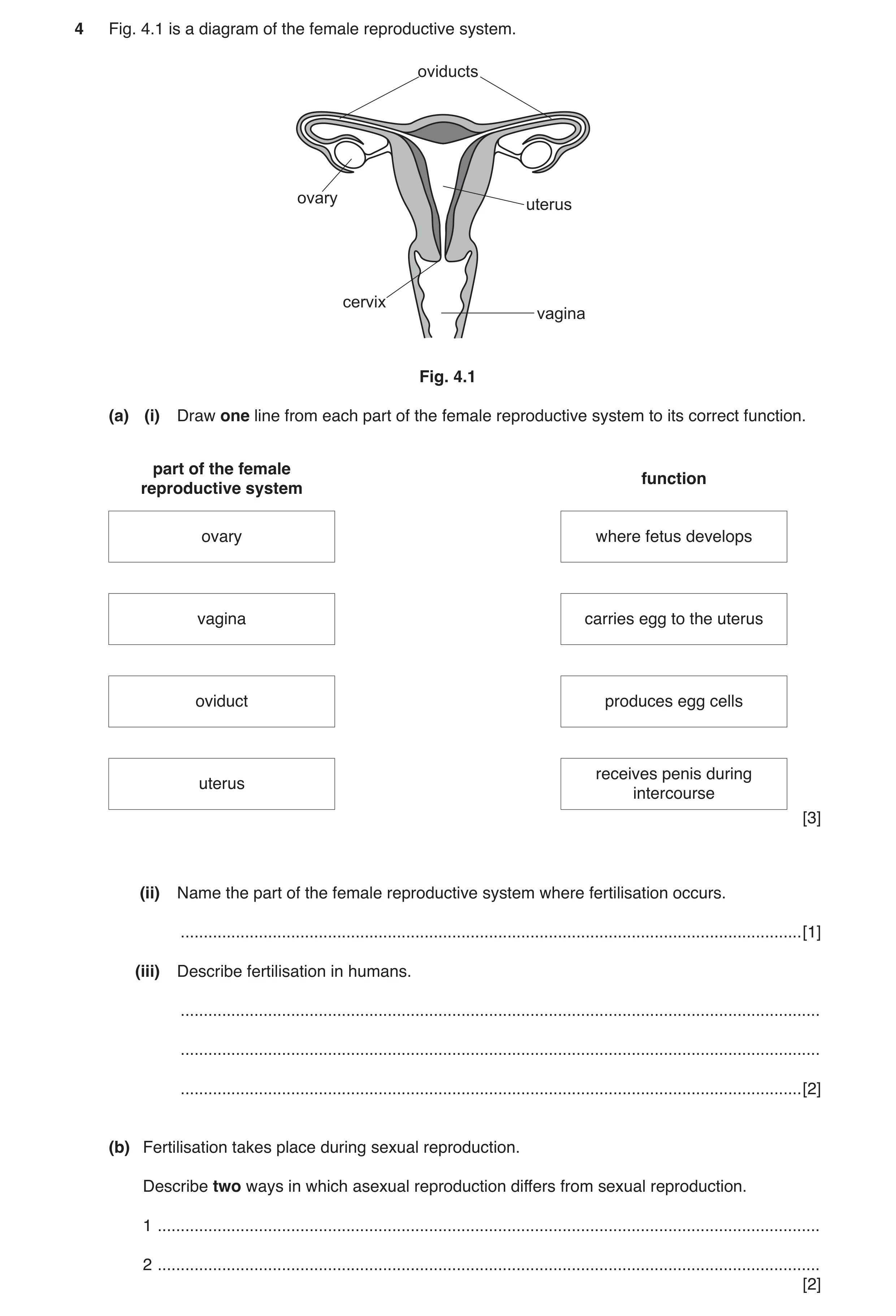
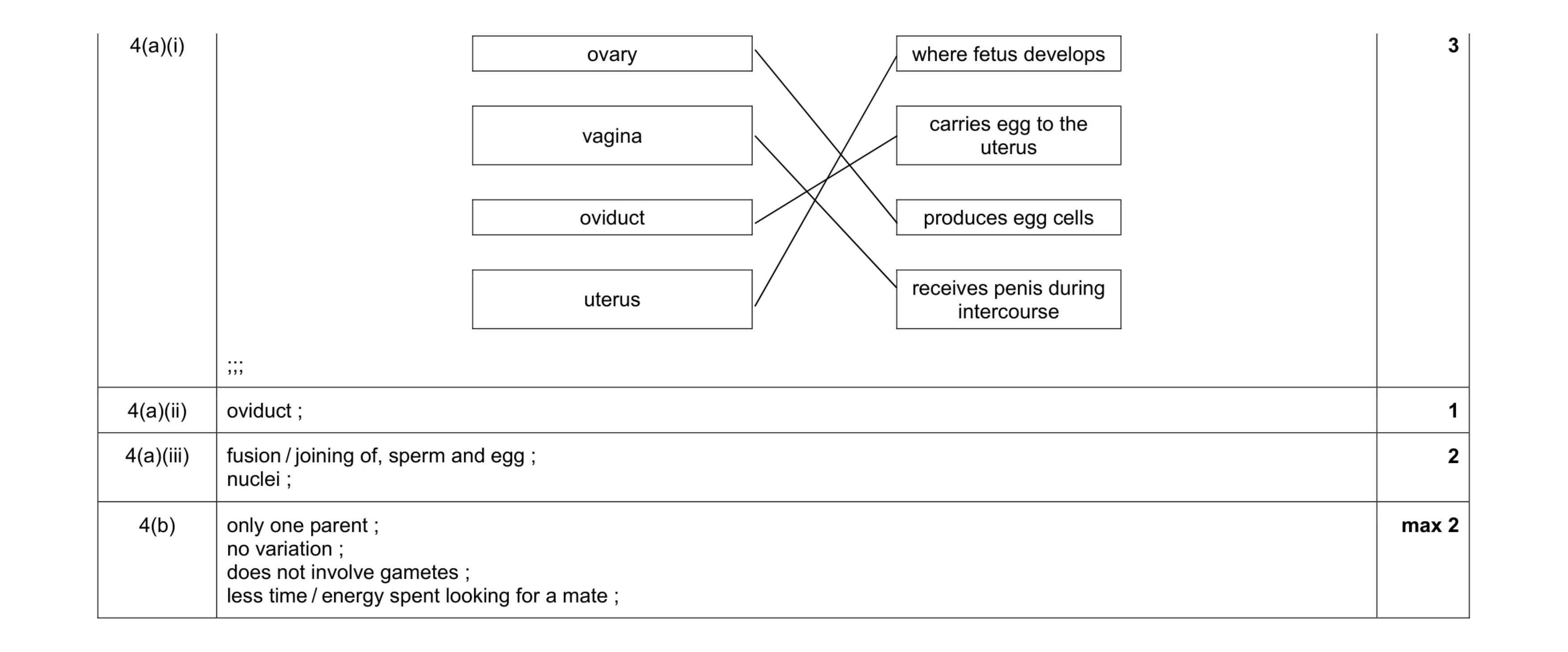
4 Fig. 4.1 is a diagram of the female reproductive system. oviducts ovary uterus cervix vagina Fig. 4.1 (a) (i) Draw one line from each part of the female reproductive system to its correct function. part of the female function reproductive system ovary where fetus develops vagina carries egg to the uterus oviduct produces egg cells receives penis during uterus intercourse [3] (ii) Name the part of the female reproductive system where fertilisation occurs. … [1] (iii) Describe fertilisation in humans. … … … [2] (b) Fertilisation takes place during sexual reproduction. Describe two ways in which asexual reproduction differs from sexual reproduction. 1 … 2 … [2]
8 marks
Mark scheme: 4(a)(i) ovary where fetus develops vagina carries egg to the uterus oviduct produces egg cells uterus receives penis during intercourse ;;; 3 4(a)(ii) oviduct ; 1 4(a)(iii) fusion / joining of, sperm and egg ; nuclei ; 2 4(b) only one parent ; no variation ; does not involve gametes ; less time / energy spent looking for a mate ; max 2
This question in 0654/31 May/June 2017
Q2 · A diagram of the male reproductive system 0654/33 May/June 2017
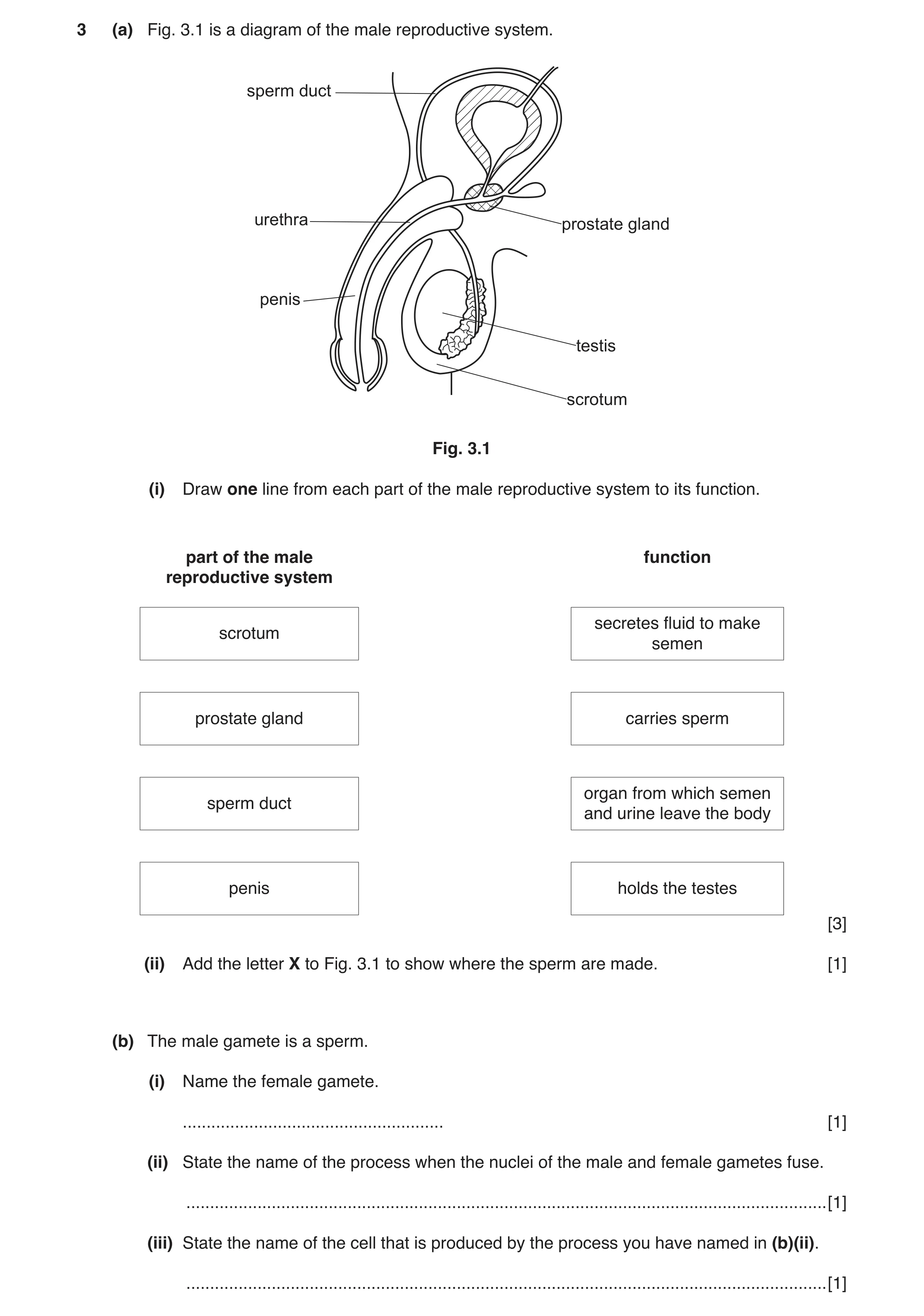
3 (a) Fig. 3.1 is a diagram of the male reproductive system. sperm duct urethra prostate gland penis testis scrotum Fig. 3.1 (i) Draw one line from each part of the male reproductive system to its function. part of the male function reproductive system secretes fluid to make scrotum semen prostate gland carries sperm organ from which semen sperm duct and urine leave the body penis holds the testes [3] (ii) Add the letter X to Fig. 3.1 to show where the sperm are made. [1] (b) The male gamete is a sperm. (i) Name the female gamete. … [1] (ii) State the name of the process when the nuclei of the male and female gametes fuse. … [1] (iii) State the name of the cell that is produced by the process you have named in (b)(ii). … [1]
7 marks
Mark scheme: 3(a)(i) scrotum secretes fluid to make semen prostate gland carries sperm sperm duct organ from which semen and urine leave the body penis holds the testes ;;; 3 3(a)(ii) ‘X’ on testis ; 1 3(b)(i) egg / ova / ovum ; 1 3(b)(ii) fertilisation ; 1 3(b)(iii) zygote ; 1
This question in 0654/33 May/June 2017
Q3 · A diagram of the female reproductive system 0654/32 Oct/Nov 2017
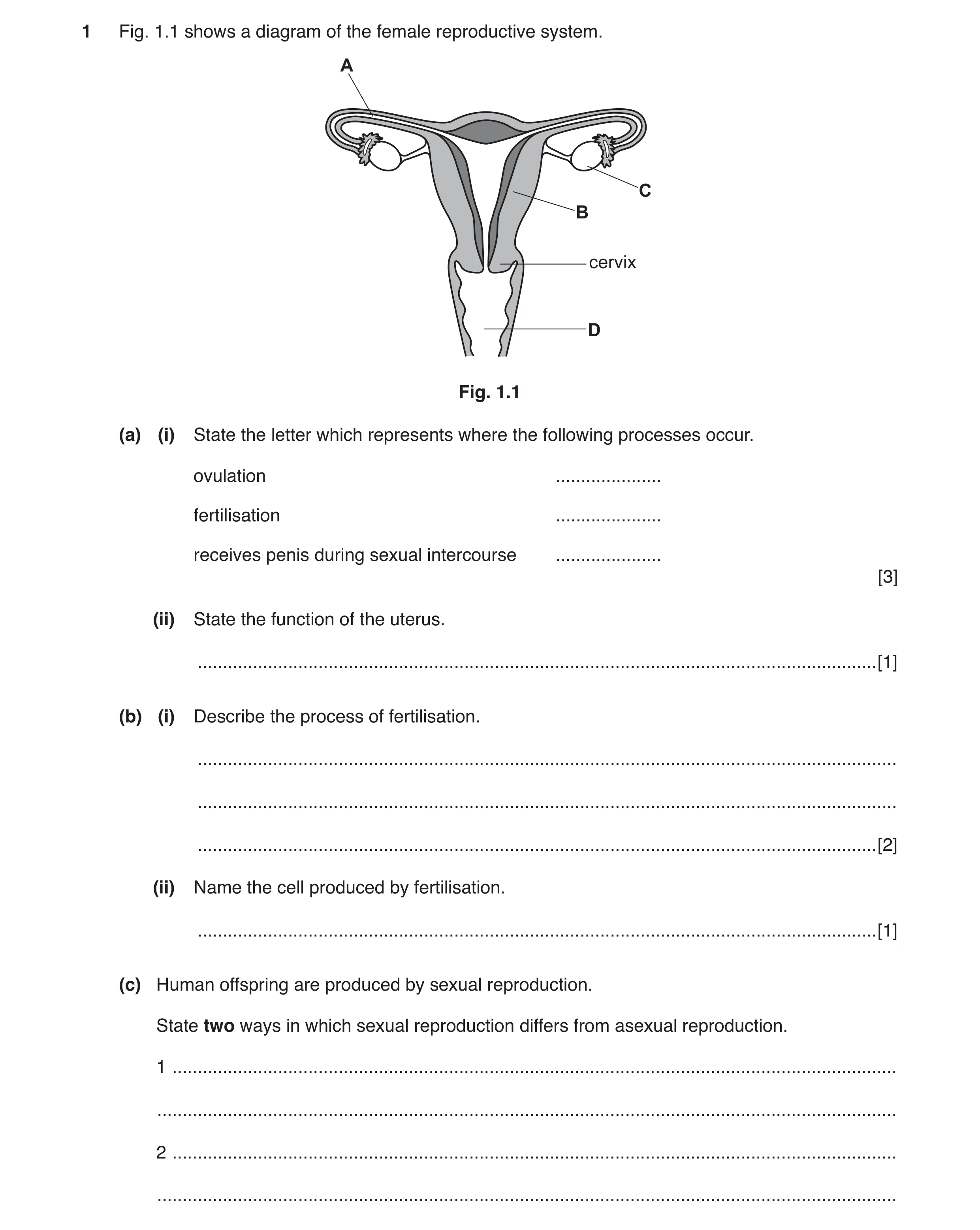
1 Fig. 1.1 shows a diagram of the female reproductive system. A C B cervix D Fig. 1.1 (a) (i) State the letter which represents where the following processes occur. ovulation … fertilisation … receives penis during sexual intercourse … [3] (ii) State the function of the uterus. … [1] (b) (i) Describe the process of fertilisation. … … … [2] (ii) Name the cell produced by fertilisation. … [1] (c) Human offspring are produced by sexual reproduction. State two ways in which sexual reproduction differs from asexual reproduction. 1 … … 2 … …
9 marks
Mark scheme: 1(a)(i) C ; A ; D ; 3 1(a)(ii) where fetus / baby, develops ; 1 1(b)(i) joining of male and female gamete / sperm and egg ; joining / fusion, of nuclei ; 2 1(b)(ii) zygote ; 1 1(c) requires two parents ; produces genetically dissimilar offspring ; involves haploid cell / gametes / sex cells ; max 2
This question in 0654/32 Oct/Nov 2017
Q4 · A diagram of the female reproductive system 0654/33 Oct/Nov 2018
7 Fig. 7.1 shows a diagram of the female reproductive system. oviducts ovary uterus uterus lining cervix vagina Fig. 7.1 (a) Mark an X on Fig. 7.1 to show where an egg is released. [1] (b) The boxes on the left show parts of the female reproductive system. The boxes on the right show functions of the parts of the reproductive system. Draw four lines to link each part of the female reproductive system with its function. part function keeps baby in place cervix during pregnancy penis placed here oviduct during intercourse where fertilisation uterus occurs where growing vagina baby develops [3] (c) The menstrual cycle lasts for approximately 28 days. Describe the main changes to the uterus lining during the menstrual cycle. days 0–5 … … days 5–18 … … days 18–28 … … [3] (d) When an egg is fertilised, it becomes a zygote. Describe, in detail, the early development of the zygote immediately after fertilisation. … … … … [3]
10 marks
Mark scheme: 7(a) X on either or both ovaries ; 1 7(b) 1 correct ; 2 or 3 correct ; 4 correct ; cervix keeps baby in place during pregnancy oviduct penis placed here during intercourse uterus where fertilisation occurs vagina where growing baby develops 3 7(c) Days 0–5 (uterus lining) shed / menstruation ; Days 5–18 (uterus lining) builds up / thickens ; Days 18–28 (uterus lining) is maintained / stays thick / remains the same ; 3 7(d) travels, down oviduct / into uterus ; divides ; forms a ball of cells ; implants into uterus wall ; max 3
This question in 0654/33 Oct/Nov 2018
Q5 · The menstrual cycle of females can vary from approximately 24 to 32 days 0654/31 May/June 2019
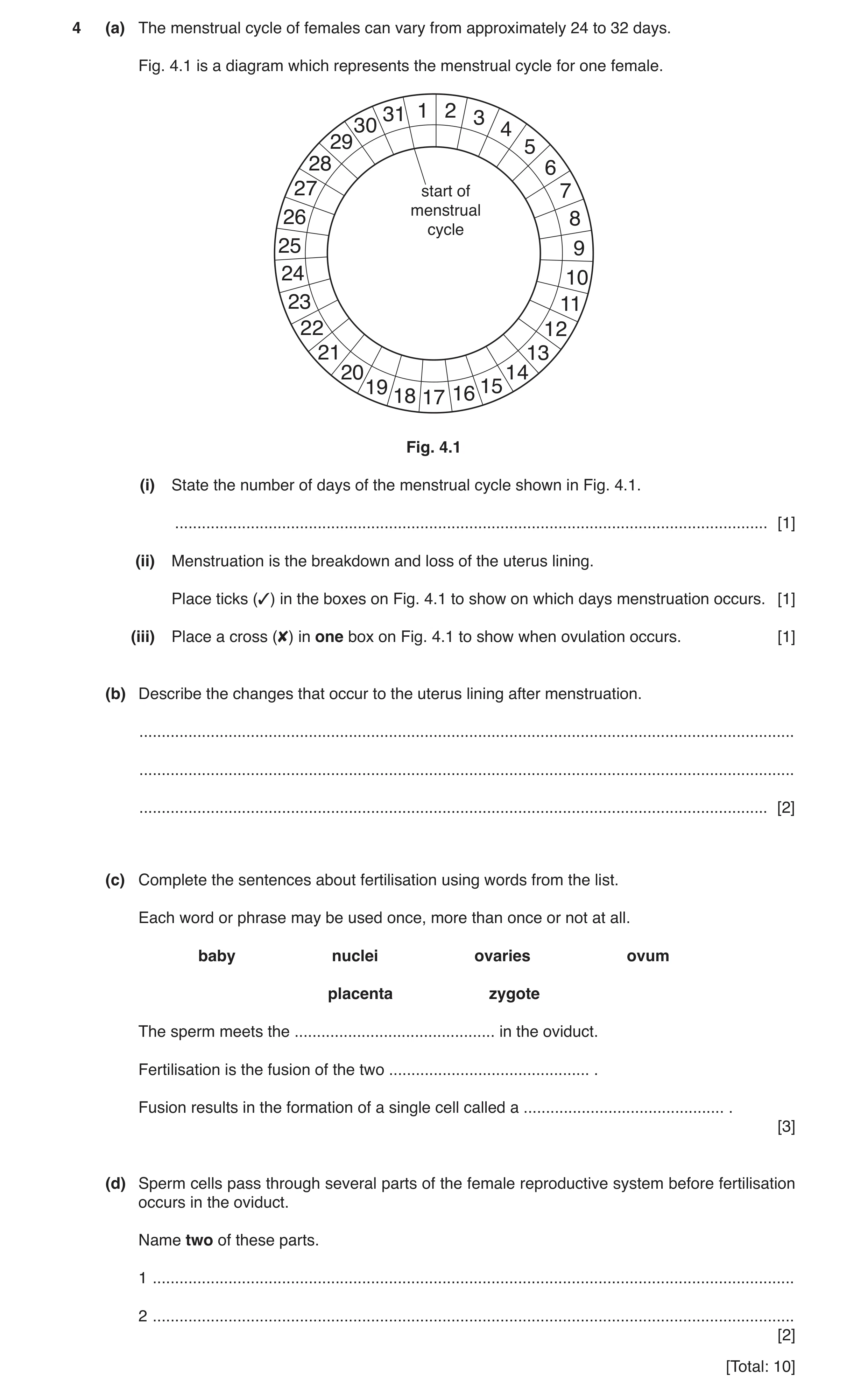
4 (a) The menstrual cycle of females can vary from approximately 24 to 32 days. Fig. 4.1 is a diagram which represents the menstrual cycle for one female. 31 1 2 3 2930 4 5 28 6 27 start of 7 26 menstrual 8 cycle 25 9 24 10 23 11 22 12 21 13 20 14 19 15 18 17 16 Fig. 4.1 (i) State the number of days of the menstrual cycle shown in Fig. 4.1. … [1] (ii) Menstruation is the breakdown and loss of the uterus lining. Place ticks (3) in the boxes on Fig. 4.1 to show on which days menstruation occurs. [1] (iii) Place a cross (8) in one box on Fig. 4.1 to show when ovulation occurs. [1] (b) Describe the changes that occur to the uterus lining after menstruation. … … … [2] (c) Complete the sentences about fertilisation using words from the list. Each word or phrase may be used once, more than once or not at all. baby nuclei ovaries ovum placenta zygote The sperm meets the … in the oviduct. Fertilisation is the fusion of the two … . Fusion results in the formation of a single cell called a … . [3] (d) Sperm cells pass through several parts of the female reproductive system before fertilisation occurs in the oviduct. Name two of these parts. 1 … 2 … [2] [Total: 10]
10 marks
Mark scheme: 4(a)(i) 31 (days) ; 1 4(a)(ii) days 1, 2, 3, 4–7 ticked ; 1 4(a)(iii) X placed in any day 12–16 ; 1 4(b) uterus lining, builds up / increases, in thickness ; and stays / maintains, thickness ; 2 4(c) ovum ; nuclei ; zygote ; 3 4(d) any two from vagina ; cervix ; uterus ; max 2
This question in 0654/31 May/June 2019
Q6 · A diagram of the male reproductive system 0654/32 May/June 2019
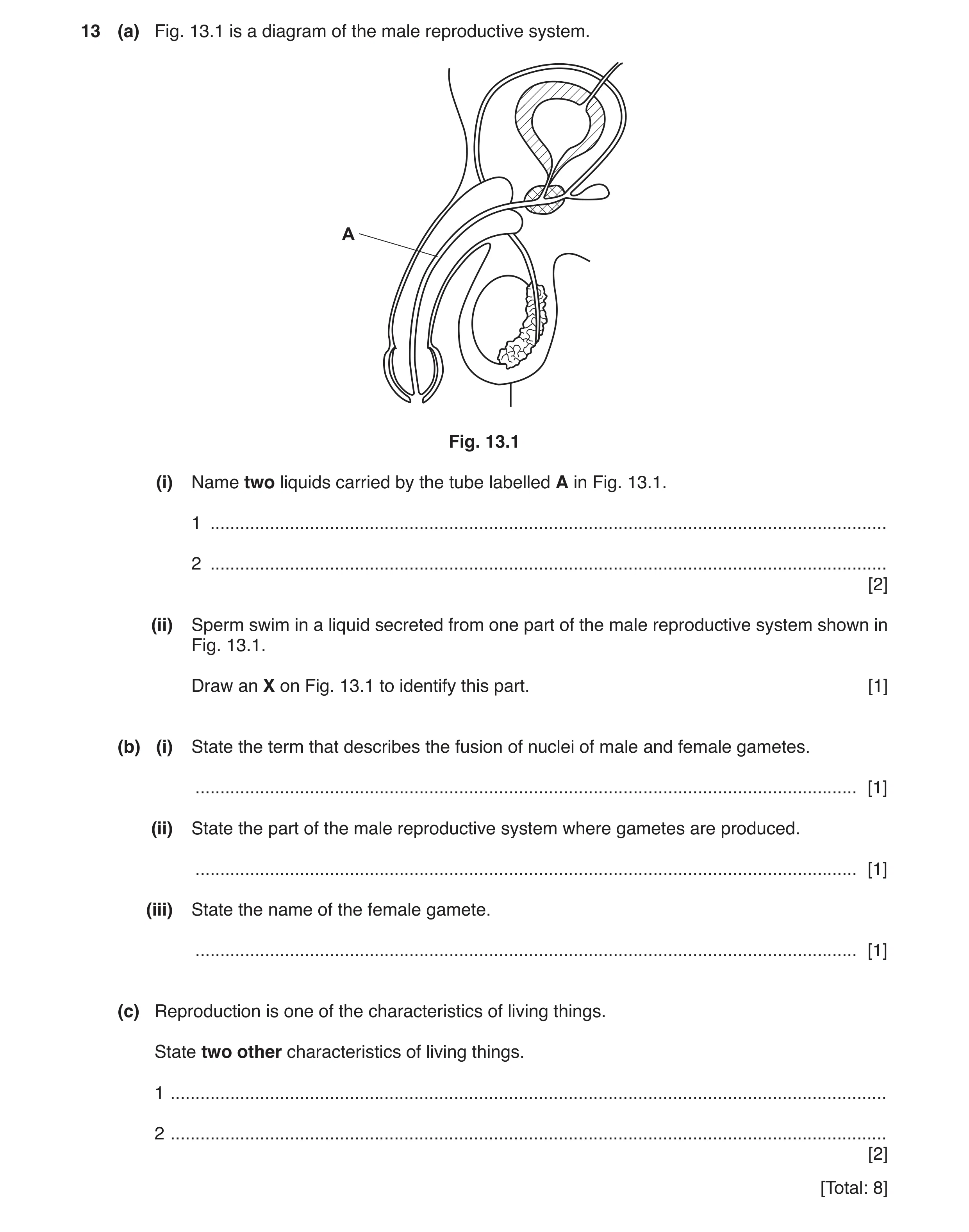
13 (a) Fig. 13.1 is a diagram of the male reproductive system. A Fig. 13.1 (i) Name two liquids carried by the tube labelled A in Fig. 13.1. 1 … 2 … [2] (ii) Sperm swim in a liquid secreted from one part of the male reproductive system shown in Fig. 13.1. Draw an X on Fig. 13.1 to identify this part. [1] (b) (i) State the term that describes the fusion of nuclei of male and female gametes. … [1] (ii) State the part of the male reproductive system where gametes are produced. … [1] (iii) State the name of the female gamete. … [1] (c) Reproduction is one of the characteristics of living things. State two other characteristics of living things. 1 … 2 … [2] [Total: 8]
8 marks
Mark scheme: 13(a)(i) semen ; urine ; 2 13(a)(ii) X marked on prostate gland ; 1 13(b)(i) fertilisation ; 1 13(b)(ii) testes ; 1 13(b)(iii) ovum ; 1 13(c) any two from movement ; respiration ; sensitivity ; growth ; excretion ; nutrition ; max 2
This question in 0654/32 May/June 2019
Q7 · A diagram of the male reproductive system 0654/33 May/June 2019
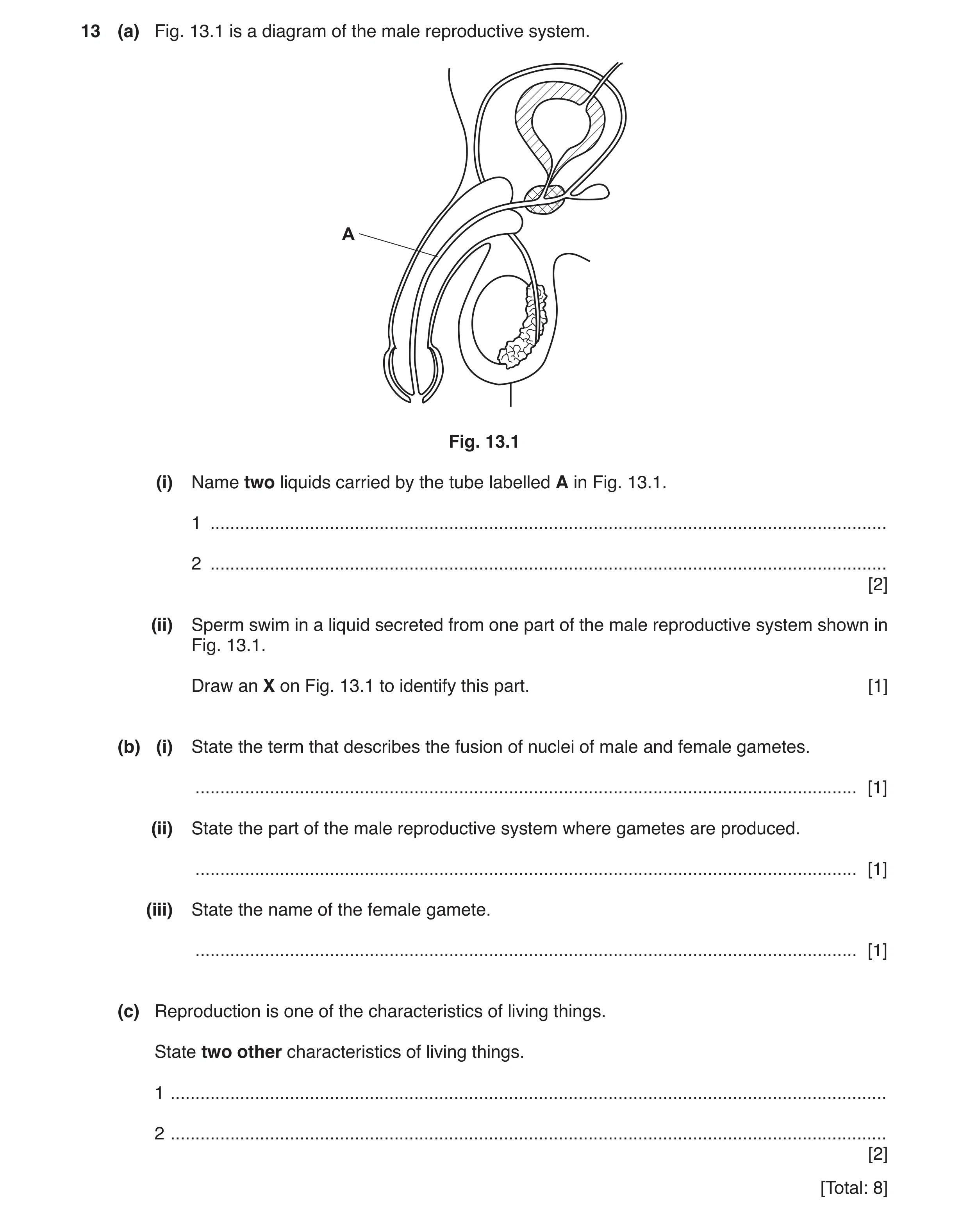
13 (a) Fig. 13.1 is a diagram of the male reproductive system. A Fig. 13.1 (i) Name two liquids carried by the tube labelled A in Fig. 13.1. 1 … 2 … [2] (ii) Sperm swim in a liquid secreted from one part of the male reproductive system shown in Fig. 13.1. Draw an X on Fig. 13.1 to identify this part. [1] (b) (i) State the term that describes the fusion of nuclei of male and female gametes. … [1] (ii) State the part of the male reproductive system where gametes are produced. … [1] (iii) State the name of the female gamete. … [1] (c) Reproduction is one of the characteristics of living things. State two other characteristics of living things. 1 … 2 … [2] [Total: 8]
8 marks
Mark scheme: 13(a)(i) semen ; urine ; 2 13(a)(ii) X marked on prostate gland ; 1 13(b)(i) fertilisation ; 1 13(b)(ii) testes ; 1 13(b)(iii) ovum ; 1 13(c) any two from movement ; respiration ; sensitivity ; growth ; excretion ; nutrition ; max 2
This question in 0654/33 May/June 2019
Q8 · A diagram of a flower 0654/32 Oct/Nov 2019
13 (a) Fig. 13.1 is a diagram of a flower. B C A D E Fig. 13.1 Table 13.1 shows some of the parts labelled in Fig. 13.1. Table 13.1 part letter in Fig. 13.1 function protects flower when in bud anther C produces pollen petal produces ovules Use Fig. 13.1 to complete Table 13.1. [3] (b) Describe fertilisation in plants. … … … [2] (c) Name the cell formed by the fusion of the nuclei of gametes. … [1] (d) State the number of parents needed for: asexual reproduction … sexual reproduction. … [1] [Total: 7]
7 marks
Mark scheme: 13(a) part letter in Fig. 5.1 function sepal E protects flower when in bud anther C produces pollen petal A attracts insects ovary D produces ovules ;;; 3 13(b) ref to pollen and ovule ; fusion of nuclei ; 2 13(c) zygote ; 1 13(d) 1 and 2 ; 1
This question in 0654/32 Oct/Nov 2019
Q9 · A diagram of the human female reproductive system 0654/31 May/June 2020
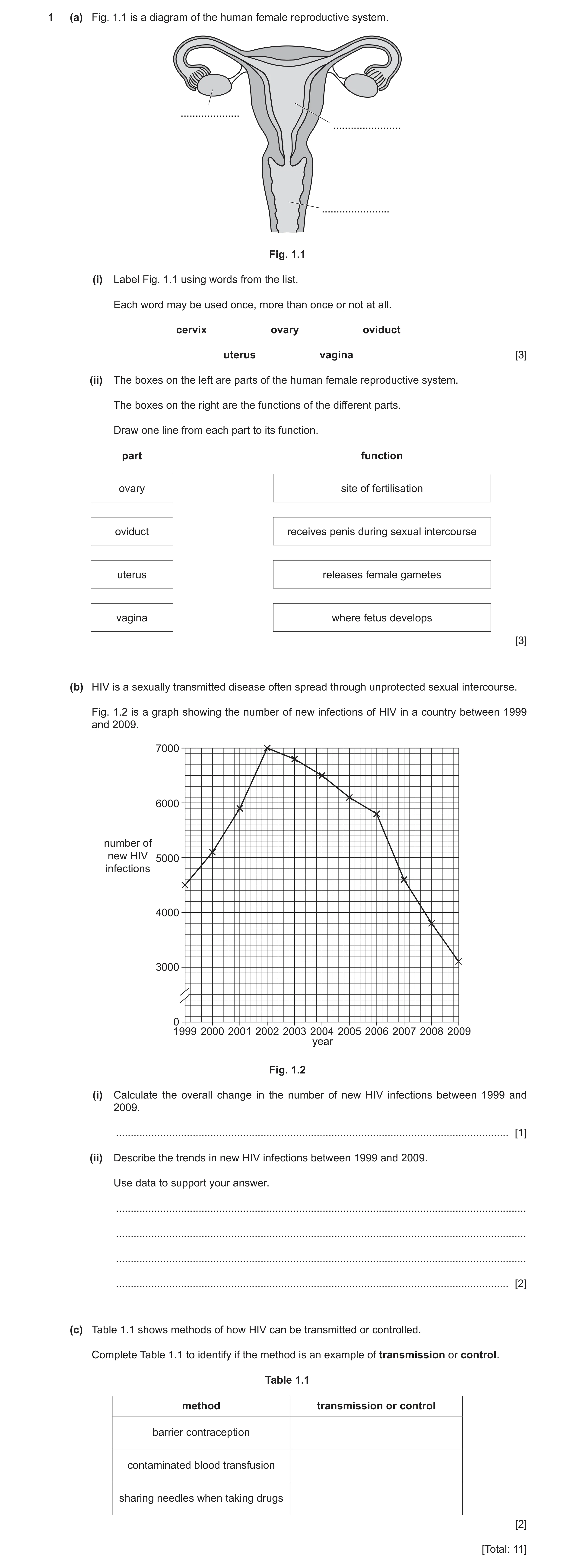
1 (a) Fig. 1.1 is a diagram of the human female reproductive system. … … … Fig. 1.1 (i) Label Fig. 1.1 using words from the list. Each word may be used once, more than once or not at all. cervix ovary oviduct uterus vagina [3] (ii) The boxes on the left are parts of the human female reproductive system. The boxes on the right are the functions of the different parts. Draw one line from each part to its function. part function ovary site of fertilisation oviduct receives penis during sexual intercourse uterus releases female gametes vagina where fetus develops [3] (b) HIV is a sexually transmitted disease often spread through unprotected sexual intercourse. Fig. 1.2 is a graph showing the number of new infections of HIV in a country between 1999 and 2009. 7000 6000 number of new HIV 5000 infections 4000 3000 0 1999 2000 2001 2002 2003 2004 2005 2006 2007 2008 2009 year Fig. 1.2 (i) Calculate the overall change in the number of new HIV infections between 1999 and 2009. … [1] (ii) Describe the trends in new HIV infections between 1999 and 2009. Use data to support your answer. … … … … [2] (c) Table 1.1 shows methods of how HIV can be transmitted or controlled. Complete Table 1.1 to identify if the method is an example of transmission or control. Table 1.1 method transmission or control barrier contraception contaminated blood transfusion sharing needles when taking drugs [2] [Total: 11]
11 marks
Mark scheme: 1(a)(i) ovary, uterus and vagina correctly labelled (clockwise from bottom left hand side) ;;; 3 1(a)(ii) ovary site of fertilisation oviduct receives penis during sexual intercourse uterus releases female gametes vagina where fetus develops ;;; 1 correct for 1 mark 2-3 correct for 2 marks all correct for 3 marks 3 1(b)(i) (4500 – 3100) = 1400 ; 1 1(b)(ii) (number of new HIV infections) increases then decreases ; peaks at, 2002 / 7000 (new infections) ; 2 1(c) control transmission transmission ;; 2 correct for 1 mark all correct for 2 marks 2
This question in 0654/31 May/June 2020
Q10 · Scientists measure the length of sperm cells from different animals 0654/31 Oct/Nov 2021
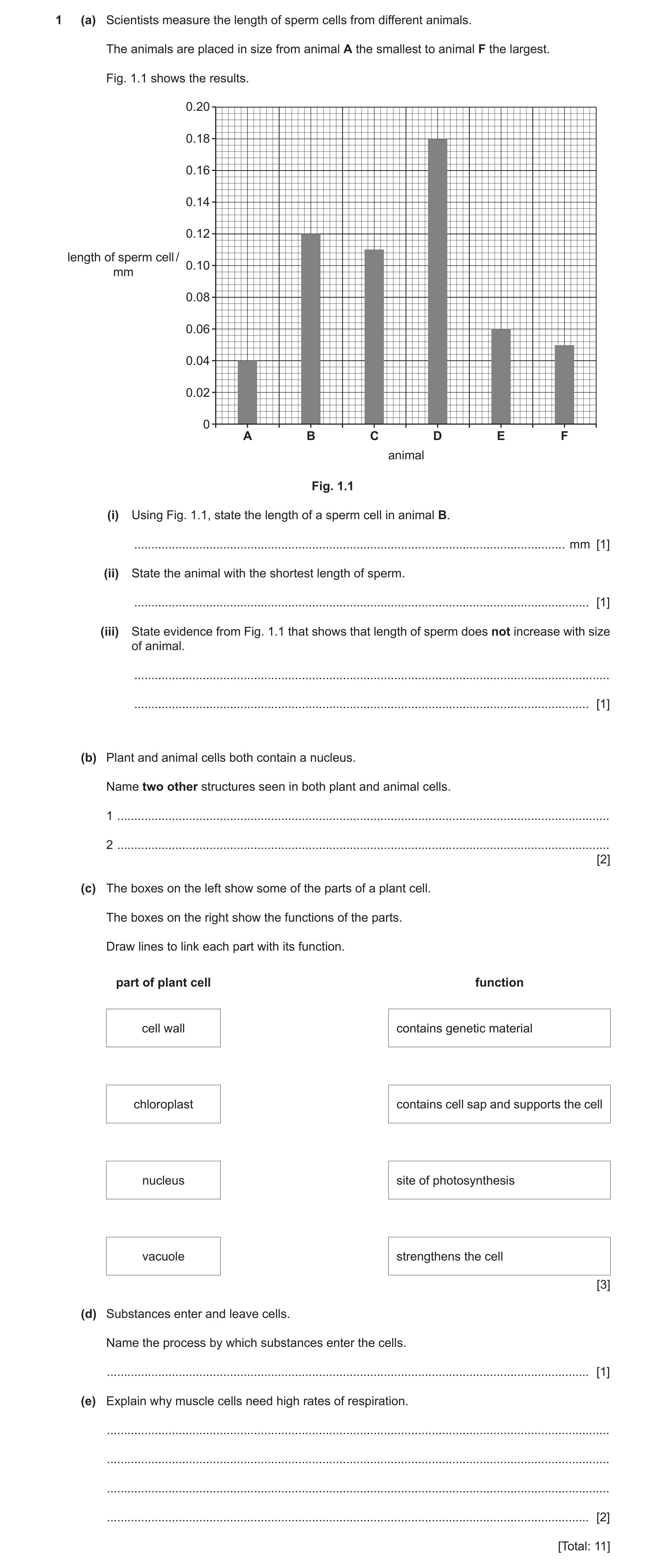
1 (a) Scientists measure the length of sperm cells from different animals. The animals are placed in size from animal A the smallest to animal F the largest. Fig. 1.1 shows the results. 0.20 0.18 0.16 0.14 0.12 length of sperm cell / 0.10 mm 0.08 0.06 0.04 0.02 0 A B C D E F animal Fig. 1.1 (i) Using Fig. 1.1, state the length of a sperm cell in animal B. … mm [1] (ii) State the animal with the shortest length of sperm. … [1] (iii) State evidence from Fig. 1.1 that shows that length of sperm does not increase with size of animal. … … [1] (b) Plant and animal cells both contain a nucleus. Name two other structures seen in both plant and animal cells. 1 … 2 … [2] (c) The boxes on the left show some of the parts of a plant cell. The boxes on the right show the functions of the parts. Draw lines to link each part with its function. part of plant cell function cell wall contains genetic material chloroplast contains cell sap and supports the cell nucleus site of photosynthesis vacuole strengthens the cell [3] (d) Substances enter and leave cells. Name the process by which substances enter the cells. … [1] (e) Explain why muscle cells need high rates of respiration. … … … … [2] [Total: 11]
11 marks
Mark scheme: 1(a)(i) 0.12 (mm) ; 1 1(a)(ii) A ; 1 1(a)(iii) animal F is the biggest but does not have the longest length of sperm / animal D has the longest sperm but is not the biggest animal / avp ; 1 1(b) any two from: cell membrane ; cytoplasm ; AVP ; e.g. ribosomes / mitochondria 2 1(c) cell wall contains genetic material chloroplast contains cell sap and supports the cell nucleus site of photosynthesis vacuole strengthens the cell ;;; 3 1(d) diffusion ; 1 1(e) respiration releases energy ; (energy is required) for muscle contraction / movement ; 2
This question in 0654/31 Oct/Nov 2021
Q11 · A diagram of the male reproductive system in humans 0654/31 Oct/Nov 2021
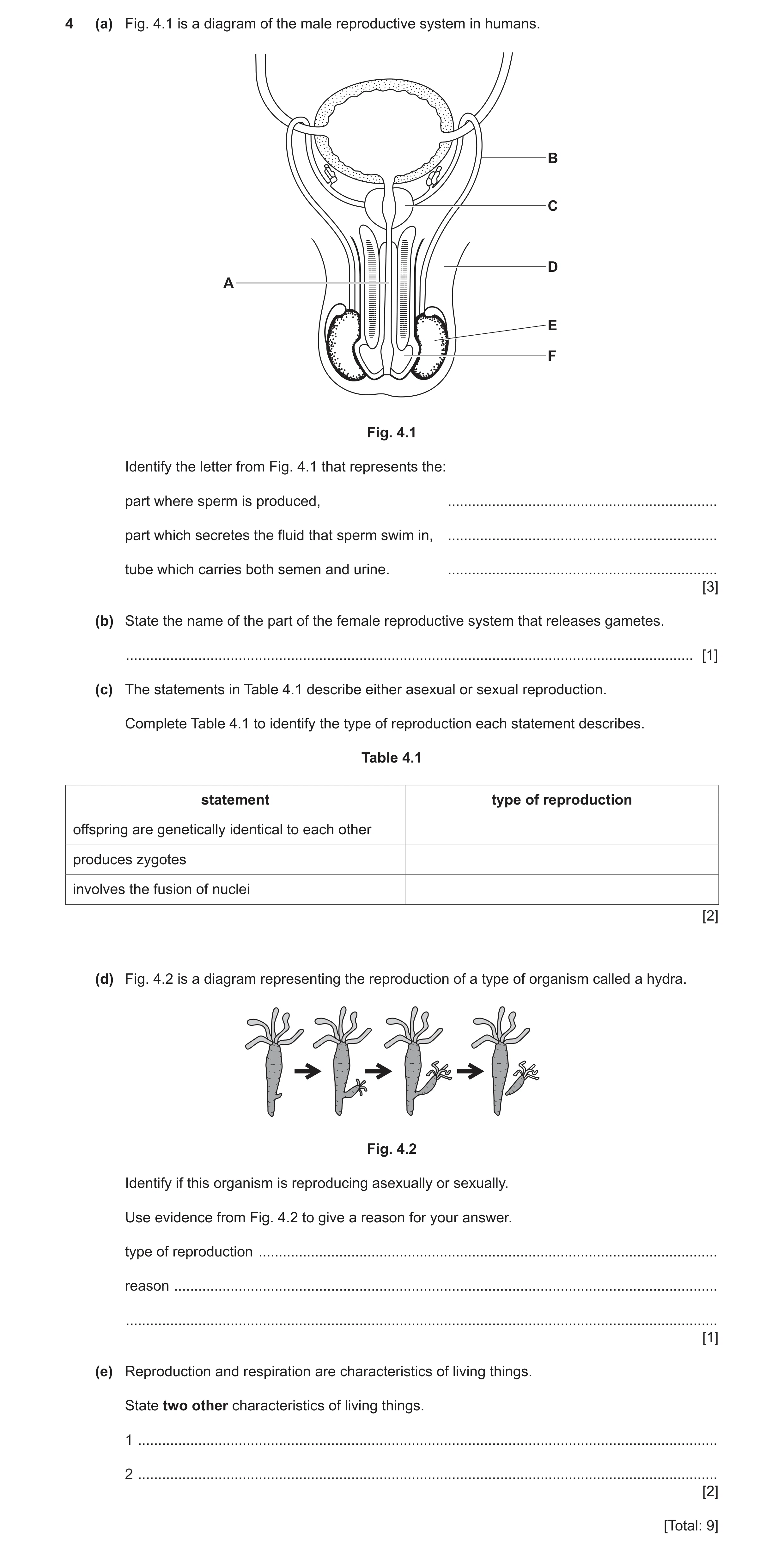
4 (a) Fig. 4.1 is a diagram of the male reproductive system in humans. B C D A E F Fig. 4.1 Identify the letter from Fig. 4.1 that represents the: part where sperm is produced, … part which secretes the fluid that sperm swim in, … tube which carries both semen and urine. … [3] (b) State the name of the part of the female reproductive system that releases gametes. … [1] (c) The statements in Table 4.1 describe either asexual or sexual reproduction. Complete Table 4.1 to identify the type of reproduction each statement describes. Table 4.1 statement type of reproduction offspring are genetically identical to each other produces zygotes involves the fusion of nuclei [2] (d) Fig. 4.2 is a diagram representing the reproduction of a type of organism called a hydra. Fig. 4.2 Identify if this organism is reproducing asexually or sexually. Use evidence from Fig. 4.2 to give a reason for your answer. type of reproduction … reason … … [1] (e) Reproduction and respiration are characteristics of living things. State two other characteristics of living things. 1 … 2 … [2] [Total: 9]
9 marks
Mark scheme: 4(a) E ; C ; A ; 3 4(b) ovary ; 1 4(c) asexual sexual sexual ;; 2 4(d) asexual offspring produced by only one parent ; 1 Question Answer Marks 4(e) any two from: movement ; sensitivity ; growth ; excretion ; nutrition ; 2
This question in 0654/31 Oct/Nov 2021
Q12 · The inheritance of smooth or wrinkled skin in pea plants is controlled by a single gene 0654/31 May/June 2022
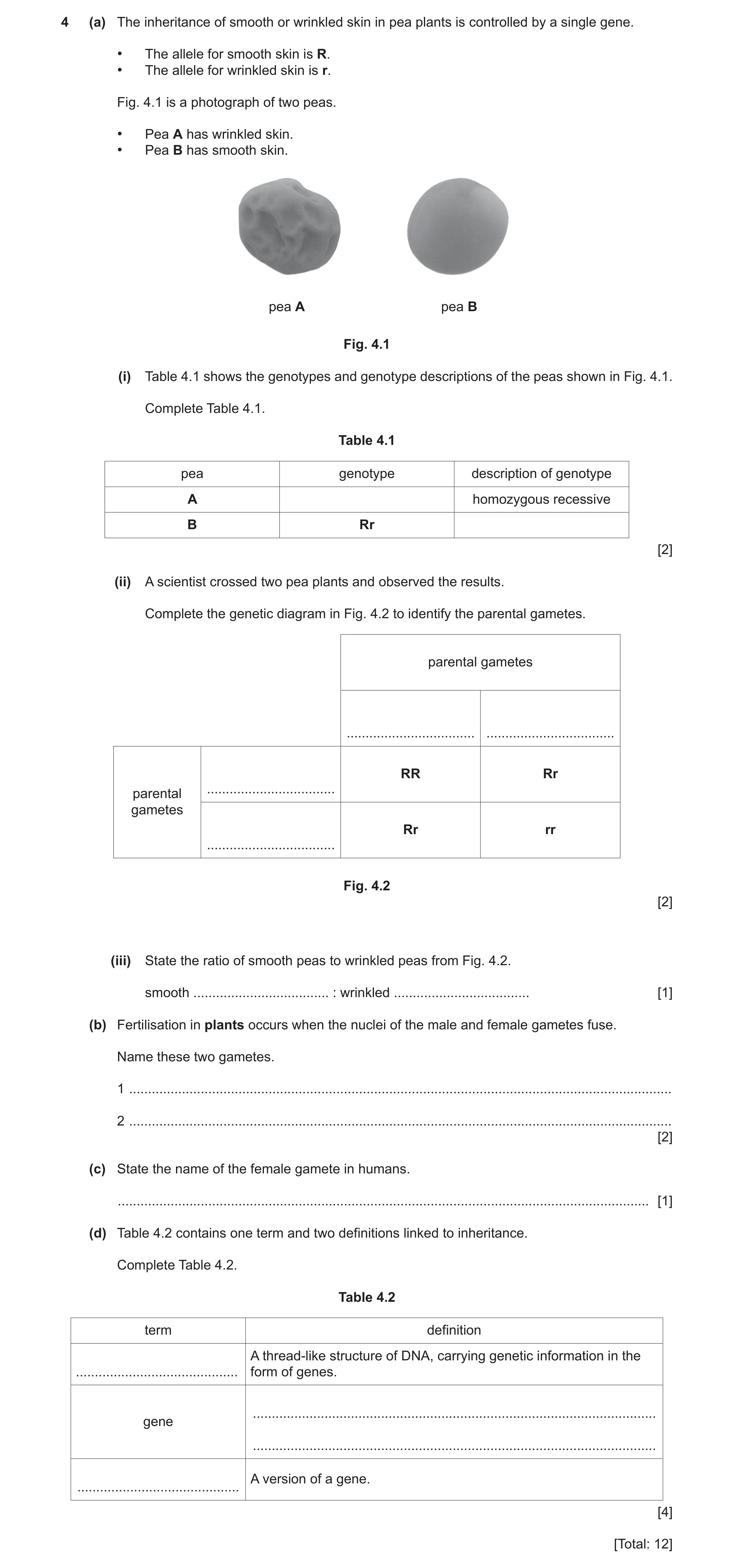
4 (a) The inheritance of smooth or wrinkled skin in pea plants is controlled by a single gene. • The allele for smooth skin is R. • The allele for wrinkled skin is r. Fig. 4.1 is a photograph of two peas. • Pea A has wrinkled skin. • Pea B has smooth skin. pea A pea B Fig. 4.1 (i) Table 4.1 shows the genotypes and genotype descriptions of the peas shown in Fig. 4.1. Complete Table 4.1. Table 4.1 pea genotype description of genotype A homozygous recessive B Rr [2] (ii) A scientist crossed two pea plants and observed the results. Complete the genetic diagram in Fig. 4.2 to identify the parental gametes. parental gametes … … RR Rr … parental gametes Rr rr … Fig. 4.2 [2] (iii) State the ratio of smooth peas to wrinkled peas from Fig. 4.2. smooth … : wrinkled … [1] (b) Fertilisation in plants occurs when the nuclei of the male and female gametes fuse. Name these two gametes. 1 … 2 … [2] (c) State the name of the female gamete in humans. … [1] (d) Table 4.2 contains one term and two definitions linked to inheritance. Complete Table 4.2. Table 4.2 term definition A thread-like structure of DNA, carrying genetic information in the … form of genes. … gene … A version of a gene … [4] [Total: 12]
12 marks
Mark scheme: 4(a)(i) pea genotype description of genotype A rr ; homozygous recessive B Rr heterozygous ; 2 4(a)(ii) parental gametes R r parental gametes R RR Rr r Rr rr 2 4(a)(iii) smooth 3 : wrinkled 1 ; 1 4(b) pollen ; ovule ; 2 4(c) egg / ovum ; 1 4(d) chromosome ; length of DNA ; that codes for a protein ; allele ; 4
This question in 0654/31 May/June 2022
Q13 · A diagram of the male reproductive system 0654/31 May/June 2022
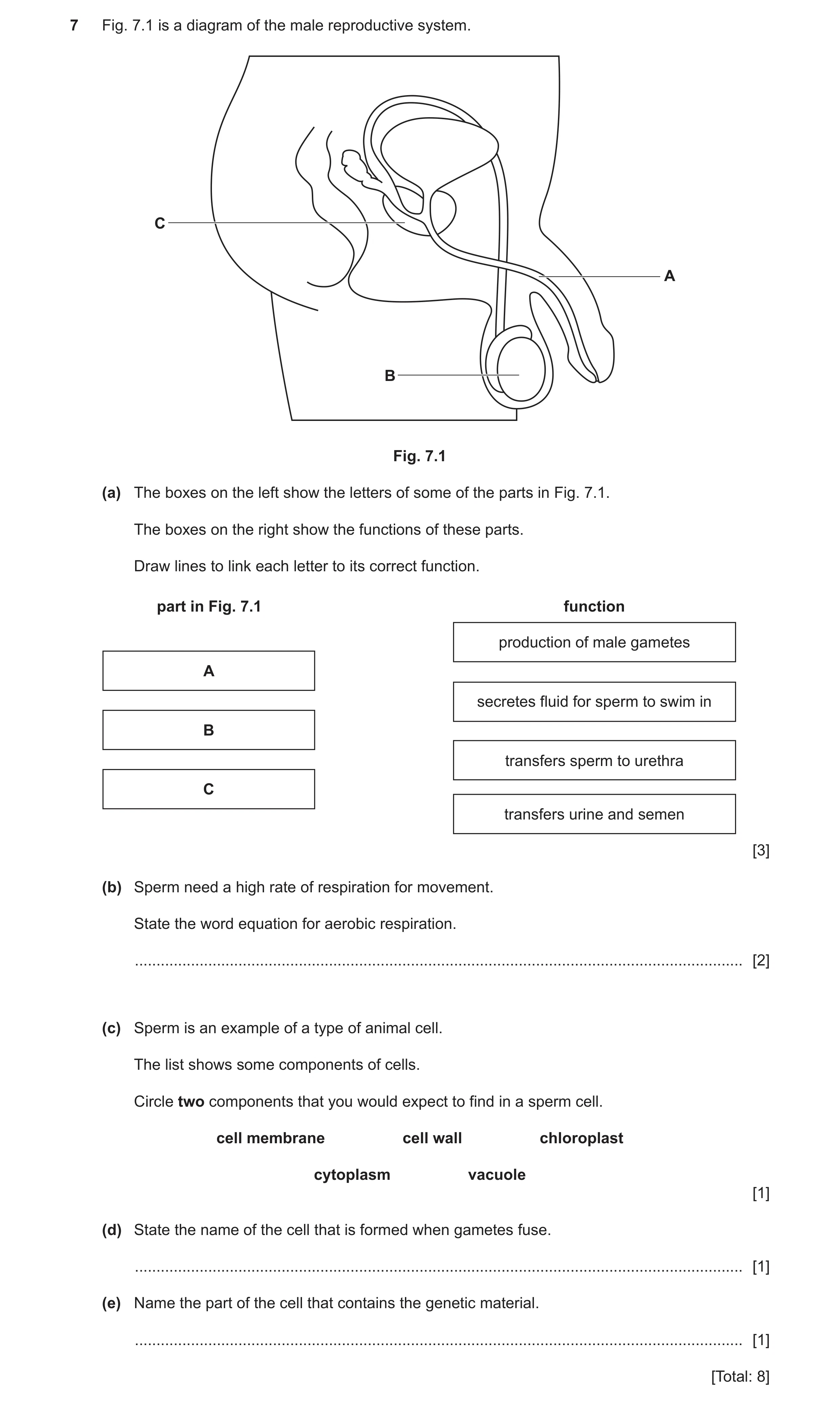
7 Fig. 7.1 is a diagram of the male reproductive system. C A B Fig. 7.1 (a) The boxes on the left show the letters of some of the parts in Fig. 7.1. The boxes on the right show the functions of these parts. Draw lines to link each letter to its correct function. part in Fig. 7.1 function production of male gametes A secretes fluid for sperm to swim in B transfers sperm to urethra C transfers urine and semen [3] (b) Sperm need a high rate of respiration for movement. State the word equation for aerobic respiration. … [2] (c) Sperm is an example of a type of animal cell. The list shows some components of cells. Circle two components that you would expect to find in a sperm cell. cell membrane cell wall chloroplast cytoplasm vacuole [1] (d) State the name of the cell that is formed when gametes fuse. … [1] (e) Name the part of the cell that contains the genetic material. … [1] [Total: 8]
8 marks
Mark scheme: 7(a) production of male gametes A secretes fluid for sperm to swim in B transfers sperm to urethra C transfers urine and semen 3 Question Answer Marks 7(b) glucose + oxygen carbon dioxide + water LHS 1; RHS 1; 2 7(c) cell membrane and cytoplasm circled ; 1 7(d) zygote ; 1 7(e) nucleus ; 1
This question in 0654/31 May/June 2022
Q14 · A diagram of an insect-pollinated flower 0654/32 Oct/Nov 2022
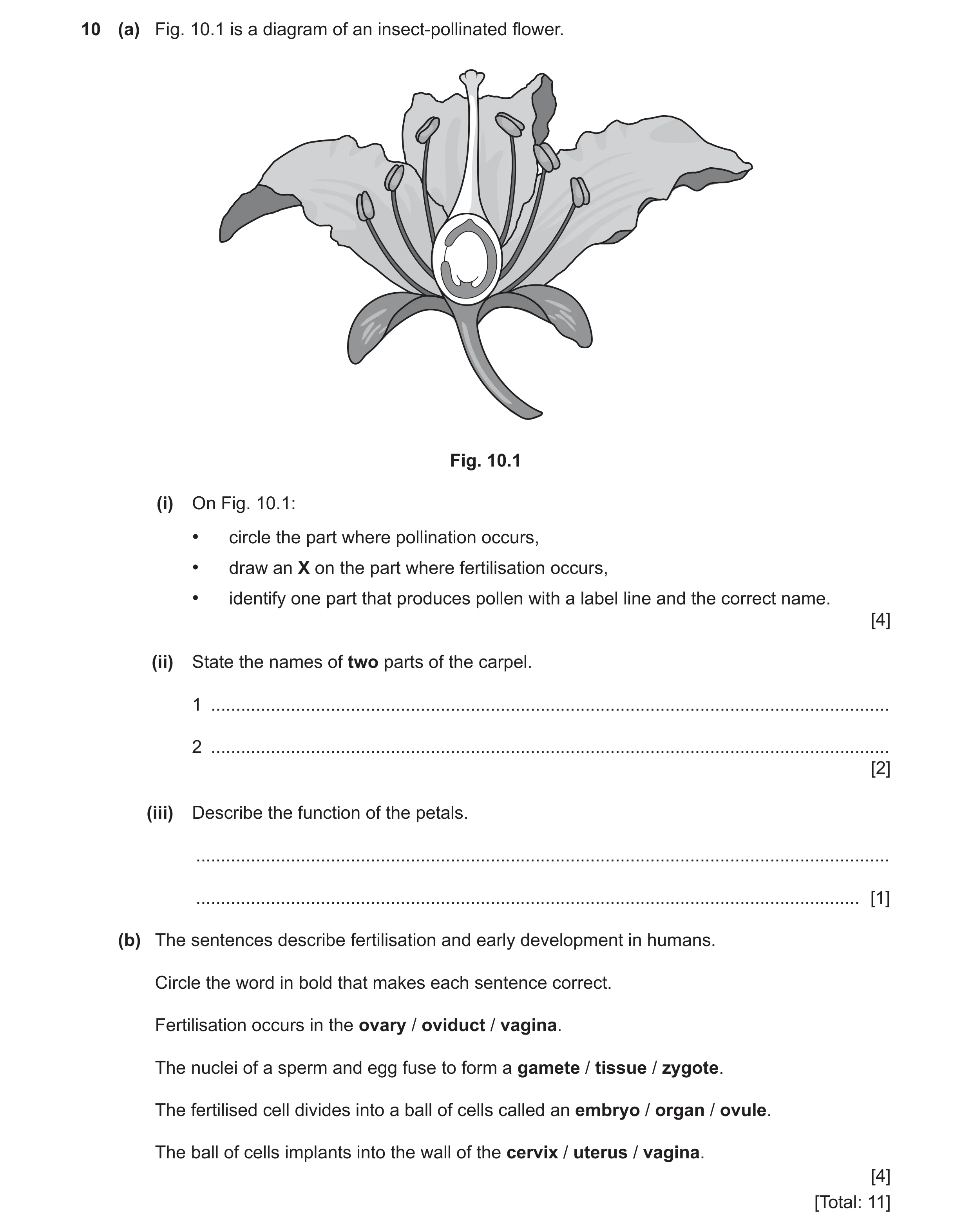
10 (a) Fig. 10.1 is a diagram of an insect-pollinated flower. Fig. 10.1 (i) On Fig. 10.1: • circle the part where pollination occurs, • draw an X on the part where fertilisation occurs, • identify one part that produces pollen with a label line and the correct name. [4] (ii) State the names of two parts of the carpel. 1 … 2 … [2] (iii) Describe the function of the petals. … … [1] (b) The sentences describe fertilisation and early development in humans. Circle the word in bold that makes each sentence correct. Fertilisation occurs in the ovary / oviduct / vagina. The nuclei of a sperm and egg fuse to form a gamete / tissue / zygote. The fertilised cell divides into a ball of cells called an embryo / organ / ovule. The ball of cells implants into the wall of the cervix / uterus / vagina. [4] [Total: 11]
11 marks
Mark scheme: 10(a)(i) 4 circle around stigma ; X on ovule ; label line to anther with correct name ;; 10(a)(ii) any two from: 2 style ; stigma ; ovary ; 10(a)(iii) attract (named), pollinator/insects (for pollination) ; 1 10(b) oviduct ; 4 zygote ; embryo ; uterus ;
This question in 0654/32 Oct/Nov 2022
Q15 · Students in a school measure their hand-span 0654/33 Oct/Nov 2022
7 (a) Students in a school measure their hand-span. Fig. 7.1 is a photograph showing the measurement that each student takes. Fig. 7.1 Fig. 7.2 is a histogram showing the results. 14 12 10 8 number of students 6 4 2 0 17.0–17.9 18.0–18.9 19.0–19.9 20.0–20.9 21.0–21.9 22.0–22.9 23.0–23.9 24.0–24.9 25.0–25.9 26.0–26.9 27.0–27.9 hand-span category / cm Fig. 7.2 (i) Determine which hand-span category has the most students. … cm [1] (ii) Determine the number of students with a hand-span of 19.0–19.9 cm. … [1] (iii) Histograms are used to display data that show continuous variation. What other evidence from Fig. 7.2 shows that hand-span is an example of continuous variation? … … [1] (iv) State the name of one other example of continuous variation. … [1] (b) Fig. 7.3 is an incomplete Punnett square, genetic diagram. (i) Complete Fig. 7.3 to show how sex is inherited in humans. male sex chromosomes X Y female sex chromosomes Fig. 7.3 [2] (ii) Use Fig. 7.3 to determine the ratio of male offspring to female offspring. … male : … female [1] (c) Several structures are involved in inheritance. chromosomes DNA gene nucleus Place structures from the list in order of size from smallest to largest. smallest … … … largest … [2] [Total: 9]
9 marks
Mark scheme: 7(a)(i) 22.0–22.9 (cm) ; 1 7(a)(ii) 4 ; 1 7(a)(iii) there is a range (of hand spans between two extremes) ; 1 7(a)(iv) height / any valid point ; 1 7(b)(i) correct female sex chromosomes ; 2 correct offspring chromosomes ; 7(b)(ii) 1:1 ; 1 7(c) DNA 2 gene chromosome nucleus ;; 1 mark for DNA and nucleus in correct place 1 mark for gene smaller than chromosome (in any position)
This question in 0654/33 Oct/Nov 2022
Q16 · Albinism is a condition in humans where no pigment is made by the skin 0654/32 Feb/March 2023
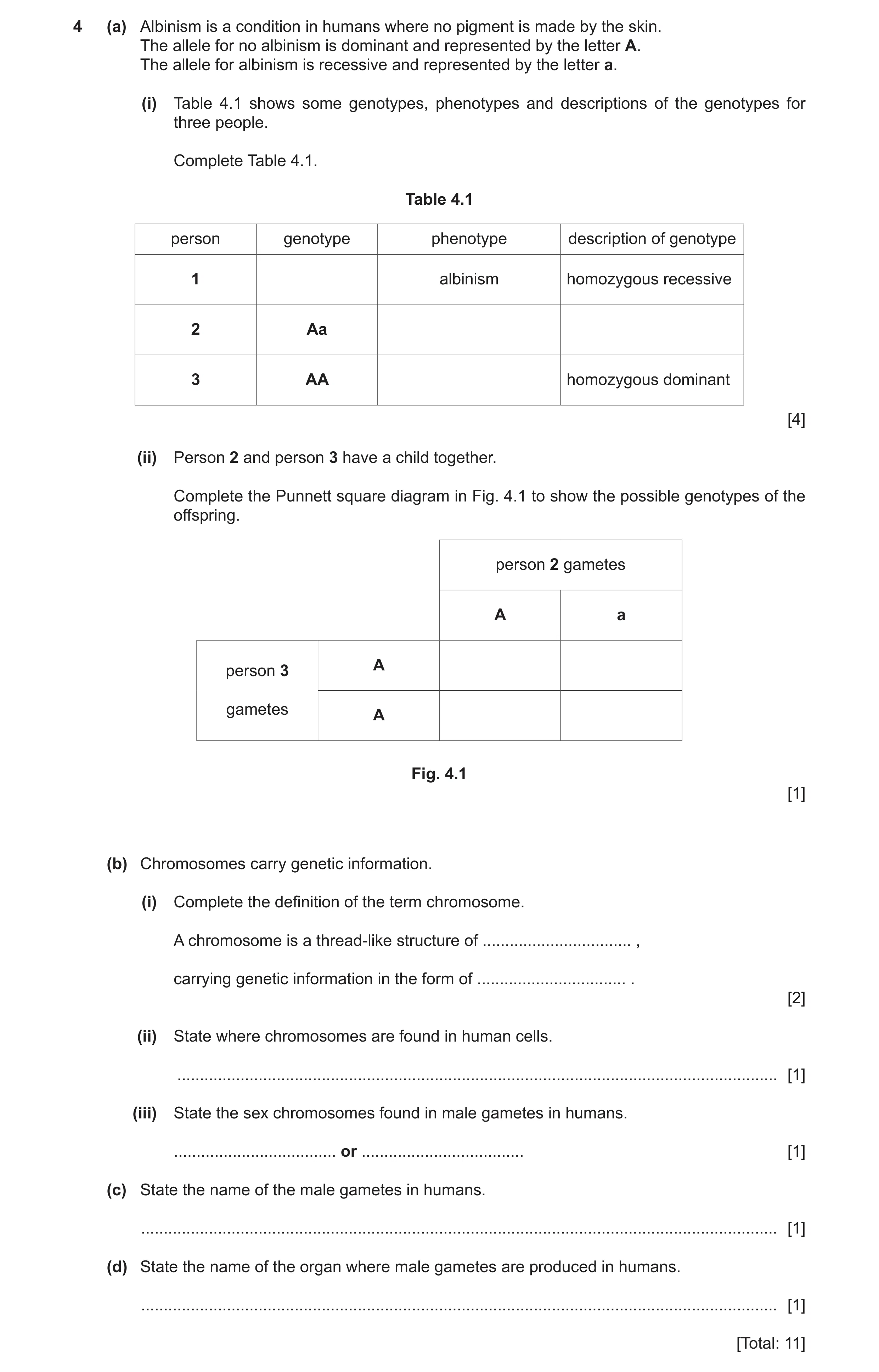
4 (a) Albinism is a condition in humans where no pigment is made by the skin. The allele for no albinism is dominant and represented by the letter A. The allele for albinism is recessive and represented by the letter a. (i) Table 4.1 shows some genotypes, phenotypes and descriptions of the genotypes for three people. Complete Table 4.1. Table 4.1 person genotype phenotype description of genotype 1 albinism homozygous recessive 2 Aa 3 AA homozygous dominant [4] (ii) Person 2 and person 3 have a child together. Complete the Punnett square diagram in Fig. 4.1 to show the possible genotypes of the offspring. person 2 gametes A a A person 3 gametes A Fig. 4.1 [1] (b) Chromosomes carry genetic information. (i) Complete the definition of the term chromosome. A chromosome is a thread-like structure of … , carrying genetic information in the form of … . [2] (ii) State where chromosomes are found in human cells. … [1] (iii) State the sex chromosomes found in male gametes in humans. … or … [1] (c) State the name of the male gametes in humans. … [1] (d) State the name of the organ where male gametes are produced in humans. … [1] [Total: 11]
11 marks
Mark scheme: 4(a)(i) 4 aa ; albinism homozygous recessive Aa no albinism ; heterozygous ; AA no albinism ; homozygous dominant 4(a)(ii) 1 AA Aa AA Aa ; 4(b)(i) DNA ; 2 genes ; 4(b)(ii) nucleus ; 1 4(b)(iii) X and Y ; 1 4(c) sperm ; 1 4(d) testes ; 1
This question in 0654/32 Feb/March 2023
Q17 · A diagram of a flower 0654/32 May/June 2023
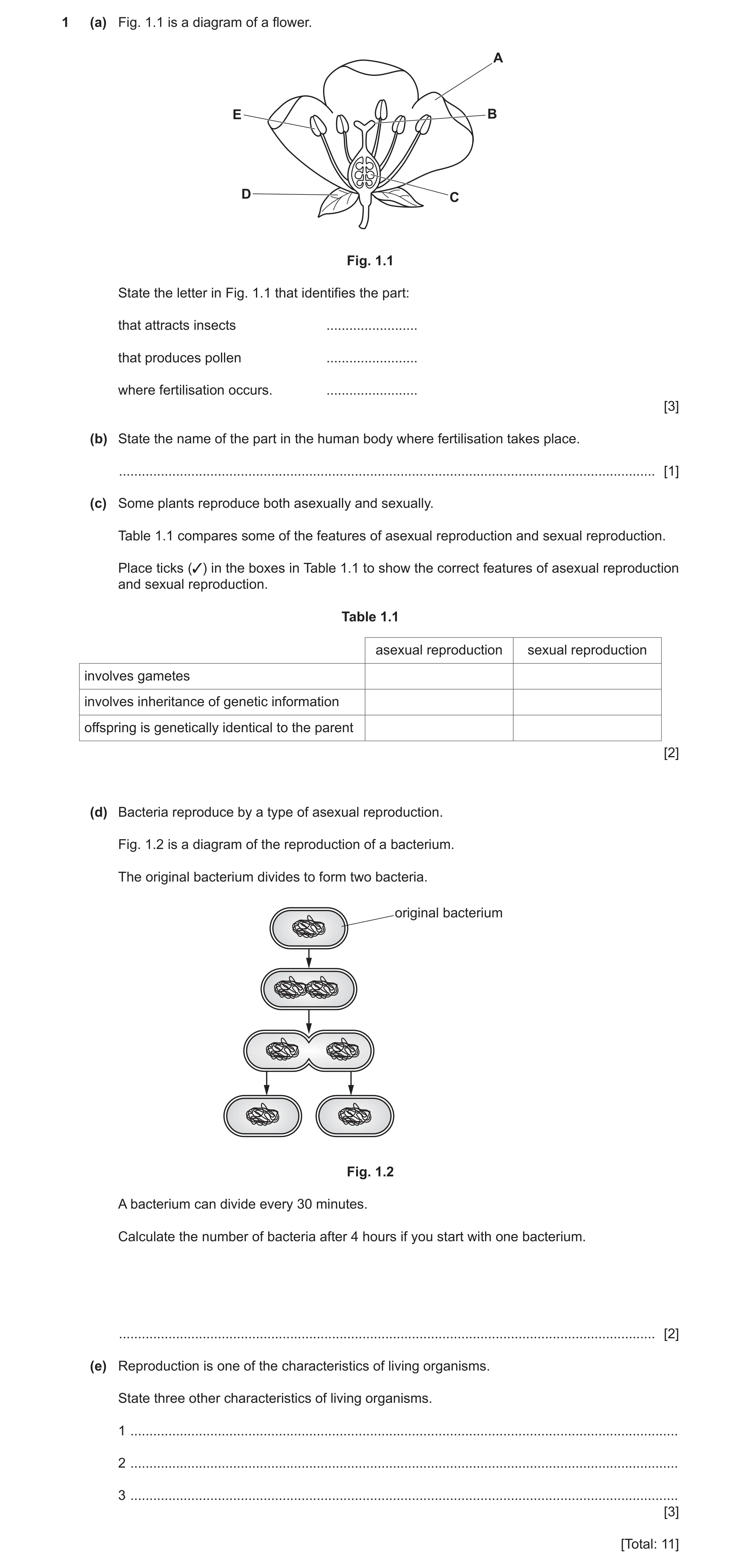
1 (a) Fig. 1.1 is a diagram of a flower. A E B D C Fig. 1.1 State the letter in Fig. 1.1 that identifies the part: that attracts insects … that produces pollen … where fertilisation occurs. … [3] (b) State the name of the part in the human body where fertilisation takes place. … [1] (c) Some plants reproduce both asexually and sexually. Table 1.1 compares some of the features of asexual reproduction and sexual reproduction. Place ticks (3) in the boxes in Table 1.1 to show the correct features of asexual reproduction and sexual reproduction. Table 1.1 asexual reproduction sexual reproduction involves gametes involves inheritance of genetic information offspring is genetically identical to the parent [2] (d) Bacteria reproduce by a type of asexual reproduction. Fig. 1.2 is a diagram of the reproduction of a bacterium. The original bacterium divides to form two bacteria. original bacterium Fig. 1.2 A bacterium can divide every 30 minutes. Calculate the number of bacteria after 4 hours if you start with one bacterium. … [2] (e) Reproduction is one of the characteristics of living organisms. State three other characteristics of living organisms. 1 … 2 … 3 … [3] [Total: 11]
11 marks
Mark scheme: 1(a) A ; E ; C ; 3 1(b) oviduct ; 1 1(c) asexual reproduction sexual reproduction involves gametes involves inheritance of genetic information offspring is genetically identical to the parent ;; 2 1(d) ref to 8 divisions ; 28 = 256 ; 2 1(e) any three from: movement ; respiration ; sensitivity ; growth ; excretion ; nutrition ; 3
This question in 0654/32 May/June 2023
Q18 · A diagram of a flower 0654/33 May/June 2023
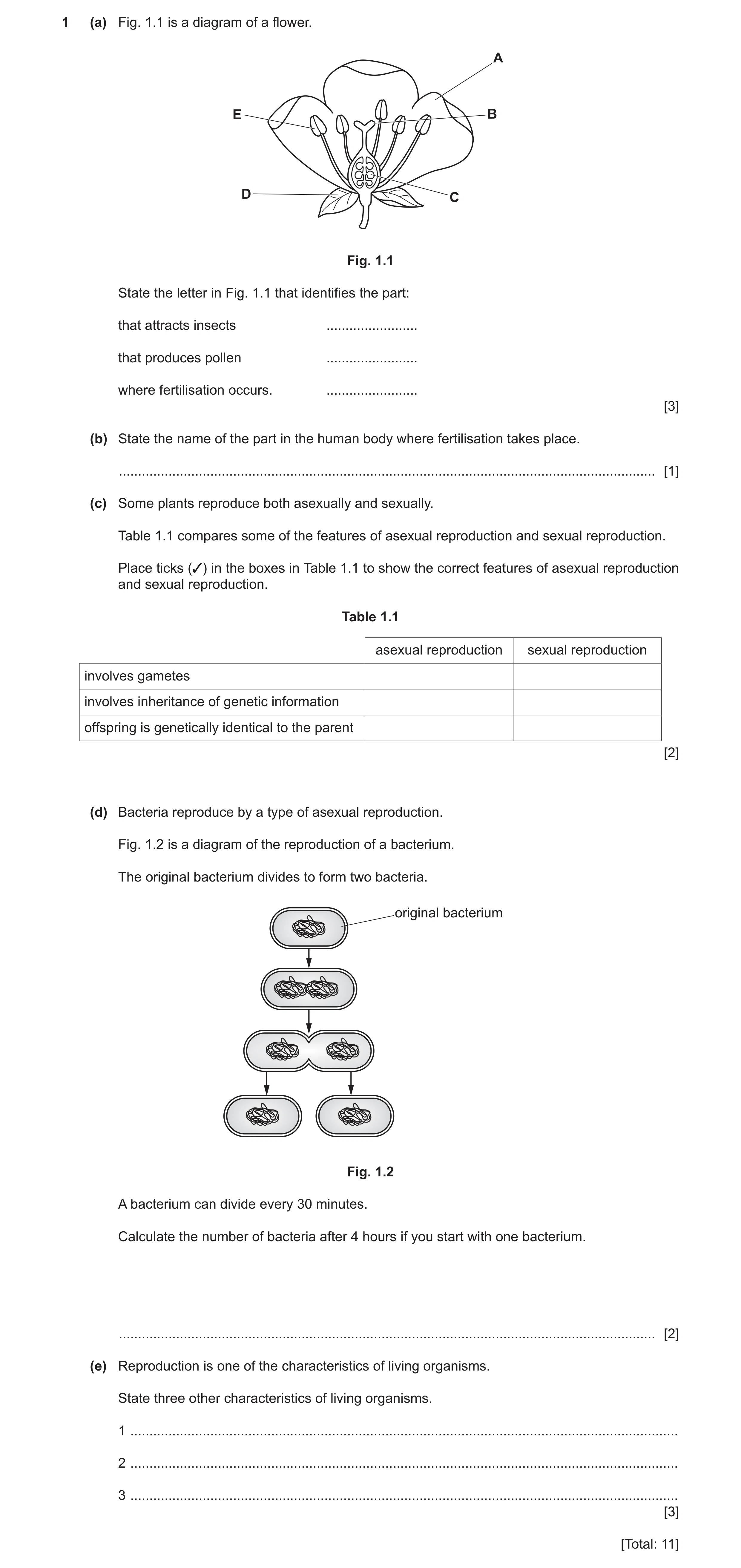
1 (a) Fig. 1.1 is a diagram of a flower. A E B D C Fig. 1.1 State the letter in Fig. 1.1 that identifies the part: that attracts insects … that produces pollen … where fertilisation occurs. … [3] (b) State the name of the part in the human body where fertilisation takes place. … [1] (c) Some plants reproduce both asexually and sexually. Table 1.1 compares some of the features of asexual reproduction and sexual reproduction. Place ticks (3) in the boxes in Table 1.1 to show the correct features of asexual reproduction and sexual reproduction. Table 1.1 asexual reproduction sexual reproduction involves gametes involves inheritance of genetic information offspring is genetically identical to the parent [2] (d) Bacteria reproduce by a type of asexual reproduction. Fig. 1.2 is a diagram of the reproduction of a bacterium. The original bacterium divides to form two bacteria. original bacterium Fig. 1.2 A bacterium can divide every 30 minutes. Calculate the number of bacteria after 4 hours if you start with one bacterium. … [2] (e) Reproduction is one of the characteristics of living organisms. State three other characteristics of living organisms. 1 … 2 … 3 … [3] [Total: 11]
11 marks
Mark scheme: 1(a) A ; E ; C ; 3 1(b) oviduct ; 1 1(c) asexual reproduction sexual reproduction involves gametes involves inheritance of genetic information offspring is genetically identical to the parent ;; 2 1(d) ref to 8 divisions ; 28 = 256 ; 2 1(e) any three from: movement ; respiration ; sensitivity ; growth ; excretion ; nutrition ; 3
This question in 0654/33 May/June 2023
Q19 · A diagram of the female reproductive system in humans 0654/31 Oct/Nov 2023
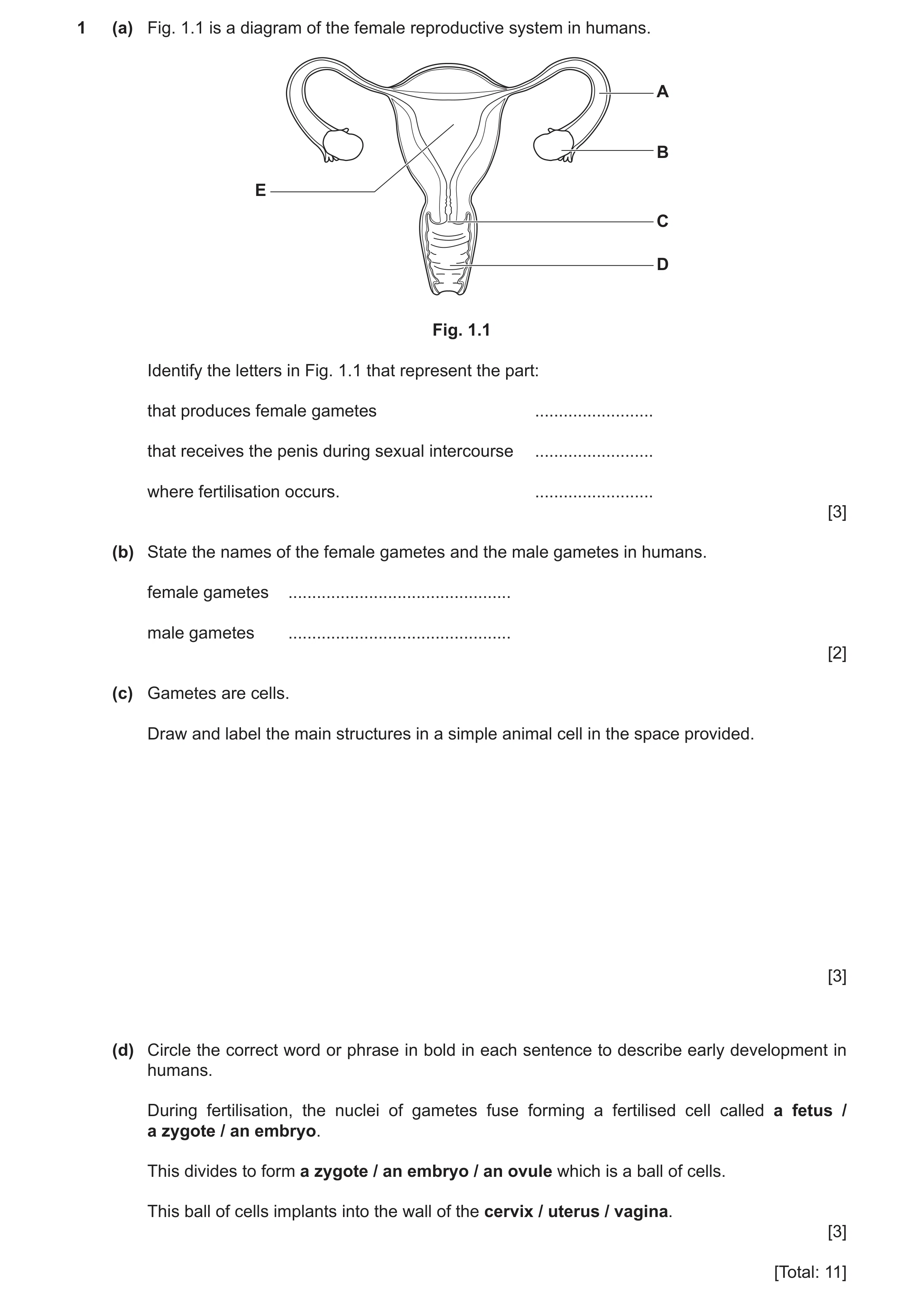
1 (a) Fig. 1.1 is a diagram of the female reproductive system in humans. A B E C D Fig. 1.1 Identify the letters in Fig. 1.1 that represent the part: that produces female gametes … that receives the penis during sexual intercourse … where fertilisation occurs. … [3] (b) State the names of the female gametes and the male gametes in humans. female gametes … male gametes … [2] (c) Gametes are cells. Draw and label the main structures in a simple animal cell in the space provided. [3] (d) Circle the correct word or phrase in bold in each sentence to describe early development in humans. During fertilisation, the nuclei of gametes fuse forming a fertilised cell called a fetus / a zygote / an embryo. This divides to form a zygote / an embryo / an ovule which is a ball of cells. This ball of cells implants into the wall of the cervix / uterus / vagina. [3] [Total: 11]
11 marks
Mark scheme: Question Answer Marks 1(a) B ; 3 D ; A ; 1(b) female – ovum / egg ; 2 male – sperm ; 1(c) cell membrane drawn correctly and labelled ; 3 nucleus drawn correctly and labelled ; space around nucleus inside of the cell membrane labelled cytoplasm ; 1(d) a zygote ; 3 an embryo ; uterus ;
This question in 0654/31 Oct/Nov 2023
Q20 · Reproduction is one of the characteristics of living things 0654/33 Oct/Nov 2023
1 (a) Reproduction is one of the characteristics of living things. Complete the definition. Reproduction is the process that makes more of the same kind of … [1] (b) Fig. 1.1 is a diagram of the male reproductive system in humans. A C B Fig. 1.1 The boxes on the left show the letters labelling some of the parts in Fig. 1.1. The boxes on the right show functions of some of the parts. Draw one line to link each letter to its function. carries semen and urine out of the body A produces sperm B secretes fluid for sperm to swim in C transfers sperm to urethra [3] (c) Fig. 1.2 is a drawing of a sperm cell. Label the cell structure that contains the genetic material with a label line and the correct name. Fig. 1.2 [2] (d) State the names of two cell structures that are present in plant cells but not present in animal cells. 1 … 2 … [2] [Total: 8]
8 marks
Mark scheme: Question Answer Marks 1(a) organism ; 1 1(b) 3 carries semen and urine out of the body A produces sperm B secretes fluid for sperm to swim in C transfers sperm to urethra 1 mark for each line ;;; 1(c) nucleus correctly labelled 2 labelling correct structure ; correct name ; 1(d) any two from: 2 chloroplast ; cell wall ; (permanent) vacuole ;
This question in 0654/33 Oct/Nov 2023
Q21 · A diagram of the female reproductive system in humans 0654/32 May/June 2024
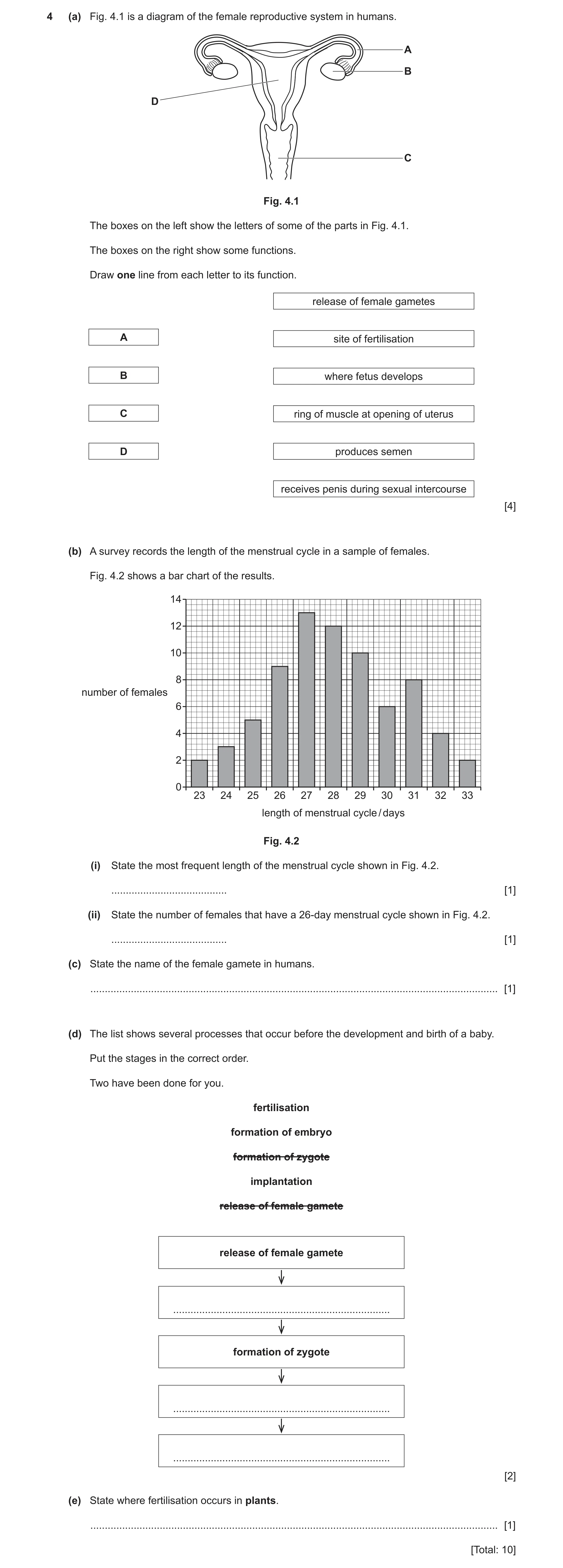
4 (a) Fig. 4.1 is a diagram of the female reproductive system in humans. A B D C Fig. 4.1 The boxes on the left show the letters of some of the parts in Fig. 4.1. The boxes on the right show some functions. Draw one line from each letter to its function. release of female gametes A site of fertilisation B where fetus develops C ring of muscle at opening of uterus D produces semen receives penis during sexual intercourse [4] (b) A survey records the length of the menstrual cycle in a sample of females. Fig. 4.2 shows a bar chart of the results. 14 12 10 8 number of females 6 4 2 0 23 24 25 26 27 28 29 30 31 32 33 length of menstrual cycle / days Fig. 4.2 (i) State the most frequent length of the menstrual cycle shown in Fig. 4.2. … [1] (ii) State the number of females that have a 26‑day menstrual cycle shown in Fig. 4.2. … [1] (c) State the name of the female gamete in humans. … [1] (d) The list shows several processes that occur before the development and birth of a baby. Put the stages in the correct order. Two have been done for you. fertilisation formation of embryo formation of zygote implantation release of female gamete release of female gamete … formation of zygote … … [2] (e) State where fertilisation occurs in plants. … [1] [Total: 10]
10 marks
Mark scheme: 4(a) release of female gametes A site of fertilisation B where fetus develops C ring of muscle at opening of uterus D produces semen receives penis during sexual intercourse ;;;; 4(b)(i) 27 (days) ; 1 4(b)(ii) 9 ; 1 Question Answer Marks 4(c) egg / ovum ; 1 4(d) release of female gamete fertilisation formation of zygote formation of embryo implantation 1 or 2 correct ; 3 correct ; 2 4(e) ovule ; 1
This question in 0654/32 May/June 2024
Q22 · A diagram of the female reproductive system in humans 0654/33 May/June 2024
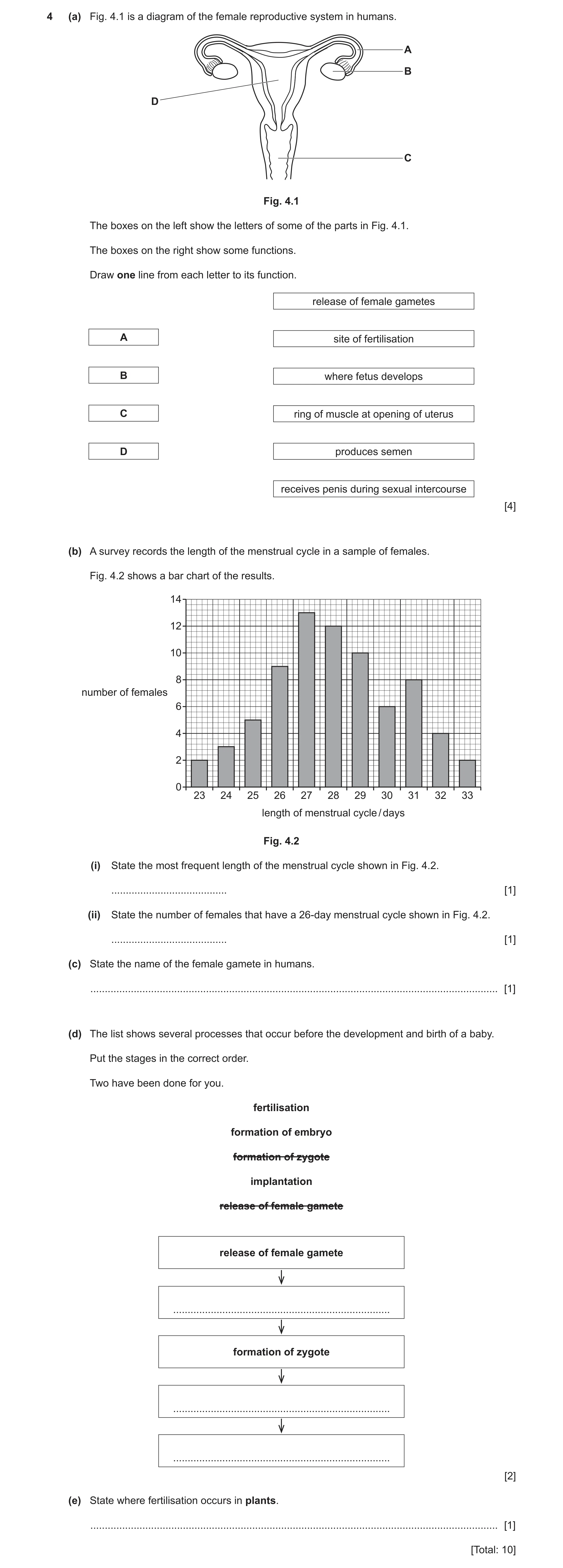
4 (a) Fig. 4.1 is a diagram of the female reproductive system in humans. A B D C Fig. 4.1 The boxes on the left show the letters of some of the parts in Fig. 4.1. The boxes on the right show some functions. Draw one line from each letter to its function. release of female gametes A site of fertilisation B where fetus develops C ring of muscle at opening of uterus D produces semen receives penis during sexual intercourse [4] (b) A survey records the length of the menstrual cycle in a sample of females. Fig. 4.2 shows a bar chart of the results. 14 12 10 8 number of females 6 4 2 0 23 24 25 26 27 28 29 30 31 32 33 length of menstrual cycle / days Fig. 4.2 (i) State the most frequent length of the menstrual cycle shown in Fig. 4.2. … [1] (ii) State the number of females that have a 26‑day menstrual cycle shown in Fig. 4.2. … [1] (c) State the name of the female gamete in humans. … [1] (d) The list shows several processes that occur before the development and birth of a baby. Put the stages in the correct order. Two have been done for you. fertilisation formation of embryo formation of zygote implantation release of female gamete release of female gamete … formation of zygote … … [2] (e) State where fertilisation occurs in plants. … [1] [Total: 10]
10 marks
Mark scheme: 4(a) release of female gametes A site of fertilisation B where fetus develops C ring of muscle at opening of uterus D produces semen receives penis during sexual intercourse ;;;; 4(b)(i) 27 (days) ; 1 4(b)(ii) 9 ; 1 Question Answer Marks 4(c) egg / ovum ; 1 4(d) release of female gamete fertilisation formation of zygote formation of embryo implantation 1 or 2 correct ; 3 correct ; 2 4(e) ovule ; 1
This question in 0654/33 May/June 2024
Q23 · A diagram of the male reproductive system in humans 0654/32 Oct/Nov 2024
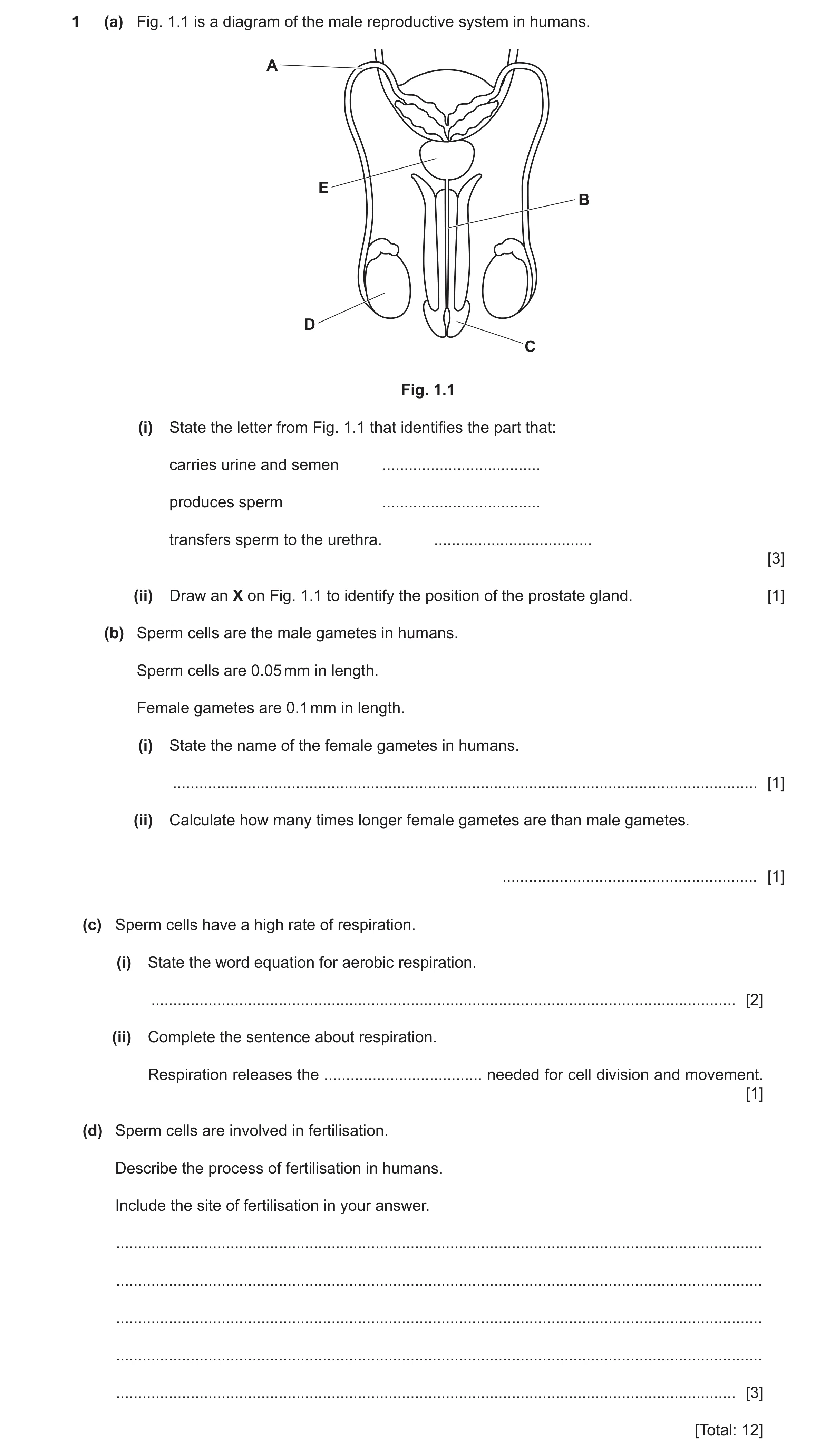
1 (a) Fig. 1.1 is a diagram of the male reproductive system in humans. A E B D C Fig. 1.1 (i) State the letter from Fig. 1.1 that identifies the part that: carries urine and semen … produces sperm … transfers sperm to the urethra. … [3] (ii) Draw an X on Fig. 1.1 to identify the position of the prostate gland. [1] (b) Sperm cells are the male gametes in humans. Sperm cells are 0.05 mm in length. Female gametes are 0.1 mm in length. (i) State the name of the female gametes in humans. … [1] (ii) Calculate how many times longer female gametes are than male gametes. … [1] (c) Sperm cells have a high rate of respiration. (i) State the word equation for aerobic respiration. … [2] (ii) Complete the sentence about respiration. Respiration releases the … needed for cell division and movement. [1] (d) Sperm cells are involved in fertilisation. Describe the process of fertilisation in humans. Include the site of fertilisation in your answer. … … … … … [3] [Total: 12]
12 marks
Mark scheme: Question Answer Marks 1(a)(i) B ; 3 D ; A ; 1(a)(ii) X drawn on prostate gland ; 1 1(b)(i) egg / ova / ovum ; 1 1(b)(ii) (0.1 / 0.05 =) 2 ; 1 1(c)(i) glucose + oxygen → carbon dioxide + water 2 1 mark for reactants ; 1 mark for products ; 1(c)(ii) energy ; 1 1(d) fusion of the, sperm / male gamete, and, egg / female gamete ; 3 ref to nuclei ; fertilisation takes place in the oviduct ;
This question in 0654/32 Oct/Nov 2024
Q24 · A diagram of the male reproductive system in humans 0654/33 Oct/Nov 2024
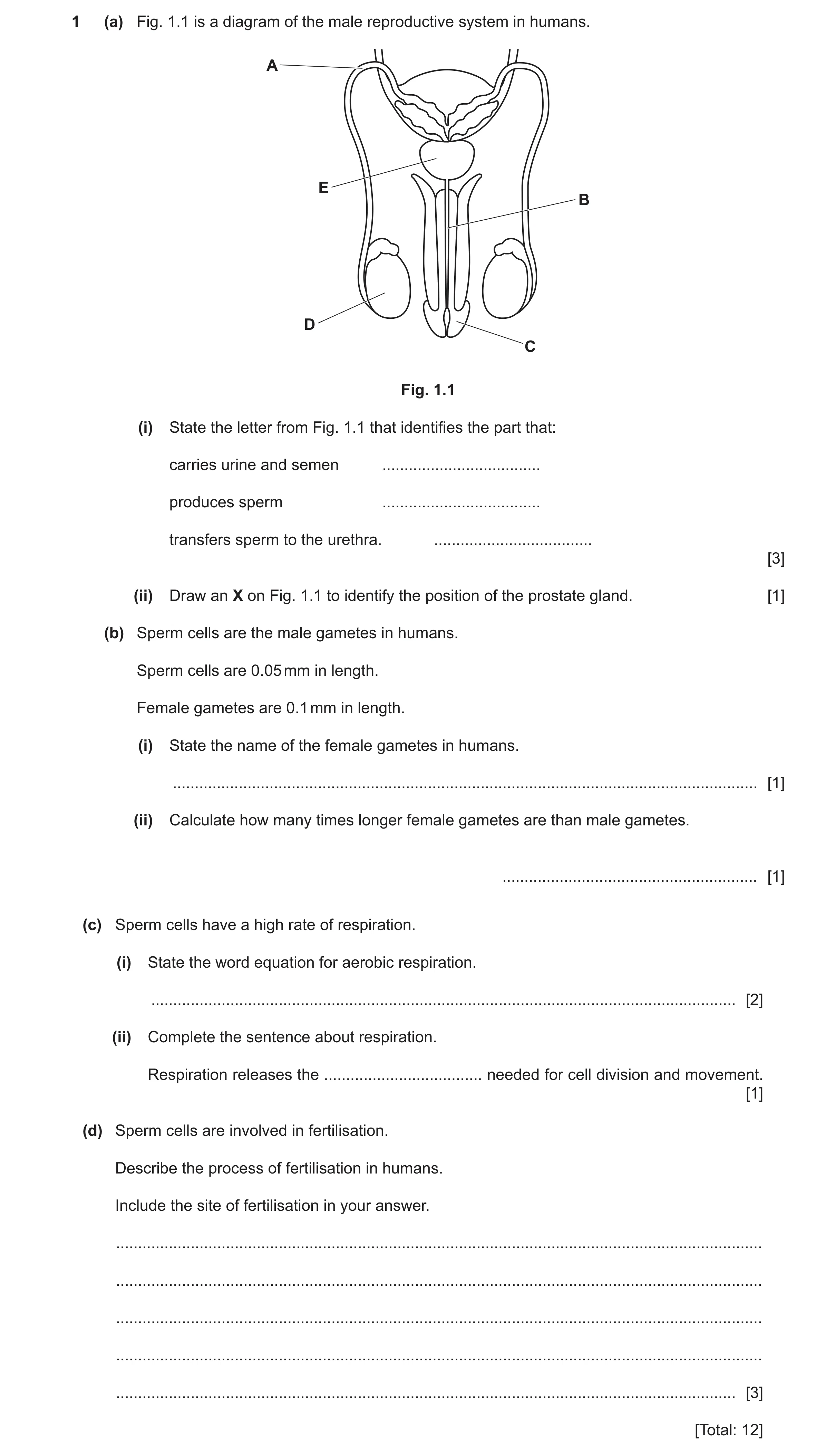
1 (a) Fig. 1.1 is a diagram of the male reproductive system in humans. A E B D C Fig. 1.1 (i) State the letter from Fig. 1.1 that identifies the part that: carries urine and semen … produces sperm … transfers sperm to the urethra. … [3] (ii) Draw an X on Fig. 1.1 to identify the position of the prostate gland. [1] (b) Sperm cells are the male gametes in humans. Sperm cells are 0.05 mm in length. Female gametes are 0.1 mm in length. (i) State the name of the female gametes in humans. … [1] (ii) Calculate how many times longer female gametes are than male gametes. … [1] (c) Sperm cells have a high rate of respiration. (i) State the word equation for aerobic respiration. … [2] (ii) Complete the sentence about respiration. Respiration releases the … needed for cell division and movement. [1] (d) Sperm cells are involved in fertilisation. Describe the process of fertilisation in humans. Include the site of fertilisation in your answer. … … … … … [3] [Total: 12]
12 marks
Mark scheme: Question Answer Marks 1(a)(i) B ; 3 D ; A ; 1(a)(ii) X drawn on prostate gland ; 1 1(b)(i) egg / ova / ovum ; 1 1(b)(ii) (0.1 / 0.05 =) 2 ; 1 1(c)(i) glucose + oxygen → carbon dioxide + water 2 1 mark for reactants ; 1 mark for products ; 1(c)(ii) energy ; 1 1(d) fusion of the, sperm / male gamete, and, egg / female gamete ; 3 ref to nuclei ; fertilisation takes place in the oviduct ;
This question in 0654/33 Oct/Nov 2024
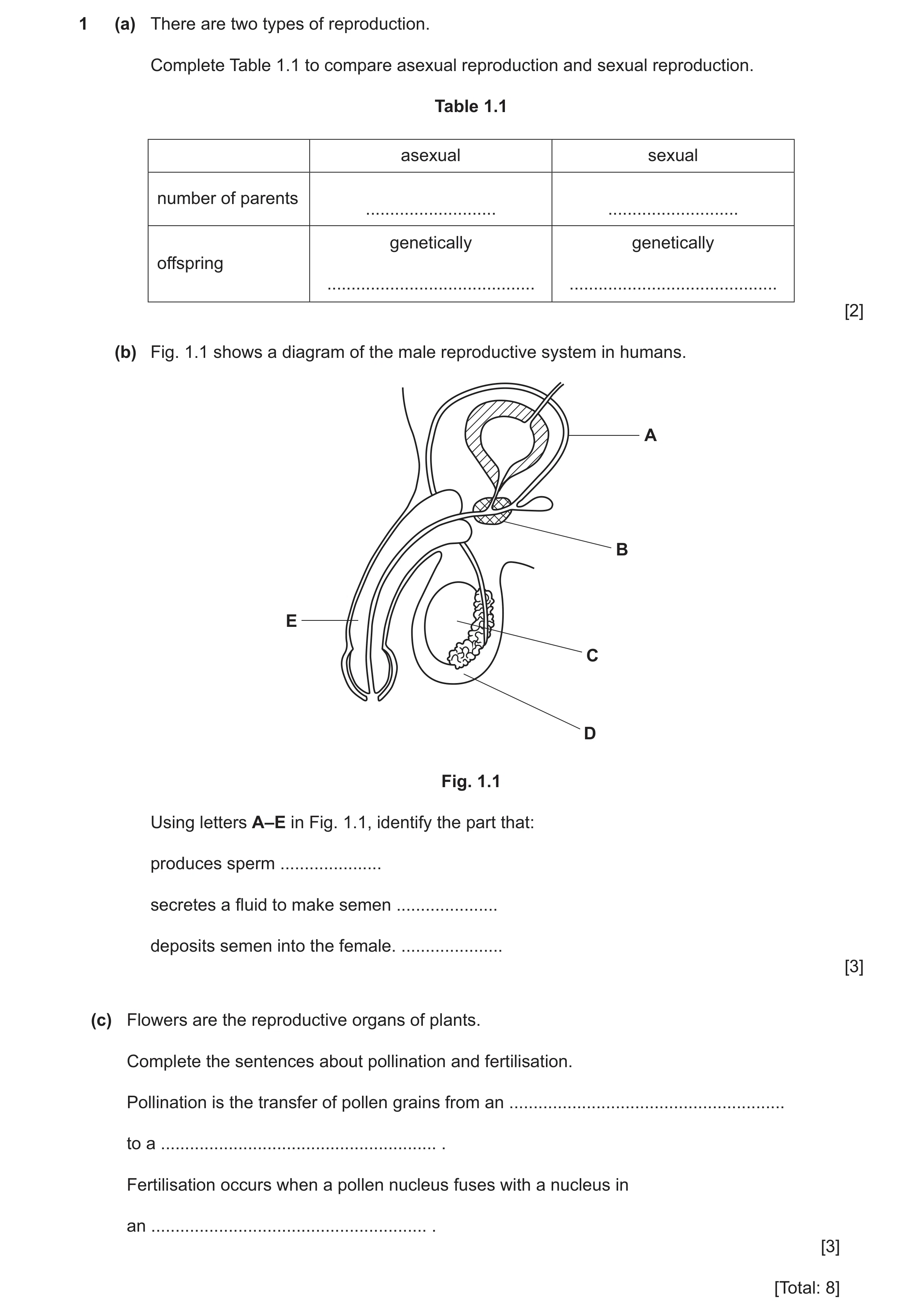
Q25 · There are two types of reproduction 0654/31 Oct/Nov 2025
1 (a) There are two types of reproduction. Complete Table 1.1 to compare asexual reproduction and sexual reproduction. Table 1.1 asexual sexual number of parents … … genetically genetically offspring … … [2] (b) Fig. 1.1 shows a diagram of the male reproductive system in humans. A B E C D Fig. 1.1 Using letters A–E in Fig. 1.1, identify the part that: produces sperm … secretes a fluid to make semen … deposits semen into the female. … [3] (c) Flowers are the reproductive organs of plants. Complete the sentences about pollination and fertilisation. Pollination is the transfer of pollen grains from an … to a … . Fertilisation occurs when a pollen nucleus fuses with a nucleus in an … . [3] [Total: 8]
8 marks
Mark scheme: Question Answer Marks 1(a) 2 asexual sexual number of parents 1 2 offspring identical different 1 mark for each correct row 1(b) (produces sperm) = C ; 3 (fluid) = B ; (deposits semen) = E ; 1(c) anther ; 3 stigma ; ovule ;
This question in 0654/31 Oct/Nov 2025
 3 / 37
 4 / 37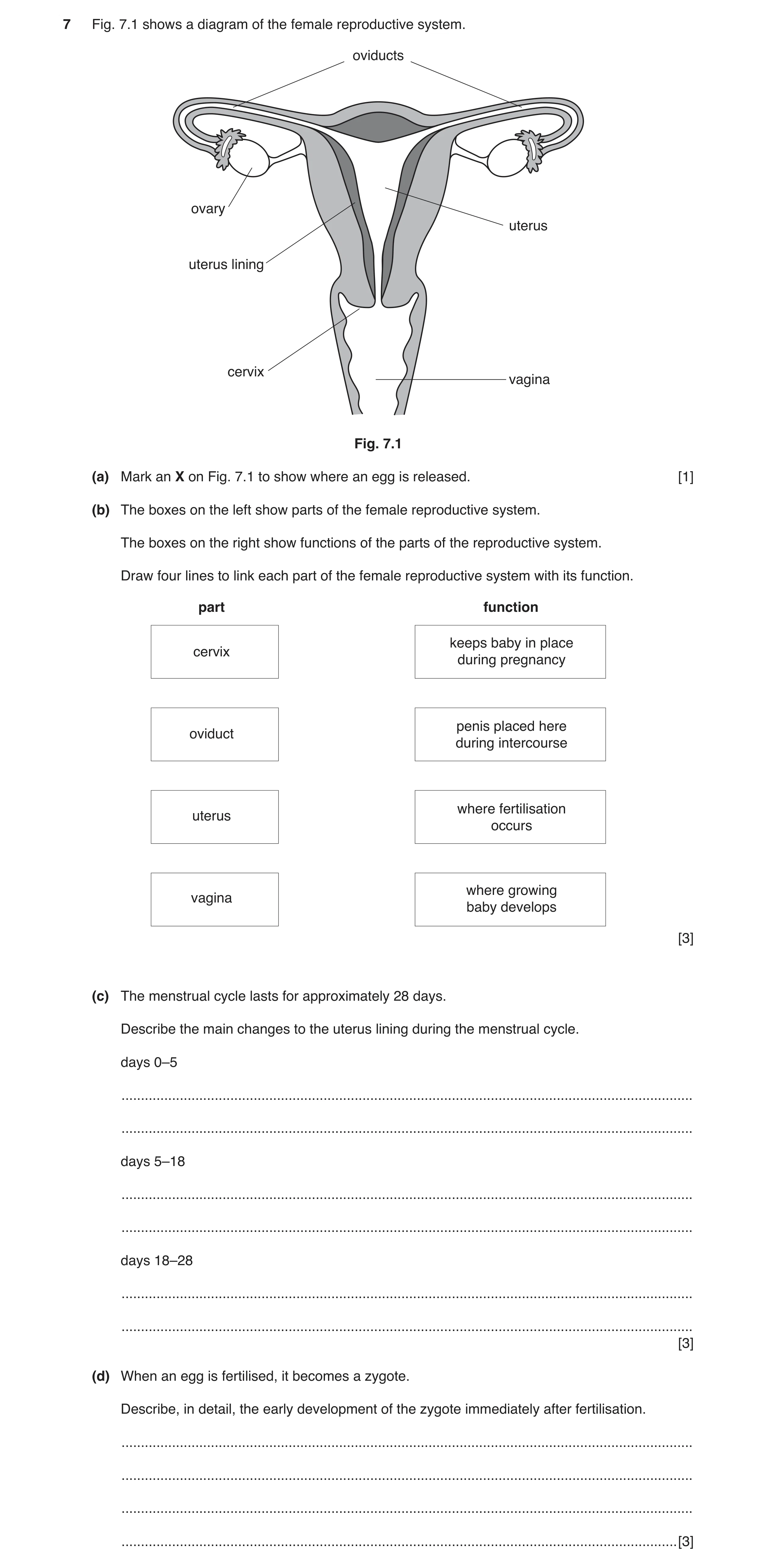
 8 / 37
 9 / 37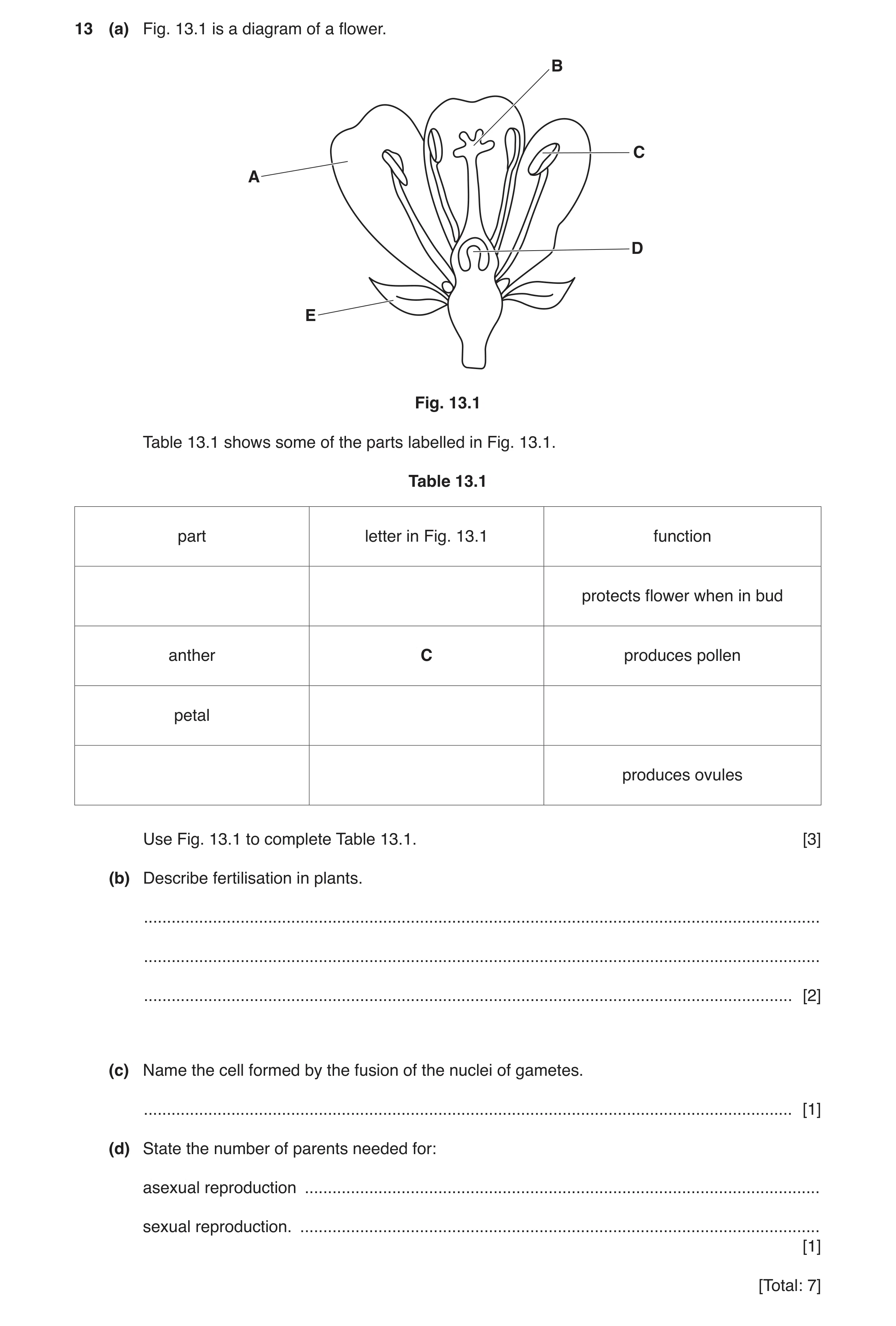
 20 / 37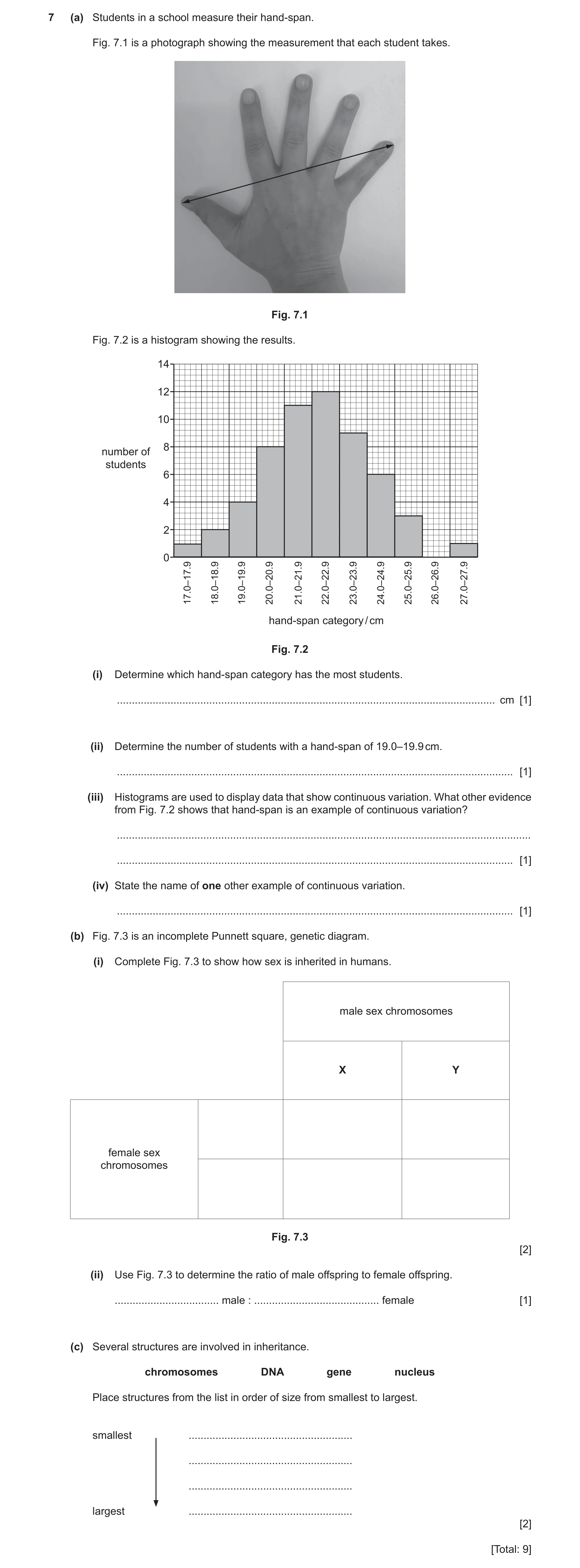
 28 / 37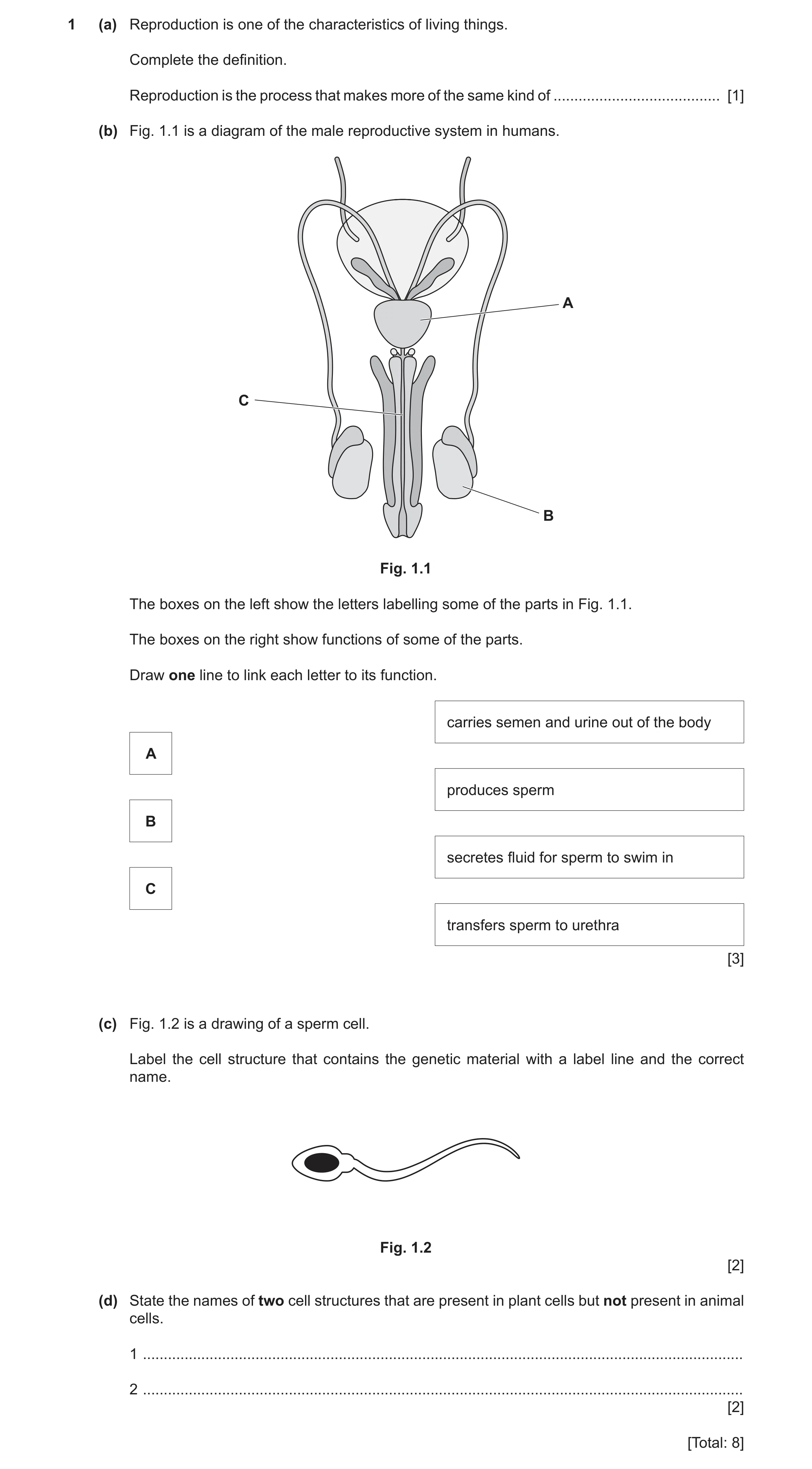
 37 / 37
 8
8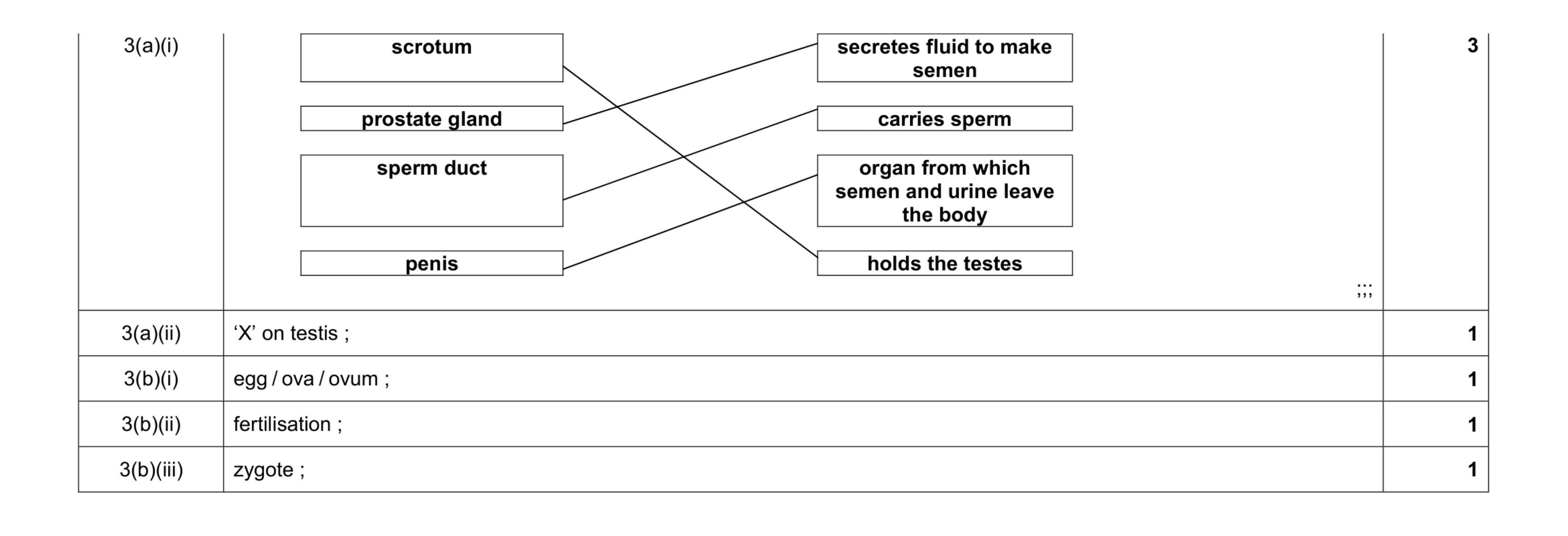 7
7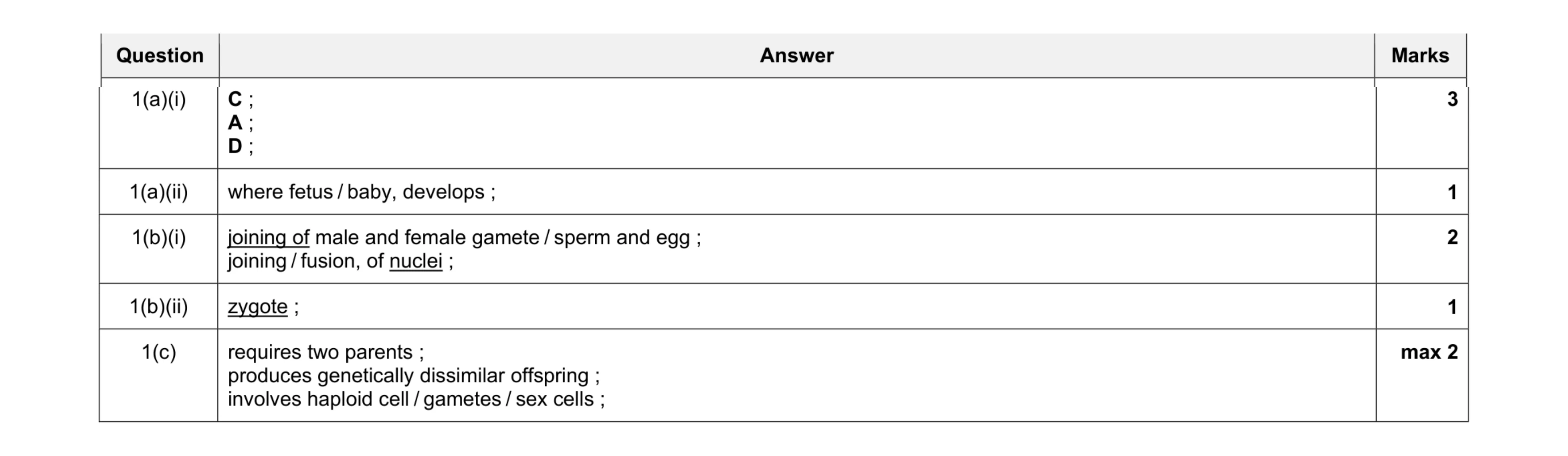 9
9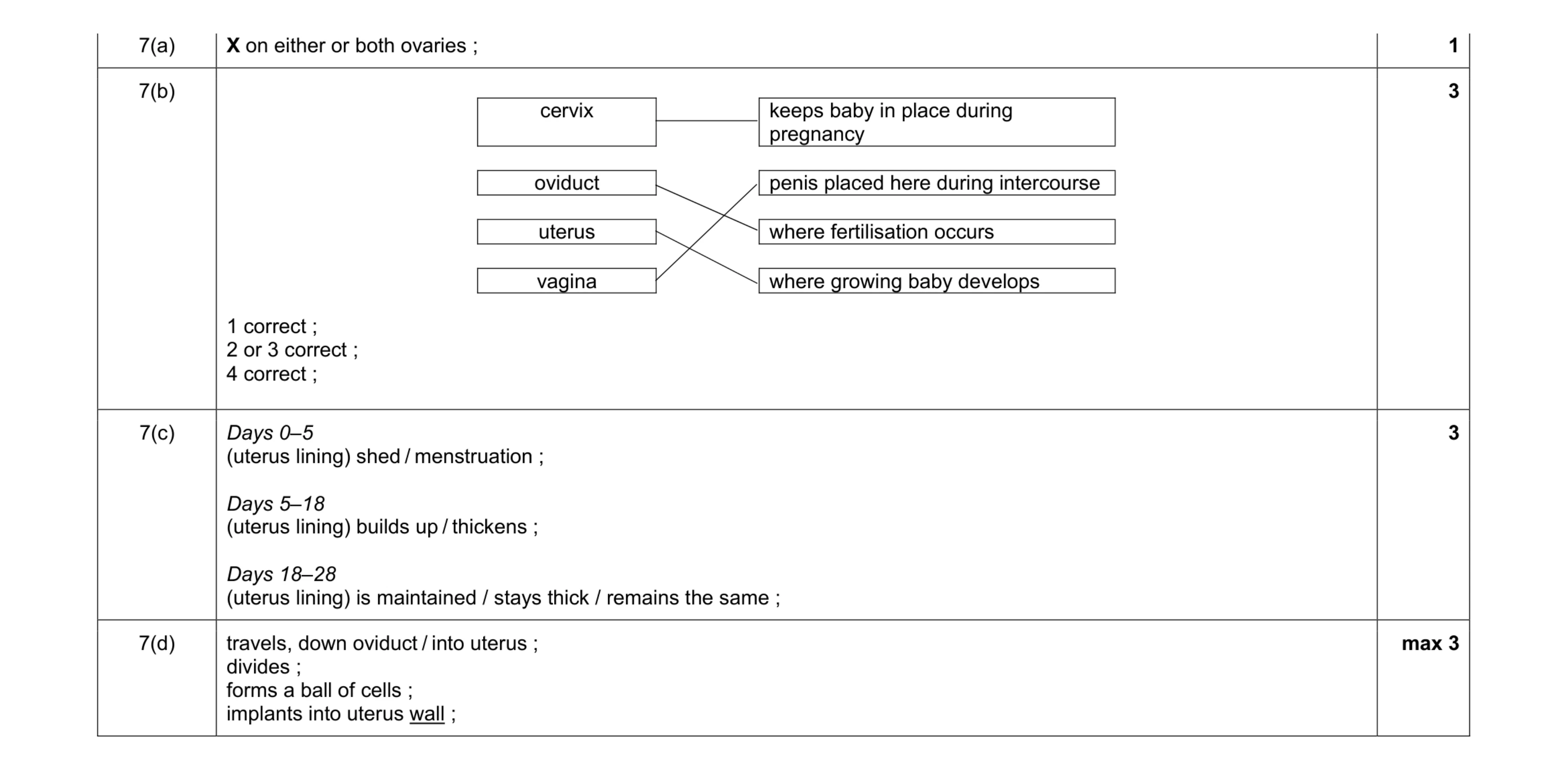 10
10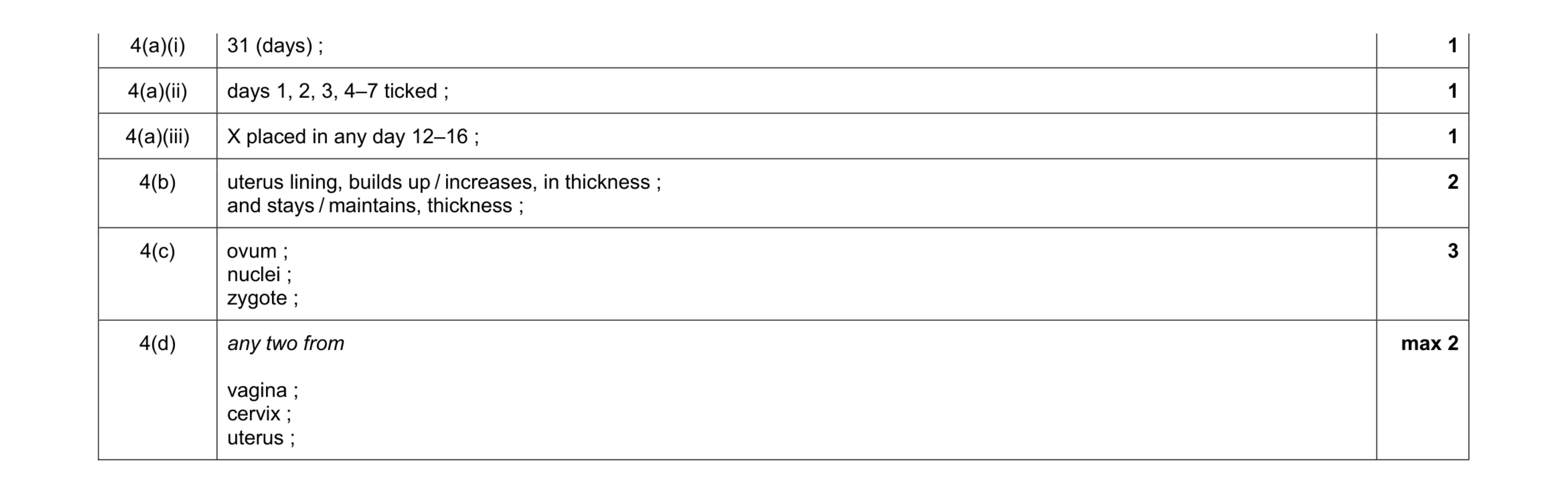 10
10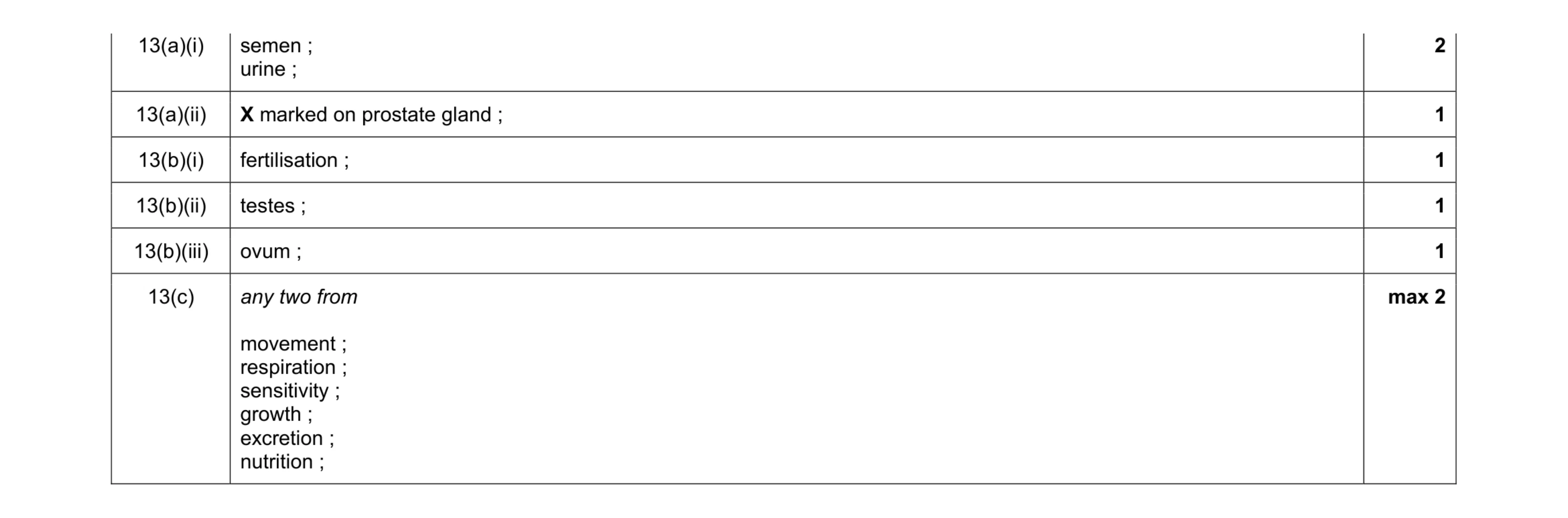 8
8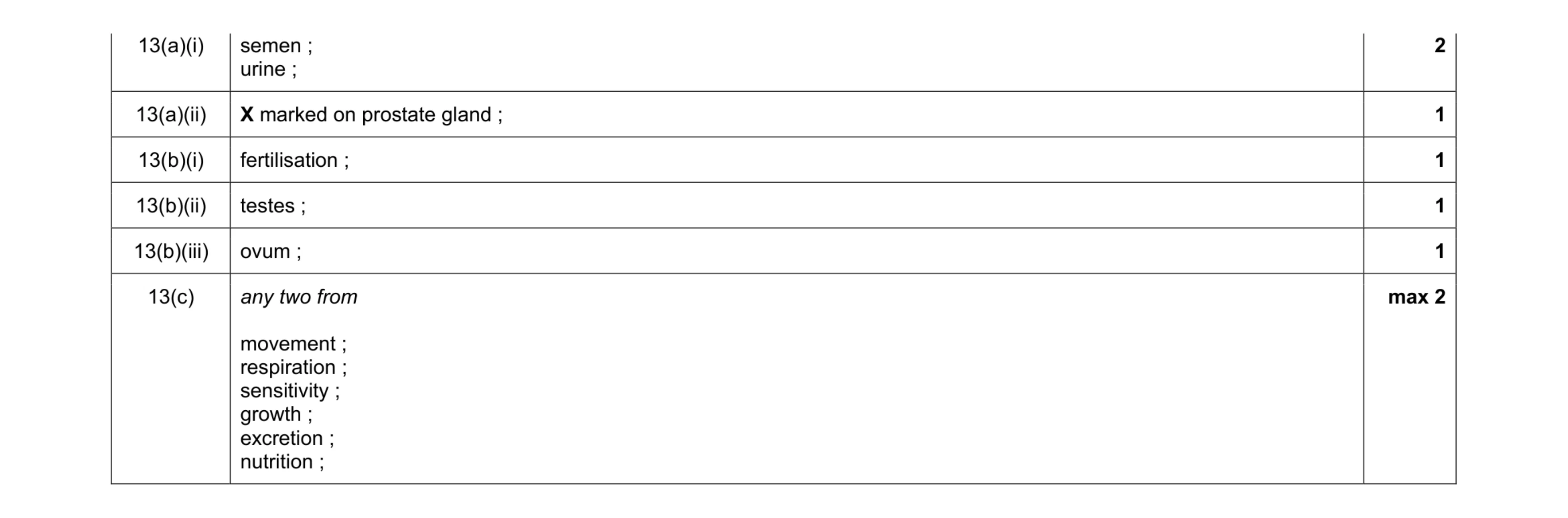 8
8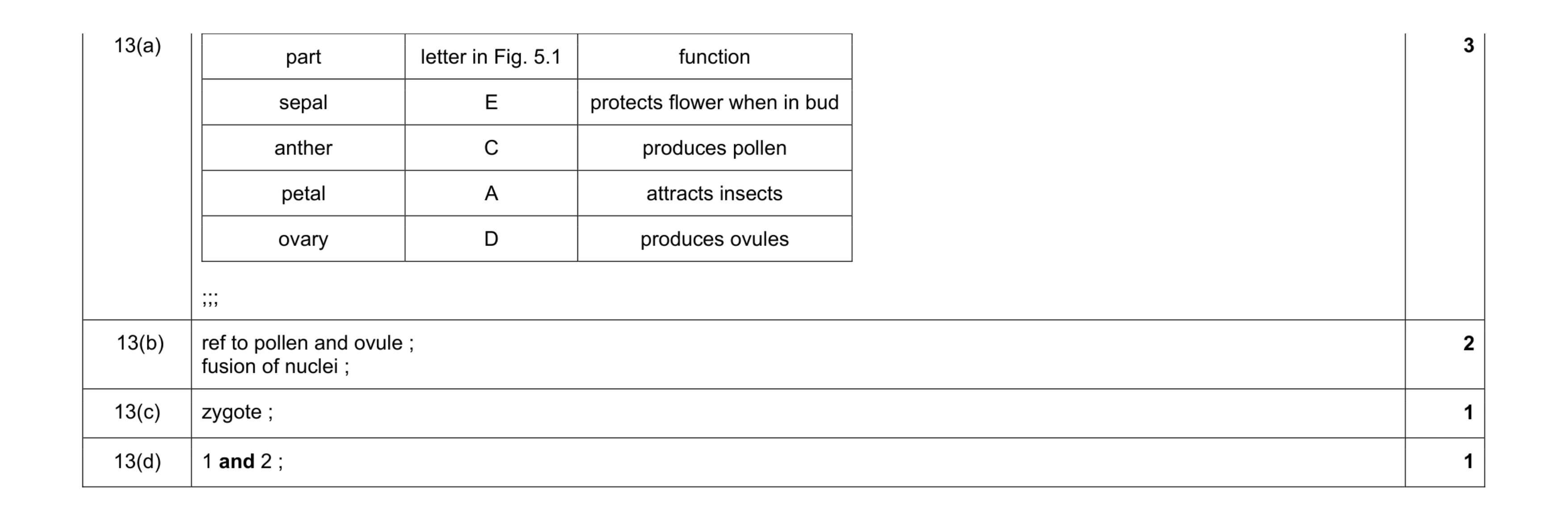 7
7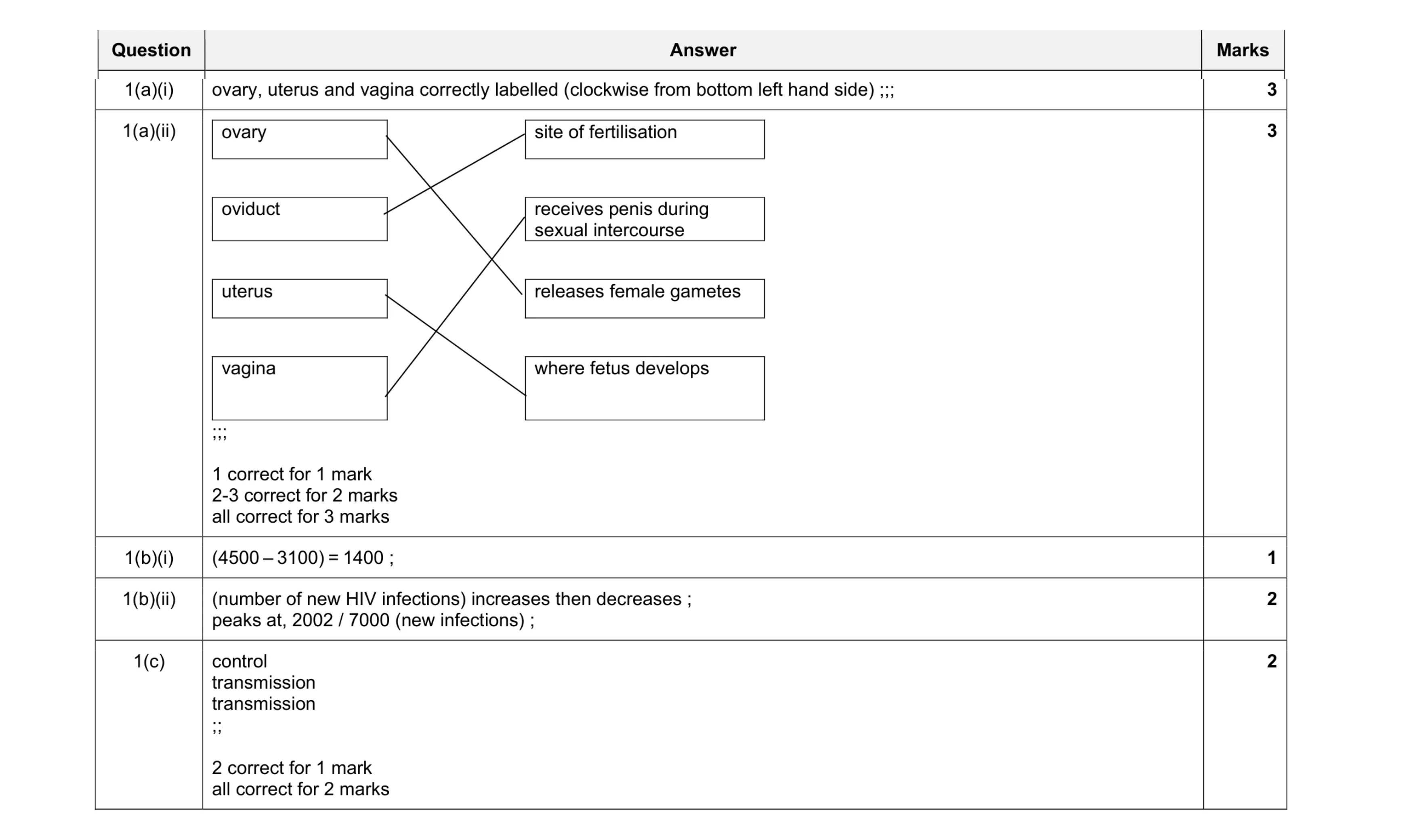 11
11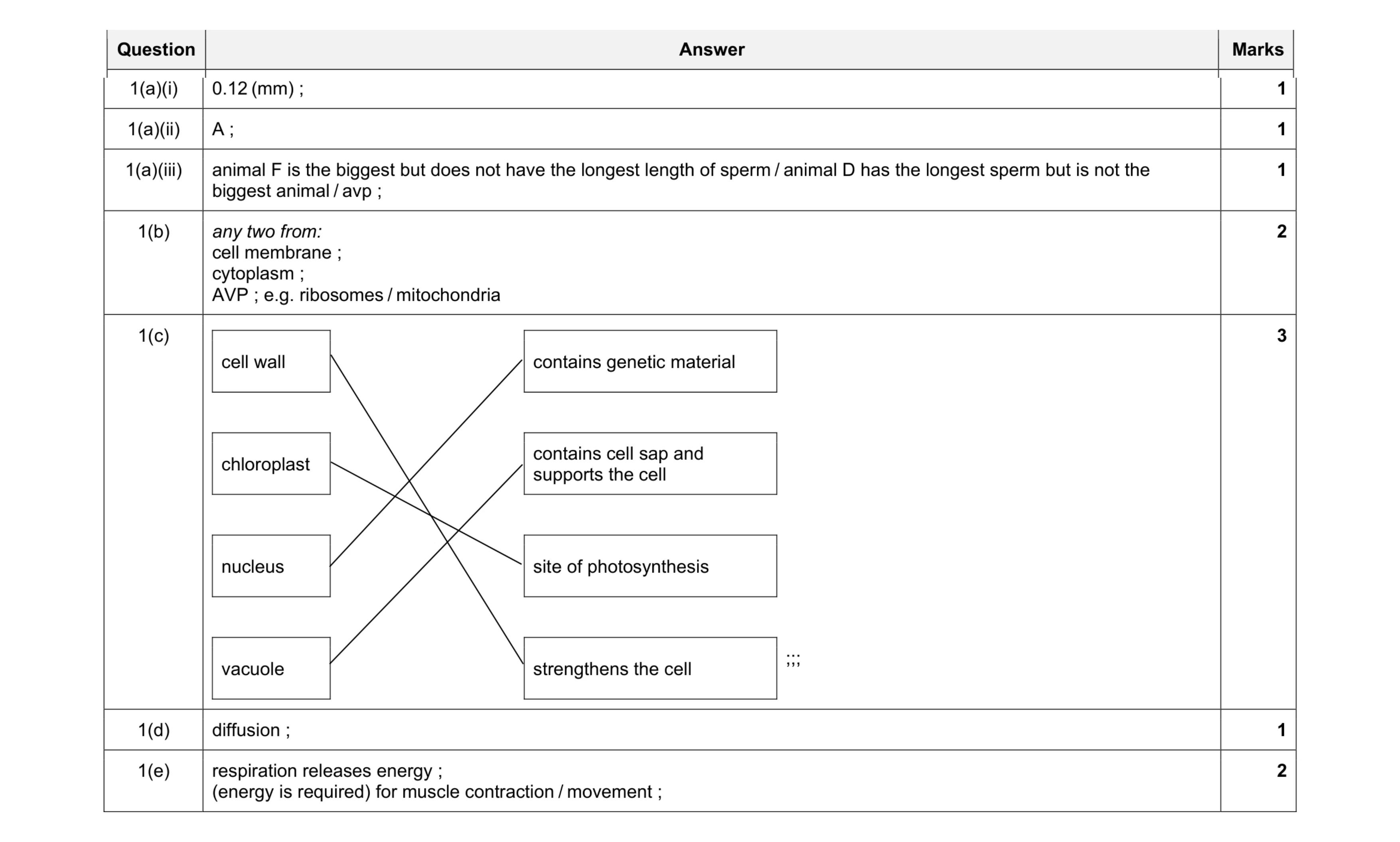 11
11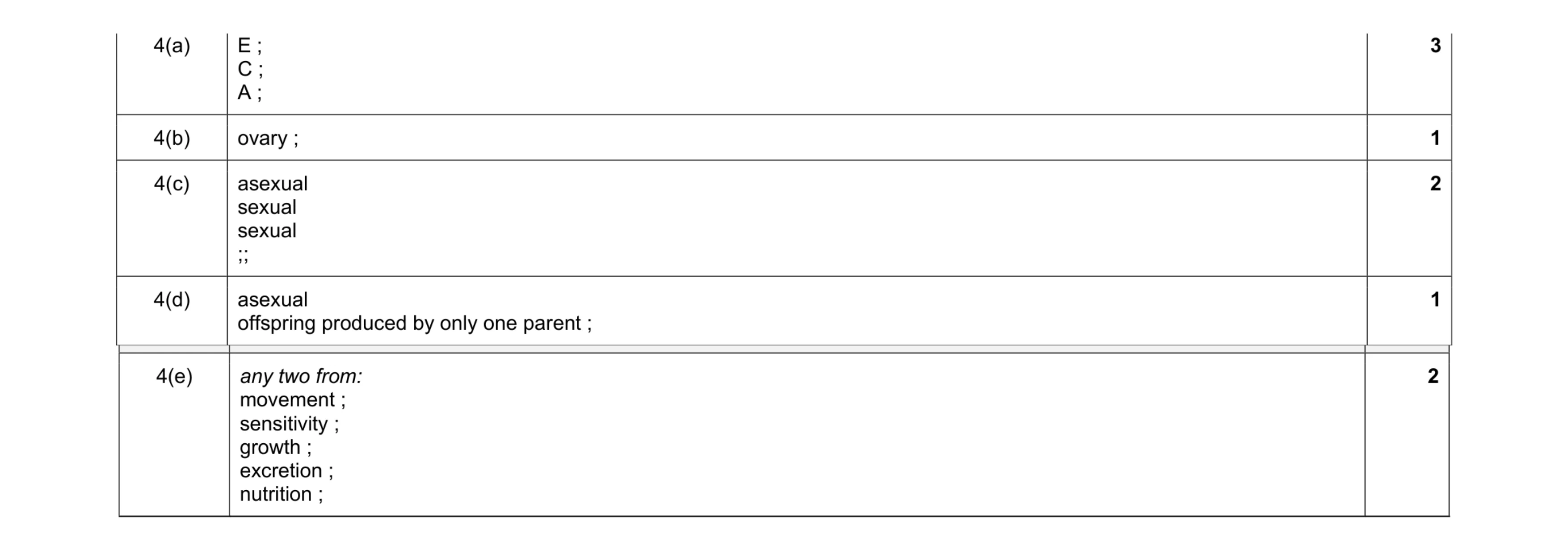 9
9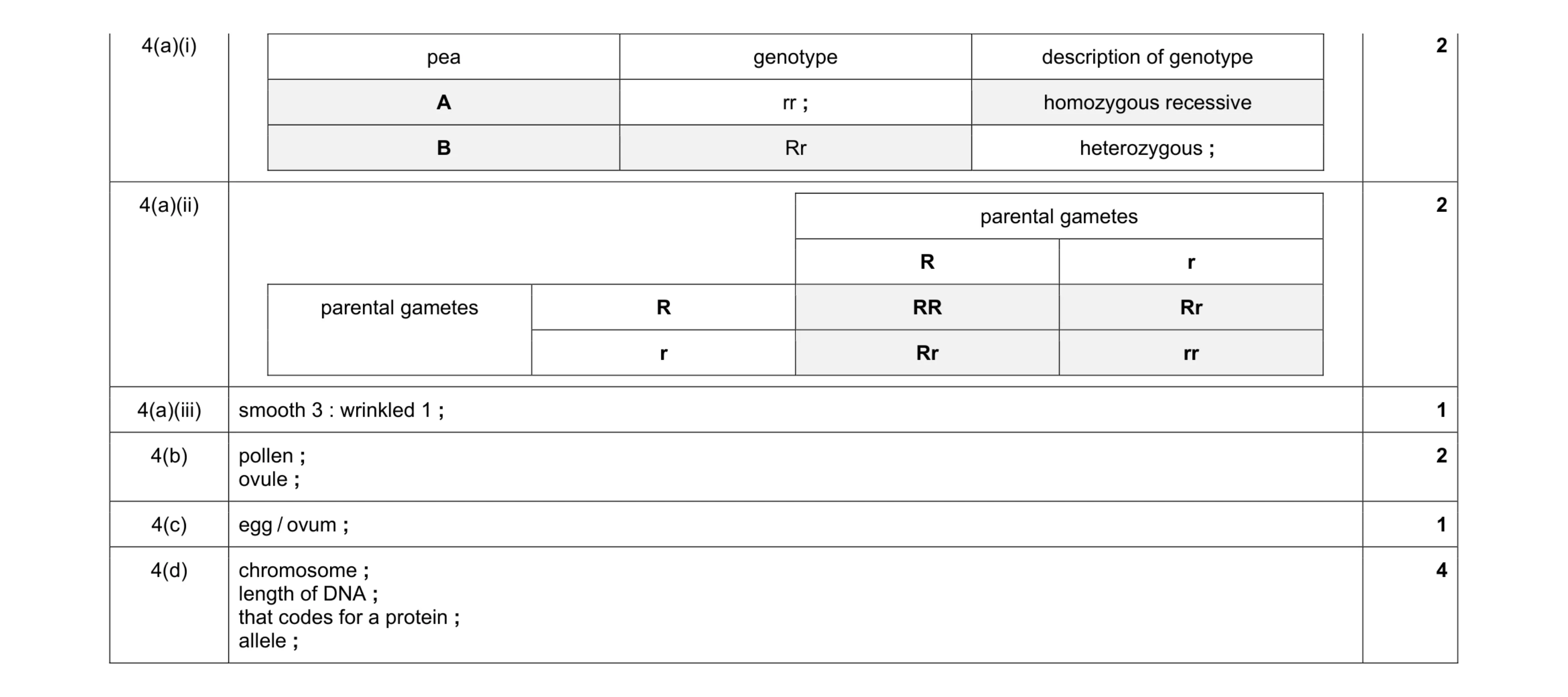 12
12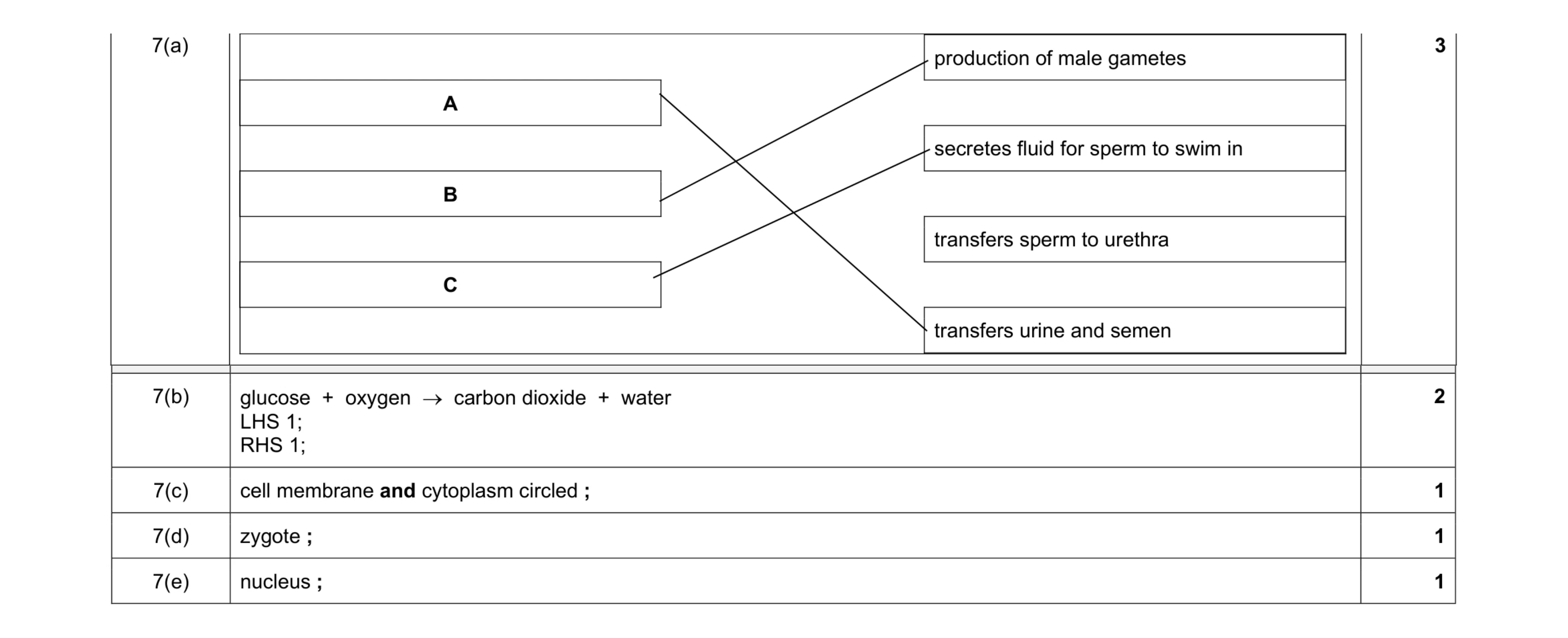 8
8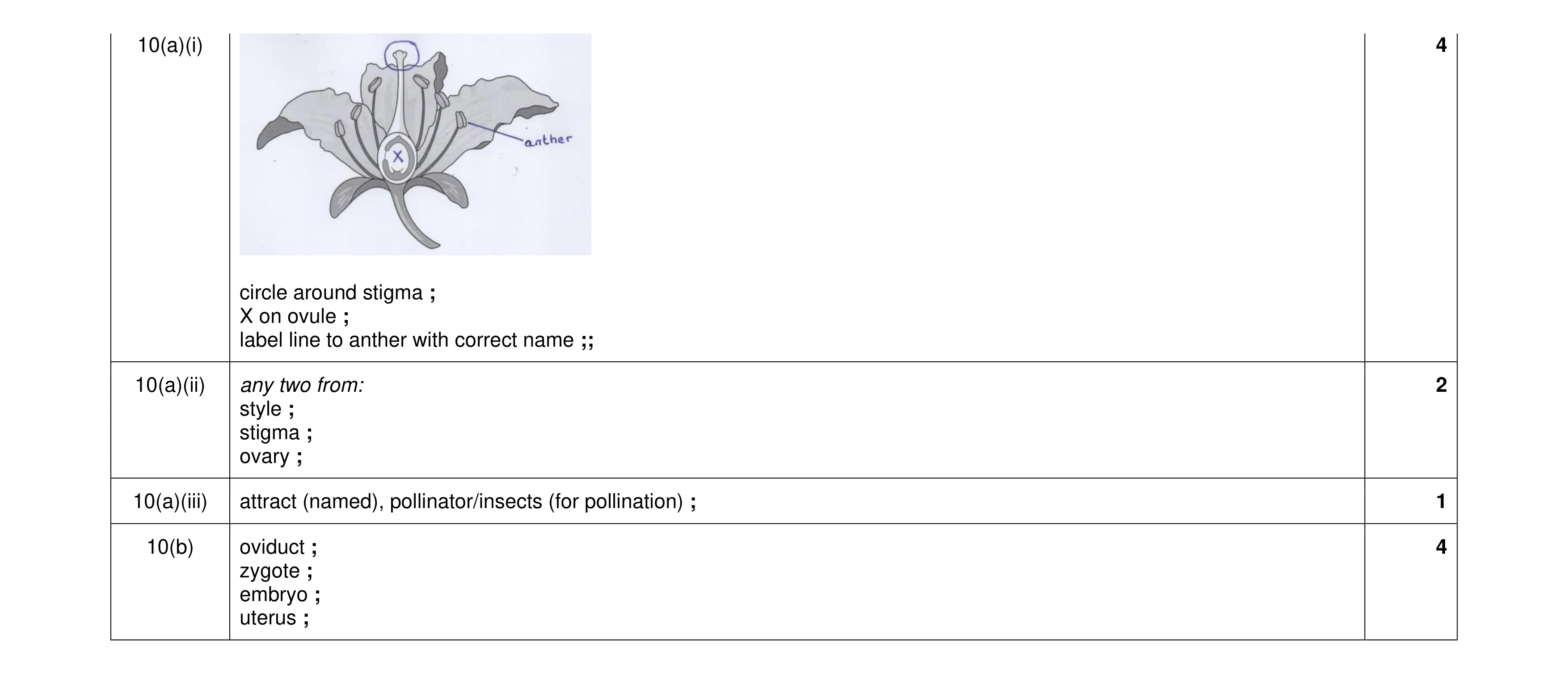 11
11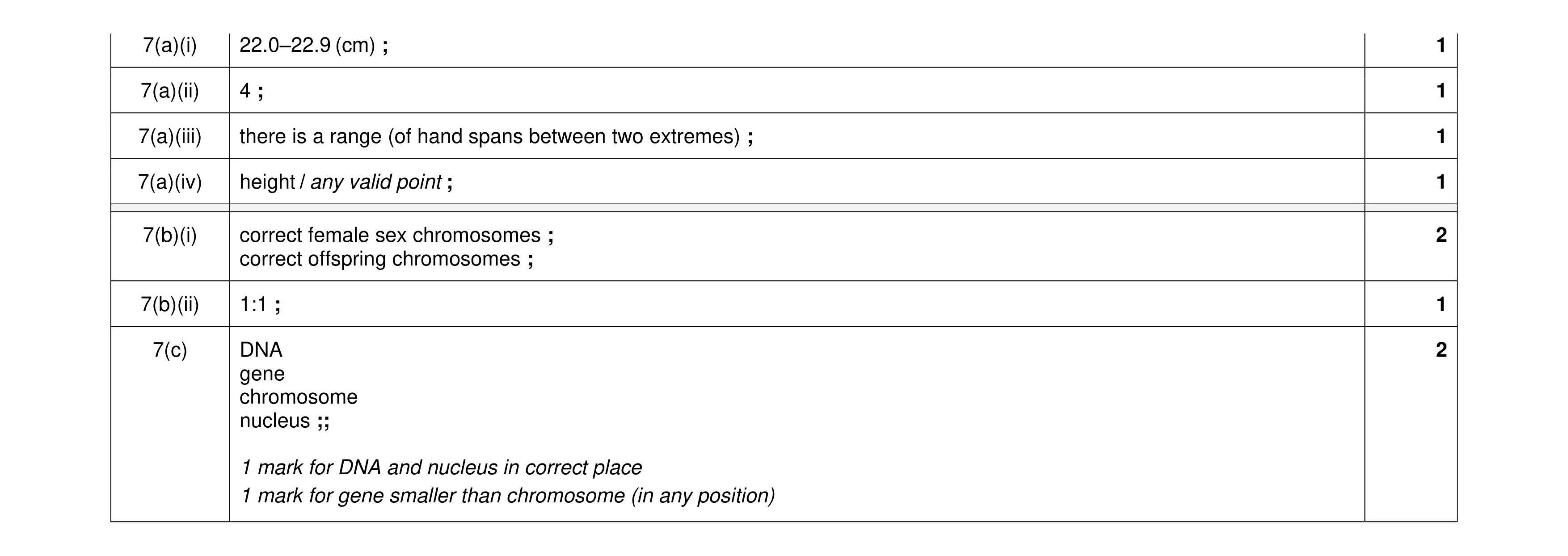 9
9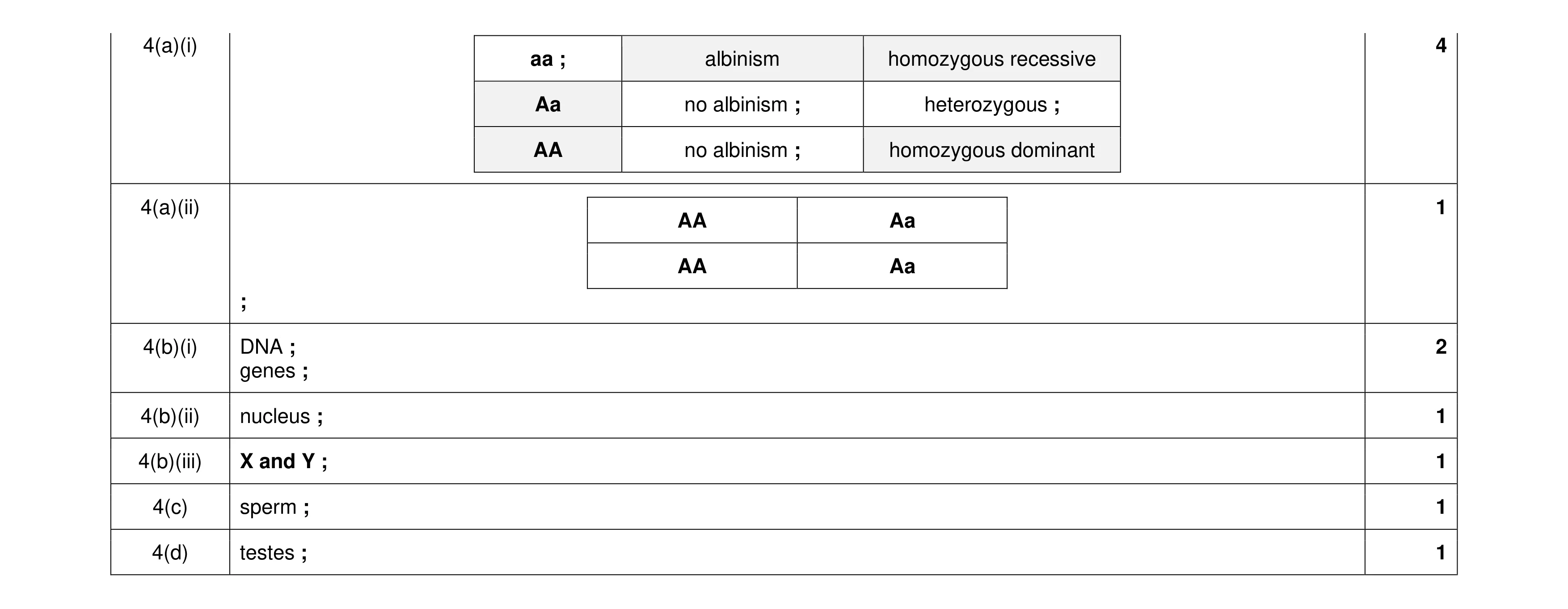 11
11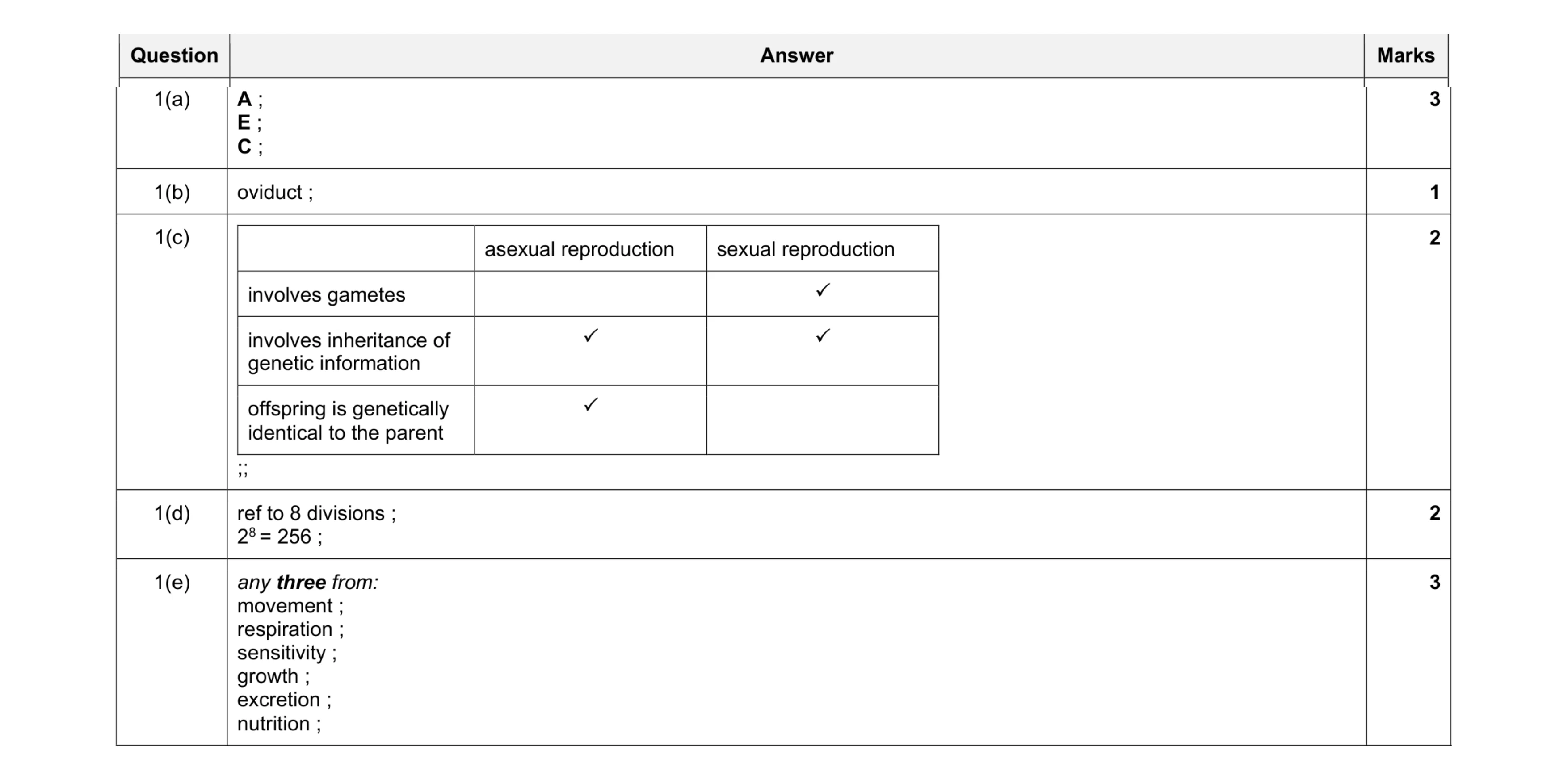 11
11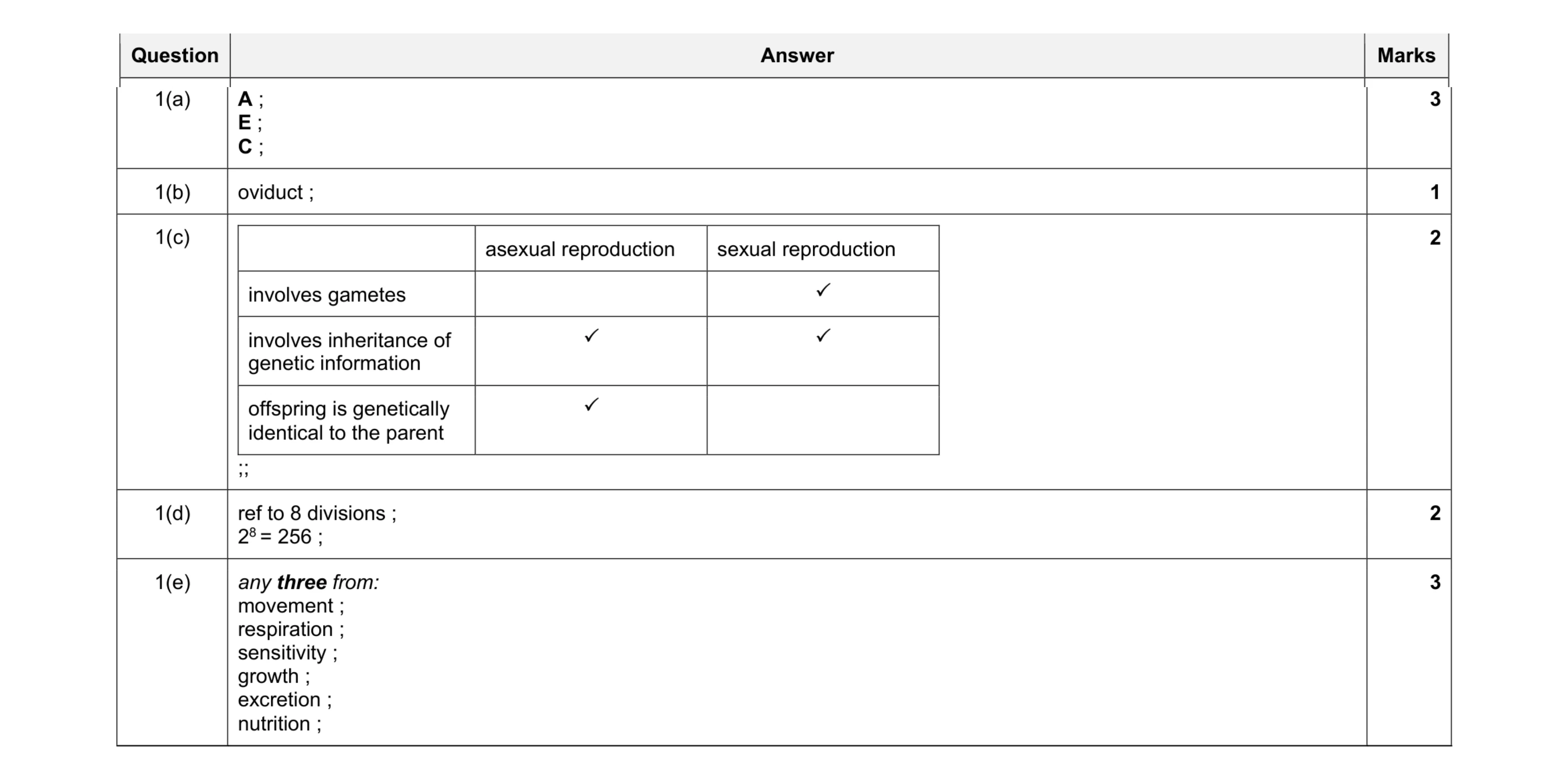 11
11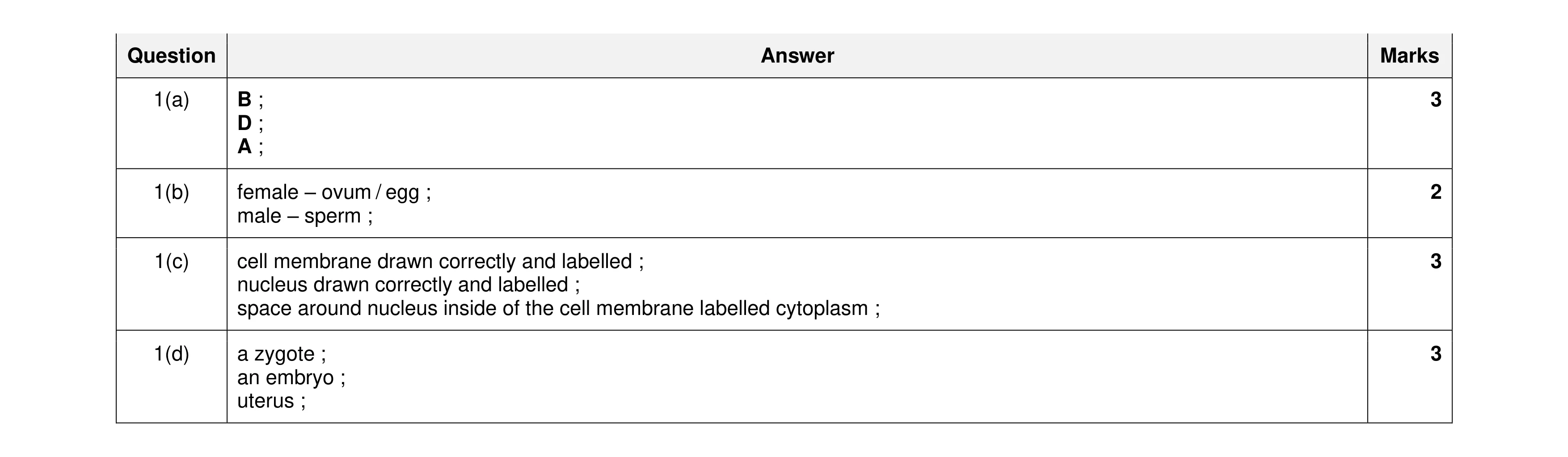 11
11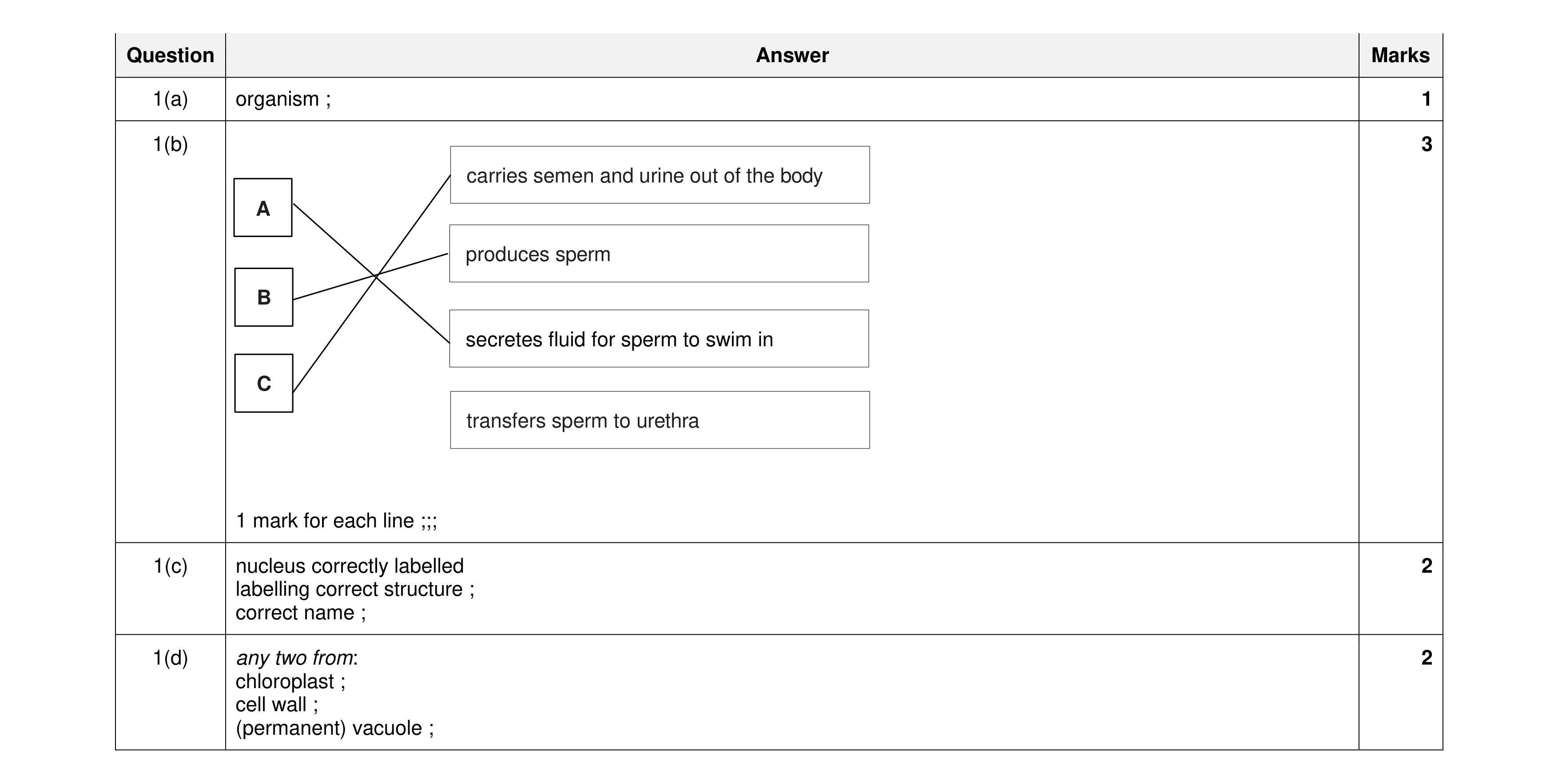 8
8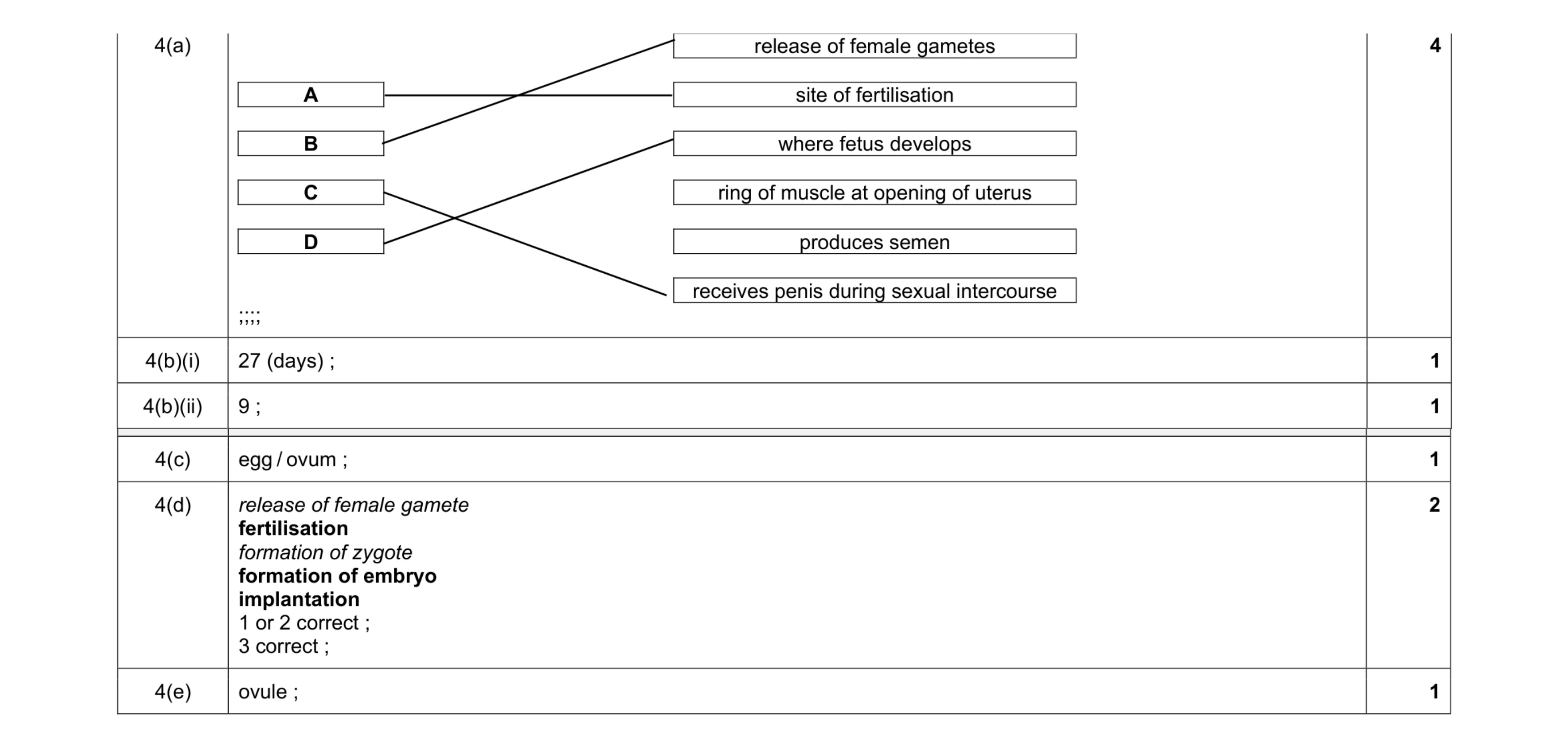 10
10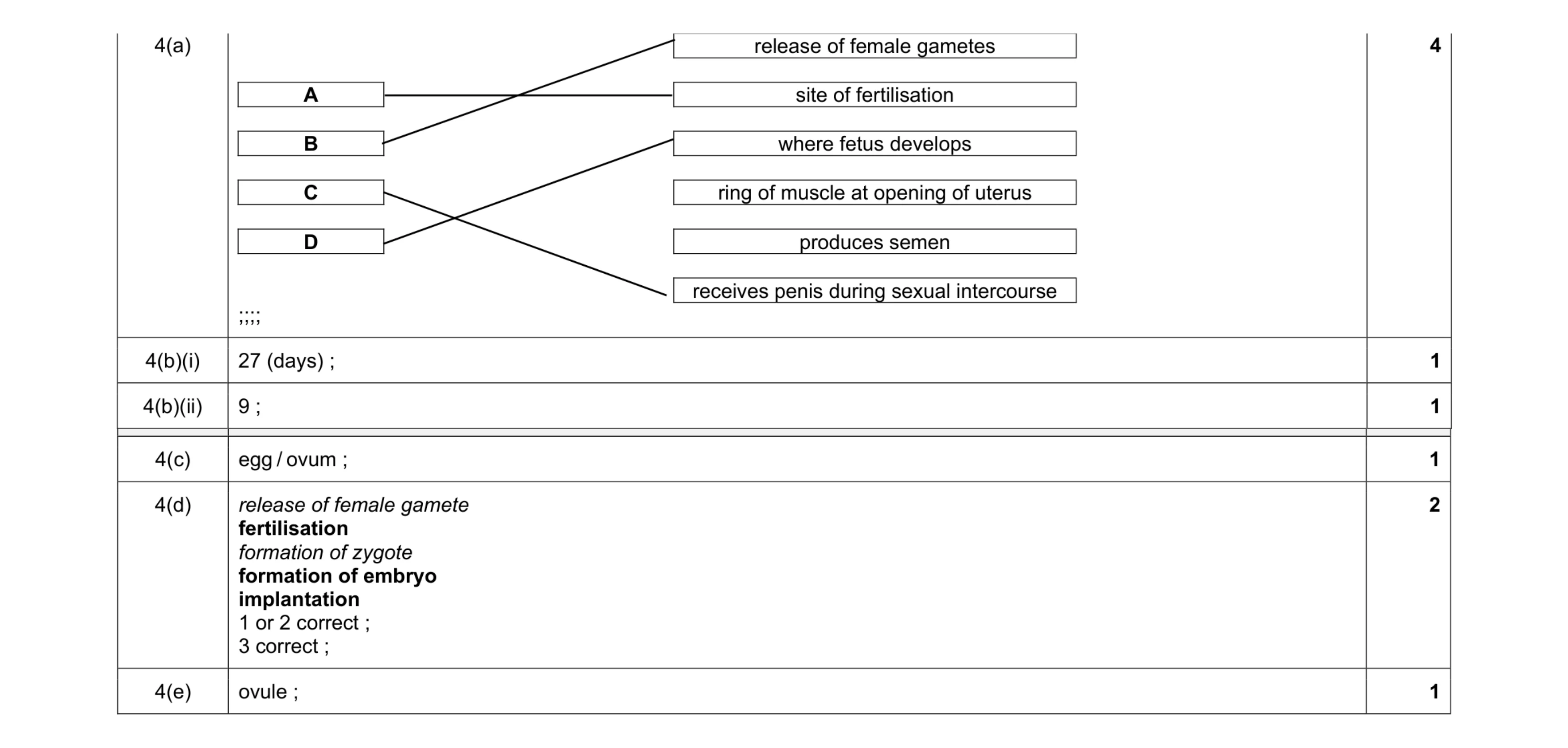 10
10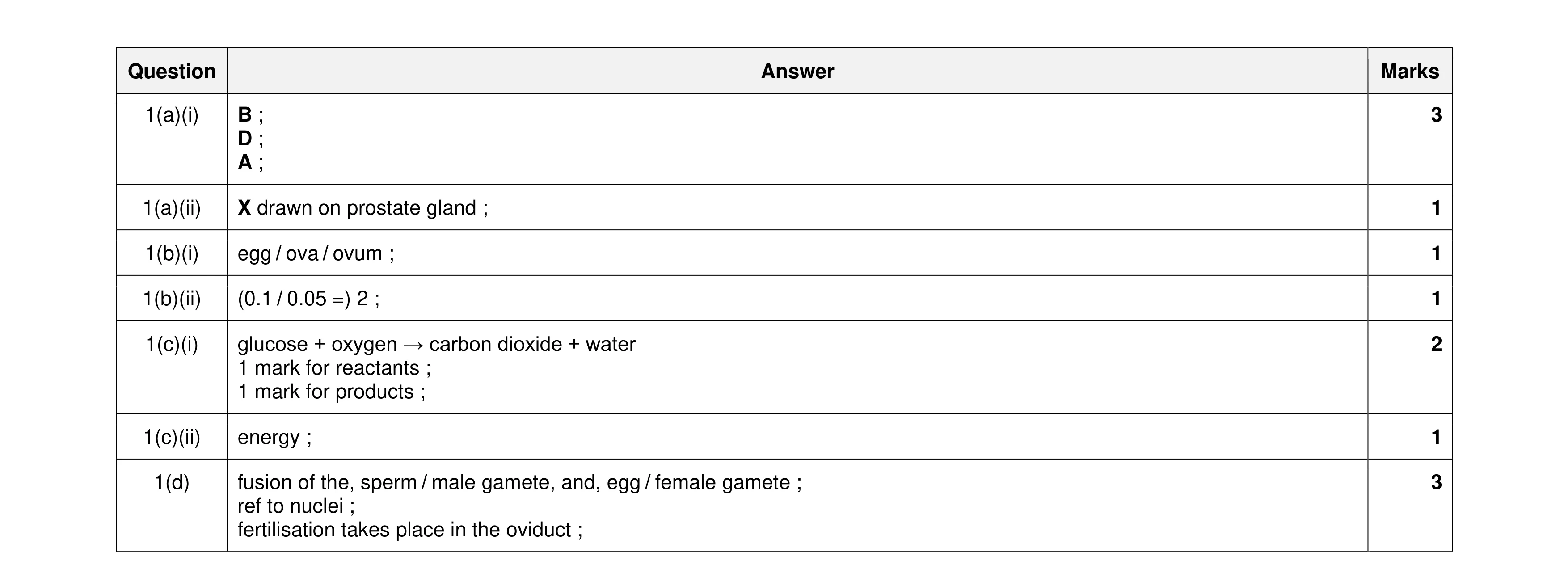 12
12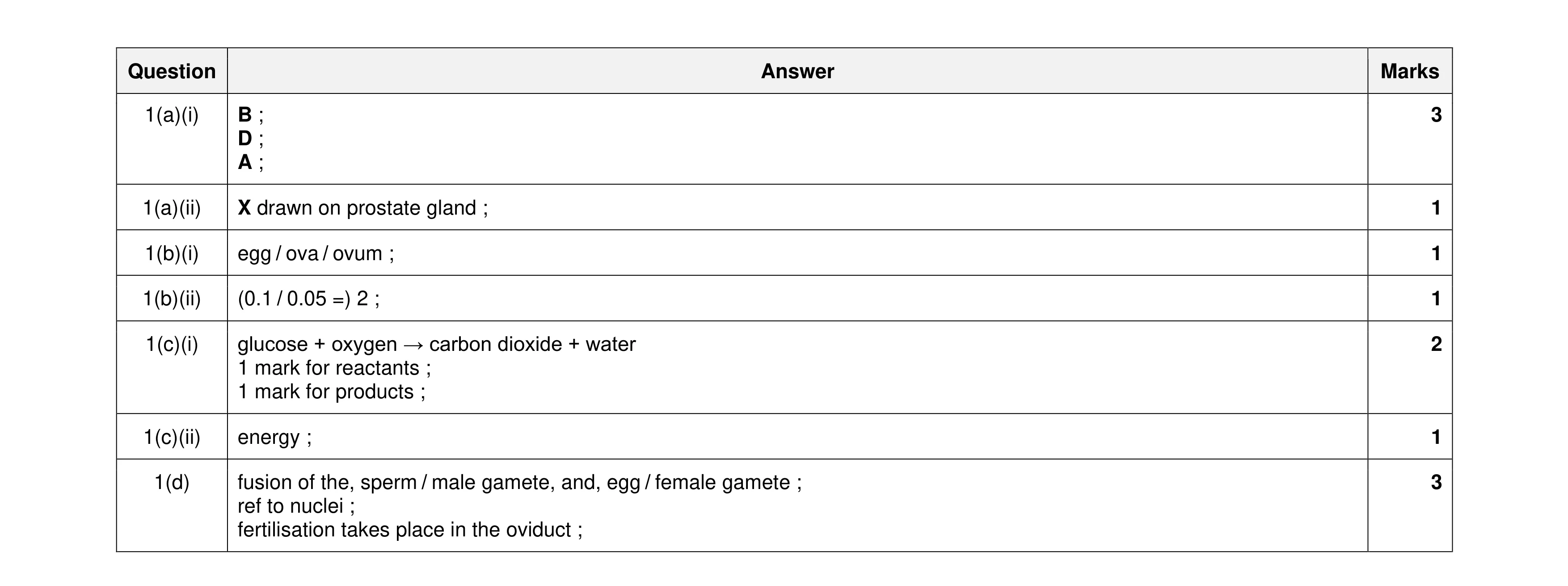 12
12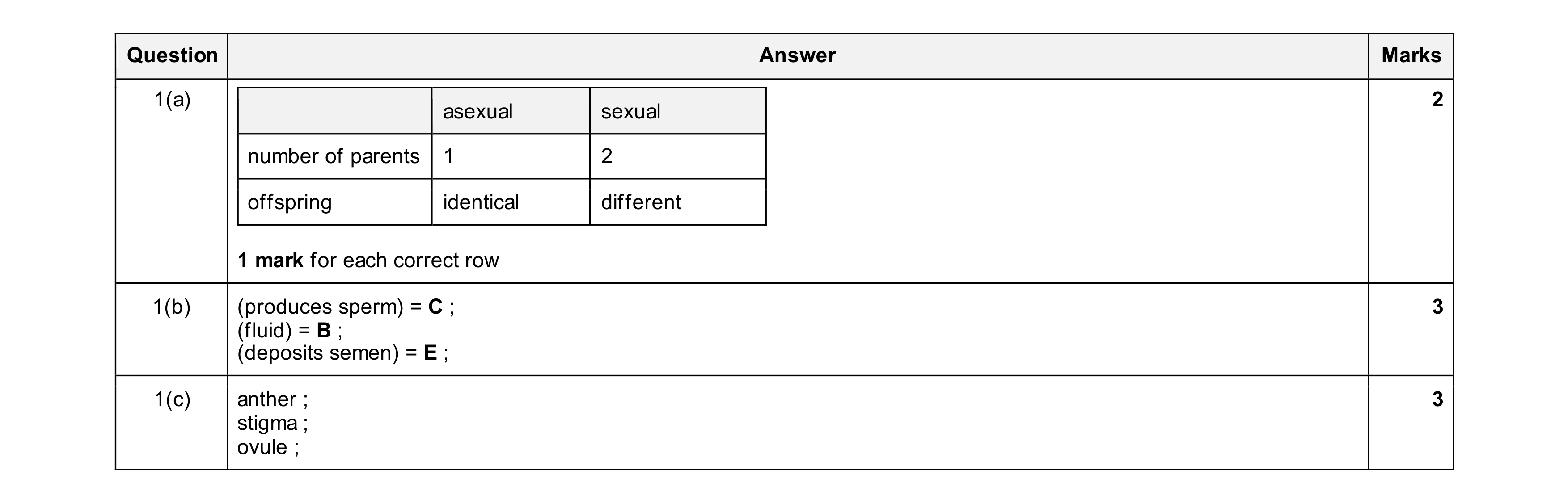 8
8