Questions as text
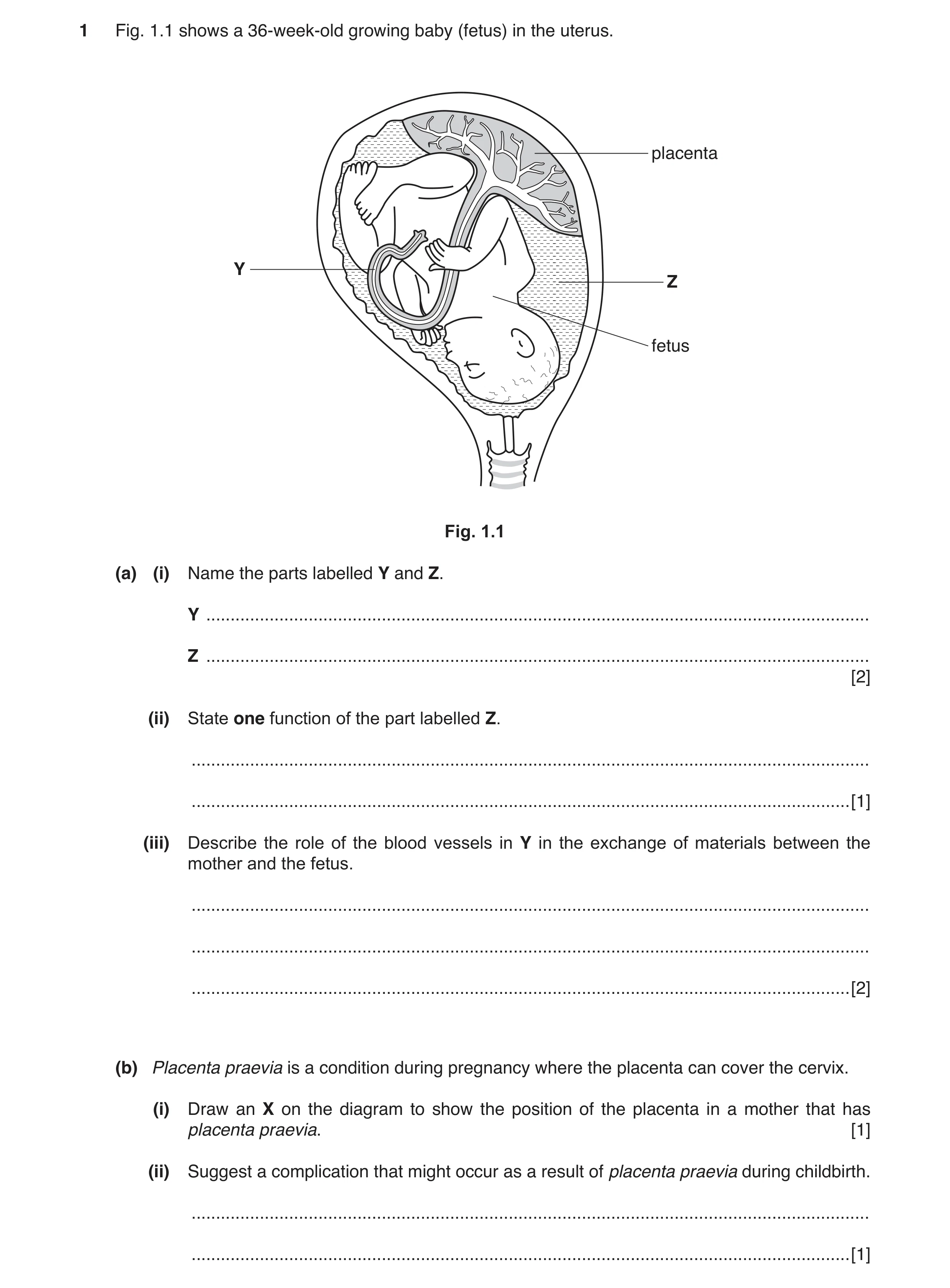
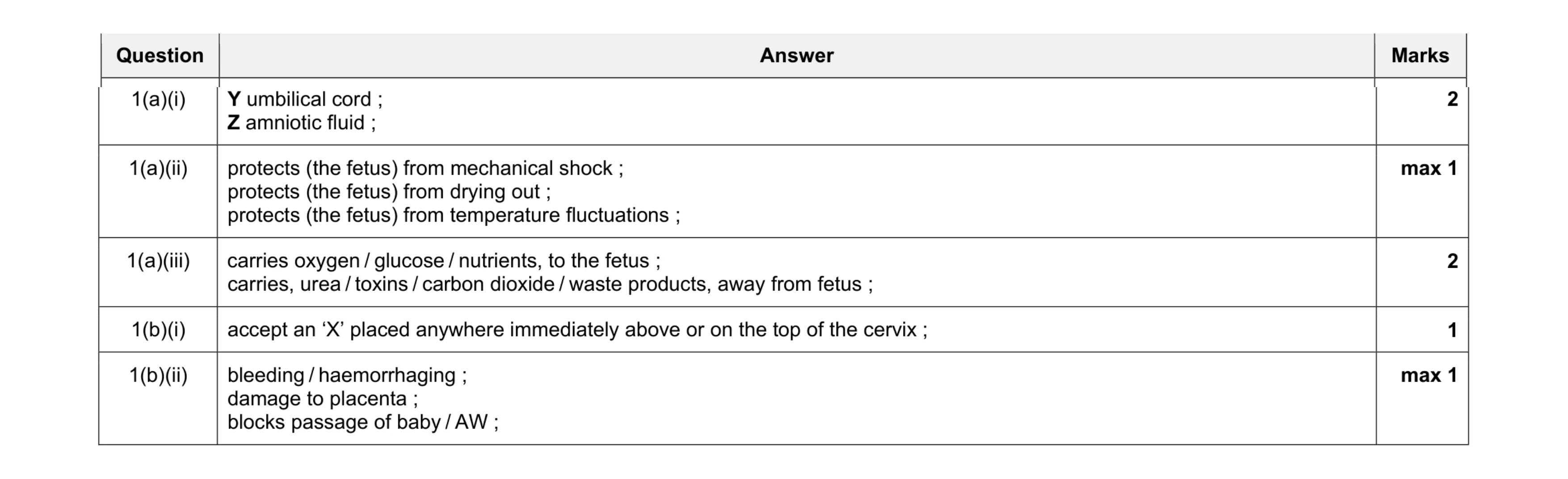
Q1 · A 36-week-old growing baby (fetus) in the uterus 0654/41 May/June 2017
1 Fig. 1.1 shows a 36-week-old growing baby (fetus) in the uterus. placenta Y Z fetus Fig. 1.1 (a) (i) Name the parts labelled Y and Z. Y … Z … [2] (ii) State one function of the part labelled Z. … … [1] (iii) Describe the role of the blood vessels in Y in the exchange of materials between the mother and the fetus. … … … [2] (b) Placenta praevia is a condition during pregnancy where the placenta can cover the cervix. (i) Draw an X on the diagram to show the position of the placenta in a mother that has placenta praevia. [1] (ii) Suggest a complication that might occur as a result of placenta praevia during childbirth. … … [1]
7 marks
Mark scheme: 1(a)(i) Y umbilical cord ; Z amniotic fluid ; 2 1(a)(ii) protects (the fetus) from mechanical shock ; protects (the fetus) from drying out ; protects (the fetus) from temperature fluctuations ; max 1 1(a)(iii) carries oxygen / glucose / nutrients, to the fetus ; carries, urea / toxins / carbon dioxide / waste products, away from fetus ; 2 1(b)(i) accept an ‘X’ placed anywhere immediately above or on the top of the cervix ; 1 1(b)(ii) bleeding / haemorrhaging ; damage to placenta ; blocks passage of baby / AW ; max 1
This question in 0654/41 May/June 2017
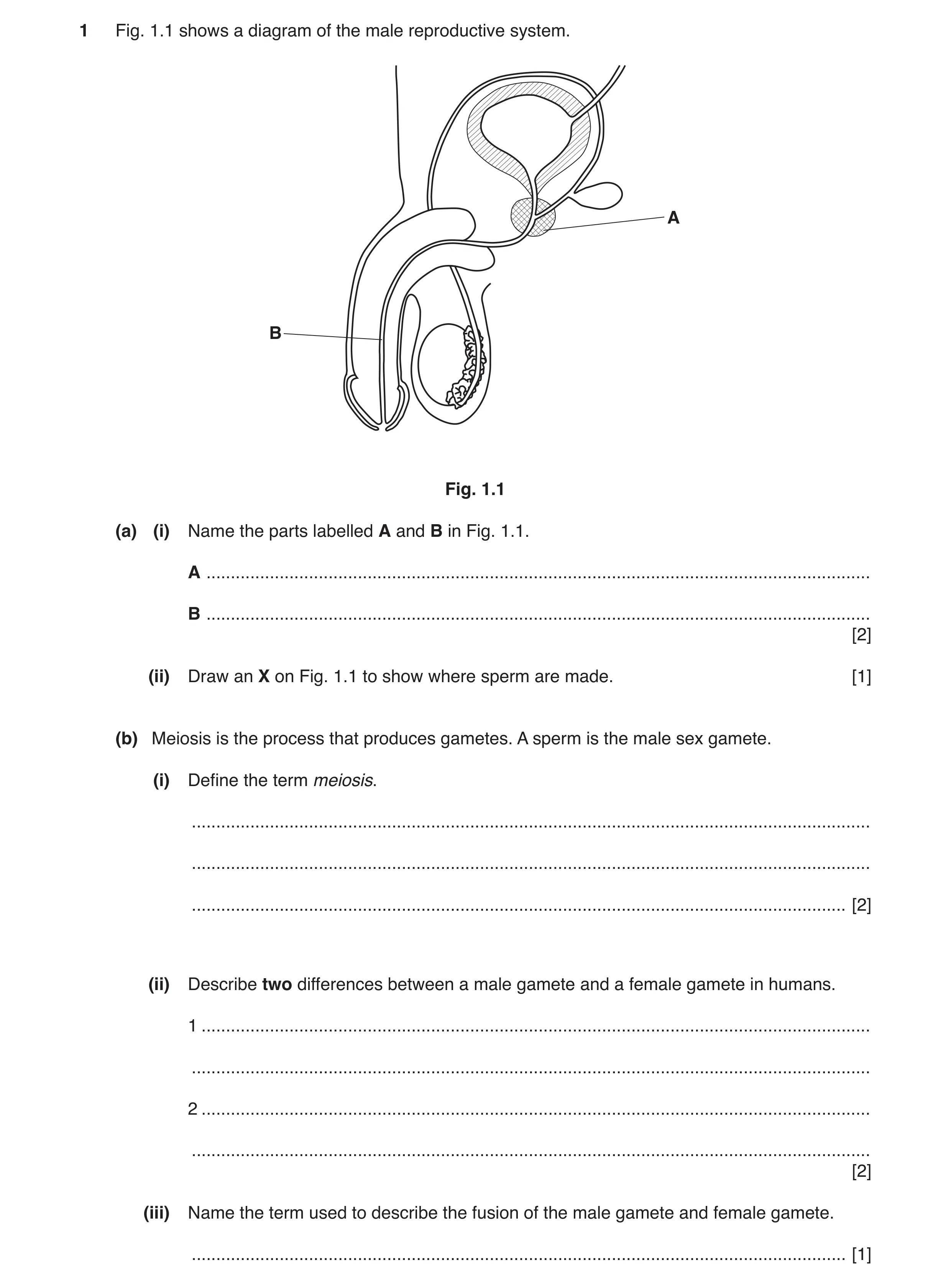
Q2 · A diagram of the male reproductive system 0654/41 Oct/Nov 2017
1 Fig. 1.1 shows a diagram of the male reproductive system. A B Fig. 1.1 (a) (i) Name the parts labelled A and B in Fig. 1.1. A … B … [2] (ii) Draw an X on Fig. 1.1 to show where sperm are made. [1] (b) Meiosis is the process that produces gametes. A sperm is the male sex gamete. (i) Define the term meiosis. … … … [2] (ii) Describe two differences between a male gamete and a female gamete in humans. 1 … … 2 … … [2] (iii) Name the term used to describe the fusion of the male gamete and female gamete. … [1]
8 marks
Mark scheme: 1(a)(i) A – prostate gland ; B – urethra ; 2 1(a)(ii) ‘X’ on testicle ; 1 1(b)(i) reduction division ; chromosome number halved ; from diploid to haploid ; max 2 1(b)(ii) egg bigger / sperm smaller ; egg non-motile / sperm, motile ; only sperm has tail / ORA ; egg contains X chromosome and male contains X or Y chromosome ; max 2 1(b)(iii) fertilisation ; 1
This question in 0654/41 Oct/Nov 2017
Q3 · A diagram of the male reproductive system 0654/43 Oct/Nov 2018
1 Fig. 1.1 shows a diagram of the male reproductive system. Fig. 1.1 (a) (i) Mark an X on Fig. 1.1 to show where sperm cells are made. [1] (ii) State the type of cell division that produces sperm cells. … [1] (iii) State two structures through which sperm cells must pass on their way out of the body. 1 … 2 … [2] (b) Table 1.1 compares some of the features of sperm cells and egg cells in humans. Complete Table 1.1. Table 1.1 feature sperm cells egg cells size compared to the other sex cell number produced during lifetime compared to the other sex cell ability to move themselves unable to move themselves [3] (c) The nuclei of sperm cells can be described as haploid. State the meaning of the term haploid nuclei. … … [1] (d) During fertilisation, the nuclei of the sperm cell and the egg cell join. State where in the human body fertilisation occurs. … [1]
9 marks
Mark scheme: 1(a)(i) X drawn on testis ; 1 1(a)(ii) meiosis ; 1 1(a)(iii) any two from sperm duct ; urethra ; penis ; max 2 1(b) feature sperm cells egg cells size compared to the other sex cell small large number produced during lifetime compared to the other sex cell many few ability to move themselves able to move themselves unable to move themselves 1 correct row ; 2 correct rows ; 3 correct rows ; 3 1(c) (nuclei) contains, single set / unpaired chromosomes ; 1 1(d) oviduct ; 1
This question in 0654/43 Oct/Nov 2018
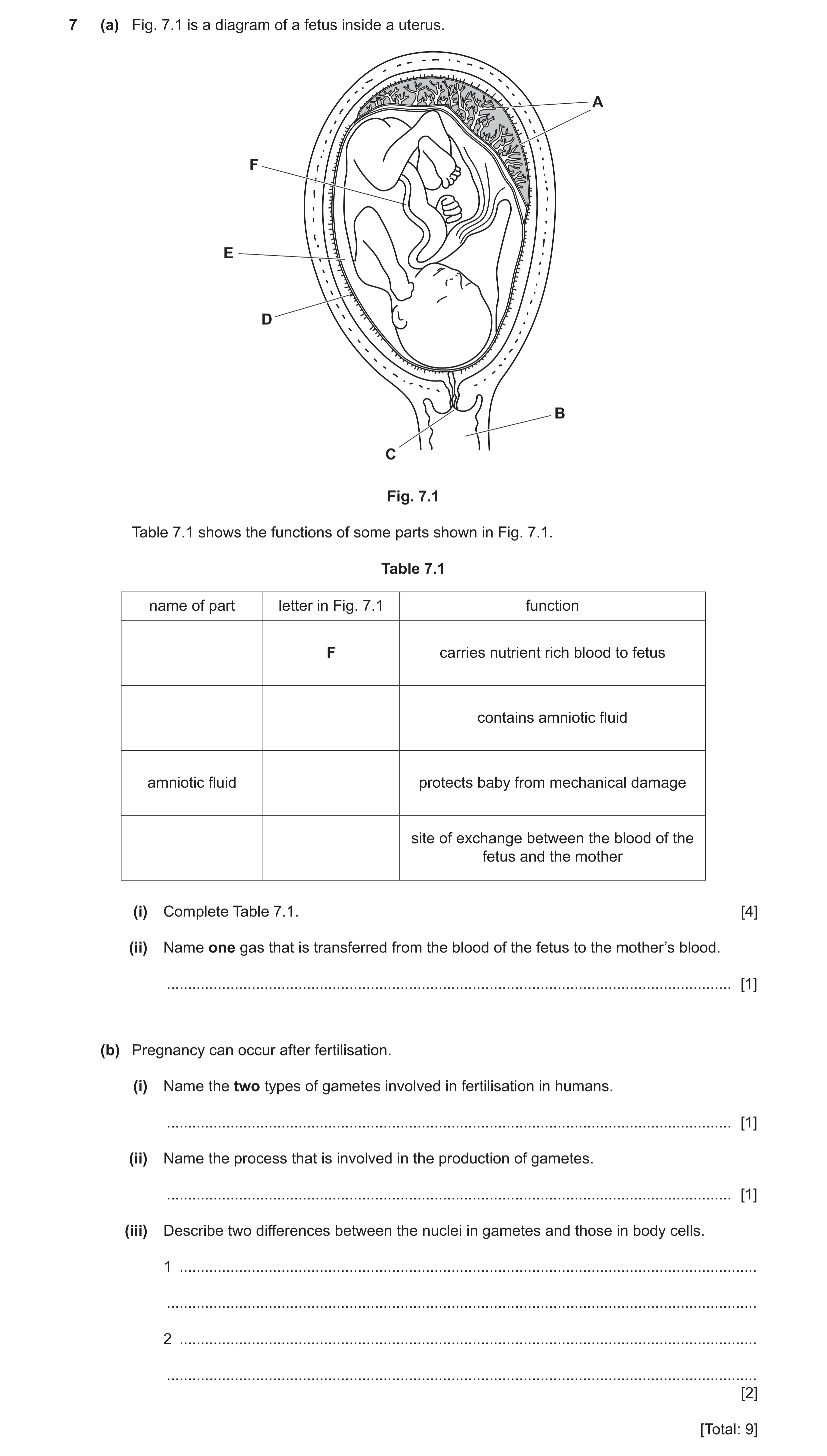
Q4 · A diagram of a fetus inside a uterus 0654/41 May/June 2020
7 (a) Fig. 7.1 is a diagram of a fetus inside a uterus. A F E D B C Fig. 7.1 Table 7.1 shows the functions of some parts shown in Fig. 7.1. Table 7.1 name of part letter in Fig. 7.1 function F carries nutrient rich blood to fetus contains amniotic fluid amniotic fluid protects baby from mechanical damage site of exchange between the blood of the fetus and the mother (i) Complete Table 7.1. [4] (ii) Name one gas that is transferred from the blood of the fetus to the mother’s blood. … [1] (b) Pregnancy can occur after fertilisation. (i) Name the two types of gametes involved in fertilisation in humans. … [1] (ii) Name the process that is involved in the production of gametes. … [1] (iii) Describe two differences between the nuclei in gametes and those in body cells. 1 … … 2 … … [2] [Total: 9]
9 marks
Mark scheme: 7(a)(i) name of part letter in Fig. 7.1 function umbilical cord F attaches growing baby to placenta amnion / amniotic sac D contains amniotic fluid amniotic fluid E protects baby from mechanical damage placenta A site of exchange between the blood of the fetus and mother ;;;; 1 mark for each row 7(a)(ii) carbon dioxide ; 1 7(b)(i) sperm and eggs ; 1 7(b)(ii) meiosis ; 1 7(b)(iii) gametes have haploid nuclei / body cells have diploid nuclei ; gametes have unpaired chromosomes / body cells have paired chromosomes ; gametes have 23 chromosomes / body cells have 46 or 23 pairs ; max 2
This question in 0654/41 May/June 2020
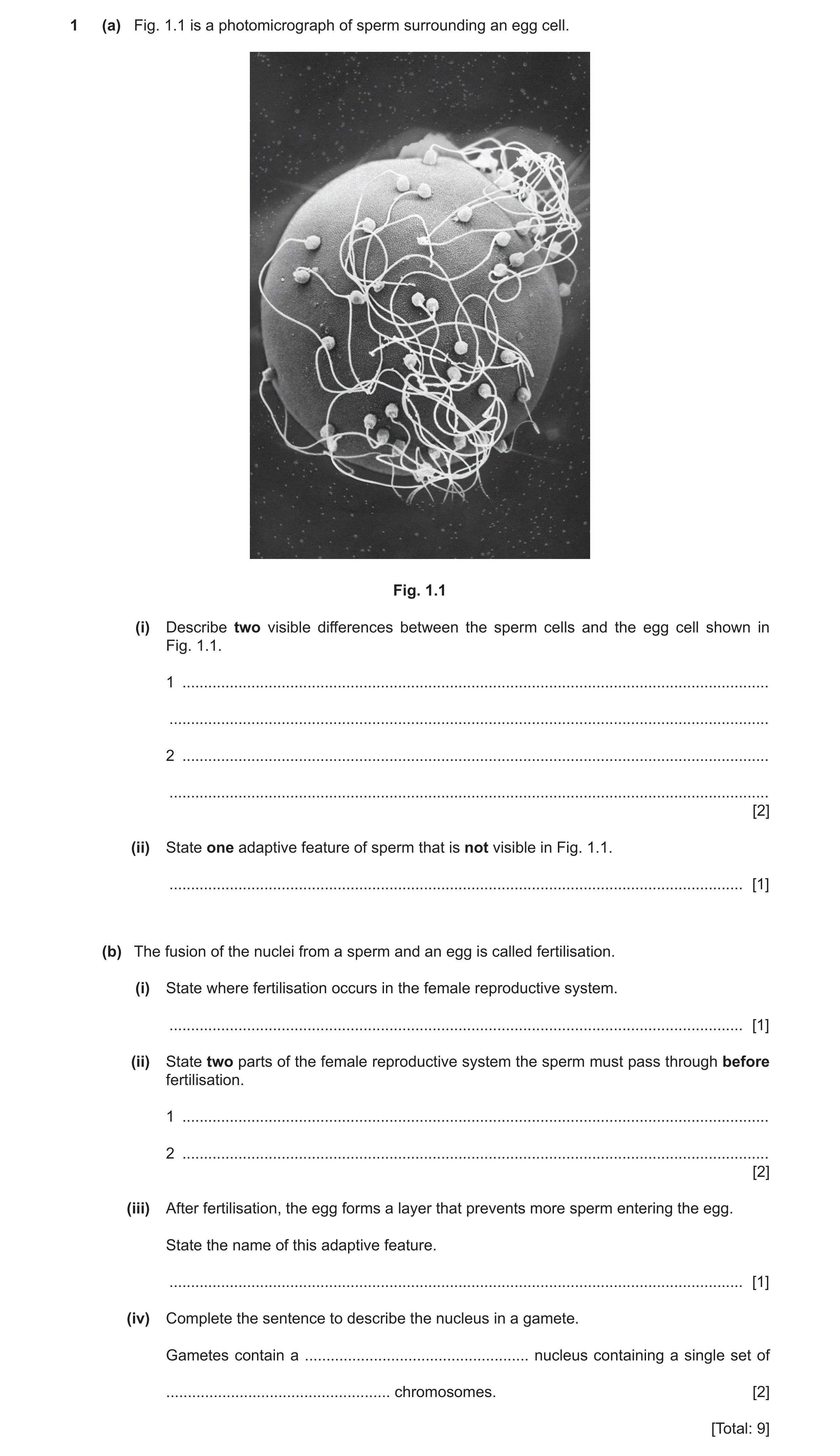
Q5 · A photomicrograph of sperm surrounding an egg cell 0654/42 Oct/Nov 2020
1 (a) Fig. 1.1 is a photomicrograph of sperm surrounding an egg cell. Fig. 1.1 (i) Describe two visible differences between the sperm cells and the egg cell shown in Fig. 1.1. 1 … … 2 … … [2] (ii) State one adaptive feature of sperm that is not visible in Fig. 1.1. … [1] (b) The fusion of the nuclei from a sperm and an egg is called fertilisation. (i) State where fertilisation occurs in the female reproductive system. … [1] (ii) State two parts of the female reproductive system the sperm must pass through before fertilisation. 1 … 2 … [2] (iii) After fertilisation, the egg forms a layer that prevents more sperm entering the egg. State the name of this adaptive feature. … [1] (iv) Complete the sentence to describe the nucleus in a gamete. Gametes contain a … nucleus containing a single set of … chromosomes. [2] [Total: 9]
9 marks
Mark scheme: 1(a)(i) sperm are smaller ; sperm, are elongated / are long and thin / have flagellum ; 2 1(a)(ii) presence of enzymes / AVP ; 1 1(b)(i) oviduct ; 1 1(b)(ii) any two from vagina ; cervix ; uterus ; 2 1(b)(iii) jelly coating ; 1 1(b)(iv) haploid ; unpaired ; 2
This question in 0654/42 Oct/Nov 2020
Q6 · A diagram of the blood vessels in the placenta of the mother and her fetus 0654/43 Oct/Nov 2020
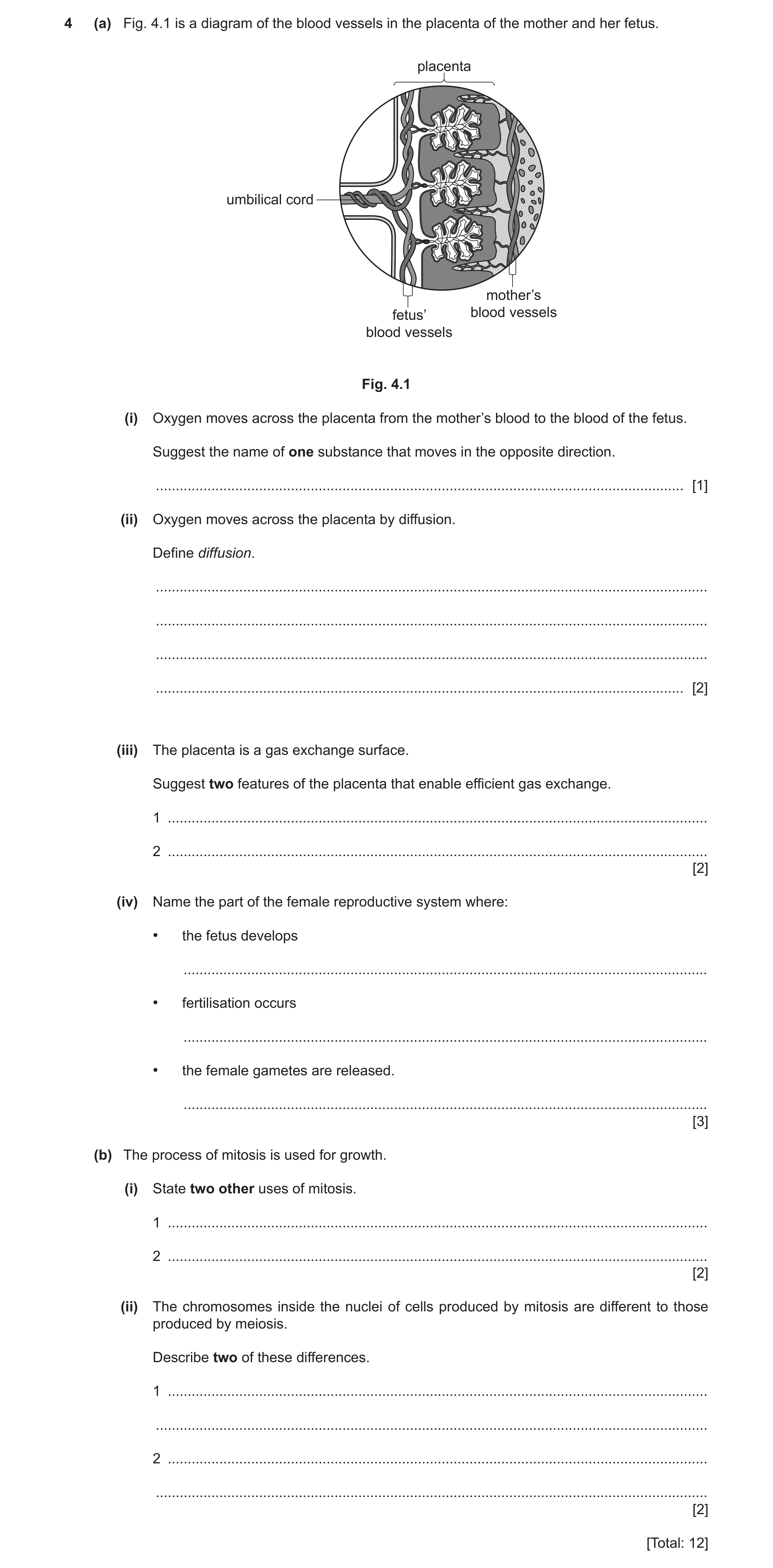
4 (a) Fig. 4.1 is a diagram of the blood vessels in the placenta of the mother and her fetus. placenta umbilical cord mother’s fetus’ blood vessels blood vessels Fig. 4.1 (i) Oxygen moves across the placenta from the mother’s blood to the blood of the fetus. Suggest the name of one substance that moves in the opposite direction. … [1] (ii) Oxygen moves across the placenta by diffusion. Define diffusion. … … … … [2] (iii) The placenta is a gas exchange surface. Suggest two features of the placenta that enable efficient gas exchange. 1 … 2 … [2] (iv) Name the part of the female reproductive system where: • the fetus develops … • fertilisation occurs … • the female gametes are released. … [3] (b) The process of mitosis is used for growth. (i) State two other uses of mitosis. 1 … 2 … [2] (ii) The chromosomes inside the nuclei of cells produced by mitosis are different to those produced by meiosis. Describe two of these differences. 1 … … 2 … … [2] [Total: 12]
12 marks
Mark scheme: 4(a)(i) carbon dioxide ; 1 4(a)(ii) (net movement of particles from their) higher concentration to their lower concentration / down a concentration gradient ; ref to random movement of particles ; 2 4(a)(iii) any two from thin membrane ; large surface area ; good blood supply ; (semi) permeable membrane ; 2 4(a)(iv) uterus ; oviduct ; ovary ; 3 4(b)(i) any two from repair (of damaged tissue) ; replacement of cells ; asexual reproduction ; 2 4(b)(ii) chromosomes produced by mitosis have a diploid number / chromosomes produced by meiosis have a haploid number ; cells produced by mitosis, contain two sets of chromosomes / are paired / cells produced by meiosis are unpaired ; cells produced by mitosis are genetically identical (to parent cell / each other) / cells produced by meiosis are genetically different (to parent cell / each other) ; max 2 2
This question in 0654/43 Oct/Nov 2020
Q7 · The daily energy requirements of different females 0654/42 Oct/Nov 2021
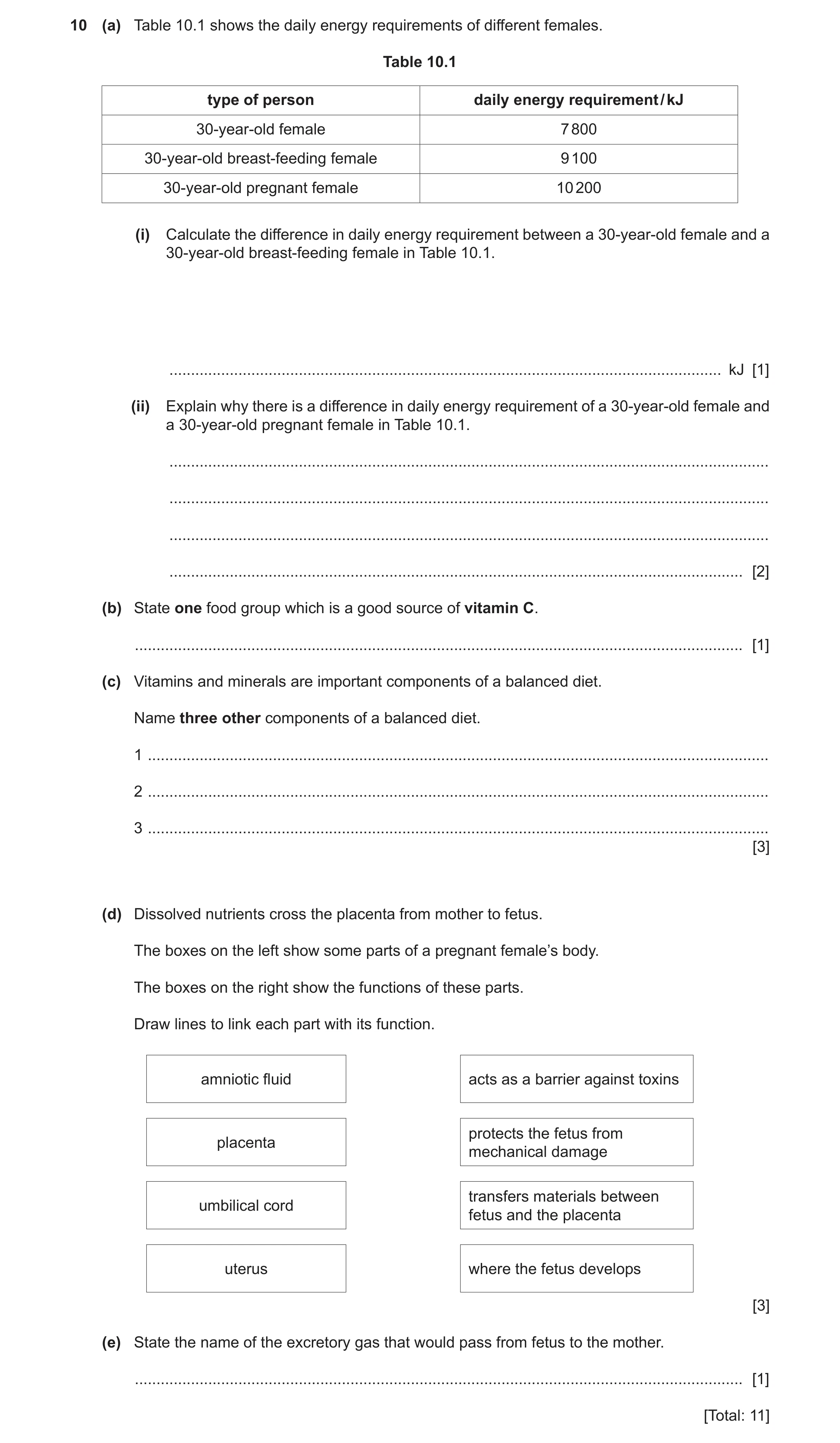
10 (a) Table 10.1 shows the daily energy requirements of different females. Table 10.1 type of person daily energy requirement / kJ 30-year-old female 7 800 30-year-old breast-feeding female 9 100 30-year-old pregnant female 10 200 (i) Calculate the difference in daily energy requirement between a 30-year-old female and a 30-year-old breast-feeding female in Table 10.1. … kJ [1] (ii) Explain why there is a difference in daily energy requirement of a 30-year-old female and a 30-year-old pregnant female in Table 10.1. … … … … [2] (b) State one food group which is a good source of vitamin C. … [1] (c) Vitamins and minerals are important components of a balanced diet. Name three other components of a balanced diet. 1 … 2 … 3 … [3] (d) Dissolved nutrients cross the placenta from mother to fetus. The boxes on the left show some parts of a pregnant female’s body. The boxes on the right show the functions of these parts. Draw lines to link each part with its function. amniotic fluid acts as a barrier against toxins protects the fetus from placenta mechanical damage transfers materials between umbilical cord fetus and the placenta uterus where the fetus develops [3] (e) State the name of the excretory gas that would pass from fetus to the mother. … [1] [Total: 11]
11 marks
Mark scheme: 10(a)(i) (9100 – 7800) = 1300 (kJ) ; 1 10(a)(ii) a fetus requires energy ; for, growth / development (of the fetus) ; 2 10(b) (named), fruit / vegetables ; 1 10(c) any three from: carbohydrates ; fats ; protein ; fibre ; water ; 3 10(d) amniotic fluid acts as a barrier against toxins placenta protects the fetus from mechanical damage umbilical cord transfers materials between fetus and the placenta uterus where the fetus develops ;;; 3 10(e) carbon dioxide ; 1
This question in 0654/42 Oct/Nov 2021
Q8 · A drawing of a sperm cell 0654/43 Oct/Nov 2021
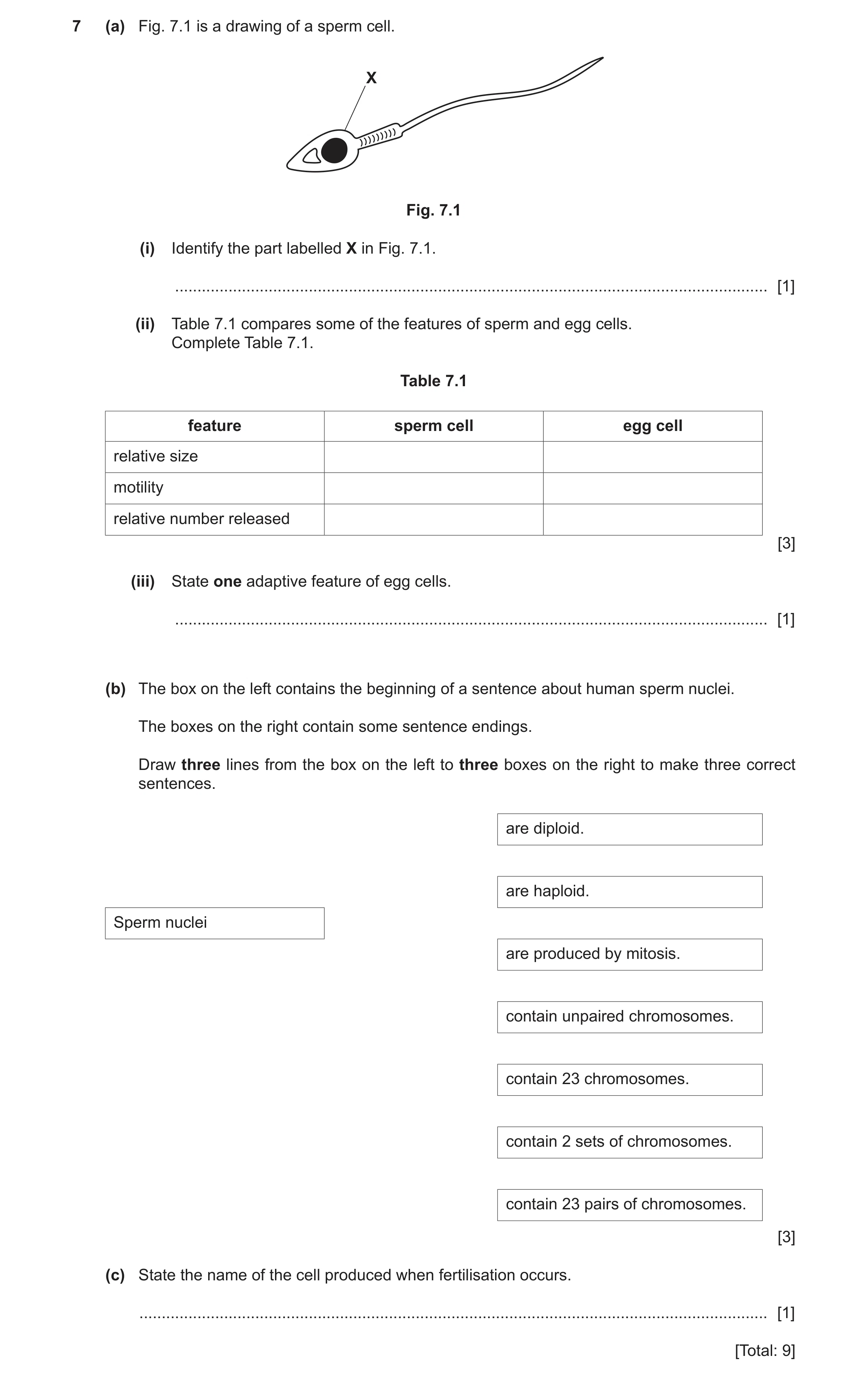
7 (a) Fig. 7.1 is a drawing of a sperm cell. X Fig. 7.1 (i) Identify the part labelled X in Fig. 7.1. … [1] (ii) Table 7.1 compares some of the features of sperm and egg cells. Complete Table 7.1. Table 7.1 feature sperm cell egg cell relative size motility relative number released [3] (iii) State one adaptive feature of egg cells. … [1] (b) The box on the left contains the beginning of a sentence about human sperm nuclei. The boxes on the right contain some sentence endings. Draw three lines from the box on the left to three boxes on the right to make three correct sentences. are diploid. are haploid. Sperm nuclei are produced by mitosis. contain unpaired chromosomes. contain 23 chromosomes. contain 2 sets of chromosomes. contain 23 pairs of chromosomes. [3] (c) State the name of the cell produced when fertilisation occurs. … [1] [Total: 9]
9 marks
Mark scheme: 7(a)(i) cell membrane ; 1 7(a)(ii) (relative size) small and large ; (motility) motile and non-motile ; (relative number released at a time) many and few ; 3 7(a)(iii) jelly coat / energy stores ; 1 7(b) are haploid ; contain unpaired chromosomes ; contain 23 chromosomes ; 3 7(c) zygote ; 1
This question in 0654/43 Oct/Nov 2021
Q9 · A diagram of the female reproductive system 0654/43 May/June 2022
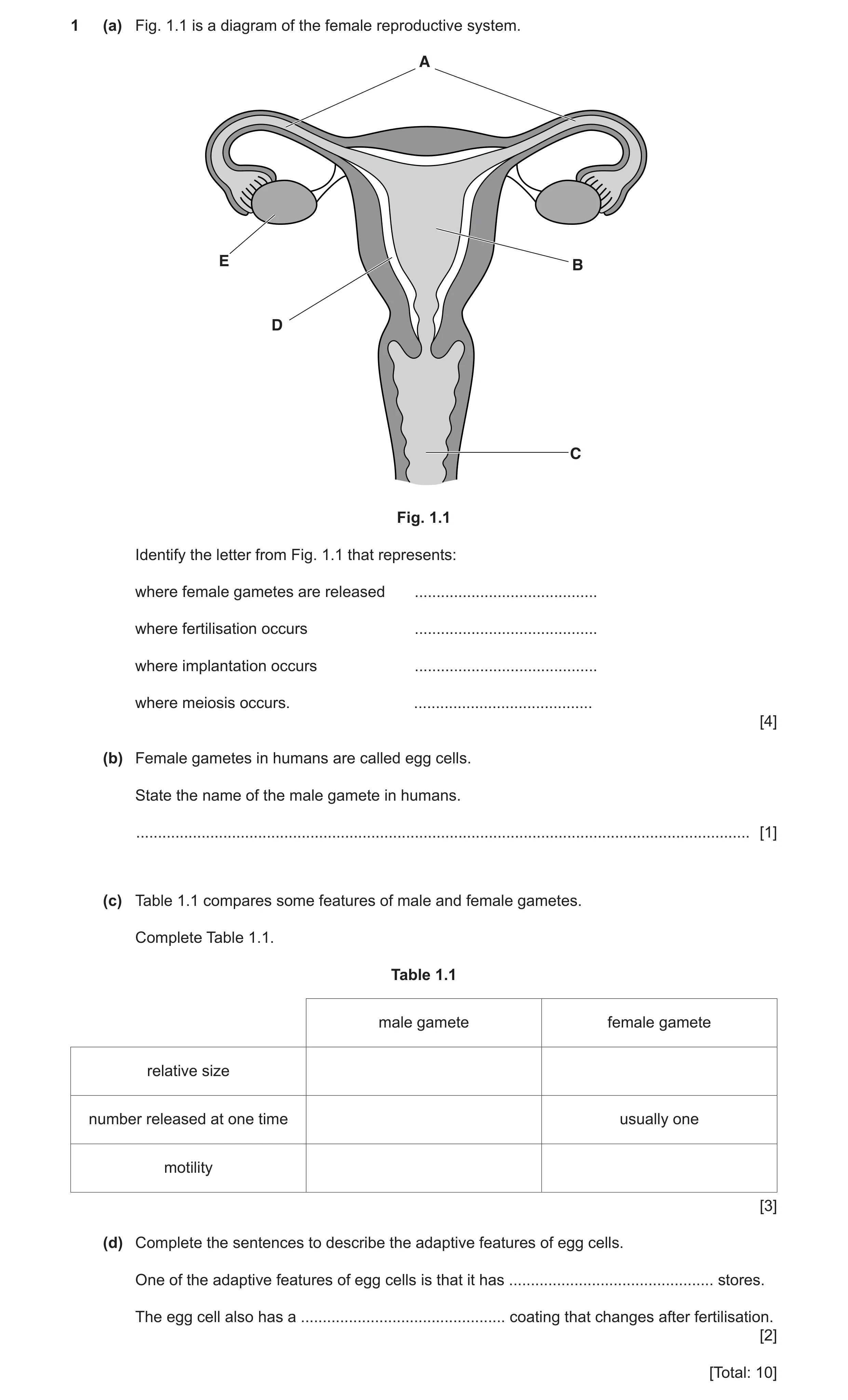
1 (a) Fig. 1.1 is a diagram of the female reproductive system. A E B D C Fig. 1.1 Identify the letter from Fig. 1.1 that represents: where female gametes are released … where fertilisation occurs … where implantation occurs … where meiosis occurs. … [4] (b) Female gametes in humans are called egg cells. State the name of the male gamete in humans. … [1] (c) Table 1.1 compares some features of male and female gametes. Complete Table 1.1. Table 1.1 male gamete female gamete relative size number released at one time usually one motility [3] (d) Complete the sentences to describe the adaptive features of egg cells. One of the adaptive features of egg cells is that it has … stores. The egg cell also has a … coating that changes after fertilisation. [2] [Total: 10]
10 marks
Mark scheme: 1(a) E ; A ; D ; E ; 4 1(b) sperm ; 1 1(c) male gamete female gamete relative size small large number released at one time millions / many usually one motility motile non-motile ;;; 3 1(d) energy ; jelly ; 2
This question in 0654/43 May/June 2022
Q10 · A diagram of the male reproductive system in humans 0654/41 Oct/Nov 2022
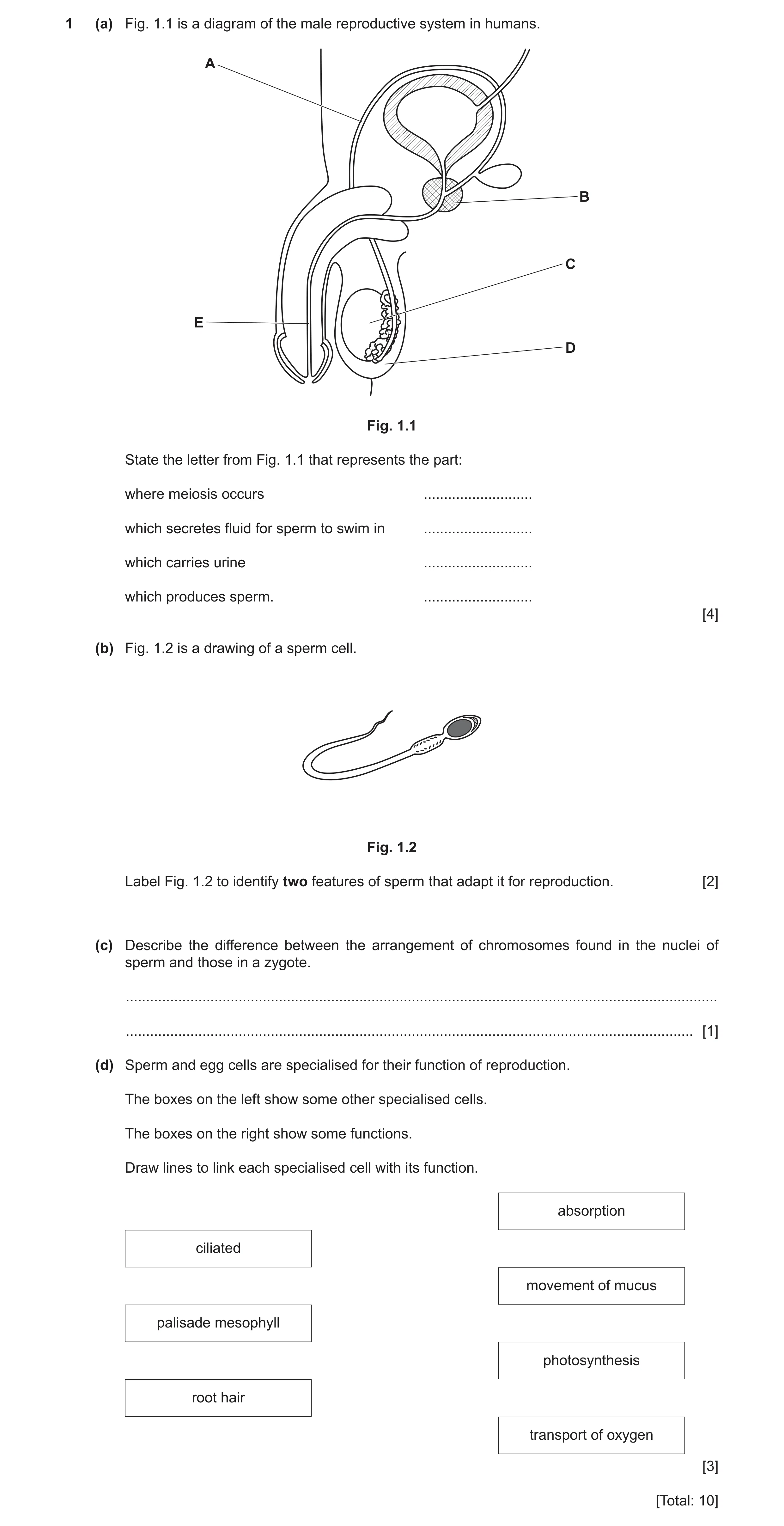
1 (a) Fig. 1.1 is a diagram of the male reproductive system in humans. A B C E D Fig. 1.1 State the letter from Fig. 1.1 that represents the part: where meiosis occurs … which secretes fluid for sperm to swim in … which carries urine … which produces sperm. … [4] (b) Fig. 1.2 is a drawing of a sperm cell. Fig. 1.2 Label Fig. 1.2 to identify two features of sperm that adapt it for reproduction. [2] (c) Describe the difference between the arrangement of chromosomes found in the nuclei of sperm and those in a zygote. … … [1] (d) Sperm and egg cells are specialised for their function of reproduction. The boxes on the left show some other specialised cells. The boxes on the right show some functions. Draw lines to link each specialised cell with its function. absorption ciliated movement of mucus palisade mesophyll photosynthesis root hair transport of oxygen [3] [Total: 10]
10 marks
Mark scheme: Question Answer Marks 1(a) C ; 4 B ; E ; C ; 1(b) any two from: 2 flagellum labelled ; haploid nucleus labelled ; enzymes labelled ; AVP ; 1(c) 1 from: 1 sperm: unpaired chromosomes / single set of chromosomes ; zygote: paired chromosomes / 2 sets of chromosomes ; 1(d) 3 absorption ciliated movement of mucus palisade mesophyll photosynthesis root hair transport of oxygen ;;;
This question in 0654/41 Oct/Nov 2022
Q11 · The total number of new HIV infections in the world is monitored 0654/42 Oct/Nov 2022
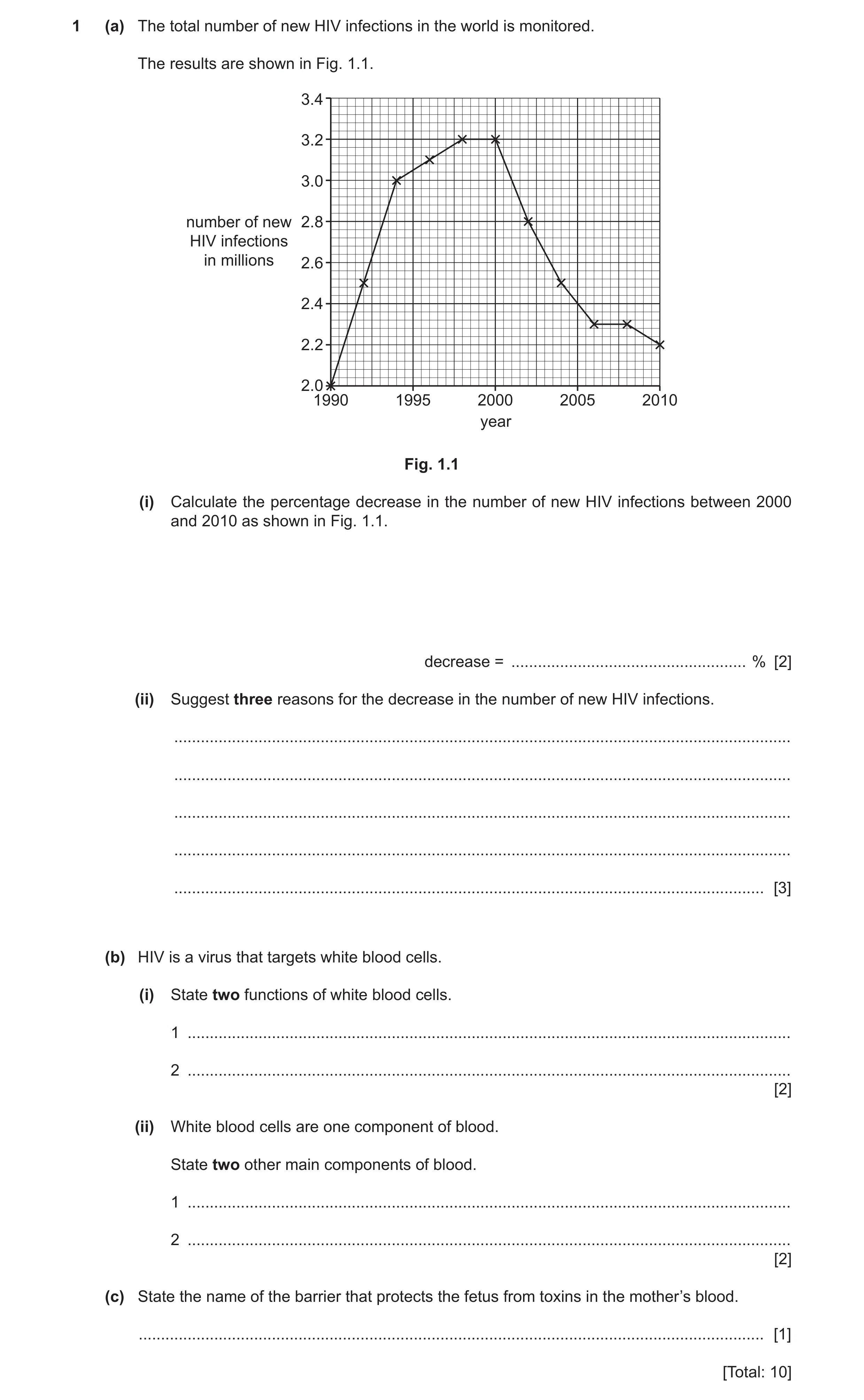
1 (a) The total number of new HIV infections in the world is monitored. The results are shown in Fig. 1.1. 3.4 3.2 3.0 number of new 2.8 HIV infections in millions 2.6 2.4 2.2 2.0 1990 1995 2000 2005 2010 year Fig. 1.1 (i) Calculate the percentage decrease in the number of new HIV infections between 2000 and 2010 as shown in Fig. 1.1. decrease = … % [2] (ii) Suggest three reasons for the decrease in the number of new HIV infections. … … … … … [3] (b) HIV is a virus that targets white blood cells. (i) State two functions of white blood cells. 1 … 2 … [2] (ii) White blood cells are one component of blood. State two other main components of blood. 1 … 2 … [2] (c) State the name of the barrier that protects the fetus from toxins in the mother’s blood. … [1] [Total: 10]
10 marks
Mark scheme: Question Answer Marks 1(a)(i) (difference =) 3.2–2.2 or 1.0 ; 2 ((difference / 3.2) 100) = 31 (%) ; 1(a)(ii) any three from: 3 discovery of routes of transmission ; (increased) use of (named) barrier contraception / abstinence ; screening of blood transfusions ; ref to reduced drug use / use of clean needles ; monitoring/testing/screening, (of HIV) ; ref to education / awareness ; any valid point ; 1(b)(i) phagocytosis ; 2 antibody production ; 1(b)(ii) any two from: 2 red blood cells ; platelets ; plasma ; 1(c) placenta ; 1
This question in 0654/42 Oct/Nov 2022
Q12 · A diagram of a sperm cell in humans 0654/42 May/June 2023
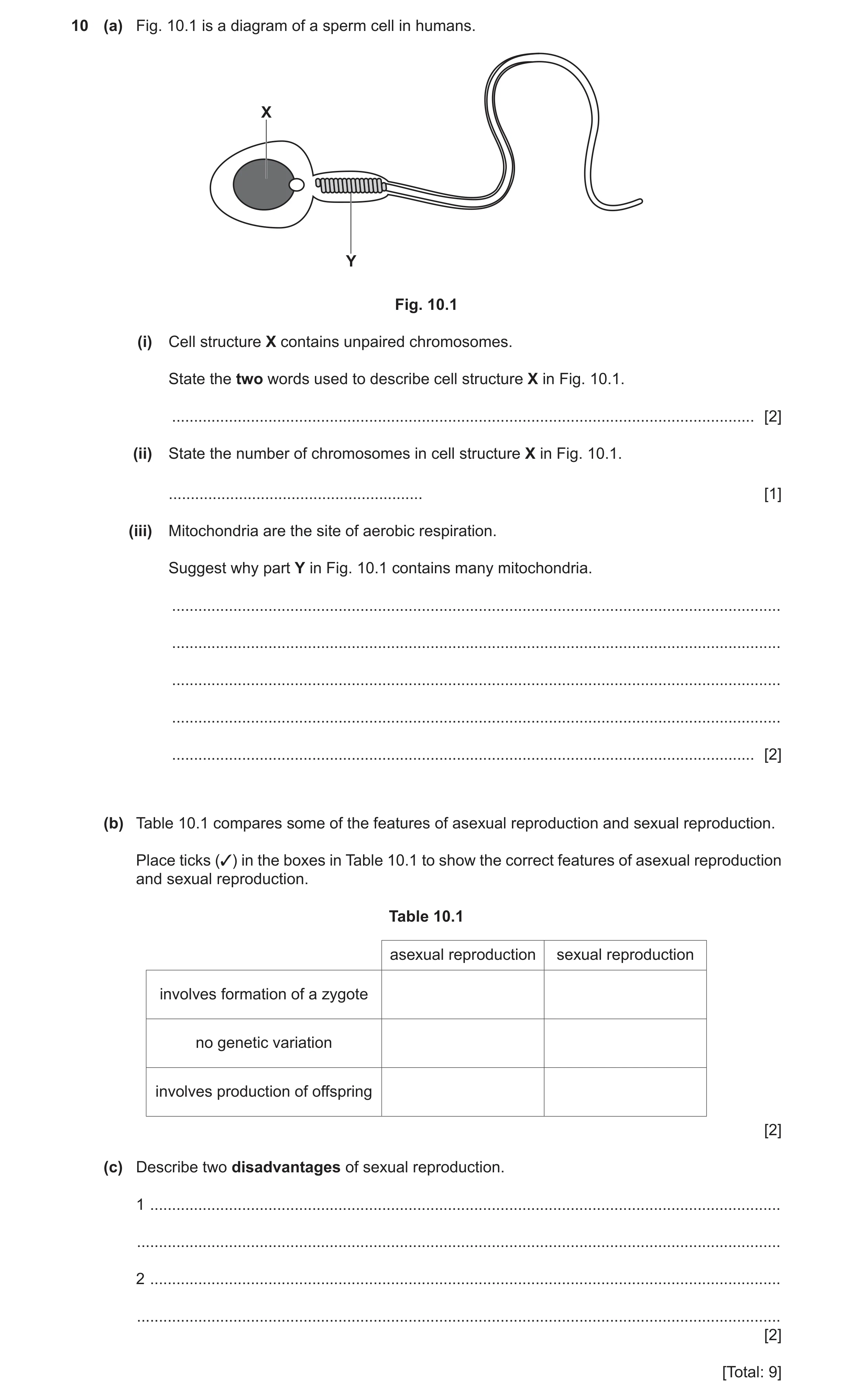
10 (a) Fig. 10.1 is a diagram of a sperm cell in humans. X Y Fig. 10.1 (i) Cell structure X contains unpaired chromosomes. State the two words used to describe cell structure X in Fig. 10.1. … [2] (ii) State the number of chromosomes in cell structure X in Fig. 10.1. … [1] (iii) Mitochondria are the site of aerobic respiration. Suggest why part Y in Fig. 10.1 contains many mitochondria. … … … … … [2] (b) Table 10.1 compares some of the features of asexual reproduction and sexual reproduction. Place ticks (3) in the boxes in Table 10.1 to show the correct features of asexual reproduction and sexual reproduction. Table 10.1 asexual reproduction sexual reproduction involves formation of a zygote no genetic variation involves production of offspring [2] (c) Describe two disadvantages of sexual reproduction. 1 … … 2 … … [2] [Total: 9]
9 marks
Mark scheme: 10(a)(i) haploid ; nucleus ; 2 10(a)(ii) 23 ; 1 10(a)(iii) (aerobic) respiration releases energy ; needed for sperm to, swim / move flagella / move (to egg) / locomotion ; 2 10(b) asexual reproduction sexual reproduction involves formation of a zygote no genetic variation involves production of offspring ;; 2 10(c) any two from: more energy is required (to find a mate / produce gametes) ; longer process ; can’t reproduce if isolated / have to have more than one organism ; not always successful ; idea of new, undesirable characteristics, can result in the offspring ; 2
This question in 0654/42 May/June 2023
Q13 · A diagram of the female reproductive system in humans 0654/42 Oct/Nov 2023
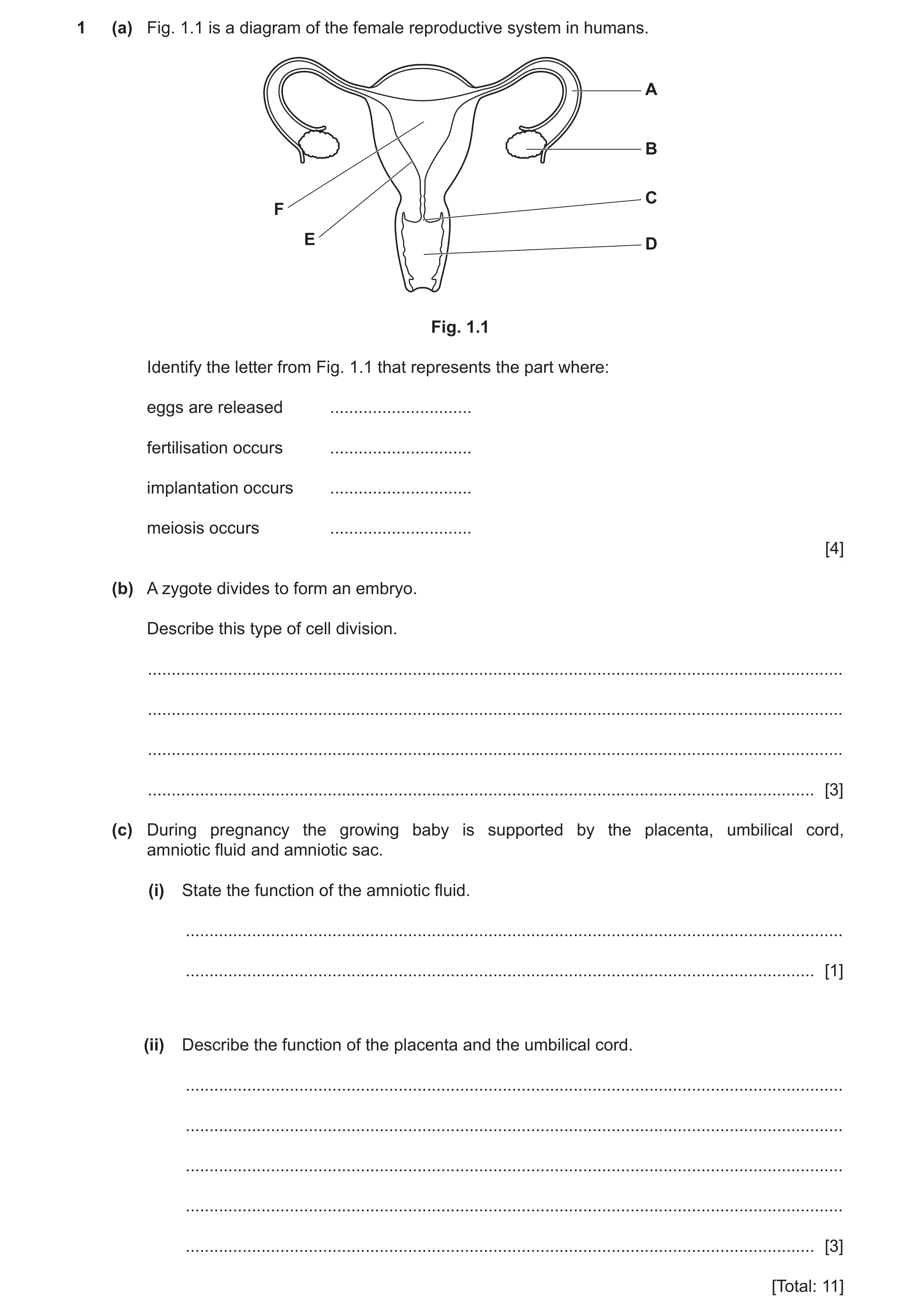
1 (a) Fig. 1.1 is a diagram of the female reproductive system in humans. A B C F E D Fig. 1.1 Identify the letter from Fig. 1.1 that represents the part where: eggs are released … fertilisation occurs … implantation occurs … meiosis occurs … [4] (b) A zygote divides to form an embryo. Describe this type of cell division. … … … … [3] (c) During pregnancy the growing baby is supported by the placenta, umbilical cord, amniotic fluid and amniotic sac. (i) State the function of the amniotic fluid. … … [1] (ii) Describe the function of the placenta and the umbilical cord. … … … … … [3] [Total: 11]
11 marks
Mark scheme: Question Answer Marks 1(a) B ; 4 A ; E ; B ; 1(b) any three from: 3 mitosis ; nuclear division ; production of genetically identical cells ; ref to duplication of chromosomes (before mitosis) ; 1(c)(i) protection (from mechanical damage) ; 1 1(c)(ii) any three from: 3 placenta provides a barrier to toxins ; umbilical cord passes, oxygen / nutrients, to fetus (blood) ; umbilical cord passes, excretory products / carbon dioxide, to mothers (blood) ; ref to exchange of materials by diffusion (across the placenta) ;
This question in 0654/42 Oct/Nov 2023
Q14 · A diagram of the male reproductive system in humans 0654/42 Feb/March 2024
1 (a) Fig. 1.1 is a diagram of the male reproductive system in humans. A E B D C Fig. 1.1 State the letter from Fig. 1.1 that identifies the part: that is a tube transporting excretory products … that secretes fluid for the formation of semen … where meiosis occurs. … [3] (b) Fig. 1.2 is a diagram of a sperm cell. Y X Fig. 1.2 (i) State how the arrangement of the chromosomes in the part labelled X in Fig. 1.2 is different to that of a human body cell. … … [1] (ii) State the name and function of the adaptive feature labelled Y in Fig. 1.2. name … function … … [2] (c) The list shows the names of some specialised cells. ciliated cell egg cell palisade mesophyll cell red blood cell root hair cell white blood cell Choose one cell from the list that: contains a haploid nucleus … does not contain a nucleus … is found in the bronchi … is responsible for phagocytosis. … [4] (d) Red blood cells and white blood cells are components of blood. State the name of one other major component of blood. … [1] [Total: 11]
11 marks
Mark scheme: Question Answer Marks 1(a) B ; 3 E ; D ; 1(b)(i) unpaired ; 1 1(b)(ii) flagellum ; 2 movement / locomotion ; 1(c) egg (cell) ; 4 red blood (cell) ; ciliated (cell) ; white blood (cell) ; 1(d) plasma / platelets ; 1
This question in 0654/42 Feb/March 2024
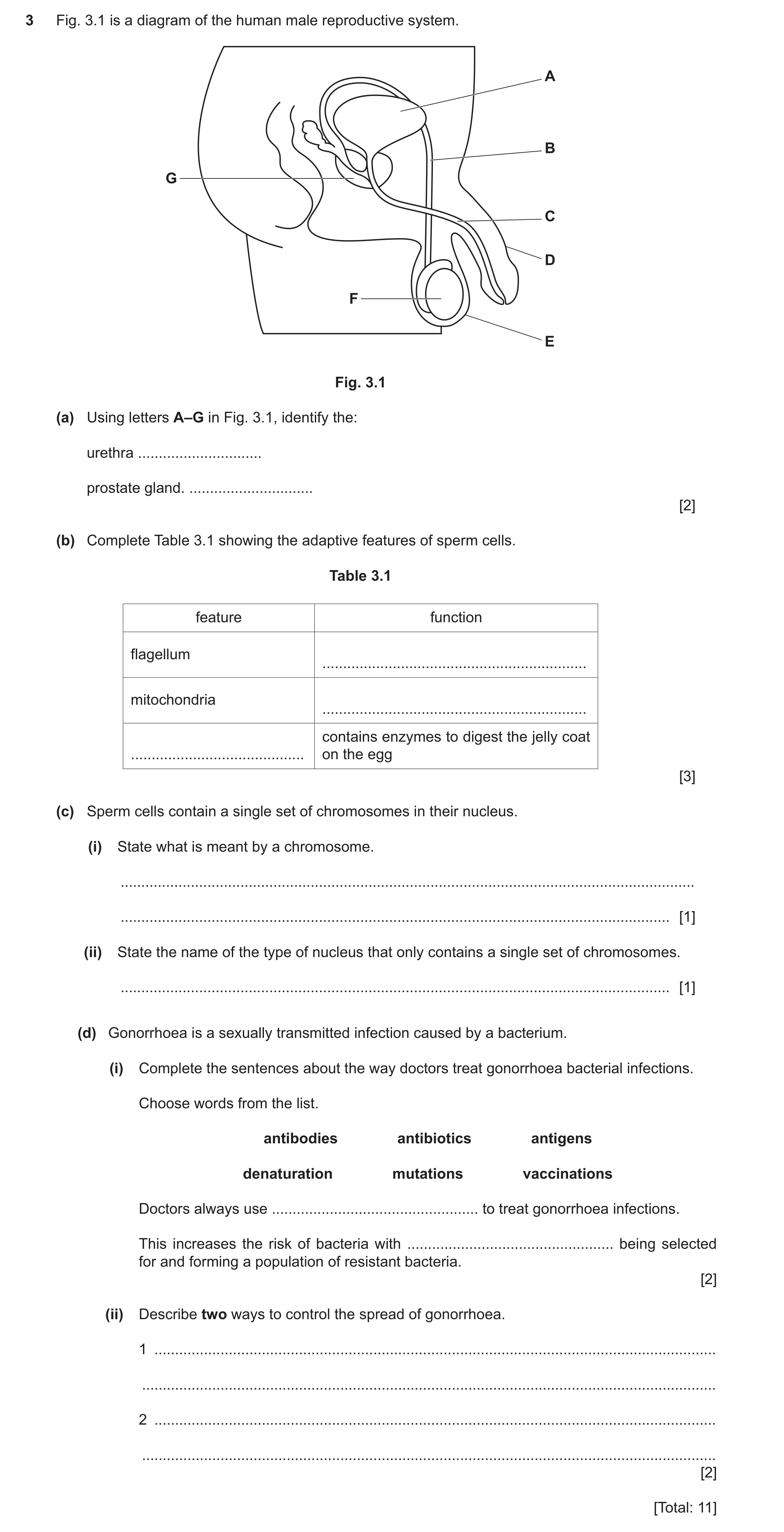
Q15 · A diagram of the human male reproductive system 0654/43 May/June 2025
3 Fig. 3.1 is a diagram of the human male reproductive system. A B G C D F E Fig. 3.1 (a) Using letters A–G in Fig. 3.1, identify the: urethra … prostate gland. … [2] (b) Complete Table 3.1 showing the adaptive features of sperm cells. Table 3.1 feature function flagellum … mitochondria … contains enzymes to digest the jelly coat … on the egg [3] (c) Sperm cells contain a single set of chromosomes in their nucleus. (i) State what is meant by a chromosome. … … [1] (ii) State the name of the type of nucleus that only contains a single set of chromosomes. … [1] (d) Gonorrhoea is a sexually transmitted infection caused by a bacterium. (i) Complete the sentences about the way doctors treat gonorrhoea bacterial infections. Choose words from the list. antibodies antibiotics antigens denaturation mutations vaccinations Doctors always use … to treat gonorrhoea infections. This increases the risk of bacteria with … being selected for and forming a population of resistant bacteria. [2] (ii) Describe two ways to control the spread of gonorrhoea. 1 … … 2 … … [2] [Total: 11]
11 marks
Mark scheme: 3(a) C; 2 G; 3(b) 3 feature function flagellum produces swimming / movement; mitochondria release energy (for swimming); contains enzymes to digest the jelly acrosome; coat on the egg 3(c)(i) (length of) DNA which contains, genetic information / genes; 1 3(c)(ii) haploid; 1 3(d)(i) antibiotics; 2 mutation; 3(d)(ii) reducing number of sexual partners / abstaining (from sex); 2 using condoms / preventing transfer of bodily fluids during sex; AVP;;
This question in 0654/43 May/June 2025
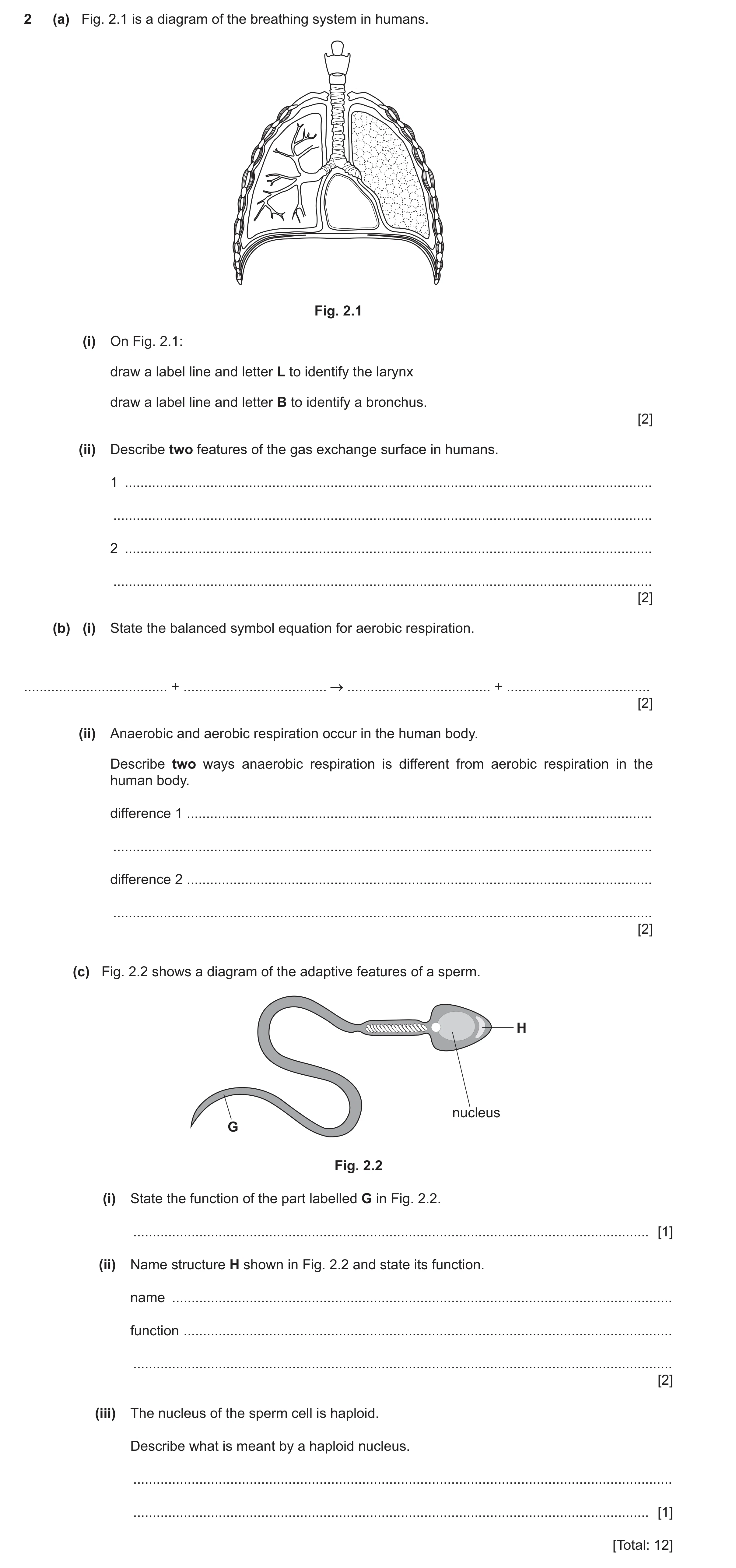
Q16 · A diagram of the breathing system in humans 0654/41 Oct/Nov 2025
2 (a) Fig. 2.1 is a diagram of the breathing system in humans. Fig. 2.1 (i) On Fig. 2.1: draw a label line and letter L to identify the larynx draw a label line and letter B to identify a bronchus. [2] (ii) Describe two features of the gas exchange surface in humans. 1 … … 2 … … [2] (b) (i) State the balanced symbol equation for aerobic respiration. … + … … + … [2] (ii) Anaerobic and aerobic respiration occur in the human body. Describe two ways anaerobic respiration is different from aerobic respiration in the human body. difference 1 … … difference 2 … … [2] (c) Fig. 2.2 shows a diagram of the adaptive features of a sperm. H nucleus G Fig. 2.2 (i) State the function of the part labelled G in Fig. 2.2. … [1] (ii) Name structure H shown in Fig. 2.2 and state its function. name … function … … [2] (iii) The nucleus of the sperm cell is haploid. Describe what is meant by a haploid nucleus. … … [1] [Total: 12]
12 marks
Mark scheme: 2(a)(i) larynx labelled L or larynx ; 2 bronchus labelled B or bronchus ; 2(a)(ii) any two from: 2 • large (surface) area ; • thin (surface) / thin wall ; • good blood supply ; • good ventilation (with air) ; • AVP ; 2(b)(i) C6H12O6 + 6O2 → 6CO2 + 6H2O 2 LHS correct either order = 1 mark RHS correct either order = 1 mark 2(b)(ii) any two from: 2 • anaerobic does not require oxygen / ORA ; • anaerobic produces lactic acid / anaerobic releases lactic acid / ORA ; • anaerobic releases less energy / anaerobic releases less ATP / ORA ; • anaerobic does not produce water / anaerobic does not produce carbon dioxide / ORA ; 2(c)(i) motility / move(ment) / swim(ming) ; 1 2(c)(ii) acrosome ; 2 (contains digestive) enzyme(s) to penetrate egg ; 2(c)(iii) contains a single set of chromosomes / AW ; 1
This question in 0654/41 Oct/Nov 2025
 1 / 22
 2 / 22
![Question 3: Fig. 1.1 shows a diagram of the male reproductive system. Fig. 1.1 (a) (i) Mark an X on Fig. 1.1 to show where sperm cells are made. [1] (i…](https://img.pastlit.com/crops/de48ac87-a145-4180-b929-1ee28046327c/q1.webp)
 17 / 22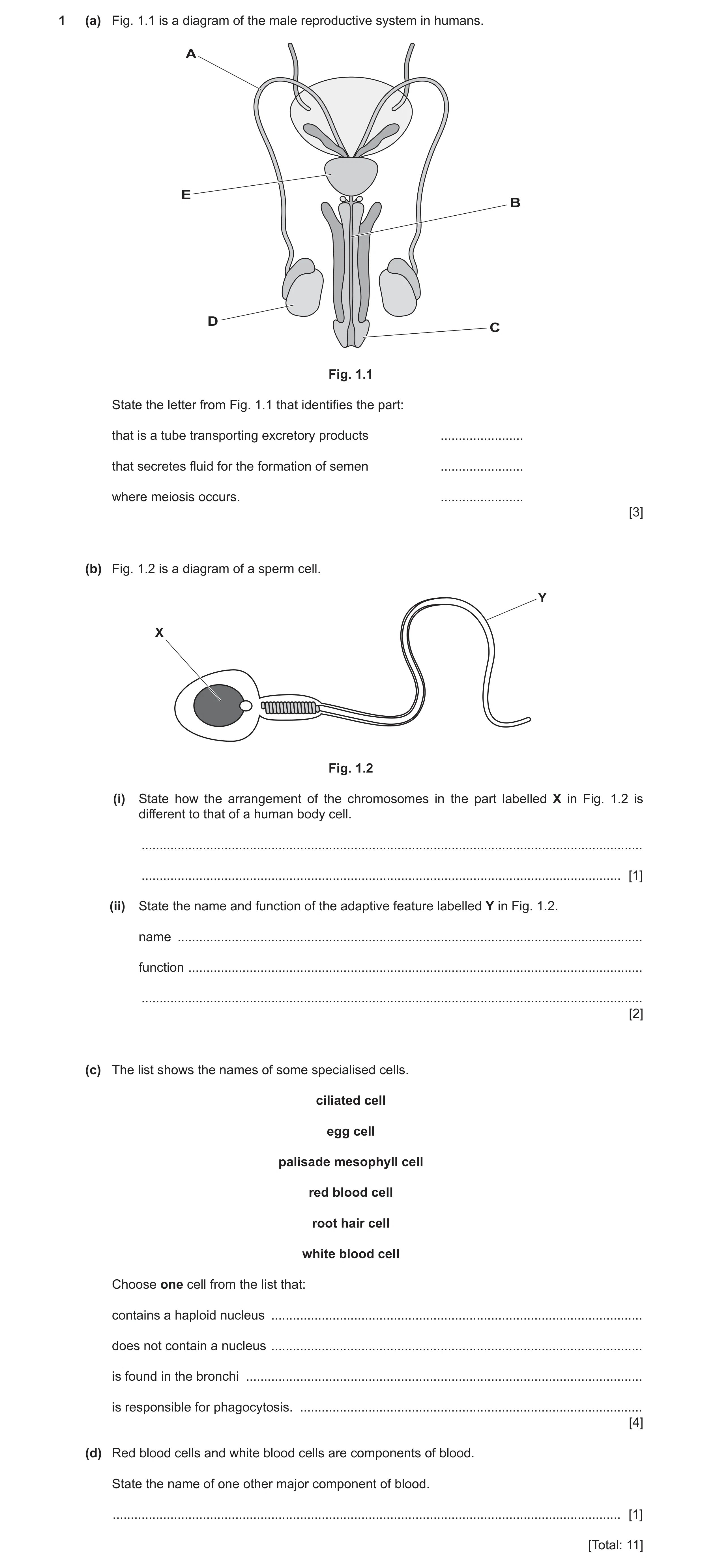
 7
7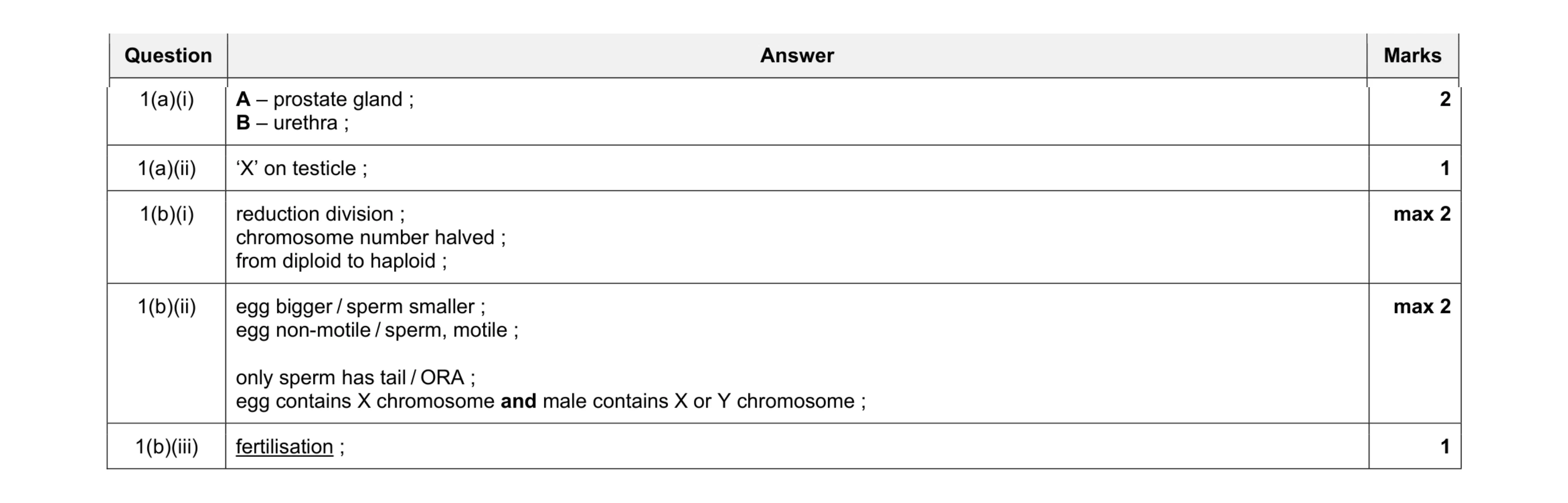 8
8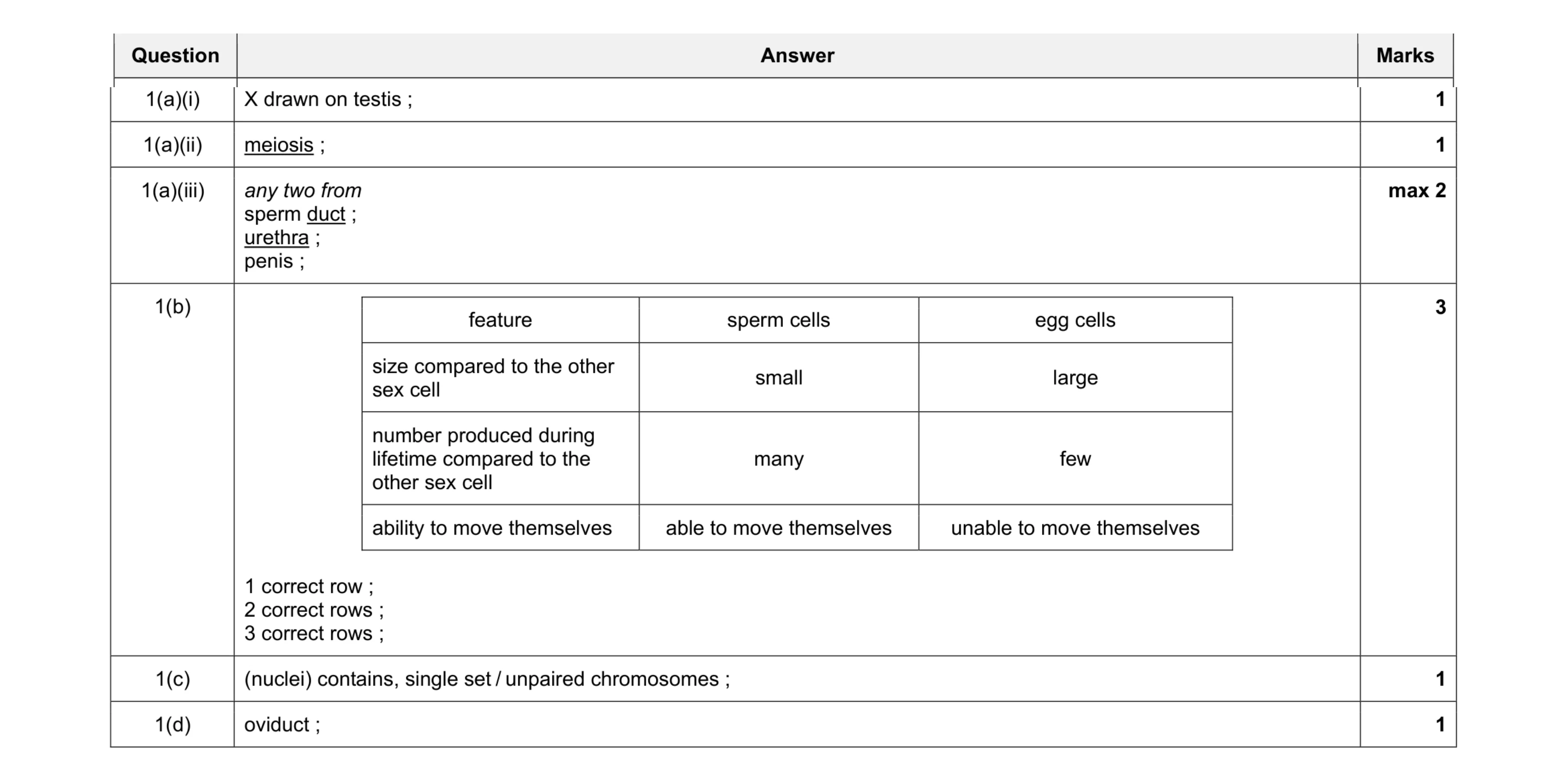 9
9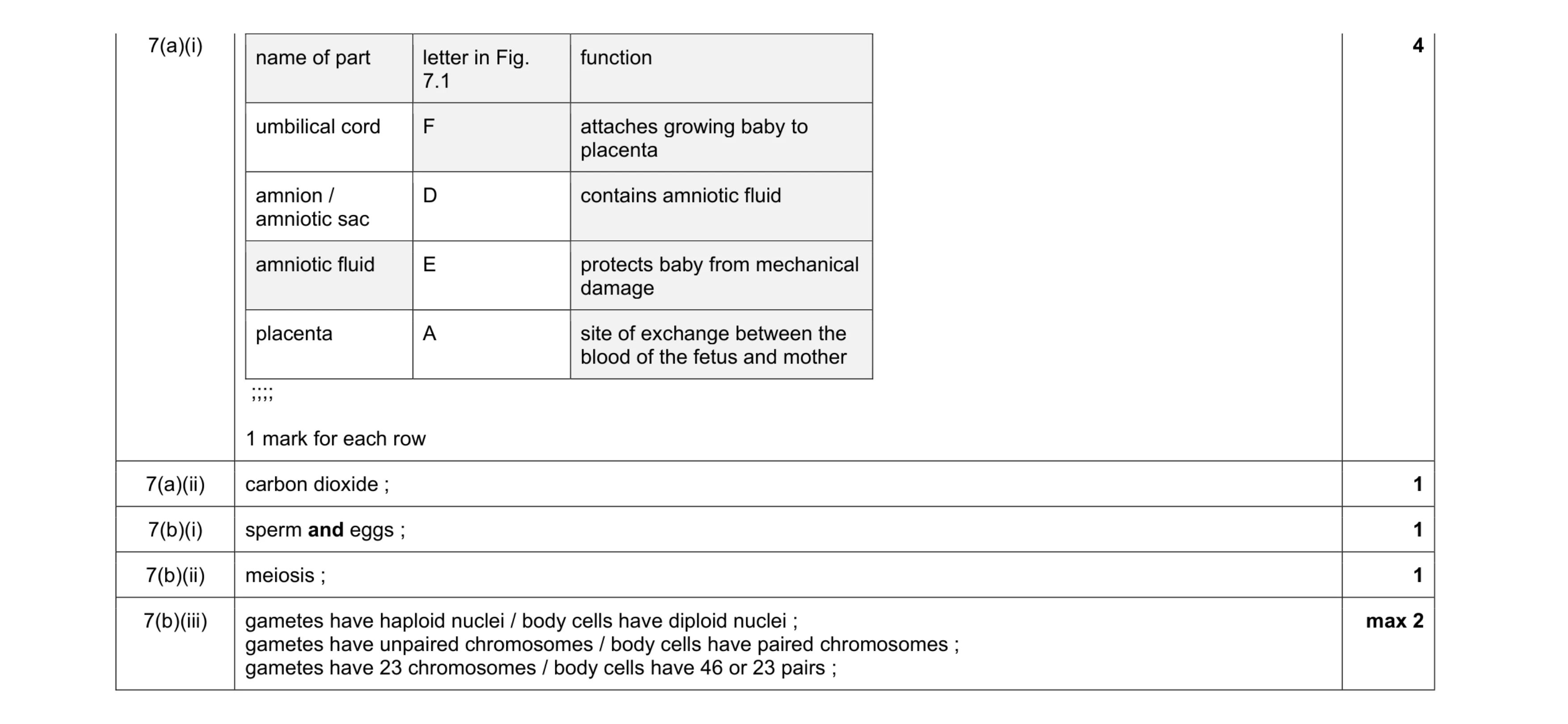 9
9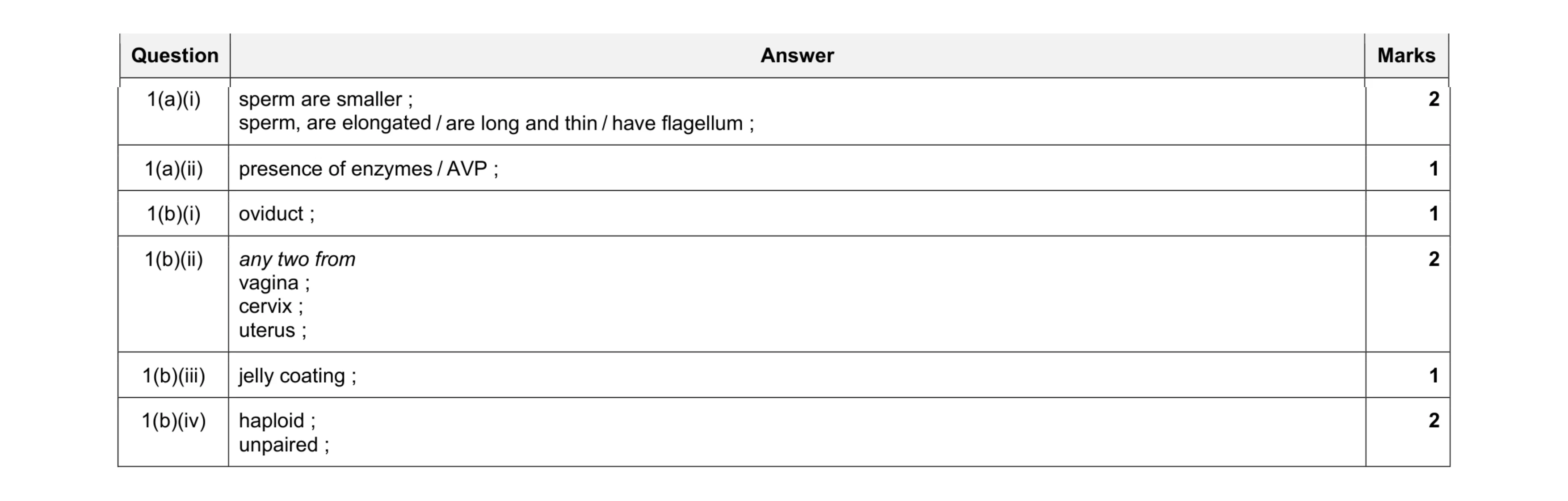 9
9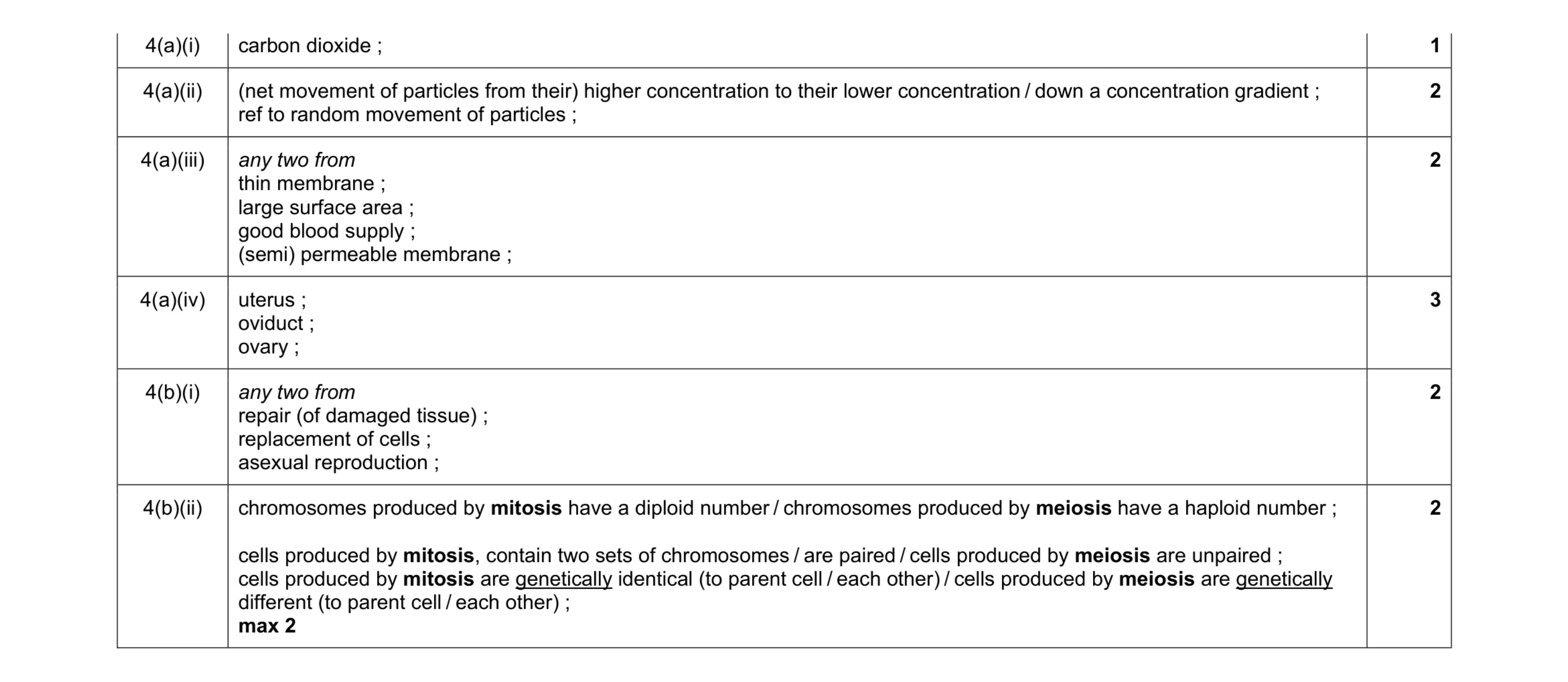 12
12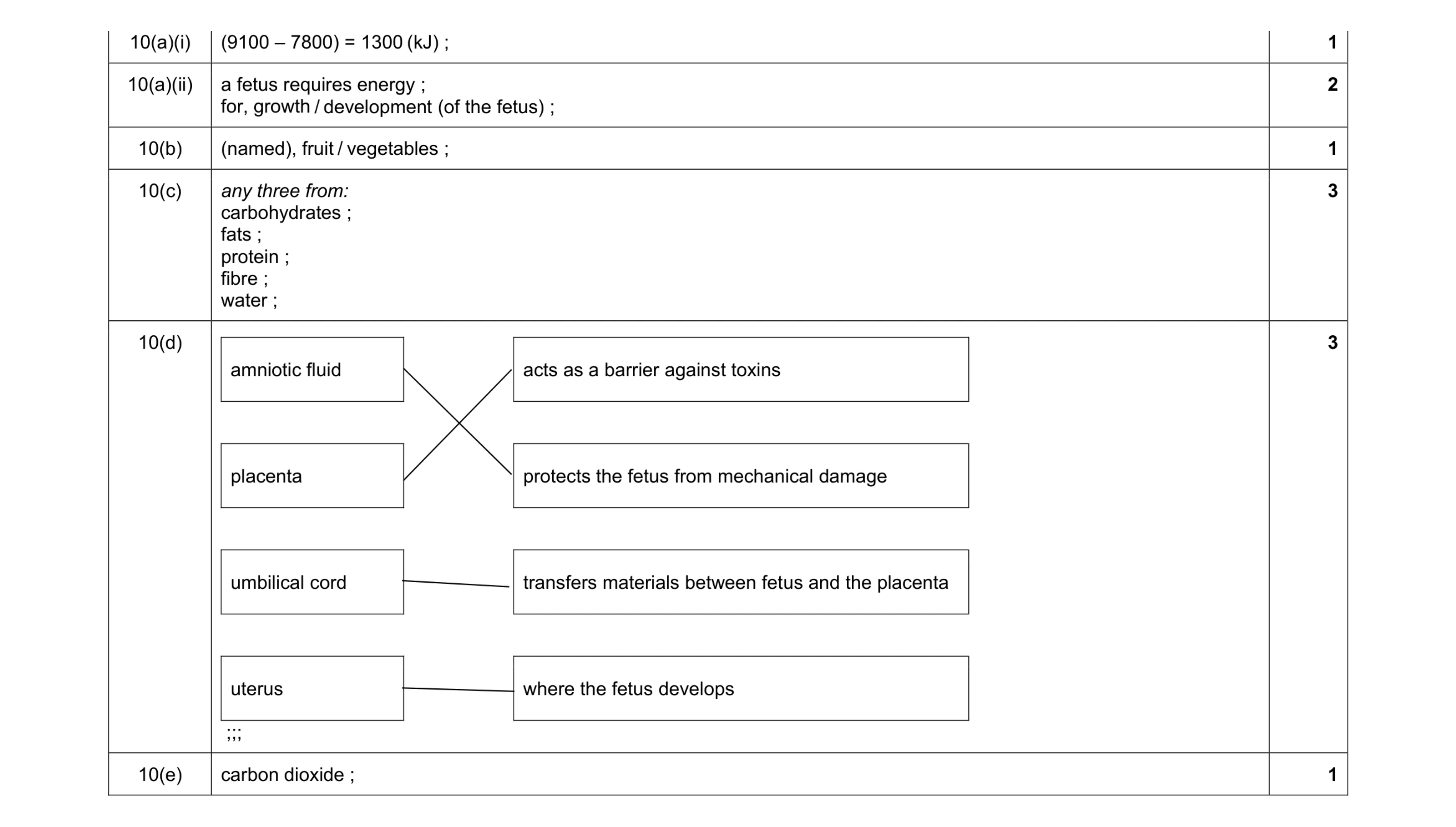 11
11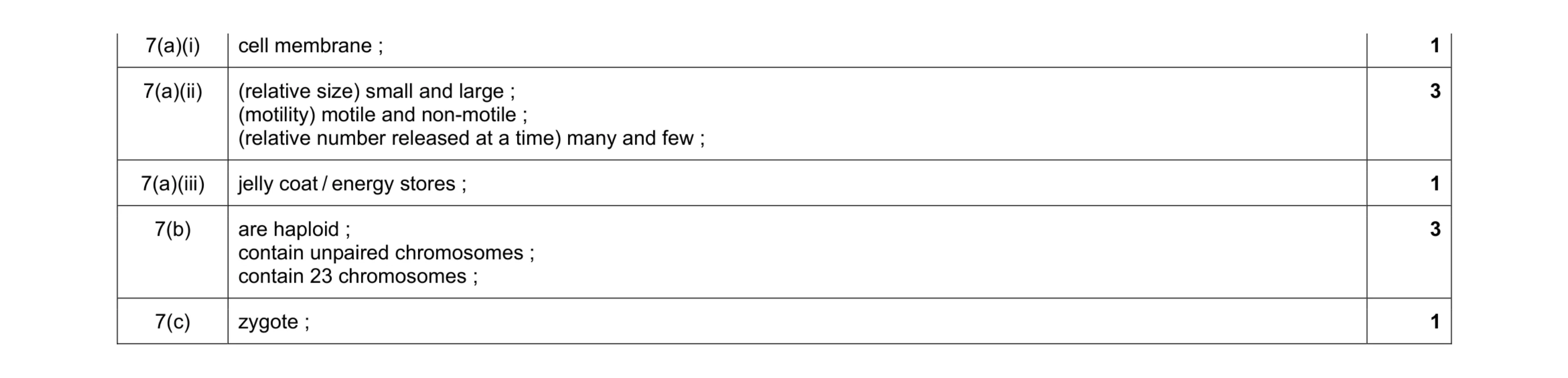 9
9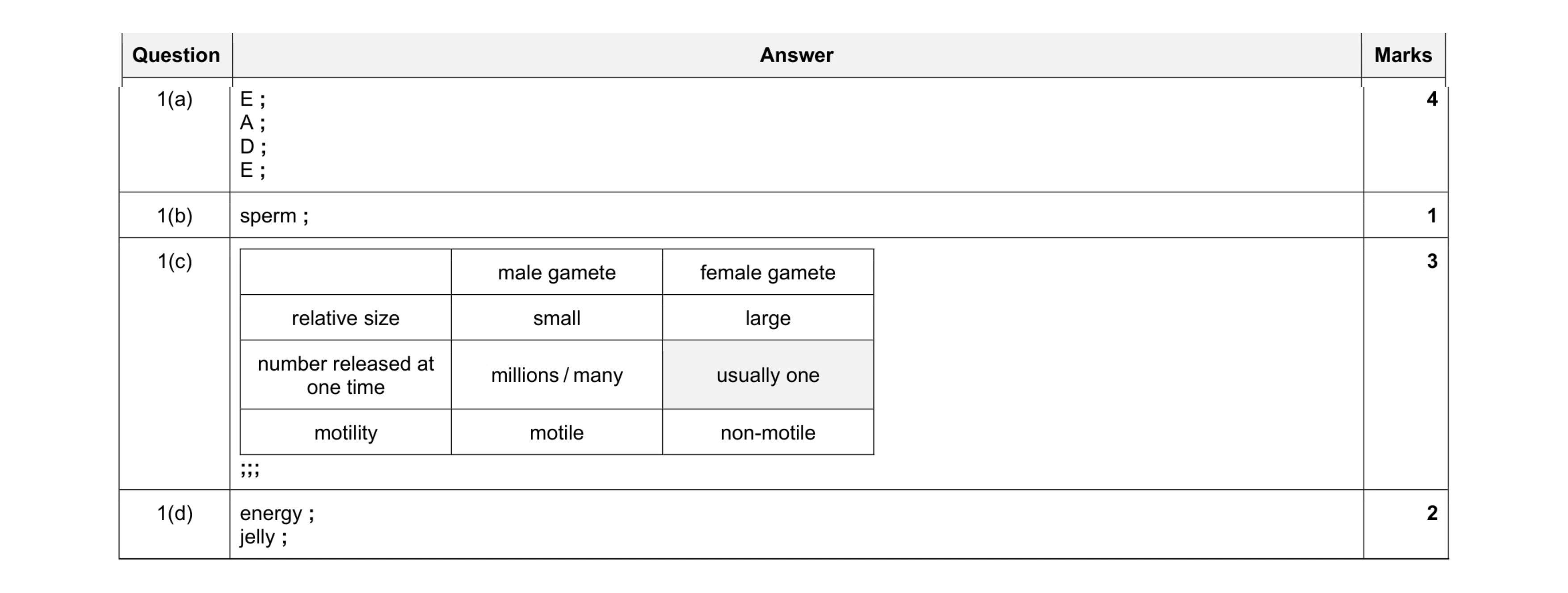 10
10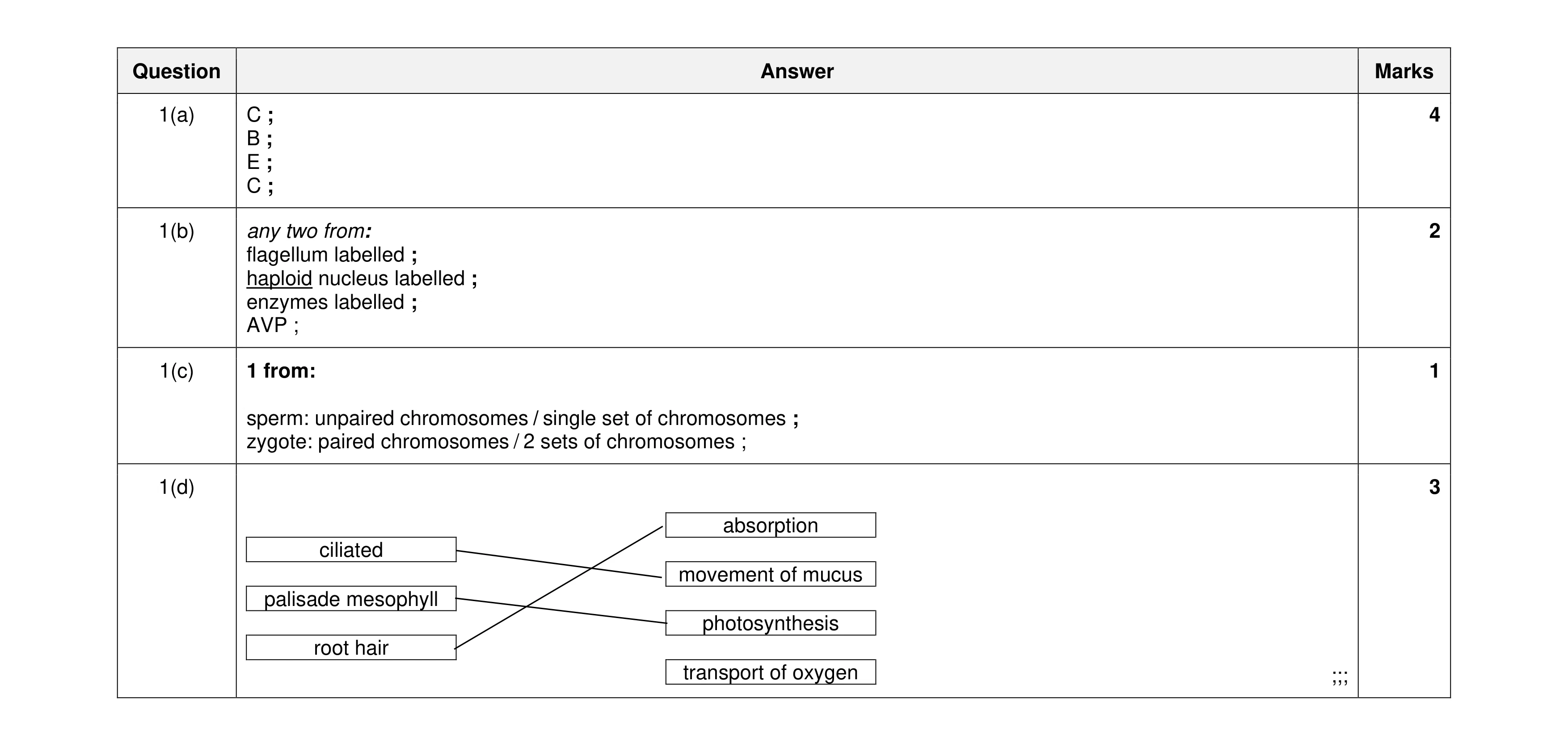 10
10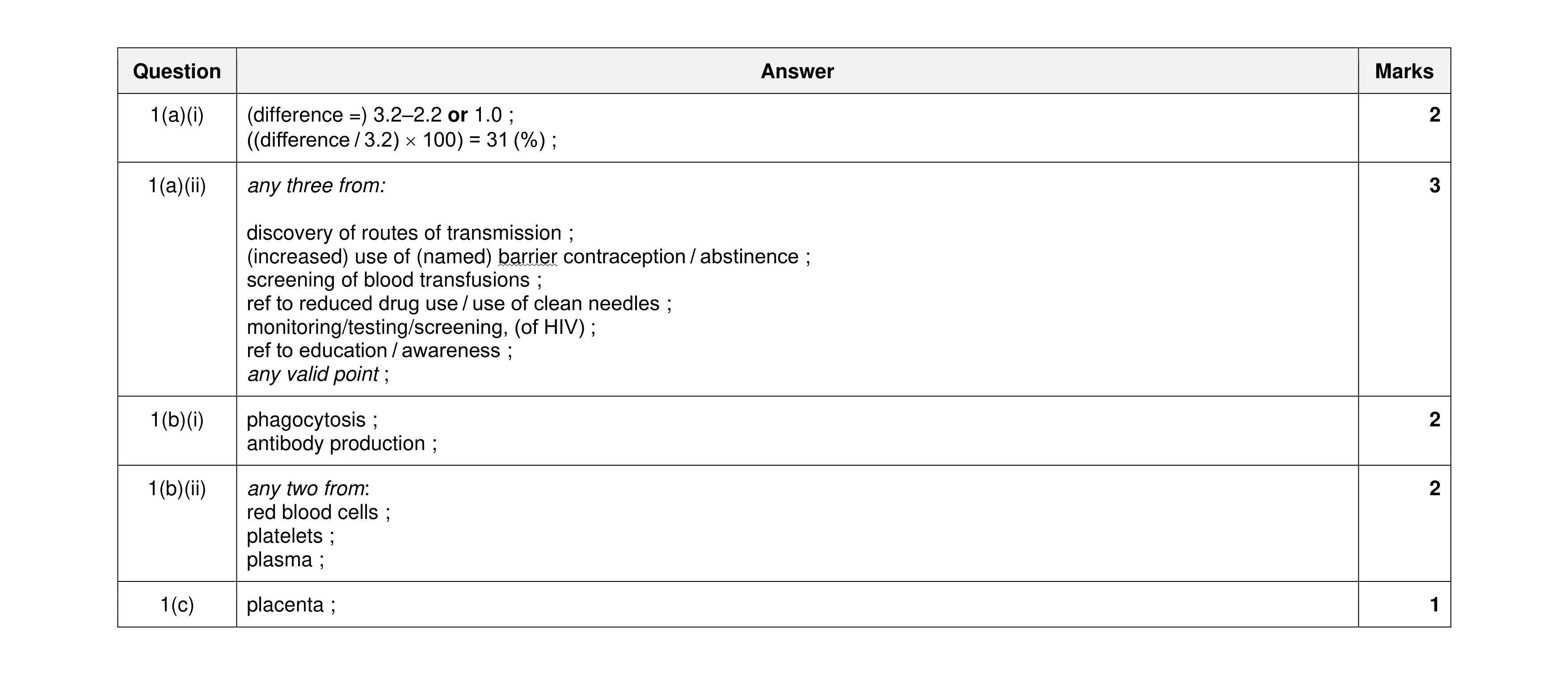 10
10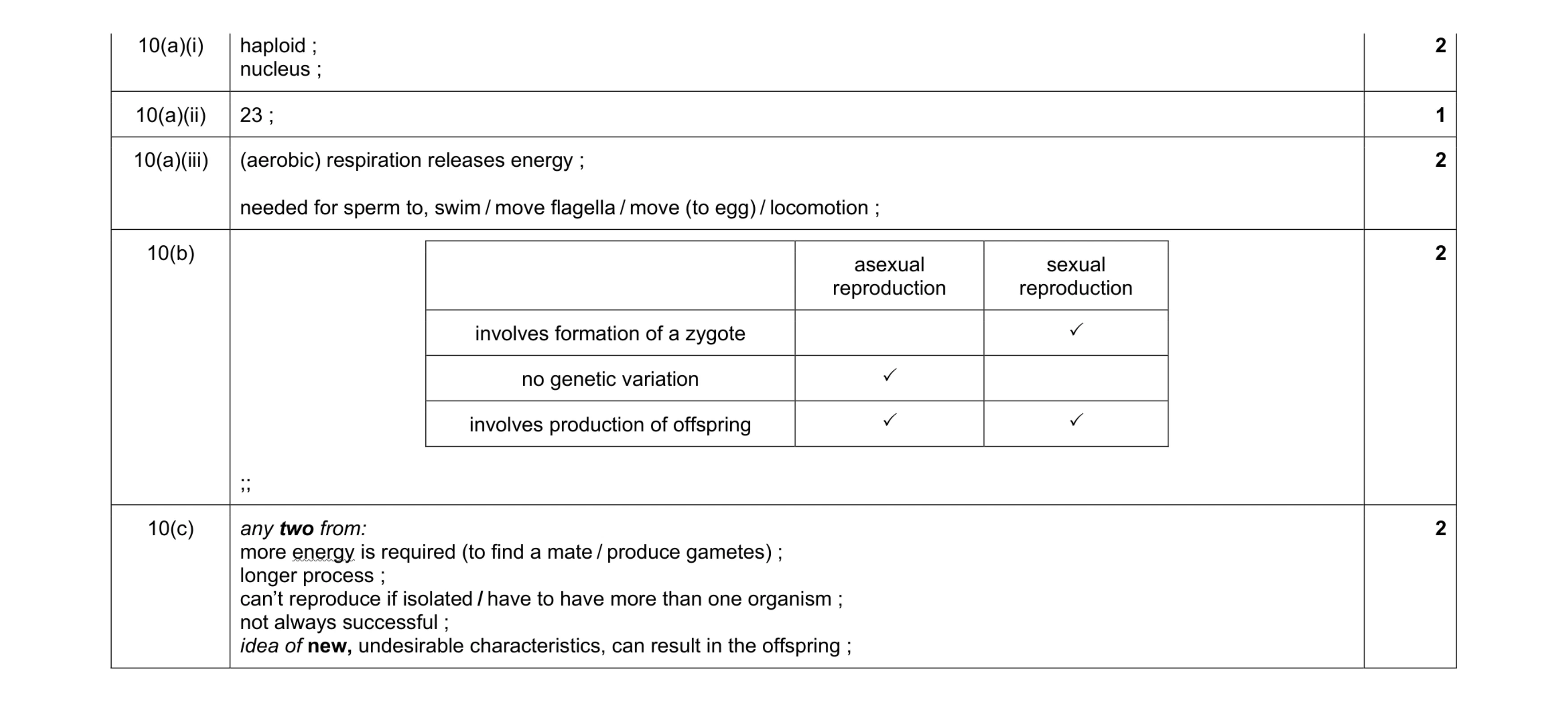 9
9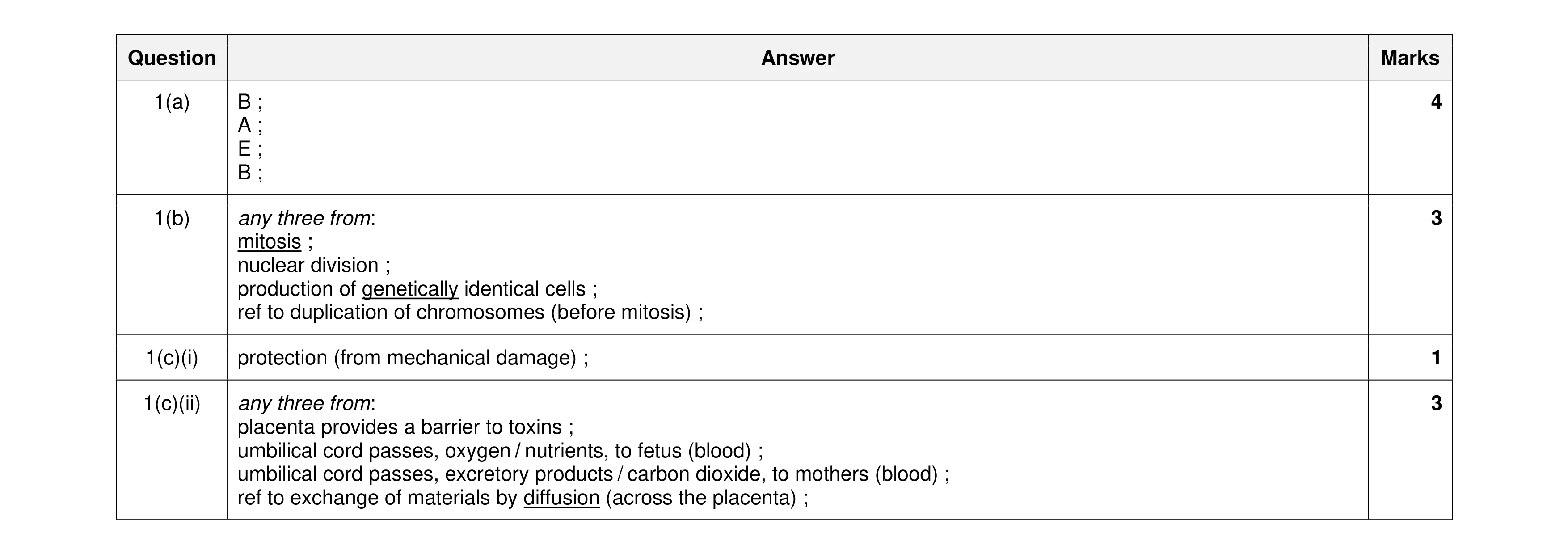 11
11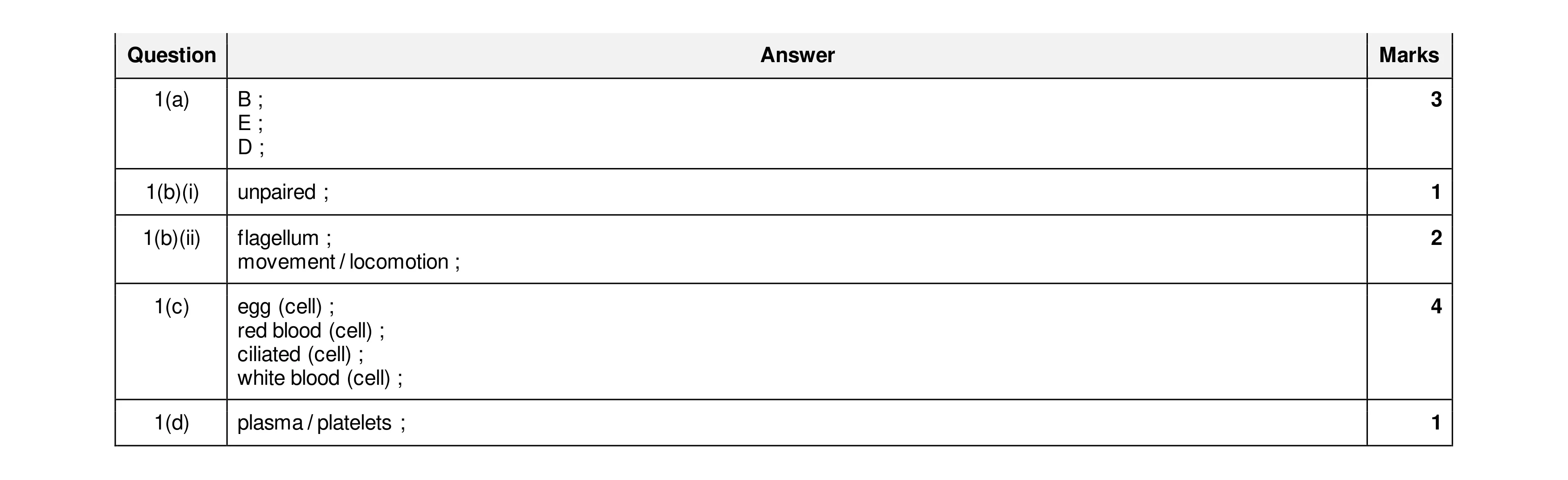 11
11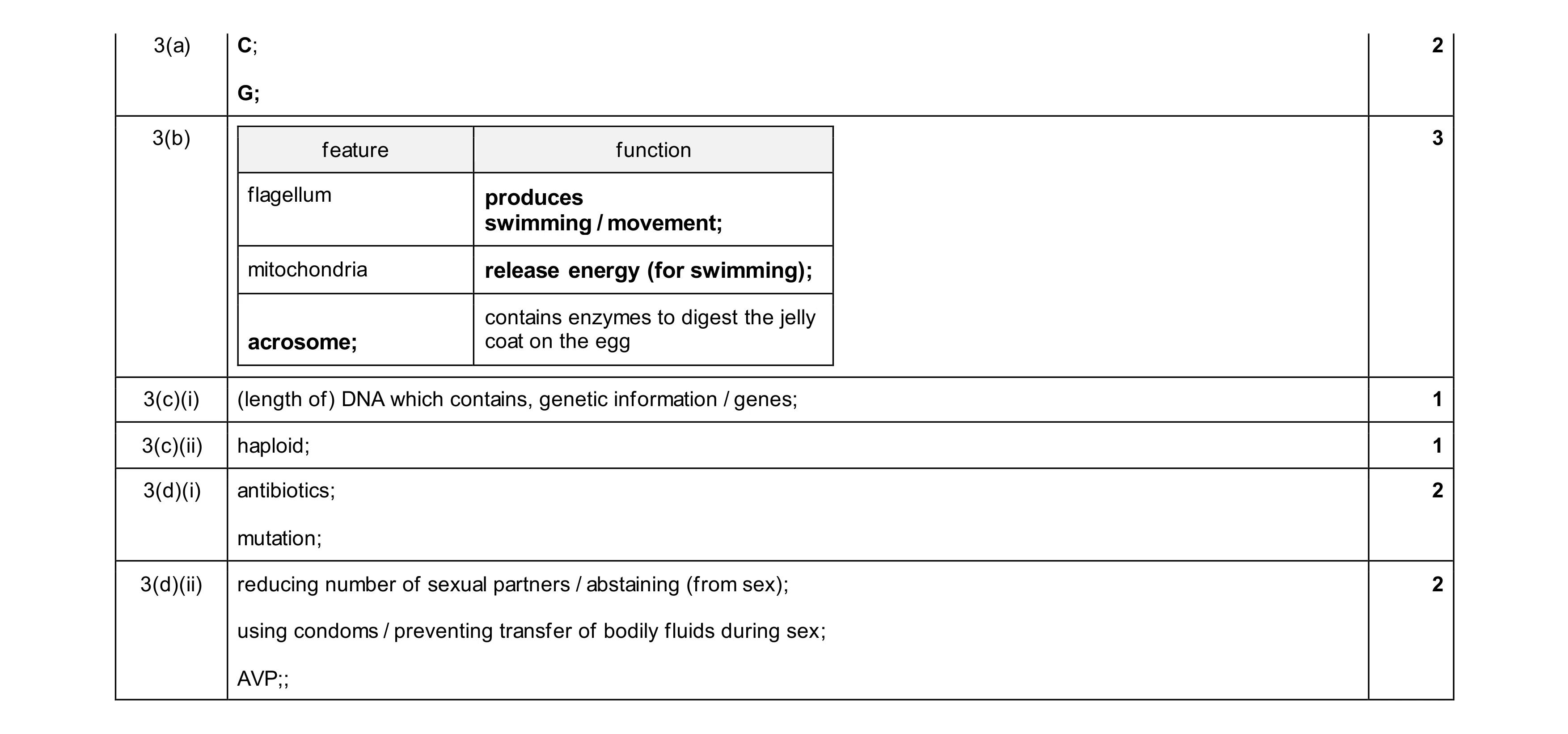 11
11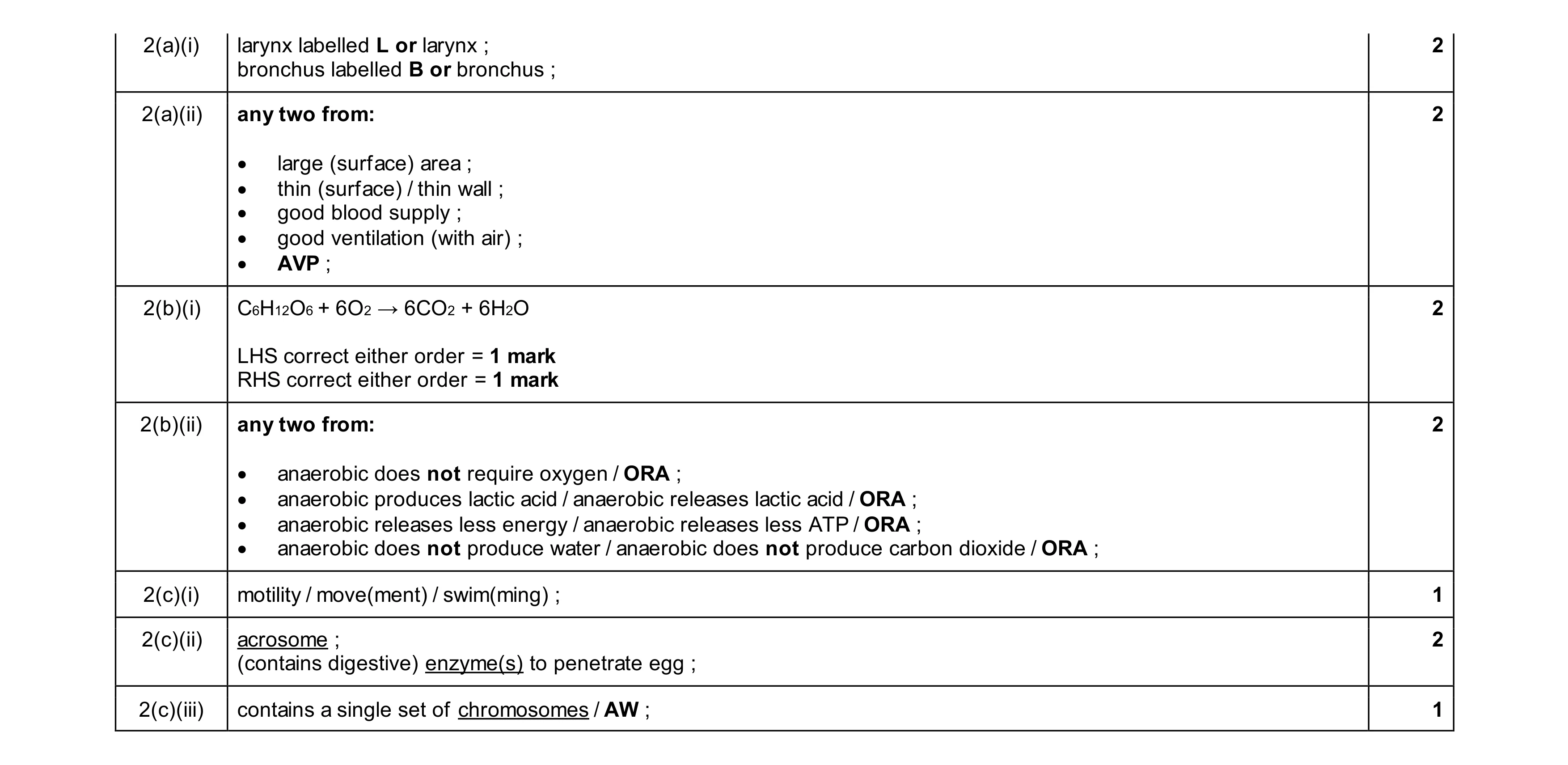 12
12