Questions as text
Q1 · Information about an element in the Periodic Table is shown 0653/23 May/June 2017
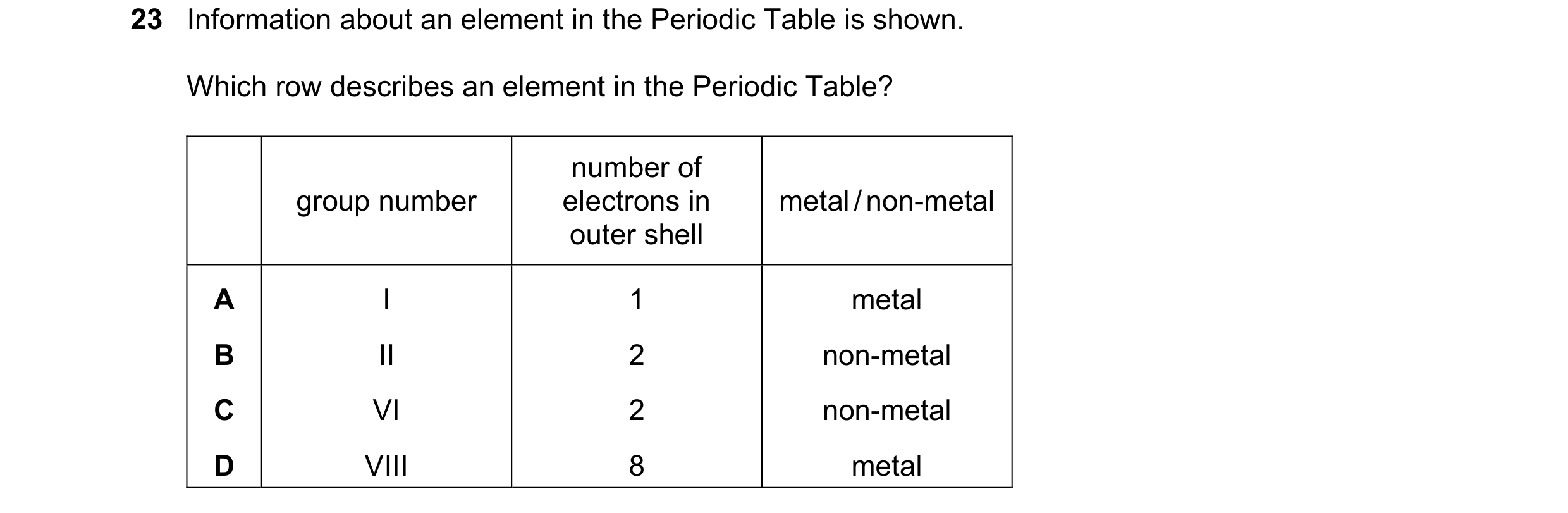
23 Information about an element in the Periodic Table is shown. Which row describes an element in the Periodic Table? number of group number electrons in metal / non-metal outer shell A I 1 metal B II 2 non-metal C VI 2 non-metal D VIII 8 metal
1 marks
Answer: A
This question in 0653/23 May/June 2017
Q2 · Which statement about elements in the Periodic Table is correct? 0653/21 Oct/Nov 2017
24 Which statement about elements in the Periodic Table is correct? A Barium is a non-metal in Group II and its atoms have two electrons in their outer shells. B Chlorine is a non-metal in Group VII and its atoms have seven electrons in their outer shells. C Fluorine is a non-metal in Group VII and its atoms have one electron in their outer shells. D Sodium is a metal in Group II and its atoms have one electron in their outer shells.
1 marks
Answer: B
This question in 0653/21 Oct/Nov 2017
Q3 · Which statement describes the metallic character of elements in Period 2 of the Periodic… 0653/21 May/June 2018
24 Which statement describes the metallic character of elements in Period 2 of the Periodic Table? A The first and last elements in this period are metals. B The metallic elements are in the centre of this period. C The metallic elements are on the left of this period. D The metallic elements are on the right of this period.
1 marks
Answer: C
This question in 0653/21 May/June 2018
Q4 · Part of the Periodic Table is shown 0653/22 May/June 2018
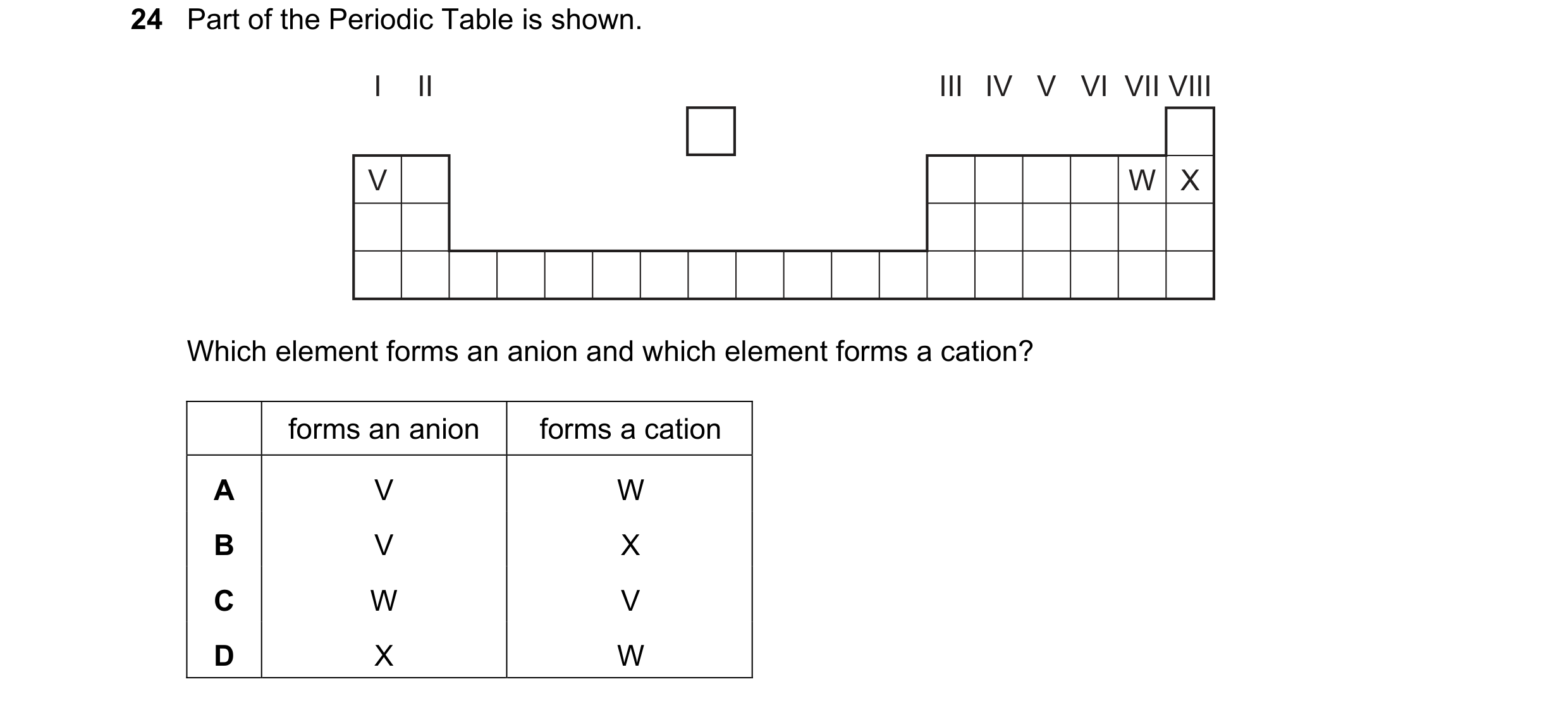
24 Part of the Periodic Table is shown. I II III IV V VI VII VIII V W X Which element forms an anion and which element forms a cation? forms an anion forms a cation A V W B V X C W V D X W
1 marks
Answer: C
This question in 0653/22 May/June 2018
Q5 · What is the trend shown by the elements across a period in the Periodic Table, from left… 0653/23 May/June 2018
23 What is the trend shown by the elements across a period in the Periodic Table, from left to right? A metals → non-metals B metals → non-metals → metals C non-metals → metals D non-metals → metals → non-metals
1 marks
Answer: A
This question in 0653/23 May/June 2018
Q6 · Which element in a period of the Periodic Table has the greatest metallic character? 0653/21 Oct/Nov 2018
22 Which element in a period of the Periodic Table has the greatest metallic character? A the element which most readily forms an anion B the element with the fewest outer-shell electrons C the element with the highest atomic number D the element with the largest group number
1 marks
Answer: B
This question in 0653/21 Oct/Nov 2018
Q7 · An atom of an element has the proton number 16 and the nucleon number 36 0653/22 May/June 2019
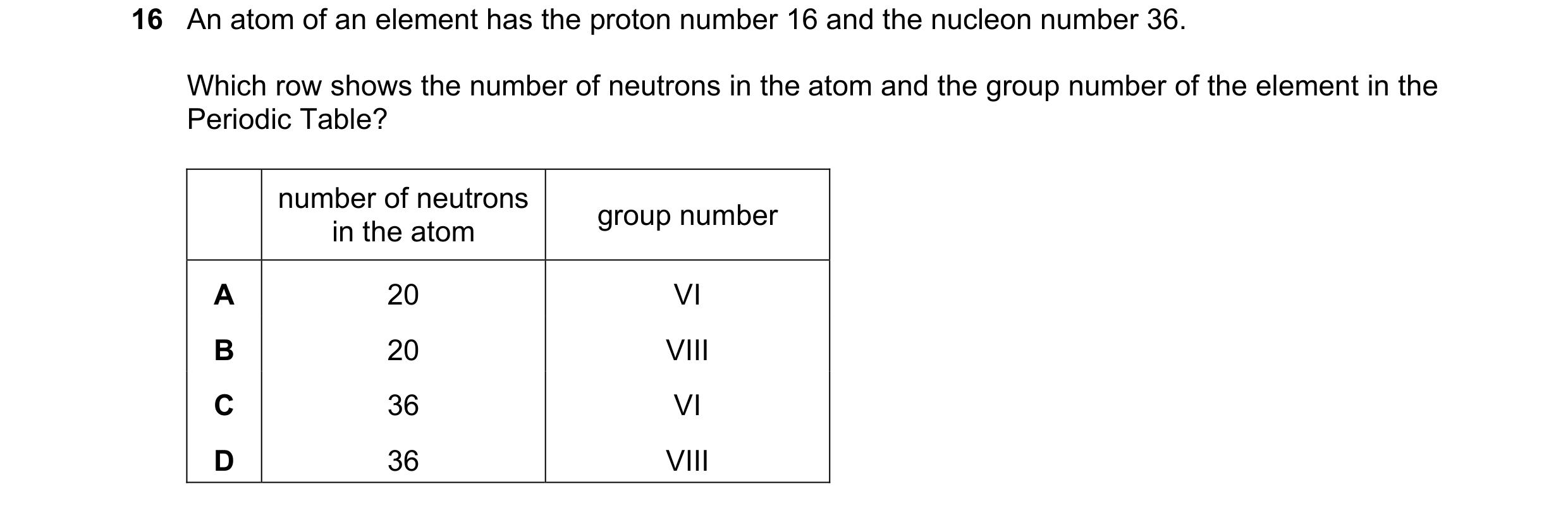
16 An atom of an element has the proton number 16 and the nucleon number 36. Which row shows the number of neutrons in the atom and the group number of the element in the Periodic Table? number of neutrons group number in the atom A 20 VI B 20 VIII C 36 VI D 36 VIII
1 marks
Answer: A
This question in 0653/22 May/June 2019
Q8 · Properties of some Group II elements are shown 0653/21 May/June 2020
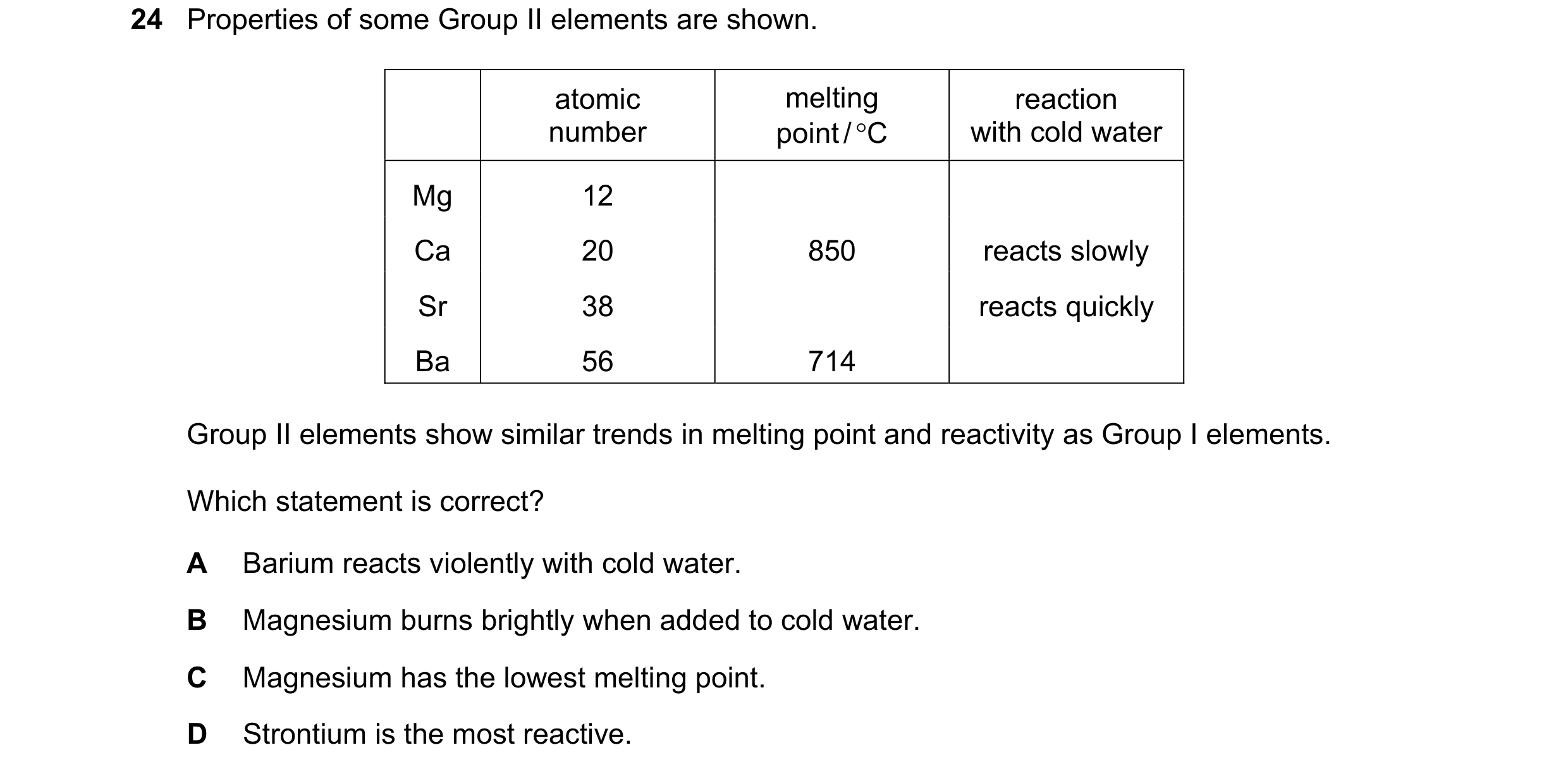
24 Properties of some Group II elements are shown. atomic melting reaction number point / °C with cold water Mg 12 Ca 20 850 reacts slowly Sr 38 reacts quickly Ba 56 714 Group II elements show similar trends in melting point and reactivity as Group I elements. Which statement is correct? A Barium reacts violently with cold water. B Magnesium burns brightly when added to cold water. C Magnesium has the lowest melting point. D Strontium is the most reactive.
1 marks
Answer: A
This question in 0653/21 May/June 2020
Q9 · Which row shows the relationship between the group number of an element, its number of… 0653/22 May/June 2020
22 Which row shows the relationship between the group number of an element, its number of outer shell electrons and its metallic / non-metallic character? number of outer metallic / non-metallic group number shell electrons character A I 1 non-metal B III 5 metal C V 5 non-metal D VII 1 metal
1 marks
Answer: C
This question in 0653/22 May/June 2020
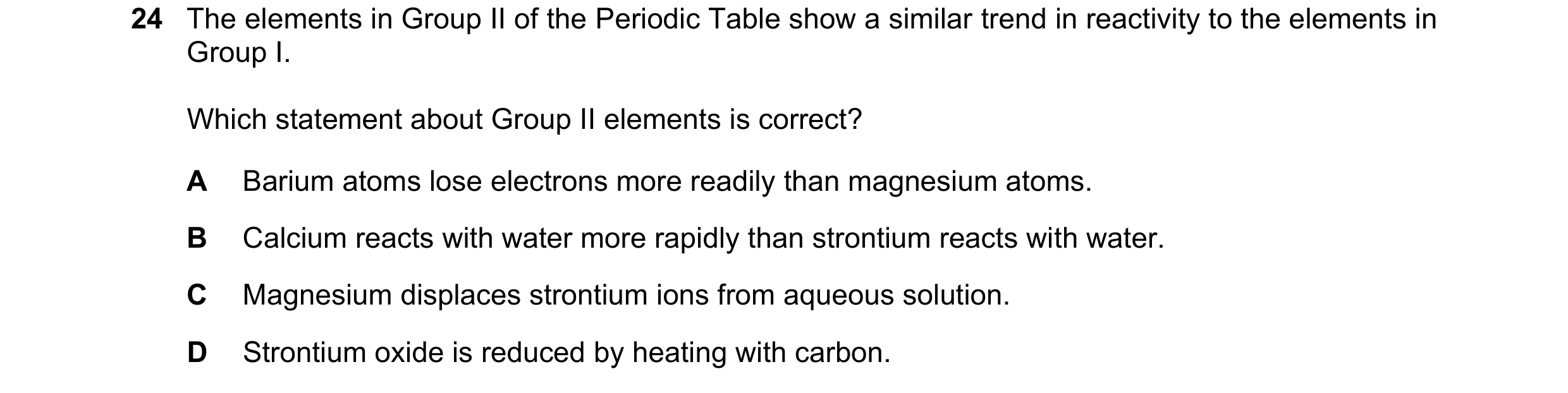
Q10 · The elements in Group II of the Periodic Table show a similar trend in reactivity to the… 0653/22 Oct/Nov 2020
24 The elements in Group II of the Periodic Table show a similar trend in reactivity to the elements in Group I. Which statement about Group II elements is correct? A Barium atoms lose electrons more readily than magnesium atoms. B Calcium reacts with water more rapidly than strontium reacts with water. C Magnesium displaces strontium ions from aqueous solution. D Strontium oxide is reduced by heating with carbon.
1 marks
Answer: A
This question in 0653/22 Oct/Nov 2020
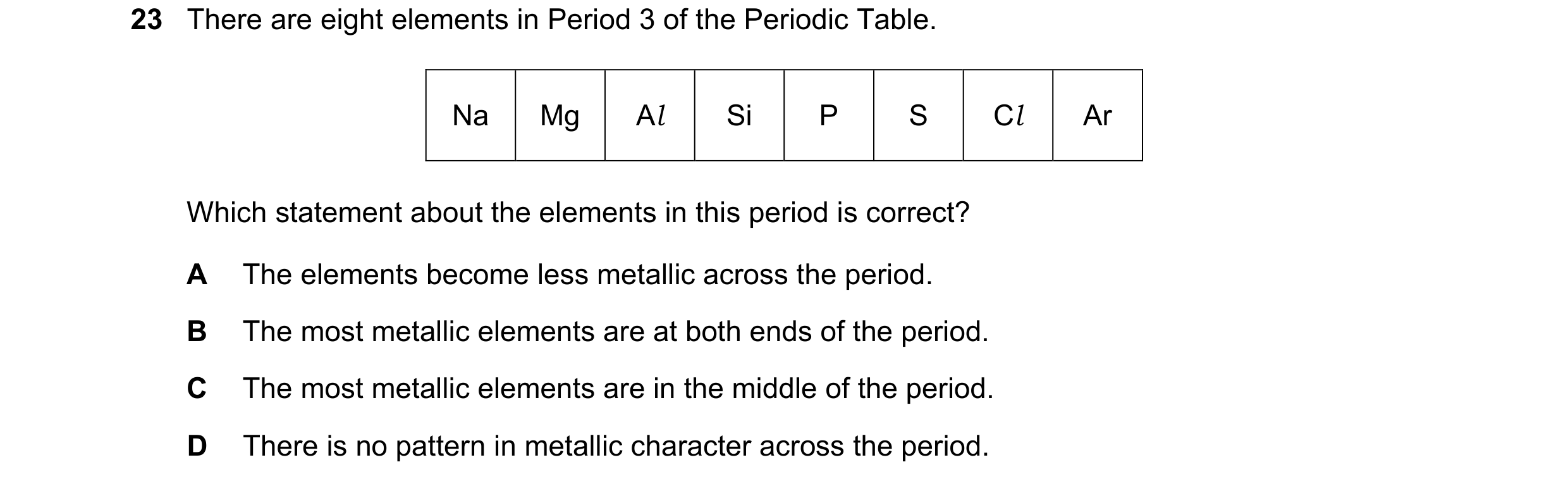
Q11 · There are eight elements in Period 3 of the Periodic Table 0653/21 May/June 2021
23 There are eight elements in Period 3 of the Periodic Table. Na Mg Al Si P S Cl Ar Which statement about the elements in this period is correct? A The elements become less metallic across the period. B The most metallic elements are at both ends of the period. C The most metallic elements are in the middle of the period. D There is no pattern in metallic character across the period.
1 marks
Answer: A
This question in 0653/21 May/June 2021
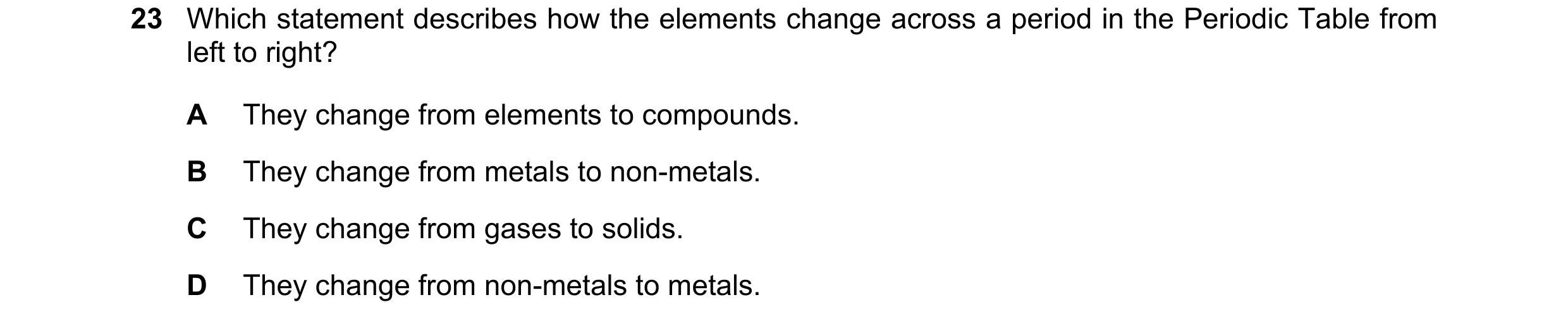
Q12 · Which statement describes how the elements change across a period in the Periodic Table… 0653/22 May/June 2021
23 Which statement describes how the elements change across a period in the Periodic Table from left to right? A They change from elements to compounds. B They change from metals to non-metals. C They change from gases to solids. D They change from non-metals to metals.
1 marks
Answer: B
This question in 0653/22 May/June 2021
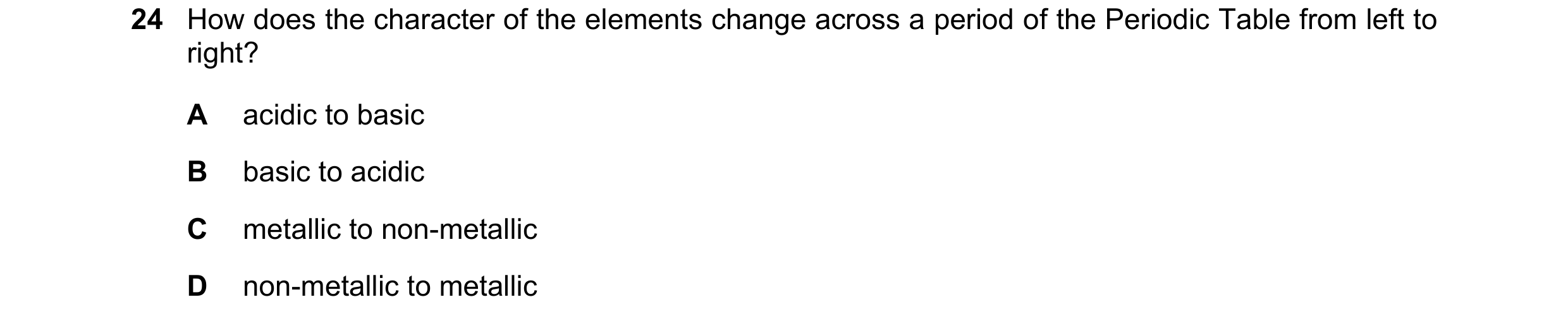
Q13 · How does the character of the elements change across a period of the Periodic Table from… 0653/23 May/June 2021
24 How does the character of the elements change across a period of the Periodic Table from left to right? A acidic to basic B basic to acidic C metallic to non-metallic D non-metallic to metallic
1 marks
Answer: C
This question in 0653/23 May/June 2021
Q14 · Indium is an element in the Periodic Table 0653/22 May/June 2022
21 Indium is an element in the Periodic Table. Which row describes the electronic structure and character of indium? number of outer character shell electrons A 3 metal B 3 non-metal C 5 metal D 5 non-metal
1 marks
Answer: A
This question in 0653/22 May/June 2022
Q15 · Which statement about non-metallic elements is correct? 0653/23 May/June 2022
15 Which statement about non-metallic elements is correct? A They are hard. B They are malleable. C They conduct electricity. D They have low densities.
1 marks
Answer: D
This question in 0653/23 May/June 2022
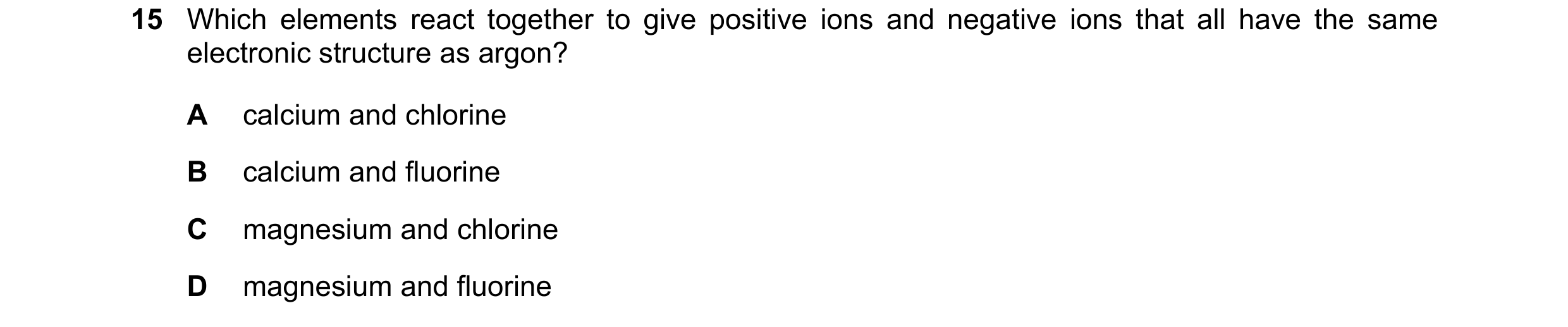
Q16 · Which elements react together to give positive ions and negative ions that all have the… 0653/22 Feb/March 2023
15 Which elements react together to give positive ions and negative ions that all have the same electronic structure as argon? A calcium and chlorine B calcium and fluorine C magnesium and chlorine D magnesium and fluorine
1 marks
Answer: A
This question in 0653/22 Feb/March 2023
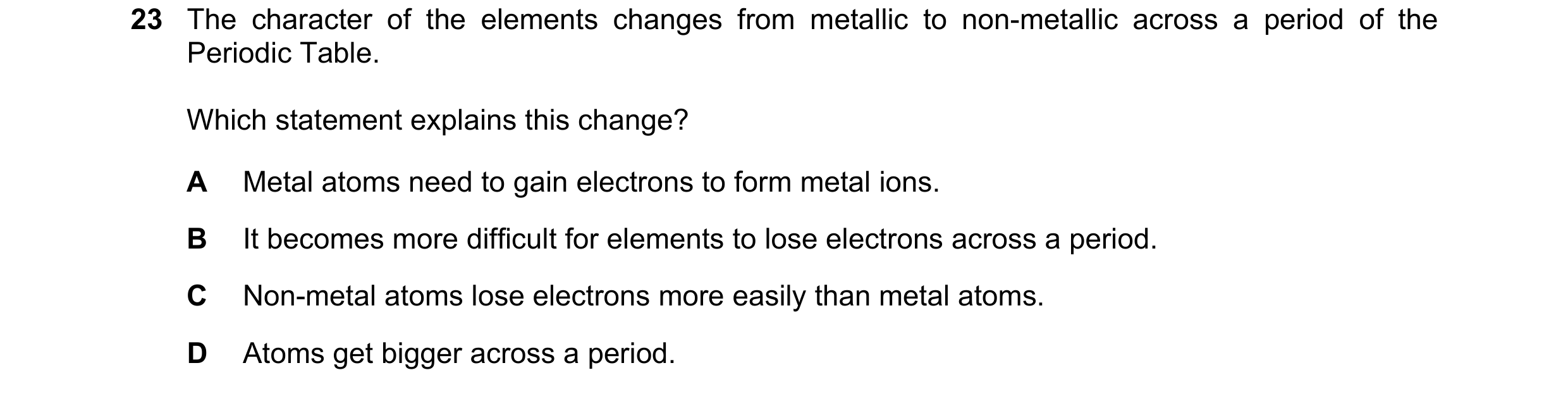
Q17 · The character of the elements changes from metallic to non-metallic across a period of… 0653/21 May/June 2023
23 The character of the elements changes from metallic to non-metallic across a period of the Periodic Table. Which statement explains this change? A Metal atoms need to gain electrons to form metal ions. B It becomes more difficult for elements to lose electrons across a period. C Non-metal atoms lose electrons more easily than metal atoms. D Atoms get bigger across a period.
1 marks
Answer: B
This question in 0653/21 May/June 2023
Q18 · Which electronic structure is that of a metal? 0653/22 May/June 2023
23 Which electronic structure is that of a metal? A 2,8,3 B 2,8,4 C 2,8,6 D 2,8,7
1 marks
Answer: A
This question in 0653/22 May/June 2023
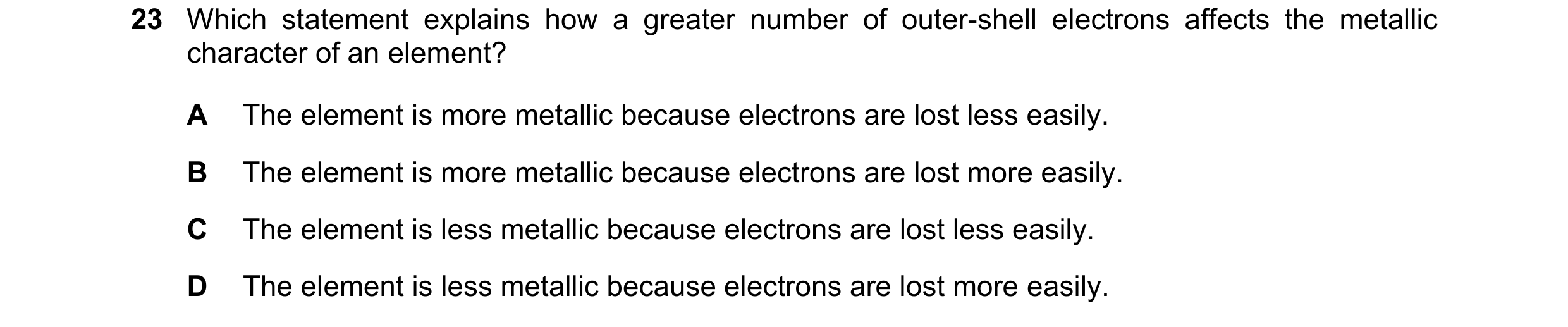
Q19 · Which statement explains how a greater number of outer-shell electrons affects the… 0653/23 May/June 2023
23 Which statement explains how a greater number of outer-shell electrons affects the metallic character of an element? A The element is more metallic because electrons are lost less easily. B The element is more metallic because electrons are lost more easily. C The element is less metallic because electrons are lost less easily. D The element is less metallic because electrons are lost more easily.
1 marks
Answer: C
This question in 0653/23 May/June 2023
Q20 · Which properties of argon, Ar, can be determined from its position in the Periodic Table? 0653/22 Oct/Nov 2023
22 Which properties of argon, Ar, can be determined from its position in the Periodic Table? 1 its number of outer-shell electrons 2 its density 3 its chemical reactivity A 1, 2 and 3 B 1 and 2 only C 1 and 3 only D 2 and 3 only
1 marks
Answer: C
This question in 0653/22 Oct/Nov 2023
Q21 · Which statement describes the elements in a period of the Periodic Table? 0653/22 Feb/March 2024
22 Which statement describes the elements in a period of the Periodic Table? A Metals are on the left and non-metals are on the right of the period. B Metals are on the left and right, non-metals are in the middle of the period. C Non-metals are on the left and right, metals are in the middle of the period. D Non-metals are on the left and metals are on the right of the period.
1 marks
Answer: A
This question in 0653/22 Feb/March 2024
Q22 · Which statement about the properties of the elements in Period 3 of the Periodic Table is… 0653/21 May/June 2024
24 Which statement about the properties of the elements in Period 3 of the Periodic Table is correct? A The elements on the left lose electrons more readily. B The elements on the left are less malleable. C The elements on the right are metallic. D The elements on the right form cations.
1 marks
Answer: A
This question in 0653/21 May/June 2024
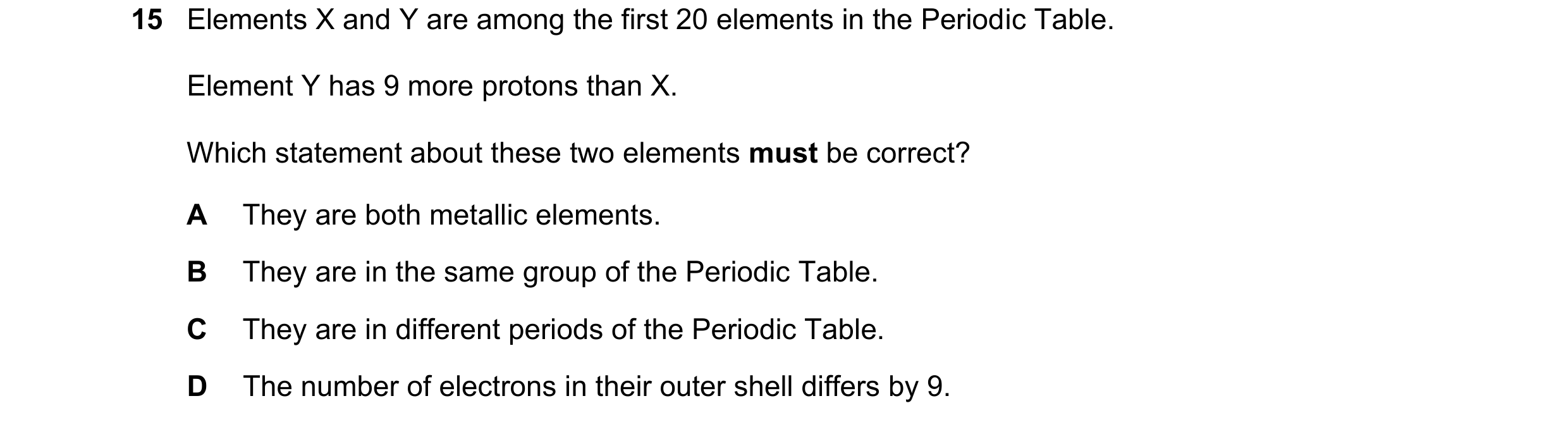
Q23 · Elements X and Y are among the first 20 elements in the Periodic Table 0653/22 Feb/March 2025
15 Elements X and Y are among the first 20 elements in the Periodic Table. Element Y has 9 more protons than X. Which statement about these two elements must be correct? A They are both metallic elements. B They are in the same group of the Periodic Table. C They are in different periods of the Periodic Table. D The number of electrons in their outer shell differs by 9.
1 marks
Answer: C
This question in 0653/22 Feb/March 2025
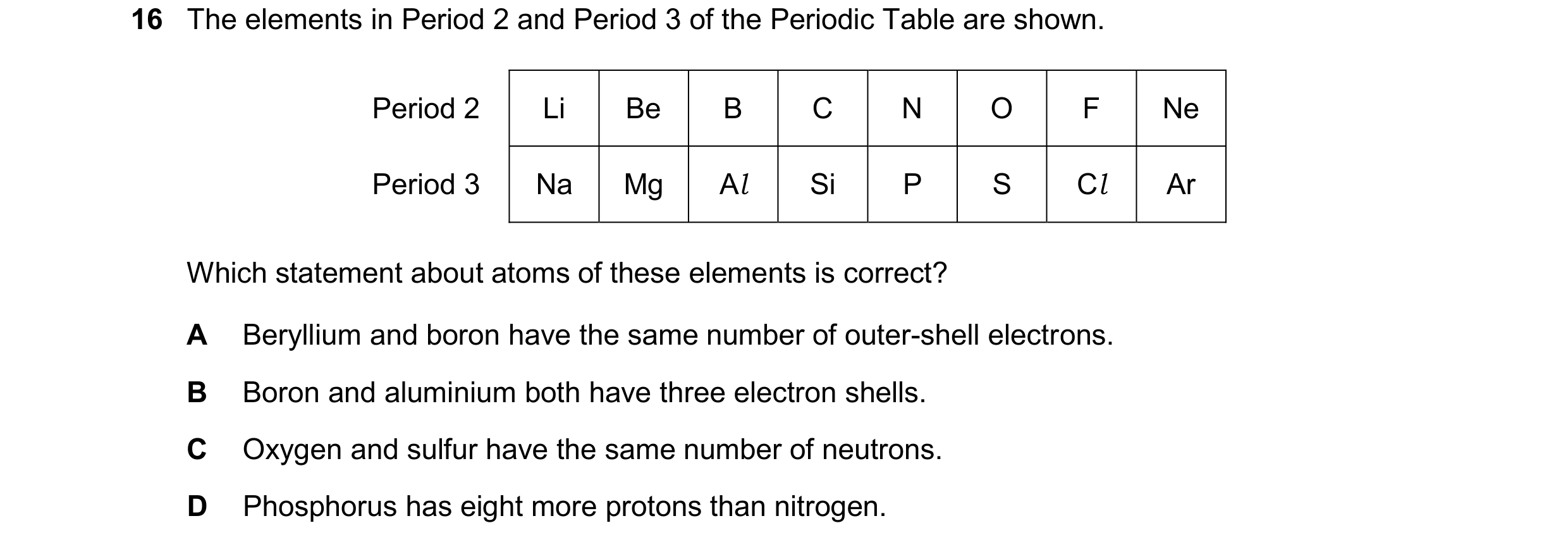
Q24 · The elements in Period 2 and Period 3 of the Periodic Table are shown 0653/21 May/June 2025
16 The elements in Period 2 and Period 3 of the Periodic Table are shown. Period 2 Li Be B C N O F Ne Period 3 Na Mg Al Si P S Cl Ar Which statement about atoms of these elements is correct? A Beryllium and boron have the same number of outer-shell electrons. B Boron and aluminium both have three electron shells. C Oxygen and sulfur have the same number of neutrons. D Phosphorus has eight more protons than nitrogen.
1 marks
Answer: D
This question in 0653/21 May/June 2025
Q25 · An element is in Period 3 of the Periodic Table 0653/21 Oct/Nov 2025
17 An element is in Period 3 of the Periodic Table. Which information is given by the period number of this element? A its proton number B its metallic character C the number of electrons in the outer shell of an atom of the element D the number of electron shells in an atom of the element
1 marks
Answer: D
This question in 0653/21 Oct/Nov 2025
Q26 · What is the method by which elements are arranged in the Periodic Table? 0653/22 Oct/Nov 2025
21 What is the method by which elements are arranged in the Periodic Table? A by nucleon number B by number of electrons C by number of neutrons D by number of protons
1 marks
Answer: D
This question in 0653/22 Oct/Nov 2025


 1 / 6
1 / 6

 2 / 6
2 / 6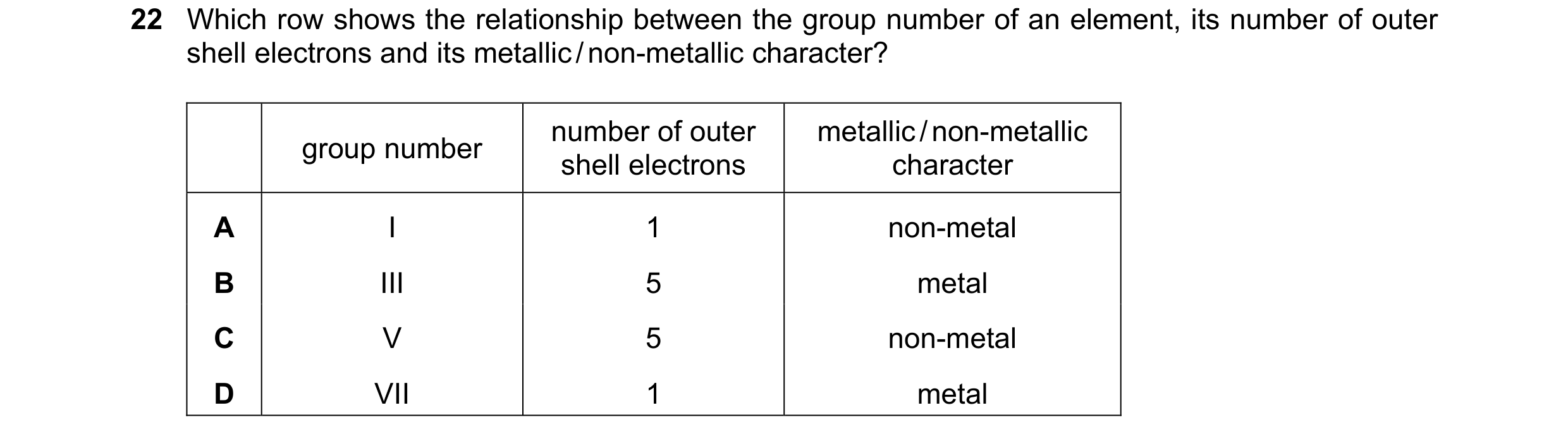
 3 / 6
3 / 6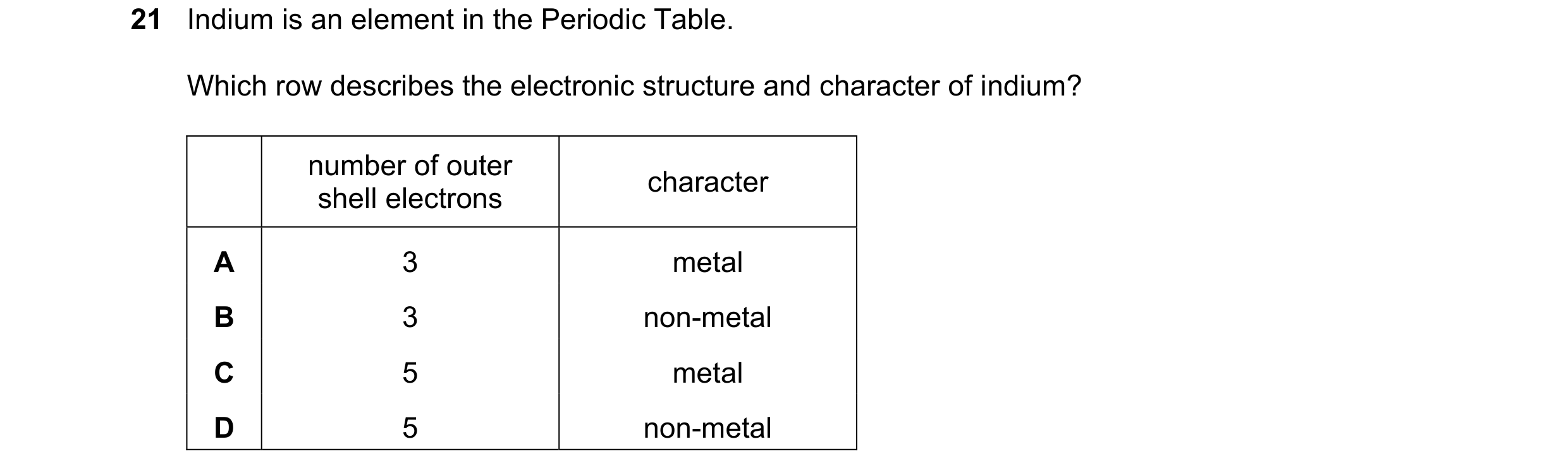


 4 / 6
4 / 6


 5 / 6
5 / 6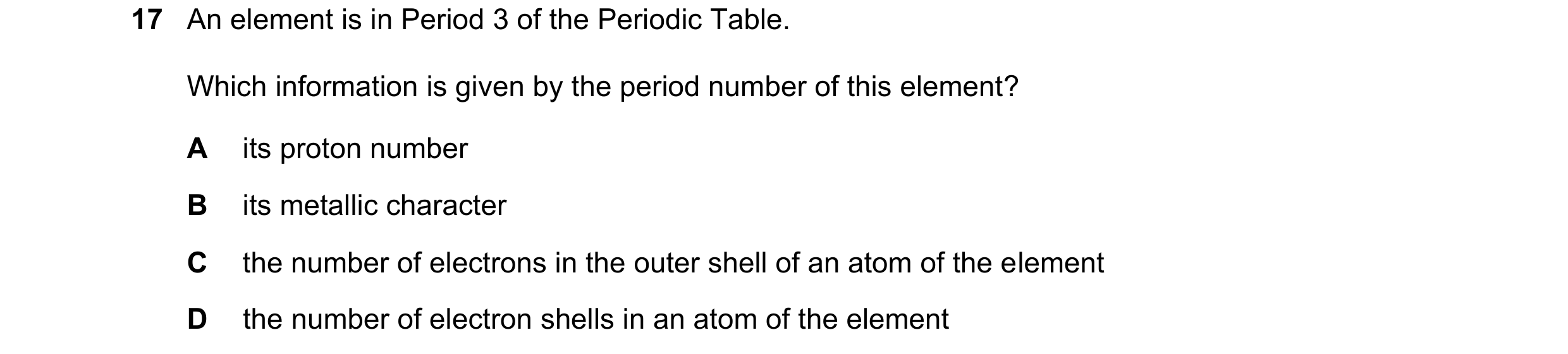
 6 / 6
6 / 6