Questions as text
Q1 · The mass of some of the contents of three foods in a 100 gram sample of each food 0653/31 May/June 2017
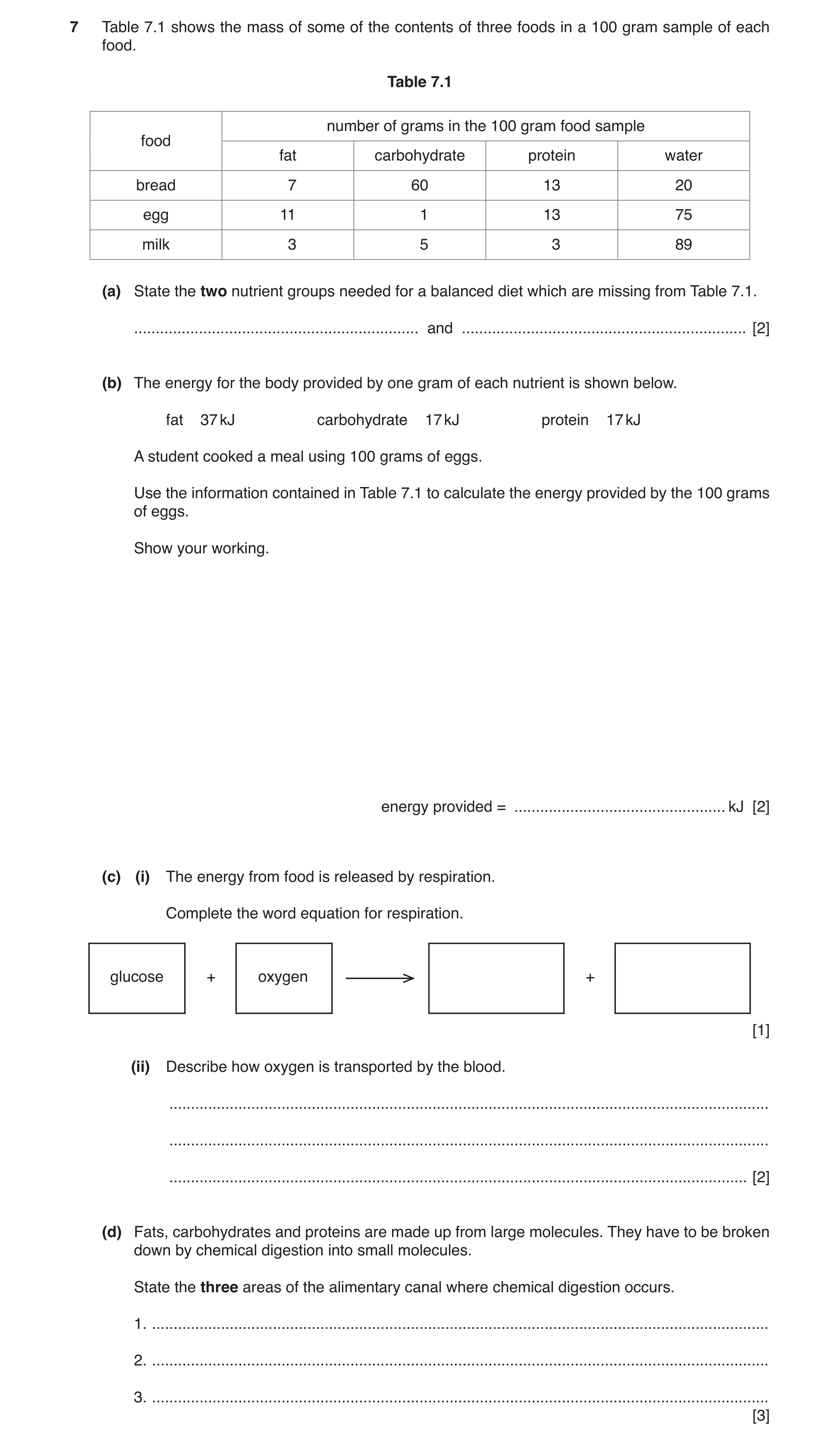
7 Table 7.1 shows the mass of some of the contents of three foods in a 100 gram sample of each food. Table 7.1 number of grams in the 100 gram food sample food fat carbohydrate protein water bread 7 60 13 20 egg 11 1 13 75 milk 3 5 3 89 (a) State the two nutrient groups needed for a balanced diet which are missing from Table 7.1. … and … [2] (b) The energy for the body provided by one gram of each nutrient is shown below. fat 37 kJ carbohydrate 17 kJ protein 17 kJ A student cooked a meal using 100 grams of eggs. Use the information contained in Table 7.1 to calculate the energy provided by the 100 grams of eggs. Show your working. energy provided = … kJ [2] (c) (i) The energy from food is released by respiration. Complete the word equation for respiration. glucose + oxygen + [1] (ii) Describe how oxygen is transported by the blood. … … … [2] (d) Fats, carbohydrates and proteins are made up from large molecules. They have to be broken down by chemical digestion into small molecules. State the three areas of the alimentary canal where chemical digestion occurs. 1. … 2. … 3. … [3]
10 marks
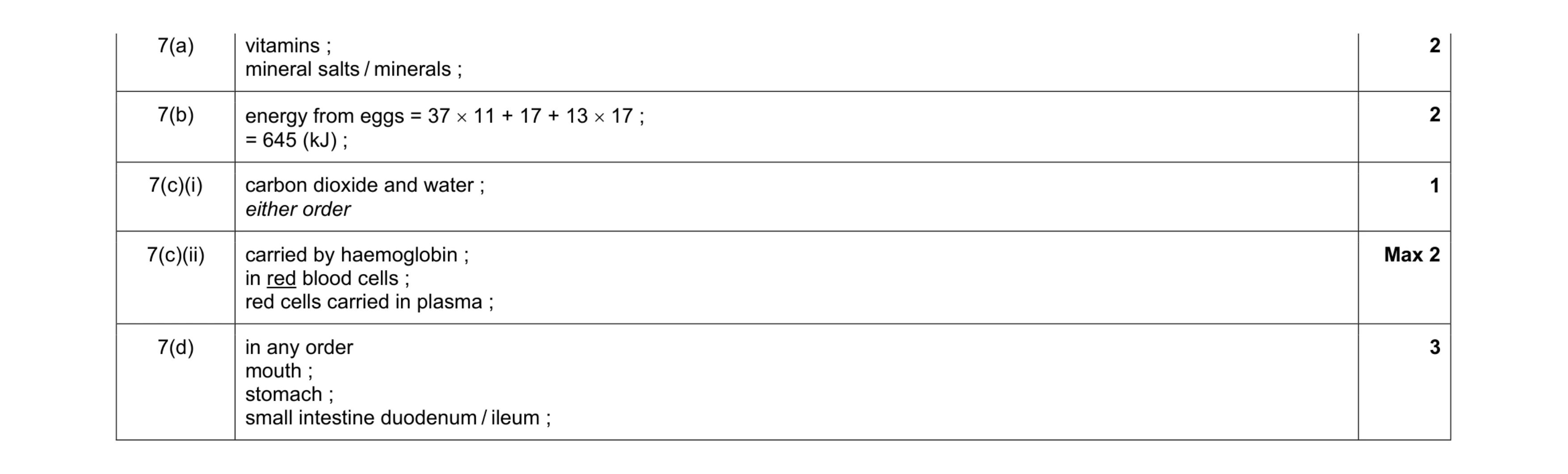
Mark scheme: 7(a) vitamins ; mineral salts / minerals ; 2 7(b) energy from eggs = 37 × 11 + 17 + 13 × 17 ; = 645 (kJ) ; 2 7(c)(i) carbon dioxide and water ; either order 1 7(c)(ii) carried by haemoglobin ; in red blood cells ; red cells carried in plasma ; Max 2 7(d) in any order mouth ; stomach ; small intestine duodenum / ileum ; 3
This question in 0653/31 May/June 2017
Q2 · Some of the organisms in a lake 0653/32 May/June 2017
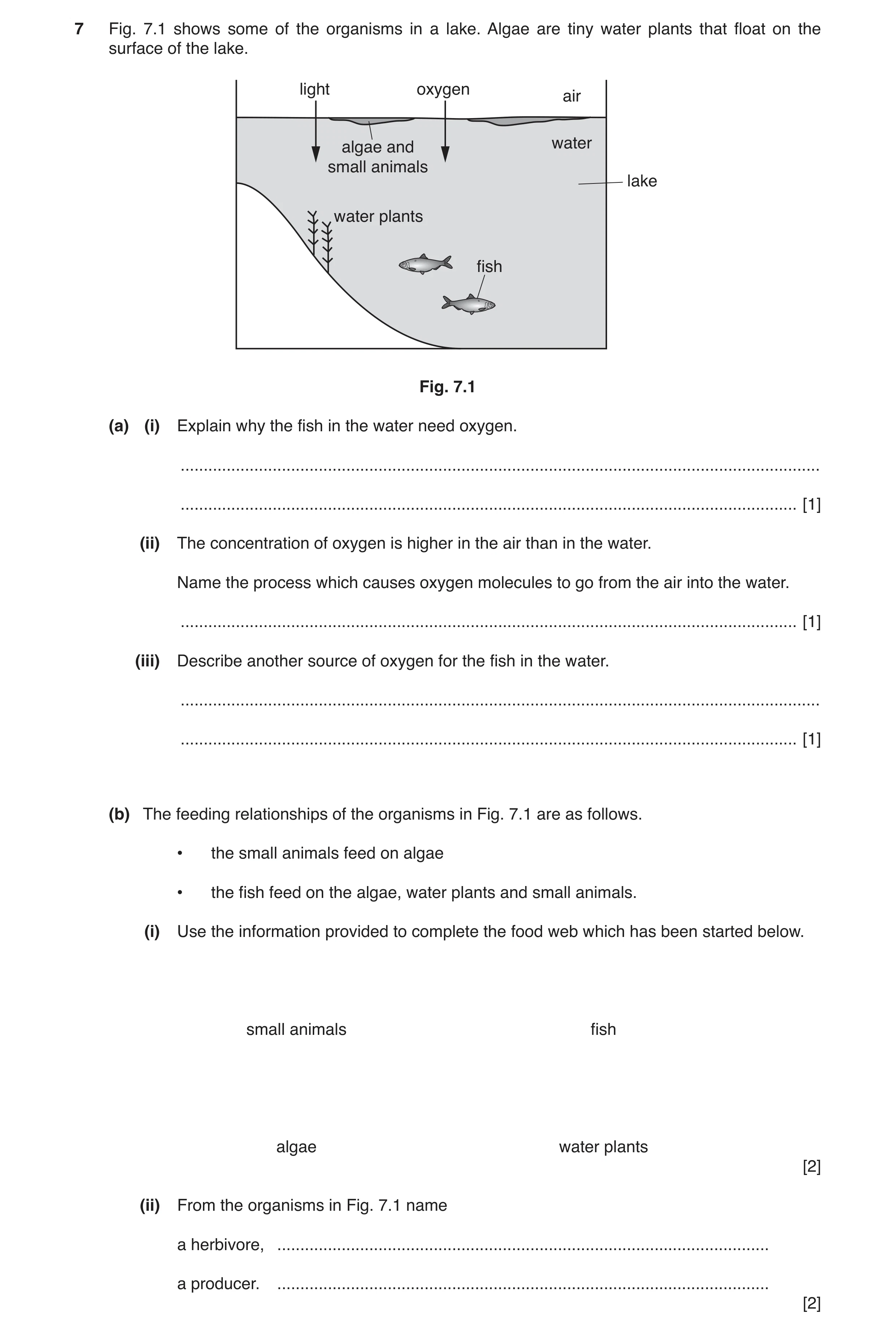
7 Fig. 7.1 shows some of the organisms in a lake. Algae are tiny water plants that float on the surface of the lake. light oxygen air algae and water small animals lake water plants fish Fig. 7.1 (a) (i) Explain why the fish in the water need oxygen. … … [1] (ii) The concentration of oxygen is higher in the air than in the water. Name the process which causes oxygen molecules to go from the air into the water. … [1] (iii) Describe another source of oxygen for the fish in the water. … … [1] (b) The feeding relationships of the organisms in Fig. 7.1 are as follows. • the small animals feed on algae • the fish feed on the algae, water plants and small animals. (i) Use the information provided to complete the food web which has been started below. small animals fish algae water plants [2] (ii) From the organisms in Fig. 7.1 name a herbivore, … a producer. … [2]
7 marks
Mark scheme: 7(a)(i) for respiration ; 1 7(a)(ii) diffusion ; 1 7(a)(iii) from the (water) plants ; 1 7(b)(i) food web completed as shown ; small animals fish algae water plants arrows in the correct direction ; 2 7(b)(ii) small animals ; water plants / algae ; 2
This question in 0653/32 May/June 2017
Q3 · Some of the organisms in a lake 0653/33 May/June 2017
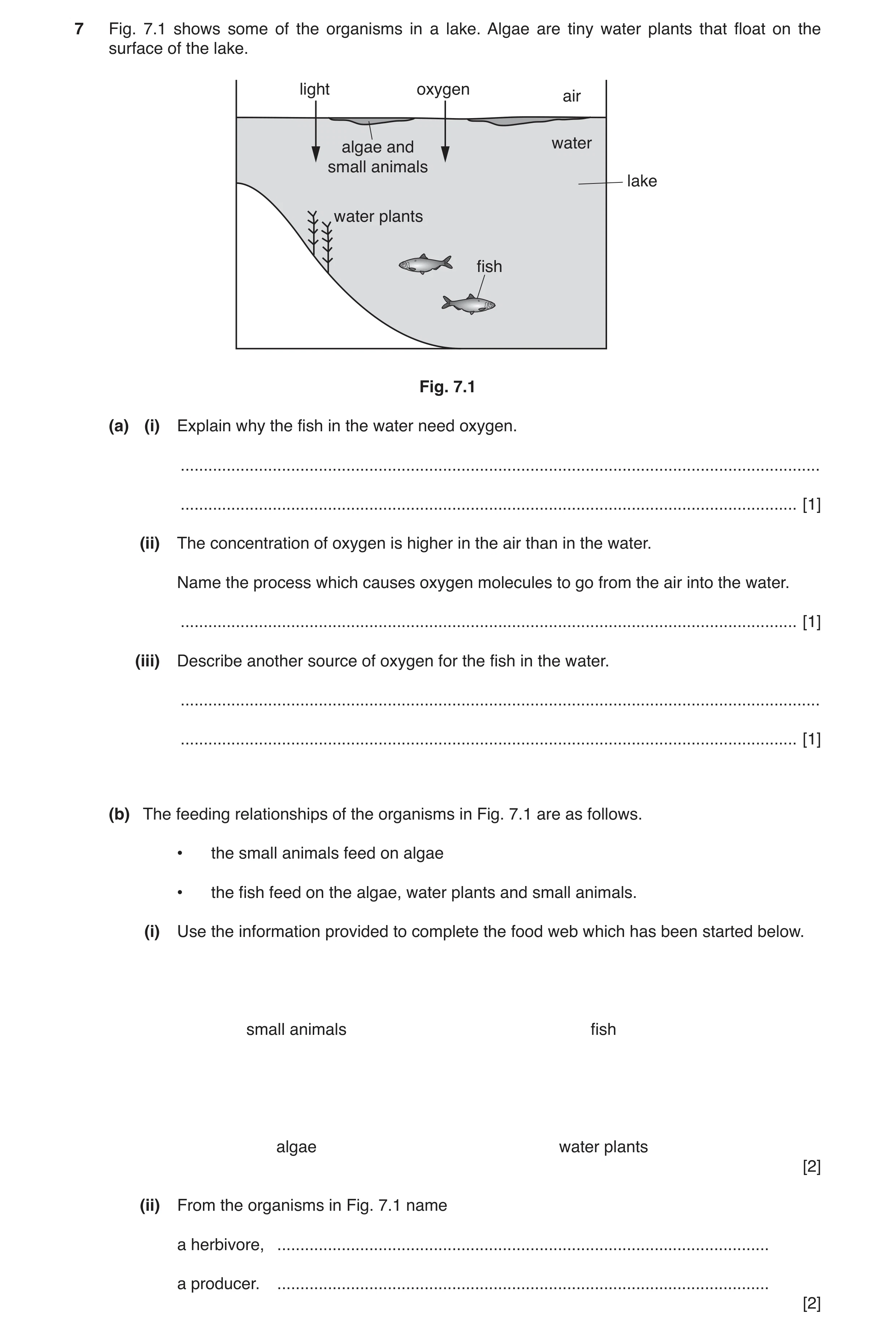
7 Fig. 7.1 shows some of the organisms in a lake. Algae are tiny water plants that float on the surface of the lake. light oxygen air algae and water small animals lake water plants fish Fig. 7.1 (a) (i) Explain why the fish in the water need oxygen. … … [1] (ii) The concentration of oxygen is higher in the air than in the water. Name the process which causes oxygen molecules to go from the air into the water. … [1] (iii) Describe another source of oxygen for the fish in the water. … … [1] (b) The feeding relationships of the organisms in Fig. 7.1 are as follows. • the small animals feed on algae • the fish feed on the algae, water plants and small animals. (i) Use the information provided to complete the food web which has been started below. small animals fish algae water plants [2] (ii) From the organisms in Fig. 7.1 name a herbivore, … a producer. … [2]
7 marks
Mark scheme: 7(a)(i) for respiration ; 1 7(a)(ii) diffusion ; 1 7(a)(iii) from the (water) plants ; 1 7(b)(i) food web completed as shown ; small animals fish algae water plants arrows in the correct direction ; 2 7(b)(ii) small animals ; water plants / algae ; 2
This question in 0653/33 May/June 2017
Q4 · Some facts about processes in living organisms 0653/32 Feb/March 2018
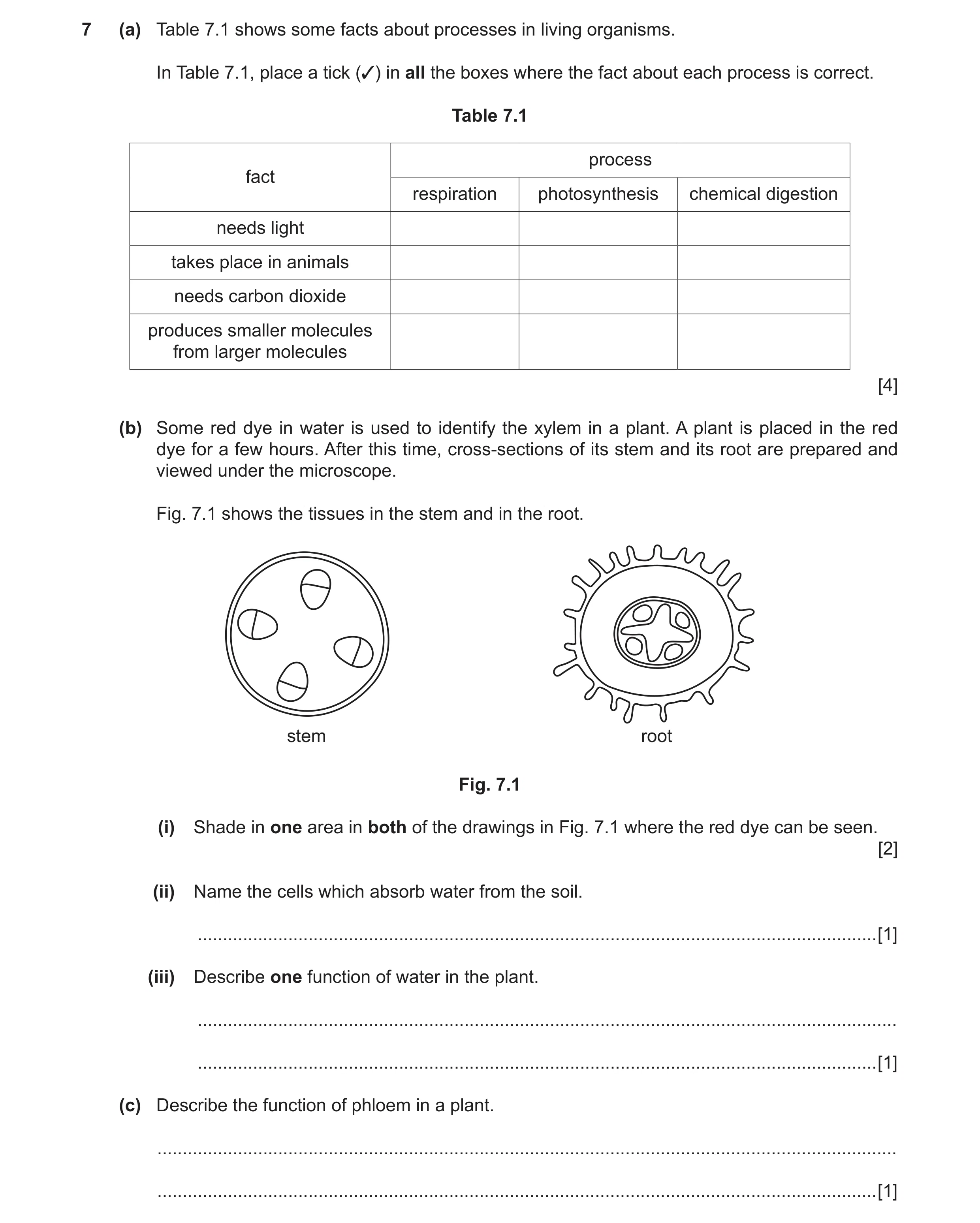
7 (a) Table 7.1 shows some facts about processes in living organisms. In Table 7.1, place a tick (3) in all the boxes where the fact about each process is correct. Table 7.1 process fact respiration photosynthesis chemical digestion needs light takes place in animals needs carbon dioxide produces smaller molecules from larger molecules [4] (b) Some red dye in water is used to identify the xylem in a plant. A plant is placed in the red dye for a few hours. After this time, cross-sections of its stem and its root are prepared and viewed under the microscope. Fig. 7.1 shows the tissues in the stem and in the root. stem root Fig. 7.1 (i) Shade in one area in both of the drawings in Fig. 7.1 where the red dye can be seen. [2] (ii) Name the cells which absorb water from the soil. … [1] (iii) Describe one function of water in the plant. … … [1] (c) Describe the function of phloem in a plant. … … [1]
9 marks
Mark scheme: 7(a) One mark for each correct line of table ;;;; fact process respiration photosynthesis chemical digestion needs light 9 takes place in animals 9 9 needs carbon dioxide 9 produces smaller molecules from larger molecules 9 9 4 7(b)(i) shading in at least one area of xylem in stem ; shading in at least one area of xylem in root ; 2 Question Answer Marks 7(b)(ii) root hair cells ; 1 7(b)(iii) replace water lost in transpiration / prevent wilting ; to carry minerals to all parts of the plant ; raw material in photosynthesis ; max 1 7(c) transports food / sugars / amino acids ; 1
This question in 0653/32 Feb/March 2018
Q5 · Substances in food can be identified using test solutions 0653/31 May/June 2018
1 (a) Substances in food can be identified using test solutions. Use lines to join each substance with the correct test solution and the colour of its positive result. One example is done for you. substance test solution colour of positive result fats Benedict’s solution blue‑black protein biuret solution milky emulsion reducing sugar ethanol purple starch iodine solution red [3] (b) Fig. 1.1 shows three leaves, P, Q and R. The leaves are of similar size. They are all taken from the same type of plant on a sunny day. green yellow P Q R Fig. 1.1 (i) The leaves in Fig. 1.1 are all tested for the presence of starch. P, Q and R are found to contain different amounts of starch. Use Fig. 1.1 to place the leaves P, Q and R in order of the amount of starch they contain. … highest amount of starch … … lowest amount of starch [1] (ii) Explain your answer to (i). … … … [2] (c) The word equation for photosynthesis is shown. carbon dioxide + water glucose + oxygen Describe how carbon dioxide and water enter a plant. carbon dioxide … … … water … … … [4] (d) A student made the following statement. ‘Plants carry out respiration in their cells only when it is dark.’ (i) State whether you agree with the student’s statement and explain your decision. … … [1] (ii) State one use of the energy released by respiration in plants. … [1]
12 marks
Mark scheme: 1(a) boxes connected as shown fats Benedict’s solution blue / black protein biuret solution milky emulsion reducing sugar ethanol purple starch iodine solution red ;;; 1 mark for each 2 correct lines 3 1(b)(i) P,Q and R in the correct order ; 1 1(b)(ii) green areas contain chlorophyll ; reference to photosynthesis ; 2 1(c) (carbon doxide) through stomata ; by diffusion ; (water) through root hair cells; from the soil / ground / by diffusion ; 4 1(d)(i) false – no mark respiration takes place all the time / owtte ; 1 1(d)(ii) any one of protein synthesis ; cell division ; growth ; max1
This question in 0653/31 May/June 2018
Q6 · Gardeners can increase the numbers of plants by splitting a parent plant in two… 0653/32 May/June 2018
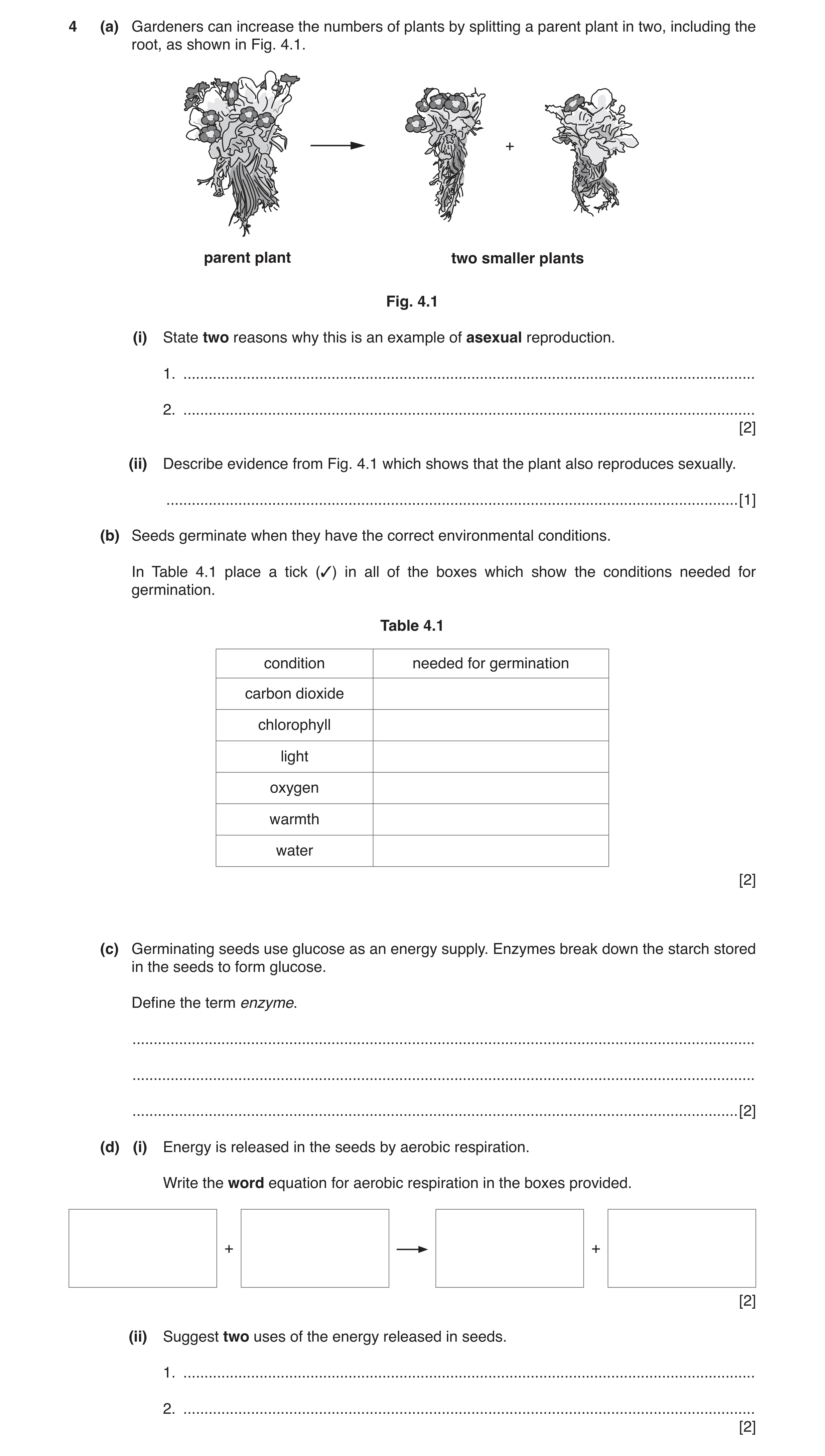
4 (a) Gardeners can increase the numbers of plants by splitting a parent plant in two, including the root, as shown in Fig. 4.1. + parent plant two smaller plants Fig. 4.1 (i) State two reasons why this is an example of asexual reproduction. 1. … 2. … [2] (ii) Describe evidence from Fig. 4.1 which shows that the plant also reproduces sexually. … [1] (b) Seeds germinate when they have the correct environmental conditions. In Table 4.1 place a tick (✓) in all of the boxes which show the conditions needed for germination. Table 4.1 condition needed for germination carbon dioxide chlorophyll light oxygen warmth water [2] (c) Germinating seeds use glucose as an energy supply. Enzymes break down the starch stored in the seeds to form glucose. Define the term enzyme. … … … [2] (d) (i) Energy is released in the seeds by aerobic respiration. Write the word equation for aerobic respiration in the boxes provided. + + [2] (ii) Suggest two uses of the energy released in seeds. 1. … 2. … [2]
11 marks
Mark scheme: 4(a)(i) only one parent involved ; offspring (genetically) identical ; 2 4(a)(ii) it has flowers ; 1 4(b) ticks in three boxes as shown ;; 2 marks all 3 correct 1 mark for 1 or 2 correct condition needed for germination () carbon dioxide chlorophyll light oxygen 9 water 9 warmth 9 2 Question Answer Marks 4(c) a protein ; (that functions as) a (biological) catalyst ; 2 4(d)(i) glucose, oxygen ; – either order carbon dioxide, water ; – either order 2 4(d)(ii) any two of protein synthesis ; cell division ; growth ; 2
This question in 0653/32 May/June 2018
Q7 · Gardeners can increase the numbers of plants by splitting a parent plant in two… 0653/33 May/June 2018
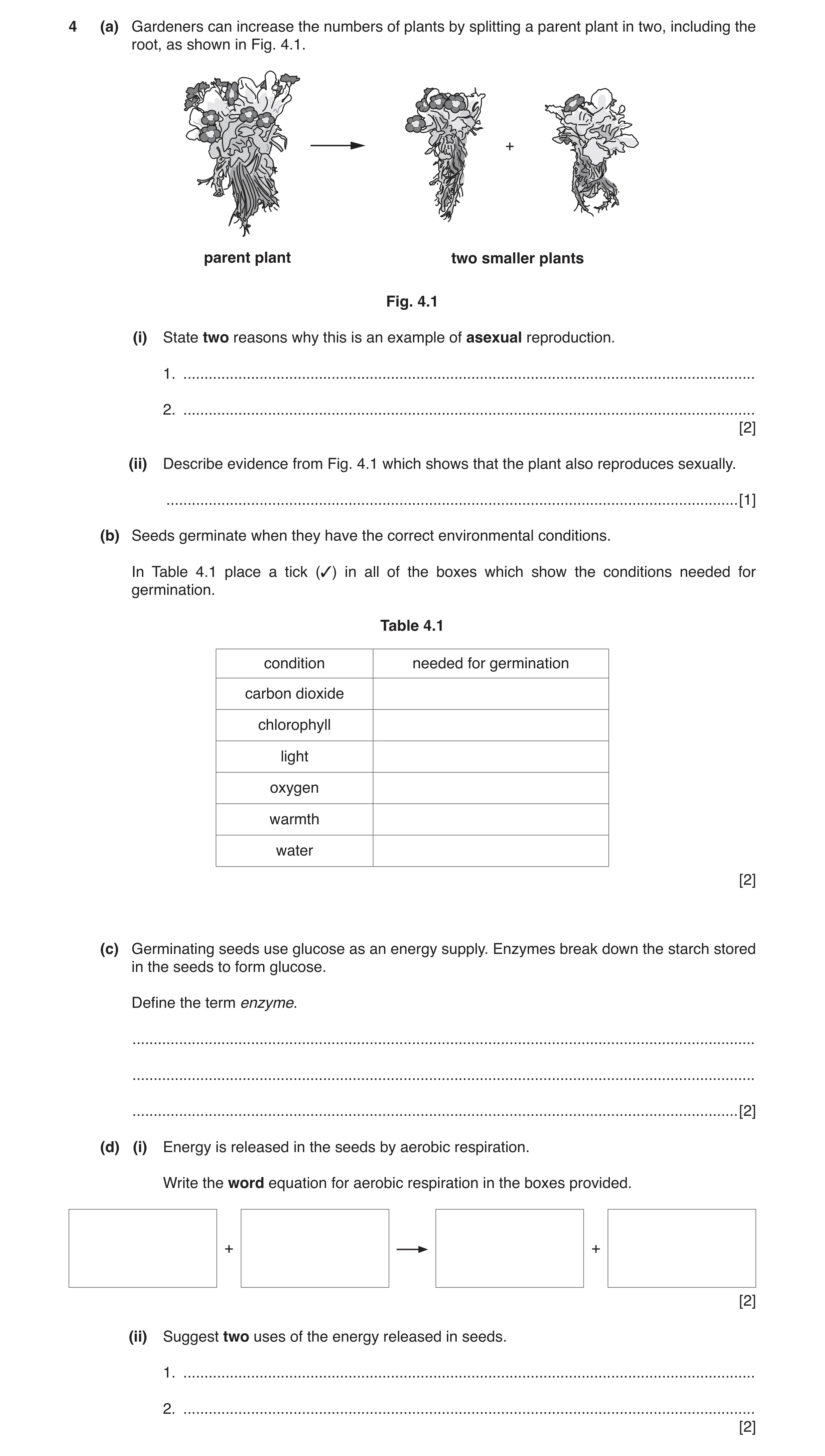
4 (a) Gardeners can increase the numbers of plants by splitting a parent plant in two, including the root, as shown in Fig. 4.1. + parent plant two smaller plants Fig. 4.1 (i) State two reasons why this is an example of asexual reproduction. 1. … 2. … [2] (ii) Describe evidence from Fig. 4.1 which shows that the plant also reproduces sexually. … [1] (b) Seeds germinate when they have the correct environmental conditions. In Table 4.1 place a tick (✓) in all of the boxes which show the conditions needed for germination. Table 4.1 condition needed for germination carbon dioxide chlorophyll light oxygen warmth water [2] (c) Germinating seeds use glucose as an energy supply. Enzymes break down the starch stored in the seeds to form glucose. Define the term enzyme. … … … [2] (d) (i) Energy is released in the seeds by aerobic respiration. Write the word equation for aerobic respiration in the boxes provided. + + [2] (ii) Suggest two uses of the energy released in seeds. 1. … 2. … [2]
11 marks
Mark scheme: 4(a)(i) only one parent involved ; offspring (genetically) identical ; 2 4(a)(ii) it has flowers ; 1 4(b) ticks in three boxes as shown ;; 2 marks all 3 correct 1 mark for 1 or 2 correct condition needed for germination () carbon dioxide chlorophyll light oxygen 9 water 9 warmth 9 2 Question Answer Marks 4(c) a protein ; (that functions as) a (biological) catalyst ; 2 4(d)(i) glucose, oxygen ; – either order carbon dioxide, water ; – either order 2 4(d)(ii) any two of protein synthesis ; cell division ; growth ; 2
This question in 0653/33 May/June 2018
Q8 · A flowering plant and some functions carried out by the plant 0653/33 Oct/Nov 2018
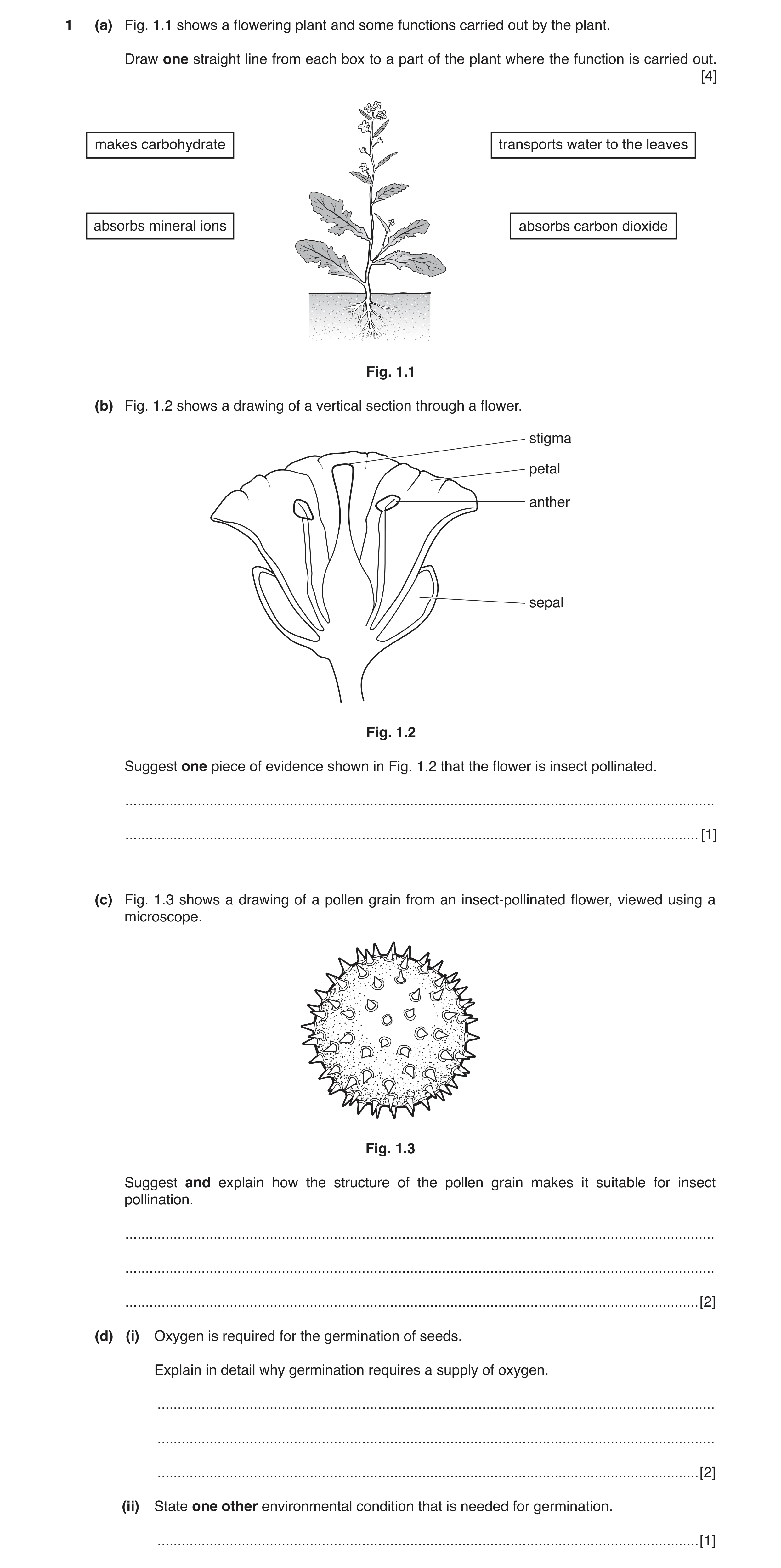
1 (a) Fig. 1.1 shows a flowering plant and some functions carried out by the plant. Draw one straight line from each box to a part of the plant where the function is carried out. [4] makes carbohydrate transports water to the leaves absorbs mineral ions absorbs carbon dioxide Fig. 1.1 (b) Fig. 1.2 shows a drawing of a vertical section through a flower. stigma petal anther sepal Fig. 1.2 Suggest one piece of evidence shown in Fig. 1.2 that the flower is insect pollinated. … … [1] (c) Fig. 1.3 shows a drawing of a pollen grain from an insect-pollinated flower, viewed using a microscope. Fig. 1.3 Suggest and explain how the structure of the pollen grain makes it suitable for insect pollination. … … … [2] (d) (i) Oxygen is required for the germination of seeds. Explain in detail why germination requires a supply of oxygen. … … … [2] (ii) State one other environmental condition that is needed for germination. … [1]
10 marks
Mark scheme: 1(a) Line drawn from: absorbs mineral ions to any part of the root ; makes carbohydrate to any leaf ; transports water to the leaves to any part of the stem ; absorbs carbon dioxide to any leaf ; 4 1(b) large petals ; or anther / stigma inside the flower ; 1 1(c) Spiky / irregular surface ; sticks well to insects’ bodies / stigma ; 2 1(d)(i) for respiration ; and one of to release energy ; for growth ; building up large molecules ; cell division ; Max 2 2 1(d)(ii) warmth / water ; 1
This question in 0653/33 Oct/Nov 2018
Q9 · Plants make their own food in leaves by the process of photosynthesis 0653/31 May/June 2019
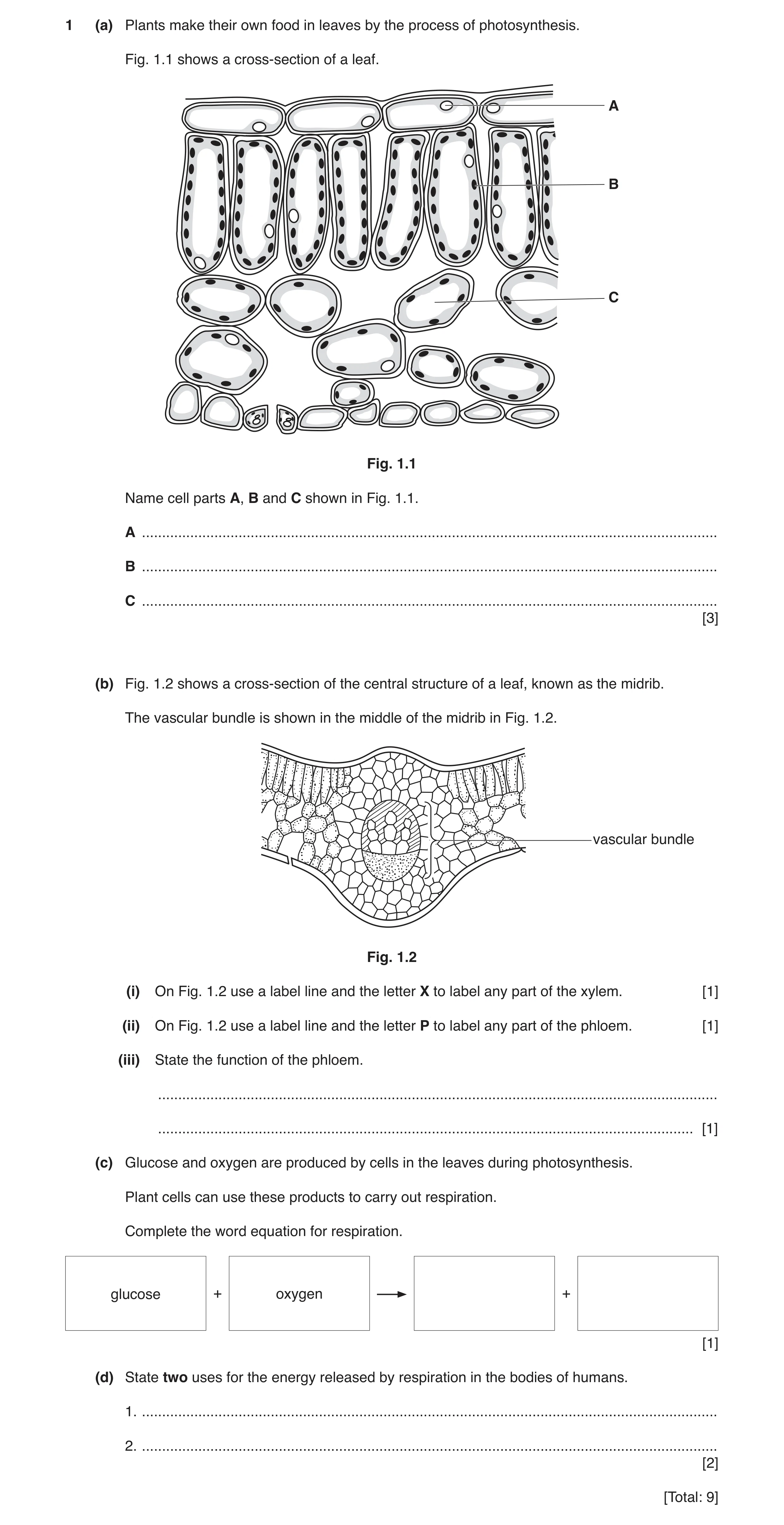
1 (a) Plants make their own food in leaves by the process of photosynthesis. Fig. 1.1 shows a cross-section of a leaf. A B C Fig. 1.1 Name cell parts A, B and C shown in Fig. 1.1. A … B … C … [3] (b) Fig. 1.2 shows a cross-section of the central structure of a leaf, known as the midrib. The vascular bundle is shown in the middle of the midrib in Fig. 1.2. vascular bundle Fig. 1.2 (i) On Fig. 1.2 use a label line and the letter X to label any part of the xylem. [1] (ii) On Fig. 1.2 use a label line and the letter P to label any part of the phloem. [1] (iii) State the function of the phloem. … … [1] (c) Glucose and oxygen are produced by cells in the leaves during photosynthesis. Plant cells can use these products to carry out respiration. Complete the word equation for respiration. glucose + oxygen + [1] (d) State two uses for the energy released by respiration in the bodies of humans. 1. … 2. … [2] [Total: 9]
9 marks
Mark scheme: 1(a) A nucleus ; B chloroplast ; C vacuole ; 3 1(b)(i) label X to any part of xylem area ; 1 1(b)(ii) label P to any part of phloem area ; 1 1(b)(iii) transport food substances (from leaves) ; 1 1(c) carbon dioxide and water ; (either order) 1 1(d) any two of muscle contraction ; protein synthesis ; growth ; maintenance of (a constant body) temperature ; 2
This question in 0653/31 May/June 2019
Q10 · The structure of a human heart 0653/31 May/June 2020
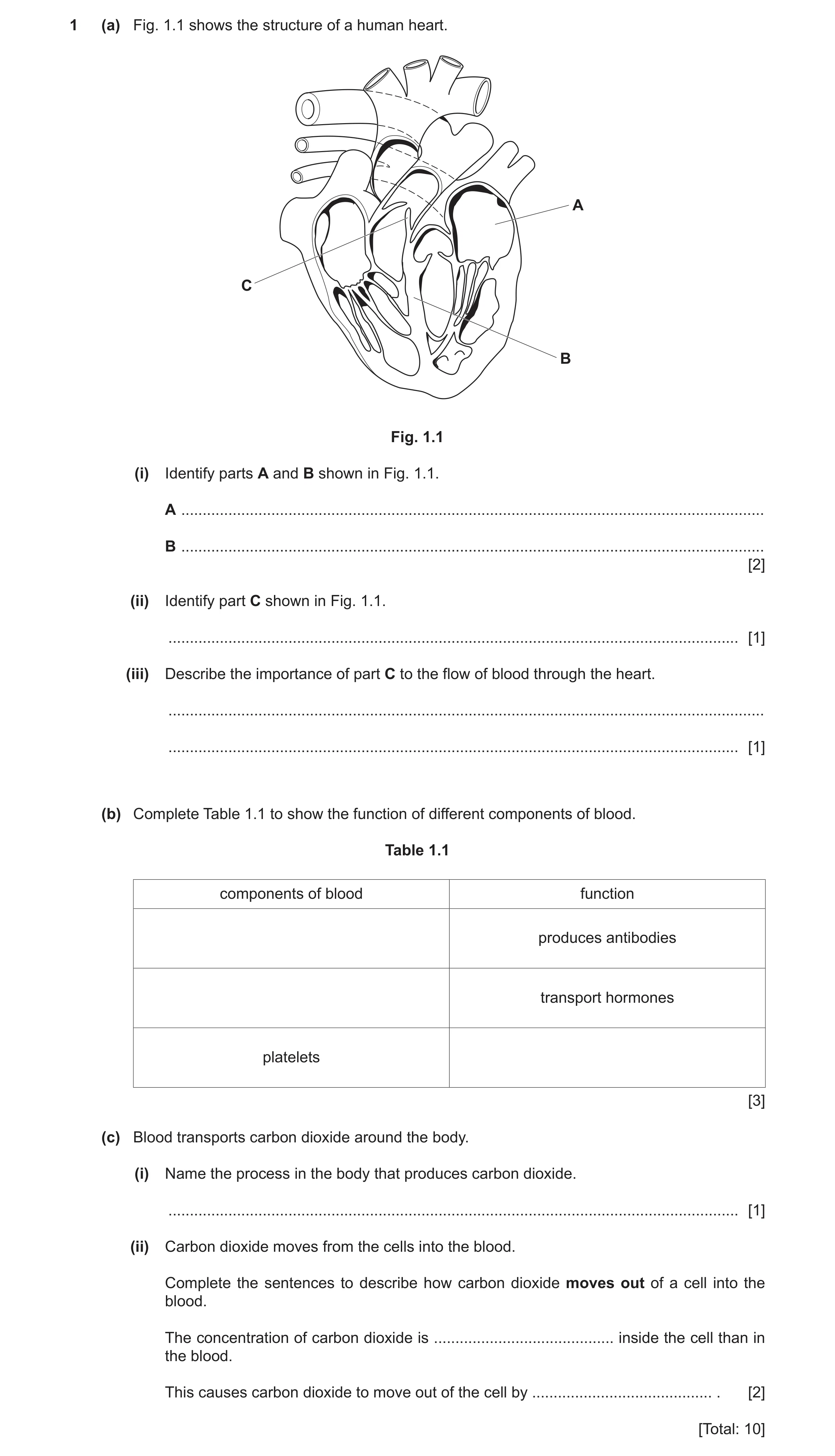
1 (a) Fig. 1.1 shows the structure of a human heart. A C B Fig. 1.1 (i) Identify parts A and B shown in Fig. 1.1. A … B … [2] (ii) Identify part C shown in Fig. 1.1. … [1] (iii) Describe the importance of part C to the flow of blood through the heart. … … [1] (b) Complete Table 1.1 to show the function of different components of blood. Table 1.1 components of blood function produces antibodies transport hormones platelets [3] (c) Blood transports carbon dioxide around the body. (i) Name the process in the body that produces carbon dioxide. … [1] (ii) Carbon dioxide moves from the cells into the blood. Complete the sentences to describe how carbon dioxide moves out of a cell into the blood. The concentration of carbon dioxide is … inside the cell than in the blood. This causes carbon dioxide to move out of the cell by … . [2] [Total: 10]
10 marks
Mark scheme: 1(a)(i) A (left) atrium ; B septum ; 2 1(a)(ii) valve ; 1 1(a)(iii) makes sure the blood flows in one direction / prevents backflow ; 1 1(b) white blood cells (produces antibodies) ; plasma (transports hormones) ; (platelets) blood clotting ; 3 1(c)(i) respiration ; 1 1(c)(ii) higher / greater ; diffusion ; 2
This question in 0653/31 May/June 2020
Q11 · A diagram of some parts of the body 0653/31 Oct/Nov 2020
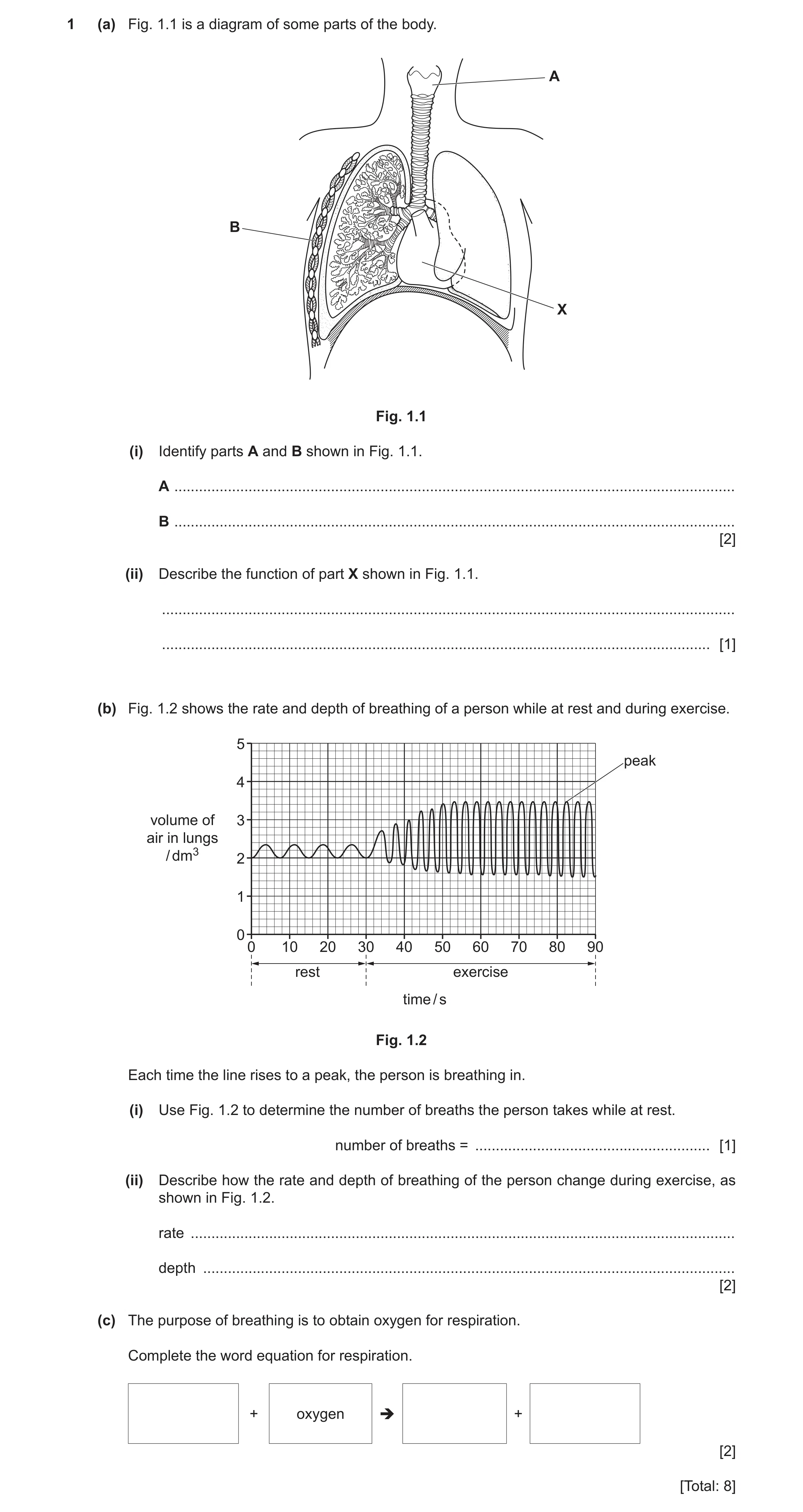
1 (a) Fig. 1.1 is a diagram of some parts of the body. A B X Fig. 1.1 (i) Identify parts A and B shown in Fig. 1.1. A … B … [2] (ii) Describe the function of part X shown in Fig. 1.1. … … [1] (b) Fig. 1.2 shows the rate and depth of breathing of a person while at rest and during exercise. 5 peak 4 volume of 3 air in lungs / dm3 2 1 0 0 10 20 30 40 50 60 70 80 90 rest exercise time / s Fig. 1.2 Each time the line rises to a peak, the person is breathing in. (i) Use Fig. 1.2 to determine the number of breaths the person takes while at rest. number of breaths = … [1] (ii) Describe how the rate and depth of breathing of the person change during exercise, as shown in Fig. 1.2. rate … depth … [2] (c) The purpose of breathing is to obtain oxygen for respiration. Complete the word equation for respiration. + oxygen + [2] [Total: 8]
8 marks
Mark scheme: 1(a)(i) B intercostal muscles ; 2 1(a)(ii) pump blood (around the body) ; 1 1(b)(i) 4 ; 1 1(b)(ii) (rate) increases ; (depth) increases ; 2 1(c) glucose + (oxygen) carbon dioxide + water LHS ; RHS ; 2
This question in 0653/31 Oct/Nov 2020
Q12 · Part of a food web from a lake 0653/32 Feb/March 2021
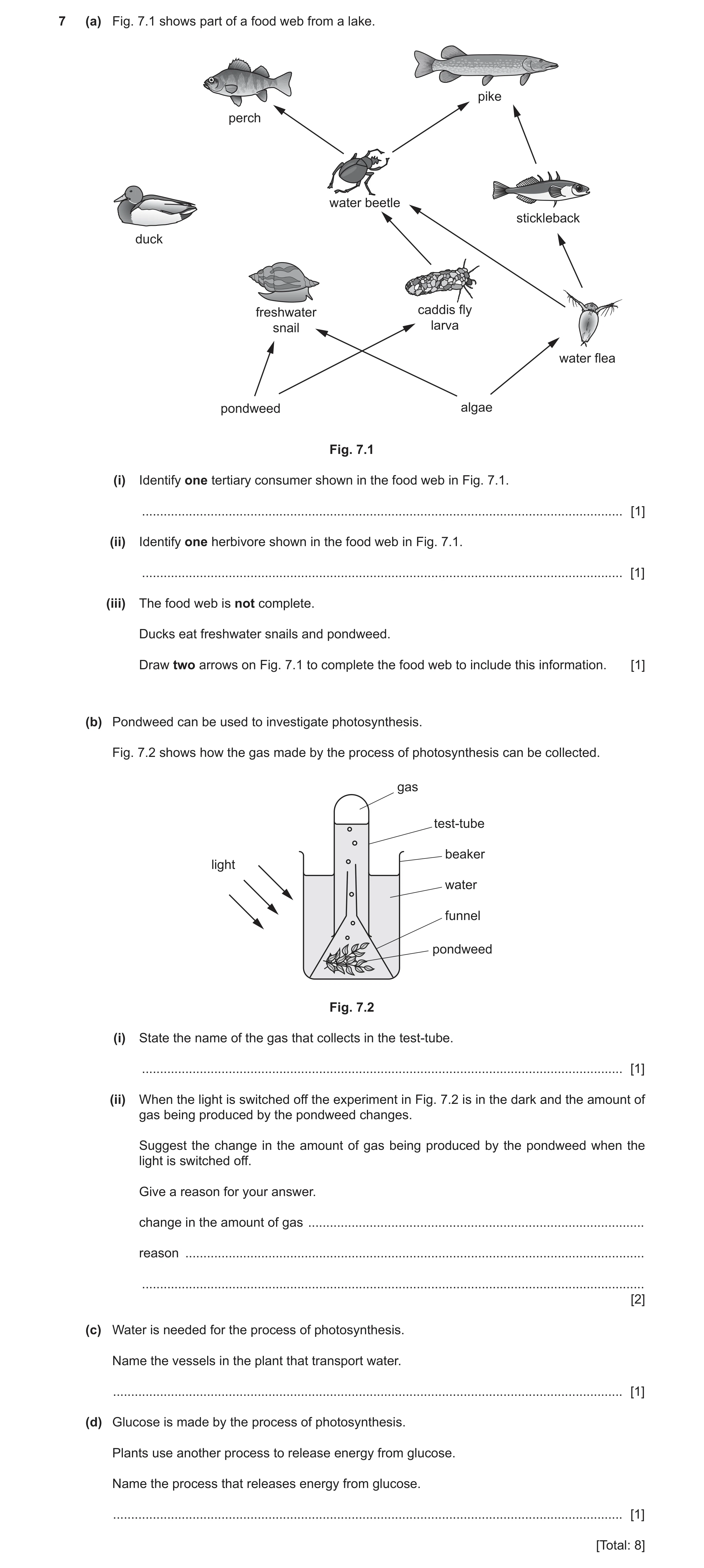
7 (a) Fig. 7.1 shows part of a food web from a lake. pike perch water beetle stickleback duck freshwater caddis fly snail larva water flea pondweed algae Fig. 7.1 (i) Identify one tertiary consumer shown in the food web in Fig. 7.1. … [1] (ii) Identify one herbivore shown in the food web in Fig. 7.1. … [1] (iii) The food web is not complete. Ducks eat freshwater snails and pondweed. Draw two arrows on Fig. 7.1 to complete the food web to include this information. [1] (b) Pondweed can be used to investigate photosynthesis. Fig. 7.2 shows how the gas made by the process of photosynthesis can be collected. gas test-tube beaker light water funnel pondweed Fig. 7.2 (i) State the name of the gas that collects in the test-tube. … [1] (ii) When the light is switched off the experiment in Fig. 7.2 is in the dark and the amount of gas being produced by the pondweed changes. Suggest the change in the amount of gas being produced by the pondweed when the light is switched off. Give a reason for your answer. change in the amount of gas … reason … … [2] (c) Water is needed for the process of photosynthesis. Name the vessels in the plant that transport water. … [1] (d) Glucose is made by the process of photosynthesis. Plants use another process to release energy from glucose. Name the process that releases energy from glucose. … [1] [Total: 8]
8 marks
Mark scheme: 7(a)(i) perch / pike ; 1 7(a)(ii) freshwater snail / caddis fly larva / water flea ; 1 7(a)(iii) arrow from freshwater snail to duck AND arrow from pondweed to duck ; 1 7(b)(i) oxygen ; 1 7(b)(ii) less / no, gas produced ; (because) light is needed for photosynthesis ; 2 7(c) xylem ; 1 7(d) (aerobic) respiration ; 1
This question in 0653/32 Feb/March 2021
Q13 · The boxes on the left show some of the characteristics of living organisms 0653/32 Oct/Nov 2022
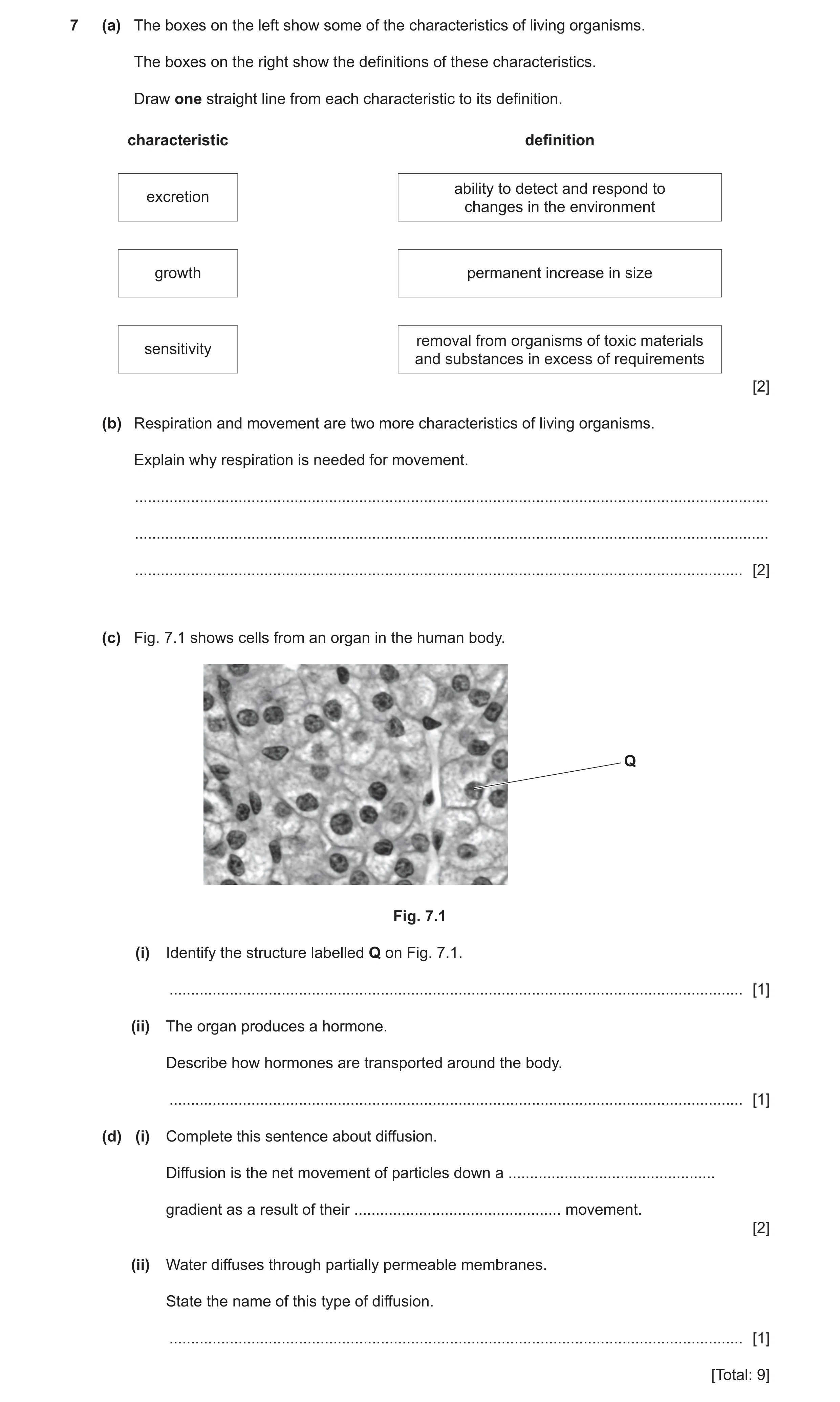
7 (a) The boxes on the left show some of the characteristics of living organisms. The boxes on the right show the definitions of these characteristics. Draw one straight line from each characteristic to its definition. characteristic definition ability to detect and respond to excretion changes in the environment growth permanent increase in size removal from organisms of toxic materials sensitivity and substances in excess of requirements [2] (b) Respiration and movement are two more characteristics of living organisms. Explain why respiration is needed for movement. … … … [2] (c) Fig. 7.1 shows cells from an organ in the human body. Q Fig. 7.1 (i) Identify the structure labelled Q on Fig. 7.1. … [1] (ii) The organ produces a hormone. Describe how hormones are transported around the body. … [1] (d) (i) Complete this sentence about diffusion. Diffusion is the net movement of particles down a … gradient as a result of their … movement. [2] (ii) Water diffuses through partially permeable membranes. State the name of this type of diffusion. … [1] [Total: 9]
9 marks
Mark scheme: 7(a) 2 ability to detect and respond to excretion changes in the environment growth permanent increase in size removal from organisms of toxic sensitivity materials and substances in excess of requirements one correct ; all three correct ; 7(b) respiration releases energy ; 2 energy needed for muscle contraction ; 7(c)(i) nucleus ; 1 7(c)(ii) (in the) blood / plasma ; 1 7(d)(i) concentration ; 2 random ; 7(d)(ii) osmosis ; 1
This question in 0653/32 Oct/Nov 2022
Q14 · The boxes on the left show some of the characteristics of living organisms 0653/33 Oct/Nov 2022
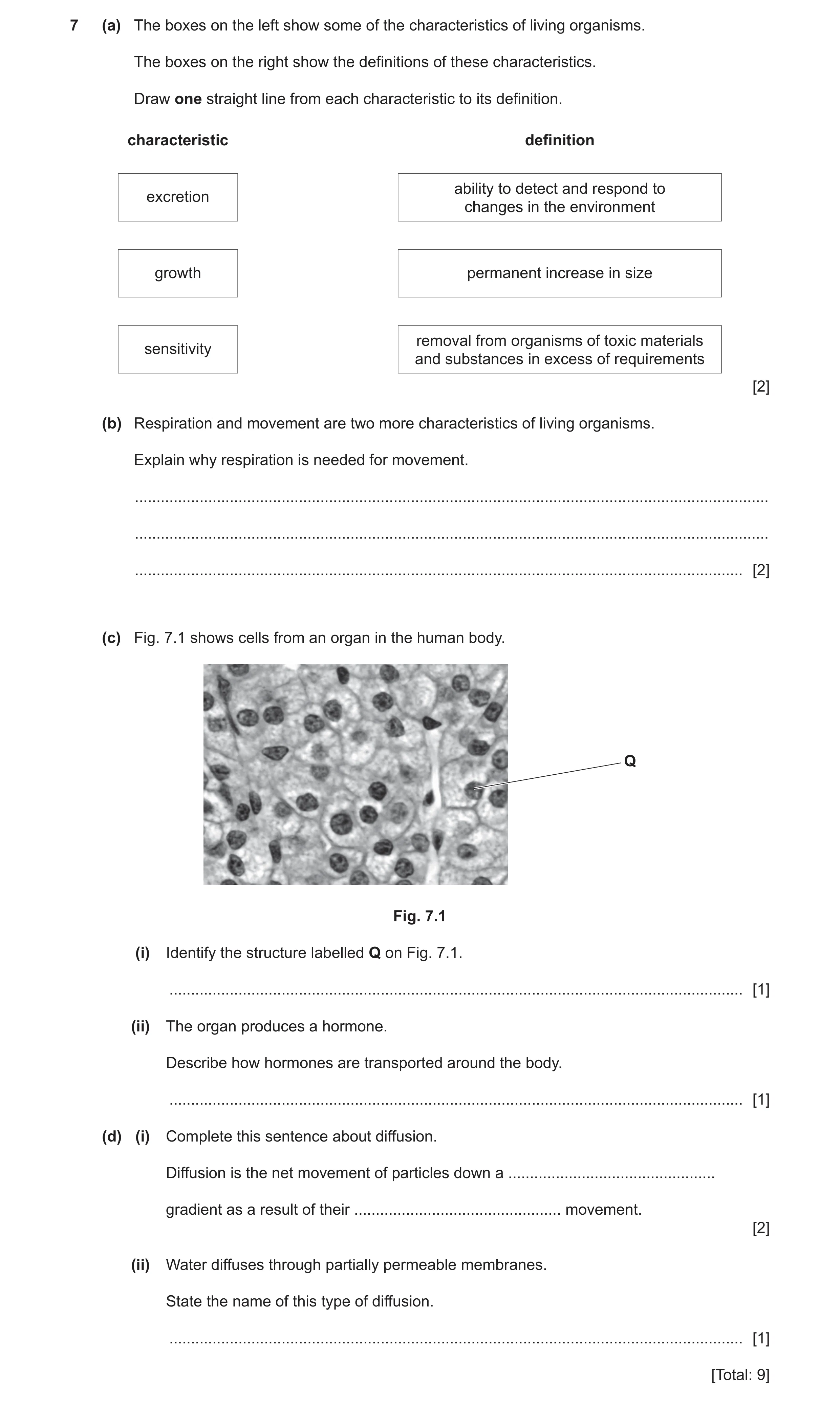
7 (a) The boxes on the left show some of the characteristics of living organisms. The boxes on the right show the definitions of these characteristics. Draw one straight line from each characteristic to its definition. characteristic definition ability to detect and respond to excretion changes in the environment growth permanent increase in size removal from organisms of toxic materials sensitivity and substances in excess of requirements [2] (b) Respiration and movement are two more characteristics of living organisms. Explain why respiration is needed for movement. … … … [2] (c) Fig. 7.1 shows cells from an organ in the human body. Q Fig. 7.1 (i) Identify the structure labelled Q on Fig. 7.1. … [1] (ii) The organ produces a hormone. Describe how hormones are transported around the body. … [1] (d) (i) Complete this sentence about diffusion. Diffusion is the net movement of particles down a … gradient as a result of their … movement. [2] (ii) Water diffuses through partially permeable membranes. State the name of this type of diffusion. … [1] [Total: 9]
9 marks
Mark scheme: 7(a) 2 ability to detect and respond to excretion changes in the environment growth permanent increase in size removal from organisms of toxic sensitivity materials and substances in excess of requirements one correct ; all three correct ; 7(b) respiration releases energy ; 2 energy needed for muscle contraction ; 7(c)(i) nucleus ; 1 7(c)(ii) (in the) blood / plasma ; 1 7(d)(i) concentration ; 2 random ; 7(d)(ii) osmosis ; 1
This question in 0653/33 Oct/Nov 2022
Q15 · The boxes on the left name some parts of the male reproductive system in humans 0653/32 Feb/March 2023
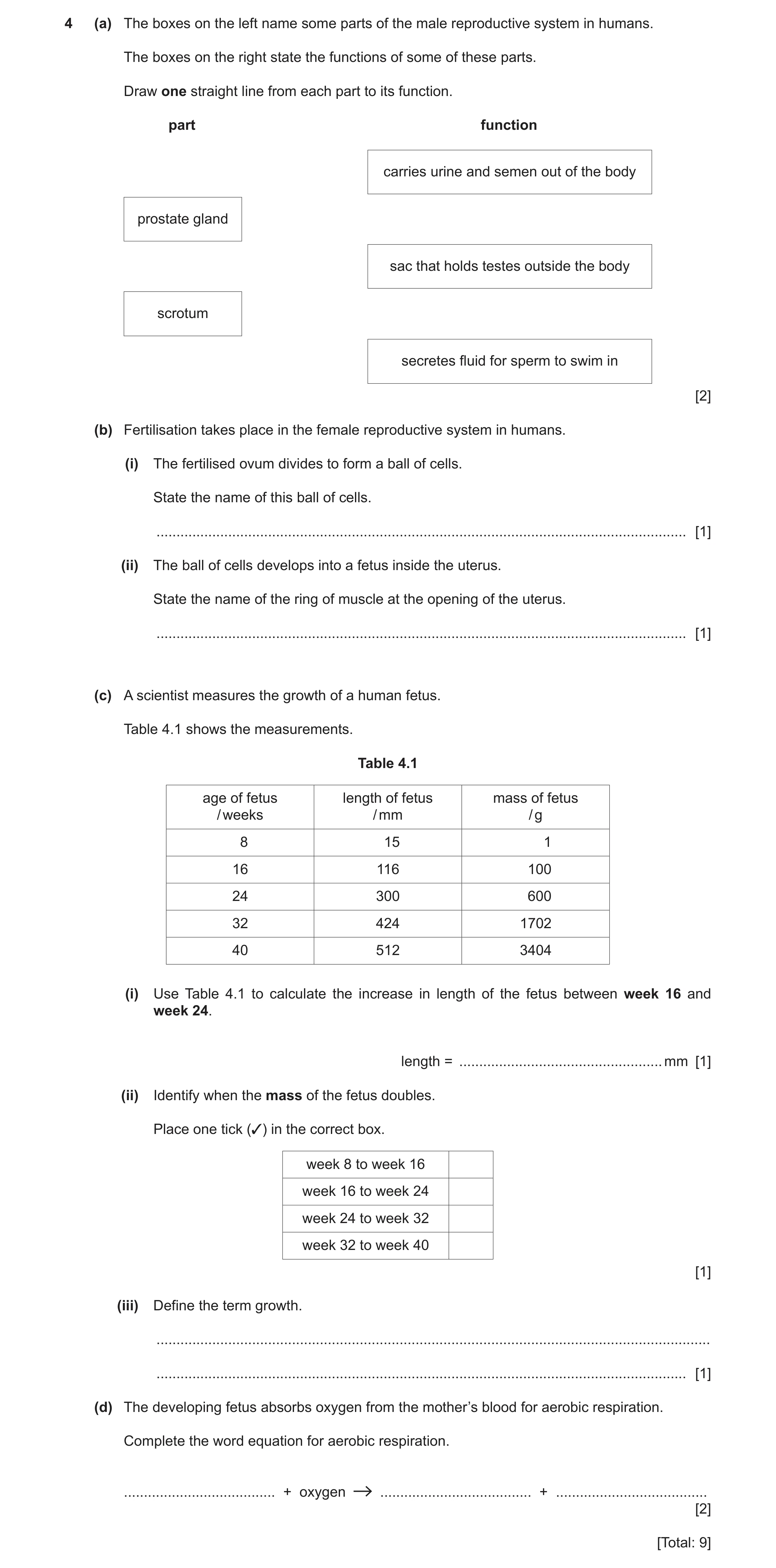
4 (a) The boxes on the left name some parts of the male reproductive system in humans. The boxes on the right state the functions of some of these parts. Draw one straight line from each part to its function. part function carries urine and semen out of the body prostate gland sac that holds testes outside the body scrotum secretes fluid for sperm to swim in [2] (b) Fertilisation takes place in the female reproductive system in humans. (i) The fertilised ovum divides to form a ball of cells. State the name of this ball of cells. … [1] (ii) The ball of cells develops into a fetus inside the uterus. State the name of the ring of muscle at the opening of the uterus. … [1] (c) A scientist measures the growth of a human fetus. Table 4.1 shows the measurements. Table 4.1 age of fetus length of fetus mass of fetus / weeks / mm / g 8 15 1 16 116 100 24 300 600 32 424 1702 40 512 3404 (i) Use Table 4.1 to calculate the increase in length of the fetus between week 16 and week 24. length = … mm [1] (ii) Identify when the mass of the fetus doubles. Place one tick (✓) in the correct box. week 8 to week 16 week 16 to week 24 week 24 to week 32 week 32 to week 40 [1] (iii) Define the term growth. … … [1] (d) The developing fetus absorbs oxygen from the mother’s blood for aerobic respiration. Complete the word equation for aerobic respiration. … + oxygen … + … [2] [Total: 9]
9 marks
Mark scheme: 4(a) 2 carries urine and semen out of the body prostate gland sac that holds testes outside the body scrotum secretes fluid for sperm to swim in ;; 4(b)(i) embryo ; 1 4(b)(ii) cervix ; 1 4(c)(i) 184 (mm) ; 1 4(c)(ii) week 32 to week 40 ; 1 4(c)(iii) permanent increase in size ; 1 4(d) glucose ; 2 carbon dioxide and water ;
This question in 0653/32 Feb/March 2023
Q16 · A model of the human gas exchange system 0653/31 May/June 2023
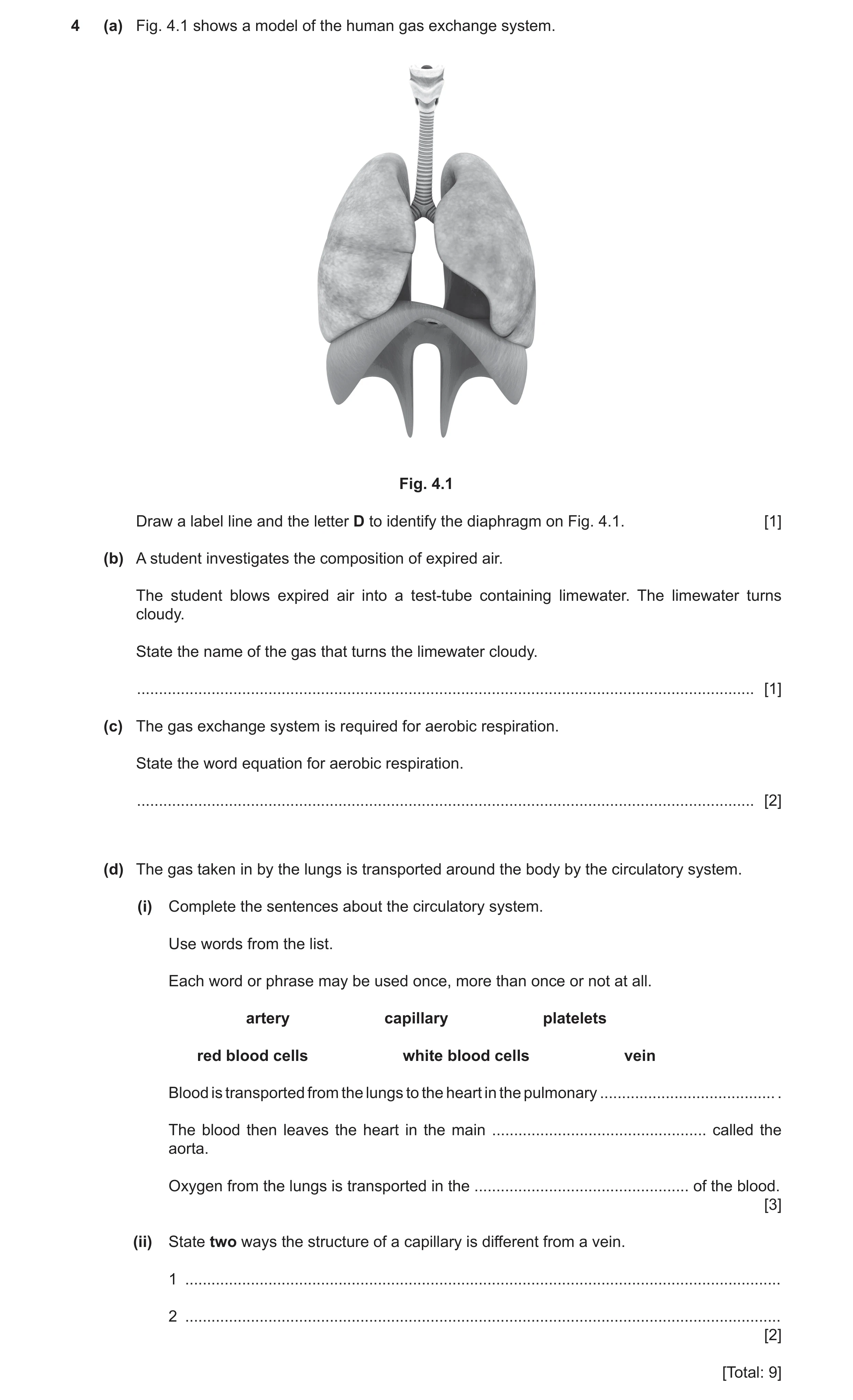
4 (a) Fig. 4.1 shows a model of the human gas exchange system. Fig. 4.1 Draw a label line and the letter D to identify the diaphragm on Fig. 4.1. [1] (b) A student investigates the composition of expired air. The student blows expired air into a test-tube containing limewater. The limewater turns cloudy. State the name of the gas that turns the limewater cloudy. … [1] (c) The gas exchange system is required for aerobic respiration. State the word equation for aerobic respiration. … [2] (d) The gas taken in by the lungs is transported around the body by the circulatory system. (i) Complete the sentences about the circulatory system. Use words from the list. Each word or phrase may be used once, more than once or not at all. artery capillary platelets red blood cells white blood cells vein Blood is transported from the lungs to the heart in the pulmonary … . The blood then leaves the heart in the main … called the aorta. Oxygen from the lungs is transported in the … of the blood. [3] (ii) State two ways the structure of a capillary is different from a vein. 1 … 2 … [2] [Total: 9]
9 marks
Mark scheme: 4(a) diaphragm labelled D ; 1 4(b) carbon dioxide ; 1 4(c) glucose + oxygen carbon dioxide + water ;; reactants (1) products (1) 2 4(d)(i) vein ; artery ; red blood cells ; 3 4(d)(ii) any two from: idea of small(er) internal cross-sectional area ; thinner wall / wall one cell thick ; no, muscles / elastic tissue in wall ; no valves ; 2
This question in 0653/31 May/June 2023
Question 17 0653/31 Oct/Nov 2023
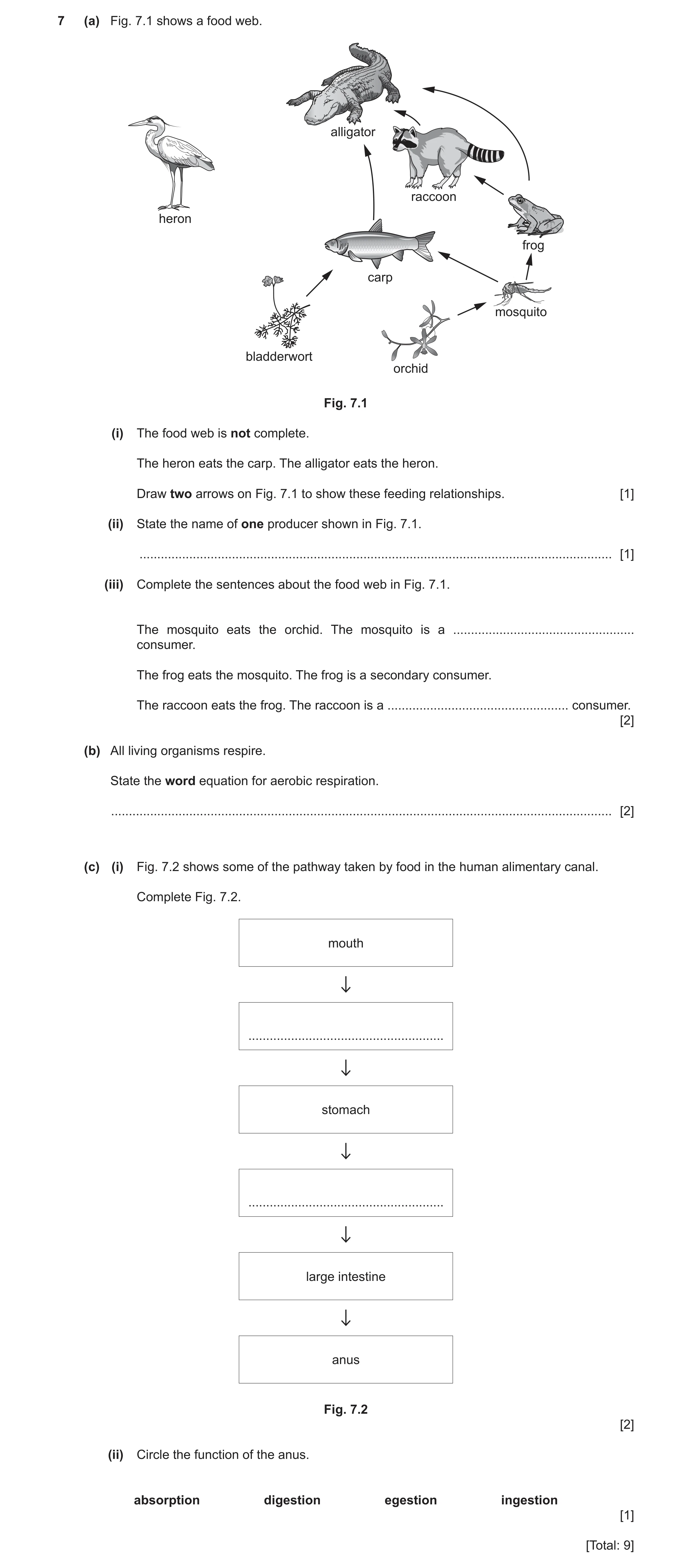
7 (a) Fig. 7.1 shows a food web. alligator raccoon heron frog carp mosquito bladderwort orchid Fig. 7.1 (i) The food web is not complete. The heron eats the carp. The alligator eats the heron. Draw two arrows on Fig. 7.1 to show these feeding relationships. [1] (ii) State the name of one producer shown in Fig. 7.1. … [1] (iii) Complete the sentences about the food web in Fig. 7.1. The mosquito eats the orchid. The mosquito is a … consumer. The frog eats the mosquito. The frog is a secondary consumer. The raccoon eats the frog. The raccoon is a … consumer. [2] (b) All living organisms respire. State the word equation for aerobic respiration. … [2] (c) (i) Fig. 7.2 shows some of the pathway taken by food in the human alimentary canal. Complete Fig. 7.2. mouth … stomach … large intestine anus Fig. 7.2 [2] (ii) Circle the function of the anus. absorption digestion egestion ingestion [1] [Total: 9]
9 marks
Mark scheme: 7(a)(i) arrows from carp to heron AND from heron to alligator ; 1 7(a)(ii) bladderwort / orchid ; 1 7(a)(iii) primary ; 2 tertiary ; 7(b) glucose + oxygen ; 2 → carbon dioxide + water ; 7(c)(i) oesophagus ; 2 small intestine ; 7(c)(ii) egestion ; 1
This question in 0653/31 Oct/Nov 2023
Q18 · Anaemia is caused by a deficiency of iron in the diet 0653/31 Oct/Nov 2024
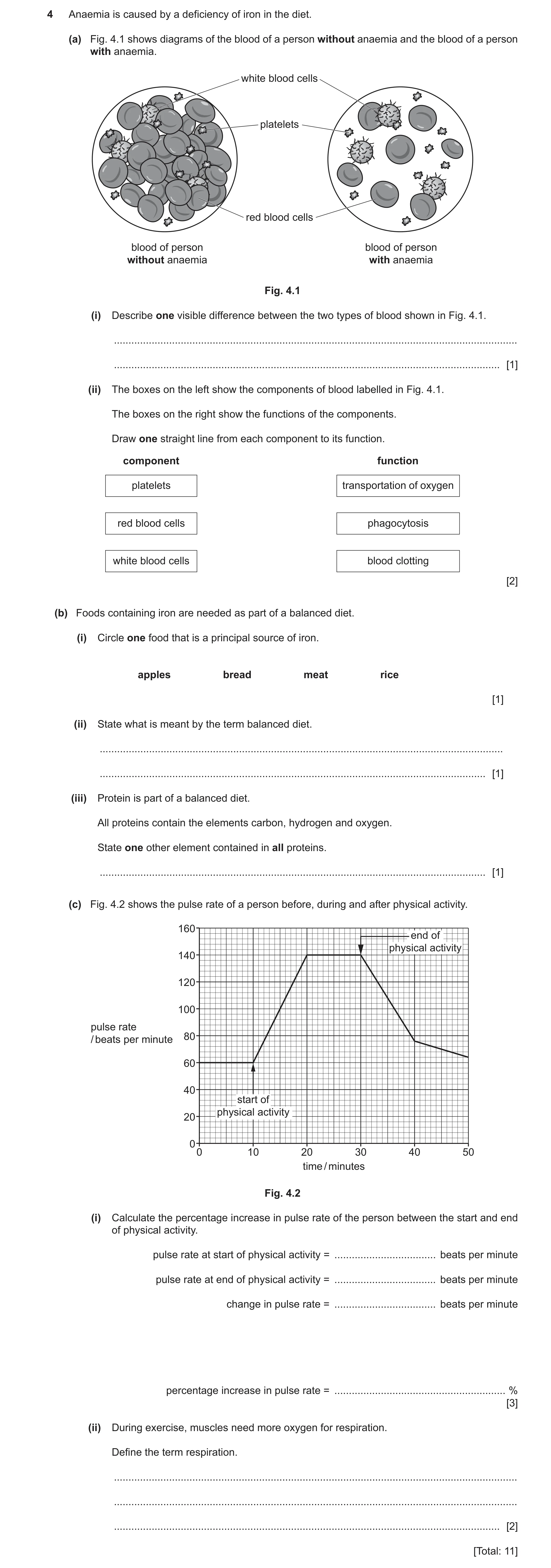
4 Anaemia is caused by a deficiency of iron in the diet. (a) Fig. 4.1 shows diagrams of the blood of a person without anaemia and the blood of a person with anaemia. white blood cells platelets red blood cells blood of person blood of person without anaemia with anaemia Fig. 4.1 (i) Describe one visible difference between the two types of blood shown in Fig. 4.1. … … [1] (ii) The boxes on the left show the components of blood labelled in Fig. 4.1. The boxes on the right show the functions of the components. Draw one straight line from each component to its function. component function platelets transportation of oxygen red blood cells phagocytosis white blood cells blood clotting [2] (b) Foods containing iron are needed as part of a balanced diet. (i) Circle one food that is a principal source of iron. apples bread meat rice [1] (ii) State what is meant by the term balanced diet. … … [1] (iii) Protein is part of a balanced diet. All proteins contain the elements carbon, hydrogen and oxygen. State one other element contained in all proteins. … [1] (c) Fig. 4.2 shows the pulse rate of a person before, during and after physical activity. 160 end of physical activity 140 120 100 pulse rate 80 / beats per minute 60 40 start of physical activity 20 0 0 10 20 30 40 50 time / minutes Fig. 4.2 (i) Calculate the percentage increase in pulse rate of the person between the start and end of physical activity. pulse rate at start of physical activity = … beats per minute pulse rate at end of physical activity = … beats per minute change in pulse rate = … beats per minute percentage increase in pulse rate = … % [3] (ii) During exercise, muscles need more oxygen for respiration. Define the term respiration. … … … [2] [Total: 11]
11 marks
Mark scheme: 4(a)(i) blood from person without anaemia has more red blood cells ORA ; 1 4(a)(ii) 2 platelets transportation of oxygen red blood cells phagocytosis white blood cells blood clotting one correct ; all correct ; 4(b)(i) meat ; 1 4(b)(ii) idea of diet that contains suitable amounts of each type of nutrient ; 1 4(b)(iii) nitrogen ; 1 4(c)(i) 60 AND 140 ; 3 80 ; 133.3(%) ; 4(c)(ii) chemical reaction (in cells) that breaks down nutrient molecules ; 2 to release energy ;
This question in 0653/31 Oct/Nov 2024
Q19 · Blood contains different components 0653/32 Feb/March 2025
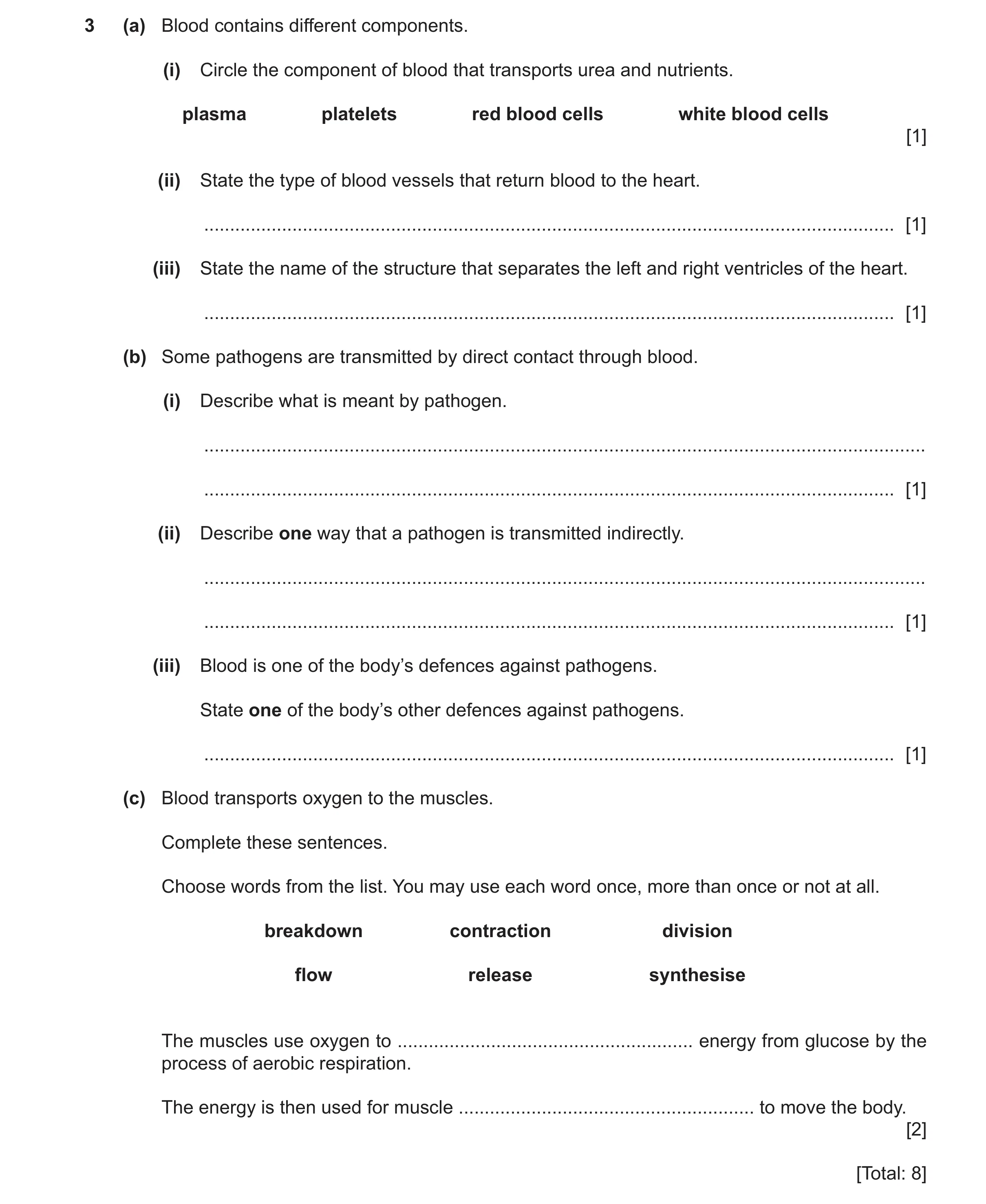
3 (a) Blood contains different components. (i) Circle the component of blood that transports urea and nutrients. plasma platelets red blood cells white blood cells [1] (ii) State the type of blood vessels that return blood to the heart. … [1] (iii) State the name of the structure that separates the left and right ventricles of the heart. … [1] (b) Some pathogens are transmitted by direct contact through blood. (i) Describe what is meant by pathogen. … … [1] (ii) Describe one way that a pathogen is transmitted indirectly. … … [1] (iii) Blood is one of the body’s defences against pathogens. State one of the body’s other defences against pathogens. … [1] (c) Blood transports oxygen to the muscles. Complete these sentences. Choose words from the list. You may use each word once, more than once or not at all. breakdown contraction division flow release synthesise The muscles use oxygen to … energy from glucose by the process of aerobic respiration. The energy is then used for muscle … to move the body. [2] [Total: 8]
8 marks
Mark scheme: 3(a)(i) plasma ; 1 more than one answer circled = 0 marks 3(a)(ii) vein ; 1 3(a)(iii) septum ; 1 3(b)(i) disease-causing organism ; 1 3(b)(ii) (contaminated) surfaces / food / animals / air ; 1 3(b)(iii) skin / nose hairs / mucus / stomach acid ; 1 3(c) release ; 2 contraction ;
This question in 0653/32 Feb/March 2025
Q20 · A diagram of a plant root hair cell 0653/31 May/June 2025
1 (a) Fig. 1.1 is a diagram of a plant root hair cell. X mitochondria Fig. 1.1 (i) Name the part labelled X on Fig. 1.1. … [1] (ii) State the function of mitochondria. … [1] (iii) Suggest why the cell in Fig. 1.1 does not have chloroplasts. … … … [2] (b) Water enters the root hair cell from the soil. (i) Complete the sentence to describe the movement of water into the cell. Water diffuses through a … permeable membrane by … . [2] (ii) Water passes through the root to the xylem. Circle the name of the root cells that water passes through to reach the xylem. cortex guard mesophyll palisade [1] (c) Fig. 1.2 shows part of the carbon cycle. carbon dioxide in atmosphere C B A E cow grass use of fossil fuels D inside factory fossil fuels dead organisms Fig. 1.2 (i) State the letter on Fig. 1.2 that represents: combustion … decomposition. … [2] (ii) Use Fig. 1.2 to explain why the cow is described as a herbivore. … … [1] [Total: 10]
10 marks
Mark scheme: Question Answer Marks 1(a)(i) vacuole ; 1 1(a)(ii) (aerobic) respiration ; 1 1(a)(iii) (root hair cells) do not / cannot, photosynthesise / no photosynthesis ; 2 no light available ; 1(b)(i) partially ; 2 osmosis ; 1(b)(ii) cortex ; 1 1(c)(i) A ; 2 D ; 1(c)(ii) idea that they only feed on plants / only gain energy from plants ; 1
This question in 0653/31 May/June 2025
Q21 · A student investigates the effect of different physical activity on heart rate 0653/33 May/June 2025
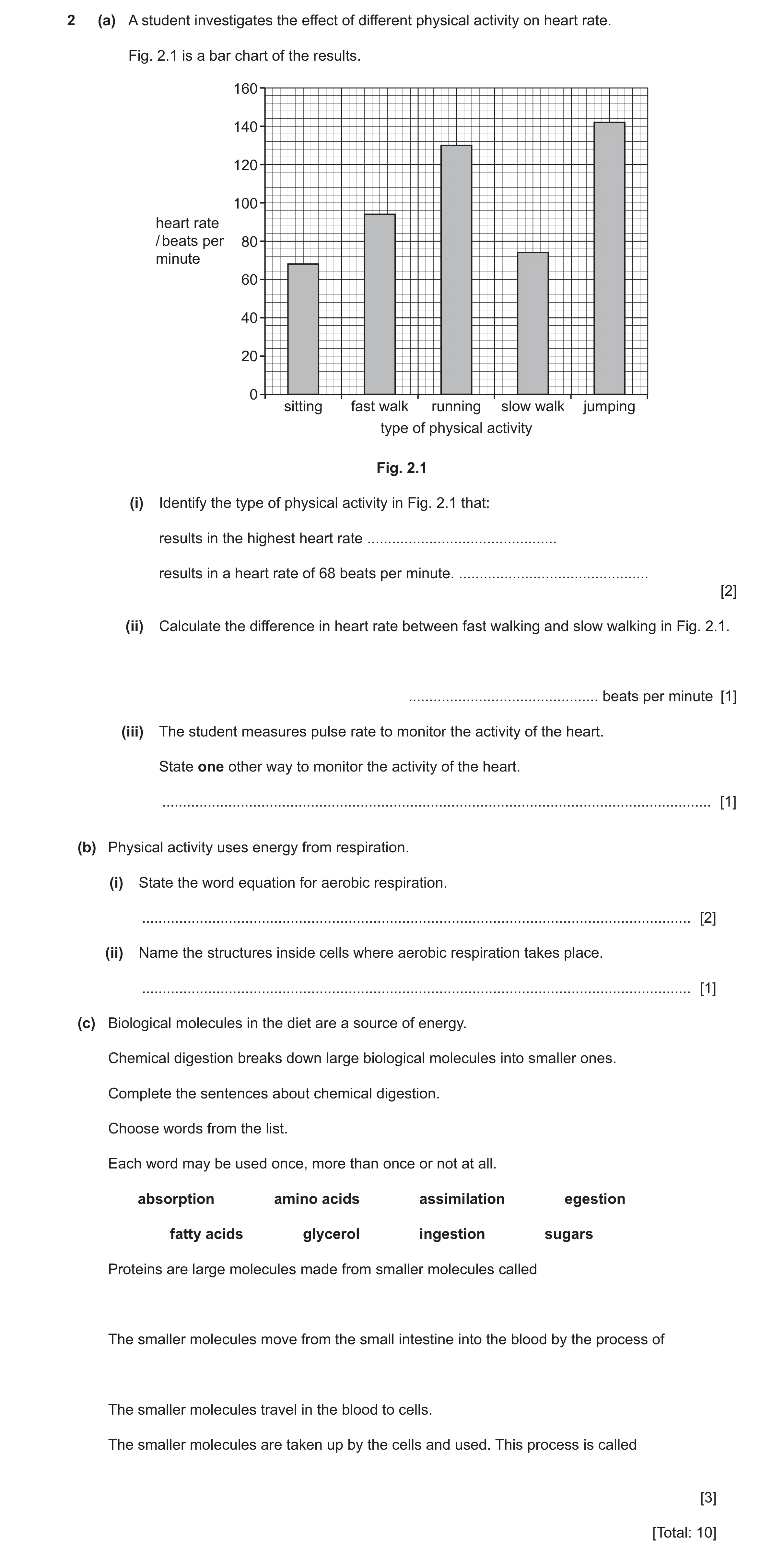
2 (a) A student investigates the effect of different physical activity on heart rate. Fig. 2.1 is a bar chart of the results. 160 140 120 100 heart rate / beats per 80 minute 60 40 20 0 sitting fast walk running slow walk jumping type of physical activity Fig. 2.1 (i) Identify the type of physical activity in Fig. 2.1 that: results in the highest heart rate … results in a heart rate of 68 beats per minute. … [2] (ii) Calculate the difference in heart rate between fast walking and slow walking in Fig. 2.1. … beats per minute [1] (iii) The student measures pulse rate to monitor the activity of the heart. State one other way to monitor the activity of the heart. … [1] (b) Physical activity uses energy from respiration. (i) State the word equation for aerobic respiration. … [2] (ii) Name the structures inside cells where aerobic respiration takes place. … [1] (c) Biological molecules in the diet are a source of energy. Chemical digestion breaks down large biological molecules into smaller ones. Complete the sentences about chemical digestion. Choose words from the list. Each word may be used once, more than once or not at all. absorption amino acids assimilation egestion fatty acids glycerol ingestion sugars Proteins are large molecules made from smaller molecules called The smaller molecules move from the small intestine into the blood by the process of The smaller molecules travel in the blood to cells. The smaller molecules are taken up by the cells and used. This process is called [3] [Total: 10]
10 marks
Mark scheme: 2(a)(i) jumping ; 2 sitting ; 2(a)(ii) (94 – 74 =) 20 (beats per minute) ; 1 2(a)(iii) ECG / electrocardiogram / listening to sounds of valves (closing) / stethoscope ; 1 2(b)(i) glucose + oxygen carbon dioxide + water ;; 2 reactants (either order) = 1 mark products (either order) = 1 mark 2(b)(ii) mitochondria ; 1 2(c) amino acids ; 3 absorption ; assimilation ;
This question in 0653/33 May/June 2025
 5 / 31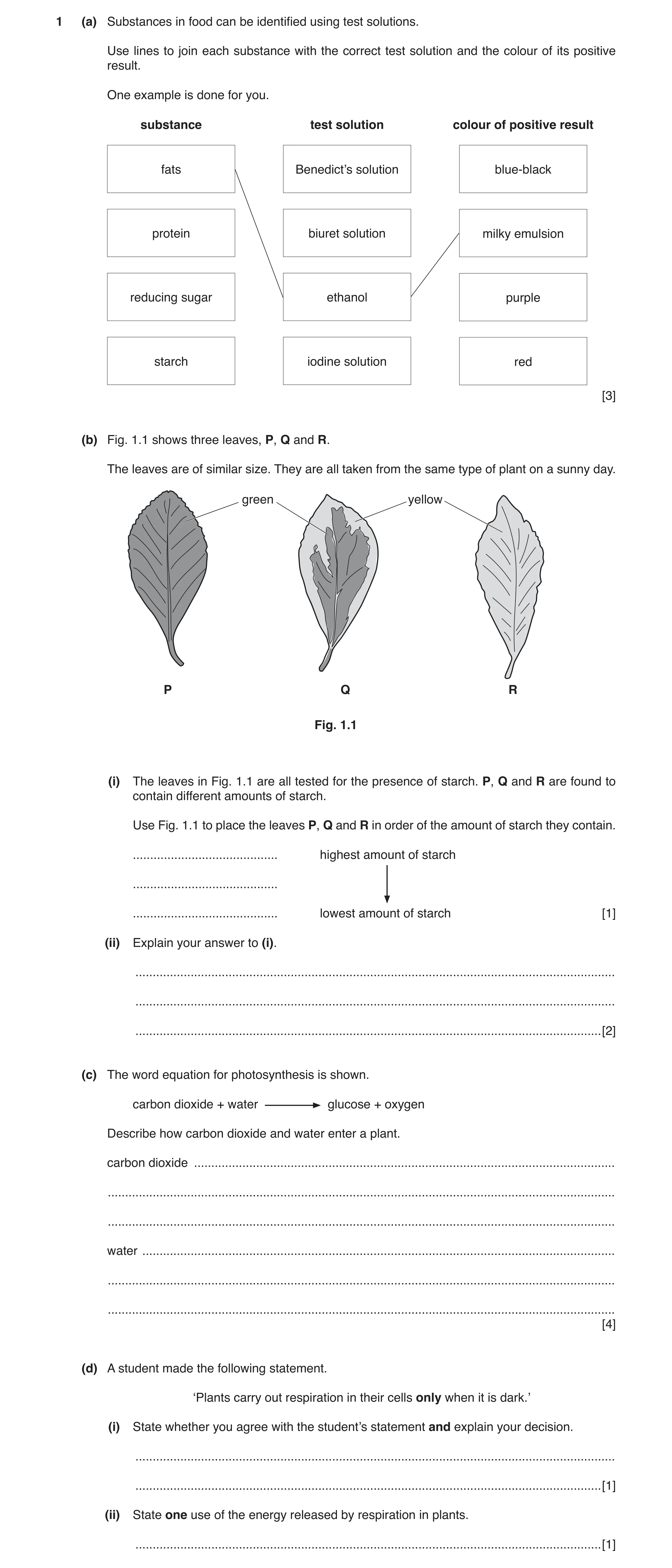
 28 / 31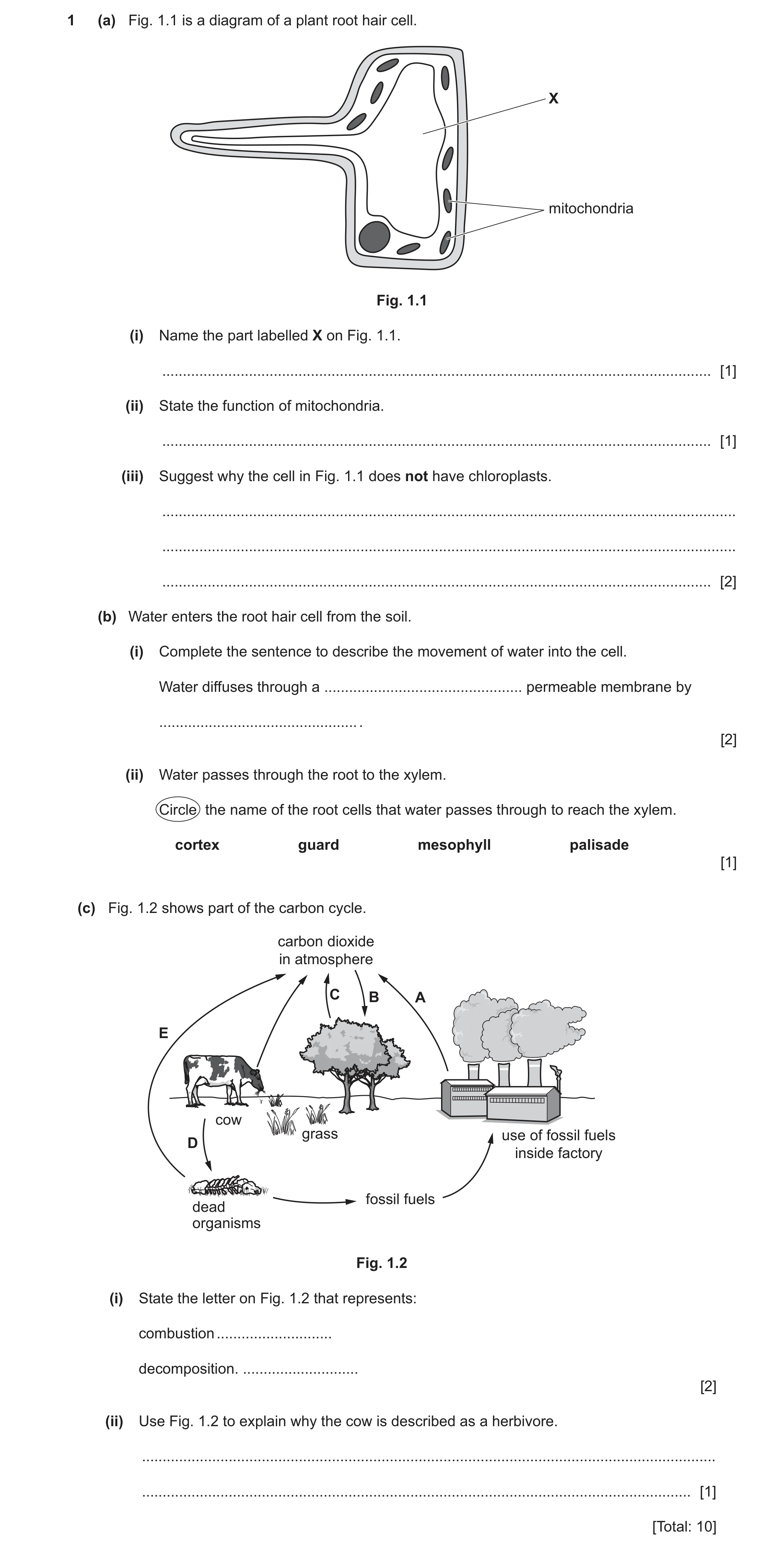
 10
10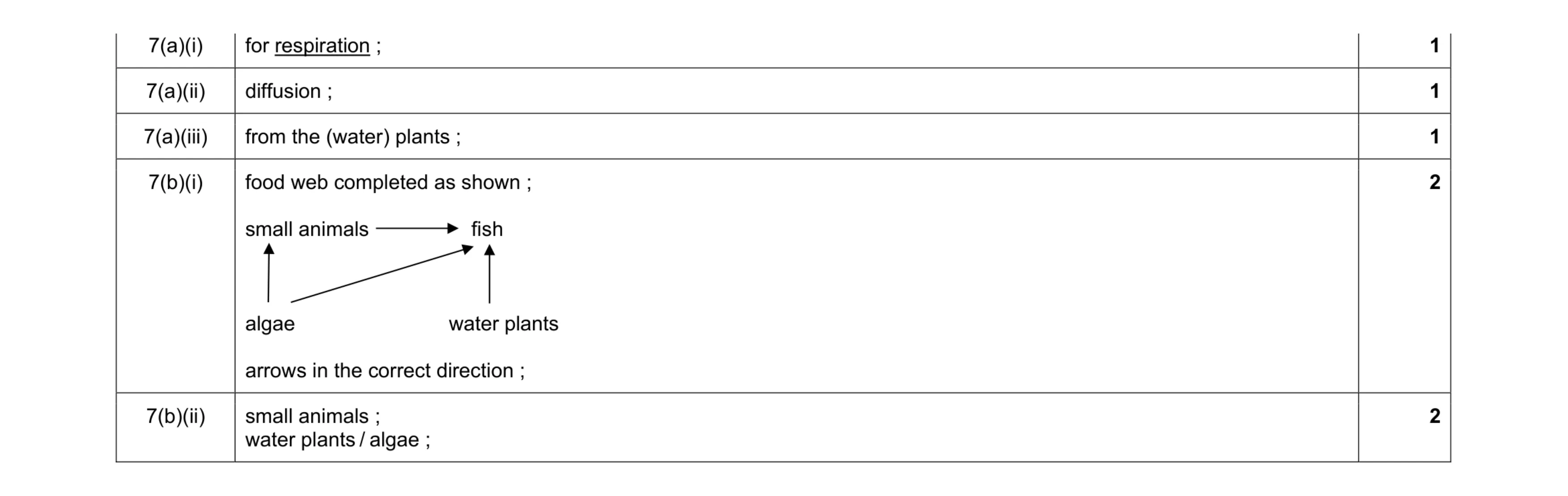 7
7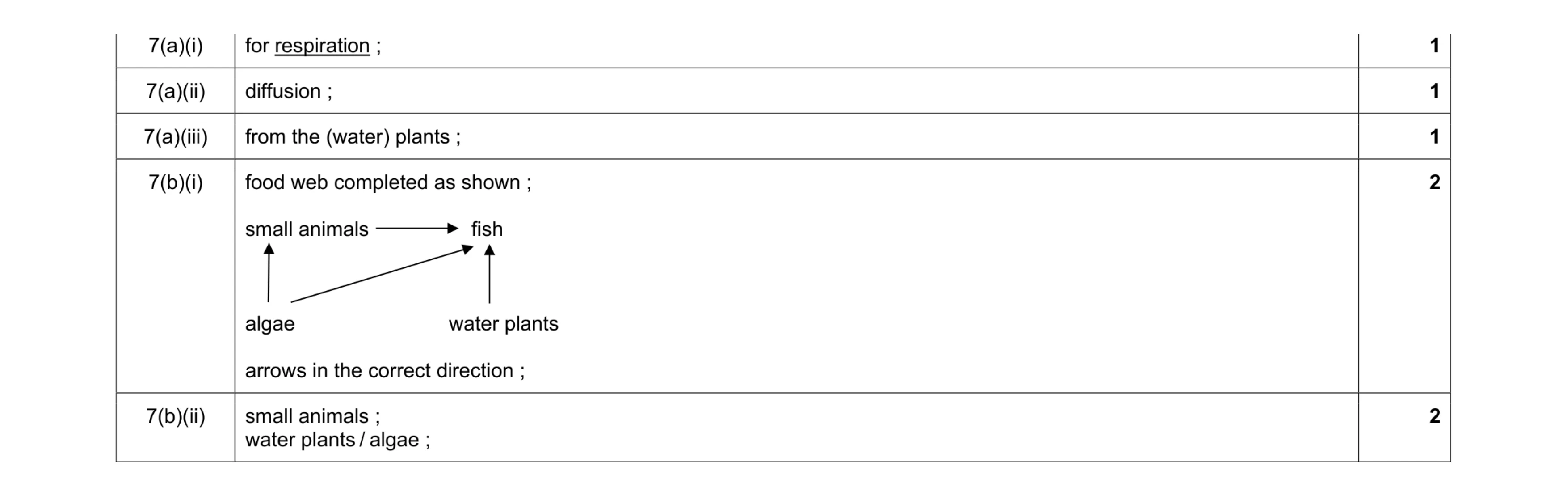 7
7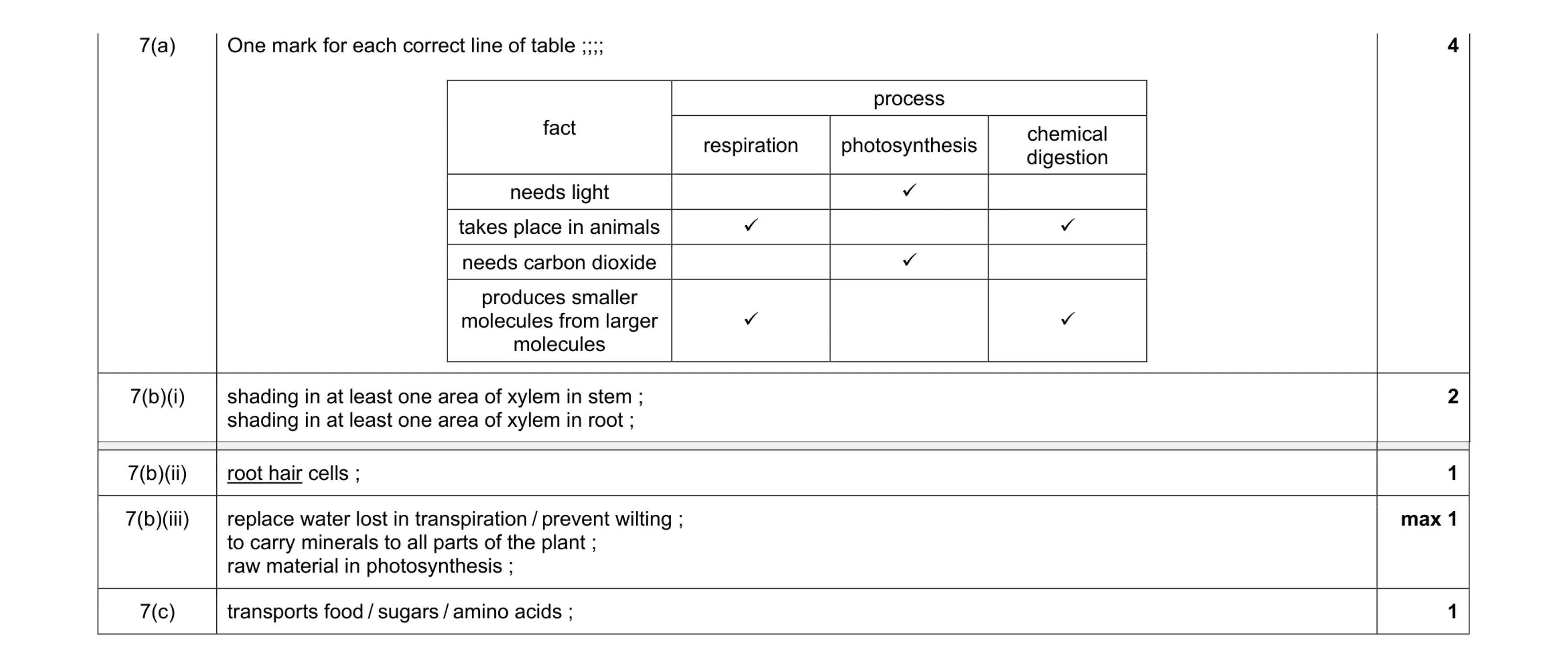 9
9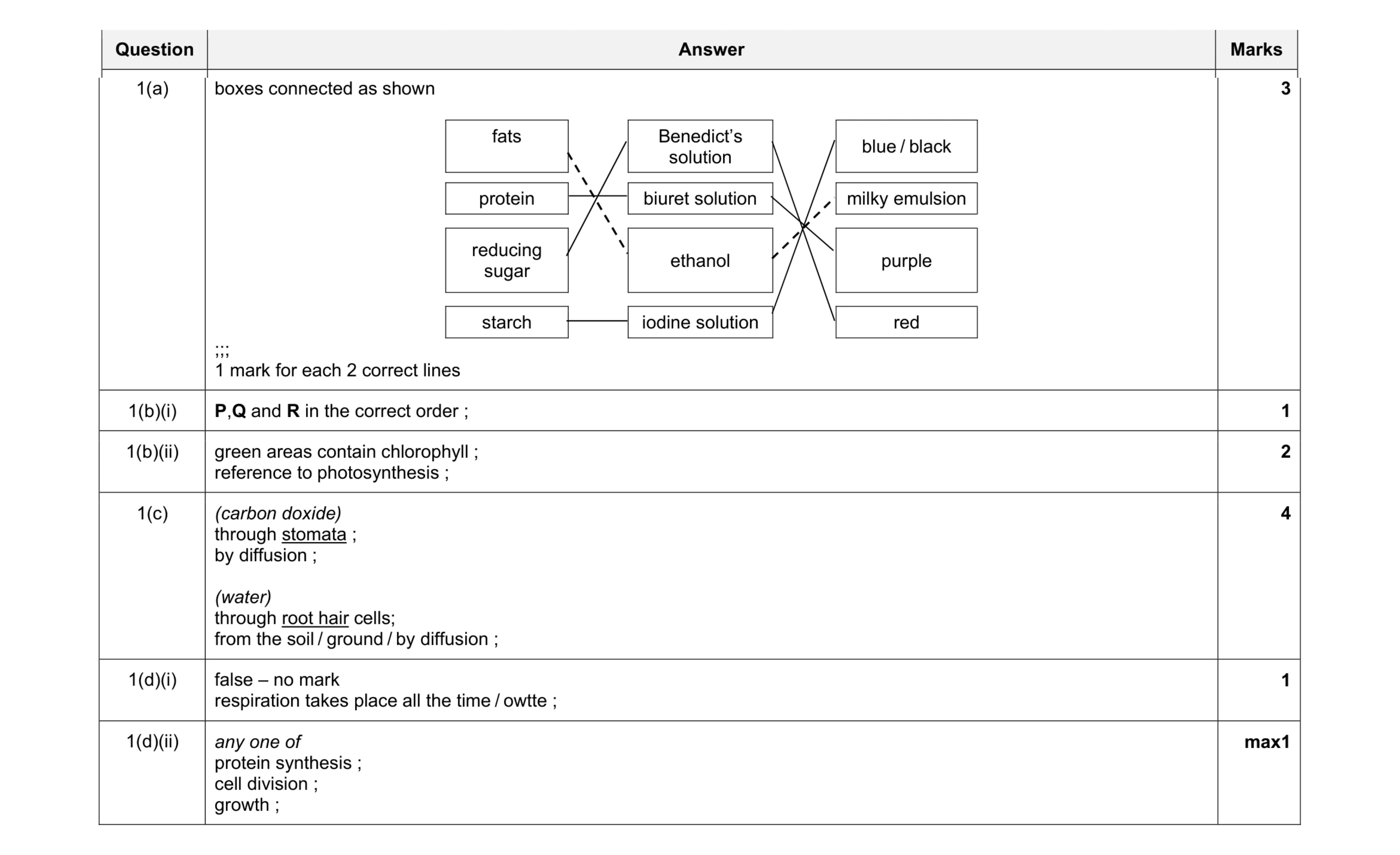 12
12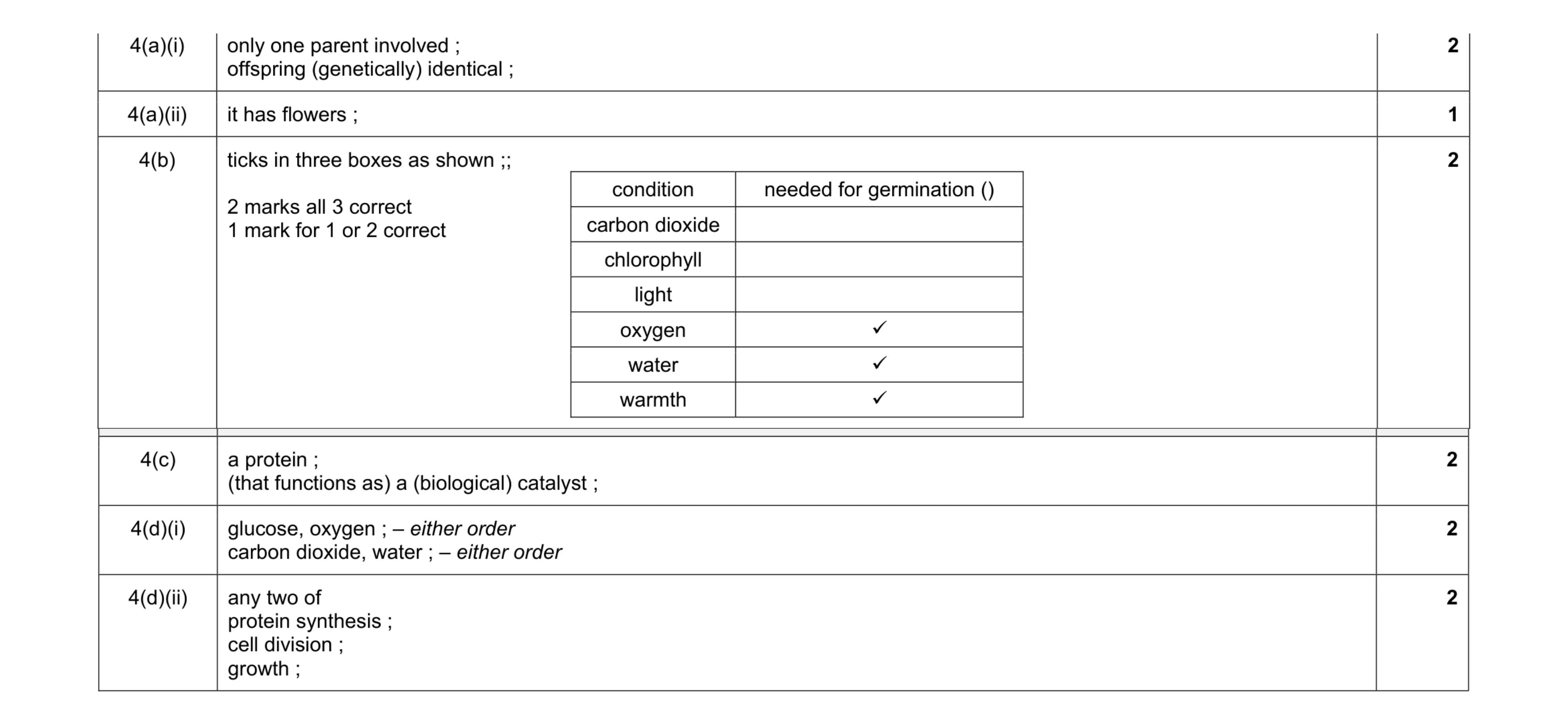 11
11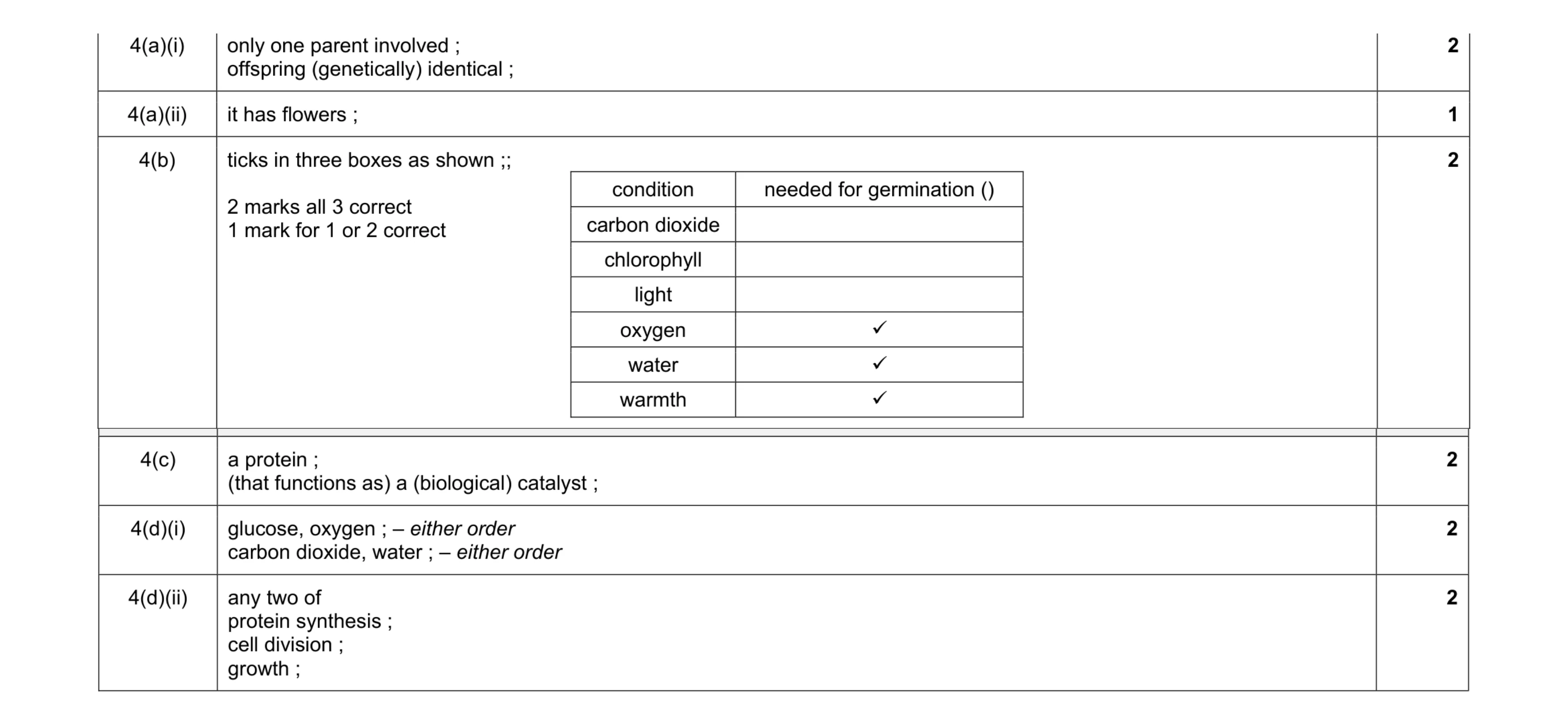 11
11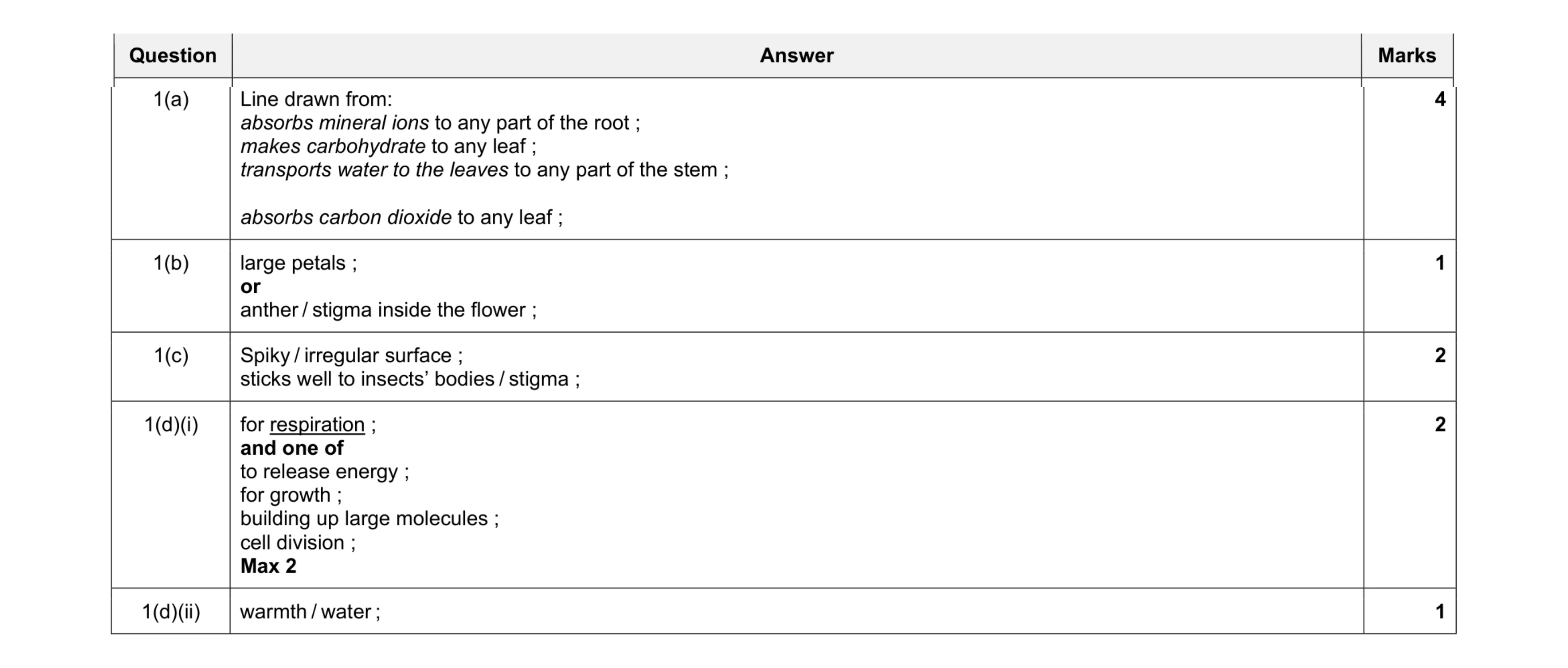 10
10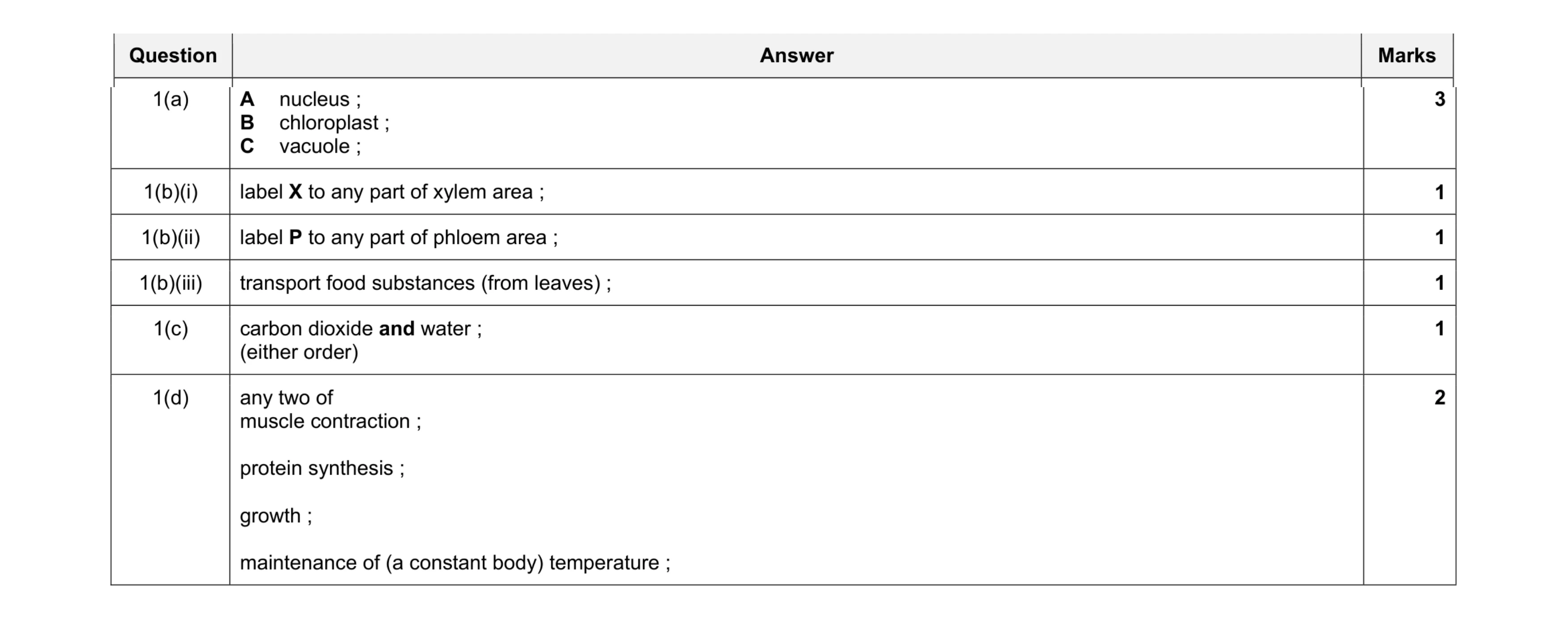 9
9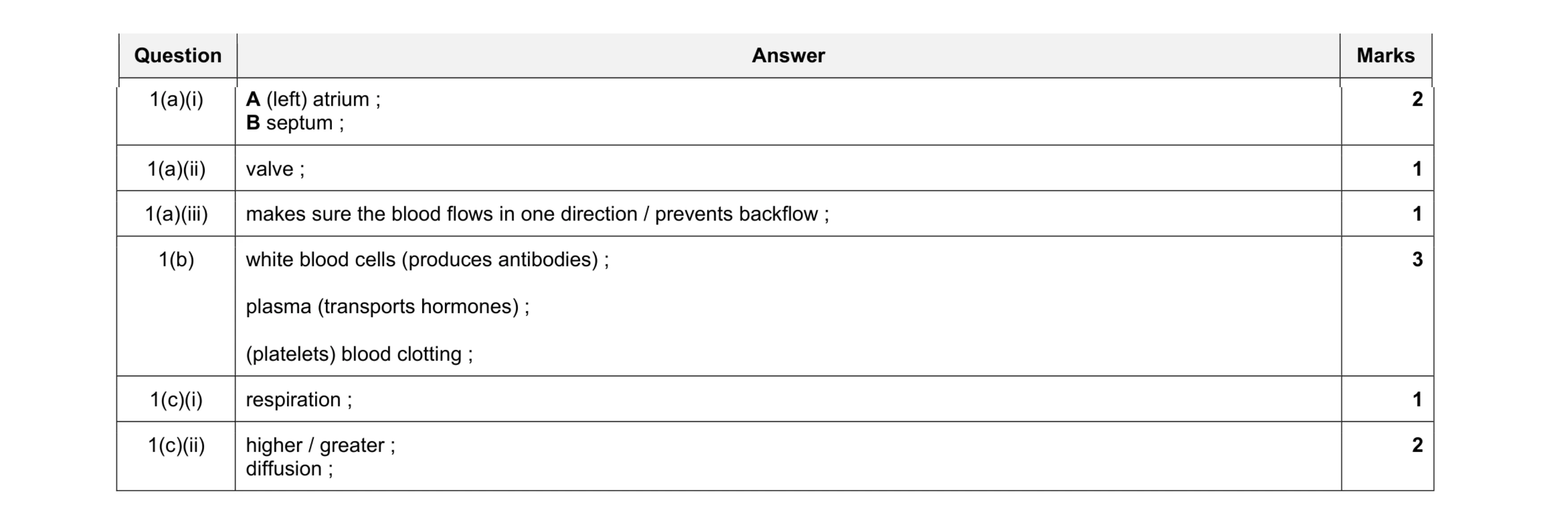 10
10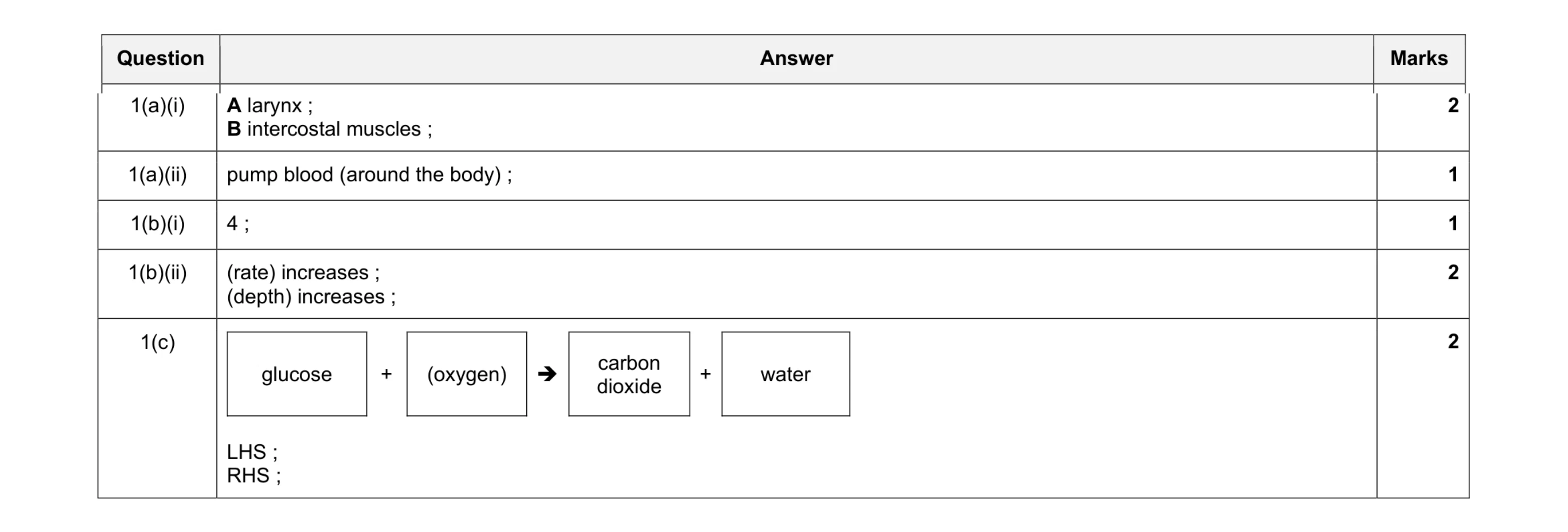 8
8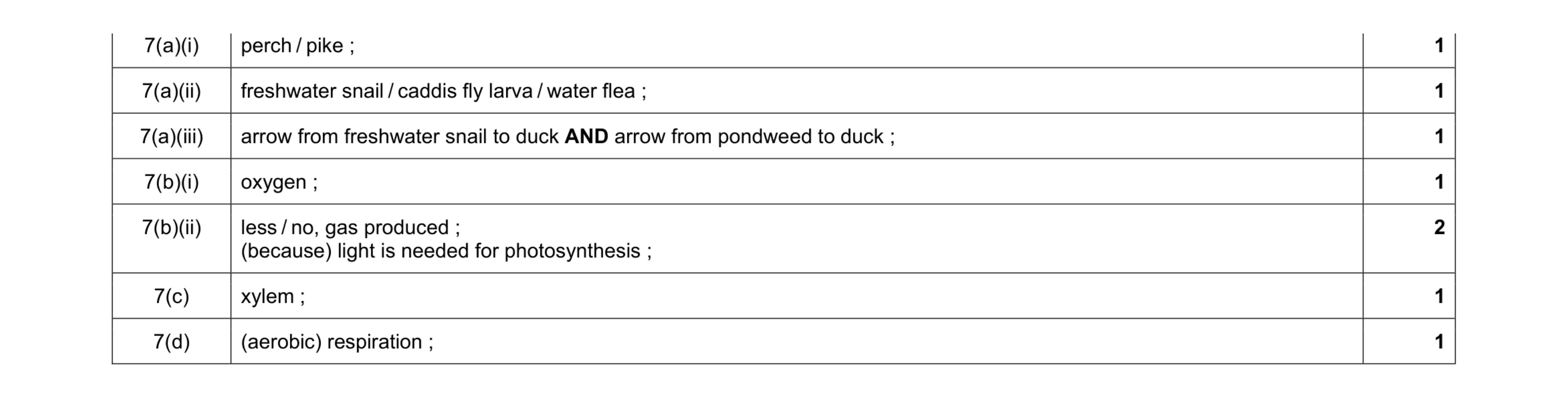 8
8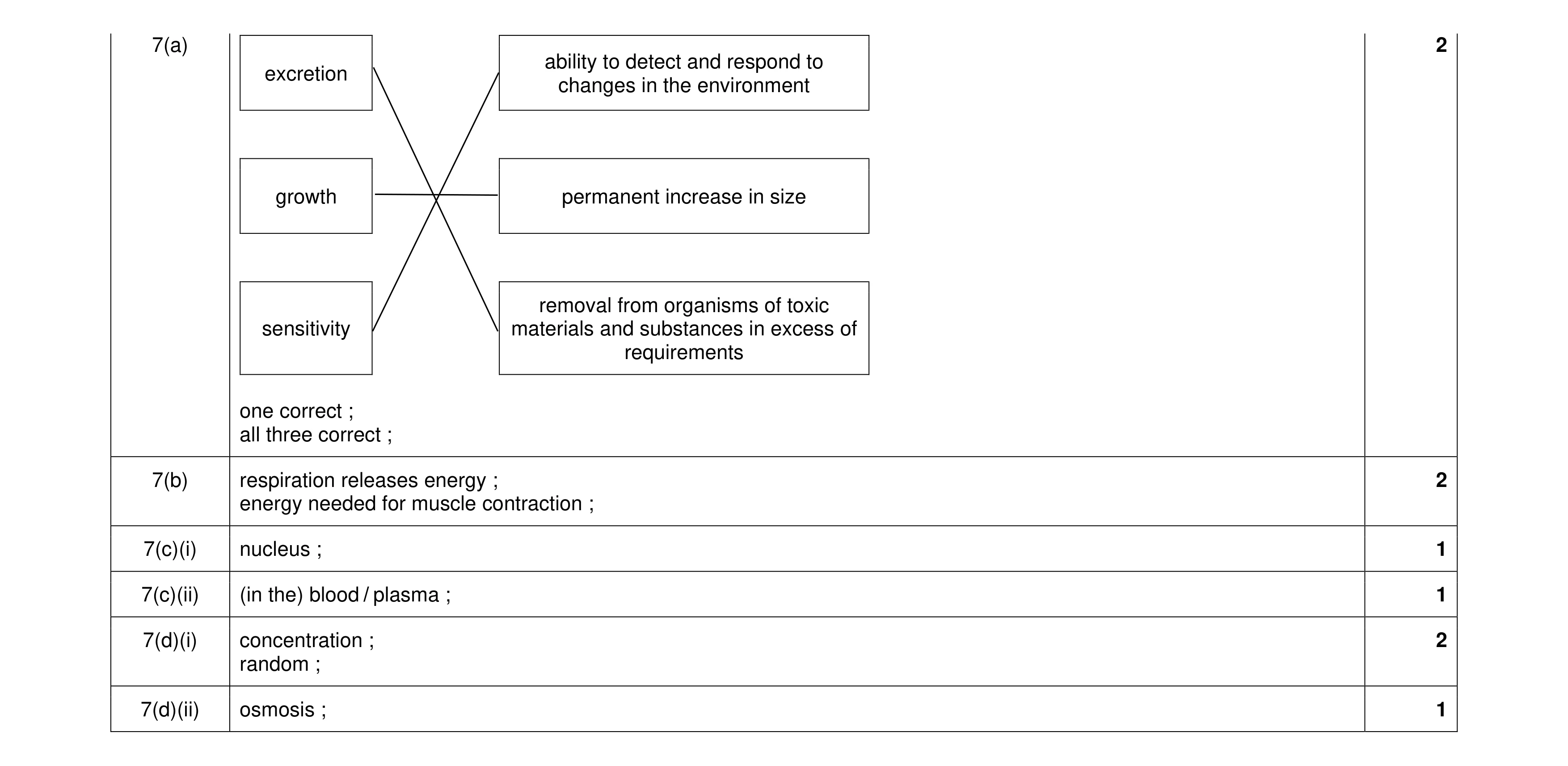 9
9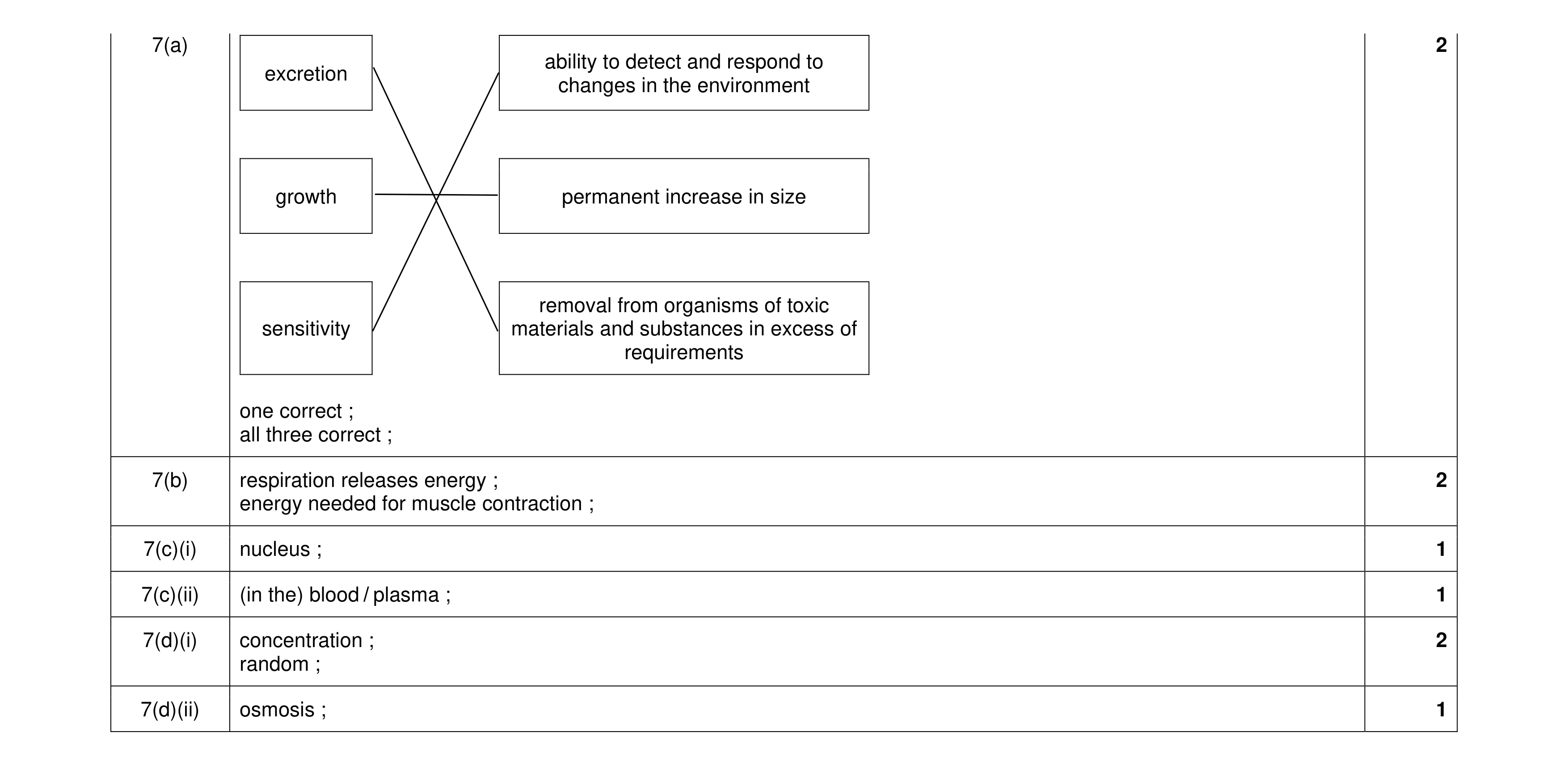 9
9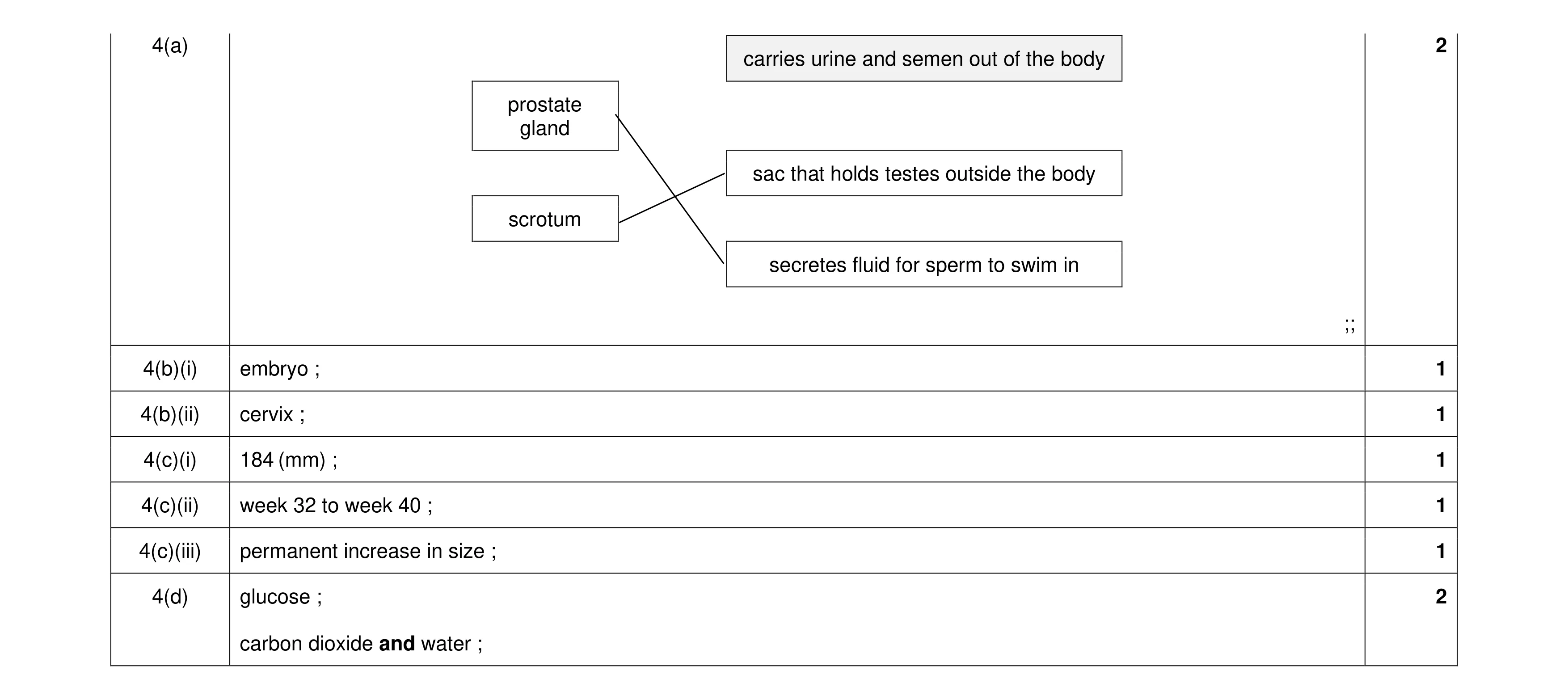 9
9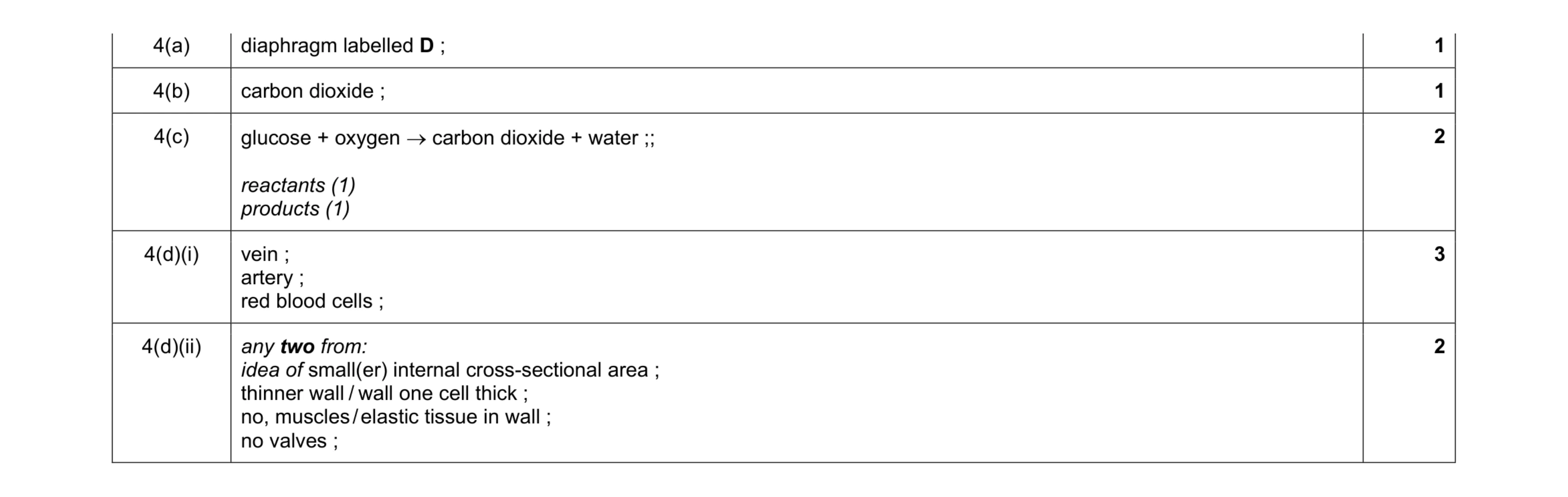 9
9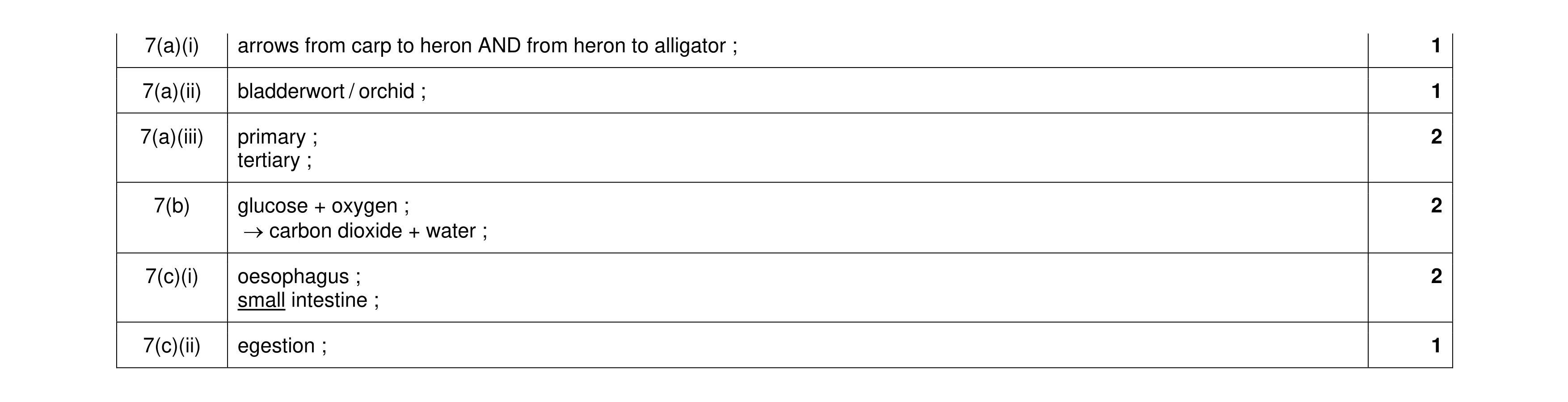 9
9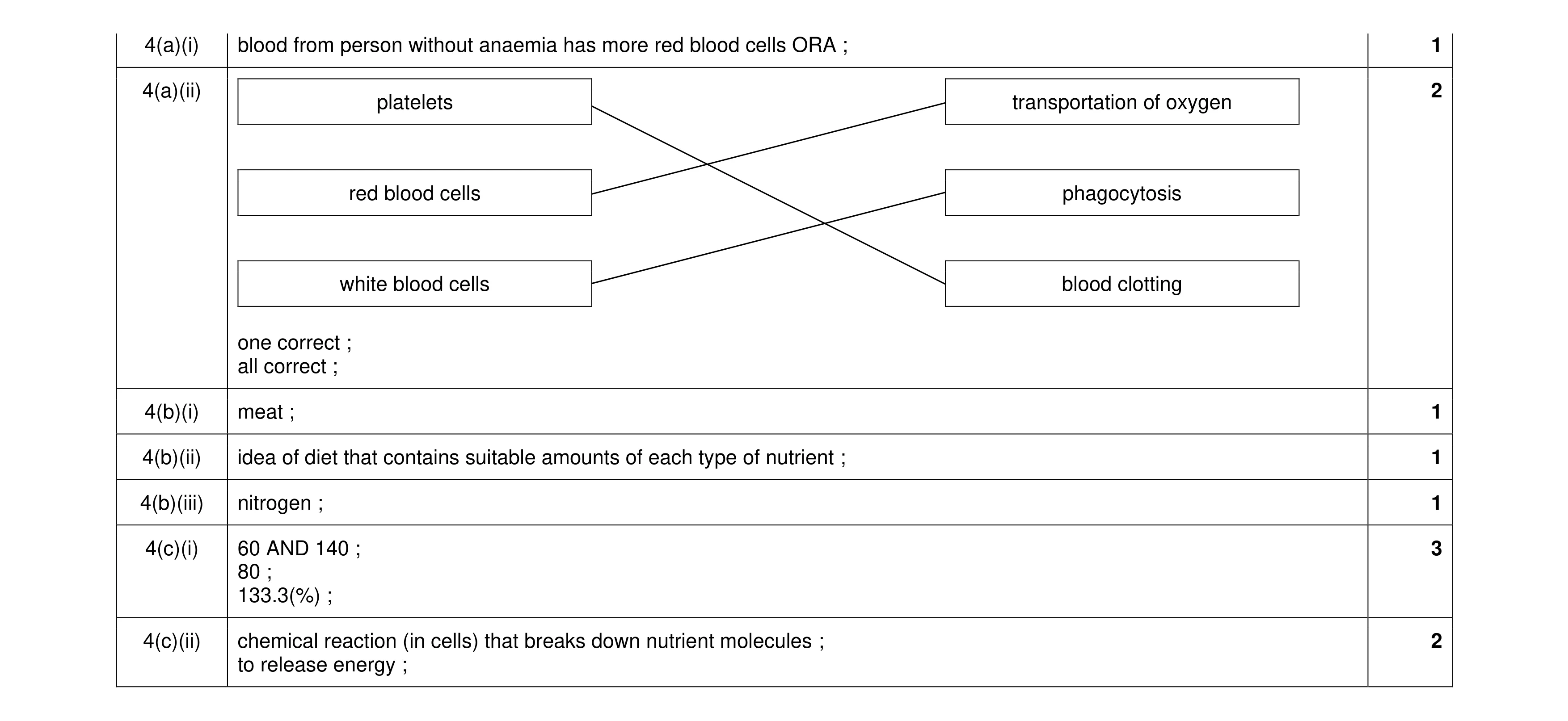 11
11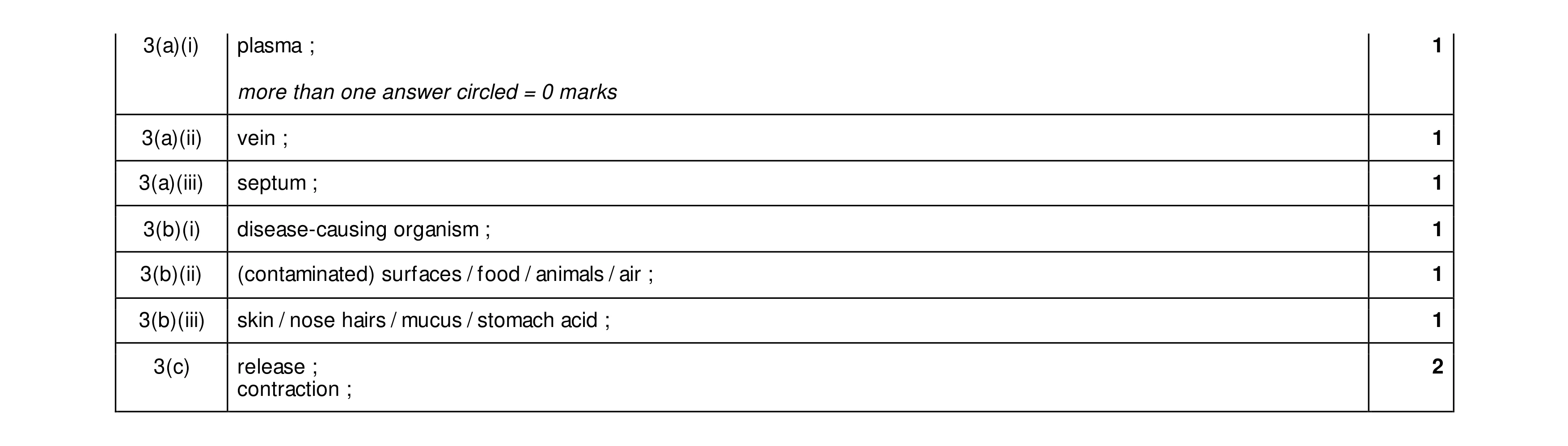 8
8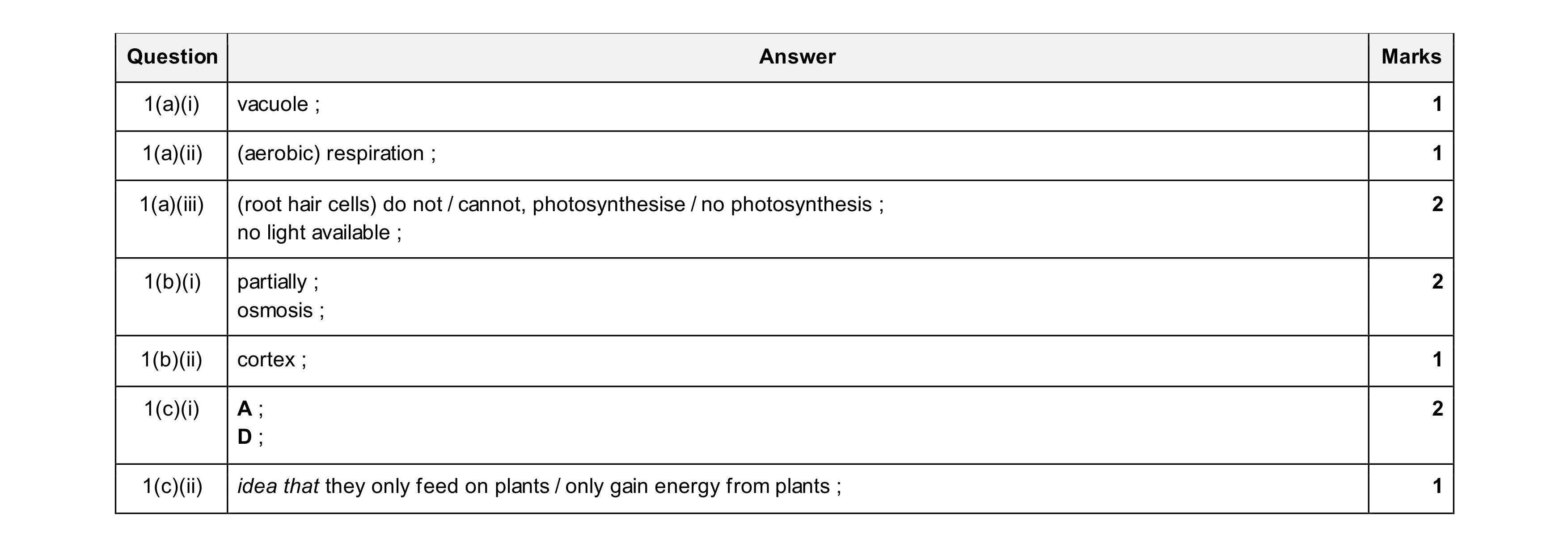 10
10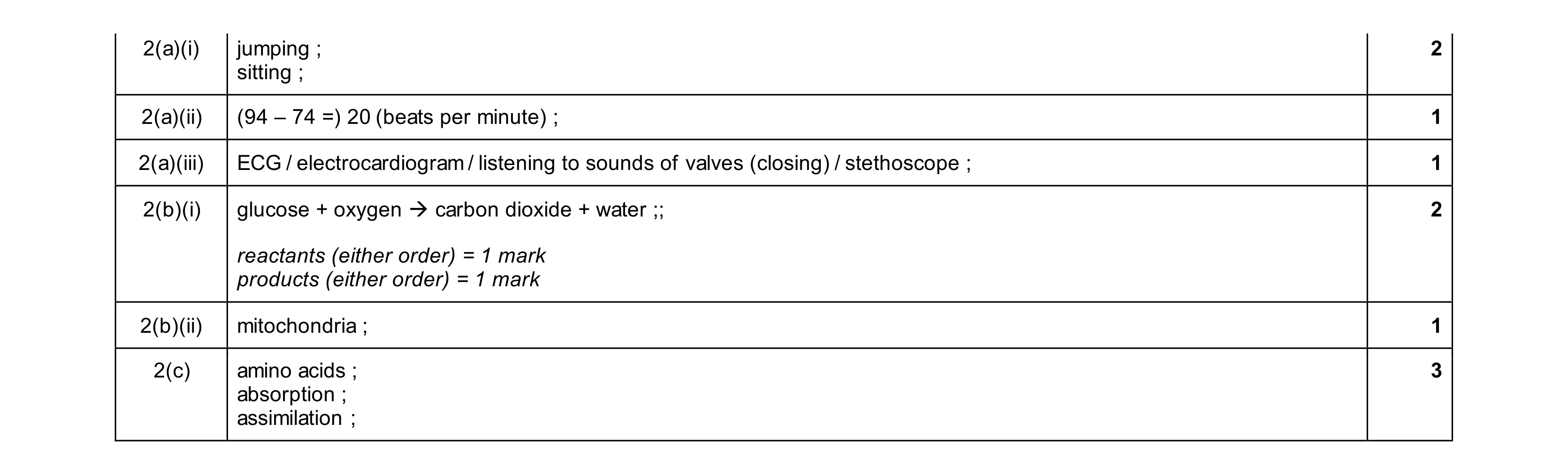 10
10