Questions as text
Q1 · The mass of some of the contents of three foods in a 100 gram sample of each food 0653/41 May/June 2017
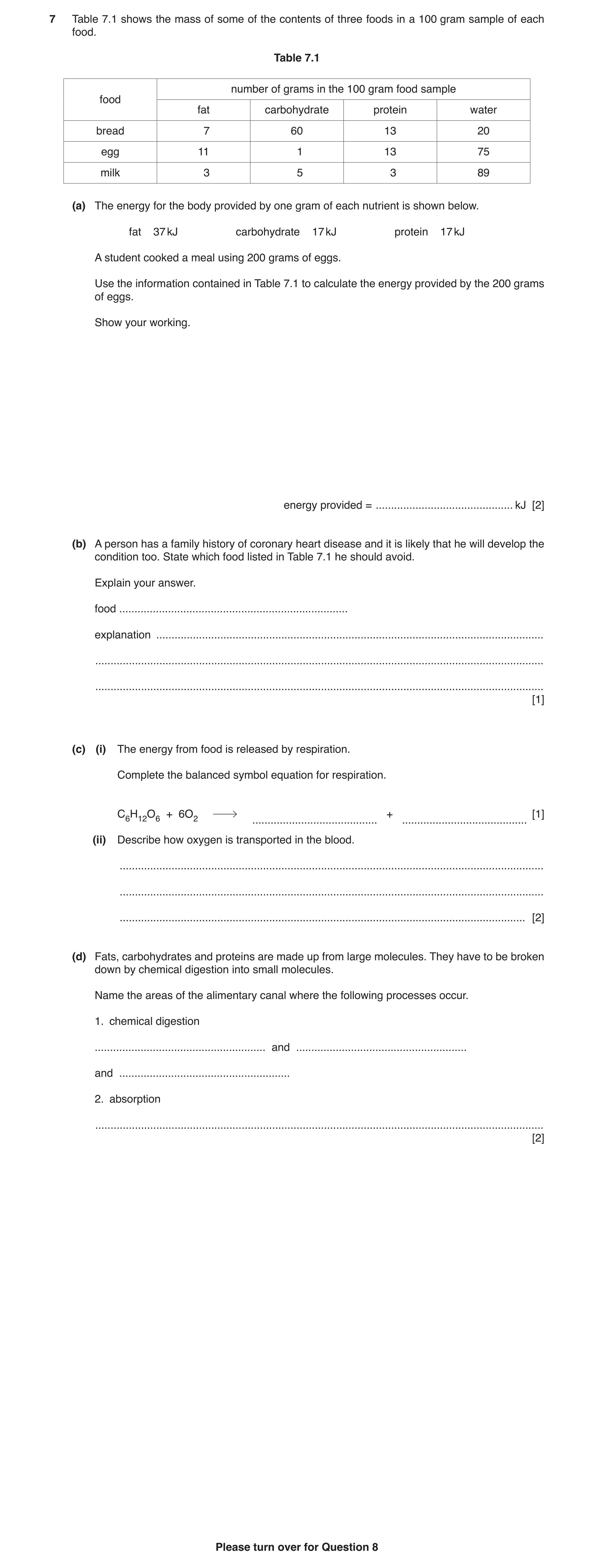
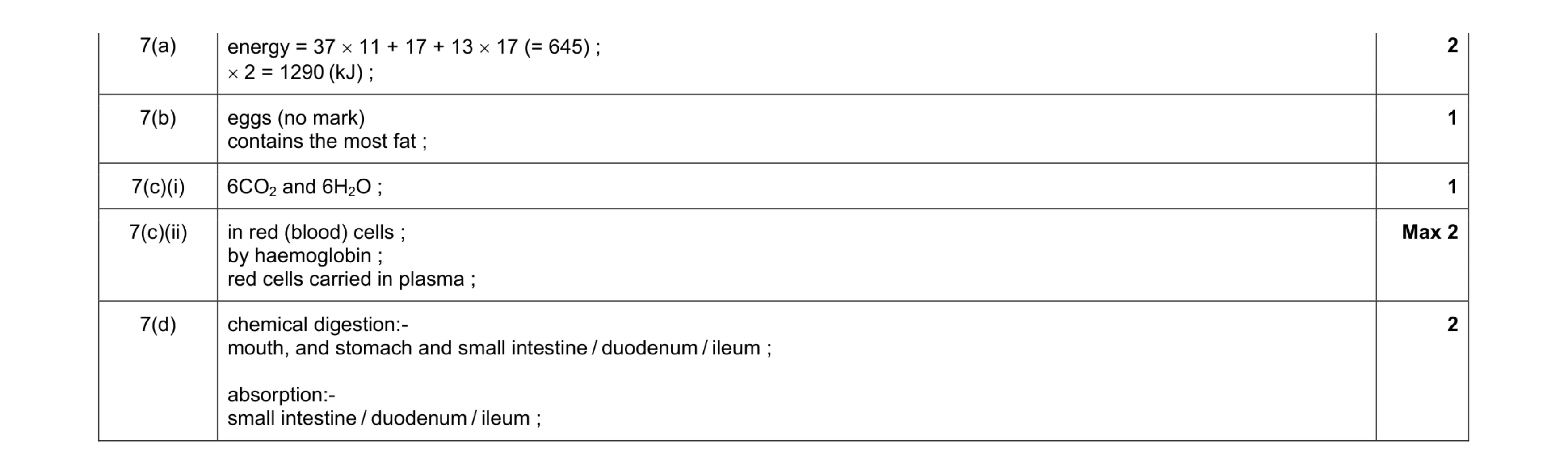
7 Table 7.1 shows the mass of some of the contents of three foods in a 100 gram sample of each food. Table 7.1 number of grams in the 100 gram food sample food fat carbohydrate protein water bread 7 60 13 20 egg 11 1 13 75 milk 3 5 3 89 (a) The energy for the body provided by one gram of each nutrient is shown below. fat 37 kJ carbohydrate 17 kJ protein 17 kJ A student cooked a meal using 200 grams of eggs. Use the information contained in Table 7.1 to calculate the energy provided by the 200 grams of eggs. Show your working. energy provided = … kJ [2] (b) A person has a family history of coronary heart disease and it is likely that he will develop the condition too. State which food listed in Table 7.1 he should avoid. Explain your answer. food … explanation … … … [1] (c) (i) The energy from food is released by respiration. Complete the balanced symbol equation for respiration. C6H12O6 + 6O2 + [1] … … (ii) Describe how oxygen is transported in the blood. … … … [2] (d) Fats, carbohydrates and proteins are made up from large molecules. They have to be broken down by chemical digestion into small molecules. Name the areas of the alimentary canal where the following processes occur. 1. chemical digestion … and … and … 2. absorption … [2] Please turn over for Question 8
8 marks
Mark scheme: 7(a) × 2 = 1290 (kJ) ; 2 7(b) eggs (no mark) contains the most fat ; 1 7(c)(i) 6CO2 and 6H2O ; 1 7(c)(ii) in red (blood) cells ; by haemoglobin ; red cells carried in plasma ; Max 2 7(d) chemical digestion:- mouth, and stomach and small intestine / duodenum / ileum ; absorption:- small intestine / duodenum / ileum ; 2
This question in 0653/41 May/June 2017
Q2 · Use lines to connect the box on the left to different boxes on the right to make correct… 0653/43 May/June 2017
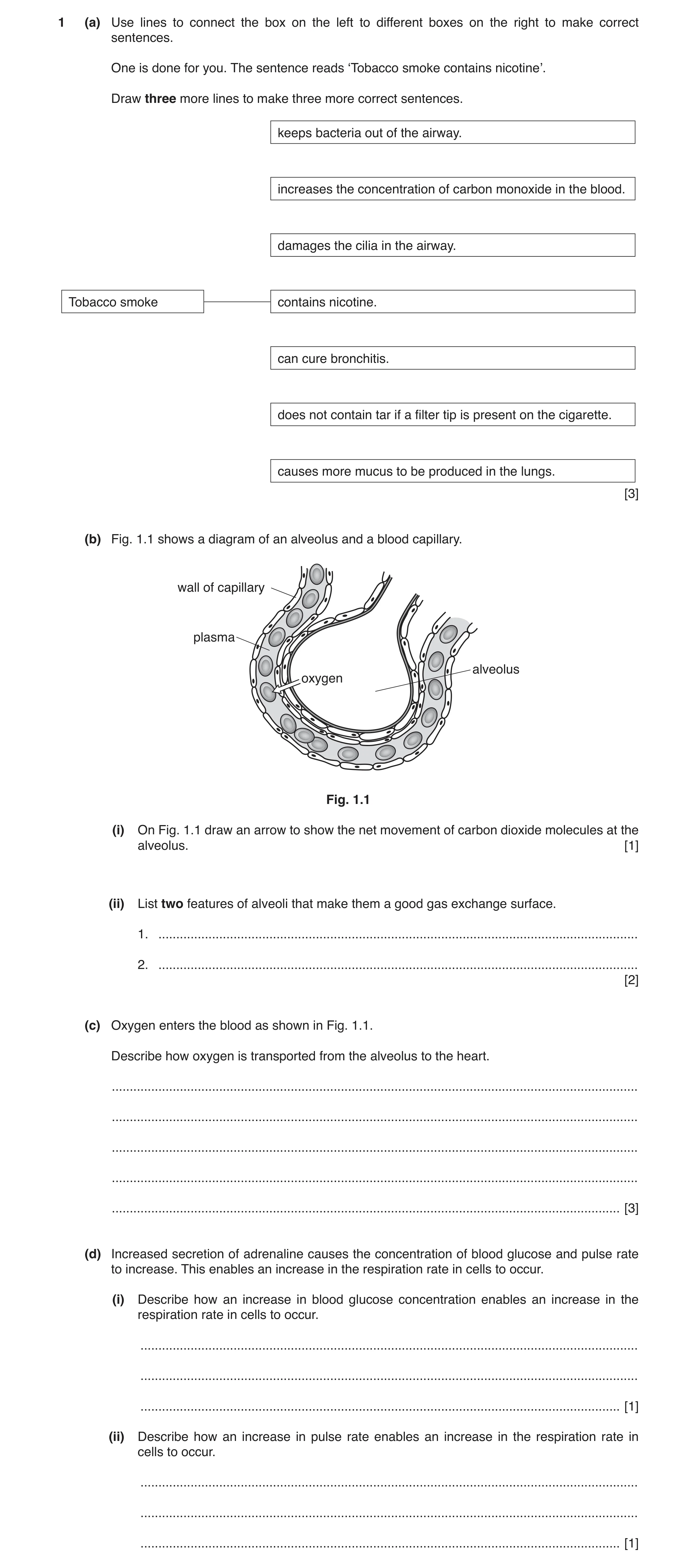
1 (a) Use lines to connect the box on the left to different boxes on the right to make correct sentences. One is done for you. The sentence reads ‘Tobacco smoke contains nicotine’. Draw three more lines to make three more correct sentences. keeps bacteria out of the airway. increases the concentration of carbon monoxide in the blood. damages the cilia in the airway. Tobacco smoke contains nicotine. can cure bronchitis. does not contain tar if a filter tip is present on the cigarette. causes more mucus to be produced in the lungs. [3] (b) Fig. 1.1 shows a diagram of an alveolus and a blood capillary. wall of capillary plasma alveolus oxygen Fig. 1.1 (i) On Fig. 1.1 draw an arrow to show the net movement of carbon dioxide molecules at the alveolus. [1] (ii) List two features of alveoli that make them a good gas exchange surface. 1. … 2. … [2] (c) Oxygen enters the blood as shown in Fig. 1.1. Describe how oxygen is transported from the alveolus to the heart. … … … … … [3] (d) Increased secretion of adrenaline causes the concentration of blood glucose and pulse rate to increase. This enables an increase in the respiration rate in cells to occur. (i) Describe how an increase in blood glucose concentration enables an increase in the respiration rate in cells to occur. … … … [1] (ii) Describe how an increase in pulse rate enables an increase in the respiration rate in cells to occur. … … … [1]
11 marks
Mark scheme: 1(a) three lines drawn to increases the concentration of carbon monoxide in the blood ; damages the cilia in the airway ; causes more mucus to be produced in the lungs ; 3 1(b)(i) arrow drawn from plasma to alveolar sac ; 1 1(b)(ii) large surface area ; thin wall ; reference to good blood supply ; 2 1(c) carried by haemoglobin ; in red blood cells ; enters left atrium / through the pulmonary vein ; red cells carried in plasma ; max 3 1(d)(i) more glucose available to be broken down by cells / for oxidation / chemical (energy) converted to thermal / heat (energy) 1 1(d)(ii) faster delivery of oxygen / glucose to cells ; 1
This question in 0653/43 May/June 2017
Q3 · A fetus is the name given to a developing baby in the later stages of pregnancy 0653/42 Oct/Nov 2017
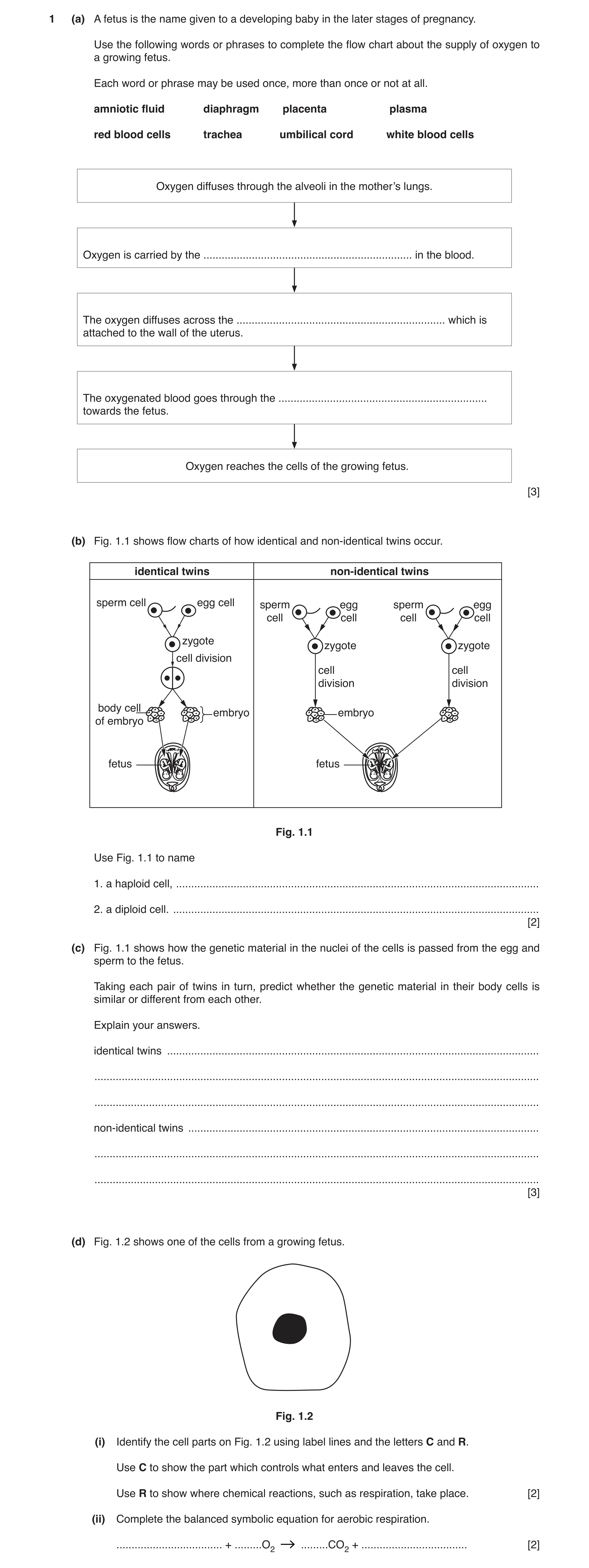
1 (a) A fetus is the name given to a developing baby in the later stages of pregnancy. Use the following words or phrases to complete the flow chart about the supply of oxygen to a growing fetus. Each word or phrase may be used once, more than once or not at all. amniotic fluid diaphragm placenta plasma red blood cells trachea umbilical cord white blood cells Oxygen diffuses through the alveoli in the mother’s lungs. Oxygen is carried by the … in the blood. The oxygen diffuses across the … which is attached to the wall of the uterus. The oxygenated blood goes through the … towards the fetus. Oxygen reaches the cells of the growing fetus. [3] (b) Fig. 1.1 shows flow charts of how identical and non-identical twins occur. identical twins non-identical twins sperm cell egg cell sperm egg sperm egg cell cell cell cell zygote zygote zygote cell division cell cell division division body cell embryo embryo of embryo fetus fetus Fig. 1.1 Use Fig. 1.1 to name 1. a haploid cell, … 2. a diploid cell. … [2] (c) Fig. 1.1 shows how the genetic material in the nuclei of the cells is passed from the egg and sperm to the fetus. Taking each pair of twins in turn, predict whether the genetic material in their body cells is similar or different from each other. Explain your answers. identical twins … … … non-identical twins … … … [3] (d) Fig. 1.2 shows one of the cells from a growing fetus. Fig. 1.2 (i) Identify the cell parts on Fig. 1.2 using label lines and the letters C and R. Use C to show the part which controls what enters and leaves the cell. Use R to show where chemical reactions, such as respiration, take place. [2] (ii) Complete the balanced symbolic equation for aerobic respiration. … + … O2 … CO2 + … [2]
12 marks
Mark scheme: 1(a) red blood cells ; placenta ; umbilical cord ; 3 1(b) sperm cell / egg cell ; zygote / body cell ; 2 1(c) for identical twins genetic material is similar and for non-identical the genetic material is different ; (identical twins) genetic material has come from one egg / one fertilised egg / one sperm / one zygote ; (non-identical twins) genetic material has come from two eggs / two fertilised eggs / two sperms / two zygotes ; all eggs / sperms are genetically different / owtte ; max 3 1(d)(i) C label line to any part of the cell membrane ; R label line to any part of the cytoplasm ; 2 1(d)(ii) C6H12O6 and H2O ; 6 before O2, CO2, H2O ; 2
This question in 0653/42 Oct/Nov 2017
Q4 · Three leaves P, Q and R 0653/41 May/June 2018
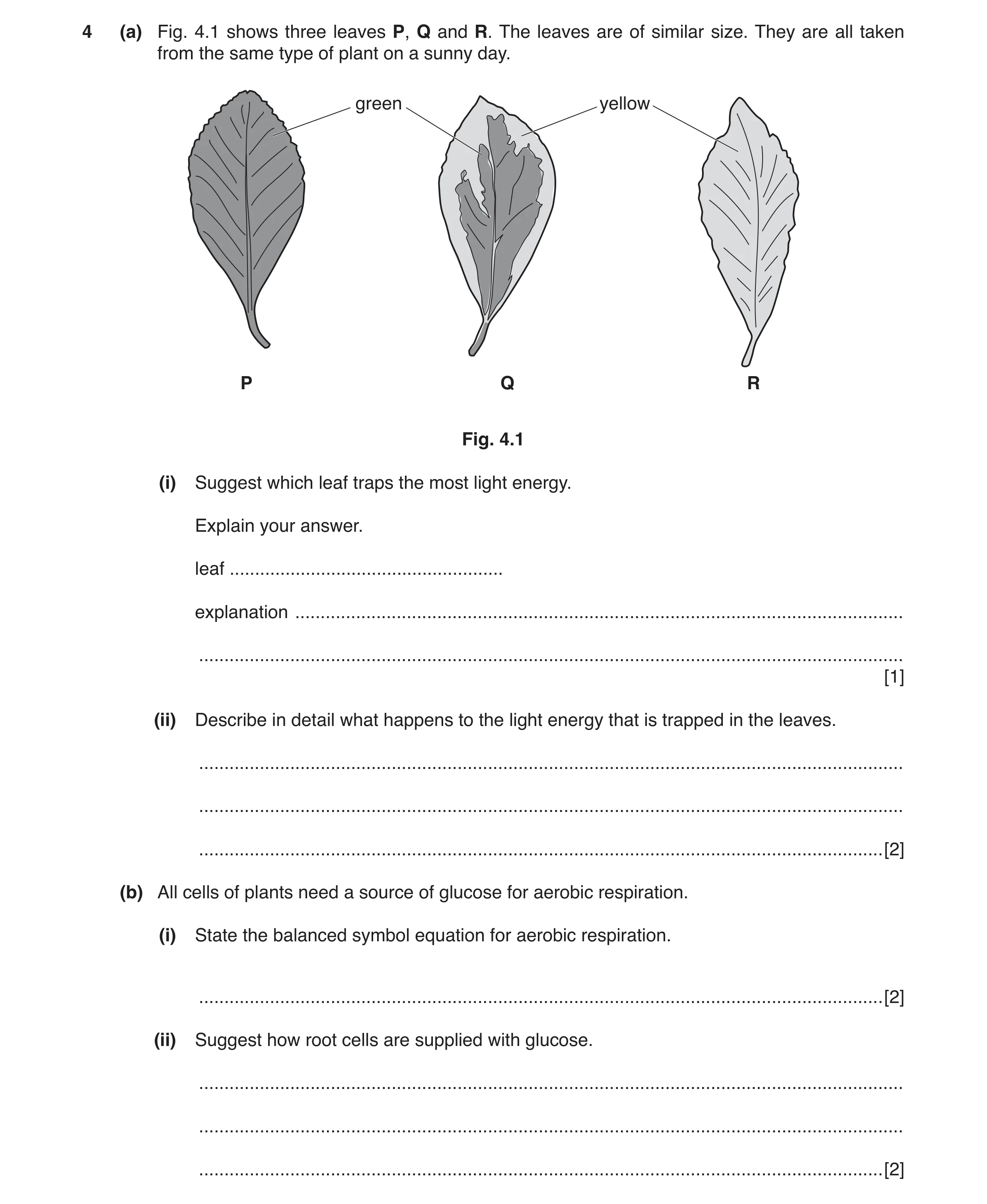
4 (a) Fig. 4.1 shows three leaves P, Q and R. The leaves are of similar size. They are all taken from the same type of plant on a sunny day. green yellow P Q R Fig. 4.1 (i) Suggest which leaf traps the most light energy. Explain your answer. leaf … explanation … … [1] (ii) Describe in detail what happens to the light energy that is trapped in the leaves. … … … [2] (b) All cells of plants need a source of glucose for aerobic respiration. (i) State the balanced symbol equation for aerobic respiration. … [2] (ii) Suggest how root cells are supplied with glucose. … … … [2]
7 marks
Mark scheme: 4(a)(i) (leaf P ) it contains most chlorophyll ; 1 4(a)(ii) converted to chemical energy ; used to make glucose / carbohydrate ; 2 4(b)(i) C6H12O6 + 6O2 → 6CO2 + 6H2O correct formulae ; correctly balanced depending on correct formulae ; 2 4(b)(ii) from leaves ; (transport) through the phloem ; 2
This question in 0653/41 May/June 2018
Q5 · A simplified version of the carbon cycle 0653/42 Oct/Nov 2018
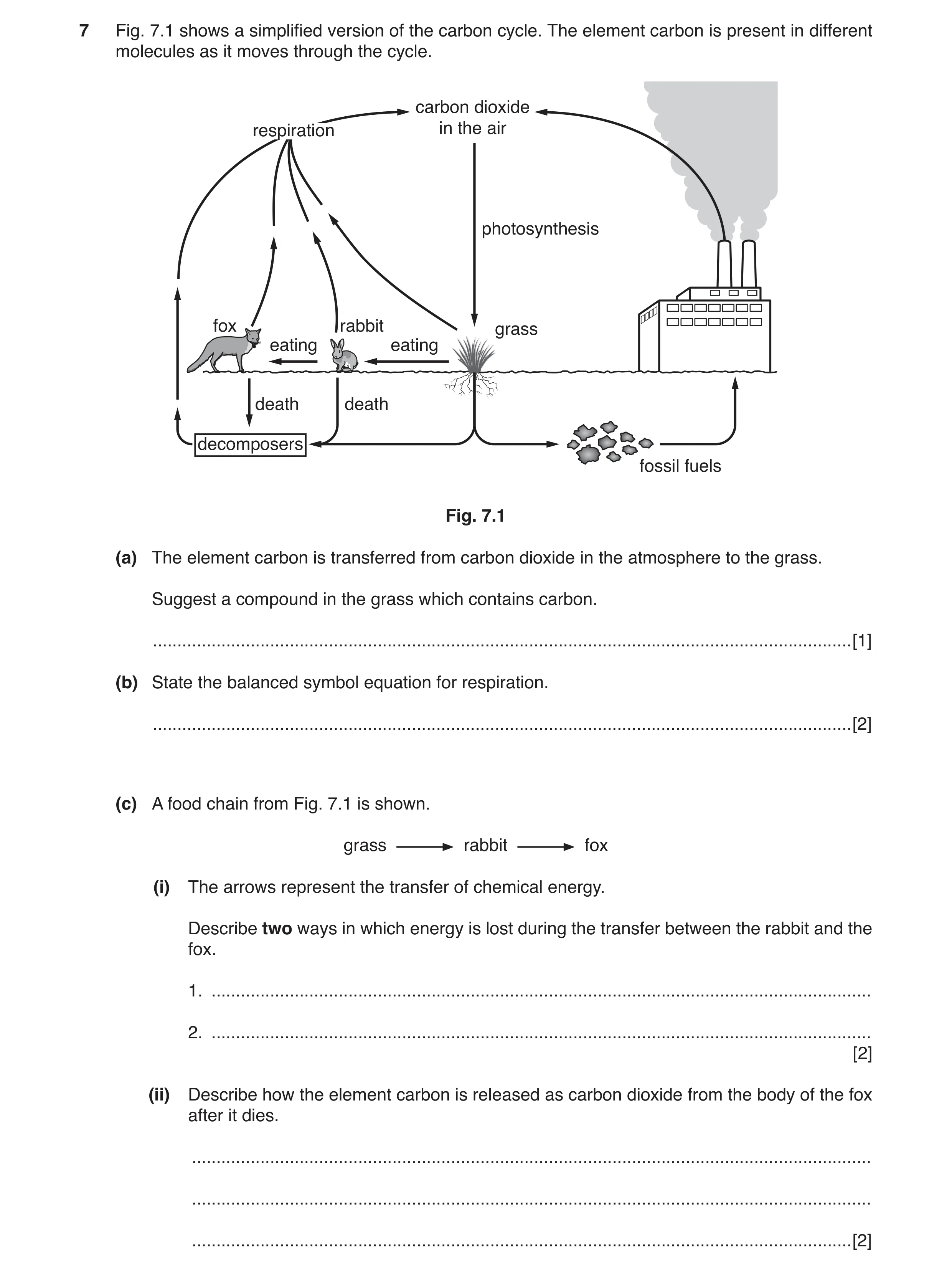
7 Fig. 7.1 shows a simplified version of the carbon cycle. The element carbon is present in different molecules as it moves through the cycle. carbon dioxide respiration in the air photosynthesis fox rabbit grass eating eating death death decomposers fossil fuels Fig. 7.1 (a) The element carbon is transferred from carbon dioxide in the atmosphere to the grass. Suggest a compound in the grass which contains carbon. … [1] (b) State the balanced symbol equation for respiration. … [2] (c) A food chain from Fig. 7.1 is shown. grass rabbit fox (i) The arrows represent the transfer of chemical energy. Describe two ways in which energy is lost during the transfer between the rabbit and the fox. 1. … 2. … [2] (ii) Describe how the element carbon is released as carbon dioxide from the body of the fox after it dies. … … … [2]
7 marks
Mark scheme: 7(a) glucose / starch / sugar ; 1 7(b) C6H12O6 + 6O2 → 6CO2 + 6H2O 1 mark for formulae ; 1 mark for balanced ; 2 7(c)(i) any two from not all of the rabbit is eaten ; not all of the rabbit is digested / absorbed by the fox / egestion in fox ; excretion / production / loss of urine in fox ; some energy wasted as heat / respiration / carbon dioxide in fox ; Max 2 2 7(c)(ii) decomposers / named type of decomposer e.g. bacteria / fungi ; feed on / break down (carbon compounds in the fox’s) body ; carbon dioxide released by respiration (of decomposers) ; Max 2 2
This question in 0653/42 Oct/Nov 2018
Q6 · A plant responding to light coming from one side 0653/42 May/June 2019
7 Fig. 7.1 shows a plant responding to light coming from one side. light Fig. 7.1 (a) Name this plant response. … [1] (b) Explain in detail why the plant bends towards the light. Refer to the hormone auxin in your answer. … … … … [3] (c) Hormones are also present in animals. Give an example of a specific situation when the secretion of adrenaline is increased by a large amount. … [1] (d) The word equation for respiration is shown. glucose + oxygen carbon dioxide + water Two effects of the secretion of adrenaline are an increase in breathing rate and an increase in heart rate. Describe how these two effects of adrenaline enable the cells of the body to increase their rate of respiration. increase in breathing rate … … … increase in heart rate … … … [2] (e) State two ways in which the energy released by respiration is used by the body. 1. … 2. … [2] [Total: 9]
9 marks
Mark scheme: 7(a) phototropism ; 1 7(b) auxin produced at tip ; more auxin in cells in dark side ; auxin causes (cell) elongation ; (cell) elongation greater on dark side ; max 3 7(c) any example of a fight or flight situation described ; 1 7(d) (breathing rate) enables more oxygen to enter blood / be taken in (at lungs) ; (heart rate) increases rate of delivery of oxygen / glucose to cells ; 2 Question Answer Marks 7(e) any two from muscle contraction protein synthesis growth maintenance of body temperature ;; 2
This question in 0653/42 May/June 2019
Q7 · A student investigates the volumes of air breathed in and out of their lungs before and… 0653/42 Oct/Nov 2019
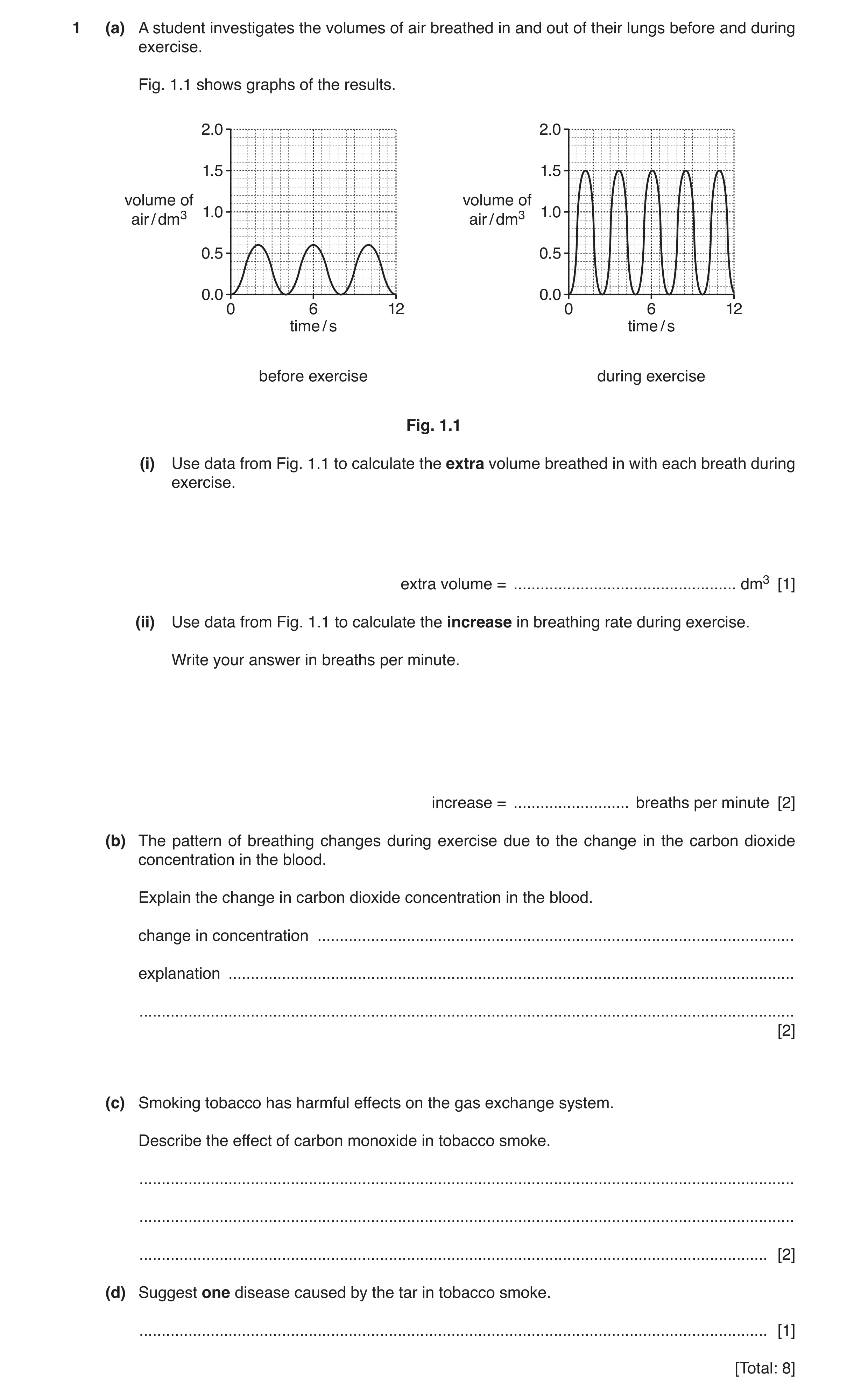
1 (a) A student investigates the volumes of air breathed in and out of their lungs before and during exercise. Fig. 1.1 shows graphs of the results. 2.0 2.0 1.5 1.5 volume of volume of 1.0 1.0 air / dm3 air / dm3 0.5 0.5 0.0 0.0 0 6 12 0 6 12 time / s time / s before exercise during exercise Fig. 1.1 (i) Use data from Fig. 1.1 to calculate the extra volume breathed in with each breath during exercise. extra volume = … dm3 [1] (ii) Use data from Fig. 1.1 to calculate the increase in breathing rate during exercise. Write your answer in breaths per minute. increase = … breaths per minute [2] (b) The pattern of breathing changes during exercise due to the change in the carbon dioxide concentration in the blood. Explain the change in carbon dioxide concentration in the blood. change in concentration … explanation … … [2] (c) Smoking tobacco has harmful effects on the gas exchange system. Describe the effect of carbon monoxide in tobacco smoke. … … … [2] (d) Suggest one disease caused by the tar in tobacco smoke. … [1] [Total: 8]
8 marks
Mark scheme: 1(a)(i) (1.5 – 0.6 =) 0.9 (dm3) ; 1 1(a)(ii) (increase in breaths) = 2 breaths (over 12 seconds) ; × 60 / 12 = 10 ; 2 1(b) increase ; (aerobic) respiration increases during exercise ; 2 1(c) combines with haemoglobin / reduces the amount of oxygen able to combine with haemoglobin ; reduces amount of oxygen being transported (by blood / red cells) ; 2 1(d) lung cancer / COPD / emphysema / bronchitis ; 1
This question in 0653/42 Oct/Nov 2019
Q8 · Food taken in by the body must be digested so that the body can absorb the nutrients 0653/42 Feb/March 2020
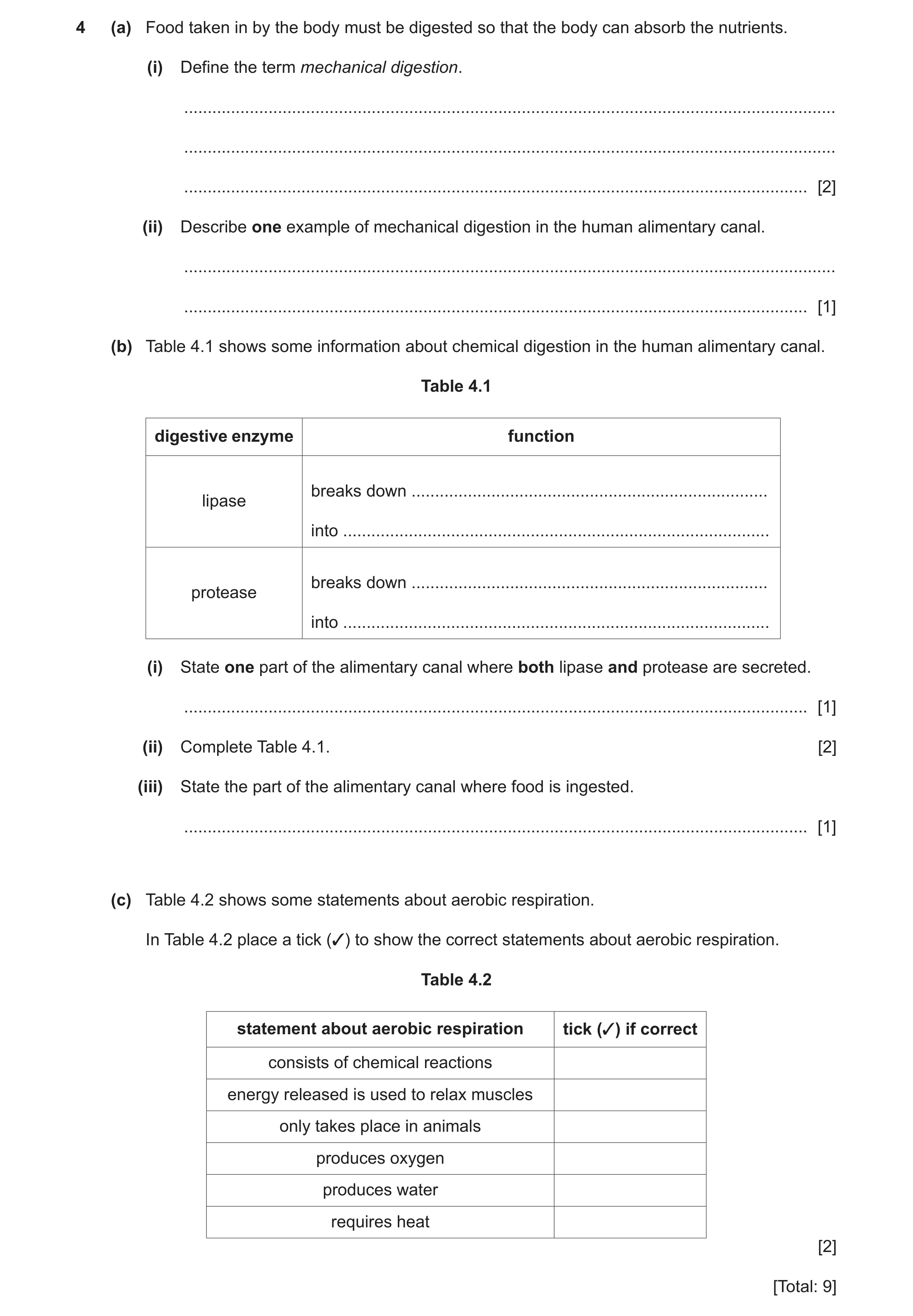
4 (a) Food taken in by the body must be digested so that the body can absorb the nutrients. (i) Define the term mechanical digestion. … … … [2] (ii) Describe one example of mechanical digestion in the human alimentary canal. … … [1] (b) Table 4.1 shows some information about chemical digestion in the human alimentary canal. Table 4.1 digestive enzyme function breaks down … lipase into … breaks down … protease into … (i) State one part of the alimentary canal where both lipase and protease are secreted. … [1] (ii) Complete Table 4.1. [2] (iii) State the part of the alimentary canal where food is ingested. … [1] (c) Table 4.2 shows some statements about aerobic respiration. In Table 4.2 place a tick (✓) to show the correct statements about aerobic respiration. Table 4.2 statement about aerobic respiration tick (✓) if correct consists of chemical reactions energy released is used to relax muscles only takes place in animals produces oxygen produces water requires heat [2] [Total: 9]
9 marks
Mark scheme: 4(a)(i) the breakdown of food into smaller pieces ; without chemical change (to the food molecules) ; Question Answer Marks 4(a)(ii) chewing food / churning action by stomach ; 1 4(b)(i) small intestine ; 1 4(b)(ii) (lipase breaks down) fat (into) fatty acids and glycerol ; (protease breaks down) protein (into) amino acids ; 2 4(b)(iii) mouth ; 1 4(c) consists of chemical reactions ; produces water ; (if more than two statements ticked then incorrect ticks cancel correct ones to a min of 0) 2
This question in 0653/42 Feb/March 2020
Q9 · The percentage composition of the gases in inspired air and in expired air 0653/41 May/June 2020
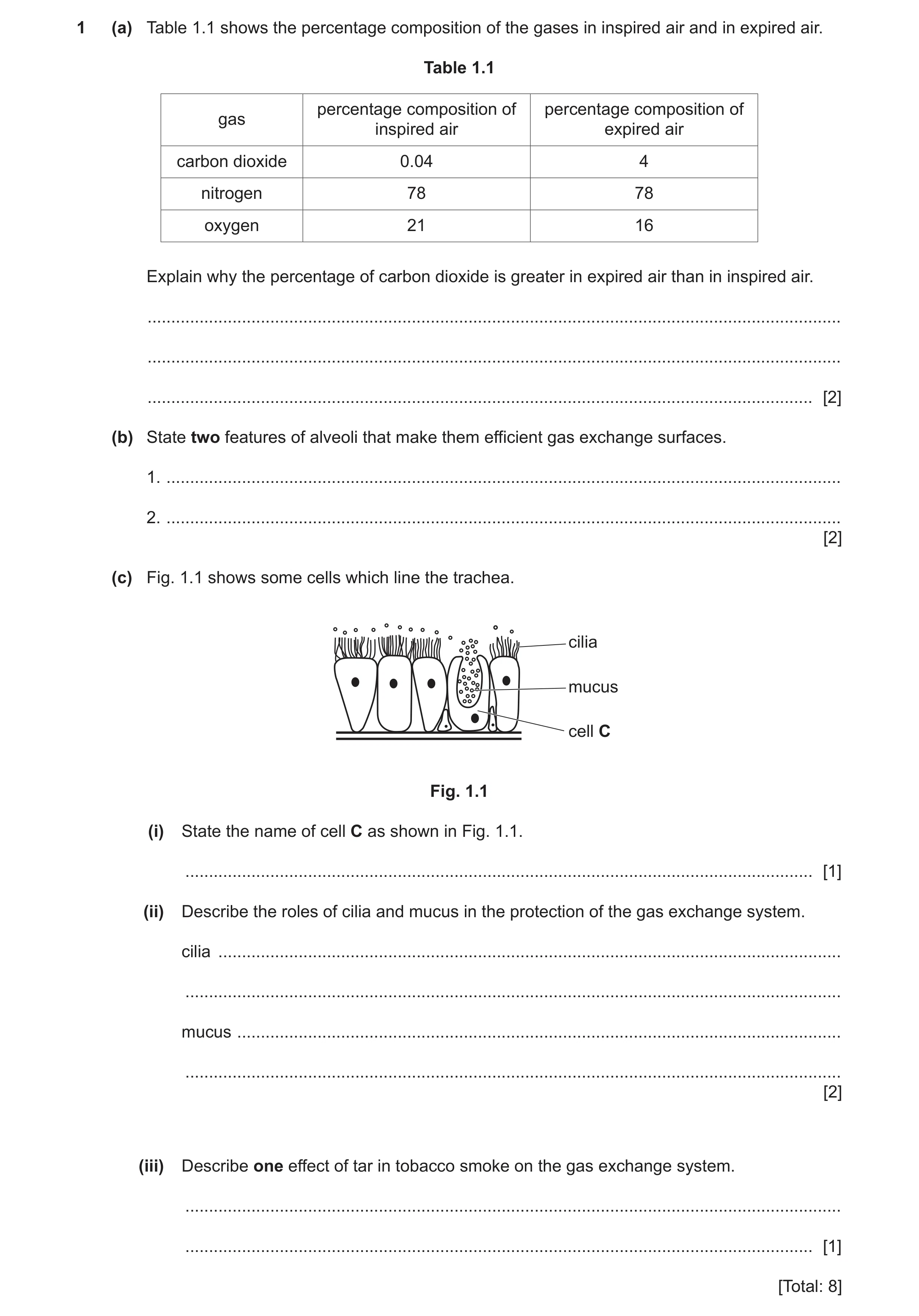
1 (a) Table 1.1 shows the percentage composition of the gases in inspired air and in expired air. Table 1.1 percentage composition of percentage composition of gas inspired air expired air carbon dioxide 0.04 4 nitrogen 78 78 oxygen 21 16 Explain why the percentage of carbon dioxide is greater in expired air than in inspired air. … … … [2] (b) State two features of alveoli that make them efficient gas exchange surfaces. 1. … 2. … [2] (c) Fig. 1.1 shows some cells which line the trachea. cilia mucus cell C Fig. 1.1 (i) State the name of cell C as shown in Fig. 1.1. … [1] (ii) Describe the roles of cilia and mucus in the protection of the gas exchange system. cilia … … mucus … … [2] (iii) Describe one effect of tar in tobacco smoke on the gas exchange system. … … [1] [Total: 8]
8 marks
Mark scheme: 1(a) carbon dioxide produced by cells during respiration ; carbon dioxide, diffuses from blood (plasma) / into alveoli / is excreted at the lungs ; 2 1(b) any two from: large surface area ; thin surface ; good blood supply ; well ventilated ; max 2 1(c)(i) goblet cell ; 1 1(c)(ii) (cilia) (beat to) remove mucus ; (mucus) traps pathogens and particles ; 2 1(c)(iii) stimulates mucus production / bronchitis / lung cancer / destroys or paralyses cilia / collects in alveoli / coats gas exchange surface ; 1
This question in 0653/41 May/June 2020
Q10 · An external view of the heart 0653/41 Oct/Nov 2020
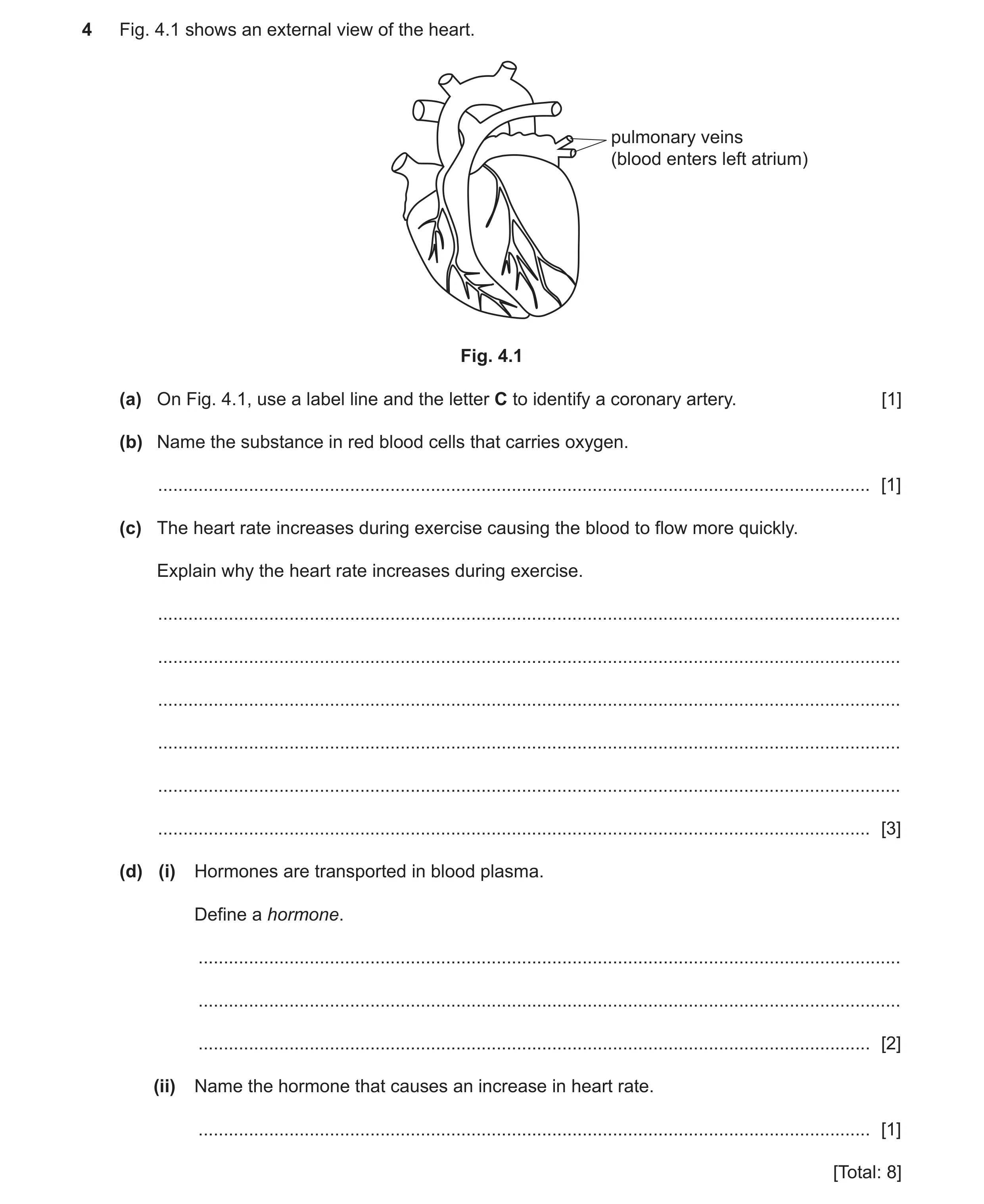
4 Fig. 4.1 shows an external view of the heart. pulmonary veins (blood enters left atrium) Fig. 4.1 (a) On Fig. 4.1, use a label line and the letter C to identify a coronary artery. [1] (b) Name the substance in red blood cells that carries oxygen. … [1] (c) The heart rate increases during exercise causing the blood to flow more quickly. Explain why the heart rate increases during exercise. … … … … … … [3] (d) (i) Hormones are transported in blood plasma. Define a hormone. … … … [2] (ii) Name the hormone that causes an increase in heart rate. … [1] [Total: 8]
8 marks
Mark scheme: 4(a) coronary artery correctly labelled ; 1 4(b) haemoglobin ; 1 4(c) any three from: so more oxygen / glucose, taken to the muscles ; so more energy can be released ; correct reference to respiration ; so more carbon dioxide can be removed (from the muscles) ; 3 4(d)(i) a chemical substance produced by a gland, carried by blood ; which alters the activity of one or more specific target organs ; 2 4(d)(ii) adrenaline ; 1
This question in 0653/41 Oct/Nov 2020
Q11 · A diagram of a fetus inside the uterus 0653/42 Oct/Nov 2021
1 (a) Fig. 1.1 is a diagram of a fetus inside the uterus. Fig. 1.1 On Fig. 1.1, draw a label line and the letter C to identify the cervix. [1] (b) The fetus requires energy and amino acids for growth. (i) State the name of the process in cells that releases energy. … [1] (ii) Describe how the fetus obtains amino acids. … … … [2] (c) A pregnant female takes iron tablets to supplement her diet. Explain why iron tablets may be needed during pregnancy. … … … [2] (d) Table 1.1 shows the names and functions of some organs associated with the alimentary canal of an adult human body. Complete Table 1.1. Table 1.1 organ function uses teeth to break down food … into smaller pieces large intestine … egestion … [3] [Total: 9]
9 marks
Mark scheme: 1(a) cervix labelled anywhere in shaded area ; 1 1(b)(i) respiration ; 1 1(b)(ii) amino acids come from mother's blood ; plus any one from: cross the placenta ; brought to fetus by umbilical cord ; via diffusion ; 2 1(c) idea that fetus needs some of the iron ; reference to any named iron deficiency symptom (in mother) / iron is needed for haemoglobin production ; 2 1(d) organ function mouth ; (uses teeth to breakdown food into smaller pieces) (large intestine) absorbs water ; anus ; (egestion) 3
This question in 0653/42 Oct/Nov 2021
Q12 · The structure of the human heart 0653/43 May/June 2023
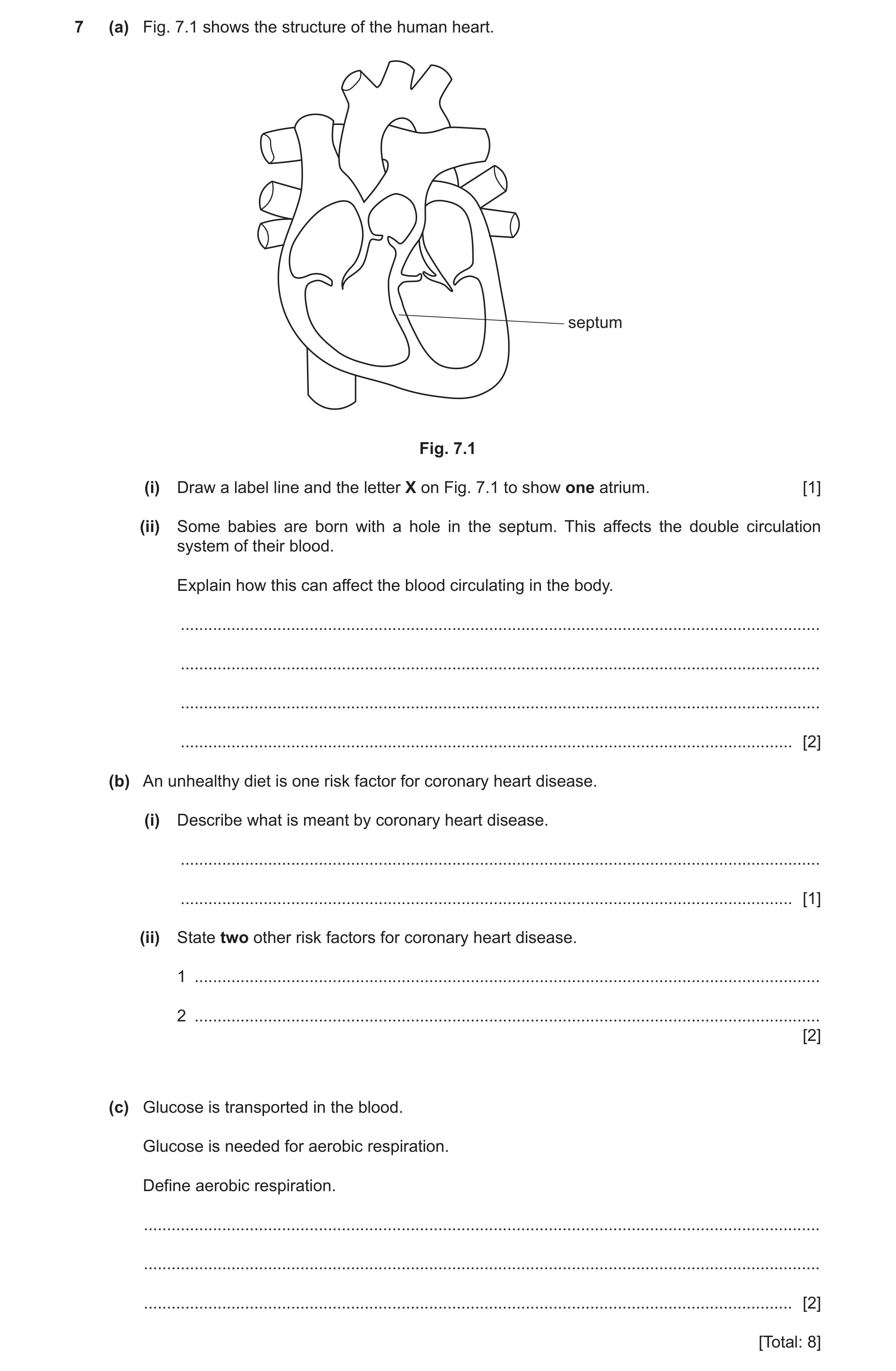
7 (a) Fig. 7.1 shows the structure of the human heart. septum Fig. 7.1 (i) Draw a label line and the letter X on Fig. 7.1 to show one atrium. [1] (ii) Some babies are born with a hole in the septum. This affects the double circulation system of their blood. Explain how this can affect the blood circulating in the body. … … … … [2] (b) An unhealthy diet is one risk factor for coronary heart disease. (i) Describe what is meant by coronary heart disease. … … [1] (ii) State two other risk factors for coronary heart disease. 1 … 2 … [2] (c) Glucose is transported in the blood. Glucose is needed for aerobic respiration. Define aerobic respiration. … … … [2] [Total: 8]
8 marks
Mark scheme: 7(a)(i) either atrium labelled ; 1 7(a)(ii) any two from: mixing of blood from lungs and body ; less oxygen transported (to body) ; decrease in blood pressure (to body) ; AVP, e.g. reduction in (aerobic) respiration in cells ; max 2 7(b)(i) blockage of coronary artery ; 1 7(b)(ii) any two from: stress ; smoking ; genetic predisposition ; age ; gender / sex ; AVP, e.g. lack of exercise ; 2 Question Answer Marks 7(c) (respiration is a) reaction with oxygen ; breakdown of nutrient (molecules) to release energy ; 2
This question in 0653/43 May/June 2023
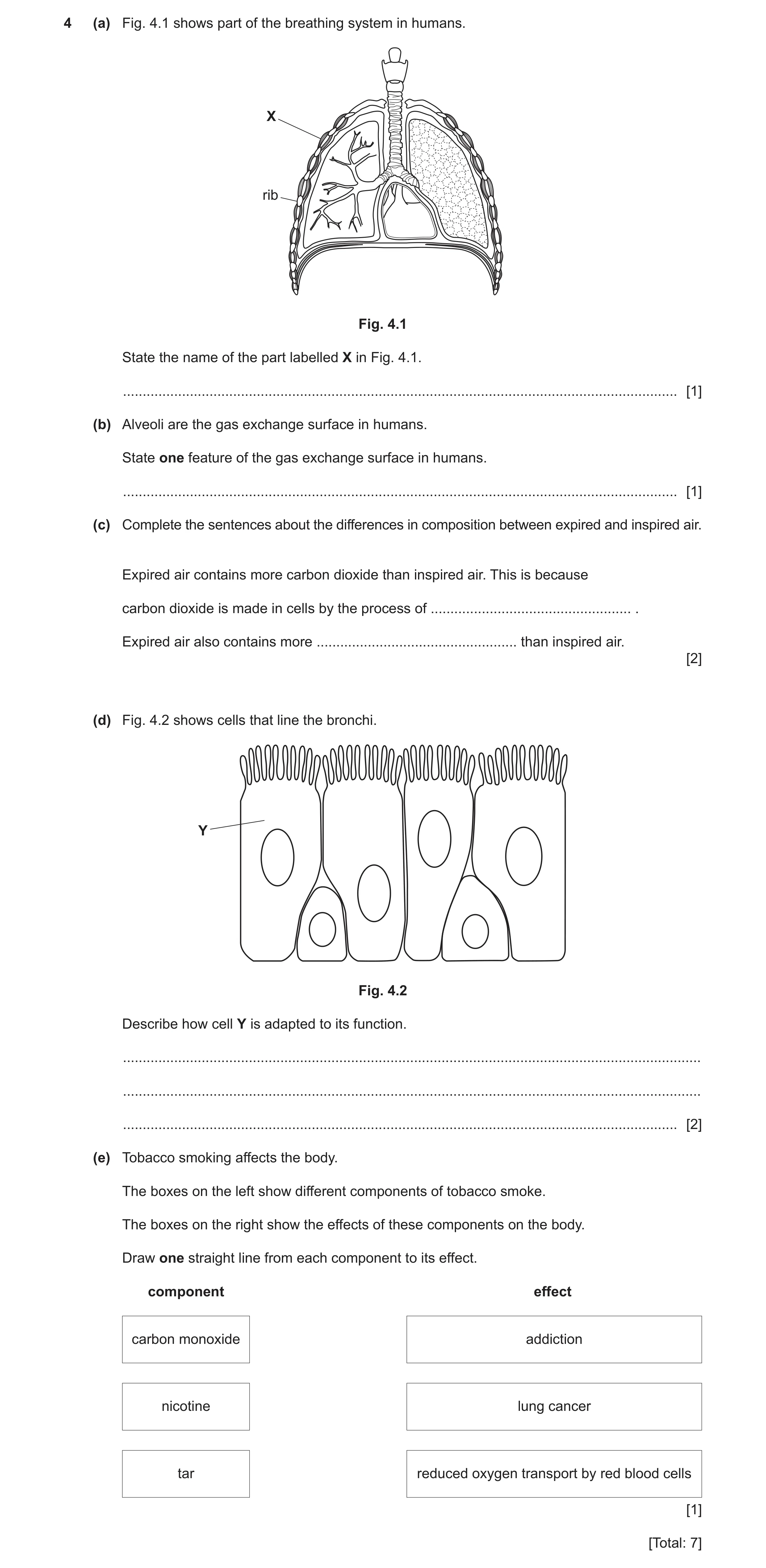
Q13 · Part of the breathing system in humans 0653/41 Oct/Nov 2023
4 (a) Fig. 4.1 shows part of the breathing system in humans. X rib Fig. 4.1 State the name of the part labelled X in Fig. 4.1. … [1] (b) Alveoli are the gas exchange surface in humans. State one feature of the gas exchange surface in humans. … [1] (c) Complete the sentences about the differences in composition between expired and inspired air. Expired air contains more carbon dioxide than inspired air. This is because carbon dioxide is made in cells by the process of … . Expired air also contains more … than inspired air. [2] (d) Fig. 4.2 shows cells that line the bronchi. Y Fig. 4.2 Describe how cell Y is adapted to its function. … … … [2] (e) Tobacco smoking affects the body. The boxes on the left show different components of tobacco smoke. The boxes on the right show the effects of these components on the body. Draw one straight line from each component to its effect. component effect carbon monoxide addiction nicotine lung cancer tar reduced oxygen transport by red blood cells [1] [Total: 7]
7 marks
Mark scheme: 4(a) intercostal muscle ; 1 4(b) any one from: 1 large (surface) area ; thin (surface) ; good blood supply ; good ventilation (with air) ; AVP ; 4(c) (aerobic) respiration ; 2 water (vapour) ; 4(d) ciliated / has cilia ; 2 to move mucus (away from lungs) ; 4(e) 1 carbon monoxide addiction nicotine lung cancer tar reduced oxygen transport by red blood cells only three lines and all correct ;
This question in 0653/41 Oct/Nov 2023
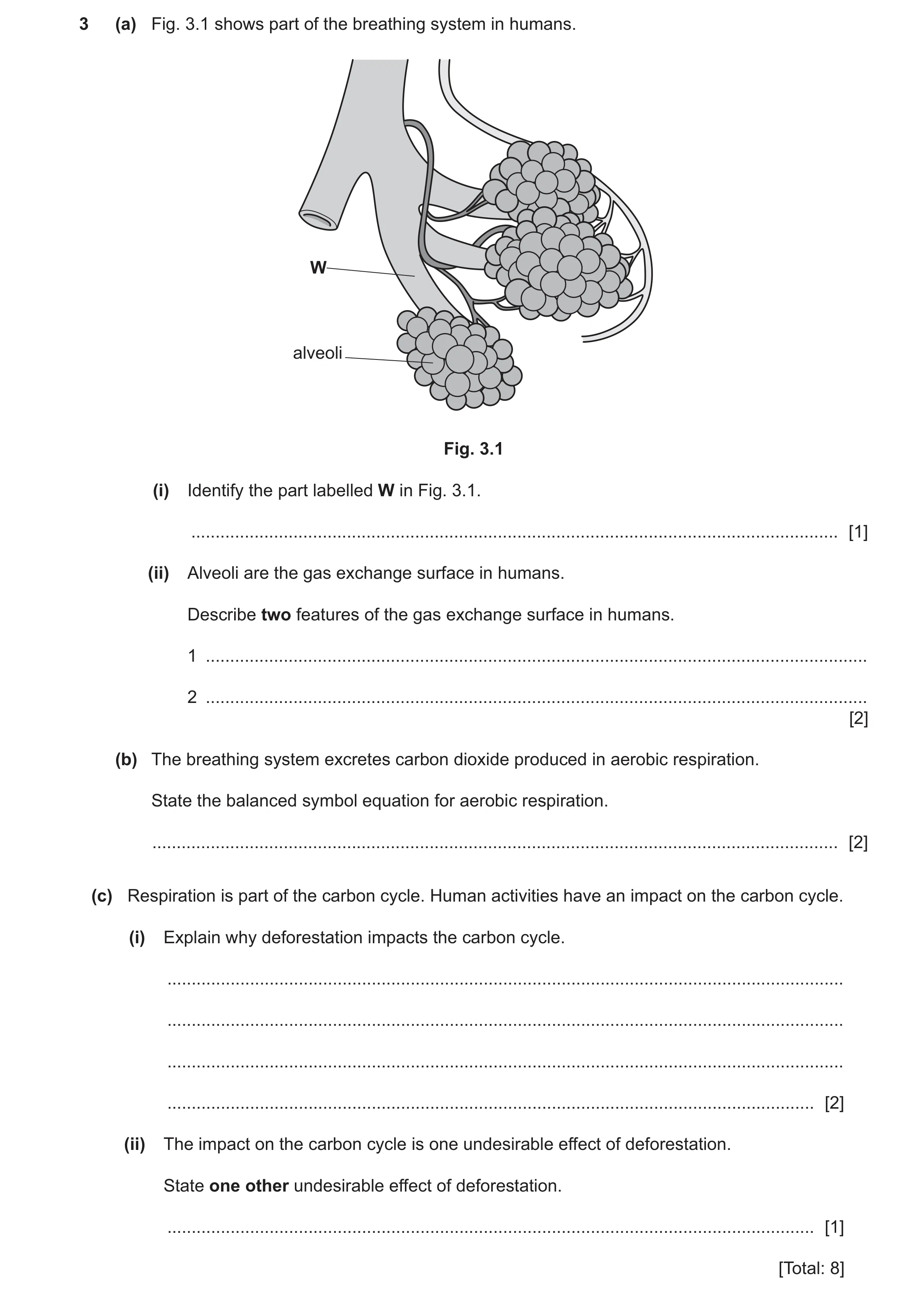
Q14 · Part of the breathing system in humans 0653/43 May/June 2025
3 (a) Fig. 3.1 shows part of the breathing system in humans. W alveoli Fig. 3.1 (i) Identify the part labelled W in Fig. 3.1. … [1] (ii) Alveoli are the gas exchange surface in humans. Describe two features of the gas exchange surface in humans. 1 … 2 … [2] (b) The breathing system excretes carbon dioxide produced in aerobic respiration. State the balanced symbol equation for aerobic respiration. … [2] (c) Respiration is part of the carbon cycle. Human activities have an impact on the carbon cycle. (i) Explain why deforestation impacts the carbon cycle. … … … … [2] (ii) The impact on the carbon cycle is one undesirable effect of deforestation. State one other undesirable effect of deforestation. … [1] [Total: 8]
8 marks
Mark scheme: 3(a)(i) bronchiole ; 1 3(a)(ii) any two from: 2 large surface area ; thin surface ; good blood supply ; good ventilation (with air) ; AVP ; 3(b) C6H12O6 + 6O2 → 6H2O + 6CO2 ;; 2 correct reactants (in either order) and balanced = 1 mark correct products (in either order) and balanced = 1mark 3(c)(i) any two from: 2 decrease in photosynthesis ; so less carbon dioxide removed from atmosphere / carbon dioxide (in atmosphere) increases ; AVP ; 3(c)(ii) any one from: 1 habitat destruction ; reduced biodiversity ; extinction ; loss of soil ; flooding ;
This question in 0653/43 May/June 2025
 7 / 19
 8 / 19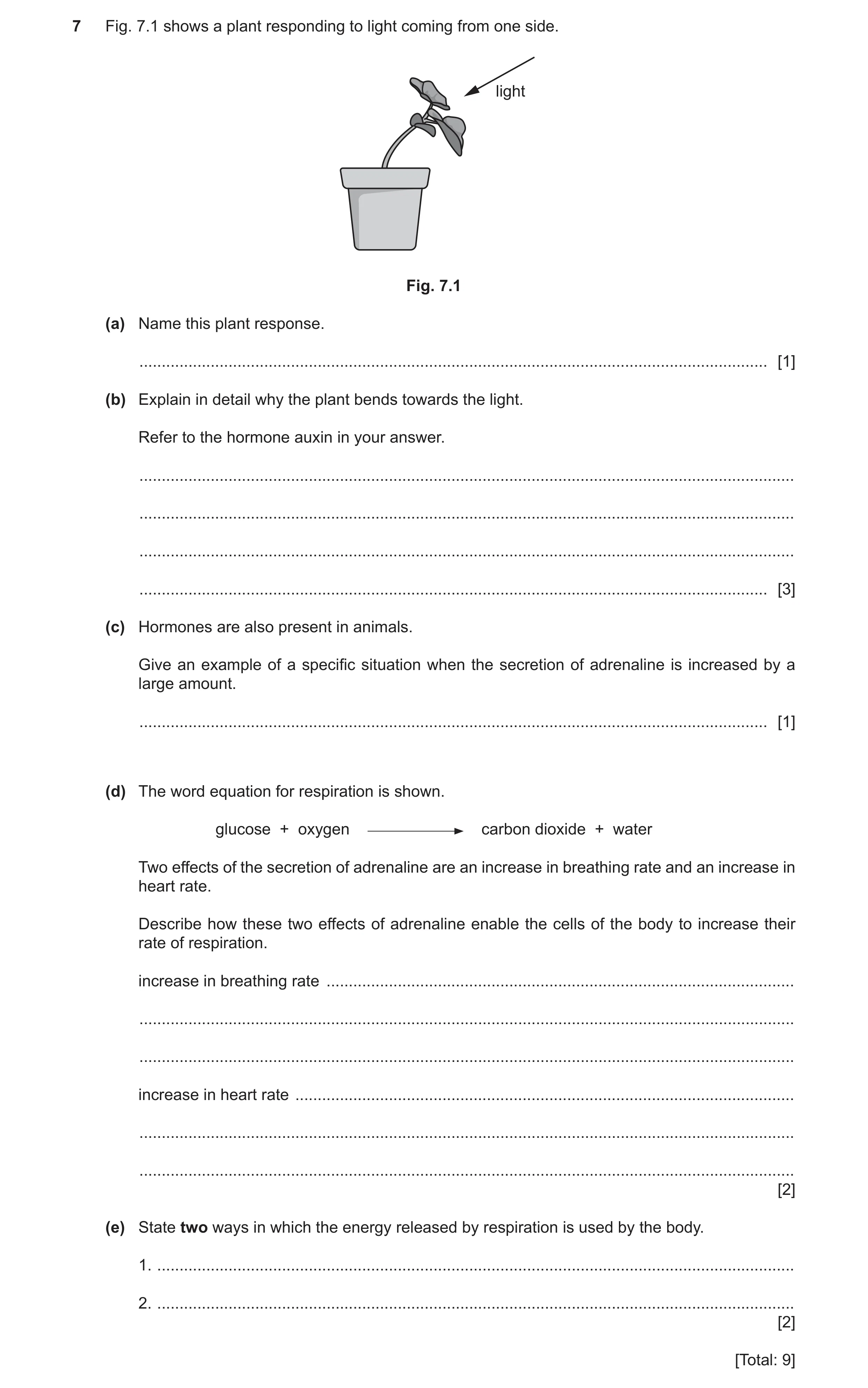
 12 / 19
 13 / 19
 14 / 19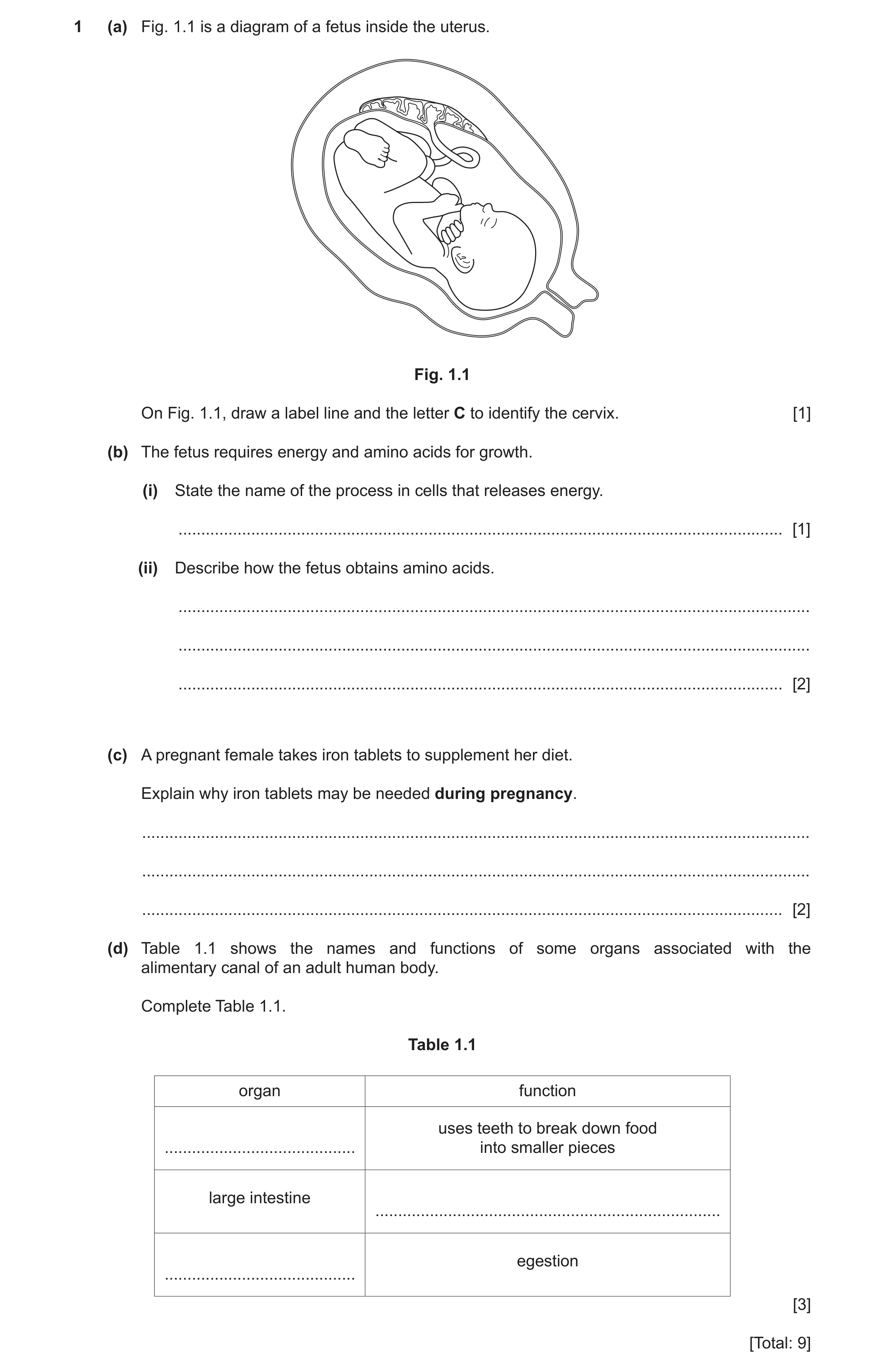
 19 / 19
 8
8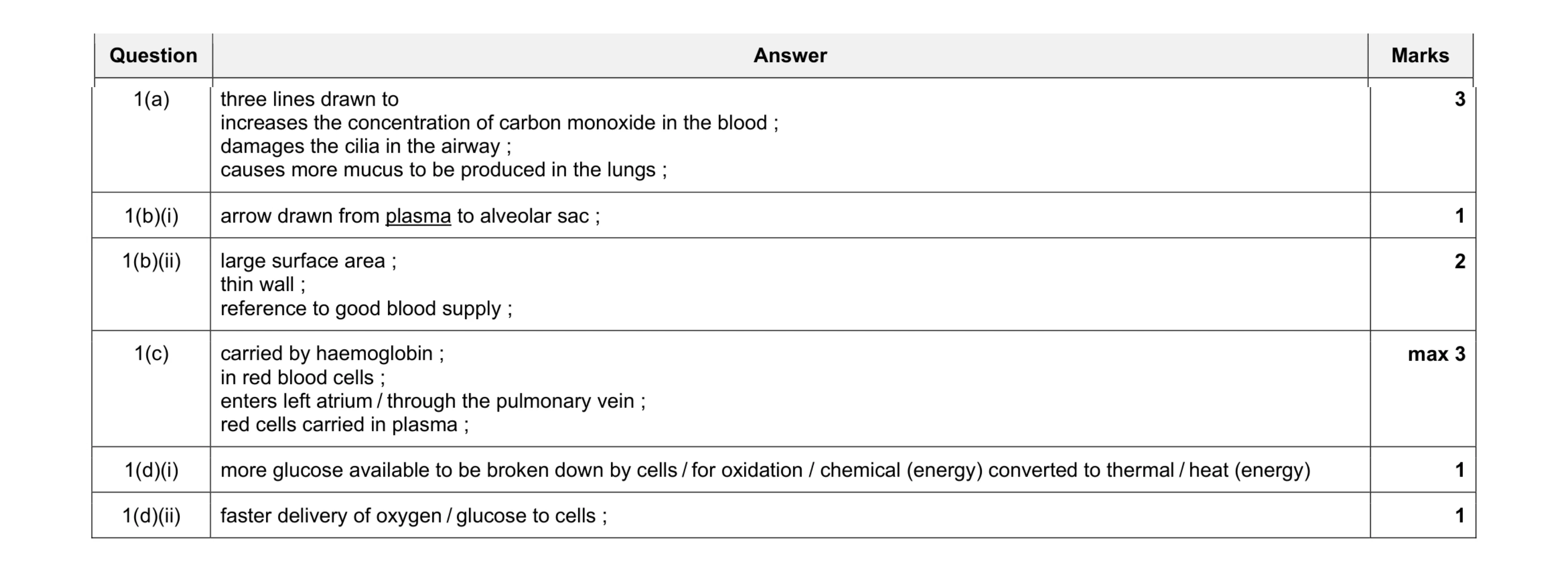 11
11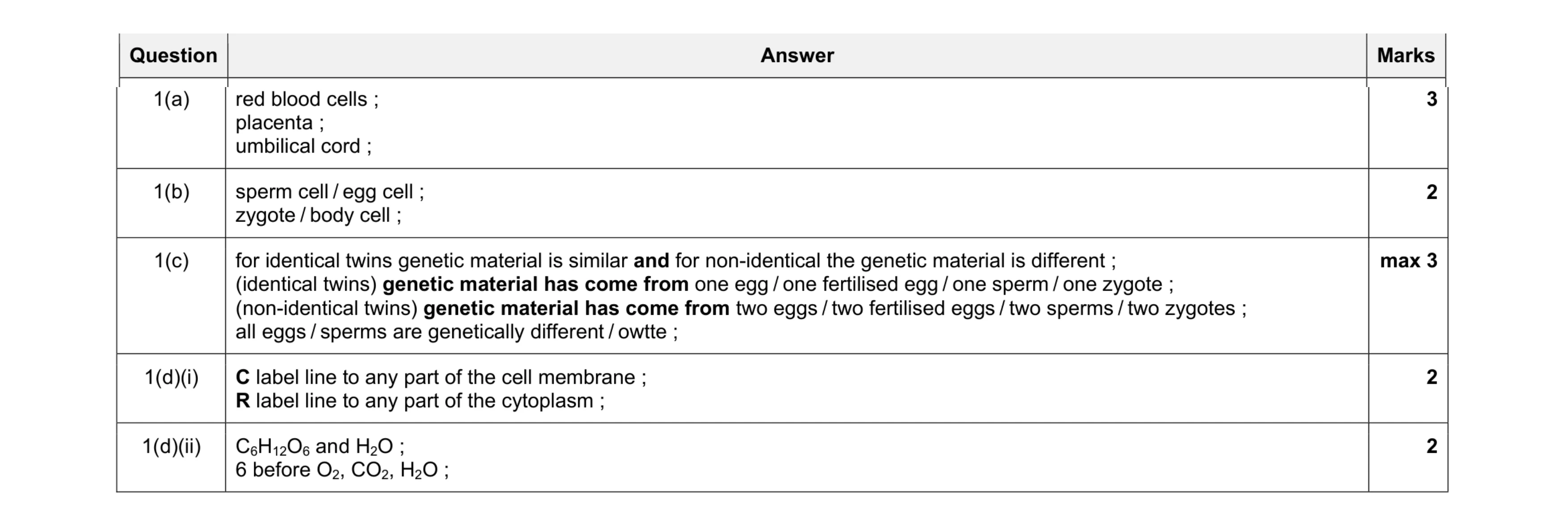 12
12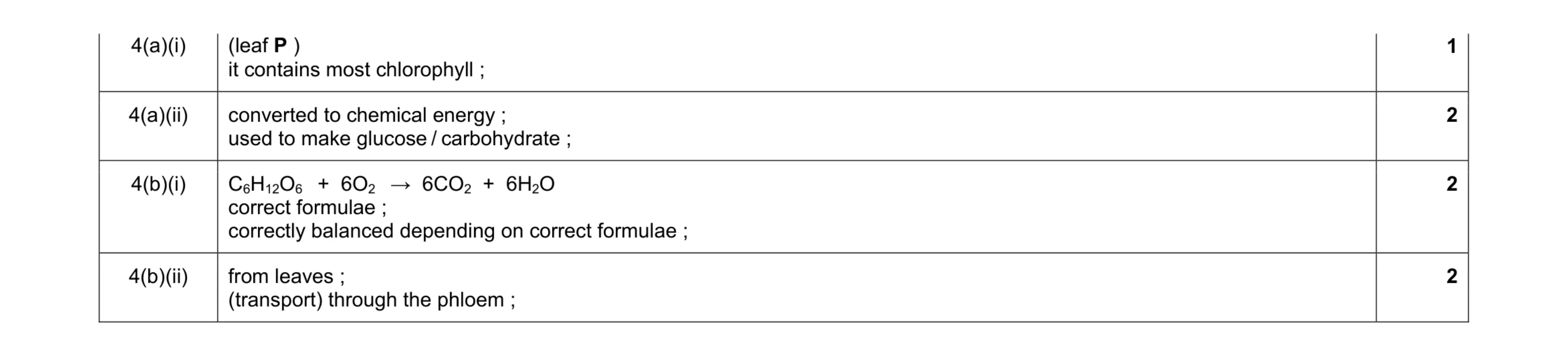 7
7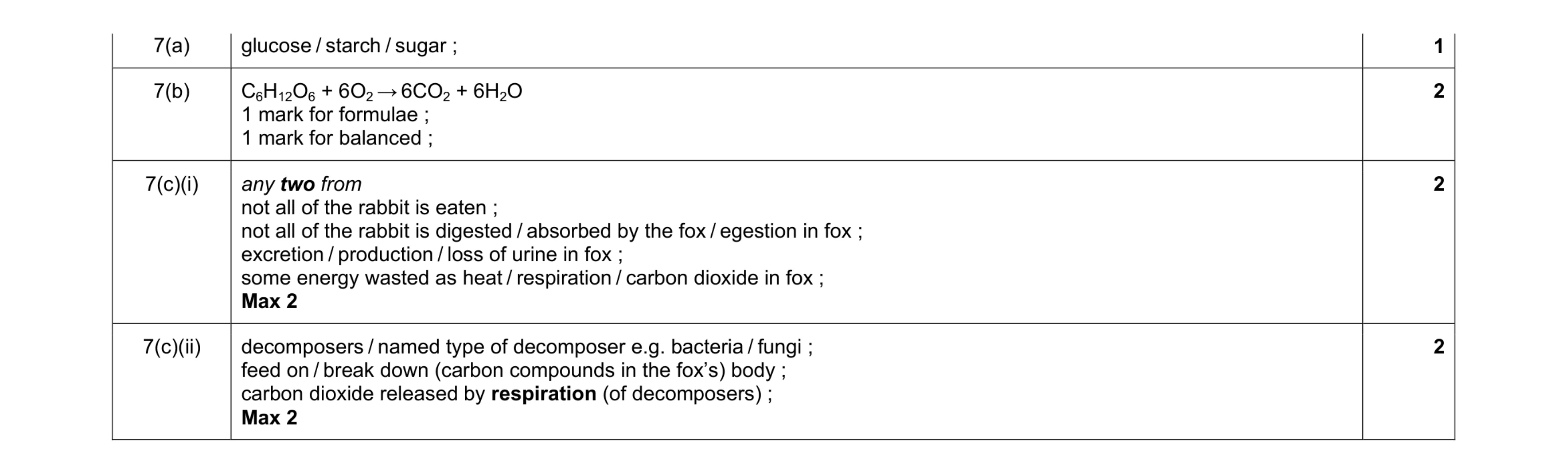 7
7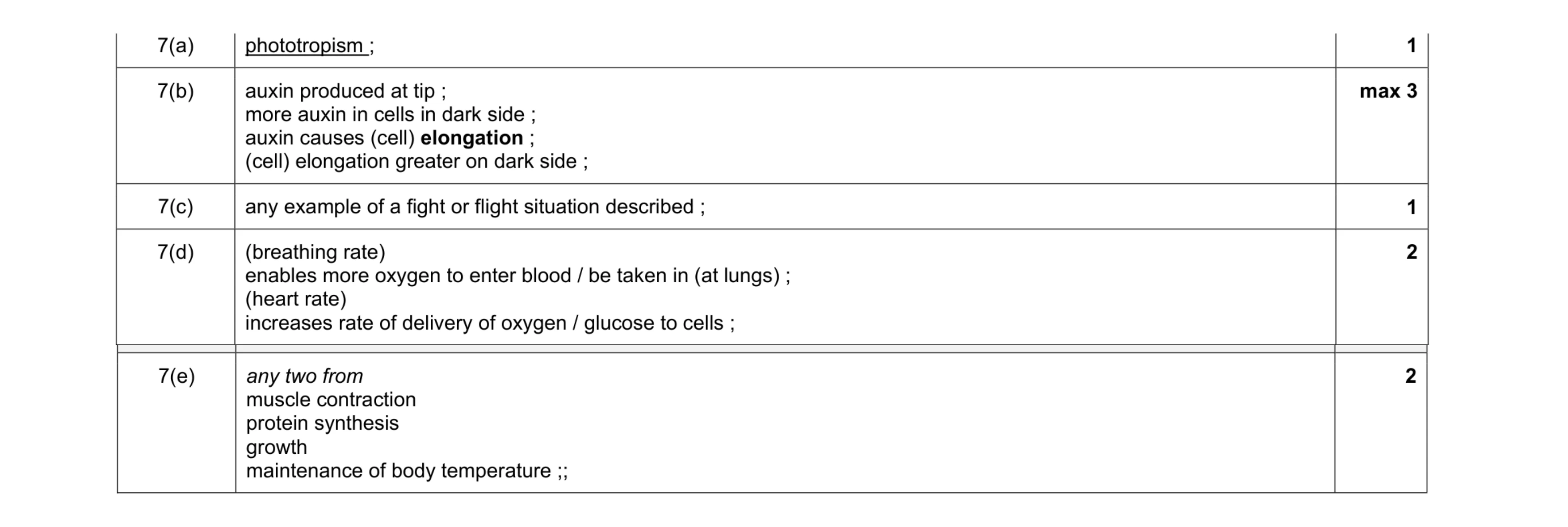 9
9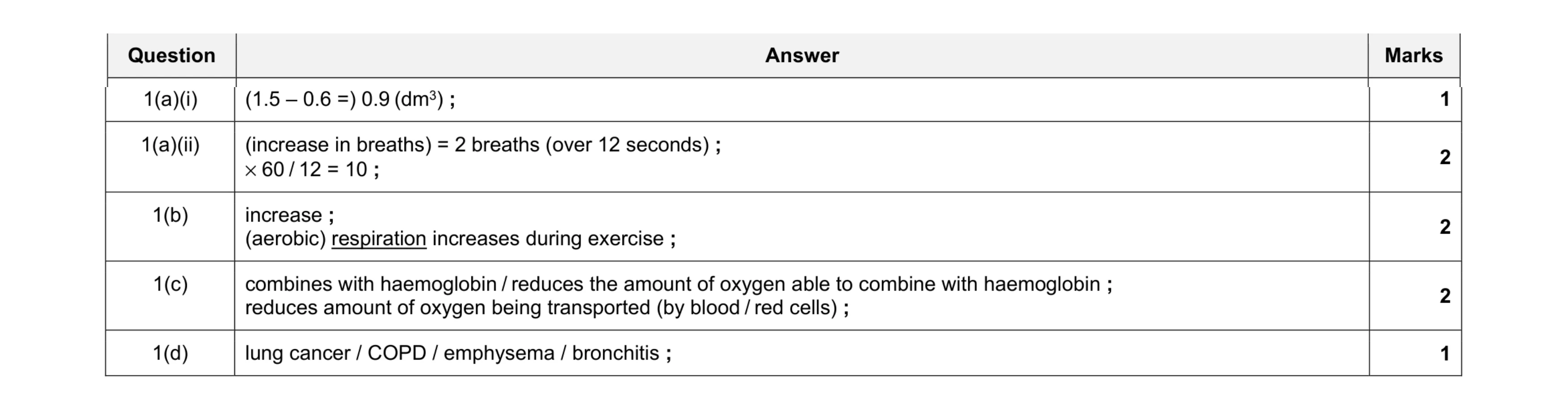 8
8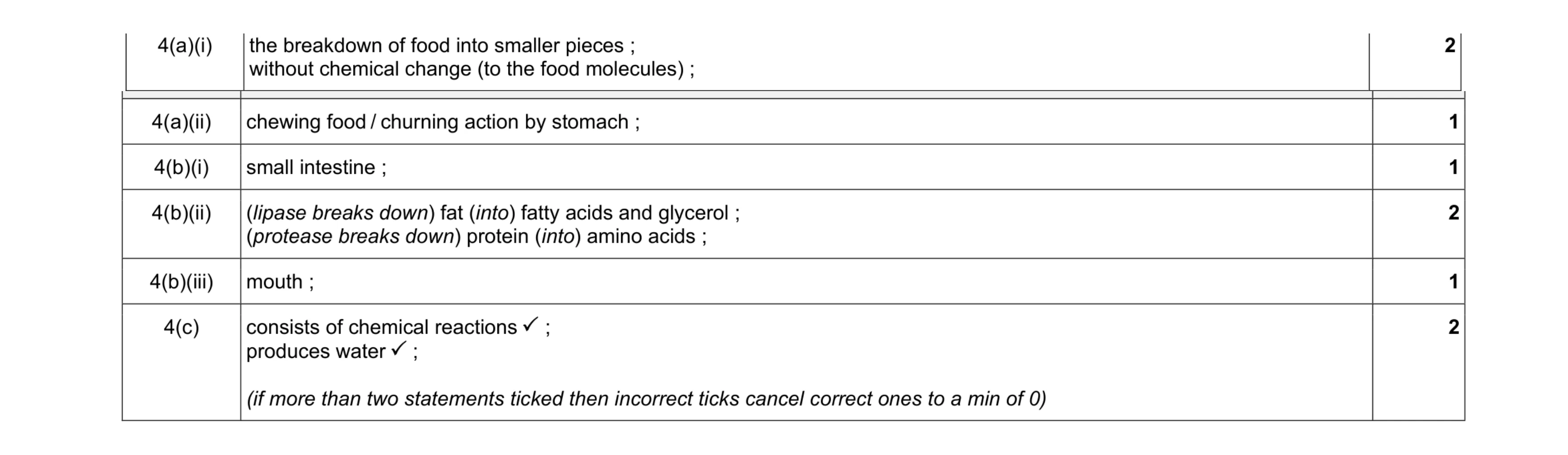 9
9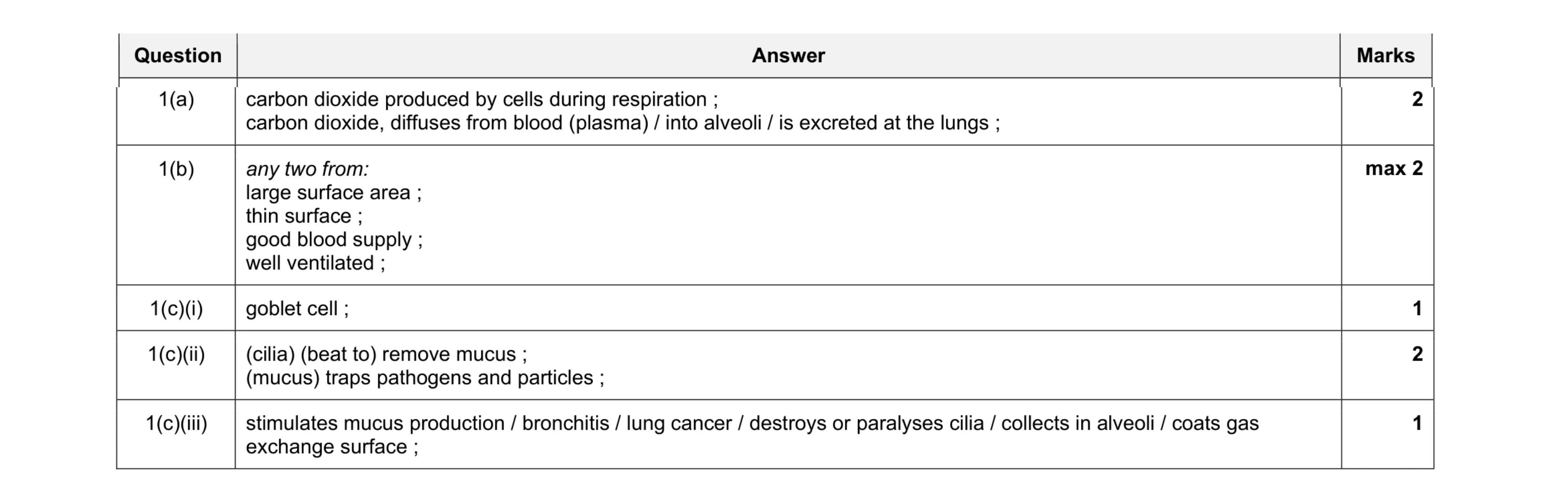 8
8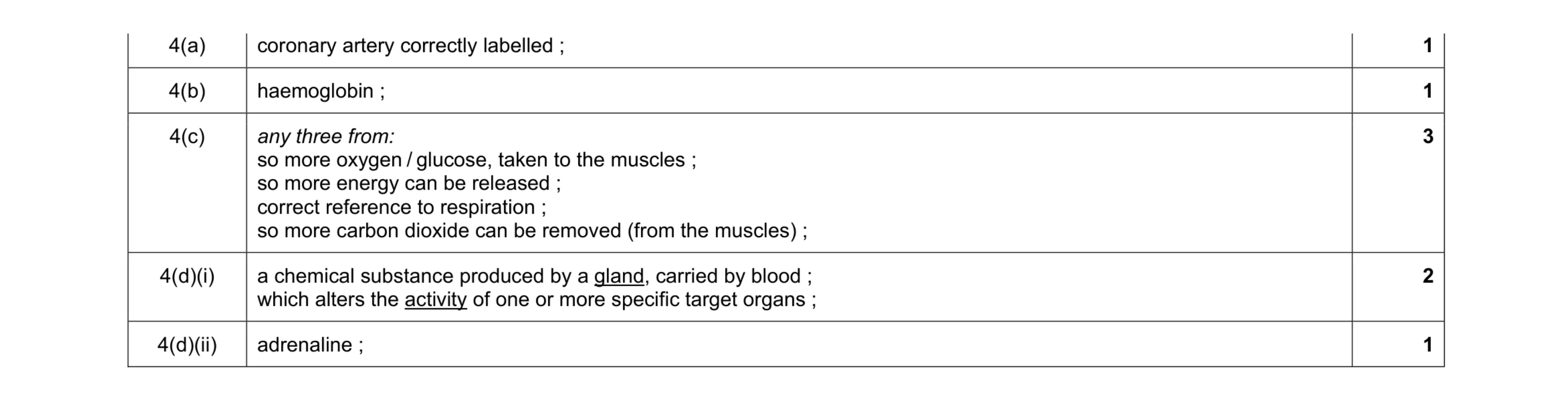 8
8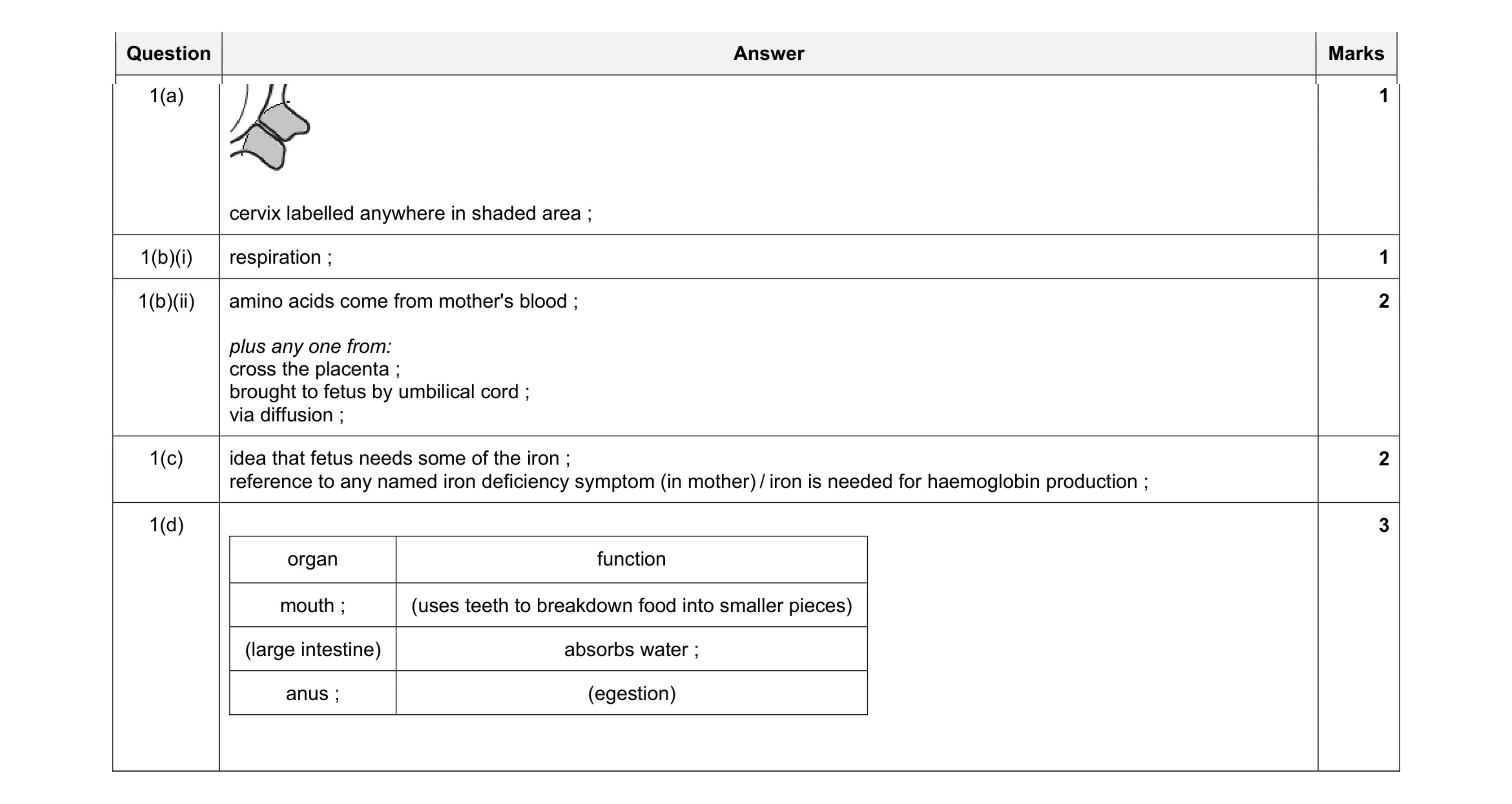 9
9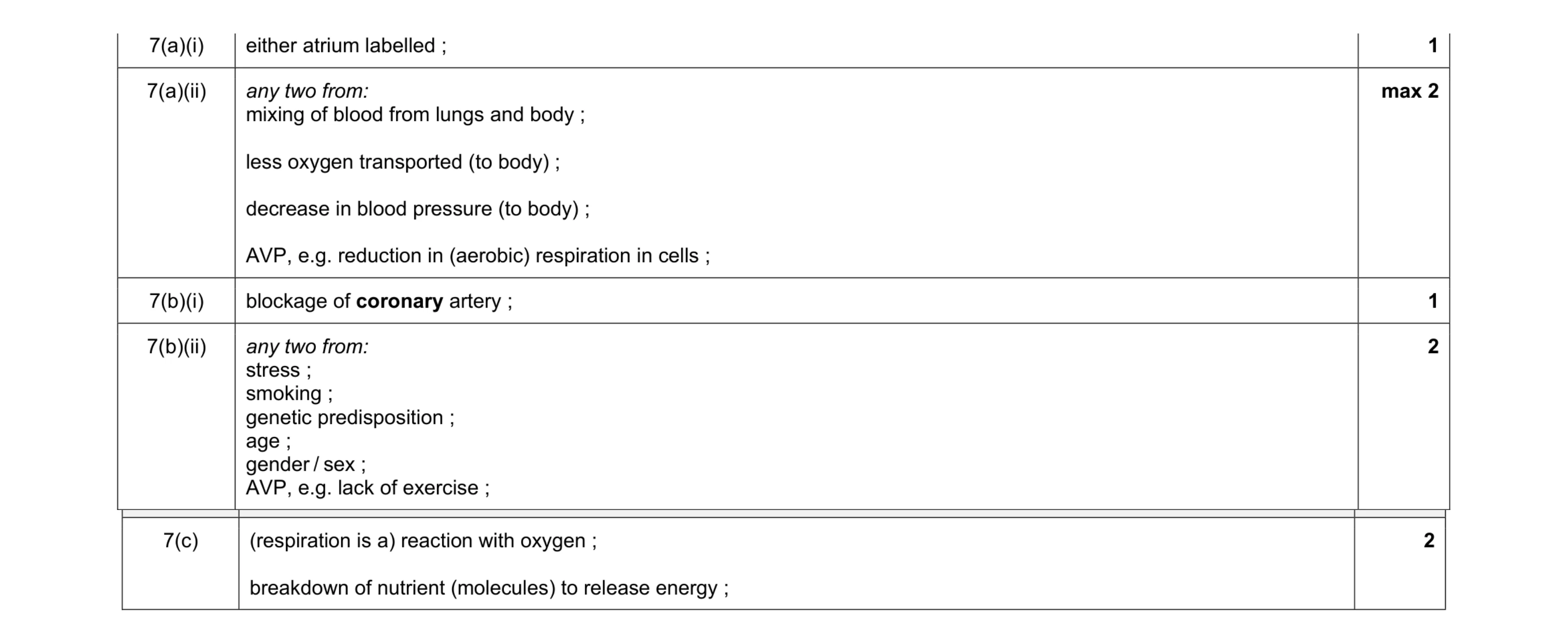 8
8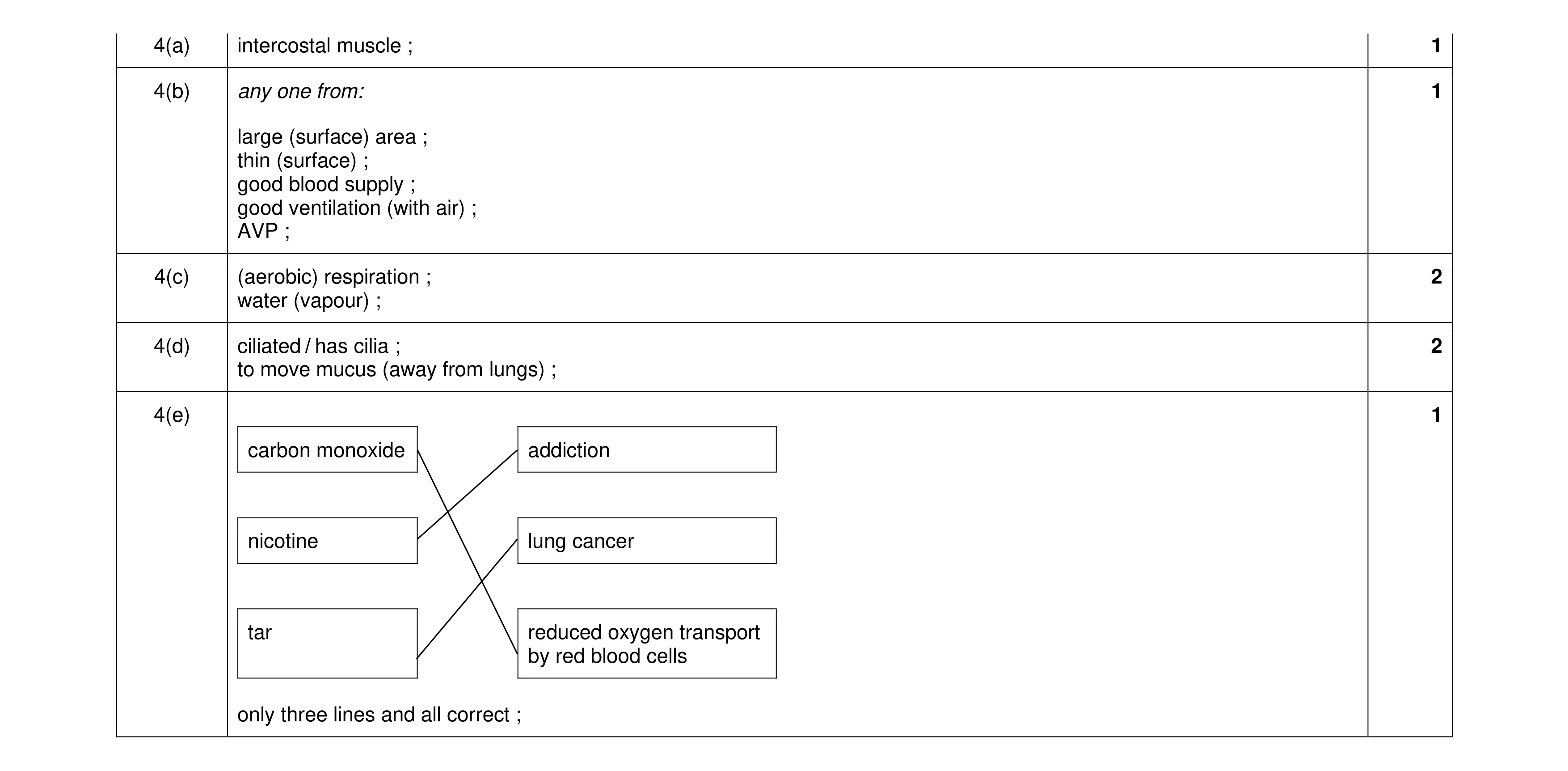 7
7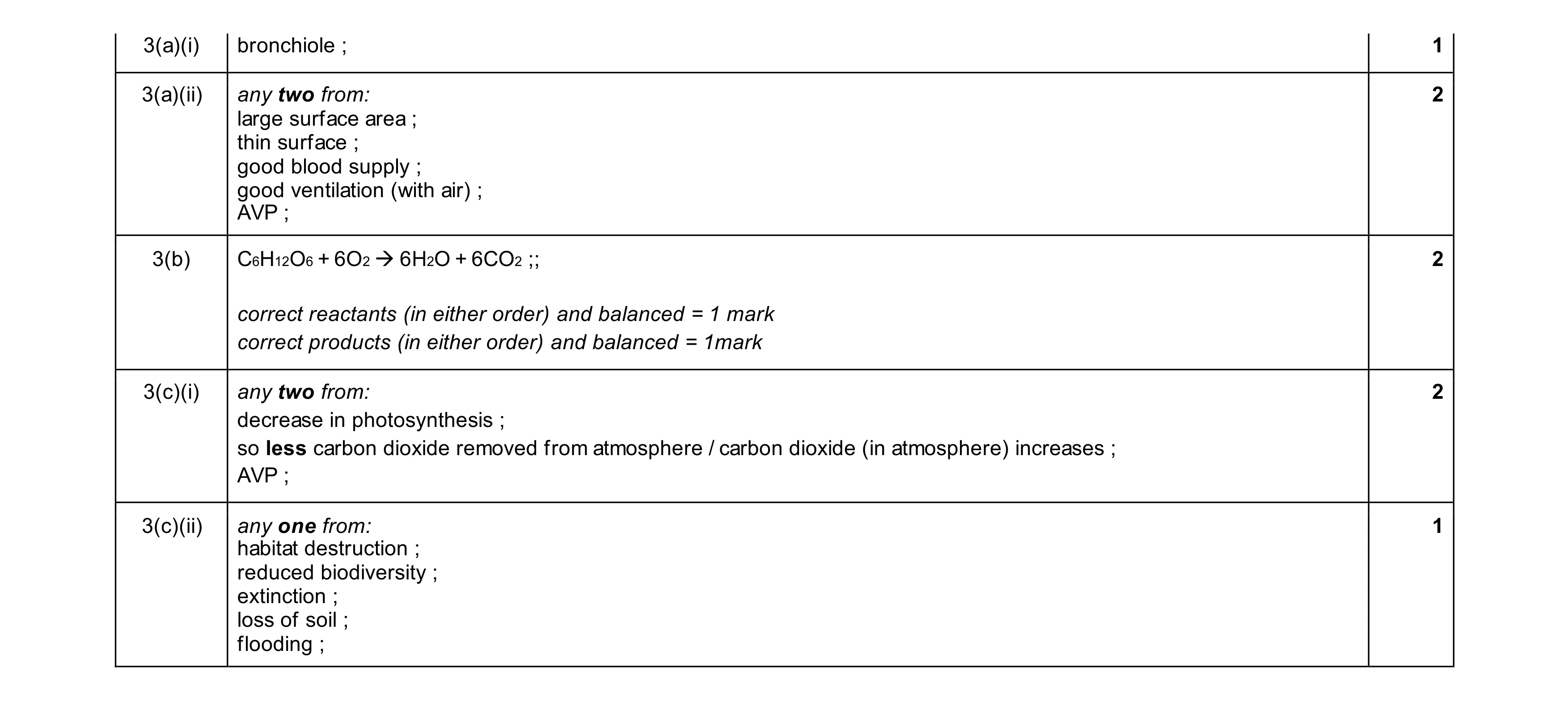 8
8