Questions as text
Q1 · Low-cost airlines For several decades, low-cost airlines have been competing on… 0455/22 Feb/March 2017
1 Low-cost airlines For several decades, low-cost airlines have been competing on short-distance flights not just with established airlines, but also with train travel and car travel. Now they are starting to compete with established airlines on long-distance flights. In response to this increased competition there have been some horizontal mergers occurring between the established airlines. It is predicted that by 2030 China will become the world’s largest domestic air travel market, with 20% of all global air travel. The USA is currently the dominant market and it is predicted that between 2015 and 2030 the country will order 6160 of the 28 000 passenger aircraft that will be produced. India, which has both state-owned and private-sector airlines, is experiencing a great increase in both internal flights and flights to other countries. More airports are being built in India, with more facilities being provided inside and around the airports. For example, more taxi firms are being set up to take passengers to and from the airports. The rapid expansion of air travel in India and other countries is having an impact on the market for pilots, as shown in Fig. 1. S price of pilots P2 P1 D2 D1 O Q1 Q2 quantity / number of pilots Fig. 1 The market for pilots How rapidly the Indian air travel market will grow will be influenced by a number of factors. These include the extent to which business travel will grow and how rapidly demand for foreign holidays will increase. Demand for these forms of air travel is, in turn, influenced by changes in price. The price elasticity of demand for air travel has been estimated at −1.2. One factor that influences prices, and so the inflation rate, is changes in taxation. (a) Identify, using information from the extract: (i) a substitute for air travel [1] (ii) a complement to air travel. [1] (b) Explain two advantages that firms may gain from a horizontal merger. [4] (c) Calculate, using information from the extract: (i) the percentage of the new passenger aircraft that the USA is predicted to purchase between 2015 and 2030 [2] (ii) the percentage change in demand for air travel if the price of air travel falls by 15%. [2] (d) Analyse why demand for a luxury holiday may be price elastic. [5] (e) Discuss whether airlines should be state-owned or operated by the private sector. [5] (f) Explain, using information from the extract and Fig. 1, what happened to the market for pilots in India in 2015. [4] (g) Discuss whether a cut in taxation will reduce inflation. [6]
30 marks
Mark scheme: 1(a) Using information from the extract, identify (i) a substitute and (ii) a complement to air travel. substitute: train travel/car travel (1) complement: taxi travel/foreign holidays (1). 2 1(b) Explain two advantages that firms may gain from a horizontal merger. 1 mark each for each of two advantages identified: • able to take advantage of economies of scale • increased market share/market power • rationalisation • exchange ideas/technology 1 mark each for each of two explanations: • larger firms may be able to reduce average costs/become more efficient/increase productivity • a direct competitor is eliminated • savings may be made by e.g. operating only one warehouse • increase innovation/better quality • higher profit 4 Not sufficient just to have higher demand on its own. 1(c)(i) Calculate the percentage of the new passenger aircraft that the USA are predicted to purchase between 2015 and 2030. 22% (2) Correct working i.e. 6160/28 000 × 100 (1). 2 1 mark if the final answer is different but 22% is given part way through the answer. 1(c)(ii) Calculate the percentage change in demand for air travel if the price of air travel falls by 15%. 18%/18 (2) Correct working i.e. – 1.2 × 15% or 0.18 (%). Or 1.8 (%) (1). 2 Question Answer Marks Guidance 1(d) Analyse why demand for a luxury holiday may be price-elastic. Price-elastic means a percentage change in price creates a greater percentage change in demand (1). A luxury holiday may have a substitute (1) in the form of another holiday (1) a rise in price will make substitutes relatively cheaper (1) demand will be more elastic the closer the substitute (1). Taking a luxury holiday can be postponed/does not have to be purchased (1) it is not a necessity (1). The purchase of a luxury holiday takes up a large proportion of people’s income (1) this would make the change in price more noticeable/more significant (1) a fall in price may make it affordable to many more people (1). 5 1(e) Discuss whether airlines should be state-owned or operated by the private sector. Up to 3 marks for why they should be state-owned: The government will base decisions on social costs and benefits (1) may try to cut down on pollution (1) may be less chance of market failure occurring (1) may carry out a CBA (1). The government may act in the public interest/aim may be to promote welfare (1) may be safer (1). The government may keep prices low (1) to ensure access to flights (1). The government may have more funds available (1) may be able to operate them on a large scale (1) enjoy economies of scale (1). The government may employ more workers (1) to keep unemployment low (1). If profitable can provide funds for the government (1) increase ability of government to spend on e.g. education (1). Up to 3 marks for why they should be operated by the private sector: Profit motive (1) may make the firm/s more responsive to consumer demand (1) may provide better quality (1). Will not require tax revenue/allow government to concentrate on other areas (1) tax revenue can be used for other purposes/example of what revenue could be spent on (1). State-owned may be a monopoly/may be more competition in the private sector (1) competition may drive down price (1) may provide more choice (1). 5 Question Answer Marks Guidance 1(f) Using information from the extract including Fig. 1, explain what happened to the market for pilots in India in 2015. The diagram shows demand increasing (1) inelastic demand (1) wages / prices rising (1) supply extending / more pilots (1) inelastic supply (1) due to countries wanting to recruit more pilots/increased demand for flights (1). 4 1(g) Discuss whether a cut in taxation will reduce inflation. Up to 4 marks for why it might: A cut in indirect taxes/corporation tax (1) will reduce firms’ costs of production (1) reduce cost-push inflation (1). A cut in tariffs (1) will lower cost of imports (1) reduce price of products consumers buy (1). Lower taxes may increase incentives (1) increase supply (1) reduce costs (1) lower cost-push inflation (1). Up to 4 marks for why it might not: A cut in income tax (1) will increase disposable income/increase purchasing power (1) increase demand (1) firms raise prices to increase profits (1) increase demand-pull inflation (1). Lower indirect taxes (1) may not be passed on to consumers in lower prices (1). 6 Note: maximum of 2 if no link to inflation,
This question in 0455/22 Feb/March 2017
Q2 · Indonesia’s output is influenced by its factors of production 0455/22 May/June 2017
2 Indonesia’s output is influenced by its factors of production. A production possibility curve diagram can be used to show this relationship between resources and output. Indonesia does have extensive fishing waters but does not actually catch many fish. Most of its fishing firms are small and they compete against much larger foreign firms. These larger foreign firms have been attracted into Indonesia’s waters because of increasing demand for fish. The price elasticity of demand for different types of fish has changed in the last few years. (a) Identify the two human factors of production. [2] (b) Explain two economic concepts shown by a production possibility curve diagram. [4] (c) Analyse why demand for a product may become more elastic over time. [6] (d) Discuss whether small firms can compete successfully against large firms. [8]
20 marks
Mark scheme: 2(a) Identify the two human factors of production. • Labour (1) entrepreneur/enterprise (1). 2 2(b) Explain two economic concepts shown by a production possibility curve diagram. 1 mark each for each of two concepts identified: • opportunity cost • scarcity/economic problem/unlimited wants and limited resources • choice • efficiency/full employment • specialisation • economic growth/the difference between actual and potential economic growth 1 mark each for each of two explanations given: • The curve shows that if more of one type of product is produced, less of another product can be made • The curve shows that there is a limit to the amount that can be produced with existing resources/maximum output of two products • The curve shows that more than one production point cannot be selected • Any point on the curve is efficient/any point inside the curve is inefficient • The curve shows the maximum amount of a product that can be produced if all resources are devoted to one good • Economic growth is shown by a shift to the right of the curve/actual growth is shown by a movement towards the curve and potential growth by a shift to the right 4 Maximum of 2 marks for a list- like approach. Only reward the use of a diagram if the concepts are clearly shown and linked to an explanation. Accept limited resources as an alternative to scarcity. Question Answer Marks Guidance 2(c) Analyse why demand for a product may become more elastic over time. • More substitutes may be available for the product (1) due to more firms/more competition/more innovation/improved versions (1) which means people are more willing to switch to and from the product (1) • The product may be seen to be more of a luxury (1) and less of a necessity (1) • Demand becomes more price sensitive the higher the price (1) as the product becomes less affordable (1) • The product may become less habit forming (1) addictive products have price inelastic demand (1) • It may become easier to postpone purchasing the product (1) so a rise in price may result in more consumers delaying its purchase (1) • The product may take up a higher proportion of income (1) change in price would become more significant (1) • Demand will become more price sensitive as the price of complements rises (1) as the two products combined become less affordable (1) 6 Maximum of 3 marks for a static approach e.g. demand is elastic when there are substitutes. Question Answer Marks Guidance 2(d) Discuss whether small firms can compete successfully against large firms. Up to 5 marks for why they might: • May provide a personal service (1) operate in a niche market (1) may be more in touch with consumers (1) may be more adaptable/flexible in response to changes in consumer demand (1) • May be subsidised by the government (1) which would reduce costs of production (1) allowing small firms to charge lower prices (1) • May be operating in an industry where economies of scale are not significant (1) or there are diseconomies of scale (1) raising average cost (1) example (max 2) • May be able to take advantage of external economies of scale (1) reducing average cost (1) example (max 2) Up to 5 marks for why they might not: • Large firms may benefit from economies of scale (1) enjoy lower average costs (1) example (max 2) • Large firms may take over small firms (1) may drive small firms out of business by charging lower prices (1) • Large firms may have more market power (1) use barriers to entry (1) drive firms out of the industry by e.g. using predatory pricing (1) • Large firms may be better known (1) have brand loyalty (1) • Large firms may have more finance (1) which may enable them to purchase more efficient capital/machinery/technology (1) spend more on advertising (1) 8 A response may develop a mixture of relevant points to achieve up to 5 marks on either side. Do not credit references to just ‘costs’ in relation to EoS/DoS. 1 mark may be awarded for small firms and large firms are able to charge lower prices, if explained separately. Maximum of 2 marks on each side of the discussion for a list- like approach.
This question in 0455/22 May/June 2017
Q3 · Between 2014 and 2015, Sao Paulo, a large city in Brazil, opened more than 120 km of… 0455/23 May/June 2017
2 Between 2014 and 2015, Sao Paulo, a large city in Brazil, opened more than 120 km of cycle-only lanes alongside roads. The city has a car culture, with demand for car travel being price-inelastic. In contrast, in Copenhagen, the capital of Denmark, 36% of commuter journeys are now by bicycle, which has reduced the demand for car travel in the city. (a) Define ‘price-inelastic demand’. [2] (b) Explain two causes of a shift of a demand curve to the left. [4] (c) Analyse how a government could promote the purchase of bicycles. [6] (d) Discuss whether governments should discourage car use. [8]
20 marks
Mark scheme: 2(a) Define ‘price-inelastic demand’. When demand changes by a smaller percentage (1) than the change in price (1) when PED is less than 1 (1). 2 2(b) Explain two causes of a shift of a demand curve to the left. 1 mark each for each of two causes identified: • decrease in the price of a substitute • increase in the price of a complement • decrease in income • decrease in population • change in tastes (away from the product)/less advertising 1 mark each for each of two explanations given: • if a substitute becomes cheaper people will switch to it • if a complement becomes more expensive, people will buy less of it and the product which goes with it • lower income will reduce people’s ability to buy the product • lower population will reduce the number of people buying the product • the product may become less popular 4 Do not accept change in the price of a product. 2(c) Analyse how a government could promote the purchase of bicycles. The government could do the following: • Subsidise bicycle producers (1) reducing production costs (1) lowering price (1) improving quality (1) making them more affordable (1) • Subsidise bicycle consumers (1) increasing their purchasing power (1) • Reduce the tax on bicycles (1) encouraging bicycle purchases (1) • Introduce/increase the number of cycle lanes (1) making it safer/faster to cycle (1) • Tax/raise the price of other forms of transport (1) e.g. bus travel, cars (1) which are substitutes (1) discouraging their consumption (1) • Advertising/campaigns/educate people about the health benefits of cycling (1) make bicycles more fashionable/attractive to consumers (1) 6 Maximum of 3 marks for a list-like approach. Question Answer Marks Guidance 2(d) Discuss whether governments should discourage car use. Up to 5 marks for why they should: • Cars may cause external costs (1) e.g. pollution (1) cause global warming (1) damaging people’s health (1) reducing living standards (1) damaging local economies, e.g. tourism (1) • May cause congestion (1) increasing firms’ costs of production (1) lowering output (1) • May cause accidents (1) resulting in increased healthcare costs/costs to society (1) Up to 5 marks for why they should not: • Difficult to estimate the correct amount of car use (1) may result in under-consumption (1) • Car industry employs large numbers (1) may reduce the output/revenue from cars (1) reducing GDP/economic growth (1) and causing unemployment in the car industry (1) increasing benefit costs to government (1) reducing government tax receipts (1). • Advances in technology may make cars cleaner (1) car use does not cause congestion in all countries (1) 8 Arguments which focus on people needing cars or the problems of rural areas not to be credited. Arguments about the problems with bicycles are not relevant. A response may develop a mixture of relevant points to achieve up to 5 marks on either side. Maximum of 2 marks on each side of the discussion for a list- like approach.
This question in 0455/23 May/June 2017
Q4 · In Saudi Arabia, output of cement has risen as a result of an increase in demand from the… 0455/23 Oct/Nov 2017
2 In Saudi Arabia, output of cement has risen as a result of an increase in demand from the construction industry for building houses, schools, hospitals and roads. The market for cement is also being affected by price changes, export bans and mergers between companies making cement. (a) Define ‘demand’. [2] (b) Explain two reasons why a country might want to restrict exports. [4] (c) Analyse how information on the price elasticity of demand for its product can influence a firm’s pricing decisions. [6] (d) Discuss whether a merger of two firms in the same industry will be likely to reduce the price of the product. [8]
20 marks
Mark scheme: 2(a) Define ‘demand’. The willingness/desire/want (1) and ability to buy a product (1) in a given period (1). 2 2(b) Explain two reasons why a country might want to restrict exports. 1 mark each for each of two reasons identified: • keep prices low on home market • prevent stocks running out • maintain monopoly of raw materials • reduce balance of payments surplus / reduce demand-pull inflation • raise price of exports. 1 mark each for each of two explanations given: • reducing exports may increase supply on the home market • a government may want to conserve e.g. oil for future generations to enjoy • reducing exports of raw materials that are found mainly in the country may mean that other countries/firms will not be able to produce the product • may increase export revenue if demand is inelastic. 4 2(c) Analyse how information on price elasticity of demand for its product can influence a firm’s pricing decisions. If a firm knows that demand for its products is price-elastic (1) it will know a fall in price will cause a rise in revenue (and vice versa) / percentage price change causes a bigger percentage change in demand (1). It will also know that its products probably have close substitutes (1). If it knows demand for its products is price-inelastic (1) it will know a rise in price will cause a rise in total revenue / percentage change in price is greater than percentage change in demand (1). It will also know its products probably do not have close substitutes (1). If it knows that demand for its products have unit price elasticity of demand (1) it will know that its revenue will not change if it changes price (1). It is difficult to calculate PED (1) firms may use other factors to determine price (1). 6 Question Answer Marks Guidance 2(d) Discuss whether a merger of two firms in the same industry will be likely to reduce the price of the product. Up to 5 marks for why it might: A horizontal merger may allow the firm to enjoy economies of scale (1) example/s (2) lower average costs (1) enabling the firm to lower prices and maintain/increase profit / pass on savings (1). A horizontal merger may allow a firm to rationalise (1) to cut out duplication (1). Up to 5 marks for why it might not: A merger may result in a firm experiencing diseconomies of scale (1) example/s (2) higher average costs (1). A merger may increase market share / power / firm becomes a price maker (1) reducing competition (1) making demand price-inelastic (1) prices may rise rather than fall (1). 8
This question in 0455/23 Oct/Nov 2017
Q5 · In the UK, bus journeys outside London have fallen by nearly 40% since 1980 0455/22 May/June 2018
4 In the UK, bus journeys outside London have fallen by nearly 40% since 1980. This fall in demand has been largely due to a rise in bus fares, a rise in income and changes in the price and quality of substitutes. On some routes there are monopolies operating and this lack of competition can push up the price. (a) Define a substitute and give an example. [2] (b) Explain two advantages a firm may gain from being a monopoly. [4] (c) Analyse how price elasticity of demand for a product influences the revenue a firm receives. [6] (d) Discuss whether or not a government should subsidise bus transport. [8]
20 marks
Mark scheme: 4(a) Define a substitute and give an example. A rival product / a product that can be used instead of another (1) e.g. bus travel and car travel / oranges and apples (1). 2 4(b) Explain two advantages a firm may gain from being a monopoly. May be able to charge high prices / price maker (1) due to lack of competition (1) enabling it to earn a high profit (1). May produce at lower costs (1) due to economies of scale / charge lower prices (1). May produce high quality products (1) as high profits enable it to invest and innovate (1). May be able to compete with foreign firms (1) gain a wider market / export more (1). May have stronger bargaining power with suppliers (1) keeping costs low (1). 4 4(c) Analyse how price elasticity of demand for a product influences the revenue a firm receives. Formula or definition of PED (1). If demand is elastic, a rise in price will cause a fall in revenue (1) because the quantity demanded will fall by more than the rise in price (1) in percentage terms (1) example of type of product with elastic demand e.g. a luxury (1). If demand is inelastic, a rise in price will cause a rise in revenue (1) because the quantity demanded will fall by less than the rise in price (1) in percentage terms (1) example of a product with inelastic demand e.g. one without a substitute (1). If demand is perfectly inelastic, a rise in price will cause an equally proportionate rise in revenue (1) because the quantity demanded will not change (1). If demand is perfectly elastic, a rise in price will cause revenue to fall to zero (1) because people will stop buying the product (1). If demand is unitary, a rise in price will leave total revenue unchanged (1) as the proportionate change in quantity demanded and price will be the same (1). 6 Accept as reasons why demand may be price- elastic, availability of substitutes and why demand may be price- inelastic, lack of substitutes. Question Answer Marks Guidance 4(d) Discuss whether or not a government should subsidise bus transport. Up to 5 marks for why it should: A subsidy will lower costs, (1) it may encourage a rise in bus travel (1) reducing bus fares (1). It may reduce poverty / redistribute income (1) the poor tend to use buses more than the rich (1) better quality travel (1). Bus travel creates fewer external costs than car travel (1) reduce pollution (1) reduce traffic congestion (1) increase employment / reduce unemployment (1) increase labour mobility (1). Up to 5 marks for why it should not: It will involve an opportunity cost (1) the government might instead spend more on e.g. education / raise taxes (1). Bus companies may not pass on the subsidy to passengers (1) subsidies may make bus companies complacent (1) not try to keep their costs low (1) may not improve quality (1). Rail transport may be more efficient (1) may provide more social benefits (1) generate lower social costs (1). 8 Reward but do not expect reference to bus transport being a merit good.
This question in 0455/22 May/June 2018
Q6 · The global water crisis In 2015, the World Economic Forum identified the water crisis as… 0455/23 May/June 2018
1 The global water crisis In 2015, the World Economic Forum identified the water crisis as the world’s biggest risk. Across many Asian and African nations the water supply was at critically low levels, insufficient to meet the rising demand. Demand has risen because of the expansion of cities and population growth requiring much more agricultural production. Water scarcity is a problem shared by many developing countries which have a low life expectancy. A third of all their healthcare facilities are estimated to lack access to safe water and basic sanitation. Water shortages harm public health – 80% of all illnesses in developing countries are caused by poor water and sanitation conditions. Water shortages also restrict the amount of food production. Table 1 shows the risk of water shortage (highest risk is 5) and Gross Domestic Product (GDP) per head measured in US$. Table 1 Risk of water shortage and GDP per head for countries / regions in 2015 Country / region Risk of Water Shortage GDP per head (highest risk = 5) (US$) Algeria 3.4 4 318 Canada 1.2 43 332 Germany 1.9 40 997 Pakistan 4.3 1 450 Saudi Arabia 5.0 20 813 Western Sahara 5.0 2 500 The shortage of water has led various countries and regions to experiment with privatising their supply. However, because water is a necessity, private supply has in some cases resulted in consumers suffering from significant price increases. A 10% increase in the price of water is estimated to result in only a 0.7% decrease in quantity demanded. This means that governments have to regulate water markets to protect consumers. Some economists argue that consistent undervaluing of water has led to it being used inefficiently. This is because prices fail to take into account the long-run consequences of not conserving this valuable resource. With much of the world facing a hotter and drier future as a result of climate change, water will become increasingly scarce. More than 663 million people are estimated to live without access to clean water. The World Bank funds a range of projects designed to tackle this and in doing so reduce levels of absolute poverty. Improving access to natural resources is seen as essential in promoting economic development in some of the world’s poorest nations. (a) Identify, using information from the extract, two causes of low life expectancy in developing countries. [2] (b) (i) Explain, using information from the extract, how the water shortage is an example of the economic problem. [4] (ii) Explain, using information from the extract, why the problem of water shortages is likely to become even worse in the future. [4] (c) Analyse, using Table 1, the extent to which a high risk of water shortage in a country/region causes low GDP per head. [5] (d) Calculate, using the information in the extract, the price elasticity of demand for water. [2] (e) Discuss whether or not private firms supplying water should increase their prices. [5] (f) Explain what is meant by absolute poverty. [2] (g) Discuss whether or not a country’s economic growth rate depends mostly on the availability of its natural resources. [6]
30 marks
Mark scheme: 1(a) Identify, using information from the extract, two causes of low life expectancy in developing countries. • Poor healthcare facilities • lack of access to safe water • lack of basic sanitation • not enough food production • absolute poverty 2 1(b)(i) Explain, using information from the extract, how the water shortage is an example of the economic problem. The economic problem consists of the allocation of scarce resources amongst competing ends (1). Water supply is at critically low levels (1) showing resources are scarce / limited (1). Rising demand from growth of cities (1) and rising agricultural production (1) wants are unlimited (1). 4 1(b)(ii) Explain, using information from the extract, why the problem of water shortages is likely to become even worse in the future. Water is being undervalued (1) this has led to it being wasted (1) and the prices do not reflect scarcity that will arise in the future (1) this means that as demand continues to rise (1) the gap between wants and the amount of the resource will increase (1). Climate change (1) will cause water supplies to become increasingly scarce (1). Population will continue to rise / cities will expand (1) increasing demand (1) and exceeding the ability of supply to match demand (1). 4 Question Answer Mark Guidance 1(c) Analyse, using Table 1, the extent to which a high risk of water shortage in a country / region causes low GDP per head. The data indicates a link (1) the greater the degree of water scarcity (i.e. the higher the water risk score) the lower the GDP per capita. (1) Canada / Germany have the lowest water risk scores and the highest GDP per capita (1). Pakistan / Western Sahara have high water risk scores and low GDP per capita (1). Saudi Arabia illustrates that this relationship is not perfect (1) and demonstrates that other factors contribute towards GDP per capita (1) 5 1(d) Calculate, using the information in the extract, the price elasticity of demand for water. PED = (–) 0.07 (2) Correct working –0.7% / 10% or –0.07% or 0.7 (1) 2 Question Answer Mark Guidance 1(e) Discuss whether or not private firms supplying water should increase their prices. Up to 3 marks for why they should: An increase in price will increase total revenue (1) as demand is price inelastic (1) meaning an increase in price causes a less than proportional decrease in quantity demanded (1) some of the extra funds could be used to increase the supply of water (1) reducing its shortage (1) and improve the quality of water (1). Higher prices may reduce demand (1) helping to eliminate the shortage / achieve market equilibrium (1). As population is increasing (1) rising prices are needed to ration extra demand (1). Current prices do not take account of the long run costs of failing to conserve supplies (1) higher prices will encourage more efficient use of water / less waste (1). Up to 3 marks for why they should not: Water is a necessity / has very inelastic demand (1) raising prices will harm consumers (1) and will fall more heavily on the poor / the poor will be unable to afford water (1) increase absolute poverty (1) increase inequality (1). Higher water prices can reduce health (1) reduce life expectancy (1) as less people will have access to safe water / basic sanitation (1). Higher water prices reduce income available to spend on other necessities e.g. education (1). 5 1(f) Explain what is meant by absolute poverty. Individuals cannot afford the necessities essential for survival (1) such as food, water, shelter, warmth and clothing (1) individuals living on less than a certain amount per day, e.g. $1. 2 Question Answer Mark Guidance 1(g) Discuss whether or not a country’s economic growth rate depends mostly on the availability of its natural resources. Up to 4 marks for why they might: Natural resources are an important factor of production (1) Countries endowed with natural resources have a good productive capacity as a result (1), boosting the growth that they can enjoy (1). A lack of natural resources such as water can cause poverty / ill health (1). This can harm productivity (1). Countries with insufficient natural resources are reliant on other countries to provide them (1) worsening the current account and reducing the economic growth rate (1) and if a country does not have enough other resources to trade it must rely upon its own natural resources (1). Natural resources are important in agriculture (1) countries with a lack of natural resources may not produce enough food (1) leading to poorer nutrition (1) poorer health and lower productivity (1). Natural resources are essential for the construction of infrastructure e.g. roads and schools (1) Other economic sectors (secondary and tertiary) depend upon natural resources (primary) (1). Up to 4 marks for why they might not: Other factors of production are equally / more important e.g. capital investment or education for skills (1). Through trade (1) a country can obtain from other countries the natural resources it lacks (1) It depends upon what countries specialise in (1) and whether they face trade restrictions (1) if they can import raw materials from other countries their growth will not be limited (1). Finding natural resources can take a long time (1) slowing down economic growth (1). There are many countries in the world with significant natural resources but poor economic growth rates / standard of living (1) and many countries with limited resources but high growth rates, such as Singapore (1). 6
This question in 0455/23 May/June 2018
Q7 · Droughts in the Pacific Coast region of the US and regulations, in the form of limits on… 0455/21 Oct/Nov 2018
3 Droughts in the Pacific Coast region of the US and regulations, in the form of limits on the amount of salmon that can be caught in the wild, have reduced the supply of wild salmon. These limits were imposed to avoid market failure in the salmon market. However, the effect of this on the revenue of salmon producers is uncertain. In addition, producers of farmed salmon in the US states of Washington and Alaska have received subsidies from the US government. (a) Define supply. [2] (b) Explain one market failure that may occur in the salmon market. [4] (c) Analyse how information on changes in a firm’s revenue can be obtained from price elasticity of demand calculations. [6] (d) Discuss whether or not government subsidies are beneficial to producers. [8]
20 marks
Mark scheme: 3(a) Define supply. The number of products firms are willing to provide/sell (1) and are able to provide/sell (1) at a given price (1). 2 3(b) Explain one market failure that may occur in the salmon market. Market mechanism fails to allocate resources efficiently / not all costs are considered (1). Social cost is greater than private cost (1) as there are external costs / negative externalities (1) consumption at the current rate may lead to depletion of stock (1) consumption becomes unsustainable (1) overconsumption / resources are overused (1) these resources could be conserved for future generations (1) cost to future generations who will not be able to enjoy the product (1) pollution may occur e.g. water pollution (1). Monopoly / one large producer (1) no competition (1) can charge high prices / exploit consumers (1) excess profits of producers (1). Inequality (1) high price (1) poor cannot afford the product (1) and will not be able to attain any health benefits of consuming the product (1). 4 Question Answer Marks Guidance 3(c) Analyse how information on changes in a firm’s revenue can be obtained from price elasticity of demand calculations. PED definition or formula (1) PED provides information on how consumers react to a change in price (1). If PED is elastic / PED > 1, a fall in price will raise revenue (1) as quantity demanded will increase more (1) than proportionately/percentage (1). A rise in price will decrease revenue (1) as quantity demanded will decrease more than proportionately (1). If PED is inelastic / PED < 1, a rise in price will raise revenue (1) as quantity demanded will decrease less (1) than proportionately / percentage (1). A fall in price will decrease revenue (1) as quantity demanded will increase less than proportionately (1). If PED is perfectly elastic, a rise in price will cause revenue to fall to 0 (1) as consumers will stop buying completely (1) If PED is perfectly inelastic / PED = 0, a rise in price will raise revenue (1) as consumers will continue to buy the same amount (1) If PED has unit elasticity / PED = 1, a change in price will keep revenue unchanged (1) as quantity demanded will change by the same proportion (1). 6 Maximum 4 marks for reference to only elastic OR inelastic. Question Answer Marks Guidance 3(d) Discuss whether or not government subsidies are always beneficial to producers. Up to 5 marks on how subsidies are beneficial to producers: Subsidies will lead to a decrease in cost of production (1) leading to a decrease in the price of products / shown on a diagram (1) and an increase the quantity demanded for producers / shown on a diagram (1). Total revenue for producers may increase (1) increasing profits (1). Subsidies will enable producers to increase investment (1) increasing future output (1) Producers can maintain a stable livelihood (1) ensure a stable income (1) ensure jobs can continue to be provided (1). Subsidies can encourage new entrants to an industry (1) increasing competition (1) Up to 5 marks on how subsidies are not beneficial: Subsidies may be relatively small (1) and not be enough to offset the firm’s losses (1) or not enough to offset higher costs (1). Subsidies can lead to complacency (1) where producers do not use subsidies in an effective way (1) they will be reluctant to lose the subsidies (1) and producers not receiving the subsidy e.g. those in a competing industry will be at a disadvantage (1). Subsidies have opportunity cost for the government (1). Other government provisions might be sacrificed (1) e.g. healthcare and education (1). 8 Each point may be credited only once, on either side of an argument, but separate development as to how/why the outcome may differ is to be rewarded.
This question in 0455/21 Oct/Nov 2018
Q8 · Productivity has fallen recently in Finland particularly in the public sector 0455/22 Oct/Nov 2018
5 Productivity has fallen recently in Finland particularly in the public sector. The country has a relatively high number of small firms. In recent years the price elasticity of demand and the price elasticity of supply of the products made by Finnish firms have changed. (a) What is the difference between the private sector and the public sector? [2] (b) Explain two reasons why productivity may fall. [4] (c) Analyse how an increase in the price elasticity of demand (PED) and the price elasticity of supply (PES) of its products could benefit a firm. [6] (d) Discuss whether or not small firms are likely to survive in the long run. [8]
20 marks
Mark scheme: 5(a) What is the difference between the private sector and the public sector? The private sector is the part of the economy where market forces / price mechanism / producers and consumers’ decisions allocate resources (1) firms are owned by private individuals (1). The public sector is the part of the economy where the government makes the decisions / government controlled / government-owned firms (1). 2 5(b) Explain two reasons why productivity may fall. Productivity may fall as the result of a decline in the quantity or quality of education/training (1) workers will be less skilled (1). A decline in investment (1) workers will work with less equipment (1). A decline in wage rates (1) will reduce workers’ motivation (1). Worse working conditions (1) reduce job satisfaction (1). A rise in working hours (1) making workers more tired (1). Work may become more repetitive / less interesting (1) which may result in workers becoming bored (1). Change in average age of workers (1) e.g. older workers may be less up to date with new technology / younger workers may have received less training / be less experienced (1). Higher tax rates in a country (1) may reduce workers’ motivation (1). Poorer healthcare in a country (1) reducing workers’ physical strength / mental alertness (1). 4 5(c) Analyse how an increase in the price elasticity of demand and the price elasticity of supply of its products could benefit a firm. A more elastic demand would mean that the firm could reduce price (1) to raise revenue (1) as demand would rise by more than the fall in price (1) if revenue rises by more than costs, profit will increase (1). A more elastic supply will mean that the firm can adjust more quickly the amount it sells when price changes (1) the firm will be able to take greater advantage of an increase in demand / rise in price (1) the firm will be able to take more of its products off the market should price fall (1). 6 Question Answer Marks Guidance 5(d) Discuss whether or not small firms are likely to survive in the long run. Up to 5 marks for why they might: Small firms may provide a personal service (1) may have greater contact with their customers (1) more responsive to changes in consumer demand (1). May be more flexible (1) fewer people to consult (1). May be producing products in low demand (1) not facing competition from large firms (1). May be a local monopoly / in a good location (1) may not face competition in the area (1). May cooperate with other small firms (1) enable advantage to be taken of e.g. buying in bulk (1). May supply specialised products / in a niche market (1) including to large firms (1). May receive government subsidies (1) lowering their costs of production (1). Up to 5 marks for why they might not: May be driven out of business (1) by larger firms with lower costs of production (1) better known (1) larger firms can take advantage of economies of scale (1).examples of economies of scale (Up to 2). Large firms may take over / merge with smaller firms (1) to gain market power (1) take advantage of economies of scale (1). Government subsidies may only be short term (1). Some small firms may cease to exist when their owners retire/die (1) e.g. sole traders (1). Less capital available / difficulties in raising capital (1) make it difficult to purchase new / high quality equipment (1) make it difficult to invest in R&D (1). 8 Each point may be credited only once, on either side of an argument, but separate development as to how/why the outcome may differ is expected.
This question in 0455/22 Oct/Nov 2018
Q9 · India: a growing success In 2016, the Indian economy grew by 7.5% 0455/22 Feb/March 2019
1 India: a growing success In 2016, the Indian economy grew by 7.5%. This made it the world’s fastest growing large economy. In contrast, the Chinese economy grew by 6.8%. India had some other macroeconomic successes. Its price level rose by less in 2016 than it had in any year since 2004. The price of oil fell in 2016 and India is a large importer of oil. The government’s use of monetary policy helped to keep down rises in the general price level. India’s manufacturing sector grew rapidly in 2016. One industry that performed particularly well was the vehicle industry. India was the world’s sixth largest producer of vehicles, employing 26 million workers. India was the world’s largest producer of tractors. In 2015, the price of tractors was increased. This led to a short-term fall in demand but a rise in revenue. The growth of the vehicle industry has enabled firms in the industry to employ more specialised workers and made it easier for these larger firms to borrow from banks. It is expected that the industry will be able to recruit extra workers in the future because India’s labour force is growing. In 2014, India’s labour force was 500m and this grew by 4% between 2014 and 2016. The economic growth rate and the population growth rate in recent years are shown in Fig. 1.1. The rate of economic growth and its stability affect households’ decisions on how much they spend and save. 12 10 8 6 4 2 0 2010 2011 2012 2013 2014 2015 2016 Economic growth rate (%) Population growth rate (%) Fig. 1.1 India’s economic growth rate and population growth rate 2010–2016 The rising optimism about the performance of India’s economy has increased total demand in the economy. However, the Reserve Bank of India, the country’s central bank, has been relatively successful at keeping the inflation rate close to the government’s target which in 2016 was 4%. One influence on the country’s future macroeconomic performance will be changes in its population. India is set to have one of the world’s youngest populations by 2020, with an average age of only 29. (a) Identify, using information from the extract, two reasons why India’s inflation rate fell in 2016. [2] (b) Explain, using information from the extract, whether demand for Indian tractors was price-elastic or price-inelastic in 2015. [2] (c) Explain two internal economies of scale referred to in the extract. [4] (d) Calculate, using information from the extract, the percentage of India’s labour force that was employed in the vehicle industry in 2016. [2] (e) Analyse, using Fig. 1.1, what happened to India’s output and population over the period shown. [5] (f) Discuss whether or not a government should aim for a low rate of inflation. [5] (g) Explain, using information from the extract, two reasons why consumer expenditure may increase in India in the future. [4] (h) Discuss whether or not having a young population is a benefit to an economy. [6]
30 marks
Mark scheme: Question Answer Marks 1(a) Identify, using information from the extract, two reasons why India’s 2 inflation rate fell in 2016. Fall in oil prices (1). Monetary policy (1). 1(b) Explain, using information from the extract, whether demand for Indian 2 tractors was price-elastic or price-inelastic in 2015. Inelastic (1) price and revenue moved in the same direction (1). 1(c) Explain two internal economies of scale referred to in the extract. 4 • managerial/labour economies (1) employing specialised workers (1) • financial economies (1) easier to borrow from banks / lower borrowing costs (1). 1(d) Calculate, using information from the extract, the percentage of India’s 2 labour force that was employed in the vehicle industry in 2016. 5% (2). Correct working: (26m / 500m + 20m) × 100 / 520m (size of labour force) / 5.2% (percentage in 2014) (1). 1(e) Analyse, using Fig.1, the relationship between India’s economic 5 growth rate and population growth rate over the period shown. Output rose over the period / economic growth rate was positive over the period (1). Economic growth rate fell over the whole period (1). Economic growth rate fell from 2010 to 2012 (1). Economic growth rate rose from 2012 to 2016 (1). Economic growth rate is highest in 2010 (1). Population rose over the period (1). Population growth rate fell over the period / was on a downward trend (1). Population growth rate was relatively stable (1). Population growth rate is highest in 2010 (1). Economic growth rate was higher than population growth rate (1) every year (1). Economic growth fluctuated more than population growth rate (1). The data suggests that GDP per head / living standards would have risen over the period (1). 1(f) Discuss whether or not a government should aim for a low rate of 5 inflation. Up to 3 marks for why it should: A low rate of inflation may result in increased international competitiveness (1) improving the current account position (1). It may create certainty/stability (1) encouraging firms to invest (1) increasing output (1) increasing employment / lowering unemployment (1). It will not cause a random redistribution of income (1) protecting savers (1). It may raise profit (1) if demand-pull (1) encourage firms to expand (1) increasing employment (1). It stops purchasing power being eroded by too much (1). Up to 3 marks for why it should not: It may involve policy measures such as e.g. higher income tax (1) which reduce total (aggregate) demand (1) and so cause unemployment (1). Inflation can reduce debts (1) keeping firms in business (1) stopping households getting into difficulty (1). Employment may be protected (1) wages can be raised by less than inflation (1) enabling firms in difficulty to continue in production (1). A government may have other policy objectives (1). There is a risk that this could lead to deflation (1) have adverse macroeconomic effects / lose benefits of low rate of demand-pull inflation (1). 1(g) Explain, using information from the extract, two reasons why 4 consumer expenditure may increase in India in the future. The economy is growing / there is a rise in GDP per head (1) more income increases people’s ability to spend (1). There is growing optimism (1) which is likely to increase people’s willingness to spend as they may expect incomes/employment to be high in the future (1). The population is increasing (1) more people to buy goods and services (1). The labour force is increasing (1) more people with incomes to spend (1). The population is due to be relatively young (1) the young may spend a relatively high proportion of their income (1). Low/stable inflation (1) may enable interest rates to be low (1). 1(h) Discuss whether or not having a young population is a benefit to an 6 economy. Up to 4 marks for why it might: They may increase the size of the labour force (1) increase productive capacity / potential output (1). They may be more geographically mobile (1) allowing firms to fill vacancies (1). They may have up to date skills (1) may be fitter / physically stronger (1) raise productivity (1). A ready supply of young workers may attract MNCs (1) increase output (1). Up to 4 marks for why it might not: If a high proportion are aged below school leaving age (1) there will be a high dependency ratio (1) placing a burden on workers (1). There may be a need for more schools (1) resources could have been used for other purposes (1) opportunity cost (1). Young workers may be less experienced (1) less productive/skilled (1) may need more training (1) may emigrate (1). There may be a fall in parents working for a while (1) reduce output (1).
This question in 0455/22 Feb/March 2019
Q10 · A number of book publishers operate in Pakistan 0455/21 May/June 2019
6 A number of book publishers operate in Pakistan. These include multinational companies (MNCs). They employ a range of specialist workers. A number of these specialists estimate the price elasticity of demand (PED) for their firms’ books. There is a debate about whether some books should be subsidised by the government. (a) Define a multinational company. [2] (b) Explain two disadvantages a worker could experience from specialising. [4] (c) Analyse how a change in the PED for its products may benefit a firm. [6] (d) Discuss whether or not the government should subsidise the production of books. [8]
20 marks
Mark scheme: 6(a) Define a multinational company. A firm that produces / operates (1) in more than one country (1). A firm that has its headquarters in one country (1) but also produces / operates in other countries (1). 2 6(b) Explain two disadvantages a worker could experience from specialising. Monotony / boredom / lower efficiency (1) doing the same task over and over again (1). Workers may not develop a range of skills (1) this may limit their earning potential (1). Workers may become dependent on other workers (1) this may reduce their earning potential (1). There may be a greater risk of unemployment (1) which could lead to lower income / living standards / due to lack of wider skills (1). 4 6(c) Analyse how a change in the PED for its products may benefit a firm. A more elastic demand (1) would mean that the firm could raise revenue (1) by lowering price (1) profit would rise (1) if revenue rises by more than costs (1). A more inelastic demand (1) would mean the firm could raise revenue (1) by raising price (1) profit would rise (1) if a lower output increases the gap between revenue and cost (1). 6 No marks for a definition of PED. Allow one mark for explanation of elastic demand and one mark for explanation of inelastic demand. Analysis of change in elasticity of demand is required. Question Answer Marks Guidance 6(d) Discuss whether or not the government should subsidise the production of books. Up to 5 marks for why it should: A subsidy would increase the supply of books / reduce costs of production (1) lower their price (1) and cause demand to rise (1). More books being purchased may raise education standards / literacy (1) increase productivity (1) raise output / result in economic growth (1). A subsidy may reduce the price of school textbooks (1) reducing the cost of education (1). Some publishers may be making a loss (1) and may be in danger of going out of business (1) this would cause unemployment (1). Up to 5 marks for why it should not: Some book publishers may be making high profits (1) and so do not need a subsidy (1). The subsidy may encourage the book publishers to become inefficient (1) not cutting their costs (1) and improving the quality of the books they produce (1). There will be an opportunity cost involved (1) e.g. spending on education (1). Waste of resources (1) e.g. growth of internet / e-books (1) There may be an external cost (1) e.g. trees (1). Certain books should not be subsidised (1) example (1). 8 Reward but do not expect reference to books being a merit good / a positive externality.
This question in 0455/21 May/June 2019
Q11 · The markets for cars and tyres are closely related 0455/22 May/June 2019
2 The markets for cars and tyres are closely related. The five largest tyre firms used to make 66% of all tyres. The entry of more than 250 Chinese firms has reduced the global market share of the largest five firms to less than 50%. This also changed the price elasticity of demand (PED) for individual firms’ tyres. Some of these firms are state-owned enterprises and some are in the private sector. (a) Identify two types of business organisation that operate in the private sector. [2] (b) Explain what effect more firms producing tyres would have on the PED of individual firms’ tyres. [4] (c) Analyse, using a demand and supply diagram, the effect of an increase in demand for cars on the market for tyres. [6] (d) Discuss whether a large firm will earn more profit per unit sold than a small firm. [8]
20 marks
Mark scheme: 2(a) Identify two types of business organisation that operate in the private sector. • sole trader • public limited companies • cooperatives • multinationals 2 limited companies. 2(b) Explain what effect more firms producing tyres would have on the PED of individual firms’ tyres. Will increase competition (1) more substitutes will be available (1) a rise in the price of one firm’s tyres would cause people to switch to other firms’ tyres (1) demand would become more elastic (1). 4 Accept a diagram as an alternative to the last mark 2(c) Analyse, using a demand and supply diagram, the effect of an increase in demand for cars on the market for tyres. Up to 4 marks for the diagram: Axes correctly labelled – price and quantity or P and Q (1). Demand and supply curves correctly labelled (1). Shift in the demand curve to the right (1). Equilibriums correctly identified either by lines or by e.g. E1 and E2 (1). Up to 2 marks for written analysis: Price of tyres will increase / quantity traded will rise (1). Tyres are a complement of cars (1). More tyres may be purchased by drivers / car firms (1). 6 Question Answer Marks Guidance 2(d) Discuss whether a large firm will earn more profit per unit sold than a small firm. Up to 5 marks for why it might: May be able to take advantage of economies of scale (1) examples (2) lower average cost (1) permitting a lower price to be charged raising sales / enabling more profit to be made even if the price charged is the same (1). May have funds available to spend on advertising (1) create a brand image / brand loyalty (1) allowing the firm to raise price (1). May have more market power (1) may be able to keep competitors out of the market/have high barriers to entry (1) allowing the firm to raise price (1). Up to 5 marks for why it might not: Large firm may experience diseconomies of scale (1) examples (2) higher average cost (1). Small firms may be subsidised by the government (1) lower average cost/extra source of revenue (1). Small firms may be producing a new product (1) for which there may be a high demand (1). Small firms may be in a niche market (1) consumers may be willing to pay a high price (1). Small firms may respond quicker to a change in demand (1) reducing surpluses and shortages (1). Small firms may provide a personal service / develop a personal contact (1) increasing demand / enabling a higher price to be charged (1). 8 Accept an answer from the perspective of a small firm earning more/less profit.
This question in 0455/22 May/June 2019
Q12 · The price elasticity of demand (PED) for sugar in most countries is less than 1 0455/22 May/June 2019
7 The price elasticity of demand (PED) for sugar in most countries is less than 1. In 2017, the price of sugar fell. However, the price of specialised, higher quality sugar grown in countries such as Mauritius fell by less than the average global price. Efficient producers, such as some farmers in Brazil that have a low fixed cost of production, were also less affected by the fall in price. (a) State the formula used to calculate PED. [2] (b) Explain two reasons why the price of sugar may fall. [4] (c) Analyse the possible reasons why a producer’s fixed cost may increase. [6] (d) Discuss whether or not a country will benefit from specialising in an agricultural product such as sugar. [8]
20 marks
Mark scheme: 7(a) State the formula used to calculate PED. % change in quantity demanded divided by % change in price (2). Change in demand divided by change in price (1). 2 7(b) Explain two reasons why the price of sugar may fall. • demand may fall (1) • supply may increase (1) • a fall in income will lower demand (1) because of less purchasing power (1) • a fall in population will lower demand (1) as there will be fewer consumers (1) • a change in tastes will lower demand (1) as people may find sugar less appealing (1) • concern about health will lower demand (1) as consumers will switch to other foods (1) • a rise in the price of a complement (1) e.g. tea (1) • a fall in the price of a substitute (1) e.g. sweeteners (1) • reduction in costs of production will increase supply (1) as it is likely to lead to higher profits (1) • subsidies will increase supply (1) as they will give an incentive to firms to produce more (1) • a cut in indirect tax will increase supply (1) as it lowers costs (1) • good weather conditions will increase supply (1) as less of the crop will be lost (1) • more firms in the market (1) increasing competition in the market (1) 4 Question Answer Marks Guidance 7(c) Analyse the possible reasons why a producer’s fixed cost may increase. Fixed costs are costs that do not alter with output (1) in the short run (1). Rent may increase (1) landlords may decide to charge more for factories and offices (1). The amount charged for insurance may increase (1) insurance companies may be seeking higher profits / their costs may have risen (1). Interest paid on loans may increase (1) e.g. the central bank may have increased the rate of interest (1). A firm may have moved to a larger factory / changed its production process / using more capital goods (1) leading to higher fixed capital costs (1). Inflation may occur (1) increasing e.g. the cost of workers with long-term contracts (1). 6 Question Answer Marks Guidance 7(d) Discuss whether or not a country will benefit from specialising in an agricultural product such as sugar. Up to 5 marks for why it might: It may increase efficiency/productivity (1) workers may be well trained in sugar production (1) advantage may be taken of economies of scale (1) lower cost (1) lower price (1) exports may increase / imports may fall (1) improving the current account position (1). The country may have the right climate (1) to give a good crop of sugar beet/cane (1) economic growth may increase (1). Agriculture may be labour intensive (1) creating employment for high number of workers (1). The country may gain a reputation for high quality agricultural products (1) increasing demand (1). May benefit if demand for the product is high (1). Up to 5 marks for why it might not: Demand may fall (1) due to a change in tastes (1) rise in competitors (1). Supply may be reduced (1) by bad weather or a disease (1). Demand for manufactured good and for services tend to increase more as income rises (1) larger profits tend to be earned on these products (1). Diseconomies of scale may set in (1) Economies of scale tend to be more significant in manufacturing (1). Agricultural products tend to have more trade restrictions imposed on them (1) making it more difficult to export them (1). Market prices of agricultural products are more variable (1) farmers face uncertainty in predicting income (1). The country may become dependent on other countries for other products (1). 8 Reward but do not expect reference to absolute and comparative advantage.
This question in 0455/22 May/June 2019
Q13 · The food items people buy can be influenced by taxes, subsidies and health reports 0455/23 Oct/Nov 2019
3 The food items people buy can be influenced by taxes, subsidies and health reports. A report published in 2017 outlined the health benefits of eating tomatoes including improved vision and reduced risk of heart disease. Egypt is a major producer of tomatoes and it also produces a large amount of cement. Cement is a product with price-inelastic demand. Egyptian cement producers have introduced more capital-intensive production methods. (a) Identify the difference between a tax and a subsidy. [2] (b) Explain two reasons why demand for a product may be price-inelastic. [4] (c) Analyse, using a demand and supply diagram, the effect a report stating that eating tomatoes is good for health will have on the market for tomatoes. [6] (d) Discuss whether or not introducing more capital-intensive production methods will increase a firm’s profits. [8]
20 marks
Mark scheme: 3(a) Identify the difference between a tax and a subsidy. • A tax is a payment to the government (1) whereas a subsidy is a grant from the government (1). • A tax increases costs/prices (1) a subsidy reduces costs/prices (1). • A tax reduces consumption / production (1) a subsidy increases consumption / production (1). • A tax is a cost for people / firms (1) a subsidy is a cost to the government (1). • A tax is placed on demerit goods (1) a subsidy is given to merit goods (1). 2 3(b) Explain two reasons why demand for a product may be price-inelastic. • The product may not have a substitute (1) consumers will not be able to switch to rival products / example (1). • The product may be a necessity (1) people will need to buy it even if price rises / example (1). • The product may take up a small proportion of income (1) people may not notice a price rise / example (1). • The product may be addictive (1) people cannot do without the product / example (1). • The purchase of the product cannot be postponed/there is only a short time period (1) so people do not have time to find alternatives (1). • Advertising changes tastes of consumer (1) making the product a “must have” (1). 4 Question Answer Marks Guidance 3(c) Analyse, using a demand and supply diagram, the effect a report stating that eating tomatoes is good for health will have on the market for tomatoes. Up to 4 marks for the diagram: Axes correctly labelled – price and quantity or P and Q (1). Demand and supply curves correctly labelled (1). Demand curve shifted to the right (1). Equilibriums – shown by lines or e.g. E1 and E2 (1). Up to 2 marks for written analysis: The report will encourage people to eat more tomatoes (1) rise in demand leads to shortages (1) a rise in price (1) and an increase in output of tomatoes (1). The supply of tomatoes is likely to be relatively inelastic (1) and so an increase in demand will be likely to have more impact on price than quantity (1). Do not reward analysis marks for description of diagram e.g. price changes from P2 to P1 or quantity changes from Q1 to Q2. 6 S Q2 Q1 P1 P2 D1 D2 O quantity of tomatoes price of tomatoes Question Answer Marks Guidance 3(d) Discuss whether or not introducing more capital-intensive production methods will increase a firm’s profits. Up to 5 marks for why it might: • Machines may introduce more advanced technology (1) increases productivity (1) higher output means firm benefits from economies of scale (1) less workers means lower labour costs (1) may reduce average costs / (1) may enable price to be lower (1) revenue will rise (1) if demand is elastic (1). • Better quality products could be produced (1) increasing demand (1). • May increase international competitiveness (1) sell more exports (1). Up to 5 marks for why it might not: • Machines may be expensive (1) workers may not be trained in their use (1) average costs could rise (1) reducing gaps between revenue and cost (1). • Machines may break down (1) consequences of breakdown e.g. interruptions in supply (1). • Initial set-up costs may be high (1) profits are reduced in short-run (1). • A fall in price may cause revenue to fall (1) if demand is inelastic (1). • Consumers may prefer handmade/personalised products (1) demand may fall (1). • Labour may be in large supply (1) resulting in low wages (1). • Government may subsidise firms to employ workers (1) to reduce unemployment (1). 8
This question in 0455/23 Oct/Nov 2019
Q14 · The Indian government has declared that the country, now a major car producer, will sell… 0455/22 May/June 2020
2 The Indian government has declared that the country, now a major car producer, will sell only electric cars by 2030. The government wants to reduce external costs, some of which are caused by petrol and diesel cars. Demand for electric cars is currently relatively low and price-elastic. The government, however, thinks that it will not need to subsidise the production of electric cars to achieve its target. (a) Define external costs. [2] (b) Explain two influences on whether demand for a product is price-elastic or price-inelastic. [4] (c) Analyse, using a demand and supply diagram, how a subsidy given to producers could affect the market for electric cars. [6] (d) Discuss whether cars should be produced by the private sector or the public sector. [8]
20 marks
Mark scheme: 2(a) Define external costs. 2 Harmful effects (1) on third parties (1). Social costs – private costs (1). 2(b) Explain two influences on whether demand for a product is price- 4 elastic or price-inelastic. Logical explanation which might include: Availability of substitutes (1) close substitutes will be likely to result in demand being price-elastic (1). Whether the product is a luxury or necessity (1) luxuries tend to have elastic demand/necessities tend to have inelastic demand (1). Proportion of income spent on the production (1) demand tends to be inelastic if a small proportion is spent on it/ elastic if a high proportion is spent on it (1) Whether the purchase can be postponed (1) if so, demand is likely to be elastic, if not inelastic. Addictiveness of the product (1) addictive products are likely to have inelastic demand (1). Time period (1) demand tends to become elastic over time (1). 2(c) Analyse, using a demand and supply diagram, how a subsidy given to 6 producers could affect the market for electric cars. price of S1 electric S2 cars P1 P2 D1 O Q1 Q2 quantity of electric cars Up to 4 marks for the diagram: Axes correctly labelled – price and quantity or p and q (1). Demand and supply curves correctly labelled (1). Supply curve shifted to the right (1). Equilibriums – shown by lines P1 and P2 / Q1 and Q2 or equilibrium points E1 and E2 (1). Up to 2 marks for coherent analysis which might include: A subsidy encourages firms to produce more/equivalent to a reduction in costs (1). Price will fall/quantity traded will rise (1). 2(d) Discuss whether cars should be produced by the private sector or the 8 public sector. In assessing each answer, use the table below. Level Description Marks 3 A reasoned discussion which accurately examines both 6–8 sides of the economic argument, making use of economic information and clear and logical analysis to evaluate economic issues and situations. One side of the argument may have more depth than the other but, overall, both sides of the argument are considered and developed. There is thoughtful evaluation of economic concepts, terminology, information and/or data appropriate to the question. The discussion may also point out the possible uncertainties of alternative decisions and outcomes. 2 A reasoned discussion which makes use of economic 3–5 information and clear analysis to evaluate economic issues and situations. The answer may lack some depth and development may be one-sided. There is relevant use of economic concepts, terminology, information and data appropriate to the question. 1 There is a simple attempt at using economic definitions 1–2 and terminology. Some reference may be made to economic theory, with occasional understanding. 0 A mark of zero should be awarded for no creditable 0 content. Why cars should be produced by the private sector: • may be a more competitive market and so prices may be lower • profit incentive may raise efficiency and encourage firms to produce what consumers want and keep costs low • may be higher investment which could improve quality and lower costs • may be easier to raise finance as can sell shares • may be forced to be efficient as may not be supported by the government Why cars should be produced by the public sector: • a private sector monopoly may abuse market power and may restrict supply and raise price • public sector firm to charge low prices/prices below cost for cheap cars to help the poor • public sector firms may take into account external costs and benefits/welfare • the state may have more financial resources and be able to invest on a larger scale.
This question in 0455/22 May/June 2020
Q15 · Italy is home to the world’s oldest bank and some of the world’s oldest car producers 0455/22 Oct/Nov 2020
4 Italy is home to the world’s oldest bank and some of the world’s oldest car producers. Internationally, both industries are facing a number of challenges. The wages of bank workers and car workers are increasing. Demand for bank loans and for cars is changing, in part, due to changes in population size. It is predicted that the price elasticity of demand (PED) for cars will also change in the future. (a) State two functions of a commercial bank. [2] (b) Explain two reasons why emigration from a country may increase. [4] (c) Analyse the possible causes of a rise in the wages of bank workers. [6] (d) Discuss whether or not demand for cars will become more price-elastic in the future. [8]
20 marks
Mark scheme: 4(a) State two functions of a commercial bank. Two from: • lending • accepting deposits • allowing customers to make payments • looking after valuables • giving financial advice • providing insurance • exchanging foreign currency 2 Internet banking alone is too vague. 4(b) Explain two reasons why emigration from a country may increase. Logical explanation which might include: Rise in unemployment (1) people move abroad in search of jobs (1). Fall in income (1) seek higher wages abroad (1). Lower living standards (1) e.g. healthcare may be better abroad / less pollution (1). Relaxation on immigration controls (1) making it easier to move abroad (1). Greater social unrest / outbreak of war (1) seek greater security (1). High inflation at home (1) seek lower cost of living (1). 4 One mark for each of two reasons identified and one mark for each of two explanations. Reward answers that give an argument from the opposite perspective but do not double award. Accept ‘static approach’ e.g. unemployment. Question Answer Marks Guidance 4(c) Analyse the possible causes of a rise in the wages of bank workers. Coherent analysis which might include: Demand for bank workers may increase (1) due to higher demand for banking / this may result from more people opening bank accounts/using the services of banks (1) may also result from a rise in the productivity of workers (1) more banks competing for the services of bank workers / more competition for workers (1) higher wages paid to retain bank workers (1). Supply of bank workers may fall (1) qualifications may have been increased (1) skills may have increased / may need to be more skilled as working with more advanced technology (1). Bank workers may use trade union power (1) collective bargaining and/or industrial action (1). Banks may have earned large profits (1) may have rewarded workers with bonuses (1) bonuses / high pay may be used to motivate workers (1). A higher national minimum wage (1) forcing banks to pay some of their staff more (1). Bank workers may work longer hours / may work overtime (1). Bank workers may be more experienced (1) more productive / more skilled (1). Inflation / higher income tax (1) purchasing power will fall unless wages increased (1). 6 Question Answer Marks Guidance 4(d) Discuss whether or not demand for cars will become more price-elastic in the future. In assessing each answer, use the table opposite. Why it might: • may be closer substitutes. Price of public transport and /or quality of public transport may fall making them closer substitutes • may take up a larger proportion of income. Incomes may fall • price may rise. Demand becomes more price elastic as price rises • the number of firms producing certain types of cars may increase • time will give consumers more opportunity to search out lower prices. Why it might not: • may become more of a necessity. People may work further from where they live • may become easier to postpone purchase. If cars last longer, consumers may be able to delay buying replacements • people may have become used to driving – habit forming. May be reluctant not to own and drive a car • price of complements may rise, so that even if price of cars fall, people may not buy more cars. 8 Level Descriptors Mark 3 A reasoned discussion which accurately examines both sides of the economic argument, making use of economic information and clear and logical analysis to evaluate economic issues and situations. One side of the argument may have more depth than the other, but overall both sides of the argument are considered and developed. There is thoughtful evaluation of economic concepts, terminology, information and/or data appropriate to the question. The discussion may also point out the possible uncertainties of alternative decisions and outcomes. 6–8 2 A reasoned discussion which makes use of economic information and clear analysis to evaluate economic issues and situations. The answer may lack some depth and development or may be one-sided. There is relevant use of economic concepts, terminology, information and data appropriate to the question. 3–5 1 There is a simple attempt at using economic definitions and terminology. Some reference may be made to economic theory, with occasional understanding. 1–2 0 A mark of zero should be awarded for no creditable content. 0 Question Answer Marks Guidance 4(d) Example of an L2 answer: Demand for cars may become more price-elastic. People may be more willing to switch to substitutes. If bus transportation reduced market prices, people may use buses rather than buying cars when prices of cars rise. On the other hand, cars may be price-inelastic in the future. They may become more of a necessity if people find buses and trains inconvenient. Cars also show a better standard of living and many jobs require a car which makes having a car a necessity therefore it becomes price-inelastic. Principal Examiner comment: Reasonable on both sides. Reward answers that give an argument from the opposite perspective but do not double award.
This question in 0455/22 Oct/Nov 2020
Q16 · In the Netherlands in 2018, there were 1.3 bicycles per person and the world’s largest… 0455/22 Feb/March 2021
3 In the Netherlands in 2018, there were 1.3 bicycles per person and the world’s largest underground bicycle parking area was built in the capital city. Land is scarce in city centres, where most cycling takes place. Demand for bikes in the Netherlands is price-inelastic. Only a few people in the Netherlands borrow money to buy bikes. The government encourages cycling by spending on both bike parking areas and leisure cycle parks. (a) Identify one difference between land and labour. [2] (b) Explain two reasons why demand for a product may be price-inelastic. [4] (c) Analyse why households in one country may borrow more than households in another country. [6] (d) Discuss whether or not a government should encourage more people to cycle. [8]
20 marks
Mark scheme: 3(a) Identify one difference between land and labour. Land is a natural resource (1) labour is a human resource / people (1). Reward for land is rent (1) reward for labour is wages (1). Land is likely to be more geographically immobile than labour (2). Land may be more occupationally mobile than labour (2). Land may be in more fixed supply / scarcer than labour (2). Accept raw materials for natural resource, 3(b) Explain two reasons why demand for a product may be price-inelastic. Logical explanation which might include: Lack of close substitutes (1) not able to switch to other products if the price of the product rises (1). A necessity (1) difficult to do without (1). Takes up a small part of income (1) change in price will not be significant (1). Addictive (1) people find it difficult to stop consuming it (1). New trend (1) brand loyalty being enforced by advertising (1). Time / short period of time (1) may take time to find an alternative (1). 4 One mark each for each of two reasons identified and one mark each for each of two explanations. Question Answer Marks Guidance 3(c) Analyse why households in one country may borrow more than households in another country. Coherent analysis which might include: A lower interest rate (1) reduces the cost of borrowing (1). Financial institutions may have more funds available to lend in one country (1) making it easier to borrow (1). Households / financial institutions may be more confident that they can repay (1) employment / income may be rising in one country (1). Borrowing may be more socially acceptable in one country (1) people may not mind getting into debt (1). Younger households (1) may be less worried about debt (1). Rise in unemployment / fall in GDP / recession in one country / lower income (1) may result in borrowing to buy basic necessities (1). Inflation (1) borrowers will gain if the rate is higher than the rate of interest (1). 6 Accept an approach that analyses why households in the other country borrow less. A maximum of 3 marks for a list-like approach. This might be in the form of e.g. lower, interest rate, more confidence and more culturally acceptable to borrow. Or In the form of e.g. difference in interest rates, differences in confidence, differences in cultural acceptability of borrowing. Question Answer Marks Guidance 3(d) Discuss whether or not a government should encourage more people to cycle. In assessing each answer, use the table opposite. Why it should: • reduce external costs • improve the environment • improve people’s health • reduce traffic congestion • may reduce need to import petrol Why it should not: • may involve costs e.g. building cycle paths • may result in unemployment in car industry • may lead to more imports of bicycles • market forces will result in the most efficient allocation of resources Example of an L3 answer External benefits are benefits enjoyed by the third party who are neither involved in production or consumption of goods and services. The private benefit of cycling, enjoyed by cyclists, is their fitness will increase. But government can enjoy a more healthy labour force which means it can result in better quality of goods and services, which can be exported to increase export revenue. Moreover, cycling increases fitness, which could also mean that the government will not have to spend more on healthcare. This finance can be used somewhere else, like infrastructure. Lastly, increased cycling would mean that pollution levels will decrease, which not only promotes sustainability, but also reduces external costs such as traffic and noise. 8 Level Description Marks 3 A reasoned discussion which accurately examines both sides of the economic argument, making use of economic information and clear and logical analysis to evaluate economic issues and situations. One side of the argument may have more depth than the other, but overall both sides of the argument are considered and developed. There is thoughtful evaluation of economic concepts, terminology, information and/or data appropriate to the question. The discussion may also point out the possible uncertainties of alternative decisions and outcomes. 6–8 2 A reasoned discussion which makes use of economic information and clear analysis to evaluate economic issues and situations. The answer may lack some depth and development may be one-sided. There is relevant use of economic concepts, terminology, information and data appropriate to the question. 3–5 Question Answer Marks Guidance 3(d) However. If cycling is promoted, the government will have to build cycling parks and parking, increasing the costs and opportunity cost as same money could be used for retraining and reskilling. In addition, if the land is used for cycling parks, opportunity cost will be high as land is scarce, and it could be used for housing. Finally, since cycles are 2-wheelers, they are less safe than cars. So, chances of accidents rises. This means the government will have to spend more on healthcare, which can reduce a budget surplus. Less cars may be bought and lower car production could increase unemployment. Example of an L2 answer If people in Netherlands buy cycles to commute, external costs such as pollution will be lower which means people will fall less ill and less money will be needed for healthcare. Lower pollution in a country means that tourists might also be attracted. If more people bought cycles in a country like Netherlands there will be less congestion on roads which might improve productivity. However, if the government does encourage cycling, it means that they will also have to spend building leisure parks and bike paths across the country which might outweigh costs such as pollution. Sale of low-priced cycles means that the government might also generate less indirect tax e.g. VAT, decreasing the surplus of the government. Example of an L1 answer They should as cars are polluting the world. If people are riding bikes it is good for their health and there will be fewer accidents and they will lose weight. But the government will have to build cycle parks and this will cost money. Level Description Marks 1 There is a simple attempt at using economic definitions and terminology. Some reference may be made to economic theory, with occasional understanding. 1–2 0 A mark of zero should be awarded for no creditable content. 0
This question in 0455/22 Feb/March 2021
Q17 · Calculate Chile’s agricultural output in 2017 0455/22 May/June 2021
1 (a) Calculate Chile’s agricultural output in 2017. [1] (b) Identify two disadvantages of a country specialising. [2] (c) Explain one reason why demand for cherries is price-elastic. [2] (d) Explain how Chile’s population structure differs from Haiti’s population structure. [4] (e) Analyse why China buys most of its cherries from Chile. [4] (f) Analyse why Chilean astronomers are paid more than Chilean farm workers. [5] (g) Discuss whether or not Chilean consumers would benefit from more government intervention in the economy. [6] (h) Discuss whether or not the Haitian economy would benefit from fewer of its people working in Chile. [6]
30 marks
Mark scheme: 1(a) Calculate Chile’s agricultural output in 2017. $11.76bn / $11 760 000 000 / $11 760m (1). 1 Accept $11.8bn and $12bn. $ is not essential. 1(b) Identify two disadvantages of a country specialising. Two from: • demand may fall / new competitors may appear • supply/output may fall / diseases / natural disasters / bad weather may affect agricultural output / costs may rise • non-renewable resources may run out • structural unemployment may occur • reliance on imports no longer produced by home country / overdependency on other countries 2 One mark each for each of two disadvantages. Rely on a small number of industries is not sufficient. 1(c) Explain one reason why demand for cherries is price-elastic. A luxury product (1) they do not have to be purchased / not essential / not a necessity (1). Has close substitutes (1) example / rise in price will cause some people to switch to rival products (1). 2 In terms of close substitutes, also accept: fall in price will cause some people to switch towards this product and away from rival products. One mark for the reason identified and one mark for the explanation. A candidate who writes a luxury product and has close substitutes and no more has identified two reasons, so just one mark. If a candidate identifies one of the two reasons but does not explain it and then identifies the second reason and explains it, the second reason can be taken and with the explanation, 2 marks. Question Answer Marks Guidance 1(d) Explain how Chile’s population structure differs from Haiti’s population structure. Logical explanation which might include: Chile has a higher proportion of its population aged over 65 / Haiti a lower proportion aged over 65 (1). Chile has a lower proportion of the population aged under 15 / Haiti has a higher proportion aged under 15 (1). Chile is likely to have a lower birth rate / Haiti is likely to have a higher birth rate (1). Chile likely to have a lower death rate / Haiti is likely to have a higher death rate (1). Chile’s population pyramid indicates a relatively high level of development/high income country / Haiti’s population pyramid indicates a relatively low level of development/low income country (1). Chile’s population pyramid is less pyramid shaped / more stationary / constrictive / bulges out in the middle / more egg-shaped / Haiti’s is more pyramid shaped / more expansive (1). Lower dependency ratio in Chile / higher dependency ratio in Haiti (1). Higher proportion of population of working age in Chile / lower proportion of population of working age in Haiti (1). Higher population size in Chile / lower population size in Haiti (1). 4 Accept for the first and second points other relevant age ranges e.g. over 60, under 10. Accept longer life expectancy for lower death rate and shorter life expectancy for higher death rate. Note that each country overall has more females than males, so not a difference. Question Answer Marks Guidance 1(d) Chile has a higher average age / older population / Haiti has a lower average age population / younger population (1). 1(e) Analyse why China buys most of its cherries from Chile. Coherent analysis which might include: Chile has high production standards (1) cherries are likely to be of a high quality (1). China does not impose tariffs on Chilean cherries (1) may keep their price low (1). 4 Free trade agreement on its own is not sufficient. 1(f) Analyse why Chilean astronomers are paid more than Chilean farm workers. Coherent analysis which might include: Most astronomers have a university degree (1) high cost of training/ long period of training (1) well qualified / well educated / high level of knowledge (1) highly productive / highly skilled / efficient (1) in short supply (1) high demand (1) more inelastic demand (1) more inelastic supply (1). Most work in the public sector (1) government may be more willing / able to pay higher wages (1) public sector workers are more likely to belong to a trade union (1) have stronger bargaining power (1). 5 Also accept an approach based on an analysis of why Chilean farm workers are paid less than Chilean astronomers. This may include reference to immigrant farm workers who may be prepared to accept relatively low wages and Chilean farm workers being replaced by capital equipment / more replaceable than astronomers. Question Answer Marks Guidance 1(g) Discuss whether or not Chilean consumers would benefit from more government intervention in the economy. Award up to 4 marks for why they might: • evidence of market failure (1) • merit goods may be underproduced (1) as under- consumed (1) • demerit goods may be overproduced (1) as overconsumed (1) • external costs could be reduced (1) external benefits may be increased (1) external costs / external benefits are not taken into account by the private sector (1) • public goods may not be produced (1) no profit incentive to make them (1) as there can be free riders (1) • inequality (1) poor consumers may lose out / there may be poverty (1) resources may not be devoted to producing what the poor need (1) may not be able to afford prices charged (1) • government subsidies (1) can lower prices (1) • government could set maximum prices (1) lower prices of necessities (1) • government could control (private sector) monopoly power (1) prevent abuse of market power (1) • government investment in education (1) could lower prices / raise quality of output (1). Award up to 4 marks for why they might not: • government failure may occur (1) e.g. government may lack information (1). • market forces can provide wide choice of products (1) may be consumer sovereignty (1) 6 Apply this example to all questions with the command word DISCUSS (1(g), 1(h), 2(d), 3(d), 4(d) and 5(d)) Not taking lower taxes, lower subsidies or reduced immigration controls as a form of government intervention. Each point may be credited only once, on either side of an argument, but separate development as to how/why the outcome may differ is rewarded. Generic example mark Tax revenue may decrease … 1 ... because of reason e.g. incomes may be lower. 1 Tax revenue may increase because incomes may be higher i.e. reverse of a previous argument. 0 Tax revenue may increase because of a different reason i.e. not the reverse of a previous argument e.g. government spending on subsidies may stimulate the economy more than spending on education. 1 Question Answer Marks Guidance 1(g) • profit incentive (1) industries may respond to changes in consumer demand (1) • efficient industries (1) prices may be low (1) quality may be high (1) • government intervention in the form of nationalisation (1) may reduce competition (1). • government taxes / tariffs / regulation / minimum wages (1) may increase costs (1) raise prices (1) • maximum prices could reduce availability of products (1) • government limits on immigration (1) may reduce availability of products / raise prices (1) Question Answer Marks Guidance 1(h) Discuss whether or not the Haitian economy would benefit from fewer of its people working in Chile. Award up to 4 marks for why it might: • wages may be low in Chile (1) work involves unskilled labour (1) • employment may be rising in Haiti (1) the country could keep more of its skilled workers (1) • larger labour force / more workers (1) higher total demand (1) increase GDP / increase economic growth / increase productive potential (1) increase living standards (1) increase exports (1) • rise in the numbers employed in Haiti could increase tax revenue (1) may enable more spending on e.g. education (1) • fewer parents may leave behind dependent relatives (1) reduce burden on the government (1) • jobs could be found in other countries (1) Award up to 4 marks for why it might not: • wages may be higher in Chile (1) fewer emigrant workers may send money home (1) living standards may be lower (1) lower spending (1) • less money coming into the country (1) may increase a current account deficit (1) • job opportunities may be higher in Chile (1) unemployment may rise in Haiti (1) • if unemployment rises in Haiti, cost of unemployment benefits may rise (1) opportunity cost / higher taxation (1) • opportunities to gain new skills may be reduced (1) these skills could be brought back into the country (1) 6 For an approach which discusses whether or not the Haitian economy benefits from its people working in Chile, award a maximum of 3 marks. Question Answer Marks Guidance 1(h) • may reduce pressure to invest / spend on capital equipment (1) reduce advances in technology / reduce increases in efficiency / productivity (1) • may increase overcrowding / overpopulation (1) increase external costs / pollution (1) pressure on resources (1).
This question in 0455/22 May/June 2021
Q18 · The demand for smartphones has become more price-inelastic as the range of functions… 0455/23 May/June 2021
5 The demand for smartphones has become more price-inelastic as the range of functions available has increased. In low-income countries, smartphones are an important tool for economic development. This is because they provide access to education and banking services which were once not available in rural areas. Smartphones have made it easier for people to borrow and save their money. (a) Define economic development. [2] (b) Explain two reasons why children in rural areas may receive less education than those in cities. [4] (c) Analyse the advantages of selling a product which is price-inelastic in demand. [6] (d) Discuss whether or not an increase in the level of savings is beneficial for an economy. [8]
20 marks
Mark scheme: 5(a) Define economic development. When there is an increase in standards of living of the people of a country / quality of life / economic welfare (2). Increase in income per head / average income/GDP per head / education / healthcare / HDI (1). The process by which low-income economies become high-income economies (1). Movement from primary towards the secondary and tertiary sectors (1). Question Answer Mark Guidance 5(b) Explain two reasons why children in rural areas may receive less education than those in cities. Logical explanation which might include: Low income (1) cannot afford to go to school (1). Poor infrastructure (1) cannot get to school / no schools (1). Have to work on the family farm (1) no time to go to school (1). Parental attitude (1) they do not see benefit of education (1). Low tax revenue in rural areas (1) government spending on schools lower (1). Difficult to recruit teachers (1) poor housing / long distance to travel / low wages (1) Lack of schools (1) difficult to get materials to build schools / may be insufficient children (1). Parents have not been educated (1) don’t see the value in (paying for) education (1) 4 One mark for each cause identified and one mark for each explanation. Question Answer Mark Guidance 5(c) Analyse the advantages of selling a product which is price- inelastic in demand. Coherent analysis which might include: Price-inelastic demand means when price increases, quantity demanded falls by a less than proportionate amount or vice versa (1). Relevant example (1). When demand is price-inelastic, price and revenue move in the same direction (1). PED of less than one (1) may indicate lack of competition / substitutes (1) necessities often have inelastic demand (1) Firms can increase prices (1) total revenue increases (1) may increase in profits (1) if revenue rises faster than cost (1). Less market volatility (1) stability of income/revenue (1) making it easier to plan (1). 6 Award up to 2 marks for a diagram that shows price rising and total revenue rising, but do not reward twice. Question Answer Mark Guidance 5(d) Discuss whether or not an increase in the level of savings is beneficial for an economy. In assessing each answer, use the table opposite. Why an increase in the level of savings may be beneficial: • increase in savings could provide more funds for firms to borrow to invest • could lead to more future expenditure for consumers on things such as education • increase in firms’ productivity due to higher investments • increase in future standards of living / income for consumers • savings for old age / rainy day for consumers • may reduce the need to borrow and so reduce the risk of debt • may reduce inflation • may reduce spending on imports and so improve the current account of the balance of payments Why increase in the level of savings may not be beneficial: • increase in savings will lead to lower spending by consumers, lower total demand and lower economic growth now • lower expenditure on goods and services by consumers which leads to less profits for firms and less government tax revenue • increase in savings may reduce the incentive for firms to invest • increase in savings may be a sign of lower confidence in the economy • may reduce total demand an increase unemployment 8 Level Description Marks 3 A reasoned discussion which accurately examines both sides of the economic argument, making use of economic information and clear and logical analysis to evaluate economic issues and situations. One side of the argument may have more depth than the other, but overall both sides of the argument are considered and developed. There is thoughtful evaluation of economic concepts, terminology, information and/or data appropriate to the question. The discussion may also point out the possible uncertainties of alternative decisions and outcomes. 6–8 2 A reasoned discussion which makes use of economic information and clear analysis to evaluate economic issues and situations. The answer may lack some depth and development may be one- sided. There is relevant use of economic concepts, terminology, information and data appropriate to the question. 3–5 Question Answer Mark Guidance 5(d) Level Description Marks 1 There is a simple attempt at using economic definitions and terminology. Some reference may be made to economic theory, with occasional understanding. 1–2 0 A mark of zero should be awarded for no creditable content. 0
This question in 0455/23 May/June 2021
Q19 · Calculate the number of Bermudian workers who were unemployed in 2018 0455/22 Feb/March 2022
1 (a) Calculate the number of Bermudian workers who were unemployed in 2018. [1] (b) Identify two reasons why demand for holidays in Bermuda may be price-elastic. [2] (c) State two reasons why a foreign MNC may want to operate in Bermuda. [2] (d) Explain two reasons why Bermuda has a higher level of economic development than many other countries. [4] (e) Analyse the role of the Bermudian Monetary Authority (BMA). [4] (f) Analyse the relationship between GDP per head and life expectancy. [5] (g) Discuss whether or not Bermudian government policy measures designed to reduce unemployment would increase the inflation rate. [6] (h) Discuss whether or not higher indirect taxes can reduce the market failure caused by demerit goods. [6]
30 marks
Mark scheme: 1(a) Calculate the number of Bermudian workers who were unemployed in 2018. 2345 (1). 1 1(b) Identify two reasons why demand for holidays in Bermuda may be price-elastic. Luxury (not a necessity) (1) expensive / high price (1). 2 If more than two reasons are given, consider the first three, 1(c) State two reasons why a foreign MNC may want to operate in Bermuda. Any two from: Tax haven / no corporation tax (1) High GDP per head (1) High import tariffs (1) High literacy rate / skilled workers / educated workers (1) Low inflation (1). 2 If more than two reasons are given, consider the first three, Question Answer Marks Guidance 1(d) Explain two reasons why Bermuda has higher level of economic development than many other countries. Logical explanation which might include: Large tertiary sector (1) jobs in the tertiary sector tend to be better paid / have better working conditions (1). High literacy rate (1) a higher literacy rate will tend to increase employability / provide more choices / increase quality of jobs obtained / increase pay / increase skills / produce better quality products / may suggest a good level of education / raise productivity / increase output (1). Low population growth (1) a lower population growth may mean that dependency ratio may be low / less stress on resources / more resources can be devoted to e.g. investment (1). High GDP per head (1) a higher GDP per head can increase living standards / result in high consumer expenditure (1). High life expectancy (1) which can reflect good health care / may mean high quality labour (1). 4 One mark each for each of two reasons identified and one mark for each of two explanations. If more than two relevant reasons are identified, consider the first three and take the two which gain the highest marks. Note: no mark for high GDP, low unemployment or just e.g. population growth. 1(e) Analyse the role of the Bermudian Monetary Authority (BMA). Coherent analysis which might include: Carries out (most) of the functions of a central bank (1). Acts as banker to the government (1) receives tax payments / enables government to make payments / manages national debt / allows government to borrow and lend (1). Holds the country’s reserves of foreign currency (1) may use reserves to influence the value of Bermuda’s currency / buy / sell currency (1). Carries out the government’s monetary policy / keeps inflation low (1) by changing interest rate / money supply (1). 4 Maximum of 2 marks for recognising functions (including carrying out the functions of a central bank) from the source material. Question Answer Marks Guidance 1(f) Analyse the relationship between GDP per head and life expectancy. Coherent analysis which might include: Overview Generally, a positive relationship / the higher the GDP per head, the longer the life expectancy (1). Supporting evidence Evidence in terms of an individual country or group of countries e.g. Monaco has the highest GDP per head and the longest life expectancy or e.g. the three countries with the highest GDP per head have the longest life expectancy (1) evidence in terms of another country or group of countries e.g. Eswatini has the lowest GDP per head and the lowest life expectancy or e.g. Argentina, Bahamas and Eswatini have the lowest GDP per head and the lowest life expectancy (1). Exception Argentina or Bahamas (1) not in same order / reason for why difference may exist (1). Comments Higher income allows more to be spent on healthcare (1) better healthcare reduces illness / reduces death rate (1). 5 No marks for just stating the figures e.g. Monaco has a GDP per head of approximately $185 000 and a life expectancy of 90 years and Eswatini has a GDP per head of approximately $4000 and a life expectancy of 58. Question Answer Marks Guidance 1(g) Discuss whether or not Bermudian government policy measures designed to reduce unemployment would increase the inflation rate. Award up to 4 marks for logical reasons why they might, which may include: Expansionary fiscal and/or monetary policy measures (1) example of a measure (1) could increase total demand / increase spending (1) higher total demand could cause demand-pull inflation (1) if total (aggregate) demand exceeds total (aggregate) supply / there is limited or no spare capacity (1). Shortage of unemployed workers / lower unemployment could push up wage rates / incomes (1) higher output could push up costs of raw materials (1) and cost of capital goods (1) higher costs of production (1) could cause cost-push inflation (1). Award up to 4 marks for logical reasons why they might not, which may include: Supply-side policy measures (1) could raise productivity (1) example of a measure (1) higher productivity could reduce costs of production (1) total supply could increase to match higher total demand / productive potential/capacity could increase (1) avoid / reduce cost-push inflation (1). Expectations of future inflation could be low (1) resulting in e.g. lower wage claims (1). Unemployment rate is at 7% (1) not at full employment (1) unemployed workers may be willing to work at existing wage rates (1) there is some spare capacity (1). Inflation rate is low (1) and so expectations of inflation may be low (1). Expansionary demand-side policy measures may just result in higher savings (1). 6 Apply this example to all questions with the command word DISCUSS (1g, 1h, 2d, 3d, 4d and 5d) Each point may be credited only once, on either side of an argument, but separate development as to how/why the outcome may differ is rewarded. Generic example Mark Tax revenue may decrease… 1 ...because of reason e.g. incomes may be lower. 1 Tax revenue may increase because incomes may be higher i.e. reverse of a previous argument. 0 Tax revenue may increase because of a different reason i.e. not the reverse of a previous argument e.g. government spending on subsidies may stimulate the economy more than spending on education. 1 Question Answer Marks Guidance 1(h) Discuss whether or not higher indirect taxes can reduce the market failure caused by demerit goods. Award up to 4 marks for logical reasons why they might, which may include: Demerit goods are more harmful than consumers realise / are harmful / consuming less would make people healthier (1) they usually have negative external costs (1) examples include fast food, alcohol and tobacco (1). Demerit goods are overconsumed (1) and overproduced (1) higher indirect taxes will impose an extra cost / raise cost of production (1) which may lower output / supply (1) be likely to raise price (1) which is likely to reduce consumption (1) lower consumption/lower output/lower supply may move output to a point where social costs equal social benefits (1). May raise tax revenue (1) which can be spent on campaigns to reduce e.g. smoking (1). Award up to 4 marks for logical reasons why it might not, which may include: It may be difficult to change consumers’ behaviour / spending patterns (1) some demerit goods are addictive (1) those with high incomes may not be affected by a rise in price (1) demand for demerit goods may be inelastic (1). Producers may not pass on price rise to consumers / products may be sold on an illegal market (1) to avoid fall in demand (1). It can be difficult to determine the output of demerit goods which will avoid market failure. (1) the output where social cost will equal social benefit (1). 6 Examples of demerit goods may be rewarded in why might or why might not.
This question in 0455/22 Feb/March 2022
Q20 · In 2019, France produced inside its production possibility curve (PPC) 0455/22 May/June 2022
3 In 2019, France produced inside its production possibility curve (PPC). France exports a wide range of its products. It is the world’s top exporter of luxury perfume and the 7th largest exporter of soap. Changes in technology affect the products people produce and buy. The French government plans to upgrade its infrastructure for all households to have internet access. (a) Define a production possibility curve. [2] (b) Explain why demand for soap is more price-inelastic than demand for a luxury brand of perfume. [4] (c) Analyse, using a demand and supply diagram, how an increase in income will affect the market for a luxury brand of perfume. [6] (d) Discuss whether or not the public sector should be responsible for the supply of all internet services. [8]
20 marks
Mark scheme: 3(a) Define a production possibility curve. A diagram showing maximum output / possible combinations (1) of two types of products / of capital and consumer goods (1) with given resources / given technology / in a given time period (1) shows opportunity cost (1). 2 Nothing for a diagram, 3(b) Explain why demand for soap is more price-inelastic than demand for a luxury brand of perfume. Logical explanation which might include: Soap is more essential / necessary than a luxury brand of perfume (2) OR soap is a necessity (1) luxury brand of perfume does not have to be purchased / not essential / a want (1). Soap has fewer substitutes than a luxury brand of perfume (2) OR soap does not have close substitutes (1) whereas a luxury brand of perfume may have close substitutes (1). Soap is likely to take up a smaller proportion of income than a luxury brand of soap (2) OR soap is likely to take only a small proportion of income (1) whereas a luxury brand of perfume is likely to take up a large proportion (1). It is harder to delay the purchase of soap than the purchase of a luxury brand of perfume OR the purchase of soap cannot be delayed (1) while the purchase of a luxury brand of perfume can be (1). 4 Question Answer Marks Guidance 3(c) Analyse, using a demand and supply diagram, how an increase in income will affect the market for a luxury brand of perfume. Coherent analysis which might include: Up to 4 marks for the diagram: D and S diagram: Axes correctly labelled – price and quantity or p and q (1). Original demand and supply curves correctly labelled (1). New demand curve shifted to the right (1). Equilibriums – shown by lines or equilibrium points (1). Up to 2 marks for written analysis which might include: Luxury perfume will be more affordable / greater purchasing power / luxury perfume will take a smaller proportion of income / more will be demanded at the same price (1) price will rise / quantity traded will increase (1). 6 Written analysis An increase in income will cause an increase in demand for luxury perfume is not sufficient for a mark. Reward but do not expect reference to a luxury brand of perfume being a normal good. Question Answer Marks Guidance 3(d) Discuss whether or not the public sector should be responsible for the supply of all internet services. In assessing each answer, use the table opposite. Why it might: government may charge a low price enable poor to gain access to the internet, help children with education government may base decisions on social costs and benefits government can control what is on the internet may be more able to take advantage of economies of scale avoidance of wasteful duplication government may take a longer-term view on investing. Why it might not: opportunity cost – could have spent the money on e.g. healthcare private sector may invest more private sector may be more efficient / have lower costs of production profit incentive may encourage private sector to raise quality private sector may make decisions quicker. 8 Level Description Marks 3 A reasoned discussion which accurately examines both sides of the economic argument, making use of economic information and clear and logical analysis to evaluate economic issues and situations. One side of the argument may have more depth than the other, but overall, both sides of the argument are considered and developed. There is thoughtful evaluation of economic concepts, terminology, information and/or data appropriate to the question. The discussion may also point out the possible uncertainties of alternative decisions and outcomes. 68 Question Answer Marks Guidance 3(d) 2 A reasoned discussion which makes use of economic information and clear analysis to evaluate economic issues and situations. The answer may lack some depth and development may be one-sided. There is relevant use of economic concepts, terminology, information and data appropriate to the question. 35 1 There is a simple attempt at using economic definitions and terminology. Some reference may be made to economic theory, with occasional understanding. 12 0 A mark of zero should be awarded for no creditable content. 0
This question in 0455/22 May/June 2022
Q21 · Poland is the world’s top exporter of toothpaste, a product that is in inelastic demand 0455/23 Oct/Nov 2022
4 Poland is the world’s top exporter of toothpaste, a product that is in inelastic demand. In 2019, some Polish firms producing toothpaste considered a horizontal merger. Also in 2019, the wages of dentists increased globally. This increase was particularly high in the UK where dentists received, on average, a 25% wage rise. (a) Identify two determinants of price elasticity of demand. [2] (b) Explain two advantages to a firm of a horizontal merger. [4] (c) Analyse, using a demand and supply diagram, how the market for toothpaste would be affected by an increase in population. [6] (d) Discuss whether or not an increase in the wages of dentists will increase the number of dentists employed. [8]
20 marks
Mark scheme: 4(a) Identify two determinants of price elasticity of demand. 2 Availability of substitutes (1) Availability of complements (1) Proportion of income (1) Whether the product is a luxury or a necessity / essential (1) Whether it is addictive (1) Whether the purchase can be postponed (1) Impact of advertising / brand loyalty (1). 4(b) Explain two advantages to a firm of a horizontal merger. 4 One mark for each of two reasons identified and one mark for each explanation. Logical explanation which might include: To gain market power or share / monopoly power / become larger (1) by eliminating a competitor / controlling more of the market (1) can increase prices as fewer competitors (1). To reduce average costs of production (1) by being able to take greater advantage of economies of scale (1) example of economy of scale (1) more competitive internationally (1) may decrease prices / profits (1). To keep up with competitors (1) to avoid being driven out of the market (1). 4(c) Analyse, using a demand and supply diagram, how the 6 Diagram does not need to refer to toothpaste but if not; the market for toothpaste would be affected by an increase analysis must refer to increase in demand toothpaste. in population. Coherent analysis which might include Up to 4 marks for the D&S diagram: Axes correctly labelled – price and quantity or p and q (1). Original demand and supply curves correctly labelled (1). New demand curve shifted to the right (1). Equilibriums – shown by lines P1 and Q1 and P2 and Q2 or equilibrium points E1 and E2 (1). Up to 2 marks for written analysis which might include: An increase in population will mean there are more people to buy / demand toothpaste (1). Price will rise / quantity traded will increase (1). 4(d) Discuss whether or not an increase in the wages of 8 Level Description Marks dentists will increase the number of dentists employed. 3 A reasoned discussion which 6–8 In assessing each answer, use the table opposite. accurately examines both sides of the economic argument, making use of Why it might: economic information and clear and • increase in demand may cause supply to extend logical analysis to evaluate economic • may encourage more people to train to be dentists issues and situations. One side of the argument may have more depth than • higher pay may increase the standard of living of the other, but overall both sided of the dentists argument are considered and • may persuade current dentists not to leave the developed. There is thoughtful occupation / delay retirement. evaluation of economic concepts, • may cause increased inward migration of qualified terminology, information and/or data dentists appropriate to the question. The discussion may also point out the Why it might not: possible uncertainties of alternative • decrease in supply may cause demand to contract long decisions and outcomes. period of training may discourage people • people may lack qualifications / skills 2 A reasoned discussion which makes 3–5 • people may not find the job enjoyable use of economic information and clear • people may think the job will be too physically analysis to evaluate economic issues demanding e.g. backache and situations. The answer may lack • wages may rise more in other occupations some depth and development may be • may increase costs for dental firms employing dentists / one-sided. There is relevant use of economic concepts, terminology, consumers reducing demand for dentists information and data appropriate to the question. 1 There is a simple attempt at using 1–2 economic definitions and terminology. Some reference may be made to economic theory, with occasional understanding. 0 A mark of zero should be awarded for 0 no creditable content.
This question in 0455/23 Oct/Nov 2022
Q22 · Serbia is the world’s second largest producer of raspberries, a product with elastic… 0455/22 Feb/March 2023
5 Serbia is the world’s second largest producer of raspberries, a product with elastic demand. Consumers experience the economic problem when buying raspberries. Few raspberry farm workers are members of trade unions. Membership of trade unions in Serbia had fallen to 20% of all workers by 2020. In that year, Serbia had more state pensioners than workers. (a) Identify two determinants of price elasticity of demand. [2] (b) Explain how the economic problem results in consumers having to make choices. [4] (c) Analyse why some workers decide not to join a trade union. [6] (d) Discuss whether or not a government should reduce the amount of money it gives to each state pensioner. [8]
20 marks
Mark scheme: 5(a) Identify two determinants of price elasticity of 2 If more than two determinants given, consider the first three. demand. Two from: • substitutes • whether a luxury or necessity • proportion of income taken • whether habit forming / addictive • whether the purchase can be postponed • time period • breadth of definition • brand loyalty • number of uses • complements 5(b) Explain how the economic problem results in 4 consumers having to make choices. Logical explanation which might include: The economic problem is unlimited / infinite wants (1) exceeding limited / finite / scare resources (1) resulting in scarcity (1). Consumers have limited incomes (1) and so cannot buy everything they want (1). Buying one product involves an opportunity cost (1) in the form of another product sacrificed / example (1). 5(c) Analyse why some workers decide not to join a 6 trade union. Coherent analysis which might include: Trade unions charge a subscription fee (1) workers cannot afford to join (1) may be unemployed / have low income (1). Government legislation may prevent trade union membership / government may discourage membership (1) may reduce the power of trade unions (1) less benefit from joining (1). Employers may discourage membership (1) may think it will reduce chance of employment / increase chance of unemployment (1) chance of promotion (1). May be satisfied with wages (1) working conditions (1) may have job security (1) no need for collective bargaining (1). May be employed in industries that do not have a history of trade union membership (1). May be reluctant to take industrial action (1) may lose pay during a strike (1). May not agree with the objectives of the trade union (1). May follow example of fellow workers (1). 5(d) Discuss whether or not a government should 8 Level Description Marks reduce the amount of money it gives to each state pensioner. 3 A reasoned discussion which accurately 6–8 examines both sides of the economic In assessing each answer, use the table opposite. argument, making use of economic information and clear and logical analysis Why it should: to evaluate economic issues and • ageing population can mean the amount of situations. One side of the argument may government spending on pensions rises have more depth than the other, but significantly overall, both sided of the argument are • a reduction in the state pension could reduce a considered and developed. There is budget deficit thoughtful evaluation of economic • may persuade people to work longer, raising concepts, terminology, information and / output and tax revenue or data appropriate to the question. The • paying pensions involves an opportunity cost, discussion may also point out the could spend more on e.g. education possible uncertainties of alternative decisions and outcomes. Why it should not: 2 A reasoned discussion which makes use 3–5 • will reduce living standards of pensioners of economic information and clear • may increase the numbers living in absolute analysis to evaluate economic issues poverty and situations. The answer may lack • will reduce total demand some depth and development may be • lower spending by pensioners could reduce one-sided. There is relevant use of output and increase unemployment. economic concepts, terminology, information and data appropriate to the question. 1 There is a simple attempt at using 1–2 economic definitions and terminology. Some reference may be made to economic theory, with occasional understanding. 0 A mark of zero should be awarded for no 0 creditable content.
This question in 0455/22 Feb/March 2023
Q23 · In 2020, Australia had a high national minimum wage (NMW) 0455/22 May/June 2023
4 In 2020, Australia had a high national minimum wage (NMW). The NMW is received by some people who work on Australian dairy farms. Australia produces milk and soft drinks. Milk is purchased by some people as an alternative to soft drinks. Some dairy farms and some small firms went out of business in 2020. The year saw an increase in the value of the country’s floating foreign exchange rate. (a) Identify two reasons why a government may set an NMW. [2] (b) Explain two causes of an increase in the value of a country’s floating foreign exchange rate. [4] (c) Analyse how an increase in the price of milk may affect the revenue earned by milk producers and soft drinks producers. [6] (d) Discuss whether or not small firms are more likely to go out of business than large firms. [8]
20 marks
Mark scheme: 4(a) Identify two reasons why a government may set an NMW. Two from: to raise wages to reduce poverty / raise living standards reduce income inequality to correct market failure / ensure fair wages / prevent exploitation of workers to encourage job seeking / reduce unemployment reduce emigration 2 If more than two reasons given, consider the first three. 4(b) Explain two causes of an increase in the value of a country’s floating foreign exchange rate. Logical explanation which might include: Increase in demand for the currency (1) rise in exports / exports exceeding imports / current account surplus (1) due to higher incomes abroad (1) lower inflation / deflation / lower prices for exports (1) better quality (1). Increase in foreign investment in the country (1). Higher rate of interest (1) attracts hot money flows (1). Speculation (1) that the currency will rise in value (1). Decrease in supply of the currency (1) fall in imports / fall in current account deficit (1) fall in incomes at home (1) lower inflation / higher prices of imports / fall in quality of imports (1). The country’s firms reducing investment in other countries (1) Lower rate of interest in other countries (1) reduce hot money going out of the country (1). Speculation (1) that other currencies will fall in value (1). 4 Causes may be linked here in different ways. Also allow explanation of two causes of an increase in demand for the currency or two causes of a decrease in supply of the currency. Credit higher demand mark only once and lower supply mark only once. Question Answer Marks Guidance 4(c) Analyse how an increase in the price of milk may affect the revenue earned by milk producers and soft drinks producers. Coherent analysis which might include: Demand for milk is likely to fall / contraction in demand (1) The effect on the revenue of milk producers will depend on price elasticity of demand (1) if demand is elastic, revenue will fall (1) as demand will fall by a greater percentage than the rise in price (1) if demand is inelastic, or demand is constant, revenue will increase (1) as demand will fall by a smaller percentage than the rise in price (1). Demand for soft drinks is likely to increase (1) the revenue of soft drinks producers is likely to rise (1) as soft drinks are a substitute / alternative to milk (1). 6 Question Answer Marks Guidance 4(d) Discuss whether or not small firms are more likely to go out of business than large firms. In assessing each answer, use the table opposite. Why they might: may have high average costs less able to take advantage of economies of scale may be less likely to get a loan from commercial banks may have less retained profits may be new, testing out whether there is demand, inexperienced entrepreneurs Why they might not: less likely to experience diseconomies of scale may receive financial assistance from the government may have customer loyalty may be more flexible may be a monopoly in a niche / specialist market. 8 Level Description Marks 3 A reasoned discussion which accurately examines both sides of the economic argument, making use of economic information and clear and logical analysis to evaluate economic issues and situations. One side of the argument may have more depth than the other, but overall, both sides of the argument are considered and developed. There is thoughtful evaluation of economic concepts, terminology, information and/or data appropriate to the question. The discussion may also point out the possible uncertainties of alternative decisions and outcomes. 6–8 2 A reasoned discussion which makes use of economic information and clear analysis to evaluate economic issues and situations. The answer may lack some depth and development may be one-sided. There is relevant use of economic concepts, terminology, information and data appropriate to the question. 3–5 1 There is a simple attempt at using economic definitions and terminology. Some reference may be made to economic theory, with occasional understanding. 1–2 0 A mark of zero should be awarded for no creditable content. 0
This question in 0455/22 May/June 2023
Q24 · Calculate Montenegro’s budget deficit as a percentage of its GDP 0455/23 Oct/Nov 2023
1 (a) Calculate Montenegro’s budget deficit as a percentage of its GDP. [1] (b) Identify two examples of capital goods in Montenegro. [2] (c) Explain one way price elasticity of demand may influence firms’ decision making. [2] (d) Explain two ways the pattern of employment has changed in Montenegro in recent years. [4] (e) Draw a demand and supply diagram to show the effect of a minimum price set above the equilibrium price on the market for oranges. [4] (f) Analyse the relationship between countries’ trade in goods and services balances and their current account balances. [5] (g) Discuss whether or not privatisation is likely to have benefited consumers in Montenegro. [6] (h) Discuss whether or not deflation would benefit the Montenegro economy. [6]
30 marks
Mark scheme: Question Answer Marks Guidance 1(a) Calculate Montenegro’s budget deficit as a percentage 1 Calculation is -$0.6 bn divided by $4.8 bn of its GDP. Allow 12.5 12.5%. 1(b) Identify two examples of capital goods in Montenegro. 2 These are the only two capital goods mentioned in the text but accept answers such as telecommunications equipment Computers (1) office buildings (1). and aluminium production factories 1(c) Explain one way price elasticity of demand may 2 One mark for the way identified and one mark for an influence firms’ decision making. explanation. If demand is price elastic / high (1) firms will know that if they Note: source material only mentions demand for holidays as raise price, revenue will fall / if they lower price, revenue will being price-elastic. rise (1). No mark for identifying price-inelastic but do allow second mark that price inelastic demand means if they raise price revenue will rise / if they lower price, revenue will fall. Do not reward impact on demand or on profits 1(d) Explain two ways the pattern of employment has 4 One mark each for each of two reasons identified and one changed in Montenegro in recent years. mark each for each of two explanations. Logical explanation which might include: Note: question requires a reason for the change in pattern Higher proportion of workers employed in the tourism of employment industry / tertiary sector (1) growth in tourism / lower proportion employed in primary and secondary sectors (1). More workers employed in the private sector / commercial banks / telecommunications / aluminium products (1) due to privatisation / less employed in state sector (1). 1(e) Draw a demand and supply diagram to show the effect 4 of a minimum price set above the equilibrium price on the market for oranges. Coherent analysis: Demand and supply diagram: Axes correctly labelled – price and quantity or p and q (1). Original demand and supply curves correctly labelled (1). Minimum Price / Price floor line set above the equilibrium and correctly labelled – accept Pmin or Pm or MP but not P2. Supply shown as greater than demand e.g. labelling of Qd<Qs (1). Note: No mark for showing minimum price if also shows a shift in supply or demand curve as it is no longer above market equilibrium. Ignore all written comments. 1(f) Analyse the relationship between countries’ trade in 5 Allow income for primary income and current transfers for goods and services balance and their current account secondary income. balances. Responses do not have to be in the format suggested but There are two approaches to answering this question: they should address the expected/normal relationship, offer supporting evidence of that, highlight any exceptions to that, Approach A: Coherent analysis which might include: and analyse the overall data. Expected relationship: MAX 2 marks. Do not accept relationship is directly proportional. Positive / direct relationship (1). Countries which have a deficit on the trade in goods and services balance might be expected to have a deficit on the current account balance (1). Countries which have a surplus on the trade in goods and services balance might be expected to have a surplus on the current account balance (1). Supporting evidence: MAX 2 Marks Three countries / Bosnia & Herzegovina / Kosovo / Montenegro all have a deficit on the trade in goods and service balance also had a deficit on the current account balance (1) two countries / Bulgaria / Slovenia had a surplus on the trade in goods and service balance but also had a surplus on the current account balance (1). Exception: Max 2 marks Croatia (1) had a deficit on trade in goods and services balance but a surplus on the current account balance (1). Approach B: Expected Relationship: Max 2 marks. 1(f) There is no expected relationship as the current account balance contains other items which can either be positive or negative (1) and are not dependent on the trade in goods and services (1). Supporting evidence: Max 2 marks There are 5 countries where the current account balance is higher than the trade in goods and services balance (1) example (1). Exception: Max 2 marks Slovenia (1) where current account balance is worse that trade in goods and services balance / trade in goods and services is $4.6bn but current account balance is only $3.0bn (1). Analysis for both approaches: Max 3 marks Trade in goods and services is the largest component of the current account (1) current account also includes primary income and secondary income (1) Bosnia & Herzegovina, Bulgaria, Croatia, Kosovo and Montenegro must have had a surplus on the primary and secondary income (1) Slovenia must have had a deficit on the primary and secondary income (1). 1(g) Discuss whether or not privatisation is likely to have 6 Apply this example to all questions with the command word benefited consumers in Montenegro. DISCUSS (1g, 1h, 2d, 3d, 4d and 5d) Award up to 4 marks for logical reasons why it might, Each point may be credited only once, on either side of an which may include: argument, but separate development as to how/why the outcome may differ is rewarded. • Firms are profit driven (1) may have increased investment / research & development (1) raising quality Generic Example Marks of goods and services (1) lowered cost of production (1) • more firms entering the market (1) increased Tax revenue may decrease… 1 competition (1) may reduce prices (1) may give more choice to consumers (1) ...because of reason e.g. incomes 1 • firms may respond more quickly (1) to changes in may be lower. consumer demand (1). Tax revenue may increase 0 Award up to 4 marks for logical reasons why it might because incomes may be higher not, which may include: i.e. reverse of a previous argument. • state-owned firms may have been subsidised (1) investment may be now lower (1) Tax revenue may increase 1 • privatised firms may be profit maximisers (1) may because of a different reason i.e. become monopolies (1) and may restrict supply (1) to not the reverse of a previous push up prices (1) lowered quality of goods produced argument e.g. government (1) creates inequality as not all consumers can afford to spending on subsidies may buy (1) stimulate the economy more than • privatised firms may be smaller (1) and so not able to spending on education. take advantage of economies of scale (1) • privatised firms do not take account of external costs (1) Note: The question is about the impact on consumers. Do e.g. pollution (1). not reward answers that relate to the economy or the government. Award one mark for an accurate explanation of what is meant by privatisation. 1(h) Discuss whether or not deflation would benefit the 6 Reward but do not expect explanation of benign and malign Montenegro economy. deflation. Award up to 4 marks for logical reasons why it might, Allow reference to demand-side deflation but not demand- which may include: pull deflation or cost-push deflation as they are not acceptable terms. • could make products more internationally competitive (1) leading to greater exports (1) reducing imports (1) improving the current account balance / reducing a deficit on the current account (1) • if caused by advances in technology / supply side measures e.g. higher labour productivity (1) could increase output (1) and employment (1) and lead to economic growth / higher standard of living (1). Award up to 4 marks for logical reasons why it might not, which may include: • current inflation rate is only 0.4% (1) • greater uncertainty (1) could discourage consumer spending / investment by firms (1) as households and firms could expect prices to fall further (1) • if caused by a fall in total demand (1) could reduce output (1) and causing recession (1) firms make losses / go out of business (1) could cause more unemployment (1) and unemployment is already high at 18% (1) • could increase a budget deficit (1) due to lower tax revenue from lower sales taxes / income taxes (1) increase in unemployment benefits (1). Award one mark for an accurate explanation of what is meant by deflation e.g. a fall in the price level is sufficient here.
This question in 0455/23 Oct/Nov 2023
Q25 · In 2021, the Suez Canal was blocked by one of the world’s biggest container ships 0455/22 Feb/March 2024
4 In 2021, the Suez Canal was blocked by one of the world’s biggest container ships. This affected some firms’ profits and caused a shortage in a number of products. The delivery of luxury chocolate and salt, for example, was delayed. These two goods have differences in their price elasticity of demand. The disruption to international trade created particular difficulties for those countries which import most of the food they consume. (a) Define a shortage. [2] (b) Explain two ways a firm can increase its profit. [4] (c) Analyse the reasons why the price elasticity of demand for one brand of luxury chocolates is likely to be different from that of salt. [6] (d) Discuss whether or not a country should import most of the food it consumes. [8]
20 marks
Mark scheme: 4(a) Define a shortage. 2 Demand exceeding supply (2). Too much demand / not enough supply / supply is low and demand is high (1). 4(b) Explain two ways a firm can increase its profit. 4 One mark each for each of two ways identified and one mark for each of two explanations. Logical explanation which might include: Note: in each case, reduce cost of production, raise Becoming more capital-intensive (1) which may reduce cost demand, increase revenue can only be rewarded once. of production (1). Buying cheaper raw materials (1) which may reduce cost of Nothing for change in price without relative reference to production (1). PED. Increasing efficiency / raising quality of product (1) by e.g. employing skilled workers (1). Increase training of workers (1) to raise productivity (1). Merging (1) enabling greater advantage to be taken of economies of scale (1). Advertising / improved packaging / adding more features (1) to increase demand / raise revenue (1). Gaining greater market power (1) enabling price to rise and revenue to increase / making demand inelastic (1). Raise revenue (1) by reducing price if demand is elastic / by raising price if demand is inelastic (1). 4(c) Analyse the reasons why the price elasticity of demand 6 Award: for one brand of luxury chocolates is likely to be Demand for a luxury brand of chocolate may be inelastic is different from that of salt. consumers have brand loyalty (1) reinforced by advertising (1). Coherent analysis which might include: One brand of chocolates is likely to have substitutes / other brands to switch to (1) is narrowly defined (1) it is not a necessity / is a want (1) the purchase can be postponed (1) it takes up a large proportion of income (1) demand is likely to be price elastic (1) a rise in price will cause a greater percentage change in quantity demand (1). Salt does not have substitutes (1) is widely defined (1) it takes up a small proportion of income / is likely to be cheap (so price change less noticeable) (1) people become addicted to the taste (1) may be seen as a necessity (1) demand is likely to be price inelastic (1) a rise in price will cause a smaller percentage change in quantity demanded (1). 4(d) Discuss whether or not a country should import most of 8 Level Description Marks the food it consumes. 3 A reasoned discussion which 6–8 In assessing each answer, use the table opposite. accurately examines both sides of the economic argument, making use of Why it should: economic information and clear and • may lack appropriate resources to produce food logical analysis to evaluate economic • will allow the country to produce other goods and issues and situations. One side of the services argument may have more depth than • value added may be greater in the secondary and the other, but overall both sides of the tertiary sectors argument are considered and • wages may be higher in the secondary and tertiary developed. There is thoughtful evaluation of economic concepts, sectors • working conditions may be better in the secondary and terminology, information and/or data appropriate to the question. The tertiary sectors discussion may also point out the • the output of food can be affected by changes in possible uncertainties of alternative weather and natural disasters. decisions and outcomes. 2 A reasoned discussion which makes 3–5 Why it should not: use of economic information and clear • makes the country dependent on other countries analysis to evaluate economic issues • agriculture may be considered to be a strategic industry and situations. The answer may lack • foreign producers may raise price some depth and development may be • food is a basic essential one-sided. There is relevant use of • a higher price could increase poverty economic concepts, terminology, • there may be disruptions in supply. information and data appropriate to the question. 1 There is a simple attempt at using 1–2 economic definitions and terminology. Some reference may be made to economic theory, with occasional understanding. 0 A mark of zero should be awarded for 0 no creditable content. 4(d) Reward but do not expect reference to comparative advantage or absolute advantage.
This question in 0455/22 Feb/March 2024
Q26 · Calculate the price elasticity of demand for coffee 0455/21 May/June 2024
1 (a) Calculate the price elasticity of demand for coffee. [1] (b) Identify two rewards to factors of production in Nicaragua. [2] (c) Explain one way in which unemployment is measured. [2] (d) Explain two functions of money in Nicaragua. [4] (e) Analyse the relationship between the percentage of the labour force employed in agriculture and GDP per head. [4] (f) Analyse, using a demand and supply diagram, how a drought could affect the market for coffee. [5] (g) Discuss whether or not small firms benefit Nicaraguan consumers. [6] (h) Discuss whether or not Nicaragua should devote more of its resources to coffee production. [6]
30 marks
Mark scheme: 1(a) Calculate the price elasticity of demand for coffee. () 0.3 (1) 1(b) Identify two rewards to factors of production in Nicaragua. Wages (1) profits (1) 2 Only accept these answers if within the first three listed. 1(c) Explain one way in which unemployment is measured. Claimant count (1) based on workers claiming unemployment benefits (1). OR Labour force survey (1) asking people if they are out of work and looking for employment (1). 2 One mark for a way identified and one mark for an explanation. 1(d) Explain two functions of money in Nicaragua. Medium of exchange (1) used to buy and sell products / used to trade (1). Store of value (1) used to save / keeps its value over a period of time (1). 4 One mark each for each of two functions identified and one mark for each of two explanations. Only accept these answers if within the first three listed. Question Answer Mark Guidance 1(e) Analyse the relationship between the percentage of the labour force employed in agriculture and GDP per head. Coherent analysis which might include: Relationship: Inverse or negative relationship / move in opposite directions (1). Countries with a high percentage of their labour force employed in agriculture tend to have a low GDP per head (1). Supporting evidence: The four countries with the lowest % of the labour force employed in agriculture had the highest GDP per head (1) Specific reference to one or more countries e.g. Bahamas had the lowest % employed in agriculture and the highest GDP per head (1). Use of GDP per head data to show comparison between country with high employment in agriculture and one with low percentage employment in agriculture (1). Analysis of expected relationship: Wages may be low in agriculture (1) wages / value added tends to be higher in the secondary and / or tertiary sector (1). Exception: Nicaragua / Dominica (1) Nicaragua has the second highest % of labour force employed in agriculture but the lowest GDP per head / Dominica had the highest % of labour force employed in agriculture but the second to lowest GDP (1). Analysis of exception: Explanation of another influence on GDP per head (1). 4 Responses do not have to be in the format suggested but they should address the expected/normal relationship, offer supporting evidence of that, highlight any exceptions to that, and analyse the overall data. Note the four are: Bahamas Barbados Costa Rica Saint Lucia Question Answer Mark Guidance 1(f) Analyse, using a demand and supply diagram, how a drought could affect the market for coffee. Coherent analysis which might include: D&S diagram: Axes correctly labelled – price and quantity or p and q (1). Original demand and supply curves correctly labelled (1). New supply curve shifted to the left (1). Equilibriums – shown by lines P1 and Q1 and P2 and Q2 or equilibrium points marked as E1 and E2 (1). Written analysis: A drought will lead to a shortage / will increase costs of production (1). OR The lower supply will push up price / reduce quantity (traded) (1). 5 Question Answer Mark Guidance 1(g) Discuss whether or not small firms benefit Nicaraguan consumers. Award up to 4 marks for logical reasons why they might, which may include: know customers’ requirements (1) provide a personal service / see them often (1) may be flexible (1) may be many small firms / competitive markets (1) prices may be low (1) quality may be high (1) may offer wider choice collectively than a few large firms (1) may provide products for which there is only a low demand (1) niche market (1) makes goods more accessible in rural areas (1). Award up to 4 marks for logical reasons why it might not, which may include: may not be able to take advantage of economies of scale (1) examples (1) higher average cost of production (1) higher price (1) small firms may have lower profits (1) may limit investment / funds available (1) fail to raise quality (1) may limit choice (1) individual small firms may have a limited range of products (1) cannot provide all that consumers may want (1). 6 Apply this example to all questions with the command word DISCUSS 1(g), 1(h), 2(d), 3(d), 4(d) and 5(d) Each point may be credited only once, on either side of an argument, but separate development as to how/why the outcome may differ is rewarded. Generic example Mark Tax revenue may decrease… 1 ...because of reason e.g. incomes may be lower. 1 Tax revenue may increase because incomes may be higher i.e. reverse of a previous argument. 0 Tax revenue may increase because of a different reason i.e. not the reverse of a previous argument e.g. government spending on subsidies may stimulate the economy more than spending on education. 1 Only reward reference to quality or prices once. Question Answer Mark Guidance 1(h) Discuss whether or not Nicaragua should devote more of its resources to coffee production. Award up to 4 marks for logical reasons why it should, which may include: global demand for coffee is increasing (1) demand for coffee is price inelastic (1) revenue / profits may increase (1) more tax revenue for government (1) firms grow in size (1) greater specialisation / economies of scale may reduce average costs (1) raise quality (1) increase profits (1) more competitive (1) exports may increase (1) improve the current account of its balance of payments (1) lead to economic growth/higher standard of living (1) may lead to more job opportunities (1) less poverty / less government payments to unemployed (1) already twelfth biggest world producer (1) growth will give them more monopoly power (1) more power to raise price of coffee (1). Award up to 4 marks for logical reasons why it should not, which may include: other countries produce coffee (1) these may be more competitive (1) output may be affected by changes in weather (1) natural disasters (1) overproduction can exhaust land (1) leading to lower yields in future (1) opportunity cost (1) resources could be used to produce other products (1) example (1) coffee workers only receive low pay (1) world market for coffee may fall / demand is unpredictable (1) resulting in surplus capacity / wasted resources (1) bmore dependent on other countries for imports of other (agricultural) products (1) firms may suffer from diseconomies of scale (1) reduce profits (1). 6 Do not expect, but reward reference to absolute or comparative advantage.
This question in 0455/21 May/June 2024
Q27 · Calculate the percentage of the population who were foreign nationals living in the UAE 0455/21 Oct/Nov 2024
1 (a) Calculate the percentage of the population who were foreign nationals living in the UAE. [1] (b) Identify two features of globalisation. [2] (c) Explain one factor that can influence labour mobility between countries. [2] (d) Explain one advantage and one disadvantage of producing a product which is price-inelastic in demand such as oil. [4] (e) Explain the relationship between the oil price and the UAE’s current account balance. [4] (f) Analyse, using a production possibility curve (PPC) diagram, the effect of technological progress on an economy such as the UAE. [5] (g) Discuss whether or not luxury tourism and financial services have helped Dubai achieve economic development. [6] (h) Discuss whether or not having a fixed exchange rate is beneficial for a country such as the UAE. [6]
30 marks
Mark scheme: Question Answer Mark Guidance 1(a) Calculate the percentage of the population who were 1 Accept answer without % foreign nationals living in the UAE. 89% 1(b) Identify two features of globalisation. 2 The increased connection of people from all over the world through migration (1) the trade of goods and services (1) the sharing of ideas (1) technological development (1). 1(c) Explain one factor that can influence labour mobility 2 One mark for a factor identified and one mark for an between countries. explanation. • Good transport helping workers to move (1) availability of flights / development of air travel (1) • Technological progress / development (1) increasing quality / quantity of factors production (1) 1(d) Explain one advantage and one disadvantage of 4 One mark for each effect identified and one mark for each producing a product which is price-inelastic in demand explanation. such as oil. Accept responses that consider perfect price inelasticity Logical explanation which might include: (PED = 0) Advantage: when price increases, there is a less than proportionate fall in quantity demanded (1) revenue generated from the product increases (1) because it’s a necessity / has no substitutes (1) Disadvantage: when price decreases, there is a less than proportionate rise in quantity demanded (1) revenue generated from this product decreases (1) 1(e) Explain the relationship between the oil price and the 4 Responses do not have to be in the format suggested but UAE’s current account balance. they should address the expected / normal relationship, offer supporting evidence of that, and analyse the overall data. Coherent analysis which might include: Expected relationship: Positive / direct relationship (1) the oil price and the current account balance would be expected to move in the same direction (1). Supporting Evidence: As the % change in the price of oil increases, the % change in the current account balance increases (1) (and vice versa). When oil price goes up, the current account balance goes up, e.g. 2016 – 2018, 2020 – 2022 (1) When oil price goes down, the current account balance goes down, e.g. 2019 – 2020 (1). When the % change in the price of oil is highest, the % change in the current account balance is also the highest e.g. 2021 (1). When the % change in the price of oil is lowest, the % change in the current account is also the lowest e.g. 2020 (1) Analysis: Higher oil prices increase export revenue as demand for oil is inelastic (1) increases inflows into current account (1). Exception: There is no exception evident in the figure (1) 1(f) Analyse, using a production possibility curve (PPC) 5 diagram, the effect of technological progress on an economy such as the UAE. PPC diagram: Axes correctly labelled with different outputs (1). Initial curve drawn as a curve / line sloping downward to the axes (1). New curve drawn to the right of the initial curve as a curve / line sloping downward to the axes (1). Shift to the right indicated by arrow or PPC1 to PPC2 (1). Written analysis: Technological progress can increase productive capacity / the economy is able to produce more (1). 1(g) Discuss whether or not luxury tourism and financial 6 Apply this example to all questions with the command services have helped Dubai achieve economic word DISCUSS development. (1g, 1h, 2d, 3d, 4d and 5d) Award up to 4 marks for logical reasons why it might, which Each point may be credited only once, on either side of an may include: argument, but separate development as to how / why the • they attract foreign tourists (1) who spend on goods and outcome may differ is rewarded. services in Dubai (1) increasing total demand / economic growth (1) Generic example mark • employment is generated (1) increasing incomes (1) and improving living standards (1) Tax revenue may decrease… 1 • increased government’s tax revenues (1) may be spent on public services / infrastructure / education / healthcare because of reason e.g. incomes may be 1 (1) lower. • increased export revenues (1) improve the current account of the balance of payments (1) increase profits Tax revenue may increase because 0 of firms in tourism and financial services (1). incomes may be higher i.e. reverse of a previous argument. Award up to 4 marks for logical reasons why it might not, which may include: Tax revenue may increase because of a 1 • increased pollution (1) environmental damage / external different reason i.e. not the reverse of a costs e.g. health problems (1) high use of water previous argument e.g. government resources (1) spending on subsidies may stimulate the • inequality in the distribution of income (1) some workers economy more than spending on education. may be paid much lower than others (1) • spending on luxury tourism and financial services may change with income (1) depending on them could be risky (1) • workers may lack the skills for these occupations (1) be unable to gain employment to improve living standards (1) 1(h) Discuss whether or not having a fixed exchange rate is 6 Maximum 3 marks for only identifying benefits / disbenefits. beneficial for a country such as the UAE. Award up to 4 marks for logical reasons why it might, that may include: • currency has more stability (1) it will not increase / decrease in value (1) avoiding reduced / increased competitiveness (1) • maintains investor confidence in the economy (1) increasing investments (1) increasing total demand / employment (1) • may maintain consumer confidence (1) by controlling inflation (1) • it can be set at a low rate to gain a competitive advantage (1). Award up to 4 marks for logical reasons why might it not, that may include: • limits the government’s flexibility (1) with monetary policy (1) as interest rate changes (1) may be used to maintain the fixed exchange rate (1) • other macroeconomic objectives cannot be met (1) e.g. if a low exchange rate is fixed, inflation might occur (1) • reserves of foreign currency have to be kept (1) to maintain the exchange rate (1) • the fixed exchange rate might not reflect market conditions (supply and demand) for the currency (1)
This question in 0455/21 Oct/Nov 2024
Q28 · The shape of Colombia’s population pyramid is changing 0455/21 May/June 2025
2 The shape of Colombia’s population pyramid is changing. The income distribution of this South American country, however, is not changing significantly. The country has one of the most unequal income distributions in the world. Some Colombians work in its footwear industry which produces shoes, sandals and boots. Although footwear is produced in the private sector, Colombia has a mixed economic system. (a) Define population pyramid. [2] (b) Explain two reasons why income may become more unevenly distributed. [4] (c) Analyse the influences on whether demand for shoes is elastic or inelastic. [6] (d) Discuss whether or not a mixed economic system will benefit the people who live in that economy. [8]
20 marks
Mark scheme: 2(a) Define population pyramid. 2 If more than two factors given, consider the first three. age (1) gender (1) 2(b) Explain two reasons why income may become more 4 One mark each for each of two reasons identified and one unevenly distributed. mark each for each of two explanations. Logical explanation which might include: If more than two reasons given, consider the first three. A rise in: MAX of two marks if not identifying what changes. • Unemployment (1) those who lose their jobs are likely to experience a fall in their income (1). • Illness (1) the sick may not be able to earn an income (1). • Profits (1) benefitting entrepreneurs (1). • Interest rates (1) benefitting those with a high value of savings (1). • Wealth (1) with rich people gaining more interest/profit (1). • Regressive taxation (1) reducing the income of the poor/placing greater burden on poor (1). • Discrimination of workers (1) example e.g. reducing income of women • Education provision / attainment (1) but only for some (1). A fall in: • National minimum wage (1) the low-paid experience a fall in income (1). • Progressive taxation (1) increases the income of the rich (1). • Welfare / state benefits (1) reduce the income of the poor (1). 2(b) Growth: 4 • Economic growth (1) benefits go more to skilled than to unskilled workers (1). • Changes in growth rate of different industries (1). workers in expanding industries may earn more in wages than workers in declining industries (1). • Changes in growth rate of different regions (1) workers in high growth areas may earn higher wages than in low growth / declining regions (1). • Changes in growth rate of private and public sector (1) private sector earn higher increase in wages (1). 2(c) Analyse the influences on whether demand for shoes is 6 elastic or inelastic. Coherent analysis which might include: • Shoes have substitutes in the form of sandals and boots (1) may make demand (price) elastic (1) as a change in price will cause consumers to switch between different forms of footwear (1) especially if the types are close substitutes / close in price (1). • PED of particular brands of shoes will be more elastic than demand for shoes as a whole (1) • Proportion of income spent on the shoes (1) the lower the proportion, the more inelastic the demand (1) as a change in price will not have such a significant impact on demand (1). • Whether shoes are considered to be a necessity or a luxury (1) shoes are likely to be considered a necessity (1) and therefore inelastic (1). • It may not be possible to delay the purchase of shoes (1) making demand inelastic (1). • Durability of shoes (1) the more durable the more inelastic (1). • Demand for some shoe may be addictive (1) making demand inelastic (1). 2(d) Discuss whether or not a mixed economic system will 8 Level Description Marks benefit the people who live in that economy. 3 A reasoned discussion which 6–8 In assessing each answer, use the table opposite. accurately examines both sides of the economic argument, making use of Why it might: economic information and clear and • public goods may be provided logical analysis to evaluate economic • production of demerit goods may be discouraged issues and situations. One side of the • production of merit goods may be encouraged argument may have more depth than • state benefits may be provided the other, but overall both sides of the • income may be redistributed to help the poor argument are considered and • unemployment may be kept low by government policies developed. There is thoughtful • private sector benefits e.g. generate high incomes / evaluation of economic concepts, lower prices terminology, information and/or data appropriate to the question. The Why it might not: discussion may also point out the • may be market failure in the private sector possible uncertainties of alternative • rich may lose if there is high progressive taxation decisions and outcomes. • high taxation may discourage enterprise • state-owned enterprises may be inefficient 2 A reasoned discussion which makes 3–5 • may be less choice in the public sector. use of economic information and clear analysis to evaluate economic issues and situations. The answer may lack some depth and development may be one-sided. There is relevant use of economic concepts, terminology, information and data appropriate to the question. 2(d) 8 Level Description Marks 1 There is a simple attempt at using 1–2 economic definitions and terminology. Some reference may be made to economic theory, with occasional understanding. 0 A mark of zero should be awarded for 0 no creditable content.
This question in 0455/21 May/June 2025
Q29 · The world’s four largest accountancy firms experienced a decline in demand for their… 0455/22 May/June 2025
2 The world’s four largest accountancy firms experienced a decline in demand for their services at the start of 2023. One cause of this lower demand was a decline in mergers in other industries, including the chocolate industry. Three of the accountancy firms reduced the number of new workers they hired and the other accountancy firm announced job losses. The ability of workers to gain new jobs is influenced by their mobility. (a) Identify two advantages a firm may gain from merging with another firm. [2] (b) Explain two disadvantages workers may experience as a result of losing their jobs. [4] (c) Analyse the advantages of an increase in labour mobility. [6] (d) Discuss whether or not the demand for chocolate is likely to be price elastic. [8]
20 marks
Mark scheme: 2(a) Identify two advantages a firm may gain from merging 2 If more than two advantages given, consider the first three. with another firm. Two from: • reduce competition / increase market power / increase market share / may become a monopoly / become a price maker / higher barriers to entry • gain economies of scale / reduce (average) cost / increased efficiency / higher productivity • gain control over outlets • gain control over raw materials • rationalisation • greater profit / revenue • new ideas / access to improved technology • spread risks • more resources / more labour / more capital / more enterprise / more land • higher demand / more sales / larger size of firm • gain consumer data 2(b) Explain two disadvantages workers may experience as 4 One mark each for each of two reasons identified and one a result of losing their jobs. mark each for each of two explanations. Logical explanation which might include: Loss of income (1) resulting in lower living standards / lower If more than two reasons given, consider the first three. quality of life / poverty / inability to buy necessities / lower purchasing power / lower spending / lower consumption / Reward ‘making it more difficult to get another job’ only lower spending on a particular good or services e.g. once. education/healthcare/housing/holidays (1). Loss of skills (1) may need to gain new skills / as miss out on training / make it more difficult to get another job / lower paid job / reduced mobility of labour (1). May be more likely to get into debt (1) harder to repay any past loans (1). Harder to get a loan (1) banks may not expect them to be able to repay loan (1). Loss of fringe benefits (1) example e.g. health insurance / home (1). Less attractive to future employers / bad reputation (1) make it more difficult to get another job (1). Mental health problems / stress / illness / divorce (1) loss of self-esteem / loss of self-confidence / making it more difficult to get another job / reduced life expectancy / due to difficulty/time to find another job (1). May have to sell possessions (1) to gain money / to meet bills (1). Demotivation (1) give up looking for work / become a discouraged worker / become voluntarily unemployed (1). Reduced ability to save (1) reduced ability to cope with unexpected events / to finance e.g. education / healthcare / retirement (1). 2(c) Analyse the advantages of an increase in labour 6 Reward but do not expect reference to reduce labour market mobility. failure. Coherent analysis which might include: • An increase in the ability of workers to change jobs / provide more choice of jobs (1) occupational mobility of labour (1) improve skills / productivity / experience by changing jobs (1). • An increase in the ability of workers to move from one area to another (1) geographical mobility of labour (1) move to a more pleasant area (1). • Can reduce structural / regional / frictional (1) unemployment (1) enable workers to get new jobs more quickly / reduce long term unemployment (1) may enable some workers to find higher paid jobs / gain higher wages / reduce poverty / higher standard of living / better working conditions (1) raise tax revenue / reduce government spending on benefits (1). • It can reduce labour shortages (1) reduce costs / cost- push inflation (1) increase output / increase GDP / cause economic growth (1). • It can enable firms to respond more quickly/more fully to changes in consumer demand / increase flexibility / change in size (1) reduce surpluses and shortages of products (1). 2(d) Discuss whether or not the demand for chocolate is 8 Level Description Marks likely to be price elastic. 3 A reasoned discussion which accurately 6–8 In assessing each answer, use the table opposite. examines both sides of the economic argument, making use of economic Why it might: information and clear and logical • may have substitutes analysis to evaluate economic issues • may be seen as a luxury and situations. One side of the argument • PED of particular brands will be more elastic than may have more depth than the other, but demand for chocolate as a whole overall both sides of the argument are • the longer the time period, the easier it will be for considered and developed. There is consumers to change their spending patterns. thoughtful evaluation of economic concepts, terminology, information Why it might not: and/or data appropriate to the question. • may be addictive The discussion may also point out the • may be seen as a necessity possible uncertainties of alternative • may take up a small % of income. decisions and outcomes. 2 A reasoned discussion which makes use 3–5 of economic information and clear analysis to evaluate economic issues and situations. The answer may lack some depth and development may be one-sided. There is relevant use of economic concepts, terminology, information and data appropriate to the question. 2(d) Level Description Marks 1 There is a simple attempt at using 1–2 economic definitions and terminology. Some reference may be made to economic theory, with occasional understanding. 0 A mark of zero should be awarded for no 0 creditable content.
This question in 0455/22 May/June 2025
Q30 · Some markets in Belgium are in equilibrium 0455/22 Oct/Nov 2025
2 Some markets in Belgium are in equilibrium. The country produces a wide range of goods and services with different degrees of price elasticity of demand. The Belgian Government wants the economy to move to a production possibility point beyond its current production possibility curve (PPC). Belgium’s scientific industry is one industry which is doing well. Workers in this industry are highly specialised. (a) Define market equilibrium. [2] (b) Explain two ways an economy could reach a point outside its current PPC. [4] (c) Analyse how price elasticity of demand can influence a firm’s pricing decisions. [6] (d) Discuss whether or not firms benefit from their workers undertaking training. [8]
20 marks
Mark scheme: 2(a) Define market equilibrium. 2 Demand equalling supply (2). No shortage (1) no surplus (1). Balance of demand and supply (2). 2(b) Explain two ways an economy could reach a point 4 One mark each for two ways identified and one mark each outside its current PPC. for two explanations. Logical explanation which might include the following. If more than two reasons are given, consider the first three. • Increase investment (1) devoting more resources to capital goods (1). • Encourage immigration (1) increase size of the labour force (1). • Land reclamation (1) creating more land on which to e.g. grow crops (1). • Increase in education and training (1) raise quality / efficiency / productivity of labour (1). • Increase spending on research and development / new technology (1) increase quality / efficiency / productivity of capital (1). • Discovery of sources of resources (1) example/enables extra output to be produced (1). 2(c) Analyse how price elasticity of demand can influence a 6 Reward, but do not expect: firm’s pricing decisions. Facilitate price discrimination (1) charging higher prices in Coherent analysis which might include the following. markets with inelastic demand (1) valid example, e.g. higher rail fares at peak times (1). Price elasticity of demand is a measure of the responsiveness of demand to a change in price (1). If demand is elastic, a rise in price will cause a greater percentage change in demand (1) may indicate the firm’s product has close substitutes / is not a necessity / takes a significant proportion of consumers’ incomes (1) may encourage firms to lower price (1) raise revenue (1). If demand is inelastic, a rise in price will cause a smaller percentage change in demand (1) may indicate the firm’s product has few substitutes / is a necessity / takes a small proportion of consumers’ incomes (1) may encourage firms to raise prices (1) revenue would increase (1). 2(d) Discuss whether or not firms benefit from their workers 8 Level Description Marks undertaking training. 3 A reasoned discussion which accurately 6–8 In assessing each answer, use the table opposite. examines both sides of the economic argument, making use of economic Why they might: information and clear and logical • may increase productivity analysis to evaluate economic issues • may enable workers to work with more advanced and situations. One side of the technology argument may have more depth than • may lower costs of production the other, but overall, both sides of the • may be able to fill promoted posts argument are considered and • reduce waste developed. There is thoughtful • raise quality of output evaluation of economic concepts, • training may be provided by the government at no direct terminology, information and/or data cost for firms. appropriate to the question. The • increase workers motivation, reducing labour turnover discussion may also point out the • increase flexibility to cover absences. possible uncertainties of alternative decisions and outcomes. Why they might not: • if the firms provide the training, increase costs / 2 A reasoned discussion which makes 3–5 use of economic information and clear opportunity cost • output may fall while workers are being trained analysis to evaluate economic issues and situations. The answer may lack • training may not be successful some depth and development may be • trained workers may demand higher wages one-sided. There is relevant use of • trained workers may leave to work for other firms – economic concepts, terminology, other firms will gain the benefits of the training. information and data appropriate to the question. 2(d) Level Description Marks 1 There is a simple attempt at using 1–2 economic definitions and terminology. Some reference may be made to economic theory, with occasional understanding. 0 A mark of zero should be awarded for 0 no creditable content.
This question in 0455/22 Oct/Nov 2025
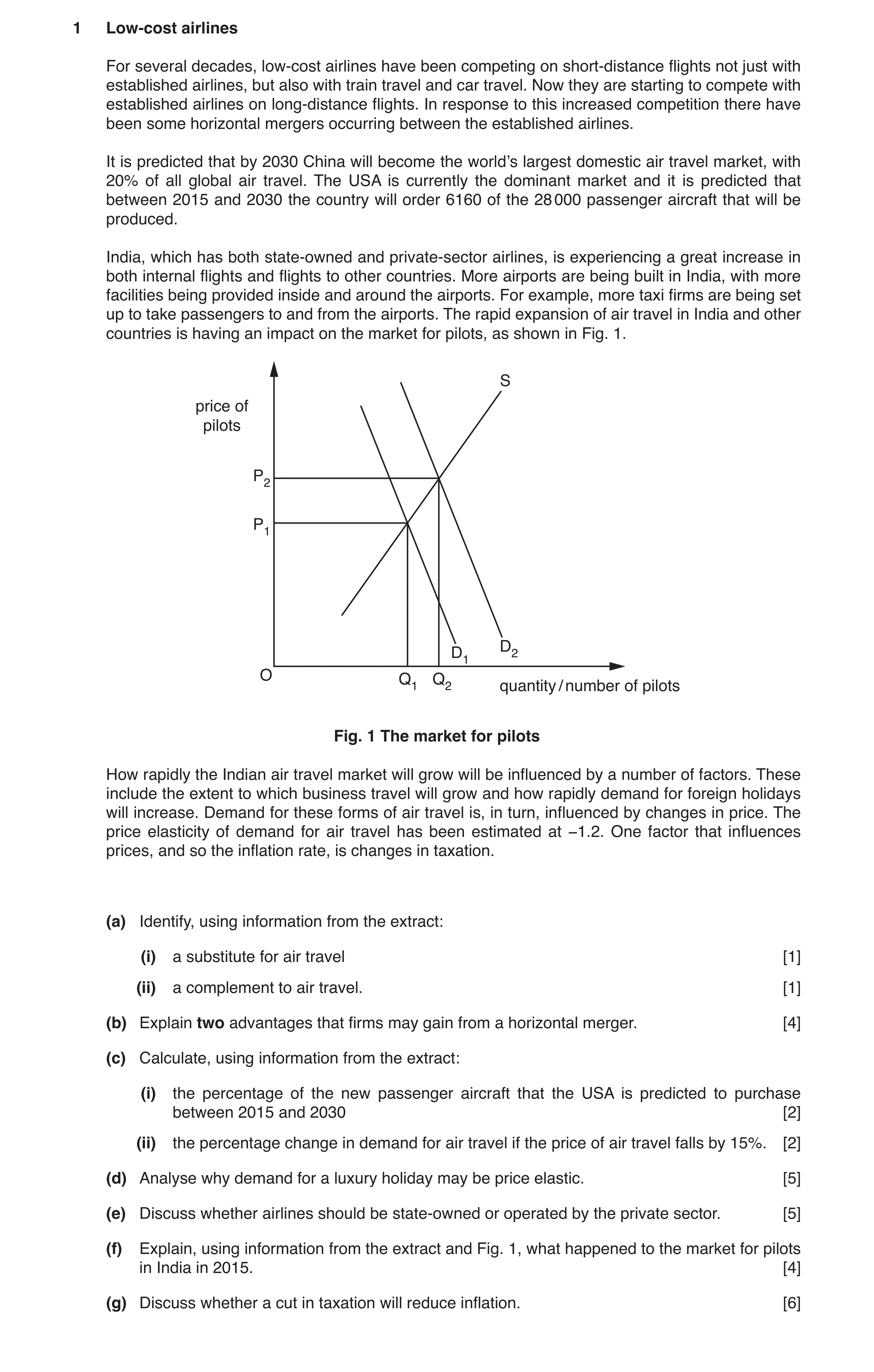
 2 / 13
 3 / 13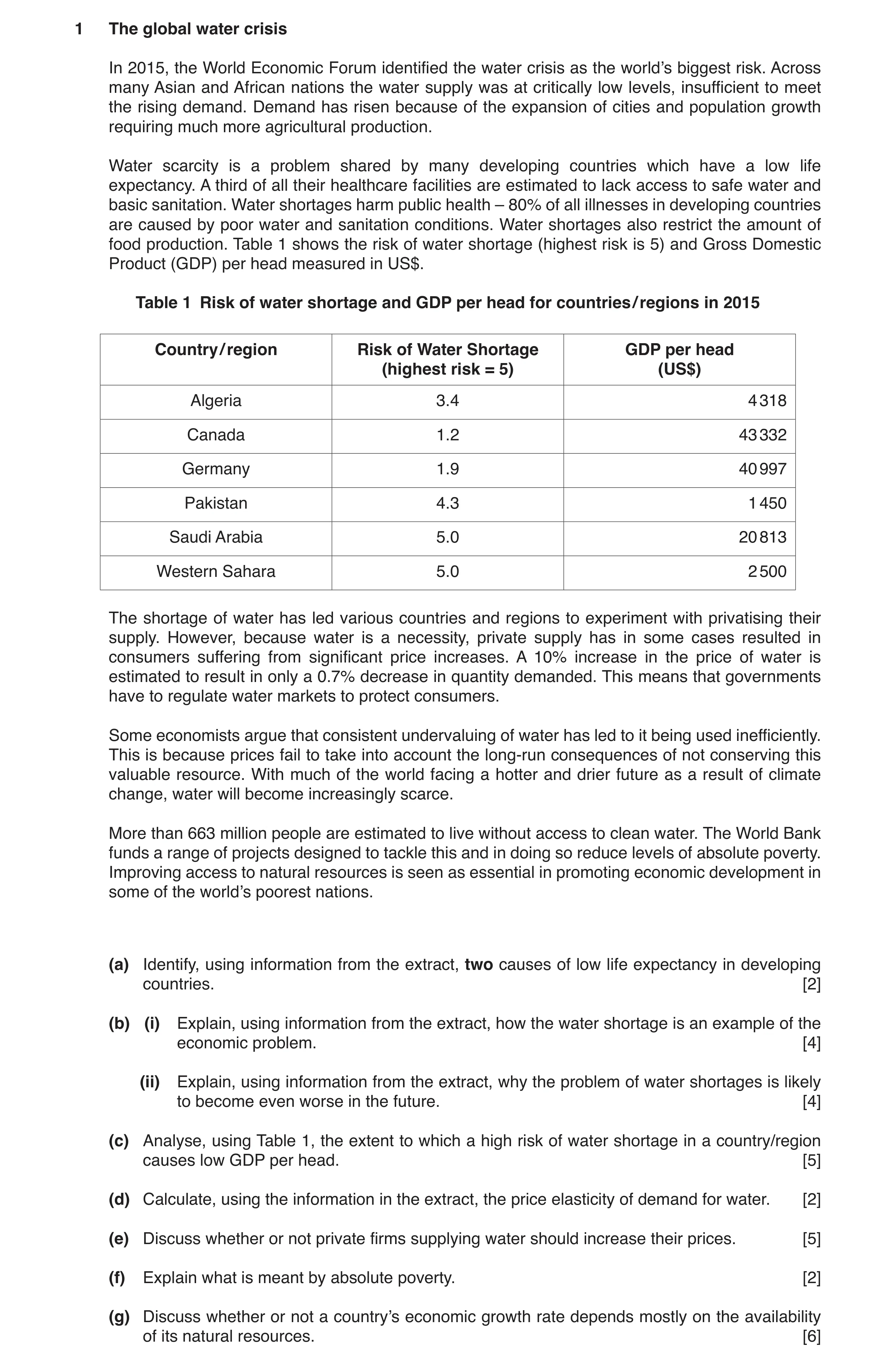
 4 / 13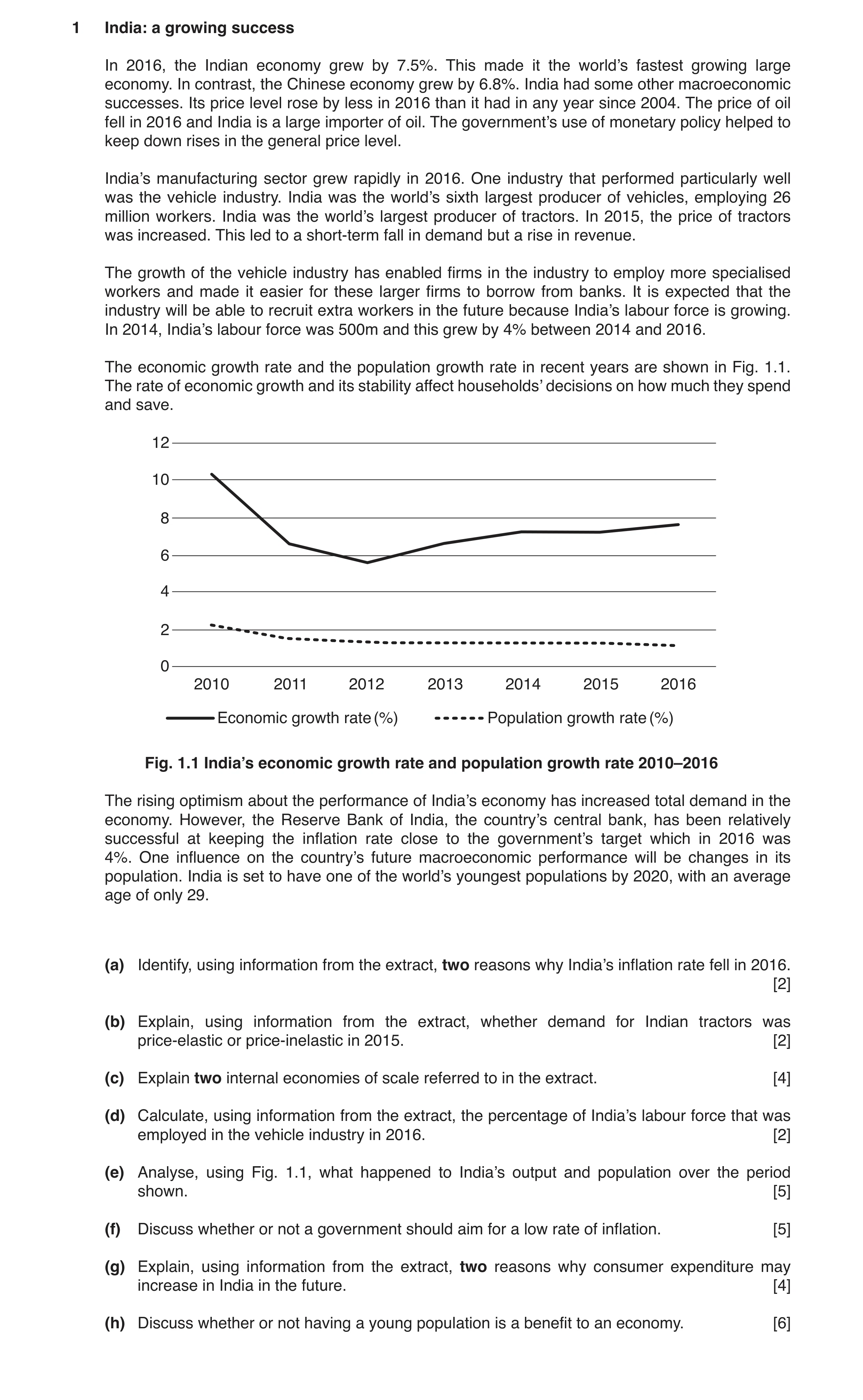
 6 / 13
 7 / 13
![Question 17: (a) Calculate Chile’s agricultural output in 2017. [1] (b) Identify two disadvantages of a country specialising. [2] (c) Explain one reason…](https://img.pastlit.com/crops/968265c6-2b58-4019-a37b-553bd7526ae7/q1.webp) 8 / 13
8 / 13
![Question 19: (a) Calculate the number of Bermudian workers who were unemployed in 2018. [1] (b) Identify two reasons why demand for holidays in Bermuda …](https://img.pastlit.com/crops/c0e68d91-70be-408e-9dd5-92967753d3fe/q1.webp)
 9 / 13
 10 / 13
![Question 24: (a) Calculate Montenegro’s budget deficit as a percentage of its GDP. [1] (b) Identify two examples of capital goods in Montenegro. [2] (c)…](https://img.pastlit.com/crops/0dfd2f47-cb48-4acc-8476-a69d8fdbfbf8/q1.webp)
![Question 26: (a) Calculate the price elasticity of demand for coffee. [1] (b) Identify two rewards to factors of production in Nicaragua. [2] (c) Explai…](https://img.pastlit.com/crops/cc53b0b9-ab3e-45e2-9ca1-51e8e106e99b/q1.webp) 11 / 13
11 / 13![Question 27: (a) Calculate the percentage of the population who were foreign nationals living in the UAE. [1] (b) Identify two features of globalisation…](https://img.pastlit.com/crops/7eea9f29-1b7b-4af3-bef9-c39a027dec63/q1.webp)
 12 / 13
 13 / 13
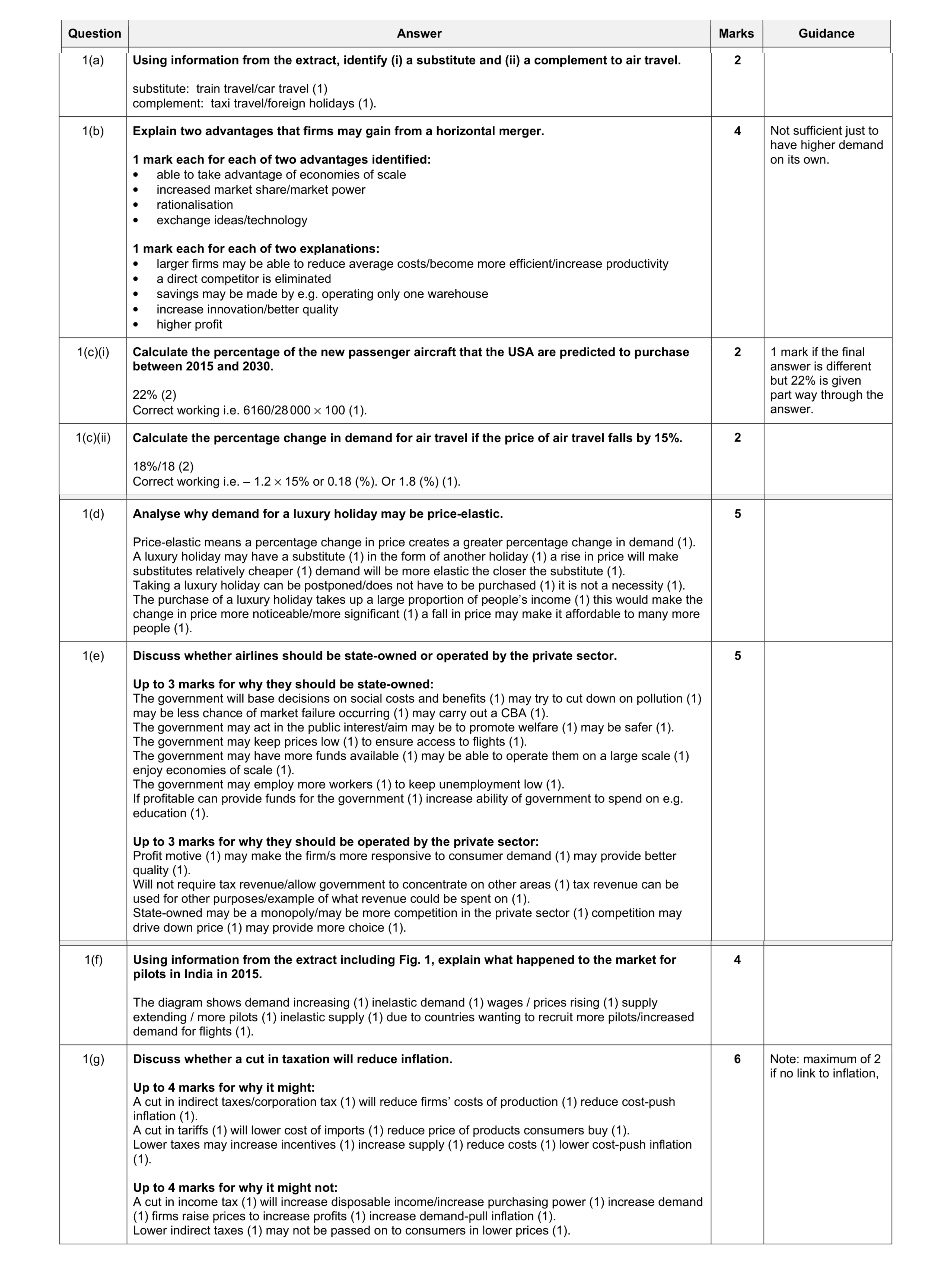 30
30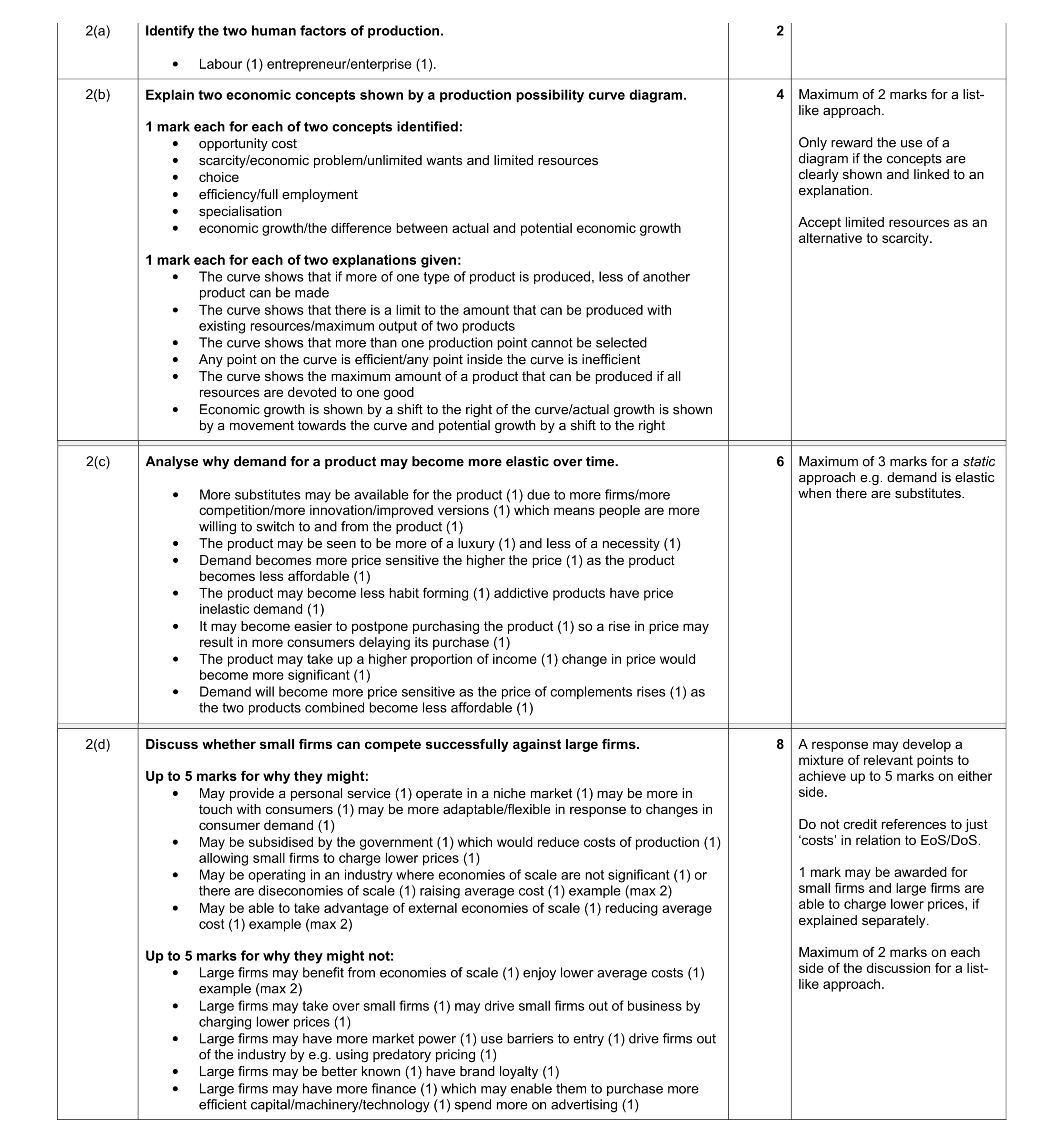 20
20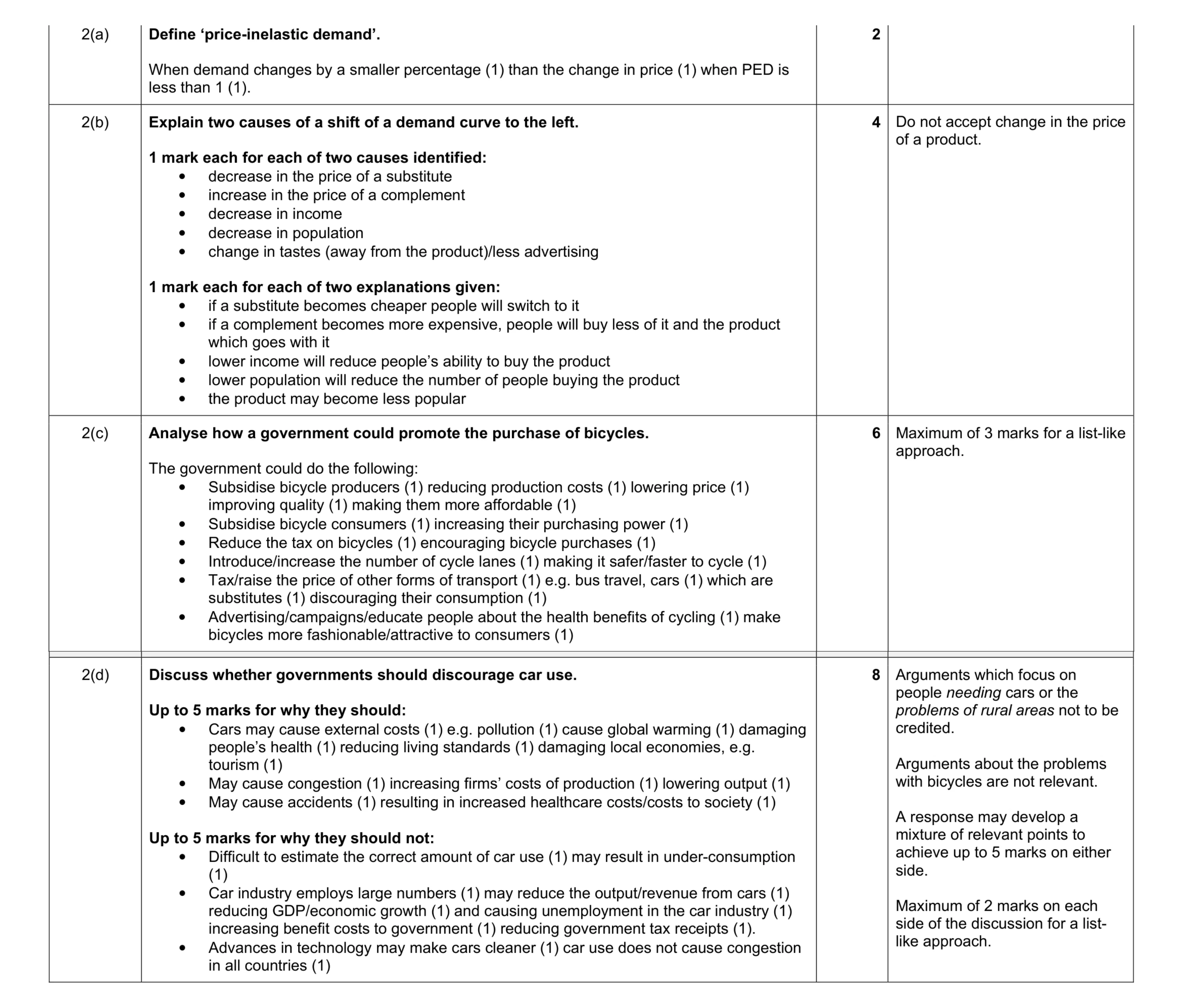 20
20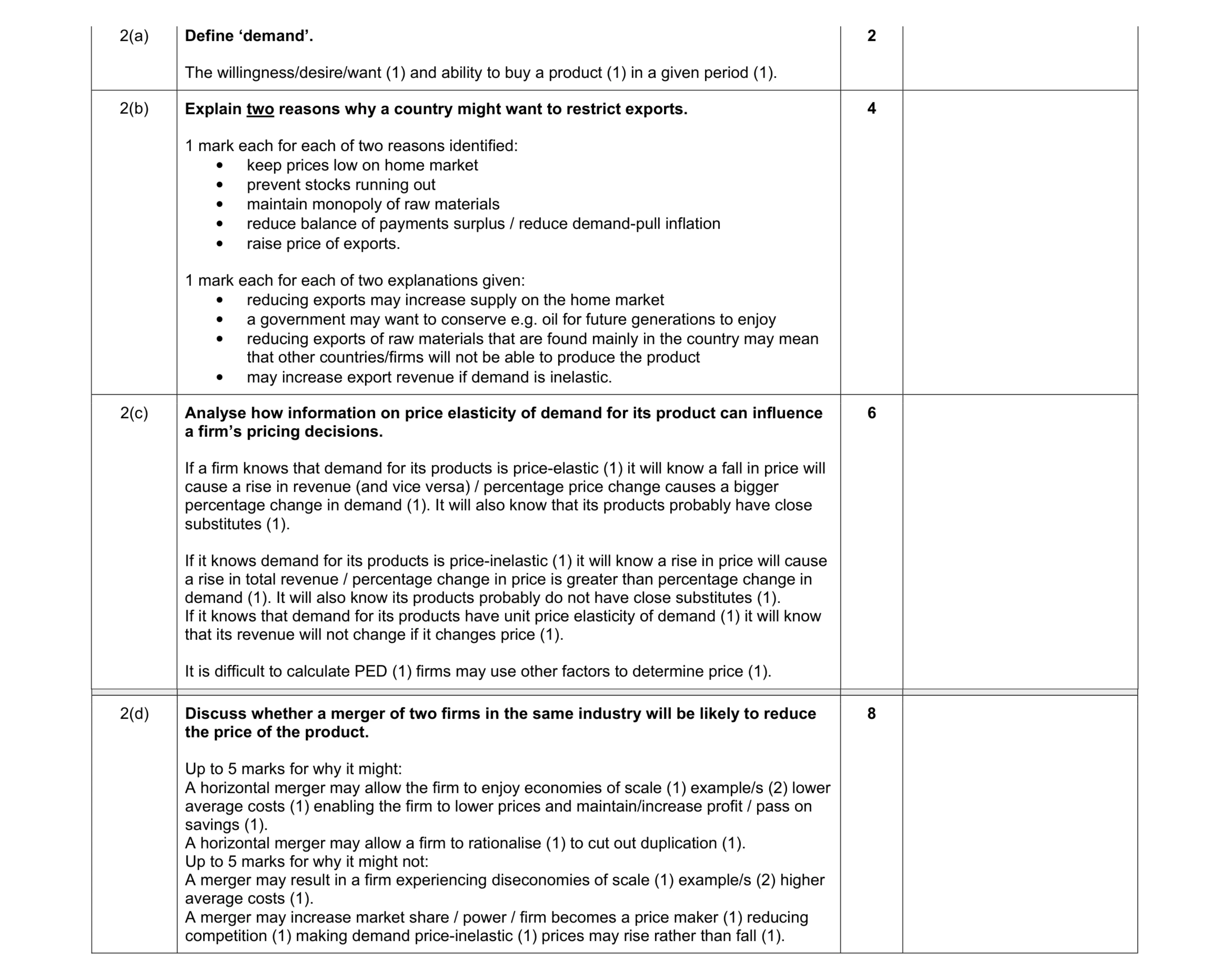 20
20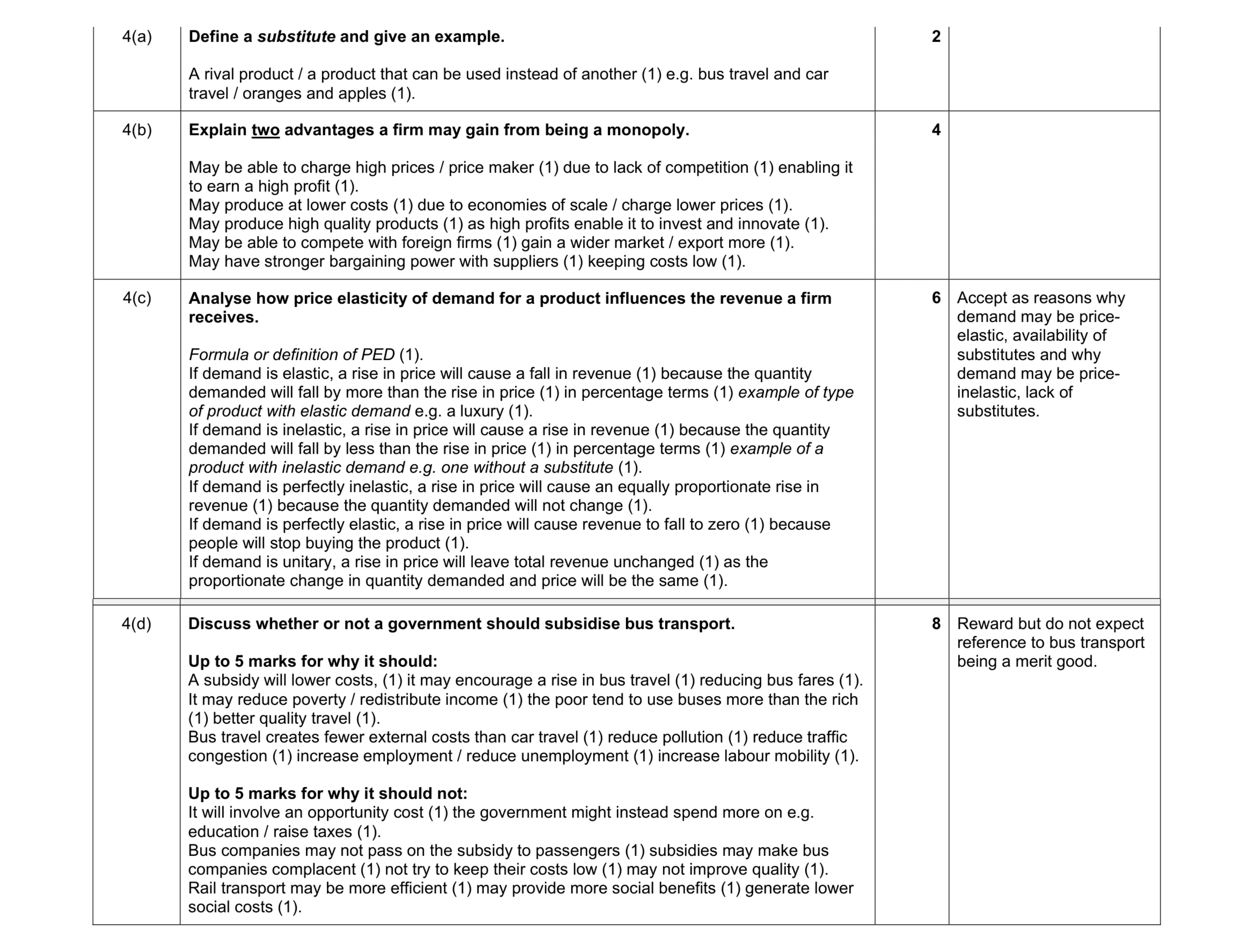 20
20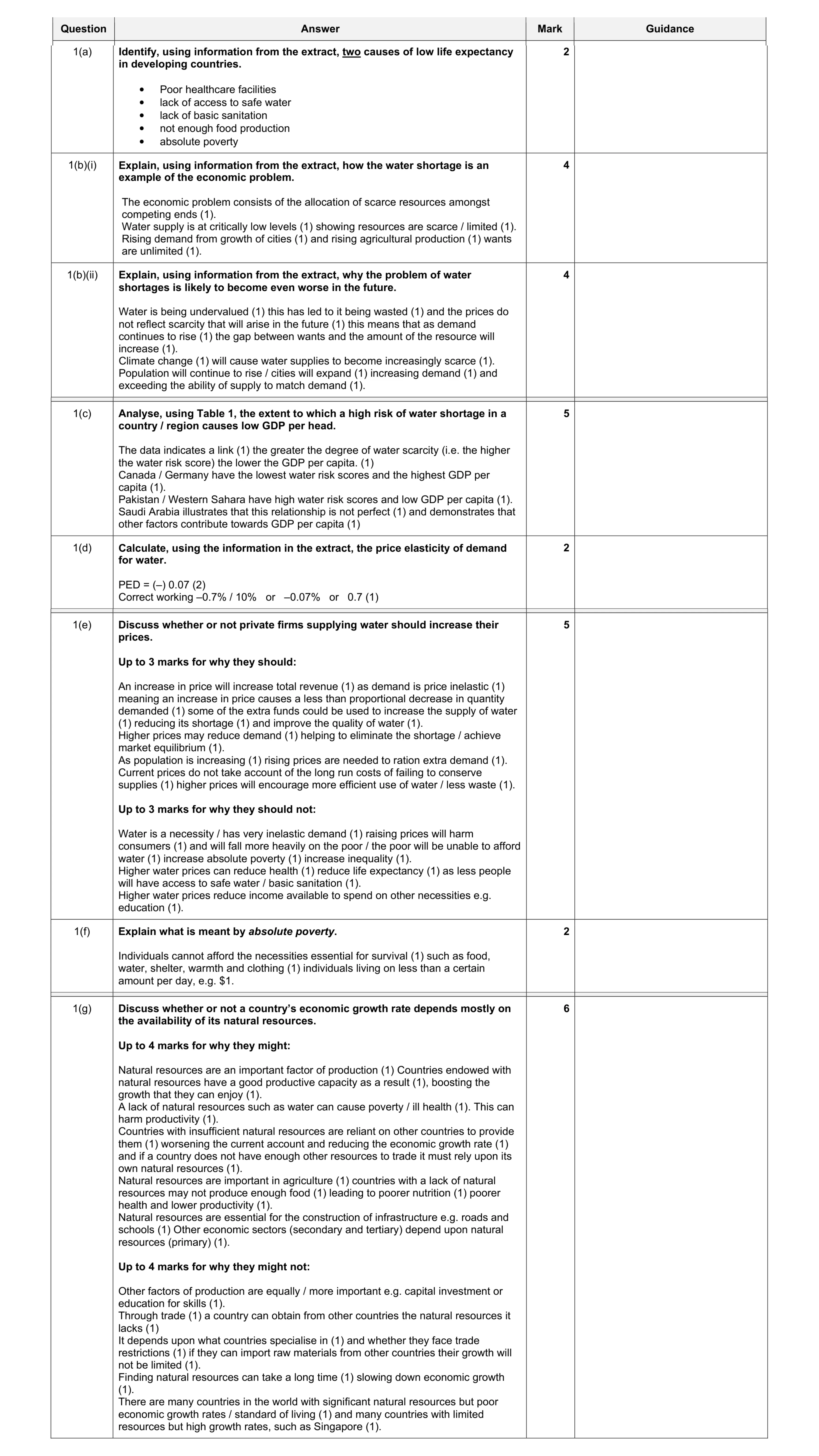 30
30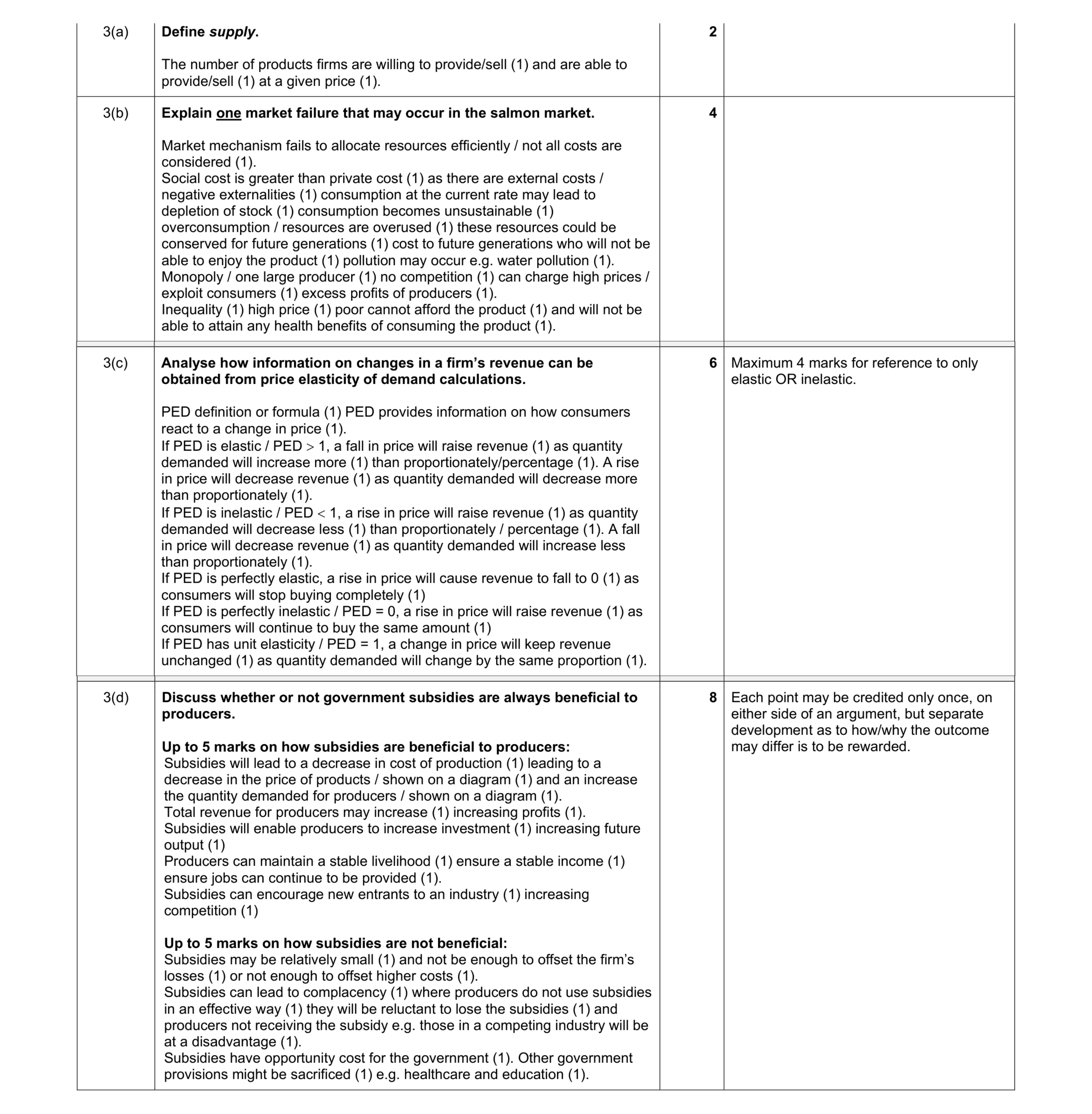 20
20 20
20 30
30 20
20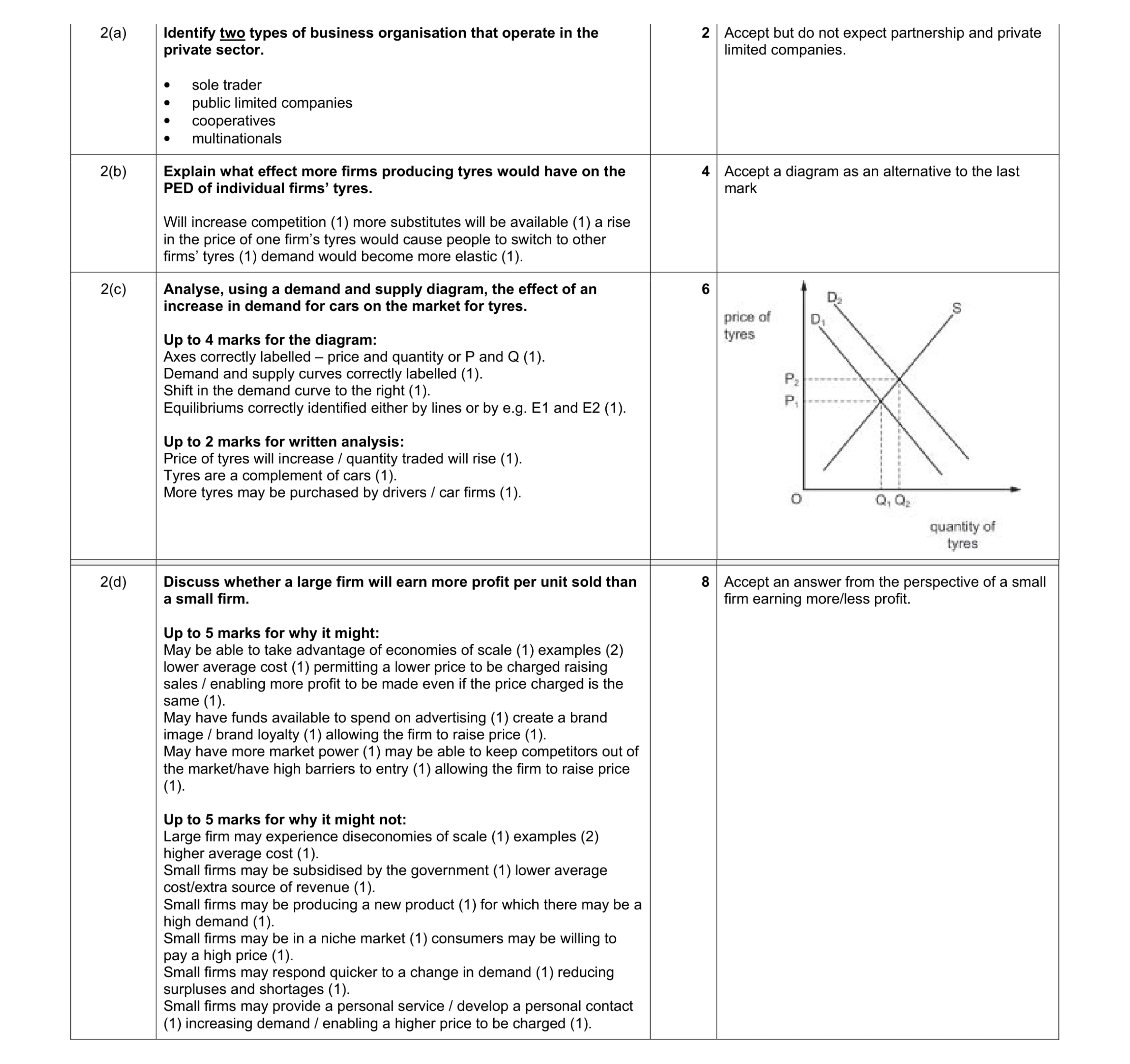 20
20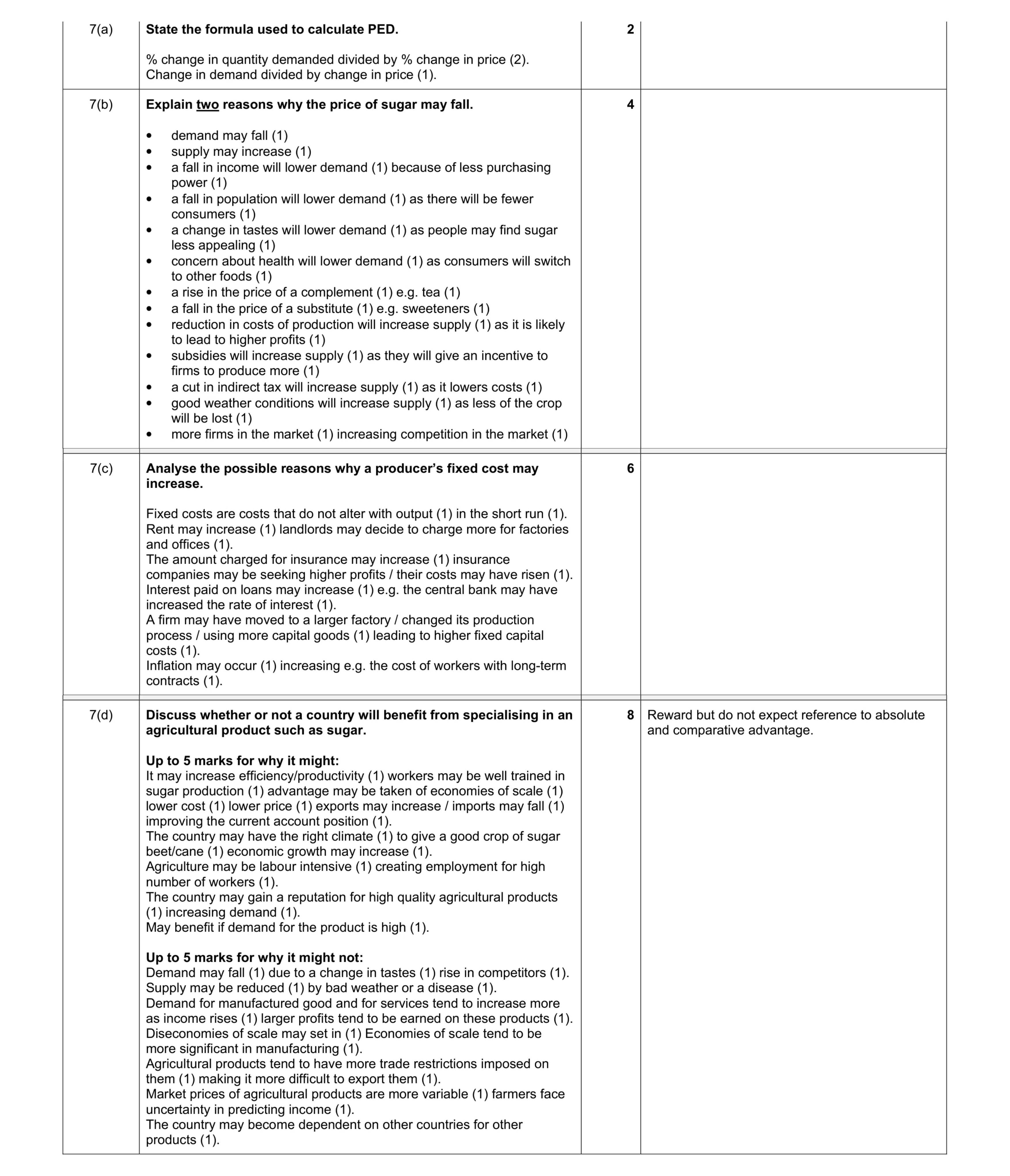 20
20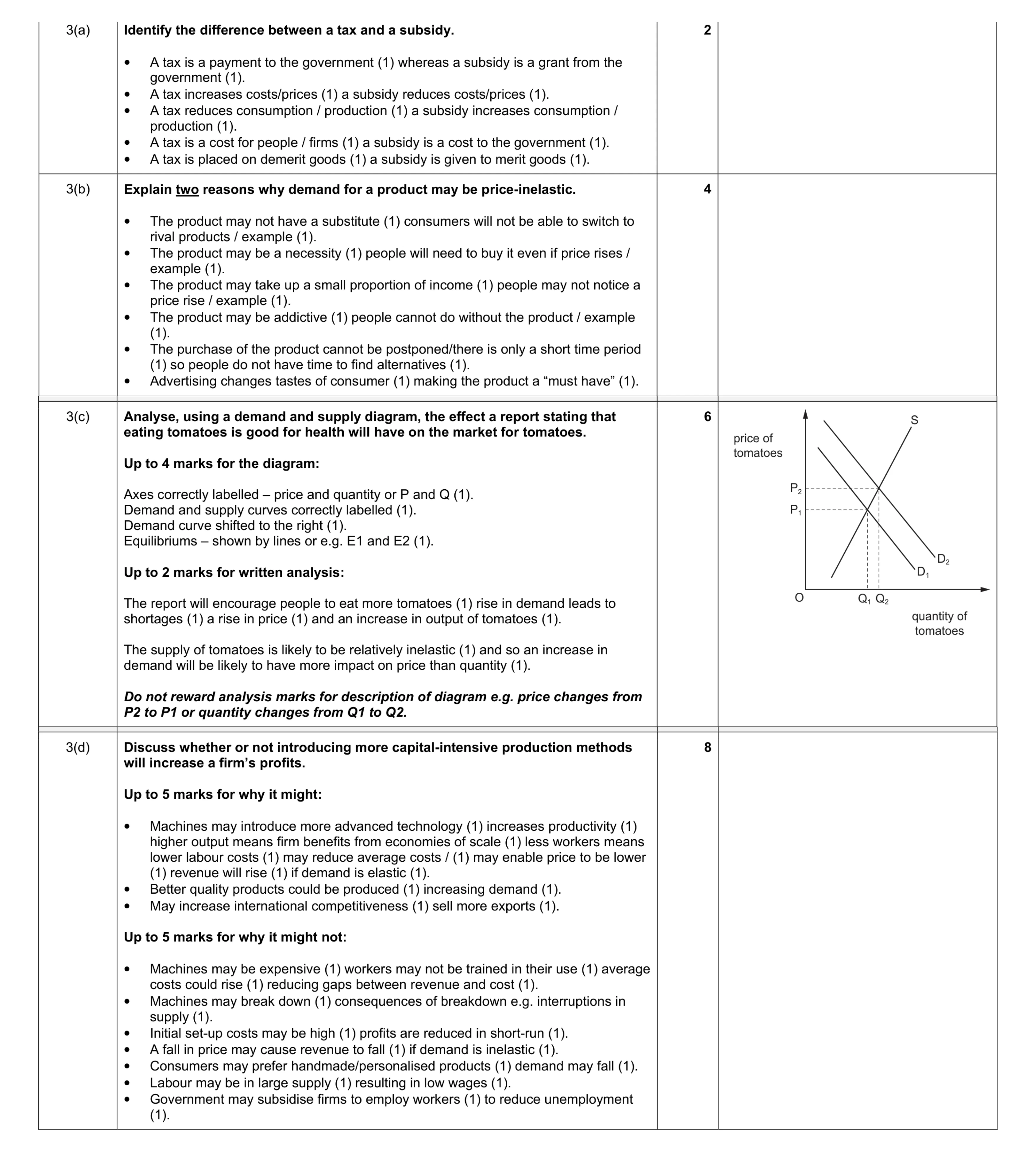 20
20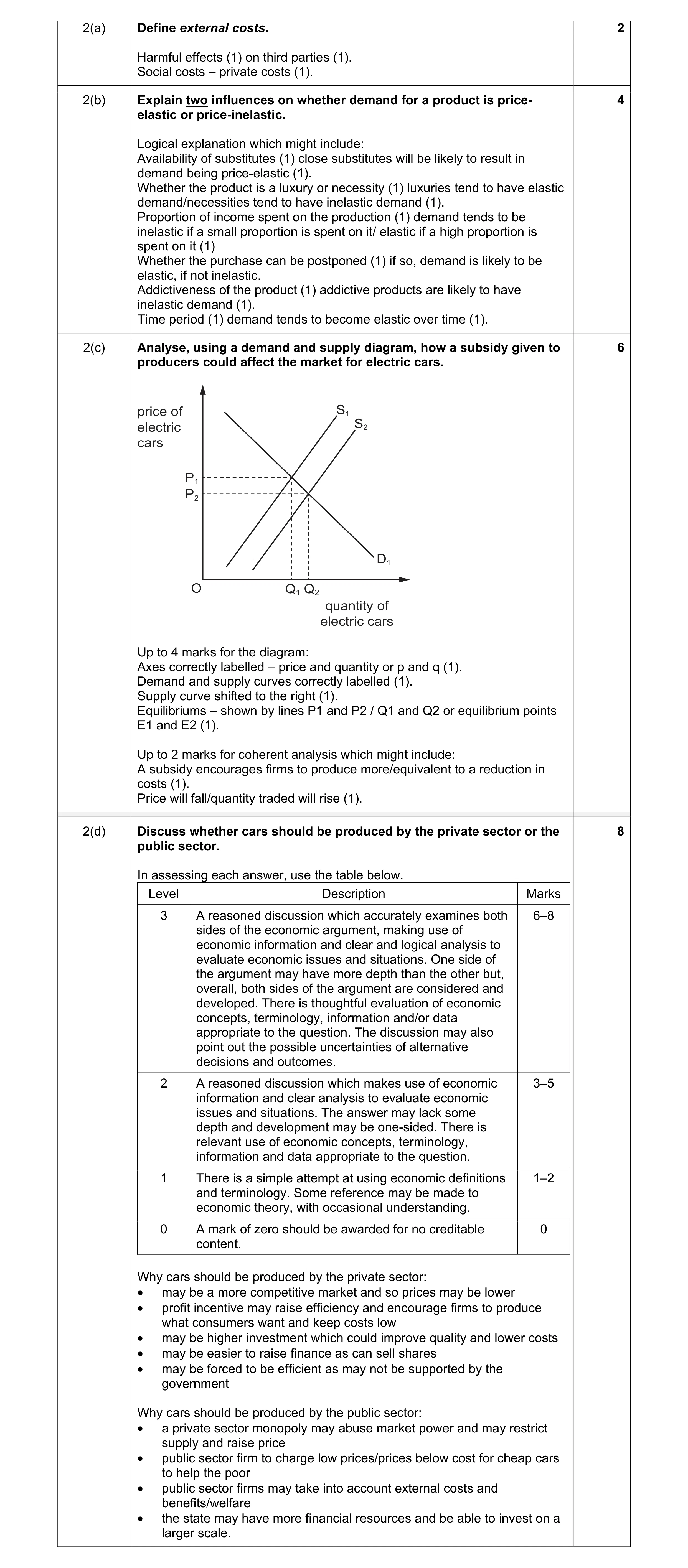 20
20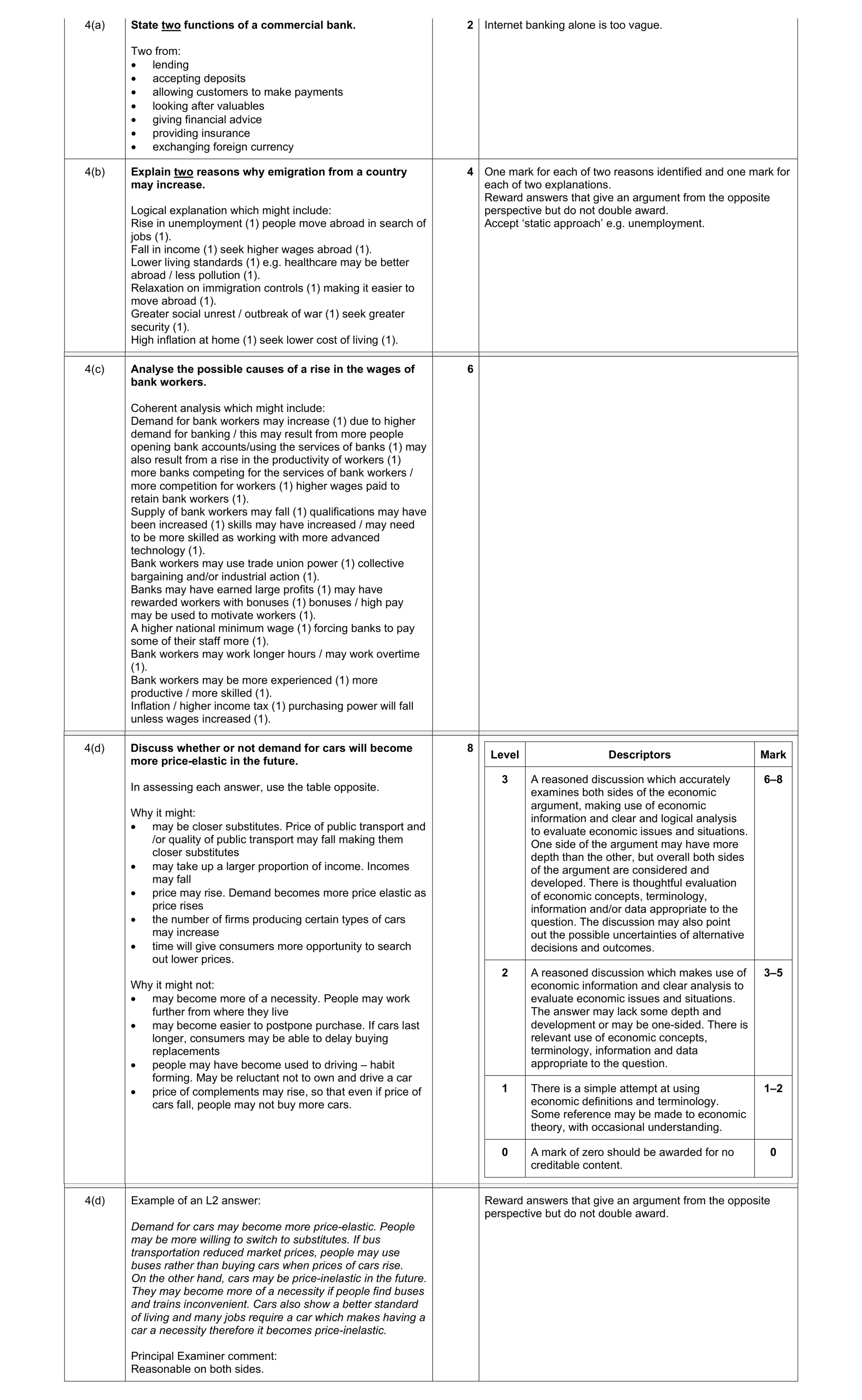 20
20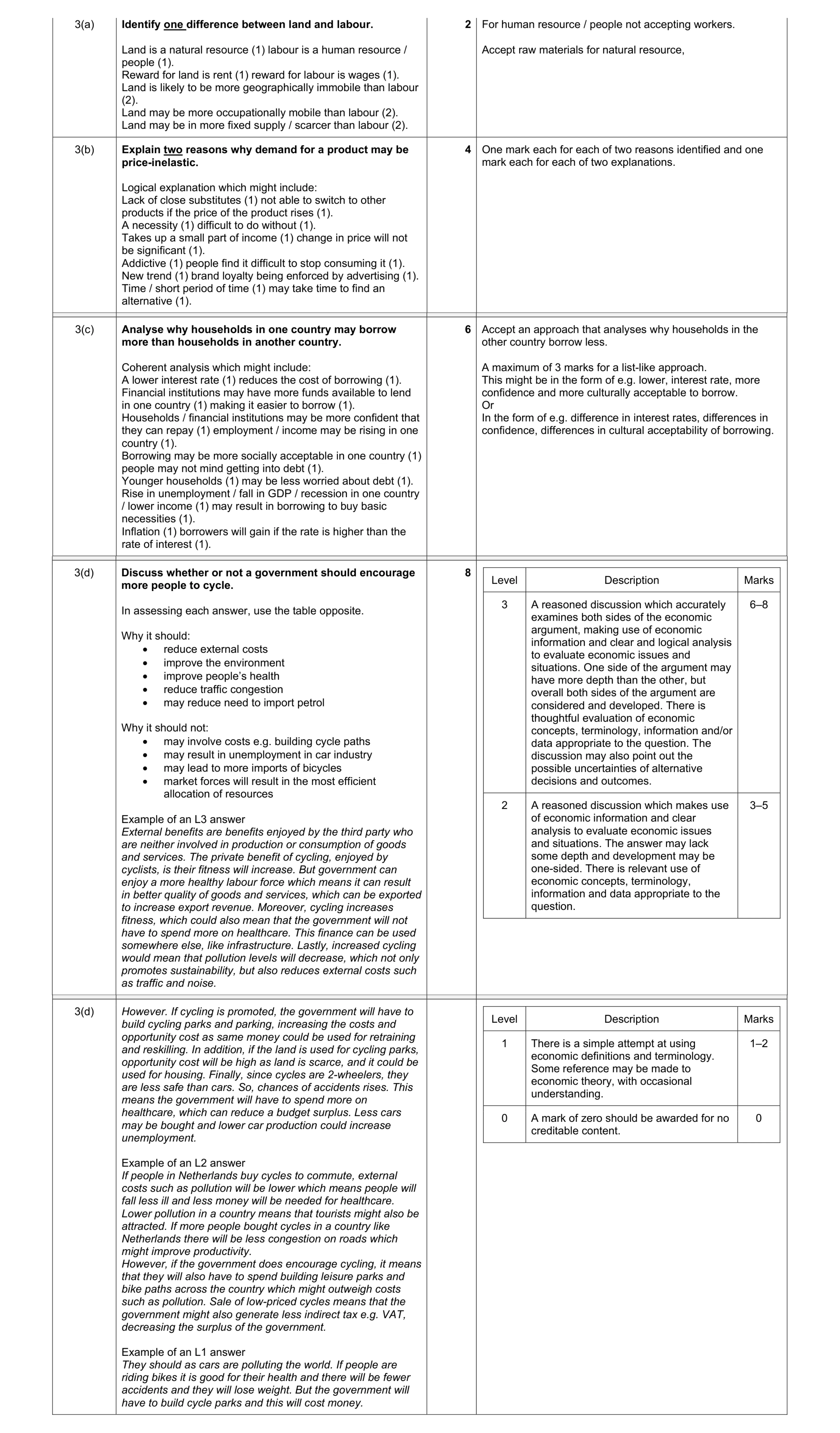 20
20 30
30 20
20 30
30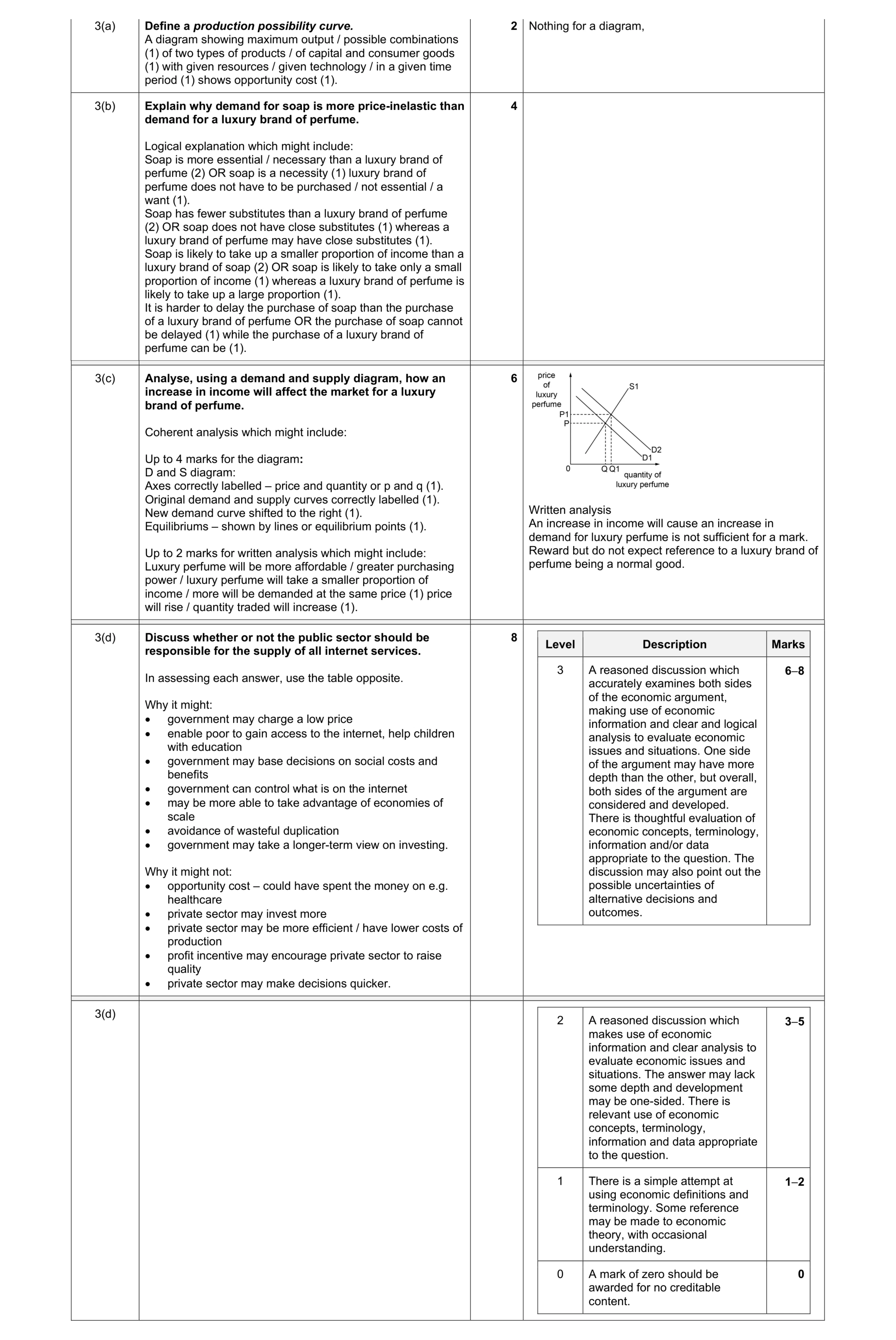 20
20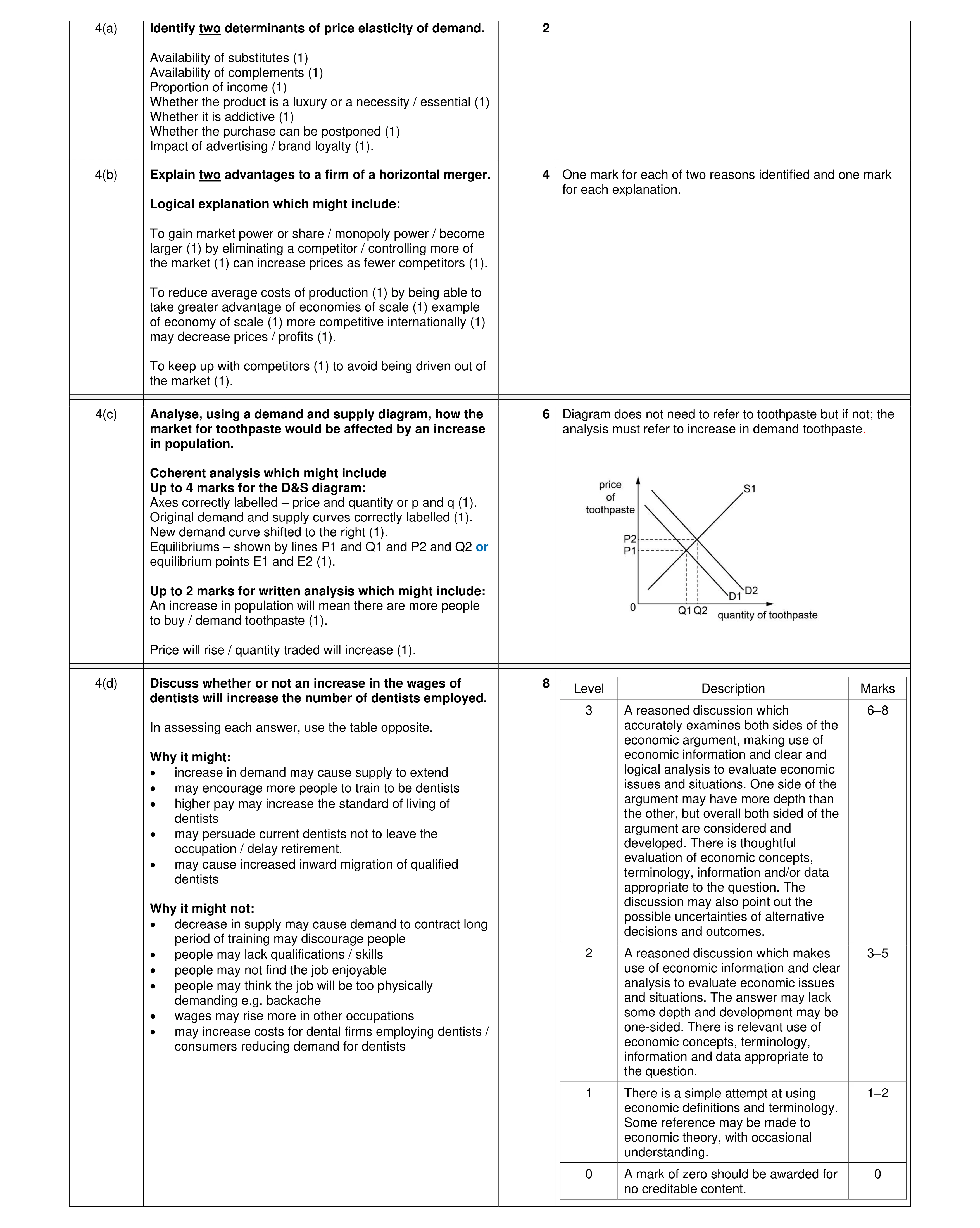 20
20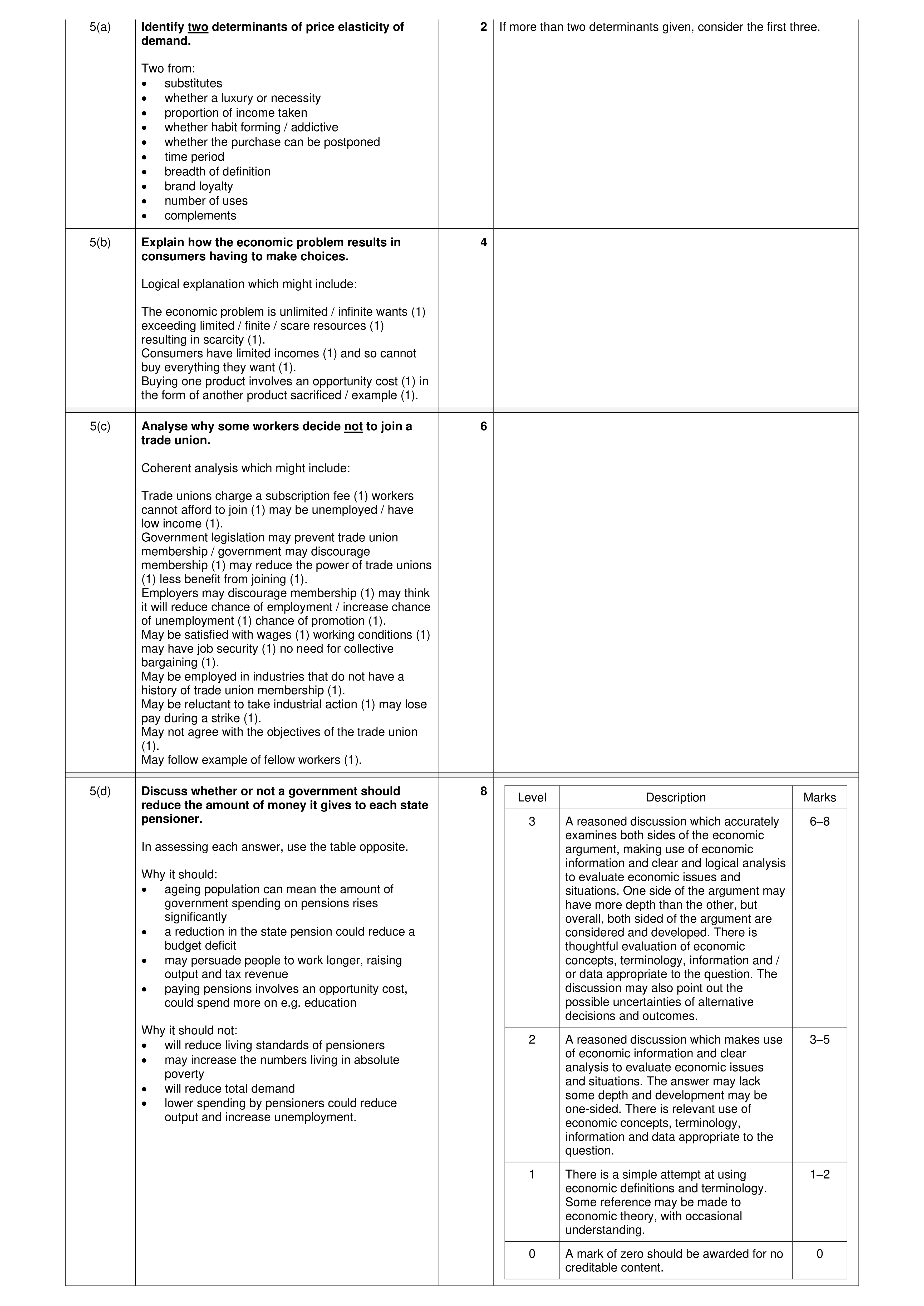 20
20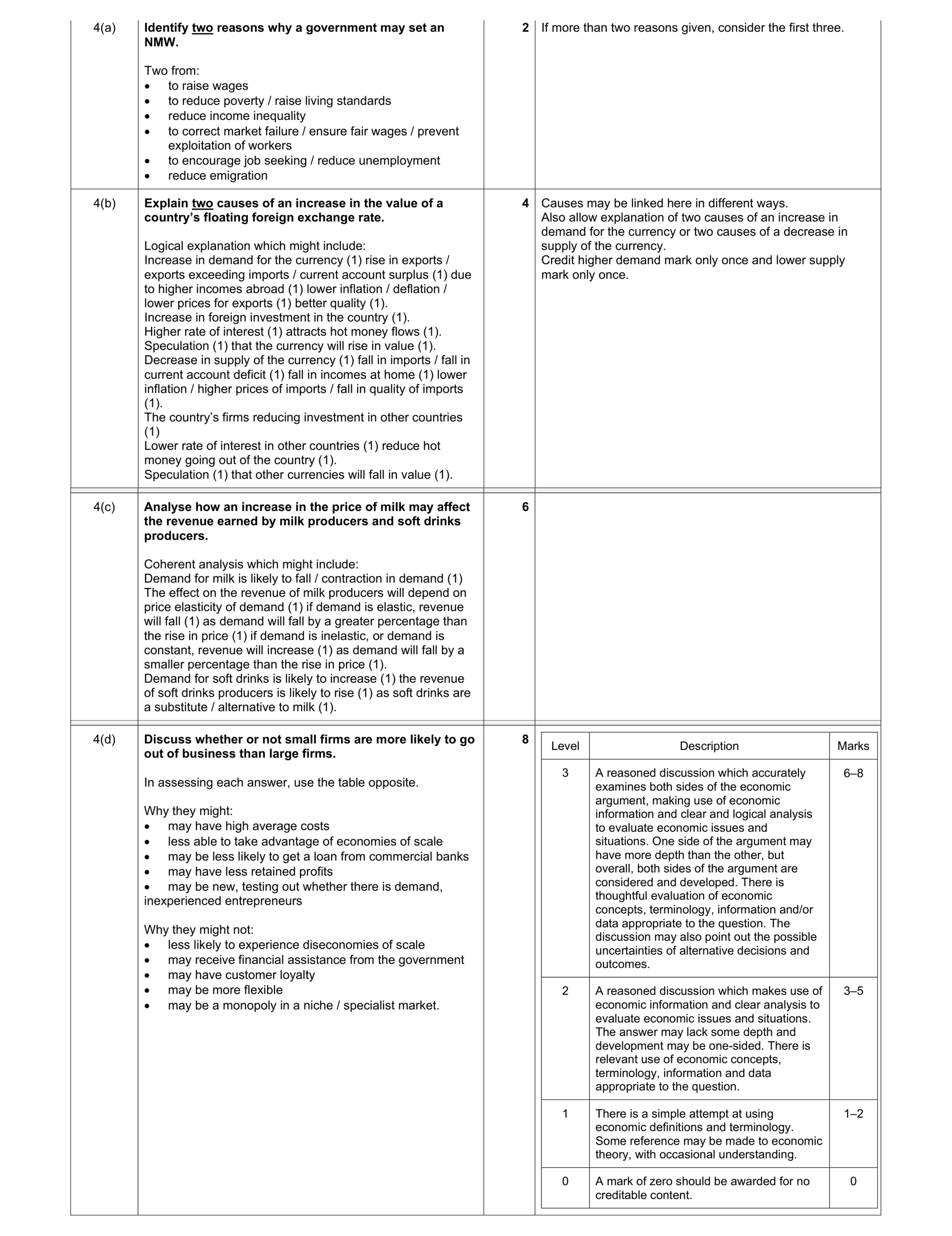 20
20 30
30 20
20 30
30 30
30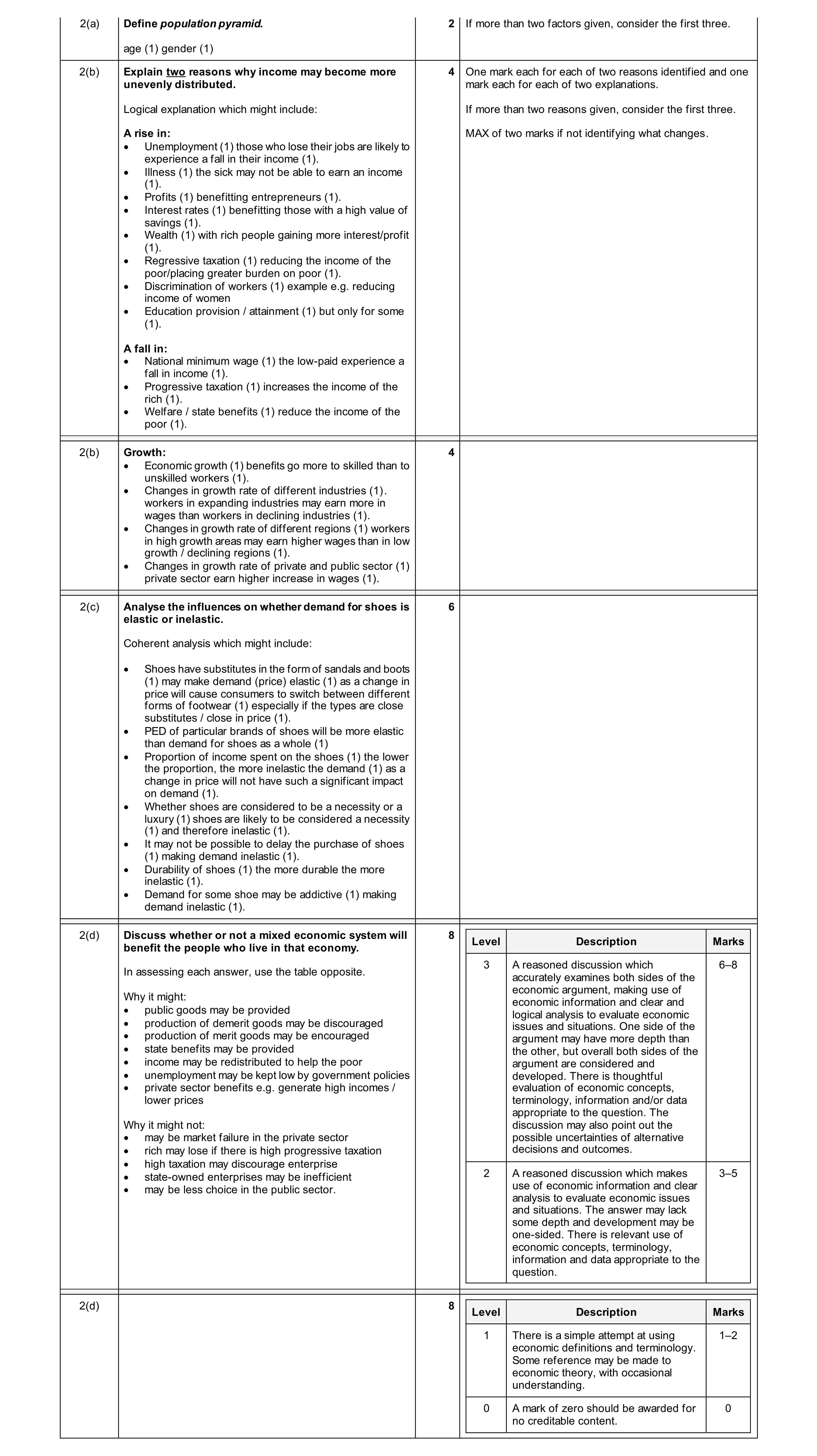 20
20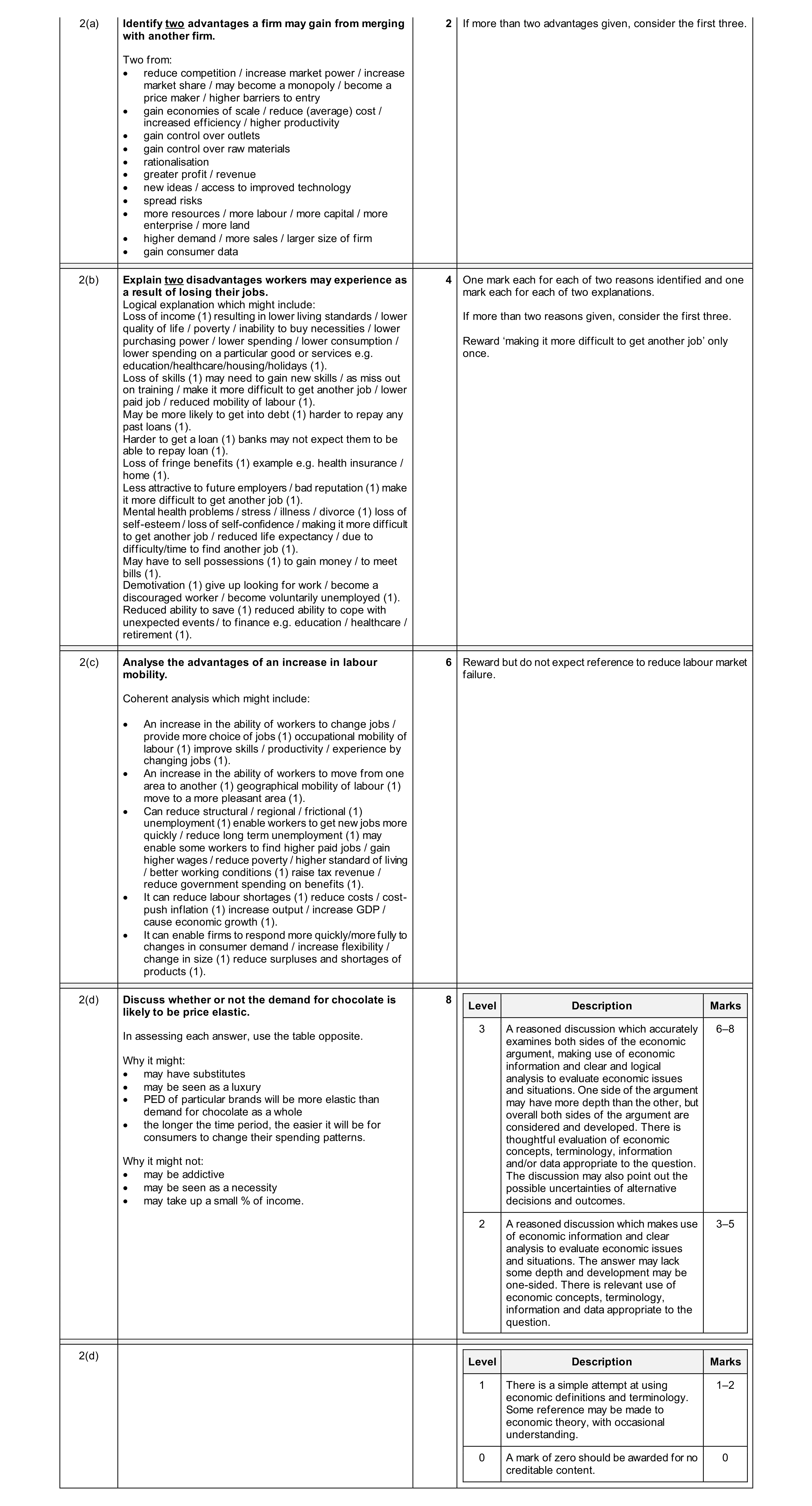 20
20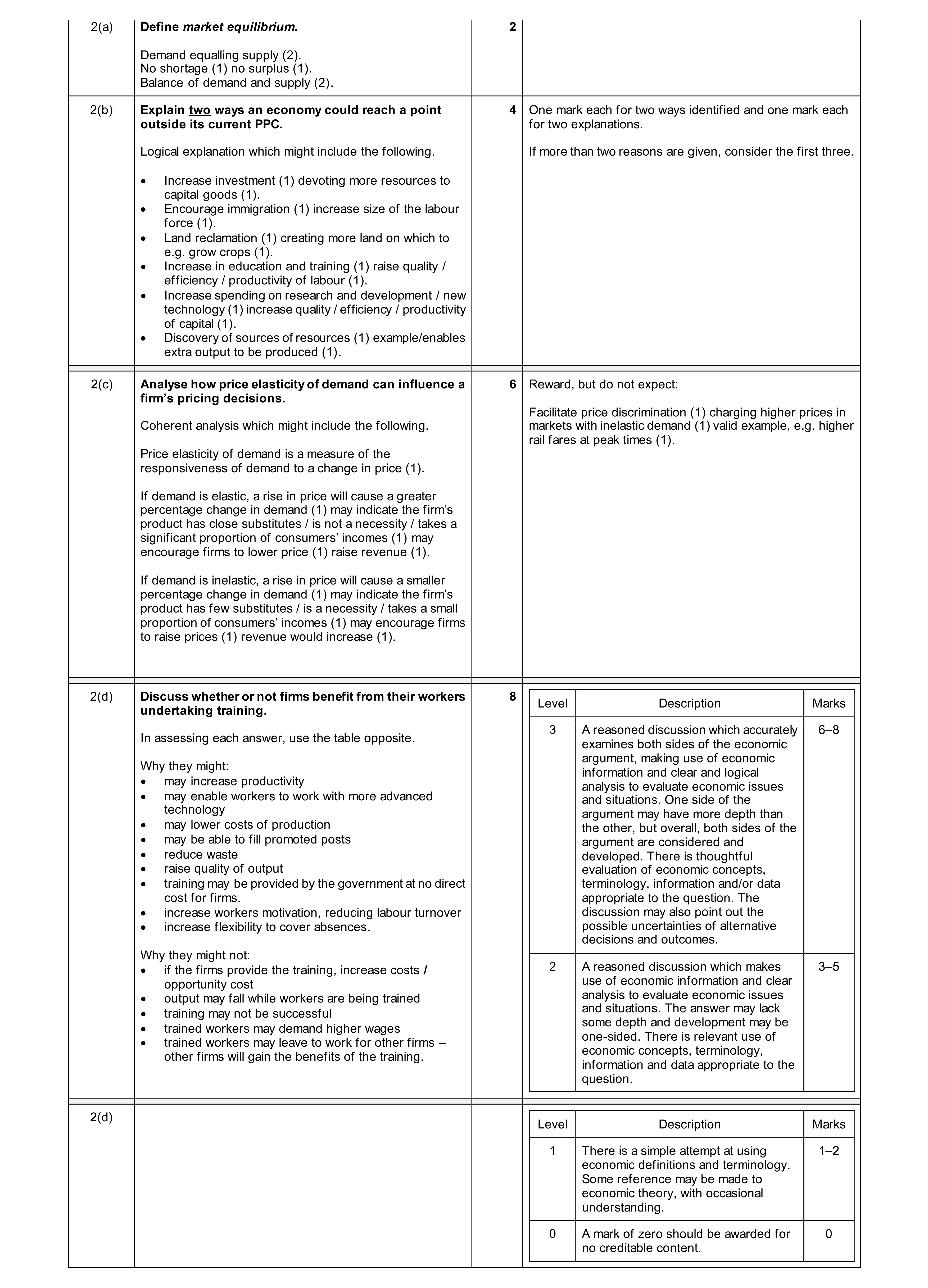 20
20