Cambridge IGCSE Economics 0455 — 2024 Oct/Nov Paper 2 · Variant 1
0455/21/O/N/24 · 5 questions · 90 marks · ≈101 min
The question paper and its mark scheme, free to read here and free to download. This is Cambridge’s own paper, exactly as it was sat.
Question paper8 pages
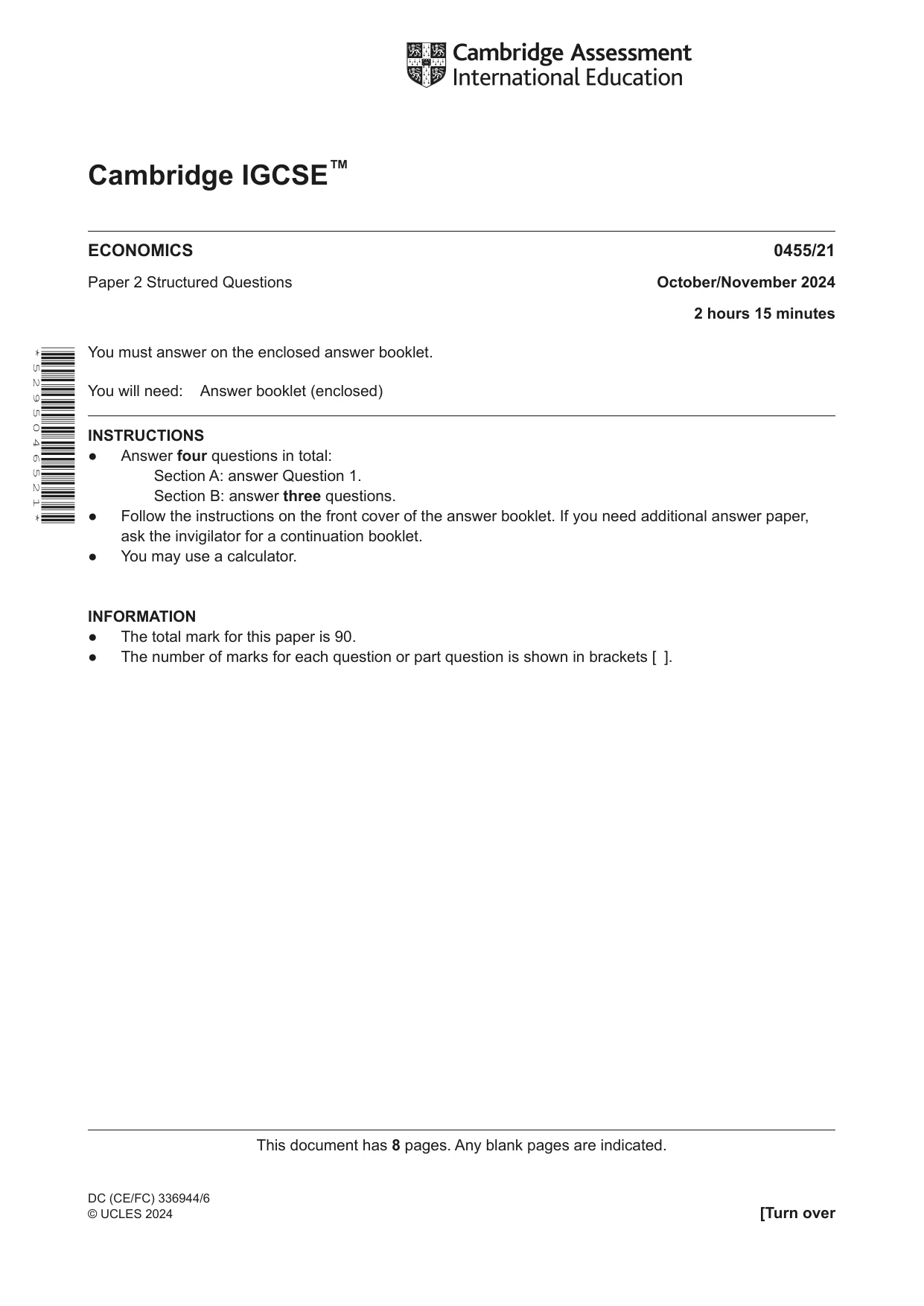




Mark scheme27 pages
Answers below. Sit the paper first if you are practising.



Questions as text
Q1 · Calculate the percentage of the population who were foreign nationals living in the UAE
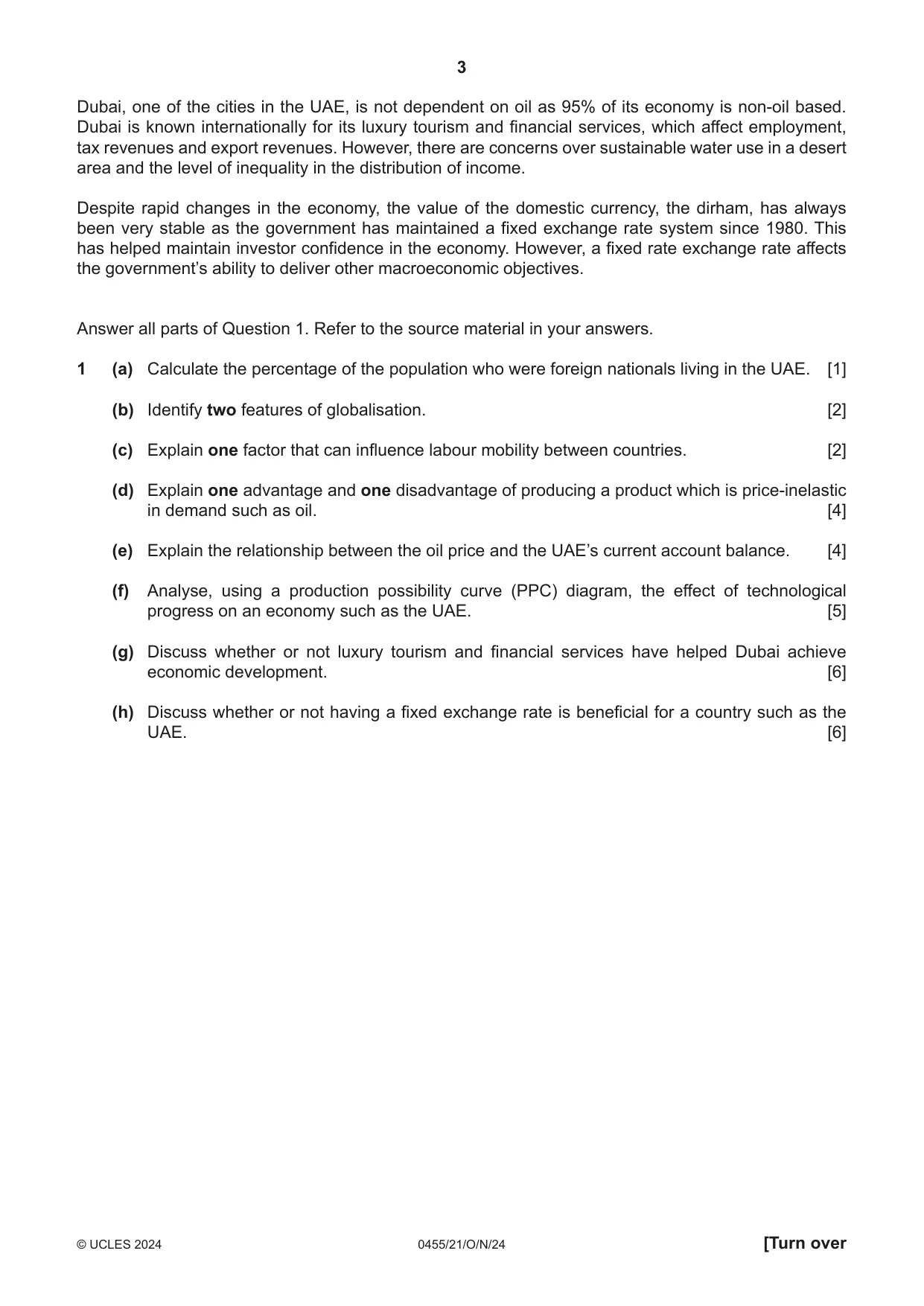
1 (a) Calculate the percentage of the population who were foreign nationals living in the UAE. [1] (b) Identify two features of globalisation. [2] (c) Explain one factor that can influence labour mobility between countries. [2] (d) Explain one advantage and one disadvantage of producing a product which is price-inelastic in demand such as oil. [4] (e) Explain the relationship between the oil price and the UAE’s current account balance. [4] (f) Analyse, using a production possibility curve (PPC) diagram, the effect of technological progress on an economy such as the UAE. [5] (g) Discuss whether or not luxury tourism and financial services have helped Dubai achieve economic development. [6] (h) Discuss whether or not having a fixed exchange rate is beneficial for a country such as the UAE. [6]
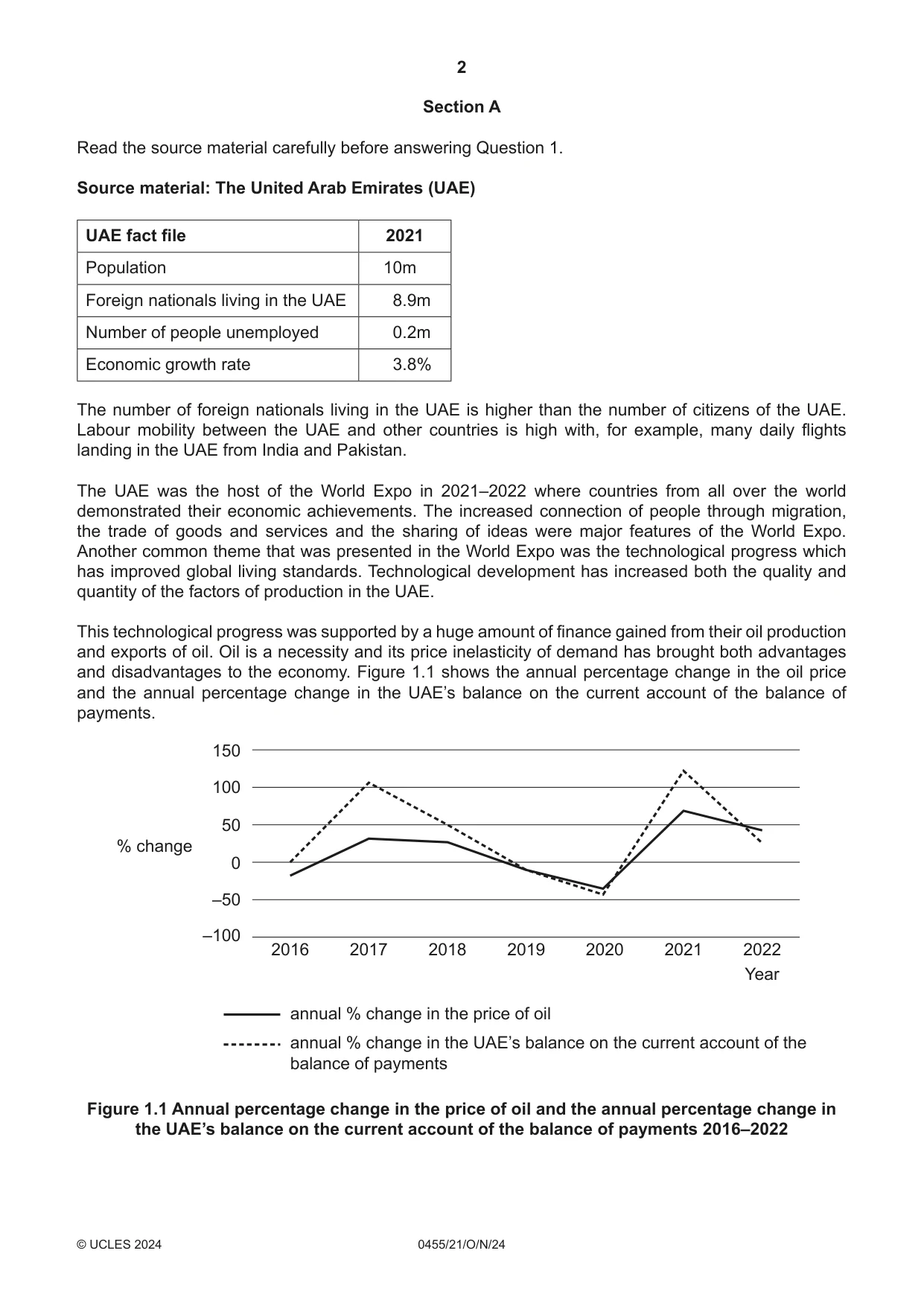
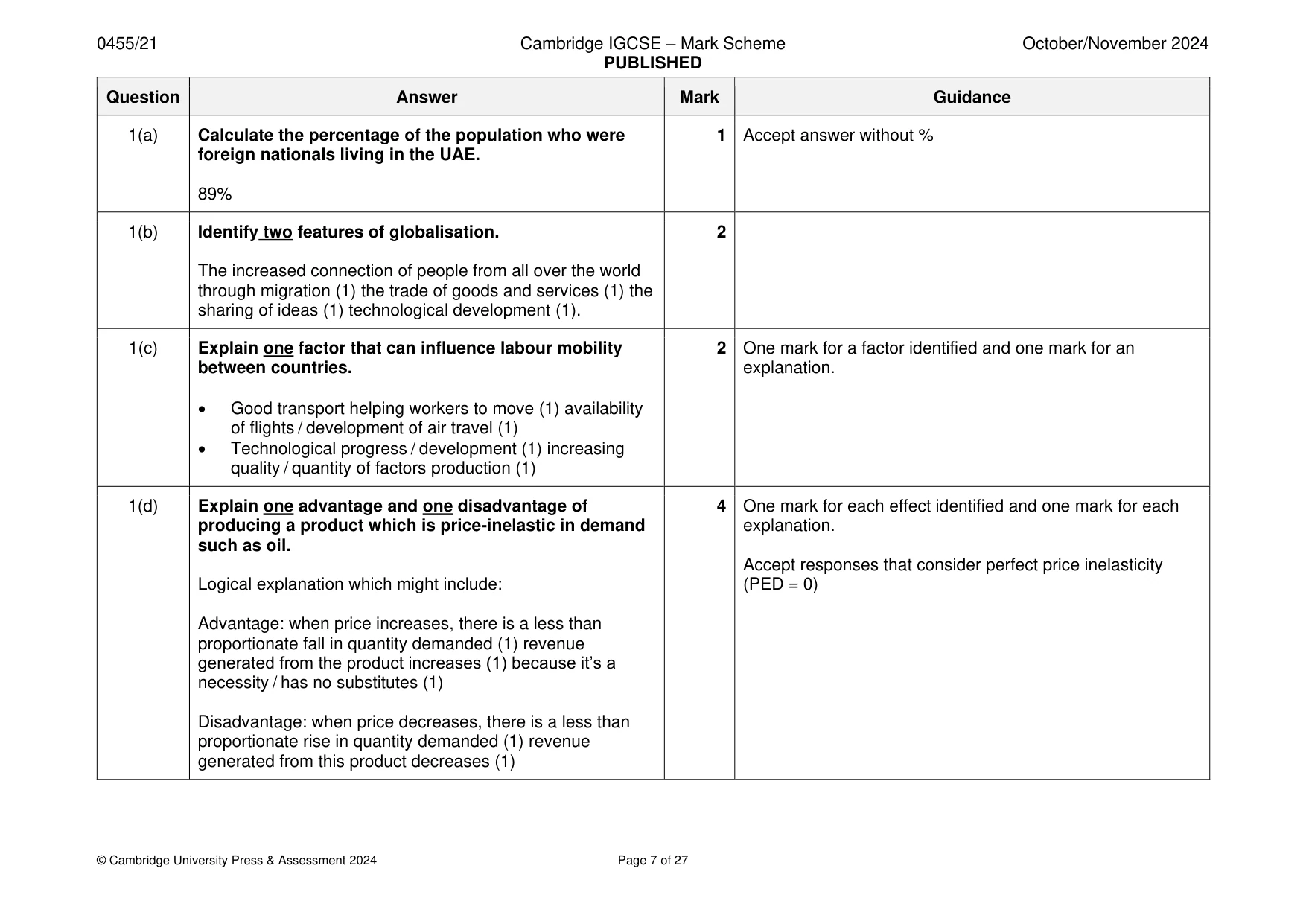
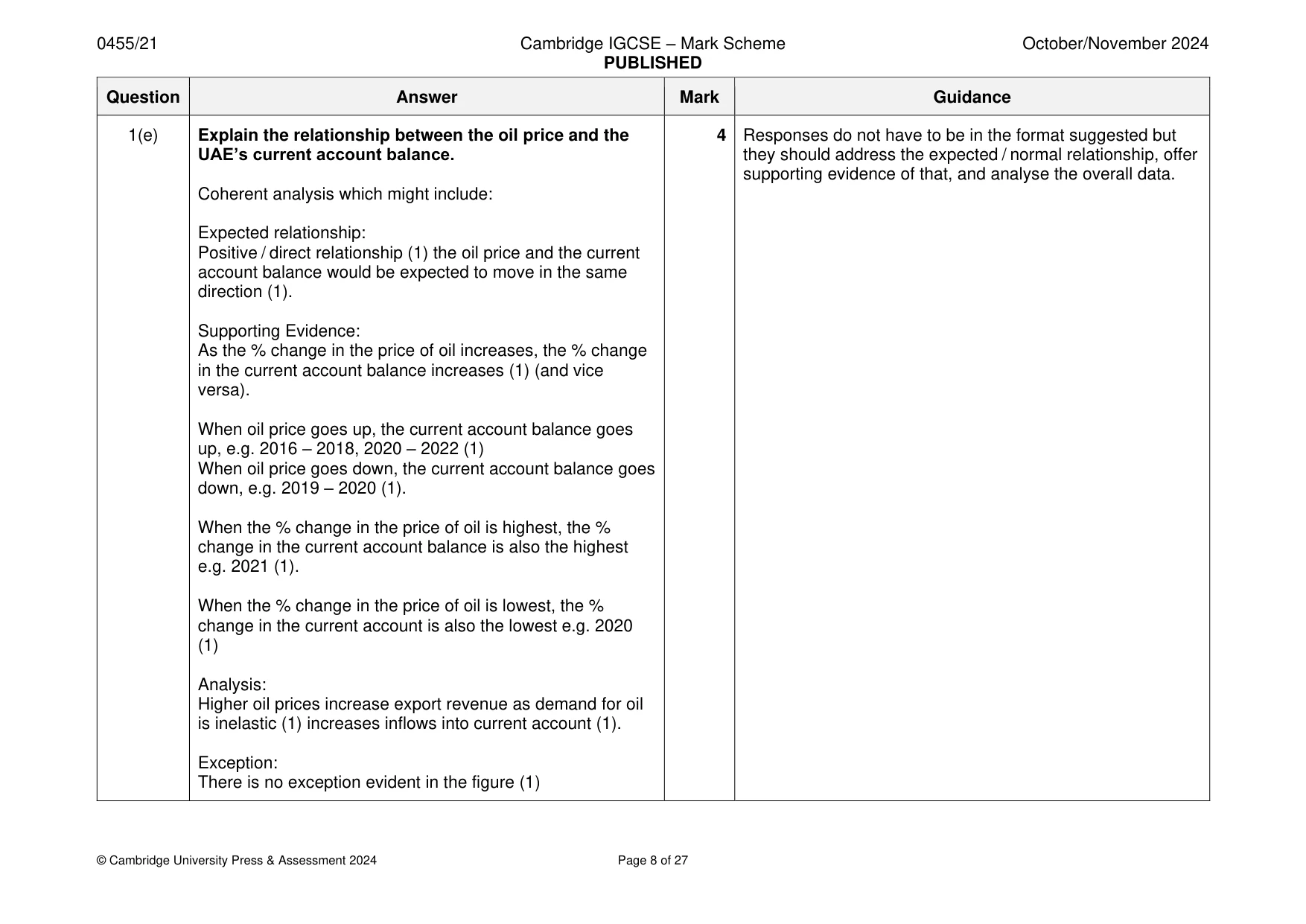
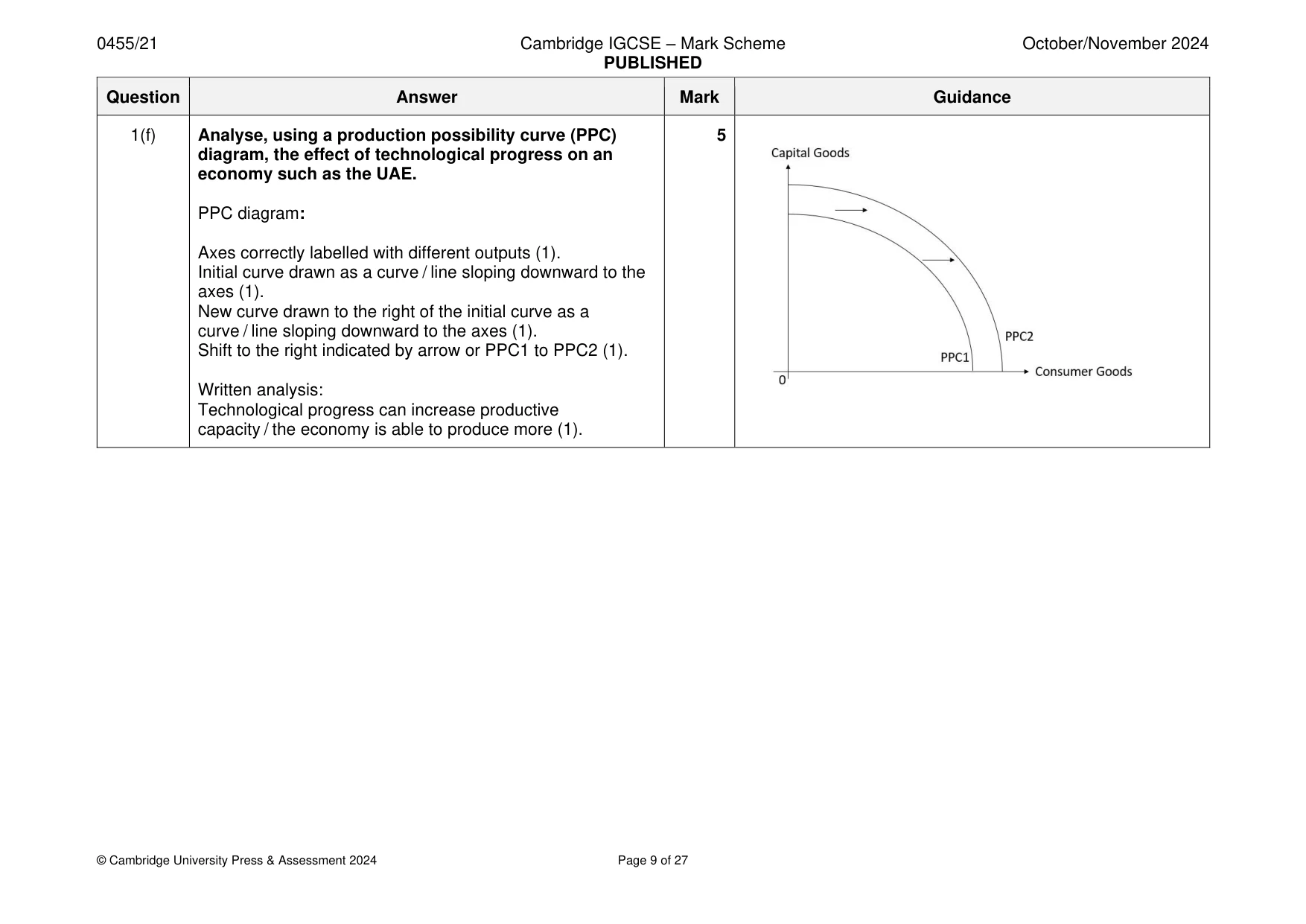
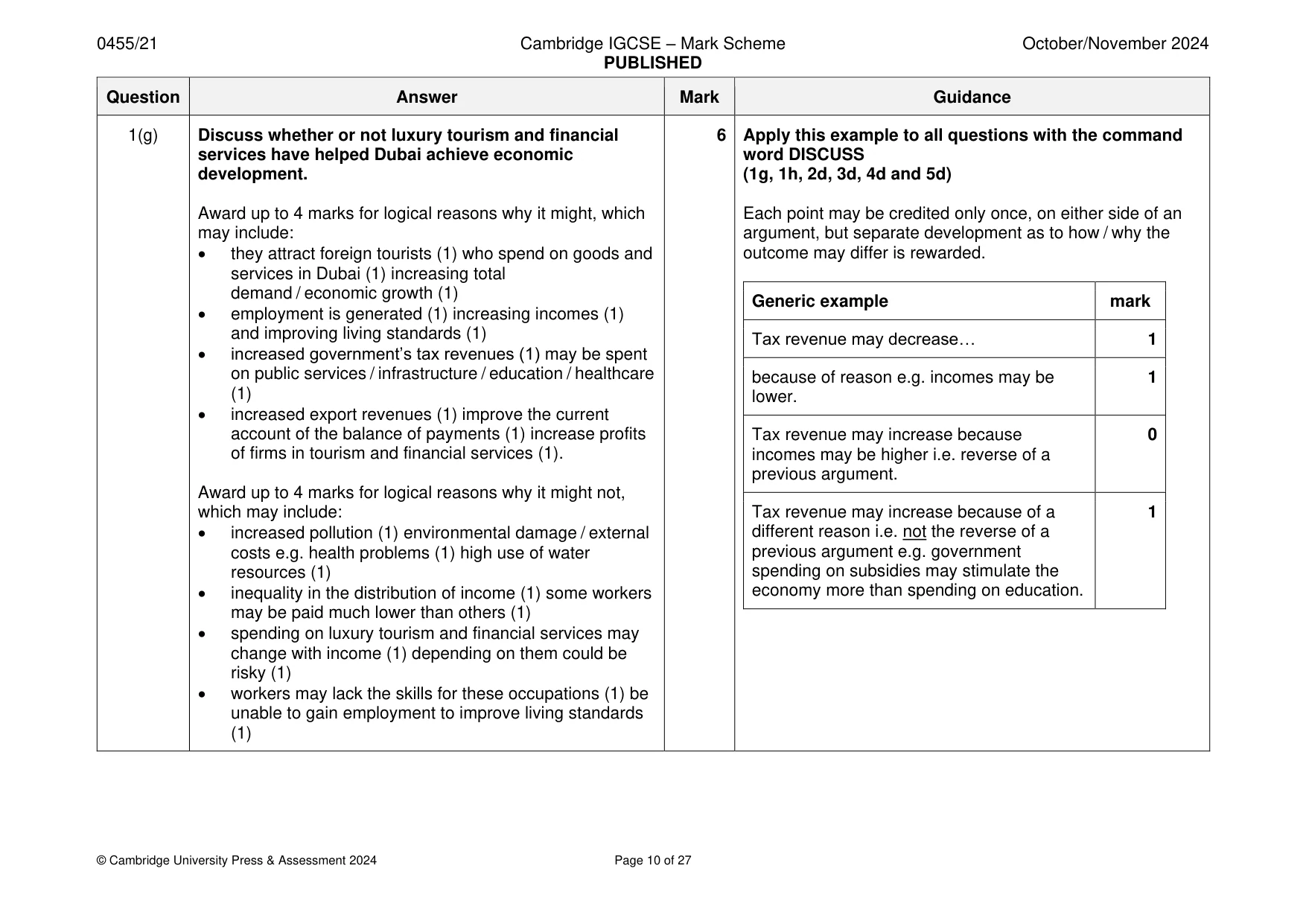
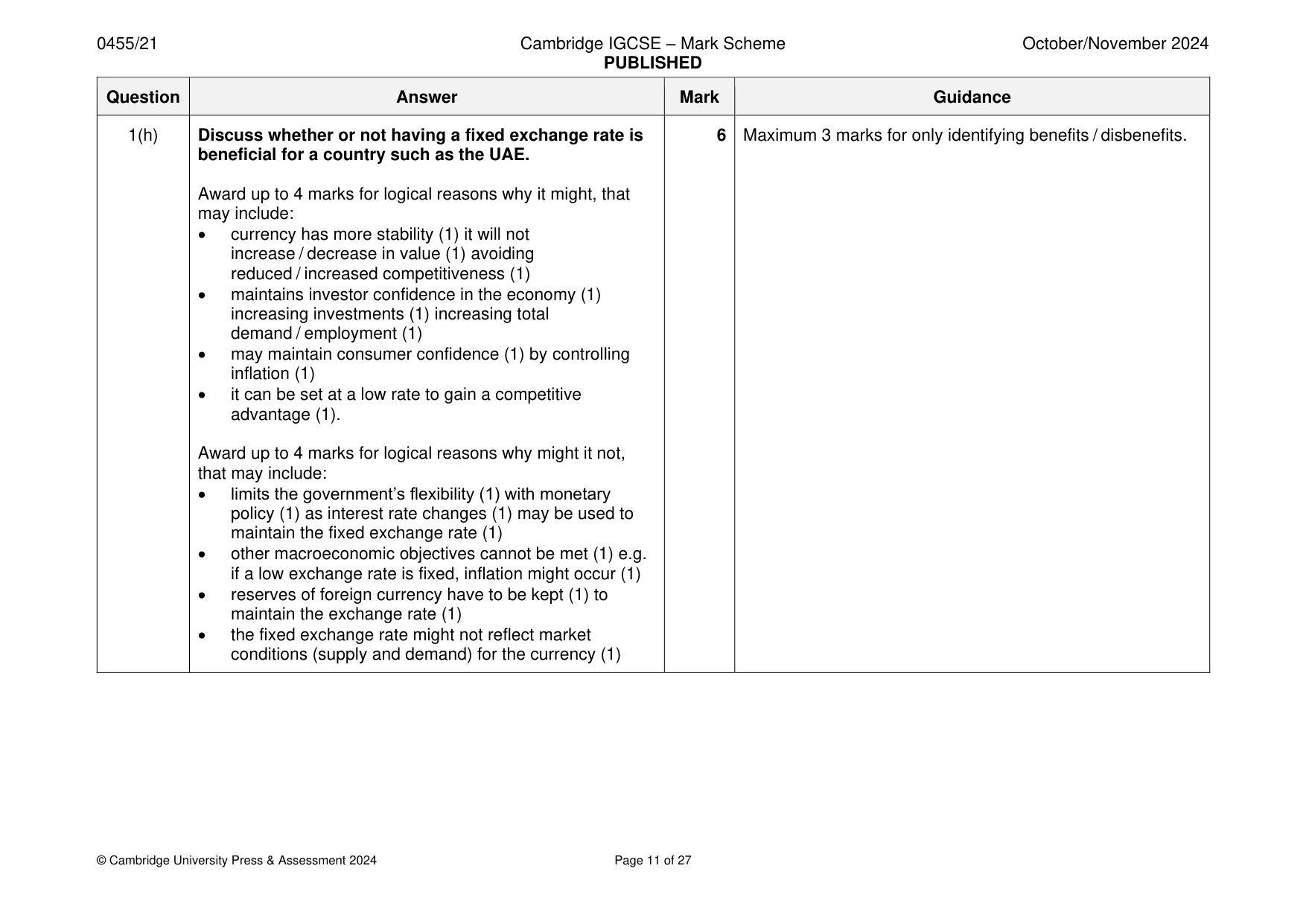
Mark scheme: Question Answer Mark Guidance 1(a) Calculate the percentage of the population who were 1 Accept answer without % foreign nationals living in the UAE. 89% 1(b) Identify two features of globalisation. 2 The increased connection of people from all over the world through migration (1) the trade of goods and services (1) the sharing of ideas (1) technological development (1). 1(c) Explain one factor that can influence labour mobility 2 One mark for a factor identified and one mark for an between countries. explanation. • Good transport helping workers to move (1) availability of flights / development of air travel (1) • Technological progress / development (1) increasing quality / quantity of factors production (1) 1(d) Explain one advantage and one disadvantage of 4 One mark for each effect identified and one mark for each producing a product which is price-inelastic in demand explanation. such as oil. Accept responses that consider perfect price inelasticity Logical explanation which might include: (PED = 0) Advantage: when price increases, there is a less than proportionate fall in quantity demanded (1) revenue generated from the product increases (1) because it’s a necessity / has no substitutes (1) Disadvantage: when price decreases, there is a less than proportionate rise in quantity demanded (1) revenue generated from this product decreases (1) 1(e) Explain the relationship between the oil price and the 4 Responses do not have to be in the format suggested but UAE’s current account balance. they should address the expected / normal relationship, offer supporting evidence of that, and analyse the overall data. Coherent analysis which might include: Expected relationship: Positive / direct relationship (1) the oil price and the current account balance would be expected to move in the same direction (1). Supporting Evidence: As the % change in the price of oil increases, the % change in the current account balance increases (1) (and vice versa). When oil price goes up, the current account balance goes up, e.g. 2016 – 2018, 2020 – 2022 (1) When oil price goes down, the current account balance goes down, e.g. 2019 – 2020 (1). When the % change in the price of oil is highest, the % change in the current account balance is also the highest e.g. 2021 (1). When the % change in the price of oil is lowest, the % change in the current account is also the lowest e.g. 2020 (1) Analysis: Higher oil prices increase export revenue as demand for oil is inelastic (1) increases inflows into current account (1). Exception: There is no exception evident in the figure (1) 1(f) Analyse, using a production possibility curve (PPC) 5 diagram, the effect of technological progress on an economy such as the UAE. PPC diagram: Axes correctly labelled with different outputs (1). Initial curve drawn as a curve / line sloping downward to the axes (1). New curve drawn to the right of the initial curve as a curve / line sloping downward to the axes (1). Shift to the right indicated by arrow or PPC1 to PPC2 (1). Written analysis: Technological progress can increase productive capacity / the economy is able to produce more (1). 1(g) Discuss whether or not luxury tourism and financial 6 Apply this example to all questions with the command services have helped Dubai achieve economic word DISCUSS development. (1g, 1h, 2d, 3d, 4d and 5d) Award up to 4 marks for logical reasons why it might, which Each point may be credited only once, on either side of an may include: argument, but separate development as to how / why the • they attract foreign tourists (1) who spend on goods and outcome may differ is rewarded. services in Dubai (1) increasing total demand / economic growth (1) Generic example mark • employment is generated (1) increasing incomes (1) and improving living standards (1) Tax revenue may decrease… 1 • increased government’s tax revenues (1) may be spent on public services / infrastructure / education / healthcare because of reason e.g. incomes may be 1 (1) lower. • increased export revenues (1) improve the current account of the balance of payments (1) increase profits Tax revenue may increase because 0 of firms in tourism and financial services (1). incomes may be higher i.e. reverse of a previous argument. Award up to 4 marks for logical reasons why it might not, which may include: Tax revenue may increase because of a 1 • increased pollution (1) environmental damage / external different reason i.e. not the reverse of a costs e.g. health problems (1) high use of water previous argument e.g. government resources (1) spending on subsidies may stimulate the • inequality in the distribution of income (1) some workers economy more than spending on education. may be paid much lower than others (1) • spending on luxury tourism and financial services may change with income (1) depending on them could be risky (1) • workers may lack the skills for these occupations (1) be unable to gain employment to improve living standards (1) 1(h) Discuss whether or not having a fixed exchange rate is 6 Maximum 3 marks for only identifying benefits / disbenefits. beneficial for a country such as the UAE. Award up to 4 marks for logical reasons why it might, that may include: • currency has more stability (1) it will not increase / decrease in value (1) avoiding reduced / increased competitiveness (1) • maintains investor confidence in the economy (1) increasing investments (1) increasing total demand / employment (1) • may maintain consumer confidence (1) by controlling inflation (1) • it can be set at a low rate to gain a competitive advantage (1). Award up to 4 marks for logical reasons why might it not, that may include: • limits the government’s flexibility (1) with monetary policy (1) as interest rate changes (1) may be used to maintain the fixed exchange rate (1) • other macroeconomic objectives cannot be met (1) e.g. if a low exchange rate is fixed, inflation might occur (1) • reserves of foreign currency have to be kept (1) to maintain the exchange rate (1) • the fixed exchange rate might not reflect market conditions (supply and demand) for the currency (1)
More questions on Differences in economic development between countries
Q2 · Unemployment in the United Kingdom (UK) fell in December 2021 to 4.1%
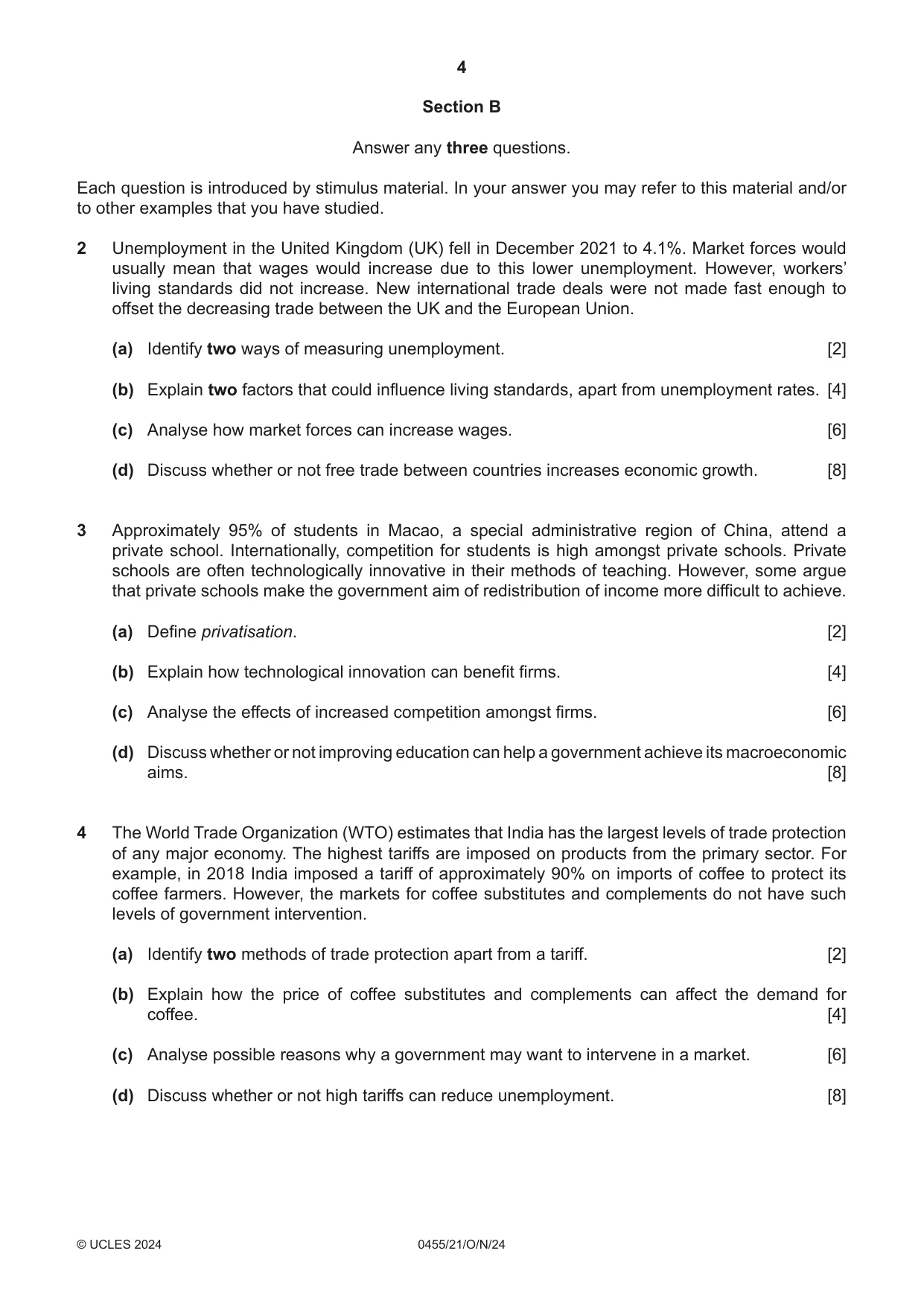
2 Unemployment in the United Kingdom (UK) fell in December 2021 to 4.1%. Market forces would usually mean that wages would increase due to this lower unemployment. However, workers’ living standards did not increase. New international trade deals were not made fast enough to offset the decreasing trade between the UK and the European Union. (a) Identify two ways of measuring unemployment. [2] (b) Explain two factors that could influence living standards, apart from unemployment rates. [4] (c) Analyse how market forces can increase wages. [6] (d) Discuss whether or not free trade between countries increases economic growth. [8]
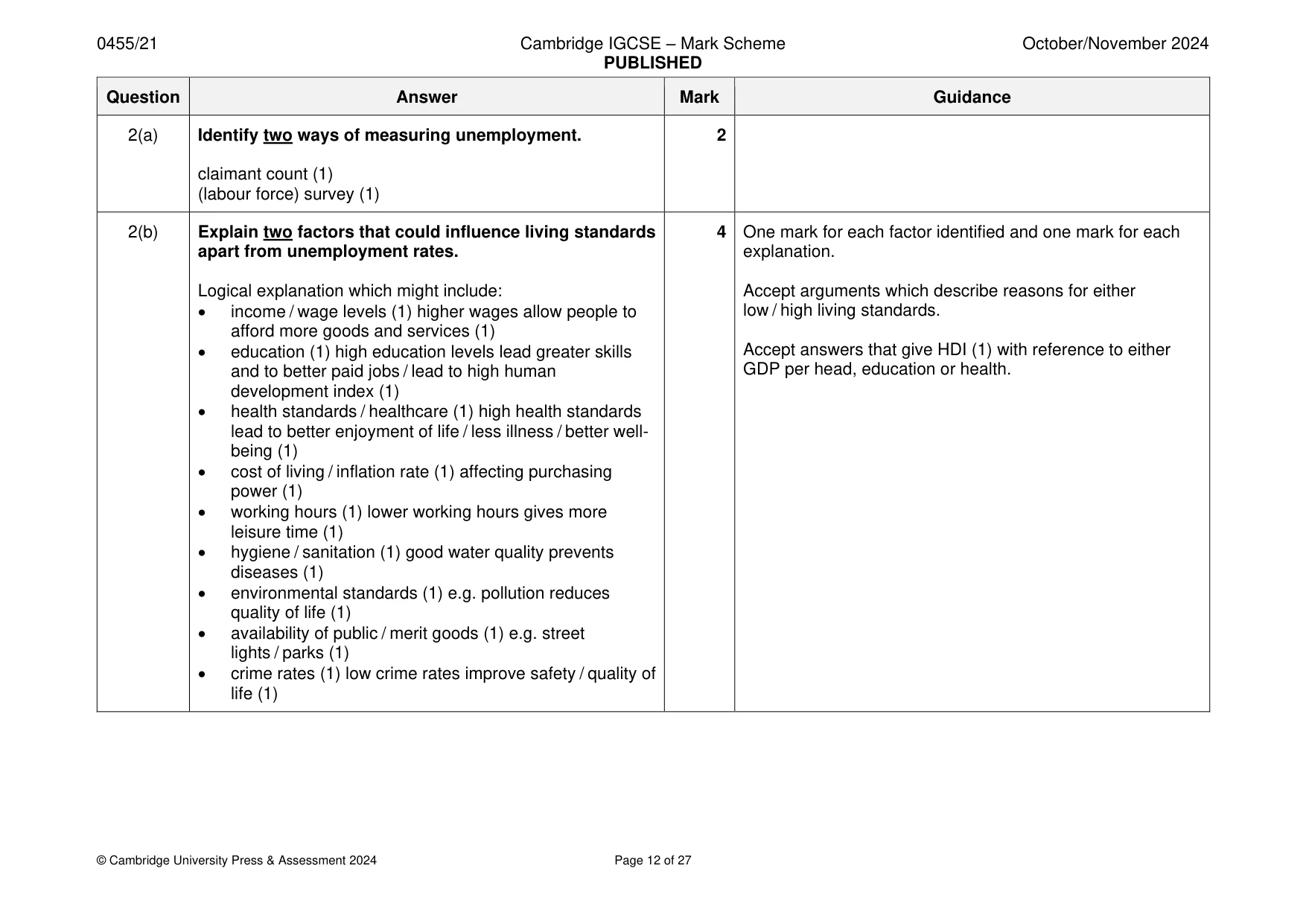
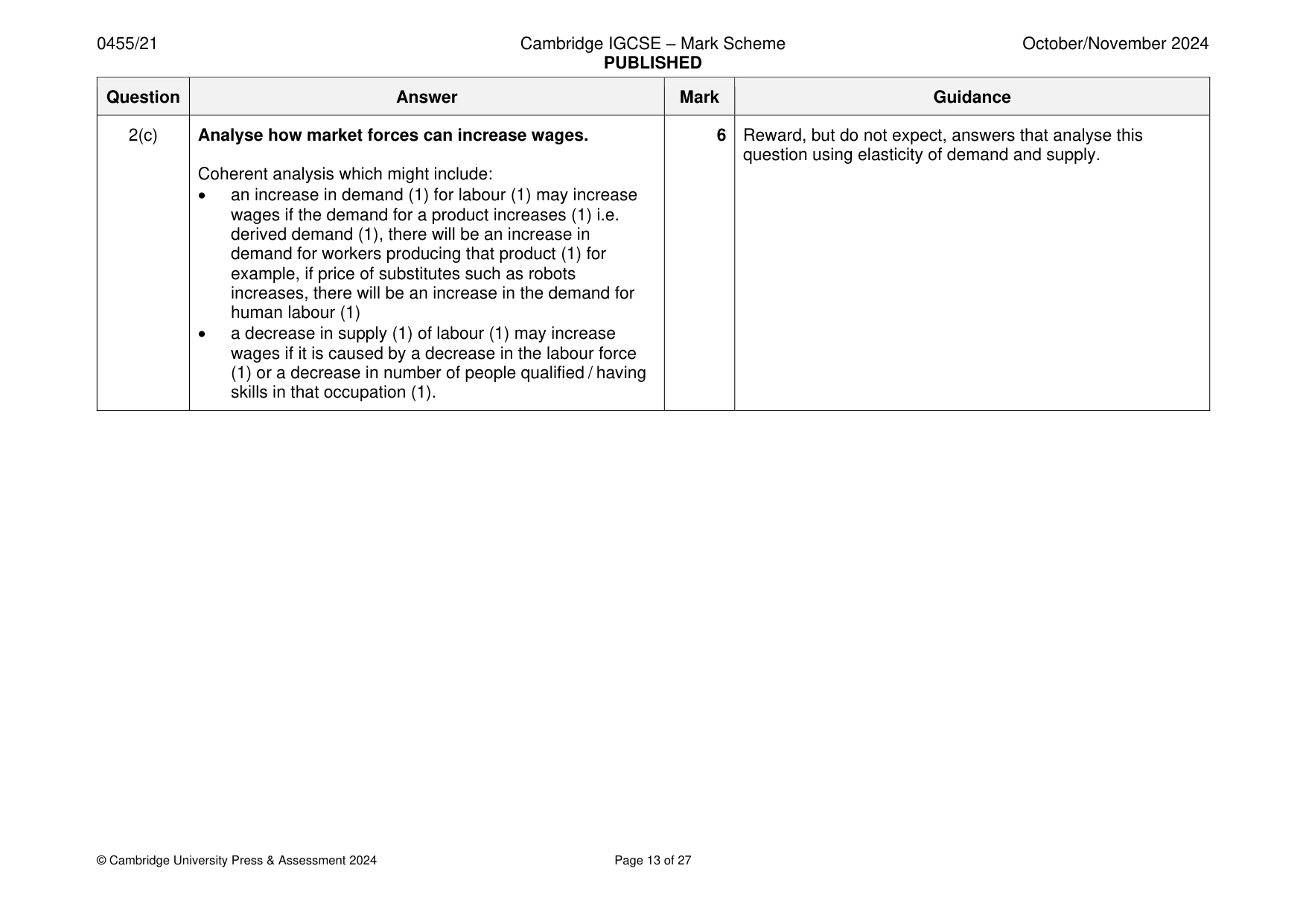
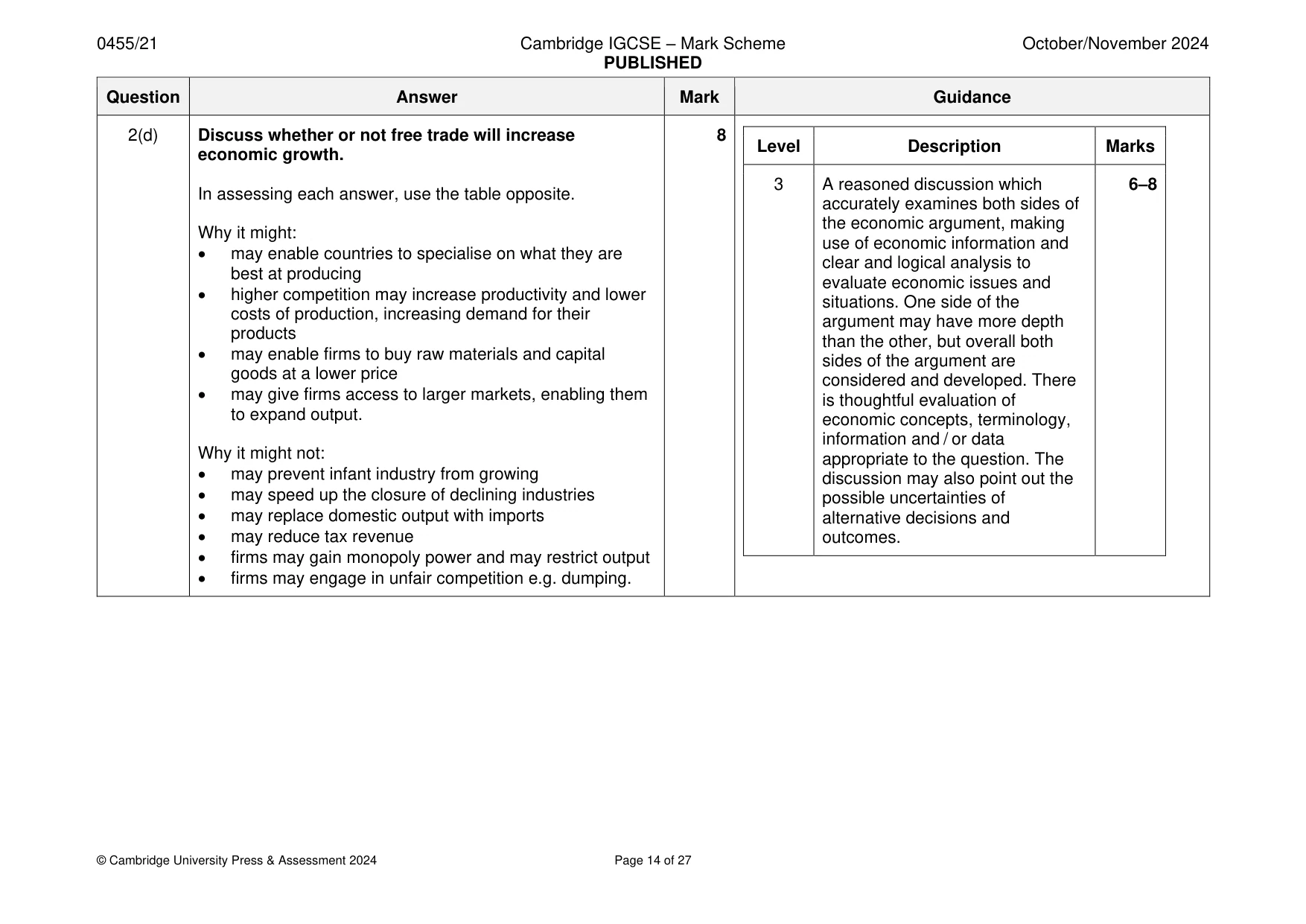
Mark scheme: 2(a) Identify two ways of measuring unemployment. 2 claimant count (1) (labour force) survey (1) 2(b) Explain two factors that could influence living standards 4 One mark for each factor identified and one mark for each apart from unemployment rates. explanation. Logical explanation which might include: Accept arguments which describe reasons for either • income / wage levels (1) higher wages allow people to low / high living standards. afford more goods and services (1) • education (1) high education levels lead greater skills Accept answers that give HDI (1) with reference to either and to better paid jobs / lead to high human GDP per head, education or health. development index (1) • health standards / healthcare (1) high health standards lead to better enjoyment of life / less illness / better well- being (1) • cost of living / inflation rate (1) affecting purchasing power (1) • working hours (1) lower working hours gives more leisure time (1) • hygiene / sanitation (1) good water quality prevents diseases (1) • environmental standards (1) e.g. pollution reduces quality of life (1) • availability of public / merit goods (1) e.g. street lights / parks (1) • crime rates (1) low crime rates improve safety / quality of life (1) 2(c) Analyse how market forces can increase wages. 6 Reward, but do not expect, answers that analyse this question using elasticity of demand and supply. Coherent analysis which might include: • an increase in demand (1) for labour (1) may increase wages if the demand for a product increases (1) i.e. derived demand (1), there will be an increase in demand for workers producing that product (1) for example, if price of substitutes such as robots increases, there will be an increase in the demand for human labour (1) • a decrease in supply (1) of labour (1) may increase wages if it is caused by a decrease in the labour force (1) or a decrease in number of people qualified / having skills in that occupation (1). 2(d) Discuss whether or not free trade will increase 8 Level Description Marks economic growth. 3 A reasoned discussion which 6–8 In assessing each answer, use the table opposite. accurately examines both sides of the economic argument, making Why it might: use of economic information and • may enable countries to specialise on what they are clear and logical analysis to best at producing evaluate economic issues and • higher competition may increase productivity and lower situations. One side of the costs of production, increasing demand for their argument may have more depth products than the other, but overall both • may enable firms to buy raw materials and capital sides of the argument are goods at a lower price considered and developed. There • may give firms access to larger markets, enabling them is thoughtful evaluation of to expand output. economic concepts, terminology, information and / or data Why it might not: appropriate to the question. The • may prevent infant industry from growing discussion may also point out the • may speed up the closure of declining industries possible uncertainties of • may replace domestic output with imports alternative decisions and • may reduce tax revenue outcomes. • firms may gain monopoly power and may restrict output • firms may engage in unfair competition e.g. dumping. 2(d) 2 A reasoned discussion which 3–5 makes use of economic information and clear analysis to evaluate economic issues and situations. The answer may lack some depth and development may be one-sided. There is relevant use of economic concepts, terminology, information and data appropriate to the question. 1 There is a simple attempt at using 1–2 economic definitions and terminology. Some reference may be made to economic theory, with occasional understanding. 0 A mark of zero should be awarded 0 for no creditable content.
Q3 · Approximately 95% of students in Macao, a special administrative region of China, attend…
3 Approximately 95% of students in Macao, a special administrative region of China, attend a private school. Internationally, competition for students is high amongst private schools. Private schools are often technologically innovative in their methods of teaching. However, some argue that private schools make the government aim of redistribution of income more difficult to achieve. (a) Define privatisation. [2] (b) Explain how technological innovation can benefit firms. [4] (c) Analyse the effects of increased competition amongst firms. [6] (d) Discuss whether or not improving education can help a government achieve its macroeconomic aims. [8]
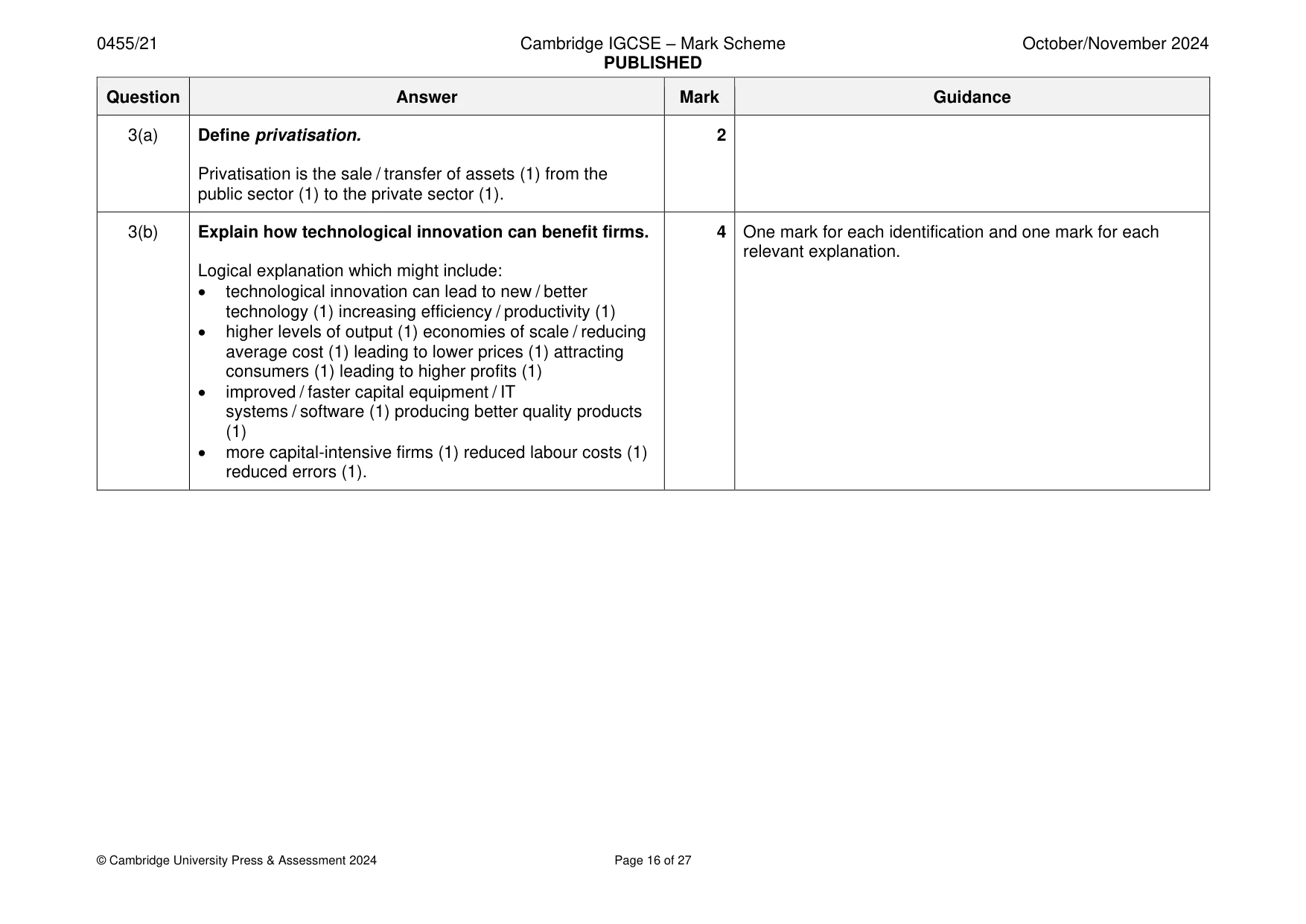
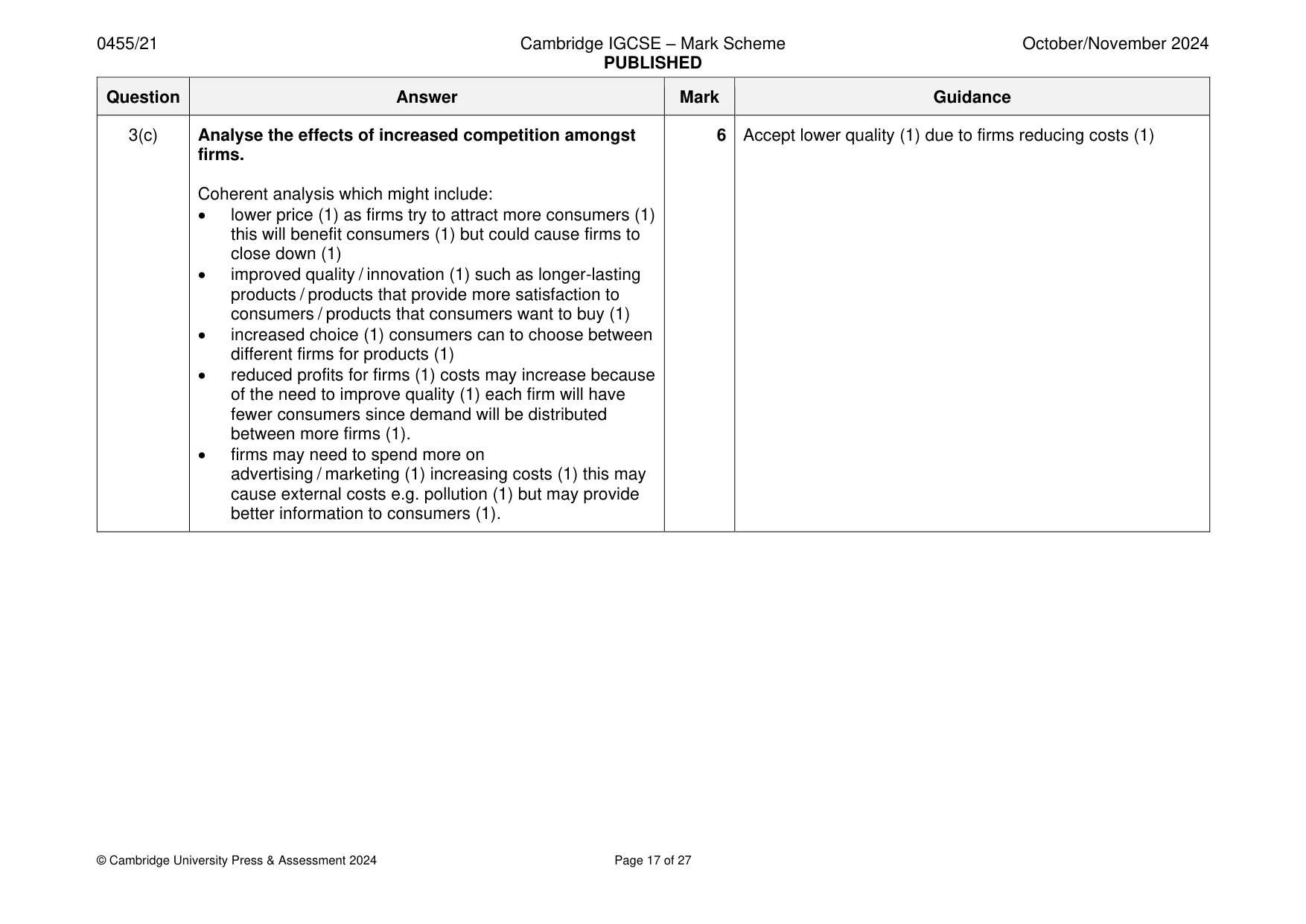
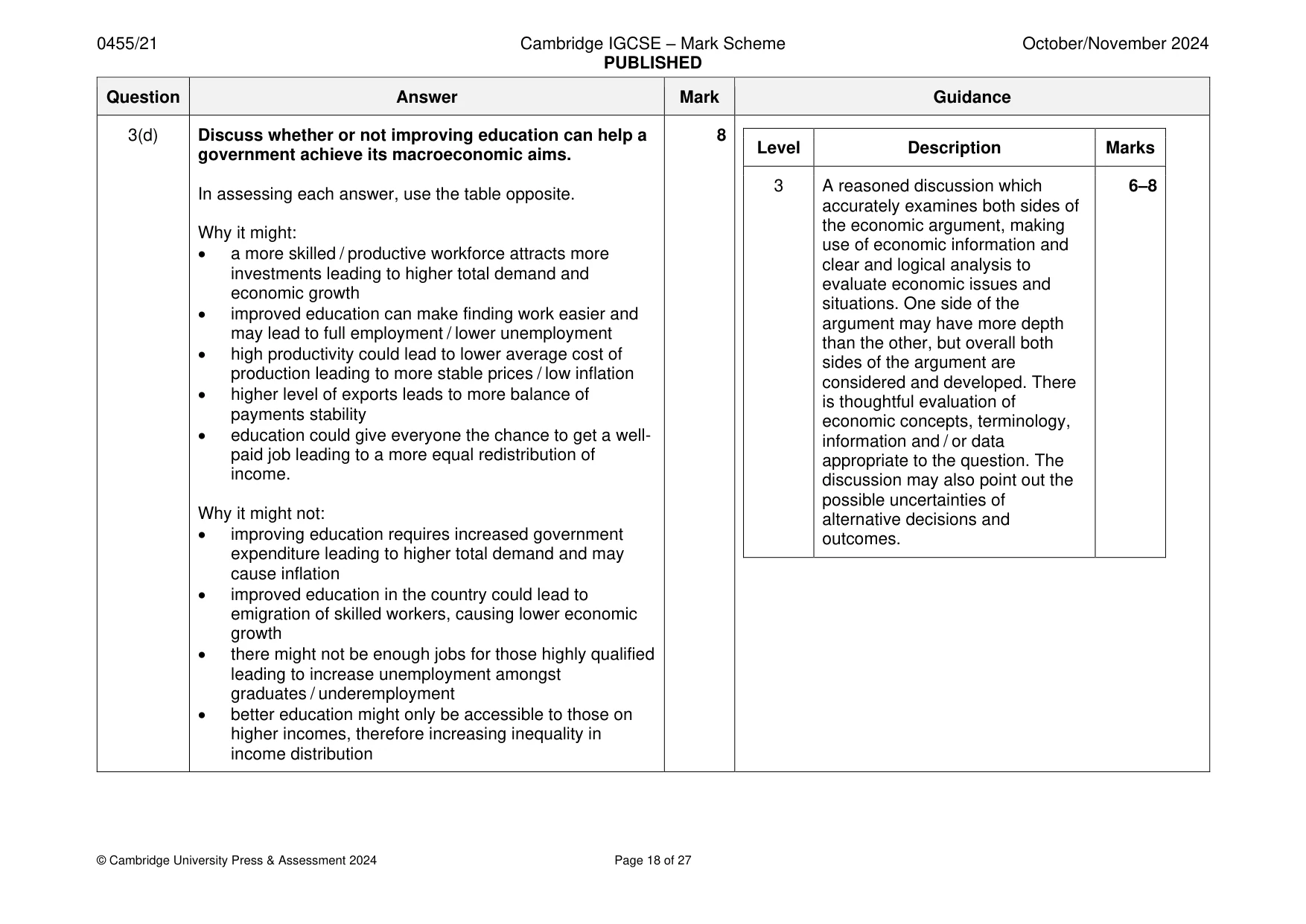
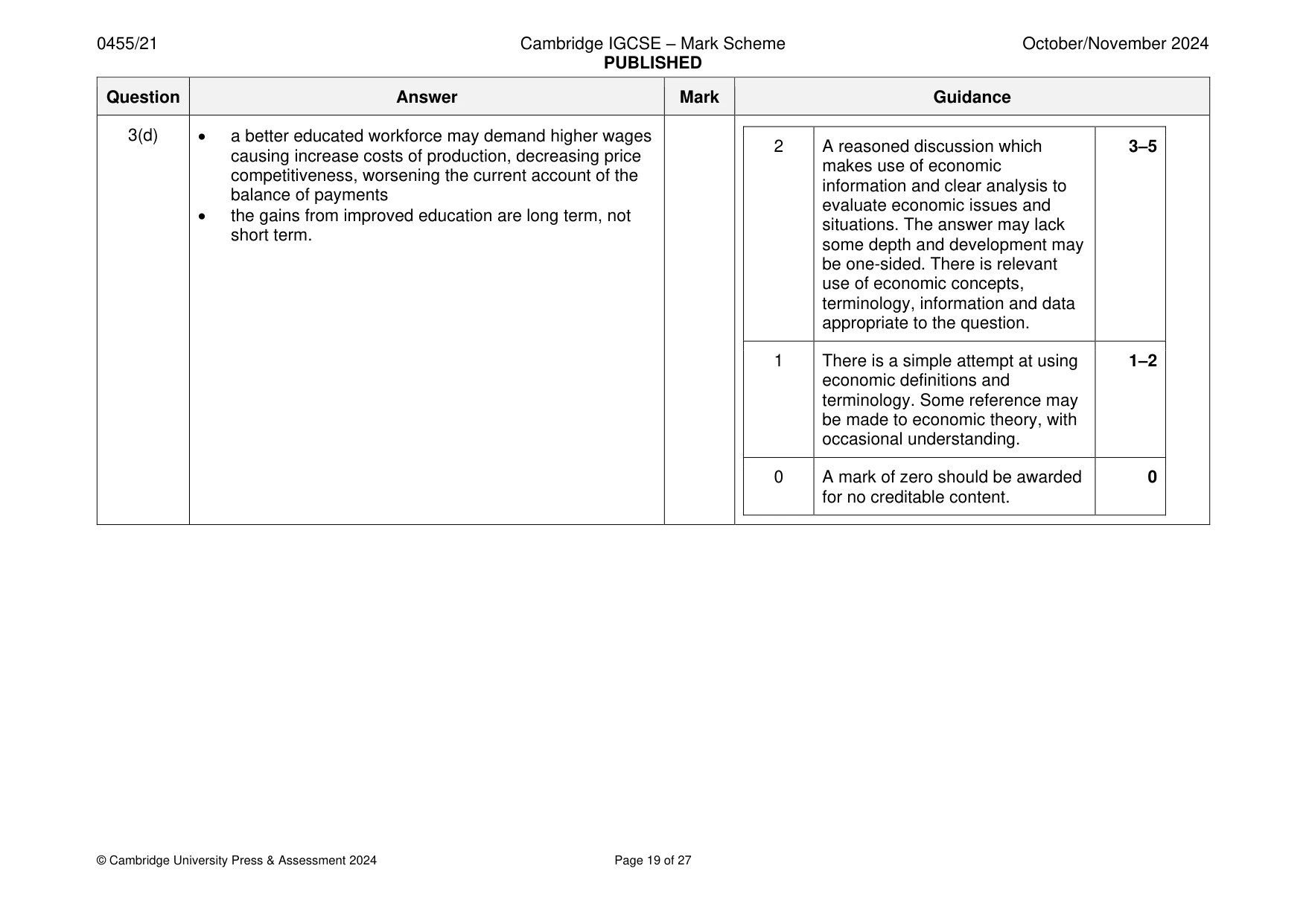
Mark scheme: 3(a) Define privatisation. 2 Privatisation is the sale / transfer of assets (1) from the public sector (1) to the private sector (1). 3(b) Explain how technological innovation can benefit firms. 4 One mark for each identification and one mark for each relevant explanation. Logical explanation which might include: • technological innovation can lead to new / better technology (1) increasing efficiency / productivity (1) • higher levels of output (1) economies of scale / reducing average cost (1) leading to lower prices (1) attracting consumers (1) leading to higher profits (1) • improved / faster capital equipment / IT systems / software (1) producing better quality products (1) • more capital-intensive firms (1) reduced labour costs (1) reduced errors (1). 3(c) Analyse the effects of increased competition amongst 6 Accept lower quality (1) due to firms reducing costs (1) firms. Coherent analysis which might include: • lower price (1) as firms try to attract more consumers (1) this will benefit consumers (1) but could cause firms to close down (1) • improved quality / innovation (1) such as longer-lasting products / products that provide more satisfaction to consumers / products that consumers want to buy (1) • increased choice (1) consumers can to choose between different firms for products (1) • reduced profits for firms (1) costs may increase because of the need to improve quality (1) each firm will have fewer consumers since demand will be distributed between more firms (1). • firms may need to spend more on advertising / marketing (1) increasing costs (1) this may cause external costs e.g. pollution (1) but may provide better information to consumers (1). 3(d) Discuss whether or not improving education can help a 8 Level Description Marks government achieve its macroeconomic aims. 3 A reasoned discussion which 6–8 In assessing each answer, use the table opposite. accurately examines both sides of the economic argument, making Why it might: use of economic information and • a more skilled / productive workforce attracts more clear and logical analysis to investments leading to higher total demand and evaluate economic issues and economic growth situations. One side of the • improved education can make finding work easier and argument may have more depth may lead to full employment / lower unemployment than the other, but overall both • high productivity could lead to lower average cost of sides of the argument are production leading to more stable prices / low inflation considered and developed. There • higher level of exports leads to more balance of is thoughtful evaluation of payments stability economic concepts, terminology, • education could give everyone the chance to get a well- information and / or data paid job leading to a more equal redistribution of appropriate to the question. The income. discussion may also point out the possible uncertainties of Why it might not: alternative decisions and • improving education requires increased government outcomes. expenditure leading to higher total demand and may cause inflation • improved education in the country could lead to emigration of skilled workers, causing lower economic growth • there might not be enough jobs for those highly qualified leading to increase unemployment amongst graduates / underemployment • better education might only be accessible to those on higher incomes, therefore increasing inequality in income distribution 3(d) • a better educated workforce may demand higher wages 2 A reasoned discussion which 3–5 causing increase costs of production, decreasing price makes use of economic competitiveness, worsening the current account of the information and clear analysis to balance of payments evaluate economic issues and • the gains from improved education are long term, not situations. The answer may lack short term. some depth and development may be one-sided. There is relevant use of economic concepts, terminology, information and data appropriate to the question. 1 There is a simple attempt at using 1–2 economic definitions and terminology. Some reference may be made to economic theory, with occasional understanding. 0 A mark of zero should be awarded 0 for no creditable content.
Q4 · The World Trade Organization (WTO) estimates that India has the largest levels of trade…
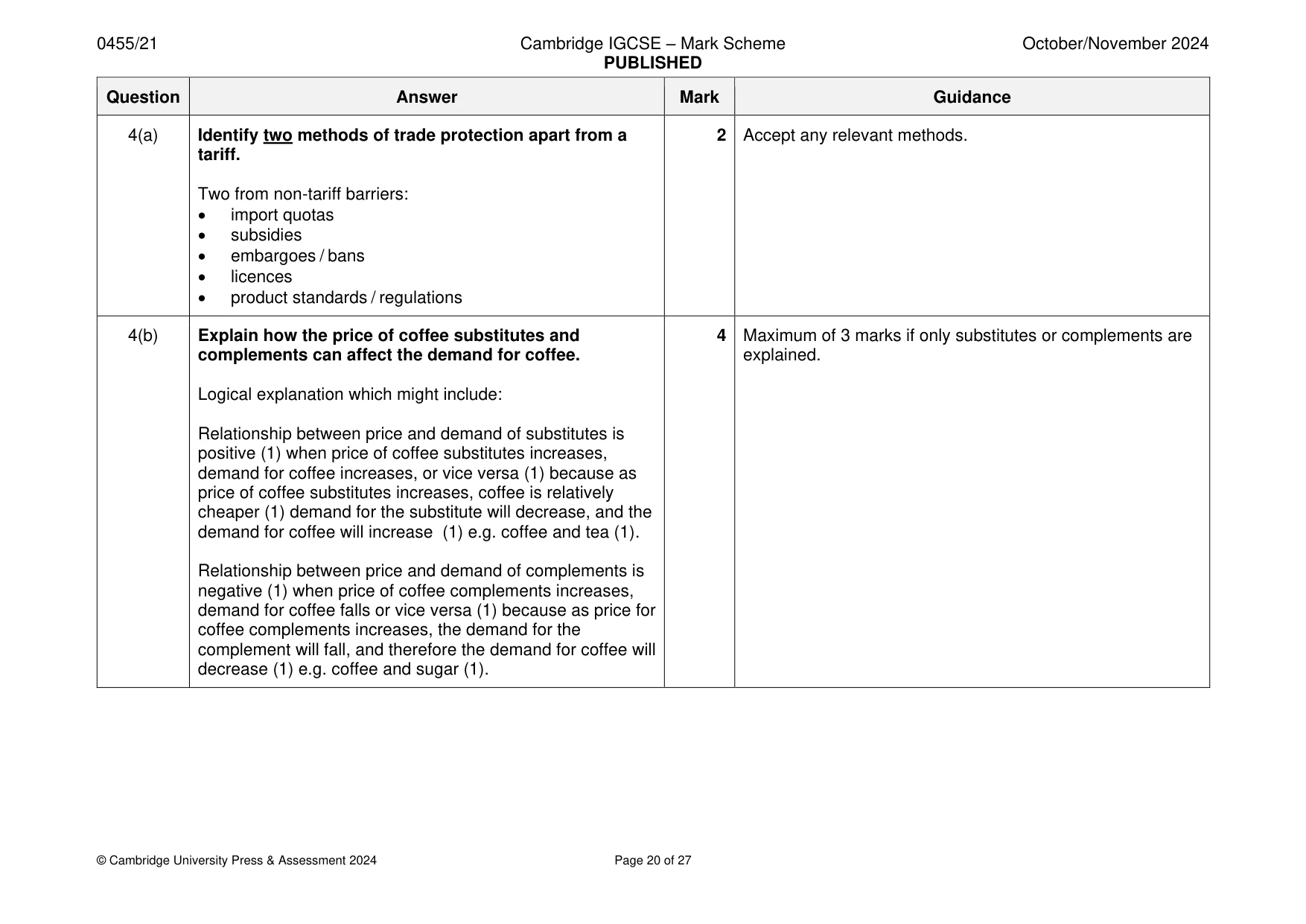
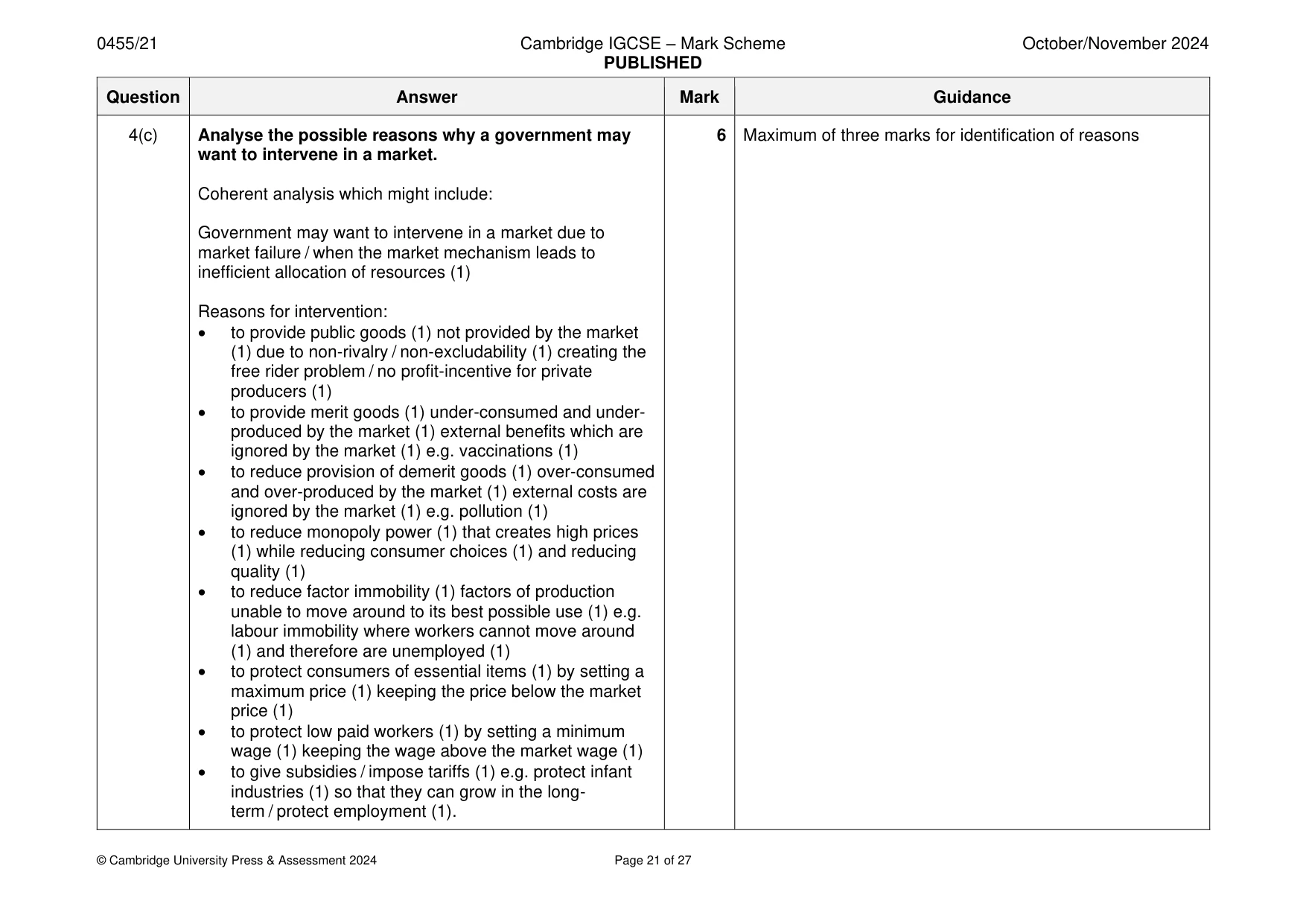
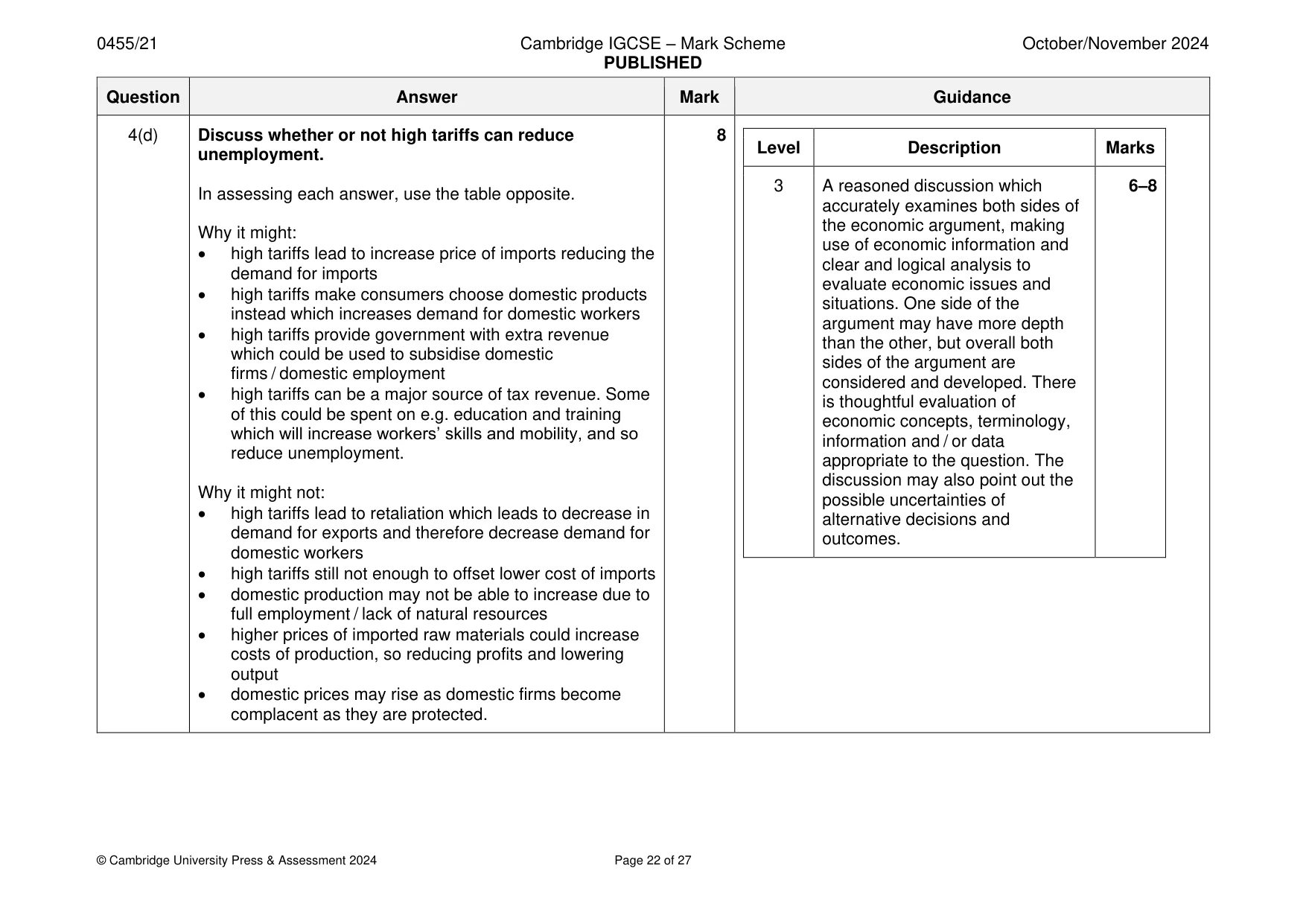
4 The World Trade Organization (WTO) estimates that India has the largest levels of trade protection of any major economy. The highest tariffs are imposed on products from the primary sector. For example, in 2018 India imposed a tariff of approximately 90% on imports of coffee to protect its coffee farmers. However, the markets for coffee substitutes and complements do not have such levels of government intervention. (a) Identify two methods of trade protection apart from a tariff. [2] (b) Explain how the price of coffee substitutes and complements can affect the demand for coffee. [4] (c) Analyse possible reasons why a government may want to intervene in a market. [6] (d) Discuss whether or not high tariffs can reduce unemployment. [8]
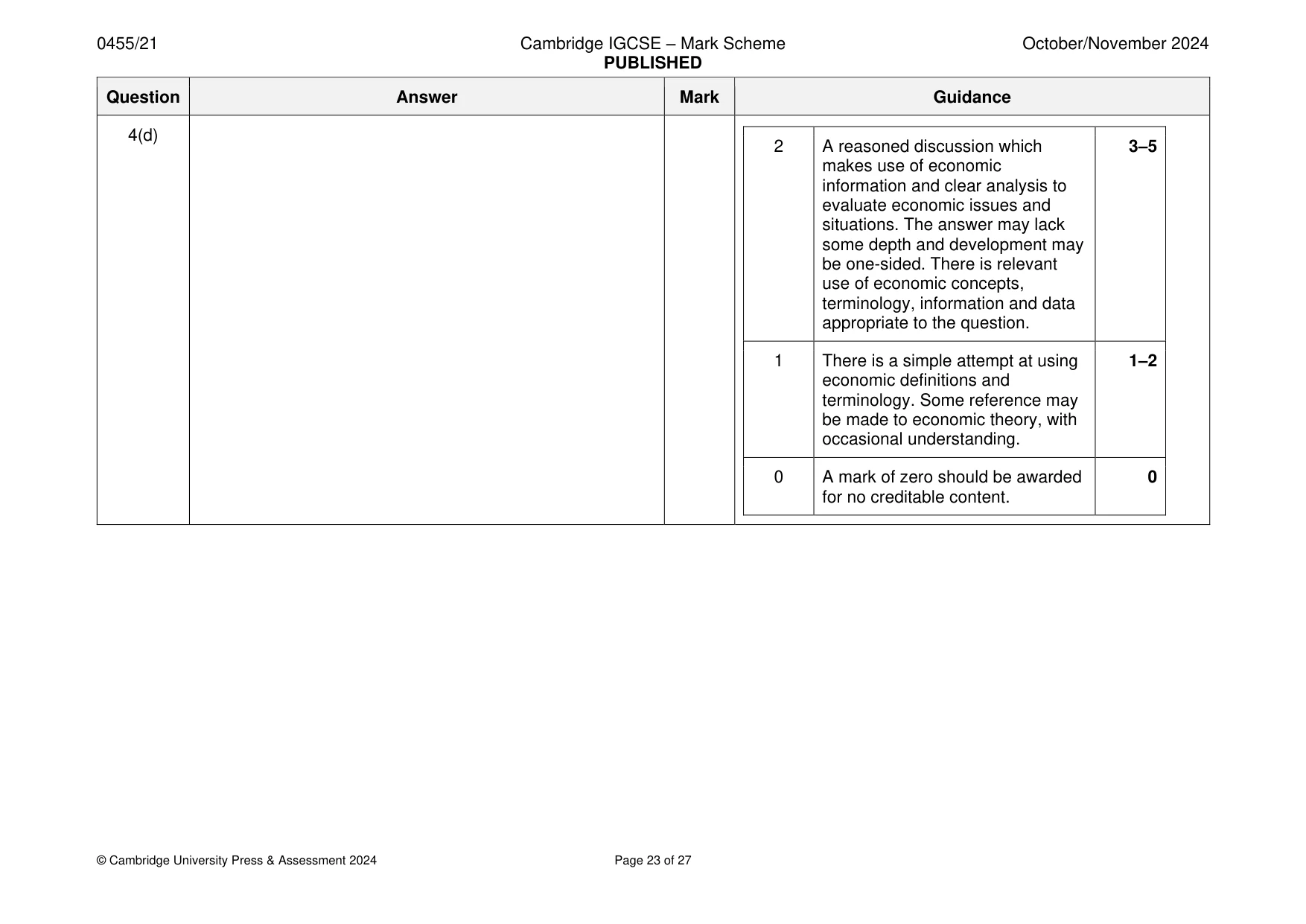
Mark scheme: 4(a) Identify two methods of trade protection apart from a 2 Accept any relevant methods. tariff. Two from non-tariff barriers: • import quotas • subsidies • embargoes / bans • licences • product standards / regulations 4(b) Explain how the price of coffee substitutes and 4 Maximum of 3 marks if only substitutes or complements are complements can affect the demand for coffee. explained. Logical explanation which might include: Relationship between price and demand of substitutes is positive (1) when price of coffee substitutes increases, demand for coffee increases, or vice versa (1) because as price of coffee substitutes increases, coffee is relatively cheaper (1) demand for the substitute will decrease, and the demand for coffee will increase (1) e.g. coffee and tea (1). Relationship between price and demand of complements is negative (1) when price of coffee complements increases, demand for coffee falls or vice versa (1) because as price for coffee complements increases, the demand for the complement will fall, and therefore the demand for coffee will decrease (1) e.g. coffee and sugar (1). 4(c) Analyse the possible reasons why a government may 6 Maximum of three marks for identification of reasons want to intervene in a market. Coherent analysis which might include: Government may want to intervene in a market due to market failure / when the market mechanism leads to inefficient allocation of resources (1) Reasons for intervention: • to provide public goods (1) not provided by the market (1) due to non-rivalry / non-excludability (1) creating the free rider problem / no profit-incentive for private producers (1) • to provide merit goods (1) under-consumed and under- produced by the market (1) external benefits which are ignored by the market (1) e.g. vaccinations (1) • to reduce provision of demerit goods (1) over-consumed and over-produced by the market (1) external costs are ignored by the market (1) e.g. pollution (1) • to reduce monopoly power (1) that creates high prices (1) while reducing consumer choices (1) and reducing quality (1) • to reduce factor immobility (1) factors of production unable to move around to its best possible use (1) e.g. labour immobility where workers cannot move around (1) and therefore are unemployed (1) • to protect consumers of essential items (1) by setting a maximum price (1) keeping the price below the market price (1) • to protect low paid workers (1) by setting a minimum wage (1) keeping the wage above the market wage (1) • to give subsidies / impose tariffs (1) e.g. protect infant industries (1) so that they can grow in the long- term / protect employment (1). 4(d) Discuss whether or not high tariffs can reduce 8 Level Description Marks unemployment. 3 A reasoned discussion which 6–8 In assessing each answer, use the table opposite. accurately examines both sides of the economic argument, making Why it might: use of economic information and • high tariffs lead to increase price of imports reducing the clear and logical analysis to demand for imports evaluate economic issues and • high tariffs make consumers choose domestic products situations. One side of the instead which increases demand for domestic workers argument may have more depth • high tariffs provide government with extra revenue than the other, but overall both which could be used to subsidise domestic sides of the argument are firms / domestic employment considered and developed. There • high tariffs can be a major source of tax revenue. Some is thoughtful evaluation of of this could be spent on e.g. education and training economic concepts, terminology, which will increase workers’ skills and mobility, and so information and / or data reduce unemployment. appropriate to the question. The discussion may also point out the Why it might not: possible uncertainties of • high tariffs lead to retaliation which leads to decrease in alternative decisions and demand for exports and therefore decrease demand for outcomes. domestic workers • high tariffs still not enough to offset lower cost of imports • domestic production may not be able to increase due to full employment / lack of natural resources • higher prices of imported raw materials could increase costs of production, so reducing profits and lowering output • domestic prices may rise as domestic firms become complacent as they are protected. 4(d) 2 A reasoned discussion which 3–5 makes use of economic information and clear analysis to evaluate economic issues and situations. The answer may lack some depth and development may be one-sided. There is relevant use of economic concepts, terminology, information and data appropriate to the question. 1 There is a simple attempt at using 1–2 economic definitions and terminology. Some reference may be made to economic theory, with occasional understanding. 0 A mark of zero should be awarded 0 for no creditable content.
Q5 · Hawaii’s economy has grown due to tourism but the growth in this sector has also…
5 Hawaii’s economy has grown due to tourism but the growth in this sector has also increased inflation in this US island state. It is estimated that 9% of Hawaii’s population were living in poverty in 2022. Many families struggled to save. Young workers were able to leave due to high levels of labour mobility between US states. However, Hawaii is now facing an ageing population including many more retired people. (a) Define labour mobility. [2] (b) Explain the effects of an ageing population on spending and saving levels. [4] (c) Analyse how a rise in tourism can increase inflation in an economy. [6] (d) Discuss whether or not fiscal policy is effective in reducing poverty. [8]
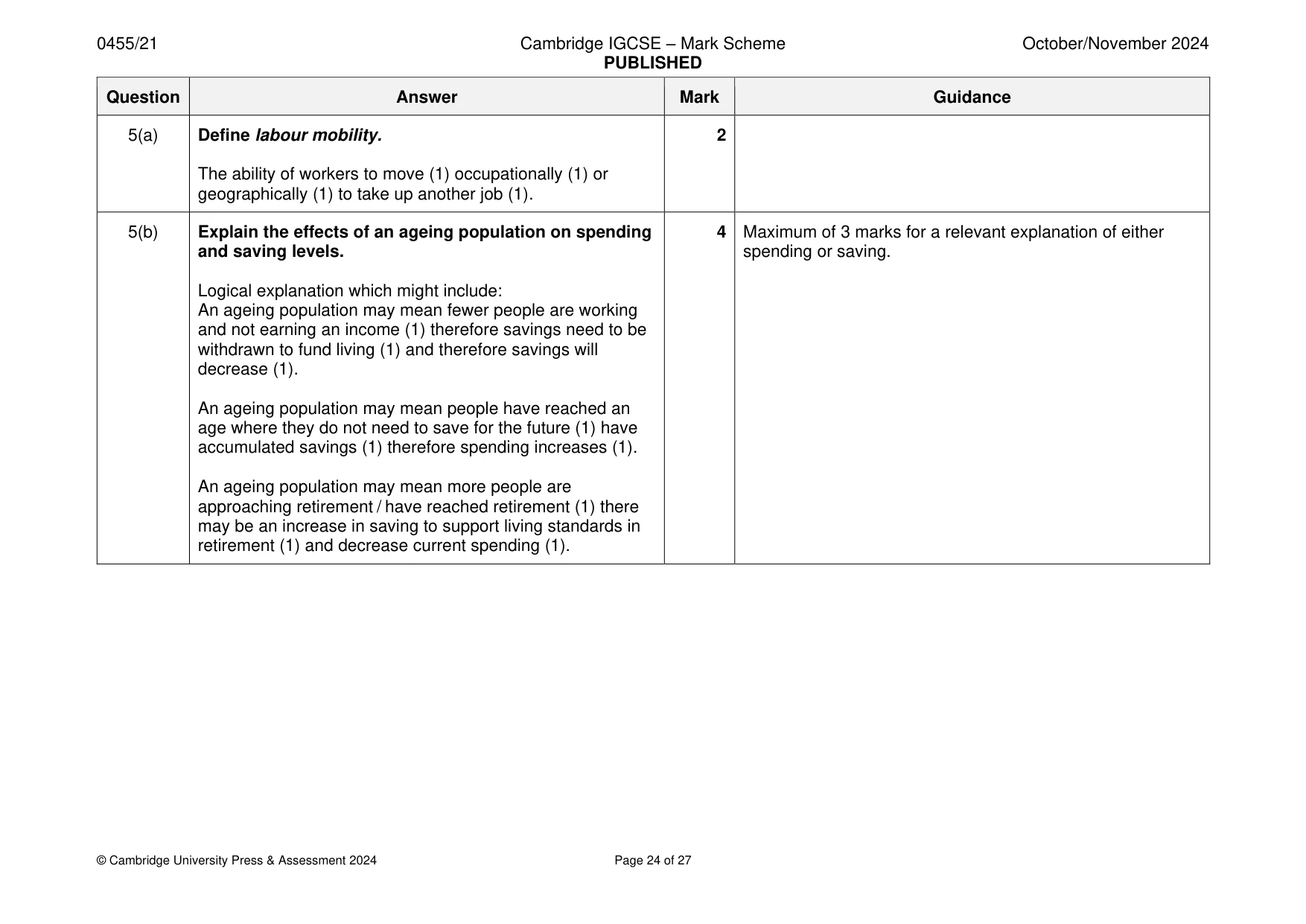
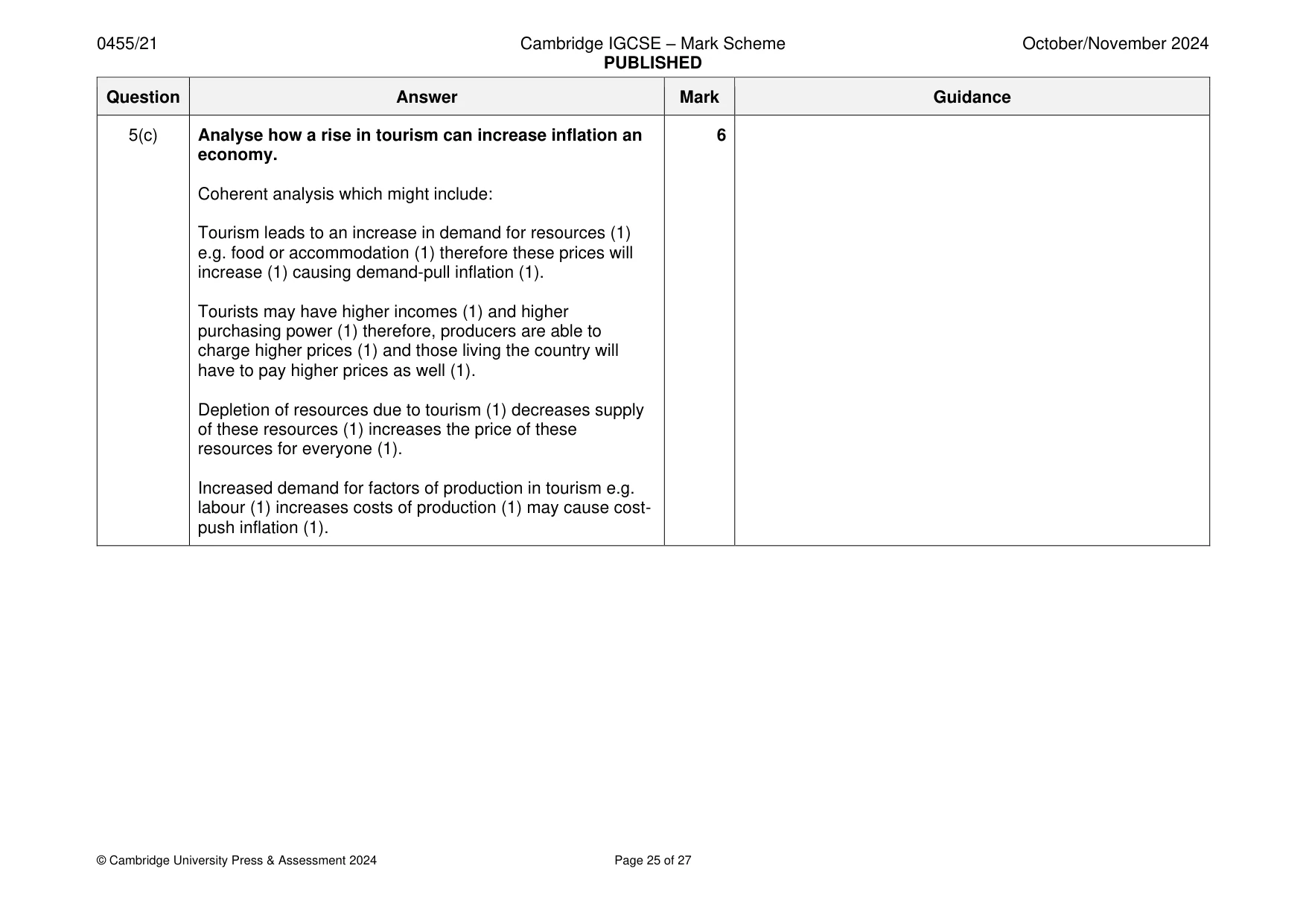
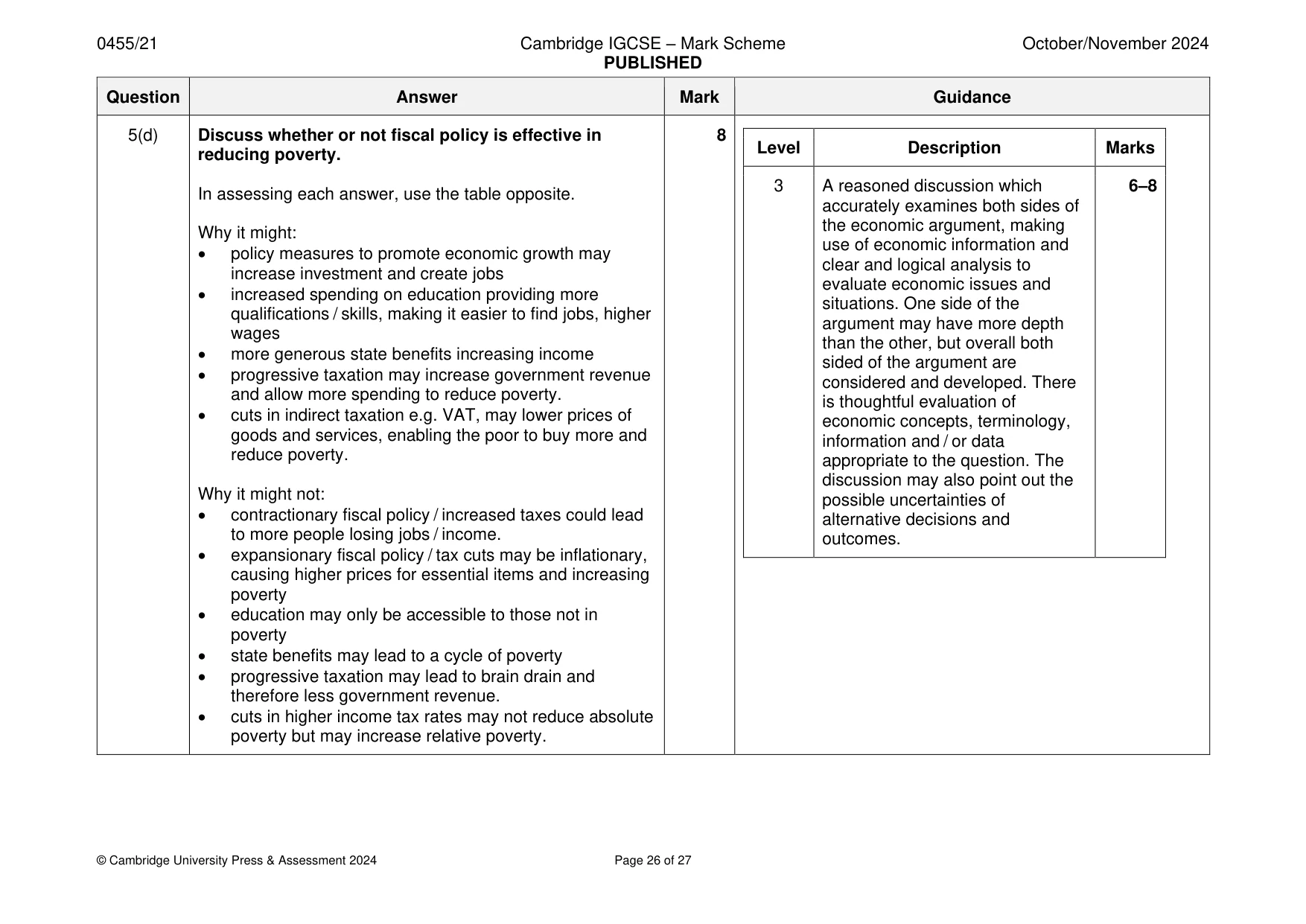
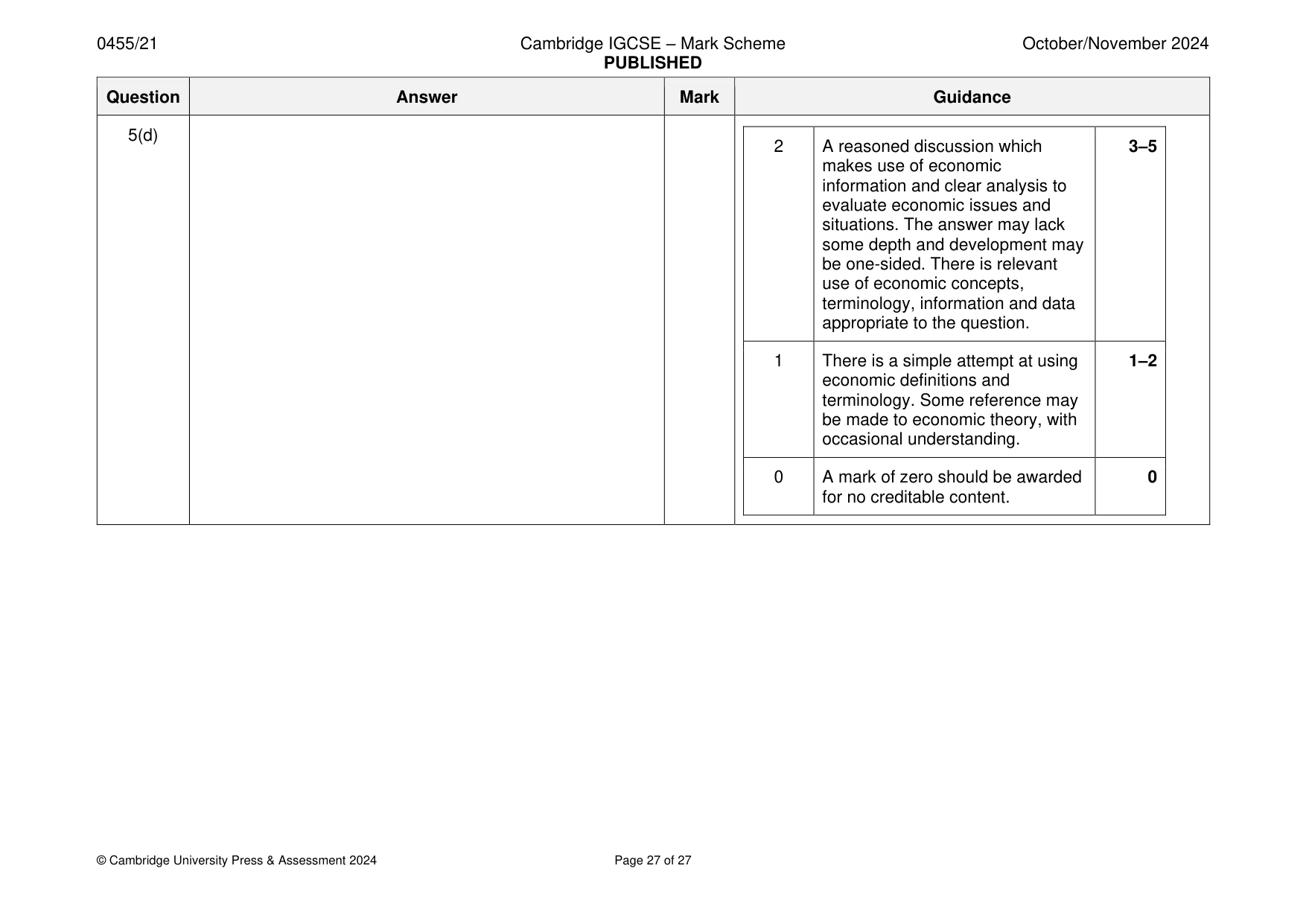
Mark scheme: 5(a) Define labour mobility. 2 The ability of workers to move (1) occupationally (1) or geographically (1) to take up another job (1). 5(b) Explain the effects of an ageing population on spending 4 Maximum of 3 marks for a relevant explanation of either and saving levels. spending or saving. Logical explanation which might include: An ageing population may mean fewer people are working and not earning an income (1) therefore savings need to be withdrawn to fund living (1) and therefore savings will decrease (1). An ageing population may mean people have reached an age where they do not need to save for the future (1) have accumulated savings (1) therefore spending increases (1). An ageing population may mean more people are approaching retirement / have reached retirement (1) there may be an increase in saving to support living standards in retirement (1) and decrease current spending (1). 5(c) Analyse how a rise in tourism can increase inflation an 6 economy. Coherent analysis which might include: Tourism leads to an increase in demand for resources (1) e.g. food or accommodation (1) therefore these prices will increase (1) causing demand-pull inflation (1). Tourists may have higher incomes (1) and higher purchasing power (1) therefore, producers are able to charge higher prices (1) and those living the country will have to pay higher prices as well (1). Depletion of resources due to tourism (1) decreases supply of these resources (1) increases the price of these resources for everyone (1). Increased demand for factors of production in tourism e.g. labour (1) increases costs of production (1) may cause cost- push inflation (1). 5(d) Discuss whether or not fiscal policy is effective in 8 Level Description Marks reducing poverty. 3 A reasoned discussion which 6–8 In assessing each answer, use the table opposite. accurately examines both sides of the economic argument, making Why it might: use of economic information and • policy measures to promote economic growth may clear and logical analysis to increase investment and create jobs evaluate economic issues and • increased spending on education providing more situations. One side of the qualifications / skills, making it easier to find jobs, higher argument may have more depth wages than the other, but overall both • more generous state benefits increasing income sided of the argument are • progressive taxation may increase government revenue considered and developed. There and allow more spending to reduce poverty. is thoughtful evaluation of • cuts in indirect taxation e.g. VAT, may lower prices of economic concepts, terminology, goods and services, enabling the poor to buy more and information and / or data reduce poverty. appropriate to the question. The discussion may also point out the Why it might not: possible uncertainties of • contractionary fiscal policy / increased taxes could lead alternative decisions and to more people losing jobs / income. outcomes. • expansionary fiscal policy / tax cuts may be inflationary, causing higher prices for essential items and increasing poverty • education may only be accessible to those not in poverty • state benefits may lead to a cycle of poverty • progressive taxation may lead to brain drain and therefore less government revenue. • cuts in higher income tax rates may not reduce absolute poverty but may increase relative poverty. 5(d) 2 A reasoned discussion which 3–5 makes use of economic information and clear analysis to evaluate economic issues and situations. The answer may lack some depth and development may be one-sided. There is relevant use of economic concepts, terminology, information and data appropriate to the question. 1 There is a simple attempt at using 1–2 economic definitions and terminology. Some reference may be made to economic theory, with occasional understanding. 0 A mark of zero should be awarded 0 for no creditable content.
What was in this paper
The subtopics covered by these 5 questions, and how many questions each got. Open one in a new tab to see every Cambridge question on it.
What you needed in this session
Cambridge’s own grade thresholds for 2024 Oct/Nov, Paper 2 · Variant 1. A higher threshold means an easier paper — the bar moves with how the cohort did.