Cambridge IGCSE Economics 0455 — 2018 Oct/Nov Paper 2 · Variant 2
0455/22/O/N/18 · 7 questions · 90 marks · ≈101 min
The question paper and its mark scheme, free to read here and free to download. This is Cambridge’s own paper, exactly as it was sat.
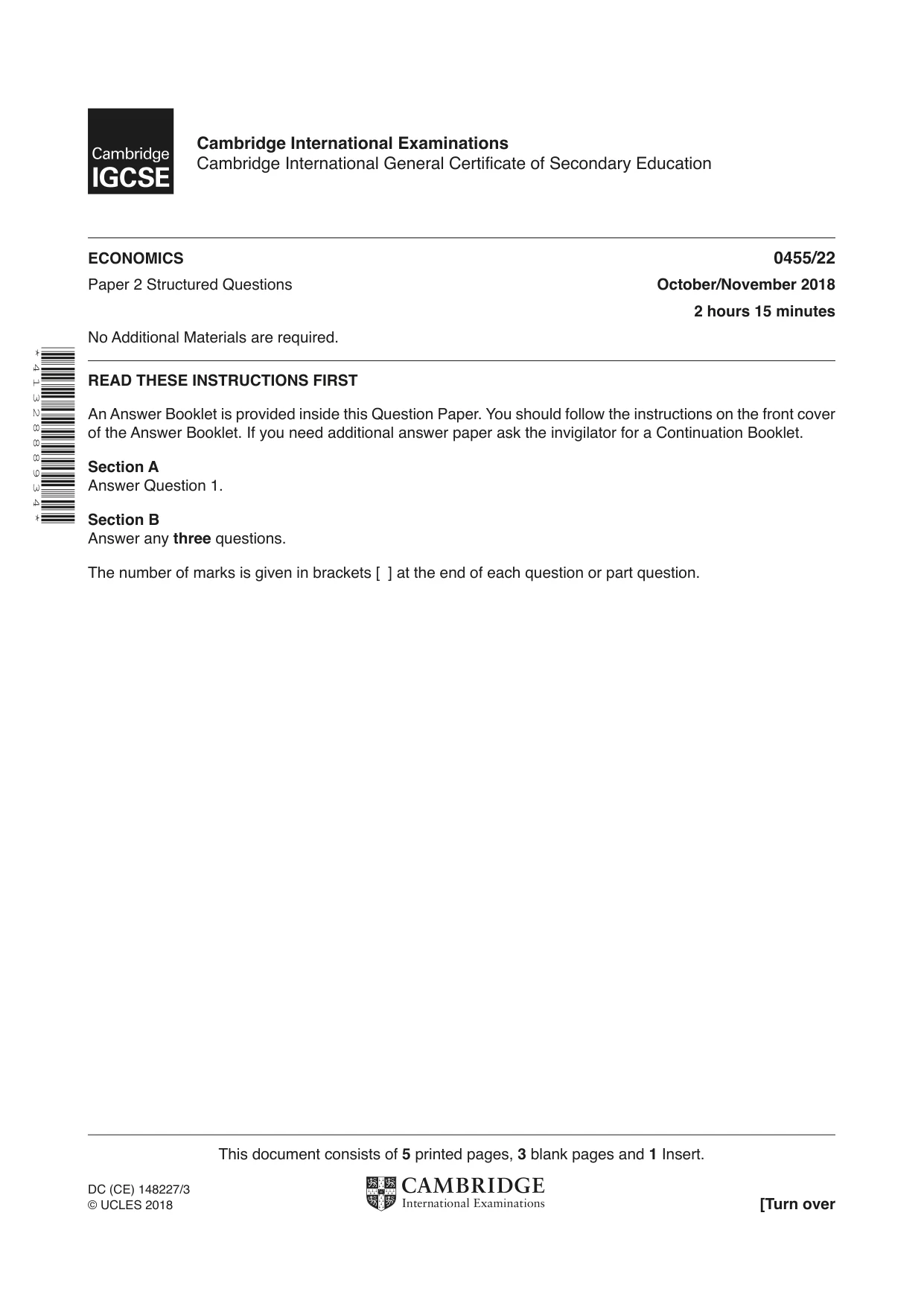
Question paper8 pages



Mark scheme20 pages
Answers below. Sit the paper first if you are practising.
Questions as text
Q1 · Rubber production in Liberia Liberia is a west African country that has faced a number of…
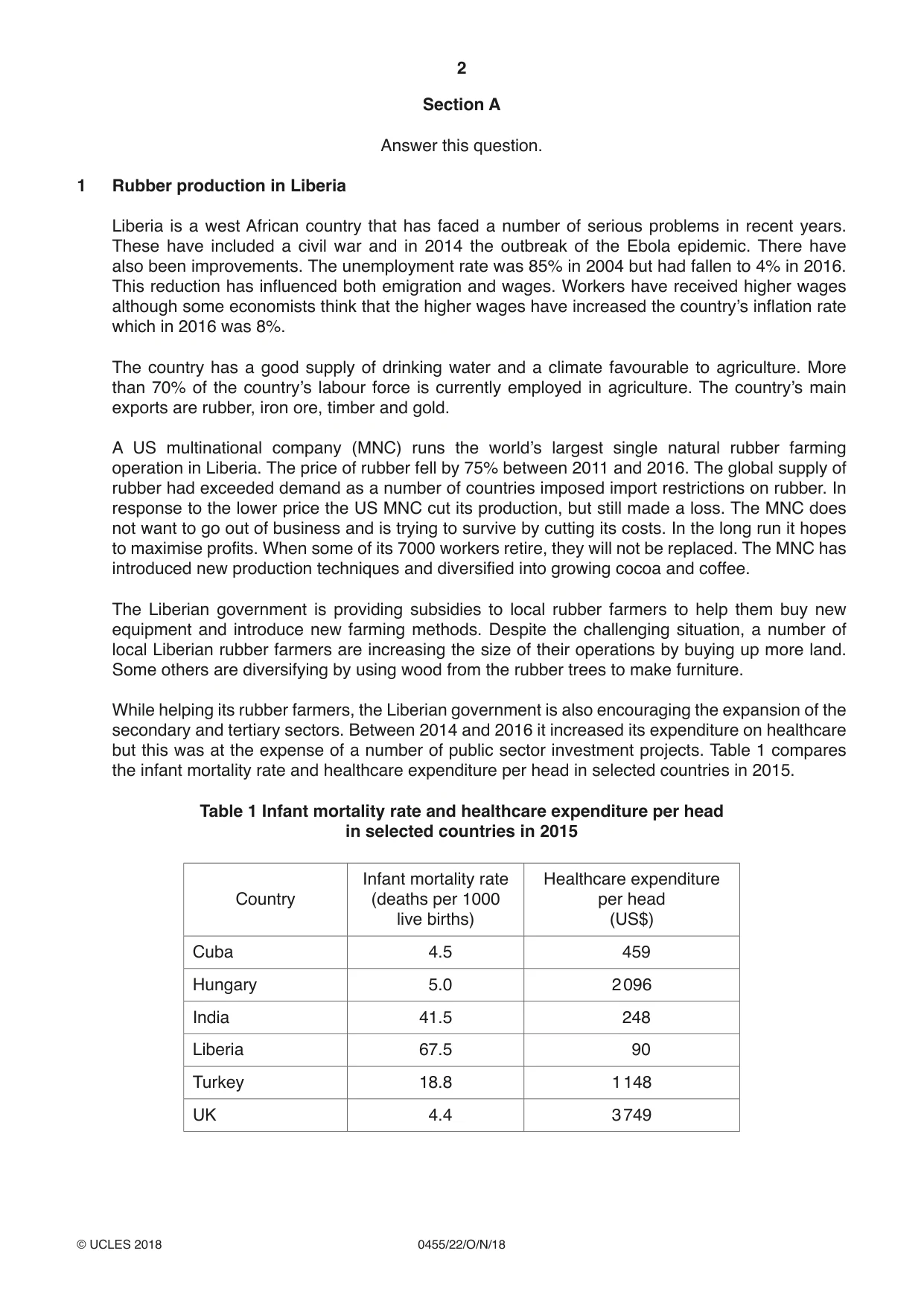
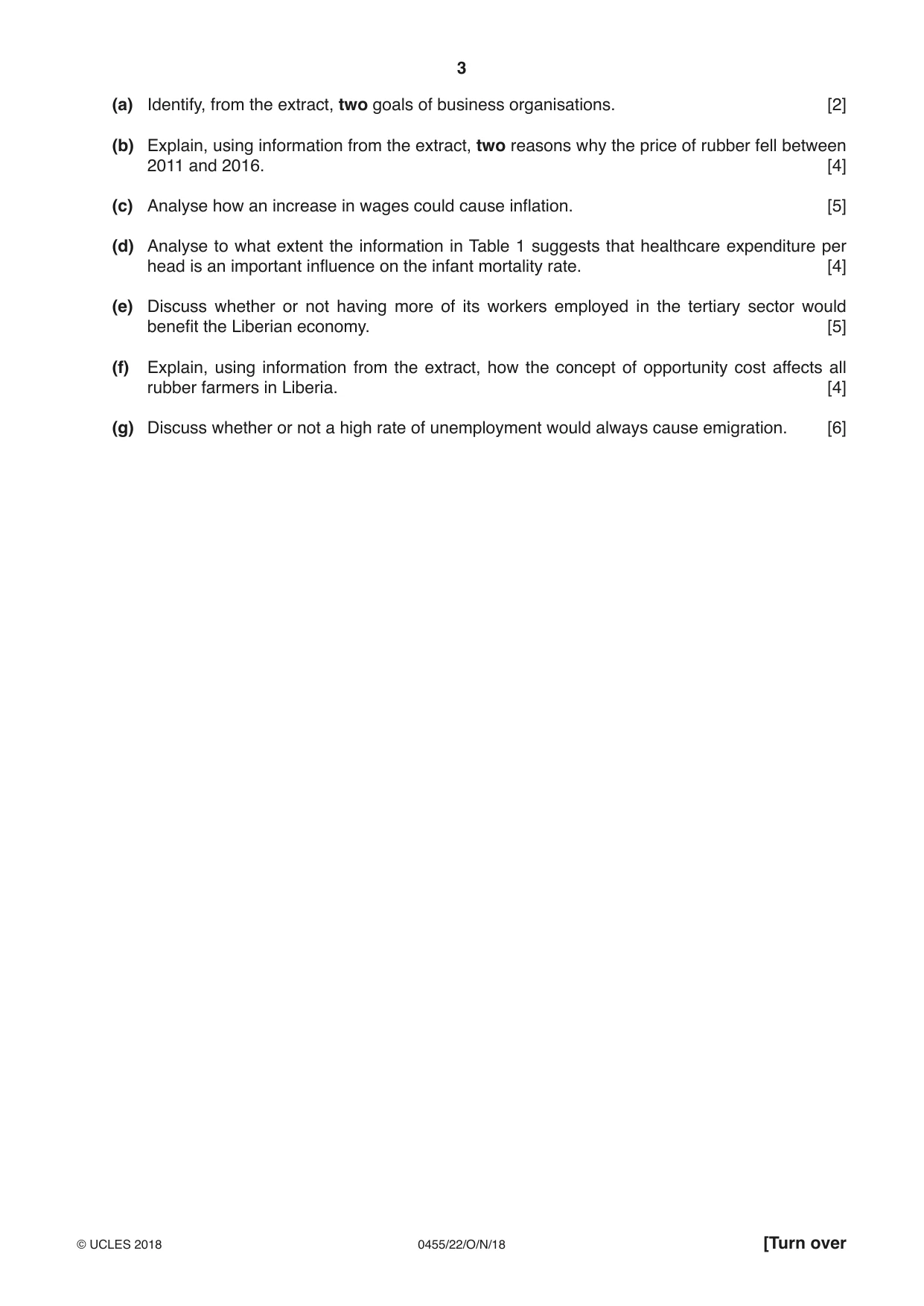
1 Rubber production in Liberia Liberia is a west African country that has faced a number of serious problems in recent years. These have included a civil war and in 2014 the outbreak of the Ebola epidemic. There have also been improvements. The unemployment rate was 85% in 2004 but had fallen to 4% in 2016. This reduction has influenced both emigration and wages. Workers have received higher wages although some economists think that the higher wages have increased the country’s inflation rate which in 2016 was 8%. The country has a good supply of drinking water and a climate favourable to agriculture. More than 70% of the country’s labour force is currently employed in agriculture. The country’s main exports are rubber, iron ore, timber and gold. A US multinational company (MNC) runs the world’s largest single natural rubber farming operation in Liberia. The price of rubber fell by 75% between 2011 and 2016. The global supply of rubber had exceeded demand as a number of countries imposed import restrictions on rubber. In response to the lower price the US MNC cut its production, but still made a loss. The MNC does not want to go out of business and is trying to survive by cutting its costs. In the long run it hopes to maximise profits. When some of its 7000 workers retire, they will not be replaced. The MNC has introduced new production techniques and diversified into growing cocoa and coffee. The Liberian government is providing subsidies to local rubber farmers to help them buy new equipment and introduce new farming methods. Despite the challenging situation, a number of local Liberian rubber farmers are increasing the size of their operations by buying up more land. Some others are diversifying by using wood from the rubber trees to make furniture. While helping its rubber farmers, the Liberian government is also encouraging the expansion of the secondary and tertiary sectors. Between 2014 and 2016 it increased its expenditure on healthcare but this was at the expense of a number of public sector investment projects. Table 1 compares the infant mortality rate and healthcare expenditure per head in selected countries in 2015. Table 1 Infant mortality rate and healthcare expenditure per head in selected countries in 2015 Infant mortality rate Healthcare expenditure Country (deaths per 1000 per head live births) (US$) Cuba 4.5 459 Hungary 5.0 2 096 India 41.5 248 Liberia 67.5 90 Turkey 18.8 1 148 UK 4.4 3 749 (a) Identify, from the extract, two goals of business organisations. [2] (b) Explain, using information from the extract, two reasons why the price of rubber fell between 2011 and 2016. [4] (c) Analyse how an increase in wages could cause inflation. [5] (d) Analyse to what extent the information in Table 1 suggests that healthcare expenditure per head is an important influence on the infant mortality rate. [4] (e) Discuss whether or not having more of its workers employed in the tertiary sector would benefit the Liberian economy. [5] (f) Explain, using information from the extract, how the concept of opportunity cost affects all rubber farmers in Liberia. [4] (g) Discuss whether or not a high rate of unemployment would always cause emigration. [6]
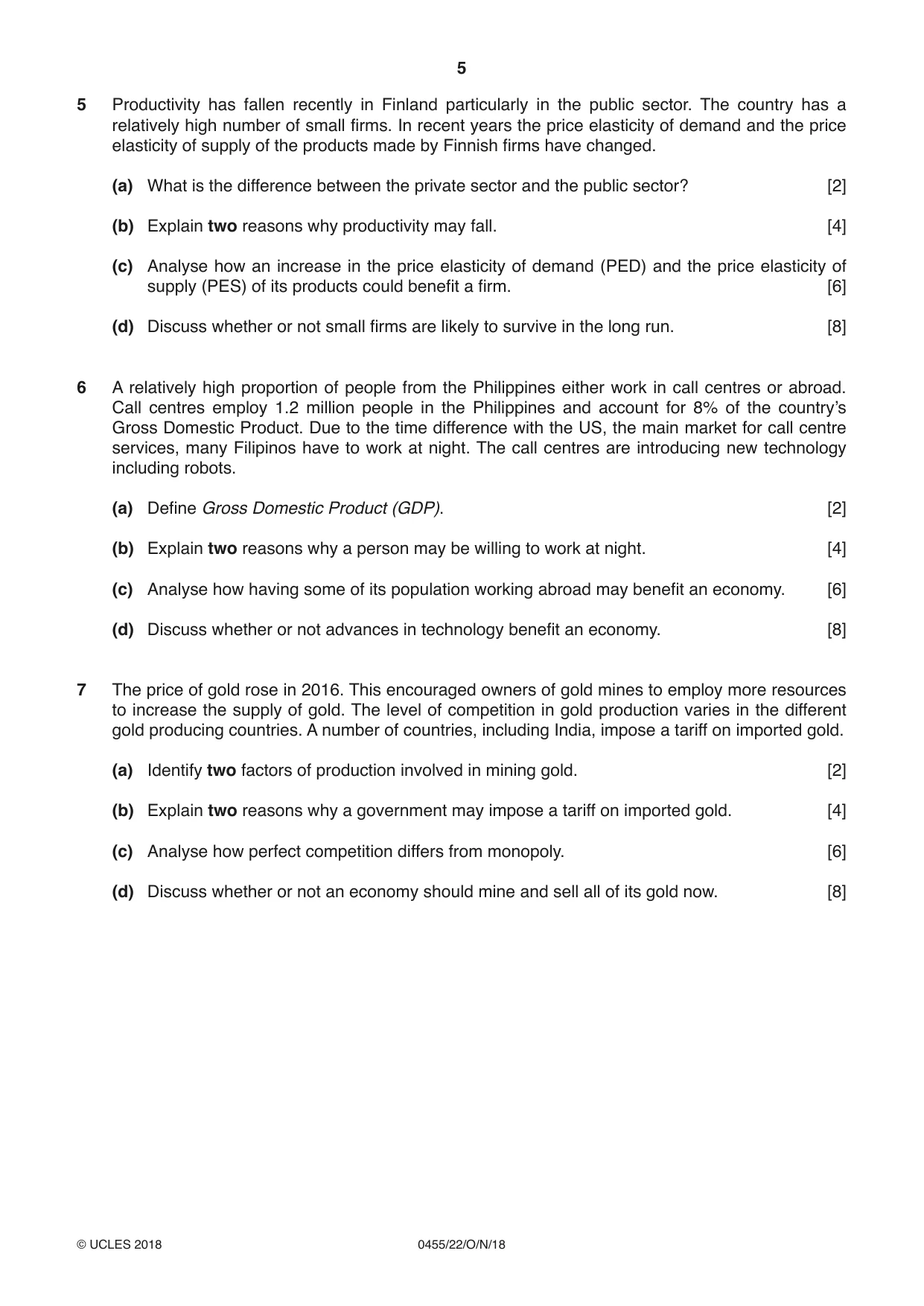
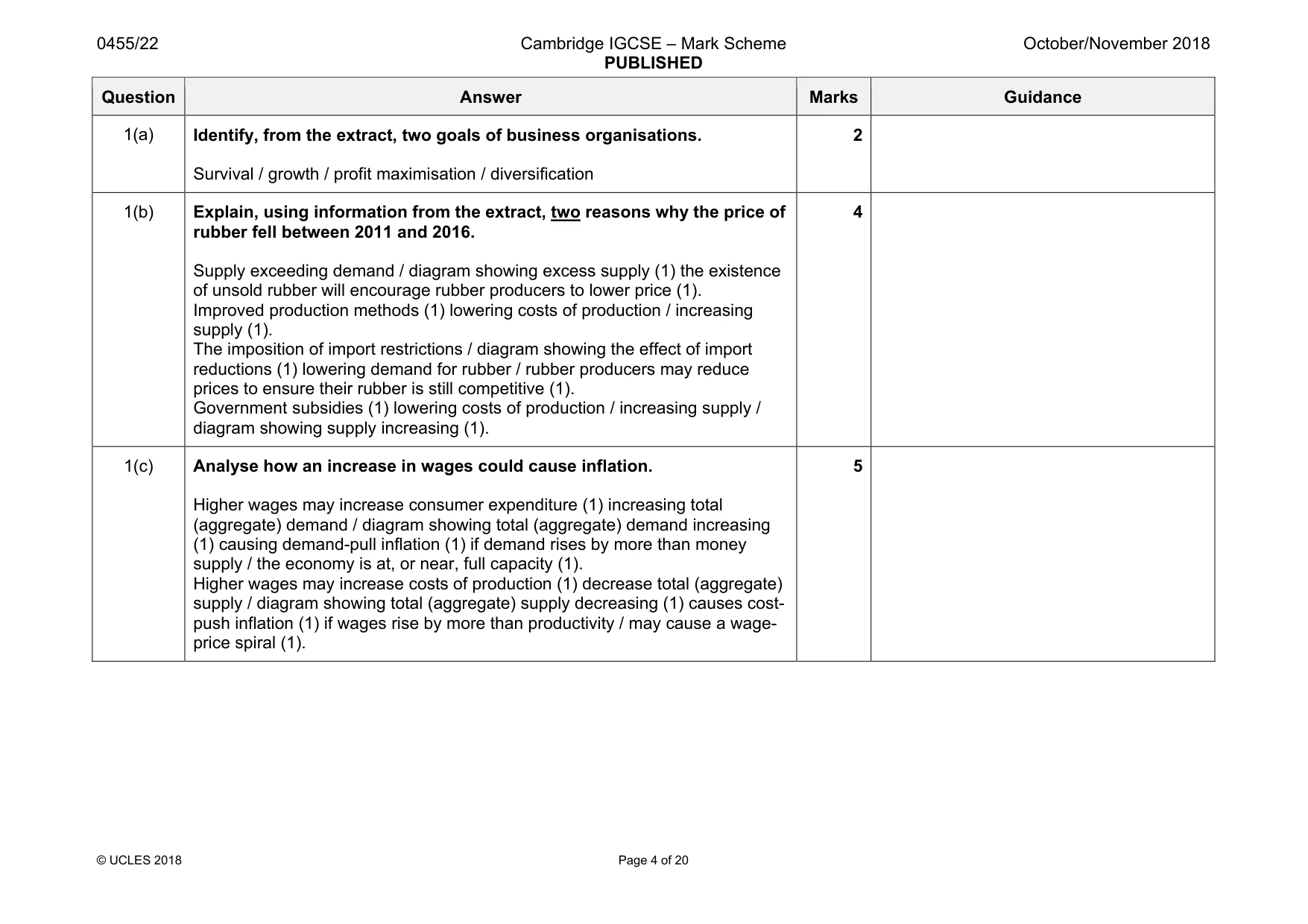
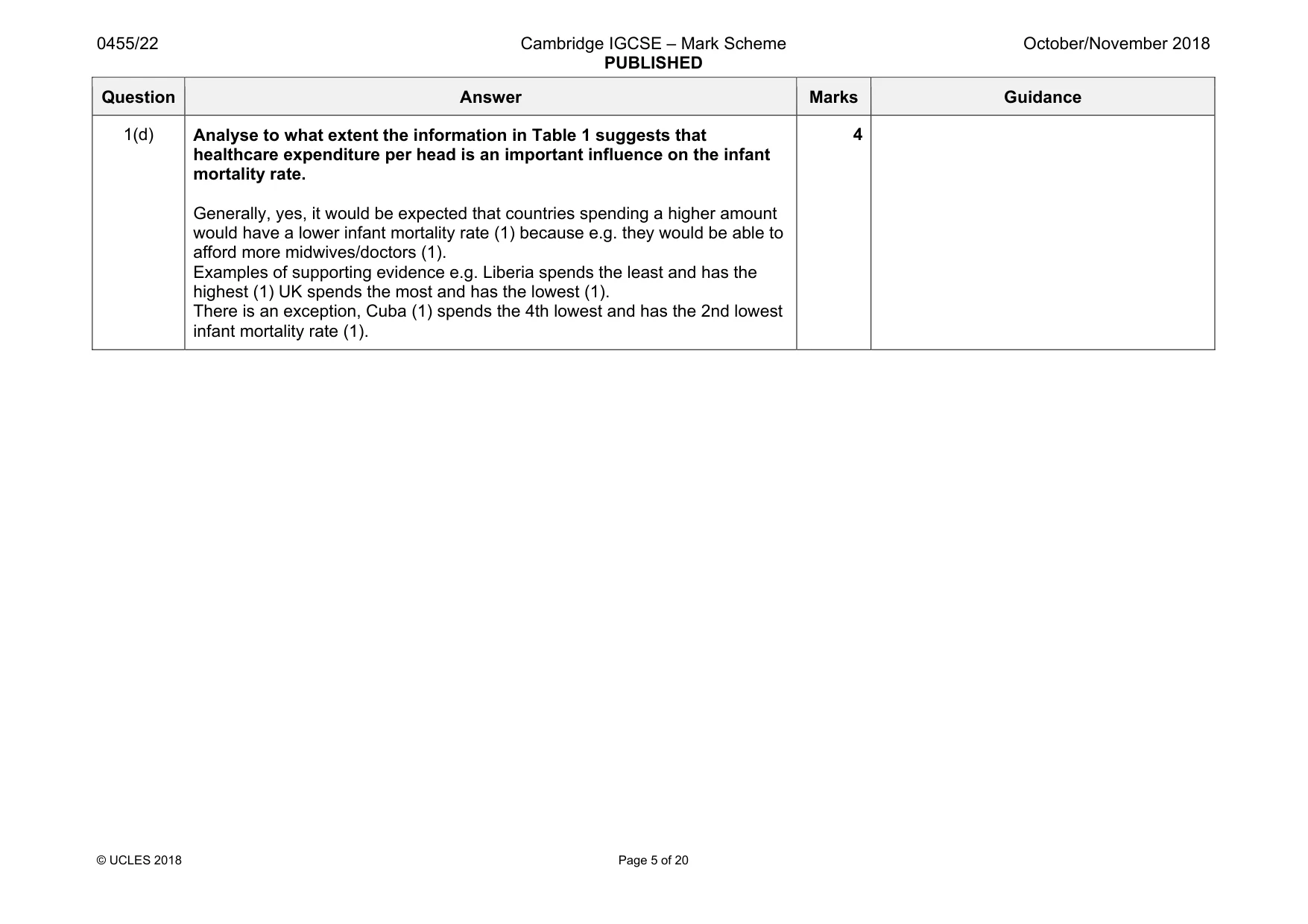
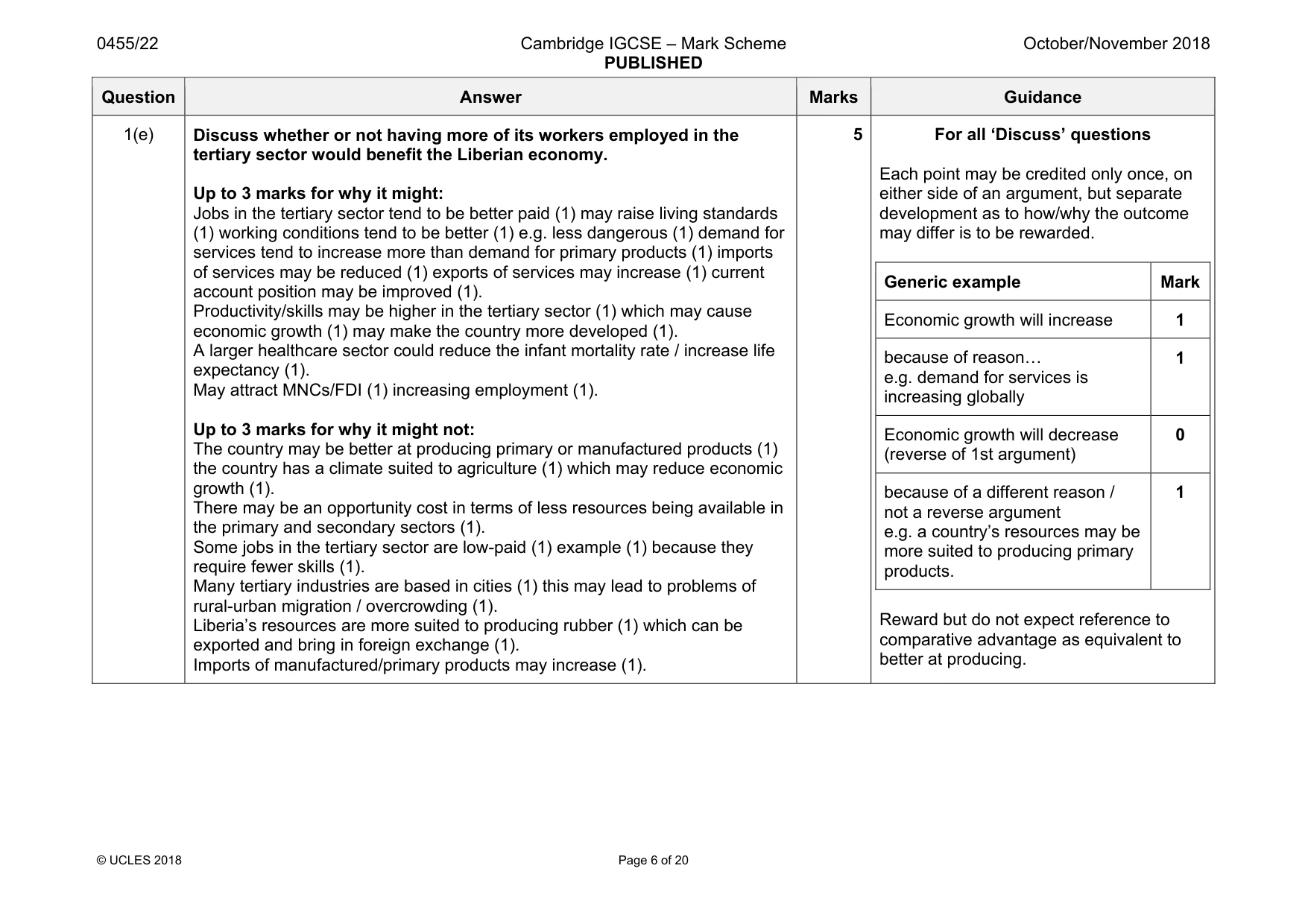
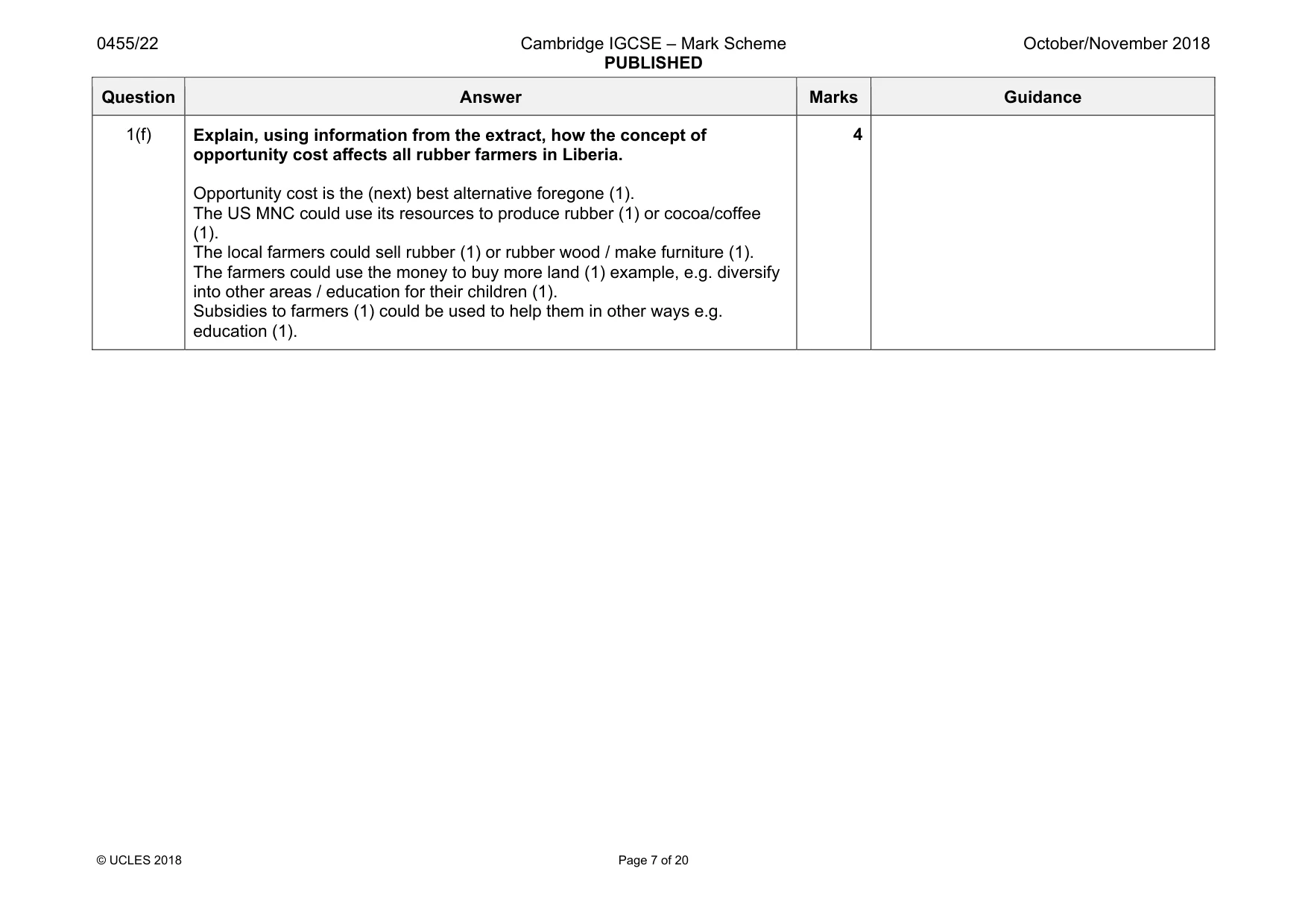
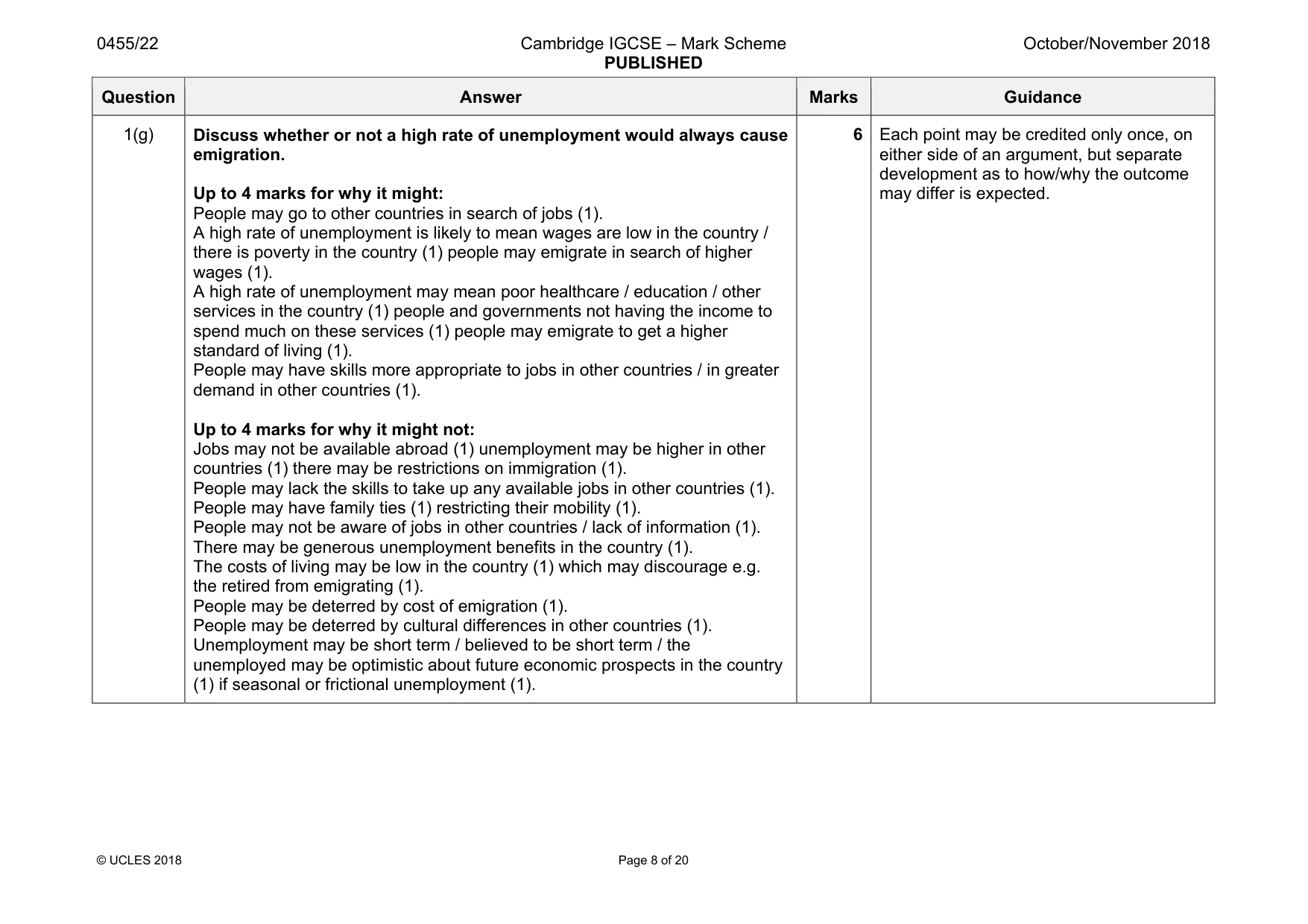
Mark scheme: 1(a) Identify, from the extract, two goals of business organisations. Survival / growth / profit maximisation / diversification 2 1(b) Explain, using information from the extract, two reasons why the price of rubber fell between 2011 and 2016. Supply exceeding demand / diagram showing excess supply (1) the existence of unsold rubber will encourage rubber producers to lower price (1). Improved production methods (1) lowering costs of production / increasing supply (1). The imposition of import restrictions / diagram showing the effect of import reductions (1) lowering demand for rubber / rubber producers may reduce prices to ensure their rubber is still competitive (1). Government subsidies (1) lowering costs of production / increasing supply / diagram showing supply increasing (1). 4 1(c) Analyse how an increase in wages could cause inflation. Higher wages may increase consumer expenditure (1) increasing total (aggregate) demand / diagram showing total (aggregate) demand increasing (1) causing demand-pull inflation (1) if demand rises by more than money supply / the economy is at, or near, full capacity (1). Higher wages may increase costs of production (1) decrease total (aggregate) supply / diagram showing total (aggregate) supply decreasing (1) causes cost- push inflation (1) if wages rise by more than productivity / may cause a wage- price spiral (1). 5 Question Answer Marks Guidance 1(d) Analyse to what extent the information in Table 1 suggests that healthcare expenditure per head is an important influence on the infant mortality rate. Generally, yes, it would be expected that countries spending a higher amount would have a lower infant mortality rate (1) because e.g. they would be able to afford more midwives/doctors (1). Examples of supporting evidence e.g. Liberia spends the least and has the highest (1) UK spends the most and has the lowest (1). There is an exception, Cuba (1) spends the 4th lowest and has the 2nd lowest infant mortality rate (1). 4 Question Answer Marks Guidance 1(e) Discuss whether or not having more of its workers employed in the tertiary sector would benefit the Liberian economy. Up to 3 marks for why it might: Jobs in the tertiary sector tend to be better paid (1) may raise living standards (1) working conditions tend to be better (1) e.g. less dangerous (1) demand for services tend to increase more than demand for primary products (1) imports of services may be reduced (1) exports of services may increase (1) current account position may be improved (1). Productivity/skills may be higher in the tertiary sector (1) which may cause economic growth (1) may make the country more developed (1). A larger healthcare sector could reduce the infant mortality rate / increase life expectancy (1). May attract MNCs/FDI (1) increasing employment (1). Up to 3 marks for why it might not: The country may be better at producing primary or manufactured products (1) the country has a climate suited to agriculture (1) which may reduce economic growth (1). There may be an opportunity cost in terms of less resources being available in the primary and secondary sectors (1). Some jobs in the tertiary sector are low-paid (1) example (1) because they require fewer skills (1). Many tertiary industries are based in cities (1) this may lead to problems of rural-urban migration / overcrowding (1). Liberia’s resources are more suited to producing rubber (1) which can be exported and bring in foreign exchange (1). Imports of manufactured/primary products may increase (1). 5 For all ‘Discuss’ questions Each point may be credited only once, on either side of an argument, but separate development as to how/why the outcome may differ is to be rewarded. Generic example Mark Economic growth will increase 1 because of reason« e.g. demand for services is increasing globally 1 Economic growth will decrease (reverse of 1st argument) 0 because of a different reason / not a reverse argument e.g. a country’s resources may be more suited to producing primary products. 1 Reward but do not expect reference to comparative advantage as equivalent to better at producing. Question Answer Marks Guidance 1(f) Explain, using information from the extract, how the concept of opportunity cost affects all rubber farmers in Liberia. Opportunity cost is the (next) best alternative foregone (1). The US MNC could use its resources to produce rubber (1) or cocoa/coffee (1). The local farmers could sell rubber (1) or rubber wood / make furniture (1). The farmers could use the money to buy more land (1) example, e.g. diversify into other areas / education for their children (1). Subsidies to farmers (1) could be used to help them in other ways e.g. education (1). 4 Question Answer Marks Guidance 1(g) Discuss whether or not a high rate of unemployment would always cause emigration. Up to 4 marks for why it might: People may go to other countries in search of jobs (1). A high rate of unemployment is likely to mean wages are low in the country / there is poverty in the country (1) people may emigrate in search of higher wages (1). A high rate of unemployment may mean poor healthcare / education / other services in the country (1) people and governments not having the income to spend much on these services (1) people may emigrate to get a higher standard of living (1). People may have skills more appropriate to jobs in other countries / in greater demand in other countries (1). Up to 4 marks for why it might not: Jobs may not be available abroad (1) unemployment may be higher in other countries (1) there may be restrictions on immigration (1). People may lack the skills to take up any available jobs in other countries (1). People may have family ties (1) restricting their mobility (1). People may not be aware of jobs in other countries / lack of information (1). There may be generous unemployment benefits in the country (1). The costs of living may be low in the country (1) which may discourage e.g. the retired from emigrating (1). People may be deterred by cost of emigration (1). People may be deterred by cultural differences in other countries (1). Unemployment may be short term / believed to be short term / the unemployed may be optimistic about future economic prospects in the country (1) if seasonal or frictional unemployment (1). 6 Each point may be credited only once, on either side of an argument, but separate development as to how/why the outcome may differ is expected.
Q2 · Mexico has recently experienced relatively low inflation and the Mexican government wants…
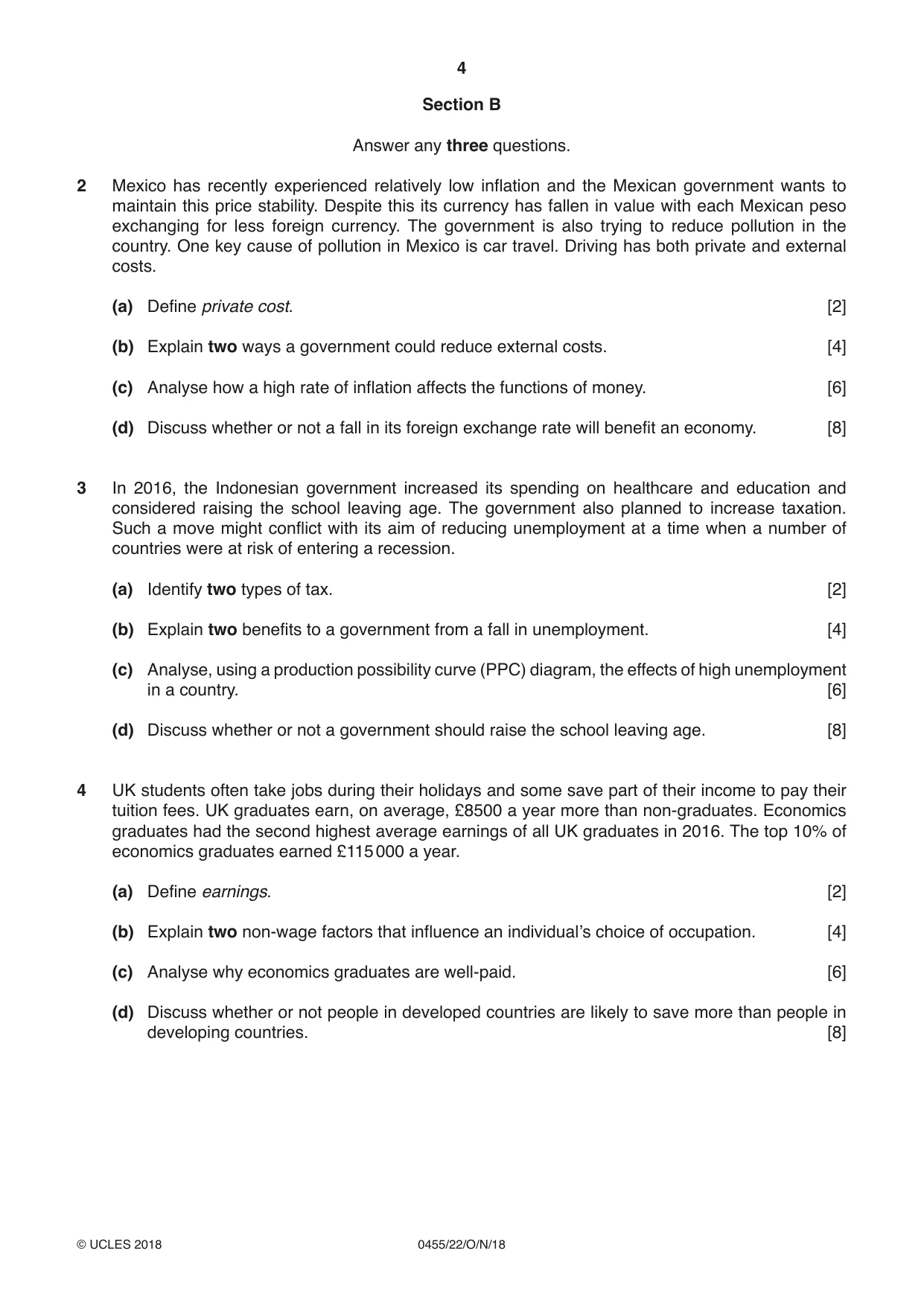
2 Mexico has recently experienced relatively low inflation and the Mexican government wants to maintain this price stability. Despite this its currency has fallen in value with each Mexican peso exchanging for less foreign currency. The government is also trying to reduce pollution in the country. One key cause of pollution in Mexico is car travel. Driving has both private and external costs. (a) Define private cost. [2] (b) Explain two ways a government could reduce external costs. [4] (c) Analyse how a high rate of inflation affects the functions of money. [6] (d) Discuss whether or not a fall in its foreign exchange rate will benefit an economy. [8]
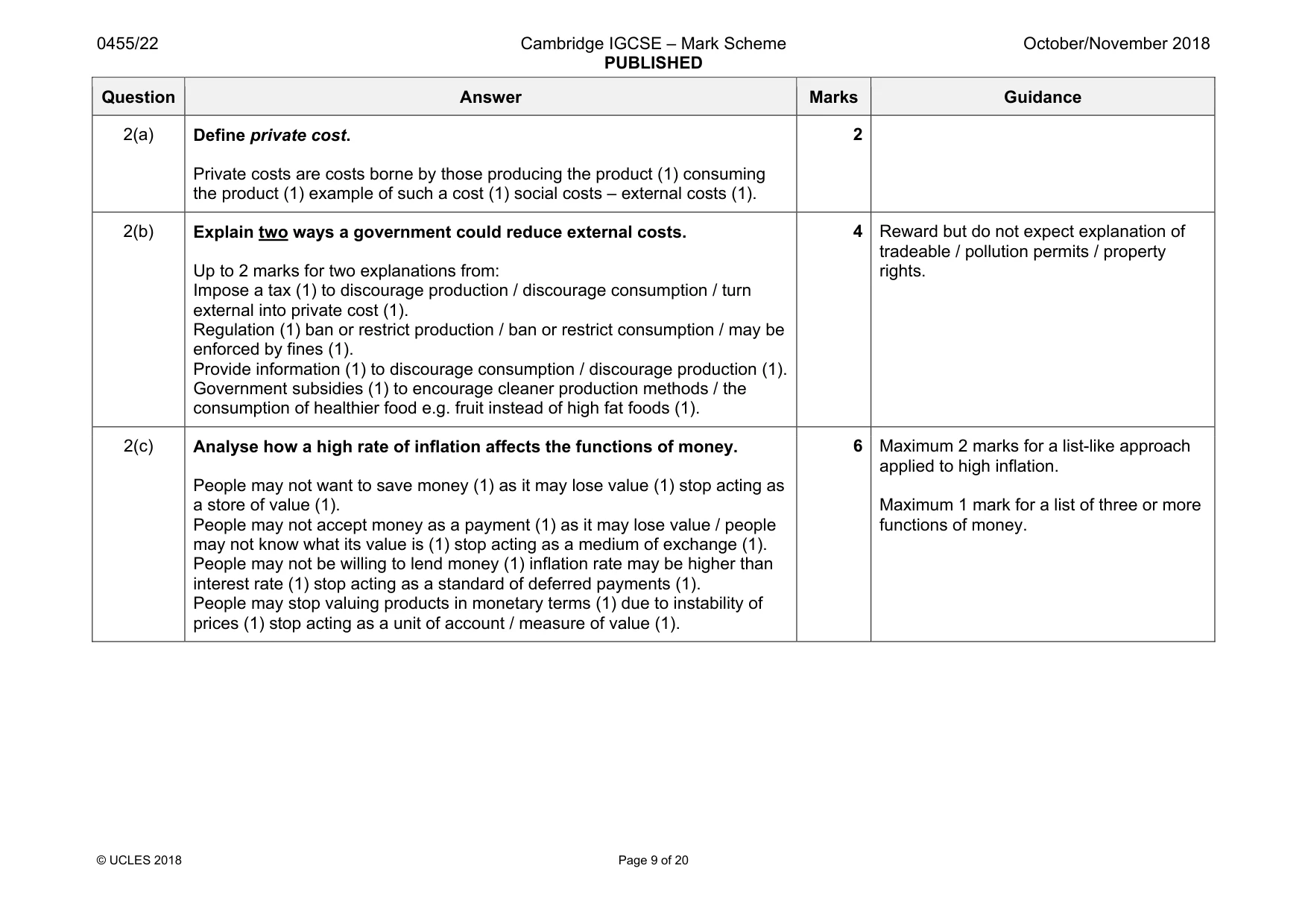
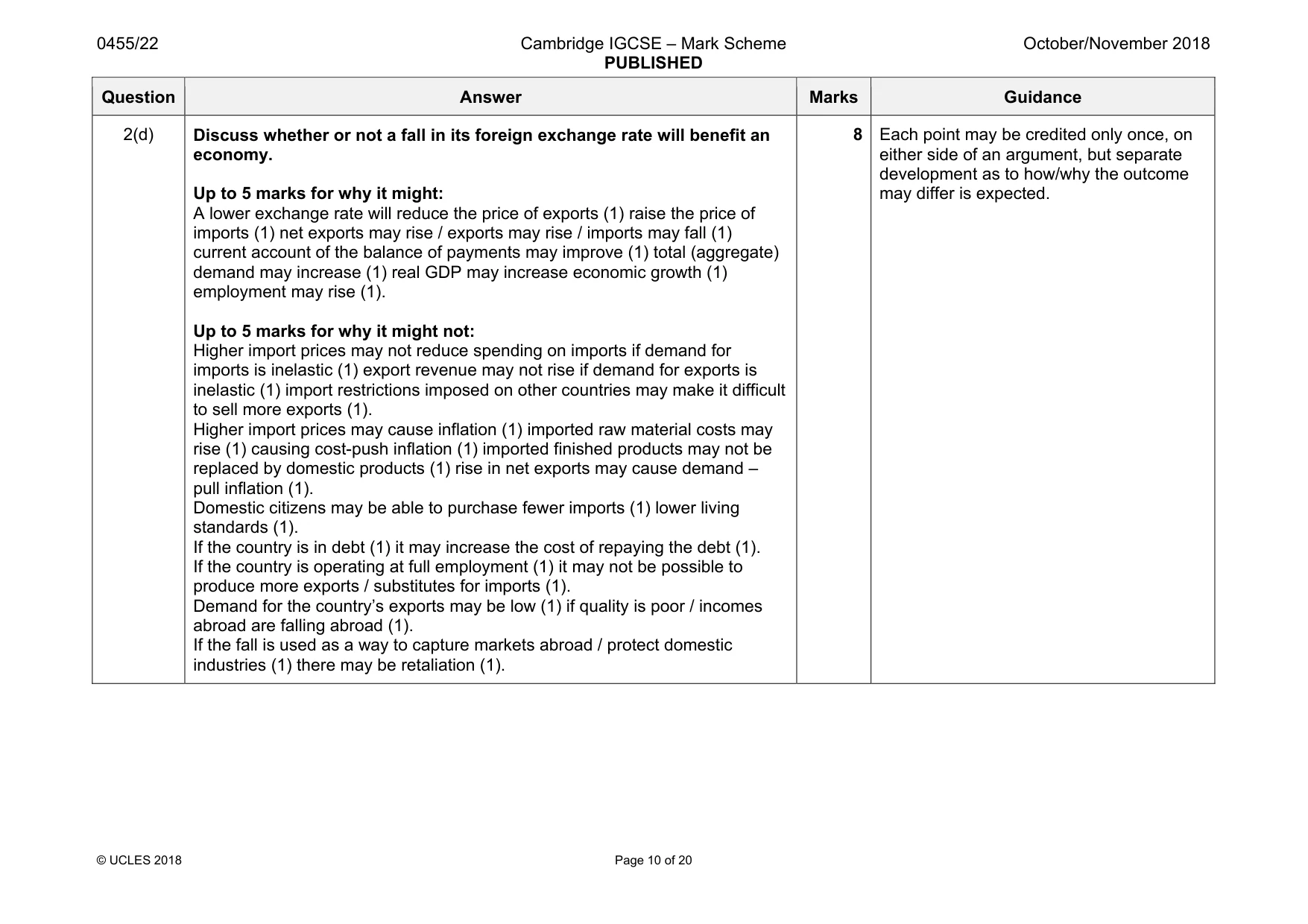
Mark scheme: 2(a) Define private cost. Private costs are costs borne by those producing the product (1) consuming the product (1) example of such a cost (1) social costs – external costs (1). 2 2(b) Explain two ways a government could reduce external costs. Up to 2 marks for two explanations from: Impose a tax (1) to discourage production / discourage consumption / turn external into private cost (1). Regulation (1) ban or restrict production / ban or restrict consumption / may be enforced by fines (1). Provide information (1) to discourage consumption / discourage production (1). Government subsidies (1) to encourage cleaner production methods / the consumption of healthier food e.g. fruit instead of high fat foods (1). 4 Reward but do not expect explanation of tradeable / pollution permits / property rights. 2(c) Analyse how a high rate of inflation affects the functions of money. People may not want to save money (1) as it may lose value (1) stop acting as a store of value (1). People may not accept money as a payment (1) as it may lose value / people may not know what its value is (1) stop acting as a medium of exchange (1). People may not be willing to lend money (1) inflation rate may be higher than interest rate (1) stop acting as a standard of deferred payments (1). People may stop valuing products in monetary terms (1) due to instability of prices (1) stop acting as a unit of account / measure of value (1). 6 Maximum 2 marks for a list-like approach applied to high inflation. Maximum 1 mark for a list of three or more functions of money. Question Answer Marks Guidance 2(d) Discuss whether or not a fall in its foreign exchange rate will benefit an economy. Up to 5 marks for why it might: A lower exchange rate will reduce the price of exports (1) raise the price of imports (1) net exports may rise / exports may rise / imports may fall (1) current account of the balance of payments may improve (1) total (aggregate) demand may increase (1) real GDP may increase economic growth (1) employment may rise (1). Up to 5 marks for why it might not: Higher import prices may not reduce spending on imports if demand for imports is inelastic (1) export revenue may not rise if demand for exports is inelastic (1) import restrictions imposed on other countries may make it difficult to sell more exports (1). Higher import prices may cause inflation (1) imported raw material costs may rise (1) causing cost-push inflation (1) imported finished products may not be replaced by domestic products (1) rise in net exports may cause demand – pull inflation (1). Domestic citizens may be able to purchase fewer imports (1) lower living standards (1). If the country is in debt (1) it may increase the cost of repaying the debt (1). If the country is operating at full employment (1) it may not be possible to produce more exports / substitutes for imports (1). Demand for the country’s exports may be low (1) if quality is poor / incomes abroad are falling abroad (1). If the fall is used as a way to capture markets abroad / protect domestic industries (1) there may be retaliation (1). 8 Each point may be credited only once, on either side of an argument, but separate development as to how/why the outcome may differ is expected.
Q3 · In 2016, the Indonesian government increased its spending on healthcare and education and…
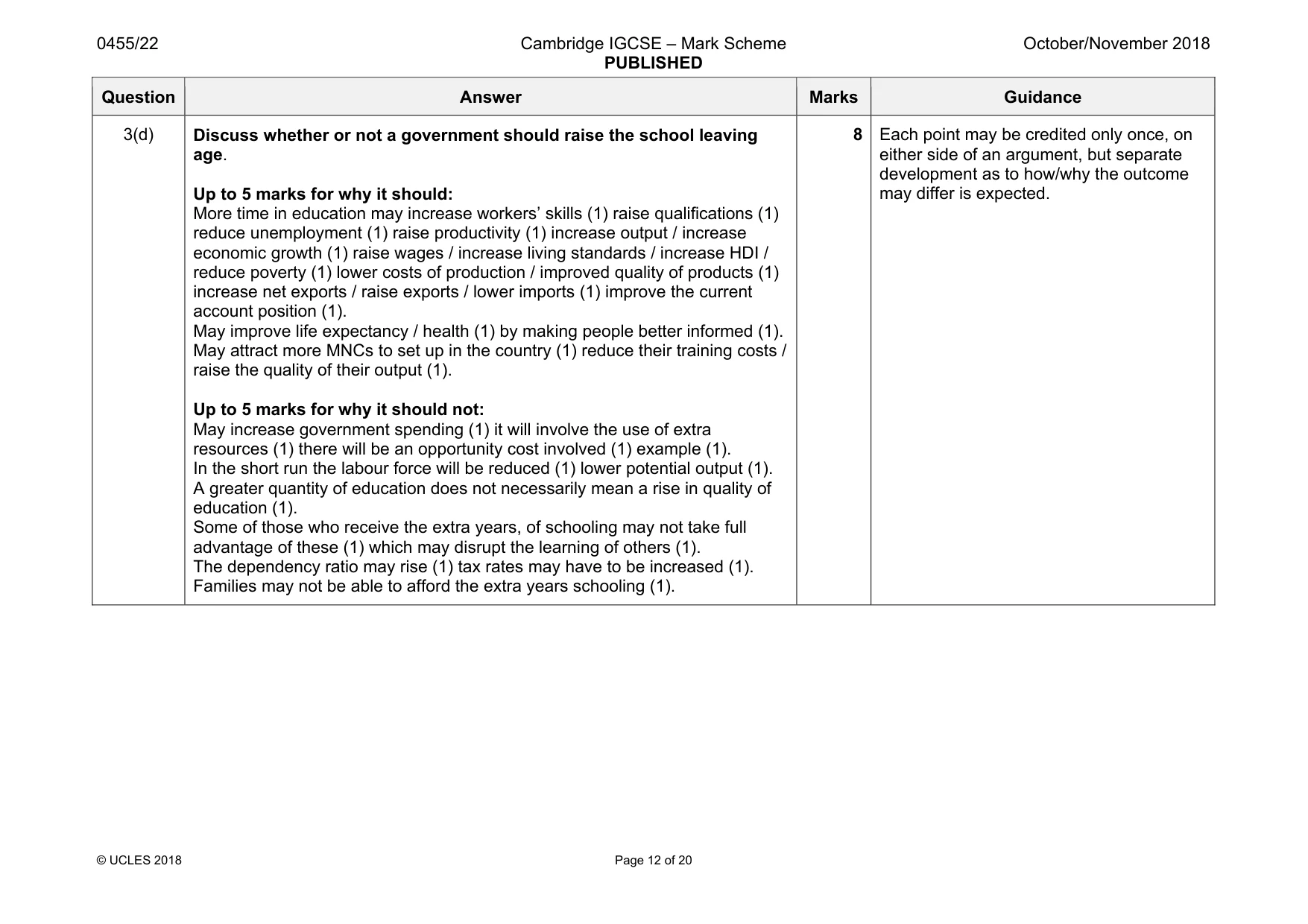
3 In 2016, the Indonesian government increased its spending on healthcare and education and considered raising the school leaving age. The government also planned to increase taxation. Such a move might conflict with its aim of reducing unemployment at a time when a number of countries were at risk of entering a recession. (a) Identify two types of tax. [2] (b) Explain two benefits to a government from a fall in unemployment. [4] (c) Analyse, using a production possibility curve (PPC) diagram, the effects of high unemployment in a country. [6] (d) Discuss whether or not a government should raise the school leaving age. [8]
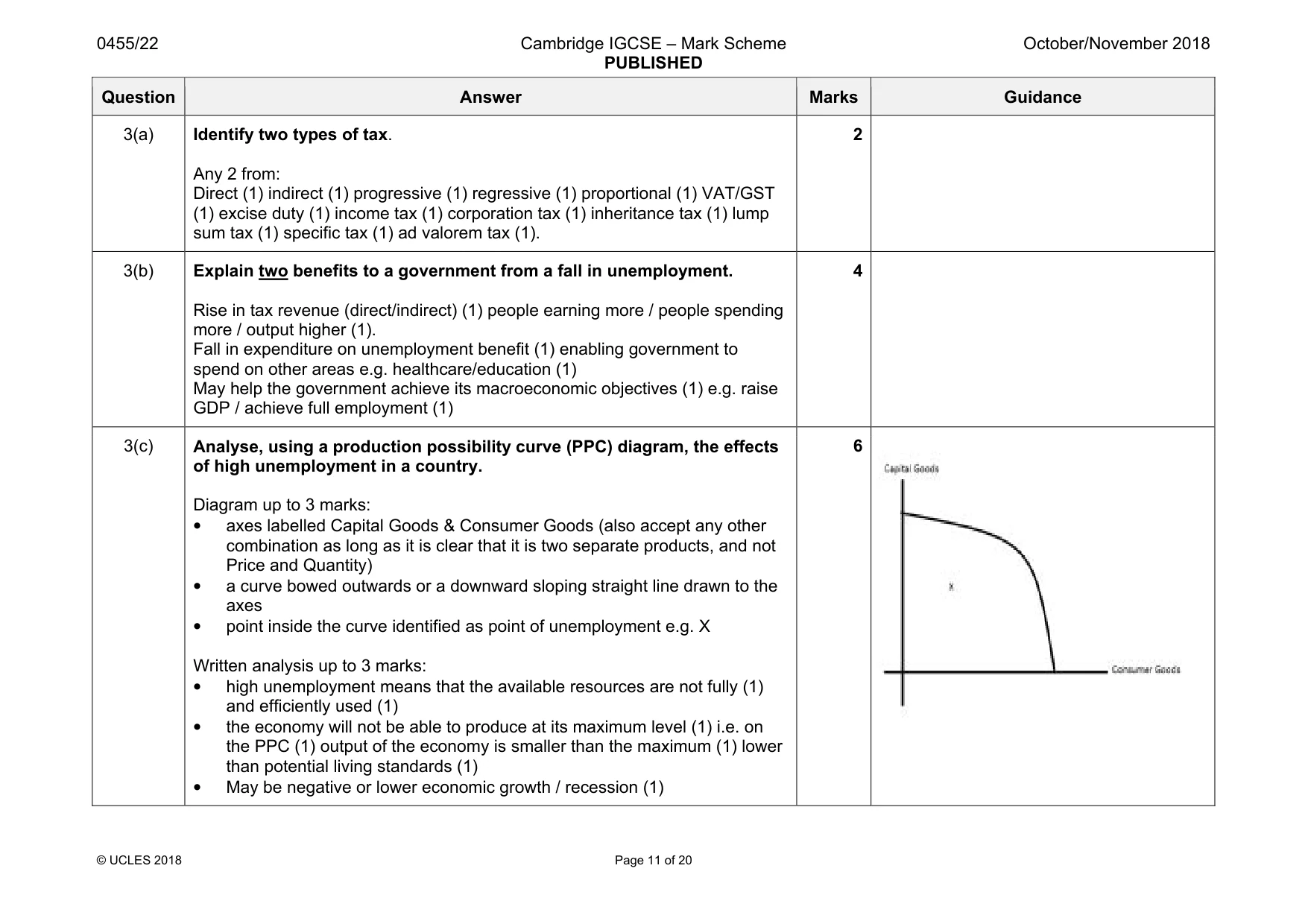
Mark scheme: 3(a) Identify two types of tax. Any 2 from: Direct (1) indirect (1) progressive (1) regressive (1) proportional (1) VAT/GST (1) excise duty (1) income tax (1) corporation tax (1) inheritance tax (1) lump sum tax (1) specific tax (1) ad valorem tax (1). 2 3(b) Explain two benefits to a government from a fall in unemployment. Rise in tax revenue (direct/indirect) (1) people earning more / people spending more / output higher (1). Fall in expenditure on unemployment benefit (1) enabling government to spend on other areas e.g. healthcare/education (1) May help the government achieve its macroeconomic objectives (1) e.g. raise GDP / achieve full employment (1) 4 3(c) Analyse, using a production possibility curve (PPC) diagram, the effects of high unemployment in a country. Diagram up to 3 marks: • axes labelled Capital Goods & Consumer Goods (also accept any other combination as long as it is clear that it is two separate products, and not Price and Quantity) • a curve bowed outwards or a downward sloping straight line drawn to the axes • point inside the curve identified as point of unemployment e.g. X Written analysis up to 3 marks: • high unemployment means that the available resources are not fully (1) and efficiently used (1) • the economy will not be able to produce at its maximum level (1) i.e. on the PPC (1) output of the economy is smaller than the maximum (1) lower than potential living standards (1) • May be negative or lower economic growth / recession (1) 6 Question Answer Marks Guidance 3(d) Discuss whether or not a government should raise the school leaving age. Up to 5 marks for why it should: More time in education may increase workers’ skills (1) raise qualifications (1) reduce unemployment (1) raise productivity (1) increase output / increase economic growth (1) raise wages / increase living standards / increase HDI / reduce poverty (1) lower costs of production / improved quality of products (1) increase net exports / raise exports / lower imports (1) improve the current account position (1). May improve life expectancy / health (1) by making people better informed (1). May attract more MNCs to set up in the country (1) reduce their training costs / raise the quality of their output (1). Up to 5 marks for why it should not: May increase government spending (1) it will involve the use of extra resources (1) there will be an opportunity cost involved (1) example (1). In the short run the labour force will be reduced (1) lower potential output (1). A greater quantity of education does not necessarily mean a rise in quality of education (1). Some of those who receive the extra years, of schooling may not take full advantage of these (1) which may disrupt the learning of others (1). The dependency ratio may rise (1) tax rates may have to be increased (1). Families may not be able to afford the extra years schooling (1). 8 Each point may be credited only once, on either side of an argument, but separate development as to how/why the outcome may differ is expected.
Q4 · UK students often take jobs during their holidays and some save part of their income to…
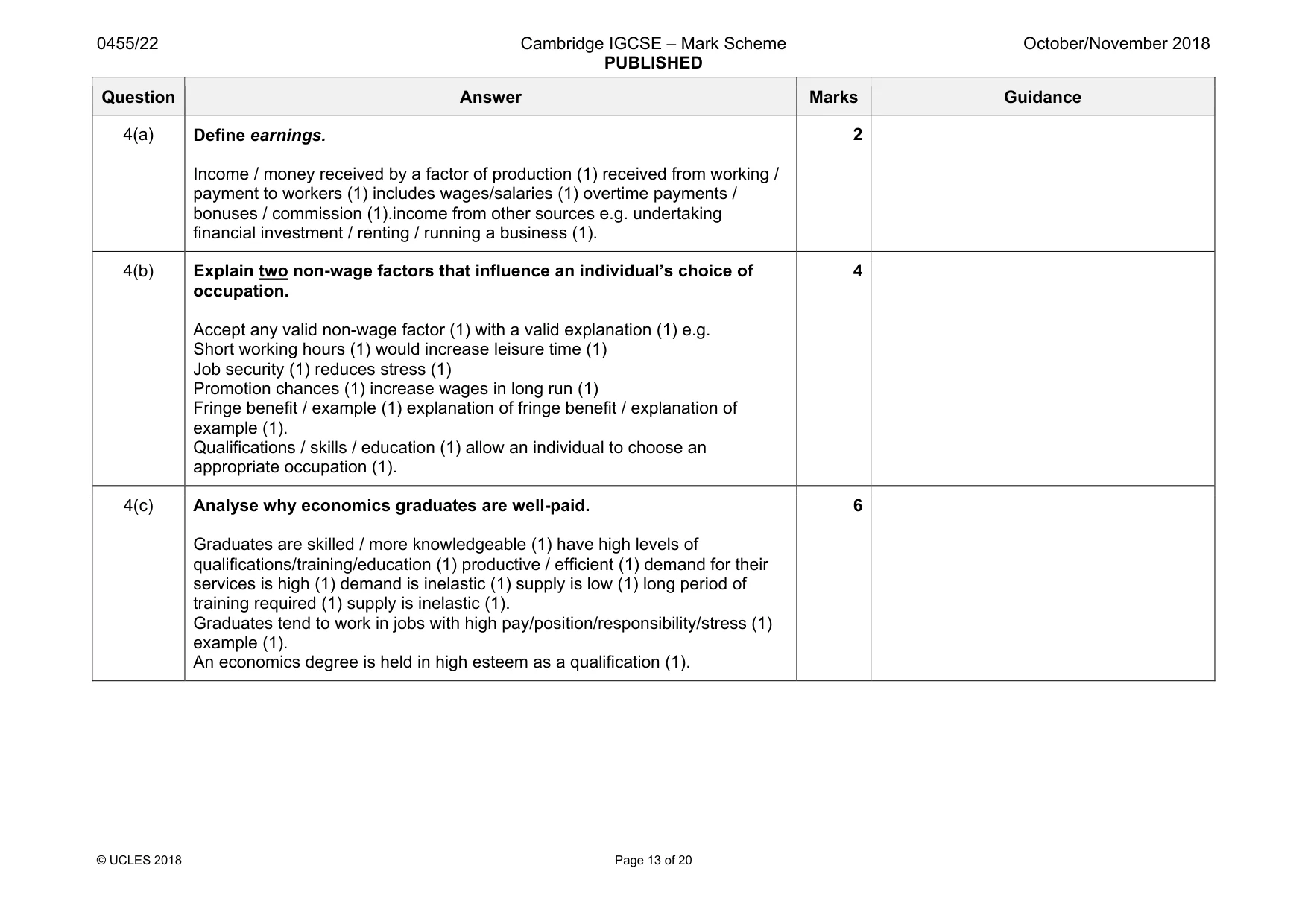
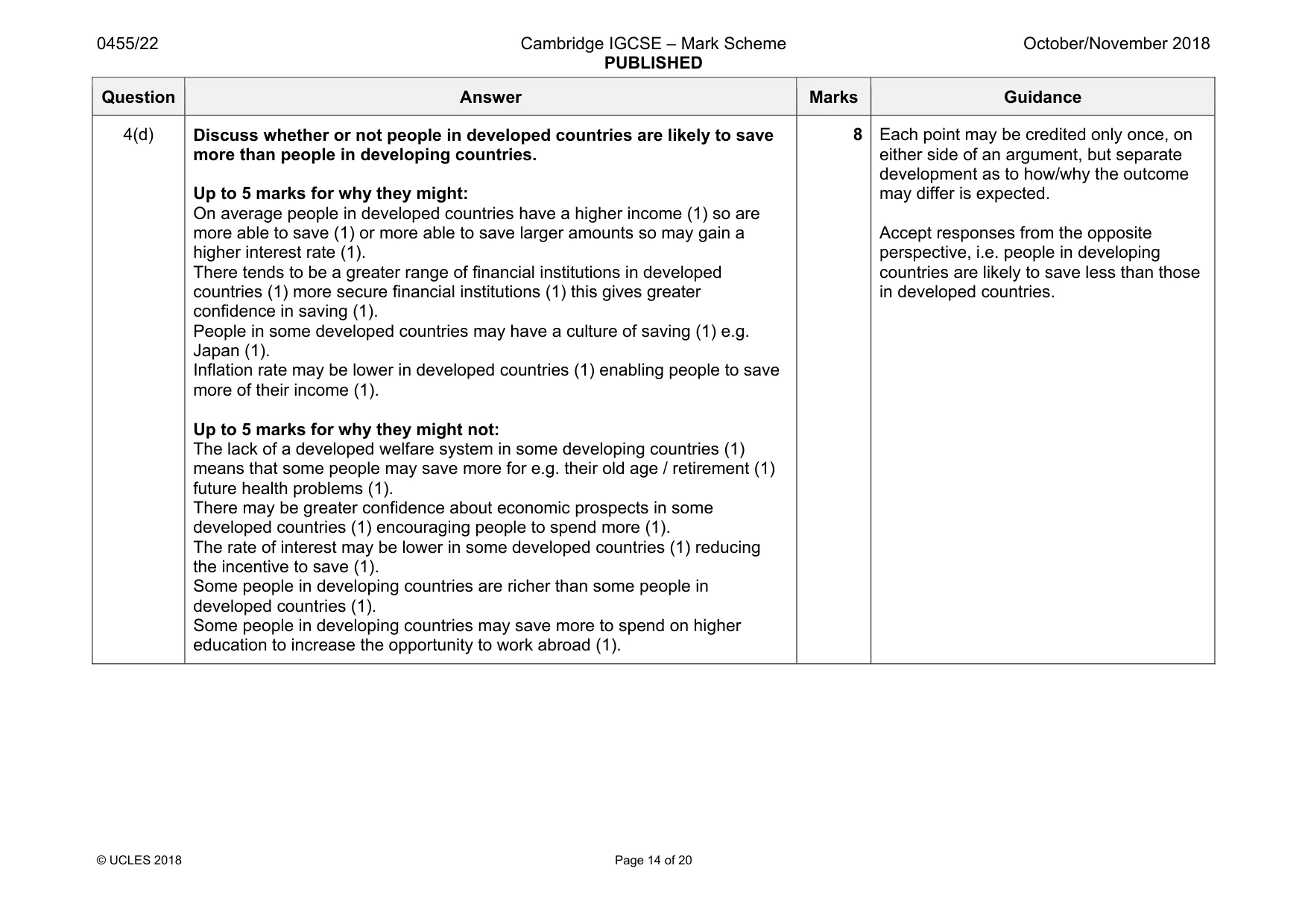
4 UK students often take jobs during their holidays and some save part of their income to pay their tuition fees. UK graduates earn, on average, £8500 a year more than non-graduates. Economics graduates had the second highest average earnings of all UK graduates in 2016. The top 10% of economics graduates earned £115 000 a year. (a) Define earnings. [2] (b) Explain two non-wage factors that influence an individual’s choice of occupation. [4] (c) Analyse why economics graduates are well-paid. [6] (d) Discuss whether or not people in developed countries are likely to save more than people in developing countries. [8]
Mark scheme: 4(a) Define earnings. Income / money received by a factor of production (1) received from working / payment to workers (1) includes wages/salaries (1) overtime payments / bonuses / commission (1).income from other sources e.g. undertaking financial investment / renting / running a business (1). 2 4(b) Explain two non-wage factors that influence an individual’s choice of occupation. Accept any valid non-wage factor (1) with a valid explanation (1) e.g. Short working hours (1) would increase leisure time (1) Job security (1) reduces stress (1) Promotion chances (1) increase wages in long run (1) Fringe benefit / example (1) explanation of fringe benefit / explanation of example (1). Qualifications / skills / education (1) allow an individual to choose an appropriate occupation (1). 4 4(c) Analyse why economics graduates are well-paid. Graduates are skilled / more knowledgeable (1) have high levels of qualifications/training/education (1) productive / efficient (1) demand for their services is high (1) demand is inelastic (1) supply is low (1) long period of training required (1) supply is inelastic (1). Graduates tend to work in jobs with high pay/position/responsibility/stress (1) example (1). An economics degree is held in high esteem as a qualification (1). 6 Question Answer Marks Guidance 4(d) Discuss whether or not people in developed countries are likely to save more than people in developing countries. Up to 5 marks for why they might: On average people in developed countries have a higher income (1) so are more able to save (1) or more able to save larger amounts so may gain a higher interest rate (1). There tends to be a greater range of financial institutions in developed countries (1) more secure financial institutions (1) this gives greater confidence in saving (1). People in some developed countries may have a culture of saving (1) e.g. Japan (1). Inflation rate may be lower in developed countries (1) enabling people to save more of their income (1). Up to 5 marks for why they might not: The lack of a developed welfare system in some developing countries (1) means that some people may save more for e.g. their old age / retirement (1) future health problems (1). There may be greater confidence about economic prospects in some developed countries (1) encouraging people to spend more (1). The rate of interest may be lower in some developed countries (1) reducing the incentive to save (1). Some people in developing countries are richer than some people in developed countries (1). Some people in developing countries may save more to spend on higher education to increase the opportunity to work abroad (1). 8 Each point may be credited only once, on either side of an argument, but separate development as to how/why the outcome may differ is expected. Accept responses from the opposite perspective, i.e. people in developing countries are likely to save less than those in developed countries.
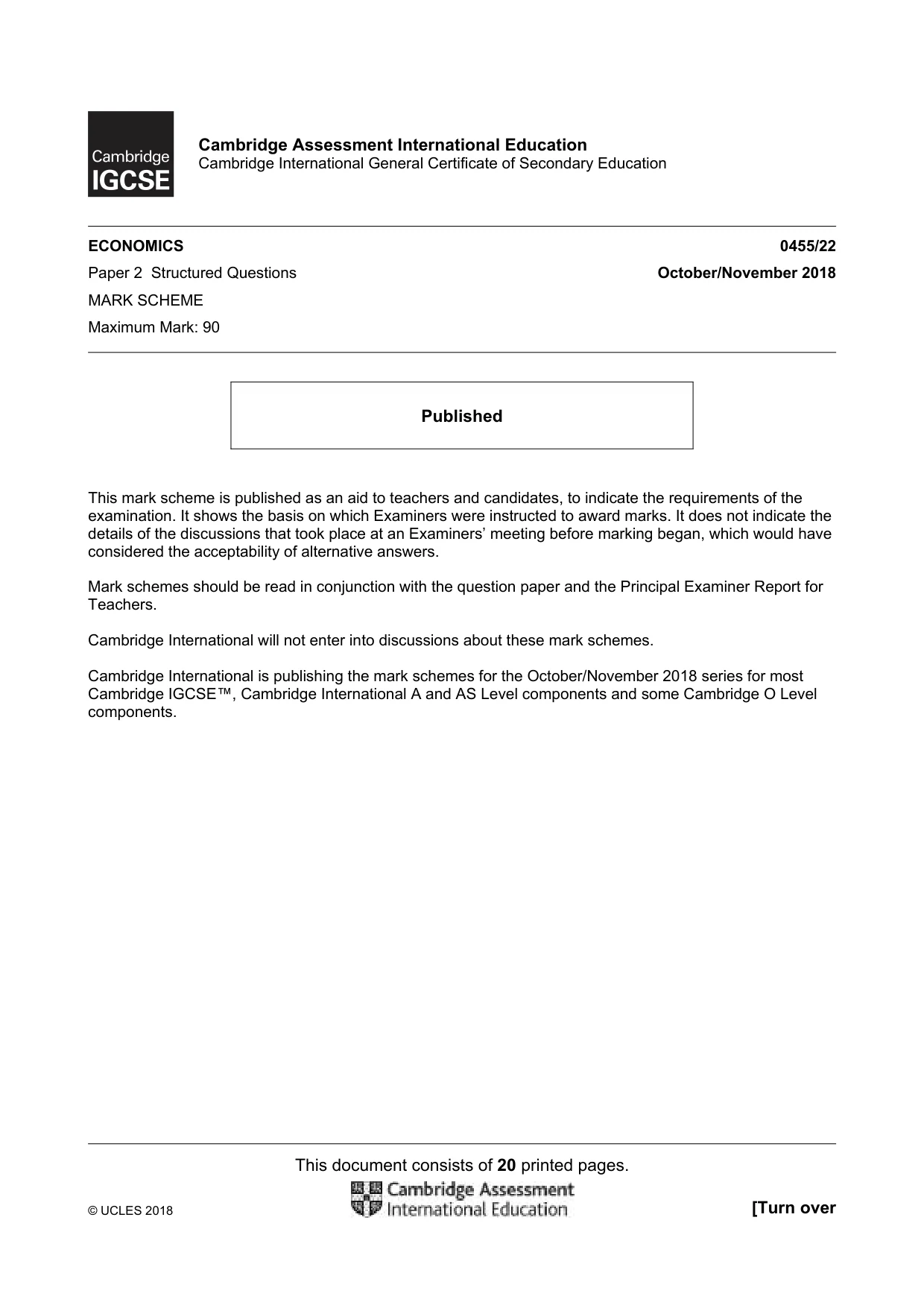
Q5 · Productivity has fallen recently in Finland particularly in the public sector
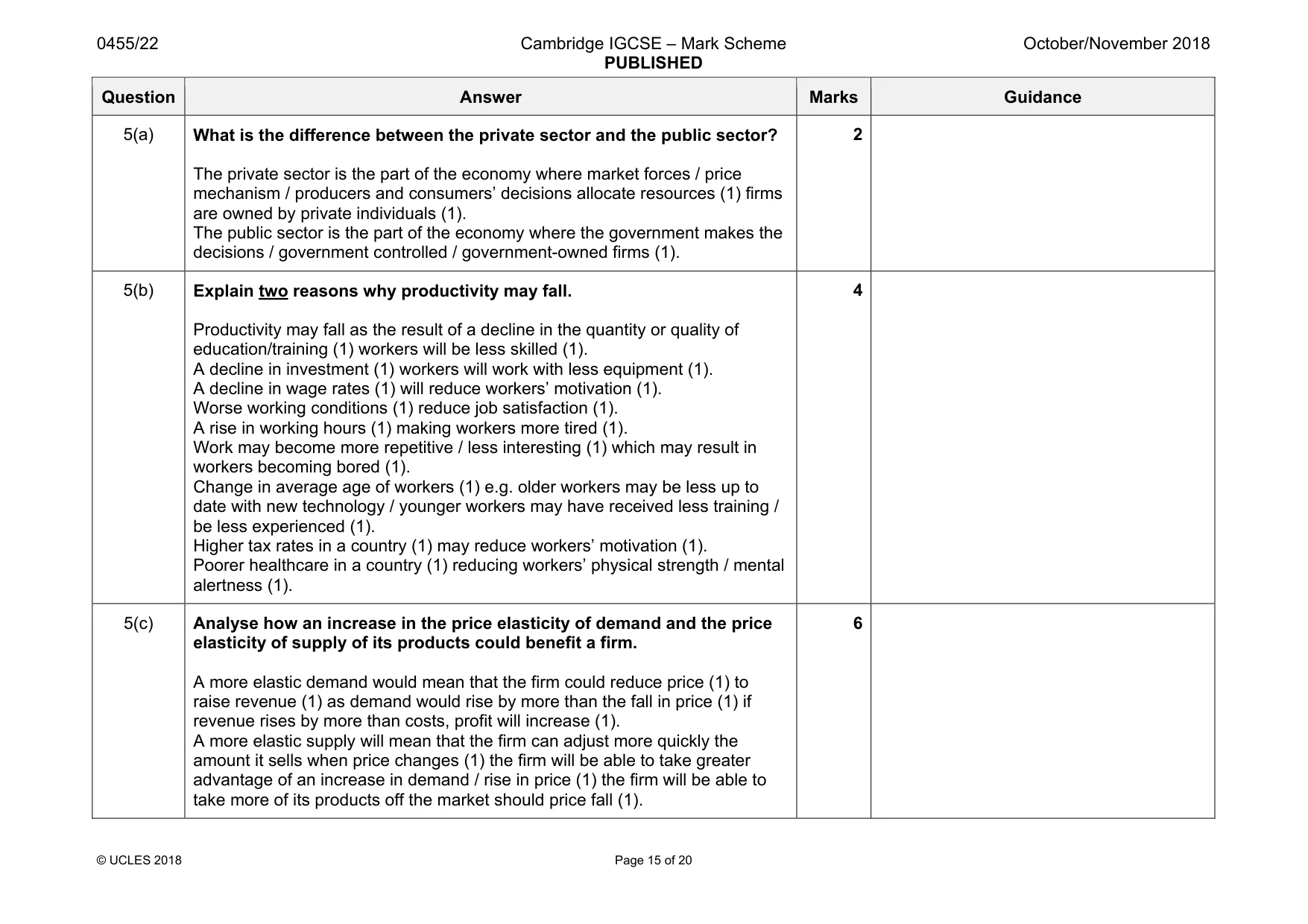
5 Productivity has fallen recently in Finland particularly in the public sector. The country has a relatively high number of small firms. In recent years the price elasticity of demand and the price elasticity of supply of the products made by Finnish firms have changed. (a) What is the difference between the private sector and the public sector? [2] (b) Explain two reasons why productivity may fall. [4] (c) Analyse how an increase in the price elasticity of demand (PED) and the price elasticity of supply (PES) of its products could benefit a firm. [6] (d) Discuss whether or not small firms are likely to survive in the long run. [8]
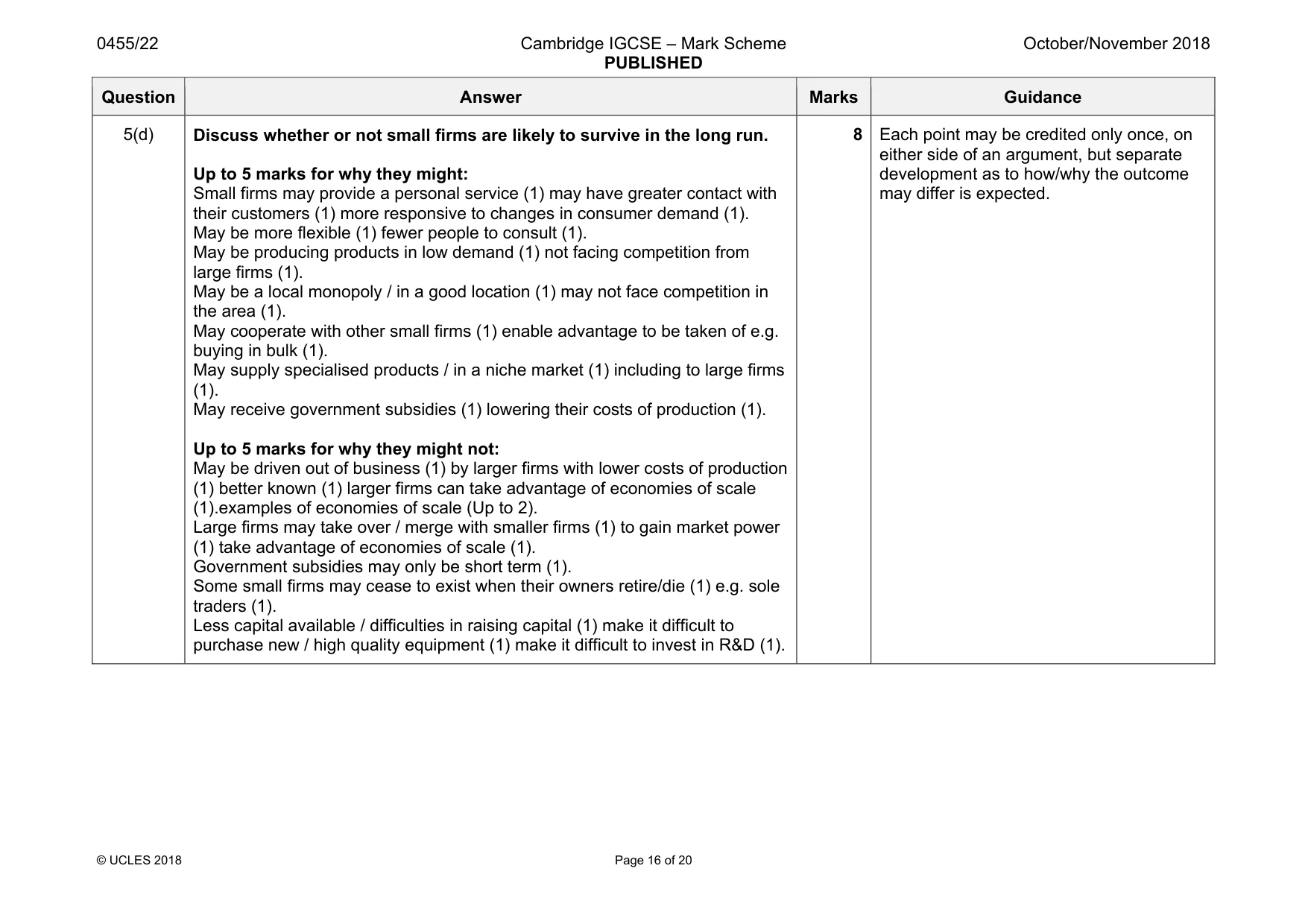
Mark scheme: 5(a) What is the difference between the private sector and the public sector? The private sector is the part of the economy where market forces / price mechanism / producers and consumers’ decisions allocate resources (1) firms are owned by private individuals (1). The public sector is the part of the economy where the government makes the decisions / government controlled / government-owned firms (1). 2 5(b) Explain two reasons why productivity may fall. Productivity may fall as the result of a decline in the quantity or quality of education/training (1) workers will be less skilled (1). A decline in investment (1) workers will work with less equipment (1). A decline in wage rates (1) will reduce workers’ motivation (1). Worse working conditions (1) reduce job satisfaction (1). A rise in working hours (1) making workers more tired (1). Work may become more repetitive / less interesting (1) which may result in workers becoming bored (1). Change in average age of workers (1) e.g. older workers may be less up to date with new technology / younger workers may have received less training / be less experienced (1). Higher tax rates in a country (1) may reduce workers’ motivation (1). Poorer healthcare in a country (1) reducing workers’ physical strength / mental alertness (1). 4 5(c) Analyse how an increase in the price elasticity of demand and the price elasticity of supply of its products could benefit a firm. A more elastic demand would mean that the firm could reduce price (1) to raise revenue (1) as demand would rise by more than the fall in price (1) if revenue rises by more than costs, profit will increase (1). A more elastic supply will mean that the firm can adjust more quickly the amount it sells when price changes (1) the firm will be able to take greater advantage of an increase in demand / rise in price (1) the firm will be able to take more of its products off the market should price fall (1). 6 Question Answer Marks Guidance 5(d) Discuss whether or not small firms are likely to survive in the long run. Up to 5 marks for why they might: Small firms may provide a personal service (1) may have greater contact with their customers (1) more responsive to changes in consumer demand (1). May be more flexible (1) fewer people to consult (1). May be producing products in low demand (1) not facing competition from large firms (1). May be a local monopoly / in a good location (1) may not face competition in the area (1). May cooperate with other small firms (1) enable advantage to be taken of e.g. buying in bulk (1). May supply specialised products / in a niche market (1) including to large firms (1). May receive government subsidies (1) lowering their costs of production (1). Up to 5 marks for why they might not: May be driven out of business (1) by larger firms with lower costs of production (1) better known (1) larger firms can take advantage of economies of scale (1).examples of economies of scale (Up to 2). Large firms may take over / merge with smaller firms (1) to gain market power (1) take advantage of economies of scale (1). Government subsidies may only be short term (1). Some small firms may cease to exist when their owners retire/die (1) e.g. sole traders (1). Less capital available / difficulties in raising capital (1) make it difficult to purchase new / high quality equipment (1) make it difficult to invest in R&D (1). 8 Each point may be credited only once, on either side of an argument, but separate development as to how/why the outcome may differ is expected.
Q6 · A relatively high proportion of people from the Philippines either work in call centres…
6 A relatively high proportion of people from the Philippines either work in call centres or abroad. Call centres employ 1.2 million people in the Philippines and account for 8% of the country’s Gross Domestic Product. Due to the time difference with the US, the main market for call centre services, many Filipinos have to work at night. The call centres are introducing new technology including robots. (a) Define Gross Domestic Product (GDP). [2] (b) Explain two reasons why a person may be willing to work at night. [4] (c) Analyse how having some of its population working abroad may benefit an economy. [6] (d) Discuss whether or not advances in technology benefit an economy. [8]
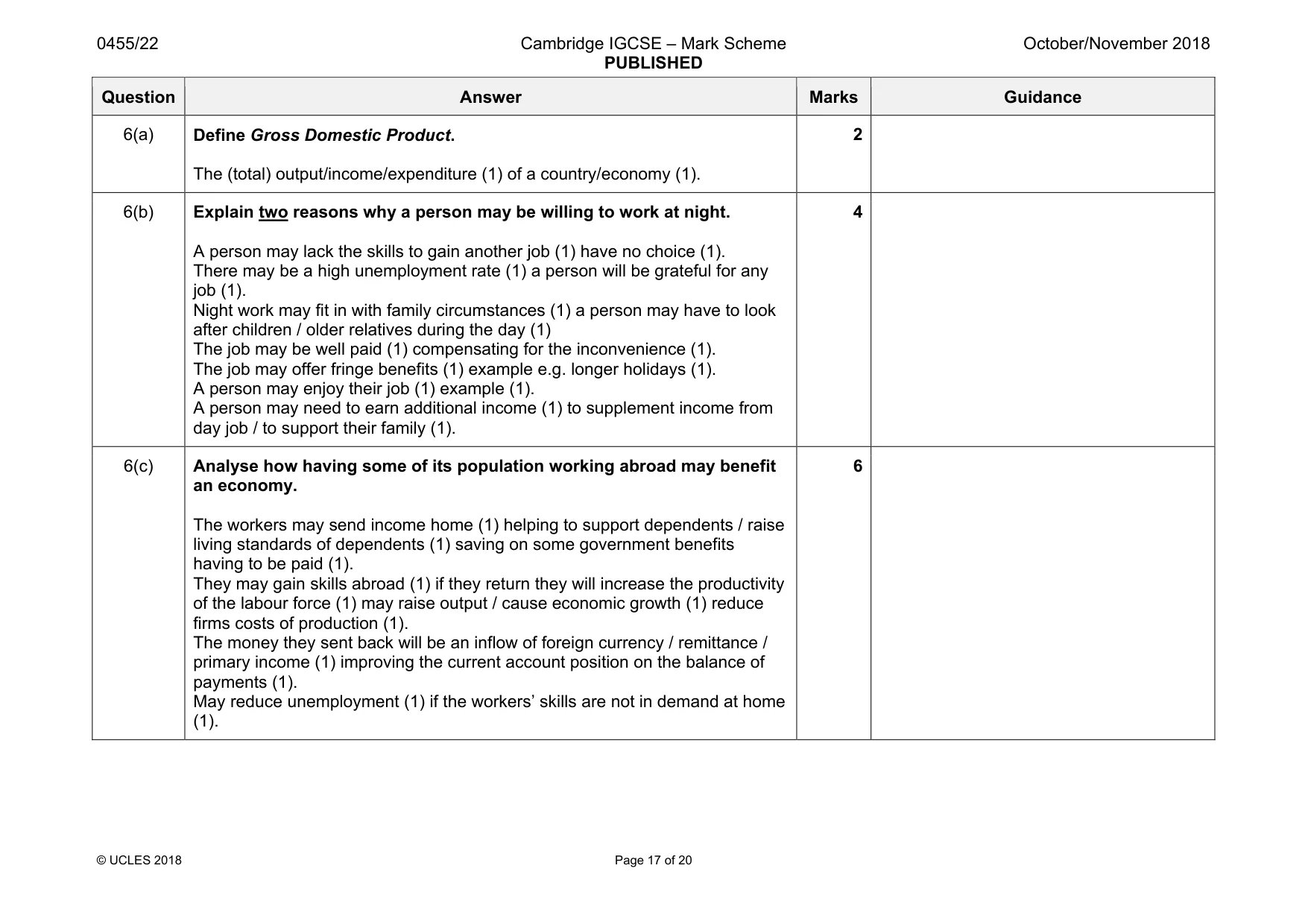
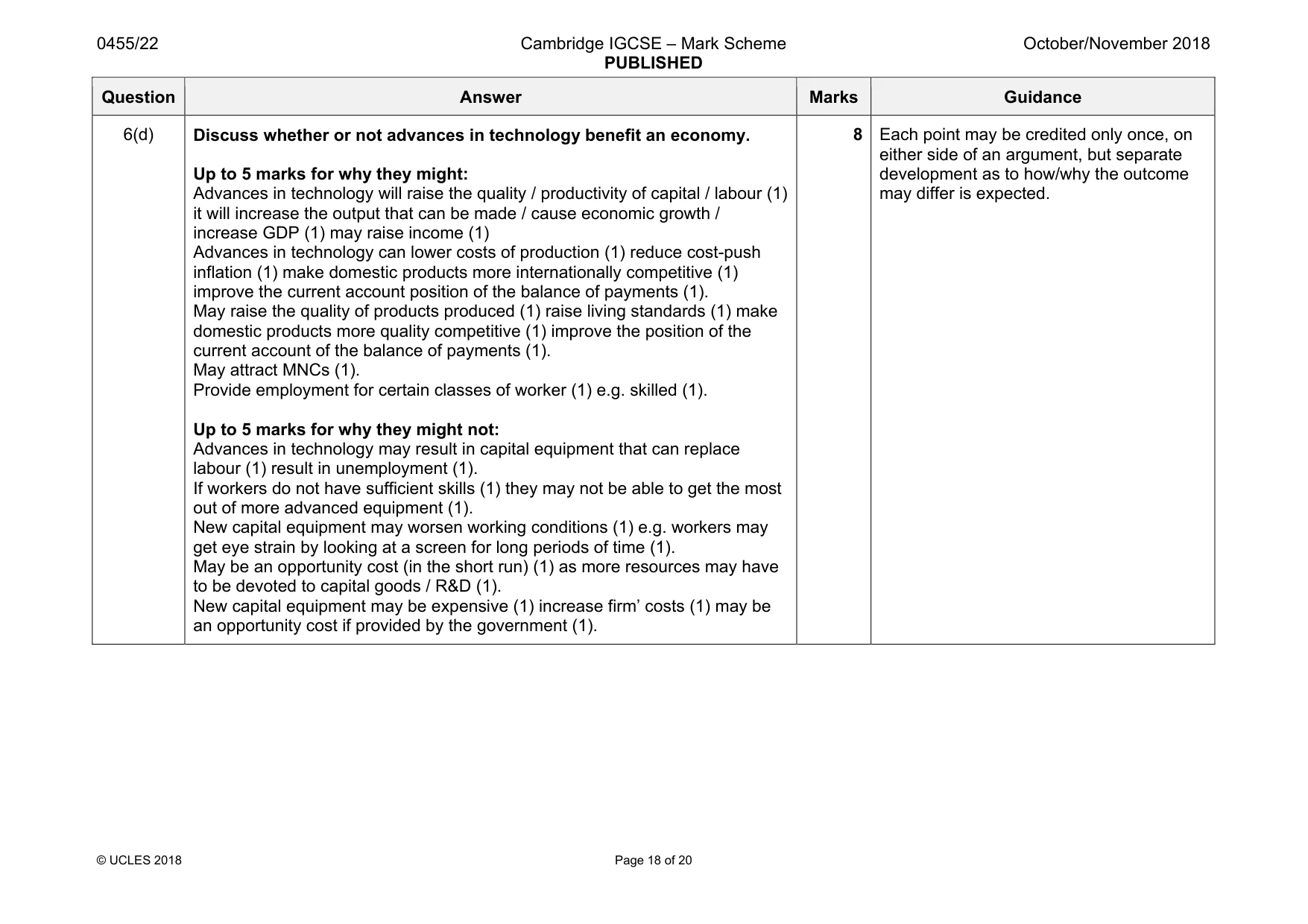
Mark scheme: 6(a) Define Gross Domestic Product. The (total) output/income/expenditure (1) of a country/economy (1). 2 6(b) Explain two reasons why a person may be willing to work at night. A person may lack the skills to gain another job (1) have no choice (1). There may be a high unemployment rate (1) a person will be grateful for any job (1). Night work may fit in with family circumstances (1) a person may have to look after children / older relatives during the day (1) The job may be well paid (1) compensating for the inconvenience (1). The job may offer fringe benefits (1) example e.g. longer holidays (1). A person may enjoy their job (1) example (1). A person may need to earn additional income (1) to supplement income from day job / to support their family (1). 4 6(c) Analyse how having some of its population working abroad may benefit an economy. The workers may send income home (1) helping to support dependents / raise living standards of dependents (1) saving on some government benefits having to be paid (1). They may gain skills abroad (1) if they return they will increase the productivity of the labour force (1) may raise output / cause economic growth (1) reduce firms costs of production (1). The money they sent back will be an inflow of foreign currency / remittance / primary income (1) improving the current account position on the balance of payments (1). May reduce unemployment (1) if the workers’ skills are not in demand at home (1). 6 Question Answer Marks Guidance 6(d) Discuss whether or not advances in technology benefit an economy. Up to 5 marks for why they might: Advances in technology will raise the quality / productivity of capital / labour (1) it will increase the output that can be made / cause economic growth / increase GDP (1) may raise income (1) Advances in technology can lower costs of production (1) reduce cost-push inflation (1) make domestic products more internationally competitive (1) improve the current account position of the balance of payments (1). May raise the quality of products produced (1) raise living standards (1) make domestic products more quality competitive (1) improve the position of the current account of the balance of payments (1). May attract MNCs (1). Provide employment for certain classes of worker (1) e.g. skilled (1). Up to 5 marks for why they might not: Advances in technology may result in capital equipment that can replace labour (1) result in unemployment (1). If workers do not have sufficient skills (1) they may not be able to get the most out of more advanced equipment (1). New capital equipment may worsen working conditions (1) e.g. workers may get eye strain by looking at a screen for long periods of time (1). May be an opportunity cost (in the short run) (1) as more resources may have to be devoted to capital goods / R&D (1). New capital equipment may be expensive (1) increase firm’ costs (1) may be an opportunity cost if provided by the government (1). 8 Each point may be credited only once, on either side of an argument, but separate development as to how/why the outcome may differ is expected.
Q7 · The price of gold rose in 2016
7 The price of gold rose in 2016. This encouraged owners of gold mines to employ more resources to increase the supply of gold. The level of competition in gold production varies in the different gold producing countries. A number of countries, including India, impose a tariff on imported gold. (a) Identify two factors of production involved in mining gold. [2] (b) Explain two reasons why a government may impose a tariff on imported gold. [4] (c) Analyse how perfect competition differs from monopoly. [6] (d) Discuss whether or not an economy should mine and sell all of its gold now. [8]
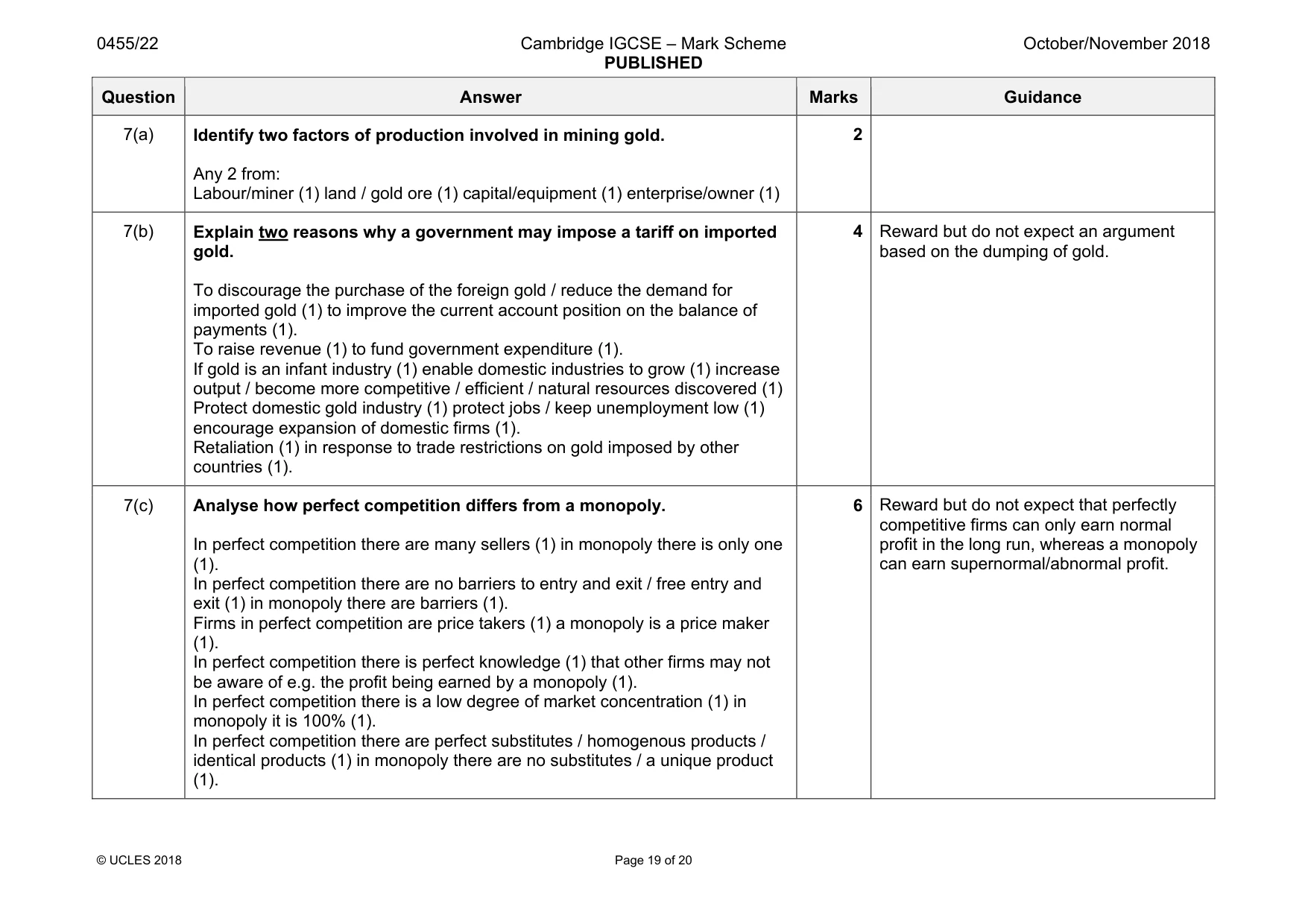
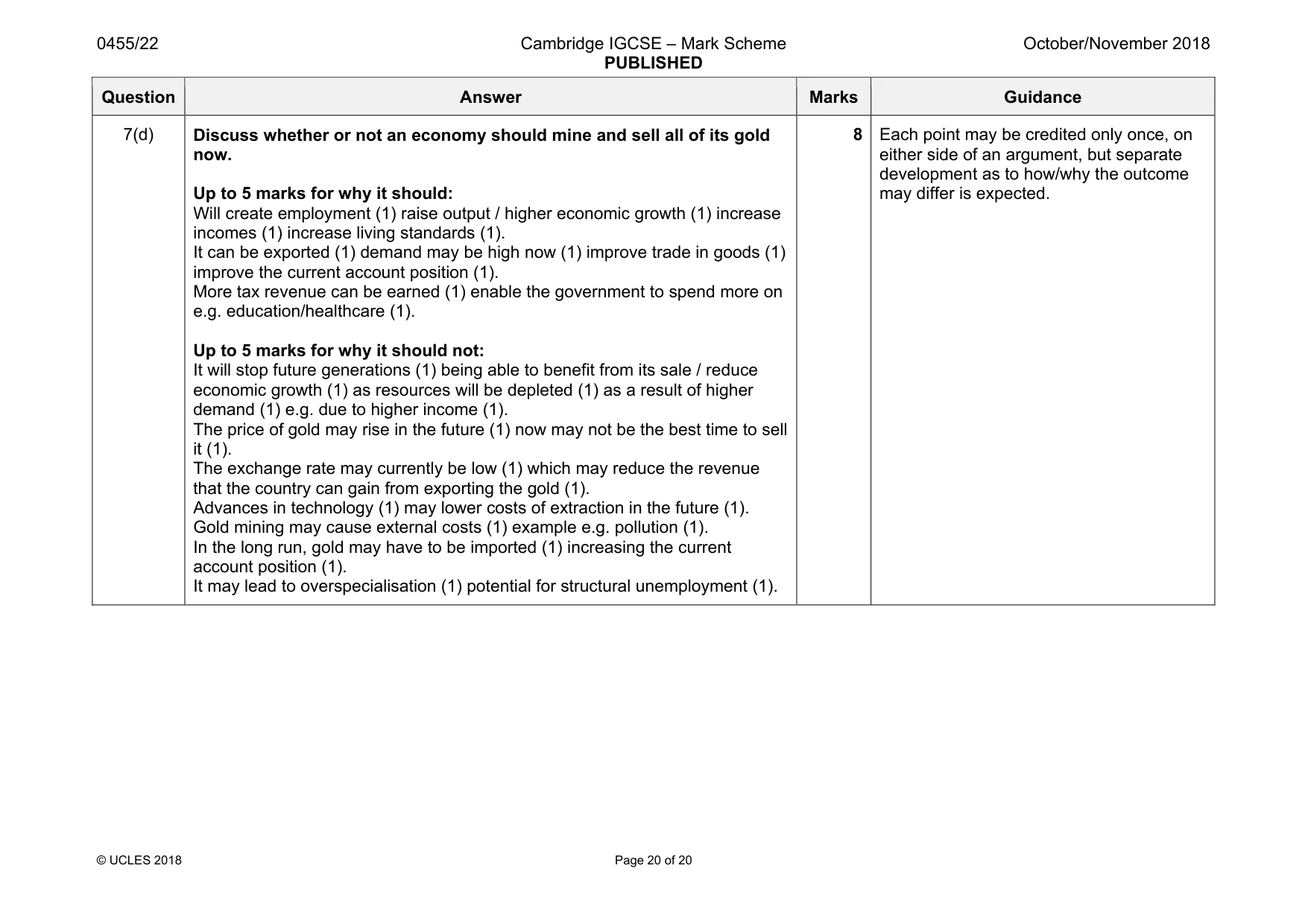
Mark scheme: 7(a) Identify two factors of production involved in mining gold. Any 2 from: Labour/miner (1) land / gold ore (1) capital/equipment (1) enterprise/owner (1) 2 7(b) Explain two reasons why a government may impose a tariff on imported gold. To discourage the purchase of the foreign gold / reduce the demand for imported gold (1) to improve the current account position on the balance of payments (1). To raise revenue (1) to fund government expenditure (1). If gold is an infant industry (1) enable domestic industries to grow (1) increase output / become more competitive / efficient / natural resources discovered (1) Protect domestic gold industry (1) protect jobs / keep unemployment low (1) encourage expansion of domestic firms (1). Retaliation (1) in response to trade restrictions on gold imposed by other countries (1). 4 Reward but do not expect an argument based on the dumping of gold. 7(c) Analyse how perfect competition differs from a monopoly. In perfect competition there are many sellers (1) in monopoly there is only one (1). In perfect competition there are no barriers to entry and exit / free entry and exit (1) in monopoly there are barriers (1). Firms in perfect competition are price takers (1) a monopoly is a price maker (1). In perfect competition there is perfect knowledge (1) that other firms may not be aware of e.g. the profit being earned by a monopoly (1). In perfect competition there is a low degree of market concentration (1) in monopoly it is 100% (1). In perfect competition there are perfect substitutes / homogenous products / identical products (1) in monopoly there are no substitutes / a unique product (1). 6 Reward but do not expect that perfectly competitive firms can only earn normal profit in the long run, whereas a monopoly can earn supernormal/abnormal profit. Question Answer Marks Guidance 7(d) Discuss whether or not an economy should mine and sell all of its gold now. Up to 5 marks for why it should: Will create employment (1) raise output / higher economic growth (1) increase incomes (1) increase living standards (1). It can be exported (1) demand may be high now (1) improve trade in goods (1) improve the current account position (1). More tax revenue can be earned (1) enable the government to spend more on e.g. education/healthcare (1). Up to 5 marks for why it should not: It will stop future generations (1) being able to benefit from its sale / reduce economic growth (1) as resources will be depleted (1) as a result of higher demand (1) e.g. due to higher income (1). The price of gold may rise in the future (1) now may not be the best time to sell it (1). The exchange rate may currently be low (1) which may reduce the revenue that the country can gain from exporting the gold (1). Advances in technology (1) may lower costs of extraction in the future (1). Gold mining may cause external costs (1) example e.g. pollution (1). In the long run, gold may have to be imported (1) increasing the current account position (1). It may lead to overspecialisation (1) potential for structural unemployment (1). 8 Each point may be credited only once, on either side of an argument, but separate development as to how/why the outcome may differ is expected.
What was in this paper
The subtopics covered by these 7 questions, and how many questions each got. Open one in a new tab to see every Cambridge question on it.
What you needed in this session
Cambridge’s own grade thresholds for 2018 Oct/Nov, Paper 2 · Variant 2. A higher threshold means an easier paper — the bar moves with how the cohort did.