Cambridge IGCSE Economics 0455 — 2025 May/June Paper 2 · Variant 2
0455/22/M/J/25 · 5 questions · 90 marks · ≈101 min
The question paper and its mark scheme, free to read here and free to download. This is Cambridge’s own paper, exactly as it was sat.
Question paper8 pages




Mark scheme31 pages
Answers below. Sit the paper first if you are practising.
Questions as text
Question 1
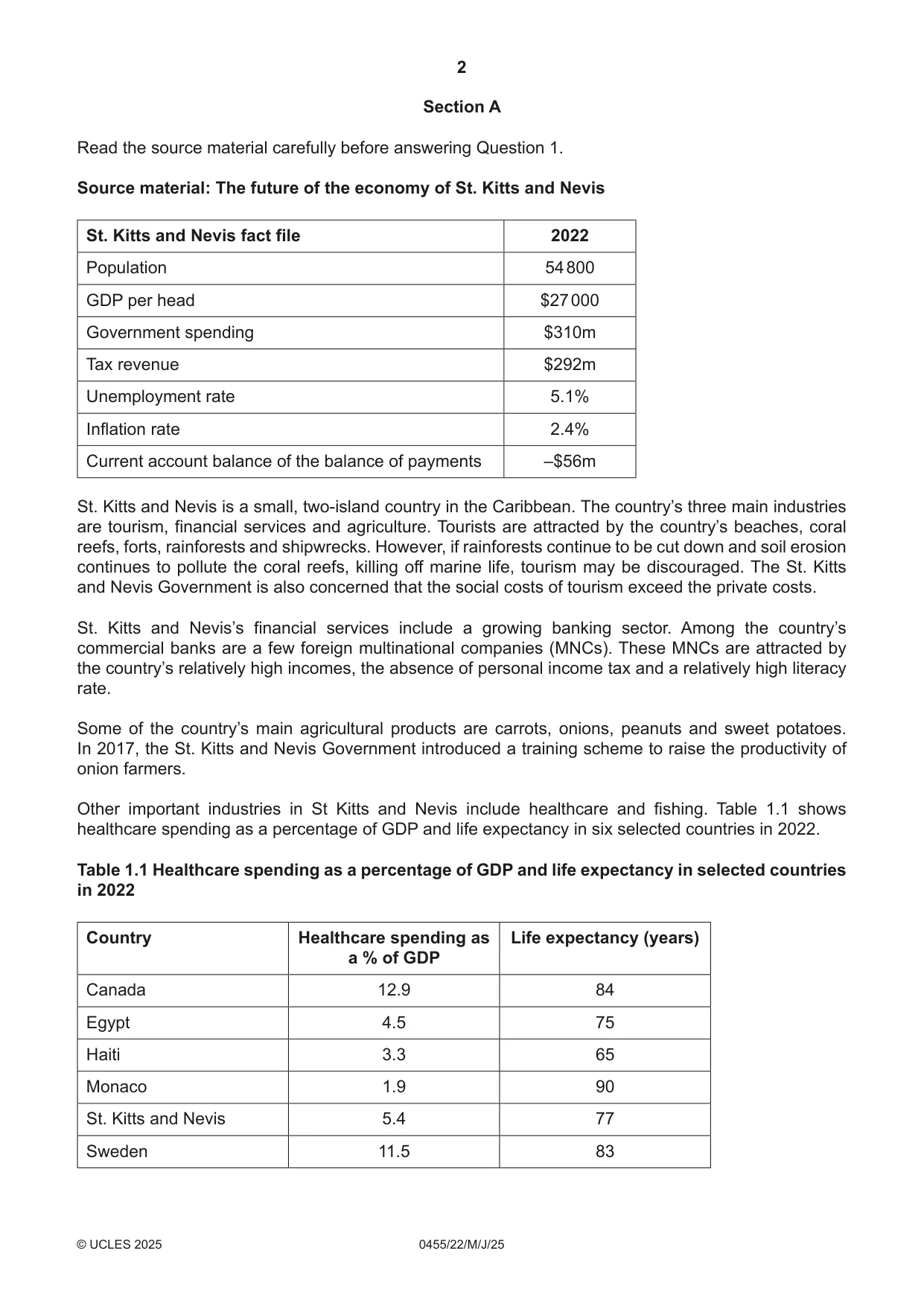
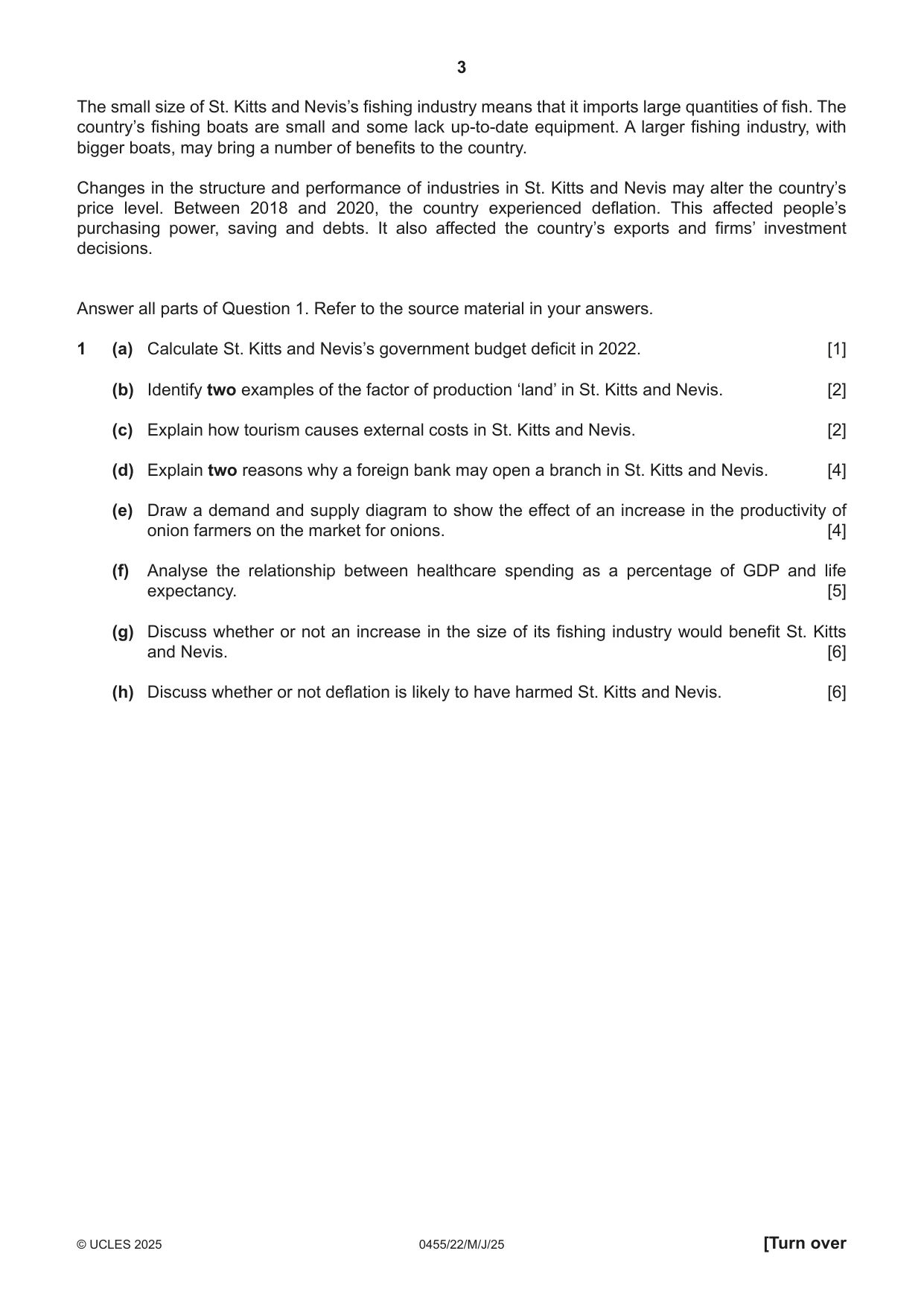
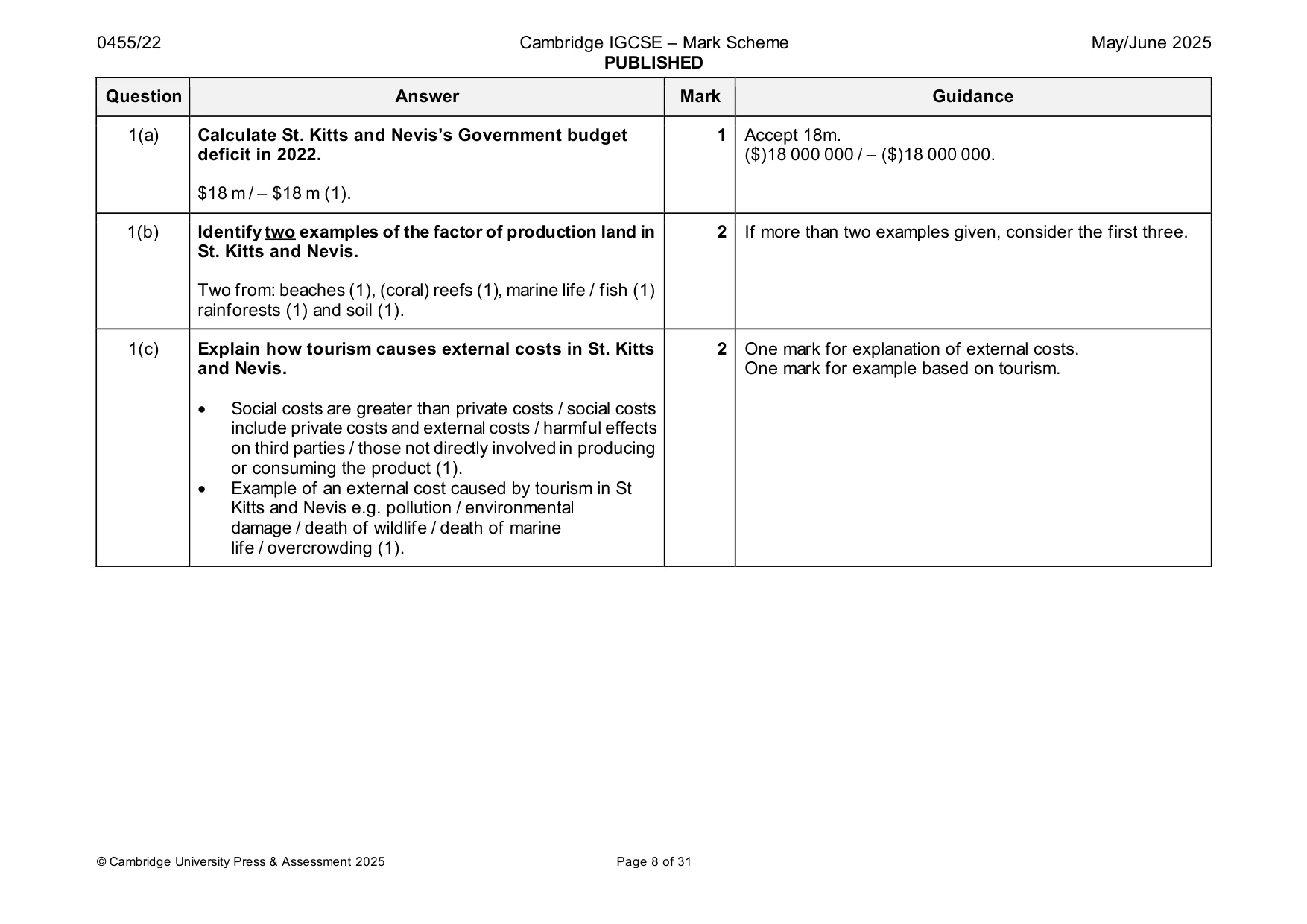
1 (a) Calculate St. Kitts and Nevis’s government budget deficit in 2022. [1] (b) Identify two examples of the factor of production ‘land’ in St. Kitts and Nevis. [2] (c) Explain how tourism causes external costs in St. Kitts and Nevis. [2] (d) Explain two reasons why a foreign bank may open a branch in St. Kitts and Nevis. [4] (e) Draw a demand and supply diagram to show the effect of an increase in the productivity of onion farmers on the market for onions. [4] (f) Analyse the relationship between healthcare spending as a percentage of GDP and life expectancy. [5] (g) Discuss whether or not an increase in the size of its fishing industry would benefit St. Kitts and Nevis. [6] (h) Discuss whether or not deflation is likely to have harmed St. Kitts and Nevis. [6]
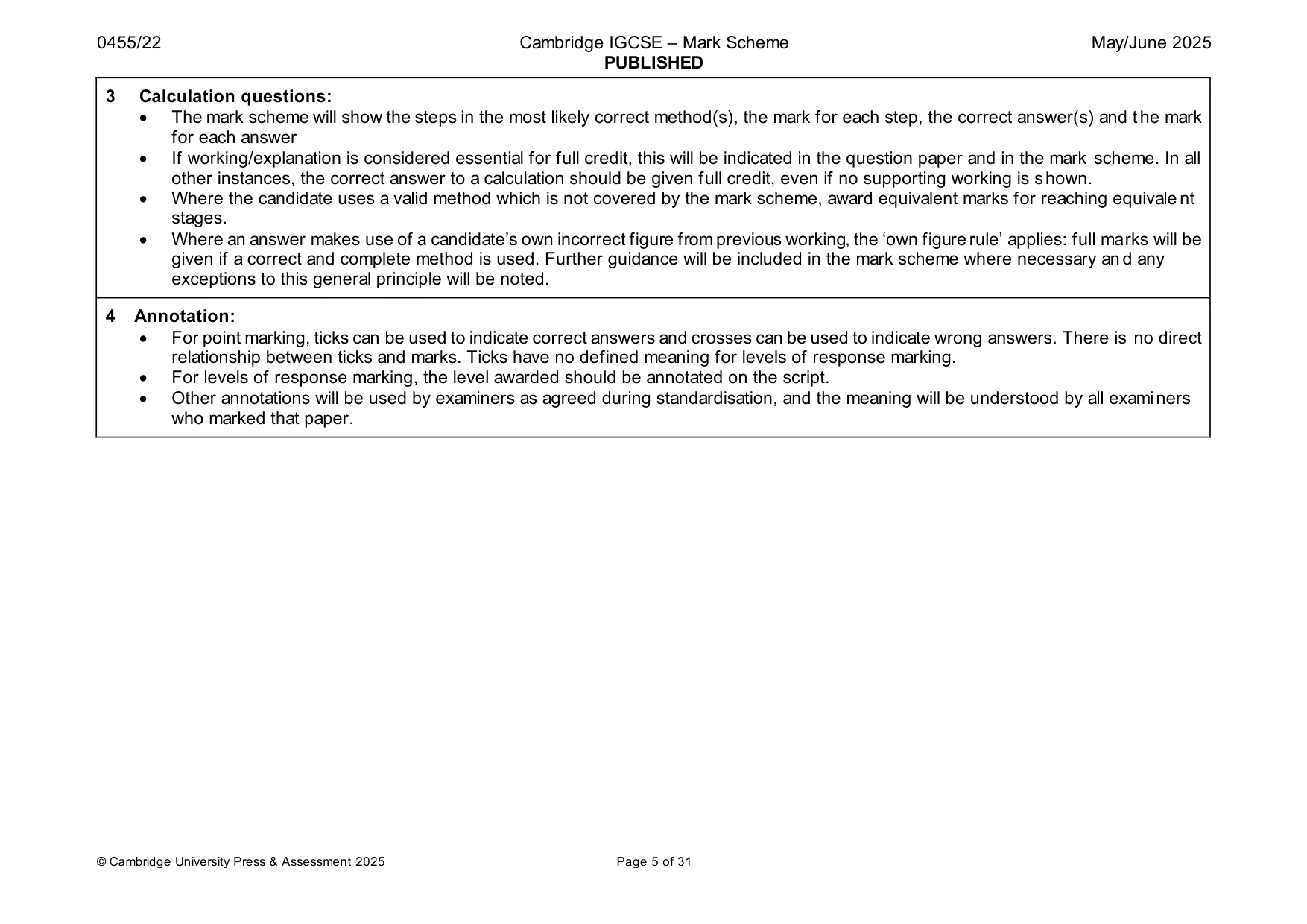
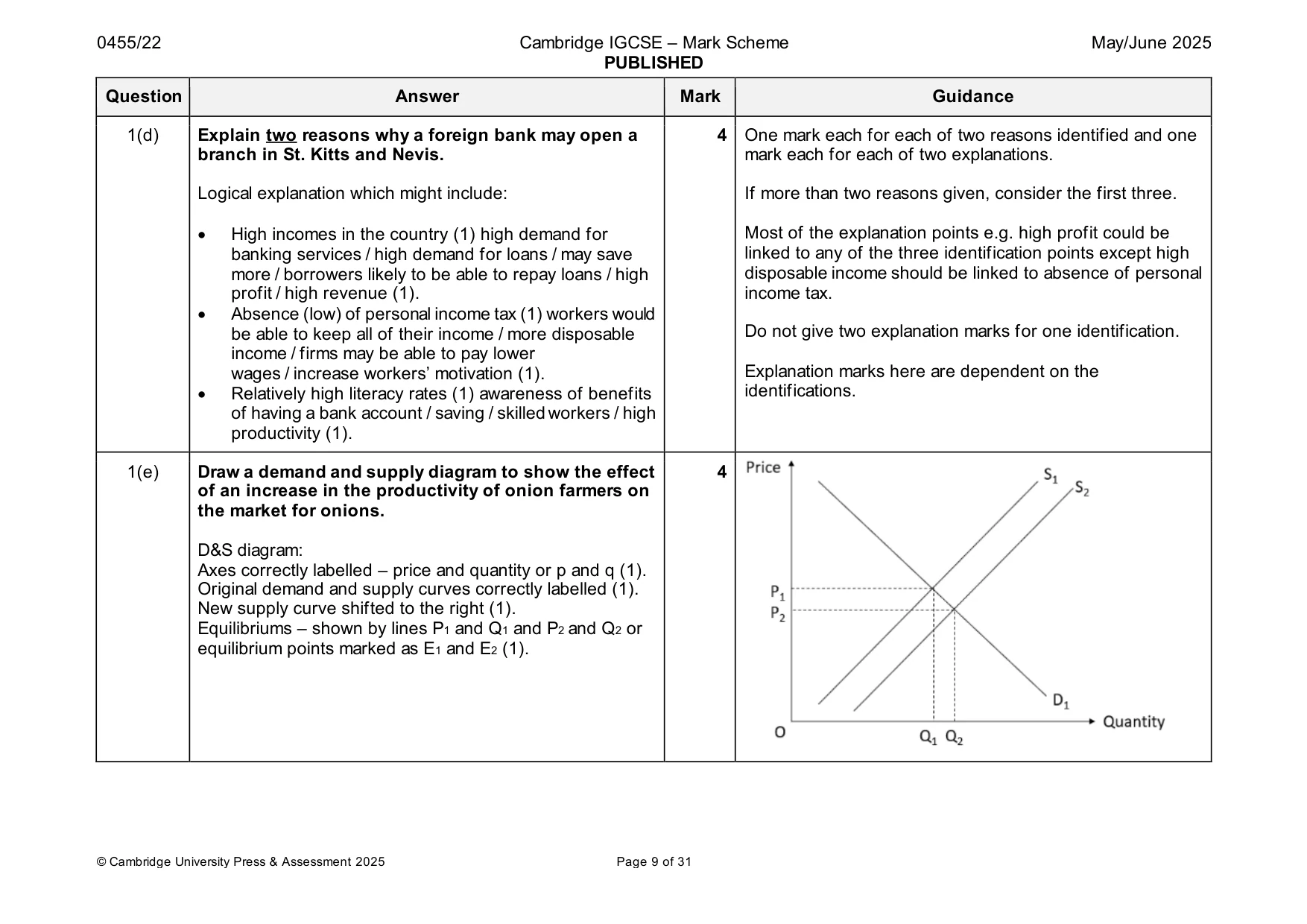
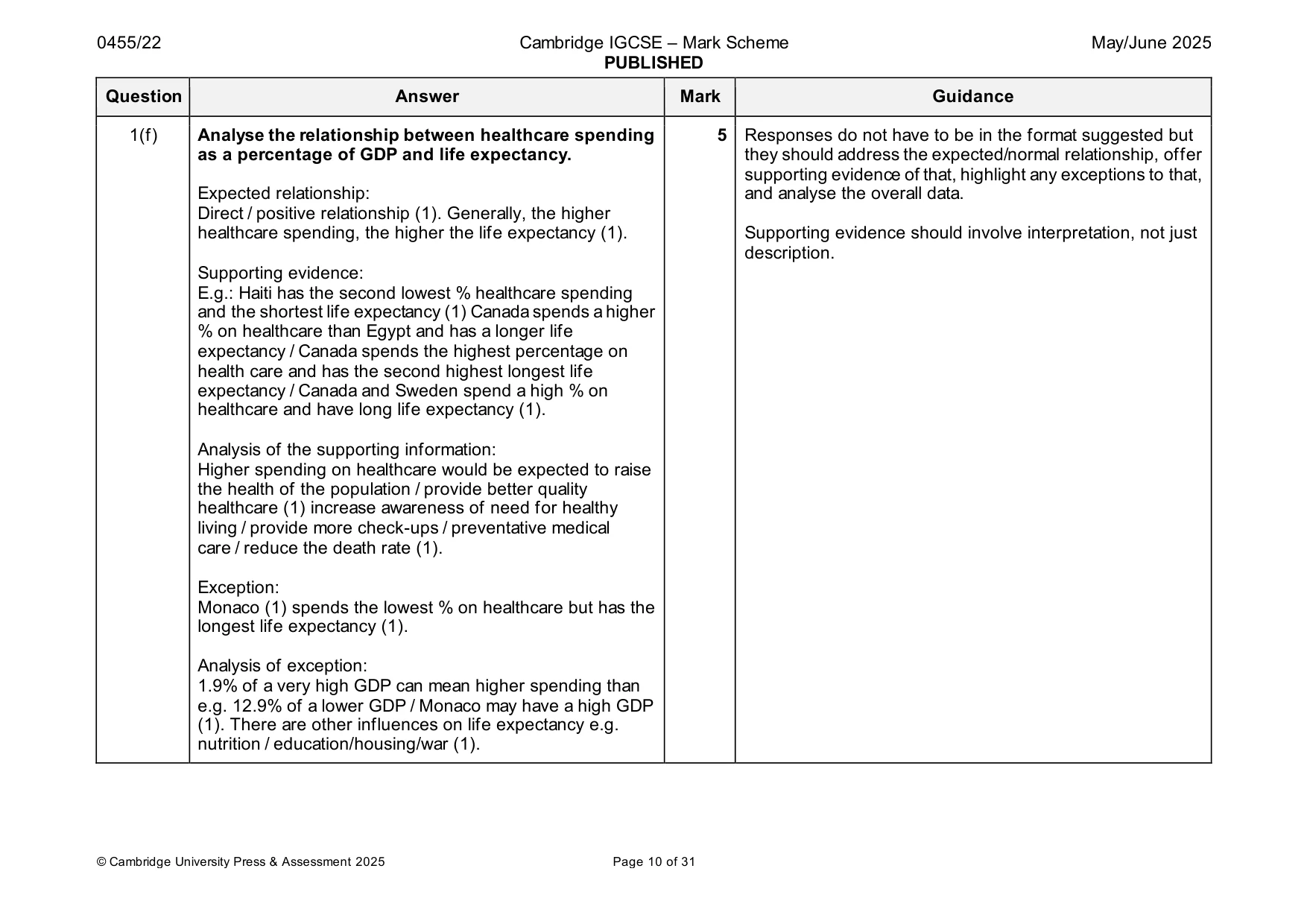
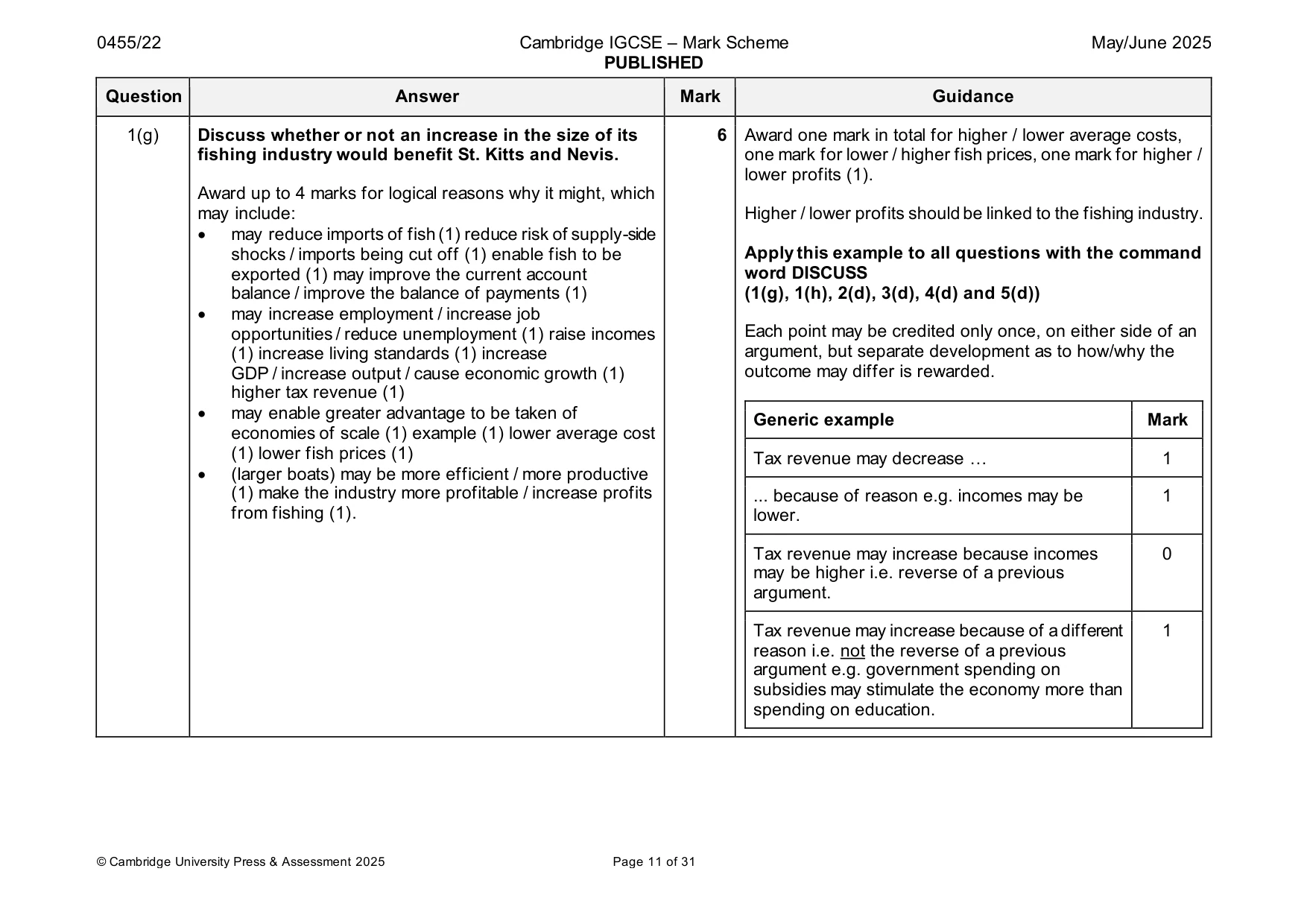
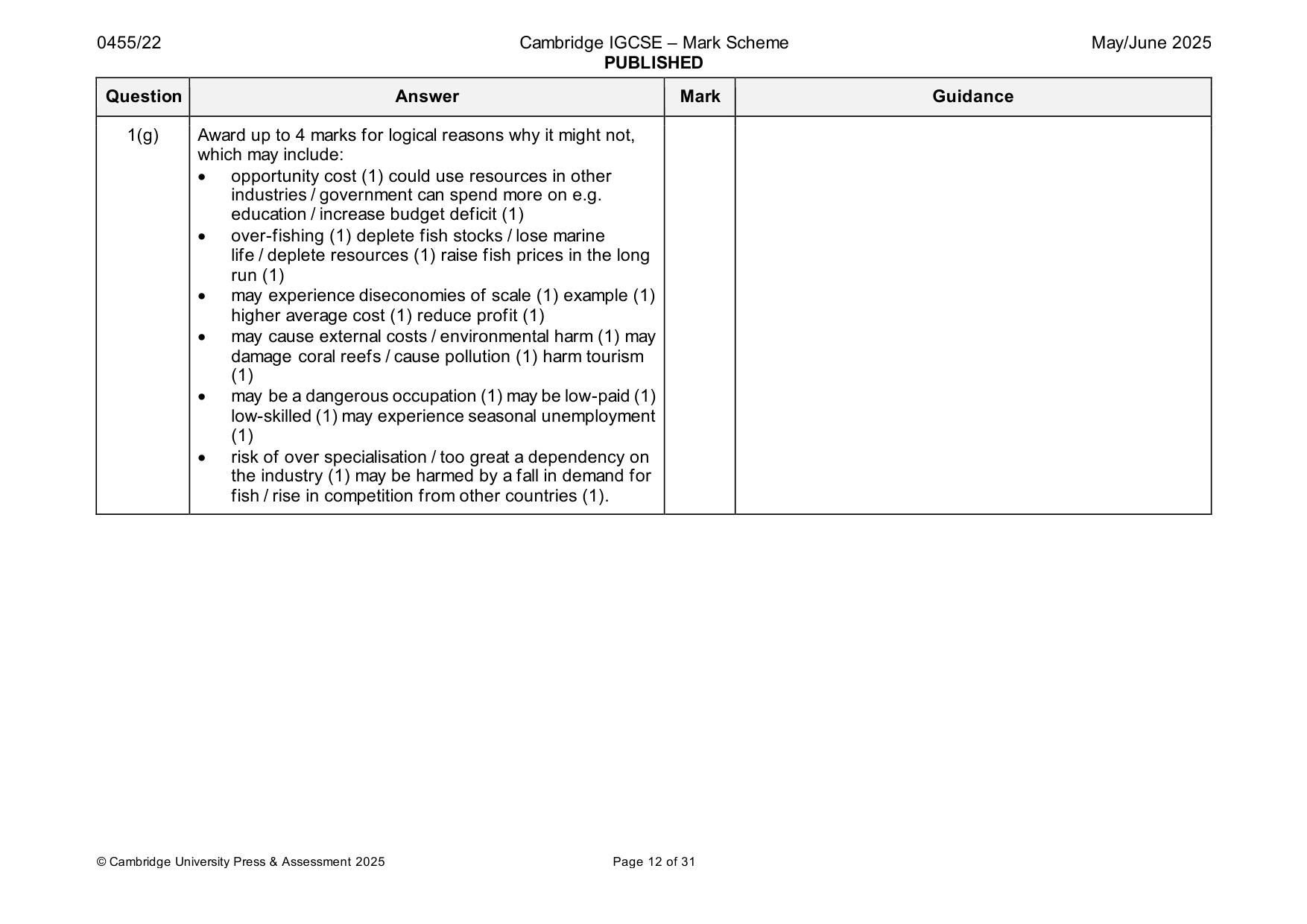
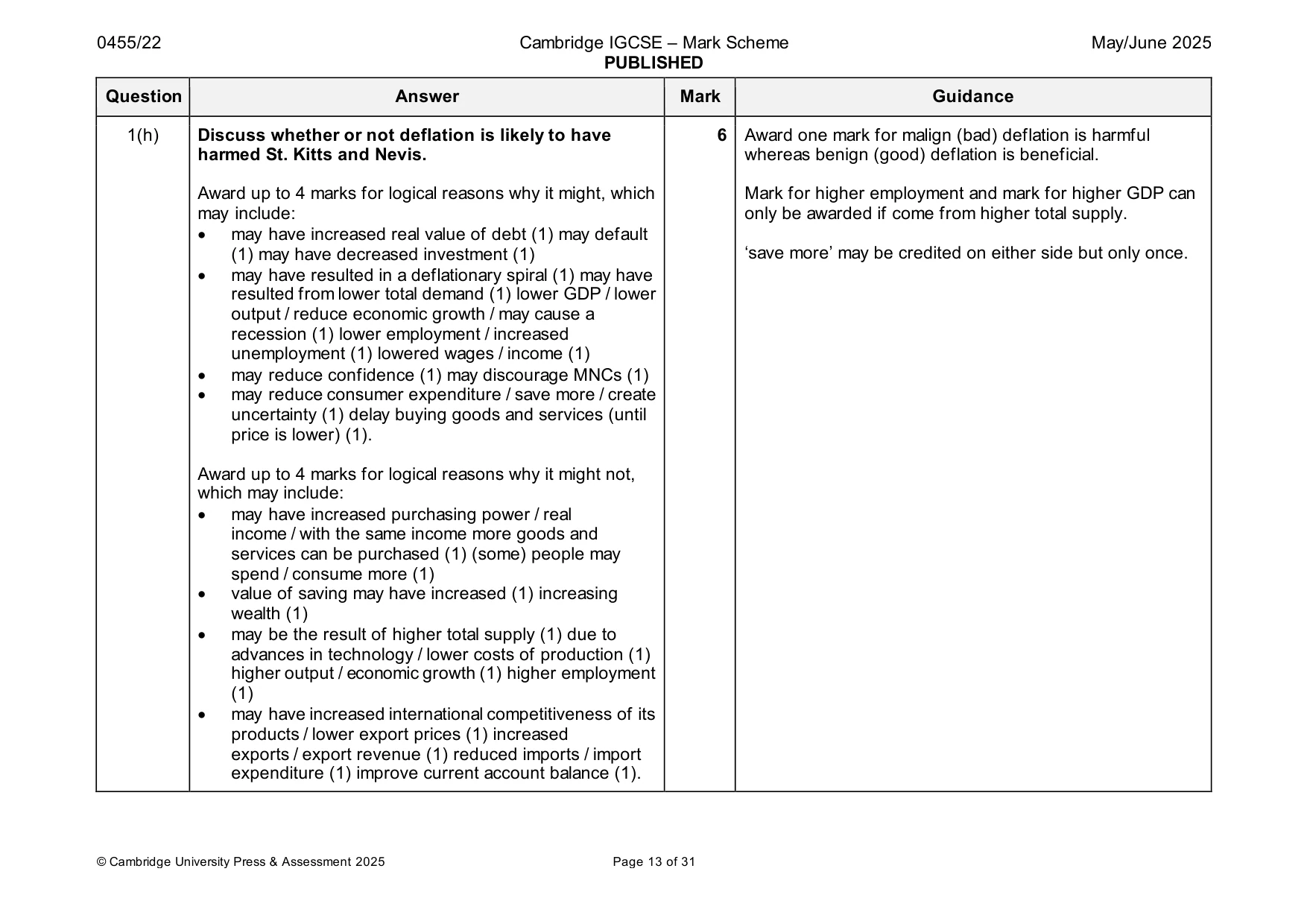
Mark scheme: Question Answer Mark Guidance 1(a) Calculate St. Kitts and Nevis’s Government budget 1 Accept 18m. deficit in 2022. ($)18 000 000 / – ($)18 000 000. $18 m / – $18 m (1). 1(b) Identify two examples of the factor of production land in 2 If more than two examples given, consider the first three. St. Kitts and Nevis. Two from: beaches (1), (coral) reefs (1), marine life / fish (1) rainforests (1) and soil (1). 1(c) Explain how tourism causes external costs in St. Kitts 2 One mark for explanation of external costs. and Nevis. One mark for example based on tourism. • Social costs are greater than private costs / social costs include private costs and external costs / harmful effects on third parties / those not directly involved in producing or consuming the product (1). • Example of an external cost caused by tourism in St Kitts and Nevis e.g. pollution / environmental damage / death of wildlife / death of marine life / overcrowding (1). 1(d) Explain two reasons why a foreign bank may open a 4 One mark each for each of two reasons identified and one branch in St. Kitts and Nevis. mark each for each of two explanations. Logical explanation which might include: If more than two reasons given, consider the first three. • High incomes in the country (1) high demand for Most of the explanation points e.g. high profit could be banking services / high demand for loans / may save linked to any of the three identification points except high more / borrowers likely to be able to repay loans / high disposable income should be linked to absence of personal profit / high revenue (1). income tax. • Absence (low) of personal income tax (1) workers would be able to keep all of their income / more disposable Do not give two explanation marks for one identification. income / firms may be able to pay lower wages / increase workers’ motivation (1). Explanation marks here are dependent on the • Relatively high literacy rates (1) awareness of benefits identifications. of having a bank account / saving / skilled workers / high productivity (1). 1(e) Draw a demand and supply diagram to show the effect 4 of an increase in the productivity of onion farmers on the market for onions. D&S diagram: Axes correctly labelled – price and quantity or p and q (1). Original demand and supply curves correctly labelled (1). New supply curve shifted to the right (1). Equilibriums – shown by lines P1 and Q1 and P2 and Q2 or equilibrium points marked as E1 and E2 (1). 1(f) Analyse the relationship between healthcare spending 5 Responses do not have to be in the format suggested but as a percentage of GDP and life expectancy. they should address the expected/normal relationship, offer supporting evidence of that, highlight any exceptions to that, Expected relationship: and analyse the overall data. Direct / positive relationship (1). Generally, the higher healthcare spending, the higher the life expectancy (1). Supporting evidence should involve interpretation, not just description. Supporting evidence: E.g.: Haiti has the second lowest % healthcare spending and the shortest life expectancy (1) Canada spends a higher % on healthcare than Egypt and has a longer life expectancy / Canada spends the highest percentage on health care and has the second highest longest life expectancy / Canada and Sweden spend a high % on healthcare and have long life expectancy (1). Analysis of the supporting information: Higher spending on healthcare would be expected to raise the health of the population / provide better quality healthcare (1) increase awareness of need for healthy living / provide more check-ups / preventative medical care / reduce the death rate (1). Exception: Monaco (1) spends the lowest % on healthcare but has the longest life expectancy (1). Analysis of exception: 1.9% of a very high GDP can mean higher spending than e.g. 12.9% of a lower GDP / Monaco may have a high GDP (1). There are other influences on life expectancy e.g. nutrition / education/housing/war (1). 1(g) Discuss whether or not an increase in the size of its 6 Award one mark in total for higher / lower average costs, fishing industry would benefit St. Kitts and Nevis. one mark for lower / higher fish prices, one mark for higher / lower profits (1). Award up to 4 marks for logical reasons why it might, which may include: Higher / lower profits should be linked to the fishing industry. • may reduce imports of fish (1) reduce risk of supply-side shocks / imports being cut off (1) enable fish to be Apply this example to all questions with the command exported (1) may improve the current account word DISCUSS balance / improve the balance of payments (1) (1(g), 1(h), 2(d), 3(d), 4(d) and 5(d)) • may increase employment / increase job opportunities / reduce unemployment (1) raise incomes Each point may be credited only once, on either side of an (1) increase living standards (1) increase argument, but separate development as to how/why the GDP / increase output / cause economic growth (1) outcome may differ is rewarded. higher tax revenue (1) • may enable greater advantage to be taken of Generic example Mark economies of scale (1) example (1) lower average cost (1) lower fish prices (1) Tax revenue may decrease … 1 • (larger boats) may be more efficient / more productive (1) make the industry more profitable / increase profits ... because of reason e.g. incomes may be 1 from fishing (1). lower. Tax revenue may increase because incomes 0 may be higher i.e. reverse of a previous argument. Tax revenue may increase because of a different 1 reason i.e. not the reverse of a previous argument e.g. government spending on subsidies may stimulate the economy more than spending on education. 1(g) Award up to 4 marks for logical reasons why it might not, which may include: • opportunity cost (1) could use resources in other industries / government can spend more on e.g. education / increase budget deficit (1) • over-fishing (1) deplete fish stocks / lose marine life / deplete resources (1) raise fish prices in the long run (1) • may experience diseconomies of scale (1) example (1) higher average cost (1) reduce profit (1) • may cause external costs / environmental harm (1) may damage coral reefs / cause pollution (1) harm tourism (1) • may be a dangerous occupation (1) may be low-paid (1) low-skilled (1) may experience seasonal unemployment (1) • risk of over specialisation / too great a dependency on the industry (1) may be harmed by a fall in demand for fish / rise in competition from other countries (1). 1(h) Discuss whether or not deflation is likely to have 6 Award one mark for malign (bad) deflation is harmful harmed St. Kitts and Nevis. whereas benign (good) deflation is beneficial. Award up to 4 marks for logical reasons why it might, which Mark for higher employment and mark for higher GDP can may include: only be awarded if come from higher total supply. • may have increased real value of debt (1) may default (1) may have decreased investment (1) ‘save more’ may be credited on either side but only once. • may have resulted in a deflationary spiral (1) may have resulted from lower total demand (1) lower GDP / lower output / reduce economic growth / may cause a recession (1) lower employment / increased unemployment (1) lowered wages / income (1) • may reduce confidence (1) may discourage MNCs (1) • may reduce consumer expenditure / save more / create uncertainty (1) delay buying goods and services (until price is lower) (1). Award up to 4 marks for logical reasons why it might not, which may include: • may have increased purchasing power / real income / with the same income more goods and services can be purchased (1) (some) people may spend / consume more (1) • value of saving may have increased (1) increasing wealth (1) • may be the result of higher total supply (1) due to advances in technology / lower costs of production (1) higher output / economic growth (1) higher employment (1) • may have increased international competitiveness of its products / lower export prices (1) increased exports / export revenue (1) reduced imports / import expenditure (1) improve current account balance (1).
Q2 · The world’s four largest accountancy firms experienced a decline in demand for their…
2 The world’s four largest accountancy firms experienced a decline in demand for their services at the start of 2023. One cause of this lower demand was a decline in mergers in other industries, including the chocolate industry. Three of the accountancy firms reduced the number of new workers they hired and the other accountancy firm announced job losses. The ability of workers to gain new jobs is influenced by their mobility. (a) Identify two advantages a firm may gain from merging with another firm. [2] (b) Explain two disadvantages workers may experience as a result of losing their jobs. [4] (c) Analyse the advantages of an increase in labour mobility. [6] (d) Discuss whether or not the demand for chocolate is likely to be price elastic. [8]
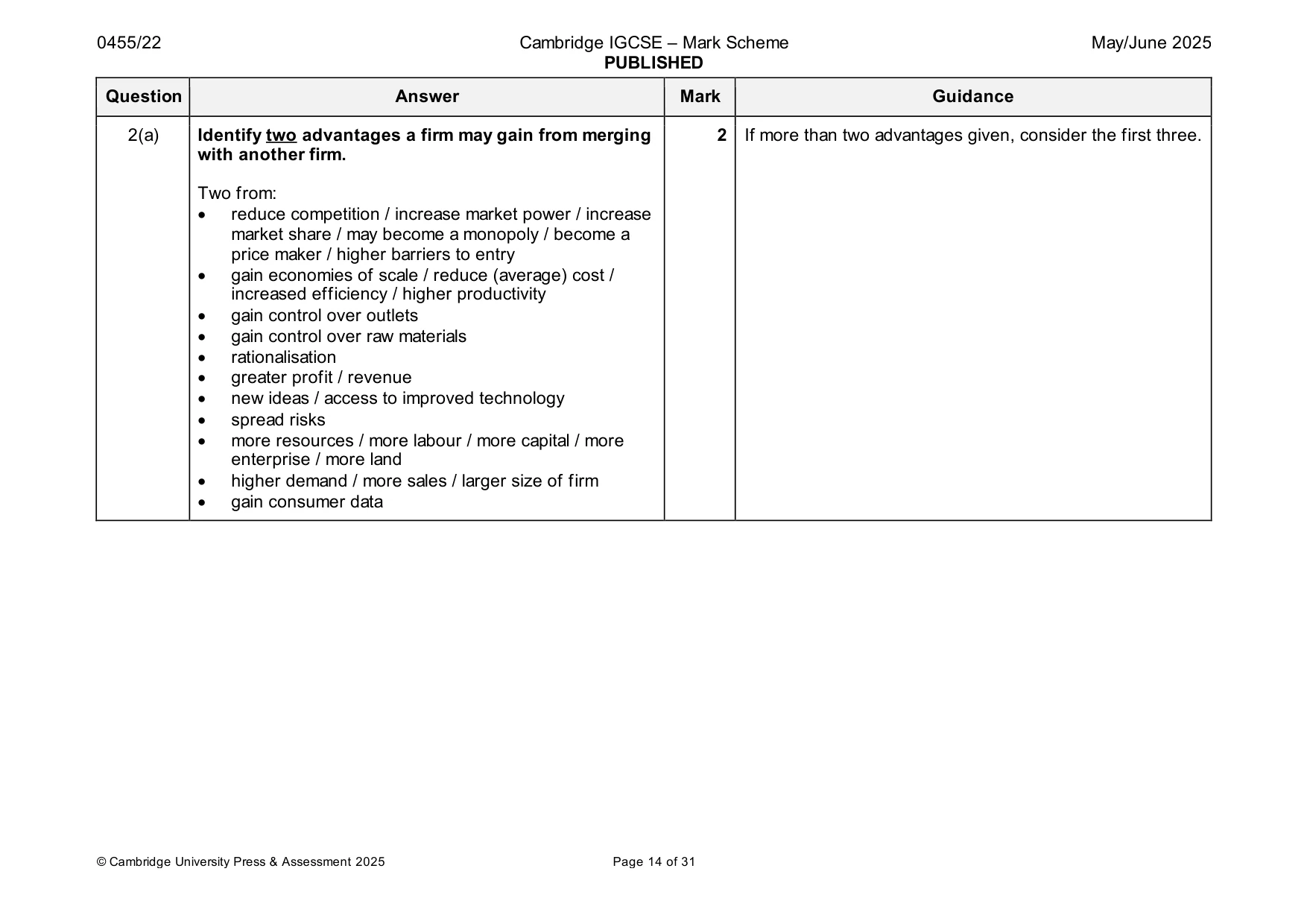
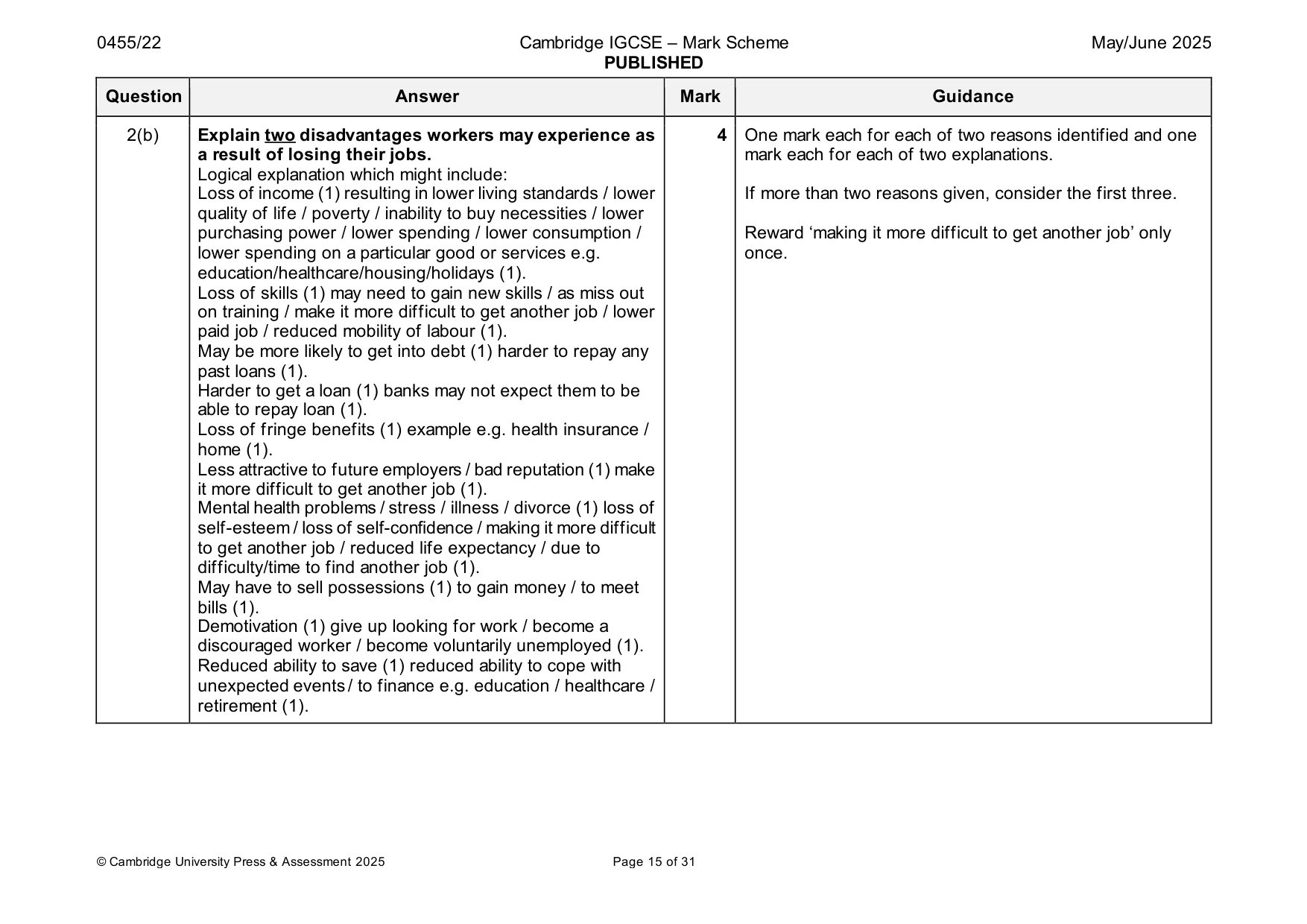
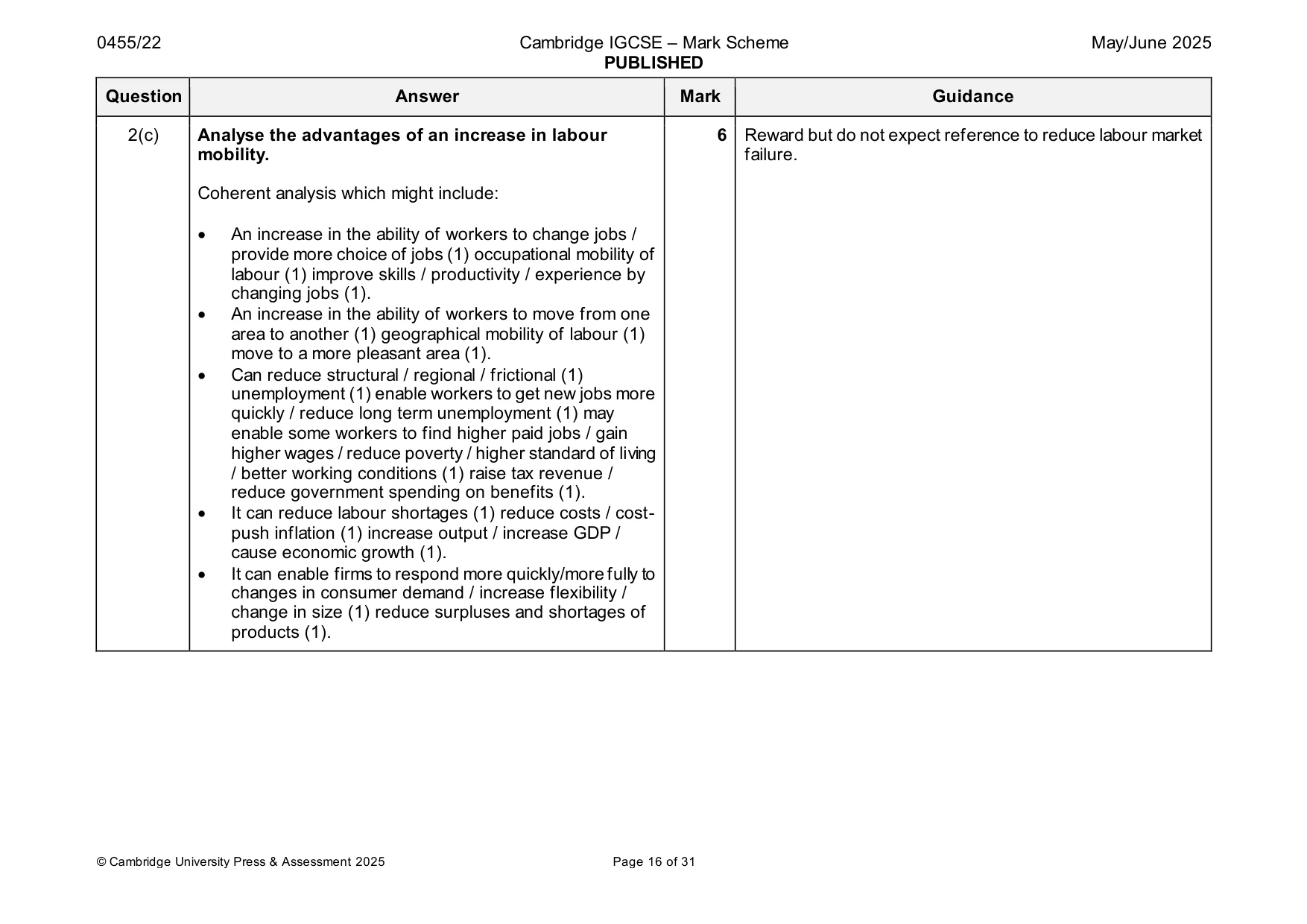
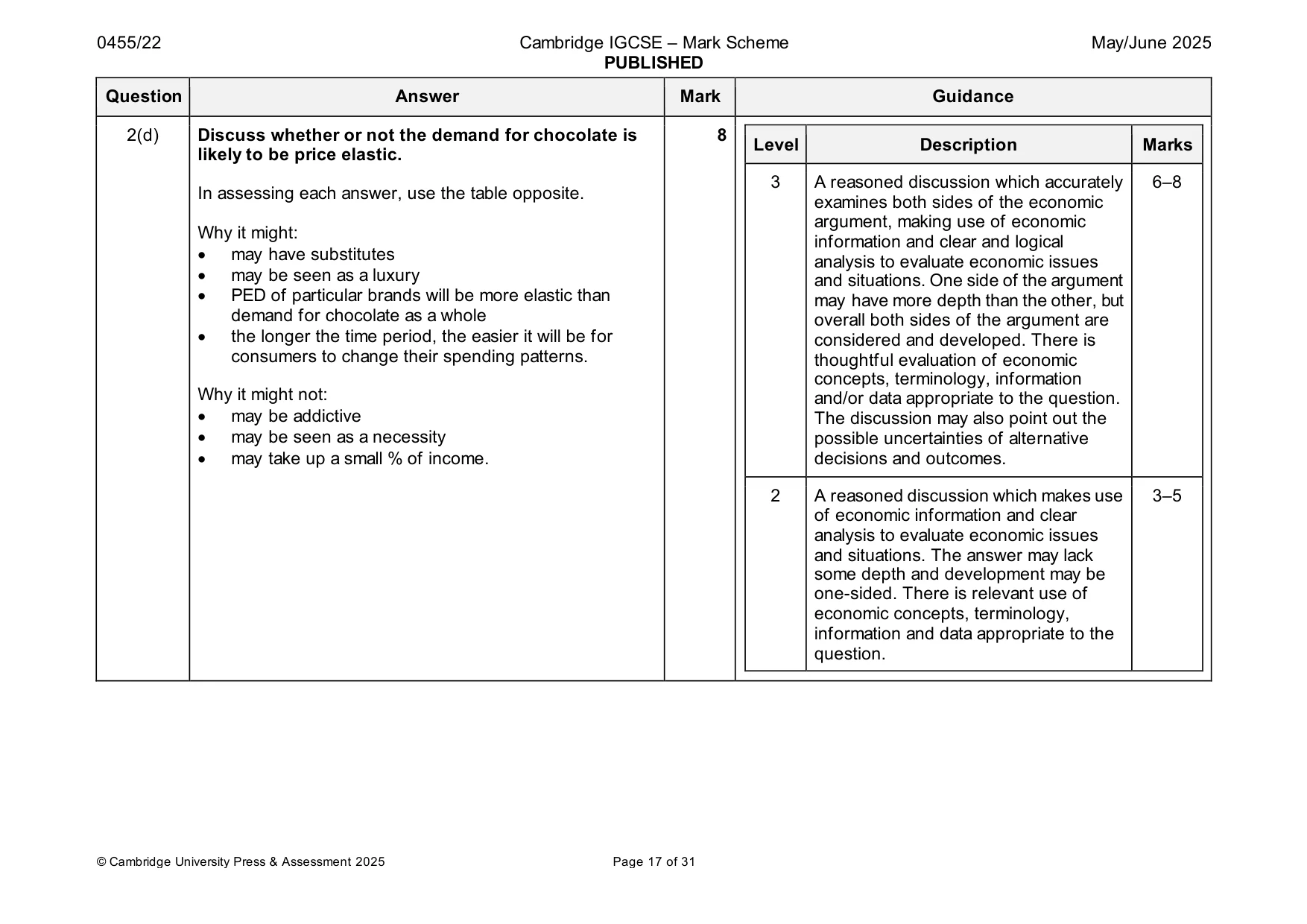
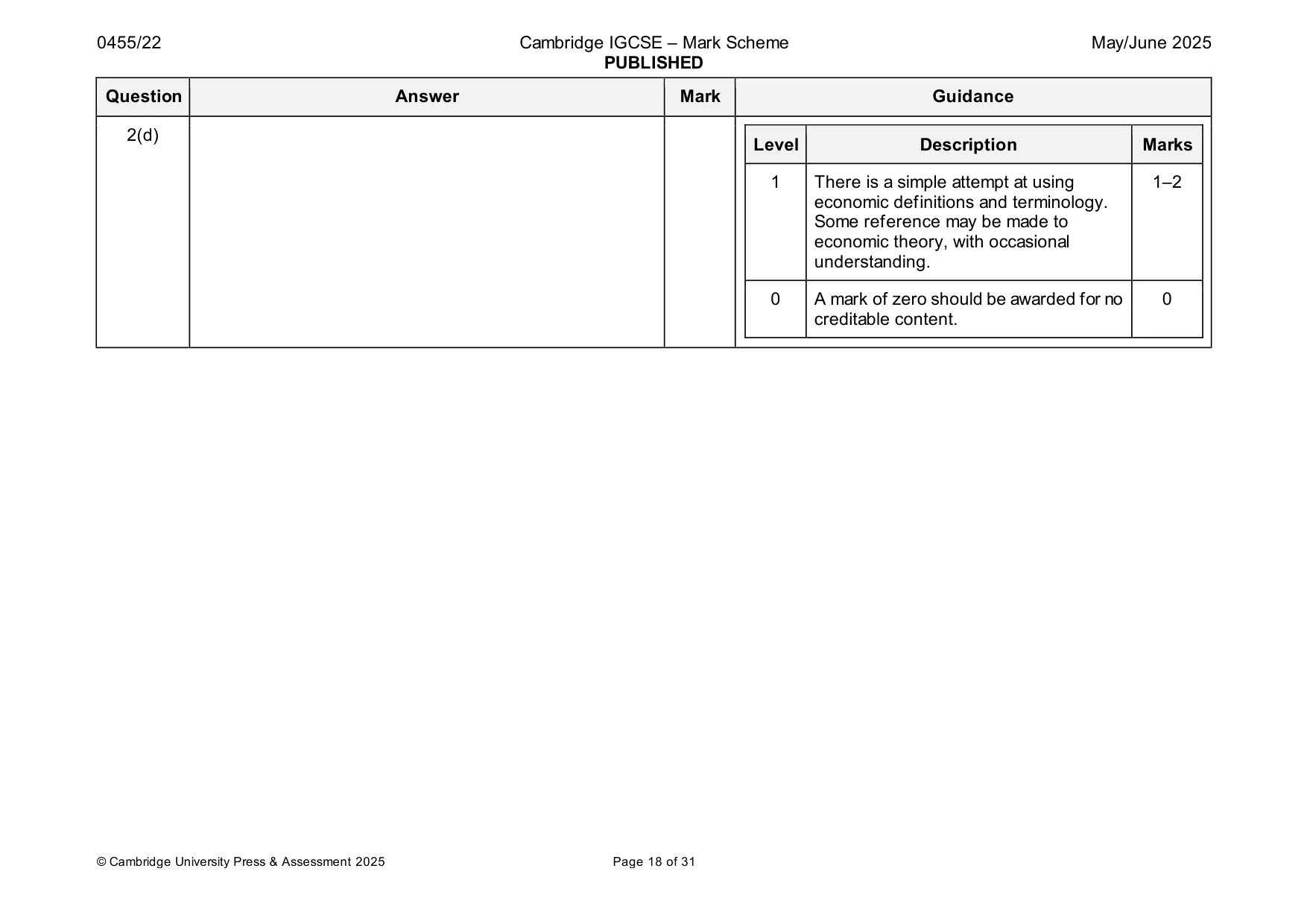
Mark scheme: 2(a) Identify two advantages a firm may gain from merging 2 If more than two advantages given, consider the first three. with another firm. Two from: • reduce competition / increase market power / increase market share / may become a monopoly / become a price maker / higher barriers to entry • gain economies of scale / reduce (average) cost / increased efficiency / higher productivity • gain control over outlets • gain control over raw materials • rationalisation • greater profit / revenue • new ideas / access to improved technology • spread risks • more resources / more labour / more capital / more enterprise / more land • higher demand / more sales / larger size of firm • gain consumer data 2(b) Explain two disadvantages workers may experience as 4 One mark each for each of two reasons identified and one a result of losing their jobs. mark each for each of two explanations. Logical explanation which might include: Loss of income (1) resulting in lower living standards / lower If more than two reasons given, consider the first three. quality of life / poverty / inability to buy necessities / lower purchasing power / lower spending / lower consumption / Reward ‘making it more difficult to get another job’ only lower spending on a particular good or services e.g. once. education/healthcare/housing/holidays (1). Loss of skills (1) may need to gain new skills / as miss out on training / make it more difficult to get another job / lower paid job / reduced mobility of labour (1). May be more likely to get into debt (1) harder to repay any past loans (1). Harder to get a loan (1) banks may not expect them to be able to repay loan (1). Loss of fringe benefits (1) example e.g. health insurance / home (1). Less attractive to future employers / bad reputation (1) make it more difficult to get another job (1). Mental health problems / stress / illness / divorce (1) loss of self-esteem / loss of self-confidence / making it more difficult to get another job / reduced life expectancy / due to difficulty/time to find another job (1). May have to sell possessions (1) to gain money / to meet bills (1). Demotivation (1) give up looking for work / become a discouraged worker / become voluntarily unemployed (1). Reduced ability to save (1) reduced ability to cope with unexpected events / to finance e.g. education / healthcare / retirement (1). 2(c) Analyse the advantages of an increase in labour 6 Reward but do not expect reference to reduce labour market mobility. failure. Coherent analysis which might include: • An increase in the ability of workers to change jobs / provide more choice of jobs (1) occupational mobility of labour (1) improve skills / productivity / experience by changing jobs (1). • An increase in the ability of workers to move from one area to another (1) geographical mobility of labour (1) move to a more pleasant area (1). • Can reduce structural / regional / frictional (1) unemployment (1) enable workers to get new jobs more quickly / reduce long term unemployment (1) may enable some workers to find higher paid jobs / gain higher wages / reduce poverty / higher standard of living / better working conditions (1) raise tax revenue / reduce government spending on benefits (1). • It can reduce labour shortages (1) reduce costs / cost- push inflation (1) increase output / increase GDP / cause economic growth (1). • It can enable firms to respond more quickly/more fully to changes in consumer demand / increase flexibility / change in size (1) reduce surpluses and shortages of products (1). 2(d) Discuss whether or not the demand for chocolate is 8 Level Description Marks likely to be price elastic. 3 A reasoned discussion which accurately 6–8 In assessing each answer, use the table opposite. examines both sides of the economic argument, making use of economic Why it might: information and clear and logical • may have substitutes analysis to evaluate economic issues • may be seen as a luxury and situations. One side of the argument • PED of particular brands will be more elastic than may have more depth than the other, but demand for chocolate as a whole overall both sides of the argument are • the longer the time period, the easier it will be for considered and developed. There is consumers to change their spending patterns. thoughtful evaluation of economic concepts, terminology, information Why it might not: and/or data appropriate to the question. • may be addictive The discussion may also point out the • may be seen as a necessity possible uncertainties of alternative • may take up a small % of income. decisions and outcomes. 2 A reasoned discussion which makes use 3–5 of economic information and clear analysis to evaluate economic issues and situations. The answer may lack some depth and development may be one-sided. There is relevant use of economic concepts, terminology, information and data appropriate to the question. 2(d) Level Description Marks 1 There is a simple attempt at using 1–2 economic definitions and terminology. Some reference may be made to economic theory, with occasional understanding. 0 A mark of zero should be awarded for no 0 creditable content.
Q3 · In 2022, Paraguay’s production possibility curve (PPC) shifted to the right
3 In 2022, Paraguay’s production possibility curve (PPC) shifted to the right. Paraguay has a mixed economic system. Its government provides merit goods and public goods. The country’s private sector is a major producer of shampoo. The firms in the shampoo industry make use of division of labour. There are several firms in the industry, but the number is declining. There is a possibility that soon there may be just one firm in the industry. (a) Identify what is measured on the axes of a production possibility curve. [2] (b) Explain, with an example of each, the difference between a merit good and a public good. [4] (c) Analyse how division of labour can benefit firms. [6] (d) Discuss whether or not consumers would benefit from only one firm producing shampoo. [8]
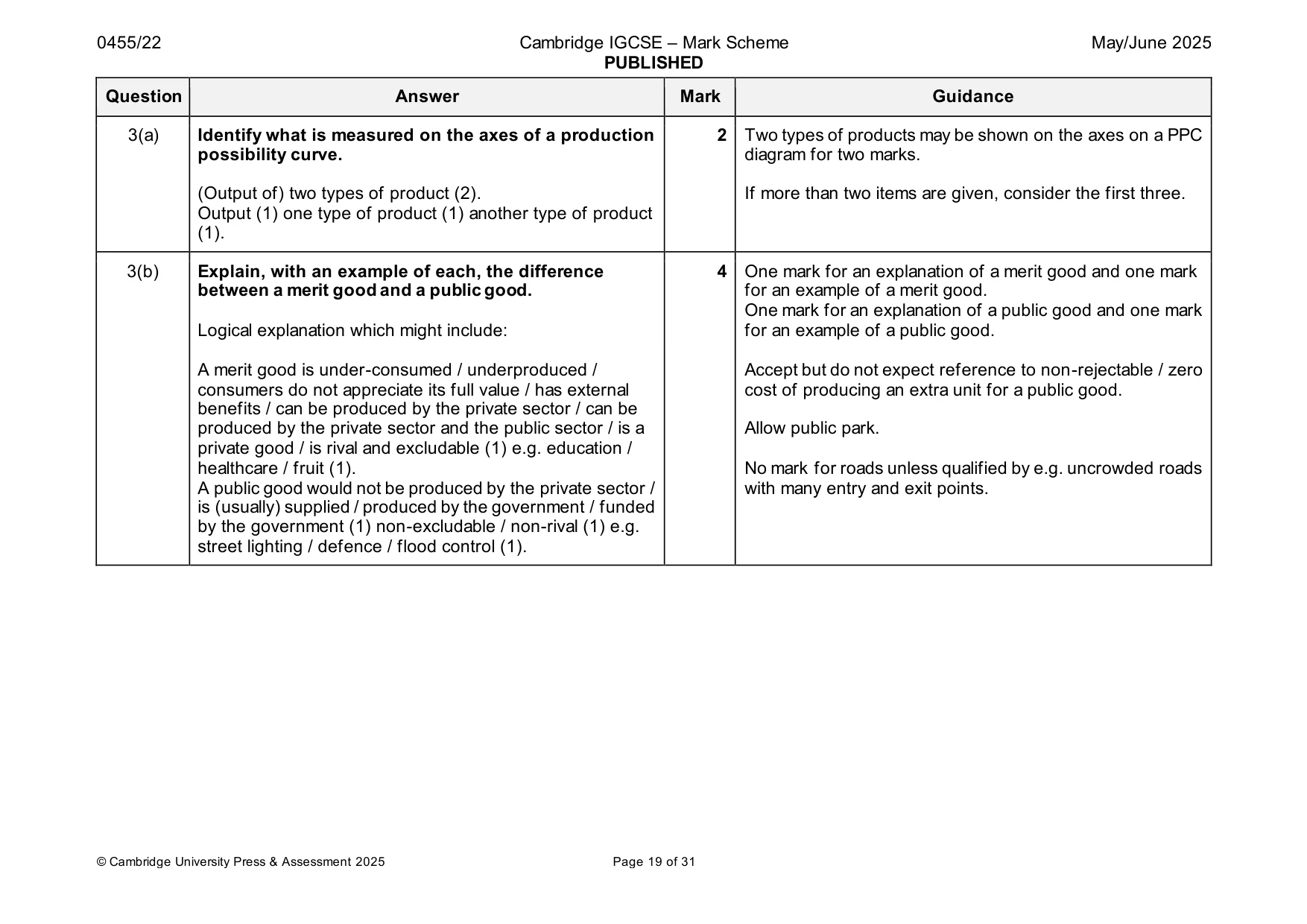
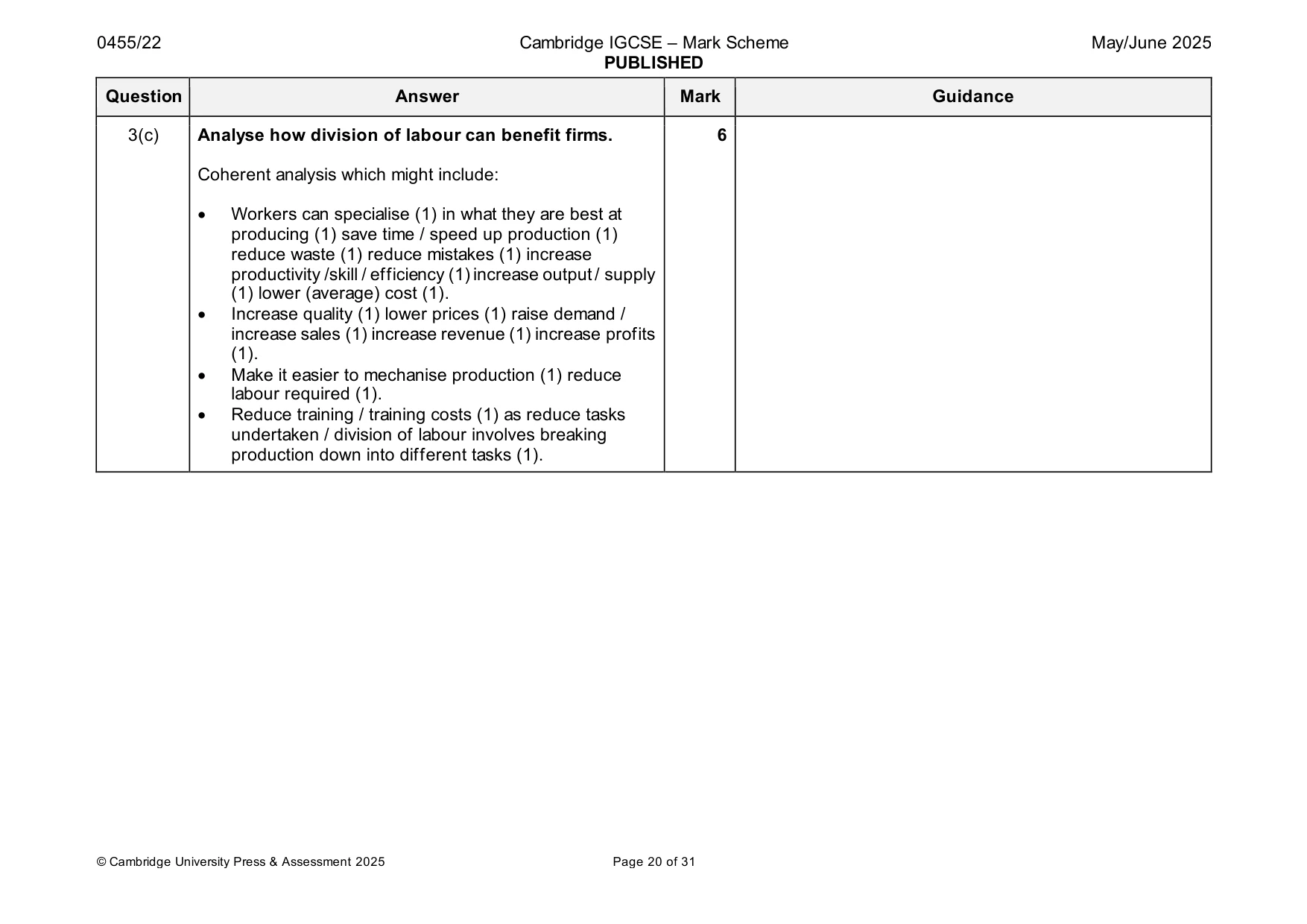
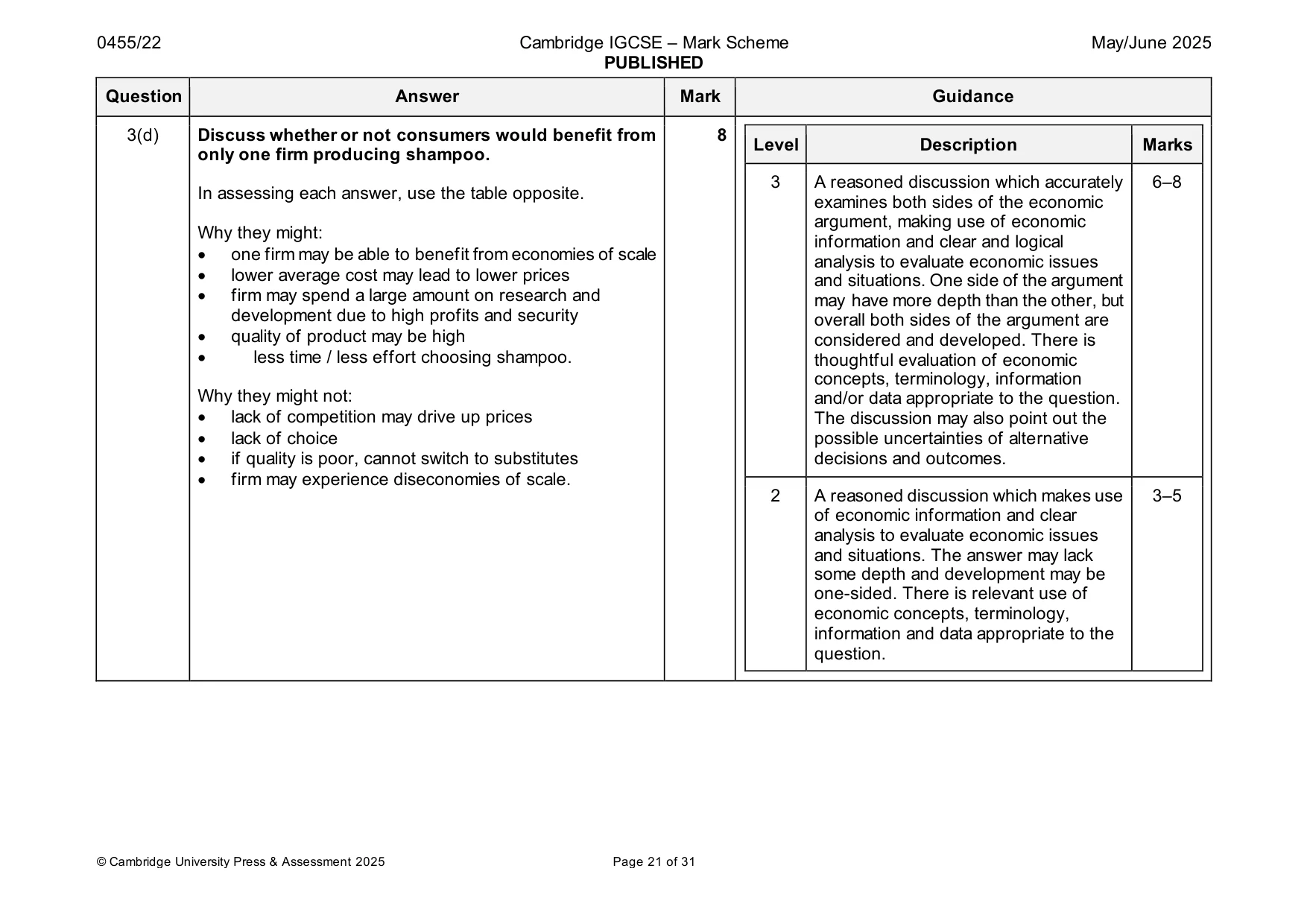
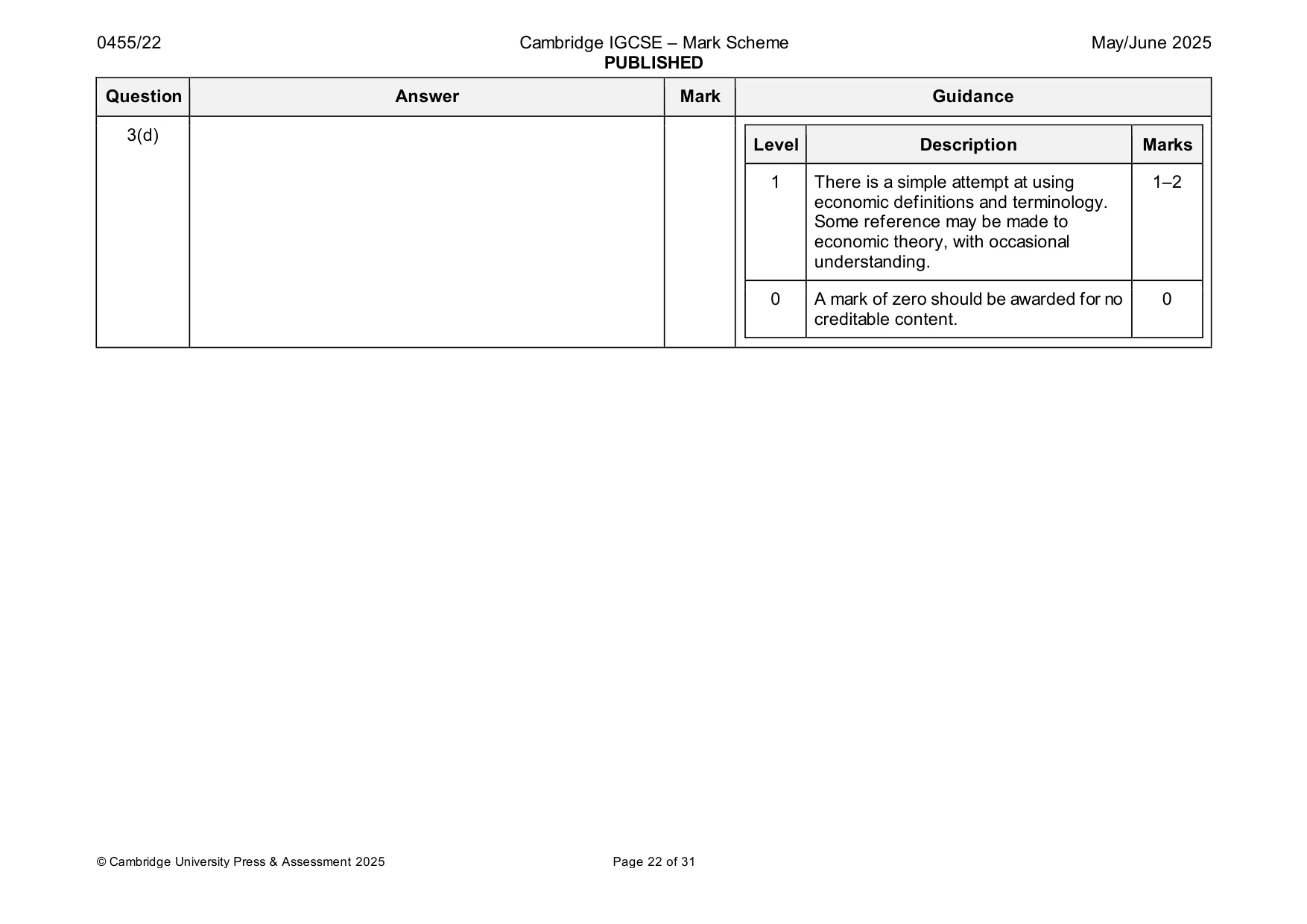
Mark scheme: 3(a) Identify what is measured on the axes of a production 2 Two types of products may be shown on the axes on a PPC possibility curve. diagram for two marks. (Output of) two types of product (2). If more than two items are given, consider the first three. Output (1) one type of product (1) another type of product (1). 3(b) Explain, with an example of each, the difference 4 One mark for an explanation of a merit good and one mark between a merit good and a public good. for an example of a merit good. One mark for an explanation of a public good and one mark Logical explanation which might include: for an example of a public good. A merit good is under-consumed / underproduced / Accept but do not expect reference to non-rejectable / zero consumers do not appreciate its full value / has external cost of producing an extra unit for a public good. benefits / can be produced by the private sector / can be produced by the private sector and the public sector / is a Allow public park. private good / is rival and excludable (1) e.g. education / healthcare / fruit (1). No mark for roads unless qualified by e.g. uncrowded roads A public good would not be produced by the private sector / with many entry and exit points. is (usually) supplied / produced by the government / funded by the government (1) non-excludable / non-rival (1) e.g. street lighting / defence / flood control (1). 3(c) Analyse how division of labour can benefit firms. 6 Coherent analysis which might include: • Workers can specialise (1) in what they are best at producing (1) save time / speed up production (1) reduce waste (1) reduce mistakes (1) increase productivity /skill / efficiency (1) increase output / supply (1) lower (average) cost (1). • Increase quality (1) lower prices (1) raise demand / increase sales (1) increase revenue (1) increase profits (1). • Make it easier to mechanise production (1) reduce labour required (1). • Reduce training / training costs (1) as reduce tasks undertaken / division of labour involves breaking production down into different tasks (1). 3(d) Discuss whether or not consumers would benefit from 8 Level Description Marks only one firm producing shampoo. 3 A reasoned discussion which accurately 6–8 In assessing each answer, use the table opposite. examines both sides of the economic argument, making use of economic Why they might: information and clear and logical • one firm may be able to benefit from economies of scale analysis to evaluate economic issues • lower average cost may lead to lower prices and situations. One side of the argument • firm may spend a large amount on research and may have more depth than the other, but development due to high profits and security overall both sides of the argument are • quality of product may be high considered and developed. There is • less time / less effort choosing shampoo. thoughtful evaluation of economic concepts, terminology, information Why they might not: and/or data appropriate to the question. • lack of competition may drive up prices The discussion may also point out the • lack of choice possible uncertainties of alternative • if quality is poor, cannot switch to substitutes decisions and outcomes. • firm may experience diseconomies of scale. 2 A reasoned discussion which makes use 3–5 of economic information and clear analysis to evaluate economic issues and situations. The answer may lack some depth and development may be one-sided. There is relevant use of economic concepts, terminology, information and data appropriate to the question. 3(d) Level Description Marks 1 There is a simple attempt at using 1–2 economic definitions and terminology. Some reference may be made to economic theory, with occasional understanding. 0 A mark of zero should be awarded for no 0 creditable content.
Q4 · In 2022, more than a quarter of a million workers, including doctors, left Sri Lanka to…
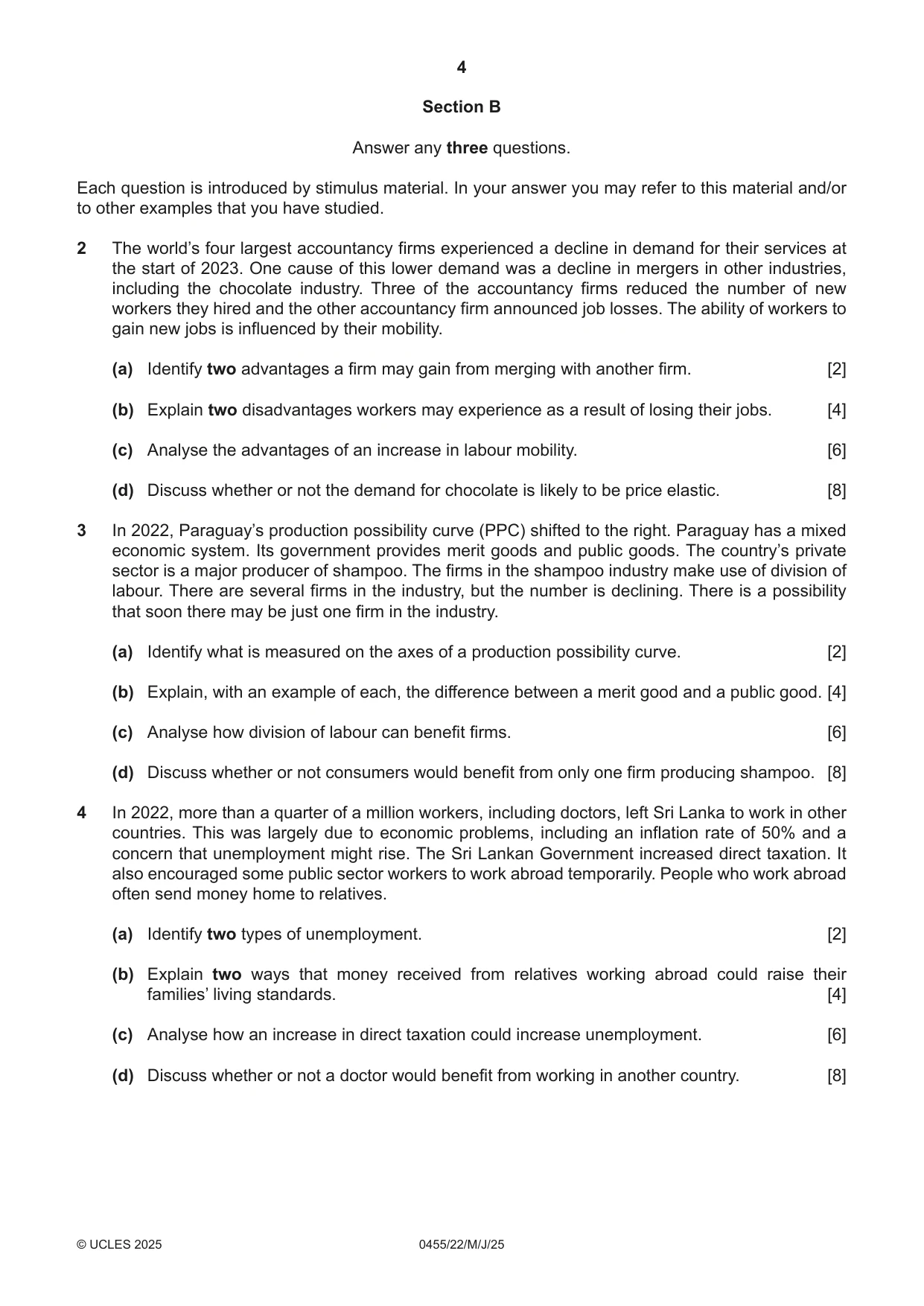
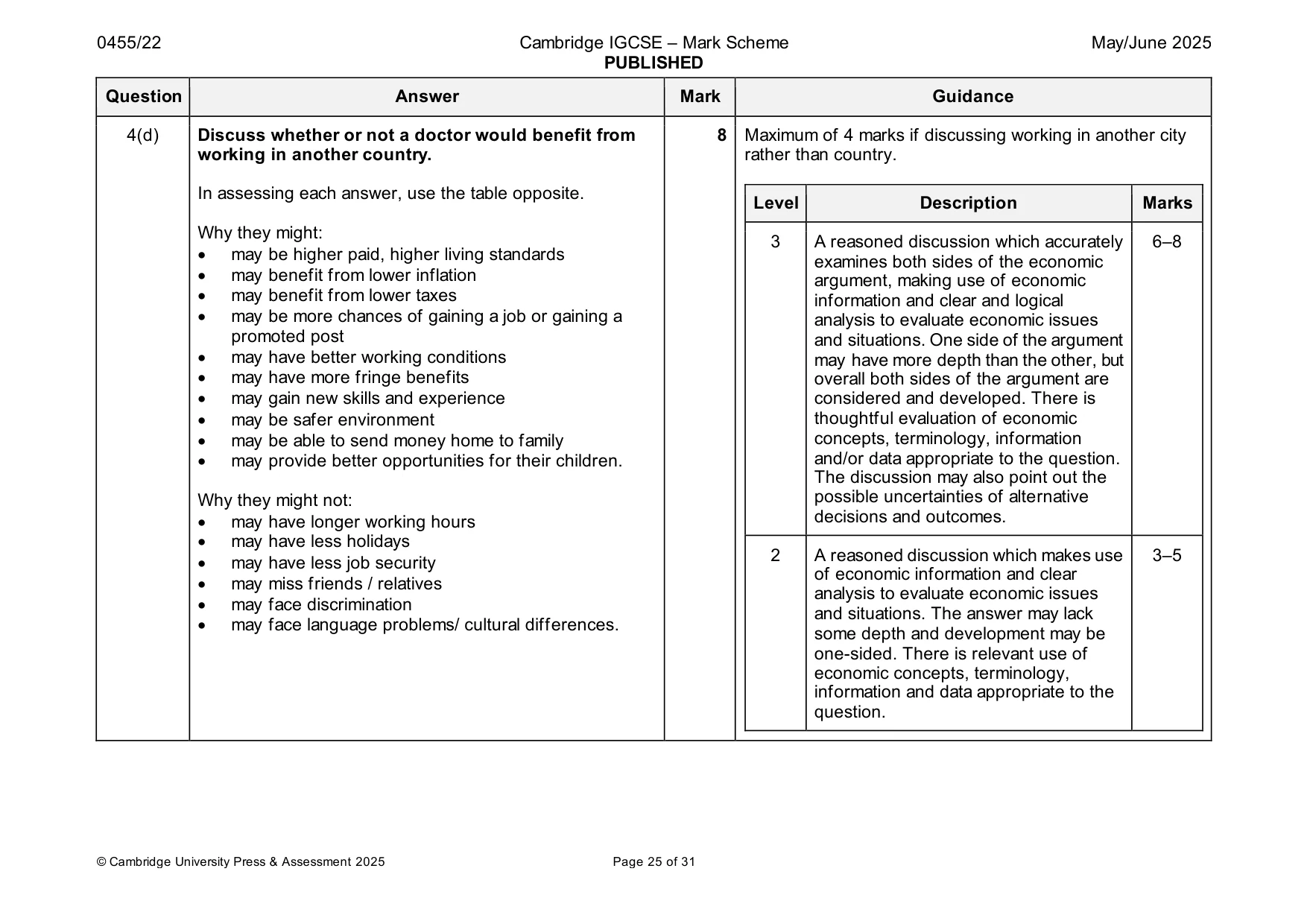
4 In 2022, more than a quarter of a million workers, including doctors, left Sri Lanka to work in other countries. This was largely due to economic problems, including an inflation rate of 50% and a concern that unemployment might rise. The Sri Lankan Government increased direct taxation. It also encouraged some public sector workers to work abroad temporarily. People who work abroad often send money home to relatives. (a) Identify two types of unemployment. [2] (b) Explain two ways that money received from relatives working abroad could raise their families’ living standards. [4] (c) Analyse how an increase in direct taxation could increase unemployment. [6] (d) Discuss whether or not a doctor would benefit from working in another country. [8]
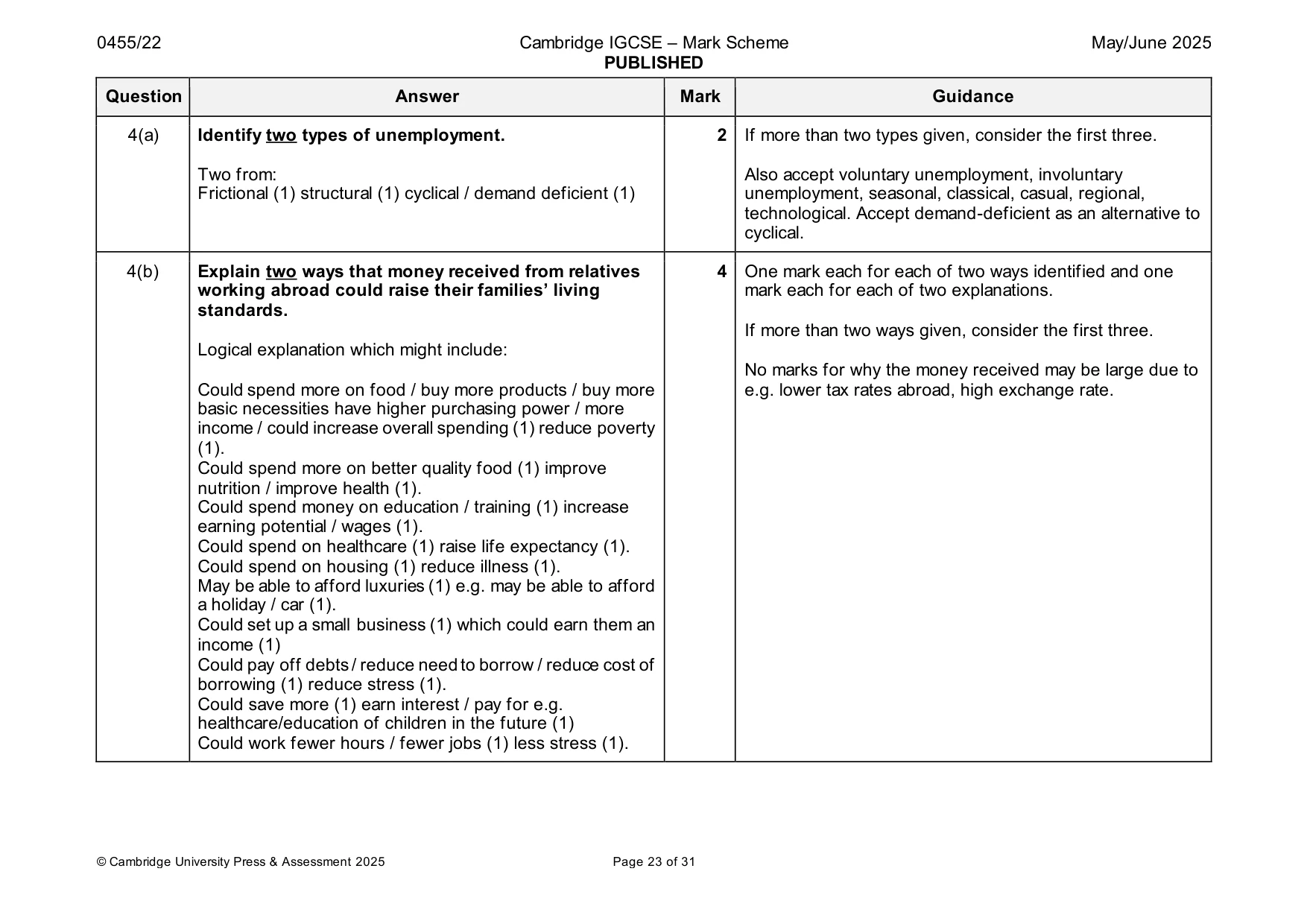
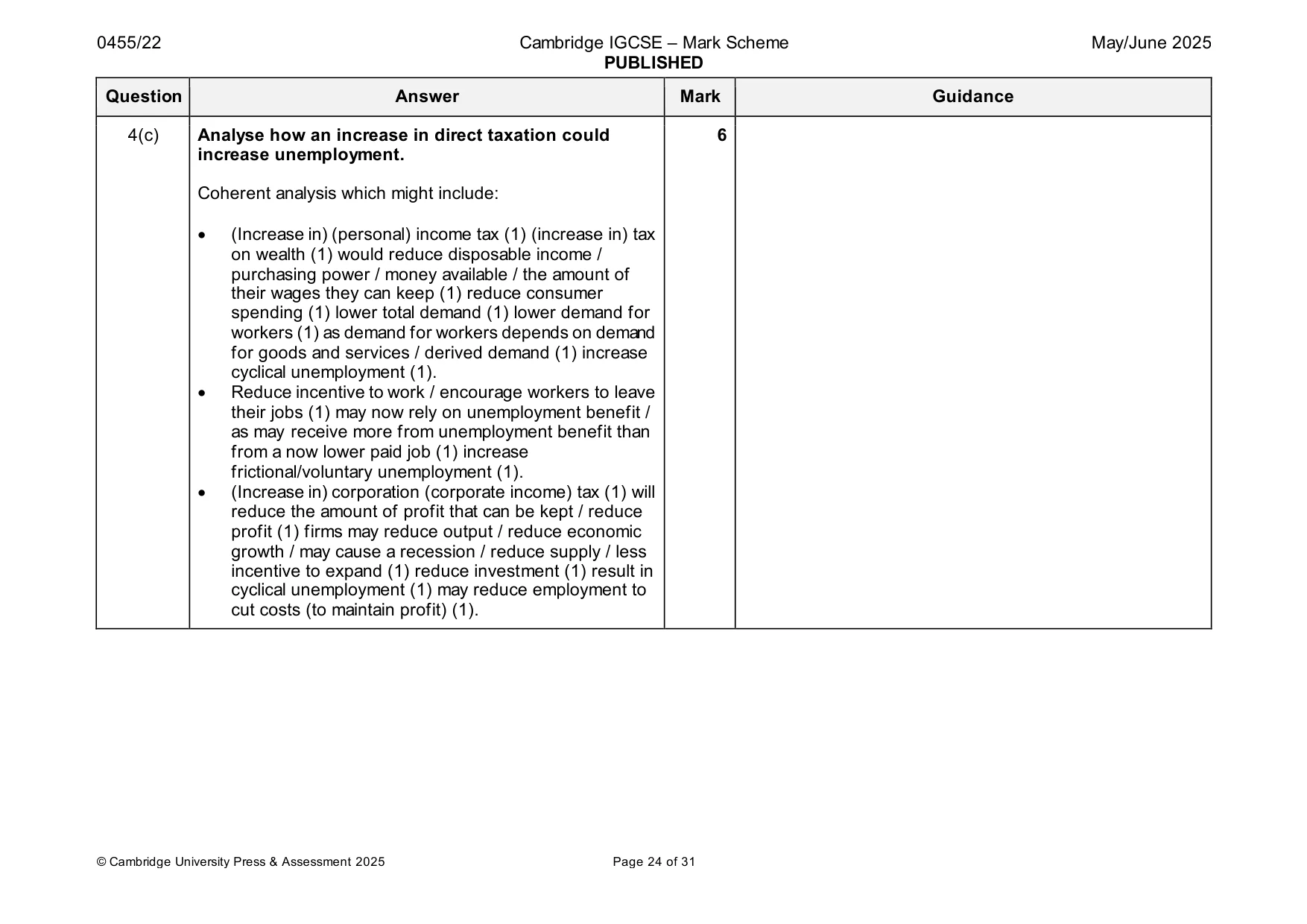
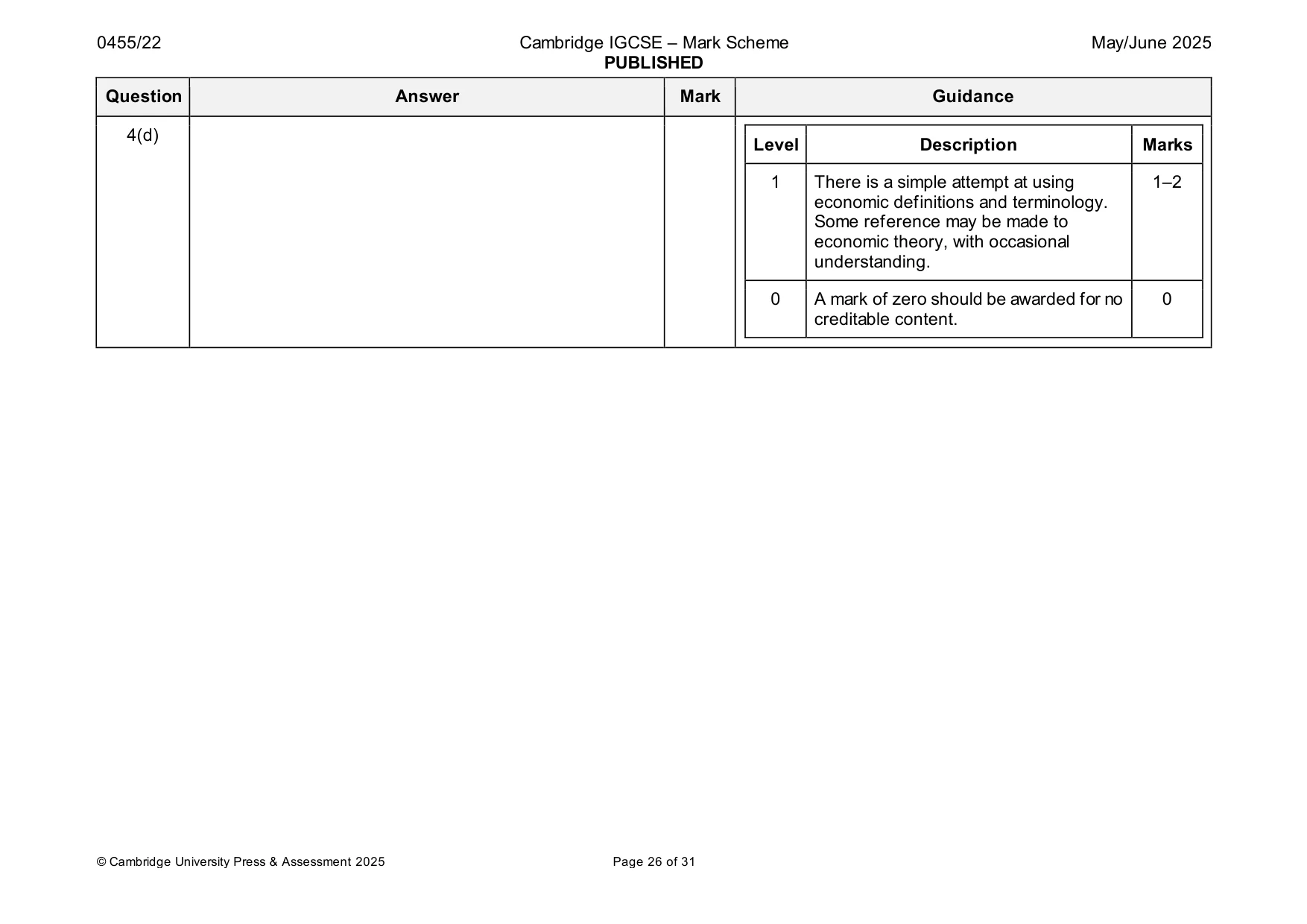
Mark scheme: 4(a) Identify two types of unemployment. 2 If more than two types given, consider the first three. Two from: Also accept voluntary unemployment, involuntary Frictional (1) structural (1) cyclical / demand deficient (1) unemployment, seasonal, classical, casual, regional, technological. Accept demand-deficient as an alternative to cyclical. 4(b) Explain two ways that money received from relatives 4 One mark each for each of two ways identified and one working abroad could raise their families’ living mark each for each of two explanations. standards. If more than two ways given, consider the first three. Logical explanation which might include: No marks for why the money received may be large due to Could spend more on food / buy more products / buy more e.g. lower tax rates abroad, high exchange rate. basic necessities have higher purchasing power / more income / could increase overall spending (1) reduce poverty (1). Could spend more on better quality food (1) improve nutrition / improve health (1). Could spend money on education / training (1) increase earning potential / wages (1). Could spend on healthcare (1) raise life expectancy (1). Could spend on housing (1) reduce illness (1). May be able to afford luxuries (1) e.g. may be able to afford a holiday / car (1). Could set up a small business (1) which could earn them an income (1) Could pay off debts / reduce need to borrow / reduce cost of borrowing (1) reduce stress (1). Could save more (1) earn interest / pay for e.g. healthcare/education of children in the future (1) Could work fewer hours / fewer jobs (1) less stress (1). 4(c) Analyse how an increase in direct taxation could 6 increase unemployment. Coherent analysis which might include: • (Increase in) (personal) income tax (1) (increase in) tax on wealth (1) would reduce disposable income / purchasing power / money available / the amount of their wages they can keep (1) reduce consumer spending (1) lower total demand (1) lower demand for workers (1) as demand for workers depends on demand for goods and services / derived demand (1) increase cyclical unemployment (1). • Reduce incentive to work / encourage workers to leave their jobs (1) may now rely on unemployment benefit / as may receive more from unemployment benefit than from a now lower paid job (1) increase frictional/voluntary unemployment (1). • (Increase in) corporation (corporate income) tax (1) will reduce the amount of profit that can be kept / reduce profit (1) firms may reduce output / reduce economic growth / may cause a recession / reduce supply / less incentive to expand (1) reduce investment (1) result in cyclical unemployment (1) may reduce employment to cut costs (to maintain profit) (1). 4(d) Discuss whether or not a doctor would benefit from 8 Maximum of 4 marks if discussing working in another city working in another country. rather than country. In assessing each answer, use the table opposite. Level Description Marks Why they might: 3 A reasoned discussion which accurately 6–8 • may be higher paid, higher living standards examines both sides of the economic • may benefit from lower inflation argument, making use of economic • may benefit from lower taxes information and clear and logical • may be more chances of gaining a job or gaining a analysis to evaluate economic issues promoted post and situations. One side of the argument • may have better working conditions may have more depth than the other, but • may have more fringe benefits overall both sides of the argument are • may gain new skills and experience considered and developed. There is • may be safer environment thoughtful evaluation of economic • may be able to send money home to family concepts, terminology, information • may provide better opportunities for their children. and/or data appropriate to the question. The discussion may also point out the Why they might not: possible uncertainties of alternative • may have longer working hours decisions and outcomes. • may have less holidays 2 A reasoned discussion which makes use 3–5 • may have less job security of economic information and clear • may miss friends / relatives analysis to evaluate economic issues • may face discrimination and situations. The answer may lack • may face language problems/ cultural differences. some depth and development may be one-sided. There is relevant use of economic concepts, terminology, information and data appropriate to the question. 4(d) Level Description Marks 1 There is a simple attempt at using 1–2 economic definitions and terminology. Some reference may be made to economic theory, with occasional understanding. 0 A mark of zero should be awarded for no 0 creditable content.
Q5 · In 2023, the Chinese Government said that it would aim for an economic growth rate of 5%…
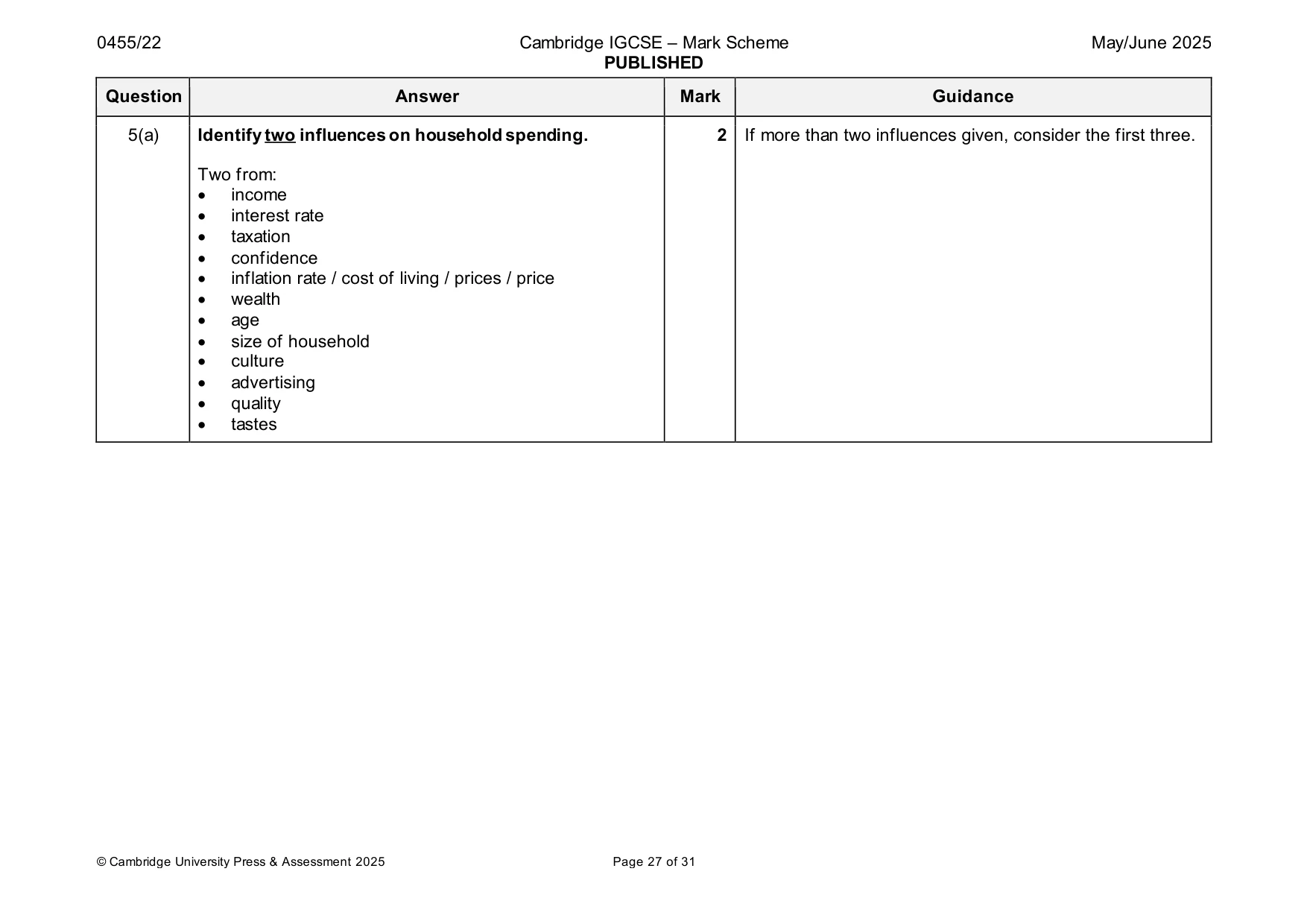
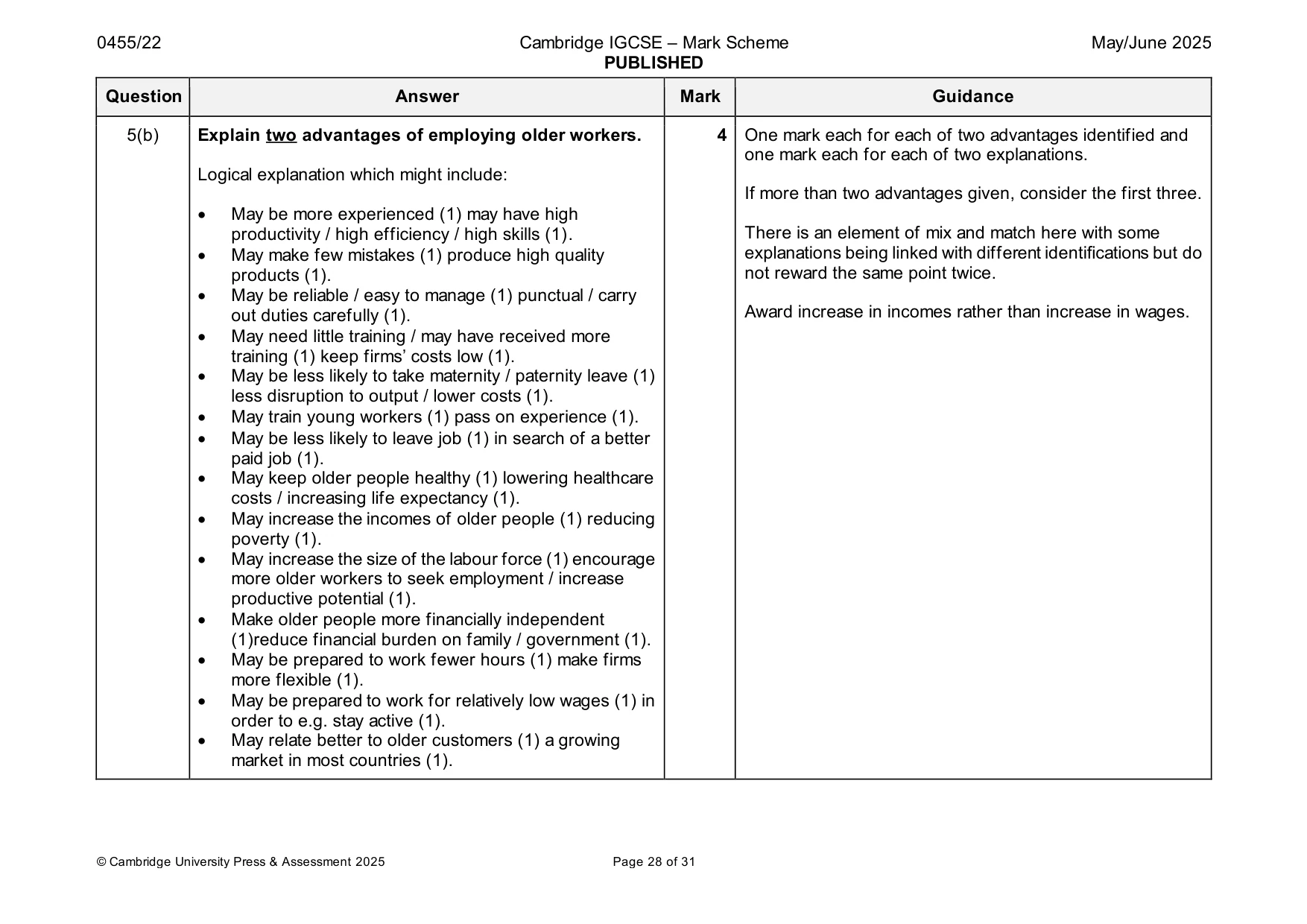
5 In 2023, the Chinese Government said that it would aim for an economic growth rate of 5% and a steady increase in both exports and imports. It was expected that higher output would be caused mainly by an increase in household spending, although this could also result in inflation. Another aim of the Chinese Government was to keep the unemployment rate at around 5.5%. China has an ageing population and an ageing labour force. (a) Identify two influences on household spending. [2] (b) Explain two advantages of employing older workers. [4] (c) Analyse how an increase in household spending could cause inflation. [6] (d) Discuss whether or not a government should aim for an increase in imports. [8]
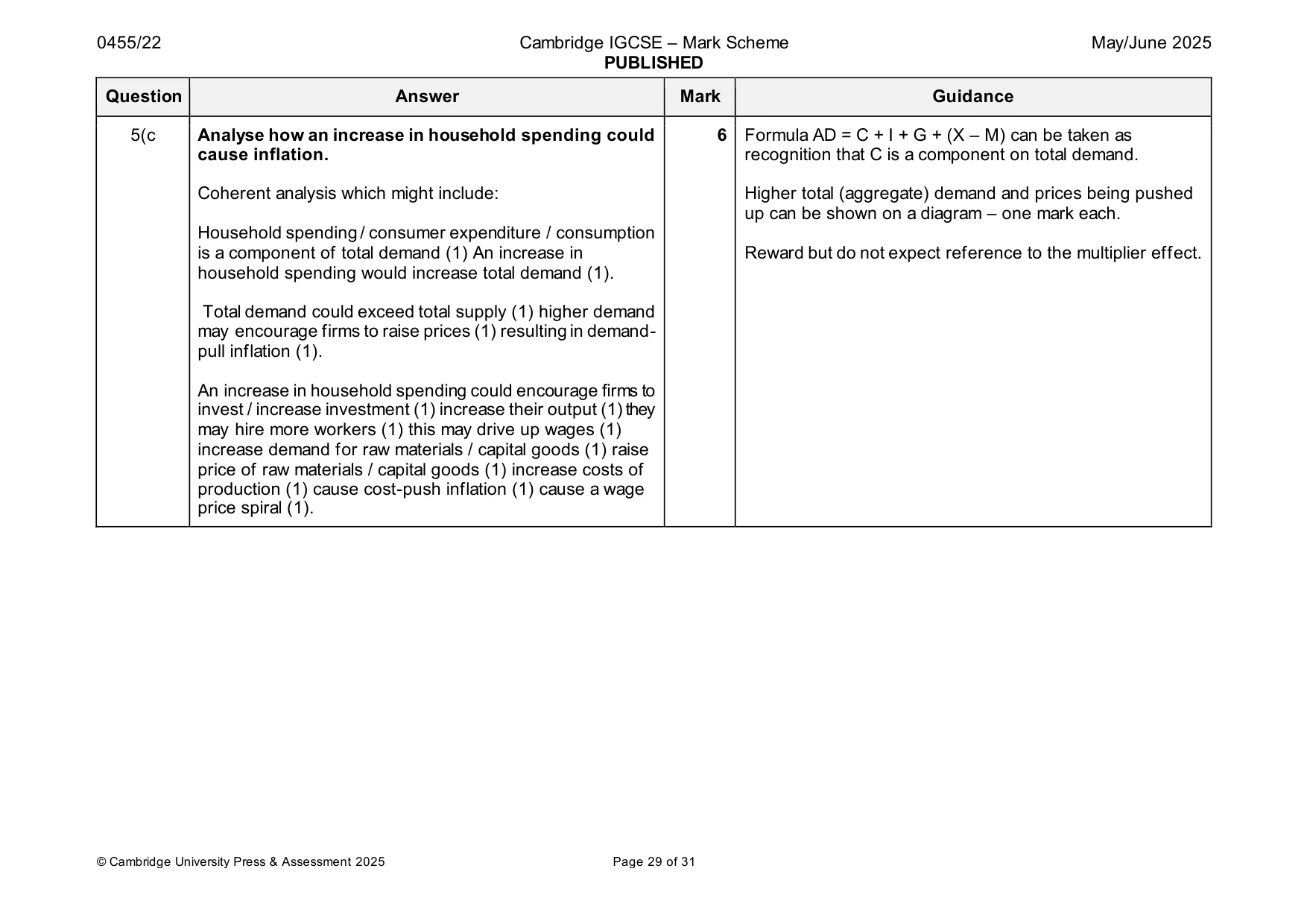
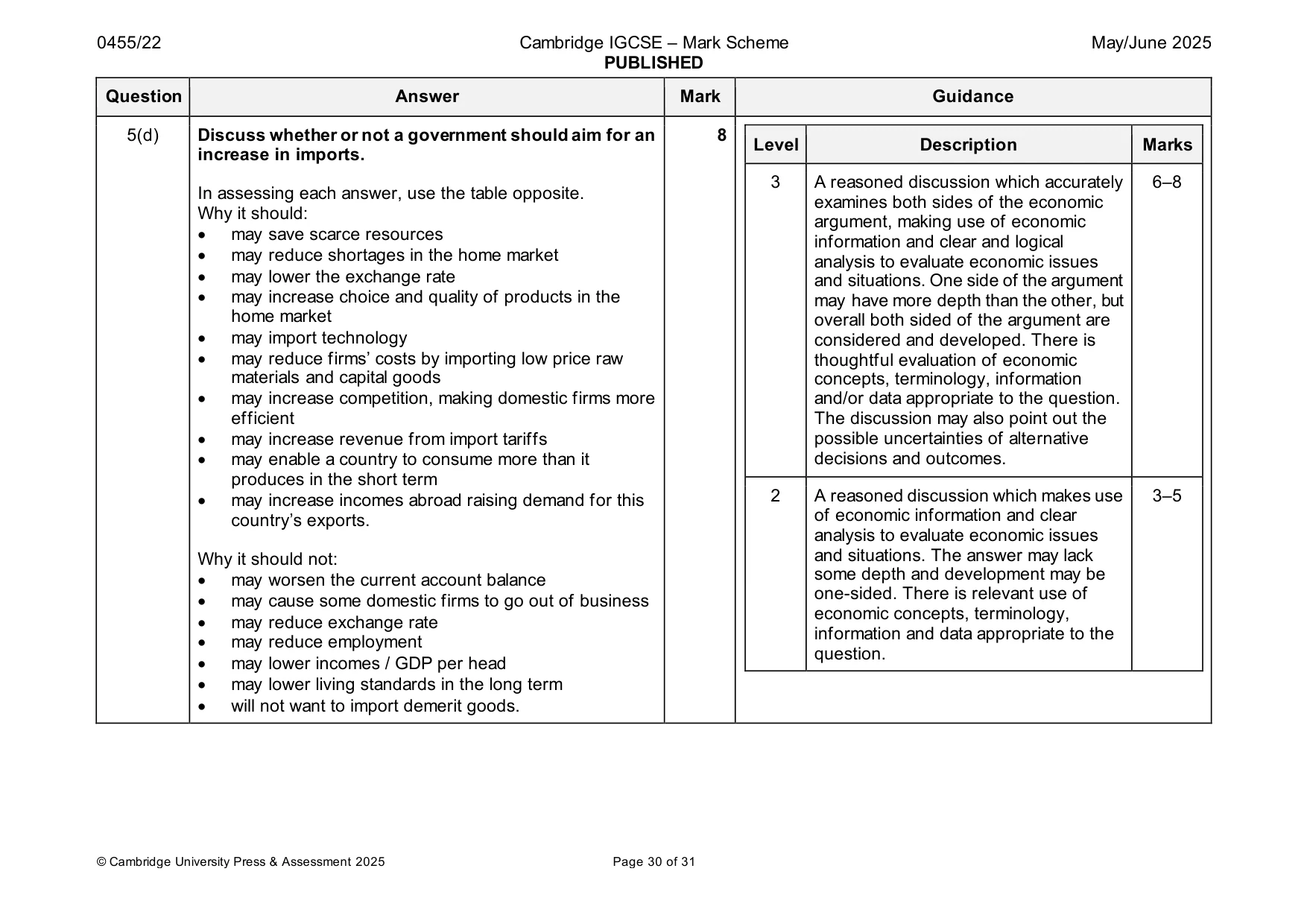
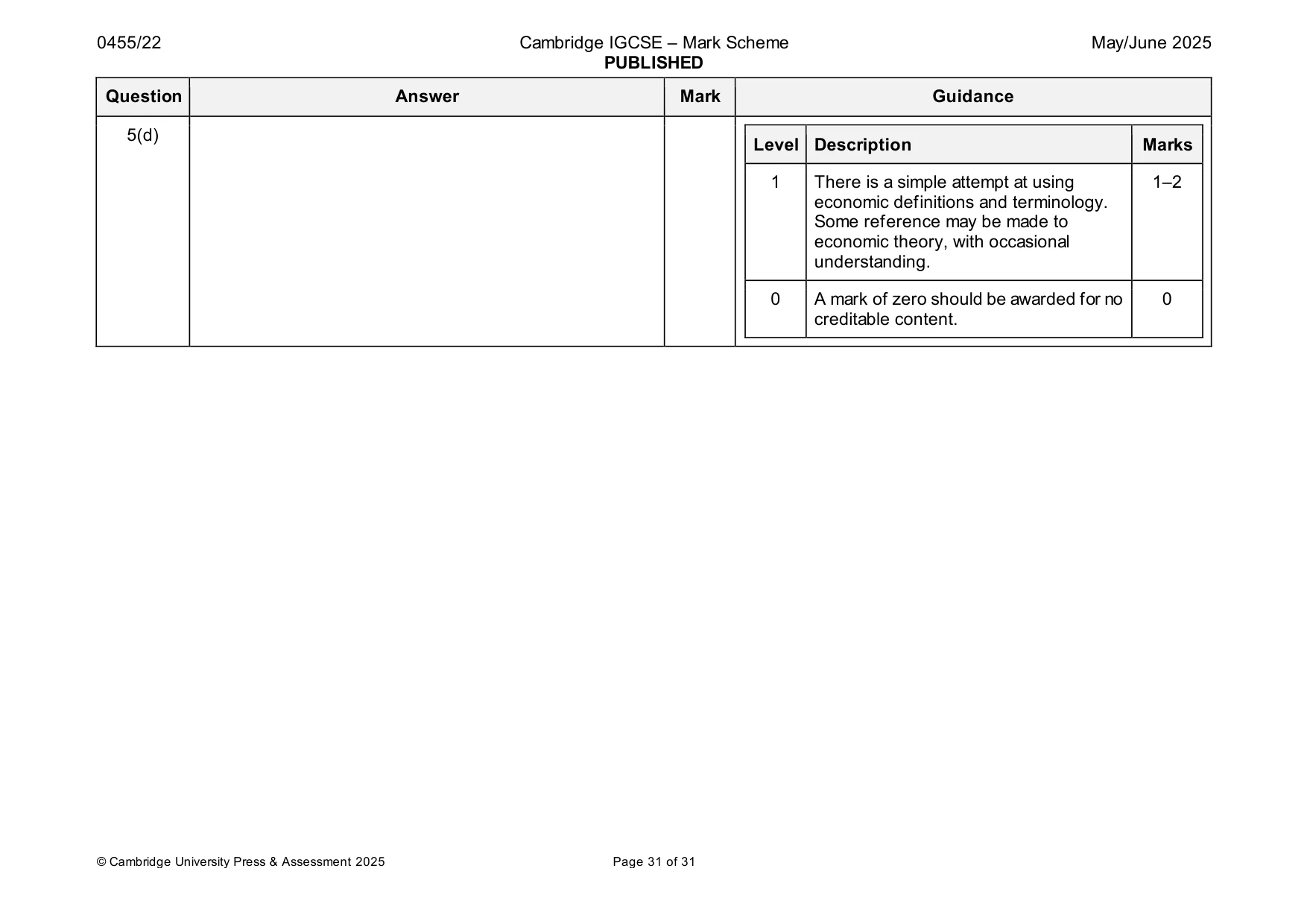
Mark scheme: 5(a) Identify two influences on household spending. 2 If more than two influences given, consider the first three. Two from: • income • interest rate • taxation • confidence • inflation rate / cost of living / prices / price • wealth • age • size of household • culture • advertising • quality • tastes 5(b) Explain two advantages of employing older workers. 4 One mark each for each of two advantages identified and one mark each for each of two explanations. Logical explanation which might include: If more than two advantages given, consider the first three. • May be more experienced (1) may have high productivity / high efficiency / high skills (1). There is an element of mix and match here with some • May make few mistakes (1) produce high quality explanations being linked with different identifications but do products (1). not reward the same point twice. • May be reliable / easy to manage (1) punctual / carry out duties carefully (1). Award increase in incomes rather than increase in wages. • May need little training / may have received more training (1) keep firms’ costs low (1). • May be less likely to take maternity / paternity leave (1) less disruption to output / lower costs (1). • May train young workers (1) pass on experience (1). • May be less likely to leave job (1) in search of a better paid job (1). • May keep older people healthy (1) lowering healthcare costs / increasing life expectancy (1). • May increase the incomes of older people (1) reducing poverty (1). • May increase the size of the labour force (1) encourage more older workers to seek employment / increase productive potential (1). • Make older people more financially independent (1)reduce financial burden on family / government (1). • May be prepared to work fewer hours (1) make firms more flexible (1). • May be prepared to work for relatively low wages (1) in order to e.g. stay active (1). • May relate better to older customers (1) a growing market in most countries (1). 5(c Analyse how an increase in household spending could 6 Formula AD = C + I + G + (X – M) can be taken as cause inflation. recognition that C is a component on total demand. Coherent analysis which might include: Higher total (aggregate) demand and prices being pushed up can be shown on a diagram – one mark each. Household spending / consumer expenditure / consumption is a component of total demand (1) An increase in Reward but do not expect reference to the multiplier effect. household spending would increase total demand (1). Total demand could exceed total supply (1) higher demand may encourage firms to raise prices (1) resulting in demand- pull inflation (1). An increase in household spending could encourage firms to invest / increase investment (1) increase their output (1) they may hire more workers (1) this may drive up wages (1) increase demand for raw materials / capital goods (1) raise price of raw materials / capital goods (1) increase costs of production (1) cause cost-push inflation (1) cause a wage price spiral (1). 5(d) Discuss whether or not a government should aim for an 8 Level Description Marks increase in imports. 3 A reasoned discussion which accurately 6–8 In assessing each answer, use the table opposite. examines both sides of the economic Why it should: argument, making use of economic • may save scarce resources information and clear and logical • may reduce shortages in the home market analysis to evaluate economic issues • may lower the exchange rate and situations. One side of the argument • may increase choice and quality of products in the may have more depth than the other, but home market overall both sided of the argument are • may import technology considered and developed. There is • may reduce firms’ costs by importing low price raw thoughtful evaluation of economic materials and capital goods concepts, terminology, information • may increase competition, making domestic firms more and/or data appropriate to the question. efficient The discussion may also point out the • may increase revenue from import tariffs possible uncertainties of alternative • may enable a country to consume more than it decisions and outcomes. produces in the short term • may increase incomes abroad raising demand for this 2 A reasoned discussion which makes use 3–5 of economic information and clear country’s exports. analysis to evaluate economic issues Why it should not: and situations. The answer may lack • may worsen the current account balance some depth and development may be one-sided. There is relevant use of • may cause some domestic firms to go out of business economic concepts, terminology, • may reduce exchange rate information and data appropriate to the • may reduce employment question. • may lower incomes / GDP per head • may lower living standards in the long term • will not want to import demerit goods. 5(d) Level Description Marks 1 There is a simple attempt at using 1–2 economic definitions and terminology. Some reference may be made to economic theory, with occasional understanding. 0 A mark of zero should be awarded for no 0 creditable content.
What was in this paper
The subtopics covered by these 5 questions, and how many questions each got. Open one in a new tab to see every Cambridge question on it.
What you needed in this session
Cambridge’s own grade thresholds for 2025 May/June, Paper 2 · Variant 2. A higher threshold means an easier paper — the bar moves with how the cohort did.