Cambridge IGCSE Economics 0455 — 2019 Oct/Nov Paper 2 · Variant 3
0455/23/O/N/19 · 7 questions · 90 marks · ≈101 min
The question paper and its mark scheme, free to read here and free to download. This is Cambridge’s own paper, exactly as it was sat.
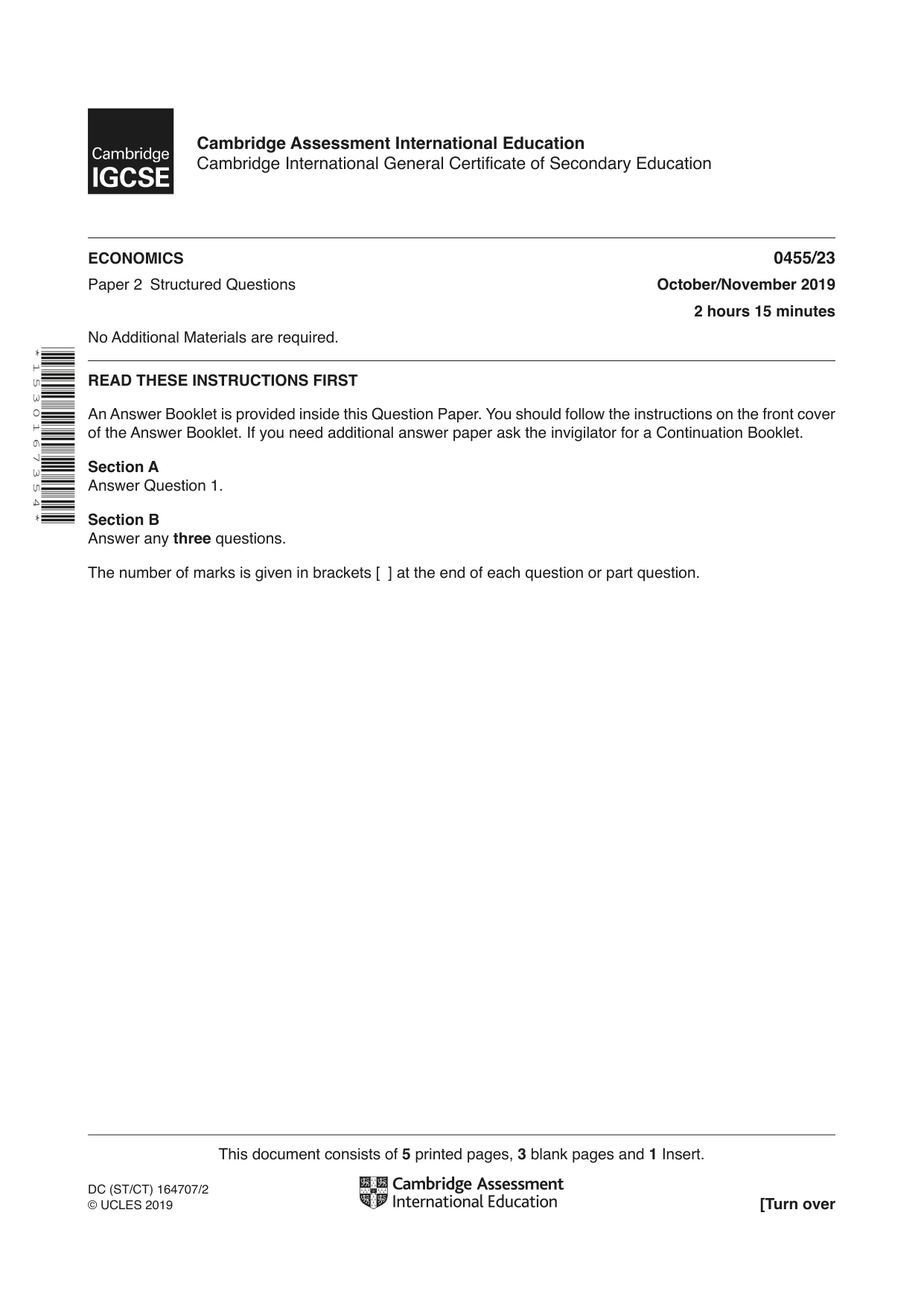
Question paper8 pages



Mark scheme20 pages
Answers below. Sit the paper first if you are practising.

Questions as text
Q1 · A new capital for Zambia?
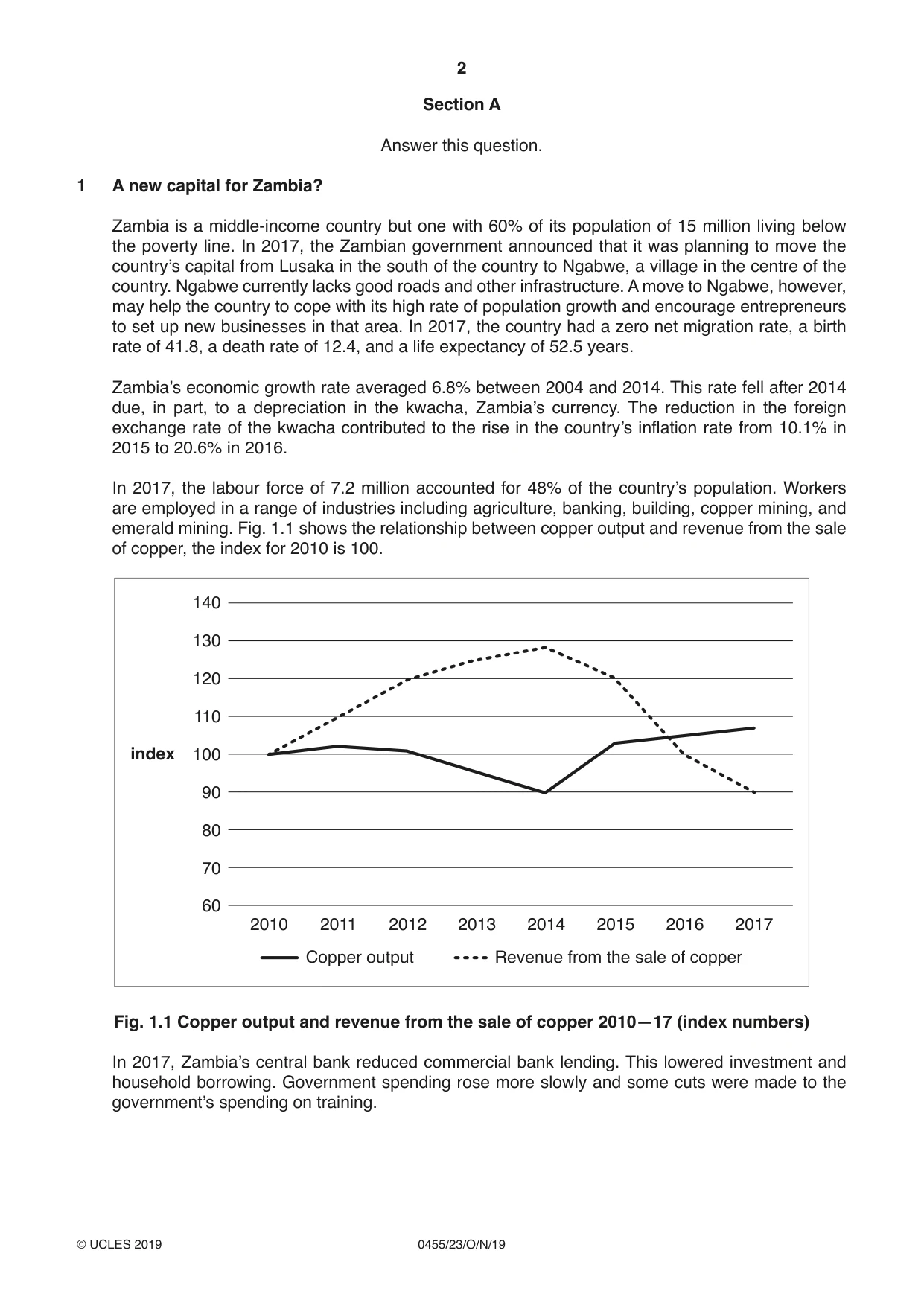
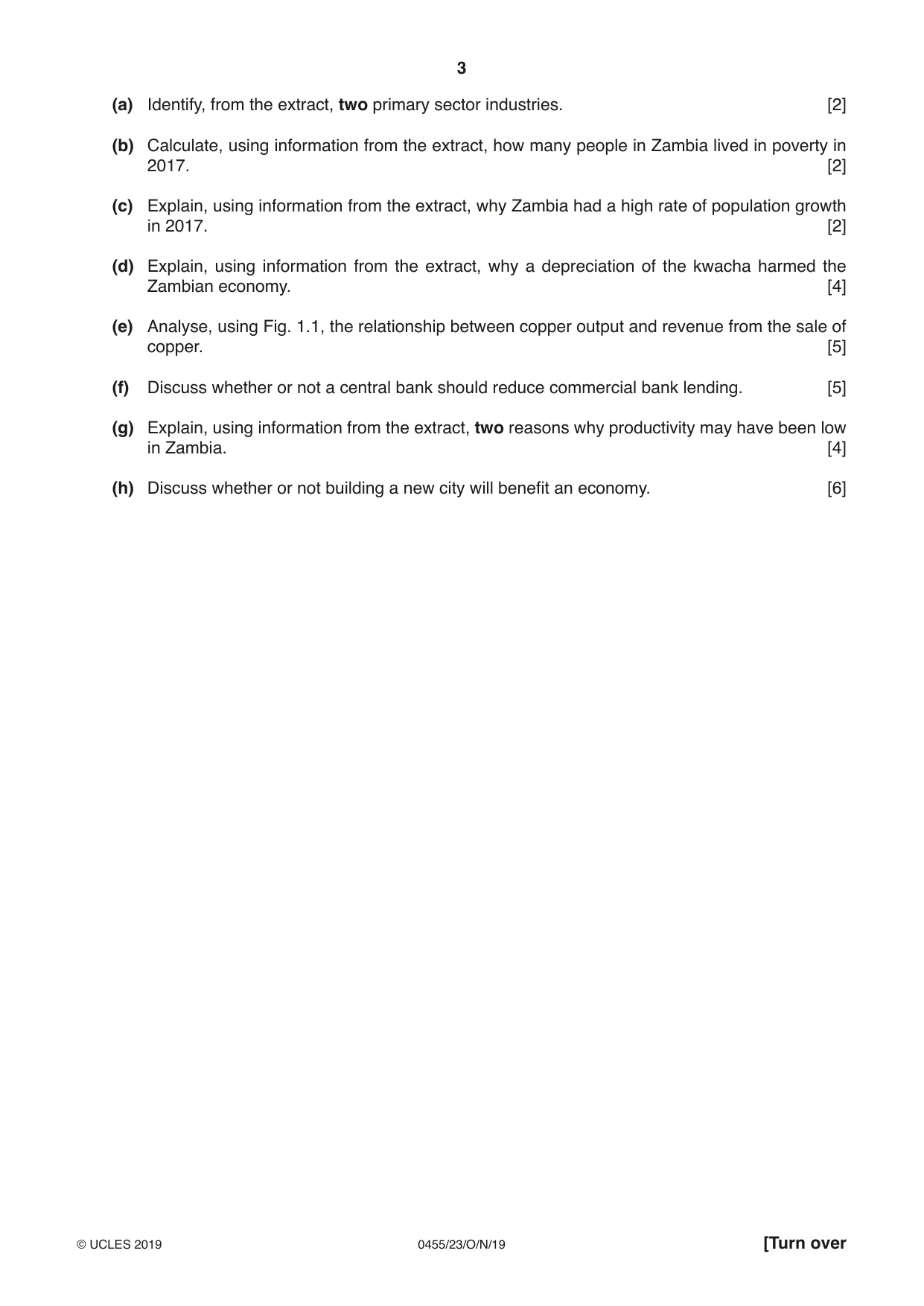
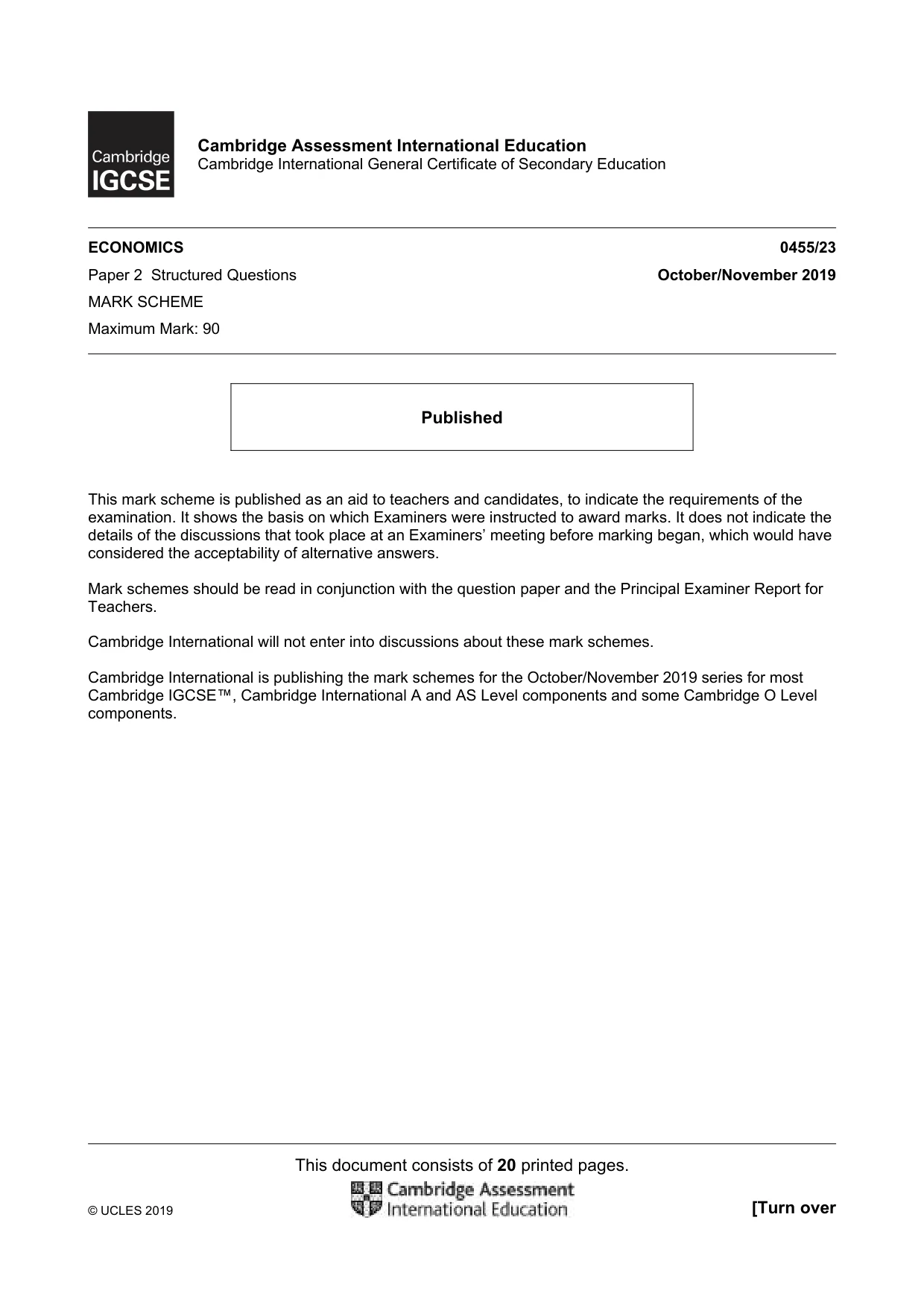
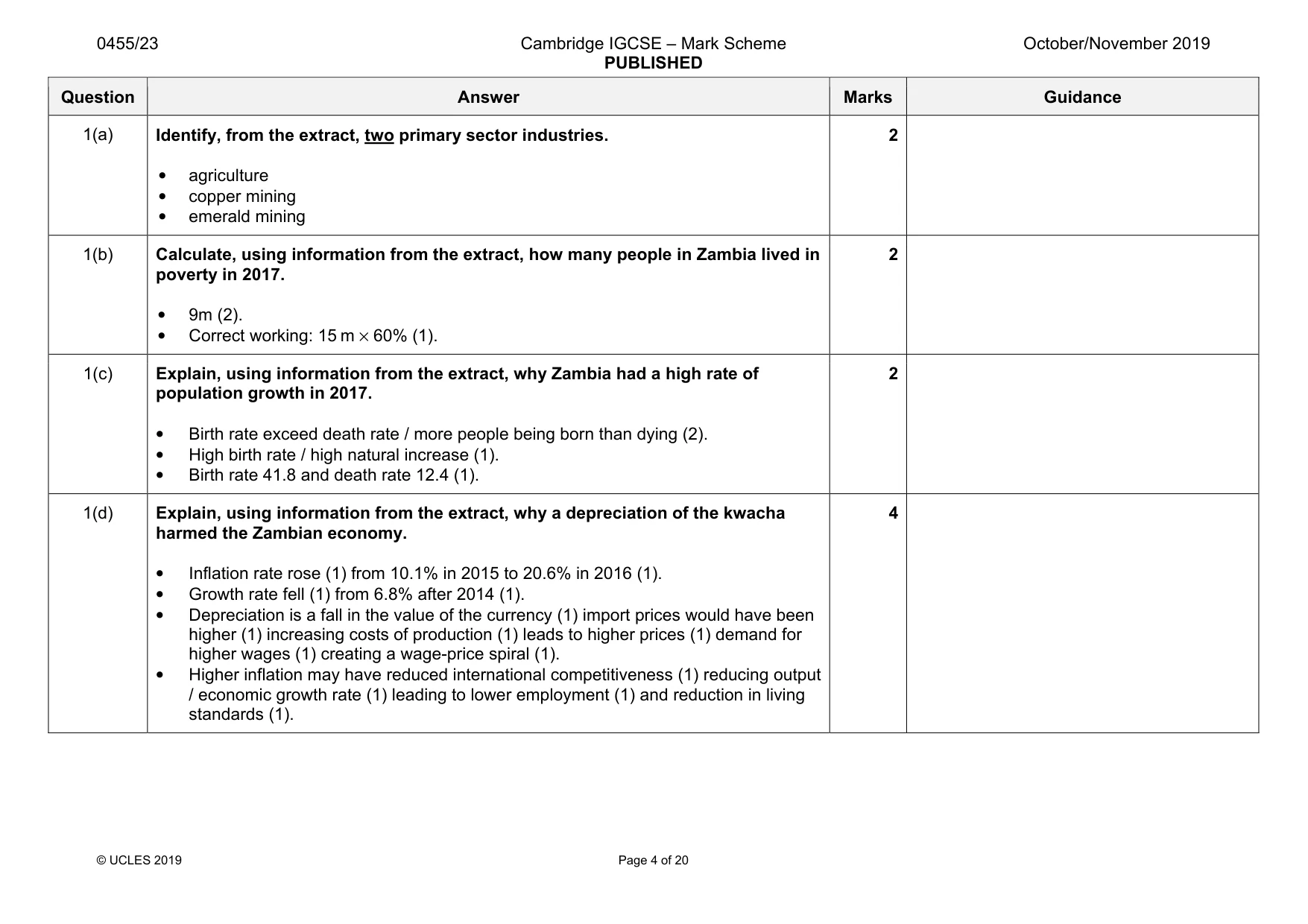
1 A new capital for Zambia? Zambia is a middle-income country but one with 60% of its population of 15 million living below the poverty line. In 2017, the Zambian government announced that it was planning to move the country’s capital from Lusaka in the south of the country to Ngabwe, a village in the centre of the country. Ngabwe currently lacks good roads and other infrastructure. A move to Ngabwe, however, may help the country to cope with its high rate of population growth and encourage entrepreneurs to set up new businesses in that area. In 2017, the country had a zero net migration rate, a birth rate of 41.8, a death rate of 12.4, and a life expectancy of 52.5 years. Zambia’s economic growth rate averaged 6.8% between 2004 and 2014. This rate fell after 2014 due, in part, to a depreciation in the kwacha, Zambia’s currency. The reduction in the foreign exchange rate of the kwacha contributed to the rise in the country’s inflation rate from 10.1% in 2015 to 20.6% in 2016. In 2017, the labour force of 7.2 million accounted for 48% of the country’s population. Workers are employed in a range of industries including agriculture, banking, building, copper mining, and emerald mining. Fig. 1.1 shows the relationship between copper output and revenue from the sale of copper, the index for 2010 is 100. 140 130 120 110 index 100 90 80 70 60 2010 2011 2012 2013 2014 2015 2016 2017 Copper output Revenue from the sale of copper Fig. 1.1 Copper output and revenue from the sale of copper 2010—17 (index numbers) In 2017, Zambia’s central bank reduced commercial bank lending. This lowered investment and household borrowing. Government spending rose more slowly and some cuts were made to the government’s spending on training. (a) Identify, from the extract, two primary sector industries. [2] (b) Calculate, using information from the extract, how many people in Zambia lived in poverty in 2017. [2] (c) Explain, using information from the extract, why Zambia had a high rate of population growth in 2017. [2] (d) Explain, using information from the extract, why a depreciation of the kwacha harmed the Zambian economy. [4] (e) Analyse, using Fig. 1.1, the relationship between copper output and revenue from the sale of copper. [5] (f) Discuss whether or not a central bank should reduce commercial bank lending. [5] (g) Explain, using information from the extract, two reasons why productivity may have been low in Zambia. [4] (h) Discuss whether or not building a new city will benefit an economy. [6]
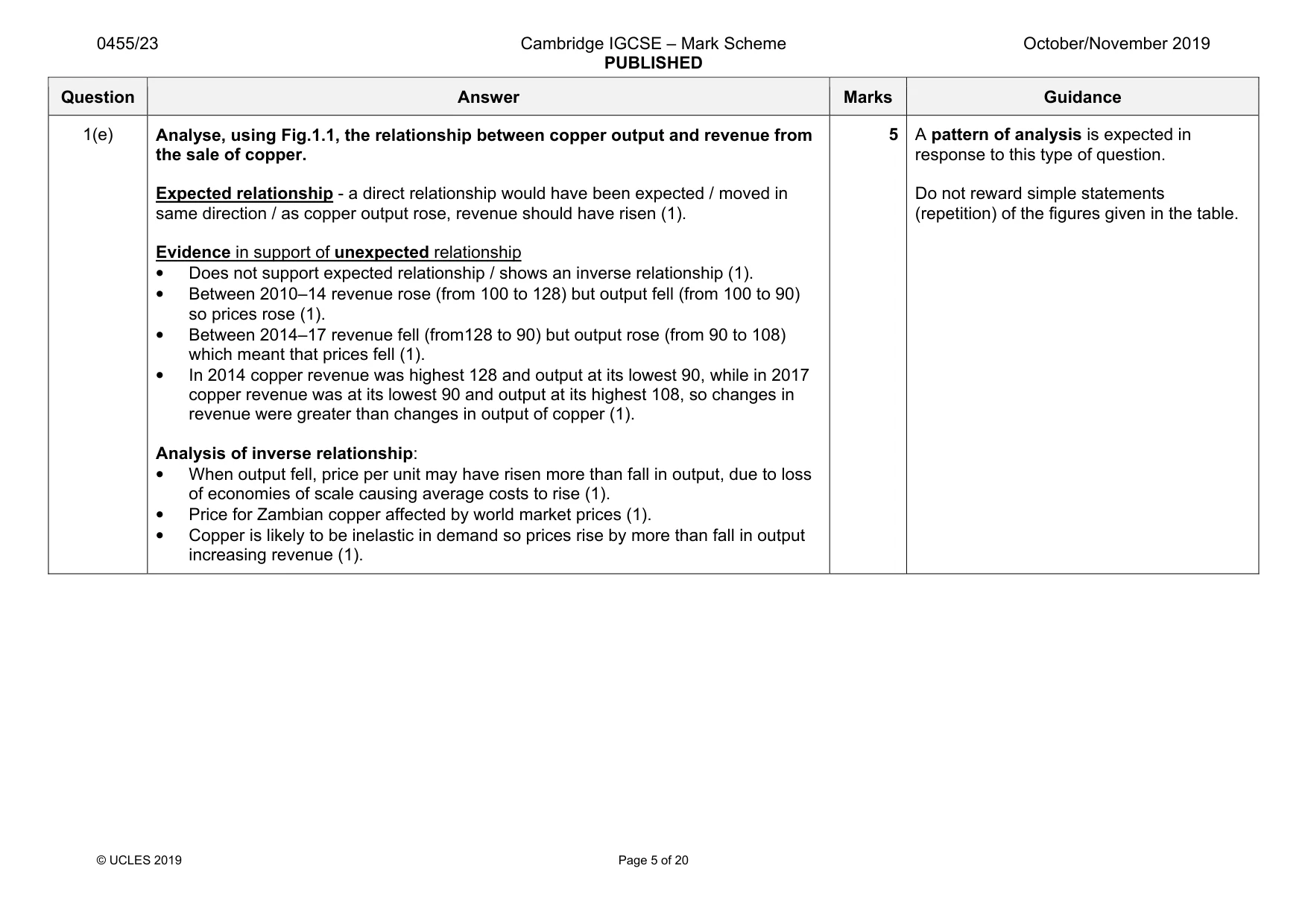
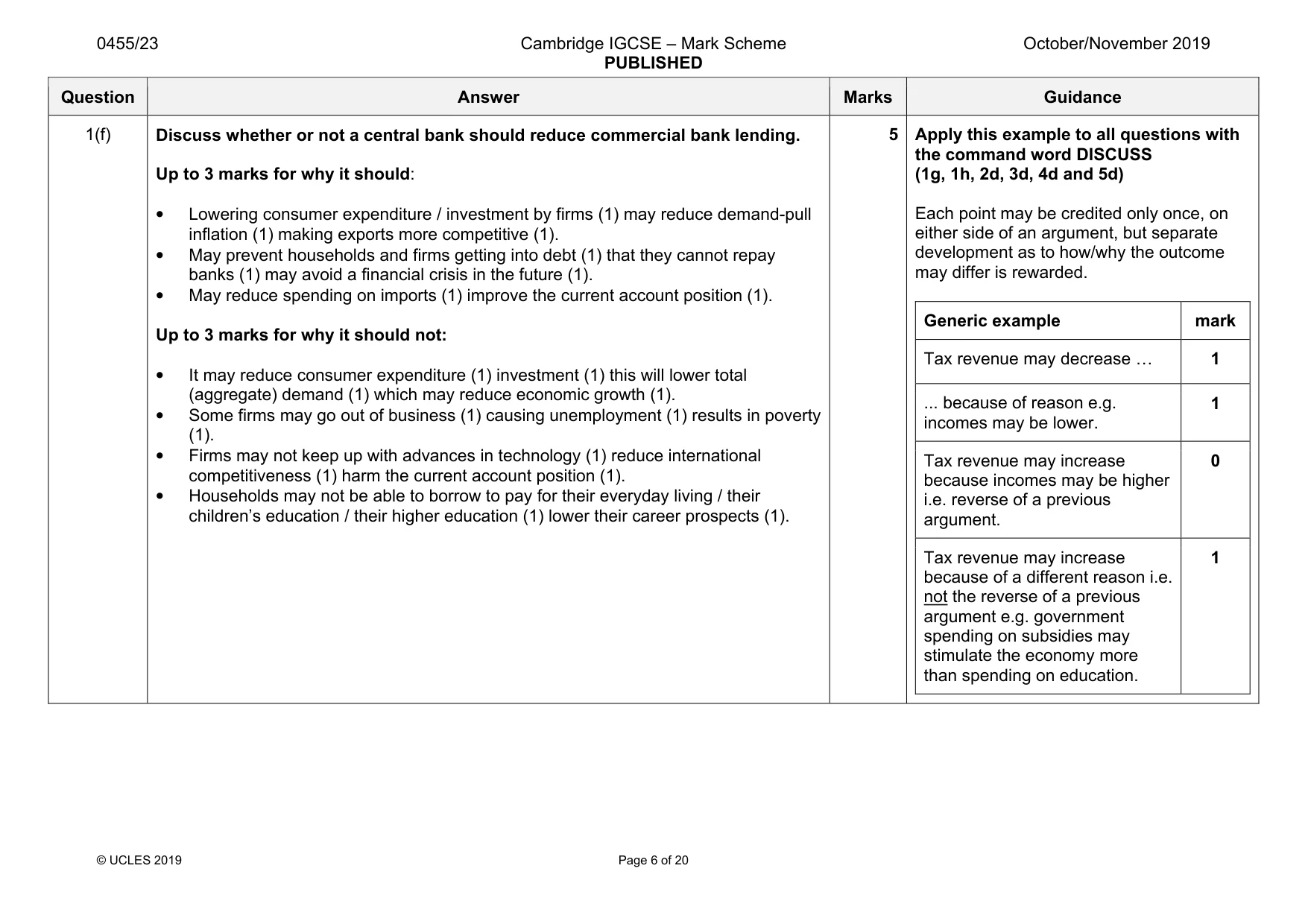
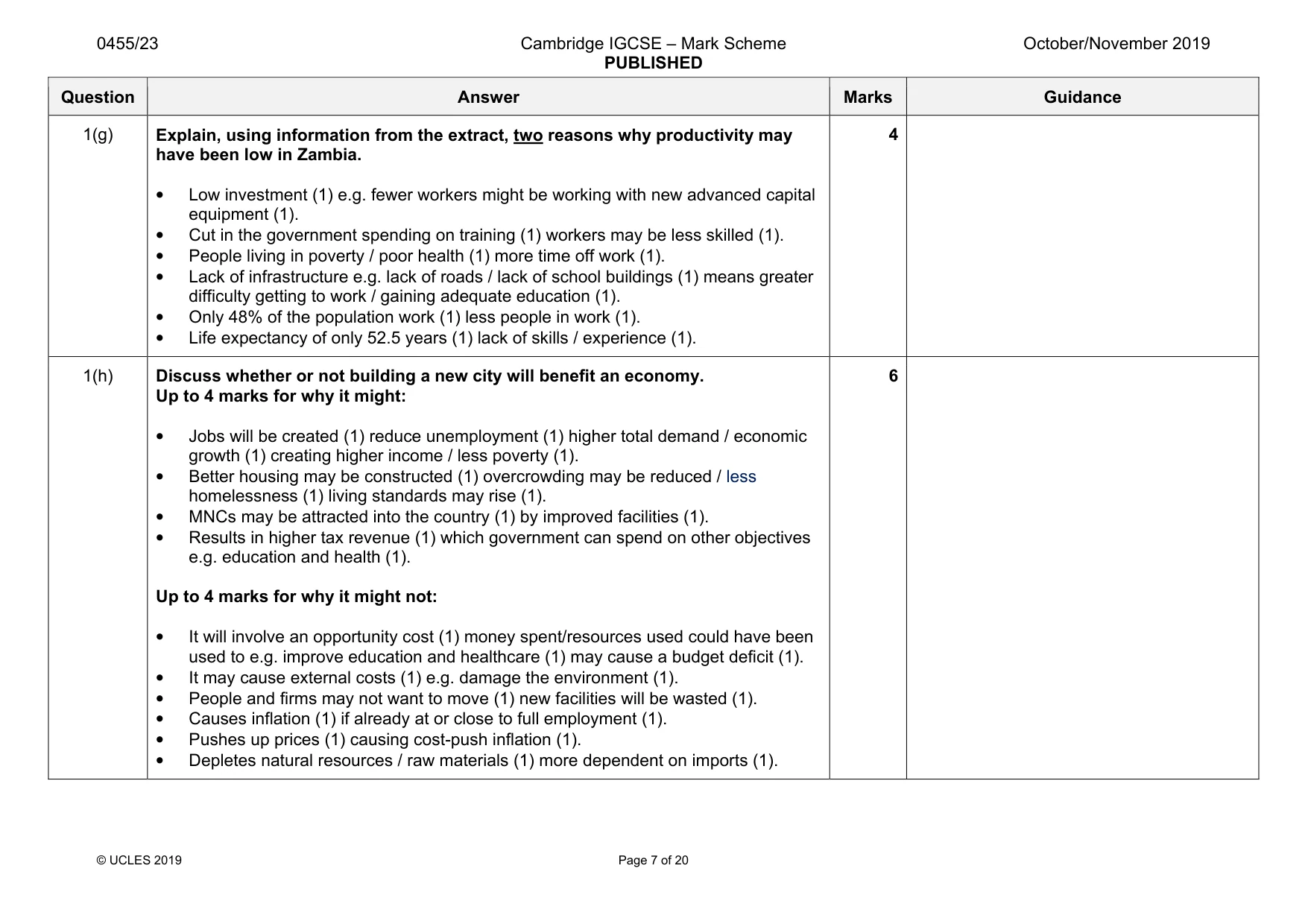
Mark scheme: 1(a) Identify, from the extract, two primary sector industries. • agriculture • copper mining • emerald mining 2 1(b) Calculate, using information from the extract, how many people in Zambia lived in poverty in 2017. • 9m (2). • Correct working: 15 m × 60% (1). 2 1(c) Explain, using information from the extract, why Zambia had a high rate of population growth in 2017. • Birth rate exceed death rate / more people being born than dying (2). • High birth rate / high natural increase (1). • Birth rate 41.8 and death rate 12.4 (1). 2 1(d) Explain, using information from the extract, why a depreciation of the kwacha harmed the Zambian economy. • Inflation rate rose (1) from 10.1% in 2015 to 20.6% in 2016 (1). • Growth rate fell (1) from 6.8% after 2014 (1). • Depreciation is a fall in the value of the currency (1) import prices would have been higher (1) increasing costs of production (1) leads to higher prices (1) demand for higher wages (1) creating a wage-price spiral (1). • Higher inflation may have reduced international competitiveness (1) reducing output / economic growth rate (1) leading to lower employment (1) and reduction in living standards (1). 4 Question Answer Marks Guidance 1(e) Analyse, using Fig.1.1, the relationship between copper output and revenue from the sale of copper. Expected relationship - a direct relationship would have been expected / moved in same direction / as copper output rose, revenue should have risen (1). Evidence in support of unexpected relationship • Does not support expected relationship / shows an inverse relationship (1). • Between 2010–14 revenue rose (from 100 to 128) but output fell (from 100 to 90) so prices rose (1). • Between 2014–17 revenue fell (from128 to 90) but output rose (from 90 to 108) which meant that prices fell (1). • In 2014 copper revenue was highest 128 and output at its lowest 90, while in 2017 copper revenue was at its lowest 90 and output at its highest 108, so changes in revenue were greater than changes in output of copper (1). Analysis of inverse relationship: • When output fell, price per unit may have risen more than fall in output, due to loss of economies of scale causing average costs to rise (1). • Price for Zambian copper affected by world market prices (1). • Copper is likely to be inelastic in demand so prices rise by more than fall in output increasing revenue (1). 5 A pattern of analysis is expected in response to this type of question. Do not reward simple statements (repetition) of the figures given in the table. Question Answer Marks Guidance 1(f) Discuss whether or not a central bank should reduce commercial bank lending. Up to 3 marks for why it should: • Lowering consumer expenditure / investment by firms (1) may reduce demand-pull inflation (1) making exports more competitive (1). • May prevent households and firms getting into debt (1) that they cannot repay banks (1) may avoid a financial crisis in the future (1). • May reduce spending on imports (1) improve the current account position (1). Up to 3 marks for why it should not: • It may reduce consumer expenditure (1) investment (1) this will lower total (aggregate) demand (1) which may reduce economic growth (1). • Some firms may go out of business (1) causing unemployment (1) results in poverty (1). • Firms may not keep up with advances in technology (1) reduce international competitiveness (1) harm the current account position (1). • Households may not be able to borrow to pay for their everyday living / their children’s education / their higher education (1) lower their career prospects (1). 5 Apply this example to all questions with the command word DISCUSS (1g, 1h, 2d, 3d, 4d and 5d) Each point may be credited only once, on either side of an argument, but separate development as to how/why the outcome may differ is rewarded. Generic example mark Tax revenue may decrease « 1 ... because of reason e.g. incomes may be lower. 1 Tax revenue may increase because incomes may be higher i.e. reverse of a previous argument. 0 Tax revenue may increase because of a different reason i.e. not the reverse of a previous argument e.g. government spending on subsidies may stimulate the economy more than spending on education. 1 Question Answer Marks Guidance 1(g) Explain, using information from the extract, two reasons why productivity may have been low in Zambia. • Low investment (1) e.g. fewer workers might be working with new advanced capital equipment (1). • Cut in the government spending on training (1) workers may be less skilled (1). • People living in poverty / poor health (1) more time off work (1). • Lack of infrastructure e.g. lack of roads / lack of school buildings (1) means greater difficulty getting to work / gaining adequate education (1). • Only 48% of the population work (1) less people in work (1). • Life expectancy of only 52.5 years (1) lack of skills / experience (1). 4 1(h) Discuss whether or not building a new city will benefit an economy. Up to 4 marks for why it might: • Jobs will be created (1) reduce unemployment (1) higher total demand / economic growth (1) creating higher income / less poverty (1). • Better housing may be constructed (1) overcrowding may be reduced / less homelessness (1) living standards may rise (1). • MNCs may be attracted into the country (1) by improved facilities (1). • Results in higher tax revenue (1) which government can spend on other objectives e.g. education and health (1). Up to 4 marks for why it might not: • It will involve an opportunity cost (1) money spent/resources used could have been used to e.g. improve education and healthcare (1) may cause a budget deficit (1). • It may cause external costs (1) e.g. damage the environment (1). • People and firms may not want to move (1) new facilities will be wasted (1). • Causes inflation (1) if already at or close to full employment (1). • Pushes up prices (1) causing cost-push inflation (1). • Depletes natural resources / raw materials (1) more dependent on imports (1). 6
Q2 · Between 2007 and 2017, the average wage in China tripled, while it fell in Brazil
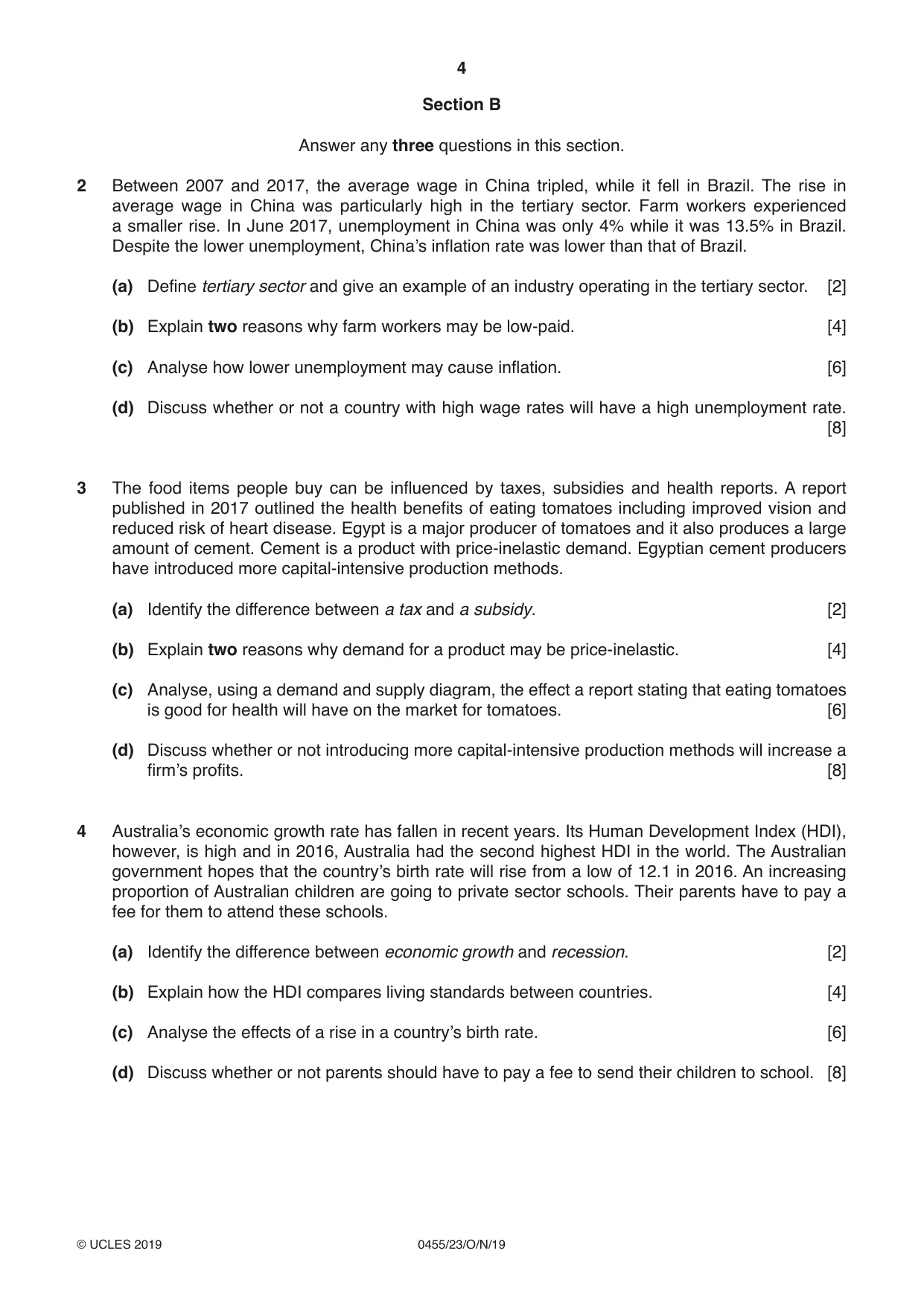
2 Between 2007 and 2017, the average wage in China tripled, while it fell in Brazil. The rise in average wage in China was particularly high in the tertiary sector. Farm workers experienced a smaller rise. In June 2017, unemployment in China was only 4% while it was 13.5% in Brazil. Despite the lower unemployment, China’s inflation rate was lower than that of Brazil. (a) Define tertiary sector and give an example of an industry operating in the tertiary sector. [2] (b) Explain two reasons why farm workers may be low-paid. [4] (c) Analyse how lower unemployment may cause inflation. [6] (d) Discuss whether or not a country with high wage rates will have a high unemployment rate. [8]
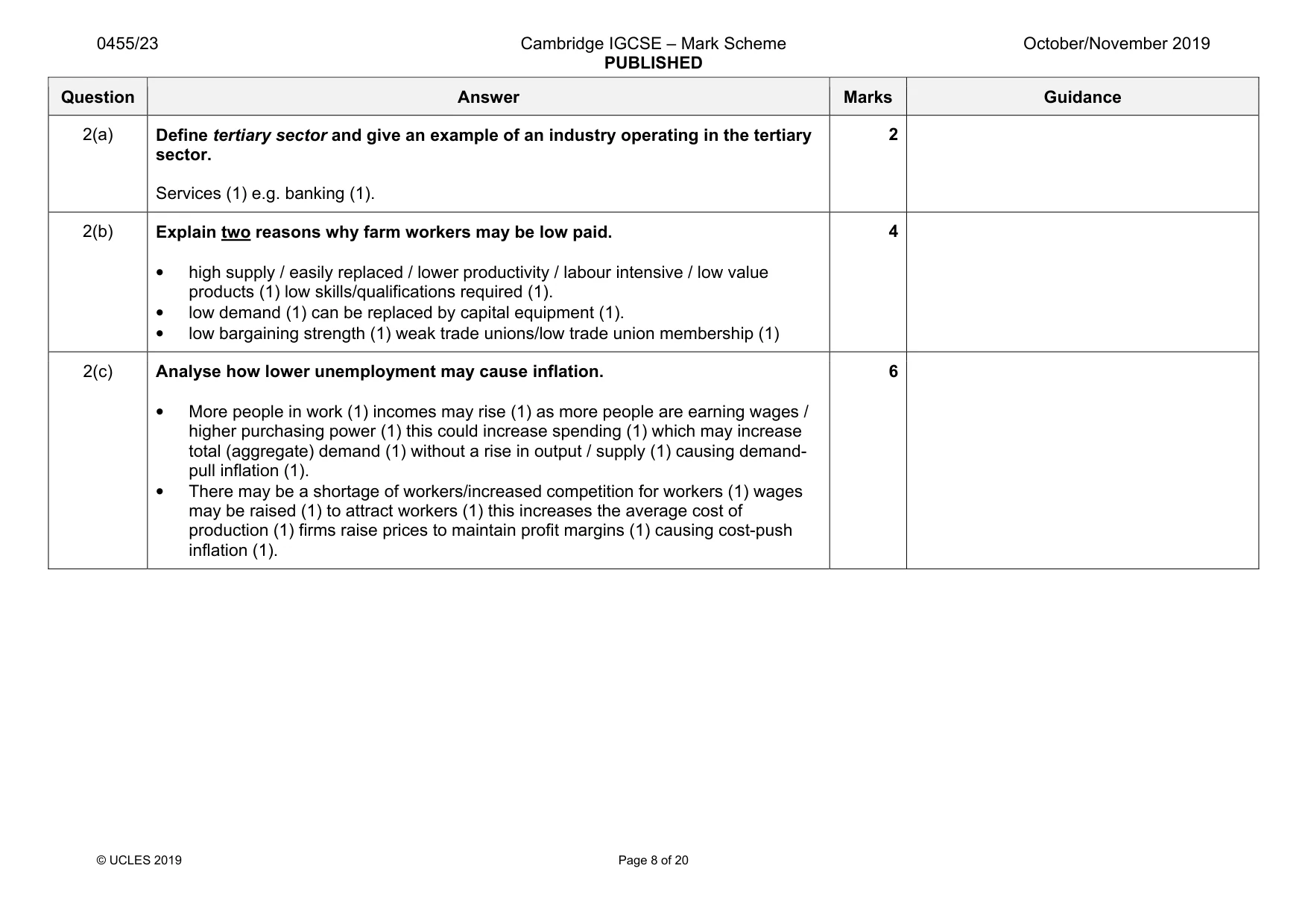
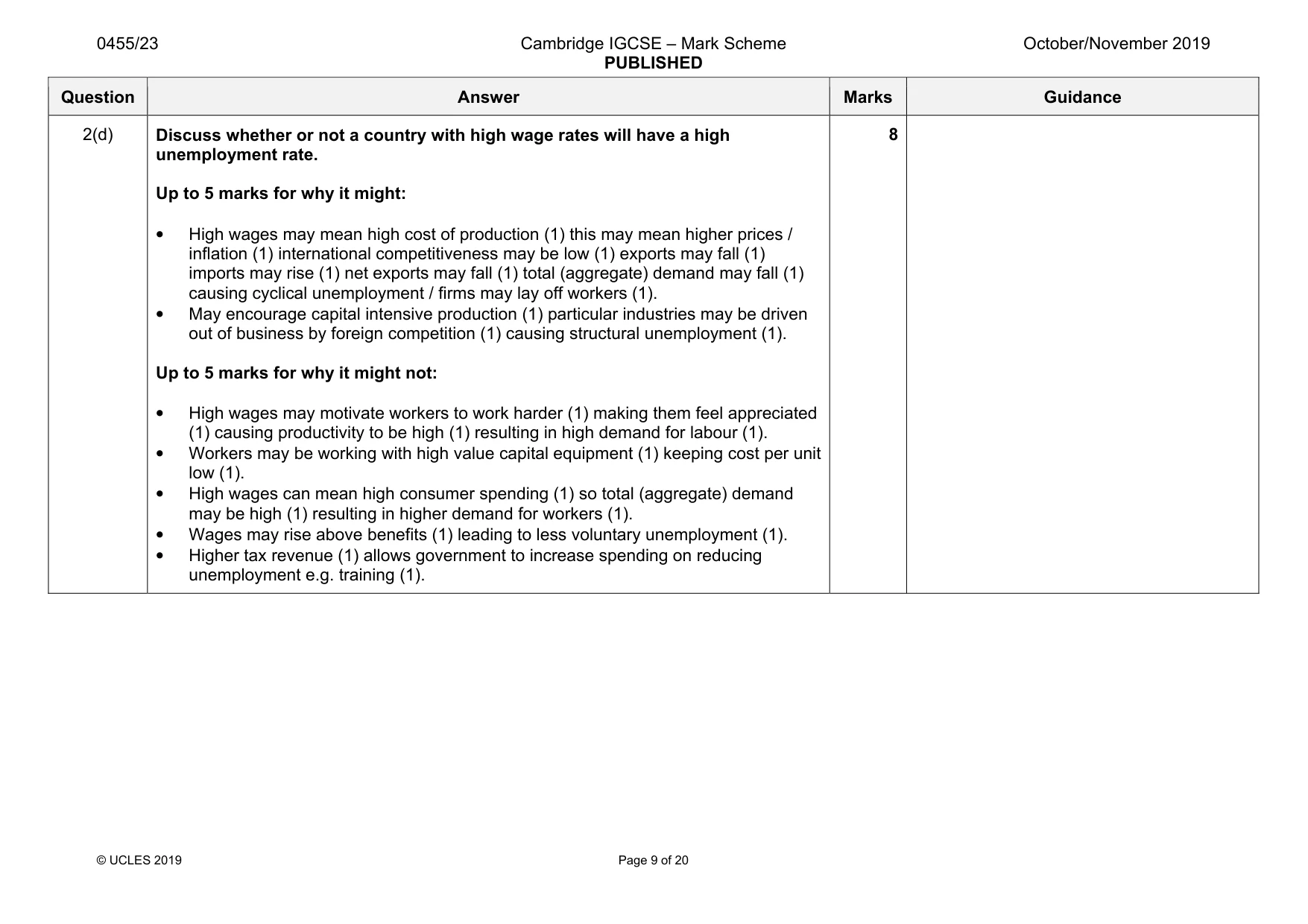
Mark scheme: 2(a) Define tertiary sector and give an example of an industry operating in the tertiary sector. Services (1) e.g. banking (1). 2 2(b) Explain two reasons why farm workers may be low paid. • high supply / easily replaced / lower productivity / labour intensive / low value products (1) low skills/qualifications required (1). • low demand (1) can be replaced by capital equipment (1). • low bargaining strength (1) weak trade unions/low trade union membership (1) 4 2(c) Analyse how lower unemployment may cause inflation. • More people in work (1) incomes may rise (1) as more people are earning wages / higher purchasing power (1) this could increase spending (1) which may increase total (aggregate) demand (1) without a rise in output / supply (1) causing demand- pull inflation (1). • There may be a shortage of workers/increased competition for workers (1) wages may be raised (1) to attract workers (1) this increases the average cost of production (1) firms raise prices to maintain profit margins (1) causing cost-push inflation (1). 6 Question Answer Marks Guidance 2(d) Discuss whether or not a country with high wage rates will have a high unemployment rate. Up to 5 marks for why it might: • High wages may mean high cost of production (1) this may mean higher prices / inflation (1) international competitiveness may be low (1) exports may fall (1) imports may rise (1) net exports may fall (1) total (aggregate) demand may fall (1) causing cyclical unemployment / firms may lay off workers (1). • May encourage capital intensive production (1) particular industries may be driven out of business by foreign competition (1) causing structural unemployment (1). Up to 5 marks for why it might not: • High wages may motivate workers to work harder (1) making them feel appreciated (1) causing productivity to be high (1) resulting in high demand for labour (1). • Workers may be working with high value capital equipment (1) keeping cost per unit low (1). • High wages can mean high consumer spending (1) so total (aggregate) demand may be high (1) resulting in higher demand for workers (1). • Wages may rise above benefits (1) leading to less voluntary unemployment (1). • Higher tax revenue (1) allows government to increase spending on reducing unemployment e.g. training (1). 8
Q3 · The food items people buy can be influenced by taxes, subsidies and health reports
3 The food items people buy can be influenced by taxes, subsidies and health reports. A report published in 2017 outlined the health benefits of eating tomatoes including improved vision and reduced risk of heart disease. Egypt is a major producer of tomatoes and it also produces a large amount of cement. Cement is a product with price-inelastic demand. Egyptian cement producers have introduced more capital-intensive production methods. (a) Identify the difference between a tax and a subsidy. [2] (b) Explain two reasons why demand for a product may be price-inelastic. [4] (c) Analyse, using a demand and supply diagram, the effect a report stating that eating tomatoes is good for health will have on the market for tomatoes. [6] (d) Discuss whether or not introducing more capital-intensive production methods will increase a firm’s profits. [8]
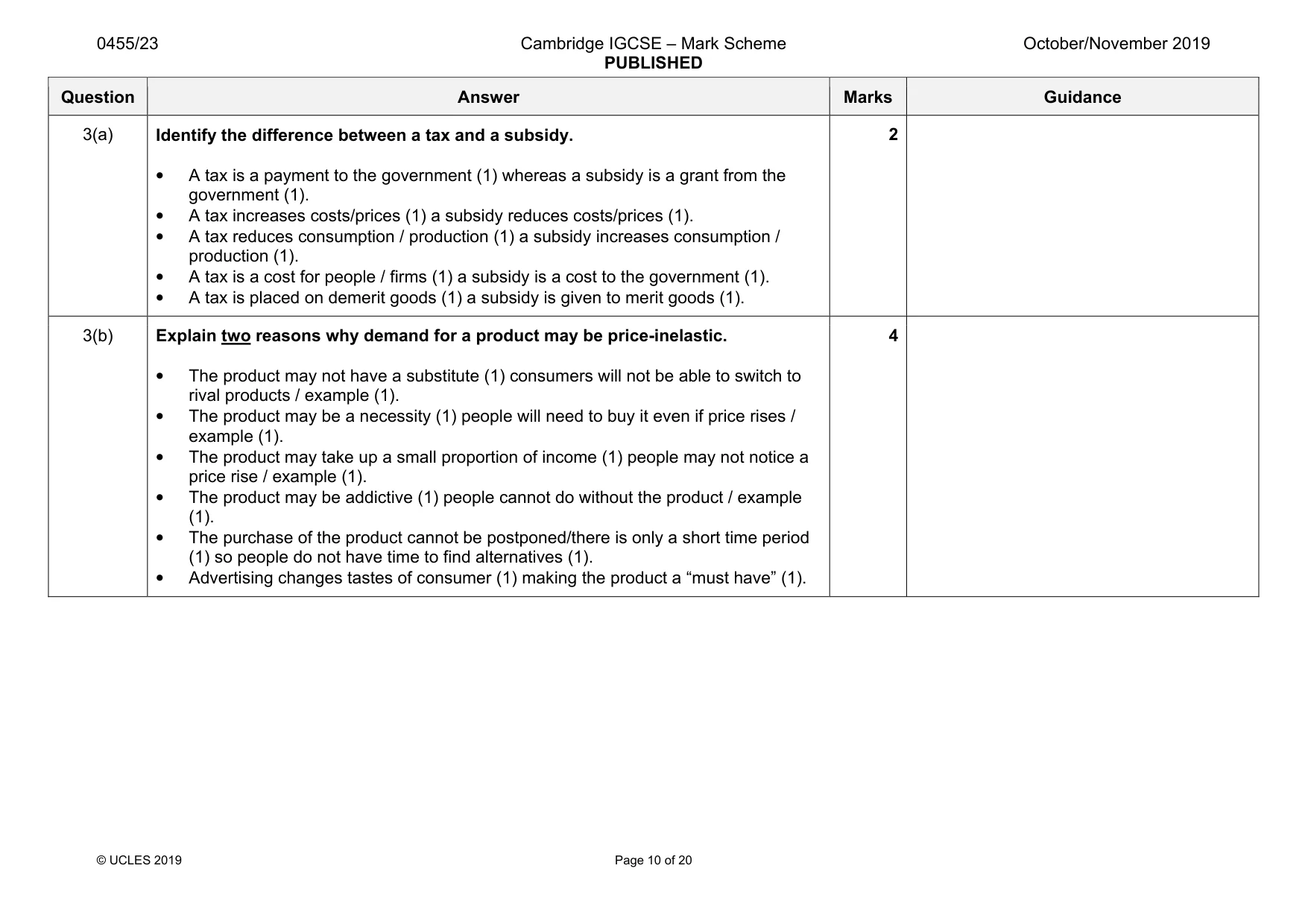
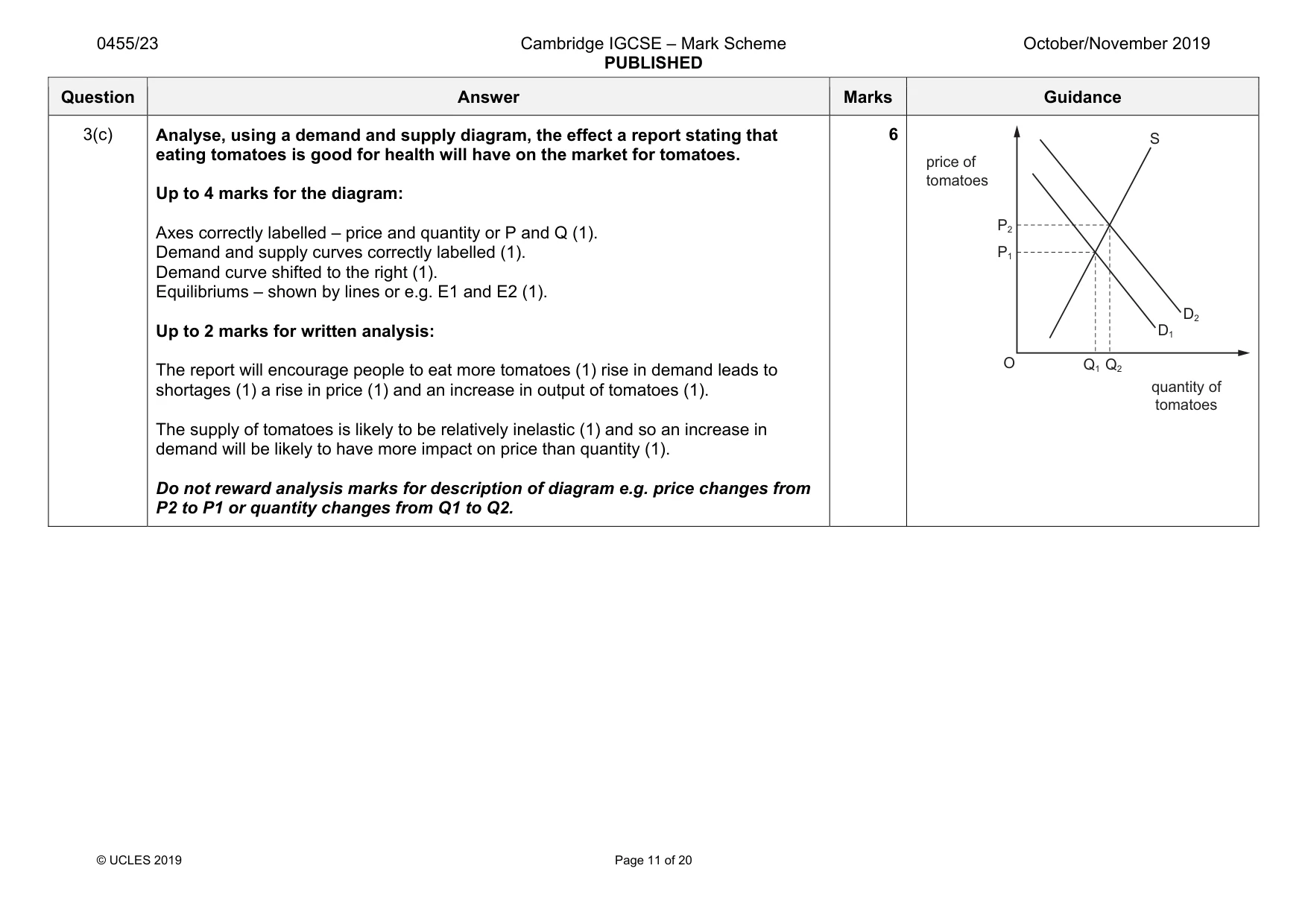
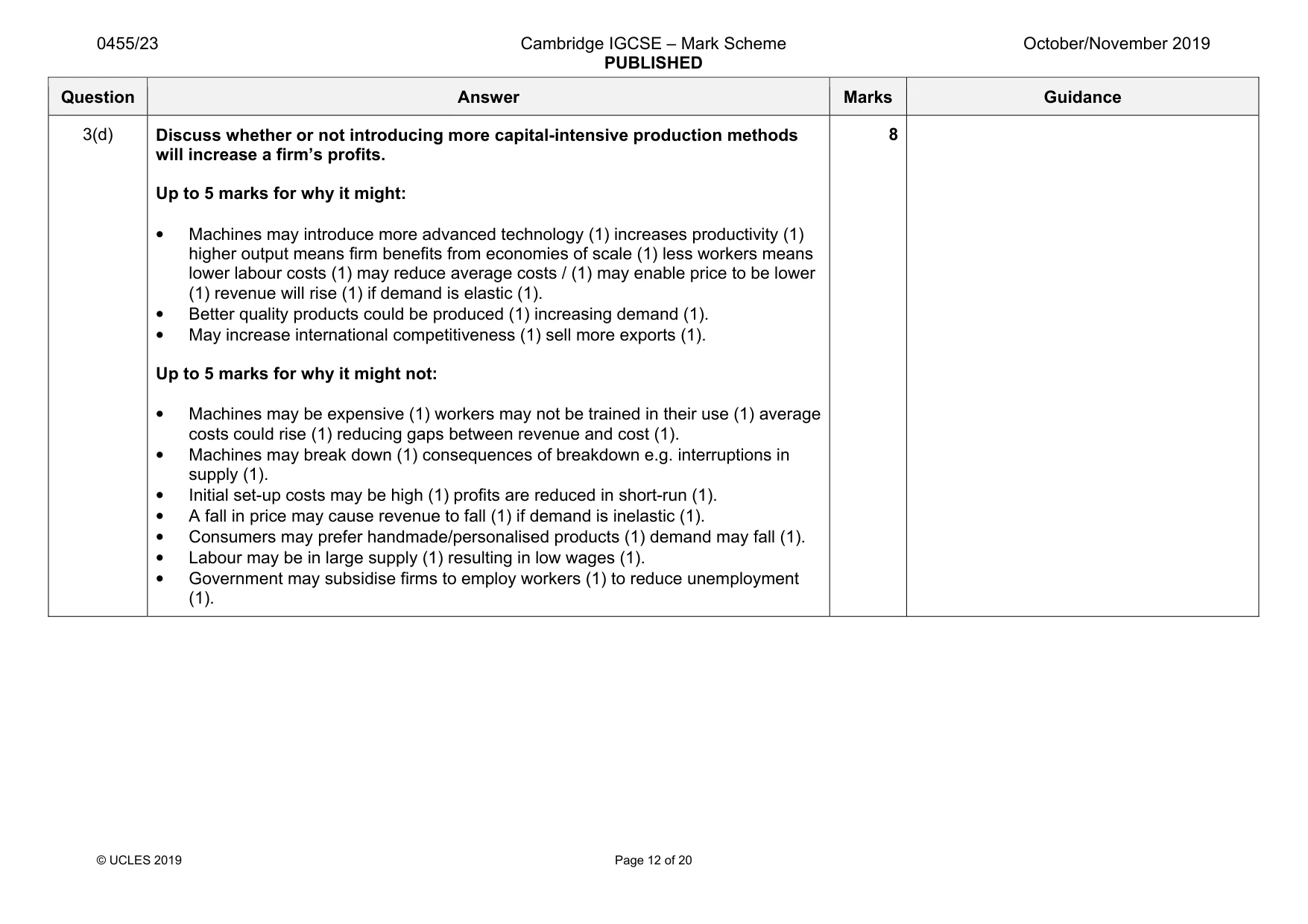
Mark scheme: 3(a) Identify the difference between a tax and a subsidy. • A tax is a payment to the government (1) whereas a subsidy is a grant from the government (1). • A tax increases costs/prices (1) a subsidy reduces costs/prices (1). • A tax reduces consumption / production (1) a subsidy increases consumption / production (1). • A tax is a cost for people / firms (1) a subsidy is a cost to the government (1). • A tax is placed on demerit goods (1) a subsidy is given to merit goods (1). 2 3(b) Explain two reasons why demand for a product may be price-inelastic. • The product may not have a substitute (1) consumers will not be able to switch to rival products / example (1). • The product may be a necessity (1) people will need to buy it even if price rises / example (1). • The product may take up a small proportion of income (1) people may not notice a price rise / example (1). • The product may be addictive (1) people cannot do without the product / example (1). • The purchase of the product cannot be postponed/there is only a short time period (1) so people do not have time to find alternatives (1). • Advertising changes tastes of consumer (1) making the product a “must have” (1). 4 Question Answer Marks Guidance 3(c) Analyse, using a demand and supply diagram, the effect a report stating that eating tomatoes is good for health will have on the market for tomatoes. Up to 4 marks for the diagram: Axes correctly labelled – price and quantity or P and Q (1). Demand and supply curves correctly labelled (1). Demand curve shifted to the right (1). Equilibriums – shown by lines or e.g. E1 and E2 (1). Up to 2 marks for written analysis: The report will encourage people to eat more tomatoes (1) rise in demand leads to shortages (1) a rise in price (1) and an increase in output of tomatoes (1). The supply of tomatoes is likely to be relatively inelastic (1) and so an increase in demand will be likely to have more impact on price than quantity (1). Do not reward analysis marks for description of diagram e.g. price changes from P2 to P1 or quantity changes from Q1 to Q2. 6 S Q2 Q1 P1 P2 D1 D2 O quantity of tomatoes price of tomatoes Question Answer Marks Guidance 3(d) Discuss whether or not introducing more capital-intensive production methods will increase a firm’s profits. Up to 5 marks for why it might: • Machines may introduce more advanced technology (1) increases productivity (1) higher output means firm benefits from economies of scale (1) less workers means lower labour costs (1) may reduce average costs / (1) may enable price to be lower (1) revenue will rise (1) if demand is elastic (1). • Better quality products could be produced (1) increasing demand (1). • May increase international competitiveness (1) sell more exports (1). Up to 5 marks for why it might not: • Machines may be expensive (1) workers may not be trained in their use (1) average costs could rise (1) reducing gaps between revenue and cost (1). • Machines may break down (1) consequences of breakdown e.g. interruptions in supply (1). • Initial set-up costs may be high (1) profits are reduced in short-run (1). • A fall in price may cause revenue to fall (1) if demand is inelastic (1). • Consumers may prefer handmade/personalised products (1) demand may fall (1). • Labour may be in large supply (1) resulting in low wages (1). • Government may subsidise firms to employ workers (1) to reduce unemployment (1). 8
Q4 · Australia’s economic growth rate has fallen in recent years
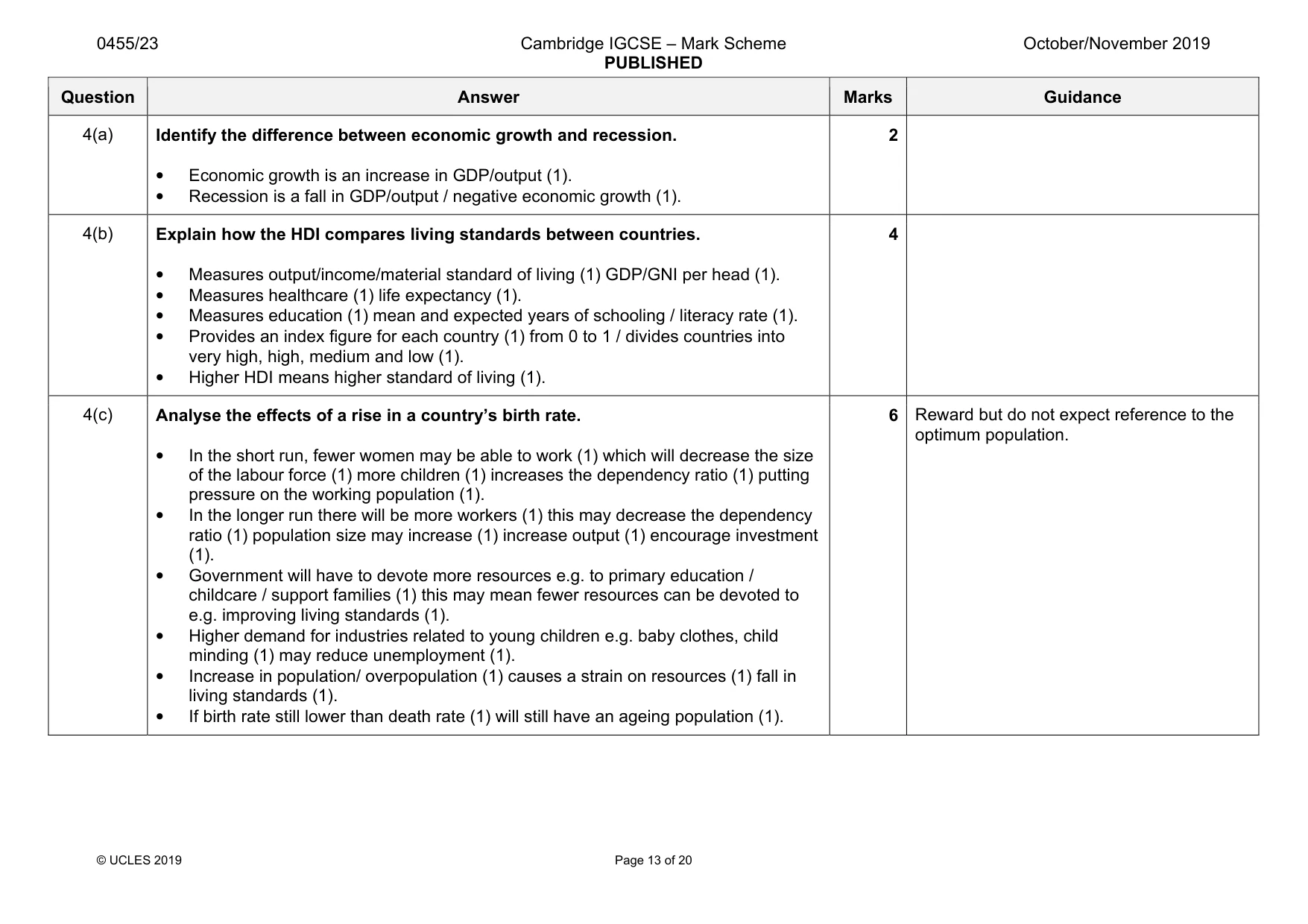
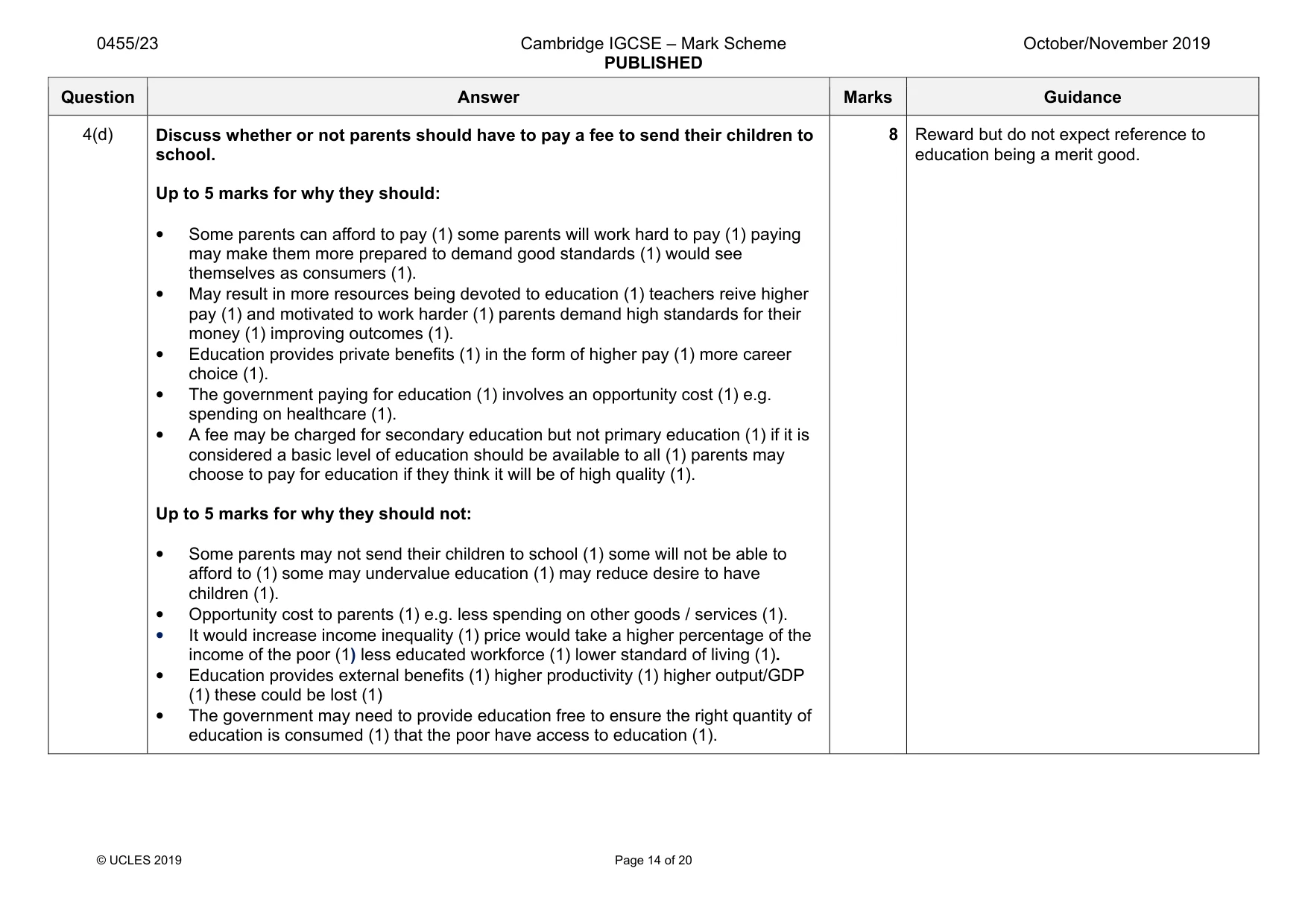
4 Australia’s economic growth rate has fallen in recent years. Its Human Development Index (HDI), however, is high and in 2016, Australia had the second highest HDI in the world. The Australian government hopes that the country’s birth rate will rise from a low of 12.1 in 2016. An increasing proportion of Australian children are going to private sector schools. Their parents have to pay a fee for them to attend these schools. (a) Identify the difference between economic growth and recession. [2] (b) Explain how the HDI compares living standards between countries. [4] (c) Analyse the effects of a rise in a country’s birth rate. [6] (d) Discuss whether or not parents should have to pay a fee to send their children to school. [8]
Mark scheme: 4(a) Identify the difference between economic growth and recession. • Economic growth is an increase in GDP/output (1). • Recession is a fall in GDP/output / negative economic growth (1). 2 4(b) Explain how the HDI compares living standards between countries. • Measures output/income/material standard of living (1) GDP/GNI per head (1). • Measures healthcare (1) life expectancy (1). • Measures education (1) mean and expected years of schooling / literacy rate (1). • Provides an index figure for each country (1) from 0 to 1 / divides countries into very high, high, medium and low (1). • Higher HDI means higher standard of living (1). 4 4(c) Analyse the effects of a rise in a country’s birth rate. • In the short run, fewer women may be able to work (1) which will decrease the size of the labour force (1) more children (1) increases the dependency ratio (1) putting pressure on the working population (1). • In the longer run there will be more workers (1) this may decrease the dependency ratio (1) population size may increase (1) increase output (1) encourage investment (1). • Government will have to devote more resources e.g. to primary education / childcare / support families (1) this may mean fewer resources can be devoted to e.g. improving living standards (1). • Higher demand for industries related to young children e.g. baby clothes, child minding (1) may reduce unemployment (1). • Increase in population/ overpopulation (1) causes a strain on resources (1) fall in living standards (1). • If birth rate still lower than death rate (1) will still have an ageing population (1). 6 Reward but do not expect reference to the optimum population. Question Answer Marks Guidance 4(d) Discuss whether or not parents should have to pay a fee to send their children to school. Up to 5 marks for why they should: • Some parents can afford to pay (1) some parents will work hard to pay (1) paying may make them more prepared to demand good standards (1) would see themselves as consumers (1). • May result in more resources being devoted to education (1) teachers reive higher pay (1) and motivated to work harder (1) parents demand high standards for their money (1) improving outcomes (1). • Education provides private benefits (1) in the form of higher pay (1) more career choice (1). • The government paying for education (1) involves an opportunity cost (1) e.g. spending on healthcare (1). • A fee may be charged for secondary education but not primary education (1) if it is considered a basic level of education should be available to all (1) parents may choose to pay for education if they think it will be of high quality (1). Up to 5 marks for why they should not: • Some parents may not send their children to school (1) some will not be able to afford to (1) some may undervalue education (1) may reduce desire to have children (1). • Opportunity cost to parents (1) e.g. less spending on other goods / services (1). • It would increase income inequality (1) price would take a higher percentage of the income of the poor (1) less educated workforce (1) lower standard of living (1). • Education provides external benefits (1) higher productivity (1) higher output/GDP (1) these could be lost (1) • The government may need to provide education free to ensure the right quantity of education is consumed (1) that the poor have access to education (1). 8 Reward but do not expect reference to education being a merit good.
Q5 · Angola is an African country without a stock exchange
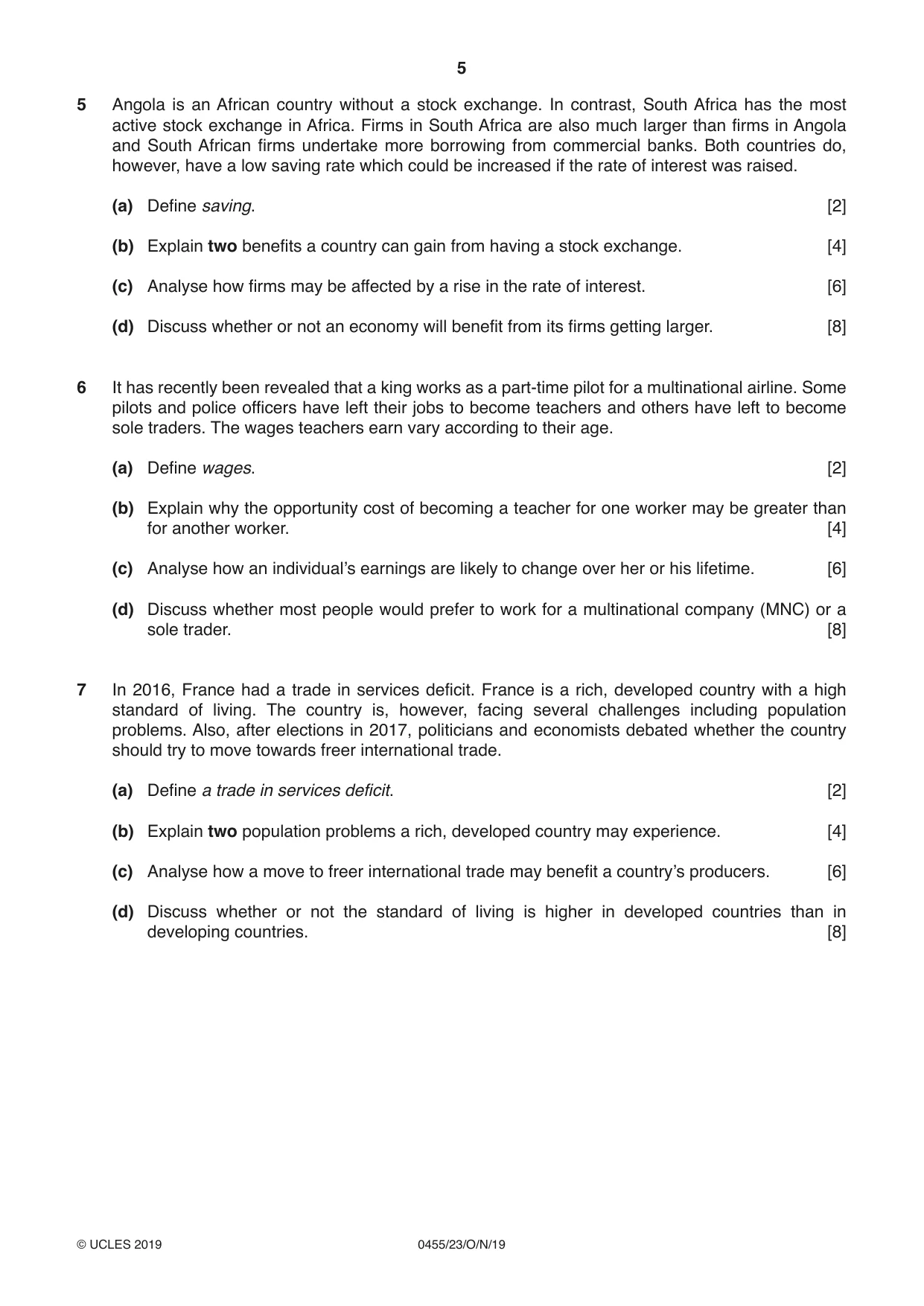
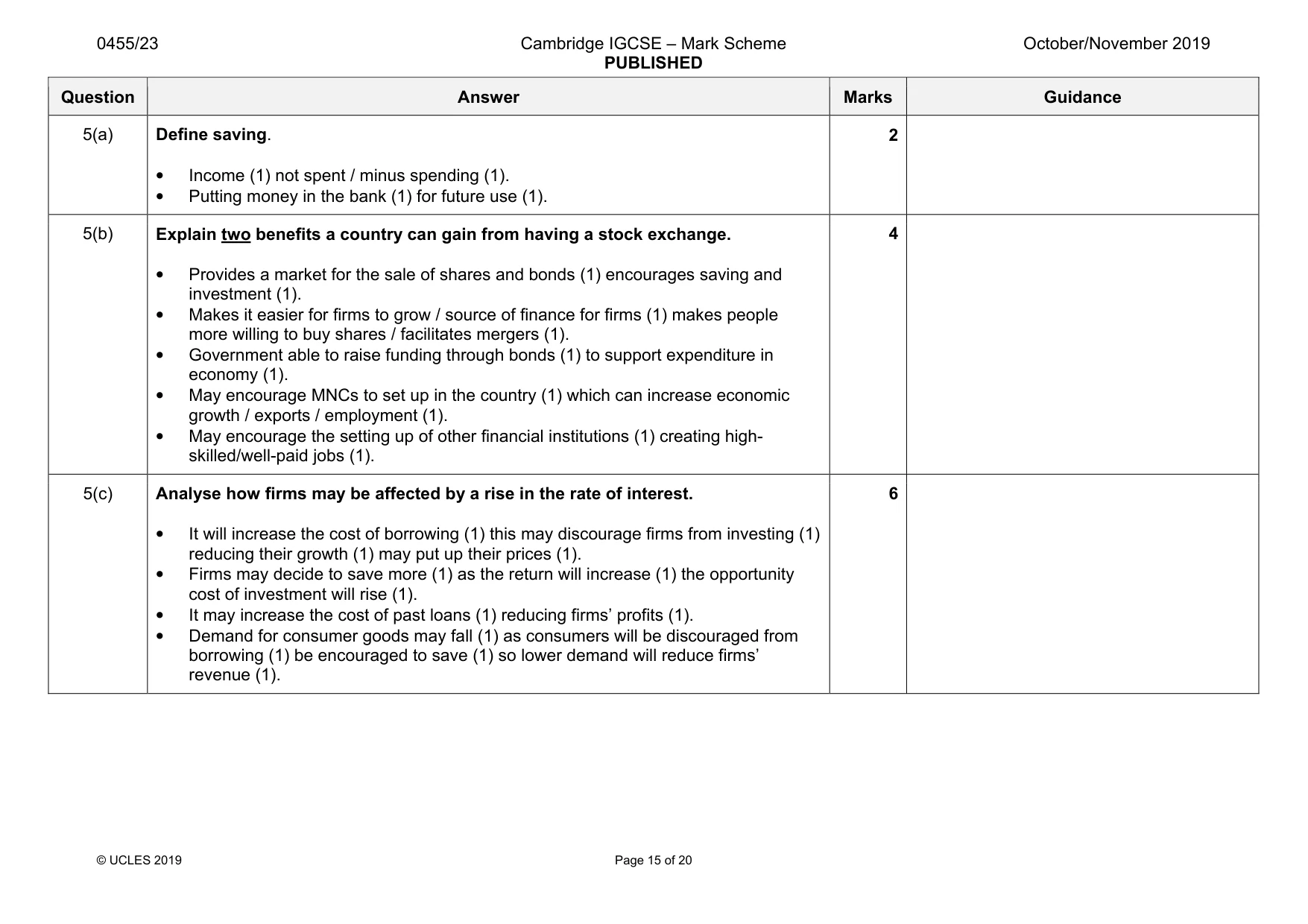
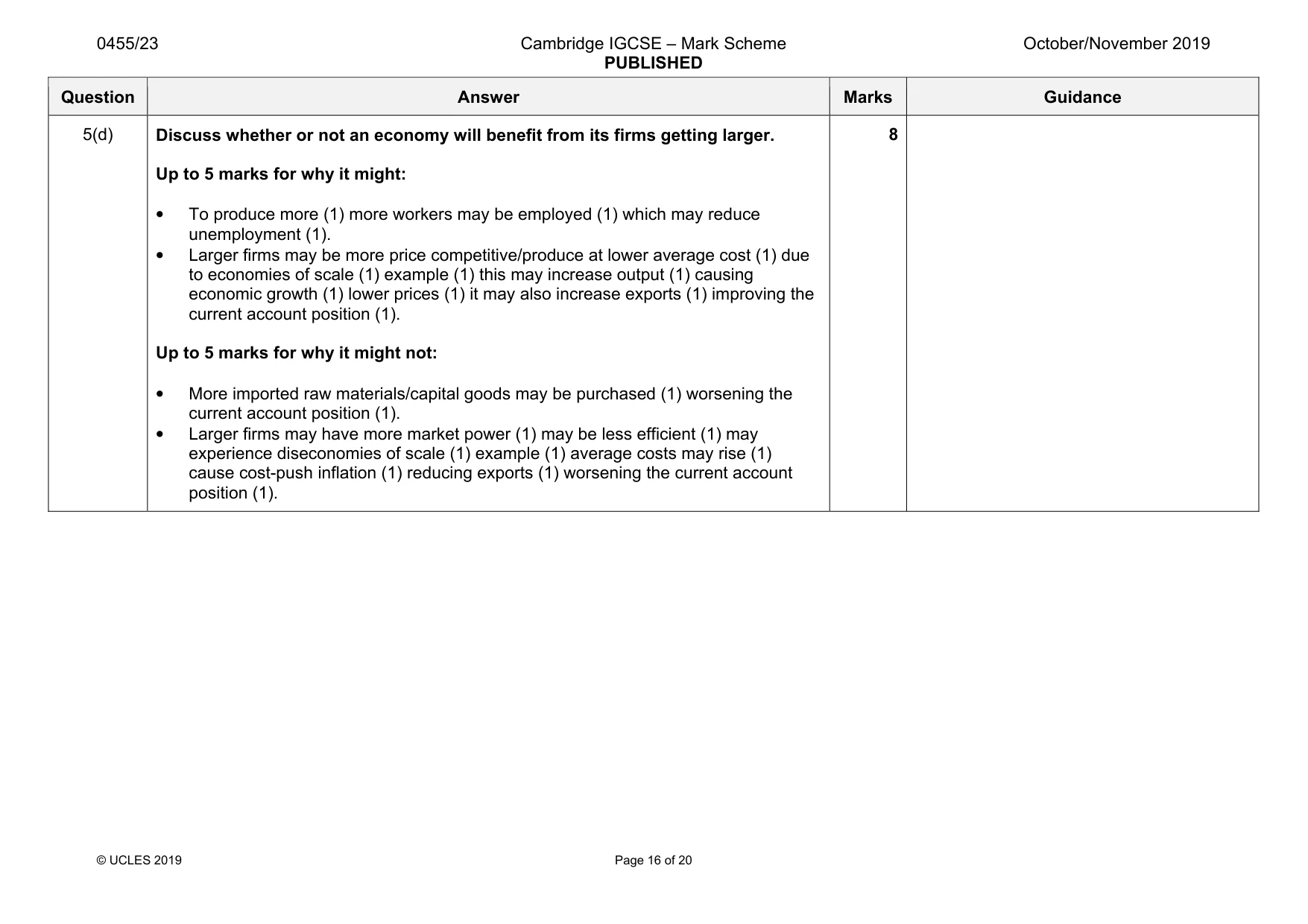
5 Angola is an African country without a stock exchange. In contrast, South Africa has the most active stock exchange in Africa. Firms in South Africa are also much larger than firms in Angola and South African firms undertake more borrowing from commercial banks. Both countries do, however, have a low saving rate which could be increased if the rate of interest was raised. (a) Define saving. [2] (b) Explain two benefits a country can gain from having a stock exchange. [4] (c) Analyse how firms may be affected by a rise in the rate of interest. [6] (d) Discuss whether or not an economy will benefit from its firms getting larger. [8]
Mark scheme: 5(a) Define saving. • Income (1) not spent / minus spending (1). • Putting money in the bank (1) for future use (1). 2 5(b) Explain two benefits a country can gain from having a stock exchange. • Provides a market for the sale of shares and bonds (1) encourages saving and investment (1). • Makes it easier for firms to grow / source of finance for firms (1) makes people more willing to buy shares / facilitates mergers (1). • Government able to raise funding through bonds (1) to support expenditure in economy (1). • May encourage MNCs to set up in the country (1) which can increase economic growth / exports / employment (1). • May encourage the setting up of other financial institutions (1) creating high- skilled/well-paid jobs (1). 4 5(c) Analyse how firms may be affected by a rise in the rate of interest. • It will increase the cost of borrowing (1) this may discourage firms from investing (1) reducing their growth (1) may put up their prices (1). • Firms may decide to save more (1) as the return will increase (1) the opportunity cost of investment will rise (1). • It may increase the cost of past loans (1) reducing firms’ profits (1). • Demand for consumer goods may fall (1) as consumers will be discouraged from borrowing (1) be encouraged to save (1) so lower demand will reduce firms’ revenue (1). 6 Question Answer Marks Guidance 5(d) Discuss whether or not an economy will benefit from its firms getting larger. Up to 5 marks for why it might: • To produce more (1) more workers may be employed (1) which may reduce unemployment (1). • Larger firms may be more price competitive/produce at lower average cost (1) due to economies of scale (1) example (1) this may increase output (1) causing economic growth (1) lower prices (1) it may also increase exports (1) improving the current account position (1). Up to 5 marks for why it might not: • More imported raw materials/capital goods may be purchased (1) worsening the current account position (1). • Larger firms may have more market power (1) may be less efficient (1) may experience diseconomies of scale (1) example (1) average costs may rise (1) cause cost-push inflation (1) reducing exports (1) worsening the current account position (1). 8
Q6 · It has recently been revealed that a king works as a part-time pilot for a multinational…
6 It has recently been revealed that a king works as a part-time pilot for a multinational airline. Some pilots and police officers have left their jobs to become teachers and others have left to become sole traders. The wages teachers earn vary according to their age. (a) Define wages. [2] (b) Explain why the opportunity cost of becoming a teacher for one worker may be greater than for another worker. [4] (c) Analyse how an individual’s earnings are likely to change over her or his lifetime. [6] (d) Discuss whether most people would prefer to work for a multinational company (MNC) or a sole trader. [8]
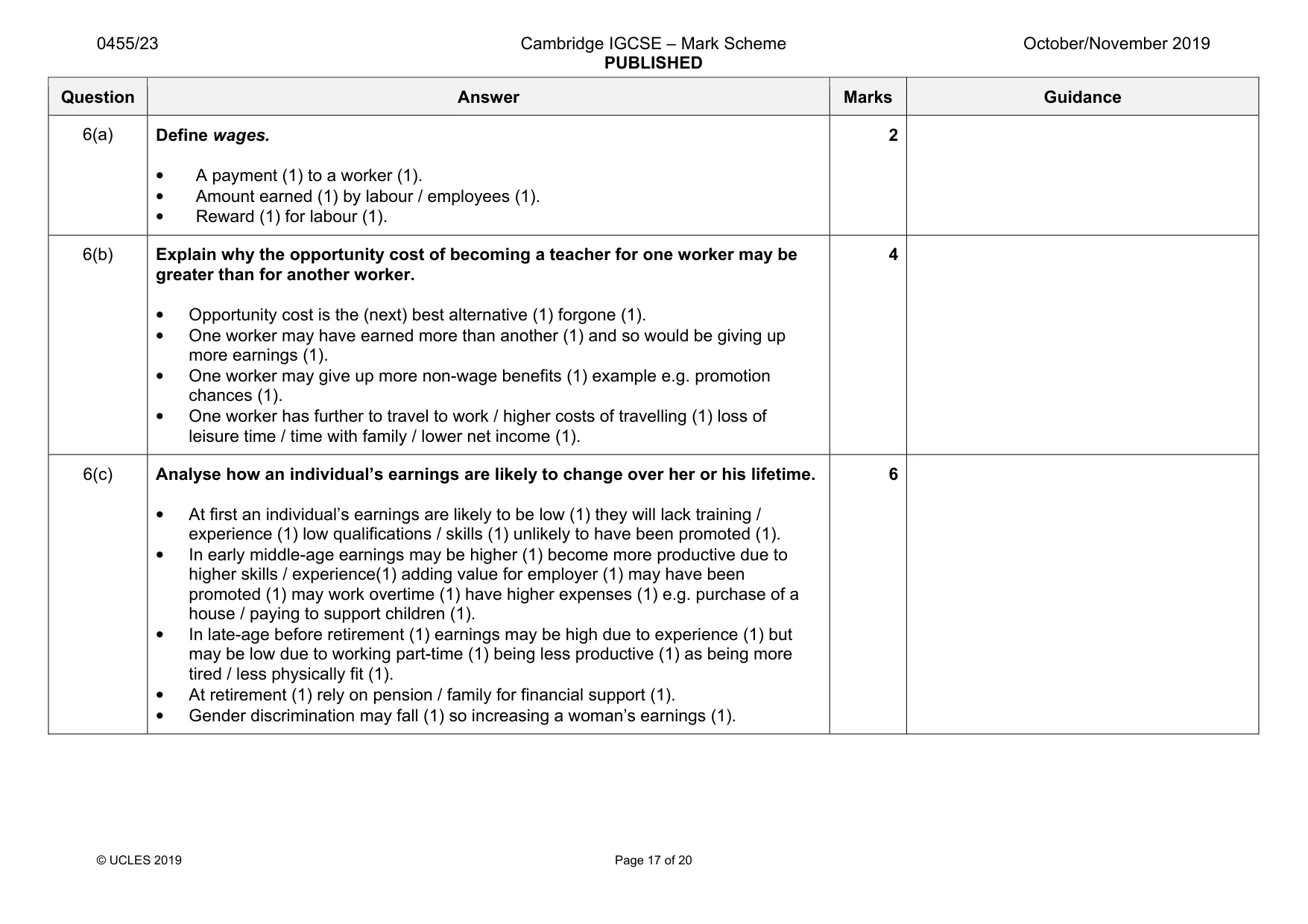
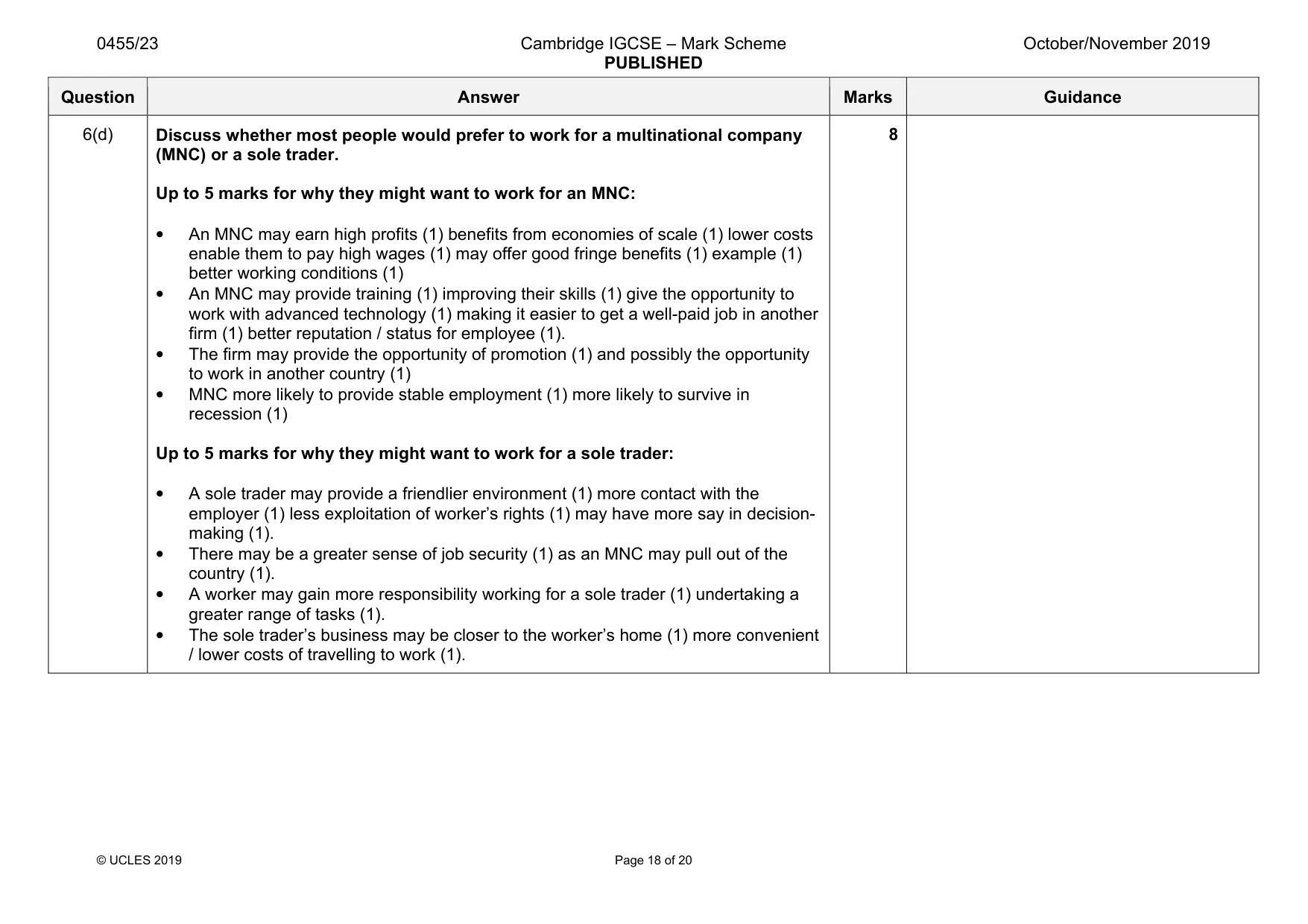
Mark scheme: 6(a) Define wages. • A payment (1) to a worker (1). • Amount earned (1) by labour / employees (1). • Reward (1) for labour (1). 2 6(b) Explain why the opportunity cost of becoming a teacher for one worker may be greater than for another worker. • Opportunity cost is the (next) best alternative (1) forgone (1). • One worker may have earned more than another (1) and so would be giving up more earnings (1). • One worker may give up more non-wage benefits (1) example e.g. promotion chances (1). • One worker has further to travel to work / higher costs of travelling (1) loss of leisure time / time with family / lower net income (1). 4 6(c) Analyse how an individual’s earnings are likely to change over her or his lifetime. • At first an individual’s earnings are likely to be low (1) they will lack training / experience (1) low qualifications / skills (1) unlikely to have been promoted (1). • In early middle-age earnings may be higher (1) become more productive due to higher skills / experience(1) adding value for employer (1) may have been promoted (1) may work overtime (1) have higher expenses (1) e.g. purchase of a house / paying to support children (1). • In late-age before retirement (1) earnings may be high due to experience (1) but may be low due to working part-time (1) being less productive (1) as being more tired / less physically fit (1). • At retirement (1) rely on pension / family for financial support (1). • Gender discrimination may fall (1) so increasing a woman’s earnings (1). 6 Question Answer Marks Guidance 6(d) Discuss whether most people would prefer to work for a multinational company (MNC) or a sole trader. Up to 5 marks for why they might want to work for an MNC: • An MNC may earn high profits (1) benefits from economies of scale (1) lower costs enable them to pay high wages (1) may offer good fringe benefits (1) example (1) better working conditions (1) • An MNC may provide training (1) improving their skills (1) give the opportunity to work with advanced technology (1) making it easier to get a well-paid job in another firm (1) better reputation / status for employee (1). • The firm may provide the opportunity of promotion (1) and possibly the opportunity to work in another country (1) • MNC more likely to provide stable employment (1) more likely to survive in recession (1) Up to 5 marks for why they might want to work for a sole trader: • A sole trader may provide a friendlier environment (1) more contact with the employer (1) less exploitation of worker’s rights (1) may have more say in decision- making (1). • There may be a greater sense of job security (1) as an MNC may pull out of the country (1). • A worker may gain more responsibility working for a sole trader (1) undertaking a greater range of tasks (1). • The sole trader’s business may be closer to the worker’s home (1) more convenient / lower costs of travelling to work (1). 8
Q7 · In 2016, France had a trade in services deficit
7 In 2016, France had a trade in services deficit. France is a rich, developed country with a high standard of living. The country is, however, facing several challenges including population problems. Also, after elections in 2017, politicians and economists debated whether the country should try to move towards freer international trade. (a) Define a trade in services deficit. [2] (b) Explain two population problems a rich, developed country may experience. [4] (c) Analyse how a move to freer international trade may benefit a country’s producers. [6] (d) Discuss whether or not the standard of living is higher in developed countries than in developing countries. [8]
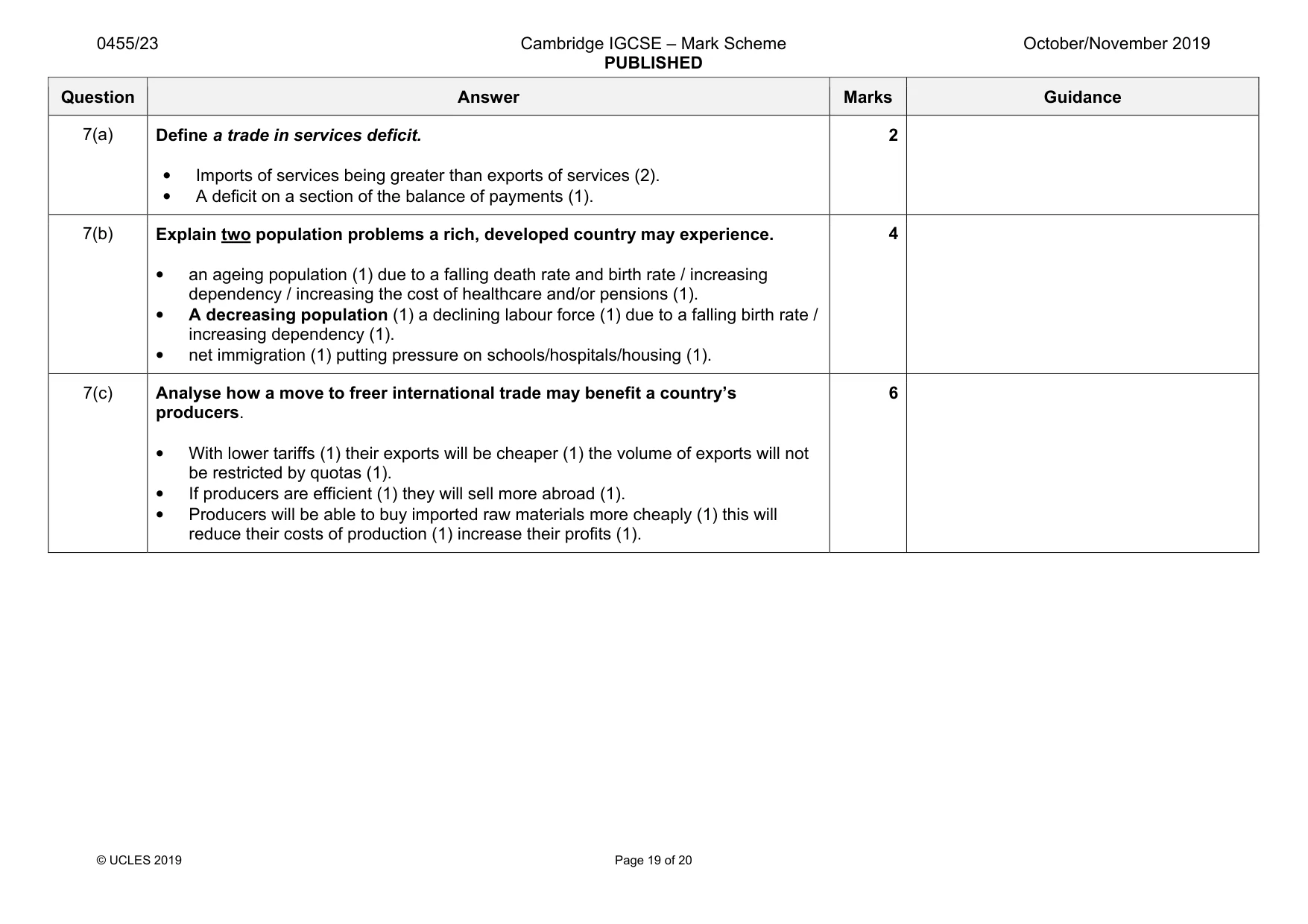
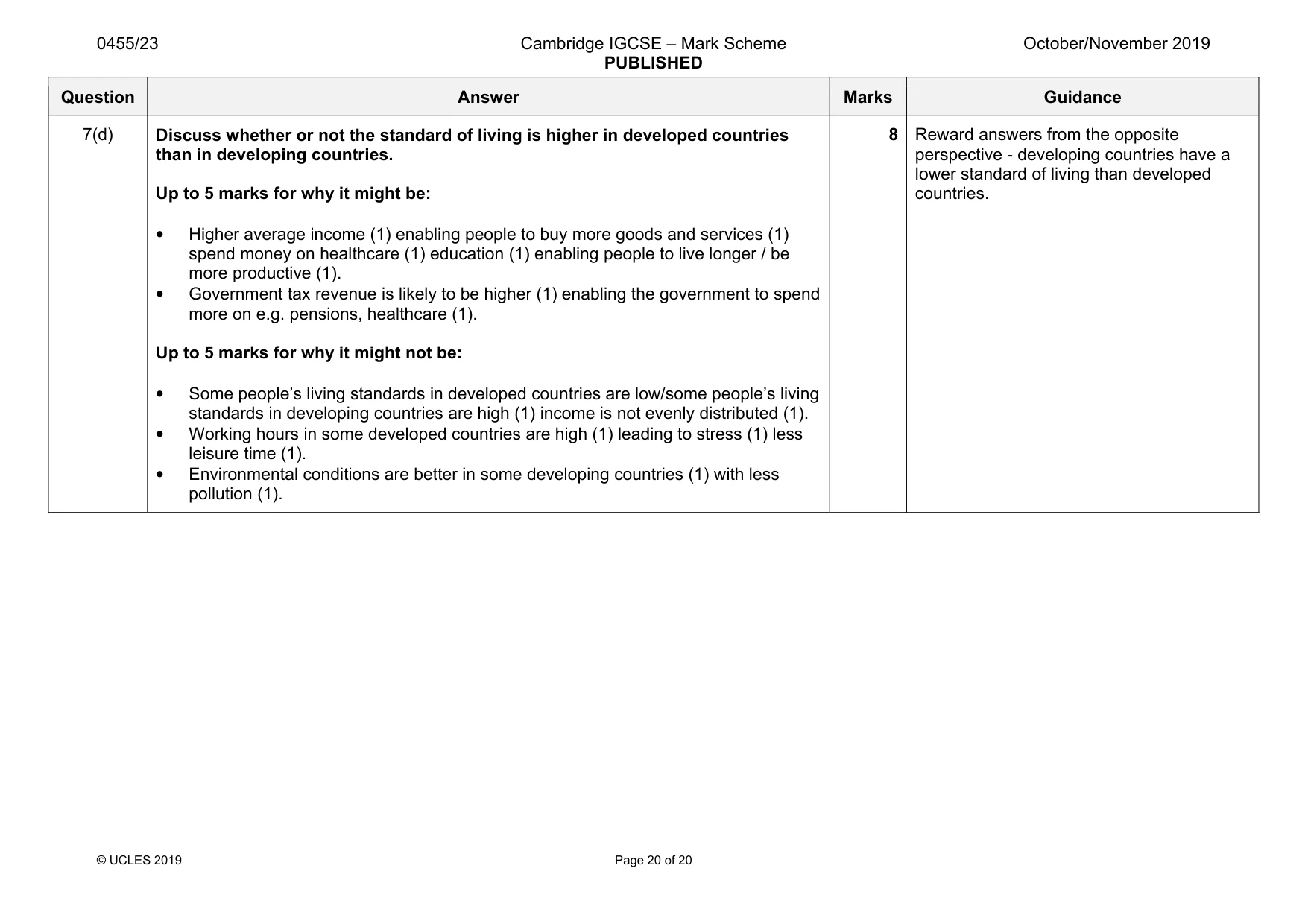
Mark scheme: 7(a) Define a trade in services deficit. • Imports of services being greater than exports of services (2). • A deficit on a section of the balance of payments (1). 2 7(b) Explain two population problems a rich, developed country may experience. • an ageing population (1) due to a falling death rate and birth rate / increasing dependency / increasing the cost of healthcare and/or pensions (1). • A decreasing population (1) a declining labour force (1) due to a falling birth rate / increasing dependency (1). • net immigration (1) putting pressure on schools/hospitals/housing (1). 4 7(c) Analyse how a move to freer international trade may benefit a country’s producers. • With lower tariffs (1) their exports will be cheaper (1) the volume of exports will not be restricted by quotas (1). • If producers are efficient (1) they will sell more abroad (1). • Producers will be able to buy imported raw materials more cheaply (1) this will reduce their costs of production (1) increase their profits (1). 6 Question Answer Marks Guidance 7(d) Discuss whether or not the standard of living is higher in developed countries than in developing countries. Up to 5 marks for why it might be: • Higher average income (1) enabling people to buy more goods and services (1) spend money on healthcare (1) education (1) enabling people to live longer / be more productive (1). • Government tax revenue is likely to be higher (1) enabling the government to spend more on e.g. pensions, healthcare (1). Up to 5 marks for why it might not be: • Some people’s living standards in developed countries are low/some people’s living standards in developing countries are high (1) income is not evenly distributed (1). • Working hours in some developed countries are high (1) leading to stress (1) less leisure time (1). • Environmental conditions are better in some developing countries (1) with less pollution (1). 8 Reward answers from the opposite perspective - developing countries have a lower standard of living than developed countries.
What was in this paper
The subtopics covered by these 7 questions, and how many questions each got. Open one in a new tab to see every Cambridge question on it.
What you needed in this session
Cambridge’s own grade thresholds for 2019 Oct/Nov, Paper 2 · Variant 3. A higher threshold means an easier paper — the bar moves with how the cohort did.