Cambridge IGCSE Economics 0455 — 2021 Feb/March Paper 2 · Variant 2
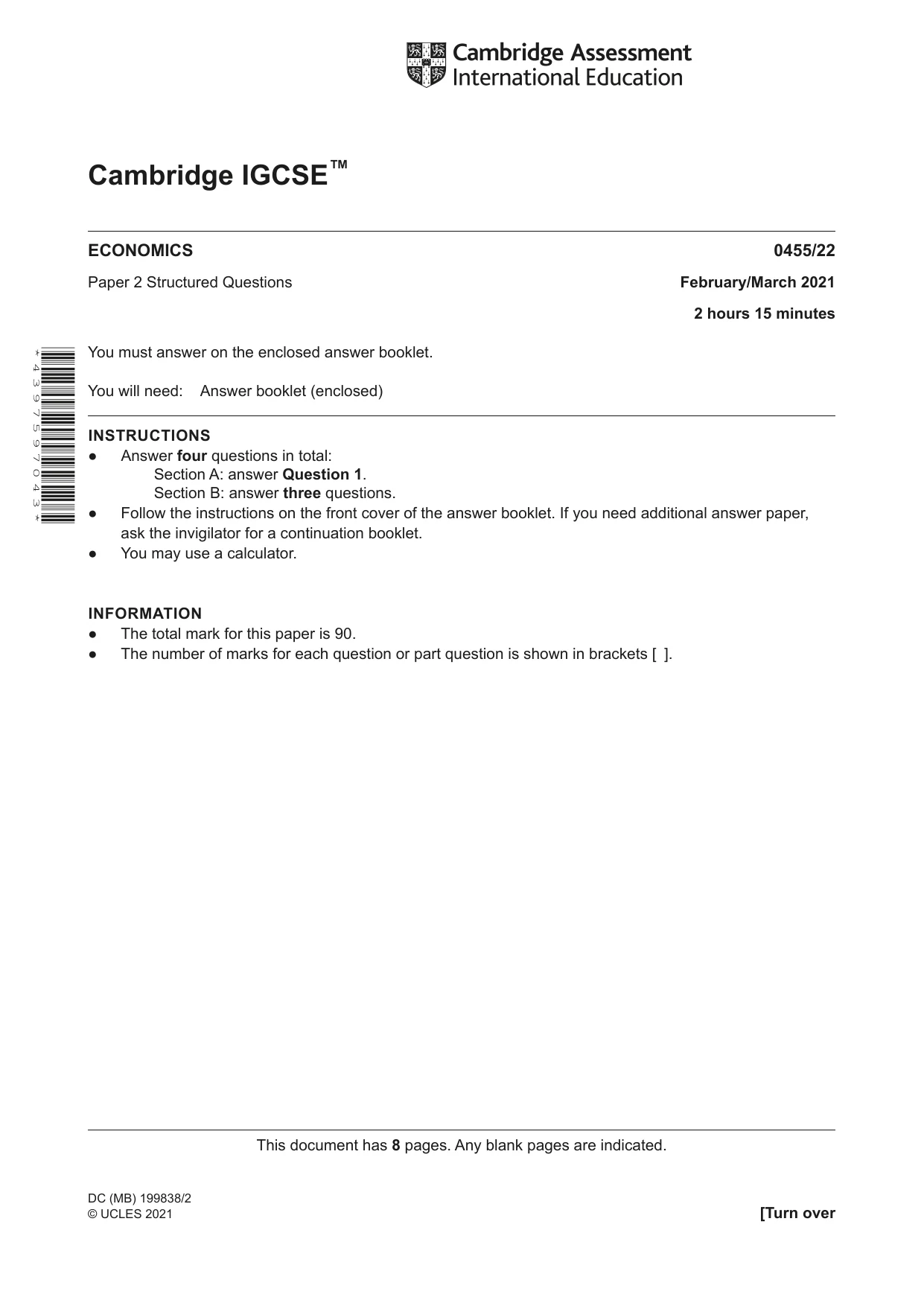
0455/22/F/M/21 · 5 questions · 90 marks · ≈101 min
The question paper and its mark scheme, free to read here and free to download. This is Cambridge’s own paper, exactly as it was sat.
Question paper8 pages




Mark scheme29 pages
Answers below. Sit the paper first if you are practising.
Questions as text
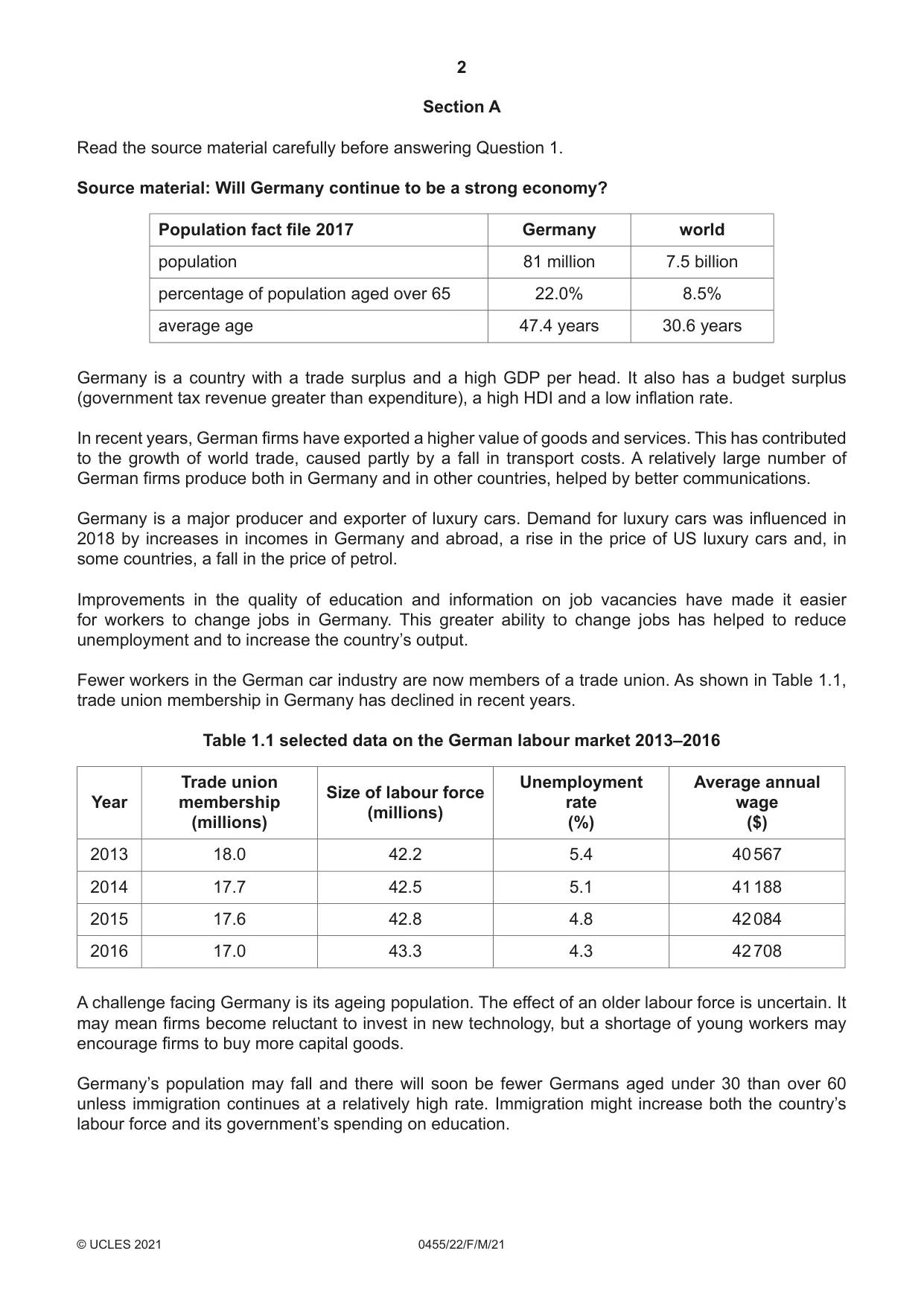
Q1 · Calculate the number of Germans aged over 65 in 2017
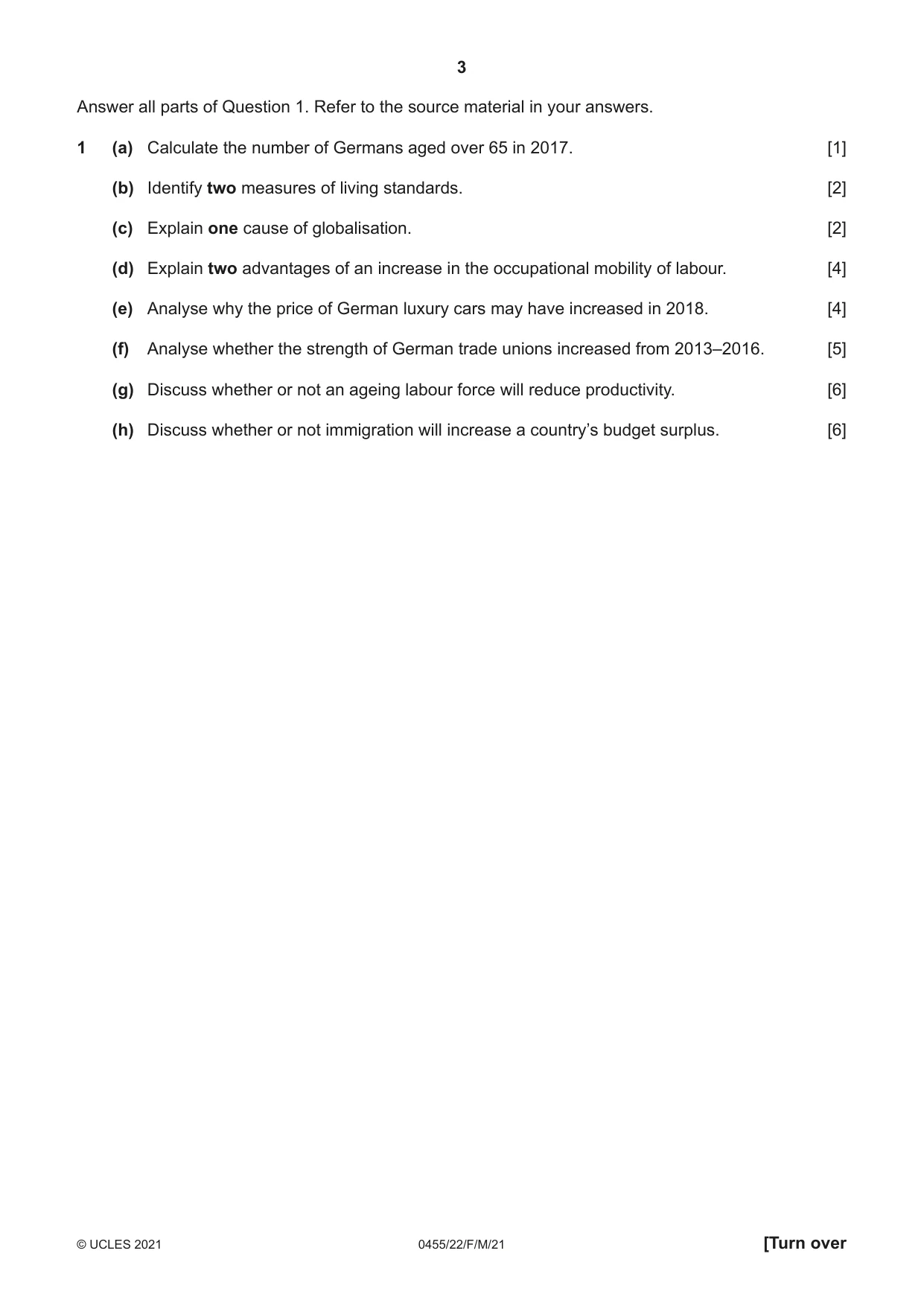
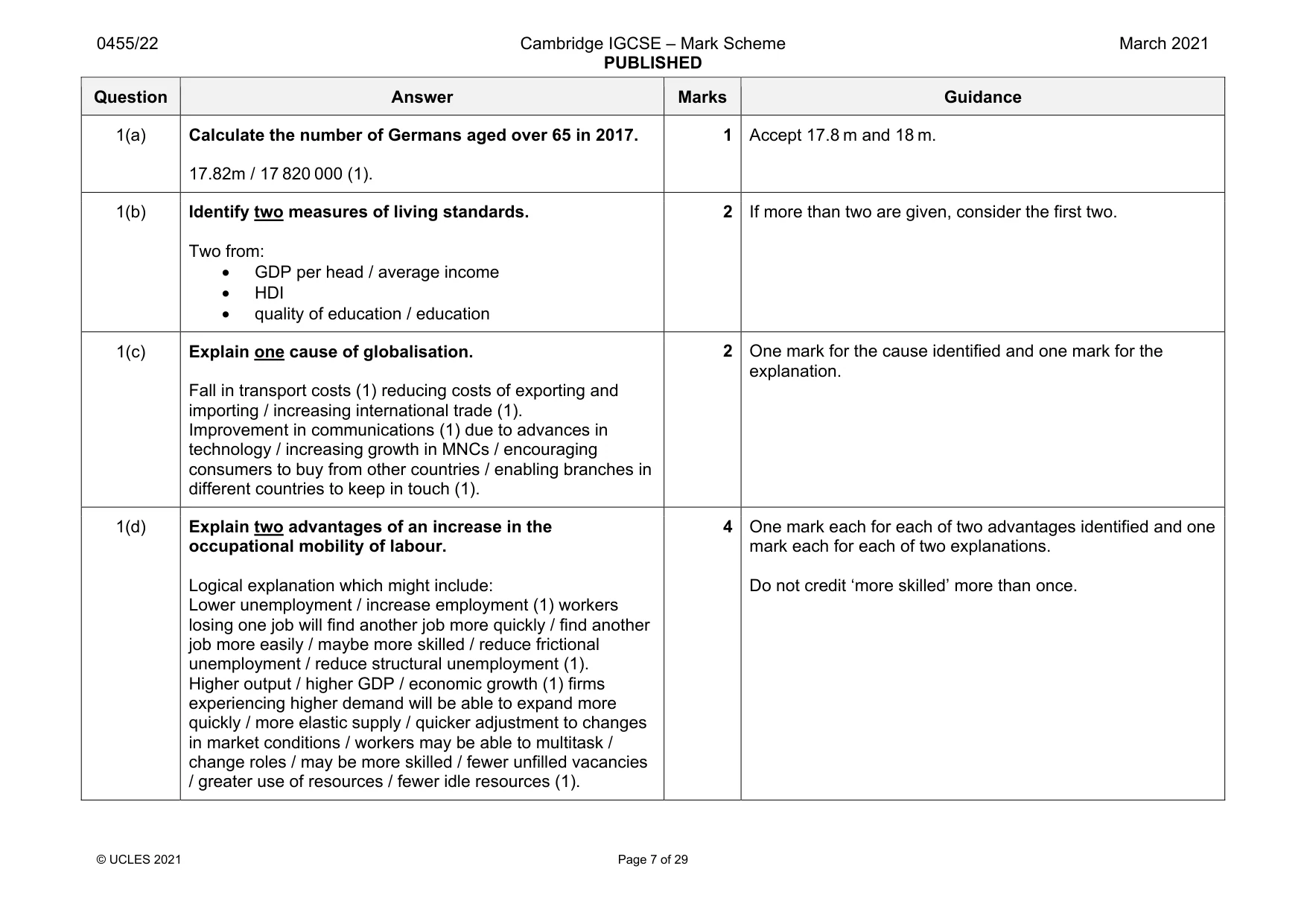
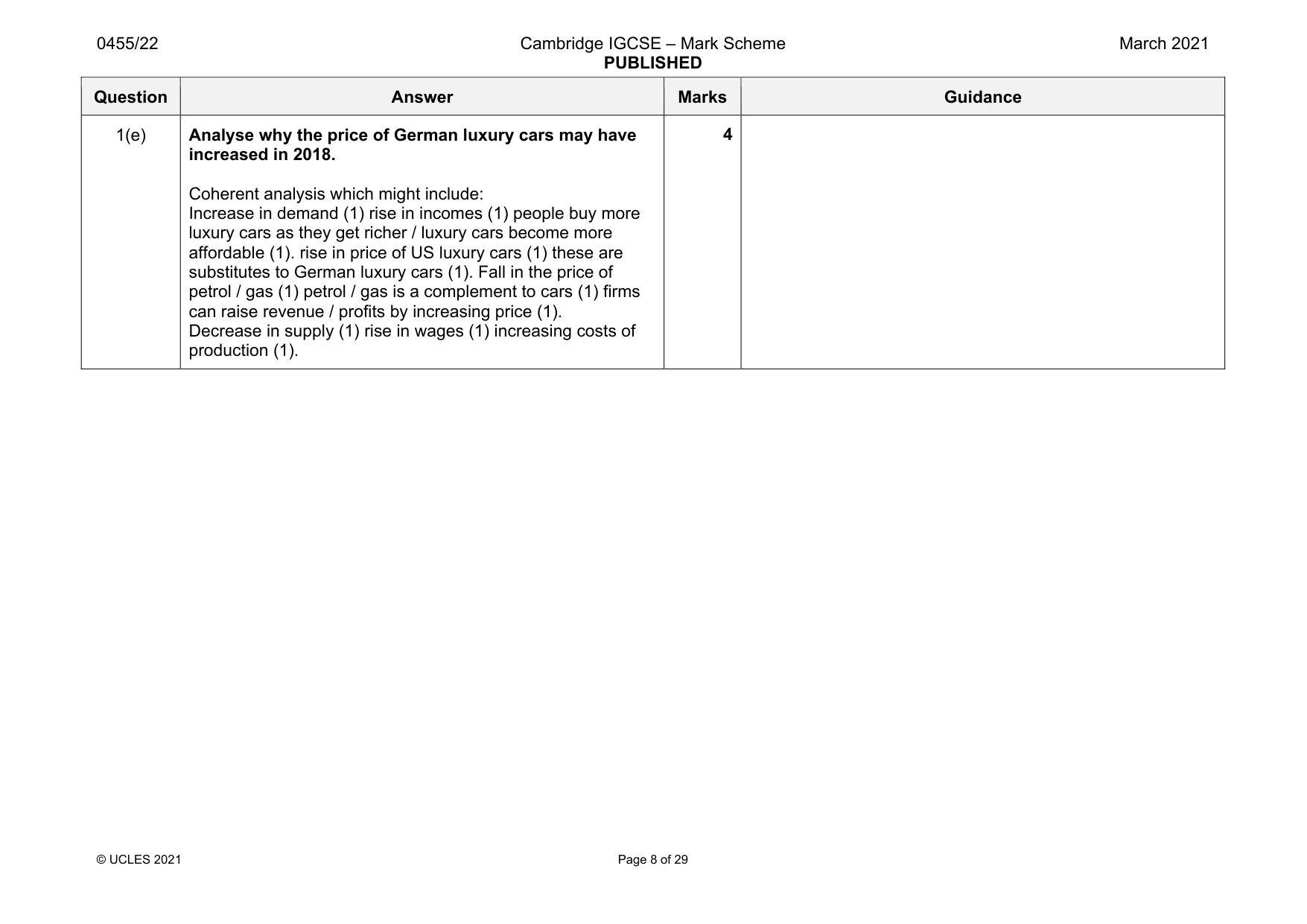
1 (a) Calculate the number of Germans aged over 65 in 2017. [1] (b) Identify two measures of living standards. [2] (c) Explain one cause of globalisation. [2] (d) Explain two advantages of an increase in the occupational mobility of labour. [4] (e) Analyse why the price of German luxury cars may have increased in 2018. [4] (f) Analyse whether the strength of German trade unions increased from 2013–2016. [5] (g) Discuss whether or not an ageing labour force will reduce productivity. [6] (h) Discuss whether or not immigration will increase a country’s budget surplus. [6]
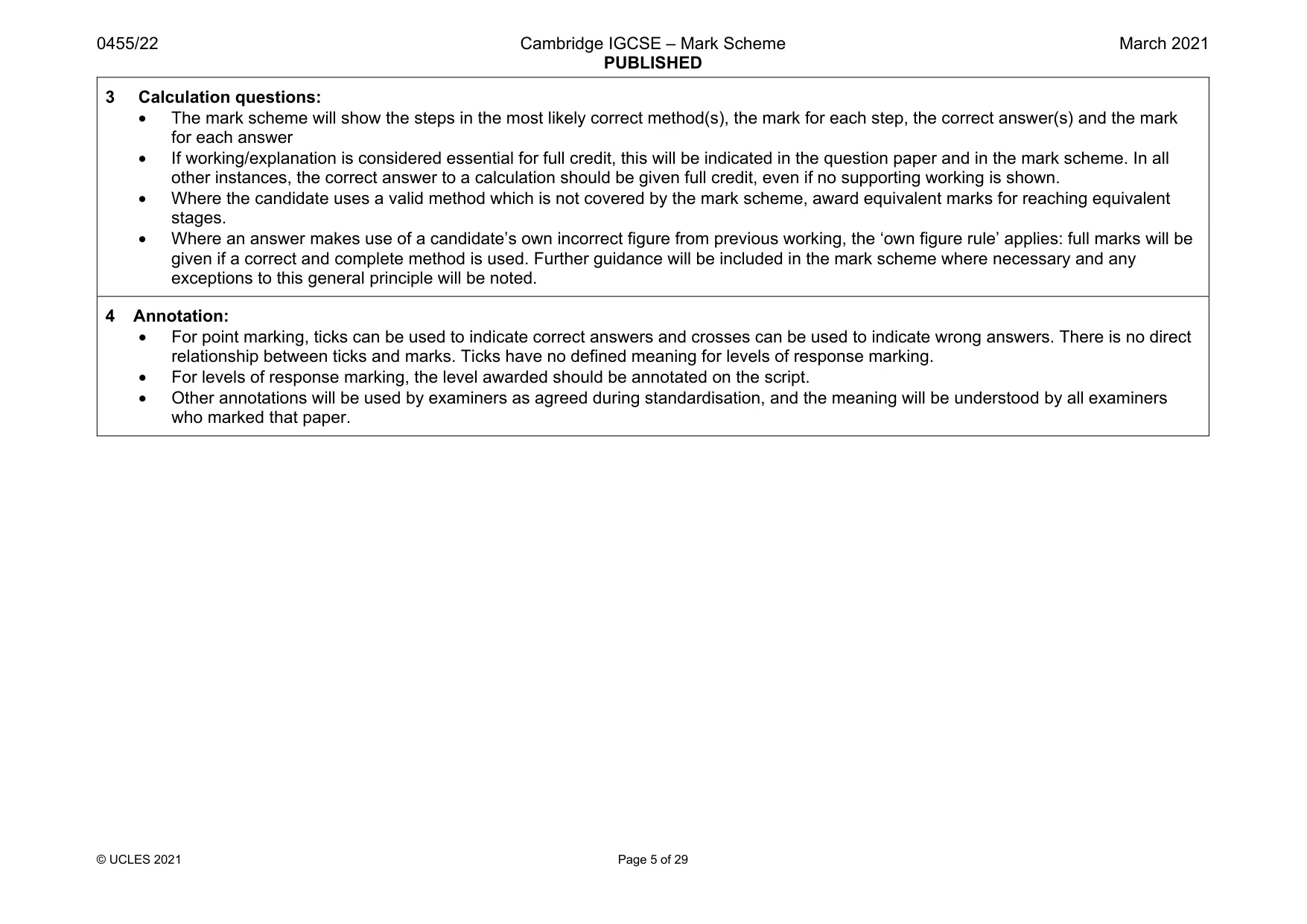
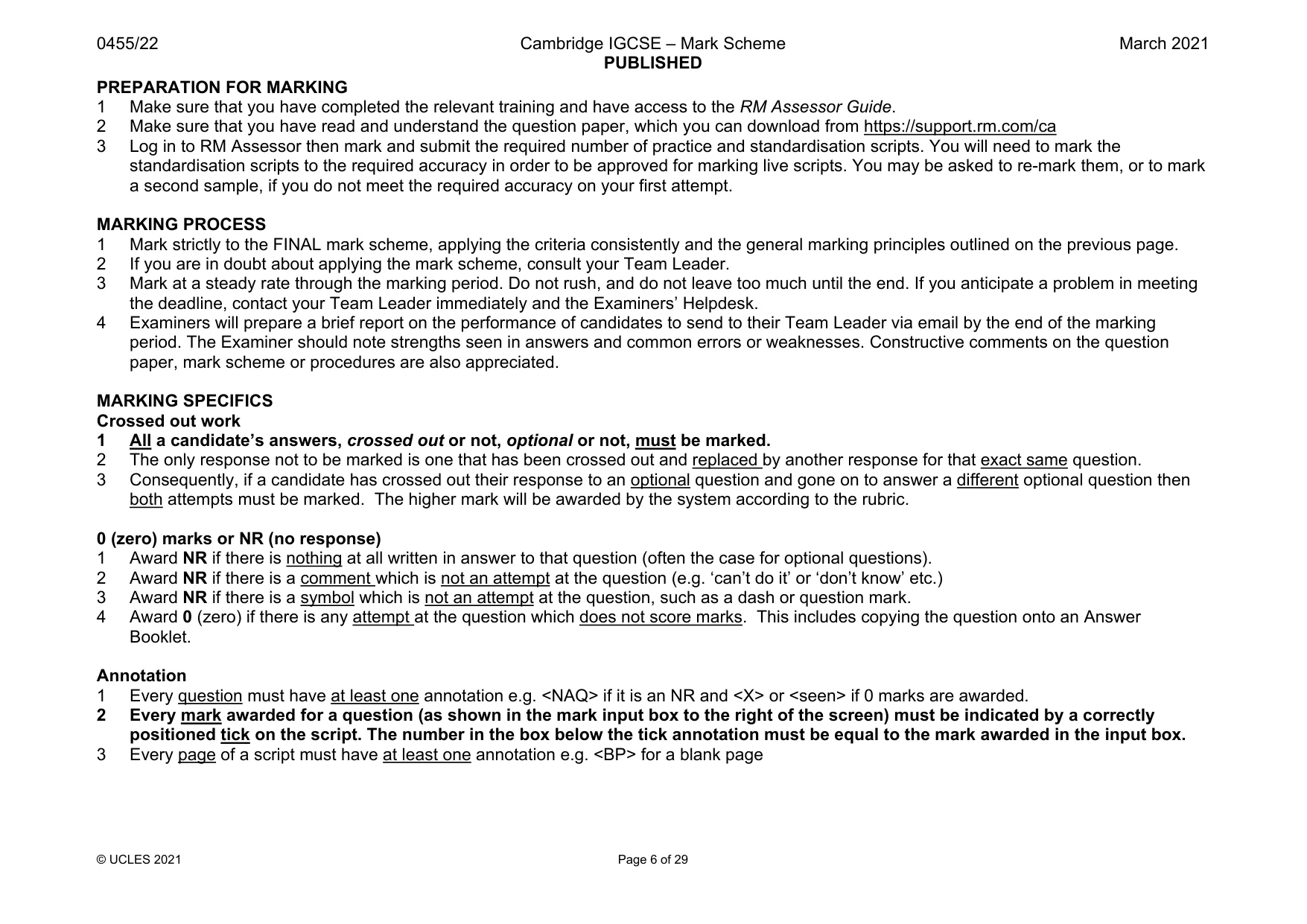
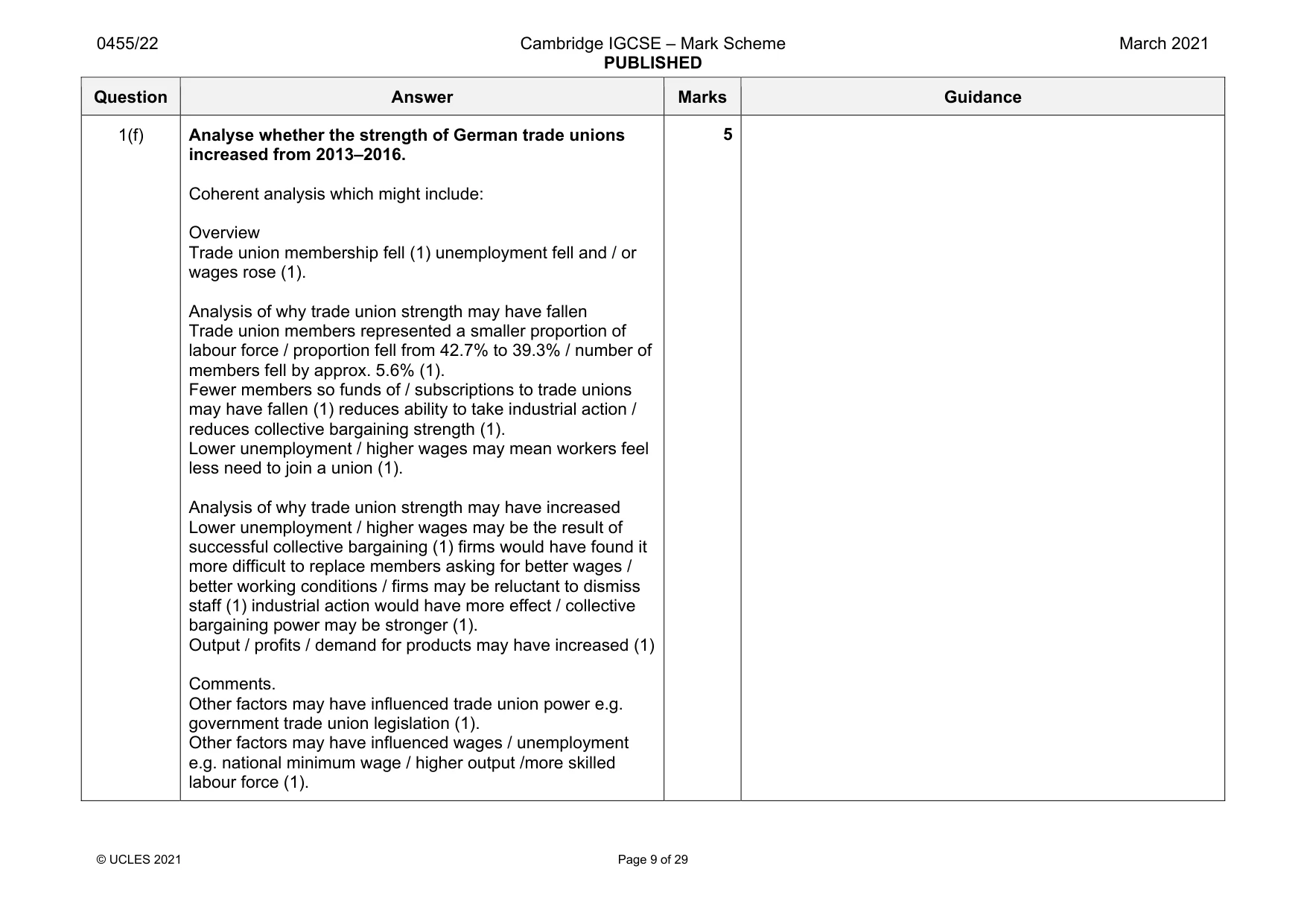
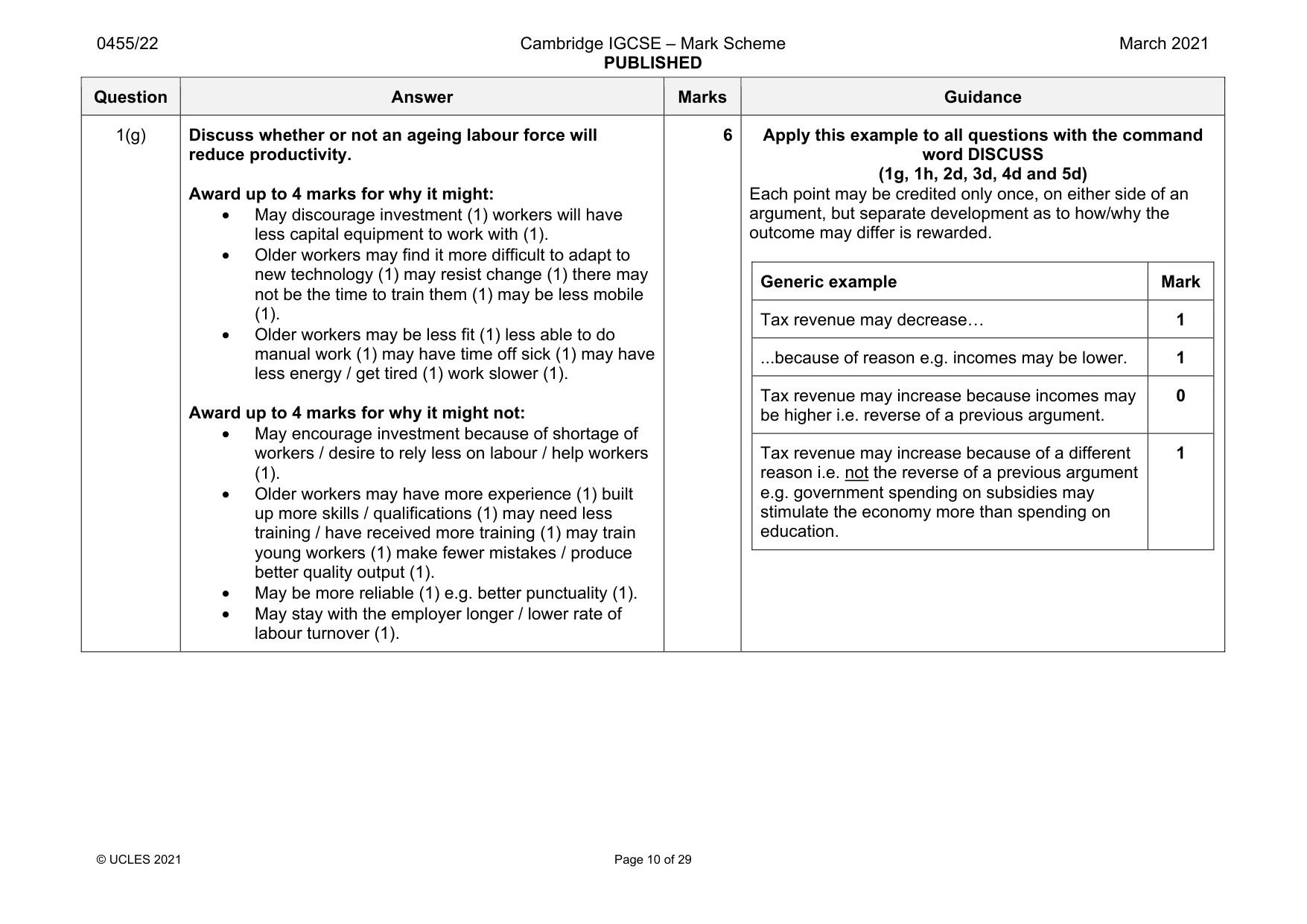
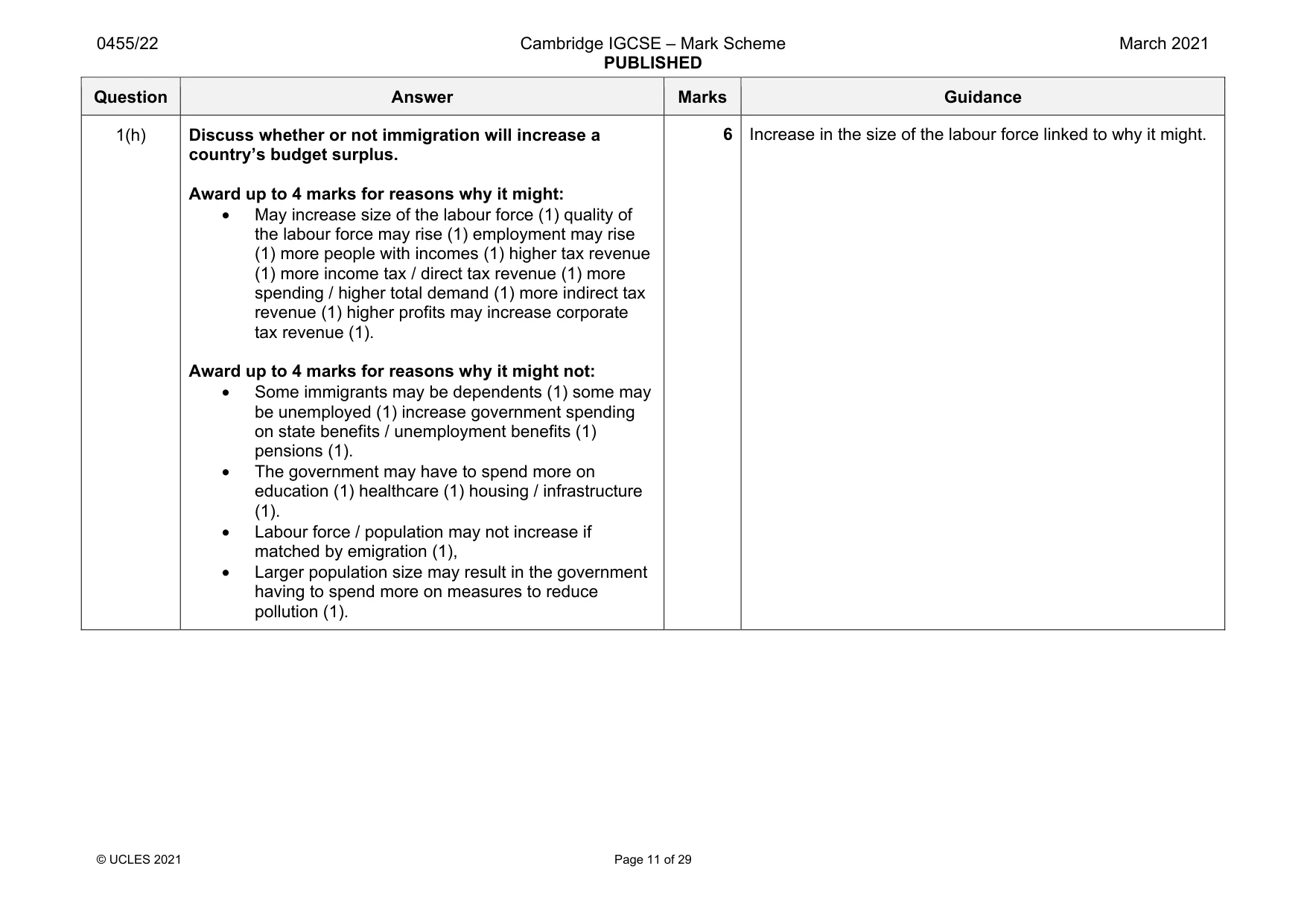
Mark scheme: 1(a) Calculate the number of Germans aged over 65 in 2017. 17.82m / 17 820 000 (1). 1 Accept 17.8 m and 18 m. 1(b) Identify two measures of living standards. Two from: • GDP per head / average income • HDI • quality of education / education 2 If more than two are given, consider the first two. 1(c) Explain one cause of globalisation. Fall in transport costs (1) reducing costs of exporting and importing / increasing international trade (1). Improvement in communications (1) due to advances in technology / increasing growth in MNCs / encouraging consumers to buy from other countries / enabling branches in different countries to keep in touch (1). 2 One mark for the cause identified and one mark for the explanation. 1(d) Explain two advantages of an increase in the occupational mobility of labour. Logical explanation which might include: Lower unemployment / increase employment (1) workers losing one job will find another job more quickly / find another job more easily / maybe more skilled / reduce frictional unemployment / reduce structural unemployment (1). Higher output / higher GDP / economic growth (1) firms experiencing higher demand will be able to expand more quickly / more elastic supply / quicker adjustment to changes in market conditions / workers may be able to multitask / change roles / may be more skilled / fewer unfilled vacancies / greater use of resources / fewer idle resources (1). 4 One mark each for each of two advantages identified and one mark each for each of two explanations. Do not credit ‘more skilled’ more than once. Question Answer Marks Guidance 1(e) Analyse why the price of German luxury cars may have increased in 2018. Coherent analysis which might include: Increase in demand (1) rise in incomes (1) people buy more luxury cars as they get richer / luxury cars become more affordable (1). rise in price of US luxury cars (1) these are substitutes to German luxury cars (1). Fall in the price of petrol / gas (1) petrol / gas is a complement to cars (1) firms can raise revenue / profits by increasing price (1). Decrease in supply (1) rise in wages (1) increasing costs of production (1). 4 Question Answer Marks Guidance 1(f) Analyse whether the strength of German trade unions increased from 2013–2016. Coherent analysis which might include: Overview Trade union membership fell (1) unemployment fell and / or wages rose (1). Analysis of why trade union strength may have fallen Trade union members represented a smaller proportion of labour force / proportion fell from 42.7% to 39.3% / number of members fell by approx. 5.6% (1). Fewer members so funds of / subscriptions to trade unions may have fallen (1) reduces ability to take industrial action / reduces collective bargaining strength (1). Lower unemployment / higher wages may mean workers feel less need to join a union (1). Analysis of why trade union strength may have increased Lower unemployment / higher wages may be the result of successful collective bargaining (1) firms would have found it more difficult to replace members asking for better wages / better working conditions / firms may be reluctant to dismiss staff (1) industrial action would have more effect / collective bargaining power may be stronger (1). Output / profits / demand for products may have increased (1) Comments. Other factors may have influenced trade union power e.g. government trade union legislation (1). Other factors may have influenced wages / unemployment e.g. national minimum wage / higher output /more skilled labour force (1). 5 Question Answer Marks Guidance 1(g) Discuss whether or not an ageing labour force will reduce productivity. Award up to 4 marks for why it might: • May discourage investment (1) workers will have less capital equipment to work with (1). • Older workers may find it more difficult to adapt to new technology (1) may resist change (1) there may not be the time to train them (1) may be less mobile (1). • Older workers may be less fit (1) less able to do manual work (1) may have time off sick (1) may have less energy / get tired (1) work slower (1). Award up to 4 marks for why it might not: • May encourage investment because of shortage of workers / desire to rely less on labour / help workers (1). • Older workers may have more experience (1) built up more skills / qualifications (1) may need less training / have received more training (1) may train young workers (1) make fewer mistakes / produce better quality output (1). • May be more reliable (1) e.g. better punctuality (1). • May stay with the employer longer / lower rate of labour turnover (1). 6 Apply this example to all questions with the command word DISCUSS (1g, 1h, 2d, 3d, 4d and 5d) Each point may be credited only once, on either side of an argument, but separate development as to how/why the outcome may differ is rewarded. Generic example Mark Tax revenue may decrease… 1 ...because of reason e.g. incomes may be lower. 1 Tax revenue may increase because incomes may be higher i.e. reverse of a previous argument. 0 Tax revenue may increase because of a different reason i.e. not the reverse of a previous argument e.g. government spending on subsidies may stimulate the economy more than spending on education. 1 Question Answer Marks Guidance 1(h) Discuss whether or not immigration will increase a country’s budget surplus. Award up to 4 marks for reasons why it might: • May increase size of the labour force (1) quality of the labour force may rise (1) employment may rise (1) more people with incomes (1) higher tax revenue (1) more income tax / direct tax revenue (1) more spending / higher total demand (1) more indirect tax revenue (1) higher profits may increase corporate tax revenue (1). Award up to 4 marks for reasons why it might not: • Some immigrants may be dependents (1) some may be unemployed (1) increase government spending on state benefits / unemployment benefits (1) pensions (1). • The government may have to spend more on education (1) healthcare (1) housing / infrastructure (1). • Labour force / population may not increase if matched by emigration (1), • Larger population size may result in the government having to spend more on measures to reduce pollution (1). 6 Increase in the size of the labour force linked to why it might.
Q2 · India has experienced a relatively high economic growth rate in recent years
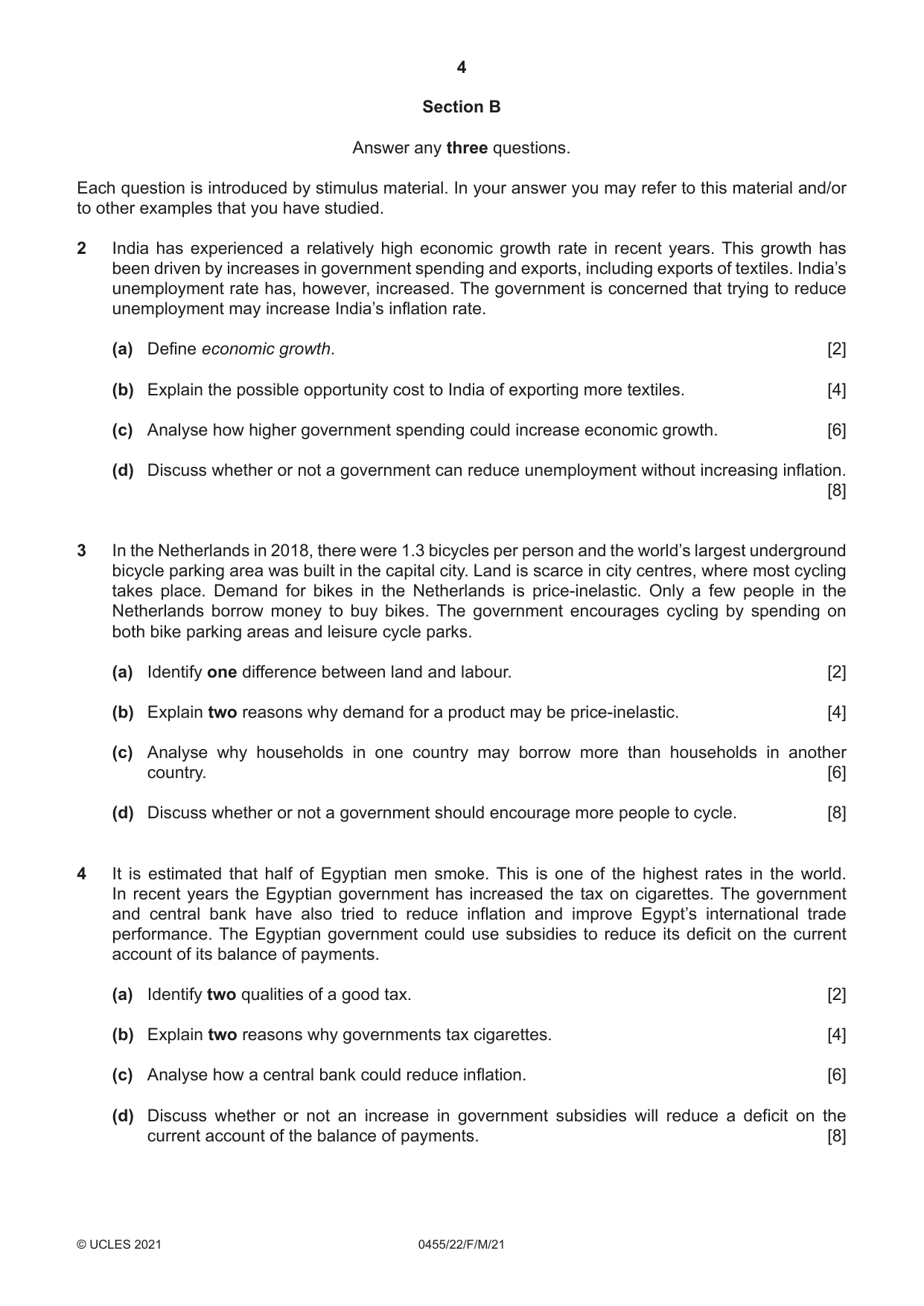
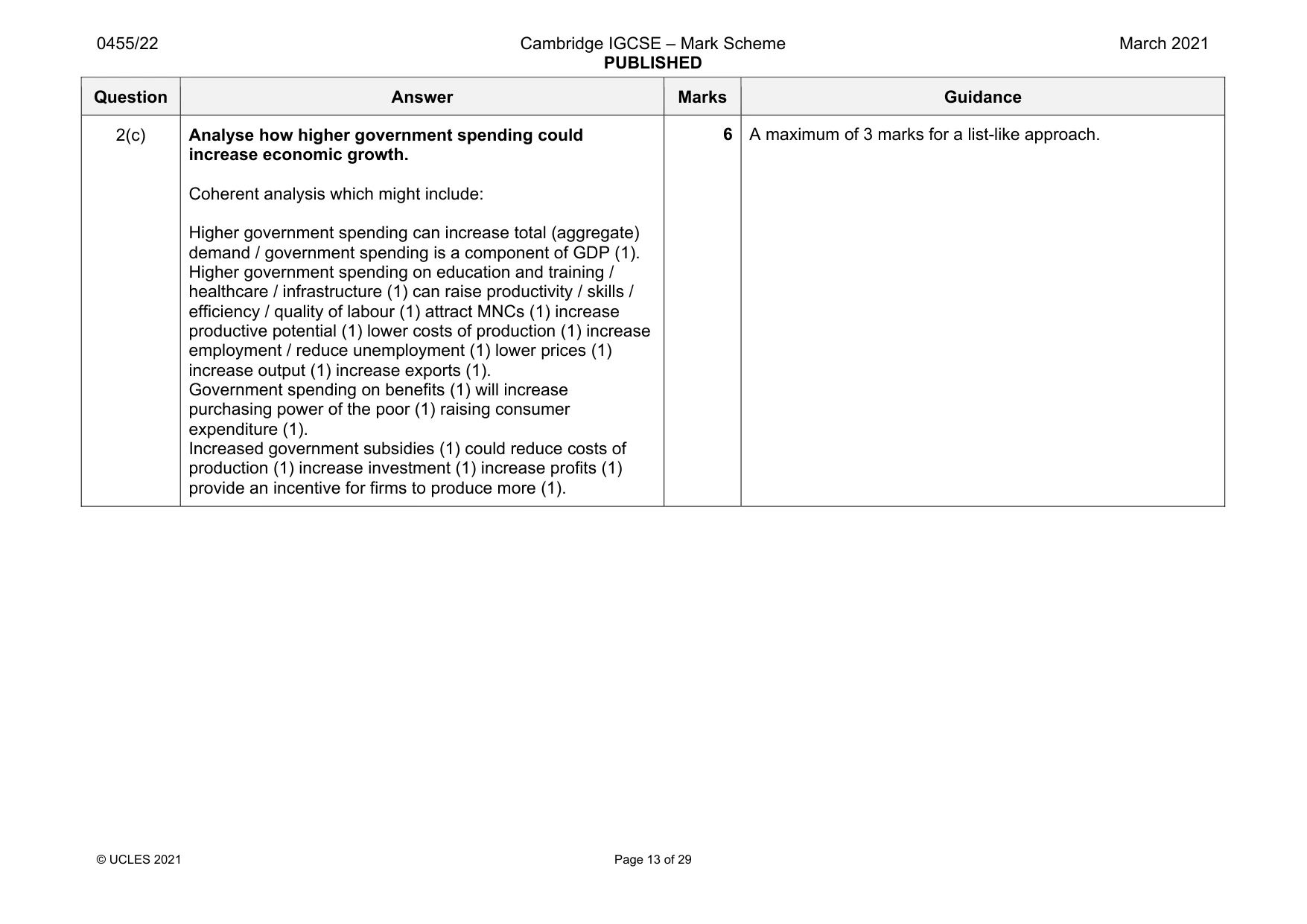
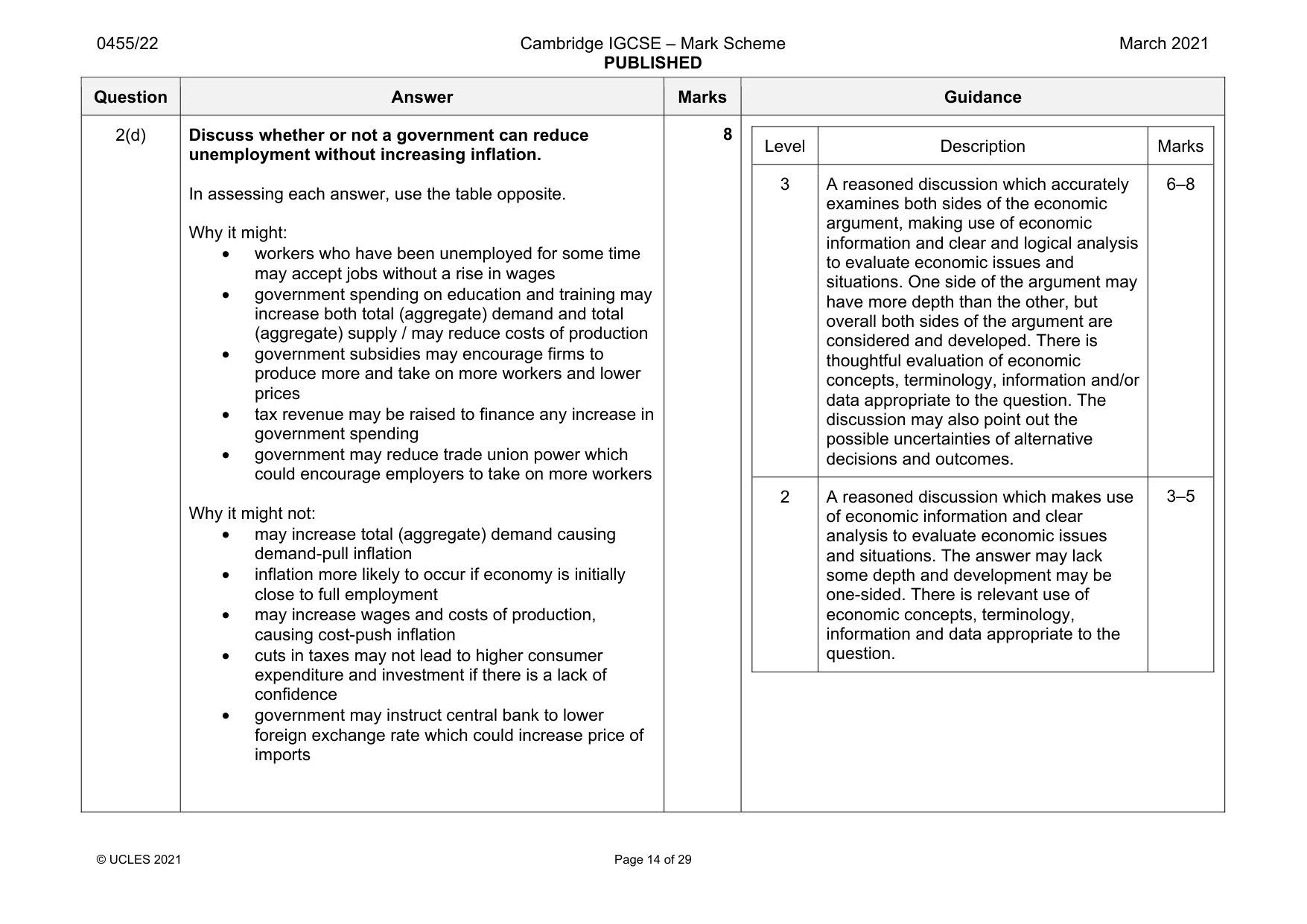
2 India has experienced a relatively high economic growth rate in recent years. This growth has been driven by increases in government spending and exports, including exports of textiles. India’s unemployment rate has, however, increased. The government is concerned that trying to reduce unemployment may increase India’s inflation rate. (a) Define economic growth. [2] (b) Explain the possible opportunity cost to India of exporting more textiles. [4] (c) Analyse how higher government spending could increase economic growth. [6] (d) Discuss whether or not a government can reduce unemployment without increasing inflation. [8]
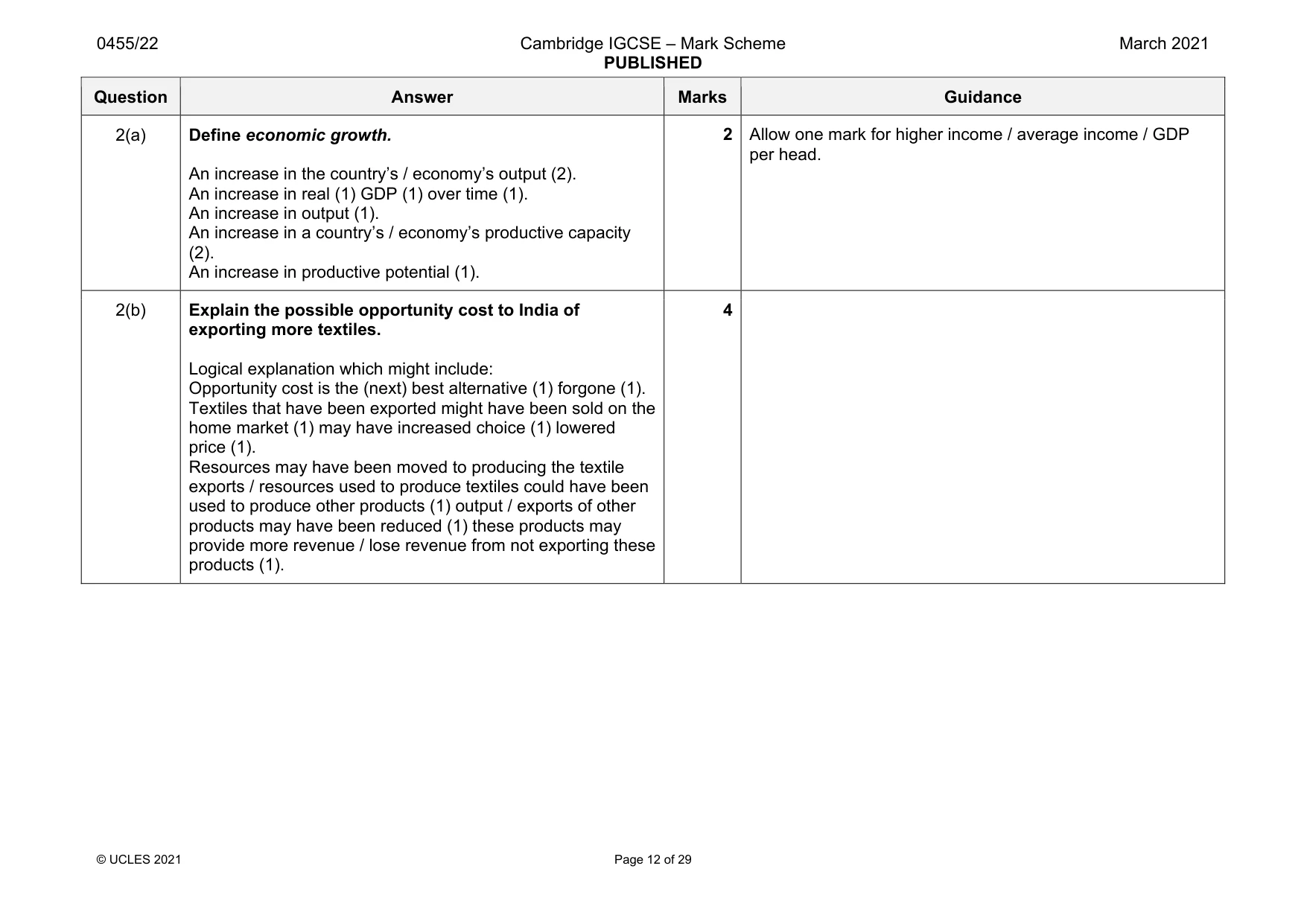
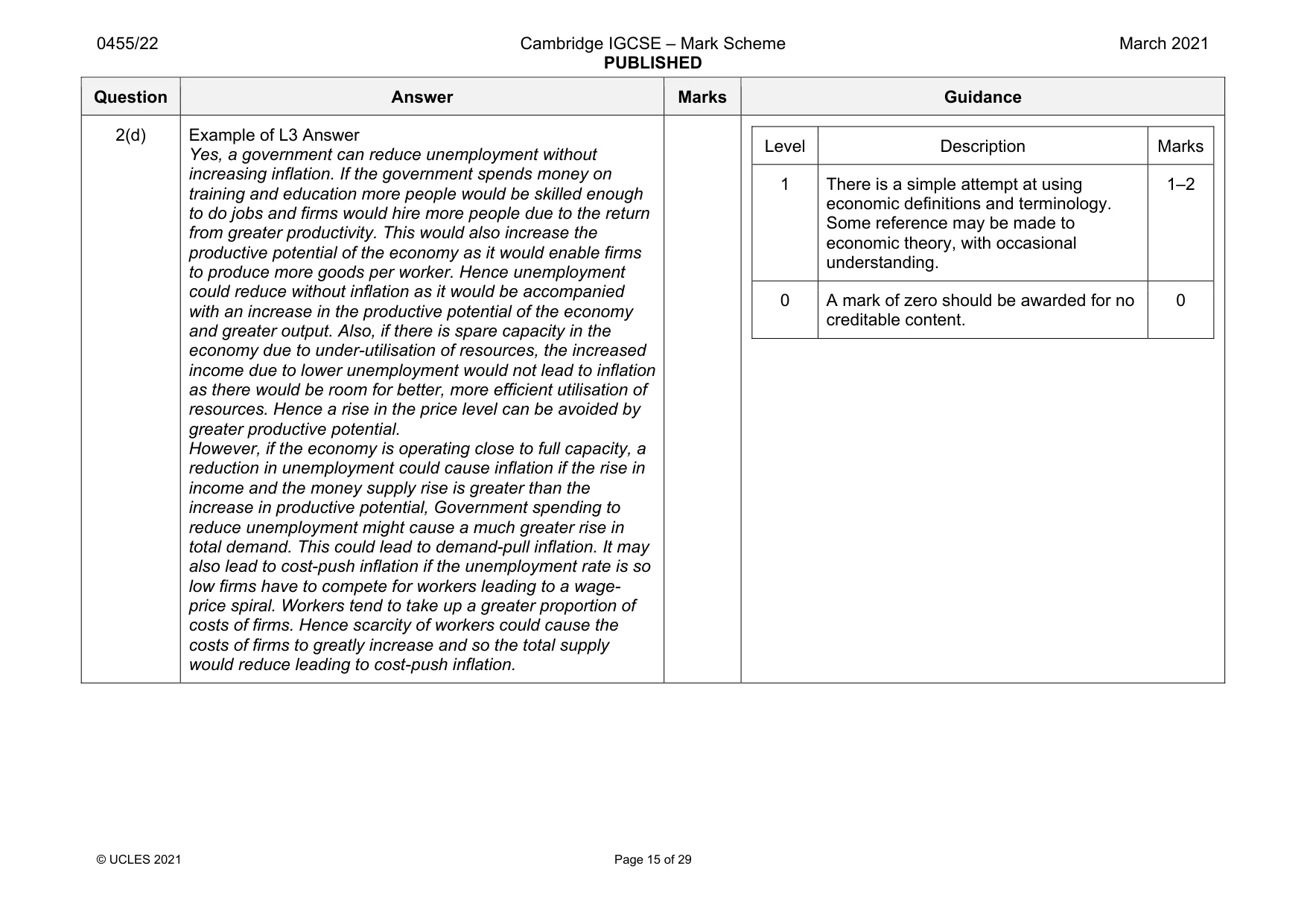
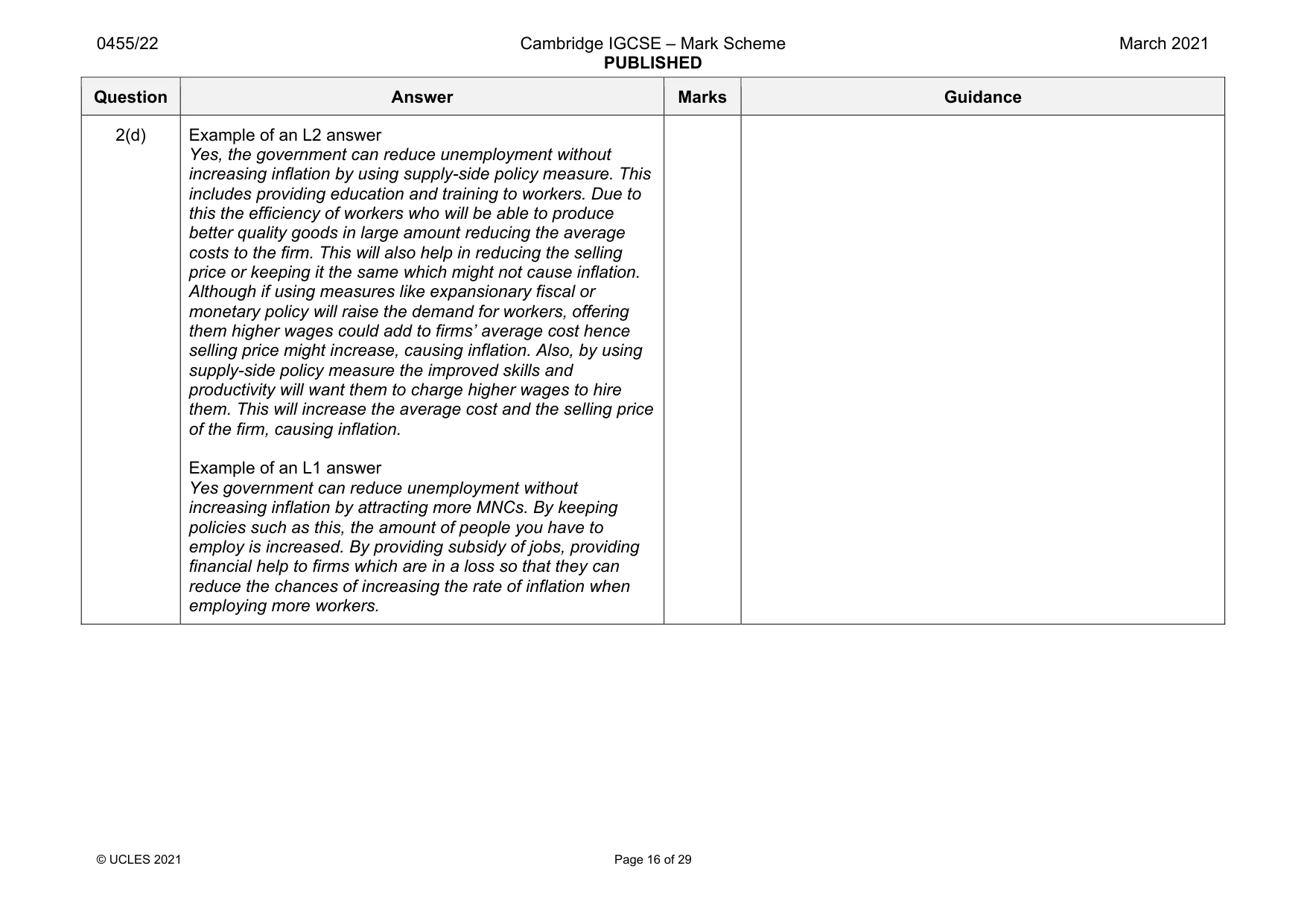
Mark scheme: 2(a) Define economic growth. An increase in the country’s / economy’s output (2). An increase in real (1) GDP (1) over time (1). An increase in output (1). An increase in a country’s / economy’s productive capacity (2). An increase in productive potential (1). per head. 2(b) Explain the possible opportunity cost to India of exporting more textiles. Logical explanation which might include: Opportunity cost is the (next) best alternative (1) forgone (1). Textiles that have been exported might have been sold on the home market (1) may have increased choice (1) lowered price (1). Resources may have been moved to producing the textile exports / resources used to produce textiles could have been used to produce other products (1) output / exports of other products may have been reduced (1) these products may provide more revenue / lose revenue from not exporting these products (1). 4 Question Answer Marks Guidance 2(c) Analyse how higher government spending could increase economic growth. Coherent analysis which might include: Higher government spending can increase total (aggregate) demand / government spending is a component of GDP (1). Higher government spending on education and training / healthcare / infrastructure (1) can raise productivity / skills / efficiency / quality of labour (1) attract MNCs (1) increase productive potential (1) lower costs of production (1) increase employment / reduce unemployment (1) lower prices (1) increase output (1) increase exports (1). Government spending on benefits (1) will increase purchasing power of the poor (1) raising consumer expenditure (1). Increased government subsidies (1) could reduce costs of production (1) increase investment (1) increase profits (1) provide an incentive for firms to produce more (1). 6 A maximum of 3 marks for a list-like approach. Question Answer Marks Guidance 2(d) Discuss whether or not a government can reduce unemployment without increasing inflation. In assessing each answer, use the table opposite. Why it might: • workers who have been unemployed for some time may accept jobs without a rise in wages • government spending on education and training may increase both total (aggregate) demand and total (aggregate) supply / may reduce costs of production • government subsidies may encourage firms to produce more and take on more workers and lower prices • tax revenue may be raised to finance any increase in government spending • government may reduce trade union power which could encourage employers to take on more workers Why it might not: • may increase total (aggregate) demand causing demand-pull inflation • inflation more likely to occur if economy is initially close to full employment • may increase wages and costs of production, causing cost-push inflation • cuts in taxes may not lead to higher consumer expenditure and investment if there is a lack of confidence • government may instruct central bank to lower foreign exchange rate which could increase price of imports 8 Level Description Marks 3 A reasoned discussion which accurately examines both sides of the economic argument, making use of economic information and clear and logical analysis to evaluate economic issues and situations. One side of the argument may have more depth than the other, but overall both sides of the argument are considered and developed. There is thoughtful evaluation of economic concepts, terminology, information and/or data appropriate to the question. The discussion may also point out the possible uncertainties of alternative decisions and outcomes. 6–8 2 A reasoned discussion which makes use of economic information and clear analysis to evaluate economic issues and situations. The answer may lack some depth and development may be one-sided. There is relevant use of economic concepts, terminology, information and data appropriate to the question. 3–5 Question Answer Marks Guidance 2(d) Example of L3 Answer Yes, a government can reduce unemployment without increasing inflation. If the government spends money on training and education more people would be skilled enough to do jobs and firms would hire more people due to the return from greater productivity. This would also increase the productive potential of the economy as it would enable firms to produce more goods per worker. Hence unemployment could reduce without inflation as it would be accompanied with an increase in the productive potential of the economy and greater output. Also, if there is spare capacity in the economy due to under-utilisation of resources, the increased income due to lower unemployment would not lead to inflation as there would be room for better, more efficient utilisation of resources. Hence a rise in the price level can be avoided by greater productive potential. However, if the economy is operating close to full capacity, a reduction in unemployment could cause inflation if the rise in income and the money supply rise is greater than the increase in productive potential, Government spending to reduce unemployment might cause a much greater rise in total demand. This could lead to demand-pull inflation. It may also lead to cost-push inflation if the unemployment rate is so low firms have to compete for workers leading to a wage- price spiral. Workers tend to take up a greater proportion of costs of firms. Hence scarcity of workers could cause the costs of firms to greatly increase and so the total supply would reduce leading to cost-push inflation. Level Description Marks 1 There is a simple attempt at using economic definitions and terminology. Some reference may be made to economic theory, with occasional understanding. 1–2 0 A mark of zero should be awarded for no creditable content. 0 Question Answer Marks Guidance 2(d) Example of an L2 answer Yes, the government can reduce unemployment without increasing inflation by using supply-side policy measure. This includes providing education and training to workers. Due to this the efficiency of workers who will be able to produce better quality goods in large amount reducing the average costs to the firm. This will also help in reducing the selling price or keeping it the same which might not cause inflation. Although if using measures like expansionary fiscal or monetary policy will raise the demand for workers, offering them higher wages could add to firms’ average cost hence selling price might increase, causing inflation. Also, by using supply-side policy measure the improved skills and productivity will want them to charge higher wages to hire them. This will increase the average cost and the selling price of the firm, causing inflation. Example of an L1 answer Yes government can reduce unemployment without increasing inflation by attracting more MNCs. By keeping policies such as this, the amount of people you have to employ is increased. By providing subsidy of jobs, providing financial help to firms which are in a loss so that they can reduce the chances of increasing the rate of inflation when employing more workers.
Q3 · In the Netherlands in 2018, there were 1.3 bicycles per person and the world’s largest…
3 In the Netherlands in 2018, there were 1.3 bicycles per person and the world’s largest underground bicycle parking area was built in the capital city. Land is scarce in city centres, where most cycling takes place. Demand for bikes in the Netherlands is price-inelastic. Only a few people in the Netherlands borrow money to buy bikes. The government encourages cycling by spending on both bike parking areas and leisure cycle parks. (a) Identify one difference between land and labour. [2] (b) Explain two reasons why demand for a product may be price-inelastic. [4] (c) Analyse why households in one country may borrow more than households in another country. [6] (d) Discuss whether or not a government should encourage more people to cycle. [8]
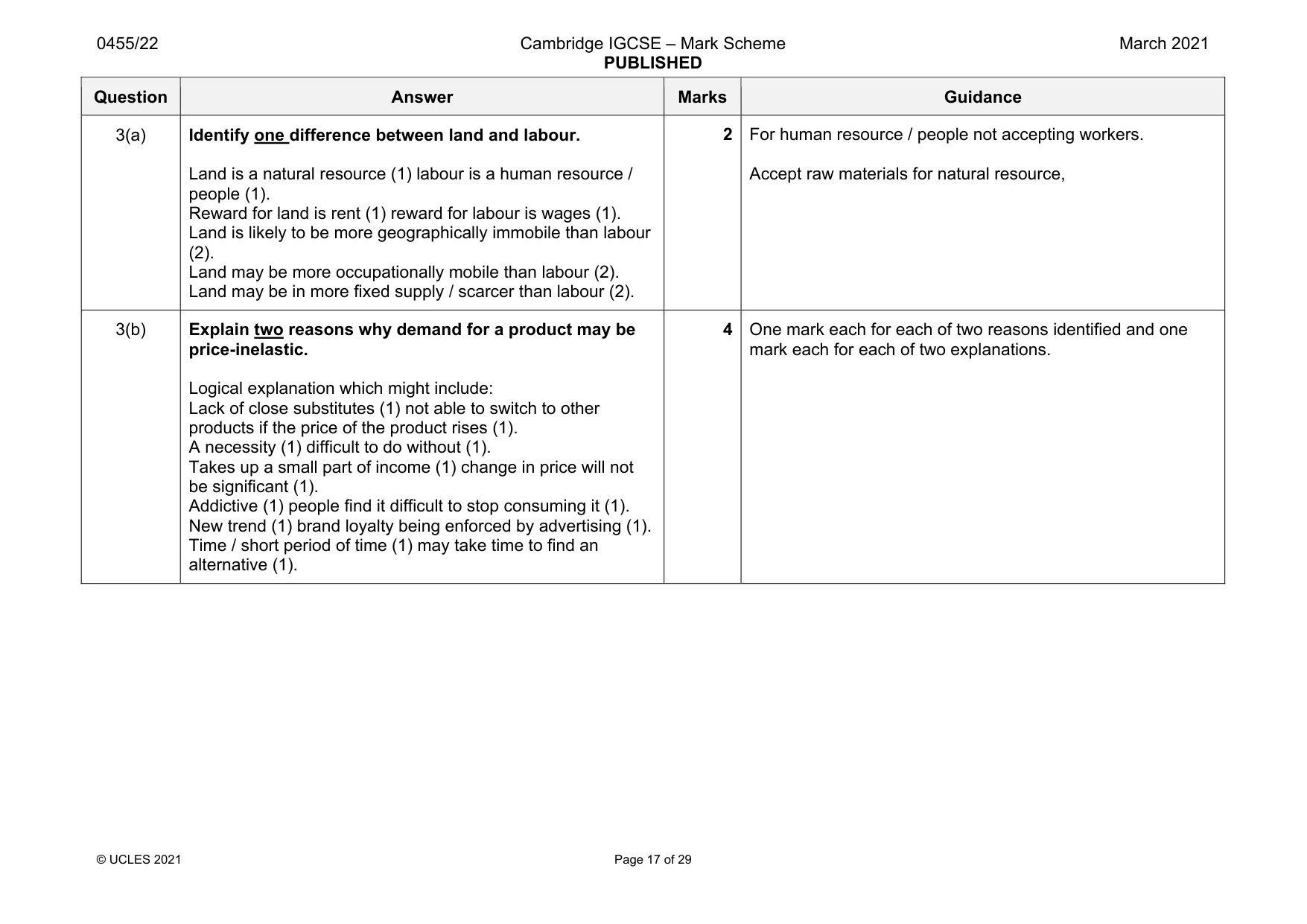
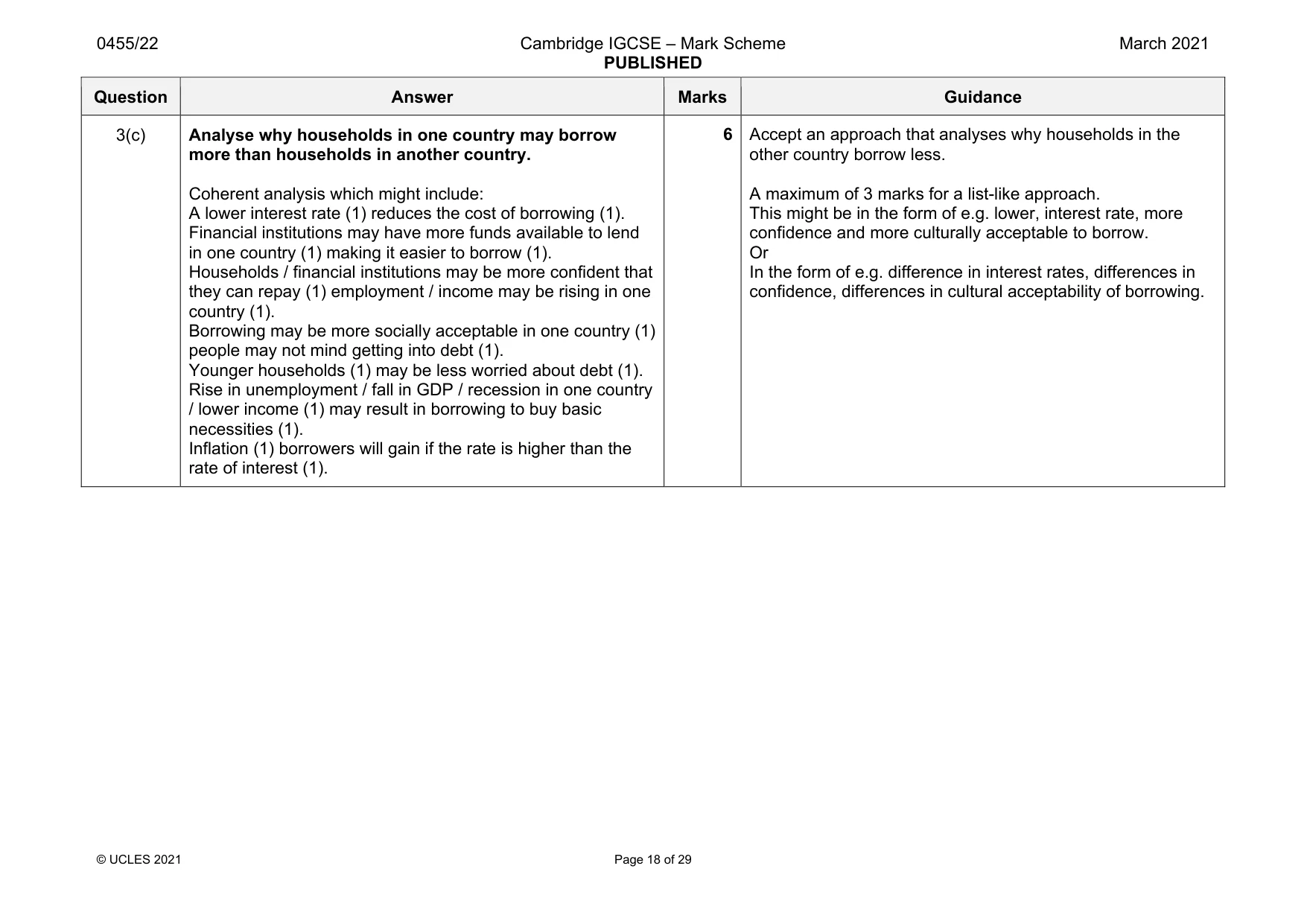
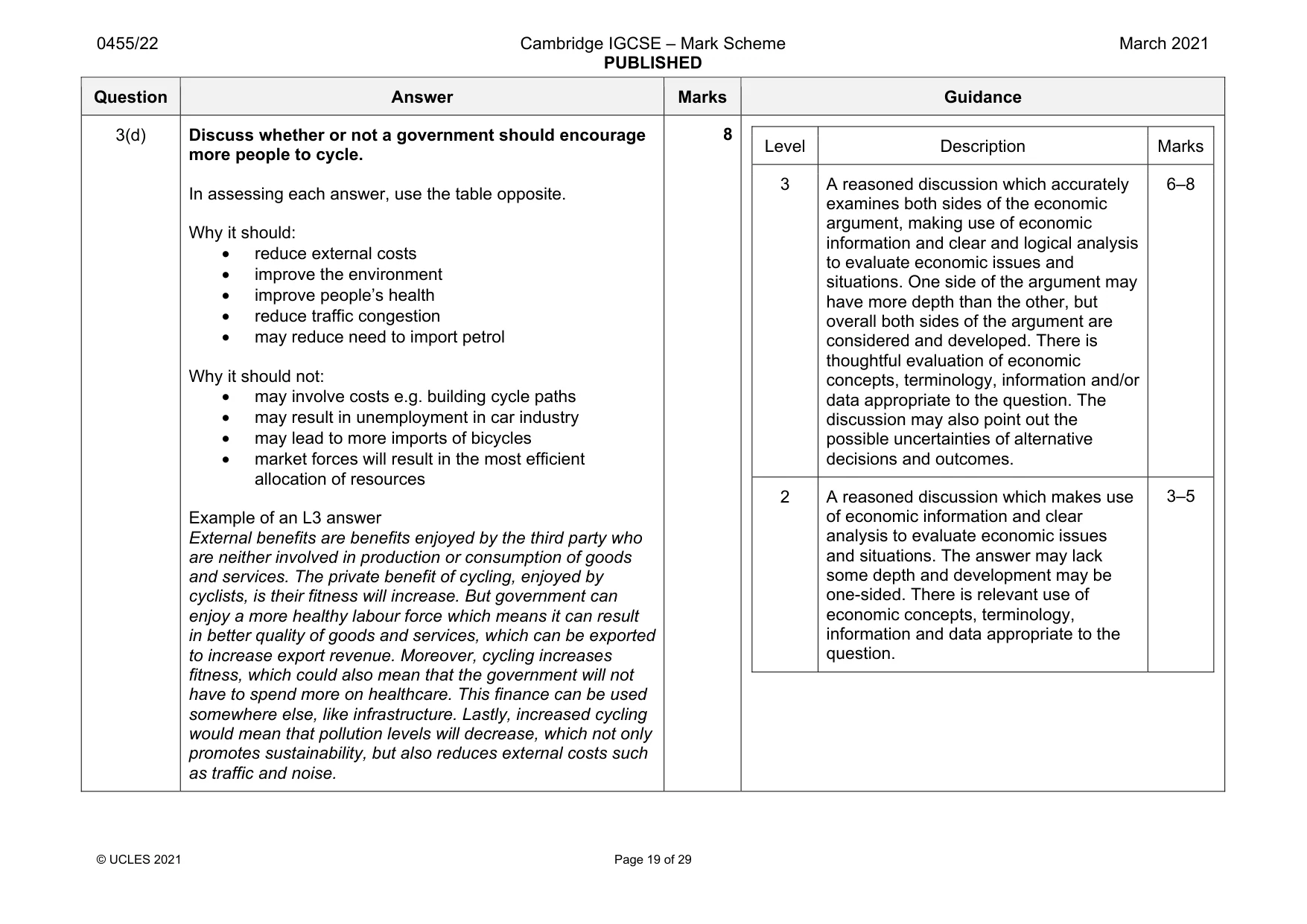
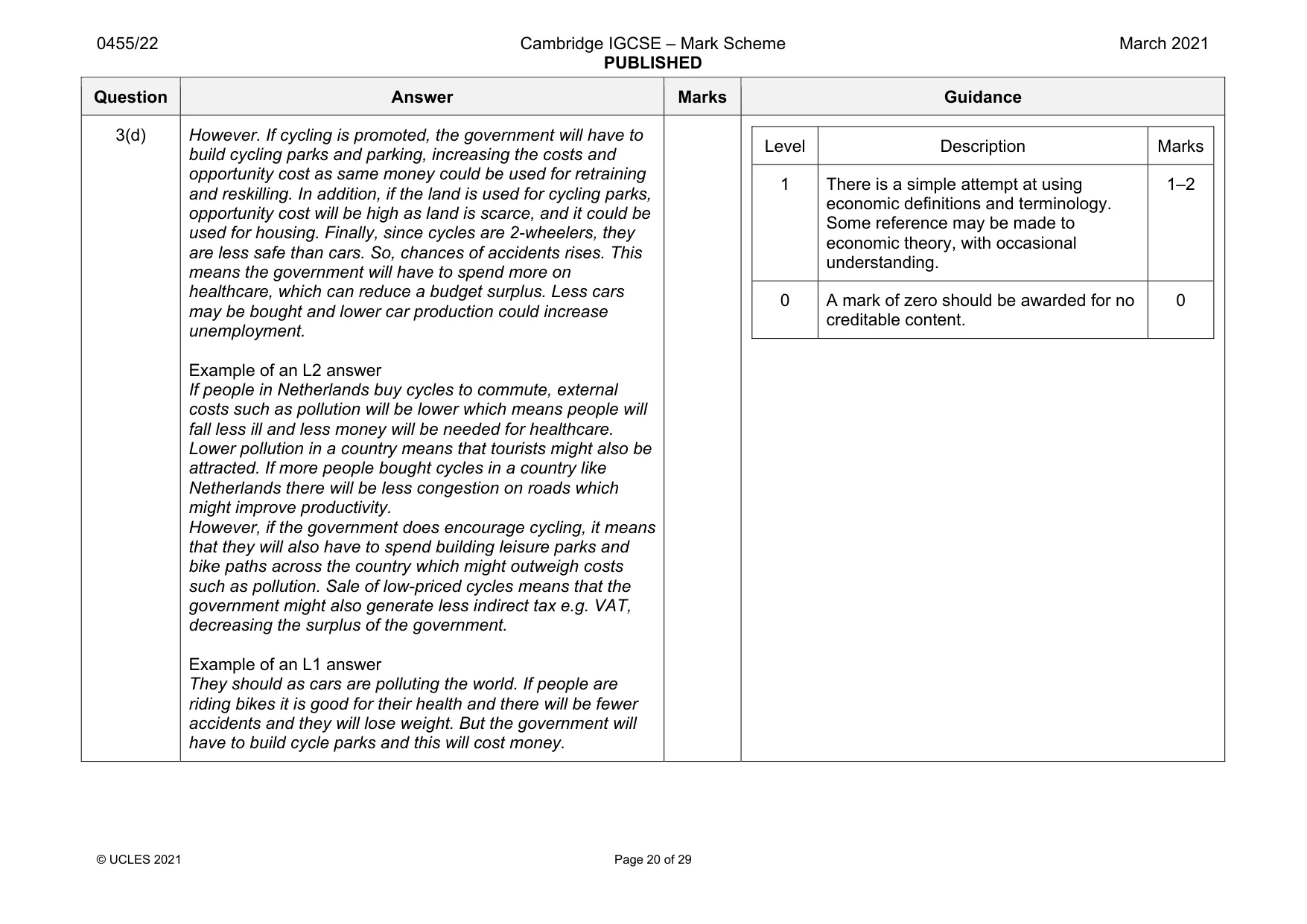
Mark scheme: 3(a) Identify one difference between land and labour. Land is a natural resource (1) labour is a human resource / people (1). Reward for land is rent (1) reward for labour is wages (1). Land is likely to be more geographically immobile than labour (2). Land may be more occupationally mobile than labour (2). Land may be in more fixed supply / scarcer than labour (2). Accept raw materials for natural resource, 3(b) Explain two reasons why demand for a product may be price-inelastic. Logical explanation which might include: Lack of close substitutes (1) not able to switch to other products if the price of the product rises (1). A necessity (1) difficult to do without (1). Takes up a small part of income (1) change in price will not be significant (1). Addictive (1) people find it difficult to stop consuming it (1). New trend (1) brand loyalty being enforced by advertising (1). Time / short period of time (1) may take time to find an alternative (1). 4 One mark each for each of two reasons identified and one mark each for each of two explanations. Question Answer Marks Guidance 3(c) Analyse why households in one country may borrow more than households in another country. Coherent analysis which might include: A lower interest rate (1) reduces the cost of borrowing (1). Financial institutions may have more funds available to lend in one country (1) making it easier to borrow (1). Households / financial institutions may be more confident that they can repay (1) employment / income may be rising in one country (1). Borrowing may be more socially acceptable in one country (1) people may not mind getting into debt (1). Younger households (1) may be less worried about debt (1). Rise in unemployment / fall in GDP / recession in one country / lower income (1) may result in borrowing to buy basic necessities (1). Inflation (1) borrowers will gain if the rate is higher than the rate of interest (1). 6 Accept an approach that analyses why households in the other country borrow less. A maximum of 3 marks for a list-like approach. This might be in the form of e.g. lower, interest rate, more confidence and more culturally acceptable to borrow. Or In the form of e.g. difference in interest rates, differences in confidence, differences in cultural acceptability of borrowing. Question Answer Marks Guidance 3(d) Discuss whether or not a government should encourage more people to cycle. In assessing each answer, use the table opposite. Why it should: • reduce external costs • improve the environment • improve people’s health • reduce traffic congestion • may reduce need to import petrol Why it should not: • may involve costs e.g. building cycle paths • may result in unemployment in car industry • may lead to more imports of bicycles • market forces will result in the most efficient allocation of resources Example of an L3 answer External benefits are benefits enjoyed by the third party who are neither involved in production or consumption of goods and services. The private benefit of cycling, enjoyed by cyclists, is their fitness will increase. But government can enjoy a more healthy labour force which means it can result in better quality of goods and services, which can be exported to increase export revenue. Moreover, cycling increases fitness, which could also mean that the government will not have to spend more on healthcare. This finance can be used somewhere else, like infrastructure. Lastly, increased cycling would mean that pollution levels will decrease, which not only promotes sustainability, but also reduces external costs such as traffic and noise. 8 Level Description Marks 3 A reasoned discussion which accurately examines both sides of the economic argument, making use of economic information and clear and logical analysis to evaluate economic issues and situations. One side of the argument may have more depth than the other, but overall both sides of the argument are considered and developed. There is thoughtful evaluation of economic concepts, terminology, information and/or data appropriate to the question. The discussion may also point out the possible uncertainties of alternative decisions and outcomes. 6–8 2 A reasoned discussion which makes use of economic information and clear analysis to evaluate economic issues and situations. The answer may lack some depth and development may be one-sided. There is relevant use of economic concepts, terminology, information and data appropriate to the question. 3–5 Question Answer Marks Guidance 3(d) However. If cycling is promoted, the government will have to build cycling parks and parking, increasing the costs and opportunity cost as same money could be used for retraining and reskilling. In addition, if the land is used for cycling parks, opportunity cost will be high as land is scarce, and it could be used for housing. Finally, since cycles are 2-wheelers, they are less safe than cars. So, chances of accidents rises. This means the government will have to spend more on healthcare, which can reduce a budget surplus. Less cars may be bought and lower car production could increase unemployment. Example of an L2 answer If people in Netherlands buy cycles to commute, external costs such as pollution will be lower which means people will fall less ill and less money will be needed for healthcare. Lower pollution in a country means that tourists might also be attracted. If more people bought cycles in a country like Netherlands there will be less congestion on roads which might improve productivity. However, if the government does encourage cycling, it means that they will also have to spend building leisure parks and bike paths across the country which might outweigh costs such as pollution. Sale of low-priced cycles means that the government might also generate less indirect tax e.g. VAT, decreasing the surplus of the government. Example of an L1 answer They should as cars are polluting the world. If people are riding bikes it is good for their health and there will be fewer accidents and they will lose weight. But the government will have to build cycle parks and this will cost money. Level Description Marks 1 There is a simple attempt at using economic definitions and terminology. Some reference may be made to economic theory, with occasional understanding. 1–2 0 A mark of zero should be awarded for no creditable content. 0
Q4 · It is estimated that half of Egyptian men smoke
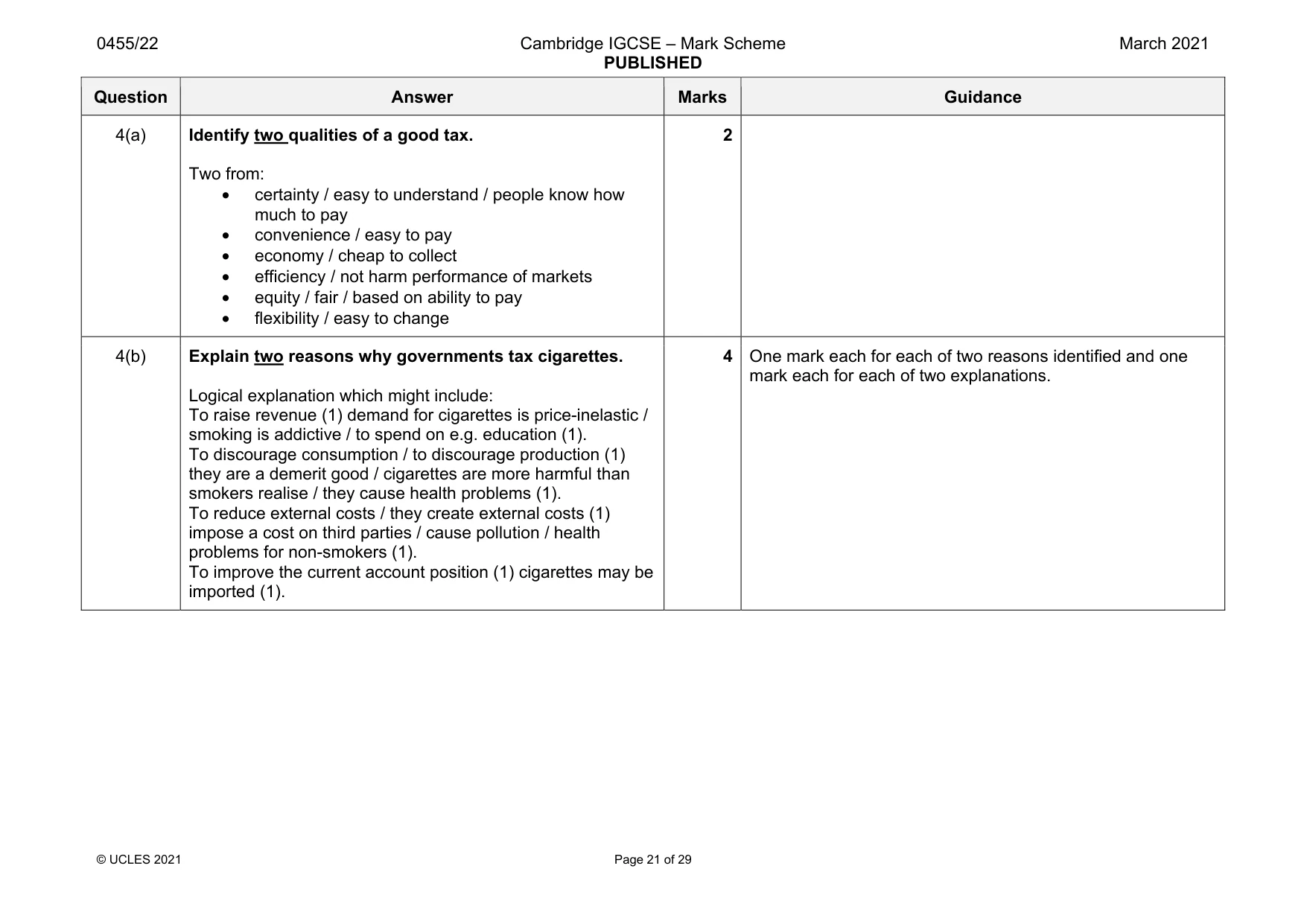
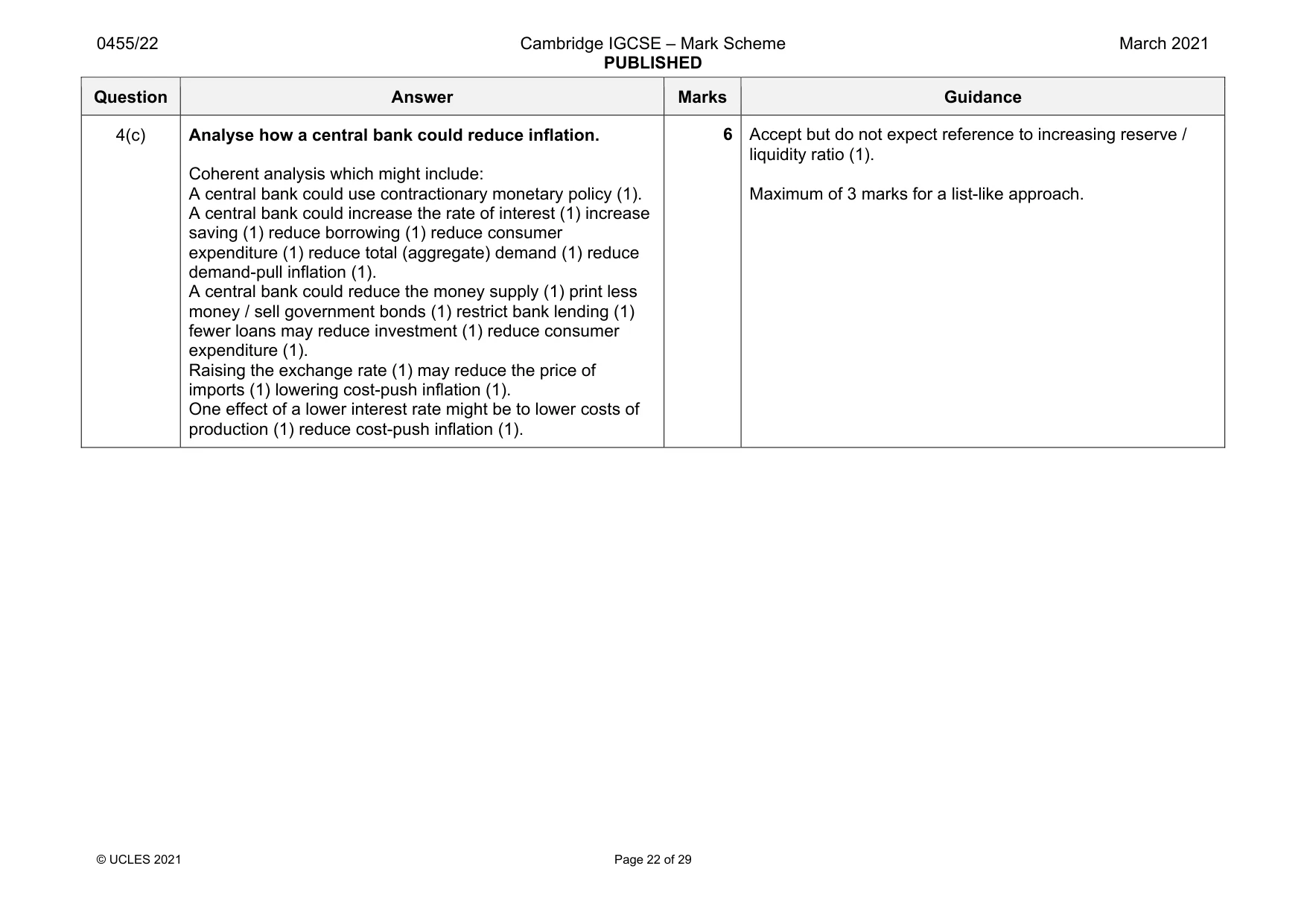
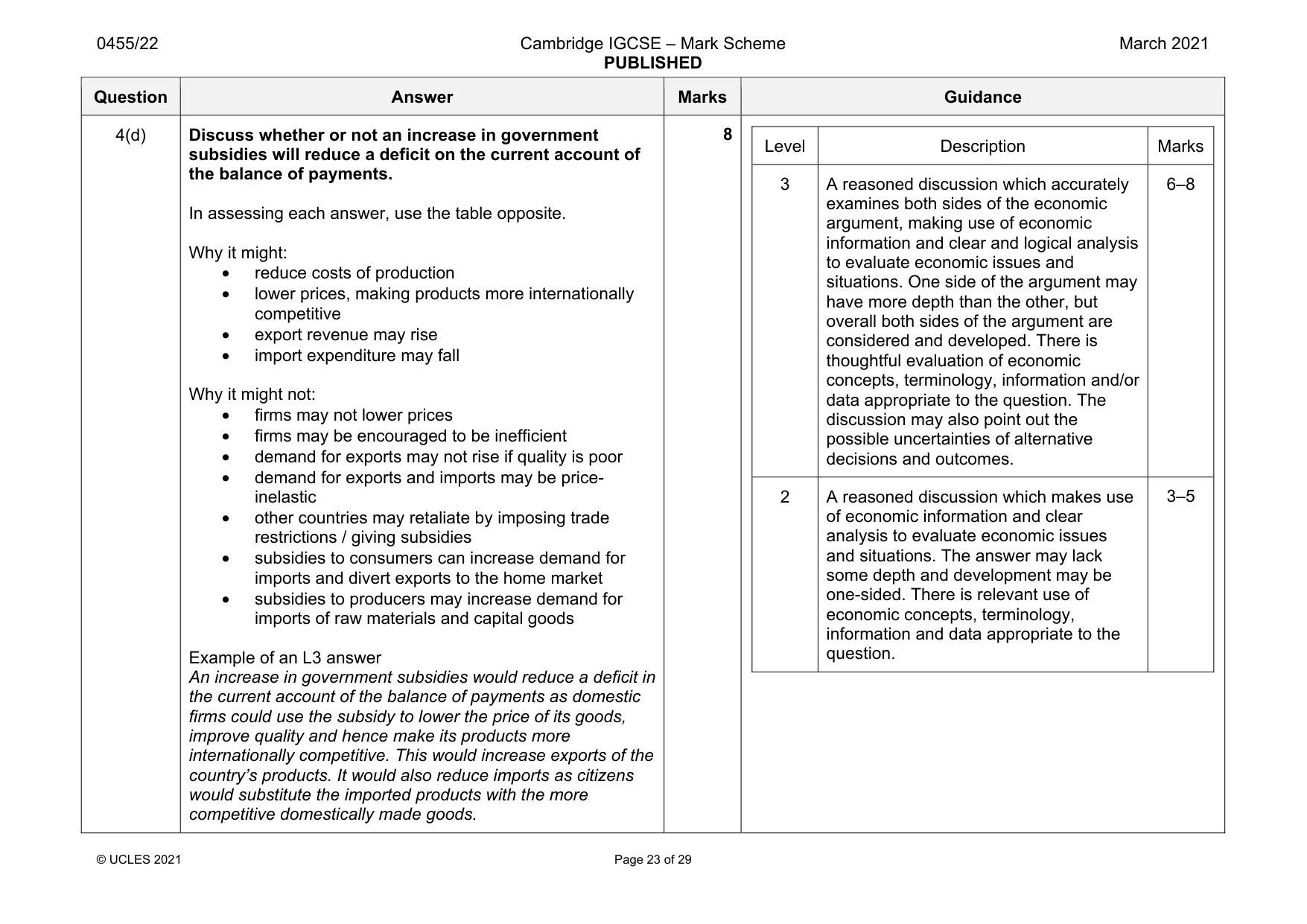
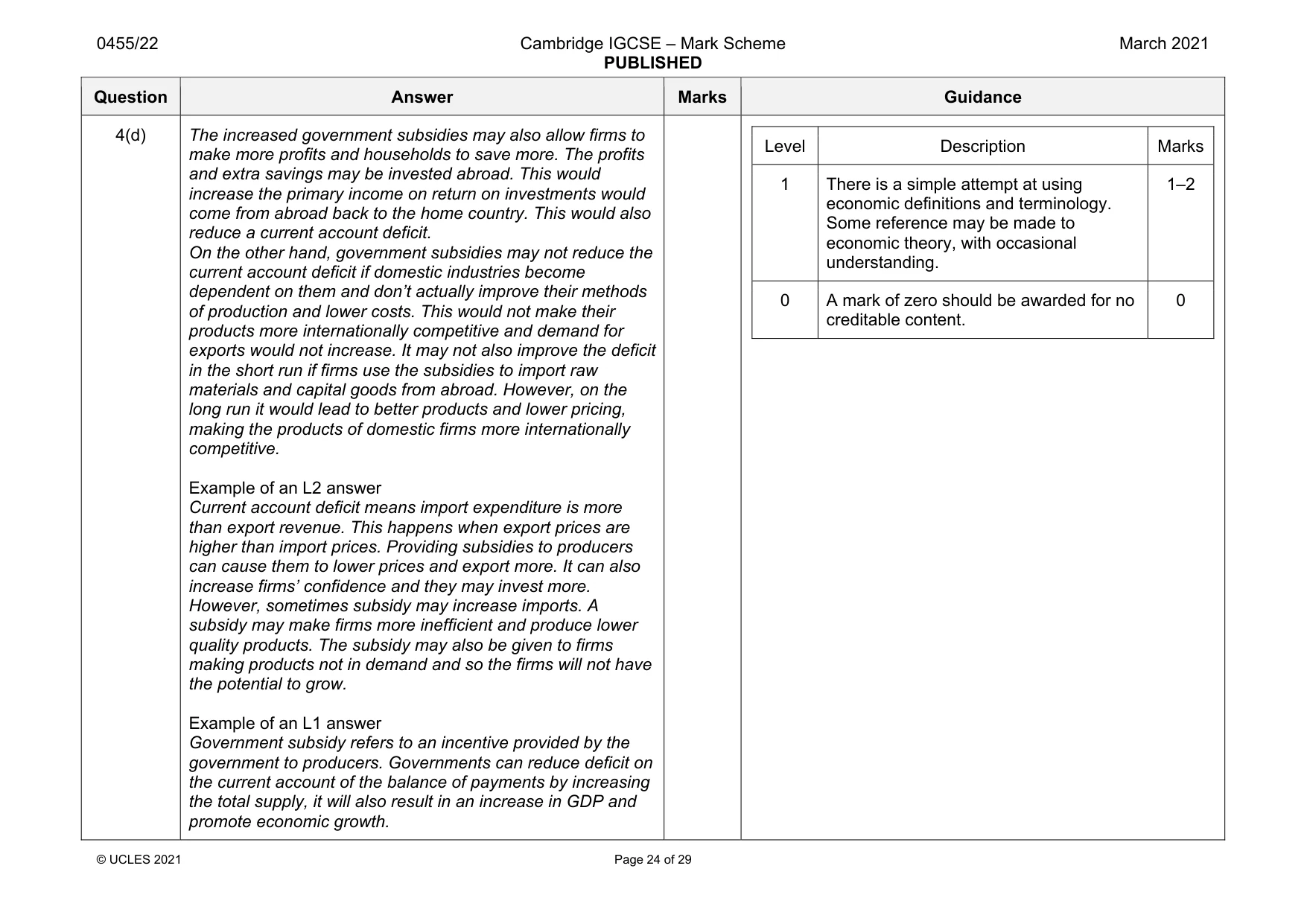
4 It is estimated that half of Egyptian men smoke. This is one of the highest rates in the world. In recent years the Egyptian government has increased the tax on cigarettes. The government and central bank have also tried to reduce inflation and improve Egypt’s international trade performance. The Egyptian government could use subsidies to reduce its deficit on the current account of its balance of payments. (a) Identify two qualities of a good tax. [2] (b) Explain two reasons why governments tax cigarettes. [4] (c) Analyse how a central bank could reduce inflation. [6] (d) Discuss whether or not an increase in government subsidies will reduce a deficit on the current account of the balance of payments. [8]
Mark scheme: 4(a) Identify two qualities of a good tax. Two from: • certainty / easy to understand / people know how much to pay • convenience / easy to pay • economy / cheap to collect • efficiency / not harm performance of markets • equity / fair / based on ability to pay • flexibility / easy to change 2 4(b) Explain two reasons why governments tax cigarettes. Logical explanation which might include: To raise revenue (1) demand for cigarettes is price-inelastic / smoking is addictive / to spend on e.g. education (1). To discourage consumption / to discourage production (1) they are a demerit good / cigarettes are more harmful than smokers realise / they cause health problems (1). To reduce external costs / they create external costs (1) impose a cost on third parties / cause pollution / health problems for non-smokers (1). To improve the current account position (1) cigarettes may be imported (1). 4 One mark each for each of two reasons identified and one mark each for each of two explanations. Question Answer Marks Guidance 4(c) Analyse how a central bank could reduce inflation. Coherent analysis which might include: A central bank could use contractionary monetary policy (1). A central bank could increase the rate of interest (1) increase saving (1) reduce borrowing (1) reduce consumer expenditure (1) reduce total (aggregate) demand (1) reduce demand-pull inflation (1). A central bank could reduce the money supply (1) print less money / sell government bonds (1) restrict bank lending (1) fewer loans may reduce investment (1) reduce consumer expenditure (1). Raising the exchange rate (1) may reduce the price of imports (1) lowering cost-push inflation (1). One effect of a lower interest rate might be to lower costs of production (1) reduce cost-push inflation (1). 6 Accept but do not expect reference to increasing reserve / liquidity ratio (1). Maximum of 3 marks for a list-like approach. Question Answer Marks Guidance 4(d) Discuss whether or not an increase in government subsidies will reduce a deficit on the current account of the balance of payments. In assessing each answer, use the table opposite. Why it might: • reduce costs of production • lower prices, making products more internationally competitive • export revenue may rise • import expenditure may fall Why it might not: • firms may not lower prices • firms may be encouraged to be inefficient • demand for exports may not rise if quality is poor • demand for exports and imports may be price- inelastic • other countries may retaliate by imposing trade restrictions / giving subsidies • subsidies to consumers can increase demand for imports and divert exports to the home market • subsidies to producers may increase demand for imports of raw materials and capital goods Example of an L3 answer An increase in government subsidies would reduce a deficit in the current account of the balance of payments as domestic firms could use the subsidy to lower the price of its goods, improve quality and hence make its products more internationally competitive. This would increase exports of the country’s products. It would also reduce imports as citizens would substitute the imported products with the more competitive domestically made goods. 8 Level Description Marks 3 A reasoned discussion which accurately examines both sides of the economic argument, making use of economic information and clear and logical analysis to evaluate economic issues and situations. One side of the argument may have more depth than the other, but overall both sides of the argument are considered and developed. There is thoughtful evaluation of economic concepts, terminology, information and/or data appropriate to the question. The discussion may also point out the possible uncertainties of alternative decisions and outcomes. 6–8 2 A reasoned discussion which makes use of economic information and clear analysis to evaluate economic issues and situations. The answer may lack some depth and development may be one-sided. There is relevant use of economic concepts, terminology, information and data appropriate to the question. 3–5 Question Answer Marks Guidance 4(d) The increased government subsidies may also allow firms to make more profits and households to save more. The profits and extra savings may be invested abroad. This would increase the primary income on return on investments would come from abroad back to the home country. This would also reduce a current account deficit. On the other hand, government subsidies may not reduce the current account deficit if domestic industries become dependent on them and don’t actually improve their methods of production and lower costs. This would not make their products more internationally competitive and demand for exports would not increase. It may not also improve the deficit in the short run if firms use the subsidies to import raw materials and capital goods from abroad. However, on the long run it would lead to better products and lower pricing, making the products of domestic firms more internationally competitive. Example of an L2 answer Current account deficit means import expenditure is more than export revenue. This happens when export prices are higher than import prices. Providing subsidies to producers can cause them to lower prices and export more. It can also increase firms’ confidence and they may invest more. However, sometimes subsidy may increase imports. A subsidy may make firms more inefficient and produce lower quality products. The subsidy may also be given to firms making products not in demand and so the firms will not have the potential to grow. Example of an L1 answer Government subsidy refers to an incentive provided by the government to producers. Governments can reduce deficit on the current account of the balance of payments by increasing the total supply, it will also result in an increase in GDP and promote economic growth. Level Description Marks 1 There is a simple attempt at using economic definitions and terminology. Some reference may be made to economic theory, with occasional understanding. 1–2 0 A mark of zero should be awarded for no creditable content. 0
Q5 · Sweden has a mixed economic system
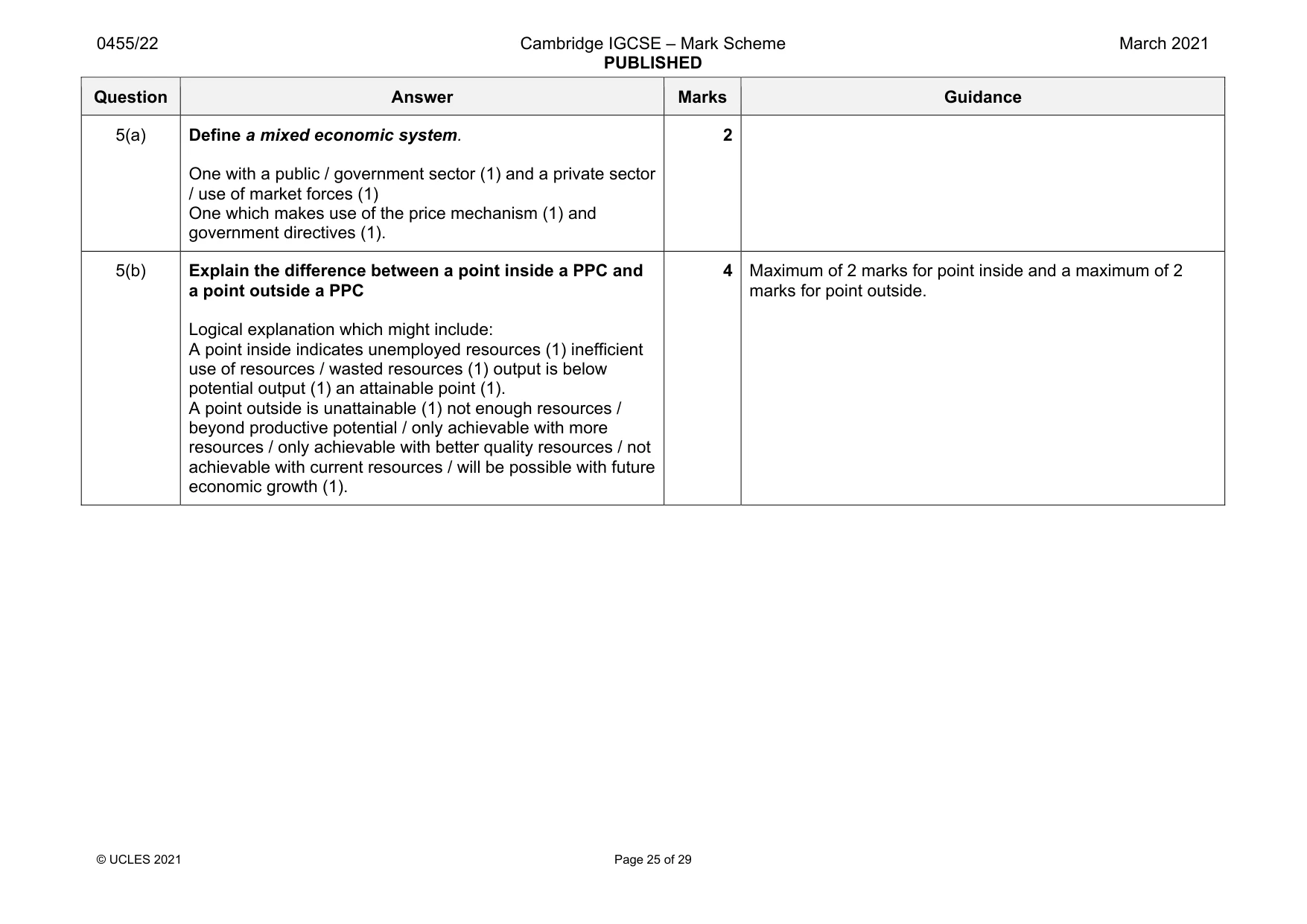
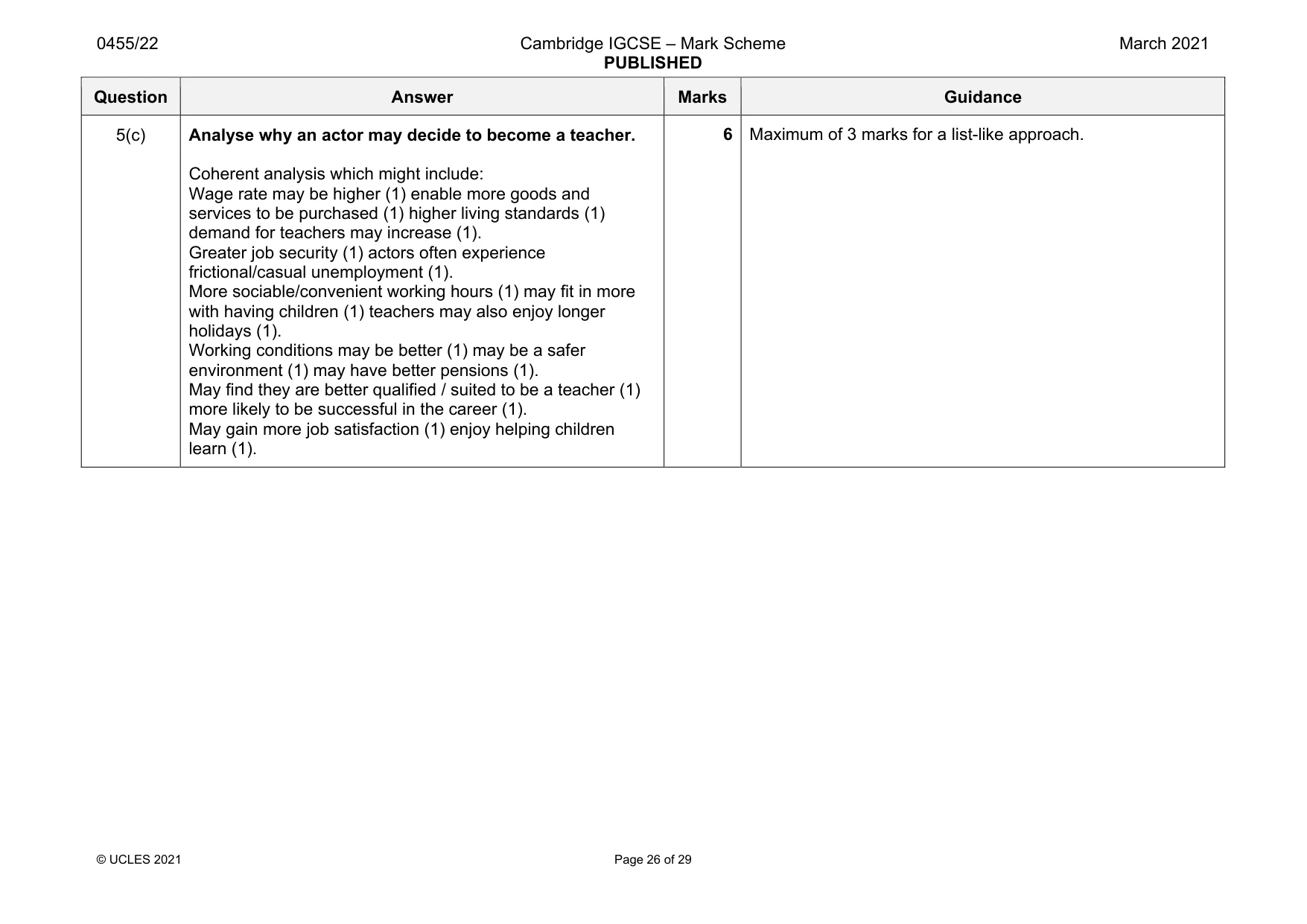
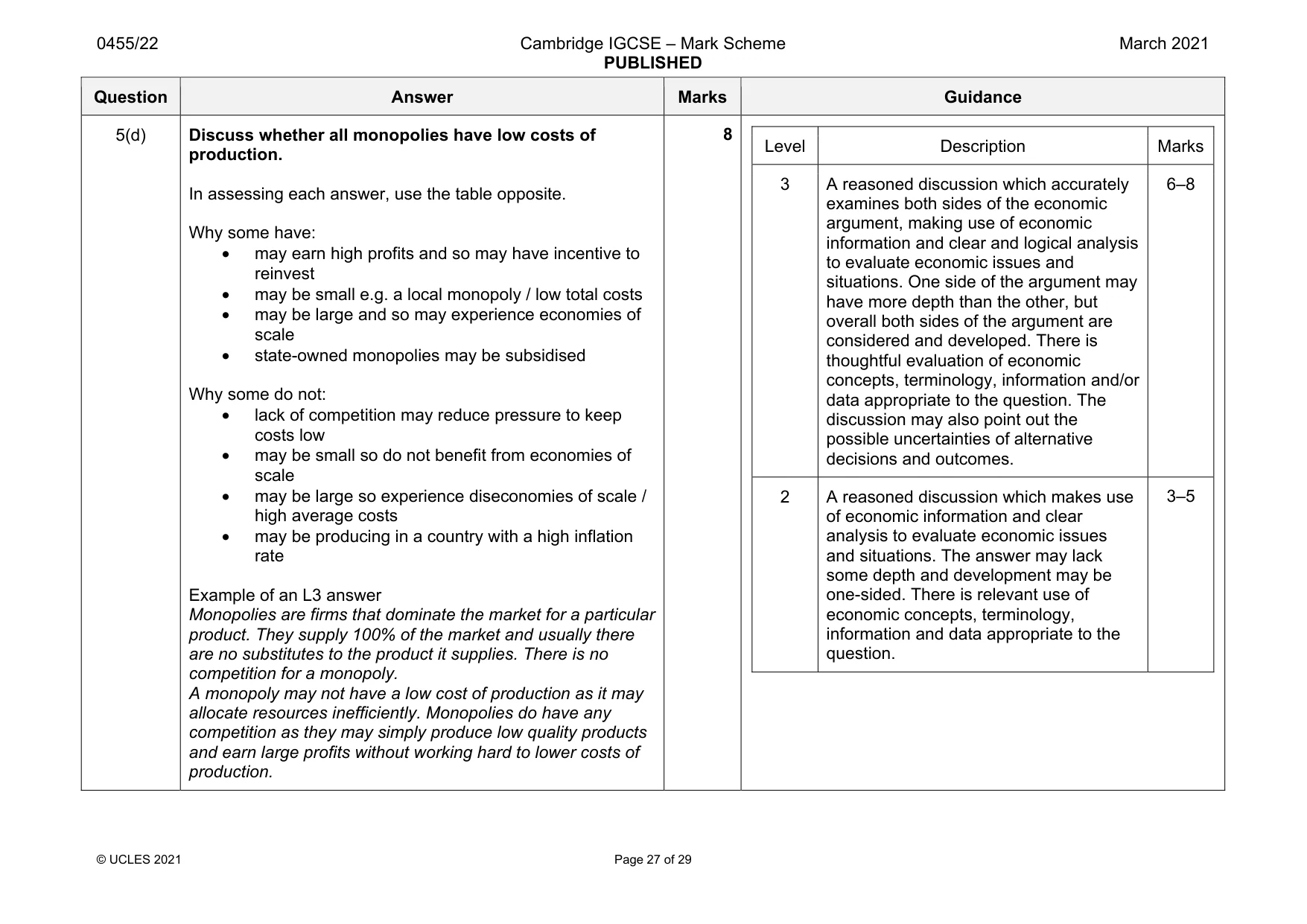
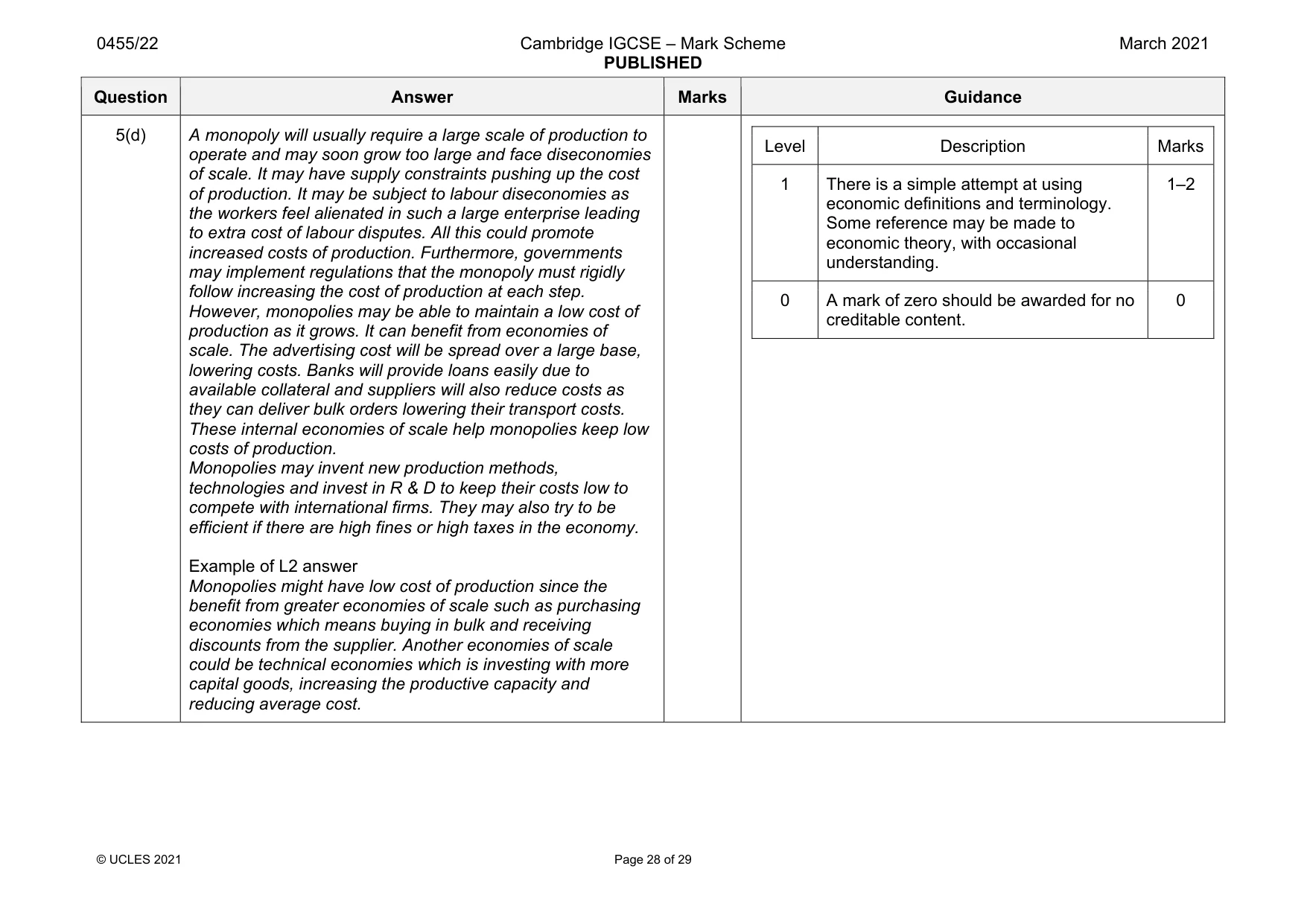
5 Sweden has a mixed economic system. In 2018, it was operating at a point inside its production possibility curve (PPC). In 2018, the country’s schools employed nearly 2500 extra teachers. A few of these had previously been actors. A higher number had previously been government officials involved with regulation of Swedish monopolies. (a) Define a mixed economic system. [2] (b) Explain the difference between a point inside a PPC and a point outside a PPC. [4] (c) Analyse why an actor may decide to become a teacher. [6] (d) Discuss whether all monopolies have low costs of production. [8]
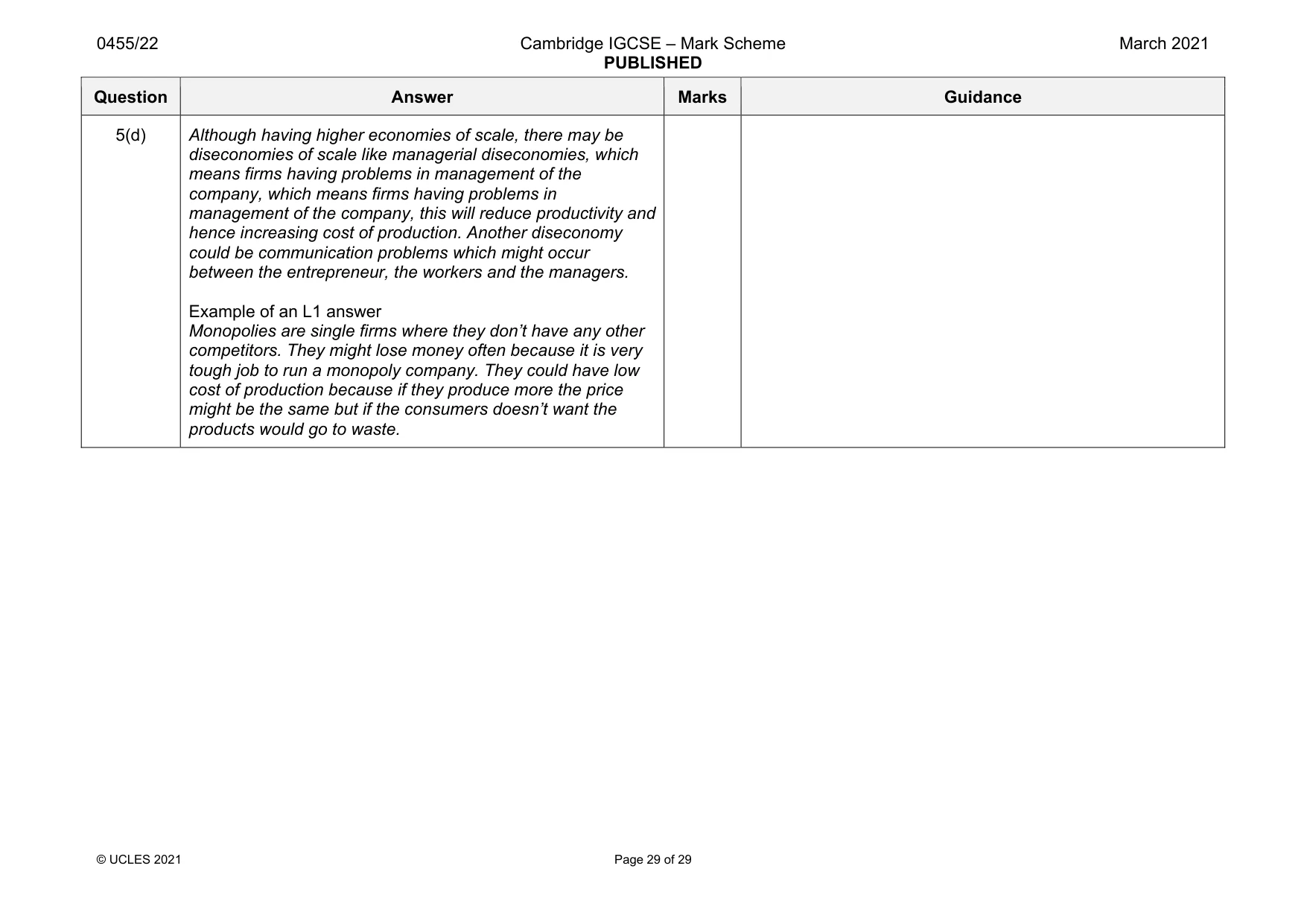
Mark scheme: 5(a) Define a mixed economic system. One with a public / government sector (1) and a private sector / use of market forces (1) One which makes use of the price mechanism (1) and government directives (1). 2 5(b) Explain the difference between a point inside a PPC and a point outside a PPC Logical explanation which might include: A point inside indicates unemployed resources (1) inefficient use of resources / wasted resources (1) output is below potential output (1) an attainable point (1). A point outside is unattainable (1) not enough resources / beyond productive potential / only achievable with more resources / only achievable with better quality resources / not achievable with current resources / will be possible with future economic growth (1). 4 Maximum of 2 marks for point inside and a maximum of 2 marks for point outside. Question Answer Marks Guidance 5(c) Analyse why an actor may decide to become a teacher. Coherent analysis which might include: Wage rate may be higher (1) enable more goods and services to be purchased (1) higher living standards (1) demand for teachers may increase (1). Greater job security (1) actors often experience frictional/casual unemployment (1). More sociable/convenient working hours (1) may fit in more with having children (1) teachers may also enjoy longer holidays (1). Working conditions may be better (1) may be a safer environment (1) may have better pensions (1). May find they are better qualified / suited to be a teacher (1) more likely to be successful in the career (1). May gain more job satisfaction (1) enjoy helping children learn (1). 6 Maximum of 3 marks for a list-like approach. Question Answer Marks Guidance 5(d) Discuss whether all monopolies have low costs of production. In assessing each answer, use the table opposite. Why some have: • may earn high profits and so may have incentive to reinvest • may be small e.g. a local monopoly / low total costs • may be large and so may experience economies of scale • state-owned monopolies may be subsidised Why some do not: • lack of competition may reduce pressure to keep costs low • may be small so do not benefit from economies of scale • may be large so experience diseconomies of scale / high average costs • may be producing in a country with a high inflation rate Example of an L3 answer Monopolies are firms that dominate the market for a particular product. They supply 100% of the market and usually there are no substitutes to the product it supplies. There is no competition for a monopoly. A monopoly may not have a low cost of production as it may allocate resources inefficiently. Monopolies do have any competition as they may simply produce low quality products and earn large profits without working hard to lower costs of production. 8 Level Description Marks 3 A reasoned discussion which accurately examines both sides of the economic argument, making use of economic information and clear and logical analysis to evaluate economic issues and situations. One side of the argument may have more depth than the other, but overall both sides of the argument are considered and developed. There is thoughtful evaluation of economic concepts, terminology, information and/or data appropriate to the question. The discussion may also point out the possible uncertainties of alternative decisions and outcomes. 6–8 2 A reasoned discussion which makes use of economic information and clear analysis to evaluate economic issues and situations. The answer may lack some depth and development may be one-sided. There is relevant use of economic concepts, terminology, information and data appropriate to the question. 3–5 Question Answer Marks Guidance 5(d) A monopoly will usually require a large scale of production to operate and may soon grow too large and face diseconomies of scale. It may have supply constraints pushing up the cost of production. It may be subject to labour diseconomies as the workers feel alienated in such a large enterprise leading to extra cost of labour disputes. All this could promote increased costs of production. Furthermore, governments may implement regulations that the monopoly must rigidly follow increasing the cost of production at each step. However, monopolies may be able to maintain a low cost of production as it grows. It can benefit from economies of scale. The advertising cost will be spread over a large base, lowering costs. Banks will provide loans easily due to available collateral and suppliers will also reduce costs as they can deliver bulk orders lowering their transport costs. These internal economies of scale help monopolies keep low costs of production. Monopolies may invent new production methods, technologies and invest in R & D to keep their costs low to compete with international firms. They may also try to be efficient if there are high fines or high taxes in the economy. Example of L2 answer Monopolies might have low cost of production since the benefit from greater economies of scale such as purchasing economies which means buying in bulk and receiving discounts from the supplier. Another economies of scale could be technical economies which is investing with more capital goods, increasing the productive capacity and reducing average cost. Level Description Marks 1 There is a simple attempt at using economic definitions and terminology. Some reference may be made to economic theory, with occasional understanding. 1–2 0 A mark of zero should be awarded for no creditable content. 0 Question Answer Marks Guidance 5(d) Although having higher economies of scale, there may be diseconomies of scale like managerial diseconomies, which means firms having problems in management of the company, which means firms having problems in management of the company, this will reduce productivity and hence increasing cost of production. Another diseconomy could be communication problems which might occur between the entrepreneur, the workers and the managers. Example of an L1 answer Monopolies are single firms where they don’t have any other competitors. They might lose money often because it is very tough job to run a monopoly company. They could have low cost of production because if they produce more the price might be the same but if the consumers doesn’t want the products would go to waste.
What was in this paper
The subtopics covered by these 5 questions, and how many questions each got. Open one in a new tab to see every Cambridge question on it.
What you needed in this session
Cambridge’s own grade thresholds for 2021 Feb/March, Paper 2 · Variant 2. A higher threshold means an easier paper — the bar moves with how the cohort did.