Cambridge IGCSE Economics 0455 — 2021 May/June Paper 2 · Variant 3
0455/23/M/J/21 · 5 questions · 90 marks · ≈101 min
The question paper and its mark scheme, free to read here and free to download. This is Cambridge’s own paper, exactly as it was sat.
Question paper8 pages




Mark scheme27 pages
Answers below. Sit the paper first if you are practising.






Questions as text
Q1 · Calculate, in $s, the contribution of the fishing industry to Morocco’s GDP in 2017
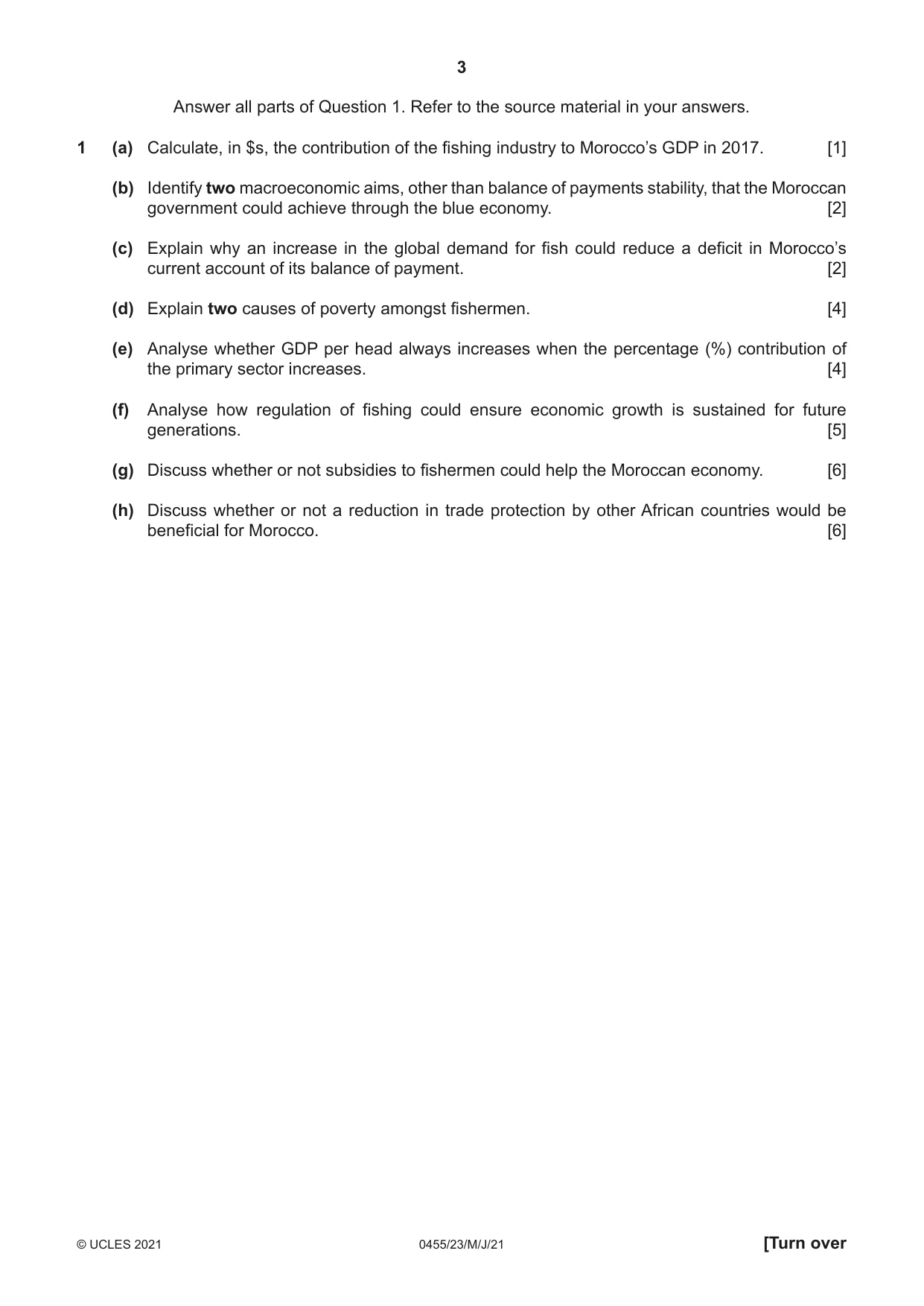
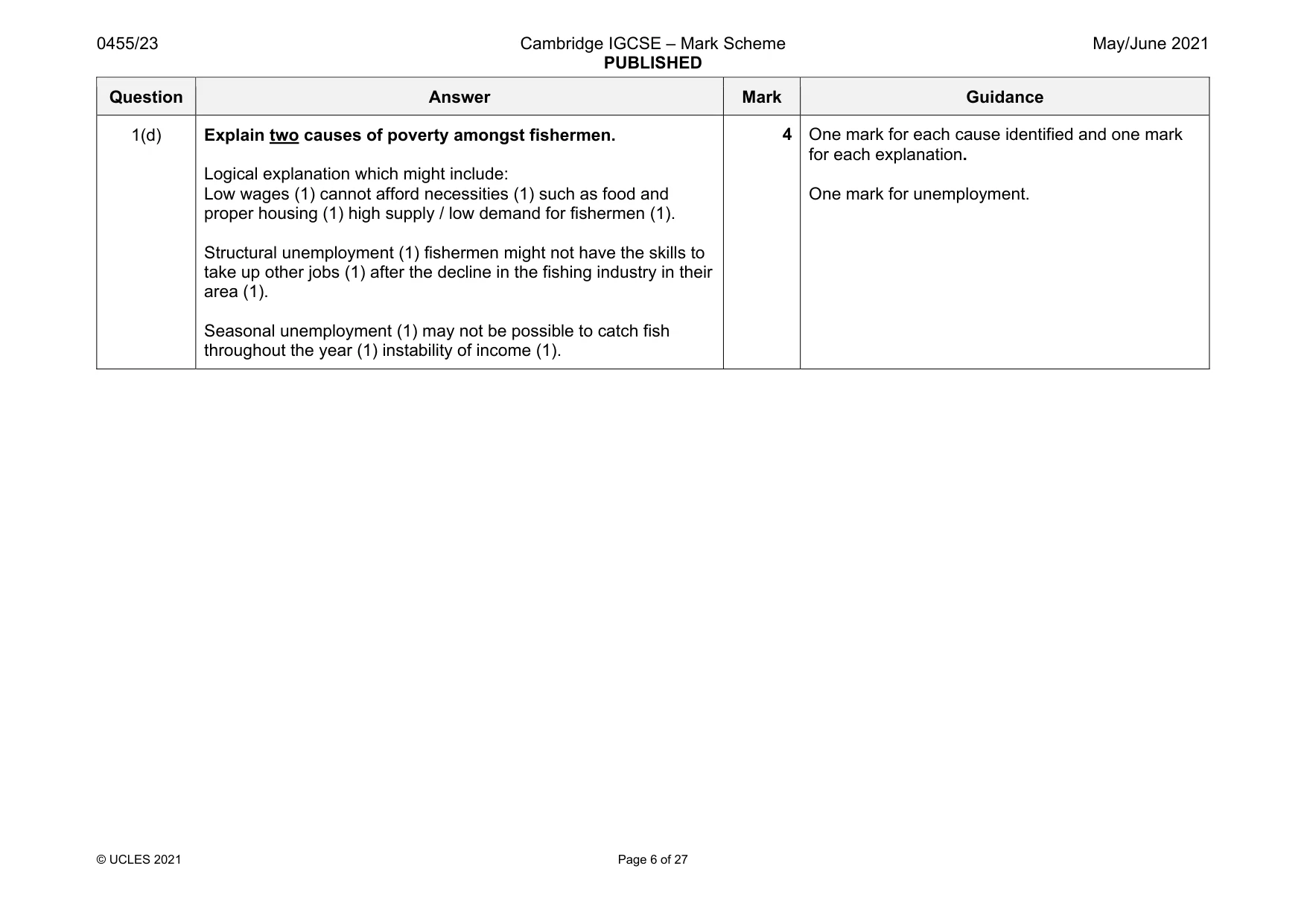
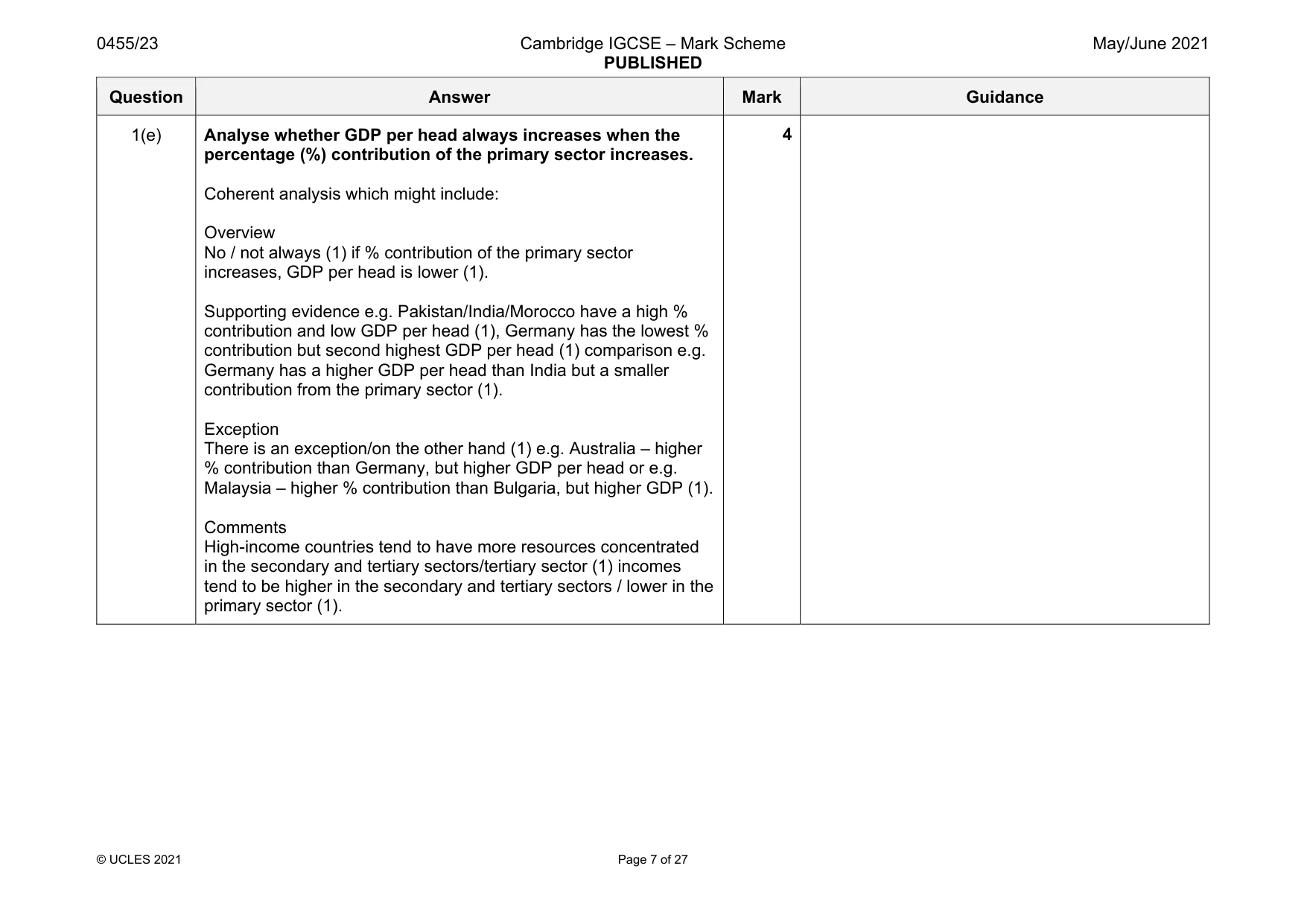
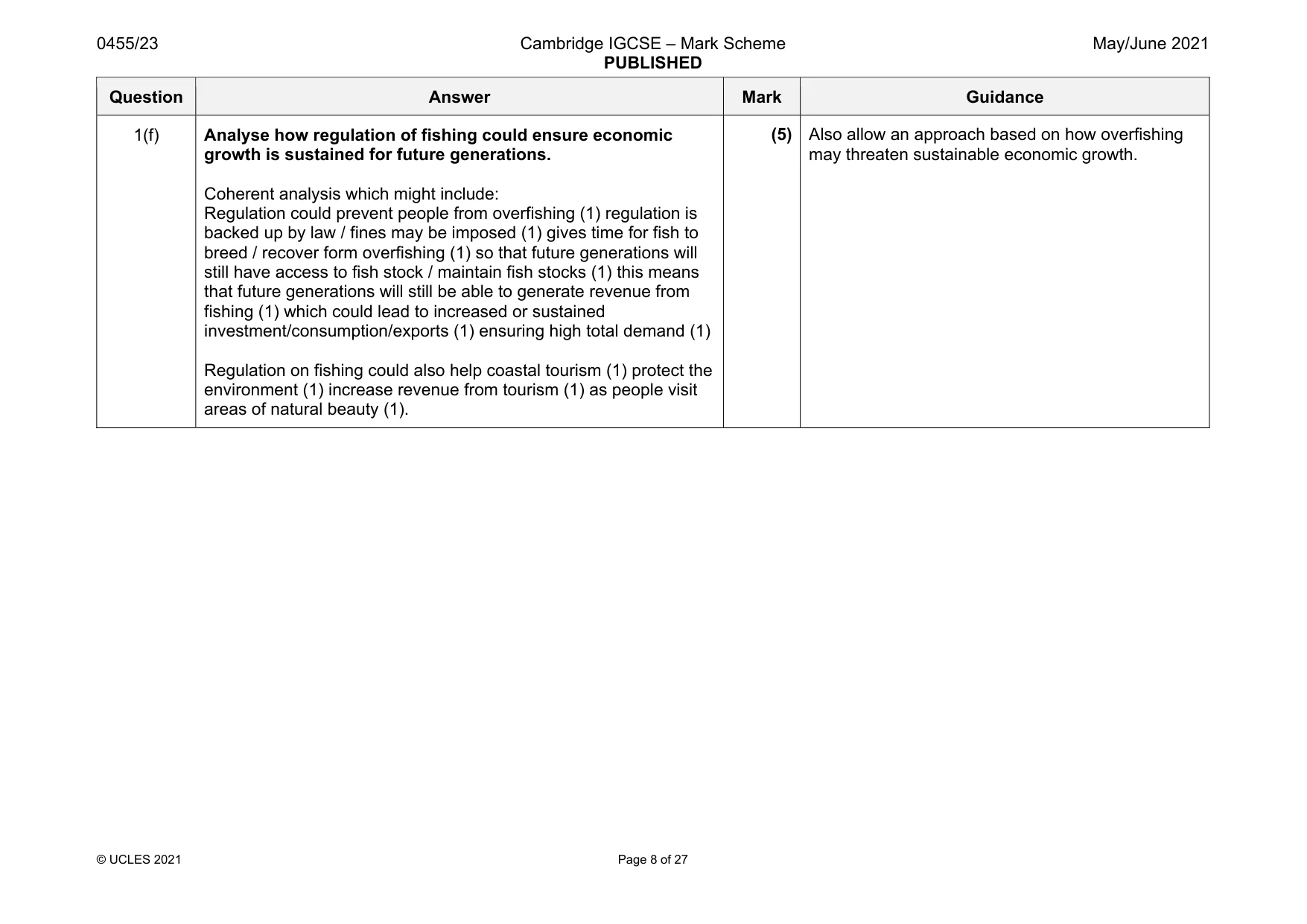
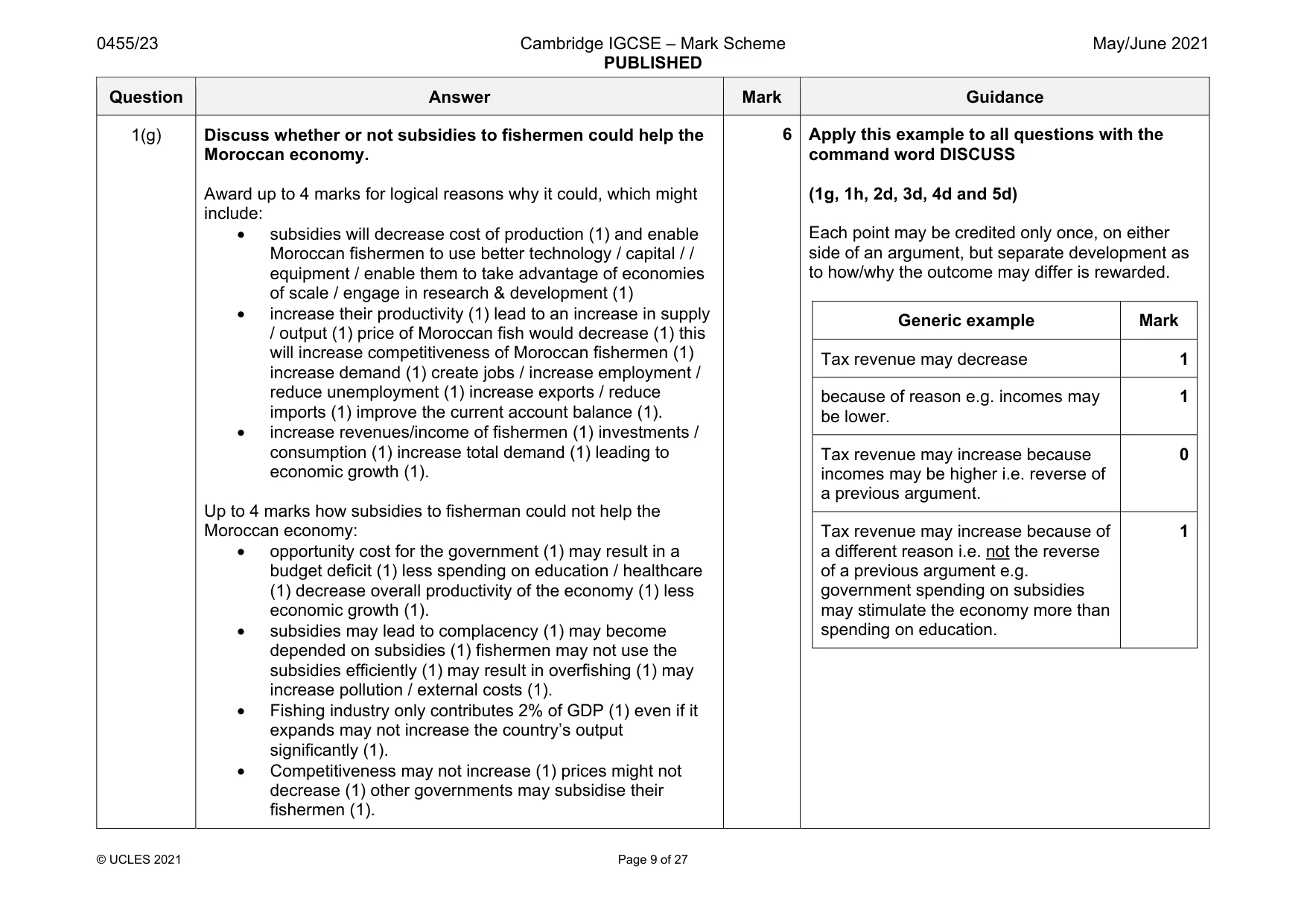
1 (a) Calculate, in $s, the contribution of the fishing industry to Morocco’s GDP in 2017. [1] (b) Identify two macroeconomic aims, other than balance of payments stability, that the Moroccan government could achieve through the blue economy. [2] (c) Explain why an increase in the global demand for fish could reduce a deficit in Morocco’s current account of its balance of payment. [2] (d) Explain two causes of poverty amongst fishermen. [4] (e) Analyse whether GDP per head always increases when the percentage (%) contribution of the primary sector increases. [4] (f) Analyse how regulation of fishing could ensure economic growth is sustained for future generations. [5] (g) Discuss whether or not subsidies to fishermen could help the Moroccan economy. [6] (h) Discuss whether or not a reduction in trade protection by other African countries would be beneficial for Morocco. [6]
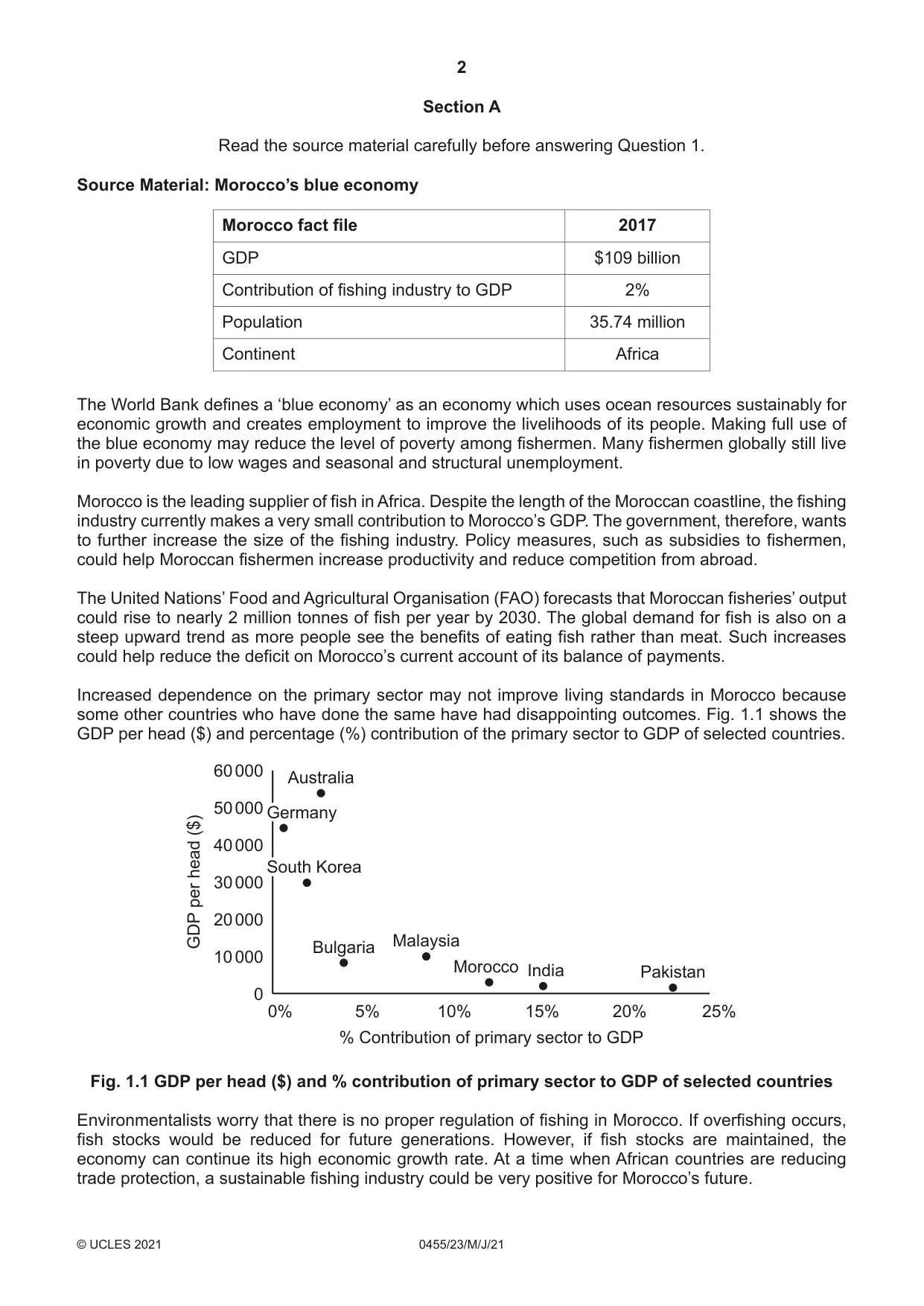
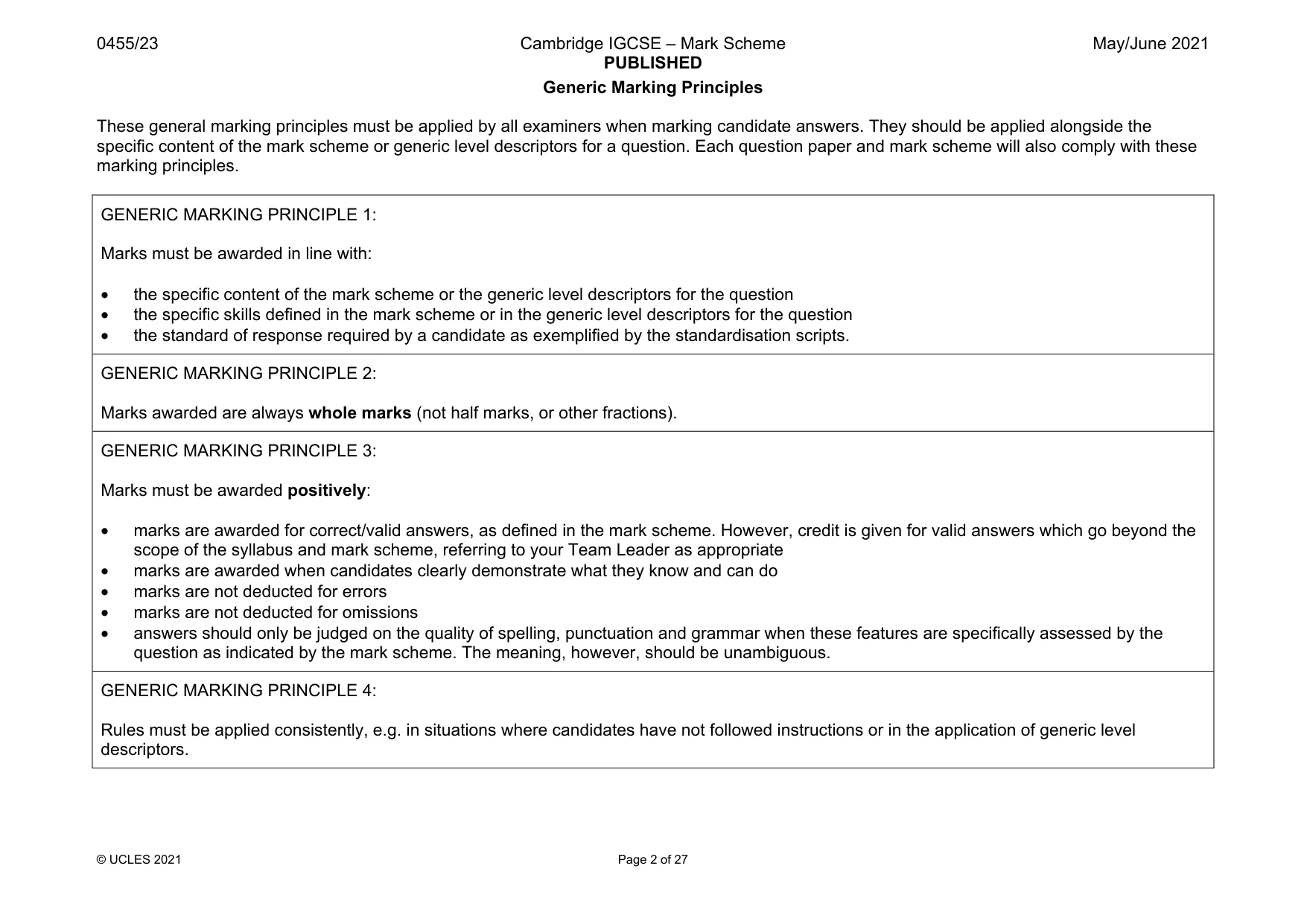
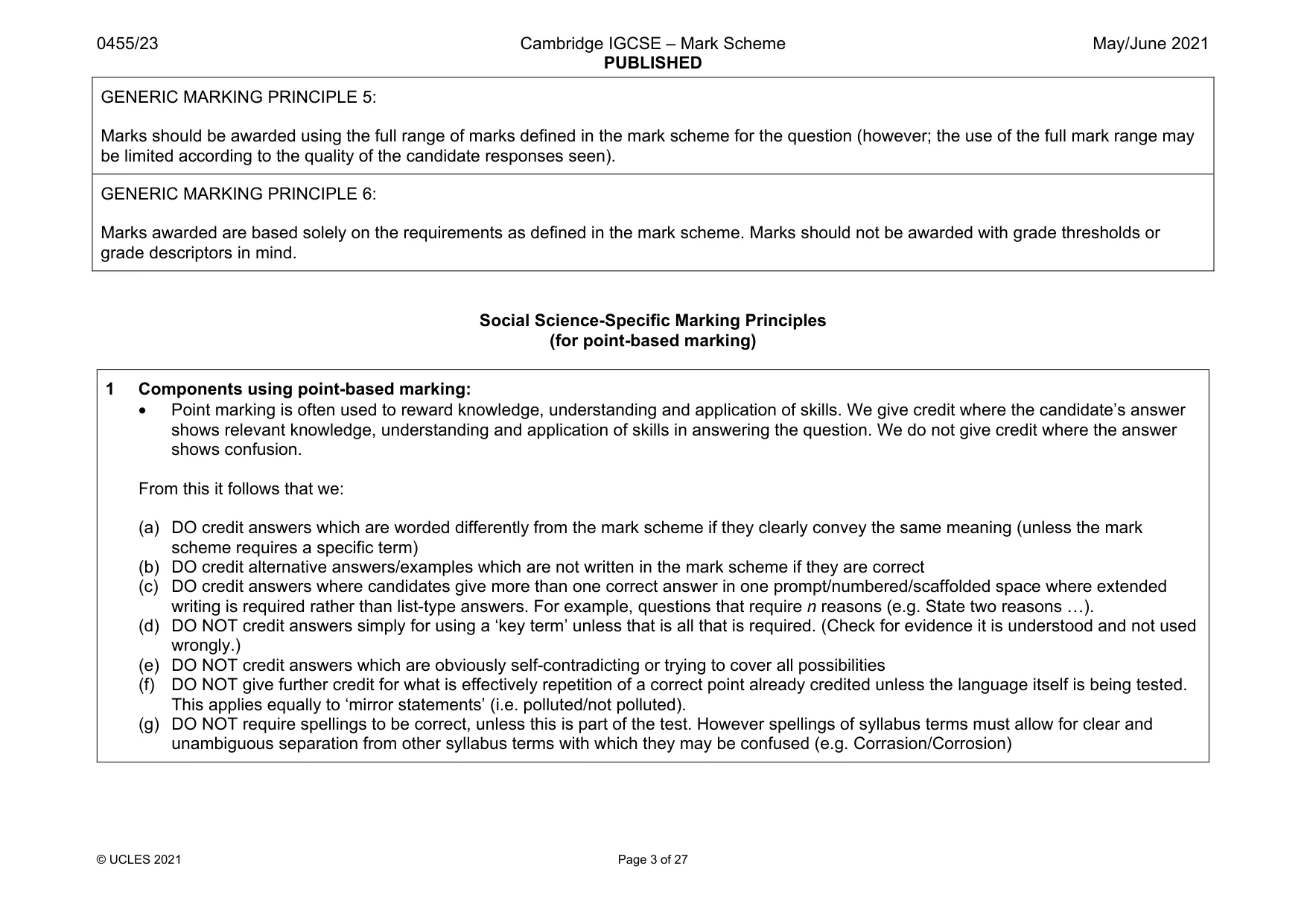
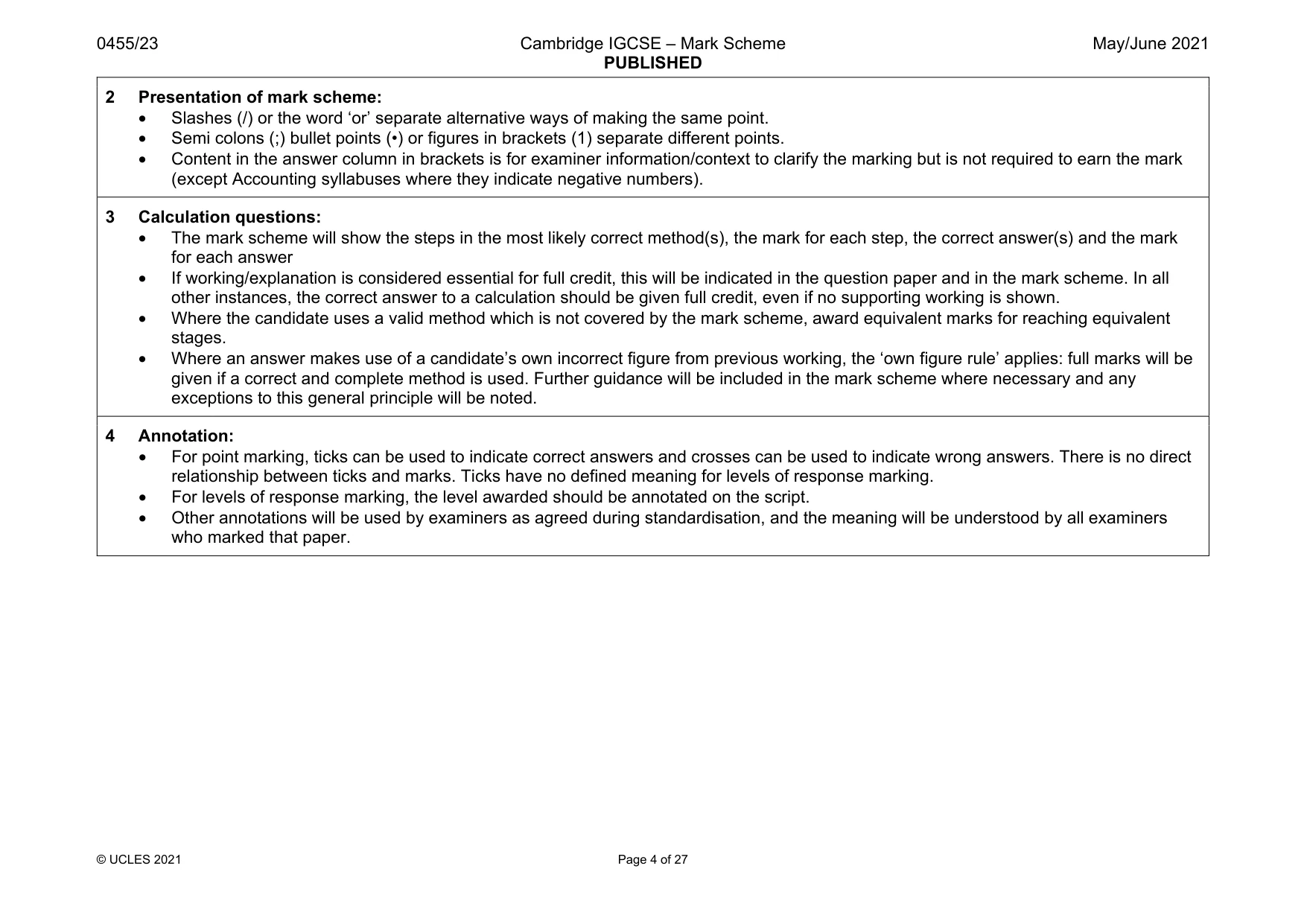
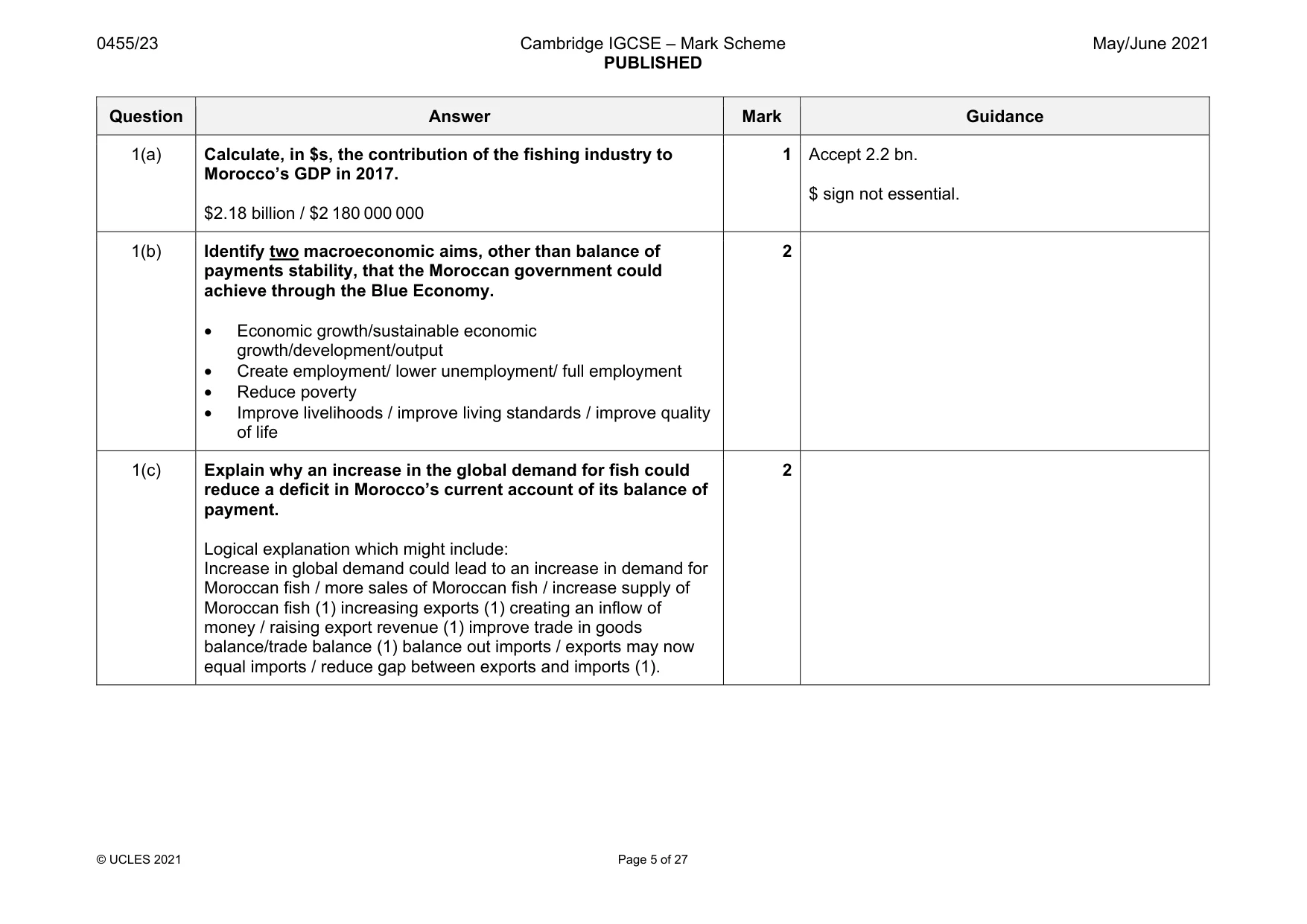
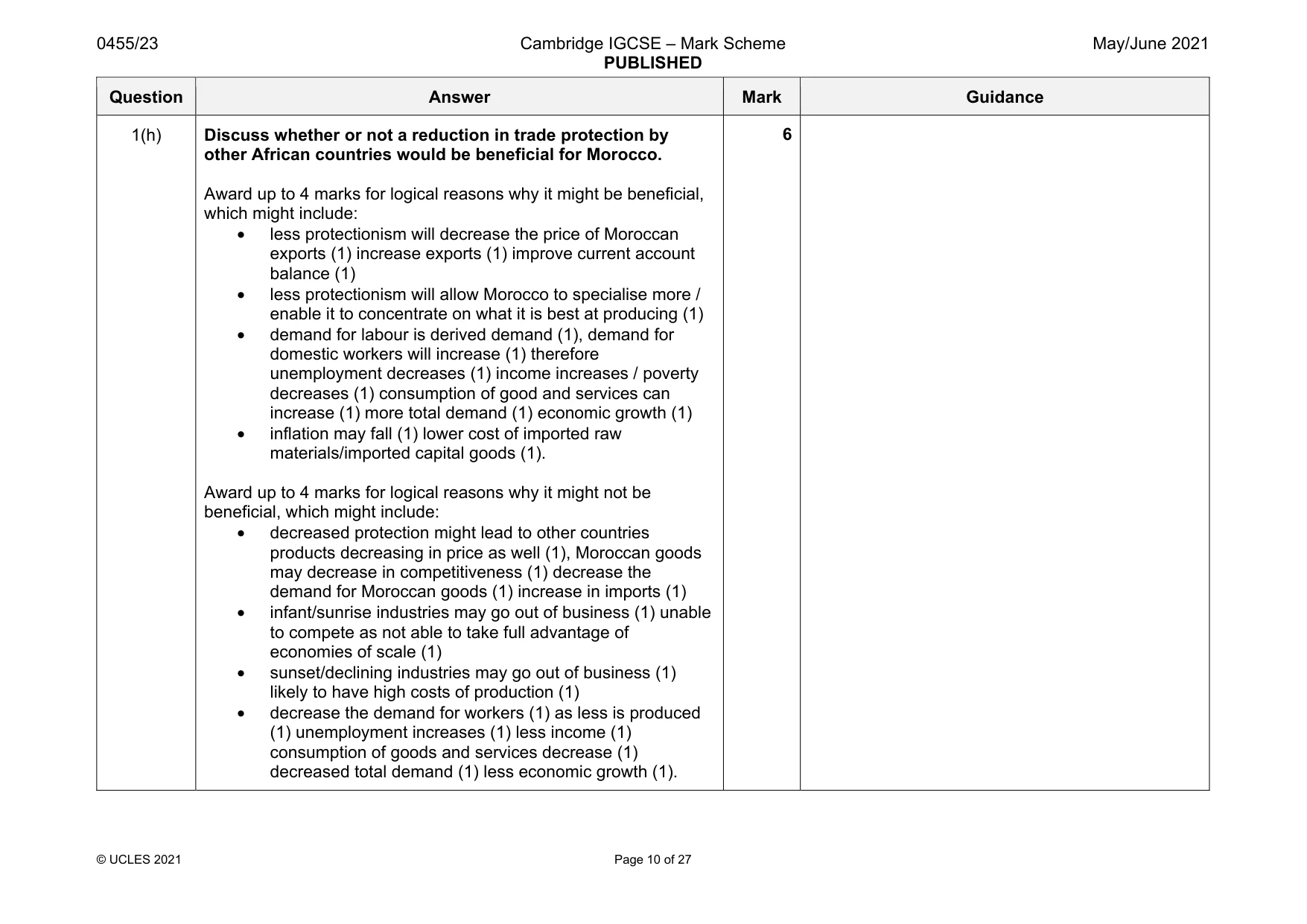
Mark scheme: 1(a) Calculate, in $s, the contribution of the fishing industry to Morocco’s GDP in 2017. $2.18 billion / $2 180 000 000 1 Accept 2.2 bn. $ sign not essential. 1(b) Identify two macroeconomic aims, other than balance of payments stability, that the Moroccan government could achieve through the Blue Economy. • Economic growth/sustainable economic growth/development/output • Create employment/ lower unemployment/ full employment • Reduce poverty • Improve livelihoods / improve living standards / improve quality of life 2 1(c) Explain why an increase in the global demand for fish could reduce a deficit in Morocco’s current account of its balance of payment. Logical explanation which might include: Increase in global demand could lead to an increase in demand for Moroccan fish / more sales of Moroccan fish / increase supply of Moroccan fish (1) increasing exports (1) creating an inflow of money / raising export revenue (1) improve trade in goods balance/trade balance (1) balance out imports / exports may now equal imports / reduce gap between exports and imports (1). 2 Question Answer Mark Guidance 1(d) Explain two causes of poverty amongst fishermen. Logical explanation which might include: Low wages (1) cannot afford necessities (1) such as food and proper housing (1) high supply / low demand for fishermen (1). Structural unemployment (1) fishermen might not have the skills to take up other jobs (1) after the decline in the fishing industry in their area (1). Seasonal unemployment (1) may not be possible to catch fish throughout the year (1) instability of income (1). 4 One mark for each cause identified and one mark for each explanation. One mark for unemployment. Question Answer Mark Guidance 1(e) Analyse whether GDP per head always increases when the percentage (%) contribution of the primary sector increases. Coherent analysis which might include: Overview No / not always (1) if % contribution of the primary sector increases, GDP per head is lower (1). Supporting evidence e.g. Pakistan/India/Morocco have a high % contribution and low GDP per head (1), Germany has the lowest % contribution but second highest GDP per head (1) comparison e.g. Germany has a higher GDP per head than India but a smaller contribution from the primary sector (1). Exception There is an exception/on the other hand (1) e.g. Australia – higher % contribution than Germany, but higher GDP per head or e.g. Malaysia – higher % contribution than Bulgaria, but higher GDP (1). Comments High-income countries tend to have more resources concentrated in the secondary and tertiary sectors/tertiary sector (1) incomes tend to be higher in the secondary and tertiary sectors / lower in the primary sector (1). 4 Question Answer Mark Guidance 1(f) Analyse how regulation of fishing could ensure economic growth is sustained for future generations. Coherent analysis which might include: Regulation could prevent people from overfishing (1) regulation is backed up by law / fines may be imposed (1) gives time for fish to breed / recover form overfishing (1) so that future generations will still have access to fish stock / maintain fish stocks (1) this means that future generations will still be able to generate revenue from fishing (1) which could lead to increased or sustained investment/consumption/exports (1) ensuring high total demand (1) Regulation on fishing could also help coastal tourism (1) protect the environment (1) increase revenue from tourism (1) as people visit areas of natural beauty (1). (5) Also allow an approach based on how overfishing may threaten sustainable economic growth. Question Answer Mark Guidance 1(g) Discuss whether or not subsidies to fishermen could help the Moroccan economy. Award up to 4 marks for logical reasons why it could, which might include: • subsidies will decrease cost of production (1) and enable Moroccan fishermen to use better technology / capital / / equipment / enable them to take advantage of economies of scale / engage in research & development (1) • increase their productivity (1) lead to an increase in supply / output (1) price of Moroccan fish would decrease (1) this will increase competitiveness of Moroccan fishermen (1) increase demand (1) create jobs / increase employment / reduce unemployment (1) increase exports / reduce imports (1) improve the current account balance (1). • increase revenues/income of fishermen (1) investments / consumption (1) increase total demand (1) leading to economic growth (1). Up to 4 marks how subsidies to fisherman could not help the Moroccan economy: • opportunity cost for the government (1) may result in a budget deficit (1) less spending on education / healthcare (1) decrease overall productivity of the economy (1) less economic growth (1). • subsidies may lead to complacency (1) may become depended on subsidies (1) fishermen may not use the subsidies efficiently (1) may result in overfishing (1) may increase pollution / external costs (1). • Fishing industry only contributes 2% of GDP (1) even if it expands may not increase the country’s output significantly (1). • Competitiveness may not increase (1) prices might not decrease (1) other governments may subsidise their fishermen (1). 6 Apply this example to all questions with the command word DISCUSS (1g, 1h, 2d, 3d, 4d and 5d) Each point may be credited only once, on either side of an argument, but separate development as to how/why the outcome may differ is rewarded. Generic example Mark Tax revenue may decrease 1 because of reason e.g. incomes may be lower. 1 Tax revenue may increase because incomes may be higher i.e. reverse of a previous argument. 0 Tax revenue may increase because of a different reason i.e. not the reverse of a previous argument e.g. government spending on subsidies may stimulate the economy more than spending on education. 1 Question Answer Mark Guidance 1(h) Discuss whether or not a reduction in trade protection by other African countries would be beneficial for Morocco. Award up to 4 marks for logical reasons why it might be beneficial, which might include: • less protectionism will decrease the price of Moroccan exports (1) increase exports (1) improve current account balance (1) • less protectionism will allow Morocco to specialise more / enable it to concentrate on what it is best at producing (1) • demand for labour is derived demand (1), demand for domestic workers will increase (1) therefore unemployment decreases (1) income increases / poverty decreases (1) consumption of good and services can increase (1) more total demand (1) economic growth (1) • inflation may fall (1) lower cost of imported raw materials/imported capital goods (1). Award up to 4 marks for logical reasons why it might not be beneficial, which might include: • decreased protection might lead to other countries products decreasing in price as well (1), Moroccan goods may decrease in competitiveness (1) decrease the demand for Moroccan goods (1) increase in imports (1) • infant/sunrise industries may go out of business (1) unable to compete as not able to take full advantage of economies of scale (1) • sunset/declining industries may go out of business (1) likely to have high costs of production (1) • decrease the demand for workers (1) as less is produced (1) unemployment increases (1) less income (1) consumption of goods and services decrease (1) decreased total demand (1) less economic growth (1). 6
Q2 · Latvia is one of the fastest growing economies in Europe
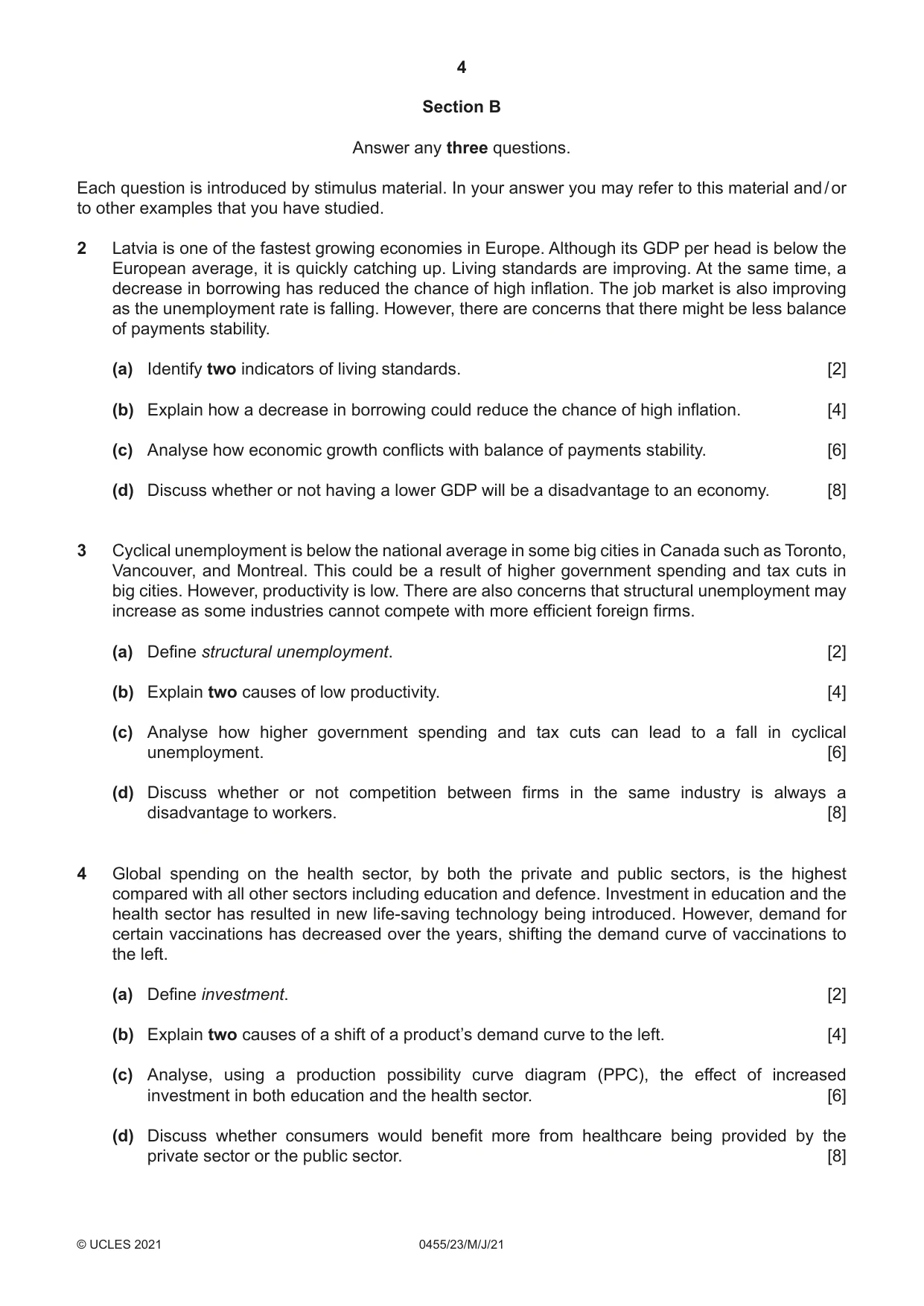
2 Latvia is one of the fastest growing economies in Europe. Although its GDP per head is below the European average, it is quickly catching up. Living standards are improving. At the same time, a decrease in borrowing has reduced the chance of high inflation. The job market is also improving as the unemployment rate is falling. However, there are concerns that there might be less balance of payments stability. (a) Identify two indicators of living standards. [2] (b) Explain how a decrease in borrowing could reduce the chance of high inflation. [4] (c) Analyse how economic growth conflicts with balance of payments stability. [6] (d) Discuss whether or not having a lower GDP will be a disadvantage to an economy. [8]
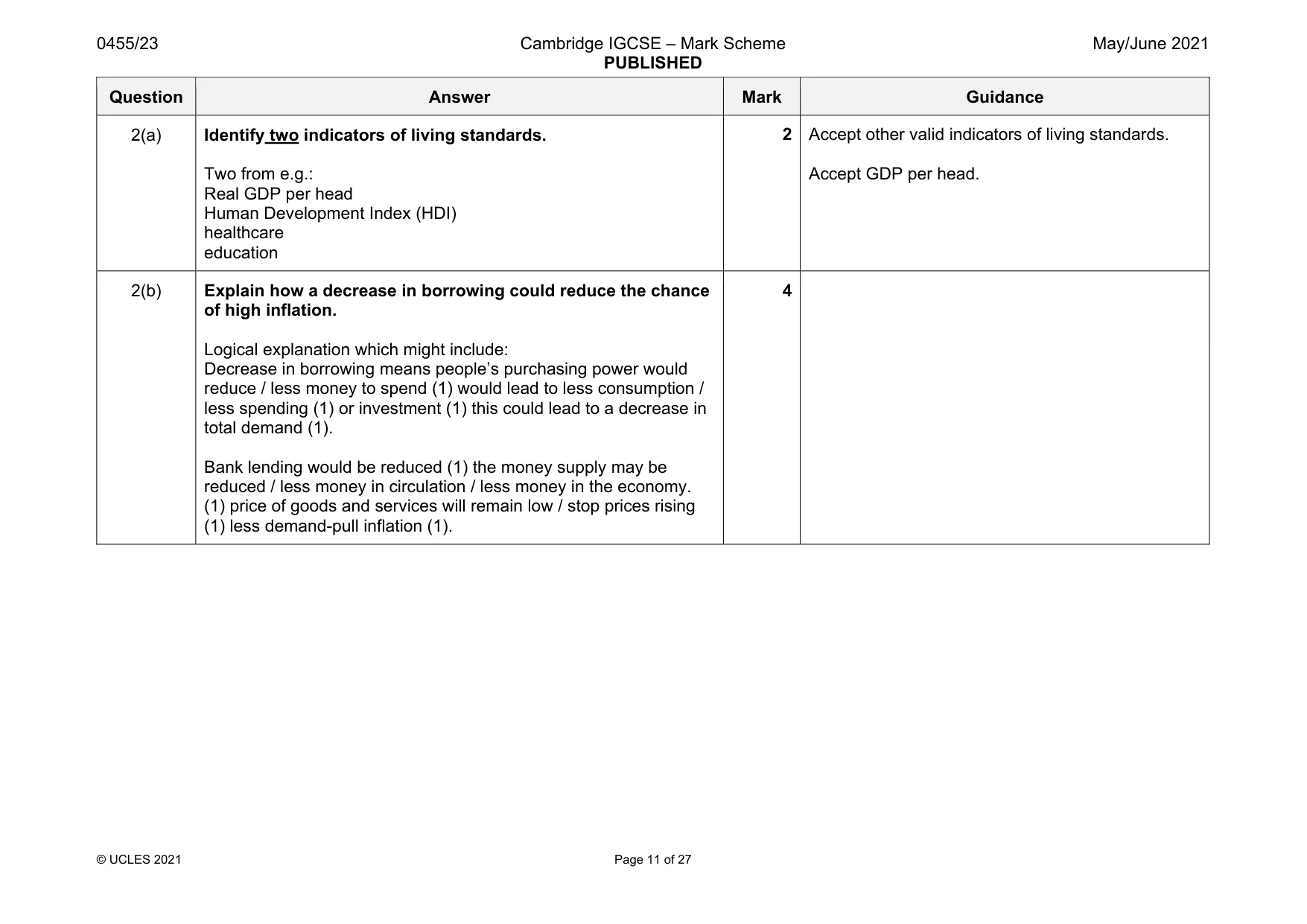
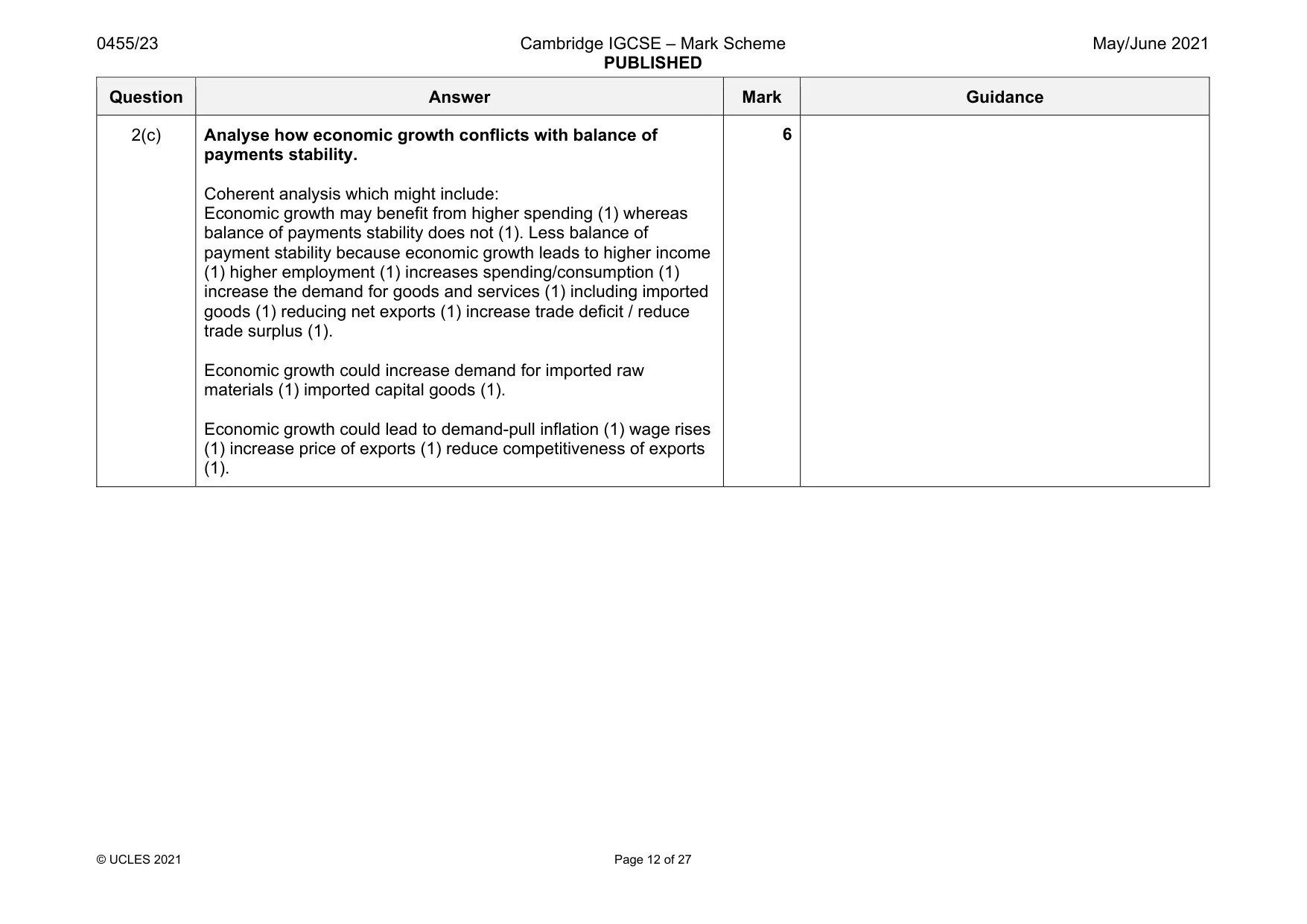
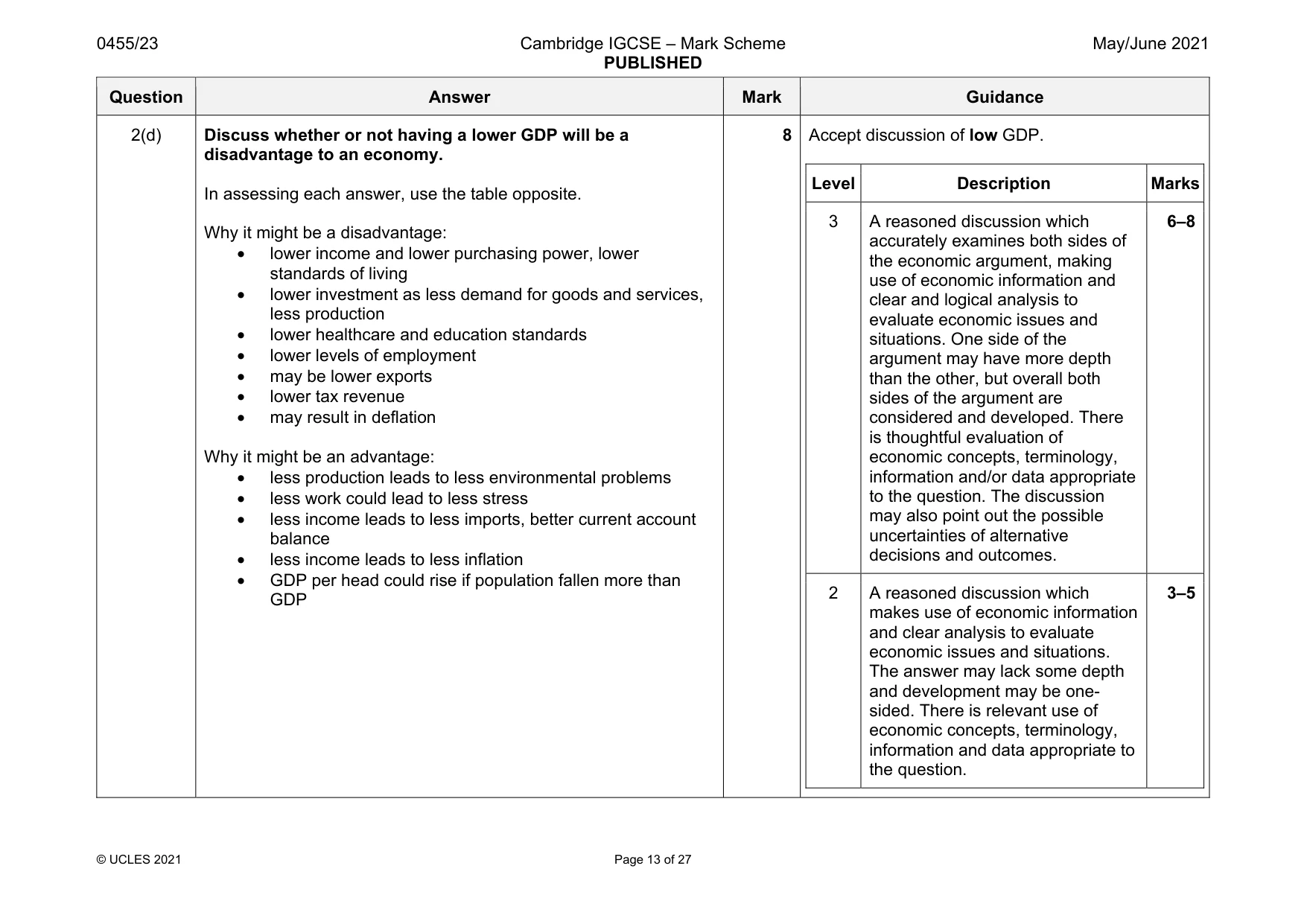
Mark scheme: 2(a) Identify two indicators of living standards. Two from e.g.: Real GDP per head Human Development Index (HDI) healthcare education Accept GDP per head. 2(b) Explain how a decrease in borrowing could reduce the chance of high inflation. Logical explanation which might include: Decrease in borrowing means people’s purchasing power would reduce / less money to spend (1) would lead to less consumption / less spending (1) or investment (1) this could lead to a decrease in total demand (1). Bank lending would be reduced (1) the money supply may be reduced / less money in circulation / less money in the economy. (1) price of goods and services will remain low / stop prices rising (1) less demand-pull inflation (1). 4 Question Answer Mark Guidance 2(c) Analyse how economic growth conflicts with balance of payments stability. Coherent analysis which might include: Economic growth may benefit from higher spending (1) whereas balance of payments stability does not (1). Less balance of payment stability because economic growth leads to higher income (1) higher employment (1) increases spending/consumption (1) increase the demand for goods and services (1) including imported goods (1) reducing net exports (1) increase trade deficit / reduce trade surplus (1). Economic growth could increase demand for imported raw materials (1) imported capital goods (1). Economic growth could lead to demand-pull inflation (1) wage rises (1) increase price of exports (1) reduce competitiveness of exports (1). 6 Question Answer Mark Guidance 2(d) Discuss whether or not having a lower GDP will be a disadvantage to an economy. In assessing each answer, use the table opposite. Why it might be a disadvantage: • lower income and lower purchasing power, lower standards of living • lower investment as less demand for goods and services, less production • lower healthcare and education standards • lower levels of employment • may be lower exports • lower tax revenue • may result in deflation Why it might be an advantage: • less production leads to less environmental problems • less work could lead to less stress • less income leads to less imports, better current account balance • less income leads to less inflation • GDP per head could rise if population fallen more than GDP 8 Accept discussion of low GDP. Level Description Marks 3 A reasoned discussion which accurately examines both sides of the economic argument, making use of economic information and clear and logical analysis to evaluate economic issues and situations. One side of the argument may have more depth than the other, but overall both sides of the argument are considered and developed. There is thoughtful evaluation of economic concepts, terminology, information and/or data appropriate to the question. The discussion may also point out the possible uncertainties of alternative decisions and outcomes. 6–8 2 A reasoned discussion which makes use of economic information and clear analysis to evaluate economic issues and situations. The answer may lack some depth and development may be one- sided. There is relevant use of economic concepts, terminology, information and data appropriate to the question. 3–5 Question Answer Mark Guidance 2(d) Level Description Marks 1 There is a simple attempt at using economic definitions and terminology. Some reference may be made to economic theory, with occasional understanding. 1–2 0 A mark of zero should be awarded for no creditable content. 0
Q3 · Cyclical unemployment is below the national average in some big cities in Canada such as…
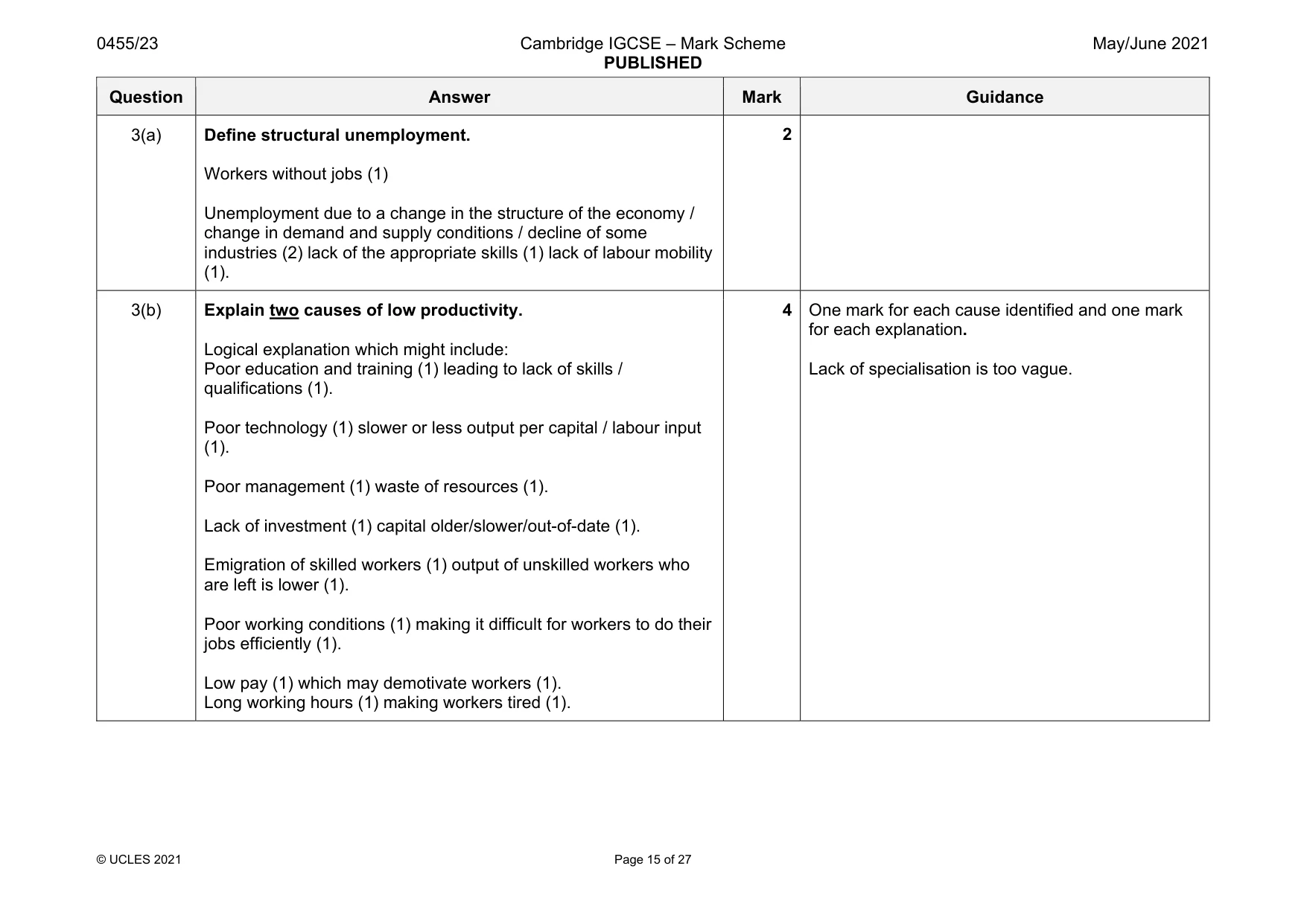
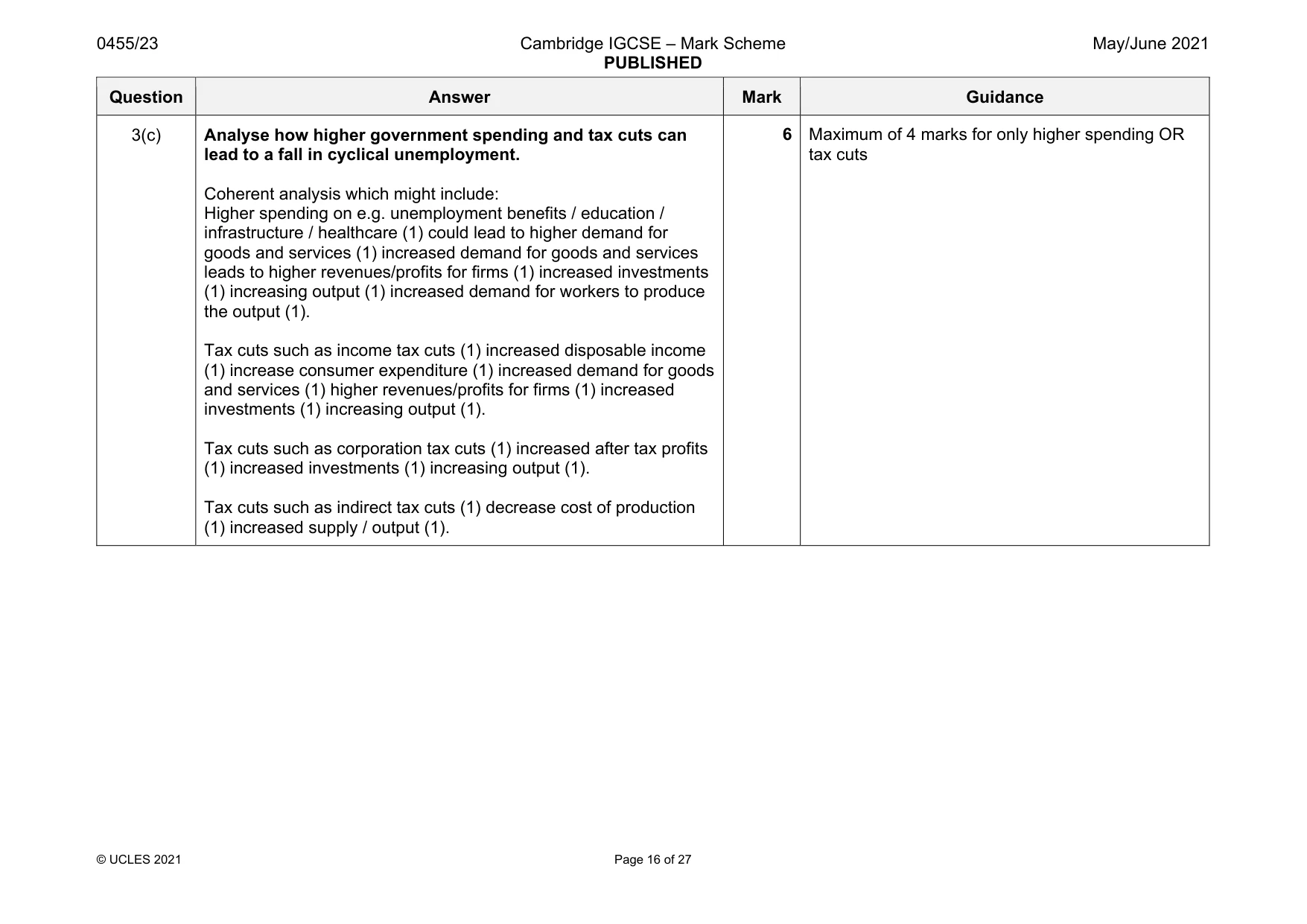
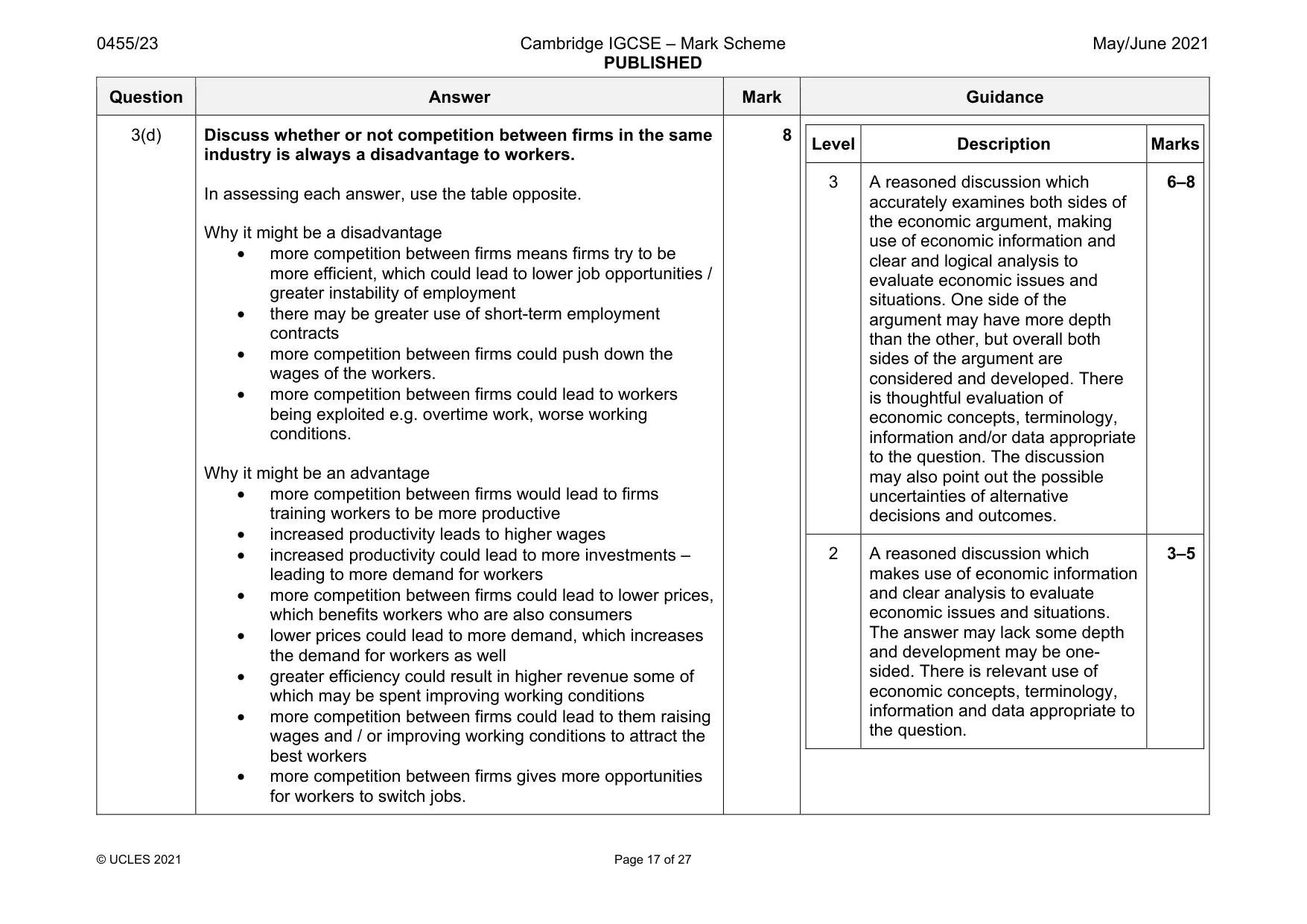
3 Cyclical unemployment is below the national average in some big cities in Canada such as Toronto, Vancouver, and Montreal. This could be a result of higher government spending and tax cuts in big cities. However, productivity is low. There are also concerns that structural unemployment may increase as some industries cannot compete with more efficient foreign firms. (a) Define structural unemployment. [2] (b) Explain two causes of low productivity. [4] (c) Analyse how higher government spending and tax cuts can lead to a fall in cyclical unemployment. [6] (d) Discuss whether or not competition between firms in the same industry is always a disadvantage to workers. [8]
Mark scheme: 3(a) Define structural unemployment. Workers without jobs (1) Unemployment due to a change in the structure of the economy / change in demand and supply conditions / decline of some industries (2) lack of the appropriate skills (1) lack of labour mobility (1). 3(b) Explain two causes of low productivity. Logical explanation which might include: Poor education and training (1) leading to lack of skills / qualifications (1). Poor technology (1) slower or less output per capital / labour input (1). Poor management (1) waste of resources (1). Lack of investment (1) capital older/slower/out-of-date (1). Emigration of skilled workers (1) output of unskilled workers who are left is lower (1). Poor working conditions (1) making it difficult for workers to do their jobs efficiently (1). Low pay (1) which may demotivate workers (1). Long working hours (1) making workers tired (1). 4 One mark for each cause identified and one mark for each explanation. Lack of specialisation is too vague. Question Answer Mark Guidance 3(c) Analyse how higher government spending and tax cuts can lead to a fall in cyclical unemployment. Coherent analysis which might include: Higher spending on e.g. unemployment benefits / education / infrastructure / healthcare (1) could lead to higher demand for goods and services (1) increased demand for goods and services leads to higher revenues/profits for firms (1) increased investments (1) increasing output (1) increased demand for workers to produce the output (1). Tax cuts such as income tax cuts (1) increased disposable income (1) increase consumer expenditure (1) increased demand for goods and services (1) higher revenues/profits for firms (1) increased investments (1) increasing output (1). Tax cuts such as corporation tax cuts (1) increased after tax profits (1) increased investments (1) increasing output (1). Tax cuts such as indirect tax cuts (1) decrease cost of production (1) increased supply / output (1). 6 Maximum of 4 marks for only higher spending OR tax cuts Question Answer Mark Guidance 3(d) Discuss whether or not competition between firms in the same industry is always a disadvantage to workers. In assessing each answer, use the table opposite. Why it might be a disadvantage • more competition between firms means firms try to be more efficient, which could lead to lower job opportunities / greater instability of employment • there may be greater use of short-term employment contracts • more competition between firms could push down the wages of the workers. • more competition between firms could lead to workers being exploited e.g. overtime work, worse working conditions. Why it might be an advantage • more competition between firms would lead to firms training workers to be more productive • increased productivity leads to higher wages • increased productivity could lead to more investments – leading to more demand for workers • more competition between firms could lead to lower prices, which benefits workers who are also consumers • lower prices could lead to more demand, which increases the demand for workers as well • greater efficiency could result in higher revenue some of which may be spent improving working conditions • more competition between firms could lead to them raising wages and / or improving working conditions to attract the best workers • more competition between firms gives more opportunities for workers to switch jobs. 8 Level Description Marks 3 A reasoned discussion which accurately examines both sides of the economic argument, making use of economic information and clear and logical analysis to evaluate economic issues and situations. One side of the argument may have more depth than the other, but overall both sides of the argument are considered and developed. There is thoughtful evaluation of economic concepts, terminology, information and/or data appropriate to the question. The discussion may also point out the possible uncertainties of alternative decisions and outcomes. 6–8 2 A reasoned discussion which makes use of economic information and clear analysis to evaluate economic issues and situations. The answer may lack some depth and development may be one- sided. There is relevant use of economic concepts, terminology, information and data appropriate to the question. 3–5 Question Answer Mark Guidance 3(d) Level Description Marks 1 There is a simple attempt at using economic definitions and terminology. Some reference may be made to economic theory, with occasional understanding. 1–2 0 A mark of zero should be awarded for no creditable content. 0
Q4 · Global spending on the health sector, by both the private and public sectors, is the…
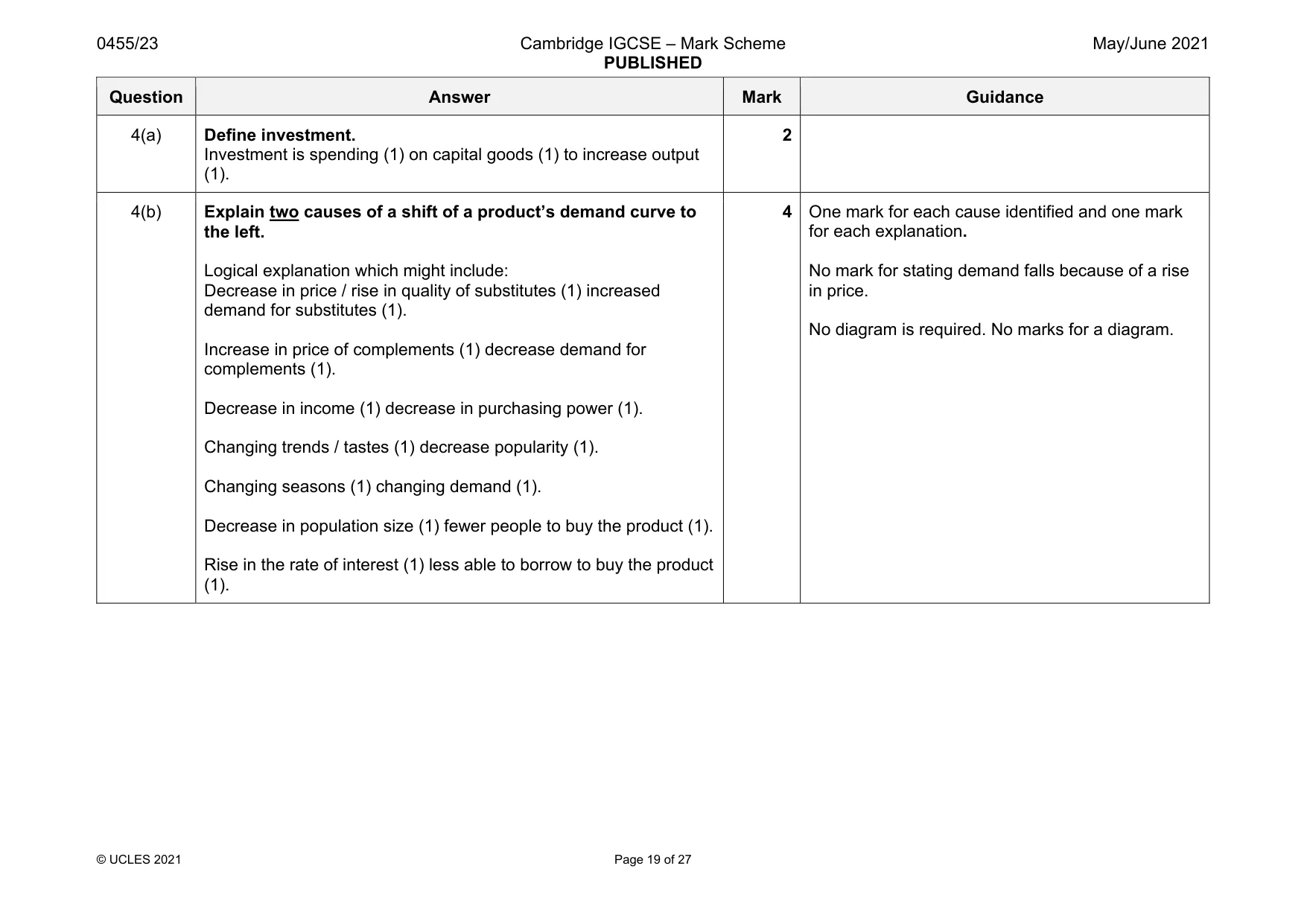
4 Global spending on the health sector, by both the private and public sectors, is the highest compared with all other sectors including education and defence. Investment in education and the health sector has resulted in new life-saving technology being introduced. However, demand for certain vaccinations has decreased over the years, shifting the demand curve of vaccinations to the left. (a) Define investment. [2] (b) Explain two causes of a shift of a product’s demand curve to the left. [4] (c) Analyse, using a production possibility curve diagram (PPC), the effect of increased investment in both education and the health sector. [6] (d) Discuss whether consumers would benefit more from healthcare being provided by the private sector or the public sector. [8]
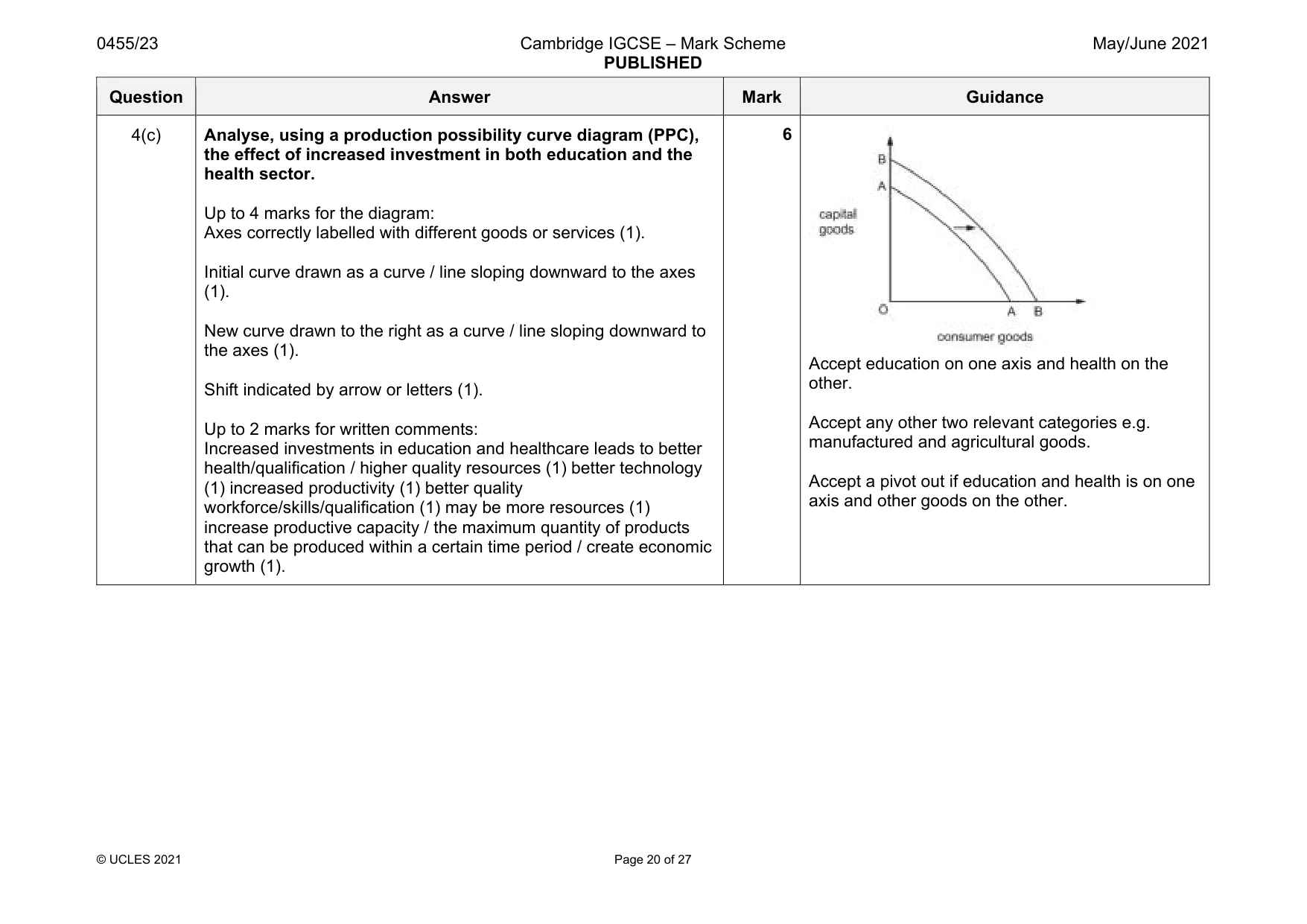
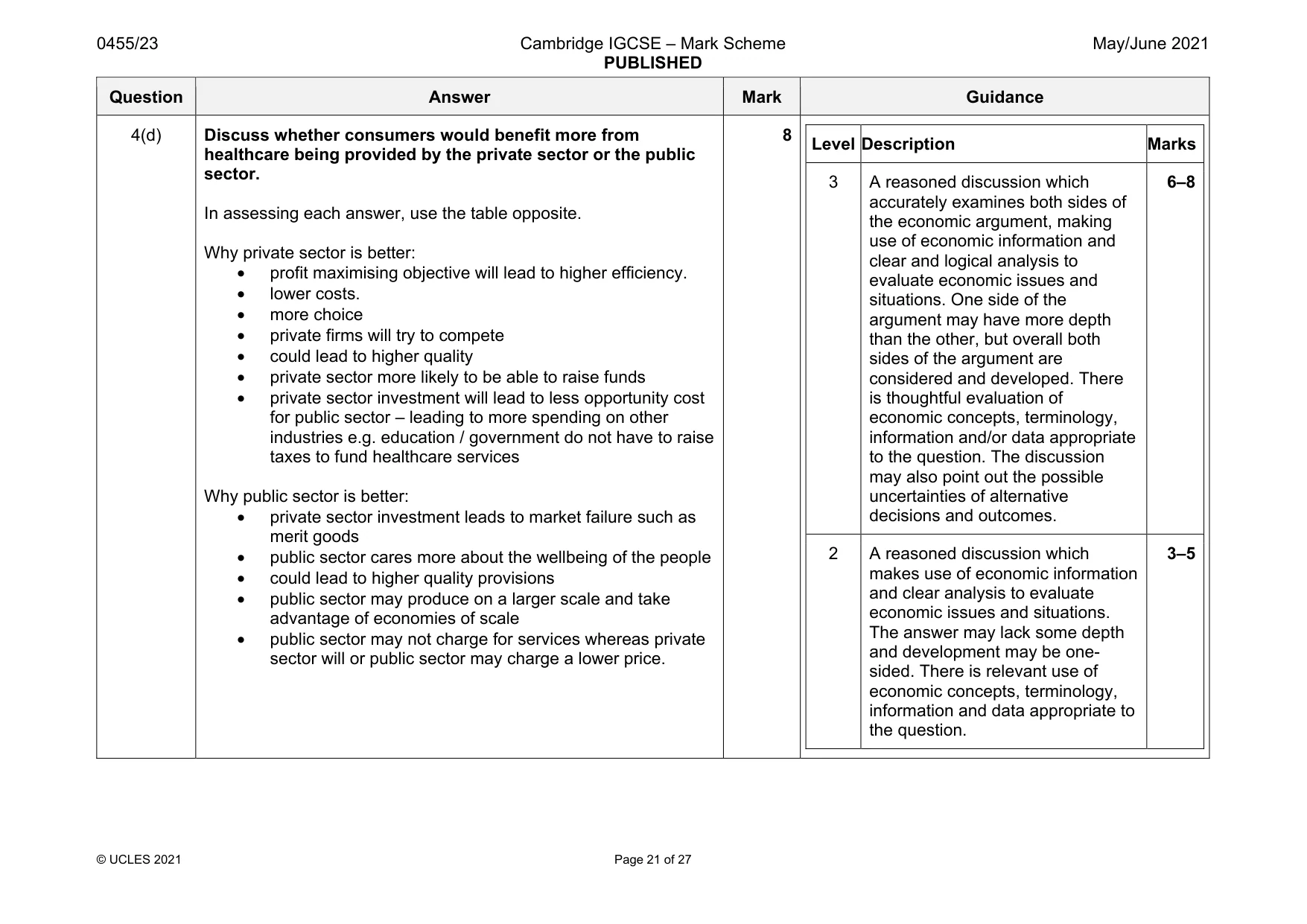
Mark scheme: 4(a) Define investment. Investment is spending (1) on capital goods (1) to increase output (1). 2 4(b) Explain two causes of a shift of a product’s demand curve to the left. Logical explanation which might include: Decrease in price / rise in quality of substitutes (1) increased demand for substitutes (1). Increase in price of complements (1) decrease demand for complements (1). Decrease in income (1) decrease in purchasing power (1). Changing trends / tastes (1) decrease popularity (1). Changing seasons (1) changing demand (1). Decrease in population size (1) fewer people to buy the product (1). Rise in the rate of interest (1) less able to borrow to buy the product (1). 4 One mark for each cause identified and one mark for each explanation. No mark for stating demand falls because of a rise in price. No diagram is required. No marks for a diagram. Question Answer Mark Guidance 4(c) Analyse, using a production possibility curve diagram (PPC), the effect of increased investment in both education and the health sector. Up to 4 marks for the diagram: Axes correctly labelled with different goods or services (1). Initial curve drawn as a curve / line sloping downward to the axes (1). New curve drawn to the right as a curve / line sloping downward to the axes (1). Shift indicated by arrow or letters (1). Up to 2 marks for written comments: Increased investments in education and healthcare leads to better health/qualification / higher quality resources (1) better technology (1) increased productivity (1) better quality workforce/skills/qualification (1) may be more resources (1) increase productive capacity / the maximum quantity of products that can be produced within a certain time period / create economic growth (1). 6 Accept education on one axis and health on the other. Accept any other two relevant categories e.g. manufactured and agricultural goods. Accept a pivot out if education and health is on one axis and other goods on the other. Question Answer Mark Guidance 4(d) Discuss whether consumers would benefit more from healthcare being provided by the private sector or the public sector. In assessing each answer, use the table opposite. Why private sector is better: • profit maximising objective will lead to higher efficiency. • lower costs. • more choice • private firms will try to compete • could lead to higher quality • private sector more likely to be able to raise funds • private sector investment will lead to less opportunity cost for public sector – leading to more spending on other industries e.g. education / government do not have to raise taxes to fund healthcare services Why public sector is better: • private sector investment leads to market failure such as merit goods • public sector cares more about the wellbeing of the people • could lead to higher quality provisions • public sector may produce on a larger scale and take advantage of economies of scale • public sector may not charge for services whereas private sector will or public sector may charge a lower price. 8 Level Description Marks 3 A reasoned discussion which accurately examines both sides of the economic argument, making use of economic information and clear and logical analysis to evaluate economic issues and situations. One side of the argument may have more depth than the other, but overall both sides of the argument are considered and developed. There is thoughtful evaluation of economic concepts, terminology, information and/or data appropriate to the question. The discussion may also point out the possible uncertainties of alternative decisions and outcomes. 6–8 2 A reasoned discussion which makes use of economic information and clear analysis to evaluate economic issues and situations. The answer may lack some depth and development may be one- sided. There is relevant use of economic concepts, terminology, information and data appropriate to the question. 3–5 Question Answer Mark Guidance 4(d) Level Description Marks 1 There is a simple attempt at using economic definitions and terminology. Some reference may be made to economic theory, with occasional understanding. 1–2 0 A mark of zero should be awarded for no creditable content. 0
Q5 · The demand for smartphones has become more price-inelastic as the range of functions…
5 The demand for smartphones has become more price-inelastic as the range of functions available has increased. In low-income countries, smartphones are an important tool for economic development. This is because they provide access to education and banking services which were once not available in rural areas. Smartphones have made it easier for people to borrow and save their money. (a) Define economic development. [2] (b) Explain two reasons why children in rural areas may receive less education than those in cities. [4] (c) Analyse the advantages of selling a product which is price-inelastic in demand. [6] (d) Discuss whether or not an increase in the level of savings is beneficial for an economy. [8]
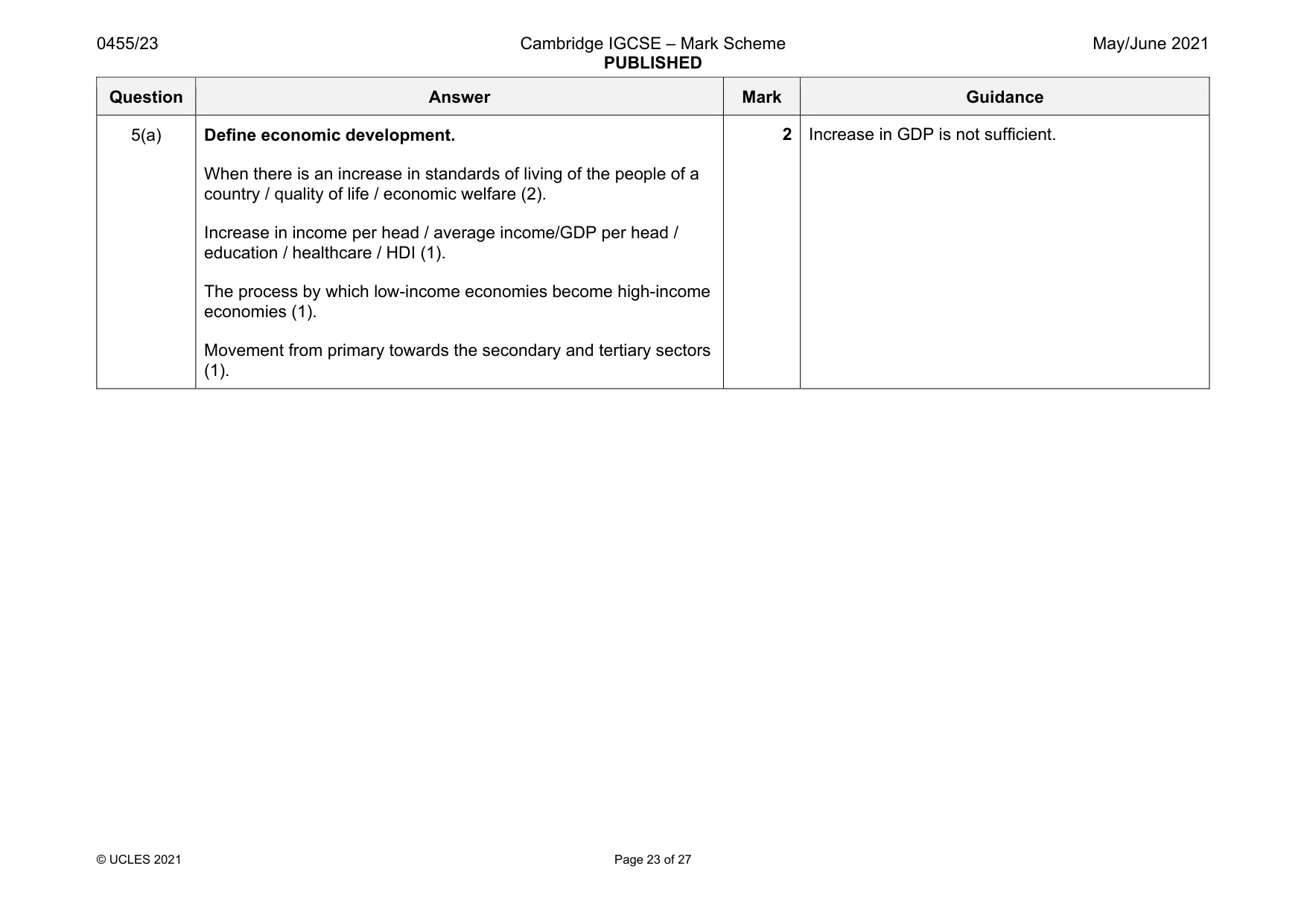
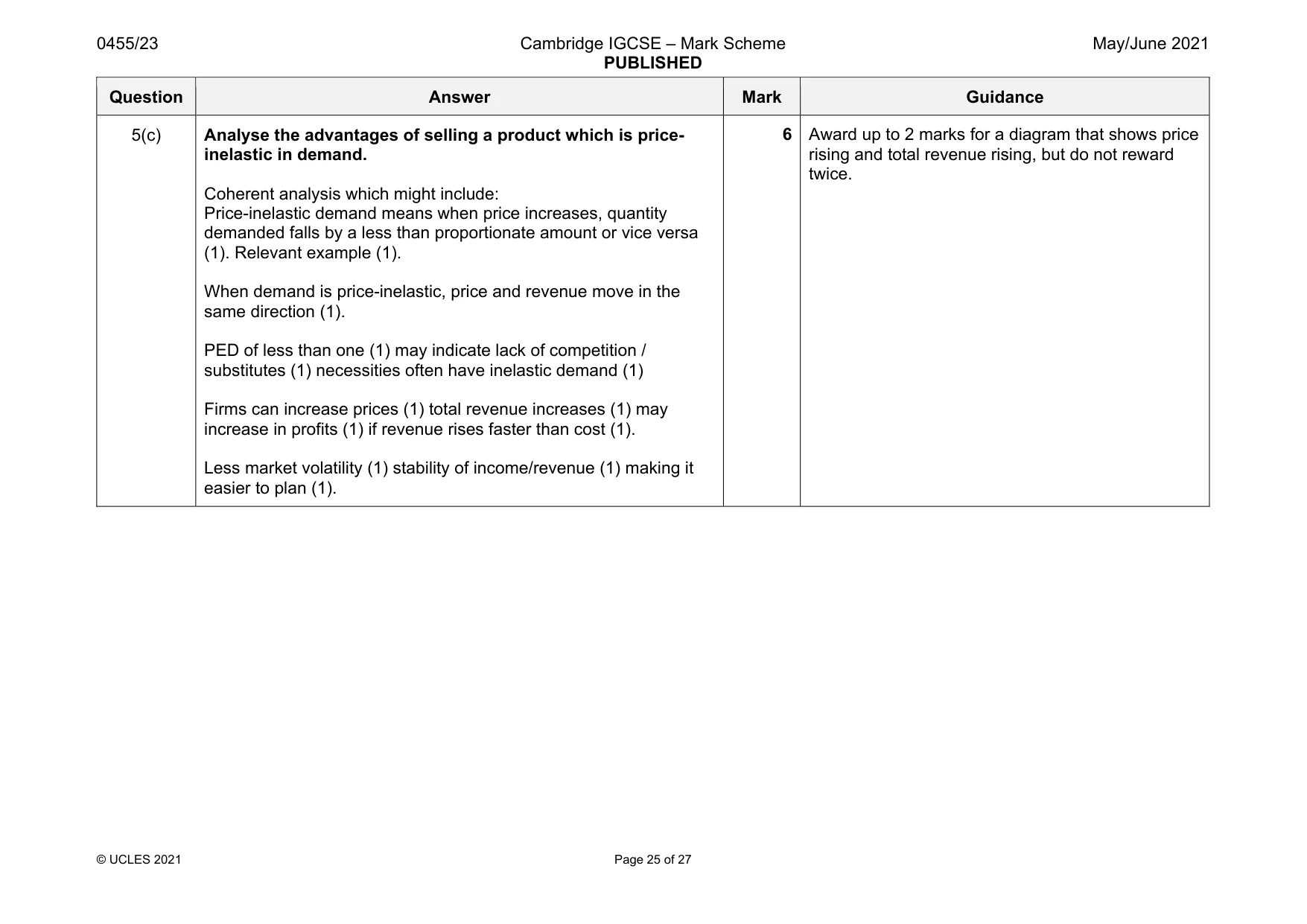
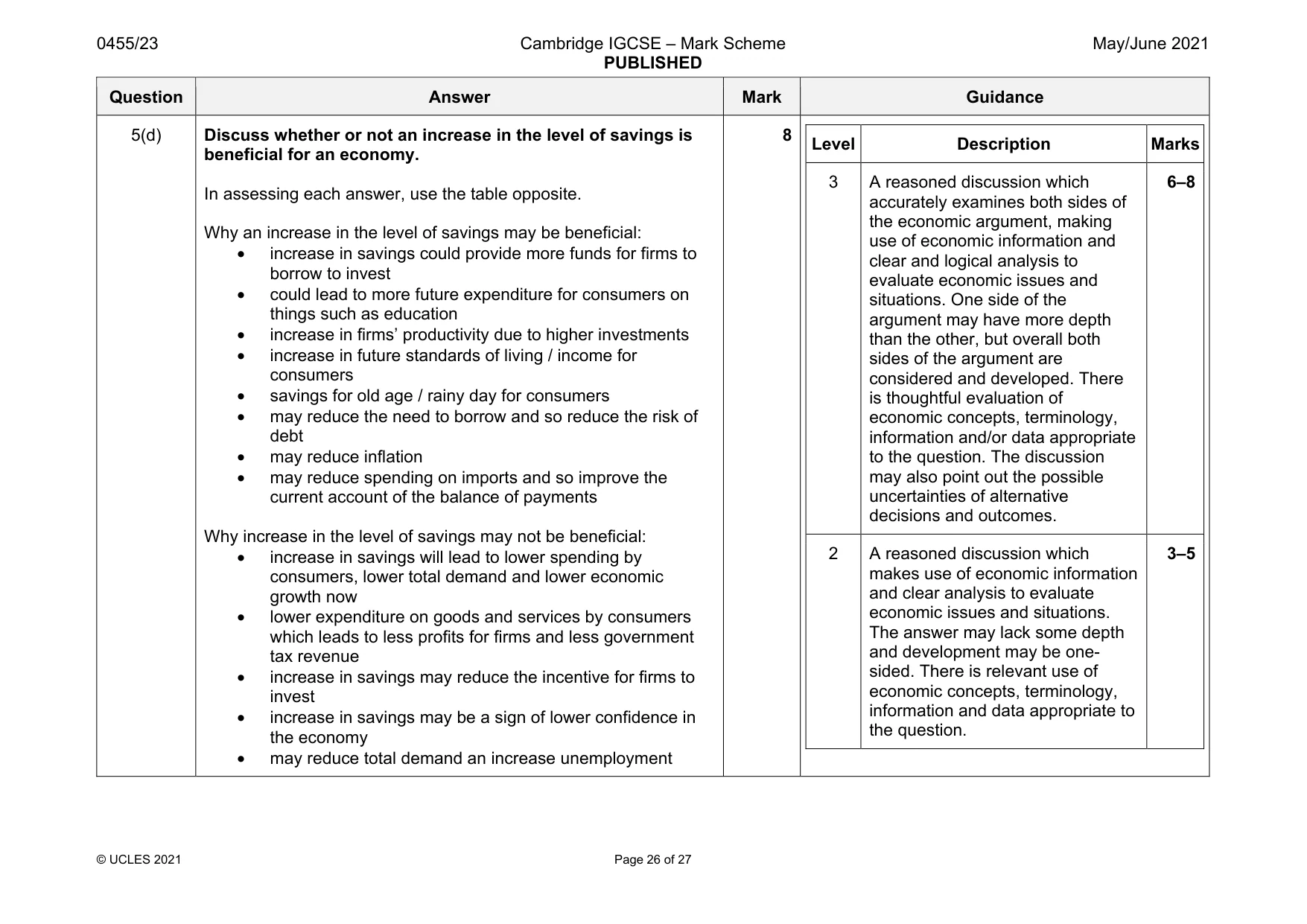
Mark scheme: 5(a) Define economic development. When there is an increase in standards of living of the people of a country / quality of life / economic welfare (2). Increase in income per head / average income/GDP per head / education / healthcare / HDI (1). The process by which low-income economies become high-income economies (1). Movement from primary towards the secondary and tertiary sectors (1). Question Answer Mark Guidance 5(b) Explain two reasons why children in rural areas may receive less education than those in cities. Logical explanation which might include: Low income (1) cannot afford to go to school (1). Poor infrastructure (1) cannot get to school / no schools (1). Have to work on the family farm (1) no time to go to school (1). Parental attitude (1) they do not see benefit of education (1). Low tax revenue in rural areas (1) government spending on schools lower (1). Difficult to recruit teachers (1) poor housing / long distance to travel / low wages (1) Lack of schools (1) difficult to get materials to build schools / may be insufficient children (1). Parents have not been educated (1) don’t see the value in (paying for) education (1) 4 One mark for each cause identified and one mark for each explanation. Question Answer Mark Guidance 5(c) Analyse the advantages of selling a product which is price- inelastic in demand. Coherent analysis which might include: Price-inelastic demand means when price increases, quantity demanded falls by a less than proportionate amount or vice versa (1). Relevant example (1). When demand is price-inelastic, price and revenue move in the same direction (1). PED of less than one (1) may indicate lack of competition / substitutes (1) necessities often have inelastic demand (1) Firms can increase prices (1) total revenue increases (1) may increase in profits (1) if revenue rises faster than cost (1). Less market volatility (1) stability of income/revenue (1) making it easier to plan (1). 6 Award up to 2 marks for a diagram that shows price rising and total revenue rising, but do not reward twice. Question Answer Mark Guidance 5(d) Discuss whether or not an increase in the level of savings is beneficial for an economy. In assessing each answer, use the table opposite. Why an increase in the level of savings may be beneficial: • increase in savings could provide more funds for firms to borrow to invest • could lead to more future expenditure for consumers on things such as education • increase in firms’ productivity due to higher investments • increase in future standards of living / income for consumers • savings for old age / rainy day for consumers • may reduce the need to borrow and so reduce the risk of debt • may reduce inflation • may reduce spending on imports and so improve the current account of the balance of payments Why increase in the level of savings may not be beneficial: • increase in savings will lead to lower spending by consumers, lower total demand and lower economic growth now • lower expenditure on goods and services by consumers which leads to less profits for firms and less government tax revenue • increase in savings may reduce the incentive for firms to invest • increase in savings may be a sign of lower confidence in the economy • may reduce total demand an increase unemployment 8 Level Description Marks 3 A reasoned discussion which accurately examines both sides of the economic argument, making use of economic information and clear and logical analysis to evaluate economic issues and situations. One side of the argument may have more depth than the other, but overall both sides of the argument are considered and developed. There is thoughtful evaluation of economic concepts, terminology, information and/or data appropriate to the question. The discussion may also point out the possible uncertainties of alternative decisions and outcomes. 6–8 2 A reasoned discussion which makes use of economic information and clear analysis to evaluate economic issues and situations. The answer may lack some depth and development may be one- sided. There is relevant use of economic concepts, terminology, information and data appropriate to the question. 3–5 Question Answer Mark Guidance 5(d) Level Description Marks 1 There is a simple attempt at using economic definitions and terminology. Some reference may be made to economic theory, with occasional understanding. 1–2 0 A mark of zero should be awarded for no creditable content. 0
What was in this paper
The subtopics covered by these 5 questions, and how many questions each got. Open one in a new tab to see every Cambridge question on it.
What you needed in this session
Cambridge’s own grade thresholds for 2021 May/June, Paper 2 · Variant 3. A higher threshold means an easier paper — the bar moves with how the cohort did.