Cambridge IGCSE Economics 0455 — 2022 Feb/March Paper 2 · Variant 2
0455/22/F/M/22 · 5 questions · 90 marks · ≈101 min
The question paper and its mark scheme, free to read here and free to download. This is Cambridge’s own paper, exactly as it was sat.
Question paper8 pages




Mark scheme30 pages
Answers below. Sit the paper first if you are practising.

Questions as text
Q1 · Calculate the number of Bermudian workers who were unemployed in 2018
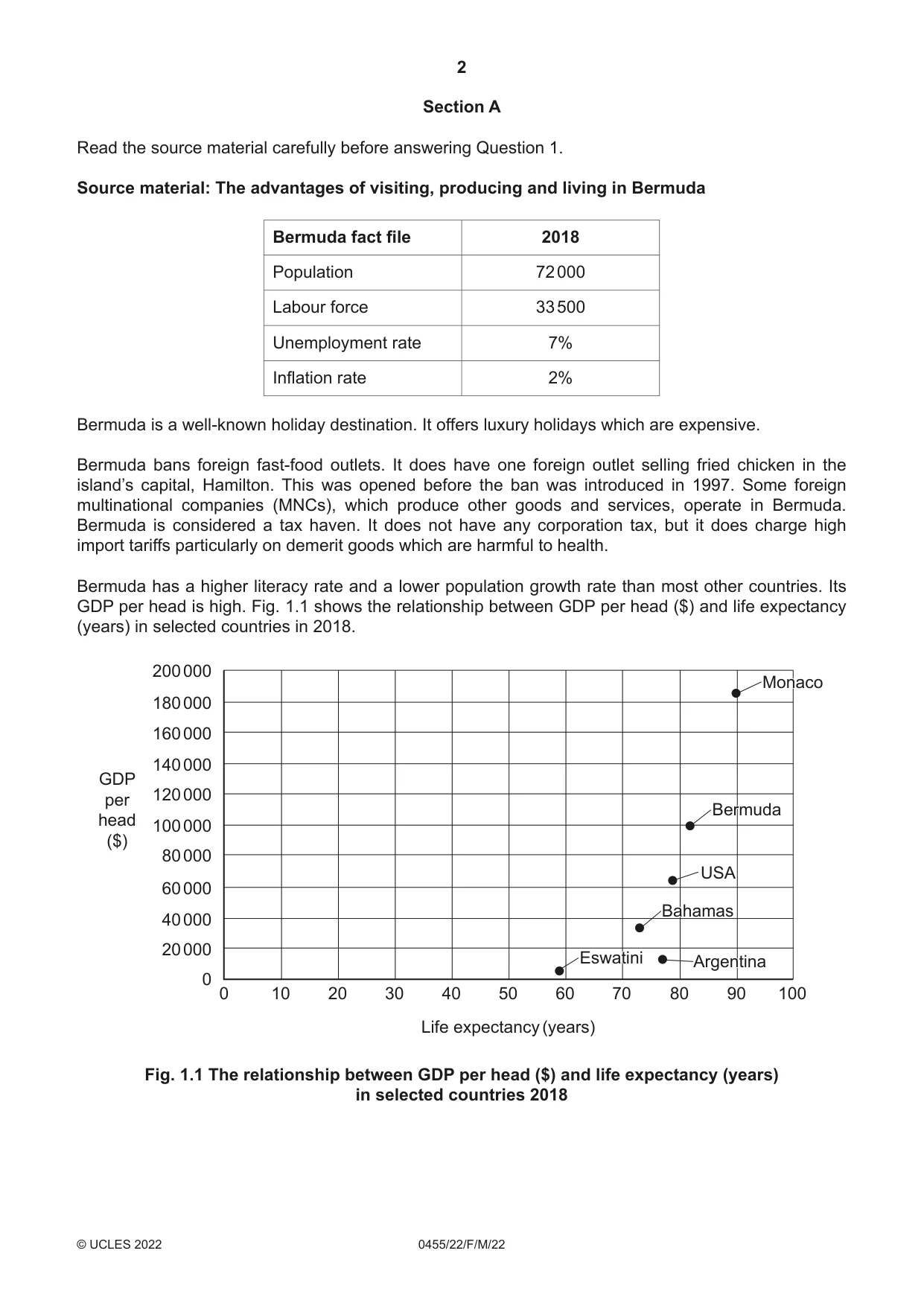
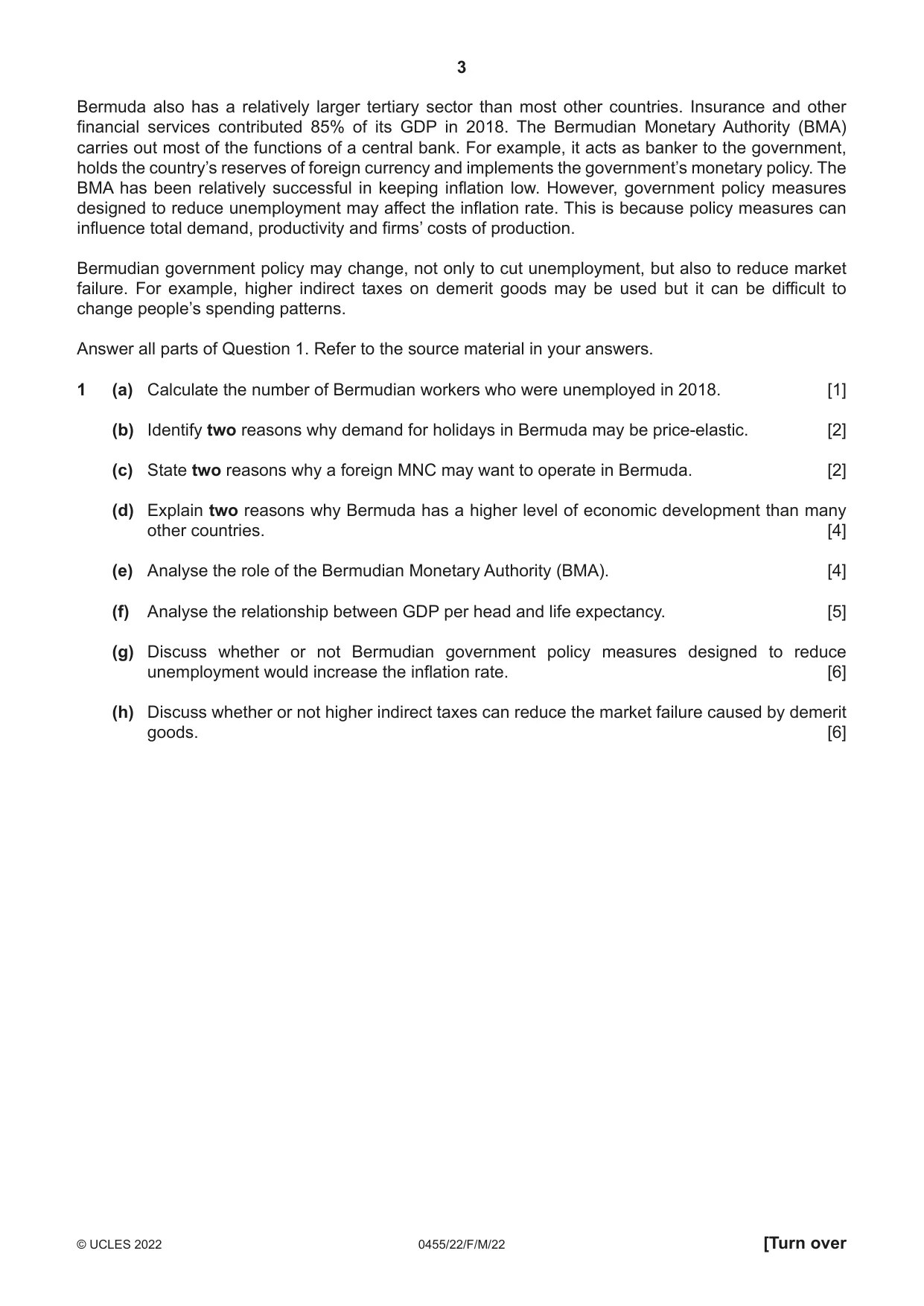
1 (a) Calculate the number of Bermudian workers who were unemployed in 2018. [1] (b) Identify two reasons why demand for holidays in Bermuda may be price-elastic. [2] (c) State two reasons why a foreign MNC may want to operate in Bermuda. [2] (d) Explain two reasons why Bermuda has a higher level of economic development than many other countries. [4] (e) Analyse the role of the Bermudian Monetary Authority (BMA). [4] (f) Analyse the relationship between GDP per head and life expectancy. [5] (g) Discuss whether or not Bermudian government policy measures designed to reduce unemployment would increase the inflation rate. [6] (h) Discuss whether or not higher indirect taxes can reduce the market failure caused by demerit goods. [6]
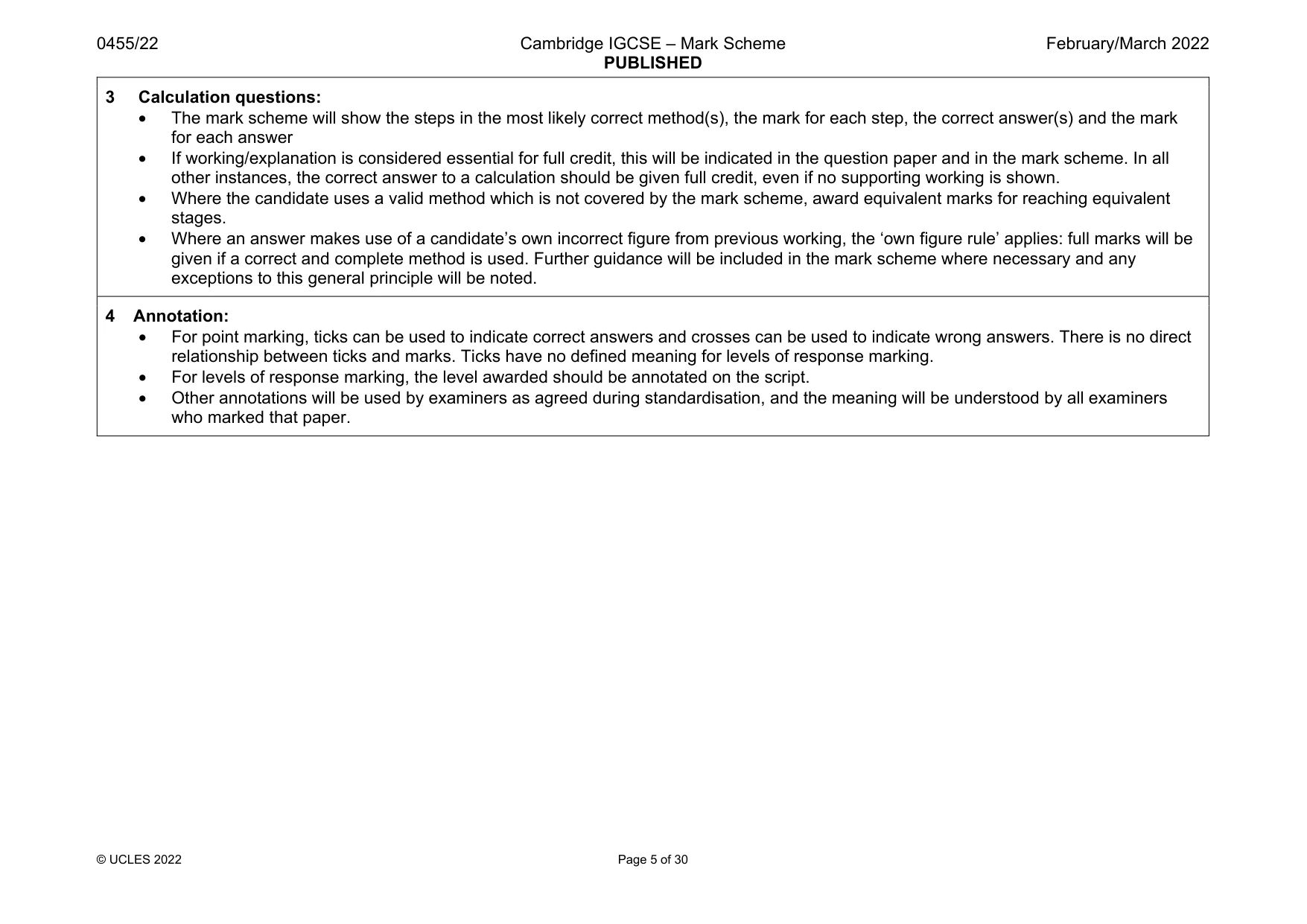
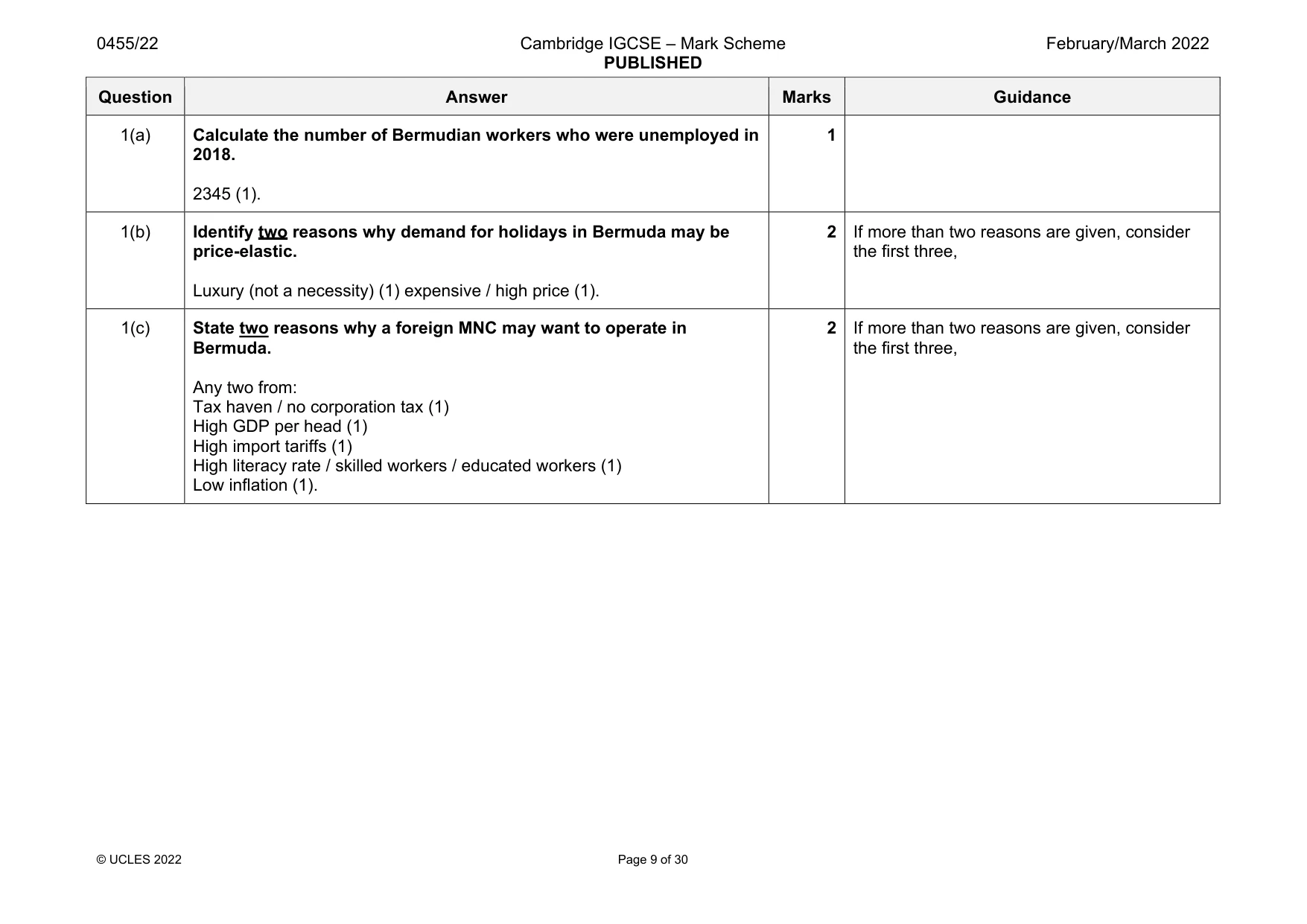
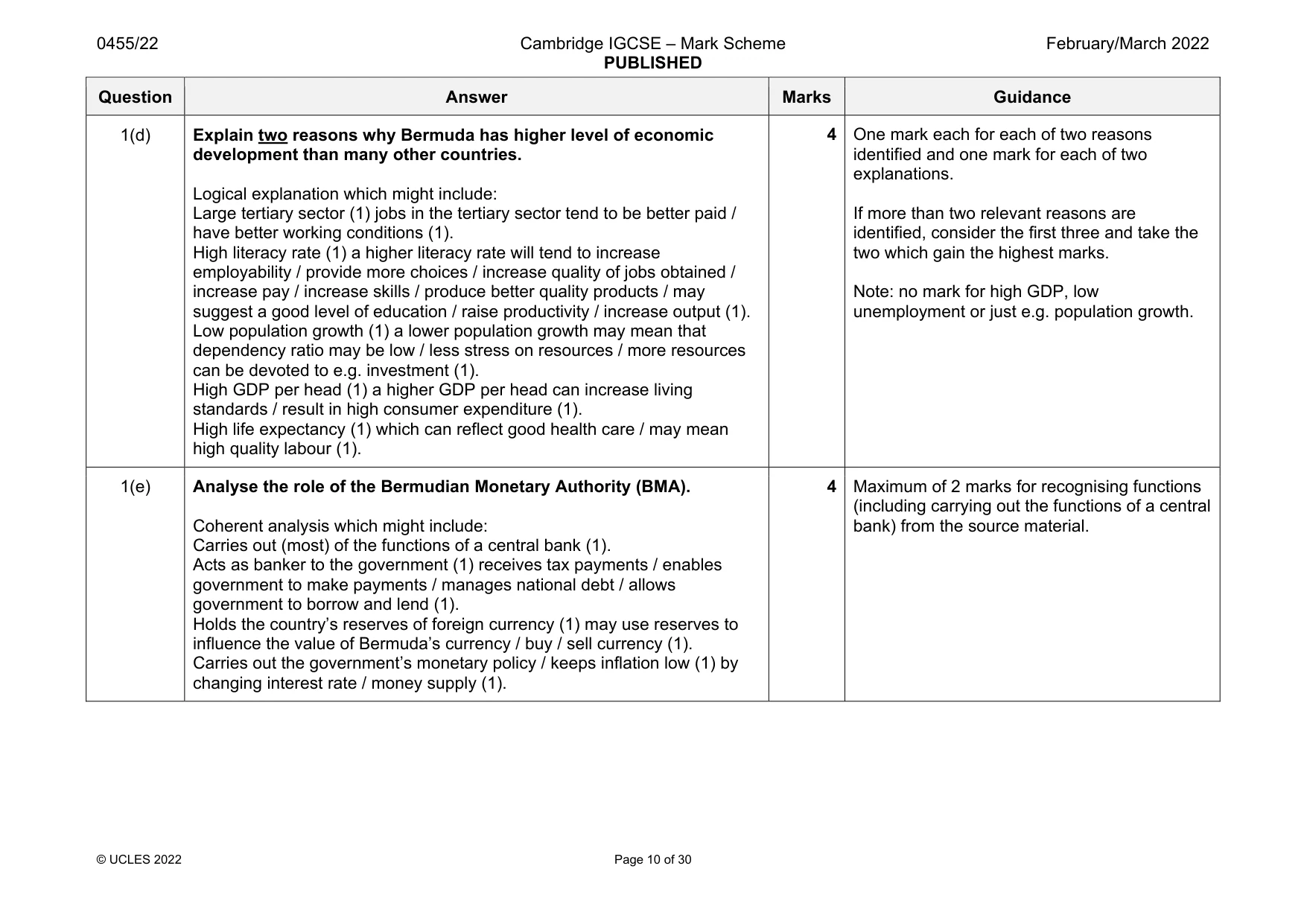
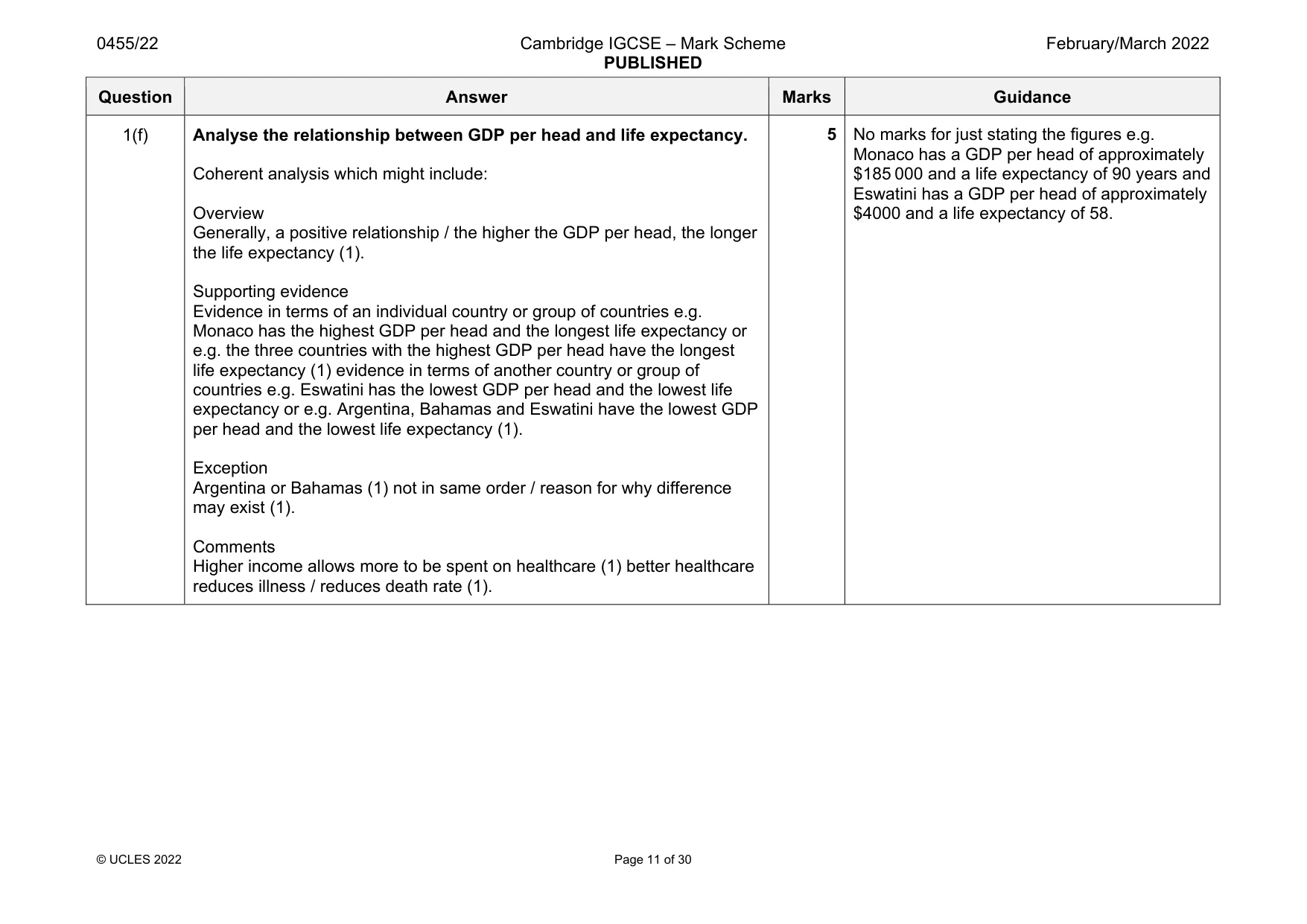
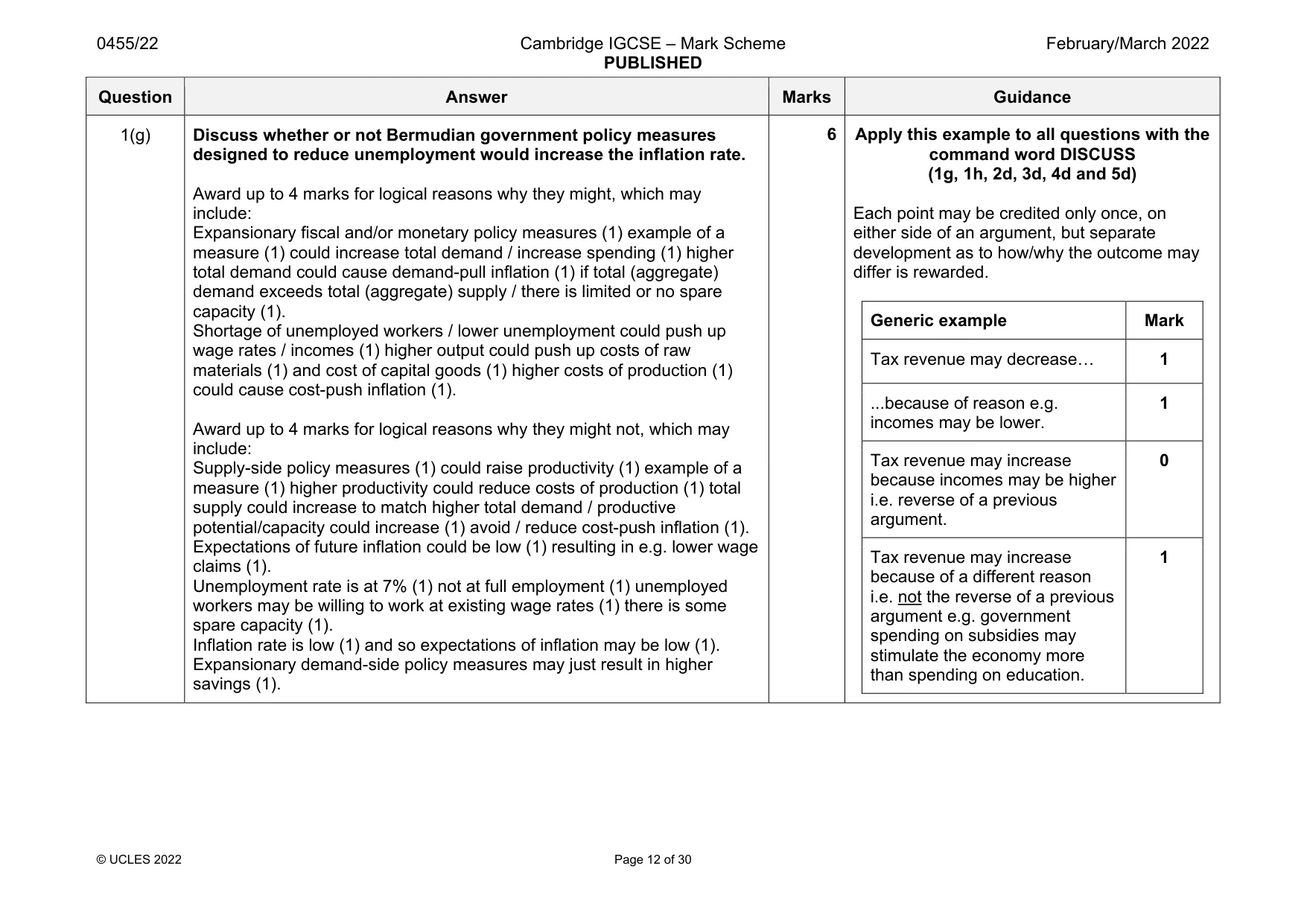
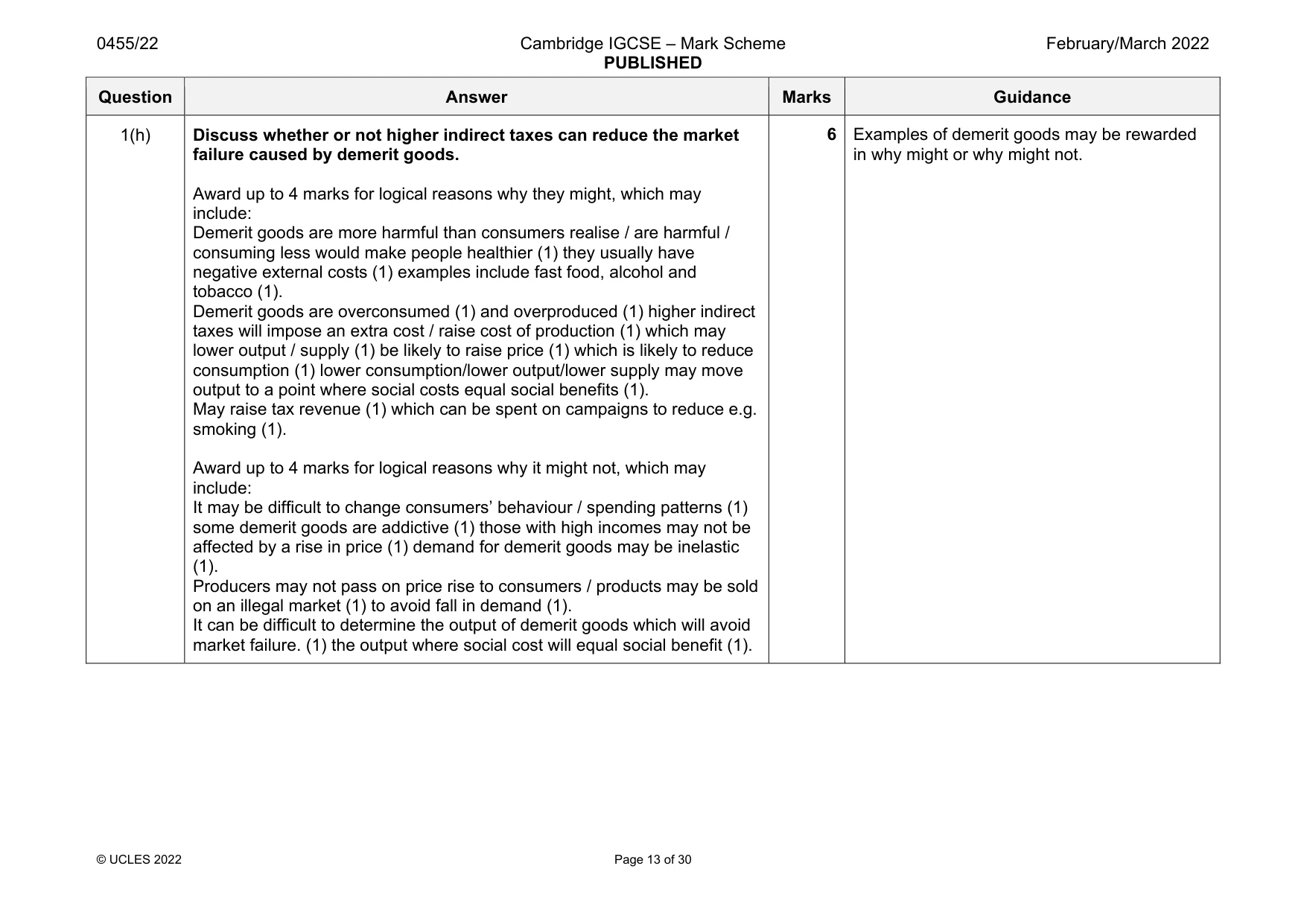
Mark scheme: 1(a) Calculate the number of Bermudian workers who were unemployed in 2018. 2345 (1). 1 1(b) Identify two reasons why demand for holidays in Bermuda may be price-elastic. Luxury (not a necessity) (1) expensive / high price (1). 2 If more than two reasons are given, consider the first three, 1(c) State two reasons why a foreign MNC may want to operate in Bermuda. Any two from: Tax haven / no corporation tax (1) High GDP per head (1) High import tariffs (1) High literacy rate / skilled workers / educated workers (1) Low inflation (1). 2 If more than two reasons are given, consider the first three, Question Answer Marks Guidance 1(d) Explain two reasons why Bermuda has higher level of economic development than many other countries. Logical explanation which might include: Large tertiary sector (1) jobs in the tertiary sector tend to be better paid / have better working conditions (1). High literacy rate (1) a higher literacy rate will tend to increase employability / provide more choices / increase quality of jobs obtained / increase pay / increase skills / produce better quality products / may suggest a good level of education / raise productivity / increase output (1). Low population growth (1) a lower population growth may mean that dependency ratio may be low / less stress on resources / more resources can be devoted to e.g. investment (1). High GDP per head (1) a higher GDP per head can increase living standards / result in high consumer expenditure (1). High life expectancy (1) which can reflect good health care / may mean high quality labour (1). 4 One mark each for each of two reasons identified and one mark for each of two explanations. If more than two relevant reasons are identified, consider the first three and take the two which gain the highest marks. Note: no mark for high GDP, low unemployment or just e.g. population growth. 1(e) Analyse the role of the Bermudian Monetary Authority (BMA). Coherent analysis which might include: Carries out (most) of the functions of a central bank (1). Acts as banker to the government (1) receives tax payments / enables government to make payments / manages national debt / allows government to borrow and lend (1). Holds the country’s reserves of foreign currency (1) may use reserves to influence the value of Bermuda’s currency / buy / sell currency (1). Carries out the government’s monetary policy / keeps inflation low (1) by changing interest rate / money supply (1). 4 Maximum of 2 marks for recognising functions (including carrying out the functions of a central bank) from the source material. Question Answer Marks Guidance 1(f) Analyse the relationship between GDP per head and life expectancy. Coherent analysis which might include: Overview Generally, a positive relationship / the higher the GDP per head, the longer the life expectancy (1). Supporting evidence Evidence in terms of an individual country or group of countries e.g. Monaco has the highest GDP per head and the longest life expectancy or e.g. the three countries with the highest GDP per head have the longest life expectancy (1) evidence in terms of another country or group of countries e.g. Eswatini has the lowest GDP per head and the lowest life expectancy or e.g. Argentina, Bahamas and Eswatini have the lowest GDP per head and the lowest life expectancy (1). Exception Argentina or Bahamas (1) not in same order / reason for why difference may exist (1). Comments Higher income allows more to be spent on healthcare (1) better healthcare reduces illness / reduces death rate (1). 5 No marks for just stating the figures e.g. Monaco has a GDP per head of approximately $185 000 and a life expectancy of 90 years and Eswatini has a GDP per head of approximately $4000 and a life expectancy of 58. Question Answer Marks Guidance 1(g) Discuss whether or not Bermudian government policy measures designed to reduce unemployment would increase the inflation rate. Award up to 4 marks for logical reasons why they might, which may include: Expansionary fiscal and/or monetary policy measures (1) example of a measure (1) could increase total demand / increase spending (1) higher total demand could cause demand-pull inflation (1) if total (aggregate) demand exceeds total (aggregate) supply / there is limited or no spare capacity (1). Shortage of unemployed workers / lower unemployment could push up wage rates / incomes (1) higher output could push up costs of raw materials (1) and cost of capital goods (1) higher costs of production (1) could cause cost-push inflation (1). Award up to 4 marks for logical reasons why they might not, which may include: Supply-side policy measures (1) could raise productivity (1) example of a measure (1) higher productivity could reduce costs of production (1) total supply could increase to match higher total demand / productive potential/capacity could increase (1) avoid / reduce cost-push inflation (1). Expectations of future inflation could be low (1) resulting in e.g. lower wage claims (1). Unemployment rate is at 7% (1) not at full employment (1) unemployed workers may be willing to work at existing wage rates (1) there is some spare capacity (1). Inflation rate is low (1) and so expectations of inflation may be low (1). Expansionary demand-side policy measures may just result in higher savings (1). 6 Apply this example to all questions with the command word DISCUSS (1g, 1h, 2d, 3d, 4d and 5d) Each point may be credited only once, on either side of an argument, but separate development as to how/why the outcome may differ is rewarded. Generic example Mark Tax revenue may decrease… 1 ...because of reason e.g. incomes may be lower. 1 Tax revenue may increase because incomes may be higher i.e. reverse of a previous argument. 0 Tax revenue may increase because of a different reason i.e. not the reverse of a previous argument e.g. government spending on subsidies may stimulate the economy more than spending on education. 1 Question Answer Marks Guidance 1(h) Discuss whether or not higher indirect taxes can reduce the market failure caused by demerit goods. Award up to 4 marks for logical reasons why they might, which may include: Demerit goods are more harmful than consumers realise / are harmful / consuming less would make people healthier (1) they usually have negative external costs (1) examples include fast food, alcohol and tobacco (1). Demerit goods are overconsumed (1) and overproduced (1) higher indirect taxes will impose an extra cost / raise cost of production (1) which may lower output / supply (1) be likely to raise price (1) which is likely to reduce consumption (1) lower consumption/lower output/lower supply may move output to a point where social costs equal social benefits (1). May raise tax revenue (1) which can be spent on campaigns to reduce e.g. smoking (1). Award up to 4 marks for logical reasons why it might not, which may include: It may be difficult to change consumers’ behaviour / spending patterns (1) some demerit goods are addictive (1) those with high incomes may not be affected by a rise in price (1) demand for demerit goods may be inelastic (1). Producers may not pass on price rise to consumers / products may be sold on an illegal market (1) to avoid fall in demand (1). It can be difficult to determine the output of demerit goods which will avoid market failure. (1) the output where social cost will equal social benefit (1). 6 Examples of demerit goods may be rewarded in why might or why might not.
Q2 · South Africa (SA) experienced a recession in the second half of 2019 and an unemployment…
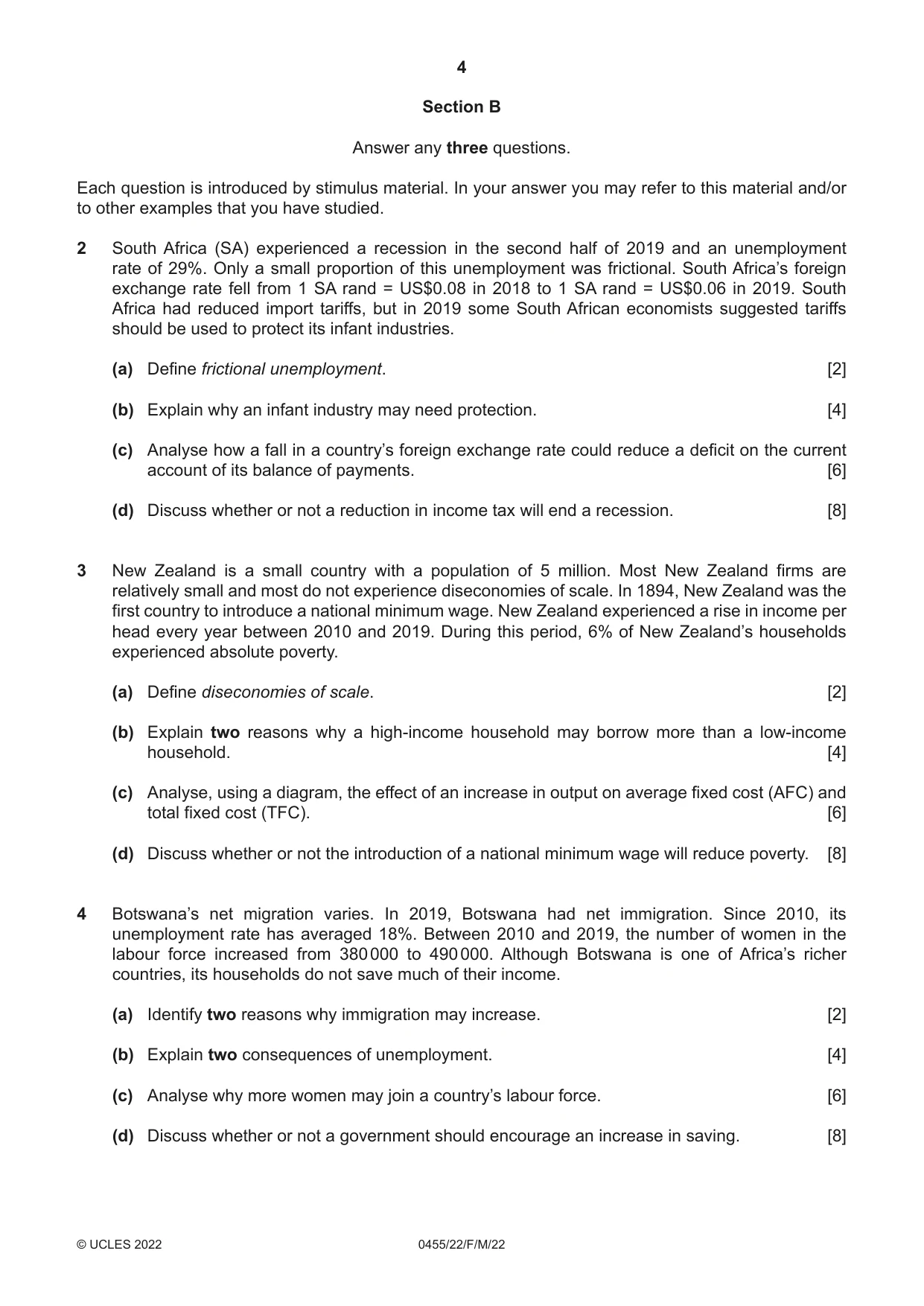
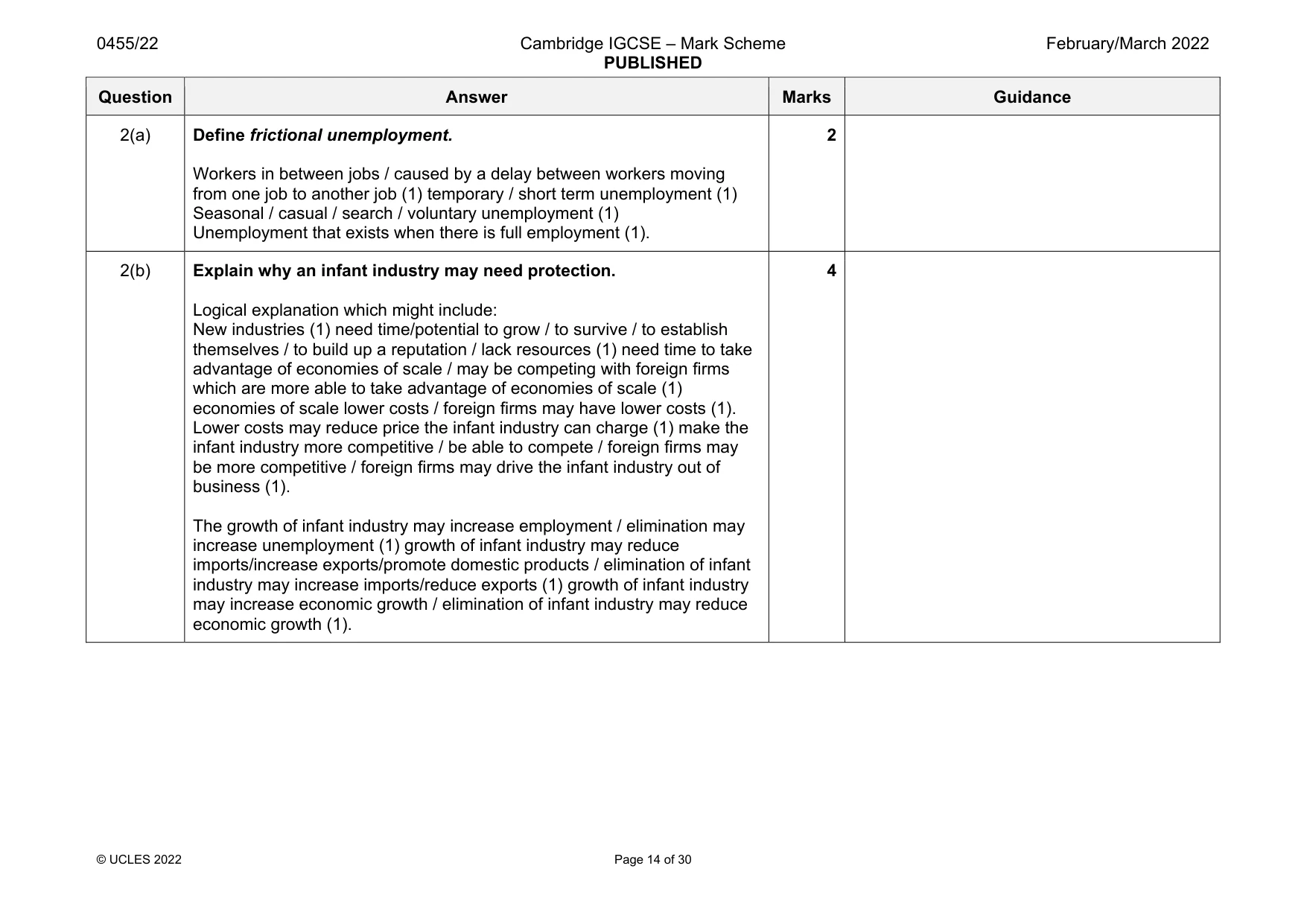
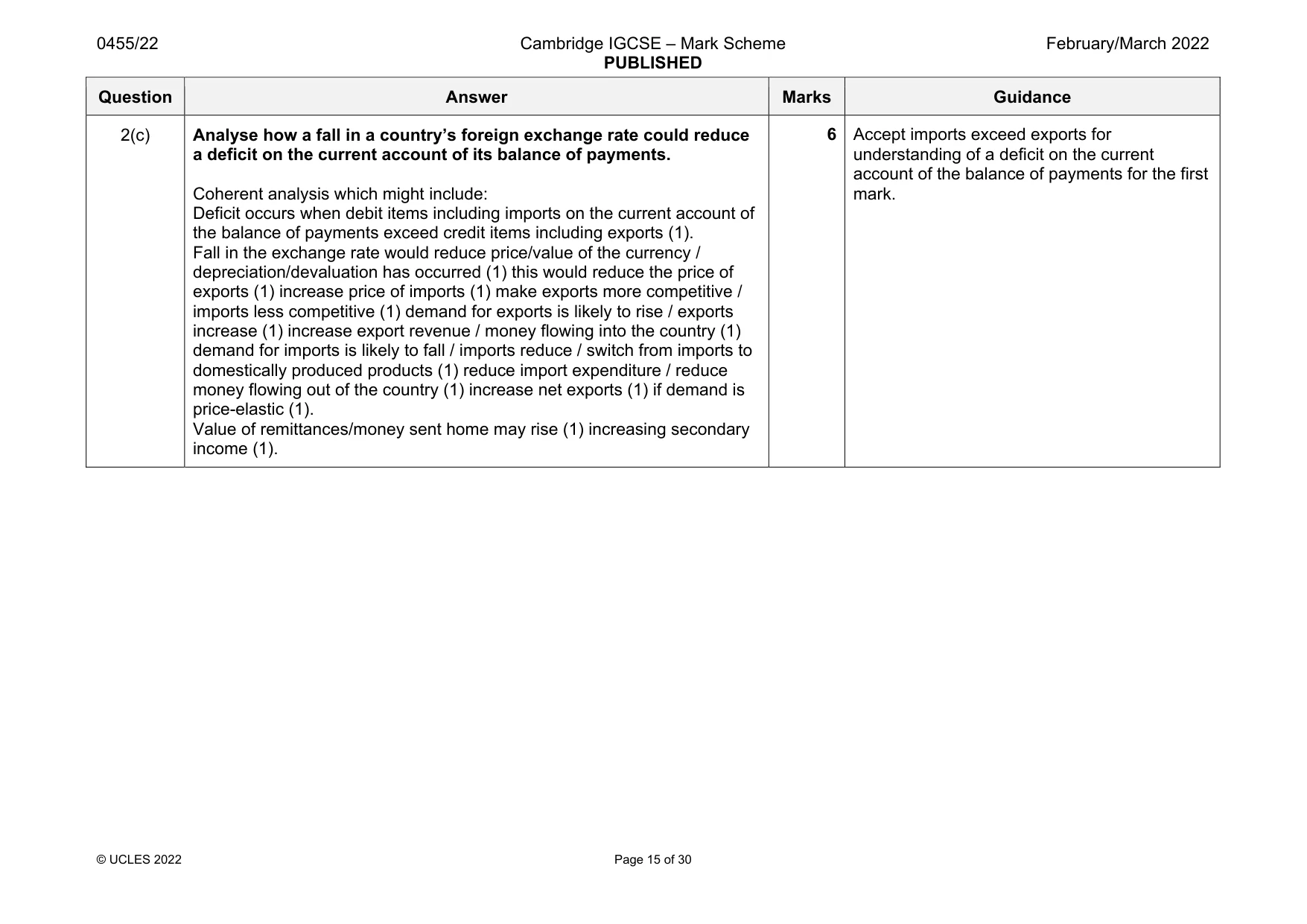
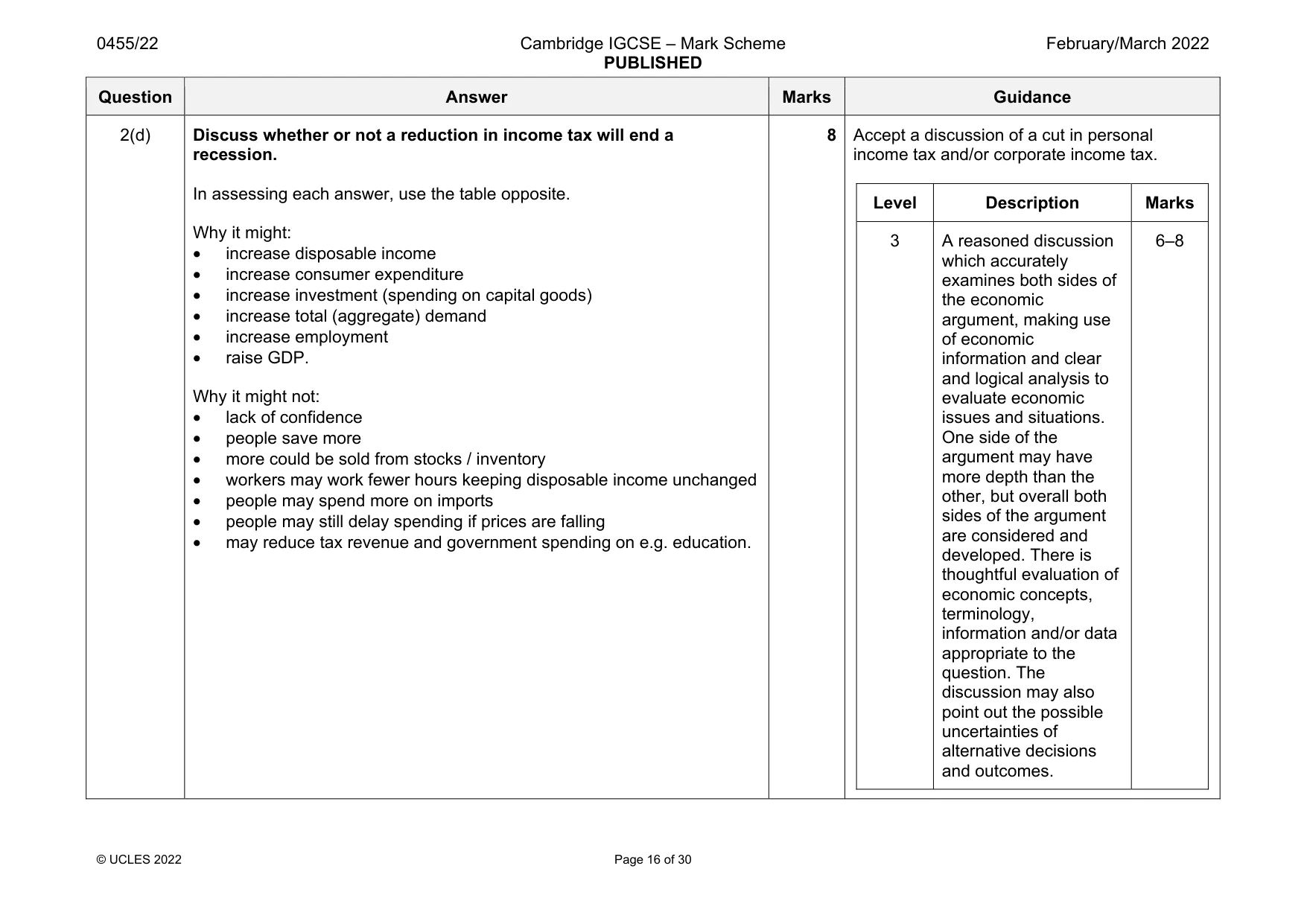
2 South Africa (SA) experienced a recession in the second half of 2019 and an unemployment rate of 29%. Only a small proportion of this unemployment was frictional. South Africa’s foreign exchange rate fell from 1 SA rand = US$0.08 in 2018 to 1 SA rand = US$0.06 in 2019. South Africa had reduced import tariffs, but in 2019 some South African economists suggested tariffs should be used to protect its infant industries. (a) Define frictional unemployment. [2] (b) Explain why an infant industry may need protection. [4] (c) Analyse how a fall in a country’s foreign exchange rate could reduce a deficit on the current account of its balance of payments. [6] (d) Discuss whether or not a reduction in income tax will end a recession. [8]
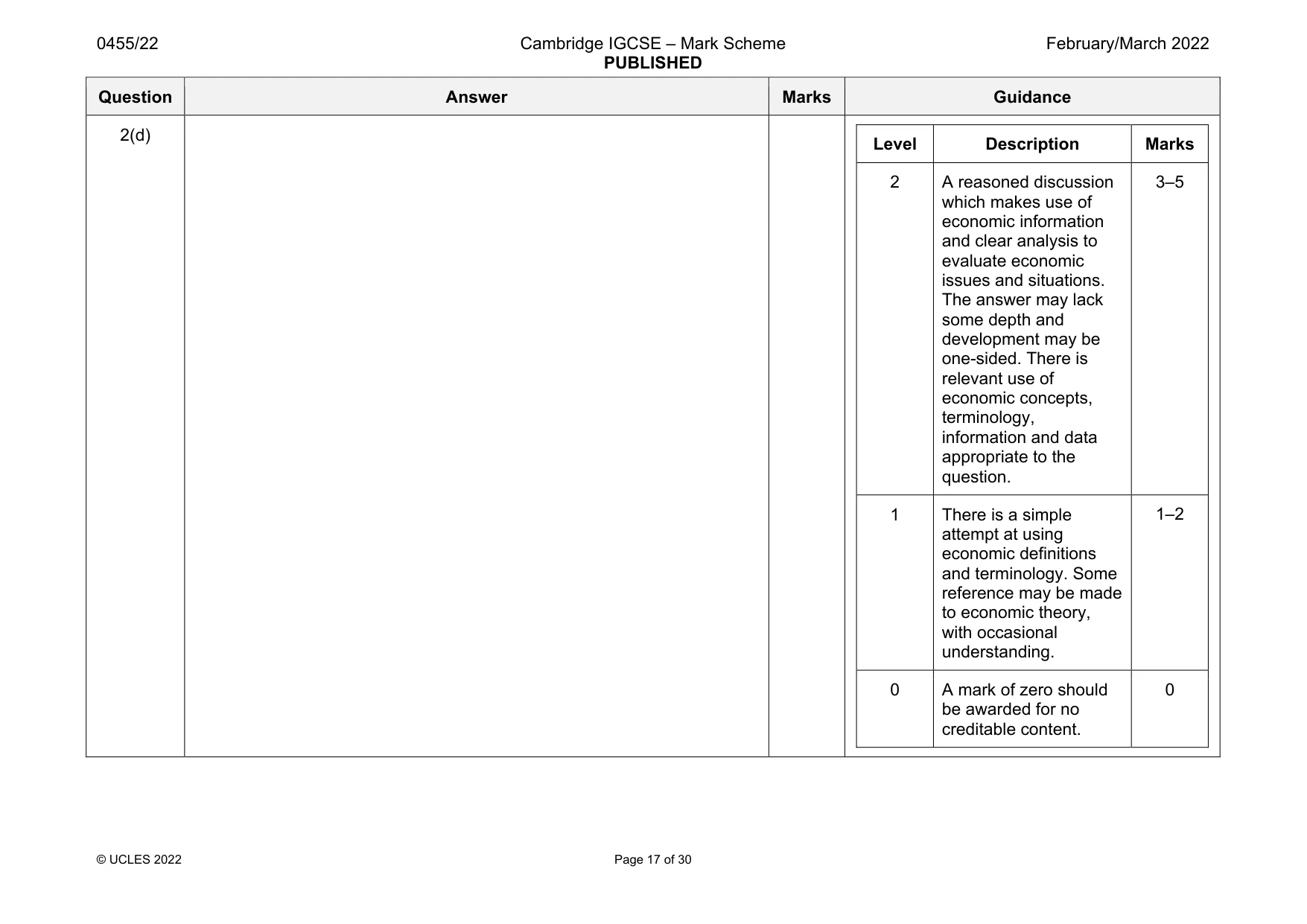
Mark scheme: 2(a) Define frictional unemployment. Workers in between jobs / caused by a delay between workers moving from one job to another job (1) temporary / short term unemployment (1) Seasonal / casual / search / voluntary unemployment (1) Unemployment that exists when there is full employment (1). 2 2(b) Explain why an infant industry may need protection. Logical explanation which might include: New industries (1) need time/potential to grow / to survive / to establish themselves / to build up a reputation / lack resources (1) need time to take advantage of economies of scale / may be competing with foreign firms which are more able to take advantage of economies of scale (1) economies of scale lower costs / foreign firms may have lower costs (1). Lower costs may reduce price the infant industry can charge (1) make the infant industry more competitive / be able to compete / foreign firms may be more competitive / foreign firms may drive the infant industry out of business (1). The growth of infant industry may increase employment / elimination may increase unemployment (1) growth of infant industry may reduce imports/increase exports/promote domestic products / elimination of infant industry may increase imports/reduce exports (1) growth of infant industry may increase economic growth / elimination of infant industry may reduce economic growth (1). 4 Question Answer Marks Guidance 2(c) Analyse how a fall in a country’s foreign exchange rate could reduce a deficit on the current account of its balance of payments. Coherent analysis which might include: Deficit occurs when debit items including imports on the current account of the balance of payments exceed credit items including exports (1). Fall in the exchange rate would reduce price/value of the currency / depreciation/devaluation has occurred (1) this would reduce the price of exports (1) increase price of imports (1) make exports more competitive / imports less competitive (1) demand for exports is likely to rise / exports increase (1) increase export revenue / money flowing into the country (1) demand for imports is likely to fall / imports reduce / switch from imports to domestically produced products (1) reduce import expenditure / reduce money flowing out of the country (1) increase net exports (1) if demand is price-elastic (1). Value of remittances/money sent home may rise (1) increasing secondary income (1). 6 Accept imports exceed exports for understanding of a deficit on the current account of the balance of payments for the first mark. Question Answer Marks Guidance 2(d) Discuss whether or not a reduction in income tax will end a recession. In assessing each answer, use the table opposite. Why it might: • increase disposable income • increase consumer expenditure • increase investment (spending on capital goods) • increase total (aggregate) demand • increase employment • raise GDP. Why it might not: • lack of confidence • people save more • more could be sold from stocks / inventory • workers may work fewer hours keeping disposable income unchanged • people may spend more on imports • people may still delay spending if prices are falling • may reduce tax revenue and government spending on e.g. education. 8 Accept a discussion of a cut in personal income tax and/or corporate income tax. Level Description Marks 3 A reasoned discussion which accurately examines both sides of the economic argument, making use of economic information and clear and logical analysis to evaluate economic issues and situations. One side of the argument may have more depth than the other, but overall both sides of the argument are considered and developed. There is thoughtful evaluation of economic concepts, terminology, information and/or data appropriate to the question. The discussion may also point out the possible uncertainties of alternative decisions and outcomes. 6–8 Question Answer Marks Guidance 2(d) Level Description Marks 2 A reasoned discussion which makes use of economic information and clear analysis to evaluate economic issues and situations. The answer may lack some depth and development may be one-sided. There is relevant use of economic concepts, terminology, information and data appropriate to the question. 3–5 1 There is a simple attempt at using economic definitions and terminology. Some reference may be made to economic theory, with occasional understanding. 1–2 0 A mark of zero should be awarded for no creditable content. 0
Q3 · New Zealand is a small country with a population of 5 million
3 New Zealand is a small country with a population of 5 million. Most New Zealand firms are relatively small and most do not experience diseconomies of scale. In 1894, New Zealand was the first country to introduce a national minimum wage. New Zealand experienced a rise in income per head every year between 2010 and 2019. During this period, 6% of New Zealand’s households experienced absolute poverty. (a) Define diseconomies of scale. [2] (b) Explain two reasons why a high-income household may borrow more than a low-income household. [4] (c) Analyse, using a diagram, the effect of an increase in output on average fixed cost (AFC) and total fixed cost (TFC). [6] (d) Discuss whether or not the introduction of a national minimum wage will reduce poverty. [8]
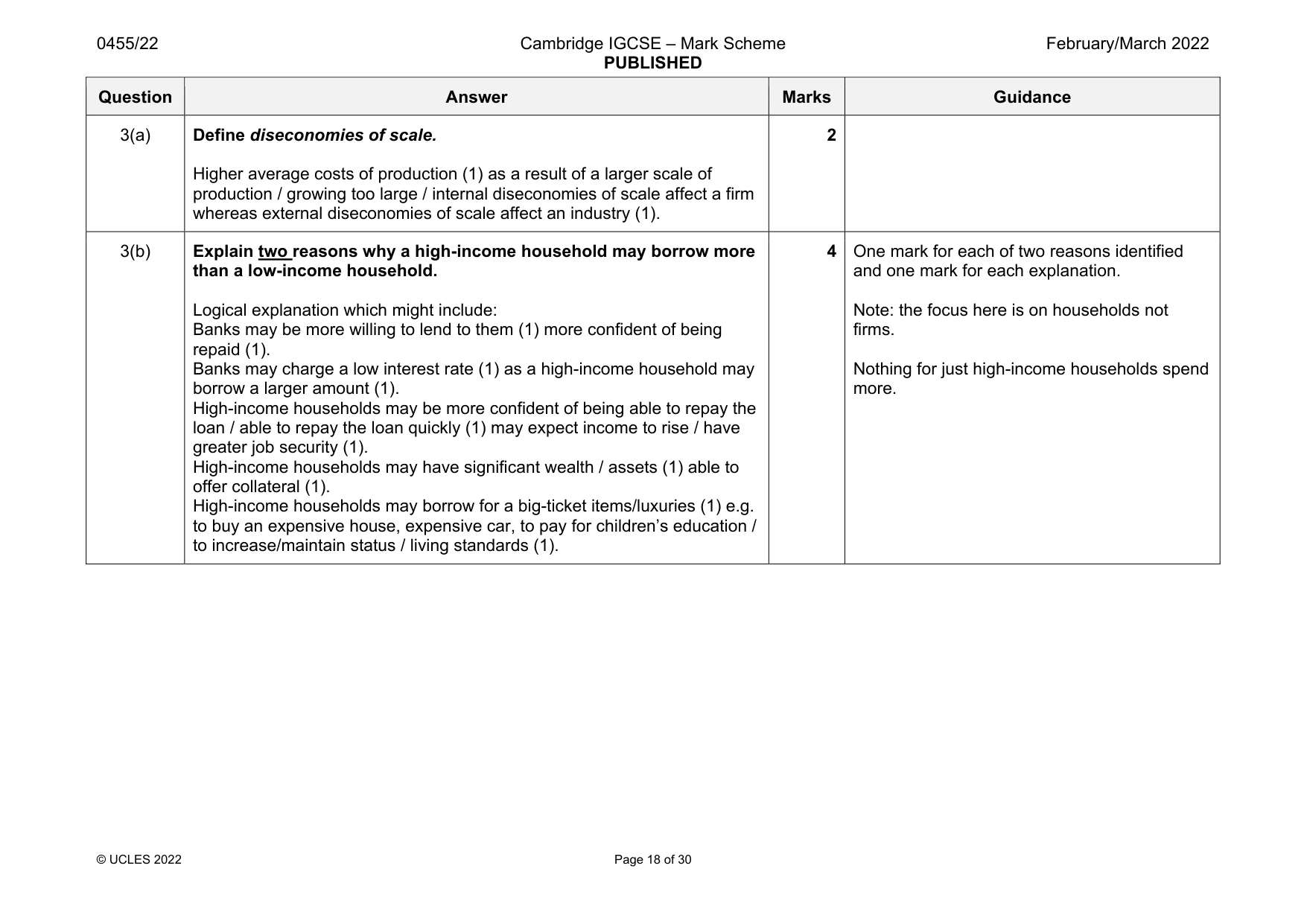
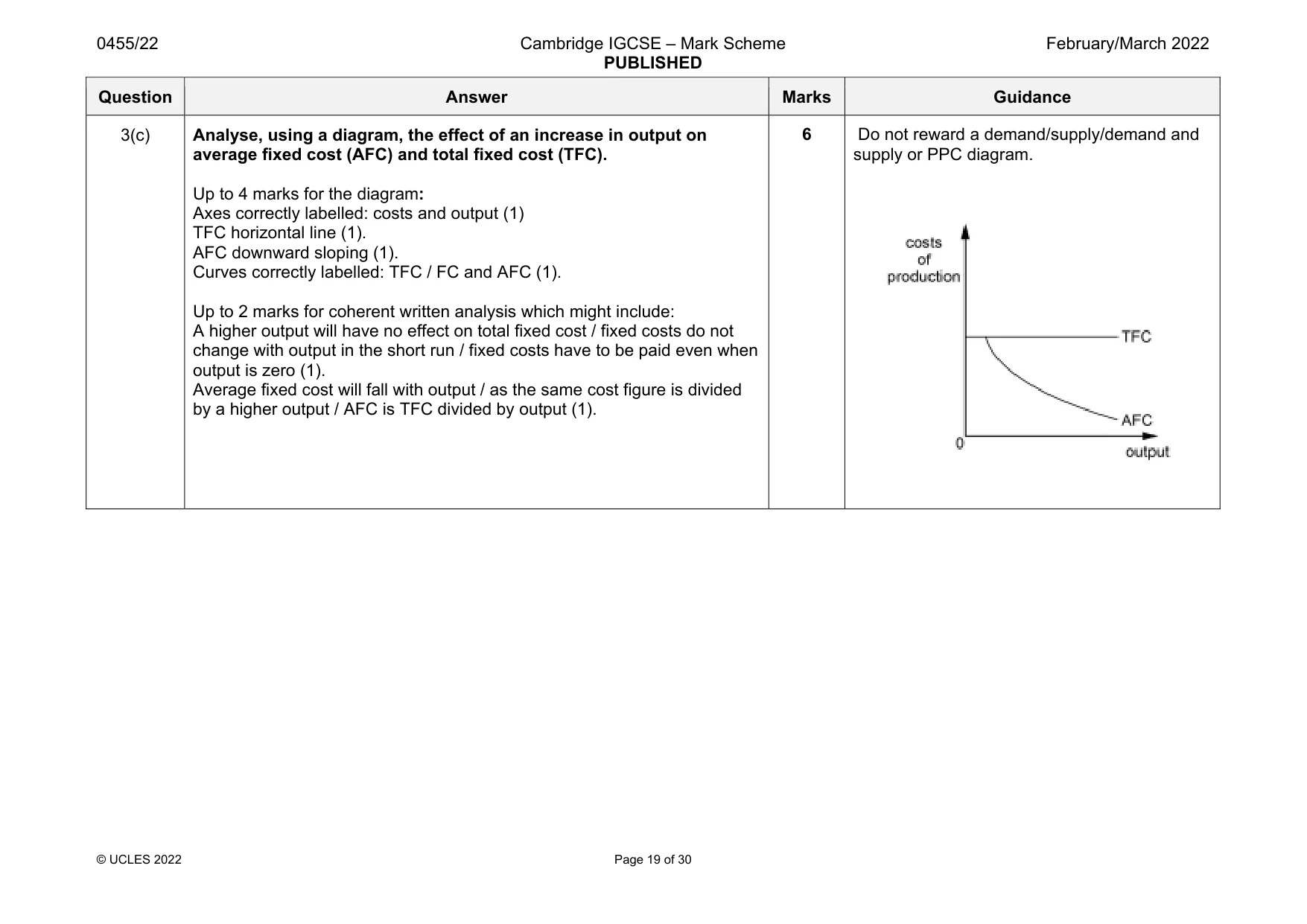
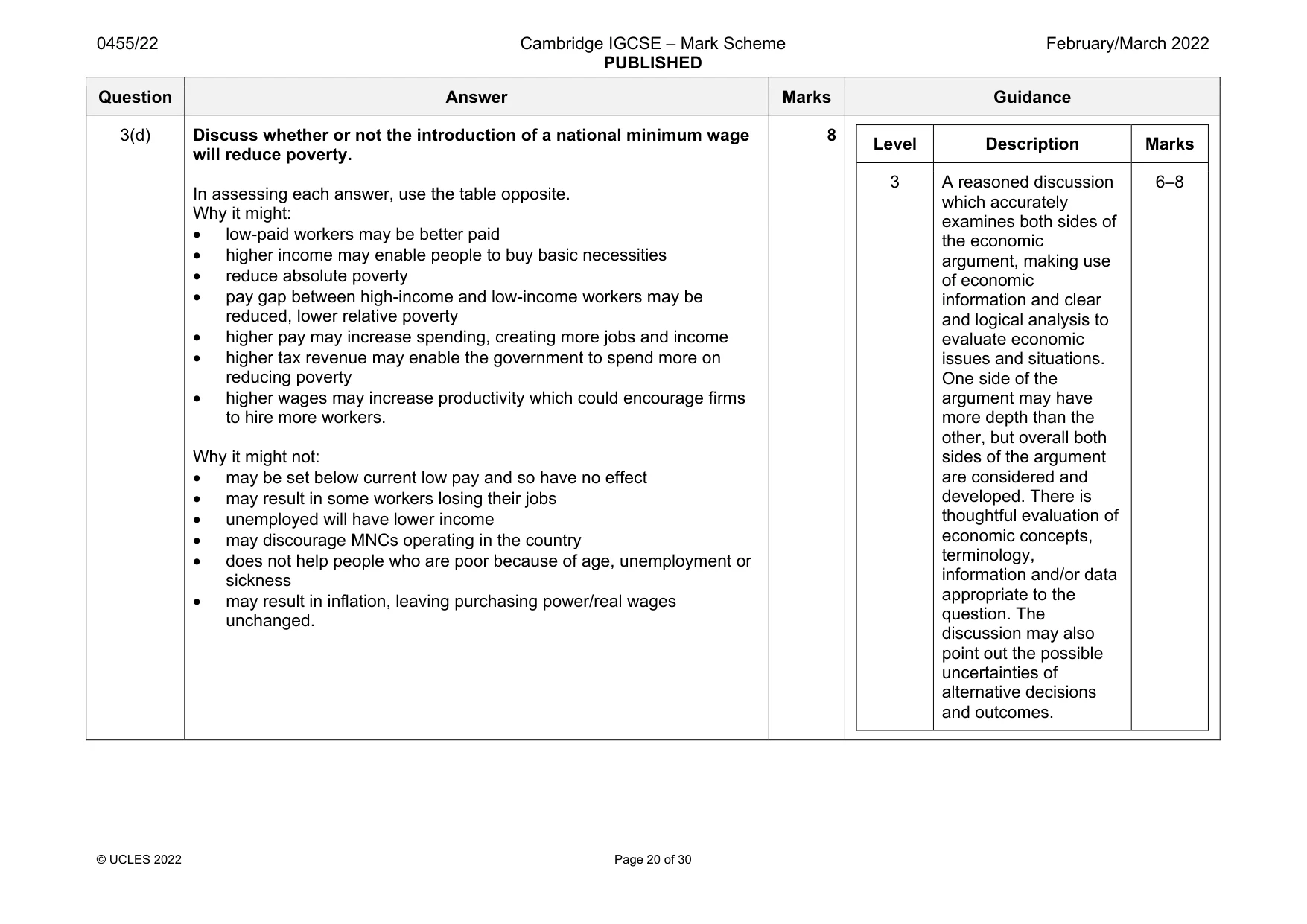
Mark scheme: 3(a) Define diseconomies of scale. Higher average costs of production (1) as a result of a larger scale of production / growing too large / internal diseconomies of scale affect a firm whereas external diseconomies of scale affect an industry (1). 2 3(b) Explain two reasons why a high-income household may borrow more than a low-income household. Logical explanation which might include: Banks may be more willing to lend to them (1) more confident of being repaid (1). Banks may charge a low interest rate (1) as a high-income household may borrow a larger amount (1). High-income households may be more confident of being able to repay the loan / able to repay the loan quickly (1) may expect income to rise / have greater job security (1). High-income households may have significant wealth / assets (1) able to offer collateral (1). High-income households may borrow for a big-ticket items/luxuries (1) e.g. to buy an expensive house, expensive car, to pay for children’s education / to increase/maintain status / living standards (1). 4 One mark for each of two reasons identified and one mark for each explanation. Note: the focus here is on households not firms. Nothing for just high-income households spend more. Question Answer Marks Guidance 3(c) Analyse, using a diagram, the effect of an increase in output on average fixed cost (AFC) and total fixed cost (TFC). Up to 4 marks for the diagram: Axes correctly labelled: costs and output (1) TFC horizontal line (1). AFC downward sloping (1). Curves correctly labelled: TFC / FC and AFC (1). Up to 2 marks for coherent written analysis which might include: A higher output will have no effect on total fixed cost / fixed costs do not change with output in the short run / fixed costs have to be paid even when output is zero (1). Average fixed cost will fall with output / as the same cost figure is divided by a higher output / AFC is TFC divided by output (1). 6 Do not reward a demand/supply/demand and supply or PPC diagram. Question Answer Marks Guidance 3(d) Discuss whether or not the introduction of a national minimum wage will reduce poverty. In assessing each answer, use the table opposite. Why it might: • low-paid workers may be better paid • higher income may enable people to buy basic necessities • reduce absolute poverty • pay gap between high-income and low-income workers may be reduced, lower relative poverty • higher pay may increase spending, creating more jobs and income • higher tax revenue may enable the government to spend more on reducing poverty • higher wages may increase productivity which could encourage firms to hire more workers. Why it might not: • may be set below current low pay and so have no effect • may result in some workers losing their jobs • unemployed will have lower income • may discourage MNCs operating in the country • does not help people who are poor because of age, unemployment or sickness • may result in inflation, leaving purchasing power/real wages unchanged. 8 Level Description Marks 3 A reasoned discussion which accurately examines both sides of the economic argument, making use of economic information and clear and logical analysis to evaluate economic issues and situations. One side of the argument may have more depth than the other, but overall both sides of the argument are considered and developed. There is thoughtful evaluation of economic concepts, terminology, information and/or data appropriate to the question. The discussion may also point out the possible uncertainties of alternative decisions and outcomes. 6–8 Question Answer Marks Guidance 3(d) Level Description Marks 2 A reasoned discussion which makes use of economic information and clear analysis to evaluate economic issues and situations. The answer may lack some depth and development may be one-sided. There is relevant use of economic concepts, terminology, information and data appropriate to the question. 3–5 1 There is a simple attempt at using economic definitions and terminology. Some reference may be made to economic theory, with occasional understanding. 1–2 0 A mark of zero should be awarded for no creditable content. 0
Q4 · Botswana’s net migration varies
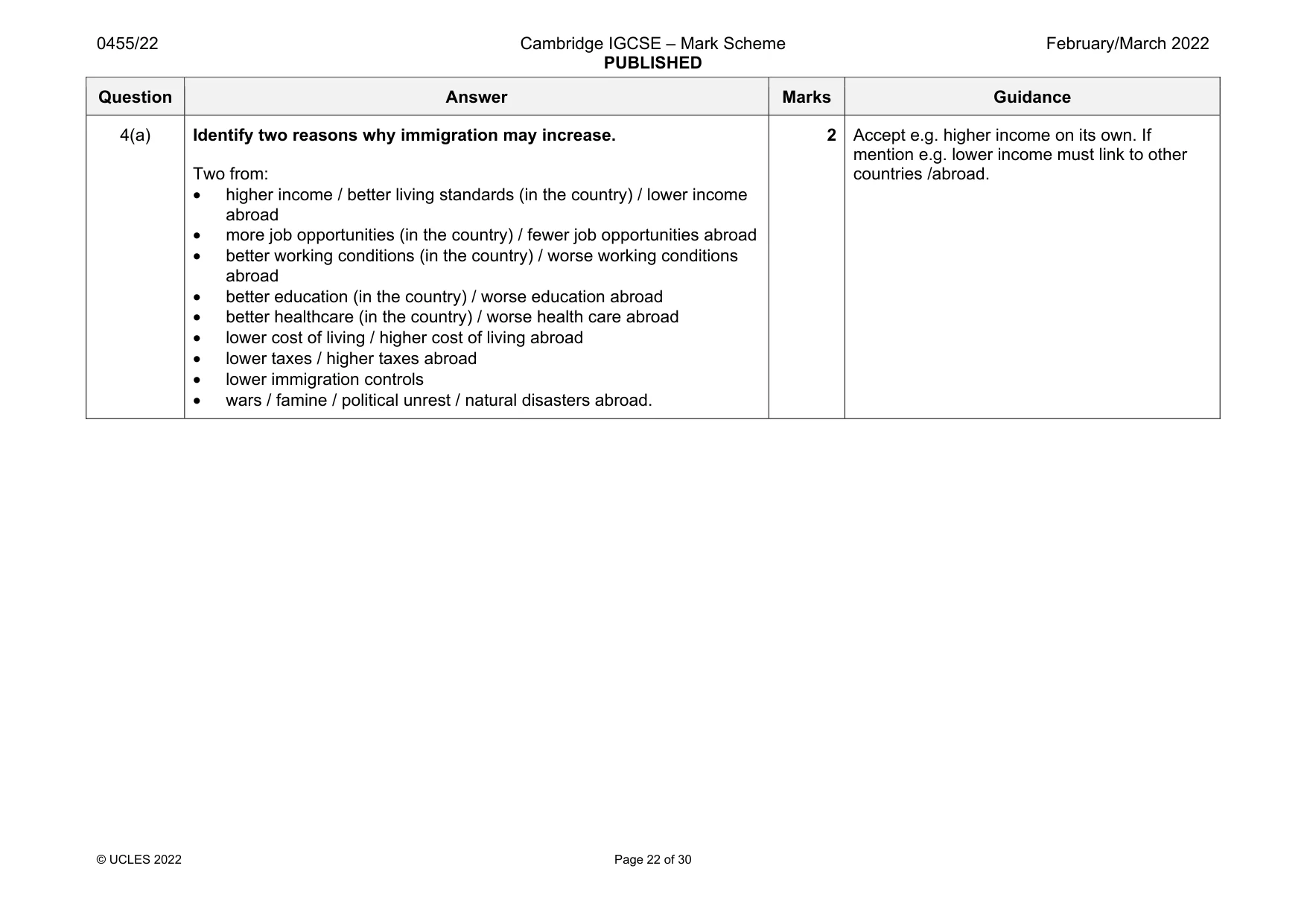
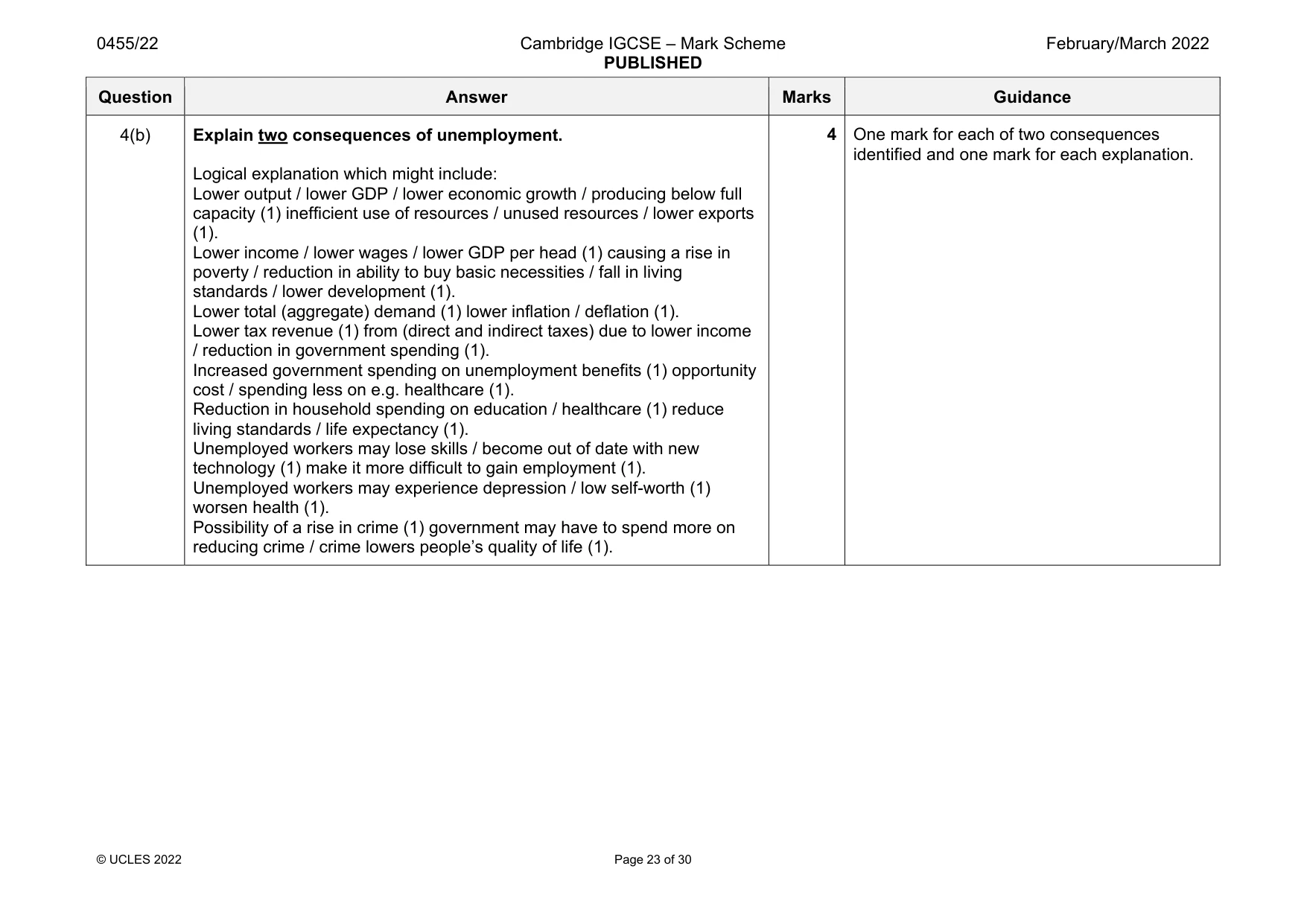
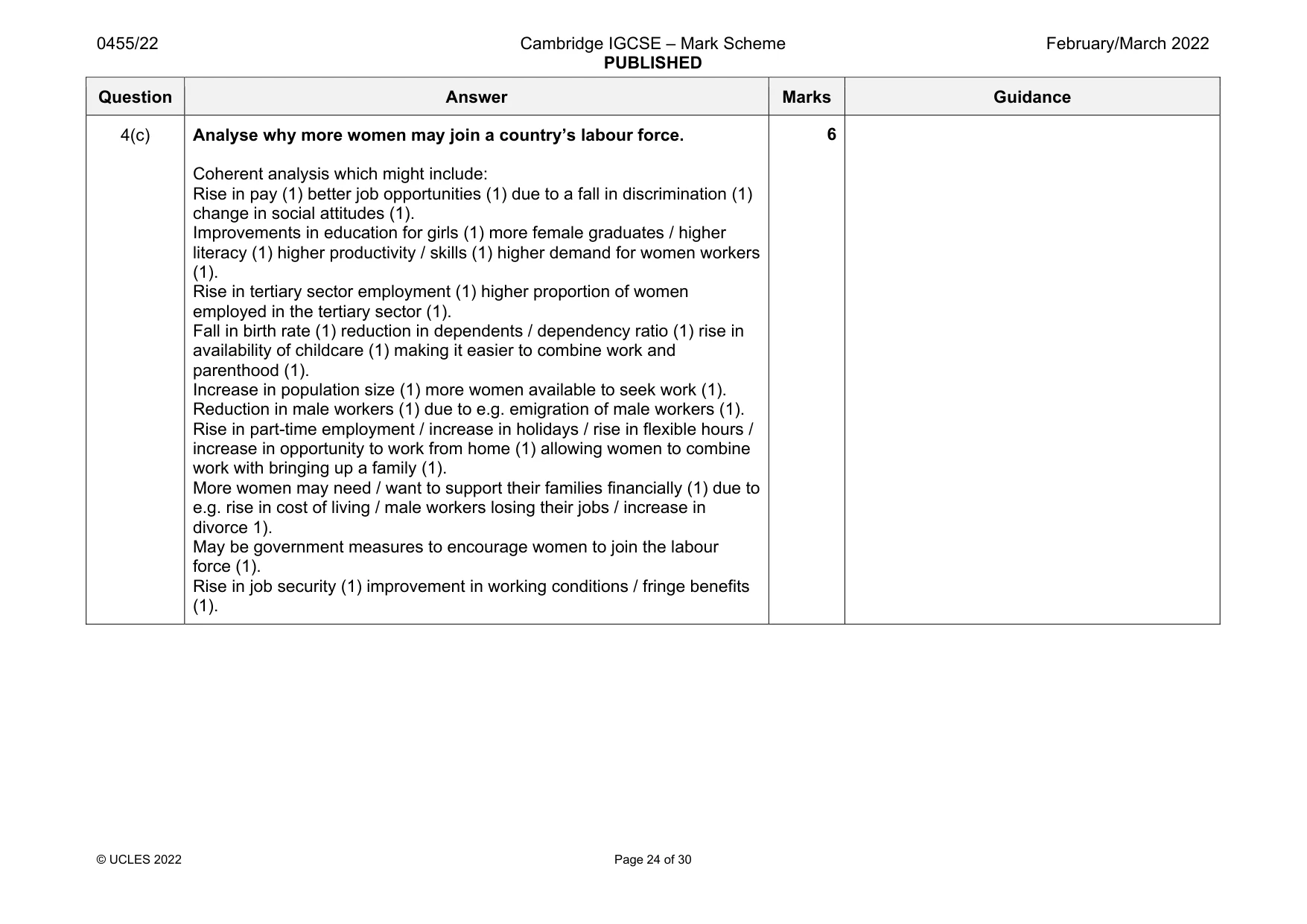
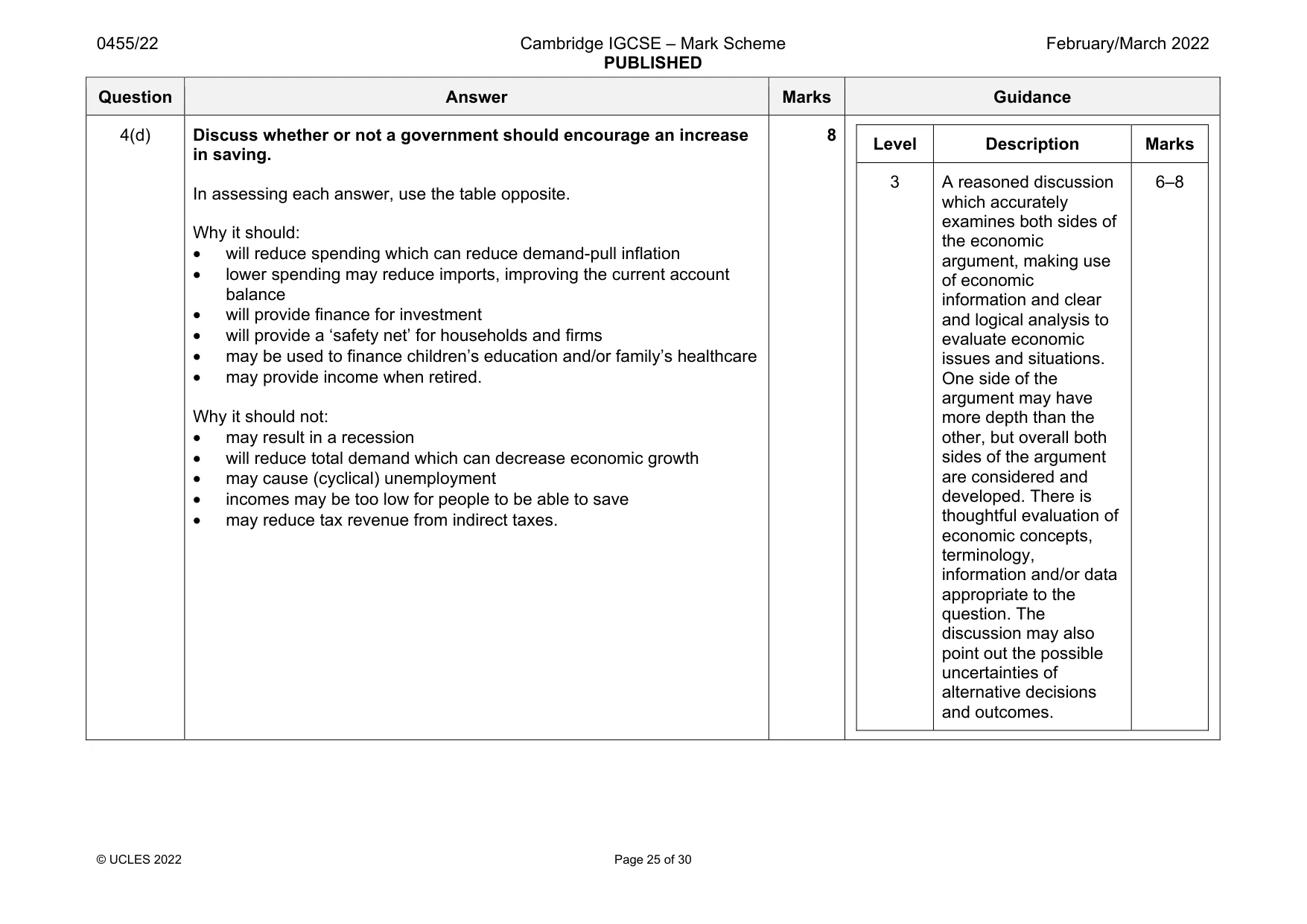
4 Botswana’s net migration varies. In 2019, Botswana had net immigration. Since 2010, its unemployment rate has averaged 18%. Between 2010 and 2019, the number of women in the labour force increased from 380 000 to 490 000. Although Botswana is one of Africa’s richer countries, its households do not save much of their income. (a) Identify two reasons why immigration may increase. [2] (b) Explain two consequences of unemployment. [4] (c) Analyse why more women may join a country’s labour force. [6] (d) Discuss whether or not a government should encourage an increase in saving. [8]
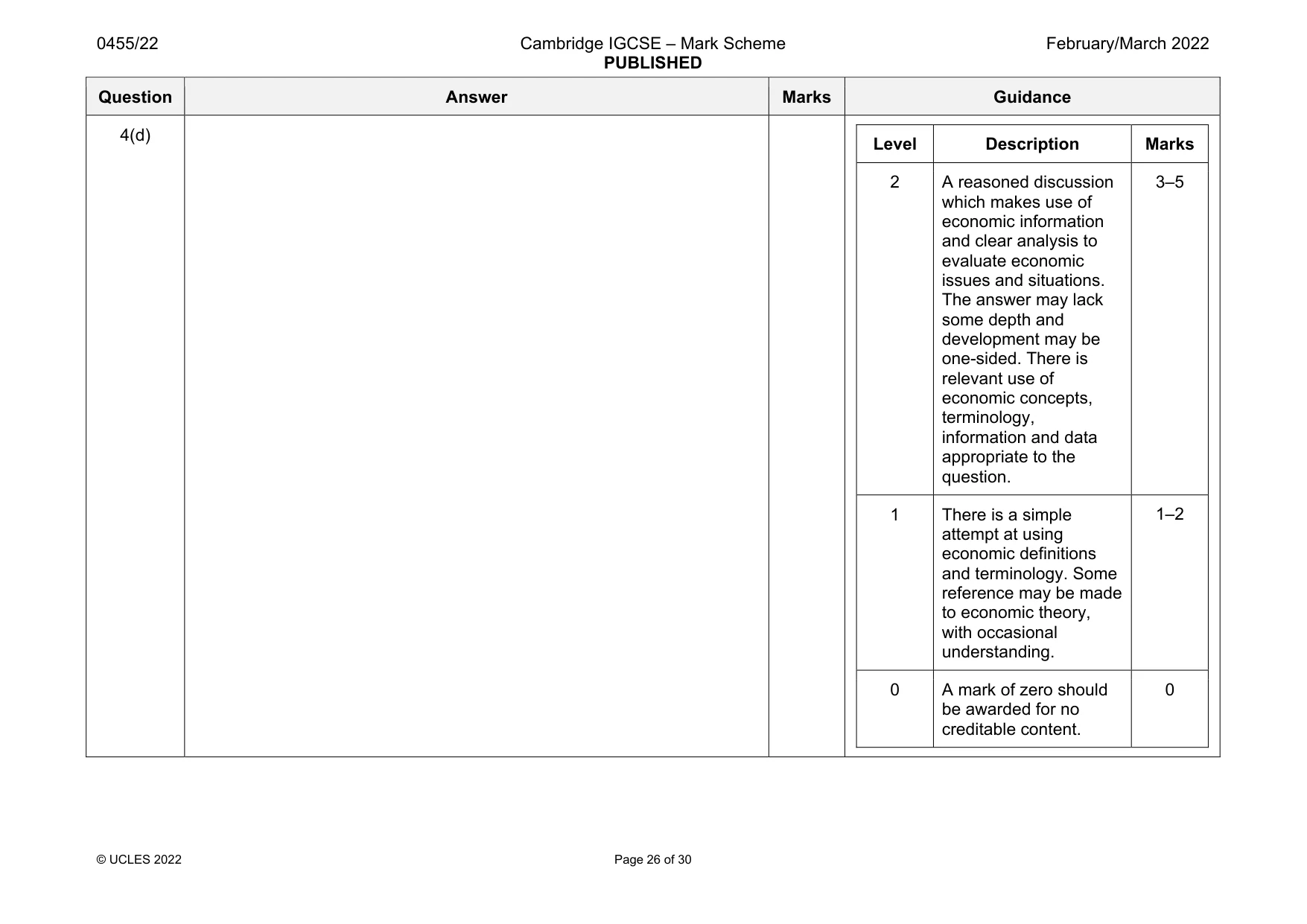
Mark scheme: 4(a) Identify two reasons why immigration may increase. Two from: • higher income / better living standards (in the country) / lower income abroad • more job opportunities (in the country) / fewer job opportunities abroad • better working conditions (in the country) / worse working conditions abroad • better education (in the country) / worse education abroad • better healthcare (in the country) / worse health care abroad • lower cost of living / higher cost of living abroad • lower taxes / higher taxes abroad • lower immigration controls • wars / famine / political unrest / natural disasters abroad. 2 Accept e.g. higher income on its own. If mention e.g. lower income must link to other countries /abroad. Question Answer Marks Guidance 4(b) Explain two consequences of unemployment. Logical explanation which might include: Lower output / lower GDP / lower economic growth / producing below full capacity (1) inefficient use of resources / unused resources / lower exports (1). Lower income / lower wages / lower GDP per head (1) causing a rise in poverty / reduction in ability to buy basic necessities / fall in living standards / lower development (1). Lower total (aggregate) demand (1) lower inflation / deflation (1). Lower tax revenue (1) from (direct and indirect taxes) due to lower income / reduction in government spending (1). Increased government spending on unemployment benefits (1) opportunity cost / spending less on e.g. healthcare (1). Reduction in household spending on education / healthcare (1) reduce living standards / life expectancy (1). Unemployed workers may lose skills / become out of date with new technology (1) make it more difficult to gain employment (1). Unemployed workers may experience depression / low self-worth (1) worsen health (1). Possibility of a rise in crime (1) government may have to spend more on reducing crime / crime lowers people’s quality of life (1). 4 One mark for each of two consequences identified and one mark for each explanation. Question Answer Marks Guidance 4(c) Analyse why more women may join a country’s labour force. Coherent analysis which might include: Rise in pay (1) better job opportunities (1) due to a fall in discrimination (1) change in social attitudes (1). Improvements in education for girls (1) more female graduates / higher literacy (1) higher productivity / skills (1) higher demand for women workers (1). Rise in tertiary sector employment (1) higher proportion of women employed in the tertiary sector (1). Fall in birth rate (1) reduction in dependents / dependency ratio (1) rise in availability of childcare (1) making it easier to combine work and parenthood (1). Increase in population size (1) more women available to seek work (1). Reduction in male workers (1) due to e.g. emigration of male workers (1). Rise in part-time employment / increase in holidays / rise in flexible hours / increase in opportunity to work from home (1) allowing women to combine work with bringing up a family (1). More women may need / want to support their families financially (1) due to e.g. rise in cost of living / male workers losing their jobs / increase in divorce 1). May be government measures to encourage women to join the labour force (1). Rise in job security (1) improvement in working conditions / fringe benefits (1). 6 Question Answer Marks Guidance 4(d) Discuss whether or not a government should encourage an increase in saving. In assessing each answer, use the table opposite. Why it should: • will reduce spending which can reduce demand-pull inflation • lower spending may reduce imports, improving the current account balance • will provide finance for investment • will provide a ‘safety net’ for households and firms • may be used to finance children’s education and/or family’s healthcare • may provide income when retired. Why it should not: • may result in a recession • will reduce total demand which can decrease economic growth • may cause (cyclical) unemployment • incomes may be too low for people to be able to save • may reduce tax revenue from indirect taxes. 8 Level Description Marks 3 A reasoned discussion which accurately examines both sides of the economic argument, making use of economic information and clear and logical analysis to evaluate economic issues and situations. One side of the argument may have more depth than the other, but overall both sides of the argument are considered and developed. There is thoughtful evaluation of economic concepts, terminology, information and/or data appropriate to the question. The discussion may also point out the possible uncertainties of alternative decisions and outcomes. 6–8 Question Answer Marks Guidance 4(d) Level Description Marks 2 A reasoned discussion which makes use of economic information and clear analysis to evaluate economic issues and situations. The answer may lack some depth and development may be one-sided. There is relevant use of economic concepts, terminology, information and data appropriate to the question. 3–5 1 There is a simple attempt at using economic definitions and terminology. Some reference may be made to economic theory, with occasional understanding. 1–2 0 A mark of zero should be awarded for no creditable content. 0
Q5 · The economic problem means that countries have to decide what to produce
5 The economic problem means that countries have to decide what to produce. Ghana uses much of its agricultural land to grow cocoa. Cocoa is sold to chocolate producers. The world’s main chocolate producer in 2019 was a US firm with a 14% share of the global market. That firm was the largest seller of chocolate in the US and, if it merges, may become a monopoly. (a) Define the economic problem. [2] (b) Explain whether land is mobile. [4] (c) Analyse the causes of a shift to the right in the supply curve of chocolate. [6] (d) Discuss whether or not consumers would benefit from a firm becoming a monopoly. [8]
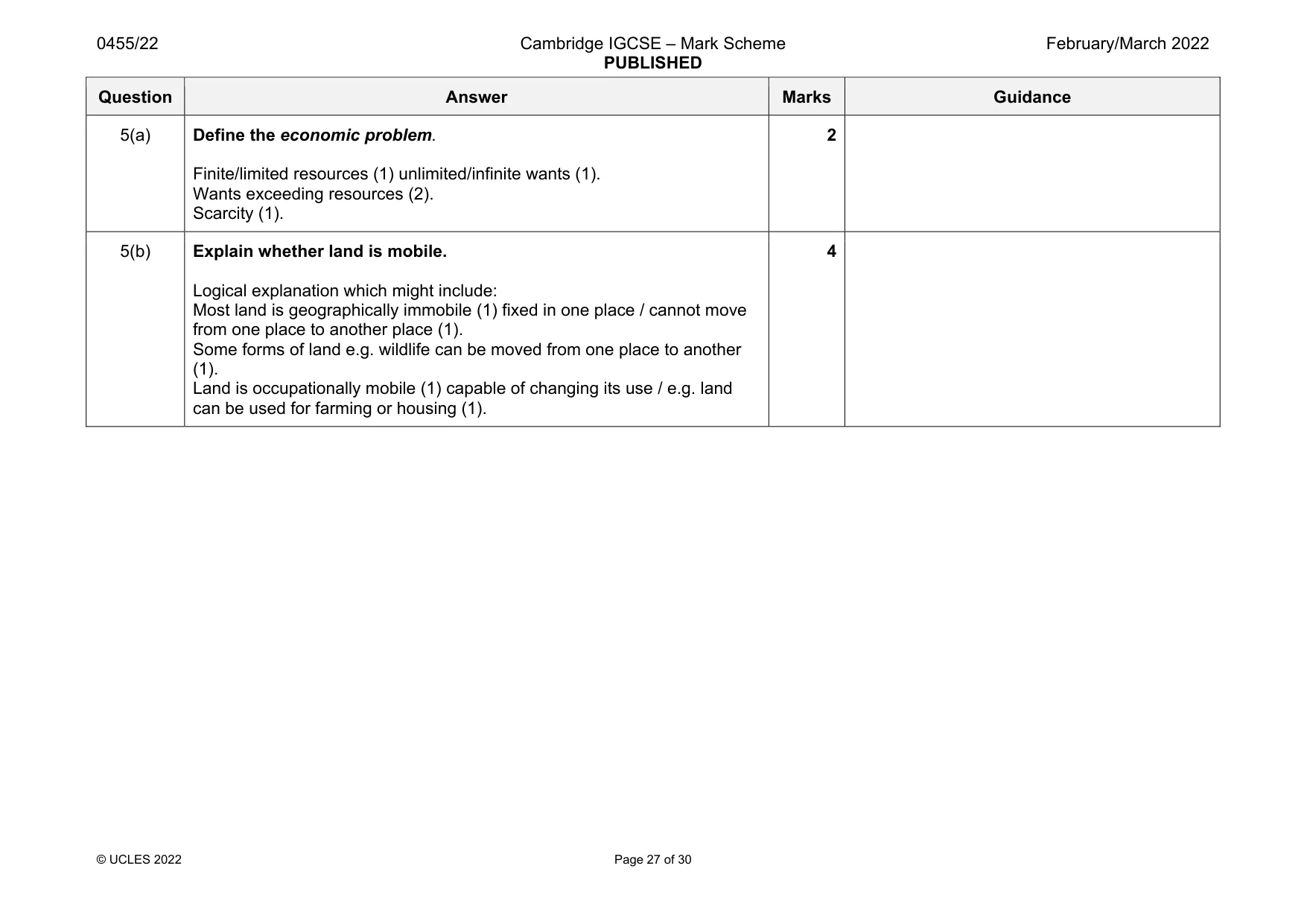
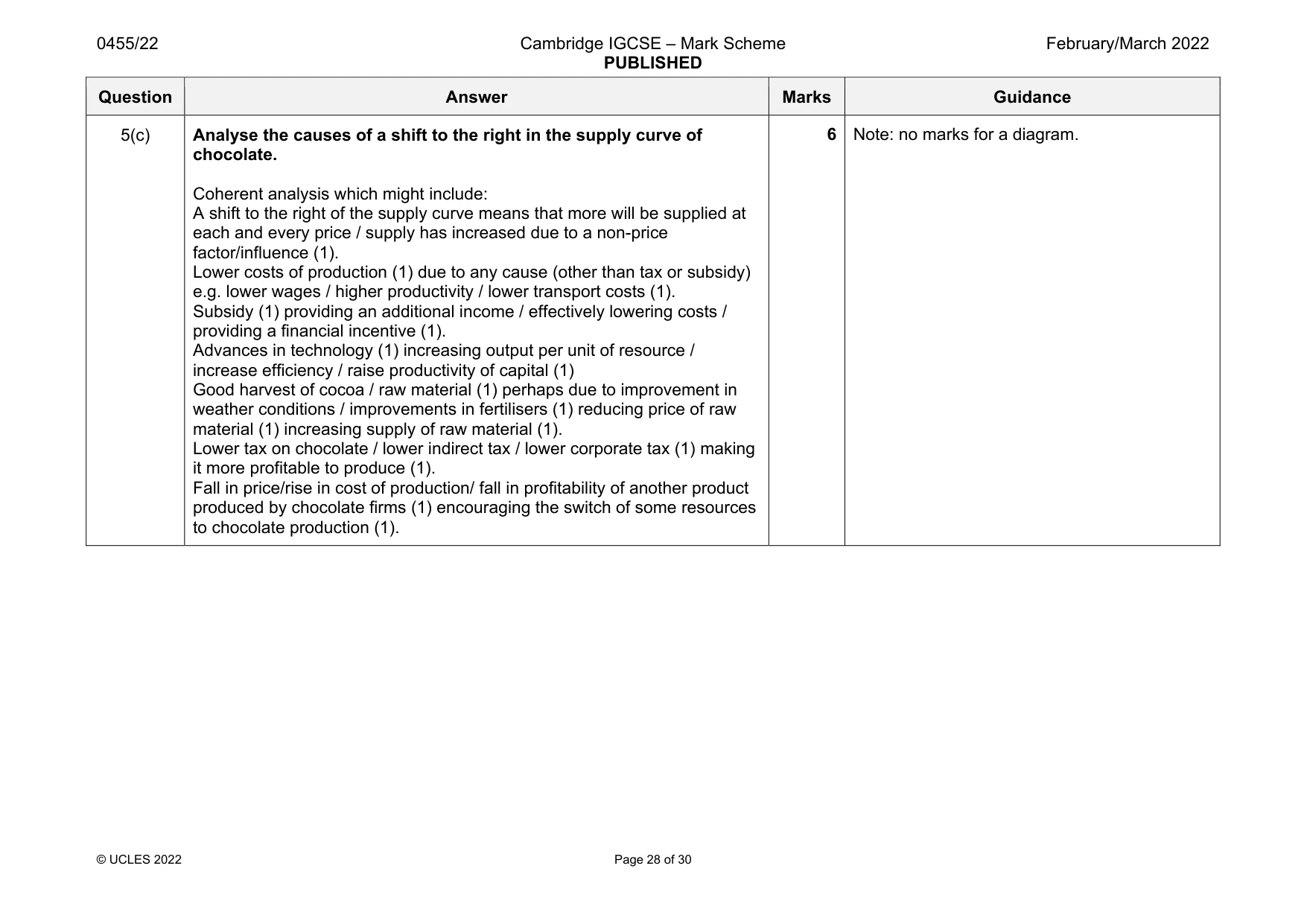
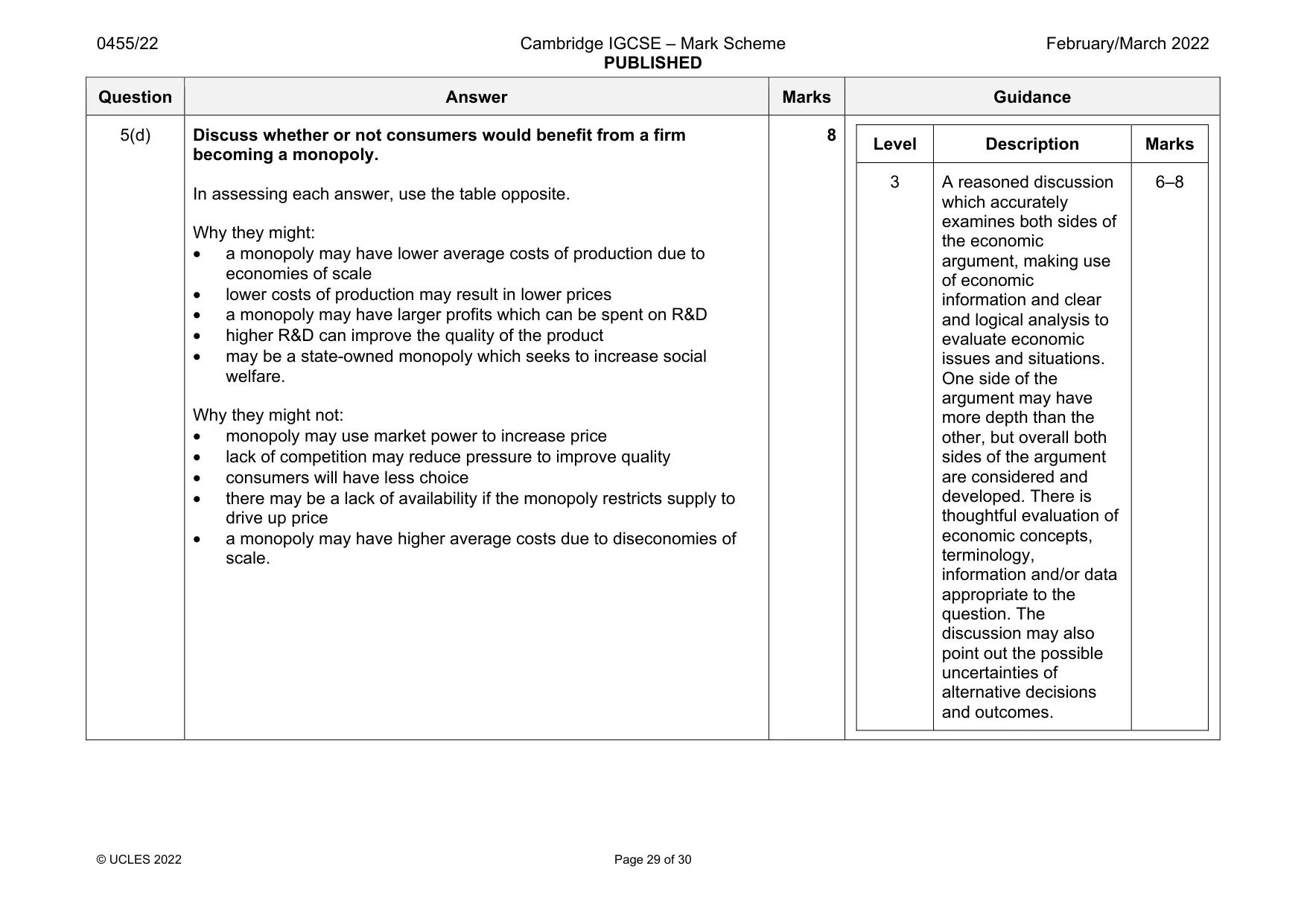
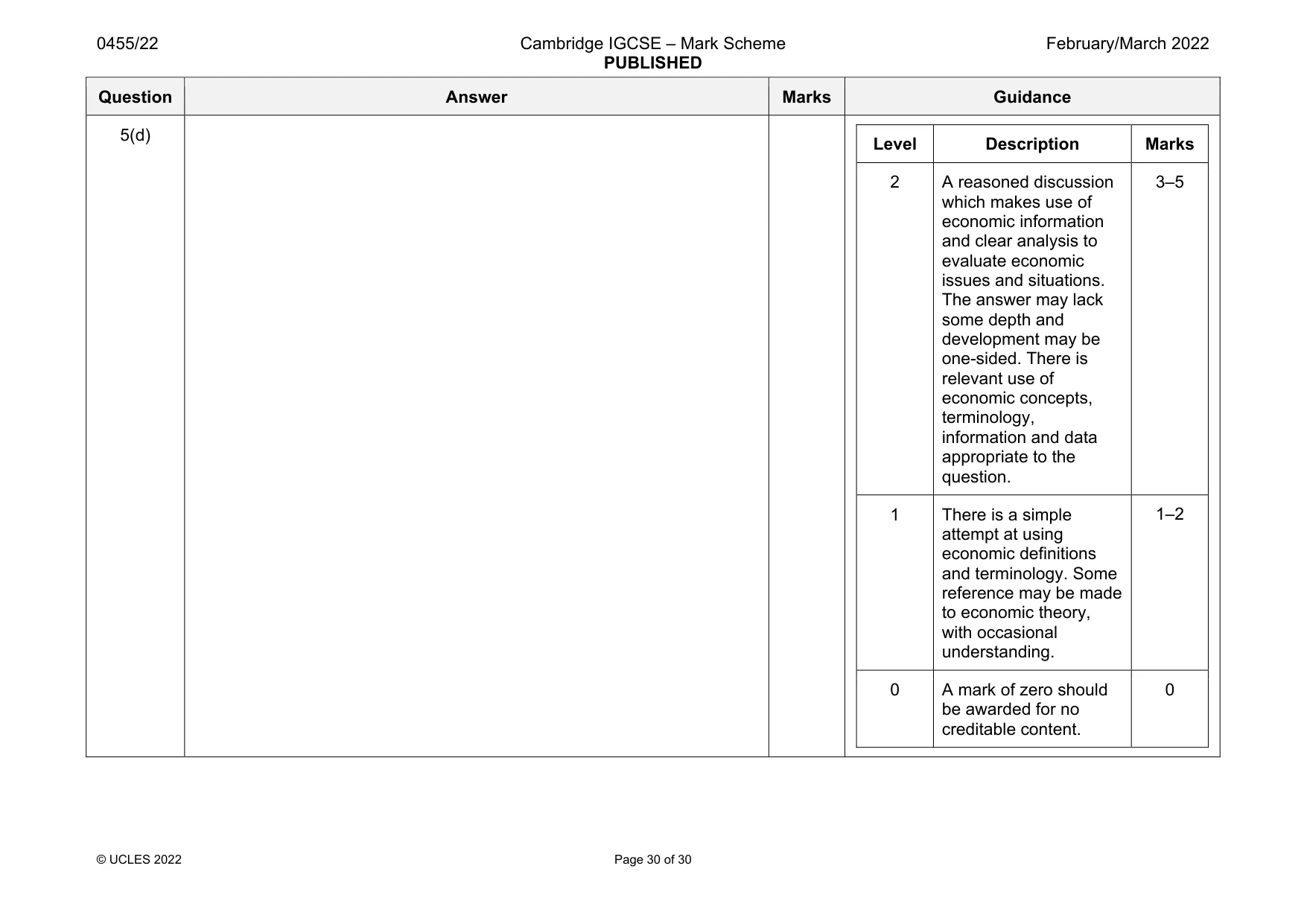
Mark scheme: 5(a) Define the economic problem. Finite/limited resources (1) unlimited/infinite wants (1). Wants exceeding resources (2). Scarcity (1). 2 5(b) Explain whether land is mobile. Logical explanation which might include: Most land is geographically immobile (1) fixed in one place / cannot move from one place to another place (1). Some forms of land e.g. wildlife can be moved from one place to another (1). Land is occupationally mobile (1) capable of changing its use / e.g. land can be used for farming or housing (1). 4 Question Answer Marks Guidance 5(c) Analyse the causes of a shift to the right in the supply curve of chocolate. Coherent analysis which might include: A shift to the right of the supply curve means that more will be supplied at each and every price / supply has increased due to a non-price factor/influence (1). Lower costs of production (1) due to any cause (other than tax or subsidy) e.g. lower wages / higher productivity / lower transport costs (1). Subsidy (1) providing an additional income / effectively lowering costs / providing a financial incentive (1). Advances in technology (1) increasing output per unit of resource / increase efficiency / raise productivity of capital (1) Good harvest of cocoa / raw material (1) perhaps due to improvement in weather conditions / improvements in fertilisers (1) reducing price of raw material (1) increasing supply of raw material (1). Lower tax on chocolate / lower indirect tax / lower corporate tax (1) making it more profitable to produce (1). Fall in price/rise in cost of production/ fall in profitability of another product produced by chocolate firms (1) encouraging the switch of some resources to chocolate production (1). 6 Note: no marks for a diagram. Question Answer Marks Guidance 5(d) Discuss whether or not consumers would benefit from a firm becoming a monopoly. In assessing each answer, use the table opposite. Why they might: • a monopoly may have lower average costs of production due to economies of scale • lower costs of production may result in lower prices • a monopoly may have larger profits which can be spent on R&D • higher R&D can improve the quality of the product • may be a state-owned monopoly which seeks to increase social welfare. Why they might not: • monopoly may use market power to increase price • lack of competition may reduce pressure to improve quality • consumers will have less choice • there may be a lack of availability if the monopoly restricts supply to drive up price • a monopoly may have higher average costs due to diseconomies of scale. 8 Level Description Marks 3 A reasoned discussion which accurately examines both sides of the economic argument, making use of economic information and clear and logical analysis to evaluate economic issues and situations. One side of the argument may have more depth than the other, but overall both sides of the argument are considered and developed. There is thoughtful evaluation of economic concepts, terminology, information and/or data appropriate to the question. The discussion may also point out the possible uncertainties of alternative decisions and outcomes. 6–8 Question Answer Marks Guidance 5(d) Level Description Marks 2 A reasoned discussion which makes use of economic information and clear analysis to evaluate economic issues and situations. The answer may lack some depth and development may be one-sided. There is relevant use of economic concepts, terminology, information and data appropriate to the question. 3–5 1 There is a simple attempt at using economic definitions and terminology. Some reference may be made to economic theory, with occasional understanding. 1–2 0 A mark of zero should be awarded for no creditable content. 0
What was in this paper
The subtopics covered by these 5 questions, and how many questions each got. Open one in a new tab to see every Cambridge question on it.
What you needed in this session
Cambridge’s own grade thresholds for 2022 Feb/March, Paper 2 · Variant 2. A higher threshold means an easier paper — the bar moves with how the cohort did.