Cambridge IGCSE Economics 0455 — 2019 Feb/March Paper 2 · Variant 2
0455/22/F/M/19 · 7 questions · 90 marks · ≈101 min
The question paper and its mark scheme, free to read here and free to download. This is Cambridge’s own paper, exactly as it was sat.
Question paper8 pages




Mark scheme12 pages
Answers below. Sit the paper first if you are practising.

Questions as text
Q1 · India: a growing success In 2016, the Indian economy grew by 7.5%
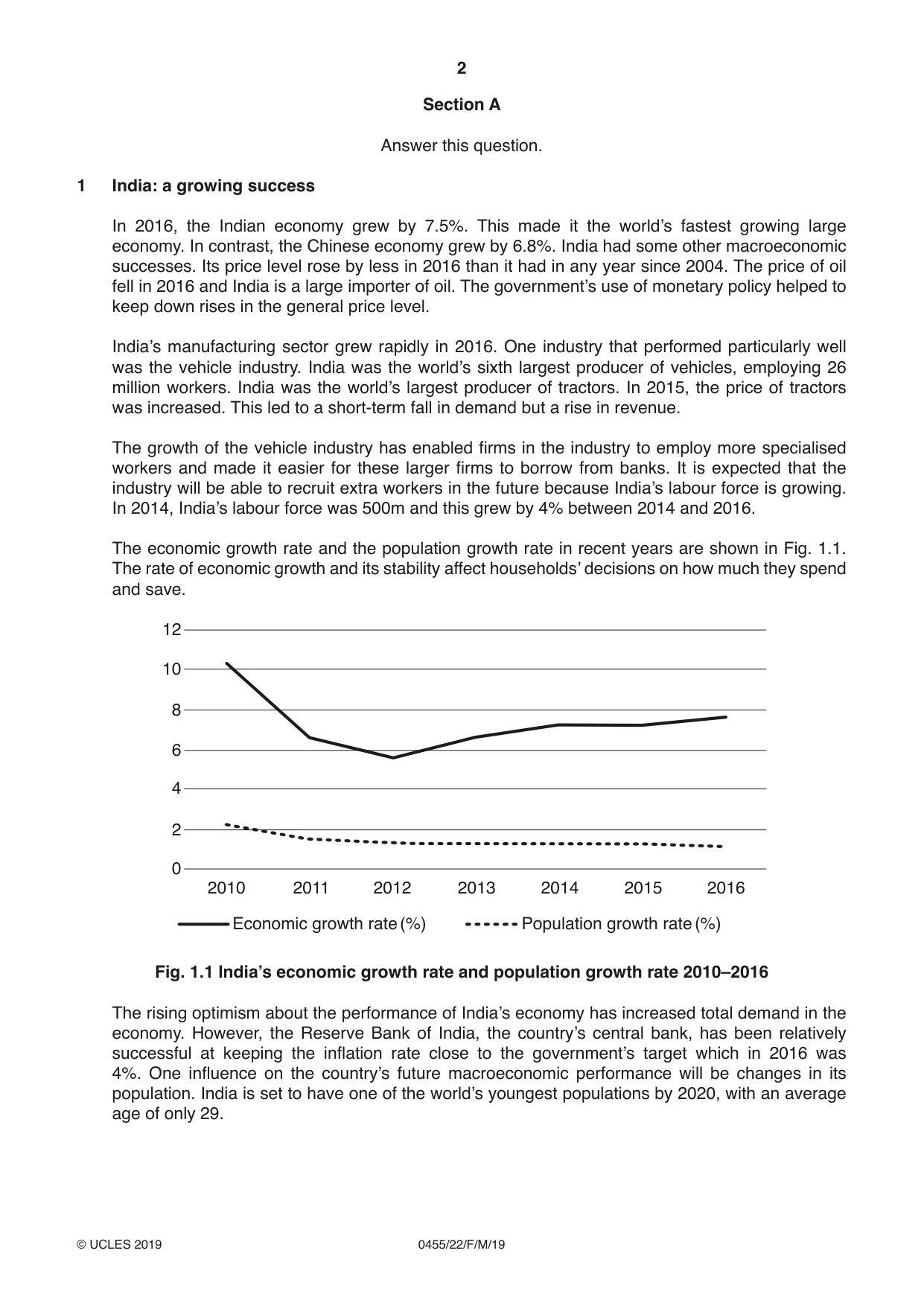
1 India: a growing success In 2016, the Indian economy grew by 7.5%. This made it the world’s fastest growing large economy. In contrast, the Chinese economy grew by 6.8%. India had some other macroeconomic successes. Its price level rose by less in 2016 than it had in any year since 2004. The price of oil fell in 2016 and India is a large importer of oil. The government’s use of monetary policy helped to keep down rises in the general price level. India’s manufacturing sector grew rapidly in 2016. One industry that performed particularly well was the vehicle industry. India was the world’s sixth largest producer of vehicles, employing 26 million workers. India was the world’s largest producer of tractors. In 2015, the price of tractors was increased. This led to a short-term fall in demand but a rise in revenue. The growth of the vehicle industry has enabled firms in the industry to employ more specialised workers and made it easier for these larger firms to borrow from banks. It is expected that the industry will be able to recruit extra workers in the future because India’s labour force is growing. In 2014, India’s labour force was 500m and this grew by 4% between 2014 and 2016. The economic growth rate and the population growth rate in recent years are shown in Fig. 1.1. The rate of economic growth and its stability affect households’ decisions on how much they spend and save. 12 10 8 6 4 2 0 2010 2011 2012 2013 2014 2015 2016 Economic growth rate (%) Population growth rate (%) Fig. 1.1 India’s economic growth rate and population growth rate 2010–2016 The rising optimism about the performance of India’s economy has increased total demand in the economy. However, the Reserve Bank of India, the country’s central bank, has been relatively successful at keeping the inflation rate close to the government’s target which in 2016 was 4%. One influence on the country’s future macroeconomic performance will be changes in its population. India is set to have one of the world’s youngest populations by 2020, with an average age of only 29. (a) Identify, using information from the extract, two reasons why India’s inflation rate fell in 2016. [2] (b) Explain, using information from the extract, whether demand for Indian tractors was price-elastic or price-inelastic in 2015. [2] (c) Explain two internal economies of scale referred to in the extract. [4] (d) Calculate, using information from the extract, the percentage of India’s labour force that was employed in the vehicle industry in 2016. [2] (e) Analyse, using Fig. 1.1, what happened to India’s output and population over the period shown. [5] (f) Discuss whether or not a government should aim for a low rate of inflation. [5] (g) Explain, using information from the extract, two reasons why consumer expenditure may increase in India in the future. [4] (h) Discuss whether or not having a young population is a benefit to an economy. [6]
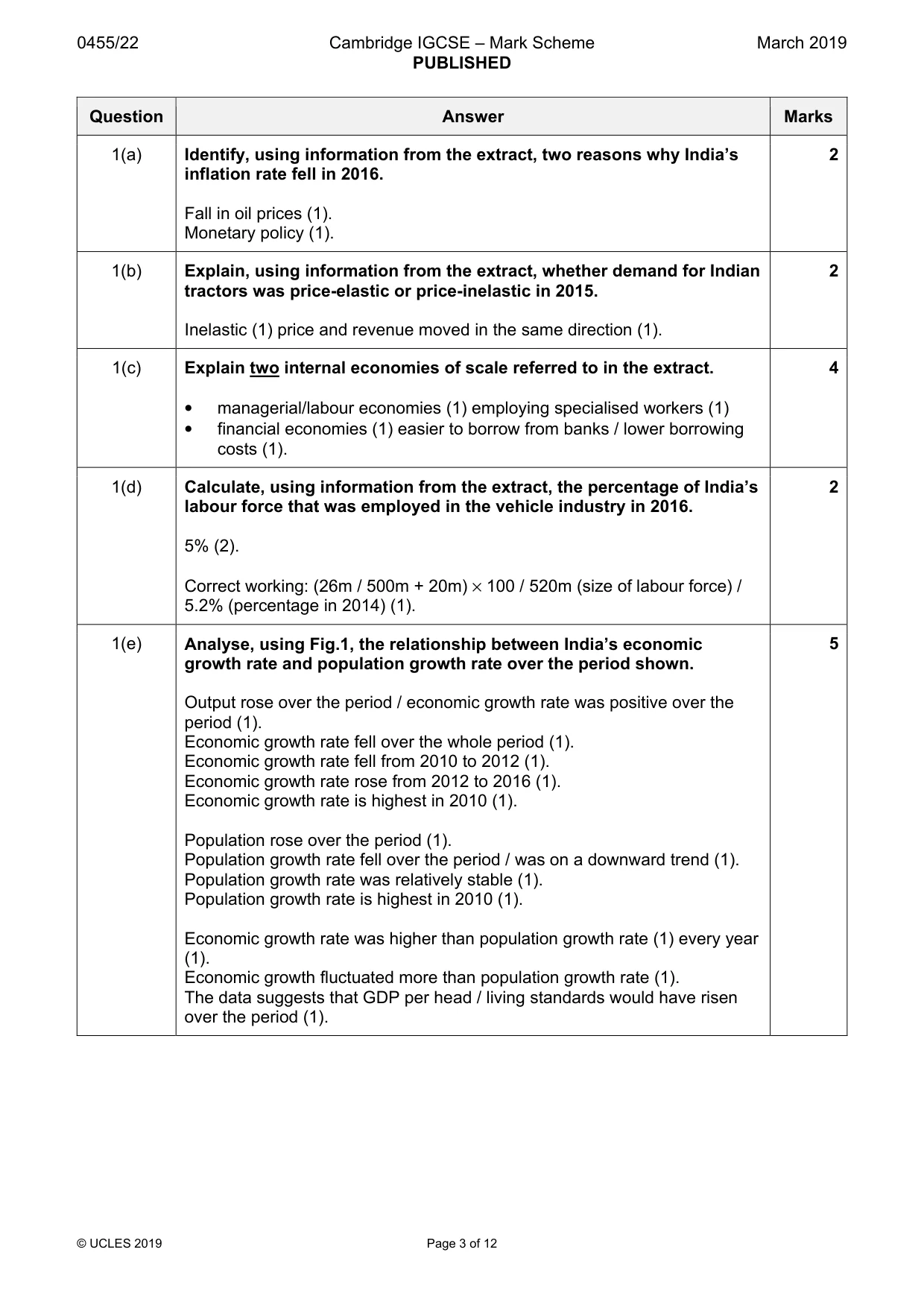
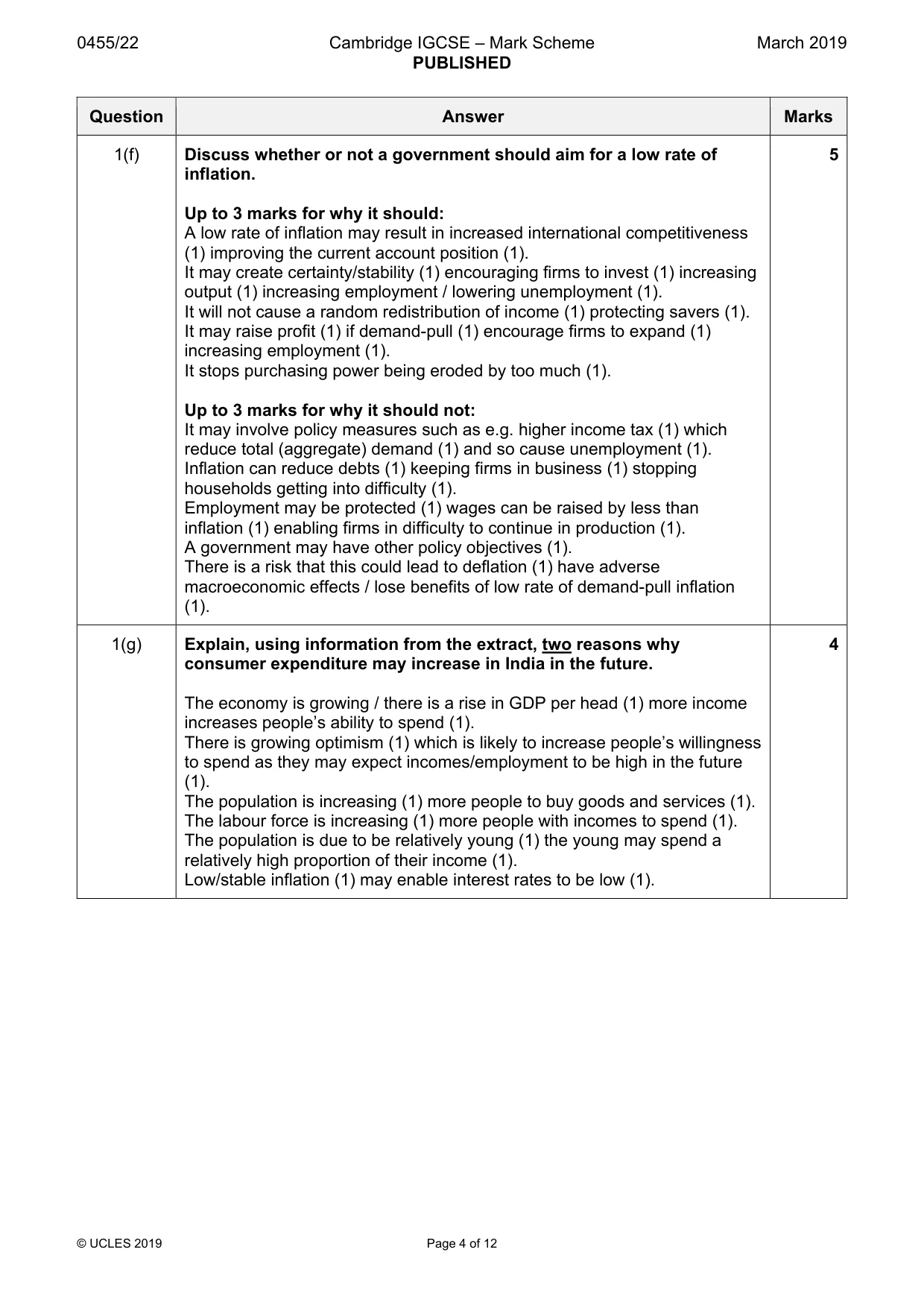
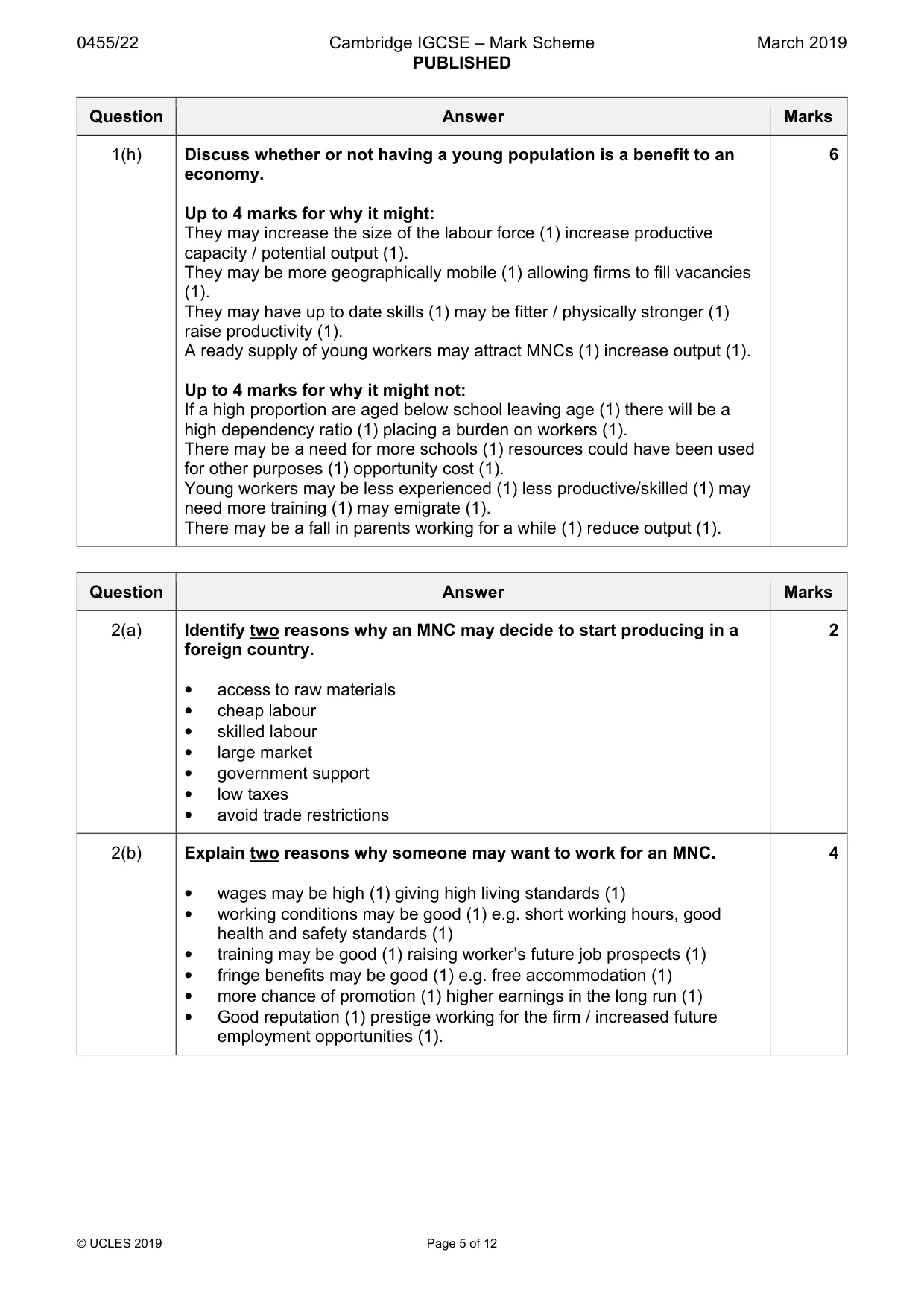
Mark scheme: Question Answer Marks 1(a) Identify, using information from the extract, two reasons why India’s 2 inflation rate fell in 2016. Fall in oil prices (1). Monetary policy (1). 1(b) Explain, using information from the extract, whether demand for Indian 2 tractors was price-elastic or price-inelastic in 2015. Inelastic (1) price and revenue moved in the same direction (1). 1(c) Explain two internal economies of scale referred to in the extract. 4 • managerial/labour economies (1) employing specialised workers (1) • financial economies (1) easier to borrow from banks / lower borrowing costs (1). 1(d) Calculate, using information from the extract, the percentage of India’s 2 labour force that was employed in the vehicle industry in 2016. 5% (2). Correct working: (26m / 500m + 20m) × 100 / 520m (size of labour force) / 5.2% (percentage in 2014) (1). 1(e) Analyse, using Fig.1, the relationship between India’s economic 5 growth rate and population growth rate over the period shown. Output rose over the period / economic growth rate was positive over the period (1). Economic growth rate fell over the whole period (1). Economic growth rate fell from 2010 to 2012 (1). Economic growth rate rose from 2012 to 2016 (1). Economic growth rate is highest in 2010 (1). Population rose over the period (1). Population growth rate fell over the period / was on a downward trend (1). Population growth rate was relatively stable (1). Population growth rate is highest in 2010 (1). Economic growth rate was higher than population growth rate (1) every year (1). Economic growth fluctuated more than population growth rate (1). The data suggests that GDP per head / living standards would have risen over the period (1). 1(f) Discuss whether or not a government should aim for a low rate of 5 inflation. Up to 3 marks for why it should: A low rate of inflation may result in increased international competitiveness (1) improving the current account position (1). It may create certainty/stability (1) encouraging firms to invest (1) increasing output (1) increasing employment / lowering unemployment (1). It will not cause a random redistribution of income (1) protecting savers (1). It may raise profit (1) if demand-pull (1) encourage firms to expand (1) increasing employment (1). It stops purchasing power being eroded by too much (1). Up to 3 marks for why it should not: It may involve policy measures such as e.g. higher income tax (1) which reduce total (aggregate) demand (1) and so cause unemployment (1). Inflation can reduce debts (1) keeping firms in business (1) stopping households getting into difficulty (1). Employment may be protected (1) wages can be raised by less than inflation (1) enabling firms in difficulty to continue in production (1). A government may have other policy objectives (1). There is a risk that this could lead to deflation (1) have adverse macroeconomic effects / lose benefits of low rate of demand-pull inflation (1). 1(g) Explain, using information from the extract, two reasons why 4 consumer expenditure may increase in India in the future. The economy is growing / there is a rise in GDP per head (1) more income increases people’s ability to spend (1). There is growing optimism (1) which is likely to increase people’s willingness to spend as they may expect incomes/employment to be high in the future (1). The population is increasing (1) more people to buy goods and services (1). The labour force is increasing (1) more people with incomes to spend (1). The population is due to be relatively young (1) the young may spend a relatively high proportion of their income (1). Low/stable inflation (1) may enable interest rates to be low (1). 1(h) Discuss whether or not having a young population is a benefit to an 6 economy. Up to 4 marks for why it might: They may increase the size of the labour force (1) increase productive capacity / potential output (1). They may be more geographically mobile (1) allowing firms to fill vacancies (1). They may have up to date skills (1) may be fitter / physically stronger (1) raise productivity (1). A ready supply of young workers may attract MNCs (1) increase output (1). Up to 4 marks for why it might not: If a high proportion are aged below school leaving age (1) there will be a high dependency ratio (1) placing a burden on workers (1). There may be a need for more schools (1) resources could have been used for other purposes (1) opportunity cost (1). Young workers may be less experienced (1) less productive/skilled (1) may need more training (1) may emigrate (1). There may be a fall in parents working for a while (1) reduce output (1).
Q2 · Ireland has attracted a significant number of foreign multinational companies (MNCs) to…
2 Ireland has attracted a significant number of foreign multinational companies (MNCs) to set up production in the country. These firms employ approximately 10% of the country’s labour force and make a high proportion of Ireland’s exports. The surplus on the current account of Ireland’s balance of payments fell in 2016 while government spending rose. (a) Identify two reasons why an MNC may decide to start producing in a foreign country. [2] (b) Explain two reasons why someone may want to work for an MNC. [4] (c) Analyse how an increase in exports could improve a country’s economic performance. [6] (d) Discuss whether or not an increase in government spending will reduce a surplus on the current account of that country’s balance of payments. [8]
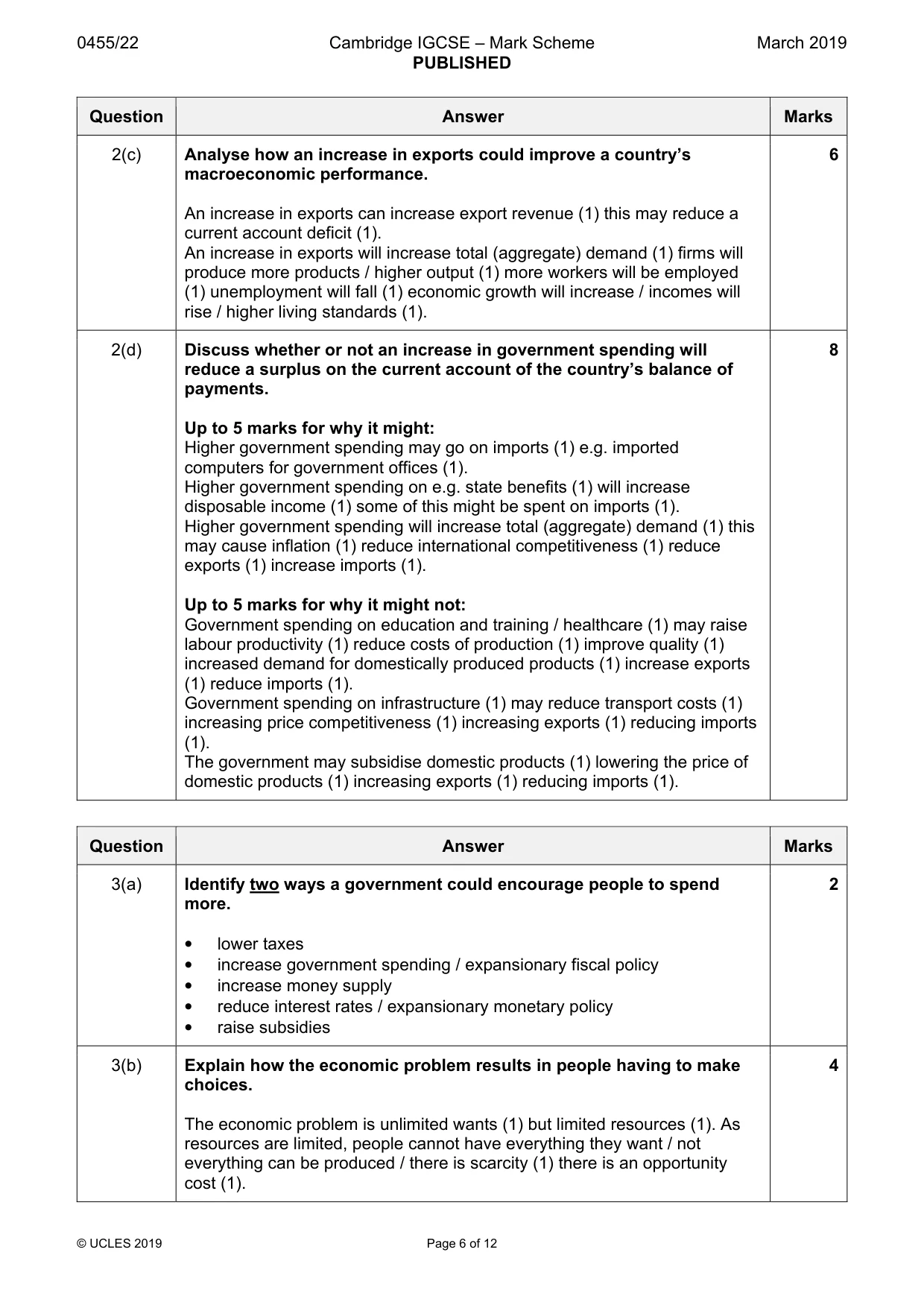
Mark scheme: 2(a) Identify two reasons why an MNC may decide to start producing in a 2 foreign country. • access to raw materials • cheap labour • skilled labour • large market • government support • low taxes • avoid trade restrictions 2(b) Explain two reasons why someone may want to work for an MNC. 4 • wages may be high (1) giving high living standards (1) • working conditions may be good (1) e.g. short working hours, good health and safety standards (1) • training may be good (1) raising worker’s future job prospects (1) • fringe benefits may be good (1) e.g. free accommodation (1) • more chance of promotion (1) higher earnings in the long run (1) • Good reputation (1) prestige working for the firm / increased future employment opportunities (1). 2(c) Analyse how an increase in exports could improve a country’s 6 macroeconomic performance. An increase in exports can increase export revenue (1) this may reduce a current account deficit (1). An increase in exports will increase total (aggregate) demand (1) firms will produce more products / higher output (1) more workers will be employed (1) unemployment will fall (1) economic growth will increase / incomes will rise / higher living standards (1). 2(d) Discuss whether or not an increase in government spending will 8 reduce a surplus on the current account of the country’s balance of payments. Up to 5 marks for why it might: Higher government spending may go on imports (1) e.g. imported computers for government offices (1). Higher government spending on e.g. state benefits (1) will increase disposable income (1) some of this might be spent on imports (1). Higher government spending will increase total (aggregate) demand (1) this may cause inflation (1) reduce international competitiveness (1) reduce exports (1) increase imports (1). Up to 5 marks for why it might not: Government spending on education and training / healthcare (1) may raise labour productivity (1) reduce costs of production (1) improve quality (1) increased demand for domestically produced products (1) increase exports (1) reduce imports (1). Government spending on infrastructure (1) may reduce transport costs (1) increasing price competitiveness (1) increasing exports (1) reducing imports (1). The government may subsidise domestic products (1) lowering the price of domestic products (1) increasing exports (1) reducing imports (1).
Q3 · The economic problem results in people having to make choices
3 The economic problem results in people having to make choices. In Bulgaria, in recent years, people have changed how much they spend. The Bulgarian government is encouraging people to spend more. It is trying to ensure that deflation does not return and that the country will continue to experience an increase in output. (a) Identify two ways a government could encourage people to spend more. [2] (b) Explain how the economic problem results in people having to make choices. [4] (c) Analyse why deflation may cause a fall in output. [6] (d) Discuss whether or not a country will suffer if its output falls. [8]
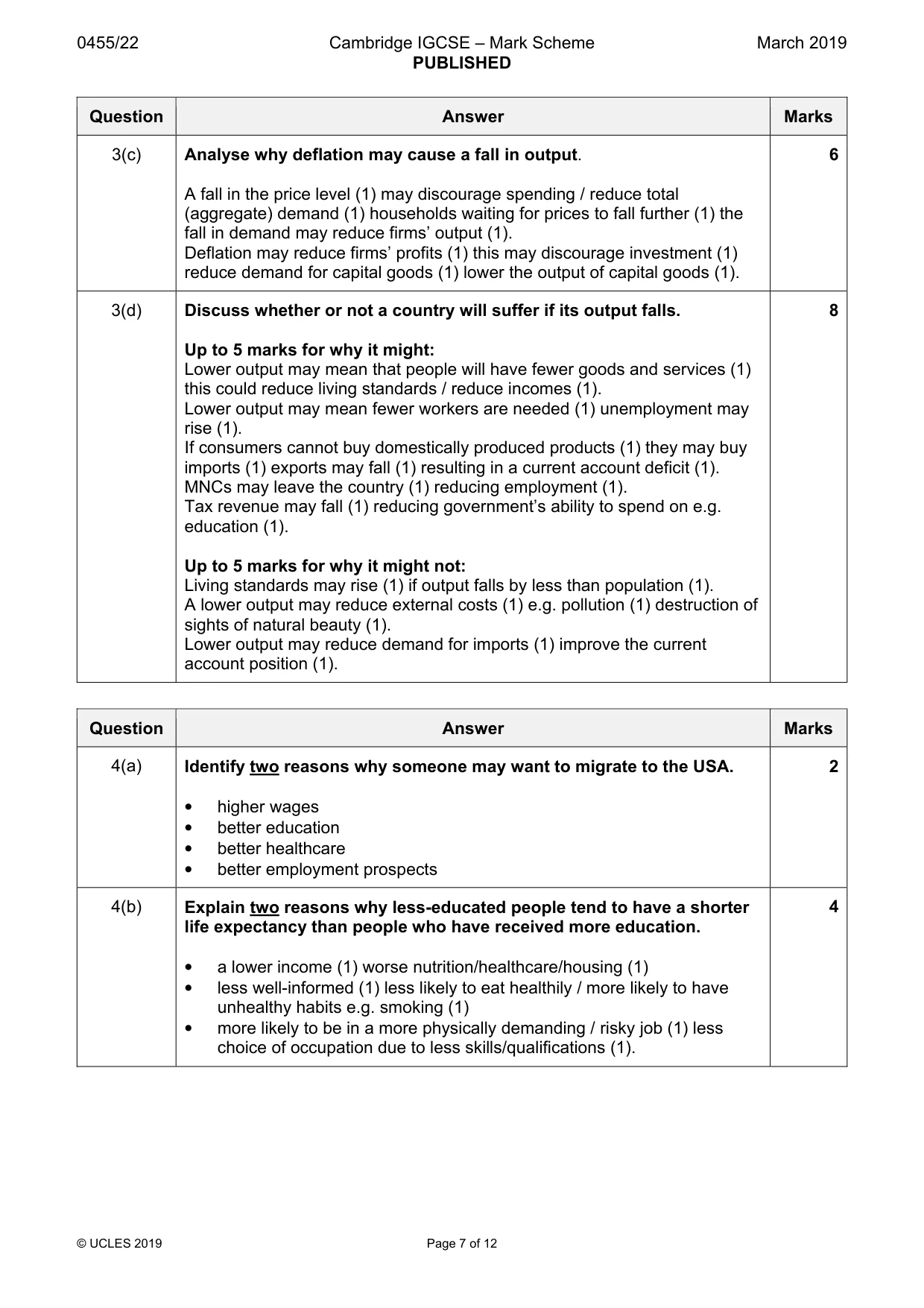
Mark scheme: 3(a) Identify two ways a government could encourage people to spend 2 more. • lower taxes • increase government spending / expansionary fiscal policy • increase money supply • reduce interest rates / expansionary monetary policy • raise subsidies 3(b) Explain how the economic problem results in people having to make 4 choices. The economic problem is unlimited wants (1) but limited resources (1). As resources are limited, people cannot have everything they want / not everything can be produced / there is scarcity (1) there is an opportunity cost (1). 3(c) Analyse why deflation may cause a fall in output. 6 A fall in the price level (1) may discourage spending / reduce total (aggregate) demand (1) households waiting for prices to fall further (1) the fall in demand may reduce firms’ output (1). Deflation may reduce firms’ profits (1) this may discourage investment (1) reduce demand for capital goods (1) lower the output of capital goods (1). 3(d) Discuss whether or not a country will suffer if its output falls. 8 Up to 5 marks for why it might: Lower output may mean that people will have fewer goods and services (1) this could reduce living standards / reduce incomes (1). Lower output may mean fewer workers are needed (1) unemployment may rise (1). If consumers cannot buy domestically produced products (1) they may buy imports (1) exports may fall (1) resulting in a current account deficit (1). MNCs may leave the country (1) reducing employment (1). Tax revenue may fall (1) reducing government’s ability to spend on e.g. education (1). Up to 5 marks for why it might not: Living standards may rise (1) if output falls by less than population (1). A lower output may reduce external costs (1) e.g. pollution (1) destruction of sights of natural beauty (1). Lower output may reduce demand for imports (1) improve the current account position (1).
Q4 · Average life expectancy is as short for the poorest Americans as it is for the people of…
4 Average life expectancy is as short for the poorest Americans as it is for the people of Sudan, a low-income African country. Low-income individuals tend to live longest in countries with more educated populations. Economic growth can increase education and reduce poverty. In 2017, the US President announced a cut in the tax on firms’ profits. He said the measure would increase employment. (a) Identify two reasons why someone may want to migrate to the USA. [2] (b) Explain two reasons why less-educated people tend to have a shorter life expectancy than people who have received more education. [4] (c) Analyse how economic growth can reduce absolute poverty. [6] (d) Discuss whether or not a cut in the tax on firms’ profits will increase employment. [8]
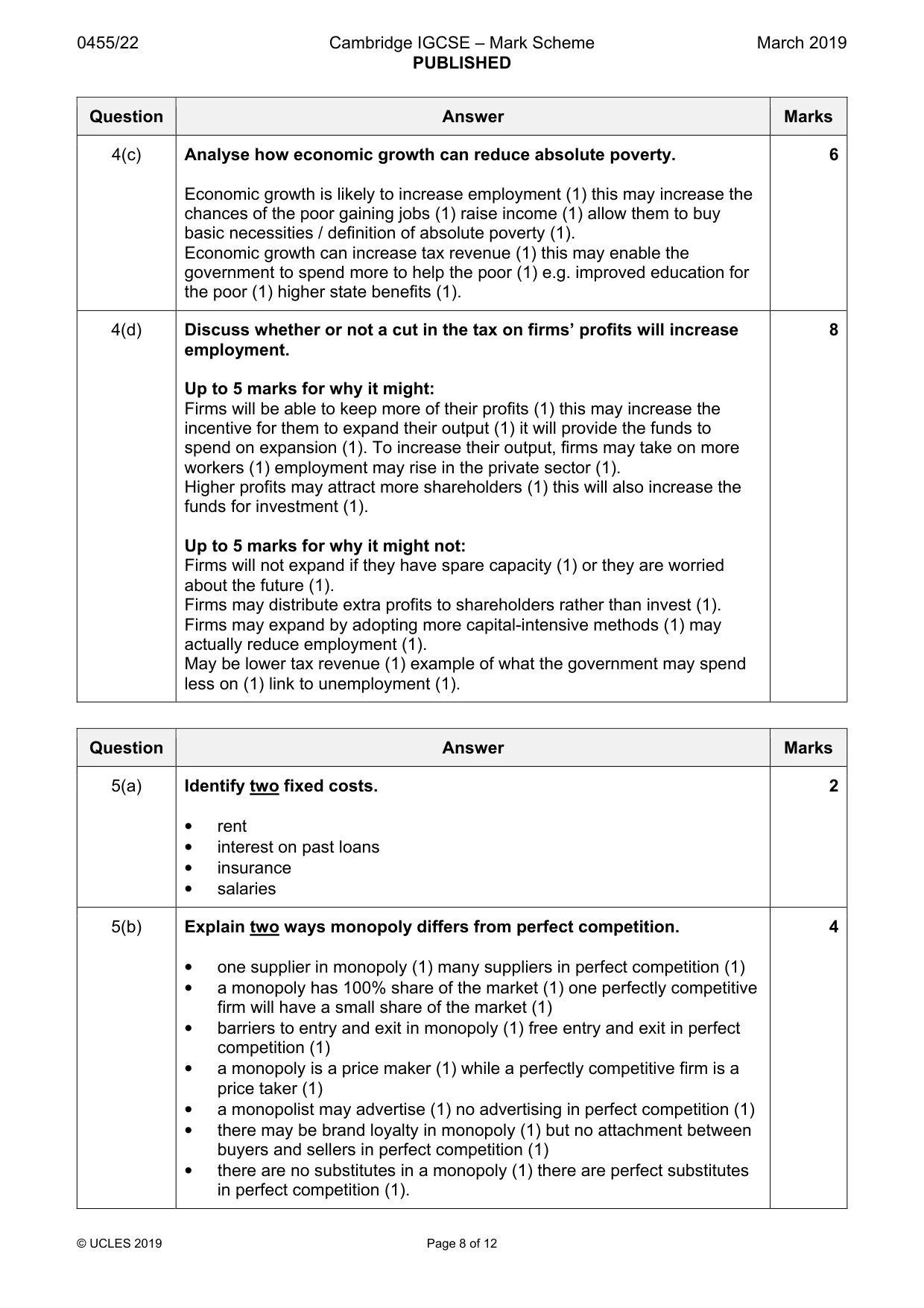
Mark scheme: 4(a) Identify two reasons why someone may want to migrate to the USA. 2 • higher wages • better education • better healthcare • better employment prospects 4(b) Explain two reasons why less-educated people tend to have a shorter 4 life expectancy than people who have received more education. • a lower income (1) worse nutrition/healthcare/housing (1) • less well-informed (1) less likely to eat healthily / more likely to have unhealthy habits e.g. smoking (1) • more likely to be in a more physically demanding / risky job (1) less choice of occupation due to less skills/qualifications (1). 4(c) Analyse how economic growth can reduce absolute poverty. 6 Economic growth is likely to increase employment (1) this may increase the chances of the poor gaining jobs (1) raise income (1) allow them to buy basic necessities / definition of absolute poverty (1). Economic growth can increase tax revenue (1) this may enable the government to spend more to help the poor (1) e.g. improved education for the poor (1) higher state benefits (1). 4(d) Discuss whether or not a cut in the tax on firms’ profits will increase 8 employment. Up to 5 marks for why it might: Firms will be able to keep more of their profits (1) this may increase the incentive for them to expand their output (1) it will provide the funds to spend on expansion (1). To increase their output, firms may take on more workers (1) employment may rise in the private sector (1). Higher profits may attract more shareholders (1) this will also increase the funds for investment (1). Up to 5 marks for why it might not: Firms will not expand if they have spare capacity (1) or they are worried about the future (1). Firms may distribute extra profits to shareholders rather than invest (1). Firms may expand by adopting more capital-intensive methods (1) may actually reduce employment (1). May be lower tax revenue (1) example of what the government may spend less on (1) link to unemployment (1).
Q5 · The mobile (cell) phone industry is growing in Asia with more workers being employed
5 The mobile (cell) phone industry is growing in Asia with more workers being employed. In March 2017, there was a merger between two mobile phone producers, both of which had relatively high fixed costs. This merger created one of the largest mobile phone firms and moved the Asian market further from perfect competition and closer to monopoly. It was expected that profits in the industry would increase as a result of the merger. (a) Identify two fixed costs. [2] (b) Explain two ways monopoly differs from perfect competition. [4] (c) Analyse what determines a firm’s demand for labour. [6] (d) Discuss whether or not a merger will increase profits. [8]
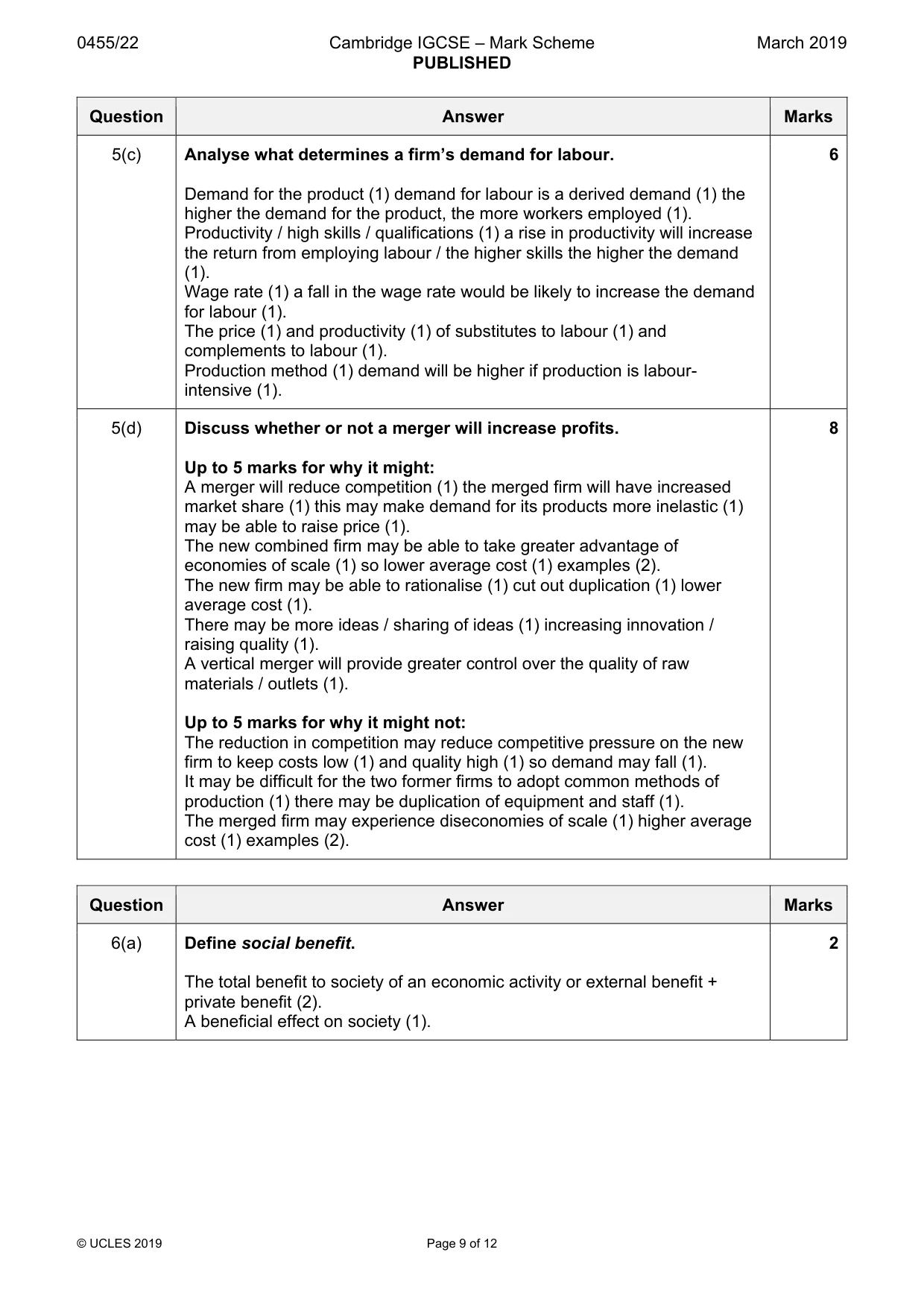
Mark scheme: 5(a) Identify two fixed costs. 2 • rent • interest on past loans • insurance • salaries 5(b) Explain two ways monopoly differs from perfect competition. 4 • one supplier in monopoly (1) many suppliers in perfect competition (1) • a monopoly has 100% share of the market (1) one perfectly competitive firm will have a small share of the market (1) • barriers to entry and exit in monopoly (1) free entry and exit in perfect competition (1) • a monopoly is a price maker (1) while a perfectly competitive firm is a price taker (1) • a monopolist may advertise (1) no advertising in perfect competition (1) • there may be brand loyalty in monopoly (1) but no attachment between buyers and sellers in perfect competition (1) • there are no substitutes in a monopoly (1) there are perfect substitutes in perfect competition (1). 5(c) Analyse what determines a firm’s demand for labour. 6 Demand for the product (1) demand for labour is a derived demand (1) the higher the demand for the product, the more workers employed (1). Productivity / high skills / qualifications (1) a rise in productivity will increase the return from employing labour / the higher skills the higher the demand (1). Wage rate (1) a fall in the wage rate would be likely to increase the demand for labour (1). The price (1) and productivity (1) of substitutes to labour (1) and complements to labour (1). Production method (1) demand will be higher if production is labour- intensive (1). 5(d) Discuss whether or not a merger will increase profits. 8 Up to 5 marks for why it might: A merger will reduce competition (1) the merged firm will have increased market share (1) this may make demand for its products more inelastic (1) may be able to raise price (1). The new combined firm may be able to take greater advantage of economies of scale (1) so lower average cost (1) examples (2). The new firm may be able to rationalise (1) cut out duplication (1) lower average cost (1). There may be more ideas / sharing of ideas (1) increasing innovation / raising quality (1). A vertical merger will provide greater control over the quality of raw materials / outlets (1). Up to 5 marks for why it might not: The reduction in competition may reduce competitive pressure on the new firm to keep costs low (1) and quality high (1) so demand may fall (1). It may be difficult for the two former firms to adopt common methods of production (1) there may be duplication of equipment and staff (1). The merged firm may experience diseconomies of scale (1) higher average cost (1) examples (2).
Q6 · Botswana has a number of conservation projects
6 Botswana has a number of conservation projects. These are thought to provide a social benefit to local communities. Botswana has a mixed economic system with tax revenue as a percentage of GDP at 27% in 2017. Some Botswanan economists suggest that the country should move towards a market economic system, taking care to avoid market failure. (a) Define social benefit. [2] (b) Explain two advantages of conserving natural resources. [4] (c) Analyse how taxation could reduce market failure. [6] (d) Discuss the advantages and disadvantages of a market economic system. [8]
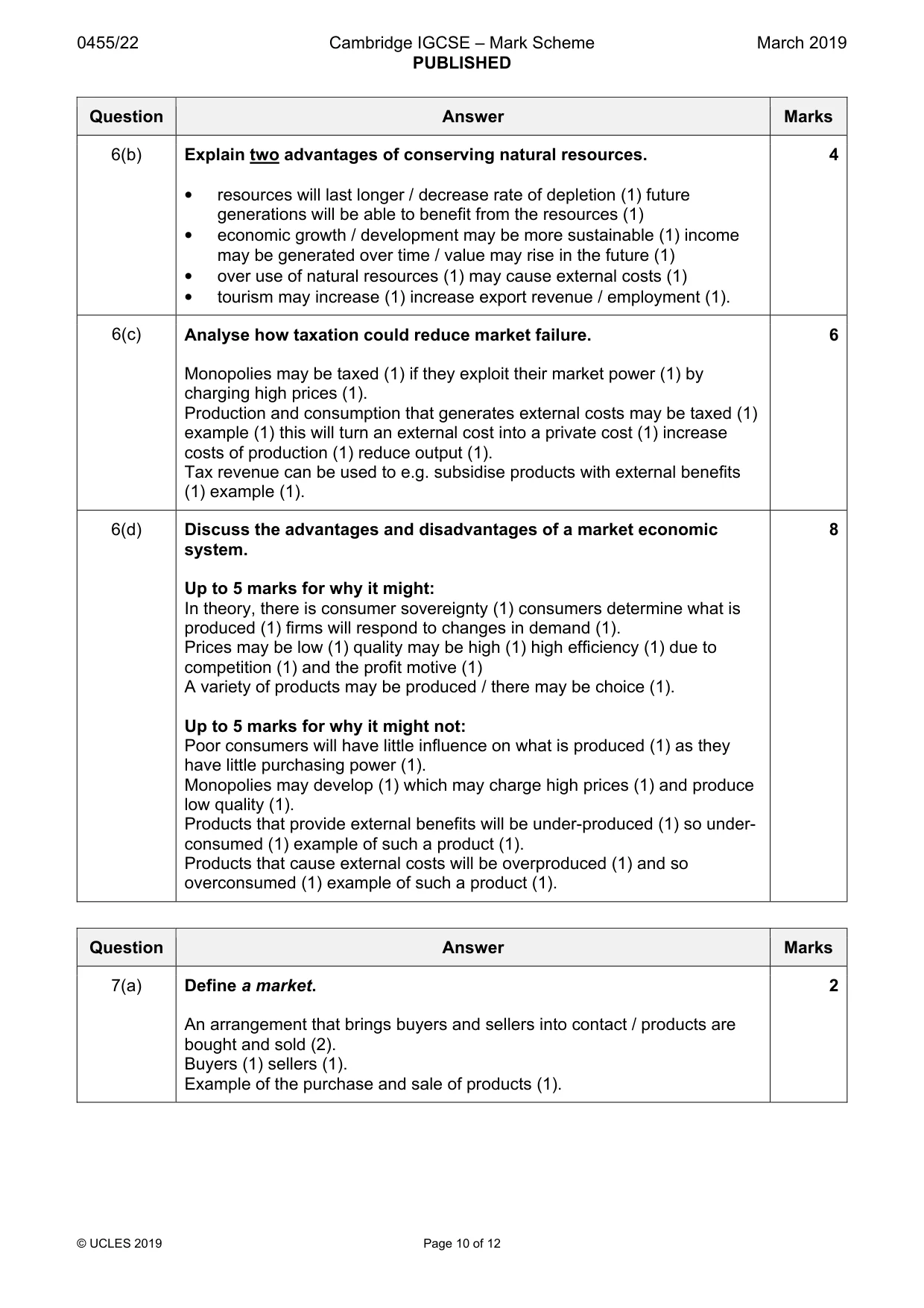
Mark scheme: 6(a) Define social benefit. 2 The total benefit to society of an economic activity or external benefit + private benefit (2). A beneficial effect on society (1). 6(b) Explain two advantages of conserving natural resources. 4 • resources will last longer / decrease rate of depletion (1) future generations will be able to benefit from the resources (1) • economic growth / development may be more sustainable (1) income may be generated over time / value may rise in the future (1) • over use of natural resources (1) may cause external costs (1) • tourism may increase (1) increase export revenue / employment (1). 6(c) Analyse how taxation could reduce market failure. 6 Monopolies may be taxed (1) if they exploit their market power (1) by charging high prices (1). Production and consumption that generates external costs may be taxed (1) example (1) this will turn an external cost into a private cost (1) increase costs of production (1) reduce output (1). Tax revenue can be used to e.g. subsidise products with external benefits (1) example (1). 6(d) Discuss the advantages and disadvantages of a market economic 8 system. Up to 5 marks for why it might: In theory, there is consumer sovereignty (1) consumers determine what is produced (1) firms will respond to changes in demand (1). Prices may be low (1) quality may be high (1) high efficiency (1) due to competition (1) and the profit motive (1) A variety of products may be produced / there may be choice (1). Up to 5 marks for why it might not: Poor consumers will have little influence on what is produced (1) as they have little purchasing power (1). Monopolies may develop (1) which may charge high prices (1) and produce low quality (1). Products that provide external benefits will be under-produced (1) so under- consumed (1) example of such a product (1). Products that cause external costs will be overproduced (1) and so overconsumed (1) example of such a product (1).
Q7 · Indian Railways is a state-owned enterprise, owned and operated by the Ministry of…
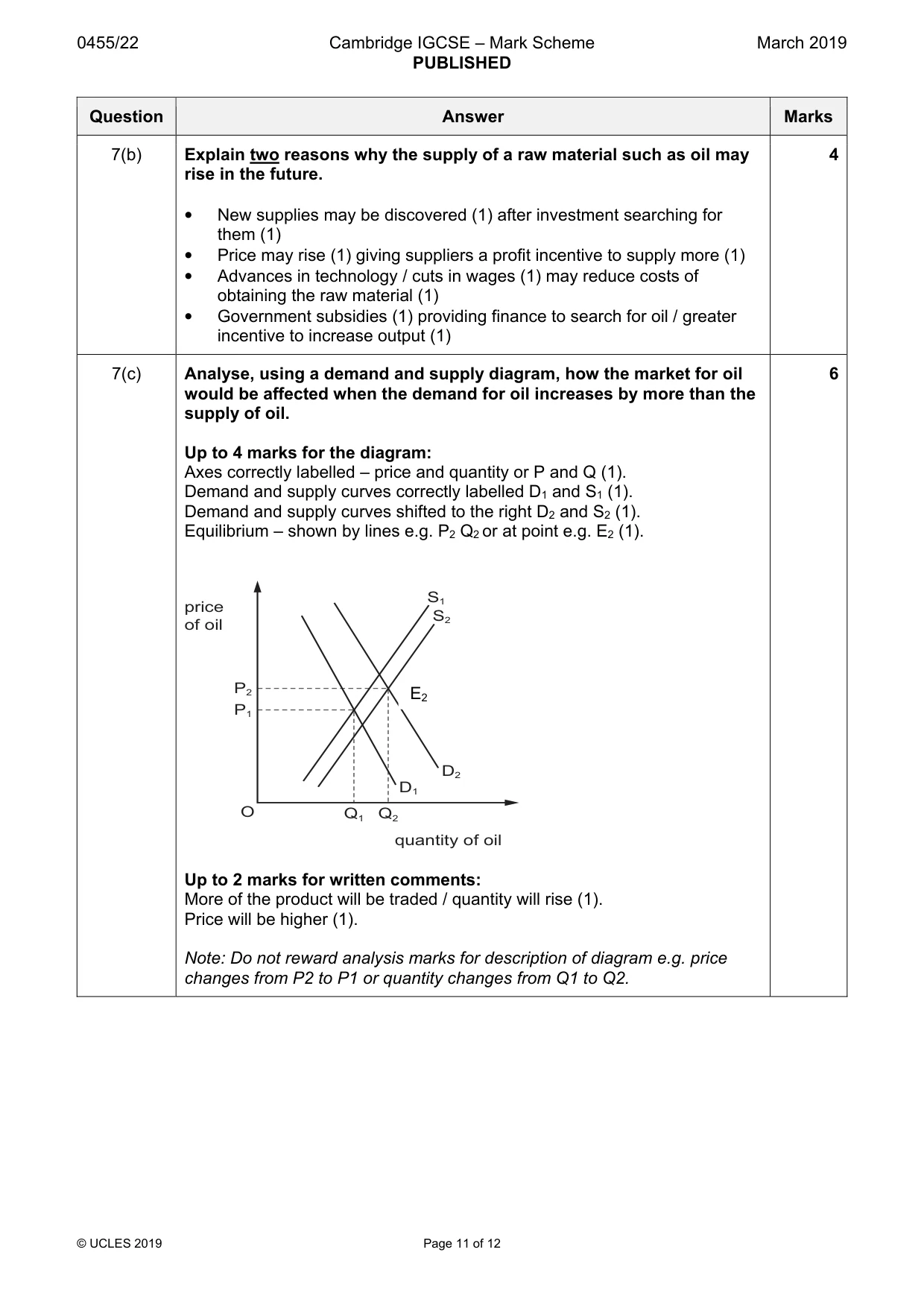
7 Indian Railways is a state-owned enterprise, owned and operated by the Ministry of Railways. There is currently only one privately-owned railway line in India. The market for rail travel is influenced by changes in the markets for other forms of transport. For instance, changes in the supply of oil and petrol influence the market for car travel. (a) Define a market. [2] (b) Explain two reasons why the supply of a raw material such as oil may rise in the future. [4] (c) Analyse, using a demand and supply diagram, how the market for oil would be affected when the demand for oil increases by more than the supply of oil. [6] (d) Discuss whether or not car travel will increase in the future. [8]
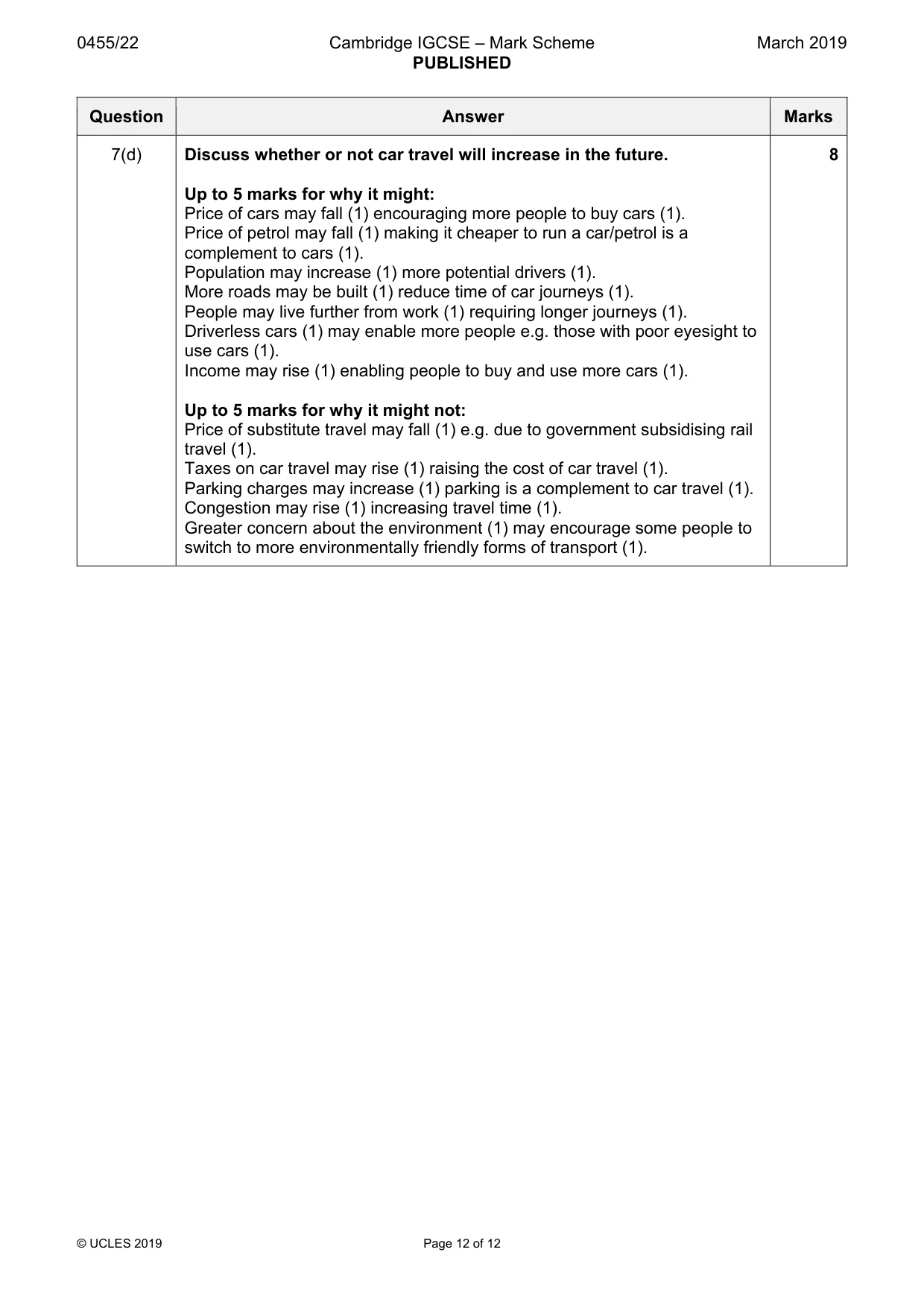
Mark scheme: 7(a) Define a market. 2 An arrangement that brings buyers and sellers into contact / products are bought and sold (2). Buyers (1) sellers (1). Example of the purchase and sale of products (1). 7(b) Explain two reasons why the supply of a raw material such as oil may 4 rise in the future. • New supplies may be discovered (1) after investment searching for them (1) • Price may rise (1) giving suppliers a profit incentive to supply more (1) • Advances in technology / cuts in wages (1) may reduce costs of obtaining the raw material (1) • Government subsidies (1) providing finance to search for oil / greater incentive to increase output (1) 7(c) Analyse, using a demand and supply diagram, how the market for oil 6 would be affected when the demand for oil increases by more than the supply of oil. Up to 4 marks for the diagram: Axes correctly labelled – price and quantity or P and Q (1). Demand and supply curves correctly labelled D1 and S1 (1). Demand and supply curves shifted to the right D2 and S2 (1). Equilibrium – shown by lines e.g. P2 Q2 or at point e.g. E2 (1). S1 price S2 of oil P2 E2 P1 D2 D1 O Q1 Q2 quantity of oil Up to 2 marks for written comments: More of the product will be traded / quantity will rise (1). Price will be higher (1). Note: Do not reward analysis marks for description of diagram e.g. price changes from P2 to P1 or quantity changes from Q1 to Q2. 7(d) Discuss whether or not car travel will increase in the future. 8 Up to 5 marks for why it might: Price of cars may fall (1) encouraging more people to buy cars (1). Price of petrol may fall (1) making it cheaper to run a car/petrol is a complement to cars (1). Population may increase (1) more potential drivers (1). More roads may be built (1) reduce time of car journeys (1). People may live further from work (1) requiring longer journeys (1). Driverless cars (1) may enable more people e.g. those with poor eyesight to use cars (1). Income may rise (1) enabling people to buy and use more cars (1). Up to 5 marks for why it might not: Price of substitute travel may fall (1) e.g. due to government subsidising rail travel (1). Taxes on car travel may rise (1) raising the cost of car travel (1). Parking charges may increase (1) parking is a complement to car travel (1). Congestion may rise (1) increasing travel time (1). Greater concern about the environment (1) may encourage some people to switch to more environmentally friendly forms of transport (1).
What was in this paper
The subtopics covered by these 7 questions, and how many questions each got. Open one in a new tab to see every Cambridge question on it.
What you needed in this session
Cambridge’s own grade thresholds for 2019 Feb/March, Paper 2 · Variant 2. A higher threshold means an easier paper — the bar moves with how the cohort did.