Cambridge IGCSE Economics 0455 — 2024 May/June Paper 2 · Variant 1
0455/21/M/J/24 · 5 questions · 90 marks · ≈101 min
The question paper and its mark scheme, free to read here and free to download. This is Cambridge’s own paper, exactly as it was sat.
Question paper8 pages
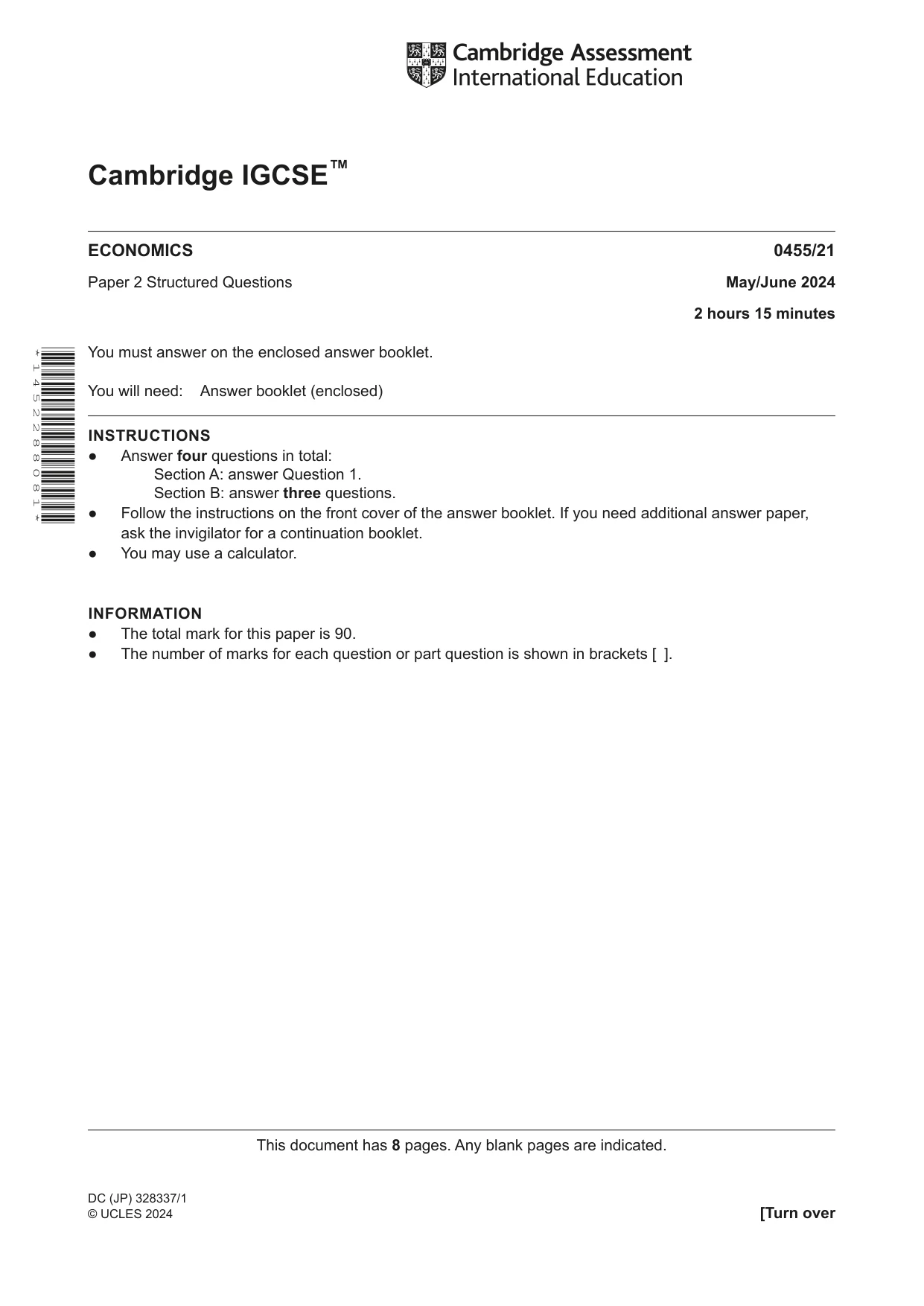
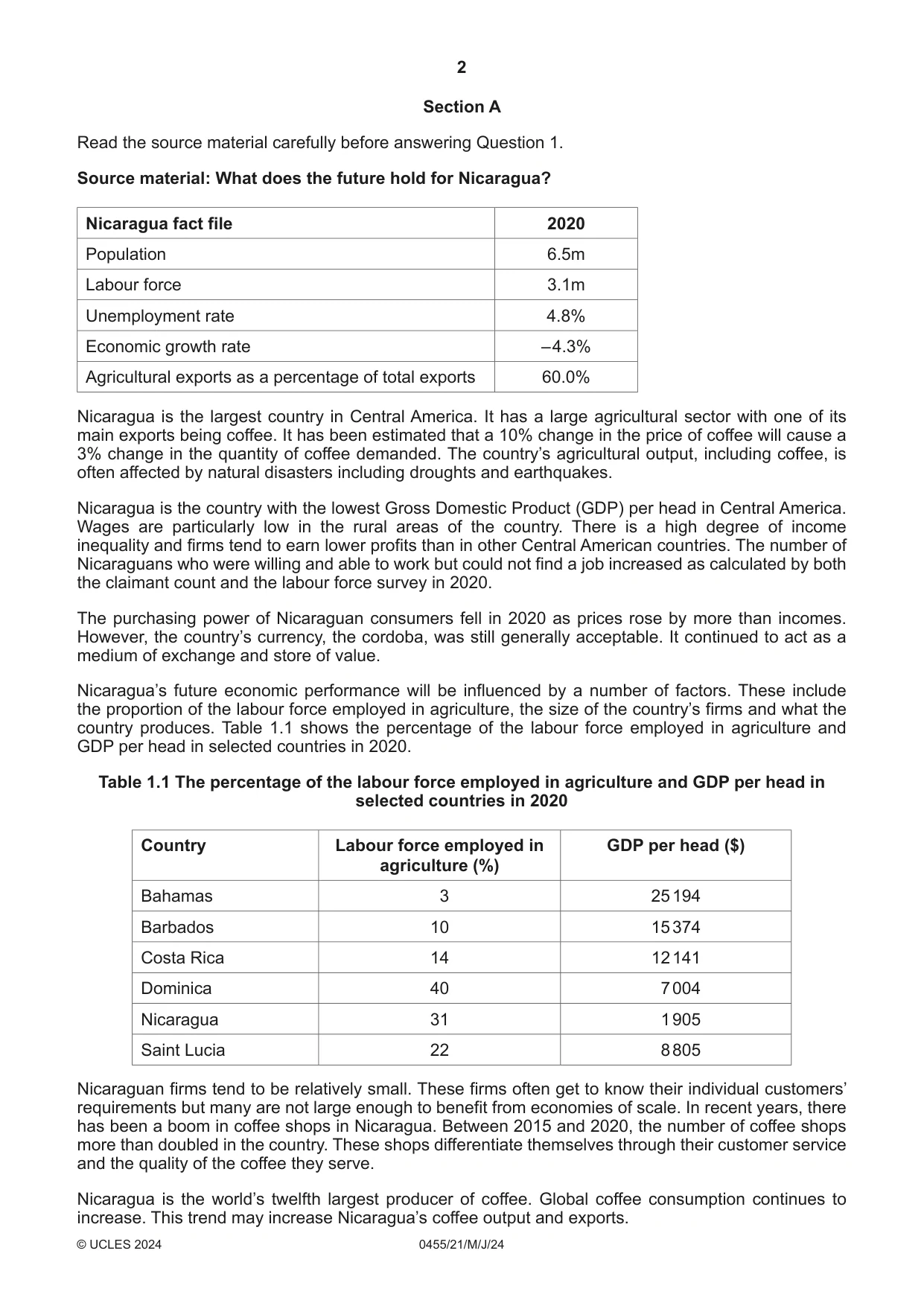
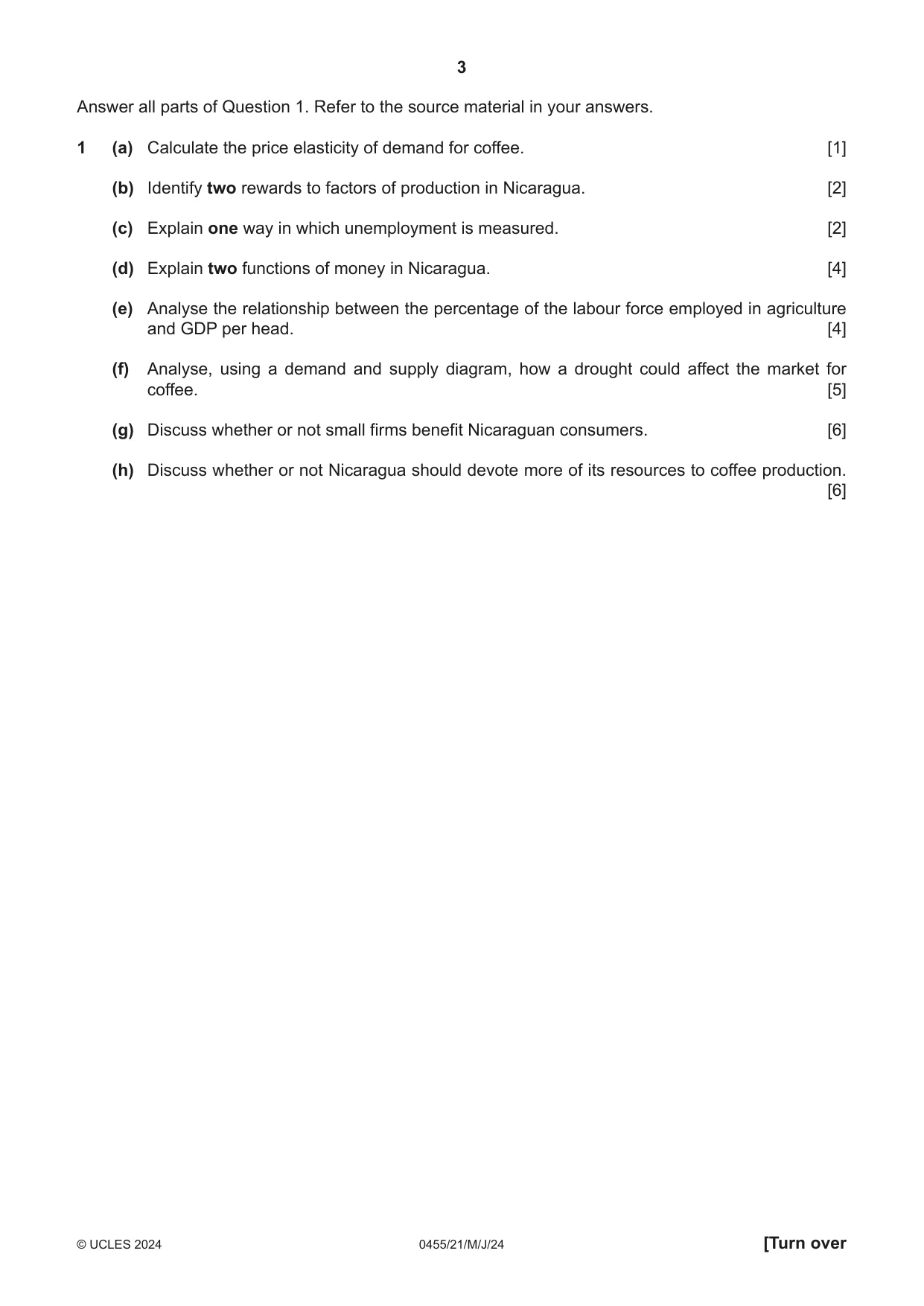
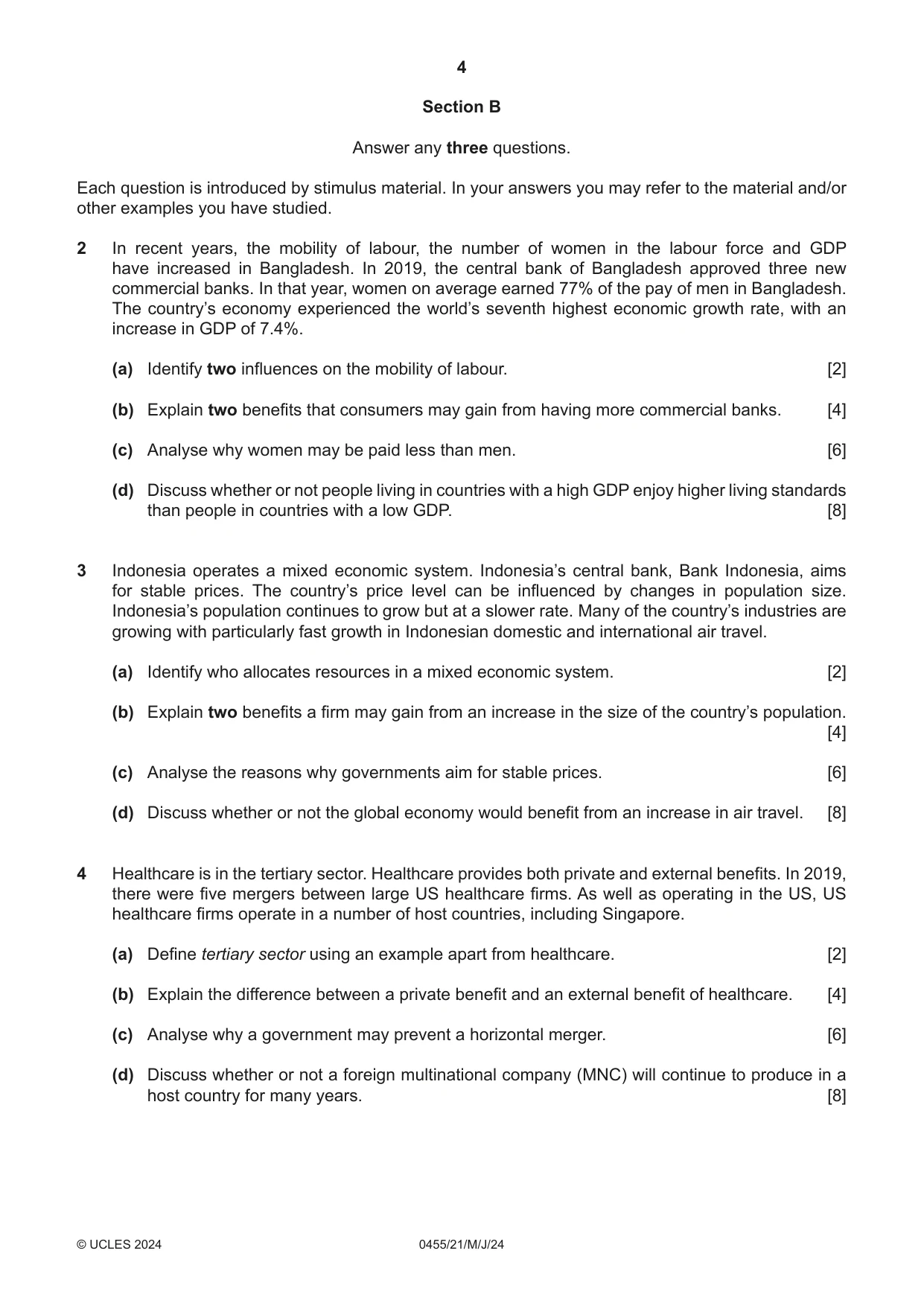




Mark scheme24 pages
Answers below. Sit the paper first if you are practising.
Questions as text
Q1 · Calculate the price elasticity of demand for coffee
1 (a) Calculate the price elasticity of demand for coffee. [1] (b) Identify two rewards to factors of production in Nicaragua. [2] (c) Explain one way in which unemployment is measured. [2] (d) Explain two functions of money in Nicaragua. [4] (e) Analyse the relationship between the percentage of the labour force employed in agriculture and GDP per head. [4] (f) Analyse, using a demand and supply diagram, how a drought could affect the market for coffee. [5] (g) Discuss whether or not small firms benefit Nicaraguan consumers. [6] (h) Discuss whether or not Nicaragua should devote more of its resources to coffee production. [6]
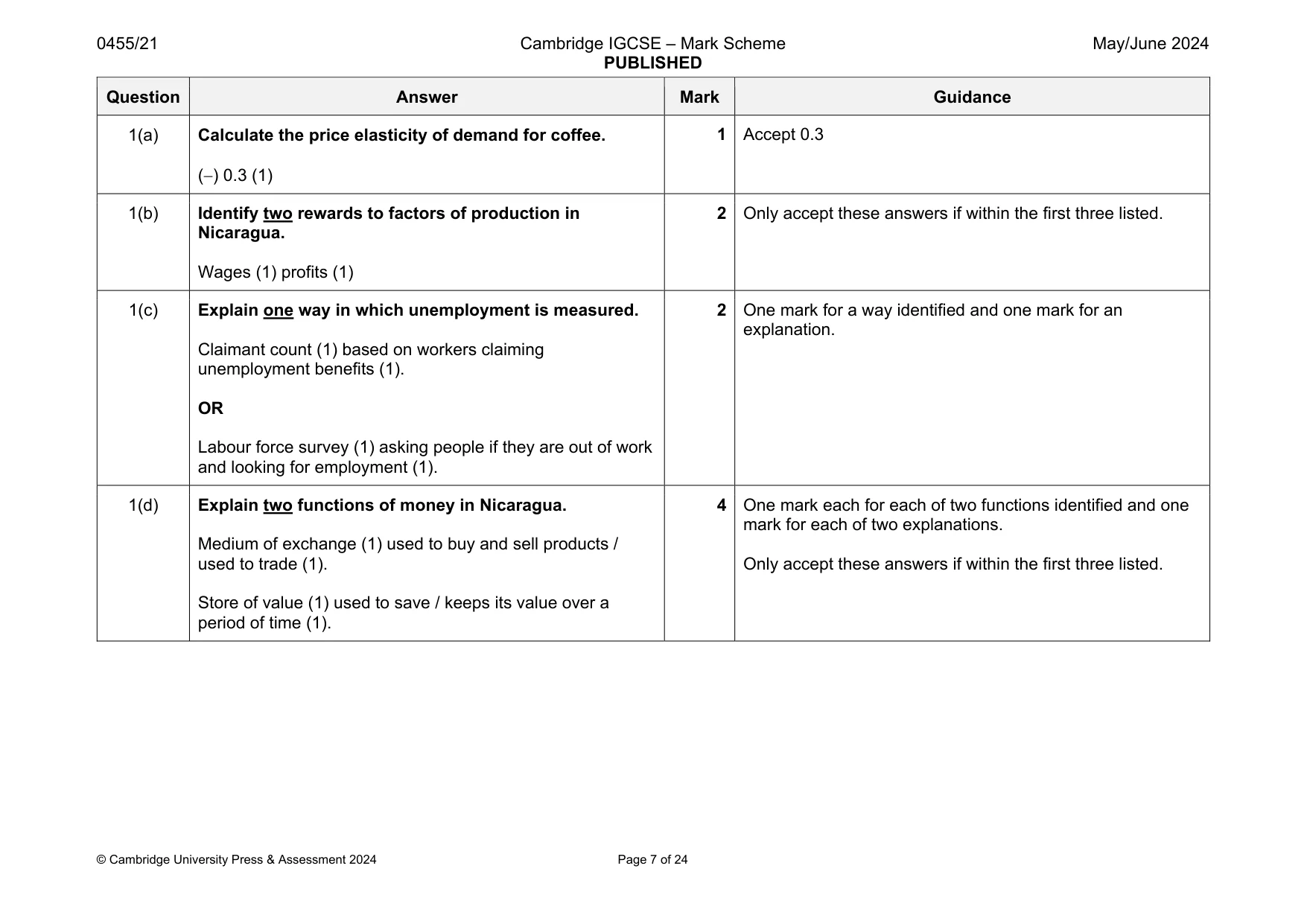
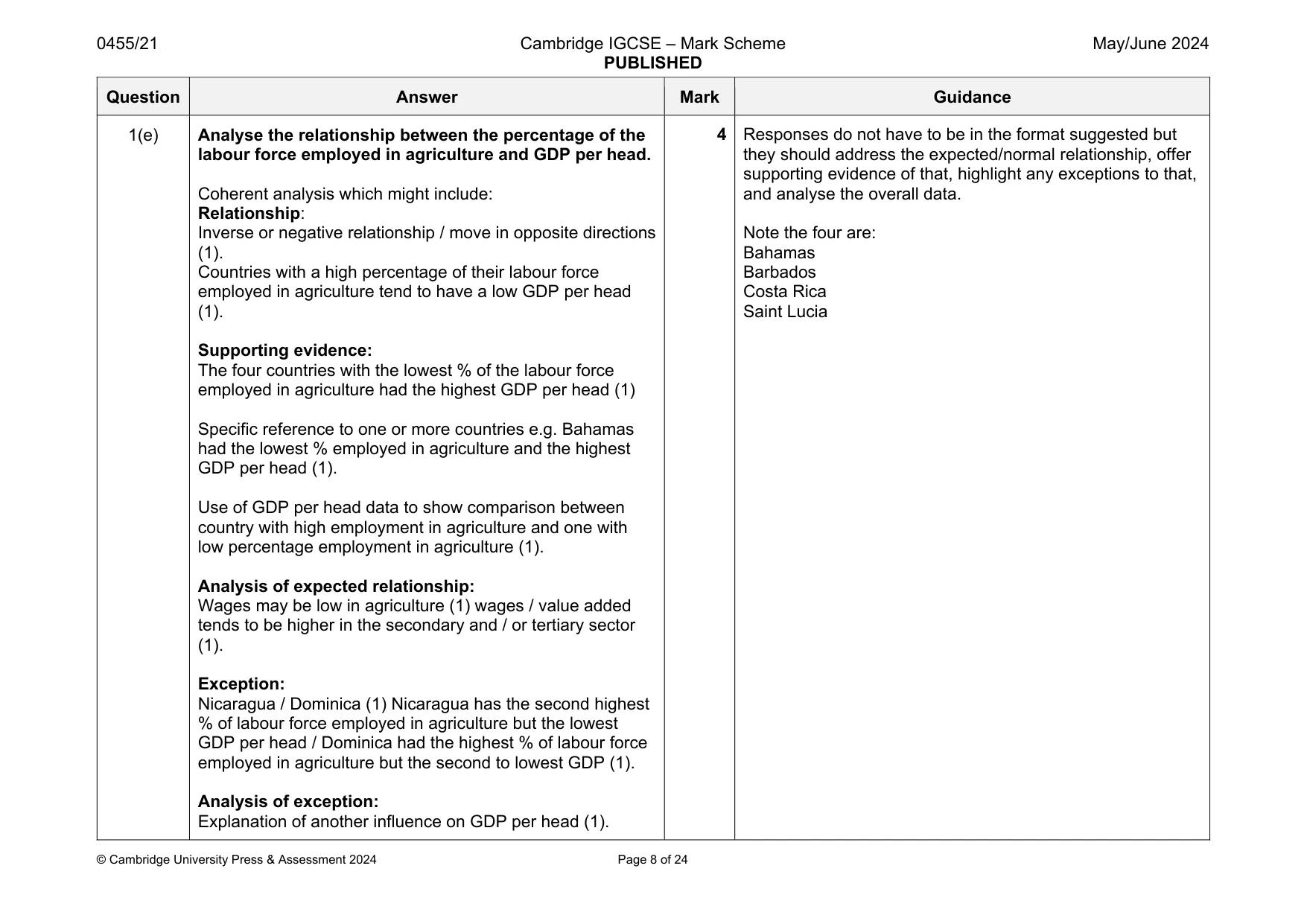
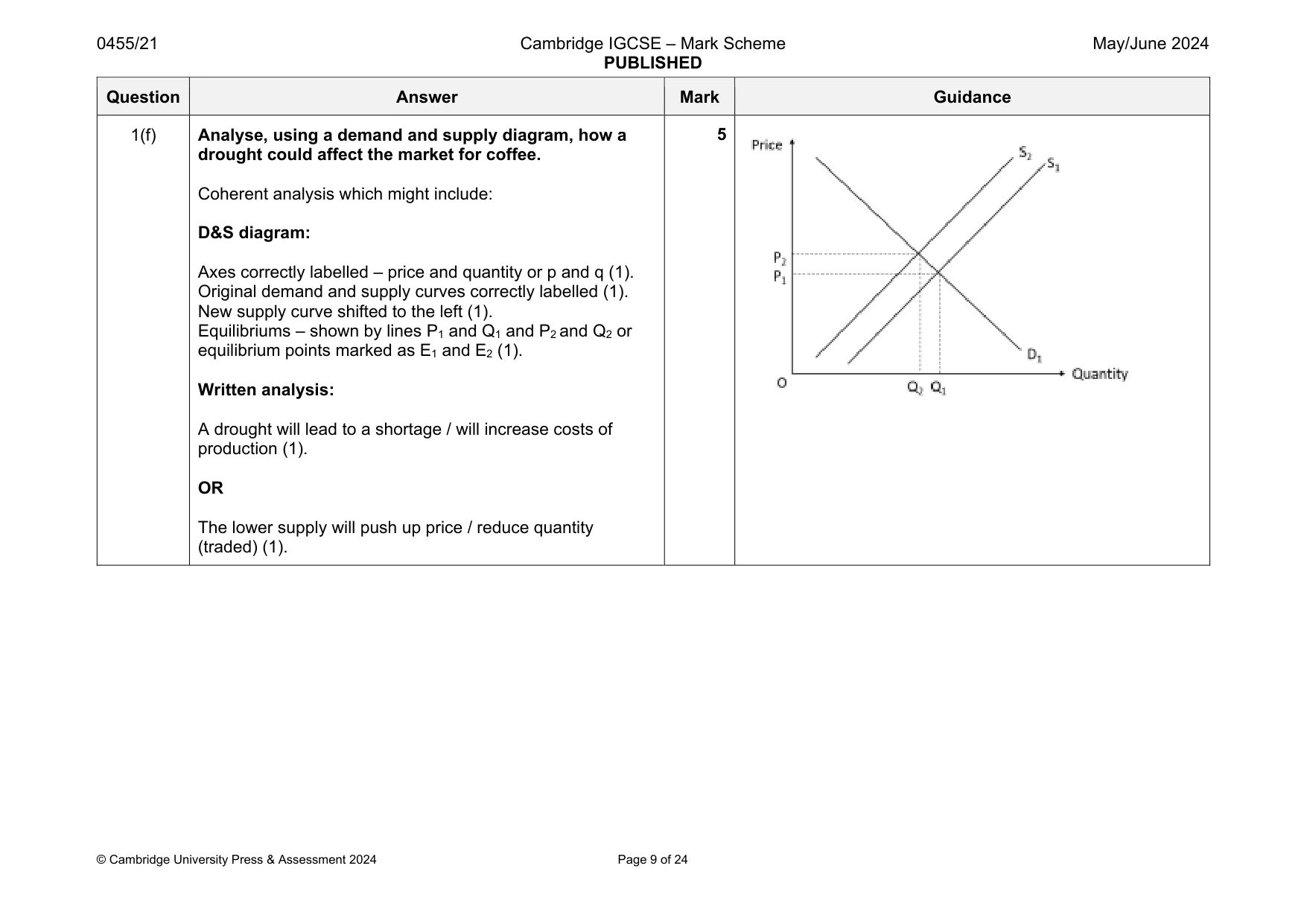
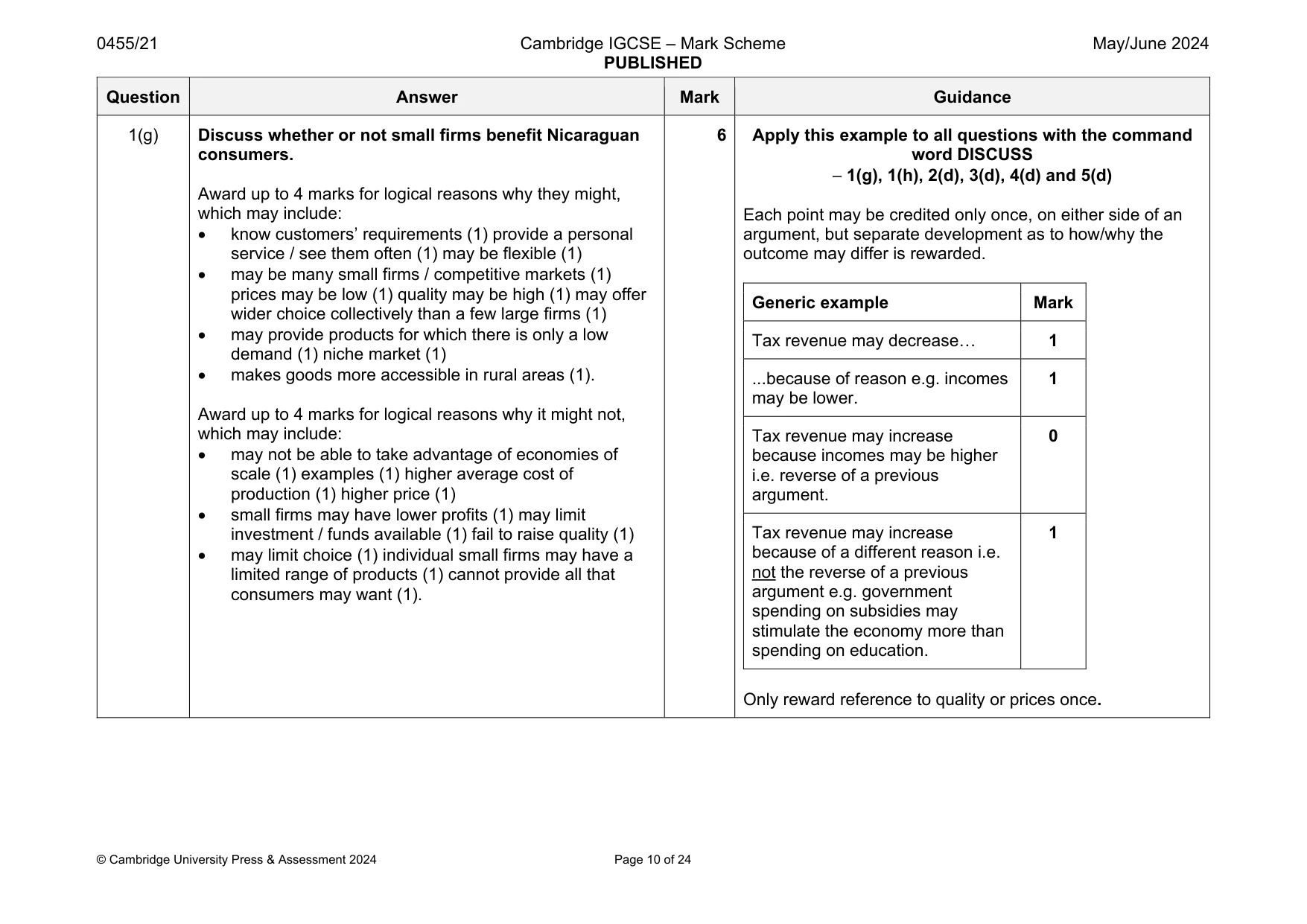
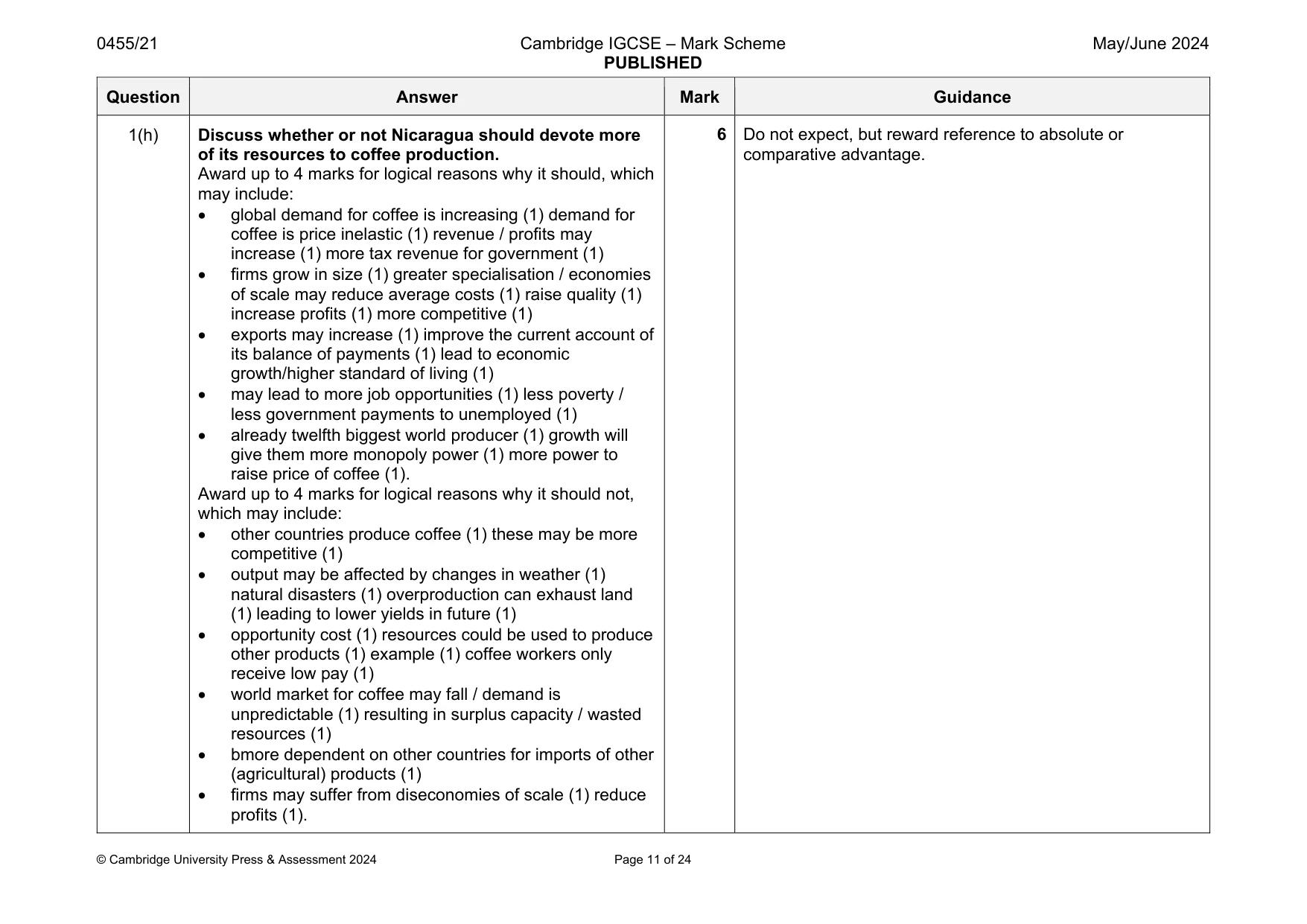
Mark scheme: 1(a) Calculate the price elasticity of demand for coffee. () 0.3 (1) 1(b) Identify two rewards to factors of production in Nicaragua. Wages (1) profits (1) 2 Only accept these answers if within the first three listed. 1(c) Explain one way in which unemployment is measured. Claimant count (1) based on workers claiming unemployment benefits (1). OR Labour force survey (1) asking people if they are out of work and looking for employment (1). 2 One mark for a way identified and one mark for an explanation. 1(d) Explain two functions of money in Nicaragua. Medium of exchange (1) used to buy and sell products / used to trade (1). Store of value (1) used to save / keeps its value over a period of time (1). 4 One mark each for each of two functions identified and one mark for each of two explanations. Only accept these answers if within the first three listed. Question Answer Mark Guidance 1(e) Analyse the relationship between the percentage of the labour force employed in agriculture and GDP per head. Coherent analysis which might include: Relationship: Inverse or negative relationship / move in opposite directions (1). Countries with a high percentage of their labour force employed in agriculture tend to have a low GDP per head (1). Supporting evidence: The four countries with the lowest % of the labour force employed in agriculture had the highest GDP per head (1) Specific reference to one or more countries e.g. Bahamas had the lowest % employed in agriculture and the highest GDP per head (1). Use of GDP per head data to show comparison between country with high employment in agriculture and one with low percentage employment in agriculture (1). Analysis of expected relationship: Wages may be low in agriculture (1) wages / value added tends to be higher in the secondary and / or tertiary sector (1). Exception: Nicaragua / Dominica (1) Nicaragua has the second highest % of labour force employed in agriculture but the lowest GDP per head / Dominica had the highest % of labour force employed in agriculture but the second to lowest GDP (1). Analysis of exception: Explanation of another influence on GDP per head (1). 4 Responses do not have to be in the format suggested but they should address the expected/normal relationship, offer supporting evidence of that, highlight any exceptions to that, and analyse the overall data. Note the four are: Bahamas Barbados Costa Rica Saint Lucia Question Answer Mark Guidance 1(f) Analyse, using a demand and supply diagram, how a drought could affect the market for coffee. Coherent analysis which might include: D&S diagram: Axes correctly labelled – price and quantity or p and q (1). Original demand and supply curves correctly labelled (1). New supply curve shifted to the left (1). Equilibriums – shown by lines P1 and Q1 and P2 and Q2 or equilibrium points marked as E1 and E2 (1). Written analysis: A drought will lead to a shortage / will increase costs of production (1). OR The lower supply will push up price / reduce quantity (traded) (1). 5 Question Answer Mark Guidance 1(g) Discuss whether or not small firms benefit Nicaraguan consumers. Award up to 4 marks for logical reasons why they might, which may include: know customers’ requirements (1) provide a personal service / see them often (1) may be flexible (1) may be many small firms / competitive markets (1) prices may be low (1) quality may be high (1) may offer wider choice collectively than a few large firms (1) may provide products for which there is only a low demand (1) niche market (1) makes goods more accessible in rural areas (1). Award up to 4 marks for logical reasons why it might not, which may include: may not be able to take advantage of economies of scale (1) examples (1) higher average cost of production (1) higher price (1) small firms may have lower profits (1) may limit investment / funds available (1) fail to raise quality (1) may limit choice (1) individual small firms may have a limited range of products (1) cannot provide all that consumers may want (1). 6 Apply this example to all questions with the command word DISCUSS 1(g), 1(h), 2(d), 3(d), 4(d) and 5(d) Each point may be credited only once, on either side of an argument, but separate development as to how/why the outcome may differ is rewarded. Generic example Mark Tax revenue may decrease… 1 ...because of reason e.g. incomes may be lower. 1 Tax revenue may increase because incomes may be higher i.e. reverse of a previous argument. 0 Tax revenue may increase because of a different reason i.e. not the reverse of a previous argument e.g. government spending on subsidies may stimulate the economy more than spending on education. 1 Only reward reference to quality or prices once. Question Answer Mark Guidance 1(h) Discuss whether or not Nicaragua should devote more of its resources to coffee production. Award up to 4 marks for logical reasons why it should, which may include: global demand for coffee is increasing (1) demand for coffee is price inelastic (1) revenue / profits may increase (1) more tax revenue for government (1) firms grow in size (1) greater specialisation / economies of scale may reduce average costs (1) raise quality (1) increase profits (1) more competitive (1) exports may increase (1) improve the current account of its balance of payments (1) lead to economic growth/higher standard of living (1) may lead to more job opportunities (1) less poverty / less government payments to unemployed (1) already twelfth biggest world producer (1) growth will give them more monopoly power (1) more power to raise price of coffee (1). Award up to 4 marks for logical reasons why it should not, which may include: other countries produce coffee (1) these may be more competitive (1) output may be affected by changes in weather (1) natural disasters (1) overproduction can exhaust land (1) leading to lower yields in future (1) opportunity cost (1) resources could be used to produce other products (1) example (1) coffee workers only receive low pay (1) world market for coffee may fall / demand is unpredictable (1) resulting in surplus capacity / wasted resources (1) bmore dependent on other countries for imports of other (agricultural) products (1) firms may suffer from diseconomies of scale (1) reduce profits (1). 6 Do not expect, but reward reference to absolute or comparative advantage.
Q2 · In recent years, the mobility of labour, the number of women in the labour force and GDP…
2 In recent years, the mobility of labour, the number of women in the labour force and GDP have increased in Bangladesh. In 2019, the central bank of Bangladesh approved three new commercial banks. In that year, women on average earned 77% of the pay of men in Bangladesh. The country’s economy experienced the world’s seventh highest economic growth rate, with an increase in GDP of 7.4%. (a) Identify two influences on the mobility of labour. [2] (b) Explain two benefits that consumers may gain from having more commercial banks. [4] (c) Analyse why women may be paid less than men. [6] (d) Discuss whether or not people living in countries with a high GDP enjoy higher living standards than people in countries with a low GDP. [8]
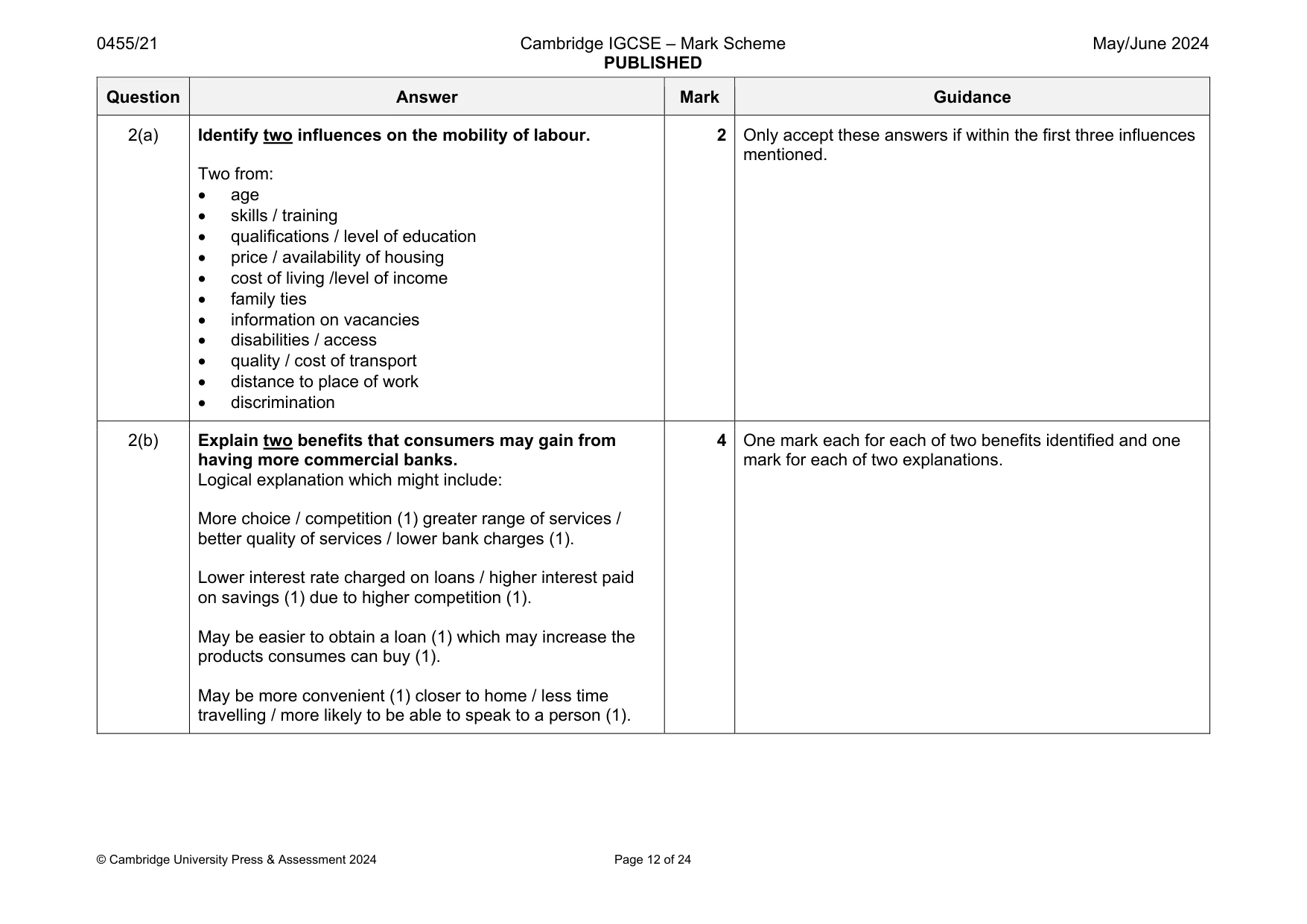
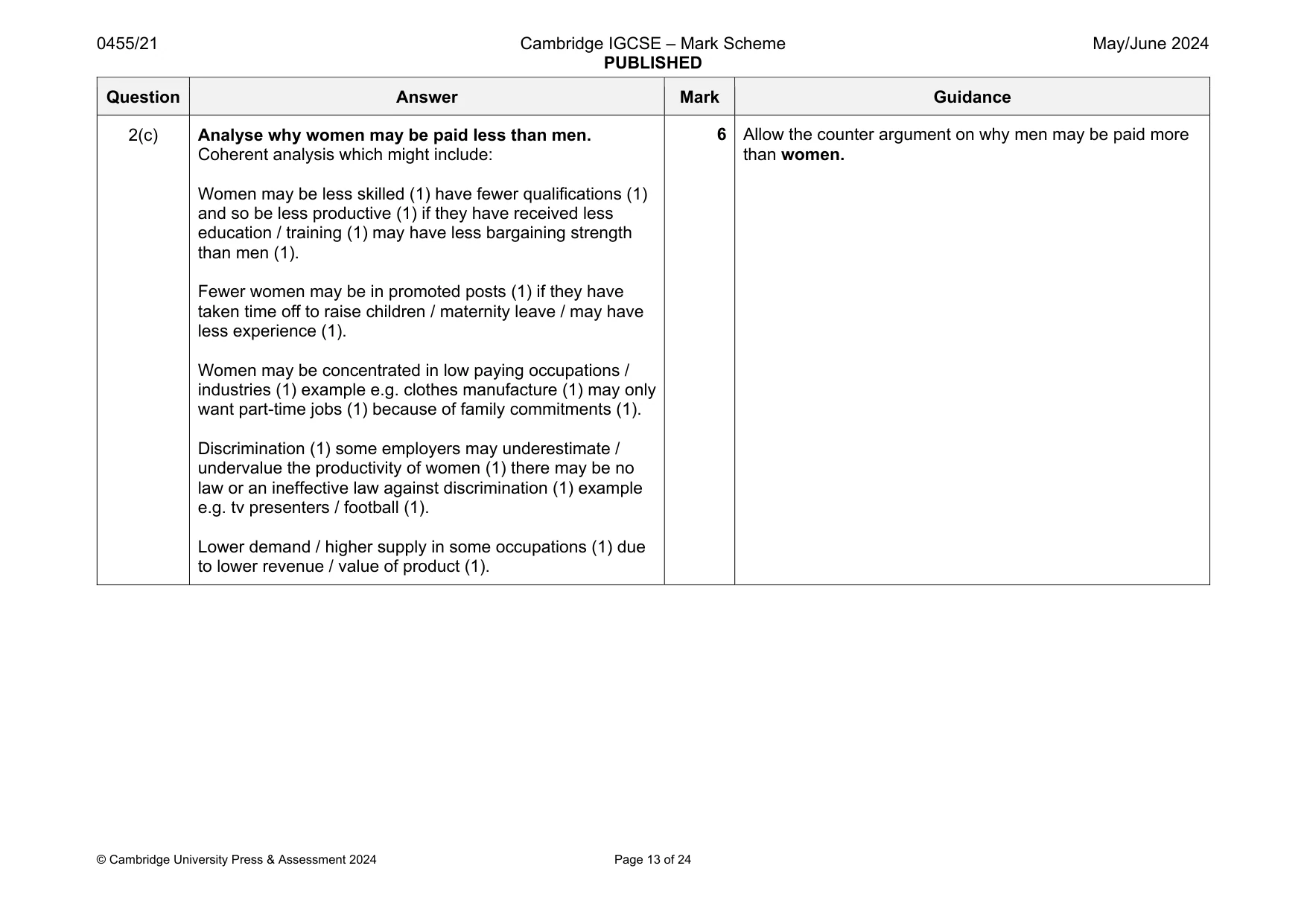
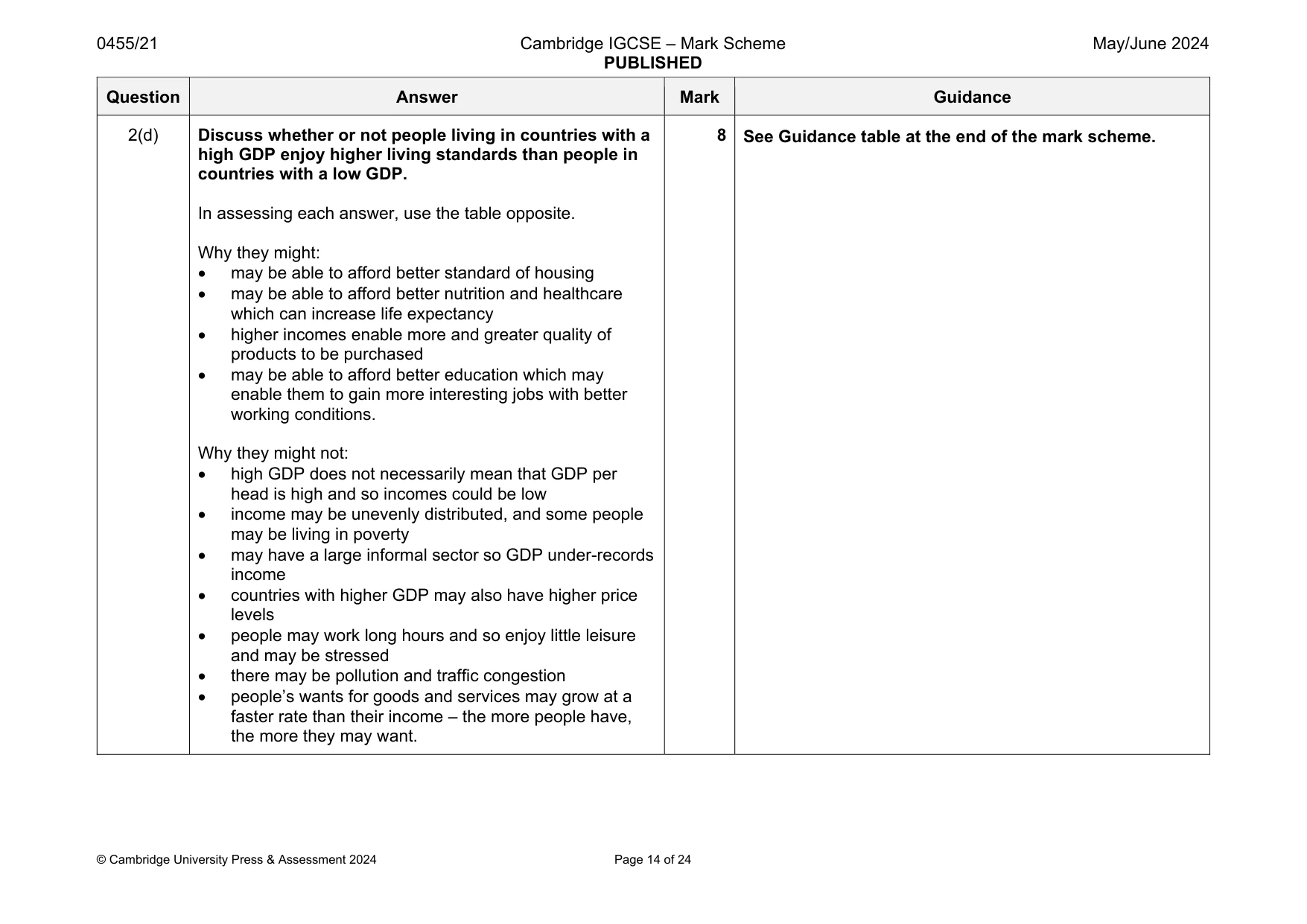
Mark scheme: 2(a) Identify two influences on the mobility of labour. Two from: age skills / training qualifications / level of education price / availability of housing cost of living /level of income family ties information on vacancies disabilities / access quality / cost of transport distance to place of work discrimination 2 Only accept these answers if within the first three influences mentioned. 2(b) Explain two benefits that consumers may gain from having more commercial banks. Logical explanation which might include: More choice / competition (1) greater range of services / better quality of services / lower bank charges (1). Lower interest rate charged on loans / higher interest paid on savings (1) due to higher competition (1). May be easier to obtain a loan (1) which may increase the products consumes can buy (1). May be more convenient (1) closer to home / less time travelling / more likely to be able to speak to a person (1). 4 One mark each for each of two benefits identified and one mark for each of two explanations. Question Answer Mark Guidance 2(c) Analyse why women may be paid less than men. Coherent analysis which might include: Women may be less skilled (1) have fewer qualifications (1) and so be less productive (1) if they have received less education / training (1) may have less bargaining strength than men (1). Fewer women may be in promoted posts (1) if they have taken time off to raise children / maternity leave / may have less experience (1). Women may be concentrated in low paying occupations / industries (1) example e.g. clothes manufacture (1) may only want part-time jobs (1) because of family commitments (1). Discrimination (1) some employers may underestimate / undervalue the productivity of women (1) there may be no law or an ineffective law against discrimination (1) example e.g. tv presenters / football (1). Lower demand / higher supply in some occupations (1) due to lower revenue / value of product (1). 6 Allow the counter argument on why men may be paid more than women. Question Answer Mark Guidance 2(d) Discuss whether or not people living in countries with a high GDP enjoy higher living standards than people in countries with a low GDP. In assessing each answer, use the table opposite. Why they might: may be able to afford better standard of housing may be able to afford better nutrition and healthcare which can increase life expectancy higher incomes enable more and greater quality of products to be purchased may be able to afford better education which may enable them to gain more interesting jobs with better working conditions. Why they might not: high GDP does not necessarily mean that GDP per head is high and so incomes could be low income may be unevenly distributed, and some people may be living in poverty may have a large informal sector so GDP under-records income countries with higher GDP may also have higher price levels people may work long hours and so enjoy little leisure and may be stressed there may be pollution and traffic congestion people’s wants for goods and services may grow at a faster rate than their income – the more people have, the more they may want. 8 See Guidance table at the end of the mark scheme.
Q3 · Indonesia operates a mixed economic system
3 Indonesia operates a mixed economic system. Indonesia’s central bank, Bank Indonesia, aims for stable prices. The country’s price level can be influenced by changes in population size. Indonesia’s population continues to grow but at a slower rate. Many of the country’s industries are growing with particularly fast growth in Indonesian domestic and international air travel. (a) Identify who allocates resources in a mixed economic system. [2] (b) Explain two benefits a firm may gain from an increase in the size of the country’s population. [4] (c) Analyse the reasons why governments aim for stable prices. [6] (d) Discuss whether or not the global economy would benefit from an increase in air travel. [8]
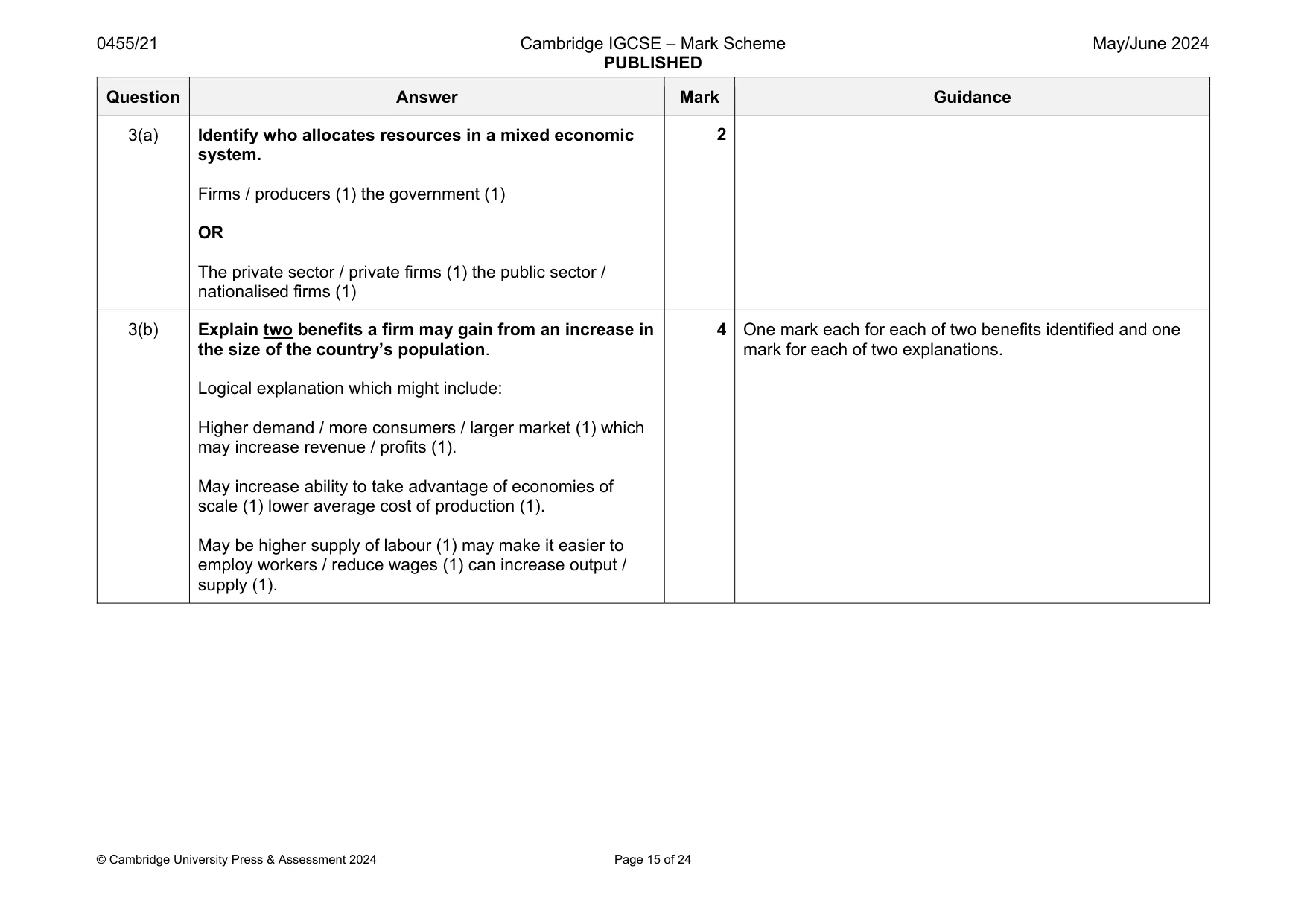
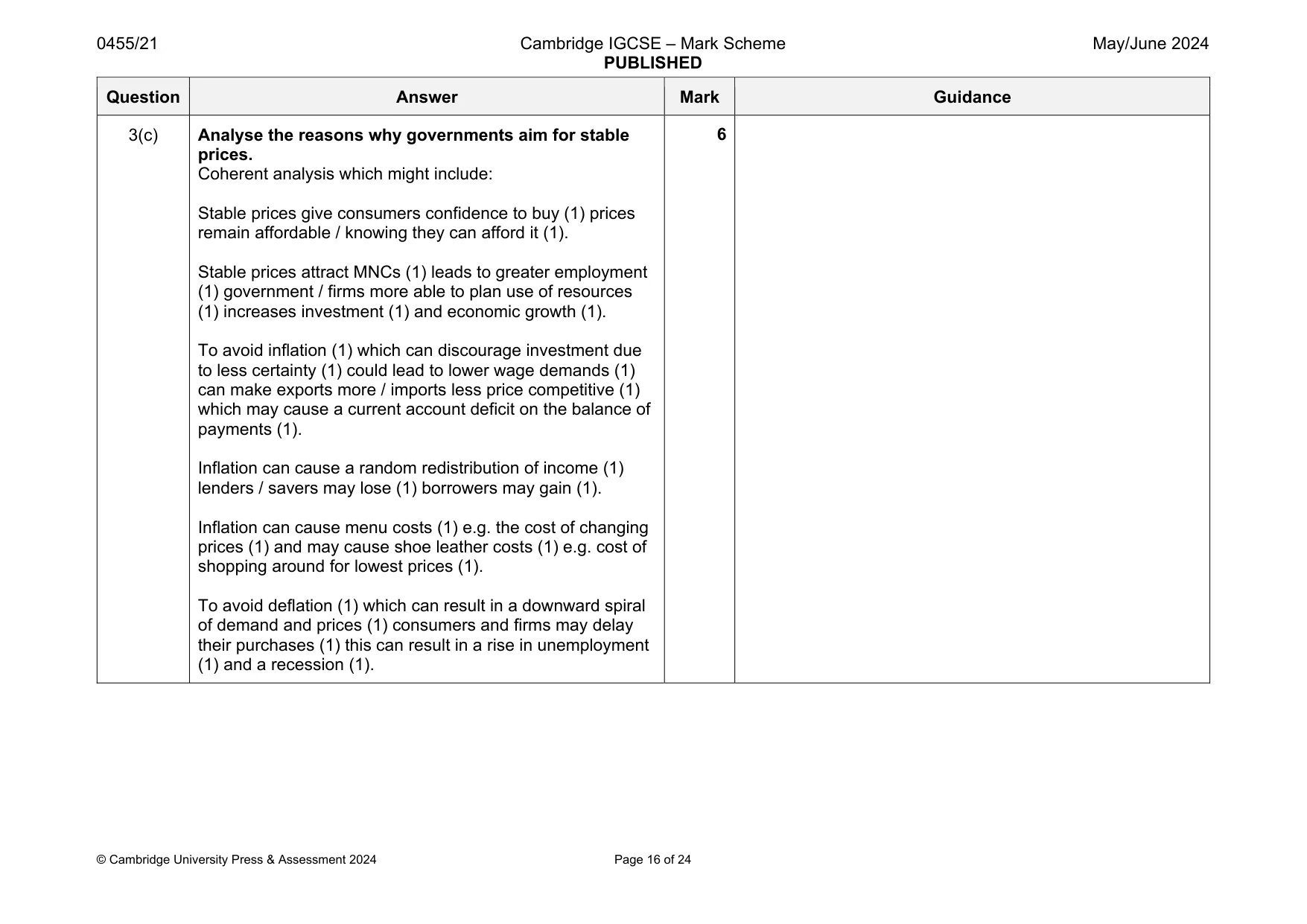
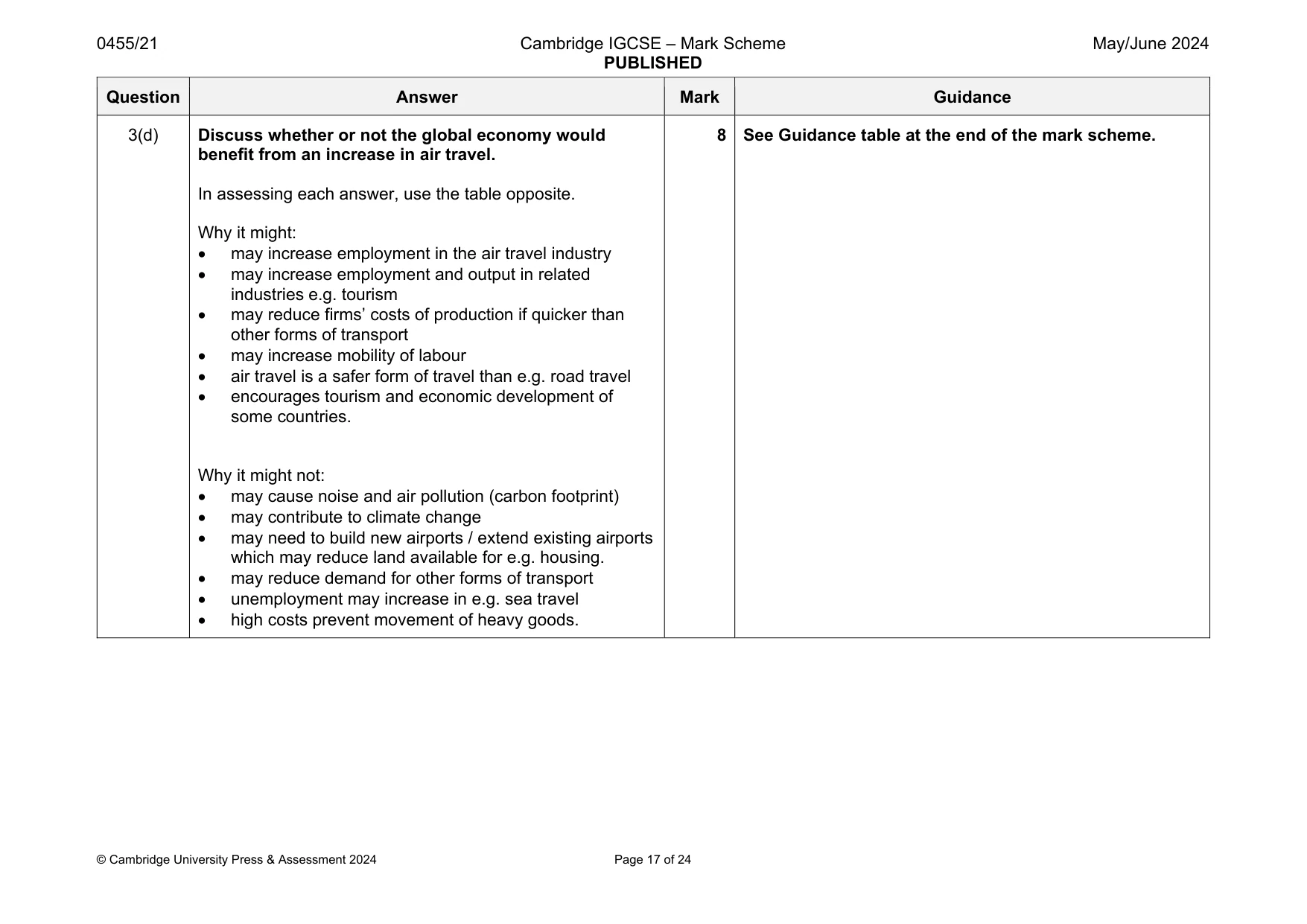
Mark scheme: 3(a) Identify who allocates resources in a mixed economic system. Firms / producers (1) the government (1) OR The private sector / private firms (1) the public sector / nationalised firms (1) 3(b) Explain two benefits a firm may gain from an increase in the size of the country’s population. Logical explanation which might include: Higher demand / more consumers / larger market (1) which may increase revenue / profits (1). May increase ability to take advantage of economies of scale (1) lower average cost of production (1). May be higher supply of labour (1) may make it easier to employ workers / reduce wages (1) can increase output / supply (1). 4 One mark each for each of two benefits identified and one mark for each of two explanations. Question Answer Mark Guidance 3(c) Analyse the reasons why governments aim for stable prices. Coherent analysis which might include: Stable prices give consumers confidence to buy (1) prices remain affordable / knowing they can afford it (1). Stable prices attract MNCs (1) leads to greater employment (1) government / firms more able to plan use of resources (1) increases investment (1) and economic growth (1). To avoid inflation (1) which can discourage investment due to less certainty (1) could lead to lower wage demands (1) can make exports more / imports less price competitive (1) which may cause a current account deficit on the balance of payments (1). Inflation can cause a random redistribution of income (1) lenders / savers may lose (1) borrowers may gain (1). Inflation can cause menu costs (1) e.g. the cost of changing prices (1) and may cause shoe leather costs (1) e.g. cost of shopping around for lowest prices (1). To avoid deflation (1) which can result in a downward spiral of demand and prices (1) consumers and firms may delay their purchases (1) this can result in a rise in unemployment (1) and a recession (1). 6 Question Answer Mark Guidance 3(d) Discuss whether or not the global economy would benefit from an increase in air travel. In assessing each answer, use the table opposite. Why it might: may increase employment in the air travel industry may increase employment and output in related industries e.g. tourism may reduce firms’ costs of production if quicker than other forms of transport may increase mobility of labour air travel is a safer form of travel than e.g. road travel encourages tourism and economic development of some countries. Why it might not: may cause noise and air pollution (carbon footprint) may contribute to climate change may need to build new airports / extend existing airports which may reduce land available for e.g. housing. may reduce demand for other forms of transport unemployment may increase in e.g. sea travel high costs prevent movement of heavy goods. 8 See Guidance table at the end of the mark scheme.
Q4 · Healthcare is in the tertiary sector
4 Healthcare is in the tertiary sector. Healthcare provides both private and external benefits. In 2019, there were five mergers between large US healthcare firms. As well as operating in the US, US healthcare firms operate in a number of host countries, including Singapore. (a) Define tertiary sector using an example apart from healthcare. [2] (b) Explain the difference between a private benefit and an external benefit of healthcare. [4] (c) Analyse why a government may prevent a horizontal merger. [6] (d) Discuss whether or not a foreign multinational company (MNC) will continue to produce in a host country for many years. [8]
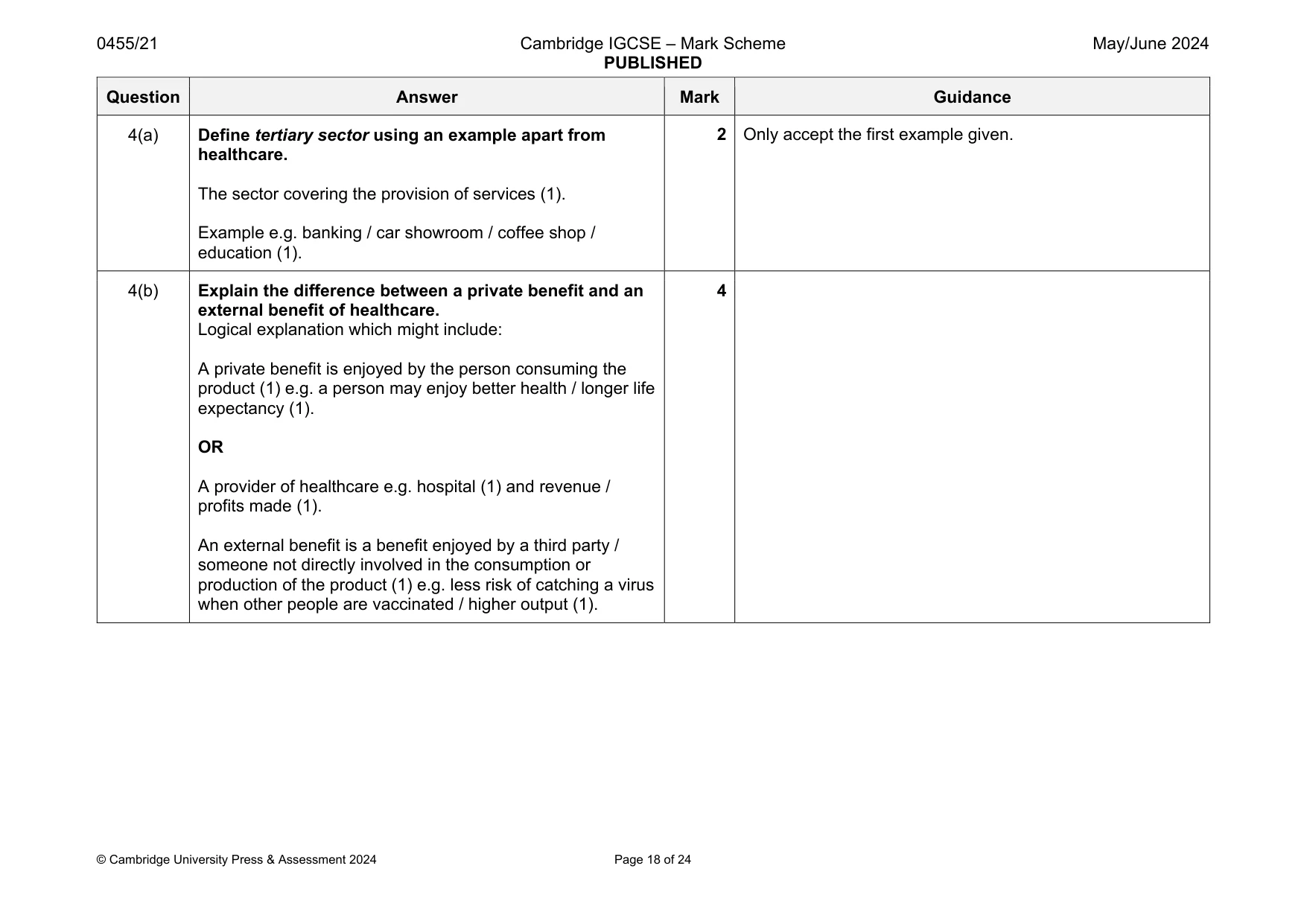
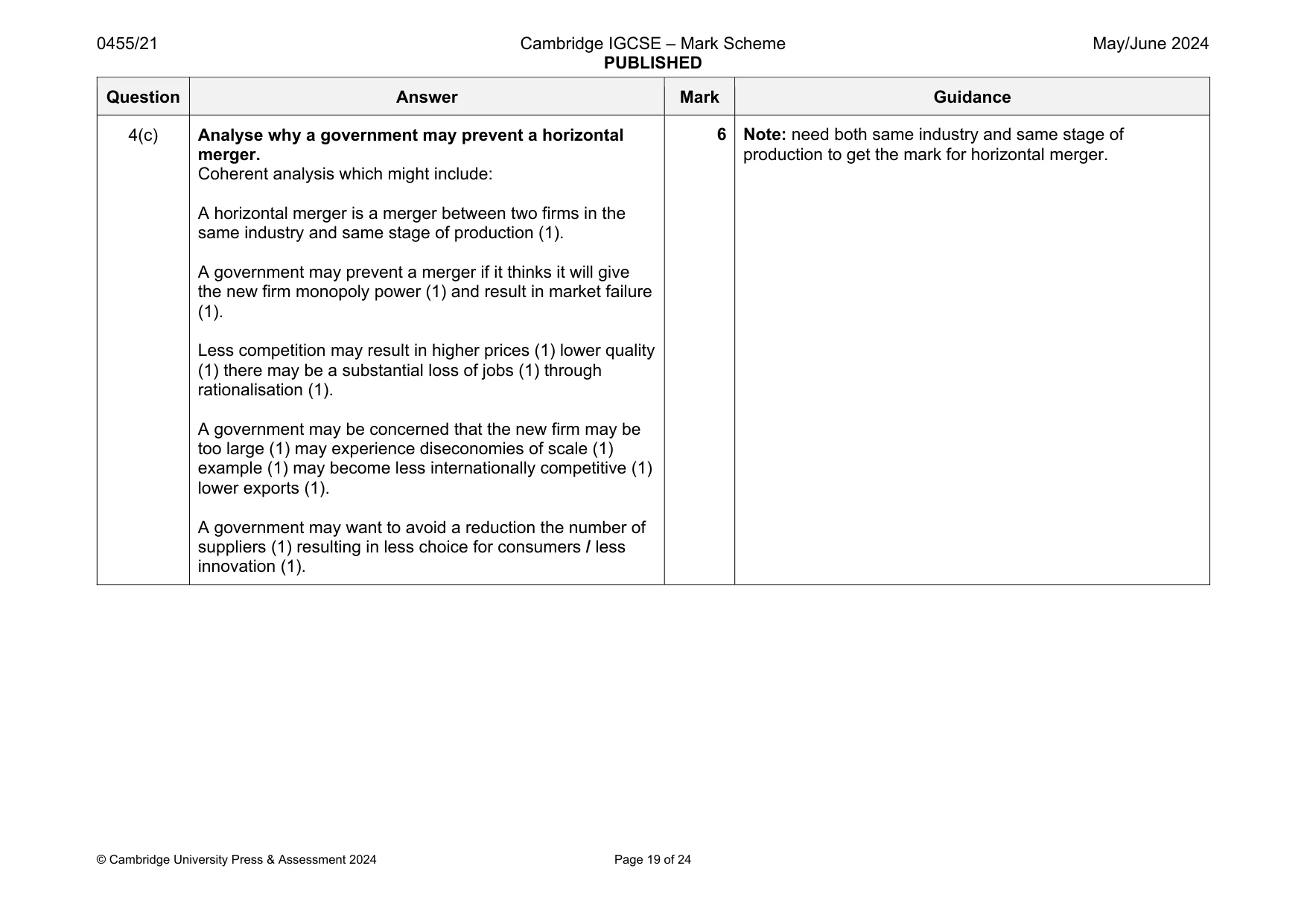
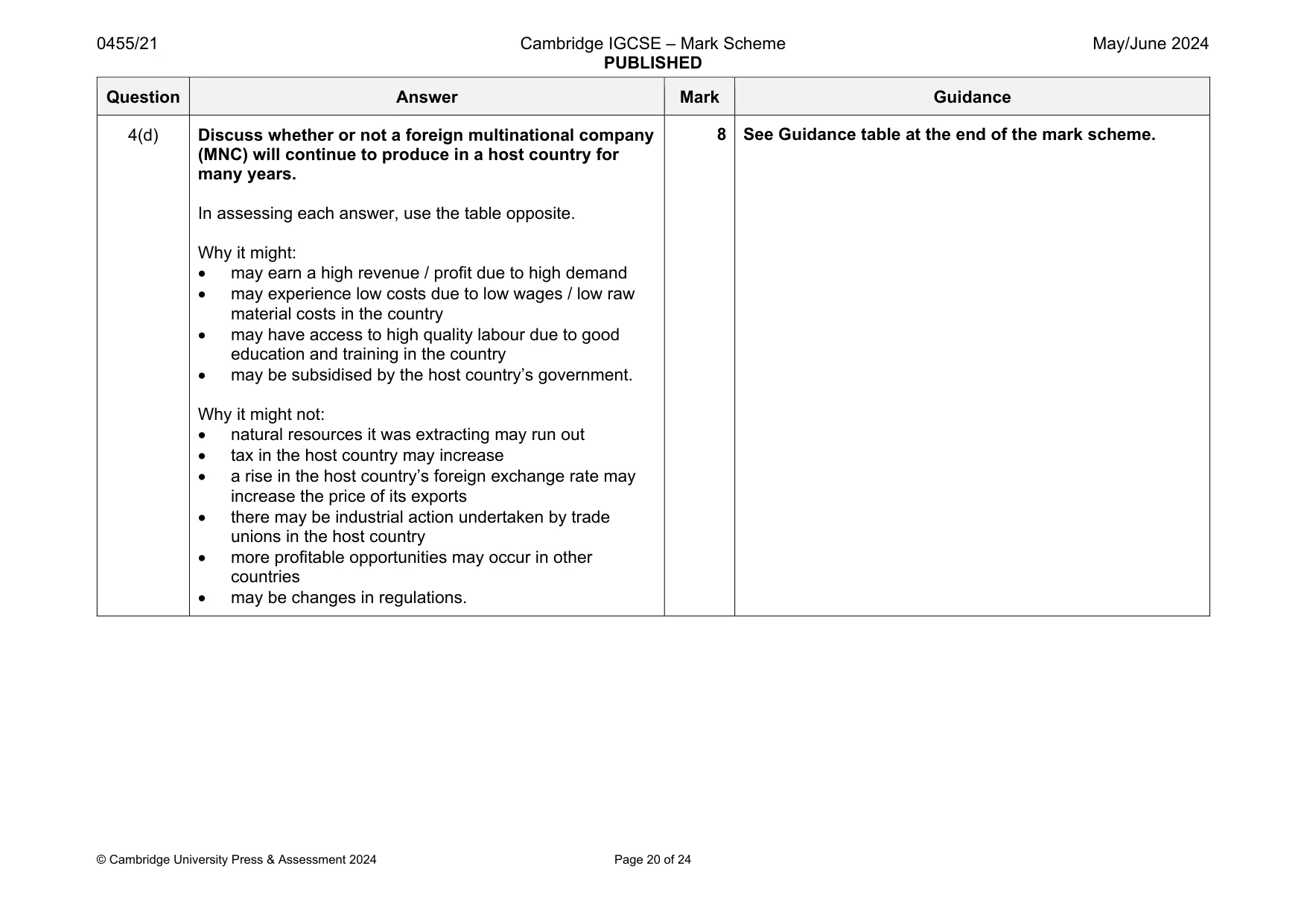
Mark scheme: 4(a) Define tertiary sector using an example apart from healthcare. The sector covering the provision of services (1). Example e.g. banking / car showroom / coffee shop / education (1). 4(b) Explain the difference between a private benefit and an external benefit of healthcare. Logical explanation which might include: A private benefit is enjoyed by the person consuming the product (1) e.g. a person may enjoy better health / longer life expectancy (1). OR A provider of healthcare e.g. hospital (1) and revenue / profits made (1). An external benefit is a benefit enjoyed by a third party / someone not directly involved in the consumption or production of the product (1) e.g. less risk of catching a virus when other people are vaccinated / higher output (1). 4 Question Answer Mark Guidance 4(c) Analyse why a government may prevent a horizontal merger. Coherent analysis which might include: A horizontal merger is a merger between two firms in the same industry and same stage of production (1). A government may prevent a merger if it thinks it will give the new firm monopoly power (1) and result in market failure (1). Less competition may result in higher prices (1) lower quality (1) there may be a substantial loss of jobs (1) through rationalisation (1). A government may be concerned that the new firm may be too large (1) may experience diseconomies of scale (1) example (1) may become less internationally competitive (1) lower exports (1). A government may want to avoid a reduction the number of suppliers (1) resulting in less choice for consumers / less innovation (1). 6 Note: need both same industry and same stage of production to get the mark for horizontal merger. Question Answer Mark Guidance 4(d) Discuss whether or not a foreign multinational company (MNC) will continue to produce in a host country for many years. In assessing each answer, use the table opposite. Why it might: may earn a high revenue / profit due to high demand may experience low costs due to low wages / low raw material costs in the country may have access to high quality labour due to good education and training in the country may be subsidised by the host country’s government. Why it might not: natural resources it was extracting may run out tax in the host country may increase a rise in the host country’s foreign exchange rate may increase the price of its exports there may be industrial action undertaken by trade unions in the host country more profitable opportunities may occur in other countries may be changes in regulations. 8 See Guidance table at the end of the mark scheme.
Q5 · In 2020, the price of gold fell in Vietnam
5 In 2020, the price of gold fell in Vietnam. That year, Vietnam was one of Asia’s best performing economies. Unlike some Asian economies, Vietnam did not experience a recession. Its total output, exports and imports all increased. Unemployment did increase from 2.0% to 2.3% but remained very low. One of the aims of fiscal policy can be to achieve full employment. (a) Identify how the effect of a fall in the price of gold would be shown on a demand curve for gold. [2] (b) Explain two disadvantages of a recession. [4] (c) Analyse why a country may demand more imports. [6] (d) Discuss whether or not fiscal policy can achieve full employment. [8]
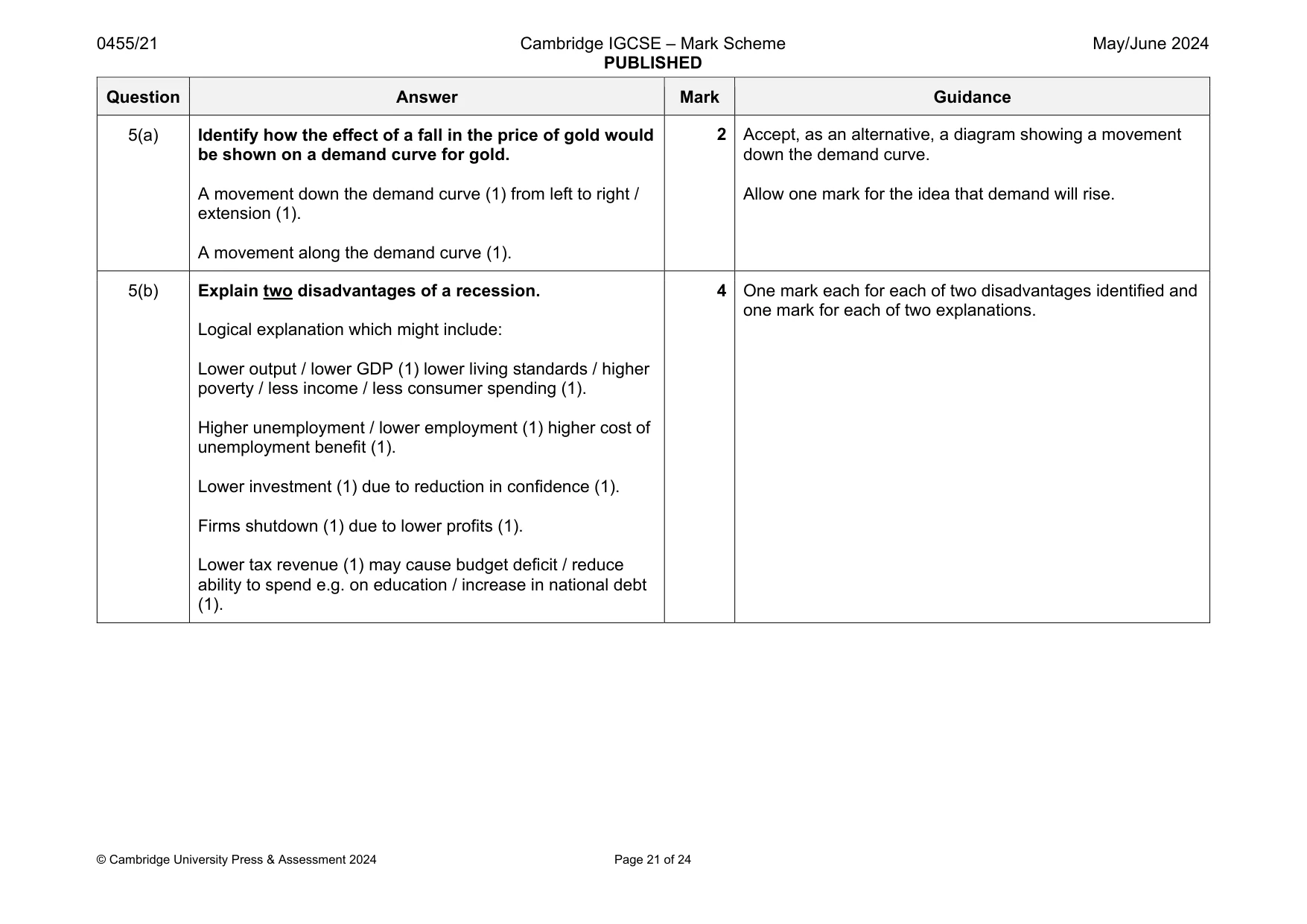
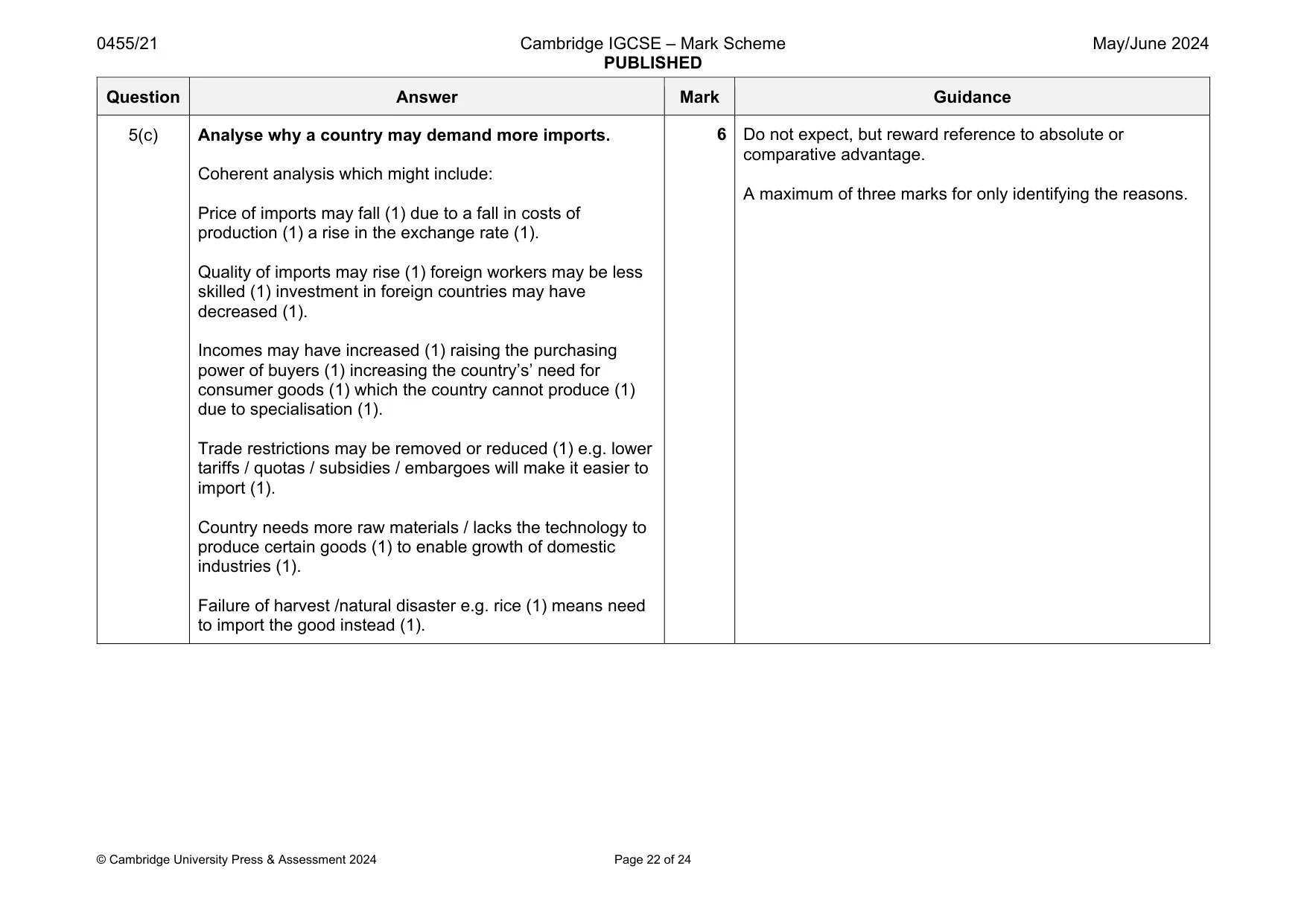
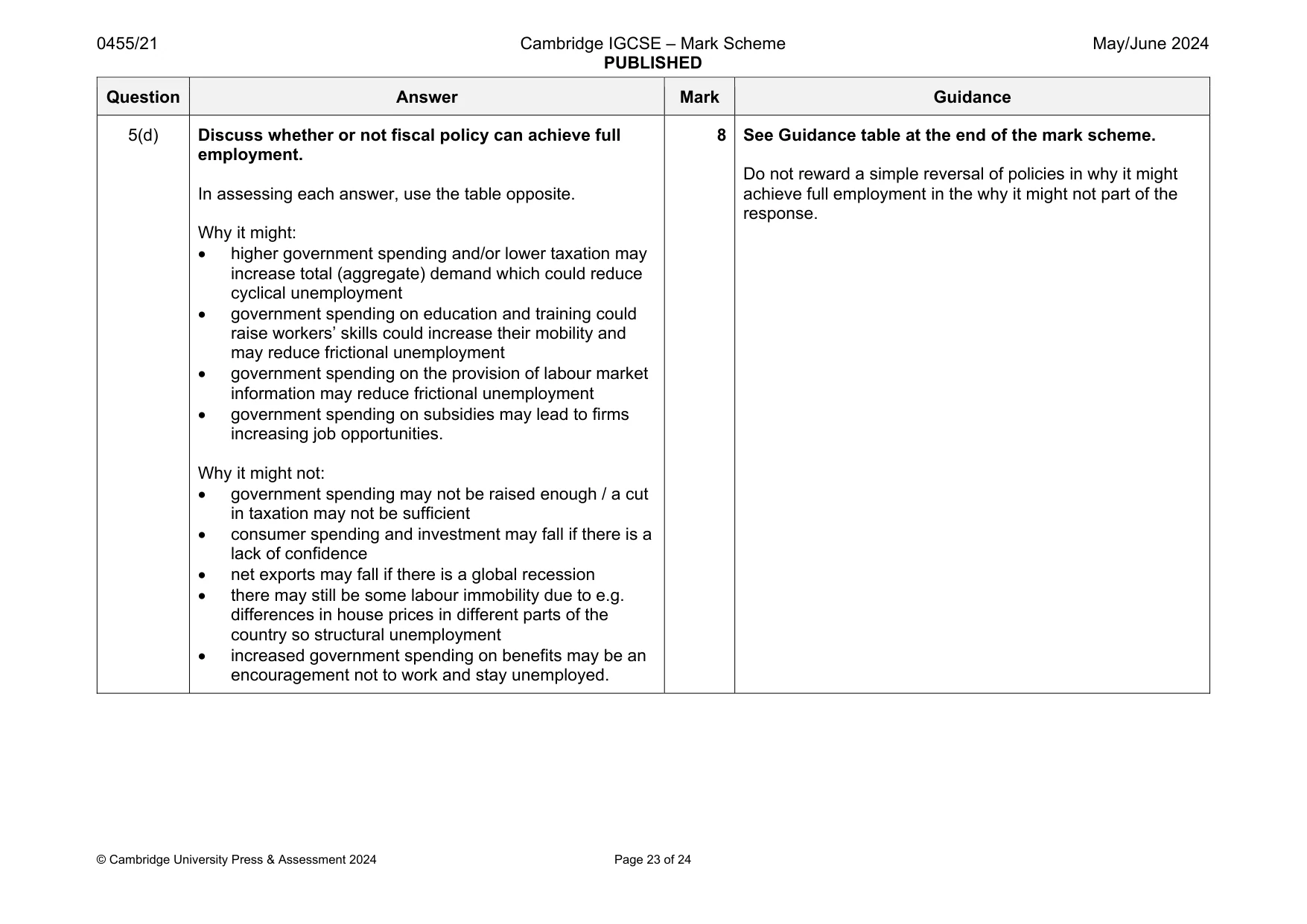
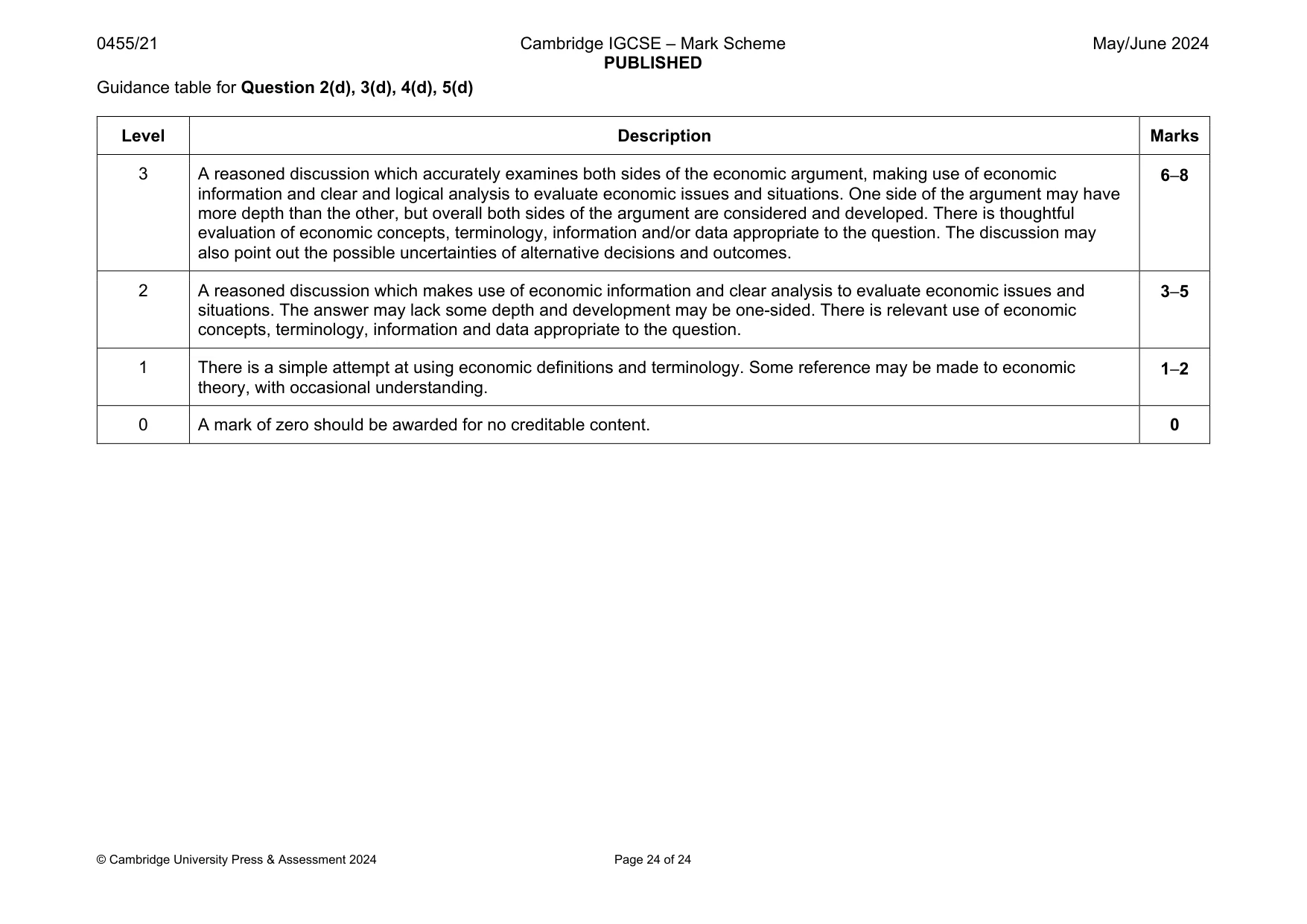
Mark scheme: 5(a) Identify how the effect of a fall in the price of gold would be shown on a demand curve for gold. A movement down the demand curve (1) from left to right / extension (1). A movement along the demand curve (1). down the demand curve. Allow one mark for the idea that demand will rise. 5(b) Explain two disadvantages of a recession. Logical explanation which might include: Lower output / lower GDP (1) lower living standards / higher poverty / less income / less consumer spending (1). Higher unemployment / lower employment (1) higher cost of unemployment benefit (1). Lower investment (1) due to reduction in confidence (1). Firms shutdown (1) due to lower profits (1). Lower tax revenue (1) may cause budget deficit / reduce ability to spend e.g. on education / increase in national debt (1). 4 One mark each for each of two disadvantages identified and one mark for each of two explanations. Question Answer Mark Guidance 5(c) Analyse why a country may demand more imports. Coherent analysis which might include: Price of imports may fall (1) due to a fall in costs of production (1) a rise in the exchange rate (1). Quality of imports may rise (1) foreign workers may be less skilled (1) investment in foreign countries may have decreased (1). Incomes may have increased (1) raising the purchasing power of buyers (1) increasing the country’s’ need for consumer goods (1) which the country cannot produce (1) due to specialisation (1). Trade restrictions may be removed or reduced (1) e.g. lower tariffs / quotas / subsidies / embargoes will make it easier to import (1). Country needs more raw materials / lacks the technology to produce certain goods (1) to enable growth of domestic industries (1). Failure of harvest /natural disaster e.g. rice (1) means need to import the good instead (1). 6 Do not expect, but reward reference to absolute or comparative advantage. A maximum of three marks for only identifying the reasons. Question Answer Mark Guidance 5(d) Discuss whether or not fiscal policy can achieve full employment. In assessing each answer, use the table opposite. Why it might: higher government spending and/or lower taxation may increase total (aggregate) demand which could reduce cyclical unemployment government spending on education and training could raise workers’ skills could increase their mobility and may reduce frictional unemployment government spending on the provision of labour market information may reduce frictional unemployment government spending on subsidies may lead to firms increasing job opportunities. Why it might not: government spending may not be raised enough / a cut in taxation may not be sufficient consumer spending and investment may fall if there is a lack of confidence net exports may fall if there is a global recession there may still be some labour immobility due to e.g. differences in house prices in different parts of the country so structural unemployment increased government spending on benefits may be an encouragement not to work and stay unemployed. 8 See Guidance table at the end of the mark scheme. Do not reward a simple reversal of policies in why it might achieve full employment in the why it might not part of the response. Level Description Marks 3 A reasoned discussion which accurately examines both sides of the economic argument, making use of economic information and clear and logical analysis to evaluate economic issues and situations. One side of the argument may have more depth than the other, but overall both sides of the argument are considered and developed. There is thoughtful evaluation of economic concepts, terminology, information and/or data appropriate to the question. The discussion may also point out the possible uncertainties of alternative decisions and outcomes. 68 2 A reasoned discussion which makes use of economic information and clear analysis to evaluate economic issues and situations. The answer may lack some depth and development may be one-sided. There is relevant use of economic concepts, terminology, information and data appropriate to the question. 35 1 There is a simple attempt at using economic definitions and terminology. Some reference may be made to economic theory, with occasional understanding. 12 0 A mark of zero should be awarded for no creditable content. 0
What was in this paper
The subtopics covered by these 5 questions, and how many questions each got. Open one in a new tab to see every Cambridge question on it.
What you needed in this session
Cambridge’s own grade thresholds for 2024 May/June, Paper 2 · Variant 1. A higher threshold means an easier paper — the bar moves with how the cohort did.