Cambridge IGCSE Economics 0455 — 2024 Feb/March Paper 2 · Variant 2
0455/22/F/M/24 · 5 questions · 90 marks · ≈101 min
The question paper and its mark scheme, free to read here and free to download. This is Cambridge’s own paper, exactly as it was sat.
Question paper8 pages
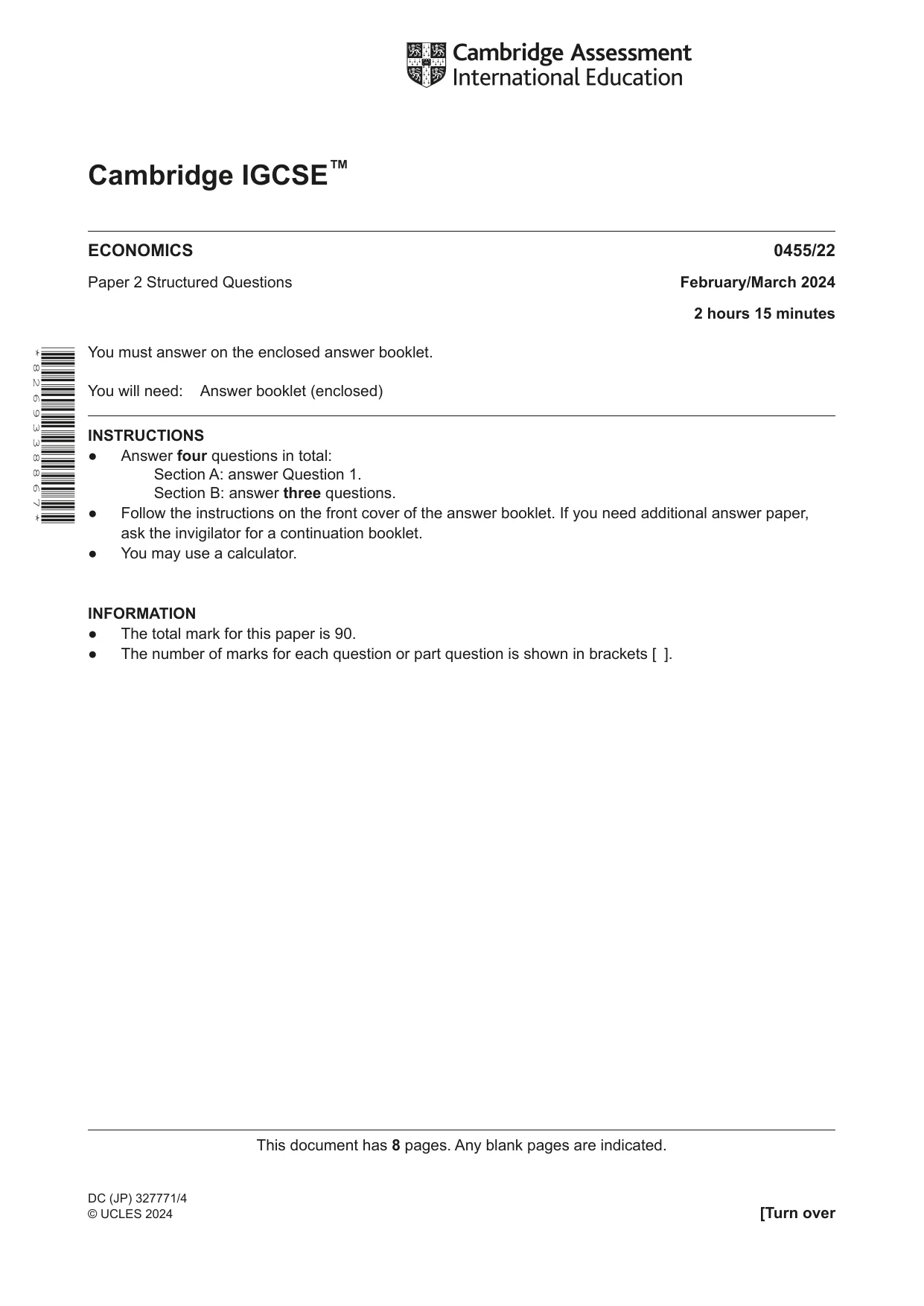
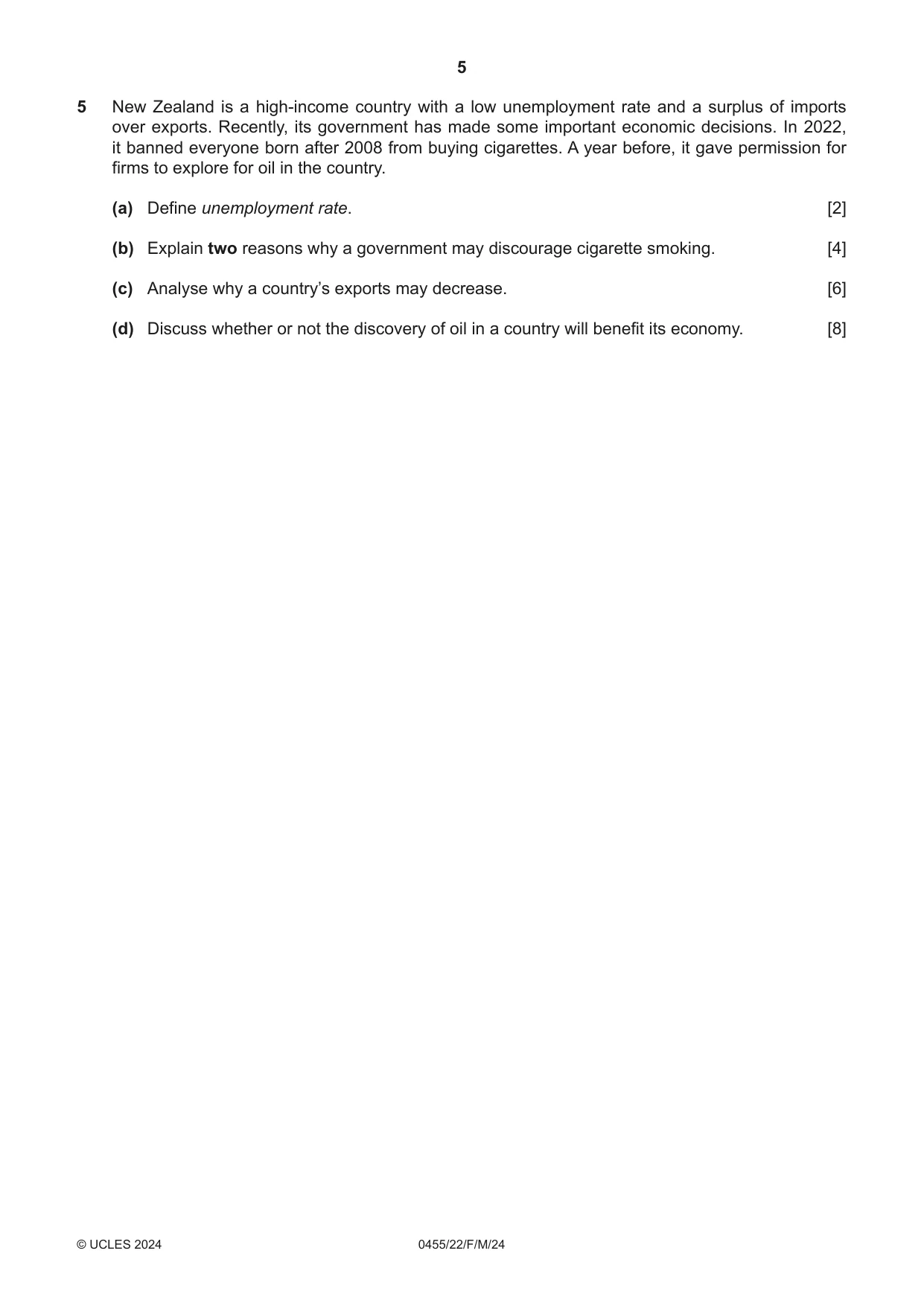



Mark scheme25 pages
Answers below. Sit the paper first if you are practising.
Questions as text
Q1 · Calculate the average wage paid in Denmark in 2020
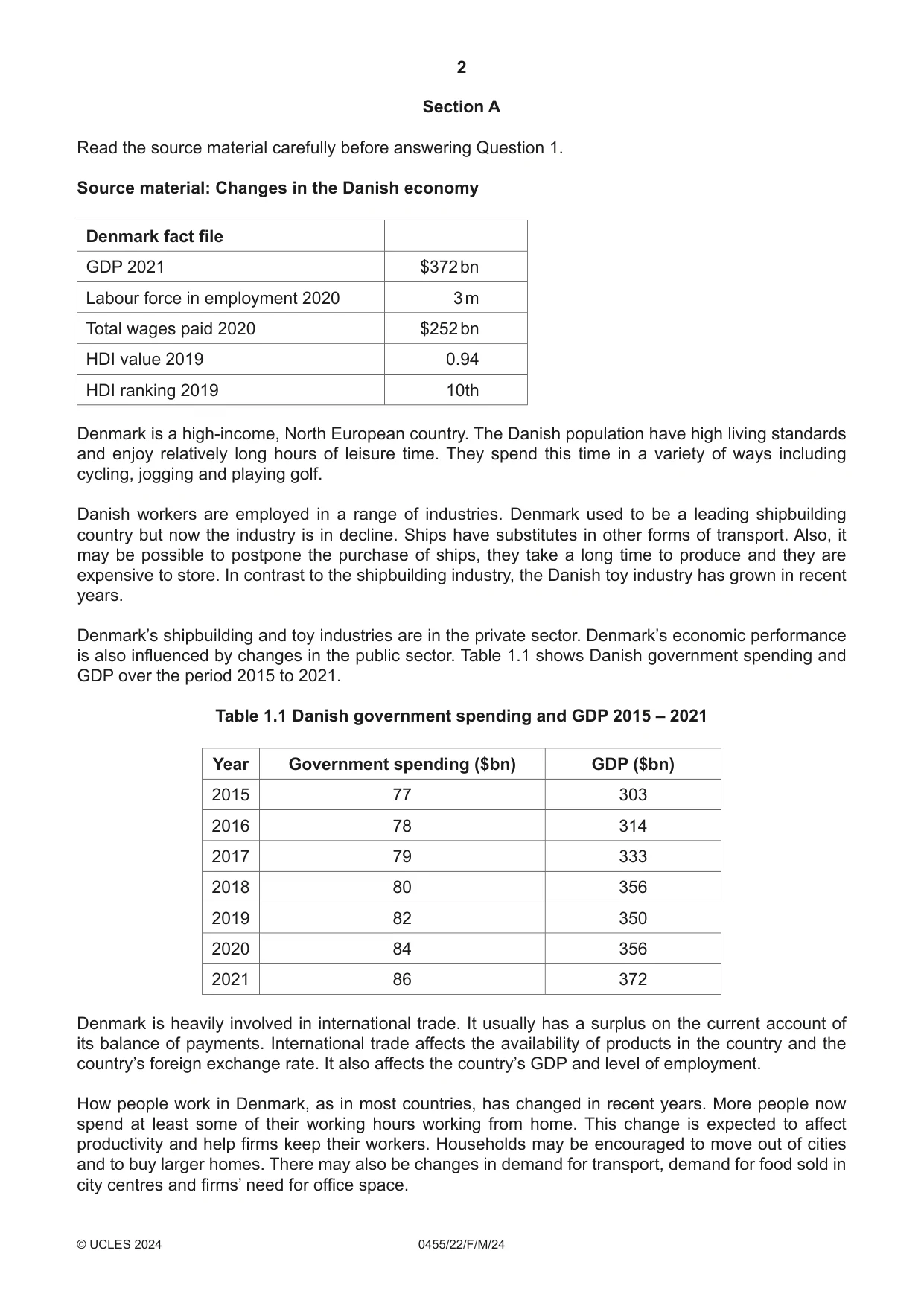
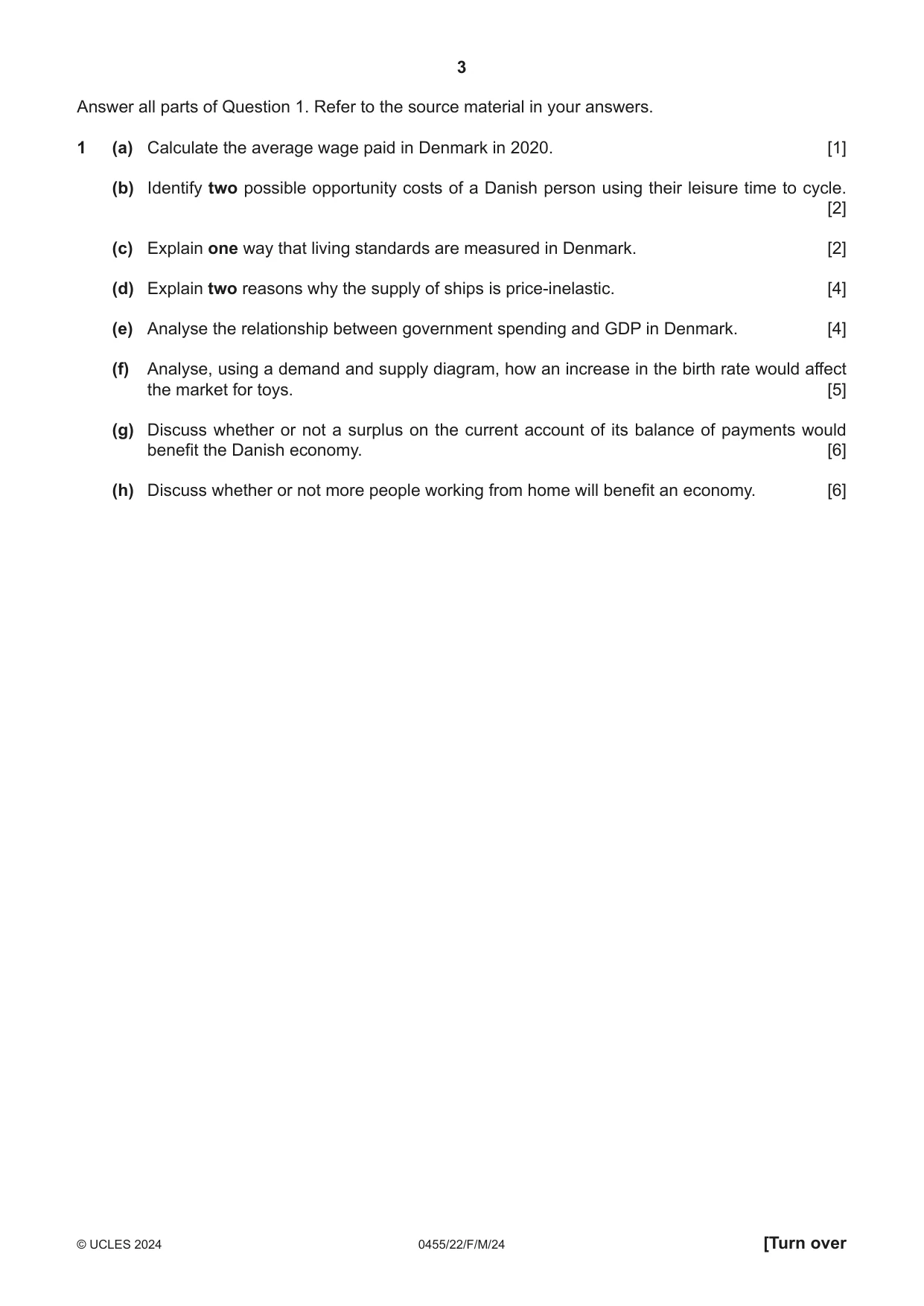
1 (a) Calculate the average wage paid in Denmark in 2020. [1] (b) Identify two possible opportunity costs of a Danish person using their leisure time to cycle. [2] (c) Explain one way that living standards are measured in Denmark. [2] (d) Explain two reasons why the supply of ships is price-inelastic. [4] (e) Analyse the relationship between government spending and GDP in Denmark. [4] (f) Analyse, using a demand and supply diagram, how an increase in the birth rate would affect the market for toys. [5] (g) Discuss whether or not a surplus on the current account of its balance of payments would benefit the Danish economy. [6] (h) Discuss whether or not more people working from home will benefit an economy. [6]
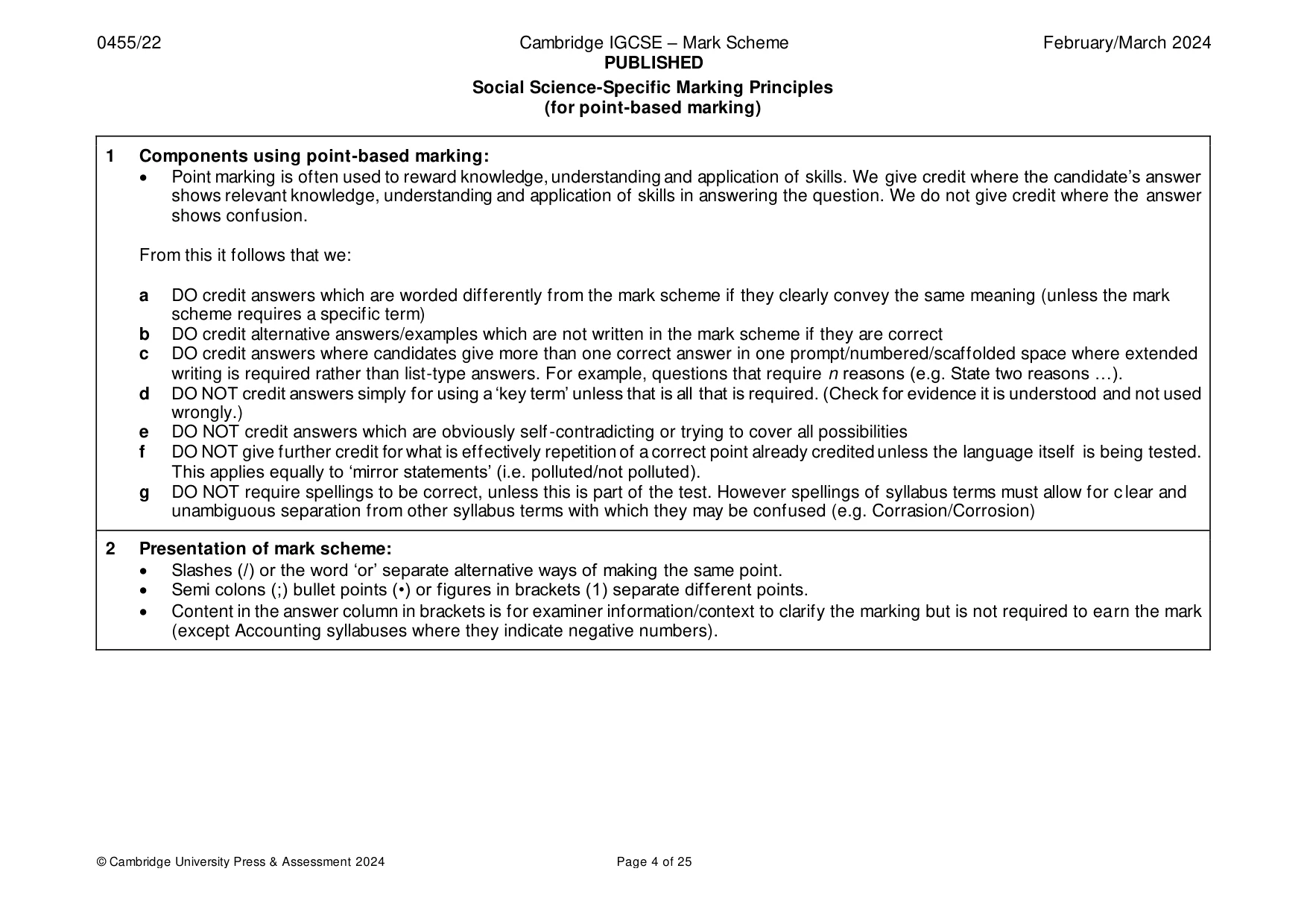
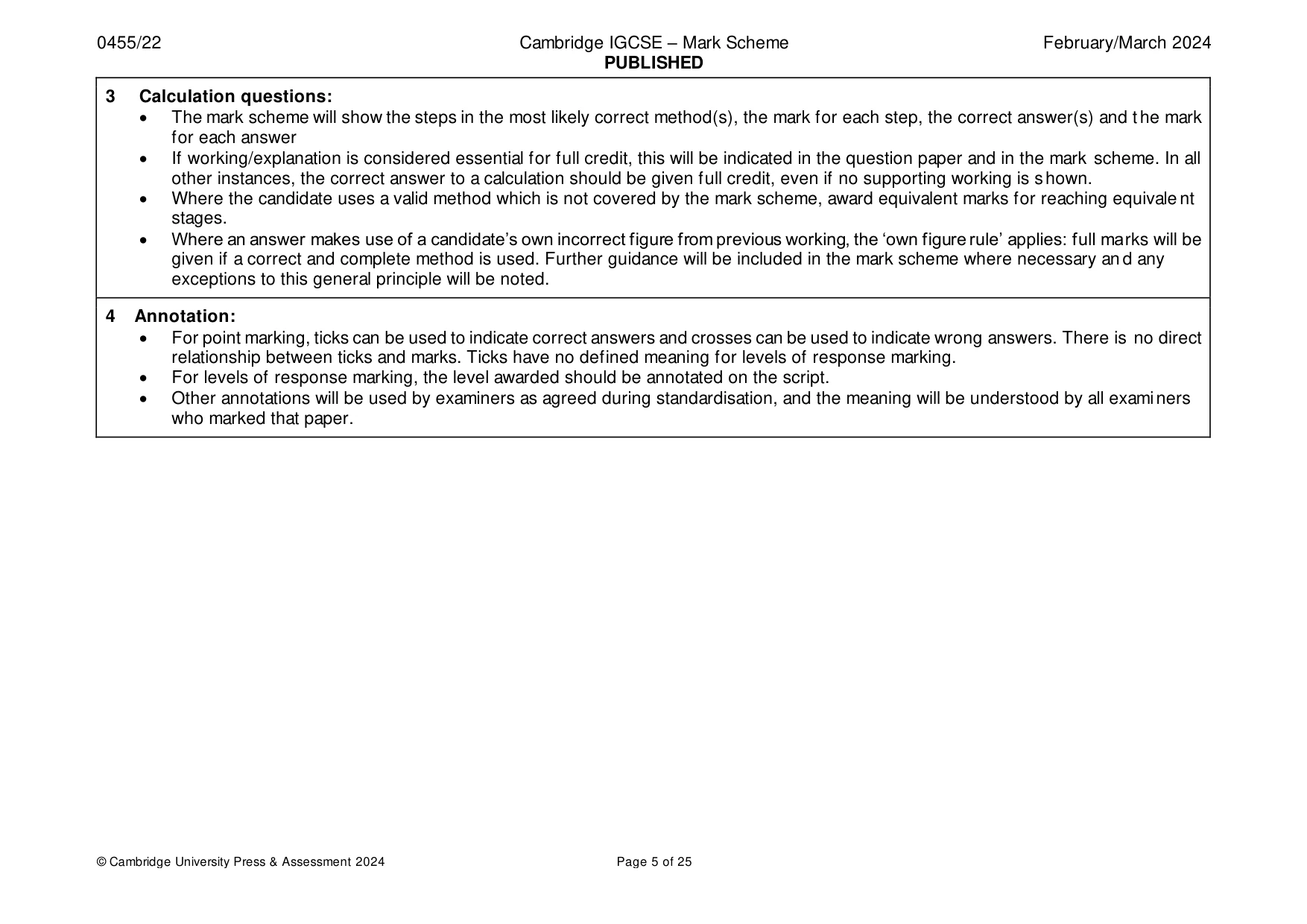
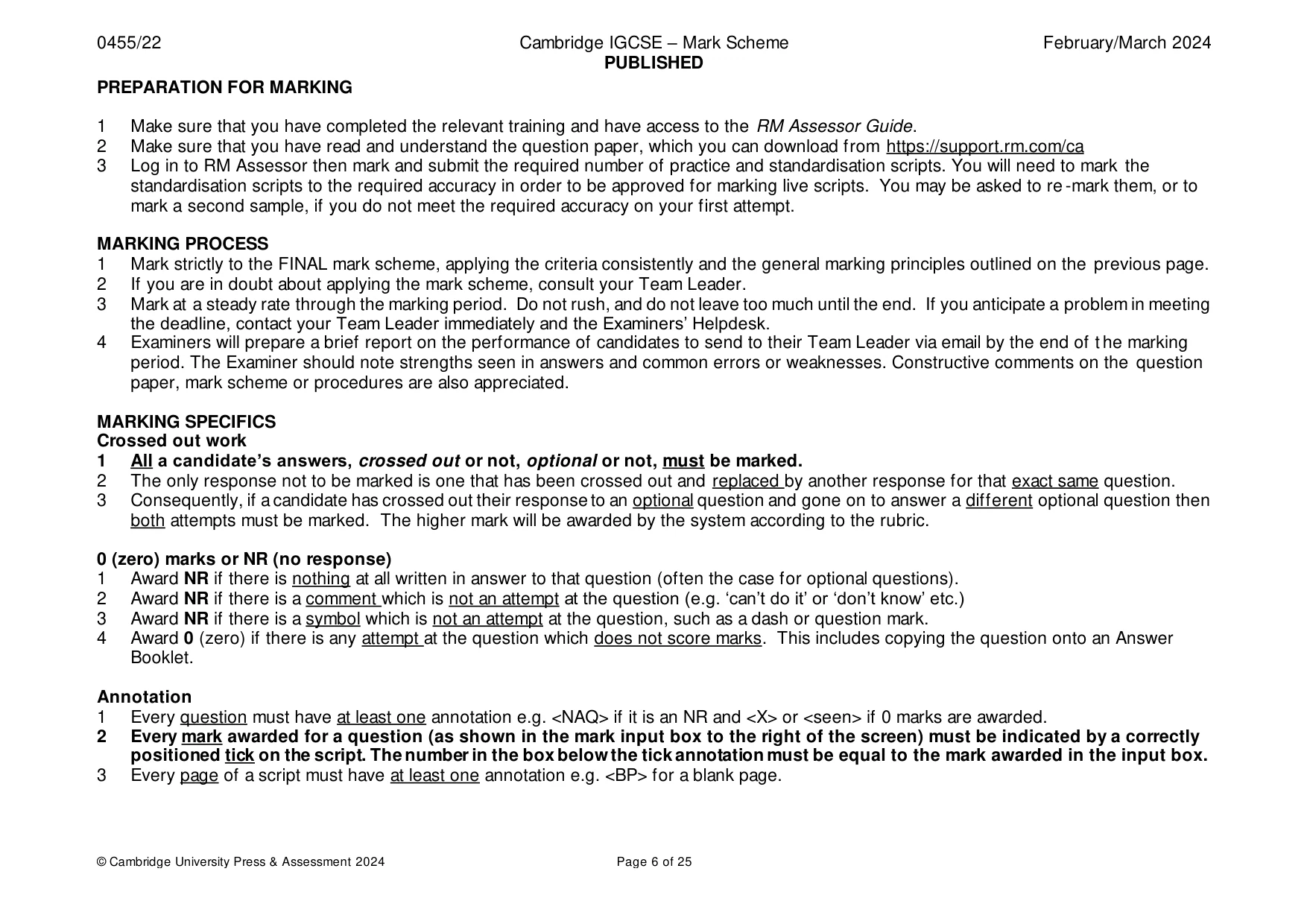
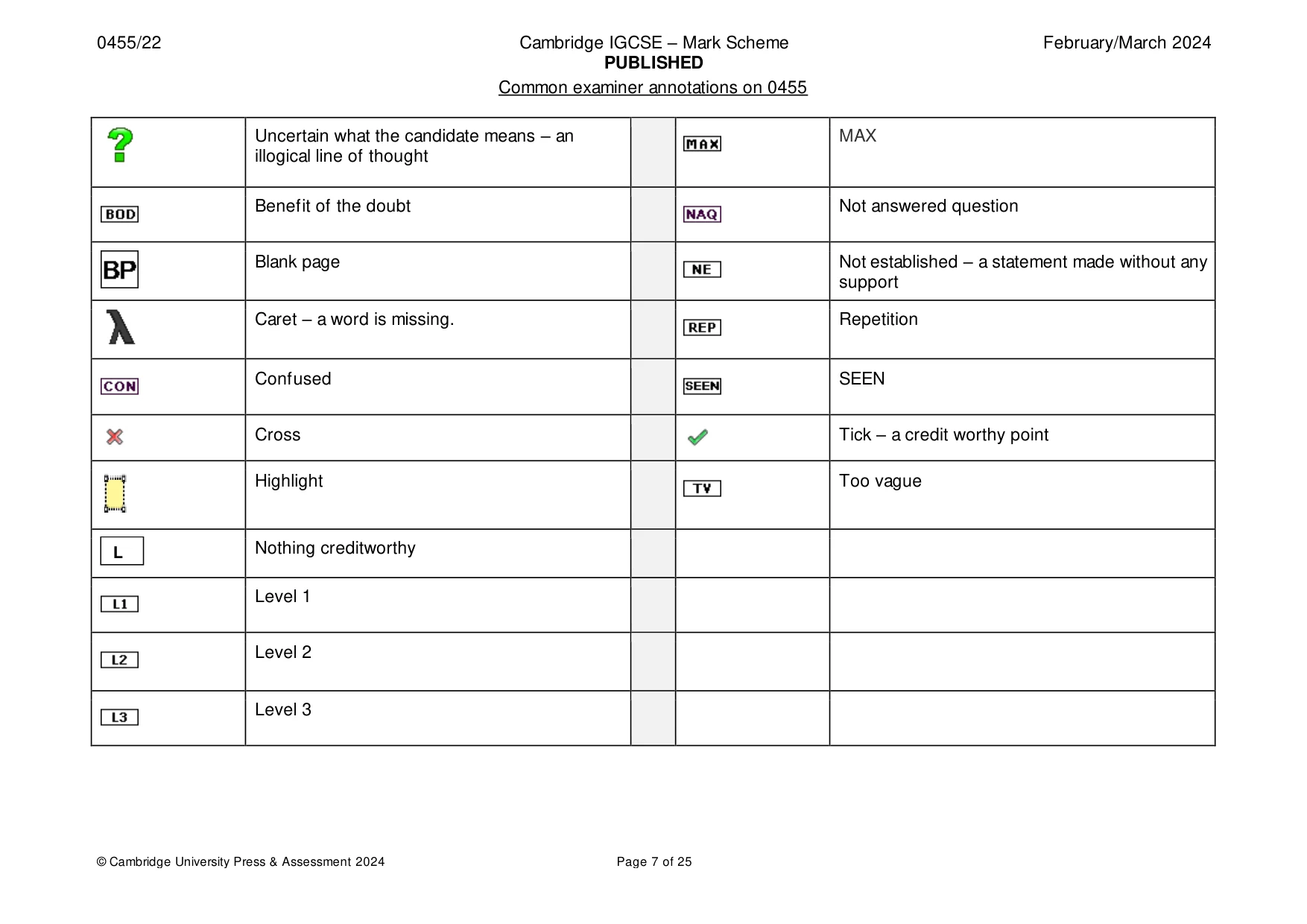
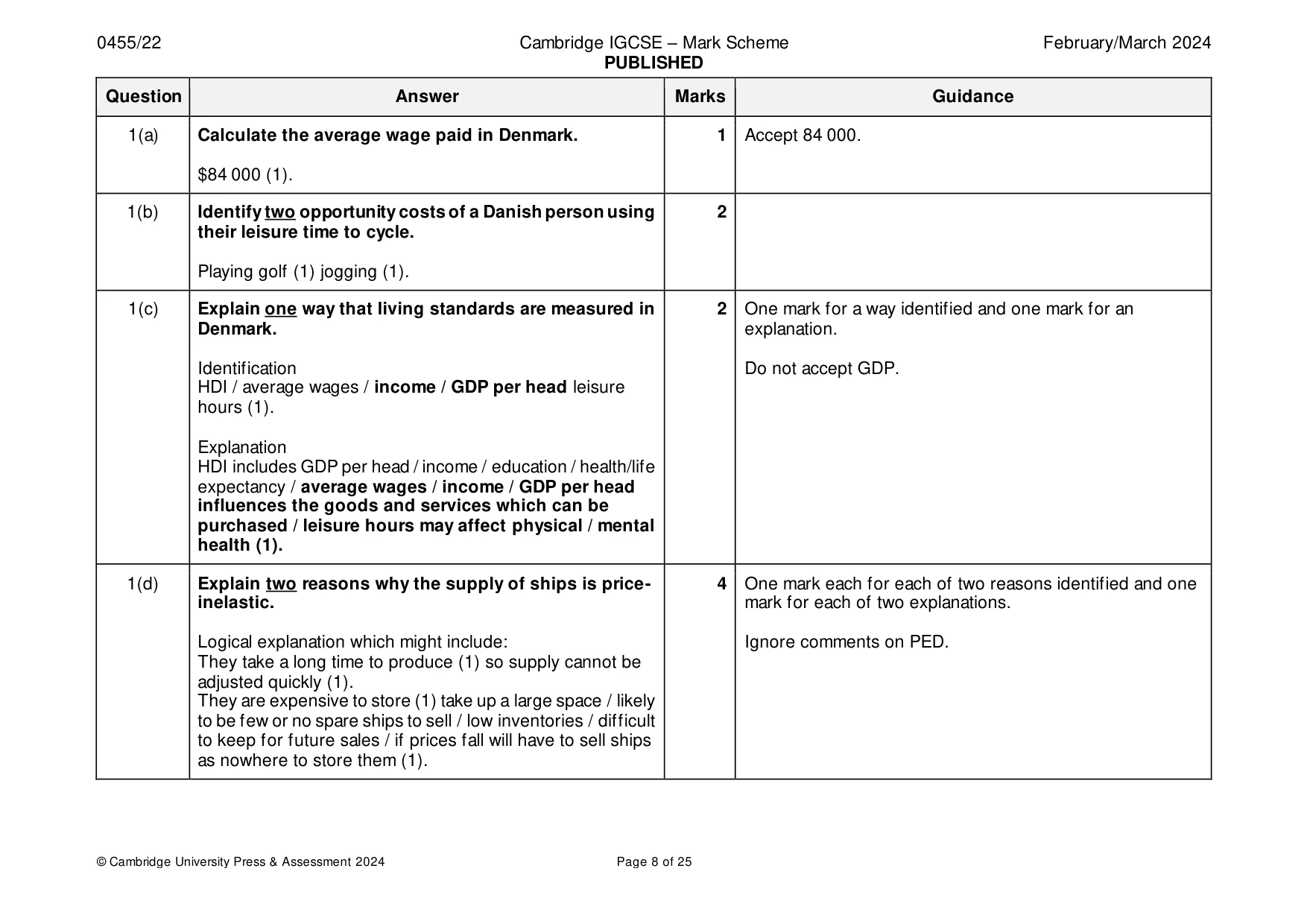
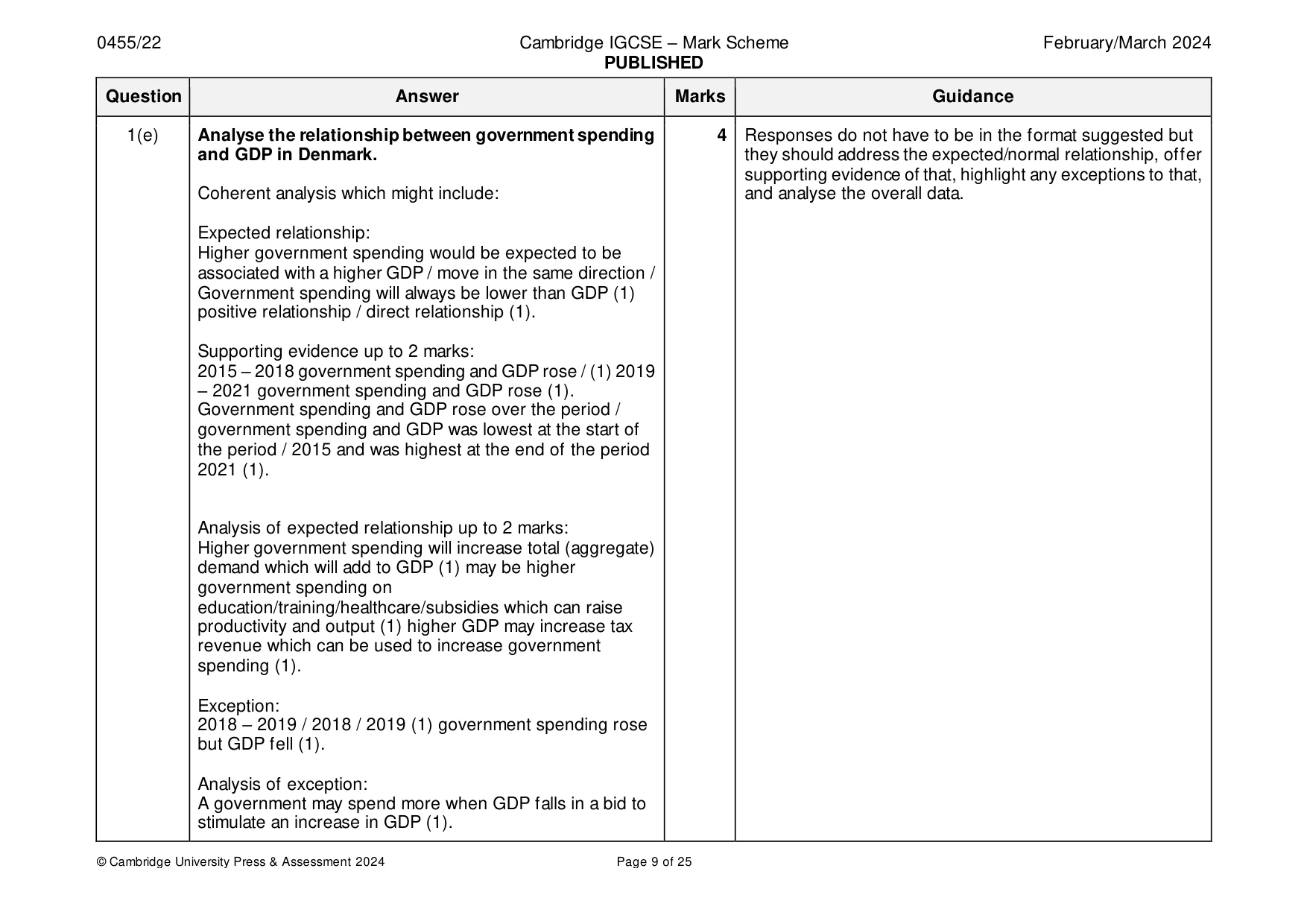
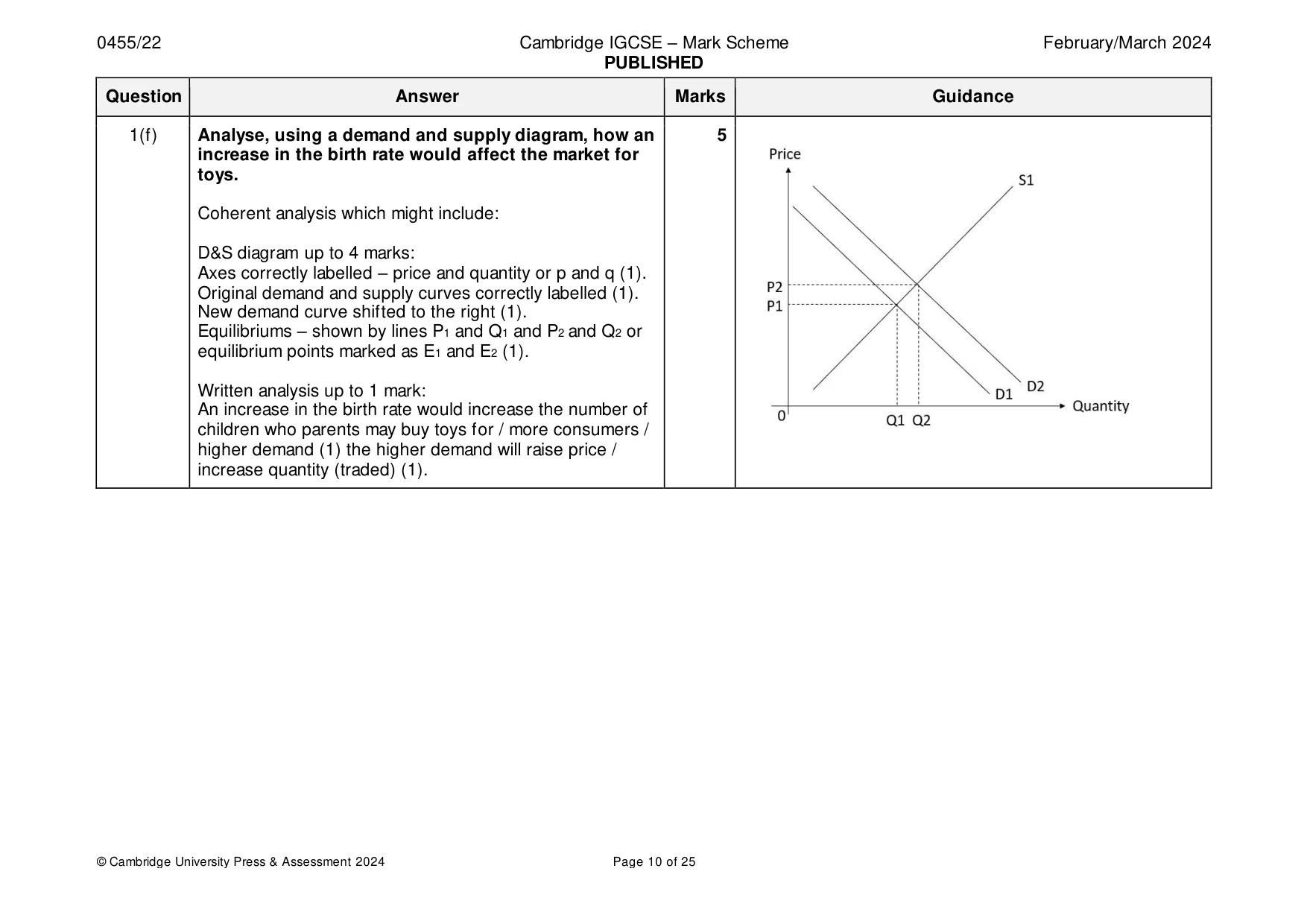
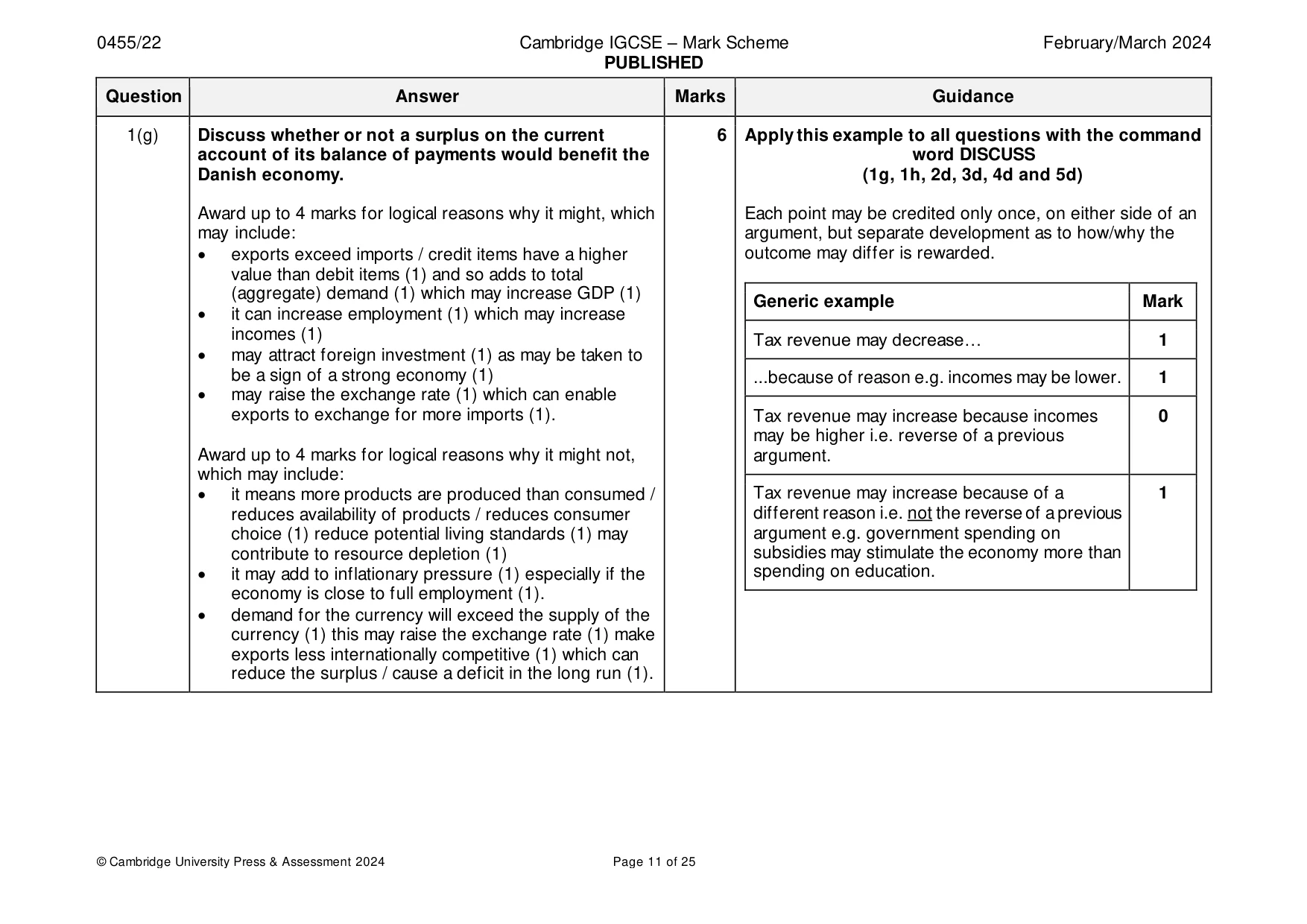
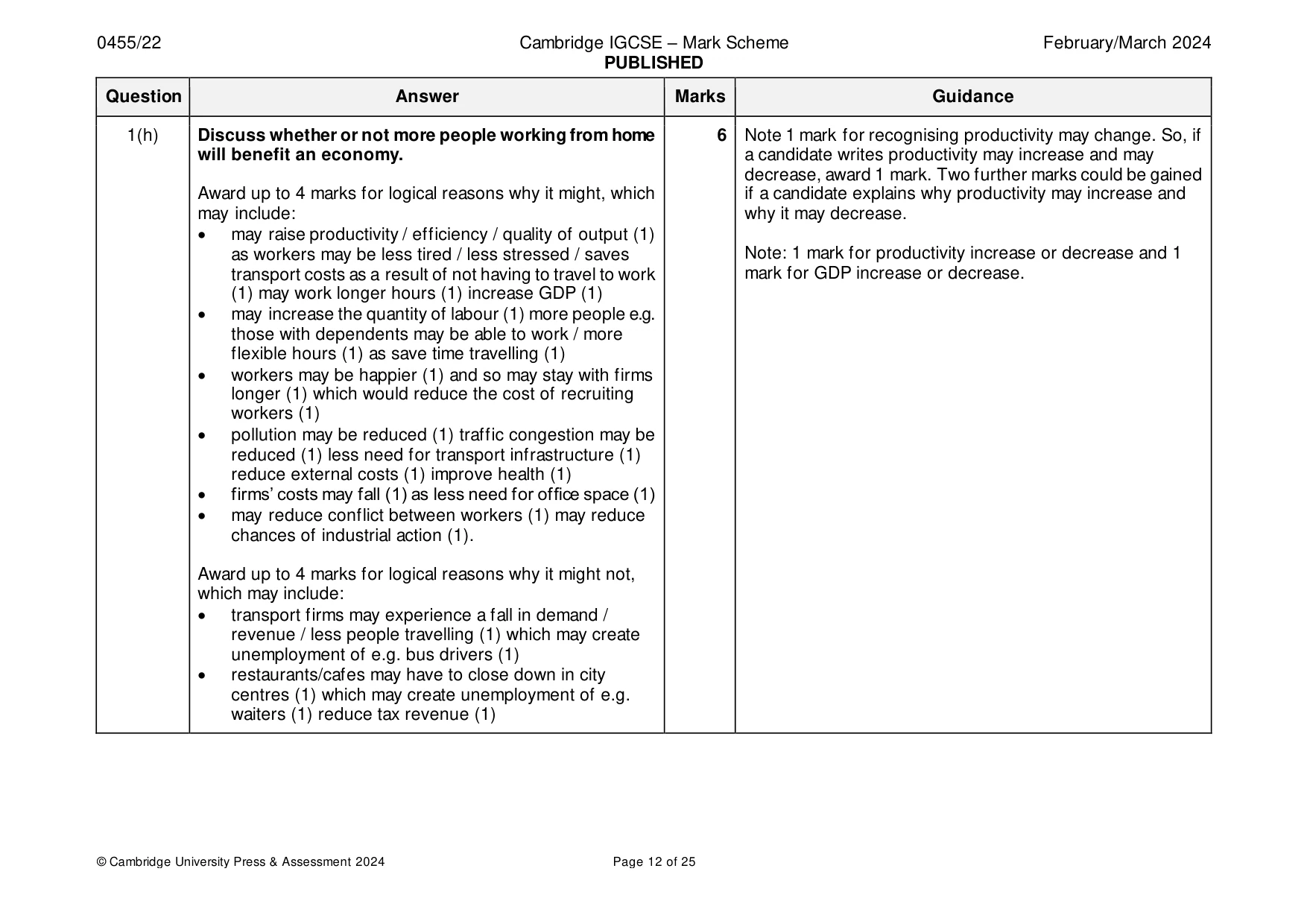
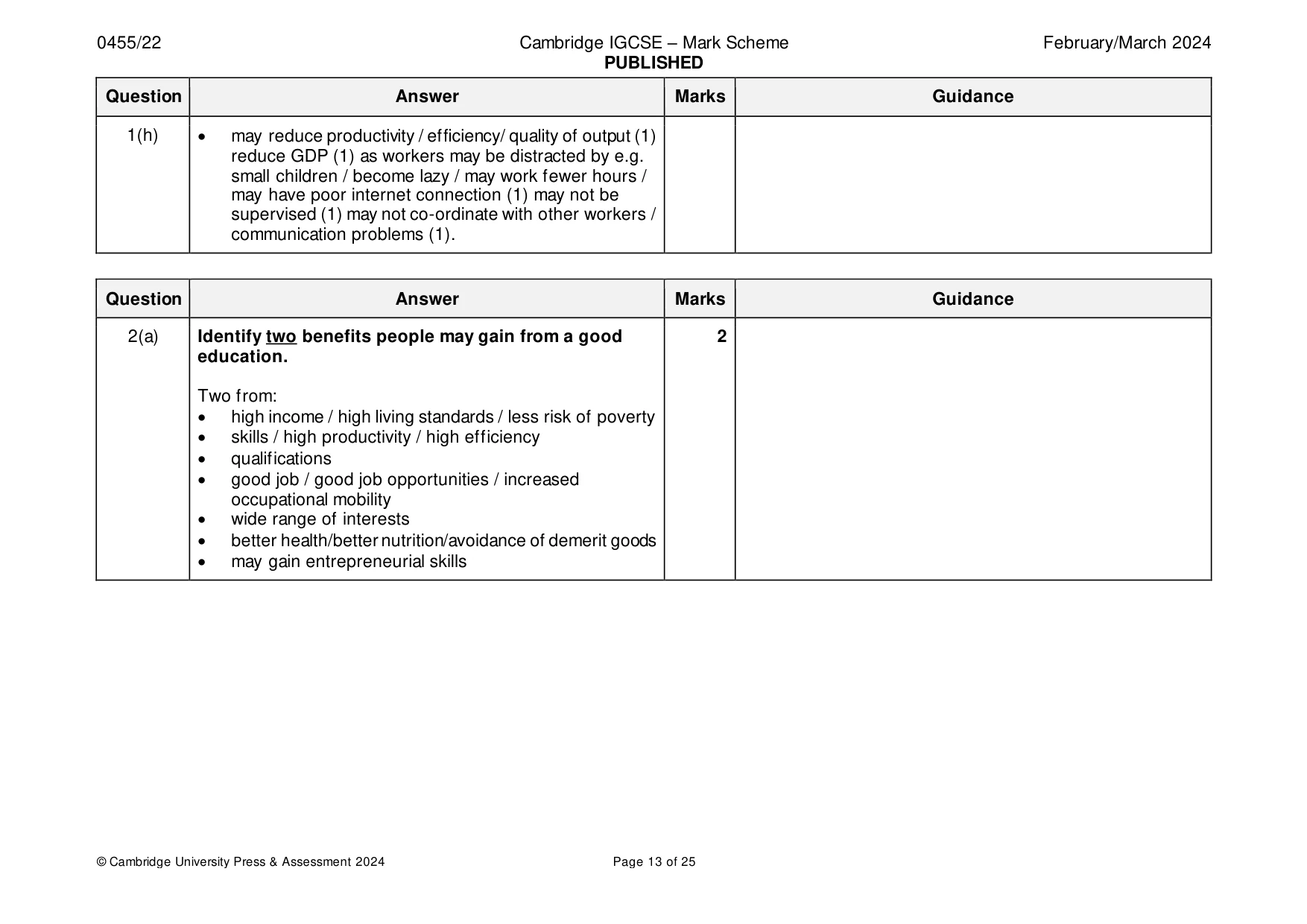
Mark scheme: Question Answer Marks Guidance 1(a) Calculate the average wage paid in Denmark. 1 Accept 84 000. $84 000 (1). 1(b) Identify two opportunity costs of a Danish person using 2 their leisure time to cycle. Playing golf (1) jogging (1). 1(c) Explain one way that living standards are measured in 2 One mark for a way identified and one mark for an Denmark. explanation. Identification Do not accept GDP. HDI / average wages / income / GDP per head leisure hours (1). Explanation HDI includes GDP per head / income / education / health/life expectancy / average wages / income / GDP per head influences the goods and services which can be purchased / leisure hours may affect physical / mental health (1). 1(d) Explain two reasons why the supply of ships is price- 4 One mark each for each of two reasons identified and one inelastic. mark for each of two explanations. Logical explanation which might include: Ignore comments on PED. They take a long time to produce (1) so supply cannot be adjusted quickly (1). They are expensive to store (1) take up a large space / likely to be few or no spare ships to sell / low inventories / difficult to keep for future sales / if prices fall will have to sell ships as nowhere to store them (1). 1(e) Analyse the relationship between government spending 4 Responses do not have to be in the format suggested but and GDP in Denmark. they should address the expected/normal relationship, offer supporting evidence of that, highlight any exceptions to that, Coherent analysis which might include: and analyse the overall data. Expected relationship: Higher government spending would be expected to be associated with a higher GDP / move in the same direction / Government spending will always be lower than GDP (1) positive relationship / direct relationship (1). Supporting evidence up to 2 marks: 2015 – 2018 government spending and GDP rose / (1) 2019 – 2021 government spending and GDP rose (1). Government spending and GDP rose over the period / government spending and GDP was lowest at the start of the period / 2015 and was highest at the end of the period 2021 (1). Analysis of expected relationship up to 2 marks: Higher government spending will increase total (aggregate) demand which will add to GDP (1) may be higher government spending on education/training/healthcare/subsidies which can raise productivity and output (1) higher GDP may increase tax revenue which can be used to increase government spending (1). Exception: 2018 – 2019 / 2018 / 2019 (1) government spending rose but GDP fell (1). Analysis of exception: A government may spend more when GDP falls in a bid to stimulate an increase in GDP (1). 1(f) Analyse, using a demand and supply diagram, how an 5 increase in the birth rate would affect the market for toys. Coherent analysis which might include: D&S diagram up to 4 marks: Axes correctly labelled – price and quantity or p and q (1). Original demand and supply curves correctly labelled (1). New demand curve shifted to the right (1). Equilibriums – shown by lines P1 and Q1 and P2 and Q2 or equilibrium points marked as E1 and E2 (1). Written analysis up to 1 mark: An increase in the birth rate would increase the number of children who parents may buy toys for / more consumers / higher demand (1) the higher demand will raise price / increase quantity (traded) (1). 1(g) Discuss whether or not a surplus on the current 6 Apply this example to all questions with the command account of its balance of payments would benefit the word DISCUSS Danish economy. (1g, 1h, 2d, 3d, 4d and 5d) Award up to 4 marks for logical reasons why it might, which Each point may be credited only once, on either side of an may include: argument, but separate development as to how/why the • exports exceed imports / credit items have a higher outcome may differ is rewarded. value than debit items (1) and so adds to total (aggregate) demand (1) which may increase GDP (1) Generic example Mark • it can increase employment (1) which may increase incomes (1) Tax revenue may decrease… 1 • may attract foreign investment (1) as may be taken to be a sign of a strong economy (1) ...because of reason e.g. incomes may be lower. 1 • may raise the exchange rate (1) which can enable exports to exchange for more imports (1). Tax revenue may increase because incomes 0 may be higher i.e. reverse of a previous Award up to 4 marks for logical reasons why it might not, argument. which may include: • it means more products are produced than consumed / Tax revenue may increase because of a 1 reduces availability of products / reduces consumer different reason i.e. not the reverse of a previous choice (1) reduce potential living standards (1) may argument e.g. government spending on contribute to resource depletion (1) subsidies may stimulate the economy more than • it may add to inflationary pressure (1) especially if the spending on education. economy is close to full employment (1). • demand for the currency will exceed the supply of the currency (1) this may raise the exchange rate (1) make exports less internationally competitive (1) which can reduce the surplus / cause a deficit in the long run (1). 1(h) Discuss whether or not more people working from home 6 Note 1 mark for recognising productivity may change. So, if will benefit an economy. a candidate writes productivity may increase and may decrease, award 1 mark. Two further marks could be gained Award up to 4 marks for logical reasons why it might, which if a candidate explains why productivity may increase and may include: why it may decrease. • may raise productivity / efficiency / quality of output (1) as workers may be less tired / less stressed / saves Note: 1 mark for productivity increase or decrease and 1 transport costs as a result of not having to travel to work mark for GDP increase or decrease. (1) may work longer hours (1) increase GDP (1) • may increase the quantity of labour (1) more people e.g. those with dependents may be able to work / more flexible hours (1) as save time travelling (1) • workers may be happier (1) and so may stay with firms longer (1) which would reduce the cost of recruiting workers (1) • pollution may be reduced (1) traffic congestion may be reduced (1) less need for transport infrastructure (1) reduce external costs (1) improve health (1) • firms’ costs may fall (1) as less need for office space (1) • may reduce conflict between workers (1) may reduce chances of industrial action (1). Award up to 4 marks for logical reasons why it might not, which may include: • transport firms may experience a fall in demand / revenue / less people travelling (1) which may create unemployment of e.g. bus drivers (1) • restaurants/cafes may have to close down in city centres (1) which may create unemployment of e.g. waiters (1) reduce tax revenue (1) 1(h) • may reduce productivity / efficiency/ quality of output (1) reduce GDP (1) as workers may be distracted by e.g. small children / become lazy / may work fewer hours / may have poor internet connection (1) may not be supervised (1) may not co-ordinate with other workers / communication problems (1).
Q2 · Since 2016, South Korea’s population has declined, due to a falling birth rate, and a…
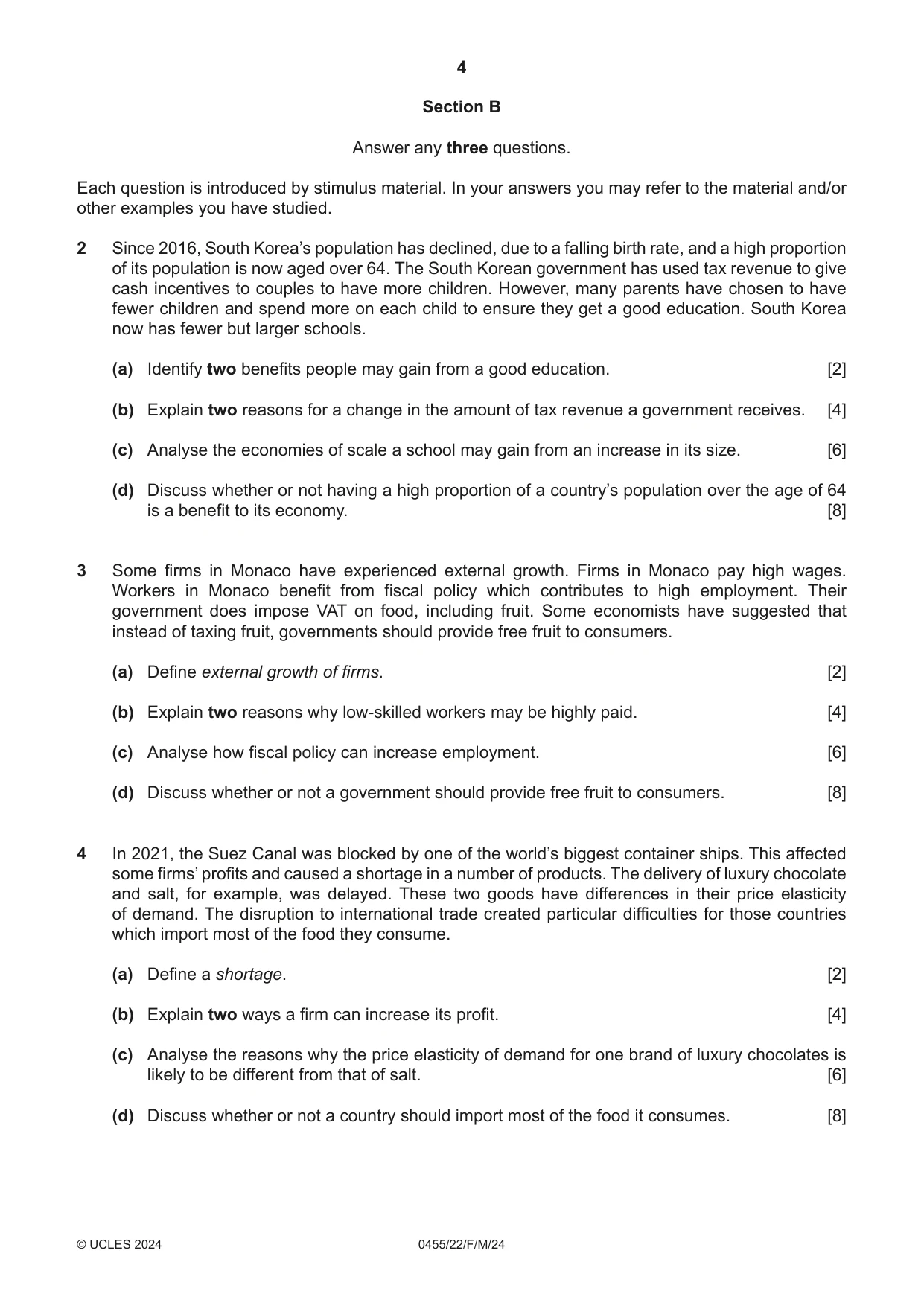
2 Since 2016, South Korea’s population has declined, due to a falling birth rate, and a high proportion of its population is now aged over 64. The South Korean government has used tax revenue to give cash incentives to couples to have more children. However, many parents have chosen to have fewer children and spend more on each child to ensure they get a good education. South Korea now has fewer but larger schools. (a) Identify two benefits people may gain from a good education. [2] (b) Explain two reasons for a change in the amount of tax revenue a government receives. [4] (c) Analyse the economies of scale a school may gain from an increase in its size. [6] (d) Discuss whether or not having a high proportion of a country’s population over the age of 64 is a benefit to its economy. [8]
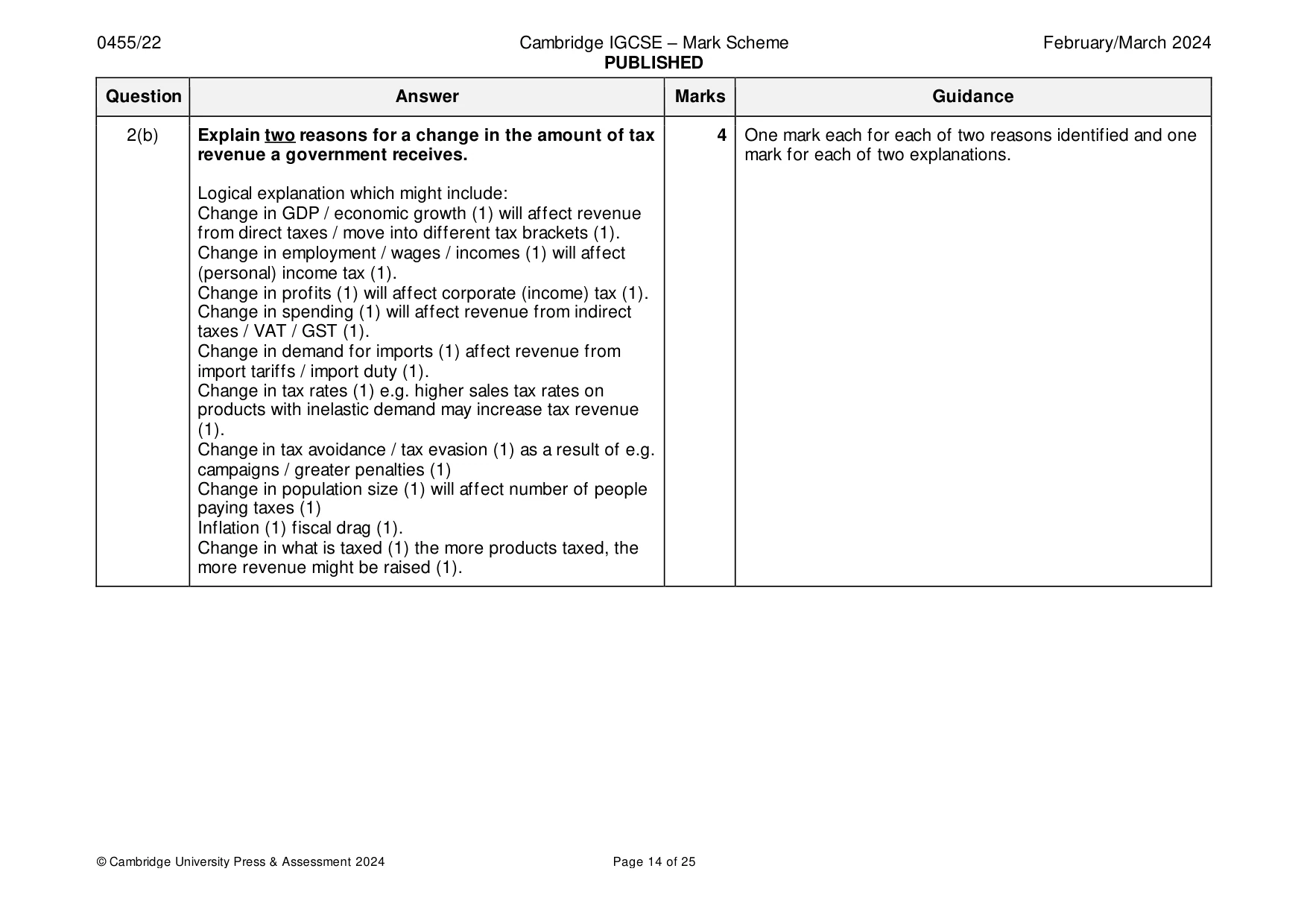
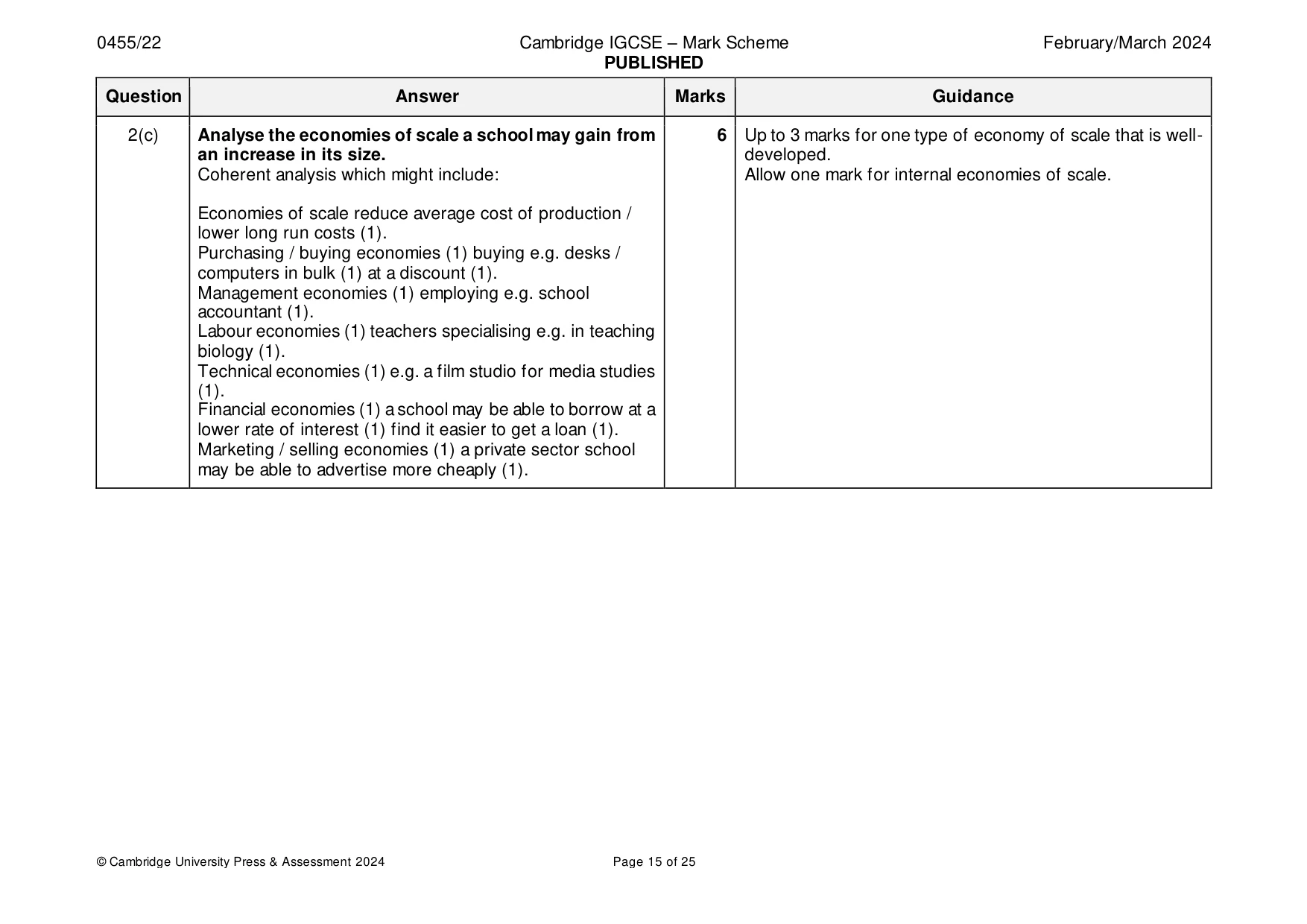
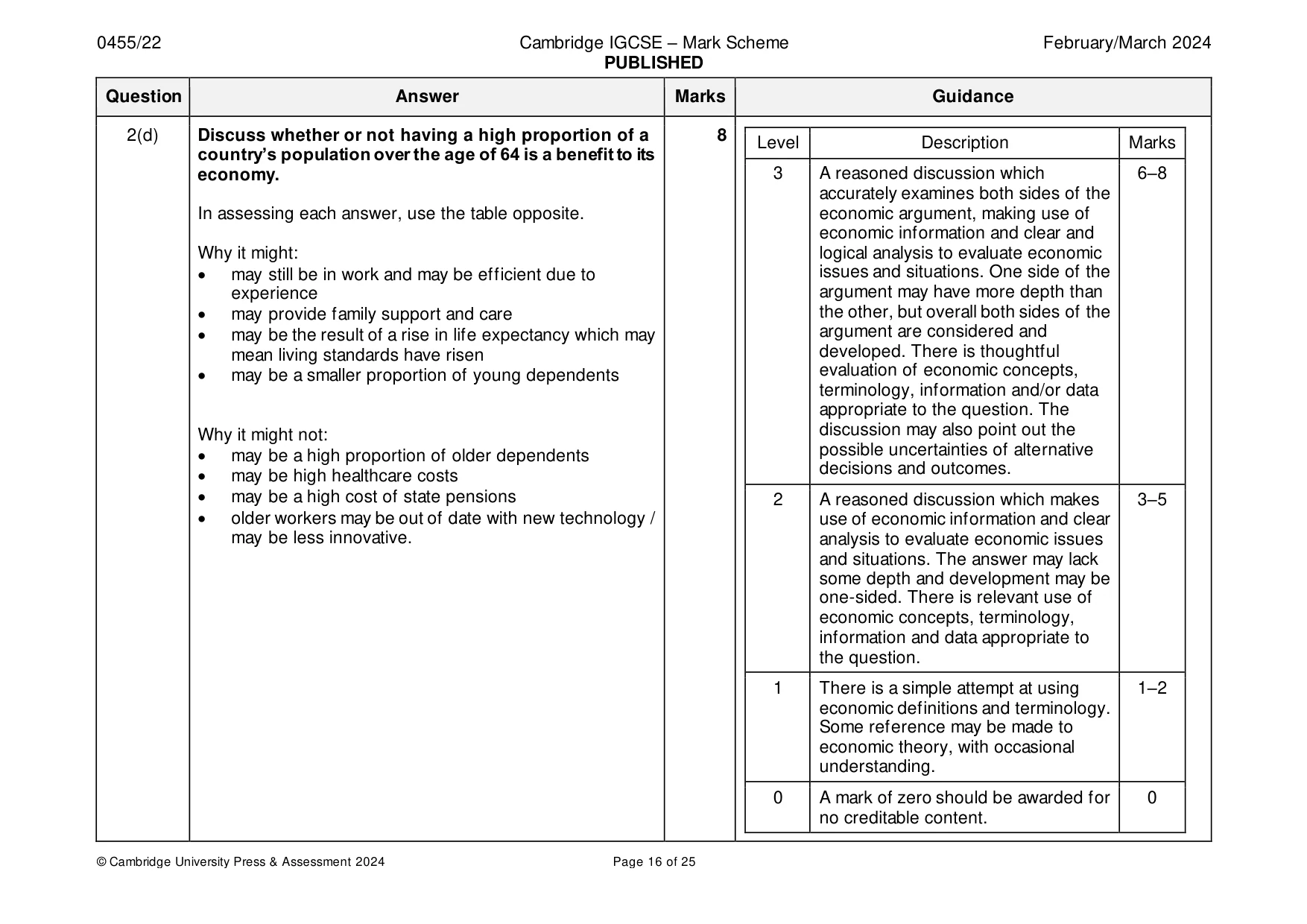
Mark scheme: 2(a) Identify two benefits people may gain from a good 2 education. Two from: • high income / high living standards / less risk of poverty • skills / high productivity / high efficiency • qualifications • good job / good job opportunities / increased occupational mobility • wide range of interests • better health/better nutrition/avoidance of demerit goods • may gain entrepreneurial skills 2(b) Explain two reasons for a change in the amount of tax 4 One mark each for each of two reasons identified and one revenue a government receives. mark for each of two explanations. Logical explanation which might include: Change in GDP / economic growth (1) will affect revenue from direct taxes / move into different tax brackets (1). Change in employment / wages / incomes (1) will affect (personal) income tax (1). Change in profits (1) will affect corporate (income) tax (1). Change in spending (1) will affect revenue from indirect taxes / VAT / GST (1). Change in demand for imports (1) affect revenue from import tariffs / import duty (1). Change in tax rates (1) e.g. higher sales tax rates on products with inelastic demand may increase tax revenue (1). Change in tax avoidance / tax evasion (1) as a result of e.g. campaigns / greater penalties (1) Change in population size (1) will affect number of people paying taxes (1) Inflation (1) fiscal drag (1). Change in what is taxed (1) the more products taxed, the more revenue might be raised (1). 2(c) Analyse the economies of scale a school may gain from 6 Up to 3 marks for one type of economy of scale that is well- an increase in its size. developed. Coherent analysis which might include: Allow one mark for internal economies of scale. Economies of scale reduce average cost of production / lower long run costs (1). Purchasing / buying economies (1) buying e.g. desks / computers in bulk (1) at a discount (1). Management economies (1) employing e.g. school accountant (1). Labour economies (1) teachers specialising e.g. in teaching biology (1). Technical economies (1) e.g. a film studio for media studies (1). Financial economies (1) a school may be able to borrow at a lower rate of interest (1) find it easier to get a loan (1). Marketing / selling economies (1) a private sector school may be able to advertise more cheaply (1). 2(d) Discuss whether or not having a high proportion of a 8 Level Description Marks country’s population over the age of 64 is a benefit to its economy. 3 A reasoned discussion which 6–8 accurately examines both sides of the In assessing each answer, use the table opposite. economic argument, making use of economic information and clear and Why it might: logical analysis to evaluate economic • may still be in work and may be efficient due to issues and situations. One side of the experience argument may have more depth than • may provide family support and care the other, but overall both sides of the • may be the result of a rise in life expectancy which may argument are considered and mean living standards have risen developed. There is thoughtful • may be a smaller proportion of young dependents evaluation of economic concepts, terminology, information and/or data appropriate to the question. The discussion may also point out the Why it might not: • may be a high proportion of older dependents possible uncertainties of alternative decisions and outcomes. • may be high healthcare costs • may be a high cost of state pensions 2 A reasoned discussion which makes 3–5 • older workers may be out of date with new technology / use of economic information and clear may be less innovative. analysis to evaluate economic issues and situations. The answer may lack some depth and development may be one-sided. There is relevant use of economic concepts, terminology, information and data appropriate to the question. 1 There is a simple attempt at using 1–2 economic definitions and terminology. Some reference may be made to economic theory, with occasional understanding. 0 A mark of zero should be awarded for 0 no creditable content.
Q3 · Some firms in Monaco have experienced external growth
3 Some firms in Monaco have experienced external growth. Firms in Monaco pay high wages. Workers in Monaco benefit from fiscal policy which contributes to high employment. Their government does impose VAT on food, including fruit. Some economists have suggested that instead of taxing fruit, governments should provide free fruit to consumers. (a) Define external growth of firms. [2] (b) Explain two reasons why low-skilled workers may be highly paid. [4] (c) Analyse how fiscal policy can increase employment. [6] (d) Discuss whether or not a government should provide free fruit to consumers. [8]
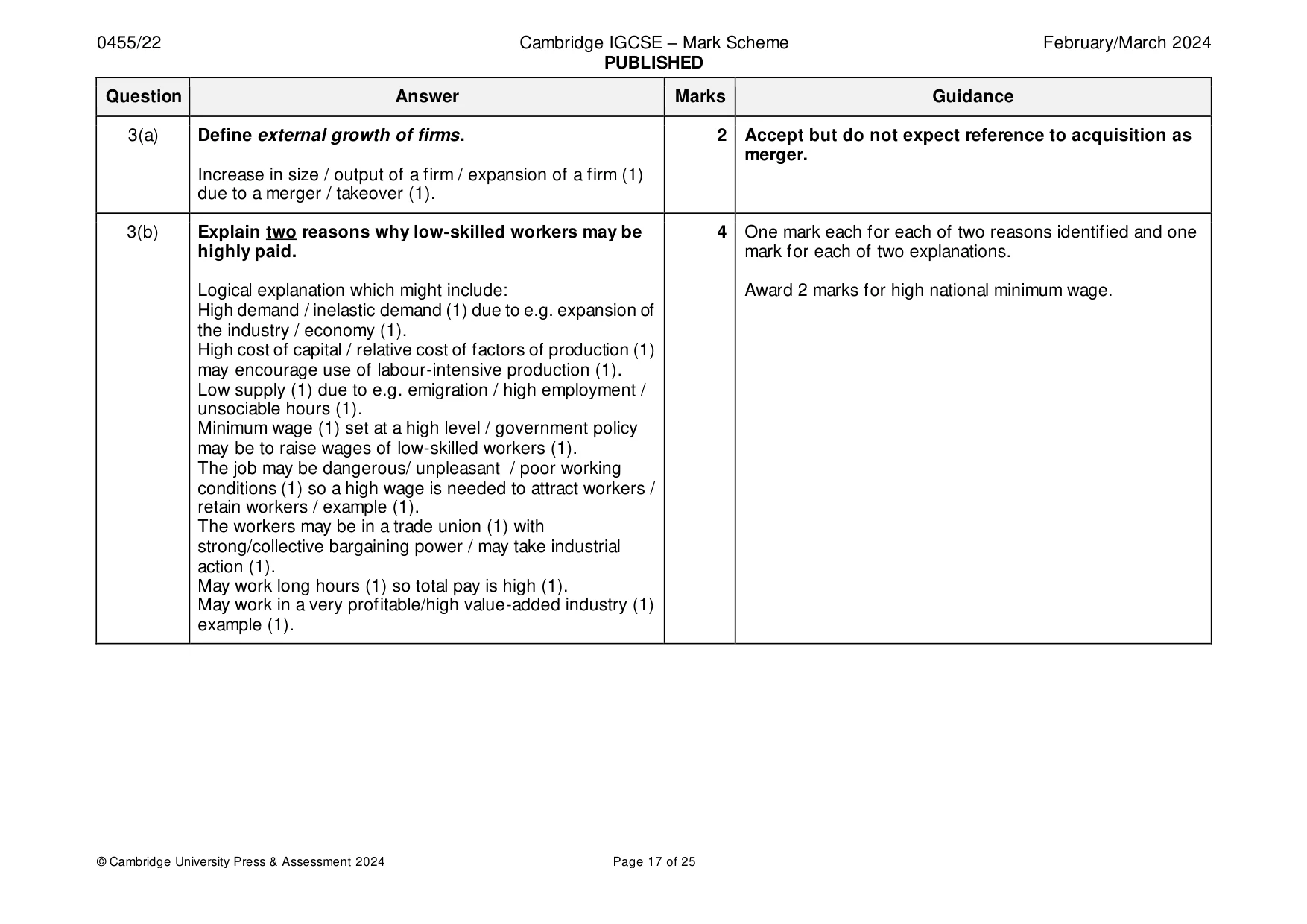
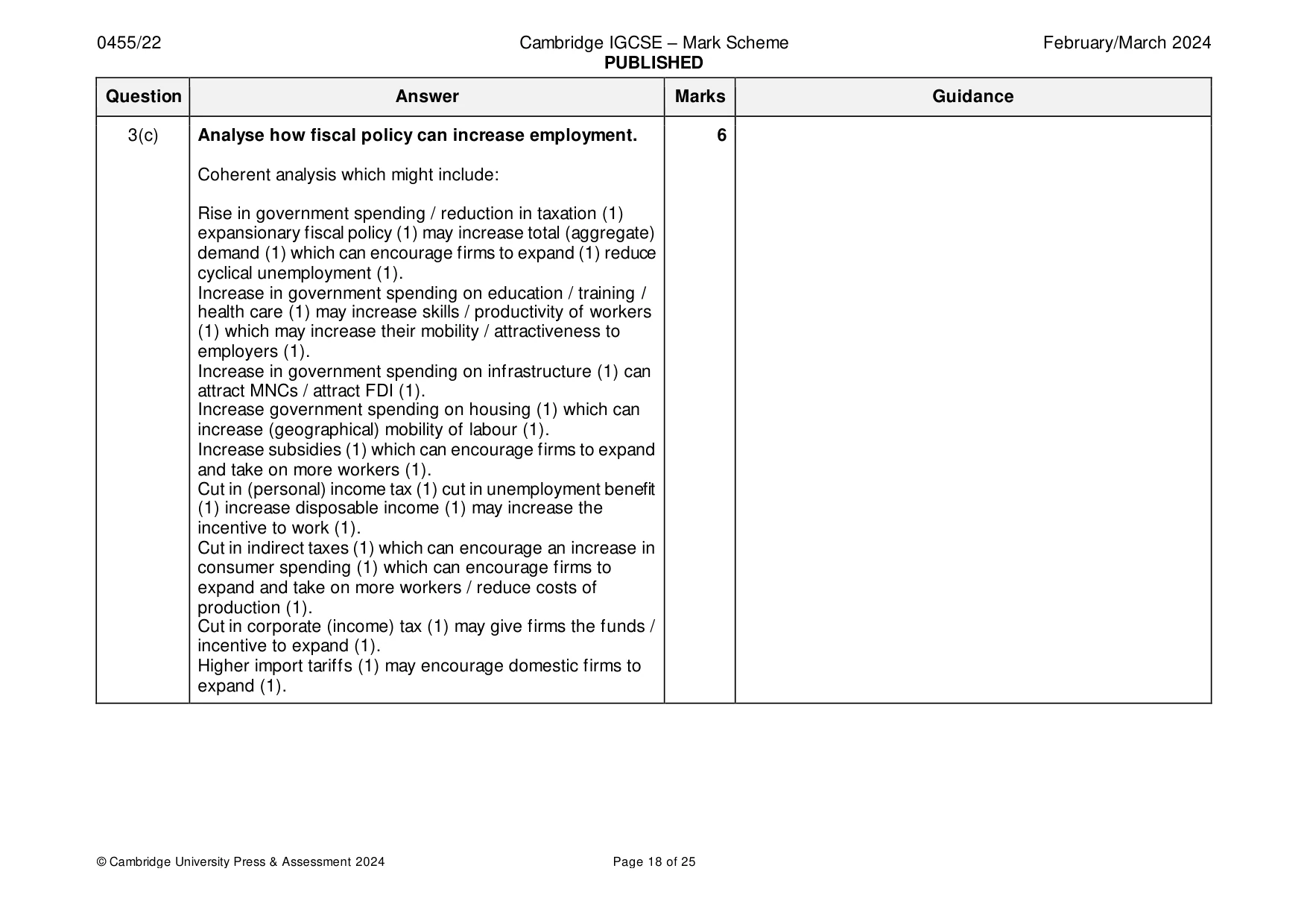
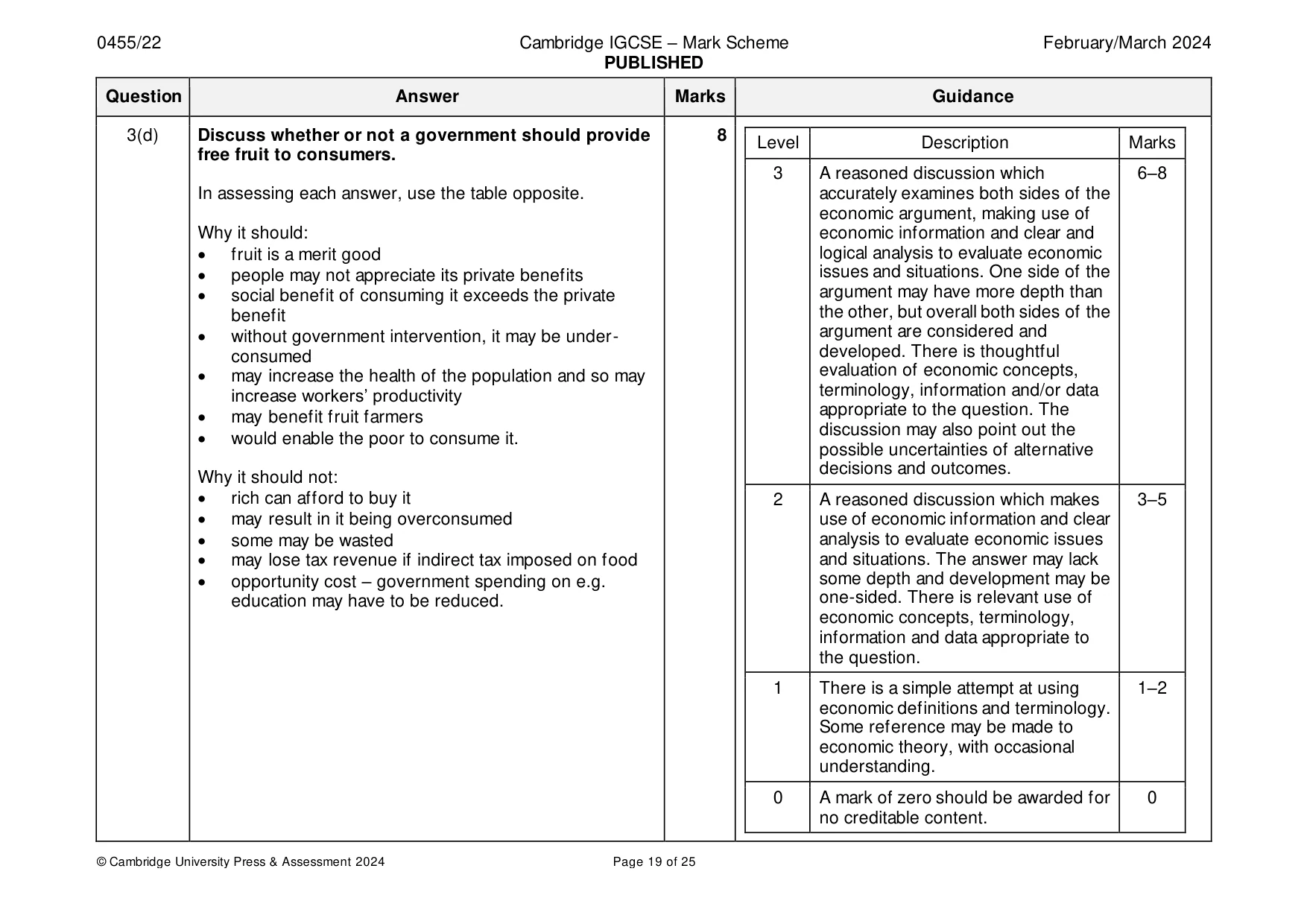
Mark scheme: 3(a) Define external growth of firms. 2 Accept but do not expect reference to acquisition as merger. Increase in size / output of a firm / expansion of a firm (1) due to a merger / takeover (1). 3(b) Explain two reasons why low-skilled workers may be 4 One mark each for each of two reasons identified and one highly paid. mark for each of two explanations. Logical explanation which might include: Award 2 marks for high national minimum wage. High demand / inelastic demand (1) due to e.g. expansion of the industry / economy (1). High cost of capital / relative cost of factors of production (1) may encourage use of labour-intensive production (1). Low supply (1) due to e.g. emigration / high employment / unsociable hours (1). Minimum wage (1) set at a high level / government policy may be to raise wages of low-skilled workers (1). The job may be dangerous/ unpleasant / poor working conditions (1) so a high wage is needed to attract workers / retain workers / example (1). The workers may be in a trade union (1) with strong/collective bargaining power / may take industrial action (1). May work long hours (1) so total pay is high (1). May work in a very profitable/high value-added industry (1) example (1). 3(c) Analyse how fiscal policy can increase employment. 6 Coherent analysis which might include: Rise in government spending / reduction in taxation (1) expansionary fiscal policy (1) may increase total (aggregate) demand (1) which can encourage firms to expand (1) reduce cyclical unemployment (1). Increase in government spending on education / training / health care (1) may increase skills / productivity of workers (1) which may increase their mobility / attractiveness to employers (1). Increase in government spending on infrastructure (1) can attract MNCs / attract FDI (1). Increase government spending on housing (1) which can increase (geographical) mobility of labour (1). Increase subsidies (1) which can encourage firms to expand and take on more workers (1). Cut in (personal) income tax (1) cut in unemployment benefit (1) increase disposable income (1) may increase the incentive to work (1). Cut in indirect taxes (1) which can encourage an increase in consumer spending (1) which can encourage firms to expand and take on more workers / reduce costs of production (1). Cut in corporate (income) tax (1) may give firms the funds / incentive to expand (1). Higher import tariffs (1) may encourage domestic firms to expand (1). 3(d) Discuss whether or not a government should provide 8 Level Description Marks free fruit to consumers. 3 A reasoned discussion which 6–8 In assessing each answer, use the table opposite. accurately examines both sides of the economic argument, making use of Why it should: economic information and clear and • fruit is a merit good logical analysis to evaluate economic • people may not appreciate its private benefits issues and situations. One side of the • social benefit of consuming it exceeds the private argument may have more depth than benefit the other, but overall both sides of the • without government intervention, it may be under- argument are considered and developed. There is thoughtful consumed • may increase the health of the population and so may evaluation of economic concepts, terminology, information and/or data increase workers’ productivity appropriate to the question. The • may benefit fruit farmers discussion may also point out the • would enable the poor to consume it. possible uncertainties of alternative decisions and outcomes. Why it should not: • rich can afford to buy it 2 A reasoned discussion which makes 3–5 • may result in it being overconsumed use of economic information and clear • some may be wasted analysis to evaluate economic issues • may lose tax revenue if indirect tax imposed on food and situations. The answer may lack • opportunity cost – government spending on e.g. some depth and development may be education may have to be reduced. one-sided. There is relevant use of economic concepts, terminology, information and data appropriate to the question. 1 There is a simple attempt at using 1–2 economic definitions and terminology. Some reference may be made to economic theory, with occasional understanding. 0 A mark of zero should be awarded for 0 no creditable content.
Q4 · In 2021, the Suez Canal was blocked by one of the world’s biggest container ships
4 In 2021, the Suez Canal was blocked by one of the world’s biggest container ships. This affected some firms’ profits and caused a shortage in a number of products. The delivery of luxury chocolate and salt, for example, was delayed. These two goods have differences in their price elasticity of demand. The disruption to international trade created particular difficulties for those countries which import most of the food they consume. (a) Define a shortage. [2] (b) Explain two ways a firm can increase its profit. [4] (c) Analyse the reasons why the price elasticity of demand for one brand of luxury chocolates is likely to be different from that of salt. [6] (d) Discuss whether or not a country should import most of the food it consumes. [8]
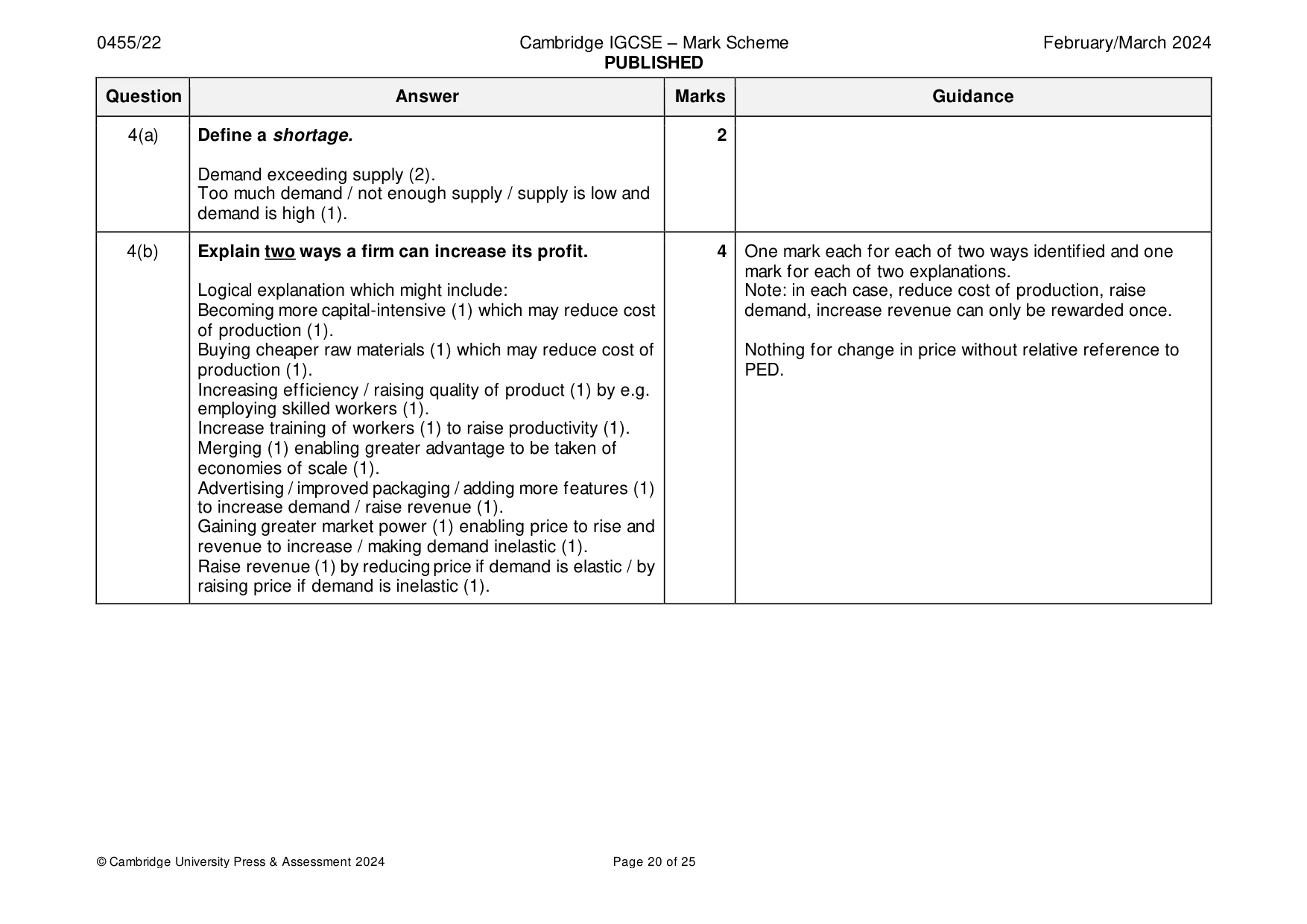
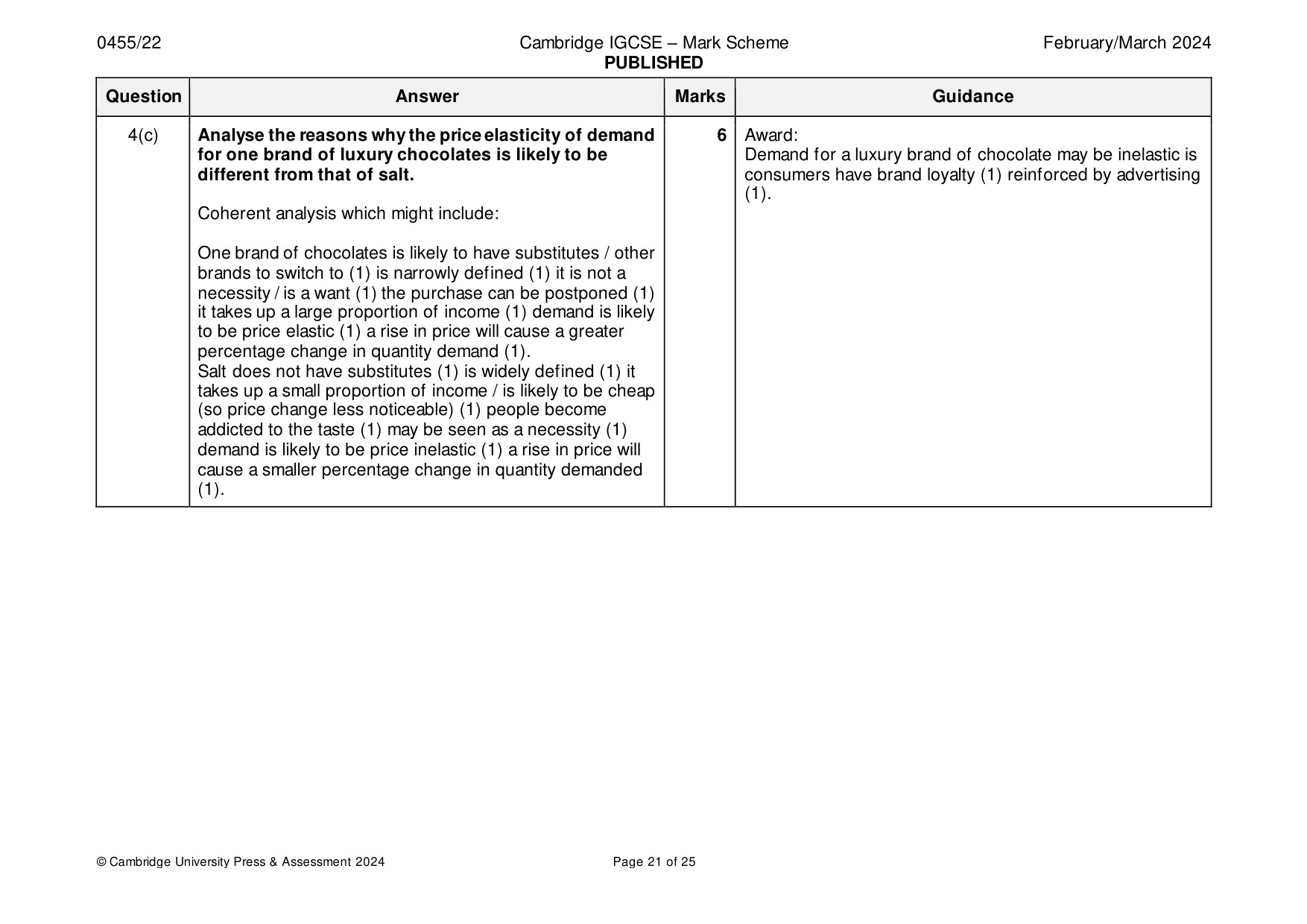
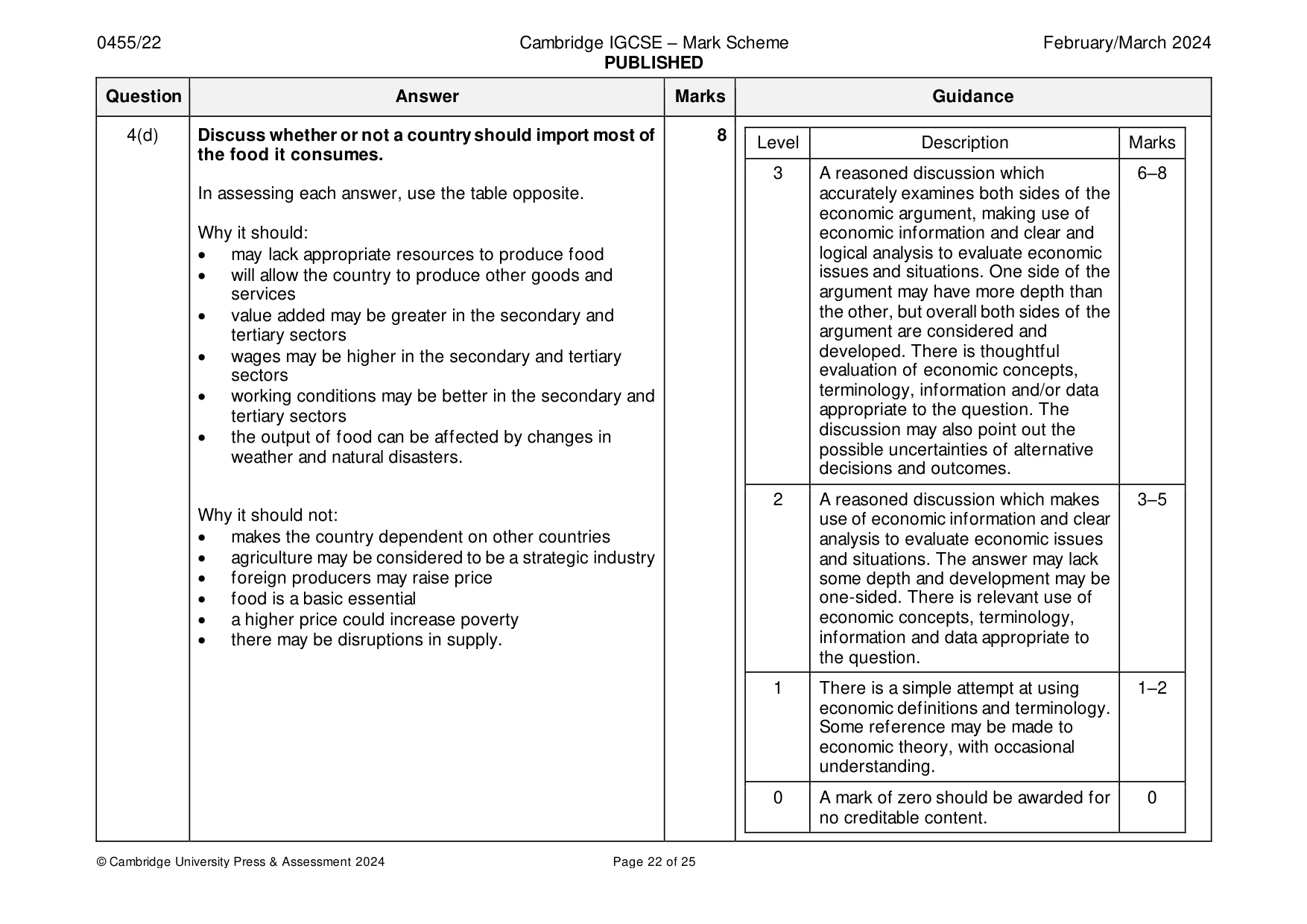
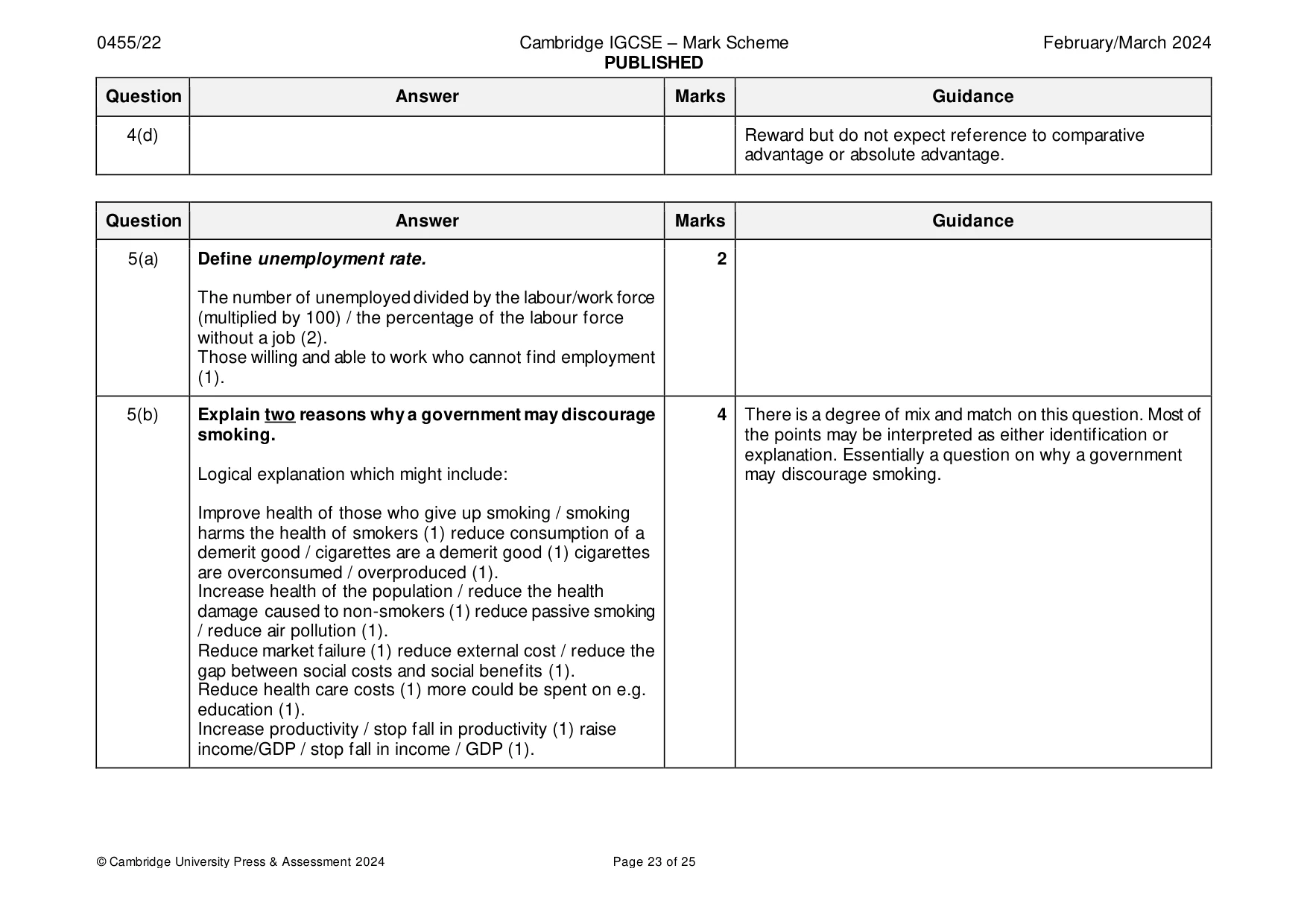
Mark scheme: 4(a) Define a shortage. 2 Demand exceeding supply (2). Too much demand / not enough supply / supply is low and demand is high (1). 4(b) Explain two ways a firm can increase its profit. 4 One mark each for each of two ways identified and one mark for each of two explanations. Logical explanation which might include: Note: in each case, reduce cost of production, raise Becoming more capital-intensive (1) which may reduce cost demand, increase revenue can only be rewarded once. of production (1). Buying cheaper raw materials (1) which may reduce cost of Nothing for change in price without relative reference to production (1). PED. Increasing efficiency / raising quality of product (1) by e.g. employing skilled workers (1). Increase training of workers (1) to raise productivity (1). Merging (1) enabling greater advantage to be taken of economies of scale (1). Advertising / improved packaging / adding more features (1) to increase demand / raise revenue (1). Gaining greater market power (1) enabling price to rise and revenue to increase / making demand inelastic (1). Raise revenue (1) by reducing price if demand is elastic / by raising price if demand is inelastic (1). 4(c) Analyse the reasons why the price elasticity of demand 6 Award: for one brand of luxury chocolates is likely to be Demand for a luxury brand of chocolate may be inelastic is different from that of salt. consumers have brand loyalty (1) reinforced by advertising (1). Coherent analysis which might include: One brand of chocolates is likely to have substitutes / other brands to switch to (1) is narrowly defined (1) it is not a necessity / is a want (1) the purchase can be postponed (1) it takes up a large proportion of income (1) demand is likely to be price elastic (1) a rise in price will cause a greater percentage change in quantity demand (1). Salt does not have substitutes (1) is widely defined (1) it takes up a small proportion of income / is likely to be cheap (so price change less noticeable) (1) people become addicted to the taste (1) may be seen as a necessity (1) demand is likely to be price inelastic (1) a rise in price will cause a smaller percentage change in quantity demanded (1). 4(d) Discuss whether or not a country should import most of 8 Level Description Marks the food it consumes. 3 A reasoned discussion which 6–8 In assessing each answer, use the table opposite. accurately examines both sides of the economic argument, making use of Why it should: economic information and clear and • may lack appropriate resources to produce food logical analysis to evaluate economic • will allow the country to produce other goods and issues and situations. One side of the services argument may have more depth than • value added may be greater in the secondary and the other, but overall both sides of the tertiary sectors argument are considered and • wages may be higher in the secondary and tertiary developed. There is thoughtful evaluation of economic concepts, sectors • working conditions may be better in the secondary and terminology, information and/or data appropriate to the question. The tertiary sectors discussion may also point out the • the output of food can be affected by changes in possible uncertainties of alternative weather and natural disasters. decisions and outcomes. 2 A reasoned discussion which makes 3–5 Why it should not: use of economic information and clear • makes the country dependent on other countries analysis to evaluate economic issues • agriculture may be considered to be a strategic industry and situations. The answer may lack • foreign producers may raise price some depth and development may be • food is a basic essential one-sided. There is relevant use of • a higher price could increase poverty economic concepts, terminology, • there may be disruptions in supply. information and data appropriate to the question. 1 There is a simple attempt at using 1–2 economic definitions and terminology. Some reference may be made to economic theory, with occasional understanding. 0 A mark of zero should be awarded for 0 no creditable content. 4(d) Reward but do not expect reference to comparative advantage or absolute advantage.
Q5 · New Zealand is a high-income country with a low unemployment rate and a surplus of…
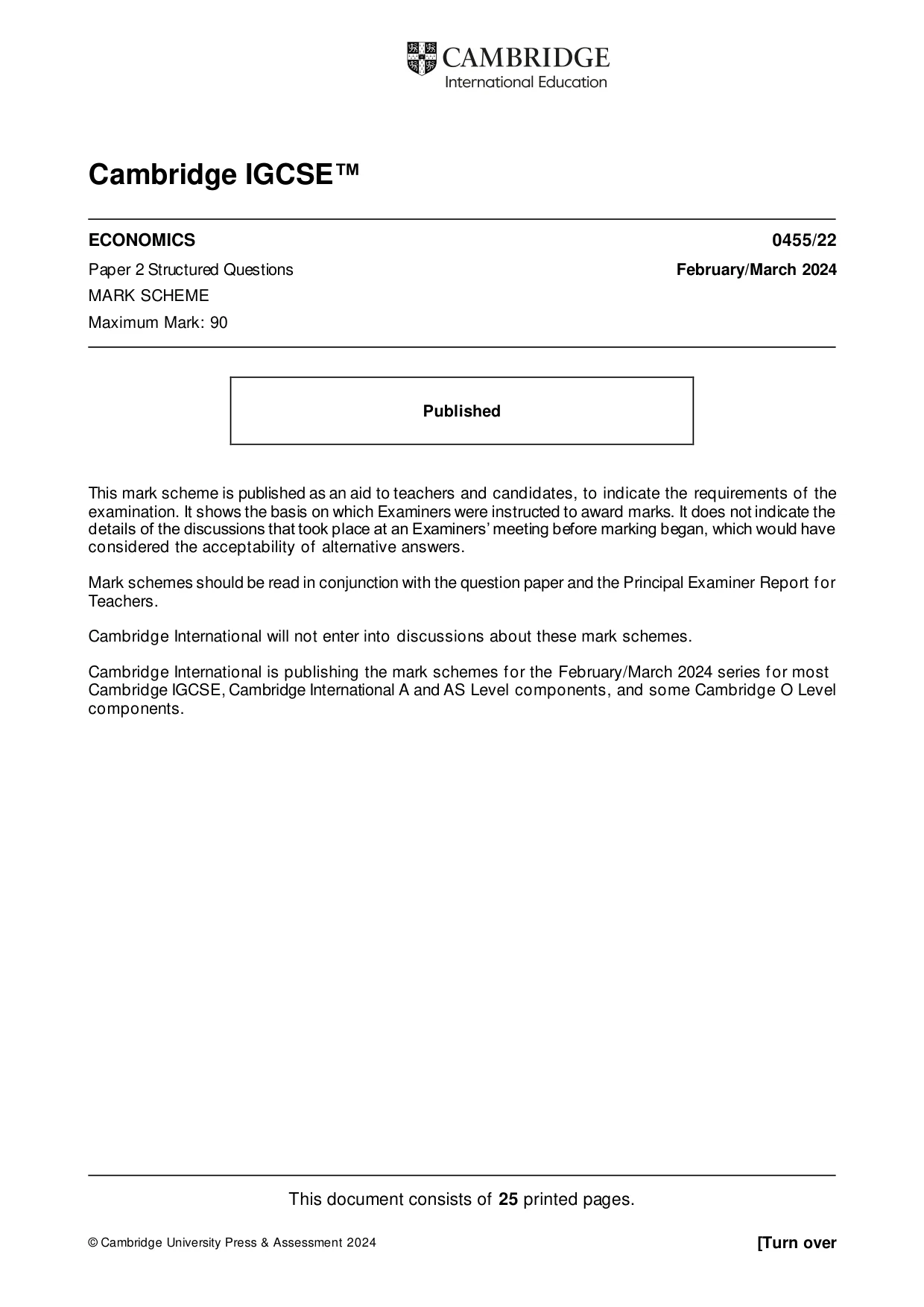
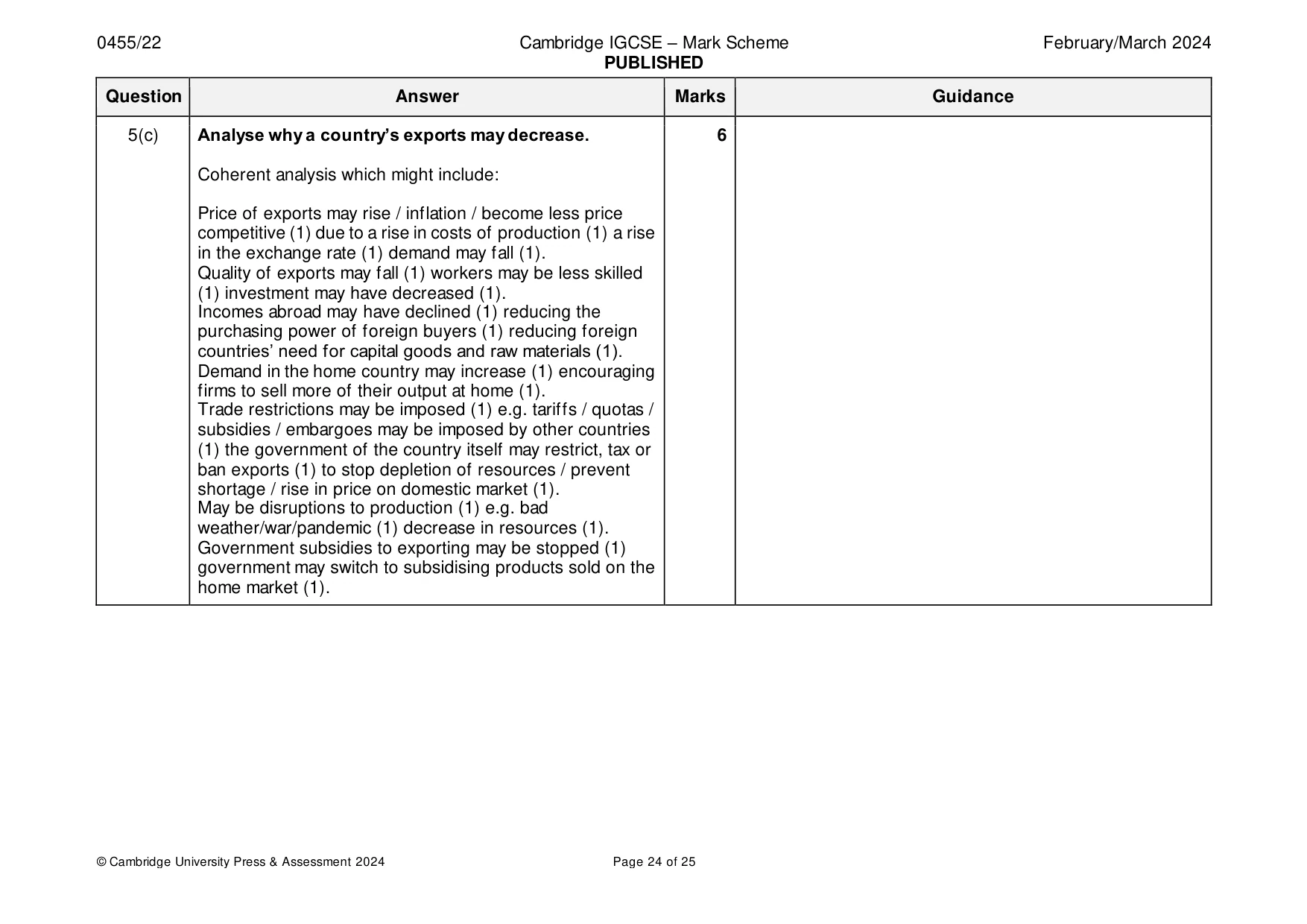
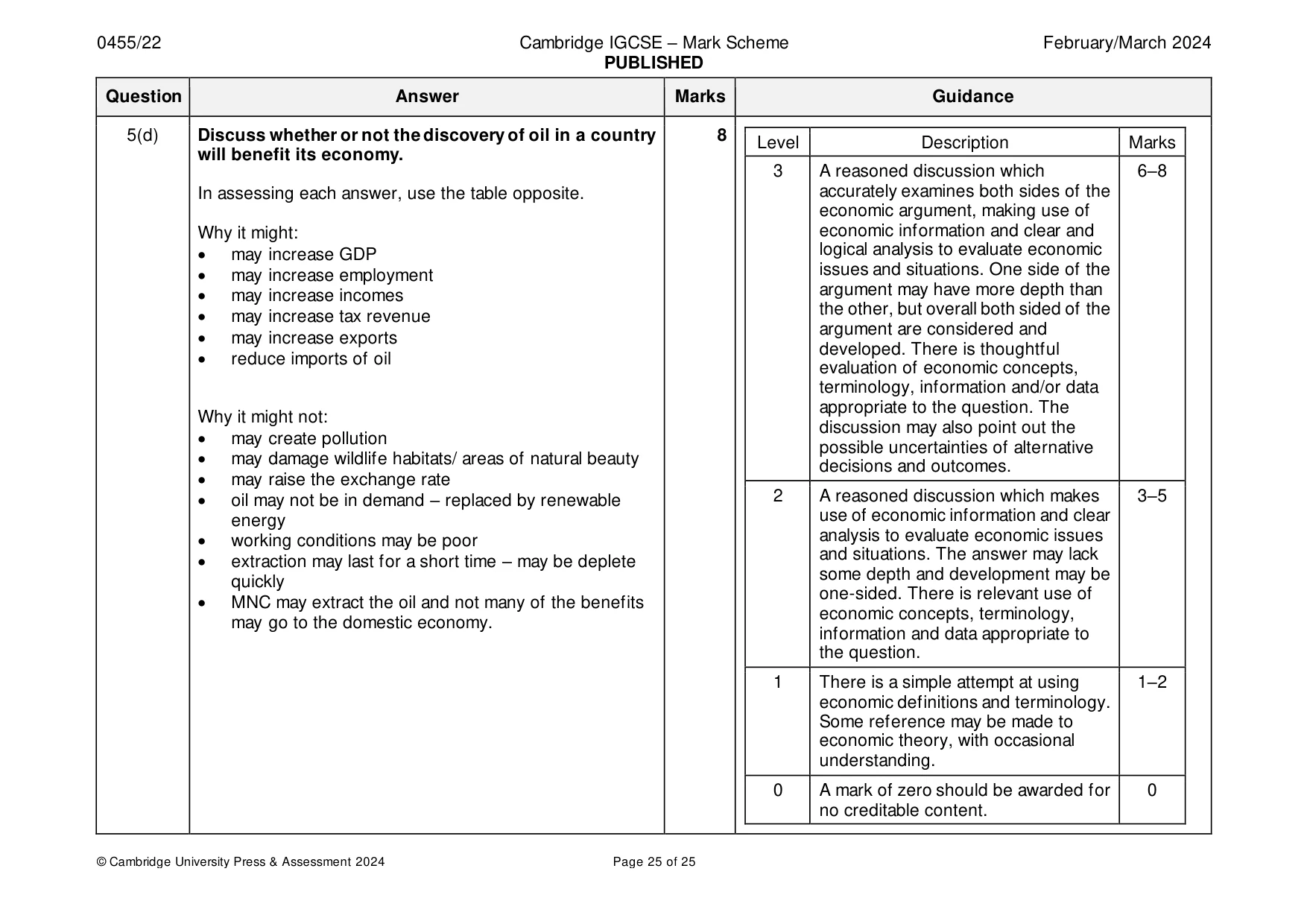
5 New Zealand is a high-income country with a low unemployment rate and a surplus of imports over exports. Recently, its government has made some important economic decisions. In 2022, it banned everyone born after 2008 from buying cigarettes. A year before, it gave permission for firms to explore for oil in the country. (a) Define unemployment rate. [2] (b) Explain two reasons why a government may discourage cigarette smoking. [4] (c) Analyse why a country’s exports may decrease. [6] (d) Discuss whether or not the discovery of oil in a country will benefit its economy. [8]
Mark scheme: 5(a) Define unemployment rate. 2 The number of unemployed divided by the labour/work force (multiplied by 100) / the percentage of the labour force without a job (2). Those willing and able to work who cannot find employment (1). 5(b) Explain two reasons why a government may discourage 4 There is a degree of mix and match on this question. Most of smoking. the points may be interpreted as either identification or explanation. Essentially a question on why a government Logical explanation which might include: may discourage smoking. Improve health of those who give up smoking / smoking harms the health of smokers (1) reduce consumption of a demerit good / cigarettes are a demerit good (1) cigarettes are overconsumed / overproduced (1). Increase health of the population / reduce the health damage caused to non-smokers (1) reduce passive smoking / reduce air pollution (1). Reduce market failure (1) reduce external cost / reduce the gap between social costs and social benefits (1). Reduce health care costs (1) more could be spent on e.g. education (1). Increase productivity / stop fall in productivity (1) raise income/GDP / stop fall in income / GDP (1). 5(c) Analyse why a country’s exports may decrease. 6 Coherent analysis which might include: Price of exports may rise / inflation / become less price competitive (1) due to a rise in costs of production (1) a rise in the exchange rate (1) demand may fall (1). Quality of exports may fall (1) workers may be less skilled (1) investment may have decreased (1). Incomes abroad may have declined (1) reducing the purchasing power of foreign buyers (1) reducing foreign countries’ need for capital goods and raw materials (1). Demand in the home country may increase (1) encouraging firms to sell more of their output at home (1). Trade restrictions may be imposed (1) e.g. tariffs / quotas / subsidies / embargoes may be imposed by other countries (1) the government of the country itself may restrict, tax or ban exports (1) to stop depletion of resources / prevent shortage / rise in price on domestic market (1). May be disruptions to production (1) e.g. bad weather/war/pandemic (1) decrease in resources (1). Government subsidies to exporting may be stopped (1) government may switch to subsidising products sold on the home market (1). 5(d) Discuss whether or not the discovery of oil in a country 8 Level Description Marks will benefit its economy. 3 A reasoned discussion which 6–8 In assessing each answer, use the table opposite. accurately examines both sides of the economic argument, making use of Why it might: economic information and clear and • may increase GDP logical analysis to evaluate economic • may increase employment issues and situations. One side of the • may increase incomes argument may have more depth than the other, but overall both sided of the • may increase tax revenue argument are considered and • may increase exports developed. There is thoughtful • reduce imports of oil evaluation of economic concepts, terminology, information and/or data appropriate to the question. The Why it might not: discussion may also point out the • may create pollution possible uncertainties of alternative • may damage wildlife habitats/ areas of natural beauty decisions and outcomes. • may raise the exchange rate • oil may not be in demand – replaced by renewable 2 A reasoned discussion which makes 3–5 use of economic information and clear energy • working conditions may be poor analysis to evaluate economic issues and situations. The answer may lack • extraction may last for a short time – may be deplete some depth and development may be quickly one-sided. There is relevant use of • MNC may extract the oil and not many of the benefits economic concepts, terminology, may go to the domestic economy. information and data appropriate to the question. 1 There is a simple attempt at using 1–2 economic definitions and terminology. Some reference may be made to economic theory, with occasional understanding. 0 A mark of zero should be awarded for 0 no creditable content.
What was in this paper
The subtopics covered by these 5 questions, and how many questions each got. Open one in a new tab to see every Cambridge question on it.
What you needed in this session
Cambridge’s own grade thresholds for 2024 Feb/March, Paper 2 · Variant 2. A higher threshold means an easier paper — the bar moves with how the cohort did.