Cambridge IGCSE Economics 0455 — 2025 May/June Paper 2 · Variant 1
0455/21/M/J/25 · 5 questions · 90 marks · ≈101 min
The question paper and its mark scheme, free to read here and free to download. This is Cambridge’s own paper, exactly as it was sat.
Question paper8 pages



Mark scheme30 pages
Answers below. Sit the paper first if you are practising.
Questions as text
Q1 · Calculate the value of Gabon’s oil production as a percentage of Gabon’s GDP
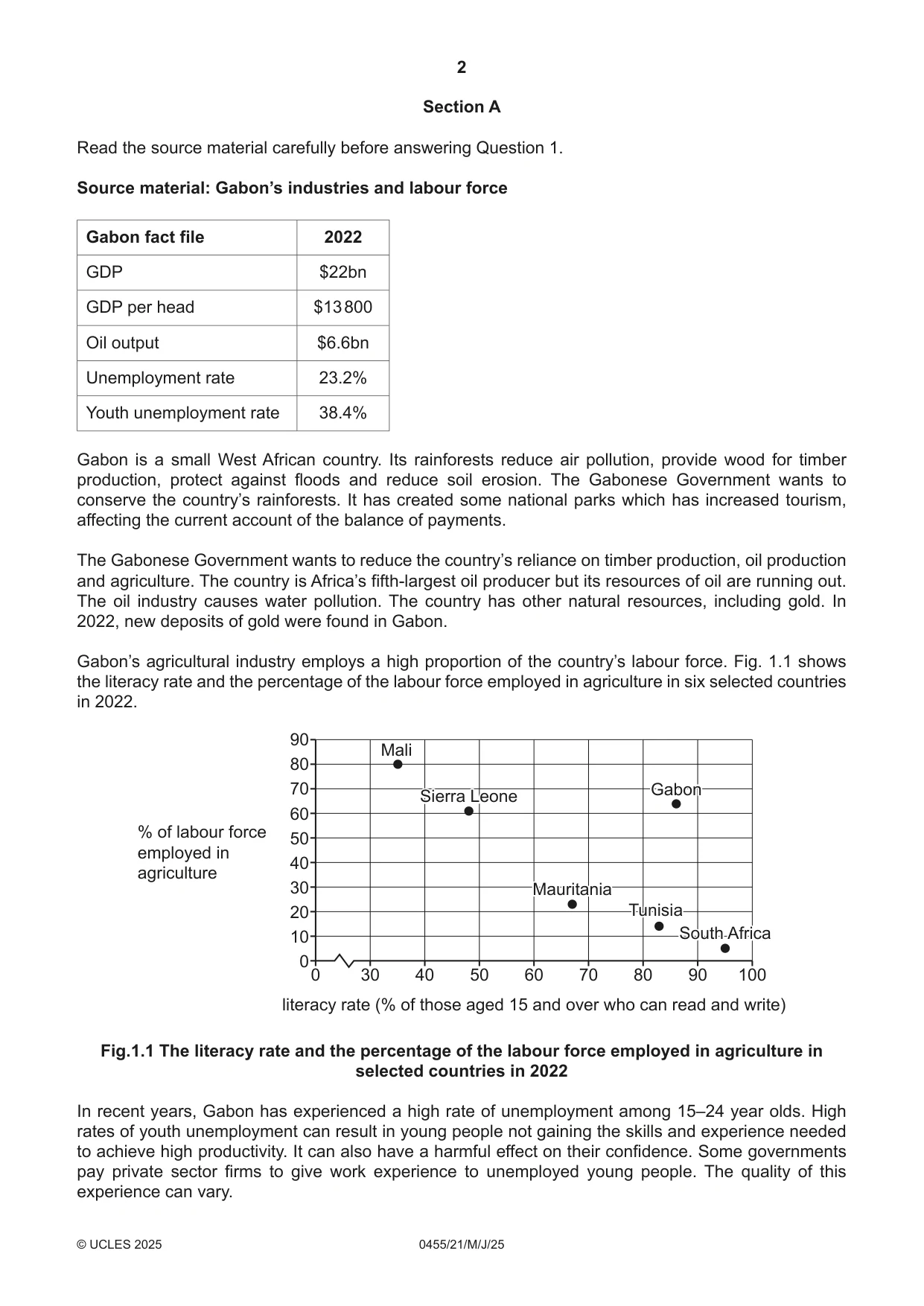
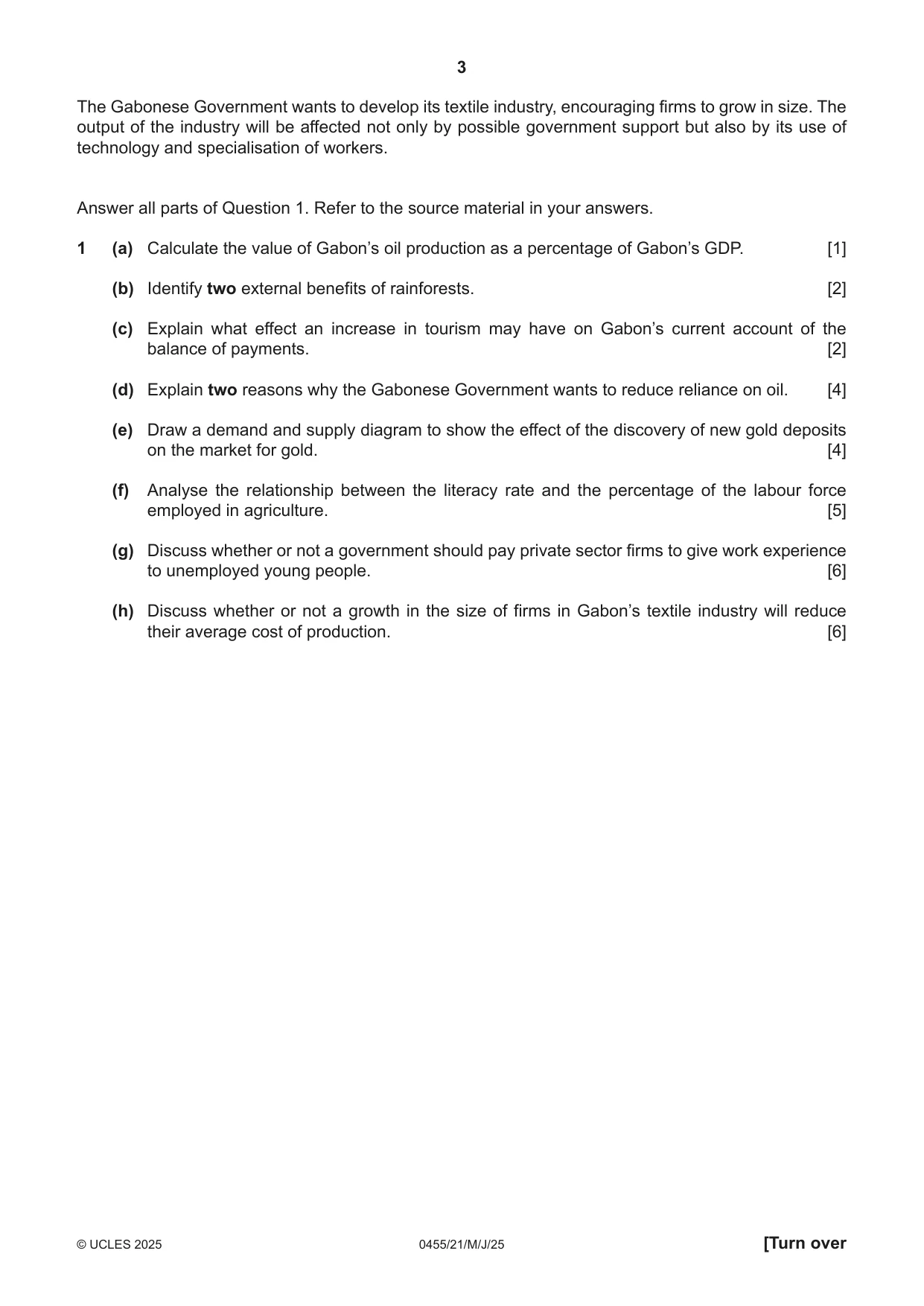
1 (a) Calculate the value of Gabon’s oil production as a percentage of Gabon’s GDP. [1] (b) Identify two external benefits of rainforests. [2] (c) Explain what effect an increase in tourism may have on Gabon’s current account of the balance of payments. [2] (d) Explain two reasons why the Gabonese Government wants to reduce reliance on oil. [4] (e) Draw a demand and supply diagram to show the effect of the discovery of new gold deposits on the market for gold. [4] (f) Analyse the relationship between the literacy rate and the percentage of the labour force employed in agriculture. [5] (g) Discuss whether or not a government should pay private sector firms to give work experience to unemployed young people. [6] (h) Discuss whether or not a growth in the size of firms in Gabon’s textile industry will reduce their average cost of production. [6]
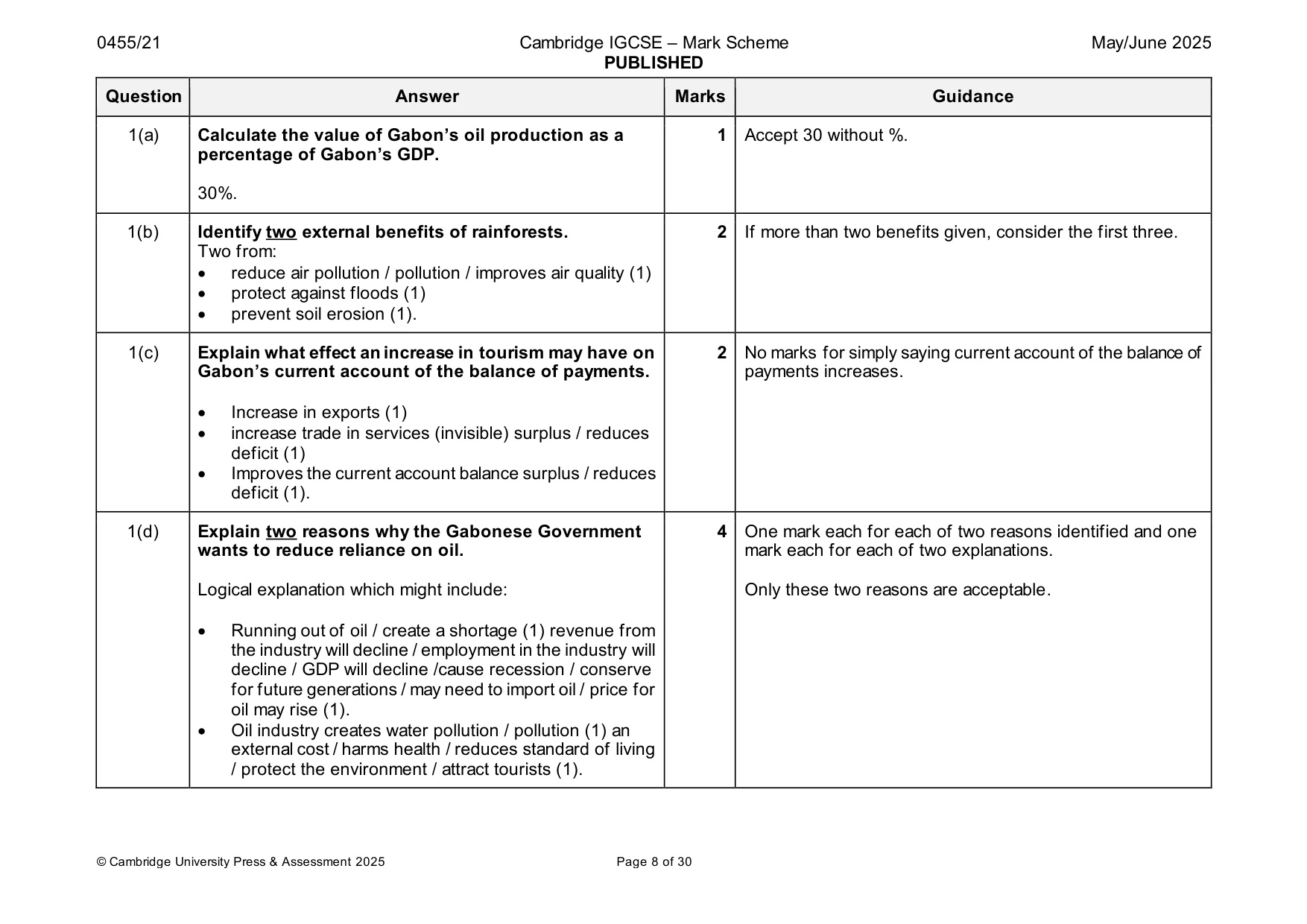
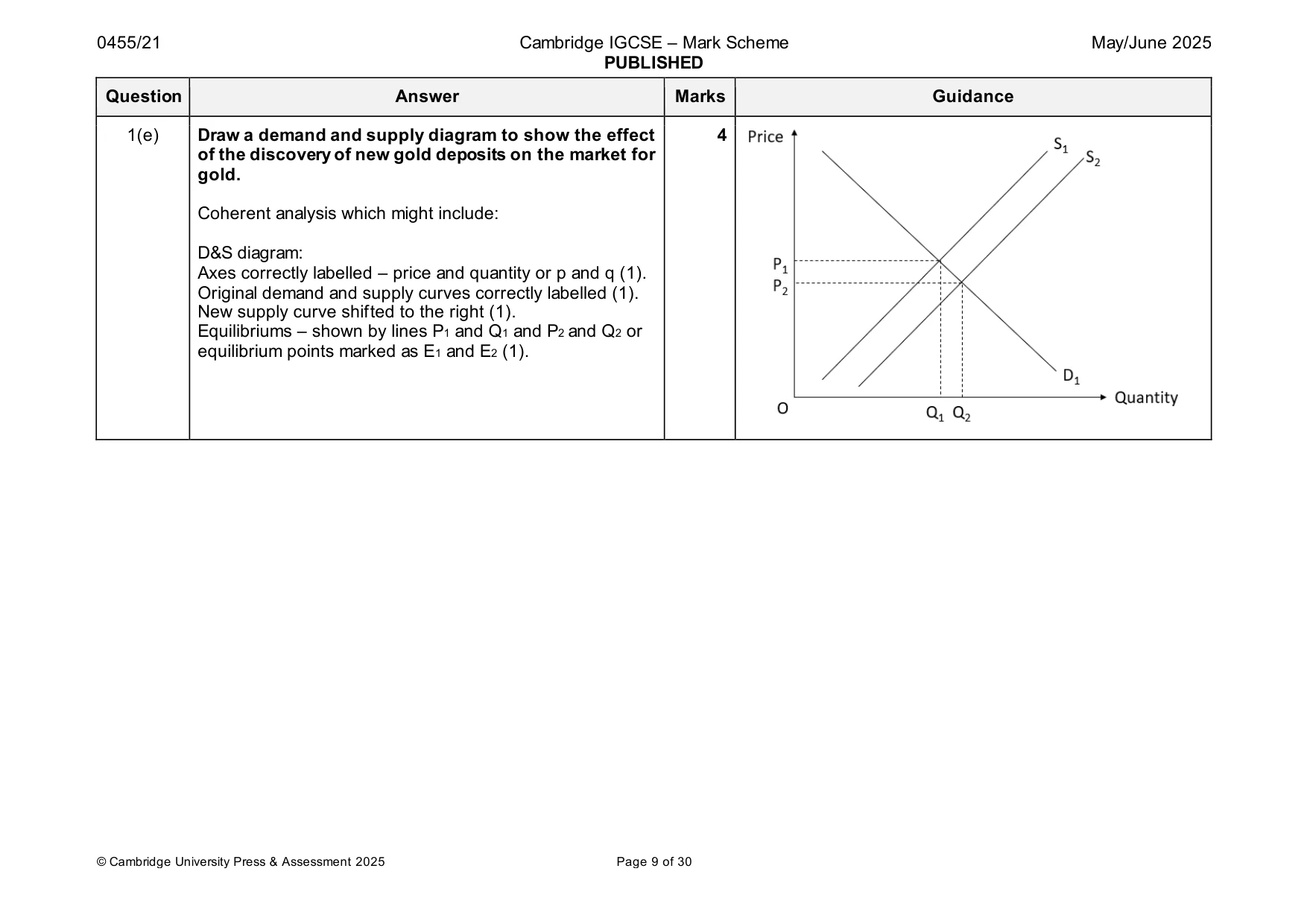
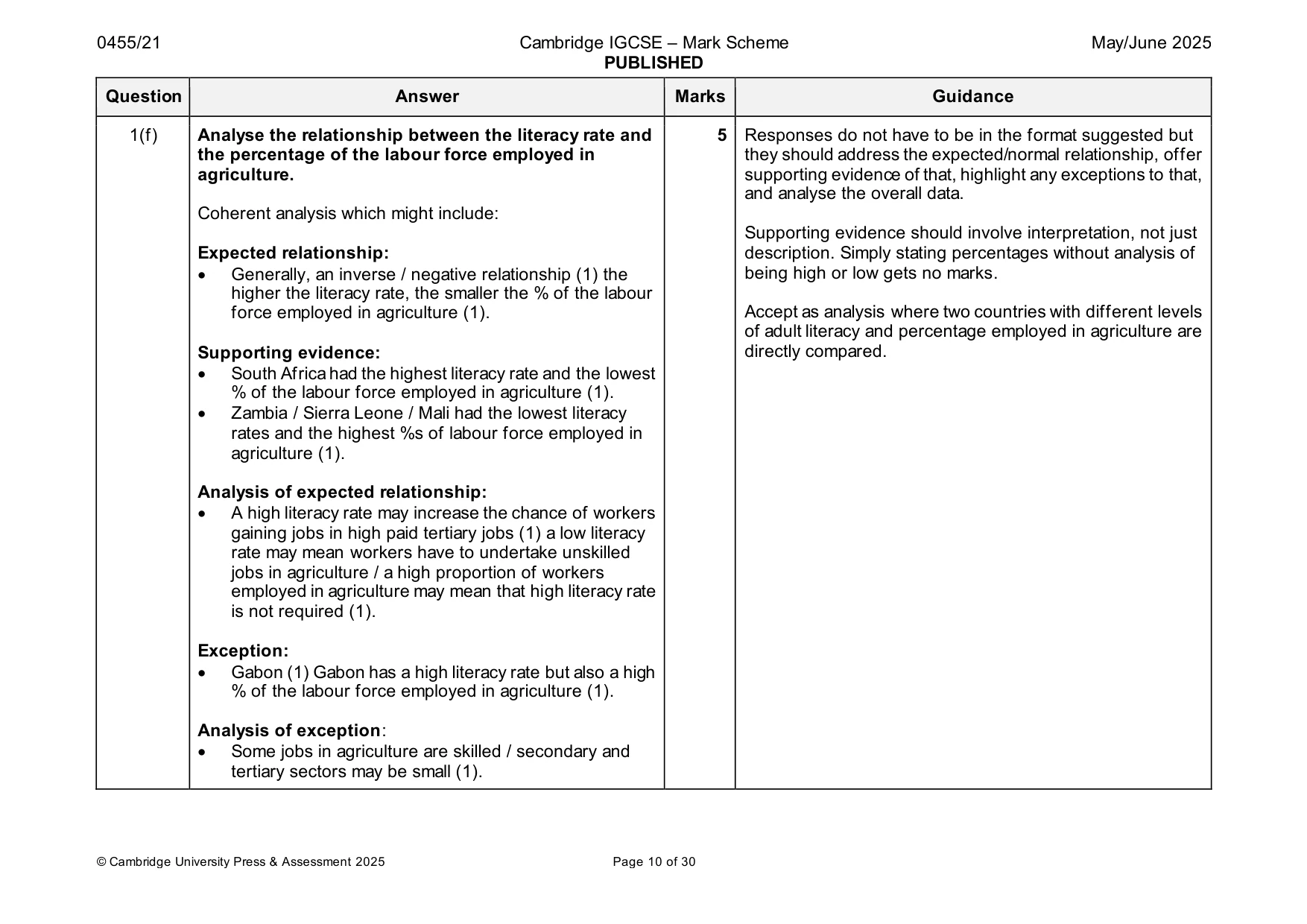
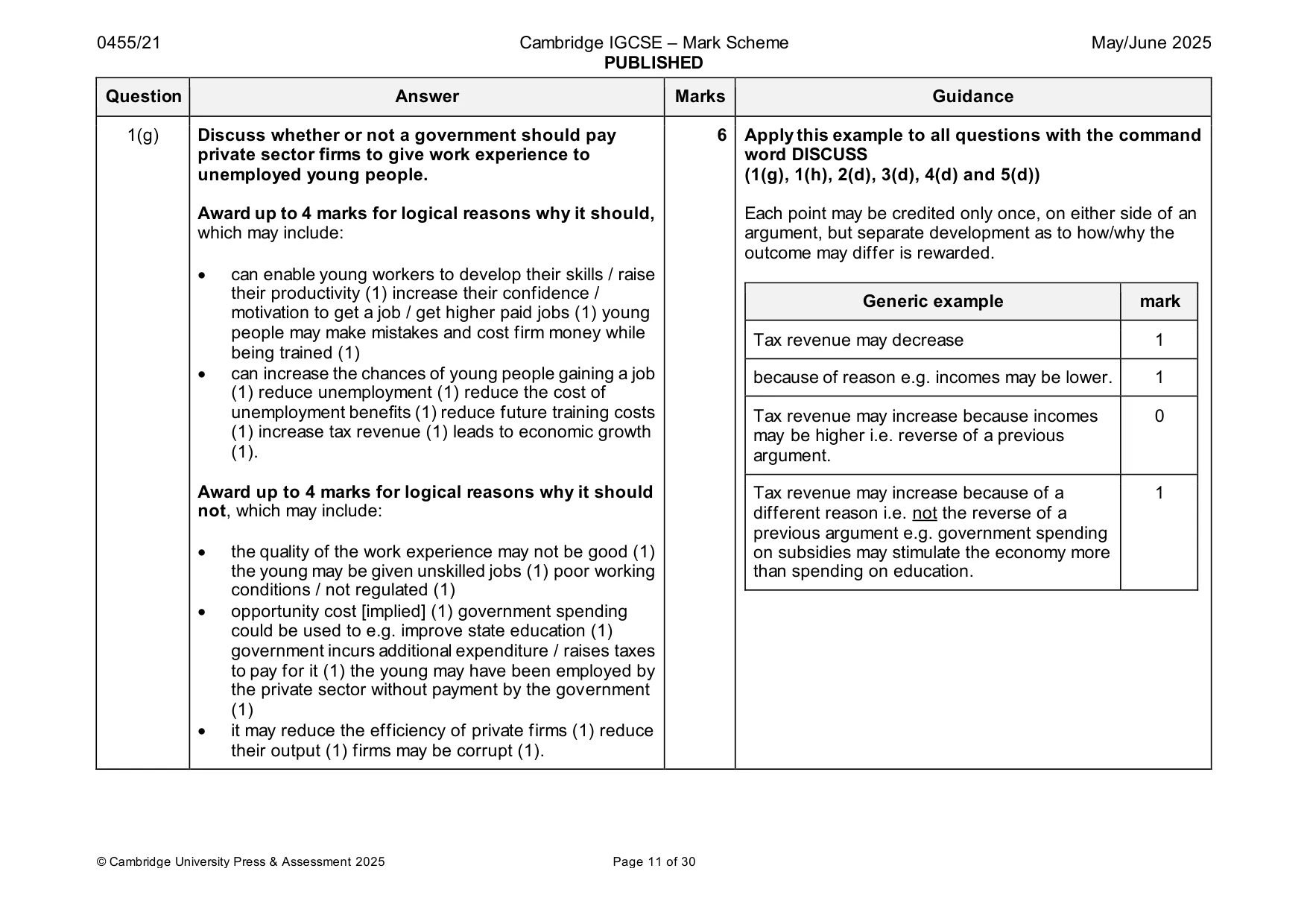
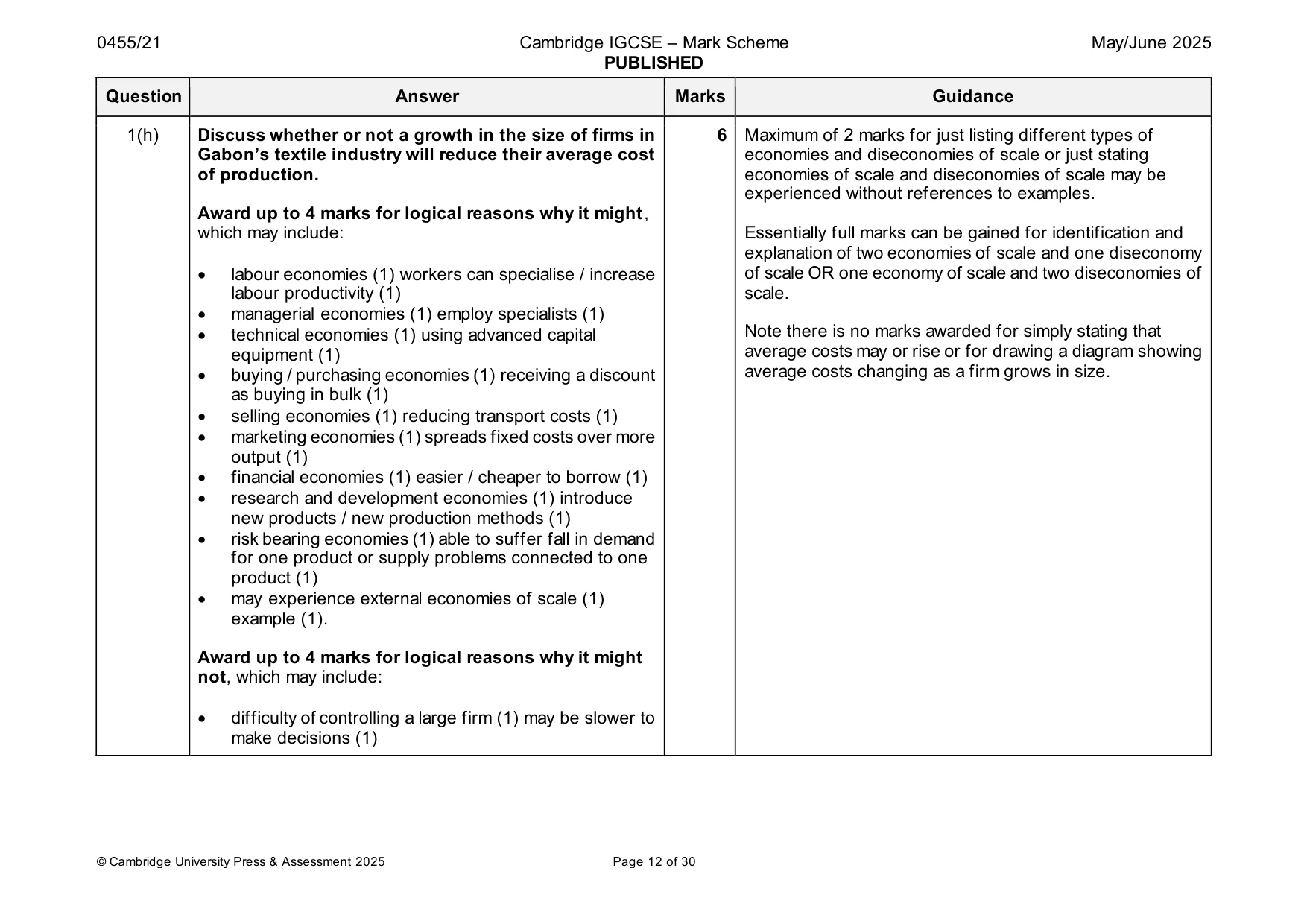
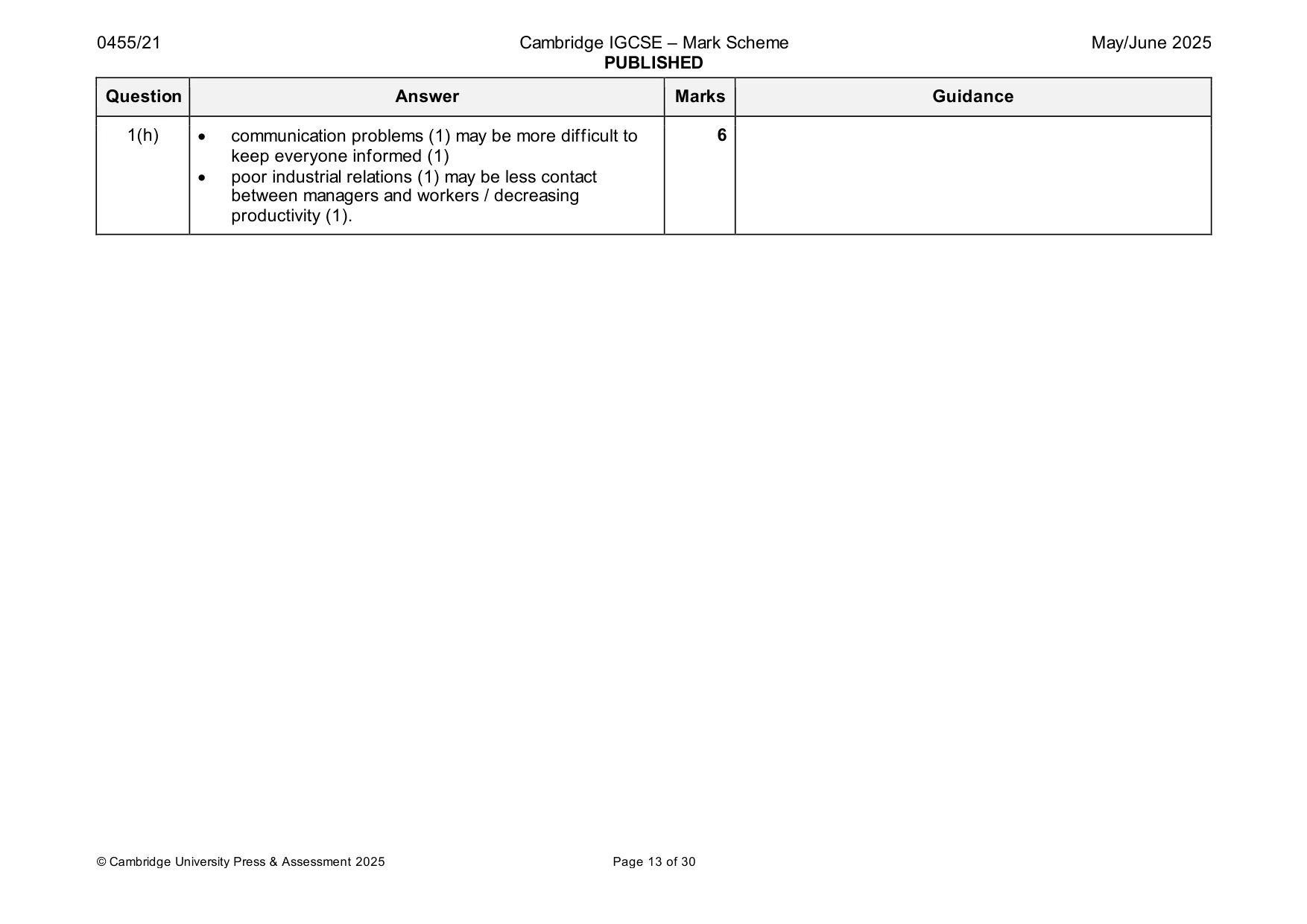
Mark scheme: Question Answer Marks Guidance 1(a) Calculate the value of Gabon’s oil production as a 1 Accept 30 without %. percentage of Gabon’s GDP. 30%. 1(b) Identify two external benefits of rainforests. 2 If more than two benefits given, consider the first three. Two from: • reduce air pollution / pollution / improves air quality (1) • protect against floods (1) • prevent soil erosion (1). 1(c) Explain what effect an increase in tourism may have on 2 No marks for simply saying current account of the balance of Gabon’s current account of the balance of payments. payments increases. • Increase in exports (1) • increase trade in services (invisible) surplus / reduces deficit (1) • Improves the current account balance surplus / reduces deficit (1). 1(d) Explain two reasons why the Gabonese Government 4 One mark each for each of two reasons identified and one wants to reduce reliance on oil. mark each for each of two explanations. Logical explanation which might include: Only these two reasons are acceptable. • Running out of oil / create a shortage (1) revenue from the industry will decline / employment in the industry will decline / GDP will decline /cause recession / conserve for future generations / may need to import oil / price for oil may rise (1). • Oil industry creates water pollution / pollution (1) an external cost / harms health / reduces standard of living / protect the environment / attract tourists (1). 1(e) Draw a demand and supply diagram to show the effect 4 of the discovery of new gold deposits on the market for gold. Coherent analysis which might include: D&S diagram: Axes correctly labelled – price and quantity or p and q (1). Original demand and supply curves correctly labelled (1). New supply curve shifted to the right (1). Equilibriums – shown by lines P1 and Q1 and P2 and Q2 or equilibrium points marked as E1 and E2 (1). 1(f) Analyse the relationship between the literacy rate and 5 Responses do not have to be in the format suggested but the percentage of the labour force employed in they should address the expected/normal relationship, offer agriculture. supporting evidence of that, highlight any exceptions to that, and analyse the overall data. Coherent analysis which might include: Supporting evidence should involve interpretation, not just Expected relationship: description. Simply stating percentages without analysis of • Generally, an inverse / negative relationship (1) the being high or low gets no marks. higher the literacy rate, the smaller the % of the labour force employed in agriculture (1). Accept as analysis where two countries with different levels of adult literacy and percentage employed in agriculture are Supporting evidence: directly compared. • South Africa had the highest literacy rate and the lowest % of the labour force employed in agriculture (1). • Zambia / Sierra Leone / Mali had the lowest literacy rates and the highest %s of labour force employed in agriculture (1). Analysis of expected relationship: • A high literacy rate may increase the chance of workers gaining jobs in high paid tertiary jobs (1) a low literacy rate may mean workers have to undertake unskilled jobs in agriculture / a high proportion of workers employed in agriculture may mean that high literacy rate is not required (1). Exception: • Gabon (1) Gabon has a high literacy rate but also a high % of the labour force employed in agriculture (1). Analysis of exception: • Some jobs in agriculture are skilled / secondary and tertiary sectors may be small (1). 1(g) Discuss whether or not a government should pay 6 Apply this example to all questions with the command private sector firms to give work experience to word DISCUSS unemployed young people. (1(g), 1(h), 2(d), 3(d), 4(d) and 5(d)) Award up to 4 marks for logical reasons why it should, Each point may be credited only once, on either side of an which may include: argument, but separate development as to how/why the outcome may differ is rewarded. • can enable young workers to develop their skills / raise their productivity (1) increase their confidence / Generic example mark motivation to get a job / get higher paid jobs (1) young people may make mistakes and cost firm money while Tax revenue may decrease 1 being trained (1) • can increase the chances of young people gaining a job because of reason e.g. incomes may be lower. 1 (1) reduce unemployment (1) reduce the cost of unemployment benefits (1) reduce future training costs Tax revenue may increase because incomes 0 (1) increase tax revenue (1) leads to economic growth may be higher i.e. reverse of a previous (1). argument. Award up to 4 marks for logical reasons why it should Tax revenue may increase because of a 1 not, which may include: different reason i.e. not the reverse of a previous argument e.g. government spending • the quality of the work experience may not be good (1) on subsidies may stimulate the economy more the young may be given unskilled jobs (1) poor working than spending on education. conditions / not regulated (1) • opportunity cost [implied] (1) government spending could be used to e.g. improve state education (1) government incurs additional expenditure / raises taxes to pay for it (1) the young may have been employed by the private sector without payment by the government (1) • it may reduce the efficiency of private firms (1) reduce their output (1) firms may be corrupt (1). 1(h) Discuss whether or not a growth in the size of firms in 6 Maximum of 2 marks for just listing different types of Gabon’s textile industry will reduce their average cost economies and diseconomies of scale or just stating of production. economies of scale and diseconomies of scale may be experienced without references to examples. Award up to 4 marks for logical reasons why it might, which may include: Essentially full marks can be gained for identification and explanation of two economies of scale and one diseconomy • labour economies (1) workers can specialise / increase of scale OR one economy of scale and two diseconomies of labour productivity (1) scale. • managerial economies (1) employ specialists (1) • technical economies (1) using advanced capital Note there is no marks awarded for simply stating that equipment (1) average costs may or rise or for drawing a diagram showing • buying / purchasing economies (1) receiving a discount average costs changing as a firm grows in size. as buying in bulk (1) • selling economies (1) reducing transport costs (1) • marketing economies (1) spreads fixed costs over more output (1) • financial economies (1) easier / cheaper to borrow (1) • research and development economies (1) introduce new products / new production methods (1) • risk bearing economies (1) able to suffer fall in demand for one product or supply problems connected to one product (1) • may experience external economies of scale (1) example (1). Award up to 4 marks for logical reasons why it might not, which may include: • difficulty of controlling a large firm (1) may be slower to make decisions (1) 1(h) • communication problems (1) may be more difficult to 6 keep everyone informed (1) • poor industrial relations (1) may be less contact between managers and workers / decreasing productivity (1).
More questions on Differences in economic development between countries
Q2 · The shape of Colombia’s population pyramid is changing
2 The shape of Colombia’s population pyramid is changing. The income distribution of this South American country, however, is not changing significantly. The country has one of the most unequal income distributions in the world. Some Colombians work in its footwear industry which produces shoes, sandals and boots. Although footwear is produced in the private sector, Colombia has a mixed economic system. (a) Define population pyramid. [2] (b) Explain two reasons why income may become more unevenly distributed. [4] (c) Analyse the influences on whether demand for shoes is elastic or inelastic. [6] (d) Discuss whether or not a mixed economic system will benefit the people who live in that economy. [8]
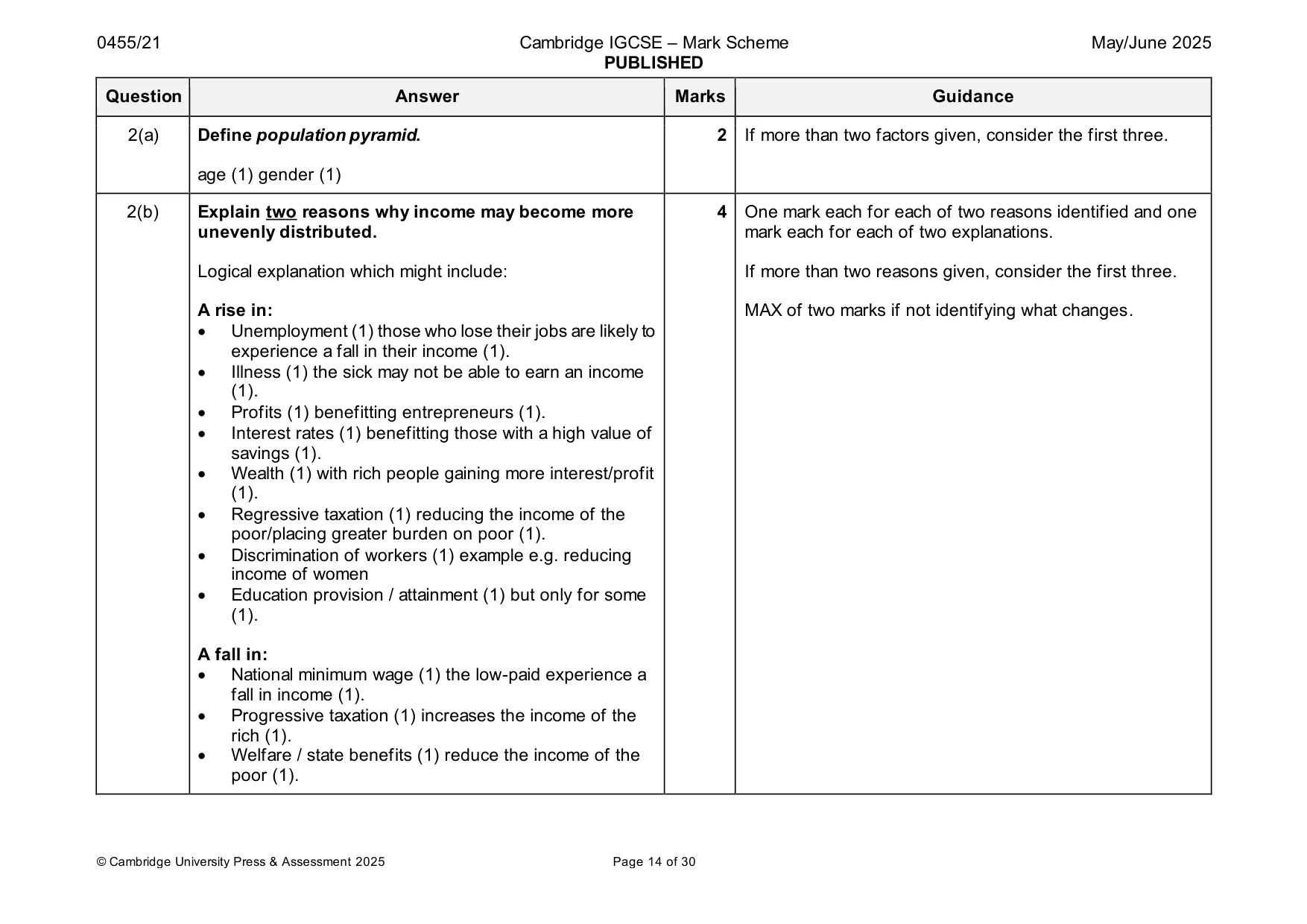
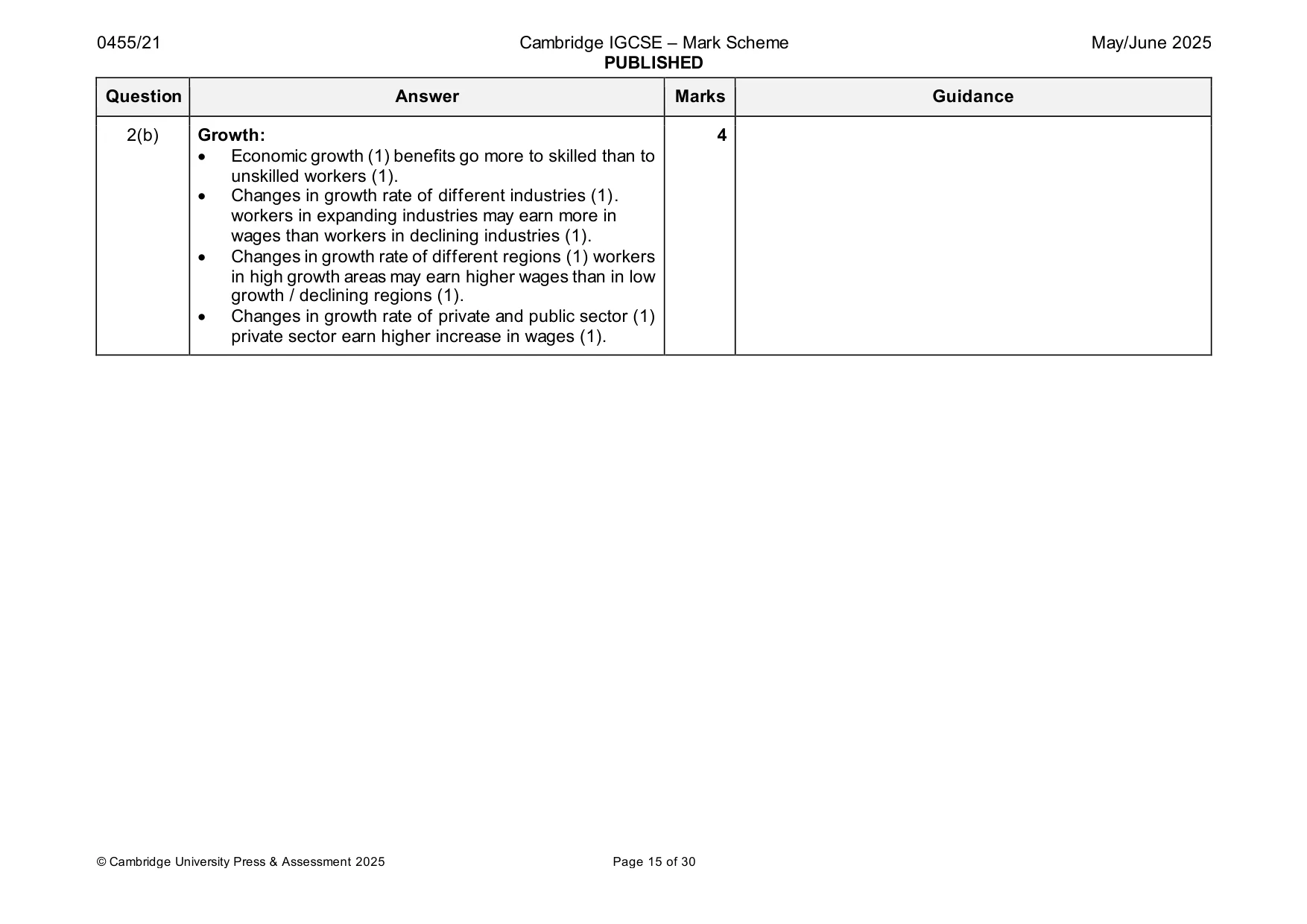
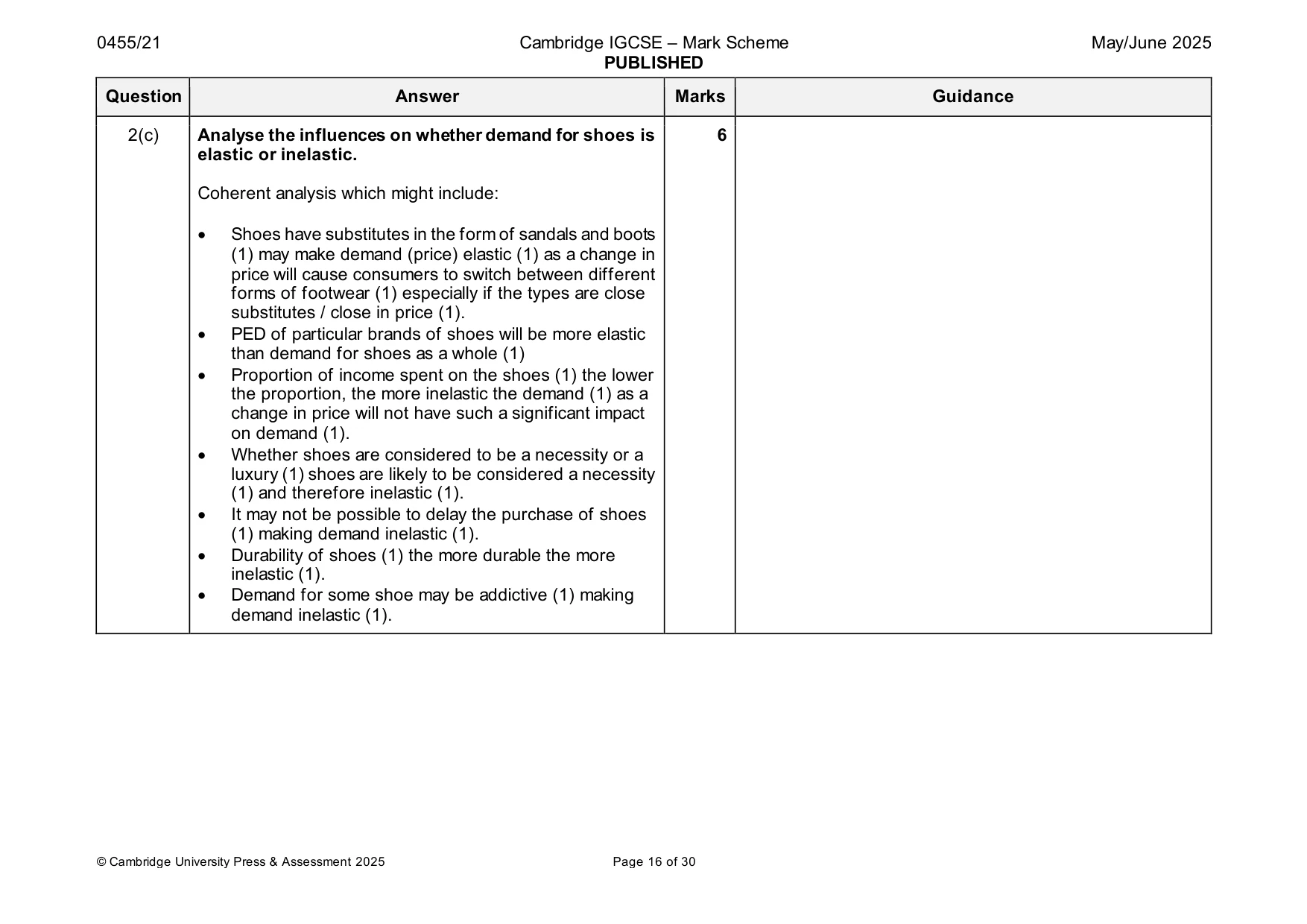
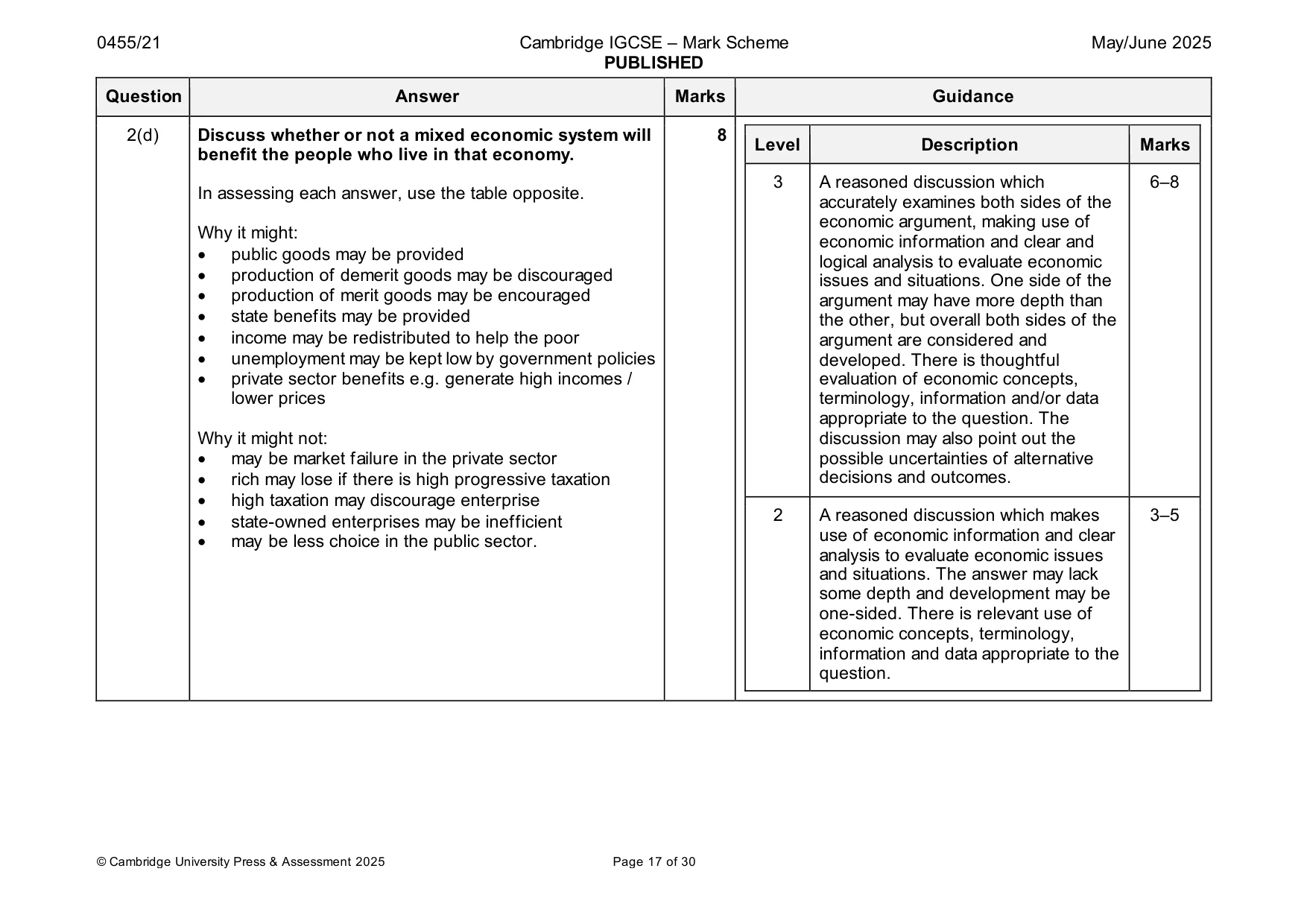
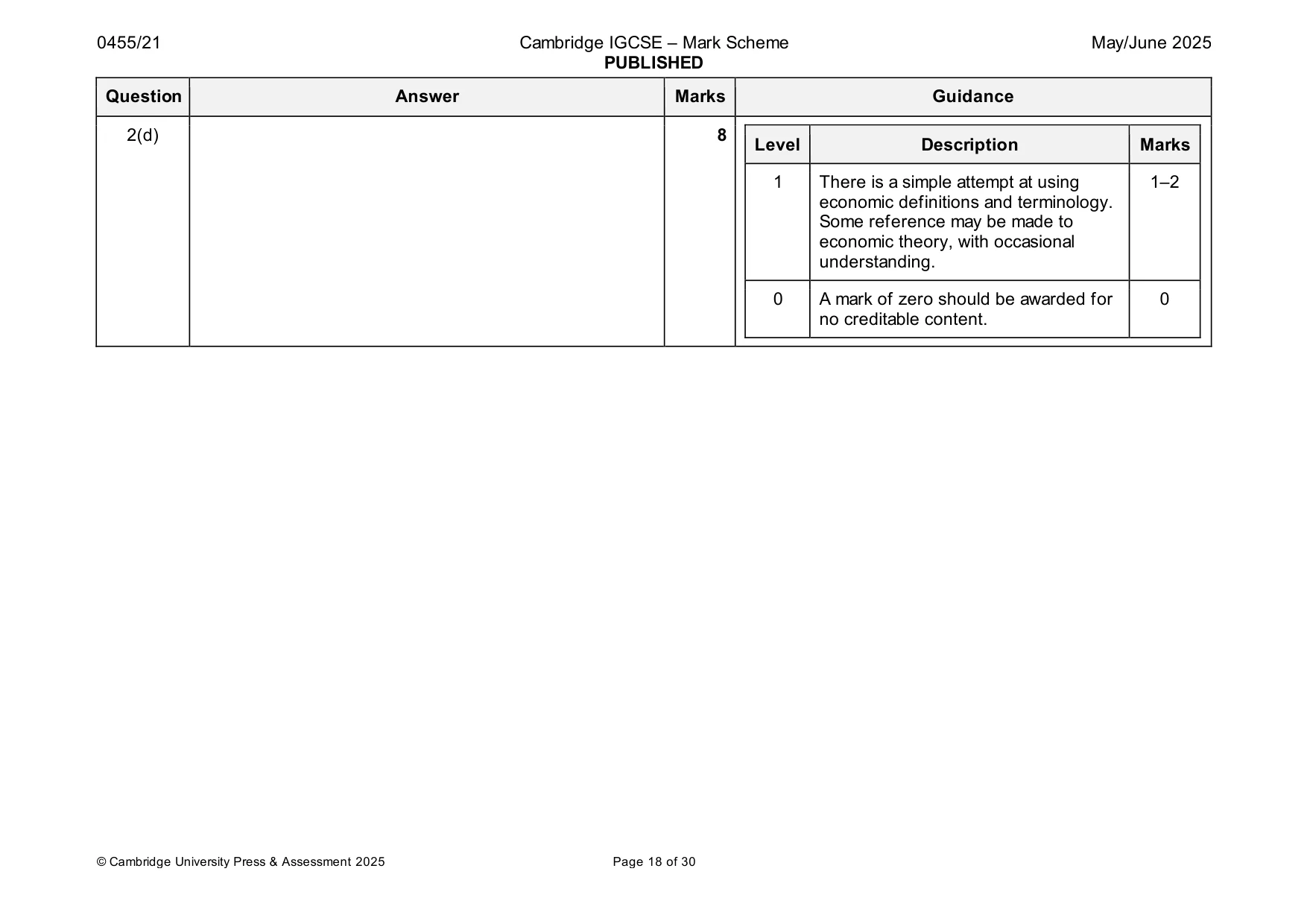
Mark scheme: 2(a) Define population pyramid. 2 If more than two factors given, consider the first three. age (1) gender (1) 2(b) Explain two reasons why income may become more 4 One mark each for each of two reasons identified and one unevenly distributed. mark each for each of two explanations. Logical explanation which might include: If more than two reasons given, consider the first three. A rise in: MAX of two marks if not identifying what changes. • Unemployment (1) those who lose their jobs are likely to experience a fall in their income (1). • Illness (1) the sick may not be able to earn an income (1). • Profits (1) benefitting entrepreneurs (1). • Interest rates (1) benefitting those with a high value of savings (1). • Wealth (1) with rich people gaining more interest/profit (1). • Regressive taxation (1) reducing the income of the poor/placing greater burden on poor (1). • Discrimination of workers (1) example e.g. reducing income of women • Education provision / attainment (1) but only for some (1). A fall in: • National minimum wage (1) the low-paid experience a fall in income (1). • Progressive taxation (1) increases the income of the rich (1). • Welfare / state benefits (1) reduce the income of the poor (1). 2(b) Growth: 4 • Economic growth (1) benefits go more to skilled than to unskilled workers (1). • Changes in growth rate of different industries (1). workers in expanding industries may earn more in wages than workers in declining industries (1). • Changes in growth rate of different regions (1) workers in high growth areas may earn higher wages than in low growth / declining regions (1). • Changes in growth rate of private and public sector (1) private sector earn higher increase in wages (1). 2(c) Analyse the influences on whether demand for shoes is 6 elastic or inelastic. Coherent analysis which might include: • Shoes have substitutes in the form of sandals and boots (1) may make demand (price) elastic (1) as a change in price will cause consumers to switch between different forms of footwear (1) especially if the types are close substitutes / close in price (1). • PED of particular brands of shoes will be more elastic than demand for shoes as a whole (1) • Proportion of income spent on the shoes (1) the lower the proportion, the more inelastic the demand (1) as a change in price will not have such a significant impact on demand (1). • Whether shoes are considered to be a necessity or a luxury (1) shoes are likely to be considered a necessity (1) and therefore inelastic (1). • It may not be possible to delay the purchase of shoes (1) making demand inelastic (1). • Durability of shoes (1) the more durable the more inelastic (1). • Demand for some shoe may be addictive (1) making demand inelastic (1). 2(d) Discuss whether or not a mixed economic system will 8 Level Description Marks benefit the people who live in that economy. 3 A reasoned discussion which 6–8 In assessing each answer, use the table opposite. accurately examines both sides of the economic argument, making use of Why it might: economic information and clear and • public goods may be provided logical analysis to evaluate economic • production of demerit goods may be discouraged issues and situations. One side of the • production of merit goods may be encouraged argument may have more depth than • state benefits may be provided the other, but overall both sides of the • income may be redistributed to help the poor argument are considered and • unemployment may be kept low by government policies developed. There is thoughtful • private sector benefits e.g. generate high incomes / evaluation of economic concepts, lower prices terminology, information and/or data appropriate to the question. The Why it might not: discussion may also point out the • may be market failure in the private sector possible uncertainties of alternative • rich may lose if there is high progressive taxation decisions and outcomes. • high taxation may discourage enterprise • state-owned enterprises may be inefficient 2 A reasoned discussion which makes 3–5 • may be less choice in the public sector. use of economic information and clear analysis to evaluate economic issues and situations. The answer may lack some depth and development may be one-sided. There is relevant use of economic concepts, terminology, information and data appropriate to the question. 2(d) 8 Level Description Marks 1 There is a simple attempt at using 1–2 economic definitions and terminology. Some reference may be made to economic theory, with occasional understanding. 0 A mark of zero should be awarded for 0 no creditable content.
Q3 · In recent years, the quantity of Latvia’s factors of production has changed
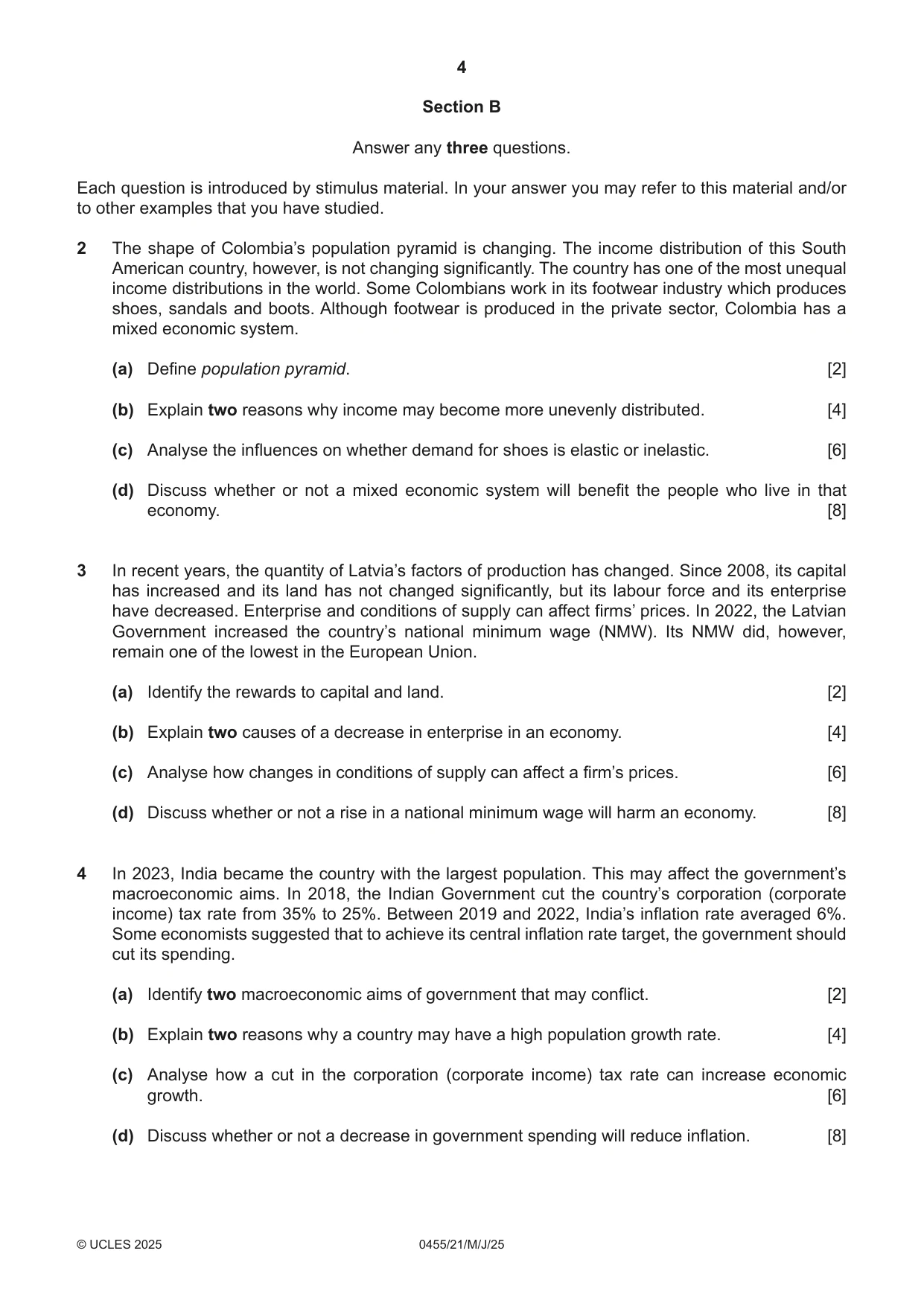
3 In recent years, the quantity of Latvia’s factors of production has changed. Since 2008, its capital has increased and its land has not changed significantly, but its labour force and its enterprise have decreased. Enterprise and conditions of supply can affect firms’ prices. In 2022, the Latvian Government increased the country’s national minimum wage (NMW). Its NMW did, however, remain one of the lowest in the European Union. (a) Identify the rewards to capital and land. [2] (b) Explain two causes of a decrease in enterprise in an economy. [4] (c) Analyse how changes in conditions of supply can affect a firm’s prices. [6] (d) Discuss whether or not a rise in a national minimum wage will harm an economy. [8]
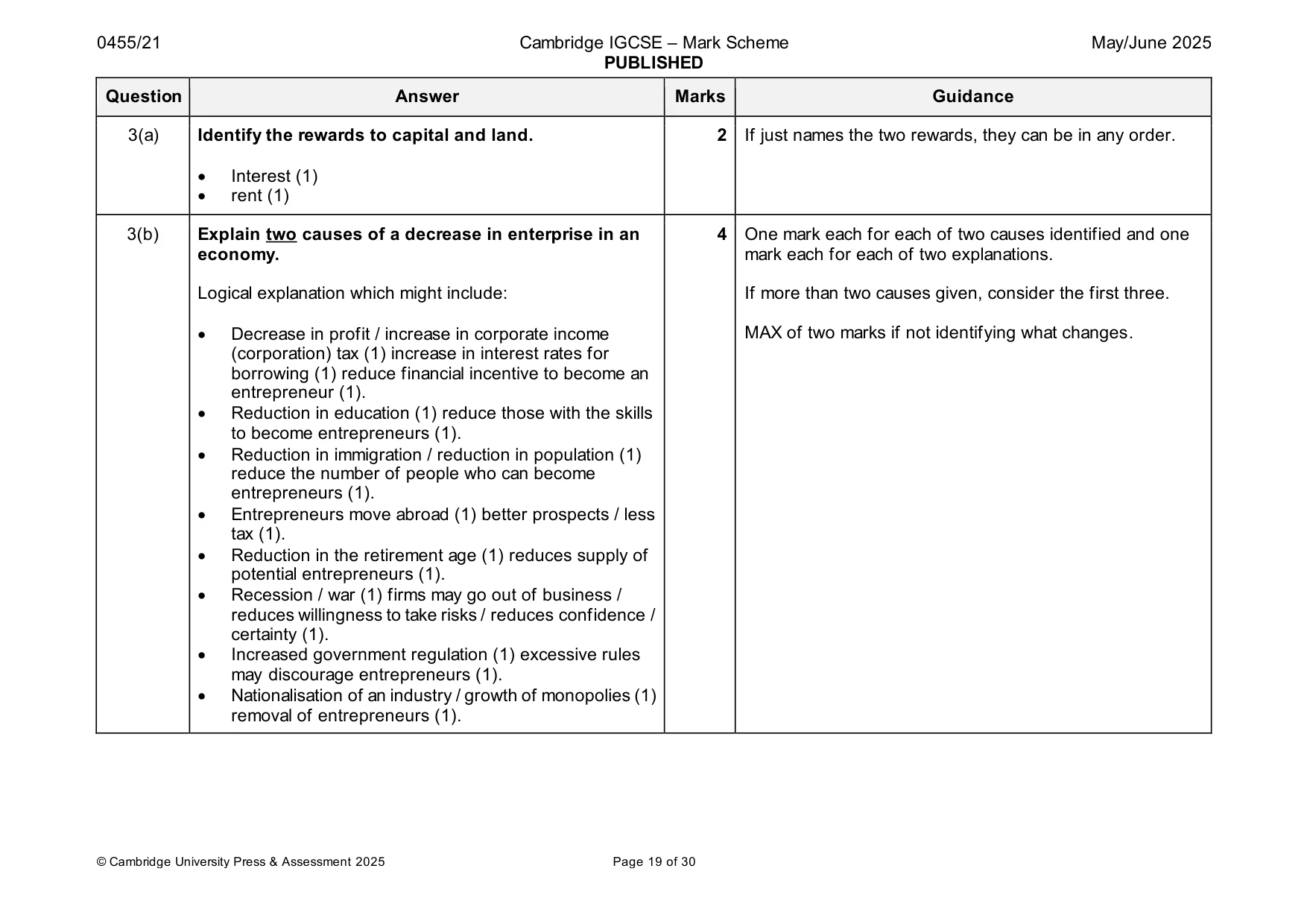
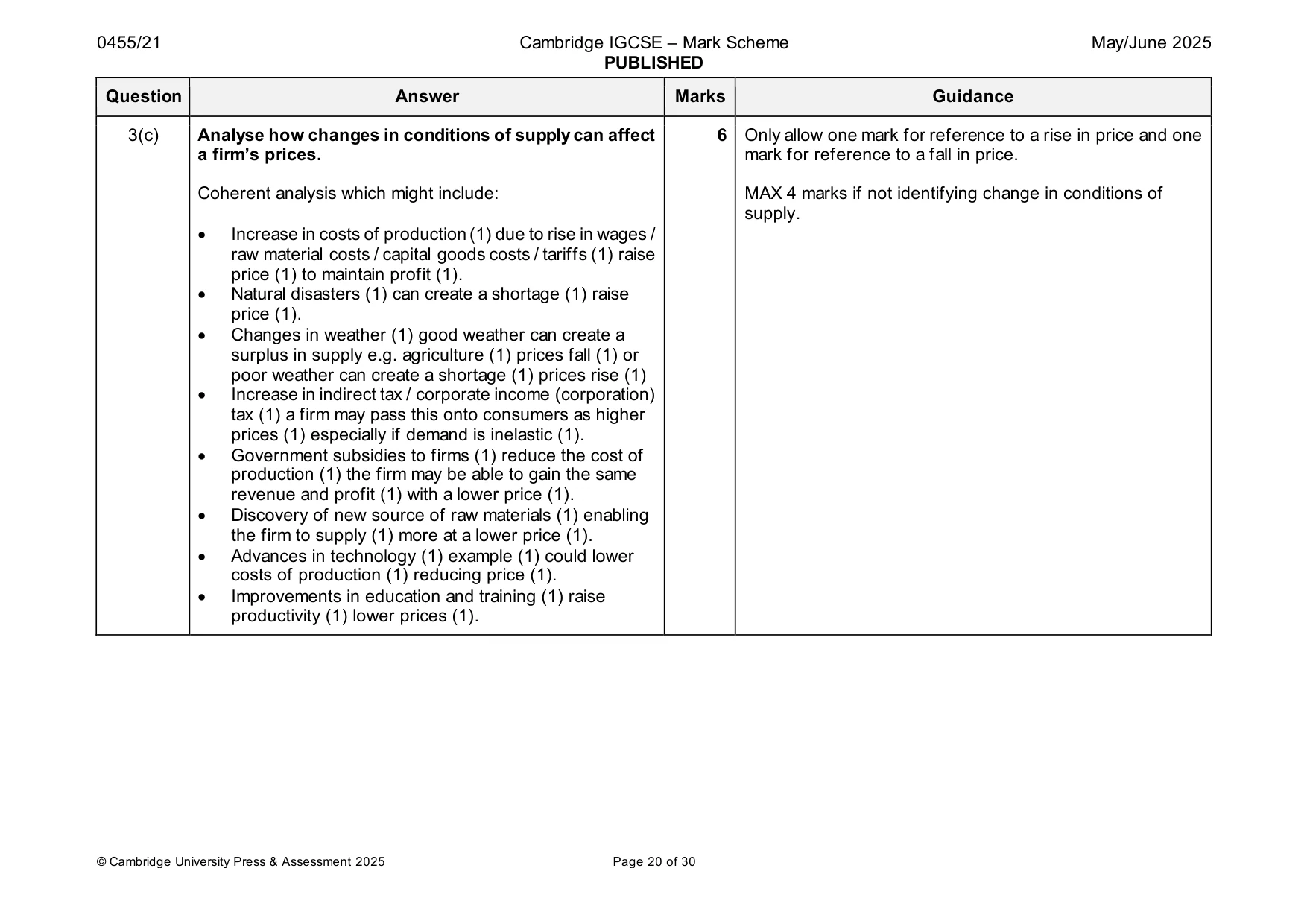
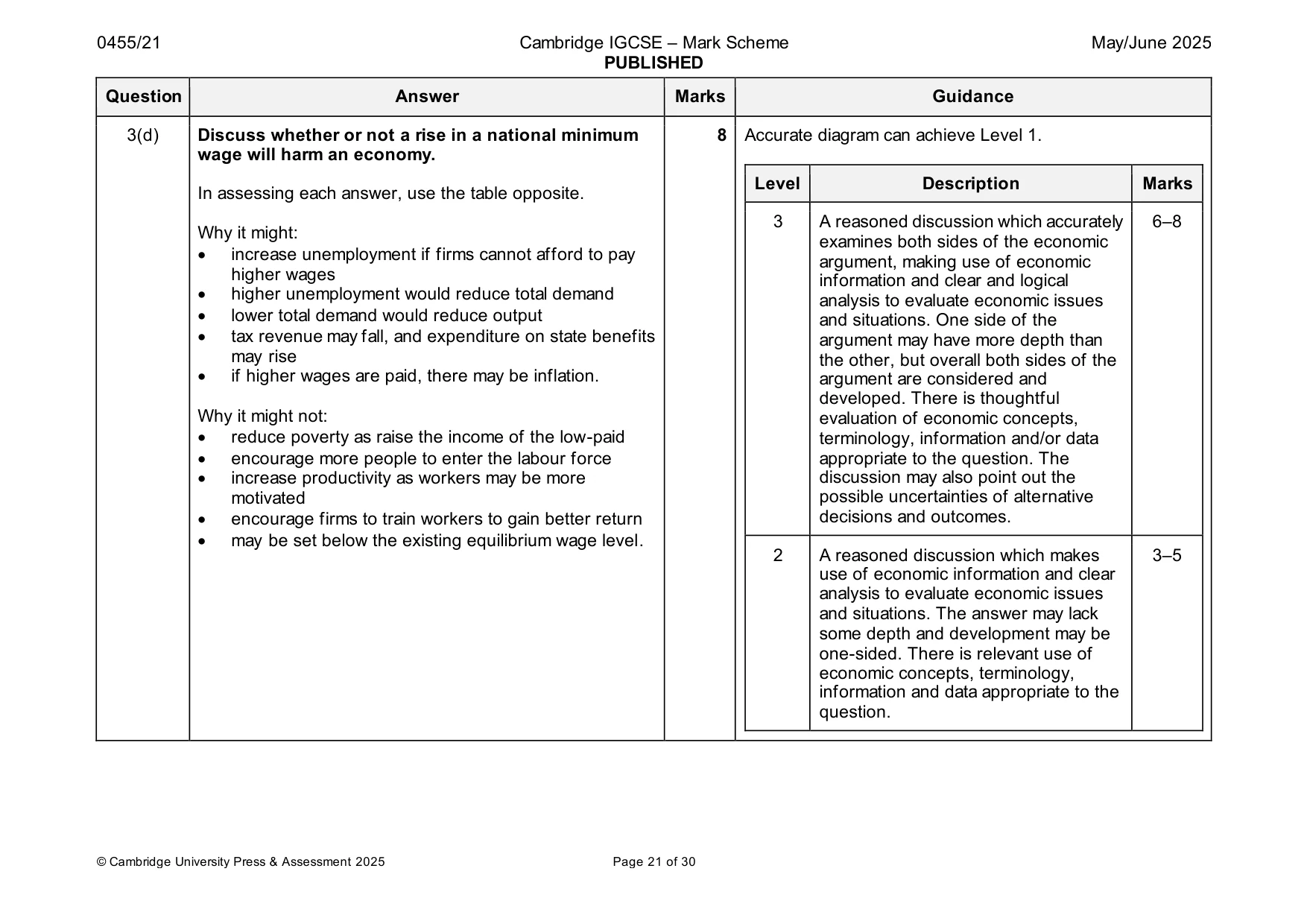
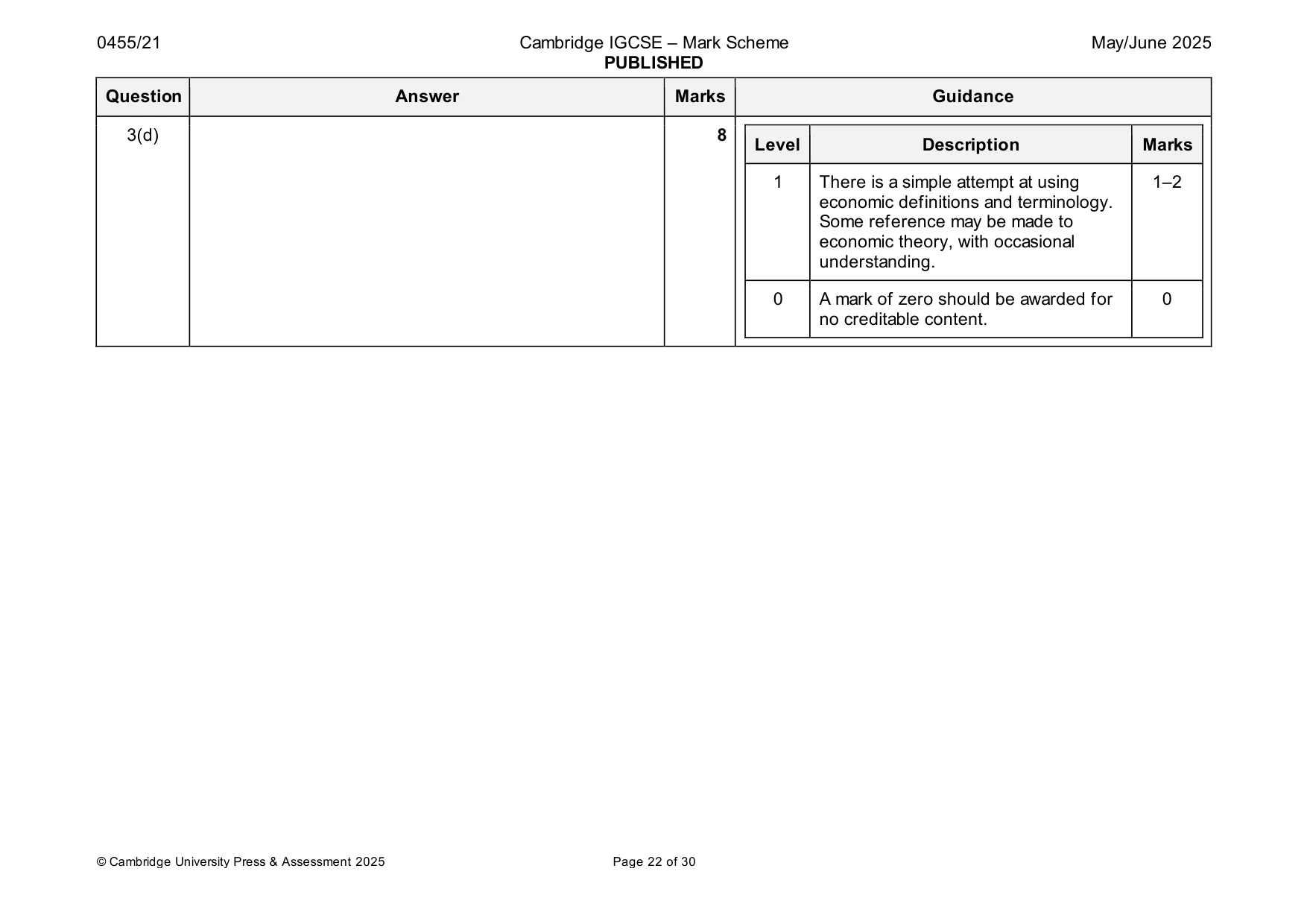
Mark scheme: 3(a) Identify the rewards to capital and land. 2 If just names the two rewards, they can be in any order. • Interest (1) • rent (1) 3(b) Explain two causes of a decrease in enterprise in an 4 One mark each for each of two causes identified and one economy. mark each for each of two explanations. Logical explanation which might include: If more than two causes given, consider the first three. • Decrease in profit / increase in corporate income MAX of two marks if not identifying what changes. (corporation) tax (1) increase in interest rates for borrowing (1) reduce financial incentive to become an entrepreneur (1). • Reduction in education (1) reduce those with the skills to become entrepreneurs (1). • Reduction in immigration / reduction in population (1) reduce the number of people who can become entrepreneurs (1). • Entrepreneurs move abroad (1) better prospects / less tax (1). • Reduction in the retirement age (1) reduces supply of potential entrepreneurs (1). • Recession / war (1) firms may go out of business / reduces willingness to take risks / reduces confidence / certainty (1). • Increased government regulation (1) excessive rules may discourage entrepreneurs (1). • Nationalisation of an industry / growth of monopolies (1) removal of entrepreneurs (1). 3(c) Analyse how changes in conditions of supply can affect 6 Only allow one mark for reference to a rise in price and one a firm’s prices. mark for reference to a fall in price. Coherent analysis which might include: MAX 4 marks if not identifying change in conditions of supply. • Increase in costs of production (1) due to rise in wages / raw material costs / capital goods costs / tariffs (1) raise price (1) to maintain profit (1). • Natural disasters (1) can create a shortage (1) raise price (1). • Changes in weather (1) good weather can create a surplus in supply e.g. agriculture (1) prices fall (1) or poor weather can create a shortage (1) prices rise (1) • Increase in indirect tax / corporate income (corporation) tax (1) a firm may pass this onto consumers as higher prices (1) especially if demand is inelastic (1). • Government subsidies to firms (1) reduce the cost of production (1) the firm may be able to gain the same revenue and profit (1) with a lower price (1). • Discovery of new source of raw materials (1) enabling the firm to supply (1) more at a lower price (1). • Advances in technology (1) example (1) could lower costs of production (1) reducing price (1). • Improvements in education and training (1) raise productivity (1) lower prices (1). 3(d) Discuss whether or not a rise in a national minimum 8 Accurate diagram can achieve Level 1. wage will harm an economy. Level Description Marks In assessing each answer, use the table opposite. 3 A reasoned discussion which accurately 6–8 Why it might: examines both sides of the economic • increase unemployment if firms cannot afford to pay argument, making use of economic higher wages information and clear and logical • higher unemployment would reduce total demand analysis to evaluate economic issues • lower total demand would reduce output and situations. One side of the • tax revenue may fall, and expenditure on state benefits argument may have more depth than may rise the other, but overall both sides of the • if higher wages are paid, there may be inflation. argument are considered and developed. There is thoughtful Why it might not: evaluation of economic concepts, • reduce poverty as raise the income of the low-paid terminology, information and/or data • encourage more people to enter the labour force appropriate to the question. The • increase productivity as workers may be more discussion may also point out the motivated possible uncertainties of alternative • encourage firms to train workers to gain better return decisions and outcomes. • may be set below the existing equilibrium wage level. 2 A reasoned discussion which makes 3–5 use of economic information and clear analysis to evaluate economic issues and situations. The answer may lack some depth and development may be one-sided. There is relevant use of economic concepts, terminology, information and data appropriate to the question. 3(d) 8 Level Description Marks 1 There is a simple attempt at using 1–2 economic definitions and terminology. Some reference may be made to economic theory, with occasional understanding. 0 A mark of zero should be awarded for 0 no creditable content.
Q4 · In 2023, India became the country with the largest population
4 In 2023, India became the country with the largest population. This may affect the government’s macroeconomic aims. In 2018, the Indian Government cut the country’s corporation (corporate income) tax rate from 35% to 25%. Between 2019 and 2022, India’s inflation rate averaged 6%. Some economists suggested that to achieve its central inflation rate target, the government should cut its spending. (a) Identify two macroeconomic aims of government that may conflict. [2] (b) Explain two reasons why a country may have a high population growth rate. [4] (c) Analyse how a cut in the corporation (corporate income) tax rate can increase economic growth. [6] (d) Discuss whether or not a decrease in government spending will reduce inflation. [8]
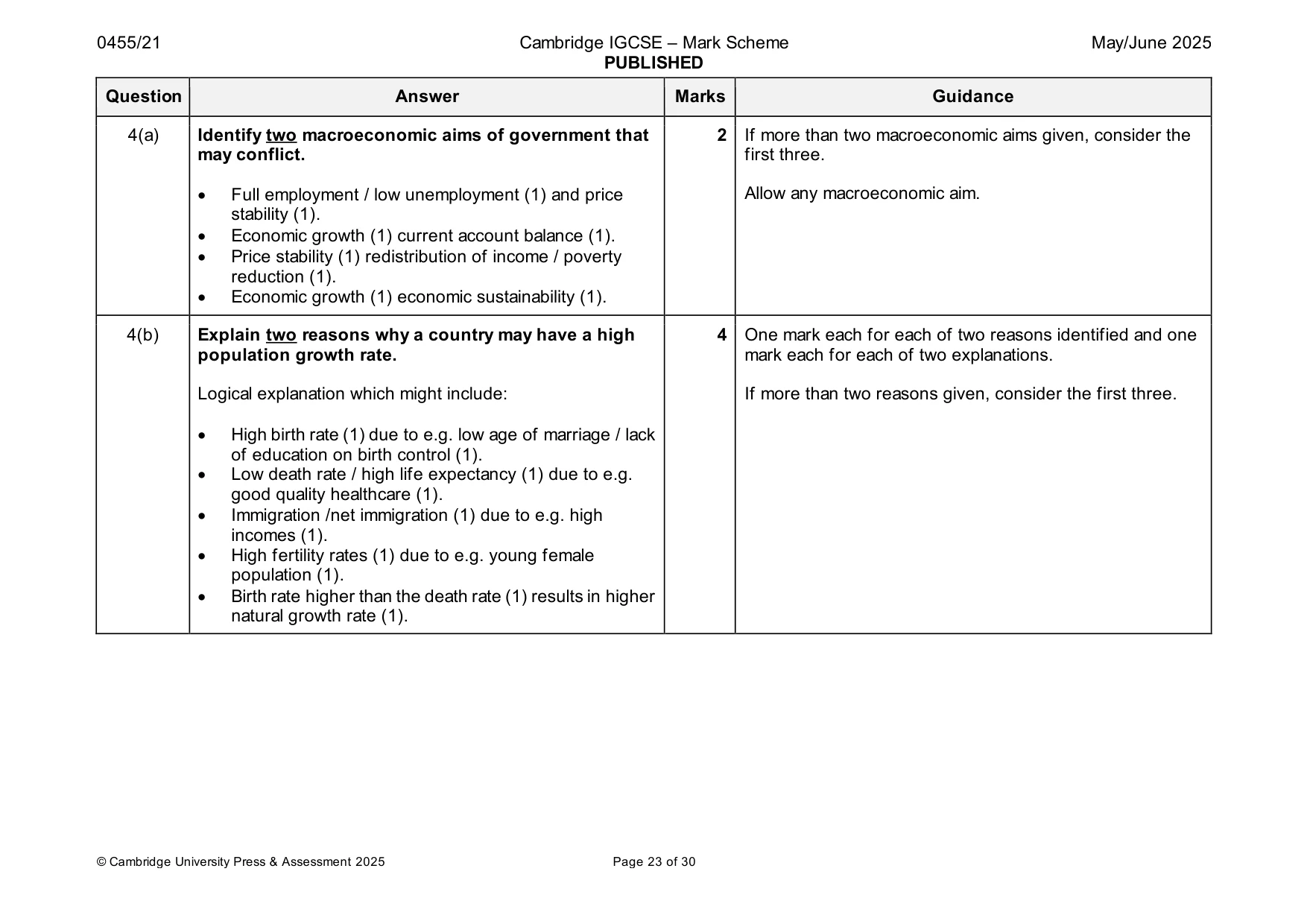
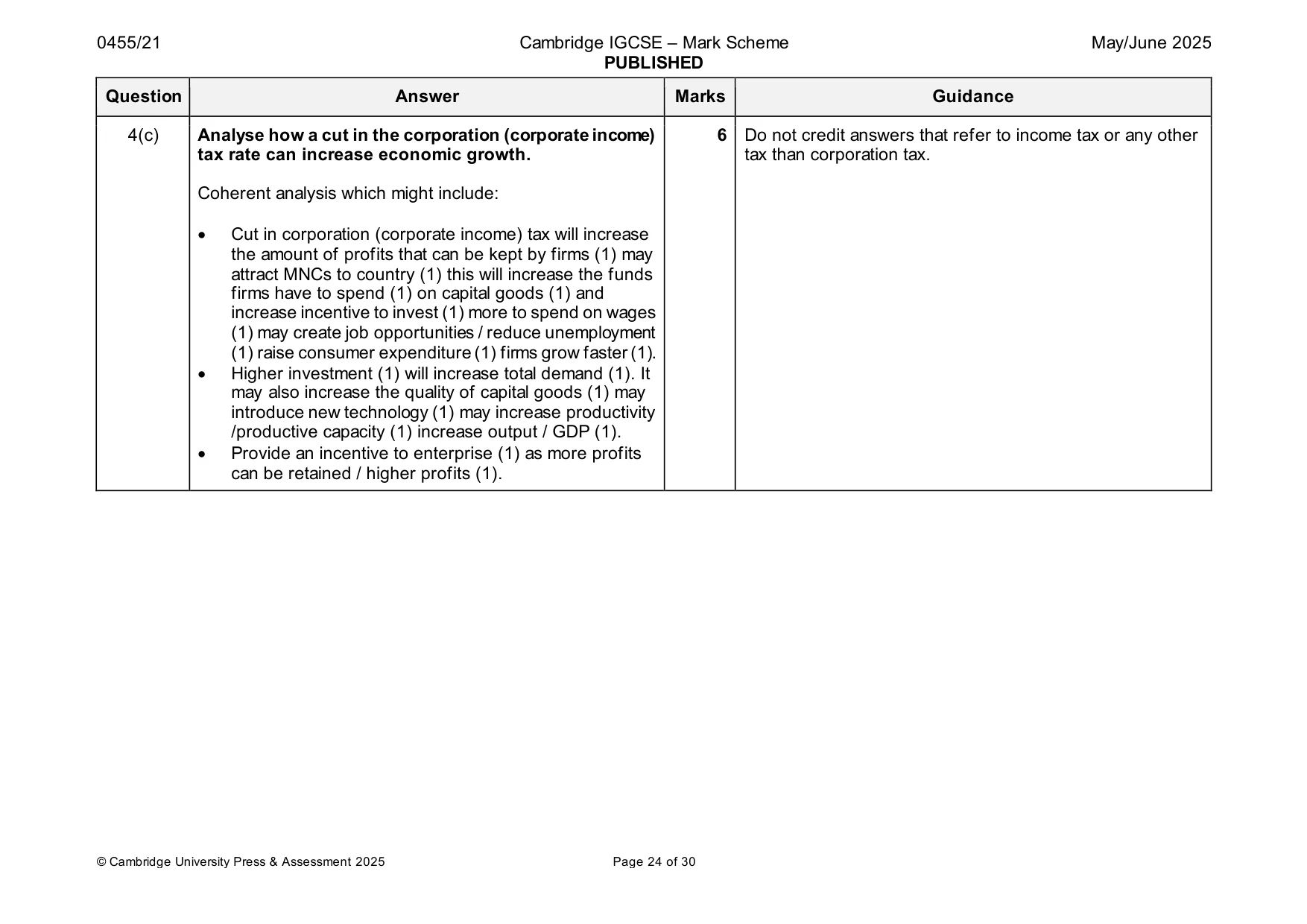
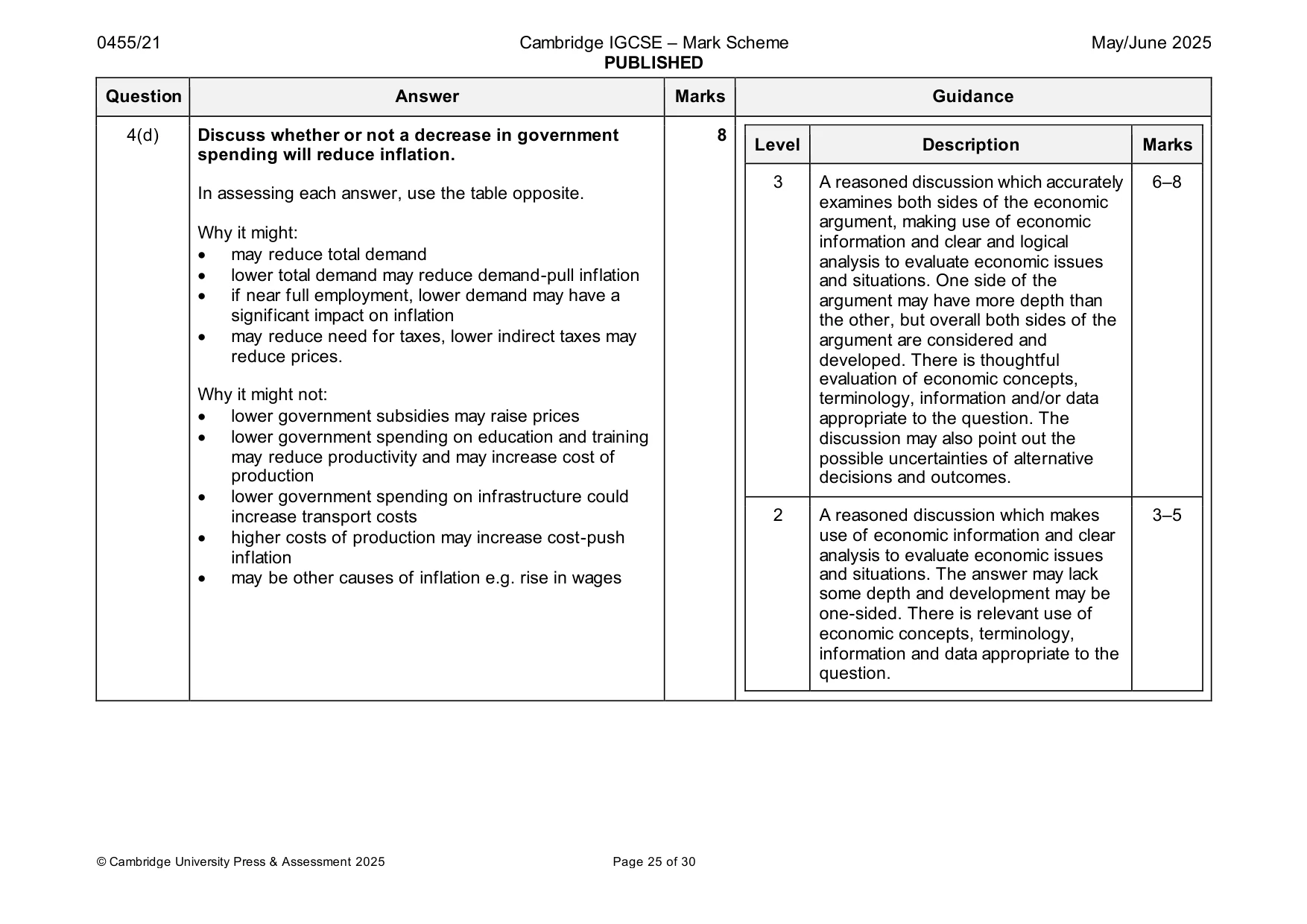
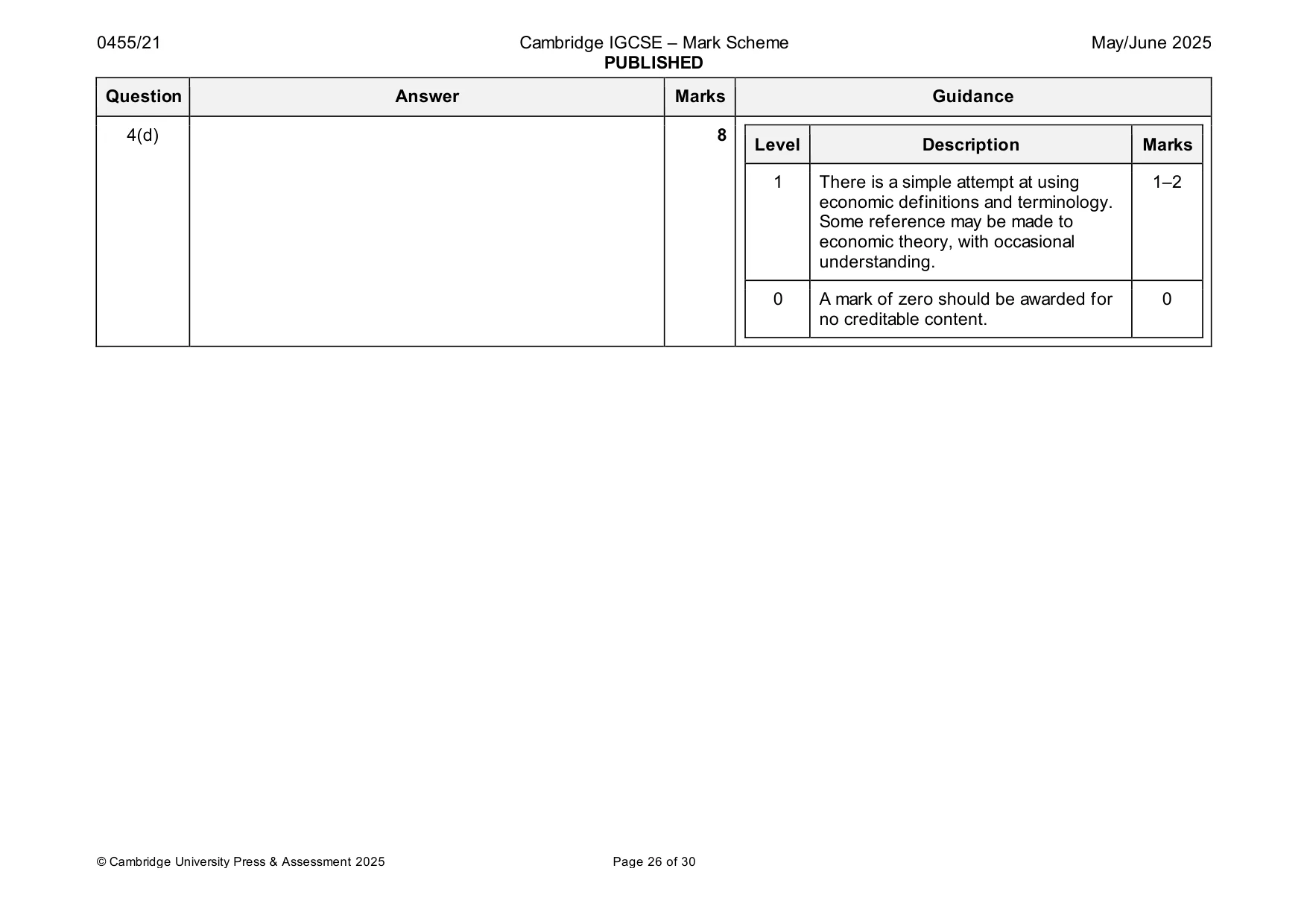
Mark scheme: 4(a) Identify two macroeconomic aims of government that 2 If more than two macroeconomic aims given, consider the may conflict. first three. • Full employment / low unemployment (1) and price Allow any macroeconomic aim. stability (1). • Economic growth (1) current account balance (1). • Price stability (1) redistribution of income / poverty reduction (1). • Economic growth (1) economic sustainability (1). 4(b) Explain two reasons why a country may have a high 4 One mark each for each of two reasons identified and one population growth rate. mark each for each of two explanations. Logical explanation which might include: If more than two reasons given, consider the first three. • High birth rate (1) due to e.g. low age of marriage / lack of education on birth control (1). • Low death rate / high life expectancy (1) due to e.g. good quality healthcare (1). • Immigration /net immigration (1) due to e.g. high incomes (1). • High fertility rates (1) due to e.g. young female population (1). • Birth rate higher than the death rate (1) results in higher natural growth rate (1). 4(c) Analyse how a cut in the corporation (corporate income) 6 Do not credit answers that refer to income tax or any other tax rate can increase economic growth. tax than corporation tax. Coherent analysis which might include: • Cut in corporation (corporate income) tax will increase the amount of profits that can be kept by firms (1) may attract MNCs to country (1) this will increase the funds firms have to spend (1) on capital goods (1) and increase incentive to invest (1) more to spend on wages (1) may create job opportunities / reduce unemployment (1) raise consumer expenditure (1) firms grow faster (1). • Higher investment (1) will increase total demand (1). It may also increase the quality of capital goods (1) may introduce new technology (1) may increase productivity /productive capacity (1) increase output / GDP (1). • Provide an incentive to enterprise (1) as more profits can be retained / higher profits (1). 4(d) Discuss whether or not a decrease in government 8 Level Description Marks spending will reduce inflation. 3 A reasoned discussion which accurately 6–8 In assessing each answer, use the table opposite. examines both sides of the economic argument, making use of economic Why it might: information and clear and logical • may reduce total demand analysis to evaluate economic issues • lower total demand may reduce demand-pull inflation and situations. One side of the • if near full employment, lower demand may have a argument may have more depth than significant impact on inflation the other, but overall both sides of the • may reduce need for taxes, lower indirect taxes may argument are considered and reduce prices. developed. There is thoughtful evaluation of economic concepts, Why it might not: terminology, information and/or data • lower government subsidies may raise prices appropriate to the question. The • lower government spending on education and training discussion may also point out the may reduce productivity and may increase cost of possible uncertainties of alternative production decisions and outcomes. • lower government spending on infrastructure could increase transport costs 2 A reasoned discussion which makes 3–5 • higher costs of production may increase cost-push use of economic information and clear inflation analysis to evaluate economic issues • may be other causes of inflation e.g. rise in wages and situations. The answer may lack some depth and development may be one-sided. There is relevant use of economic concepts, terminology, information and data appropriate to the question. 4(d) 8 Level Description Marks 1 There is a simple attempt at using 1–2 economic definitions and terminology. Some reference may be made to economic theory, with occasional understanding. 0 A mark of zero should be awarded for 0 no creditable content.
Q5 · Australia has a number of firms that operate in other countries
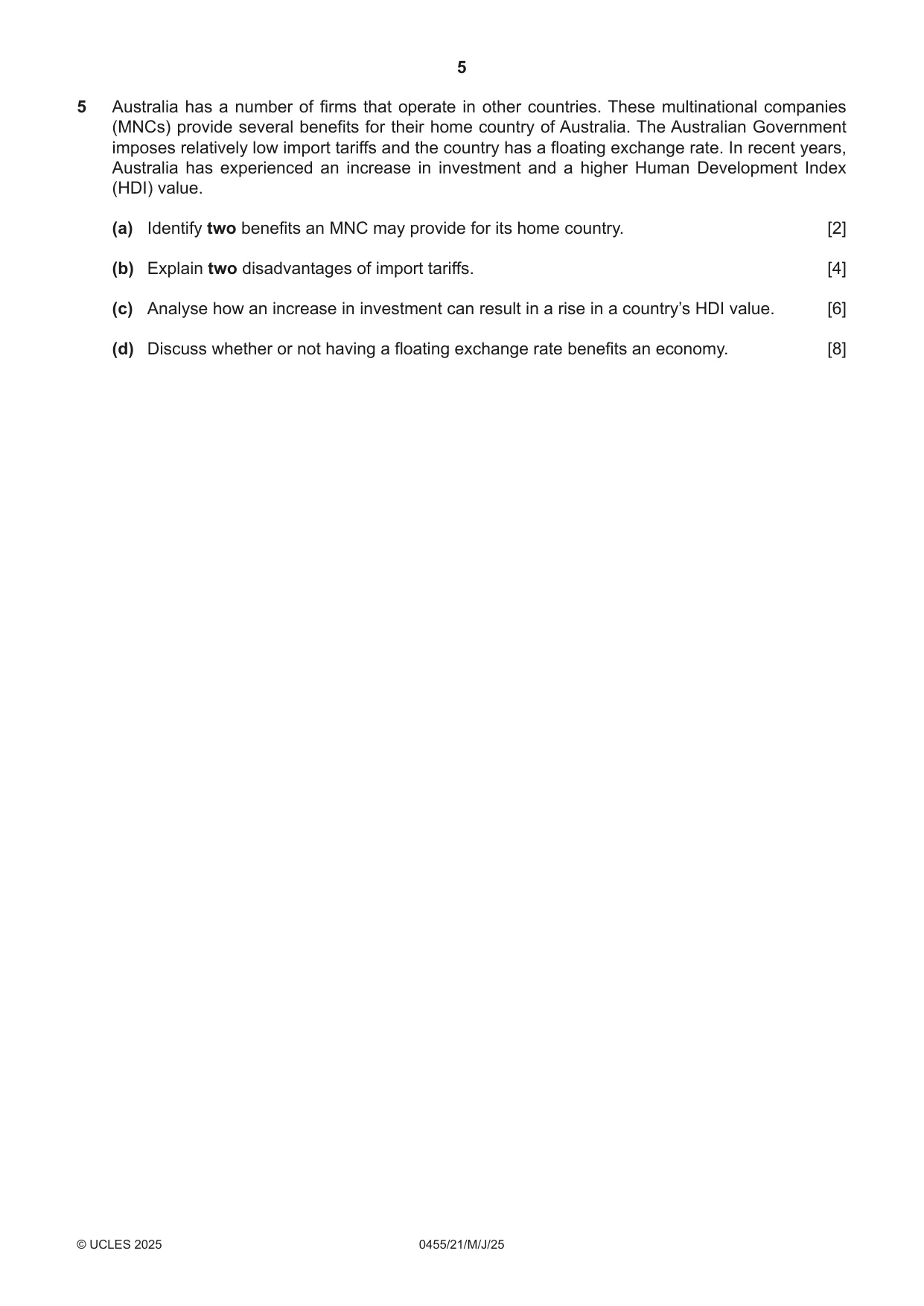
5 Australia has a number of firms that operate in other countries. These multinational companies (MNCs) provide several benefits for their home country of Australia. The Australian Government imposes relatively low import tariffs and the country has a floating exchange rate. In recent years, Australia has experienced an increase in investment and a higher Human Development Index (HDI) value. (a) Identify two benefits an MNC may provide for its home country. [2] (b) Explain two disadvantages of import tariffs. [4] (c) Analyse how an increase in investment can result in a rise in a country’s HDI value. [6] (d) Discuss whether or not having a floating exchange rate benefits an economy. [8]
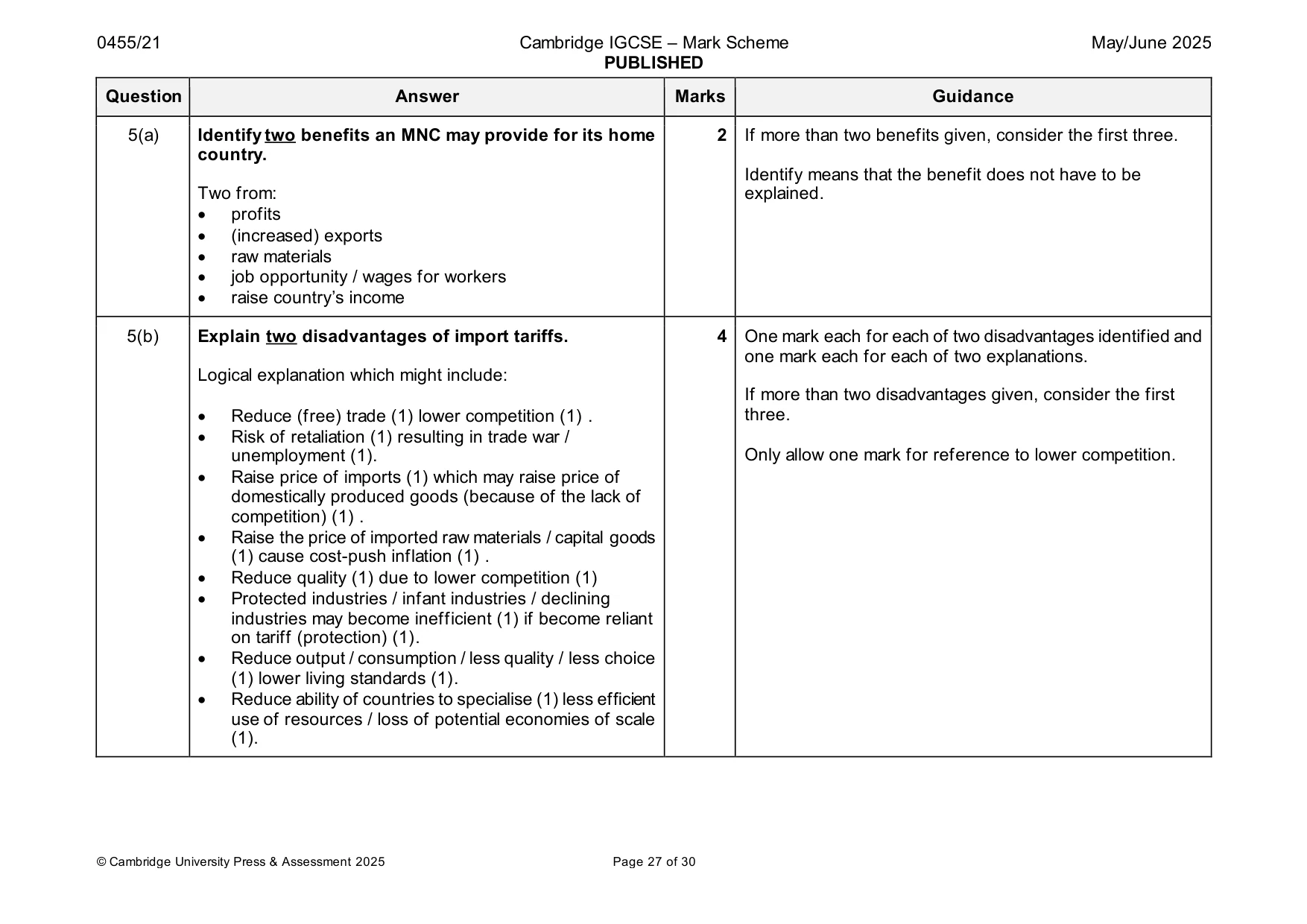
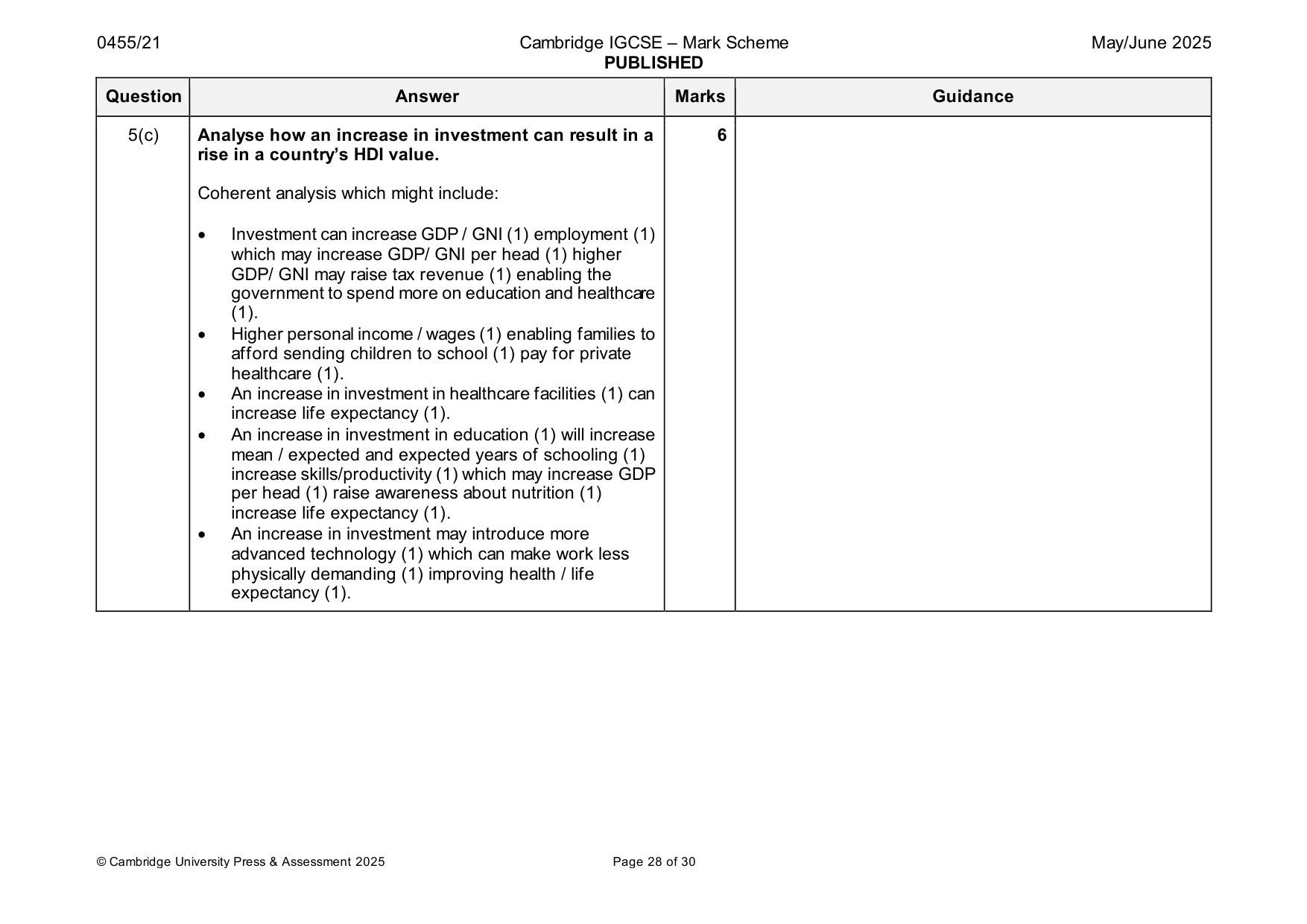
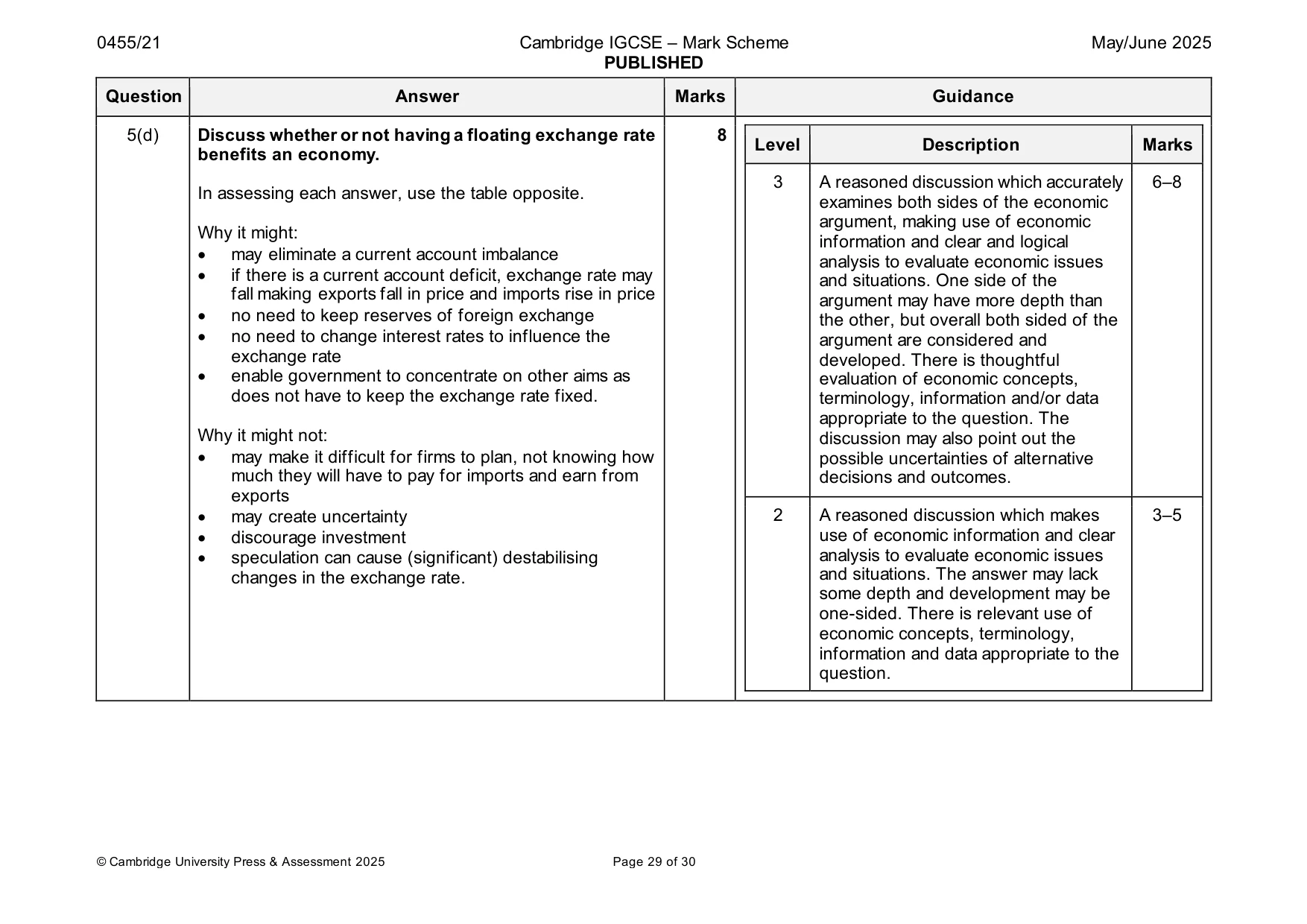
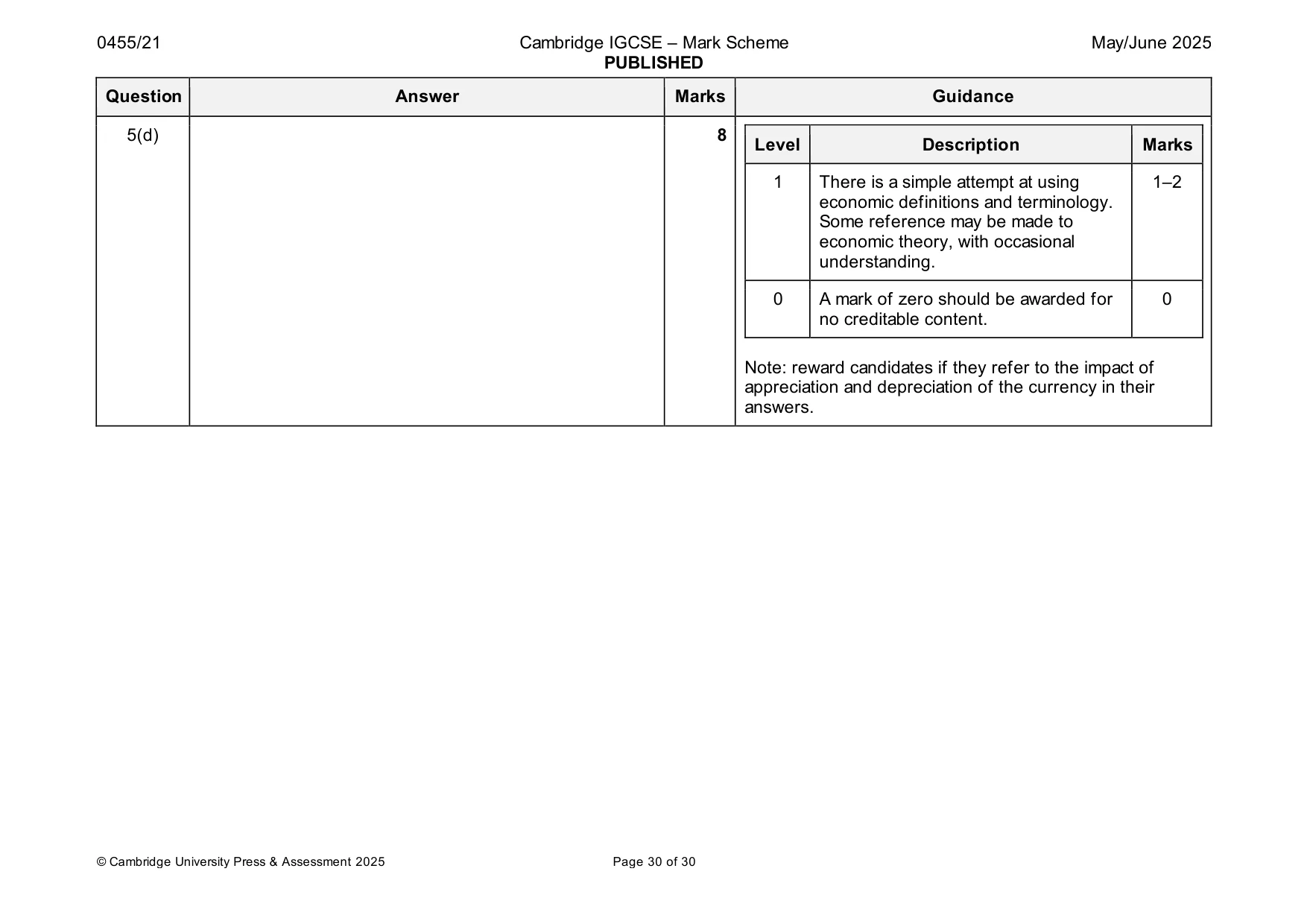
Mark scheme: 5(a) Identify two benefits an MNC may provide for its home 2 If more than two benefits given, consider the first three. country. Identify means that the benefit does not have to be Two from: explained. • profits • (increased) exports • raw materials • job opportunity / wages for workers • raise country’s income 5(b) Explain two disadvantages of import tariffs. 4 One mark each for each of two disadvantages identified and one mark each for each of two explanations. Logical explanation which might include: If more than two disadvantages given, consider the first • Reduce (free) trade (1) lower competition (1) . three. • Risk of retaliation (1) resulting in trade war / unemployment (1). Only allow one mark for reference to lower competition. • Raise price of imports (1) which may raise price of domestically produced goods (because of the lack of competition) (1) . • Raise the price of imported raw materials / capital goods (1) cause cost-push inflation (1) . • Reduce quality (1) due to lower competition (1) • Protected industries / infant industries / declining industries may become inefficient (1) if become reliant on tariff (protection) (1). • Reduce output / consumption / less quality / less choice (1) lower living standards (1). • Reduce ability of countries to specialise (1) less efficient use of resources / loss of potential economies of scale (1). 5(c) Analyse how an increase in investment can result in a 6 rise in a country’s HDI value. Coherent analysis which might include: • Investment can increase GDP / GNI (1) employment (1) which may increase GDP/ GNI per head (1) higher GDP/ GNI may raise tax revenue (1) enabling the government to spend more on education and healthcare (1). • Higher personal income / wages (1) enabling families to afford sending children to school (1) pay for private healthcare (1). • An increase in investment in healthcare facilities (1) can increase life expectancy (1). • An increase in investment in education (1) will increase mean / expected and expected years of schooling (1) increase skills/productivity (1) which may increase GDP per head (1) raise awareness about nutrition (1) increase life expectancy (1). • An increase in investment may introduce more advanced technology (1) which can make work less physically demanding (1) improving health / life expectancy (1). 5(d) Discuss whether or not having a floating exchange rate 8 Level Description Marks benefits an economy. 3 A reasoned discussion which accurately 6–8 In assessing each answer, use the table opposite. examines both sides of the economic argument, making use of economic Why it might: information and clear and logical • may eliminate a current account imbalance analysis to evaluate economic issues • if there is a current account deficit, exchange rate may and situations. One side of the fall making exports fall in price and imports rise in price argument may have more depth than • no need to keep reserves of foreign exchange the other, but overall both sided of the • no need to change interest rates to influence the argument are considered and exchange rate developed. There is thoughtful • enable government to concentrate on other aims as evaluation of economic concepts, does not have to keep the exchange rate fixed. terminology, information and/or data appropriate to the question. The Why it might not: discussion may also point out the • may make it difficult for firms to plan, not knowing how possible uncertainties of alternative much they will have to pay for imports and earn from decisions and outcomes. exports • may create uncertainty 2 A reasoned discussion which makes 3–5 • discourage investment use of economic information and clear • speculation can cause (significant) destabilising analysis to evaluate economic issues changes in the exchange rate. and situations. The answer may lack some depth and development may be one-sided. There is relevant use of economic concepts, terminology, information and data appropriate to the question. 5(d) 8 Level Description Marks 1 There is a simple attempt at using 1–2 economic definitions and terminology. Some reference may be made to economic theory, with occasional understanding. 0 A mark of zero should be awarded for 0 no creditable content. Note: reward candidates if they refer to the impact of appreciation and depreciation of the currency in their answers.
What was in this paper
The subtopics covered by these 5 questions, and how many questions each got. Open one in a new tab to see every Cambridge question on it.
What you needed in this session
Cambridge’s own grade thresholds for 2025 May/June, Paper 2 · Variant 1. A higher threshold means an easier paper — the bar moves with how the cohort did.