Cambridge IGCSE Economics 0455 — 2025 Oct/Nov Paper 2 · Variant 2
0455/22/O/N/25 · 5 questions · 90 marks · ≈101 min
The question paper and its mark scheme, free to read here and free to download. This is Cambridge’s own paper, exactly as it was sat.
Question paper8 pages



Mark scheme26 pages
Answers below. Sit the paper first if you are practising.
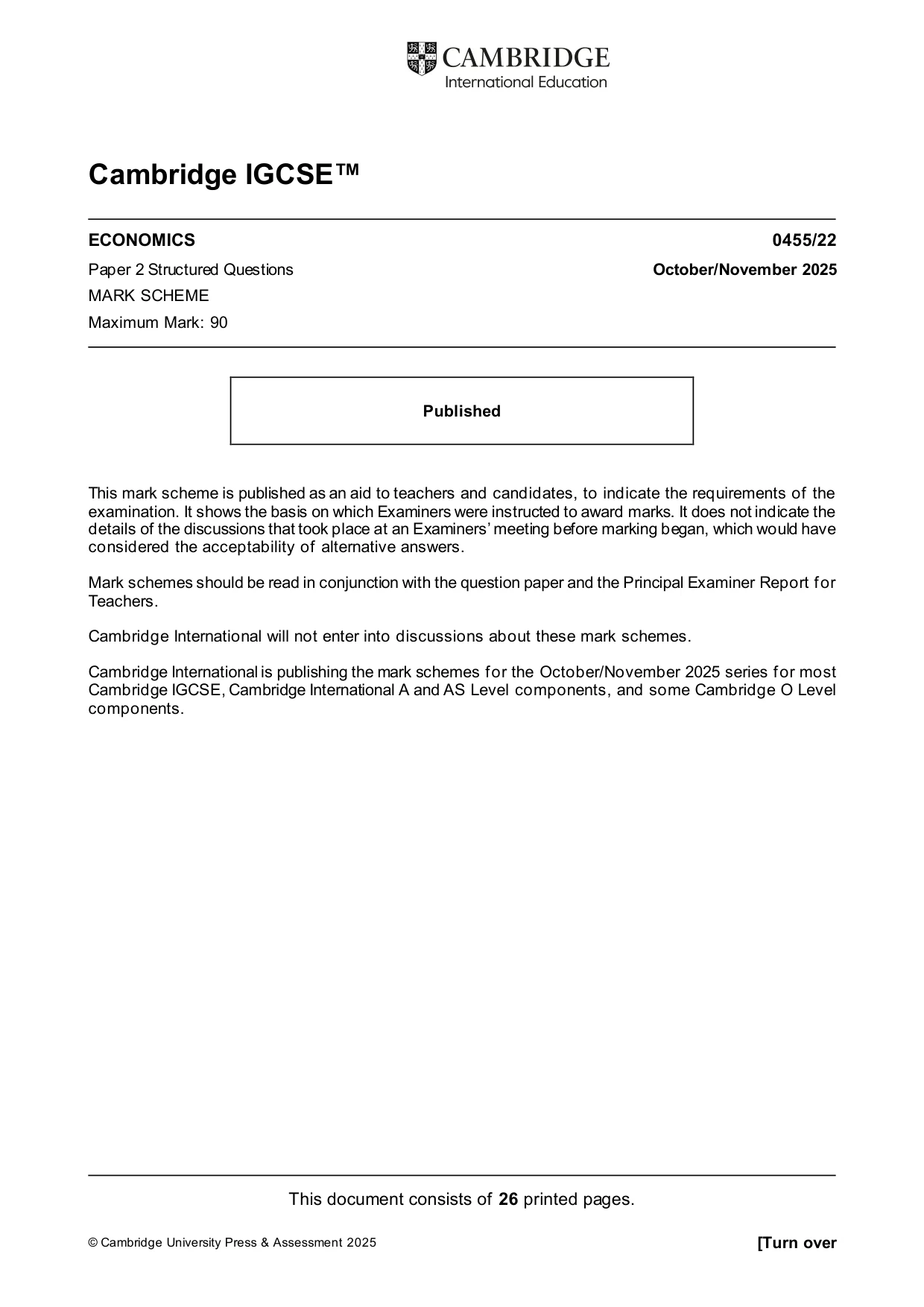
Questions as text
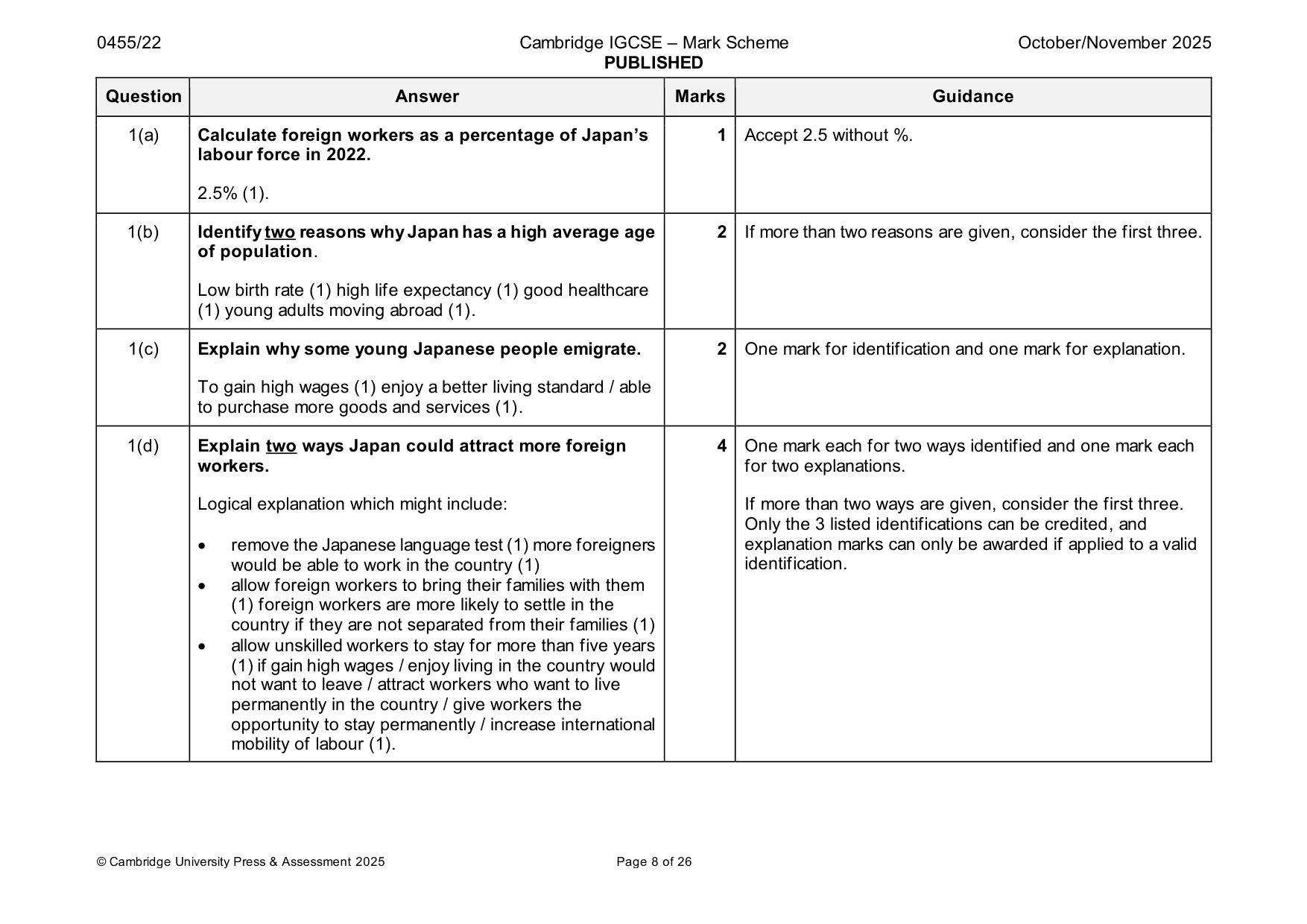
Q1 · Calculate foreign workers as a percentage of Japan’s labour force in 2022
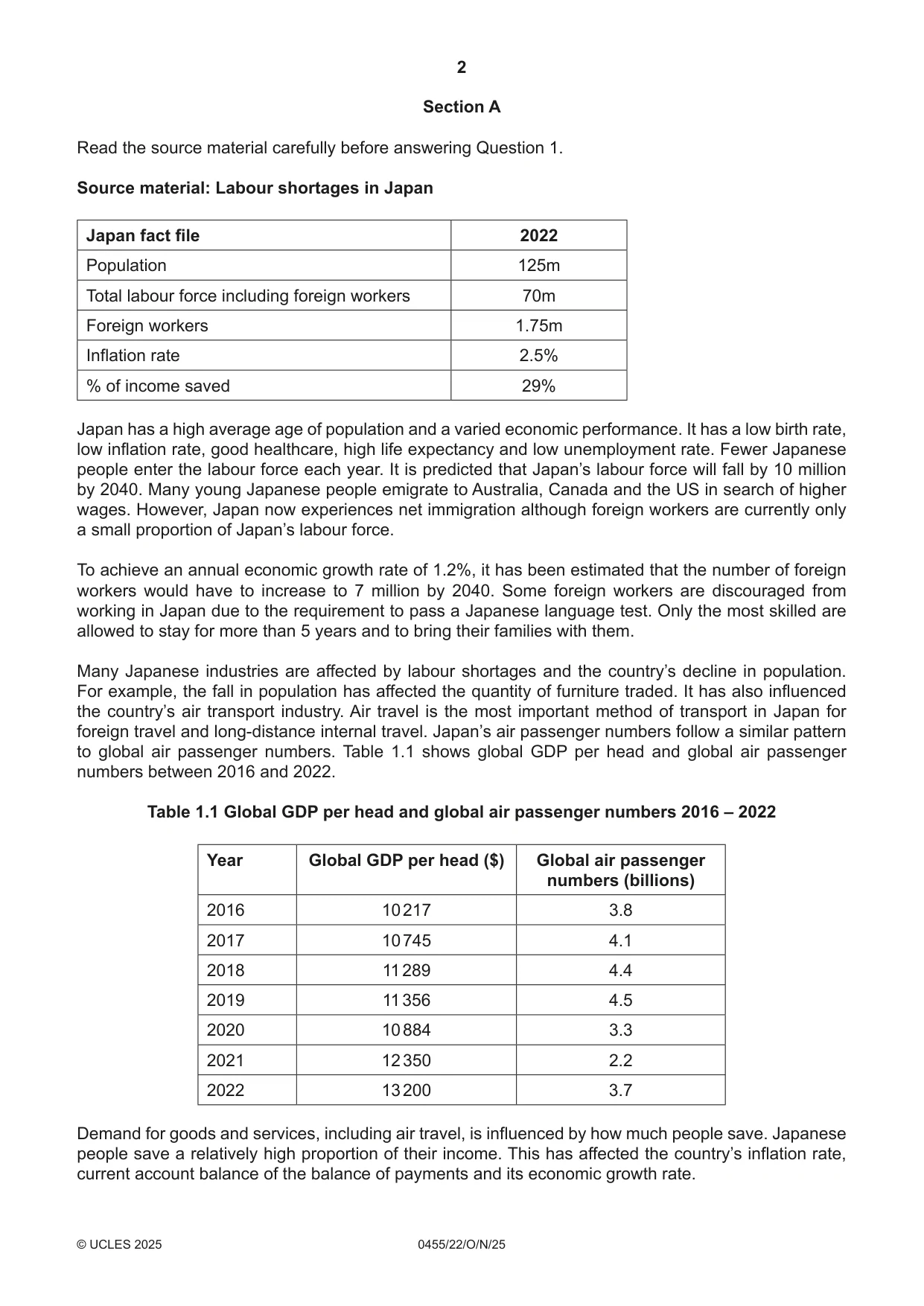
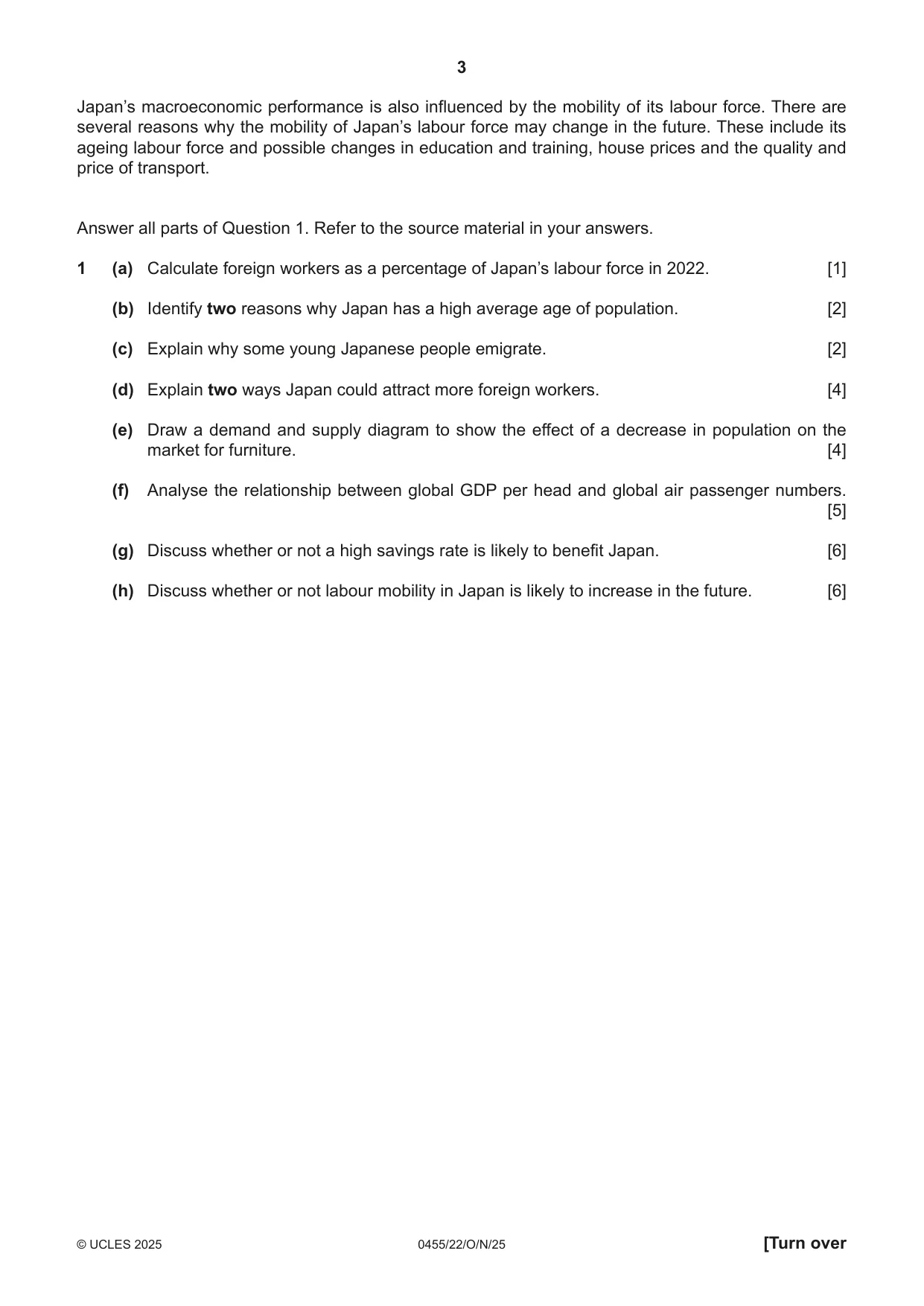
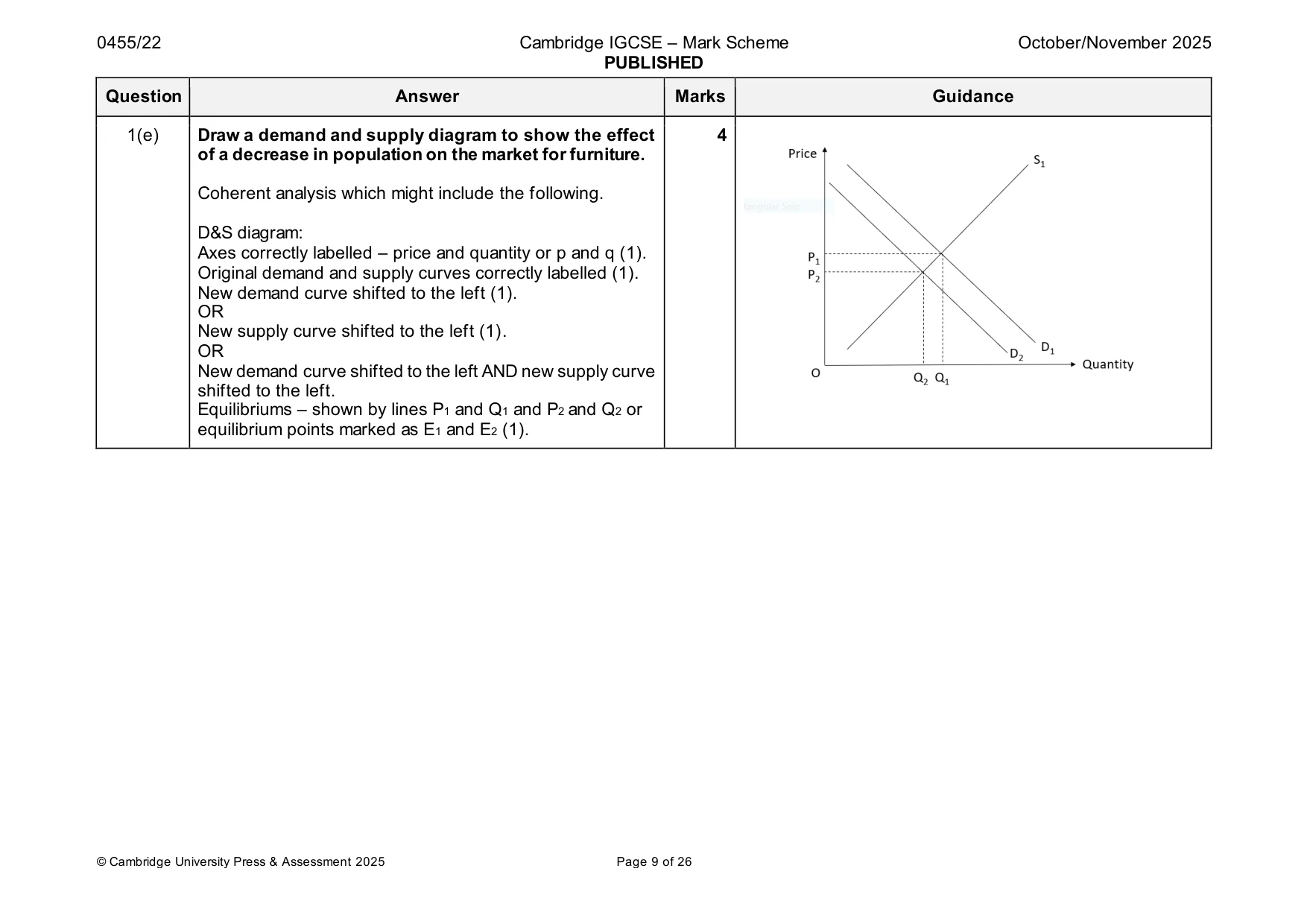
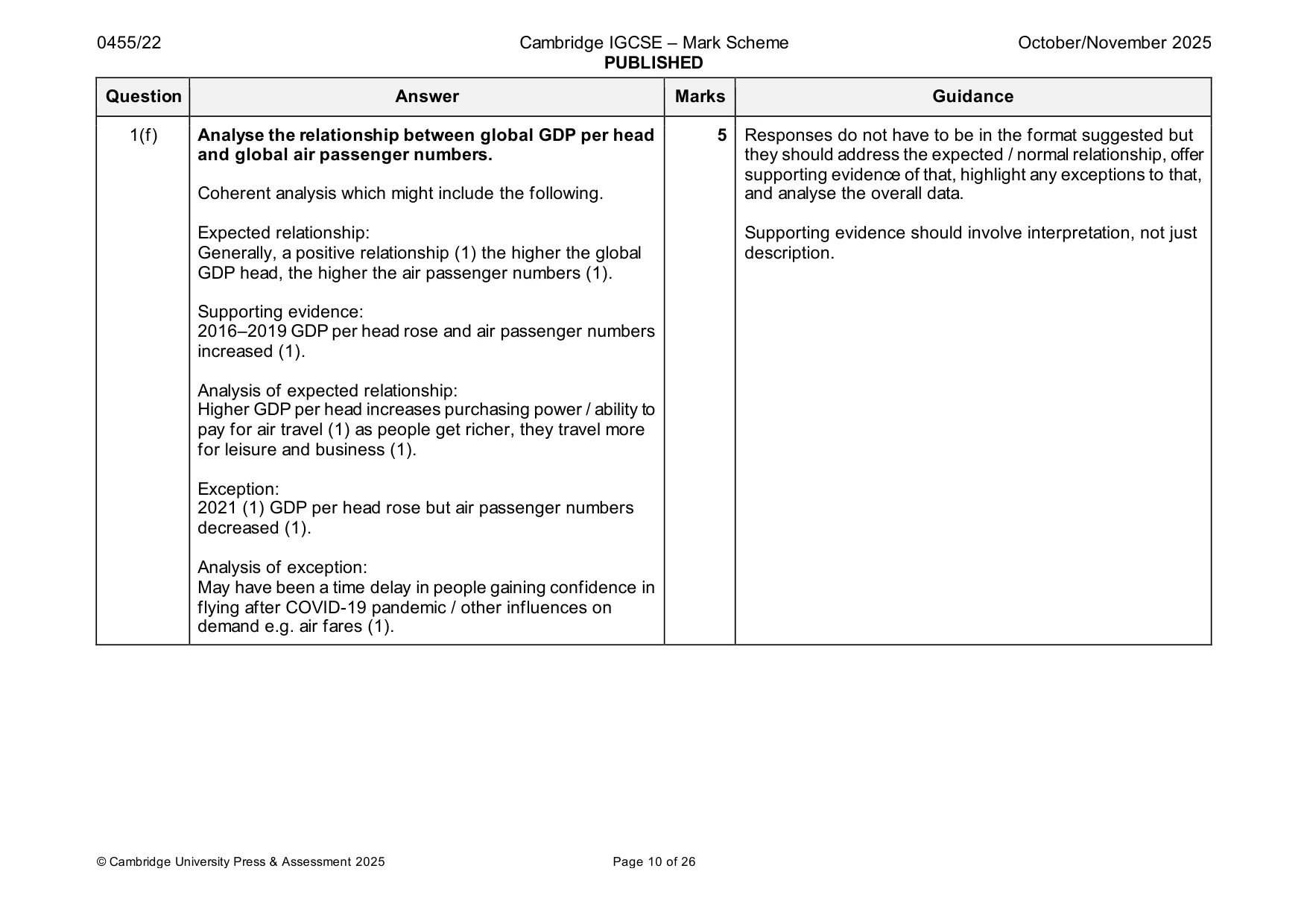
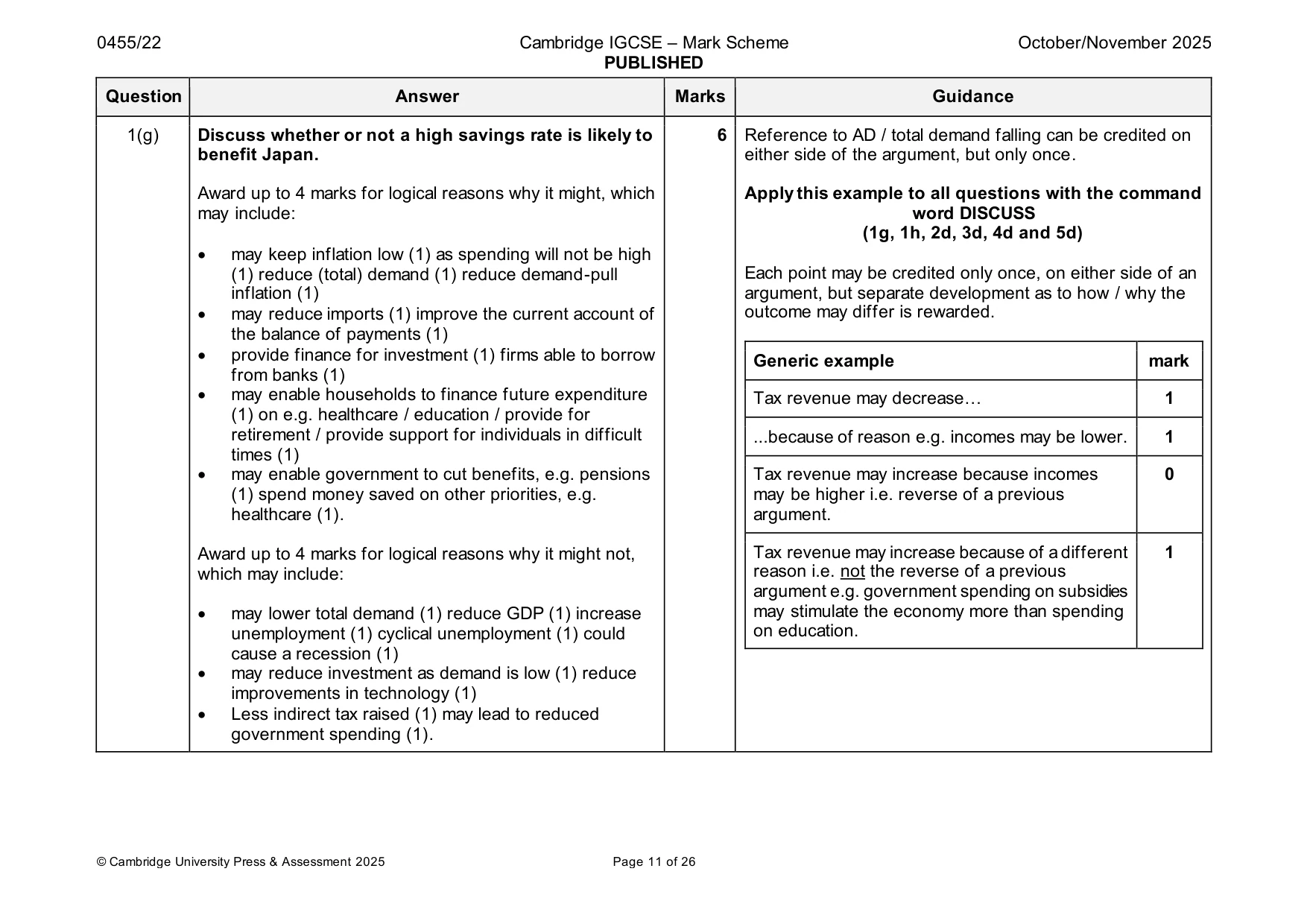
1 (a) Calculate foreign workers as a percentage of Japan’s labour force in 2022. [1] (b) Identify two reasons why Japan has a high average age of population. [2] (c) Explain why some young Japanese people emigrate. [2] (d) Explain two ways Japan could attract more foreign workers. [4] (e) Draw a demand and supply diagram to show the effect of a decrease in population on the market for furniture. [4] (f) Analyse the relationship between global GDP per head and global air passenger numbers. [5] (g) Discuss whether or not a high savings rate is likely to benefit Japan. [6] (h) Discuss whether or not labour mobility in Japan is likely to increase in the future. [6]
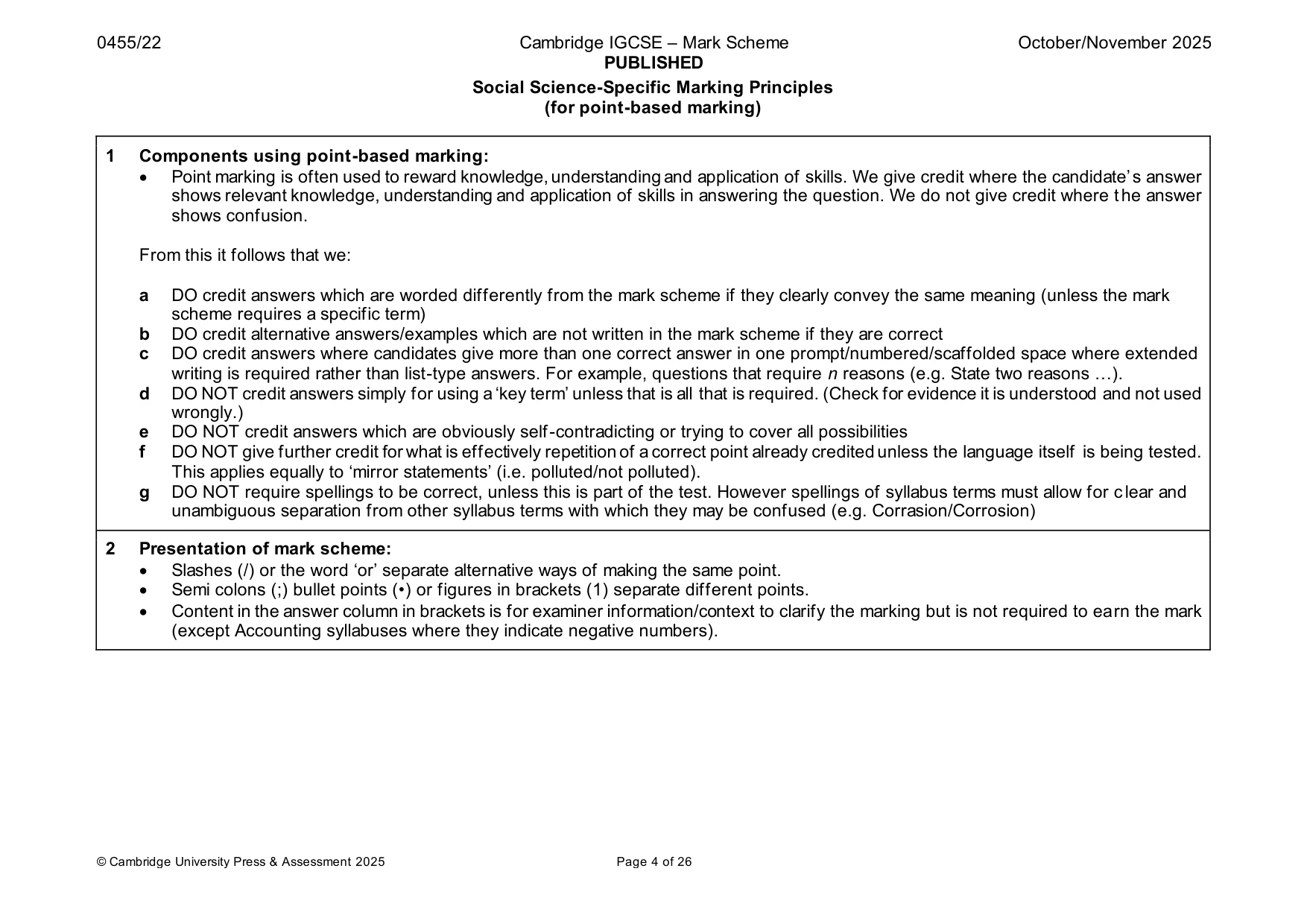
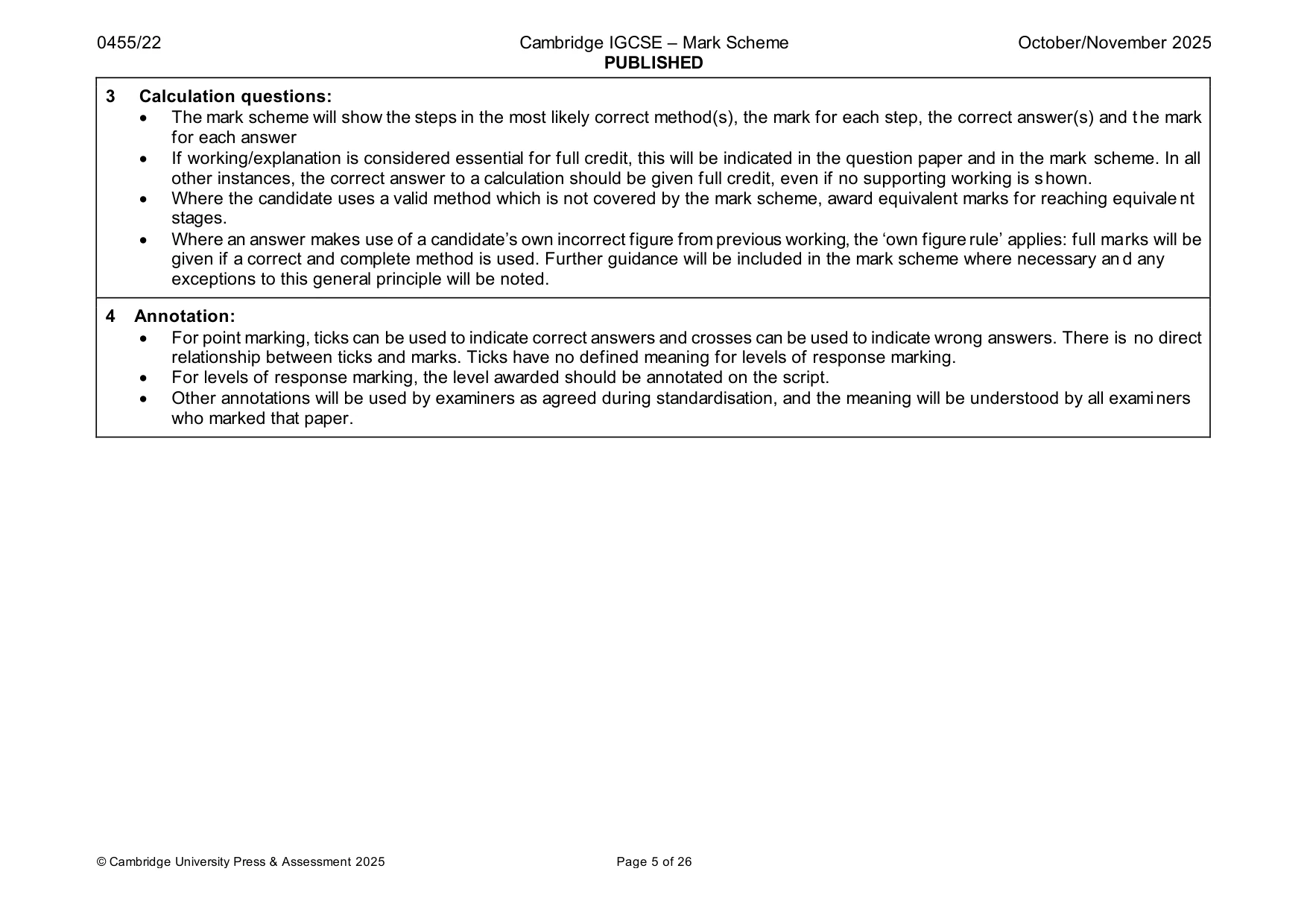
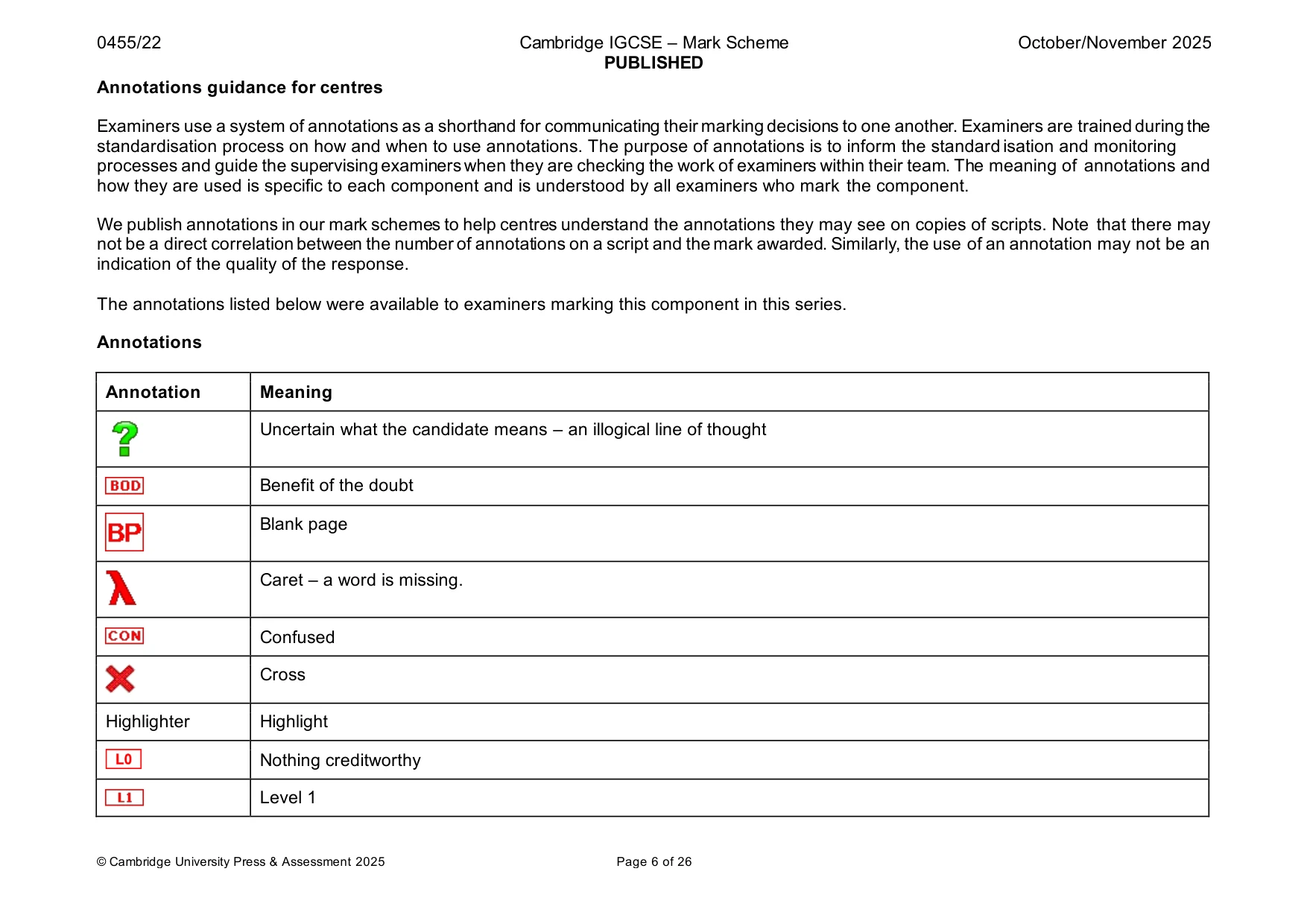
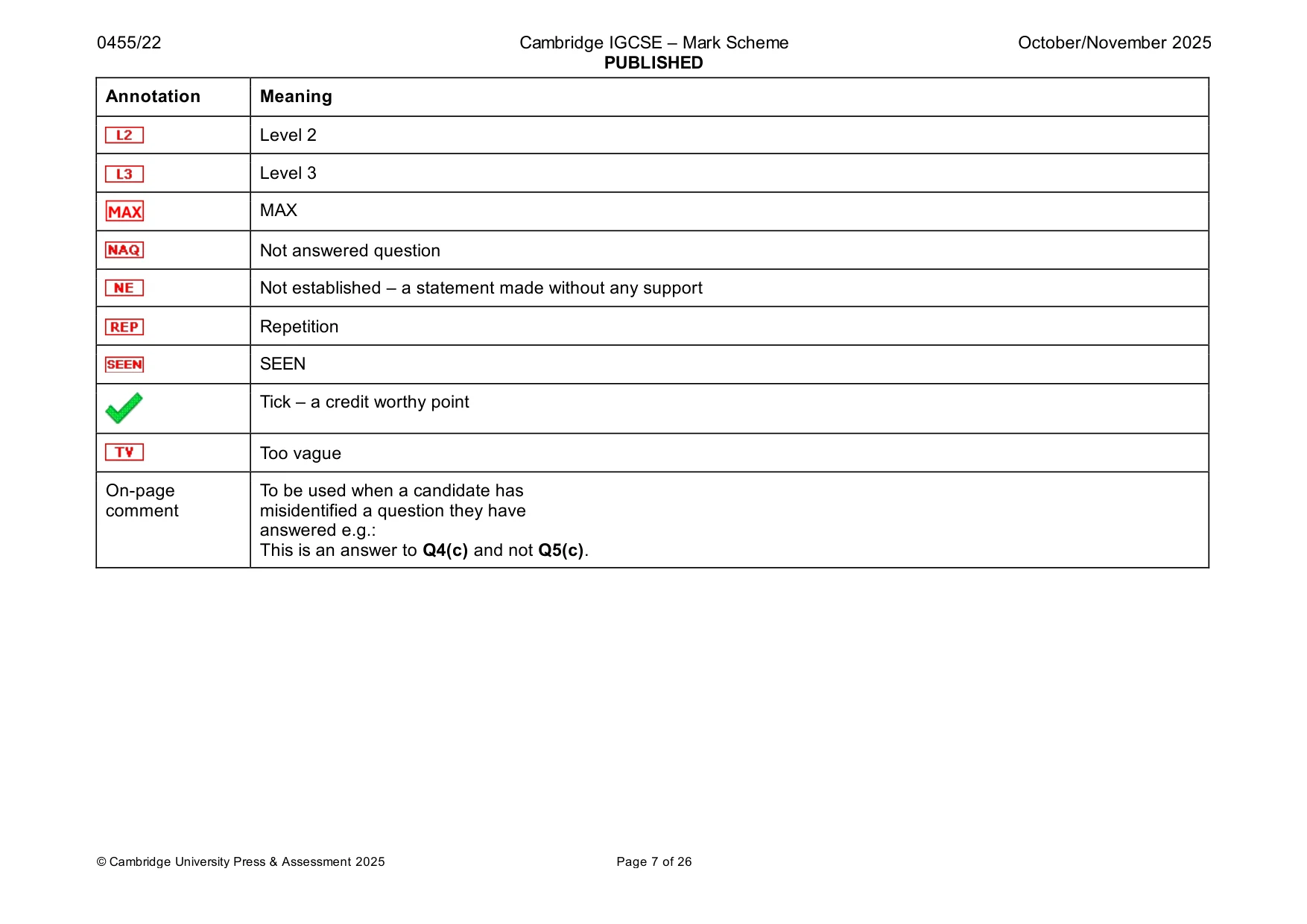
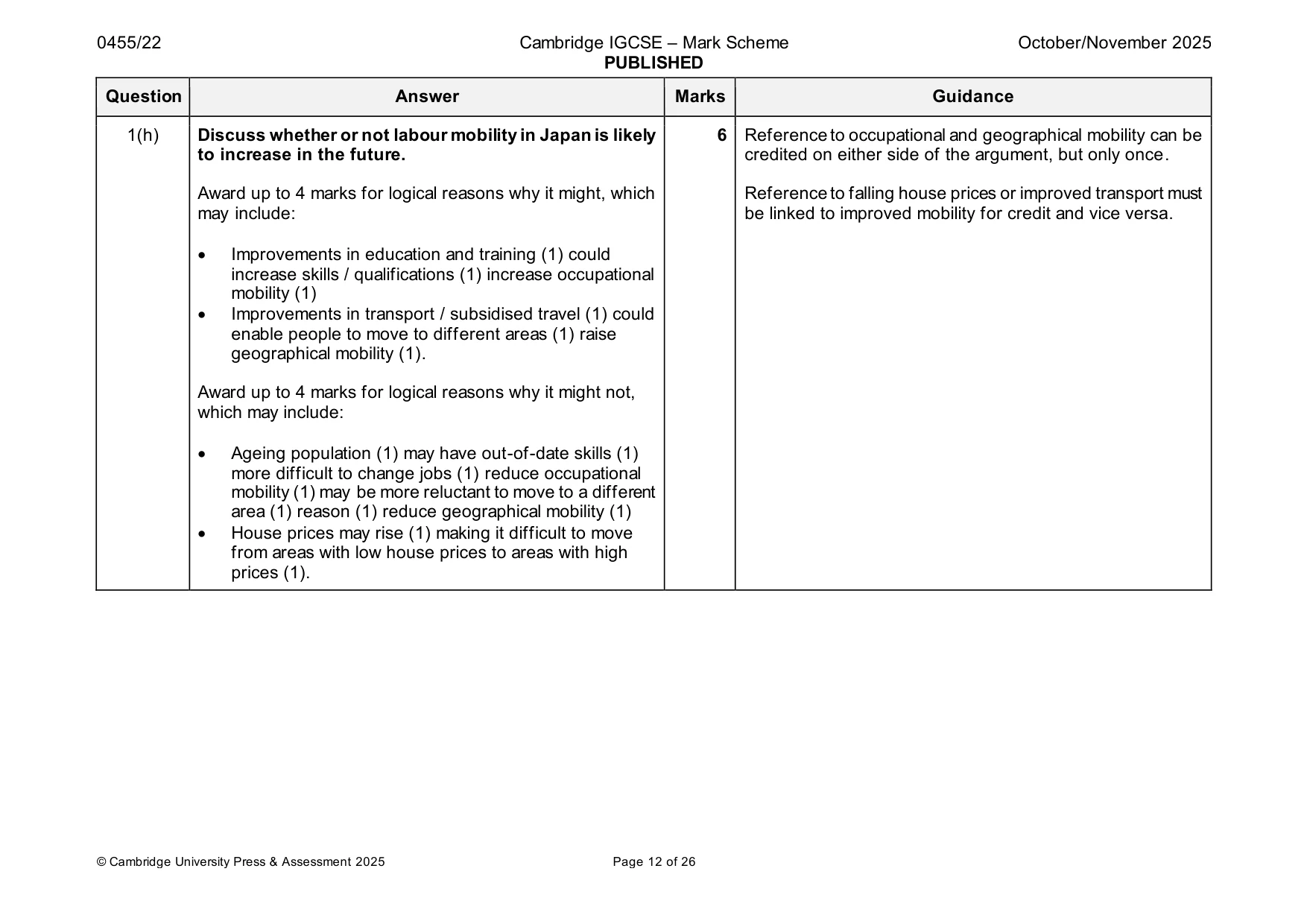
Mark scheme: Question Answer Marks Guidance 1(a) Calculate foreign workers as a percentage of Japan’s 1 Accept 2.5 without %. labour force in 2022. 2.5% (1). 1(b) Identify two reasons why Japan has a high average age 2 If more than two reasons are given, consider the first three. of population. Low birth rate (1) high life expectancy (1) good healthcare (1) young adults moving abroad (1). 1(c) Explain why some young Japanese people emigrate. 2 One mark for identification and one mark for explanation. To gain high wages (1) enjoy a better living standard / able to purchase more goods and services (1). 1(d) Explain two ways Japan could attract more foreign 4 One mark each for two ways identified and one mark each workers. for two explanations. Logical explanation which might include: If more than two ways are given, consider the first three. Only the 3 listed identifications can be credited, and • remove the Japanese language test (1) more foreigners explanation marks can only be awarded if applied to a valid would be able to work in the country (1) identification. • allow foreign workers to bring their families with them (1) foreign workers are more likely to settle in the country if they are not separated from their families (1) • allow unskilled workers to stay for more than five years (1) if gain high wages / enjoy living in the country would not want to leave / attract workers who want to live permanently in the country / give workers the opportunity to stay permanently / increase international mobility of labour (1). 1(e) Draw a demand and supply diagram to show the effect 4 of a decrease in population on the market for furniture. Coherent analysis which might include the following. D&S diagram: Axes correctly labelled – price and quantity or p and q (1). Original demand and supply curves correctly labelled (1). New demand curve shifted to the left (1). OR New supply curve shifted to the left (1). OR New demand curve shifted to the left AND new supply curve shifted to the left. Equilibriums – shown by lines P1 and Q1 and P2 and Q2 or equilibrium points marked as E1 and E2 (1). 1(f) Analyse the relationship between global GDP per head 5 Responses do not have to be in the format suggested but and global air passenger numbers. they should address the expected / normal relationship, offer supporting evidence of that, highlight any exceptions to that, Coherent analysis which might include the following. and analyse the overall data. Expected relationship: Supporting evidence should involve interpretation, not just Generally, a positive relationship (1) the higher the global description. GDP head, the higher the air passenger numbers (1). Supporting evidence: 2016–2019 GDP per head rose and air passenger numbers increased (1). Analysis of expected relationship: Higher GDP per head increases purchasing power / ability to pay for air travel (1) as people get richer, they travel more for leisure and business (1). Exception: 2021 (1) GDP per head rose but air passenger numbers decreased (1). Analysis of exception: May have been a time delay in people gaining confidence in flying after COVID-19 pandemic / other influences on demand e.g. air fares (1). 1(g) Discuss whether or not a high savings rate is likely to 6 Reference to AD / total demand falling can be credited on benefit Japan. either side of the argument, but only once. Award up to 4 marks for logical reasons why it might, which Apply this example to all questions with the command may include: word DISCUSS (1g, 1h, 2d, 3d, 4d and 5d) • may keep inflation low (1) as spending will not be high (1) reduce (total) demand (1) reduce demand-pull Each point may be credited only once, on either side of an inflation (1) argument, but separate development as to how / why the • may reduce imports (1) improve the current account of outcome may differ is rewarded. the balance of payments (1) • provide finance for investment (1) firms able to borrow Generic example mark from banks (1) • may enable households to finance future expenditure Tax revenue may decrease… 1 (1) on e.g. healthcare / education / provide for retirement / provide support for individuals in difficult ...because of reason e.g. incomes may be lower. 1 times (1) • may enable government to cut benefits, e.g. pensions Tax revenue may increase because incomes 0 (1) spend money saved on other priorities, e.g. may be higher i.e. reverse of a previous healthcare (1). argument. Award up to 4 marks for logical reasons why it might not, Tax revenue may increase because of a different 1 which may include: reason i.e. not the reverse of a previous argument e.g. government spending on subsidies • may lower total demand (1) reduce GDP (1) increase may stimulate the economy more than spending unemployment (1) cyclical unemployment (1) could on education. cause a recession (1) • may reduce investment as demand is low (1) reduce improvements in technology (1) • Less indirect tax raised (1) may lead to reduced government spending (1). 1(h) Discuss whether or not labour mobility in Japan is likely 6 Reference to occupational and geographical mobility can be to increase in the future. credited on either side of the argument, but only once. Award up to 4 marks for logical reasons why it might, which Reference to falling house prices or improved transport must may include: be linked to improved mobility for credit and vice versa. • Improvements in education and training (1) could increase skills / qualifications (1) increase occupational mobility (1) • Improvements in transport / subsidised travel (1) could enable people to move to different areas (1) raise geographical mobility (1). Award up to 4 marks for logical reasons why it might not, which may include: • Ageing population (1) may have out-of-date skills (1) more difficult to change jobs (1) reduce occupational mobility (1) may be more reluctant to move to a different area (1) reason (1) reduce geographical mobility (1) • House prices may rise (1) making it difficult to move from areas with low house prices to areas with high prices (1).
Q2 · Some markets in Belgium are in equilibrium
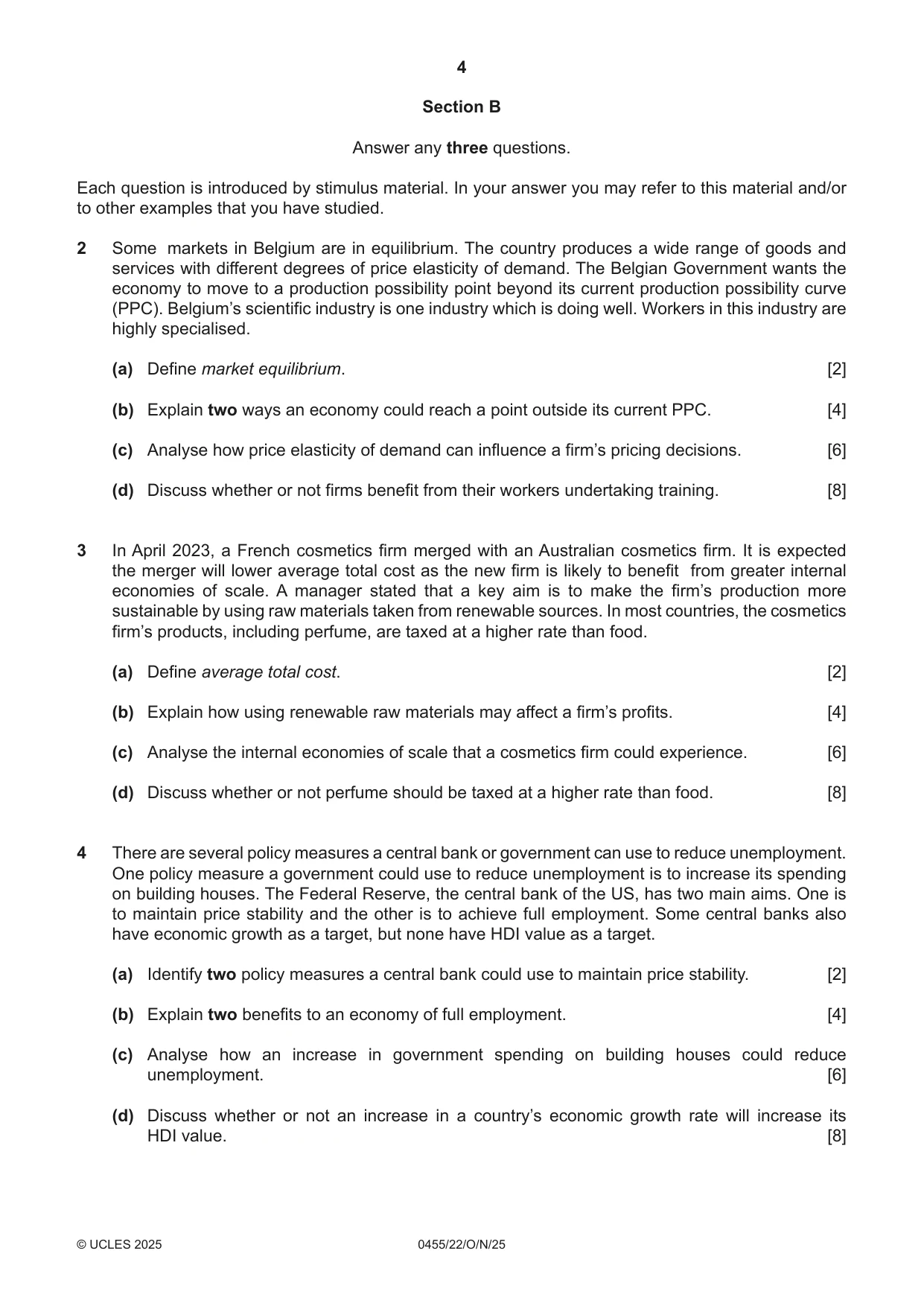
2 Some markets in Belgium are in equilibrium. The country produces a wide range of goods and services with different degrees of price elasticity of demand. The Belgian Government wants the economy to move to a production possibility point beyond its current production possibility curve (PPC). Belgium’s scientific industry is one industry which is doing well. Workers in this industry are highly specialised. (a) Define market equilibrium. [2] (b) Explain two ways an economy could reach a point outside its current PPC. [4] (c) Analyse how price elasticity of demand can influence a firm’s pricing decisions. [6] (d) Discuss whether or not firms benefit from their workers undertaking training. [8]
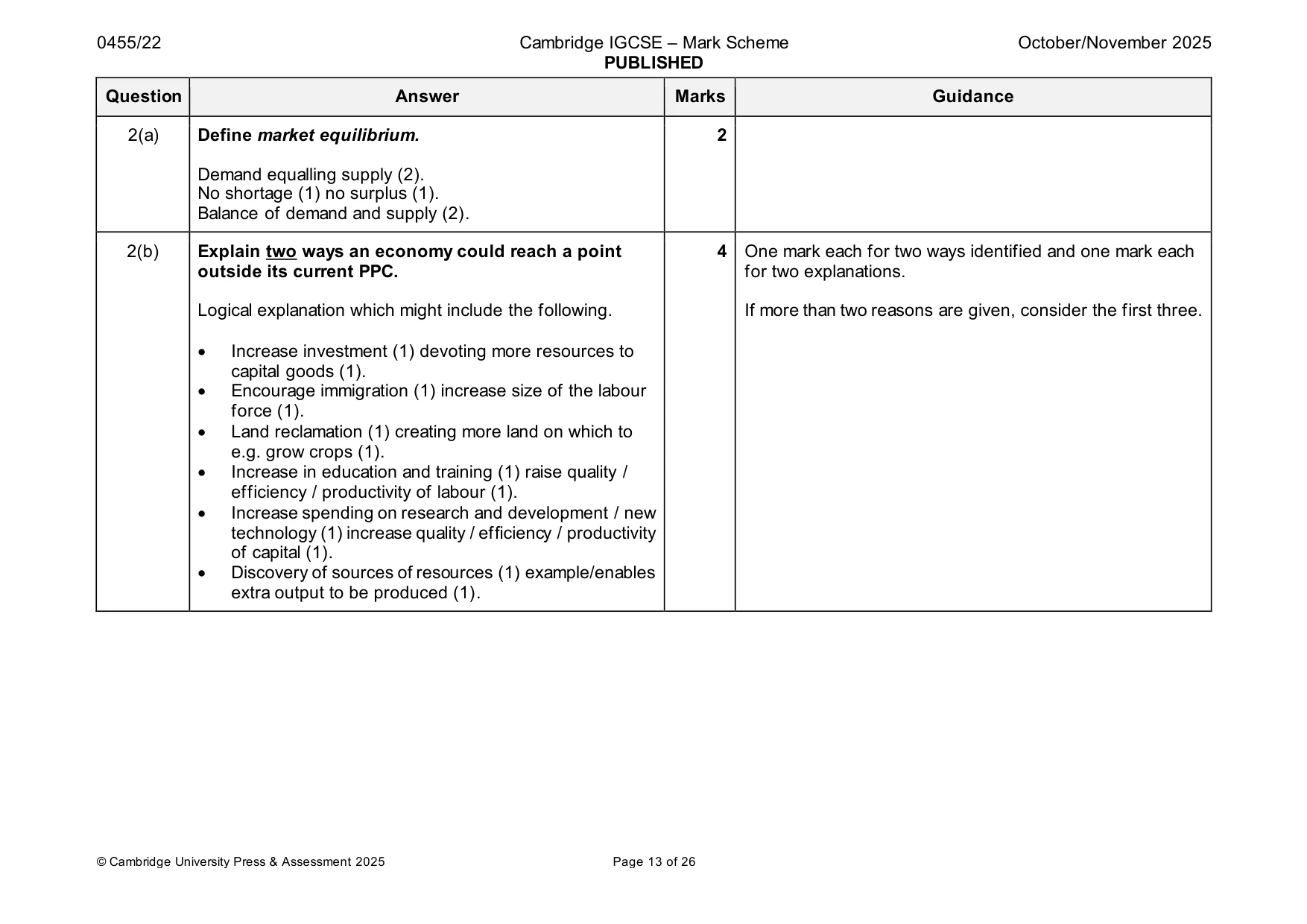
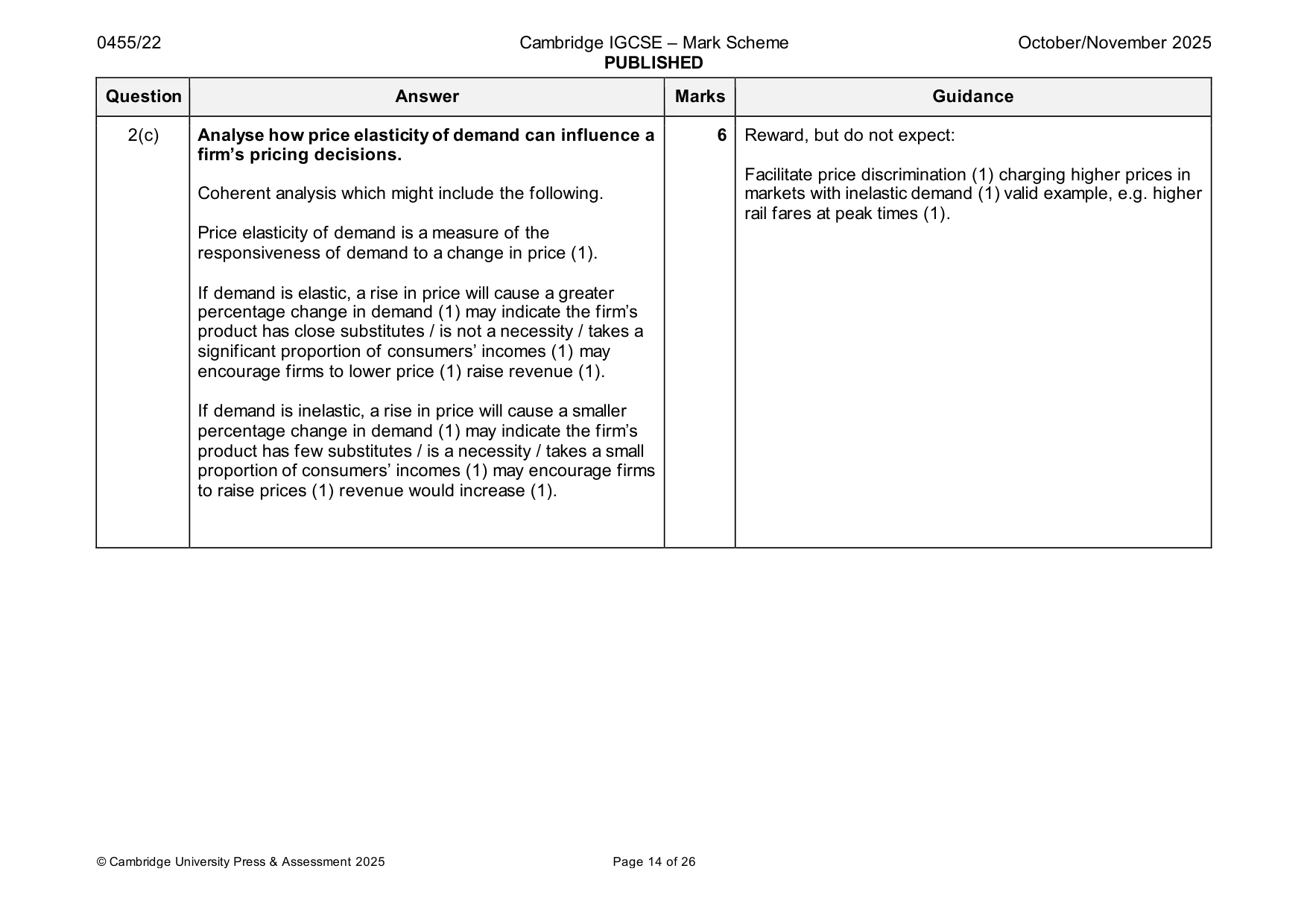
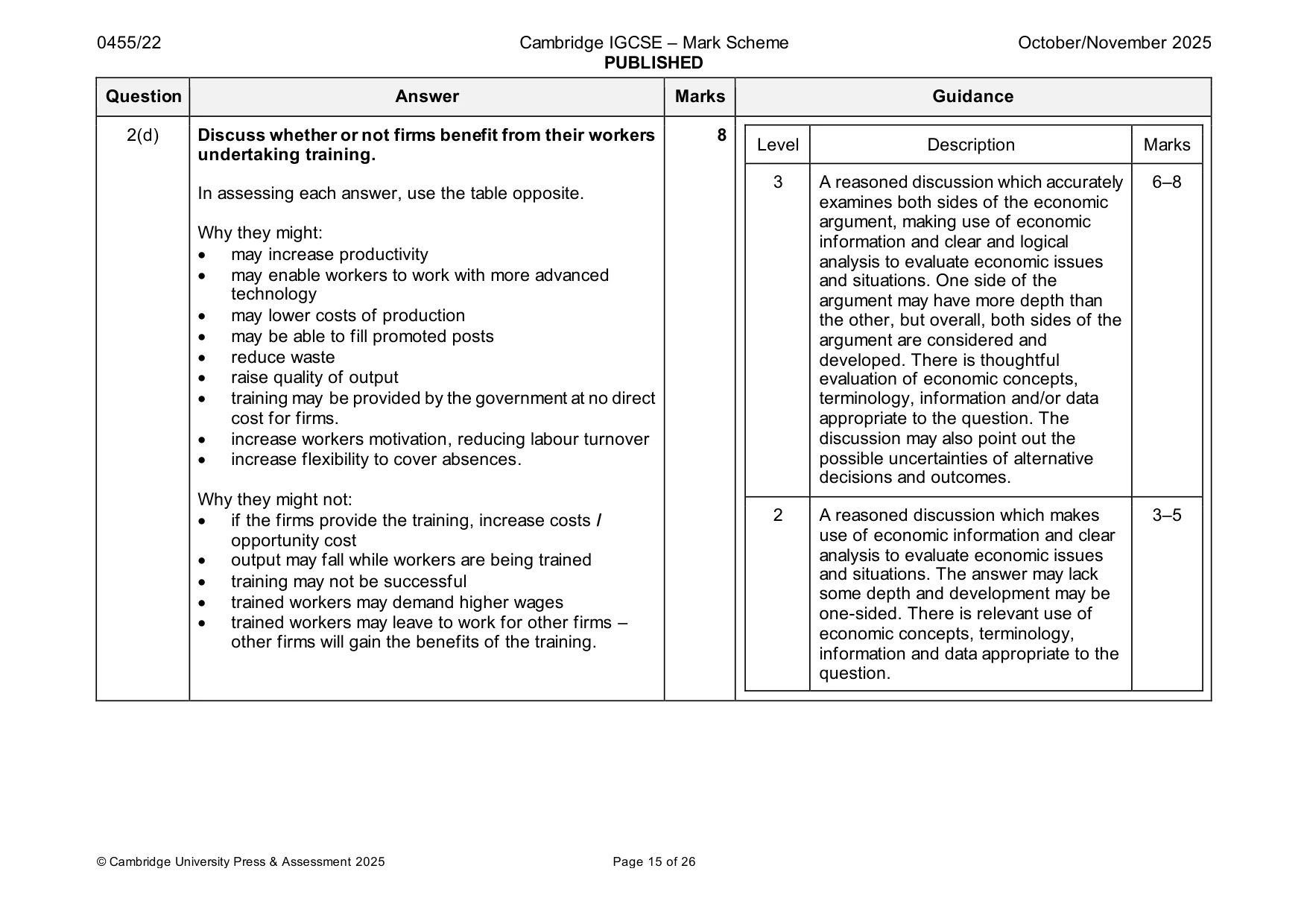
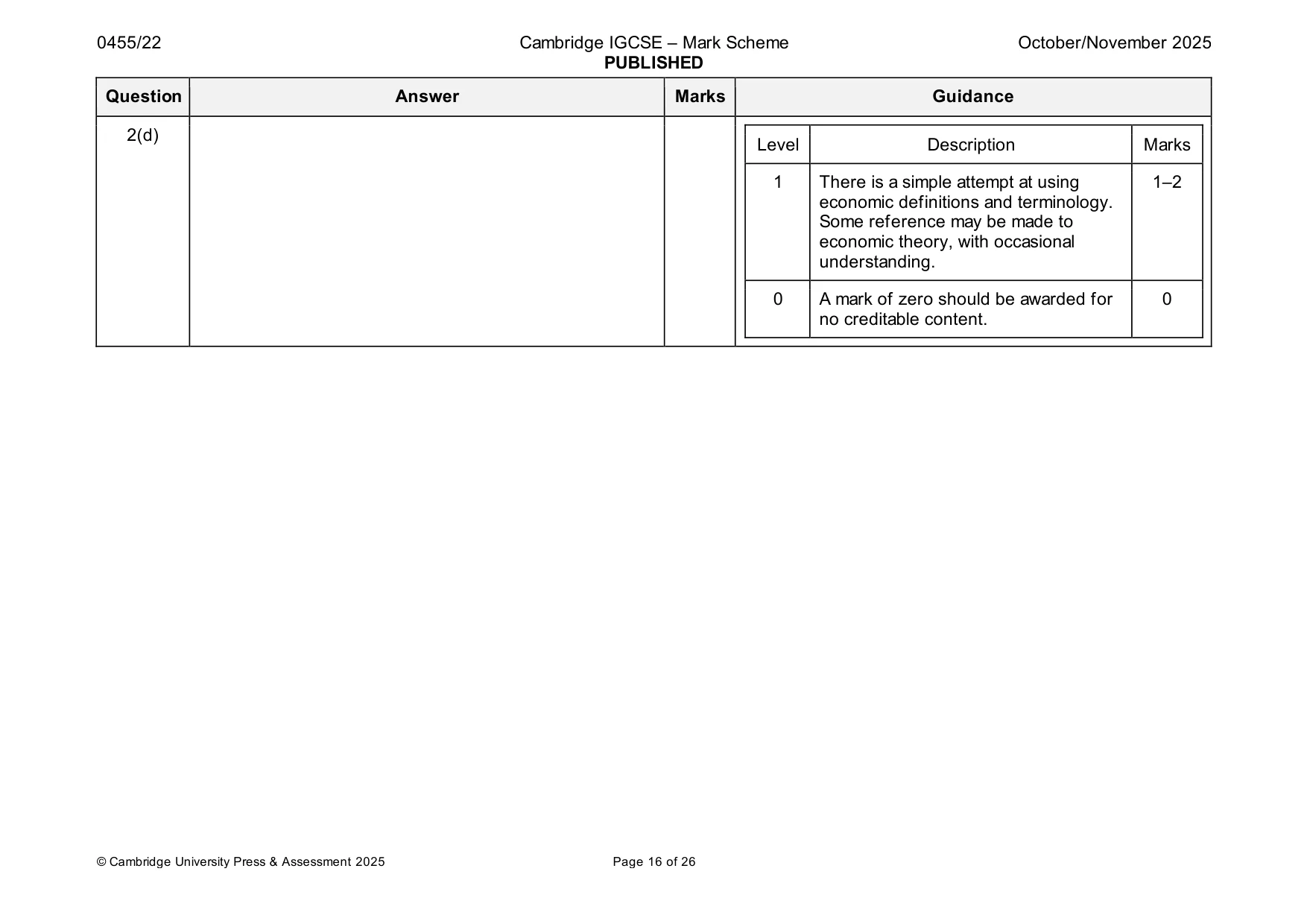
Mark scheme: 2(a) Define market equilibrium. 2 Demand equalling supply (2). No shortage (1) no surplus (1). Balance of demand and supply (2). 2(b) Explain two ways an economy could reach a point 4 One mark each for two ways identified and one mark each outside its current PPC. for two explanations. Logical explanation which might include the following. If more than two reasons are given, consider the first three. • Increase investment (1) devoting more resources to capital goods (1). • Encourage immigration (1) increase size of the labour force (1). • Land reclamation (1) creating more land on which to e.g. grow crops (1). • Increase in education and training (1) raise quality / efficiency / productivity of labour (1). • Increase spending on research and development / new technology (1) increase quality / efficiency / productivity of capital (1). • Discovery of sources of resources (1) example/enables extra output to be produced (1). 2(c) Analyse how price elasticity of demand can influence a 6 Reward, but do not expect: firm’s pricing decisions. Facilitate price discrimination (1) charging higher prices in Coherent analysis which might include the following. markets with inelastic demand (1) valid example, e.g. higher rail fares at peak times (1). Price elasticity of demand is a measure of the responsiveness of demand to a change in price (1). If demand is elastic, a rise in price will cause a greater percentage change in demand (1) may indicate the firm’s product has close substitutes / is not a necessity / takes a significant proportion of consumers’ incomes (1) may encourage firms to lower price (1) raise revenue (1). If demand is inelastic, a rise in price will cause a smaller percentage change in demand (1) may indicate the firm’s product has few substitutes / is a necessity / takes a small proportion of consumers’ incomes (1) may encourage firms to raise prices (1) revenue would increase (1). 2(d) Discuss whether or not firms benefit from their workers 8 Level Description Marks undertaking training. 3 A reasoned discussion which accurately 6–8 In assessing each answer, use the table opposite. examines both sides of the economic argument, making use of economic Why they might: information and clear and logical • may increase productivity analysis to evaluate economic issues • may enable workers to work with more advanced and situations. One side of the technology argument may have more depth than • may lower costs of production the other, but overall, both sides of the • may be able to fill promoted posts argument are considered and • reduce waste developed. There is thoughtful • raise quality of output evaluation of economic concepts, • training may be provided by the government at no direct terminology, information and/or data cost for firms. appropriate to the question. The • increase workers motivation, reducing labour turnover discussion may also point out the • increase flexibility to cover absences. possible uncertainties of alternative decisions and outcomes. Why they might not: • if the firms provide the training, increase costs / 2 A reasoned discussion which makes 3–5 use of economic information and clear opportunity cost • output may fall while workers are being trained analysis to evaluate economic issues and situations. The answer may lack • training may not be successful some depth and development may be • trained workers may demand higher wages one-sided. There is relevant use of • trained workers may leave to work for other firms – economic concepts, terminology, other firms will gain the benefits of the training. information and data appropriate to the question. 2(d) Level Description Marks 1 There is a simple attempt at using 1–2 economic definitions and terminology. Some reference may be made to economic theory, with occasional understanding. 0 A mark of zero should be awarded for 0 no creditable content.
Q3 · In April 2023, a French cosmetics firm merged with an Australian cosmetics firm
3 In April 2023, a French cosmetics firm merged with an Australian cosmetics firm. It is expected the merger will lower average total cost as the new firm is likely to benefit from greater internal economies of scale. A manager stated that a key aim is to make the firm’s production more sustainable by using raw materials taken from renewable sources. In most countries, the cosmetics firm’s products, including perfume, are taxed at a higher rate than food. (a) Define average total cost. [2] (b) Explain how using renewable raw materials may affect a firm’s profits. [4] (c) Analyse the internal economies of scale that a cosmetics firm could experience. [6] (d) Discuss whether or not perfume should be taxed at a higher rate than food. [8]
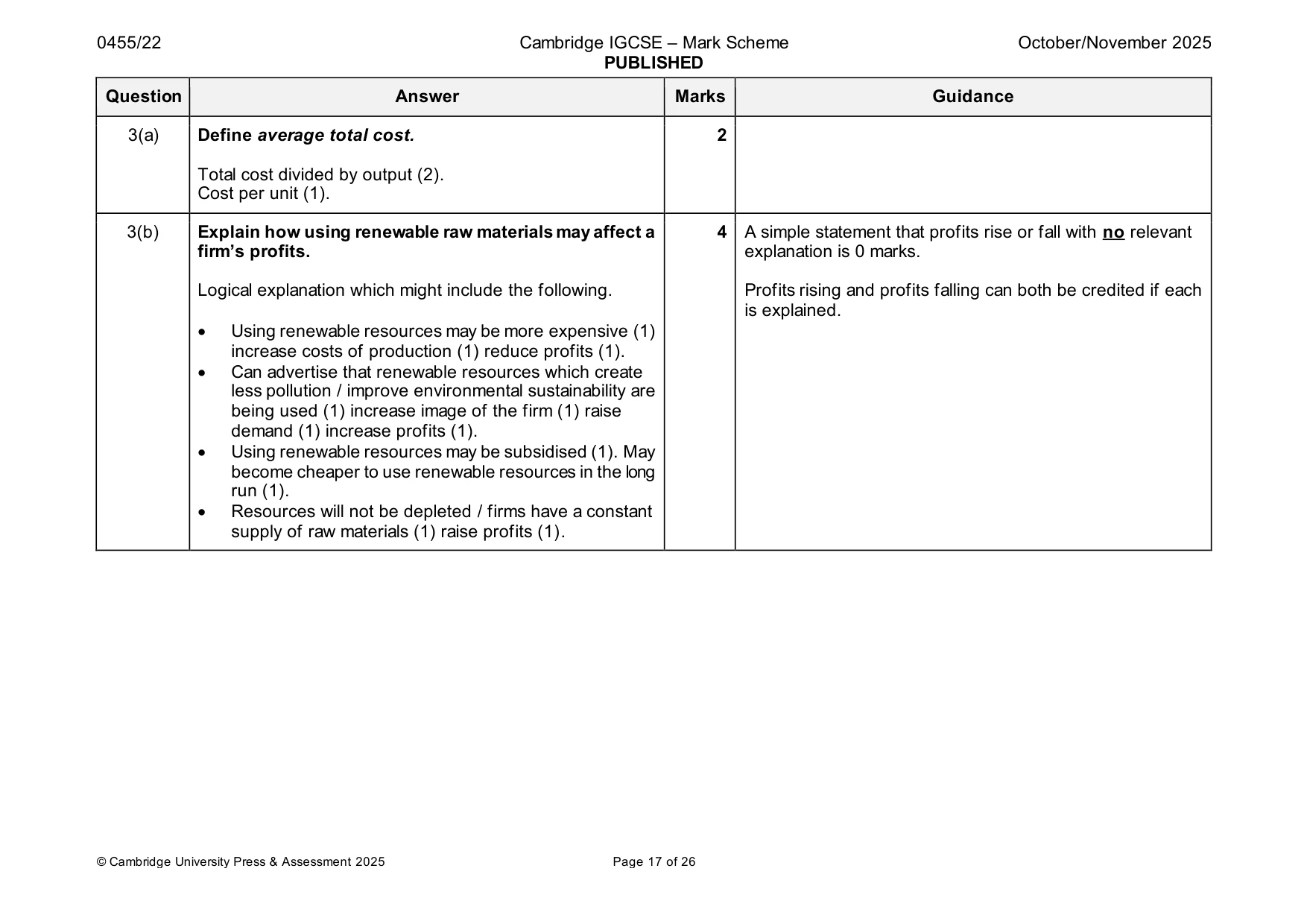
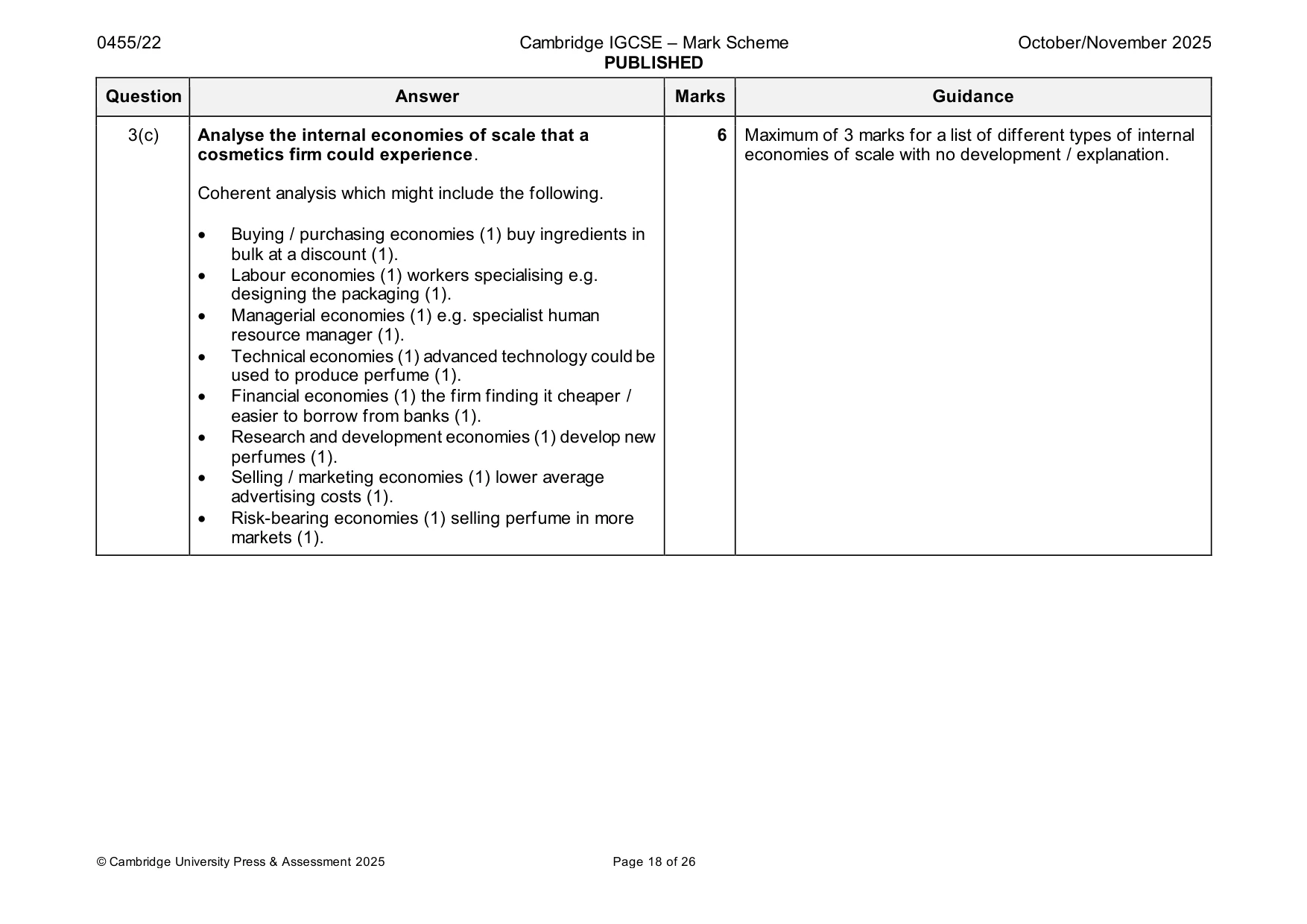
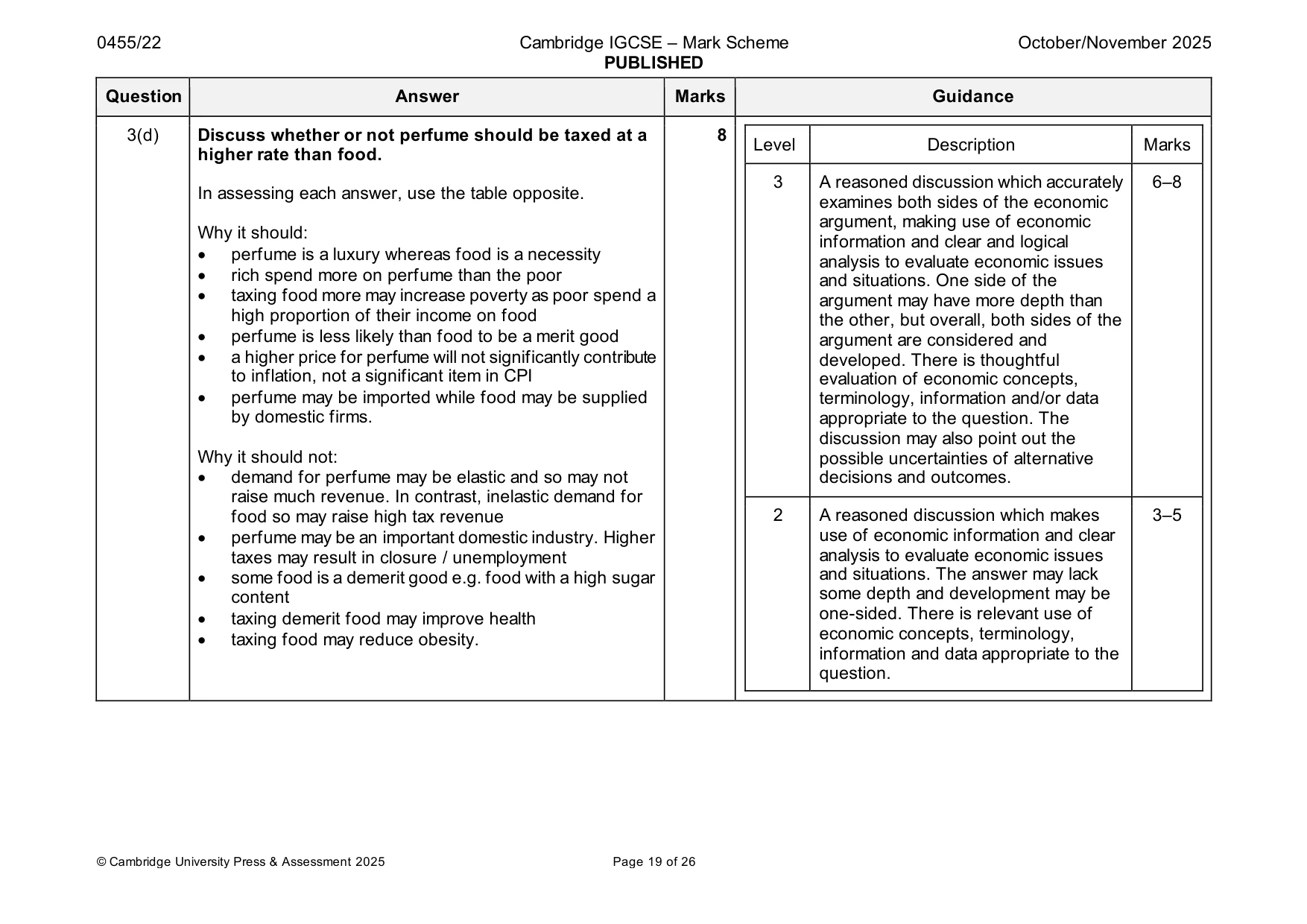
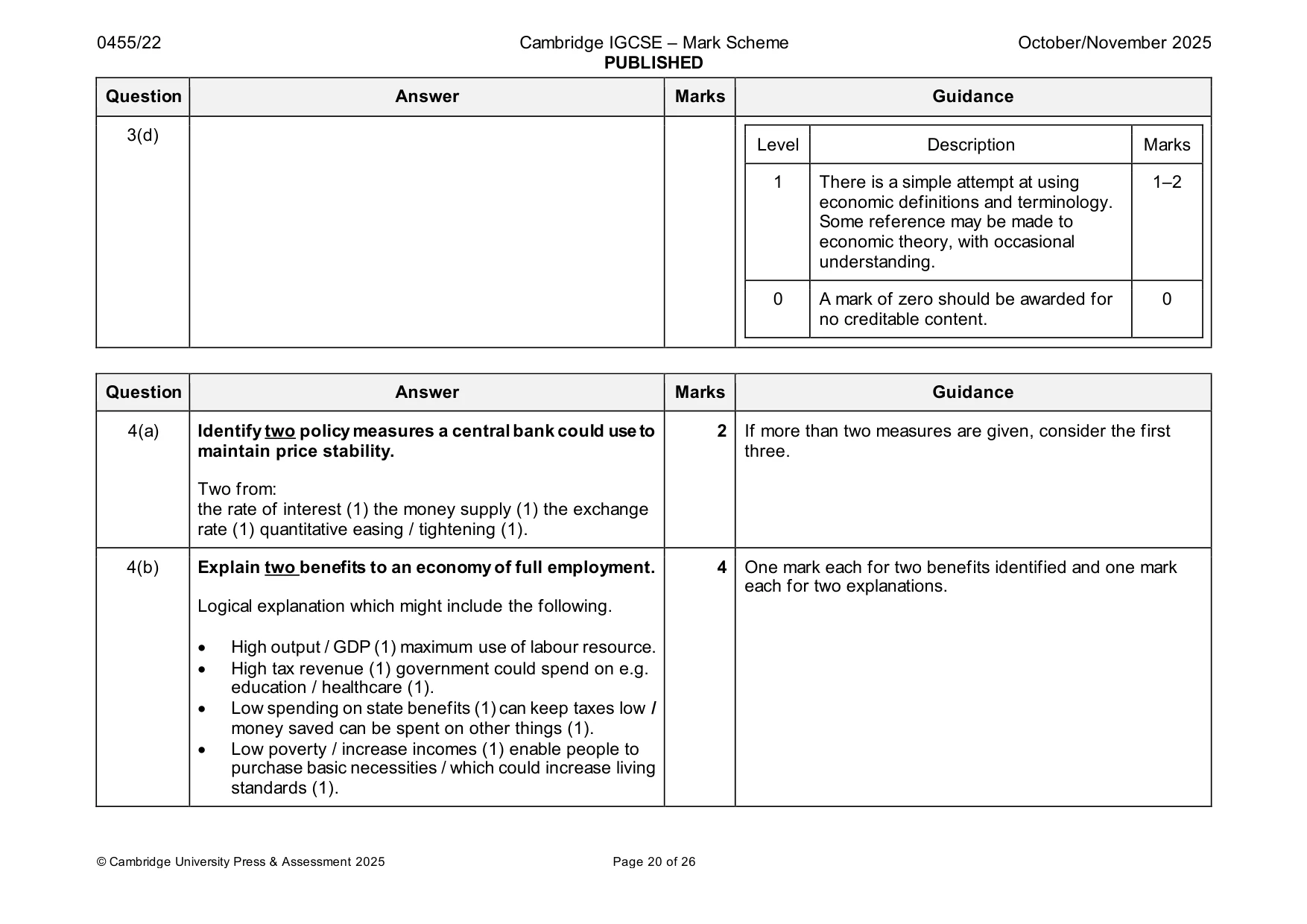
Mark scheme: 3(a) Define average total cost. 2 Total cost divided by output (2). Cost per unit (1). 3(b) Explain how using renewable raw materials may affect a 4 A simple statement that profits rise or fall with no relevant firm’s profits. explanation is 0 marks. Logical explanation which might include the following. Profits rising and profits falling can both be credited if each is explained. • Using renewable resources may be more expensive (1) increase costs of production (1) reduce profits (1). • Can advertise that renewable resources which create less pollution / improve environmental sustainability are being used (1) increase image of the firm (1) raise demand (1) increase profits (1). • Using renewable resources may be subsidised (1). May become cheaper to use renewable resources in the long run (1). • Resources will not be depleted / firms have a constant supply of raw materials (1) raise profits (1). 3(c) Analyse the internal economies of scale that a 6 Maximum of 3 marks for a list of different types of internal cosmetics firm could experience. economies of scale with no development / explanation. Coherent analysis which might include the following. • Buying / purchasing economies (1) buy ingredients in bulk at a discount (1). • Labour economies (1) workers specialising e.g. designing the packaging (1). • Managerial economies (1) e.g. specialist human resource manager (1). • Technical economies (1) advanced technology could be used to produce perfume (1). • Financial economies (1) the firm finding it cheaper / easier to borrow from banks (1). • Research and development economies (1) develop new perfumes (1). • Selling / marketing economies (1) lower average advertising costs (1). • Risk-bearing economies (1) selling perfume in more markets (1). 3(d) Discuss whether or not perfume should be taxed at a 8 Level Description Marks higher rate than food. 3 A reasoned discussion which accurately 6–8 In assessing each answer, use the table opposite. examines both sides of the economic argument, making use of economic Why it should: information and clear and logical • perfume is a luxury whereas food is a necessity analysis to evaluate economic issues • rich spend more on perfume than the poor and situations. One side of the • taxing food more may increase poverty as poor spend a argument may have more depth than high proportion of their income on food the other, but overall, both sides of the • perfume is less likely than food to be a merit good argument are considered and • a higher price for perfume will not significantly contribute developed. There is thoughtful to inflation, not a significant item in CPI evaluation of economic concepts, • perfume may be imported while food may be supplied terminology, information and/or data by domestic firms. appropriate to the question. The discussion may also point out the Why it should not: possible uncertainties of alternative • demand for perfume may be elastic and so may not decisions and outcomes. raise much revenue. In contrast, inelastic demand for food so may raise high tax revenue 2 A reasoned discussion which makes 3–5 • perfume may be an important domestic industry. Higher use of economic information and clear taxes may result in closure / unemployment analysis to evaluate economic issues • some food is a demerit good e.g. food with a high sugar and situations. The answer may lack content some depth and development may be • taxing demerit food may improve health one-sided. There is relevant use of • taxing food may reduce obesity. economic concepts, terminology, information and data appropriate to the question. 3(d) Level Description Marks 1 There is a simple attempt at using 1–2 economic definitions and terminology. Some reference may be made to economic theory, with occasional understanding. 0 A mark of zero should be awarded for 0 no creditable content.
Q4 · There are several policy measures a central bank or government can use to reduce…
4 There are several policy measures a central bank or government can use to reduce unemployment. One policy measure a government could use to reduce unemployment is to increase its spending on building houses. The Federal Reserve, the central bank of the US, has two main aims. One is to maintain price stability and the other is to achieve full employment. Some central banks also have economic growth as a target, but none have HDI value as a target. (a) Identify two policy measures a central bank could use to maintain price stability. [2] (b) Explain two benefits to an economy of full employment. [4] (c) Analyse how an increase in government spending on building houses could reduce unemployment. [6] (d) Discuss whether or not an increase in a country’s economic growth rate will increase its HDI value. [8]
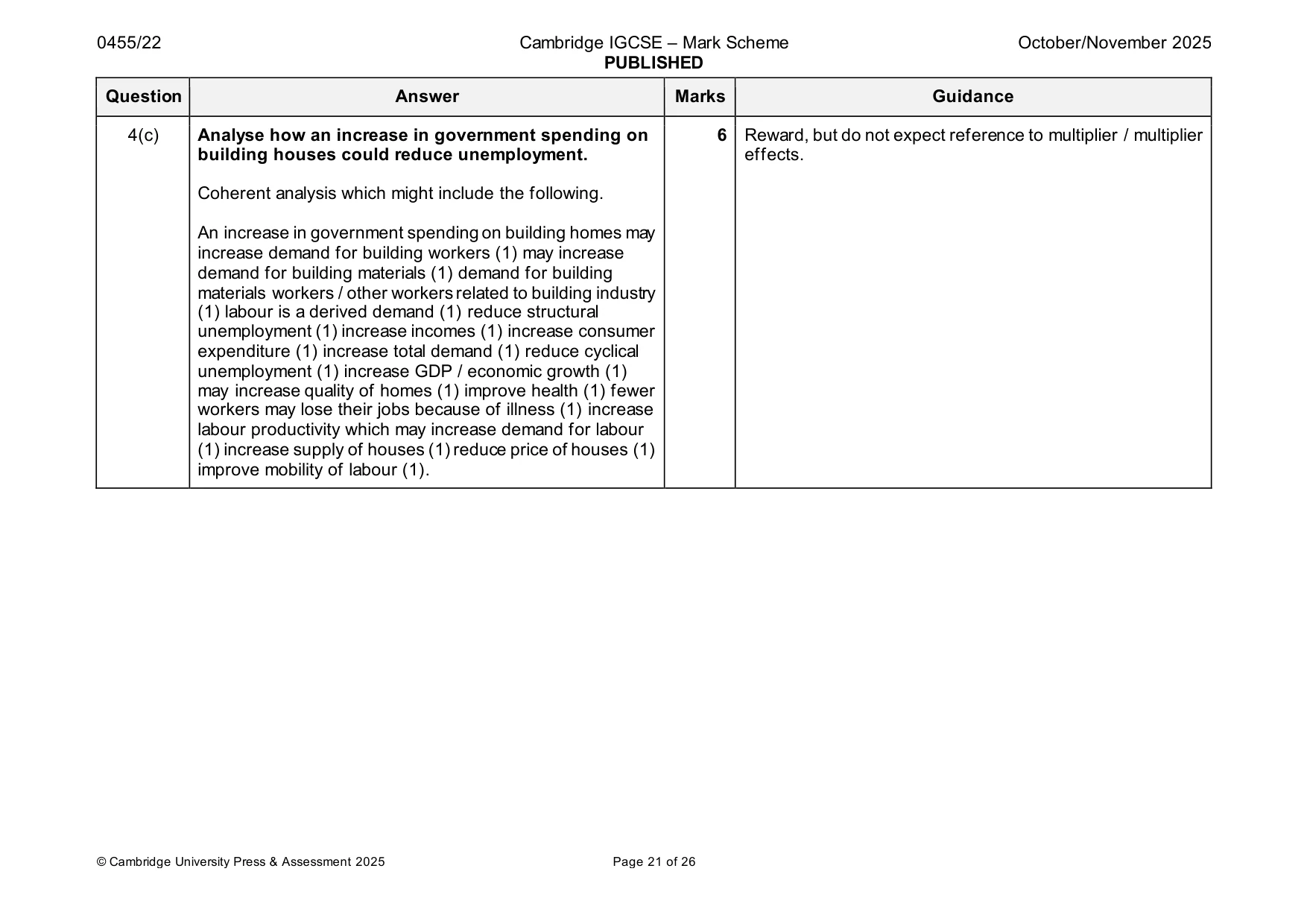
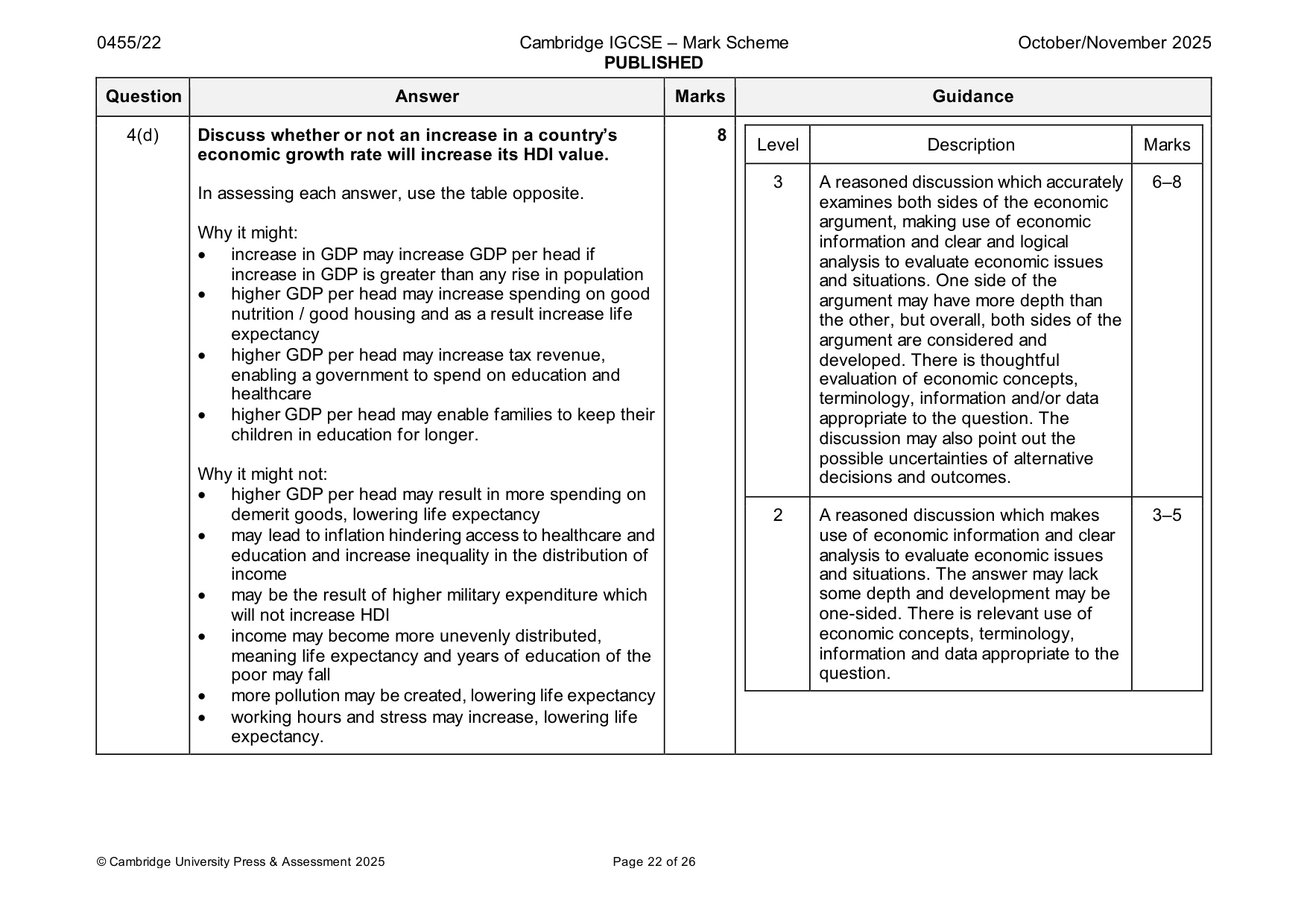
Mark scheme: 4(a) Identify two policy measures a central bank could use to 2 If more than two measures are given, consider the first maintain price stability. three. Two from: the rate of interest (1) the money supply (1) the exchange rate (1) quantitative easing / tightening (1). 4(b) Explain two benefits to an economy of full employment. 4 One mark each for two benefits identified and one mark each for two explanations. Logical explanation which might include the following. • High output / GDP (1) maximum use of labour resource. • High tax revenue (1) government could spend on e.g. education / healthcare (1). • Low spending on state benefits (1) can keep taxes low / money saved can be spent on other things (1). • Low poverty / increase incomes (1) enable people to purchase basic necessities / which could increase living standards (1). 4(c) Analyse how an increase in government spending on 6 Reward, but do not expect reference to multiplier / multiplier building houses could reduce unemployment. effects. Coherent analysis which might include the following. An increase in government spending on building homes may increase demand for building workers (1) may increase demand for building materials (1) demand for building materials workers / other workers related to building industry (1) labour is a derived demand (1) reduce structural unemployment (1) increase incomes (1) increase consumer expenditure (1) increase total demand (1) reduce cyclical unemployment (1) increase GDP / economic growth (1) may increase quality of homes (1) improve health (1) fewer workers may lose their jobs because of illness (1) increase labour productivity which may increase demand for labour (1) increase supply of houses (1) reduce price of houses (1) improve mobility of labour (1). 4(d) Discuss whether or not an increase in a country’s 8 Level Description Marks economic growth rate will increase its HDI value. 3 A reasoned discussion which accurately 6–8 In assessing each answer, use the table opposite. examines both sides of the economic argument, making use of economic Why it might: information and clear and logical • increase in GDP may increase GDP per head if analysis to evaluate economic issues increase in GDP is greater than any rise in population and situations. One side of the • higher GDP per head may increase spending on good argument may have more depth than nutrition / good housing and as a result increase life the other, but overall, both sides of the expectancy argument are considered and • higher GDP per head may increase tax revenue, developed. There is thoughtful enabling a government to spend on education and evaluation of economic concepts, healthcare terminology, information and/or data • higher GDP per head may enable families to keep their appropriate to the question. The children in education for longer. discussion may also point out the possible uncertainties of alternative Why it might not: decisions and outcomes. • higher GDP per head may result in more spending on demerit goods, lowering life expectancy 2 A reasoned discussion which makes 3–5 • may lead to inflation hindering access to healthcare and use of economic information and clear education and increase inequality in the distribution of analysis to evaluate economic issues income and situations. The answer may lack • may be the result of higher military expenditure which some depth and development may be will not increase HDI one-sided. There is relevant use of • income may become more unevenly distributed, economic concepts, terminology, meaning life expectancy and years of education of the information and data appropriate to the poor may fall question. • more pollution may be created, lowering life expectancy • working hours and stress may increase, lowering life expectancy. 4(d) Level Description Marks 1 There is a simple attempt at using 1–2 economic definitions and terminology. Some reference may be made to economic theory, with occasional understanding. 0 A mark of zero should be awarded for 0 no creditable content.
Q5 · Some countries engage in dumping by selling their products at less than cost price in…
5 Some countries engage in dumping by selling their products at less than cost price in Cambodia. The Cambodian Government wants the country to become a high-income economy by 2050. It uses fiscal, monetary and supply-side policies to increase its economic growth rate. Cambodia subsidises some infant industries. The country has one of the world’s largest deficits on the current account of its balance of payments (as a percentage of GDP). Some economists suggest cutting taxes would reduce this deficit. (a) Identify two motives for a firm dumping some of its products in a foreign market. [2] (b) Explain two differences between monetary policy and supply-side policy. [4] (c) Analyse how a government subsidy could help to protect an infant industry against foreign competition. [6] (d) Discuss whether or not cuts in taxes will reduce a deficit on the current account of a country’s balance of payments. [8]
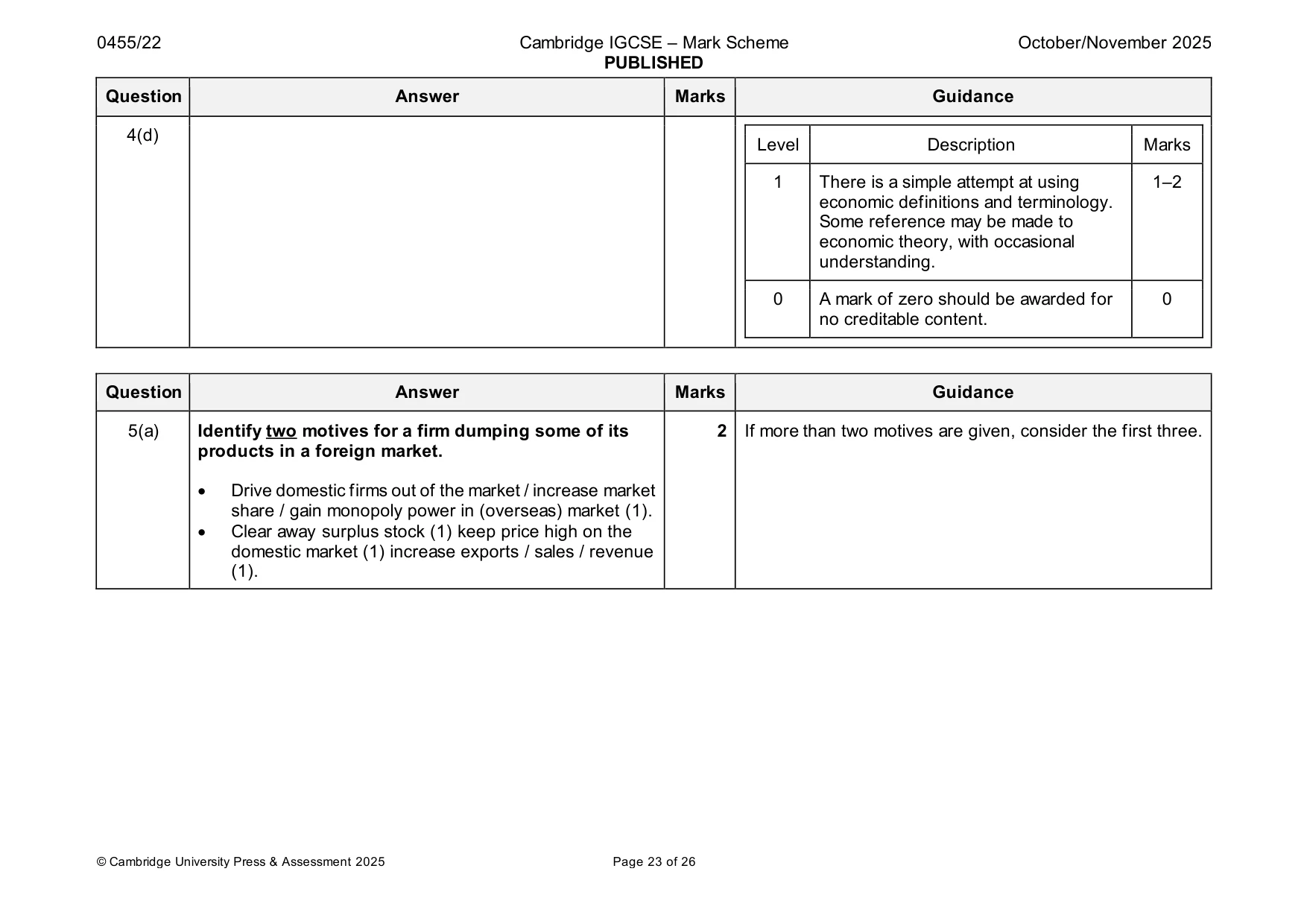
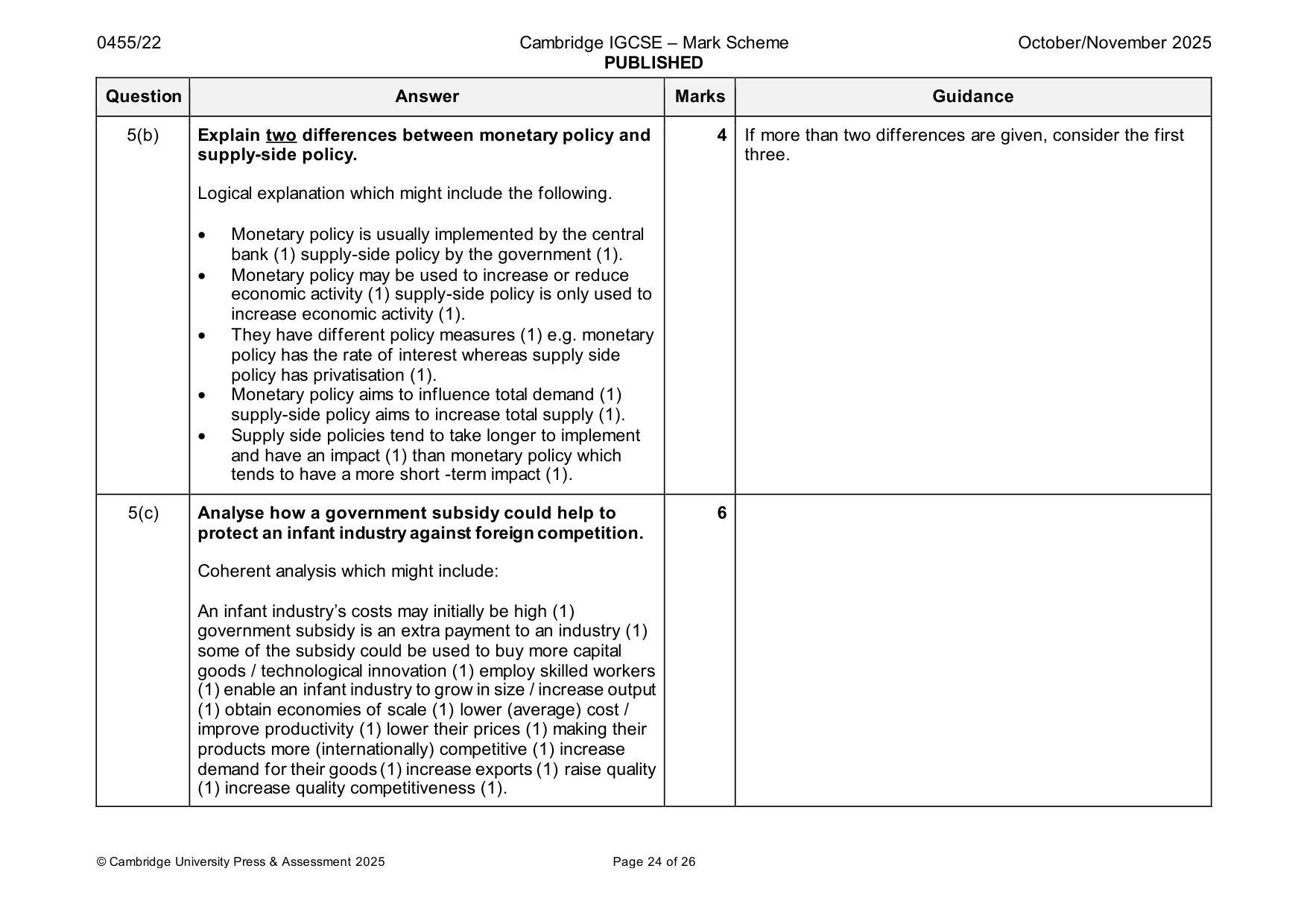
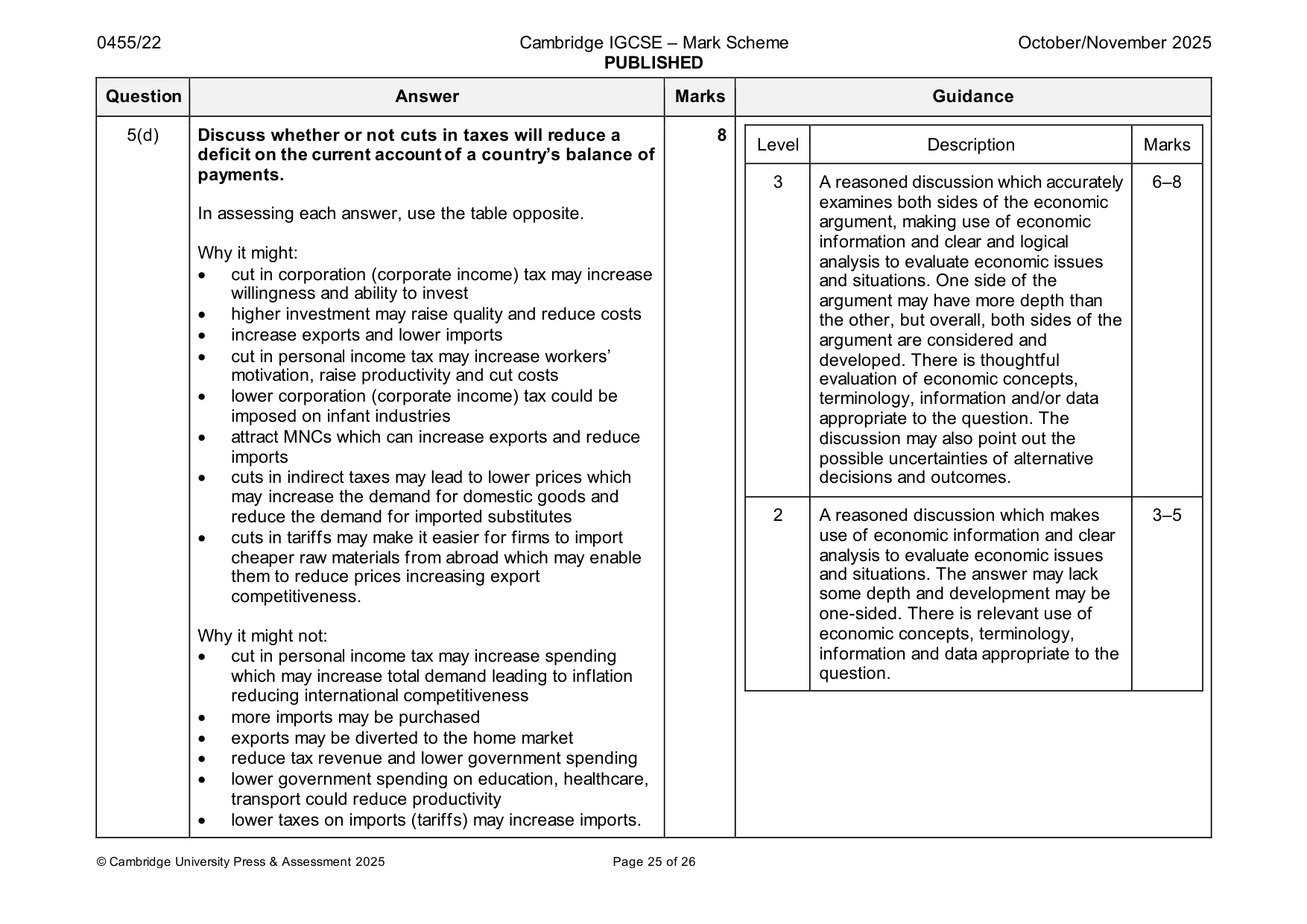
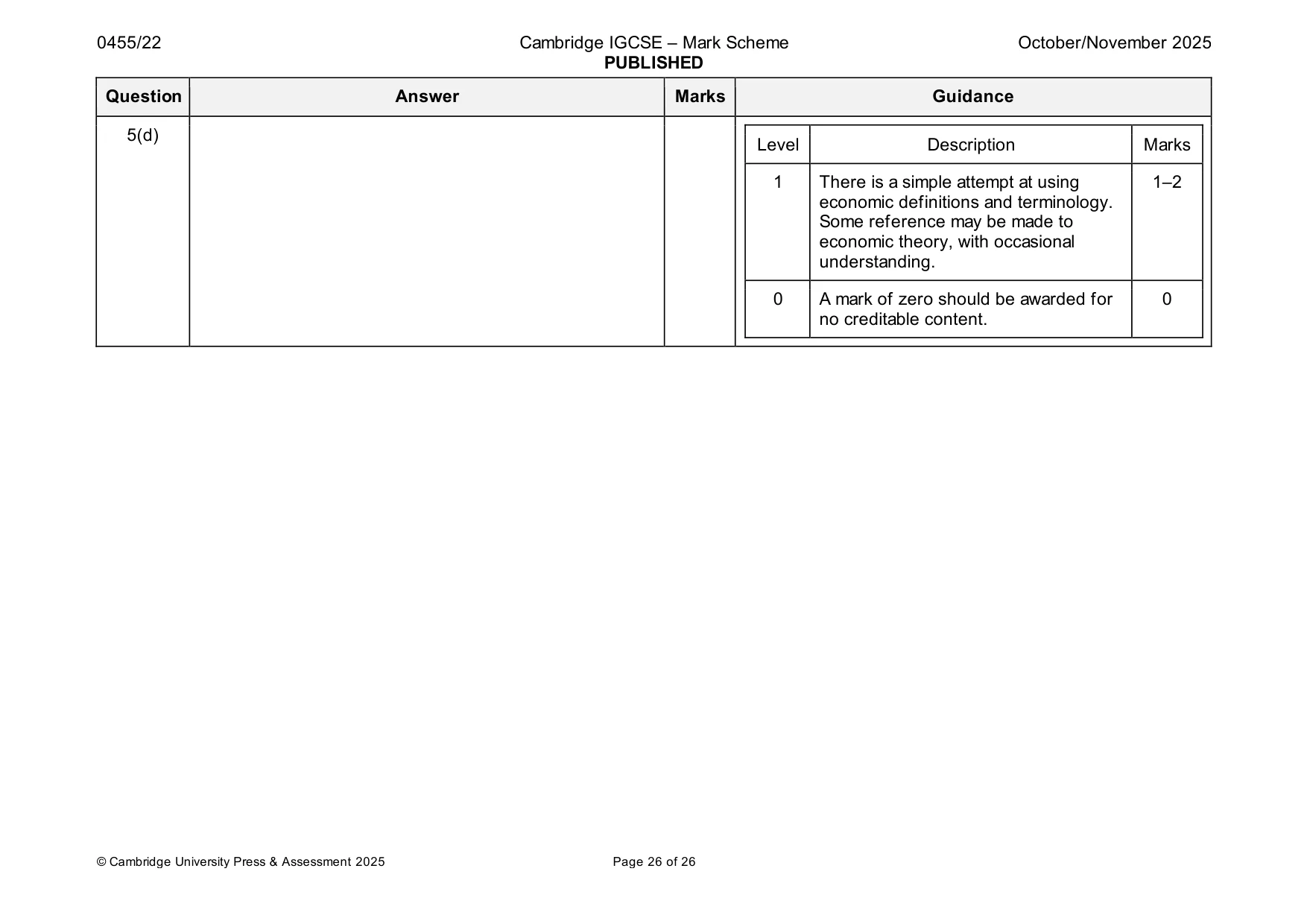
Mark scheme: 5(a) Identify two motives for a firm dumping some of its 2 If more than two motives are given, consider the first three. products in a foreign market. • Drive domestic firms out of the market / increase market share / gain monopoly power in (overseas) market (1). • Clear away surplus stock (1) keep price high on the domestic market (1) increase exports / sales / revenue (1). 5(b) Explain two differences between monetary policy and 4 If more than two differences are given, consider the first supply-side policy. three. Logical explanation which might include the following. • Monetary policy is usually implemented by the central bank (1) supply-side policy by the government (1). • Monetary policy may be used to increase or reduce economic activity (1) supply-side policy is only used to increase economic activity (1). • They have different policy measures (1) e.g. monetary policy has the rate of interest whereas supply side policy has privatisation (1). • Monetary policy aims to influence total demand (1) supply-side policy aims to increase total supply (1). • Supply side policies tend to take longer to implement and have an impact (1) than monetary policy which tends to have a more short -term impact (1). 5(c) Analyse how a government subsidy could help to 6 protect an infant industry against foreign competition. Coherent analysis which might include: An infant industry’s costs may initially be high (1) government subsidy is an extra payment to an industry (1) some of the subsidy could be used to buy more capital goods / technological innovation (1) employ skilled workers (1) enable an infant industry to grow in size / increase output (1) obtain economies of scale (1) lower (average) cost / improve productivity (1) lower their prices (1) making their products more (internationally) competitive (1) increase demand for their goods (1) increase exports (1) raise quality (1) increase quality competitiveness (1). 5(d) Discuss whether or not cuts in taxes will reduce a 8 Level Description Marks deficit on the current account of a country’s balance of payments. 3 A reasoned discussion which accurately 6–8 examines both sides of the economic In assessing each answer, use the table opposite. argument, making use of economic information and clear and logical Why it might: analysis to evaluate economic issues • cut in corporation (corporate income) tax may increase and situations. One side of the willingness and ability to invest argument may have more depth than • higher investment may raise quality and reduce costs the other, but overall, both sides of the • increase exports and lower imports argument are considered and • cut in personal income tax may increase workers’ developed. There is thoughtful motivation, raise productivity and cut costs evaluation of economic concepts, • lower corporation (corporate income) tax could be terminology, information and/or data imposed on infant industries appropriate to the question. The • attract MNCs which can increase exports and reduce discussion may also point out the imports possible uncertainties of alternative • cuts in indirect taxes may lead to lower prices which decisions and outcomes. may increase the demand for domestic goods and reduce the demand for imported substitutes 2 A reasoned discussion which makes 3–5 • cuts in tariffs may make it easier for firms to import use of economic information and clear cheaper raw materials from abroad which may enable analysis to evaluate economic issues them to reduce prices increasing export and situations. The answer may lack competitiveness. some depth and development may be one-sided. There is relevant use of Why it might not: economic concepts, terminology, • cut in personal income tax may increase spending information and data appropriate to the which may increase total demand leading to inflation question. reducing international competitiveness • more imports may be purchased • exports may be diverted to the home market • reduce tax revenue and lower government spending • lower government spending on education, healthcare, transport could reduce productivity • lower taxes on imports (tariffs) may increase imports. 5(d) Level Description Marks 1 There is a simple attempt at using 1–2 economic definitions and terminology. Some reference may be made to economic theory, with occasional understanding. 0 A mark of zero should be awarded for 0 no creditable content.
What was in this paper
The subtopics covered by these 5 questions, and how many questions each got. Open one in a new tab to see every Cambridge question on it.
What you needed in this session
Cambridge’s own grade thresholds for 2025 Oct/Nov, Paper 2 · Variant 2. A higher threshold means an easier paper — the bar moves with how the cohort did.