Cambridge IGCSE Economics 0455 — 2019 May/June Paper 2 · Variant 2
0455/22/M/J/19 · 7 questions · 90 marks · ≈101 min
The question paper and its mark scheme, free to read here and free to download. This is Cambridge’s own paper, exactly as it was sat.
Question paper8 pages
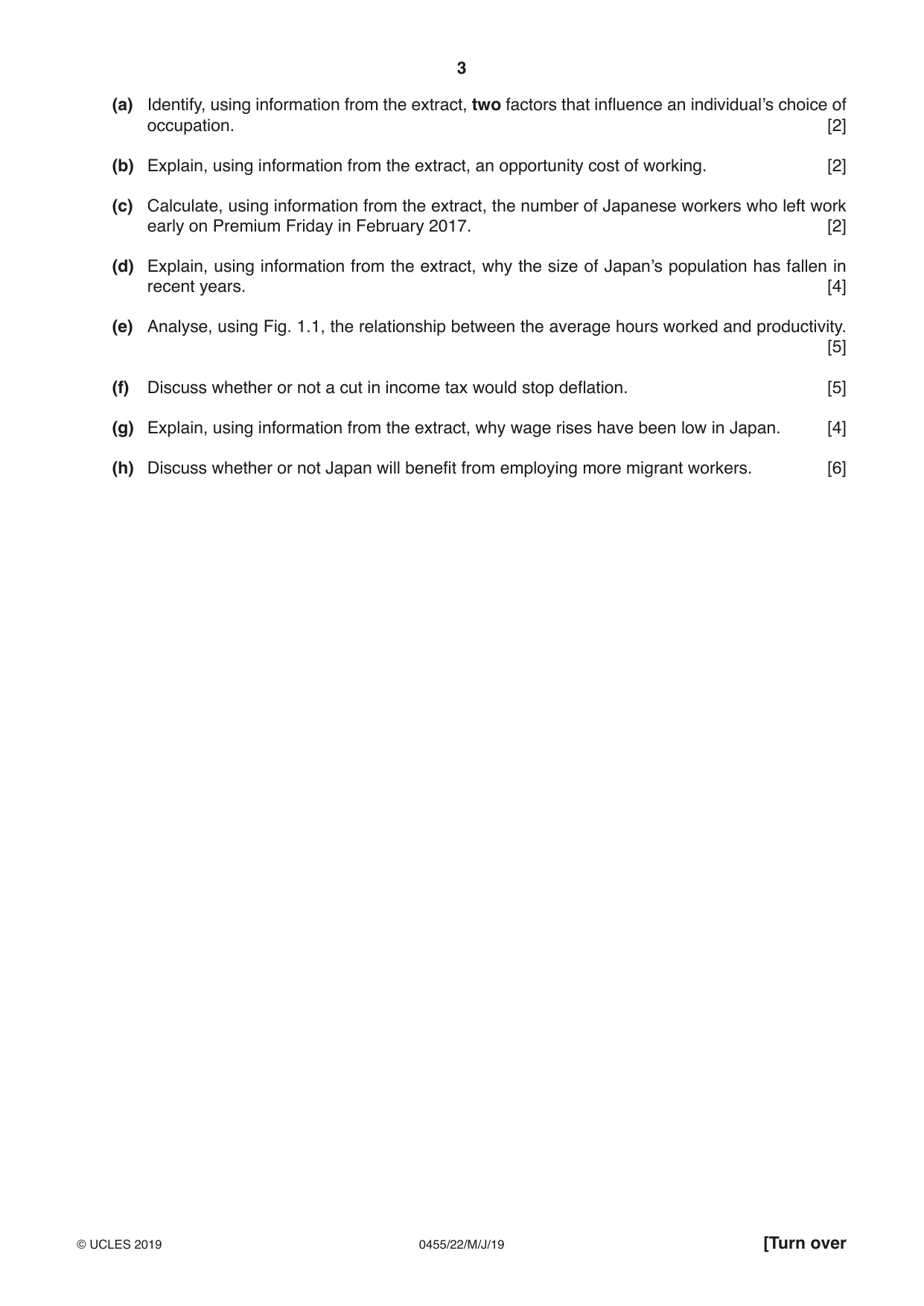
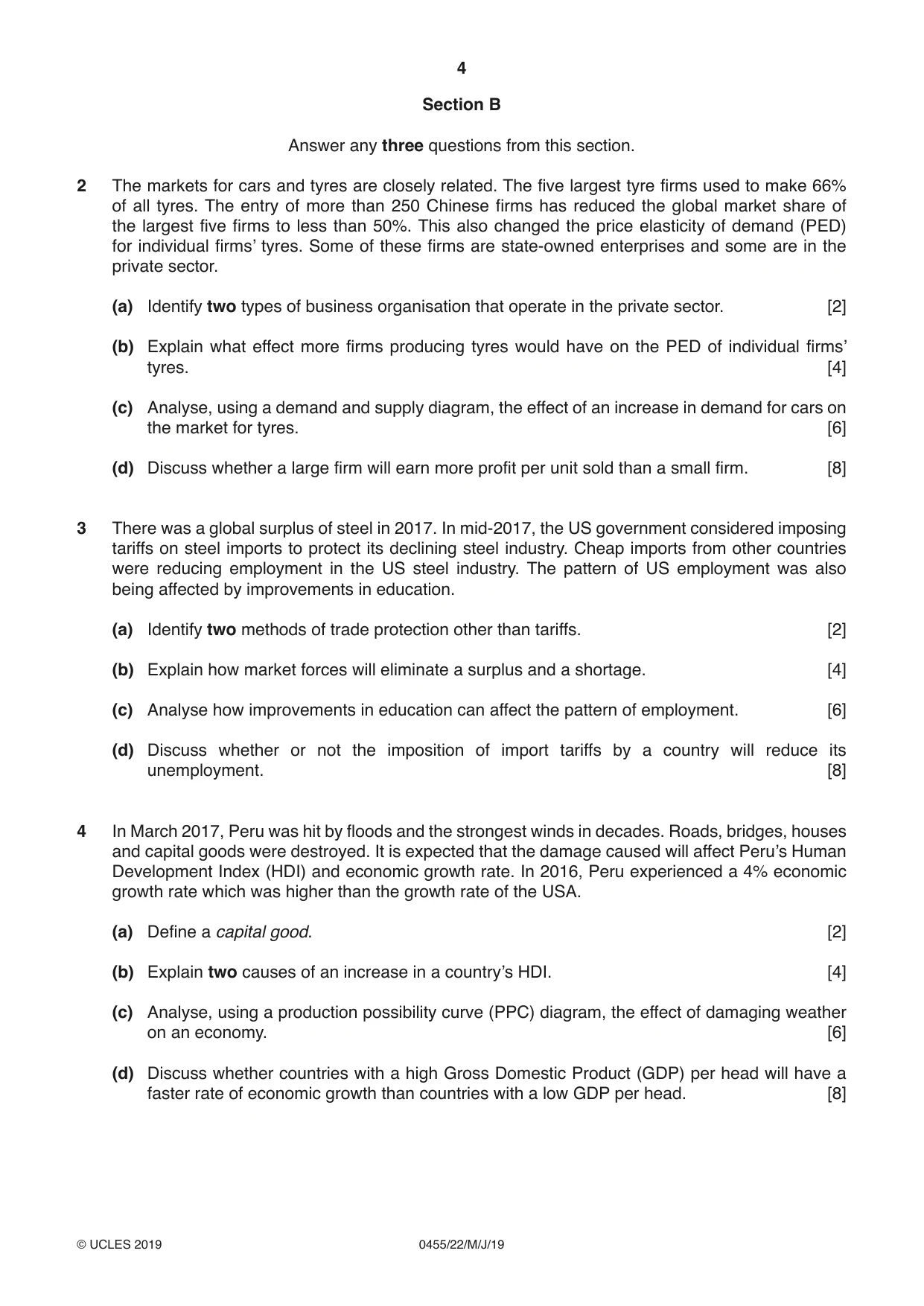



Mark scheme20 pages
Answers below. Sit the paper first if you are practising.
Questions as text
Q1 · Premium Friday At the start of February 2017, the Japanese government introduced its…
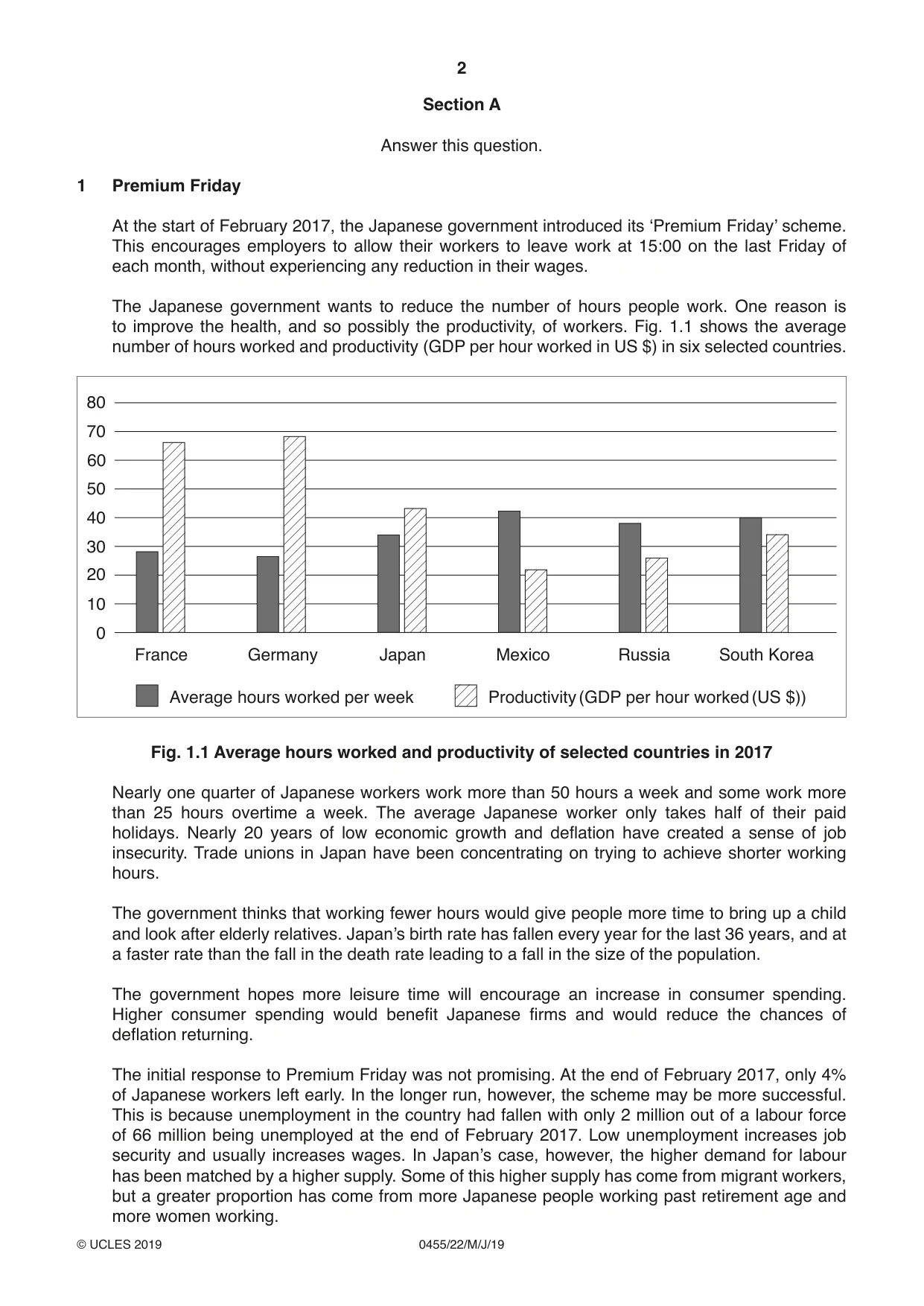
1 Premium Friday At the start of February 2017, the Japanese government introduced its ‘Premium Friday’ scheme. This encourages employers to allow their workers to leave work at 15:00 on the last Friday of each month, without experiencing any reduction in their wages. The Japanese government wants to reduce the number of hours people work. One reason is to improve the health, and so possibly the productivity, of workers. Fig. 1.1 shows the average number of hours worked and productivity (GDP per hour worked in US $) in six selected countries. 80 70 60 50 40 30 20 10 0 France Germany Japan Mexico Russia South Korea Average hours worked per week Productivity (GDP per hour worked (US $)) Fig. 1.1 Average hours worked and productivity of selected countries in 2017 Nearly one quarter of Japanese workers work more than 50 hours a week and some work more than 25 hours overtime a week. The average Japanese worker only takes half of their paid holidays. Nearly 20 years of low economic growth and deflation have created a sense of job insecurity. Trade unions in Japan have been concentrating on trying to achieve shorter working hours. The government thinks that working fewer hours would give people more time to bring up a child and look after elderly relatives. Japan’s birth rate has fallen every year for the last 36 years, and at a faster rate than the fall in the death rate leading to a fall in the size of the population. The government hopes more leisure time will encourage an increase in consumer spending. Higher consumer spending would benefit Japanese firms and would reduce the chances of deflation returning. The initial response to Premium Friday was not promising. At the end of February 2017, only 4% of Japanese workers left early. In the longer run, however, the scheme may be more successful. This is because unemployment in the country had fallen with only 2 million out of a labour force of 66 million being unemployed at the end of February 2017. Low unemployment increases job security and usually increases wages. In Japan’s case, however, the higher demand for labour has been matched by a higher supply. Some of this higher supply has come from migrant workers, but a greater proportion has come from more Japanese people working past retirement age and more women working. (a) Identify, using information from the extract, two factors that influence an individual’s choice of occupation. [2] (b) Explain, using information from the extract, an opportunity cost of working. [2] (c) Calculate, using information from the extract, the number of Japanese workers who left work early on Premium Friday in February 2017. [2] (d) Explain, using information from the extract, why the size of Japan’s population has fallen in recent years. [4] (e) Analyse, using Fig. 1.1, the relationship between the average hours worked and productivity. [5] (f) Discuss whether or not a cut in income tax would stop deflation. [5] (g) Explain, using information from the extract, why wage rises have been low in Japan. [4] (h) Discuss whether or not Japan will benefit from employing more migrant workers. [6]
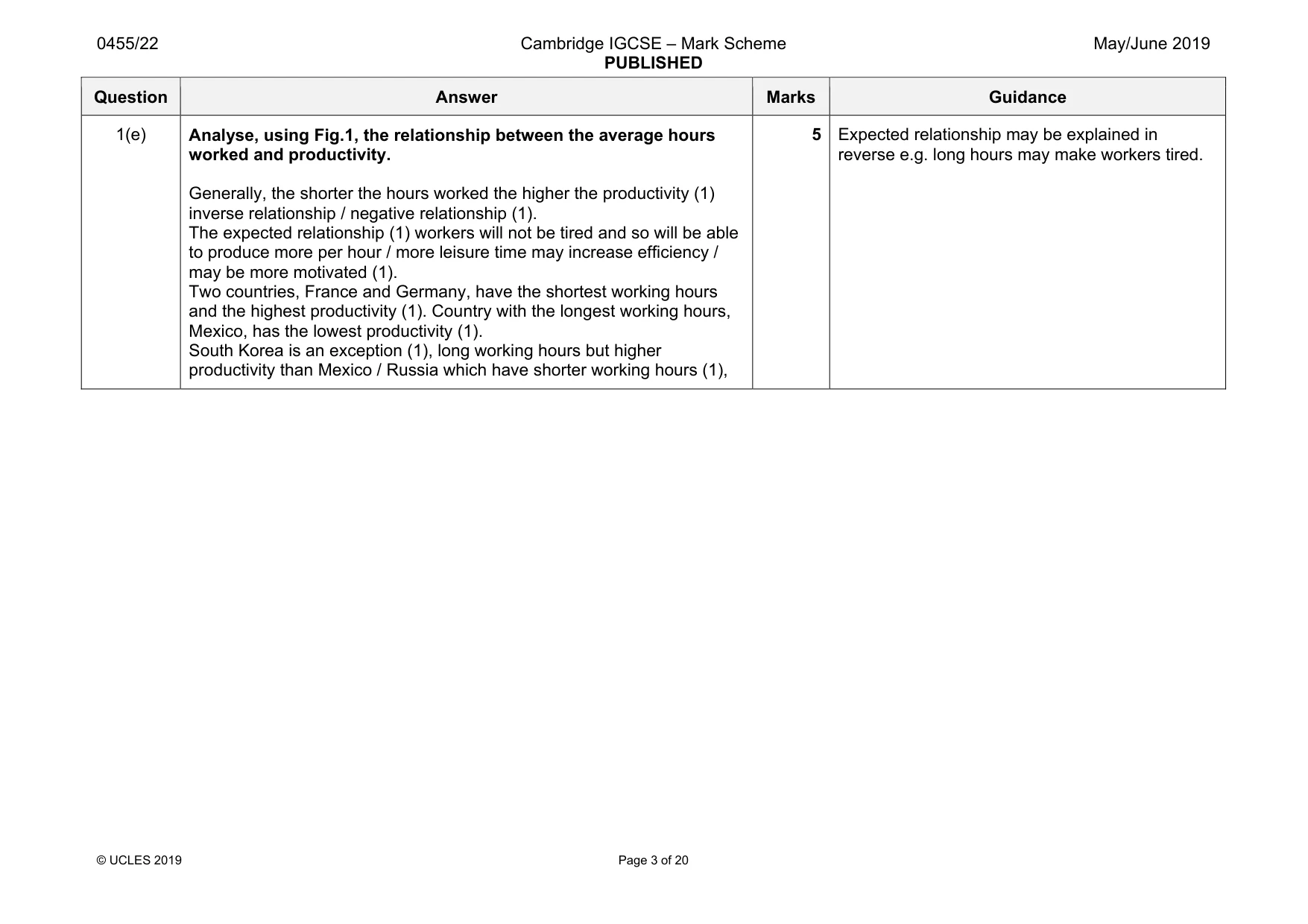
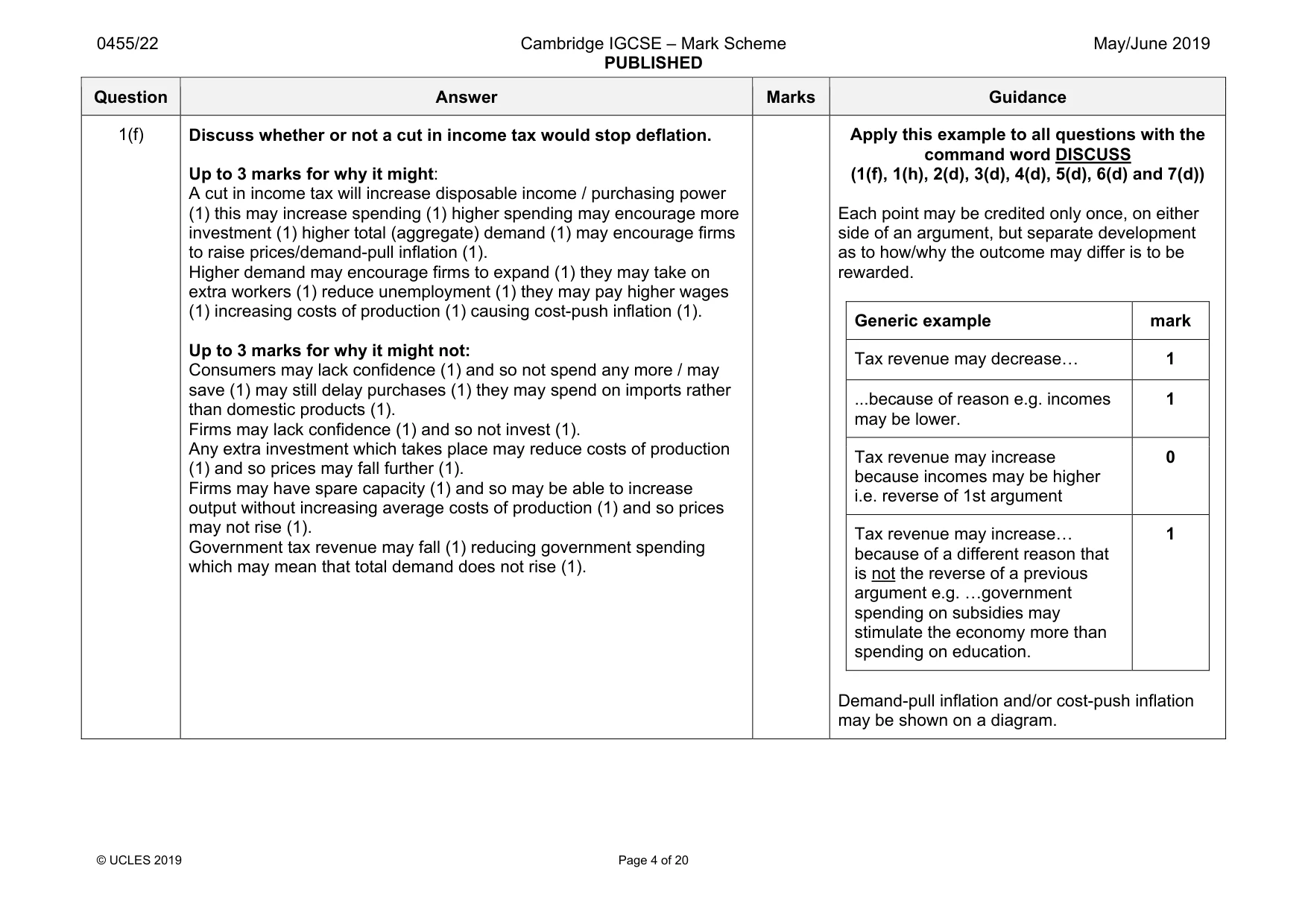
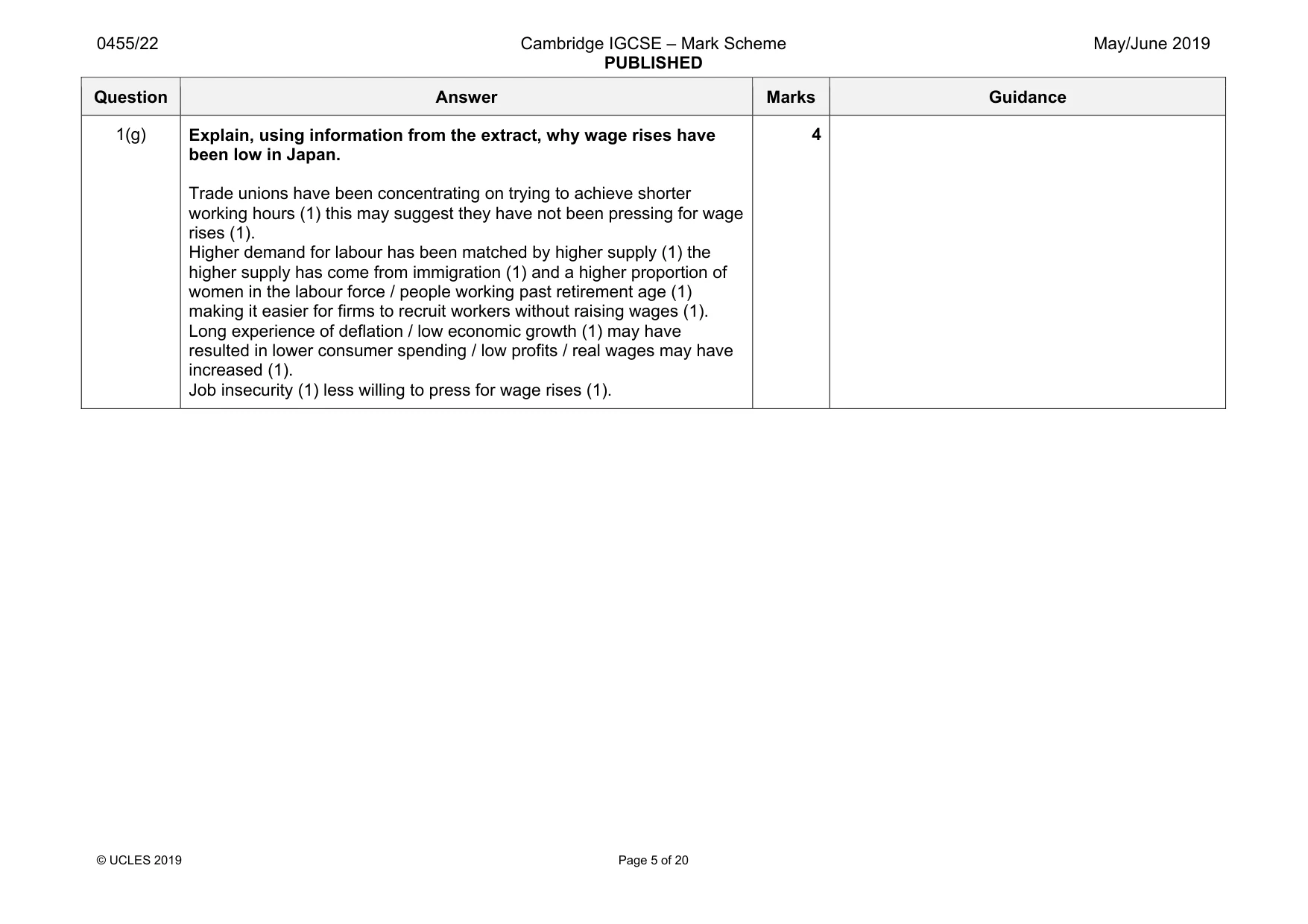
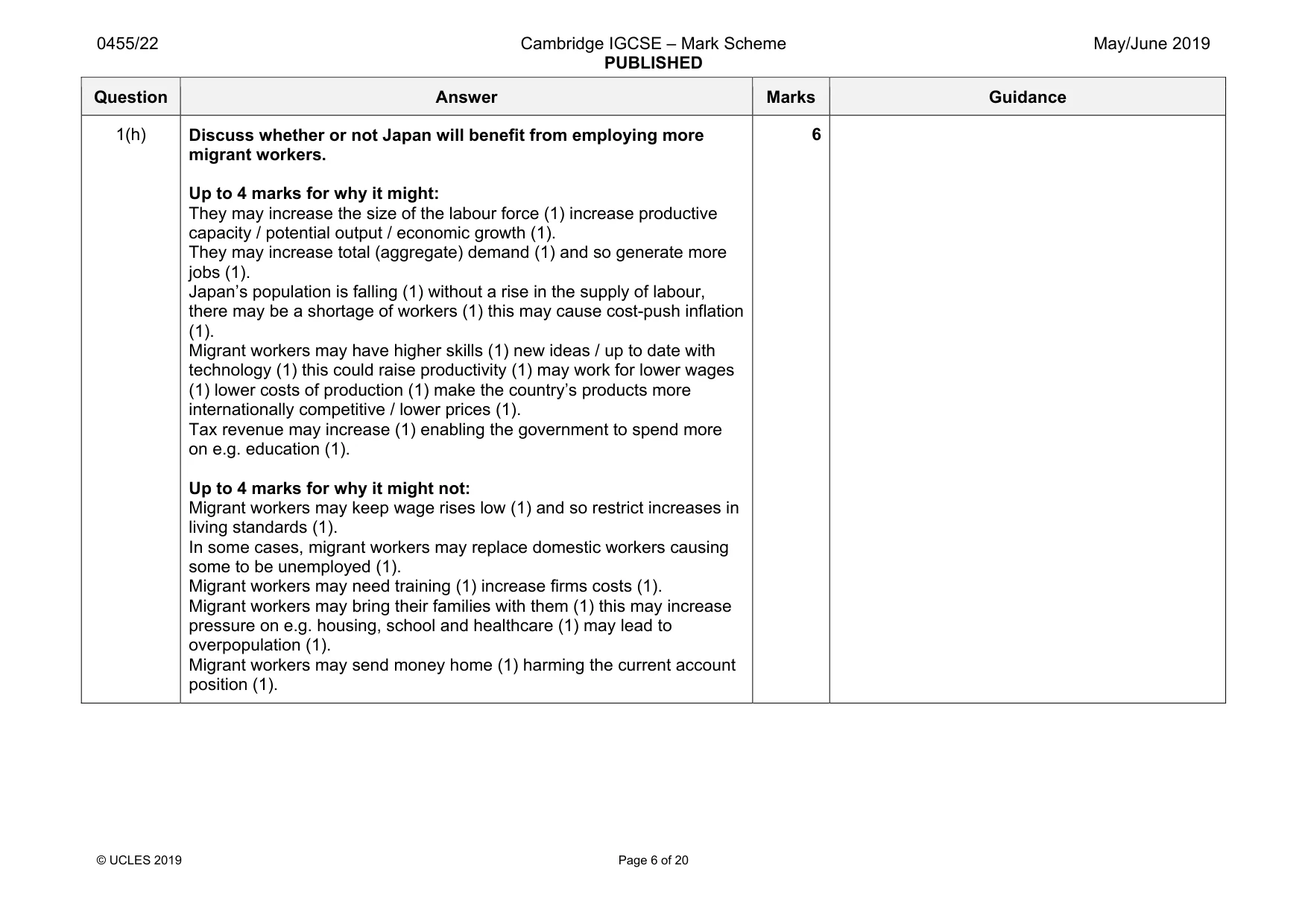
Mark scheme: 1(a) Identify, using information from the extract, two factors that influence an individual’s choice of occupation. • working hours / leisure time • holidays • job security / job insecurity • wages 2 1(b) Explain, using information from the extract, an opportunity cost of working. Leisure time / holidays / time devoted to raising children / looking after the elderly (1) opportunity cost is the (next) best alternative forgone (1). 2 1(c) Calculate, using information from the extract, the number of Japanese workers who left work early on Premium Friday in February 2017. 2.56m / 2 560 000 (2). Correct working: 4% of 64m (66m – 2m) or 2,560 or version of 2.56 (1). 2 1(d) Explain, using information from the extract, why the size of Japan’s population has fallen in recent years. The birth rate has fallen (1) more than the fall in the death rate (1). A fall in the birth rate means fewer children are being born (1) a reason e.g. more women working / people working longer hours / job insecurity / looking after elderly relatives (1). A fall in the death rate means people are living longer (1). If the birth rate falls by more than the death rate there may be a natural decrease in population (1) actual decrease if natural decrease is more than net immigration (1) extra number of older people is more than offset by fewer babies (1). 4 Question Answer Marks Guidance 1(e) Analyse, using Fig.1, the relationship between the average hours worked and productivity. Generally, the shorter the hours worked the higher the productivity (1) inverse relationship / negative relationship (1). The expected relationship (1) workers will not be tired and so will be able to produce more per hour / more leisure time may increase efficiency / may be more motivated (1). Two countries, France and Germany, have the shortest working hours and the highest productivity (1). Country with the longest working hours, Mexico, has the lowest productivity (1). South Korea is an exception (1), long working hours but higher productivity than Mexico / Russia which have shorter working hours (1), 5 Expected relationship may be explained in reverse e.g. long hours may make workers tired. Question Answer Marks Guidance 1(f) Discuss whether or not a cut in income tax would stop deflation. Up to 3 marks for why it might: A cut in income tax will increase disposable income / purchasing power (1) this may increase spending (1) higher spending may encourage more investment (1) higher total (aggregate) demand (1) may encourage firms to raise prices/demand-pull inflation (1). Higher demand may encourage firms to expand (1) they may take on extra workers (1) reduce unemployment (1) they may pay higher wages (1) increasing costs of production (1) causing cost-push inflation (1). Up to 3 marks for why it might not: Consumers may lack confidence (1) and so not spend any more / may save (1) may still delay purchases (1) they may spend on imports rather than domestic products (1). Firms may lack confidence (1) and so not invest (1). Any extra investment which takes place may reduce costs of production (1) and so prices may fall further (1). Firms may have spare capacity (1) and so may be able to increase output without increasing average costs of production (1) and so prices may not rise (1). Government tax revenue may fall (1) reducing government spending which may mean that total demand does not rise (1). Apply this example to all questions with the command word DISCUSS (1(f), 1(h), 2(d), 3(d), 4(d), 5(d), 6(d) and 7(d)) Each point may be credited only once, on either side of an argument, but separate development as to how/why the outcome may differ is to be rewarded. Generic example mark Tax revenue may decrease« 1 ...because of reason e.g. incomes may be lower. 1 Tax revenue may increase because incomes may be higher i.e. reverse of 1st argument 0 Tax revenue may increase« because of a different reason that is not the reverse of a previous argument e.g. «government spending on subsidies may stimulate the economy more than spending on education. 1 Demand-pull inflation and/or cost-push inflation may be shown on a diagram. Question Answer Marks Guidance 1(g) Explain, using information from the extract, why wage rises have been low in Japan. Trade unions have been concentrating on trying to achieve shorter working hours (1) this may suggest they have not been pressing for wage rises (1). Higher demand for labour has been matched by higher supply (1) the higher supply has come from immigration (1) and a higher proportion of women in the labour force / people working past retirement age (1) making it easier for firms to recruit workers without raising wages (1). Long experience of deflation / low economic growth (1) may have resulted in lower consumer spending / low profits / real wages may have increased (1). Job insecurity (1) less willing to press for wage rises (1). 4 Question Answer Marks Guidance 1(h) Discuss whether or not Japan will benefit from employing more migrant workers. Up to 4 marks for why it might: They may increase the size of the labour force (1) increase productive capacity / potential output / economic growth (1). They may increase total (aggregate) demand (1) and so generate more jobs (1). Japan’s population is falling (1) without a rise in the supply of labour, there may be a shortage of workers (1) this may cause cost-push inflation (1). Migrant workers may have higher skills (1) new ideas / up to date with technology (1) this could raise productivity (1) may work for lower wages (1) lower costs of production (1) make the country’s products more internationally competitive / lower prices (1). Tax revenue may increase (1) enabling the government to spend more on e.g. education (1). Up to 4 marks for why it might not: Migrant workers may keep wage rises low (1) and so restrict increases in living standards (1). In some cases, migrant workers may replace domestic workers causing some to be unemployed (1). Migrant workers may need training (1) increase firms costs (1). Migrant workers may bring their families with them (1) this may increase pressure on e.g. housing, school and healthcare (1) may lead to overpopulation (1). Migrant workers may send money home (1) harming the current account position (1). 6
Q2 · The markets for cars and tyres are closely related
2 The markets for cars and tyres are closely related. The five largest tyre firms used to make 66% of all tyres. The entry of more than 250 Chinese firms has reduced the global market share of the largest five firms to less than 50%. This also changed the price elasticity of demand (PED) for individual firms’ tyres. Some of these firms are state-owned enterprises and some are in the private sector. (a) Identify two types of business organisation that operate in the private sector. [2] (b) Explain what effect more firms producing tyres would have on the PED of individual firms’ tyres. [4] (c) Analyse, using a demand and supply diagram, the effect of an increase in demand for cars on the market for tyres. [6] (d) Discuss whether a large firm will earn more profit per unit sold than a small firm. [8]
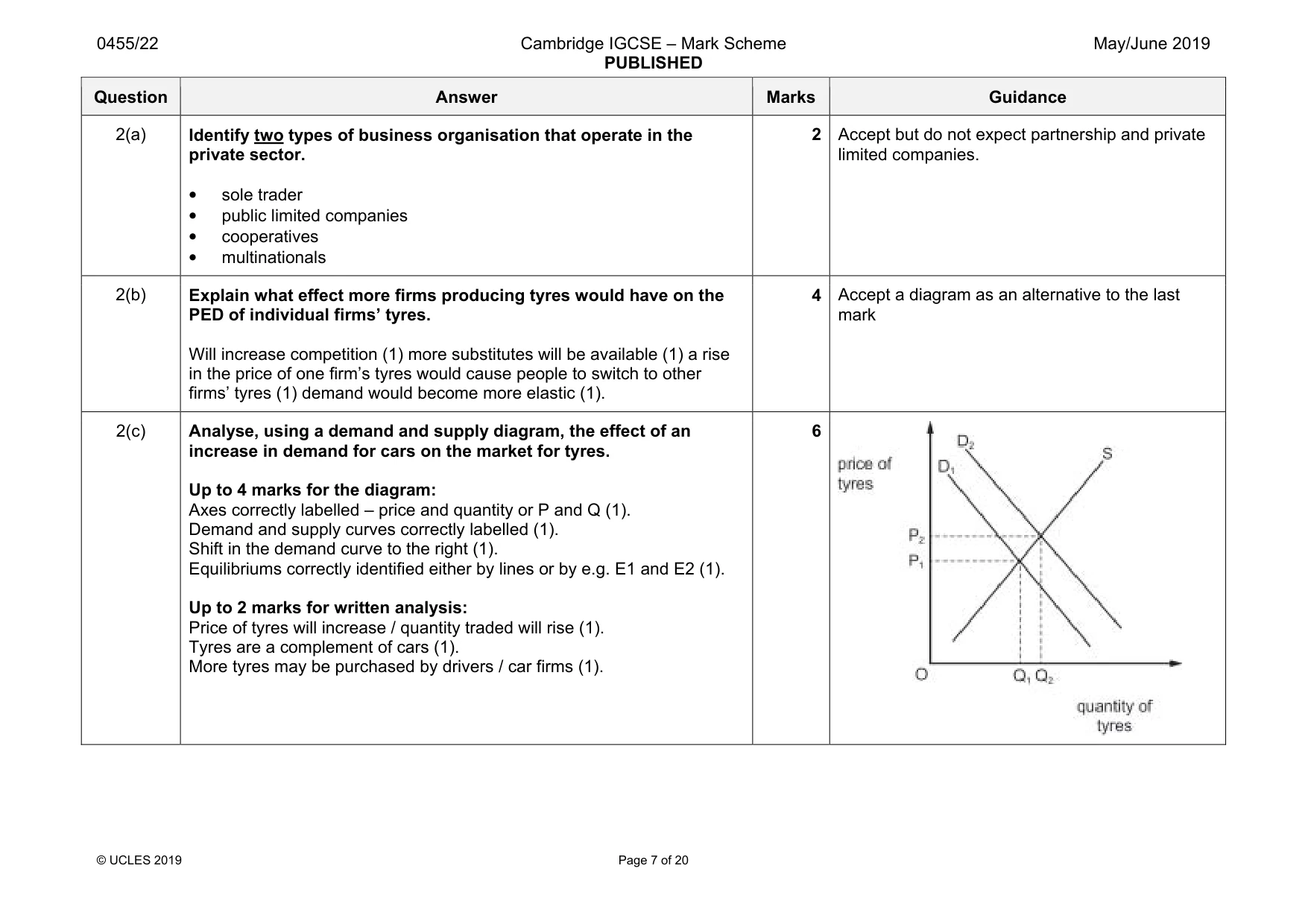
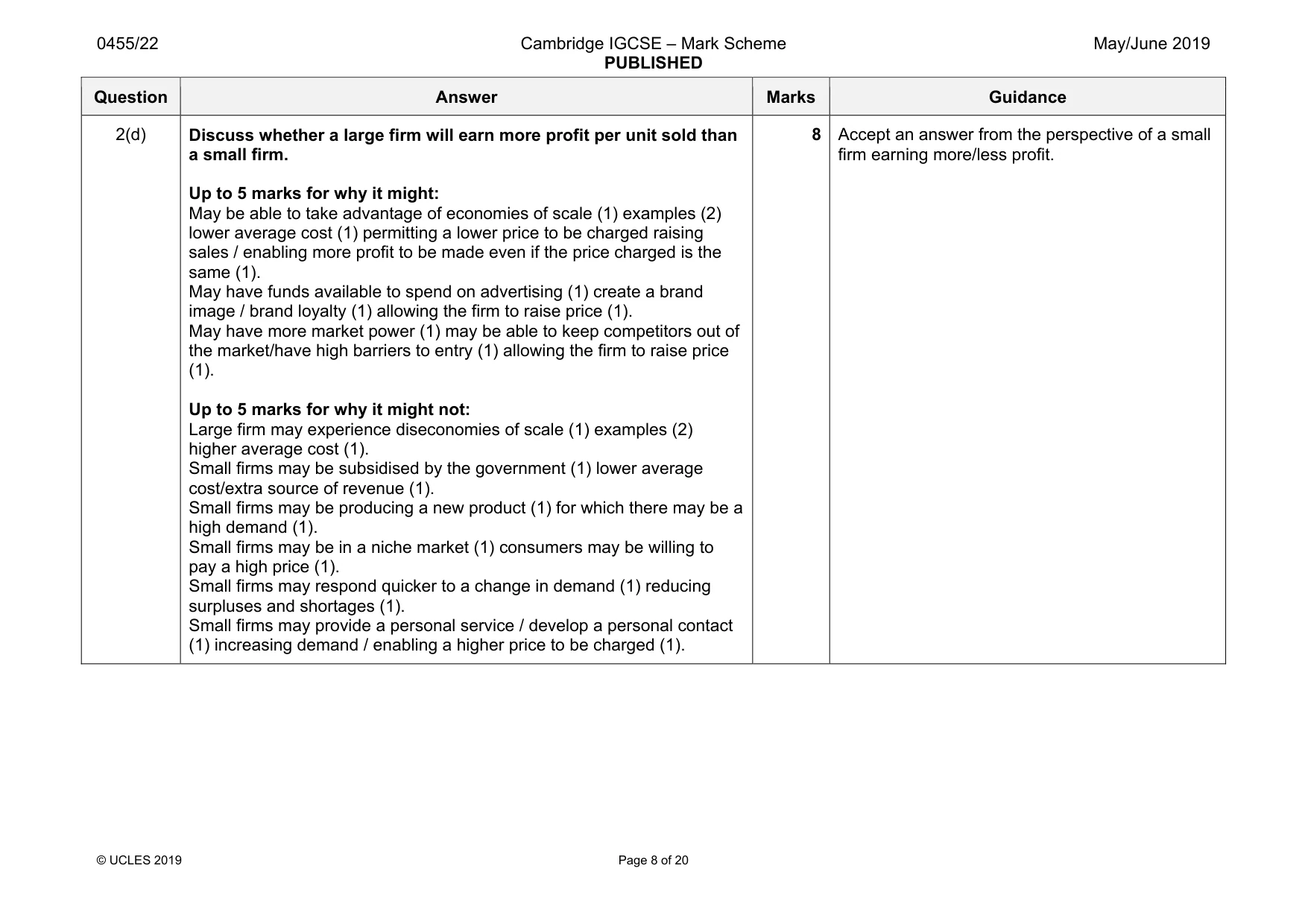
Mark scheme: 2(a) Identify two types of business organisation that operate in the private sector. • sole trader • public limited companies • cooperatives • multinationals 2 limited companies. 2(b) Explain what effect more firms producing tyres would have on the PED of individual firms’ tyres. Will increase competition (1) more substitutes will be available (1) a rise in the price of one firm’s tyres would cause people to switch to other firms’ tyres (1) demand would become more elastic (1). 4 Accept a diagram as an alternative to the last mark 2(c) Analyse, using a demand and supply diagram, the effect of an increase in demand for cars on the market for tyres. Up to 4 marks for the diagram: Axes correctly labelled – price and quantity or P and Q (1). Demand and supply curves correctly labelled (1). Shift in the demand curve to the right (1). Equilibriums correctly identified either by lines or by e.g. E1 and E2 (1). Up to 2 marks for written analysis: Price of tyres will increase / quantity traded will rise (1). Tyres are a complement of cars (1). More tyres may be purchased by drivers / car firms (1). 6 Question Answer Marks Guidance 2(d) Discuss whether a large firm will earn more profit per unit sold than a small firm. Up to 5 marks for why it might: May be able to take advantage of economies of scale (1) examples (2) lower average cost (1) permitting a lower price to be charged raising sales / enabling more profit to be made even if the price charged is the same (1). May have funds available to spend on advertising (1) create a brand image / brand loyalty (1) allowing the firm to raise price (1). May have more market power (1) may be able to keep competitors out of the market/have high barriers to entry (1) allowing the firm to raise price (1). Up to 5 marks for why it might not: Large firm may experience diseconomies of scale (1) examples (2) higher average cost (1). Small firms may be subsidised by the government (1) lower average cost/extra source of revenue (1). Small firms may be producing a new product (1) for which there may be a high demand (1). Small firms may be in a niche market (1) consumers may be willing to pay a high price (1). Small firms may respond quicker to a change in demand (1) reducing surpluses and shortages (1). Small firms may provide a personal service / develop a personal contact (1) increasing demand / enabling a higher price to be charged (1). 8 Accept an answer from the perspective of a small firm earning more/less profit.
Q3 · There was a global surplus of steel in 2017
3 There was a global surplus of steel in 2017. In mid-2017, the US government considered imposing tariffs on steel imports to protect its declining steel industry. Cheap imports from other countries were reducing employment in the US steel industry. The pattern of US employment was also being affected by improvements in education. (a) Identify two methods of trade protection other than tariffs. [2] (b) Explain how market forces will eliminate a surplus and a shortage. [4] (c) Analyse how improvements in education can affect the pattern of employment. [6] (d) Discuss whether or not the imposition of import tariffs by a country will reduce its unemployment. [8]
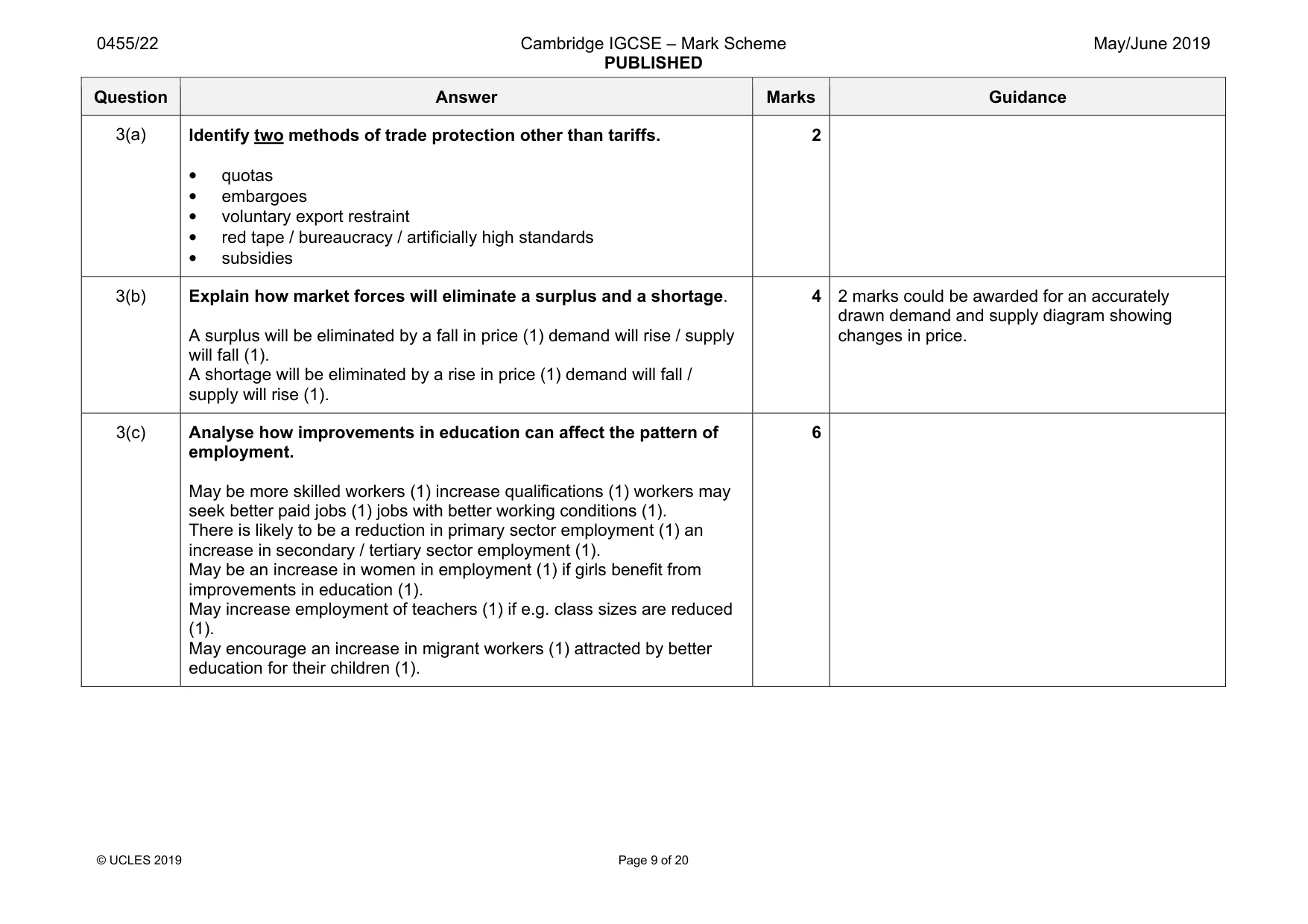
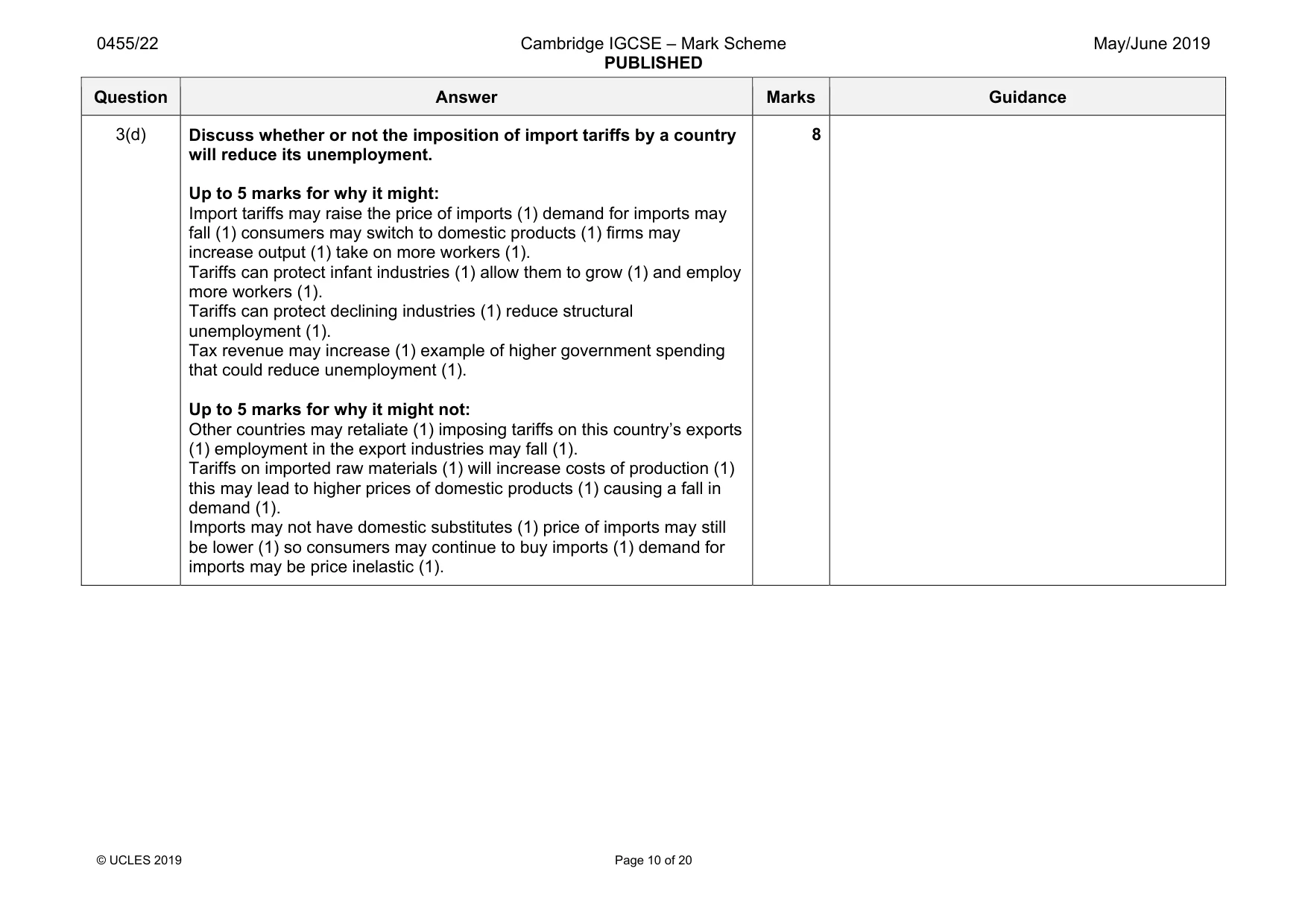
Mark scheme: 3(a) Identify two methods of trade protection other than tariffs. • quotas • embargoes • voluntary export restraint • red tape / bureaucracy / artificially high standards • subsidies 2 3(b) Explain how market forces will eliminate a surplus and a shortage. A surplus will be eliminated by a fall in price (1) demand will rise / supply will fall (1). A shortage will be eliminated by a rise in price (1) demand will fall / supply will rise (1). 4 2 marks could be awarded for an accurately drawn demand and supply diagram showing changes in price. 3(c) Analyse how improvements in education can affect the pattern of employment. May be more skilled workers (1) increase qualifications (1) workers may seek better paid jobs (1) jobs with better working conditions (1). There is likely to be a reduction in primary sector employment (1) an increase in secondary / tertiary sector employment (1). May be an increase in women in employment (1) if girls benefit from improvements in education (1). May increase employment of teachers (1) if e.g. class sizes are reduced (1). May encourage an increase in migrant workers (1) attracted by better education for their children (1). 6 Question Answer Marks Guidance 3(d) Discuss whether or not the imposition of import tariffs by a country will reduce its unemployment. Up to 5 marks for why it might: Import tariffs may raise the price of imports (1) demand for imports may fall (1) consumers may switch to domestic products (1) firms may increase output (1) take on more workers (1). Tariffs can protect infant industries (1) allow them to grow (1) and employ more workers (1). Tariffs can protect declining industries (1) reduce structural unemployment (1). Tax revenue may increase (1) example of higher government spending that could reduce unemployment (1). Up to 5 marks for why it might not: Other countries may retaliate (1) imposing tariffs on this country’s exports (1) employment in the export industries may fall (1). Tariffs on imported raw materials (1) will increase costs of production (1) this may lead to higher prices of domestic products (1) causing a fall in demand (1). Imports may not have domestic substitutes (1) price of imports may still be lower (1) so consumers may continue to buy imports (1) demand for imports may be price inelastic (1). 8
Q4 · In March 2017, Peru was hit by floods and the strongest winds in decades
4 In March 2017, Peru was hit by floods and the strongest winds in decades. Roads, bridges, houses and capital goods were destroyed. It is expected that the damage caused will affect Peru’s Human Development Index (HDI) and economic growth rate. In 2016, Peru experienced a 4% economic growth rate which was higher than the growth rate of the USA. (a) Define a capital good. [2] (b) Explain two causes of an increase in a country’s HDI. [4] (c) Analyse, using a production possibility curve (PPC) diagram, the effect of damaging weather on an economy. [6] (d) Discuss whether countries with a high Gross Domestic Product (GDP) per head will have a faster rate of economic growth than countries with a low GDP per head. [8]
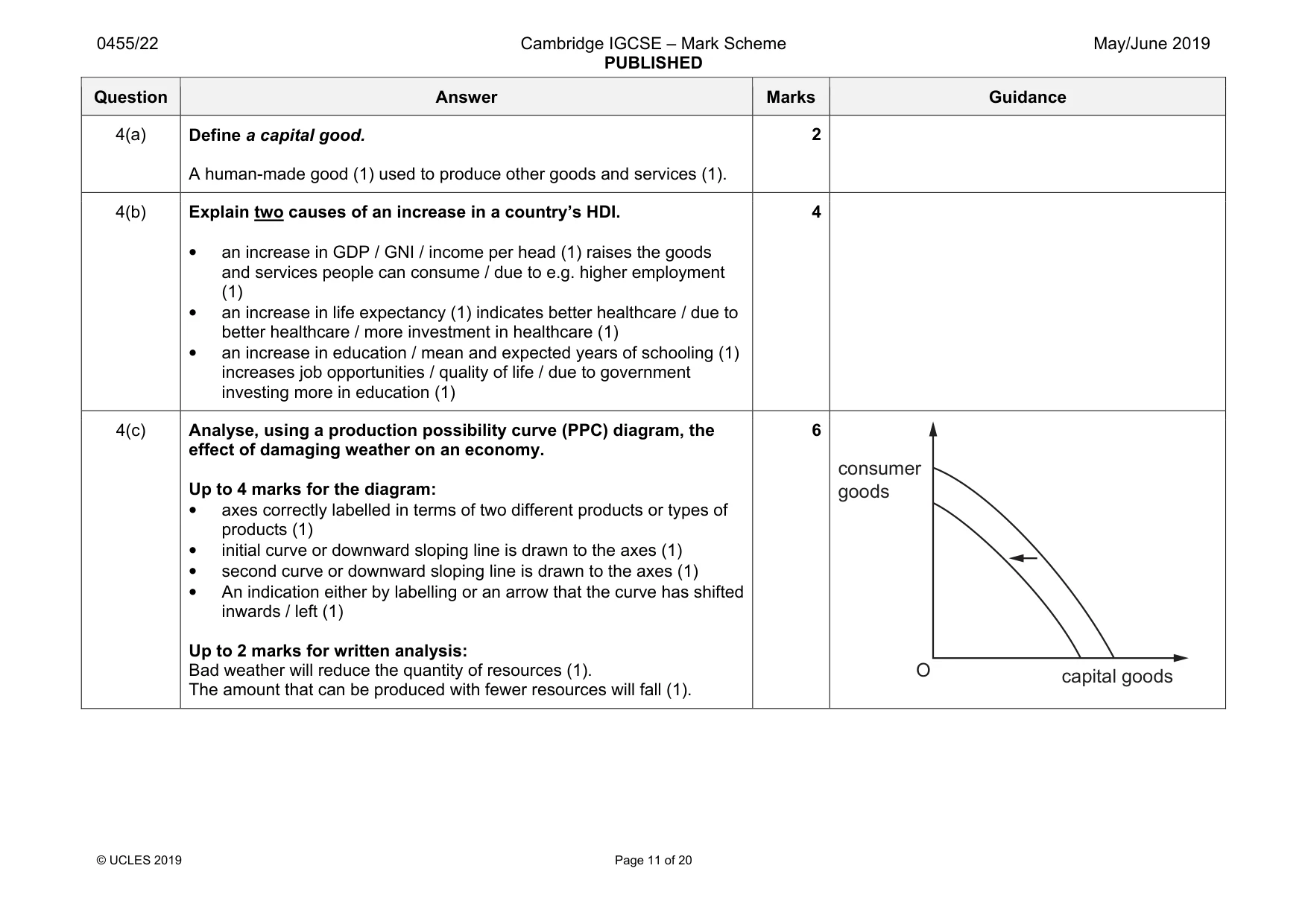
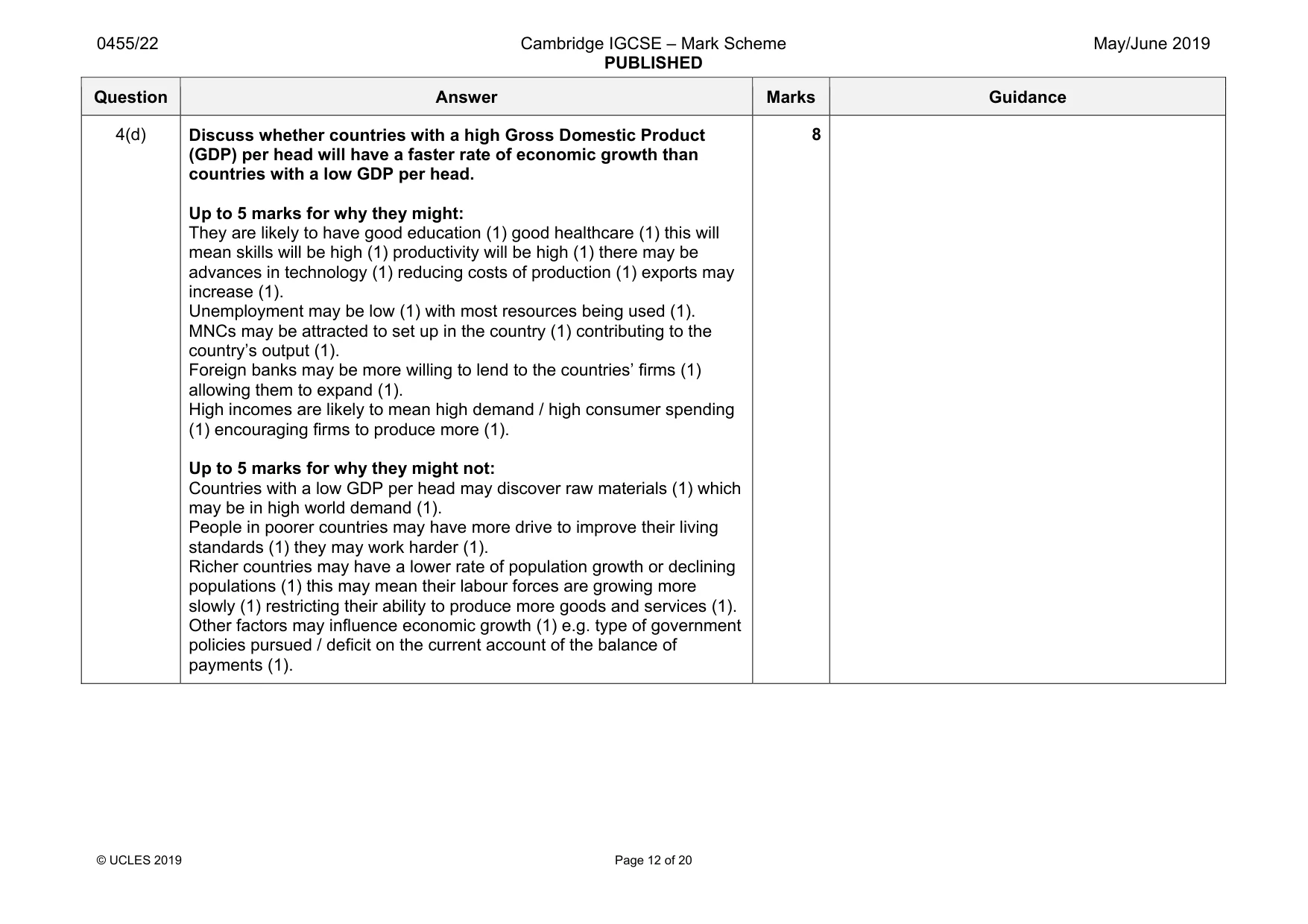
Mark scheme: 4(a) Define a capital good. A human-made good (1) used to produce other goods and services (1). 2 4(b) Explain two causes of an increase in a country’s HDI. • an increase in GDP / GNI / income per head (1) raises the goods and services people can consume / due to e.g. higher employment (1) • an increase in life expectancy (1) indicates better healthcare / due to better healthcare / more investment in healthcare (1) • an increase in education / mean and expected years of schooling (1) increases job opportunities / quality of life / due to government investing more in education (1) 4 4(c) Analyse, using a production possibility curve (PPC) diagram, the effect of damaging weather on an economy. Up to 4 marks for the diagram: • axes correctly labelled in terms of two different products or types of products (1) • initial curve or downward sloping line is drawn to the axes (1) • second curve or downward sloping line is drawn to the axes (1) • An indication either by labelling or an arrow that the curve has shifted inwards / left (1) Up to 2 marks for written analysis: Bad weather will reduce the quantity of resources (1). The amount that can be produced with fewer resources will fall (1). 6 O capital goods consumer goods Question Answer Marks Guidance 4(d) Discuss whether countries with a high Gross Domestic Product (GDP) per head will have a faster rate of economic growth than countries with a low GDP per head. Up to 5 marks for why they might: They are likely to have good education (1) good healthcare (1) this will mean skills will be high (1) productivity will be high (1) there may be advances in technology (1) reducing costs of production (1) exports may increase (1). Unemployment may be low (1) with most resources being used (1). MNCs may be attracted to set up in the country (1) contributing to the country’s output (1). Foreign banks may be more willing to lend to the countries’ firms (1) allowing them to expand (1). High incomes are likely to mean high demand / high consumer spending (1) encouraging firms to produce more (1). Up to 5 marks for why they might not: Countries with a low GDP per head may discover raw materials (1) which may be in high world demand (1). People in poorer countries may have more drive to improve their living standards (1) they may work harder (1). Richer countries may have a lower rate of population growth or declining populations (1) this may mean their labour forces are growing more slowly (1) restricting their ability to produce more goods and services (1). Other factors may influence economic growth (1) e.g. type of government policies pursued / deficit on the current account of the balance of payments (1). 8
Q5 · Moldova is Europe’s poorest economy with many of its people living in poverty
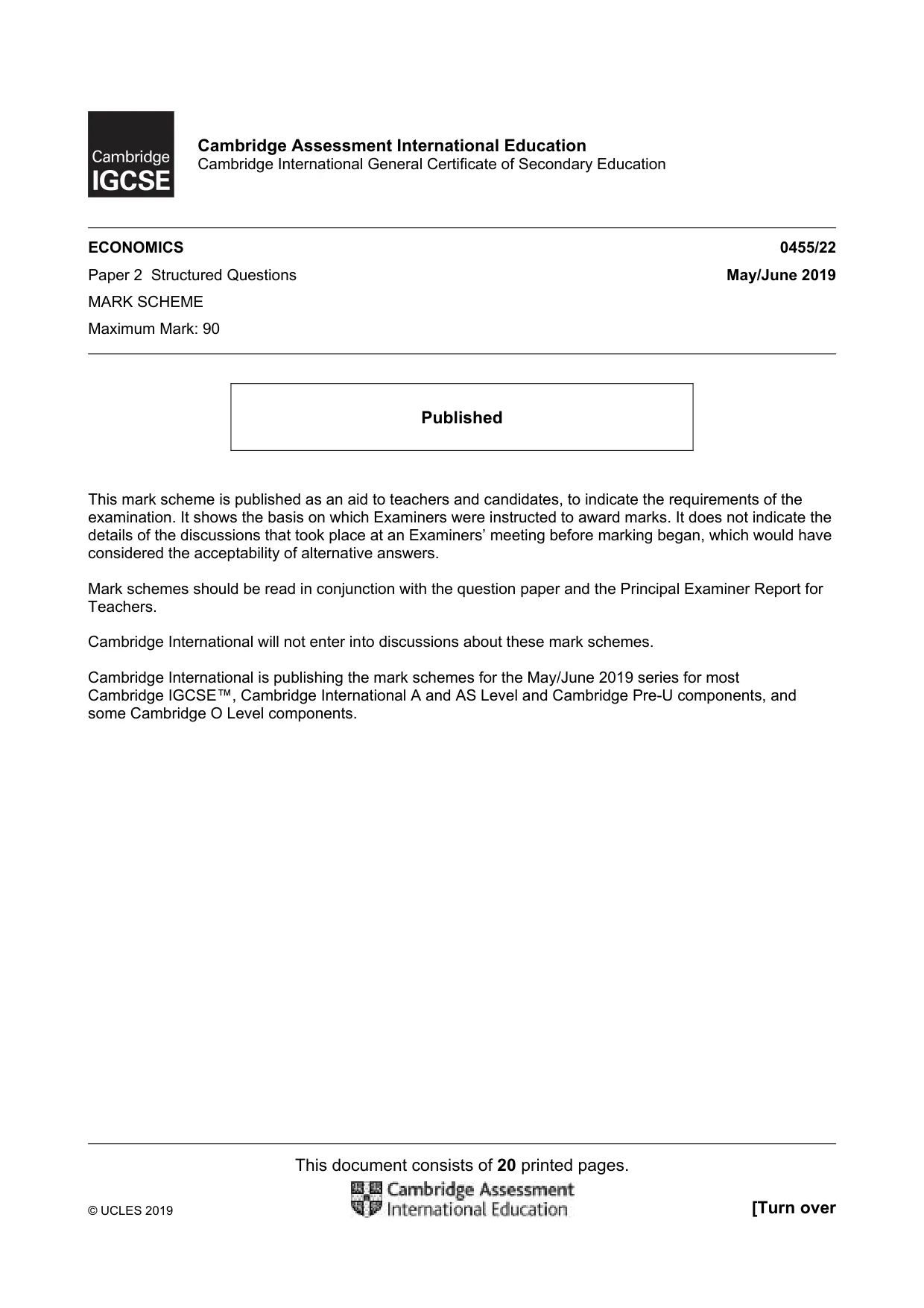
5 Moldova is Europe’s poorest economy with many of its people living in poverty. It is mainly an agricultural economy with many small farms. Its shops are also small. The government has used a range of policies, including supply-side policy, to improve the economy’s performance. It has mostly been successful. For instance, unemployment has fallen. (a) Identify two supply-side policy measures. [2] (b) Explain two ways a government could reduce relative poverty. [4] (c) Analyse the reasons why small shops may be easy to set up. [6] (d) Discuss whether or not firms will benefit from a fall in unemployment. [8]
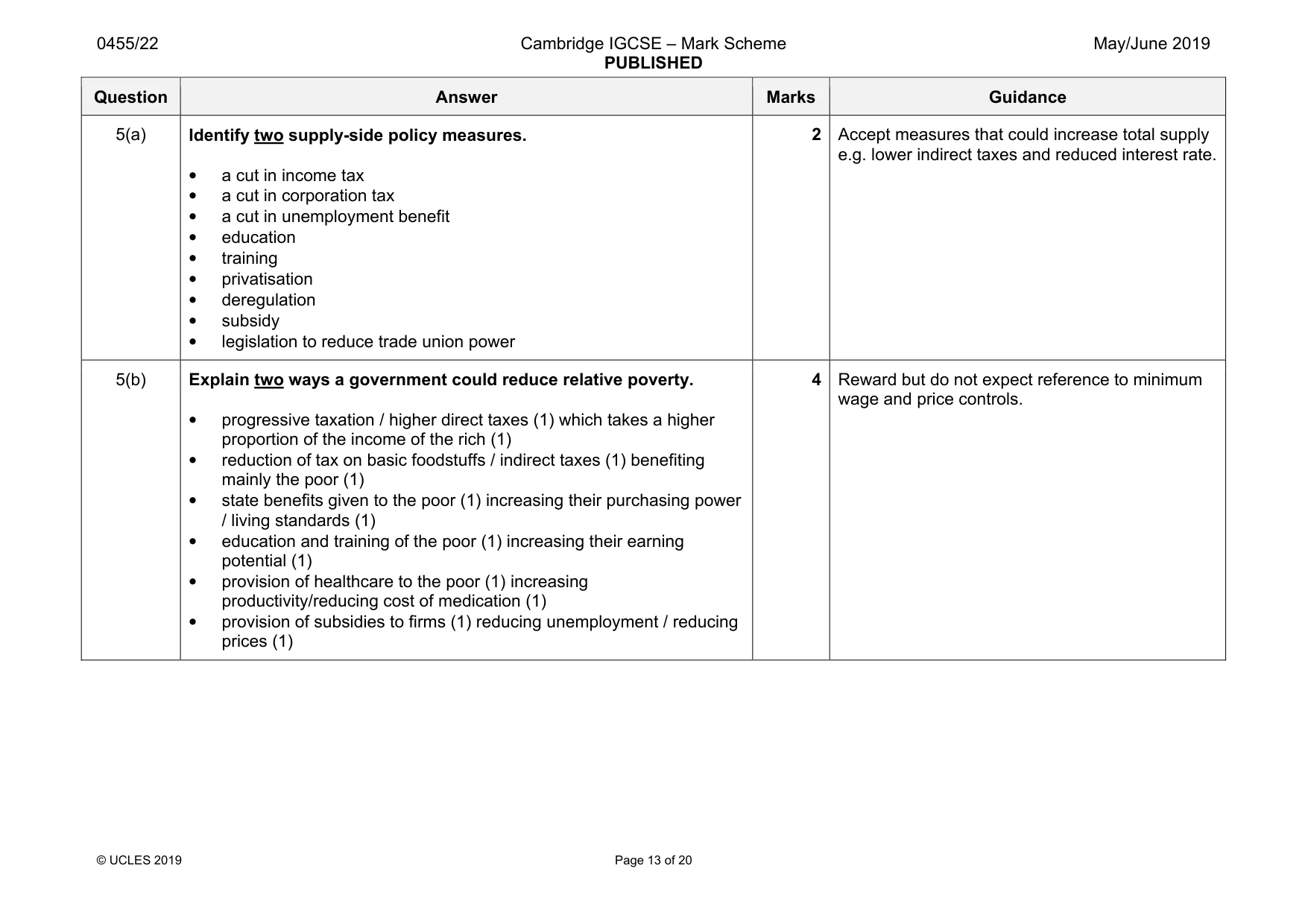
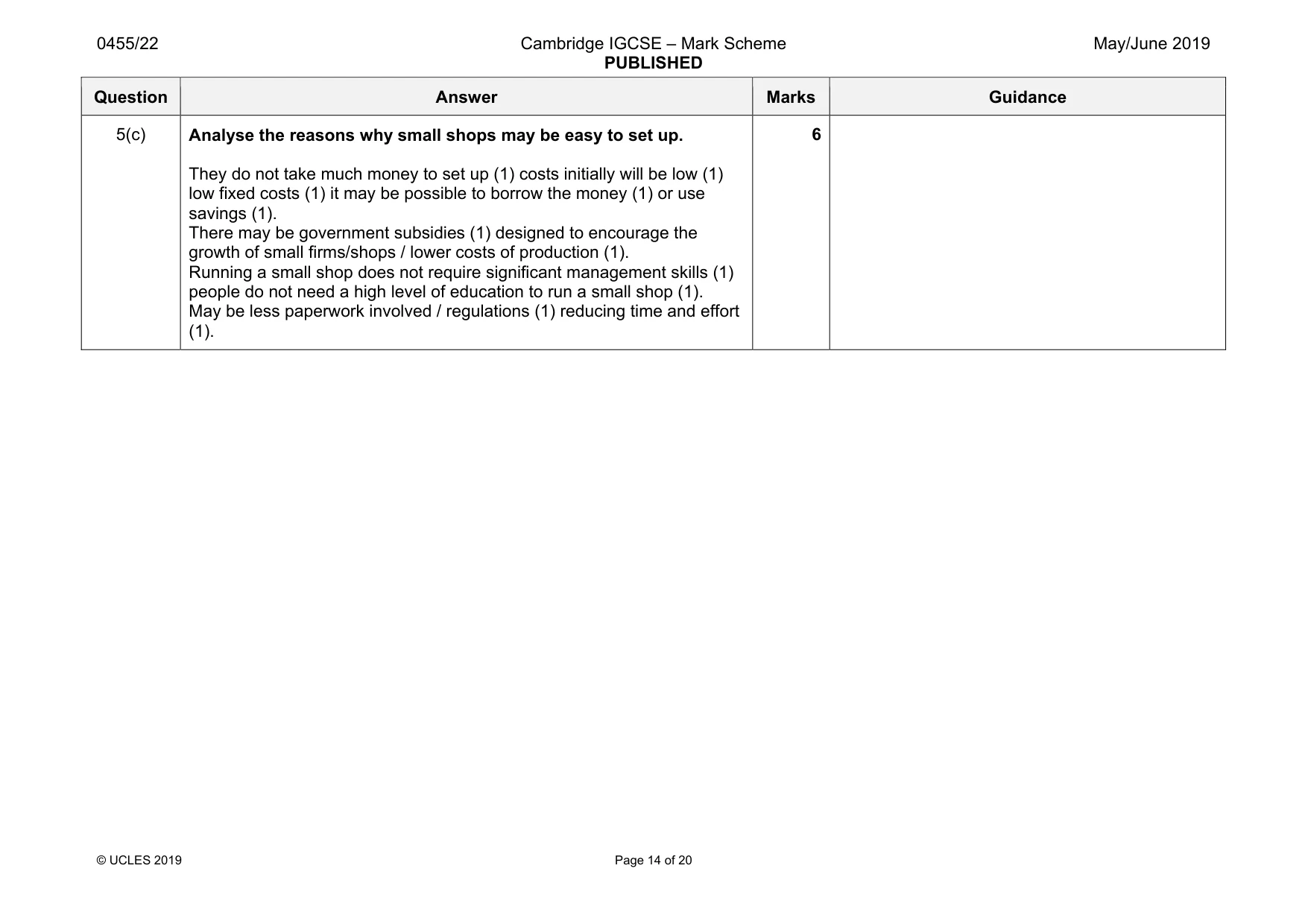
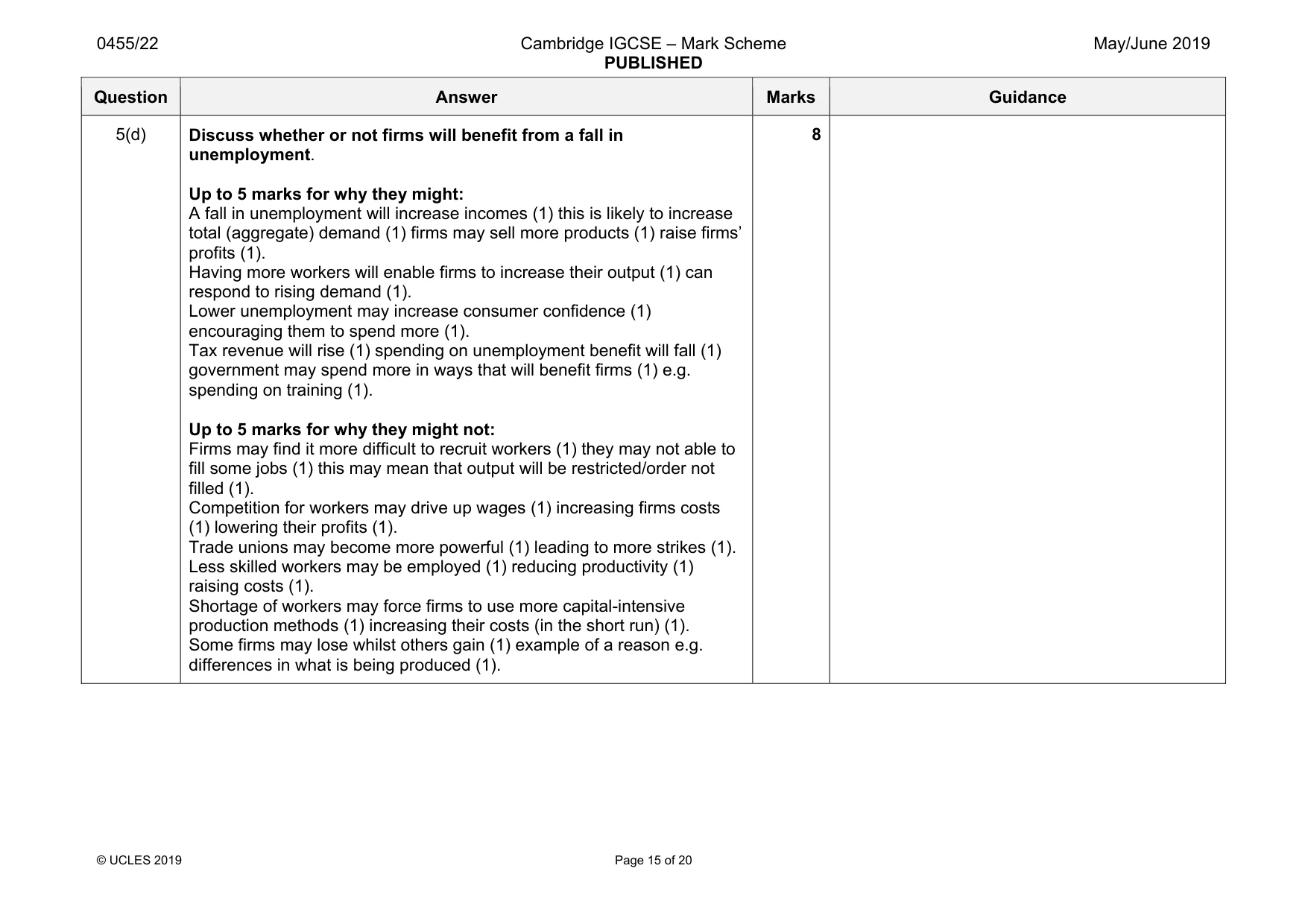
Mark scheme: 5(a) Identify two supply-side policy measures. • a cut in income tax • a cut in corporation tax • a cut in unemployment benefit • education • training • privatisation • deregulation • subsidy • legislation to reduce trade union power 2 e.g. lower indirect taxes and reduced interest rate. 5(b) Explain two ways a government could reduce relative poverty. • progressive taxation / higher direct taxes (1) which takes a higher proportion of the income of the rich (1) • reduction of tax on basic foodstuffs / indirect taxes (1) benefiting mainly the poor (1) • state benefits given to the poor (1) increasing their purchasing power / living standards (1) • education and training of the poor (1) increasing their earning potential (1) • provision of healthcare to the poor (1) increasing productivity/reducing cost of medication (1) • provision of subsidies to firms (1) reducing unemployment / reducing prices (1) 4 Reward but do not expect reference to minimum wage and price controls. Question Answer Marks Guidance 5(c) Analyse the reasons why small shops may be easy to set up. They do not take much money to set up (1) costs initially will be low (1) low fixed costs (1) it may be possible to borrow the money (1) or use savings (1). There may be government subsidies (1) designed to encourage the growth of small firms/shops / lower costs of production (1). Running a small shop does not require significant management skills (1) people do not need a high level of education to run a small shop (1). May be less paperwork involved / regulations (1) reducing time and effort (1). 6 Question Answer Marks Guidance 5(d) Discuss whether or not firms will benefit from a fall in unemployment. Up to 5 marks for why they might: A fall in unemployment will increase incomes (1) this is likely to increase total (aggregate) demand (1) firms may sell more products (1) raise firms’ profits (1). Having more workers will enable firms to increase their output (1) can respond to rising demand (1). Lower unemployment may increase consumer confidence (1) encouraging them to spend more (1). Tax revenue will rise (1) spending on unemployment benefit will fall (1) government may spend more in ways that will benefit firms (1) e.g. spending on training (1). Up to 5 marks for why they might not: Firms may find it more difficult to recruit workers (1) they may not able to fill some jobs (1) this may mean that output will be restricted/order not filled (1). Competition for workers may drive up wages (1) increasing firms costs (1) lowering their profits (1). Trade unions may become more powerful (1) leading to more strikes (1). Less skilled workers may be employed (1) reducing productivity (1) raising costs (1). Shortage of workers may force firms to use more capital-intensive production methods (1) increasing their costs (in the short run) (1). Some firms may lose whilst others gain (1) example of a reason e.g. differences in what is being produced (1). 8
Q6 · In a mixed economic system, such as Portugal’s, the government intervenes in the economy
6 In a mixed economic system, such as Portugal’s, the government intervenes in the economy. Reasons for government intervention include to correct market failure and to achieve its aims for the economy, such as control of inflation. In 2017, one-fifth of Portugal’s population was living in poverty and the government increased its spending. (a) Identify two reasons why market failure may occur. [2] (b) Explain how resources are allocated in a mixed economic system. [4] (c) Analyse how a high rate of inflation may harm the poor. [6] (d) Discuss whether or not increasing government spending will enable a government to achieve its aims for the economy. [8]
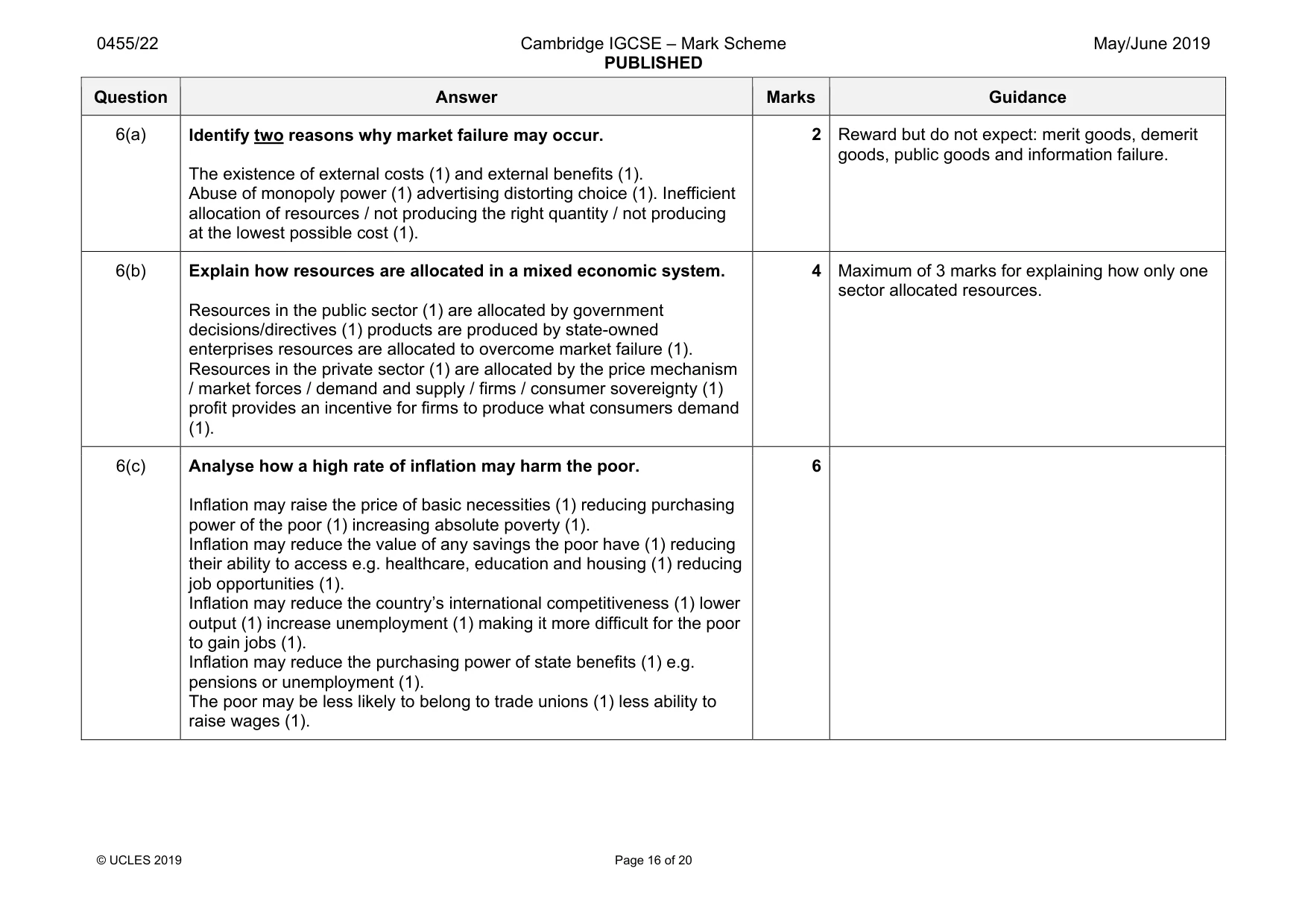
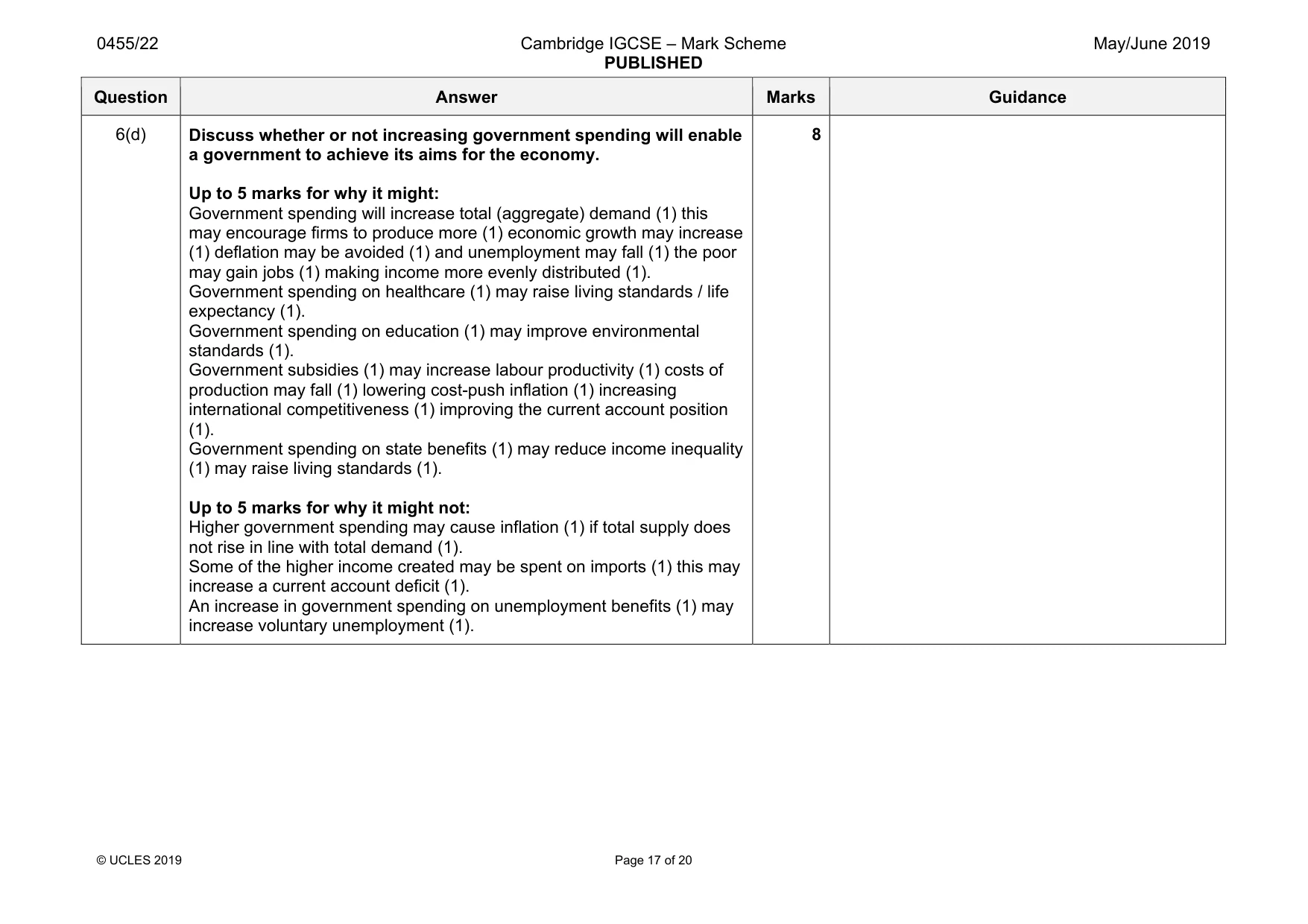
Mark scheme: 6(a) Identify two reasons why market failure may occur. The existence of external costs (1) and external benefits (1). Abuse of monopoly power (1) advertising distorting choice (1). Inefficient allocation of resources / not producing the right quantity / not producing at the lowest possible cost (1). 2 goods, public goods and information failure. 6(b) Explain how resources are allocated in a mixed economic system. Resources in the public sector (1) are allocated by government decisions/directives (1) products are produced by state-owned enterprises resources are allocated to overcome market failure (1). Resources in the private sector (1) are allocated by the price mechanism / market forces / demand and supply / firms / consumer sovereignty (1) profit provides an incentive for firms to produce what consumers demand (1). 4 Maximum of 3 marks for explaining how only one sector allocated resources. 6(c) Analyse how a high rate of inflation may harm the poor. Inflation may raise the price of basic necessities (1) reducing purchasing power of the poor (1) increasing absolute poverty (1). Inflation may reduce the value of any savings the poor have (1) reducing their ability to access e.g. healthcare, education and housing (1) reducing job opportunities (1). Inflation may reduce the country’s international competitiveness (1) lower output (1) increase unemployment (1) making it more difficult for the poor to gain jobs (1). Inflation may reduce the purchasing power of state benefits (1) e.g. pensions or unemployment (1). The poor may be less likely to belong to trade unions (1) less ability to raise wages (1). 6 Question Answer Marks Guidance 6(d) Discuss whether or not increasing government spending will enable a government to achieve its aims for the economy. Up to 5 marks for why it might: Government spending will increase total (aggregate) demand (1) this may encourage firms to produce more (1) economic growth may increase (1) deflation may be avoided (1) and unemployment may fall (1) the poor may gain jobs (1) making income more evenly distributed (1). Government spending on healthcare (1) may raise living standards / life expectancy (1). Government spending on education (1) may improve environmental standards (1). Government subsidies (1) may increase labour productivity (1) costs of production may fall (1) lowering cost-push inflation (1) increasing international competitiveness (1) improving the current account position (1). Government spending on state benefits (1) may reduce income inequality (1) may raise living standards (1). Up to 5 marks for why it might not: Higher government spending may cause inflation (1) if total supply does not rise in line with total demand (1). Some of the higher income created may be spent on imports (1) this may increase a current account deficit (1). An increase in government spending on unemployment benefits (1) may increase voluntary unemployment (1). 8
Q7 · The price elasticity of demand (PED) for sugar in most countries is less than 1
7 The price elasticity of demand (PED) for sugar in most countries is less than 1. In 2017, the price of sugar fell. However, the price of specialised, higher quality sugar grown in countries such as Mauritius fell by less than the average global price. Efficient producers, such as some farmers in Brazil that have a low fixed cost of production, were also less affected by the fall in price. (a) State the formula used to calculate PED. [2] (b) Explain two reasons why the price of sugar may fall. [4] (c) Analyse the possible reasons why a producer’s fixed cost may increase. [6] (d) Discuss whether or not a country will benefit from specialising in an agricultural product such as sugar. [8]
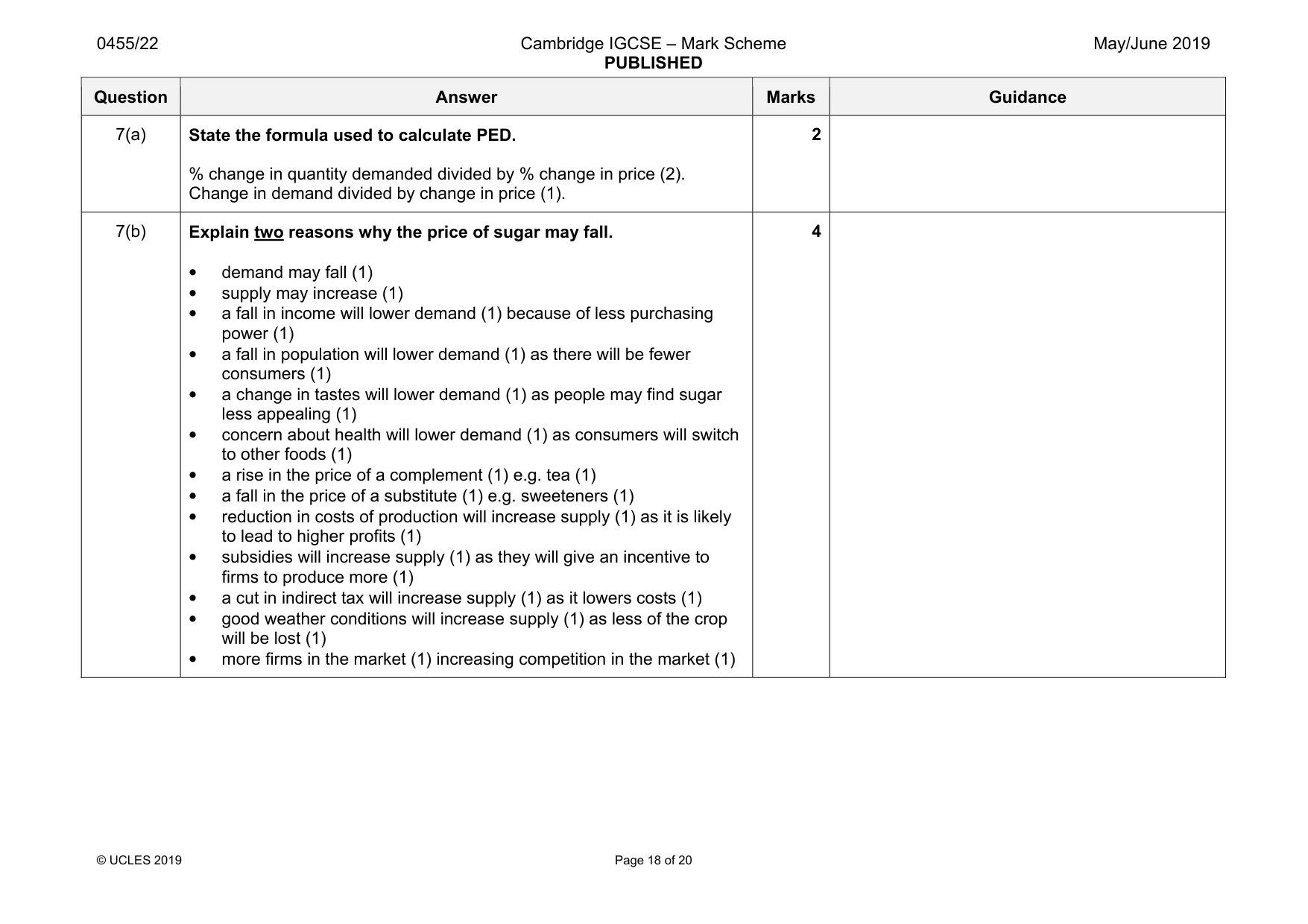
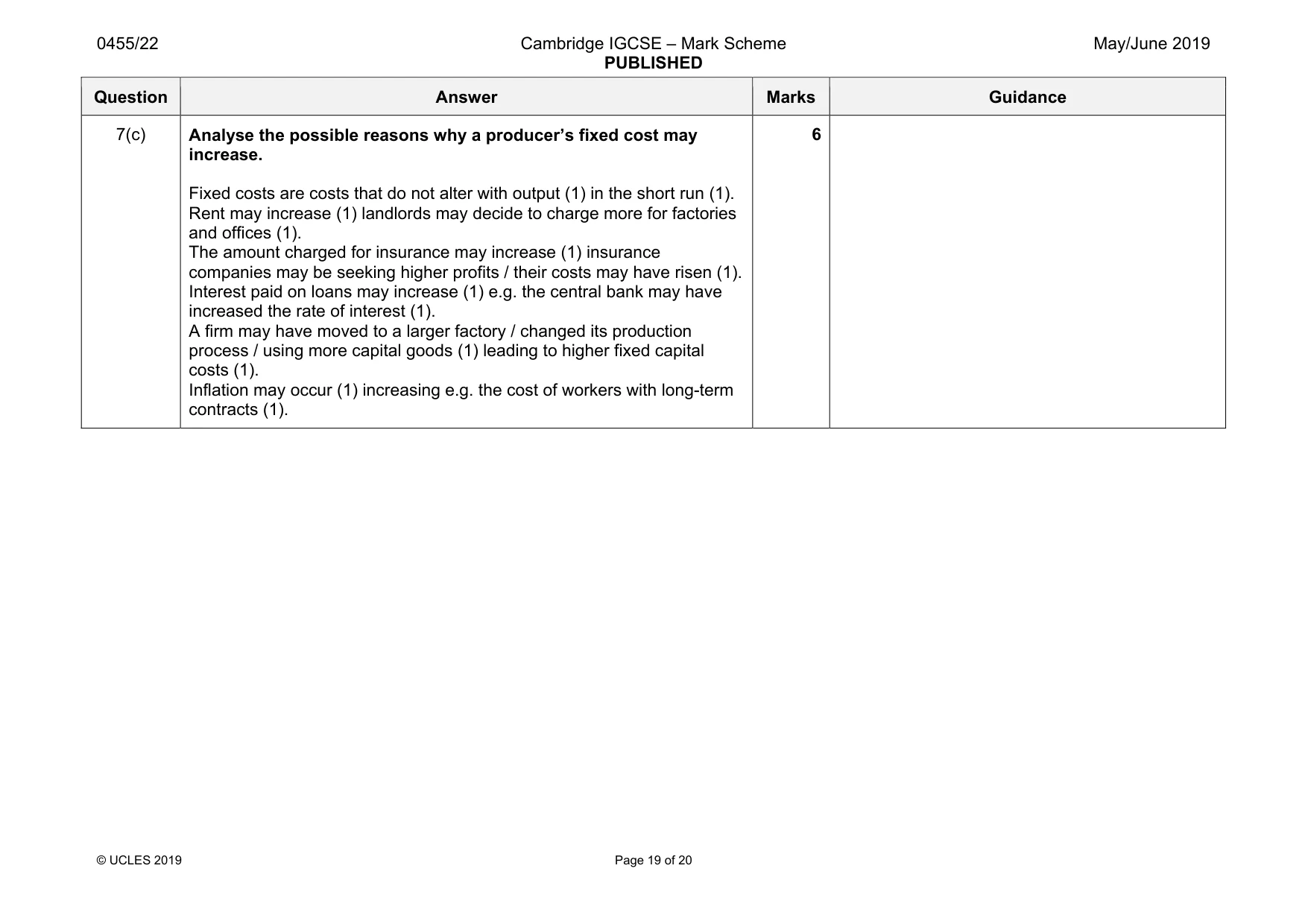
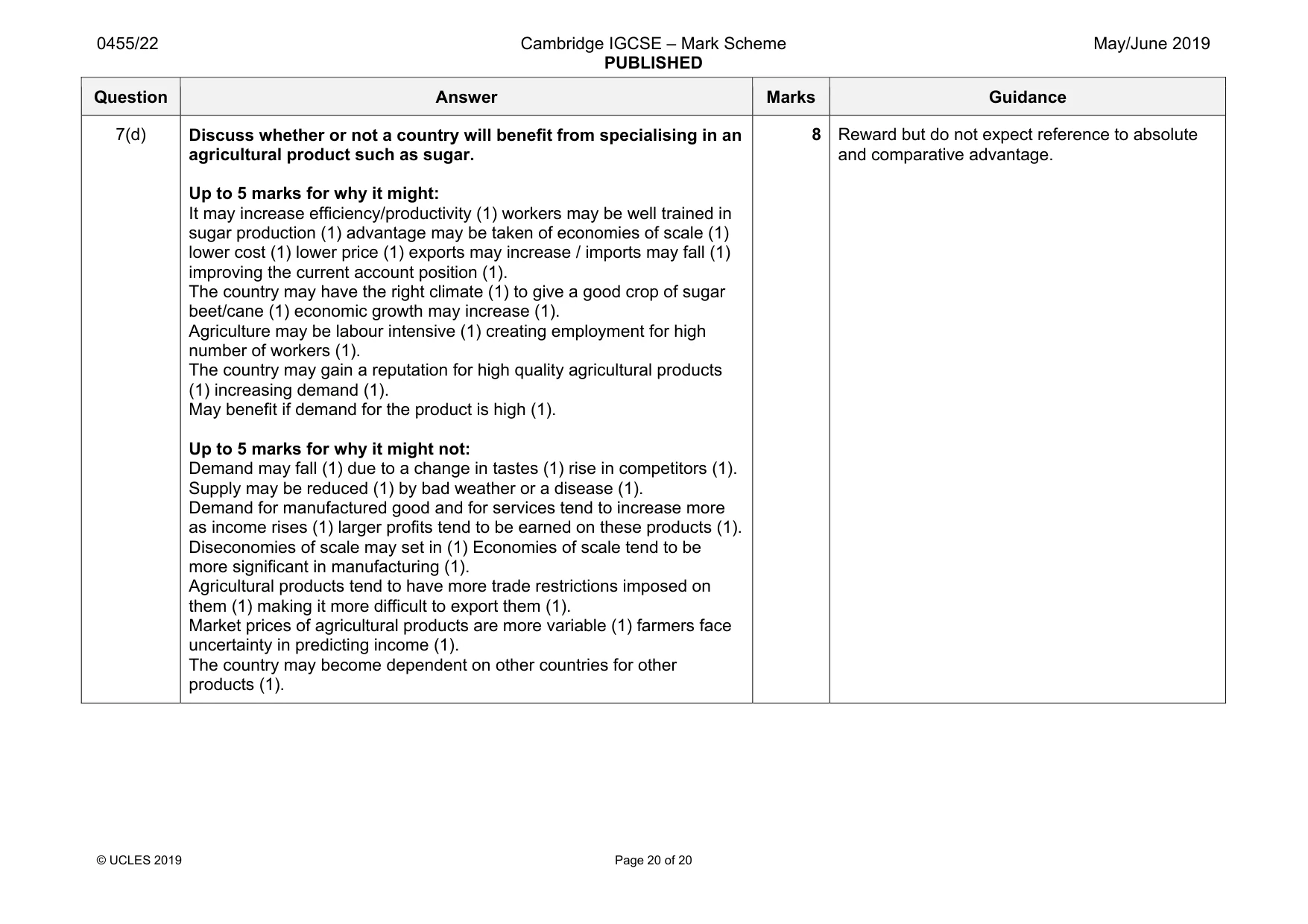
Mark scheme: 7(a) State the formula used to calculate PED. % change in quantity demanded divided by % change in price (2). Change in demand divided by change in price (1). 2 7(b) Explain two reasons why the price of sugar may fall. • demand may fall (1) • supply may increase (1) • a fall in income will lower demand (1) because of less purchasing power (1) • a fall in population will lower demand (1) as there will be fewer consumers (1) • a change in tastes will lower demand (1) as people may find sugar less appealing (1) • concern about health will lower demand (1) as consumers will switch to other foods (1) • a rise in the price of a complement (1) e.g. tea (1) • a fall in the price of a substitute (1) e.g. sweeteners (1) • reduction in costs of production will increase supply (1) as it is likely to lead to higher profits (1) • subsidies will increase supply (1) as they will give an incentive to firms to produce more (1) • a cut in indirect tax will increase supply (1) as it lowers costs (1) • good weather conditions will increase supply (1) as less of the crop will be lost (1) • more firms in the market (1) increasing competition in the market (1) 4 Question Answer Marks Guidance 7(c) Analyse the possible reasons why a producer’s fixed cost may increase. Fixed costs are costs that do not alter with output (1) in the short run (1). Rent may increase (1) landlords may decide to charge more for factories and offices (1). The amount charged for insurance may increase (1) insurance companies may be seeking higher profits / their costs may have risen (1). Interest paid on loans may increase (1) e.g. the central bank may have increased the rate of interest (1). A firm may have moved to a larger factory / changed its production process / using more capital goods (1) leading to higher fixed capital costs (1). Inflation may occur (1) increasing e.g. the cost of workers with long-term contracts (1). 6 Question Answer Marks Guidance 7(d) Discuss whether or not a country will benefit from specialising in an agricultural product such as sugar. Up to 5 marks for why it might: It may increase efficiency/productivity (1) workers may be well trained in sugar production (1) advantage may be taken of economies of scale (1) lower cost (1) lower price (1) exports may increase / imports may fall (1) improving the current account position (1). The country may have the right climate (1) to give a good crop of sugar beet/cane (1) economic growth may increase (1). Agriculture may be labour intensive (1) creating employment for high number of workers (1). The country may gain a reputation for high quality agricultural products (1) increasing demand (1). May benefit if demand for the product is high (1). Up to 5 marks for why it might not: Demand may fall (1) due to a change in tastes (1) rise in competitors (1). Supply may be reduced (1) by bad weather or a disease (1). Demand for manufactured good and for services tend to increase more as income rises (1) larger profits tend to be earned on these products (1). Diseconomies of scale may set in (1) Economies of scale tend to be more significant in manufacturing (1). Agricultural products tend to have more trade restrictions imposed on them (1) making it more difficult to export them (1). Market prices of agricultural products are more variable (1) farmers face uncertainty in predicting income (1). The country may become dependent on other countries for other products (1). 8 Reward but do not expect reference to absolute and comparative advantage.
What was in this paper
The subtopics covered by these 7 questions, and how many questions each got. Open one in a new tab to see every Cambridge question on it.
What you needed in this session
Cambridge’s own grade thresholds for 2019 May/June, Paper 2 · Variant 2. A higher threshold means an easier paper — the bar moves with how the cohort did.