Cambridge IGCSE Economics 0455 — 2018 Oct/Nov Paper 2 · Variant 1
0455/21/O/N/18 · 7 questions · 90 marks · ≈101 min
The question paper and its mark scheme, free to read here and free to download. This is Cambridge’s own paper, exactly as it was sat.
Question paper8 pages



Mark scheme24 pages
Answers below. Sit the paper first if you are practising.
Questions as text
Q1 · Russia’s struggle for economic recovery Shortly after the 2014 Winter Olympic Games in…
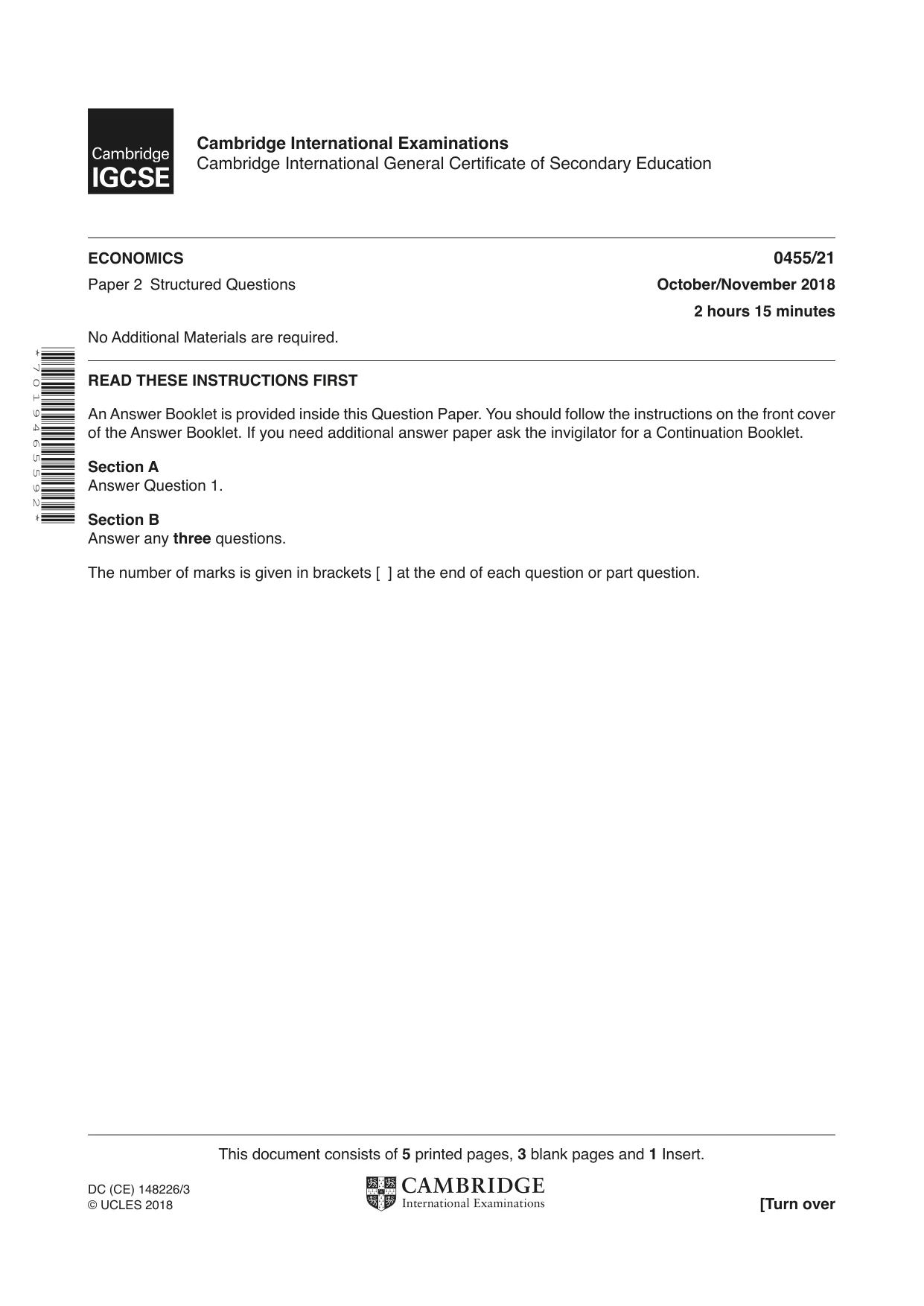
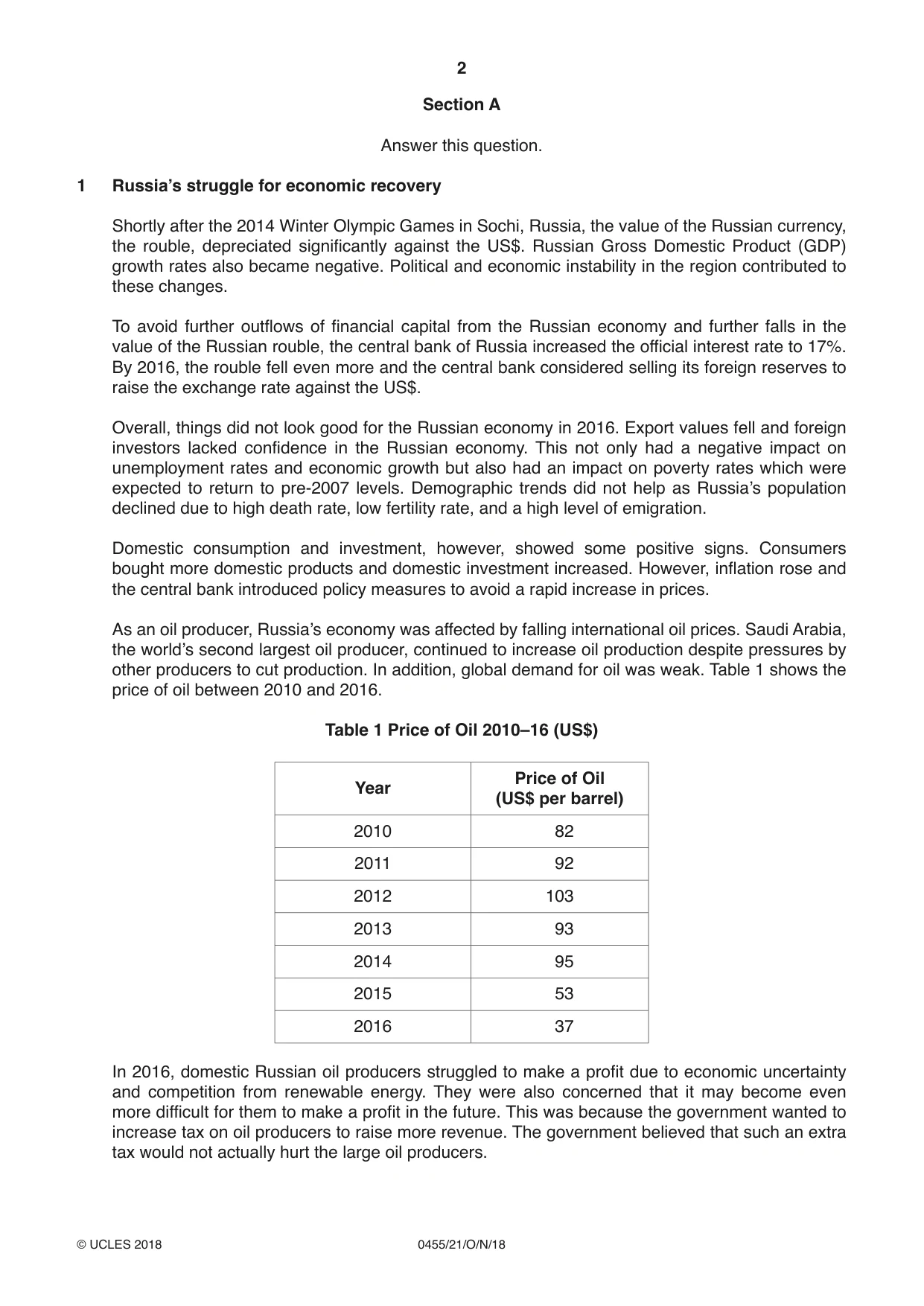
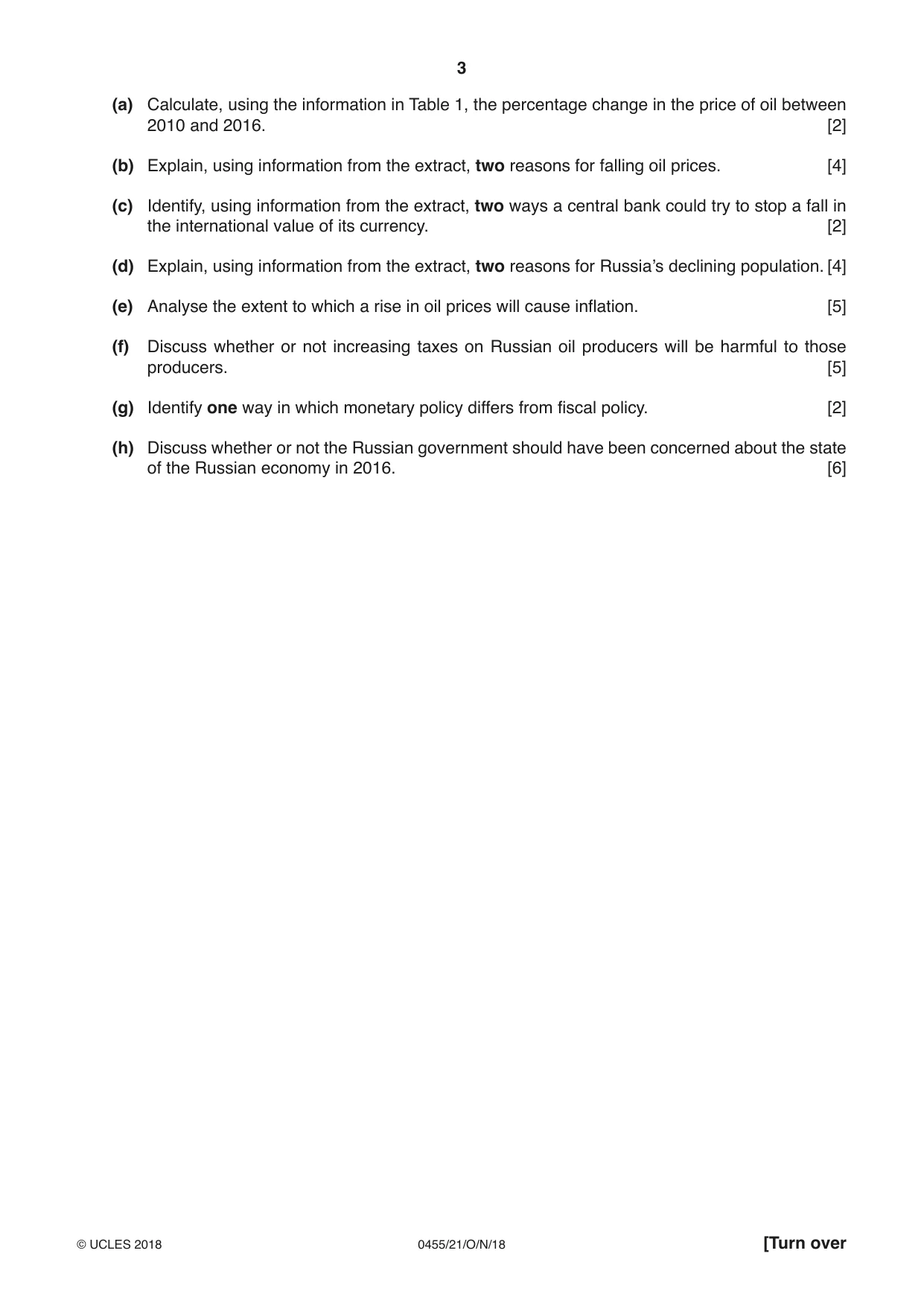
1 Russia’s struggle for economic recovery Shortly after the 2014 Winter Olympic Games in Sochi, Russia, the value of the Russian currency, the rouble, depreciated significantly against the US$. Russian Gross Domestic Product (GDP) growth rates also became negative. Political and economic instability in the region contributed to these changes. To avoid further outflows of financial capital from the Russian economy and further falls in the value of the Russian rouble, the central bank of Russia increased the official interest rate to 17%. By 2016, the rouble fell even more and the central bank considered selling its foreign reserves to raise the exchange rate against the US$. Overall, things did not look good for the Russian economy in 2016. Export values fell and foreign investors lacked confidence in the Russian economy. This not only had a negative impact on unemployment rates and economic growth but also had an impact on poverty rates which were expected to return to pre-2007 levels. Demographic trends did not help as Russia’s population declined due to high death rate, low fertility rate, and a high level of emigration. Domestic consumption and investment, however, showed some positive signs. Consumers bought more domestic products and domestic investment increased. However, inflation rose and the central bank introduced policy measures to avoid a rapid increase in prices. As an oil producer, Russia’s economy was affected by falling international oil prices. Saudi Arabia, the world’s second largest oil producer, continued to increase oil production despite pressures by other producers to cut production. In addition, global demand for oil was weak. Table 1 shows the price of oil between 2010 and 2016. Table 1 Price of Oil 2010–16 (US$) Price of Oil Year (US$ per barrel) 2010 82 2011 92 2012 103 2013 93 2014 95 2015 53 2016 37 In 2016, domestic Russian oil producers struggled to make a profit due to economic uncertainty and competition from renewable energy. They were also concerned that it may become even more difficult for them to make a profit in the future. This was because the government wanted to increase tax on oil producers to raise more revenue. The government believed that such an extra tax would not actually hurt the large oil producers. (a) Calculate, using the information in Table 1, the percentage change in the price of oil between 2010 and 2016. [2] (b) Explain, using information from the extract, two reasons for falling oil prices. [4] (c) Identify, using information from the extract, two ways a central bank could try to stop a fall in the international value of its currency. [2] (d) Explain, using information from the extract, two reasons for Russia’s declining population. [4] (e) Analyse the extent to which a rise in oil prices will cause inflation. [5] (f) Discuss whether or not increasing taxes on Russian oil producers will be harmful to those producers. [5] (g) Identify one way in which monetary policy differs from fiscal policy. [2] (h) Discuss whether or not the Russian government should have been concerned about the state of the Russian economy in 2016. [6]
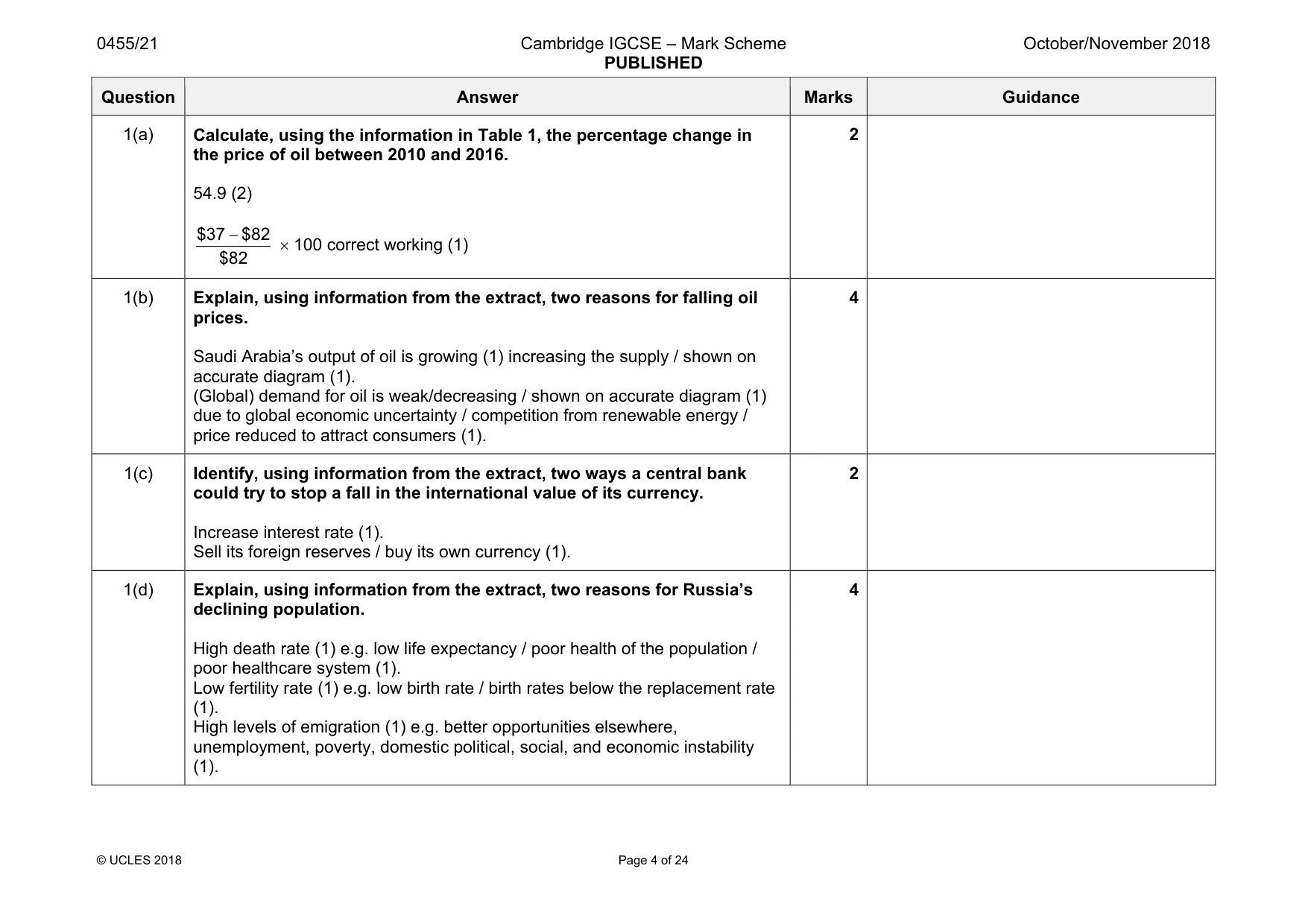
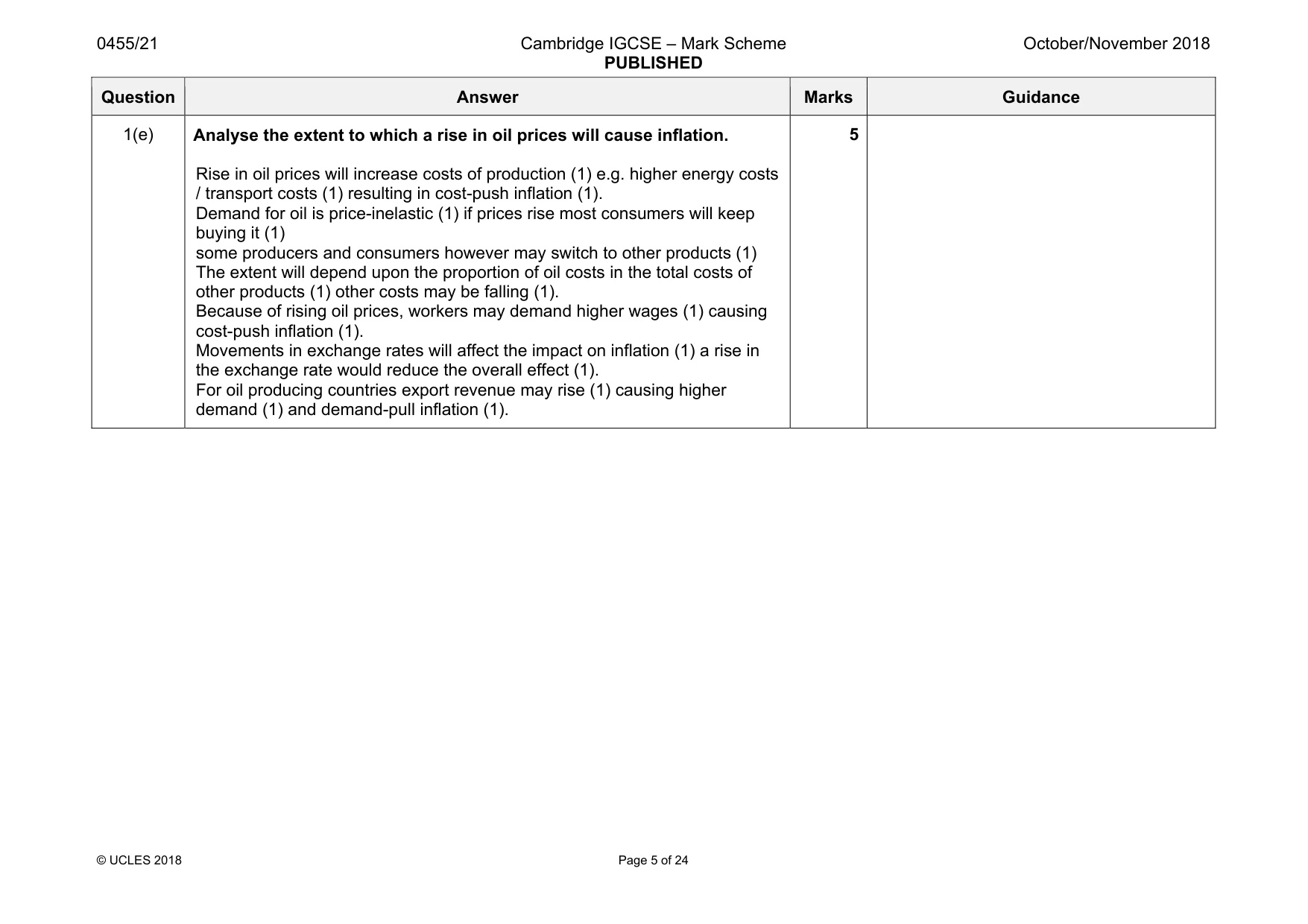
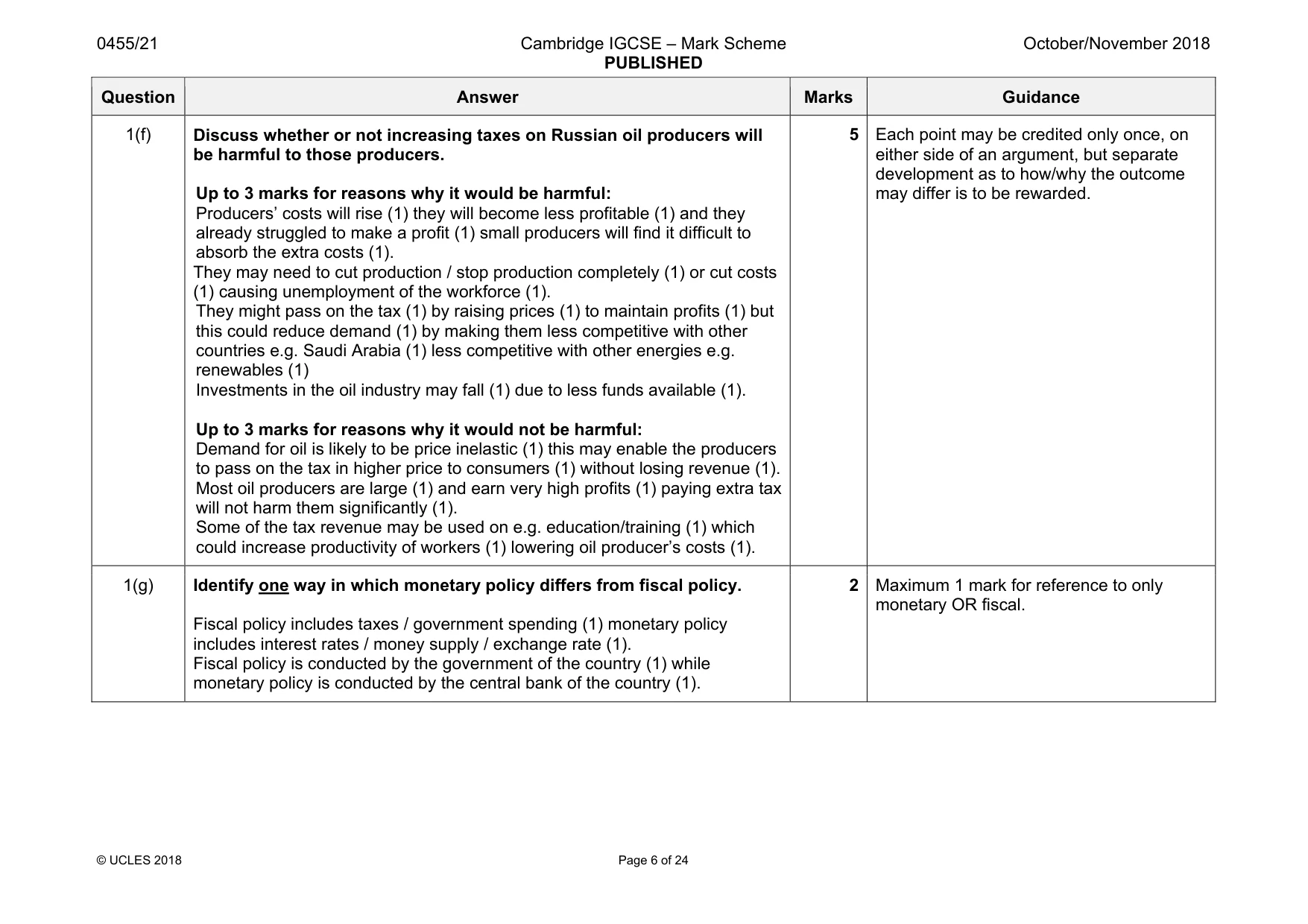
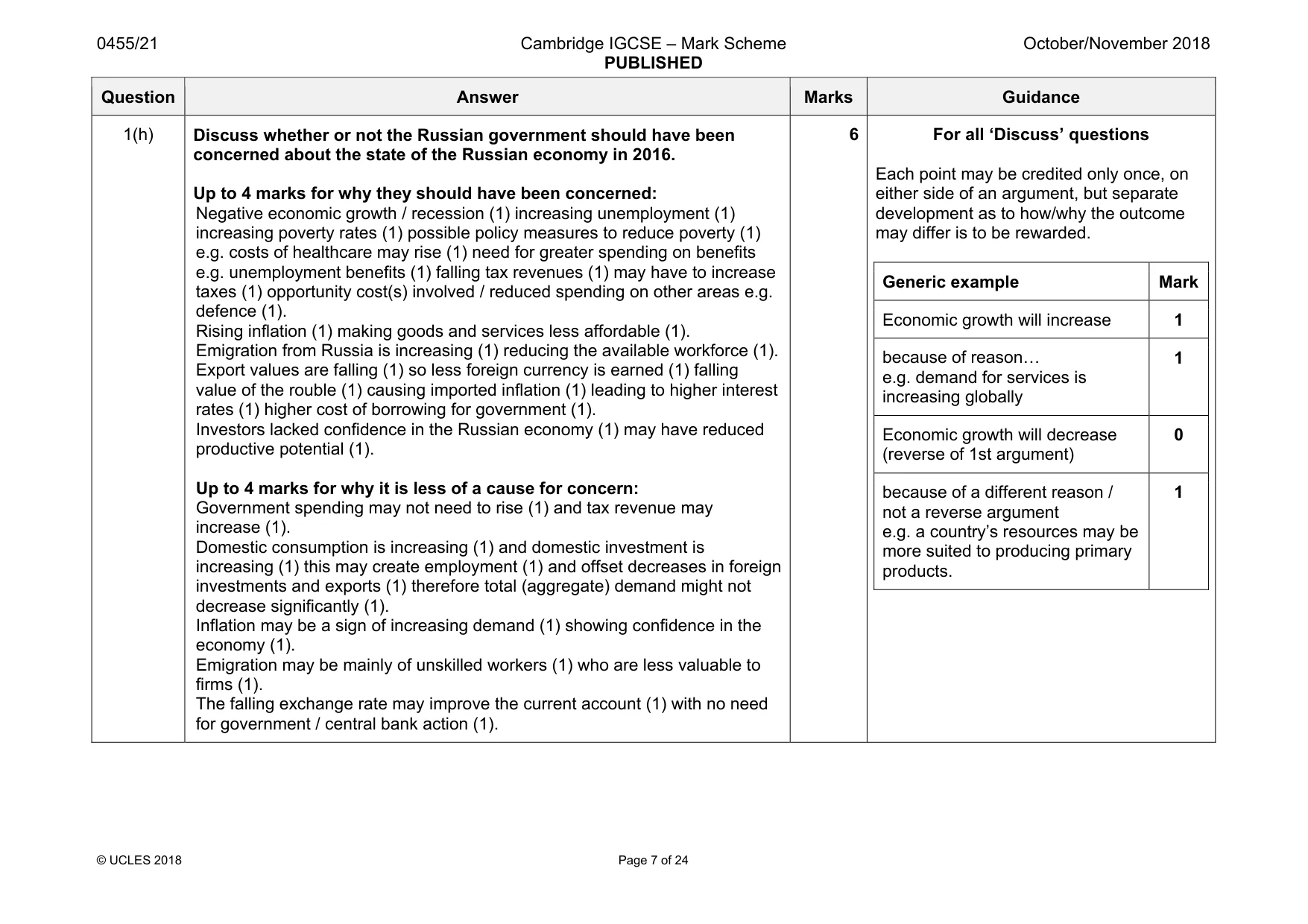
Mark scheme: 1(a) Calculate, using the information in Table 1, the percentage change in the price of oil between 2010 and 2016. 54.9 (2) − $37 $82 $82 × 100 correct working (1) 2 1(b) Explain, using information from the extract, two reasons for falling oil prices. Saudi Arabia’s output of oil is growing (1) increasing the supply / shown on accurate diagram (1). (Global) demand for oil is weak/decreasing / shown on accurate diagram (1) due to global economic uncertainty / competition from renewable energy / price reduced to attract consumers (1). 4 1(c) Identify, using information from the extract, two ways a central bank could try to stop a fall in the international value of its currency. Increase interest rate (1). Sell its foreign reserves / buy its own currency (1). 2 1(d) Explain, using information from the extract, two reasons for Russia’s declining population. High death rate (1) e.g. low life expectancy / poor health of the population / poor healthcare system (1). Low fertility rate (1) e.g. low birth rate / birth rates below the replacement rate (1). High levels of emigration (1) e.g. better opportunities elsewhere, unemployment, poverty, domestic political, social, and economic instability (1). 4 Question Answer Marks Guidance 1(e) Analyse the extent to which a rise in oil prices will cause inflation. Rise in oil prices will increase costs of production (1) e.g. higher energy costs / transport costs (1) resulting in cost-push inflation (1). Demand for oil is price-inelastic (1) if prices rise most consumers will keep buying it (1) some producers and consumers however may switch to other products (1) The extent will depend upon the proportion of oil costs in the total costs of other products (1) other costs may be falling (1). Because of rising oil prices, workers may demand higher wages (1) causing cost-push inflation (1). Movements in exchange rates will affect the impact on inflation (1) a rise in the exchange rate would reduce the overall effect (1). For oil producing countries export revenue may rise (1) causing higher demand (1) and demand-pull inflation (1). 5 Question Answer Marks Guidance 1(f) Discuss whether or not increasing taxes on Russian oil producers will be harmful to those producers. Up to 3 marks for reasons why it would be harmful: Producers’ costs will rise (1) they will become less profitable (1) and they already struggled to make a profit (1) small producers will find it difficult to absorb the extra costs (1). They may need to cut production / stop production completely (1) or cut costs (1) causing unemployment of the workforce (1). They might pass on the tax (1) by raising prices (1) to maintain profits (1) but this could reduce demand (1) by making them less competitive with other countries e.g. Saudi Arabia (1) less competitive with other energies e.g. renewables (1) Investments in the oil industry may fall (1) due to less funds available (1). Up to 3 marks for reasons why it would not be harmful: Demand for oil is likely to be price inelastic (1) this may enable the producers to pass on the tax in higher price to consumers (1) without losing revenue (1). Most oil producers are large (1) and earn very high profits (1) paying extra tax will not harm them significantly (1). Some of the tax revenue may be used on e.g. education/training (1) which could increase productivity of workers (1) lowering oil producer’s costs (1). 5 Each point may be credited only once, on either side of an argument, but separate development as to how/why the outcome may differ is to be rewarded. 1(g) Identify one way in which monetary policy differs from fiscal policy. Fiscal policy includes taxes / government spending (1) monetary policy includes interest rates / money supply / exchange rate (1). Fiscal policy is conducted by the government of the country (1) while monetary policy is conducted by the central bank of the country (1). 2 Maximum 1 mark for reference to only monetary OR fiscal. Question Answer Marks Guidance 1(h) Discuss whether or not the Russian government should have been concerned about the state of the Russian economy in 2016. Up to 4 marks for why they should have been concerned: Negative economic growth / recession (1) increasing unemployment (1) increasing poverty rates (1) possible policy measures to reduce poverty (1) e.g. costs of healthcare may rise (1) need for greater spending on benefits e.g. unemployment benefits (1) falling tax revenues (1) may have to increase taxes (1) opportunity cost(s) involved / reduced spending on other areas e.g. defence (1). Rising inflation (1) making goods and services less affordable (1). Emigration from Russia is increasing (1) reducing the available workforce (1). Export values are falling (1) so less foreign currency is earned (1) falling value of the rouble (1) causing imported inflation (1) leading to higher interest rates (1) higher cost of borrowing for government (1). Investors lacked confidence in the Russian economy (1) may have reduced productive potential (1). Up to 4 marks for why it is less of a cause for concern: Government spending may not need to rise (1) and tax revenue may increase (1). Domestic consumption is increasing (1) and domestic investment is increasing (1) this may create employment (1) and offset decreases in foreign investments and exports (1) therefore total (aggregate) demand might not decrease significantly (1). Inflation may be a sign of increasing demand (1) showing confidence in the economy (1). Emigration may be mainly of unskilled workers (1) who are less valuable to firms (1). The falling exchange rate may improve the current account (1) with no need for government / central bank action (1). 6 For all ‘Discuss’ questions Each point may be credited only once, on either side of an argument, but separate development as to how/why the outcome may differ is to be rewarded. Generic example Mark Economic growth will increase 1 because of reason« e.g. demand for services is increasing globally 1 Economic growth will decrease (reverse of 1st argument) 0 because of a different reason / not a reverse argument e.g. a country’s resources may be more suited to producing primary products. 1
Q2 · In 2016, there was a global surplus in the steel market pushing down steel prices
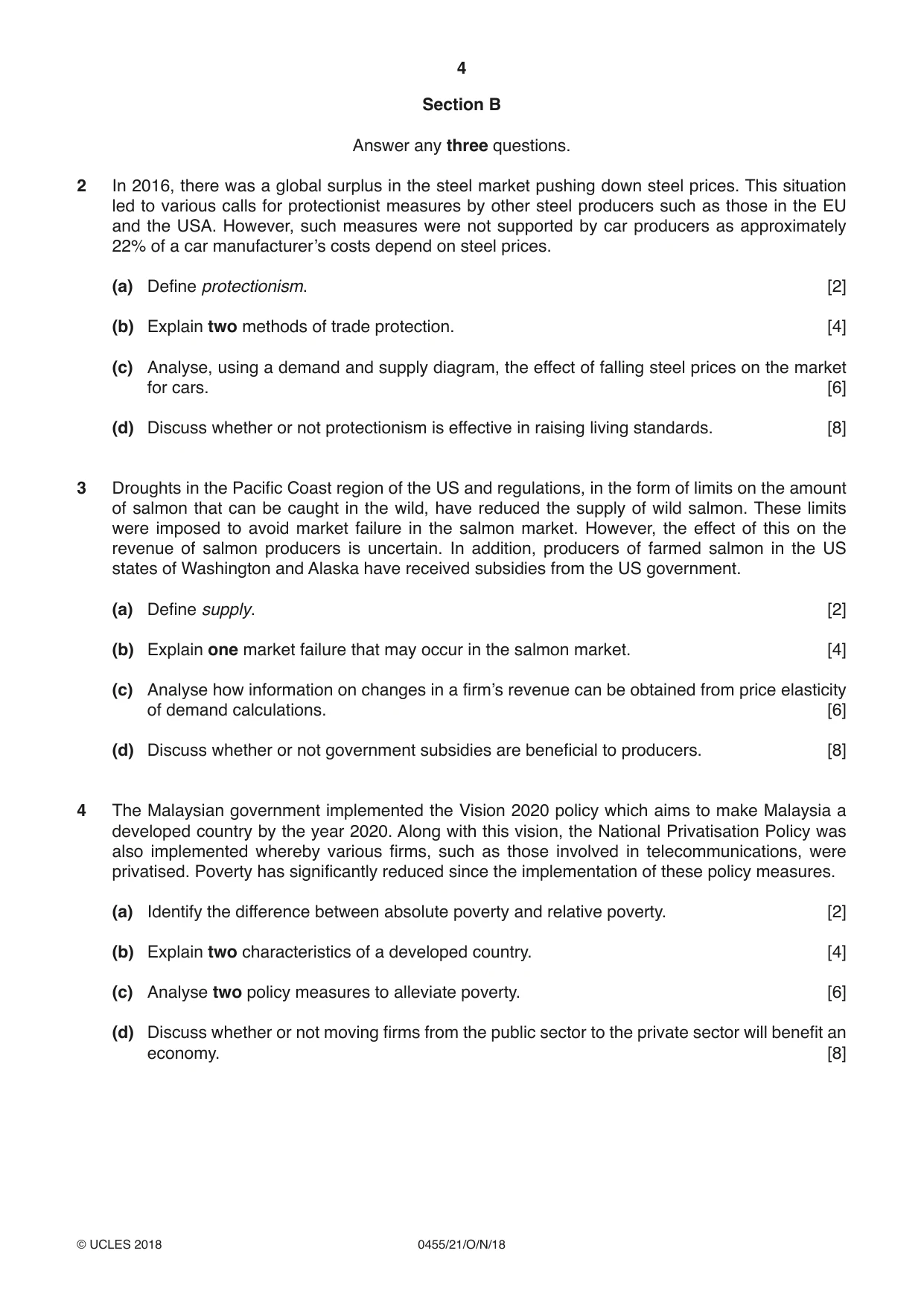
2 In 2016, there was a global surplus in the steel market pushing down steel prices. This situation led to various calls for protectionist measures by other steel producers such as those in the EU and the USA. However, such measures were not supported by car producers as approximately 22% of a car manufacturer’s costs depend on steel prices. (a) Define protectionism. [2] (b) Explain two methods of trade protection. [4] (c) Analyse, using a demand and supply diagram, the effect of falling steel prices on the market for cars. [6] (d) Discuss whether or not protectionism is effective in raising living standards. [8]
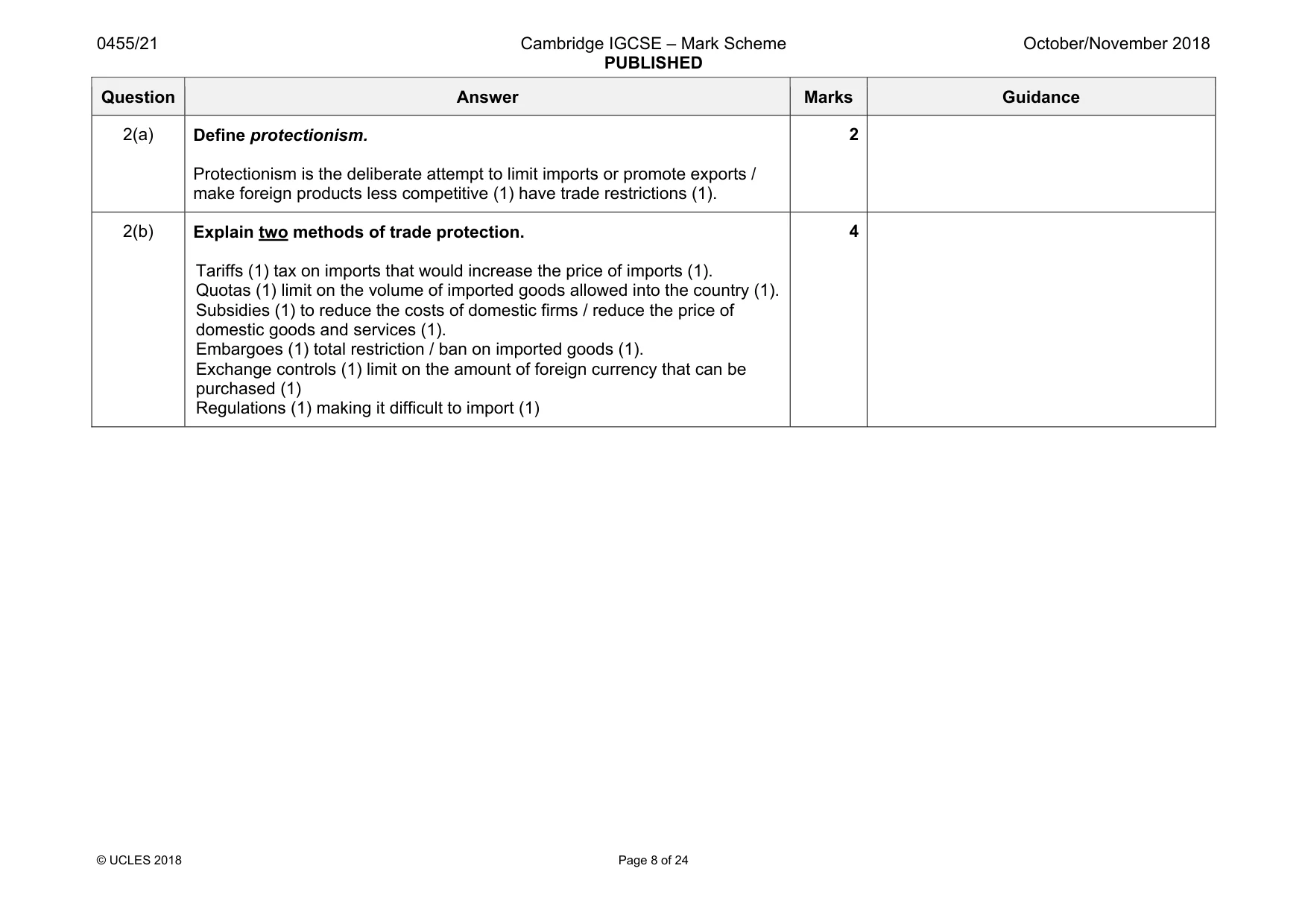
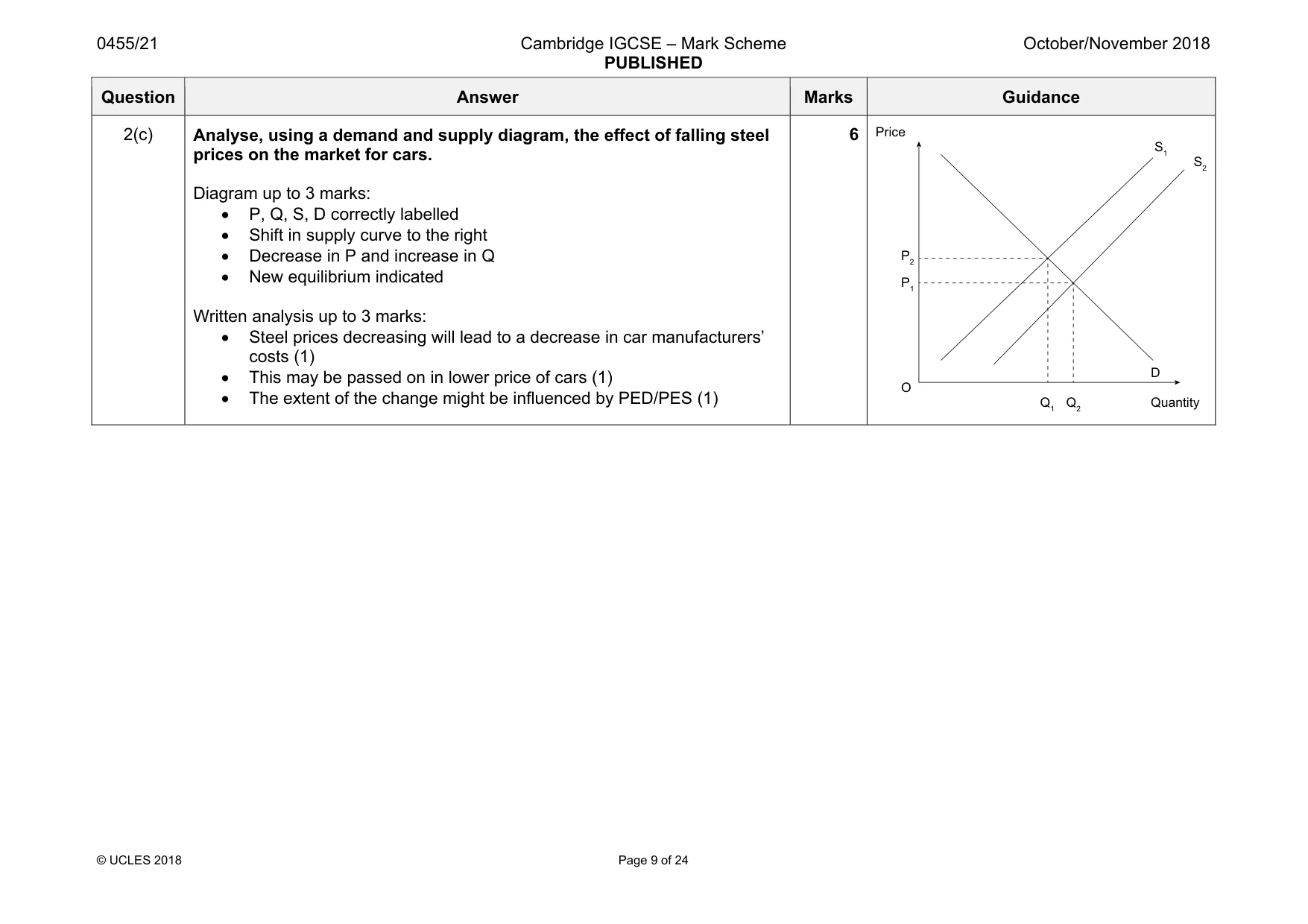
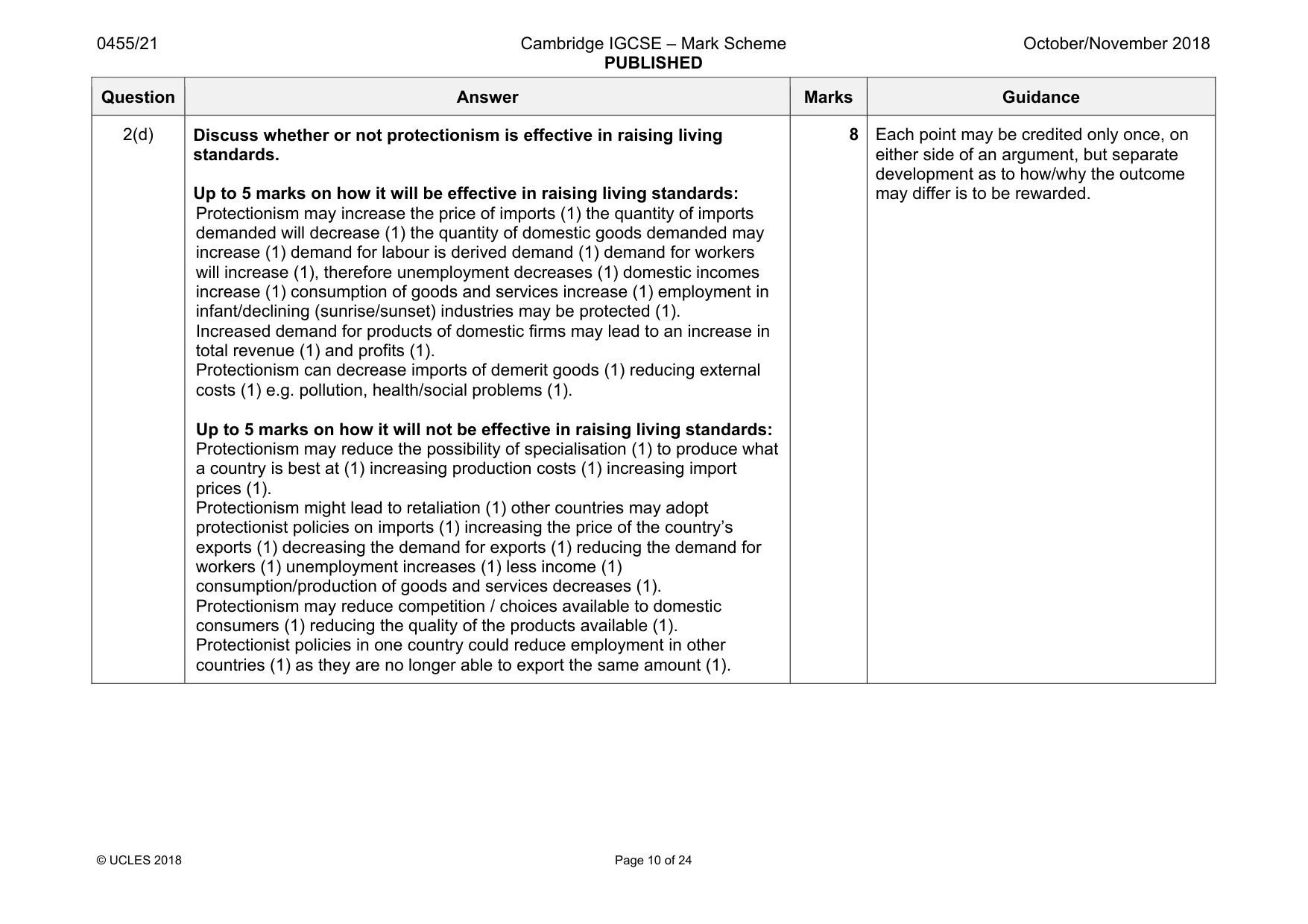
Mark scheme: 2(a) Define protectionism. Protectionism is the deliberate attempt to limit imports or promote exports / make foreign products less competitive (1) have trade restrictions (1). 2 2(b) Explain two methods of trade protection. Tariffs (1) tax on imports that would increase the price of imports (1). Quotas (1) limit on the volume of imported goods allowed into the country (1). Subsidies (1) to reduce the costs of domestic firms / reduce the price of domestic goods and services (1). Embargoes (1) total restriction / ban on imported goods (1). Exchange controls (1) limit on the amount of foreign currency that can be purchased (1) Regulations (1) making it difficult to import (1) 4 Question Answer Marks Guidance 2(c) Analyse, using a demand and supply diagram, the effect of falling steel prices on the market for cars. Diagram up to 3 marks: • P, Q, S, D correctly labelled • Shift in supply curve to the right • Decrease in P and increase in Q • New equilibrium indicated Written analysis up to 3 marks: • Steel prices decreasing will lead to a decrease in car manufacturers’ costs (1) • This may be passed on in lower price of cars (1) • The extent of the change might be influenced by PED/PES (1) 6 O Price Quantity D P1 Q1 Q2 P2 S2 S1 Question Answer Marks Guidance 2(d) Discuss whether or not protectionism is effective in raising living standards. Up to 5 marks on how it will be effective in raising living standards: Protectionism may increase the price of imports (1) the quantity of imports demanded will decrease (1) the quantity of domestic goods demanded may increase (1) demand for labour is derived demand (1) demand for workers will increase (1), therefore unemployment decreases (1) domestic incomes increase (1) consumption of goods and services increase (1) employment in infant/declining (sunrise/sunset) industries may be protected (1). Increased demand for products of domestic firms may lead to an increase in total revenue (1) and profits (1). Protectionism can decrease imports of demerit goods (1) reducing external costs (1) e.g. pollution, health/social problems (1). Up to 5 marks on how it will not be effective in raising living standards: Protectionism may reduce the possibility of specialisation (1) to produce what a country is best at (1) increasing production costs (1) increasing import prices (1). Protectionism might lead to retaliation (1) other countries may adopt protectionist policies on imports (1) increasing the price of the country’s exports (1) decreasing the demand for exports (1) reducing the demand for workers (1) unemployment increases (1) less income (1) consumption/production of goods and services decreases (1). Protectionism may reduce competition / choices available to domestic consumers (1) reducing the quality of the products available (1). Protectionist policies in one country could reduce employment in other countries (1) as they are no longer able to export the same amount (1). 8 Each point may be credited only once, on either side of an argument, but separate development as to how/why the outcome may differ is to be rewarded.
Q3 · Droughts in the Pacific Coast region of the US and regulations, in the form of limits on…
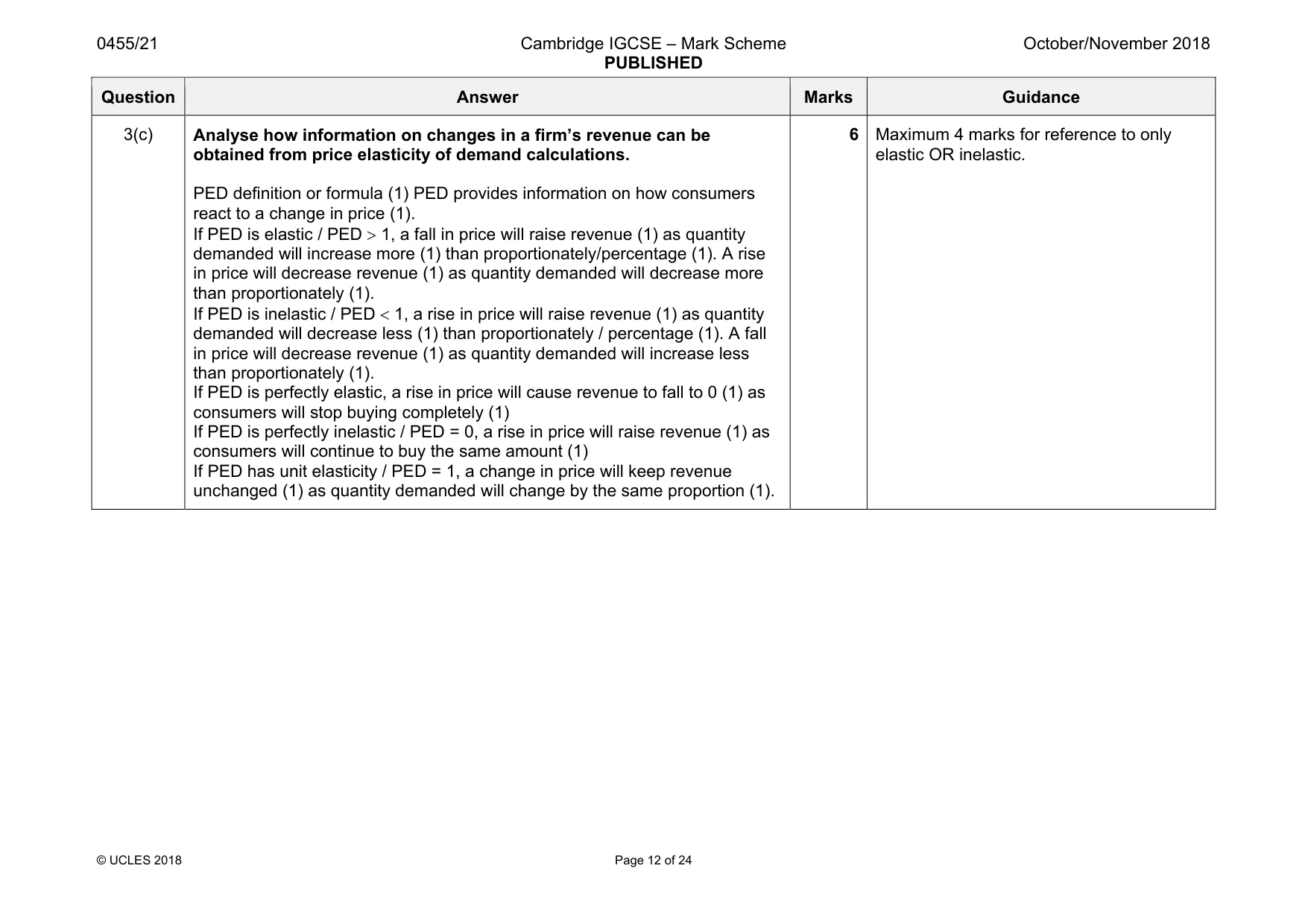
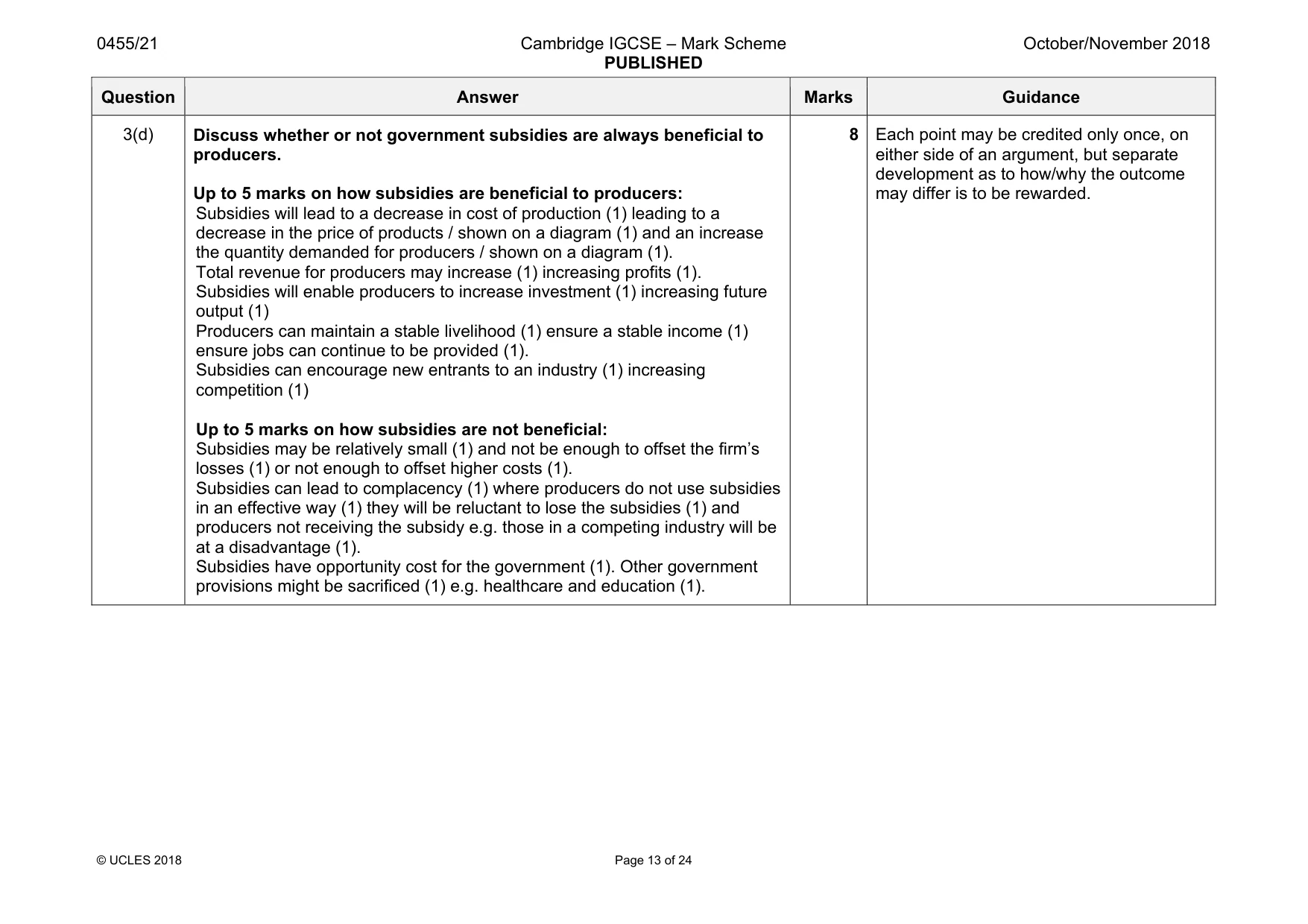
3 Droughts in the Pacific Coast region of the US and regulations, in the form of limits on the amount of salmon that can be caught in the wild, have reduced the supply of wild salmon. These limits were imposed to avoid market failure in the salmon market. However, the effect of this on the revenue of salmon producers is uncertain. In addition, producers of farmed salmon in the US states of Washington and Alaska have received subsidies from the US government. (a) Define supply. [2] (b) Explain one market failure that may occur in the salmon market. [4] (c) Analyse how information on changes in a firm’s revenue can be obtained from price elasticity of demand calculations. [6] (d) Discuss whether or not government subsidies are beneficial to producers. [8]
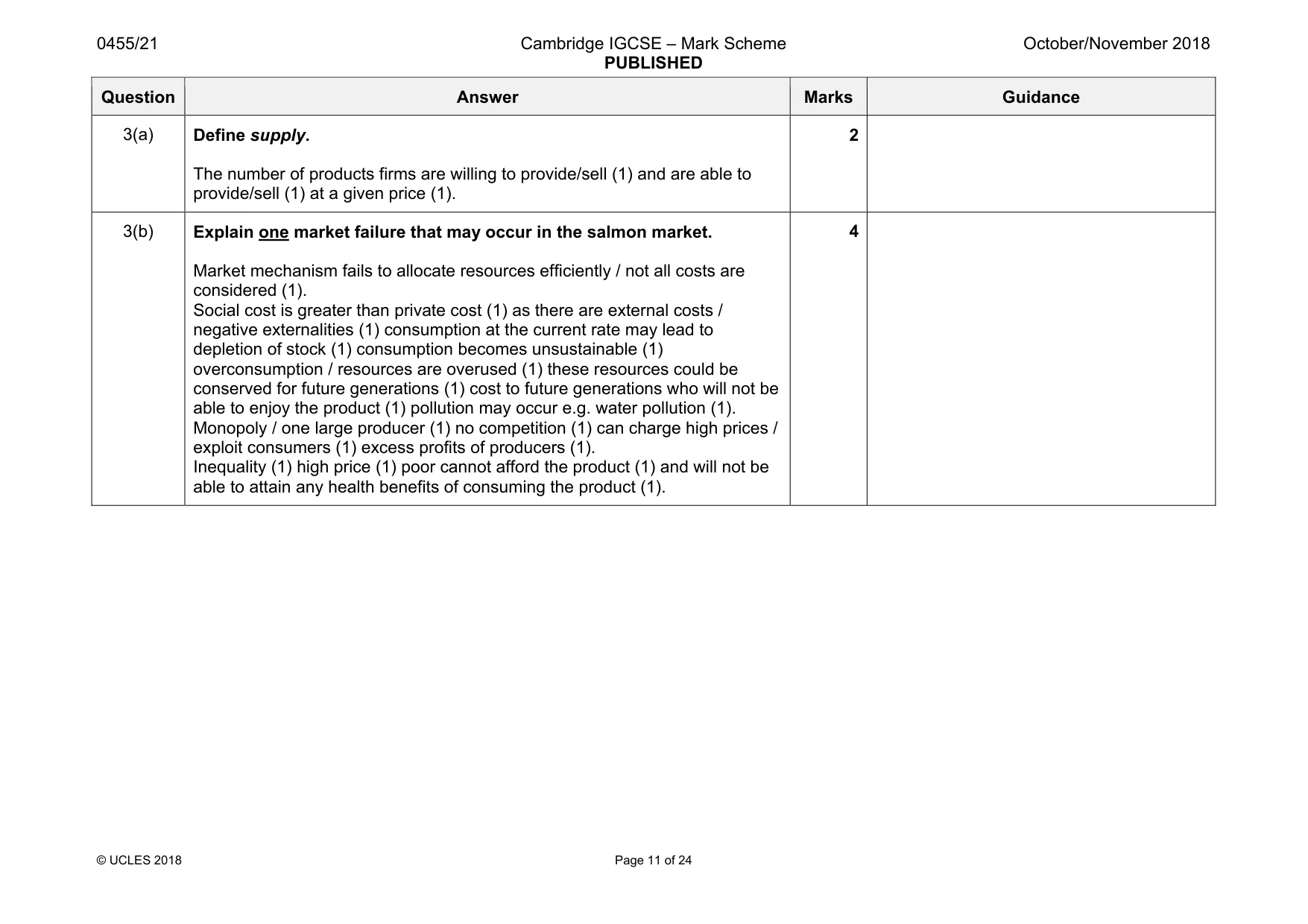
Mark scheme: 3(a) Define supply. The number of products firms are willing to provide/sell (1) and are able to provide/sell (1) at a given price (1). 2 3(b) Explain one market failure that may occur in the salmon market. Market mechanism fails to allocate resources efficiently / not all costs are considered (1). Social cost is greater than private cost (1) as there are external costs / negative externalities (1) consumption at the current rate may lead to depletion of stock (1) consumption becomes unsustainable (1) overconsumption / resources are overused (1) these resources could be conserved for future generations (1) cost to future generations who will not be able to enjoy the product (1) pollution may occur e.g. water pollution (1). Monopoly / one large producer (1) no competition (1) can charge high prices / exploit consumers (1) excess profits of producers (1). Inequality (1) high price (1) poor cannot afford the product (1) and will not be able to attain any health benefits of consuming the product (1). 4 Question Answer Marks Guidance 3(c) Analyse how information on changes in a firm’s revenue can be obtained from price elasticity of demand calculations. PED definition or formula (1) PED provides information on how consumers react to a change in price (1). If PED is elastic / PED > 1, a fall in price will raise revenue (1) as quantity demanded will increase more (1) than proportionately/percentage (1). A rise in price will decrease revenue (1) as quantity demanded will decrease more than proportionately (1). If PED is inelastic / PED < 1, a rise in price will raise revenue (1) as quantity demanded will decrease less (1) than proportionately / percentage (1). A fall in price will decrease revenue (1) as quantity demanded will increase less than proportionately (1). If PED is perfectly elastic, a rise in price will cause revenue to fall to 0 (1) as consumers will stop buying completely (1) If PED is perfectly inelastic / PED = 0, a rise in price will raise revenue (1) as consumers will continue to buy the same amount (1) If PED has unit elasticity / PED = 1, a change in price will keep revenue unchanged (1) as quantity demanded will change by the same proportion (1). 6 Maximum 4 marks for reference to only elastic OR inelastic. Question Answer Marks Guidance 3(d) Discuss whether or not government subsidies are always beneficial to producers. Up to 5 marks on how subsidies are beneficial to producers: Subsidies will lead to a decrease in cost of production (1) leading to a decrease in the price of products / shown on a diagram (1) and an increase the quantity demanded for producers / shown on a diagram (1). Total revenue for producers may increase (1) increasing profits (1). Subsidies will enable producers to increase investment (1) increasing future output (1) Producers can maintain a stable livelihood (1) ensure a stable income (1) ensure jobs can continue to be provided (1). Subsidies can encourage new entrants to an industry (1) increasing competition (1) Up to 5 marks on how subsidies are not beneficial: Subsidies may be relatively small (1) and not be enough to offset the firm’s losses (1) or not enough to offset higher costs (1). Subsidies can lead to complacency (1) where producers do not use subsidies in an effective way (1) they will be reluctant to lose the subsidies (1) and producers not receiving the subsidy e.g. those in a competing industry will be at a disadvantage (1). Subsidies have opportunity cost for the government (1). Other government provisions might be sacrificed (1) e.g. healthcare and education (1). 8 Each point may be credited only once, on either side of an argument, but separate development as to how/why the outcome may differ is to be rewarded.
Q4 · The Malaysian government implemented the Vision 2020 policy which aims to make Malaysia a…
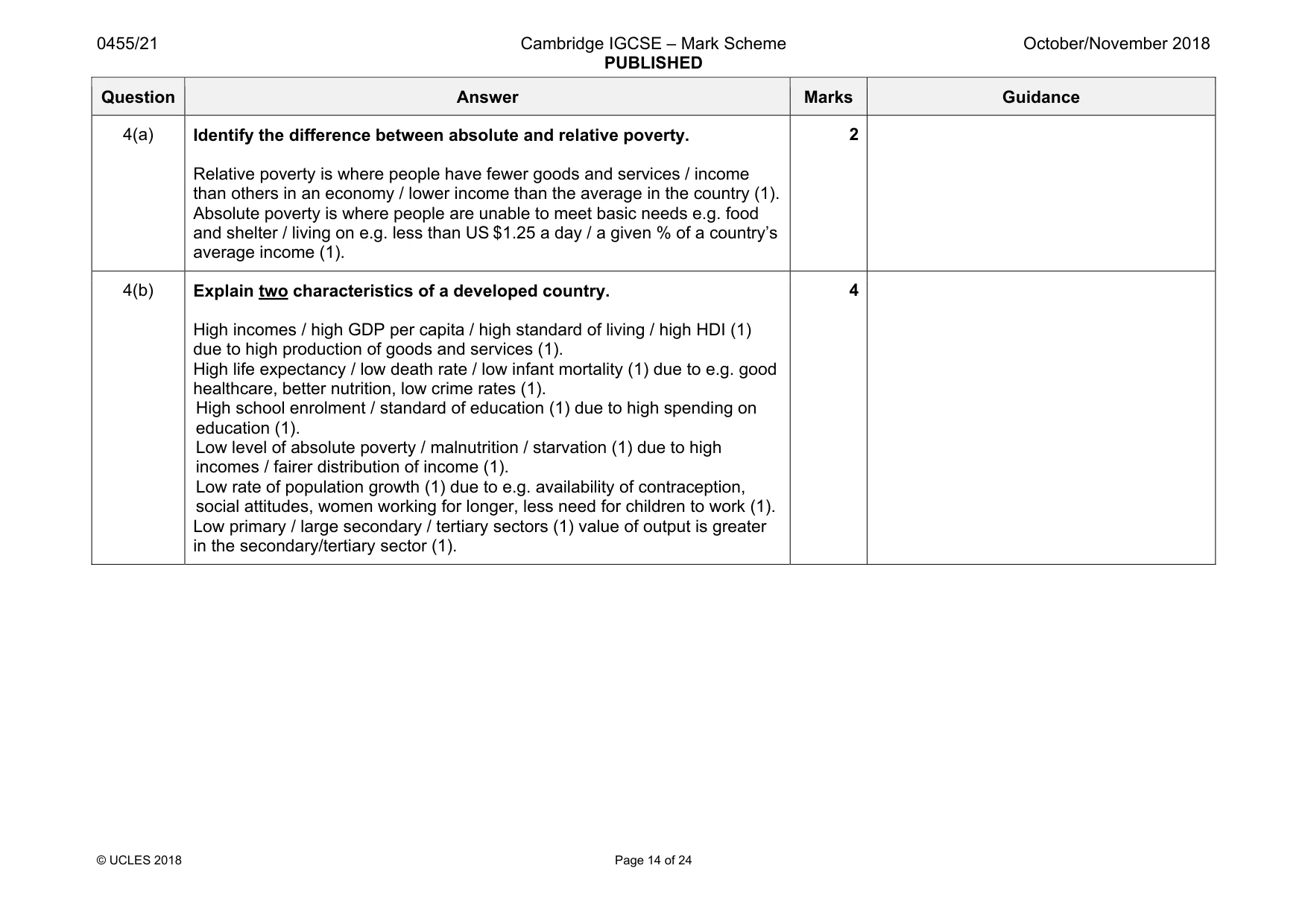
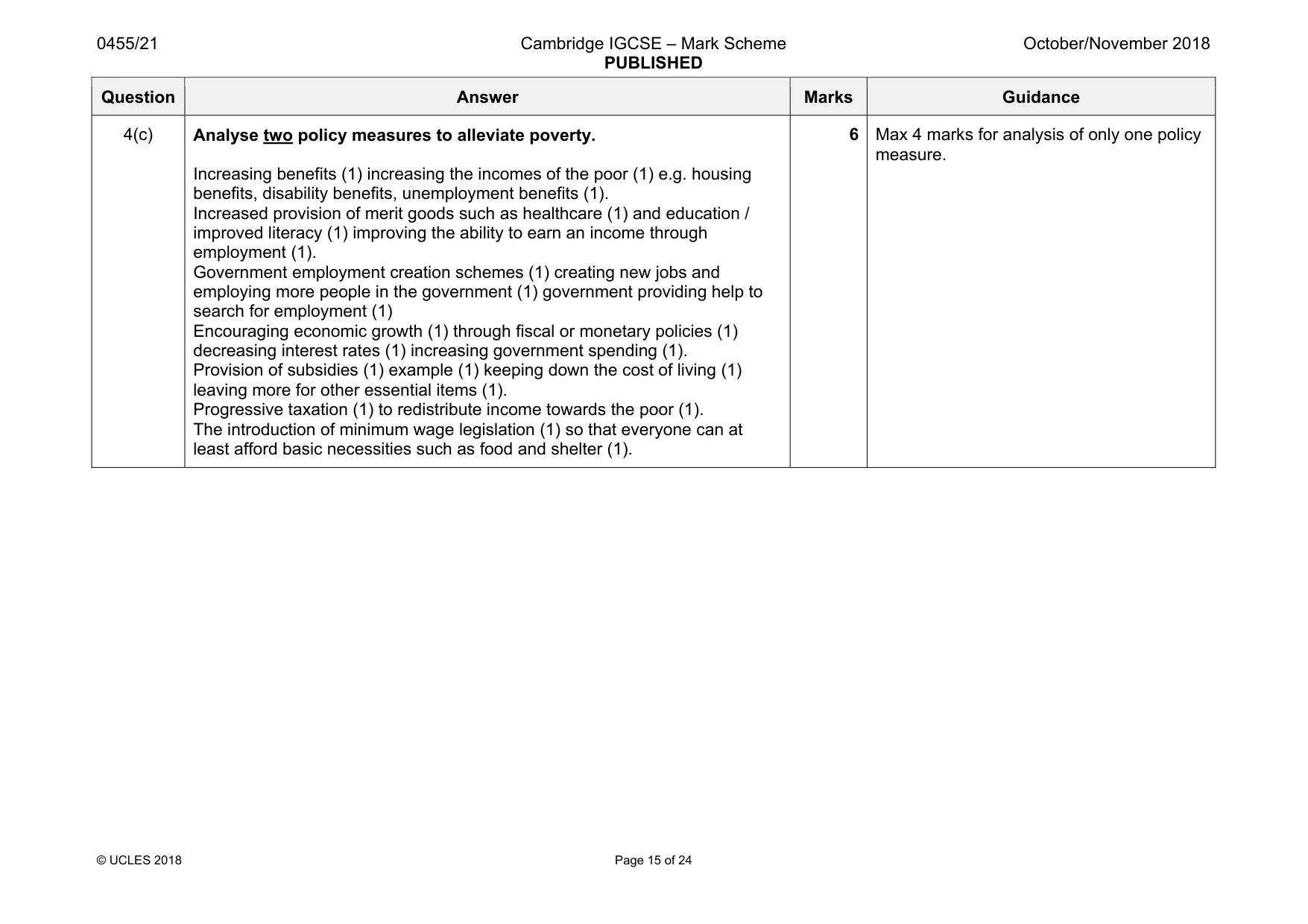
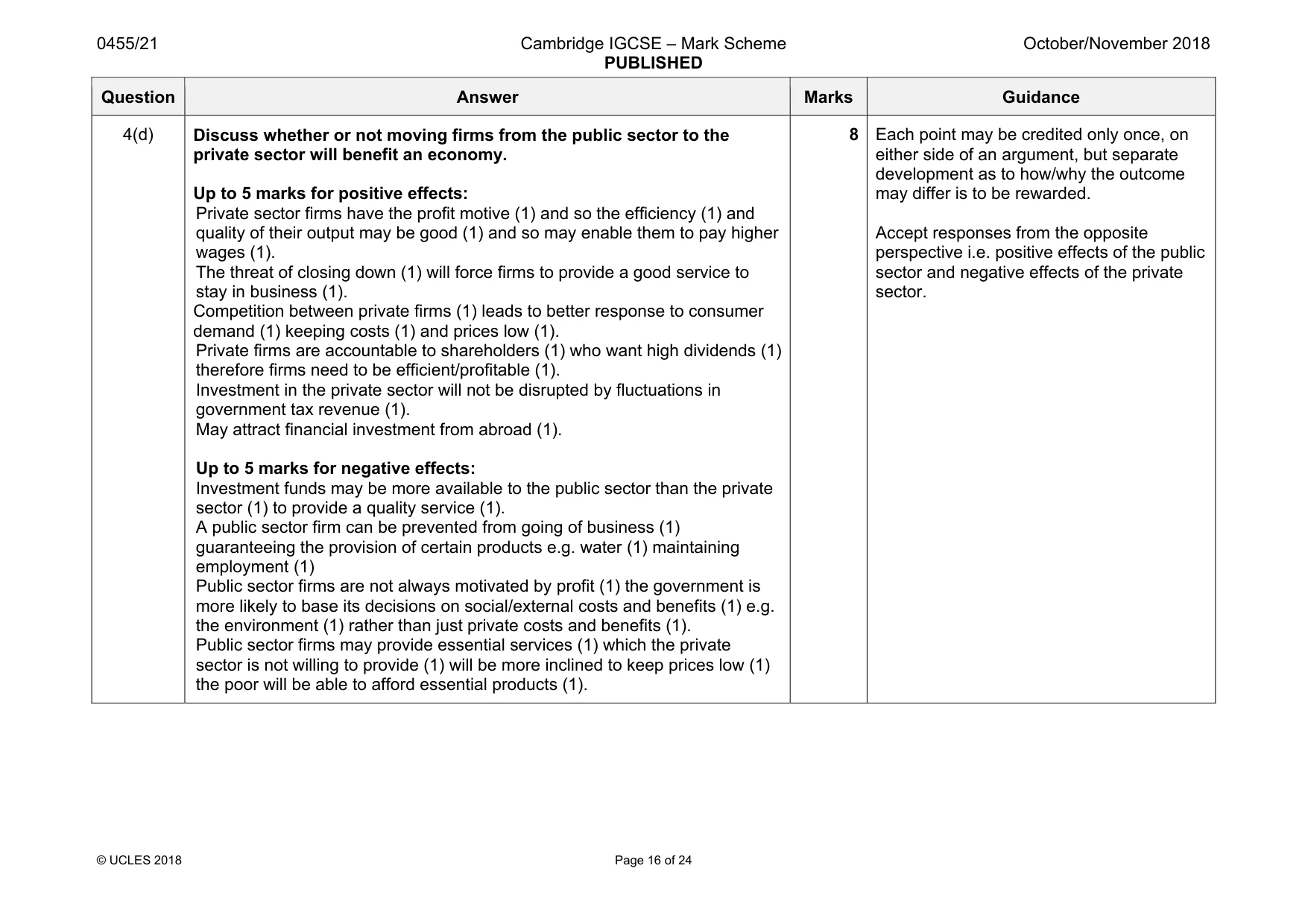
4 The Malaysian government implemented the Vision 2020 policy which aims to make Malaysia a developed country by the year 2020. Along with this vision, the National Privatisation Policy was also implemented whereby various firms, such as those involved in telecommunications, were privatised. Poverty has significantly reduced since the implementation of these policy measures. (a) Identify the difference between absolute poverty and relative poverty. [2] (b) Explain two characteristics of a developed country. [4] (c) Analyse two policy measures to alleviate poverty. [6] (d) Discuss whether or not moving firms from the public sector to the private sector will benefit an economy. [8]
Mark scheme: 4(a) Identify the difference between absolute and relative poverty. Relative poverty is where people have fewer goods and services / income than others in an economy / lower income than the average in the country (1). Absolute poverty is where people are unable to meet basic needs e.g. food and shelter / living on e.g. less than US $1.25 a day / a given % of a country’s average income (1). 2 4(b) Explain two characteristics of a developed country. High incomes / high GDP per capita / high standard of living / high HDI (1) due to high production of goods and services (1). High life expectancy / low death rate / low infant mortality (1) due to e.g. good healthcare, better nutrition, low crime rates (1). High school enrolment / standard of education (1) due to high spending on education (1). Low level of absolute poverty / malnutrition / starvation (1) due to high incomes / fairer distribution of income (1). Low rate of population growth (1) due to e.g. availability of contraception, social attitudes, women working for longer, less need for children to work (1). Low primary / large secondary / tertiary sectors (1) value of output is greater in the secondary/tertiary sector (1). 4 Question Answer Marks Guidance 4(c) Analyse two policy measures to alleviate poverty. Increasing benefits (1) increasing the incomes of the poor (1) e.g. housing benefits, disability benefits, unemployment benefits (1). Increased provision of merit goods such as healthcare (1) and education / improved literacy (1) improving the ability to earn an income through employment (1). Government employment creation schemes (1) creating new jobs and employing more people in the government (1) government providing help to search for employment (1) Encouraging economic growth (1) through fiscal or monetary policies (1) decreasing interest rates (1) increasing government spending (1). Provision of subsidies (1) example (1) keeping down the cost of living (1) leaving more for other essential items (1). Progressive taxation (1) to redistribute income towards the poor (1). The introduction of minimum wage legislation (1) so that everyone can at least afford basic necessities such as food and shelter (1). 6 Max 4 marks for analysis of only one policy measure. Question Answer Marks Guidance 4(d) Discuss whether or not moving firms from the public sector to the private sector will benefit an economy. Up to 5 marks for positive effects: Private sector firms have the profit motive (1) and so the efficiency (1) and quality of their output may be good (1) and so may enable them to pay higher wages (1). The threat of closing down (1) will force firms to provide a good service to stay in business (1). Competition between private firms (1) leads to better response to consumer demand (1) keeping costs (1) and prices low (1). Private firms are accountable to shareholders (1) who want high dividends (1) therefore firms need to be efficient/profitable (1). Investment in the private sector will not be disrupted by fluctuations in government tax revenue (1). May attract financial investment from abroad (1). Up to 5 marks for negative effects: Investment funds may be more available to the public sector than the private sector (1) to provide a quality service (1). A public sector firm can be prevented from going of business (1) guaranteeing the provision of certain products e.g. water (1) maintaining employment (1) Public sector firms are not always motivated by profit (1) the government is more likely to base its decisions on social/external costs and benefits (1) e.g. the environment (1) rather than just private costs and benefits (1). Public sector firms may provide essential services (1) which the private sector is not willing to provide (1) will be more inclined to keep prices low (1) the poor will be able to afford essential products (1). 8 Each point may be credited only once, on either side of an argument, but separate development as to how/why the outcome may differ is to be rewarded. Accept responses from the opposite perspective i.e. positive effects of the public sector and negative effects of the private sector.
Q5 · The largest airline in Pakistan was originally formed as a result of a merger between a…
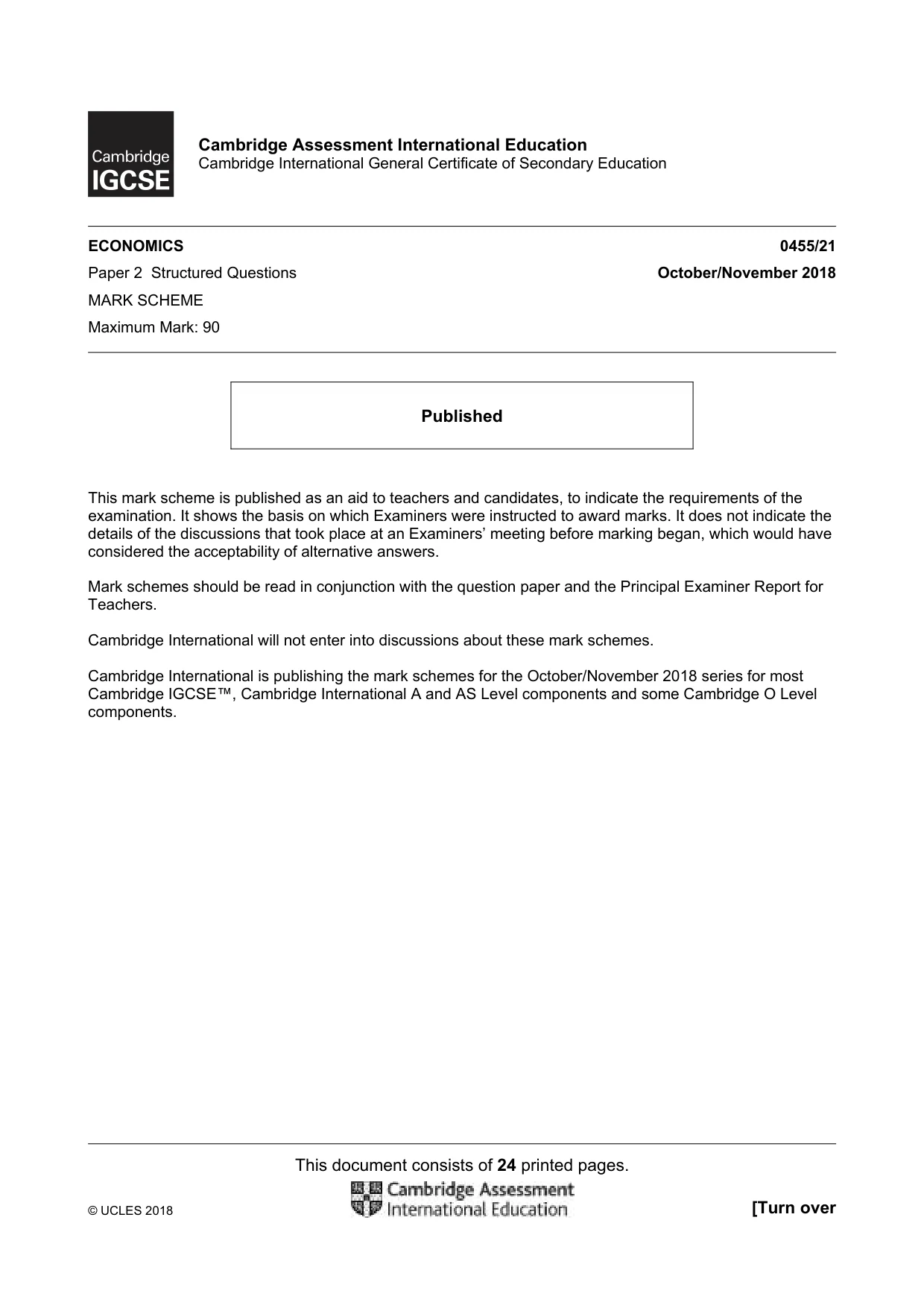
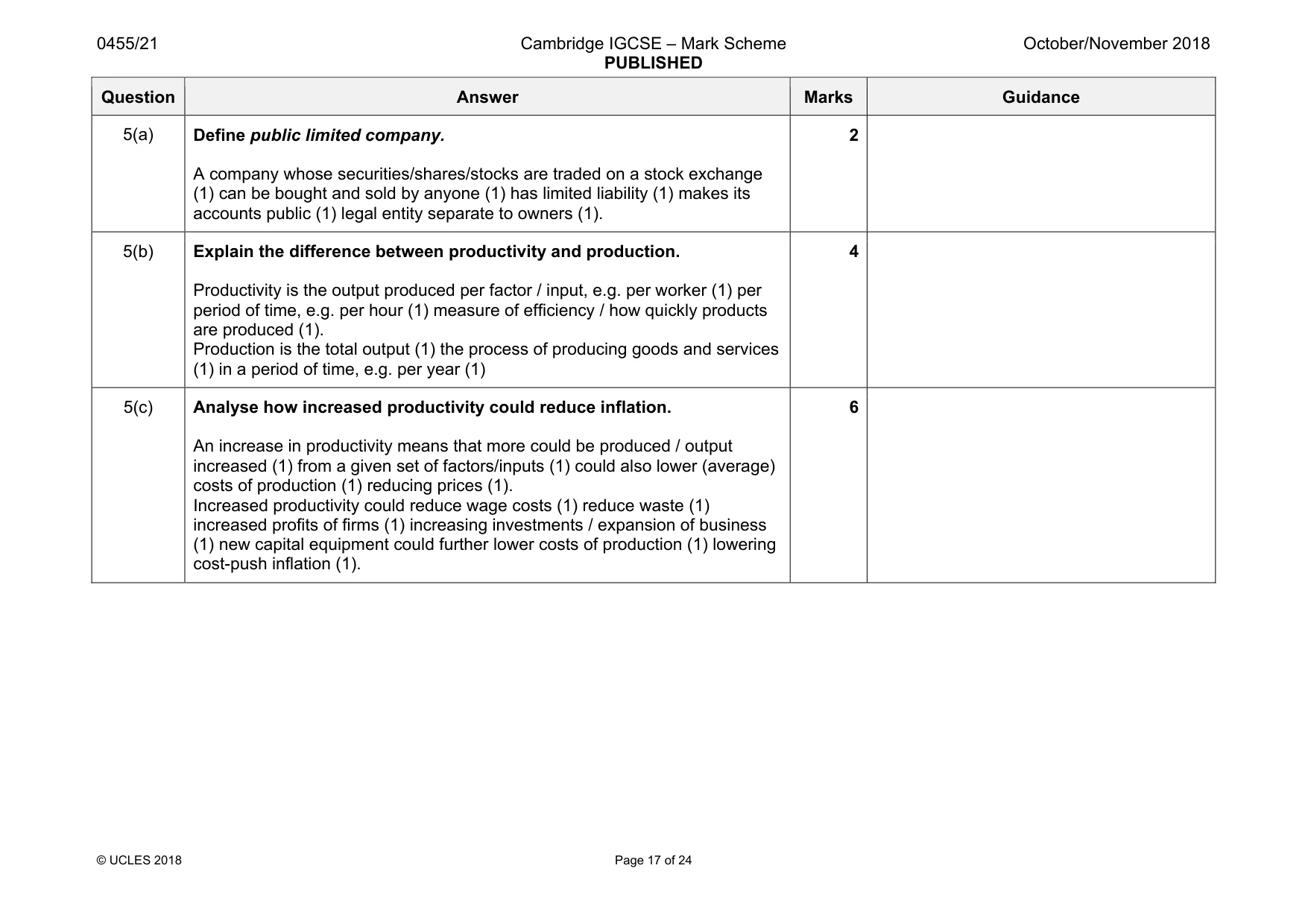
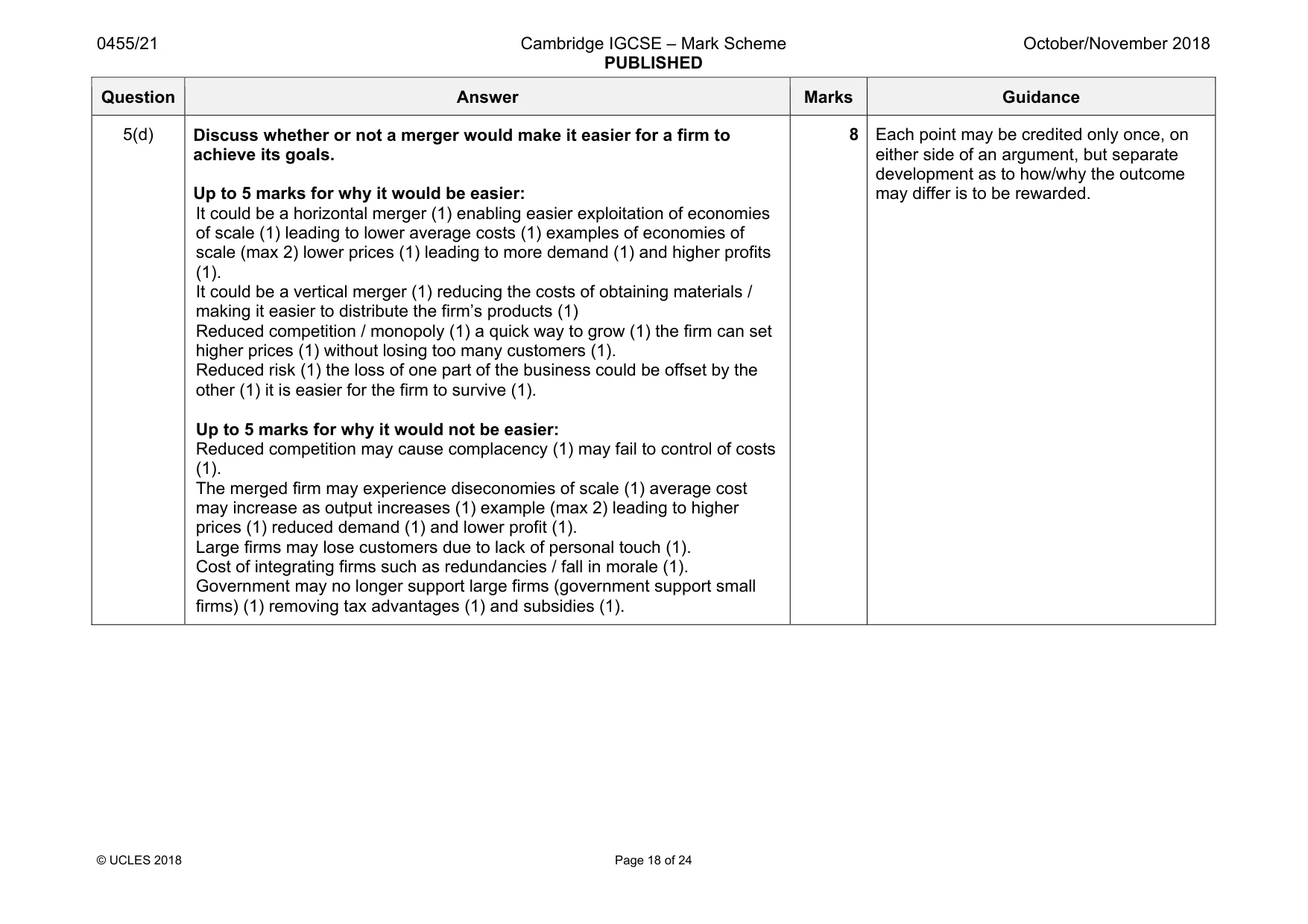
5 The largest airline in Pakistan was originally formed as a result of a merger between a state- owned airline and a private airline. In April 2016, the Pakistan government made this merged firm a public limited company. This was hoped to improve the productivity of this loss-making airline and also improve the overall economy of Pakistan. (a) Define public limited company. [2] (b) Explain the difference between productivity and production. [4] (c) Analyse how increased productivity could reduce inflation. [6] (d) Discuss whether or not a merger might make it easier for a firm to achieve its goals. [8]
Mark scheme: 5(a) Define public limited company. A company whose securities/shares/stocks are traded on a stock exchange (1) can be bought and sold by anyone (1) has limited liability (1) makes its accounts public (1) legal entity separate to owners (1). 2 5(b) Explain the difference between productivity and production. Productivity is the output produced per factor / input, e.g. per worker (1) per period of time, e.g. per hour (1) measure of efficiency / how quickly products are produced (1). Production is the total output (1) the process of producing goods and services (1) in a period of time, e.g. per year (1) 4 5(c) Analyse how increased productivity could reduce inflation. An increase in productivity means that more could be produced / output increased (1) from a given set of factors/inputs (1) could also lower (average) costs of production (1) reducing prices (1). Increased productivity could reduce wage costs (1) reduce waste (1) increased profits of firms (1) increasing investments / expansion of business (1) new capital equipment could further lower costs of production (1) lowering cost-push inflation (1). 6 Question Answer Marks Guidance 5(d) Discuss whether or not a merger would make it easier for a firm to achieve its goals. Up to 5 marks for why it would be easier: It could be a horizontal merger (1) enabling easier exploitation of economies of scale (1) leading to lower average costs (1) examples of economies of scale (max 2) lower prices (1) leading to more demand (1) and higher profits (1). It could be a vertical merger (1) reducing the costs of obtaining materials / making it easier to distribute the firm’s products (1) Reduced competition / monopoly (1) a quick way to grow (1) the firm can set higher prices (1) without losing too many customers (1). Reduced risk (1) the loss of one part of the business could be offset by the other (1) it is easier for the firm to survive (1). Up to 5 marks for why it would not be easier: Reduced competition may cause complacency (1) may fail to control of costs (1). The merged firm may experience diseconomies of scale (1) average cost may increase as output increases (1) example (max 2) leading to higher prices (1) reduced demand (1) and lower profit (1). Large firms may lose customers due to lack of personal touch (1). Cost of integrating firms such as redundancies / fall in morale (1). Government may no longer support large firms (government support small firms) (1) removing tax advantages (1) and subsidies (1). 8 Each point may be credited only once, on either side of an argument, but separate development as to how/why the outcome may differ is to be rewarded.
Q6 · Teachers in many countries oppose their governments’ cuts in spending on education
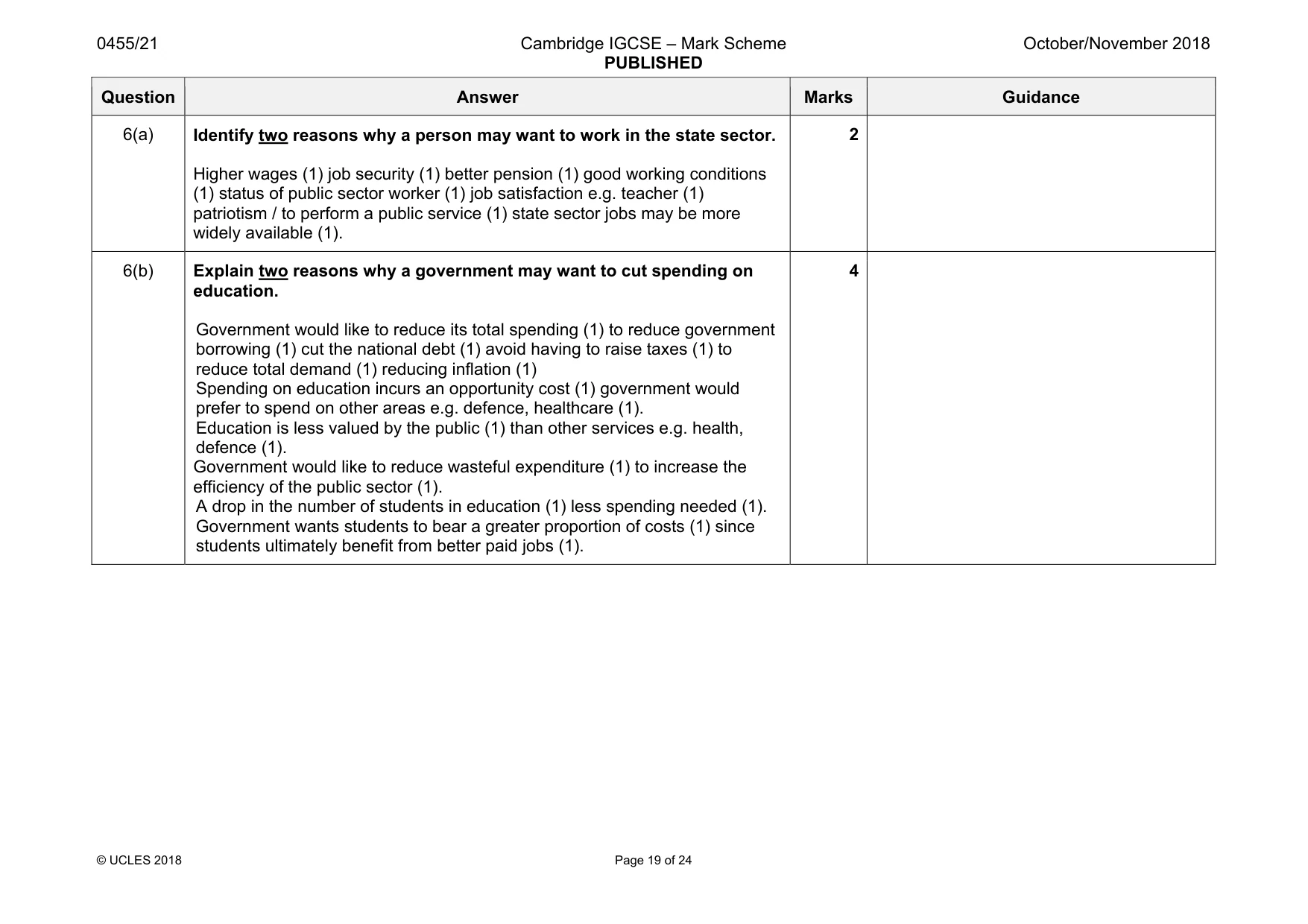
6 Teachers in many countries oppose their governments’ cuts in spending on education. They worry that this could reduce the standard of education and also the welfare of teachers employed in the state sector. Some teachers specialise in teaching one subject while others teach a number of subjects. (a) Identify two reasons why a person may want to work in the state sector. [2] (b) Explain two reasons why a government may want to cut spending on education. [4] (c) Analyse the contribution that education can make in an economy. [6] (d) Discuss whether or not a worker would benefit by specialising. [8]
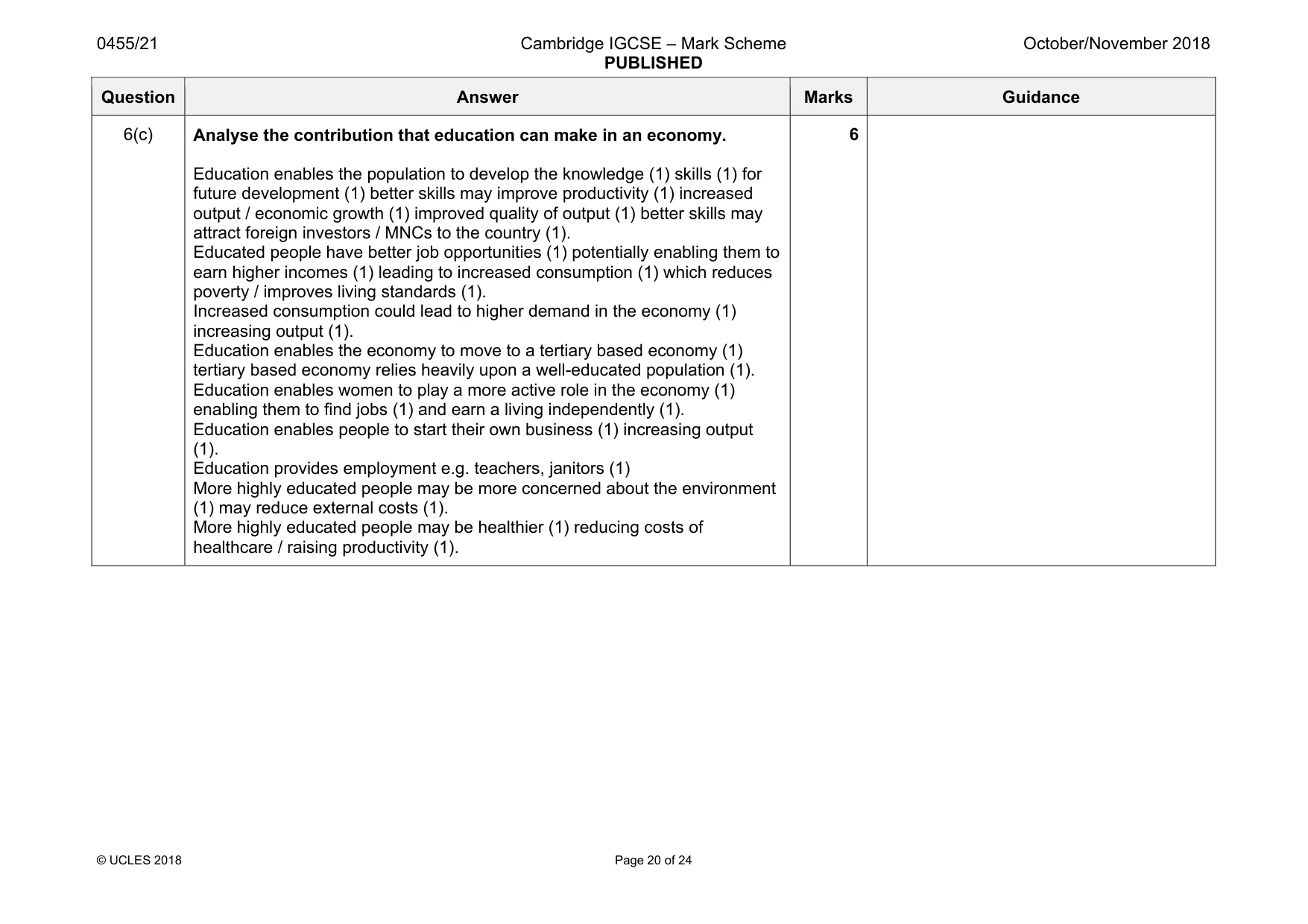
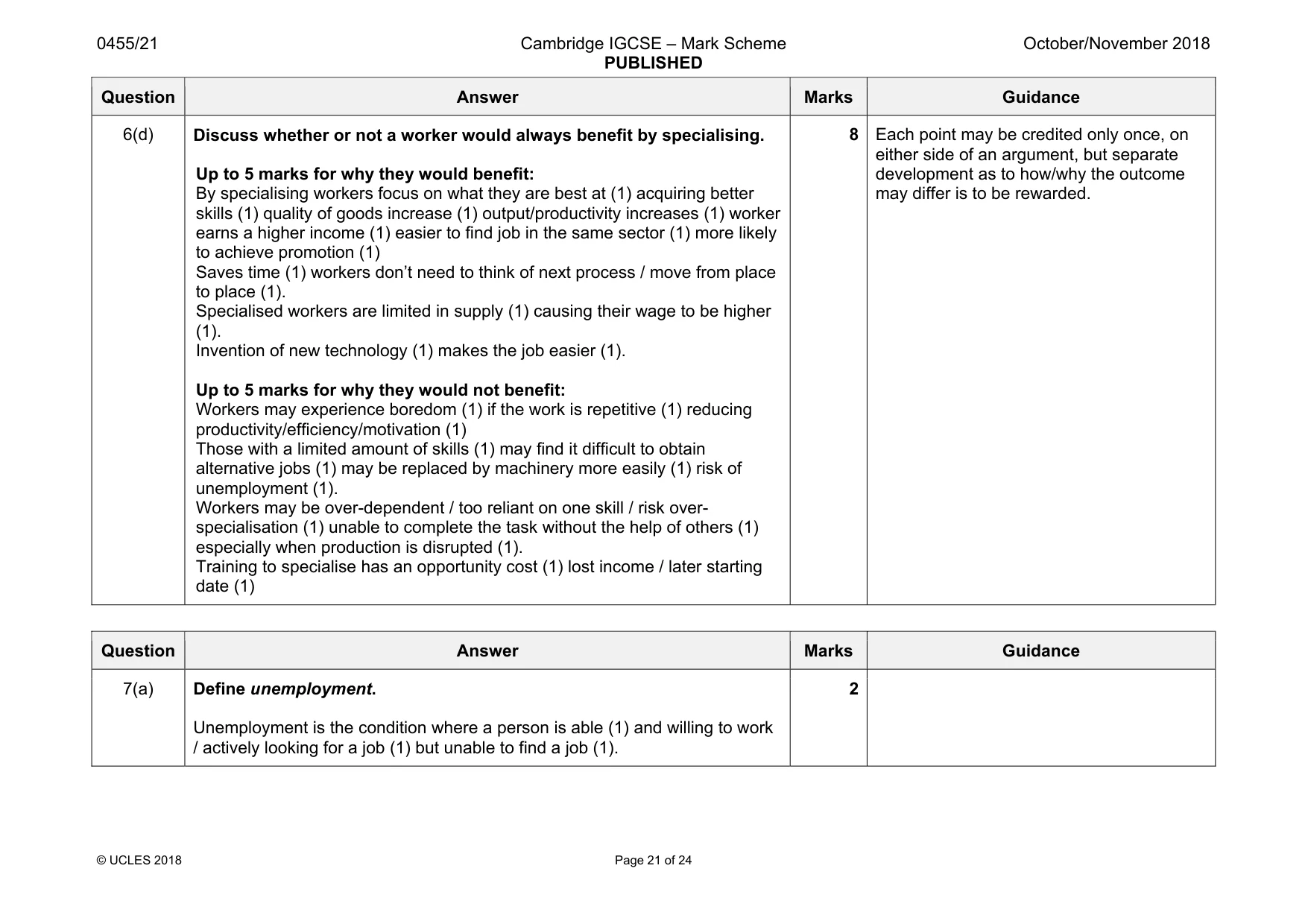
Mark scheme: 6(a) Identify two reasons why a person may want to work in the state sector. Higher wages (1) job security (1) better pension (1) good working conditions (1) status of public sector worker (1) job satisfaction e.g. teacher (1) patriotism / to perform a public service (1) state sector jobs may be more widely available (1). 2 6(b) Explain two reasons why a government may want to cut spending on education. Government would like to reduce its total spending (1) to reduce government borrowing (1) cut the national debt (1) avoid having to raise taxes (1) to reduce total demand (1) reducing inflation (1) Spending on education incurs an opportunity cost (1) government would prefer to spend on other areas e.g. defence, healthcare (1). Education is less valued by the public (1) than other services e.g. health, defence (1). Government would like to reduce wasteful expenditure (1) to increase the efficiency of the public sector (1). A drop in the number of students in education (1) less spending needed (1). Government wants students to bear a greater proportion of costs (1) since students ultimately benefit from better paid jobs (1). 4 Question Answer Marks Guidance 6(c) Analyse the contribution that education can make in an economy. Education enables the population to develop the knowledge (1) skills (1) for future development (1) better skills may improve productivity (1) increased output / economic growth (1) improved quality of output (1) better skills may attract foreign investors / MNCs to the country (1). Educated people have better job opportunities (1) potentially enabling them to earn higher incomes (1) leading to increased consumption (1) which reduces poverty / improves living standards (1). Increased consumption could lead to higher demand in the economy (1) increasing output (1). Education enables the economy to move to a tertiary based economy (1) tertiary based economy relies heavily upon a well-educated population (1). Education enables women to play a more active role in the economy (1) enabling them to find jobs (1) and earn a living independently (1). Education enables people to start their own business (1) increasing output (1). Education provides employment e.g. teachers, janitors (1) More highly educated people may be more concerned about the environment (1) may reduce external costs (1). More highly educated people may be healthier (1) reducing costs of healthcare / raising productivity (1). 6 Question Answer Marks Guidance 6(d) Discuss whether or not a worker would always benefit by specialising. Up to 5 marks for why they would benefit: By specialising workers focus on what they are best at (1) acquiring better skills (1) quality of goods increase (1) output/productivity increases (1) worker earns a higher income (1) easier to find job in the same sector (1) more likely to achieve promotion (1) Saves time (1) workers don’t need to think of next process / move from place to place (1). Specialised workers are limited in supply (1) causing their wage to be higher (1). Invention of new technology (1) makes the job easier (1). Up to 5 marks for why they would not benefit: Workers may experience boredom (1) if the work is repetitive (1) reducing productivity/efficiency/motivation (1) Those with a limited amount of skills (1) may find it difficult to obtain alternative jobs (1) may be replaced by machinery more easily (1) risk of unemployment (1). Workers may be over-dependent / too reliant on one skill / risk over- specialisation (1) unable to complete the task without the help of others (1) especially when production is disrupted (1). Training to specialise has an opportunity cost (1) lost income / later starting date (1) 8 Each point may be credited only once, on either side of an argument, but separate development as to how/why the outcome may differ is to be rewarded.
Q7 · During a recent recession in Europe, Spain had an unemployment rate of over 25%
7 During a recent recession in Europe, Spain had an unemployment rate of over 25%. This led to high levels of emigration from Spain into higher-wage European economies such as Germany and the UK. This has created both opportunities and problems in countries where immigration was higher than emigration. (a) Define unemployment. [2] (b) Explain two reasons for wage differentials between different economies. [4] (c) Analyse how a recession in one country could cause unemployment in another country. [6] (d) Discuss whether the economic advantages of immigration into countries such as the UK and Germany outweigh the economic disadvantages. [8]
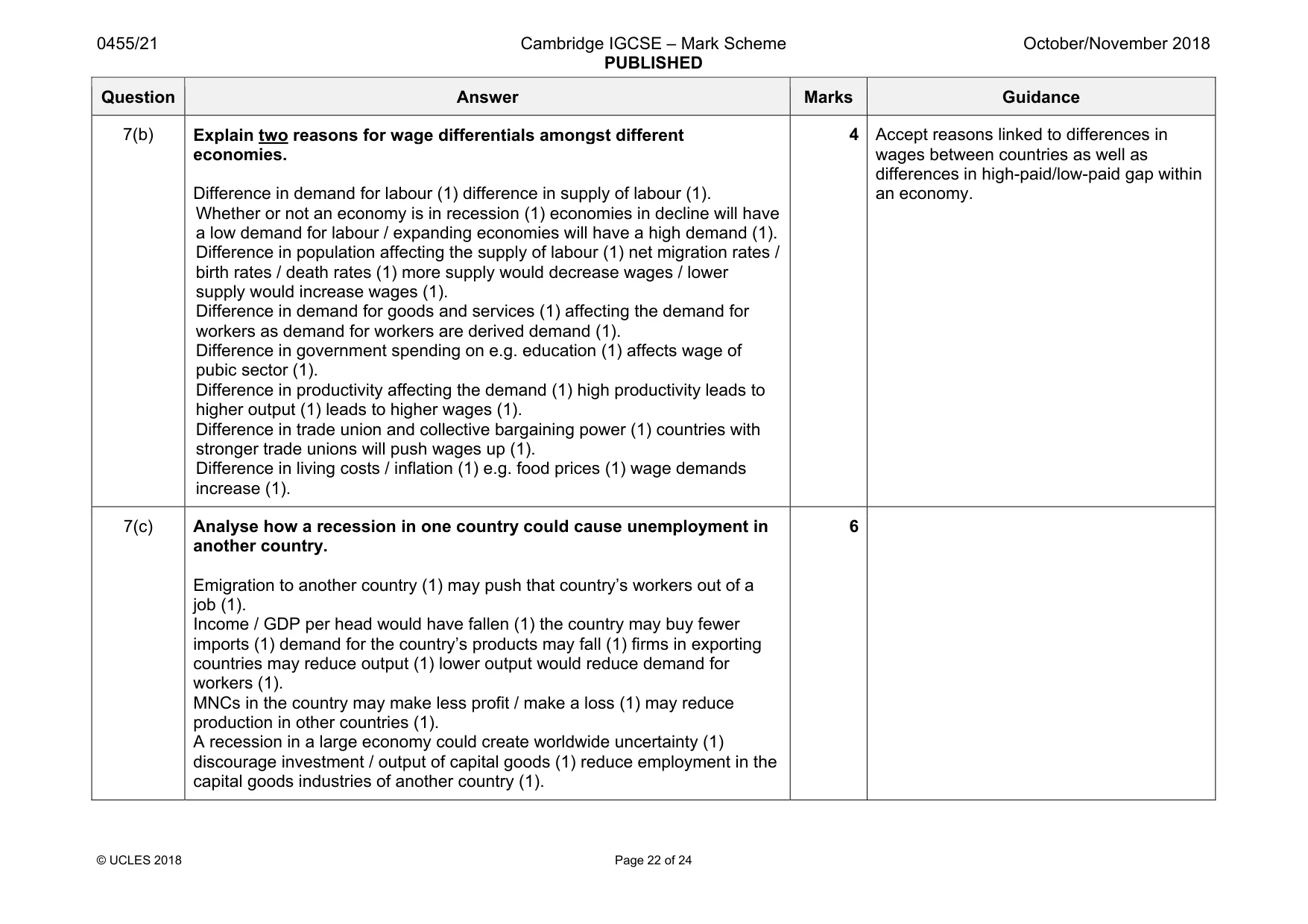
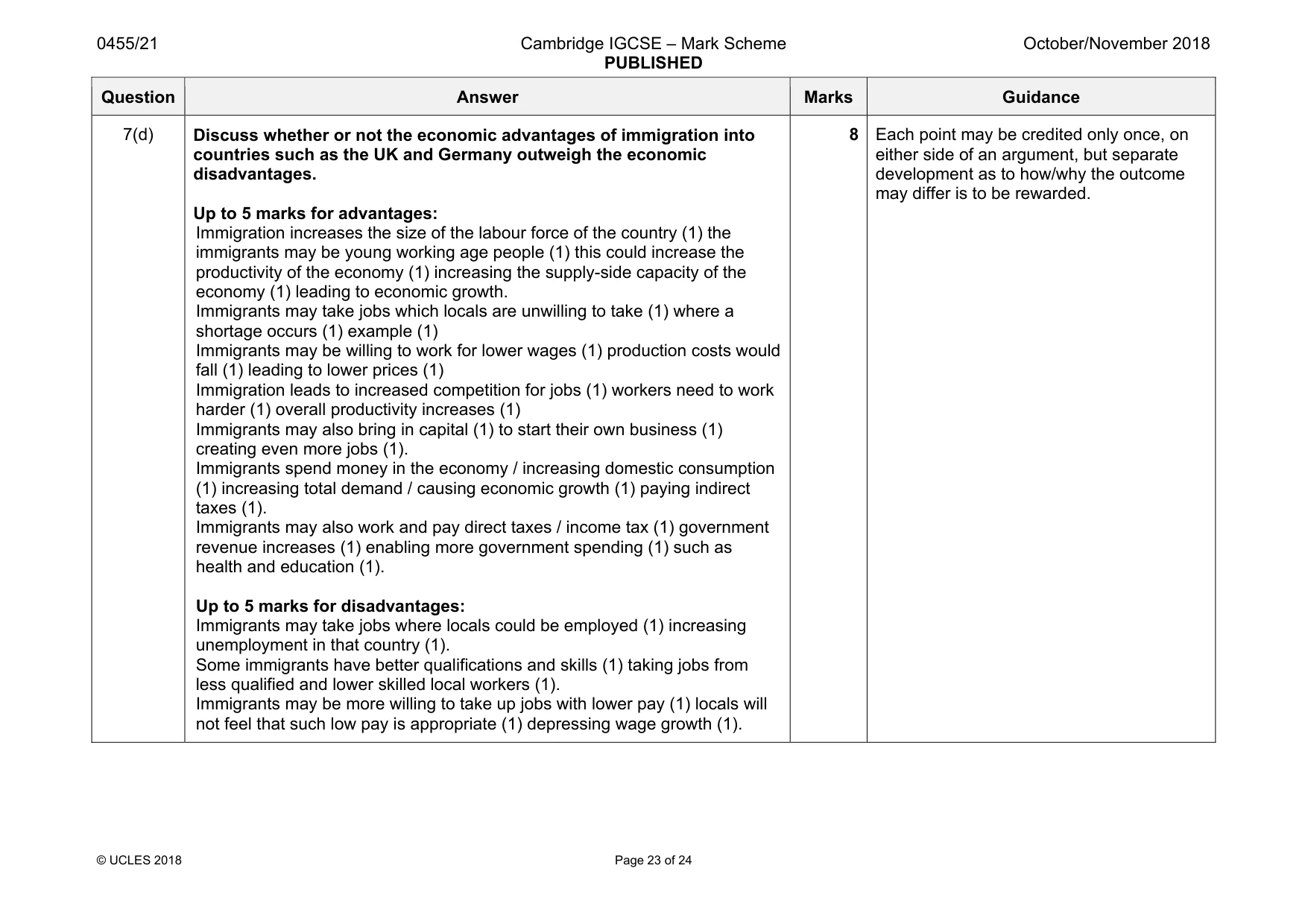
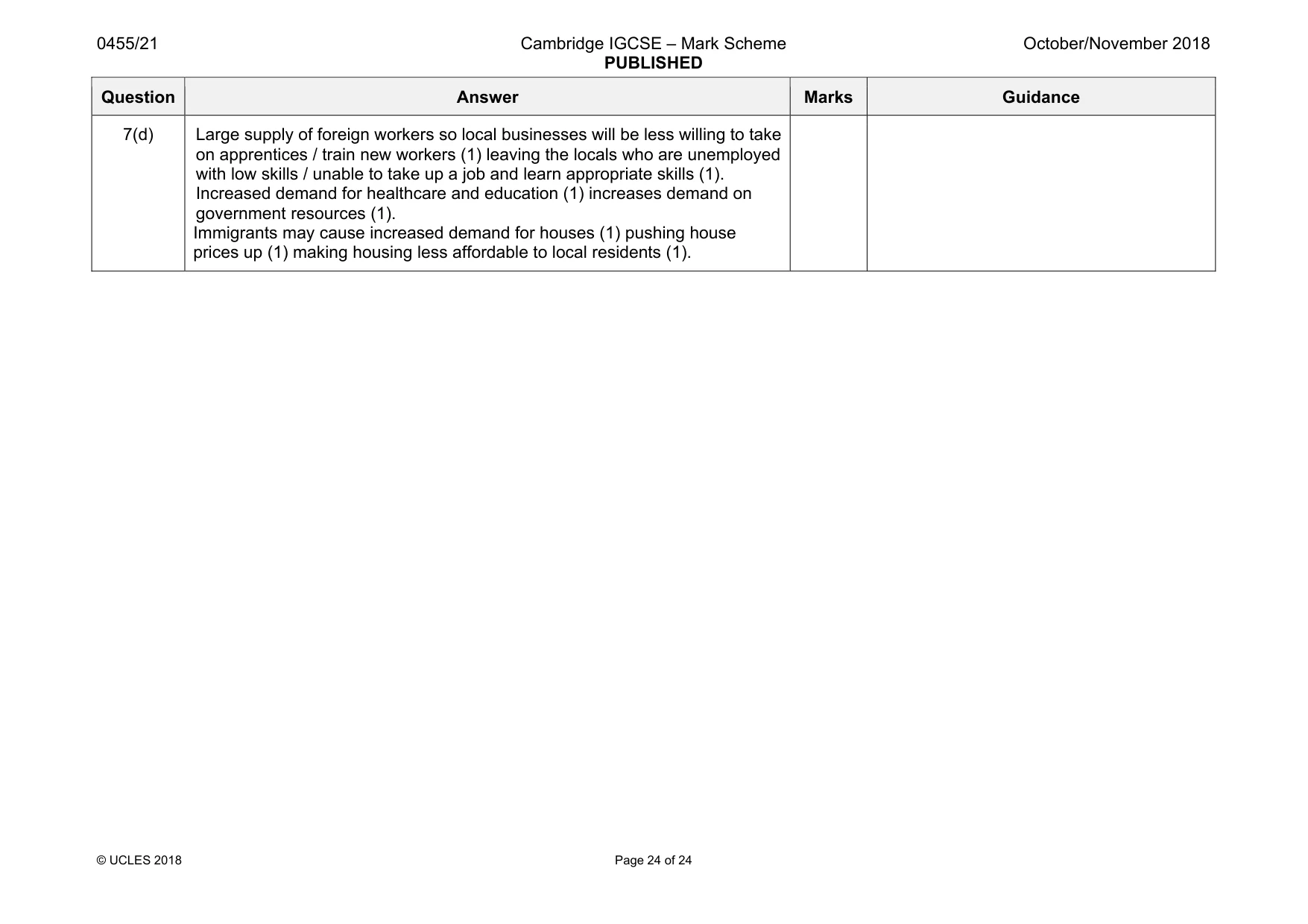
Mark scheme: 7(a) Define unemployment. Unemployment is the condition where a person is able (1) and willing to work / actively looking for a job (1) but unable to find a job (1). 2 Question Answer Marks Guidance 7(b) Explain two reasons for wage differentials amongst different economies. Difference in demand for labour (1) difference in supply of labour (1). Whether or not an economy is in recession (1) economies in decline will have a low demand for labour / expanding economies will have a high demand (1). Difference in population affecting the supply of labour (1) net migration rates / birth rates / death rates (1) more supply would decrease wages / lower supply would increase wages (1). Difference in demand for goods and services (1) affecting the demand for workers as demand for workers are derived demand (1). Difference in government spending on e.g. education (1) affects wage of pubic sector (1). Difference in productivity affecting the demand (1) high productivity leads to higher output (1) leads to higher wages (1). Difference in trade union and collective bargaining power (1) countries with stronger trade unions will push wages up (1). Difference in living costs / inflation (1) e.g. food prices (1) wage demands increase (1). 4 Accept reasons linked to differences in wages between countries as well as differences in high-paid/low-paid gap within an economy. 7(c) Analyse how a recession in one country could cause unemployment in another country. Emigration to another country (1) may push that country’s workers out of a job (1). Income / GDP per head would have fallen (1) the country may buy fewer imports (1) demand for the country’s products may fall (1) firms in exporting countries may reduce output (1) lower output would reduce demand for workers (1). MNCs in the country may make less profit / make a loss (1) may reduce production in other countries (1). A recession in a large economy could create worldwide uncertainty (1) discourage investment / output of capital goods (1) reduce employment in the capital goods industries of another country (1). 6 Question Answer Marks Guidance 7(d) Discuss whether or not the economic advantages of immigration into countries such as the UK and Germany outweigh the economic disadvantages. Up to 5 marks for advantages: Immigration increases the size of the labour force of the country (1) the immigrants may be young working age people (1) this could increase the productivity of the economy (1) increasing the supply-side capacity of the economy (1) leading to economic growth. Immigrants may take jobs which locals are unwilling to take (1) where a shortage occurs (1) example (1) Immigrants may be willing to work for lower wages (1) production costs would fall (1) leading to lower prices (1) Immigration leads to increased competition for jobs (1) workers need to work harder (1) overall productivity increases (1) Immigrants may also bring in capital (1) to start their own business (1) creating even more jobs (1). Immigrants spend money in the economy / increasing domestic consumption (1) increasing total demand / causing economic growth (1) paying indirect taxes (1). Immigrants may also work and pay direct taxes / income tax (1) government revenue increases (1) enabling more government spending (1) such as health and education (1). Up to 5 marks for disadvantages: Immigrants may take jobs where locals could be employed (1) increasing unemployment in that country (1). Some immigrants have better qualifications and skills (1) taking jobs from less qualified and lower skilled local workers (1). Immigrants may be more willing to take up jobs with lower pay (1) locals will not feel that such low pay is appropriate (1) depressing wage growth (1). 8 Each point may be credited only once, on either side of an argument, but separate development as to how/why the outcome may differ is to be rewarded. Question Answer Marks Guidance 7(d) Large supply of foreign workers so local businesses will be less willing to take on apprentices / train new workers (1) leaving the locals who are unemployed with low skills / unable to take up a job and learn appropriate skills (1). Increased demand for healthcare and education (1) increases demand on government resources (1). Immigrants may cause increased demand for houses (1) pushing house prices up (1) making housing less affordable to local residents (1).
What was in this paper
The subtopics covered by these 7 questions, and how many questions each got. Open one in a new tab to see every Cambridge question on it.
What you needed in this session
Cambridge’s own grade thresholds for 2018 Oct/Nov, Paper 2 · Variant 1. A higher threshold means an easier paper — the bar moves with how the cohort did.