Cambridge IGCSE Economics 0455 — 2017 Oct/Nov Paper 2 · Variant 3
0455/23/O/N/17 · 7 questions · 90 marks · ≈101 min
The question paper and its mark scheme, free to read here and free to download. This is Cambridge’s own paper, exactly as it was sat.
Question paper8 pages



Mark scheme17 pages
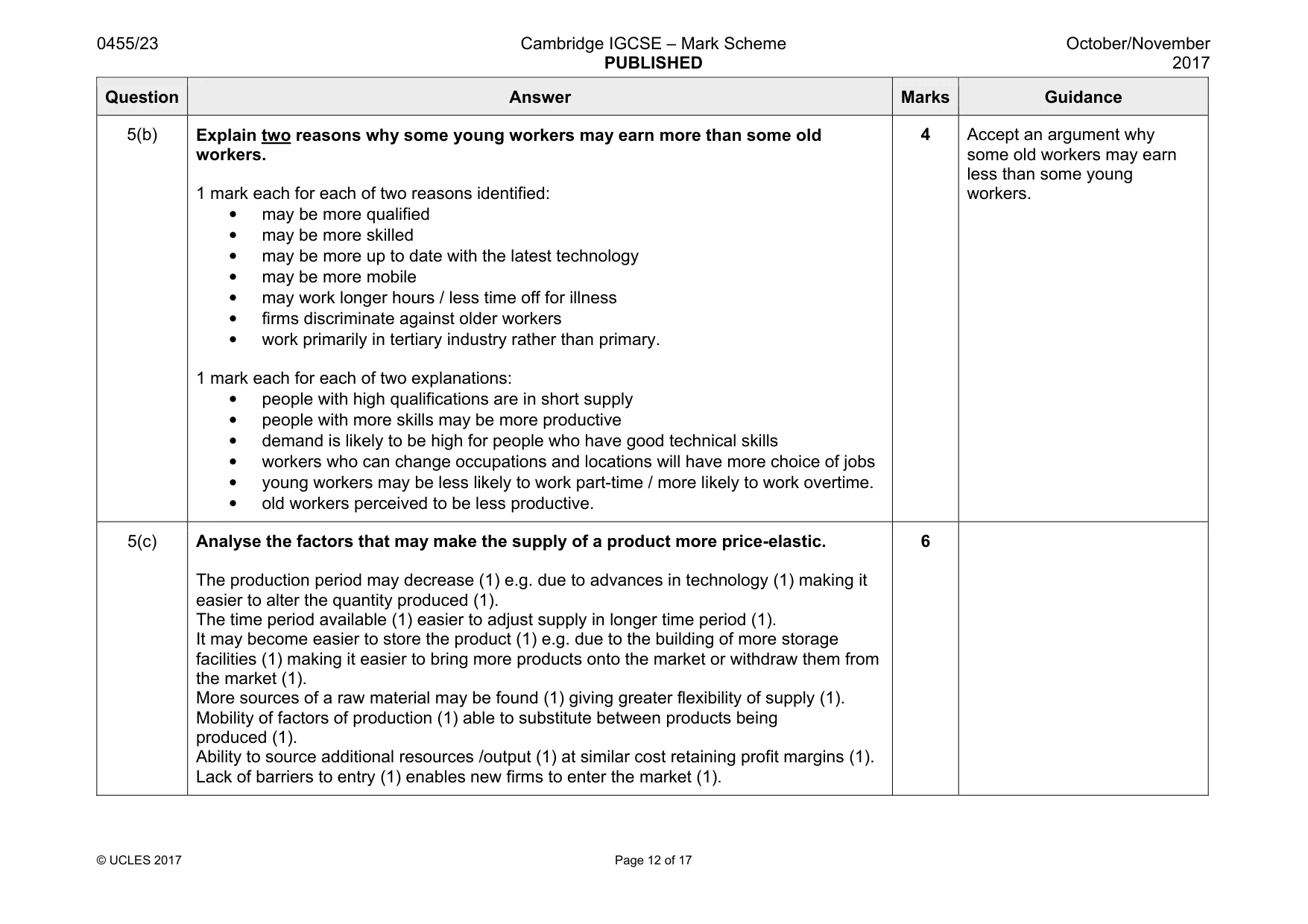
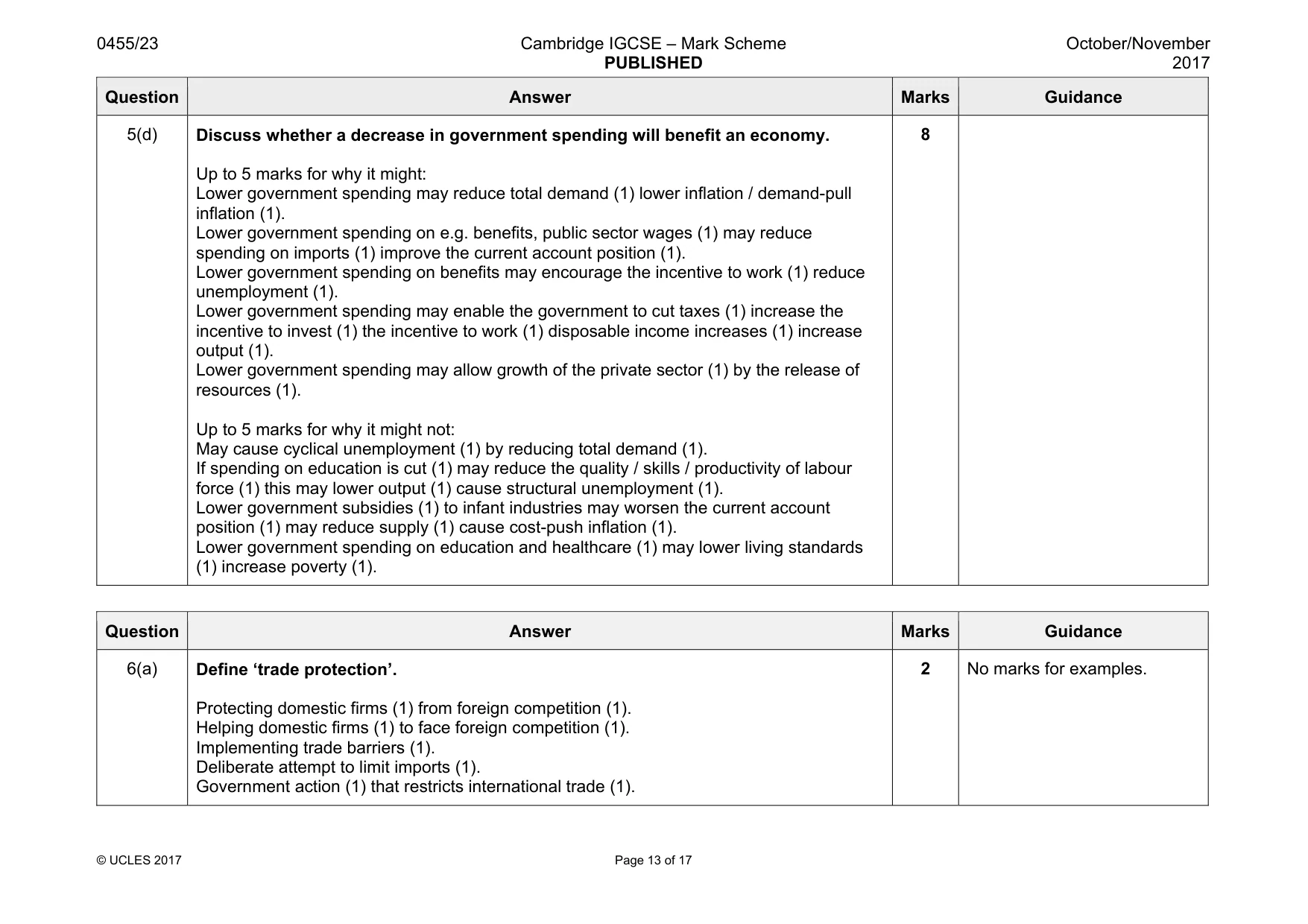
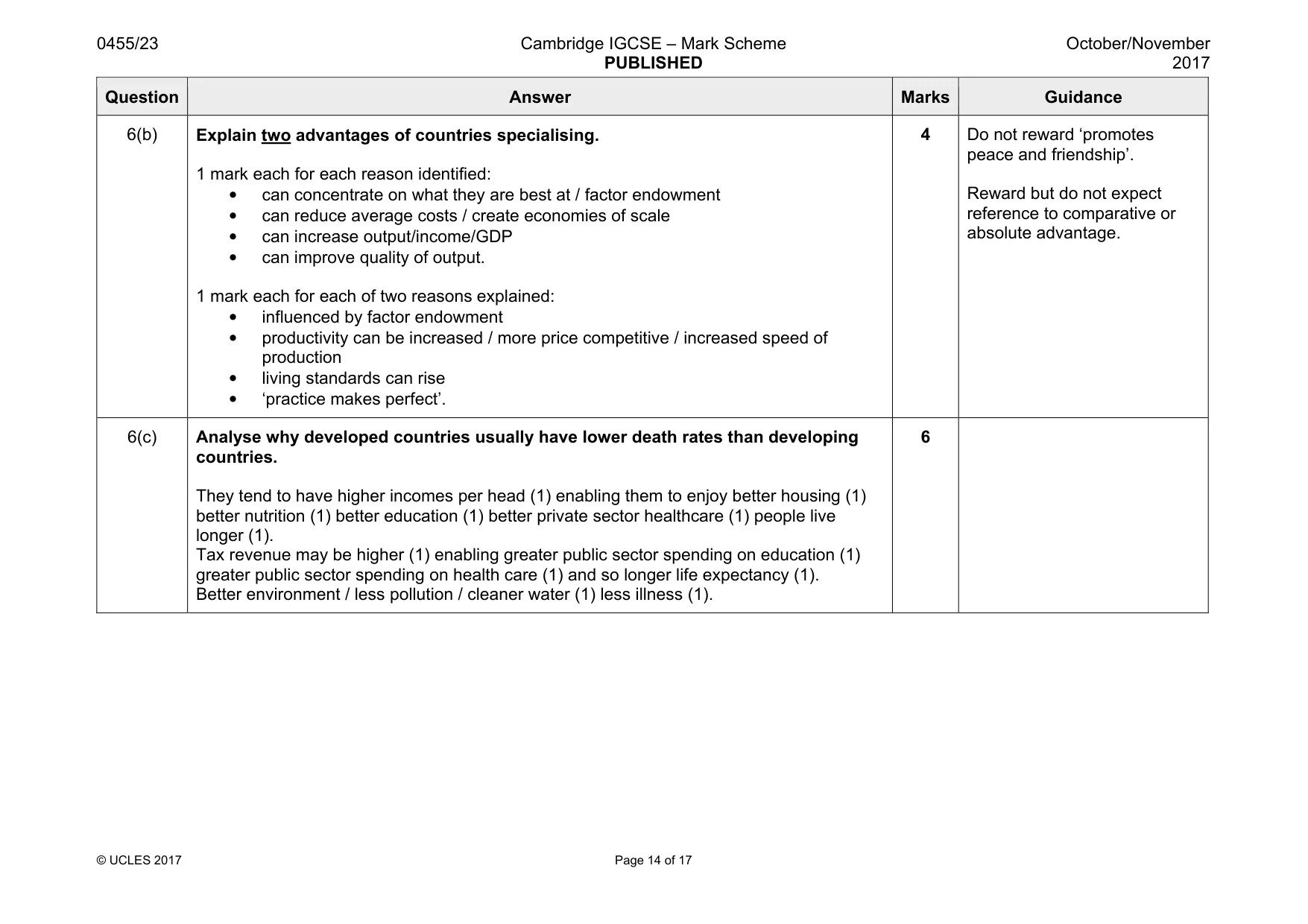
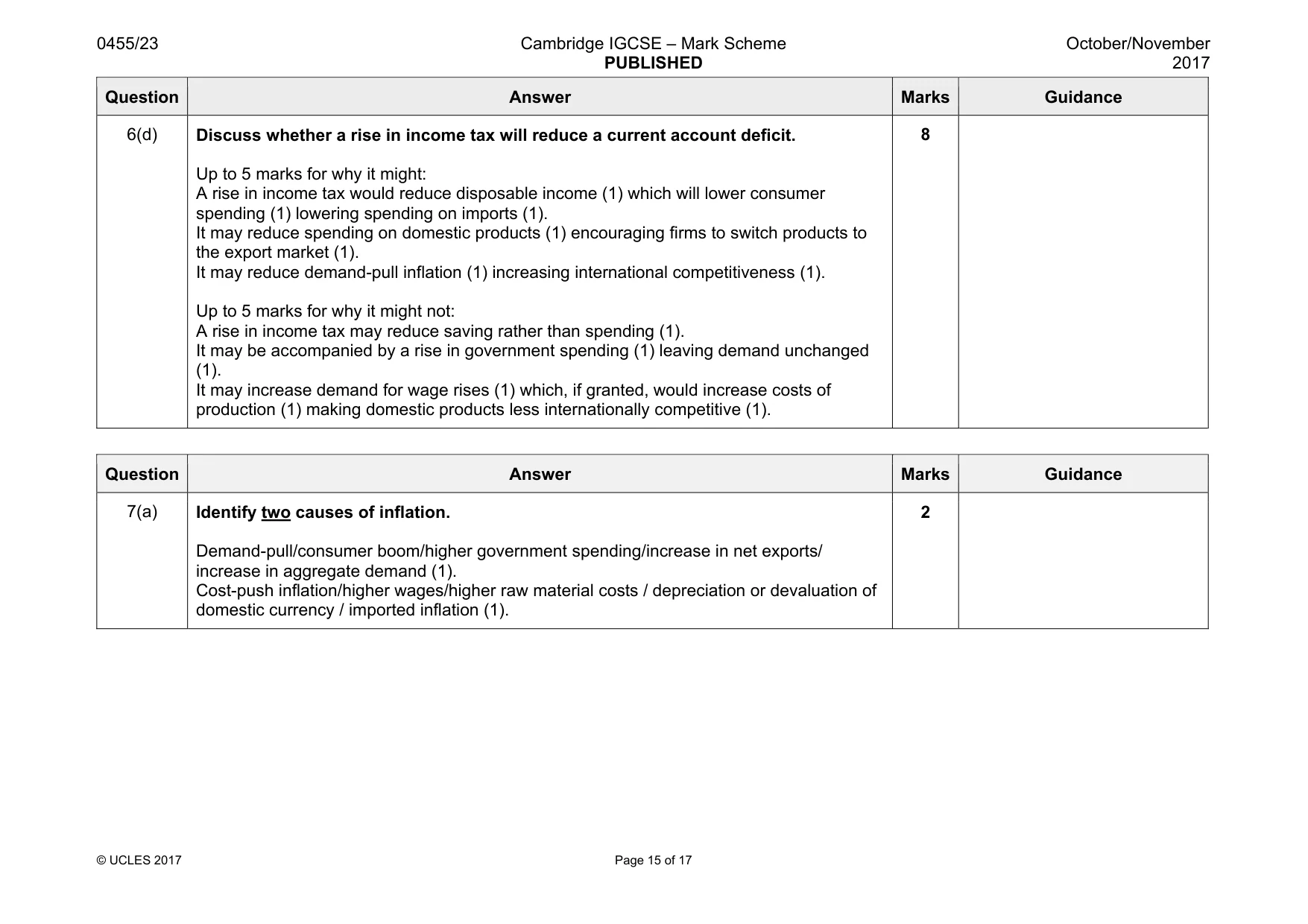
Answers below. Sit the paper first if you are practising.
Questions as text
Q1 · Changes in the global balance of economic power In 2014, global Gross Domestic Product…
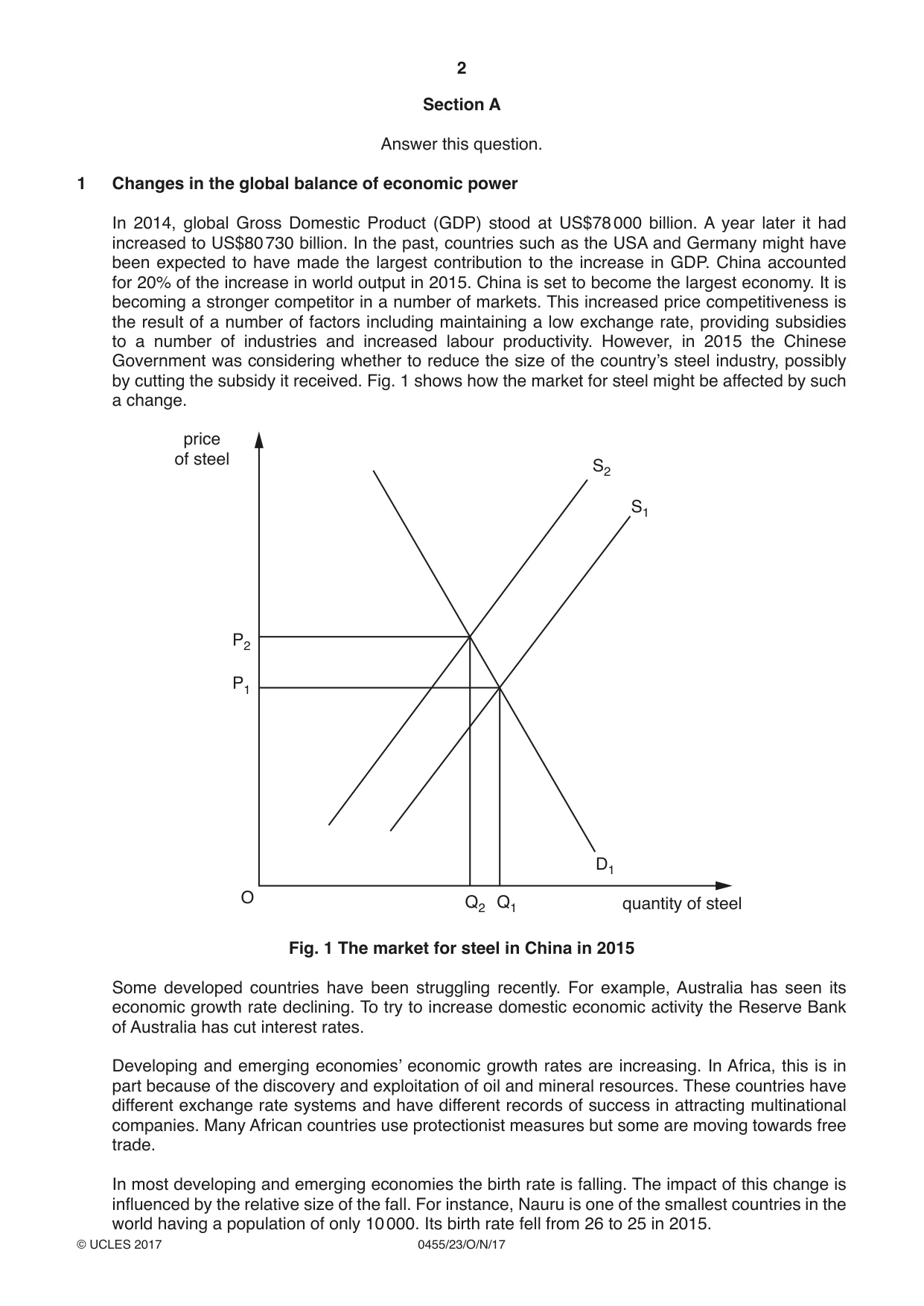
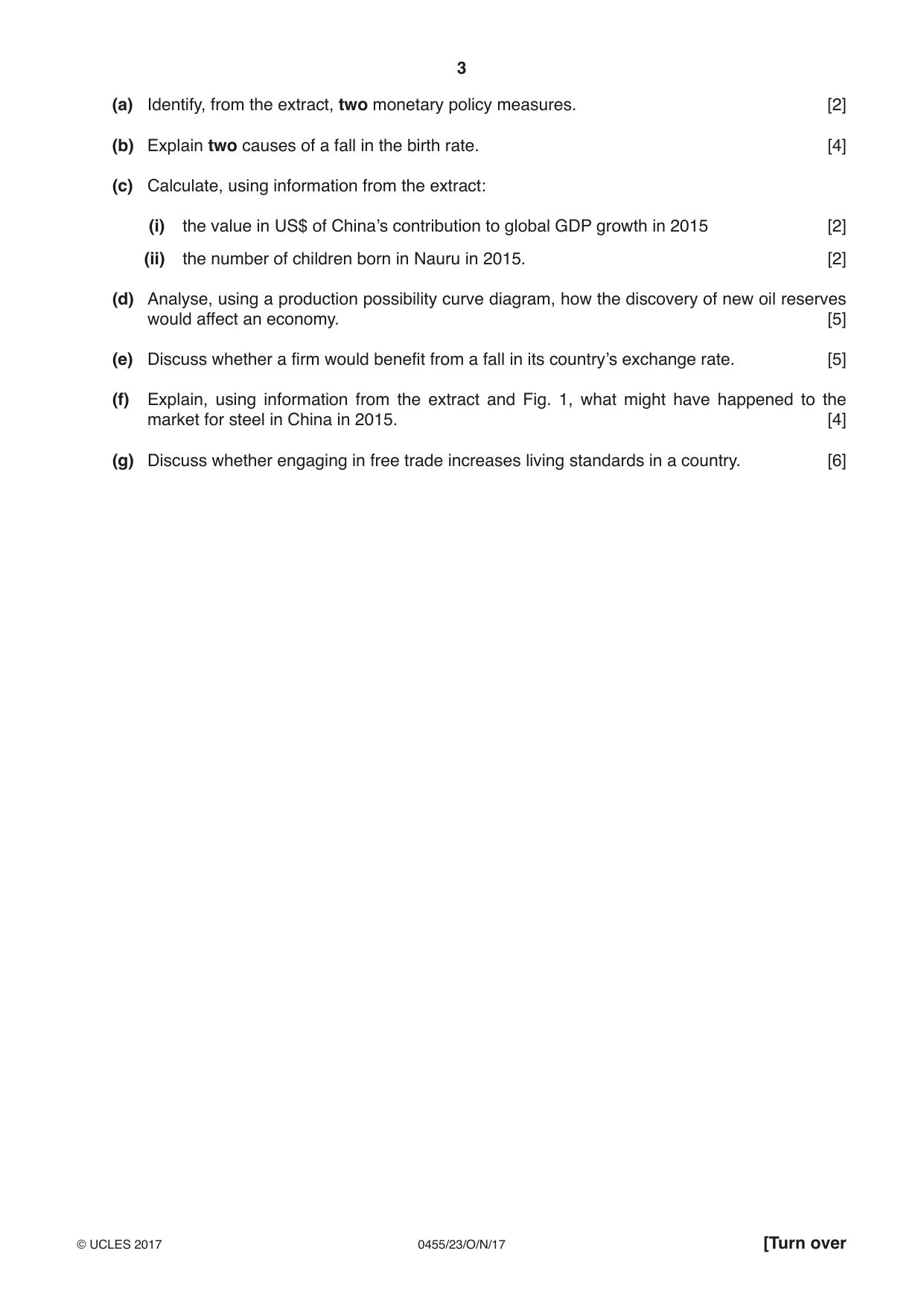
1 Changes in the global balance of economic power In 2014, global Gross Domestic Product (GDP) stood at US$78 000 billion. A year later it had increased to US$80 730 billion. In the past, countries such as the USA and Germany might have been expected to have made the largest contribution to the increase in GDP. China accounted for 20% of the increase in world output in 2015. China is set to become the largest economy. It is becoming a stronger competitor in a number of markets. This increased price competitiveness is the result of a number of factors including maintaining a low exchange rate, providing subsidies to a number of industries and increased labour productivity. However, in 2015 the Chinese Government was considering whether to reduce the size of the country’s steel industry, possibly by cutting the subsidy it received. Fig. 1 shows how the market for steel might be affected by such a change. price of steel S2 S1 P2 P1 D1 O Q2 Q1 quantity of steel Fig. 1 The market for steel in China in 2015 Some developed countries have been struggling recently. For example, Australia has seen its economic growth rate declining. To try to increase domestic economic activity the Reserve Bank of Australia has cut interest rates. Developing and emerging economies’ economic growth rates are increasing. In Africa, this is in part because of the discovery and exploitation of oil and mineral resources. These countries have different exchange rate systems and have different records of success in attracting multinational companies. Many African countries use protectionist measures but some are moving towards free trade. In most developing and emerging economies the birth rate is falling. The impact of this change is influenced by the relative size of the fall. For instance, Nauru is one of the smallest countries in the world having a population of only 10 000. Its birth rate fell from 26 to 25 in 2015. (a) Identify, from the extract, two monetary policy measures. [2] (b) Explain two causes of a fall in the birth rate. [4] (c) Calculate, using information from the extract: (i) the value in US$ of China’s contribution to global GDP growth in 2015 [2] (ii) the number of children born in Nauru in 2015. [2] (d) Analyse, using a production possibility curve diagram, how the discovery of new oil reserves would affect an economy. [5] (e) Discuss whether a firm would benefit from a fall in its country’s exchange rate. [5] (f) Explain, using information from the extract and Fig. 1, what might have happened to the market for steel in China in 2015. [4] (g) Discuss whether engaging in free trade increases living standards in a country. [6]
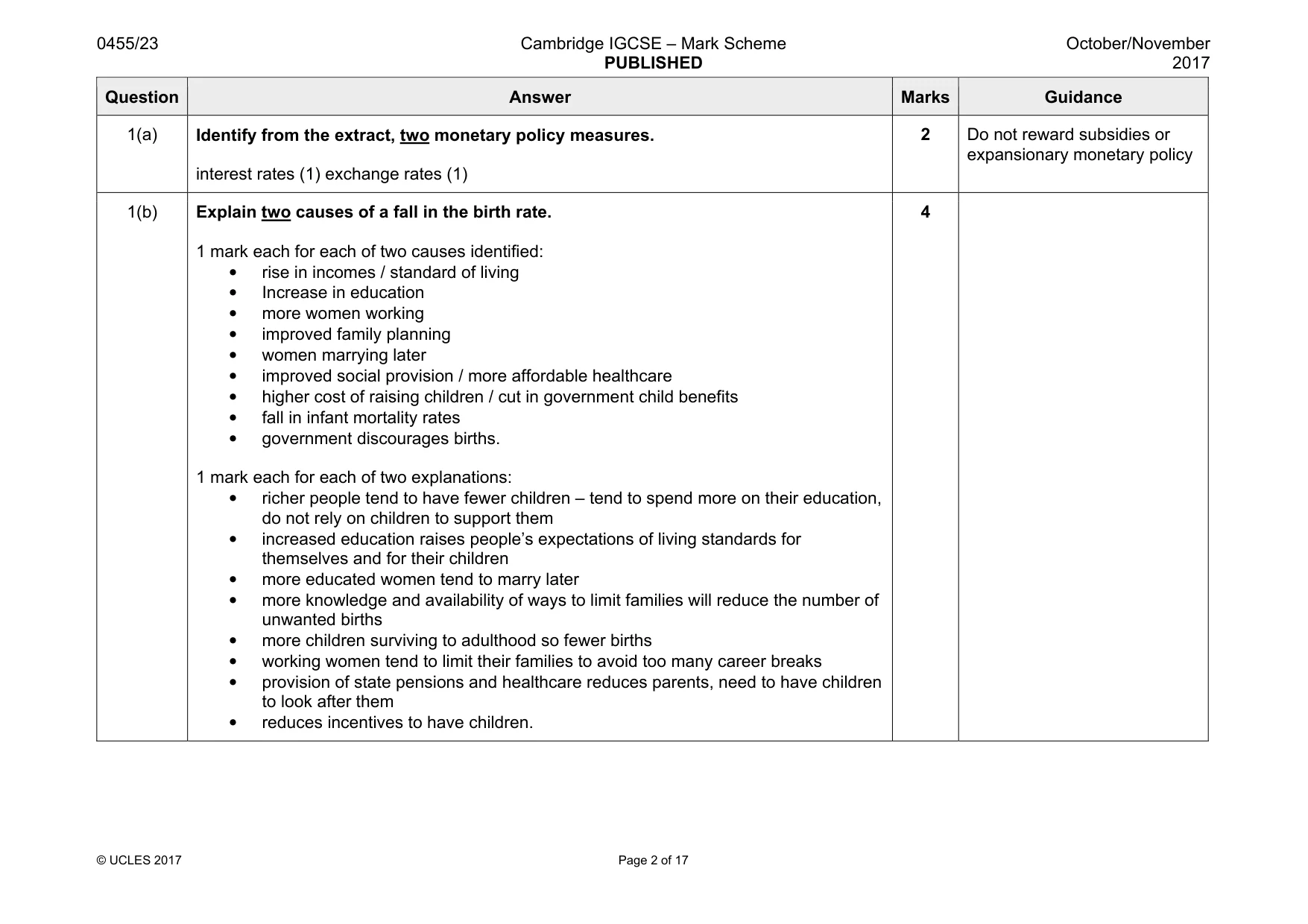
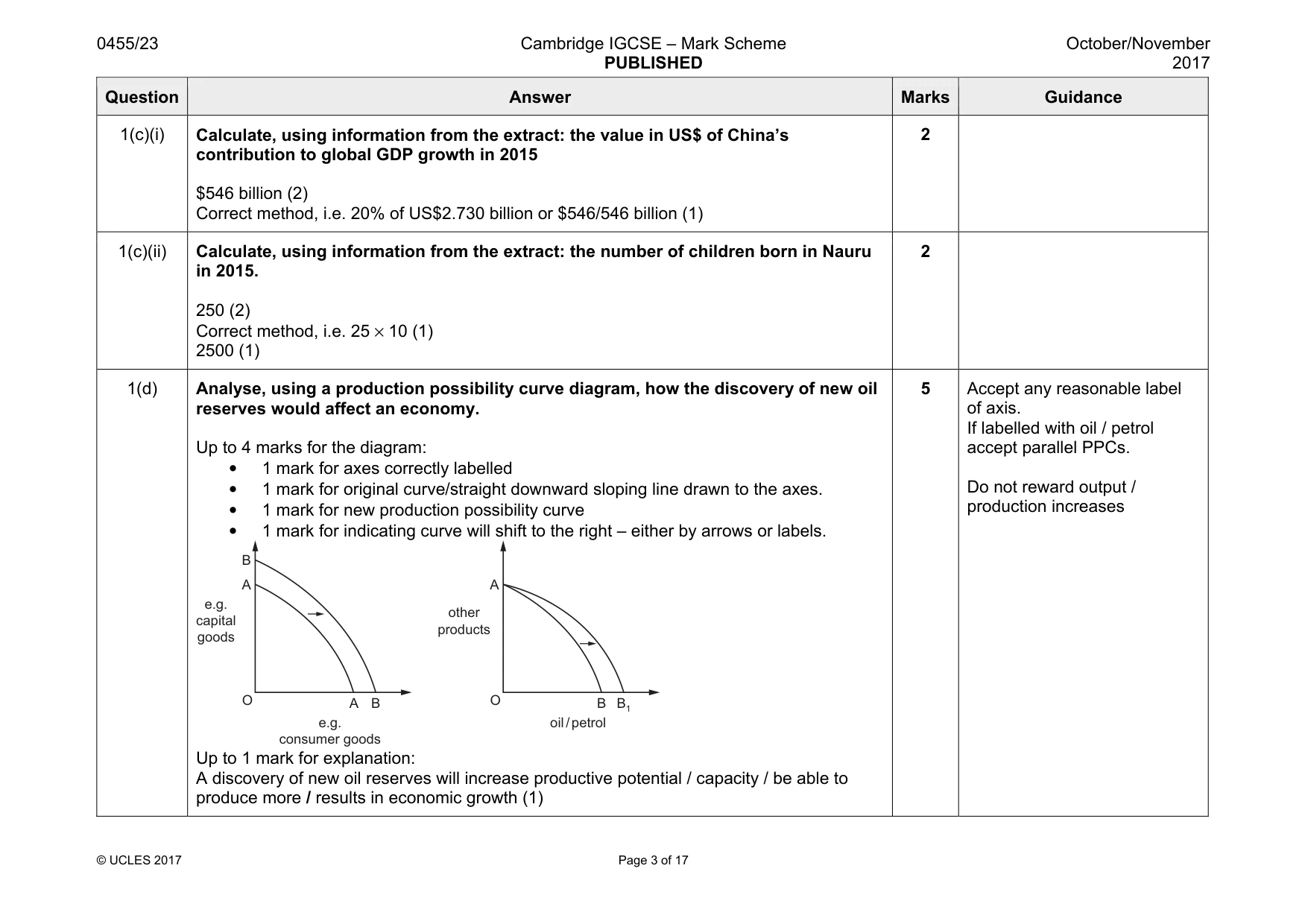
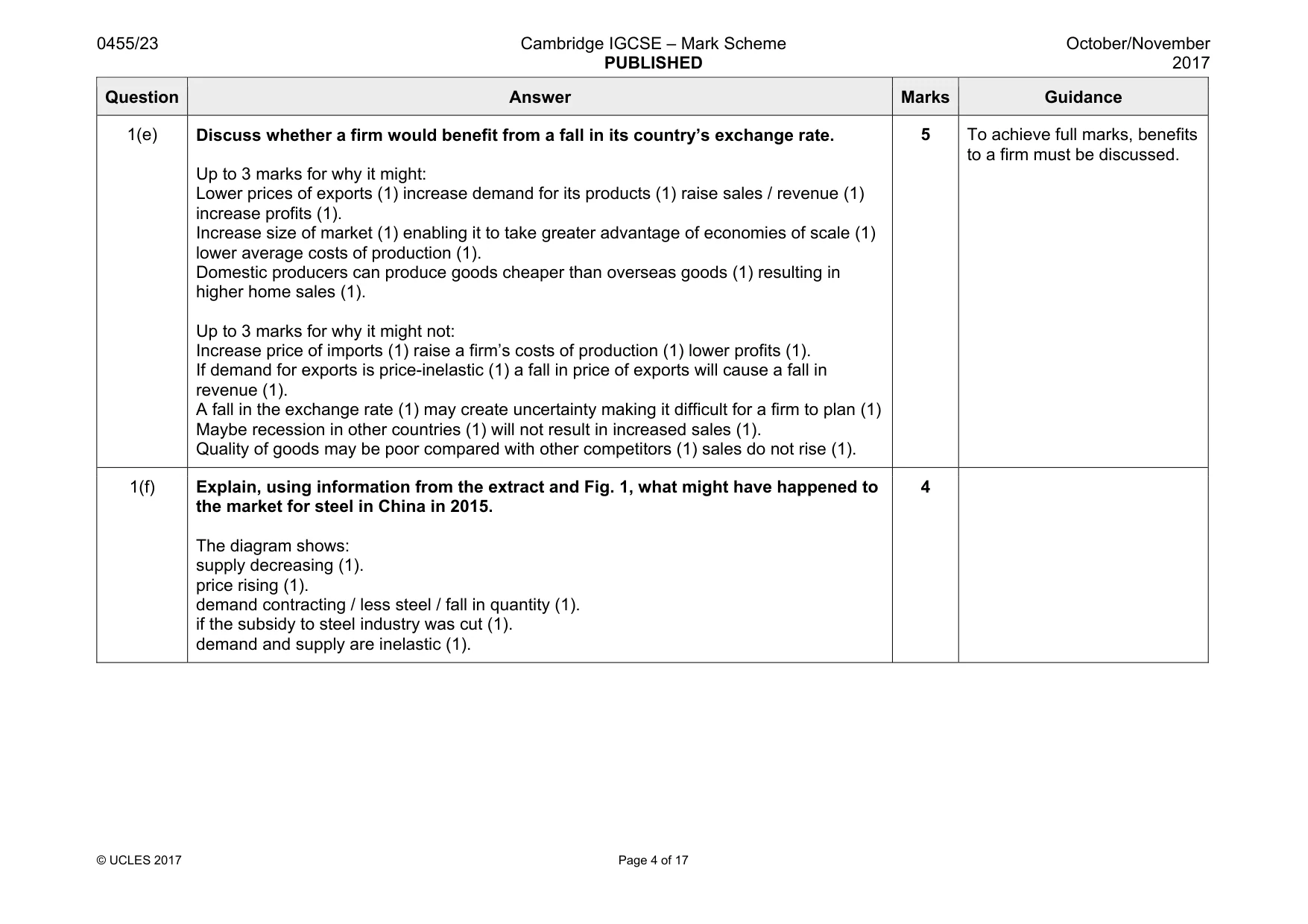
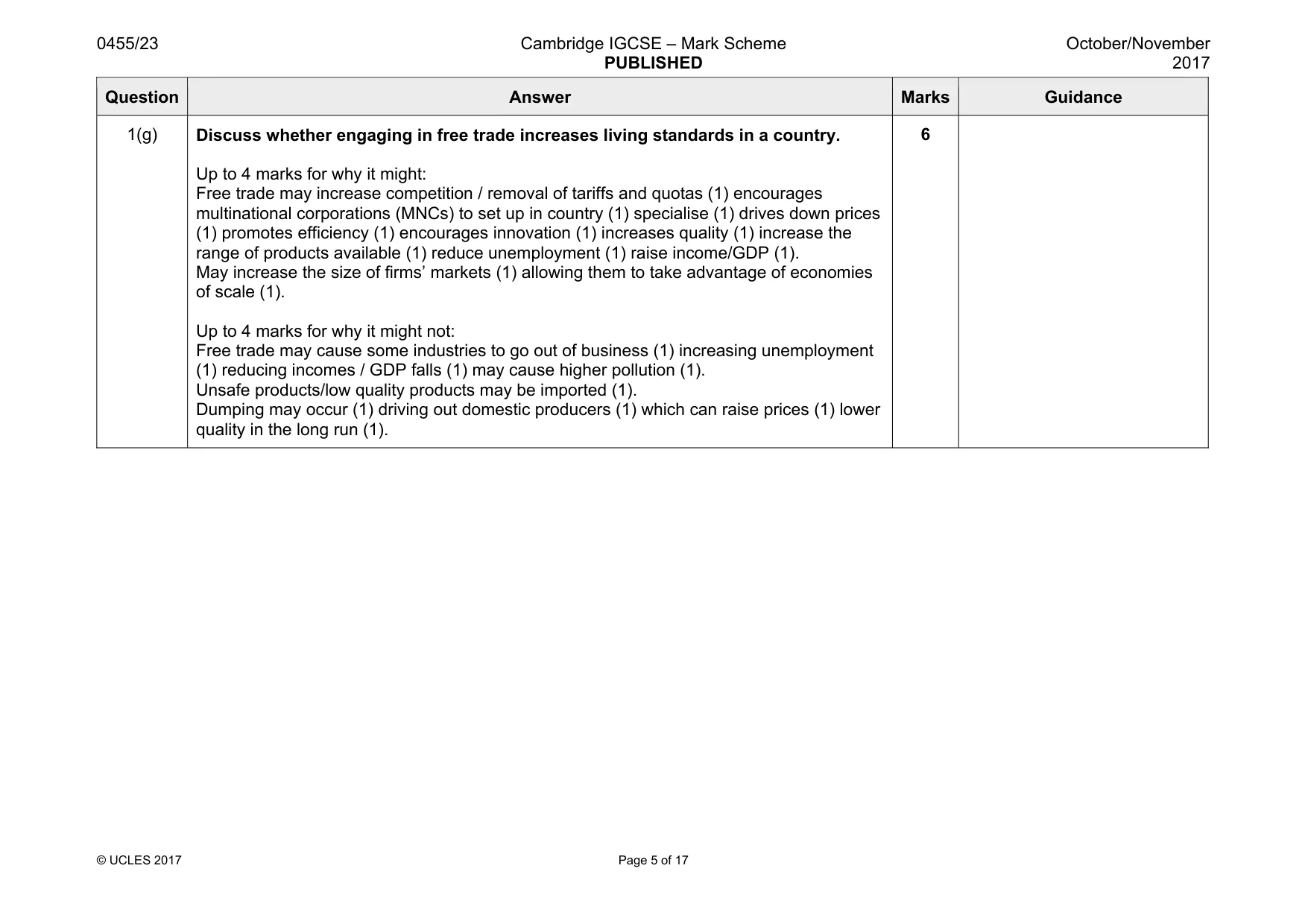
Mark scheme: 1(a) Identify from the extract, two monetary policy measures. interest rates (1) exchange rates (1) 2 expansionary monetary policy 1(b) Explain two causes of a fall in the birth rate. 1 mark each for each of two causes identified: • rise in incomes / standard of living • Increase in education • more women working • improved family planning • women marrying later • improved social provision / more affordable healthcare • higher cost of raising children / cut in government child benefits • fall in infant mortality rates • government discourages births. 1 mark each for each of two explanations: • richer people tend to have fewer children – tend to spend more on their education, do not rely on children to support them • increased education raises people’s expectations of living standards for themselves and for their children • more educated women tend to marry later • more knowledge and availability of ways to limit families will reduce the number of unwanted births • more children surviving to adulthood so fewer births • working women tend to limit their families to avoid too many career breaks • provision of state pensions and healthcare reduces parents, need to have children to look after them • reduces incentives to have children. 4 Question Answer Marks Guidance 1(c)(i) Calculate, using information from the extract: the value in US$ of China’s contribution to global GDP growth in 2015 $546 billion (2) Correct method, i.e. 20% of US$2.730 billion or $546/546 billion (1) 2 1(c)(ii) Calculate, using information from the extract: the number of children born in Nauru in 2015. 250 (2) Correct method, i.e. 25 × 10 (1) 2500 (1) 2 1(d) Analyse, using a production possibility curve diagram, how the discovery of new oil reserves would affect an economy. Up to 4 marks for the diagram: • 1 mark for axes correctly labelled • 1 mark for original curve/straight downward sloping line drawn to the axes. • 1 mark for new production possibility curve • 1 mark for indicating curve will shift to the right – either by arrows or labels. Up to 1 mark for explanation: A discovery of new oil reserves will increase productive potential / capacity / be able to produce more / results in economic growth (1) 5 Accept any reasonable label of axis. If labelled with oil / petrol accept parallel PPCs. Do not reward output / production increases O e.g. capital goods e.g. consumer goods B B A A O other products oil / petrol B1 A B Question Answer Marks Guidance 1(e) Discuss whether a firm would benefit from a fall in its country’s exchange rate. Up to 3 marks for why it might: Lower prices of exports (1) increase demand for its products (1) raise sales / revenue (1) increase profits (1). Increase size of market (1) enabling it to take greater advantage of economies of scale (1) lower average costs of production (1). Domestic producers can produce goods cheaper than overseas goods (1) resulting in higher home sales (1). Up to 3 marks for why it might not: Increase price of imports (1) raise a firm’s costs of production (1) lower profits (1). If demand for exports is price-inelastic (1) a fall in price of exports will cause a fall in revenue (1). A fall in the exchange rate (1) may create uncertainty making it difficult for a firm to plan (1) Maybe recession in other countries (1) will not result in increased sales (1). Quality of goods may be poor compared with other competitors (1) sales do not rise (1). 5 To achieve full marks, benefits to a firm must be discussed. 1(f) Explain, using information from the extract and Fig. 1, what might have happened to the market for steel in China in 2015. The diagram shows: supply decreasing (1). price rising (1). demand contracting / less steel / fall in quantity (1). if the subsidy to steel industry was cut (1). demand and supply are inelastic (1). 4 Question Answer Marks Guidance 1(g) Discuss whether engaging in free trade increases living standards in a country. Up to 4 marks for why it might: Free trade may increase competition / removal of tariffs and quotas (1) encourages multinational corporations (MNCs) to set up in country (1) specialise (1) drives down prices (1) promotes efficiency (1) encourages innovation (1) increases quality (1) increase the range of products available (1) reduce unemployment (1) raise income/GDP (1). May increase the size of firms’ markets (1) allowing them to take advantage of economies of scale (1). Up to 4 marks for why it might not: Free trade may cause some industries to go out of business (1) increasing unemployment (1) reducing incomes / GDP falls (1) may cause higher pollution (1). Unsafe products/low quality products may be imported (1). Dumping may occur (1) driving out domestic producers (1) which can raise prices (1) lower quality in the long run (1). 6
Q2 · In Saudi Arabia, output of cement has risen as a result of an increase in demand from the…
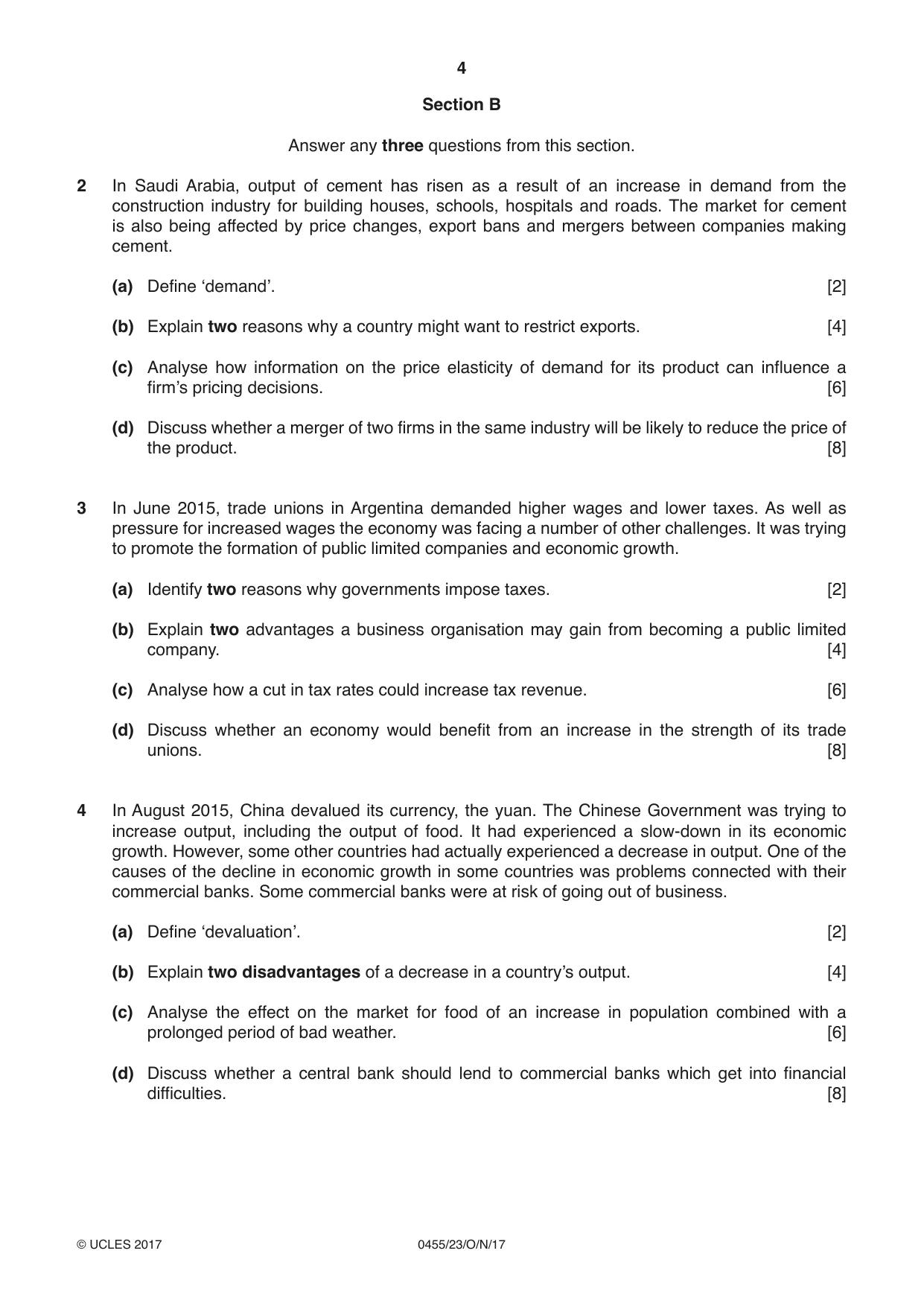
2 In Saudi Arabia, output of cement has risen as a result of an increase in demand from the construction industry for building houses, schools, hospitals and roads. The market for cement is also being affected by price changes, export bans and mergers between companies making cement. (a) Define ‘demand’. [2] (b) Explain two reasons why a country might want to restrict exports. [4] (c) Analyse how information on the price elasticity of demand for its product can influence a firm’s pricing decisions. [6] (d) Discuss whether a merger of two firms in the same industry will be likely to reduce the price of the product. [8]
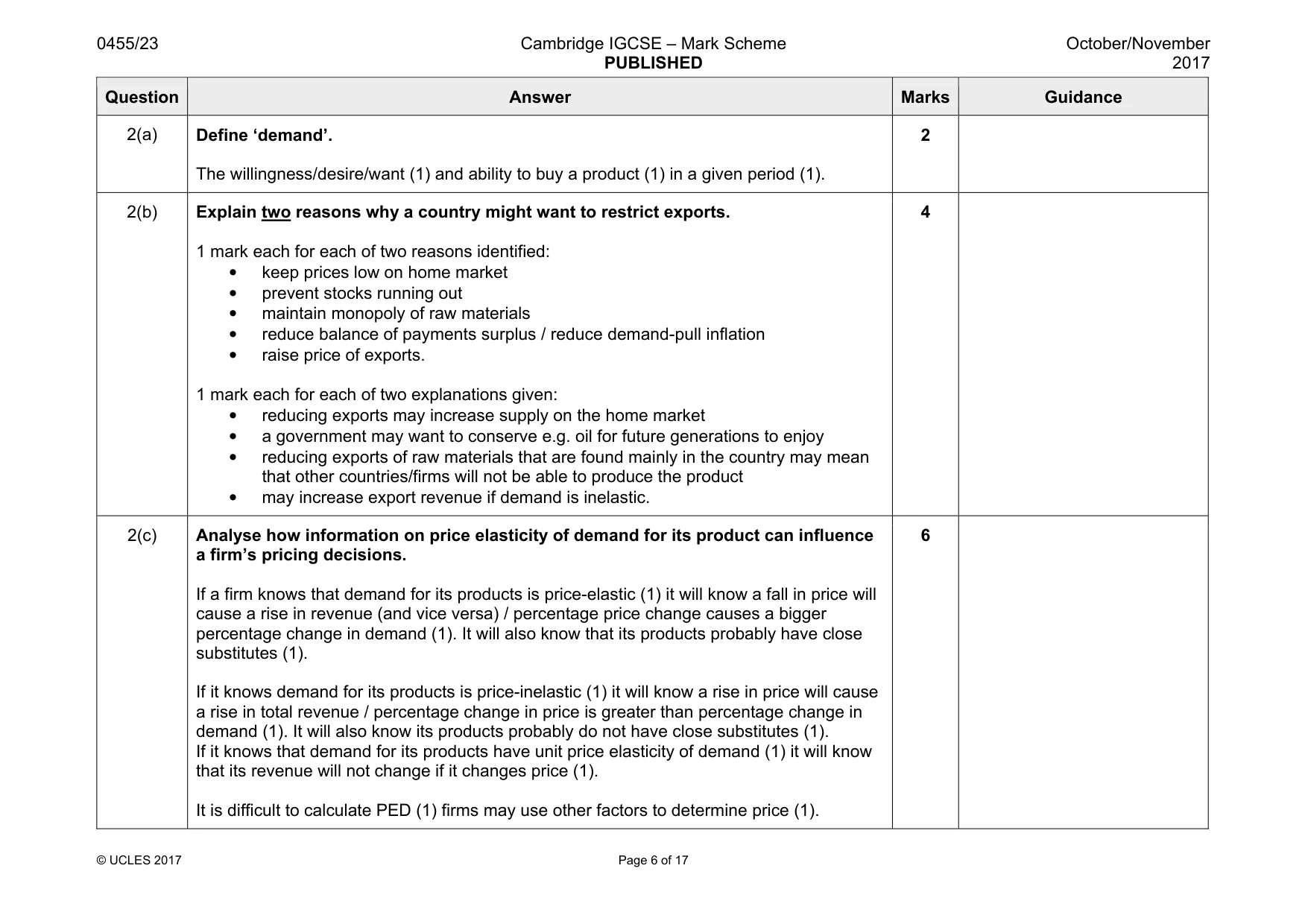
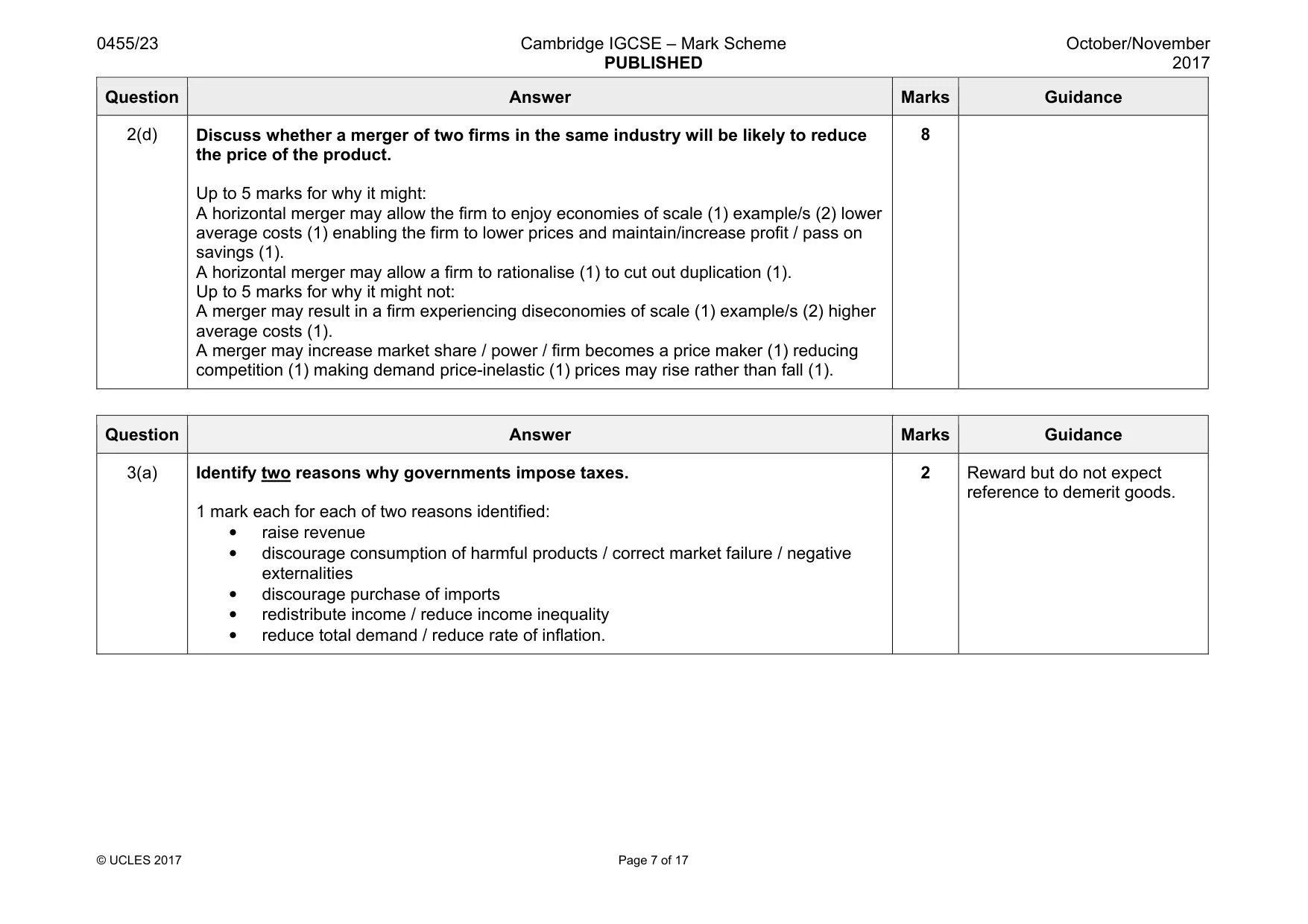
Mark scheme: 2(a) Define ‘demand’. The willingness/desire/want (1) and ability to buy a product (1) in a given period (1). 2 2(b) Explain two reasons why a country might want to restrict exports. 1 mark each for each of two reasons identified: • keep prices low on home market • prevent stocks running out • maintain monopoly of raw materials • reduce balance of payments surplus / reduce demand-pull inflation • raise price of exports. 1 mark each for each of two explanations given: • reducing exports may increase supply on the home market • a government may want to conserve e.g. oil for future generations to enjoy • reducing exports of raw materials that are found mainly in the country may mean that other countries/firms will not be able to produce the product • may increase export revenue if demand is inelastic. 4 2(c) Analyse how information on price elasticity of demand for its product can influence a firm’s pricing decisions. If a firm knows that demand for its products is price-elastic (1) it will know a fall in price will cause a rise in revenue (and vice versa) / percentage price change causes a bigger percentage change in demand (1). It will also know that its products probably have close substitutes (1). If it knows demand for its products is price-inelastic (1) it will know a rise in price will cause a rise in total revenue / percentage change in price is greater than percentage change in demand (1). It will also know its products probably do not have close substitutes (1). If it knows that demand for its products have unit price elasticity of demand (1) it will know that its revenue will not change if it changes price (1). It is difficult to calculate PED (1) firms may use other factors to determine price (1). 6 Question Answer Marks Guidance 2(d) Discuss whether a merger of two firms in the same industry will be likely to reduce the price of the product. Up to 5 marks for why it might: A horizontal merger may allow the firm to enjoy economies of scale (1) example/s (2) lower average costs (1) enabling the firm to lower prices and maintain/increase profit / pass on savings (1). A horizontal merger may allow a firm to rationalise (1) to cut out duplication (1). Up to 5 marks for why it might not: A merger may result in a firm experiencing diseconomies of scale (1) example/s (2) higher average costs (1). A merger may increase market share / power / firm becomes a price maker (1) reducing competition (1) making demand price-inelastic (1) prices may rise rather than fall (1). 8
Q3 · In June 2015, trade unions in Argentina demanded higher wages and lower taxes
3 In June 2015, trade unions in Argentina demanded higher wages and lower taxes. As well as pressure for increased wages the economy was facing a number of other challenges. It was trying to promote the formation of public limited companies and economic growth. (a) Identify two reasons why governments impose taxes. [2] (b) Explain two advantages a business organisation may gain from becoming a public limited company. [4] (c) Analyse how a cut in tax rates could increase tax revenue. [6] (d) Discuss whether an economy would benefit from an increase in the strength of its trade unions. [8]
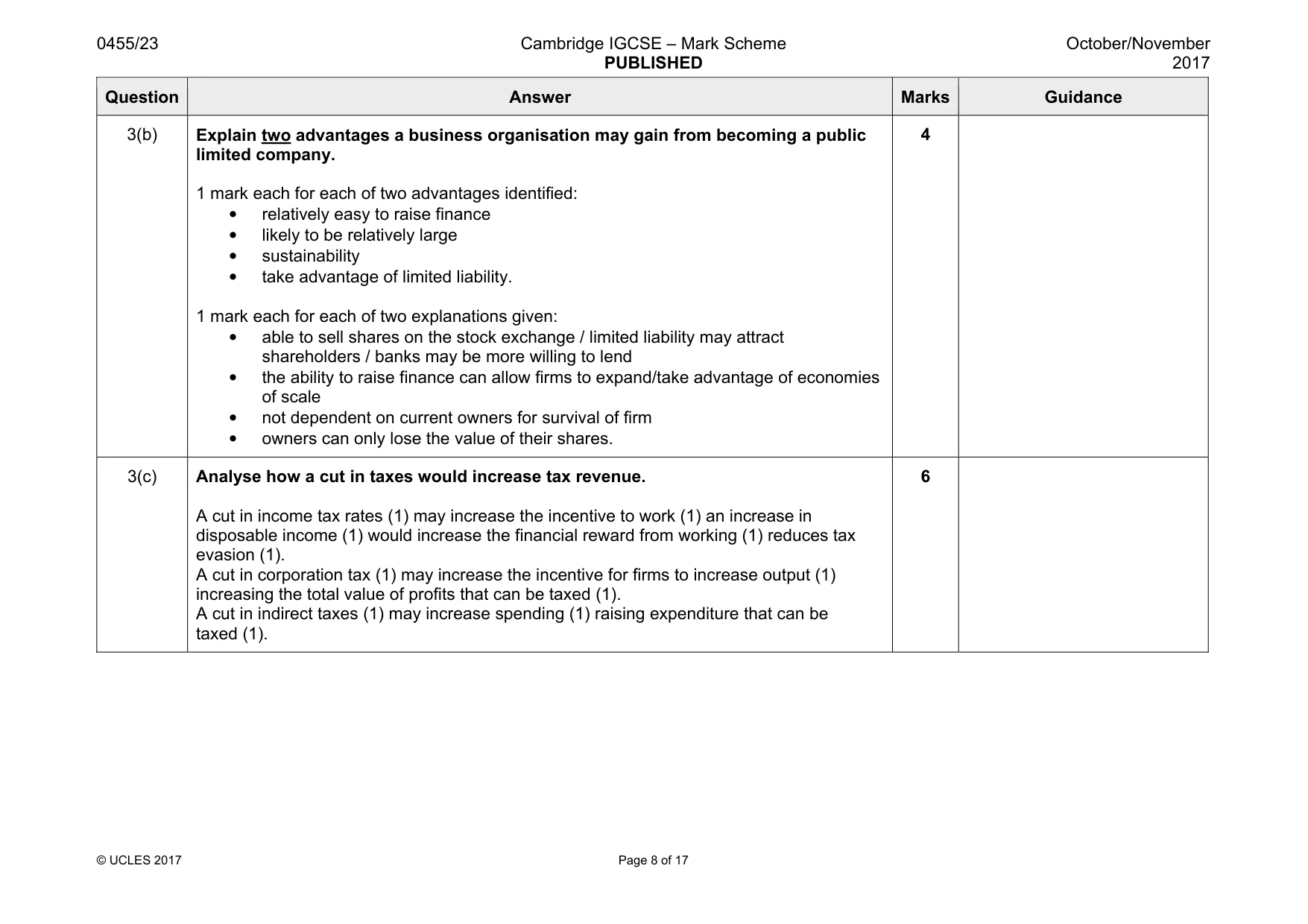
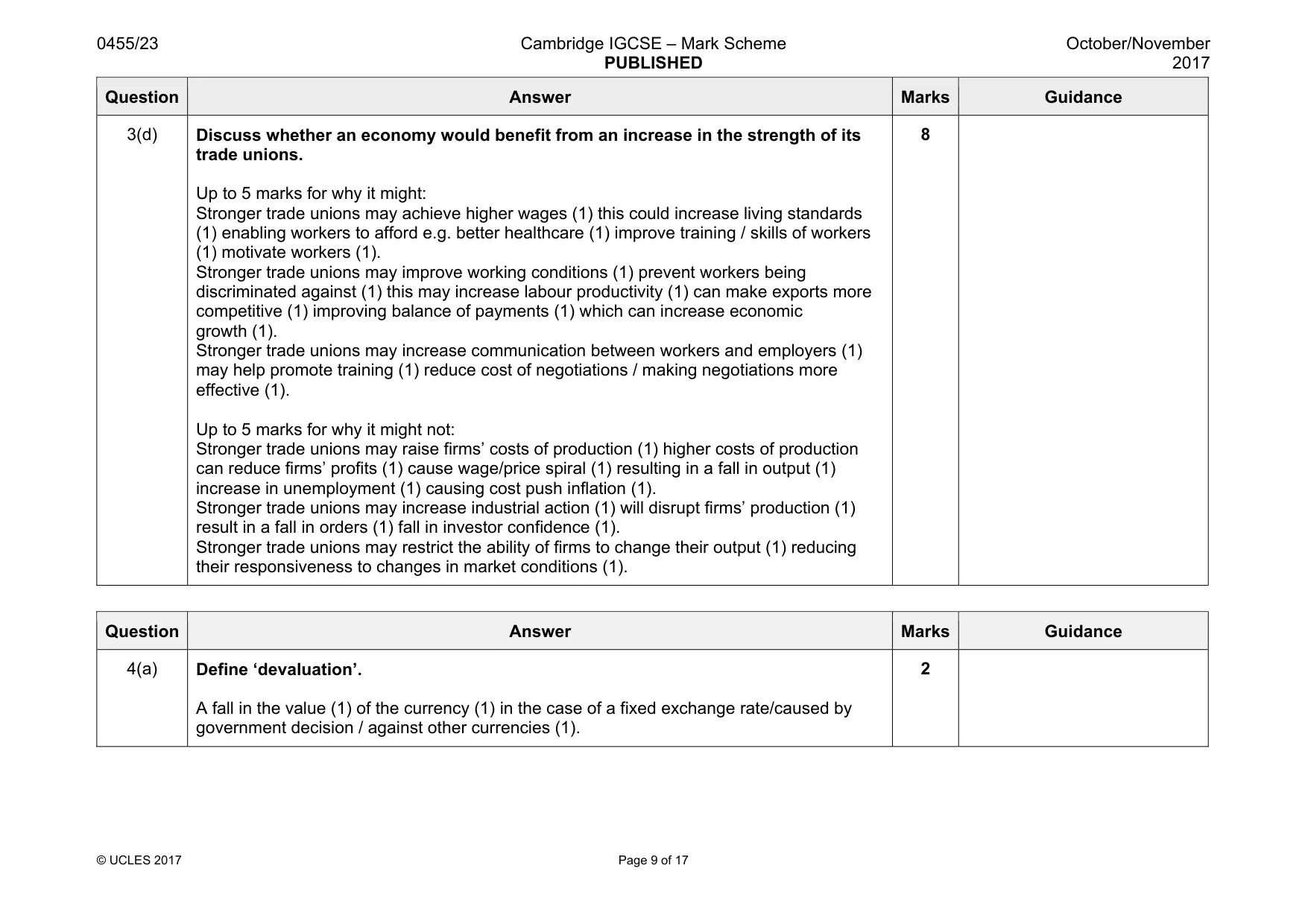
Mark scheme: 3(a) Identify two reasons why governments impose taxes. 1 mark each for each of two reasons identified: • raise revenue • discourage consumption of harmful products / correct market failure / negative externalities • discourage purchase of imports • redistribute income / reduce income inequality • reduce total demand / reduce rate of inflation. 2 reference to demerit goods. Question Answer Marks Guidance 3(b) Explain two advantages a business organisation may gain from becoming a public limited company. 1 mark each for each of two advantages identified: • relatively easy to raise finance • likely to be relatively large • sustainability • take advantage of limited liability. 1 mark each for each of two explanations given: • able to sell shares on the stock exchange / limited liability may attract shareholders / banks may be more willing to lend • the ability to raise finance can allow firms to expand/take advantage of economies of scale • not dependent on current owners for survival of firm • owners can only lose the value of their shares. 4 3(c) Analyse how a cut in taxes would increase tax revenue. A cut in income tax rates (1) may increase the incentive to work (1) an increase in disposable income (1) would increase the financial reward from working (1) reduces tax evasion (1). A cut in corporation tax (1) may increase the incentive for firms to increase output (1) increasing the total value of profits that can be taxed (1). A cut in indirect taxes (1) may increase spending (1) raising expenditure that can be taxed (1). 6 Question Answer Marks Guidance 3(d) Discuss whether an economy would benefit from an increase in the strength of its trade unions. Up to 5 marks for why it might: Stronger trade unions may achieve higher wages (1) this could increase living standards (1) enabling workers to afford e.g. better healthcare (1) improve training / skills of workers (1) motivate workers (1). Stronger trade unions may improve working conditions (1) prevent workers being discriminated against (1) this may increase labour productivity (1) can make exports more competitive (1) improving balance of payments (1) which can increase economic growth (1). Stronger trade unions may increase communication between workers and employers (1) may help promote training (1) reduce cost of negotiations / making negotiations more effective (1). Up to 5 marks for why it might not: Stronger trade unions may raise firms’ costs of production (1) higher costs of production can reduce firms’ profits (1) cause wage/price spiral (1) resulting in a fall in output (1) increase in unemployment (1) causing cost push inflation (1). Stronger trade unions may increase industrial action (1) will disrupt firms’ production (1) result in a fall in orders (1) fall in investor confidence (1). Stronger trade unions may restrict the ability of firms to change their output (1) reducing their responsiveness to changes in market conditions (1). 8
Q4 · In August 2015, China devalued its currency, the yuan
4 In August 2015, China devalued its currency, the yuan. The Chinese Government was trying to increase output, including the output of food. It had experienced a slow-down in its economic growth. However, some other countries had actually experienced a decrease in output. One of the causes of the decline in economic growth in some countries was problems connected with their commercial banks. Some commercial banks were at risk of going out of business. (a) Define ‘devaluation’. [2] (b) Explain two disadvantages of a decrease in a country’s output. [4] (c) Analyse the effect on the market for food of an increase in population combined with a prolonged period of bad weather. [6] (d) Discuss whether a central bank should lend to commercial banks which get into financial difficulties. [8]
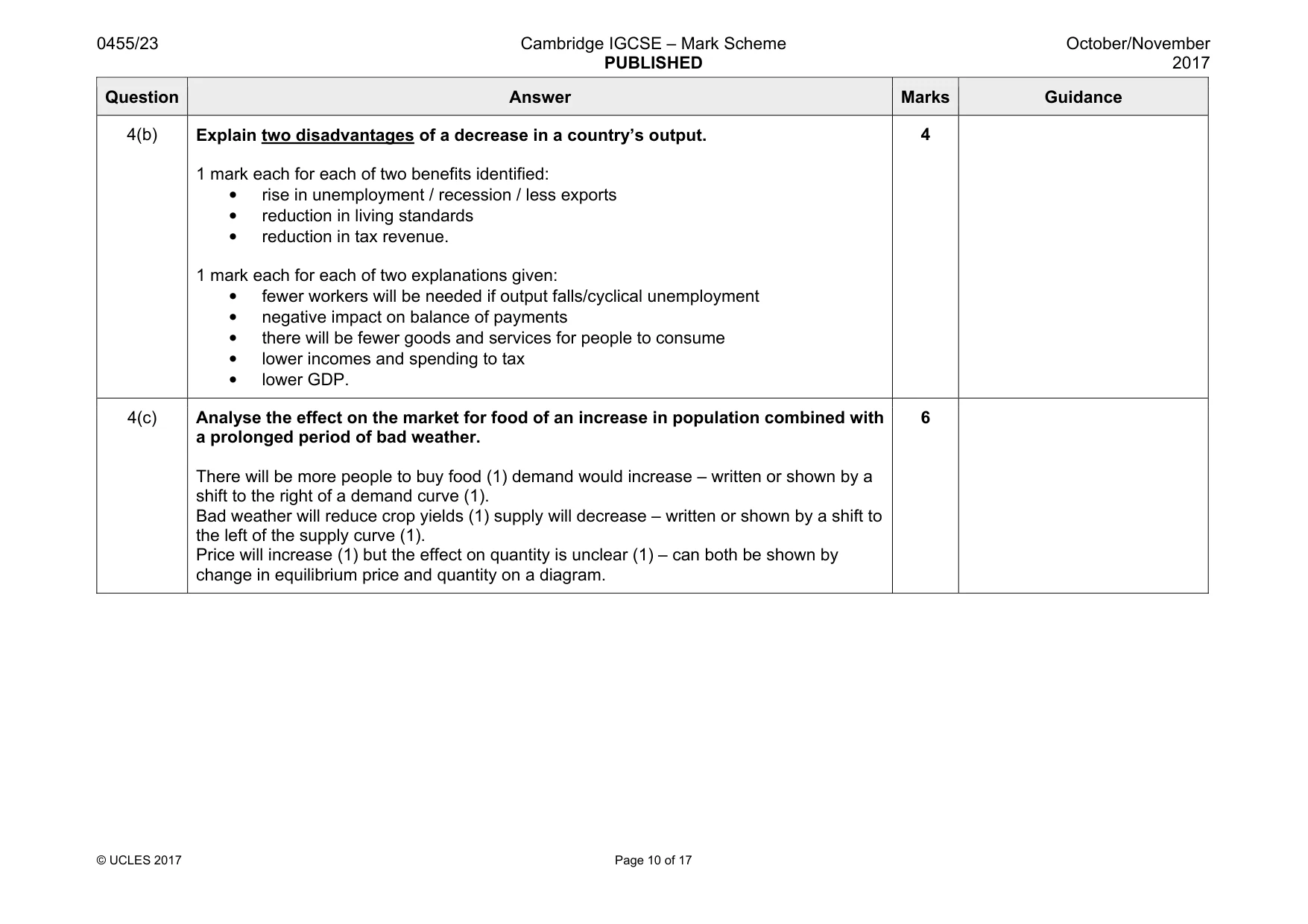
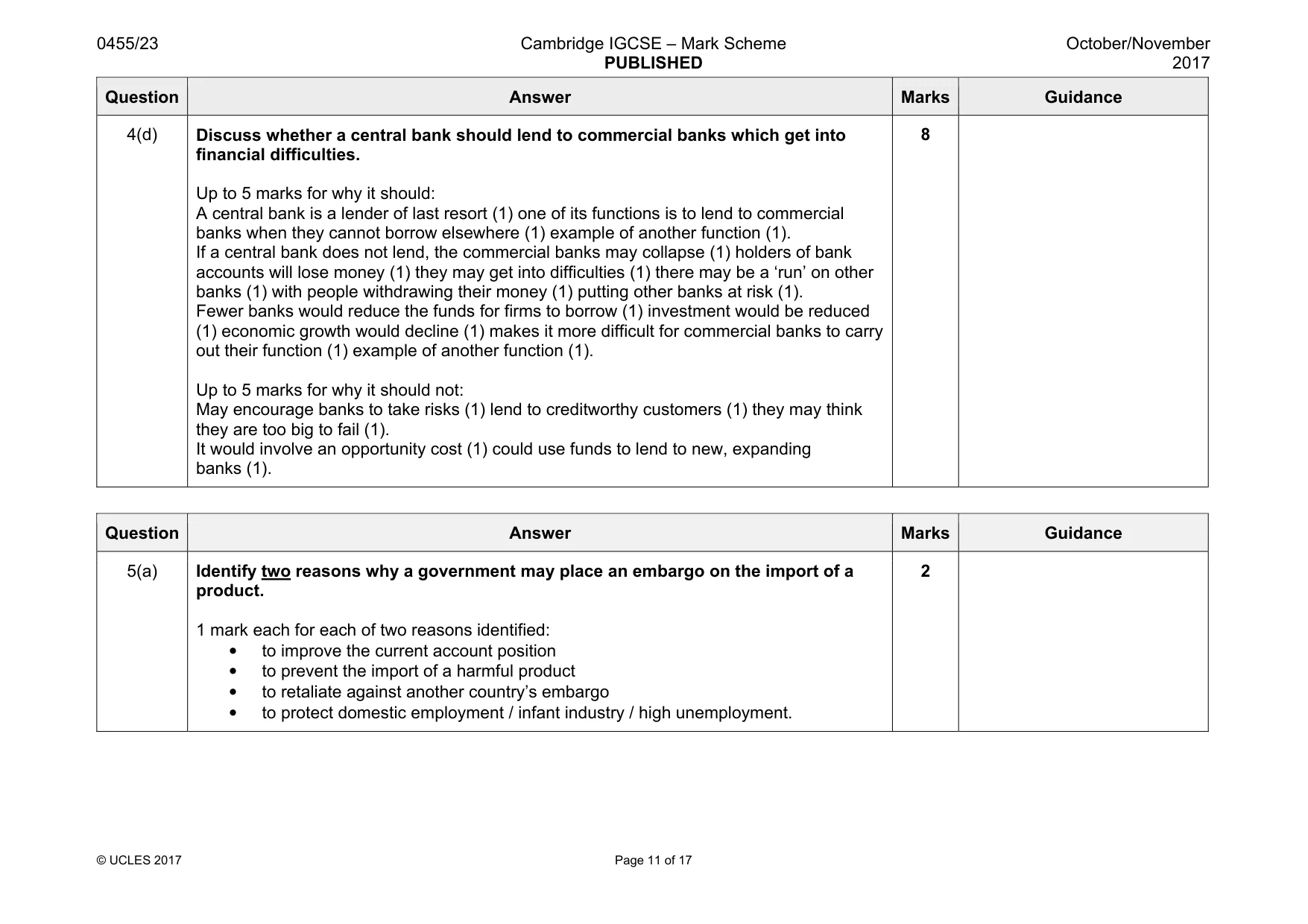
Mark scheme: 4(a) Define ‘devaluation’. A fall in the value (1) of the currency (1) in the case of a fixed exchange rate/caused by government decision / against other currencies (1). 2 Question Answer Marks Guidance 4(b) Explain two disadvantages of a decrease in a country’s output. 1 mark each for each of two benefits identified: • rise in unemployment / recession / less exports • reduction in living standards • reduction in tax revenue. 1 mark each for each of two explanations given: • fewer workers will be needed if output falls/cyclical unemployment • negative impact on balance of payments • there will be fewer goods and services for people to consume • lower incomes and spending to tax • lower GDP. 4 4(c) Analyse the effect on the market for food of an increase in population combined with a prolonged period of bad weather. There will be more people to buy food (1) demand would increase – written or shown by a shift to the right of a demand curve (1). Bad weather will reduce crop yields (1) supply will decrease – written or shown by a shift to the left of the supply curve (1). Price will increase (1) but the effect on quantity is unclear (1) – can both be shown by change in equilibrium price and quantity on a diagram. 6 Question Answer Marks Guidance 4(d) Discuss whether a central bank should lend to commercial banks which get into financial difficulties. Up to 5 marks for why it should: A central bank is a lender of last resort (1) one of its functions is to lend to commercial banks when they cannot borrow elsewhere (1) example of another function (1). If a central bank does not lend, the commercial banks may collapse (1) holders of bank accounts will lose money (1) they may get into difficulties (1) there may be a ‘run’ on other banks (1) with people withdrawing their money (1) putting other banks at risk (1). Fewer banks would reduce the funds for firms to borrow (1) investment would be reduced (1) economic growth would decline (1) makes it more difficult for commercial banks to carry out their function (1) example of another function (1). Up to 5 marks for why it should not: May encourage banks to take risks (1) lend to creditworthy customers (1) they may think they are too big to fail (1). It would involve an opportunity cost (1) could use funds to lend to new, expanding banks (1). 8
Q5 · In 2015, the island of Puerto Rico announced it was considering ending some of its trade…
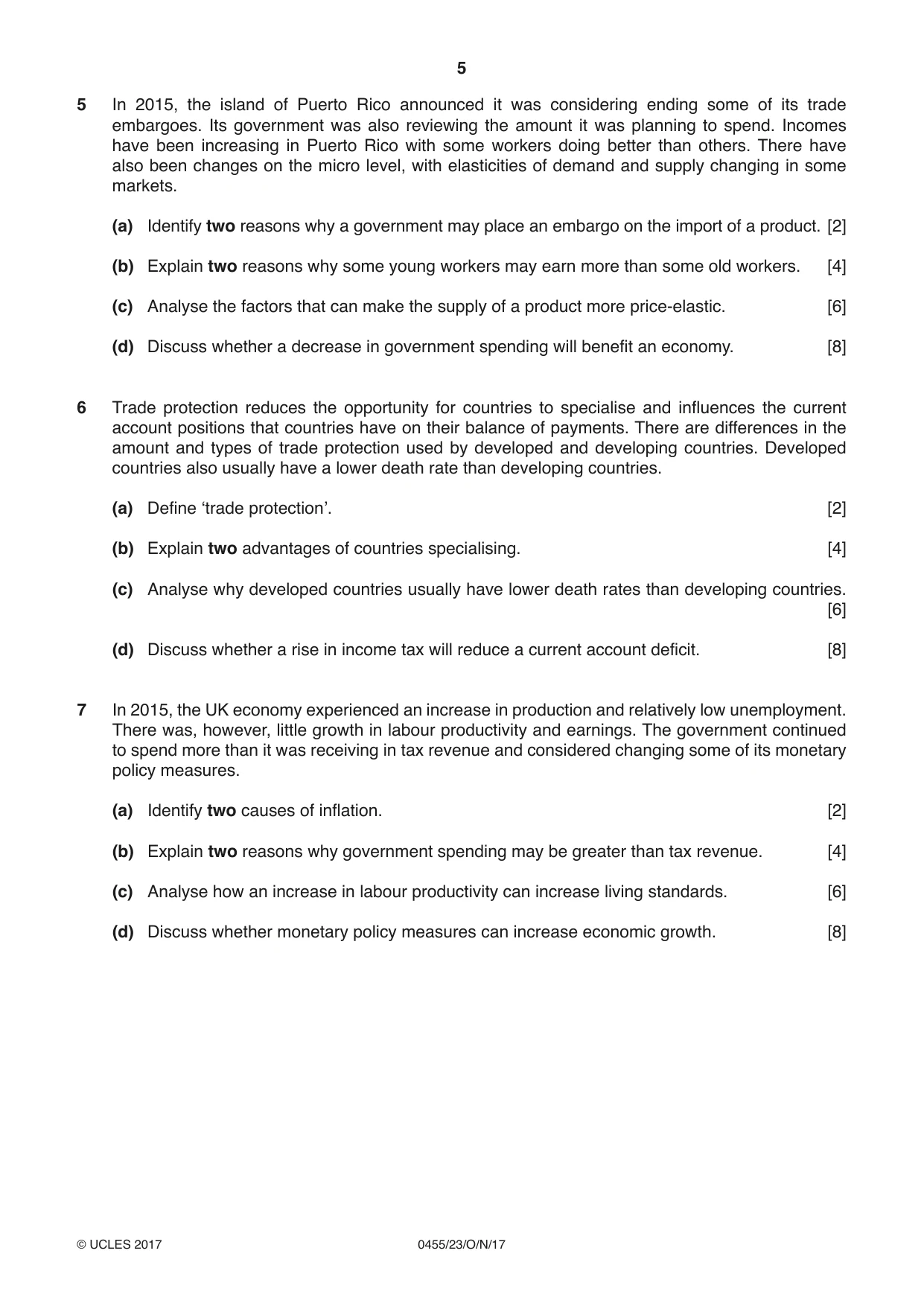
5 In 2015, the island of Puerto Rico announced it was considering ending some of its trade embargoes. Its government was also reviewing the amount it was planning to spend. Incomes have been increasing in Puerto Rico with some workers doing better than others. There have also been changes on the micro level, with elasticities of demand and supply changing in some markets. (a) Identify two reasons why a government may place an embargo on the import of a product. [2] (b) Explain two reasons why some young workers may earn more than some old workers. [4] (c) Analyse the factors that can make the supply of a product more price-elastic. [6] (d) Discuss whether a decrease in government spending will benefit an economy. [8]
Mark scheme: 5(a) Identify two reasons why a government may place an embargo on the import of a product. 1 mark each for each of two reasons identified: • to improve the current account position • to prevent the import of a harmful product • to retaliate against another country’s embargo • to protect domestic employment / infant industry / high unemployment. 2 Question Answer Marks Guidance 5(b) Explain two reasons why some young workers may earn more than some old workers. 1 mark each for each of two reasons identified: • may be more qualified • may be more skilled • may be more up to date with the latest technology • may be more mobile • may work longer hours / less time off for illness • firms discriminate against older workers • work primarily in tertiary industry rather than primary. 1 mark each for each of two explanations: • people with high qualifications are in short supply • people with more skills may be more productive • demand is likely to be high for people who have good technical skills • workers who can change occupations and locations will have more choice of jobs • young workers may be less likely to work part-time / more likely to work overtime. • old workers perceived to be less productive. 4 Accept an argument why some old workers may earn less than some young workers. 5(c) Analyse the factors that may make the supply of a product more price-elastic. The production period may decrease (1) e.g. due to advances in technology (1) making it easier to alter the quantity produced (1). The time period available (1) easier to adjust supply in longer time period (1). It may become easier to store the product (1) e.g. due to the building of more storage facilities (1) making it easier to bring more products onto the market or withdraw them from the market (1). More sources of a raw material may be found (1) giving greater flexibility of supply (1). Mobility of factors of production (1) able to substitute between products being produced (1). Ability to source additional resources /output (1) at similar cost retaining profit margins (1). Lack of barriers to entry (1) enables new firms to enter the market (1). 6 Question Answer Marks Guidance 5(d) Discuss whether a decrease in government spending will benefit an economy. Up to 5 marks for why it might: Lower government spending may reduce total demand (1) lower inflation / demand-pull inflation (1). Lower government spending on e.g. benefits, public sector wages (1) may reduce spending on imports (1) improve the current account position (1). Lower government spending on benefits may encourage the incentive to work (1) reduce unemployment (1). Lower government spending may enable the government to cut taxes (1) increase the incentive to invest (1) the incentive to work (1) disposable income increases (1) increase output (1). Lower government spending may allow growth of the private sector (1) by the release of resources (1). Up to 5 marks for why it might not: May cause cyclical unemployment (1) by reducing total demand (1). If spending on education is cut (1) may reduce the quality / skills / productivity of labour force (1) this may lower output (1) cause structural unemployment (1). Lower government subsidies (1) to infant industries may worsen the current account position (1) may reduce supply (1) cause cost-push inflation (1). Lower government spending on education and healthcare (1) may lower living standards (1) increase poverty (1). 8
Q6 · Trade protection reduces the opportunity for countries to specialise and influences the…
6 Trade protection reduces the opportunity for countries to specialise and influences the current account positions that countries have on their balance of payments. There are differences in the amount and types of trade protection used by developed and developing countries. Developed countries also usually have a lower death rate than developing countries. (a) Define ‘trade protection’. [2] (b) Explain two advantages of countries specialising. [4] (c) Analyse why developed countries usually have lower death rates than developing countries. [6] (d) Discuss whether a rise in income tax will reduce a current account deficit. [8]
Mark scheme: 6(a) Define ‘trade protection’. Protecting domestic firms (1) from foreign competition (1). Helping domestic firms (1) to face foreign competition (1). Implementing trade barriers (1). Deliberate attempt to limit imports (1). Government action (1) that restricts international trade (1). 2 Question Answer Marks Guidance 6(b) Explain two advantages of countries specialising. 1 mark each for each reason identified: • can concentrate on what they are best at / factor endowment • can reduce average costs / create economies of scale • can increase output/income/GDP • can improve quality of output. 1 mark each for each of two reasons explained: • influenced by factor endowment • productivity can be increased / more price competitive / increased speed of production • living standards can rise • ‘practice makes perfect’. 4 Do not reward ‘promotes peace and friendship’. Reward but do not expect reference to comparative or absolute advantage. 6(c) Analyse why developed countries usually have lower death rates than developing countries. They tend to have higher incomes per head (1) enabling them to enjoy better housing (1) better nutrition (1) better education (1) better private sector healthcare (1) people live longer (1). Tax revenue may be higher (1) enabling greater public sector spending on education (1) greater public sector spending on health care (1) and so longer life expectancy (1). Better environment / less pollution / cleaner water (1) less illness (1). 6 Question Answer Marks Guidance 6(d) Discuss whether a rise in income tax will reduce a current account deficit. Up to 5 marks for why it might: A rise in income tax would reduce disposable income (1) which will lower consumer spending (1) lowering spending on imports (1). It may reduce spending on domestic products (1) encouraging firms to switch products to the export market (1). It may reduce demand-pull inflation (1) increasing international competitiveness (1). Up to 5 marks for why it might not: A rise in income tax may reduce saving rather than spending (1). It may be accompanied by a rise in government spending (1) leaving demand unchanged (1). It may increase demand for wage rises (1) which, if granted, would increase costs of production (1) making domestic products less internationally competitive (1). 8
Q7 · In 2015, the UK economy experienced an increase in production and relatively low…
7 In 2015, the UK economy experienced an increase in production and relatively low unemployment. There was, however, little growth in labour productivity and earnings. The government continued to spend more than it was receiving in tax revenue and considered changing some of its monetary policy measures. (a) Identify two causes of inflation. [2] (b) Explain two reasons why government spending may be greater than tax revenue. [4] (c) Analyse how an increase in labour productivity can increase living standards. [6] (d) Discuss whether monetary policy measures can increase economic growth. [8]
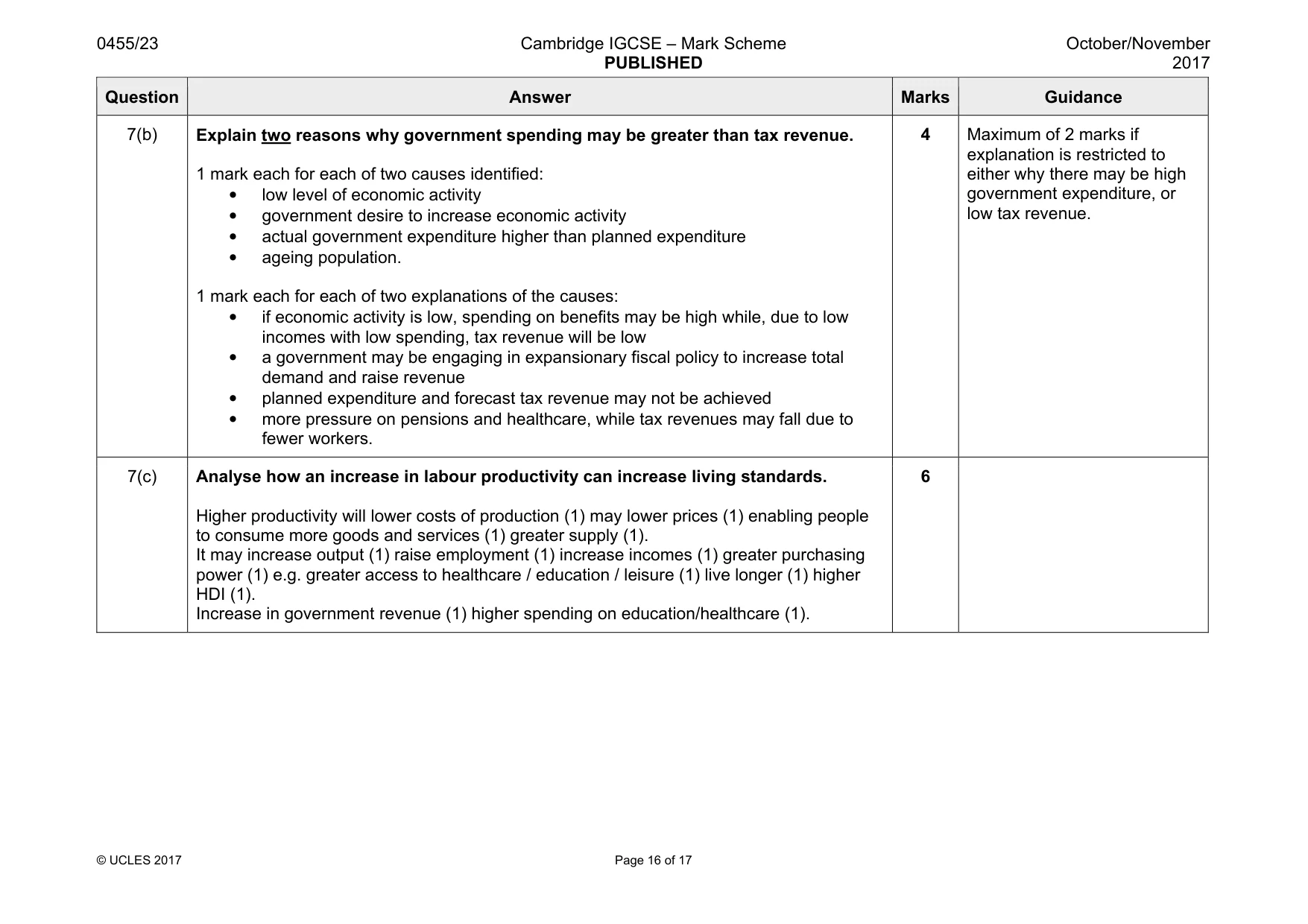
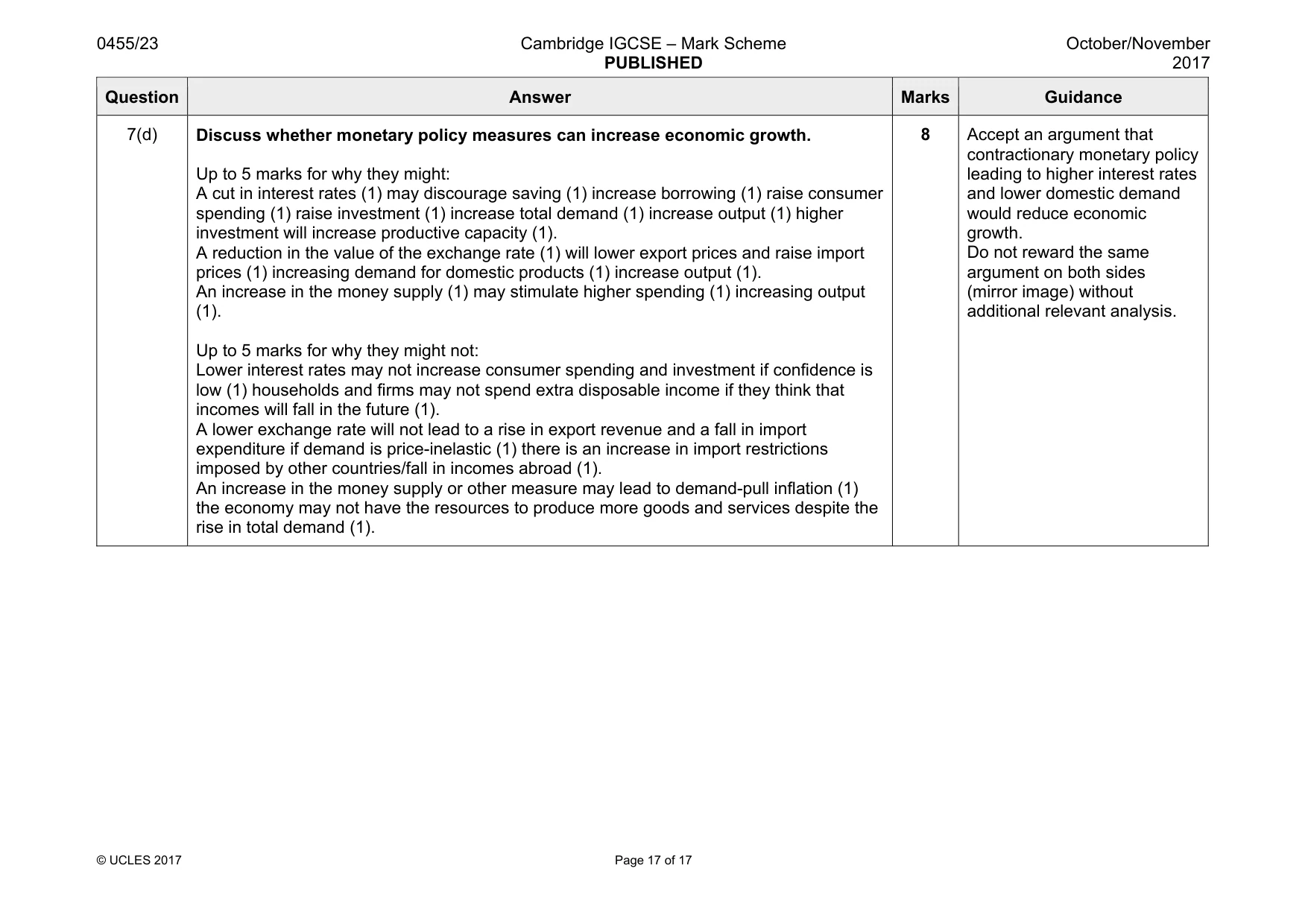
Mark scheme: 7(a) Identify two causes of inflation. Demand-pull/consumer boom/higher government spending/increase in net exports/ increase in aggregate demand (1). Cost-push inflation/higher wages/higher raw material costs / depreciation or devaluation of domestic currency / imported inflation (1). 2 Question Answer Marks Guidance 7(b) Explain two reasons why government spending may be greater than tax revenue. 1 mark each for each of two causes identified: • low level of economic activity • government desire to increase economic activity • actual government expenditure higher than planned expenditure • ageing population. 1 mark each for each of two explanations of the causes: • if economic activity is low, spending on benefits may be high while, due to low incomes with low spending, tax revenue will be low • a government may be engaging in expansionary fiscal policy to increase total demand and raise revenue • planned expenditure and forecast tax revenue may not be achieved • more pressure on pensions and healthcare, while tax revenues may fall due to fewer workers. 4 Maximum of 2 marks if explanation is restricted to either why there may be high government expenditure, or low tax revenue. 7(c) Analyse how an increase in labour productivity can increase living standards. Higher productivity will lower costs of production (1) may lower prices (1) enabling people to consume more goods and services (1) greater supply (1). It may increase output (1) raise employment (1) increase incomes (1) greater purchasing power (1) e.g. greater access to healthcare / education / leisure (1) live longer (1) higher HDI (1). Increase in government revenue (1) higher spending on education/healthcare (1). 6 Question Answer Marks Guidance 7(d) Discuss whether monetary policy measures can increase economic growth. Up to 5 marks for why they might: A cut in interest rates (1) may discourage saving (1) increase borrowing (1) raise consumer spending (1) raise investment (1) increase total demand (1) increase output (1) higher investment will increase productive capacity (1). A reduction in the value of the exchange rate (1) will lower export prices and raise import prices (1) increasing demand for domestic products (1) increase output (1). An increase in the money supply (1) may stimulate higher spending (1) increasing output (1). Up to 5 marks for why they might not: Lower interest rates may not increase consumer spending and investment if confidence is low (1) households and firms may not spend extra disposable income if they think that incomes will fall in the future (1). A lower exchange rate will not lead to a rise in export revenue and a fall in import expenditure if demand is price-inelastic (1) there is an increase in import restrictions imposed by other countries/fall in incomes abroad (1). An increase in the money supply or other measure may lead to demand-pull inflation (1) the economy may not have the resources to produce more goods and services despite the rise in total demand (1). 8 Accept an argument that contractionary monetary policy leading to higher interest rates and lower domestic demand would reduce economic growth. Do not reward the same argument on both sides (mirror image) without additional relevant analysis.
What was in this paper
The subtopics covered by these 7 questions, and how many questions each got. Open one in a new tab to see every Cambridge question on it.
What you needed in this session
Cambridge’s own grade thresholds for 2017 Oct/Nov, Paper 2 · Variant 3. A higher threshold means an easier paper — the bar moves with how the cohort did.