Cambridge IGCSE Economics 0455 — 2023 Oct/Nov Paper 2 · Variant 3
0455/23/O/N/23 · 5 questions · 90 marks · ≈101 min
The question paper and its mark scheme, free to read here and free to download. This is Cambridge’s own paper, exactly as it was sat.
Question paper8 pages



Mark scheme27 pages
Answers below. Sit the paper first if you are practising.
Questions as text
Q1 · Calculate Montenegro’s budget deficit as a percentage of its GDP
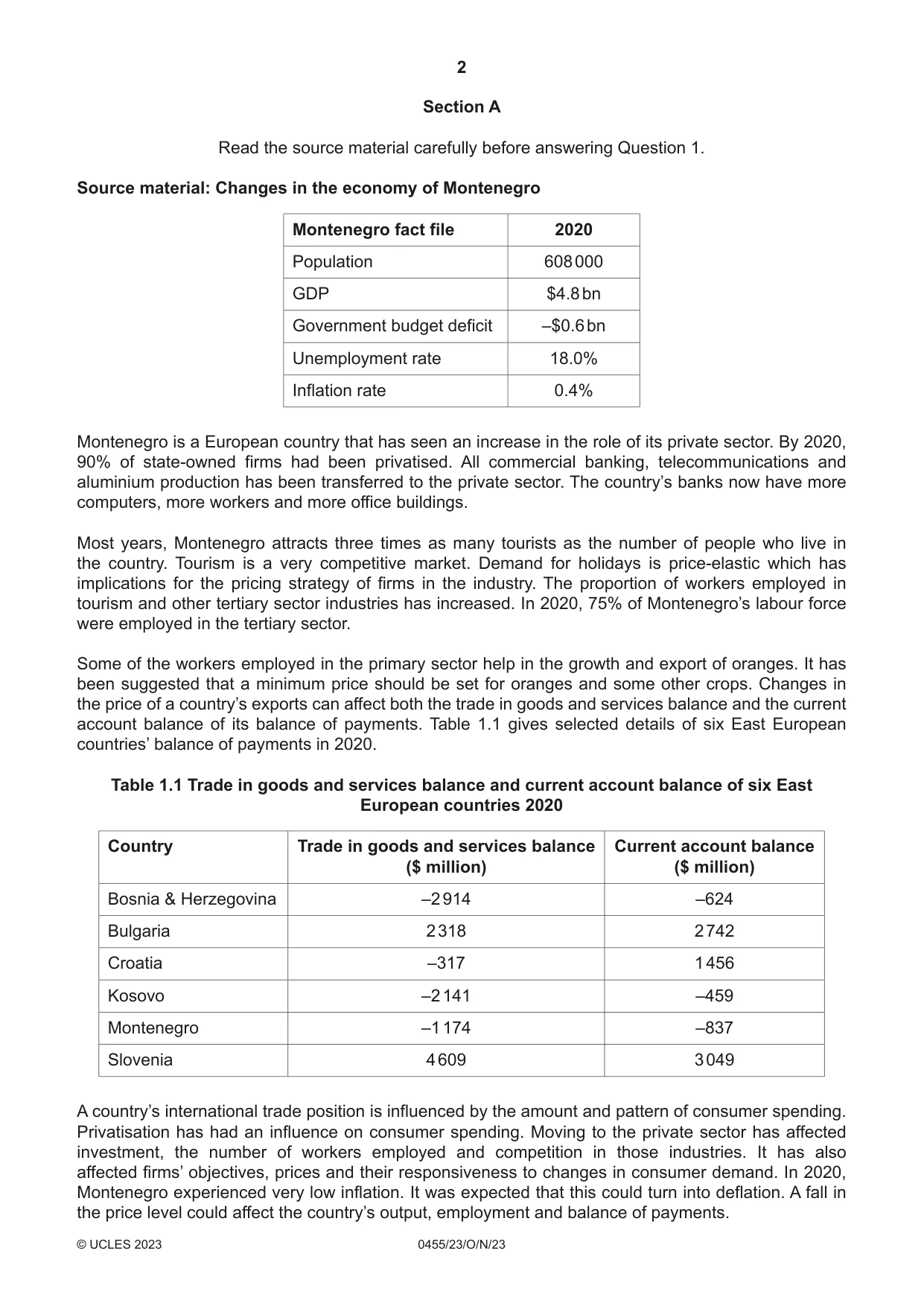
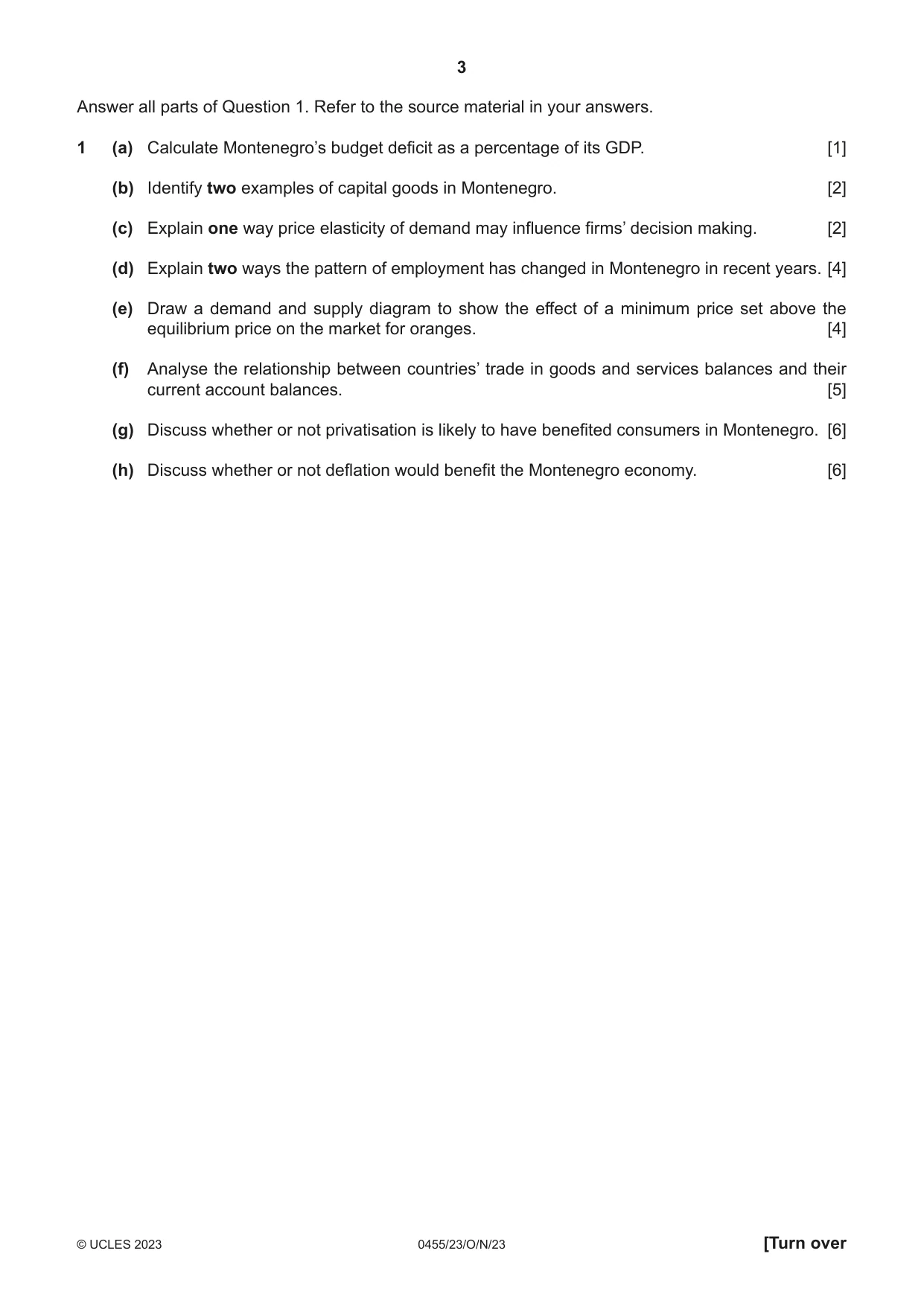
1 (a) Calculate Montenegro’s budget deficit as a percentage of its GDP. [1] (b) Identify two examples of capital goods in Montenegro. [2] (c) Explain one way price elasticity of demand may influence firms’ decision making. [2] (d) Explain two ways the pattern of employment has changed in Montenegro in recent years. [4] (e) Draw a demand and supply diagram to show the effect of a minimum price set above the equilibrium price on the market for oranges. [4] (f) Analyse the relationship between countries’ trade in goods and services balances and their current account balances. [5] (g) Discuss whether or not privatisation is likely to have benefited consumers in Montenegro. [6] (h) Discuss whether or not deflation would benefit the Montenegro economy. [6]
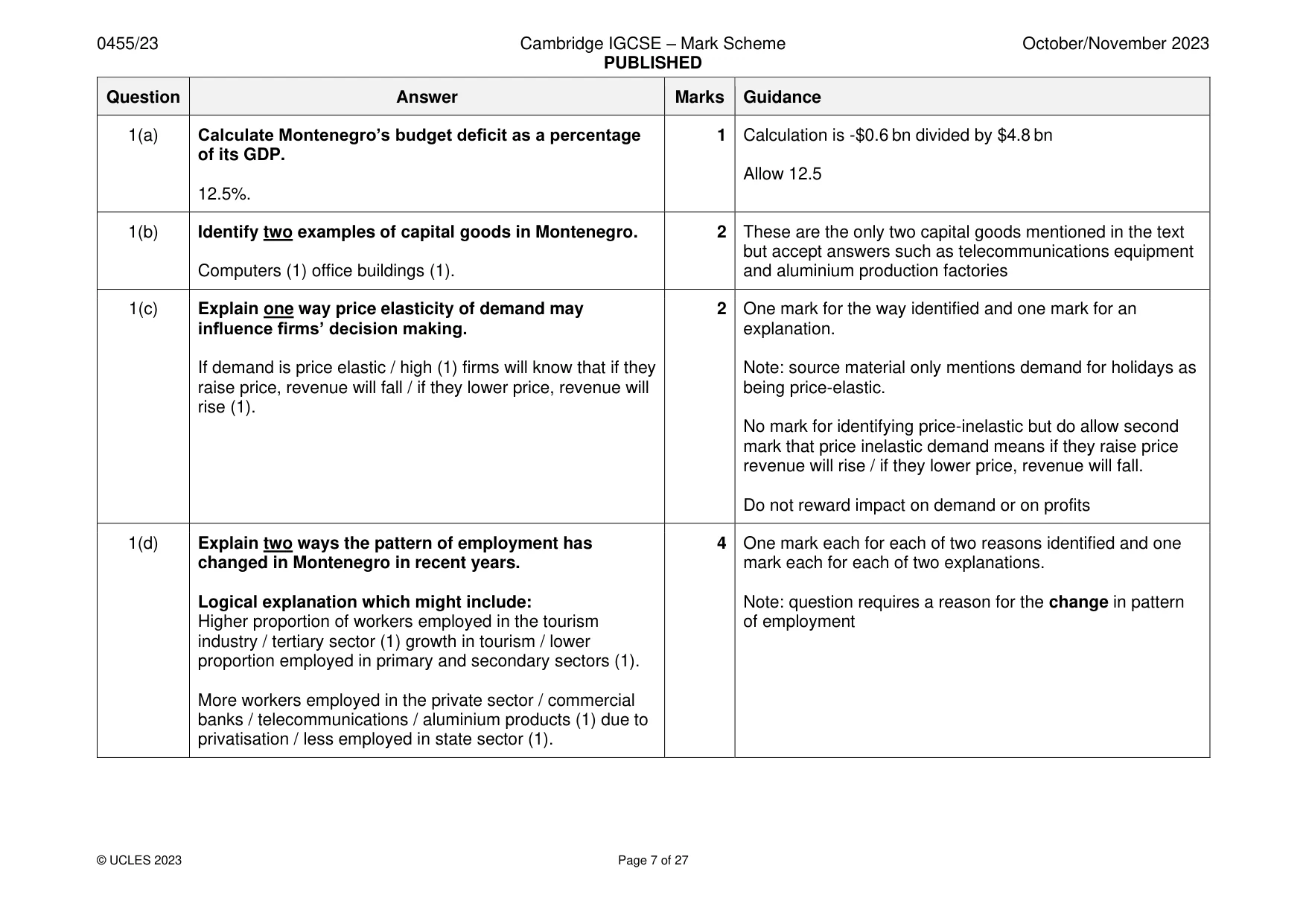
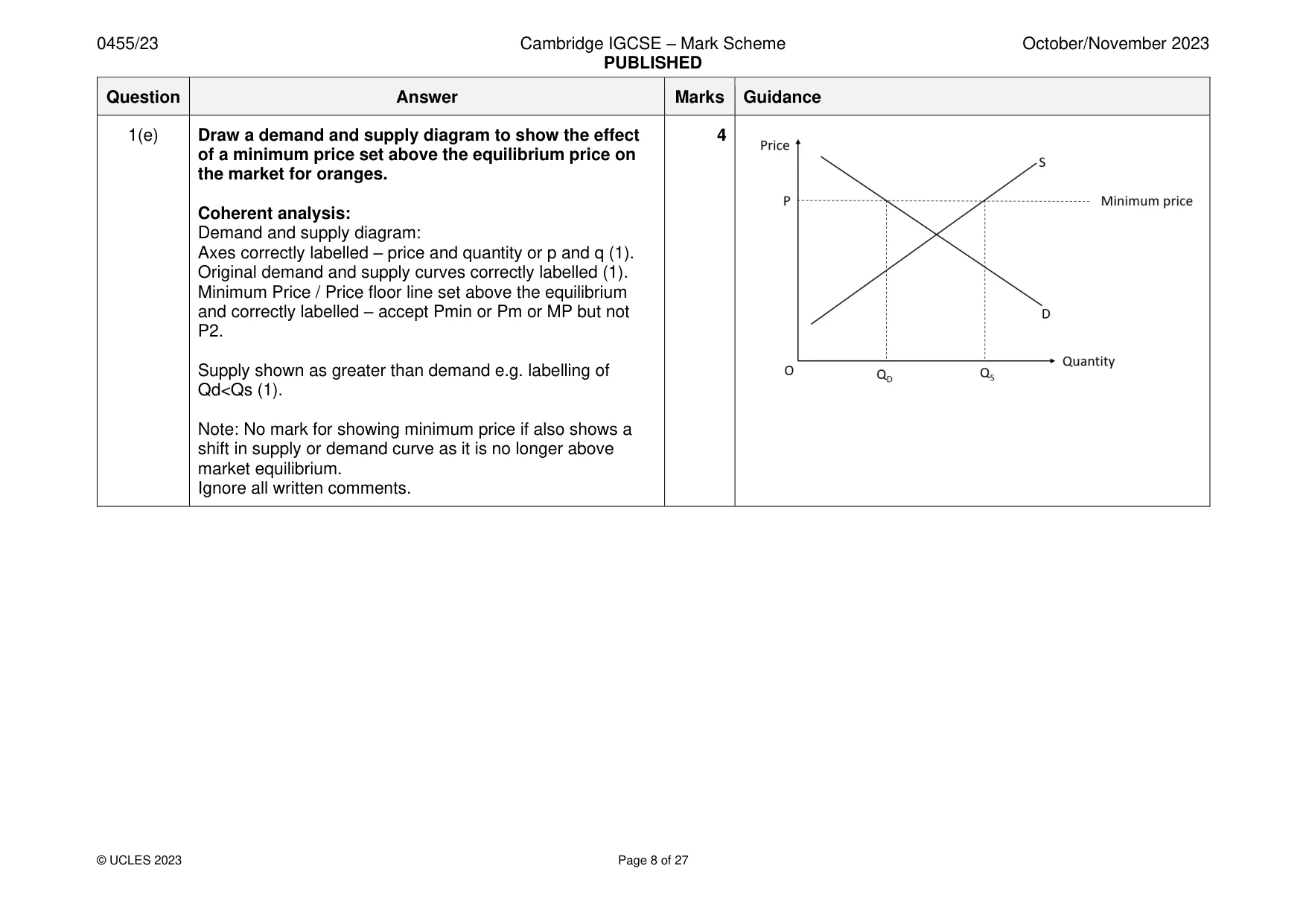
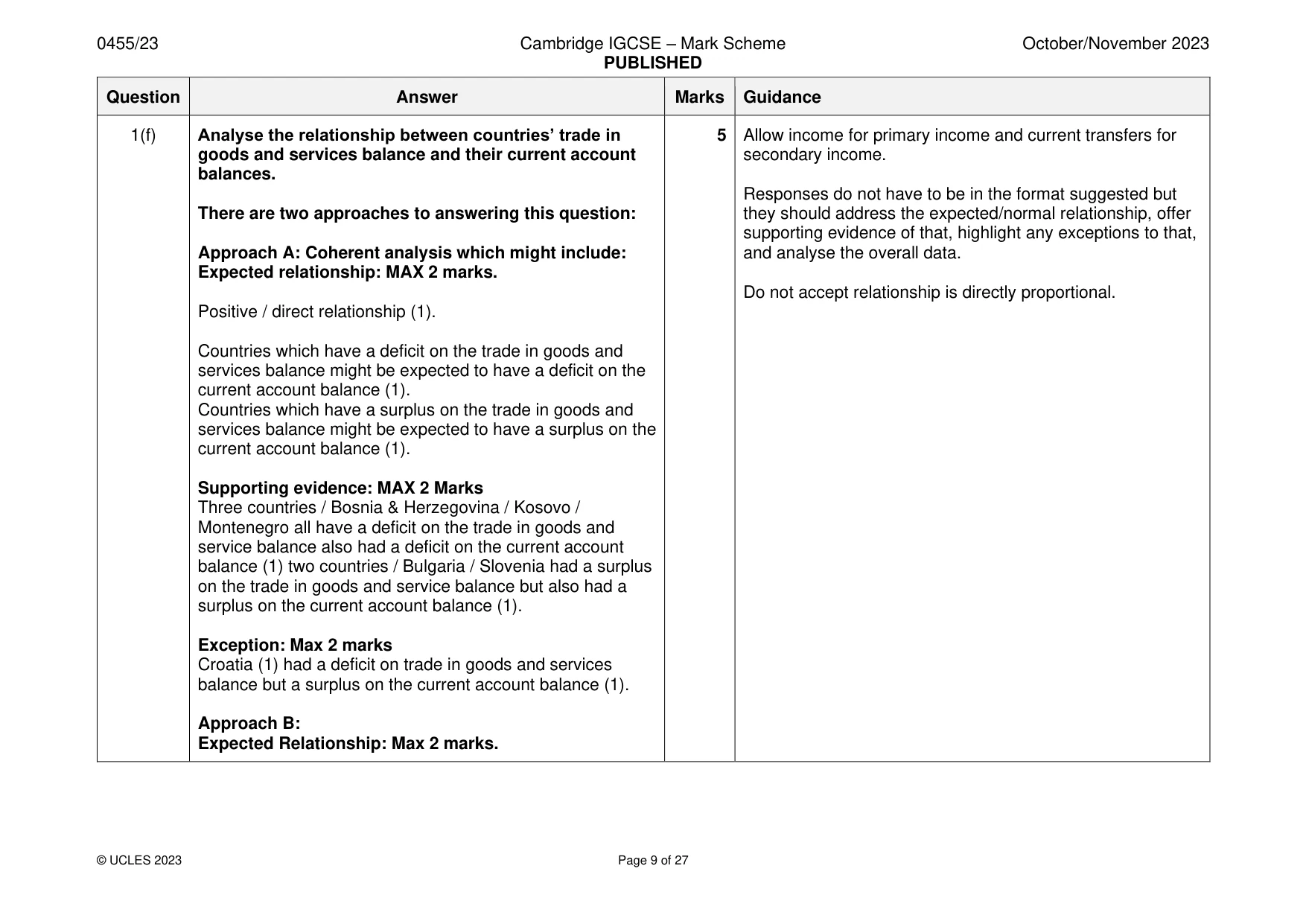
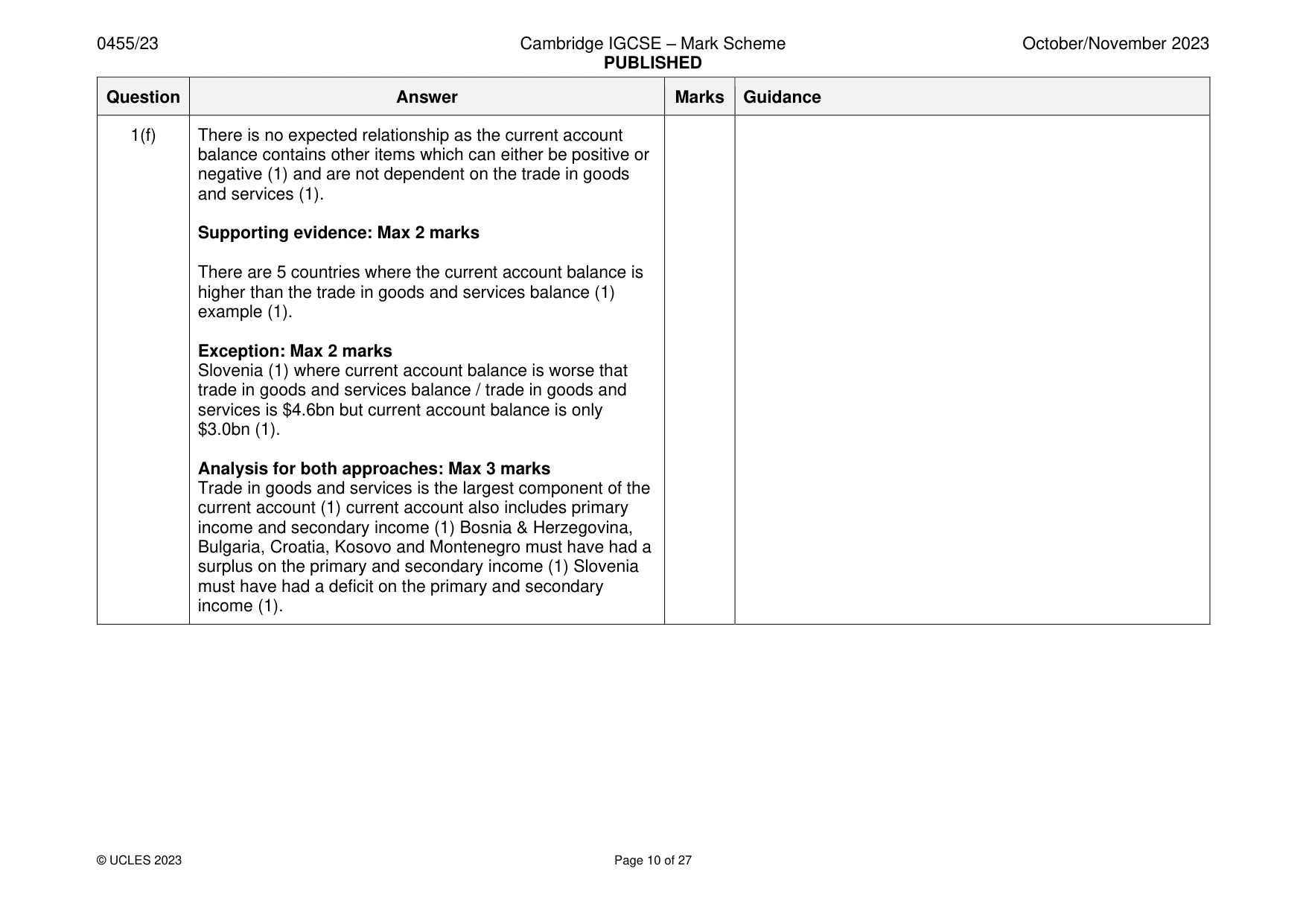
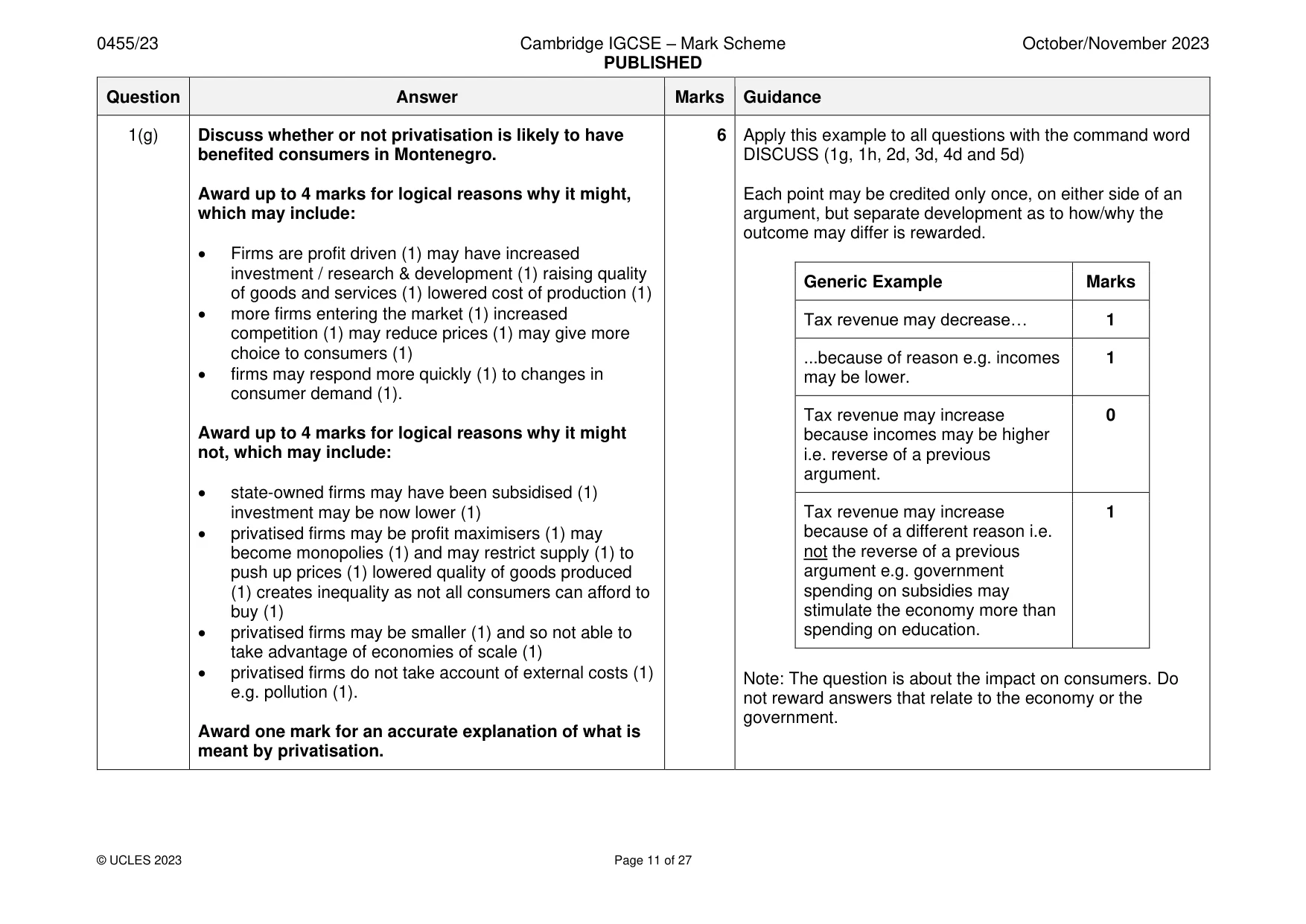
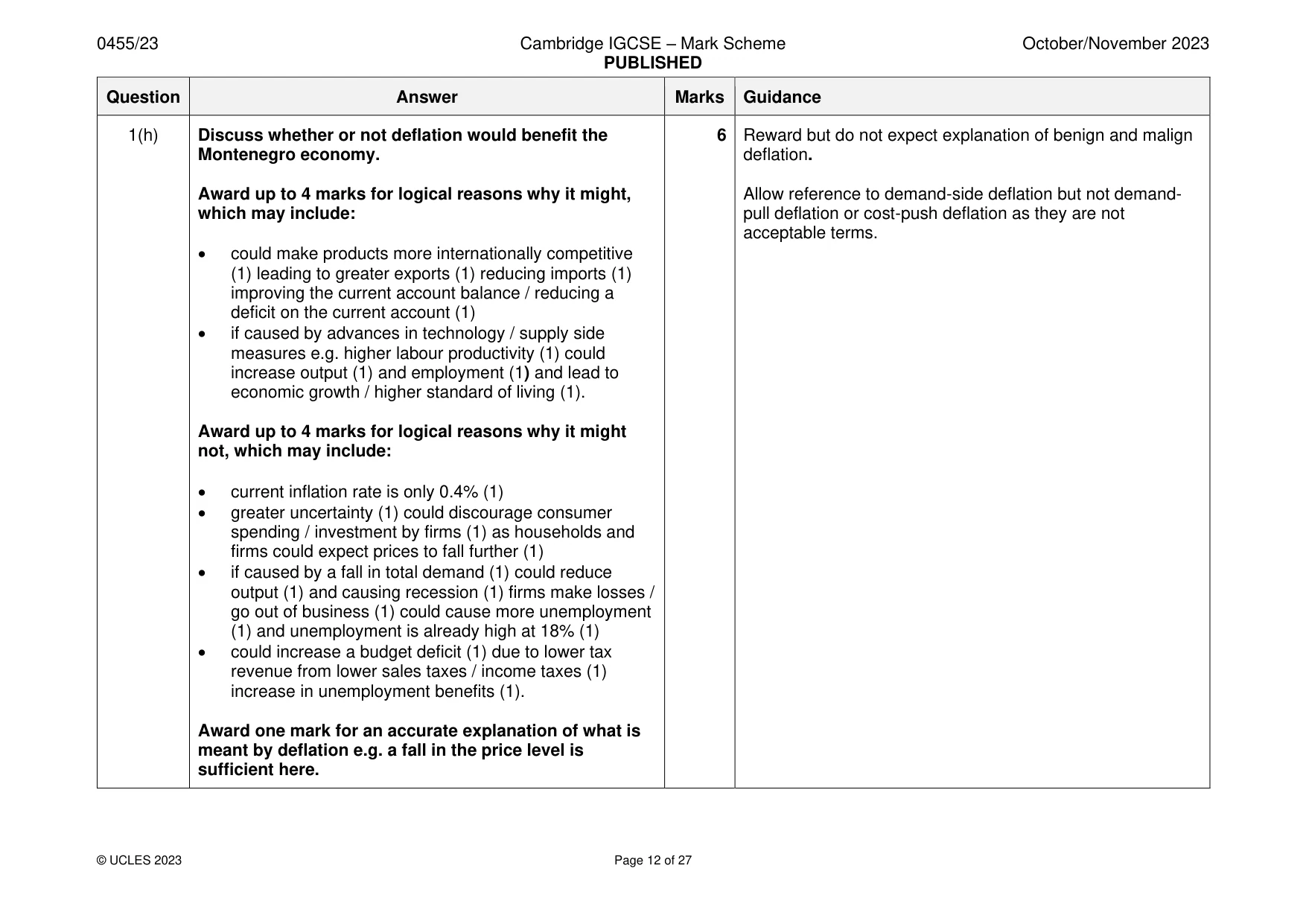
Mark scheme: Question Answer Marks Guidance 1(a) Calculate Montenegro’s budget deficit as a percentage 1 Calculation is -$0.6 bn divided by $4.8 bn of its GDP. Allow 12.5 12.5%. 1(b) Identify two examples of capital goods in Montenegro. 2 These are the only two capital goods mentioned in the text but accept answers such as telecommunications equipment Computers (1) office buildings (1). and aluminium production factories 1(c) Explain one way price elasticity of demand may 2 One mark for the way identified and one mark for an influence firms’ decision making. explanation. If demand is price elastic / high (1) firms will know that if they Note: source material only mentions demand for holidays as raise price, revenue will fall / if they lower price, revenue will being price-elastic. rise (1). No mark for identifying price-inelastic but do allow second mark that price inelastic demand means if they raise price revenue will rise / if they lower price, revenue will fall. Do not reward impact on demand or on profits 1(d) Explain two ways the pattern of employment has 4 One mark each for each of two reasons identified and one changed in Montenegro in recent years. mark each for each of two explanations. Logical explanation which might include: Note: question requires a reason for the change in pattern Higher proportion of workers employed in the tourism of employment industry / tertiary sector (1) growth in tourism / lower proportion employed in primary and secondary sectors (1). More workers employed in the private sector / commercial banks / telecommunications / aluminium products (1) due to privatisation / less employed in state sector (1). 1(e) Draw a demand and supply diagram to show the effect 4 of a minimum price set above the equilibrium price on the market for oranges. Coherent analysis: Demand and supply diagram: Axes correctly labelled – price and quantity or p and q (1). Original demand and supply curves correctly labelled (1). Minimum Price / Price floor line set above the equilibrium and correctly labelled – accept Pmin or Pm or MP but not P2. Supply shown as greater than demand e.g. labelling of Qd<Qs (1). Note: No mark for showing minimum price if also shows a shift in supply or demand curve as it is no longer above market equilibrium. Ignore all written comments. 1(f) Analyse the relationship between countries’ trade in 5 Allow income for primary income and current transfers for goods and services balance and their current account secondary income. balances. Responses do not have to be in the format suggested but There are two approaches to answering this question: they should address the expected/normal relationship, offer supporting evidence of that, highlight any exceptions to that, Approach A: Coherent analysis which might include: and analyse the overall data. Expected relationship: MAX 2 marks. Do not accept relationship is directly proportional. Positive / direct relationship (1). Countries which have a deficit on the trade in goods and services balance might be expected to have a deficit on the current account balance (1). Countries which have a surplus on the trade in goods and services balance might be expected to have a surplus on the current account balance (1). Supporting evidence: MAX 2 Marks Three countries / Bosnia & Herzegovina / Kosovo / Montenegro all have a deficit on the trade in goods and service balance also had a deficit on the current account balance (1) two countries / Bulgaria / Slovenia had a surplus on the trade in goods and service balance but also had a surplus on the current account balance (1). Exception: Max 2 marks Croatia (1) had a deficit on trade in goods and services balance but a surplus on the current account balance (1). Approach B: Expected Relationship: Max 2 marks. 1(f) There is no expected relationship as the current account balance contains other items which can either be positive or negative (1) and are not dependent on the trade in goods and services (1). Supporting evidence: Max 2 marks There are 5 countries where the current account balance is higher than the trade in goods and services balance (1) example (1). Exception: Max 2 marks Slovenia (1) where current account balance is worse that trade in goods and services balance / trade in goods and services is $4.6bn but current account balance is only $3.0bn (1). Analysis for both approaches: Max 3 marks Trade in goods and services is the largest component of the current account (1) current account also includes primary income and secondary income (1) Bosnia & Herzegovina, Bulgaria, Croatia, Kosovo and Montenegro must have had a surplus on the primary and secondary income (1) Slovenia must have had a deficit on the primary and secondary income (1). 1(g) Discuss whether or not privatisation is likely to have 6 Apply this example to all questions with the command word benefited consumers in Montenegro. DISCUSS (1g, 1h, 2d, 3d, 4d and 5d) Award up to 4 marks for logical reasons why it might, Each point may be credited only once, on either side of an which may include: argument, but separate development as to how/why the outcome may differ is rewarded. • Firms are profit driven (1) may have increased investment / research & development (1) raising quality Generic Example Marks of goods and services (1) lowered cost of production (1) • more firms entering the market (1) increased Tax revenue may decrease… 1 competition (1) may reduce prices (1) may give more choice to consumers (1) ...because of reason e.g. incomes 1 • firms may respond more quickly (1) to changes in may be lower. consumer demand (1). Tax revenue may increase 0 Award up to 4 marks for logical reasons why it might because incomes may be higher not, which may include: i.e. reverse of a previous argument. • state-owned firms may have been subsidised (1) investment may be now lower (1) Tax revenue may increase 1 • privatised firms may be profit maximisers (1) may because of a different reason i.e. become monopolies (1) and may restrict supply (1) to not the reverse of a previous push up prices (1) lowered quality of goods produced argument e.g. government (1) creates inequality as not all consumers can afford to spending on subsidies may buy (1) stimulate the economy more than • privatised firms may be smaller (1) and so not able to spending on education. take advantage of economies of scale (1) • privatised firms do not take account of external costs (1) Note: The question is about the impact on consumers. Do e.g. pollution (1). not reward answers that relate to the economy or the government. Award one mark for an accurate explanation of what is meant by privatisation. 1(h) Discuss whether or not deflation would benefit the 6 Reward but do not expect explanation of benign and malign Montenegro economy. deflation. Award up to 4 marks for logical reasons why it might, Allow reference to demand-side deflation but not demand- which may include: pull deflation or cost-push deflation as they are not acceptable terms. • could make products more internationally competitive (1) leading to greater exports (1) reducing imports (1) improving the current account balance / reducing a deficit on the current account (1) • if caused by advances in technology / supply side measures e.g. higher labour productivity (1) could increase output (1) and employment (1) and lead to economic growth / higher standard of living (1). Award up to 4 marks for logical reasons why it might not, which may include: • current inflation rate is only 0.4% (1) • greater uncertainty (1) could discourage consumer spending / investment by firms (1) as households and firms could expect prices to fall further (1) • if caused by a fall in total demand (1) could reduce output (1) and causing recession (1) firms make losses / go out of business (1) could cause more unemployment (1) and unemployment is already high at 18% (1) • could increase a budget deficit (1) due to lower tax revenue from lower sales taxes / income taxes (1) increase in unemployment benefits (1). Award one mark for an accurate explanation of what is meant by deflation e.g. a fall in the price level is sufficient here.
Q2 · In 2019, Mozambique was hit by a serious storm which destroyed bridges, factories, roads…
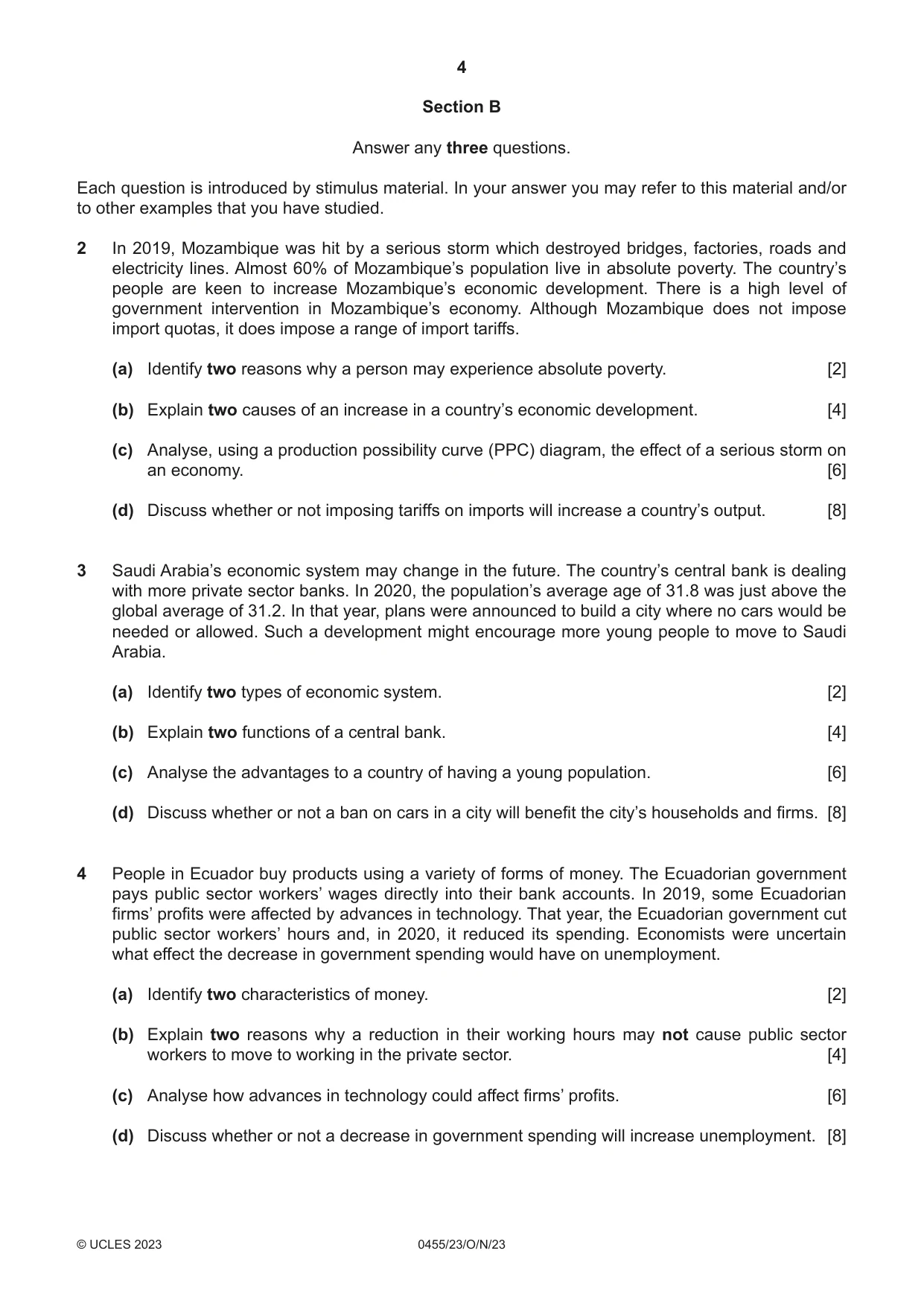
2 In 2019, Mozambique was hit by a serious storm which destroyed bridges, factories, roads and electricity lines. Almost 60% of Mozambique’s population live in absolute poverty. The country’s people are keen to increase Mozambique’s economic development. There is a high level of government intervention in Mozambique’s economy. Although Mozambique does not impose import quotas, it does impose a range of import tariffs. (a) Identify two reasons why a person may experience absolute poverty. [2] (b) Explain two causes of an increase in a country’s economic development. [4] (c) Analyse, using a production possibility curve (PPC) diagram, the effect of a serious storm on an economy. [6] (d) Discuss whether or not imposing tariffs on imports will increase a country’s output. [8]
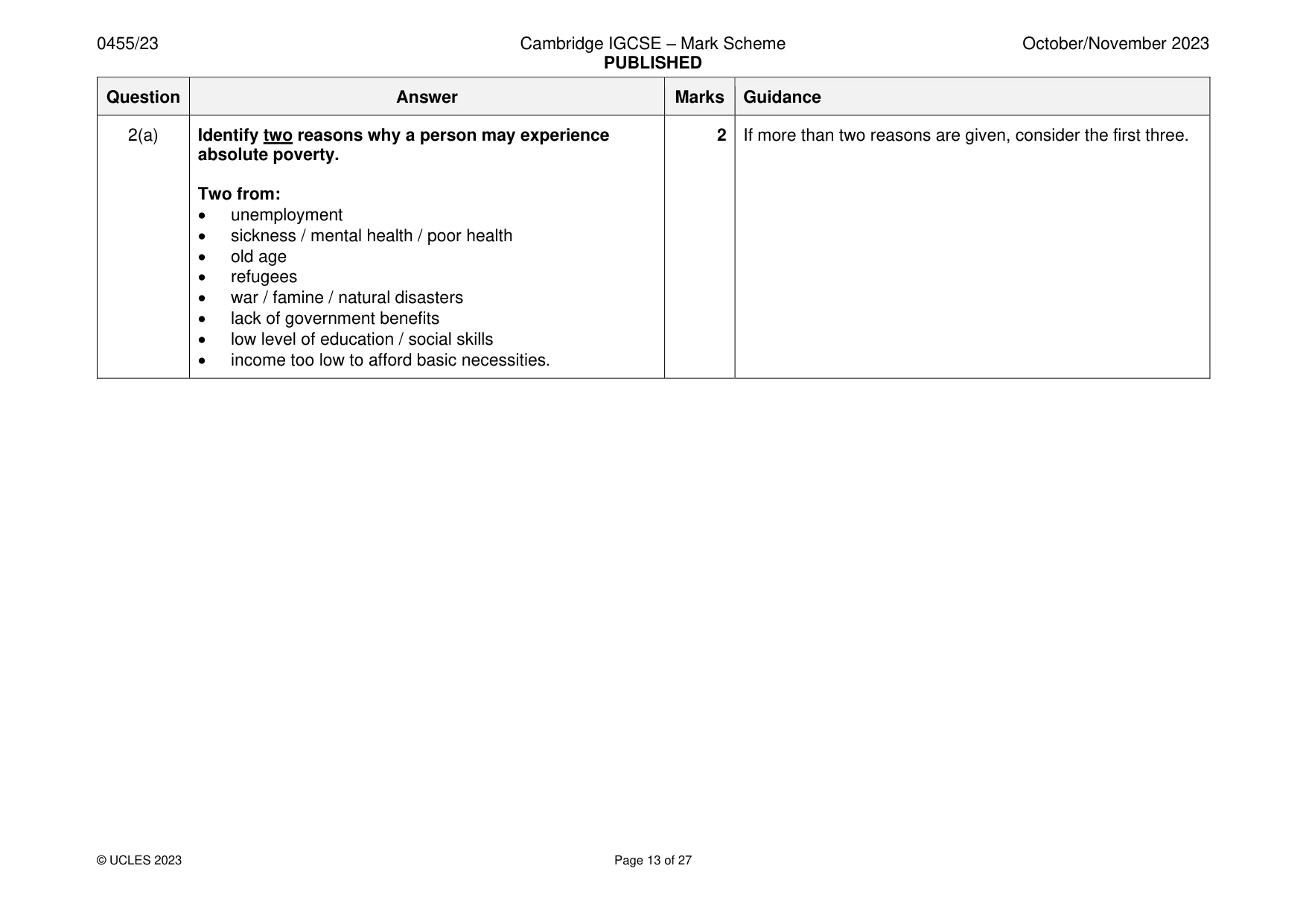
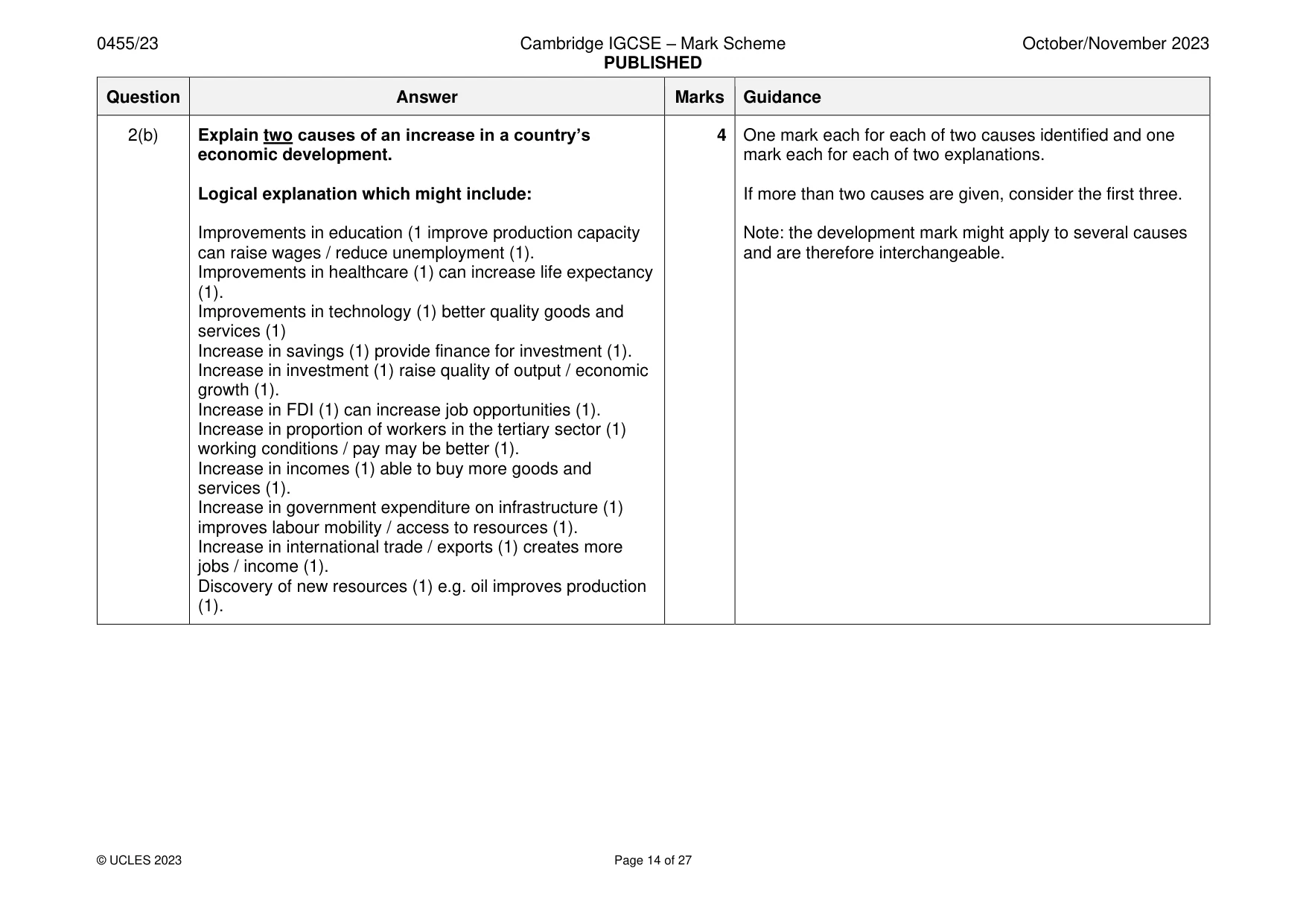
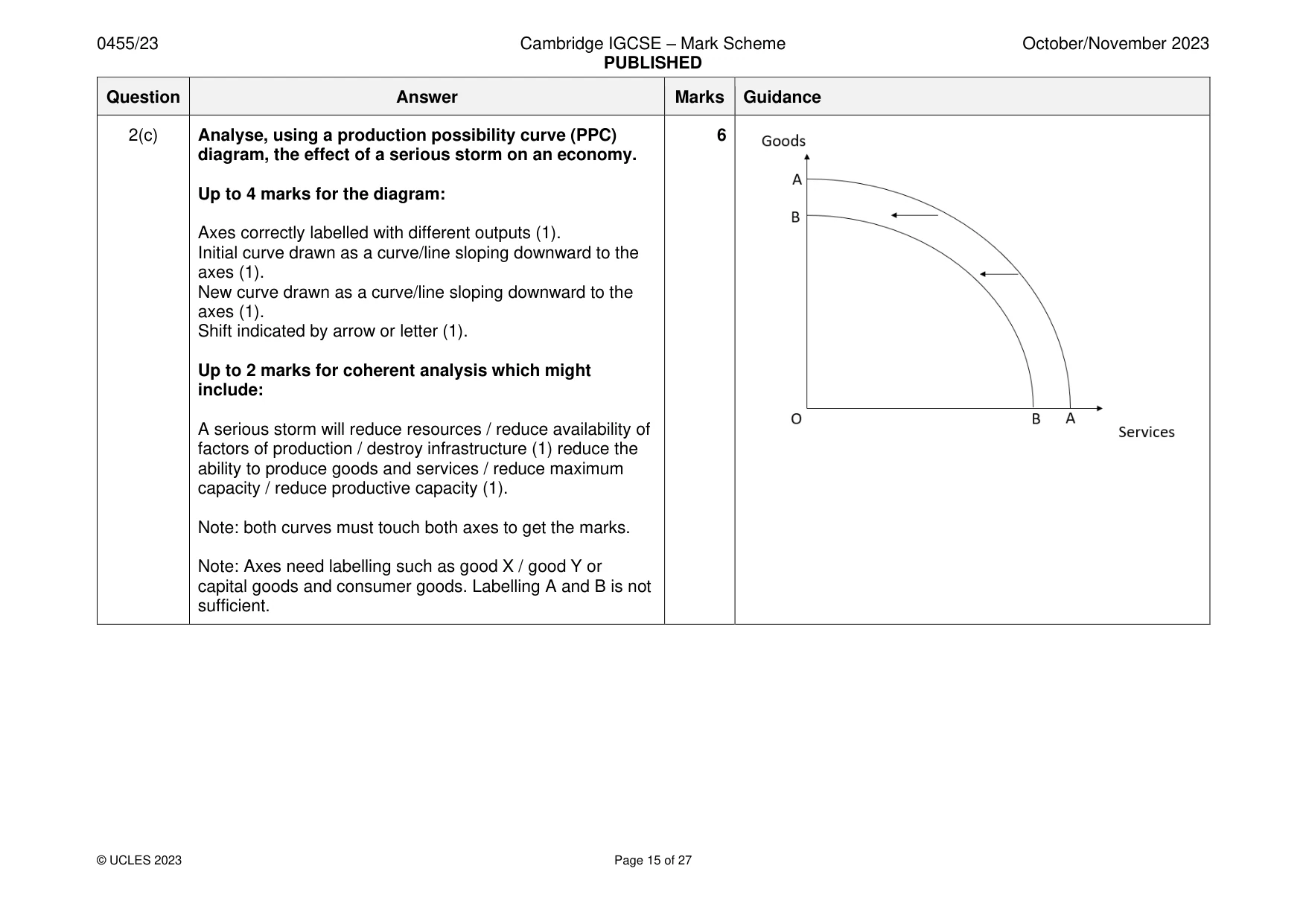
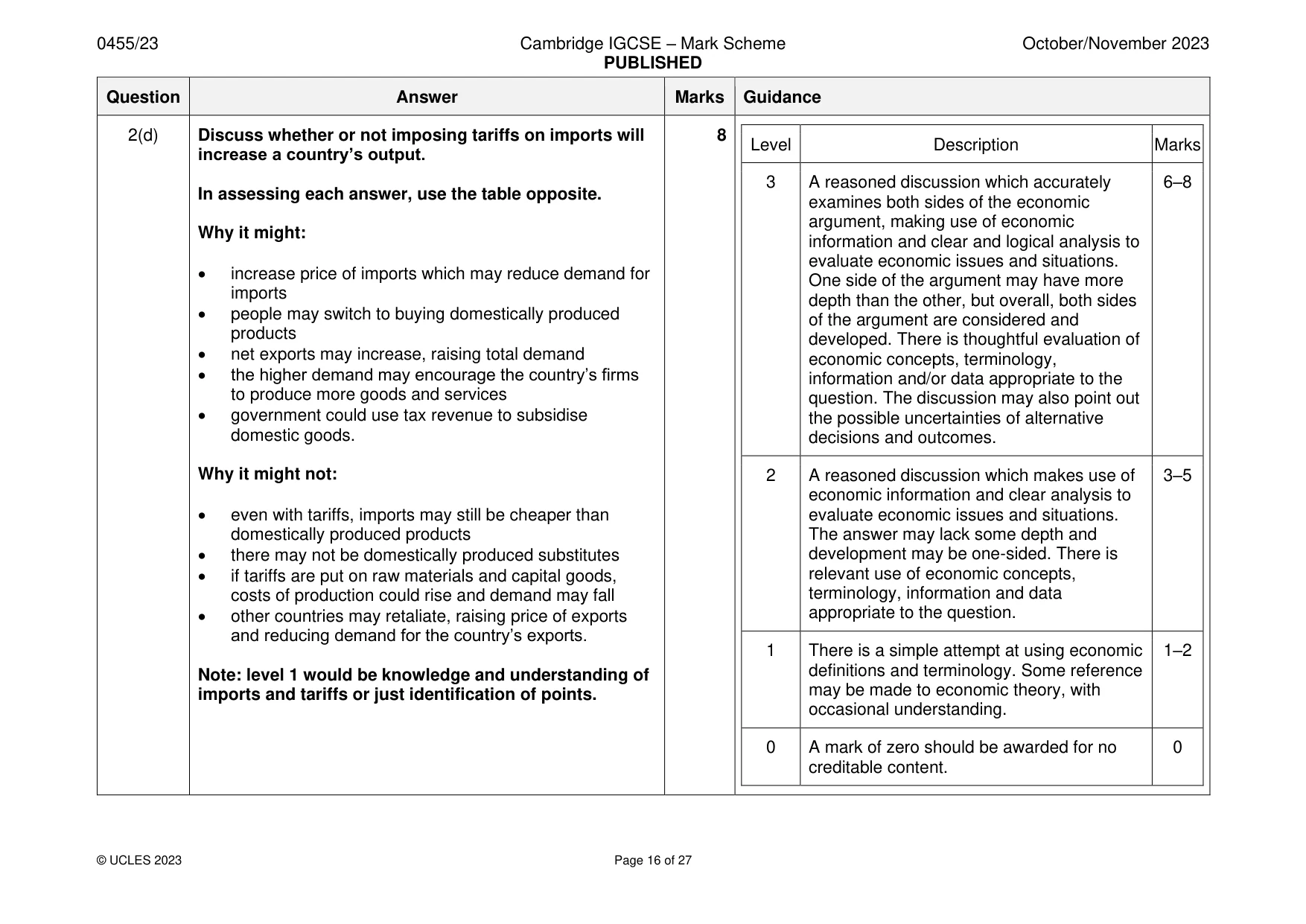
Mark scheme: 2(a) Identify two reasons why a person may experience 2 If more than two reasons are given, consider the first three. absolute poverty. Two from: • unemployment • sickness / mental health / poor health • old age • refugees • war / famine / natural disasters • lack of government benefits • low level of education / social skills • income too low to afford basic necessities. 2(b) Explain two causes of an increase in a country’s 4 One mark each for each of two causes identified and one economic development. mark each for each of two explanations. Logical explanation which might include: If more than two causes are given, consider the first three. Improvements in education (1 improve production capacity Note: the development mark might apply to several causes can raise wages / reduce unemployment (1). and are therefore interchangeable. Improvements in healthcare (1) can increase life expectancy (1). Improvements in technology (1) better quality goods and services (1) Increase in savings (1) provide finance for investment (1). Increase in investment (1) raise quality of output / economic growth (1). Increase in FDI (1) can increase job opportunities (1). Increase in proportion of workers in the tertiary sector (1) working conditions / pay may be better (1). Increase in incomes (1) able to buy more goods and services (1). Increase in government expenditure on infrastructure (1) improves labour mobility / access to resources (1). Increase in international trade / exports (1) creates more jobs / income (1). Discovery of new resources (1) e.g. oil improves production (1). 2(c) Analyse, using a production possibility curve (PPC) 6 diagram, the effect of a serious storm on an economy. Up to 4 marks for the diagram: Axes correctly labelled with different outputs (1). Initial curve drawn as a curve/line sloping downward to the axes (1). New curve drawn as a curve/line sloping downward to the axes (1). Shift indicated by arrow or letter (1). Up to 2 marks for coherent analysis which might include: A serious storm will reduce resources / reduce availability of factors of production / destroy infrastructure (1) reduce the ability to produce goods and services / reduce maximum capacity / reduce productive capacity (1). Note: both curves must touch both axes to get the marks. Note: Axes need labelling such as good X / good Y or capital goods and consumer goods. Labelling A and B is not sufficient. 2(d) Discuss whether or not imposing tariffs on imports will 8 Level Description Marks increase a country’s output. 3 A reasoned discussion which accurately 6–8 In assessing each answer, use the table opposite. examines both sides of the economic argument, making use of economic Why it might: information and clear and logical analysis to evaluate economic issues and situations. • increase price of imports which may reduce demand for One side of the argument may have more imports depth than the other, but overall, both sides • people may switch to buying domestically produced of the argument are considered and products developed. There is thoughtful evaluation of • net exports may increase, raising total demand economic concepts, terminology, • the higher demand may encourage the country’s firms information and/or data appropriate to the to produce more goods and services question. The discussion may also point out • government could use tax revenue to subsidise the possible uncertainties of alternative domestic goods. decisions and outcomes. Why it might not: 2 A reasoned discussion which makes use of 3–5 economic information and clear analysis to • even with tariffs, imports may still be cheaper than evaluate economic issues and situations. domestically produced products The answer may lack some depth and • there may not be domestically produced substitutes development may be one-sided. There is • if tariffs are put on raw materials and capital goods, relevant use of economic concepts, costs of production could rise and demand may fall terminology, information and data • other countries may retaliate, raising price of exports appropriate to the question. and reducing demand for the country’s exports. 1 There is a simple attempt at using economic 1–2 definitions and terminology. Some reference Note: level 1 would be knowledge and understanding of imports and tariffs or just identification of points. may be made to economic theory, with occasional understanding. 0 A mark of zero should be awarded for no 0 creditable content.
Q3 · Saudi Arabia’s economic system may change in the future
3 Saudi Arabia’s economic system may change in the future. The country’s central bank is dealing with more private sector banks. In 2020, the population’s average age of 31.8 was just above the global average of 31.2. In that year, plans were announced to build a city where no cars would be needed or allowed. Such a development might encourage more young people to move to Saudi Arabia. (a) Identify two types of economic system. [2] (b) Explain two functions of a central bank. [4] (c) Analyse the advantages to a country of having a young population. [6] (d) Discuss whether or not a ban on cars in a city will benefit the city’s households and firms. [8]
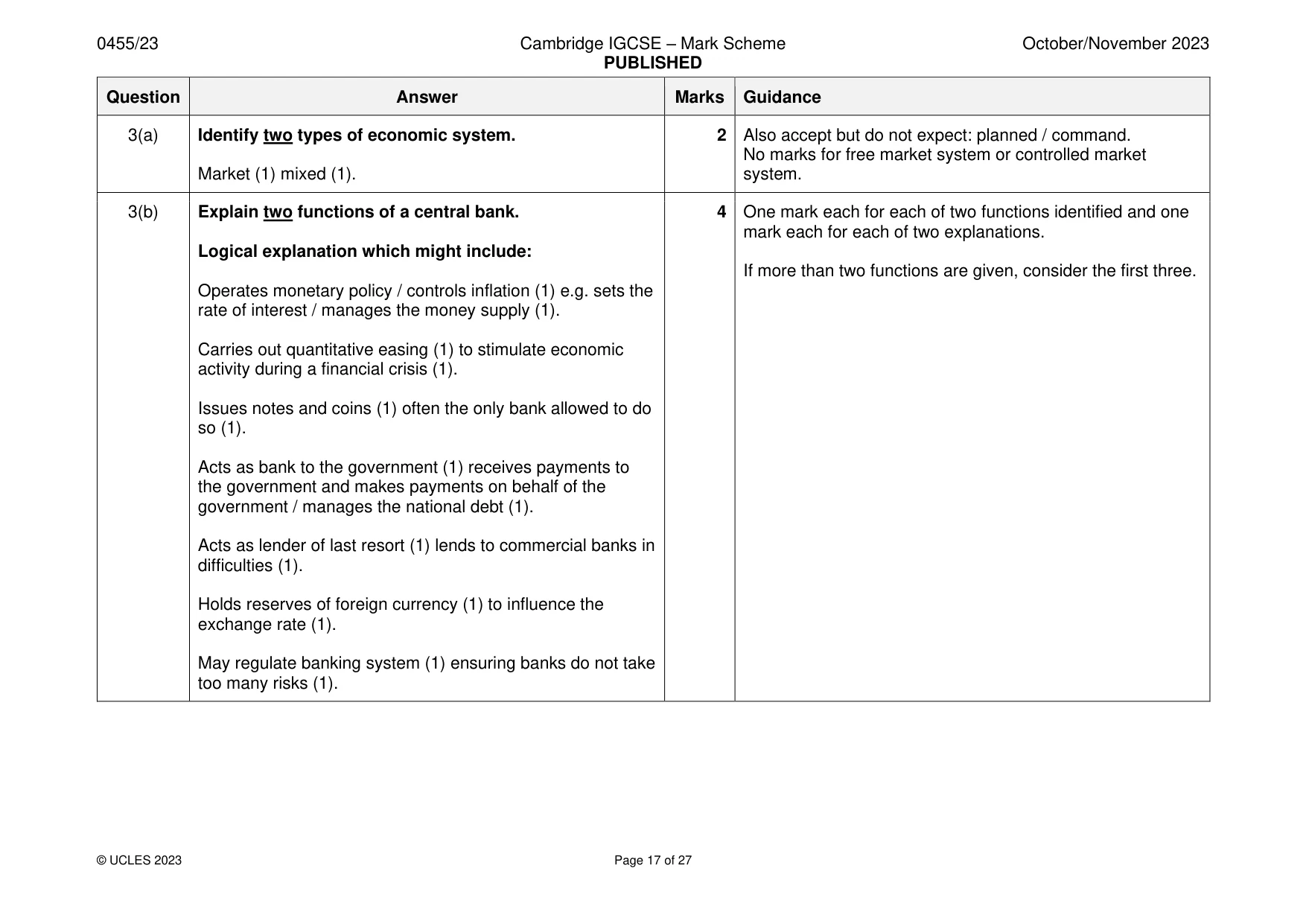
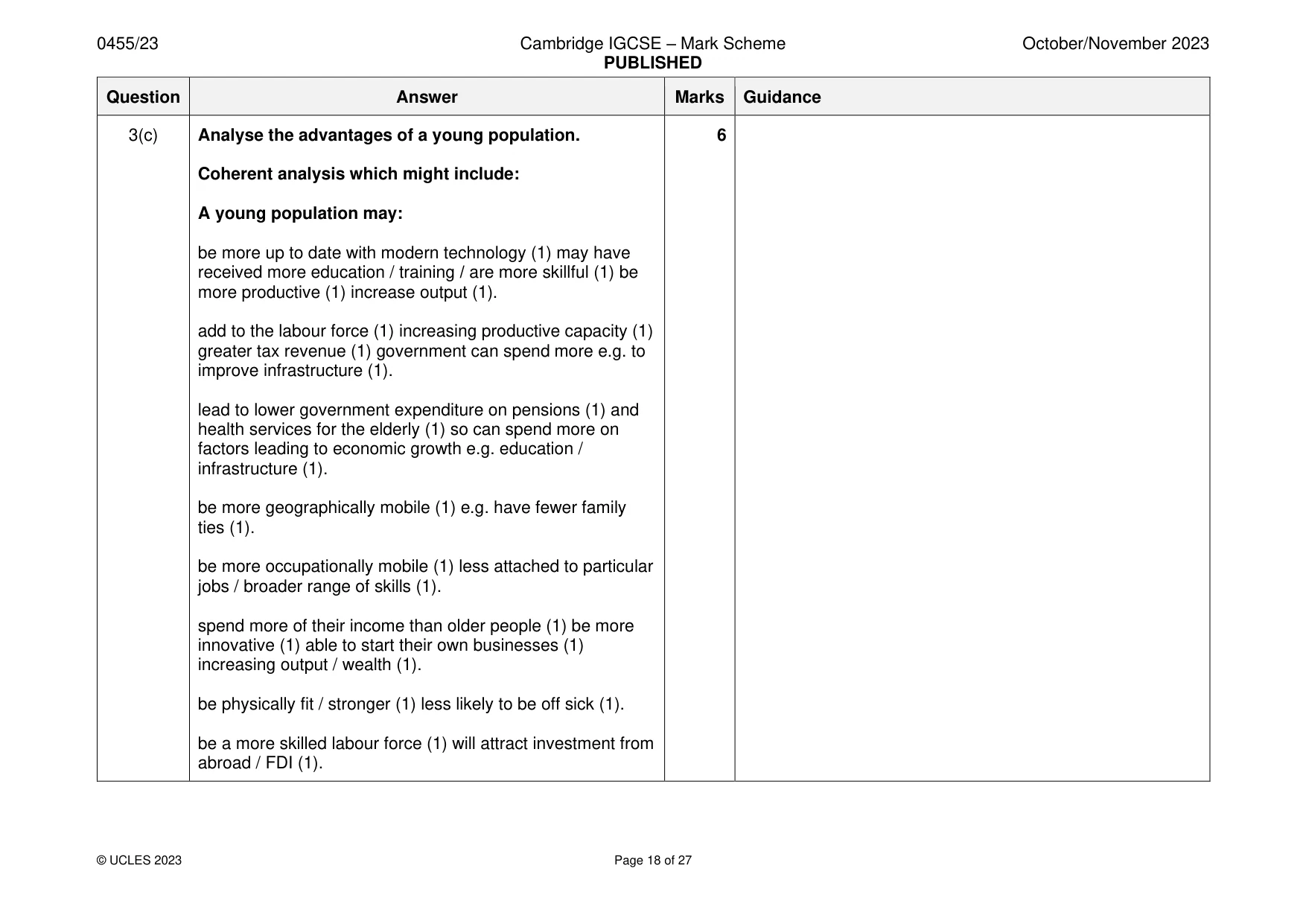
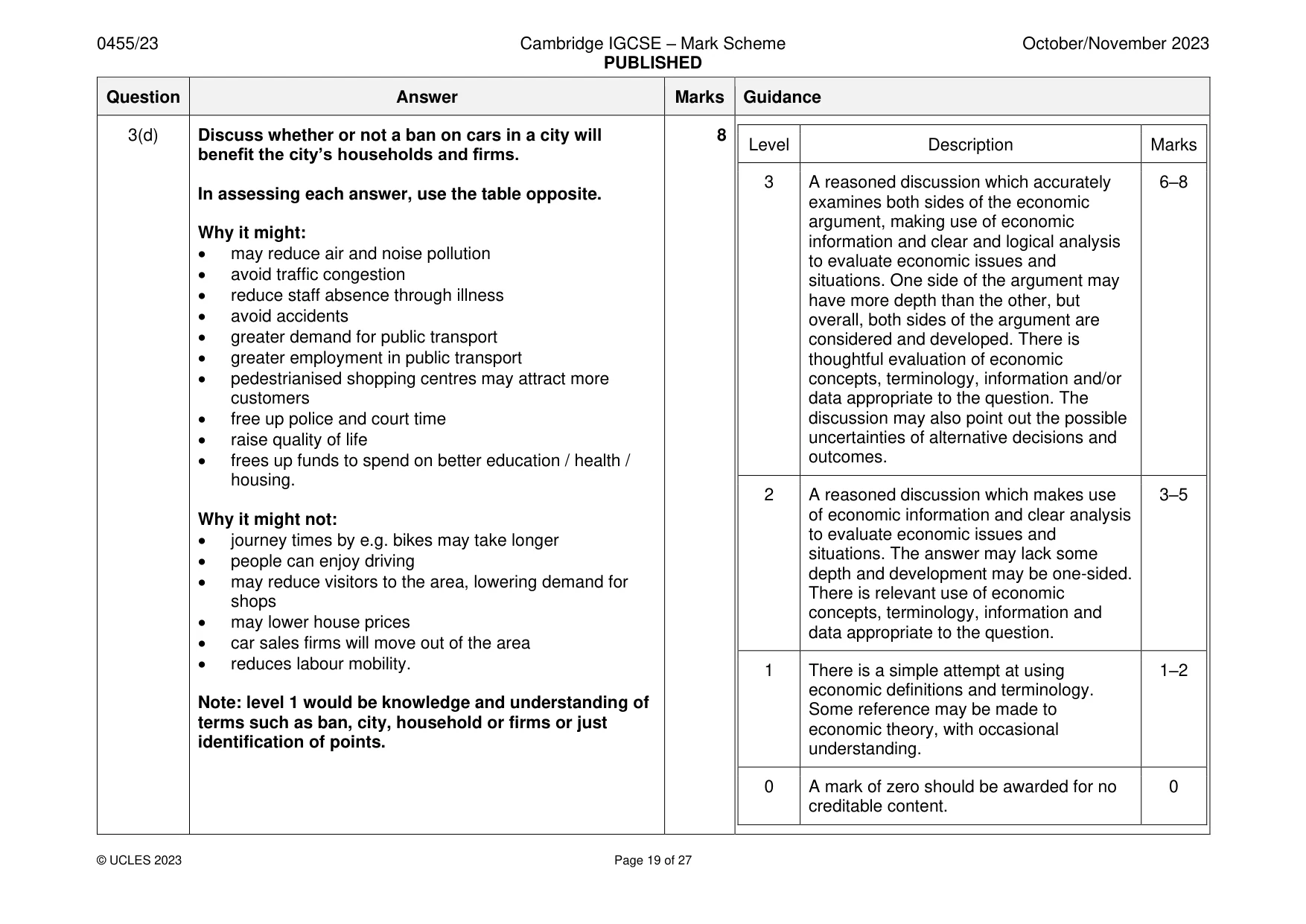
Mark scheme: 3(a) Identify two types of economic system. 2 Also accept but do not expect: planned / command. No marks for free market system or controlled market Market (1) mixed (1). system. 3(b) Explain two functions of a central bank. 4 One mark each for each of two functions identified and one mark each for each of two explanations. Logical explanation which might include: If more than two functions are given, consider the first three. Operates monetary policy / controls inflation (1) e.g. sets the rate of interest / manages the money supply (1). Carries out quantitative easing (1) to stimulate economic activity during a financial crisis (1). Issues notes and coins (1) often the only bank allowed to do so (1). Acts as bank to the government (1) receives payments to the government and makes payments on behalf of the government / manages the national debt (1). Acts as lender of last resort (1) lends to commercial banks in difficulties (1). Holds reserves of foreign currency (1) to influence the exchange rate (1). May regulate banking system (1) ensuring banks do not take too many risks (1). 3(c) Analyse the advantages of a young population. 6 Coherent analysis which might include: A young population may: be more up to date with modern technology (1) may have received more education / training / are more skillful (1) be more productive (1) increase output (1). add to the labour force (1) increasing productive capacity (1) greater tax revenue (1) government can spend more e.g. to improve infrastructure (1). lead to lower government expenditure on pensions (1) and health services for the elderly (1) so can spend more on factors leading to economic growth e.g. education / infrastructure (1). be more geographically mobile (1) e.g. have fewer family ties (1). be more occupationally mobile (1) less attached to particular jobs / broader range of skills (1). spend more of their income than older people (1) be more innovative (1) able to start their own businesses (1) increasing output / wealth (1). be physically fit / stronger (1) less likely to be off sick (1). be a more skilled labour force (1) will attract investment from abroad / FDI (1). 3(d) Discuss whether or not a ban on cars in a city will 8 Level Description Marks benefit the city’s households and firms. 3 A reasoned discussion which accurately 6–8 In assessing each answer, use the table opposite. examines both sides of the economic argument, making use of economic Why it might: information and clear and logical analysis • may reduce air and noise pollution to evaluate economic issues and • avoid traffic congestion situations. One side of the argument may • reduce staff absence through illness have more depth than the other, but • avoid accidents overall, both sides of the argument are • greater demand for public transport considered and developed. There is • greater employment in public transport thoughtful evaluation of economic • pedestrianised shopping centres may attract more concepts, terminology, information and/or customers data appropriate to the question. The • free up police and court time discussion may also point out the possible • raise quality of life uncertainties of alternative decisions and • frees up funds to spend on better education / health / outcomes. housing. 2 A reasoned discussion which makes use 3–5 Why it might not: of economic information and clear analysis • journey times by e.g. bikes may take longer to evaluate economic issues and situations. The answer may lack some • people can enjoy driving depth and development may be one-sided. • may reduce visitors to the area, lowering demand for There is relevant use of economic shops concepts, terminology, information and • may lower house prices data appropriate to the question. • car sales firms will move out of the area • reduces labour mobility. 1 There is a simple attempt at using 1–2 economic definitions and terminology. Note: level 1 would be knowledge and understanding of Some reference may be made to terms such as ban, city, household or firms or just economic theory, with occasional identification of points. understanding. 0 A mark of zero should be awarded for no 0 creditable content.
Q4 · People in Ecuador buy products using a variety of forms of money
4 People in Ecuador buy products using a variety of forms of money. The Ecuadorian government pays public sector workers’ wages directly into their bank accounts. In 2019, some Ecuadorian firms’ profits were affected by advances in technology. That year, the Ecuadorian government cut public sector workers’ hours and, in 2020, it reduced its spending. Economists were uncertain what effect the decrease in government spending would have on unemployment. (a) Identify two characteristics of money. [2] (b) Explain two reasons why a reduction in their working hours may not cause public sector workers to move to working in the private sector. [4] (c) Analyse how advances in technology could affect firms’ profits. [6] (d) Discuss whether or not a decrease in government spending will increase unemployment. [8]
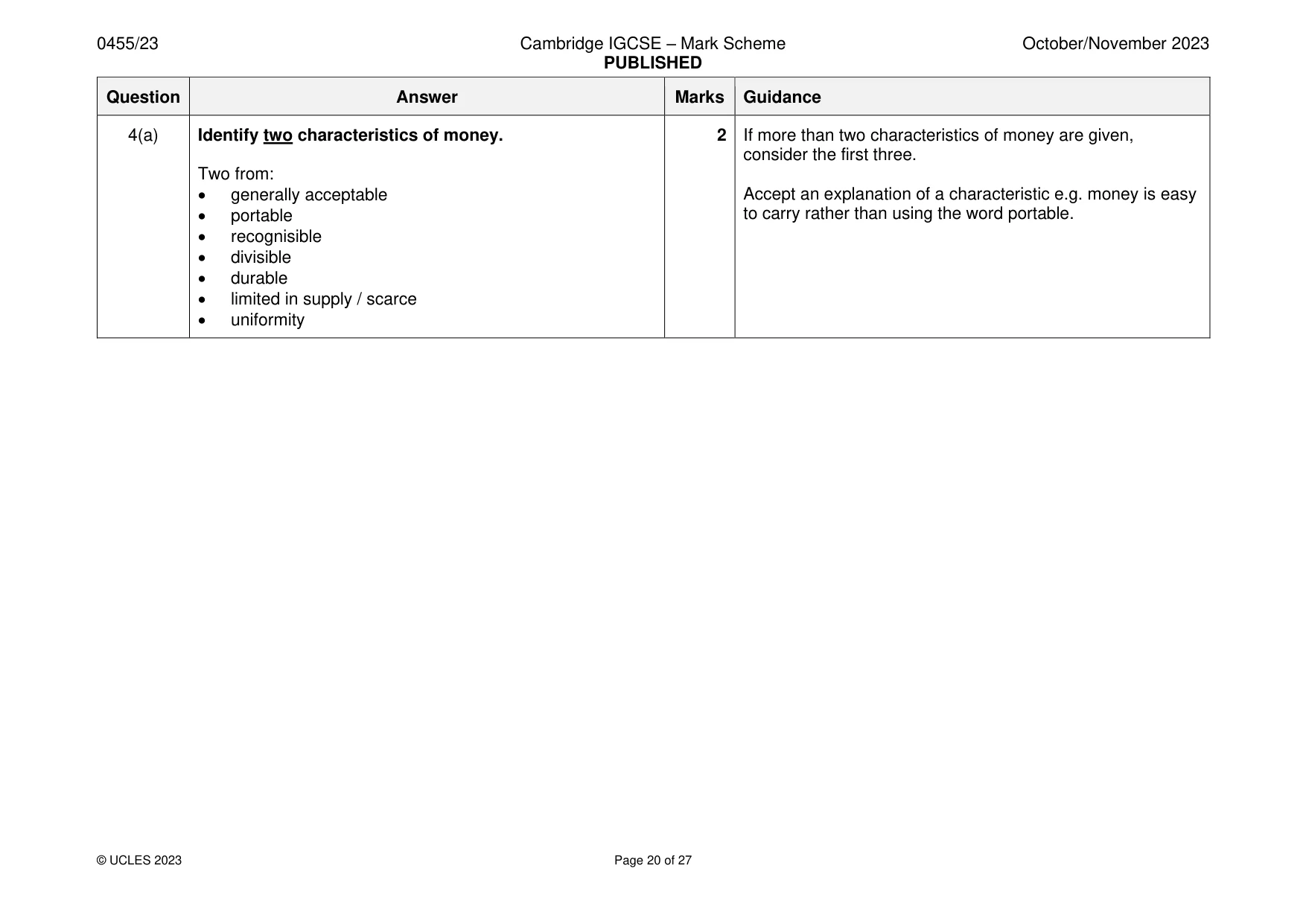
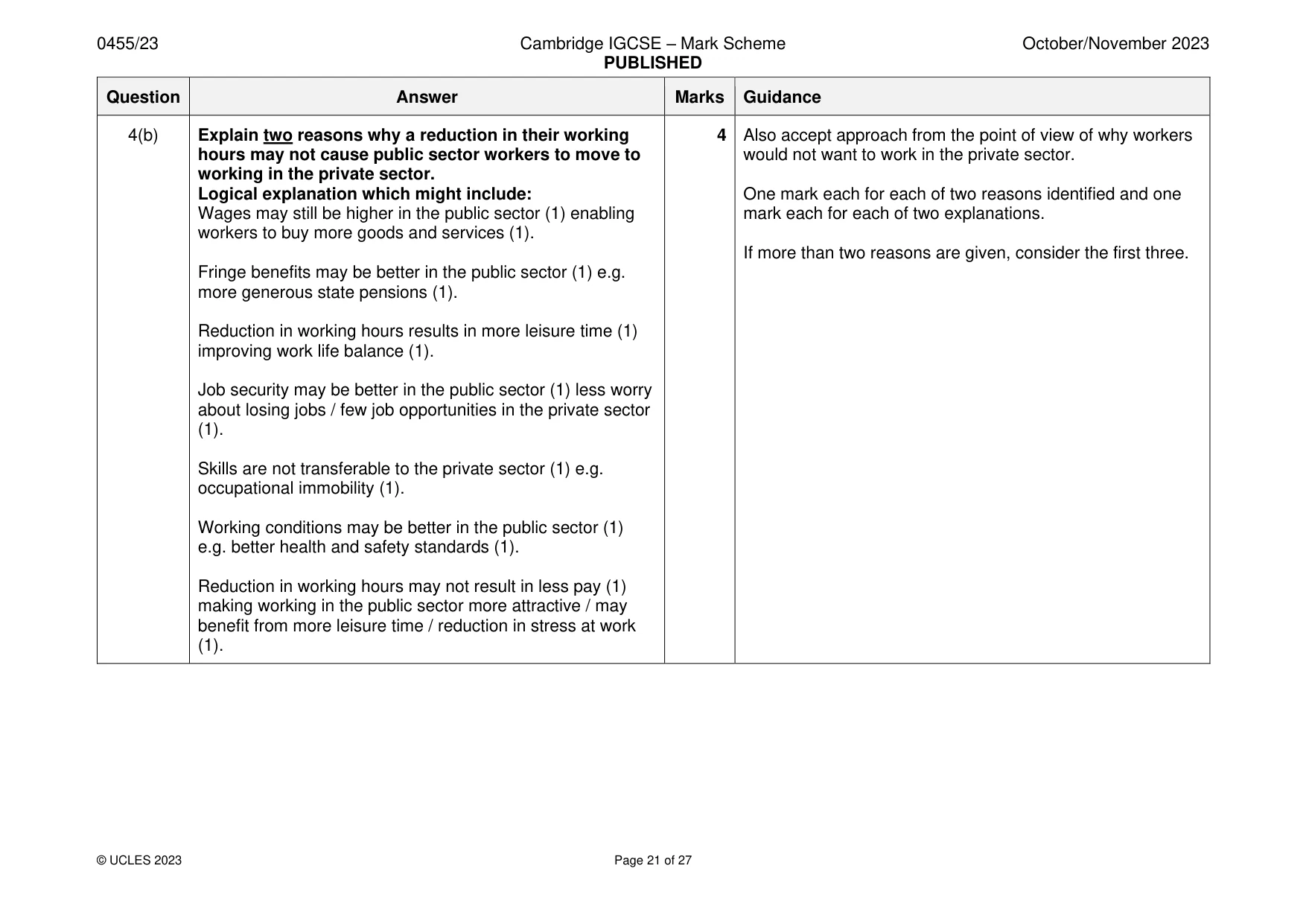
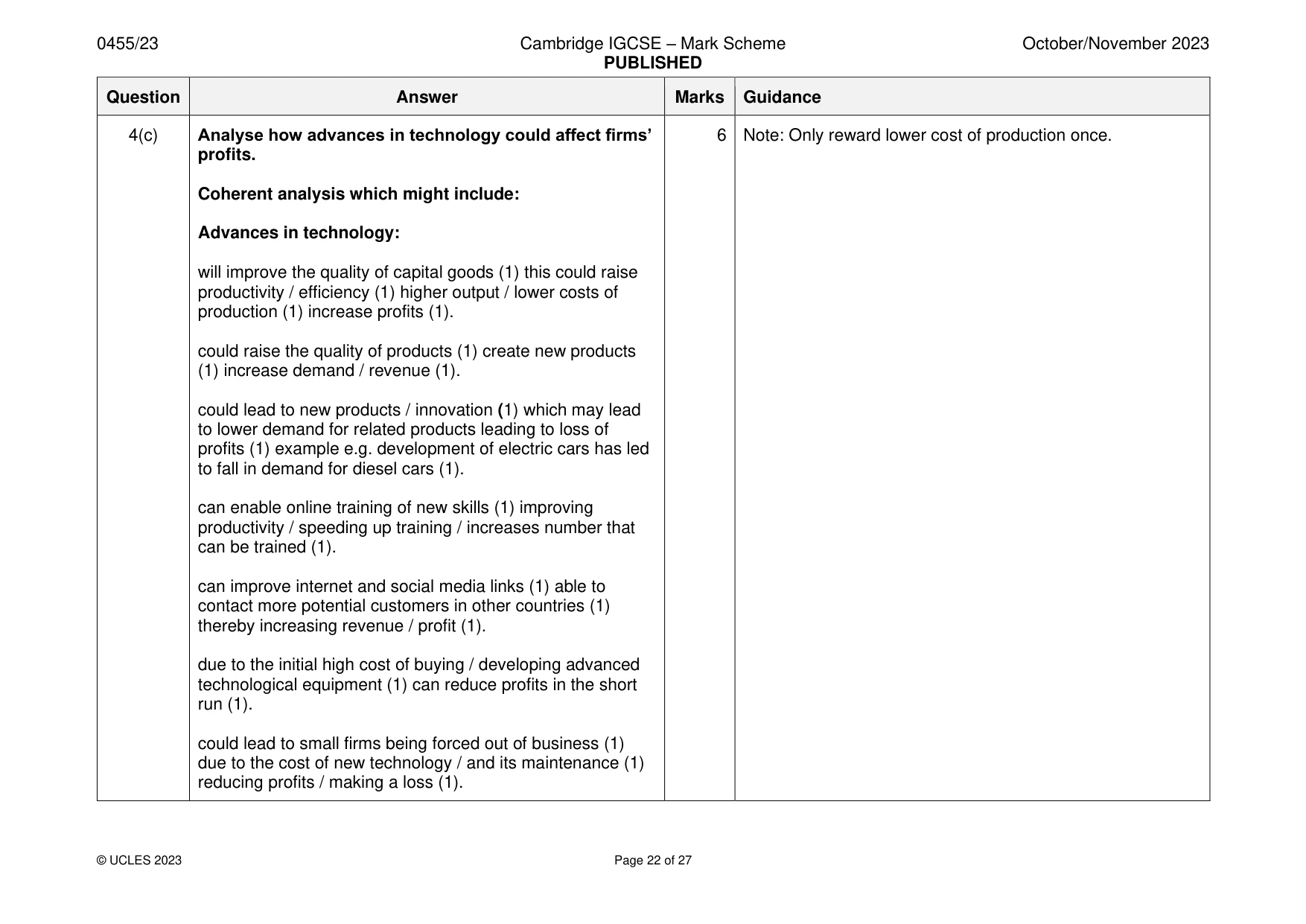
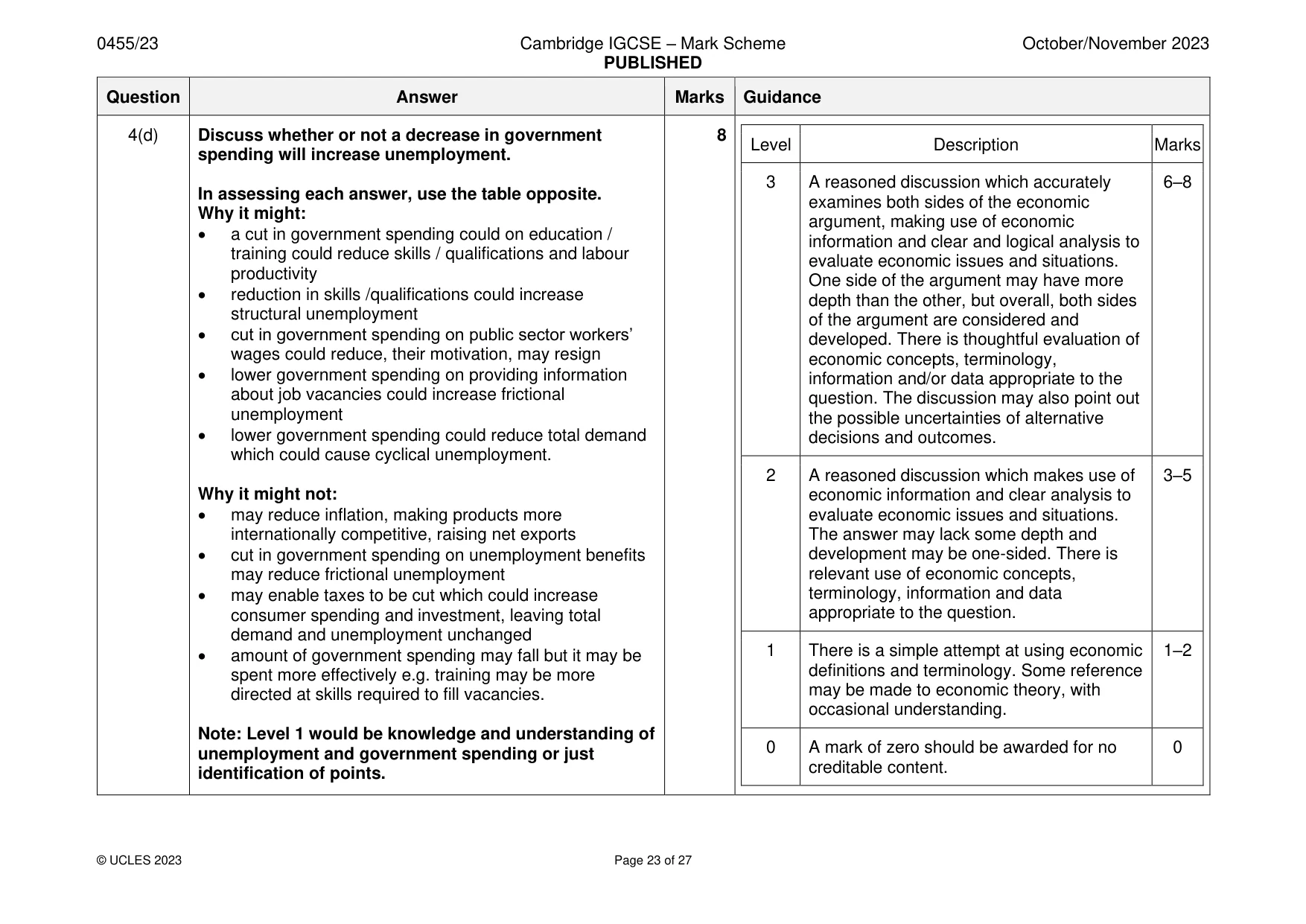
Mark scheme: 4(a) Identify two characteristics of money. 2 If more than two characteristics of money are given, consider the first three. Two from: • generally acceptable Accept an explanation of a characteristic e.g. money is easy • portable to carry rather than using the word portable. • recognisible • divisible • durable • limited in supply / scarce • uniformity 4(b) Explain two reasons why a reduction in their working 4 Also accept approach from the point of view of why workers hours may not cause public sector workers to move to would not want to work in the private sector. working in the private sector. Logical explanation which might include: One mark each for each of two reasons identified and one Wages may still be higher in the public sector (1) enabling mark each for each of two explanations. workers to buy more goods and services (1). If more than two reasons are given, consider the first three. Fringe benefits may be better in the public sector (1) e.g. more generous state pensions (1). Reduction in working hours results in more leisure time (1) improving work life balance (1). Job security may be better in the public sector (1) less worry about losing jobs / few job opportunities in the private sector (1). Skills are not transferable to the private sector (1) e.g. occupational immobility (1). Working conditions may be better in the public sector (1) e.g. better health and safety standards (1). Reduction in working hours may not result in less pay (1) making working in the public sector more attractive / may benefit from more leisure time / reduction in stress at work (1). 4(c) Analyse how advances in technology could affect firms’ 6 Note: Only reward lower cost of production once. profits. Coherent analysis which might include: Advances in technology: will improve the quality of capital goods (1) this could raise productivity / efficiency (1) higher output / lower costs of production (1) increase profits (1). could raise the quality of products (1) create new products (1) increase demand / revenue (1). could lead to new products / innovation (1) which may lead to lower demand for related products leading to loss of profits (1) example e.g. development of electric cars has led to fall in demand for diesel cars (1). can enable online training of new skills (1) improving productivity / speeding up training / increases number that can be trained (1). can improve internet and social media links (1) able to contact more potential customers in other countries (1) thereby increasing revenue / profit (1). due to the initial high cost of buying / developing advanced technological equipment (1) can reduce profits in the short run (1). could lead to small firms being forced out of business (1) due to the cost of new technology / and its maintenance (1) reducing profits / making a loss (1). 4(d) Discuss whether or not a decrease in government 8 Level Description Marks spending will increase unemployment. 3 A reasoned discussion which accurately 6–8 In assessing each answer, use the table opposite. examines both sides of the economic Why it might: argument, making use of economic • a cut in government spending could on education / information and clear and logical analysis to training could reduce skills / qualifications and labour evaluate economic issues and situations. productivity One side of the argument may have more • reduction in skills /qualifications could increase depth than the other, but overall, both sides structural unemployment of the argument are considered and • cut in government spending on public sector workers’ developed. There is thoughtful evaluation of wages could reduce, their motivation, may resign economic concepts, terminology, • lower government spending on providing information information and/or data appropriate to the about job vacancies could increase frictional question. The discussion may also point out unemployment the possible uncertainties of alternative • lower government spending could reduce total demand decisions and outcomes. which could cause cyclical unemployment. 2 A reasoned discussion which makes use of 3–5 Why it might not: economic information and clear analysis to • may reduce inflation, making products more evaluate economic issues and situations. internationally competitive, raising net exports The answer may lack some depth and • cut in government spending on unemployment benefits development may be one-sided. There is may reduce frictional unemployment relevant use of economic concepts, • may enable taxes to be cut which could increase terminology, information and data consumer spending and investment, leaving total appropriate to the question. demand and unemployment unchanged • amount of government spending may fall but it may be 1 There is a simple attempt at using economic 1–2 definitions and terminology. Some reference spent more effectively e.g. training may be more directed at skills required to fill vacancies. may be made to economic theory, with occasional understanding. Note: Level 1 would be knowledge and understanding of 0 A mark of zero should be awarded for no 0 unemployment and government spending or just creditable content. identification of points.
Q5 · In 2020, Paraguay’s Consumer Prices Index rose by 3% and its foreign exchange rate…
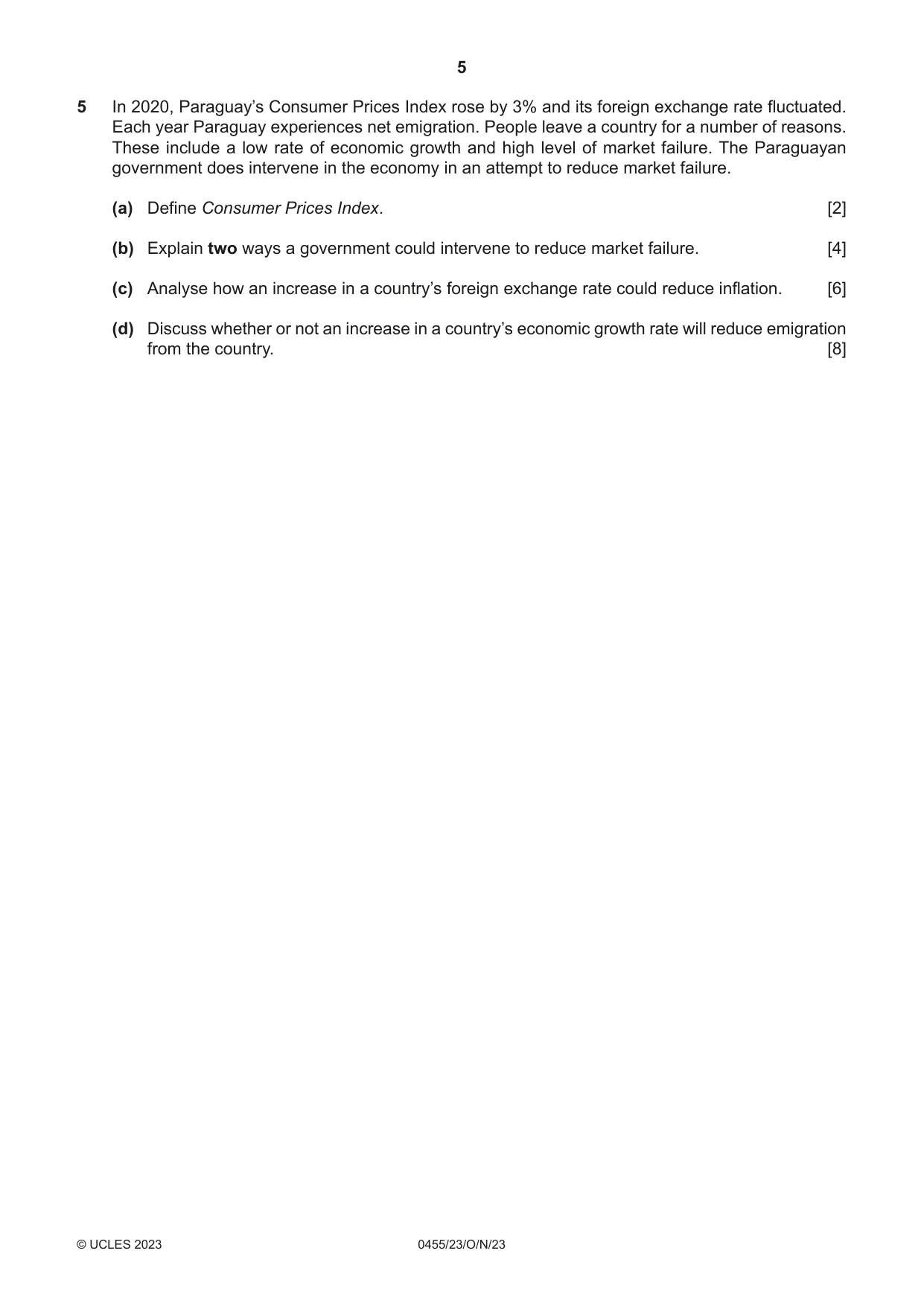
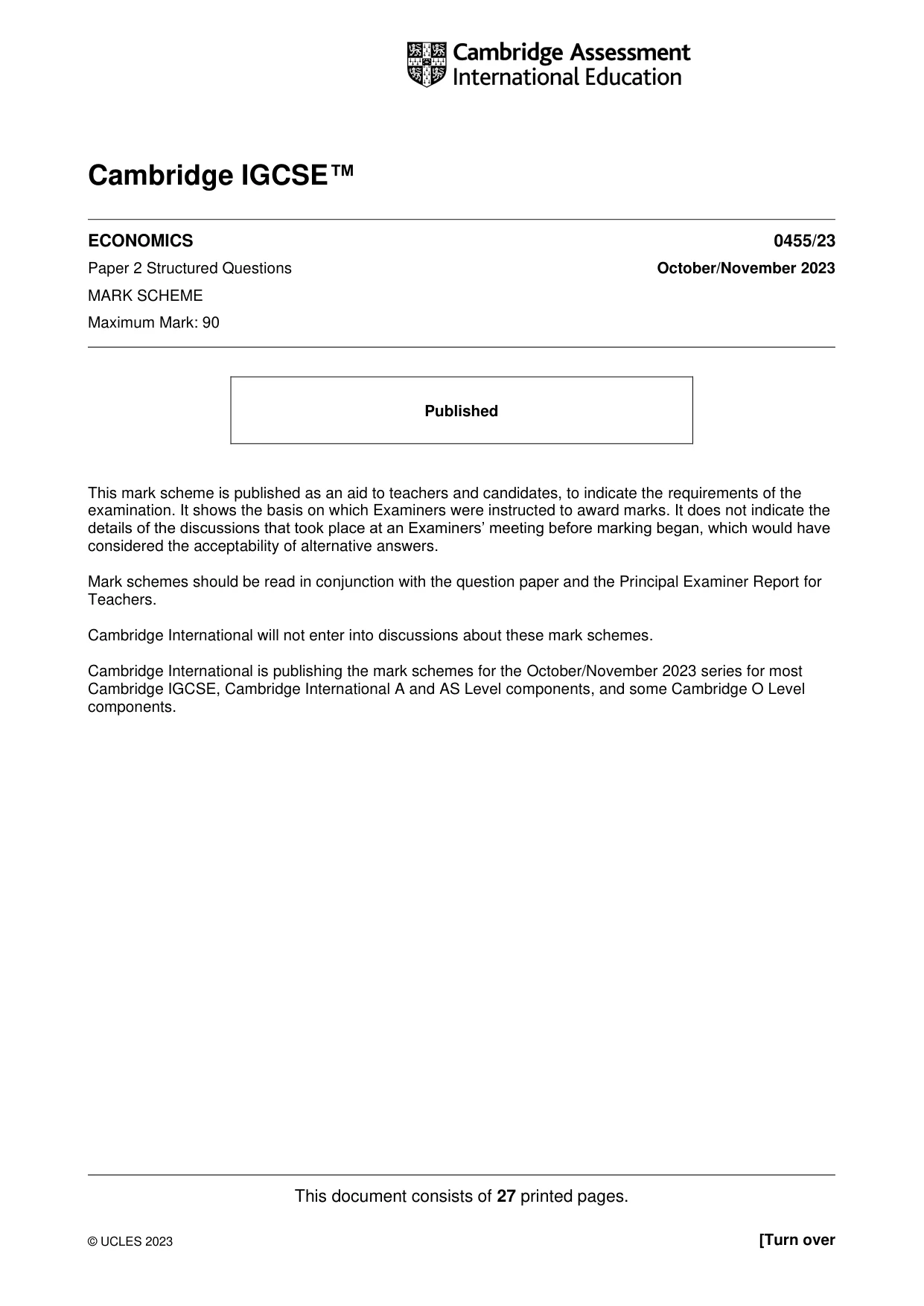
5 In 2020, Paraguay’s Consumer Prices Index rose by 3% and its foreign exchange rate fluctuated. Each year Paraguay experiences net emigration. People leave a country for a number of reasons. These include a low rate of economic growth and high level of market failure. The Paraguayan government does intervene in the economy in an attempt to reduce market failure. (a) Define Consumer Prices Index. [2] (b) Explain two ways a government could intervene to reduce market failure. [4] (c) Analyse how an increase in a country’s foreign exchange rate could reduce inflation. [6] (d) Discuss whether or not an increase in a country’s economic growth rate will reduce emigration from the country. [8]
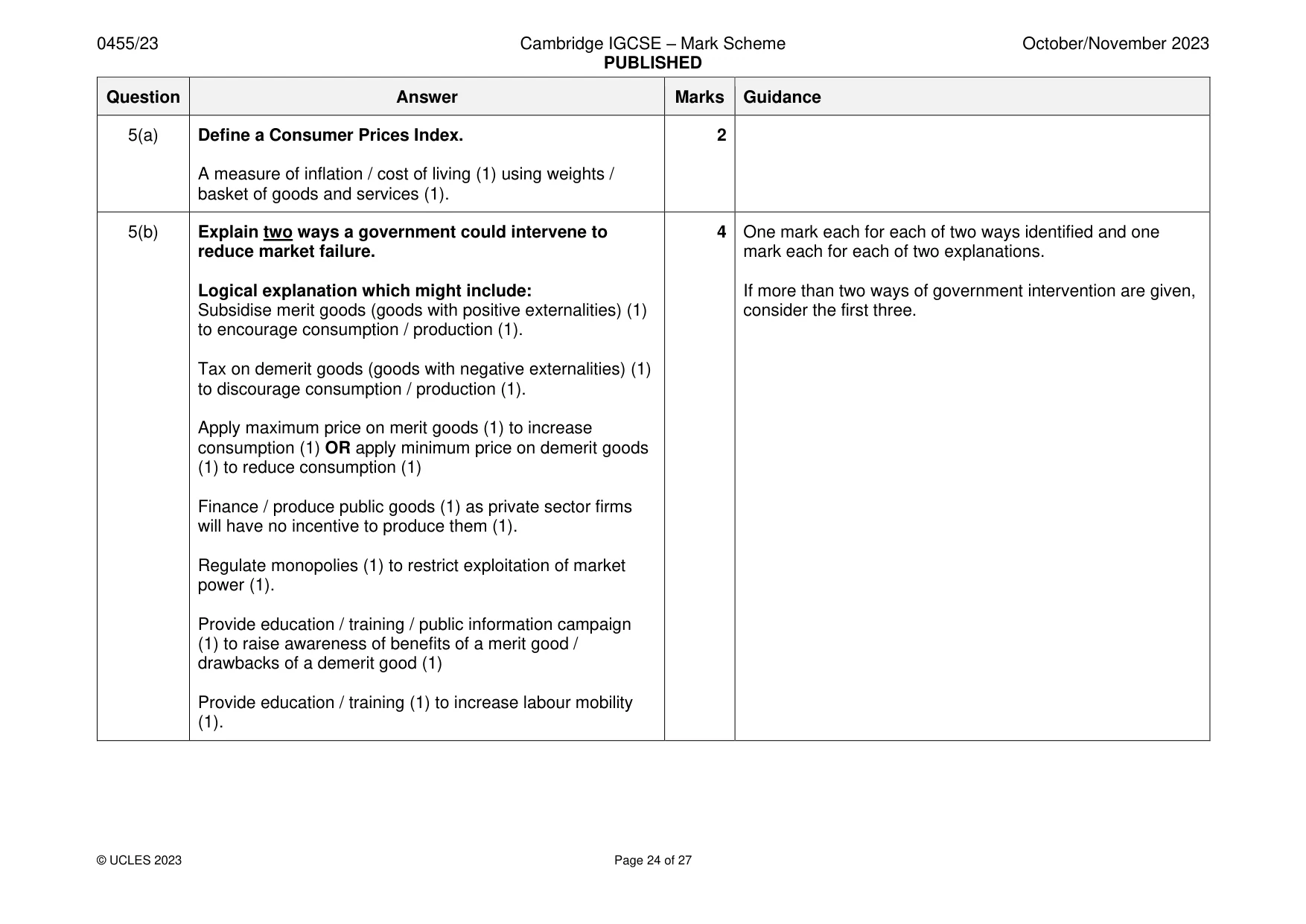
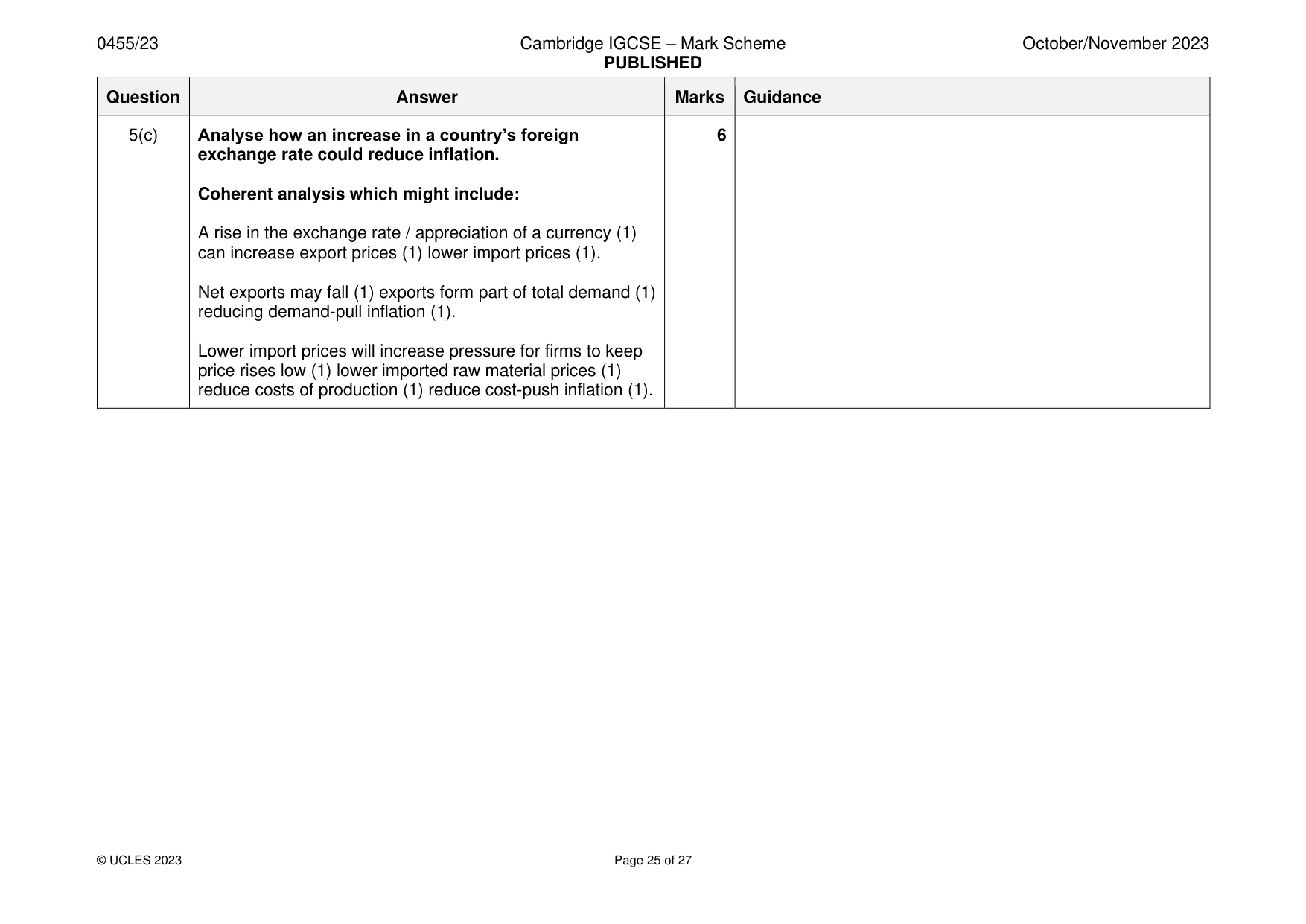
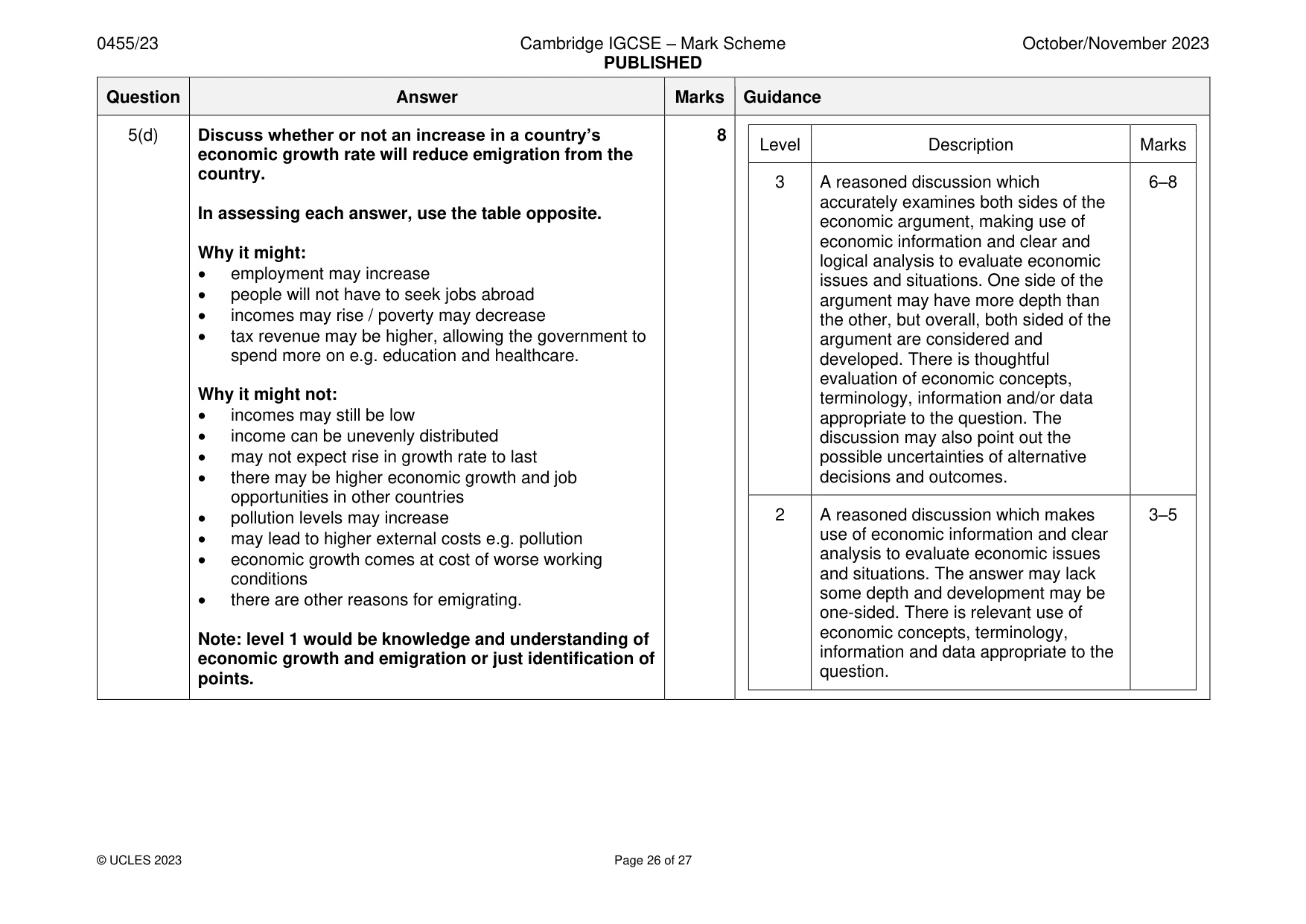
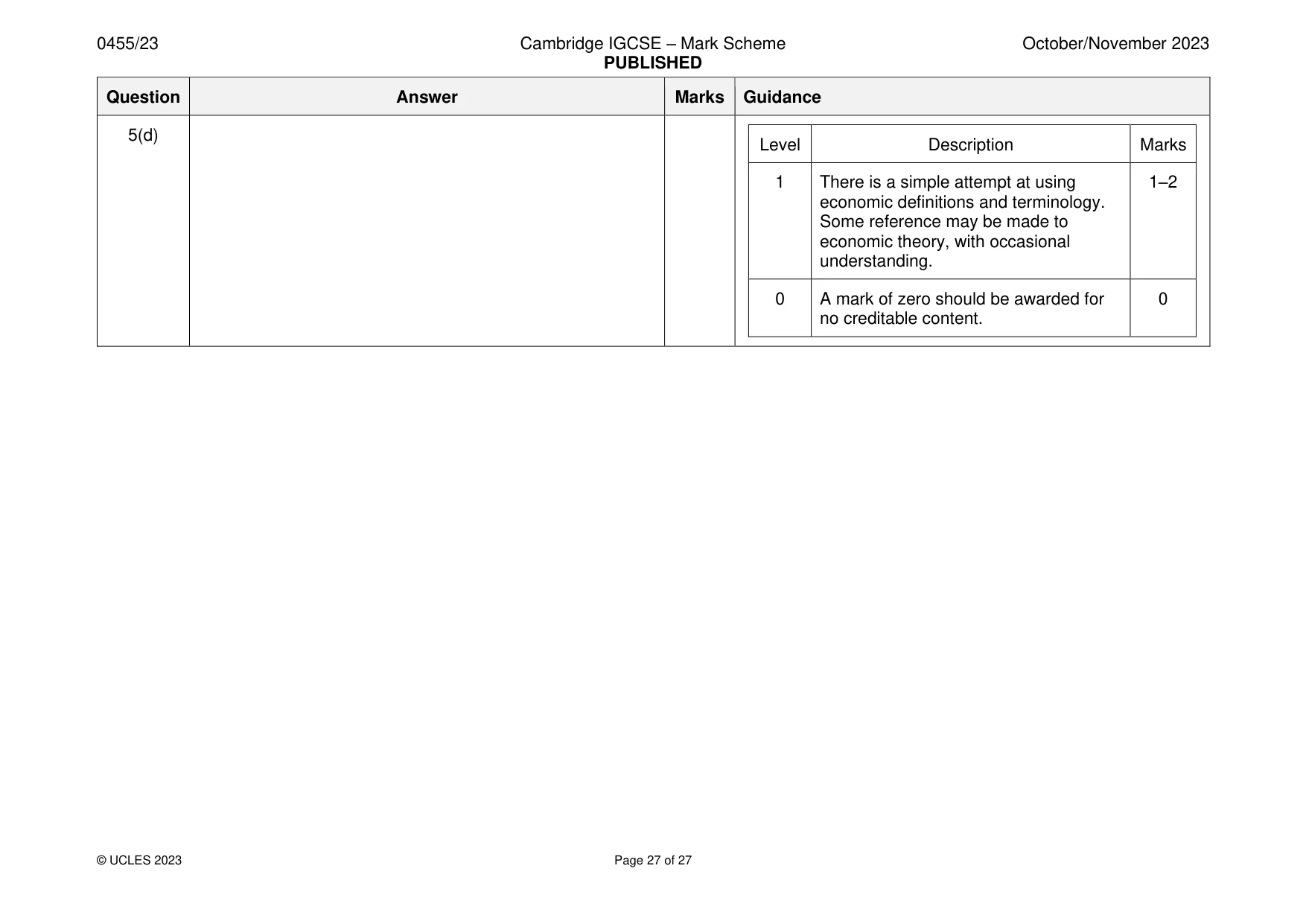
Mark scheme: 5(a) Define a Consumer Prices Index. 2 A measure of inflation / cost of living (1) using weights / basket of goods and services (1). 5(b) Explain two ways a government could intervene to 4 One mark each for each of two ways identified and one reduce market failure. mark each for each of two explanations. Logical explanation which might include: If more than two ways of government intervention are given, Subsidise merit goods (goods with positive externalities) (1) consider the first three. to encourage consumption / production (1). Tax on demerit goods (goods with negative externalities) (1) to discourage consumption / production (1). Apply maximum price on merit goods (1) to increase consumption (1) OR apply minimum price on demerit goods (1) to reduce consumption (1) Finance / produce public goods (1) as private sector firms will have no incentive to produce them (1). Regulate monopolies (1) to restrict exploitation of market power (1). Provide education / training / public information campaign (1) to raise awareness of benefits of a merit good / drawbacks of a demerit good (1) Provide education / training (1) to increase labour mobility (1). 5(c) Analyse how an increase in a country’s foreign 6 exchange rate could reduce inflation. Coherent analysis which might include: A rise in the exchange rate / appreciation of a currency (1) can increase export prices (1) lower import prices (1). Net exports may fall (1) exports form part of total demand (1) reducing demand-pull inflation (1). Lower import prices will increase pressure for firms to keep price rises low (1) lower imported raw material prices (1) reduce costs of production (1) reduce cost-push inflation (1). 5(d) Discuss whether or not an increase in a country’s 8 Level Description Marks economic growth rate will reduce emigration from the country. 3 A reasoned discussion which 6–8 accurately examines both sides of the In assessing each answer, use the table opposite. economic argument, making use of economic information and clear and Why it might: logical analysis to evaluate economic • employment may increase issues and situations. One side of the • people will not have to seek jobs abroad argument may have more depth than • incomes may rise / poverty may decrease the other, but overall, both sided of the • tax revenue may be higher, allowing the government to argument are considered and spend more on e.g. education and healthcare. developed. There is thoughtful evaluation of economic concepts, Why it might not: terminology, information and/or data • incomes may still be low appropriate to the question. The • income can be unevenly distributed discussion may also point out the • may not expect rise in growth rate to last possible uncertainties of alternative • there may be higher economic growth and job decisions and outcomes. opportunities in other countries • pollution levels may increase 2 A reasoned discussion which makes 3–5 • may lead to higher external costs e.g. pollution use of economic information and clear • economic growth comes at cost of worse working analysis to evaluate economic issues and situations. The answer may lack conditions some depth and development may be • there are other reasons for emigrating. one-sided. There is relevant use of economic concepts, terminology, Note: level 1 would be knowledge and understanding of information and data appropriate to the economic growth and emigration or just identification of question. points. 5(d) Level Description Marks 1 There is a simple attempt at using 1–2 economic definitions and terminology. Some reference may be made to economic theory, with occasional understanding. 0 A mark of zero should be awarded for 0 no creditable content.
What was in this paper
The subtopics covered by these 5 questions, and how many questions each got. Open one in a new tab to see every Cambridge question on it.
What you needed in this session
Cambridge’s own grade thresholds for 2023 Oct/Nov, Paper 2 · Variant 3. A higher threshold means an easier paper — the bar moves with how the cohort did.