Cambridge IGCSE Economics 0455 — 2019 May/June Paper 2 · Variant 1
0455/21/M/J/19 · 7 questions · 90 marks · ≈101 min
The question paper and its mark scheme, free to read here and free to download. This is Cambridge’s own paper, exactly as it was sat.
Question paper8 pages
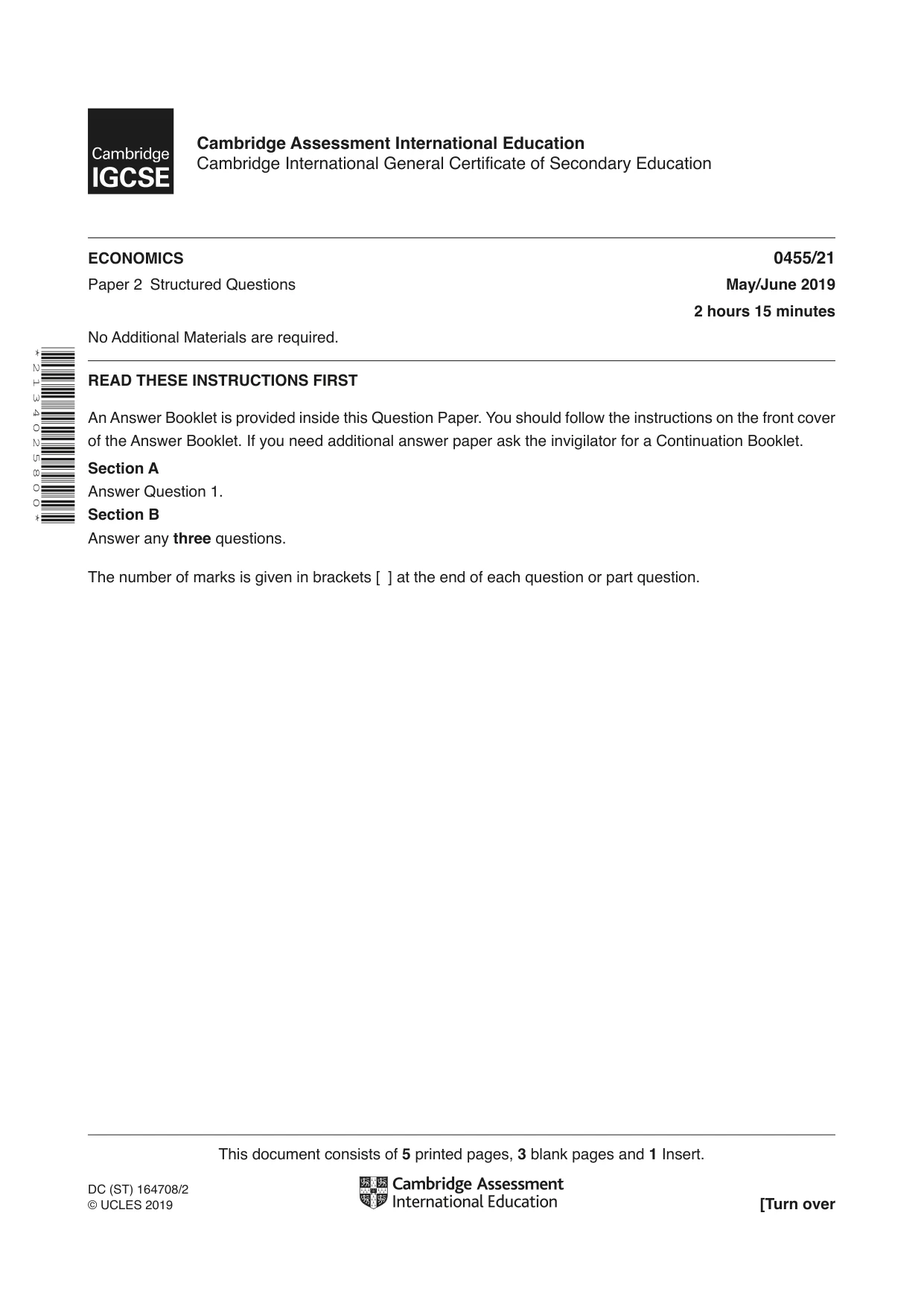


Mark scheme18 pages
Answers below. Sit the paper first if you are practising.
Questions as text
Q1 · Universal basic income (UBI) UBI is a scheme where a government provides everyone with a…
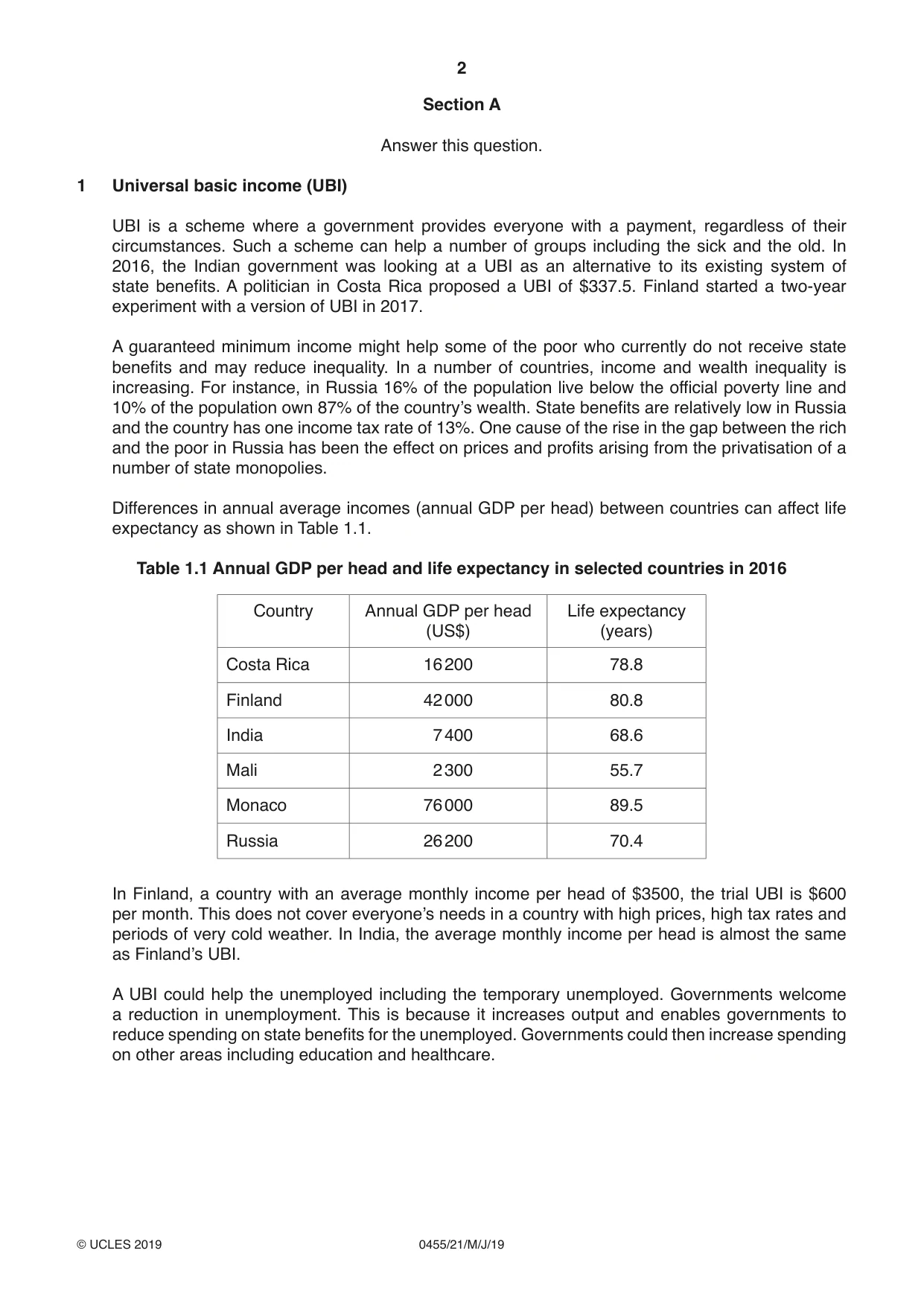
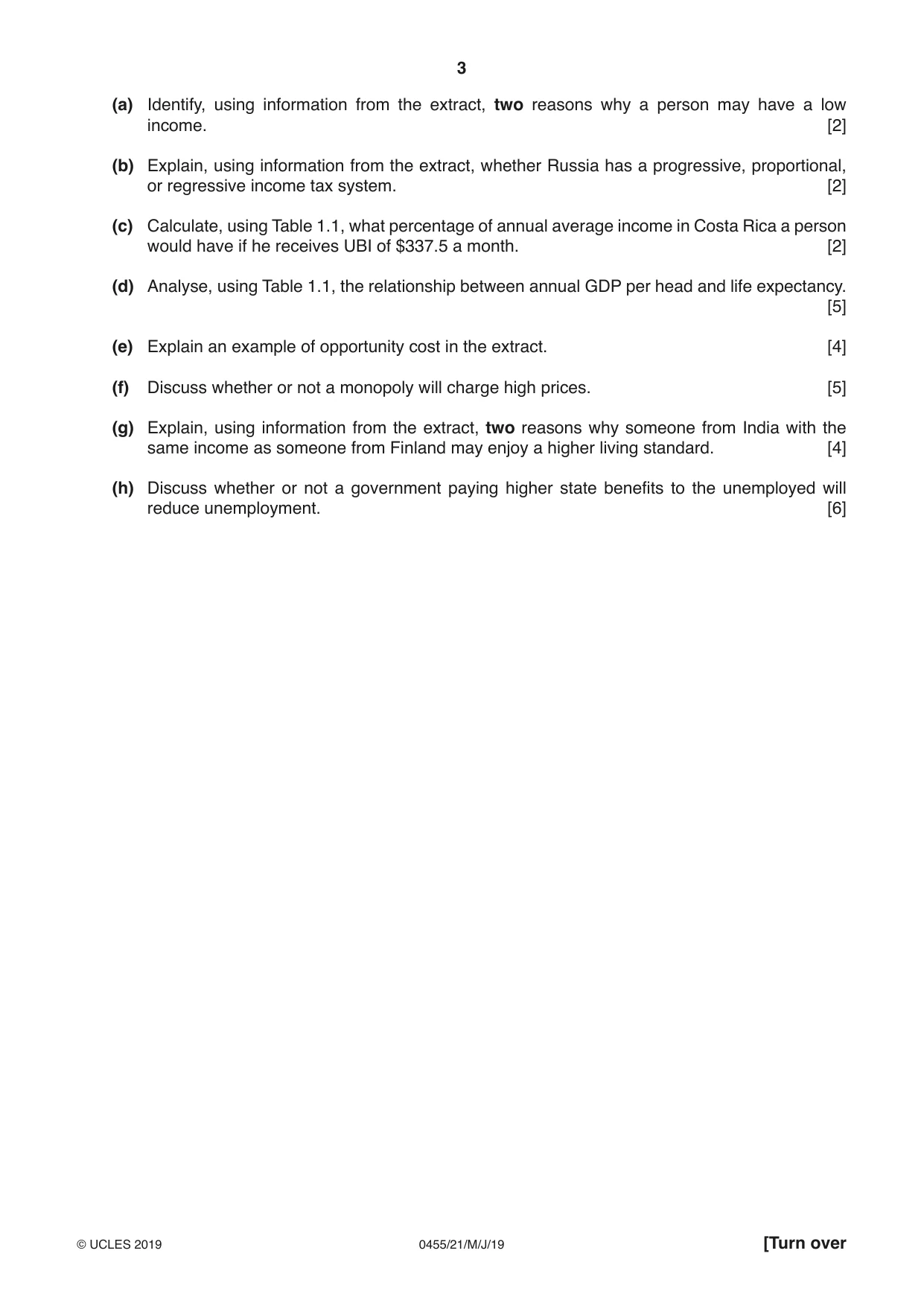
1 Universal basic income (UBI) UBI is a scheme where a government provides everyone with a payment, regardless of their circumstances. Such a scheme can help a number of groups including the sick and the old. In 2016, the Indian government was looking at a UBI as an alternative to its existing system of state benefits. A politician in Costa Rica proposed a UBI of $337.5. Finland started a two-year experiment with a version of UBI in 2017. A guaranteed minimum income might help some of the poor who currently do not receive state benefits and may reduce inequality. In a number of countries, income and wealth inequality is increasing. For instance, in Russia 16% of the population live below the official poverty line and 10% of the population own 87% of the country’s wealth. State benefits are relatively low in Russia and the country has one income tax rate of 13%. One cause of the rise in the gap between the rich and the poor in Russia has been the effect on prices and profits arising from the privatisation of a number of state monopolies. Differences in annual average incomes (annual GDP per head) between countries can affect life expectancy as shown in Table 1.1. Table 1.1 Annual GDP per head and life expectancy in selected countries in 2016 Country Annual GDP per head Life expectancy (US$) (years) Costa Rica 16 200 78.8 Finland 42 000 80.8 India 7 400 68.6 Mali 2 300 55.7 Monaco 76 000 89.5 Russia 26 200 70.4 In Finland, a country with an average monthly income per head of $3500, the trial UBI is $600 per month. This does not cover everyone’s needs in a country with high prices, high tax rates and periods of very cold weather. In India, the average monthly income per head is almost the same as Finland’s UBI. A UBI could help the unemployed including the temporary unemployed. Governments welcome a reduction in unemployment. This is because it increases output and enables governments to reduce spending on state benefits for the unemployed. Governments could then increase spending on other areas including education and healthcare. (a) Identify, using information from the extract, two reasons why a person may have a low income. [2] (b) Explain, using information from the extract, whether Russia has a progressive, proportional, or regressive income tax system. [2] (c) Calculate, using Table 1.1, what percentage of annual average income in Costa Rica a person would have if he receives UBI of $337.5 a month. [2] (d) Analyse, using Table 1.1, the relationship between annual GDP per head and life expectancy. [5] (e) Explain an example of opportunity cost in the extract. [4] (f) Discuss whether or not a monopoly will charge high prices. [5] (g) Explain, using information from the extract, two reasons why someone from India with the same income as someone from Finland may enjoy a higher living standard. [4] (h) Discuss whether or not a government paying higher state benefits to the unemployed will reduce unemployment. [6]
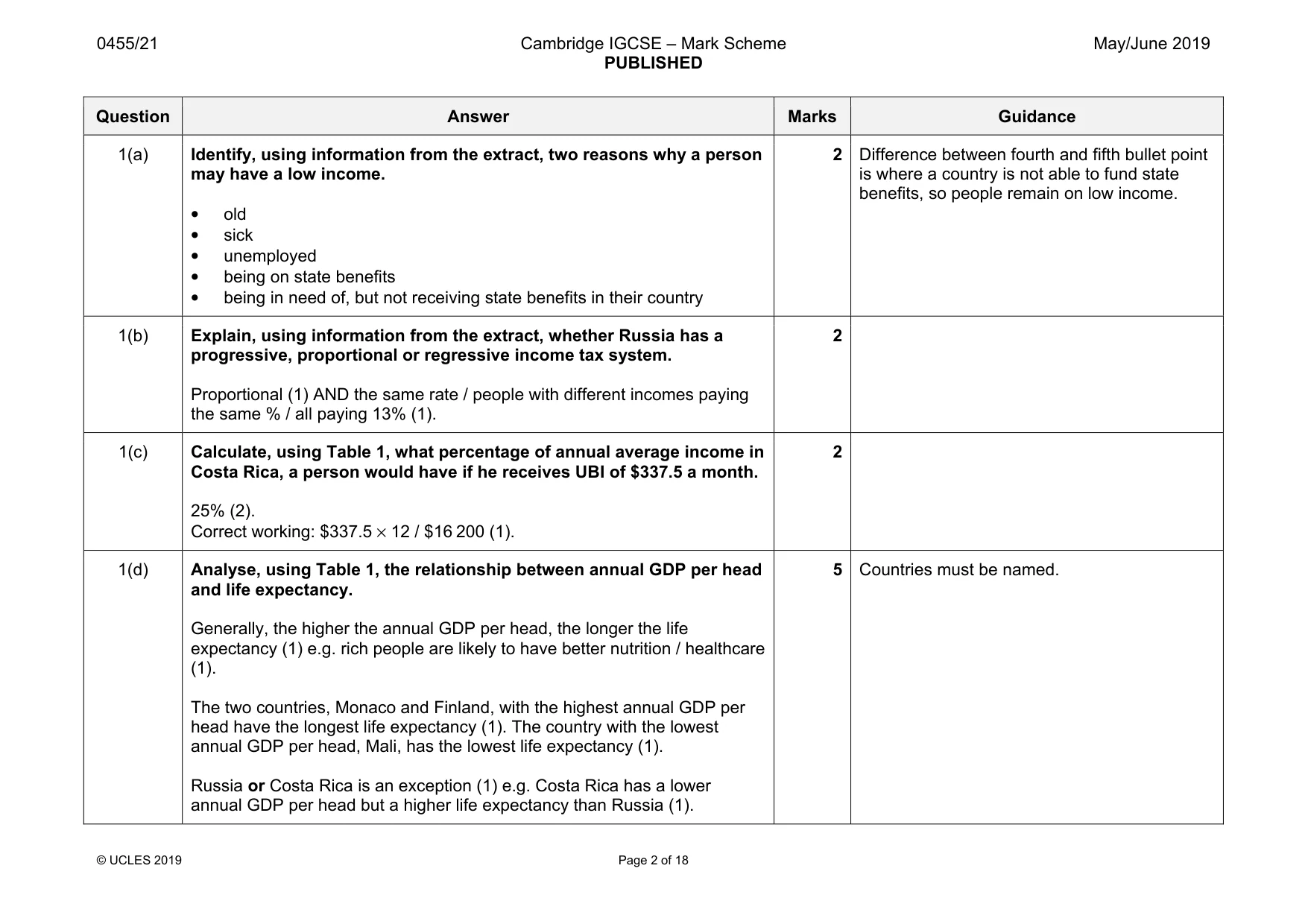
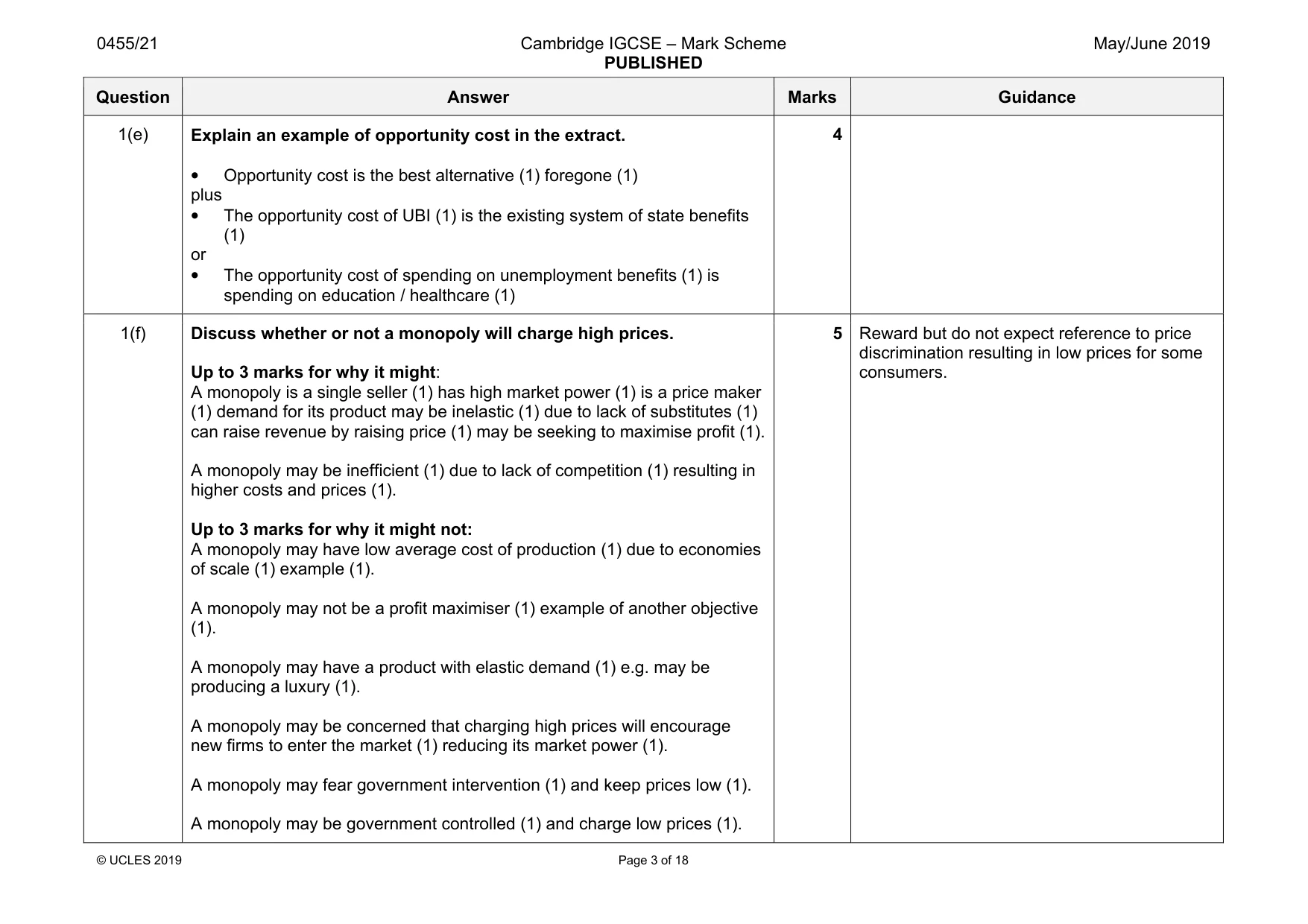
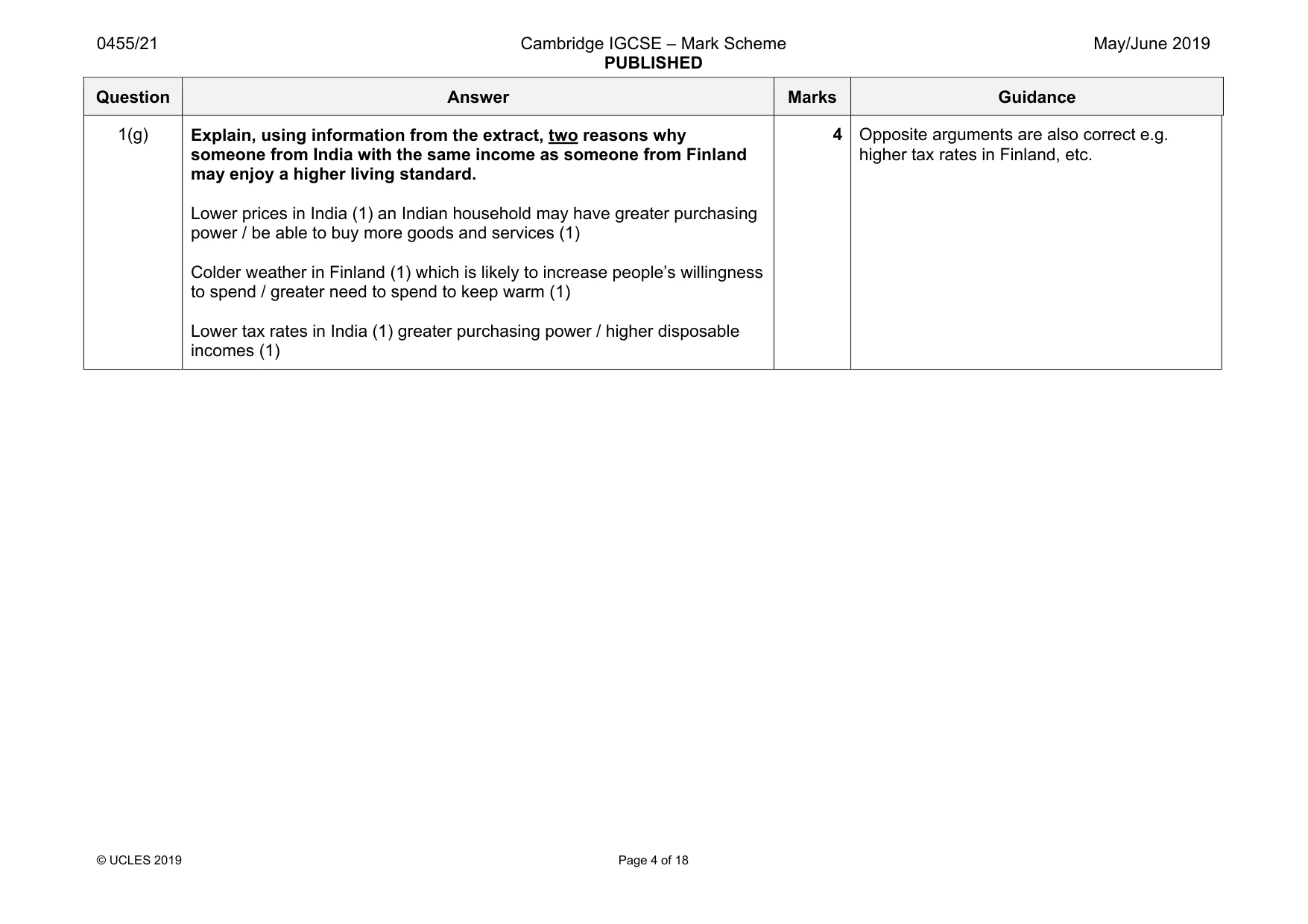
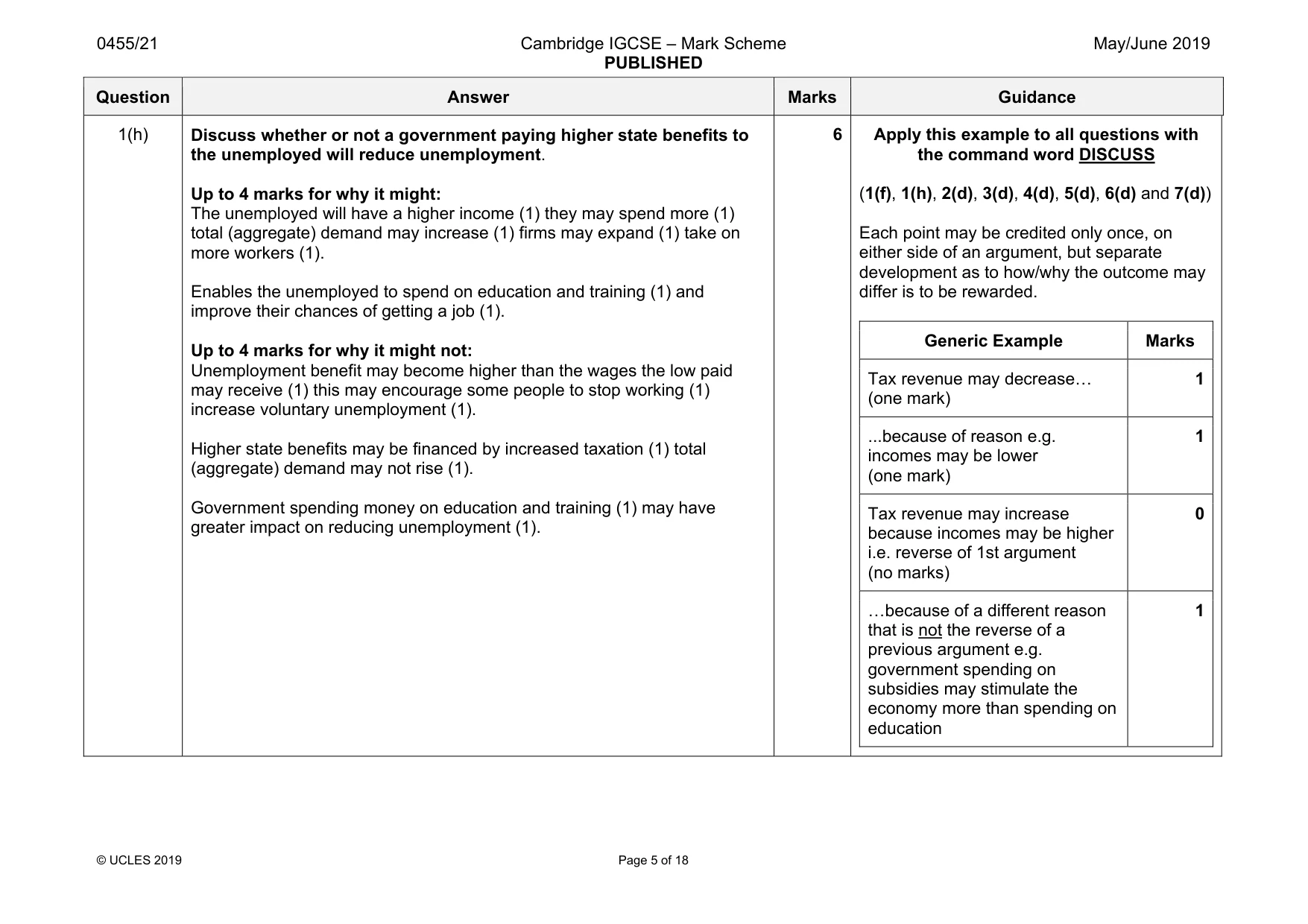
Mark scheme: 1(a) Identify, using information from the extract, two reasons why a person may have a low income. • old • sick • unemployed • being on state benefits • being in need of, but not receiving state benefits in their country 2 Difference between fourth and fifth bullet point is where a country is not able to fund state benefits, so people remain on low income. 1(b) Explain, using information from the extract, whether Russia has a progressive, proportional or regressive income tax system. Proportional (1) AND the same rate / people with different incomes paying the same % / all paying 13% (1). 2 1(c) Calculate, using Table 1, what percentage of annual average income in Costa Rica, a person would have if he receives UBI of $337.5 a month. 25% (2). Correct working: $337.5 × 12 / $16 200 (1). 2 1(d) Analyse, using Table 1, the relationship between annual GDP per head and life expectancy. Generally, the higher the annual GDP per head, the longer the life expectancy (1) e.g. rich people are likely to have better nutrition / healthcare (1). The two countries, Monaco and Finland, with the highest annual GDP per head have the longest life expectancy (1). The country with the lowest annual GDP per head, Mali, has the lowest life expectancy (1). Russia or Costa Rica is an exception (1) e.g. Costa Rica has a lower annual GDP per head but a higher life expectancy than Russia (1). 5 Countries must be named. Question Answer Marks Guidance 1(e) Explain an example of opportunity cost in the extract. • Opportunity cost is the best alternative (1) foregone (1) plus • The opportunity cost of UBI (1) is the existing system of state benefits (1) or • The opportunity cost of spending on unemployment benefits (1) is spending on education / healthcare (1) 4 1(f) Discuss whether or not a monopoly will charge high prices. Up to 3 marks for why it might: A monopoly is a single seller (1) has high market power (1) is a price maker (1) demand for its product may be inelastic (1) due to lack of substitutes (1) can raise revenue by raising price (1) may be seeking to maximise profit (1). A monopoly may be inefficient (1) due to lack of competition (1) resulting in higher costs and prices (1). Up to 3 marks for why it might not: A monopoly may have low average cost of production (1) due to economies of scale (1) example (1). A monopoly may not be a profit maximiser (1) example of another objective (1). A monopoly may have a product with elastic demand (1) e.g. may be producing a luxury (1). A monopoly may be concerned that charging high prices will encourage new firms to enter the market (1) reducing its market power (1). A monopoly may fear government intervention (1) and keep prices low (1). A monopoly may be government controlled (1) and charge low prices (1). 5 Reward but do not expect reference to price discrimination resulting in low prices for some consumers. Question Answer Marks Guidance 1(g) Explain, using information from the extract, two reasons why someone from India with the same income as someone from Finland may enjoy a higher living standard. Lower prices in India (1) an Indian household may have greater purchasing power / be able to buy more goods and services (1) Colder weather in Finland (1) which is likely to increase people’s willingness to spend / greater need to spend to keep warm (1) Lower tax rates in India (1) greater purchasing power / higher disposable incomes (1) 4 Opposite arguments are also correct e.g. higher tax rates in Finland, etc. Question Answer Marks Guidance 1(h) Discuss whether or not a government paying higher state benefits to the unemployed will reduce unemployment. Up to 4 marks for why it might: The unemployed will have a higher income (1) they may spend more (1) total (aggregate) demand may increase (1) firms may expand (1) take on more workers (1). Enables the unemployed to spend on education and training (1) and improve their chances of getting a job (1). Up to 4 marks for why it might not: Unemployment benefit may become higher than the wages the low paid may receive (1) this may encourage some people to stop working (1) increase voluntary unemployment (1). Higher state benefits may be financed by increased taxation (1) total (aggregate) demand may not rise (1). Government spending money on education and training (1) may have greater impact on reducing unemployment (1). 6 Apply this example to all questions with the command word DISCUSS (1(f), 1(h), 2(d), 3(d), 4(d), 5(d), 6(d) and 7(d)) Each point may be credited only once, on either side of an argument, but separate development as to how/why the outcome may differ is to be rewarded. Generic Example Marks Tax revenue may decrease« (one mark) 1 ...because of reason e.g. incomes may be lower (one mark) 1 Tax revenue may increase because incomes may be higher i.e. reverse of 1st argument (no marks) 0 «because of a different reason that is not the reverse of a previous argument e.g. government spending on subsidies may stimulate the economy more than spending on education 1
Q2 · The Saudi Arabian government is encouraging the growth of the private sector
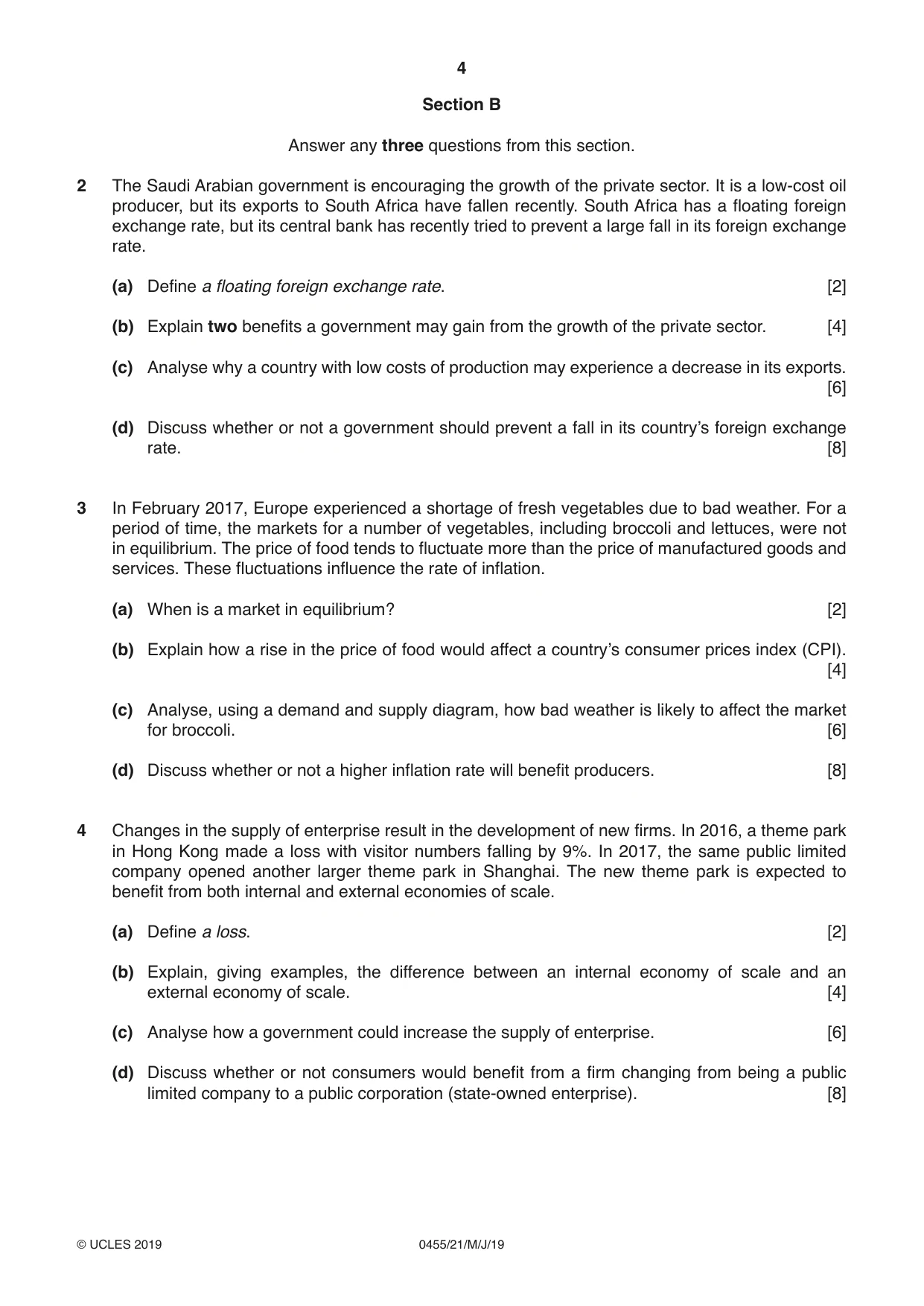
2 The Saudi Arabian government is encouraging the growth of the private sector. It is a low-cost oil producer, but its exports to South Africa have fallen recently. South Africa has a floating foreign exchange rate, but its central bank has recently tried to prevent a large fall in its foreign exchange rate. (a) Define a floating foreign exchange rate. [2] (b) Explain two benefits a government may gain from the growth of the private sector. [4] (c) Analyse why a country with low costs of production may experience a decrease in its exports. [6] (d) Discuss whether or not a government should prevent a fall in its country’s foreign exchange rate. [8]
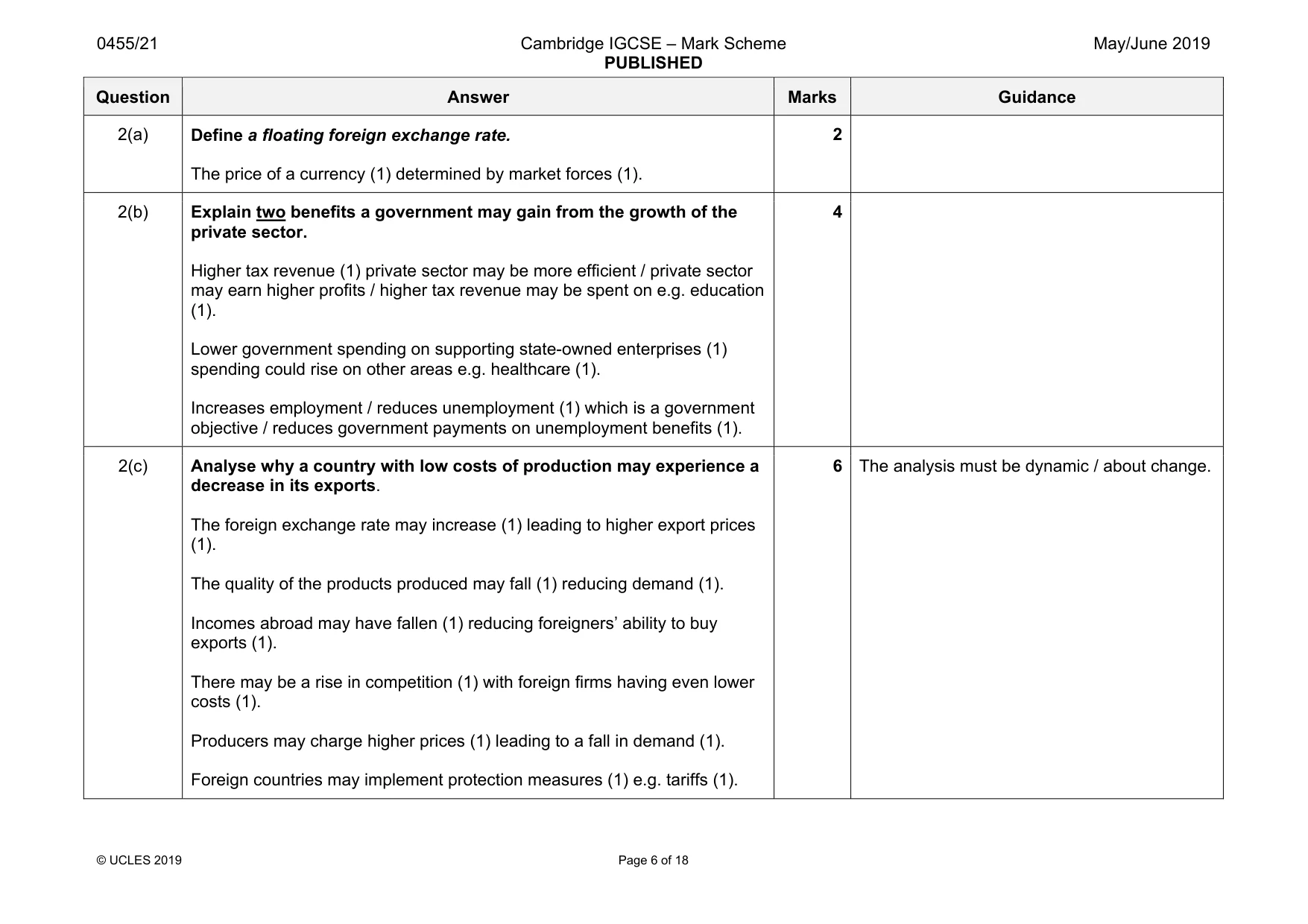
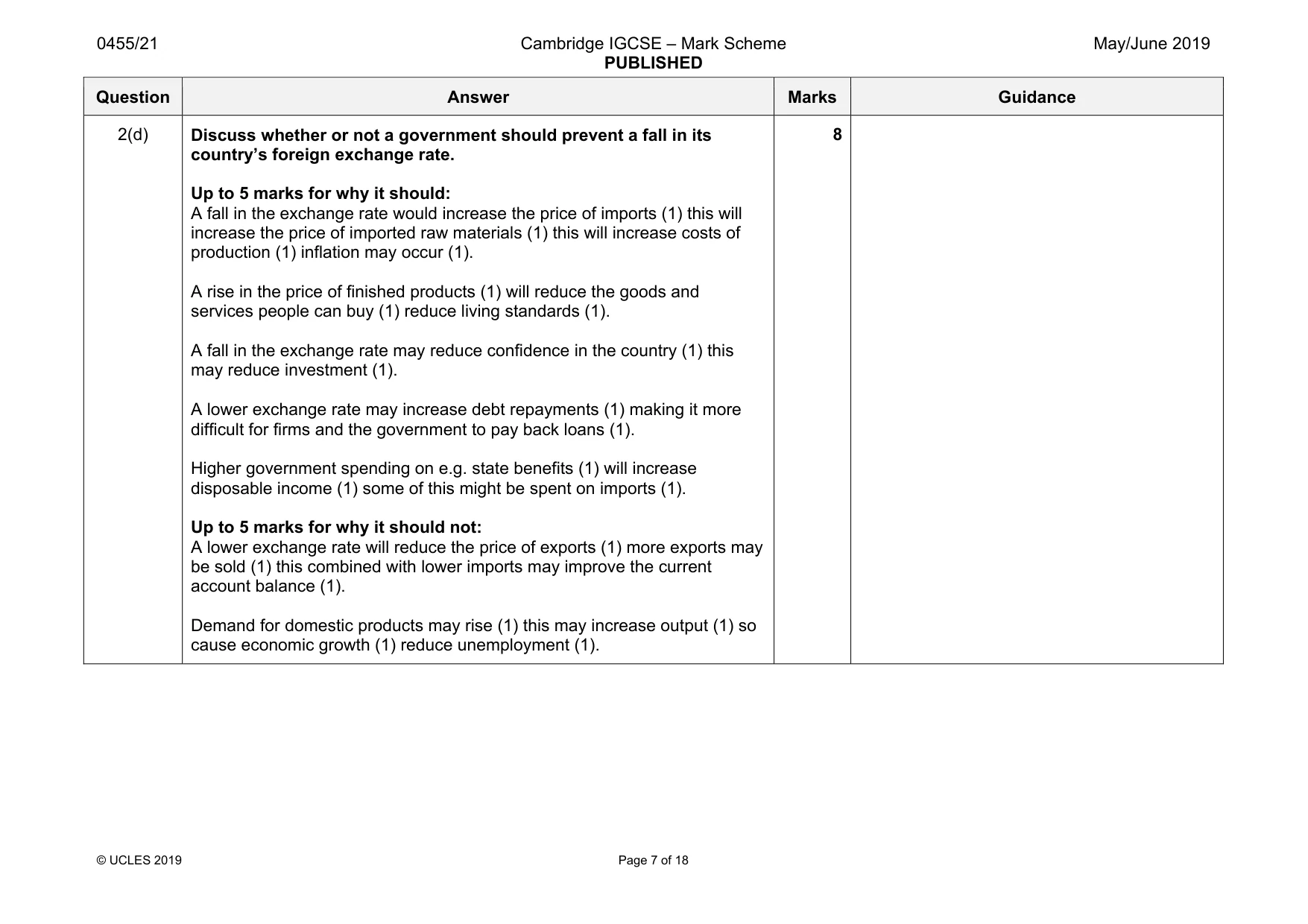
Mark scheme: 2(a) Define a floating foreign exchange rate. The price of a currency (1) determined by market forces (1). 2 2(b) Explain two benefits a government may gain from the growth of the private sector. Higher tax revenue (1) private sector may be more efficient / private sector may earn higher profits / higher tax revenue may be spent on e.g. education (1). Lower government spending on supporting state-owned enterprises (1) spending could rise on other areas e.g. healthcare (1). Increases employment / reduces unemployment (1) which is a government objective / reduces government payments on unemployment benefits (1). 4 2(c) Analyse why a country with low costs of production may experience a decrease in its exports. The foreign exchange rate may increase (1) leading to higher export prices (1). The quality of the products produced may fall (1) reducing demand (1). Incomes abroad may have fallen (1) reducing foreigners’ ability to buy exports (1). There may be a rise in competition (1) with foreign firms having even lower costs (1). Producers may charge higher prices (1) leading to a fall in demand (1). Foreign countries may implement protection measures (1) e.g. tariffs (1). 6 The analysis must be dynamic / about change. Question Answer Marks Guidance 2(d) Discuss whether or not a government should prevent a fall in its country’s foreign exchange rate. Up to 5 marks for why it should: A fall in the exchange rate would increase the price of imports (1) this will increase the price of imported raw materials (1) this will increase costs of production (1) inflation may occur (1). A rise in the price of finished products (1) will reduce the goods and services people can buy (1) reduce living standards (1). A fall in the exchange rate may reduce confidence in the country (1) this may reduce investment (1). A lower exchange rate may increase debt repayments (1) making it more difficult for firms and the government to pay back loans (1). Higher government spending on e.g. state benefits (1) will increase disposable income (1) some of this might be spent on imports (1). Up to 5 marks for why it should not: A lower exchange rate will reduce the price of exports (1) more exports may be sold (1) this combined with lower imports may improve the current account balance (1). Demand for domestic products may rise (1) this may increase output (1) so cause economic growth (1) reduce unemployment (1). 8
Q3 · In February 2017, Europe experienced a shortage of fresh vegetables due to bad weather
3 In February 2017, Europe experienced a shortage of fresh vegetables due to bad weather. For a period of time, the markets for a number of vegetables, including broccoli and lettuces, were not in equilibrium. The price of food tends to fluctuate more than the price of manufactured goods and services. These fluctuations influence the rate of inflation. (a) When is a market in equilibrium? [2] (b) Explain how a rise in the price of food would affect a country’s consumer prices index (CPI). [4] (c) Analyse, using a demand and supply diagram, how bad weather is likely to affect the market for broccoli. [6] (d) Discuss whether or not a higher inflation rate will benefit producers. [8]
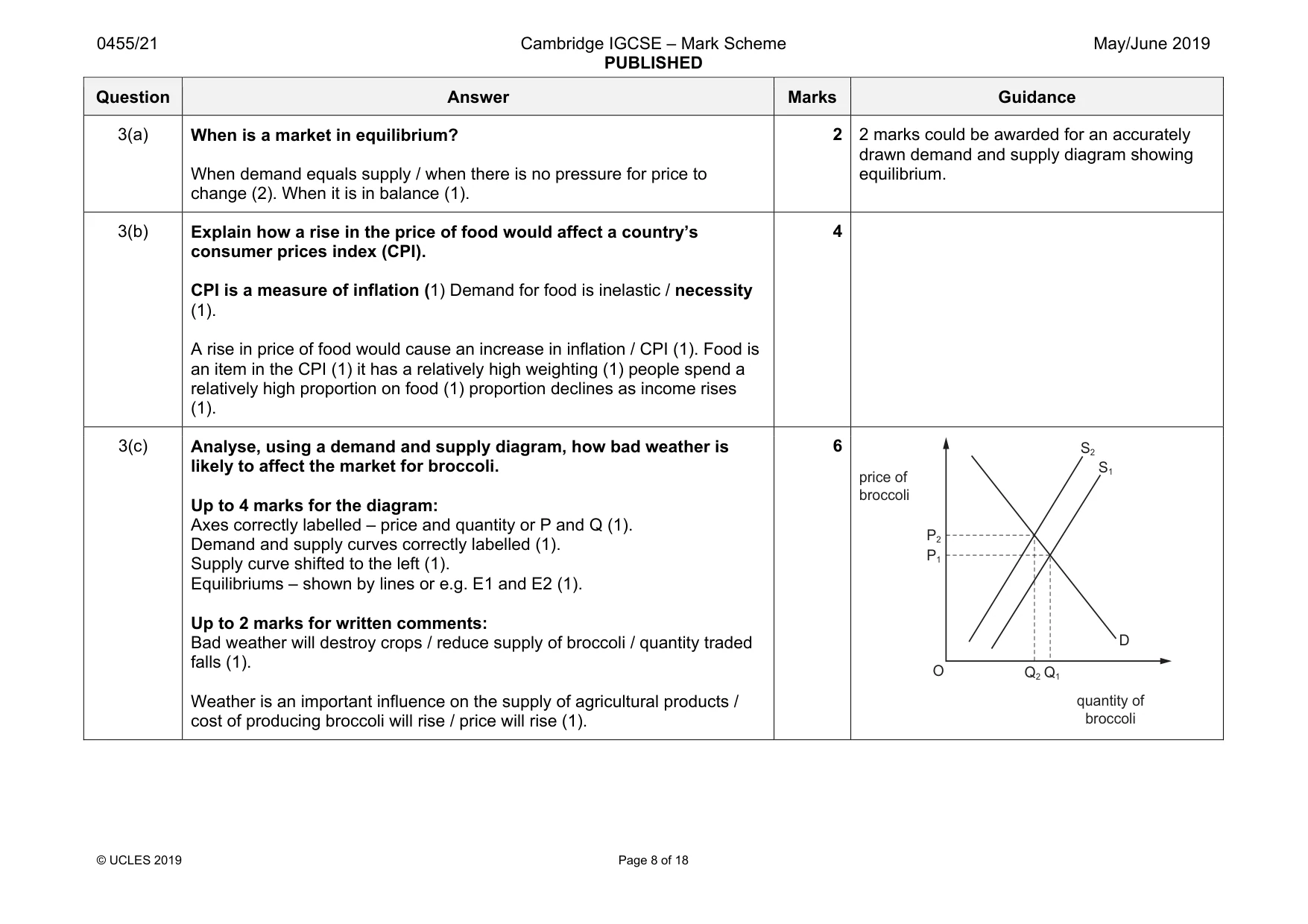
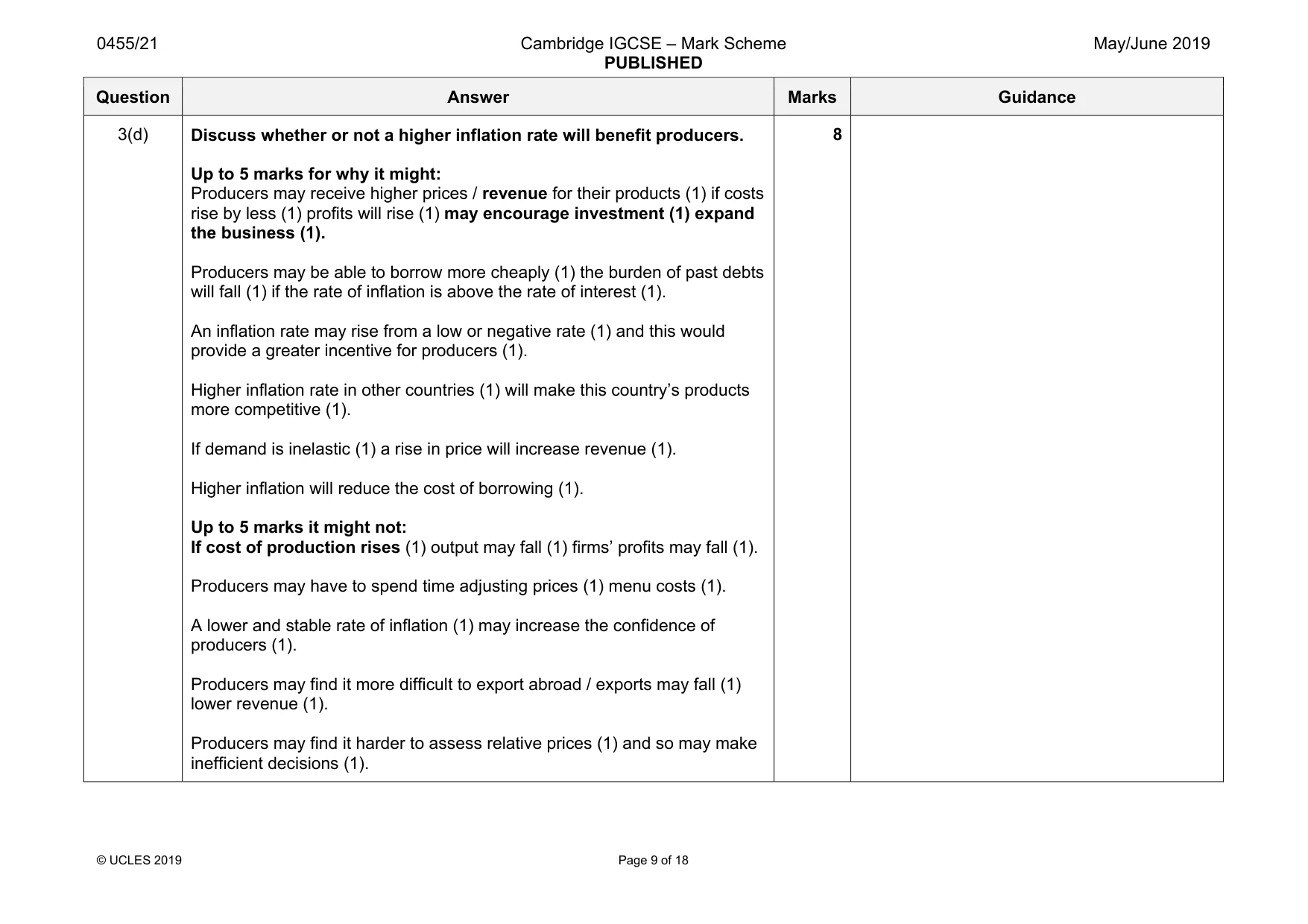
Mark scheme: 3(a) When is a market in equilibrium? When demand equals supply / when there is no pressure for price to change (2). When it is in balance (1). 2 drawn demand and supply diagram showing equilibrium. 3(b) Explain how a rise in the price of food would affect a country’s consumer prices index (CPI). CPI is a measure of inflation (1) Demand for food is inelastic / necessity (1). A rise in price of food would cause an increase in inflation / CPI (1). Food is an item in the CPI (1) it has a relatively high weighting (1) people spend a relatively high proportion on food (1) proportion declines as income rises (1). 4 3(c) Analyse, using a demand and supply diagram, how bad weather is likely to affect the market for broccoli. Up to 4 marks for the diagram: Axes correctly labelled – price and quantity or P and Q (1). Demand and supply curves correctly labelled (1). Supply curve shifted to the left (1). Equilibriums – shown by lines or e.g. E1 and E2 (1). Up to 2 marks for written comments: Bad weather will destroy crops / reduce supply of broccoli / quantity traded falls (1). Weather is an important influence on the supply of agricultural products / cost of producing broccoli will rise / price will rise (1). 6 S2 S1 Q2 Q1 P1 P2 D O quantity of broccoli price of broccoli Question Answer Marks Guidance 3(d) Discuss whether or not a higher inflation rate will benefit producers. Up to 5 marks for why it might: Producers may receive higher prices / revenue for their products (1) if costs rise by less (1) profits will rise (1) may encourage investment (1) expand the business (1). Producers may be able to borrow more cheaply (1) the burden of past debts will fall (1) if the rate of inflation is above the rate of interest (1). An inflation rate may rise from a low or negative rate (1) and this would provide a greater incentive for producers (1). Higher inflation rate in other countries (1) will make this country’s products more competitive (1). If demand is inelastic (1) a rise in price will increase revenue (1). Higher inflation will reduce the cost of borrowing (1). Up to 5 marks it might not: If cost of production rises (1) output may fall (1) firms’ profits may fall (1). Producers may have to spend time adjusting prices (1) menu costs (1). A lower and stable rate of inflation (1) may increase the confidence of producers (1). Producers may find it more difficult to export abroad / exports may fall (1) lower revenue (1). Producers may find it harder to assess relative prices (1) and so may make inefficient decisions (1). 8
Q4 · Changes in the supply of enterprise result in the development of new firms
4 Changes in the supply of enterprise result in the development of new firms. In 2016, a theme park in Hong Kong made a loss with visitor numbers falling by 9%. In 2017, the same public limited company opened another larger theme park in Shanghai. The new theme park is expected to benefit from both internal and external economies of scale. (a) Define a loss. [2] (b) Explain, giving examples, the difference between an internal economy of scale and an external economy of scale. [4] (c) Analyse how a government could increase the supply of enterprise. [6] (d) Discuss whether or not consumers would benefit from a firm changing from being a public limited company to a public corporation (state-owned enterprise). [8]
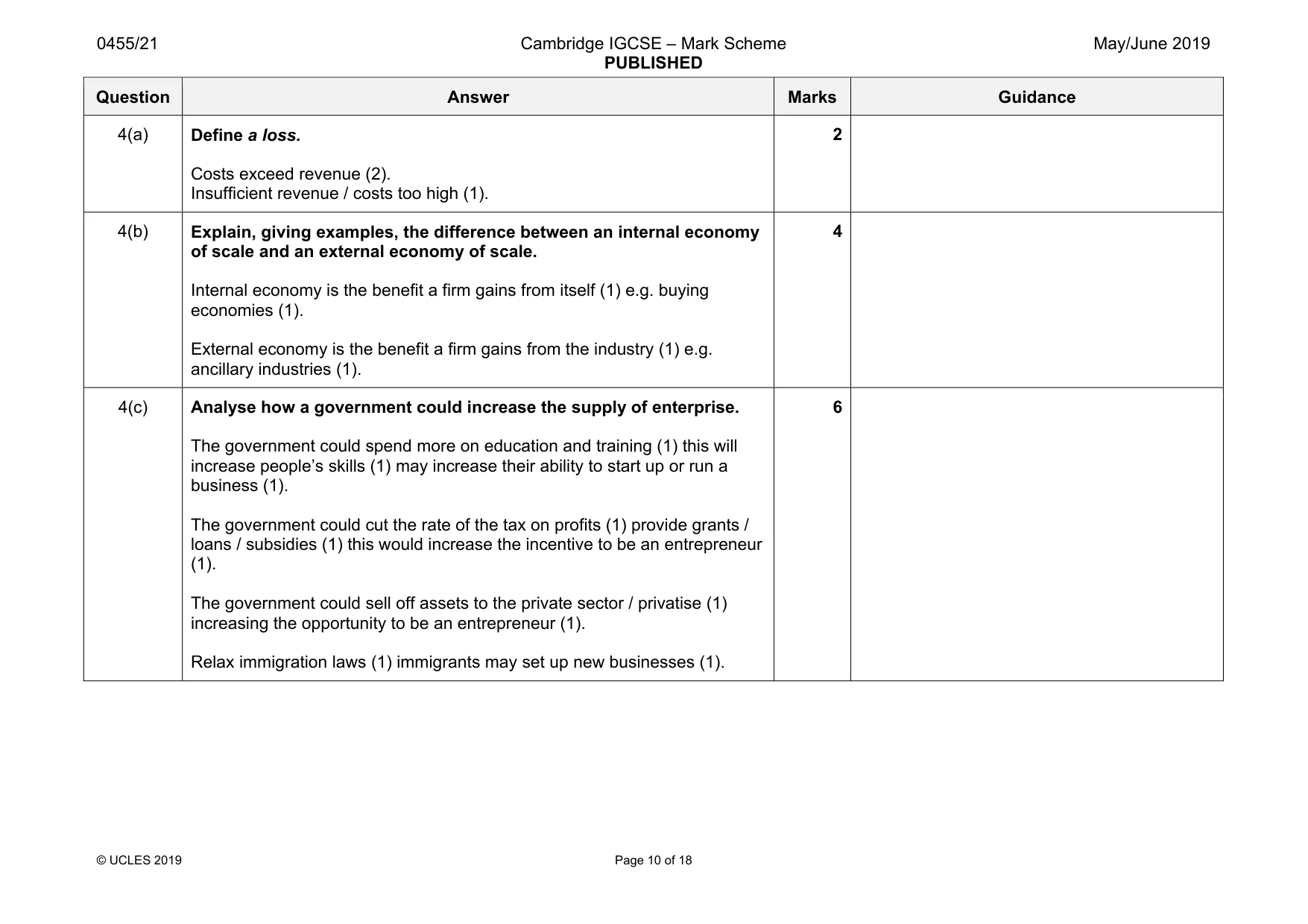
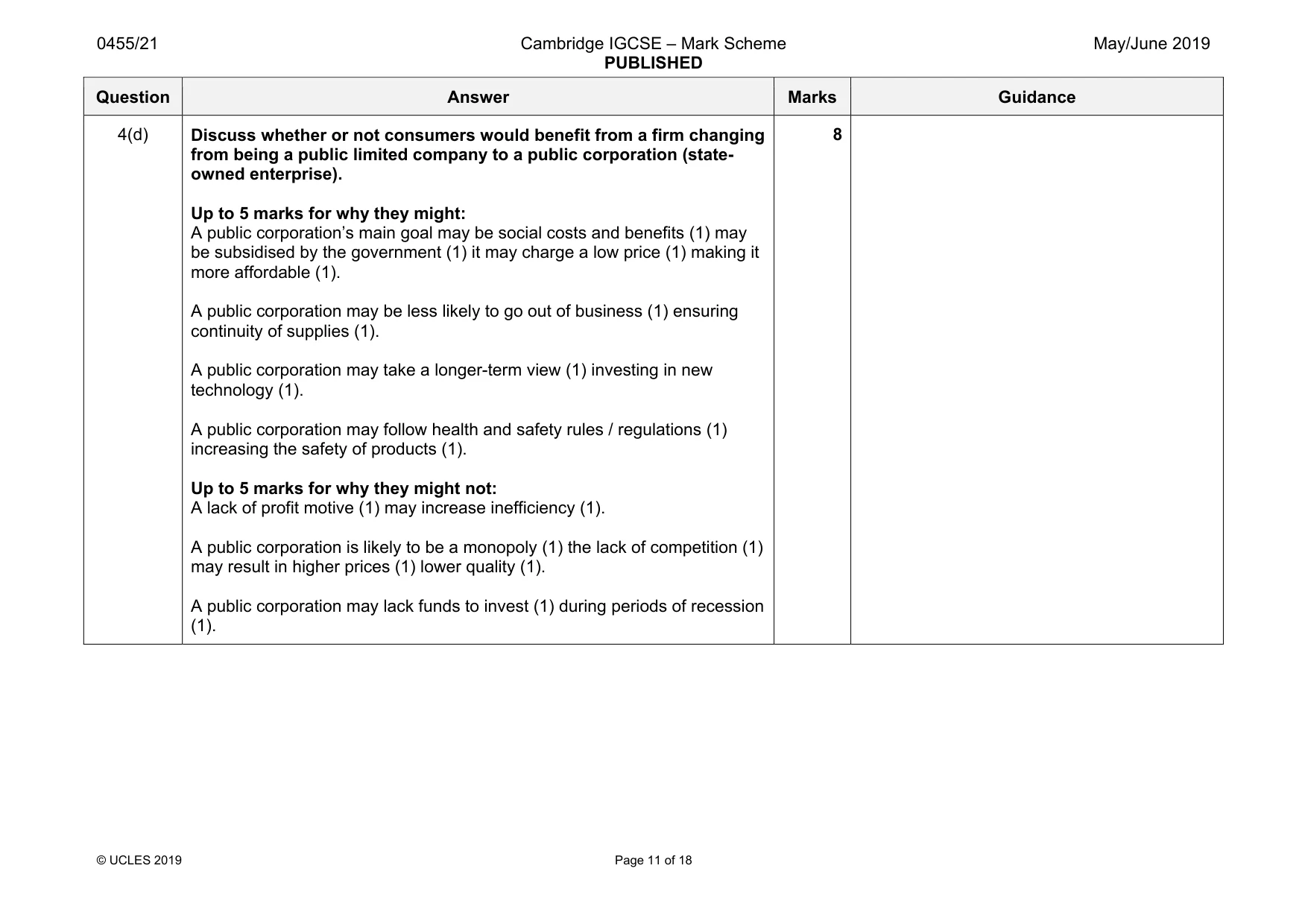
Mark scheme: 4(a) Define a loss. Costs exceed revenue (2). Insufficient revenue / costs too high (1). 2 4(b) Explain, giving examples, the difference between an internal economy of scale and an external economy of scale. Internal economy is the benefit a firm gains from itself (1) e.g. buying economies (1). External economy is the benefit a firm gains from the industry (1) e.g. ancillary industries (1). 4 4(c) Analyse how a government could increase the supply of enterprise. The government could spend more on education and training (1) this will increase people’s skills (1) may increase their ability to start up or run a business (1). The government could cut the rate of the tax on profits (1) provide grants / loans / subsidies (1) this would increase the incentive to be an entrepreneur (1). The government could sell off assets to the private sector / privatise (1) increasing the opportunity to be an entrepreneur (1). Relax immigration laws (1) immigrants may set up new businesses (1). 6 Question Answer Marks Guidance 4(d) Discuss whether or not consumers would benefit from a firm changing from being a public limited company to a public corporation (state- owned enterprise). Up to 5 marks for why they might: A public corporation’s main goal may be social costs and benefits (1) may be subsidised by the government (1) it may charge a low price (1) making it more affordable (1). A public corporation may be less likely to go out of business (1) ensuring continuity of supplies (1). A public corporation may take a longer-term view (1) investing in new technology (1). A public corporation may follow health and safety rules / regulations (1) increasing the safety of products (1). Up to 5 marks for why they might not: A lack of profit motive (1) may increase inefficiency (1). A public corporation is likely to be a monopoly (1) the lack of competition (1) may result in higher prices (1) lower quality (1). A public corporation may lack funds to invest (1) during periods of recession (1). 8
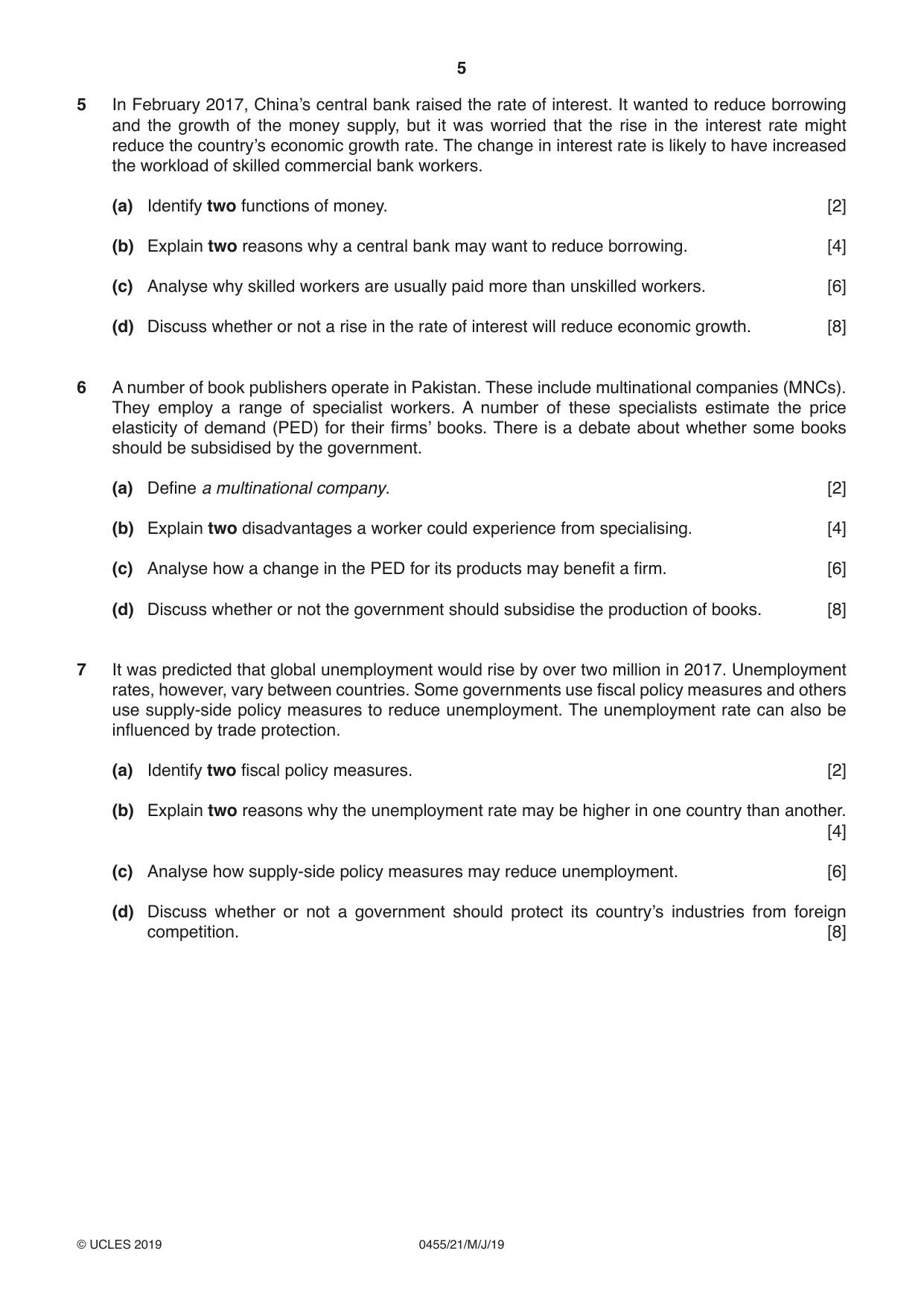
Q5 · In February 2017, China’s central bank raised the rate of interest
5 In February 2017, China’s central bank raised the rate of interest. It wanted to reduce borrowing and the growth of the money supply, but it was worried that the rise in the interest rate might reduce the country’s economic growth rate. The change in interest rate is likely to have increased the workload of skilled commercial bank workers. (a) Identify two functions of money. [2] (b) Explain two reasons why a central bank may want to reduce borrowing. [4] (c) Analyse why skilled workers are usually paid more than unskilled workers. [6] (d) Discuss whether or not a rise in the rate of interest will reduce economic growth. [8]
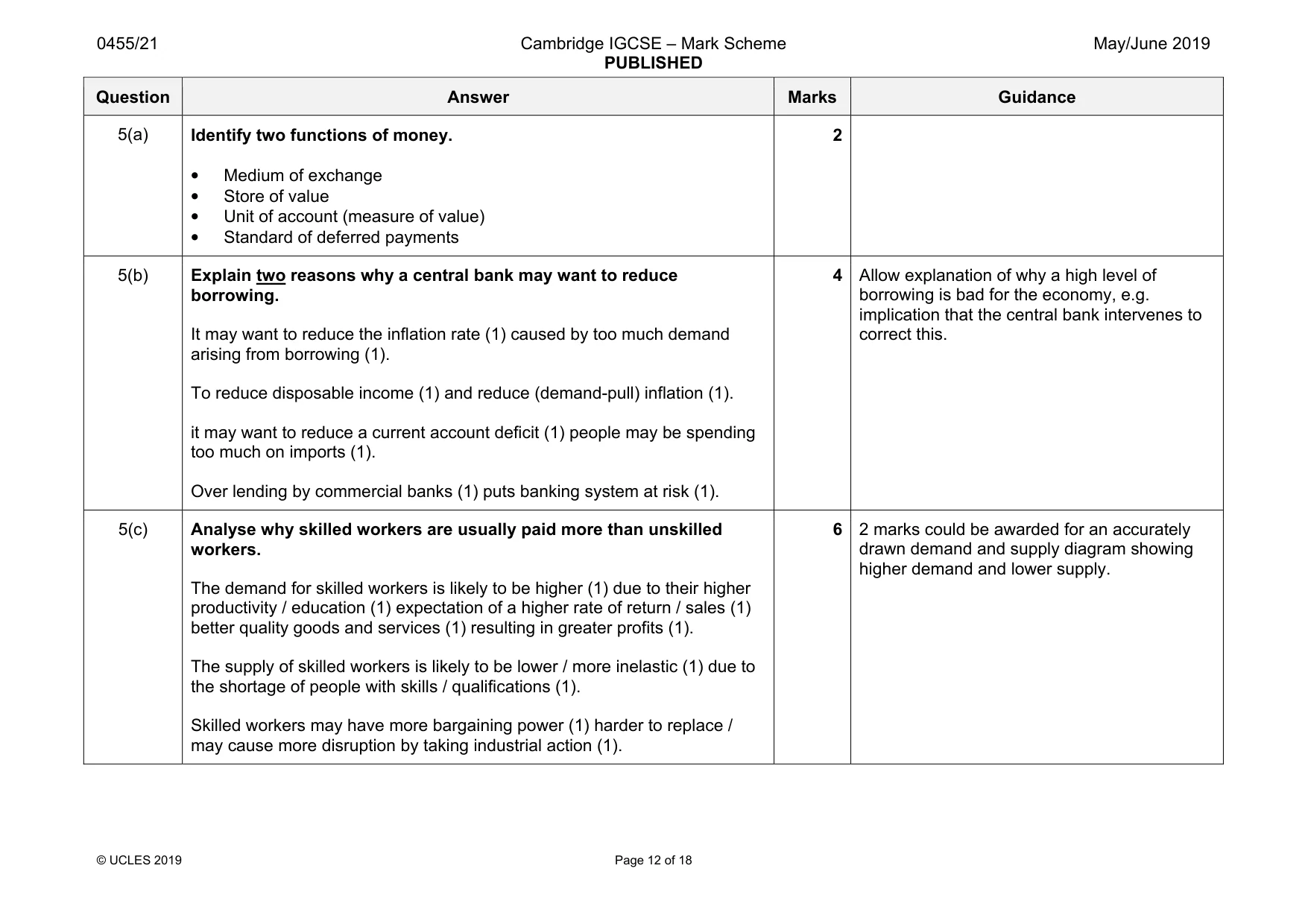
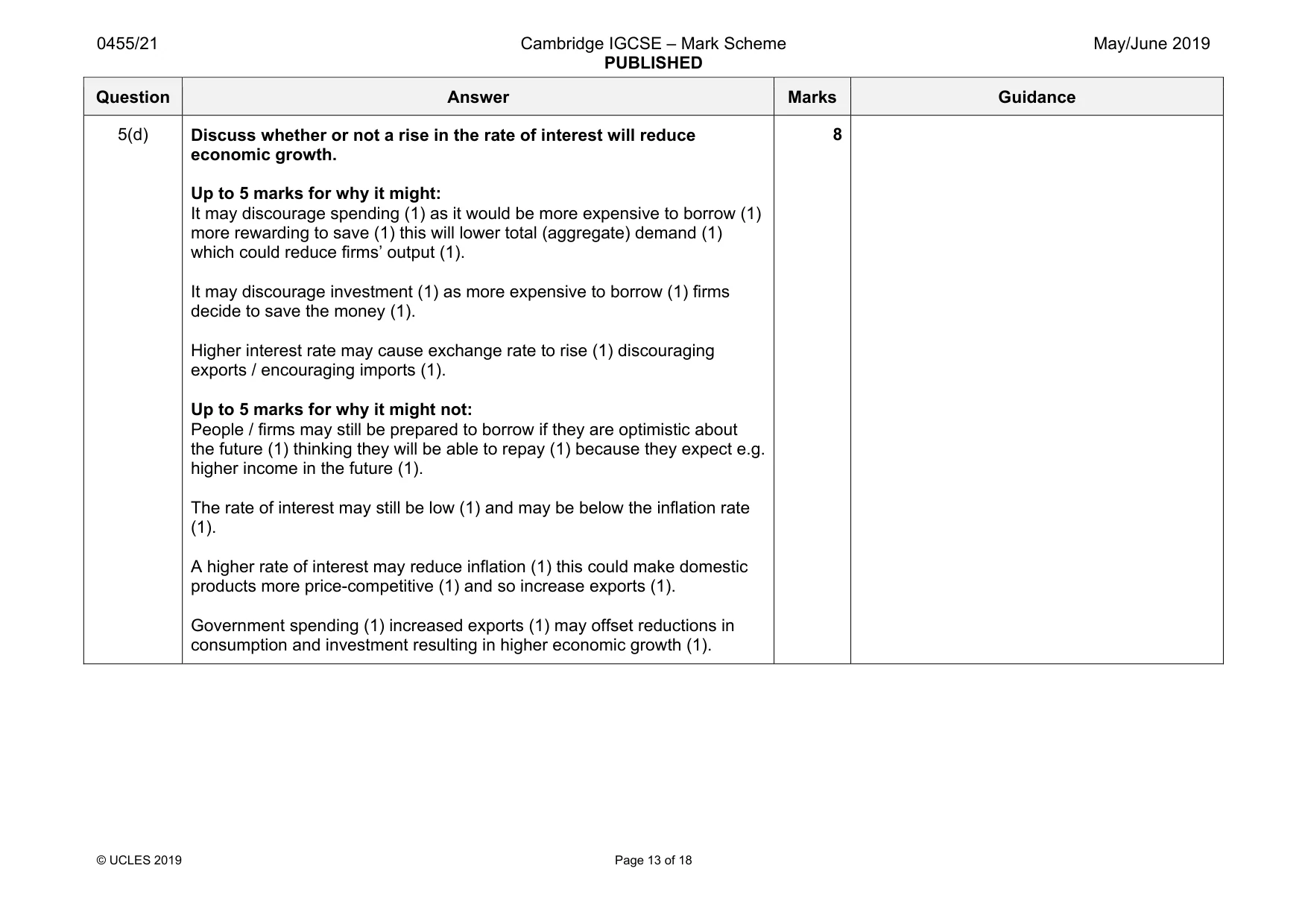
Mark scheme: 5(a) Identify two functions of money. • Medium of exchange • Store of value • Unit of account (measure of value) • Standard of deferred payments 2 5(b) Explain two reasons why a central bank may want to reduce borrowing. It may want to reduce the inflation rate (1) caused by too much demand arising from borrowing (1). To reduce disposable income (1) and reduce (demand-pull) inflation (1). it may want to reduce a current account deficit (1) people may be spending too much on imports (1). Over lending by commercial banks (1) puts banking system at risk (1). 4 Allow explanation of why a high level of borrowing is bad for the economy, e.g. implication that the central bank intervenes to correct this. 5(c) Analyse why skilled workers are usually paid more than unskilled workers. The demand for skilled workers is likely to be higher (1) due to their higher productivity / education (1) expectation of a higher rate of return / sales (1) better quality goods and services (1) resulting in greater profits (1). The supply of skilled workers is likely to be lower / more inelastic (1) due to the shortage of people with skills / qualifications (1). Skilled workers may have more bargaining power (1) harder to replace / may cause more disruption by taking industrial action (1). 6 2 marks could be awarded for an accurately drawn demand and supply diagram showing higher demand and lower supply. Question Answer Marks Guidance 5(d) Discuss whether or not a rise in the rate of interest will reduce economic growth. Up to 5 marks for why it might: It may discourage spending (1) as it would be more expensive to borrow (1) more rewarding to save (1) this will lower total (aggregate) demand (1) which could reduce firms’ output (1). It may discourage investment (1) as more expensive to borrow (1) firms decide to save the money (1). Higher interest rate may cause exchange rate to rise (1) discouraging exports / encouraging imports (1). Up to 5 marks for why it might not: People / firms may still be prepared to borrow if they are optimistic about the future (1) thinking they will be able to repay (1) because they expect e.g. higher income in the future (1). The rate of interest may still be low (1) and may be below the inflation rate (1). A higher rate of interest may reduce inflation (1) this could make domestic products more price-competitive (1) and so increase exports (1). Government spending (1) increased exports (1) may offset reductions in consumption and investment resulting in higher economic growth (1). 8
Q6 · A number of book publishers operate in Pakistan
6 A number of book publishers operate in Pakistan. These include multinational companies (MNCs). They employ a range of specialist workers. A number of these specialists estimate the price elasticity of demand (PED) for their firms’ books. There is a debate about whether some books should be subsidised by the government. (a) Define a multinational company. [2] (b) Explain two disadvantages a worker could experience from specialising. [4] (c) Analyse how a change in the PED for its products may benefit a firm. [6] (d) Discuss whether or not the government should subsidise the production of books. [8]
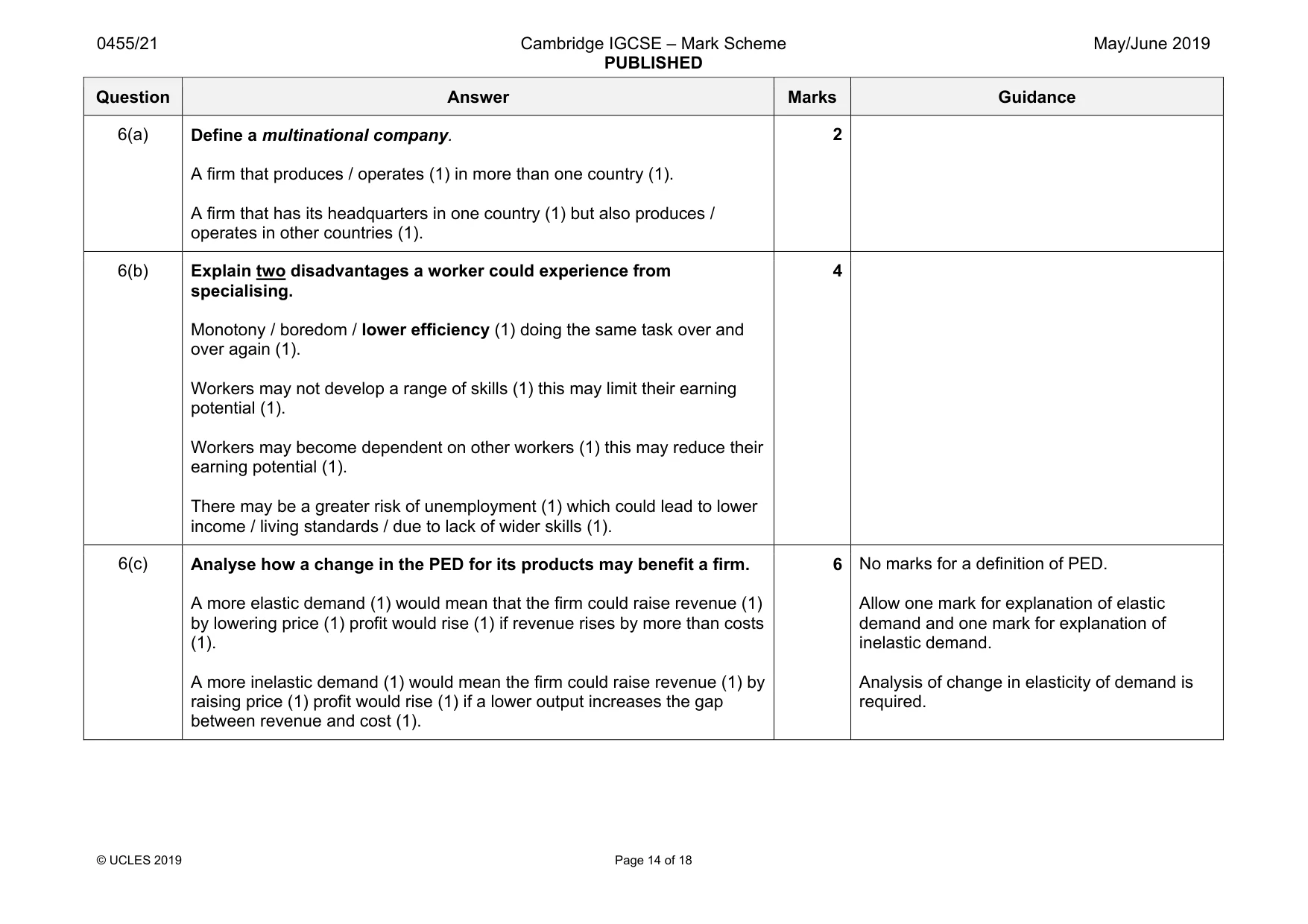
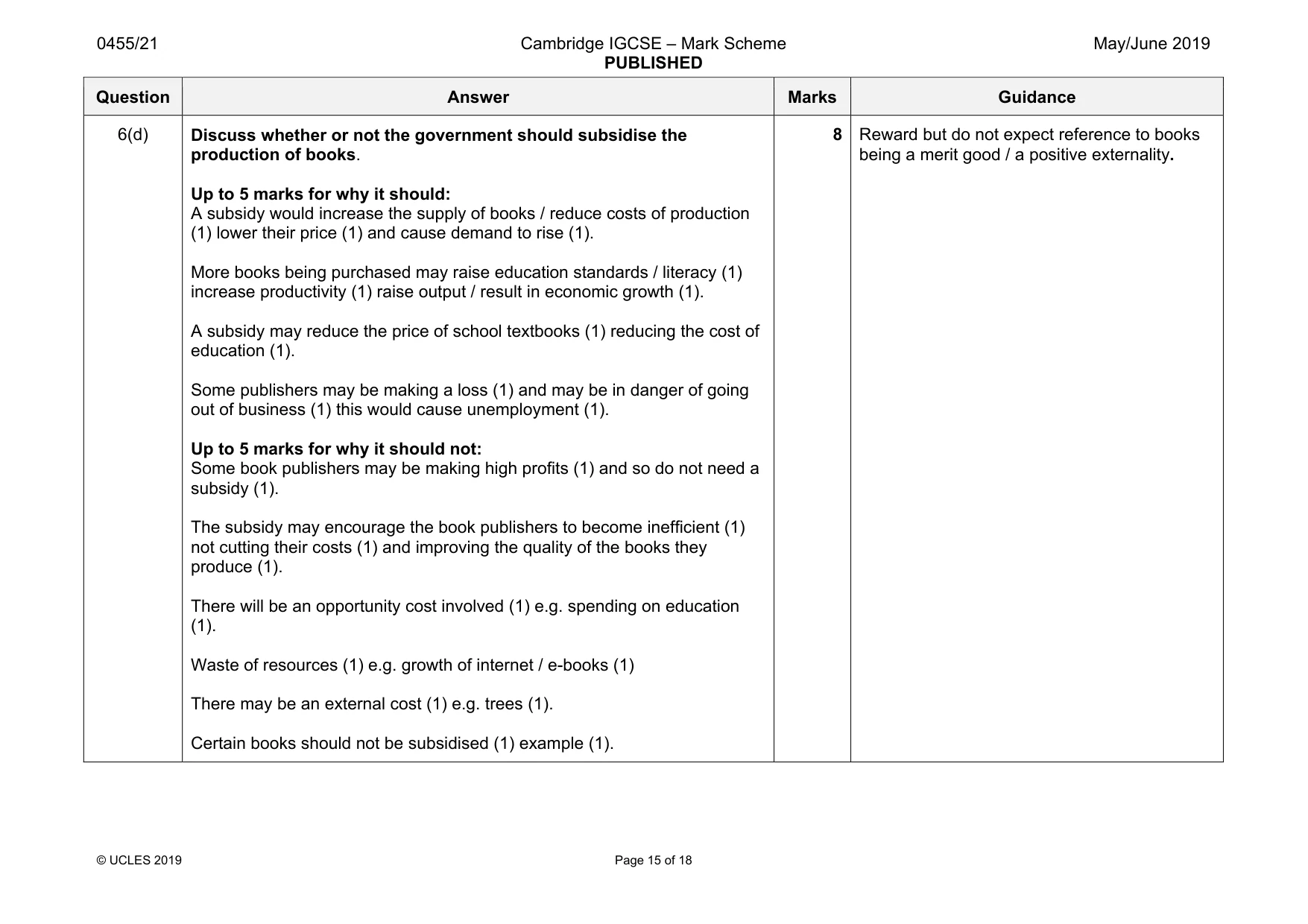
Mark scheme: 6(a) Define a multinational company. A firm that produces / operates (1) in more than one country (1). A firm that has its headquarters in one country (1) but also produces / operates in other countries (1). 2 6(b) Explain two disadvantages a worker could experience from specialising. Monotony / boredom / lower efficiency (1) doing the same task over and over again (1). Workers may not develop a range of skills (1) this may limit their earning potential (1). Workers may become dependent on other workers (1) this may reduce their earning potential (1). There may be a greater risk of unemployment (1) which could lead to lower income / living standards / due to lack of wider skills (1). 4 6(c) Analyse how a change in the PED for its products may benefit a firm. A more elastic demand (1) would mean that the firm could raise revenue (1) by lowering price (1) profit would rise (1) if revenue rises by more than costs (1). A more inelastic demand (1) would mean the firm could raise revenue (1) by raising price (1) profit would rise (1) if a lower output increases the gap between revenue and cost (1). 6 No marks for a definition of PED. Allow one mark for explanation of elastic demand and one mark for explanation of inelastic demand. Analysis of change in elasticity of demand is required. Question Answer Marks Guidance 6(d) Discuss whether or not the government should subsidise the production of books. Up to 5 marks for why it should: A subsidy would increase the supply of books / reduce costs of production (1) lower their price (1) and cause demand to rise (1). More books being purchased may raise education standards / literacy (1) increase productivity (1) raise output / result in economic growth (1). A subsidy may reduce the price of school textbooks (1) reducing the cost of education (1). Some publishers may be making a loss (1) and may be in danger of going out of business (1) this would cause unemployment (1). Up to 5 marks for why it should not: Some book publishers may be making high profits (1) and so do not need a subsidy (1). The subsidy may encourage the book publishers to become inefficient (1) not cutting their costs (1) and improving the quality of the books they produce (1). There will be an opportunity cost involved (1) e.g. spending on education (1). Waste of resources (1) e.g. growth of internet / e-books (1) There may be an external cost (1) e.g. trees (1). Certain books should not be subsidised (1) example (1). 8 Reward but do not expect reference to books being a merit good / a positive externality.
Q7 · It was predicted that global unemployment would rise by over two million in 2017
7 It was predicted that global unemployment would rise by over two million in 2017. Unemployment rates, however, vary between countries. Some governments use fiscal policy measures and others use supply-side policy measures to reduce unemployment. The unemployment rate can also be influenced by trade protection. (a) Identify two fiscal policy measures. [2] (b) Explain two reasons why the unemployment rate may be higher in one country than another. [4] (c) Analyse how supply-side policy measures may reduce unemployment. [6] (d) Discuss whether or not a government should protect its country’s industries from foreign competition. [8]
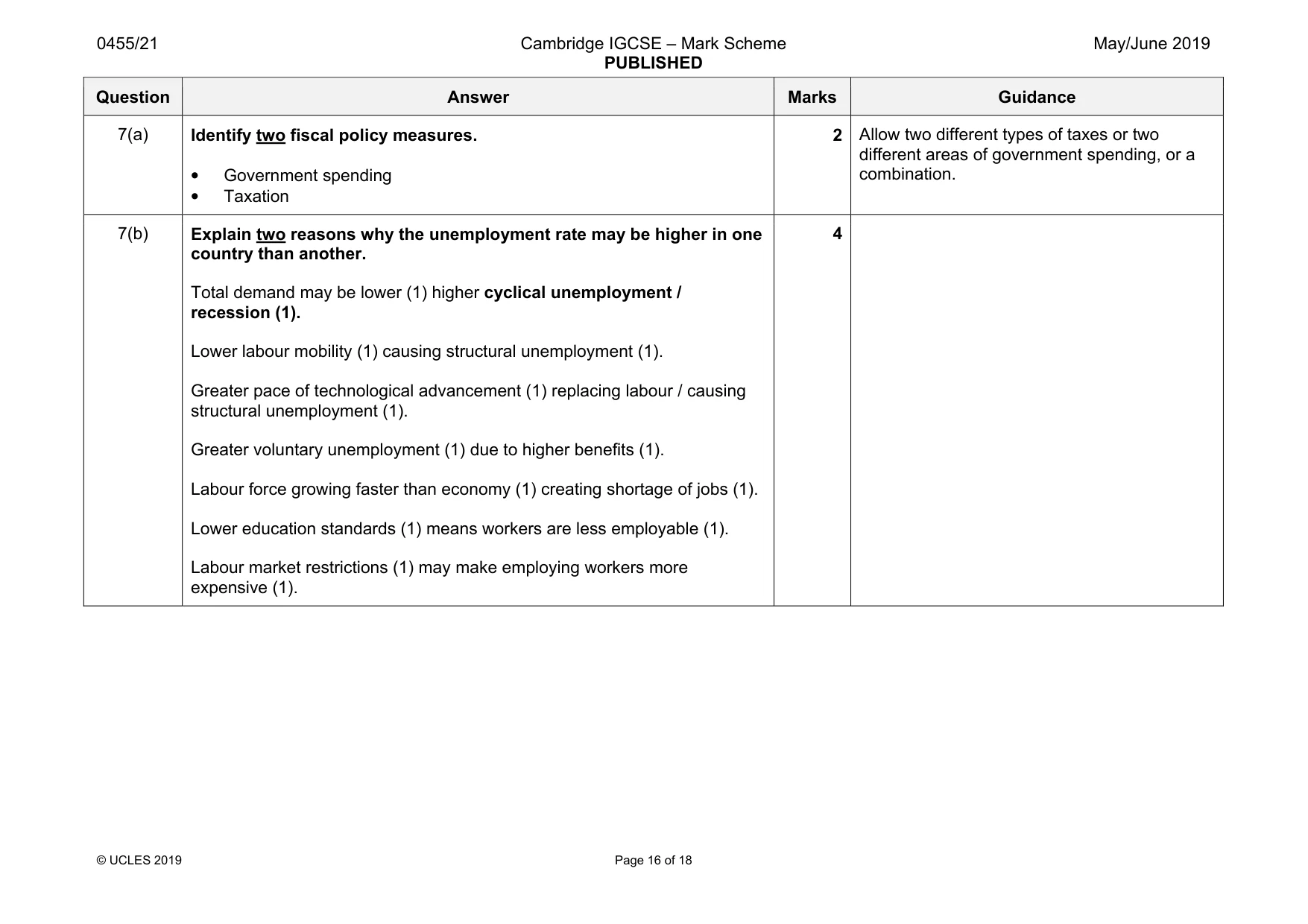
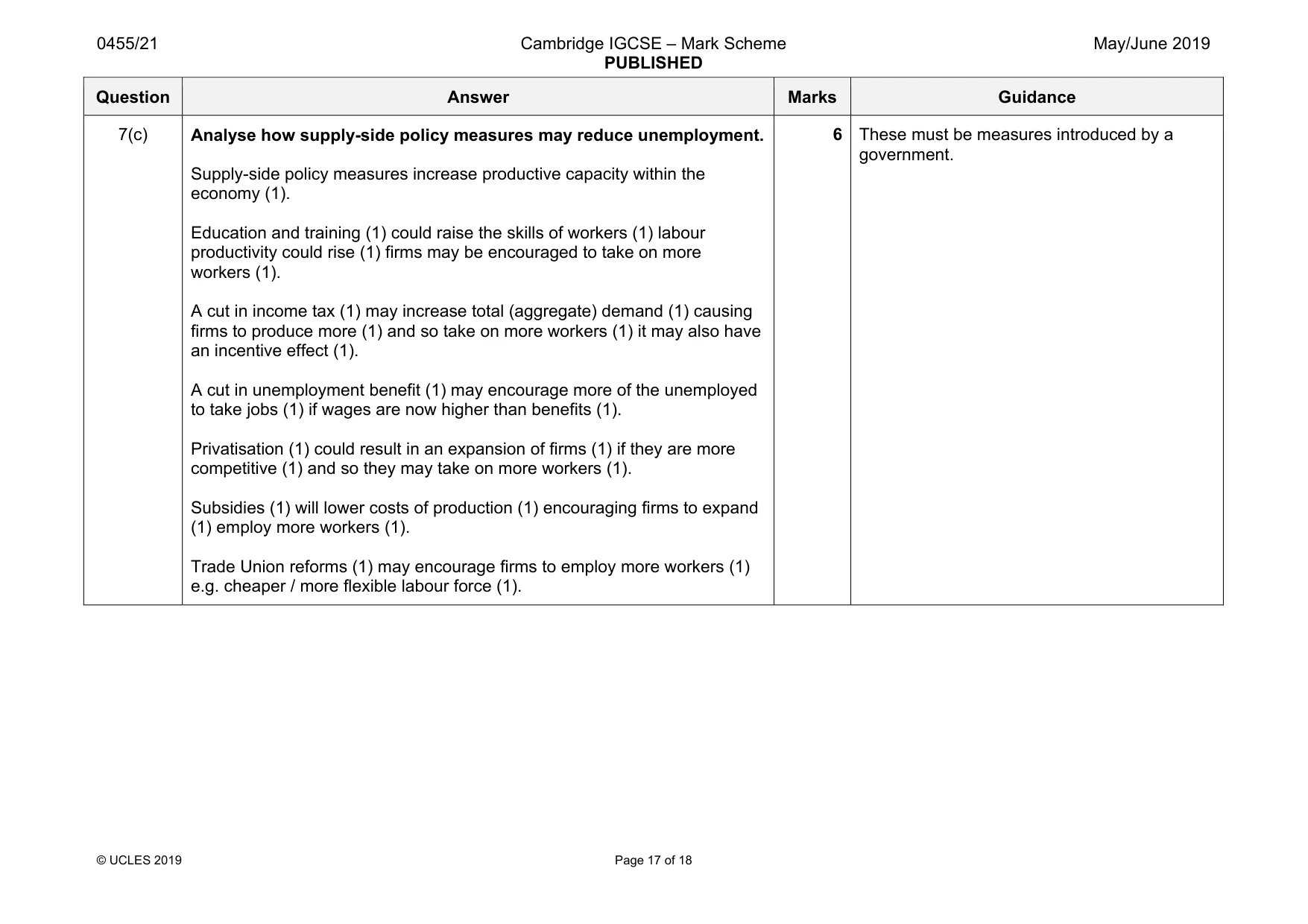
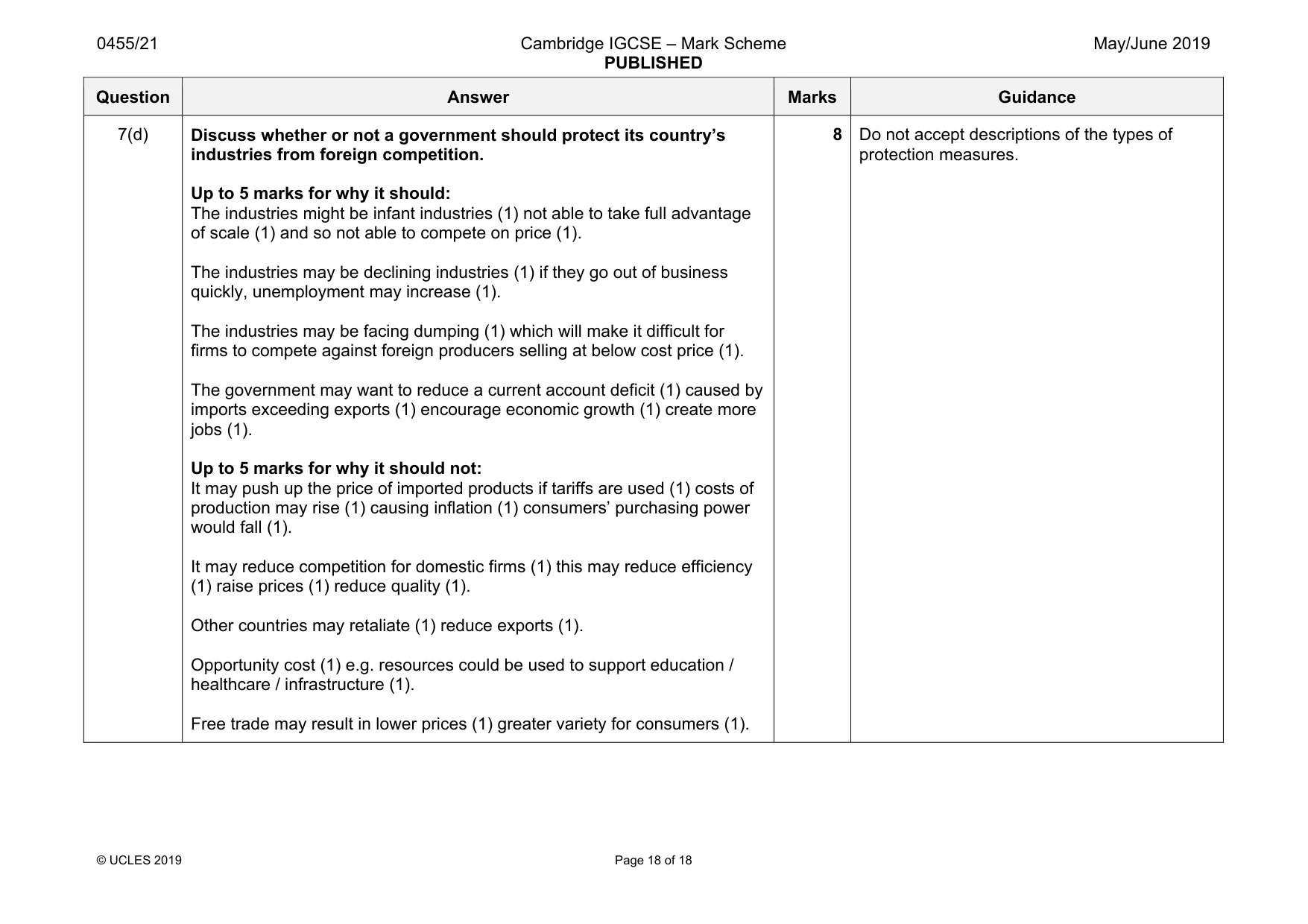
Mark scheme: 7(a) Identify two fiscal policy measures. • Government spending • Taxation 2 Allow two different types of taxes or two different areas of government spending, or a combination. 7(b) Explain two reasons why the unemployment rate may be higher in one country than another. Total demand may be lower (1) higher cyclical unemployment / recession (1). Lower labour mobility (1) causing structural unemployment (1). Greater pace of technological advancement (1) replacing labour / causing structural unemployment (1). Greater voluntary unemployment (1) due to higher benefits (1). Labour force growing faster than economy (1) creating shortage of jobs (1). Lower education standards (1) means workers are less employable (1). Labour market restrictions (1) may make employing workers more expensive (1). 4 Question Answer Marks Guidance 7(c) Analyse how supply-side policy measures may reduce unemployment. Supply-side policy measures increase productive capacity within the economy (1). Education and training (1) could raise the skills of workers (1) labour productivity could rise (1) firms may be encouraged to take on more workers (1). A cut in income tax (1) may increase total (aggregate) demand (1) causing firms to produce more (1) and so take on more workers (1) it may also have an incentive effect (1). A cut in unemployment benefit (1) may encourage more of the unemployed to take jobs (1) if wages are now higher than benefits (1). Privatisation (1) could result in an expansion of firms (1) if they are more competitive (1) and so they may take on more workers (1). Subsidies (1) will lower costs of production (1) encouraging firms to expand (1) employ more workers (1). Trade Union reforms (1) may encourage firms to employ more workers (1) e.g. cheaper / more flexible labour force (1). 6 These must be measures introduced by a government. Question Answer Marks Guidance 7(d) Discuss whether or not a government should protect its country’s industries from foreign competition. Up to 5 marks for why it should: The industries might be infant industries (1) not able to take full advantage of scale (1) and so not able to compete on price (1). The industries may be declining industries (1) if they go out of business quickly, unemployment may increase (1). The industries may be facing dumping (1) which will make it difficult for firms to compete against foreign producers selling at below cost price (1). The government may want to reduce a current account deficit (1) caused by imports exceeding exports (1) encourage economic growth (1) create more jobs (1). Up to 5 marks for why it should not: It may push up the price of imported products if tariffs are used (1) costs of production may rise (1) causing inflation (1) consumers’ purchasing power would fall (1). It may reduce competition for domestic firms (1) this may reduce efficiency (1) raise prices (1) reduce quality (1). Other countries may retaliate (1) reduce exports (1). Opportunity cost (1) e.g. resources could be used to support education / healthcare / infrastructure (1). Free trade may result in lower prices (1) greater variety for consumers (1). 8 Do not accept descriptions of the types of protection measures.
What was in this paper
The subtopics covered by these 7 questions, and how many questions each got. Open one in a new tab to see every Cambridge question on it.
What you needed in this session
Cambridge’s own grade thresholds for 2019 May/June, Paper 2 · Variant 1. A higher threshold means an easier paper — the bar moves with how the cohort did.