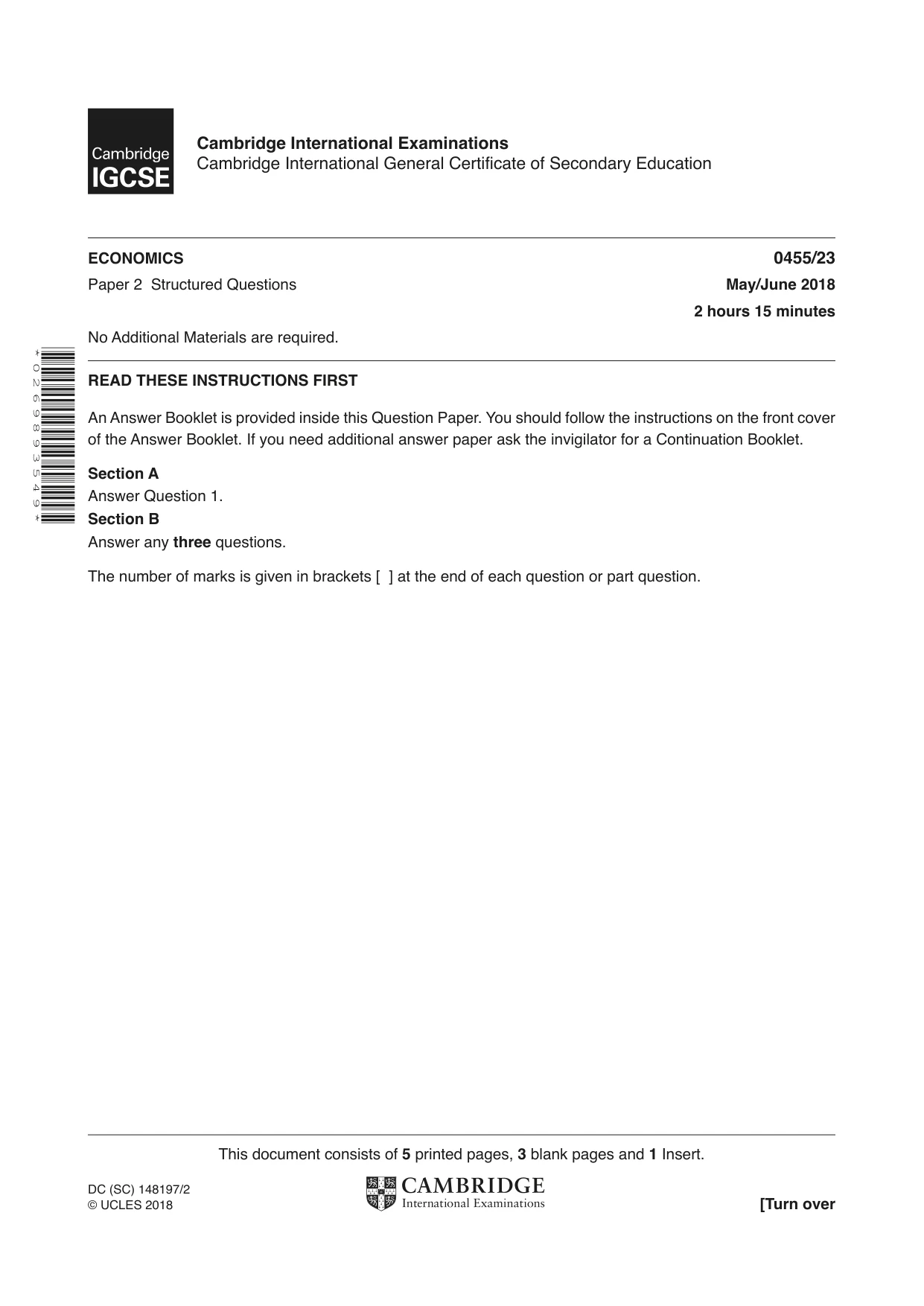
Cambridge IGCSE Economics 0455 — 2018 May/June Paper 2 · Variant 3
0455/23/M/J/18 · 7 questions · 90 marks · ≈101 min
The question paper and its mark scheme, free to read here and free to download. This is Cambridge’s own paper, exactly as it was sat.
Question paper8 pages
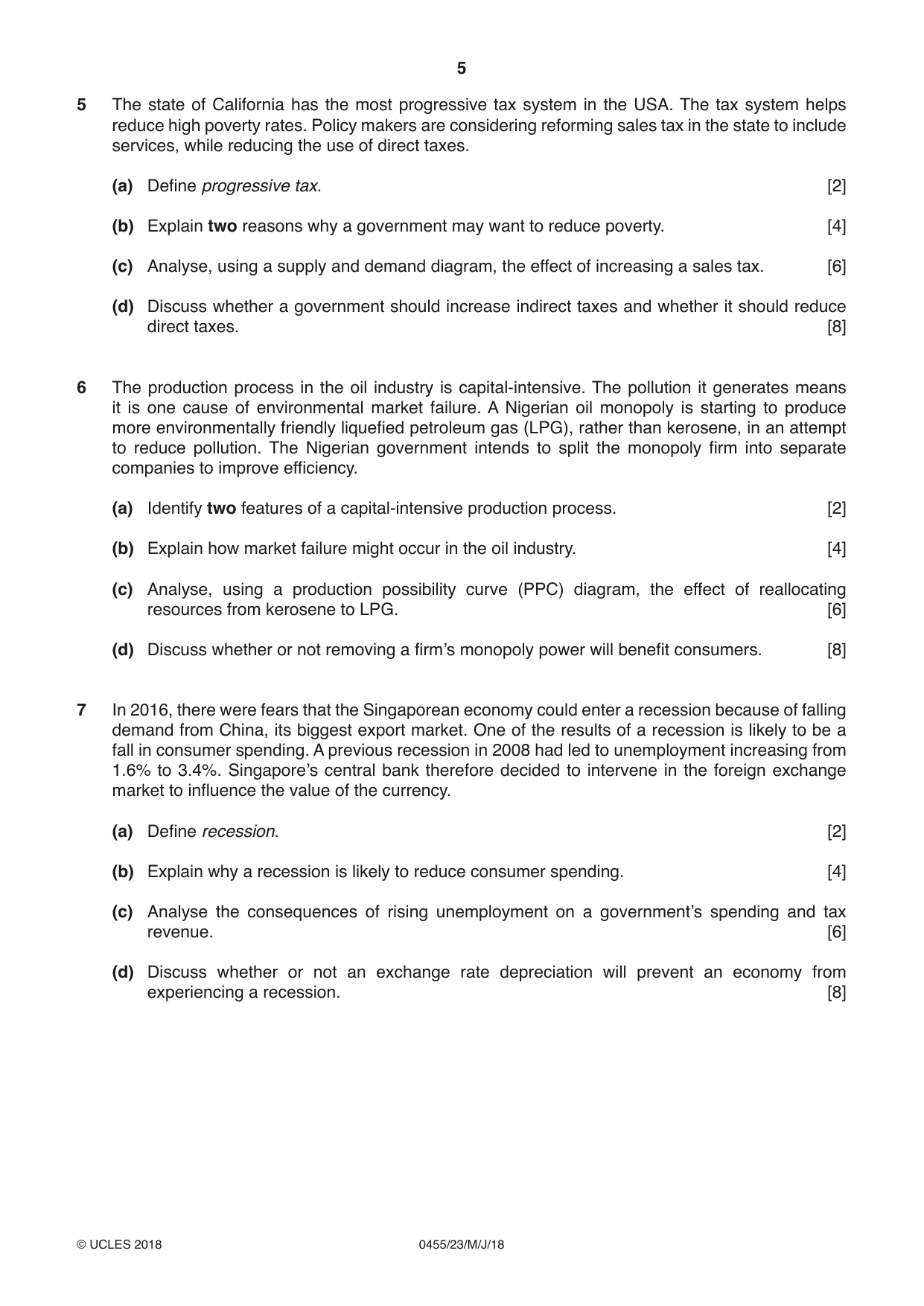


Mark scheme20 pages
Answers below. Sit the paper first if you are practising.
Questions as text
Q1 · The global water crisis In 2015, the World Economic Forum identified the water crisis as…
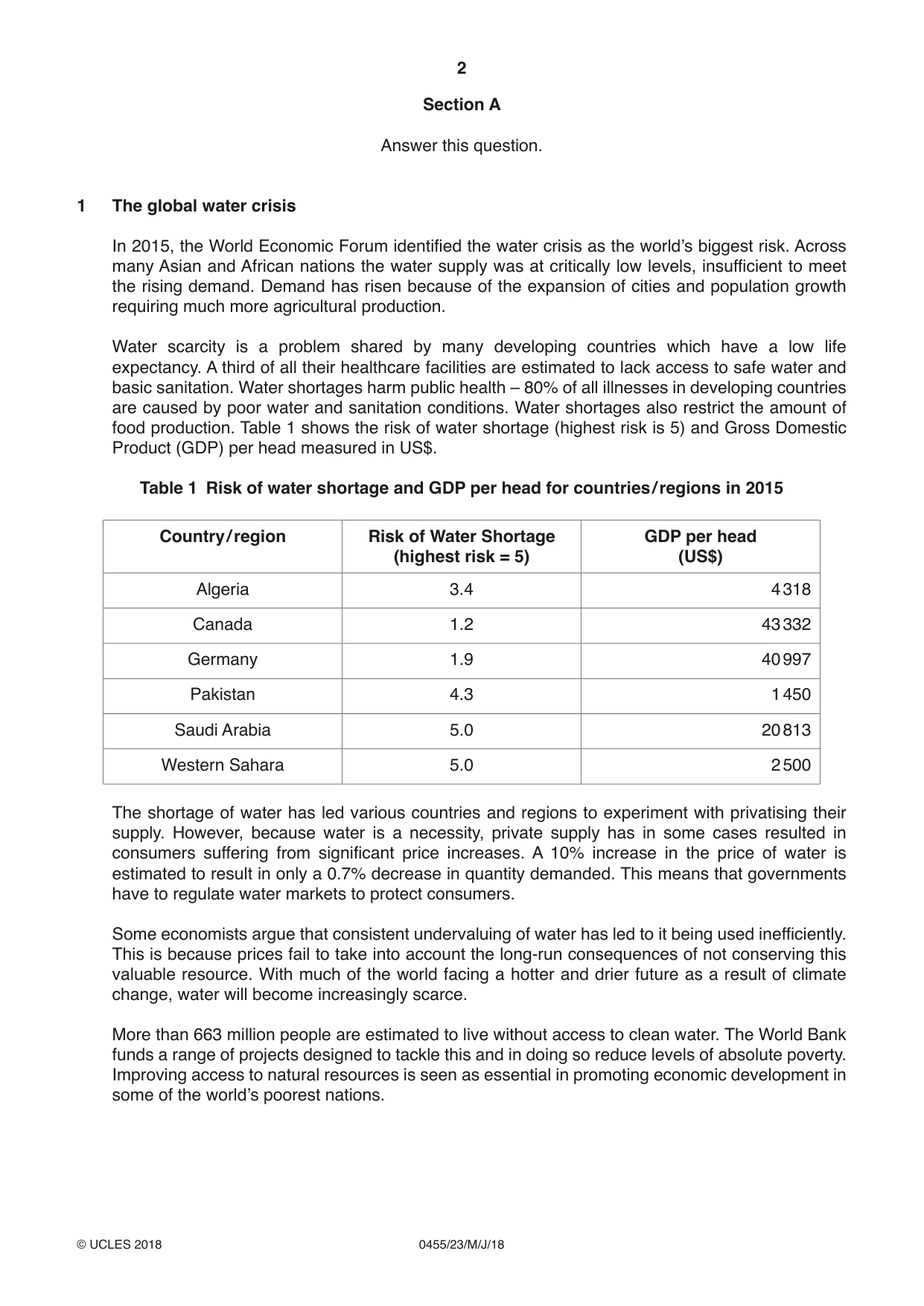
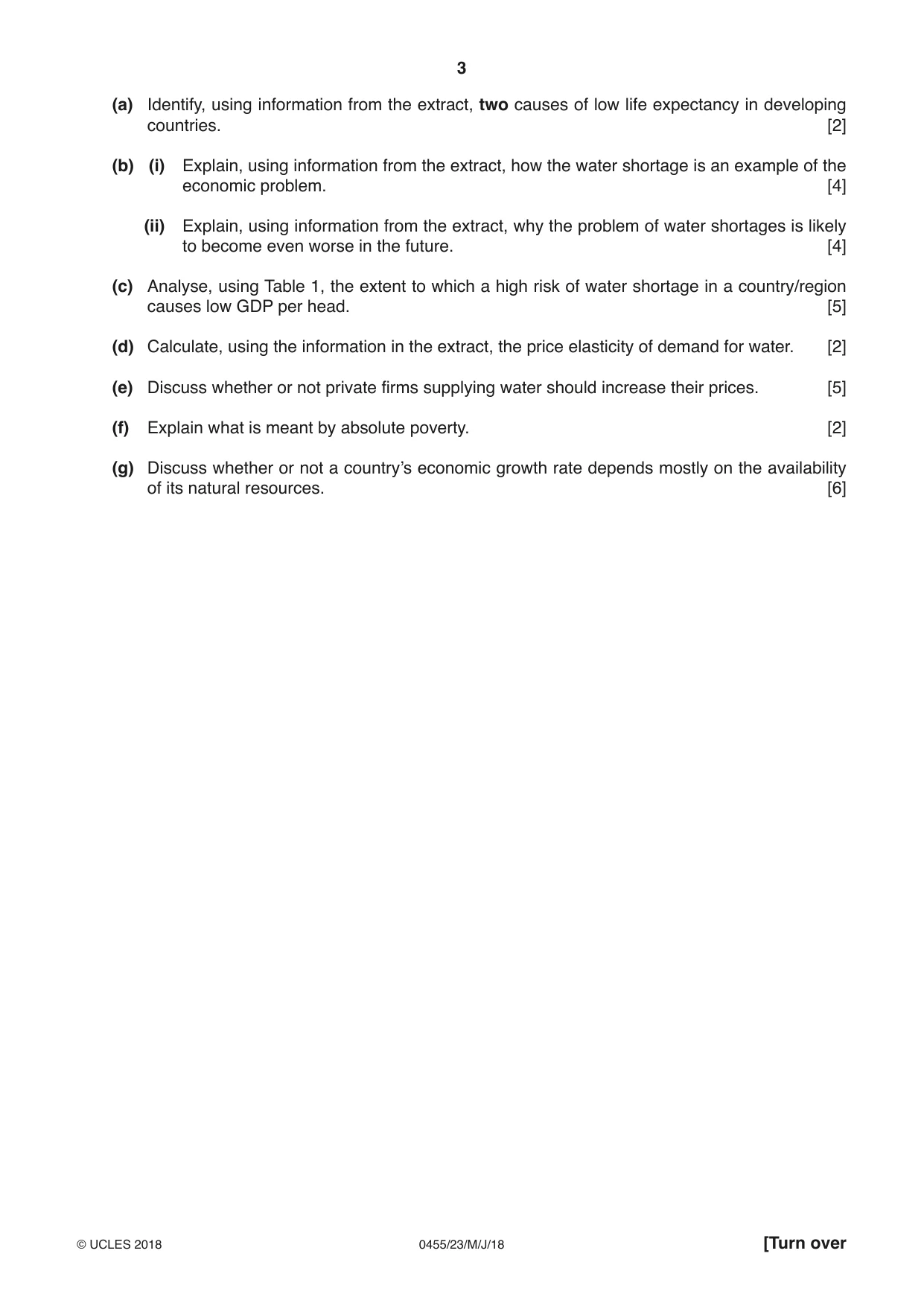
1 The global water crisis In 2015, the World Economic Forum identified the water crisis as the world’s biggest risk. Across many Asian and African nations the water supply was at critically low levels, insufficient to meet the rising demand. Demand has risen because of the expansion of cities and population growth requiring much more agricultural production. Water scarcity is a problem shared by many developing countries which have a low life expectancy. A third of all their healthcare facilities are estimated to lack access to safe water and basic sanitation. Water shortages harm public health – 80% of all illnesses in developing countries are caused by poor water and sanitation conditions. Water shortages also restrict the amount of food production. Table 1 shows the risk of water shortage (highest risk is 5) and Gross Domestic Product (GDP) per head measured in US$. Table 1 Risk of water shortage and GDP per head for countries / regions in 2015 Country / region Risk of Water Shortage GDP per head (highest risk = 5) (US$) Algeria 3.4 4 318 Canada 1.2 43 332 Germany 1.9 40 997 Pakistan 4.3 1 450 Saudi Arabia 5.0 20 813 Western Sahara 5.0 2 500 The shortage of water has led various countries and regions to experiment with privatising their supply. However, because water is a necessity, private supply has in some cases resulted in consumers suffering from significant price increases. A 10% increase in the price of water is estimated to result in only a 0.7% decrease in quantity demanded. This means that governments have to regulate water markets to protect consumers. Some economists argue that consistent undervaluing of water has led to it being used inefficiently. This is because prices fail to take into account the long-run consequences of not conserving this valuable resource. With much of the world facing a hotter and drier future as a result of climate change, water will become increasingly scarce. More than 663 million people are estimated to live without access to clean water. The World Bank funds a range of projects designed to tackle this and in doing so reduce levels of absolute poverty. Improving access to natural resources is seen as essential in promoting economic development in some of the world’s poorest nations. (a) Identify, using information from the extract, two causes of low life expectancy in developing countries. [2] (b) (i) Explain, using information from the extract, how the water shortage is an example of the economic problem. [4] (ii) Explain, using information from the extract, why the problem of water shortages is likely to become even worse in the future. [4] (c) Analyse, using Table 1, the extent to which a high risk of water shortage in a country/region causes low GDP per head. [5] (d) Calculate, using the information in the extract, the price elasticity of demand for water. [2] (e) Discuss whether or not private firms supplying water should increase their prices. [5] (f) Explain what is meant by absolute poverty. [2] (g) Discuss whether or not a country’s economic growth rate depends mostly on the availability of its natural resources. [6]
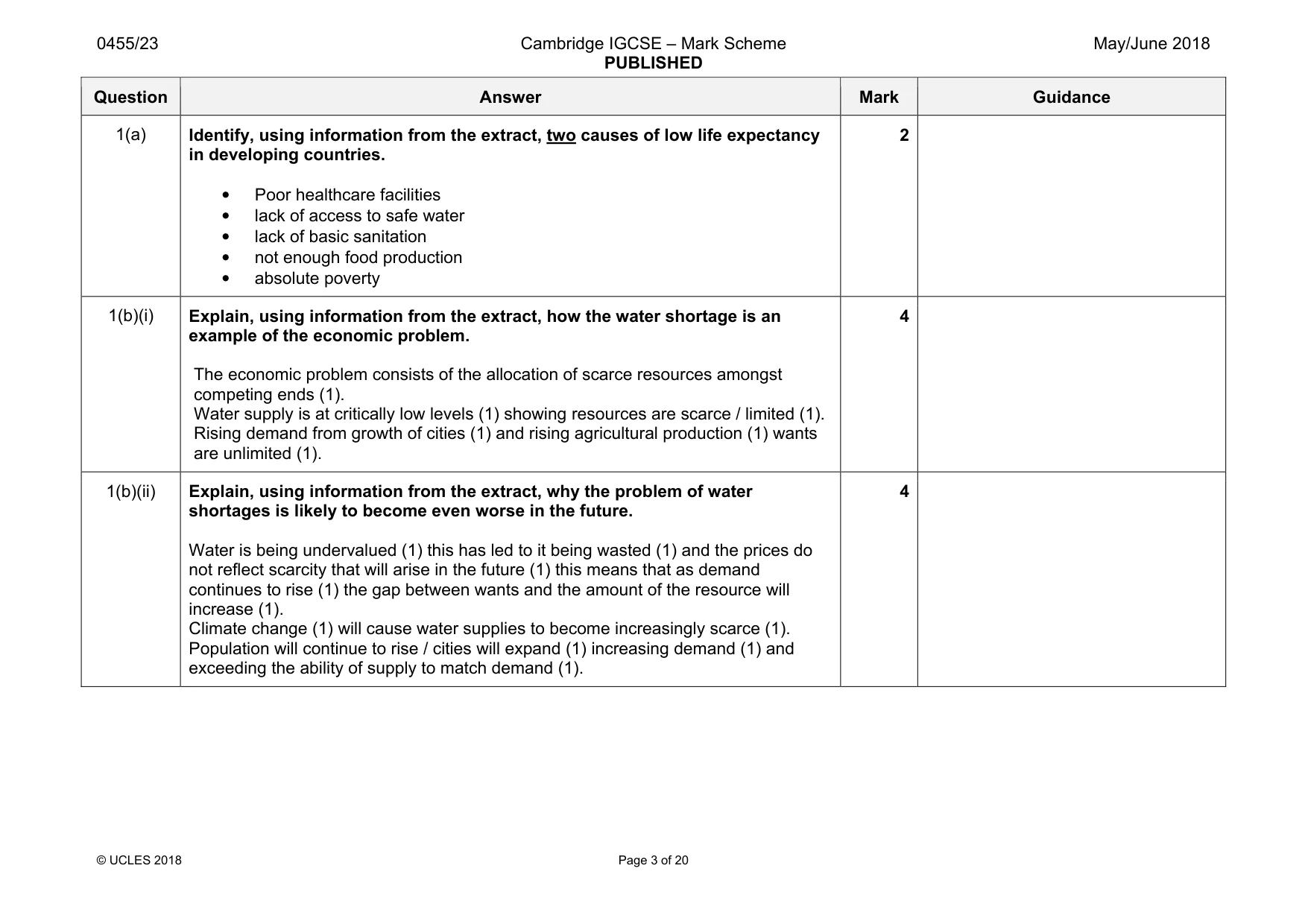
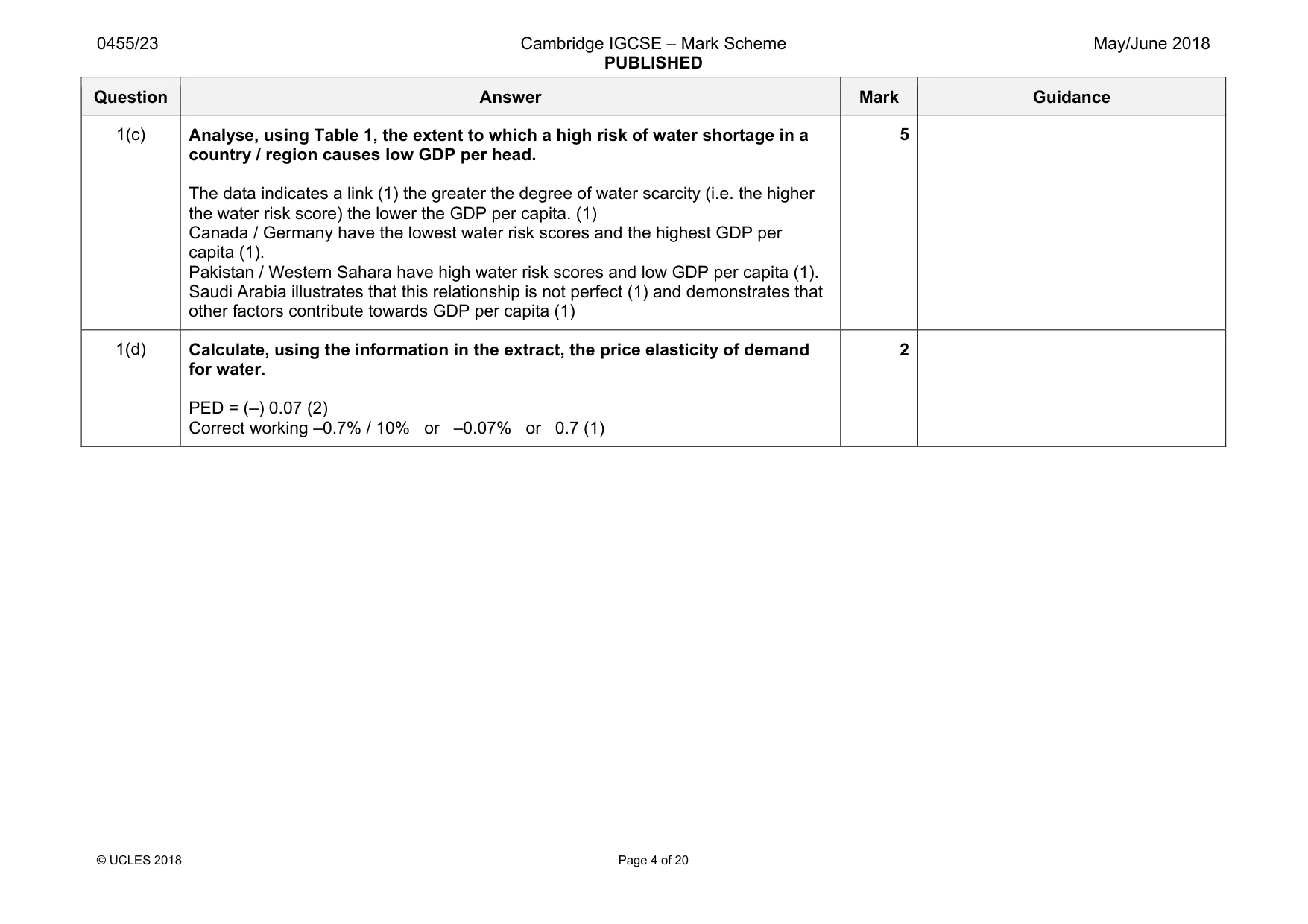
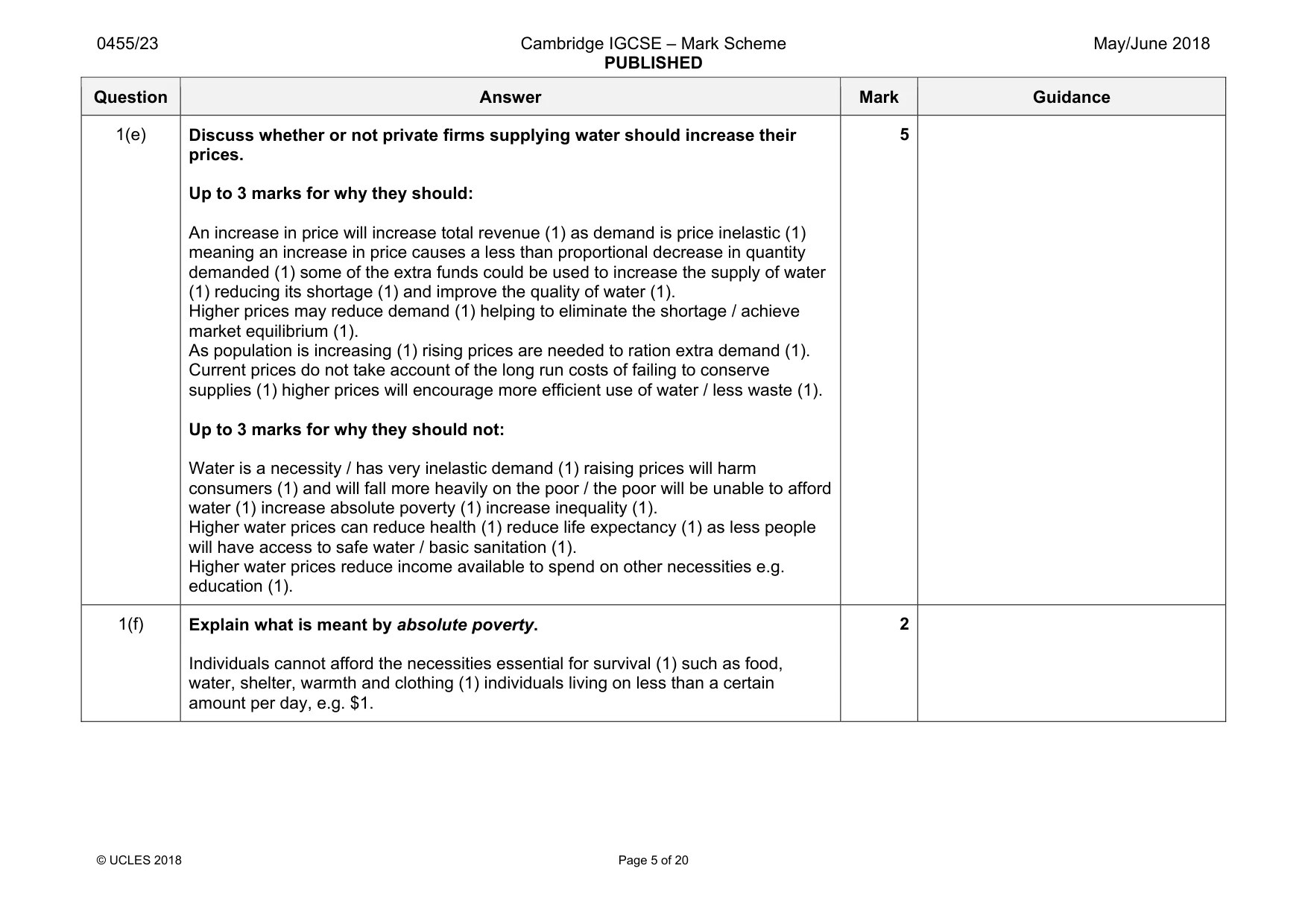
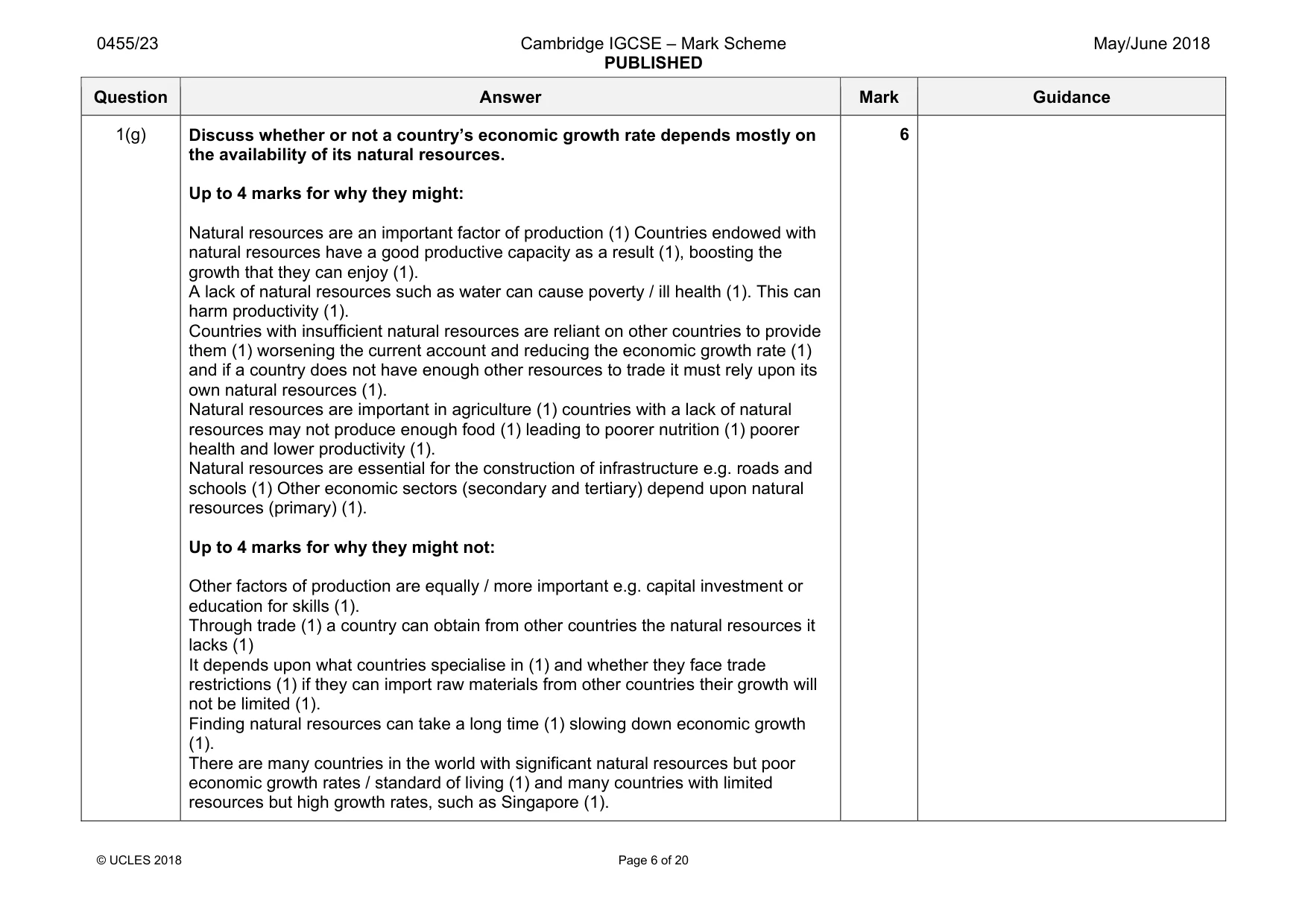
Mark scheme: 1(a) Identify, using information from the extract, two causes of low life expectancy in developing countries. • Poor healthcare facilities • lack of access to safe water • lack of basic sanitation • not enough food production • absolute poverty 2 1(b)(i) Explain, using information from the extract, how the water shortage is an example of the economic problem. The economic problem consists of the allocation of scarce resources amongst competing ends (1). Water supply is at critically low levels (1) showing resources are scarce / limited (1). Rising demand from growth of cities (1) and rising agricultural production (1) wants are unlimited (1). 4 1(b)(ii) Explain, using information from the extract, why the problem of water shortages is likely to become even worse in the future. Water is being undervalued (1) this has led to it being wasted (1) and the prices do not reflect scarcity that will arise in the future (1) this means that as demand continues to rise (1) the gap between wants and the amount of the resource will increase (1). Climate change (1) will cause water supplies to become increasingly scarce (1). Population will continue to rise / cities will expand (1) increasing demand (1) and exceeding the ability of supply to match demand (1). 4 Question Answer Mark Guidance 1(c) Analyse, using Table 1, the extent to which a high risk of water shortage in a country / region causes low GDP per head. The data indicates a link (1) the greater the degree of water scarcity (i.e. the higher the water risk score) the lower the GDP per capita. (1) Canada / Germany have the lowest water risk scores and the highest GDP per capita (1). Pakistan / Western Sahara have high water risk scores and low GDP per capita (1). Saudi Arabia illustrates that this relationship is not perfect (1) and demonstrates that other factors contribute towards GDP per capita (1) 5 1(d) Calculate, using the information in the extract, the price elasticity of demand for water. PED = (–) 0.07 (2) Correct working –0.7% / 10% or –0.07% or 0.7 (1) 2 Question Answer Mark Guidance 1(e) Discuss whether or not private firms supplying water should increase their prices. Up to 3 marks for why they should: An increase in price will increase total revenue (1) as demand is price inelastic (1) meaning an increase in price causes a less than proportional decrease in quantity demanded (1) some of the extra funds could be used to increase the supply of water (1) reducing its shortage (1) and improve the quality of water (1). Higher prices may reduce demand (1) helping to eliminate the shortage / achieve market equilibrium (1). As population is increasing (1) rising prices are needed to ration extra demand (1). Current prices do not take account of the long run costs of failing to conserve supplies (1) higher prices will encourage more efficient use of water / less waste (1). Up to 3 marks for why they should not: Water is a necessity / has very inelastic demand (1) raising prices will harm consumers (1) and will fall more heavily on the poor / the poor will be unable to afford water (1) increase absolute poverty (1) increase inequality (1). Higher water prices can reduce health (1) reduce life expectancy (1) as less people will have access to safe water / basic sanitation (1). Higher water prices reduce income available to spend on other necessities e.g. education (1). 5 1(f) Explain what is meant by absolute poverty. Individuals cannot afford the necessities essential for survival (1) such as food, water, shelter, warmth and clothing (1) individuals living on less than a certain amount per day, e.g. $1. 2 Question Answer Mark Guidance 1(g) Discuss whether or not a country’s economic growth rate depends mostly on the availability of its natural resources. Up to 4 marks for why they might: Natural resources are an important factor of production (1) Countries endowed with natural resources have a good productive capacity as a result (1), boosting the growth that they can enjoy (1). A lack of natural resources such as water can cause poverty / ill health (1). This can harm productivity (1). Countries with insufficient natural resources are reliant on other countries to provide them (1) worsening the current account and reducing the economic growth rate (1) and if a country does not have enough other resources to trade it must rely upon its own natural resources (1). Natural resources are important in agriculture (1) countries with a lack of natural resources may not produce enough food (1) leading to poorer nutrition (1) poorer health and lower productivity (1). Natural resources are essential for the construction of infrastructure e.g. roads and schools (1) Other economic sectors (secondary and tertiary) depend upon natural resources (primary) (1). Up to 4 marks for why they might not: Other factors of production are equally / more important e.g. capital investment or education for skills (1). Through trade (1) a country can obtain from other countries the natural resources it lacks (1) It depends upon what countries specialise in (1) and whether they face trade restrictions (1) if they can import raw materials from other countries their growth will not be limited (1). Finding natural resources can take a long time (1) slowing down economic growth (1). There are many countries in the world with significant natural resources but poor economic growth rates / standard of living (1) and many countries with limited resources but high growth rates, such as Singapore (1). 6
Q2 · In 2016, the trade union representing doctors in the UK was involved in collective…
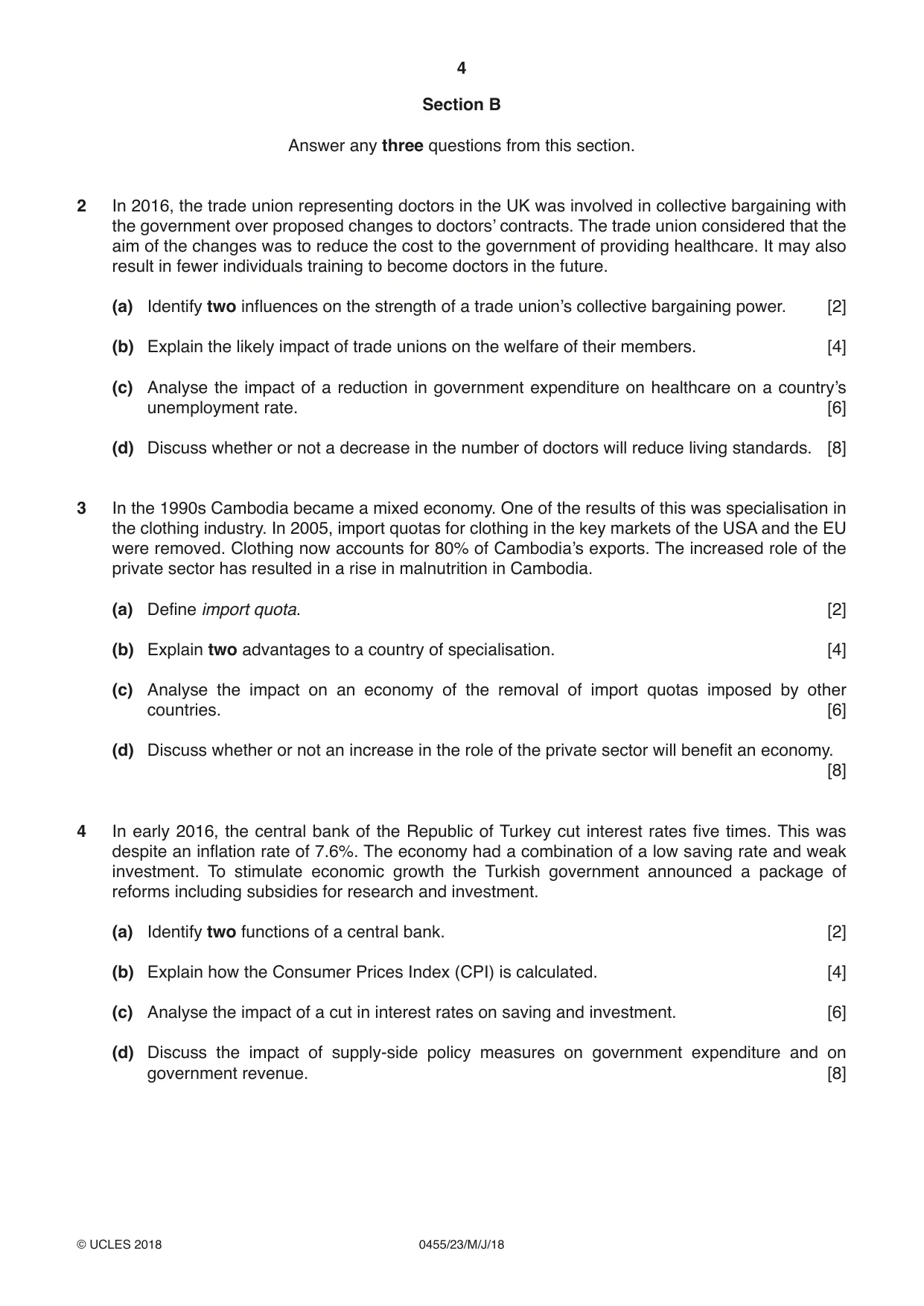
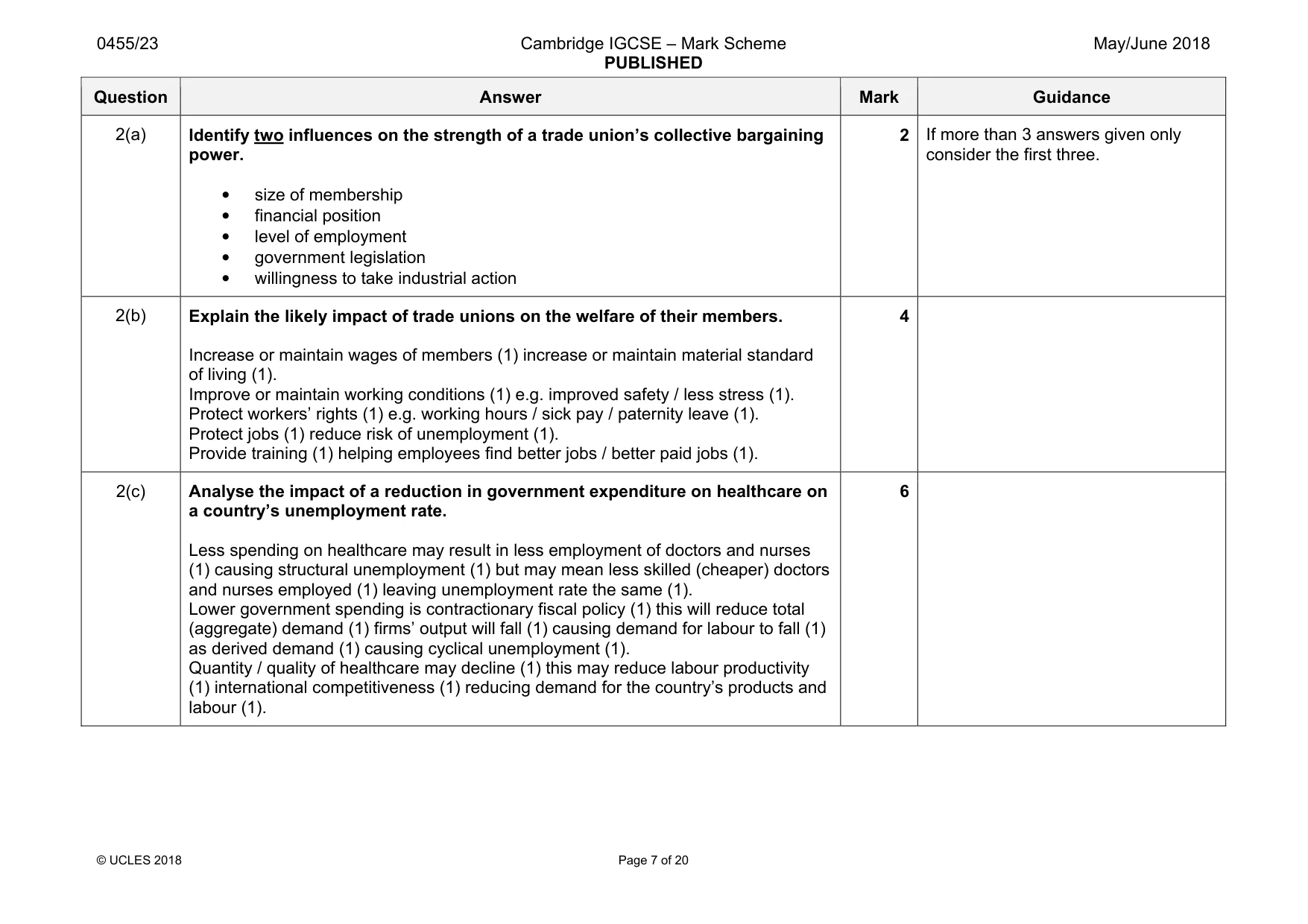
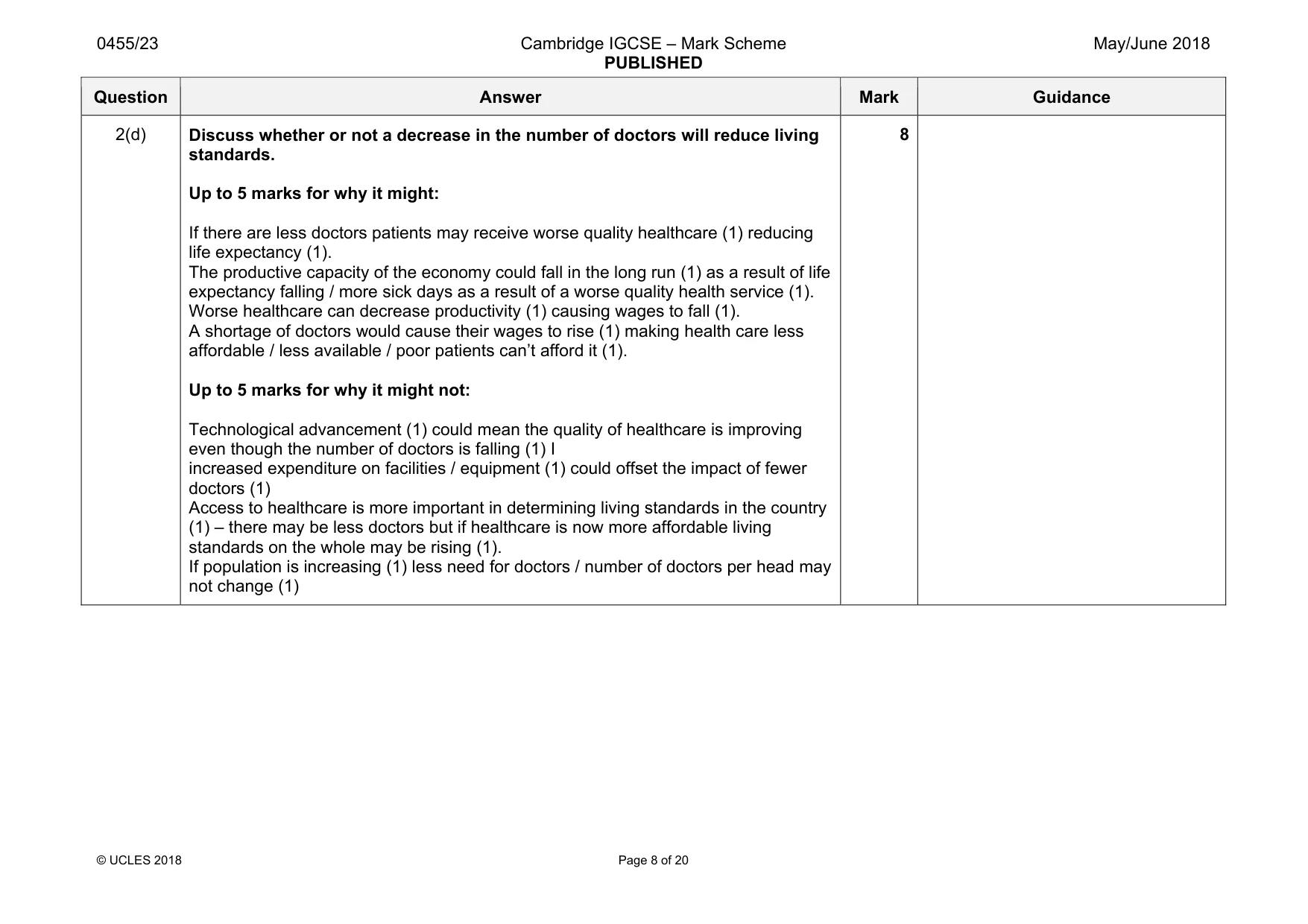
2 In 2016, the trade union representing doctors in the UK was involved in collective bargaining with the government over proposed changes to doctors’ contracts. The trade union considered that the aim of the changes was to reduce the cost to the government of providing healthcare. It may also result in fewer individuals training to become doctors in the future. (a) Identify two influences on the strength of a trade union’s collective bargaining power. [2] (b) Explain the likely impact of trade unions on the welfare of their members. [4] (c) Analyse the impact of a reduction in government expenditure on healthcare on a country’s unemployment rate. [6] (d) Discuss whether or not a decrease in the number of doctors will reduce living standards. [8]
Mark scheme: 2(a) Identify two influences on the strength of a trade union’s collective bargaining power. • size of membership • financial position • level of employment • government legislation • willingness to take industrial action 2 If more than 3 answers given only consider the first three. 2(b) Explain the likely impact of trade unions on the welfare of their members. Increase or maintain wages of members (1) increase or maintain material standard of living (1). Improve or maintain working conditions (1) e.g. improved safety / less stress (1). Protect workers’ rights (1) e.g. working hours / sick pay / paternity leave (1). Protect jobs (1) reduce risk of unemployment (1). Provide training (1) helping employees find better jobs / better paid jobs (1). 4 2(c) Analyse the impact of a reduction in government expenditure on healthcare on a country’s unemployment rate. Less spending on healthcare may result in less employment of doctors and nurses (1) causing structural unemployment (1) but may mean less skilled (cheaper) doctors and nurses employed (1) leaving unemployment rate the same (1). Lower government spending is contractionary fiscal policy (1) this will reduce total (aggregate) demand (1) firms’ output will fall (1) causing demand for labour to fall (1) as derived demand (1) causing cyclical unemployment (1). Quantity / quality of healthcare may decline (1) this may reduce labour productivity (1) international competitiveness (1) reducing demand for the country’s products and labour (1). 6 Question Answer Mark Guidance 2(d) Discuss whether or not a decrease in the number of doctors will reduce living standards. Up to 5 marks for why it might: If there are less doctors patients may receive worse quality healthcare (1) reducing life expectancy (1). The productive capacity of the economy could fall in the long run (1) as a result of life expectancy falling / more sick days as a result of a worse quality health service (1). Worse healthcare can decrease productivity (1) causing wages to fall (1). A shortage of doctors would cause their wages to rise (1) making health care less affordable / less available / poor patients can’t afford it (1). Up to 5 marks for why it might not: Technological advancement (1) could mean the quality of healthcare is improving even though the number of doctors is falling (1) I increased expenditure on facilities / equipment (1) could offset the impact of fewer doctors (1) Access to healthcare is more important in determining living standards in the country (1) – there may be less doctors but if healthcare is now more affordable living standards on the whole may be rising (1). If population is increasing (1) less need for doctors / number of doctors per head may not change (1) 8
Q3 · In the 1990s Cambodia became a mixed economy
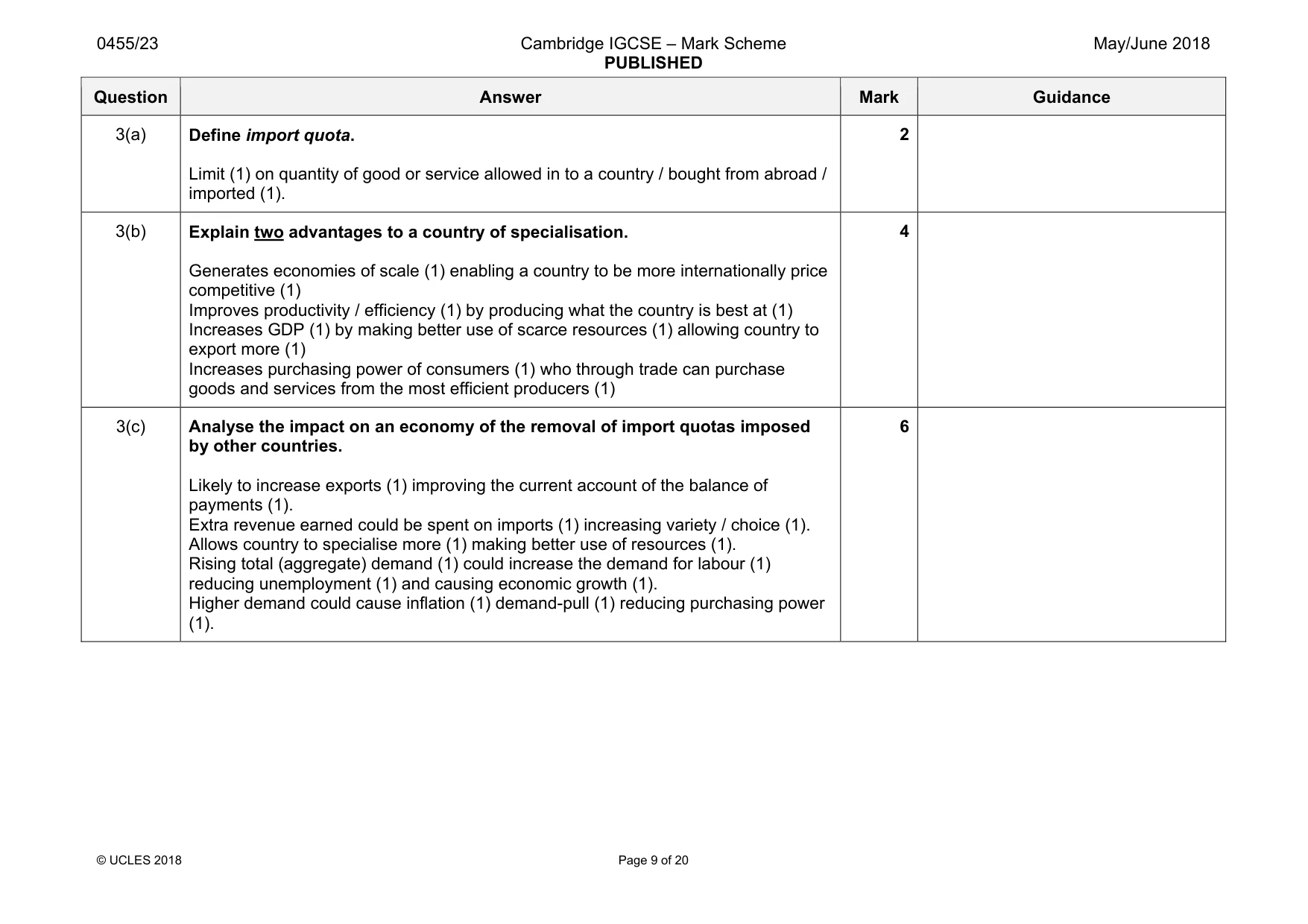
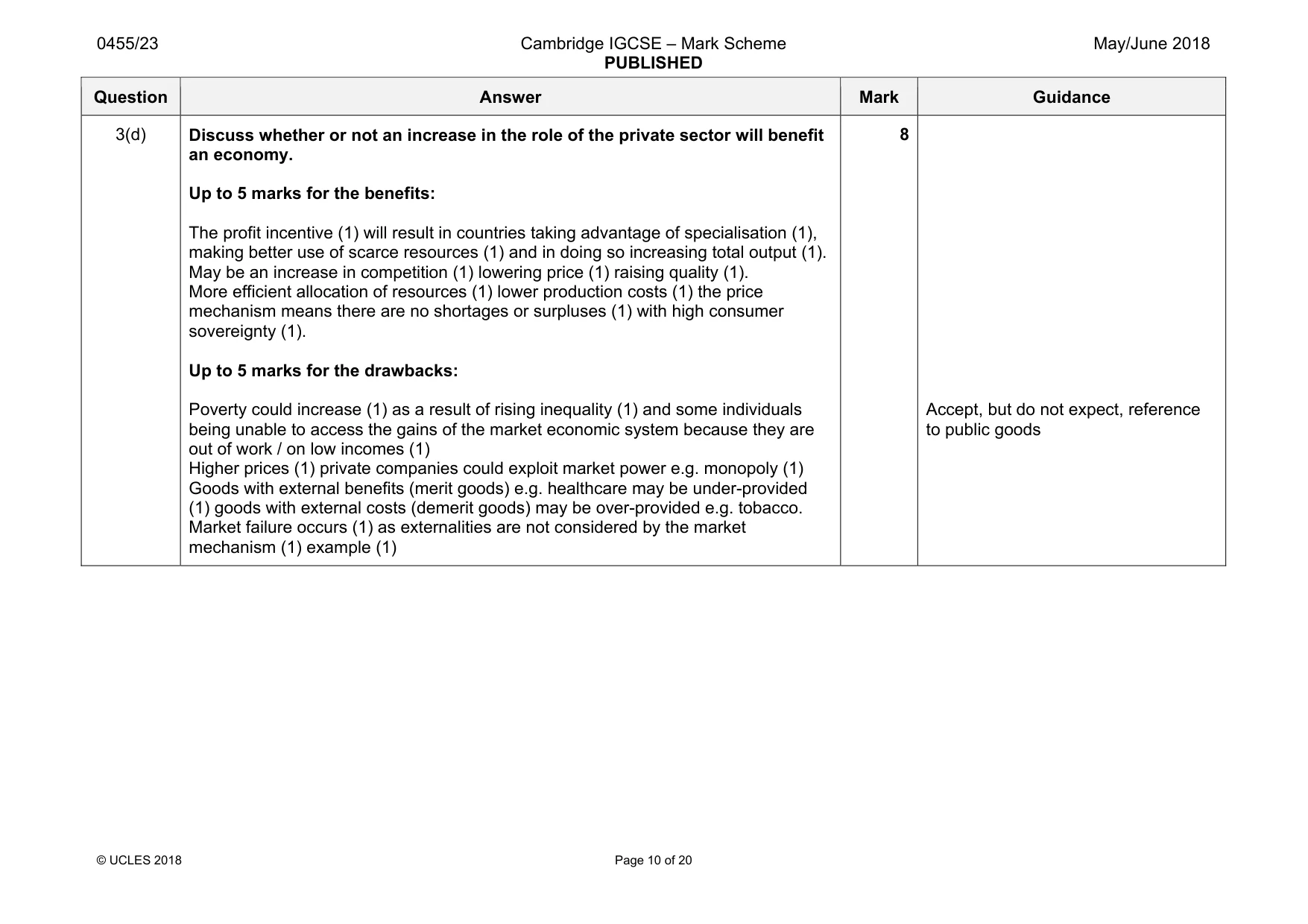
3 In the 1990s Cambodia became a mixed economy. One of the results of this was specialisation in the clothing industry. In 2005, import quotas for clothing in the key markets of the USA and the EU were removed. Clothing now accounts for 80% of Cambodia’s exports. The increased role of the private sector has resulted in a rise in malnutrition in Cambodia. (a) Define import quota. [2] (b) Explain two advantages to a country of specialisation. [4] (c) Analyse the impact on an economy of the removal of import quotas imposed by other countries. [6] (d) Discuss whether or not an increase in the role of the private sector will benefit an economy. [8]
Mark scheme: 3(a) Define import quota. Limit (1) on quantity of good or service allowed in to a country / bought from abroad / imported (1). 2 3(b) Explain two advantages to a country of specialisation. Generates economies of scale (1) enabling a country to be more internationally price competitive (1) Improves productivity / efficiency (1) by producing what the country is best at (1) Increases GDP (1) by making better use of scarce resources (1) allowing country to export more (1) Increases purchasing power of consumers (1) who through trade can purchase goods and services from the most efficient producers (1) 4 3(c) Analyse the impact on an economy of the removal of import quotas imposed by other countries. Likely to increase exports (1) improving the current account of the balance of payments (1). Extra revenue earned could be spent on imports (1) increasing variety / choice (1). Allows country to specialise more (1) making better use of resources (1). Rising total (aggregate) demand (1) could increase the demand for labour (1) reducing unemployment (1) and causing economic growth (1). Higher demand could cause inflation (1) demand-pull (1) reducing purchasing power (1). 6 Question Answer Mark Guidance 3(d) Discuss whether or not an increase in the role of the private sector will benefit an economy. Up to 5 marks for the benefits: The profit incentive (1) will result in countries taking advantage of specialisation (1), making better use of scarce resources (1) and in doing so increasing total output (1). May be an increase in competition (1) lowering price (1) raising quality (1). More efficient allocation of resources (1) lower production costs (1) the price mechanism means there are no shortages or surpluses (1) with high consumer sovereignty (1). Up to 5 marks for the drawbacks: Poverty could increase (1) as a result of rising inequality (1) and some individuals being unable to access the gains of the market economic system because they are out of work / on low incomes (1) Higher prices (1) private companies could exploit market power e.g. monopoly (1) Goods with external benefits (merit goods) e.g. healthcare may be under-provided (1) goods with external costs (demerit goods) may be over-provided e.g. tobacco. Market failure occurs (1) as externalities are not considered by the market mechanism (1) example (1) 8 Accept, but do not expect, reference to public goods
Q4 · In early 2016, the central bank of the Republic of Turkey cut interest rates five times
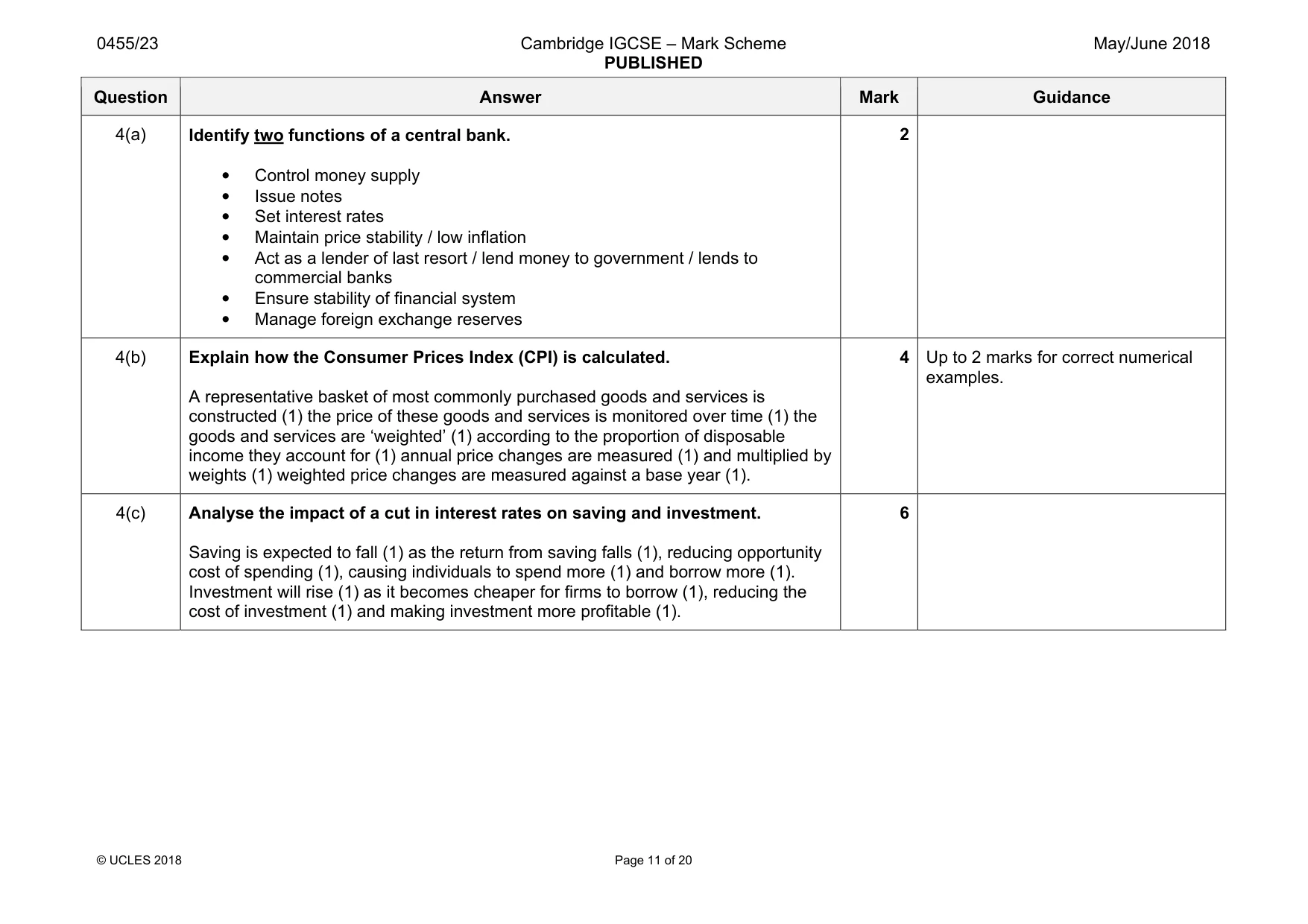
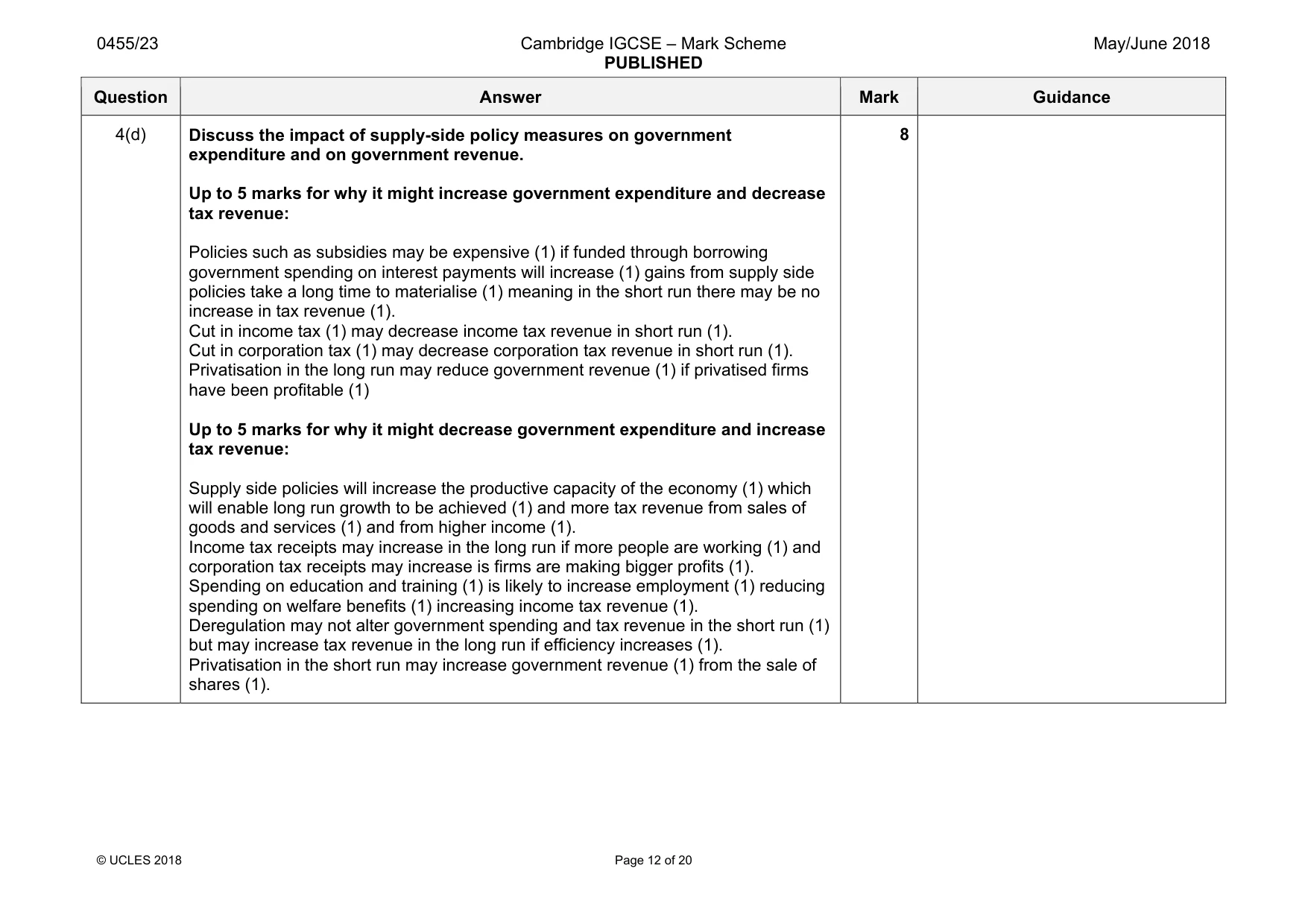
4 In early 2016, the central bank of the Republic of Turkey cut interest rates five times. This was despite an inflation rate of 7.6%. The economy had a combination of a low saving rate and weak investment. To stimulate economic growth the Turkish government announced a package of reforms including subsidies for research and investment. (a) Identify two functions of a central bank. [2] (b) Explain how the Consumer Prices Index (CPI) is calculated. [4] (c) Analyse the impact of a cut in interest rates on saving and investment. [6] (d) Discuss the impact of supply-side policy measures on government expenditure and on government revenue. [8]
Mark scheme: 4(a) Identify two functions of a central bank. • Control money supply • Issue notes • Set interest rates • Maintain price stability / low inflation • Act as a lender of last resort / lend money to government / lends to commercial banks • Ensure stability of financial system • Manage foreign exchange reserves 2 4(b) Explain how the Consumer Prices Index (CPI) is calculated. A representative basket of most commonly purchased goods and services is constructed (1) the price of these goods and services is monitored over time (1) the goods and services are ‘weighted’ (1) according to the proportion of disposable income they account for (1) annual price changes are measured (1) and multiplied by weights (1) weighted price changes are measured against a base year (1). 4 Up to 2 marks for correct numerical examples. 4(c) Analyse the impact of a cut in interest rates on saving and investment. Saving is expected to fall (1) as the return from saving falls (1), reducing opportunity cost of spending (1), causing individuals to spend more (1) and borrow more (1). Investment will rise (1) as it becomes cheaper for firms to borrow (1), reducing the cost of investment (1) and making investment more profitable (1). 6 Question Answer Mark Guidance 4(d) Discuss the impact of supply-side policy measures on government expenditure and on government revenue. Up to 5 marks for why it might increase government expenditure and decrease tax revenue: Policies such as subsidies may be expensive (1) if funded through borrowing government spending on interest payments will increase (1) gains from supply side policies take a long time to materialise (1) meaning in the short run there may be no increase in tax revenue (1). Cut in income tax (1) may decrease income tax revenue in short run (1). Cut in corporation tax (1) may decrease corporation tax revenue in short run (1). Privatisation in the long run may reduce government revenue (1) if privatised firms have been profitable (1) Up to 5 marks for why it might decrease government expenditure and increase tax revenue: Supply side policies will increase the productive capacity of the economy (1) which will enable long run growth to be achieved (1) and more tax revenue from sales of goods and services (1) and from higher income (1). Income tax receipts may increase in the long run if more people are working (1) and corporation tax receipts may increase is firms are making bigger profits (1). Spending on education and training (1) is likely to increase employment (1) reducing spending on welfare benefits (1) increasing income tax revenue (1). Deregulation may not alter government spending and tax revenue in the short run (1) but may increase tax revenue in the long run if efficiency increases (1). Privatisation in the short run may increase government revenue (1) from the sale of shares (1). 8
Q5 · The state of California has the most progressive tax system in the USA
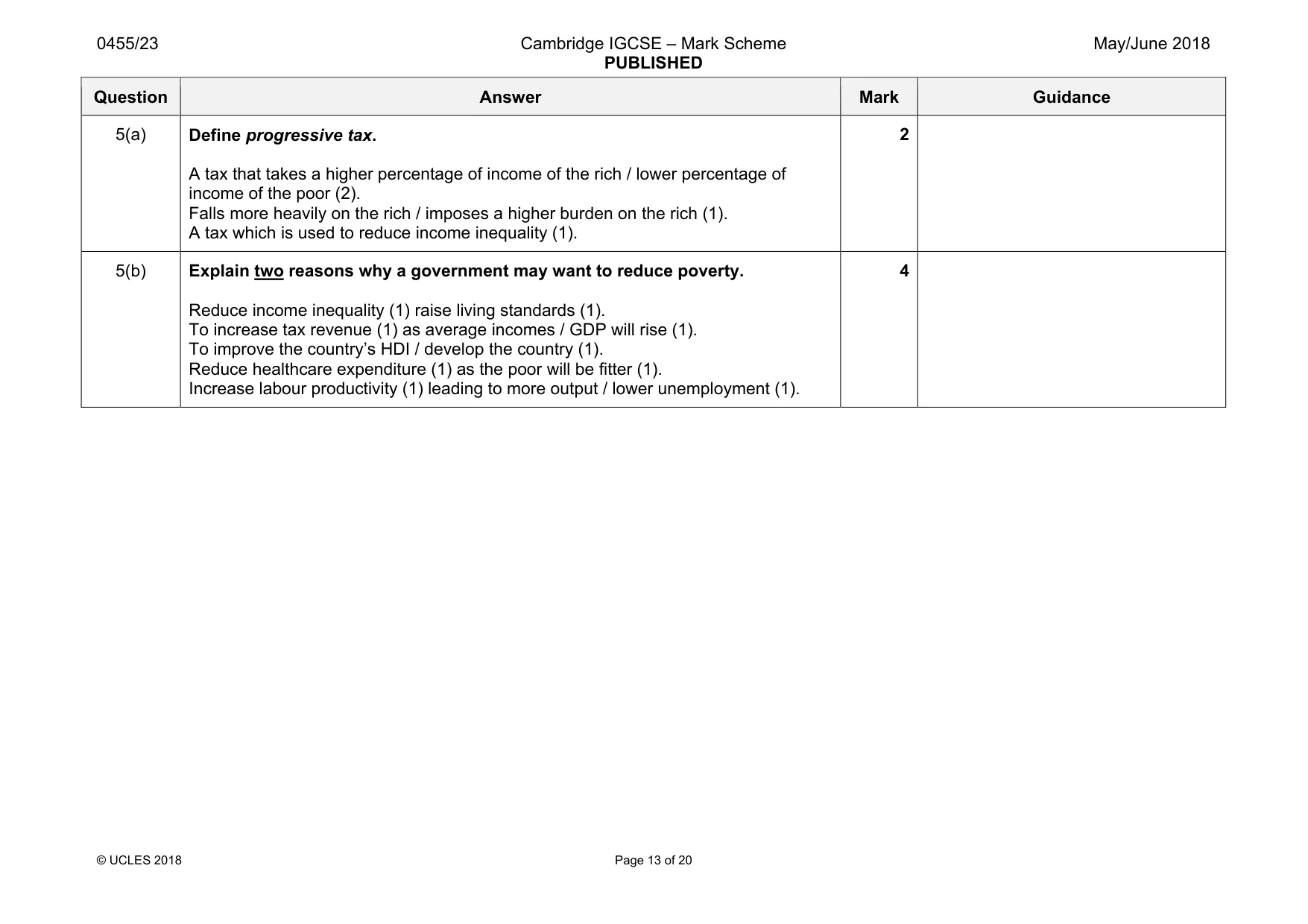
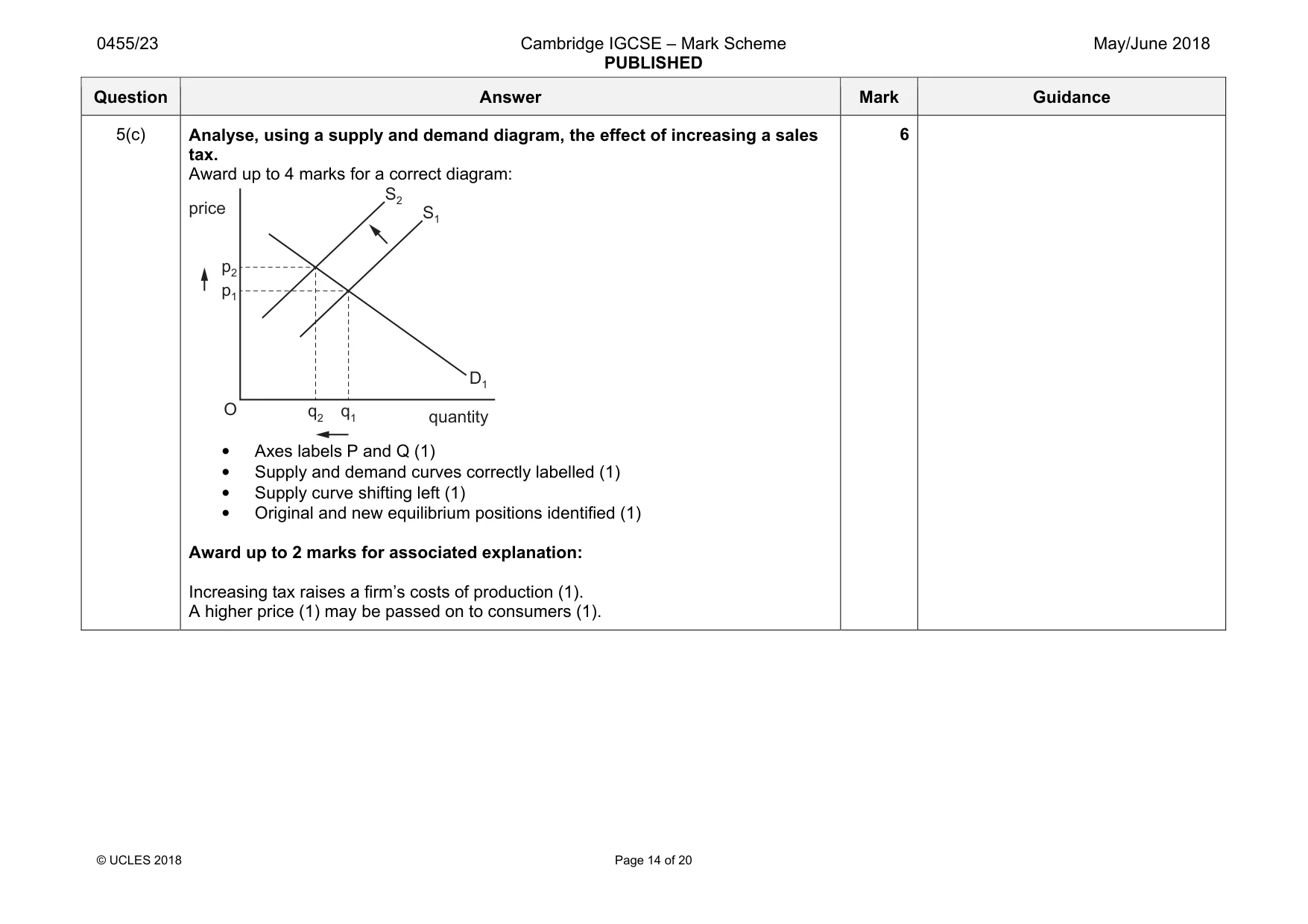
5 The state of California has the most progressive tax system in the USA. The tax system helps reduce high poverty rates. Policy makers are considering reforming sales tax in the state to include services, while reducing the use of direct taxes. (a) Define progressive tax. [2] (b) Explain two reasons why a government may want to reduce poverty. [4] (c) Analyse, using a supply and demand diagram, the effect of increasing a sales tax. [6] (d) Discuss whether a government should increase indirect taxes and whether it should reduce direct taxes. [8]
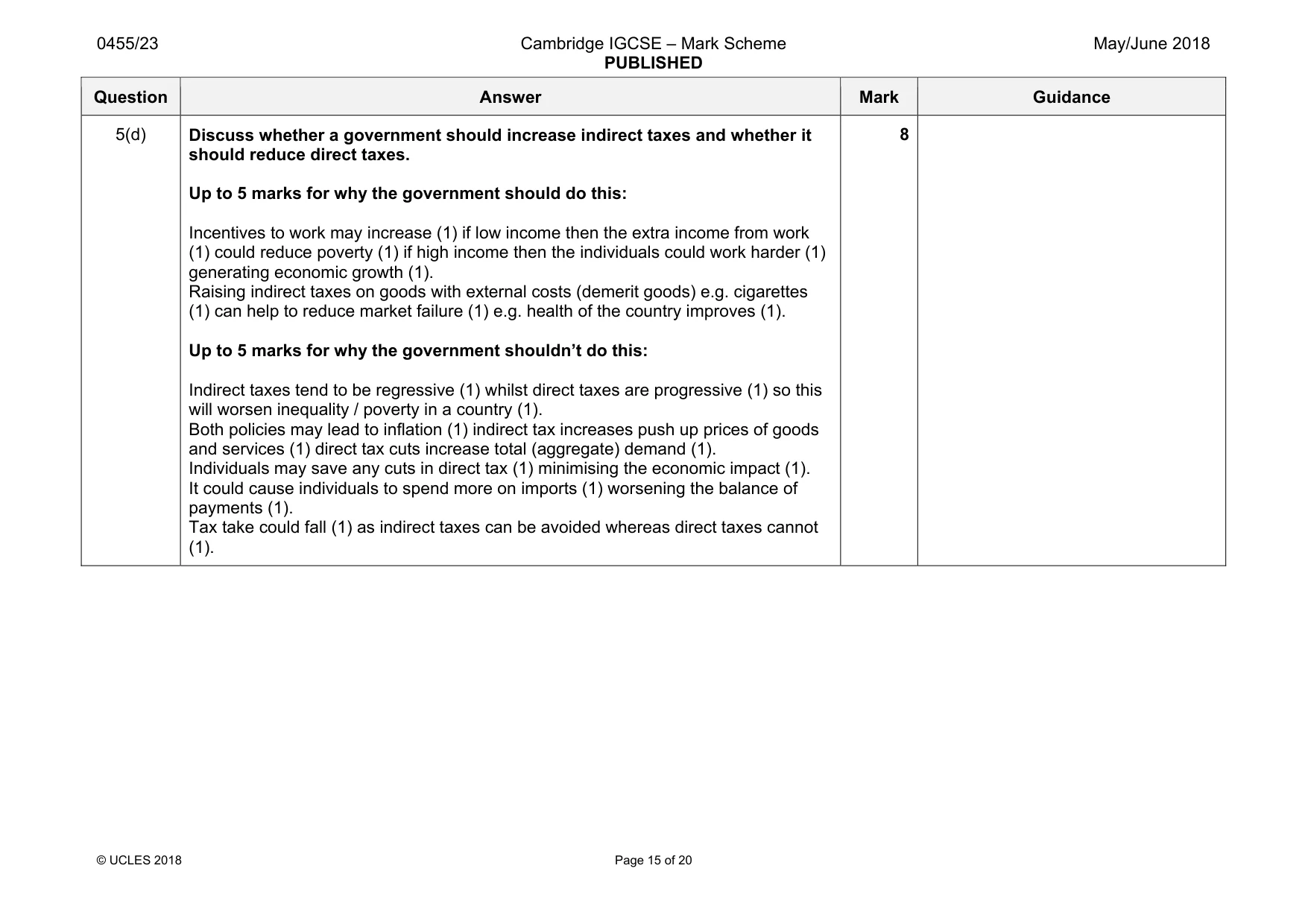
Mark scheme: 5(a) Define progressive tax. A tax that takes a higher percentage of income of the rich / lower percentage of income of the poor (2). Falls more heavily on the rich / imposes a higher burden on the rich (1). A tax which is used to reduce income inequality (1). 2 5(b) Explain two reasons why a government may want to reduce poverty. Reduce income inequality (1) raise living standards (1). To increase tax revenue (1) as average incomes / GDP will rise (1). To improve the country’s HDI / develop the country (1). Reduce healthcare expenditure (1) as the poor will be fitter (1). Increase labour productivity (1) leading to more output / lower unemployment (1). 4 Question Answer Mark Guidance 5(c) Analyse, using a supply and demand diagram, the effect of increasing a sales tax. Award up to 4 marks for a correct diagram: • Axes labels P and Q (1) • Supply and demand curves correctly labelled (1) • Supply curve shifting left (1) • Original and new equilibrium positions identified (1) Award up to 2 marks for associated explanation: Increasing tax raises a firm’s costs of production (1). A higher price (1) may be passed on to consumers (1). 6 price quantity O S2 S1 p2 p1 D1 q2 q1 Question Answer Mark Guidance 5(d) Discuss whether a government should increase indirect taxes and whether it should reduce direct taxes. Up to 5 marks for why the government should do this: Incentives to work may increase (1) if low income then the extra income from work (1) could reduce poverty (1) if high income then the individuals could work harder (1) generating economic growth (1). Raising indirect taxes on goods with external costs (demerit goods) e.g. cigarettes (1) can help to reduce market failure (1) e.g. health of the country improves (1). Up to 5 marks for why the government shouldn’t do this: Indirect taxes tend to be regressive (1) whilst direct taxes are progressive (1) so this will worsen inequality / poverty in a country (1). Both policies may lead to inflation (1) indirect tax increases push up prices of goods and services (1) direct tax cuts increase total (aggregate) demand (1). Individuals may save any cuts in direct tax (1) minimising the economic impact (1). It could cause individuals to spend more on imports (1) worsening the balance of payments (1). Tax take could fall (1) as indirect taxes can be avoided whereas direct taxes cannot (1). 8
Q6 · The production process in the oil industry is capital-intensive
6 The production process in the oil industry is capital-intensive. The pollution it generates means it is one cause of environmental market failure. A Nigerian oil monopoly is starting to produce more environmentally friendly liquefied petroleum gas (LPG), rather than kerosene, in an attempt to reduce pollution. The Nigerian government intends to split the monopoly firm into separate companies to improve efficiency. (a) Identify two features of a capital-intensive production process. [2] (b) Explain how market failure might occur in the oil industry. [4] (c) Analyse, using a production possibility curve (PPC) diagram, the effect of reallocating resources from kerosene to LPG. [6] (d) Discuss whether or not removing a firm’s monopoly power will benefit consumers. [8]
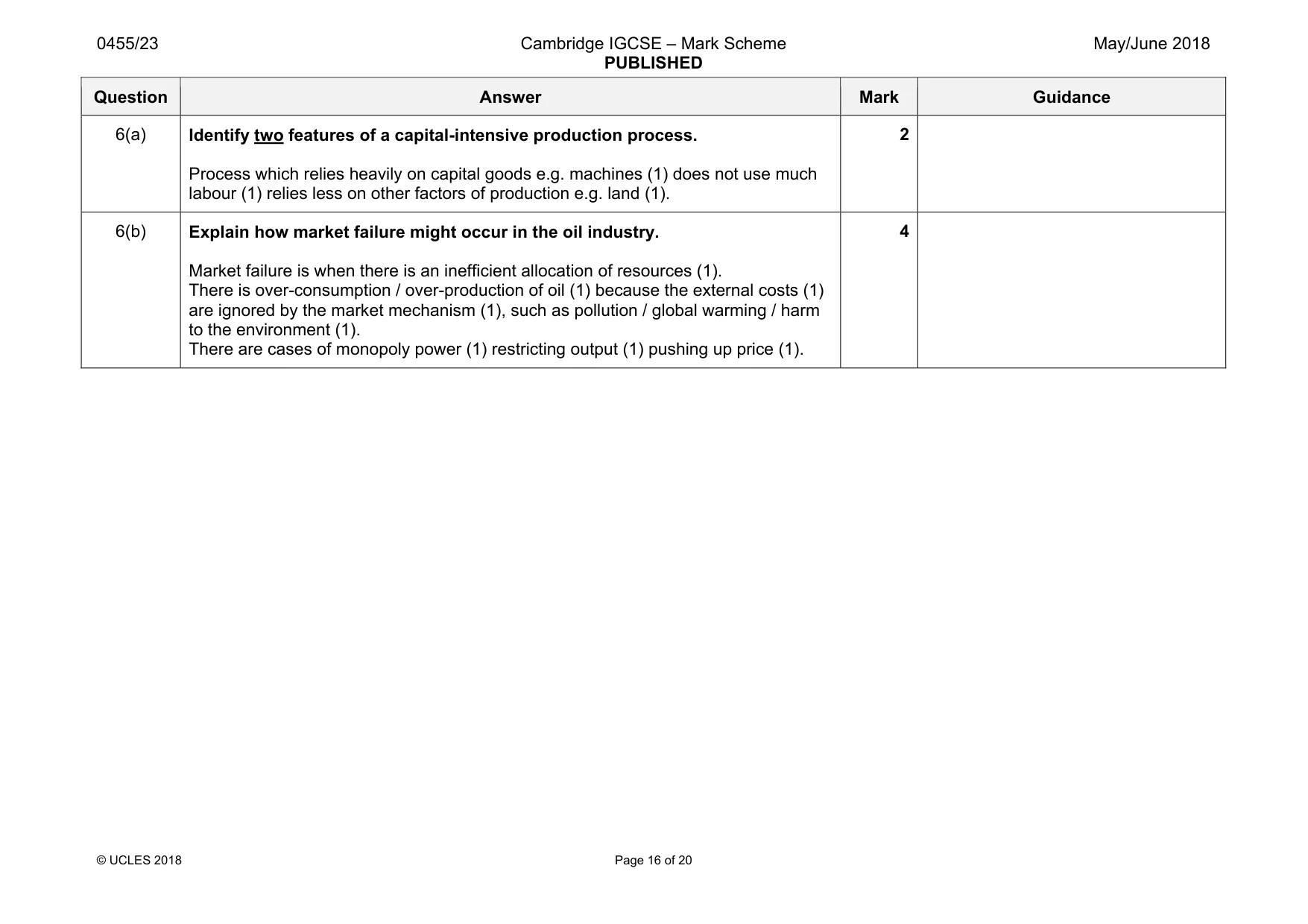
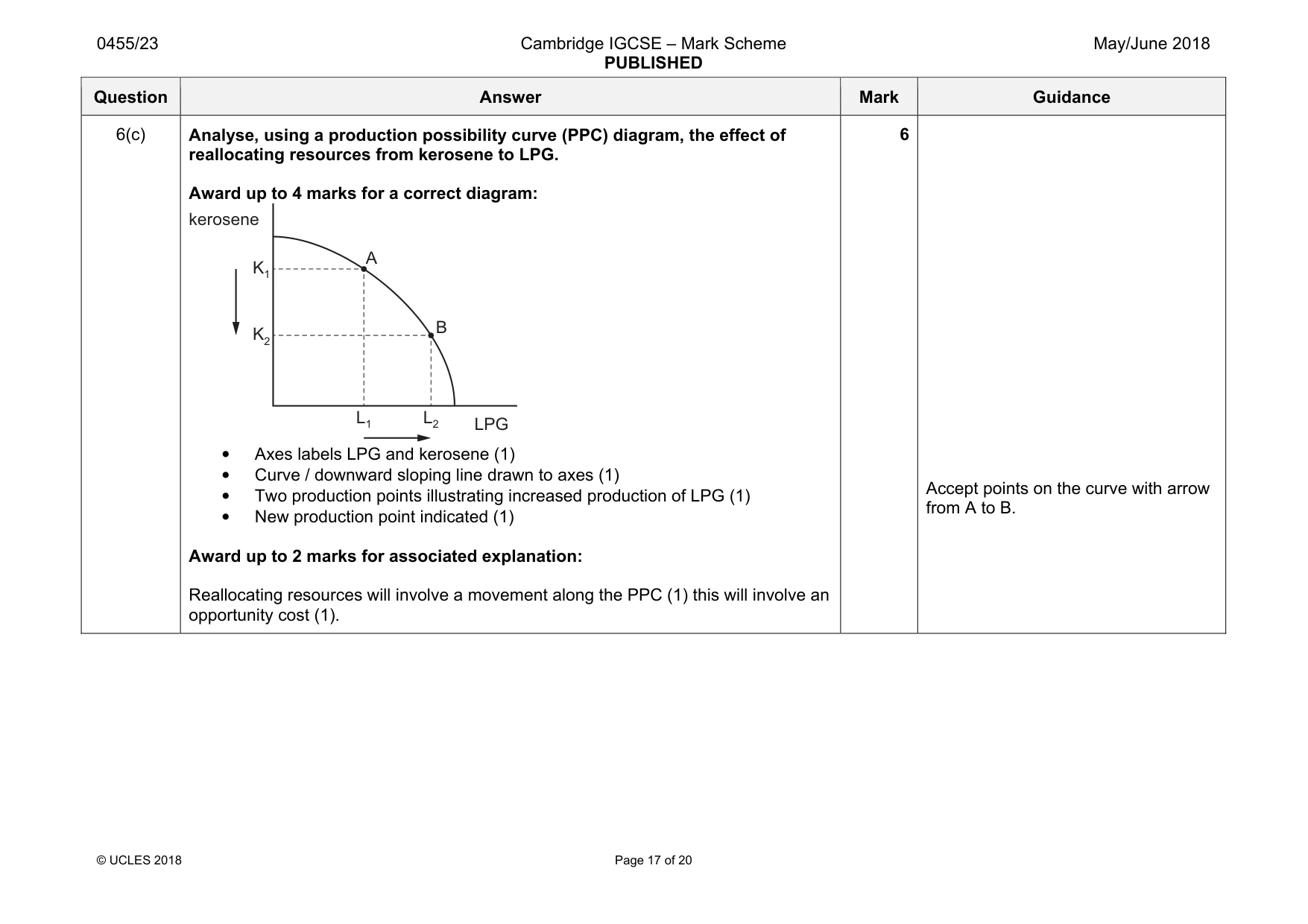
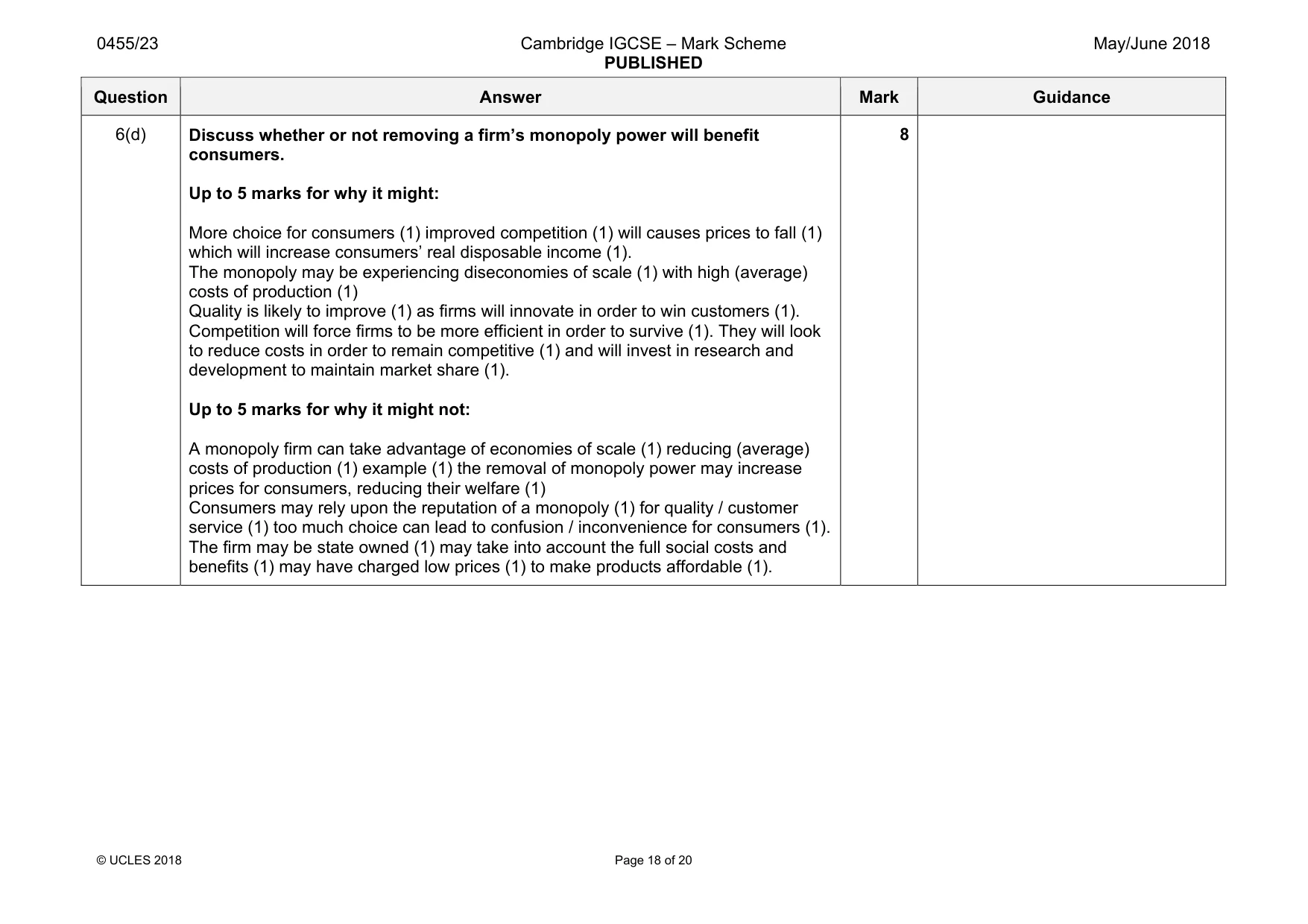
Mark scheme: 6(a) Identify two features of a capital-intensive production process. Process which relies heavily on capital goods e.g. machines (1) does not use much labour (1) relies less on other factors of production e.g. land (1). 2 6(b) Explain how market failure might occur in the oil industry. Market failure is when there is an inefficient allocation of resources (1). There is over-consumption / over-production of oil (1) because the external costs (1) are ignored by the market mechanism (1), such as pollution / global warming / harm to the environment (1). There are cases of monopoly power (1) restricting output (1) pushing up price (1). 4 Question Answer Mark Guidance 6(c) Analyse, using a production possibility curve (PPC) diagram, the effect of reallocating resources from kerosene to LPG. Award up to 4 marks for a correct diagram: • Axes labels LPG and kerosene (1) • Curve / downward sloping line drawn to axes (1) • Two production points illustrating increased production of LPG (1) • New production point indicated (1) Award up to 2 marks for associated explanation: Reallocating resources will involve a movement along the PPC (1) this will involve an opportunity cost (1). 6 Accept points on the curve with arrow from A to B. kerosene LPG K1 L1 L2 K2 A B Question Answer Mark Guidance 6(d) Discuss whether or not removing a firm’s monopoly power will benefit consumers. Up to 5 marks for why it might: More choice for consumers (1) improved competition (1) will causes prices to fall (1) which will increase consumers’ real disposable income (1). The monopoly may be experiencing diseconomies of scale (1) with high (average) costs of production (1) Quality is likely to improve (1) as firms will innovate in order to win customers (1). Competition will force firms to be more efficient in order to survive (1). They will look to reduce costs in order to remain competitive (1) and will invest in research and development to maintain market share (1). Up to 5 marks for why it might not: A monopoly firm can take advantage of economies of scale (1) reducing (average) costs of production (1) example (1) the removal of monopoly power may increase prices for consumers, reducing their welfare (1) Consumers may rely upon the reputation of a monopoly (1) for quality / customer service (1) too much choice can lead to confusion / inconvenience for consumers (1). The firm may be state owned (1) may take into account the full social costs and benefits (1) may have charged low prices (1) to make products affordable (1). 8
Q7 · In 2016, there were fears that the Singaporean economy could enter a recession because of…
7 In 2016, there were fears that the Singaporean economy could enter a recession because of falling demand from China, its biggest export market. One of the results of a recession is likely to be a fall in consumer spending. A previous recession in 2008 had led to unemployment increasing from 1.6% to 3.4%. Singapore’s central bank therefore decided to intervene in the foreign exchange market to influence the value of the currency. (a) Define recession. [2] (b) Explain why a recession is likely to reduce consumer spending. [4] (c) Analyse the consequences of rising unemployment on a government’s spending and tax revenue. [6] (d) Discuss whether or not an exchange rate depreciation will prevent an economy from experiencing a recession. [8]
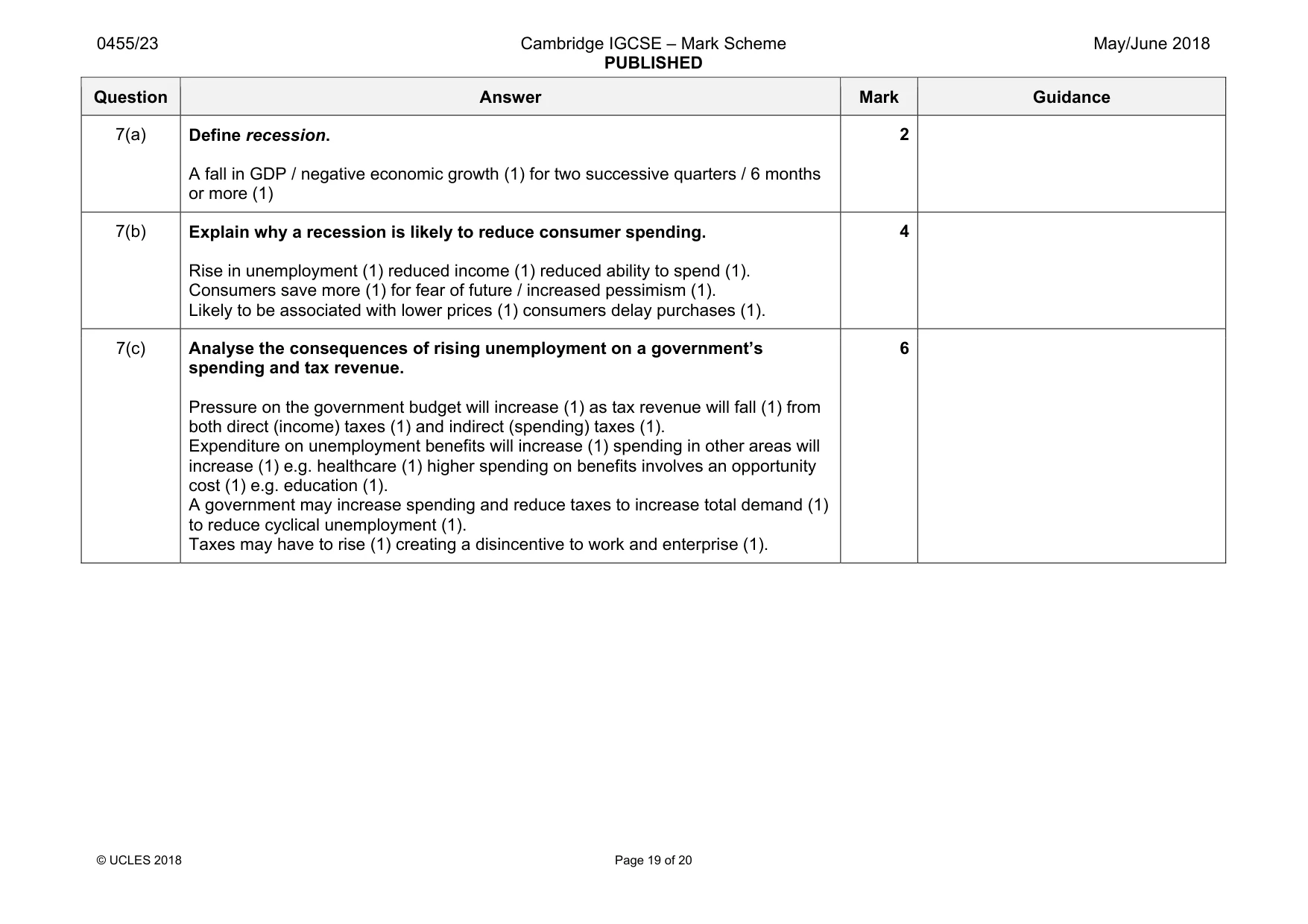
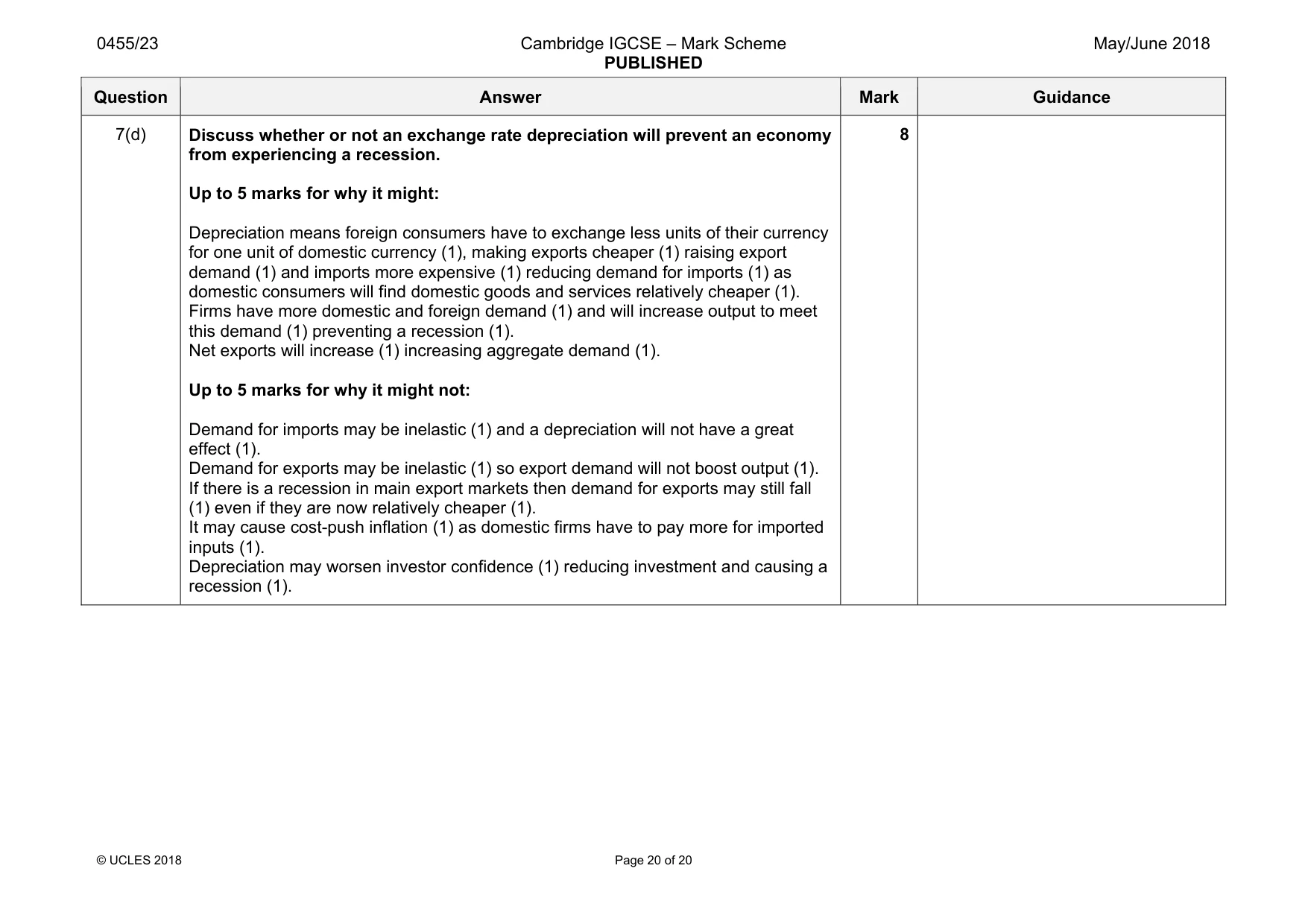
Mark scheme: 7(a) Define recession. A fall in GDP / negative economic growth (1) for two successive quarters / 6 months or more (1) 2 7(b) Explain why a recession is likely to reduce consumer spending. Rise in unemployment (1) reduced income (1) reduced ability to spend (1). Consumers save more (1) for fear of future / increased pessimism (1). Likely to be associated with lower prices (1) consumers delay purchases (1). 4 7(c) Analyse the consequences of rising unemployment on a government’s spending and tax revenue. Pressure on the government budget will increase (1) as tax revenue will fall (1) from both direct (income) taxes (1) and indirect (spending) taxes (1). Expenditure on unemployment benefits will increase (1) spending in other areas will increase (1) e.g. healthcare (1) higher spending on benefits involves an opportunity cost (1) e.g. education (1). A government may increase spending and reduce taxes to increase total demand (1) to reduce cyclical unemployment (1). Taxes may have to rise (1) creating a disincentive to work and enterprise (1). 6 Question Answer Mark Guidance 7(d) Discuss whether or not an exchange rate depreciation will prevent an economy from experiencing a recession. Up to 5 marks for why it might: Depreciation means foreign consumers have to exchange less units of their currency for one unit of domestic currency (1), making exports cheaper (1) raising export demand (1) and imports more expensive (1) reducing demand for imports (1) as domestic consumers will find domestic goods and services relatively cheaper (1). Firms have more domestic and foreign demand (1) and will increase output to meet this demand (1) preventing a recession (1). Net exports will increase (1) increasing aggregate demand (1). Up to 5 marks for why it might not: Demand for imports may be inelastic (1) and a depreciation will not have a great effect (1). Demand for exports may be inelastic (1) so export demand will not boost output (1). If there is a recession in main export markets then demand for exports may still fall (1) even if they are now relatively cheaper (1). It may cause cost-push inflation (1) as domestic firms have to pay more for imported inputs (1). Depreciation may worsen investor confidence (1) reducing investment and causing a recession (1). 8
What was in this paper
The subtopics covered by these 7 questions, and how many questions each got. Open one in a new tab to see every Cambridge question on it.
What you needed in this session
Cambridge’s own grade thresholds for 2018 May/June, Paper 2 · Variant 3. A higher threshold means an easier paper — the bar moves with how the cohort did.