Cambridge IGCSE Economics 0455 — 2020 May/June Paper 2 · Variant 2
0455/22/M/J/20 · 5 questions · 110 marks · ≈124 min
The question paper and its mark scheme, free to read here and free to download. This is Cambridge’s own paper, exactly as it was sat.
Question paper8 pages




Mark scheme14 pages
Answers below. Sit the paper first if you are practising.

Questions as text
Q1 · Calculate Pakistan’s trade in goods balance in 2017
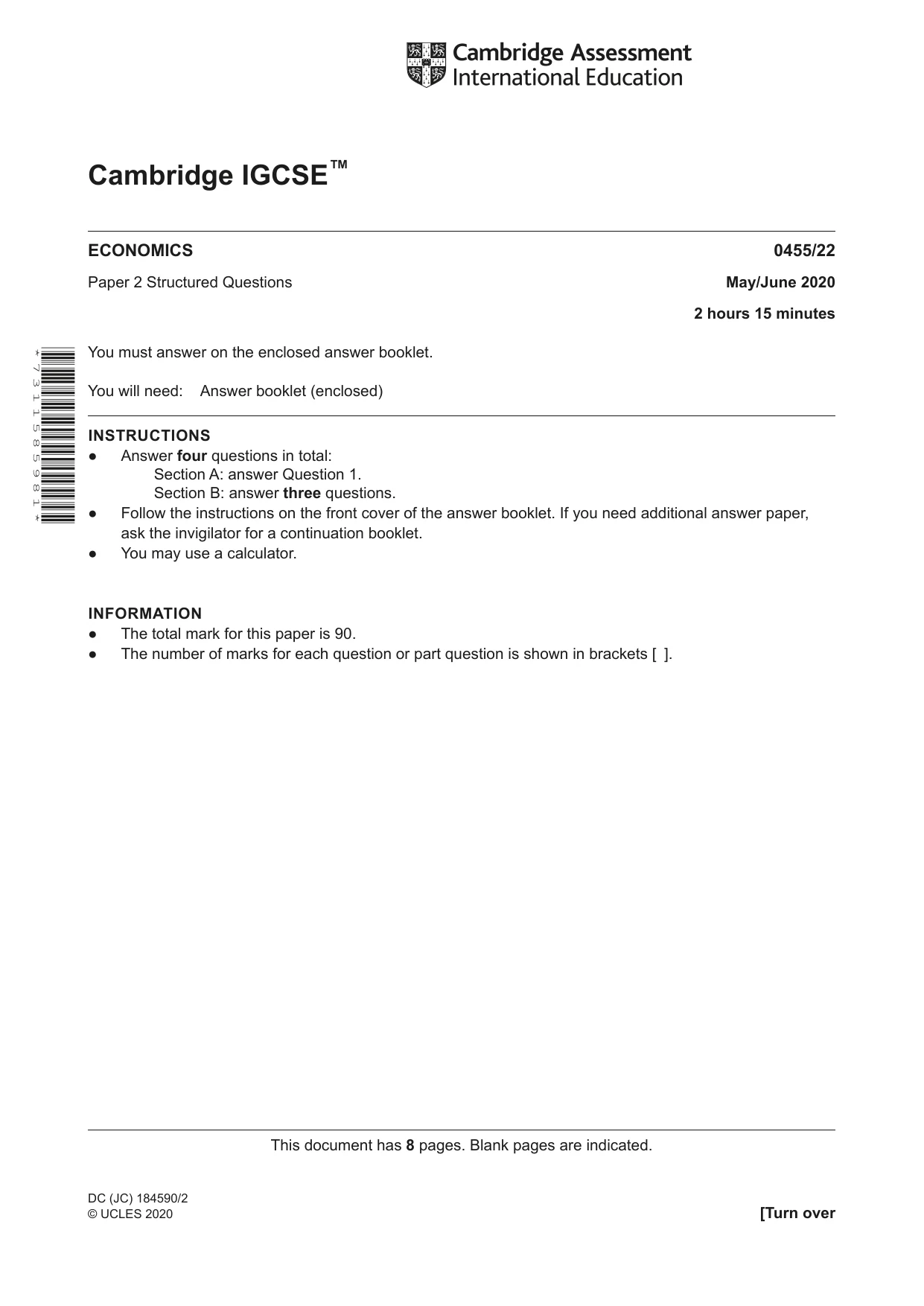
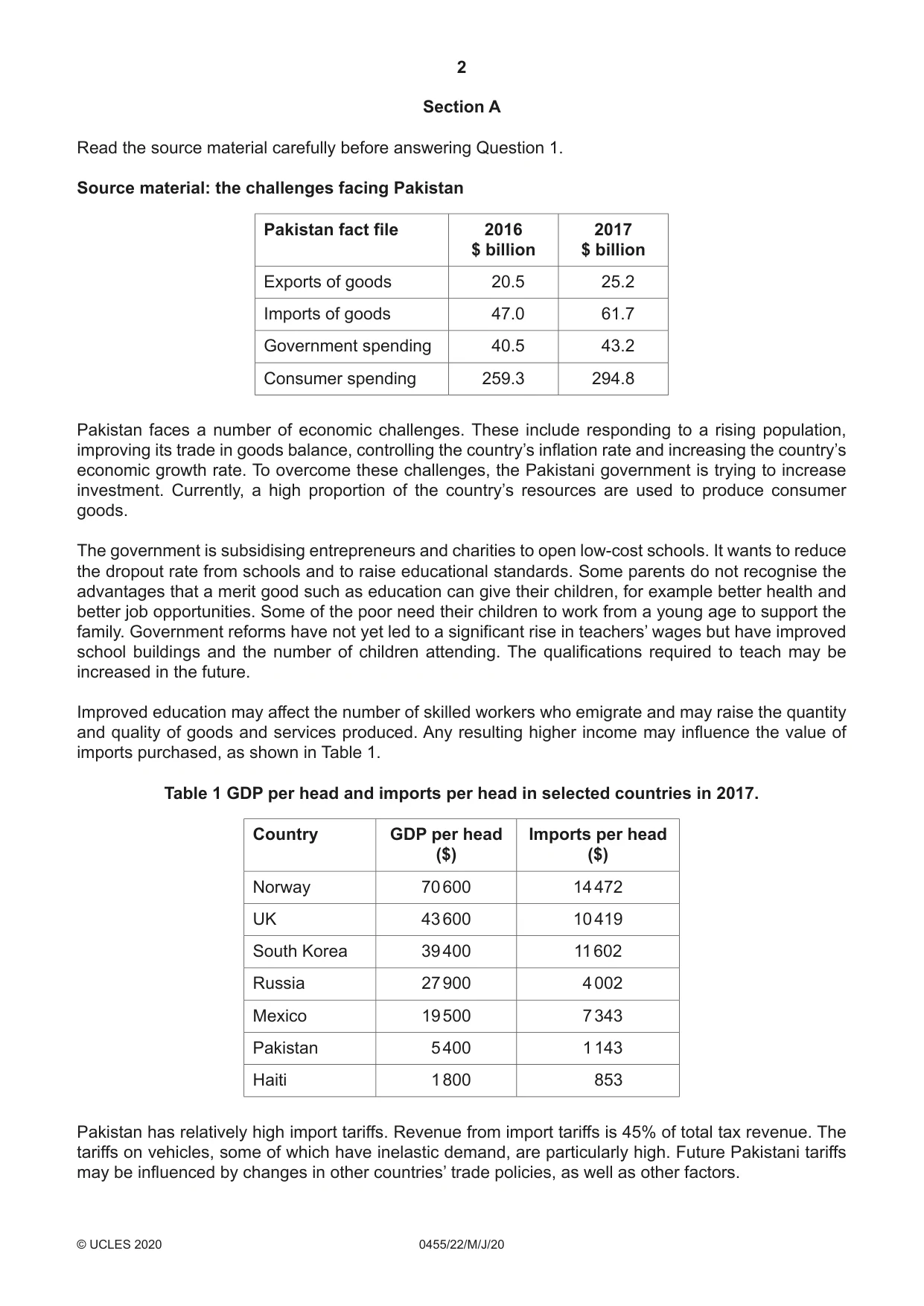
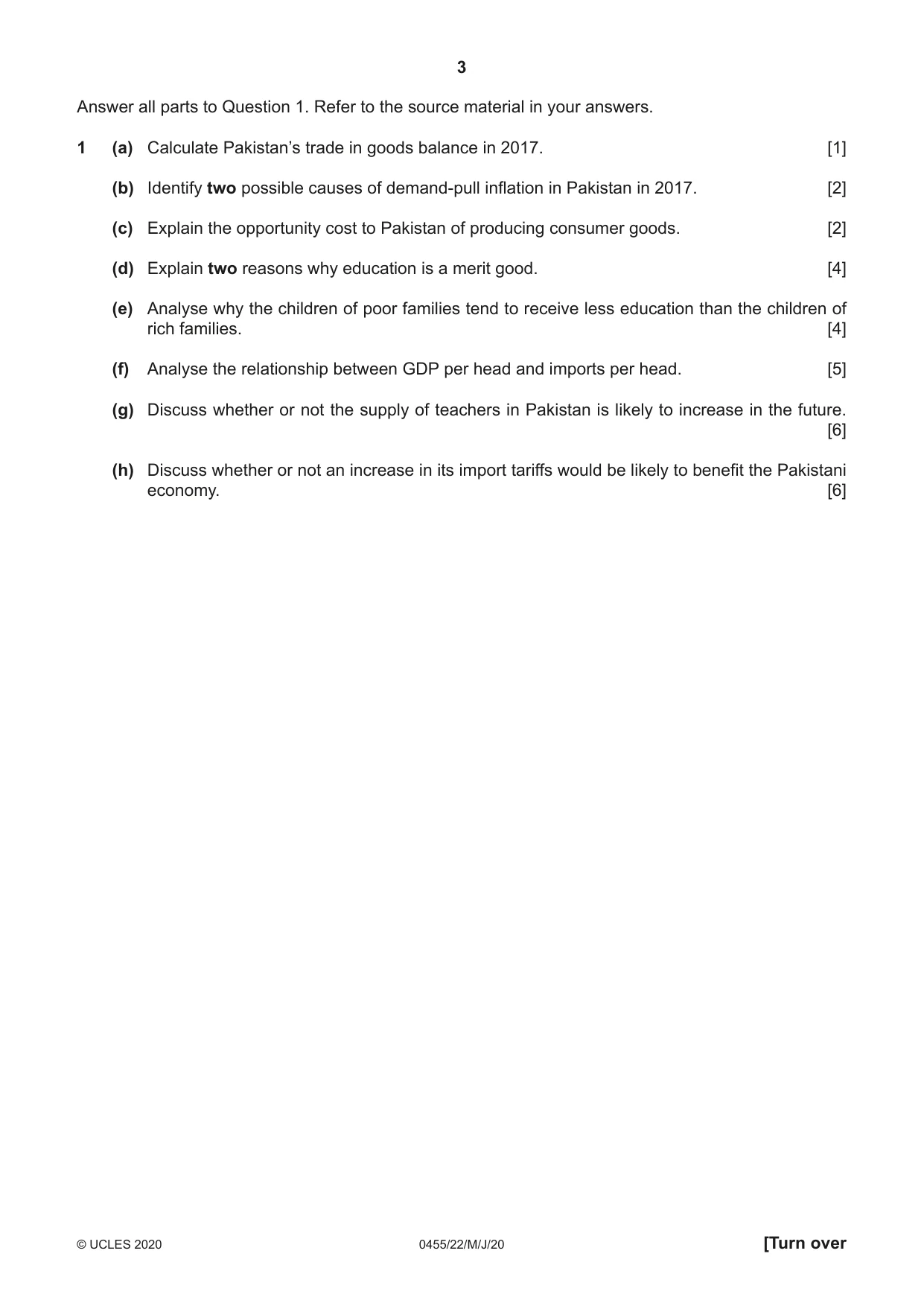
1 (a) Calculate Pakistan’s trade in goods balance in 2017. [1] (b) Identify two possible causes of demand-pull inflation in Pakistan in 2017. [2] (c) Explain the opportunity cost to Pakistan of producing consumer goods. [2] (d) Explain two reasons why education is a merit good. [4] (e) Analyse why the children of poor families tend to receive less education than the children of rich families. [4] (f) Analyse the relationship between GDP per head and imports per head. [5] (g) Discuss whether or not the supply of teachers in Pakistan is likely to increase in the future. [6] (h) Discuss whether or not an increase in its import tariffs would be likely to benefit the Pakistani economy. [6]
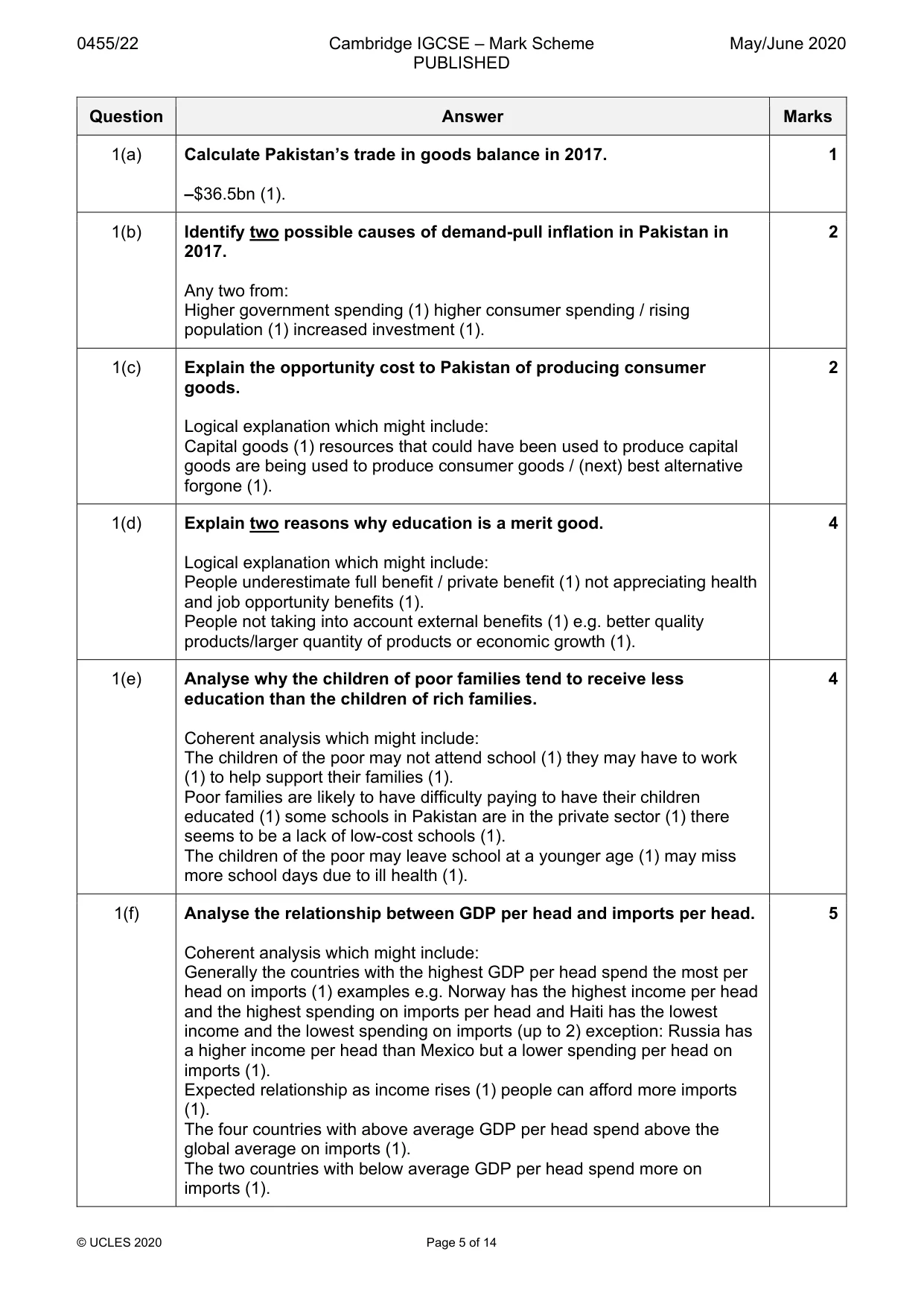
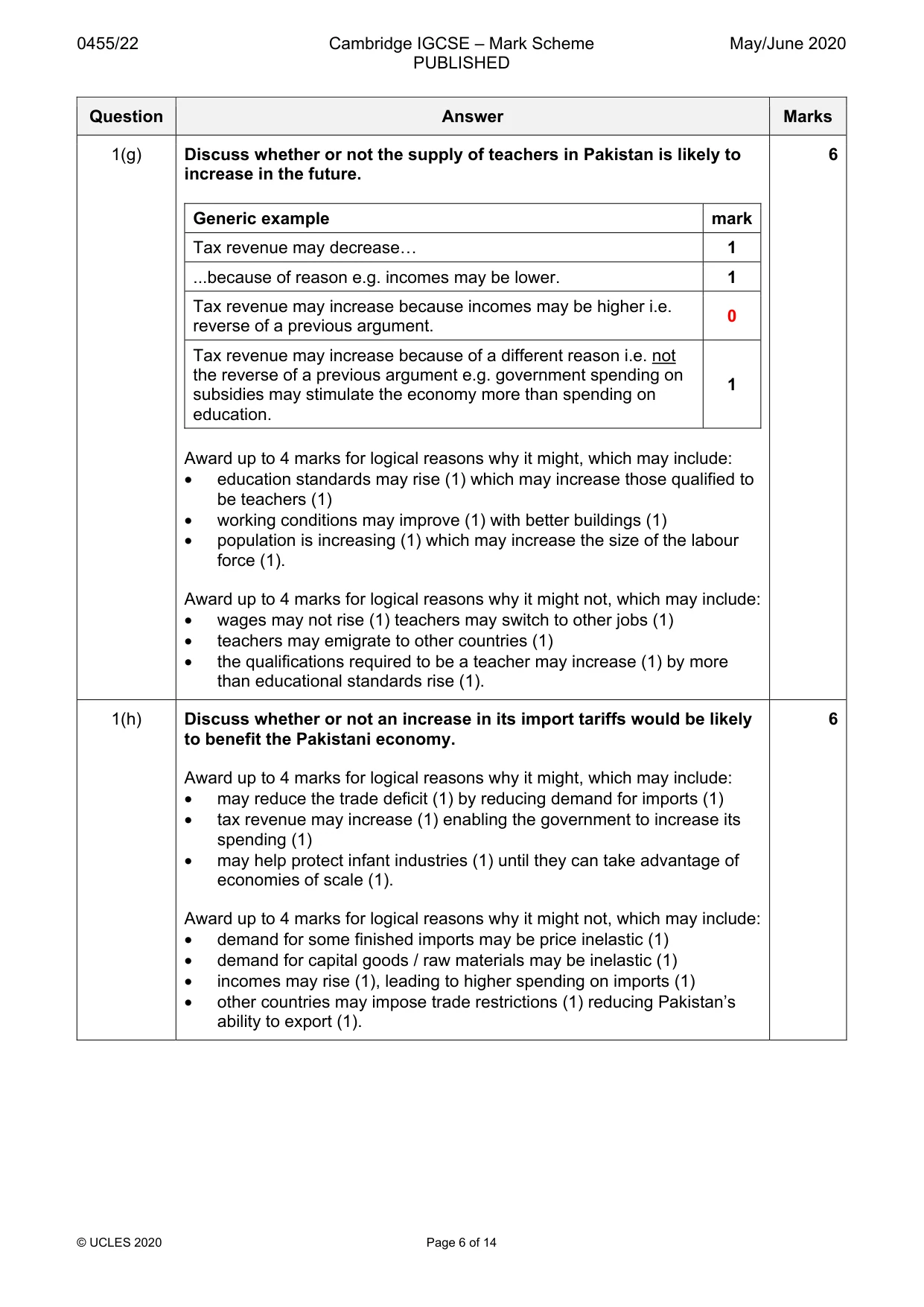
Mark scheme: Question Answer Marks 1(a) Calculate Pakistan’s trade in goods balance in 2017. 1 –$36.5bn (1). 1(b) Identify two possible causes of demand-pull inflation in Pakistan in 2 2017. Any two from: Higher government spending (1) higher consumer spending / rising population (1) increased investment (1). 1(c) Explain the opportunity cost to Pakistan of producing consumer 2 goods. Logical explanation which might include: Capital goods (1) resources that could have been used to produce capital goods are being used to produce consumer goods / (next) best alternative forgone (1). 1(d) Explain two reasons why education is a merit good. 4 Logical explanation which might include: People underestimate full benefit / private benefit (1) not appreciating health and job opportunity benefits (1). People not taking into account external benefits (1) e.g. better quality products/larger quantity of products or economic growth (1). 1(e) Analyse why the children of poor families tend to receive less 4 education than the children of rich families. Coherent analysis which might include: The children of the poor may not attend school (1) they may have to work (1) to help support their families (1). Poor families are likely to have difficulty paying to have their children educated (1) some schools in Pakistan are in the private sector (1) there seems to be a lack of low-cost schools (1). The children of the poor may leave school at a younger age (1) may miss more school days due to ill health (1). 1(f) Analyse the relationship between GDP per head and imports per head. 5 Coherent analysis which might include: Generally the countries with the highest GDP per head spend the most per head on imports (1) examples e.g. Norway has the highest income per head and the highest spending on imports per head and Haiti has the lowest income and the lowest spending on imports (up to 2) exception: Russia has a higher income per head than Mexico but a lower spending per head on imports (1). Expected relationship as income rises (1) people can afford more imports (1). The four countries with above average GDP per head spend above the global average on imports (1). The two countries with below average GDP per head spend more on imports (1). 1(g) Discuss whether or not the supply of teachers in Pakistan is likely to 6 increase in the future. Generic example mark Tax revenue may decrease… 1 ...because of reason e.g. incomes may be lower. 1 Tax revenue may increase because incomes may be higher i.e. 0 reverse of a previous argument. Tax revenue may increase because of a different reason i.e. not the reverse of a previous argument e.g. government spending on 1 subsidies may stimulate the economy more than spending on education. Award up to 4 marks for logical reasons why it might, which may include: • education standards may rise (1) which may increase those qualified to be teachers (1) • working conditions may improve (1) with better buildings (1) • population is increasing (1) which may increase the size of the labour force (1). Award up to 4 marks for logical reasons why it might not, which may include: • wages may not rise (1) teachers may switch to other jobs (1) • teachers may emigrate to other countries (1) • the qualifications required to be a teacher may increase (1) by more than educational standards rise (1). 1(h) Discuss whether or not an increase in its import tariffs would be likely 6 to benefit the Pakistani economy. Award up to 4 marks for logical reasons why it might, which may include: • may reduce the trade deficit (1) by reducing demand for imports (1) • tax revenue may increase (1) enabling the government to increase its spending (1) • may help protect infant industries (1) until they can take advantage of economies of scale (1). Award up to 4 marks for logical reasons why it might not, which may include: • demand for some finished imports may be price inelastic (1) • demand for capital goods / raw materials may be inelastic (1) • incomes may rise (1), leading to higher spending on imports (1) • other countries may impose trade restrictions (1) reducing Pakistan’s ability to export (1).
Q2 · The Indian government has declared that the country, now a major car producer, will sell…
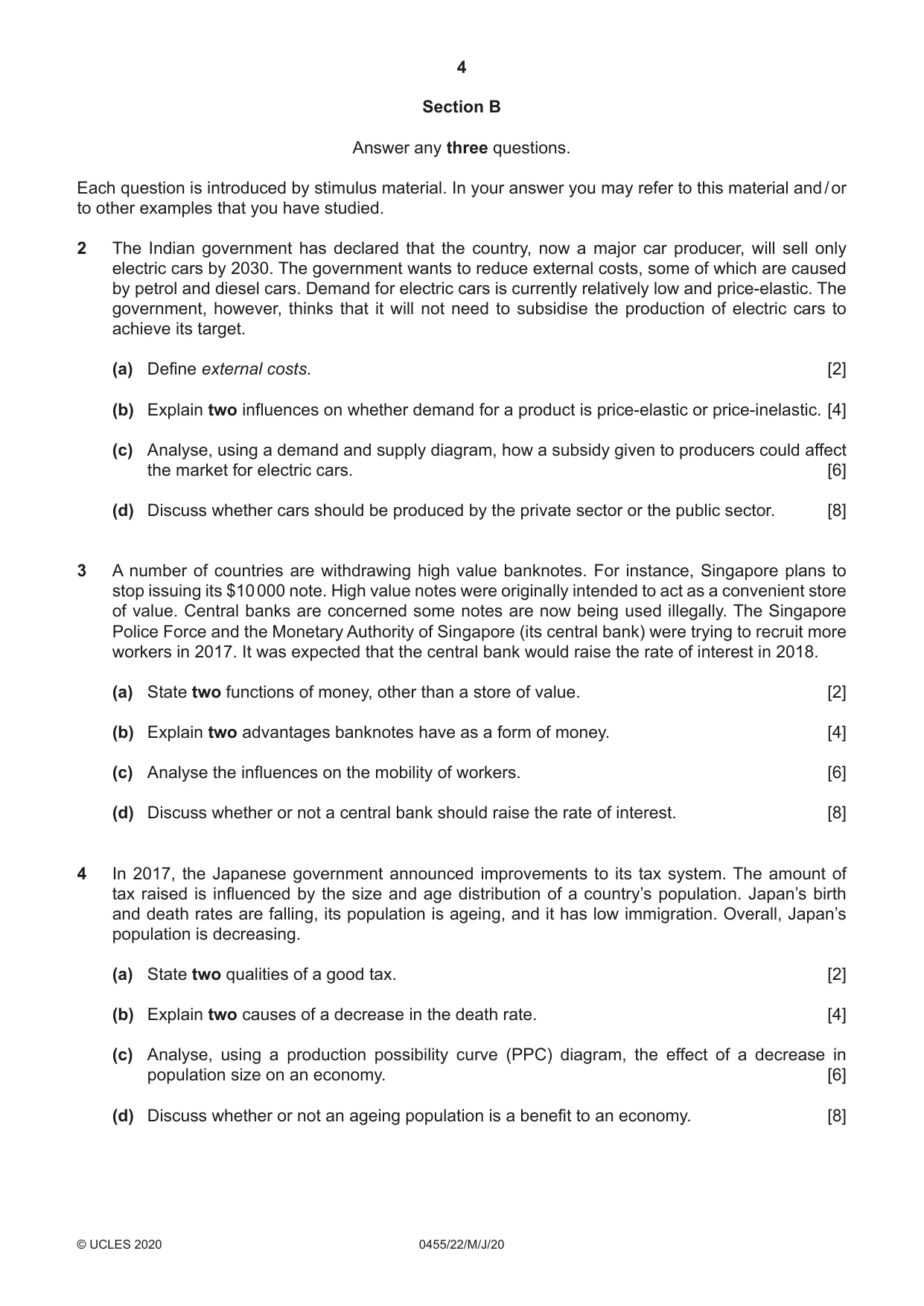
2 The Indian government has declared that the country, now a major car producer, will sell only electric cars by 2030. The government wants to reduce external costs, some of which are caused by petrol and diesel cars. Demand for electric cars is currently relatively low and price-elastic. The government, however, thinks that it will not need to subsidise the production of electric cars to achieve its target. (a) Define external costs. [2] (b) Explain two influences on whether demand for a product is price-elastic or price-inelastic. [4] (c) Analyse, using a demand and supply diagram, how a subsidy given to producers could affect the market for electric cars. [6] (d) Discuss whether cars should be produced by the private sector or the public sector. [8]
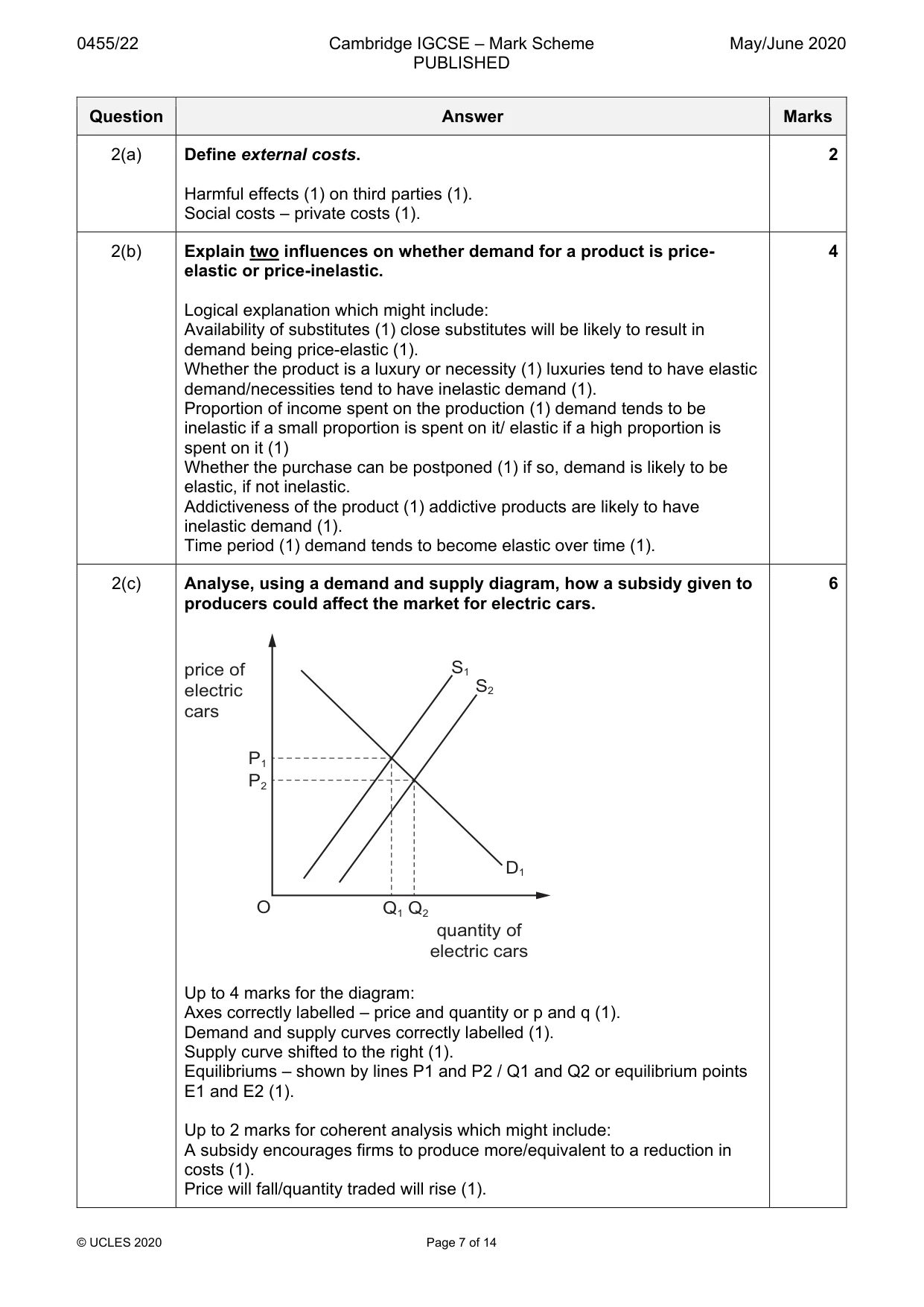
Mark scheme: 2(a) Define external costs. 2 Harmful effects (1) on third parties (1). Social costs – private costs (1). 2(b) Explain two influences on whether demand for a product is price- 4 elastic or price-inelastic. Logical explanation which might include: Availability of substitutes (1) close substitutes will be likely to result in demand being price-elastic (1). Whether the product is a luxury or necessity (1) luxuries tend to have elastic demand/necessities tend to have inelastic demand (1). Proportion of income spent on the production (1) demand tends to be inelastic if a small proportion is spent on it/ elastic if a high proportion is spent on it (1) Whether the purchase can be postponed (1) if so, demand is likely to be elastic, if not inelastic. Addictiveness of the product (1) addictive products are likely to have inelastic demand (1). Time period (1) demand tends to become elastic over time (1). 2(c) Analyse, using a demand and supply diagram, how a subsidy given to 6 producers could affect the market for electric cars. price of S1 electric S2 cars P1 P2 D1 O Q1 Q2 quantity of electric cars Up to 4 marks for the diagram: Axes correctly labelled – price and quantity or p and q (1). Demand and supply curves correctly labelled (1). Supply curve shifted to the right (1). Equilibriums – shown by lines P1 and P2 / Q1 and Q2 or equilibrium points E1 and E2 (1). Up to 2 marks for coherent analysis which might include: A subsidy encourages firms to produce more/equivalent to a reduction in costs (1). Price will fall/quantity traded will rise (1). 2(d) Discuss whether cars should be produced by the private sector or the 8 public sector. In assessing each answer, use the table below. Level Description Marks 3 A reasoned discussion which accurately examines both 6–8 sides of the economic argument, making use of economic information and clear and logical analysis to evaluate economic issues and situations. One side of the argument may have more depth than the other but, overall, both sides of the argument are considered and developed. There is thoughtful evaluation of economic concepts, terminology, information and/or data appropriate to the question. The discussion may also point out the possible uncertainties of alternative decisions and outcomes. 2 A reasoned discussion which makes use of economic 3–5 information and clear analysis to evaluate economic issues and situations. The answer may lack some depth and development may be one-sided. There is relevant use of economic concepts, terminology, information and data appropriate to the question. 1 There is a simple attempt at using economic definitions 1–2 and terminology. Some reference may be made to economic theory, with occasional understanding. 0 A mark of zero should be awarded for no creditable 0 content. Why cars should be produced by the private sector: • may be a more competitive market and so prices may be lower • profit incentive may raise efficiency and encourage firms to produce what consumers want and keep costs low • may be higher investment which could improve quality and lower costs • may be easier to raise finance as can sell shares • may be forced to be efficient as may not be supported by the government Why cars should be produced by the public sector: • a private sector monopoly may abuse market power and may restrict supply and raise price • public sector firm to charge low prices/prices below cost for cheap cars to help the poor • public sector firms may take into account external costs and benefits/welfare • the state may have more financial resources and be able to invest on a larger scale.
Q3 · A number of countries are withdrawing high value banknotes
3 A number of countries are withdrawing high value banknotes. For instance, Singapore plans to stop issuing its $10 000 note. High value notes were originally intended to act as a convenient store of value. Central banks are concerned some notes are now being used illegally. The Singapore Police Force and the Monetary Authority of Singapore (its central bank) were trying to recruit more workers in 2017. It was expected that the central bank would raise the rate of interest in 2018. (a) State two functions of money, other than a store of value. [2] (b) Explain two advantages banknotes have as a form of money. [4] (c) Analyse the influences on the mobility of workers. [6] (d) Discuss whether or not a central bank should raise the rate of interest. [8]
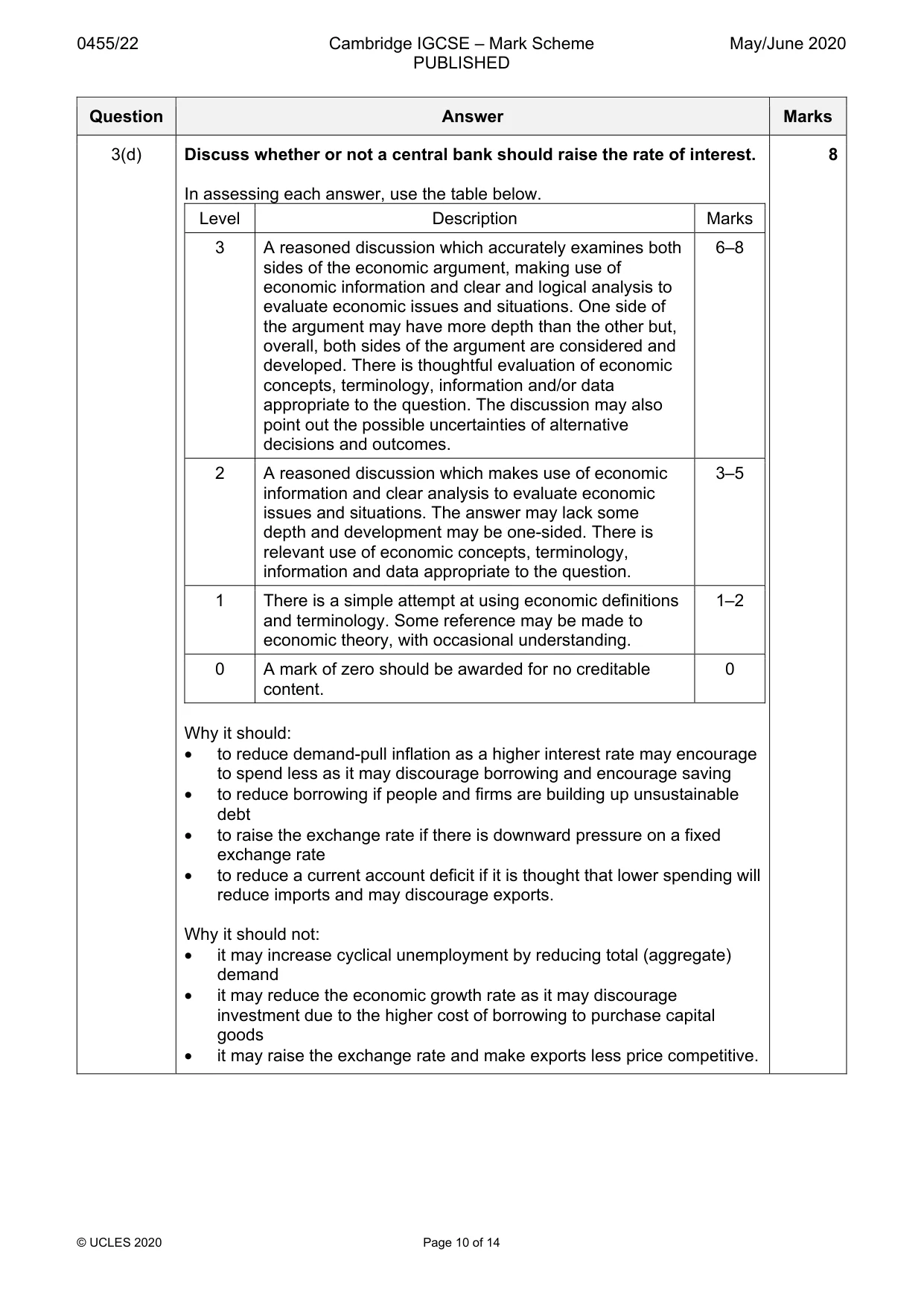
Mark scheme: 3(a) State two functions of money, other than a store of value. 2 One mark each for two from: medium of exchange, measure of value (unit of account) and standard of deferred payments. 3(b) Explain two advantages banknotes have as a form of money. 4 Logical explanation which might include: Generally acceptable (1) people are prepared to accept them in exchange for products and to settle debts (1). Portable (1) banknotes are light to carry around (1). Divisible (1) notes of different denominations (1). Recognisable (1) notes have distinct features on them known to the population (1). Limited in supply (1) the central bank prints a set number of notes (1). Homogeneous (1) all banknotes of the same value are identical (1). 3(c) Analyse the influences on the mobility of workers. 6 Coherent analysis which might include: Occupational mobility is influenced by education (1) the more qualifications workers have (1) the more choice of jobs they will have (1). Occupational mobility is influenced by training (1) the more skills workers have (1) the easier they will find it to switch jobs (1). Geographical mobility is influenced by the price/availability of housing (1) The cheaper/more available housing is (1) the easier will workers find it to work in other areas (1). Geographical mobility is influenced by family ties (1) people may be reluctant to move because children are at school/partners have job in a particular area (1). Mobility between countries will be influenced by immigration controls (1). 3(d) Discuss whether or not a central bank should raise the rate of interest. 8 In assessing each answer, use the table below. Level Description Marks 3 A reasoned discussion which accurately examines both 6–8 sides of the economic argument, making use of economic information and clear and logical analysis to evaluate economic issues and situations. One side of the argument may have more depth than the other but, overall, both sides of the argument are considered and developed. There is thoughtful evaluation of economic concepts, terminology, information and/or data appropriate to the question. The discussion may also point out the possible uncertainties of alternative decisions and outcomes. 2 A reasoned discussion which makes use of economic 3–5 information and clear analysis to evaluate economic issues and situations. The answer may lack some depth and development may be one-sided. There is relevant use of economic concepts, terminology, information and data appropriate to the question. 1 There is a simple attempt at using economic definitions 1–2 and terminology. Some reference may be made to economic theory, with occasional understanding. 0 A mark of zero should be awarded for no creditable 0 content. Why it should: • to reduce demand-pull inflation as a higher interest rate may encourage to spend less as it may discourage borrowing and encourage saving • to reduce borrowing if people and firms are building up unsustainable debt • to raise the exchange rate if there is downward pressure on a fixed exchange rate • to reduce a current account deficit if it is thought that lower spending will reduce imports and may discourage exports. Why it should not: • it may increase cyclical unemployment by reducing total (aggregate) demand • it may reduce the economic growth rate as it may discourage investment due to the higher cost of borrowing to purchase capital goods • it may raise the exchange rate and make exports less price competitive.
Q4 · In 2017, the Japanese government announced improvements to its tax system
4 In 2017, the Japanese government announced improvements to its tax system. The amount of tax raised is influenced by the size and age distribution of a country’s population. Japan’s birth and death rates are falling, its population is ageing, and it has low immigration. Overall, Japan’s population is decreasing. (a) State two qualities of a good tax. [2] (b) Explain two causes of a decrease in the death rate. [4] (c) Analyse, using a production possibility curve (PPC) diagram, the effect of a decrease in population size on an economy. [6] (d) Discuss whether or not an ageing population is a benefit to an economy. [8]
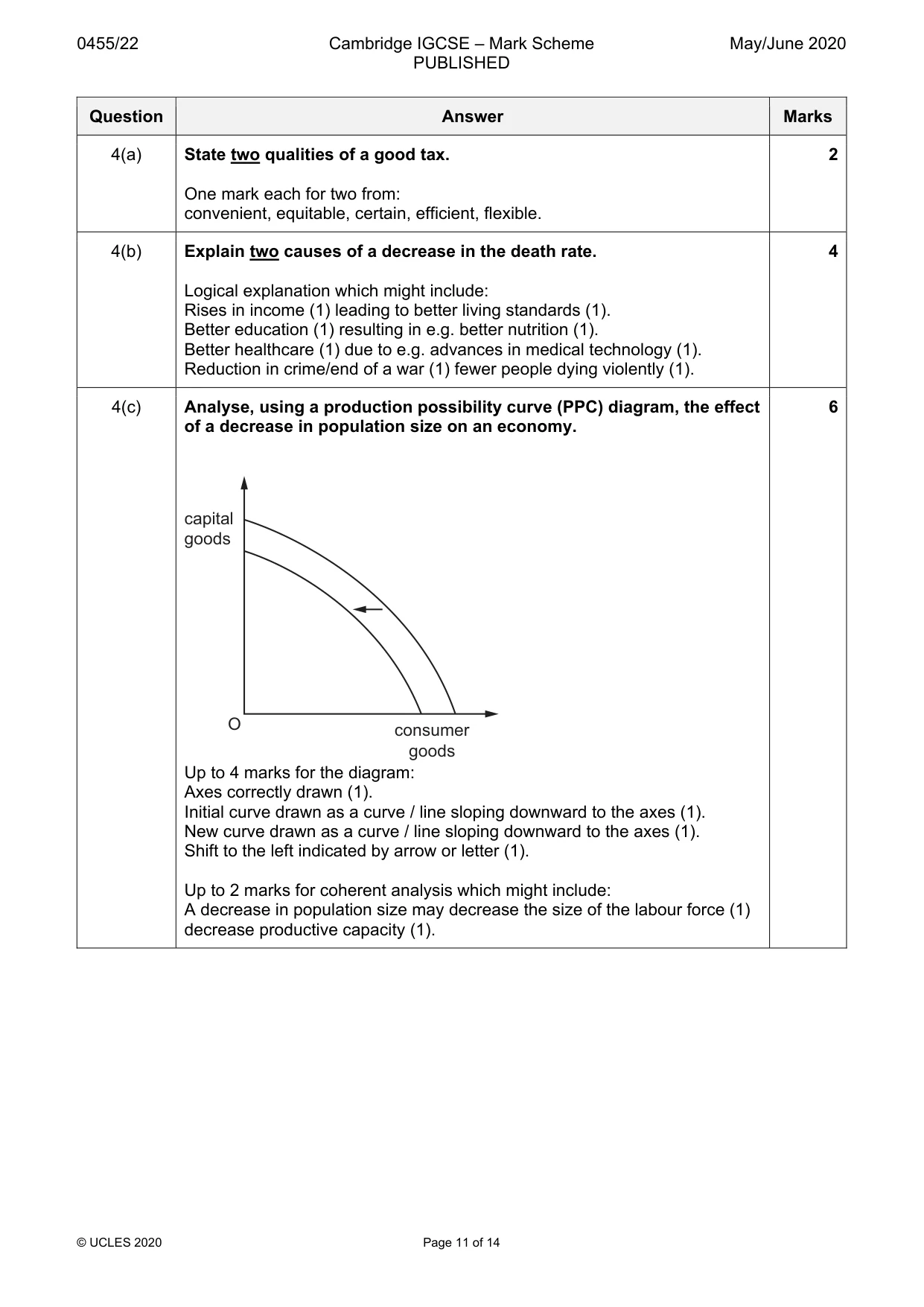
Mark scheme: 4(a) State two qualities of a good tax. 2 One mark each for two from: convenient, equitable, certain, efficient, flexible. 4(b) Explain two causes of a decrease in the death rate. 4 Logical explanation which might include: Rises in income (1) leading to better living standards (1). Better education (1) resulting in e.g. better nutrition (1). Better healthcare (1) due to e.g. advances in medical technology (1). Reduction in crime/end of a war (1) fewer people dying violently (1). 4(c) Analyse, using a production possibility curve (PPC) diagram, the effect 6 of a decrease in population size on an economy. capital goods O consumer goods Up to 4 marks for the diagram: Axes correctly drawn (1). Initial curve drawn as a curve / line sloping downward to the axes (1). New curve drawn as a curve / line sloping downward to the axes (1). Shift to the left indicated by arrow or letter (1). Up to 2 marks for coherent analysis which might include: A decrease in population size may decrease the size of the labour force (1) decrease productive capacity (1). 4(d) Discuss whether or not an ageing population is a benefit to an 8 economy. In assessing each answer, use the table below. Level Description Marks 3 A reasoned discussion which accurately examines both 6–8 sides of the economic argument, making use of economic information and clear and logical analysis to evaluate economic issues and situations. One side of the argument may have more depth than the other but, overall, both sides of the argument are considered and developed. There is thoughtful evaluation of economic concepts, terminology, information and/or data appropriate to the question. The discussion may also point out the possible uncertainties of alternative decisions and outcomes. 2 A reasoned discussion which makes use of economic 3–5 information and clear analysis to evaluate economic issues and situations. The answer may lack some depth and development may be one-sided. There is relevant use of economic concepts, terminology, information and data appropriate to the question. 1 There is a simple attempt at using economic definitions 1–2 and terminology. Some reference may be made to economic theory, with occasional understanding. 0 A mark of zero should be awarded for no creditable 0 content. Why it might: • older people may be an economic asset through their knowledge and experience • the retirement age may be raised so that the labour force may increase • in some countries, an increase in the average age of the population may mean more people are in the labour force and may reduce the dependency ratio • may indicate a good standard of living increasing life expectancy. Why it might not: • may be an increase in the dependency ratio with a smaller proportion of workers to support a higher proportion of retired • any increased spending on healthcare and pensions will involve an opportunity cost • taxes may have to be increased to finance increased costs of healthcare and pensions • any shortage of workers may drive up wages and cause cost-push inflation • older workers may not be up to date with new technology and new ideas
Q5 · Mali is a low income and low productivity country in Africa
5 Mali is a low income and low productivity country in Africa. Its government is using fiscal policy to reduce poverty. The country’s main industries are agriculture and gold mining. In recent years, however, there have been some changes in its resource allocation. The country is developing its iron ore industry. Globally, the iron ore industry is one which has experienced a significant number of mergers in recent years. (a) State two key questions about how resources are allocated. [2] (b) Explain two fiscal policy measures that can be used to reduce poverty. [4] (c) Analyse why a country may have low productivity. [6] (d) Discuss whether or not mergers benefit an economy. [8]
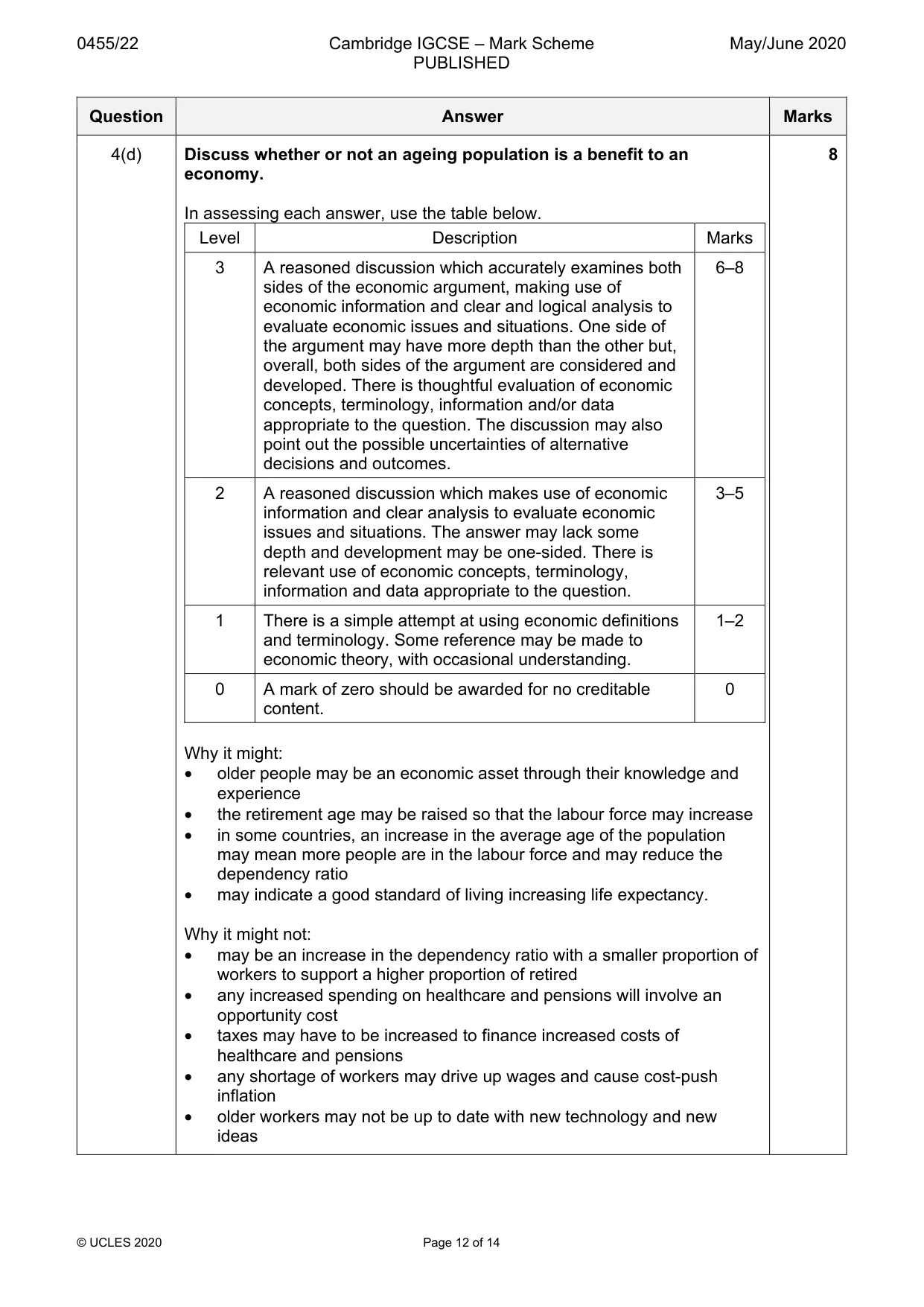
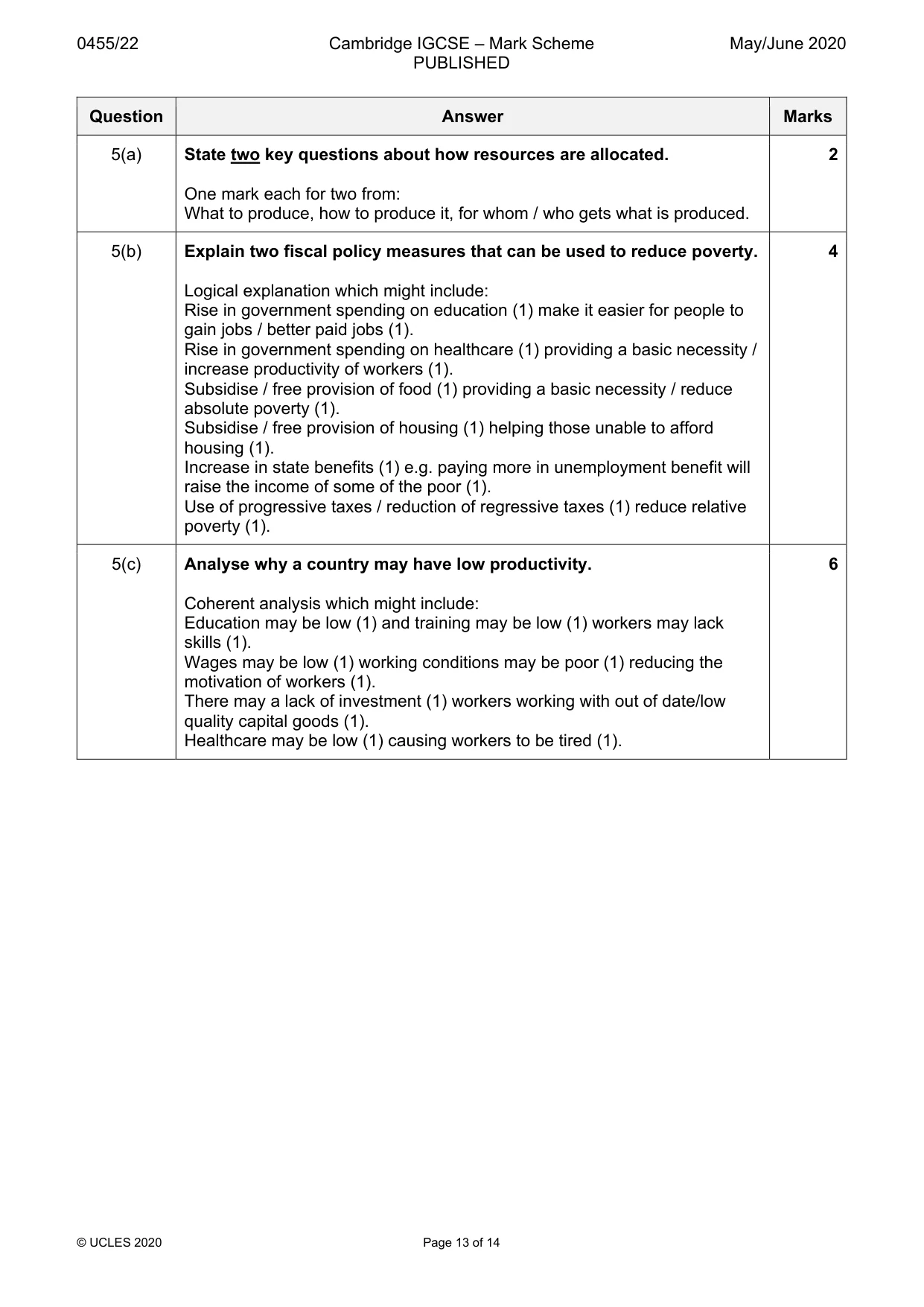
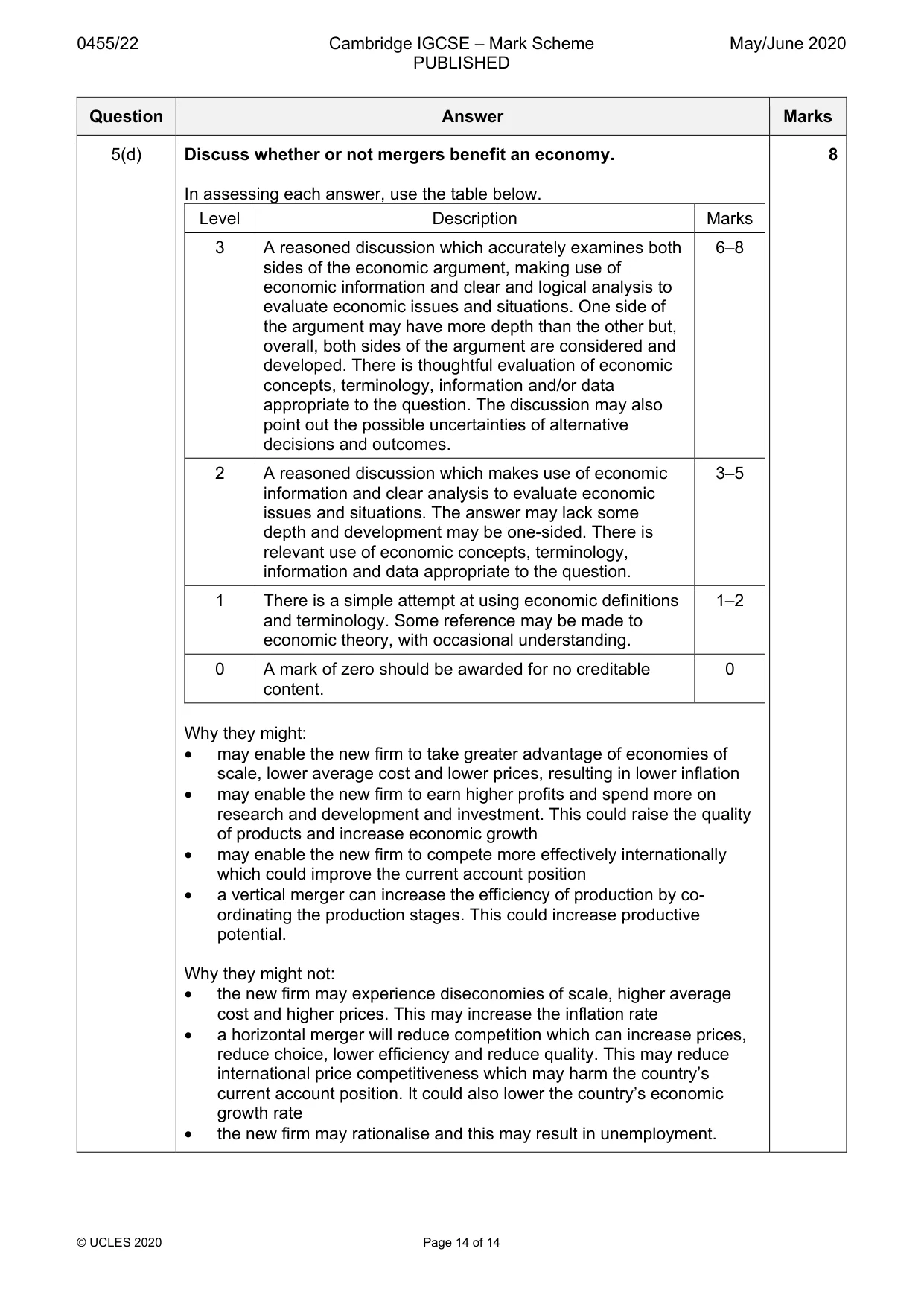
Mark scheme: 5(a) State two key questions about how resources are allocated. 2 One mark each for two from: What to produce, how to produce it, for whom / who gets what is produced. 5(b) Explain two fiscal policy measures that can be used to reduce poverty. 4 Logical explanation which might include: Rise in government spending on education (1) make it easier for people to gain jobs / better paid jobs (1). Rise in government spending on healthcare (1) providing a basic necessity / increase productivity of workers (1). Subsidise / free provision of food (1) providing a basic necessity / reduce absolute poverty (1). Subsidise / free provision of housing (1) helping those unable to afford housing (1). Increase in state benefits (1) e.g. paying more in unemployment benefit will raise the income of some of the poor (1). Use of progressive taxes / reduction of regressive taxes (1) reduce relative poverty (1). 5(c) Analyse why a country may have low productivity. 6 Coherent analysis which might include: Education may be low (1) and training may be low (1) workers may lack skills (1). Wages may be low (1) working conditions may be poor (1) reducing the motivation of workers (1). There may a lack of investment (1) workers working with out of date/low quality capital goods (1). Healthcare may be low (1) causing workers to be tired (1). 5(d) Discuss whether or not mergers benefit an economy. 8 In assessing each answer, use the table below. Level Description Marks 3 A reasoned discussion which accurately examines both 6–8 sides of the economic argument, making use of economic information and clear and logical analysis to evaluate economic issues and situations. One side of the argument may have more depth than the other but, overall, both sides of the argument are considered and developed. There is thoughtful evaluation of economic concepts, terminology, information and/or data appropriate to the question. The discussion may also point out the possible uncertainties of alternative decisions and outcomes. 2 A reasoned discussion which makes use of economic 3–5 information and clear analysis to evaluate economic issues and situations. The answer may lack some depth and development may be one-sided. There is relevant use of economic concepts, terminology, information and data appropriate to the question. 1 There is a simple attempt at using economic definitions 1–2 and terminology. Some reference may be made to economic theory, with occasional understanding. 0 A mark of zero should be awarded for no creditable 0 content. Why they might: • may enable the new firm to take greater advantage of economies of scale, lower average cost and lower prices, resulting in lower inflation • may enable the new firm to earn higher profits and spend more on research and development and investment. This could raise the quality of products and increase economic growth • may enable the new firm to compete more effectively internationally which could improve the current account position • a vertical merger can increase the efficiency of production by co- ordinating the production stages. This could increase productive potential. Why they might not: • the new firm may experience diseconomies of scale, higher average cost and higher prices. This may increase the inflation rate • a horizontal merger will reduce competition which can increase prices, reduce choice, lower efficiency and reduce quality. This may reduce international price competitiveness which may harm the country’s current account position. It could also lower the country’s economic growth rate • the new firm may rationalise and this may result in unemployment.
What was in this paper
The subtopics covered by these 5 questions, and how many questions each got. Open one in a new tab to see every Cambridge question on it.