Cambridge IGCSE Economics 0455 — 2017 May/June Paper 2 · Variant 3
0455/23/M/J/17 · 7 questions · 90 marks · ≈101 min
The question paper and its mark scheme, free to read here and free to download. This is Cambridge’s own paper, exactly as it was sat.
Question paper8 pages



Mark scheme17 pages
Answers below. Sit the paper first if you are practising.
Questions as text
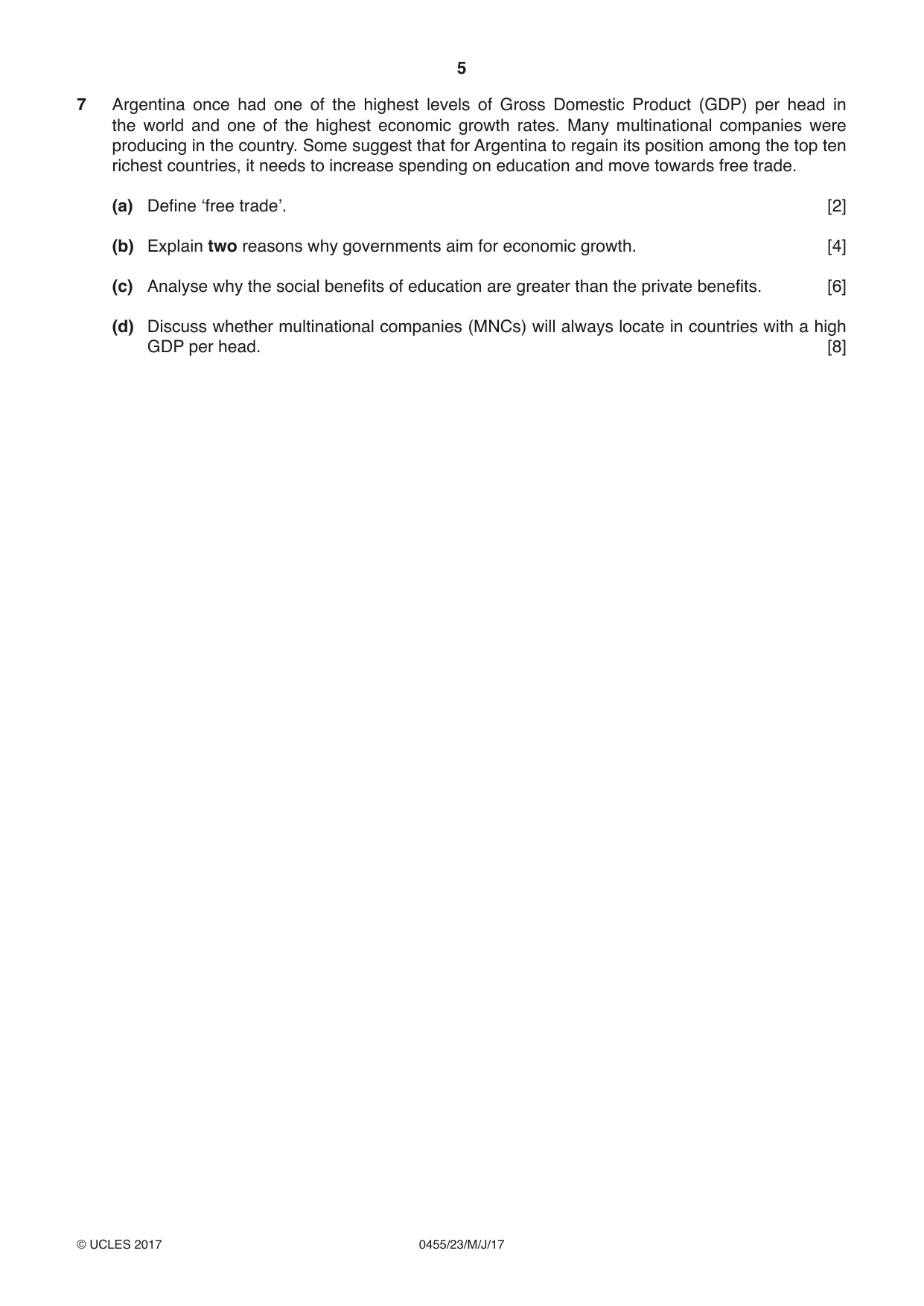
Q1 · Coal mining Coal is used directly to heat homes throughout the world and produces more…
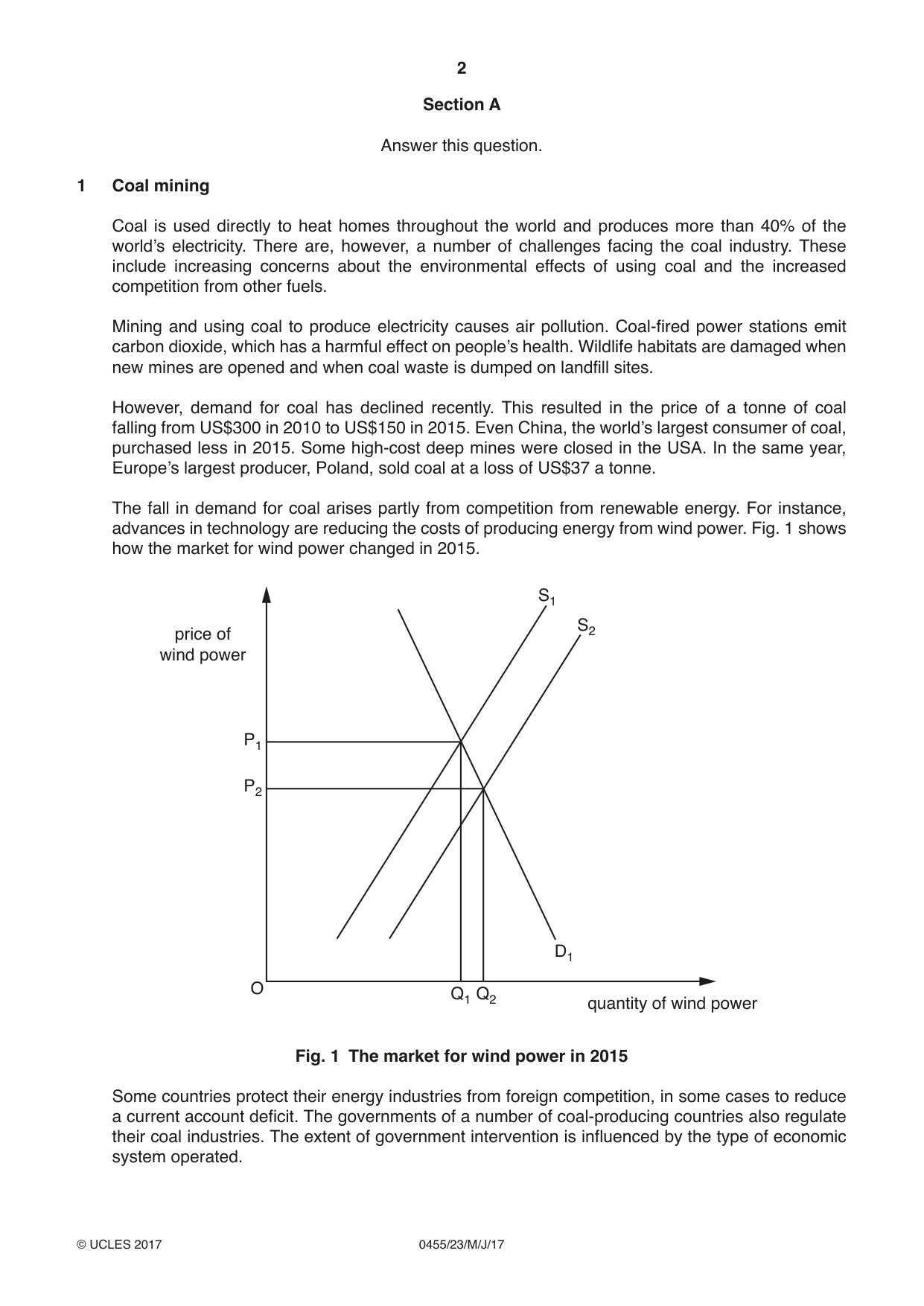
1 Coal mining Coal is used directly to heat homes throughout the world and produces more than 40% of the world’s electricity. There are, however, a number of challenges facing the coal industry. These include increasing concerns about the environmental effects of using coal and the increased competition from other fuels. Mining and using coal to produce electricity causes air pollution. Coal-fired power stations emit carbon dioxide, which has a harmful effect on people’s health. Wildlife habitats are damaged when new mines are opened and when coal waste is dumped on landfill sites. However, demand for coal has declined recently. This resulted in the price of a tonne of coal falling from US$300 in 2010 to US$150 in 2015. Even China, the world’s largest consumer of coal, purchased less in 2015. Some high-cost deep mines were closed in the USA. In the same year, Europe’s largest producer, Poland, sold coal at a loss of US$37 a tonne. The fall in demand for coal arises partly from competition from renewable energy. For instance, advances in technology are reducing the costs of producing energy from wind power. Fig. 1 shows how the market for wind power changed in 2015. S1 S2 price of wind power P1 P2 D1 O Q1 Q2 quantity of wind power Fig. 1 The market for wind power in 2015 Some countries protect their energy industries from foreign competition, in some cases to reduce a current account deficit. The governments of a number of coal-producing countries also regulate their coal industries. The extent of government intervention is influenced by the type of economic system operated. (a) Identify, using information from the extract, two external costs that arise from using coal to produce electricity. [2] (b) Explain two reasons why a firm may continue to produce a good despite making a loss. [4] (c) Calculate, using information from the extract: (i) the percentage fall in the price of coal between 2010 and 2015 [2] (ii) the cost (in US$) of producing a tonne of coal in Poland in 2015. [2] (d) Analyse how resources are allocated in a mixed economy. [5] (e) Discuss whether governments should regulate the coal industries of their countries. [5] (f) Explain, using information from the extract and Fig. 1, what happened to the market for wind power in 2015. [4] (g) Discuss whether a government should use trade protection to reduce a current account deficit. [6]
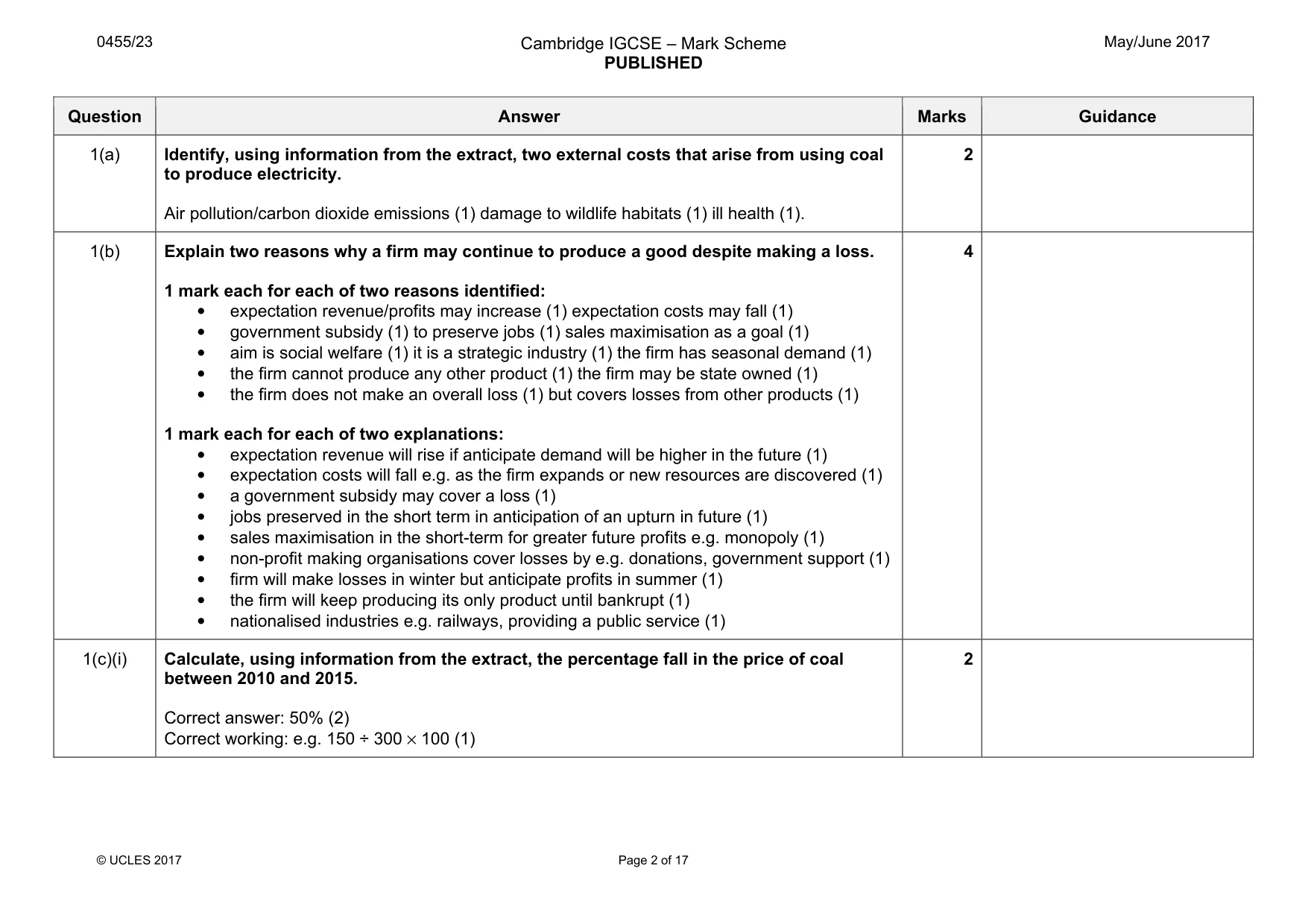
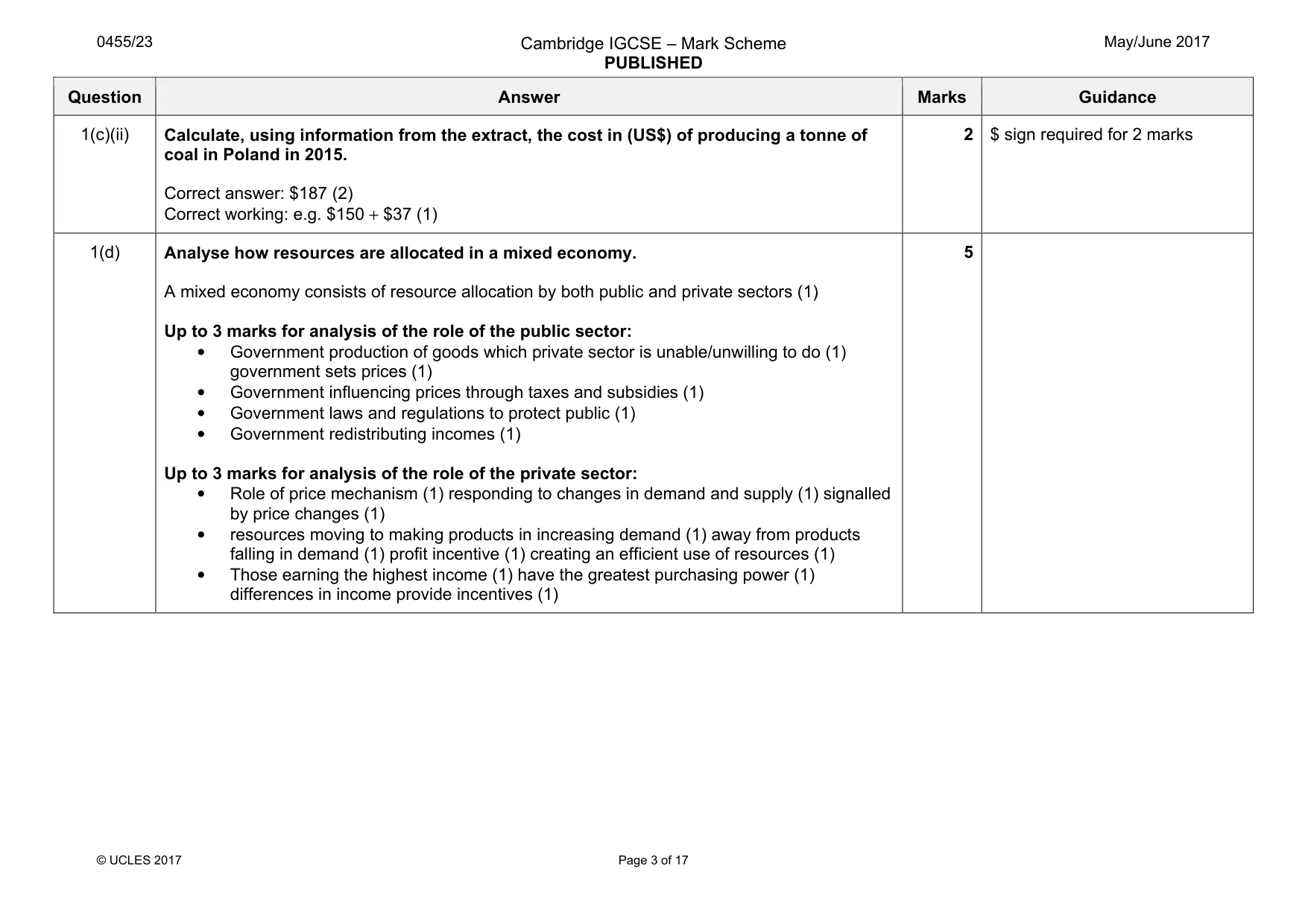
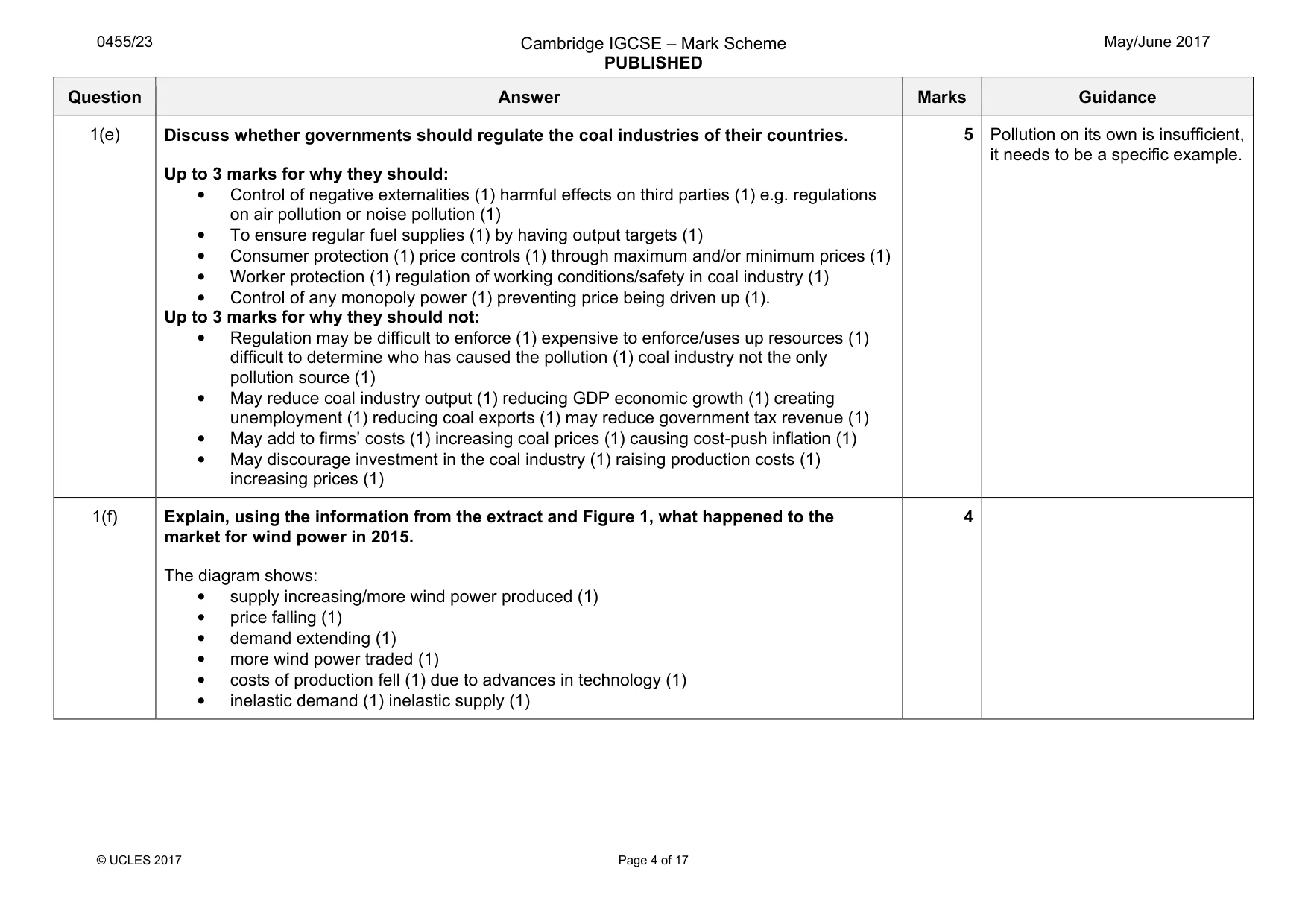
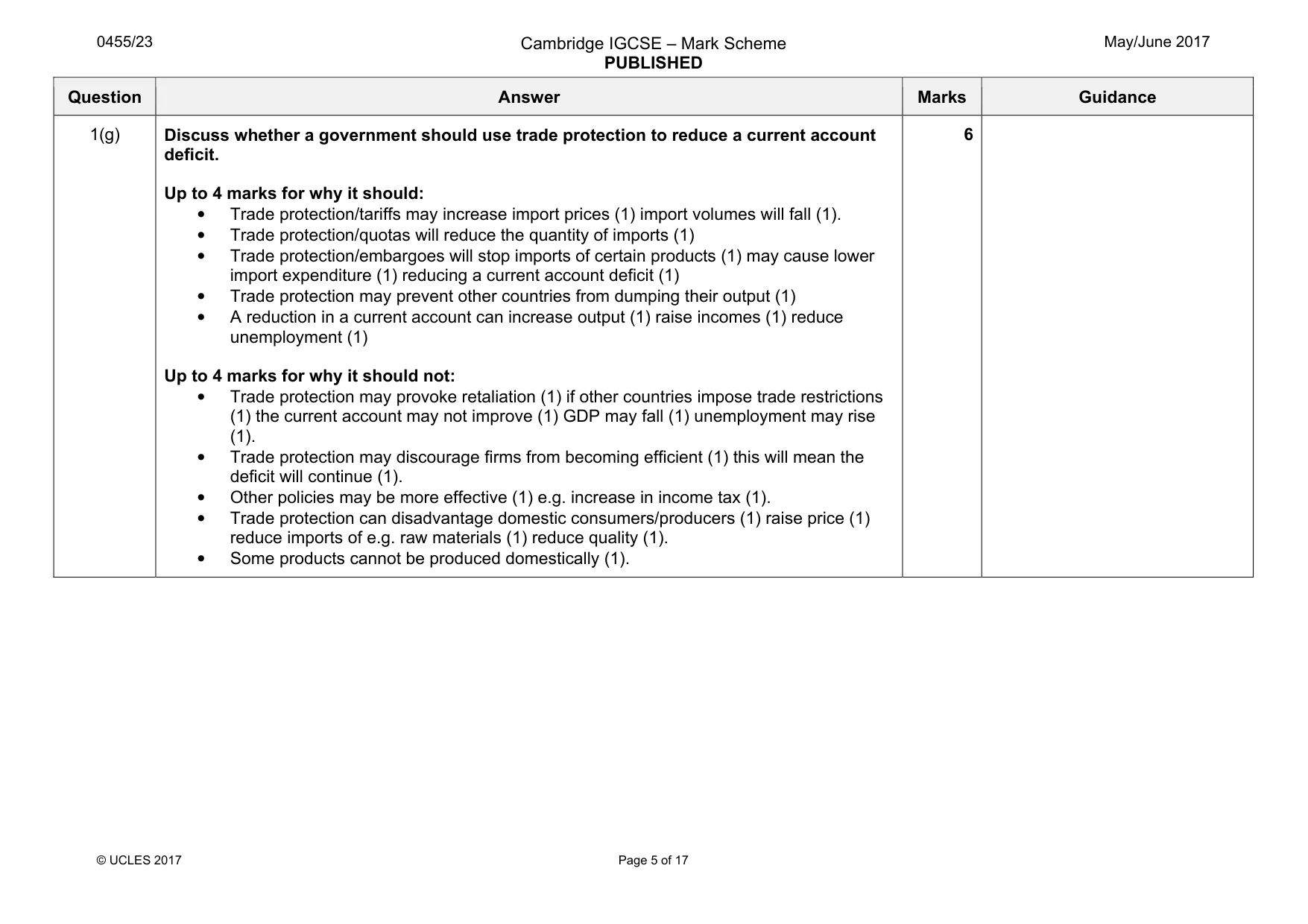
Mark scheme: 1(a) Identify, using information from the extract, two external costs that arise from using coal to produce electricity. Air pollution/carbon dioxide emissions (1) damage to wildlife habitats (1) ill health (1). 2 1(b) Explain two reasons why a firm may continue to produce a good despite making a loss. 1 mark each for each of two reasons identified: • expectation revenue/profits may increase (1) expectation costs may fall (1) • government subsidy (1) to preserve jobs (1) sales maximisation as a goal (1) • aim is social welfare (1) it is a strategic industry (1) the firm has seasonal demand (1) • the firm cannot produce any other product (1) the firm may be state owned (1) • the firm does not make an overall loss (1) but covers losses from other products (1) 1 mark each for each of two explanations: • expectation revenue will rise if anticipate demand will be higher in the future (1) • expectation costs will fall e.g. as the firm expands or new resources are discovered (1) • a government subsidy may cover a loss (1) • jobs preserved in the short term in anticipation of an upturn in future (1) • sales maximisation in the short-term for greater future profits e.g. monopoly (1) • non-profit making organisations cover losses by e.g. donations, government support (1) • firm will make losses in winter but anticipate profits in summer (1) • the firm will keep producing its only product until bankrupt (1) • nationalised industries e.g. railways, providing a public service (1) 4 1(c)(i) Calculate, using information from the extract, the percentage fall in the price of coal between 2010 and 2015. Correct answer: 50% (2) Correct working: e.g. 150 ÷ 300 × 100 (1) 2 Question Answer Marks Guidance 1(c)(ii) Calculate, using information from the extract, the cost in (US$) of producing a tonne of coal in Poland in 2015. Correct answer: $187 (2) Correct working: e.g. $150 + $37 (1) 2 $ sign required for 2 marks 1(d) Analyse how resources are allocated in a mixed economy. A mixed economy consists of resource allocation by both public and private sectors (1) Up to 3 marks for analysis of the role of the public sector: • Government production of goods which private sector is unable/unwilling to do (1) government sets prices (1) • Government influencing prices through taxes and subsidies (1) • Government laws and regulations to protect public (1) • Government redistributing incomes (1) Up to 3 marks for analysis of the role of the private sector: • Role of price mechanism (1) responding to changes in demand and supply (1) signalled by price changes (1) • resources moving to making products in increasing demand (1) away from products falling in demand (1) profit incentive (1) creating an efficient use of resources (1) • Those earning the highest income (1) have the greatest purchasing power (1) differences in income provide incentives (1) 5 Question Answer Marks Guidance 1(e) Discuss whether governments should regulate the coal industries of their countries. Up to 3 marks for why they should: • Control of negative externalities (1) harmful effects on third parties (1) e.g. regulations on air pollution or noise pollution (1) • To ensure regular fuel supplies (1) by having output targets (1) • Consumer protection (1) price controls (1) through maximum and/or minimum prices (1) • Worker protection (1) regulation of working conditions/safety in coal industry (1) • Control of any monopoly power (1) preventing price being driven up (1). Up to 3 marks for why they should not: • Regulation may be difficult to enforce (1) expensive to enforce/uses up resources (1) difficult to determine who has caused the pollution (1) coal industry not the only pollution source (1) • May reduce coal industry output (1) reducing GDP economic growth (1) creating unemployment (1) reducing coal exports (1) may reduce government tax revenue (1) • May add to firms’ costs (1) increasing coal prices (1) causing cost-push inflation (1) • May discourage investment in the coal industry (1) raising production costs (1) increasing prices (1) 5 Pollution on its own is insufficient, it needs to be a specific example. 1(f) Explain, using the information from the extract and Figure 1, what happened to the market for wind power in 2015. The diagram shows: • supply increasing/more wind power produced (1) • price falling (1) • demand extending (1) • more wind power traded (1) • costs of production fell (1) due to advances in technology (1) • inelastic demand (1) inelastic supply (1) 4 Question Answer Marks Guidance 1(g) Discuss whether a government should use trade protection to reduce a current account deficit. Up to 4 marks for why it should: • Trade protection/tariffs may increase import prices (1) import volumes will fall (1). • Trade protection/quotas will reduce the quantity of imports (1) • Trade protection/embargoes will stop imports of certain products (1) may cause lower import expenditure (1) reducing a current account deficit (1) • Trade protection may prevent other countries from dumping their output (1) • A reduction in a current account can increase output (1) raise incomes (1) reduce unemployment (1) Up to 4 marks for why it should not: • Trade protection may provoke retaliation (1) if other countries impose trade restrictions (1) the current account may not improve (1) GDP may fall (1) unemployment may rise (1). • Trade protection may discourage firms from becoming efficient (1) this will mean the deficit will continue (1). • Other policies may be more effective (1) e.g. increase in income tax (1). • Trade protection can disadvantage domestic consumers/producers (1) raise price (1) reduce imports of e.g. raw materials (1) reduce quality (1). • Some products cannot be produced domestically (1). 6
Q2 · Between 2014 and 2015, Sao Paulo, a large city in Brazil, opened more than 120 km of…
2 Between 2014 and 2015, Sao Paulo, a large city in Brazil, opened more than 120 km of cycle-only lanes alongside roads. The city has a car culture, with demand for car travel being price-inelastic. In contrast, in Copenhagen, the capital of Denmark, 36% of commuter journeys are now by bicycle, which has reduced the demand for car travel in the city. (a) Define ‘price-inelastic demand’. [2] (b) Explain two causes of a shift of a demand curve to the left. [4] (c) Analyse how a government could promote the purchase of bicycles. [6] (d) Discuss whether governments should discourage car use. [8]
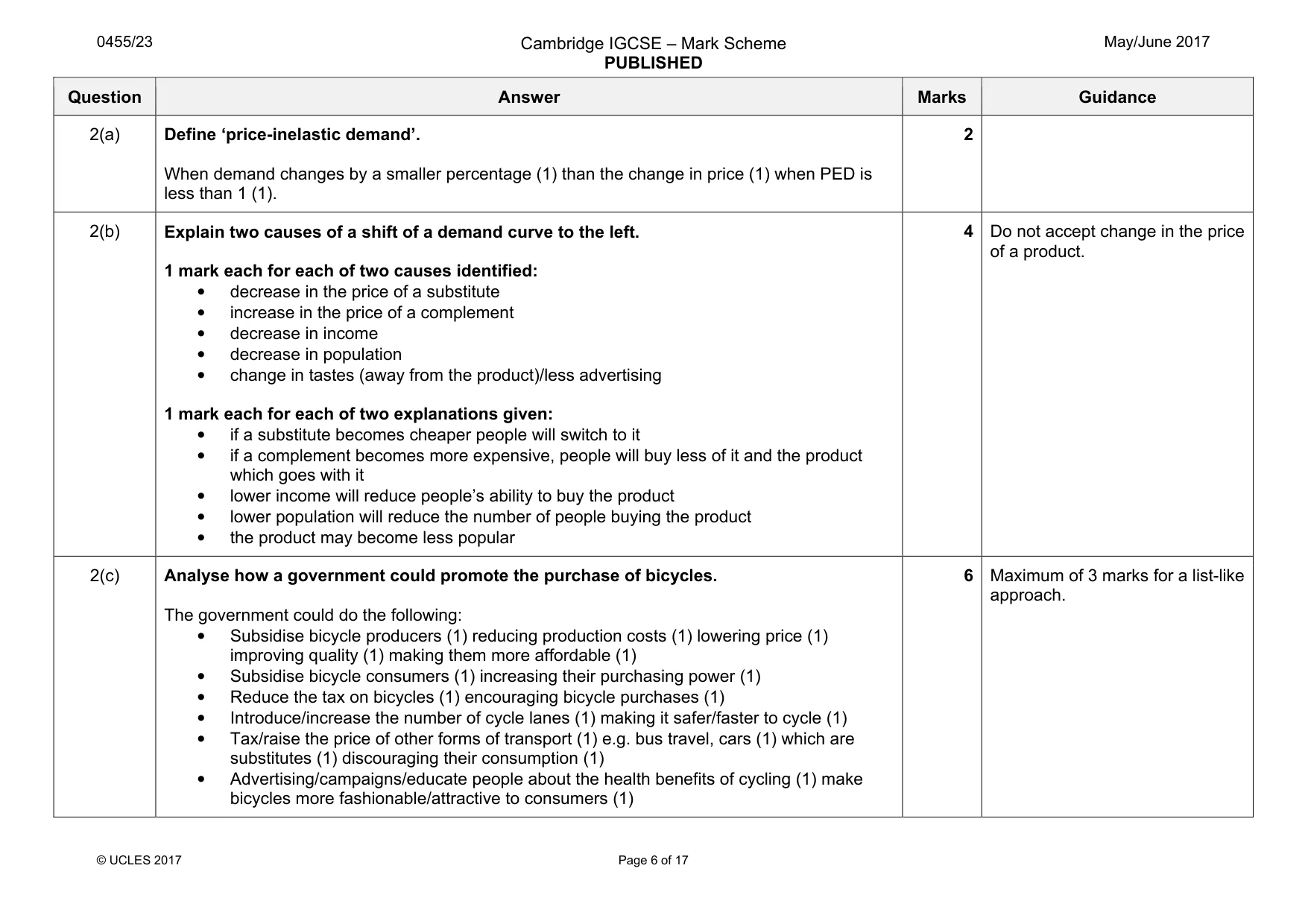
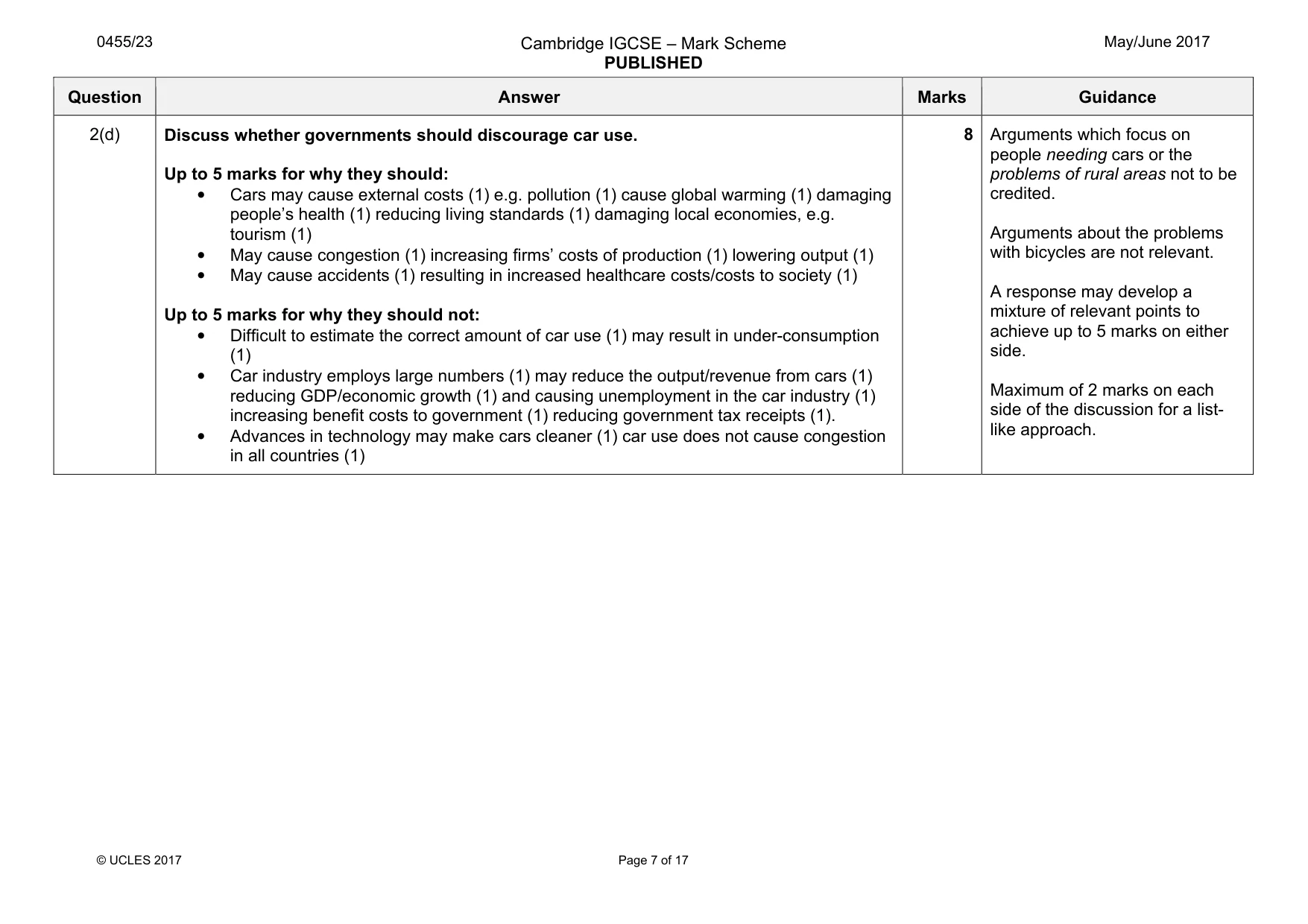
Mark scheme: 2(a) Define ‘price-inelastic demand’. When demand changes by a smaller percentage (1) than the change in price (1) when PED is less than 1 (1). 2 2(b) Explain two causes of a shift of a demand curve to the left. 1 mark each for each of two causes identified: • decrease in the price of a substitute • increase in the price of a complement • decrease in income • decrease in population • change in tastes (away from the product)/less advertising 1 mark each for each of two explanations given: • if a substitute becomes cheaper people will switch to it • if a complement becomes more expensive, people will buy less of it and the product which goes with it • lower income will reduce people’s ability to buy the product • lower population will reduce the number of people buying the product • the product may become less popular 4 Do not accept change in the price of a product. 2(c) Analyse how a government could promote the purchase of bicycles. The government could do the following: • Subsidise bicycle producers (1) reducing production costs (1) lowering price (1) improving quality (1) making them more affordable (1) • Subsidise bicycle consumers (1) increasing their purchasing power (1) • Reduce the tax on bicycles (1) encouraging bicycle purchases (1) • Introduce/increase the number of cycle lanes (1) making it safer/faster to cycle (1) • Tax/raise the price of other forms of transport (1) e.g. bus travel, cars (1) which are substitutes (1) discouraging their consumption (1) • Advertising/campaigns/educate people about the health benefits of cycling (1) make bicycles more fashionable/attractive to consumers (1) 6 Maximum of 3 marks for a list-like approach. Question Answer Marks Guidance 2(d) Discuss whether governments should discourage car use. Up to 5 marks for why they should: • Cars may cause external costs (1) e.g. pollution (1) cause global warming (1) damaging people’s health (1) reducing living standards (1) damaging local economies, e.g. tourism (1) • May cause congestion (1) increasing firms’ costs of production (1) lowering output (1) • May cause accidents (1) resulting in increased healthcare costs/costs to society (1) Up to 5 marks for why they should not: • Difficult to estimate the correct amount of car use (1) may result in under-consumption (1) • Car industry employs large numbers (1) may reduce the output/revenue from cars (1) reducing GDP/economic growth (1) and causing unemployment in the car industry (1) increasing benefit costs to government (1) reducing government tax receipts (1). • Advances in technology may make cars cleaner (1) car use does not cause congestion in all countries (1) 8 Arguments which focus on people needing cars or the problems of rural areas not to be credited. Arguments about the problems with bicycles are not relevant. A response may develop a mixture of relevant points to achieve up to 5 marks on either side. Maximum of 2 marks on each side of the discussion for a list- like approach.
Q3 · In 2015, money sent home by Nepalese workers working abroad accounted for 29% of Nepal’s…
3 In 2015, money sent home by Nepalese workers working abroad accounted for 29% of Nepal’s total income. These remittances also contributed positively to the country’s current account position on its balance of payments. In Kerala, a state in India, remittances accounted for 36% of total income, with people from the state going abroad to undertake a range of jobs including working as dentists and hotel cleaners. (a) Identify two factors that affect an individual’s choice of occupation. [2] (b) Explain two effects of a country having a surplus on the current account of its balance of payments. [4] (c) Analyse why dentists are paid more than hotel cleaners. [6] (d) Discuss whether an economy will benefit from recruiting workers from other countries. [8]
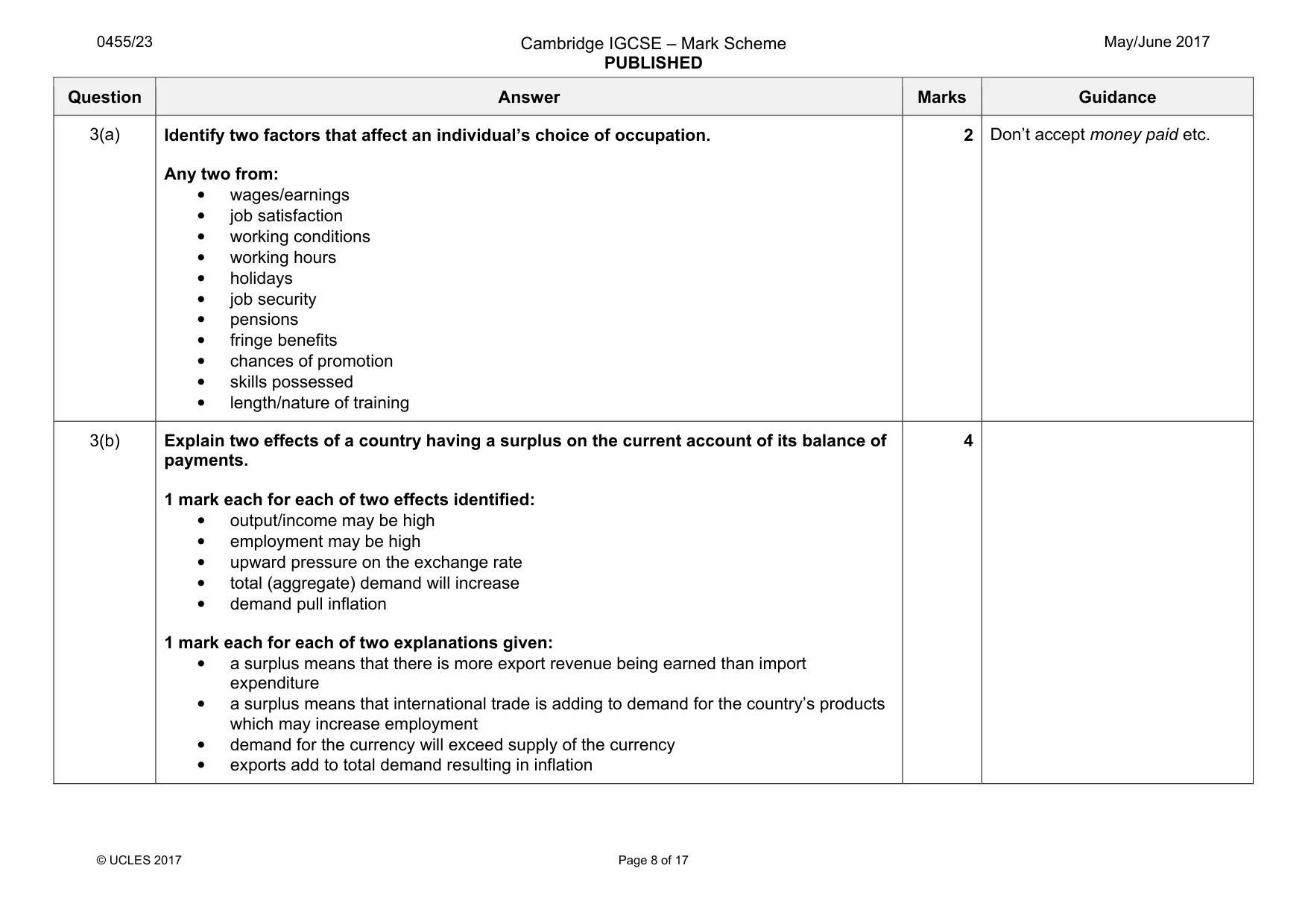
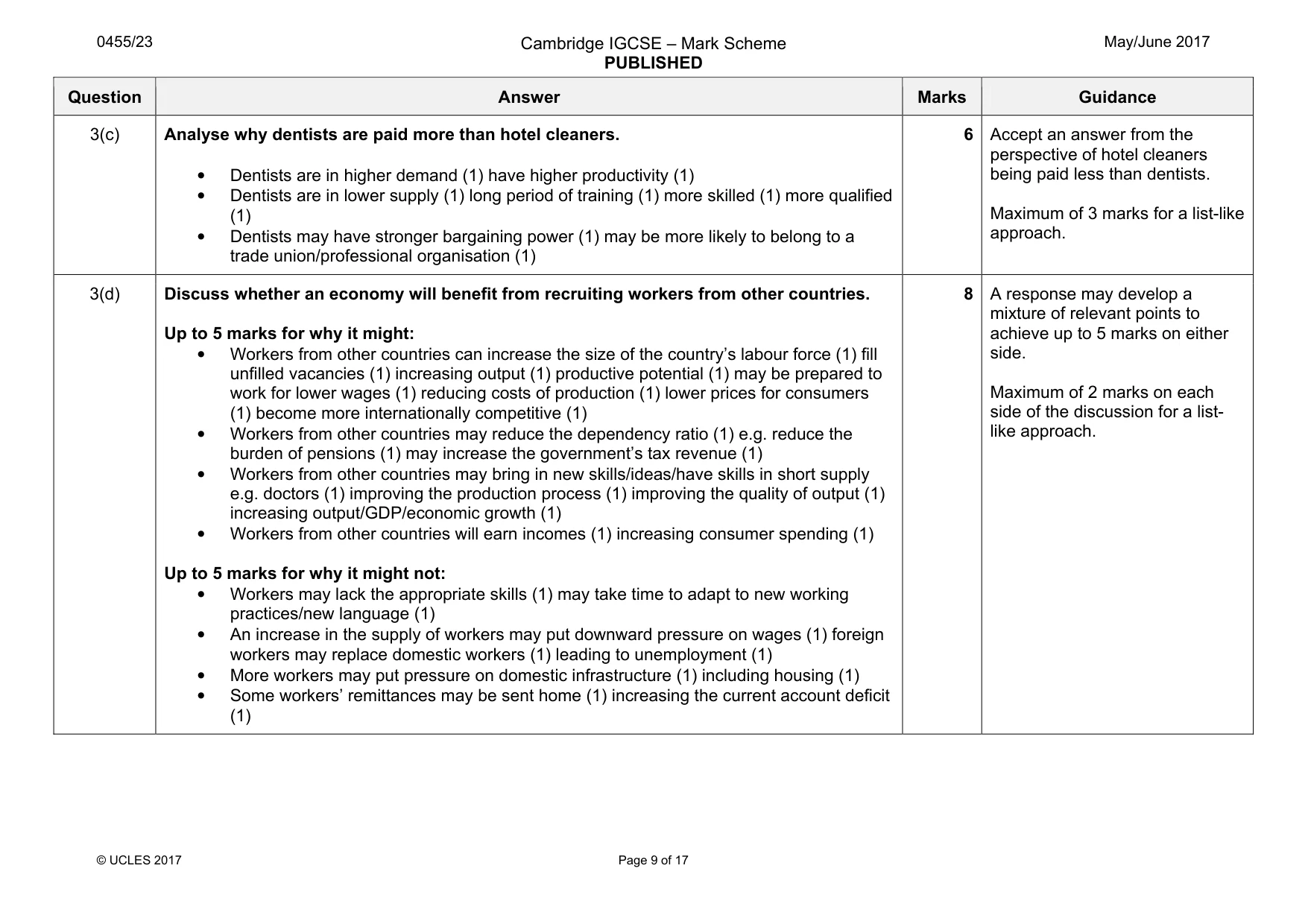
Mark scheme: 3(a) Identify two factors that affect an individual’s choice of occupation. Any two from: • wages/earnings • job satisfaction • working conditions • working hours • holidays • job security • pensions • fringe benefits • chances of promotion • skills possessed • length/nature of training 2 Don’t accept money paid etc. 3(b) Explain two effects of a country having a surplus on the current account of its balance of payments. 1 mark each for each of two effects identified: • output/income may be high • employment may be high • upward pressure on the exchange rate • total (aggregate) demand will increase • demand pull inflation 1 mark each for each of two explanations given: • a surplus means that there is more export revenue being earned than import expenditure • a surplus means that international trade is adding to demand for the country’s products which may increase employment • demand for the currency will exceed supply of the currency • exports add to total demand resulting in inflation 4 Question Answer Marks Guidance 3(c) Analyse why dentists are paid more than hotel cleaners. • Dentists are in higher demand (1) have higher productivity (1) • Dentists are in lower supply (1) long period of training (1) more skilled (1) more qualified (1) • Dentists may have stronger bargaining power (1) may be more likely to belong to a trade union/professional organisation (1) 6 Accept an answer from the perspective of hotel cleaners being paid less than dentists. Maximum of 3 marks for a list-like approach. 3(d) Discuss whether an economy will benefit from recruiting workers from other countries. Up to 5 marks for why it might: • Workers from other countries can increase the size of the country’s labour force (1) fill unfilled vacancies (1) increasing output (1) productive potential (1) may be prepared to work for lower wages (1) reducing costs of production (1) lower prices for consumers (1) become more internationally competitive (1) • Workers from other countries may reduce the dependency ratio (1) e.g. reduce the burden of pensions (1) may increase the government’s tax revenue (1) • Workers from other countries may bring in new skills/ideas/have skills in short supply e.g. doctors (1) improving the production process (1) improving the quality of output (1) increasing output/GDP/economic growth (1) • Workers from other countries will earn incomes (1) increasing consumer spending (1) Up to 5 marks for why it might not: • Workers may lack the appropriate skills (1) may take time to adapt to new working practices/new language (1) • An increase in the supply of workers may put downward pressure on wages (1) foreign workers may replace domestic workers (1) leading to unemployment (1) • More workers may put pressure on domestic infrastructure (1) including housing (1) • Some workers’ remittances may be sent home (1) increasing the current account deficit (1) 8 A response may develop a mixture of relevant points to achieve up to 5 marks on either side. Maximum of 2 marks on each side of the discussion for a list- like approach.
Q4 · 2015 saw more than US$4000 billion-worth of mergers worldwide, many in the USA and the UK
4 2015 saw more than US$4000 billion-worth of mergers worldwide, many in the USA and the UK. Some mergers occur between firms in different countries. These are influenced by a number of factors, including the size and structure of the markets in the countries and their exchange rates. Mergers influence the level of competition in markets. (a) Define ‘conglomerate integration’. [2] (b) Explain why firms in a perfectly competitive market are price-takers. [4] (c) Analyse the causes of an increase in a country’s exchange rate. [6] (d) Discuss whether a large firm will always have lower average costs of production than a small firm. [8]
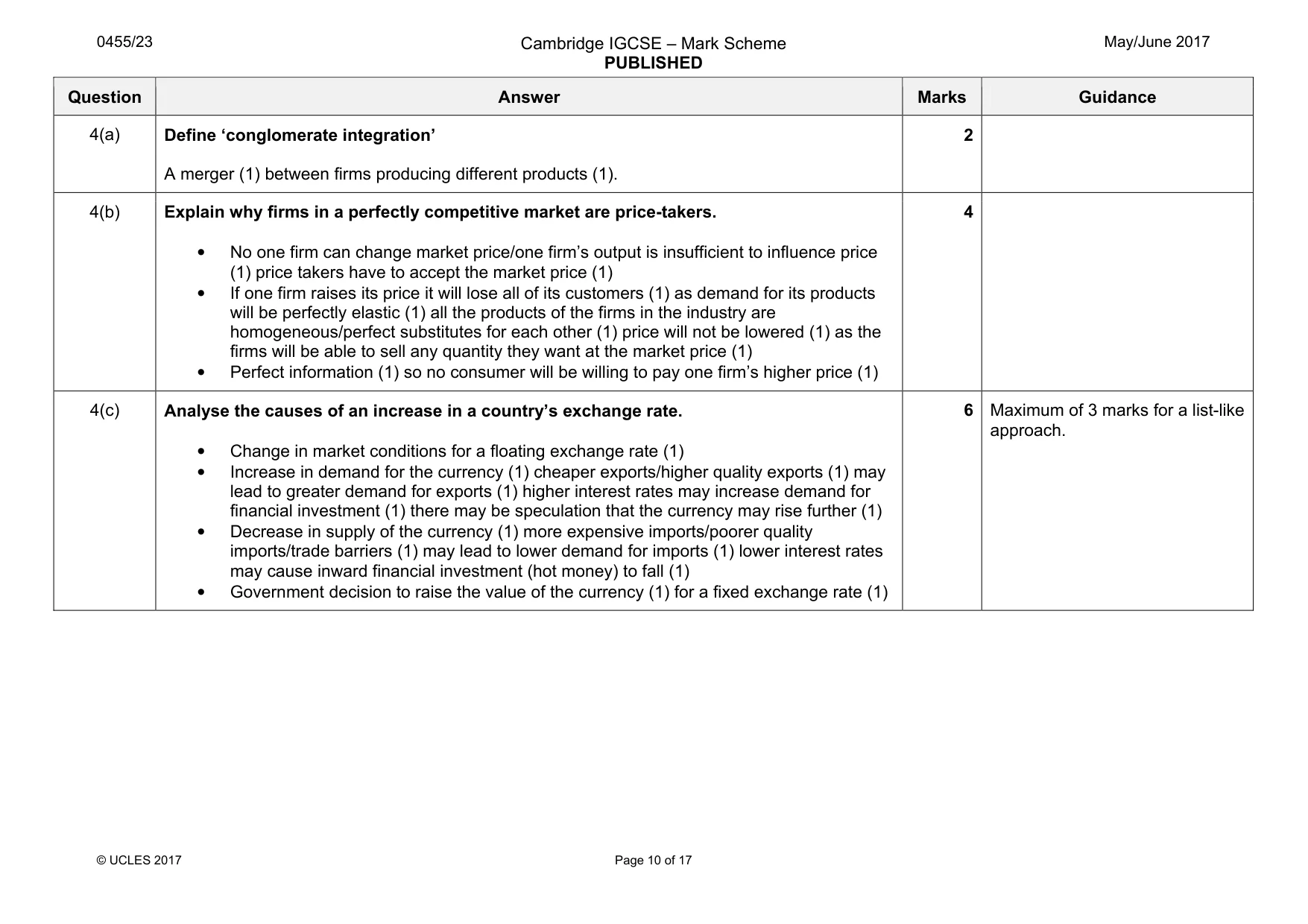
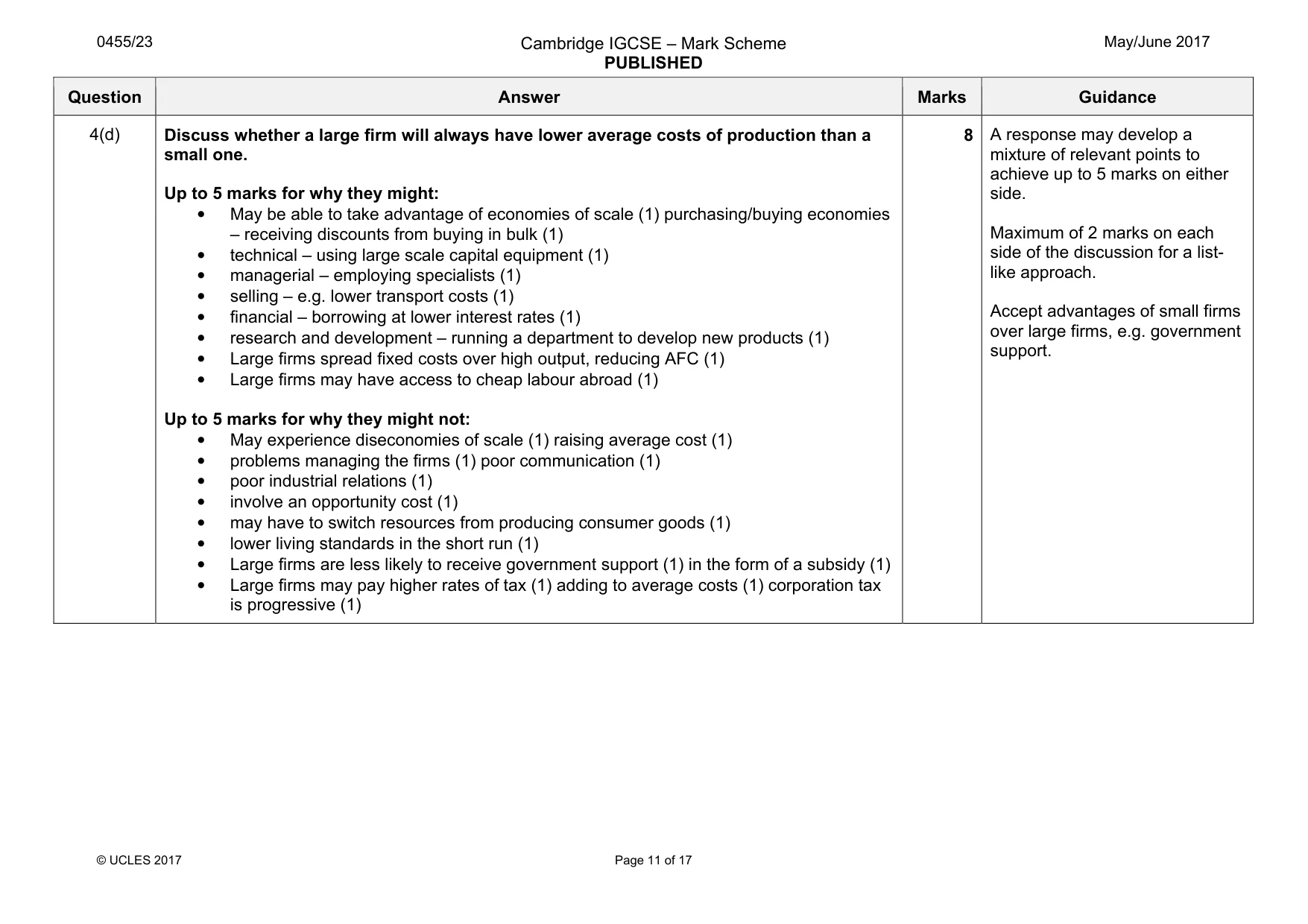
Mark scheme: 4(a) Define ‘conglomerate integration’ A merger (1) between firms producing different products (1). 2 4(b) Explain why firms in a perfectly competitive market are price-takers. • No one firm can change market price/one firm’s output is insufficient to influence price (1) price takers have to accept the market price (1) • If one firm raises its price it will lose all of its customers (1) as demand for its products will be perfectly elastic (1) all the products of the firms in the industry are homogeneous/perfect substitutes for each other (1) price will not be lowered (1) as the firms will be able to sell any quantity they want at the market price (1) • Perfect information (1) so no consumer will be willing to pay one firm’s higher price (1) 4 4(c) Analyse the causes of an increase in a country’s exchange rate. • Change in market conditions for a floating exchange rate (1) • Increase in demand for the currency (1) cheaper exports/higher quality exports (1) may lead to greater demand for exports (1) higher interest rates may increase demand for financial investment (1) there may be speculation that the currency may rise further (1) • Decrease in supply of the currency (1) more expensive imports/poorer quality imports/trade barriers (1) may lead to lower demand for imports (1) lower interest rates may cause inward financial investment (hot money) to fall (1) • Government decision to raise the value of the currency (1) for a fixed exchange rate (1) 6 Maximum of 3 marks for a list-like approach. Question Answer Marks Guidance 4(d) Discuss whether a large firm will always have lower average costs of production than a small one. Up to 5 marks for why they might: • May be able to take advantage of economies of scale (1) purchasing/buying economies – receiving discounts from buying in bulk (1) • technical – using large scale capital equipment (1) • managerial – employing specialists (1) • selling – e.g. lower transport costs (1) • financial – borrowing at lower interest rates (1) • research and development – running a department to develop new products (1) • Large firms spread fixed costs over high output, reducing AFC (1) • Large firms may have access to cheap labour abroad (1) Up to 5 marks for why they might not: • May experience diseconomies of scale (1) raising average cost (1) • problems managing the firms (1) poor communication (1) • poor industrial relations (1) • involve an opportunity cost (1) • may have to switch resources from producing consumer goods (1) • lower living standards in the short run (1) • Large firms are less likely to receive government support (1) in the form of a subsidy (1) • Large firms may pay higher rates of tax (1) adding to average costs (1) corporation tax is progressive (1) 8 A response may develop a mixture of relevant points to achieve up to 5 marks on either side. Maximum of 2 marks on each side of the discussion for a list- like approach. Accept advantages of small firms over large firms, e.g. government support.
Q5 · The Central Bank of Nigeria has set a limit for inflation of 9%, but in August 2015 the…
5 The Central Bank of Nigeria has set a limit for inflation of 9%, but in August 2015 the country’s inflation rate reached 9.2%. The Governor of the Central Bank said he would welcome the use of fiscal policy to reduce the inflation rate and would resist calls to devalue the country’s exchange rate. (a) Define ‘Central Bank’. [2] (b) Explain the difference between a fixed exchange rate and a floating exchange rate. [4] (c) Analyse how fiscal policy could reduce the inflation rate. [6] (d) Discuss whether inflation causes more problems than deflation. [8]
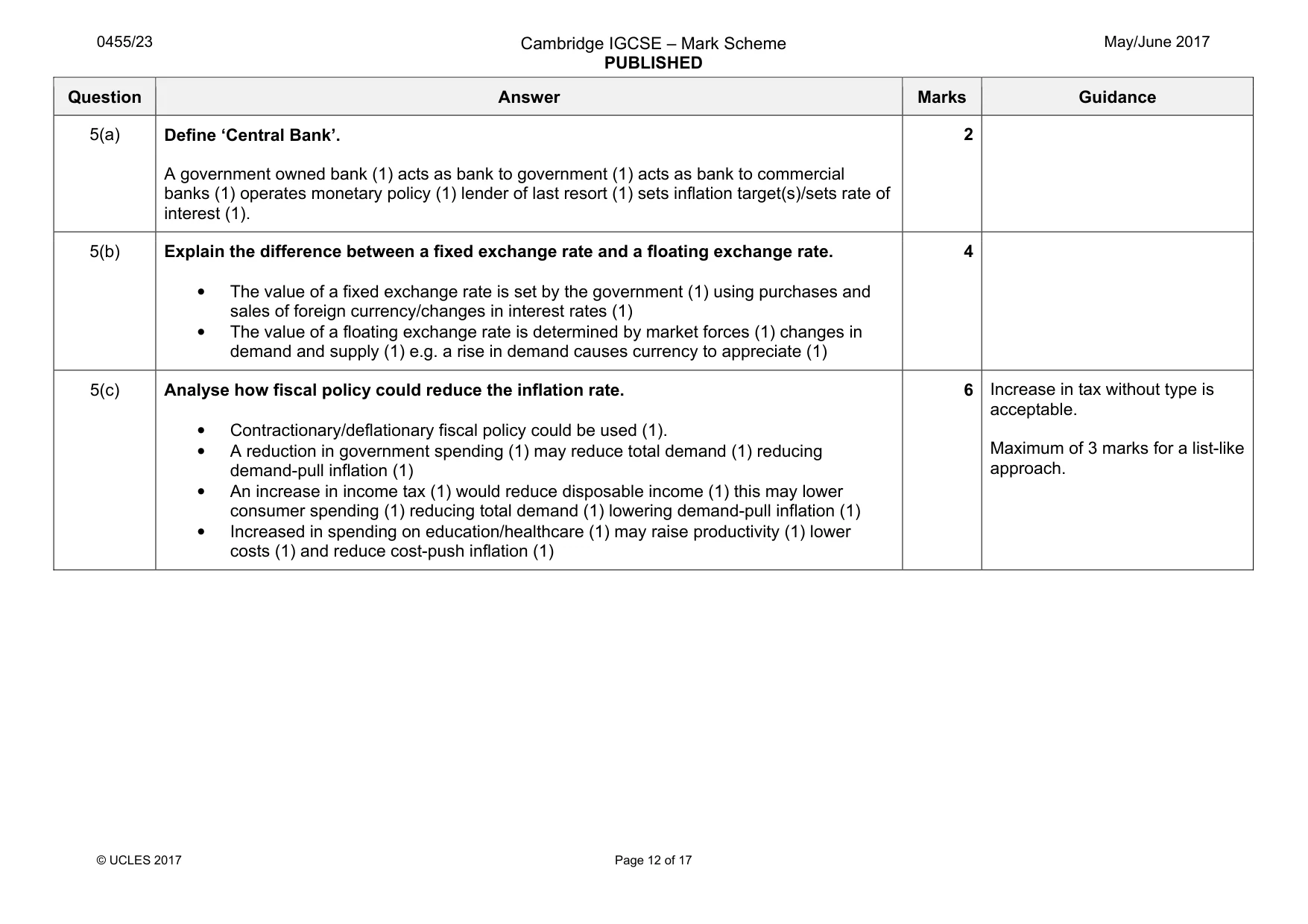
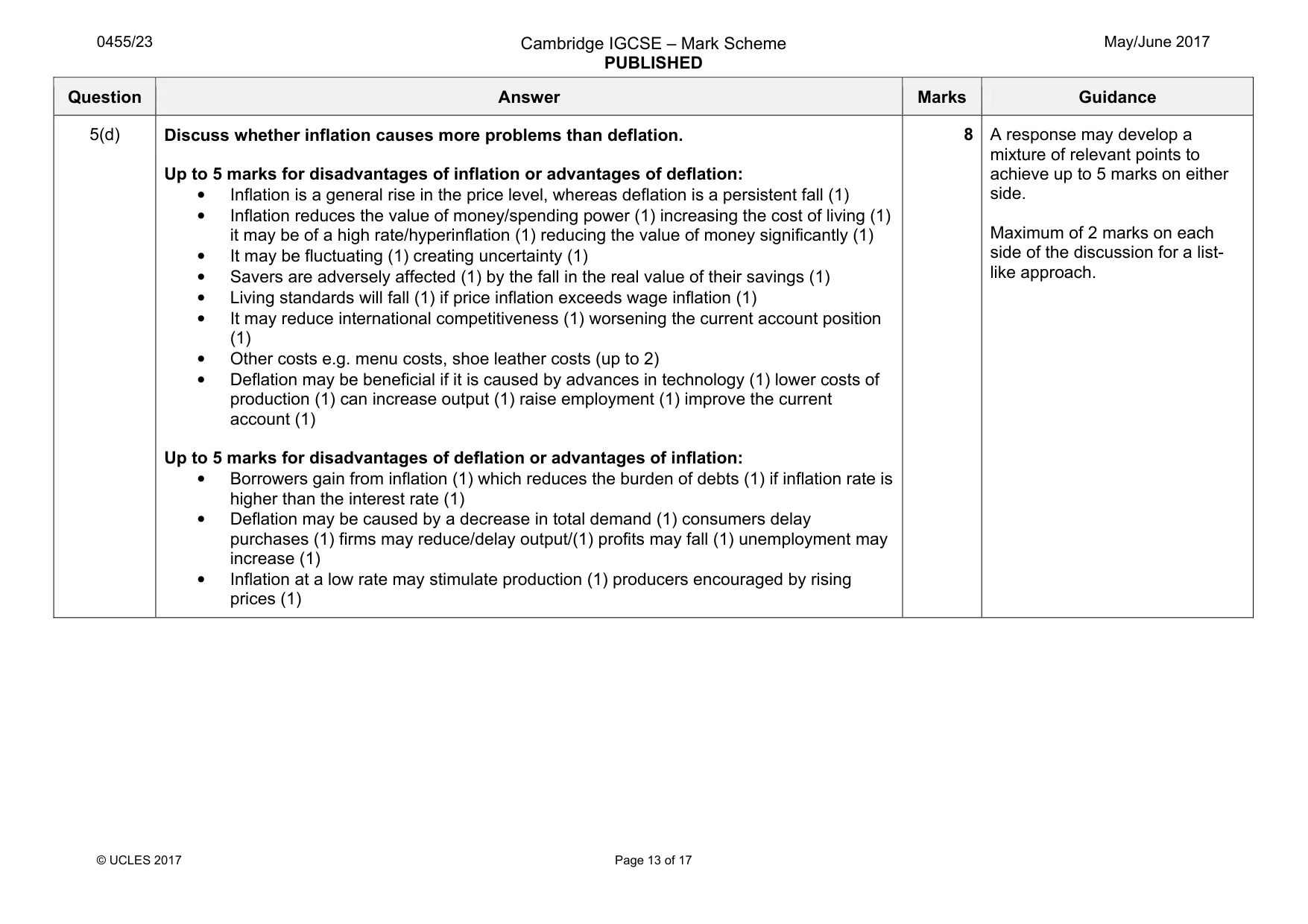
Mark scheme: 5(a) Define ‘Central Bank’. A government owned bank (1) acts as bank to government (1) acts as bank to commercial banks (1) operates monetary policy (1) lender of last resort (1) sets inflation target(s)/sets rate of interest (1). 2 5(b) Explain the difference between a fixed exchange rate and a floating exchange rate. • The value of a fixed exchange rate is set by the government (1) using purchases and sales of foreign currency/changes in interest rates (1) • The value of a floating exchange rate is determined by market forces (1) changes in demand and supply (1) e.g. a rise in demand causes currency to appreciate (1) 4 5(c) Analyse how fiscal policy could reduce the inflation rate. • Contractionary/deflationary fiscal policy could be used (1). • A reduction in government spending (1) may reduce total demand (1) reducing demand-pull inflation (1) • An increase in income tax (1) would reduce disposable income (1) this may lower consumer spending (1) reducing total demand (1) lowering demand-pull inflation (1) • Increased in spending on education/healthcare (1) may raise productivity (1) lower costs (1) and reduce cost-push inflation (1) 6 Increase in tax without type is acceptable. Maximum of 3 marks for a list-like approach. Question Answer Marks Guidance 5(d) Discuss whether inflation causes more problems than deflation. Up to 5 marks for disadvantages of inflation or advantages of deflation: • Inflation is a general rise in the price level, whereas deflation is a persistent fall (1) • Inflation reduces the value of money/spending power (1) increasing the cost of living (1) it may be of a high rate/hyperinflation (1) reducing the value of money significantly (1) • It may be fluctuating (1) creating uncertainty (1) • Savers are adversely affected (1) by the fall in the real value of their savings (1) • Living standards will fall (1) if price inflation exceeds wage inflation (1) • It may reduce international competitiveness (1) worsening the current account position (1) • Other costs e.g. menu costs, shoe leather costs (up to 2) • Deflation may be beneficial if it is caused by advances in technology (1) lower costs of production (1) can increase output (1) raise employment (1) improve the current account (1) Up to 5 marks for disadvantages of deflation or advantages of inflation: • Borrowers gain from inflation (1) which reduces the burden of debts (1) if inflation rate is higher than the interest rate (1) • Deflation may be caused by a decrease in total demand (1) consumers delay purchases (1) firms may reduce/delay output/(1) profits may fall (1) unemployment may increase (1) • Inflation at a low rate may stimulate production (1) producers encouraged by rising prices (1) 8 A response may develop a mixture of relevant points to achieve up to 5 marks on either side. Maximum of 2 marks on each side of the discussion for a list- like approach.
Q6 · Living standards have risen in a variety of ways in recent decades
6 Living standards have risen in a variety of ways in recent decades. Between 1990 and 2015, more than 2.5 billion people in the world gained access to improved water and the proportion of undernourished people declined from 24% to 13%. Countries have made different rates of progress and these have been reflected in their Human Development Index (HDI) rankings. (a) Define the ‘Human Development Index’. [2] (b) Explain why the concept of opportunity cost is important in deciding how to allocate resources. [4] (c) Analyse how a reduction in the rate of interest could reduce poverty. [6] (d) Discuss whether rapid economic growth always increases living standards. [8]
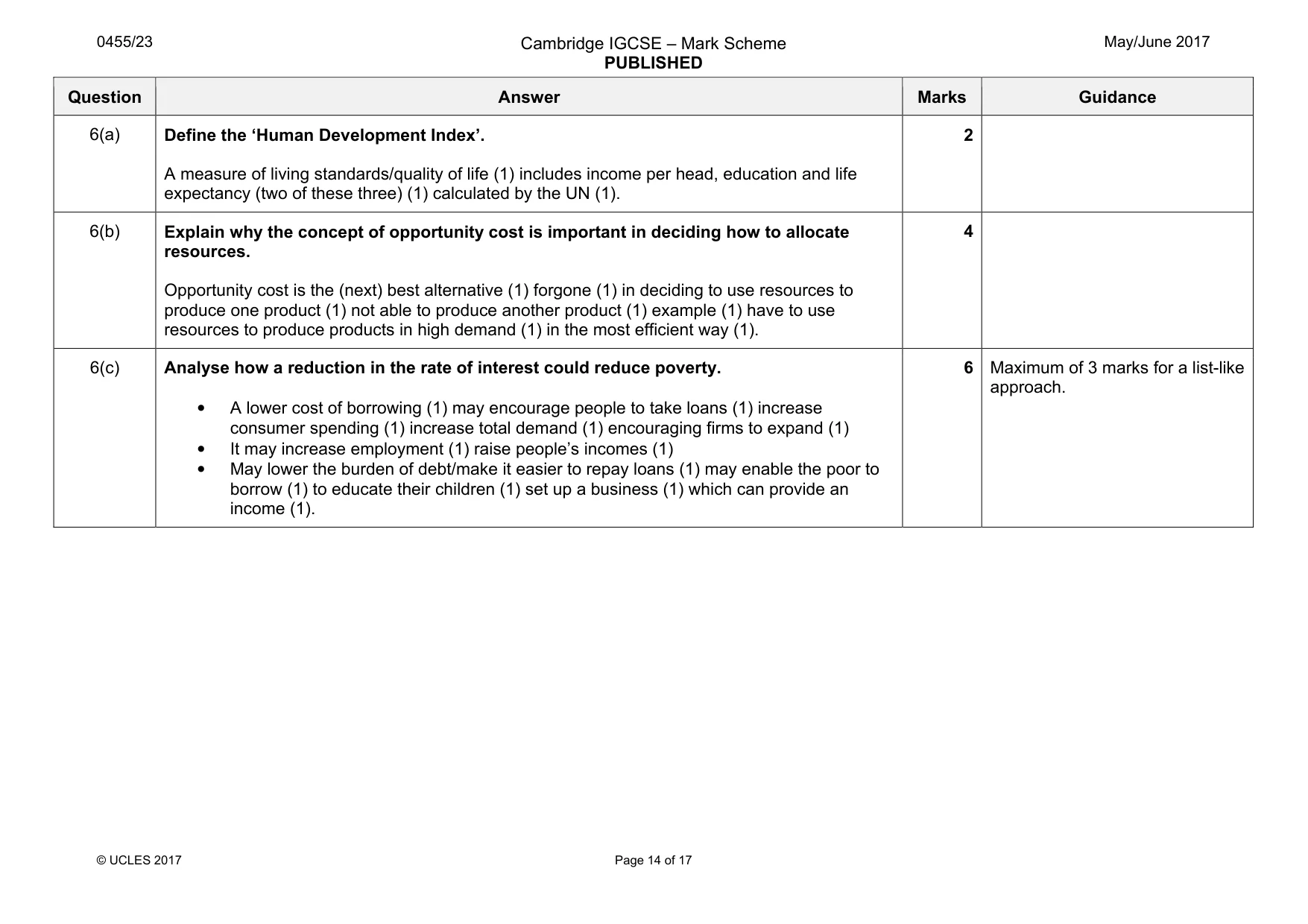
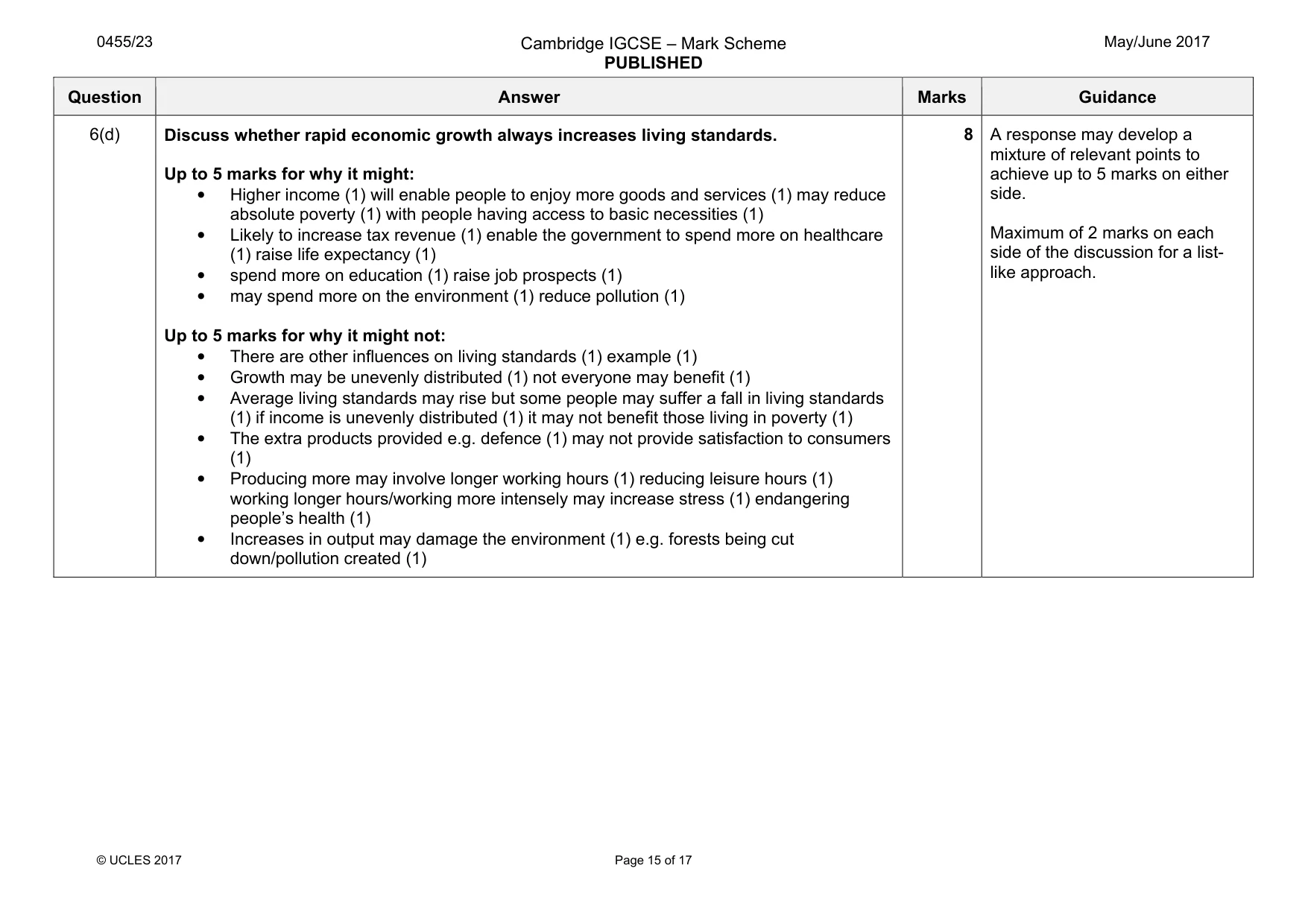
Mark scheme: 6(a) Define the ‘Human Development Index’. A measure of living standards/quality of life (1) includes income per head, education and life expectancy (two of these three) (1) calculated by the UN (1). 2 6(b) Explain why the concept of opportunity cost is important in deciding how to allocate resources. Opportunity cost is the (next) best alternative (1) forgone (1) in deciding to use resources to produce one product (1) not able to produce another product (1) example (1) have to use resources to produce products in high demand (1) in the most efficient way (1). 4 6(c) Analyse how a reduction in the rate of interest could reduce poverty. • A lower cost of borrowing (1) may encourage people to take loans (1) increase consumer spending (1) increase total demand (1) encouraging firms to expand (1) • It may increase employment (1) raise people’s incomes (1) • May lower the burden of debt/make it easier to repay loans (1) may enable the poor to borrow (1) to educate their children (1) set up a business (1) which can provide an income (1). 6 Maximum of 3 marks for a list-like approach. Question Answer Marks Guidance 6(d) Discuss whether rapid economic growth always increases living standards. Up to 5 marks for why it might: • Higher income (1) will enable people to enjoy more goods and services (1) may reduce absolute poverty (1) with people having access to basic necessities (1) • Likely to increase tax revenue (1) enable the government to spend more on healthcare (1) raise life expectancy (1) • spend more on education (1) raise job prospects (1) • may spend more on the environment (1) reduce pollution (1) Up to 5 marks for why it might not: • There are other influences on living standards (1) example (1) • Growth may be unevenly distributed (1) not everyone may benefit (1) • Average living standards may rise but some people may suffer a fall in living standards (1) if income is unevenly distributed (1) it may not benefit those living in poverty (1) • The extra products provided e.g. defence (1) may not provide satisfaction to consumers (1) • Producing more may involve longer working hours (1) reducing leisure hours (1) working longer hours/working more intensely may increase stress (1) endangering people’s health (1) • Increases in output may damage the environment (1) e.g. forests being cut down/pollution created (1) 8 A response may develop a mixture of relevant points to achieve up to 5 marks on either side. Maximum of 2 marks on each side of the discussion for a list- like approach.
Q7 · Argentina once had one of the highest levels of Gross Domestic Product (GDP) per head in…
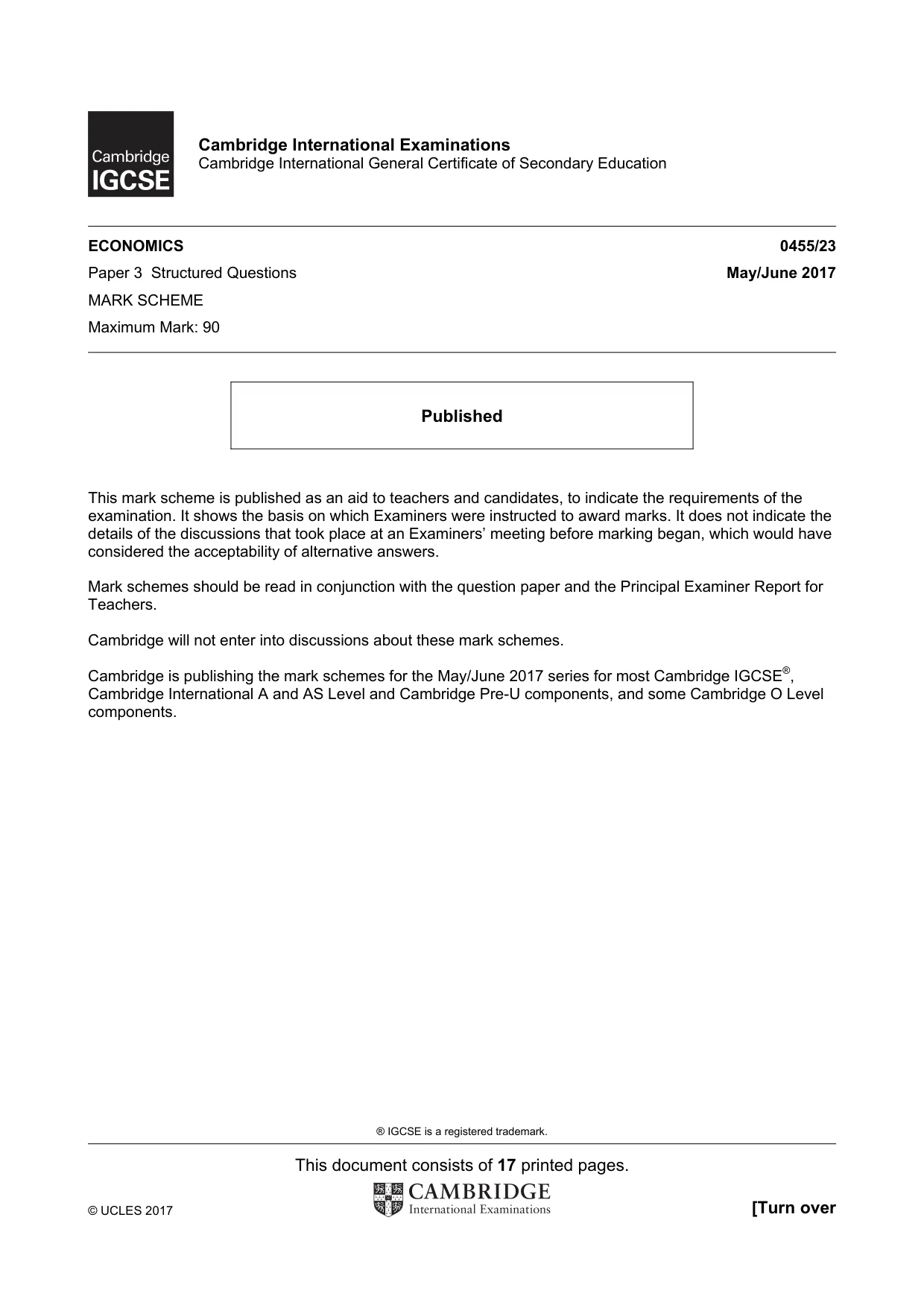
7 Argentina once had one of the highest levels of Gross Domestic Product (GDP) per head in the world and one of the highest economic growth rates. Many multinational companies were producing in the country. Some suggest that for Argentina to regain its position among the top ten richest countries, it needs to increase spending on education and move towards free trade. (a) Define ‘free trade’. [2] (b) Explain two reasons why governments aim for economic growth. [4] (c) Analyse why the social benefits of education are greater than the private benefits. [6] (d) Discuss whether multinational companies (MNCs) will always locate in countries with a high GDP per head. [8]
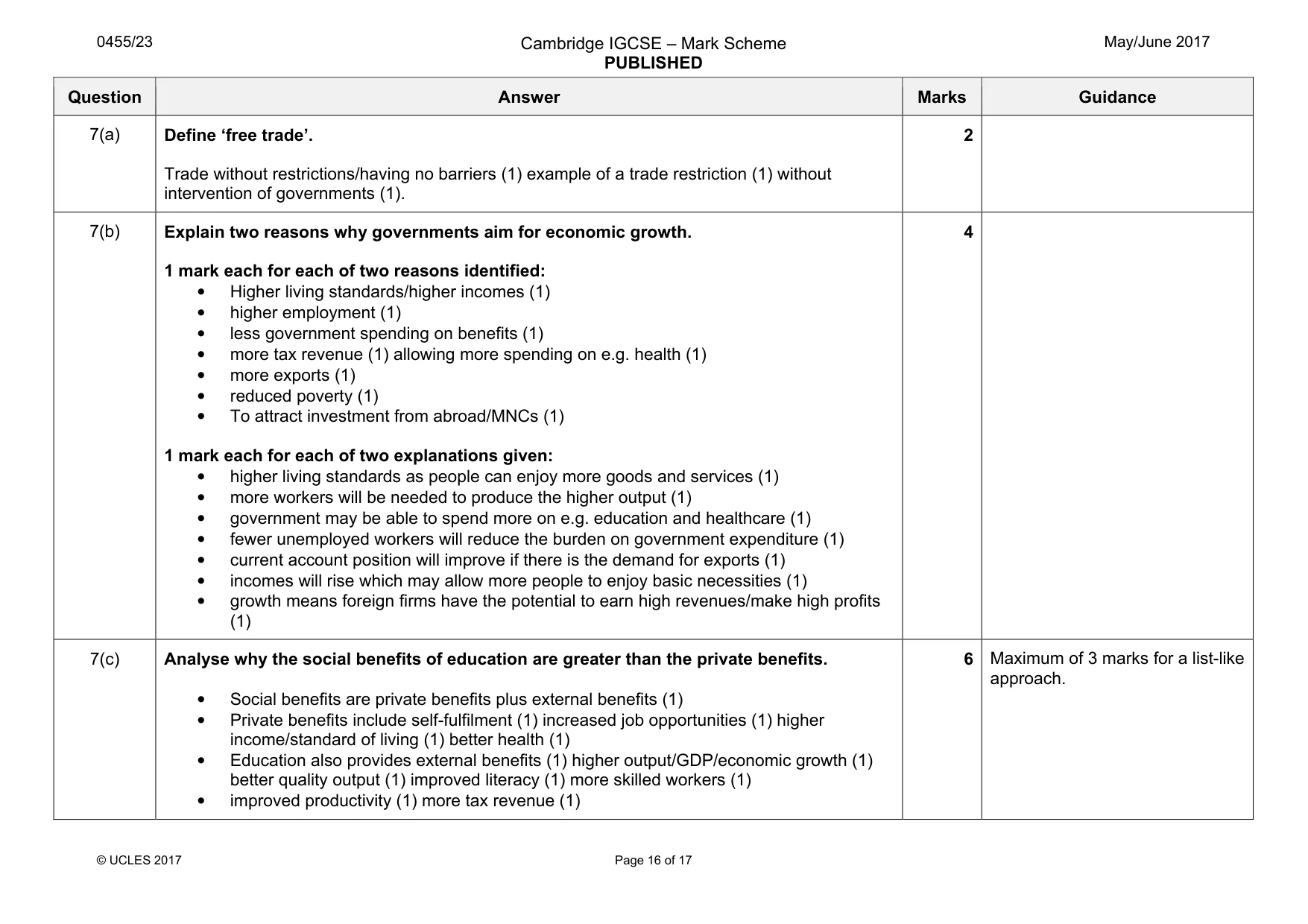
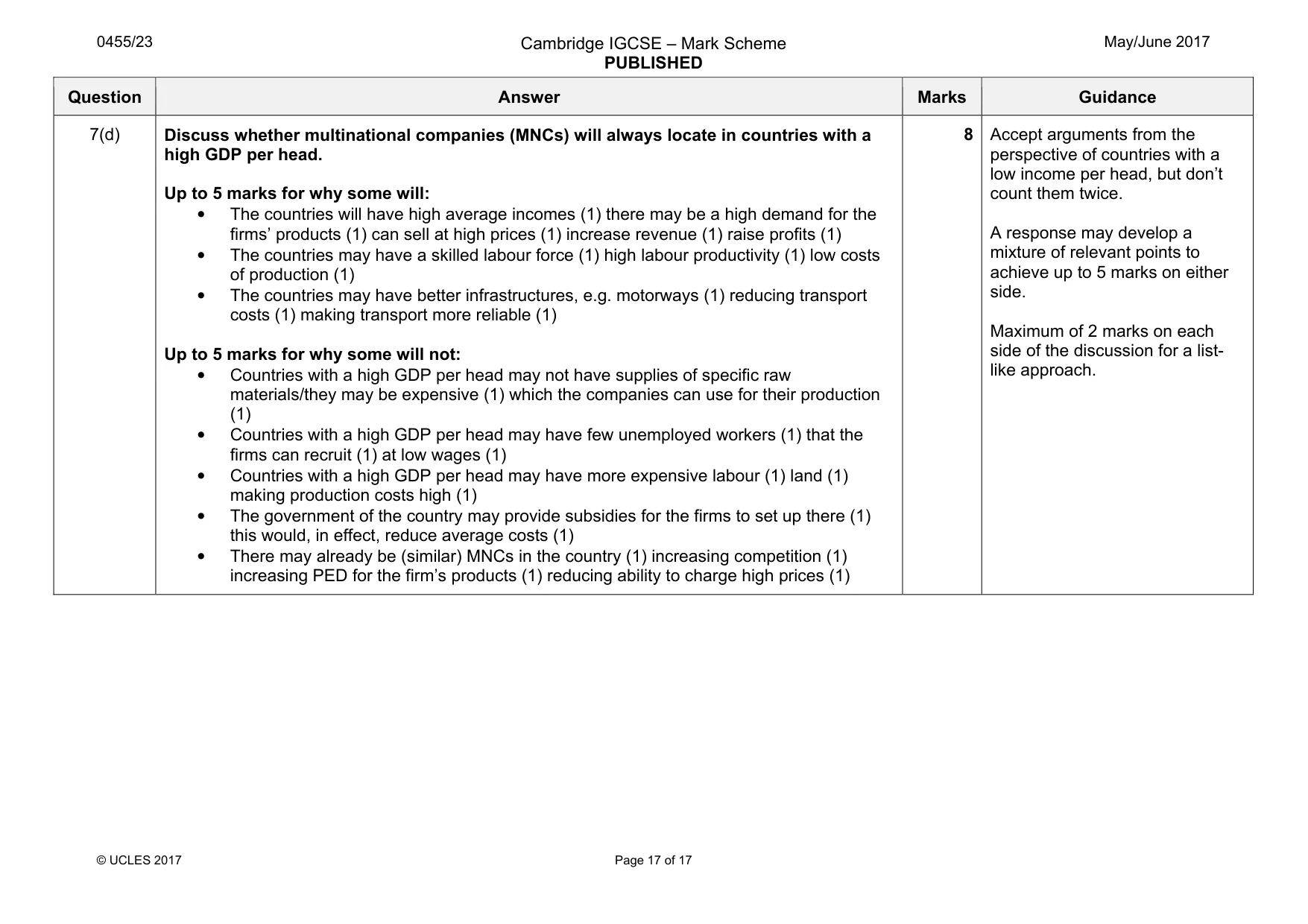
Mark scheme: 7(a) Define ‘free trade’. Trade without restrictions/having no barriers (1) example of a trade restriction (1) without intervention of governments (1). 2 7(b) Explain two reasons why governments aim for economic growth. 1 mark each for each of two reasons identified: • Higher living standards/higher incomes (1) • higher employment (1) • less government spending on benefits (1) • more tax revenue (1) allowing more spending on e.g. health (1) • more exports (1) • reduced poverty (1) • To attract investment from abroad/MNCs (1) 1 mark each for each of two explanations given: • higher living standards as people can enjoy more goods and services (1) • more workers will be needed to produce the higher output (1) • government may be able to spend more on e.g. education and healthcare (1) • fewer unemployed workers will reduce the burden on government expenditure (1) • current account position will improve if there is the demand for exports (1) • incomes will rise which may allow more people to enjoy basic necessities (1) • growth means foreign firms have the potential to earn high revenues/make high profits (1) 4 7(c) Analyse why the social benefits of education are greater than the private benefits. • Social benefits are private benefits plus external benefits (1) • Private benefits include self-fulfilment (1) increased job opportunities (1) higher income/standard of living (1) better health (1) • Education also provides external benefits (1) higher output/GDP/economic growth (1) better quality output (1) improved literacy (1) more skilled workers (1) • improved productivity (1) more tax revenue (1) 6 Maximum of 3 marks for a list-like approach. Question Answer Marks Guidance 7(d) Discuss whether multinational companies (MNCs) will always locate in countries with a high GDP per head. Up to 5 marks for why some will: • The countries will have high average incomes (1) there may be a high demand for the firms’ products (1) can sell at high prices (1) increase revenue (1) raise profits (1) • The countries may have a skilled labour force (1) high labour productivity (1) low costs of production (1) • The countries may have better infrastructures, e.g. motorways (1) reducing transport costs (1) making transport more reliable (1) Up to 5 marks for why some will not: • Countries with a high GDP per head may not have supplies of specific raw materials/they may be expensive (1) which the companies can use for their production (1) • Countries with a high GDP per head may have few unemployed workers (1) that the firms can recruit (1) at low wages (1) • Countries with a high GDP per head may have more expensive labour (1) land (1) making production costs high (1) • The government of the country may provide subsidies for the firms to set up there (1) this would, in effect, reduce average costs (1) • There may already be (similar) MNCs in the country (1) increasing competition (1) increasing PED for the firm’s products (1) reducing ability to charge high prices (1) 8 Accept arguments from the perspective of countries with a low income per head, but don’t count them twice. A response may develop a mixture of relevant points to achieve up to 5 marks on either side. Maximum of 2 marks on each side of the discussion for a list- like approach.
What was in this paper
The subtopics covered by these 7 questions, and how many questions each got. Open one in a new tab to see every Cambridge question on it.
What you needed in this session
Cambridge’s own grade thresholds for 2017 May/June, Paper 2 · Variant 3. A higher threshold means an easier paper — the bar moves with how the cohort did.