Questions as text
Q1 · Show that the equation tan(45◦+ x) = 2 tan(45◦−x) can be written in the form tan2x −6 tan… 9709/31 Oct/Nov 2004
4 (i) Show that the equation tan(45◦+ x) = 2 tan(45◦−x) can be written in the form tan2x −6 tan x + 1 = 0. [4] (ii) Hence solve the equation tan(45◦+ x) = 2 tan(45◦−x), for 0◦< x < 90◦. [3]
7 marks
Mark scheme: 4 (i) EITHER: Use tan(A ± B) formula correctly to obtain an equation in tan x M1 1 + tan x 2(1 − tan x ) State or imply the equation = or equivalent A1 1 − tan x 1 + tan x Transform to an expanded horizontal quadratic equation in tan x M1 Obtain given answer correctly A1 OR: Use sin(A ± B) and cos(A ± B) formulae correctly to obtain an equation in sin x and cos x M1 Using values of sin 45°and cos 45°, or their equality, obtain an expanded horizontal equation in sin x and cos x A1 Transform to a quadratic equation in tan x M1 Obtain given answer correctly A1 4 (ii) Solve the given quadratic and calculate an angle in degrees or radians M1 Obtain one answer e.g. 80.3° A1 Obtain second answer 9.7° and no others in the range A1 3 [Ignore answers outside the given range.] 1 2
This question in 9709/31 Oct/Nov 2004
Q2 · The diagram shows a sector OAB of a circle with centre O and radius r 9709/31 Oct/Nov 2004
5 The diagram shows a sector OAB of a circle with centre O and radius r. The angle AOB is α radians, where 0 < α < 12π. The point N on OA is such that BN is perpendicular to OA. The area of the triangle ONB is half the area of the sector OAB. (i) Show that α satisfies the equation sin 2x = x. [3] (ii) By sketching a suitable pair of graphs, show that this equation has exactly one root in the interval 0 < x < 12π. [2] (iii) Use the iterative formula xn+1 = sin(2xn), with initial value x1 = 1, to find α correct to 2 decimal places, showing the result of each iteration. [3]
8 marks
Mark scheme: 1 25 (i) Obtain area of ONB in terms of r and α e.g. r cos α sin α B1 2 1 1 2 Equate area of triangle in terms of r and α to r α or equivalent M1 2 2 Obtain given form, sin 2α = α, correctly A1 3 [Allow use of OA and/or OB for r.] (ii) Make recognisable sketch in one diagram over the given range of two suitable graphs, e.g. y = sin 2x and y = x B1 State or imply link between intersections and roots and justify the given answer B1 2 [Allow a single graph and its intersection with y = 0 to earn full marks.] (iii) Use the iterative formula correctly at least once M1 Obtain final answer 0.95 A1 Show sufficient iterations to justify its accuracy to 2d.p., or show there is a sign change in (0.945, 0.955) A1 3 [SR: Allow the M mark if calculations are attempted in degree mode.]
This question in 9709/31 Oct/Nov 2004
Q3 · Prove the identity cos 4θ + 4 cos 2θ ≡8 cos4 θ −3 9709/31 May/June 2005
6 (i) Prove the identity cos 4θ + 4 cos 2θ ≡8 cos4 θ −3. [4] (ii) Hence solve the equation cos 4θ + 4 cos 2θ = 2, for 0◦≤θ ≤360◦. [4]
8 marks
Mark scheme: 6 (i) EITHER: Express cos 4θ in terms of cos 2θ and/or sin 2θ B1 Use double angle formulae to express LHS in terms of cos θ (and maybe sin θ) M1 Obtain any correct expression in terms of cos θ alone A1 Reduce correctly to the given form A1 OR: Use double angle formula to express RHS in terms of cos 2θ M1 Express cos22θ in terms of cos 4θ . B1 Obtain any correct expression in terms of cos 4θ and cos2θ A1 Reduce correctly to the given form A1 4 (ii) Using the identity, carry out method for calculating one root M1 Obtain answer 27.2° (or 0.475 radians) or 27.3° (or 0.476 radians) A1 Obtain a second answer, e.g. 332.8° (or 5.81 radians) A1√ Obtain remaining answers, e.g. 152.8° and 207.2° (or 2.67 and 3.62 radians) and no others in range A1√ 4 A AND AS LEVEL – JUNE 2005 9709/8719 3
This question in 9709/31 May/June 2005
Q4 · By sketching a suitable pair of graphs, show that the equation cosec x = 12x + 1, where x… 9709/31 May/June 2005
7 (i) By sketching a suitable pair of graphs, show that the equation cosec x = 12x + 1, where x is in radians, has a root in the interval 0 < x < 12π. [2] (ii) Verify, by calculation, that this root lies between 0.5 and 1. [2] (iii) Show that this root also satisfies the equation 2 x = sin−1 . [1] x + 2 (iv) Use the iterative formula 2 xn+1 = sin−1 , xn + 2 with initial value x1 = 0.75, to determine this root correct to 2 decimal places. Give the result of each iteration to 4 decimal places. [3]
8 marks
Mark scheme: 7 (i) Make recognisable sketch of a relevant graph over the given range, e.g. y = cosec x B1 Sketch the other relevant graph, e.g. y = ½ x + 1, and justify the given statement B1 2 (ii) Consider sign of cosec x − ½ x − 1 at x = 0.5 and x = 1, or equivalent M1 Complete the argument correctly with appropriate calculations A1 2 (iii) Rearrange cosec x = 1 x + 1 in the given form, or vice versa B1 1 2 (iv) Use the iterative formula correctly at least once M1 Obtain final answer x = 0.80 A1 Show sufficient iterations to at least 3 d.p. to justify its accuracy to 2 d.p., or show there is a sign change in the interval (0.795, 0.805) A1 3
This question in 9709/31 May/June 2005
Q5 · Show that the equation tan(45◦+ x) −tan x = 2 can be written in the form tan2x + 2 tan x… 9709/31 Oct/Nov 2007
5 (i) Show that the equation tan(45◦+ x) −tan x = 2 can be written in the form tan2x + 2 tan x −1 = 0. [3] (ii) Hence solve the equation tan(45◦+ x) −tan x = 2, giving all solutions in the interval 0◦≤x ≤180◦. [4]
7 marks
Mark scheme: 5 (i) Use correct tan(A + B) formula to obtain an equation in tan x M1* Use tan 45° = 1 M1(dep*) Obtain the given answer A1 [3] (ii) Make reasonable attempt to solve the given quadratic for one value of tan x M1 Obtain tan x = − 1± 2 , or equivalent in the form ( a ± b /) c (accept 0.4, −2.4) A1 Obtain answer x = 22.5° A1 Obtain second answer x = 112.5 and no others in the range A1 [4] [Ignore answers outside the range.] [Treat answers in radians as a MR and deduct one mark from the marks for the angles.] GCE A/AS LEVEL – October/November 2007 9709 03
This question in 9709/31 Oct/Nov 2007
Q6 · N D C a r x M A B 3a In the diagram, ABCD is a rectangle with AB = 3a and AD = a 9709/31 May/June 2008
3 N D C a r x M A B 3a In the diagram, ABCD is a rectangle with AB = 3a and AD = a. A circular arc, with centre A and radius r, joins points M and N on AB and CD respectively. The angle MAN is x radians. The perimeter of the sector AMN is equal to half the perimeter of the rectangle. (i) Show that x satisfies the equation sin x = 14(2 + x). [3] (ii) This equation has only one root in the interval 0 < x < 12π. Use the iterative formula 2 + xn xn+1 = sin−1 , 4 with initial value x1 = 0.8, to determine the root correct to 2 decimal places. Give the result of each iteration to 4 decimal places. [3]
6 marks
Mark scheme: 3 (i) State or imply r = a cosec x, or equivalent B1 Using perimeters, obtain a correct equation in x, e.g. 2a cosec x + ax cosec x = 4a, or 2r + rx = 4a B1 Deduce the given form of equation correctly B1 [3] (ii) Use the iterative formula correctly at least once M1 Obtain final answer 0.76 A1 Show sufficient iterations to 4 d.p. to justify its accuracy to 2 d.p., or show that there is a sign change in the value of sin x − 1 (2 + x ) in the interval (0.755, 0.765) A1 [3] 4
This question in 9709/31 May/June 2008
Q7 · Show that the equation tan(30◦+ θ) = 2 tan(60◦−θ) can be written in the form tan2θ + (6… 9709/31 May/June 2008
4 (i) Show that the equation tan(30◦+ θ) = 2 tan(60◦−θ) can be written in the form tan2θ + (6 √3) tan θ −5 = 0. [4] (ii) Hence, or otherwise, solve the equation tan(30◦+ θ) = 2 tan(60◦−θ), for 0◦≤θ ≤180◦. [3]
7 marks
Mark scheme: 4 (i) Use tan(A ± B) formula correctly at least once to obtain an equation in tan θ M1 Obtain a correct horizontal equation in any form A1 Use correct exact values of tan 30° and tan 60° throughout M1 Obtain the given equation correctly A1 [4] GCE A/AS LEVEL – May/June 2008 9709 03 (ii) Make reasonable attempt to solve the given quadratic in tan θ M1 Obtain answer θ = 24.7° A1 Obtain answer θ = 95.3° and no others in the given range A1 [3] [Ignore answers outside the given range.] [Treat answers in radians as MR and deduct one mark from the marks for the angles.]
This question in 9709/31 May/June 2008
Q8 · Express 5 sin x + 12 cos x in the form R sin(x + α), where R > 0 and 0◦< α < 90◦, giving… 9709/31 Oct/Nov 2008
6 (i) Express 5 sin x + 12 cos x in the form R sin(x + α), where R > 0 and 0◦< α < 90◦, giving the value of α correct to 2 decimal places. [3] (ii) Hence solve the equation 5 sin 2θ + 12 cos 2θ = 11, giving all solutions in the interval 0◦< θ < 180◦. [5]
8 marks
Mark scheme: 6 (i) State or imply at any stage answer R = 13 B1 Use trig formula to find α M1 Obtain α = 67.38° with no errors seen A1 [3] [Do not allow radians in this part. If the only trig error is a sign error in sin(x + α) give M1A0.] −1 11 (ii) Evaluate sin correctly to at least 1 d.p (57.79577…°) B1√ 13 Carry out an appropriate method to find a value of 2θ in 0° < 2θ < 360° M1 Obtain an answer for θ in the given range, e.g. θ = 27.4° A1 Use an appropriate method to find another value of 2θ in the above range M1 Obtain second angle, e.g. θ = 175.2° and no others in the given range A1 [5] [Ignore answers outside the given range.] [Treat answers in radians as a misread and deduct A1 from the answers for the angles.] [SR: The use of correct trig formulae to obtain a 3-term quadratic in tan θ, sin 2θ, cos 2θ, or tan 2θ earns M1; then A1 for a correct quadratic, M1 for obtaining a value of θ in the given range, and A1 + A1 for the two correct answers (candidates who square must reject the spurious roots to get the final A1).] GCE A/AS LEVEL – October/November 2008 9709 03
This question in 9709/31 Oct/Nov 2008
Q9 · Two planes have equations 2x −y −3 = 7 and x + 2y + 2 = 0 9709/31 Oct/Nov 2008
7 Two planes have equations 2x −y −3 = 7 and x + 2y + 2 = 0. (i) Find the acute angle between the planes. [4] (ii) Find a vector equation for their line of intersection. [6]
10 marks
Mark scheme: 7 (i) State or imply a correct normal vector to either plane, e.g. 2i –j –3k , or i + 2j +2k B1 Carry out correct process for evaluating the scalar product of the two normals M1 Using the correct process for the moduli, divide the scalar product by the product of the moduli and evaluate the inverse cosine of the result M1 Obtain answer 57.7° (or 1.01 radians) A1 [4] (ii) EITHER: Carry out a complete method for finding a point on the line M1 Obtain such a point, e.g. (2, 0, −1) A1 EITHER: State two correct equations for a direction vector of the line, e.g. 2a –b –3c = 0 and a + 2b + 2c = 0 B1 Solve for one ratio, e.g. a : b M1 Obtain a : b : c = 4 : −7 : 5, or equivalent A1 State a correct answer, e.g. r = 2i – k + λ(4i – 7j + 5k) A1√ OR: Obtain a second point on the line, e.g. ( ,0 72 , - 72 ) A1 Subtract position vectors to obtain a direction vector M1 Obtain 4i – 7j + 5k , or equivalent A1 State a correct answer, e.g. r = 2i – k + λ(4i – 7j + 5k) A1√ OR: Attempt to calculate the vector product of two normals M1 Obtain two correct components A1 Obtain 4i – 7j + 5k, or equivalent A1 State a correct answer, e.g. r = 2i – k + λ(4i – 7j + 5k) A1√ OR1: Express one variable in terms of a second M1 14 − 4 y Obtain a correct simplified expression, e.g. x = A1 7 Express the first variable in terms of a third M1 14 + 4 z Obtain a correct simplified expression, e.g. x = A1 5 Form a vector equation for the line M1 State a correct answer, e.g. r = 7 j − 7 k + λ ( i − 7 j + 5 k ) , or equivalent A1√ 2 2 4 4 OR2: Express one variable in terms of a second M1 14 − 7 x Obtain a correct simplified expression, e.g. y = A1 4 Express the third variable in terms of the second M1 5 x − 14 Obtain a correct simplified expression, e.g. z = A1 4 Form a vector equation for the line M1 State a correct answer, e.g. r = 7 j − 7 k + λ ( i − 7 j + 5 k ) , or equivalent A1√ [6] 2 2 4 4 [The f.t. is dependent on all M marks having been obtained.] GCE A/AS LEVEL – October/November 2008 9709 03 dV 2 dh dV 2
This question in 9709/31 Oct/Nov 2008
Q10 · Prove the identity cos 4θ cos 2θ 3 sin4 θ 9709/31 Oct/Nov 2009
5 (i) Prove the identity cos 4θ cos 2θ 3 sin4 θ. [4] −4 + ≡8 (ii) Using this result find, in simplified form, the exact value of 13π sin4 θ dθ. ã 1 [4] 6π
8 marks
Mark scheme: 5 (i) EITHER: Use double angle formulae correctly to express LHS in terms of trig functions of 2θ M1 Use trig formulae correctly to express LHS in terms of sin θ, converting at least two terms M1 Obtain expression in any correct form in terms of sin θ A1 Obtain given answer correctly A1 OR: Use double angle formulae correctly to express RHS in terms of trig functions of 2θ M1 Use trig formulae correctly to express RHS in terms of cos 4θ and cos 2θ M1 Obtain expression in any correct form in terms of cos 4θ and cos 2θ A1 Obtain given answer correctly A1 [4] (ii) State indefinite integral 1 sin 4θ – 4 sin 2θ + 3θ, or equivalent B2 4 2 (award B1 if there is just one incorrect term) Use limits correctly, having attempted to use the identity M1 Obtain answer 1 (2π – 3 ), or any simplified exact equivalent A1 [4] 32
This question in 9709/31 Oct/Nov 2009
Q11 · The angles α and β lie in the interval and are such that x 0◦< < 180◦, tan α 2 tan β and 3 9709/32 Oct/Nov 2009
4 The angles α and β lie in the interval and are such that x 0◦< < 180◦, tan α 2 tan β and 3. = tan(α + β) = Find the possible values of α and β. [6]
6 marks
Mark scheme: 4 Use tan(A ± B) formula and obtain an equation in tan α and tan β M1* Substitute throughout for tan α or for tan β M1(dep*) Obtain 2 tan2 β + tan β – 1 = 0 or tan2 α + tan α – 2 = 0, or equivalent A1 Solve a 3-term quadratic and find an angle M1 Obtain answer α = 45°, β = 26.6° A1 Obtain answer α = 116.6°, β = 135° A1 [6] [Treat answers given in radians as a misread. Ignore answers outside the given range.] [SR: Two correct values of α (or β) score A1; then A1 for both correct α, β pairs]
This question in 9709/32 Oct/Nov 2009
Q12 · Solve the equation sin θ 2 cos 2θ 1, = + giving all solutions in the interval [6] 0◦≤θ… 9709/31 May/June 2010
2 Solve the equation sin θ 2 cos 2θ 1, = + giving all solutions in the interval [6] 0◦≤θ ≤360◦.
6 marks
Mark scheme: 2 Use correct cos 2A formula and obtain an equation in sin θ M1 Obtain 4 sin 2 θ + sin θ − 3 = 0 , or equivalent A1 Make reasonable attempt to solve a 3-term quadratic in sin θ M1 Obtain answer 48.6° A1 Obtain answer 131.4° and no others in the given range A1 √ Obtain answer 270° and no others in the given range A1 [6] [Treat the giving of answers in radians as a misread. Ignore answers outside the given range.]
This question in 9709/31 May/June 2010
Q13 · Using the expansions of and prove that cos(3x −x) cos(3x + x), 1 2x 3x sin x 9709/31 May/June 2010
4 (i) Using the expansions of and prove that cos(3x −x) cos(3x + x), 1 2x 3x sin x. 2(cos −cos 4x) ≡sin [3] (ii) Hence show that 13π sin 3x sin x dx 18 √3. 1 ã 6π = [3]
6 marks
Mark scheme: 4 (i) State correct expansion of cos(3x – x) or cos(3x + x) B1 Substitute expansions in 12 (cos 2 x − cos 4 x ) , or equivalent M1 Simplify and obtain the given identity correctly A1 [3] (ii) Obtain integral 14 sin 2 x − 18 sin 4 x B1 Substitute limits correctly in an integral of the form a sin 2 x + b sin 4 x M1 Obtain given answer following full, correct and exact working A1 [3] GCE AS/A LEVEL – May/June 2010 9709 31
This question in 9709/31 May/June 2010
Q14 · C r x rad A O B The diagram shows a semicircle ACB with centre O and radius r 9709/31 May/June 2010
6 C r x rad A O B The diagram shows a semicircle ACB with centre O and radius r. The angle BOC is x radians. The area of the shaded segment is a quarter of the area of the semicircle. (i) Show that x satisfies the equation x 34π x. = −sin [3] (ii) This equation has one root. Verify by calculation that the root lies between 1.3 and 1.5. [2] (iii) Use the iterative formula xn 34π xn+1 = −sin to determine the root correct to 2 decimal places. Give the result of each iteration to 4 decimal places. [3]
8 marks
Mark scheme: 6 (i) Using the formulae 12 r 2θ and 12 r 2 sin θ , or equivalent, form an equation M1 Obtain a correct equation in r and x and/or x/2 in any form A1 Obtain the given equation correctly A1 [3] (ii) Consider the sign of x − ( 34 π − sin x ) at x = 1.3 and x = 1.5, or equivalent M1 Complete the argument with correct calculations A1 [2] (iii) Use the iterative formula correctly at least once M1 Obtain final answer 1.38 A1 Show sufficient iterations to at least 4 d.p. to justify its accuracy to 2 d.p., or show there is a sign change in the interval (1.375, 1.385) A1 [3]
This question in 9709/31 May/June 2010
Q15 · Showing your working and without using a calculator It is given that cos a a 35, where… 9709/32 May/June 2010
3 Showing your working and without using a calculator It is given that cos a a 35, where 0◦< = < 90◦. to evaluate a, (i) find the exact value of [3] sin(a −30◦), (ii) find the exact value of tan 2a, and hence find the exact value of tan 3a. [4]
7 marks
Mark scheme: 3 (i) State or imply sin a = 4/5 B1 Use sin(A – B) formula and substitute for cos a and sin a M1 1 Obtain answer ( 4 3 − )3 , or exact eqivalent A1 [3] 10 (ii) Use tan 2A formula and substitute for tan a, or use sin 2A and cos 2A formulae, substitute sin a and cos a, and divide M1 24 Obtain tan 2 a = − , or equivalent A1 7 Use tan(A + B) formula with A = 2a , B = a and substitute for tan 2a and tan a M1 44 Obtain tan 3a = − A1 [4] 117
This question in 9709/32 May/June 2010
Q16 · Solve the equation 2 tan x, tan(45◦−x) = giving all solutions in the interval [5] x 0◦< <… 9709/33 May/June 2010
3 Solve the equation 2 tan x, tan(45◦−x) = giving all solutions in the interval [5] x 0◦< < 180◦.
5 marks
Mark scheme: 3 Attempt to use tan(A ± B) formula and obtain an equation in tan x M1 Obtain 3-term quadratic 2 tan2 x + 3 tan x – 1 = 0, or equivalent A1 Solve a 3-term quadratic and find a numerical value of x M1 Obtain answer 15.7° A1 Obtain answer 119.3° and no others in the given interval A1 [5] [Ignore answers outside the given interval. Treat answers in radians, 0.274 and 2.08, as a misread.]
This question in 9709/33 May/June 2010
Q17 · Prove the identity cos 3θ cos3θ cos θ 9709/33 May/June 2010
7 (i) Prove the identity cos 3θ cos3θ cos θ. [4] ≡4 −3 (ii) Using this result, find the exact value of 12π cos3θ dθ. ã 1 [4] 3π
8 marks
Mark scheme: 7 (i) Use correct cos(A + B) formula to express cos 3θ in terms of trig functions of 2θ and θ M1 Use correct trig formulae and Pythagoras to express cos 3θ in terms of cosθ M1 Obtain a correct expression in terms of cosθ in any form A1 Obtain the given identity correctly A1 [4] [SR: Give M1 for using correct formulae to express RHS in terms of cos θ and cos 2θ , then M1A1 for expressing in terms of either only cos 3θ and cos θ , or only cos 2θ , sin 2θ , cos θ , and sin θ , and A1 for obtaining the given identity correctly.] 1 1 1 (ii) Use identity and integrate, obtaining terms ( sin 3θ ) and (3 sin θ ) , or equivalent B1 + B1 4 3 4 Use limits correctly in an integral of the form ksin 3θ + lsin θ M1 2 3 Obtain answer − 3 , or any exact equivalent A1 [4] 3 8 3 2
This question in 9709/33 May/June 2010
Q18 · Solve the equation 2 sin θ, cos(θ + 60◦) = giving all solutions in the interval [5] 0◦≤θ… 9709/31 Oct/Nov 2010
3 Solve the equation 2 sin θ, cos(θ + 60◦) = giving all solutions in the interval [5] 0◦≤θ ≤360◦.
5 marks
Mark scheme: 3 Attempt use of cos(A + B) formula to obtain an equation in cos θ and sin θ M1 Use trig formula to obtain an equation in tan θ (or cos θ, sin θ or cot θ) M1 Obtain tan θ = 1/(4 + 3 ) or equivalent (or find cos θ, sin θ or cot θ) A1 Obtain answer θ = 9.9° A1 Obtain θ = 189.9°, and no others in the given interval A1 [5] [Ignore answers outside the given interval. Treat answers in radians as a misread (0.173, 3.31).] [The other solution methods are via cos θ = ±(4 + 3 )/ 1 + (4 + 3 )2 or 2 sin θ = ±1/ 1 + (4 + 3 ) .]
This question in 9709/31 Oct/Nov 2010
Q19 · By sketching suitable graphs, show that the equation 4x2 cotx −1 = has only one root in… 9709/31 Oct/Nov 2010
4 (i) By sketching suitable graphs, show that the equation 4x2 cotx −1 = has only one root in the interval 0 x 12π. [2] < < (ii) Verify by calculation that this root lies between 0.6 and 1. [2] (iii) Use the iterative formula 1 2 xn+1 = √(1 + cotxn) to determine the root correct to 2 decimal places. Give the result of each iteration to 4 decimal places. [3]
7 marks
Mark scheme: 4 (i) Make recognisable sketch of a relevant graph over the given range B1 Sketch the other relevant graph on the same diagram and justify the given statement B1 [2] (ii) Consider sign of 4x2 – 1 – cot x at x = 0.6 and x = 1, or equivalent M1 Complete the argument correctly with correct calculated values A1 [2] (iii) Use the iterative formula correctly at least once M1 Obtain final answer 0.73 A1 Show sufficient iterations to at least 4 d.p. to justify its accuracy to 2 d.p., or show there is a sign change in the interval (0.725, 0.735) A1 [3] GCE A/AS LEVEL – October/November 2010 9709 31 dx
This question in 9709/31 Oct/Nov 2010
Q20 · Solve the equation 2 sin θ, cos(θ + 60◦) = giving all solutions in the interval [5] 0◦≤θ… 9709/32 Oct/Nov 2010
3 Solve the equation 2 sin θ, cos(θ + 60◦) = giving all solutions in the interval [5] 0◦≤θ ≤360◦.
5 marks
Mark scheme: 3 Attempt use of cos(A + B) formula to obtain an equation in cos θ and sin θ M1 Use trig formula to obtain an equation in tan θ (or cos θ, sin θ or cot θ) M1 Obtain tan θ = 1/(4 + 3 ) or equivalent (or find cos θ, sin θ or cot θ) A1 Obtain answer θ = 9.9° A1 Obtain θ = 189.9°, and no others in the given interval A1 [5] [Ignore answers outside the given interval. Treat answers in radians as a misread (0.173, 3.31).] [The other solution methods are via cos θ = ±(4 + 3 )/ 1 + (4 + 3 )2 or 2 sin θ = ±1/ 1 + (4 + 3 ) .]
This question in 9709/32 Oct/Nov 2010
Q21 · Express cos θ sin θ in the form R where R 0 and α 90◦ 9709/33 Oct/Nov 2010
8 (i) Express cos θ sin θ in the form R where R 0 and α 90◦. Give the value(√6)of α correct+ (√10)to 2 decimal places. cos(θ −α), > 0◦< < [3] (ii) Hence, in each of the following cases, find the smallest positive angle θ which satisfies the equation (a) cos θ sin θ [2] (√6) + (√10) = −4, (b) cos 12θ sin 2θ1 3. [4] (√6) + (√10) =
9 marks
Mark scheme: 8 (i) Obtain or imply R = 4 B1 Use appropriate trigonometry to find α M1 Obtain α = 52.24 or better from correct work A1 [3] (ii) (a) State or imply θ − α = cos −1 (− 4 ÷ R ) M1 Obtain 232.2 or better A1 [2] (b) Attempt at least one value using cos −31 ( ÷ R ) M1 Obtain one correct value e.g. ± 41.41° A1 1 −1 3 Use θ − α = cos to find θ M1 2 R Obtain 21.7 A1 [4] dA
This question in 9709/33 Oct/Nov 2010
Q22 · Solve the equation cos θ + 4 cos 2θ = 3, giving all solutions in the interval 0◦≤θ ≤180◦ 9709/32 May/June 2011
3 Solve the equation cos θ + 4 cos 2θ = 3, giving all solutions in the interval 0◦≤θ ≤180◦. [5]
5 marks
Mark scheme: 3 Use correct trig formula (or formulae) and obtain an equation in cosθ M1 Obtain 8cos2θ + cosθ – 7 = 0, or equivalent A1 Solve a 3-term quadratic in cosθ and reach θ = cos–1(a) M1 Obtain answer 29.0° A1 Obtain answer 180° and no others A1 [5] [Ignore answers outside the given interval. Treat answers in radians (0.505 and 3.14 or π) as a misread.] [SR: The answer 180° found by inspection can earn B1.]
This question in 9709/32 May/June 2011
Q23 · C r x A O B T The diagram shows a semicircle ACB with centre O and radius r 9709/32 May/June 2011
4 C r x A O B T The diagram shows a semicircle ACB with centre O and radius r. The tangent at C meets AB produced at T. The angle BOC is x radians. The area of the shaded region is equal to the area of the semicircle. (i) Show that x satisfies the equation tan x = x + π. [3] (ii) Use the iterative formula xn+1 = tan−1(xn + π) to determine x correct to 2 decimal places. Give the result of each iteration to 4 decimal places. [3]
6 marks
Mark scheme: 4 (i) State or imply CT = r tan x or OT = r sec x , or equivalent B1 Using correct area formulae, form an equation in r and x M1 Obtain the given answer correctly A1 [3] (ii) Use the iterative formula correctly at least once M1 Obtain the final answer 1.35 A1 Show sufficient iterations to 4 d.p. to justify its accuracy to 2 d.p. , or show there is a sign change in the interval (1.345, 1.355) A1 [3] GCE AS/A LEVEL – May/June 2011 9709 32 dx 2
This question in 9709/32 May/June 2011
Q24 · Show that the equation k tan(60◦+ θ) + tan(60◦−θ) = can be written in the form (2 √3)(1 +… 9709/33 May/June 2011
4 (i) Show that the equation k tan(60◦+ θ) + tan(60◦−θ) = can be written in the form (2 √3)(1 + tan2θ) = k(1 −3 tan2θ). [4] (ii) Hence solve the equation 3√3, tan(60◦+ θ) + tan(60◦−θ) = giving all solutions in the interval [3] 0◦≤θ ≤180◦.
7 marks
Mark scheme: 4 (i) Use tan(A ± B) formula correctly at least once and obtain an equation in tanθ M1 Obtain a correct horizontal equation in any form A1 Use tan60° = 3 throughout M1 Obtain the given equation correctly A1 [4] 1 (ii) Set k = 3 3 and obtain tan2θ = B1 11 Obtain answer 16.8° B1√ Obtain answer 163.2° B1√ [3] [Ignore answers outside the given interval. Treat answers in radians (0.293 and 2.85) as a misread.] GCE AS/A LEVEL – May/June 2011 9709 33 1
This question in 9709/33 May/June 2011
Q25 · By sketching a suitable pair of graphs, show that the equation cotx 1 x2, = + where x is… 9709/33 May/June 2011
6 (i) By sketching a suitable pair of graphs, show that the equation cotx 1 x2, = + where x is in radians, has only one root in the interval 0 x 12π. [2] < < (ii) Verify by calculation that this root lies between 0.5 and 0.8. [2] (iii) Use the iterative formula xn+1 = tan−1 1 1 x2n + to determine this root correct to 2 decimal places. Give the result of each iteration to 4 decimal places. [3]
7 marks
Mark scheme: 6 (i) Make recognisable sketch of a relevant graph over the given range B1 Sketch the other relevant graph and justify the given statement B1 [2] 2 x = 0.5 and x = 0.8, or equivalent M1 (ii) Consider the sign of cot x − (1 + x ) at Complete the argument with correct calculated values A1 [2] (iii) Use the iterative formula correctly at least once with 5.0 ≤ x n ≤ 8.0 M1 Obtain final answer 0.62 A1 Show sufficient iterations to 4 d.p. to justify its accuracy to 2 d.p., or show there is a sign change in the interval (0.615, 0.625) A1 [3]
This question in 9709/33 May/June 2011
Q26 · By sketching a suitable pair of graphs, show that the equation secx 3 2x2, = −1 where x… 9709/31 Oct/Nov 2011
5 (i) By sketching a suitable pair of graphs, show that the equation secx 3 2x2, = −1 where x is in radians, has a root in the interval 0 x 12π. [2] < < (ii) Verify by calculation that this root lies between 1 and 1.4. [2] (iii) Show that this root also satisfies the equation . x [1] = cos−1 6 2 −x2 (iv) Use an iterative formula based on the equation in part (iii) to determine the root correct to 2 decimal places. Give the result of each iteration to 4 decimal places. [3]
8 marks
Mark scheme: 5 (i) Make recognisable sketch of a relevant graph over the given interval B1 Sketch the other relevant graph and justify the given statement B1 [2] (ii) Consider the sign of sec x – (3 – 1 x2) at x = 1 and x = 1.4, or equivalent M1 2 Complete the argument with correct calculated values A1 [2] (iii) Convert the given equation to sec x = 3 – 1 x2 or work vice versa B1 [1] 2 (iv) Use a correct iterative formula correctly at least once M1 Obtain final answer 1.13 A1 Show sufficient iterations to 4 d.p. to justify 1.13 to 2 d.p., or show there is a sign change in the interval (1.125, 1.135) A1 [3] [SR: Successive evaluation of the iterative function with x = 1, 2, … scores M0.]
This question in 9709/31 Oct/Nov 2011
Q27 · By sketching a suitable pair of graphs, show that the equation secx 3 2x2, = −1 where x… 9709/32 Oct/Nov 2011
5 (i) By sketching a suitable pair of graphs, show that the equation secx 3 2x2, = −1 where x is in radians, has a root in the interval 0 x 12π. [2] < < (ii) Verify by calculation that this root lies between 1 and 1.4. [2] (iii) Show that this root also satisfies the equation . x [1] = cos−1 6 2 −x2 (iv) Use an iterative formula based on the equation in part (iii) to determine the root correct to 2 decimal places. Give the result of each iteration to 4 decimal places. [3]
8 marks
Mark scheme: 5 (i) Make recognisable sketch of a relevant graph over the given interval B1 Sketch the other relevant graph and justify the given statement B1 [2] (ii) Consider the sign of sec x – (3 – 1 x2) at x = 1 and x = 1.4, or equivalent M1 2 Complete the argument with correct calculated values A1 [2] (iii) Convert the given equation to sec x = 3 – 1 x2 or work vice versa B1 [1] 2 (iv) Use a correct iterative formula correctly at least once M1 Obtain final answer 1.13 A1 Show sufficient iterations to 4 d.p. to justify 1.13 to 2 d.p., or show there is a sign change in the interval (1.125, 1.135) A1 [3] [SR: Successive evaluation of the iterative function with x = 1, 2, … scores M0.]
This question in 9709/32 Oct/Nov 2011
Q28 · Α 0 and Give the value3 (i) Express 8 cos θ 15 sin θ in the form R where R + cos(θ −α), >… 9709/33 Oct/Nov 2011
α 0 and Give the value3 (i) Express 8 cos θ 15 sin θ in the form R where R + cos(θ −α), > < 90◦. 0◦< of α correct to 2 decimal places. [3] θ 15 sin θ 12, giving all solutions in the interval (ii) Hence solve the equation 8 cos θ + = < 360◦. 0◦< [4]
7 marks
Mark scheme: 3 (i) State or imply R =17 B1 Use correct trigonometric formula to find α M1 Obtain 61.93° with no errors seen A1 [3] 12 (ii) Evaluate cos–1 R ( = 45.099) M1 Obtain answer 107.0° A1 Carry out correct method for second answer M1 Obtain answer 16.8° and no others between 0° and 360° A1 [4] GCE AS/A LEVEL – October/November 2011 9709 33
This question in 9709/33 Oct/Nov 2011
Q29 · It is given that 2 tan 2x 5 tan2x 0 9709/31 May/June 2012
10 (i) It is given that 2 tan 2x 5 tan2x 0. Denoting tan x by t, form an equation in t and hence show that either t 0 or t + = [4] = = 3√(t + 0.8). (ii) It is given that there is exactly one real value of t satisfying the equation t Verify by calculation that this value lies between 1.2 and 1.3. = 3√(t + 0.8). [2] to find the value of t correct to 3 decimal places. Give (iii) Use the iterative formula tn+1 = 3√(tn + 0.8) the result of each iteration to 5 decimal places. [3] (iv) Using the values of t found in previous parts of the question, solve the equation 2 tan 2x 5 tan2x 0 + = for [3] −π ≤x ≤π.
12 marks
Mark scheme: 10 (i) Use correct identity for tan 2 x and obtains at4 + bt3 + ct2 + dt = 0, where b may be zero M1 Obtain correct horizontal equation, e.g. 4t + 5t2 – 5t4 = 0 A1 Obtain kt(t3 + et + f) = 0 or equivalent M1 Confirm given results t = 0 and t = 3 t + 8.0 A1 [4] (ii) Consider sign of t − 3 t + 8.0 at 1.2 and 1.3 or equivalent M1 Justify the given statement with correct calculations (–0.06 and 0.02) A1 [2] (iii) Use the iterative formula correctly at least once with 1.2 < tn < 1.3 M1 Obtain final answer 1.276 A1 Show sufficient iterations to justify answer or show there is a change of sign in interval (1.2755, 1.2765) A1 [3] (iv) Evaluate tan–1 (answer from part (iii)) to obtain at least one value M1 Obtain –2.24 and 0.906 A1 State –π, 0 and π B1 [3] [SR If A0, B0, allow B1 for any 3 roots]
This question in 9709/31 May/June 2012
Q30 · C q M a A B In the diagram, ABC is a triangle in which angle ABC is a right angle and BC a 9709/32 May/June 2012
2 C q M a A B In the diagram, ABC is a triangle in which angle ABC is a right angle and BC a. A circular arc, with centre C and radius a, joins B and the point M on AC. The angle ACB is θ radians.= The area of the sector CMB is equal to one third of the area of the triangle ABC. (i) Show that θ satisfies the equation tan θ 3θ. = [2] (ii) This equation has one root in the interval 0 θ 12π. Use the iterative formula < < θn+1 = tan−1(3θn) to determine the root correct to 2 decimal places. Give the result of each iteration to 4 decimal places. [3]
5 marks
Mark scheme: 1 2 1 2 (i) Using the formulae r θ and bh , form an equation an a and θ M1 2 2 Obtain given answer A1 [2] (ii) Use the iterative formula correctly at least once M1 Obtain answer θ = 1.32 A1 Show sufficient iterations to 4 d.p. to justify 1.32 to 2 d.p., or show there is a sign change in the interval (1.315, 1.325) A1 [3] GCE AS/A LEVEL – May/June 2012 9709 32 1 1 2
This question in 9709/32 May/June 2012
Q31 · It is given that tan 3x k tan x, where k is a constant and tan x = ≠0 9709/33 May/June 2012
6 It is given that tan 3x k tan x, where k is a constant and tan x = ≠0. (i) By first expanding show that tan(2x + x), tan2x k (3k −1) = −3. [4] (ii) Hence solve the equation tan 3x k tan x when k 4, giving all solutions in the interval = = [3] x 0◦< < 180◦. 2. [1] (iii) Show that the equation tan 3x k tan x has no root in the interval x k 0◦< = < 180◦when =
8 marks
Mark scheme: 6 (i) Use tan (A + B) and tan 2A formulae to obtain an equation in tan x M1 Obtain a correct equation in tan x in any form A1 Obtain an expression of the form a tan 2 x = b M1 Obtain the given answer A1 [4] (ii) Substitute k = 4 in the given expression and solve for x M1 Obtain answer, e.g. x = 16.8° A1 Obtain second answer, e.g. x = 163.2°, and no others in the given interval A1 [3] [Ignore answers outside the given interval. Treat answers in radians as a misread and deduct A1 from the marks for the angles.] (iii) Substitute k = 2, show tan 2 x < 0 and justify given statement correctly B1 [1]
This question in 9709/33 May/June 2012
Q32 · Solve the equation 2 sin(θ + 45◦) = cos(θ −30◦), θ [5] giving all solutions in the… 9709/31 Oct/Nov 2012
3 Solve the equation 2 sin(θ + 45◦) = cos(θ −30◦), θ [5] giving all solutions in the interval < 180◦. 0◦<
5 marks
Mark scheme: 3 Attempt use of sin (A + B) and cos (A – B) formulate to obtain an equation in cos θ and sin θ M1 Obtain a correct equation in any form A1 Use trig. formula to obtain an equation in tan θ (or cos θ, sin θ or cot θ) M1 √6 –1 Obtain tan θ = 1 – √2 , or equivalent (or find cost θ, sin θ or cot θ) A1 Obtain answer θ = 105.9°, and no others in the given interval A1 [5] [Ignore answers outside the given material] 3
This question in 9709/31 Oct/Nov 2012
Q33 · Solve the equation 2 sin(θ + 45◦) = cos(θ −30◦), θ [5] giving all solutions in the… 9709/32 Oct/Nov 2012
3 Solve the equation 2 sin(θ + 45◦) = cos(θ −30◦), θ [5] giving all solutions in the interval 0◦< < 180◦.
5 marks
Mark scheme: 3 Attempt use of sin (A + B) and cos (A – B) formulate to obtain an equation in cos θ and sin θ M1 Obtain a correct equation in any form A1 Use trig. formula to obtain an equation in tan θ (or cos θ, sin θ or cot θ) M1 √6 –1 Obtain tan θ = 1 – √2 , or equivalent (or find cost θ, sin θ or cot θ) A1 Obtain answer θ = 105.9°, and no others in the given interval A1 [5] [Ignore answers outside the given material] 3
This question in 9709/32 Oct/Nov 2012
Q34 · Α 0 and Give the value2 (i) Express 24 sin θ cos θ in the form R where R 0◦< −7 sin(θ… 9709/33 Oct/Nov 2012
α 0 and Give the value2 (i) Express 24 sin θ cos θ in the form R where R 0◦< −7 sin(θ −α), > < 90◦. of α correct to 2 decimal places. [3] (ii) Hence find the smallest positive value of θ satisfying the equation 24 sin θ cos θ 17. −7 = [2]
5 marks
Mark scheme: 2 (i) State or imply R = 25 B1 Use correct trigonometric formula to find ~ M1 Obtain 16.26 ° with no errors seen A1 [3] 17 (ii) Evaluate of sin − 1 ( = 42.84…°) M1 R Obtain answer 59.1 ° A1 [2]
This question in 9709/33 Oct/Nov 2012
Q35 · Solve the equation tan 2x 5 cot x, for x [5] = 0Å < < 180Å 9709/33 May/June 2013
3 Solve the equation tan 2x 5 cot x, for x [5] = 0Å < < 180Å.
5 marks
Mark scheme: 3 Use correct tan 2A formula and cot x = 1/tan x to form an equation in tan x M1 Obtain a correct horizontal equation in any form A1 Solve an equation in tan2x for x M1 Obtain answer, e.g. 40.2° A1 Obtain second answer, e.g. 139.8°, and no other in the given interval A1 [5] [Ignore answers outside the given interval.] [Treat answers in radians as a misread and deduct A1 from the marks for the angles.] [SR: For the answer x = 90° give B1 and A1 for one of the other angles.]
This question in 9709/33 May/June 2013
Q36 · Prove that cot tan 2 cosec [3] 1 + 1 21 9709/31 Oct/Nov 2013
5 (i) Prove that cot tan 2 cosec [3] 1 + 1 21. 1 30 1 (ii) Hence show that cosec ln 3. [4] 1 2 Ó 21 d1 = 60
7 marks
Mark scheme: 5 (i) Use Pythagoras M1 Use the sin2A formula M1 Obtain the given result A1 [3] (ii) Integrate and obtain a k ln sin θ or m ln cos θ term, or obtain integral of the form p ln tan θ M1* 1 1 1 Obtain indefinite integral ln sin θ − ln cos θ , or equivalent, or ln tan θ A1 2 2 2 Substitute limits correctly M1(dep)* Obtain the given answer correctly having shown appropriate working A1 [4] 2 2 2 ( )
This question in 9709/31 Oct/Nov 2013
Q37 · O B C r q A In the diagram, A is a point on the circumference of a circle with centre O… 9709/31 Oct/Nov 2013
6 O B C r q A In the diagram, A is a point on the circumference of a circle with centre O and radius r. A circular arc with centre A meets the circumference at B and C. The angle OAB is radians. The shaded region is bounded by the circumference of the circle and the arc with centre A 1joining B and C. The area of the shaded region is equal to half the area of the circle. 2 sin (i) Show that cos . [5] 21 −0 21 = 41 (ii) Use the iterative formula P2 sin Q 1 , 2 cos−1 21n −0 1n+1 = 41n with initial value 1, to determine correct to 2 decimal places, showing the result of each iteration to 4 decimal11 =places. 1 [3]
8 marks
Mark scheme: 6 (i) State or imply AB = 2r cos θ or AB 2 = 2 r 2 − 2 r 2 cos(π − 2θ ) B1 Use correct formula to express the area of sector ABC in terms of r and θ M1 Use correct area formulae to express the area of a segment in terms of r and θ M1 State a correct equation in r and θ in any form A1 Obtain the given answer A1 [5] [SR: If the complete equation is approached by adding two sectors to the shaded area above BO and OC give the first M1 as on the scheme, and the second M1 for using correct area formulae for a triangle AOB or AOC, and a sector AOB or AOC.] (ii) Use the iterative formula correctly at least once M1 Obtain final answer 0.95 A1 Show sufficient iterations to 4 d.p. to justify 0.95 to 2 d.p., or show there is a sign change in the interval (0.945, 0.955) A1 [3] GCE A LEVEL – October/November 2013 9709 31 A Bx + C
This question in 9709/31 Oct/Nov 2013
Q38 · O B C r A In the diagram, A is a point on the circumference of a circle with centre O and… 9709/32 Oct/Nov 2013
6 O B C r A In the diagram, A is a point on the circumference of a circle with centre O and radius r. A circular arc with centre A meets the circumference at B and C. The angle OAB is radians. The shaded region is bounded by the circumference of the circle and the arc with centre A joining B and C. The area of the shaded region is equal to half the area of the circle. 2 sin 2 − (i) Show that cos 2 = . [5] 4 (ii) Use the iterative formula 2 sin 2 n − 1 n+1 = 2 cos−1 , 4 n with initial value 1 = 1, to determine correct to 2 decimal places, showing the result of each iteration to 4 decimal places. [3]
8 marks
Mark scheme: 6 (i) State or imply AB = 2r cosθ or AB 2 = 2 r 2 − 2 r 2 cos (π − 2θ ) B1 Use correct formula to express the area of sector ABC in terms of r and θ M1 Use correct area formulae to express the area of a segment in terms of r and θ M1 State a correct equation in r and θ in any form A1 Obtain the given answer A1 [5] [SR: If the complete equation is approached by adding two sectors to the shaded area above BO and OC give the first M1 as on the scheme, and the second M1 for using correct area formulae for a triangle AOB or AOC, and a sector AOB or AOC.] (ii) Use the iterative formula correctly at least once M1 Obtain final answer 0.95 A1 Show sufficient iterations to 4 d.p. to justify 0.95 to 2 d.p., or show there is a sign change in the interval (0.945, 0.955) A1 [3] GCE A LEVEL – October/November 2013 9709 32 A Bx + C
This question in 9709/32 Oct/Nov 2013
Q39 · Two planes have equations 3x 9 and x y −y + 2Ï = + −4Ï = −1 9709/33 Oct/Nov 2013
6 Two planes have equations 3x 9 and x y −y + 2Ï = + −4Ï = −1. (i) Find the acute angle between the planes. [3] (ii) Find a vector equation of the line of intersection of the planes. [6]
9 marks
Mark scheme: 6 (i) Find scalar product of the normals to the planes M1 Using the correct process for the moduli, divide the scalar product by the product of the moduli and find cos–1 of the result. M1 Obtain 67.8° (or 1.18 radians) A1 [3] (ii) EITHER Carry out complete method for finding point on line M1 17 6 Obtain one such point, e.g. (,2 − 0,3 ) or ,0, or (,0 − 17 , − 4 ) or … A1… 7 7 Either State 3a − b + 2 c = 0 and a + b − 4 c = 0 or equivalent B1 Attempt to solve for one ratio, e.g. a : b M1 Obtain a : b : c = 1 : 7 : 2 or equivalent A1 State a correct final answer, e.g. r = [2, –3, 0] + λ [1, 7, 2] A1 Or 1 Obtain a second point on the line A1 Subtract position vectors to obtain direction vector M1 Obtain [1, 7, 2] or equivalent A1 State a correct final answer, e.g. r = [2, –3, 0] + λ [1, 7, 2] A1 Or 2 Use correct method to calculate vector product of two normals M1 Obtain two correct components A1 Obtain [2, 14, 4] or equivalent A1 State a correct final answer, e.g. r = [2, –3, 0] + λ [1, 7, 2] A1 [ is dependent on both M marks in all three cases] OR 3 Express one variable in terms of a second variable M1 1 Obtain a correct simplified expression, e.g. x = ( 4 + )z A1 2 Express the first variable in terms of third variable M1 1 Obtain a correct simplified expression, e.g. x = ( 17 + y ) A1 7 Form a vector equation for the line M1 State a correct final answer, e.g. r = [0, –17, –4] + λ [1, 7, 2] A1 OR 4 Express one variable in terms of a second variable M1 Obtain a correct simplified expression, e.g. z = 2 x − 4 A1 Express third variable in terms of the second variable M1 Obtain a correct simplified expression, e.g. y = 7 x − 17 A1 Form a vector equation for the line M1 State a correct final answer, e.g. r = [0, –17, –4] + λ [1, 7, 2] A1 [6] GCE A LEVEL – October/November 2013 9709 33 1 1
This question in 9709/33 Oct/Nov 2013
Q40 · Simplify sin sec [2] 2! 9709/31 May/June 2014
1 (i) Simplify sin sec [2] 2! !. (ii) Given that 3 cos 7 cos 0, find the exact value of cos [3] 2" + " = ".
5 marks
Mark scheme: 1 (i) State sin2α = 2sinα cosα and secα = 1/cosα B1 Obtain 2sinα B1 [2] (ii) Use cos2β = 2cos2β –1 or equivalent to produce correct equation in cosβ B1 Solve three-term quadratic equation for cosβ M1 1 Obtain cos β = only A1 [3] 3 d u 2
This question in 9709/31 May/June 2014
Q41 · A B C x r O In the diagram, A is a point on the circumference of a circle with centre O… 9709/32 May/June 2014
6 A B C x r O In the diagram, A is a point on the circumference of a circle with centre O and radius r. A circular arc with centre A meets the circumference at B and C. The angle OAB is equal to x radians. The shaded region is bounded by AB, AC and the circular arc with centre A joining B and C. The perimeter of the shaded region is equal to half the circumference of the circle. 0 1 0 (i) Show that x = cos−1 . [3] 4 + 4x (ii) Verify by calculation that x lies between 1 and 1.5. [2] (iii) Use the iterative formula @ A 0 xn+1 = cos−1 4 + 4xn to determine the value of x correct to 2 decimal places. Give the result of each iteration to 4 decimal places. [3]
8 marks
Mark scheme: 6 (i) Use correct arc formula and form an equation in r and x M1 Obtain a correct equation in any form A1 Rearrange in the given form A1 3 (ii) Consider sign of a relevant expression at x = 1 and x = 1.5, or compare values of relevant expressions at x = 1 and x = 5.1 M1 Complete the argument correctly with correct calculated values A1 2 (iii) Use the iterative formula correctly at least once M1 Obtain final answer 1.21 A1 Show sufficient iterations to 4 d.p. to justify 1.21 to 2 d.p., or show there is a sign change in the interval (1.205,1.215) A1 3 3
This question in 9709/32 May/June 2014
Q42 · Find 4 tan22x dx 9709/31 May/June 2015
5 (a) Find 4 tan22x dx. [3] Ó + 1 1 20 sin x (b) Find the exact value of + 60 dx. [5] Ô 1 sin x 40
8 marks
Mark scheme: 5 (a) Use identity tan 2 2 x = sec 2 2 x − 1 B1 Obtain integral of form ax + b tan 2 x M1 1 Obtain correct 3x + tan 2x , condoning absence of + c A1 [3] 2 1 1 (b) State sin x cos π + cos x sin π B1 2 6 1 cos x sin 16 π Simplify integrand to cos π + or equivalent B1 6 sin x Integrate to obtain at least term of form a In(sin x ) *M1 Apply limits and simplify to obtain two terms M1 dep *M 1 1 Obtain π 3 −1 ln( ) or equivalent A1 [5] 8 2 2 2
This question in 9709/31 May/June 2015
Q43 · Solve the equation cot 2x cotx 3 for x [6] + = 0Å < < 180Å 9709/33 May/June 2015
3 Solve the equation cot 2x cotx 3 for x [6] + = 0Å < < 180Å.
6 marks
Mark scheme: 3 Use correct tan 2A and cot A formulae to form an equation in tan x M1 Obtain a correct equation in any form A1 Reduce equation to the form tan2 x + 6 tan x − 3 = 0 , or equivalent A1 Solve a three term quadratic in tan x for x, as in Q1. M1 Obtain answer, e.g. 24.9° (24.896) A1 Obtain second answer, e.g. 98.8 (98.794) and no others in the given interval A1 6 [Ignore outside the given interval. Treat answers in radians as a misread.] Radian answers 0.43452, 1.7243
This question in 9709/33 May/June 2015
Q44 · By expressing the equation cosec 3 sin cot in terms of cos only, solve the equation for 1… 9709/31 May/June 2016
3 By expressing the equation cosec 3 sin cot in terms of cos only, solve the equation for 1 = 1 + 1 1 [5] 0Å < 1 < 180Å.
5 marks
Mark scheme: 3 Correctly restate the equation in terms of sin θ and cos θ B1 Using Pythagoras obtain a horizontal equation in cos θ M1 Reduce the equation to a correct quadratic in cos θ, e.g. 3cos 2 θ − cos θ − 2 = 0 A1 Solve a 3-term quadratic for cos θ M1 Obtain answer θ = 131.8° only A1 [5] [Ignore answers outside the given interval.]
This question in 9709/31 May/June 2016
Q45 · Express the equation sec 3 cos tan as a quadratic equation in sin Hence solve this… 9709/31 Oct/Nov 2016
3 Express the equation sec 3 cos tan as a quadratic equation in sin Hence solve this equation 1 = 1 + 1 1. for [5] −90Å < 1 < 90Å.
5 marks
Mark scheme: 3 EITHER: Correctly restate the equation in terms ofsinθand cosθ B1 Correct method to obtain a horizontal equation insinθ M1 Reduce the equation to a correct quadratic in any form, e.g. 3sin 2 θ− sinθ− 2 = 0 A1 Solve a three-term quadratic forsinθ M1 Obtain final answer θ= −41.8° only A1 [Ignore answers outside the given interval.] OR 1: Square both sides of the equation and use 1 + tan 2 θ = sec 2 θ B1 Correct method to obtain a horizontal equation insinθ M1 Reduce the equation to a correct quadratic in any form, e.g. 9sin 2 θ − 6sin θ − 8 = 0 A1 Solve a three-term quadratic for sinθ M1 Obtain final answer θ= −41.8° only A1 OR 2: Multiply through by (secθ + tanθ) M1 Use sec2θ – tan2θ = 1 B1 Obtain 1 = 3 + 3sinθ A1 Solve for sinθ M1 Obtain final answer θ= −41.8° only A1 [5] 2 dy
This question in 9709/31 Oct/Nov 2016
Q46 · Prove the identity tan tan sec [4] 21 −tan 1 1 21 9709/31 Oct/Nov 2016
5 (i) Prove the identity tan tan sec [4] 21 −tan 1 1 21. 160 1 3 (ii) Hence show that tan sec ln [4] 2 2. Ó 0 1 21 d1 =
8 marks
Mark scheme: 5 (i) EITHER: Use tan 2A formula to express LHS in terms of tanθ M1 Express as a single fraction in any correct form A1 Use Pythagoras or cos 2A formula M1 Obtain the given result correctly A1 OR: Express LHS in terms of sin 2θ, cos 2θ, sin θand cos θ M1 Express as a single fraction in any correct form A1 Use Pythagoras or cos 2A formula or sin(A – B) formula M1 Obtain the given result correctly A1 [4] (ii) Integrate and obtain a term of the form a ln(cos2θ) or b ln(cosθ) (or secant equivalents) M1* Obtain integral − 12 ln(cos 2θ) + ln(cosθ) , or equivalent A1 Substitute limits correctly (expect to see use of both limits) DM1 Obtain the given answer following full and correct working A1 [4]
This question in 9709/31 Oct/Nov 2016
Q47 · Express the equation sec 3 cos tan as a quadratic equation in sin Hence solve this… 9709/32 Oct/Nov 2016
3 Express the equation sec 3 cos tan as a quadratic equation in sin Hence solve this equation 1 = 1 + 1 1. for [5] −90Å < 1 < 90Å.
5 marks
Mark scheme: 3 EITHER: Correctly restate the equation in terms ofsinθand cosθ B1 Correct method to obtain a horizontal equation insinθ M1 Reduce the equation to a correct quadratic in any form, e.g. 3sin 2 θ− sinθ− 2 = 0 A1 Solve a three-term quadratic forsinθ M1 Obtain final answer θ= −41.8° only A1 [Ignore answers outside the given interval.] OR 1: Square both sides of the equation and use 1 + tan 2 θ = sec 2 θ B1 Correct method to obtain a horizontal equation insinθ M1 Reduce the equation to a correct quadratic in any form, e.g. 9sin 2 θ − 6sin θ − 8 = 0 A1 Solve a three-term quadratic for sinθ M1 Obtain final answer θ= −41.8° only A1 OR 2: Multiply through by (secθ + tanθ) M1 Use sec2θ – tan2θ = 1 B1 Obtain 1 = 3 + 3sinθ A1 Solve for sinθ M1 Obtain final answer θ= −41.8° only A1 [5] 2 dy
This question in 9709/32 Oct/Nov 2016
Q48 · Prove the identity tan tan sec [4] 21 −tan 1 1 21 9709/32 Oct/Nov 2016
5 (i) Prove the identity tan tan sec [4] 21 −tan 1 1 21. 160 1 3 (ii) Hence show that tan sec ln [4] 2 2. Ó 0 1 21 d1 =
8 marks
Mark scheme: 5 (i) EITHER: Use tan 2A formula to express LHS in terms of tanθ M1 Express as a single fraction in any correct form A1 Use Pythagoras or cos 2A formula M1 Obtain the given result correctly A1 OR: Express LHS in terms of sin 2θ, cos 2θ, sin θand cos θ M1 Express as a single fraction in any correct form A1 Use Pythagoras or cos 2A formula or sin(A – B) formula M1 Obtain the given result correctly A1 [4] (ii) Integrate and obtain a term of the form a ln(cos2θ) or b ln(cosθ) (or secant equivalents) M1* Obtain integral − 12 ln(cos 2θ) + ln(cosθ) , or equivalent A1 Substitute limits correctly (expect to see use of both limits) DM1 Obtain the given answer following full and correct working A1 [4]
This question in 9709/32 Oct/Nov 2016
Q49 · By sketching a suitable pair of graphs, show that the equation 1 cosec 2x1 = 13x + has… 9709/32 Oct/Nov 2016
6 (i) By sketching a suitable pair of graphs, show that the equation 1 cosec 2x1 = 13x + has one root in the interval 0 x [2] < ≤0. (ii) Show by calculation that this root lies between 1.4 and 1.6. [2] (iii) Show that, if a sequence of values in the interval 0 x given by the iterative formula < ≤0 @ A 3 2 sin−1 xn+1 = xn 3 + converges, then it converges to the root of the equation in part (i). [2] (iv) Use this iterative formula to calculate the root correct to 3 decimal places. Give the result of each iteration to 5 decimal places. [3]
9 marks
Mark scheme: 6 (i) Make recognizable sketch of a relevant graph B1 Sketch the other relevant graph and justify the given statement B1 [2] (ii) Use calculations to consider the value of a relevant expression at x = 1.4 and x = 1.6, or the values of relevant expressions at x = 1.4 and x = 1.6 M1 Complete the argument correctly with correct calculated values A1 [2] −1 3 (iii) State x = 2sin B1 x + 3 Rearrange this in the form cosec 12 x = 13 x + 1 B1 [2] x 3 If working in reverse, need sin = for first B1 2 x + 3 (iv) Use the iterative formula correctly at least once M1 Obtain final answer 1.471 A1 Show sufficient iterations to 5 d.p. to justify 1.471 to 3 d.p., or show there is a sign change in the interval (1.4705, 1.4715) A1 [3]
This question in 9709/32 Oct/Nov 2016
Q50 · Y 1 x O a 20 k The diagram shows the curves y x cosx and y x, where k is a constant, for… 9709/33 Oct/Nov 2016
9 y 1 x O a 20 k The diagram shows the curves y x cosx and y x, where k is a constant, for 0 x The curves = = < ≤120. touch at the point where x a. = 2 (i) Show that a satisfies the equation tan a a. [5] = @ A 2 (ii) Use the iterative formula to determine a correct to 3 decimal places. Give the tan−1 an+1 = an result of each iteration to 5 decimal places. [3] (iii) Hence find the value of k correct to 2 decimal places. [2] [Question 10 is printed on the next page.]
10 marks
Mark scheme: 9 (i) Differentiate both equations and equate derivatives M1* k Obtain equation cos a − a sin a = − 2 A1 + A1 a k State a cos a = and eliminate k DM1 a Obtain the given answer showing sufficient working A1 [5] (ii) Show clearly correct use of the iterative formula at least once M1 Obtain answer 1.077 A1 Show sufficient iterations to 5 d.p. to justify 1.077 to 3 d.p., or show there is a sign change in the interval (1.0765, 1.0775) A1 [3] (iii) Use a correct method to determine k M1 Obtain answer k = 0.55 A1 [2]
This question in 9709/33 Oct/Nov 2016
Q51 · Express the equation cot tan sin in the form a b c 0, where a, b and c are constants to… 9709/32 May/June 2017
3 (i) Express the equation cot tan sin in the form a b c 0, where a, b and c are constants to be determined.1 −2 1 = 21 cos41 + cos21 + = [3] … … … … … … … … … … … … … … … … … … … … … … … … … (ii) Hence solve the equation cot tan sin for [2] 1 −2 1 = 21 90Å < 1 < 180Å. … … … … … … … … … … … … … … … … … … … … … … … … …
5 marks
Mark scheme: 3(i) Use correct formulae to express the equation in terms of cos θand sin θ M1 Use Pythagoras and express the equation in terms of cos θonly M1 4 2 A1 Obtain correct 3-term equation, e.g. 2cos θ+ cos θ− 2 = 0 Total: 3 3(ii) 2 M1 Solve a 3-term quadratic in cos θfor cos θ Obtain answer θ= 152.1°only A1 Total: 2
This question in 9709/32 May/June 2017
Q52 · Dy 7 (i) Prove that if y then sec tan [2] cos = = 1 1 9709/32 May/June 2017
1 dy 7 (i) Prove that if y then sec tan [2] cos = = 1 1. 1 d1 … … … … … … … … … 1 sin (ii) Prove the identity 2 2 sec tan [3] + 1 1 sec21 + 1 1 −1. −sin 1 … … … … … … … … … … … … … … … … … … … … … … … … 1 40 1 sin (iii) Hence find the exact value of [4] + 1 1 d1. Ô0 −sin 1 … … … … … … … … … … … … …
9 marks
Mark scheme: 7(i) Use quotient or chain rule M1 Obtain given answer correctly A1 Total: 2 7(ii) EITHER: (M1 Multiply numerator and denominator of LHS by 1 + sinθ Use Pythagoras and express LHS in terms of sec θand tanθ M1 Complete the proof A1) OR1: (M1 Express RHS in terms of cos θand sin θ Use Pythagoras and express RHS in terms of sin θ M1 Complete the proof A1) OR2: (M1 Express LHS in terms of secθ and tanθ Multiply numerator and denominator by secθ + tanθ and use Pythagoras M1 Complete the proof A1) Total: 3 7(iii) Use the identity and obtain integral 2tanθ+ 2secθ− θ B2 Use correct limits correctly in an integral containing terms a tanθand b secθ M1 1 A1 Obtain answer 2 2 − 4π Total: 4
This question in 9709/32 May/June 2017
Q53 · Cotx x 1 Prove the identity cos 2x 9709/33 May/June 2017
cotx x 1 Prove the identity cos 2x. [3] −tan cotx tan x + … … … … … … … … … … … … … … … … … … … … … … … … …
3 marks
Mark scheme: Question Answer Marks 1 Express the LHS in terms of either cos x and sin x or in terms of tan x B1 Use Pythagoras M1 Obtain the given answer A1 Total: 3
This question in 9709/33 May/June 2017
Q54 · Sin x 2x sin x 4 (i) Show that [4] −sin 1 2x 1 cosx 9709/32 May/June 2018
2 sin x 2x sin x 4 (i) Show that [4] −sin 1 2x 1 cosx. −cos + … … … … … … … … … … … … … … … … … … … … … … … … … 1 20 2 sin x 2x (ii) Hence, showing all necessary working, find dx, giving your answer in the −sin Ô 1 1 2x 30 −cos form ln k. [4] … … … … … … … … … … … … … … … … … … … … … … … …
8 marks
Mark scheme: 4(i) Use correct double angle formulae and express LHS in terms of cos x and sin x M1 ( ) 2 2sin 2sin cos 1 2cos 1 − − x x x x Obtain a correct expression A1 Complete method to get correct denominator e.g. by factorising to remove a factor of 1 cos − x M1 Obtain the given RHS correctly OR (working R to L): A1 2 sin 1 cos sin sin cos 1 cos 1 cos 1 cos − − × = + − − x x x x x x x x M1A1 2 2sin 2sin cos 2 2cos − = − x x x x Given answer so check working carefully 2sin sin2 1 cos2 − = − x x x M1A1 4 4(ii) State integral of the form ln(1 cos ) + a x M1* If they use the substitution 1 cos = + u x allow M1A1 for ln − u Obtain integral ln(1 cos ) − + x A1 Substitute correct limits in correct order M1(dep)* Obtain answer ( ) 3 ln 2 , or equivalent A1 4
This question in 9709/32 May/June 2018
Q55 · A a 1 rad a B C The diagram shows a triangle ABC in which AB AC a and angle BAC radians 9709/32 May/June 2018
6 A a 1 rad a B C The diagram shows a triangle ABC in which AB AC a and angle BAC radians. Semicircles are drawn outside the triangle with AB and AC as= diameters.= A circular arc= 1with centre A joins B and C. The area of the shaded segment is equal to the sum of the areas of the semicircles. (i) Show that 1 sin [3] 1 = 20 + 1. … … … … … … … … … … … … … … … … … … (ii) Verify by calculation that lies between 2.2 and 2.4. [2] 1 … … … … … … … … … … … … (iii) Use an iterative formula based on the equation in part (i) to determine correct to 2 decimal places. Give the result of each iteration to 4 decimal places. 1 [3] … … … … … … … … … … …
8 marks
Mark scheme: 6(i) Use correct method for finding the area of a segment and area of semicircle and form an equation in θ M1 e.g. 2 2 2 1 1 sin 4 2 2 π θ θ = − a a a State a correct equation in any form A1 Given answer so check working carefully Obtain the given answer correctly A1 3 6(ii) Calculate values of a relevant expression or pair of expressions at 2.2 θ = and θ = 2.4 M1 e.g. ( ) ( ) ( ) f 2.2 2.37... 2.2 f sin f 2.4 2.24... 2.4 2 π θ θ = > = + = < or ( ) ( ) ( ) f 2.2 0.17... 0 f sin f 2.4 0.15... 0 2 π θ θ θ = − < = − − = + > Complete the argument correctly with correct calculated values A1 2 Question Answer Marks Guidance 6(iii) Use 1 1 sin 2 θ π θ + = + n n correctly at least once M1 e.g. 2.2 2.3 2.4 2.3793 2.3165 2.2463 2.2614 2.3054 2.3512 2.3417 2.3129 2.2814 2.2881 2.3079 2.3288 2.3244 2.2970 2.3000 2.3185 2.3165 2.3041 2.3054 2.3138 2.3129 2.3072 Obtain final answer 2.31 A1 Show sufficient iterations to 4 d.p. to justify 2.31 to 2 d.p. or show there is a sign change in the interval (2.305, 2.315) A1 3
This question in 9709/32 May/June 2018
Q56 · By first expanding cos2x sin2x 3, or otherwise, show that + cos6x sin6x 1 sin22x 9709/33 May/June 2018
5 (i) By first expanding cos2x sin2x 3, or otherwise, show that + cos6x sin6x 1 sin22x. [4] 4 + = −3 … … … … … … … … … … … … … … … … … … … … … … … … (ii) Hence solve the equation cos6x sin6x 23, + = for x [4] 0Å < < 180Å. … … … … … … … … … … … … … … … … … … … … … … … …
8 marks
Mark scheme: 5(i) Attempt cubic expansion and equate to 1 M1 Obtain a correct equation A1 Use Pythagoras and double angle formula in the expansion M1 Obtain the given result correctly A1 Total: 4 5(ii) Use the identity and carry out a method for finding a root M1 Obtain answer 20.9° A1 Obtain a second answer, e.g. 69.1° A1FT Obtain the remaining answers, e.g. 110.9° and 159.1°, and no others in the given A1FT interval Total: 4
This question in 9709/33 May/June 2018
Q57 · Y x O a 4 1 1 for 0 The diagram shows the curves y 4 9709/31 May/June 2019
7 y x O a 4 1 1 for 0 The diagram shows the curves y 4. When x = ≤x < = 4 cos 2x and y = 4 −x, a, the tangents to the curves are perpendicular. 4 (i) Show that a / 2 sin 12a . [4] = − … … … … … … … … … … … … … … … (ii) Verify by calculation that a lies between 2 and 3. [2] … … … … … … … … … … … (iii) Use an iterative formula based on the equation in part (i) to determine a correct to 3 decimal places. Give the result of each iteration to 5 decimal places. [3] … … … … … … … … … … … …
9 marks
Mark scheme: 7(i) State at least one correct derivative B1 ( ) 2 1 1 2sin , 2 4 − − x x Equate product of derivatives to – 1 M1 or equivalent Obtain a correct equation, e.g. ( ) 2 1 2sin 4 2 = − x x A1 Rearrange correctly to obtain 4 2sin 2 = − a a AG A1 4 7(ii) Calculate values of a relevant expression or pair of expressions at a = 2 and a = 3 M1 e.g. 2 2 2.7027.. 3 3 2.587.. = < = > a a 0.703 2.317 0.412 0.995 − − Values correct to at least 2 dp Complete the argument correctly with correct calculated values A1 2 7(iii) Use the iterative formula 1 ) 1 4 (2sin 2 n n a a + = − correctly at least once M1 Obtain final answer 2.611 A1 Show sufficient iterations to 5 d.p. to justify 2.611 to 3 d.p., or show there is a sign change in the interval (2.6105, 2.6115) A1 2, 2.70272, 2.60285, 2.61152, 2.61070, 2.61077 2.5, 2.62233, 2.60969, 2.61087, 2.61076 3, 2.58756, 2.61301, 2.61056, 2.61079 Condone truncation. Accept more than 5 dp 3
This question in 9709/31 May/June 2019
Q58 · Showing all necessary working, solve the equation cot 2 tan for [5] 21 = 1 0Å < 1 < 180Å 9709/32 May/June 2019
3 Showing all necessary working, solve the equation cot 2 tan for [5] 21 = 1 0Å < 1 < 180Å. … … … … … … … … … … … … … … … … … … … … … … … … …
5 marks
Mark scheme: 3 Use correct trig formulae to obtain an equation in tan θ or equivalent (e.g all in sin θ or all in cos θ) *M1 2 1 tan 2tan 2tan θ θ θ − = . Allow 2 cot 1 2 2cot cot θ θ θ −= Obtain a correct simplified equation A1 2 5tan 1 θ = or 2 2 1 5 sin or cos 6 6 θ θ = = Solve for θ DM1 Dependent on the first M1 Obtain answer 24.1° (or 155.9°) A1 One correct in range to at least 3 sf Obtain second answer A1 FT 180 24.1 their ° − ° and no others in range. Correct to at least 3 sf. Accept 156° but not 156.0 Ignore values outside range If working in tanθ or cosθ need to be considering both square roots to score the second A1 Mark 0.421, 2.72 as a MR, so A0A1 5
This question in 9709/32 May/June 2019
Q59 · A x rad B C r O In the diagram, A is the mid-point of the semicircle with centre O and… 9709/32 May/June 2019
6 A x rad B C r O In the diagram, A is the mid-point of the semicircle with centre O and radius r. A circular arc with centre A meets the semicircle at B and C. The angle OAB is equal to x radians. The area of the shaded region bounded by AB, AC and the arc with centre A is equal to half the area of the semicircle. (i) Use triangle OAB to show that AB 2r cosx. [1] = … … … … … O@ 0 A. [2] (ii) Hence show that x cos−1 = 16x … … … … … … … … … … (iii) Verify by calculation that x lies between 1 and 1.5. [2] … … … … … … … … … (iv) Use an iterative formula based on the equation in part (ii) to determine x correct to 3 decimal places. Give the result of each iteration to 5 decimal places. [3] … … … … … … … … … … … … … …
8 marks
Mark scheme: 6(i) Correct use of trigonometry to obtain B1 AG 1 Question Answer Marks Guidance 6(ii) Use correct method for finding the area of the sector and the semicircle and form an equation in x M1 ( ) 2 2 1 1 1 2 cos 2 2 2 2 π × = r r x x Obtain 1 cos 16 π − = x x correctly AG A1 Via correct simplification e.g. from 2 cos 16 π = x x 2 6(iii) Calculate values of a relevant expression or pair of expressions at x = 1 and x = 1.5 Must be working in radians M1 e.g. 1 1 1.11 1.5 1.5 1.20 = → = → x x Accept ( ) ( ) f 1 1.11 f 1.5 1.20 = = ( ) 1 f cos 16 π − = − x x x : ( ) ( ) f 1 0.111., f 1.5 0.3.. = − = f( ) cos 16 π = − x x x :f (1) 0.097.,f (1.5) 0.291. = = − For 2 16 cos π − x x f (1) 1.529..,f (1.5) 3.02.. = = − Must find values. M1 if at least one value correct Correct values and complete the argument correctly A1 2 Question Answer Marks Guidance 6(iv) Use 1 1 π cos 16 n n x x − + = correctly at least twice Must be working in radians M1 1,1.11173,1.13707,1.14225,1.14329,1.14349, 1.14354,1.14354 1.25,1.16328,1.14742,1.14432,1.14370 1.5,1.20060,1.15447,1.14570,1.14397,1.14363 Obtain final answer 1.144 A1 Show sufficient iterations to at least 5 d.p. to justify 1.144 to 3 d.p. or show there is a sign change in the interval (1.1435, 1.1445) A1 3
This question in 9709/32 May/June 2019
Q60 · Has exactly one root3 (a) By sketching a suitable pair of graphs, show that the equation… 9709/32 Feb/March 2020
2 has exactly one root3 (a) By sketching a suitable pair of graphs, show that the equation sec x = −12x in the interval 0 1 [2] ≤x < 2π. … … (b) Verify by calculation that this root lies between 0.8 and 1. [2] … … … … … @ A 2 (c) Use the iterative formula xn+1 = cos−1 4 −xn to determine the root correct to 2 decimal places. Give the result of each iteration to 4 decimal places. [3] … … … … … … …
7 marks
Mark scheme: 3(a) Sketch the graph y = sec x M1 Sketch the graph 1 2 2 = − y x , and justify the given statement A1 2 3(b) Calculate the values of a relevant expression or pair of expressions at x = 0.8 and x = 1 M1 Complete the argument correctly with correct calculated values A1 2 3(c) Use the iterative formula correctly at least once M1 Obtain final answer 0.88 A1 Show sufficient iterations to 4 d.p. to justify 0.88 to 2 d.p., or show there is a sign change in the interval (0.875, 0.885) A1 3
This question in 9709/32 Feb/March 2020
Q61 · Express 2 cos x 5 sin x in the form R cos x , where R 0 and Give the − + ! 9709/32 May/June 2020
5 (a) Express 2 cos x 5 sin x in the form R cos x , where R 0 and Give the − + ! > 0Å < ! < 90Å. exact value of R and the value of correct to 3 decimal places. [3] ! … … … … … … … … … … … … … … … … … … … … … … … … … … … … … … … … … … … … … … … … … … … … … … … … … …
7 marks
Mark scheme: 5(a) State 7 = R Use trig formulae to find α M1 Obtain α = 57.688° A1 3 5(b) Evaluate 1 cos 1 7 − to at least 3 d.p. (67.792°) (FT is on their R) B1 FT Use correct method to find a value of ߠ in the interval M1 Obtain answer, e.g. 5.1° A1 Obtain second answer, e.g.117.3°, only A1 4
This question in 9709/32 May/June 2020
Q62 · Y 1 x O p 12π k The diagram shows the curves y cos x and y where k is a constant, for 0… 9709/32 May/June 2020
9 y 1 x O p 12π k The diagram shows the curves y cos x and y where k is a constant, for 0 The = = 1 x, ≤x ≤12π. + curves touch at the point where x p. = 1 (a) Show that p satisfies the equation tan p [5] = 1 p. + … … … … … … … … … … … … … … … … @ A 1 (b) Use the iterative formula pn+1 = tan−1 1 pn + to determine the value of p correct to 3 decimal places. Give the result of each iteration to 5 decimal places. [3] … … … … … … … … … … … … … … (c) Hence find the value of k correct to 2 decimal places. [2] … … … … … … … … …
10 marks
Mark scheme: 9(a) State cos 1 = + k p p B1 Differentiate both equations and equate derivatives at x = p M1 Obtain a correct equation in any form, e.g. ( ) 2 sin 1 − = − + k p p A1 Eliminate k M1 Obtain the given answer showing sufficient working A1 5 9(b) Use the iterative formula correctly at least once M1 Obtain final answer p = 0.568 A1 Show sufficient iterations to justify 0.568 to 3 d.p., or show there is a sign change in the interval (0.5675, 0.5685) A1 3 9(c) Use a correct method to find k M1 Obtain answer k = 1.32 A1 2
This question in 9709/32 May/June 2020
Q63 · X5 (a) By sketching a suitable pair of graphs, show that the equation cosec x = 1 + e−1… 9709/31 Oct/Nov 2020
2x5 (a) By sketching a suitable pair of graphs, show that the equation cosec x = 1 + e−1 has exactly two roots in the interval 0 < x < π. [2] … … (b) The sequence of values given by the iterative formula P Q 1 xn+1 = π −sin−1 , e−12xn + 1 with initial value x1 = 2, converges to one of these roots. Use the formula to determine this root correct to 2 decimal places. Give the result of each iteration to 4 decimal places. [3] … … … … … … … … … …
5 marks
Mark scheme: 5(a) Sketch a relevant graph, e.g. y = cosec x B1 cosec x, U shaped, roughly symmetrical about π π , 1 2 2 x y = = and domain at least π 5π , 6 6 . Sketch a second relevant graph, e.g. 1 2 1 e − = + x y , and justify the given statement B1 Exponential graph needs y(0) = 2, negative gradient, always increasing, and y(π) > 1 Needs to mark intersections with dots, crosses, or say roots at points of intersection, or equivalent 2 5(b) Use the iterative formula correctly at least twice M1 2, 2.3217, 2.2760, 2.2824… Need to see 2 iterations and following value inserted correctly Obtain final answer 2.28 A1 Must be supported by iterations Show sufficient iterations to at least 4 d.p. to justify 2.28 to 2 d.p., or show there is a sign change in the interval (2.275, 2.285) A1 3
This question in 9709/31 Oct/Nov 2020
Q64 · X5 (a) By sketching a suitable pair of graphs, show that the equation cosec x = 1 + e−1… 9709/33 Oct/Nov 2020
2x5 (a) By sketching a suitable pair of graphs, show that the equation cosec x = 1 + e−1 has exactly two roots in the interval 0 < x < π. [2] … … (b) The sequence of values given by the iterative formula P Q 1 xn+1 = π −sin−1 , e−12xn + 1 with initial value x1 = 2, converges to one of these roots. Use the formula to determine this root correct to 2 decimal places. Give the result of each iteration to 4 decimal places. [3] … … … … … … … … … …
5 marks
Mark scheme: 5(a) Sketch a relevant graph, e.g. y = cosec x B1 cosec x, U shaped, roughly symmetrical about π π , 1 2 2 x y = = and domain at least π 5π , 6 6 . Sketch a second relevant graph, e.g. 1 2 1 e − = + x y , and justify the given statement B1 Exponential graph needs y(0) = 2, negative gradient, always increasing, and y(π) > 1 Needs to mark intersections with dots, crosses, or say roots at points of intersection, or equivalent 2 5(b) Use the iterative formula correctly at least twice M1 2, 2.3217, 2.2760, 2.2824… Need to see 2 iterations and following value inserted correctly Obtain final answer 2.28 A1 Must be supported by iterations Show sufficient iterations to at least 4 d.p. to justify 2.28 to 2 d.p., or show there is a sign change in the interval (2.275, 2.285) A1 3
This question in 9709/33 Oct/Nov 2020
Q65 · Express 7 sin x 2 cos x in the form R sin x , where R 0 and State the exact + + ! 9709/32 Feb/March 2021
5 (a) Express 7 sin x 2 cos x in the form R sin x , where R 0 and State the exact + + ! > 0Å < ! < 90Å. value of R and give correct to 2 decimal places. [3] ! … … … … … … … … … … … … … … … … … … … … … … … … … (b) Hence solve the equation 7 sin 2 cos 1, for [5] 21 + 21 = 0Å < 1 < 180Å. … … … … … … … … … … … … … … … … … … … … … … … … …
8 marks
Mark scheme: 5(a) State 11 = R B1 Use trig formulae to find α M1 Obtain 37.09 α = ° A1 3 5(b) Evaluate 1 1 sin 11 − to at least 2 dp (17.5484°) B1 FT The FT is on R. Use correct method to find a value of θ in the interval M1 Obtain answer, e.g. 62.7° A1 Use a correct method to obtain a second answer M1 Obtain second answer, e.g. 170.2° , and no other in the interval A1 Ignore answers outside the given interval. 5
This question in 9709/32 Feb/March 2021
Q66 · 4 (a) Prove that [2] −cos 21 1 cos tan21 9709/31 May/June 2021
1 4 (a) Prove that [2] −cos 21 1 cos tan21. + 21 … … … … … … … … 1 3π 1 (b) Hence find the exact value of [4] −cos 21 Ô 1 1 cos d1. 6π + 21 … … … … … … … … … … … … … …
6 marks
Mark scheme: 4(a) Use correct double angle formula or t-substitution twice M1 Obtain 2 1 cos2 tan 1 cos2 θ θ θ − = + from correct working A1 AG 2 Question Answer Marks Guidance 4(b) Express 2 tan θ in terms of 2 sec θ M1 ( ) 2 π 3 π 6 sec 1 d θ θ ± Integrate and obtain terms tanθ θ − A1 Accept with a mixture of x and θ Substitute limits correctly in an integral of the form tanθ θ + a b , where 0 ≠ ab M1 3 π 1 π 3 6 3 − − + Allow if trig. not substituted Obtain answer 2 1 3 π 3 6 − A1 or equivalent exact 2-term expression 4
This question in 9709/31 May/June 2021
Q67 · By first expanding tan , show that the equation tan 1 tan may be expressed as 2 21 + 21 41… 9709/33 May/June 2021
5 (a) By first expanding tan , show that the equation tan 1 tan may be expressed as 2 21 + 21 41 = 1 2 0. [4] tan41 + tan21 −7 = … … … … … … … … … … … … … … … … … … … … … … … … (b) Hence solve the equation tan 1 tan for [3] 2 41 = 1, 0Å < 1 < 180Å. … … … … … … … … … … … … … … … … … … … … … … … … …
7 marks
Mark scheme: 5(a) Use double angle formula to express tan 4θ in terms of tan 2θ M1 Use double angle formula to express result in terms of tan θ M1 Obtain a correct equation in tan θ in any form A1 Obtain the given answer A1 4 Question Answer Marks Guidance 5(b) Solve for tan θ and obtain a value of θ M1 Obtain answer, e.g. 53.5° A1 Obtain second answer, e.g. 126.5° and no other in the interval A1 Ignore answers outside the given interval. Treat answers in radians as a misread. 3
This question in 9709/33 May/June 2021
Q68 · By sketching a suitable pair of graphs, show that the equation cot 1 1 has exactly one 2x… 9709/33 May/June 2021
6 (a) By sketching a suitable pair of graphs, show that the equation cot 1 1 has exactly one 2x = + e−x [2] root in the interval 0 x < ≤π. (b) Verify by calculation that this root lies between 1 and 1.5. [2] … … … … … … … … … … … @ A 1 (c) Use the iterative formula 2 to determine the root correct to 2 decimal tan−1 1 xn+1 = e−xn places. Give the result of each iteration to 4 +decimal places. [3] … … … … … … … … … … … … … … … … … … … … … … … …
7 marks
Mark scheme: 6(a) Sketch a relevant graph, e.g. 1 cot 2 = y x B1 Sketch a second relevant graph, e.g. 1 e− = + x y , and justify the given statement B1 2 6(b) Calculate values of a relevant expression or pair of expressions at x = 1 and x = 1.5 M1 Complete the argument correctly with correct calculated values A1 2 6(c) Use the iterative formula correctly at least once M1 Obtain final answer 1.34 A1 Show sufficient iterations to 4 d.p. to justify 1.34 to 2 d.p. or show there is a sign change in the interval (1.335, 1.345) A1 3
This question in 9709/33 May/June 2021
Q69 · Show that the equation cot cot 2 21 + 1 = can be expressed as a quadratic equation in tan… 9709/31 Oct/Nov 2021
5 (a) Show that the equation cot cot 2 21 + 1 = can be expressed as a quadratic equation in tan [3] 1. … … … … … … … … … … … … (b) Hence solve the equation cot cot 2, for 0 giving your answers correct to 3 decimal places. 21 + 1 = < 1 < π, [3] … … … … … … … … … …
6 marks
Mark scheme: 5(a) M1 Obtain a correct equation in tanθ in any form A1 e.g. 2 1 tan 1 2 2tan tan θ θ θ − + = Reduce to 2 tan 4tan 3 0 θ θ + −= , or 3-term equivalent A1 3 5(b) Solve a 3-term quadratic for tan θ and calculate θ M1 ( ) tan 2 7 θ = −± Obtain answer, e.g. 0.573 A1 Must be 3 d.p. Obtain second answer, e.g. 1.783 and no other A1 Ignore answers outside the given interval. Treat answers in degrees as a misread. ( ) 32.9 ,102.1 ° ° 3
This question in 9709/31 Oct/Nov 2021
Q70 · By first expanding show that cos21 + sin21 2, 1 sin2 [3] cos41 + sin41 −12 21 9709/32 Oct/Nov 2021
8 (a) By first expanding show that cos21 + sin21 2, 1 sin2 [3] cos41 + sin41 −12 21. … … … … … … … … … … … … … … … … … … … … … … … … (b) Hence solve the equation 59, cos41 + sin41 = for [4] 0Å < 1 < 180Å. … … … … … … … … … … … … … … … … … … … … … … … …
7 marks
Mark scheme: 8(a) Expand the square and equate to 1 B1 Use correct double angle formula M1 Need to see 4 2 or sin2 2sin cos θ θ θ = stated. Obtain 4 4 2 1 2 cos sin 1 sin 2 θ θ θ + = − A1 Obtain the given result correctly. 3 8(b) Use the identity and carry out a method for finding a root M1 ( ) 2 5 1 1 sin 2 2 9 θ − = Obtain answer 35.3° A1 Must be correct if overspecified: 35.264... Obtain a second answer, e.g. 54.7° A1 FT [ ] e.g 90 35.3 their ° − ° Do not FT if mixing degrees and radians. Obtain the remaining answers, e.g. 144.7° and 125.3° and no others in the given interval A1 FT [ ] e.g.180 .. and180 .. ° − ° − Ignore answers outside the given interval. Treat answers in radians as a misread. ( ) 0.615, 0.955, 2.19, 2.53 Do not FT if mixing degrees and radians. 4
This question in 9709/32 Oct/Nov 2021
Q71 · Solve the equation sin 3 cos 2, for [5] 1 = 21 + 0Å ≤1 ≤360Å 9709/33 Oct/Nov 2021
5 Solve the equation sin 3 cos 2, for [5] 1 = 21 + 0Å ≤1 ≤360Å. … … … … … … … … … … … … … … … … … … … … … … … … …
5 marks
Mark scheme: 5 Use double angle formula and obtain an equation in sinθ M1 Reduce to 2 6sin sin 5 0 θ θ + − = , or 3-term equivalent A1 Solve a 3-term quadratic in sinθ and calculate θ M1 Obtain answer, e.g. 56.4° A1 Obtain second and third answers, e.g.123.6° and 270° and no others in the given interval A1 Ignore answers outside the interval. Treat answers in radians as a misread. 5
This question in 9709/33 Oct/Nov 2021
Q72 · By sketching a suitable pair of graphs, show that the equation 4 sec 2x1 has exactly one… 9709/32 Feb/March 2022
7 (a) By sketching a suitable pair of graphs, show that the equation 4 sec 2x1 has exactly one root in the interval 0 −x2 = [2] ≤x < π. (b) Verify by calculation that this root lies between 1 and 2. [2] … … … … … … 2xn (c) Use the iterative formula xn+1 = ?4 −sec 1 to determine the root correct to 2 decimal places. Give the result of each iteration to 4 decimal places. [3] … … … … … …
7 marks
Mark scheme: 7(a) Sketch a relevant graph, e.g. 2 4 = − y x Sketch a second relevant graph, e.g. 1 sec 2 = y x , and justify the given statement B1 Needs (0, 1) or mark on axis and (π, 0) Asymptote NOT required, but must NOT reach x = π. Sec graph must exist over at least interval 3π 0, 4 é ù ê ú ê ú ë û and quadratic graph over [0, 2.5]. 2 7(b) Calculate the value of a relevant expression or values of a pair of relevant expressions at x = 1 and x = 2. M1 Need all 4 values or the 2 values correct for M1. Angles in degrees score M0. Complete the argument with correct calculated values A1 2 Question Answer Marks Guidance 7(c) Use the iterative process correctly at least twice M1 Obtain final answer 1.60 A1 Must be 2 d.p. Show sufficient iterations to 4 d.p.to justify 1.60 to 2 d.p. or show there is a sign change in the interval (1.595, 1.605) A1 3
This question in 9709/32 Feb/March 2022
Q73 · Solve the equation 2 cot 2x 3 cot x 5, for x [6] + = 0Å < < 180Å 9709/31 May/June 2022
3 Solve the equation 2 cot 2x 3 cot x 5, for x [6] + = 0Å < < 180Å. … … … … … … … … … … … … … … … … … … … … … … … … …
6 marks
Mark scheme: 3 2 1 tan 3 5 tan tan x x x Obtain a correct linear equation in any form A1 2 1 tan 3 5 tan x x Reduce equation to a 3-term quadratic A1 2 tan 5tan 4 0 x x , or 3-term equivalent Solve a 3-term quadratic in tan x and obtain a value of x DM1 Obtain answer, e.g. x = 35.1 A1 Obtain second answer, e.g. x = 99.9, and no other in 0 , 180 A1 Ignore answers outside 0 , 180 . Treat answers in radians 0.612,1.74 as a misread. Alternative method for question 3 Use correct formulae for sin2x and cos2x to form an equation in sinx and cosx *M1 Obtain cos sin 4 5 sin cos x x x x A1 Reduce equation to a 3-term quadratic A1 2 tan 5tan 4 0 x x , or 3-term equivalent Solve a 3-term quadratic in tan x and obtain a value of x DM1 Obtain answer, e.g. x = 35.1 A1 Obtain second answer, e.g. x = 99.9, and no other in 0 , 180 A1 Ignore answers outside 0 , 180 . Treat answers in radians 0.612,1.74 as a misread. 6
This question in 9709/31 May/June 2022
Q74 · Prove the identity cos 41 + 4 cos 21 + 3 8 cos41 9709/31 Oct/Nov 2022
6 (a) Prove the identity cos 41 + 4 cos 21 + 3 8 cos41. [4] … … … … … … … … … … … … … … … … … … … … … … … … … (b) Hence solve the equation cos 41 + 4 cos 21 = 4 for 0Å ≤1 ≤180Å. [3] … … … … … … … … … … … … … … … … … … … … … … … … …
7 marks
Mark scheme: 6(a) Express cos4 in terms of cos2 and/or sin2 B1 Express cos2 in terms of cos and/or sin B1 Anywhere 2 Expand to obtain a correct expression in terms of cos B1 2 2cos − 1 −+1 4 2cos − 1 + 3 e.g. 2 ( 2 ) ( ) 4 B1 AG Reduce correctly to cos4+ 4cos2+ 3 8cos 4 6(b) Use the identity and carry out method to calculate a root M1 4 8cos − 3 = 4 Obtain answer, e.g. 14.7 A1 Obtain second answer, e.g.165.3, and no other in the given interval A1 FT Ignore answers outside the given interval. Treat answers in radians as a misread. 3
This question in 9709/31 Oct/Nov 2022
Q75 · Express 4 cos x x in the form R cos x , where R 0 and State the exact −sin + ! 9709/32 Oct/Nov 2022
4 (a) Express 4 cos x x in the form R cos x , where R 0 and State the exact −sin + ! > 0Å < ! < 90Å. value of R and give correct to 2 decimal places. [3] ! … … … … … … … … … … … … (b) Hence solve the equation 4 cos 2x 2x 3 for x [5] −sin = 0Å < < 180Å. … … … … … … … … … … …
8 marks
Mark scheme: 4(a) State R = 17 B1 Allow if working from an incorrect expansion but not from decimals. Use correct trig formulae to find α (Correct expansion and correct expression for M1 NB: cos= 4 and sin= 1 scores M0A0. trig ratio for ) M0 for incorrect expansion of cos ( x − ) M1 for correct expression for trig ratio for and no errors seen. Obtain = 14.04 A1 2 d.p. required Allow M1A1 for correct answer with no working shown. Correct answer from incorrect working (e.g. 1 ) is awarded M0A0. tan−−1 ( 4 ) 1 is awarded M1 180− tan−1 ( − 4 ) 3 4(b) 1 3 B1 FT FT their R. Accept awrt 43.3 or awrt 316.7 Evaluate cos− to at least 1 d.p. (43.3138) Can be implied by subsequent working. 17 Use correct method to find a value of x in the interval M1 Must be working with 2x and their . Obtain answer, e.g. 14.6 A1 Accept overspecified answers but they need to be correct. (14.6388…. and 151.3249…). Use a correct method to find a second answer in the interval M1 Must be working with 2x, their and 360−their 43.3 . Obtain second answer in the interval, e.g. 151.3, and no other in the interval A1 Ignore answers outside the given interval. Treat answers in radians (0.255… and 2.64…) as a misread. 5
This question in 9709/32 Oct/Nov 2022
Q76 · Y x O a The diagram shows part of the curve y sin x 9709/32 Oct/Nov 2022
8 y x O a The diagram shows part of the curve y sin x. This part of the curve intersects the x-axis at the point = where x a. = (a) State the exact value of a. [1] … … … (b) Using the substitution u x, find the exact area of the shaded region in the first quadrant = bounded by this part of the curve and the x-axis. [7] … … … … … … … … … … … … … … … … … … … … … … … … … … … … … … … … … … … … … …
8 marks
Mark scheme: 2 .8(a) State (a =) π 2 B1 Allow 32400, 180 2 . Accept ( x = ) 1 8(b) State or imply dx =2u du or equivalent B1 e.g. ddux = 2 1 x Incorrect statements e.g. du = 1 is B0. 2 x Substitute for x and dx throughout the integral M1 Obtain u2 sin u du A1 Allow with missing du. Commence integration of ku sin u du by parts and reach *M1 ku cos u k cos u du Obtain integral −ku cos u + k sin u A1 Substitute limits u = 0 and u = their a , a ≠0 , a in radians DM1 −2πcosπ + 2sin π ( +0 − 2sin0 ) or x = 0 and their a Need limits stated but condone if zeros not shown in in the complete integral substitution. Obtain answer 2π A1 7
This question in 9709/32 Oct/Nov 2022
Q77 · Show that the equation 5 sec x tan x 4 can be expressed as R cos x 5, where R 0 + = + ! 9709/33 Oct/Nov 2022
7 (a) Show that the equation 5 sec x tan x 4 can be expressed as R cos x 5, where R 0 + = + ! = > and Give the exact value of R and the value of correct to 2 decimal places. [4] 0Å < ! < 90Å. ! … … … … … … … … … … … … … … … … … … … … … … … … … … … … … … … … … … … … … … … … … … … … … … … … … …
8 marks
Mark scheme: 7(a) B1 Rearrange and obtain 4cos x − sin x = 5 State R = 17 B1 Use trig formulae to find α M1 Obtain α =14.04 A1 4 7(b) 5 B1 FT FT their R. Evaluate cos− 1 17 Carry out a correct method to find a value of x in the given interval M1 Obtain answer, e.g. 21.6 A1 Obtain a second answer, e.g. 144.4 and no other in the interval A1 Treat answers in radians as a misread. Ignore answers outside the given interval. 4
This question in 9709/33 Oct/Nov 2022
Q78 · Express 5 sin 12 cos in the form R cos , where R 0 and 0 1 [3] 1 + 1 1 −! 9709/32 Feb/March 2023
6 (a) Express 5 sin 12 cos in the form R cos , where R 0 and 0 1 [3] 1 + 1 1 −! > < ! < 2π. … … … … … … … … … … … … … … … … … … … … … … … … … (b) Hence solve the equation 5 sin 2x 12 cos 2x 6 for 0 [4] + = ≤x ≤π. … … … … … … … … … … … … … … … … … … … … … … … … …
7 marks
Mark scheme: 6(a) State R = 13 B1 Allow if (122 + (− 5)2) seen. Use correct trig formulae to find M1 cos(α) = 12 and sin(α) = 5 M0 α = tan-1(±5/12) = cos-1(±12/13) = sin-1(±5/13) However, sin(α)/cos(α) = 5/12 or − 5/12 with no error seen, or tan(α) = 5/12 or − 5/12 quoted then allow. Obtain α = 0.395 A1 CWO If negative sign seen when finding R then A0 here. If degrees 22.6 A0 MR. Only penalise degrees once in (a) and (b). Note α = 0.39479… 3 B1FT SOI 6 16(b) cos− 1.0910… FT their incorrect R. R Use correct method to find a value of 2x in the interval M1 6 6 1 1 2x = cos− + α or 2 − cos− + α. R R Allow if cos(2x + 0.395) seen Obtain answer, e.g. x = 0.743 or 0.742 A1 42.5 or 42.6 degrees. Obtain second answer, e.g. x = 2.79 and no others in the interval A1 159.8, 159.9 or 160.0 degrees all possible depending whether using 3 dp or 4 dp. 4
This question in 9709/32 Feb/March 2023
Q79 · Show that the equation sin cos 2 can be expressed in the form 21 + 21 = sin21 2 sin cos 0 9709/31 May/June 2023
4 (a) Show that the equation sin cos 2 can be expressed in the form 21 + 21 = sin21 2 sin cos 0. [2] cos21 + 1 1 −3 sin21 = … … … … … … … (b) Hence solve the equation sin cos 2 for [4] 21 + 21 = sin21 0Å < 1 < 180Å. … … … … … … … … … … … … … … …
6 marks
Mark scheme: 4(a) Use correct double angle formulae M1 e.g. 2 2 2 2sin cos cos sin 2sin Obtain 2 2 cos 2sin cos 3sin 0 from full and correct working A1 AG Check conclusion is complete and matches the working. 2 Question Answer Marks Guidance 4(b) Factorise to obtain cos sin cos 3sin 0 B1 OE Solve a quadratic in sinand costo obtain a value for . M1 1 3 tan 1 tan or . Obtain one correct value e.g. 45 A1 Obtain a second correct value e.g. 161.6 and no others in the interval A1 Mark answers in radians (0.785 and 2.82) as a misread. Accept awrt 161.6 . Alternative Method 1 Obtain 2 3tan 2tan 1 0 B1 Solve a 3 term quadratic in tan to obtain a value for . M1 1 3 tan 1 tan or . Obtain one correct value e.g. 45 A1 Obtain a second correct value e.g. 161.6 and no others in the interval A1 Mark answers in radians (0.785 and 2.82) as a misread. Alternative Method 2 Obtain 2 2 cos sin 2sin B1 Solve to obtain a value for . M1 1 3 tan 1 tan or . Obtain one correct value e.g. 45 A1 Obtain a second correct value e.g. 161.6 and no others in the interval A1 Mark answers in radians (0.785 and 2.82) as a misread. 4
This question in 9709/31 May/June 2023
Q80 · 1 for 0 [5]4 Solve the equation 2 cosx −cos 2x = ≤x ≤2π 9709/32 May/June 2023
1 1 for 0 [5]4 Solve the equation 2 cosx −cos 2x = ≤x ≤2π. … … … … … … … … … … … … … … … … … … … … … … … … …
5 marks
Mark scheme: 4 Use correct double angle formula to obtain an equation in cos 2 x only e.g. 2 2 2cos 1 cos 1 2 2 x x . Obtain a 3 term quadratic in cos 2 x , A1 e.g. 2 4cos cos 3 0 2 2 x x . Allow 2 4cos cos 3 0 u u . Condone 2 x x . Obtain 3 cos andcos 1 2 4 2 x x A1 Allow answer in u e.g. 4cos 3 cos 1 u u and condone 2 x x . Solve for the original x DM1 Must see evidence of doubling, not halving. Obtain x = 0 and 4.84 and no others in the interval A1 Ignore any answers outside interval. Accept AWRT 4.84. Accept 1.54. Must be in radians. 277.2 indicates M1 but is A0. Alternative Method for Question 4 Use correct double angle formula to obtain an equation in cosx only *M1 e.g. cos 1 2cos 1 2 x x . Obtain a 3 term quadratic in cosx , A1 e.g. 2 8cos 9cos 1 0 x x . Obtain 1 cos 8 x and cos x = 1 A1 Solve for x DM1 Obtain answers x = 0 and 4.84 and no others in the interval A1 Ignore any answers outside interval. Accept AWRT 4.84. Must be in radians. 277.2 is A0. 5
This question in 9709/32 May/June 2023
Q81 · Given that sin x + 16π −sin x −16π = cos x + 13π −cos x −13π , find the exact value of tan… 9709/31 Oct/Nov 2023
5 (a) Given that sin x + 16π −sin x −16π = cos x + 13π −cos x −13π , find the exact value of tan x. [4] … … … … … … … … … … … … … … … … … … … … … … … … (b) Hence find the exact roots of the equation sin x + 16π −sin x −16π = cos x + 13π −cos x −13π for 0 ≤x ≤2π. [2] … … … … … … … … … … … … … … … … … … … … … … …
6 marks
Mark scheme: 5(a) Use correct trig formulae and obtain an equation in sin x and cos x *M1 Allow one sign error. Obtain a correct equation in any form A1 e.g 2cos x sin π6 = −2sin x sin π3 . Substitute exact trig ratios and obtain an expression for tan x DM1 Allow one sign error. 1 A1 Or exact equivalent. Obtain answer tan x = − 3 4 5(b) 5π B1 Obtain answer, e.g. x = 6 11π B1FT FT first answer + (provided 0 ⩽ first answer ⩽ ). Obtain second answer, e.g. x = and no others in the interval 6 Or FT first answer – (provided ⩽ first answer ⩽ 2). Ignore any answers outside interval. 2
This question in 9709/31 Oct/Nov 2023
Q82 · By sketching a suitable pair of graphs, show that the equation cotx 2 = −cosx has one… 9709/32 Oct/Nov 2023
6 (a) By sketching a suitable pair of graphs, show that the equation cotx 2 = −cosx has one root in the interval 0 x [2] < ≤12π. (b) Show by calculation that this root lies between 0.6 and 0.8. [2] … … … … … … … … … … … P Q 1 (c) Use the iterative formula to determine the root correct to 2 decimal tan−1 2 xn xn+1 = −cos places. Give the result of each iteration to 4 decimal places. [3] … … … … … … … … … … … … … … … … … … … … … … … …
7 marks
Mark scheme: 6(a) Sketch a relevant graph. B1 y e.g. y = cot x: x intercept should be correct. Not touching the y-axis. No incorrect curvature. y = cotx Ignore anything outside 0 < x ⩽12 π . Sketch a second relevant graph and justify the given statement B1 e.g. y = 2 − cos x : Condone if looks almost straight, but not if drawn with a 2 ruler and not incorrect curvature. Correct y intercept. y = 2 - cosx Needs to be drawn for 0 < x ⩽12 π . Ignore outside this. 2 1 1 x 2π 2nd B1 requires a mark at the point of intersection or a suitable comment for the justification. 6(b) Calculate the value of a relevant expression or values of a pair of expressions M1 e.g. 1.17 1.46, 1.30 0.971 , −0.29 0, 0.33 0 . at x = 0.6 and x = 0.8 Must be working in radians. Values correct to at least 2 −0.20 0, 0.342 0 from tan x ( 2 − cos x ) −=1 0 . significant figures. 0.80 1, 1.34 from1 tan x ( 2 − cos x ) = 1 . Need all relevant values but only one (pair) needs to be correct to award M1. 1 . Complete set of values for their expression. If not comparing with 0 or 1 then 0.146 0, − 0.105 0 from x − tan −1 ( 2 − cos x ) the pairing must be clear, not just embedded values. Complete the argument correctly with correct calculated values (awrt 2 s.f.). A1 Accept truncated values. If comparing with 0 can either Clear comparison for their expression. Allow work on a smaller interval. indicate different signs or a negative product. 2 6(c) Use the iterative process correctly at least once. Must be working in radians M1 Obtain final answer 0.68 A1 Must be a clear conclusion. Show sufficient iterations to at least 4 d.p. to justify 0.68 to 2 d.p. or show A1 e.g. 0.7, 0.6806, 0.6855, 0.6843, 0.6846 there is a sign change in the interval (0.675, 0.685). 0.6, 0.7053, 0.6792, 0.6858, 0.6842, 0.6846 Allow recovery. 0.8, 0.6545, 0.6920, 0.6826, 0.6850, 0.6844, 0.6845. Allow truncation. Allow small differences in the 4th s.f. 3 Question Answer Marks Guidance
This question in 9709/32 Oct/Nov 2023
Q83 · By expressing as prove the identity cos 4 cos [3] 31 21 + 1, 31 cos31 −3 1 9709/32 Oct/Nov 2023
7 (a) By expressing as prove the identity cos 4 cos [3] 31 21 + 1, 31 cos31 −3 1. … … … … … … … … … … … … … … … … … … … … … … … … … (b) Hence solve the equation cos cos cos 31 + 1 21 = cos21 for [5] 0Å ≤1 ≤180Å. … … … … … … … … … … … … … … … … … … … … … … …
8 marks
Mark scheme: 7(a) Use correct expansion for cos ( 2+ ) *M1 Use correct double angle formulae to express cos3in terms of cosand DM1 sin Show sufficient working to confirm cos3 4cos 3 − 3cos A1 AG 3 7(b) Use the identity and correct double angle formula to obtain an equation in *M1 e.g. 4 cos3 – 3 cos + cos (2 cos2 – 1) = cos2 cos only. Must come from using all three terms in the given equation. 6 cos3 – cos2 – 4 cos = 0 or 6 cos2 – cos – 4 = 0. Obtain = 90 B1 Allow if cosobtained correctly as a factor of their expression (even if there is an error in the quadratic factor). Can follow M0. Solve a 3-term quadratic in cos to obtain a value of DM1 Obtain one value e.g. 25.3 A1 Accept awrt 25.3. Obtain a second value e.g. 137.5and no extras in range A1 Accept awrt 137.5. Ignore values outside the range. Mark solutions in radians as a misread ( 0.442,1.57, 2.40 ) . 5
This question in 9709/32 Oct/Nov 2023
Q84 · Y M x O a π R The diagram shows the curve y sin x cos 2x, for 0 and a maximum point M… 9709/32 Oct/Nov 2023
9 y M x O a π R The diagram shows the curve y sin x cos 2x, for 0 and a maximum point M, where x a. The shaded region between the curve= and the x-axis is≤xdenoted≤π, by R. = (a) Find the value of a correct to 2 decimal places. [5] … … … … … … … … … … … … … … … … … … (b) Find the exact area of the region R, giving your answer in simplified form. [4] … … … … … … … … … … … … … … … … … … … … … … … … …
9 marks
Mark scheme: 9(a) Use correct product rule *M1 As far as p cos x cos2 x + q sin x sin2 x or full working (u, v, du/dx, dv/dx) shown. dy A1 OE Obtain = cos x cos2 x − 2sin x sin2 x dx Equate derivative to zero and use correct double angle formulae DM1 Allow if only have one double angle in their derivative. 2 A1 2 2 Obtain cos x 1 − 6sin x = 0 or equivalent e.g. cos x 6cos x − 5 = 0 , 5tan x = 1 . ( ) ( ) Simplified but not necessarily factorised - like terms must be collected. Obtain a = 0.42 A1 Only. Accept x = 0.42 . Alternative method for question 9(a) Use correct double angle formula *M1 Obtain sin x − 2sin 3 x or equivalent A1 Use correct chain rule or product rule to differentiate and equate the DM1 derivative to zero 2 A1 OE Obtain cos x 1 − 6sin x = 0 ( ) Obtain a = 0.42 A1 Only. Accept x = 0.42 . 5 2cos 2 x sin x − sin x dx .9(b) Use double angle formula and obtain p cos 3 x + q cos x correctly *M1 e.g. from 2 3 A1 Obtain − cos x + cos x Correct for their integral. 3 Correct use of limits 14 π and 34 π (or use double the integral from 14 π to 12 π ) DM1 OE 3 3 2 −1 1 1 1 − − − − . 3 2 2 2 2 2 2 A1 Or simplified exact equivalent. Obtain 3 Final answer must be positive. Alternative method 1 for question 9(b) Use integration by parts twice and obtain r cos x cos2 x + s sin x sin2 x *M1 Seen, not just implied. 1 2 A1 Obtain cos x cos2 x + sin x sin2 x Accept (correct for their integral). 3 3 Correct use of limits 14 π and 34 π (or use double the integral from 14 π to 12 π ) DM1 OE 1 1 1 0 + 2 −−1 0 − 2 1 . 3 2 2 2 2 A1 Or simplified exact equivalent. Obtain 3 Final answer must be positive.
This question in 9709/32 Oct/Nov 2023
Question 85 9709/32 Feb/March 2024
r . State r in the form R sin ( x + a) , where R 2 0 and 0 1 a 1 128 (a) Express 3 sin x + 2 2 cos x + 14 b l the exact value of R and give a correct to 3 decimal places. [4] … … … … … … … … … … … … … … … … … … … … … … … … … … (b) Hence solve the equation 6 sin 12 1 1 i + 4 2 cos 2 i + 4 r = 3 b l for - 4r 1 i 1 4 r . [5] … … … … … … … … … … … … … … … … … … … … … … … … …
9 marks
Mark scheme: 1 + 2cos x B1 1 1 8(a) Use the correct expansion of cos ( x + 4 π ) to obtain sin x 3sin x + 2 2 cos x − sin x . 2 2 B1 FT ISW FT their a sin x + b cos x provided this State R = 5 expression obtained by correct method. Use correct trig formulae to find α M1 α= tan−1(b/a) from their a sin x + b cos x or sin−1 or cos−1 provided this expression obtained by correct method. NB If cos α= 1 and sin α= 2 then M0 A0. Obtain α= 1.107 A1 3 d.p. CAO Treat answer in degrees as a misread( 63.435° ) . 4 8(b) −1 1.5 B1 FT Follow their R. sin R Use a correct method to obtain an un-simplified value of θ with their α M1 −1 1.5 −1 1.5 − α or 2 π − sin − α . 2 sin R R Obtain one correct answer e.g. −0.74 in the interval A1 Obtain second correct answer e.g. 2.60 (2.5986) or 4π – 0.74 = 11.8 A1 If uses 1.11° withhold first accuracy mark gained, or 2.60 − 4π = −9.97 in the interval but allow rest of accuracy marks. Allow 2.6(0). Obtain two more correct answers e.g. −9.97 and 11.8 and no others in the interval A1 Ignore answers outside the interval. Treat answers in degrees as a misread. ( −571.1 °, − 42.6 °,148.9 °, 677.2 ° ) . 5
This question in 9709/32 Feb/March 2024
Q86 · = ex - 3 has exactly one6 (a) By sketching a suitable pair of graphs, show that the… 9709/31 May/June 2024
= ex - 3 has exactly one6 (a) By sketching a suitable pair of graphs, show that the equation cosec 12 x root, denoted by a, in the interval 0 1 x 1 r . [2] (b) Verify by calculation that a lies between 1 and 2. [2] … … … … … … … … … … … … … (c) Show that if a sequence of values in the interval 0 1 x 1 r given by the iterative formula x n + 1 1 = ln ( cosec 2 x n + 3) converges, then it converges to a. [1] … … … … … … … (d) Use this iterative formula with an initial value of 1.4 to determine a correct to 2 decimal places. Give the result of each iteration to 4 decimal places. [3] … … … … … … … … … … … … … (e) State the minimum number of calculated iterations needed with this initial value to determine a correct to 2 decimal places. [1] … …
9 marks
Mark scheme: 6(a) Correct shape, correct vertical intercept B1 Sketch a second relevant graph, e.g. cosec 2 x y (correct shape, minimum above the axis) and justify the given statement. Need to mark intersection with a dot, a cross, or say root at points of intersection, or equivalent B1 2 6(b) Calculate the values of a relevant expression or pair of expressions at x = 1 and x = 2 M1 Use of degrees is M0. Complete the argument correctly with correct calculated values A1 E.g. 0.282 2.086, 4.389 1.188 1 < 1.626, 2 > 1.432 2.36 > 0, –3.2 < 0 At least 2sf. Condone truncation. 2 6(c) State 1 ln cosec 3 2 x x and rearrange to the given equation cosec e 3 2 x x B1 AG. Or vice versa and obtain the iterative formula. 1 6(d) Use the iterative formula correctly at least twice M1 Use of degrees in M0 (might see 1.38….). Obtain final answer 1.50 A1 Show sufficient iterations to 4 dp to justify 1.50 to 4 dp or show there is a sign change in the interval (1.495, 1.505) A1 1.5156, 1.4940, 1.4978, 1.4971. 3 1 -2 y x O π Question Answer Marks Guidance 6(e) 4 B1 1
This question in 9709/31 May/June 2024
Q87 · Show that cos 4 i - sin 4 i / cos2i 9709/32 May/June 2024
7 (a) Show that cos 4 i - sin 4 i / cos2i . [3] … … … … … … … … … … … … … … … … … … … … … … … … … … … 1 8 r 4 4 2 2(b) Hence find the exact value of cos i - sin i + 4 sin i cos i d i . [6] 1 y- r ` j 8 … … … … … … … … … … … … … … … … … … … … … … … … … … …
9 marks
Mark scheme: 7(a) Factorise LHS using difference of 2 squares *M1 2 2 2 2 cos sin cos sin Simplify DM1 2 2 cos sin 1 must be seen or implied, e.g. 2 2 2 2 2 2 cos sin cos sin cos sin . Obtain 4 4 cos sin cos2 from correct working A1 AG Alternative Method for Question 7(a) Use of correct rearrangements of double angle formulae (*M1) E.g. 2 2 1 cos2 1 cos2 2 2 Only condone 2 2 1 cos2 cos2 1 2 2 if correct expression for 2 sin seen. Expand and simplify (DM1) Collect like terms. Condone recovery from missing brackets. Obtain 4 4 cos sin cos2 from correct working (A1) AG Alternative Method 2 for Question 7(a) Correct use of Pythagoras (*M1) E.g. 2 2 4 1 sin sin or 2 2 2 2 cos 1 sin sin 1 cos Expand and simplify (DM1) Condone recovery from missing brackets. Obtain 4 4 cos sin cos2 from correct working (A1) AG 3 Question Answer Marks Guidance 7(b) Use part (a) and correct double angle formula to obtain expression involving 2 sin 2 d or 2 cos 2 d M1 4 4 2 2 2 cos sin 4sin cos d cos2 sin 2 d Allow BOD for 2 2sin 2if sin2 2sin cos seen. 1 2 cos2 sin 2 d B1 Seen or implied. Use of correct double angle formula on second part of the integral to obtain a form that can be integrated directly M1 e.g. 2 1 cos4 sin 2 d d 2 Obtain 1 1 2 8 sin4 A1 Condone a mixture of x and . Correct use of limits π 8 in an expression of the form sin 2 sin 4 p q r and evaluate the trig M1 1 1 1 2 16 8 2 2 Obtain 1 1 1 2 8 4 2 A1 ISW Or exact equivalent from exact working. 6
This question in 9709/32 May/June 2024
Q88 · Let f ( )x = 8x 3 + 54x 2 - 17x - 21 9709/33 May/June 2024
7 Let f ( )x = 8x 3 + 54x 2 - 17x - 21. (a) Show that x + 7 is a factor of f ( )x . [1] … … … … … … … … … … … … (b) Find the quotient when f ( )x is divided by x + 7 . [2] … … … … … … … … … … … … … (c) Hence solve the equation 8 cos 3 i+ 54 cos 2i - 17 cos i - 21 = 0 , for 0° G i G 360° . [3] … … … … … … … … … … … … … … … … … … … … … … … … …
6 marks
Mark scheme: 7(a) This is sufficient if no errors seen. [ – 2744 + 2646 +119 – 21 = 0] Or complete division of 8x3 + 54x2 – 17x – 21 by x + 7 to get quotient 8x2 – 2x – 3 and remainder of 0 Or state (x + 7)(8x2 – 2x – 3) is sufficient Factors must be stated again in (b) to collect marks there Correct division: 8x2 −2x −3 . x + 7 8x3 + 54x2 − 17x − 21 8x3 + 56x2 . − 2x2 −17x − 2x2 −14x . − 3x − 21 − 3x − 21 1 7(b) Commence division and reach partial quotient of the form 8x2 ± 2x or 8x3 + 54x2 – 17x – 21 = (x + 7)(Ax2 + Bx + C) and reach A = 8 and B = ± 2 or C = –3 M1 Condone no visible working. Obtain quotient 8x2 – 2x – 3 with no errors seen Stating (x + 7)(8x2 – 2x – 3) is sufficient A1 Division can terminate with 0 or −3x – 21 stated once or twice. The working of division and finding quotient may be seen in (a) but results required here to collect marks. 2 Question Answer Marks Guidance 7(c) Solve quadratic from (b) to obtain a value for 𝜃 = 1 1 cos 2 or 1 3 cos 4 M1 (x + 7) (8x2 − 2x – 3) = (x + 7)(4x – 3)(2x + 1) = 0 x = cos 2 4 96 1 3 and . 16 2 4 Obtain one answer, e.g. 𝜃 = 120° A1 Obtain three further answers, e.g. 𝜃 = 240°, 41.4° and 318.6° (condone 319°) and no others in the interval A1 Accept more accurate answers. Answers in radians, maximum 2/3. 3
This question in 9709/33 May/June 2024
Q89 · Express 3 cos 2x - 3 sin 2 x in the form R cos ( 2x + a) , where R 2 0 and 0 1 a 1 1 r 9709/33 May/June 2024
8 (a) Express 3 cos 2x - 3 sin 2 x in the form R cos ( 2x + a) , where R 2 0 and 0 1 a 1 1 r . Give the 2 exact values of R and a. [3] … … … … … … … … … … … … … … … … … … … … … … … … … … 1 r 12 3 (b) Hence find the exact value of dx , simplifying your answer. [5] y 2 0 `3 cos 2x - 3 sin 2xj … … … … … … … … … … … … … … … … … … … … … … … … … … …
8 marks
Mark scheme: 8(a) State R = 12 or exact equivalent B1 ISW Use trig formula to find α M1 Allow 1 3 30 or tan 3 or cos−1 3 2 or sin−1 1 2 Allow M1 if – 1 3 tan 3 etc. NB: If cos = 3 and sin = 3 seen then M0 A0. Obtain α = 1 π 6 A1 CWO, so A0 if from 1 3 tan . 3 3 Question Answer Marks Guidance 8(b) Express integral in the form A 2 sec 2 ... d x x or A 2 sec 2 ... d x x B1FT FT α from (a). Integrate and reach B tan 2 ... x or B tan 2 ... x B1FT FT α from (a). Where B = A or 2A or 0.5A. Obtain 1 tan 2 ... 8 x B1FT OE FT α from (a). Allow 1 8 as 1 1. 4 2 Coefficient must be correct. Use limits of 0 x and 1 12 π x in the correct order in expression of form B tan 2 ... x so B tan ... 6 −B tan ... or B tan ... 6 −B tan ... M1 Allow with tan still present. FT α from (a). SC: B1 3 12 OE after 1 1 tan 2 π 8 6 x with no working. Obtain answer 1 12 3 or 1 4 3 or 1 48 or single term exact equivalent A1 1 8 ( 3 – 1 3 ) = 1 8 3 1 3 needs simplifying. 5 Note: allow all marks in (b) even if α = 1 π 6 found by an incorrect method in (a).
This question in 9709/33 May/June 2024
Q90 · Show that sec 4 i - tan 4 i / 1 + 2 tan 2 i 9709/31 Oct/Nov 2024
4 (a) Show that sec 4 i - tan 4 i / 1 + 2 tan 2 i . [3] … … … … … … … … … … … … … … … … … … … … … … … … … … … (b) Hence or otherwise solve the equation sec 4 2 a - tan 4 2 a = 2 tan 2 2 a sec 2 2 a for 0° 1 a 1 180° . [5] … … … … … … … … … … … … … … … … … … … … … … … … … … …
8 marks
Mark scheme: 4(b) Form an equation in tan2. M1 2 2 2 1 + 2tan 2= 2tan 2 1 + tan 2 ( ) 4 2 2 2 4 cos 2+ 2sin 2cos 2= 2sin 2 Or multiply through by cos 2 to form an equation in sin2or cos2 sin 4 2+ 2sin 2 2−=1 0 or cos 4 2− 4cos 2 2+ 2 = 0 Solve for tan2 or equivalent M1 1 tan2= 2 Obtain one correct solution for α, e.g. 20.0 ( 30.. ) A1 Obtain a second correct value for α, e.g. 70.0 ( 69.9698.. ) A1 Obtain solutions 110 (110.0) and 160 (160.0) for α, and no others in range A1 5
This question in 9709/31 Oct/Nov 2024
Q91 · By sketching a suitable pair of graphs, show that the equation cot 2x = sec x has exactly… 9709/32 Oct/Nov 2024
2 (a) By sketching a suitable pair of graphs, show that the equation cot 2x = sec x has exactly one root in the interval 0 1 x 1 1 r . [2] 2 (b) Show that if a sequence of real values given by the iterative formula 1 -1 x = tan ( cos x ) n + 1 2 n converges, then it converges to the root in part (a). [1] … … … … … … … … … … … … …
3 marks
Mark scheme: 2(a) Sketch a relevant graph, e.g. y = cot 2x B1 Alt: use tan2xand cosx . And only one root in π range. (also cross at 2 ) Sketch a second relevant graph on the same axes, e.g. y = sec x and justify the given B1 Need to mark intersection with a dot, a cross, or statement say roots at points of intersection, OE. 2 2(b) 1 −1 B1 Should see tan2 x = cos x before the given State x = tan ( cos x ) 2 conclusion. and rearrange to the given equation cot 2x = sec x 1 −1 Or rearrange cot 2x = sec x to x = tan ( cos x ) 2 and state iterative formula 1 −1 xn +1 = tan ( cos xn ) . Note: If using the alternative approach in (a), can stop at tan2 x = cos x 2 1
This question in 9709/32 Oct/Nov 2024
Q92 · Show that the equation tan 3 x + 2 tan 2x - tan x = 0 may be expressed as tan 4 x - 2 tan… 9709/32 Oct/Nov 2024
7 (a) Show that the equation tan 3 x + 2 tan 2x - tan x = 0 may be expressed as tan 4 x - 2 tan 2 x - 3 = 0 for tanx ! 0 . [3] … … … … … … … … … … … … … … … … … … … … … … … … … (b) Hence solve the equation tan 3 2 i + 2 tan 4i - tan 2i = 0 for 0 1 i 1 r . Give your answers in exact form. [3] … … … … … … … … … … … … … … … … … … … … … … … … … … …
6 marks
Mark scheme: 7(a) Use correct double angle formula to obtain an equation in tan x M1 3 2 2tan x e.g. tan x + − tan x ( = 0 ) . 2 1 − tan x Allow if the correct formula is quoted but then they lose the 2 from the numerator when they use the formula. Obtain a correct equation in tan x in any form without fractions A1 E.g. tan 3 x − tan 5 x + 4tan x − tan x + tan 3 x ( = 0 ) . Condone if ‘= 0’ is missing here. Reduce to the given answer of tan 4 x − 2tan 2 x −=3 0 correctly A1 Obtain given answer from correct working but condone if never mention tan x 0. Condone the right terms in a different order ‘Show that’ so each line must be correct. 3 tan2= 37(b) A complete correct method to solve the equation to obtain a value for M1 ( ) Allow if they make a slip in copying the equation but do have a complete method to obtain a value of . M0 if they get a value for 2 but never halve it. 1 1 2 5 A1 Obtain two of ( =) , , and 6 3 3 6 1 1 2 5 A1 Exact, ignore any answers outside interval Obtain the other two of ( =) , , and and no others in the interval 6 3 3 6 2 1 4 2 Accept for and for 6 3 6 3 Do not need to see = (from tan2= 0). 2 3
This question in 9709/32 Oct/Nov 2024
Q93 · Show that cos 4 i - sin 4 i - 4 sin 2 i cos 2 i / cos 2 2i + cos 2i - 1 9709/33 Oct/Nov 2024
5 (a) Show that cos 4 i - sin 4 i - 4 sin 2 i cos 2 i / cos 2 2i + cos 2i - 1. [3] … … … … … … … … … … … … … … … … … … … … … … … … … … … (b) Solve the equation cos 4 a - sin 4 a = 4 sin 2 a cos 2 a for 0° G a G 180 ° . [3] … … … … … … … … … … … … … … … … … … … … … … … … … … …
6 marks
Mark scheme: 5(a) 2 2 B1 Starting on left. 4 1 + cos2 4 1 − cos2 Rewrite cos as or sin as or Double angle for one term. 2 2 4sin 2 cos 2 as sin 2 2 1 + cos2 2 1 − cos2 2 2 B1 OE, e.g. 1 cos2− sin 2 2. Obtain − − sin 2 2 2 Expand to B1 AG 1 1 1 2 1 1 1 2 2 + cos2+ cos 2− − cos2+ cos 2 − (1 − cos 2) 4 2 4 4 2 4 and simplify to obtain cos 2 2+ cos2− 1 Alternative Method 1 for Question 5(a): 4 4 2 2 2 2 B1 Starting on left. Express cos − sin as cos + sin cos − sin ( )( ) or rewrite 4sin 2 cos 2 as sin 2 2 Simplify to cos2− sin 2 2 B1 If cos 4 − sin 4 = cos2 instead of cos 2 + sin 2 cos 2 − sin 2 = cos2, B0. ( )( ) Use sin 2 2= 1 − cos 2 2 to obtain cos 2 2+ cos2− 1 B1 AG 5(a) Alternative Method 2 for Question 5(a): Use correct double angle formulae once e.g. replace cos2 with cos 2 − sin 2 B1 Starting on right. 2 2 2 2 2 Double angle for one term. cos − sin + cos − sin − 1 ( ) ( ) Expand to obtain B1 cos 4 − 2sin 2 cos 2 − sin 4 θ + 2sin 4 θ + cos 2− sin 2 − 1 * Write sin 4 as − sin 4 + 2sin 4 . or cos 4 − 2sin 2 cos 2 + sin 4 + cos 2− sin 2 − 1 leading to cos 4 − 2sin 2 cos 2 + sin 4 − 2sin 2 leading to 4 2 2 4 2 2 2 Write 2sin 2 as 2sin 2 (cos2 + sin2 ). cos − 2sin cos + sin −2sin θ cos θ +sin θ ** ( ) Rewrite as B1 * cos 4 − 2sin 2 cos 2 − sin 4 + 2sin 4 − 2sin 2 leading to cos 4 − 2sin 2 cos 2 − sin 4 + 2sin 2 sin 2 −1 leading to ( ) cos 4 − 4sin 2 cos 2 − sin 4 ** cos 4 − 2sin 2 cos 2 + sin 4 − 2sin 2 cos2 − 2sin4 leading to cos 4 − 4sin 2 cos 2 − sin 4 3 5(b) State a quadratic equation in cos2 and solve for M1 Alternative: form a quadratic in tan 2 and solve cos 2 2+ cos2−=1 0 tan 4 + 4tan 2 −=1 0 . ( ) for ( ) Obtain = 25.9 or = 154.1 A1 May be more accurate. Allow 154 for 154.1. Obtain = 25.9 and = 154.1 and no others in range A1 May be more accurate. Allow 154 for 154.1. Mark answers in radians as a misread (0.452, 2.69). 3
This question in 9709/33 Oct/Nov 2024
Q94 · Express 5 sin b x + 1 rl - 4 cos x in the form R sin ( x - a) , where R 2 0 and 0 1 a 1 1… 9709/31 May/June 2025
7 (a) Express 5 sin b x + 1 rl - 4 cos x in the form R sin ( x - a) , where R 2 0 and 0 1 a 1 1 r . State the 6 2 exact value of R and give the value of a correct to 3 decimal places. [4] … … … … … … … … … … … … … … … … … … … … … … … … … … (b) Hence solve the equation 5 sin b2i + 1 rl - 4 cos 2i = 7 for 0 G i G r . Give your answers correct 6 to 2 decimal places. [4] … … … … … … … … … … … … … … … … … … … … … … … … … … …
8 marks
Mark scheme: 7(a) 5 3 B1 Or exact 2 term equivalent. Expand 5sin x + − 4cos x to obtain 2 3sin x − 2 cos x 6 State R = 21 B1ft Follow their 52 3 and 32 . Use correct trig formulae to obtain tan M1 OE, WWW. 3 3 E.g. tan = = , 5 3 5 3 3 sin = = , 2 21 2 7 5 3 5 cos= = . 2 21 2 7 Obtain = 0.333 A1 4 7(b) −1 7 B1FT SOI sin 0.615... can be implied by one correct answer. 21 Follow their 21. Use a correct method to obtain a value of in the interval M1 Obtain one correct answer, e.g. 0.47 A1 Obtain second correct answer, e.g. 1.43, and no others in the interval A1 4
This question in 9709/31 May/June 2025
Q95 · Solve the equation 3 cot x - 4 cot 2 x = 3 for 0° G x G 180° 9709/32 May/June 2025
4 Solve the equation 3 cot x - 4 cot 2 x = 3 for 0° G x G 180° . [6] … … … … … … … … … … … … … … … … … … … … … … … … … … …
6 marks
Mark scheme: 4 Use correct trigonometric formulae to form an equation in tan x only, or an *M1 Condone one slip in manipulating the original equation in terms of sin x and cos x only equation provided correct trig formulae used. 3 1 − tan 2 x e.g. − 4 = 3 tan x 2tan x 3 4 − = 3 tan x 2tan2x 1− tan x cos x cos 2 x − sin 2 x 3 − 4 = 3 sin x 2sin x cos x cot 2 x − 1 3cot x − 4 = 3 2cot x Obtain a correct horizontal equation, in tan x or in cos x and sin x, in any form A1 E.g. 3 – (2 – 2 tan2 x) = 3 tan x or 2 sin² x – 3 sin x cos x + cos² x = 0. Reduce equation to a 3-term quadratic A1 E.g. 2 tan2 x – 3 tan x + 1 = 0, 2 sin² x – 3 sin x cos x + cos² x = 0. Allow if they square both sides and obtain a quartic in sin x or cos x Allow if they leave the equation as a cubic with a factor of tan x and go on to give the correct solutions to the quadratic. Solve a 3-term quadratic to obtain a value for x DM1 If the initial equation is correct, then M1 is implied The quadratic could be arrived at from a correct cubic by a correct solution. Not available if they have an incorrect cubic with an incorrect quadratic factor. Obtain one answer, e.g. (x =) 45° A1 Obtain a second answer, e.g. AWRT (x =) 26.6° and no other in the given A1 Ignore answers outside the given interval. interval, e.g. x = 0 6
This question in 9709/32 May/June 2025
Q96 · Express 7 sin i + 24 cos i in the form R cos ( i - a) , where R 2 0 and 0 1 a 1 1 r 9709/32 May/June 2025
7 (a) Express 7 sin i + 24 cos i in the form R cos ( i - a) , where R 2 0 and 0 1 a 1 1 r . Give the value 2 of a correct to 4 decimal places. [3] … … … … … … … … … … … … … … … … … … … … … … … … … … … (b) Hence solve the equation 7 sin 1 x + 24 cos 1 x = 24. 5 for 0 1 x 1 r. [4] 3 3 … … … … … … … … … … … … … … … … … … … … … … … … … … …
7 marks
Mark scheme: 7(a) State R = 25 B1 From correct work. BOD if correct value follows use of their α, but not if a decimal approximation to R is seen first. −1 7 M1 If cos = 24 and sin = 7 seen, then M0 A0. Use correct trig formula to find α, e.g. = tan 24 Obtain α = 0.2838 A1 CAO 3 7(b) −1 24.5 B1 FT Can be implied by 0.2(0033…), or by 1 cos x = 0.08...or 0.48... or a correct value of x 3 25 following M1. FT their R from (a). −1 24.5 Allow B1 if cos is not evaluated, provided R R 24.5. Carry out a complete correct method to find a value of x M1 Need some method shown, but might not show interim values if working on a calculator. Incorrect 1 answers and insufficient evidence scores M0. Sight of a correct equation using (a) is needed, e.g. cos ( 3 x − 0.2838 ) = 0.98 OE Obtain answer (x = ) 1.45 A1 AWRT Need 3 sf or better. Obtain (x = ) 0.250 or (x = ) 0.251, and no other in the interval A1 AWRT Ignore answers outside the given interval. 4
This question in 9709/32 May/June 2025
Q97 · Prove the identity cot 2 i - tan 2 i / 4 cot 2i cosec 2i 9709/33 May/June 2025
8 (a) Prove the identity cot 2 i - tan 2 i / 4 cot 2i cosec 2i . [4] … … … … … … … … … … … … … … … … … … … … … … … … … … … (b) Hence solve the equation cot 2 x - tan 2 x = 5 sec 2x for 0° 1 x 1 90° . [4] … … … … … … … … … … … … … … … … … … … … … … … … … … …
8 marks
Mark scheme: 8(a) Express the left hand side in terms of sin and cos M1 cos 2 sin 2 − sin 2 cos 2 Combine to a single term and factorise the numerator M1 2 2 2 2 cos − sin cos + sin ( )( ) cos 2 sin 2 Use correct double angle formulae in numerator and denominator M1 4cos2 sin 2 2 Obtain 4cot 2cosec2 from correct working A1 4cos2 1 4cos2 or . sin2 sin2 sin 2sin 2 Alternative Method for Question 8(a) Express the right hand side in terms of sin2 and cos2or tan2and sin2 M1 4cos2 1 4 1 or sin 2 sin 2 tan 2 sin 2 4cos2 or . sin 2sin 2 Use correct double angle formulae in numerator and denominator M1 2 2 cos − sin ( ) sin 2 cos 2 4 1 − tan 2 ( ) 1 or OE 2tan 2sincos Split into 2 terms and simplify M1 cosec2− sec2 Obtain cot 2 − tan 2 from correct working A1 1+cot 2 − 1 + tan 2 ( ) ( ) 8(a) Alternative Method 2 for Question 8(a) Express the left hand side as a difference of 2 squares in terms of tan M1 1 1 − tan + tan tan tan Use correct formula for tan2 M1 2 1 + tan tan 2 tan Use 1 + tan 2 = sec2 and simplify using correct double angle formula M1 2 sec 2 tan 2 tan Obtain 4cot 2cosec2 from correct working A1 2 2 tan 2 sin 2 Alternative Method 3 for Question 8(a) Express the left hand side using appropriate identities M1 cot 2 = cosec2− 1 and tan 2 = sec2 − 1 leading to cosec2− sec2 . Combine to a single term in terms of sin and cos M1 2 2 cos − sin ( ) sin 2 cos 2 Use correct double angle formulae in numerator and denominator M1 4cos2 sin 2 2 Obtain 4cot 2cosec2 from correct working A1 4cos2 1 4cos2 or . sin2 sin2 sin 2sin 2 4 8(b) Use the identity to obtain an expression in one trigonometric function *M1 Obtain tan 2 2x = 54 A1 OE Obtain one solution e.g. 20.9 DM1 AWRT Obtain a second value e.g. 69.1 and no extras in range A1 AWRT 4
This question in 9709/33 May/June 2025
Q98 · Solve the equation 3 cot i - 4 cosec 2 i + 5 = 0 for - r G i G r 9709/35 May/June 2025
2 Solve the equation 3 cot i - 4 cosec 2 i + 5 = 0 for - r G i G r . [5] … … … … … … … … … … … … … … … … … … … … … … … … … … …
5 marks
Mark scheme: 2 Reduce to an equation in a single trig function by use of correct trig formula(s) M1 E.g. cosec2 = cot2 +1. Obtain correct simplified solvable equation in one trig function with all terms on A1 Other equations may be possible. one side, any order, including θ, e.g. one of 4cot2 θ – 3cot θ – 1 = 0 tan2 + 3tan − 4 = 0 34sin 4 − 49sin 2 + 16 = 0 34cos 4− 19cos 2 + 1 = 0 34 2 10 −1 5 *For this equation, it is not necessary to have all terms on = 3 9 cos 2+ 3 cos2 = 0 * 34 sin ( 2− tan ( 3 ) ) one side. Solve their equation correctly, by formula, factorisation or calculator, to obtain M1 M0M1 is available if only sign slip(s) in trig formula(s). two values for a trig function, e.g. one of Incorrect solvable equation from use of correct trig formula(s) can score M1M1. 1 cot θ = 1 and – 0 tan θ = 1 and – 4 4 4 1 1 1 sin θ = and cos θ = and 17 2 17 2 15 −1 5 3 cos 2θ = 0 and − *sin 2− tan = 17 3 34 *For this equation, only one value is needed. Obtain two of answers, 14 π, − 34 π, –1.33, 1.82 A1 ISW 1 3 Accept 0.785 for 14 π and –2.36 for − 34 π. Second M1 can be implied by 4 π or − 4 π, and –1.33 or 1.82 AWRT –1.33, 1.82, 0.785, –2.36. Obtain all answers 14 π, − 34 π, –1.33, 1.82 and no others in the interval A1 ISW Accept 0.785 for 14 π and –2.36 for − 34 π. AWRT –1.33, 1.82, 0.785, –2.36. Ignore answers outside the given interval. 5
This question in 9709/35 May/June 2025
Q99 · By sketching a suitable pair of graphs, show that the equation sec 2x =- 2x - 1 has… 9709/35 May/June 2025
8 (a) By sketching a suitable pair of graphs, show that the equation sec 2x =- 2x - 1 has exactly one 2 root in the interval 0 G x G 1 r . [2] 2 (b) Show by calculation that this root lies between 0.8 and 1.2. [2] … … … … … … … … … … … … … … … (c) Show that, if a sequence of real values given by the iterative formula 1 -1 - 2 x = cos e o n + 1 2 4x + 1 n converges, then it converges to the root of the equation in part (a). [2] … … … … … … … … … … … (d) Use this iterative formula to calculate this root correct to 3 decimal places. Give the result of each iteration to 5 decimal places. [3] … … … … … … … … … … …
9 marks
Mark scheme: 8(a) Sketch y = sec 2x for 0 ⩽ x ⩽ 12 π M1 Need 1 or –1 and 14 π or 12 π. Ignore regions outside 0 ⩽ x ⩽ 12 π. Sketch y = –2x – 12 for 0 ⩽ x ⩽ 12 π and justify the given statement A1 Need a dot at the intersection of graphs, or dotted line parallel to the y-axis from where graphs cross to the x-axis, or state only one point of intersection OE. Do not allow, e.g. ‘only one root’. Ignore regions outside 0 ⩽ x ⩽ 12 π. Diagram for reference 2 8(b) Calculate the values of a relevant expression or pair of expressions at x = 0.8 and M1 M1 two values attempted and at least one correct in x = 1.2 f(x) = sec 2x +2 x + 12 : f(0.8) = –32.1 < 0, f(1.2) = 1.54 > 0. Can use smaller interval provided it contains root M1 four values attempted and at least three correct M0 if working in degrees 1 when comparing sec 2 x and –2 x – 2 : 1 Using 0.8: sec2 x = –34.2 –2 x – = –2.1 , 2 so –34.2 < –2.1. 1 Using 1.2: sec 2 x = –1.36 –2 x – = –2.9, 2 so –1.36 > –2.9. M1 two values attempted and at least one correct in 1 −1 −2 f(x) = cos − x : 2 4 x + 1 f(0.8) = 0.234 > 0, f(1.2) = – 0.239 < 0. M1 four values attempted (must see 0.8 and 1.2 explicitly, not just embedded) and at least three correct when 1 −1 −2 comparing x and 2 cos 4 x + 1: 1 −1 −2 Using 0.8: cos = 1.03, so 0.8 < 1.03. 2 4 x + 1 1 −1 −2 Using x = 1.2 cos = 0.961 , so 1.2 > 0.961 2 4 x + 1 Complete the argument correctly with correct calculated values A1 If accurate to only 1sf, M1A0. < 0 and > 0 or change of sign is sufficient For A1, answers must be correct to at least 2 sf 2 8(c) 1 −1 −2 1 −1 −2 M1 Need consistent variable, could be xn or xn+1. Express xn +1 = cos as x = cos 2 4 xn + 1 2 4 x + 1 1 −1 −2 1 A1 AG Rearrange x = cos to sec2 x = −2 x − with full and correct working, 2 4 x + 1 2 −2 Full working should include cos2x = or no slips allowed 4 x + 1 1 1 1 −2 x − = or cos2 x = . 2 cos2x 1 −2 x − 2 Alternative Method for Question 8(c) 1 1 −1 −2 M1 −2 1 Rearrange sec2 x = −2 x − to x = cos after full and correct working, Full working should include = or 2 2 4 x + 1 4 x + 1 sec2x no slips allowed −2 1 = cos 2x or cos2 x = . 4 x + 1 1 −2 x − 2 1 −1 −2 1 −1 −2 A1 AG Express x = cos as xn +1 = cos 2 4 x + 1 2 4 xn + 1 2 8(d) Use the iterative formula correctly at least twice (consecutive) even if only 3 M1 M0 if first value is not between 0.8 and 1.2 inclusive. decimal places M0 if working in degrees. Obtain final answer [x = or α = ] 0.992 A1 A0 if state nx = 0.992. Show sufficient iterations to at least 5 d.p. to justify 0.992 to 3 d.p. or show there A1 Iterations for each starting value: is a sign change in the interval (0.9915, 0.9925) 0.8, 1.03356, 0.98547, 0.99373, 0.99226, 0.99252, 0.99247, 0.99248 0.9, 1.1030, 0.98938, 0.99303, 0.99238, 0.99250, 0.99248, 0.99248 1, 0.99116, 0.99271, 0.99244, 0.99249 1.1, 0.97510, 0.99560, 0.99193, 0.999258, 0.99246, 0.99248 1.2, 0.96143, 0.99813, 0.99148, 0.99265, 0.99245, 0.99248 3
This question in 9709/35 May/June 2025
Q100 · Express 3 2 sin ( x + 45°) + cos x in the form R cos ( x - a) , where R 2 0 and 0° 1 a 1… 9709/31 Oct/Nov 2025
3 (a) Express 3 2 sin ( x + 45°) + cos x in the form R cos ( x - a) , where R 2 0 and 0° 1 a 1 90° . [4] … … … … … … … … … … … … … … … … … … … … … … … … … … … (b) Hence solve the equation 3 2 sin ( 3i + 45°) + cos 3i =-4 for 0° 1 i 1 180° . [4] … … … … … … … … … … … … … … … … … … … … … … … … … … …
8 marks
Mark scheme: 3(a) Obtain 3sinx + 4cosx B1 State R = 5 B1 FT FT their 3 and 4. −1 3 M1 Using their 3 and 4. Use trig formula to find α e.g. = tan If using cos= 4 and sin= 3 seen, this scores 4 M0A0. Obtain = 36.9 (or awrt 36.9) A1 4 3(b) − 1 − 4 B1 FT FT their R from (a). Evaluate cos − 4 R Allow cos − 1 for B1 143.13….. 5 Carry out a correct method to find a value of θ in the given interval M1 Obtain answer, e.g. 60(.0)° A1 Answers may be more accurate for A marks. Accept AWRT 60.0. Obtain a second answer, e.g. 84.6° and no other in the interval A1 Ignore answers outside the given interval. Accept AWRT 84.6. 4
This question in 9709/31 Oct/Nov 2025
Q101 · By sketching a suitable pair of graphs, show that the equation sec 2x =- ex has only one… 9709/31 Oct/Nov 2025
9 (a) By sketching a suitable pair of graphs, show that the equation sec 2x =- ex has only one root in the interval 0 1 x 1 1 r . [2] 2 (b) Show by calculation that this root lies between 0.9 and 1. [2] … … … … … … … … … … … … (c) Show that if a sequence of values given by the iterative formula nj x = 1 cos -1 `-e -x n + 1 2 converges, then it converges to the root of the equation in part (a). [1] … … … … … … … … … … (d) Use the iterative formula given in part (c) to calculate x correct to 3 decimal places. Give the result of each iteration to 5 decimal places. [3] … … … … … … … … … … … … … …
8 marks
Mark scheme: 9(a) Sketch a relevant graph, e.g. y = sec 2x B1 2 May be sketching cos2x and –e–x 2 π 2 π 2 2 For y = sec 2x correct shape, asymptote in correct position. Cuts at (0, 1) For −xe correct shape, cuts at (0, 1) 4 For y = cos2 x correct shape, correct max/min, cuts axis at π4 Complete scale not needed, but should have enough x to imply the key points for both graphs. For − e− correct shape, cuts at (0, -1) Sketch a second relevant graph, e.g. y = –ex and justify the given statement B1 Needs to mark intersection with a dot, a cross, or say roots at points of intersection, OE. 2 9(b) Calculate the values of a relevant expression or pair of expressions at M1 −4.401 −2.460 − 1.94 0 E.g. or x = 0.9 and x = 1 −2.403 −2.718 0.315 0 0.179 0 (or for the reciprocal graphs). −0.048 0 Complete the argument correctly with correct calculated values A1 2 9(c) 1 −1 − x B1 and rearrange to obtain sec 2x = –ex −e State the equation x = 2 cos ( ) −e − x −e − nx Or rearrange sec 2x = –ex as x = 12 cos −1 ( ) and state nx +1 = 12 cos −1 ( ) 1 9(d) Use the iterative process correctly at least once M1 Obtain final answer 0.978 A1 Show sufficient iterations to at least 5 d.p. to justify 0.978 to 3 d.p. or show there A1 E.g. is a sign change in the interval (0.9775, 0.9785) 1, 0.97376, 0.97903,0.97796, 0.97813 0.95, 0.98395, 0.97697, 0.97838, 0.97809 0.9, 0.99475, 0.97480, 0.97882, 0.97800, 0.97817 3
This question in 9709/31 Oct/Nov 2025
Q102 · By sketching a suitable pair of graphs, show that the equation cot 2x = 2 sin 2x - 1 has… 9709/32 Oct/Nov 2025
6 (a) By sketching a suitable pair of graphs, show that the equation cot 2x = 2 sin 2x - 1 has exactly one root in the interval 0 1 x 1 1 r . [2] 2 (b) Show by calculation that the root is in the interval 0 .4 1 x 1 0 .6 . [2] … … … … … … 1 -1 1 = (c) Use the iterative formula x tan e o to calculate the root correct to 2 decimal n + 1 2 2 sin 2 x - 1 n places. Give the result of each iteration to 4 decimal places. [3] … … … … … … …
7 marks
Mark scheme: 6(a) Sketch a relevant graph, e.g. y = cot 2 x B1 2 cot(2x) Scales must be correct if seen. Do not need a full scale, but do need to be able to verify the key points mentioned below: 1 For y = cot2 x, correct intercept on x-axis, asymptotes at x = 0, x = 12 π implied 2sin(2x)-1 (condone large gap between the curve and the asymptote on the RHS). Must be continuous. O π π 4 2 For 2sin2 x − 1, correct shape and position. No incorrect curvature. Correct maximum implied. Intercept at (0, -1). 1 Sketch a second relevant graph, e.g. y = 2sin2 x − 1 and justify the given B1 Need to see enough of both graphs to confirm there is statement not a second intersection in the given interval. Need to mark the intersection with a dot or a cross, or say that the root lies at the point of intersection (or equivalent). 2 6(b) Calculate the values of a relevant expression or pair of expressions at M1 E.g. 0.9712 0.435and 0.389 0.864 x = 0.4and x = 0.6 0.537 0 and − 0.475 0 Or using the iterative formula, 0.18 > 0, –0.17 < 0 Allow working on a smaller interval contained within the given interval Or using tan 2 x ( 2sin 2 x − 1) −=1 0 – 0.55 < 0, and 1.22 > 0. M0 if working in degrees. Justify the given statement with correct calculated values A1 Values to 2 sf or better. Accept values with statement f ( 0.4 ) f ( 0.6 ) 0. 2 6(c) 1 −1 1 M1 M0 if working in degrees. Use the iterative process xn +1 = tan correctly at least once Need to get as far as a second iteration completed. 2 2sin2 xn − 1 Obtain final answer 0.49 A1 Show sufficient iterations to 4 d.p. to justify 0.49 to 2 d.p. or show that there A1 E.g. 0.5,0.4858,0.4967,0.4883,0.4947, … is a sign change in ( 0.485, 0.495 ) or 0.4, 0.5804, 0.4378, 0.5395, 0.4595, 0.5188, 0.4726, 0.5075, 0.4804, 0.5009, 0.4851, 0.4972, 0.4879, –0.0157 < 0, 0.355 > 0 0.4950, 0.4895, 0.4937 or 0.6, 0.4291, 0.5483, 0.4544, 0.5235, 0.4695, 0.5101, 0.4786, 0.5025, 0.4840, 0.4981, 0.4872, 0.4955, 0.4891, 0.4940 The last 2 options are a lot of iterations. Allow the marks if they start correctly and finish correctly. Condone if there are some missing in the middle. 3
This question in 9709/32 Oct/Nov 2025
Q103 · Prove the identity sin 4x / 4 sin x `2 cos 3 x - cos xj 9709/32 Oct/Nov 2025
8 (a) Prove the identity sin 4x / 4 sin x `2 cos 3 x - cos xj. [3] … … … … … … … … … … … … … … … … … … … … … … … … … … … 1 4 r (b) Hence find the exact value of cos 3 x sin 4x dx. [5] y 0 … … … … … … … … … … … … … … … … … … … … … … … … … … …
8 marks
Mark scheme: 8(a) Use correct double angle formula to expand sin4x *M1 2sin2 x cos2 x OE OE. 2cos 2 x − 1 Use correct double angle formulae to obtain an expression in sin x and cos x dM1 E.g., 4sin x cos x ( ) 3 A1 AG Obtain sin4 x 4sin x 2cos x − cos x from fully correct working ( ) Alternative Method for Question 8(a) Use correct double angle formula to rearrange the RHS *M1 2 E.g. 2sin2 x 2cos x − 1 ( ) Use correct double angle formula to obtain an expression in sin2 x and cos2 x dM1 E.g. 2sin2 x cos2 x 3 A1 AG Obtain sin4 x 4sin x 2cos x − cos x from fully correct working ( ) Alternative Method 2 for Question 8(a) Use correct angle sum formulae to expand sin4x as far as an expression in *M1 E.g. sin x ( cos x cos2 x − sin x sin2 x ) sin x, cos x, sin2 x and cos2 x + cos x ( sin x cos2 x + cos x sin 2 x ) Use correct double angle formulae to obtain an expression in sin x and cos x dM1 2 3 E.g., sin x cos x 2cos x − 1 − 2sin x cos x ( ) + sin x cos x 2cos 2 x − 1 + 2sin x cos 3 x ( ) 3 A1 Obtain sin4 x 4sin x 2cos x − cos x from fully correct working ( ) 3 8(b) 6 4 B1 6 4 sin x cos x dx sin x cos x dx 8 Use the identity to obtain p sin x cos x dx − 4 sin x cos x dx + q Accept terms of the correct form but without the integral signs or the dx. Obtain r cos 7 x + s cos 5 x B1 Obtain − 8 cos 7 x + 4 cos 5 x B1 If using the substitution u = cos x, accept the form 7 5 8 7 4 5 − u + u . 7 5 Use the correct limits correctly in an expression of the form r cos 7 x + s cos 5 x M1 OE 8 1 4 1 8 4 Must be evaluated, e.g. − + + − . 7 8 2 5 4 2 7 5 1 A1 Or exact simplified equivalent (e.g. as 2 terms). Obtain 2 + 12 35 ( ) 5
This question in 9709/32 Oct/Nov 2025
Q104 · Express 3 3 sin bi + 1 rl - 2 sin i in the form R sin ( i + a) , where R 2 0 and 0 1 a 1… 9709/35 Oct/Nov 2025
8 (a) Express 3 3 sin bi + 1 rl - 2 sin i in the form R sin ( i + a) , where R 2 0 and 0 1 a 1 1 r . Give 6 2 the exact value of R and state the value of a correct to 3 decimal places. [5] … … … … … … … … … … … … … … … … … … … … … … … … … … (b) Hence, solve the equation 3 3 sin b2x + 1 rl - 2 sin 2x = 6 for 0 1 x 1 r. [4] 6 … … … … … … … … … … … … … … … … … … … … … … … … … … …
9 marks
Mark scheme: 18(a) Expand sin (+ 6 π ) and substitute trigonometric values *M1 2 3 sin+ 12 cos 5 3 3 A1 Obtain 2 sin+ 2 cos B1 1 Obtain R = 13 From 2 25 + 27. Correct use of trig to obtain DM1 5 3 3 E.g. cos = , sin = 2 13 2 13 3 3 or tan = . 5 3 3 5 M0 if it comes from sin = , cos= 2 2 9 3 3 or sin + cos. 2 2 = 0.805 A1 5 8(b) −1 6 −1 6 B1FT Follow their R (and ). 2 x + = sin = sin = 0.747 Accept AWRT 0.747 (0.746898….). R 13 Solve for x to get an answer in the range M1 2 x + 0.805 = 0.747, 2.395, 7.030 Obtain 0.795 or 3.11 A1 Accept AWRT 0.795 or 3.11 from correct work. Obtain 0.795 and 3.11 and no others in range A1 Accept AWRT 0.795 or 3.11 from correct work. 4
This question in 9709/35 Oct/Nov 2025
![Question 1: (i) Show that the equation tan(45◦+ x) = 2 tan(45◦−x) can be written in the form tan2x −6 tan x + 1 = 0. [4] (ii) Hence solve the equation …](https://img.pastlit.com/crops/94c119d2-4c4b-40f9-8932-046f3d9fd834/q4.webp)
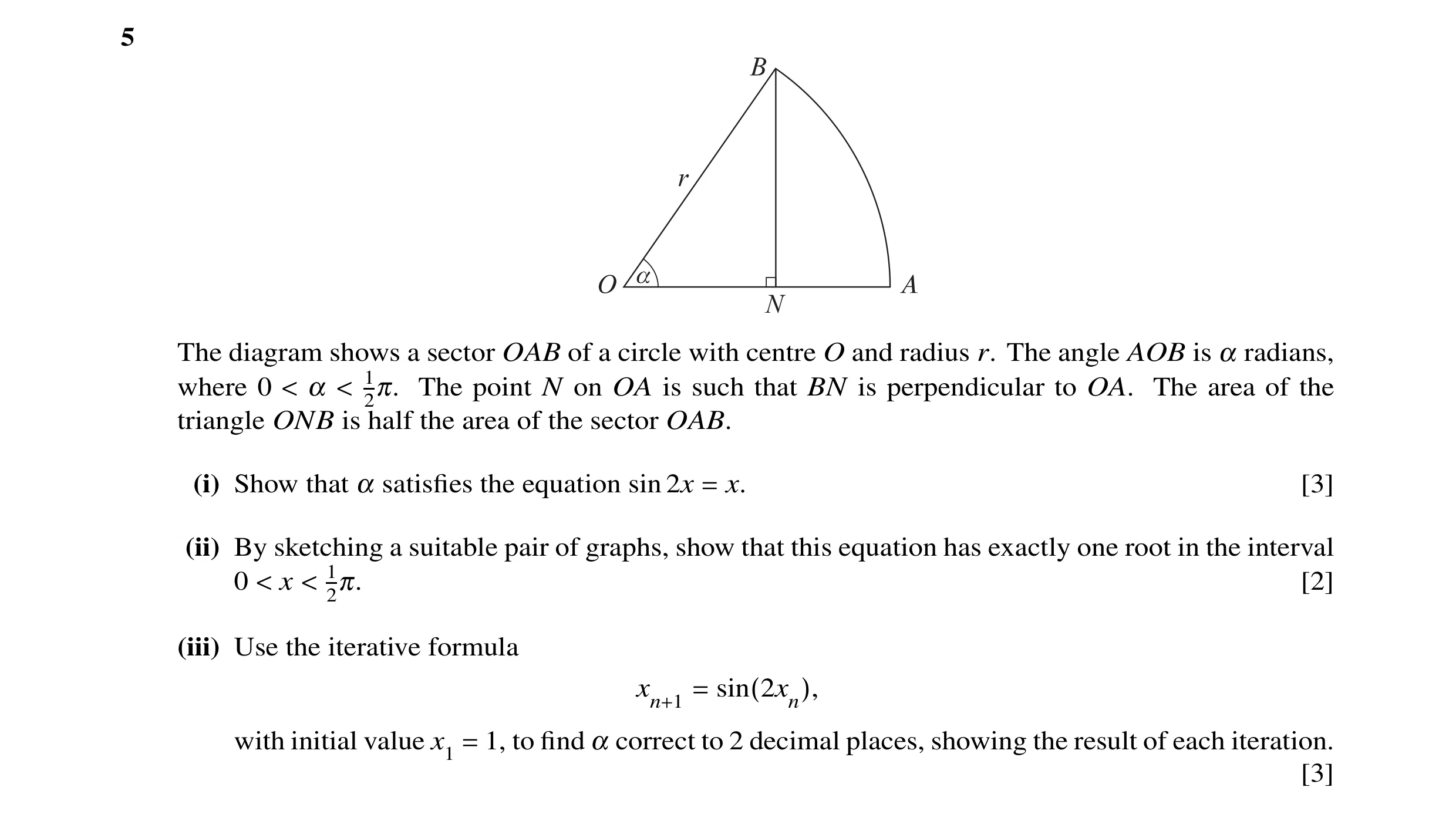
![Question 3: (i) Prove the identity cos 4θ + 4 cos 2θ ≡8 cos4 θ −3. [4] (ii) Hence solve the equation cos 4θ + 4 cos 2θ = 2, for 0◦≤θ ≤360◦. [4]](https://img.pastlit.com/crops/1dbfac46-832e-4e42-9cf5-84a8cda34c60/q6.webp) 1 / 101
1 / 101
![Question 5: (i) Show that the equation tan(45◦+ x) −tan x = 2 can be written in the form tan2x + 2 tan x −1 = 0. [3] (ii) Hence solve the equation tan(…](https://img.pastlit.com/crops/026c7af4-2219-47a8-a5e1-0b697ca91831/q5.webp) 2 / 101
2 / 101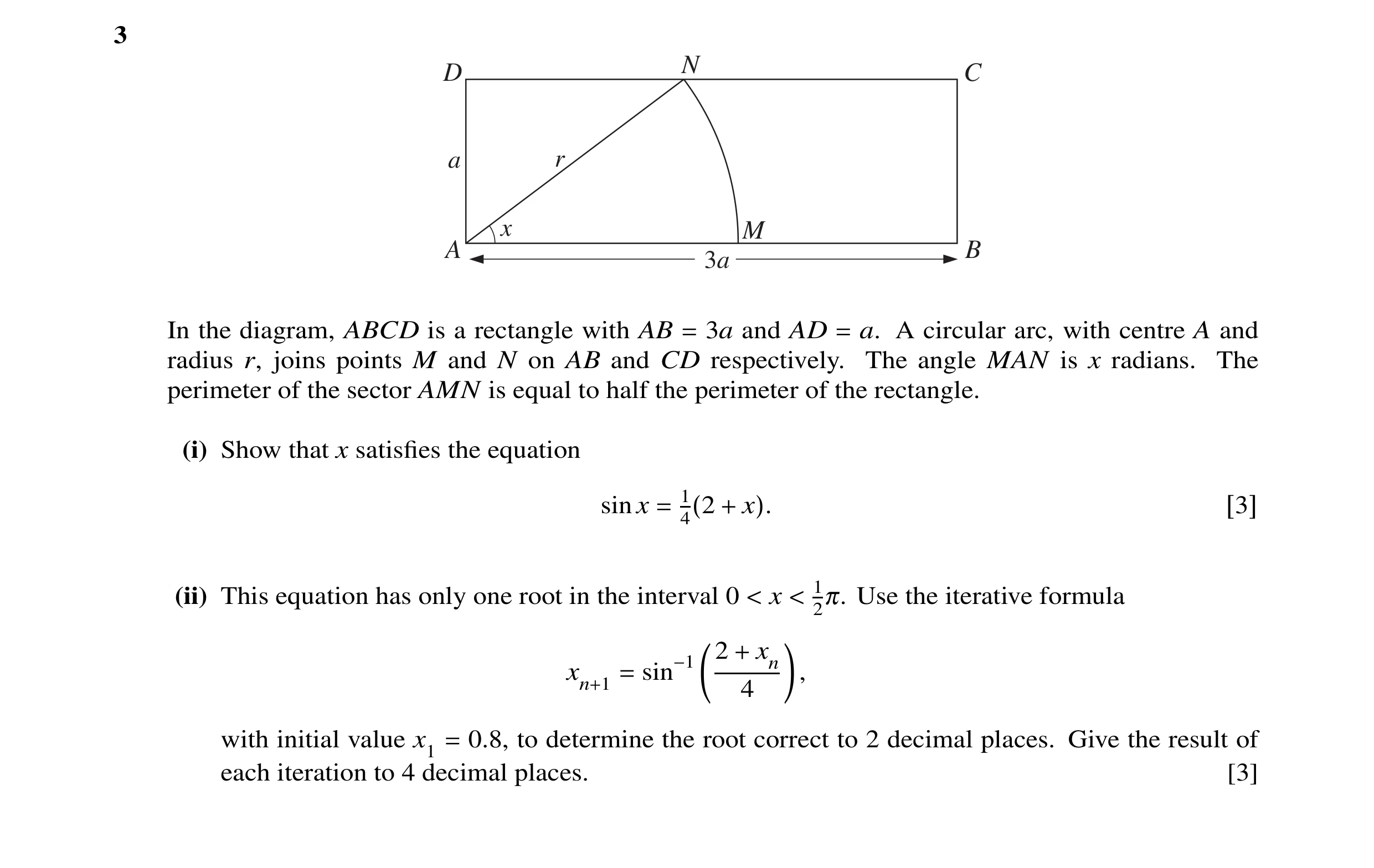
![Question 7: (i) Show that the equation tan(30◦+ θ) = 2 tan(60◦−θ) can be written in the form tan2θ + (6 √3) tan θ −5 = 0. [4] (ii) Hence, or otherwise,…](https://img.pastlit.com/crops/9699d55b-73cc-4415-b122-2405309f51c4/q4.webp)
![Question 9: Two planes have equations 2x −y −3 = 7 and x + 2y + 2 = 0. (i) Find the acute angle between the planes. [4] (ii) Find a vector equation for…](https://img.pastlit.com/crops/50741b57-4b57-4e85-9f09-4497a8622d84/q7.webp) 3 / 101
3 / 101![Question 10: (i) Prove the identity cos 4θ cos 2θ 3 sin4 θ. [4] −4 + ≡8 (ii) Using this result find, in simplified form, the exact value of 13π sin4 θ dθ.…](https://img.pastlit.com/crops/2a04340e-e118-4900-bca2-4404ab2fc10d/q5.webp)

![Question 12: Solve the equation sin θ 2 cos 2θ 1, = + giving all solutions in the interval [6] 0◦≤θ ≤360◦.](https://img.pastlit.com/crops/e436ecdb-8004-4507-8bb3-da1f1234f122/q2.webp)
![Question 13: (i) Using the expansions of and prove that cos(3x −x) cos(3x + x), 1 2x 3x sin x. 2(cos −cos 4x) ≡sin [3] (ii) Hence show that 13π sin 3x s…](https://img.pastlit.com/crops/e436ecdb-8004-4507-8bb3-da1f1234f122/q4.webp) 4 / 101
4 / 101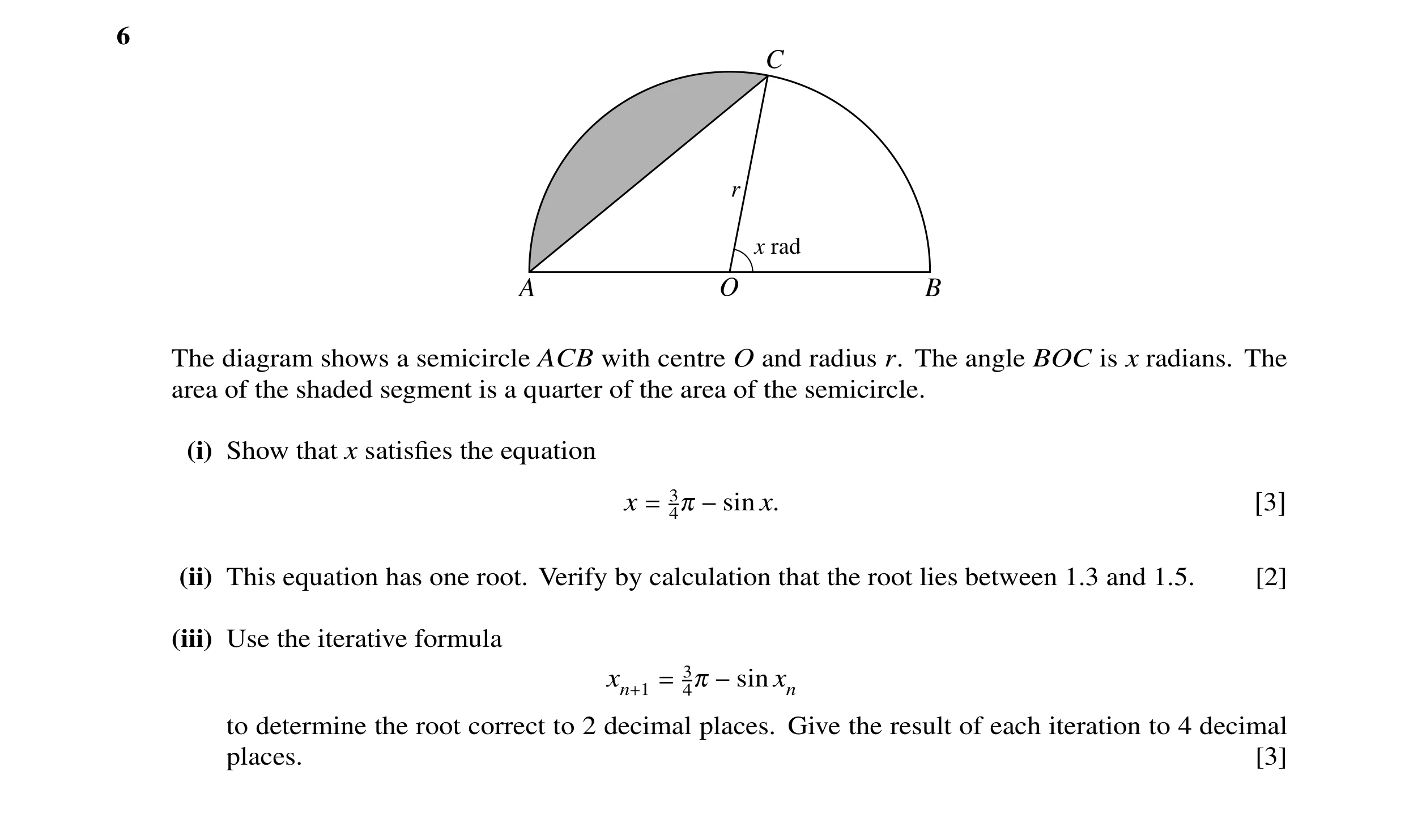
![Question 16: Solve the equation 2 tan x, tan(45◦−x) = giving all solutions in the interval [5] x 0◦< < 180◦.](https://img.pastlit.com/crops/539b23c9-b1a5-4b95-8a55-b17909a49e1f/q3.webp)
![Question 17: (i) Prove the identity cos 3θ cos3θ cos θ. [4] ≡4 −3 (ii) Using this result, find the exact value of 12π cos3θ dθ. ã 1 [4] 3π](https://img.pastlit.com/crops/539b23c9-b1a5-4b95-8a55-b17909a49e1f/q7.webp) 5 / 101
5 / 101![Question 18: Solve the equation 2 sin θ, cos(θ + 60◦) = giving all solutions in the interval [5] 0◦≤θ ≤360◦.](https://img.pastlit.com/crops/ed54a6ac-ac76-4a16-95e7-9bc8d4a671b9/q3.webp)
![Question 19: (i) By sketching suitable graphs, show that the equation 4x2 cotx −1 = has only one root in the interval 0 x 12π. [2] < < (ii) Verify by ca…](https://img.pastlit.com/crops/ed54a6ac-ac76-4a16-95e7-9bc8d4a671b9/q4.webp)
![Question 20: Solve the equation 2 sin θ, cos(θ + 60◦) = giving all solutions in the interval [5] 0◦≤θ ≤360◦.](https://img.pastlit.com/crops/658e5349-2f08-4903-881d-6443720f3016/q3.webp)
![Question 21: (i) Express cos θ sin θ in the form R where R 0 and α 90◦. Give the value(√6)of α correct+ (√10)to 2 decimal places. cos(θ −α), > 0◦< < [3]…](https://img.pastlit.com/crops/0acdbc32-78ba-49a2-be37-2740cec187eb/q8.webp)
![Question 22: Solve the equation cos θ + 4 cos 2θ = 3, giving all solutions in the interval 0◦≤θ ≤180◦. [5]](https://img.pastlit.com/crops/4bf8f599-bb44-417c-8dac-7e136b851345/q3.webp) 6 / 101
6 / 101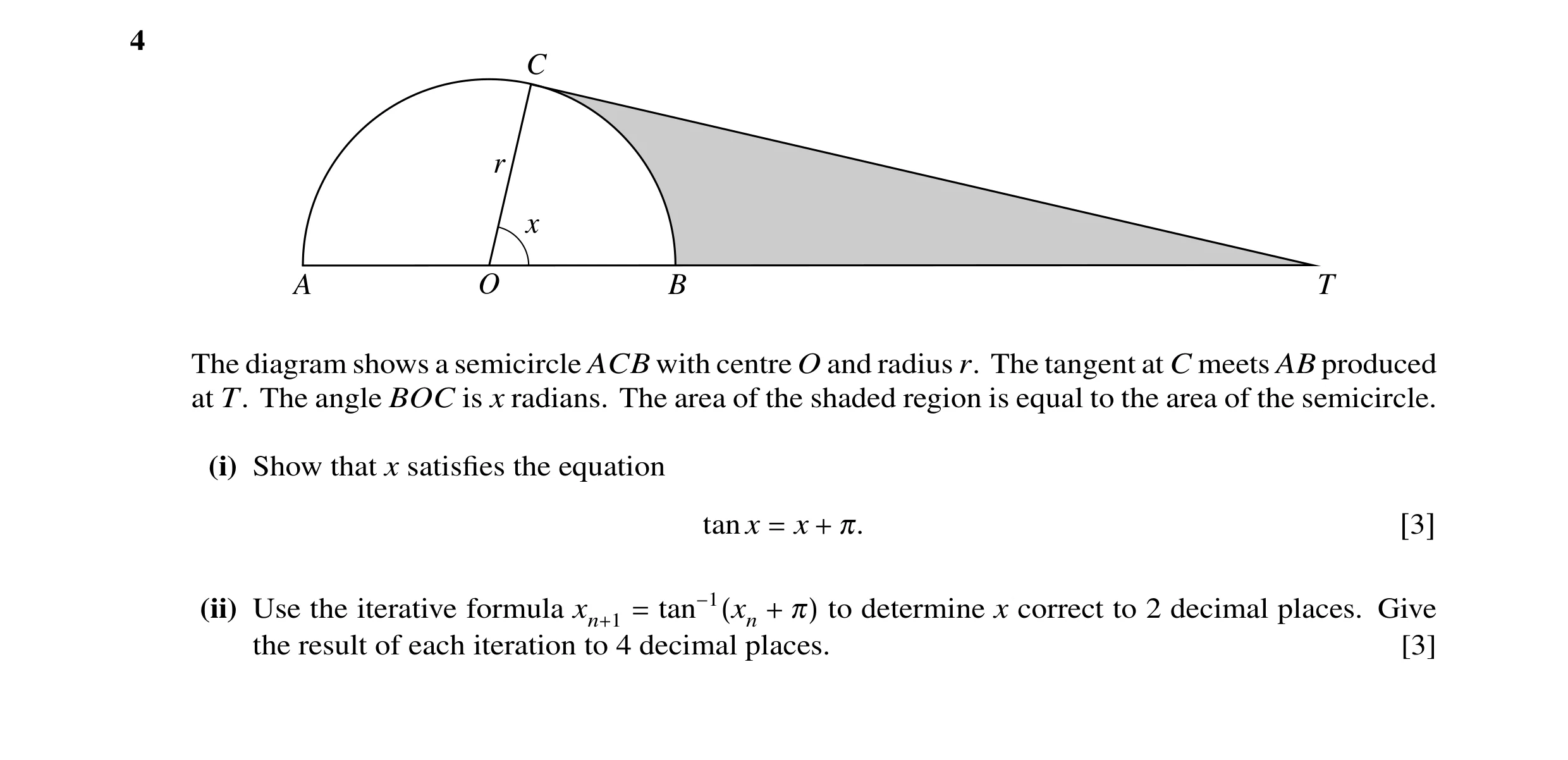
![Question 24: (i) Show that the equation k tan(60◦+ θ) + tan(60◦−θ) = can be written in the form (2 √3)(1 + tan2θ) = k(1 −3 tan2θ). [4] (ii) Hence solve …](https://img.pastlit.com/crops/50a6e2eb-2210-417d-aea4-dc687ba5c505/q4.webp)
 7 / 101
![Question 28: α 0 and Give the value3 (i) Express 8 cos θ 15 sin θ in the form R where R + cos(θ −α), > < 90◦. 0◦< of α correct to 2 decimal places. [3] …](https://img.pastlit.com/crops/469cb031-d93e-4f67-9e43-0bbc0497efc3/q3.webp)
![Question 29: (i) It is given that 2 tan 2x 5 tan2x 0. Denoting tan x by t, form an equation in t and hence show that either t 0 or t + = [4] = = 3√(t + …](https://img.pastlit.com/crops/eb1ffb76-7688-4dc9-97bb-4f11caac8ca1/q10.webp) 8 / 101
8 / 101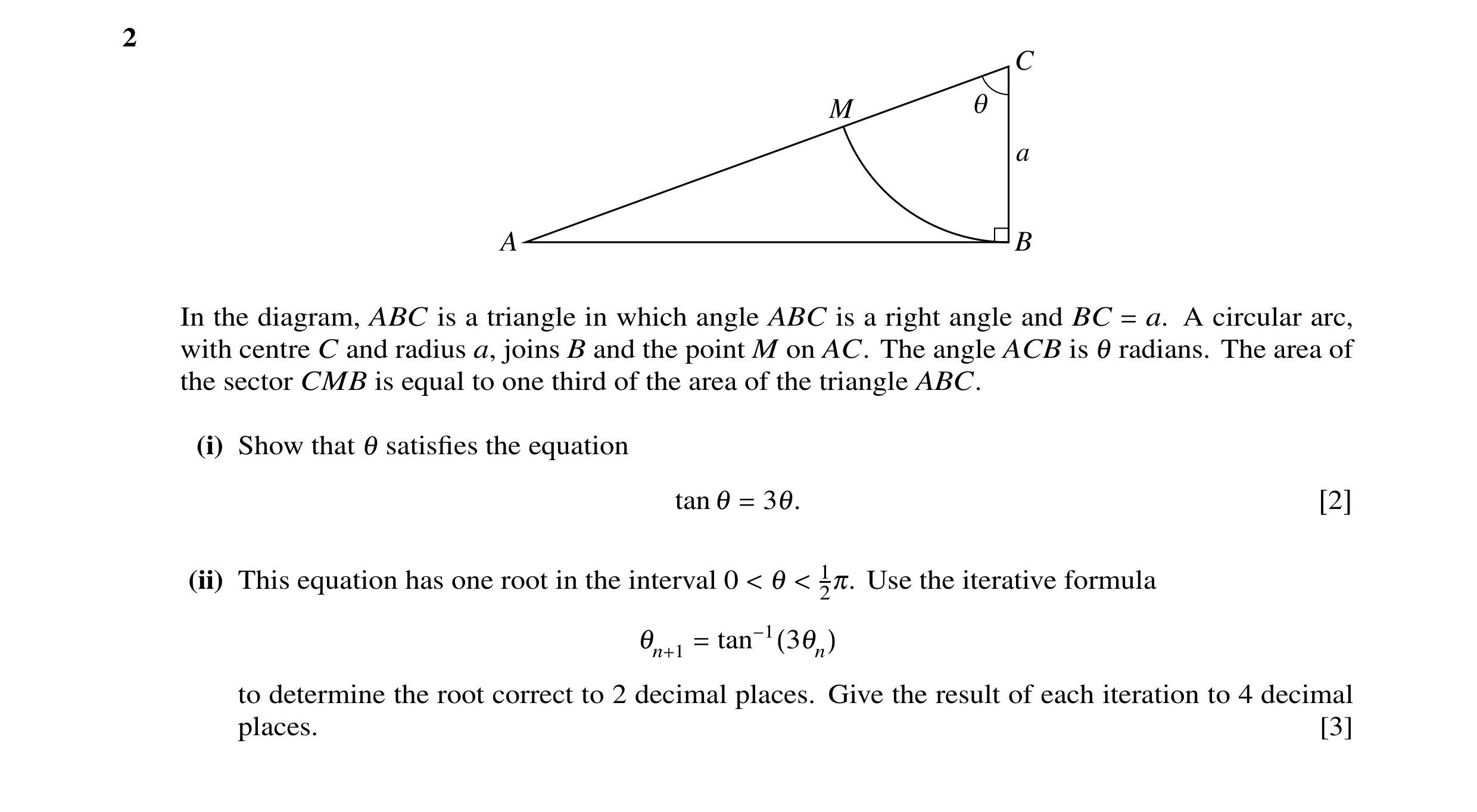
![Question 32: Solve the equation 2 sin(θ + 45◦) = cos(θ −30◦), θ [5] giving all solutions in the interval < 180◦. 0◦<](https://img.pastlit.com/crops/993bc930-69c0-462c-906f-7f46ed9923c3/q3.webp)
![Question 33: Solve the equation 2 sin(θ + 45◦) = cos(θ −30◦), θ [5] giving all solutions in the interval 0◦< < 180◦.](https://img.pastlit.com/crops/950f411d-6ca2-4a14-93da-d283f37bfbb0/q3.webp) 9 / 101
9 / 101![Question 34: α 0 and Give the value2 (i) Express 24 sin θ cos θ in the form R where R 0◦< −7 sin(θ −α), > < 90◦. of α correct to 2 decimal places. [3] (…](https://img.pastlit.com/crops/12ace9eb-a4ff-499b-8558-db01d79e8850/q2.webp)
![Question 35: Solve the equation tan 2x 5 cot x, for x [5] = 0Å < < 180Å.](https://img.pastlit.com/crops/769b6d1e-bb98-4046-92a7-422cf192132f/q3.webp)
![Question 36: (i) Prove that cot tan 2 cosec [3] 1 + 1 21. 1 30 1 (ii) Hence show that cosec ln 3. [4] 1 2 Ó 21 d1 = 60](https://img.pastlit.com/crops/fd1bedec-a981-418b-b630-69b75d77dae6/q5.webp)
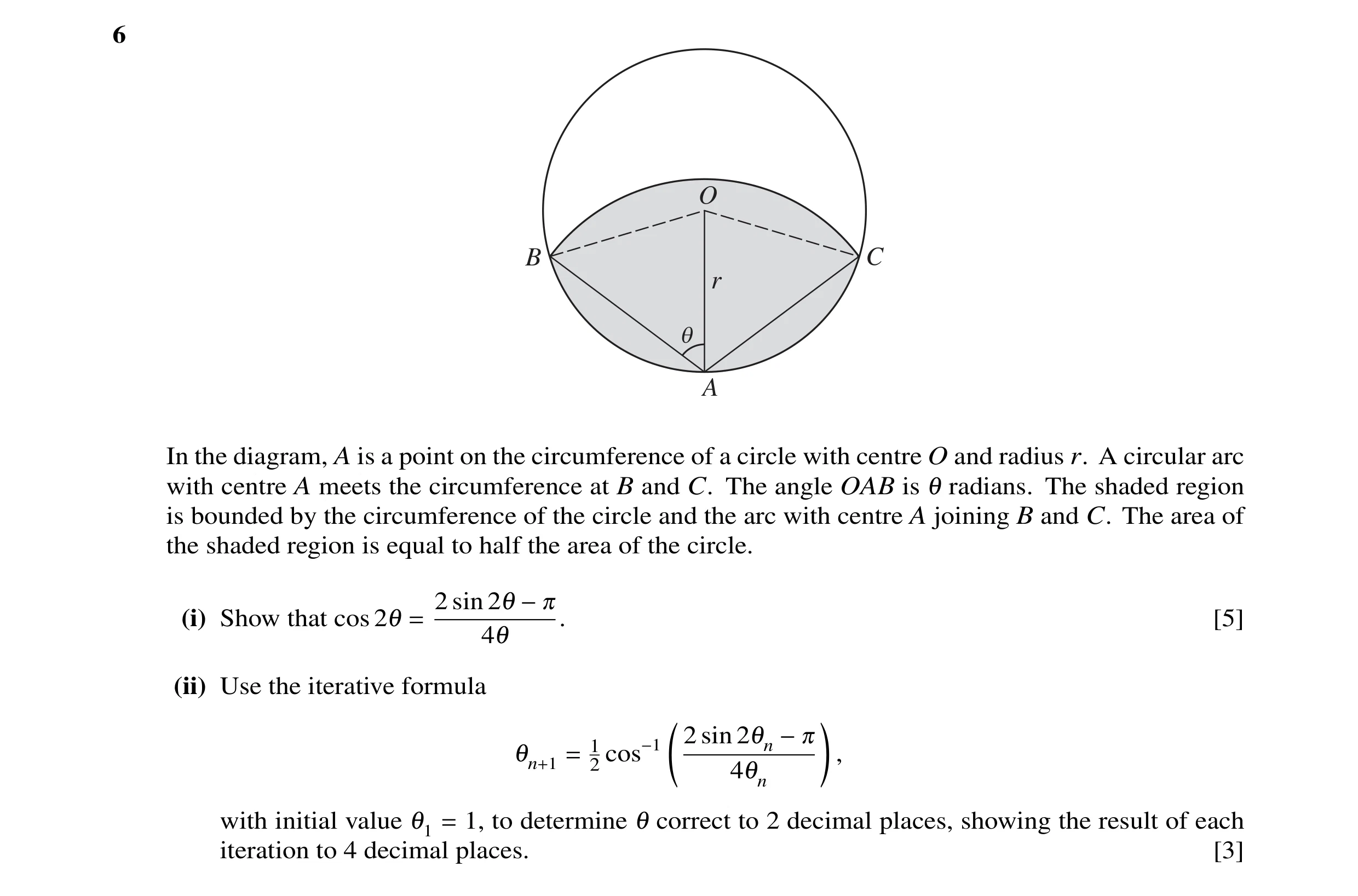 10 / 101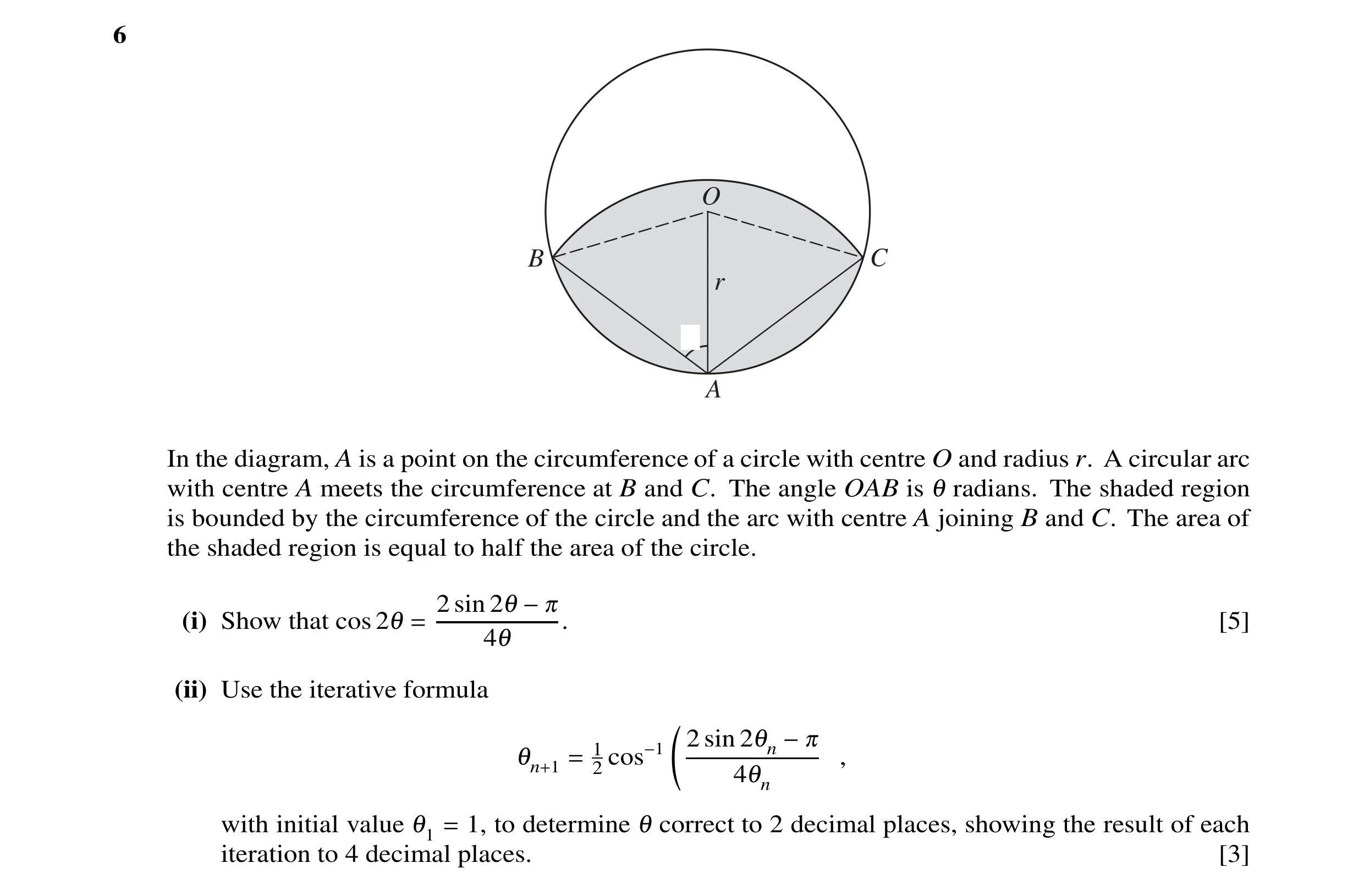
![Question 39: Two planes have equations 3x 9 and x y −y + 2Ï = + −4Ï = −1. (i) Find the acute angle between the planes. [3] (ii) Find a vector equation o…](https://img.pastlit.com/crops/36641e98-1eac-4dd8-a9bc-47976261b9a6/q6.webp)
![Question 40: (i) Simplify sin sec [2] 2! !. (ii) Given that 3 cos 7 cos 0, find the exact value of cos [3] 2" + " = ".](https://img.pastlit.com/crops/d9a053ad-812c-4d08-9ad9-ffb7dbffdf74/q1.webp) 11 / 101
11 / 101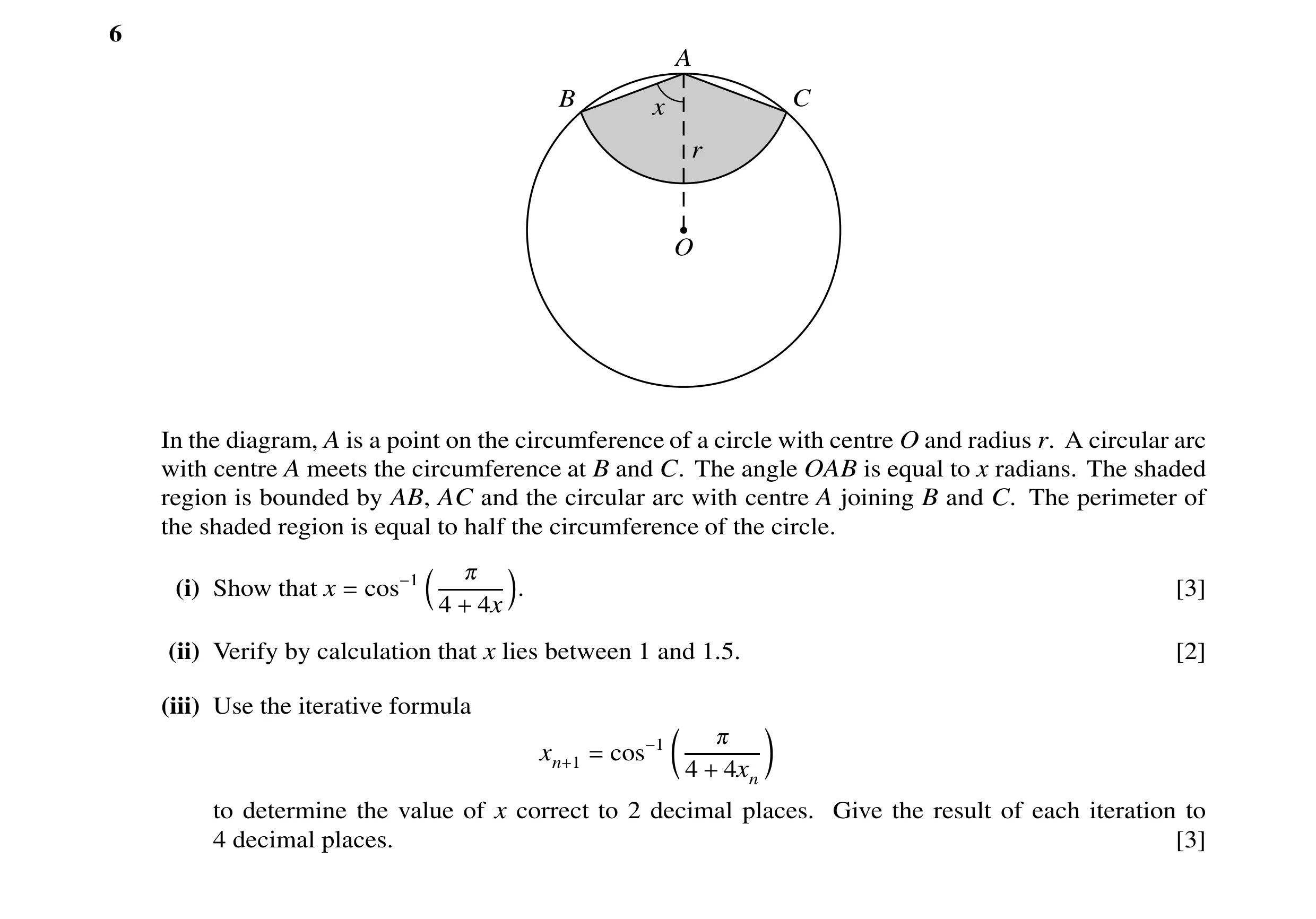
![Question 42: (a) Find 4 tan22x dx. [3] Ó + 1 1 20 sin x (b) Find the exact value of + 60 dx. [5] Ô 1 sin x 40](https://img.pastlit.com/crops/736097b2-5338-4d17-8f53-2c0429ac1fe8/q5.webp)
![Question 43: Solve the equation cot 2x cotx 3 for x [6] + = 0Å < < 180Å.](https://img.pastlit.com/crops/af344e17-464c-42e4-b905-2acf2efee49b/q3.webp)
![Question 44: By expressing the equation cosec 3 sin cot in terms of cos only, solve the equation for 1 = 1 + 1 1 [5] 0Å < 1 < 180Å.](https://img.pastlit.com/crops/4ad1f781-f1a0-43b9-b6aa-81bb681f020c/q3.webp)
![Question 45: Express the equation sec 3 cos tan as a quadratic equation in sin Hence solve this equation 1 = 1 + 1 1. for [5] −90Å < 1 < 90Å.](https://img.pastlit.com/crops/33734fde-18e4-42a8-85c3-06f14aeabf91/q3.webp) 12 / 101
12 / 101![Question 46: (i) Prove the identity tan tan sec [4] 21 −tan 1 1 21. 160 1 3 (ii) Hence show that tan sec ln [4] 2 2. Ó 0 1 21 d1 =](https://img.pastlit.com/crops/33734fde-18e4-42a8-85c3-06f14aeabf91/q5.webp)
![Question 47: Express the equation sec 3 cos tan as a quadratic equation in sin Hence solve this equation 1 = 1 + 1 1. for [5] −90Å < 1 < 90Å.](https://img.pastlit.com/crops/cc447285-65e3-426c-9930-d7121cd14aea/q3.webp)
![Question 48: (i) Prove the identity tan tan sec [4] 21 −tan 1 1 21. 160 1 3 (ii) Hence show that tan sec ln [4] 2 2. Ó 0 1 21 d1 =](https://img.pastlit.com/crops/cc447285-65e3-426c-9930-d7121cd14aea/q5.webp)
![Question 49: (i) By sketching a suitable pair of graphs, show that the equation 1 cosec 2x1 = 13x + has one root in the interval 0 x [2] < ≤0. (ii) Show…](https://img.pastlit.com/crops/cc447285-65e3-426c-9930-d7121cd14aea/q6.webp) 13 / 101
13 / 101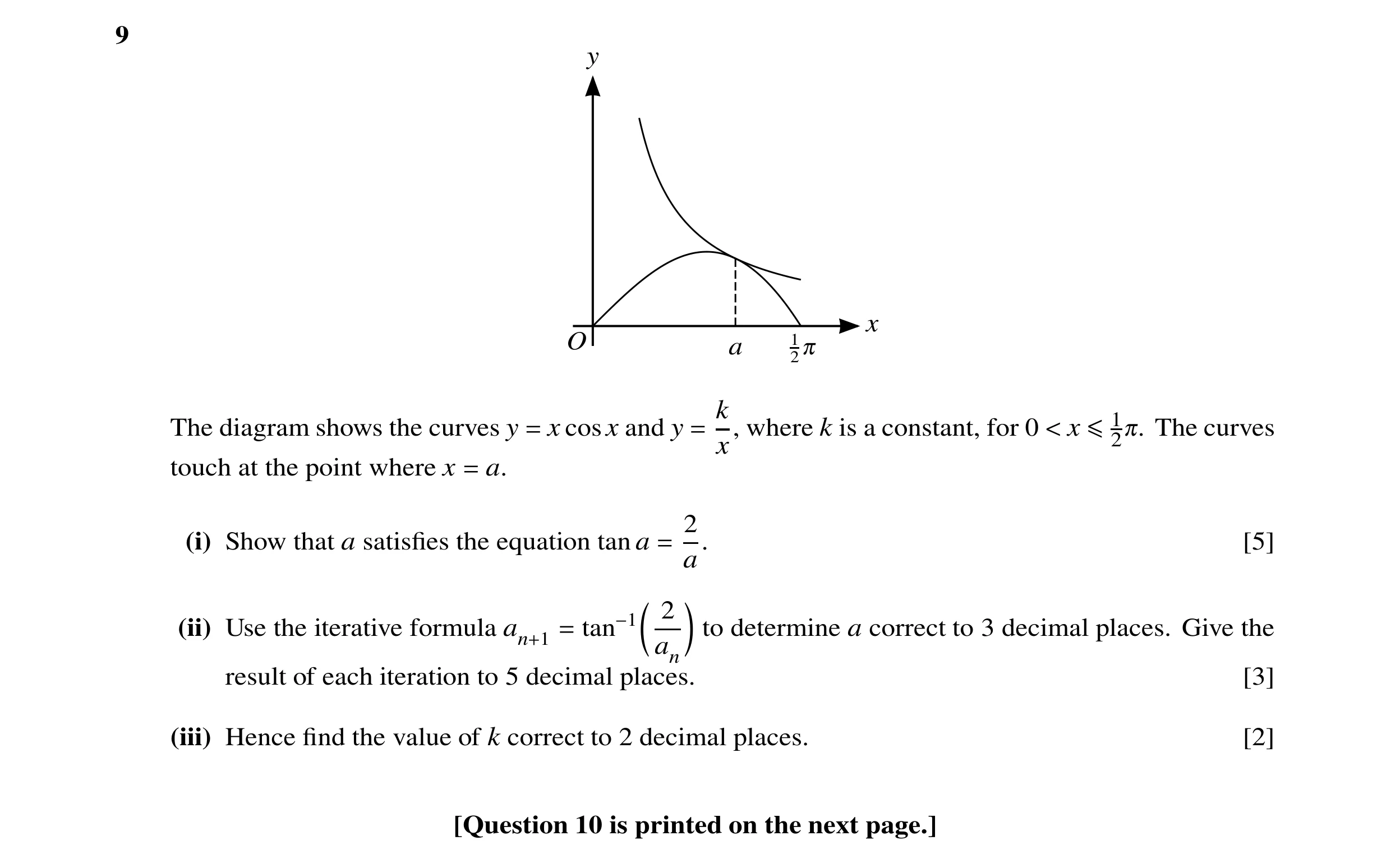 14 / 101
![Question 51: (i) Express the equation cot tan sin in the form a b c 0, where a, b and c are constants to be determined.1 −2 1 = 21 cos41 + cos21 + = [3]…](https://img.pastlit.com/crops/2cbf4649-4746-4bba-8000-8f6d6647fdb0/q3.webp)
![Question 52: dy 7 (i) Prove that if y then sec tan [2] cos = = 1 1. 1 d1 ...............................................................................…](https://img.pastlit.com/crops/2cbf4649-4746-4bba-8000-8f6d6647fdb0/q7.webp)
![Question 53: cotx x 1 Prove the identity cos 2x. [3] −tan cotx tan x + ...............................................................................…](https://img.pastlit.com/crops/f8e507c6-d723-4290-ad72-9bf707ff0468/q1.webp) 18 / 101
18 / 101![Question 54: sin x 2x sin x 4 (i) Show that [4] −sin 1 2x 1 cosx. −cos + .............................................................................…](https://img.pastlit.com/crops/87f01ae5-7c39-4e8b-9fc8-79635dc40e8f/q4.webp)
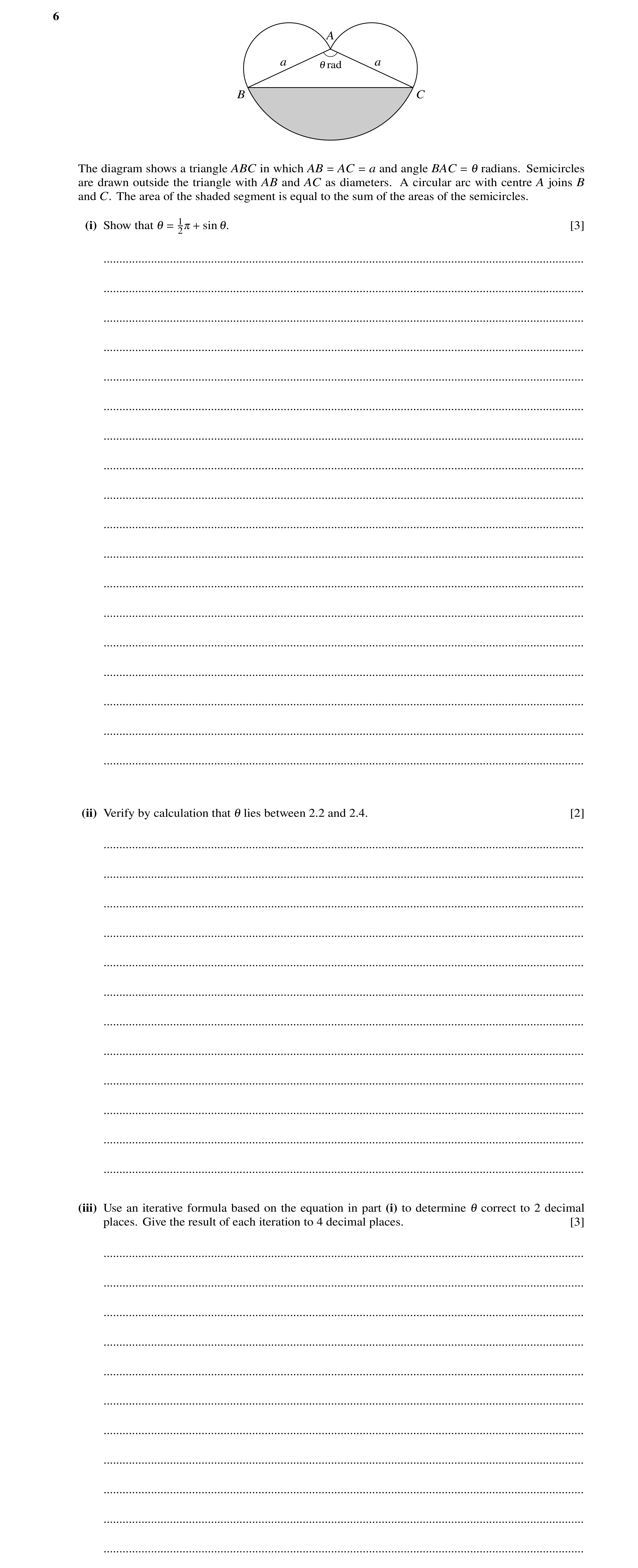
![Question 56: (i) By first expanding cos2x sin2x 3, or otherwise, show that + cos6x sin6x 1 sin22x. [4] 4 + = −3 .........................................…](https://img.pastlit.com/crops/30e4a639-f62d-48be-bef3-66259ea80d86/q5.webp)
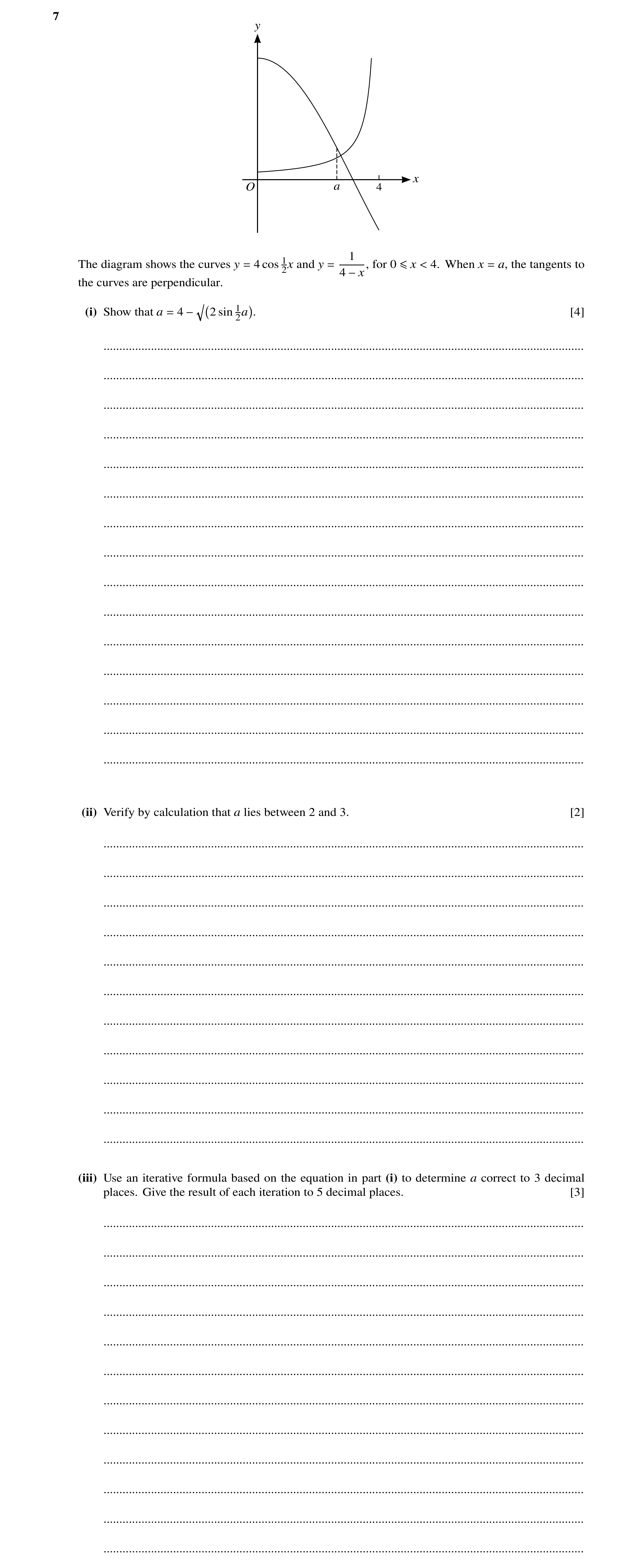
![Question 58: Showing all necessary working, solve the equation cot 2 tan for [5] 21 = 1 0Å < 1 < 180Å. .................................................…](https://img.pastlit.com/crops/767268e2-04ea-4369-b0b6-079cf0e2f2b4/q3.webp) 26 / 101
26 / 101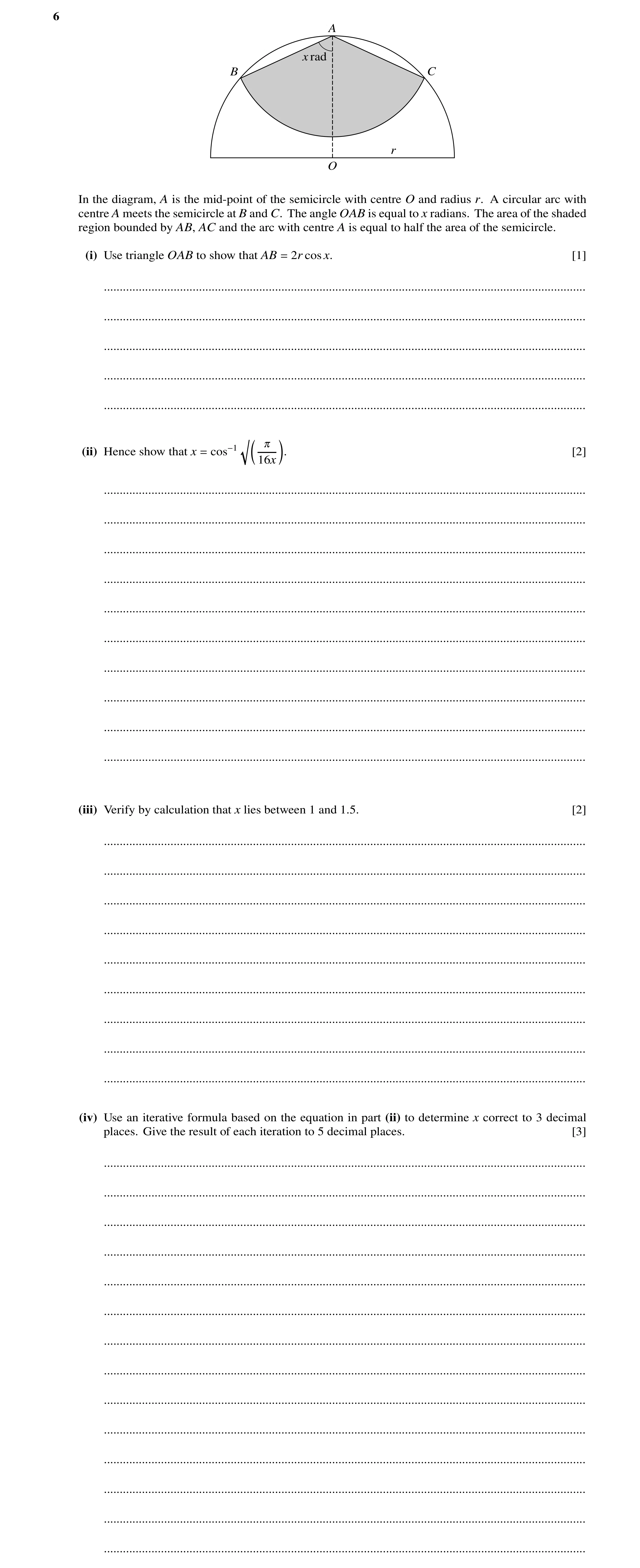
![Question 60: has exactly one root3 (a) By sketching a suitable pair of graphs, show that the equation sec x = −12x in the interval 0 1 [2] ≤x < 2π. ....…](https://img.pastlit.com/crops/f58e7cec-5e84-4f3c-8892-a7e9286804b3/q3.webp) 29 / 101
29 / 101
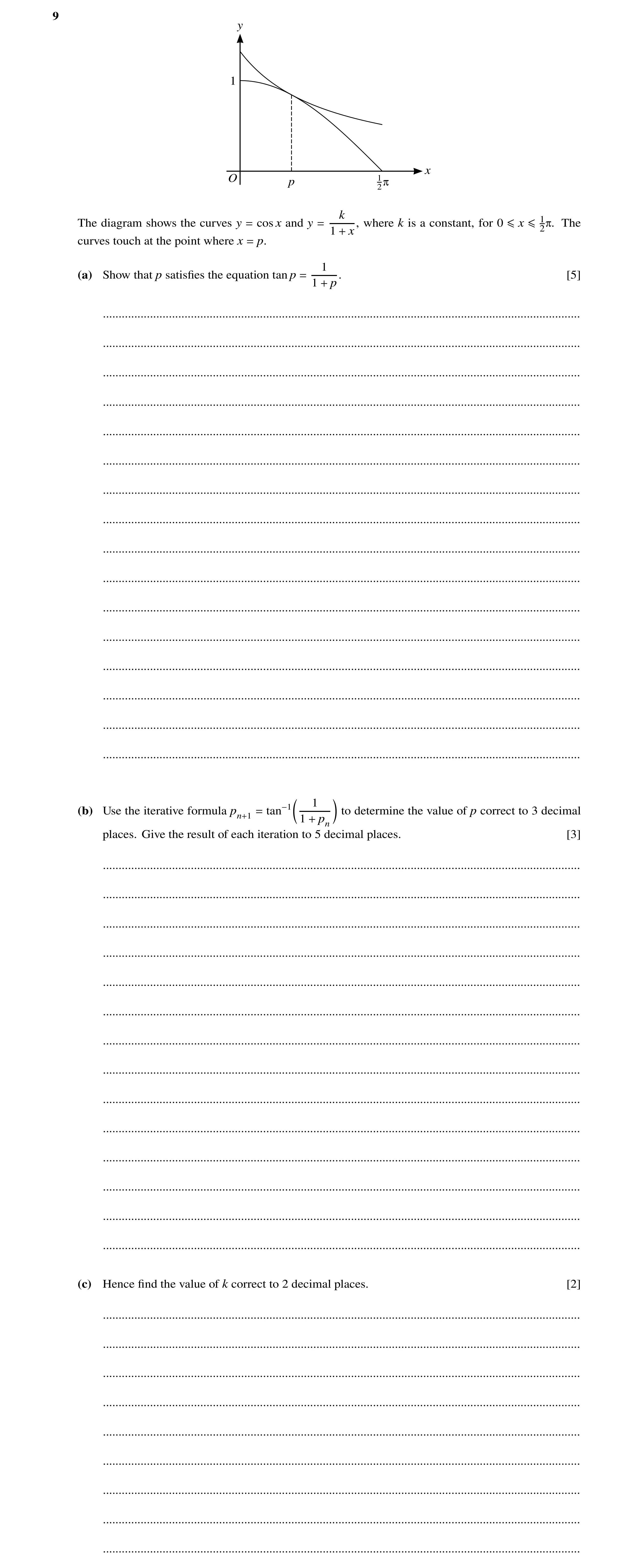
 34 / 101
 35 / 101
![Question 66: 4 (a) Prove that [2] −cos 21 1 cos tan21. + 21 ..........................................................................................…](https://img.pastlit.com/crops/bdf04a7f-20ca-4000-bf61-1940968c5b80/q4.webp) 38 / 101
38 / 101![Question 67: (a) By first expanding tan , show that the equation tan 1 tan may be expressed as 2 21 + 21 41 = 1 2 0. [4] tan41 + tan21 −7 = .............…](https://img.pastlit.com/crops/cef3f7d8-37af-4008-921a-6329799f081a/q5.webp)
![Question 68: (a) By sketching a suitable pair of graphs, show that the equation cot 1 1 has exactly one 2x = + e−x [2] root in the interval 0 x < ≤π. (b…](https://img.pastlit.com/crops/cef3f7d8-37af-4008-921a-6329799f081a/q6.webp)
![Question 69: (a) Show that the equation cot cot 2 21 + 1 = can be expressed as a quadratic equation in tan [3] 1. ......................................…](https://img.pastlit.com/crops/8a93e165-c076-4a34-a300-817e2b7f3639/q5.webp) 43 / 101
43 / 101![Question 70: (a) By first expanding show that cos21 + sin21 2, 1 sin2 [3] cos41 + sin41 −12 21. .......................................................…](https://img.pastlit.com/crops/c694a642-2dba-4c8d-8dcc-a02633c52944/q8.webp)
![Question 71: Solve the equation sin 3 cos 2, for [5] 1 = 21 + 0Å ≤1 ≤360Å. .............................................................................…](https://img.pastlit.com/crops/3443591c-60a0-4c06-9ba4-3336b6467ced/q5.webp) 46 / 101
46 / 101![Question 72: (a) By sketching a suitable pair of graphs, show that the equation 4 sec 2x1 has exactly one root in the interval 0 −x2 = [2] ≤x < π. (b) V…](https://img.pastlit.com/crops/ef254321-79cb-4b49-ba72-69cbbac5b209/q7.webp) 47 / 101
47 / 101![Question 73: Solve the equation 2 cot 2x 3 cot x 5, for x [6] + = 0Å < < 180Å. .........................................................................…](https://img.pastlit.com/crops/88890bea-5882-403b-895a-82a86138d55a/q3.webp) 48 / 101
48 / 101![Question 74: (a) Prove the identity cos 41 + 4 cos 21 + 3 8 cos41. [4] ...............................................................................…](https://img.pastlit.com/crops/8f5dbae1-3311-4796-87f2-848e75def0fd/q6.webp)
 51 / 101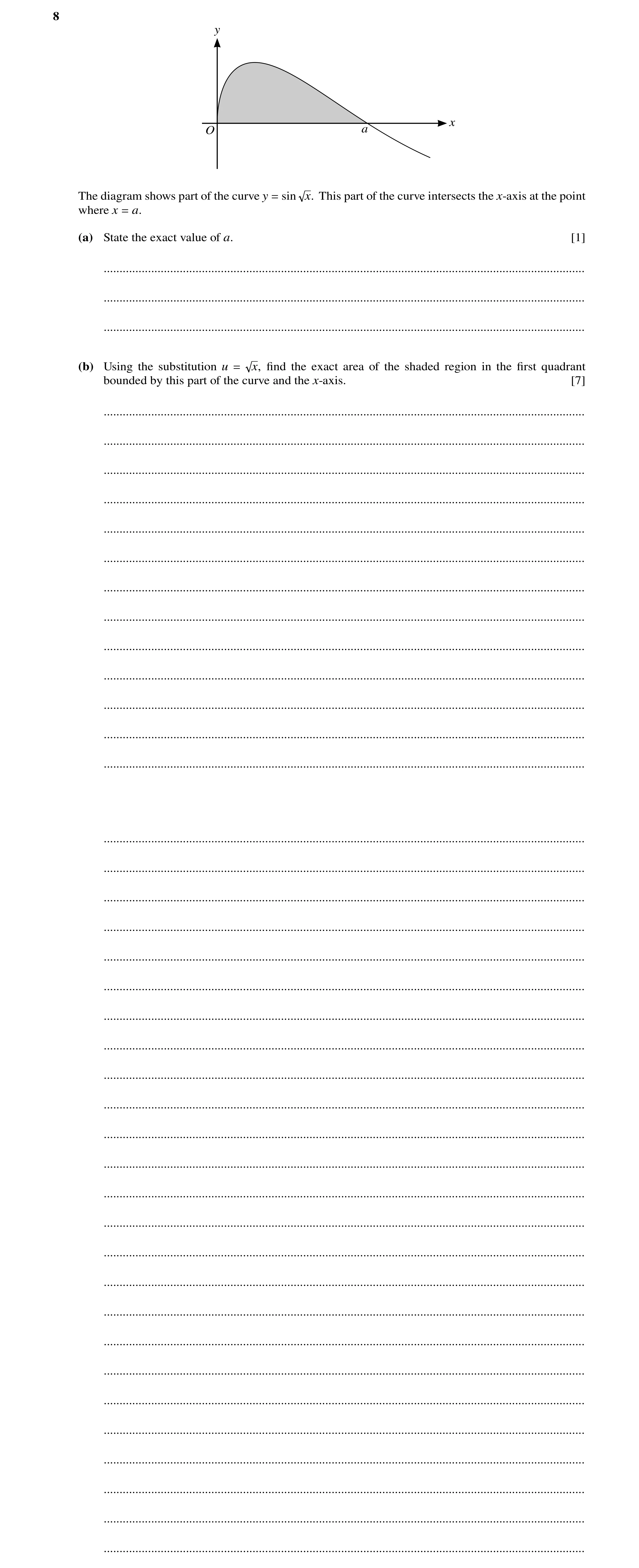
![Question 78: (a) Express 5 sin 12 cos in the form R cos , where R 0 and 0 1 [3] 1 + 1 1 −! > < ! < 2π. .................................................…](https://img.pastlit.com/crops/bb6485f4-1538-41d1-8528-3f3a34cb794d/q6.webp)
![Question 79: (a) Show that the equation sin cos 2 can be expressed in the form 21 + 21 = sin21 2 sin cos 0. [2] cos21 + 1 1 −3 sin21 = .................…](https://img.pastlit.com/crops/488e34c4-6c7f-4fa4-b4c1-c2325bd922a5/q4.webp) 58 / 101
58 / 101![Question 80: 1 for 0 [5]4 Solve the equation 2 cosx −cos 2x = ≤x ≤2π. ..................................................................................…](https://img.pastlit.com/crops/37e733e0-89b7-496d-830e-a720f434c92d/q4.webp) 59 / 101
59 / 101![Question 81: (a) Given that sin x + 16π −sin x −16π = cos x + 13π −cos x −13π , find the exact value of tan x. [4] ......................................…](https://img.pastlit.com/crops/aa09855d-693d-443e-bcb2-e8e4c2d1c32e/q5.webp)
![Question 82: (a) By sketching a suitable pair of graphs, show that the equation cotx 2 = −cosx has one root in the interval 0 x [2] < ≤12π. (b) Show by …](https://img.pastlit.com/crops/ae258b5e-8a2e-4842-a7e8-06fd44528f8f/q6.webp)
![Question 83: (a) By expressing as prove the identity cos 4 cos [3] 31 21 + 1, 31 cos31 −3 1. .........................................................…](https://img.pastlit.com/crops/ae258b5e-8a2e-4842-a7e8-06fd44528f8f/q7.webp)
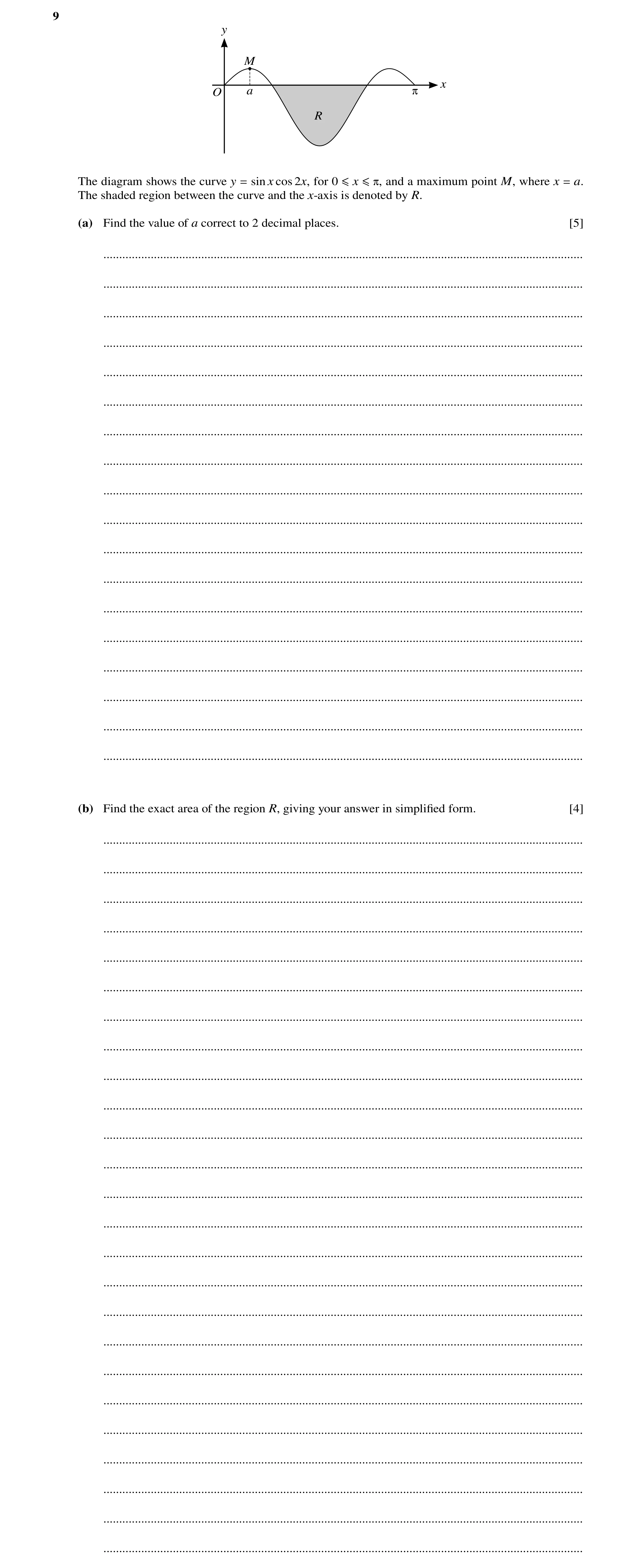
![Question 87: (a) Show that cos 4 i - sin 4 i / cos2i . [3] .............................................................................................…](https://img.pastlit.com/crops/18234476-d402-4642-b4fc-9b7d05c714cf/q7.webp)
![Question 88: Let f ( )x = 8x 3 + 54x 2 - 17x - 21. (a) Show that x + 7 is a factor of f ( )x . [1] .....................................................…](https://img.pastlit.com/crops/d2d39ed6-d2b4-4ffa-ad32-37304543c1ec/q7.webp)
![Question 89: (a) Express 3 cos 2x - 3 sin 2 x in the form R cos ( 2x + a) , where R 2 0 and 0 1 a 1 1 r . Give the 2 exact values of R and a. [3] ......…](https://img.pastlit.com/crops/d2d39ed6-d2b4-4ffa-ad32-37304543c1ec/q8.webp)
![Question 90: (a) Show that sec 4 i - tan 4 i / 1 + 2 tan 2 i . [3] .....................................................................................…](https://img.pastlit.com/crops/c689de65-af71-4aa6-a97a-6eb08bd70841/q4.webp)
![Question 91: (a) By sketching a suitable pair of graphs, show that the equation cot 2x = sec x has exactly one root in the interval 0 1 x 1 1 r . [2] 2 …](https://img.pastlit.com/crops/b67b0fc8-9555-4852-90e2-709639aecc18/q2.webp) 78 / 101
78 / 101![Question 92: (a) Show that the equation tan 3 x + 2 tan 2x - tan x = 0 may be expressed as tan 4 x - 2 tan 2 x - 3 = 0 for tanx ! 0 . [3] ..............…](https://img.pastlit.com/crops/b67b0fc8-9555-4852-90e2-709639aecc18/q7.webp)
![Question 93: (a) Show that cos 4 i - sin 4 i - 4 sin 2 i cos 2 i / cos 2 2i + cos 2i - 1. [3] ..........................................................…](https://img.pastlit.com/crops/0e06fcb7-d82e-40ae-b193-314a4df26a57/q5.webp)
![Question 95: Solve the equation 3 cot x - 4 cot 2 x = 3 for 0° G x G 180° . [6] ........................................................................…](https://img.pastlit.com/crops/839eb451-3c89-4685-8cb5-2dc929ba7724/q4.webp) 85 / 101
85 / 101
![Question 97: (a) Prove the identity cot 2 i - tan 2 i / 4 cot 2i cosec 2i . [4] ........................................................................…](https://img.pastlit.com/crops/415ffc4f-fb97-4c15-bcf3-c75615bc7963/q8.webp)
![Question 98: Solve the equation 3 cot i - 4 cosec 2 i + 5 = 0 for - r G i G r . [5] ....................................................................…](https://img.pastlit.com/crops/1821d94c-9937-4bdb-b639-2a05274a3e6e/q2.webp) 90 / 101
90 / 101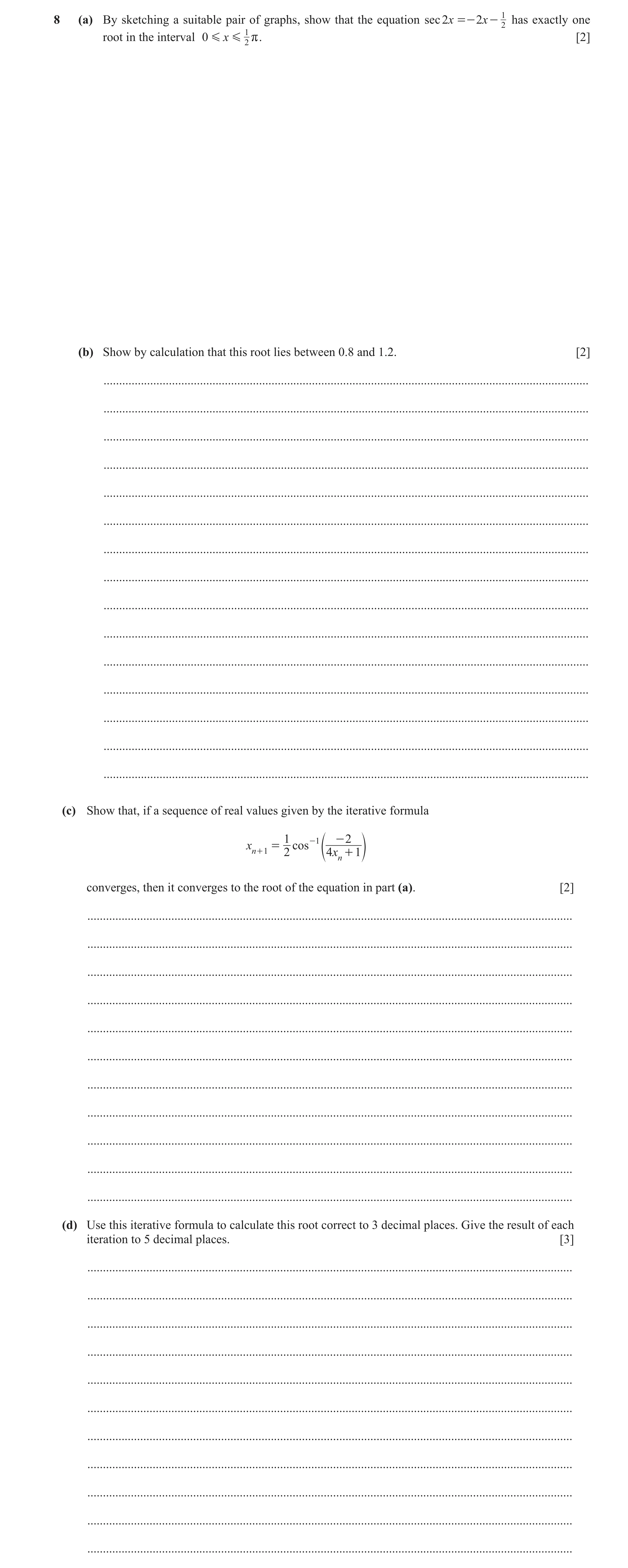
![Question 100: (a) Express 3 2 sin ( x + 45°) + cos x in the form R cos ( x - a) , where R 2 0 and 0° 1 a 1 90° . [4] ....................................…](https://img.pastlit.com/crops/97d6c821-d580-4248-92cc-fc88ec663f2f/q3.webp)
![Question 101: (a) By sketching a suitable pair of graphs, show that the equation sec 2x =- ex has only one root in the interval 0 1 x 1 1 r . [2] 2 (b) S…](https://img.pastlit.com/crops/97d6c821-d580-4248-92cc-fc88ec663f2f/q9.webp)
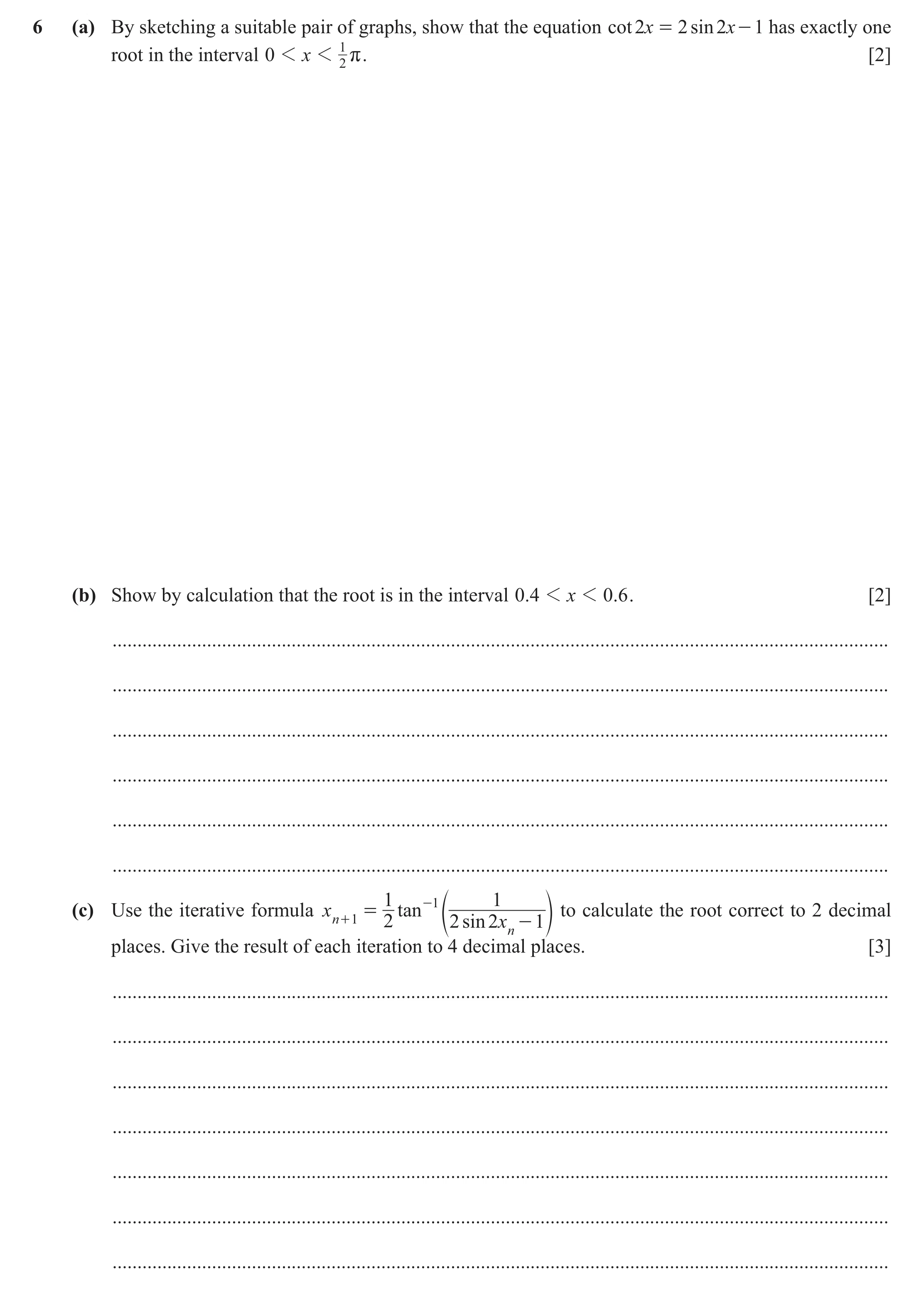 97 / 101
![Question 103: (a) Prove the identity sin 4x / 4 sin x `2 cos 3 x - cos xj. [3] ..........................................................................…](https://img.pastlit.com/crops/f5e004ff-26c4-46a2-a338-e8ed2bf9d1b6/q8.webp)
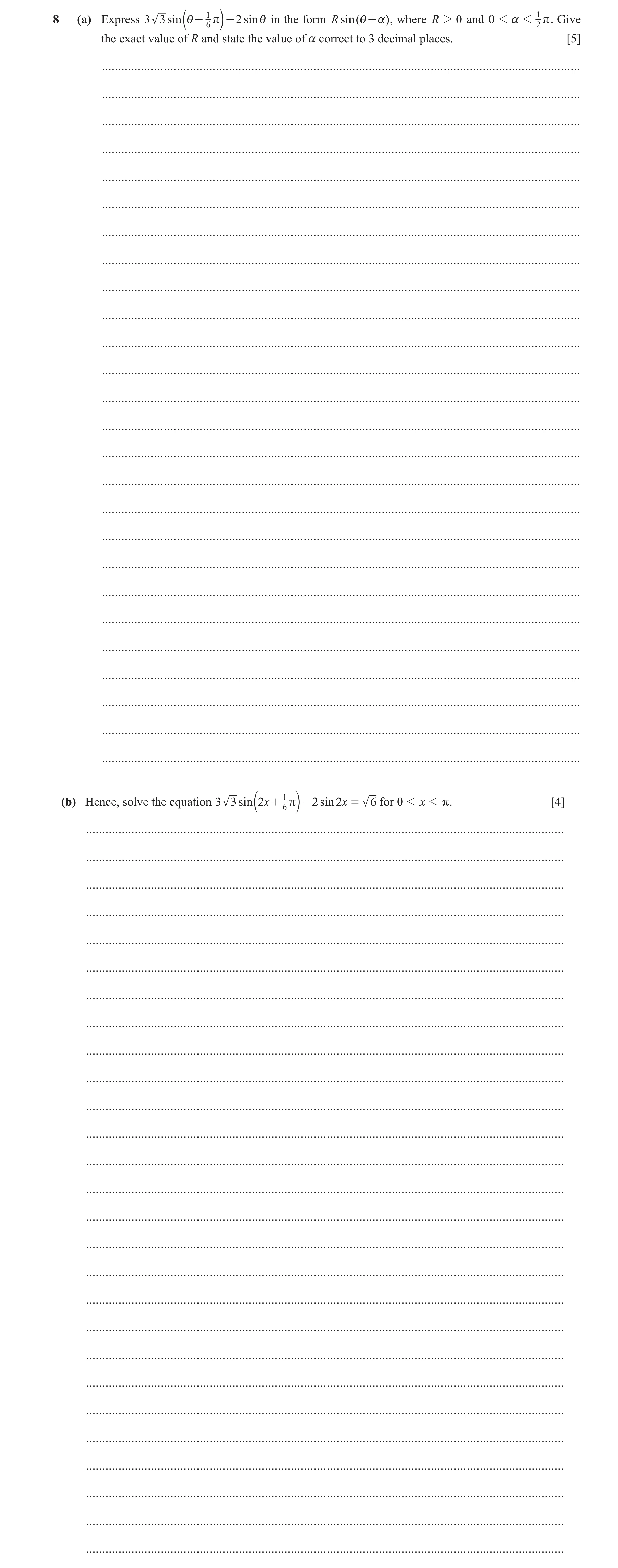
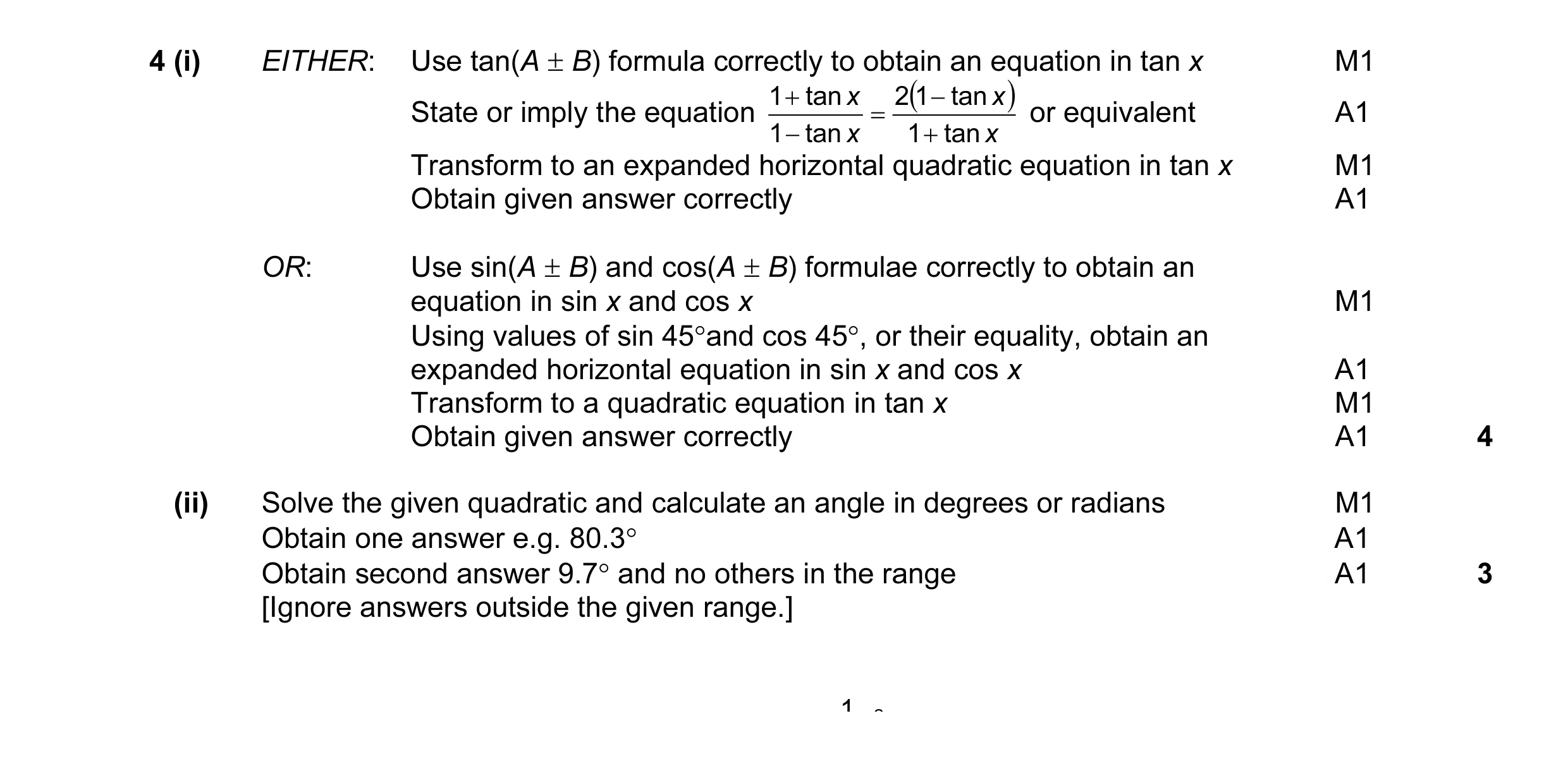 7
7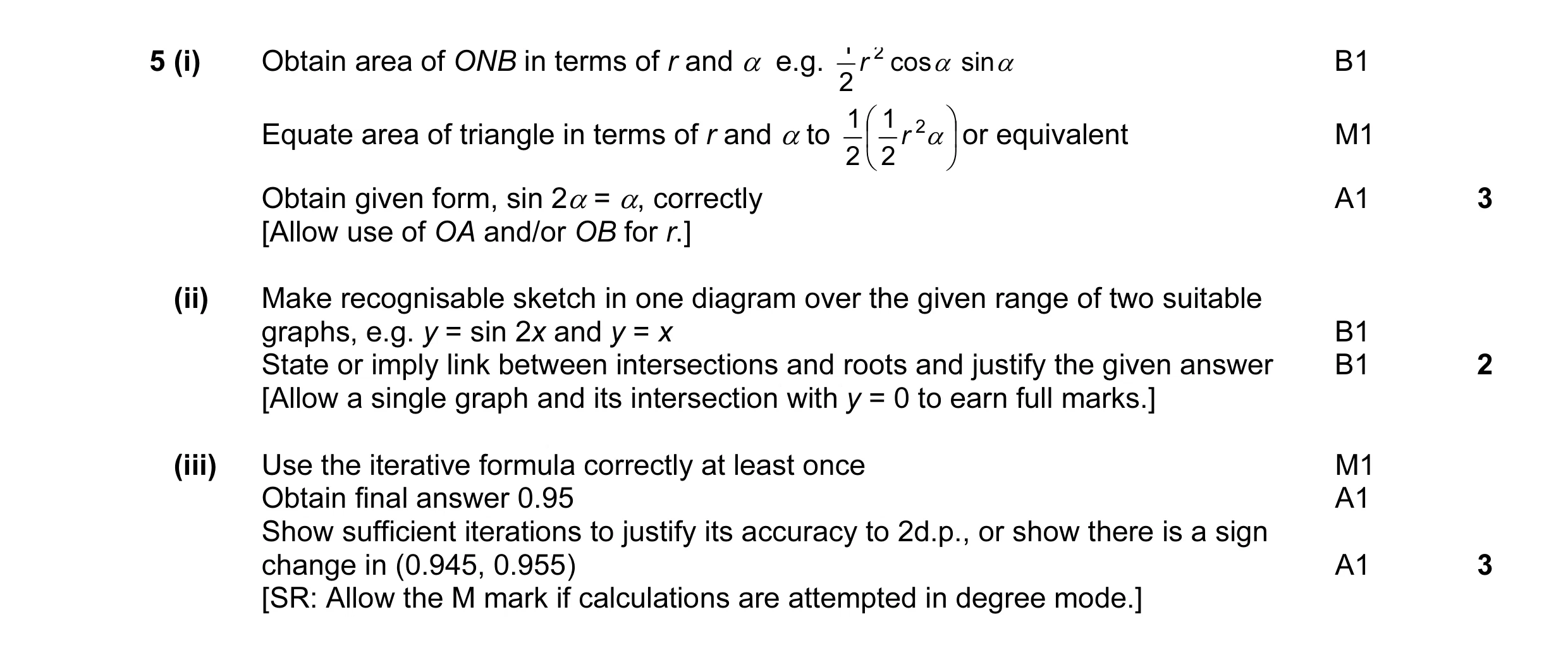 8
8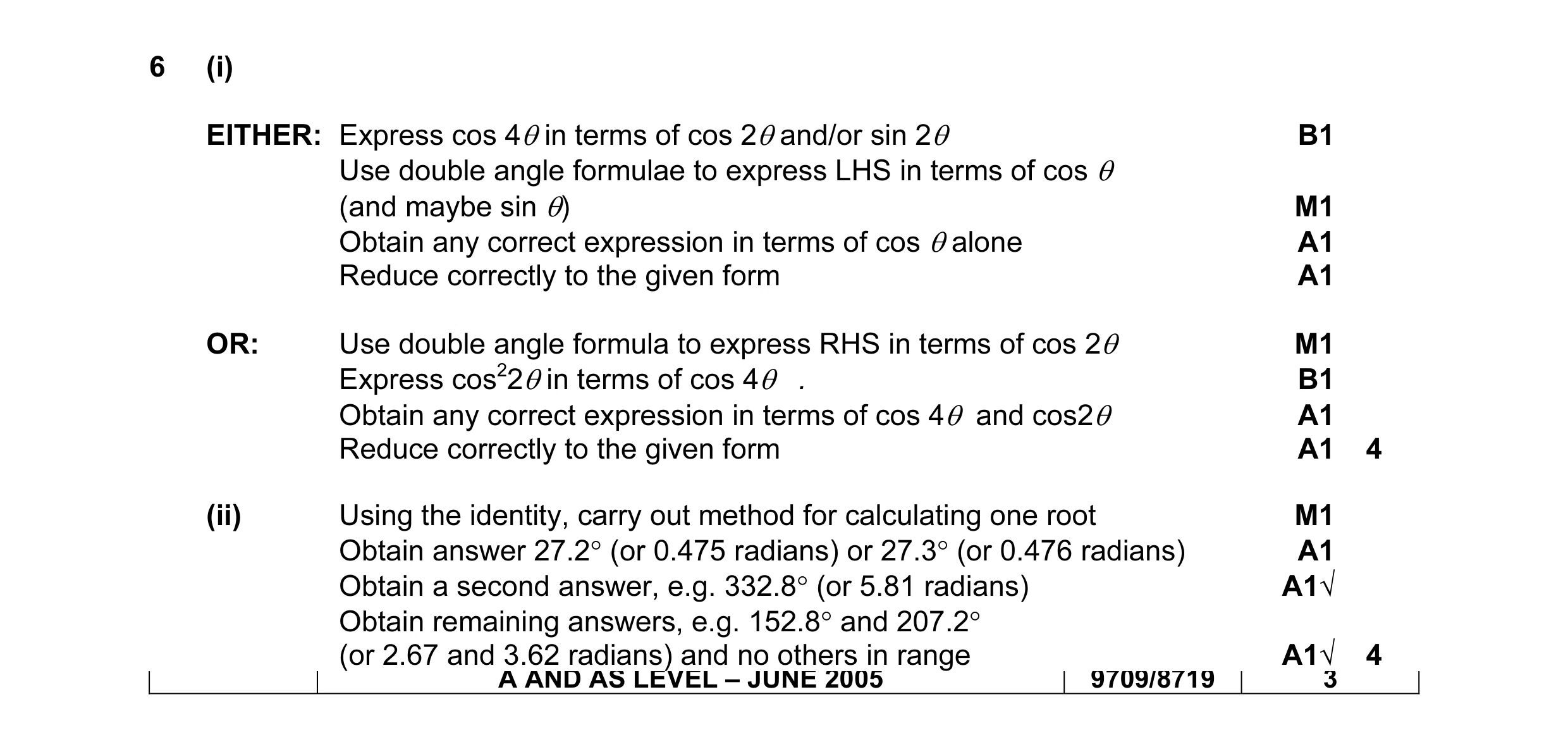 8
8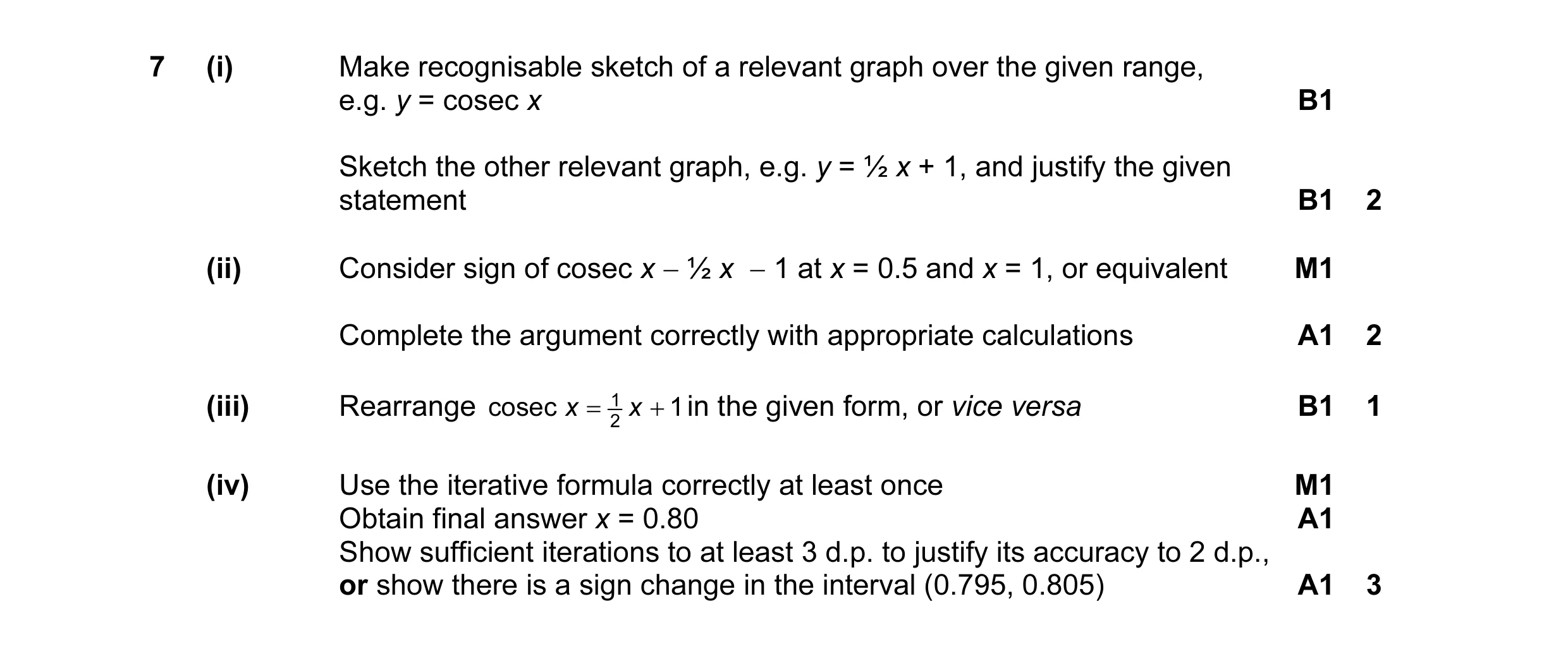 8
8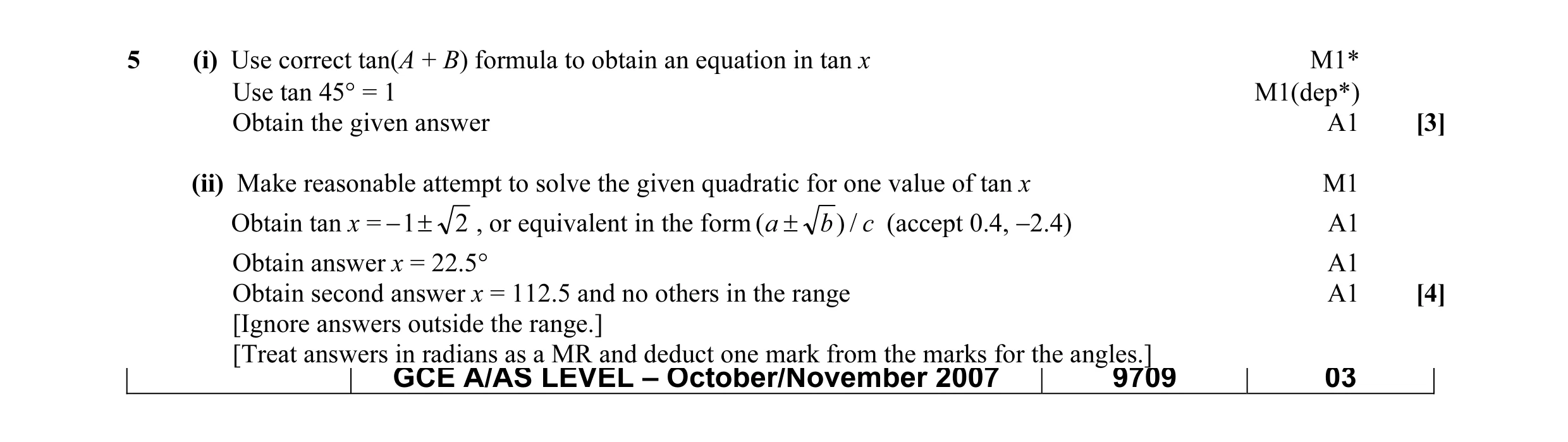 7
7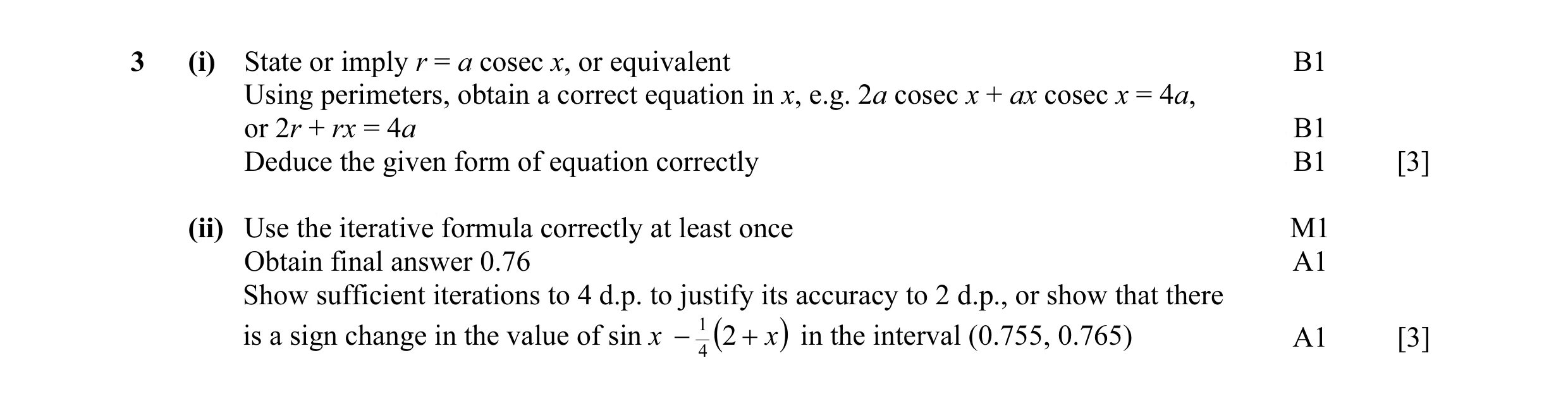 6
6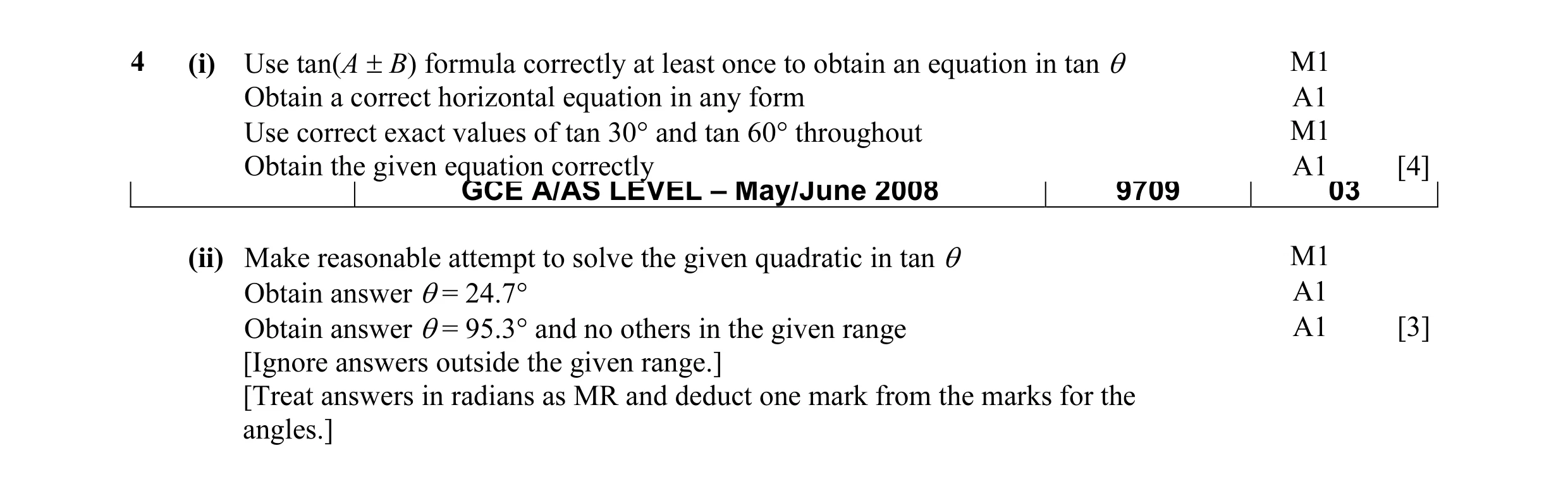 7
7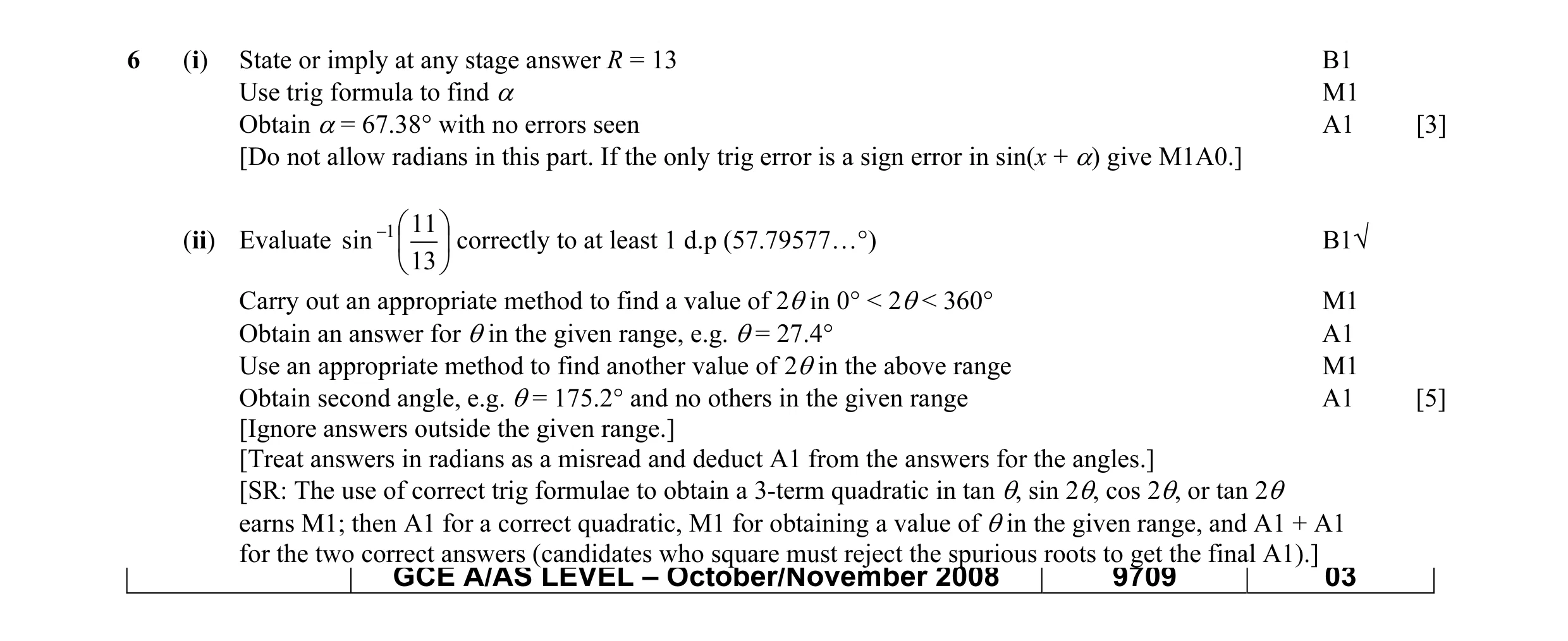 8
8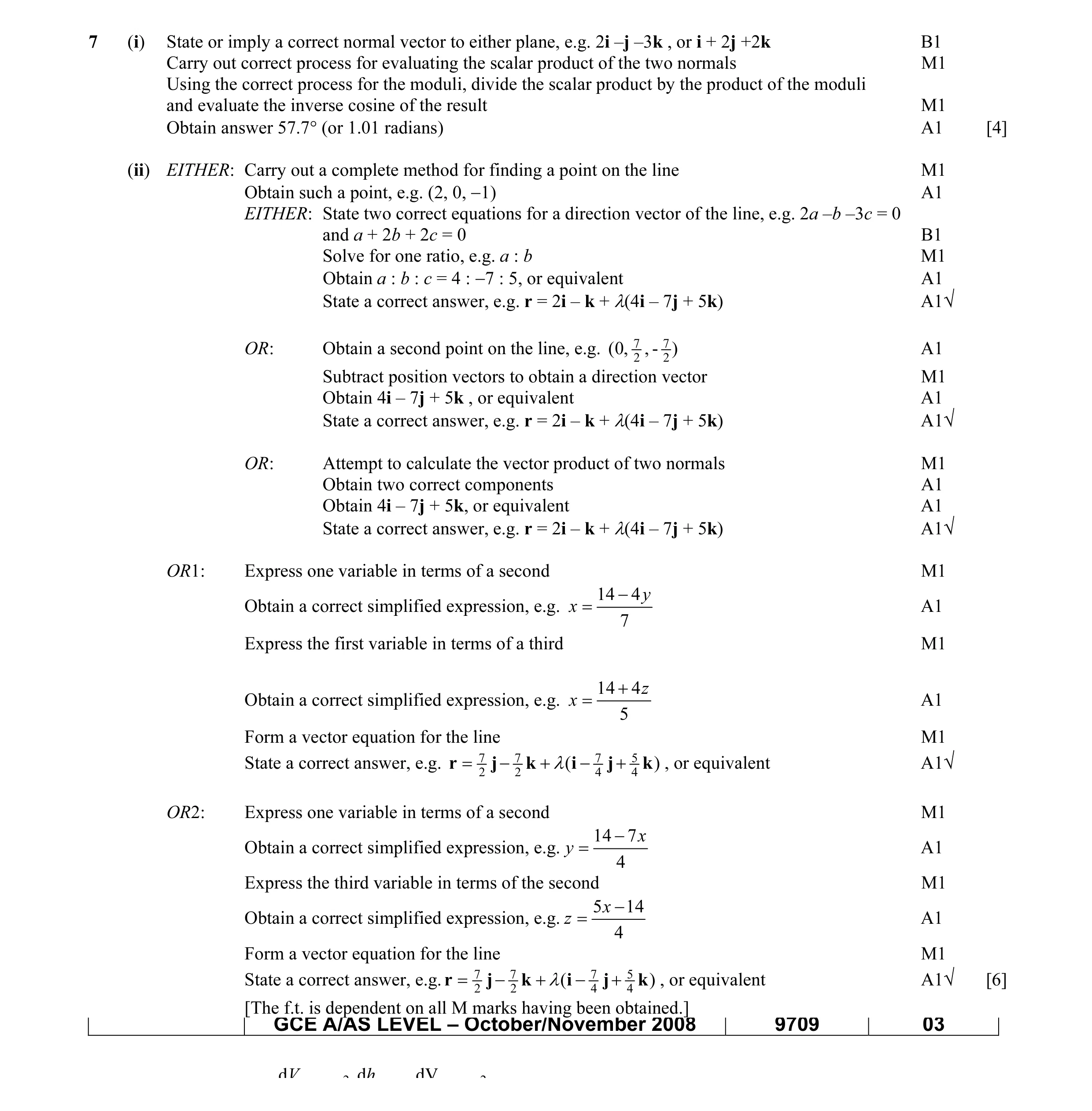 10
10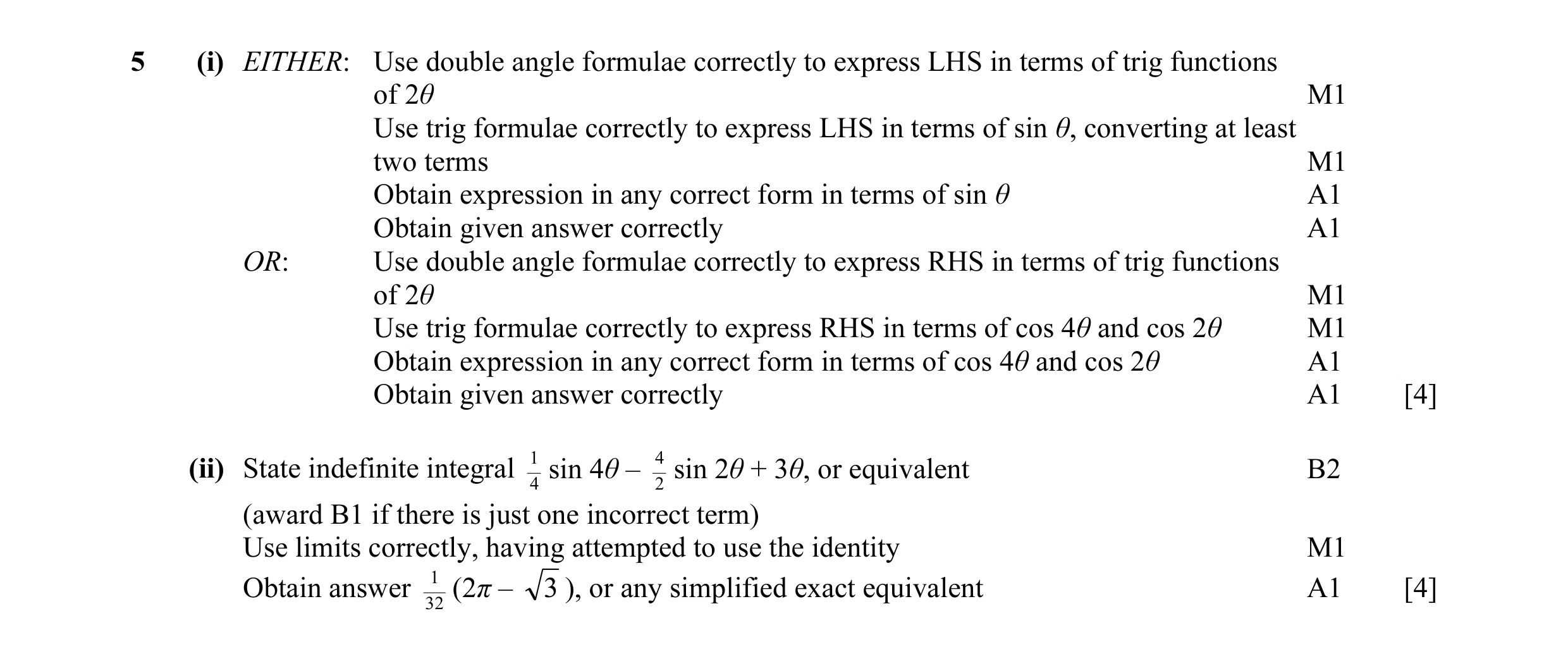 8
8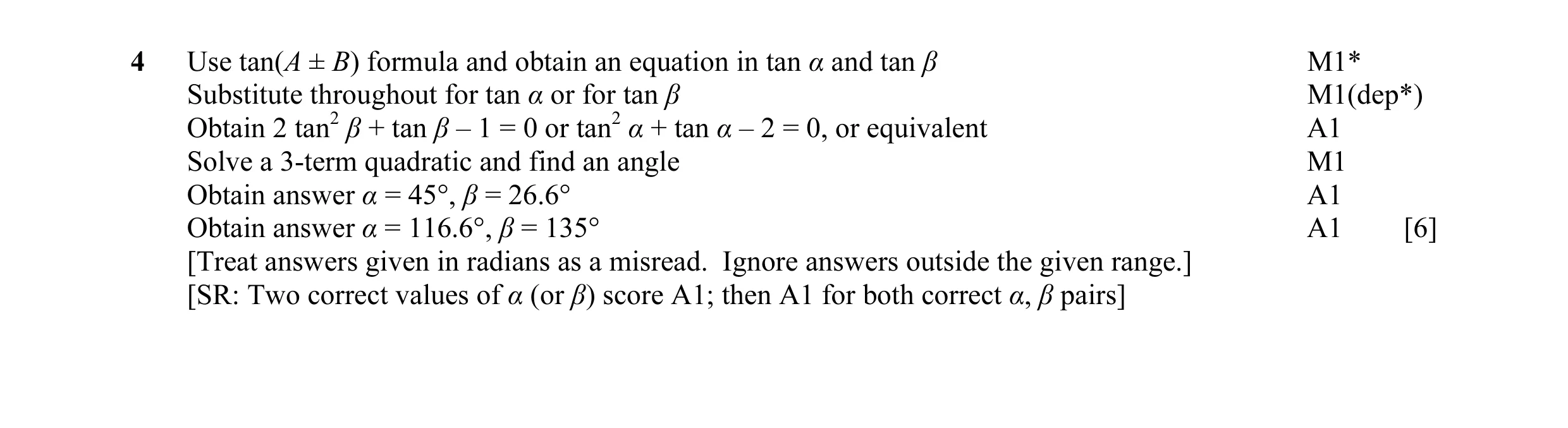 6
6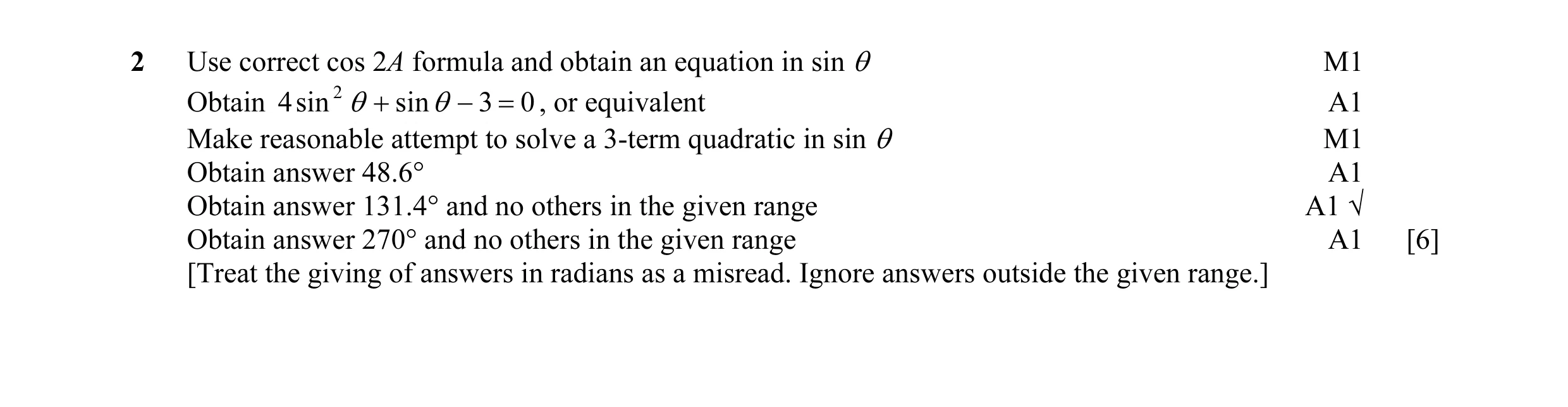 6
6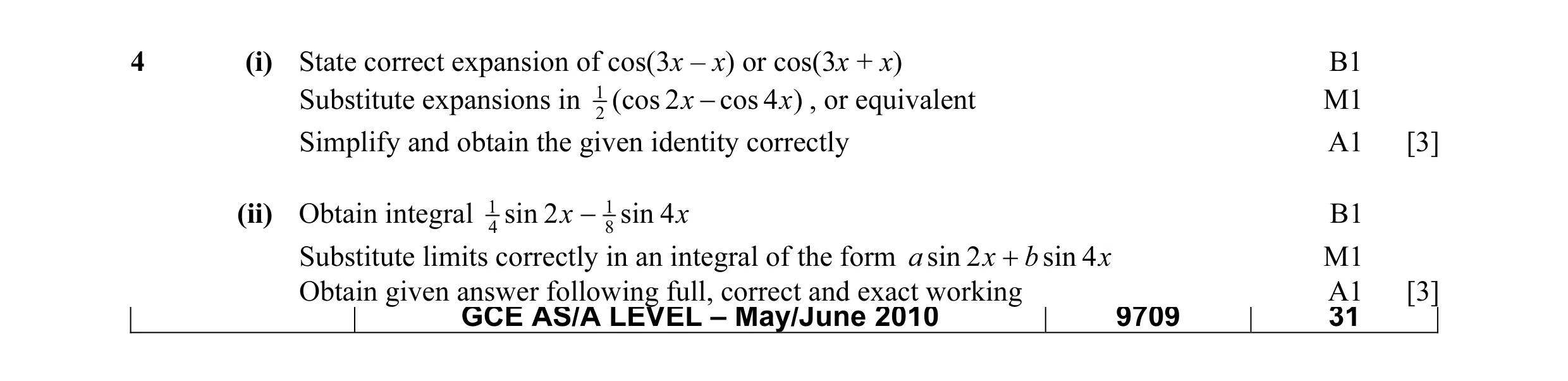 6
6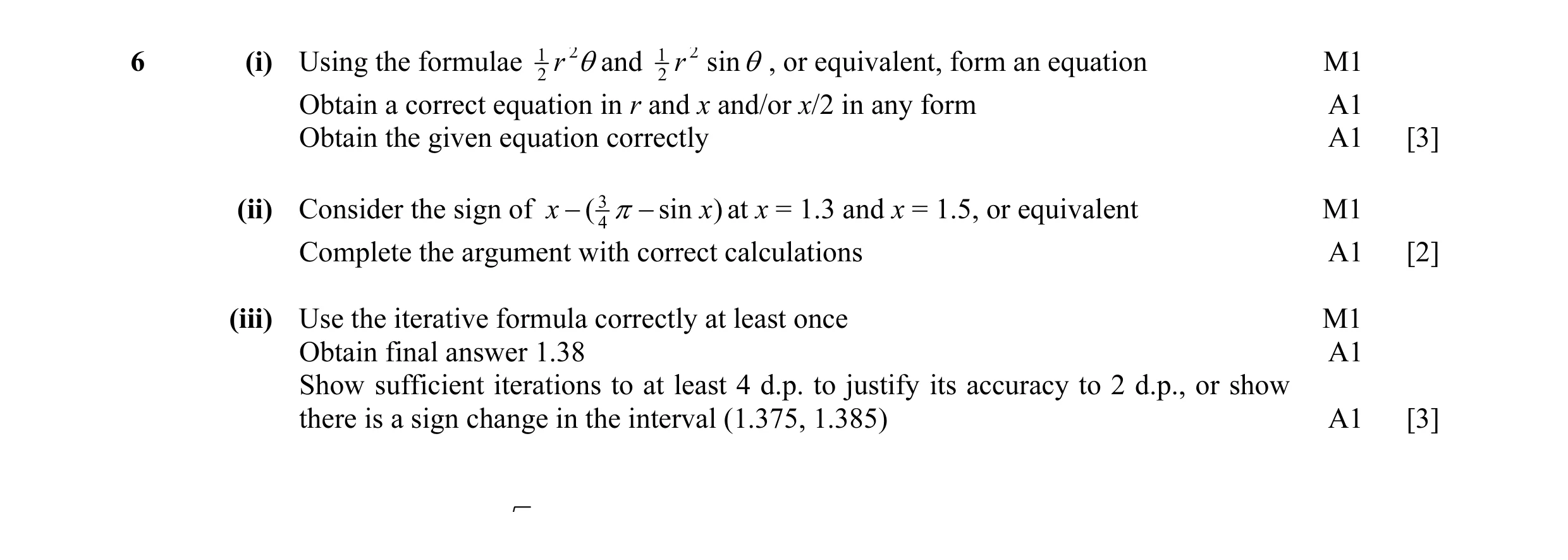 8
8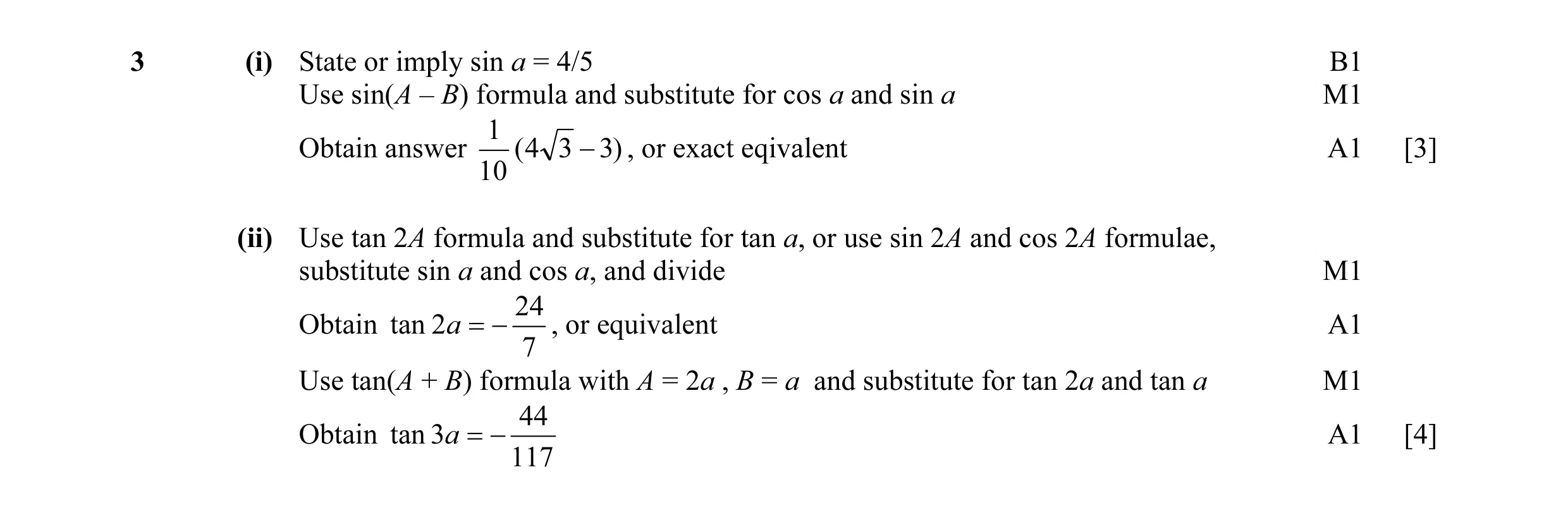 7
7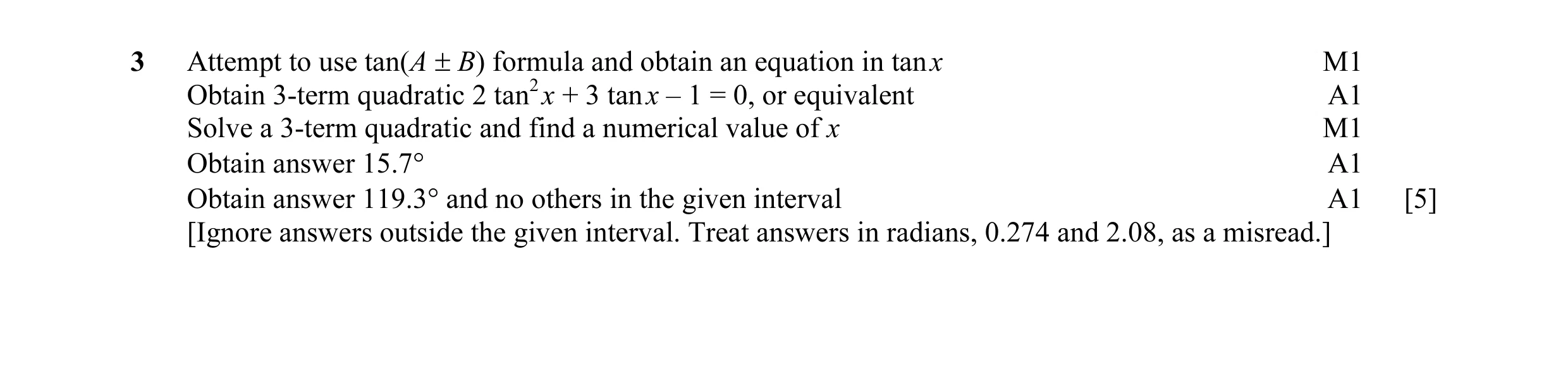 5
5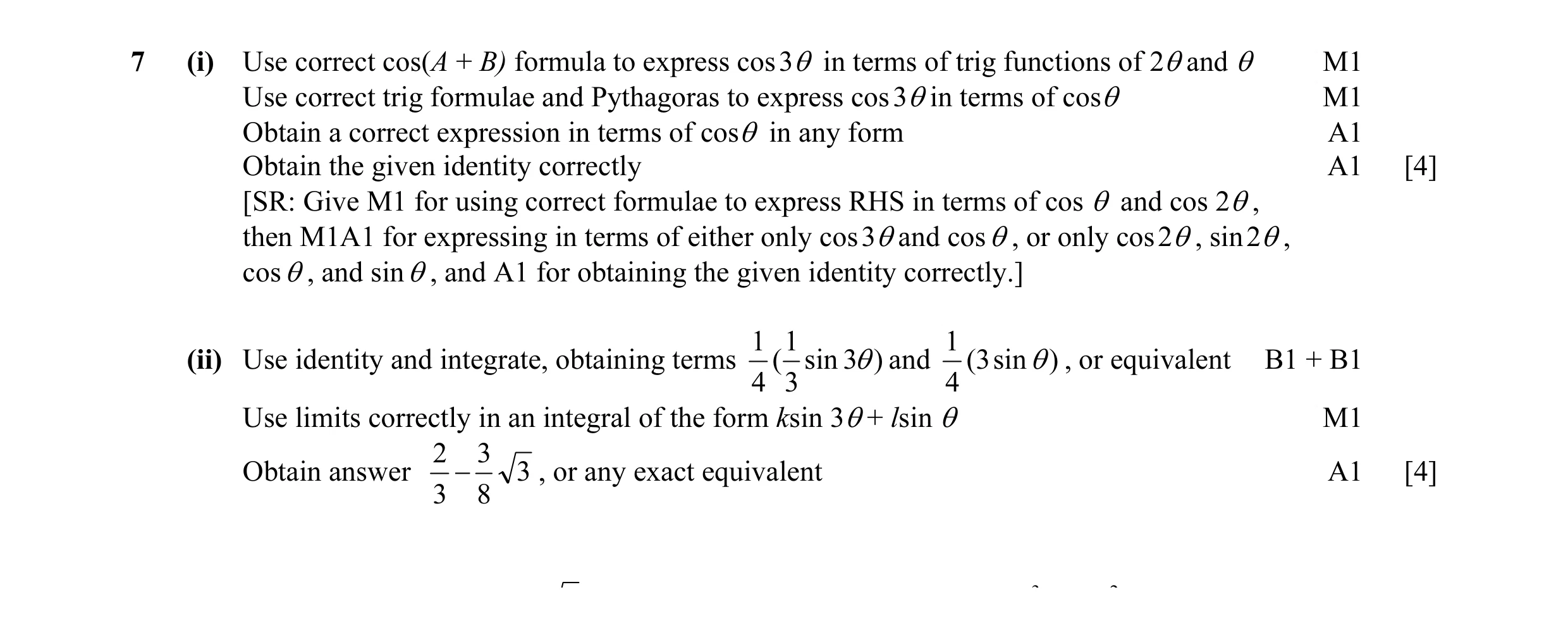 8
8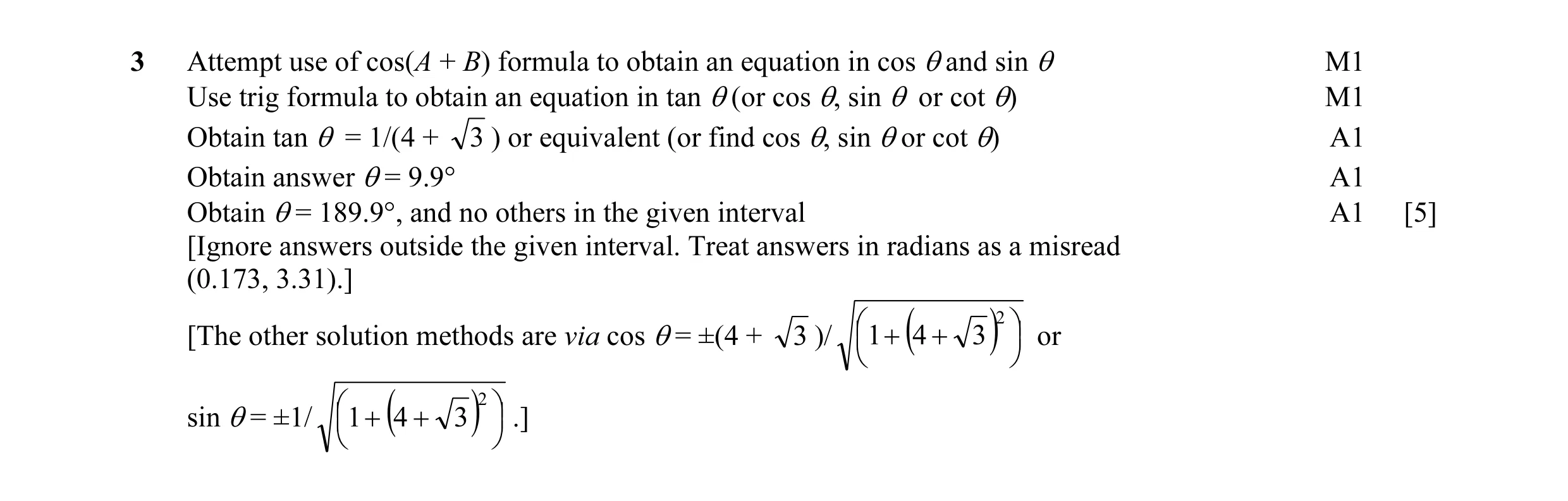 5
5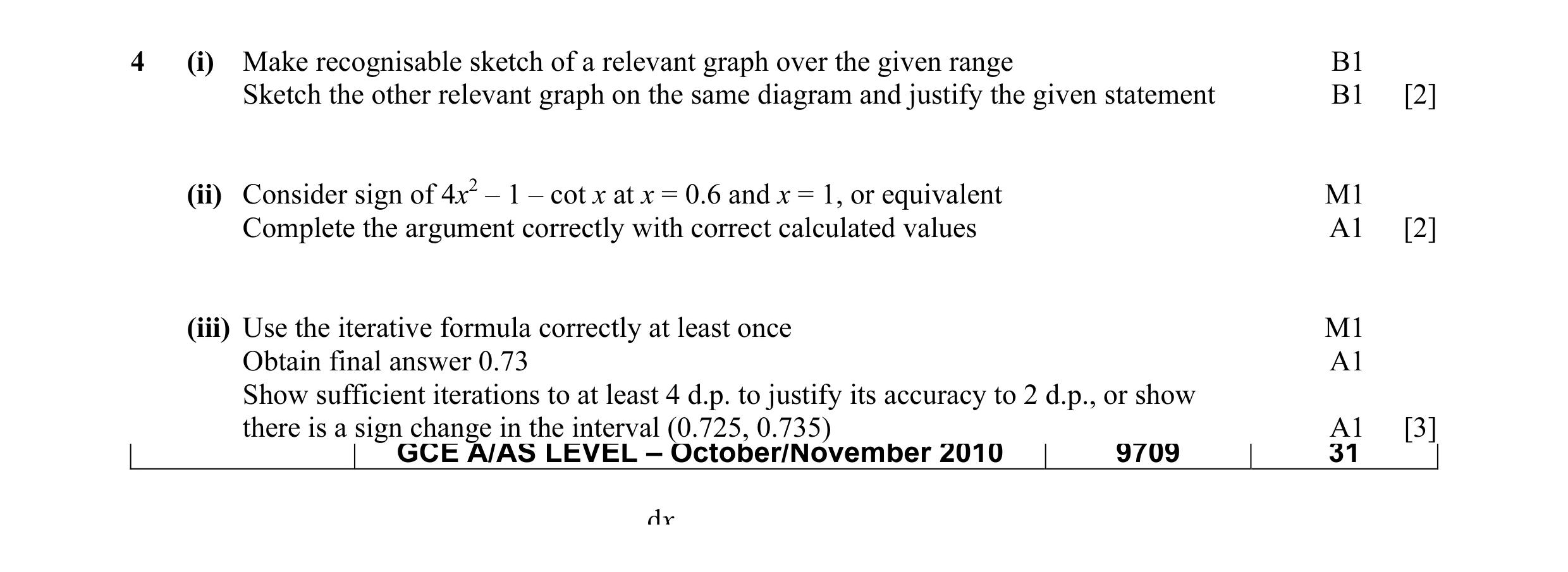 7
7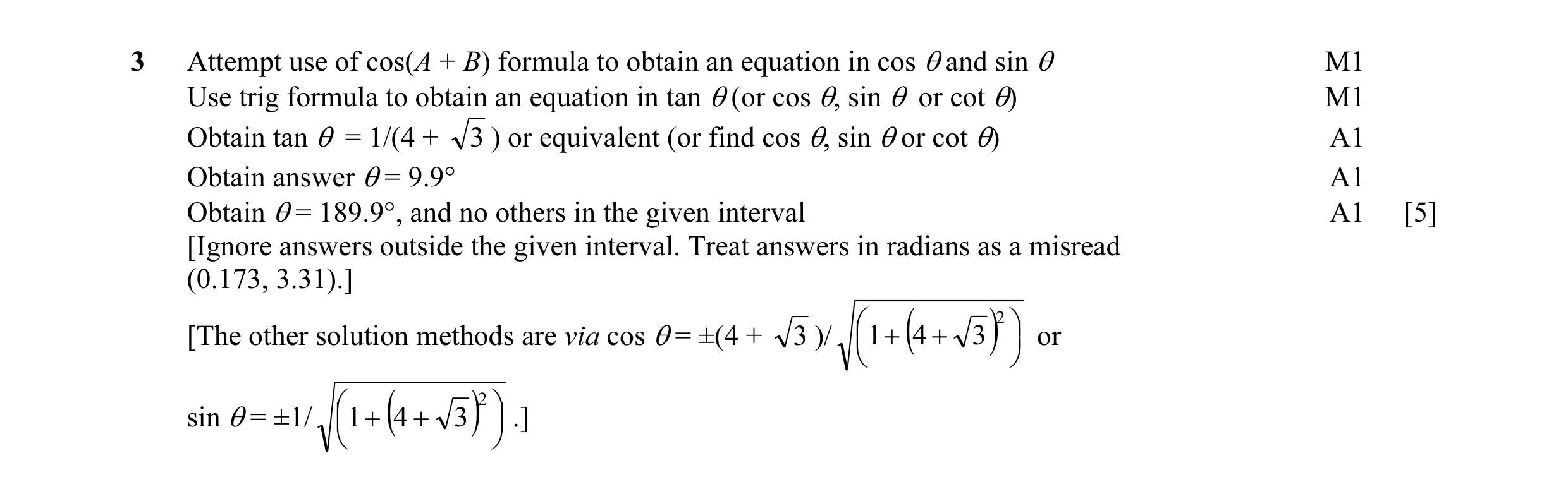 5
5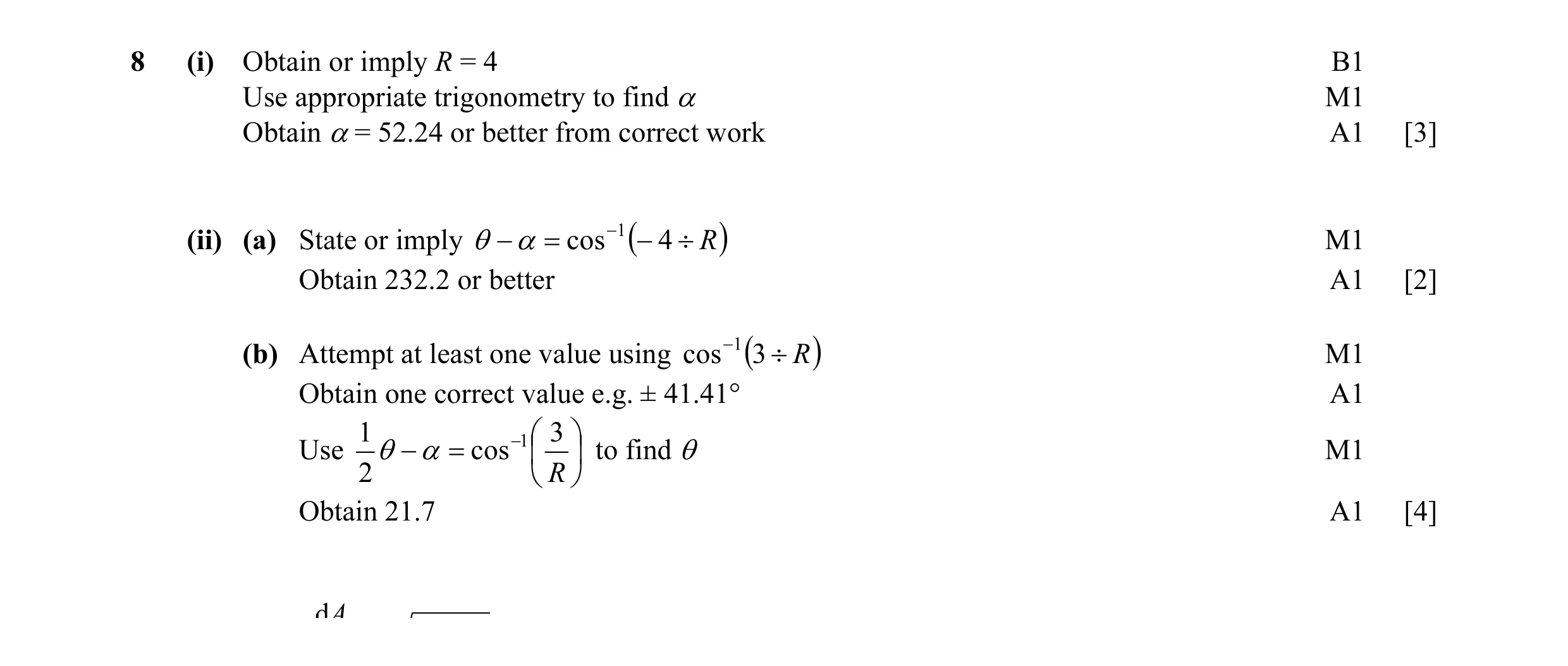 9
9 5
5 6
6 7
7 7
7 8
8 8
8 7
7 12
12 5
5 8
8 5
5 5
5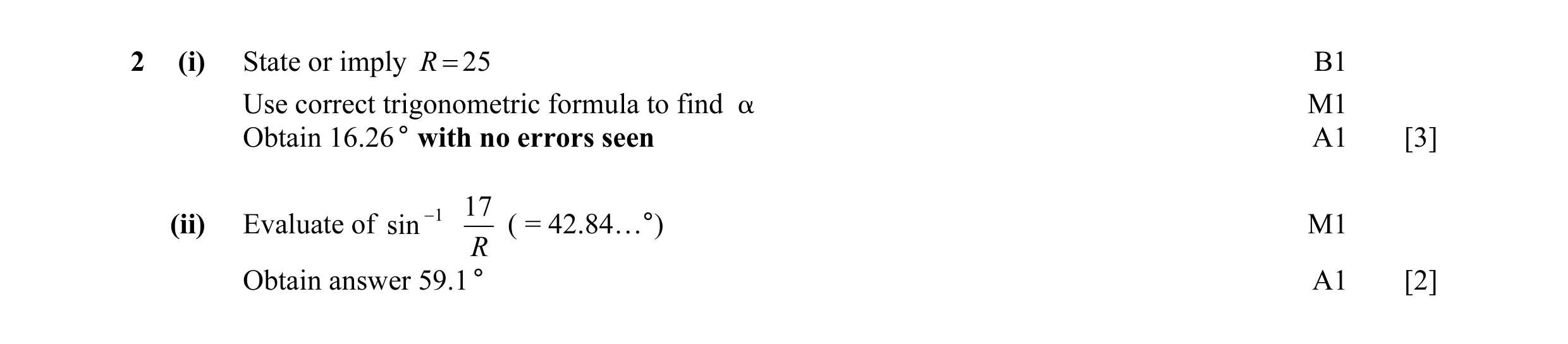 5
5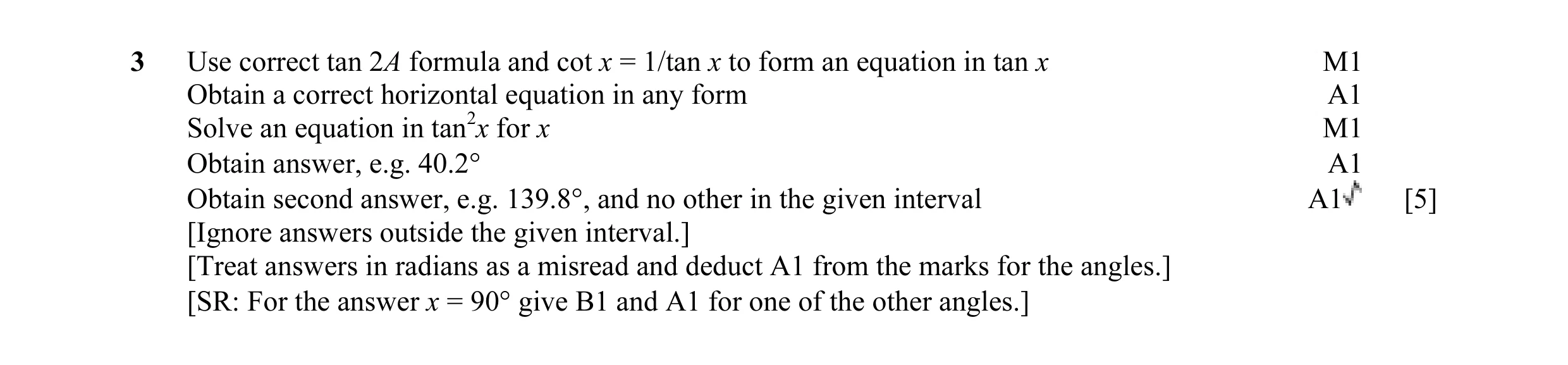 5
5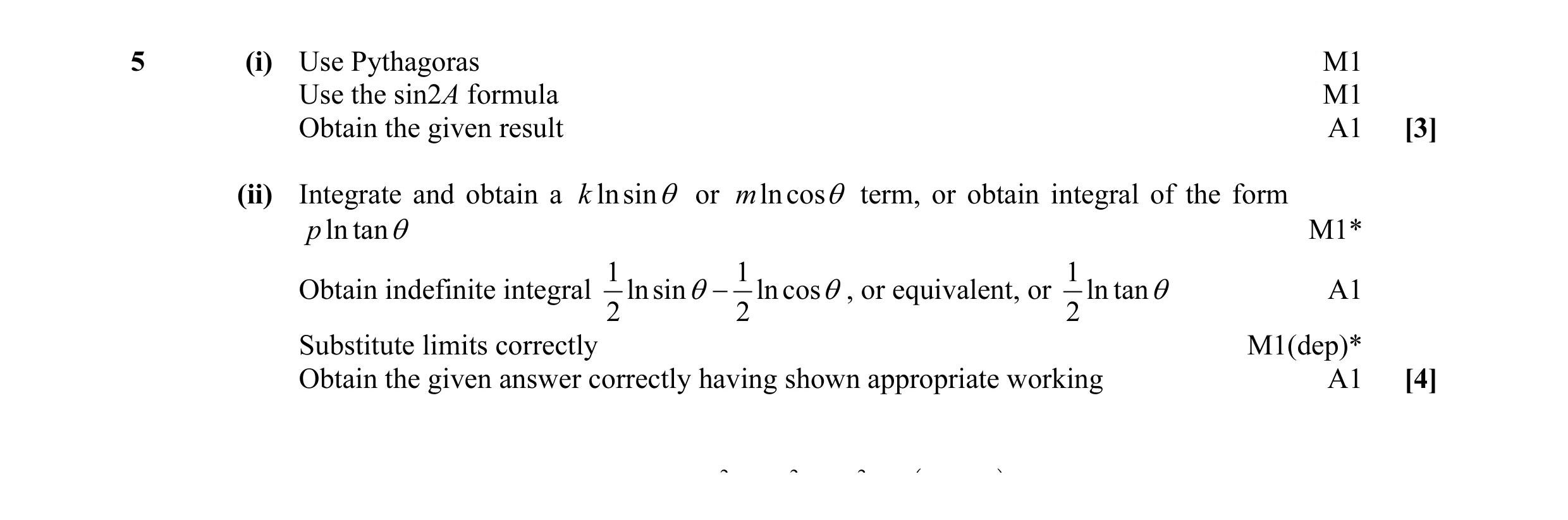 7
7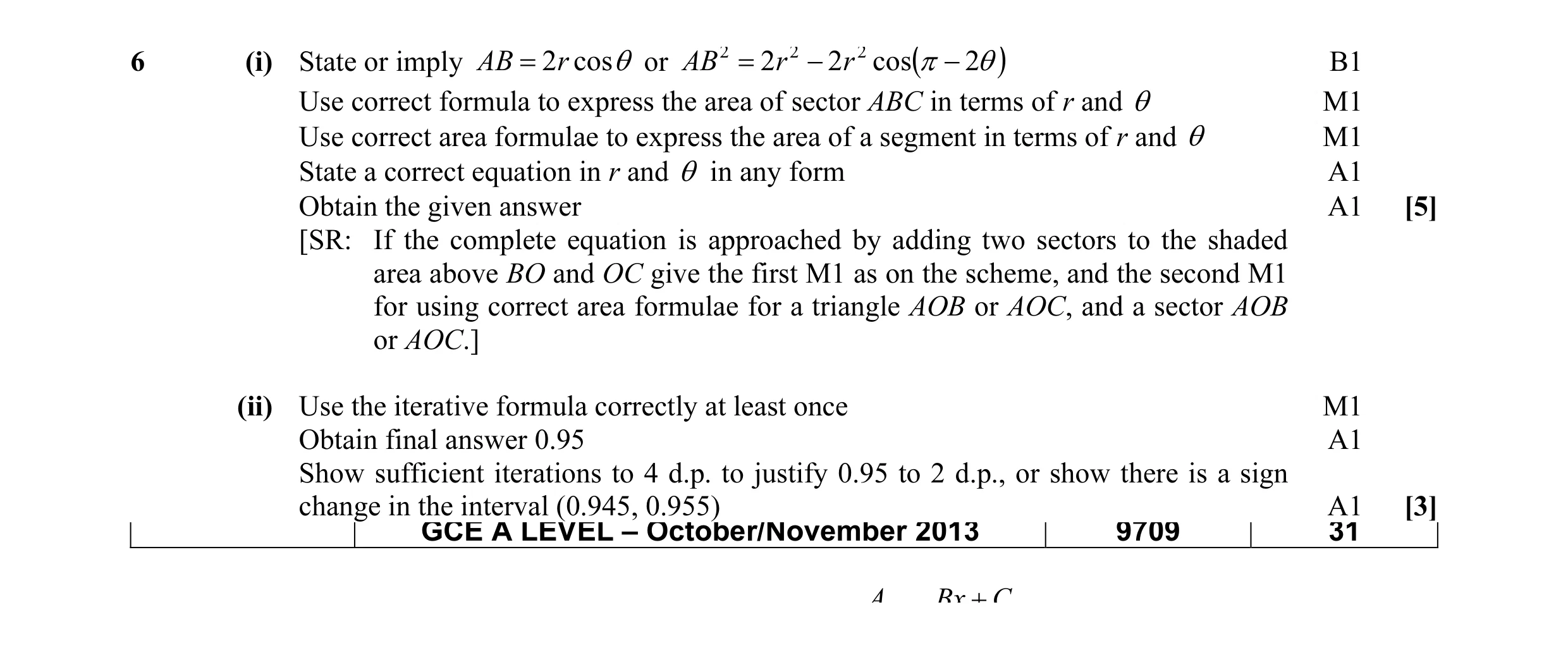 8
8 8
8 9
9 5
5 8
8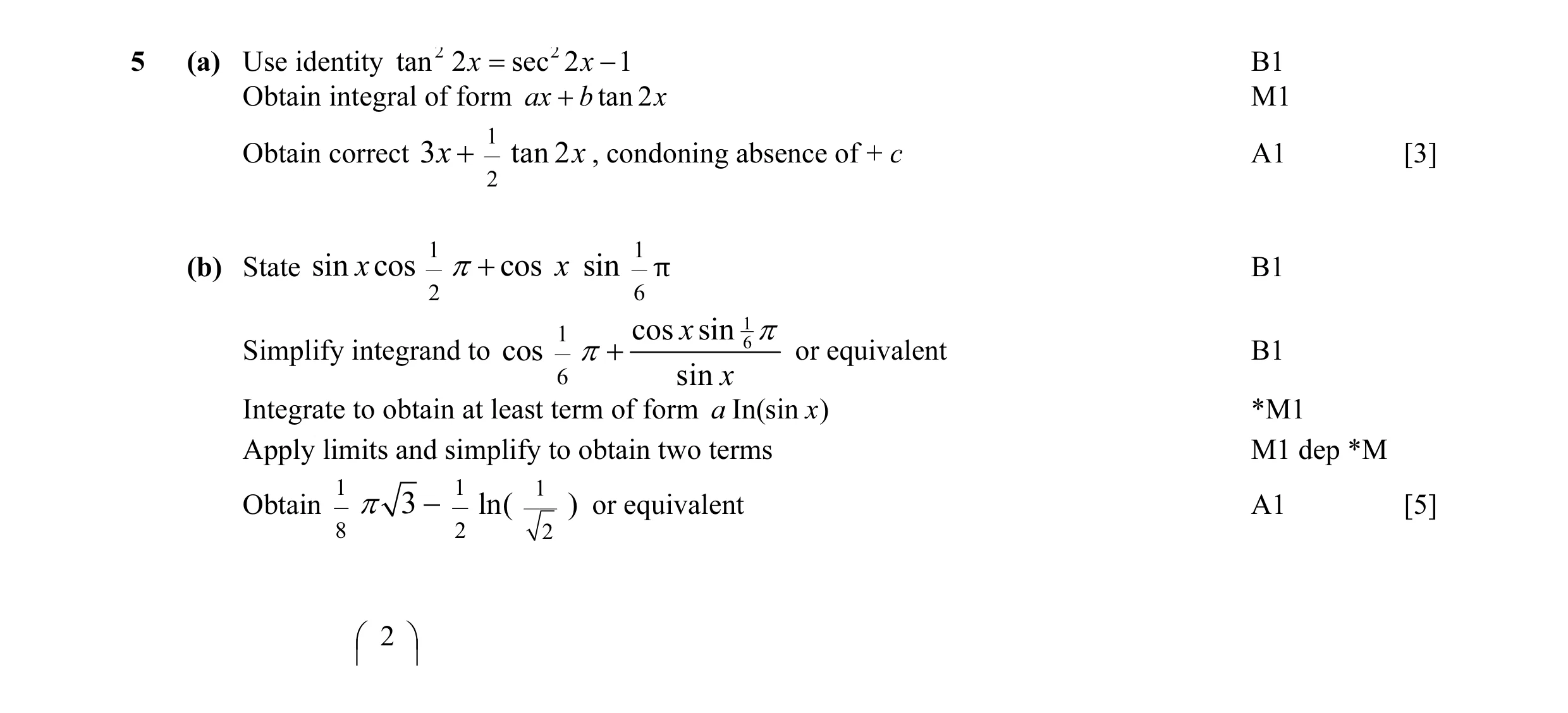 8
8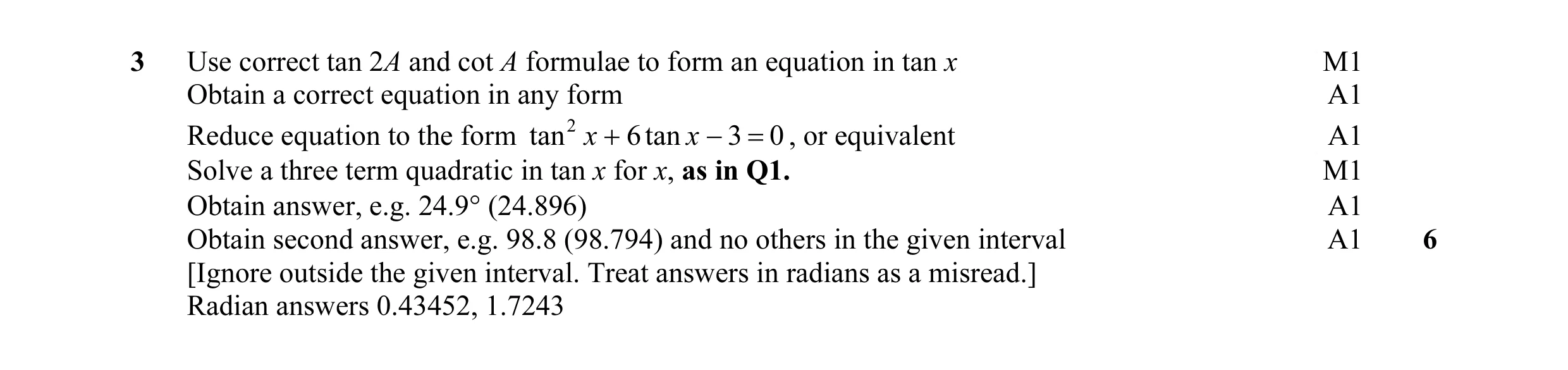 6
6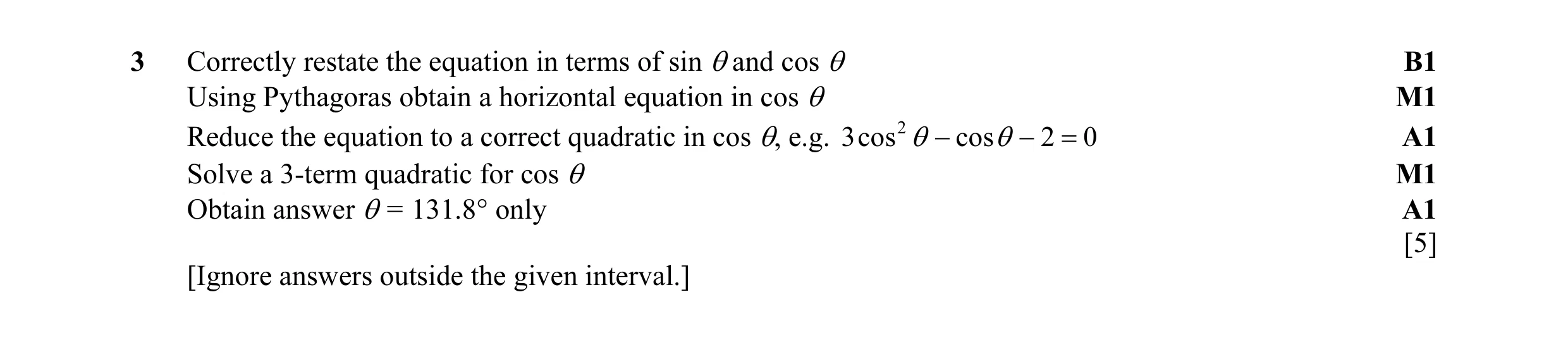 5
5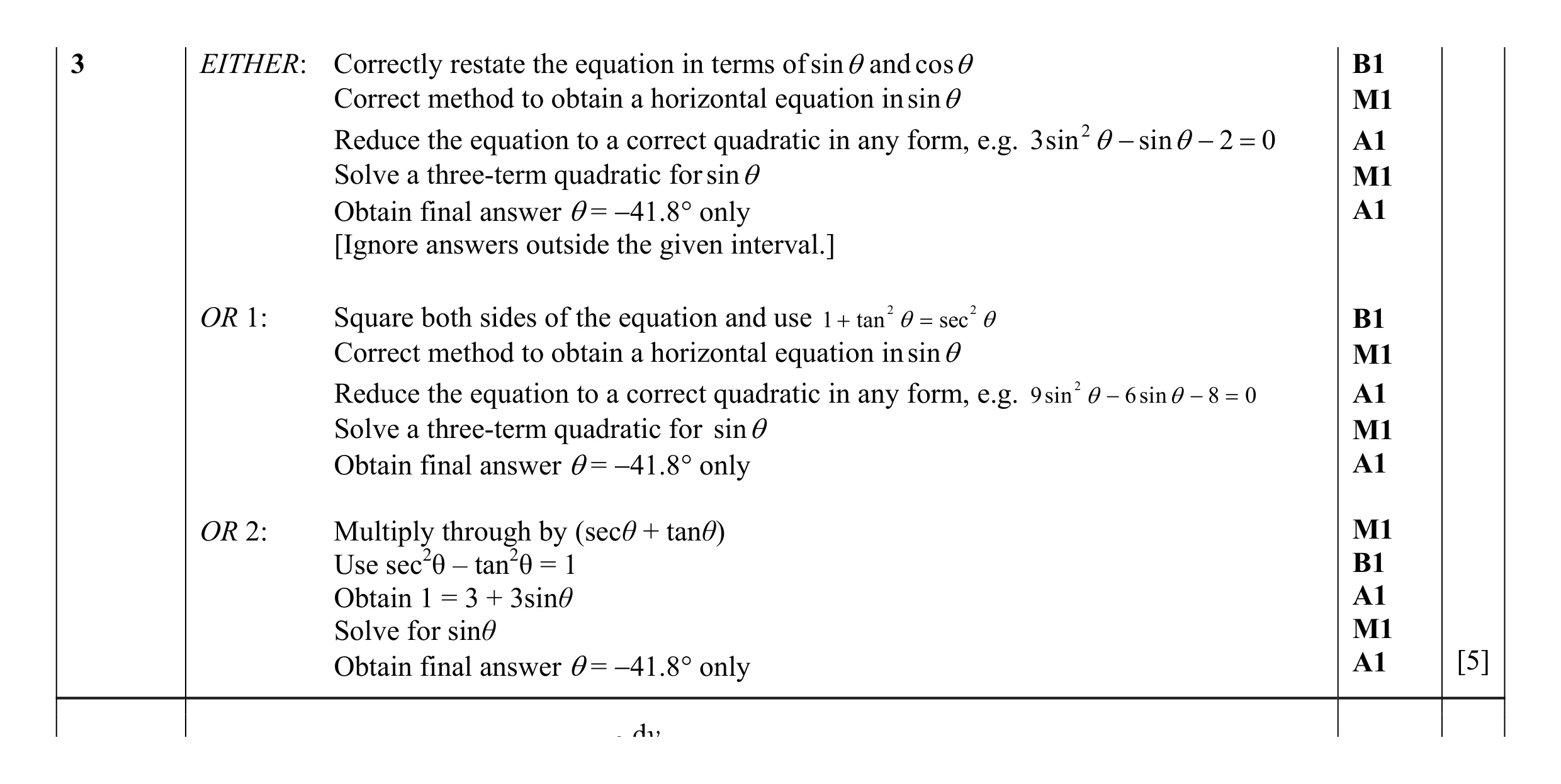 5
5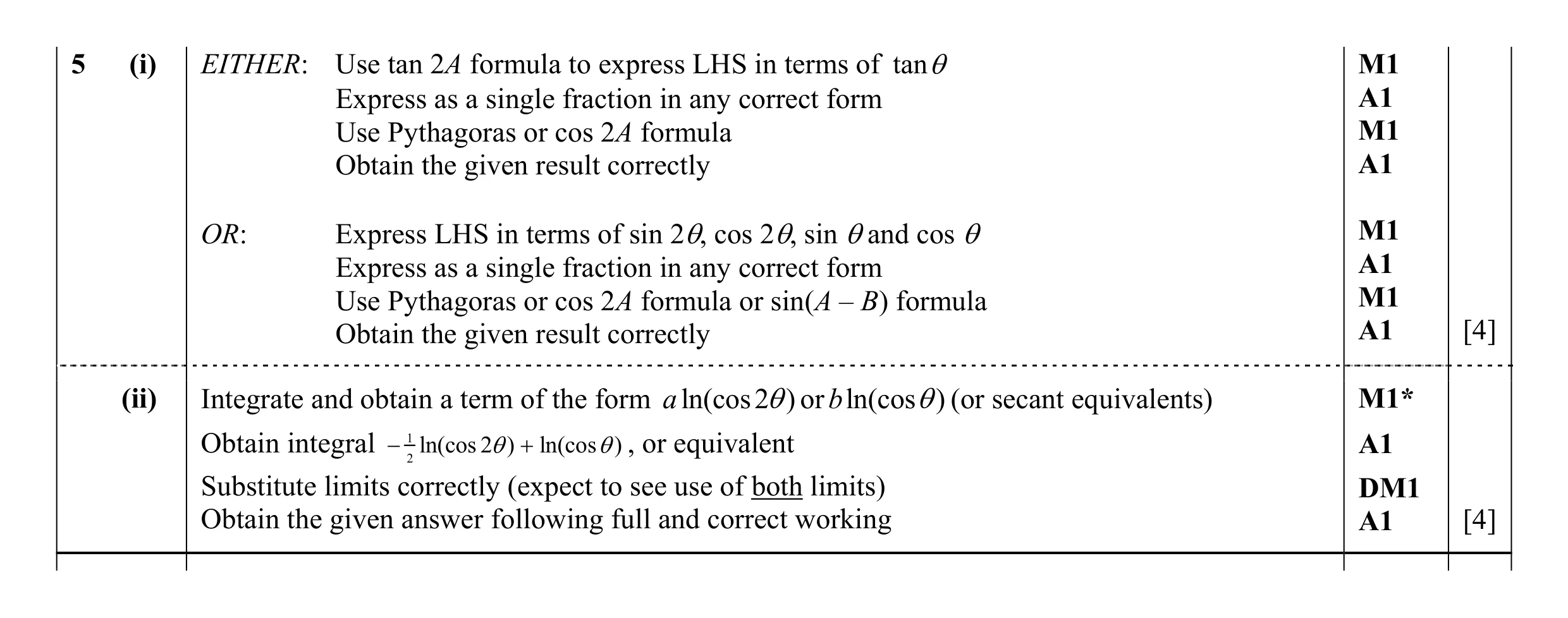 8
8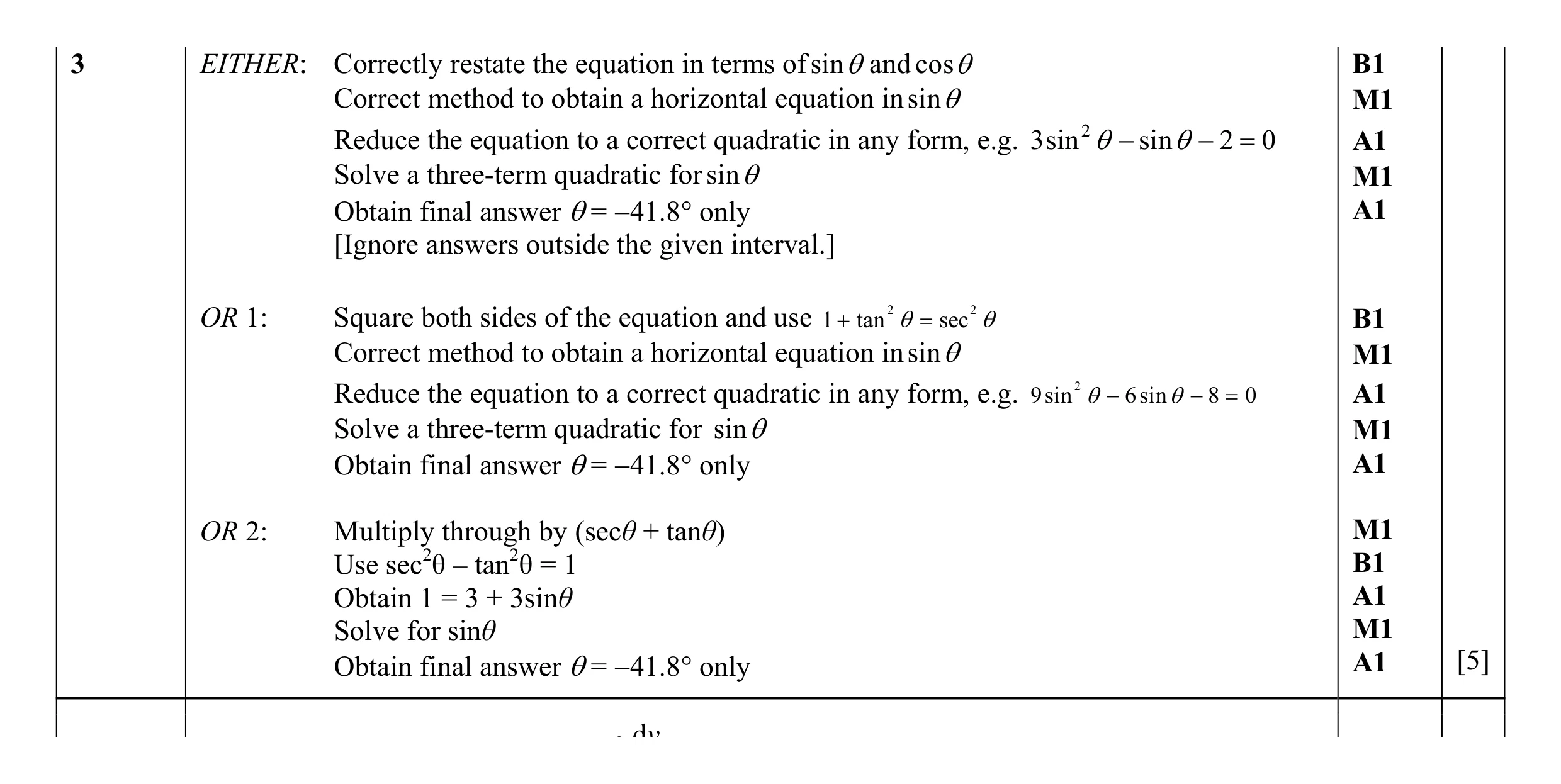 5
5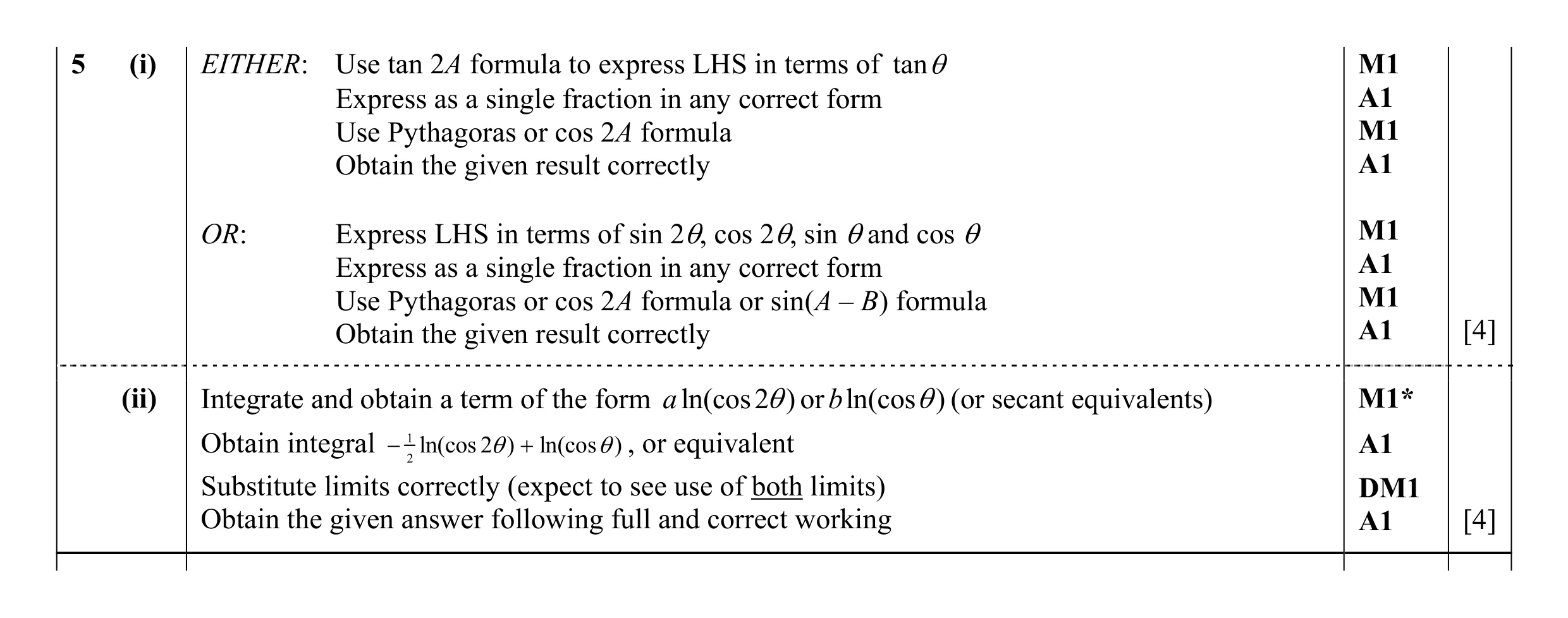 8
8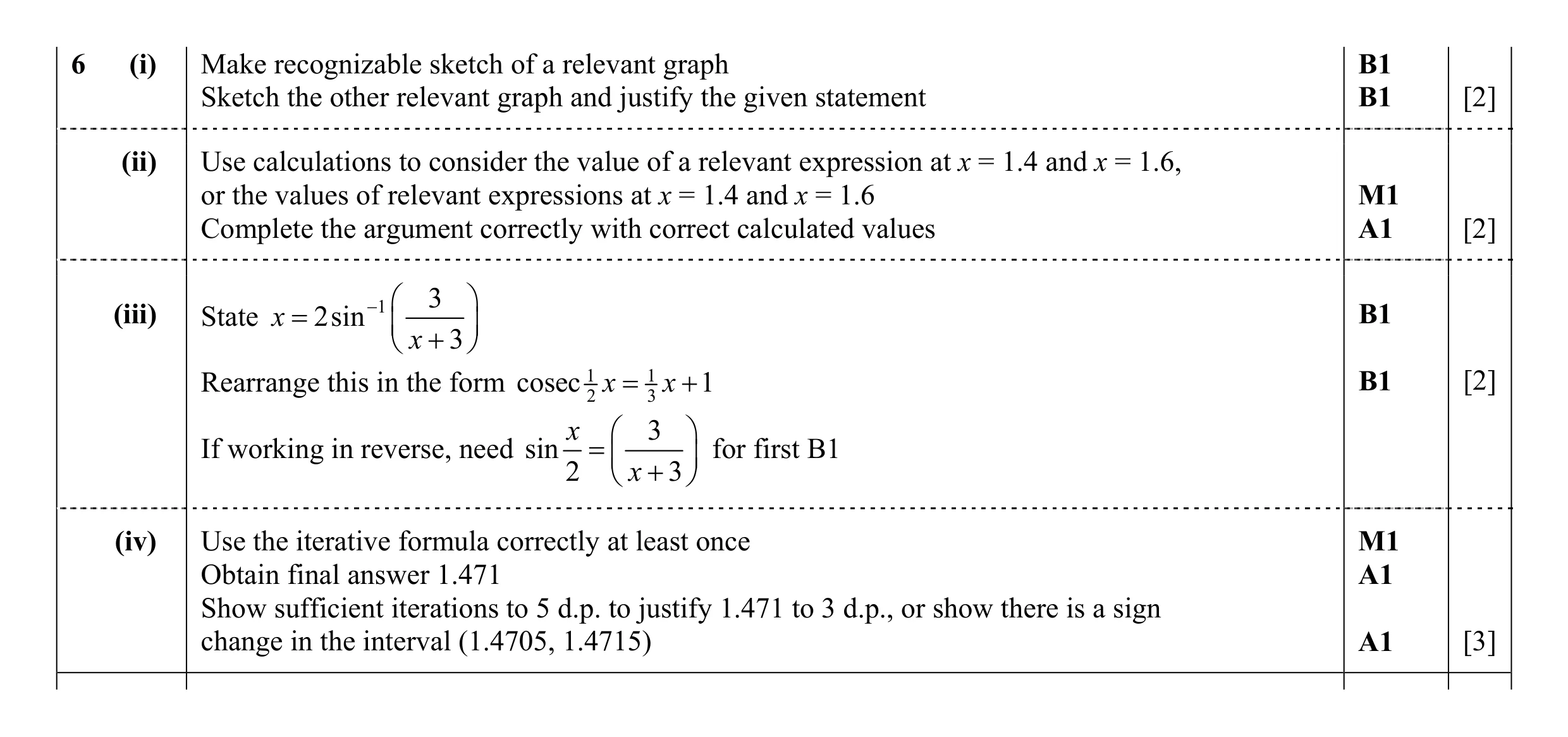 9
9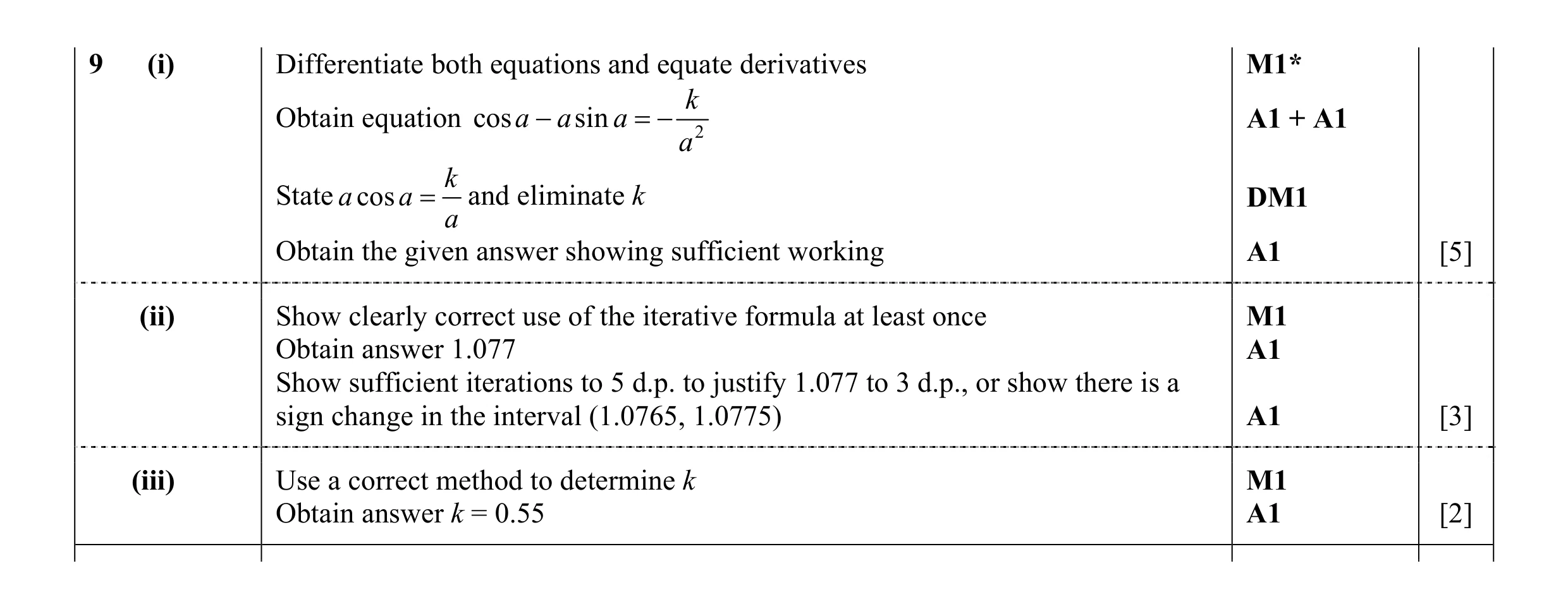 10
10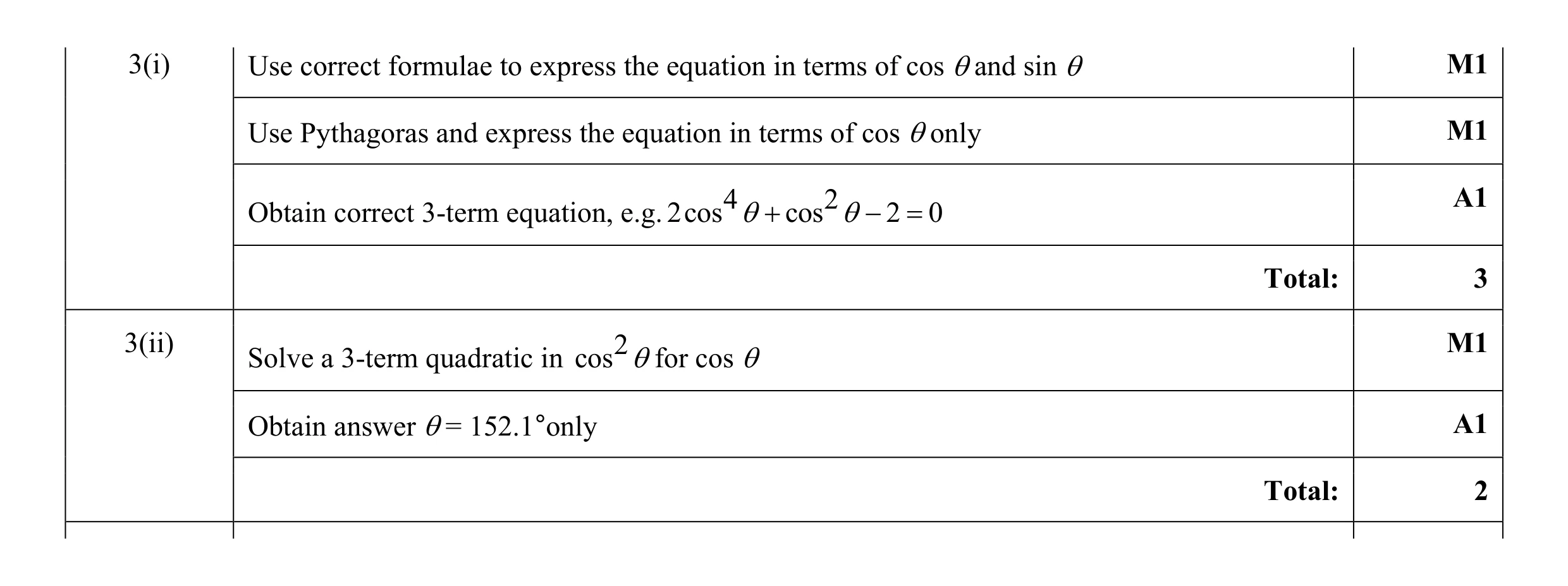 5
5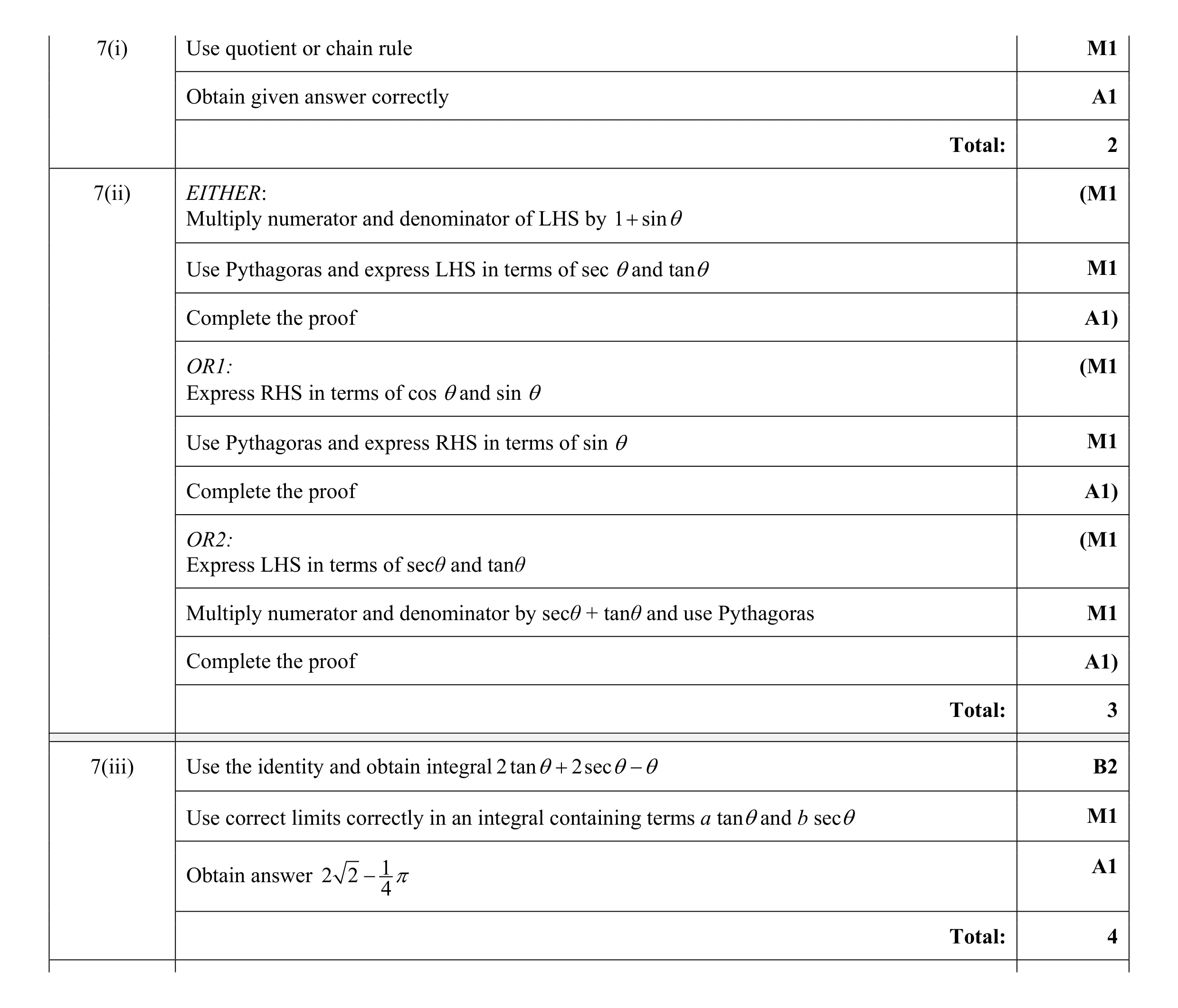 9
9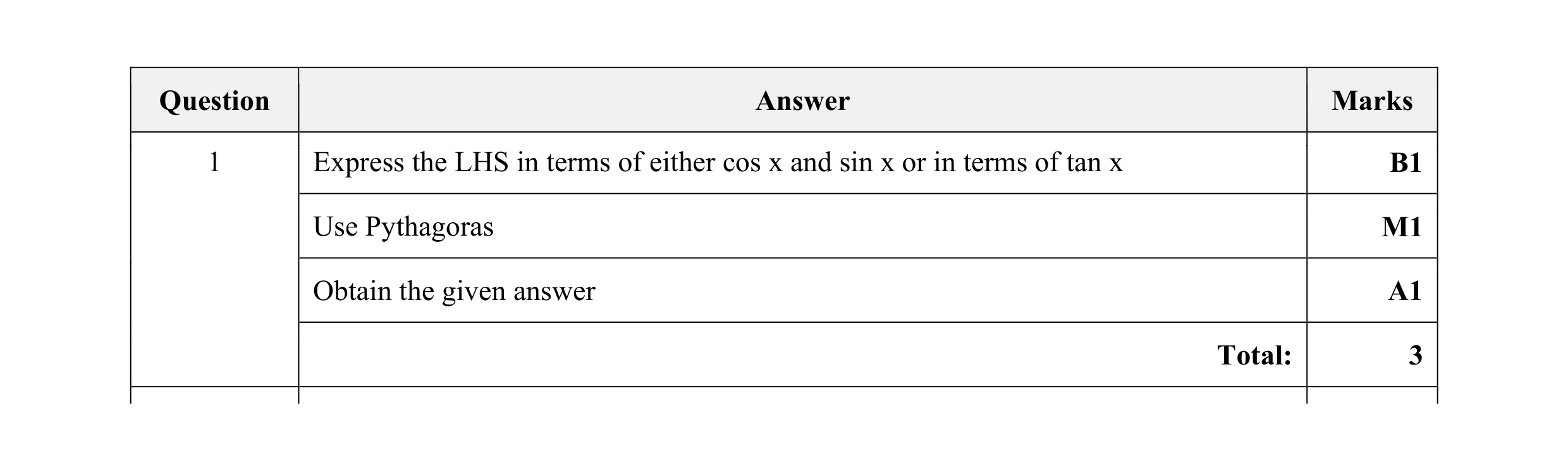 3
3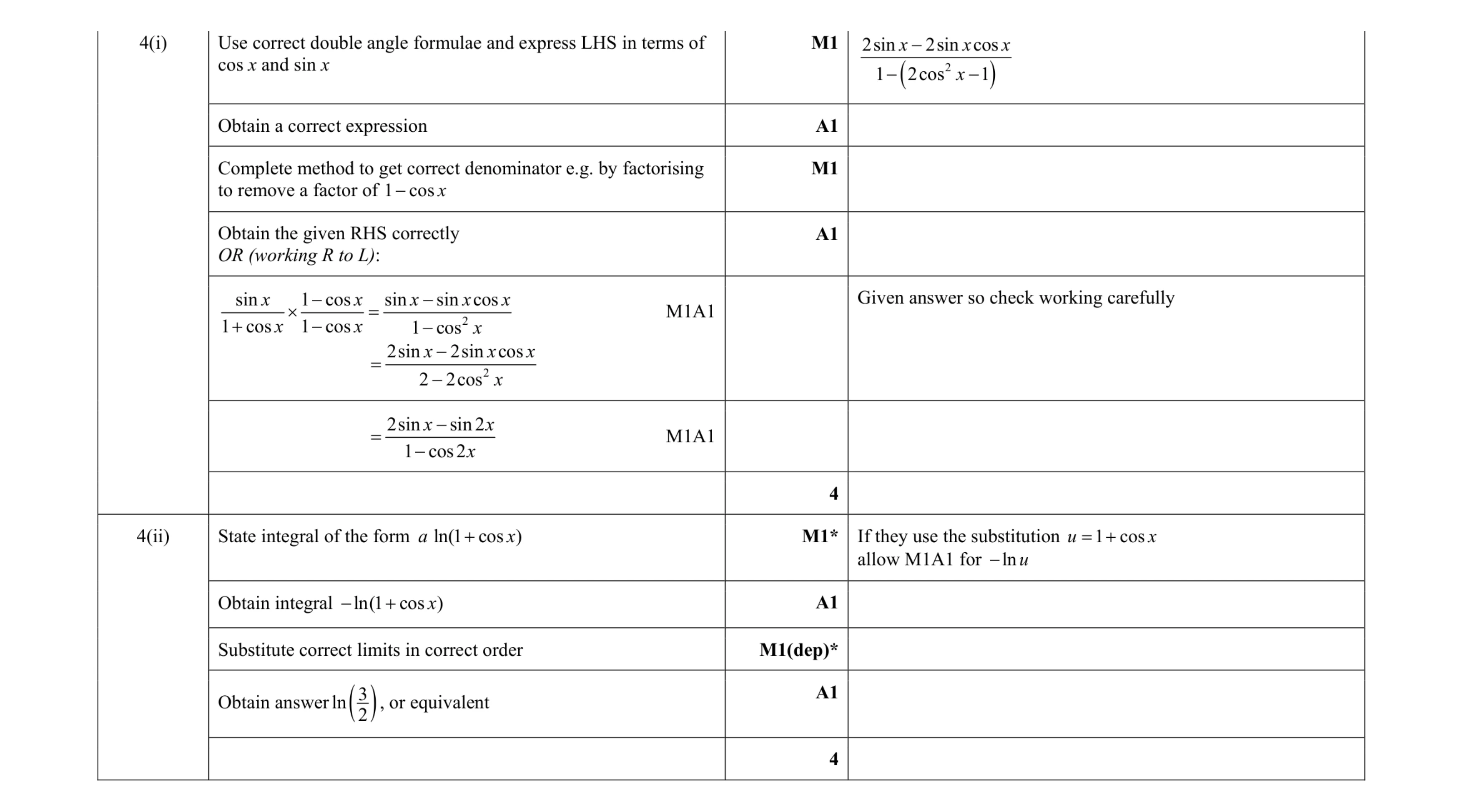 8
8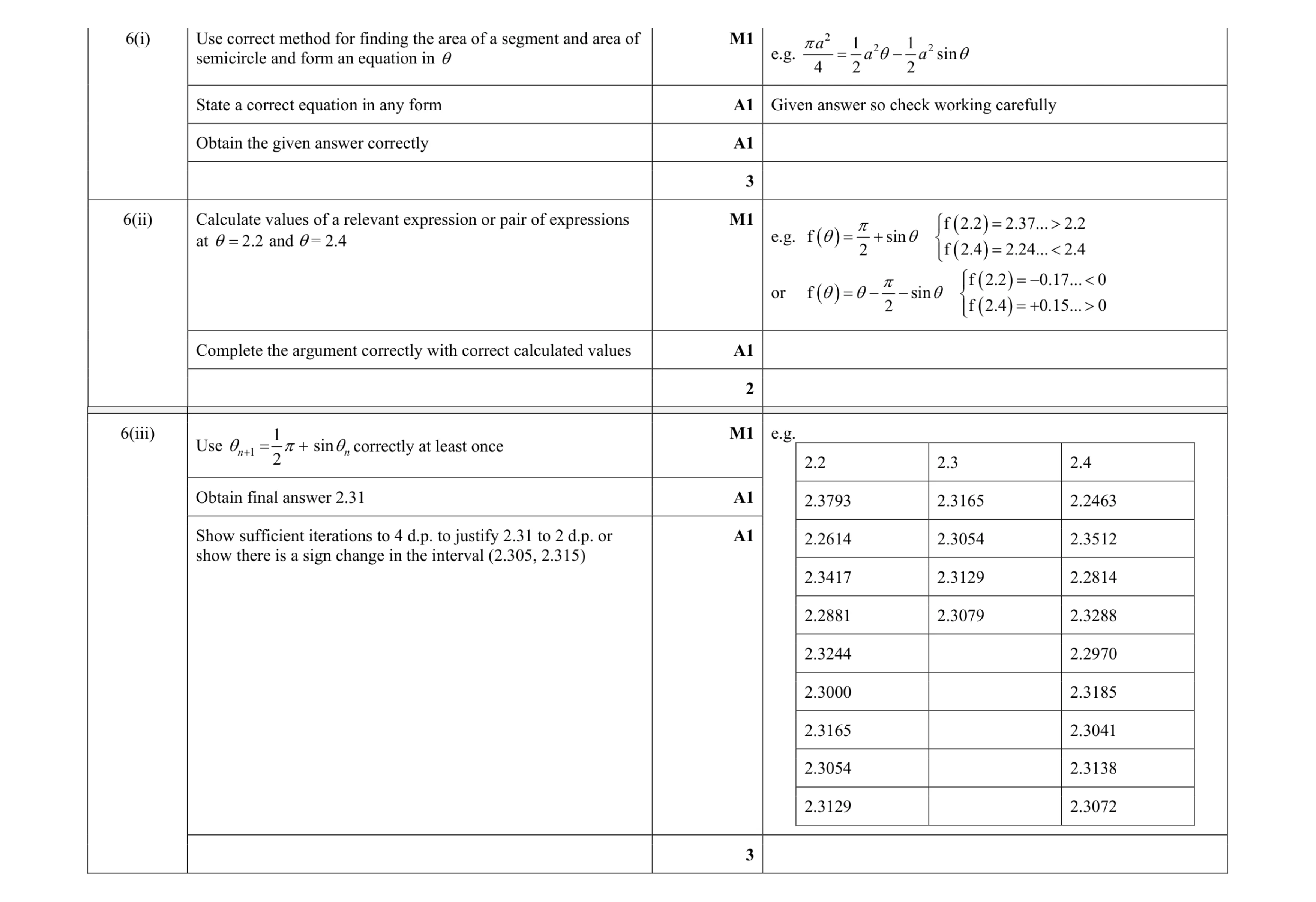 8
8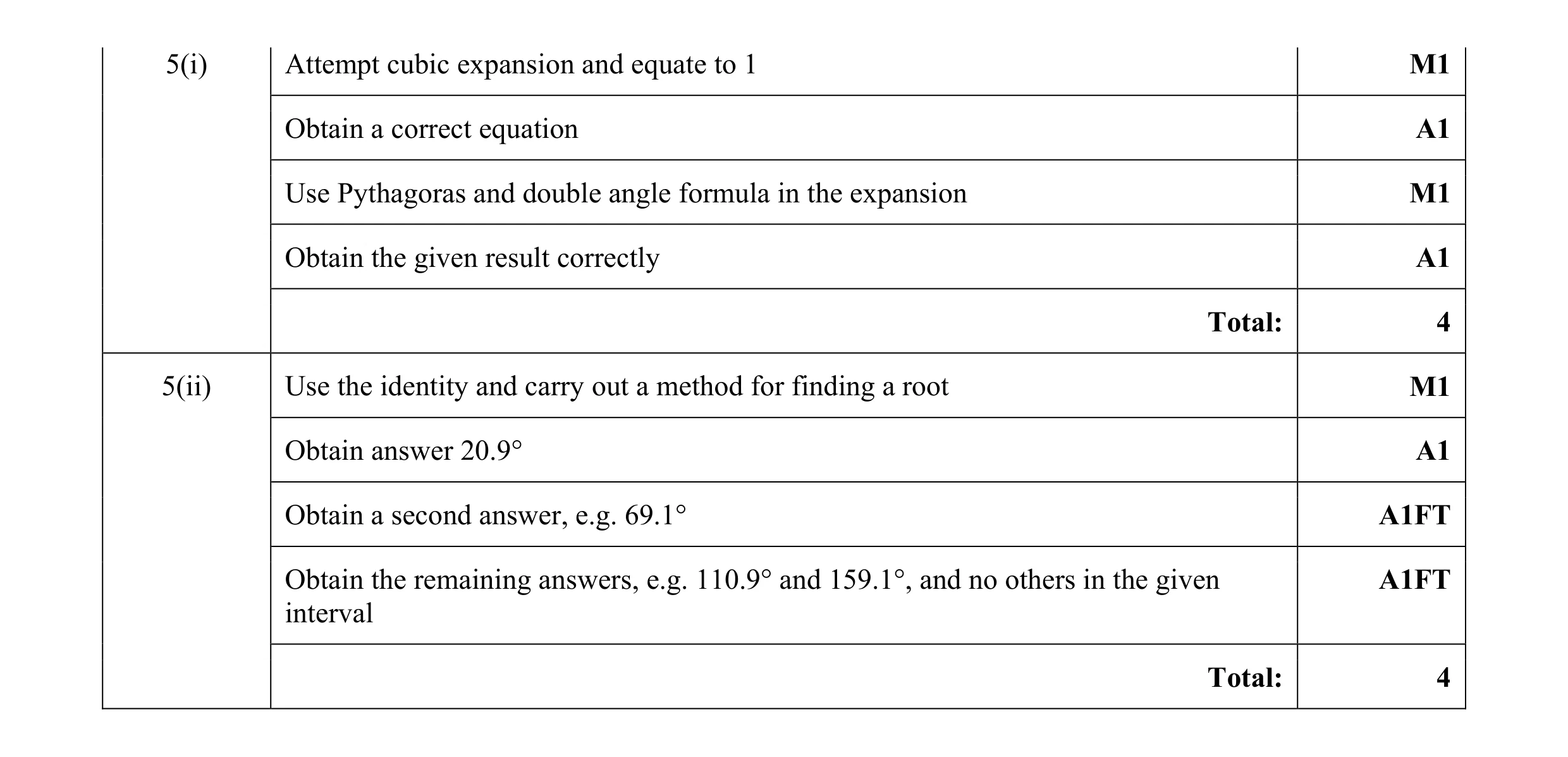 8
8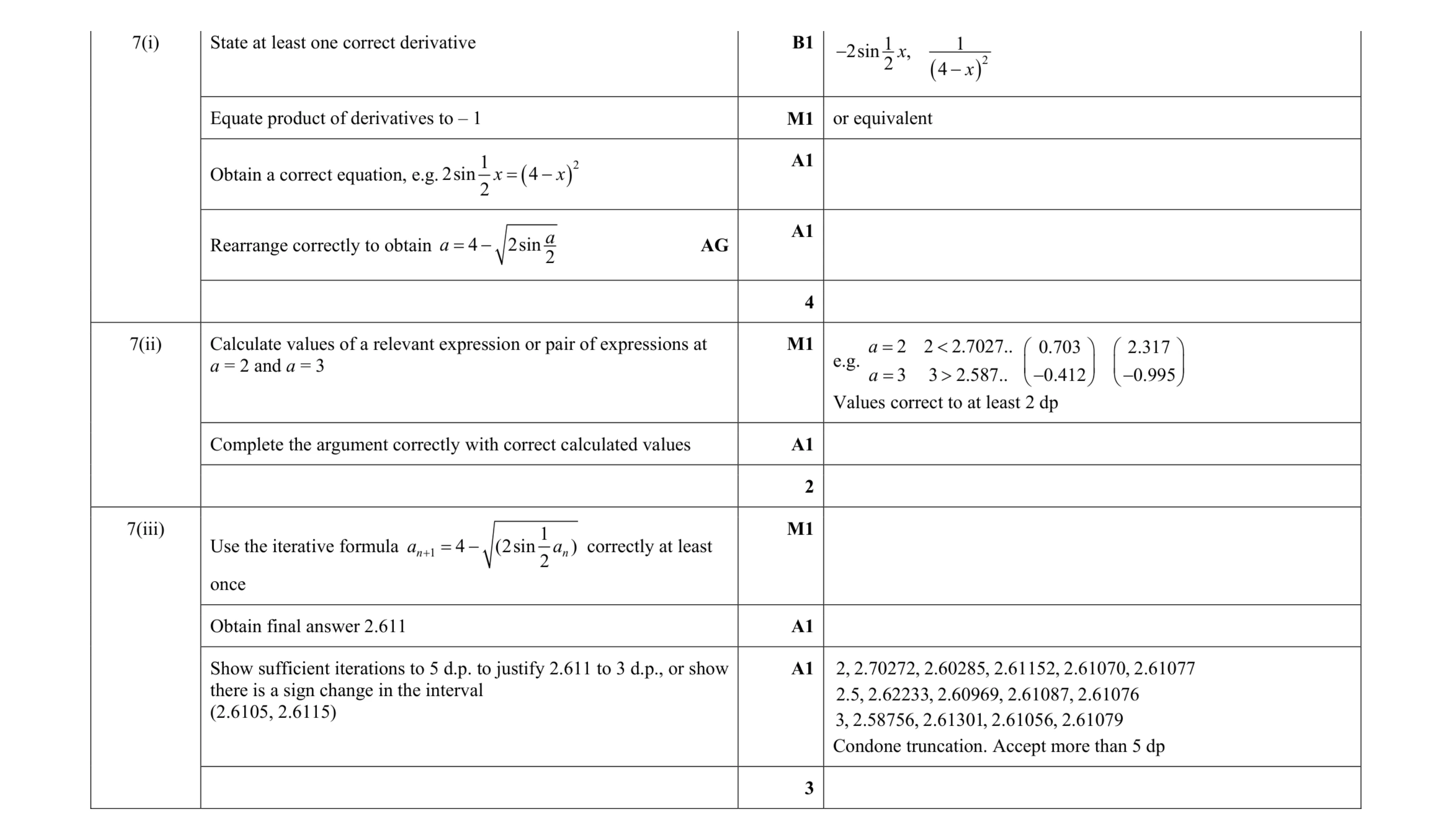 9
9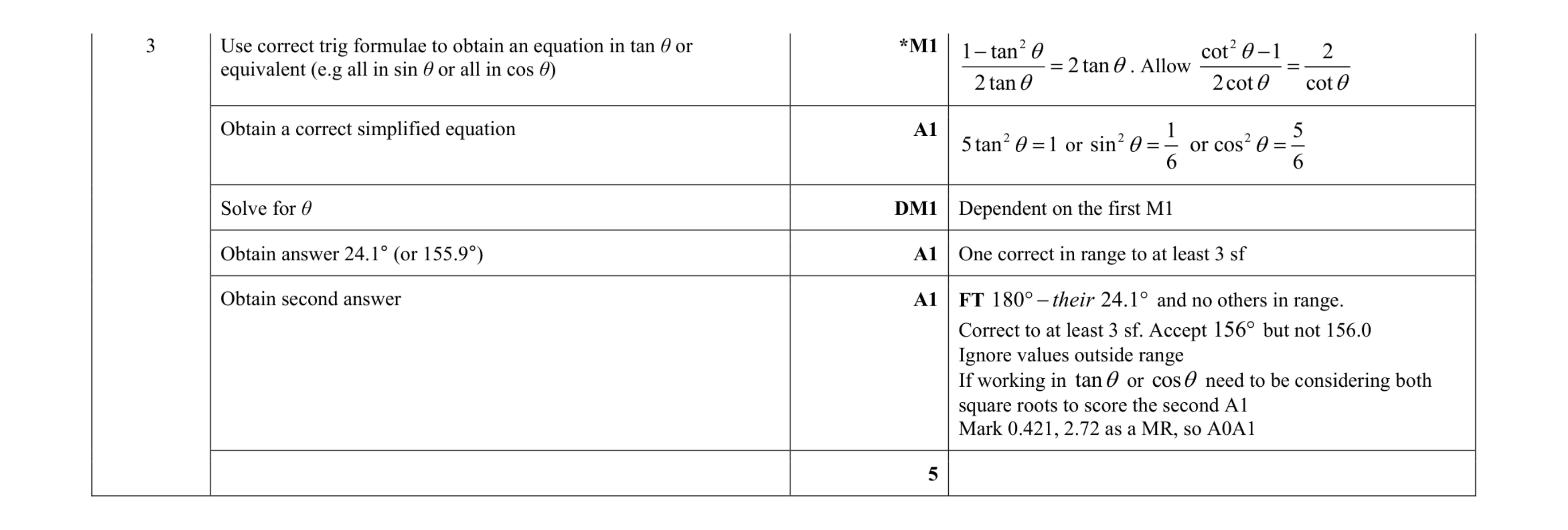 5
5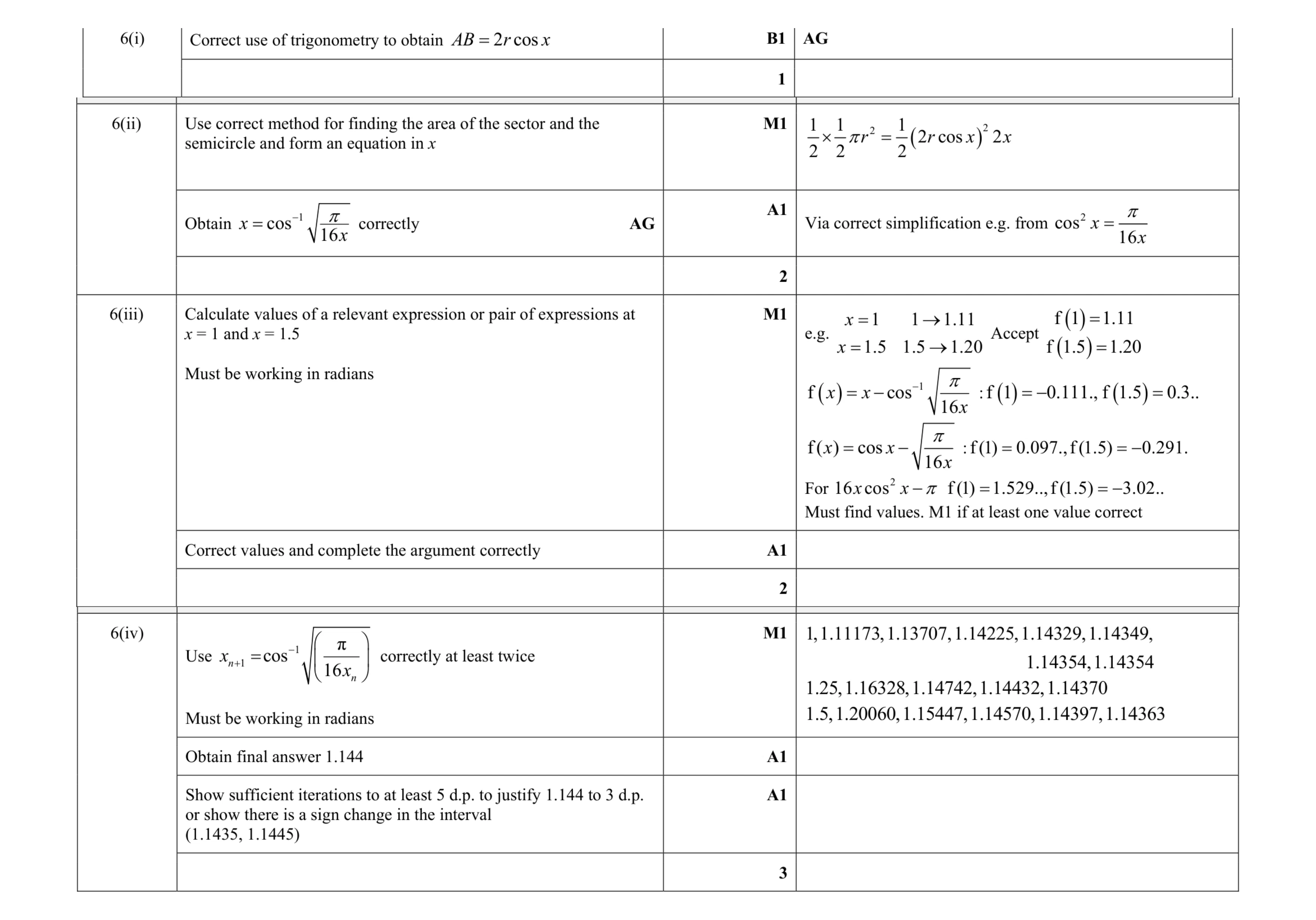 8
8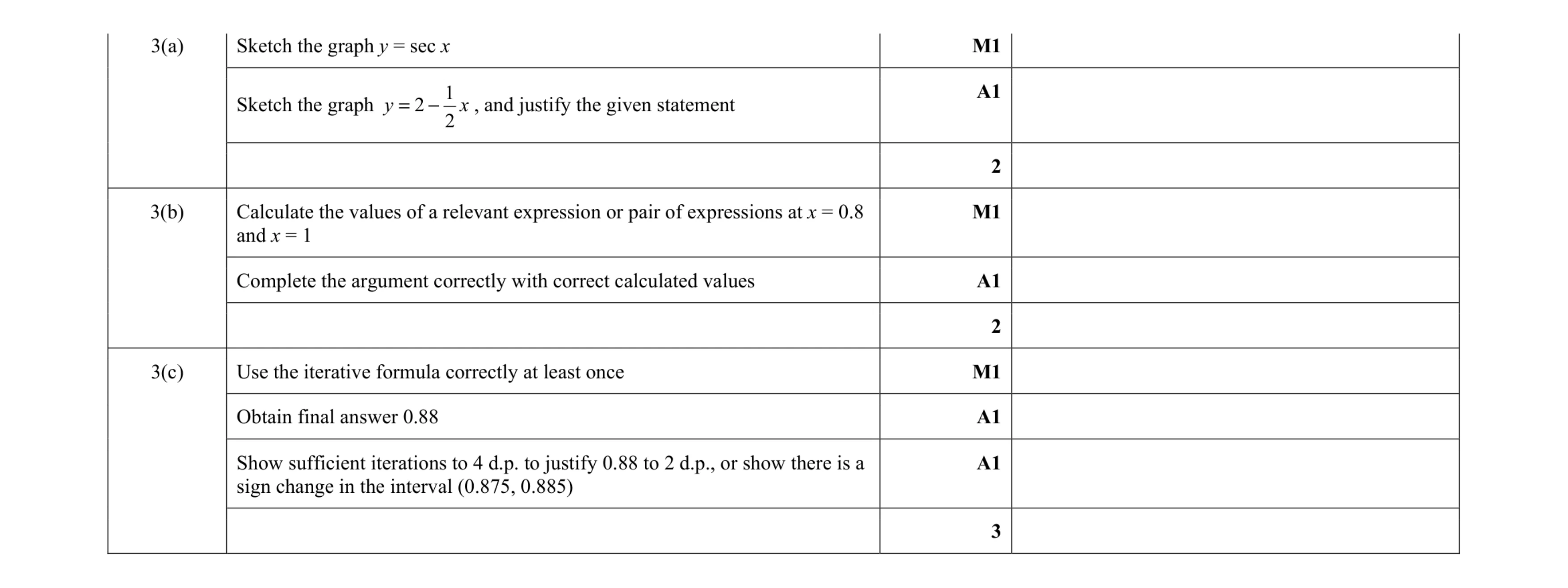 7
7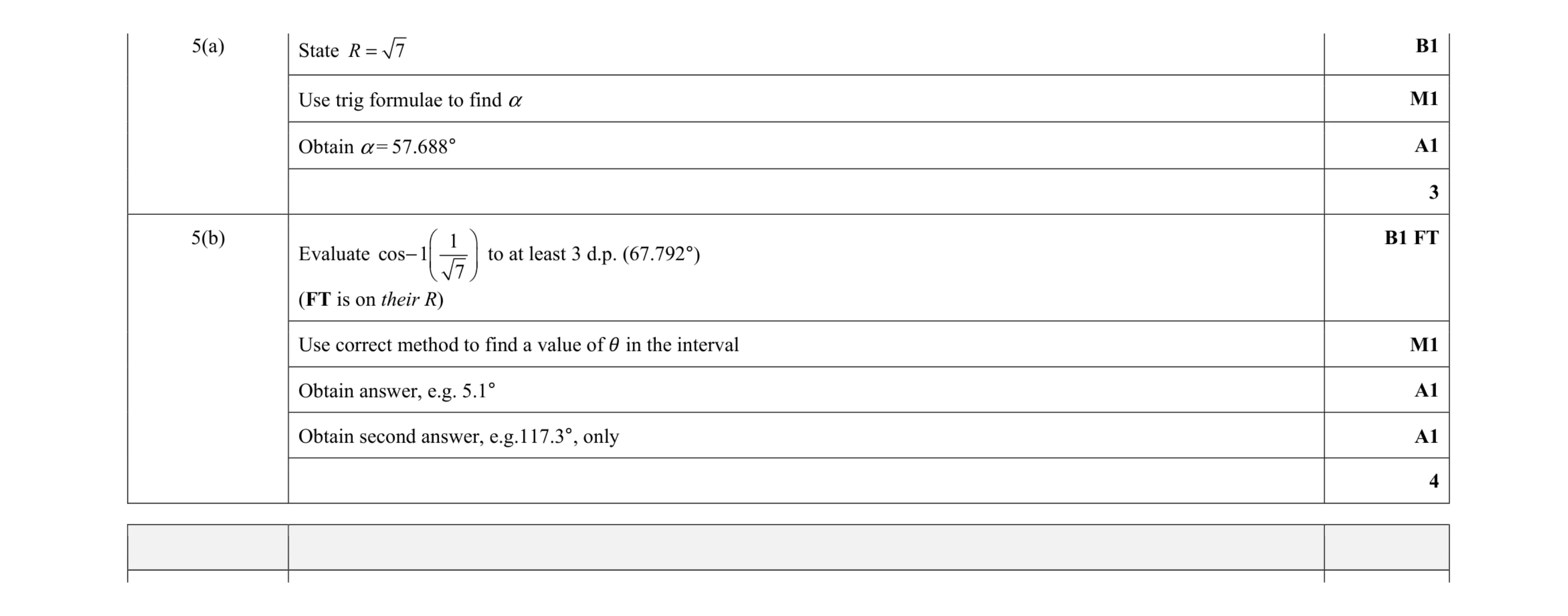 7
7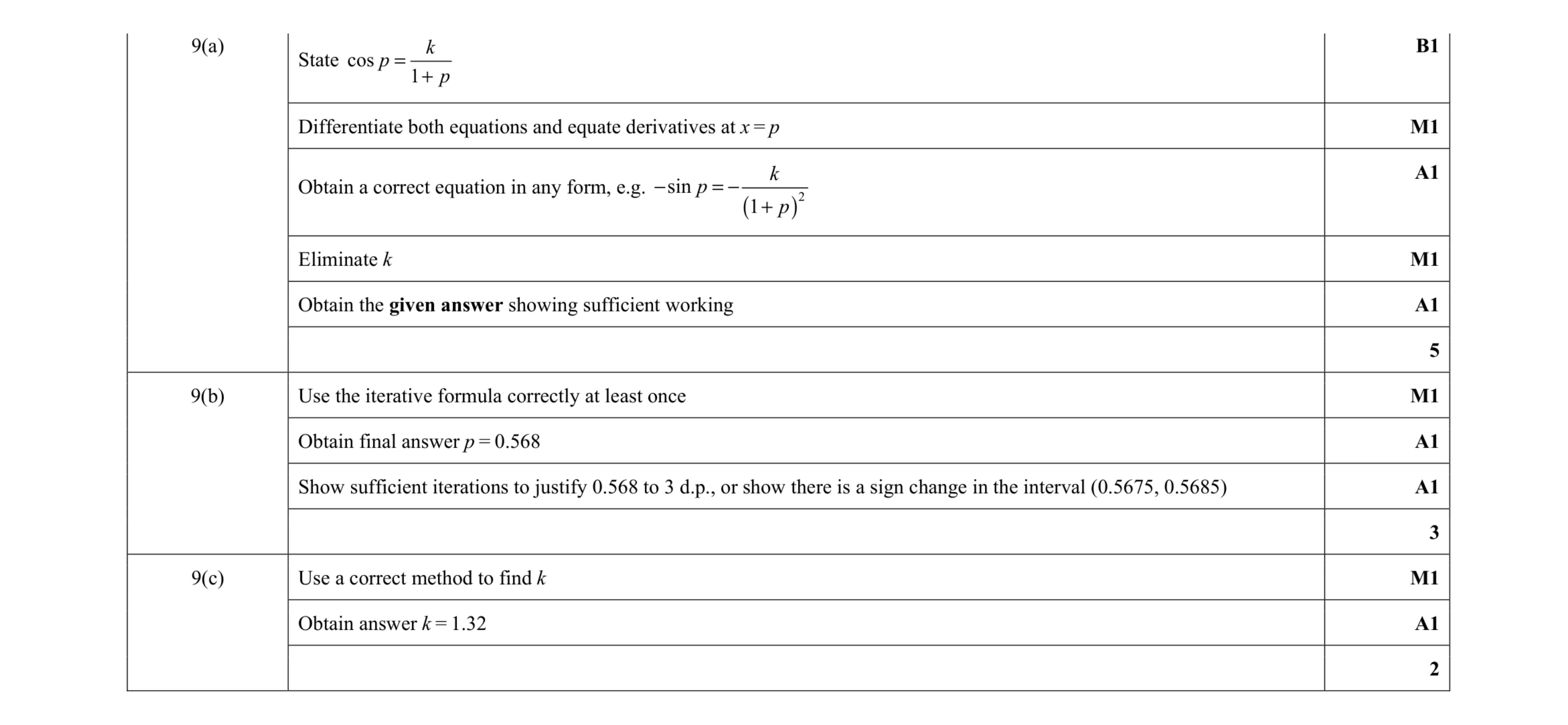 10
10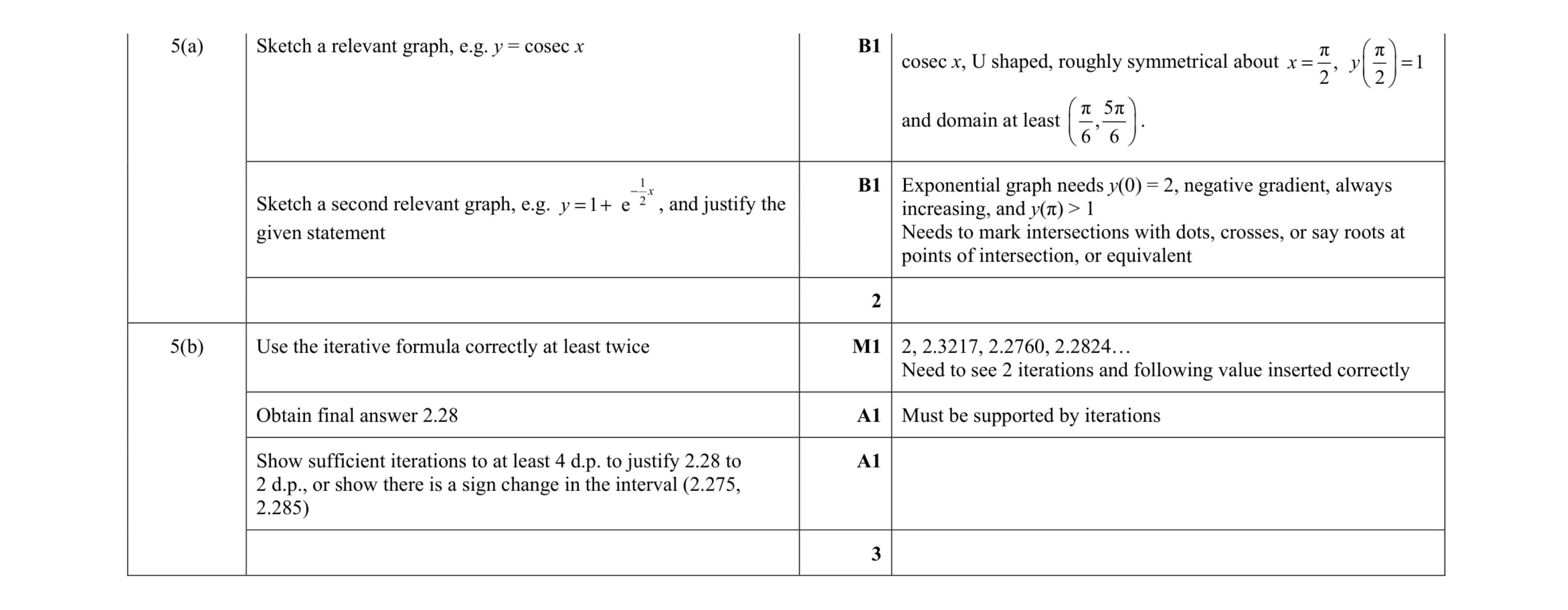 5
5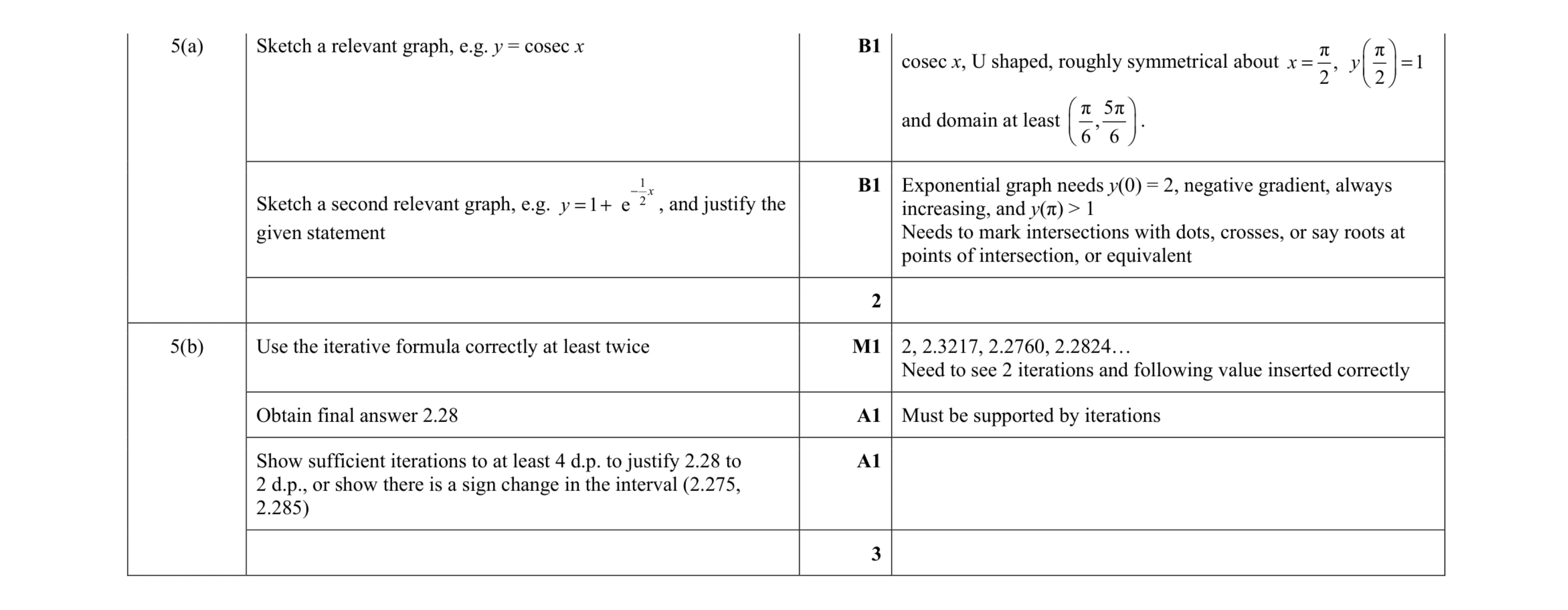 5
5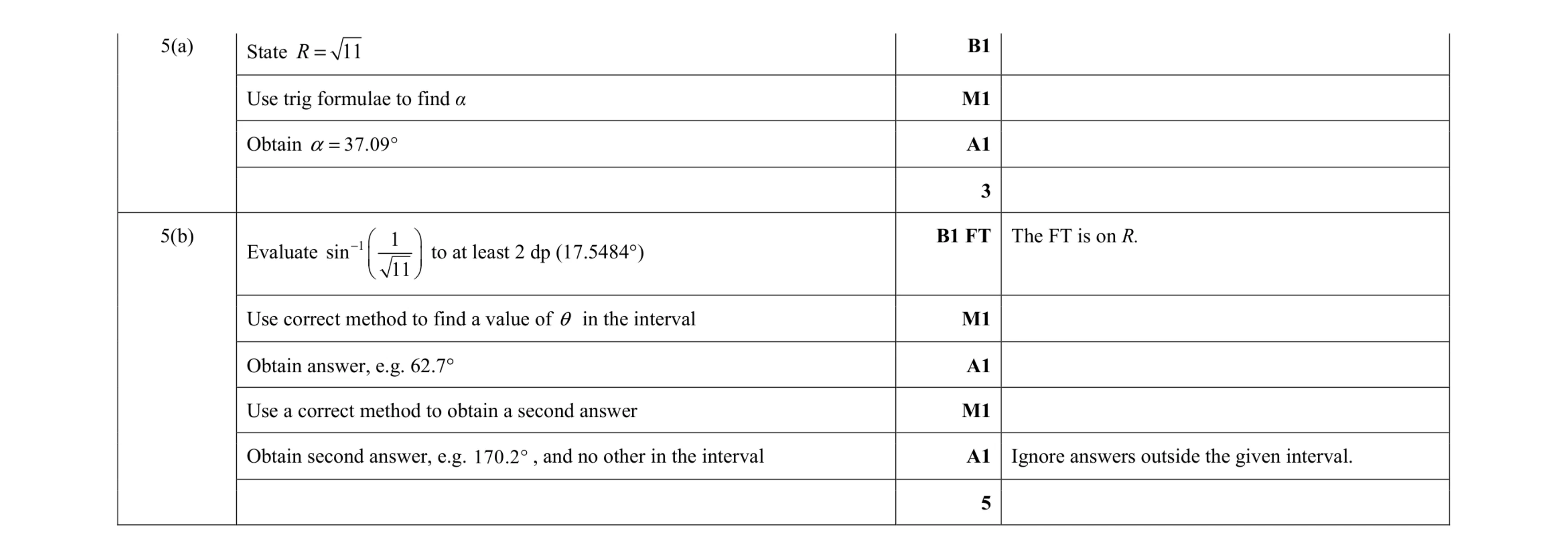 8
8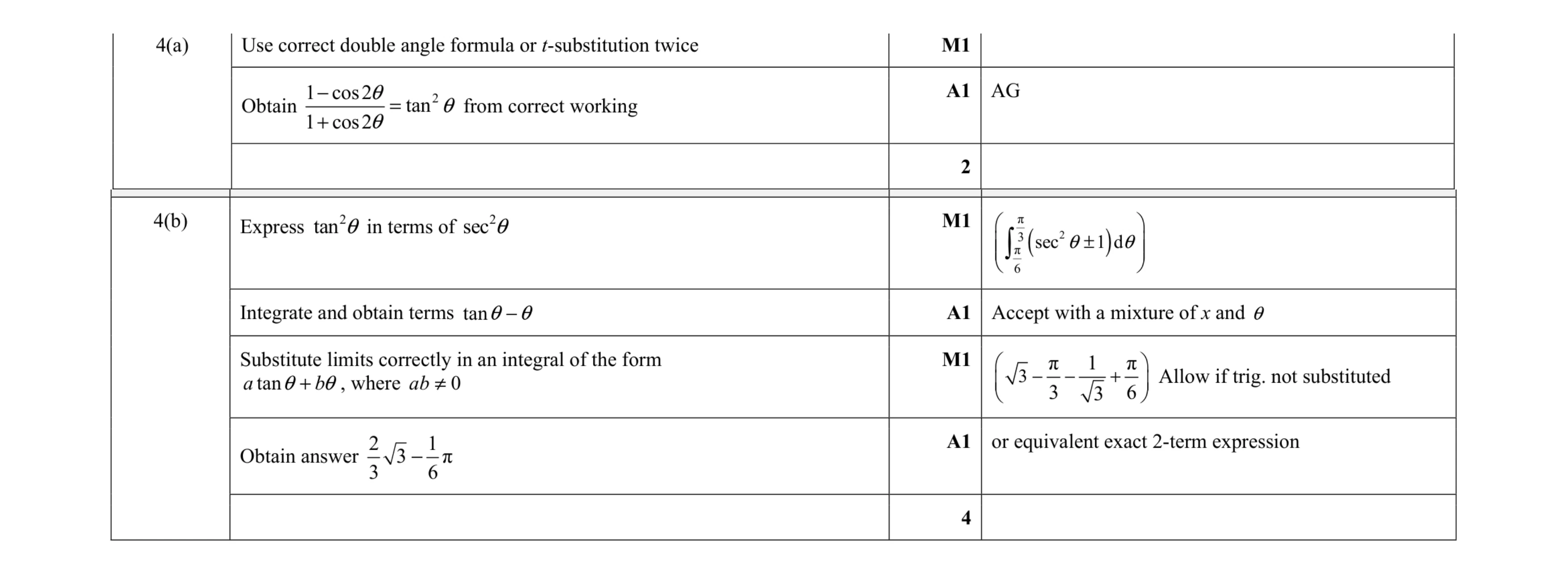 6
6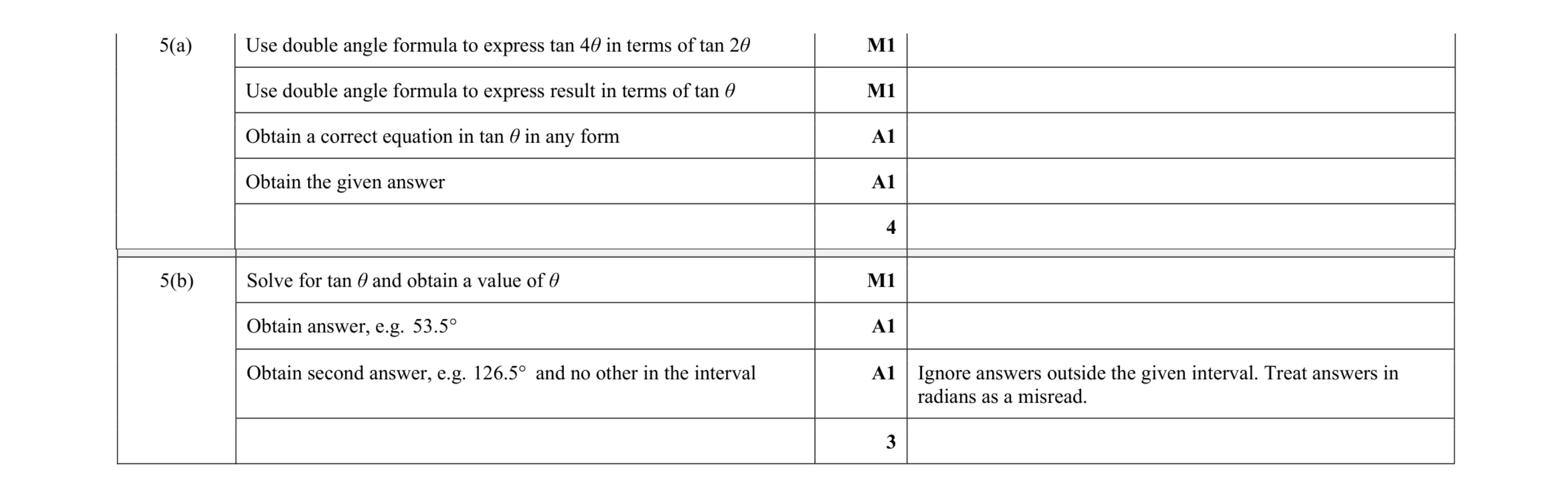 7
7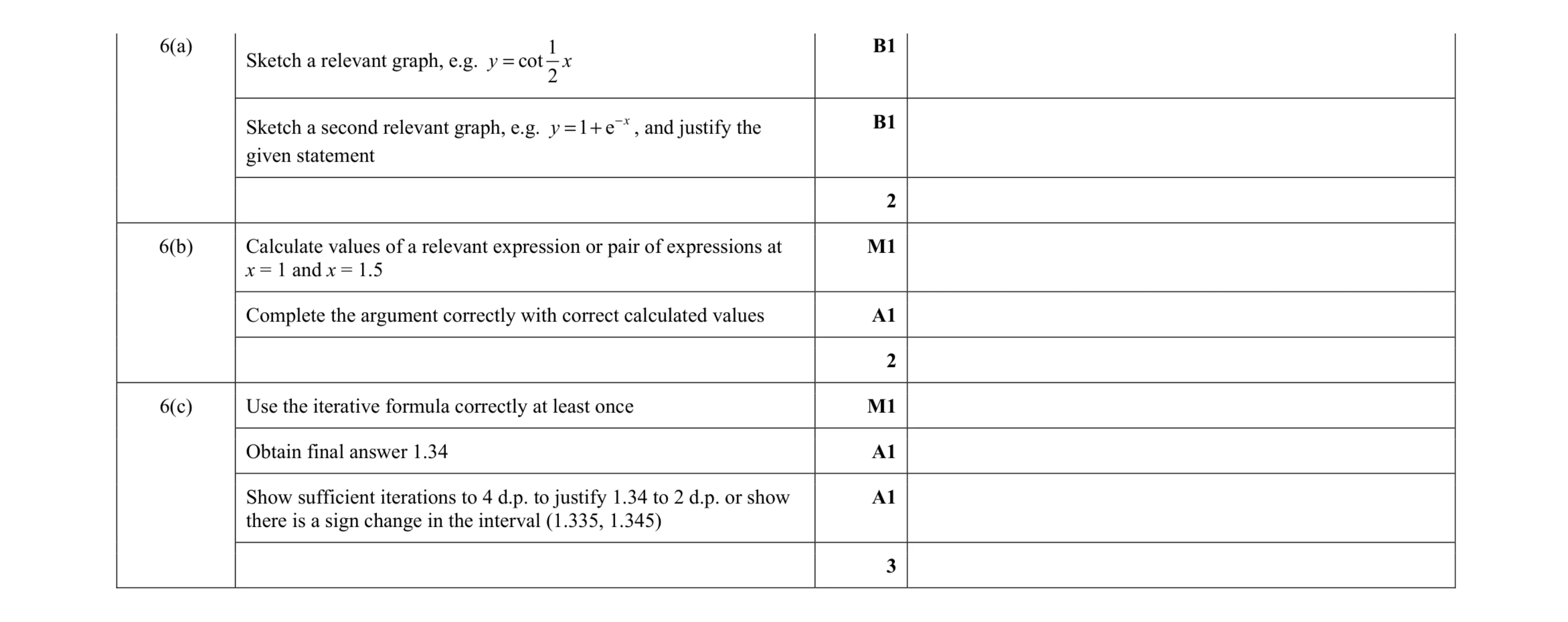 7
7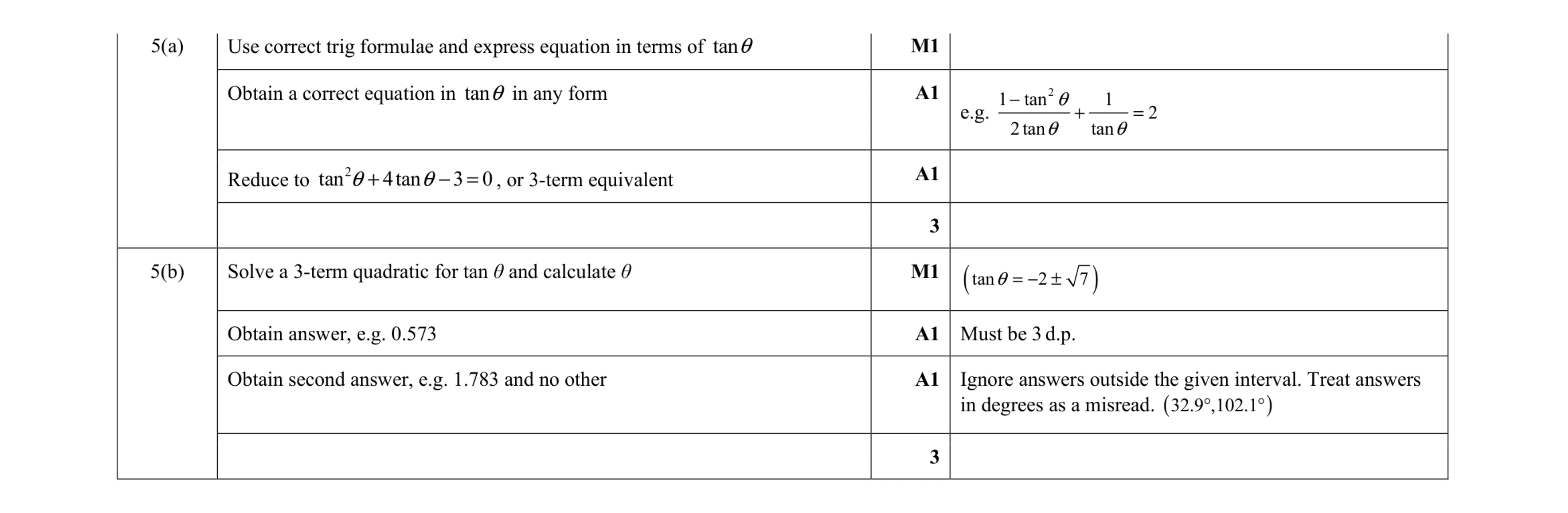 6
6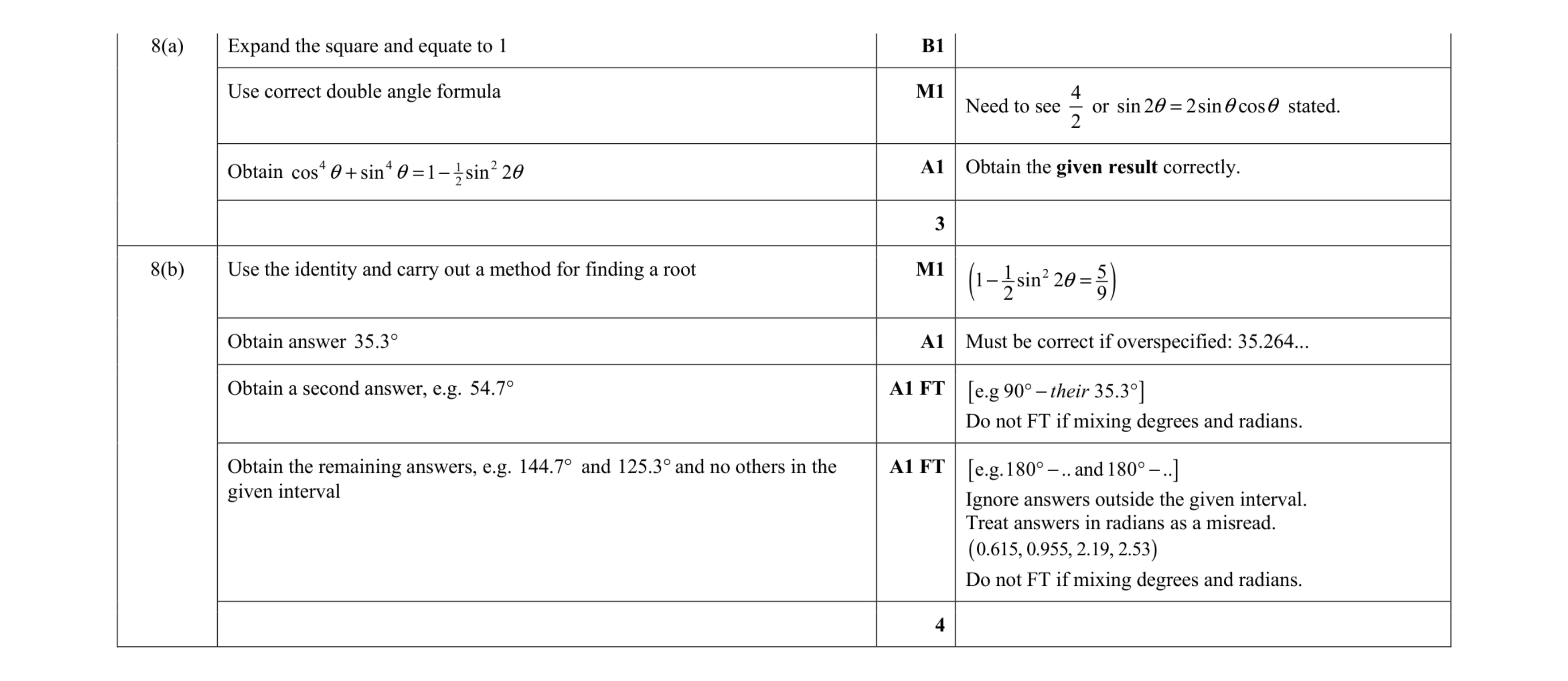 7
7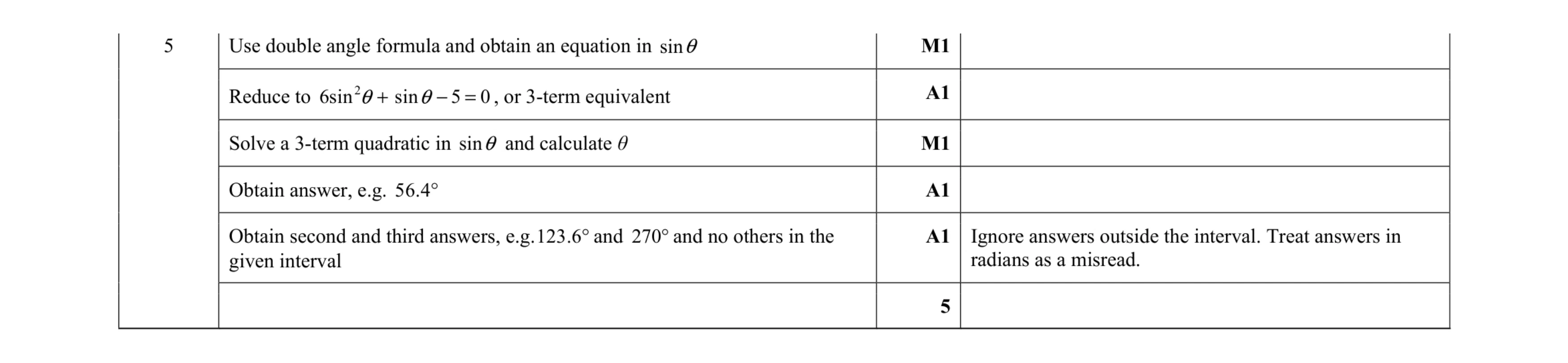 5
5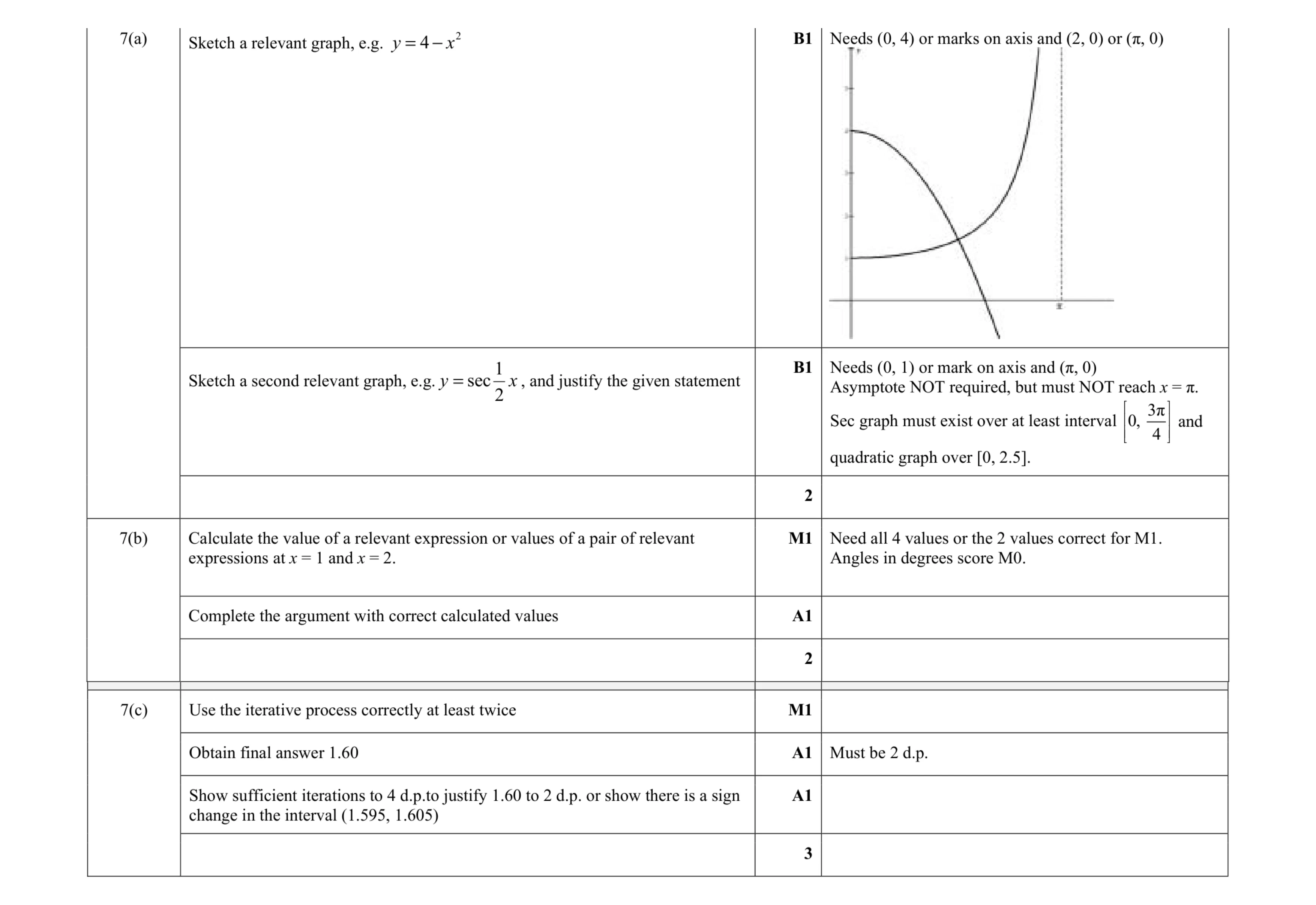 7
7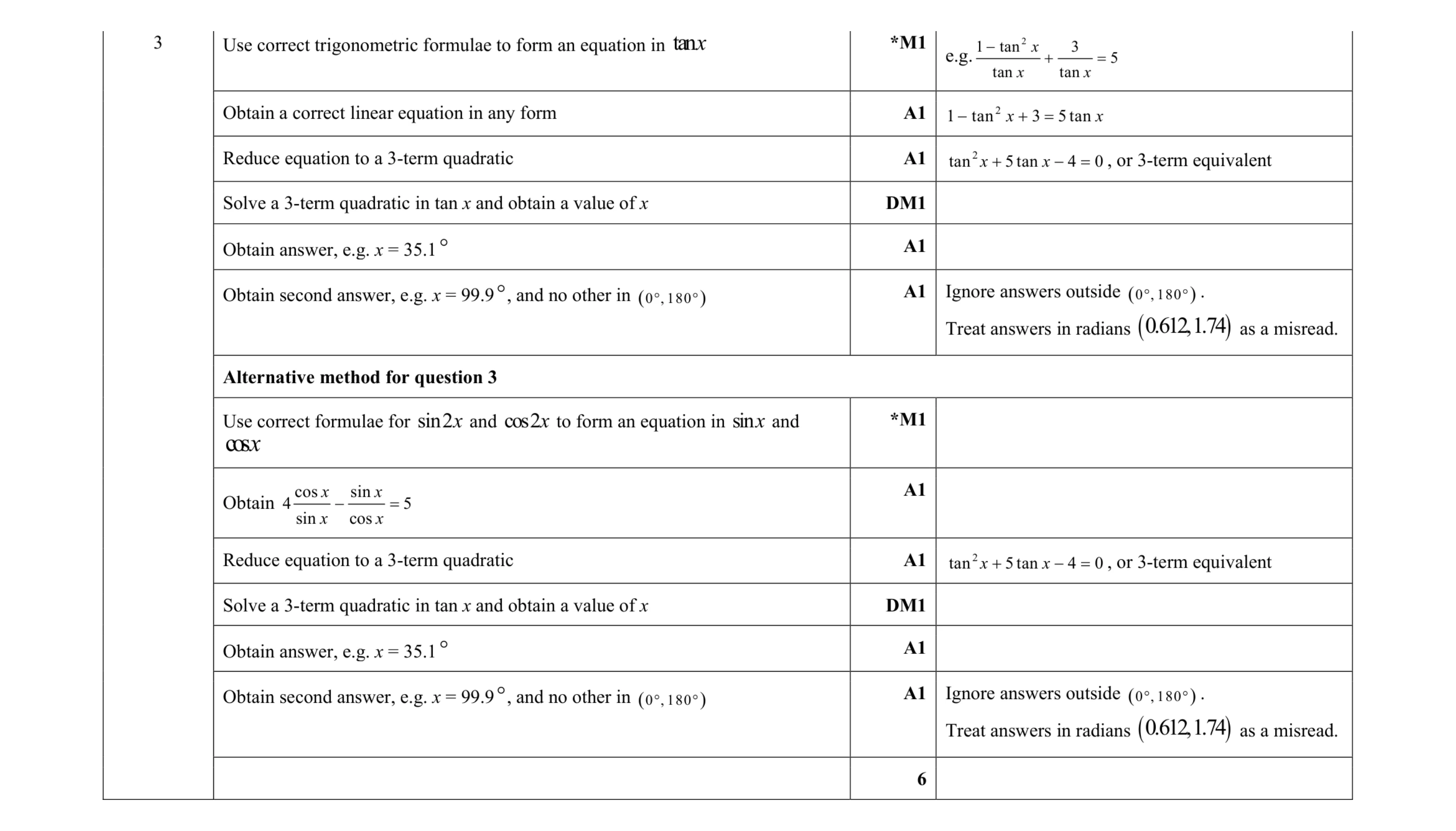 6
6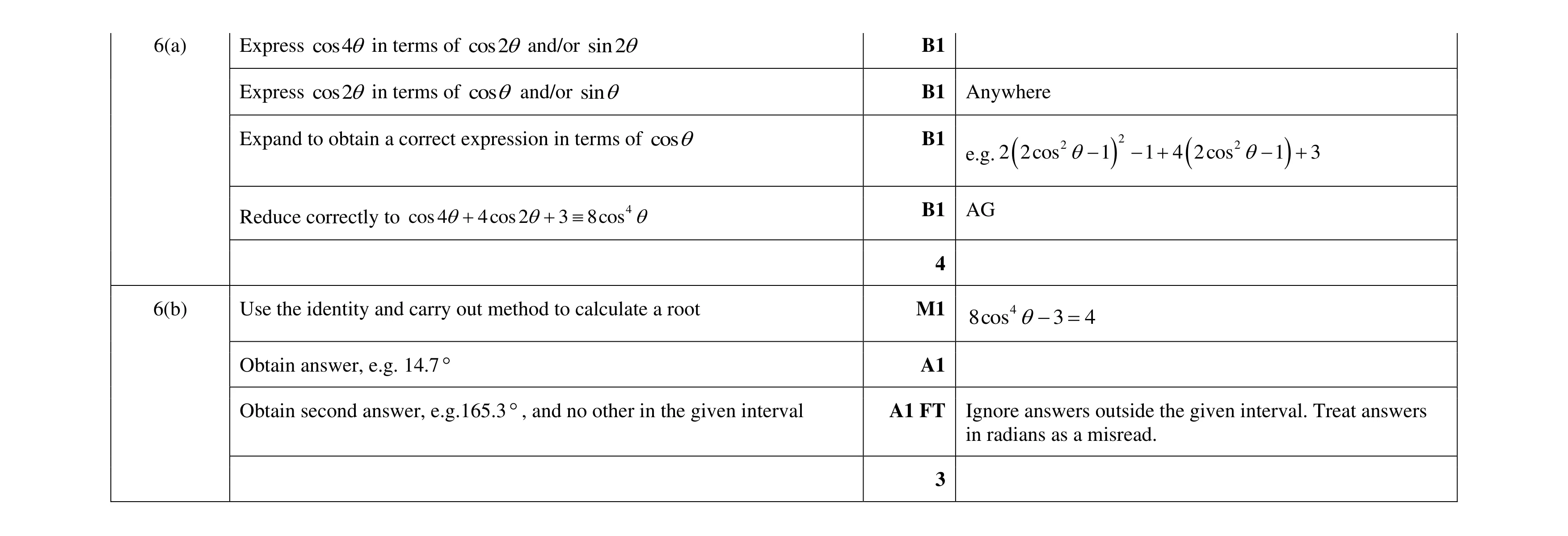 7
7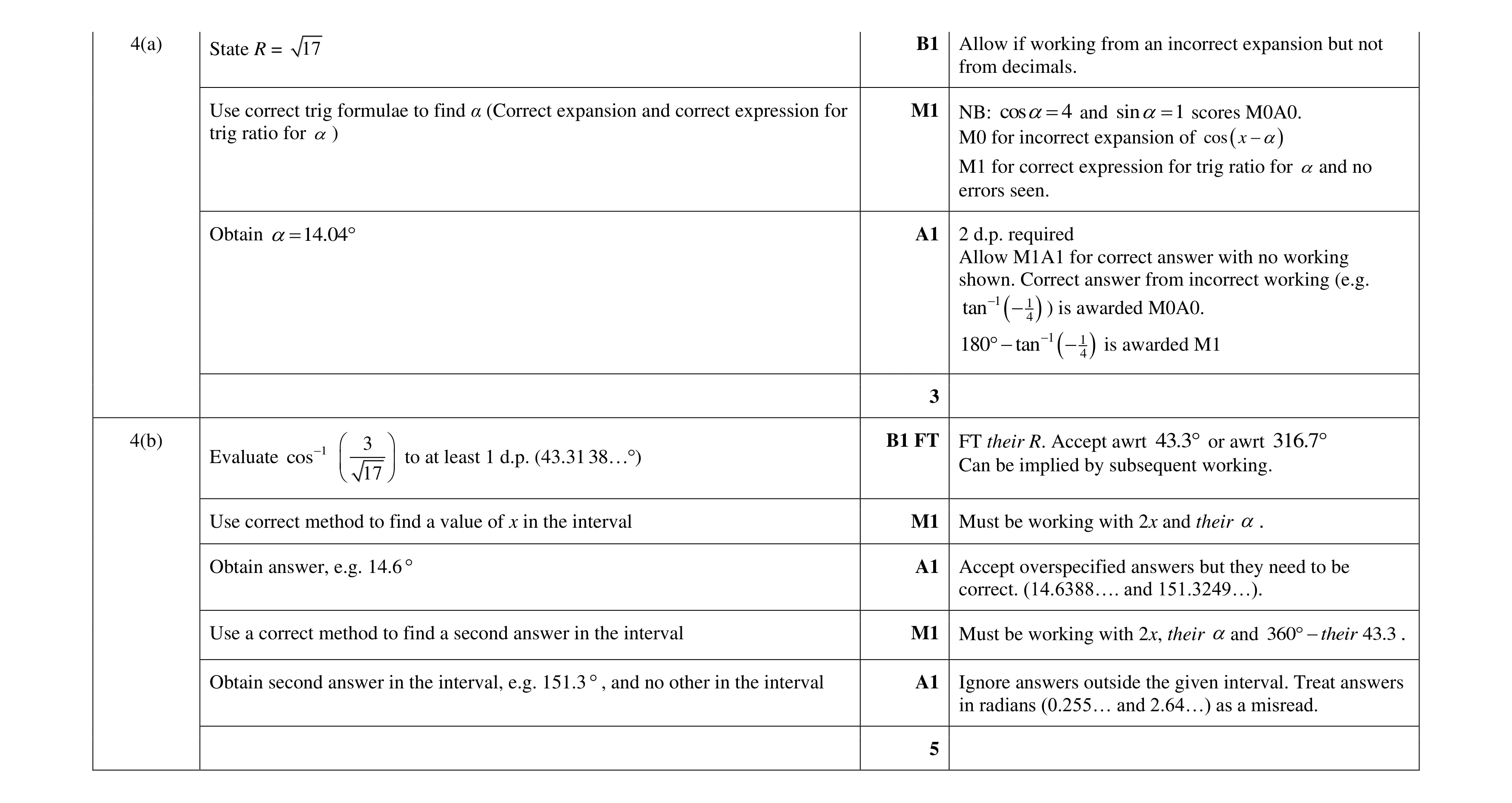 8
8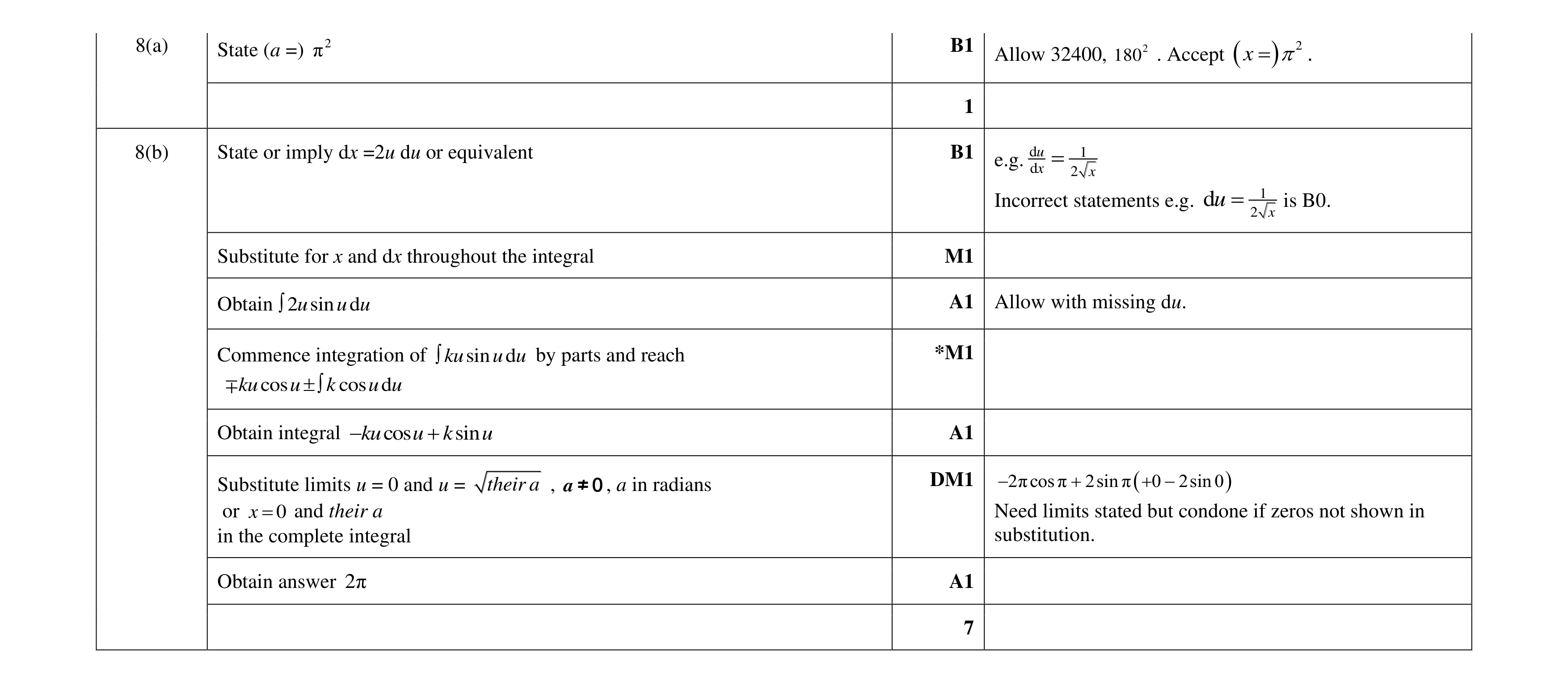 8
8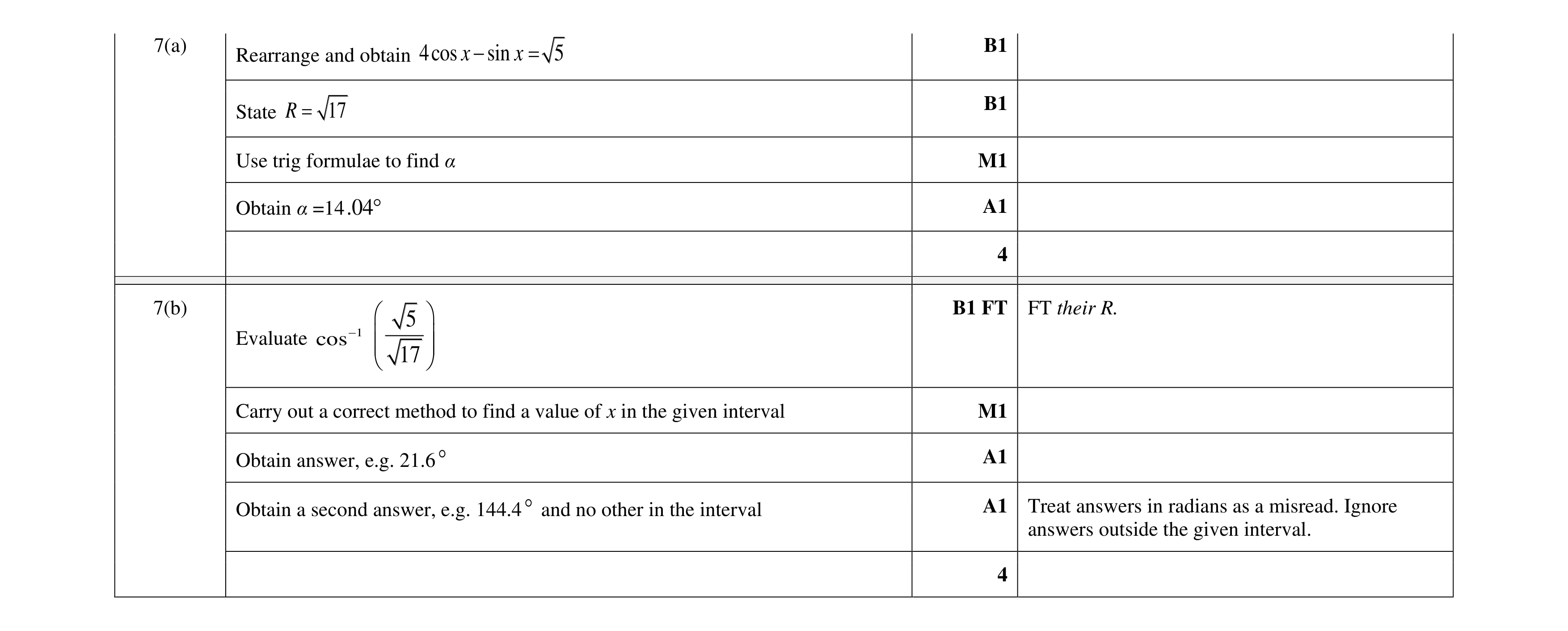 8
8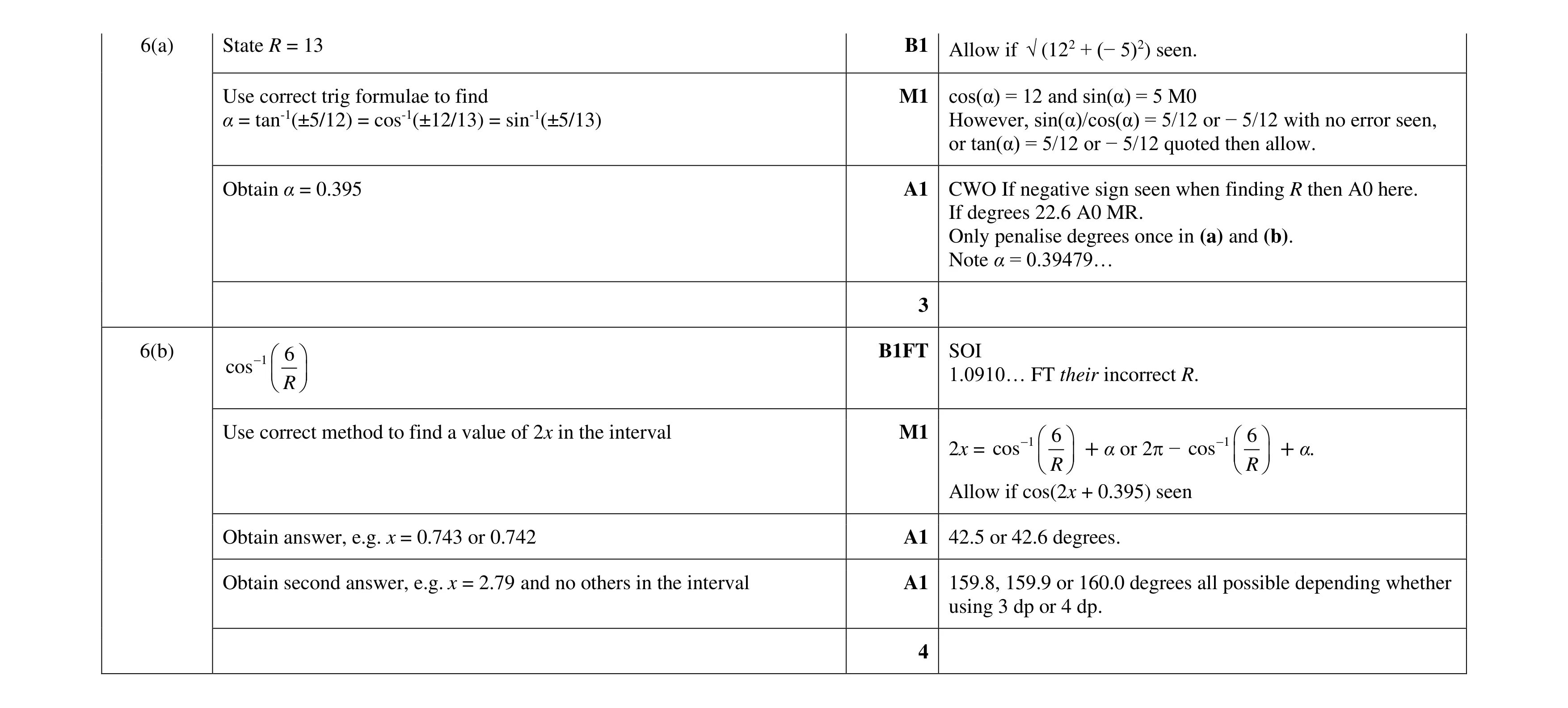 7
7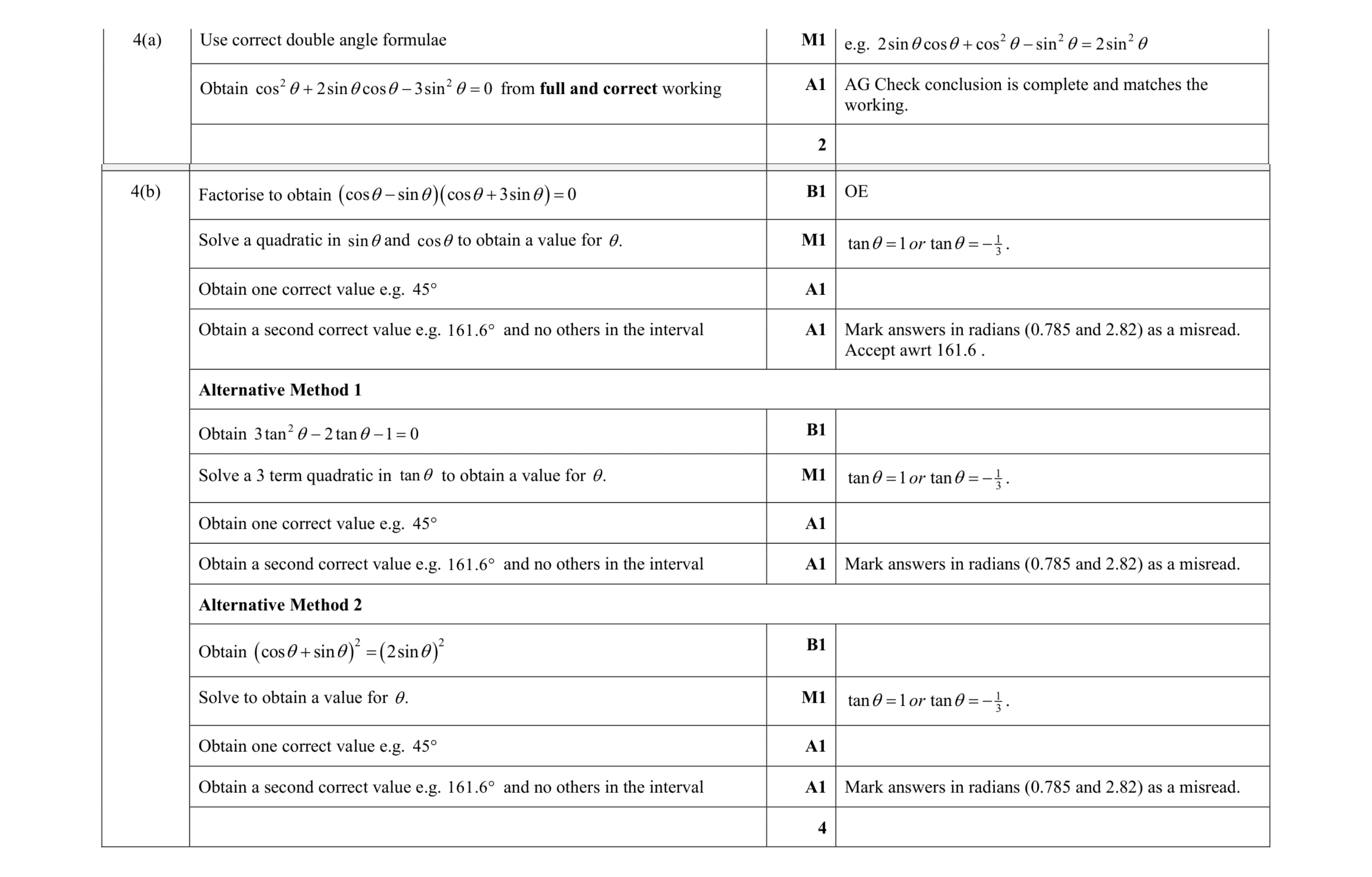 6
6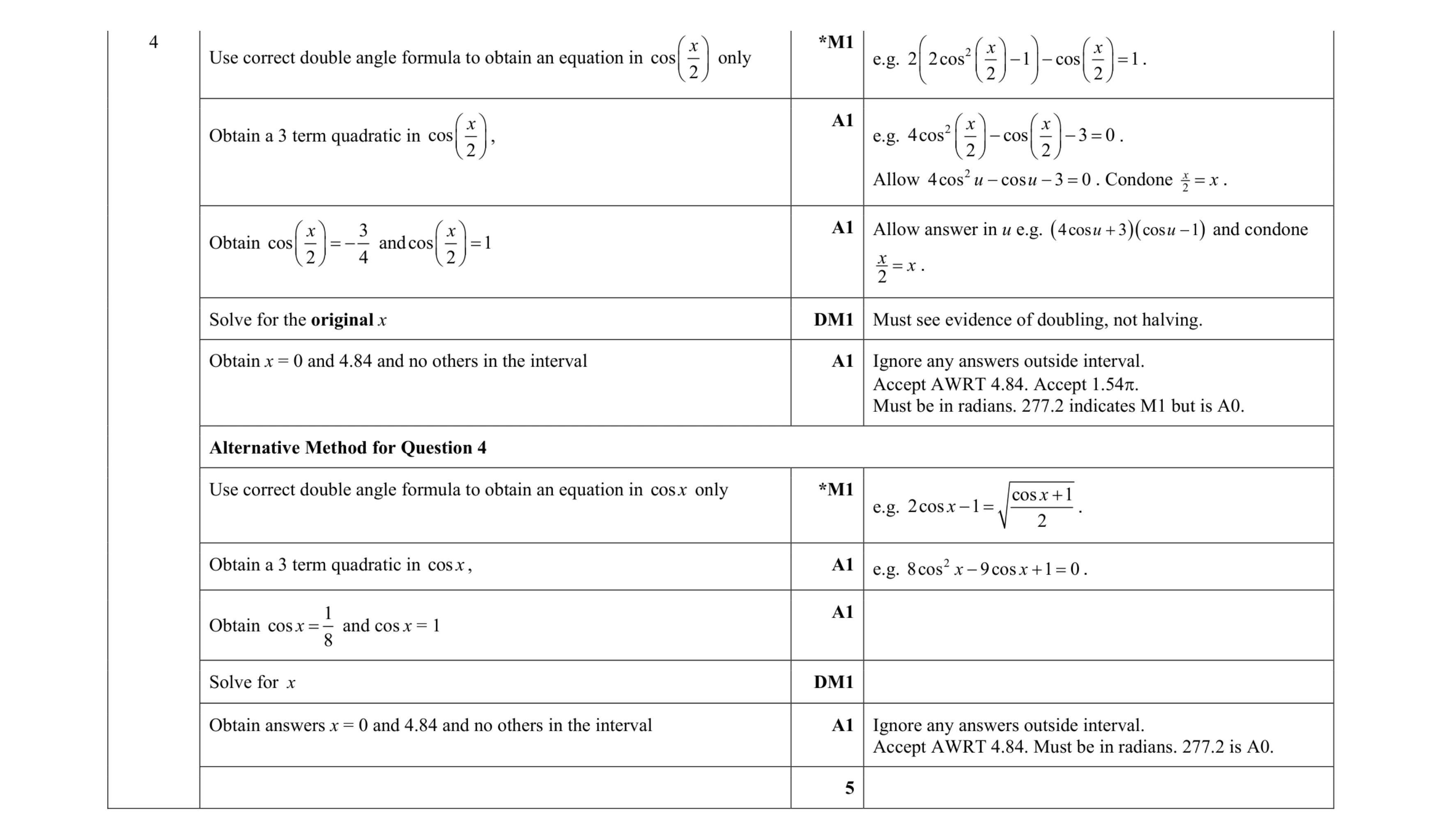 5
5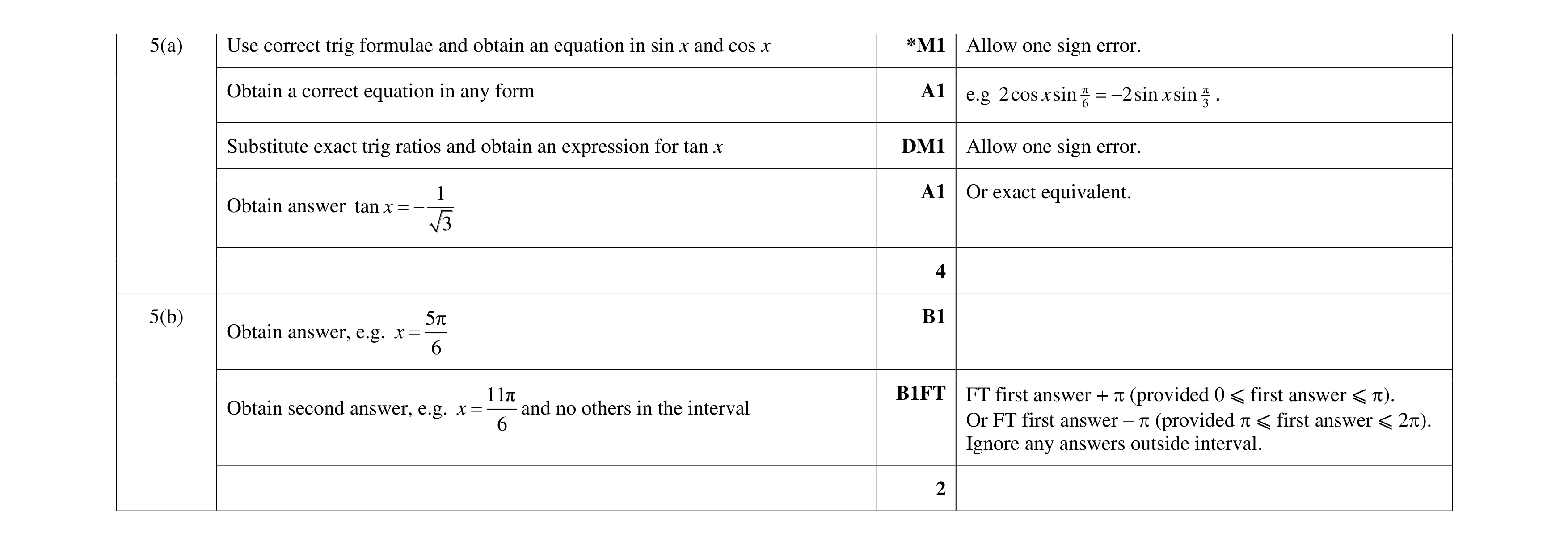 6
6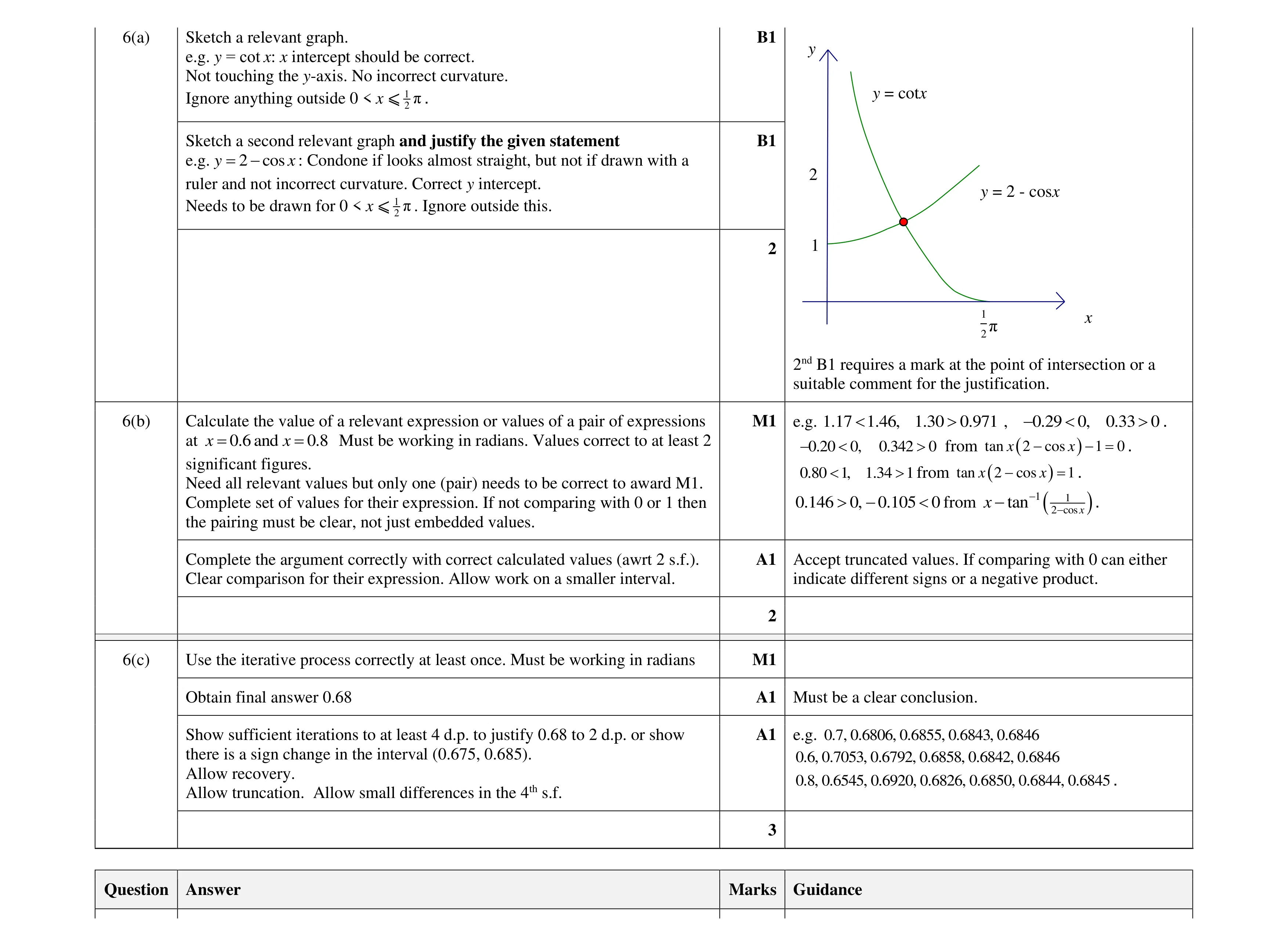 7
7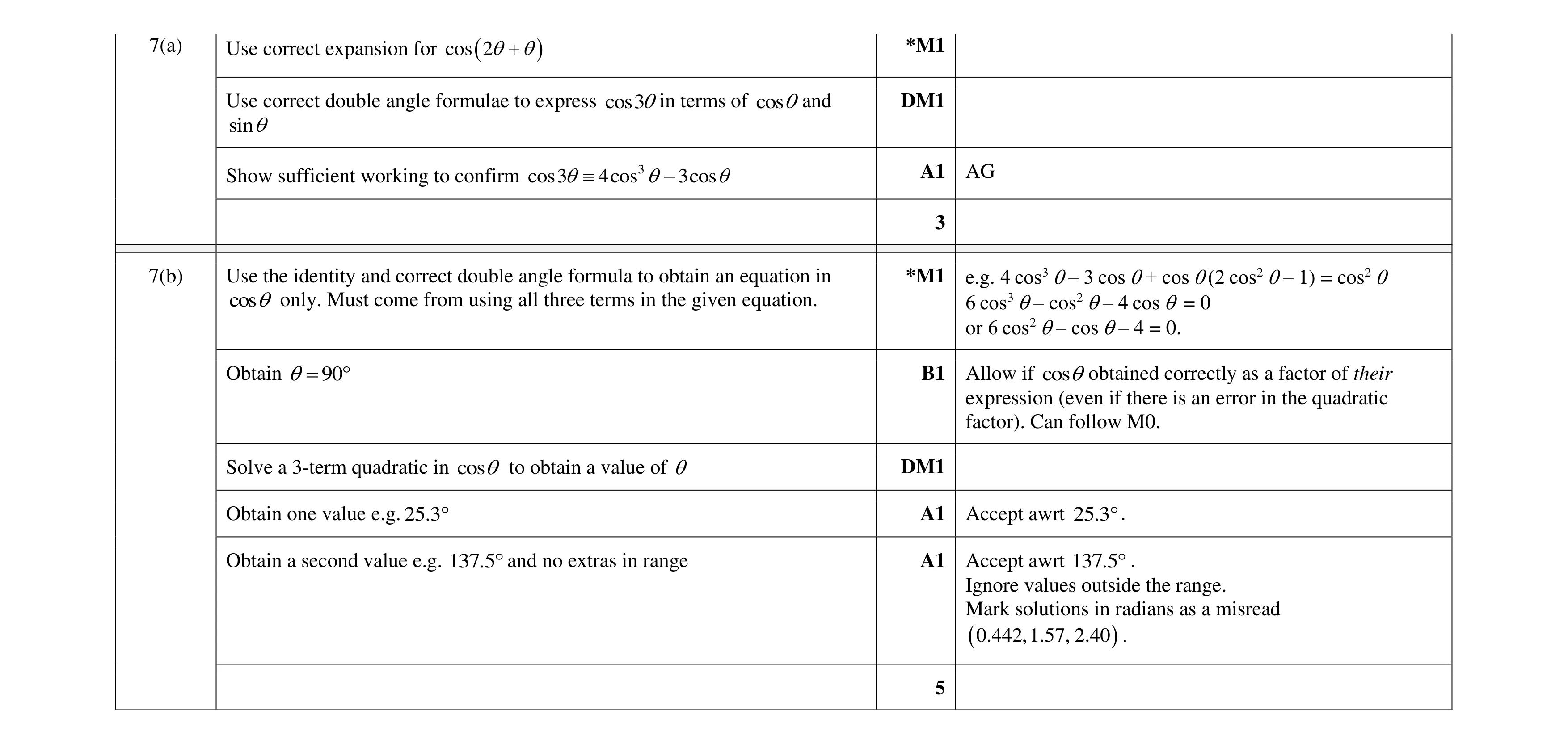 8
8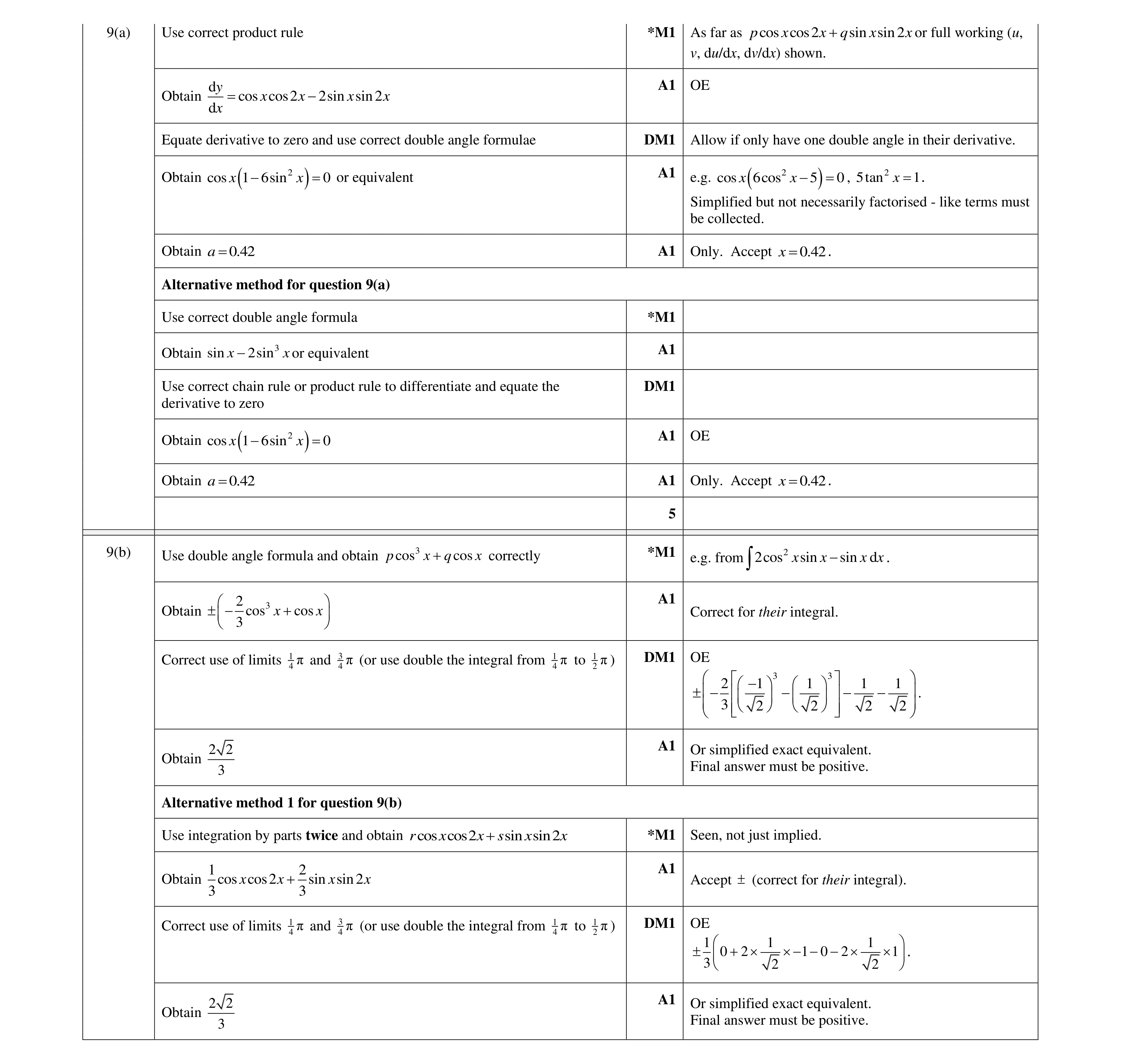 9
9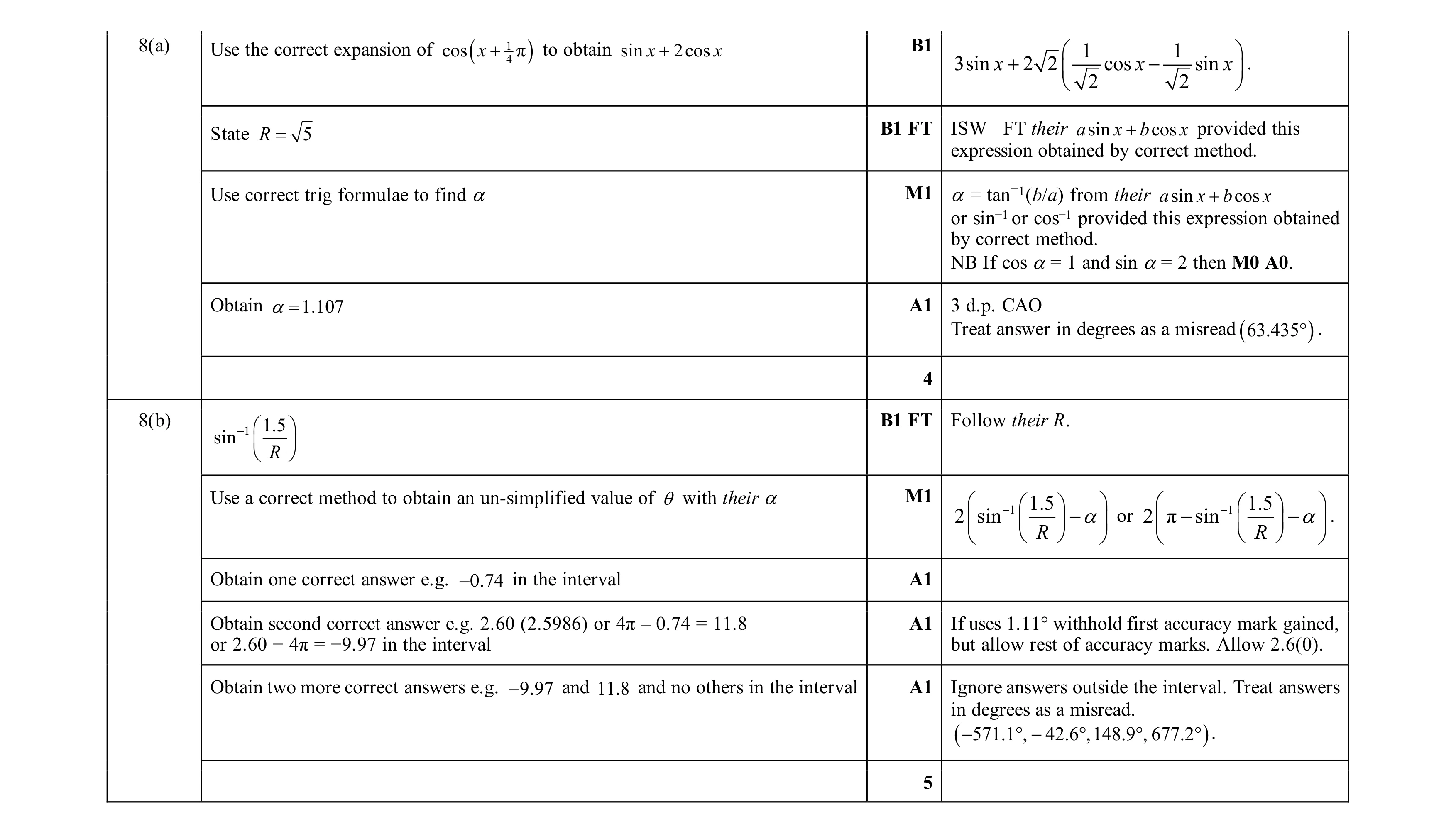 9
9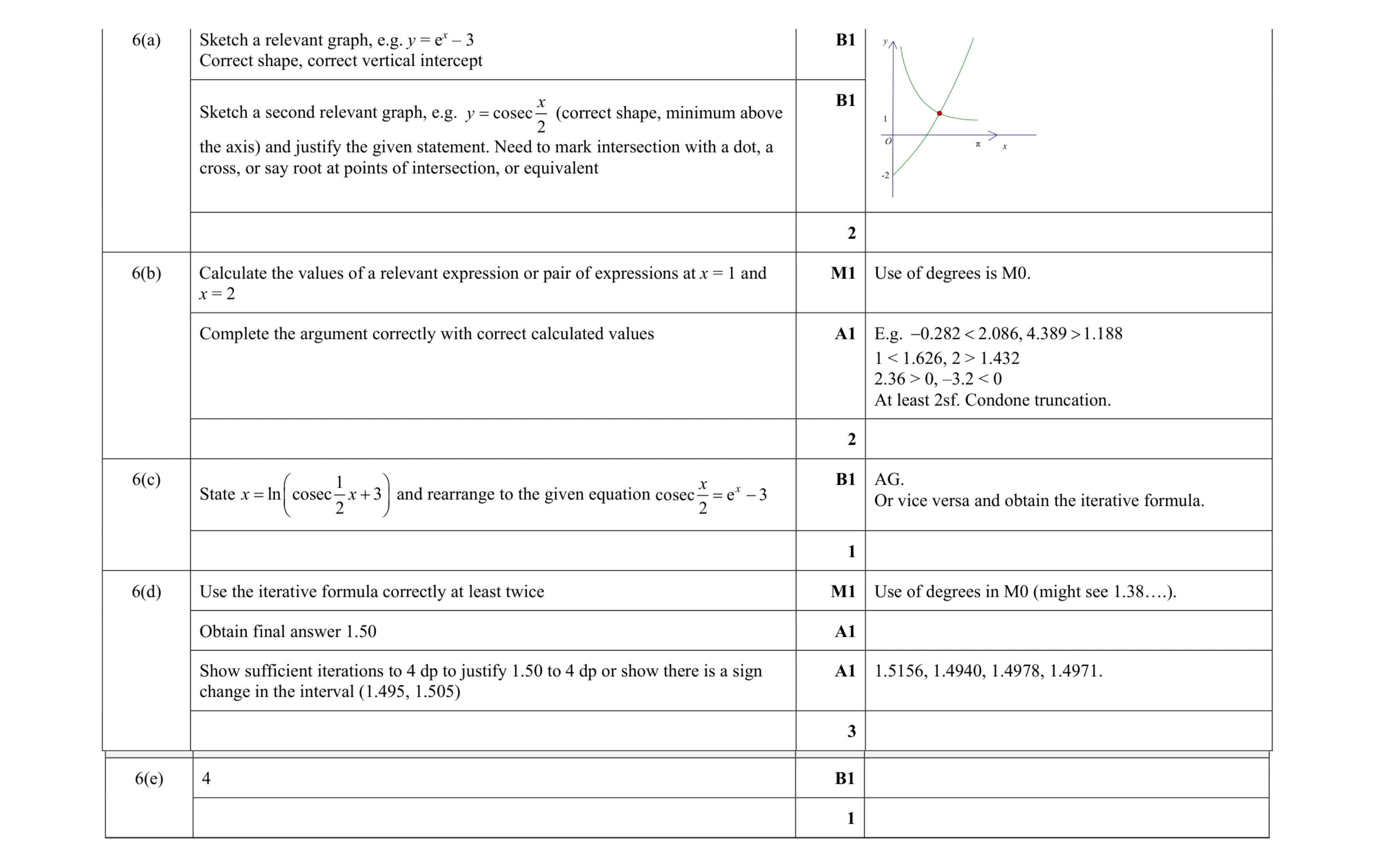 9
9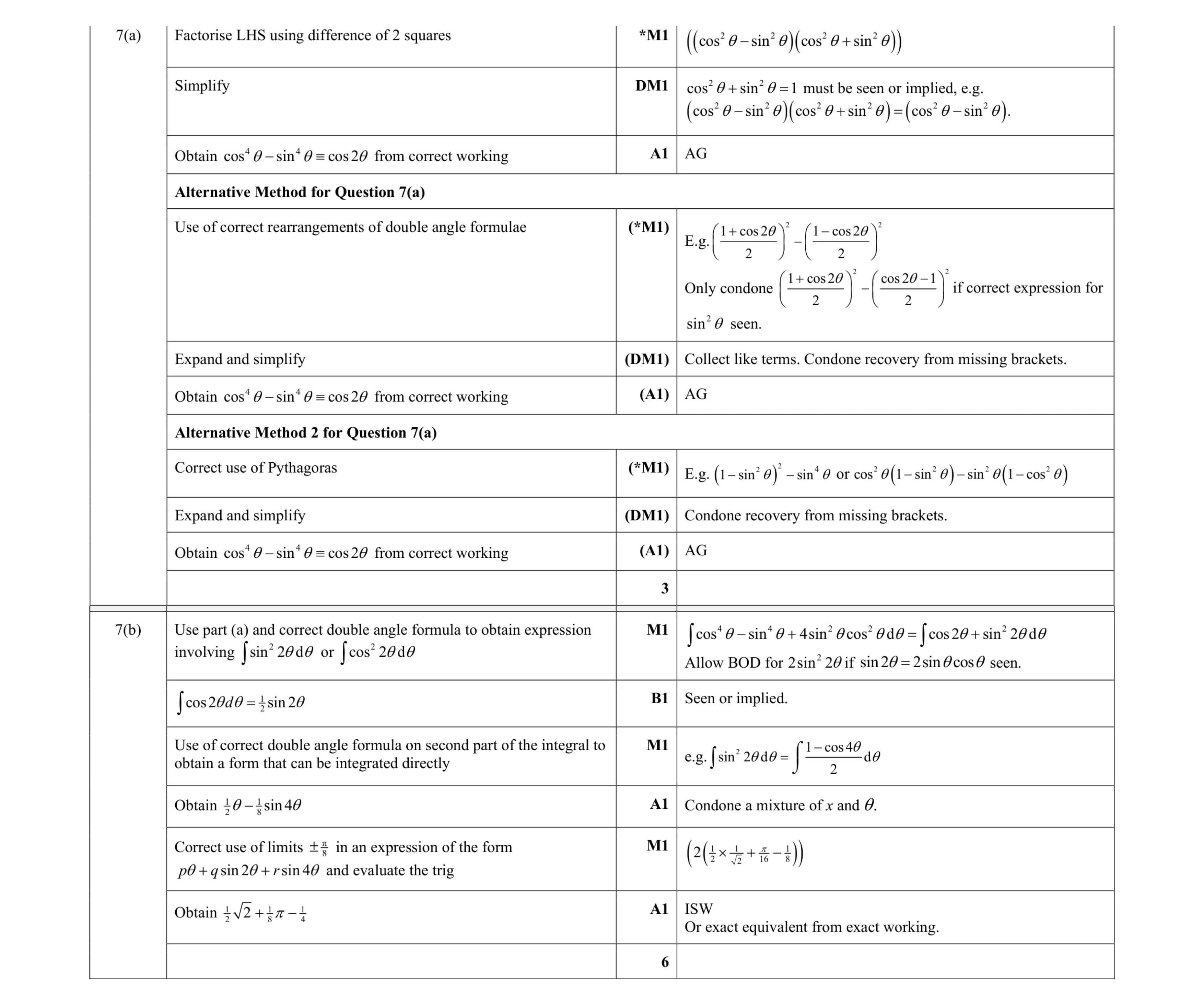 9
9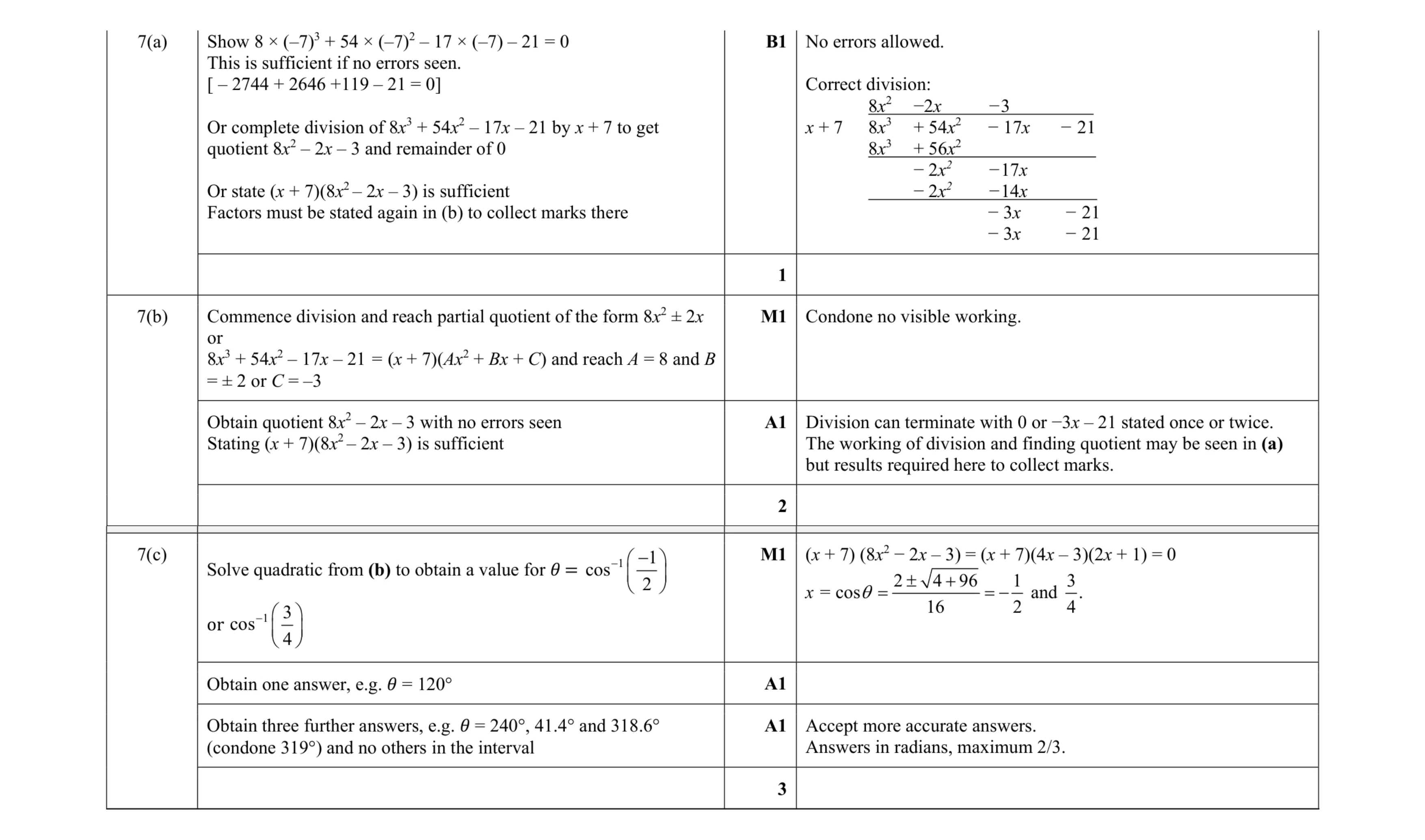 6
6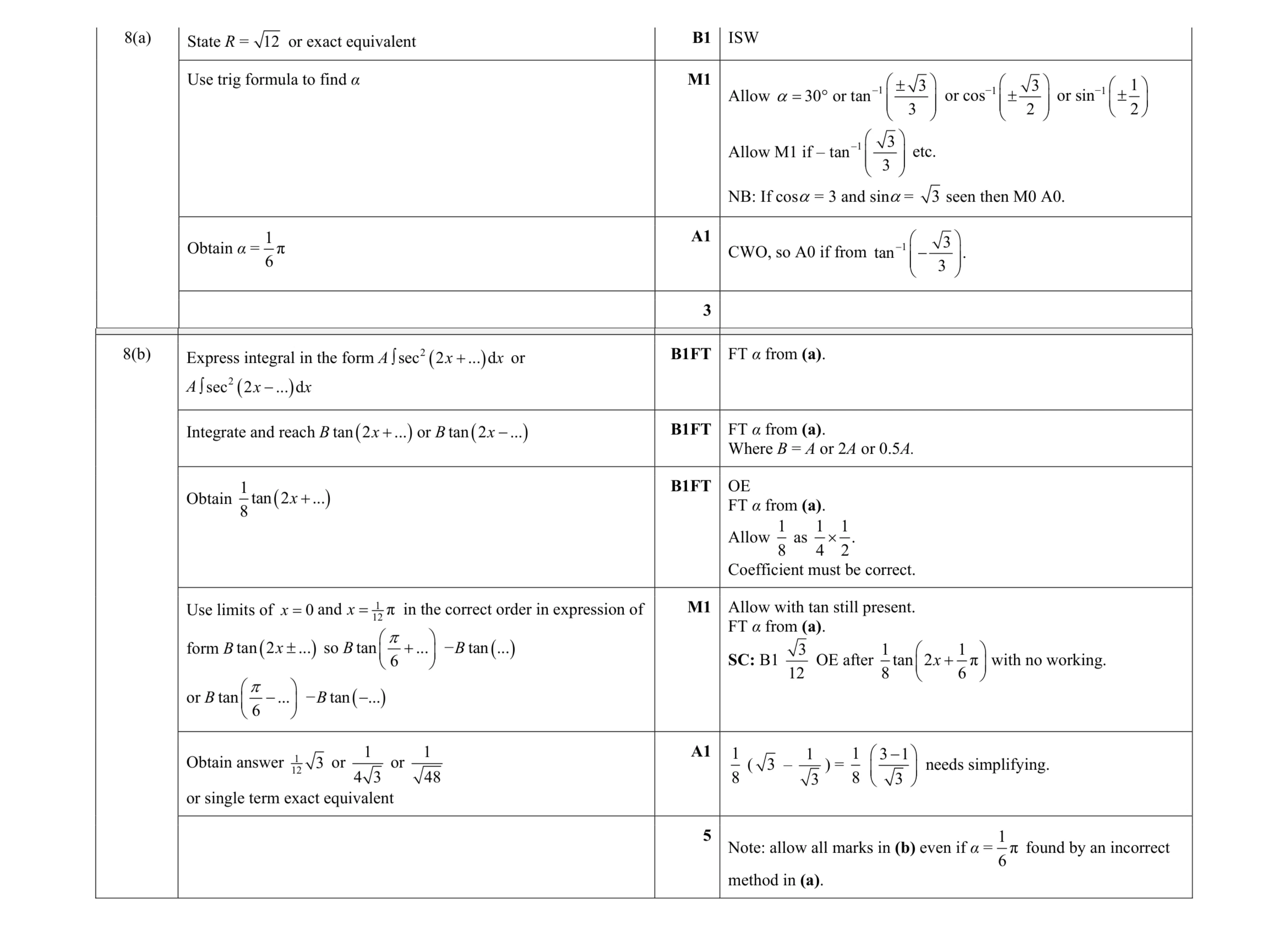 8
8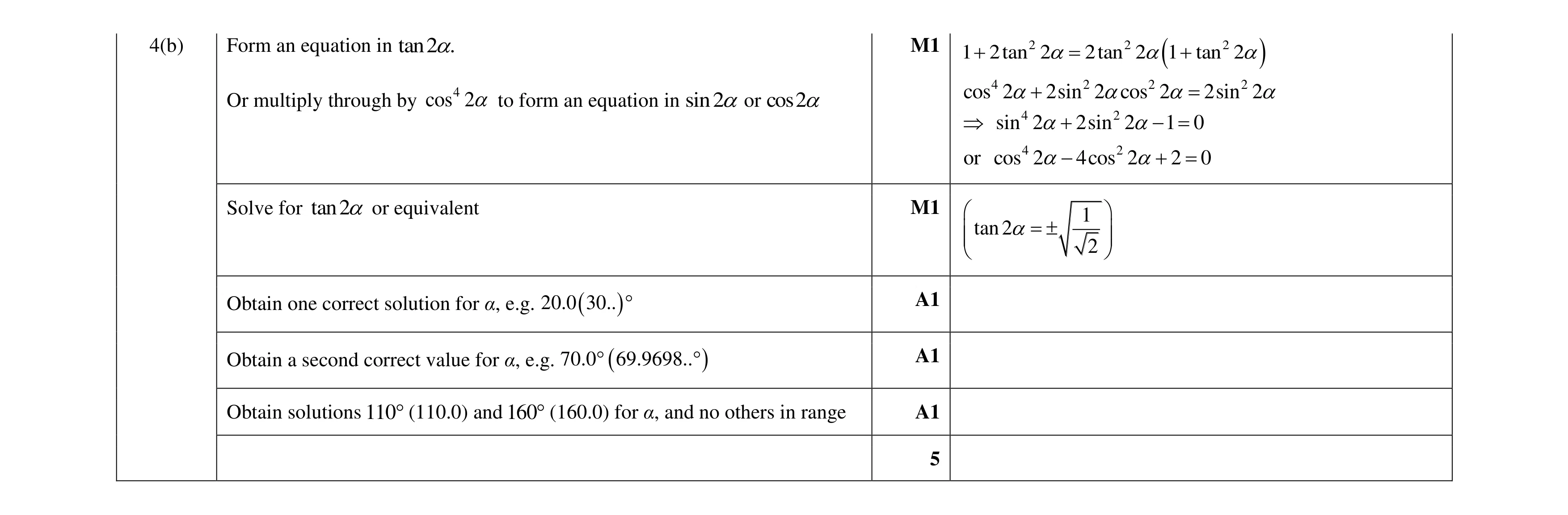 8
8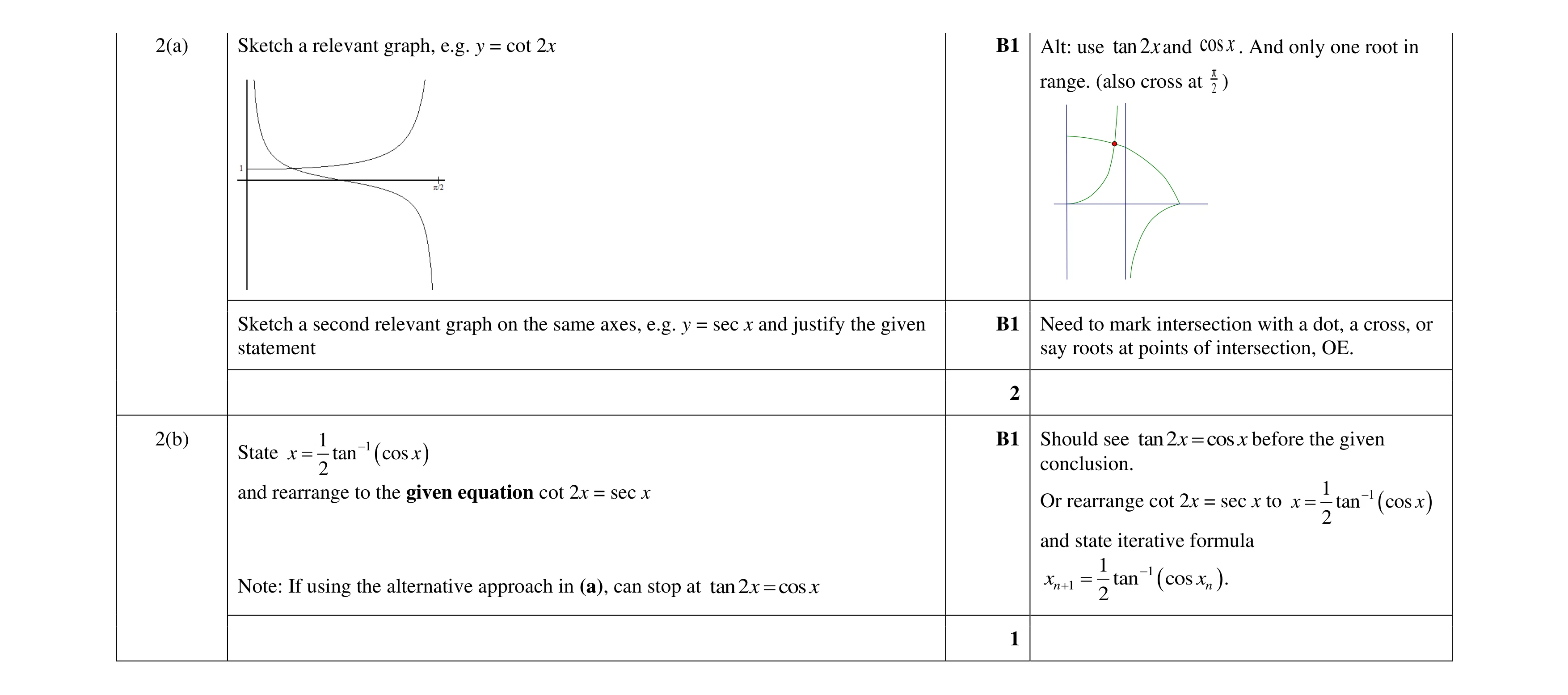 3
3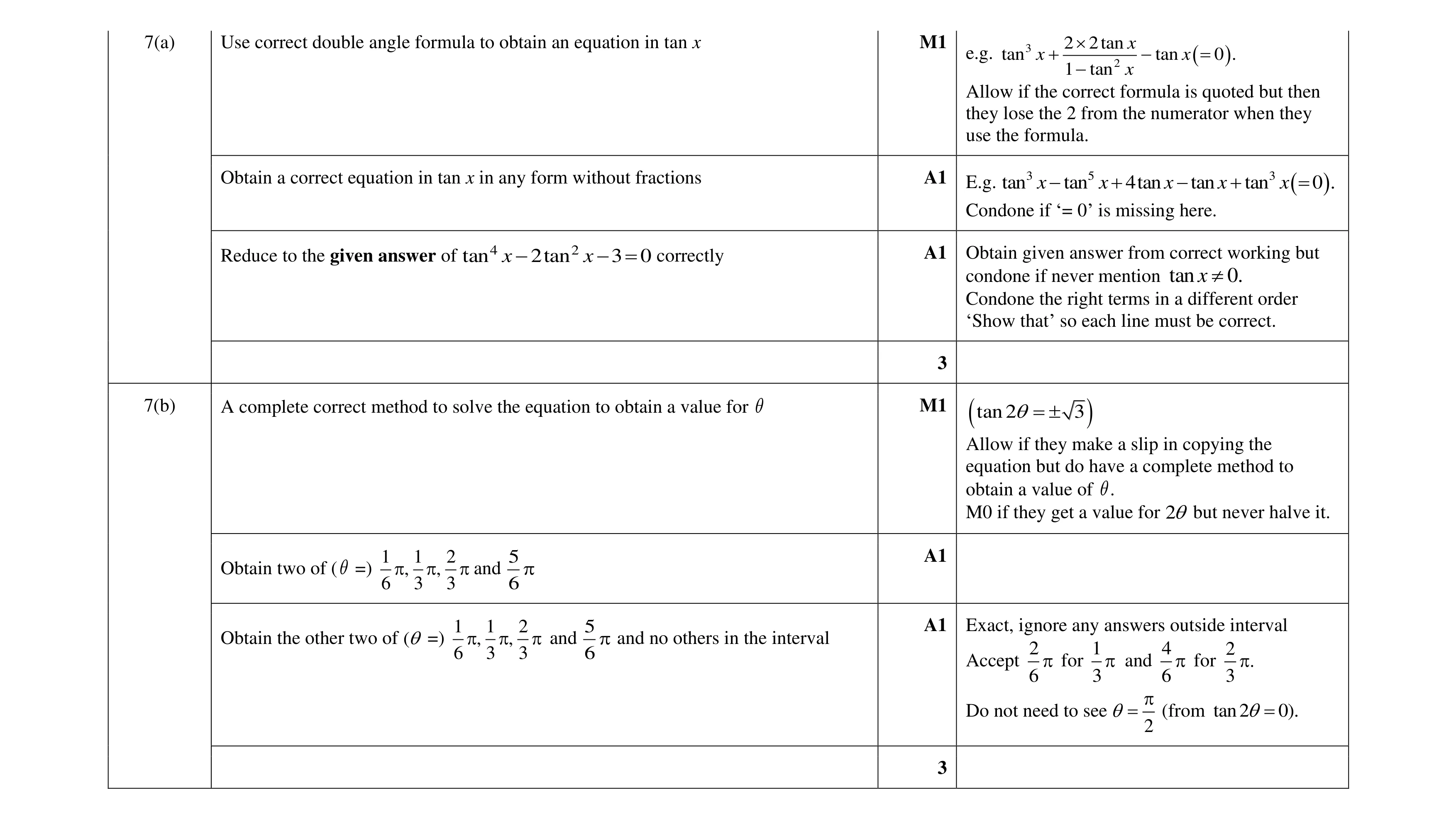 6
6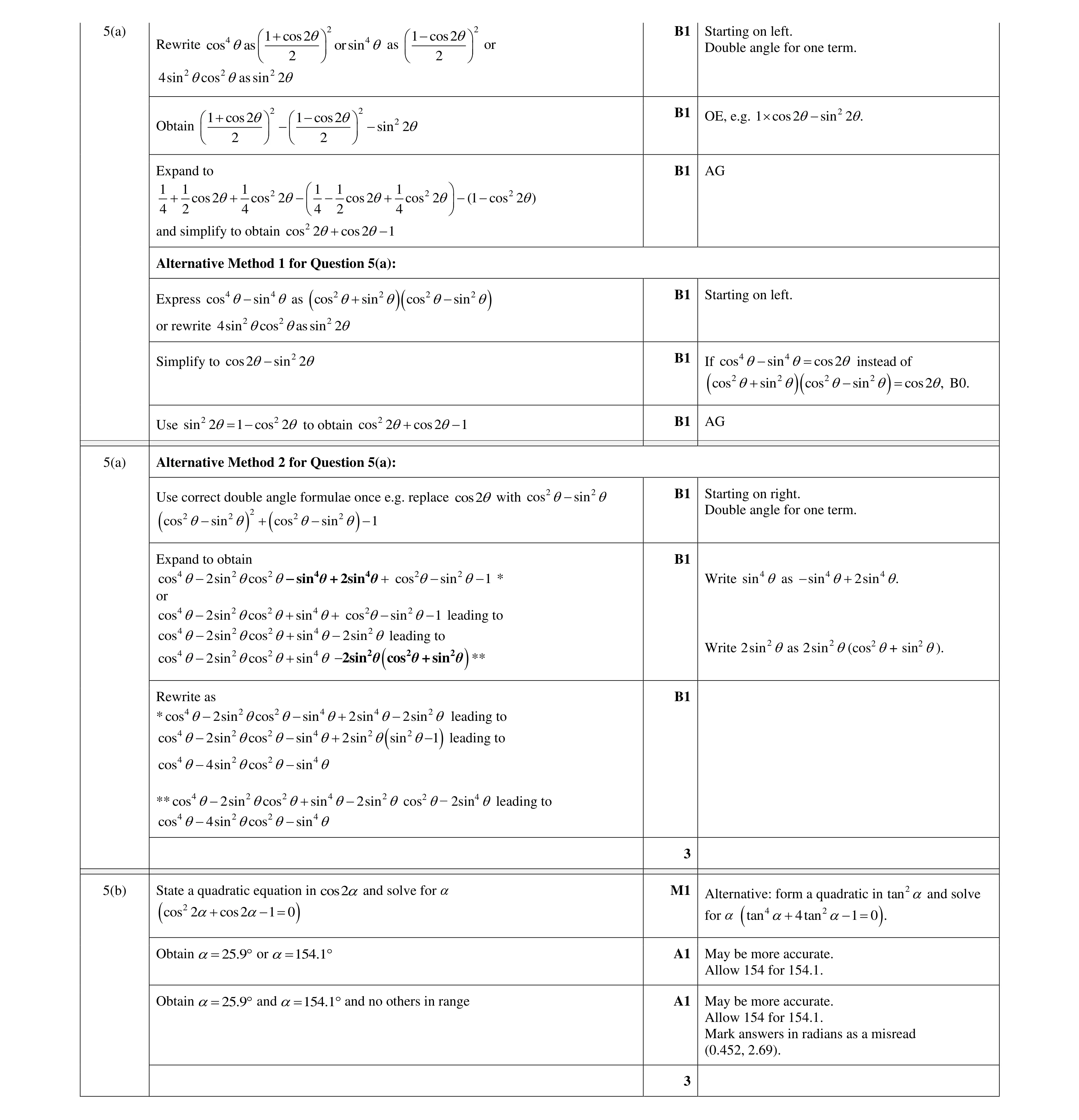 6
6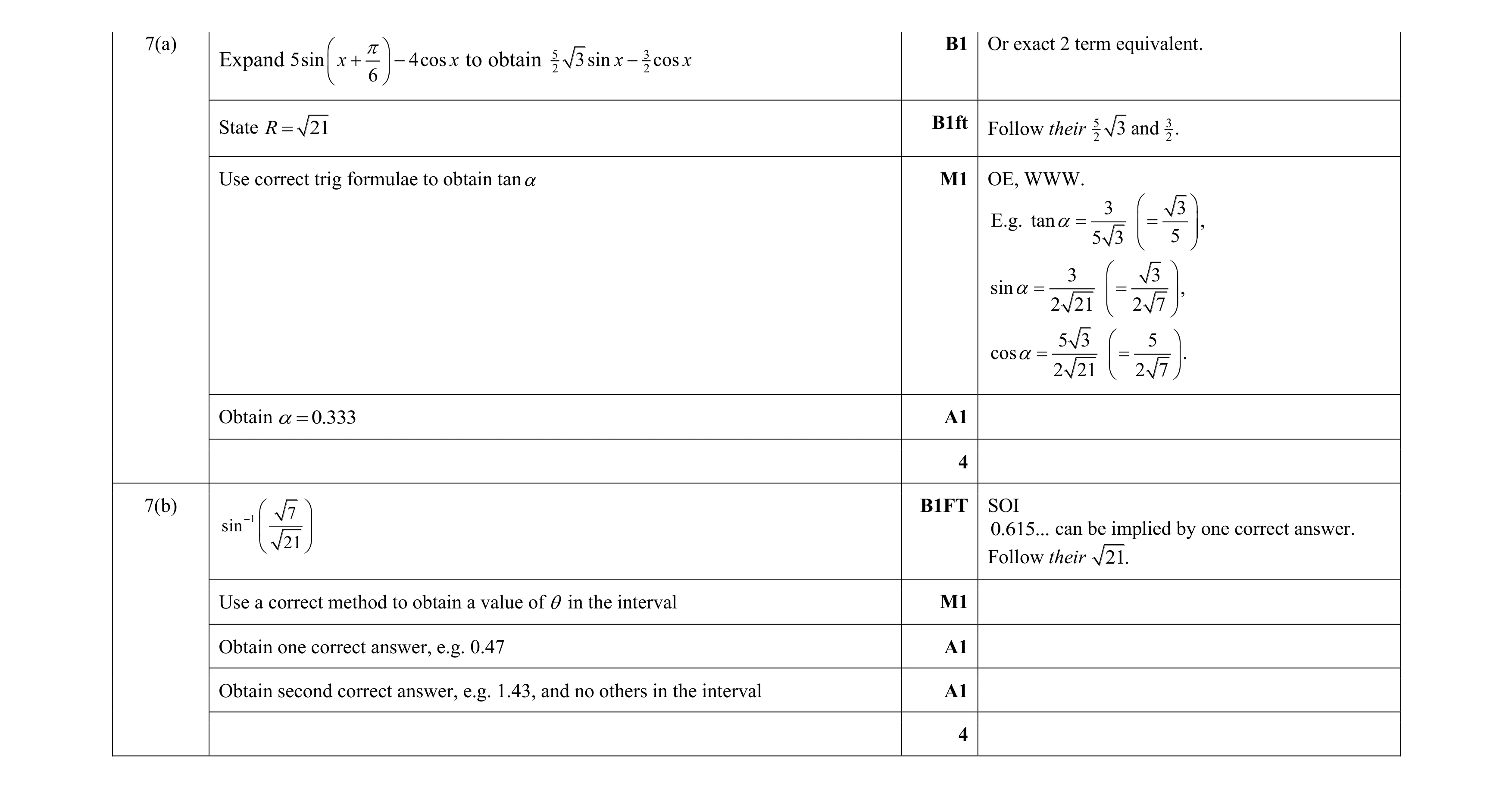 8
8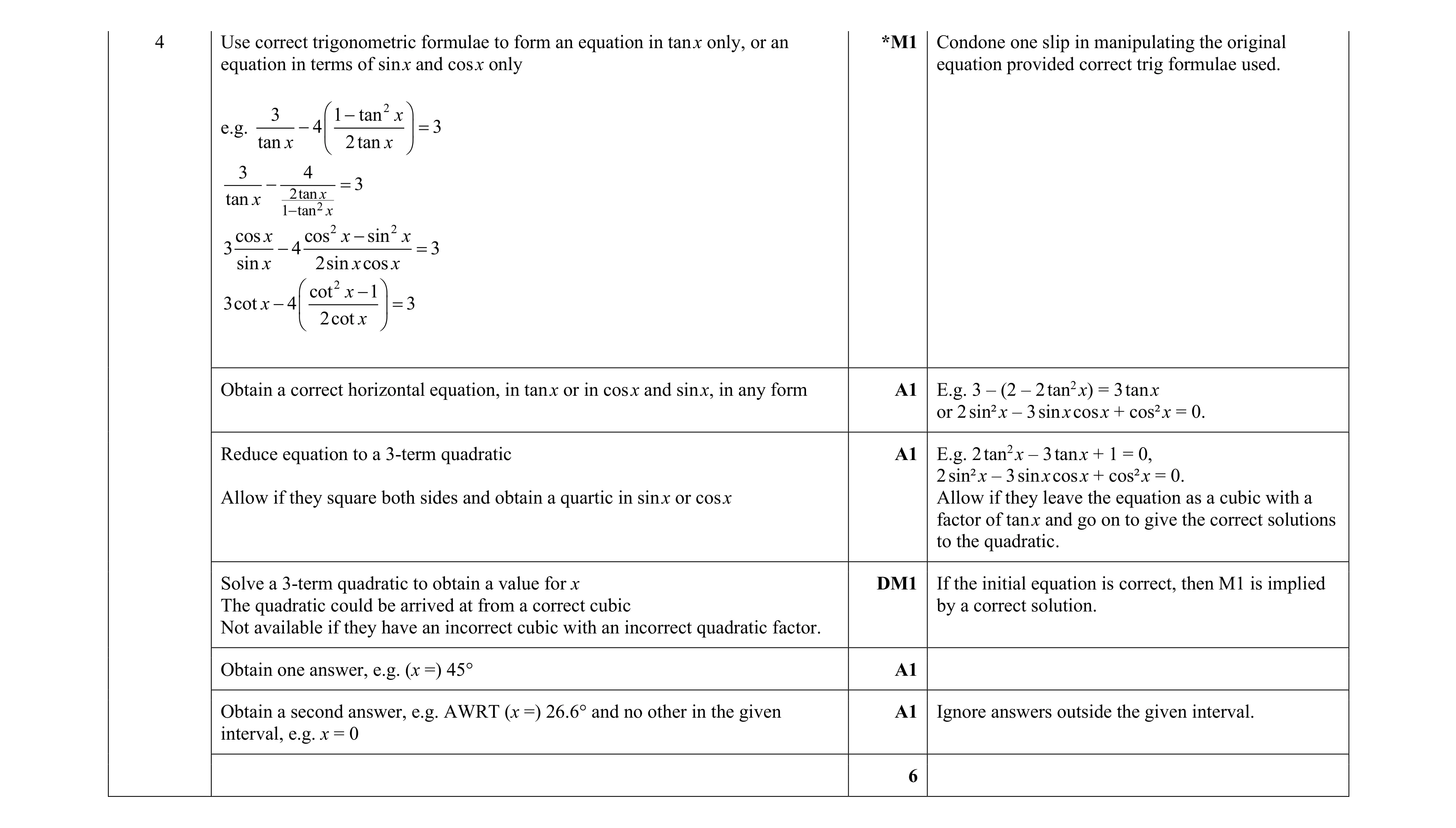 6
6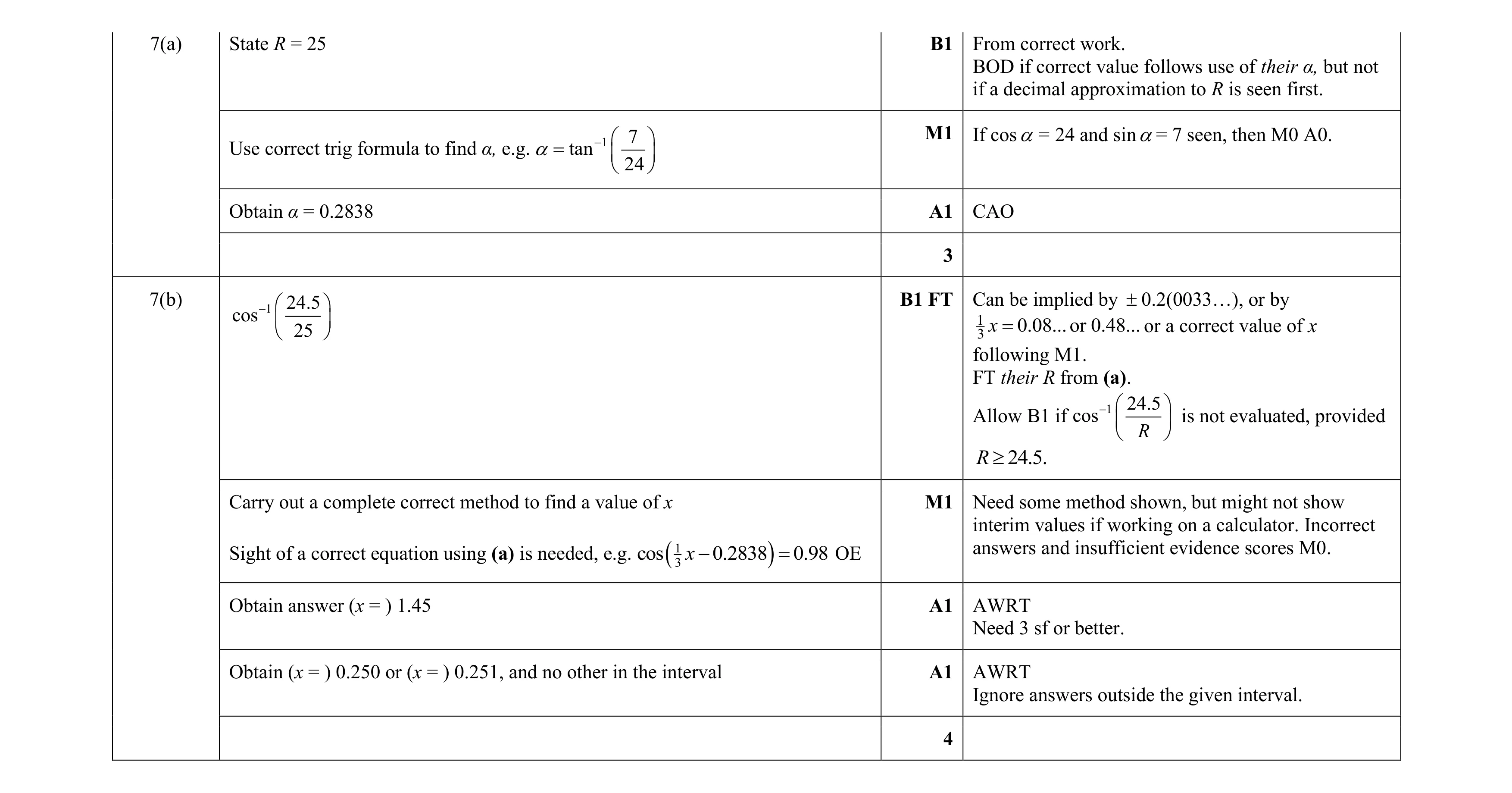 7
7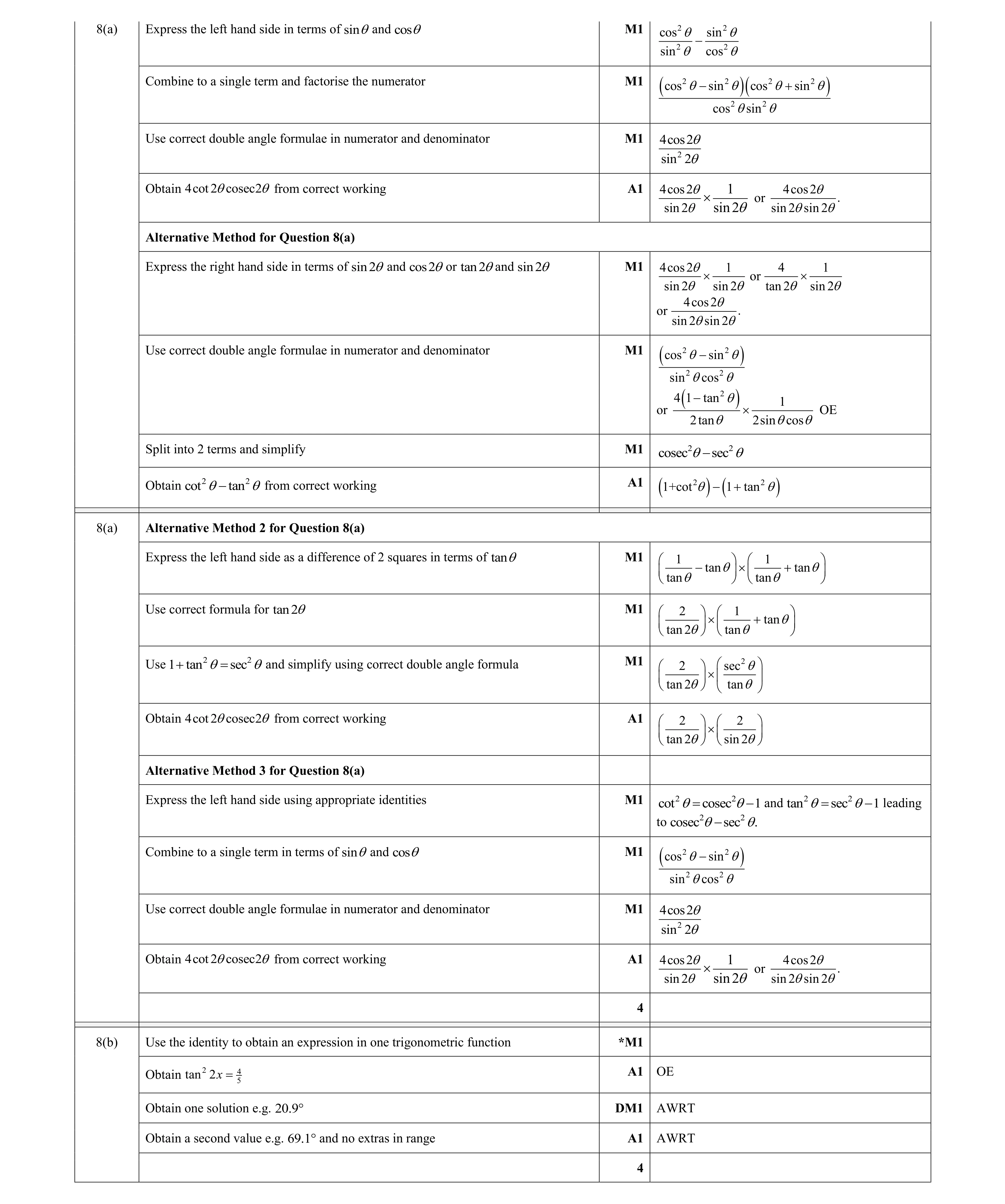 8
8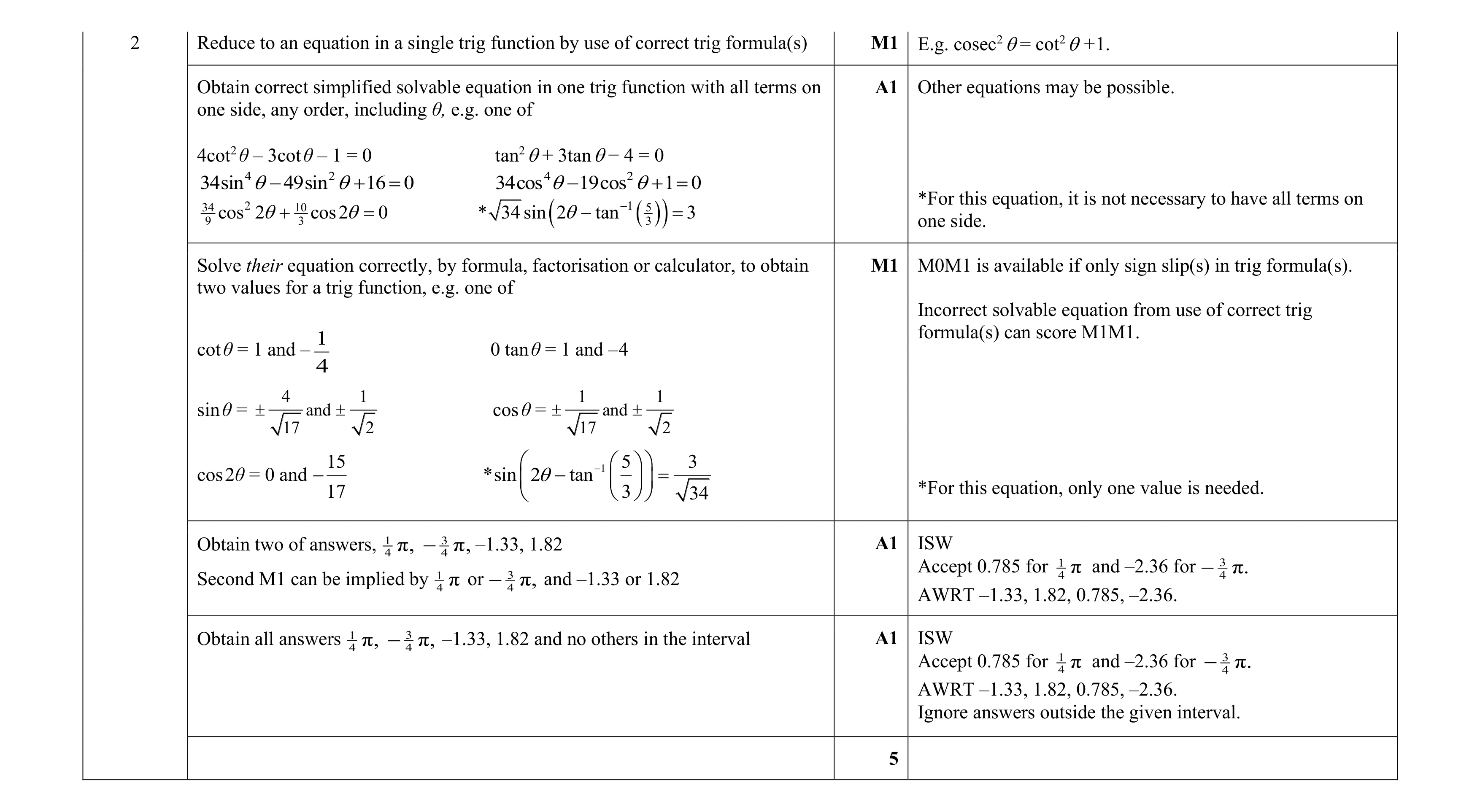 5
5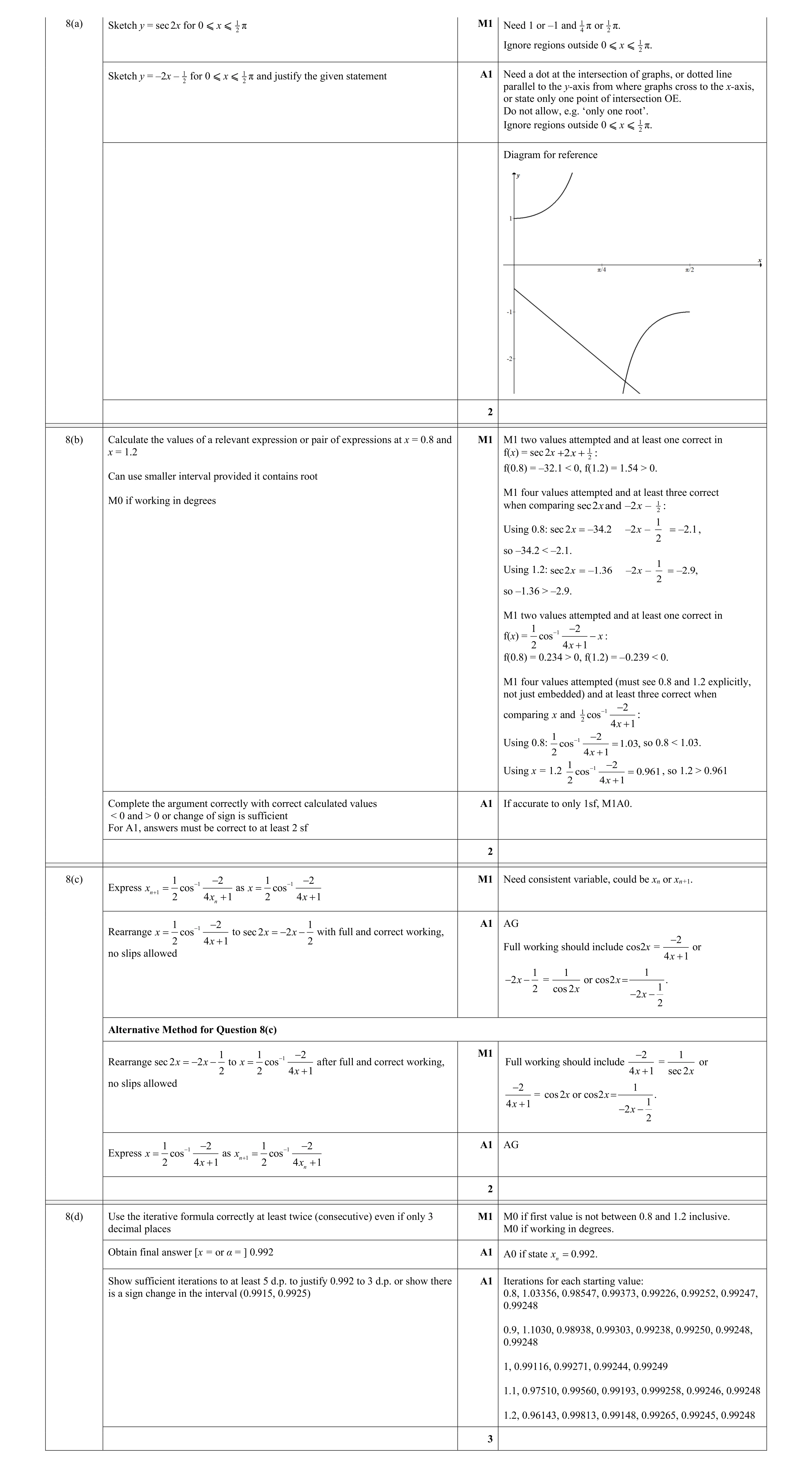 9
9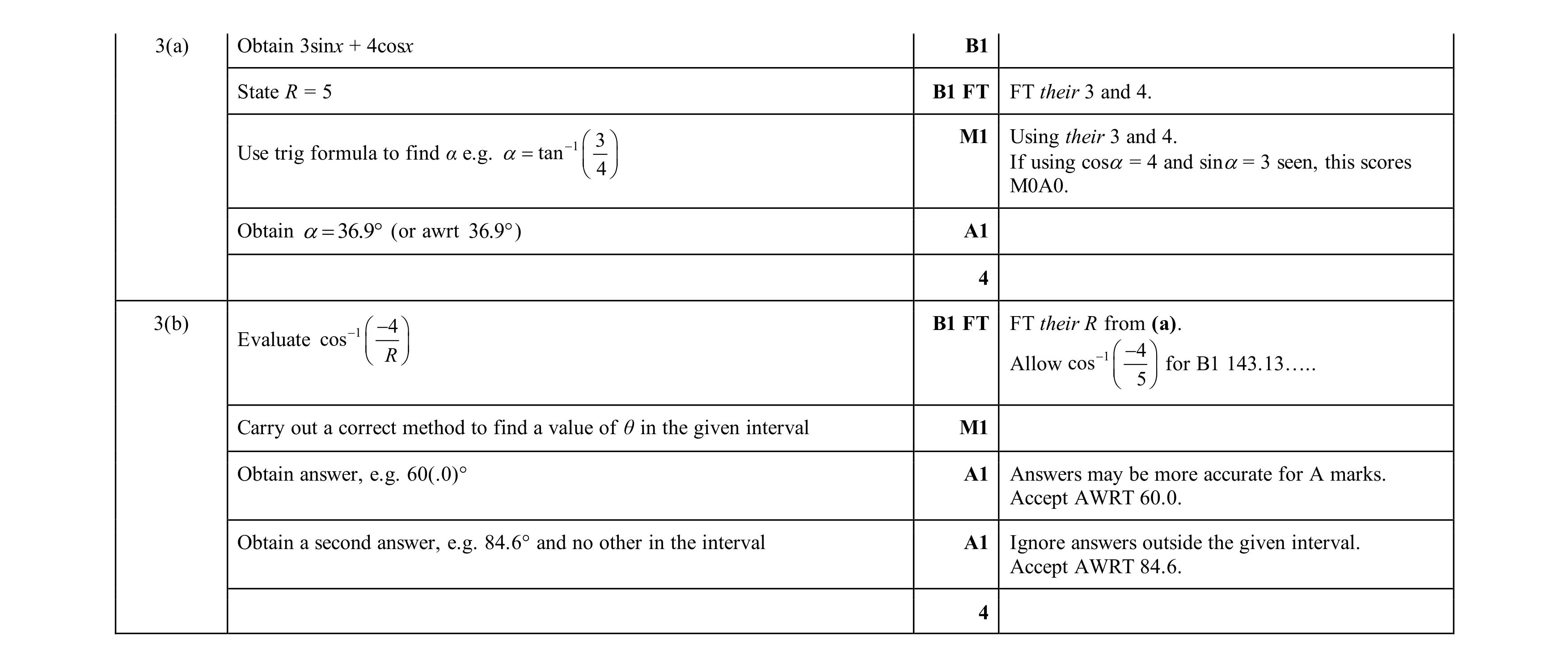 8
8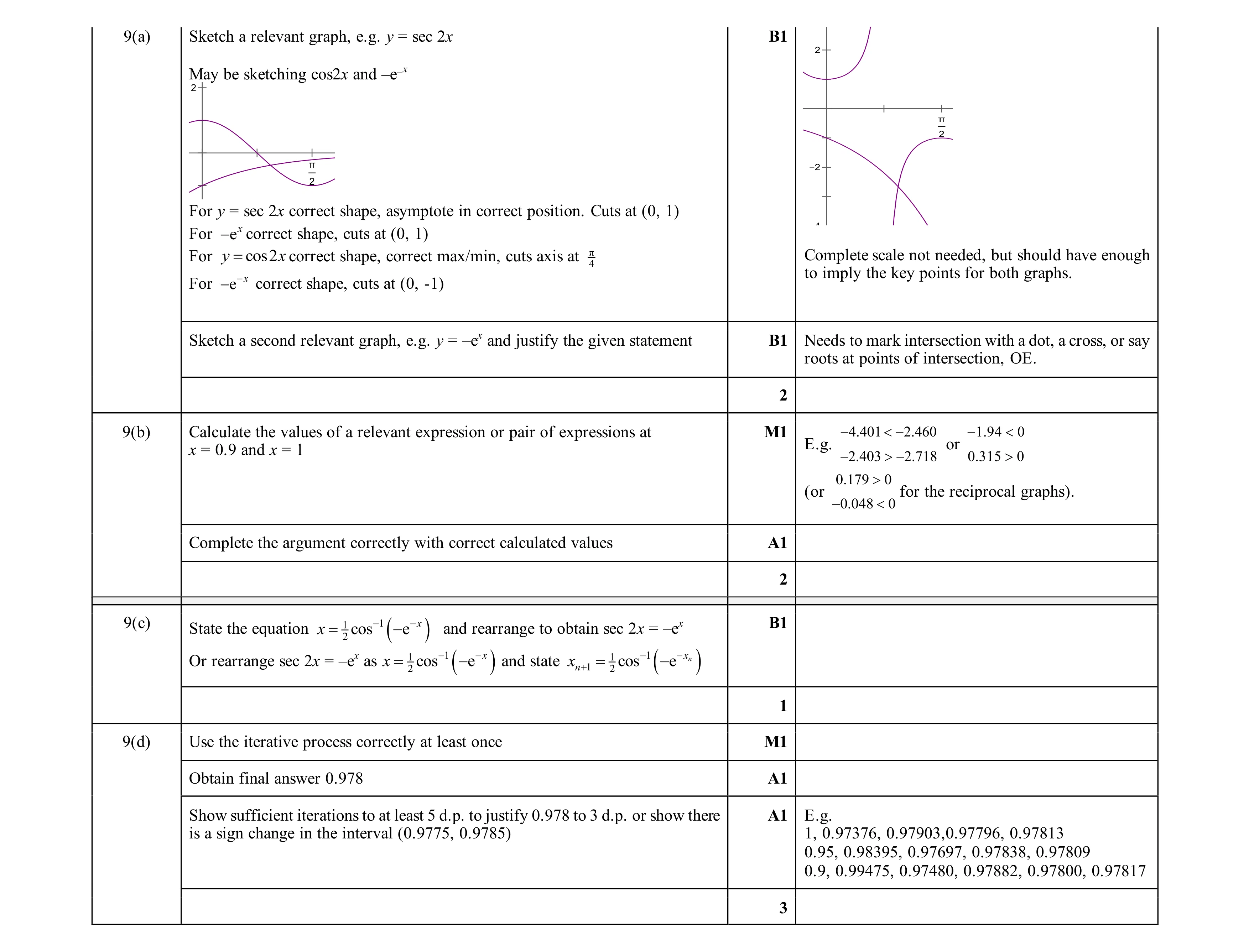 8
8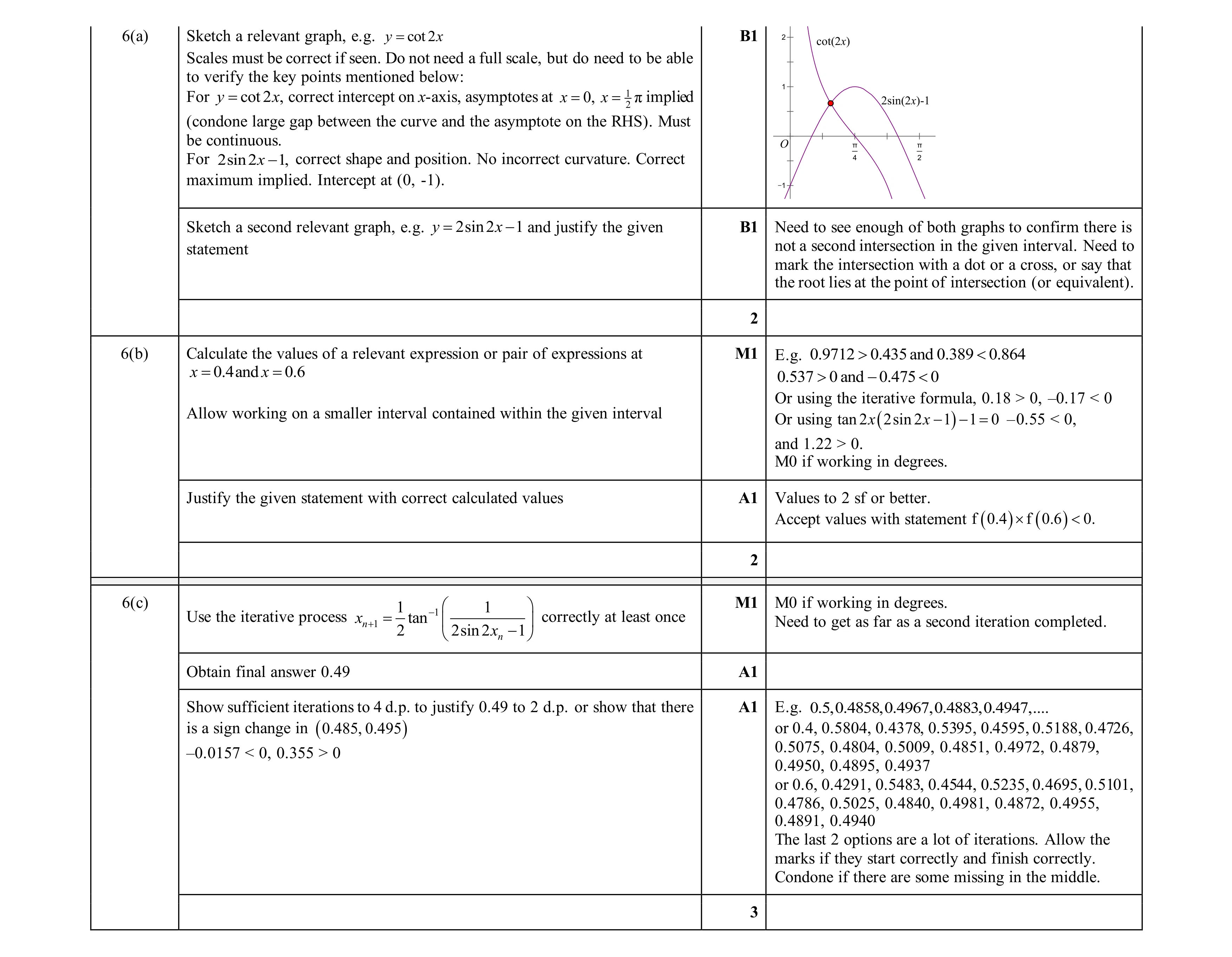 7
7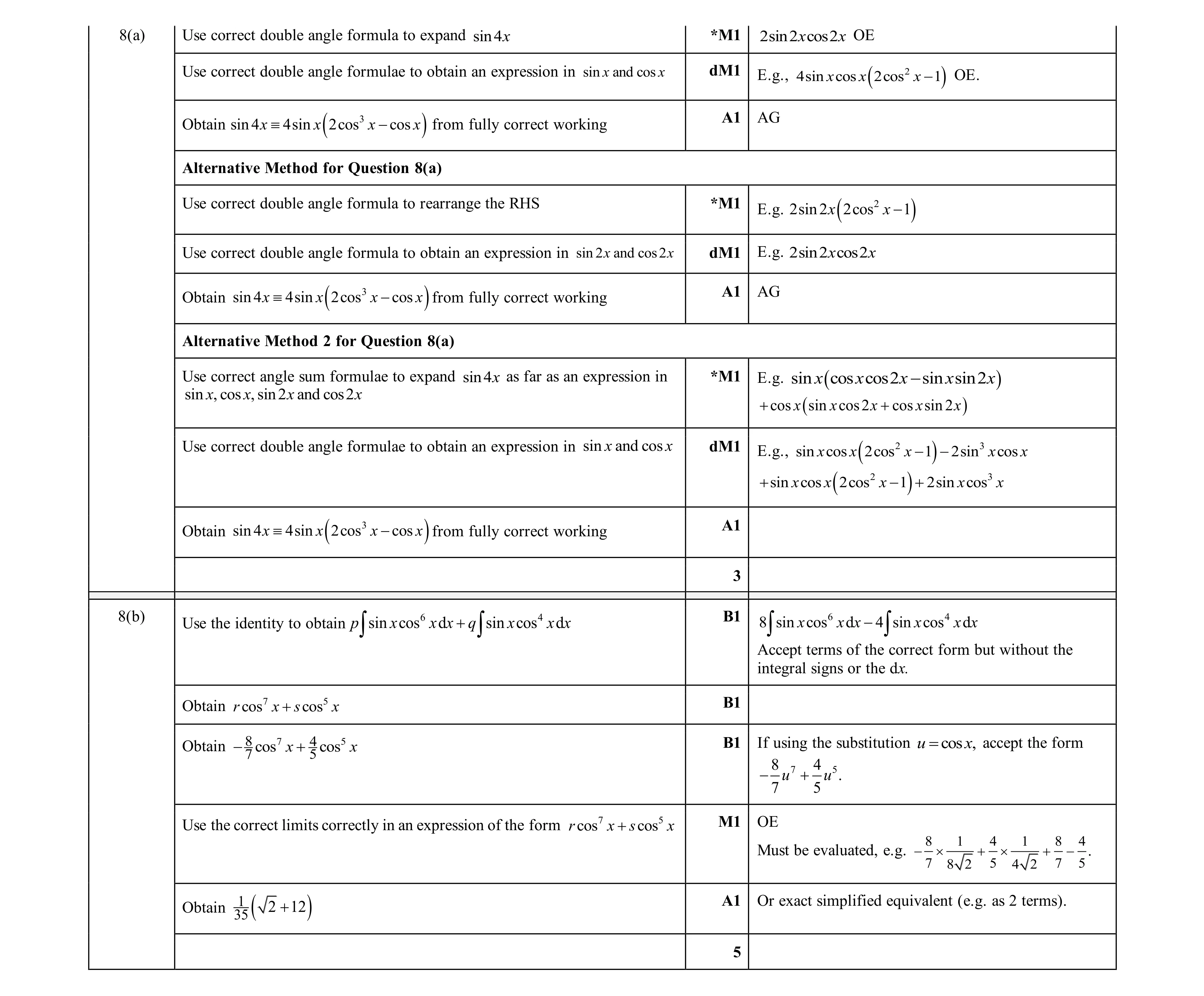 8
8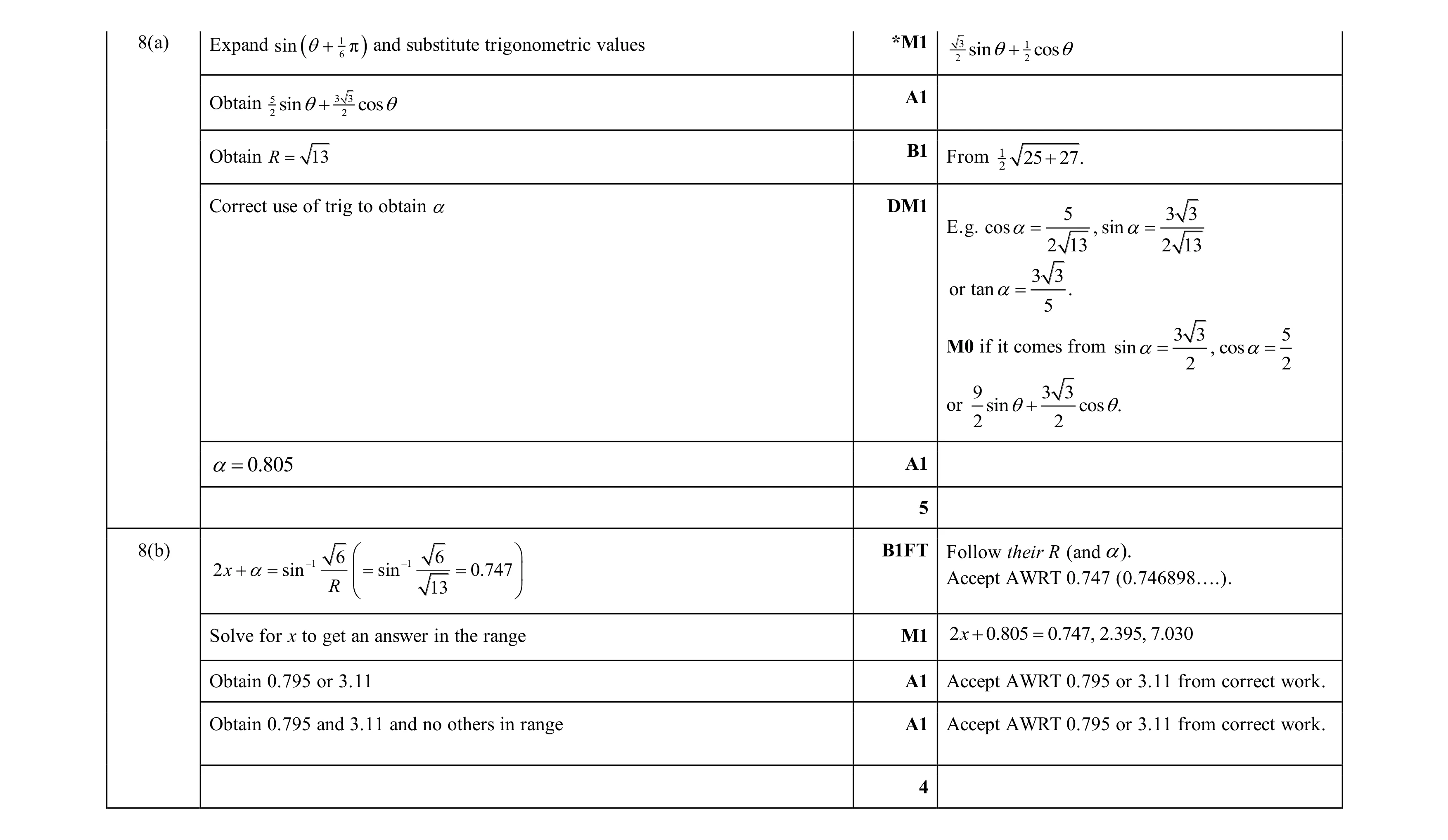 9
9