Cambridge A Level Mathematics 9709 — 2004 Oct/Nov Paper 3 · Variant 1
9709/31/O/N/04 · 10 questions · 75 marks · ≈84 min
The question paper and its mark scheme, free to read here and free to download. This is Cambridge’s own paper, exactly as it was sat.
Question paper4 pages
Mark scheme10 pages
Answers below. Sit the paper first if you are practising.
Questions as text
Q1 · 1 Expand in ascending powers of x, up to and including the term in x2, simplifying the (2…
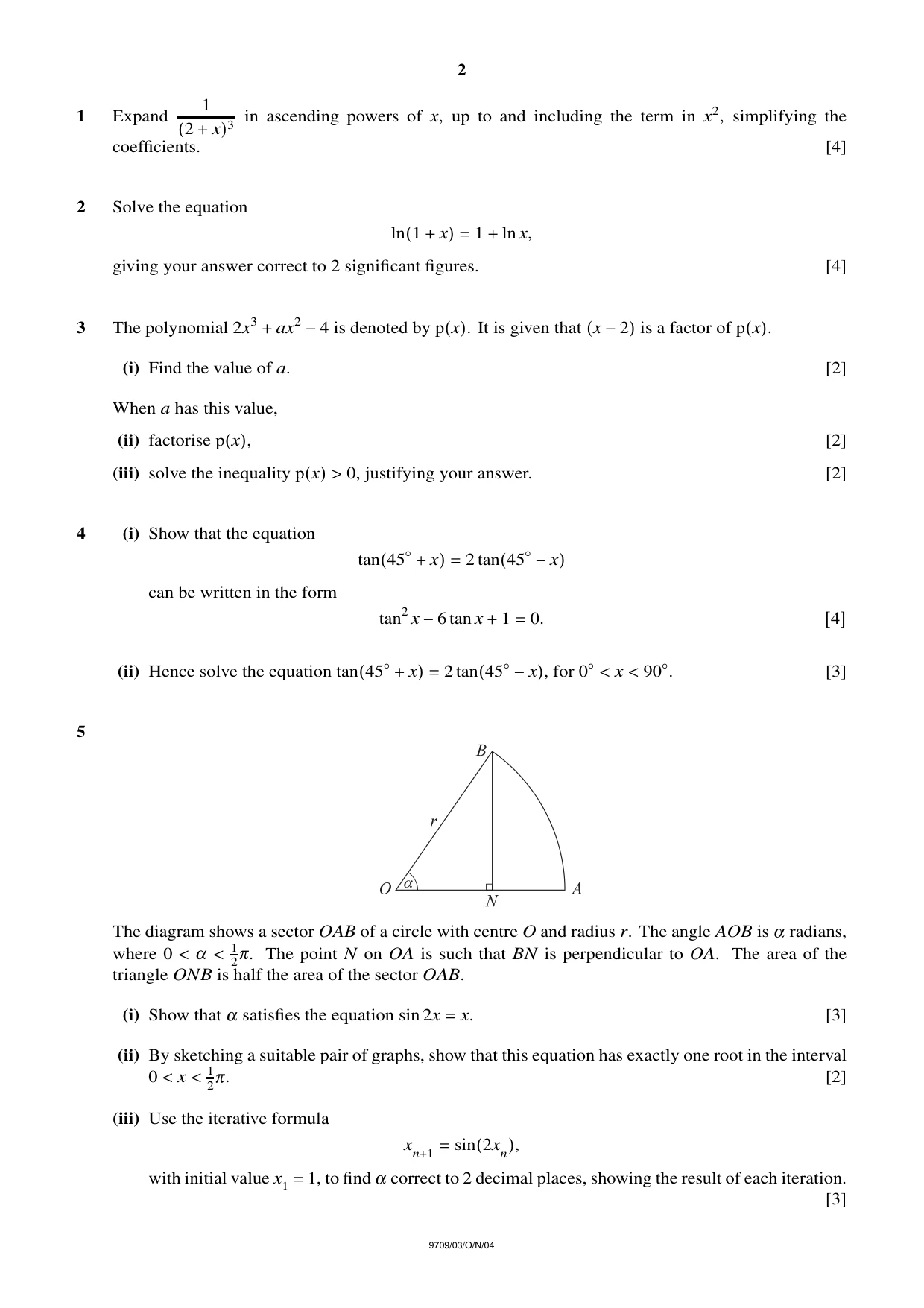
1 1 Expand in ascending powers of x, up to and including the term in x2, simplifying the (2 + x)3 coefficients. [4]
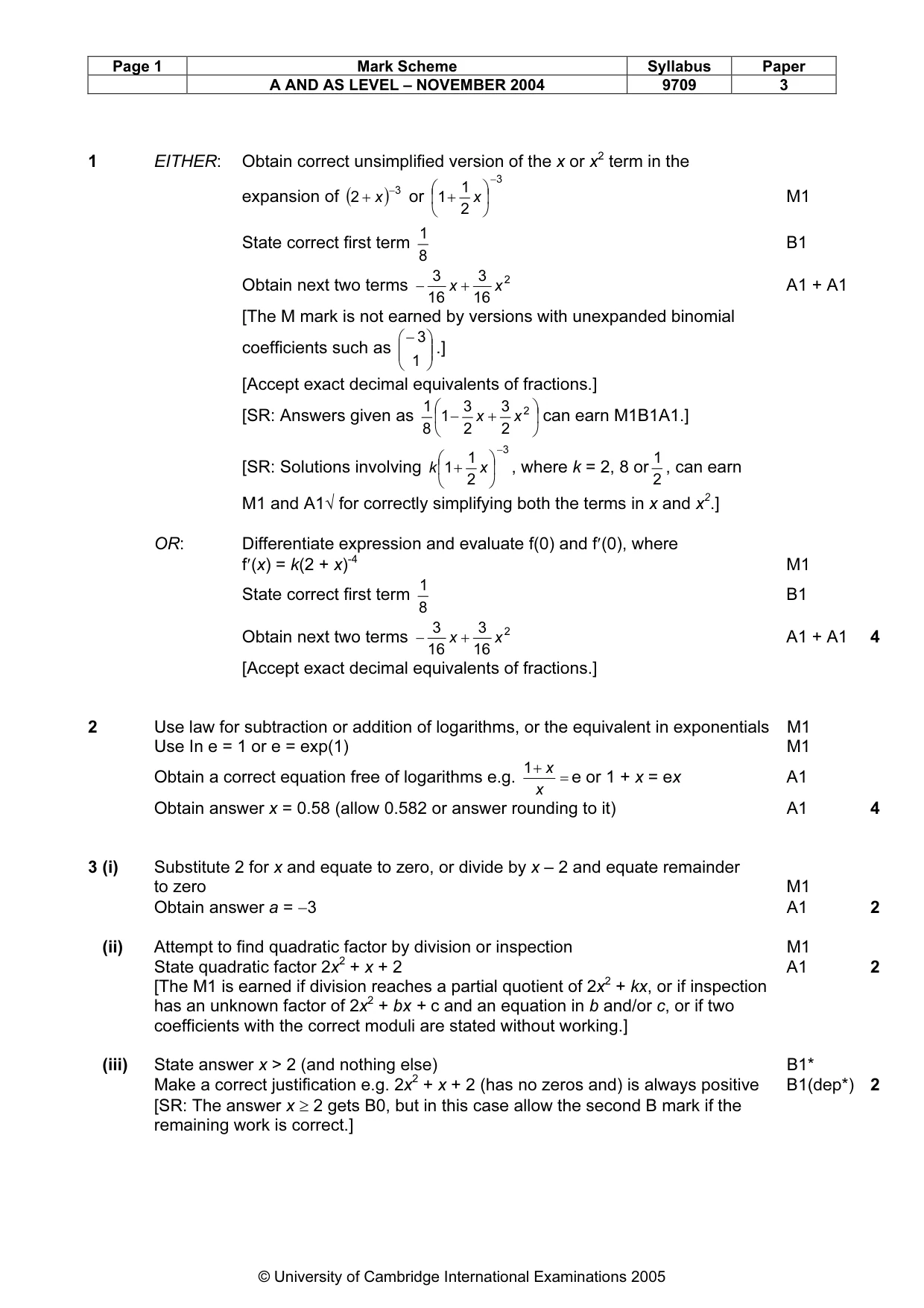
Mark scheme: 1 EITHER: Obtain correct unsimplified version of the x or x2 term in the −3 expansion of (2 + x )−3 or + 1 1 x M1 2 1 State correct first term B1 8 3 3 2 Obtain next two terms − x + x A1 + A1 16 16 [The M mark is not earned by versions with unexpanded binomial − 3 coefficients such as .] 1 [Accept exact decimal equivalents of fractions.] 1 3 3 2 [SR: Answers given as 1 − x + x can earn M1B1A1.] 8 2 2 −3 1 1 [SR: Solutions involving k + 1 x , where k = 2, 8 or , can earn 2 2 M1 and A1√ for correctly simplifying both the terms in x and x2.] OR: Differentiate expression and evaluate f(0) and f′(0), where f′(x) = k(2 + x)-4 M1 1 State correct first term B1 8 3 3 2 Obtain next two terms − x + x A1 + A1 4 16 16 [Accept exact decimal equivalents of fractions.]
Q2 · Solve the equation ln(1 + x) = 1 + ln x, giving your answer correct to 2 significant figures
2 Solve the equation ln(1 + x) = 1 + ln x, giving your answer correct to 2 significant figures. [4]
Mark scheme: 2 Use law for subtraction or addition of logarithms, or the equivalent in exponentials M1 Use In e = 1 or e = exp(1) M1 1 + x Obtain a correct equation free of logarithms e.g. = e or 1 + x = ex A1 x Obtain answer x = 0.58 (allow 0.582 or answer rounding to it) A1 4
Q3 · The polynomial 2x3 + ax2 −4 is denoted by p(x)
3 The polynomial 2x3 + ax2 −4 is denoted by p(x). It is given that (x −2) is a factor of p(x). (i) Find the value of a. [2] When a has this value, (ii) factorise p(x), [2] (iii) solve the inequality p(x) > 0, justifying your answer. [2]
Mark scheme: 3 (i) Substitute 2 for x and equate to zero, or divide by x – 2 and equate remainder to zero M1 Obtain answer a = −3 A1 2 (ii) Attempt to find quadratic factor by division or inspection M1 State quadratic factor 2x2 + x + 2 A1 2 [The M1 is earned if division reaches a partial quotient of 2x2 + kx, or if inspection has an unknown factor of 2x2 + bx + c and an equation in b and/or c, or if two coefficients with the correct moduli are stated without working.] (iii) State answer x > 2 (and nothing else) B1* Make a correct justification e.g. 2x2 + x + 2 (has no zeros and) is always positive B1(dep*) 2 [SR: The answer x ≥ 2 gets B0, but in this case allow the second B mark if the remaining work is correct.] A AND AS LEVEL – NOVEMBER 2004 9709 3
Q4 · Show that the equation tan(45◦+ x) = 2 tan(45◦−x) can be written in the form tan2x −6 tan…
4 (i) Show that the equation tan(45◦+ x) = 2 tan(45◦−x) can be written in the form tan2x −6 tan x + 1 = 0. [4] (ii) Hence solve the equation tan(45◦+ x) = 2 tan(45◦−x), for 0◦< x < 90◦. [3]
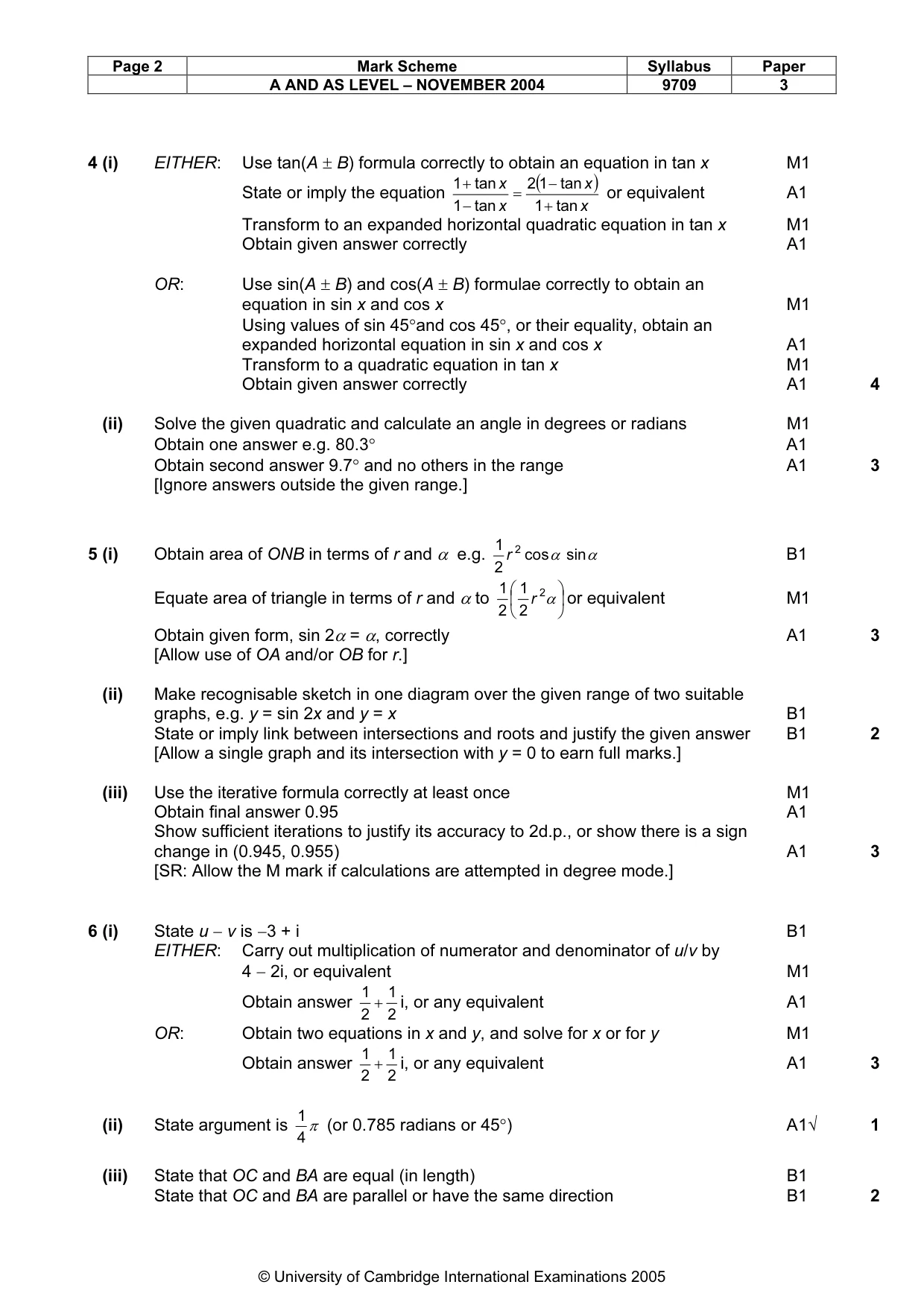
Mark scheme: 4 (i) EITHER: Use tan(A ± B) formula correctly to obtain an equation in tan x M1 1 + tan x 2(1 − tan x ) State or imply the equation = or equivalent A1 1 − tan x 1 + tan x Transform to an expanded horizontal quadratic equation in tan x M1 Obtain given answer correctly A1 OR: Use sin(A ± B) and cos(A ± B) formulae correctly to obtain an equation in sin x and cos x M1 Using values of sin 45°and cos 45°, or their equality, obtain an expanded horizontal equation in sin x and cos x A1 Transform to a quadratic equation in tan x M1 Obtain given answer correctly A1 4 (ii) Solve the given quadratic and calculate an angle in degrees or radians M1 Obtain one answer e.g. 80.3° A1 Obtain second answer 9.7° and no others in the range A1 3 [Ignore answers outside the given range.] 1 2
Q5 · The diagram shows a sector OAB of a circle with centre O and radius r
5 The diagram shows a sector OAB of a circle with centre O and radius r. The angle AOB is α radians, where 0 < α < 12π. The point N on OA is such that BN is perpendicular to OA. The area of the triangle ONB is half the area of the sector OAB. (i) Show that α satisfies the equation sin 2x = x. [3] (ii) By sketching a suitable pair of graphs, show that this equation has exactly one root in the interval 0 < x < 12π. [2] (iii) Use the iterative formula xn+1 = sin(2xn), with initial value x1 = 1, to find α correct to 2 decimal places, showing the result of each iteration. [3]
Mark scheme: 1 25 (i) Obtain area of ONB in terms of r and α e.g. r cos α sin α B1 2 1 1 2 Equate area of triangle in terms of r and α to r α or equivalent M1 2 2 Obtain given form, sin 2α = α, correctly A1 3 [Allow use of OA and/or OB for r.] (ii) Make recognisable sketch in one diagram over the given range of two suitable graphs, e.g. y = sin 2x and y = x B1 State or imply link between intersections and roots and justify the given answer B1 2 [Allow a single graph and its intersection with y = 0 to earn full marks.] (iii) Use the iterative formula correctly at least once M1 Obtain final answer 0.95 A1 Show sufficient iterations to justify its accuracy to 2d.p., or show there is a sign change in (0.945, 0.955) A1 3 [SR: Allow the M mark if calculations are attempted in degree mode.]
Q6 · The complex numbers 1 + 3i and 4 + 2i are denoted by u and v respectively
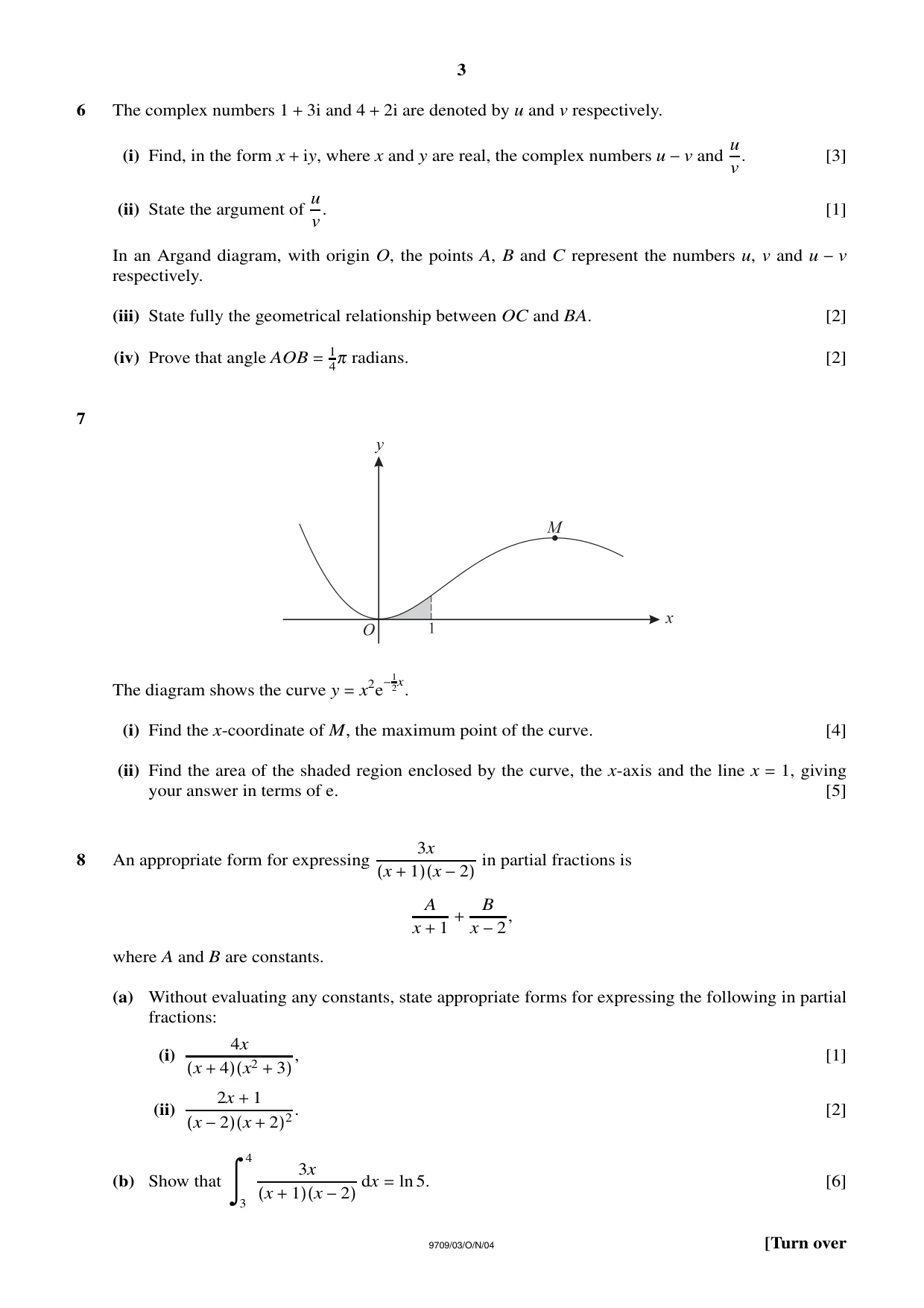
6 The complex numbers 1 + 3i and 4 + 2i are denoted by u and v respectively. u (i) Find, in the form x + iy, where x and y are real, the complex numbers u −v and v. [3] u (ii) State the argument of v. [1] In an Argand diagram, with origin O, the points A, B and C represent the numbers u, v and u −v respectively. (iii) State fully the geometrical relationship between OC and BA. [2] (iv) Prove that angle AOB = 14π radians. [2]
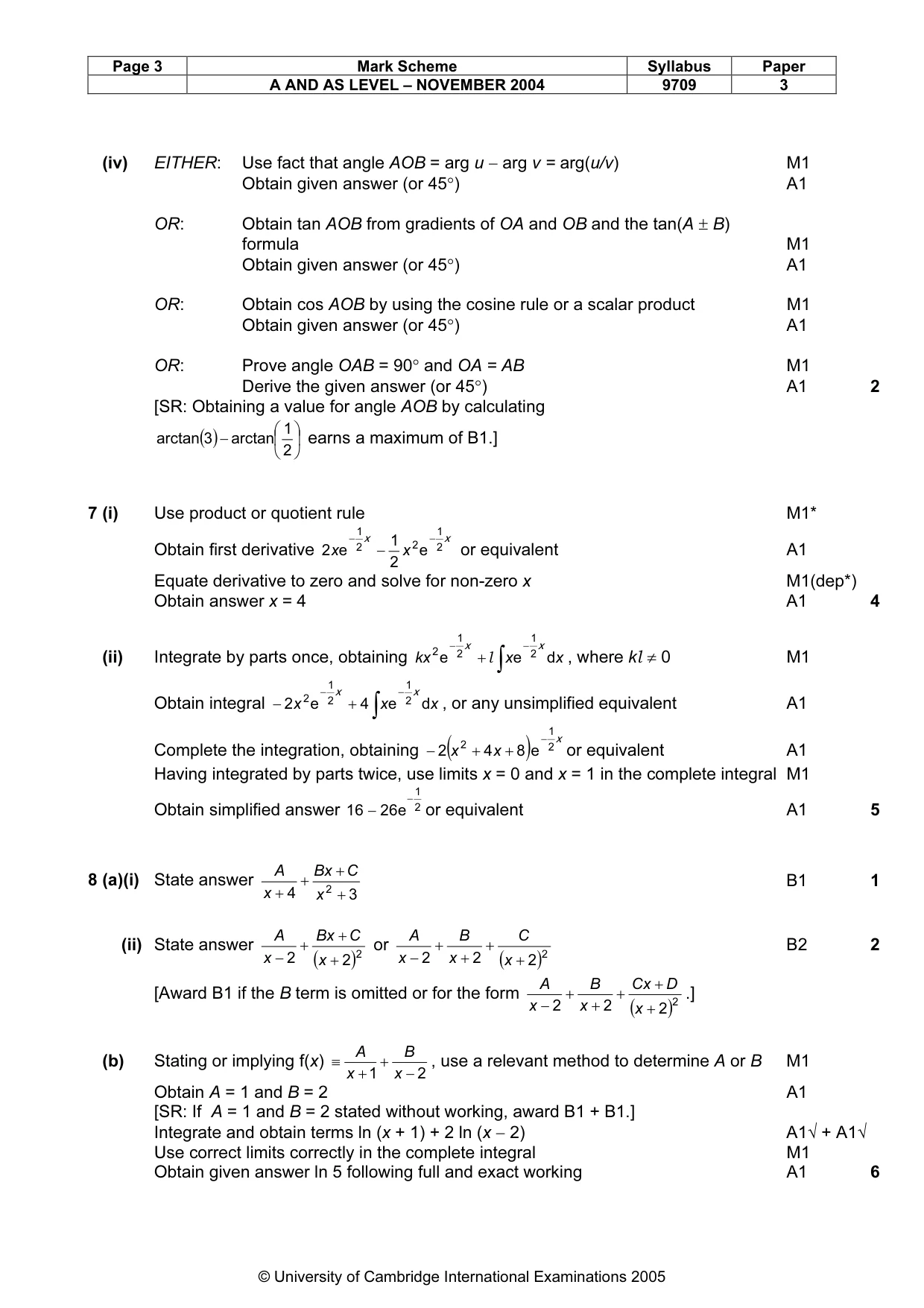
Mark scheme: 6 (i) State u − v is −3 + i B1 EITHER: Carry out multiplication of numerator and denominator of u/v by 4 − 2i, or equivalent M1 1 1 Obtain answer + i, or any equivalent A1 2 2 OR: Obtain two equations in x and y, and solve for x or for y M1 1 1 Obtain answer + i, or any equivalent A1 3 2 2 1 (ii) State argument is π (or 0.785 radians or 45°) A1√ 1 4 (iii) State that OC and BA are equal (in length) B1 State that OC and BA are parallel or have the same direction B1 2 A AND AS LEVEL – NOVEMBER 2004 9709 3 (iv) EITHER: Use fact that angle AOB = arg u − arg v = arg(u/v) M1 Obtain given answer (or 45°) A1 OR: Obtain tan AOB from gradients of OA and OB and the tan(A ± B) formula M1 Obtain given answer (or 45°) A1 OR: Obtain cos AOB by using the cosine rule or a scalar product M1 Obtain given answer (or 45°) A1 OR: Prove angle OAB = 90° and OA = AB M1 Derive the given answer (or 45°) A1 2 [SR: Obtaining a value for angle AOB by calculating 1 arctan (3 ) − arctan earns a maximum of B1.] 2
Q7 · The diagram shows the curve y = x2e−12x
7 The diagram shows the curve y = x2e−12x. (i) Find the x-coordinate of M, the maximum point of the curve. [4] (ii) Find the area of the shaded region enclosed by the curve, the x-axis and the line x = 1, giving your answer in terms of e. [5]
Mark scheme: 7 (i) Use product or quotient rule M1* 1 1 − 2 x 1 2 − 2 x Obtain first derivative 2 xe − x e or equivalent A1 2 Equate derivative to zero and solve for non-zero x M1(dep*) Obtain answer x = 4 A1 4 1 1 − x − x (ii) Integrate by parts once, obtaining kx 2 e 2 + l ∫ x e 2 d x , where kl ≠ 0 M1 1 1 − x − x Obtain integral − 2 x 2 e 2 + 4 ∫ xe 2 d x , or any unsimplified equivalent A1 1 − x 2 or equivalent A1 Complete the integration, obtaining − 2(x 2 + 4 x + 8 )e Having integrated by parts twice, use limits x = 0 and x = 1 in the complete integral M1 1 − Obtain simplified answer 16 − 26 e 2 or equivalent A1 5 A Bx + C
Q8 · X 8 An appropriate form for expressing in partial fractions is (x + 1)(x −2) A B + x + 1…
3x 8 An appropriate form for expressing in partial fractions is (x + 1)(x −2) A B + x + 1 x −2, where A and B are constants. (a) Without evaluating any constants, state appropriate forms for expressing the following in partial fractions: 4x (i) [1] (x + 4)(x2 + 3), 2x + 1 (ii) [2] (x −2)(x + 2)2. 4 3x (b) Show that dx = ln 5. [6] (x + 1)(x −2) 3
Mark scheme: A Bx + C 8 (a)(i) State answer + B1 1 x + 4 x 2 + 3 A Bx + C A B C (ii) State answer + or + + B2 2 x − 2 ( x + 2 )2 x − 2 x + 2 ( x + 2 )2 A B Cx + D [Award B1 if the B term is omitted or for the form + + .] x − 2 x + 2 ( x + 2 )2 A B (b) Stating or implying f(x) ≡ + , use a relevant method to determine A or B M1 x + 1 x − 2 Obtain A = 1 and B = 2 A1 [SR: If A = 1 and B = 2 stated without working, award B1 + B1.] Integrate and obtain terms ln (x + 1) + 2 ln (x − 2) A1√ + A1√ Use correct limits correctly in the complete integral M1 Obtain given answer ln 5 following full and exact working A1 6 A AND AS LEVEL – NOVEMBER 2004 9709 3
Q9 · The lines l and m have vector equations r = 2i −j + 4k + s(i + j −k) and r = −2i + 2j + k…
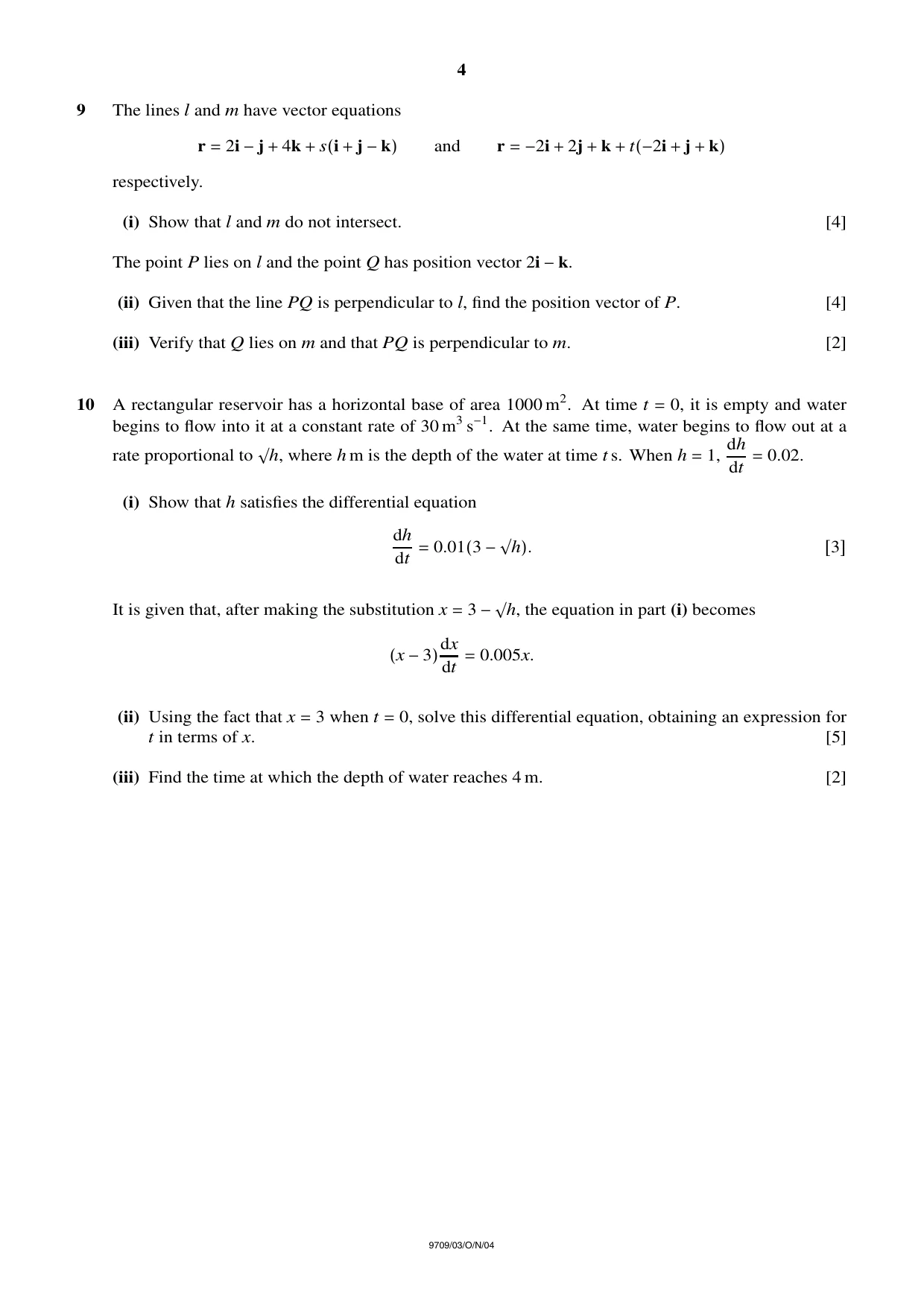
9 The lines l and m have vector equations r = 2i −j + 4k + s(i + j −k) and r = −2i + 2j + k + t(−2i + j + k) respectively. (i) Show that l and m do not intersect. [4] The point P lies on l and the point Q has position vector 2i −k. (ii) Given that the line PQ is perpendicular to l, find the position vector of P. [4] (iii) Verify that Q lies on m and that PQ is perpendicular to m. [2]
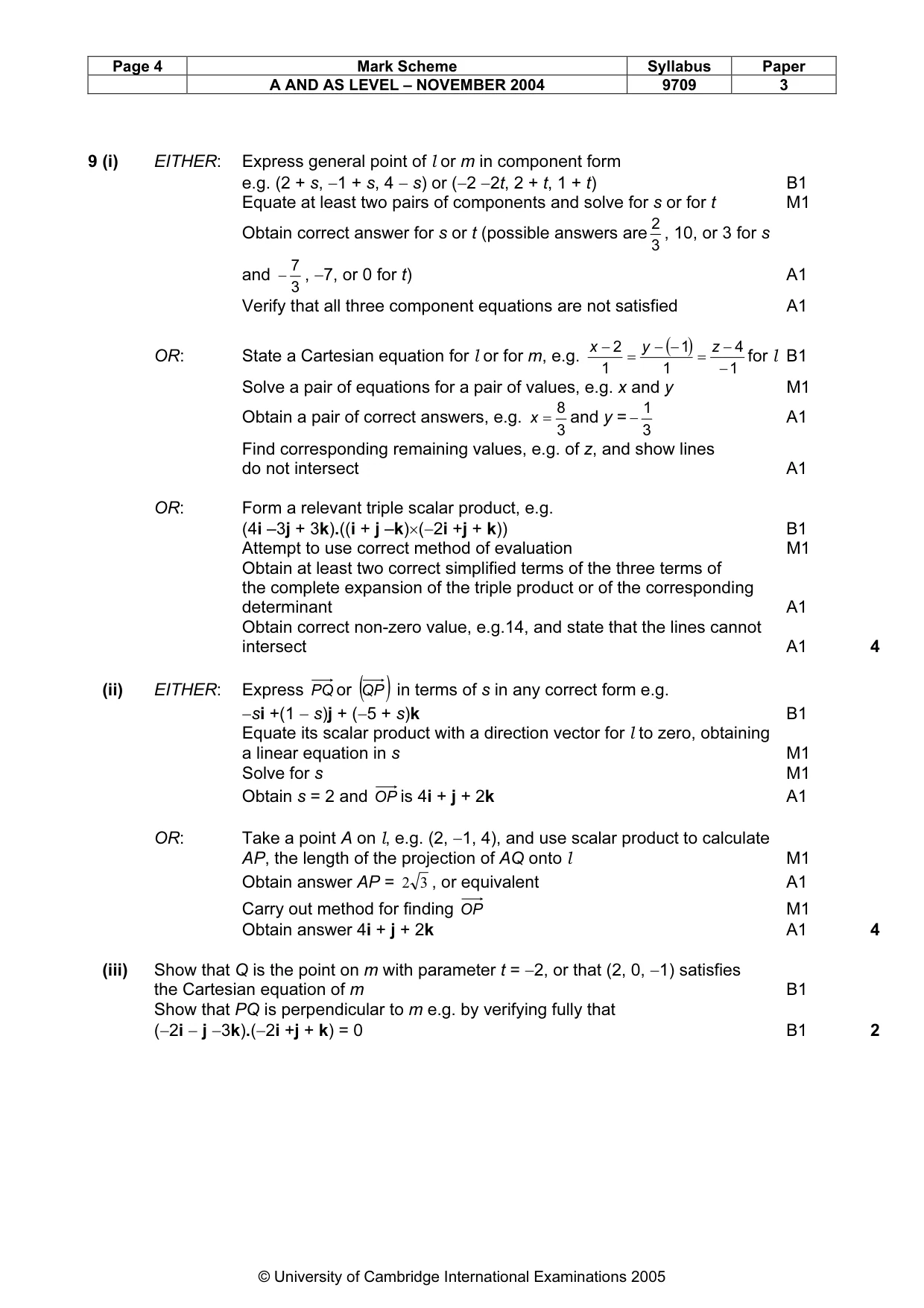
Mark scheme: 9 (i) EITHER: Express general point of l or m in component form e.g. (2 + s, −1 + s, 4 − s) or (−2 −2t, 2 + t, 1 + t) B1 Equate at least two pairs of components and solve for s or for t M1 2 Obtain correct answer for s or t (possible answers are , 10, or 3 for s 3 7 and − , −7, or 0 for t) A1 3 Verify that all three component equations are not satisfied A1 x − 2 y − (− 1) z − 4 OR: State a Cartesian equation for l or for m, e.g. = = for l B1 1 1 − 1 Solve a pair of equations for a pair of values, e.g. x and y M1 8 1 Obtain a pair of correct answers, e.g. x = and y = − A1 3 3 Find corresponding remaining values, e.g. of z, and show lines do not intersect A1 OR: Form a relevant triple scalar product, e.g. (4i –3j + 3k).((i + j –k)×(−2i +j + k)) B1 Attempt to use correct method of evaluation M1 Obtain at least two correct simplified terms of the three terms of the complete expansion of the triple product or of the corresponding determinant A1 Obtain correct non-zero value, e.g.14, and state that the lines cannot intersect A1 4 (ii) EITHER: Express PQ or (QP ) in terms of s in any correct form e.g. −si +(1 − s)j + (−5 + s)k B1 Equate its scalar product with a direction vector for l to zero, obtaining a linear equation in s M1 Solve for s M1 Obtain s = 2 and OP is 4i + j + 2k A1 OR: Take a point A on l, e.g. (2, −1, 4), and use scalar product to calculate AP, the length of the projection of AQ onto l M1 Obtain answer AP = 2 3 , or equivalent A1 Carry out method for finding OP M1 Obtain answer 4i + j + 2k A1 4 (iii) Show that Q is the point on m with parameter t = −2, or that (2, 0, −1) satisfies the Cartesian equation of m B1 Show that PQ is perpendicular to m e.g. by verifying fully that (−2i − j −3k).(−2i +j + k) = 0 B1 2 A AND AS LEVEL – NOVEMBER 2004 9709 3 d V d h
Q10 · A rectangular reservoir has a horizontal base of area 1000 m2
10 A rectangular reservoir has a horizontal base of area 1000 m2. At time t = 0, it is empty and water begins to flow into it at a constant rate of 30 m3 s−1. At the same time, water begins to flow out at a dh rate proportional to √h, where h m is the depth of the water at time t s. When h = 1, = 0.02. dt (i) Show that h satisfies the differential equation dh = 0.01(3 −√h). [3] dt It is given that, after making the substitution x = 3 −√h, the equation in part (i) becomes (x −3)dx = 0.005x. dt (ii) Using the fact that x = 3 when t = 0, solve this differential equation, obtaining an expression for t in terms of x. [5] (iii) Find the time at which the depth of water reaches 4 m. [2]
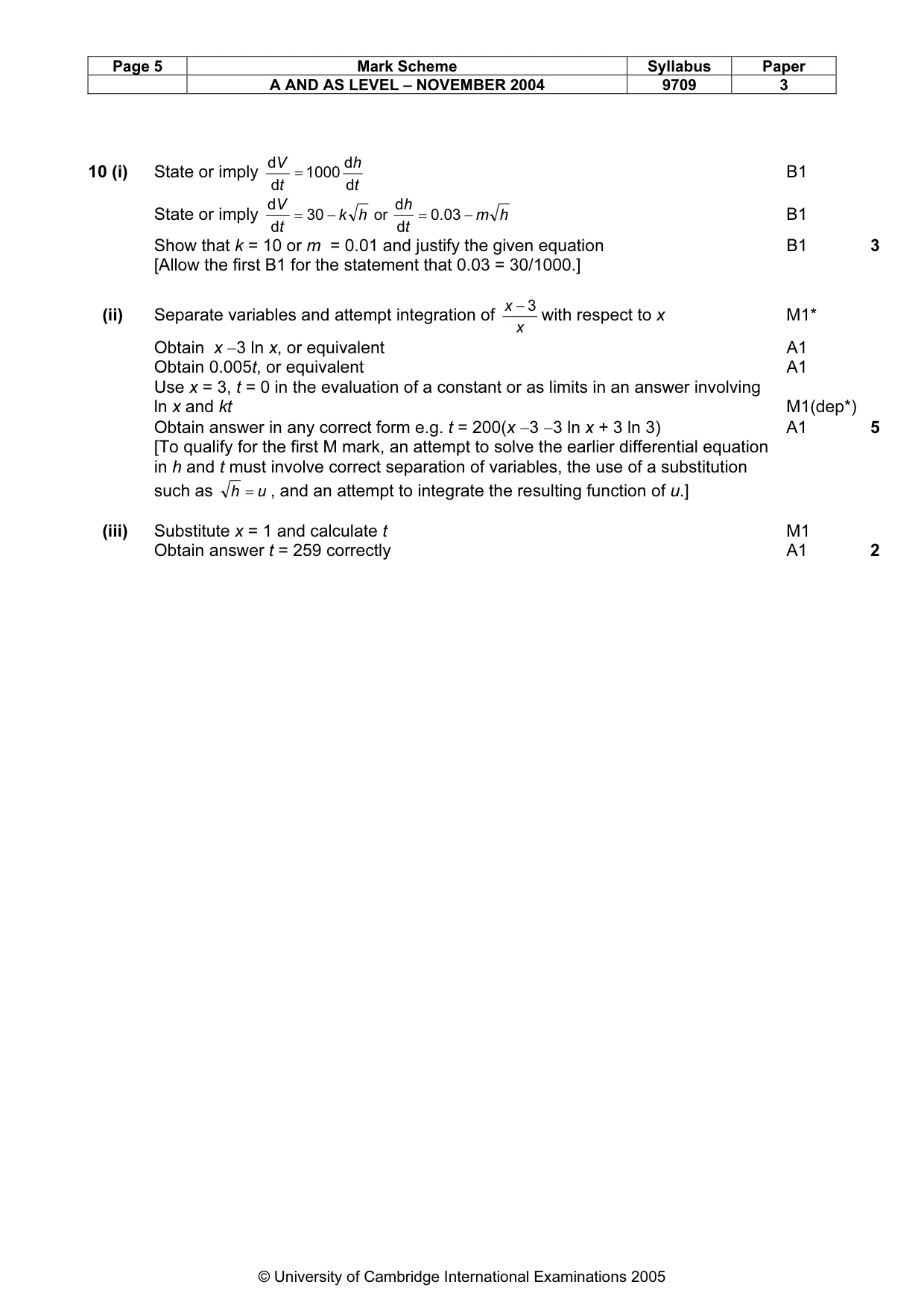
Mark scheme: d V d h 10 (i) State or imply = 1000 B1 d t d t d V d h State or imply = 30 − k h or = 0 . 03 − m h B1 d t d t Show that k = 10 or m = 0.01 and justify the given equation B1 3 [Allow the first B1 for the statement that 0.03 = 30/1000.] x − 3 (ii) Separate variables and attempt integration of with respect to x M1* x Obtain x −3 ln x, or equivalent A1 Obtain 0.005t, or equivalent A1 Use x = 3, t = 0 in the evaluation of a constant or as limits in an answer involving ln x and kt M1(dep*) Obtain answer in any correct form e.g. t = 200(x −3 −3 ln x + 3 ln 3) A1 5 [To qualify for the first M mark, an attempt to solve the earlier differential equation in h and t must involve correct separation of variables, the use of a substitution such as h = u , and an attempt to integrate the resulting function of u.] (iii) Substitute x = 1 and calculate t M1 Obtain answer t = 259 correctly A1 2
What was in this paper
The subtopics covered by these 10 questions, and how many questions each got. Open one in a new tab to see every Cambridge question on it.