Questions as text
Q1 · A m 1.5 ° O B A uniform rigid wire AB is in the form of a circular arc of radius 1.5 m… 9709/51 May/June 2008
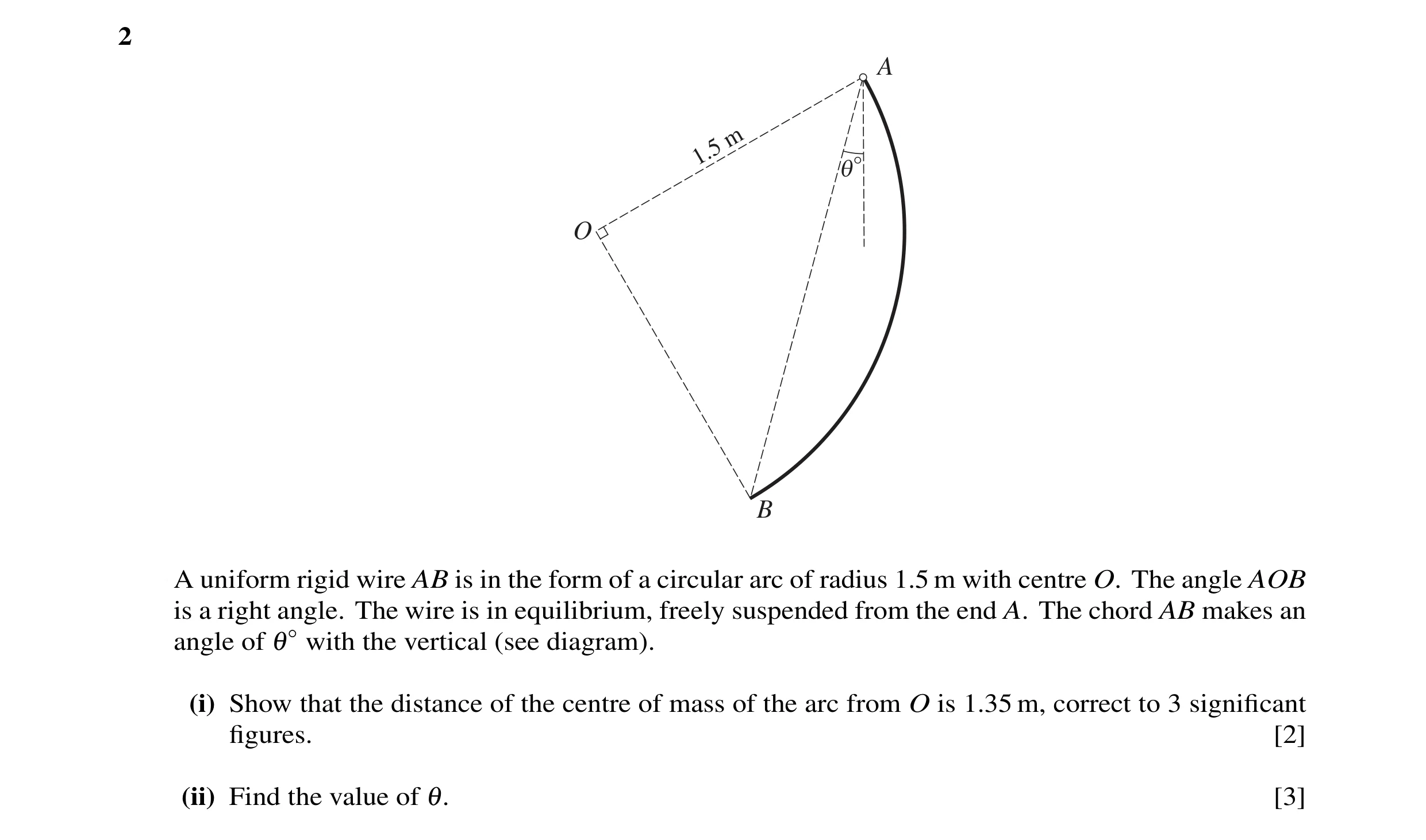
2 A m 1.5 ° O B A uniform rigid wire AB is in the form of a circular arc of radius 1.5 m with centre O. The angle AOB is a right angle. The wire is in equilibrium, freely suspended from the end A. The chord AB makes an angle of θ◦with the vertical (see diagram). (i) Show that the distance of the centre of mass of the arc from O is 1.35 m, correct to 3 significant figures. [2] (ii) Find the value of θ. [3]
5 marks
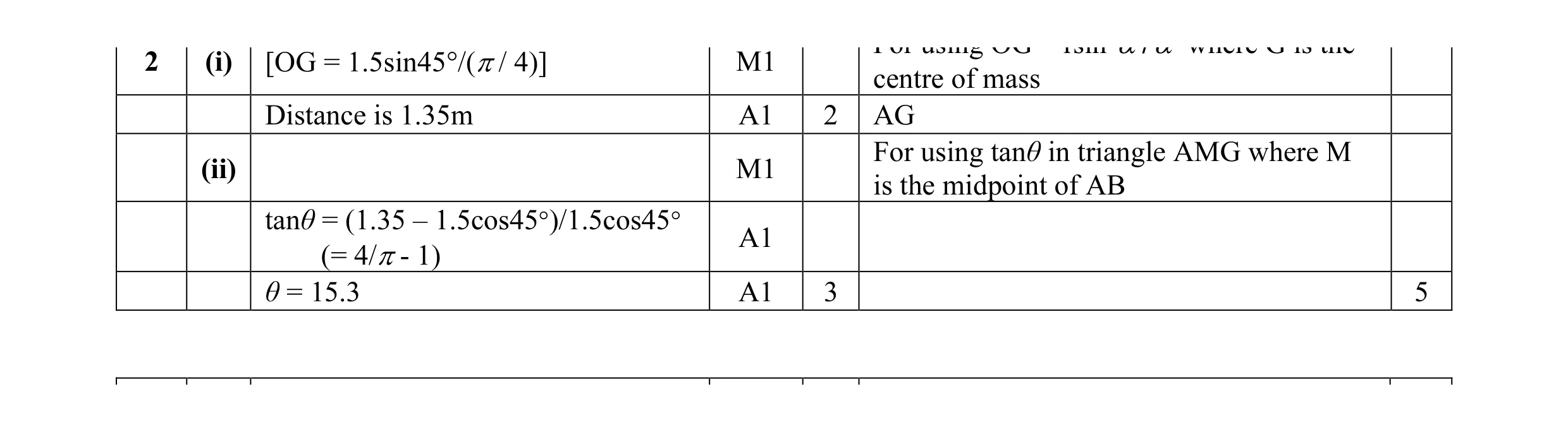
Mark scheme: For using OG rsin α / α where G is the 2 (i) [OG = 1.5sin45°/(π / 4)] M1 centre of mass Distance is 1.35m A1 2 AG For using tanθ in triangle AMG where M (ii) M1 is the midpoint of AB tanθ = (1.35 – 1.5cos45°)/1.5cos45° A1 (= 4/π - 1) θ = 15.3 A1 3 5
This question in 9709/51 May/June 2008
Q2 · A small stone is projected from a point O on horizontal ground with speed V m s−1 at an… 9709/51 May/June 2009
5 A small stone is projected from a point O on horizontal ground with speed V m s−1 at an angle θ◦ above the horizontal. Referred to horizontal and vertically upwards axes through O, the equation of the stone’s trajectory is y = 0.75x −0.02x2, where x and y are in metres. Find (i) the values of θ and V, [4] (ii) the distance from O of the point where the stone hits the ground, [2] (iii) the greatest height reached by the stone. [2]
8 marks
Mark scheme: 5 (i) M1 For using tanθ = 0.75 θ = 36.9 A1 g [10/(2x0.82V2) = 0.02] M1 For using 2 2 =0.02 2V cos θ V = 19.8 A1 4 (ii) [x(0.75 – 0.02x) = 0] M1 For solving y = 0 or using R = V2sin2θ /g Distance is 37.5 m A1 2 (iii) [ymax = 0.75x18.75 – 0.02x18.752] M1 For using y is greatest when x = R/2 or H = V2sin2 θ /2g Greatest height is 7.03 m A1 2 Ft 0.375R – 0.005R2 [8] GCE A/AS LEVEL – May/June 2009 9709 05
This question in 9709/51 May/June 2009
Q3 · 20 cm 46 cm 2 cm 32 cm A bucket that consists of three parts stands on horizontal ground 9709/52 Oct/Nov 2009
2 20 cm 46 cm 2 cm 32 cm A bucket that consists of three parts stands on horizontal ground. The base is in the form of a uniform circular disc of diameter 32 cm and thickness 2 cm. The body is in the form of a uniform hollow cylinder of outer diameter 32 cm and height 46 cm. The handle is in a vertical plane, attached at opposite ends of an outer diameter at the top of the cylinder. The handle is in the form of a uniform circular arc of radius 20 cm. The diagram shows the cross-section of the bucket in the plane of the handle. (i) Show that the centre of mass of the handle is 53.25 cm above the ground, correct to 4 significant figures. [3] The weights of the base, body and handle are 50 N, 100 N and 25 N respectively. (ii) Find the height of the centre of mass of the bucket above the ground. [2]
5 marks
Mark scheme: 2 (i) [ y handle is 20 × 0.8/0.927.. from centre M1 For using y = rsin α ÷ α (17.25)] Centre of arc is 12 cm below top of B1 cylinder Height = 2 + 46 – 12 + 17.25 = 53.25 cm A1 3 AG (ii) [(50 + 100 + 25) y = M1 For taking moments about the base 50 × 1 + 100 × 25 + 25 × 53.25] Height is 22.2 cm A1 2 5
This question in 9709/52 Oct/Nov 2009
Q4 · 30 cm cm r 35° A uniform solid cone has height 30 cm and base radius r cm 9709/51 May/June 2010
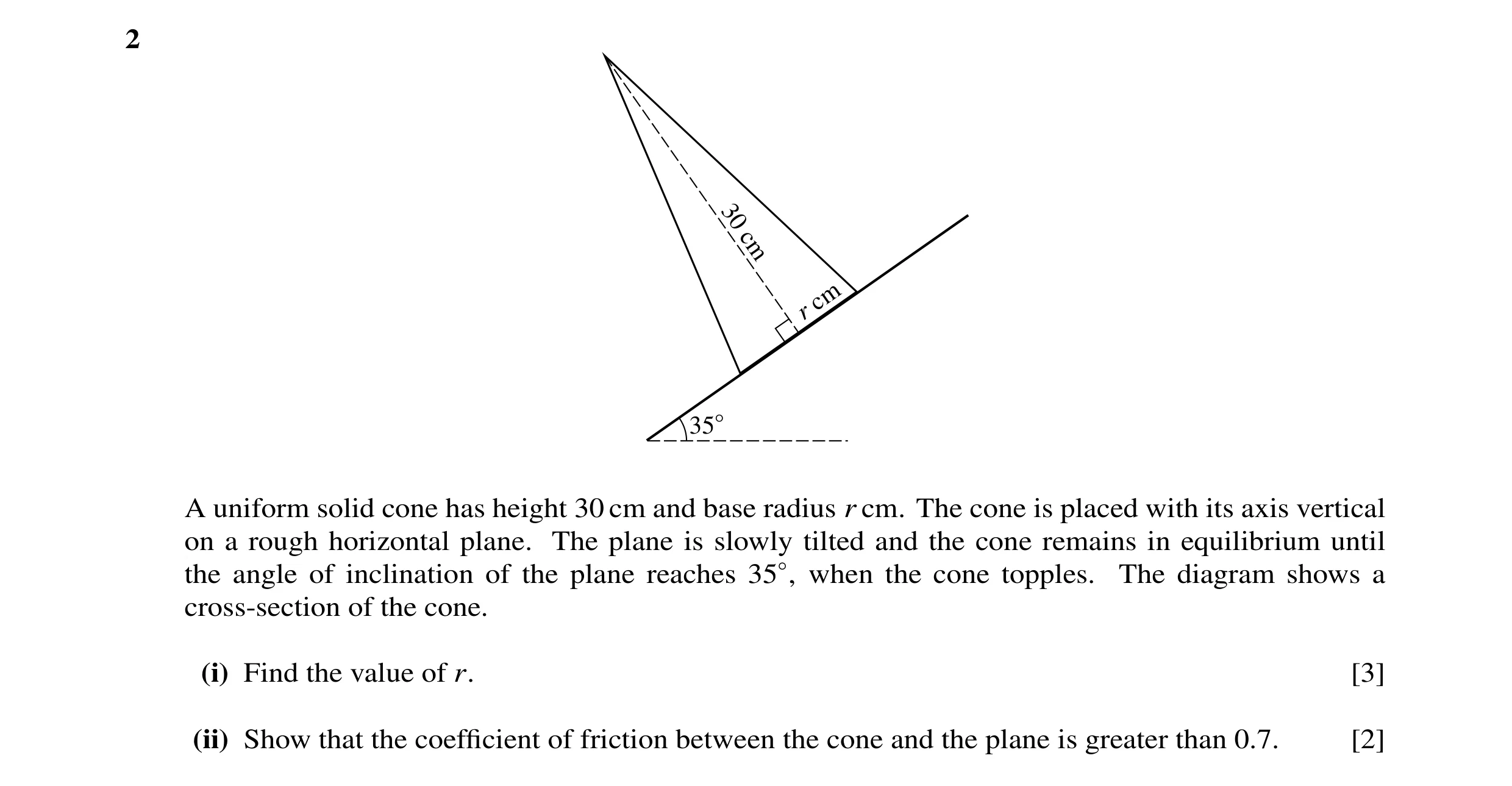
2 30 cm cm r 35° A uniform solid cone has height 30 cm and base radius r cm. The cone is placed with its axis vertical on a rough horizontal plane. The plane is slowly tilted and the cone remains in equilibrium until the angle of inclination of the plane reaches 35◦, when the cone topples. The diagram shows a cross-section of the cone. (i) Find the value of r. [3] (ii) Show that the coefficient of friction between the cone and the plane is greater than 0.7. [2]
5 marks
Mark scheme: 2 (i) M1 For using the idea that the c.m. is vertically above the lowest point of contact tan35° = r/7.5 A1ft ft using their c of m from the base r = 5.25 A1 [3] (ii) [µmgcos35° > mgsin35°] M1 For using ‘no sliding → µR > weight component’ µ > tan35° → Coefficient is greater than 0.7 A1 Do not allow µ [ 0.7 [2] AG 2
This question in 9709/51 May/June 2010
Q5 · A particle is projected from a point O on horizontal ground 9709/51 May/June 2010
5 A particle is projected from a point O on horizontal ground. The velocity of projection has magnitude 20 m s−1 and direction upwards at an angle θ to the horizontal. The particle passes through the point which is 7 m above the ground and 16 m horizontally from O, and hits the ground at the point A. (i) Using the equation of the particle’s trajectory and the identity sec2θ = 1 + tan2θ, show that the possible values of tan θ are 34 and 174 . [4] (ii) Find the distance OA for each of the two possible values of tan θ. [3] (iii) Sketch in the same diagram the two possible trajectories. [2]
9 marks
Mark scheme: 5 (i) 7 = 16tanθ – 10×162/(2×202)cos2θ B1 [7 = 16T – 3.2(1 + T2)] M1 For using cosθ = 1/secθ and the given identity to obtain a quadratic in T(tanθ) 3.2T2 – 16T + 10.2 = 0 A1 AEF T = ¾, 17/4 A1 AG [4] (ii) [x = tanθ cos2θ/0.0125 or x = 202sin2θ/g] M1 For solving y = 0 for x or for using R = V2sin2θ/g For tanθ = 0.75, distance is 38.4 m A1 For tanθ = 4.25, distance is 17.8 m A1 [3] (iii) For sketching two parabolic arcs which intersect B1 once, both starting at the origin, each with y [ 0 throughout, and each returning to the x-axis, the arc for which the angle of projection is smaller having the greater range. The ranges appear significantly greater than x at the B1 intersection, and slightly greater, respectively. [2] 2 2 1/2
This question in 9709/51 May/June 2010
Q6 · Two particles P and Q are projected simultaneously with speed 40 m s−1 from a point O on… 9709/53 May/June 2010
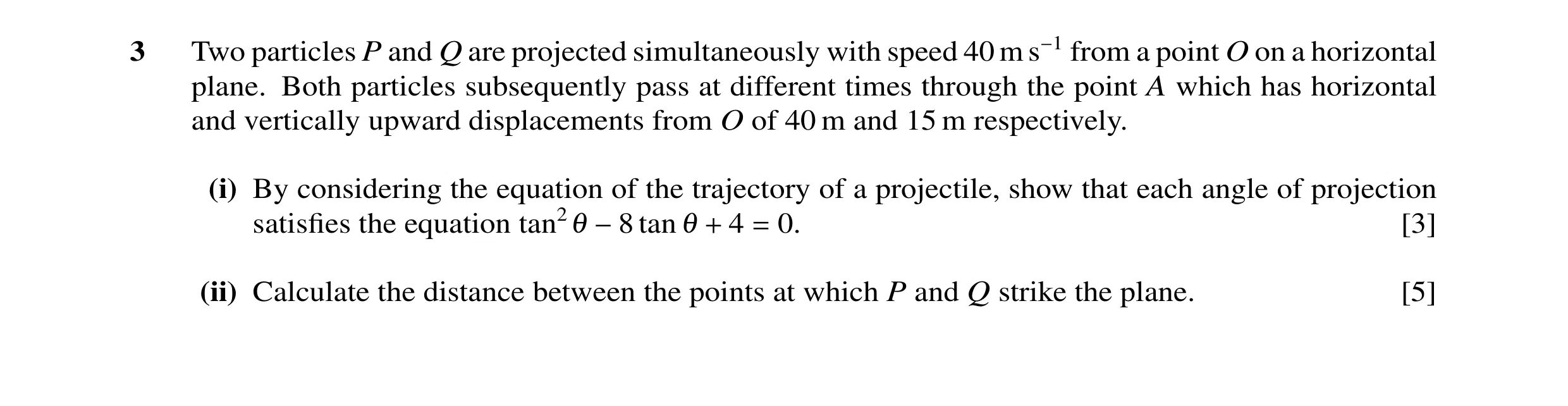
3 Two particles P and Q are projected simultaneously with speed 40 m s−1 from a point O on a horizontal plane. Both particles subsequently pass at different times through the point A which has horizontal and vertically upward displacements from O of 40 m and 15 m respectively. (i) By considering the equation of the trajectory of a projectile, show that each angle of projection satisfies the equation tan2θ −8 tan θ + 4 = 0. [3] (ii) Calculate the distance between the points at which P and Q strike the plane. [5]
8 marks
Mark scheme: 3 (i) 15 = 40tanθ – g402/(2×402cos2θ) M1θ Substitutes in projectile equation 15 = 40tanθ – 5sec2θ M1θ Uses sec2θ = 1 + tan2θ tan2θ – 8tanθ + 4 = 0 AG A1θ [3] (ii) θ = tan–1 (4 +/– 2 3 ) M1 Solves quadratic equation for θ θ = 28.2° or 82.4° A1 R = 402sin(2×28.2°)/g or M1 Valid formula for one range R = 402sin(2×82.4°)/g 0 = Rtan28.2° – gR2/(2×402cos28.2°) or 0 = rtan82.4° –gr2/(2×402cos82.4°) R = 133 or R = 41.9 (or 42.0) A1 Difference = 91.1 m A1 Using exact angles. Allow +/– 0.2 [5]
This question in 9709/53 May/June 2010
Q7 · A 0.6 m O 0.6 m B AOB is a uniform lamina in the shape of a quadrant of a circle with… 9709/51 May/June 2011
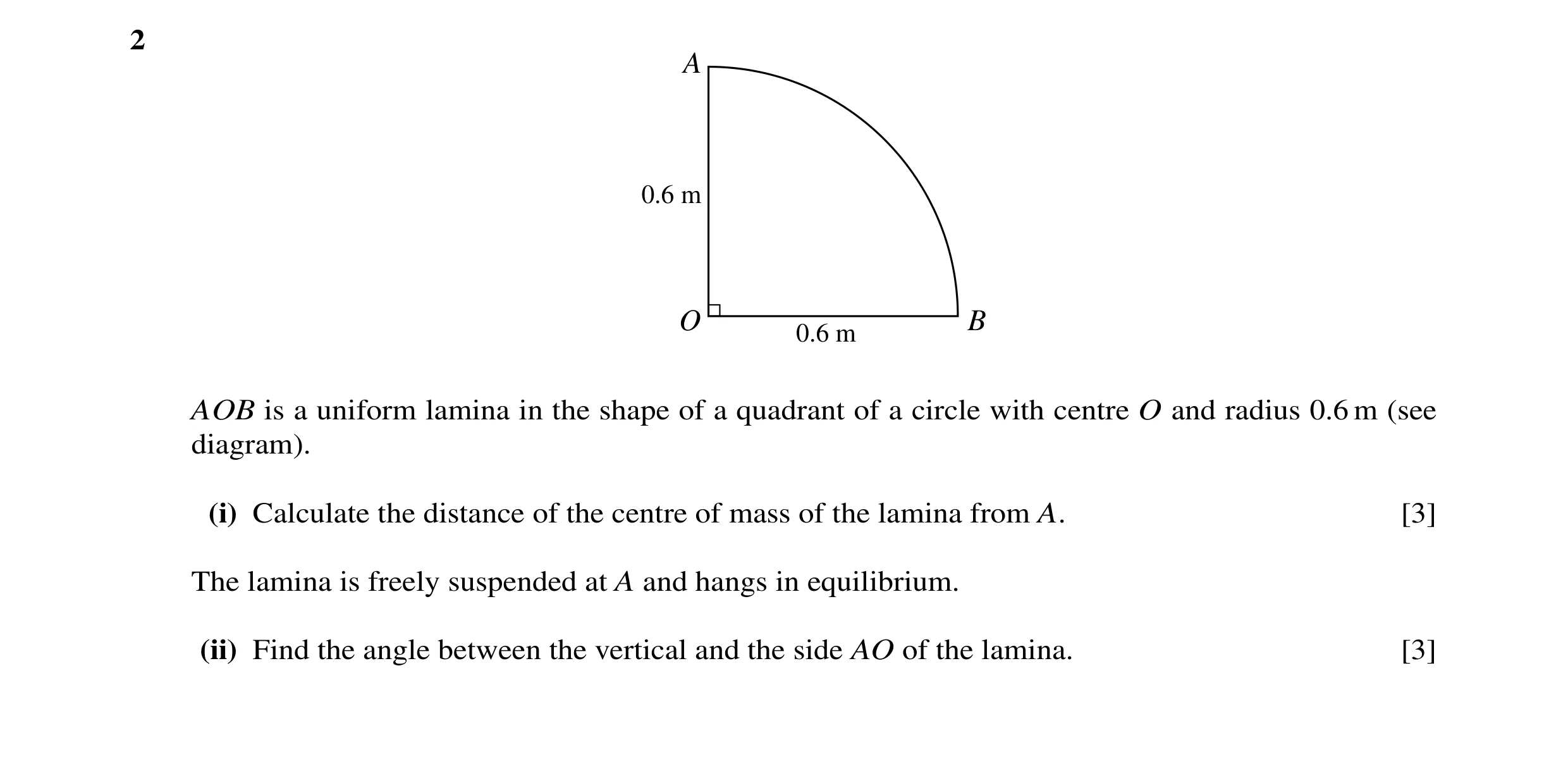
2 A 0.6 m O 0.6 m B AOB is a uniform lamina in the shape of a quadrant of a circle with centre O and radius 0.6 m (see diagram). (i) Calculate the distance of the centre of mass of the lamina from A. [3] The lamina is freely suspended at A and hangs in equilibrium. (ii) Find the angle between the vertical and the side AO of the lamina. [3]
6 marks
Mark scheme: 2 (i) x = 2 × 0.6sin(π /4)/(3π /4) [= 0.36(0)] B1 Centre of mass from O d 2 = 0.6 2 +0.36 2 – 2 × 0.6 × 0.36cos(π /4) M1 d = 0.429 A1 [3] (ii) M1 sinα /0.36 = sin(π /4)/0.429 A1 α = 36.4 o or 0.635c A1 [3]
This question in 9709/51 May/June 2011
Q8 · A uniform solid cylinder has radius 0.7 m and height h m 9709/51 Oct/Nov 2011
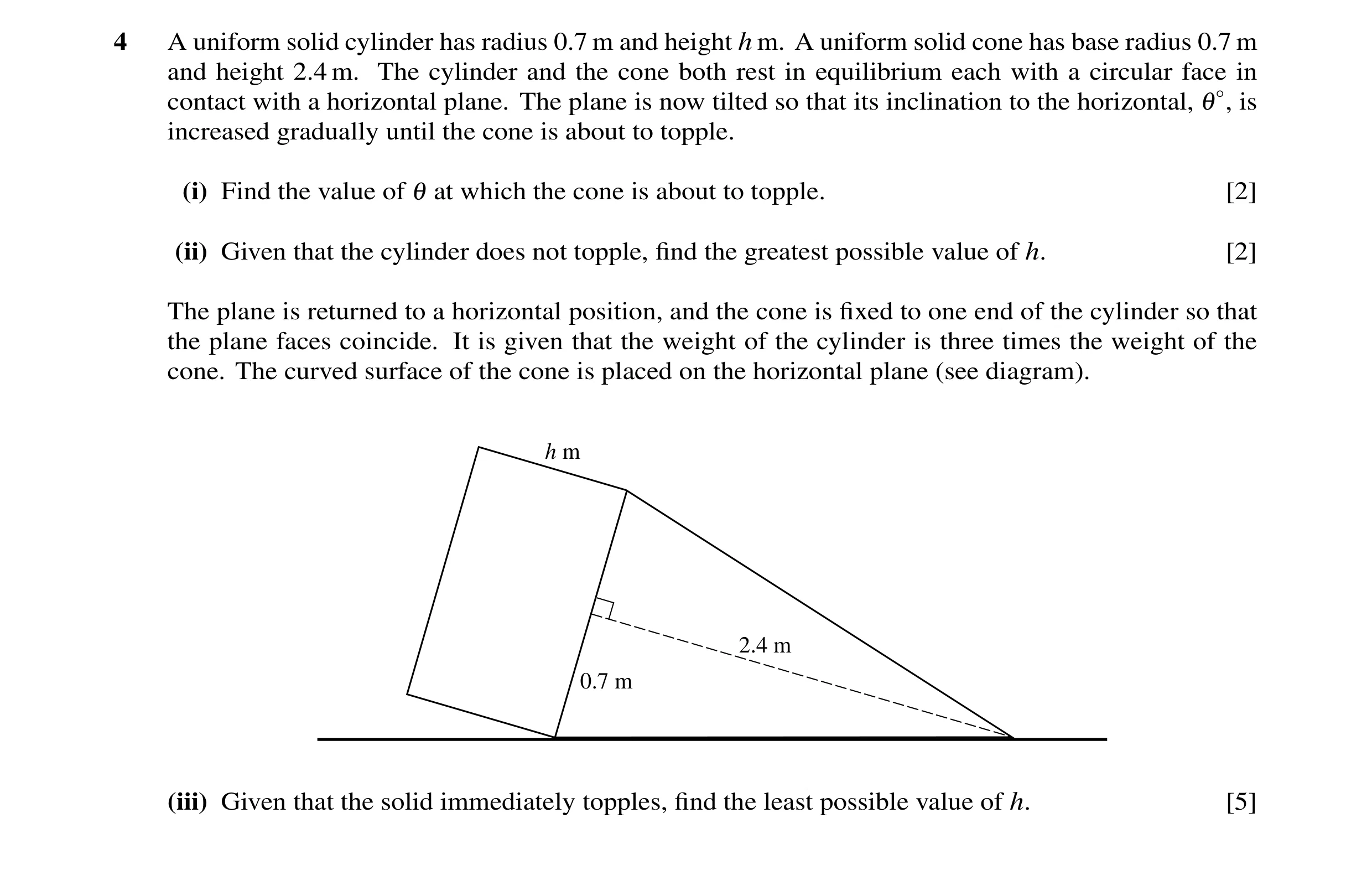
4 A uniform solid cylinder has radius 0.7 m and height h m. A uniform solid cone has base radius 0.7 m and height 2.4 m. The cylinder and the cone both rest in equilibrium each with a circular face in contact with a horizontal plane. The plane is now tilted so that its inclination to the horizontal, θ◦, is increased gradually until the cone is about to topple. (i) Find the value of θ at which the cone is about to topple. [2] (ii) Given that the cylinder does not topple, find the greatest possible value of h. [2] The plane is returned to a horizontal position, and the cone is fixed to one end of the cylinder so that the plane faces coincide. It is given that the weight of the cylinder is three times the weight of the cone. The curved surface of the cone is placed on the horizontal plane (see diagram). h m 2.4 m 0.7 m (iii) Given that the solid immediately topples, find the least possible value of h. [5]
9 marks
Mark scheme: 4 (i) tanθ = 0.7/(2.4/4) M1 θ = 49.4º A1 [2] (ii) h/2 = 2.4/4 M1 h = 1.2 A1 [2] GCE AS/A LEVEL – October/November 2011 9709 51 (iii) M1 Table of values idea, accept w = 1 4wVG = w × 2.4 × 3/4 + 3w(2.4 + h/2) A1 M1 Centre of mass above common circumference VG = [√(0.72 + 2.42)]/cosα A1 cosα = 2.4/2.5 = 0.96 h = 0.944 A1 [5]
This question in 9709/51 Oct/Nov 2011
Q9 · A uniform solid cylinder has radius 0.7 m and height h m 9709/52 Oct/Nov 2011
4 A uniform solid cylinder has radius 0.7 m and height h m. A uniform solid cone has base radius 0.7 m and height 2.4 m. The cylinder and the cone both rest in equilibrium each with a circular face in contact with a horizontal plane. The plane is now tilted so that its inclination to the horizontal, θ◦, is increased gradually until the cone is about to topple. (i) Find the value of θ at which the cone is about to topple. [2] (ii) Given that the cylinder does not topple, find the greatest possible value of h. [2] The plane is returned to a horizontal position, and the cone is fixed to one end of the cylinder so that the plane faces coincide. It is given that the weight of the cylinder is three times the weight of the cone. The curved surface of the cone is placed on the horizontal plane (see diagram). h m 2.4 m 0.7 m (iii) Given that the solid immediately topples, find the least possible value of h. [5]
9 marks
Mark scheme: 4 (i) tanθ = 0.7/(2.4/4) M1 θ = 49.4º A1 [2] (ii) h/2 = 2.4/4 M1 h = 1.2 A1 [2] GCE AS/A LEVEL – October/November 2011 9709 52 (iii) M1 Table of values idea, accept w = 1 4wVG = w × 2.4 × 3/4 + 3w(2.4 + h/2) A1 M1 Centre of mass above common circumference VG = [√(0.72 + 2.42)]/cosα A1 cosα = 2.4/2.5 = 0.96 h = 0.944 A1 [5]
This question in 9709/52 Oct/Nov 2011
Q10 · The equation of the trajectory of a projectile is y = 0.6x −0.017x2, referred to… 9709/53 May/June 2012
7 The equation of the trajectory of a projectile is y = 0.6x −0.017x2, referred to horizontal and vertically upward axes through the point of projection. (i) Find the angle of projection of the projectile, and show that the initial speed is 20 m s−1. [3] (ii) Find the speed and direction of motion of the projectile when it is at a height of 5.2 m above the level of the point of projection for the second time. [7]
10 marks
Mark scheme: 7 (i) θ = 31(.0)° B1 θ = tan–10.6 0.017 = 10/[2(vcos31)]2 M1 v = 20 AG A1 [3] (ii) v2 = M1 Accept v2 = 202 – 2g × 5.2 (20cos31)2 + [(20sin31)2 – 2g × 5.2] v = 17.2 ms–1 A1 0.017x2 – 0.6x + 5.2 = 0 M1 Solves 3 term quadratic equation x = 20 A1 Ignore smaller root if shown dy/dx = 0.6 – 0.017(2x) M1 tan α = 0.6 – 0.017(2 × 20) A1 α = 4.6° below the horizontal A1 [7] 4.57° OR 7 (i) θ = 31(.0)° B1 θ = tan–10.6 0.017 = 10/[2(vcos31)]2 M1 v = 20 AG A1 [3] (ii) 5.2 = 20sin31 –10t2/2 M1 Sets up and solves a 3 term quadratic equation t = 1.17 (t = 1.166..) A1 Ignore smaller root if shown v vert = (–)1.37(2) A1 From v = 20sin31 – 10t v2 = 17.1(5)2 + 1.37(2)2 M1 Or uses method in (ii) above 17.1(5) is horizontal velocity component v = 17.2 ms–1 A1 tan α = 1.37(2)/17.1(5) M1 α = 4.6° below the horizontal A1 [7] 4.57° [10]
This question in 9709/53 May/June 2012
Q11 · A particle P is projected with speed 35 m s−1 from a point O on a horizontal plane 9709/51 Oct/Nov 2016
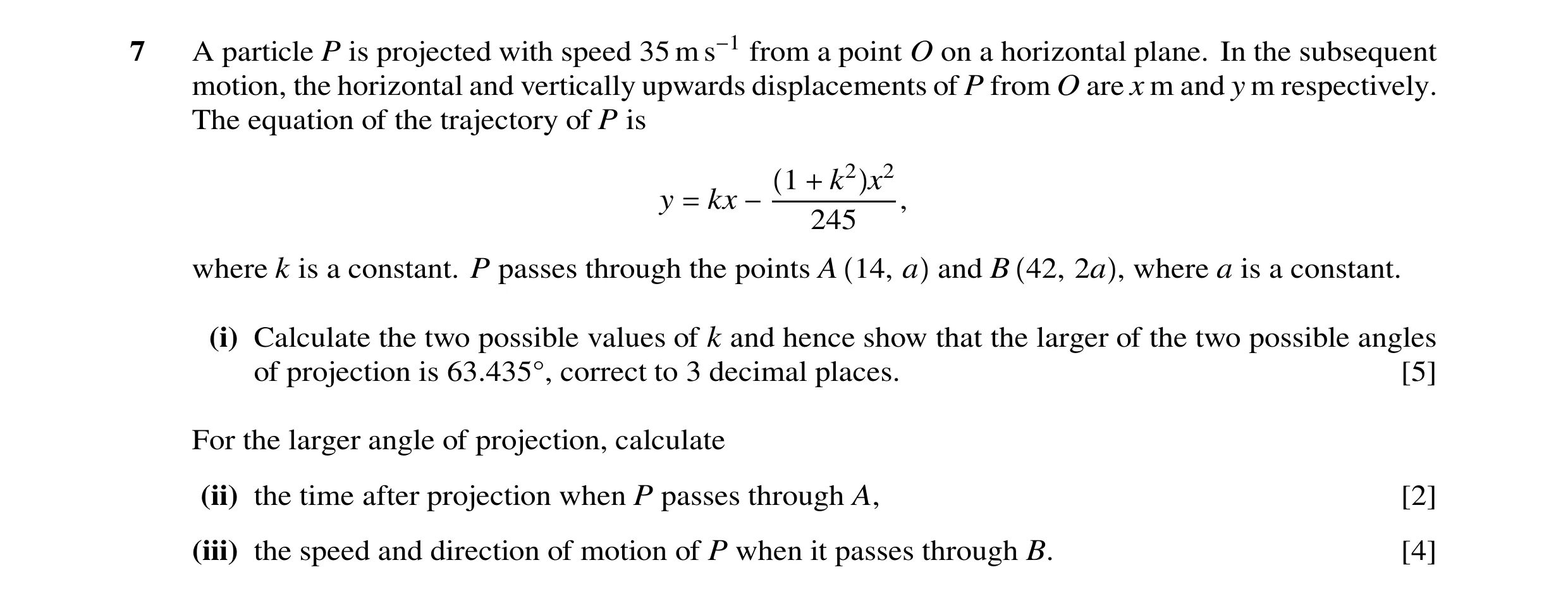
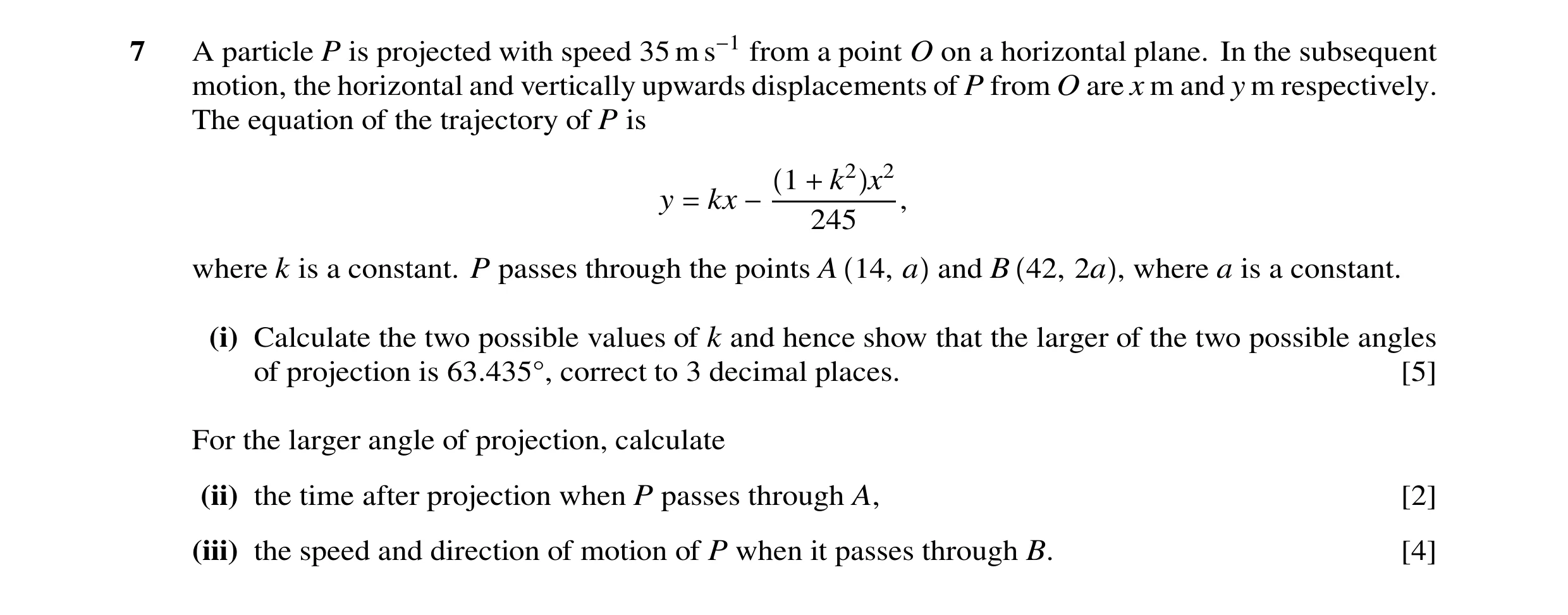
7 A particle P is projected with speed 35 m s−1 from a point O on a horizontal plane. In the subsequent motion, the horizontal and vertically upwards displacements of P from O are x m and y m respectively. The equation of the trajectory of P is 1 + k2 x2 y = kx − , 245 where k is a constant. P passes through the points A 14, a and B 42, 2a , where a is a constant. (i) Calculate the two possible values of k and hence show that the larger of the two possible angles of projection is 63.435Å, correct to 3 decimal places. [5] For the larger angle of projection, calculate (ii) the time after projection when P passes through A, [2] (iii) the speed and direction of motion of P when it passes through B. [4]
11 marks
Mark scheme: 7 (i) a = 14k – 0.8(1 + k2) and M1 Creates 2 simultaneous equations 2a = 42k – 7.2(1 + k2) 42k – 7.2(1 + k2) = 2[14k – 0.8(1 + k2)] M1 Creates a single equation in k k = 1/2 and 2 B1 Both values θ = tan–1k M1 With 1 of the candidates value of k θ= 63.435 AG A1 5 (ii) t = 14/(35cos63.435) M1 t (= 0.89442..) = 0.894 s A1 2 (iii) Vv = 35sin63.4 – g[42/(35cos63.4)] M1 Vv = 4.495 tanα = 4.495/(35cos63.4) α = 15.9° above the horizontal A1 Accept 16(.0)° V 2 = 4.4952 + (35cos63.4)2 M1 V = 16.3 m s–1 A1 4 OR 2a = 48 M1 42 x 2 – 7.2(1 + 22) V 2 = 352 – 2g x 48 V = 16.3 m s–1 A1 cosα= 35cos63.435/16.3 M1 α = 15.9° A1 4
This question in 9709/51 Oct/Nov 2016
Q12 · A particle P is projected with speed 35 m s−1 from a point O on a horizontal plane 9709/53 Oct/Nov 2016
7 A particle P is projected with speed 35 m s−1 from a point O on a horizontal plane. In the subsequent motion, the horizontal and vertically upwards displacements of P from O are x m and y m respectively. The equation of the trajectory of P is 1 + k2 x2 y = kx − , 245 where k is a constant. P passes through the points A 14, a and B 42, 2a , where a is a constant. (i) Calculate the two possible values of k and hence show that the larger of the two possible angles of projection is 63.435Å, correct to 3 decimal places. [5] For the larger angle of projection, calculate (ii) the time after projection when P passes through A, [2] (iii) the speed and direction of motion of P when it passes through B. [4]
11 marks
Mark scheme: 7 (i) a = 14k – 0.8(1 + k2) and M1 Creates 2 simultaneous equations 2a = 42k – 7.2(1 + k2) 42k – 7.2(1 + k2) = 2[14k – 0.8(1 + k2)] M1 Creates a single equation in k k = 1/2 and 2 B1 Both values θ = tan–1k M1 With 1 of the candidates value of k θ= 63.435 AG A1 5 (ii) t = 14/(35cos63.435) M1 t (= 0.89442..) = 0.894 s A1 2 (iii) Vv = 35sin63.4 – g[42/(35cos63.4)] M1 Vv = 4.495 tanα = 4.495/(35cos63.4) α = 15.9° above the horizontal A1 Accept 16(.0)° V 2 = 4.4952 + (35cos63.4)2 M1 V = 16.3 m s–1 A1 4 OR 2a = 48 M1 42 x 2 – 7.2(1 + 22) V 2 = 352 – 2g x 48 V = 16.3 m s–1 A1 cosα= 35cos63.435/16.3 M1 α = 15.9° A1 4
This question in 9709/53 Oct/Nov 2016
Q13 · A particle P is projected from a point O with speed V m s−1 9709/52 May/June 2017
7 A particle P is projected from a point O with speed V m s−1. At time t s after projection the horizontal and vertically upwards displacements of P from O are x m and y m respectively. The equation of the trajectory of P is y = 2x −25x2 . V2 (i) Write down the value of tan 1, where 1 is the angle of projection of P. [1] … … When t = 4, P passes through the point A where x = y = a. (ii) Calculate V and a. [5] … … … … … … … … … … … … … … … … … … … … … … … … … (iii) Find the direction of motion of P when it passes through A. [3] … … … … … … … … … … … … … … … … …
9 marks
Mark scheme: 7(i) Total: 1 Question Answer Marks Notes 7(ii) EITHER: a = 2a – 25 2 a / 2 V (25a = 2 V ) (B1 Substitutes x = y = a into the trajectory equation a = Vcos63.4349.. × 4 B1 Horizontal motion 2 V = 25 × 4 × Vcos63.4349.. M1 Attempts to eliminate a V = 44.7(213..) or 20 5 A1 a = 80 A1) OR: a = Vsin63.4349..× 4 – g 2 4 /2 (B1 Uses s = ut + a 2t / 2 vertically a = Vcos63.4349..× 4 B1 Horizontal motion Vsin63.4349..× 4 − g 2 4 / 2 = Vcos63.4349..× 4 M1 Attempts to solve the 2 equations V = 44.7(213..)or 20 5 A1 a = 80 A1) Total: 5 7(iii) vv = 44.7213..sin63.4349.. – 4g ( = 0) M1 vv = vertical component of the velocity α = 1 tan−+/− 0 / (44.7213..cos63.4349..) M1 tanα = vv / hv where hv = horizontal velocity α = 0° A1 Total: 3
This question in 9709/52 May/June 2017
Q14 · A 1 a B x C ABC is an object made from a uniform wire consisting of two straight portions… 9709/52 May/June 2018
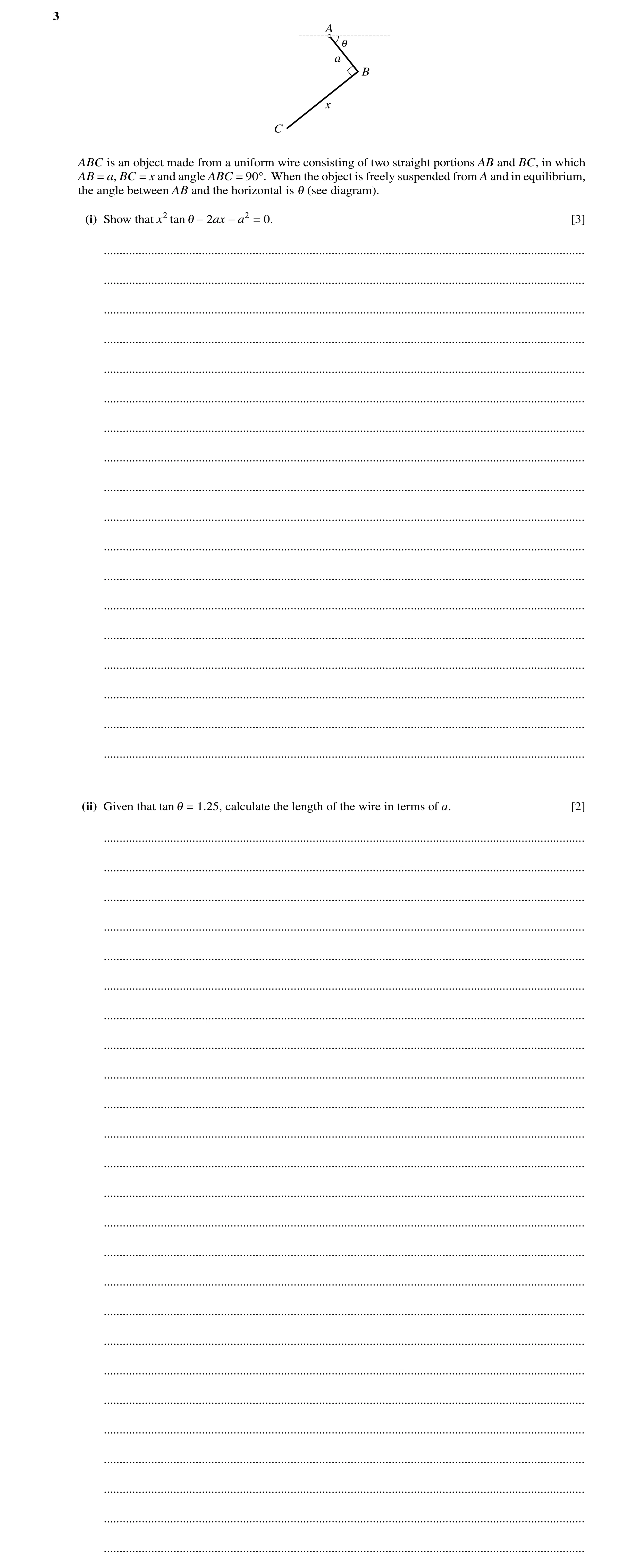
3 A 1 a B x C ABC is an object made from a uniform wire consisting of two straight portions AB and BC, in which AB = a, BC = x and angle ABC = 90Å. When the object is freely suspended from A and in equilibrium, the angle between AB and the horizontal is 1 (see diagram). (i) Show that x2 tan 1 −2ax −a2 = 0. [3] … … … … … … … … … … … … … … … … … … (ii) Given that tan 1 = 1.25, calculate the length of the wire in terms of a. [2] … … … … … … … … … … … … … … … … … … … … … … … … …
5 marks
Mark scheme: 3(i) B1 Note d is the distance of the C of M of BC from the vertical through A a(acosθ)/2 = x(xsinθ/2 – acosθ) M1 Take moments about A 2 x tanθ – 2ax – 2 a = 0 AG A1 Total: 3 3(ii) 1.25 2 x – 2ax – 2 a = 0 [x = 2a and x = – 2a/5] M1 Attempts to solve the equation Length ( = 2a + a ) = 3a A1 Total: 2
This question in 9709/52 May/June 2018
Q15 · 24 m s−1 15Å 45Å O A small object is projected with speed 24 m s−1 from a point O at the… 9709/51 Oct/Nov 2018
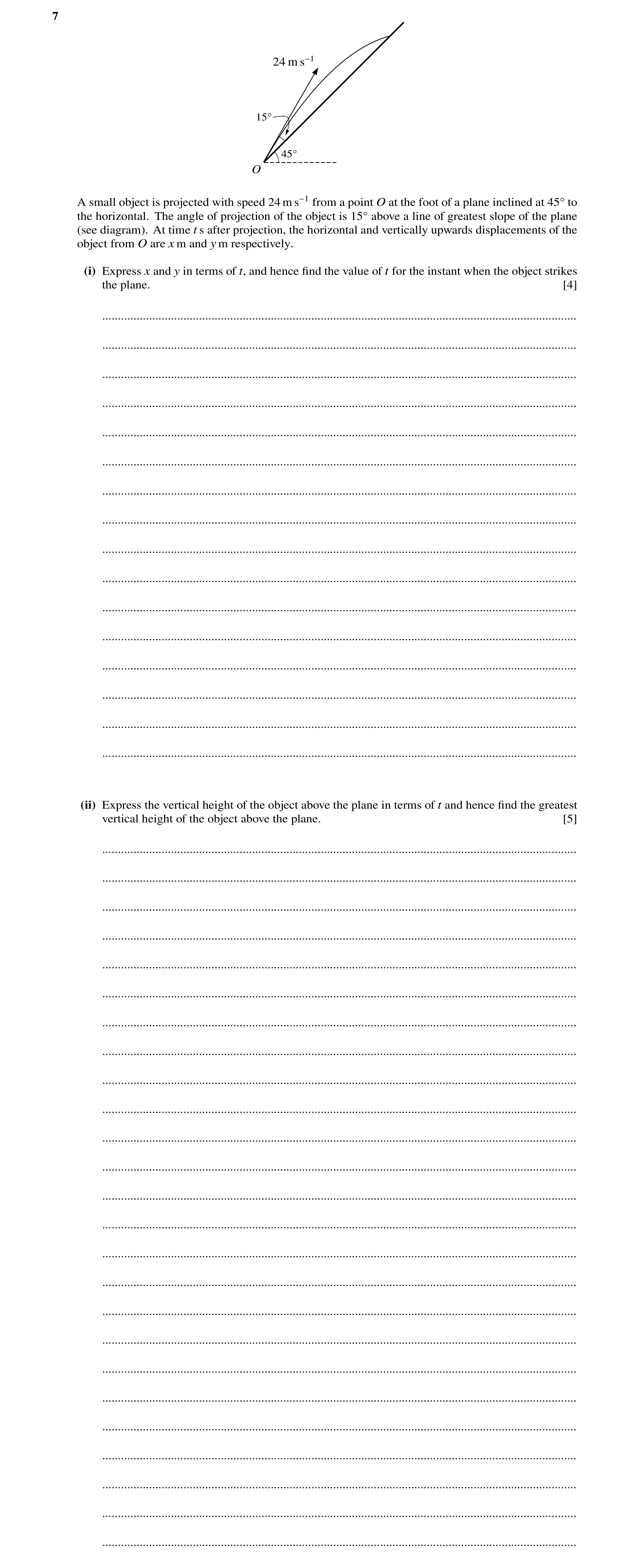
7 24 m s−1 15Å 45Å O A small object is projected with speed 24 m s−1 from a point O at the foot of a plane inclined at 45° to the horizontal. The angle of projection of the object is 15° above a line of greatest slope of the plane (see diagram). At time t s after projection, the horizontal and vertically upwards displacements of the object from O are x m and y m respectively. (i) Express x and y in terms of t, and hence find the value of t for the instant when the object strikes the plane. [4] … … … … … … … … … … … … … … … … (ii) Express the vertical height of the object above the plane in terms of t and hence find the greatest vertical height of the object above the plane. [5] … … … … … … … … … … … … … … … … … … … … … … … … … Additional Page If you use the following lined page to complete the answer(s) to any question(s), the question number(s) must be clearly shown. … … … … … … … … … … … … … … … … … … … … …
9 marks
Mark scheme: 7(i) x = (24cos60)t B1 Use horizontal motion y = (24sin60)t – gt 2/2 B1 Use vertical motion (24cos60)t = (24sin60)t –gt 2/2 M1 Recognise that x = y t = 1.76 A1 4 7(ii) h = (24sin60)t – gt 2/2 – (24cos60)t B1 M1 Attempt to differentiate dh/dt = 24(sin60 – cos60) – gt A1 24(sin60 – cos60) – gt = 0, t = 0.878(46..) M1 Equate dh/dt = 0 to find t h = 3.86 m A1 5
This question in 9709/51 Oct/Nov 2018
Q16 · A small ball is projected from a point O on horizontal ground 9709/52 Feb/March 2019
3 A small ball is projected from a point O on horizontal ground. At time t s after projection the horizontal and vertically upwards displacements of the ball from O are x m and y m respectively, where x = 4t and y = 6t −5t2. (i) Find the equation of the trajectory of the ball. [2] … … … … … … … … (ii) Hence or otherwise calculate the angle of projection of the ball and its initial speed. [4] … … … … … … … … … … … … … …
6 marks
Mark scheme: 3(i) x = 4t and y = 6t – 5 2t y [= 6x/4 – 5 2 ( / 4) x ] = 1.5x –5 2 x /16 or 1.5x – 0.3125 2 x A1 2 3(ii) tanθ = 1.5 M1 Use the trajectory equation from the formula sheet θ = 56.3° A1 2 2 V cos 56.3 =16 M1 Again use the trajectory equation V = 7.21 m s–1 A1 OR Vcosθ = 4 and Vsinθ =6 M1 Initial horizontal and vertical velocities 2 2 V cos θ + 2 2 2 4 θ = V sin + 2 6 OR tanθ = 6/4 M1 Use Pythagoras's theorem or trigonometry of a right angled triangle V = 7.21 m s–1 A1 θ = 56.3° A1 4
This question in 9709/52 Feb/March 2019
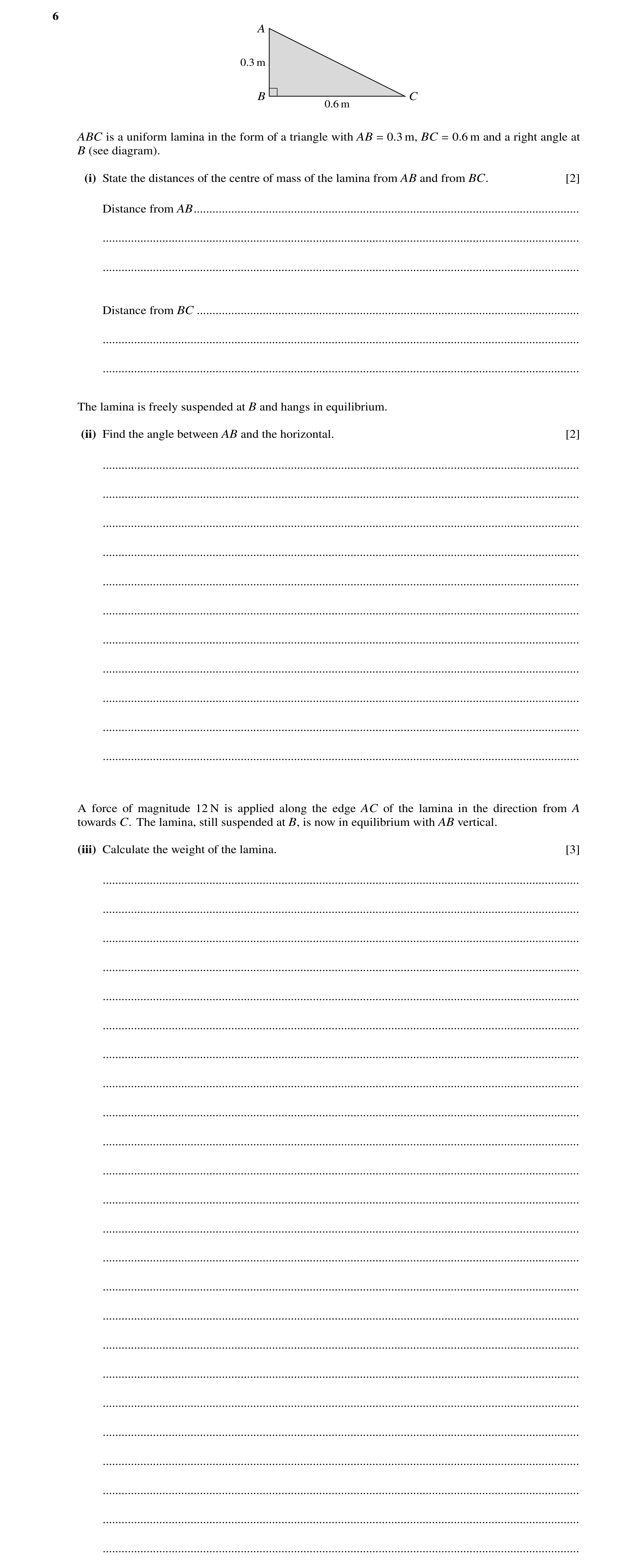
Q17 · A 0.3 m B C 0.6 m ABC is a uniform lamina in the form of a triangle with AB = 0.3 m, BC =… 9709/51 May/June 2019
6 A 0.3 m B C 0.6 m ABC is a uniform lamina in the form of a triangle with AB = 0.3 m, BC = 0.6 m and a right angle at B (see diagram). (i) State the distances of the centre of mass of the lamina from AB and from BC. [2] Distance from AB … … … Distance from BC … … … The lamina is freely suspended at B and hangs in equilibrium. (ii) Find the angle between AB and the horizontal. [2] … … … … … … … … … … … A force of magnitude 12 N is applied along the edge AC of the lamina in the direction from A towards C. The lamina, still suspended at B, is now in equilibrium with AB vertical. (iii) Calculate the weight of the lamina. [3] … … … … … … … … … … … … … … … … … … … … … … … …
7 marks
Mark scheme: 6(i) B1 From BC = 0.1 B1 2 6(ii) 0.1 tan 0.2 θ = M1 θ is the angle between AB and the horizontal θ = 26.6° A1 2 6(iii) 12cos26.6 × 0.3 = W × 0.2 M1A1 Take moments about B. (W is the weight of the lamina) W = 16.1 N A1 3
This question in 9709/51 May/June 2019
Q18 · A 0.3 m B C 0.6 m ABC is a uniform lamina in the form of a triangle with AB = 0.3 m, BC =… 9709/53 May/June 2019
6 A 0.3 m B C 0.6 m ABC is a uniform lamina in the form of a triangle with AB = 0.3 m, BC = 0.6 m and a right angle at B (see diagram). (i) State the distances of the centre of mass of the lamina from AB and from BC. [2] Distance from AB … … … Distance from BC … … … The lamina is freely suspended at B and hangs in equilibrium. (ii) Find the angle between AB and the horizontal. [2] … … … … … … … … … … … A force of magnitude 12 N is applied along the edge AC of the lamina in the direction from A towards C. The lamina, still suspended at B, is now in equilibrium with AB vertical. (iii) Calculate the weight of the lamina. [3] … … … … … … … … … … … … … … … … … … … … … … … …
7 marks
Mark scheme: 6(i) B1 From BC = 0.1 B1 2 6(ii) 0.1 tan 0.2 θ = M1 θ is the angle between AB and the horizontal θ = 26.6° A1 2 6(iii) 12cos26.6 × 0.3 = W × 0.2 M1A1 Take moments about B. (W is the weight of the lamina) W = 16.1 N A1 3
This question in 9709/53 May/June 2019
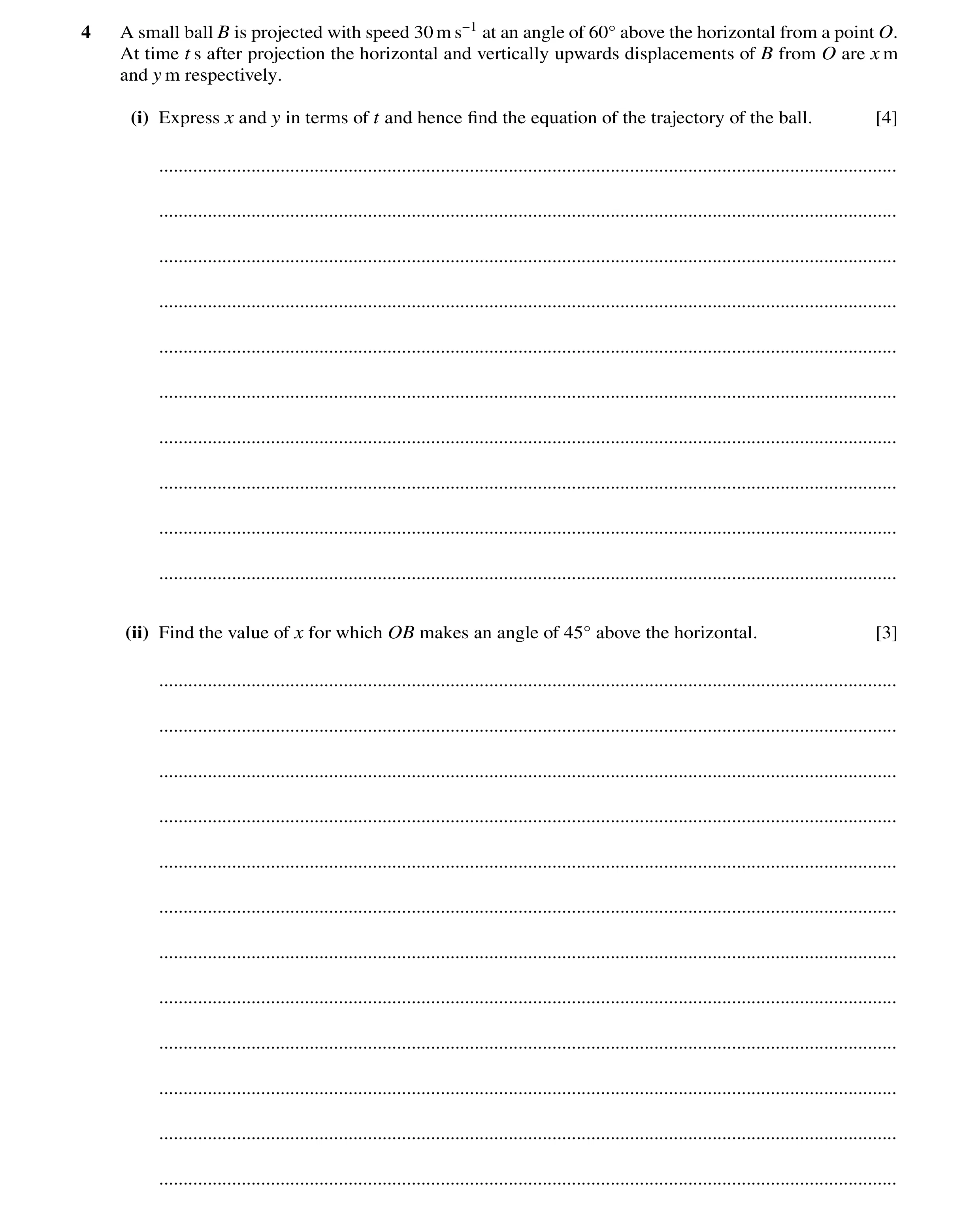
Q19 · A small ball B is projected with speed 30 m s−1 at an angle of 60Å above the horizontal… 9709/51 Oct/Nov 2019
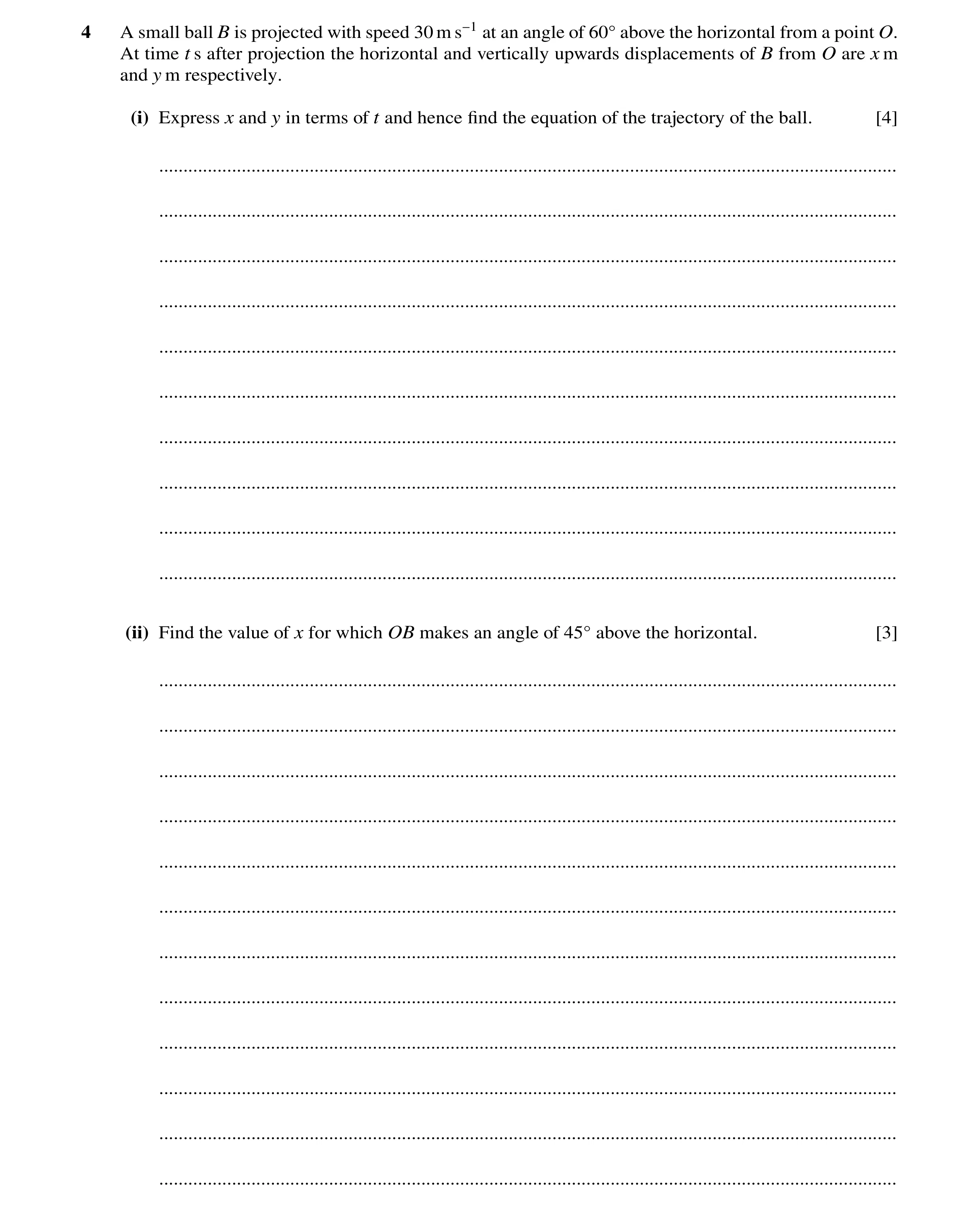
4 A small ball B is projected with speed 30 m s−1 at an angle of 60Å above the horizontal from a point O. At time t s after projection the horizontal and vertically upwards displacements of B from O are x m and y m respectively. (i) Express x and y in terms of t and hence find the equation of the trajectory of the ball. [4] … … … … … … … … … … (ii) Find the value of x for which OB makes an angle of 45Å above the horizontal. [3] … … … … … … … … … … … …
7 marks
Mark scheme: 4(i) B1 Use horizontal motion y = 30sin60t – 2 2 gt B1 Use s = ut + 2 2 gt vertically 2 2 30sin60 5 30cos60 (30cos60) = − x x y M1 Attempt to eliminate t y = 1.73x – 0.0222 2x or 2 3 45 = −x y x A1 4 4(ii) x = y or tan 45 = y x M1 1 = 1.73 – 0.0222x or 1 3 45 = −x M1 x common to all three terms x = 32.9 A1 3
This question in 9709/51 Oct/Nov 2019
Q20 · C 0.9 m A 0.4 m B ABC is the cross-section through the centre of mass of a uniform prism… 9709/51 Oct/Nov 2019
7 C 0.9 m A 0.4 m B ABC is the cross-section through the centre of mass of a uniform prism which rests with AB on a rough horizontal surface. AB = 0.4 m and C is 0.9 m above the surface (see diagram). The prism is on the point of toppling about its edge through B. (i) Show that angle BAC = 48.4Å, correct to 3 significant figures. [3] … … … … … … … … … … … … … … … … A force of magnitude 18 N acting in the plane of the cross-section and perpendicular to AC is now applied to the prism at C. The prism is on the point of rotating about its edge through A. (ii) Calculate the weight of the prism. [3] … … … … … … … … … … … (iii) Given also that the prism is on the point of slipping, calculate the coefficient of friction between the prism and the surface. [4] … … … … … … … … … … … Additional Page If you use the following lined page to complete the answer(s) to any question(s), the question number(s) must be clearly shown. … … … … … … … … … … … … … … … … … … … … …
10 marks
Mark scheme: 7(i) B1 G is the CoM vertically above B. M is the mid-point of AB and E is v the point vertically below C on AB extended. ME = 3 × 0.2 = 0.6 and 0.9 tan 0.8 = = CE A AE M1 Use of similar triangles and trigonometry of a right angled triangle A = 48.4° A1 AG 3 7(ii) AC = 0.9 1.20(41...) sin 48.4 = B1 Use trigonometry of a right angled triangle 18 × 1.2041 = 0.4W M1 Moments about A W = 54.2 N A1 3 7(iii) H = 18sinA = 18sin48.4 (= 13.46) B1 Resolve horizontally V = 54.2 – 18cos48.4 (= 42.25) B1ft Resolve vertically µ 13.46 42.25 = M1 Use F = µR µ = 0.319 A1 Accept 0.32 4
This question in 9709/51 Oct/Nov 2019
Q21 · A small ball B is projected with speed 30 m s−1 at an angle of 60Å above the horizontal… 9709/53 Oct/Nov 2019
4 A small ball B is projected with speed 30 m s−1 at an angle of 60Å above the horizontal from a point O. At time t s after projection the horizontal and vertically upwards displacements of B from O are x m and y m respectively. (i) Express x and y in terms of t and hence find the equation of the trajectory of the ball. [4] … … … … … … … … … … (ii) Find the value of x for which OB makes an angle of 45Å above the horizontal. [3] … … … … … … … … … … … …
7 marks
Mark scheme: 4(i) B1 Use horizontal motion y = 30sin60t – 2 2 gt B1 Use s = ut + 2 2 gt vertically 2 2 30sin60 5 30cos60 (30cos60) = − x x y M1 Attempt to eliminate t y = 1.73x – 0.0222 2x or 2 3 45 = −x y x A1 4 4(ii) x = y or tan 45 = y x M1 1 = 1.73 – 0.0222x or 1 3 45 = −x M1 x common to all three terms x = 32.9 A1 3
This question in 9709/53 Oct/Nov 2019
Q22 · C 0.9 m A 0.4 m B ABC is the cross-section through the centre of mass of a uniform prism… 9709/53 Oct/Nov 2019
7 C 0.9 m A 0.4 m B ABC is the cross-section through the centre of mass of a uniform prism which rests with AB on a rough horizontal surface. AB = 0.4 m and C is 0.9 m above the surface (see diagram). The prism is on the point of toppling about its edge through B. (i) Show that angle BAC = 48.4Å, correct to 3 significant figures. [3] … … … … … … … … … … … … … … … … A force of magnitude 18 N acting in the plane of the cross-section and perpendicular to AC is now applied to the prism at C. The prism is on the point of rotating about its edge through A. (ii) Calculate the weight of the prism. [3] … … … … … … … … … … … (iii) Given also that the prism is on the point of slipping, calculate the coefficient of friction between the prism and the surface. [4] … … … … … … … … … … … Additional Page If you use the following lined page to complete the answer(s) to any question(s), the question number(s) must be clearly shown. … … … … … … … … … … … … … … … … … … … … …
10 marks
Mark scheme: 7(i) B1 G is the CoM vertically above B. M is the mid-point of AB and E is v the point vertically below C on AB extended. ME = 3 × 0.2 = 0.6 and 0.9 tan 0.8 = = CE A AE M1 Use of similar triangles and trigonometry of a right angled triangle A = 48.4° A1 AG 3 7(ii) AC = 0.9 1.20(41...) sin 48.4 = B1 Use trigonometry of a right angled triangle 18 × 1.2041 = 0.4W M1 Moments about A W = 54.2 N A1 3 7(iii) H = 18sinA = 18sin48.4 (= 13.46) B1 Resolve horizontally V = 54.2 – 18cos48.4 (= 42.25) B1ft Resolve vertically µ 13.46 42.25 = M1 Use F = µR µ = 0.319 A1 Accept 0.32 4
This question in 9709/53 Oct/Nov 2019
 1 / 21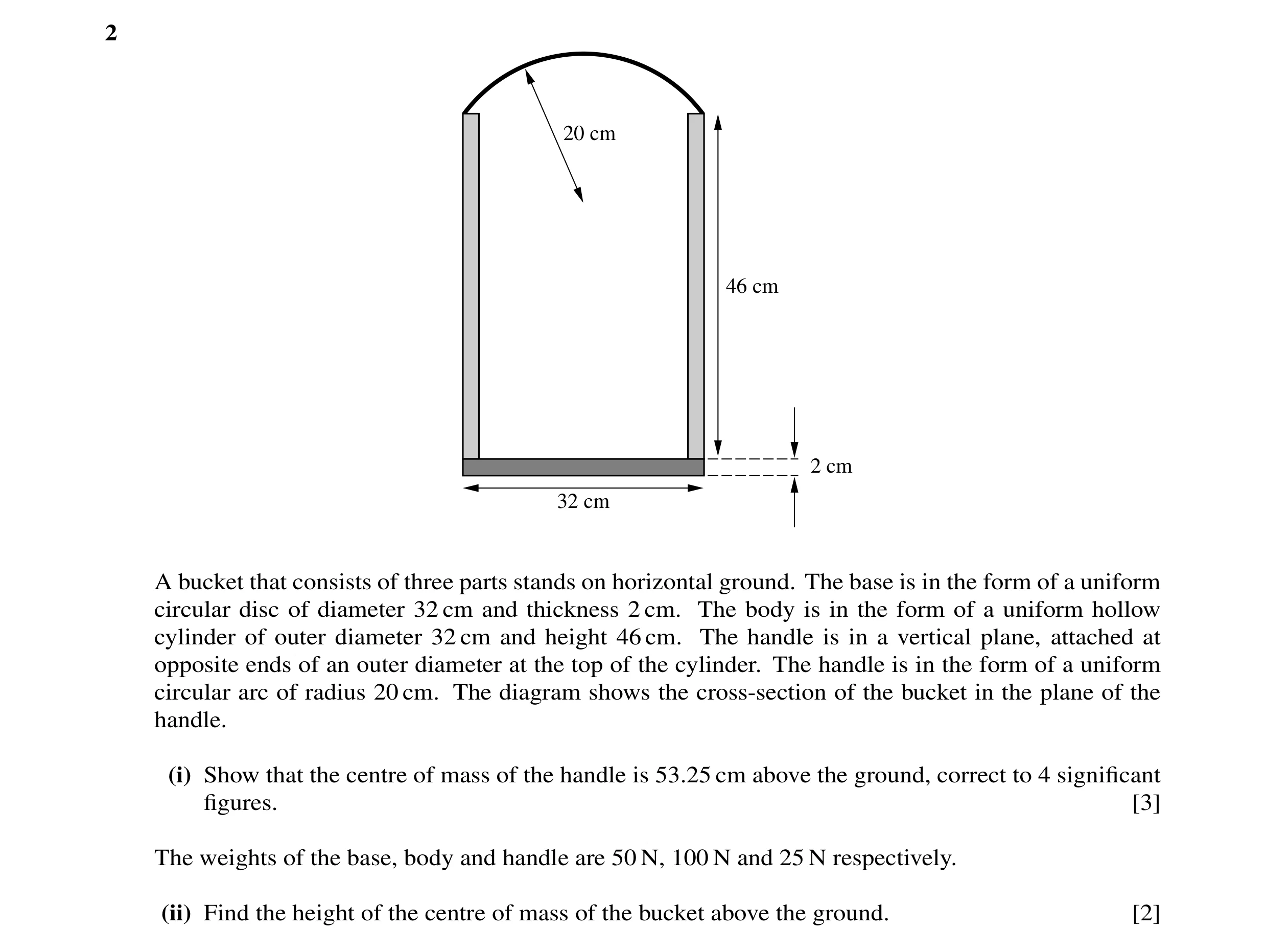
 2 / 21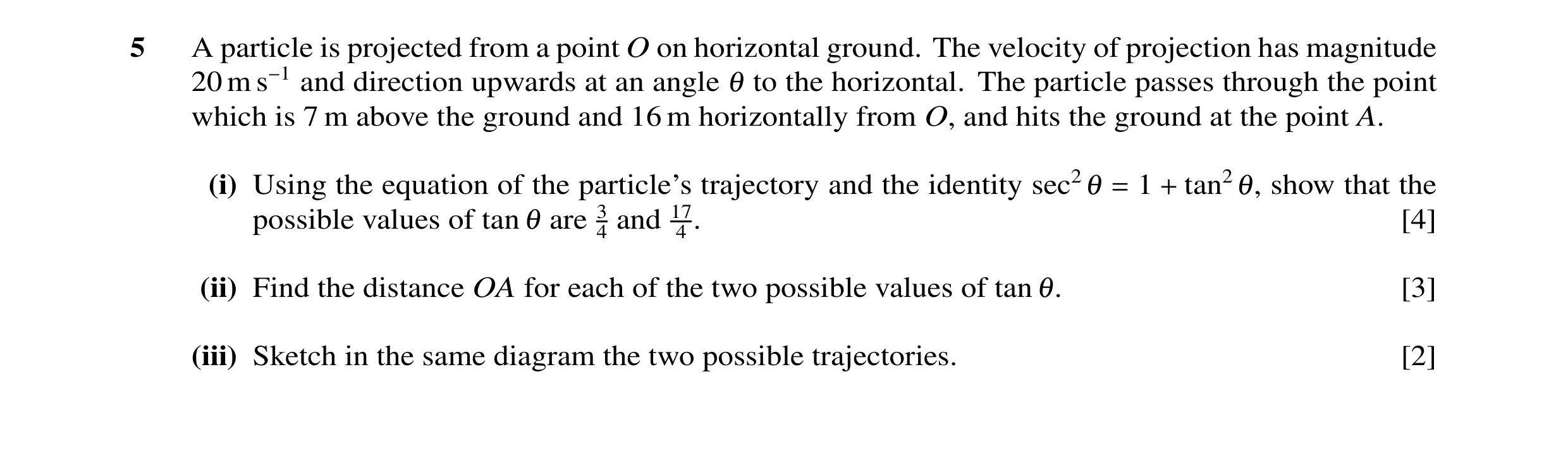
 3 / 21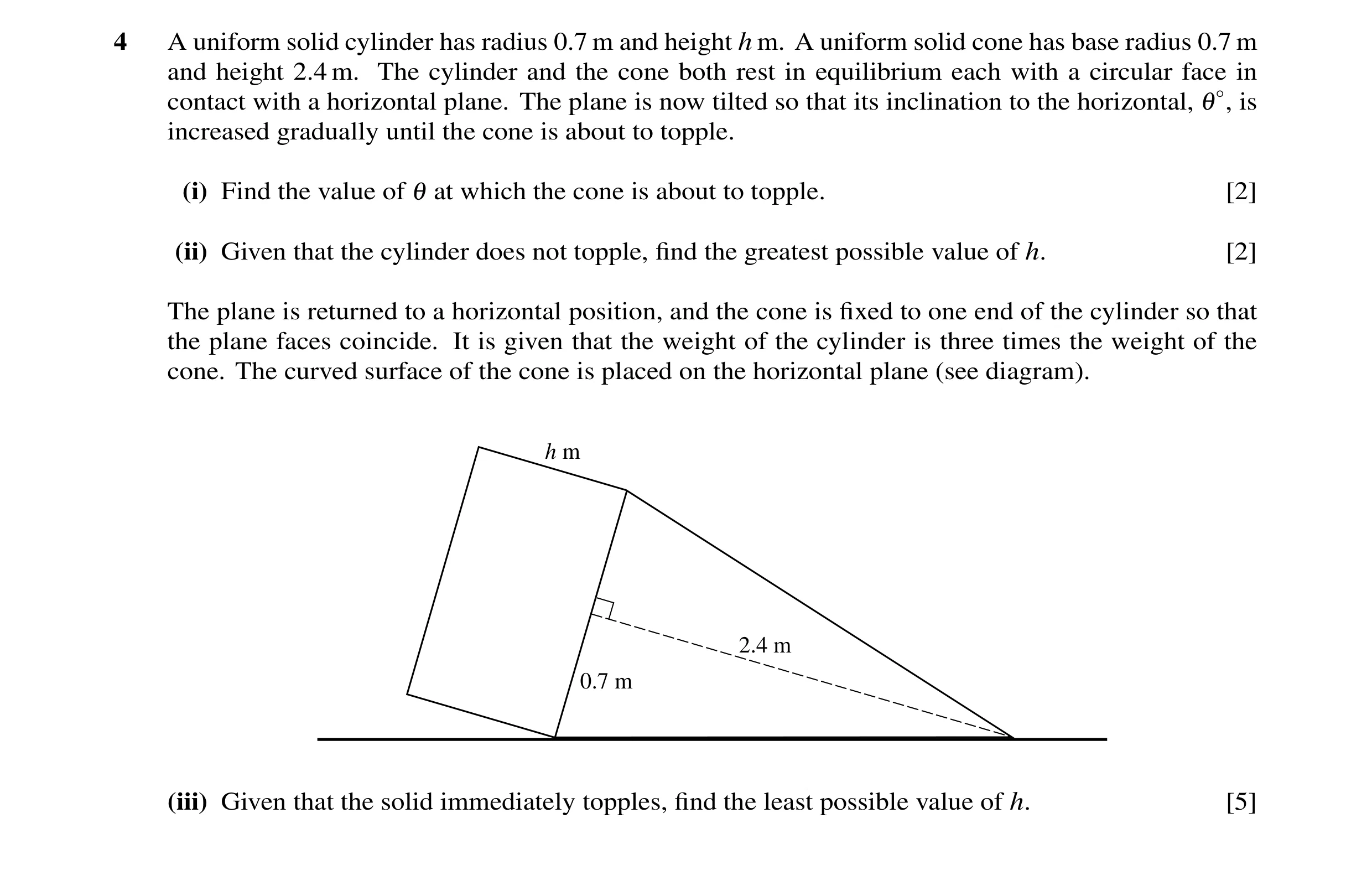
 4 / 21
 5 / 21
 11 / 21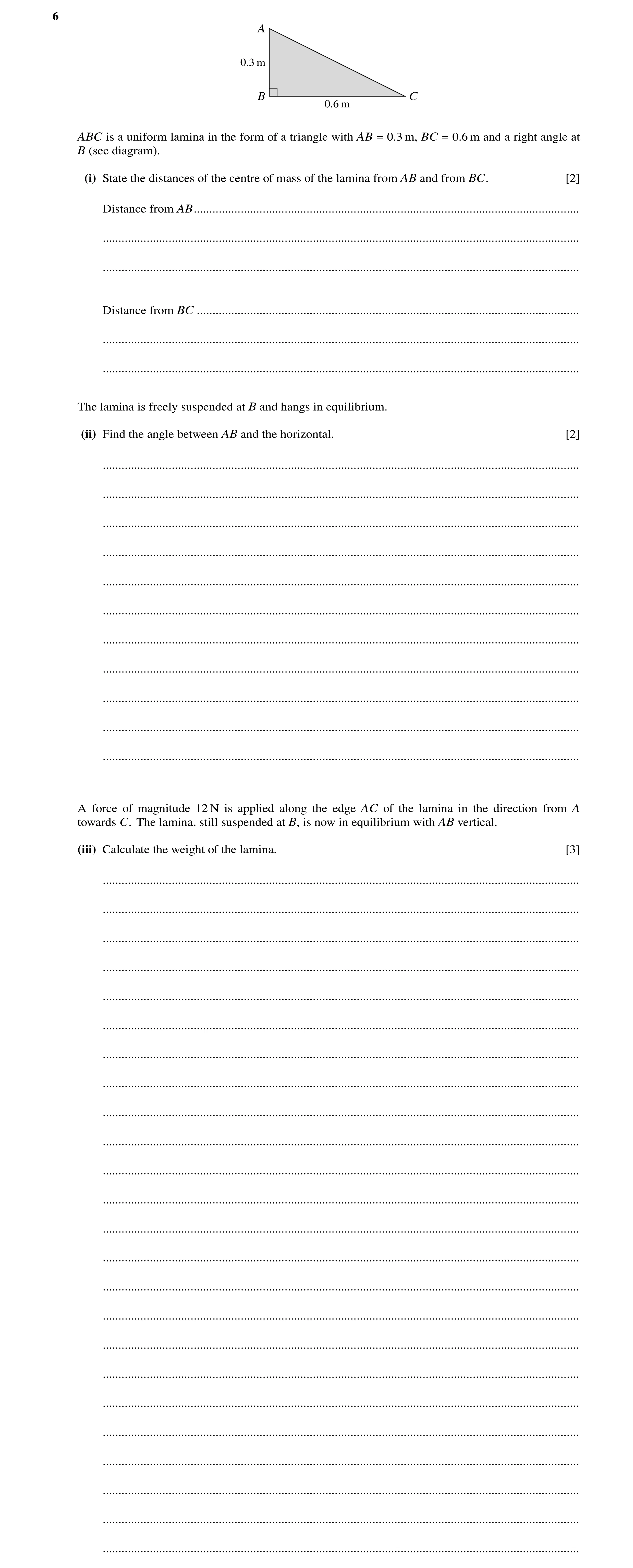
 16 / 21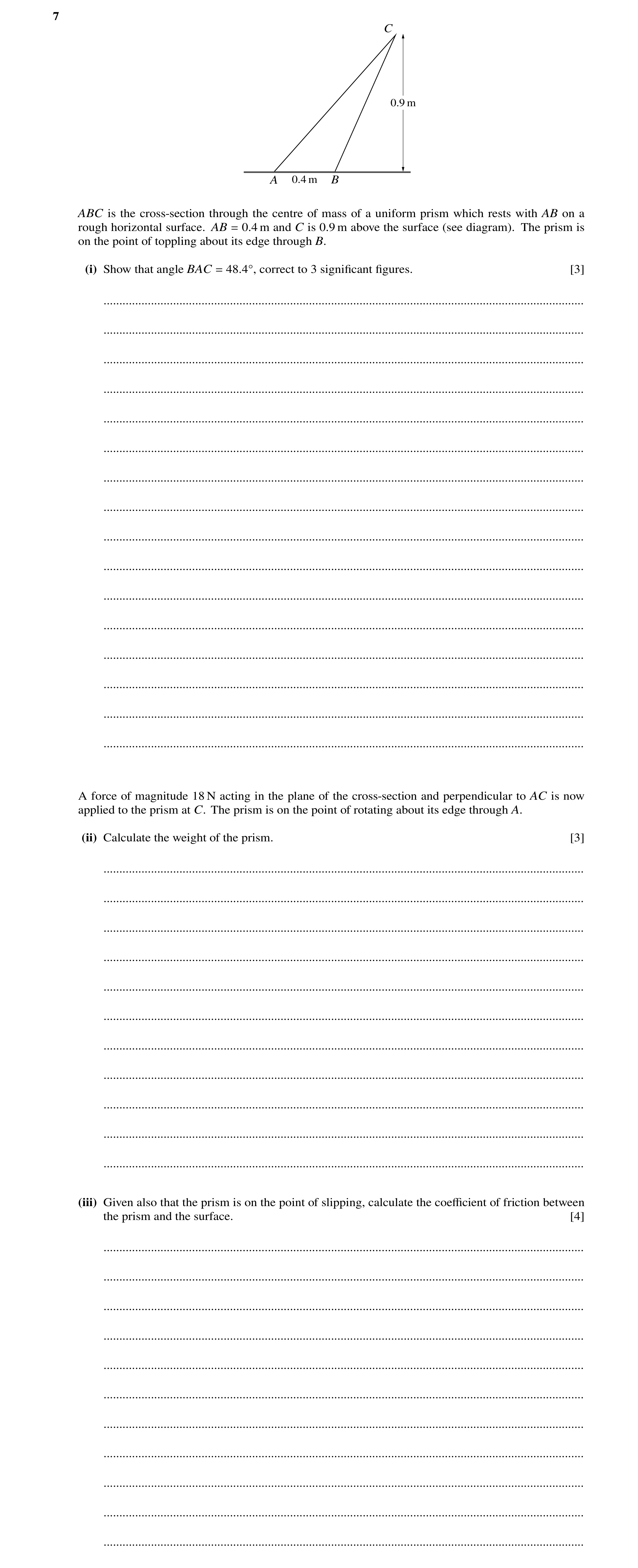
 19 / 21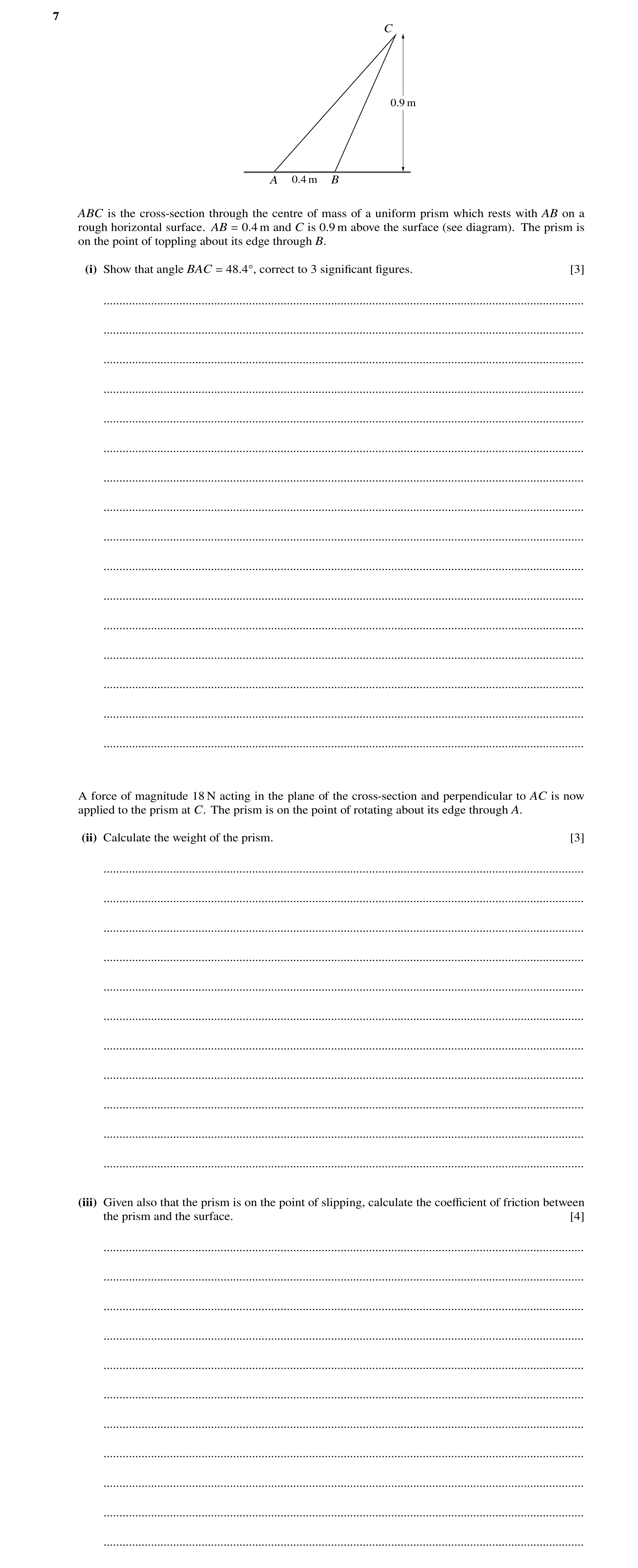
 5
5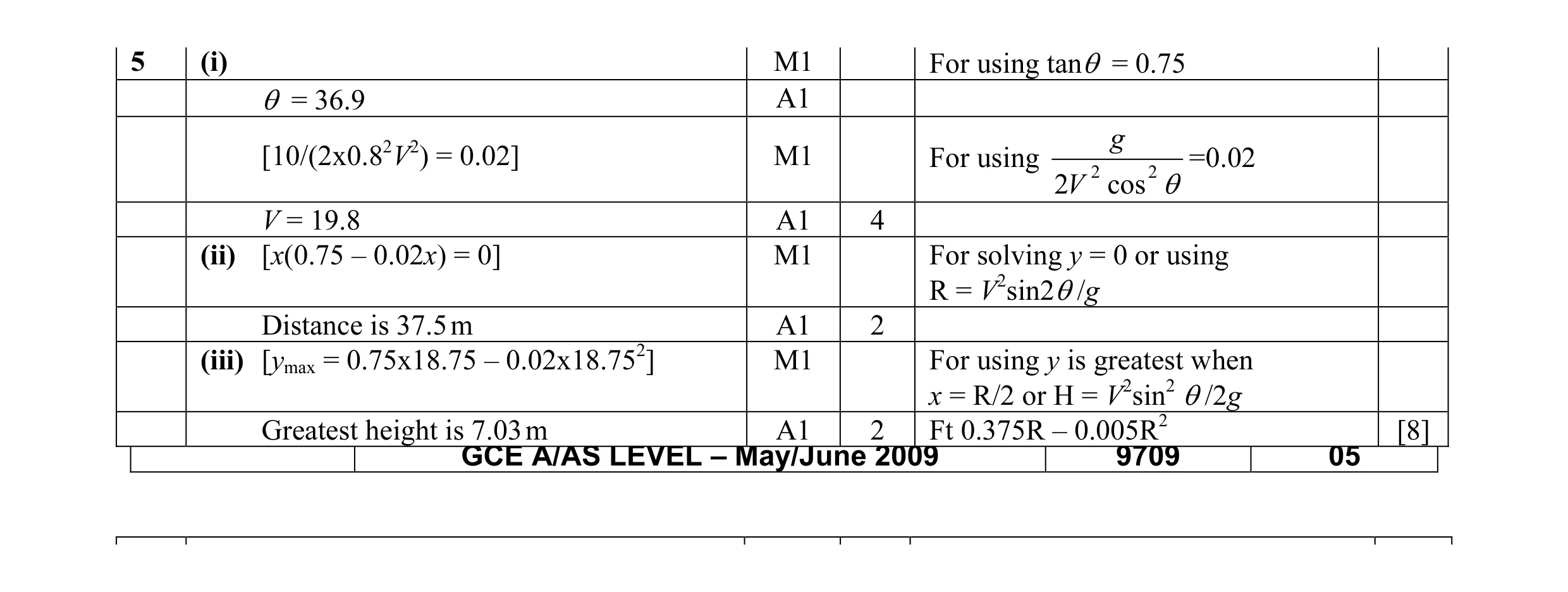 8
8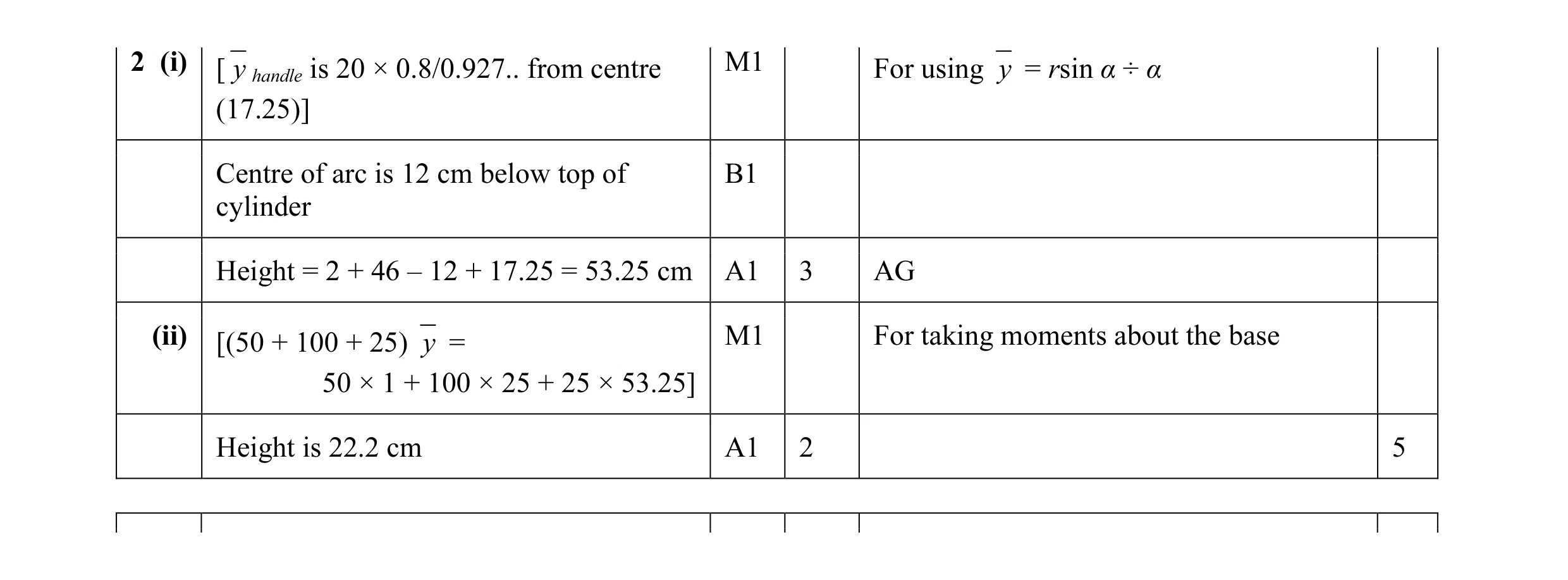 5
5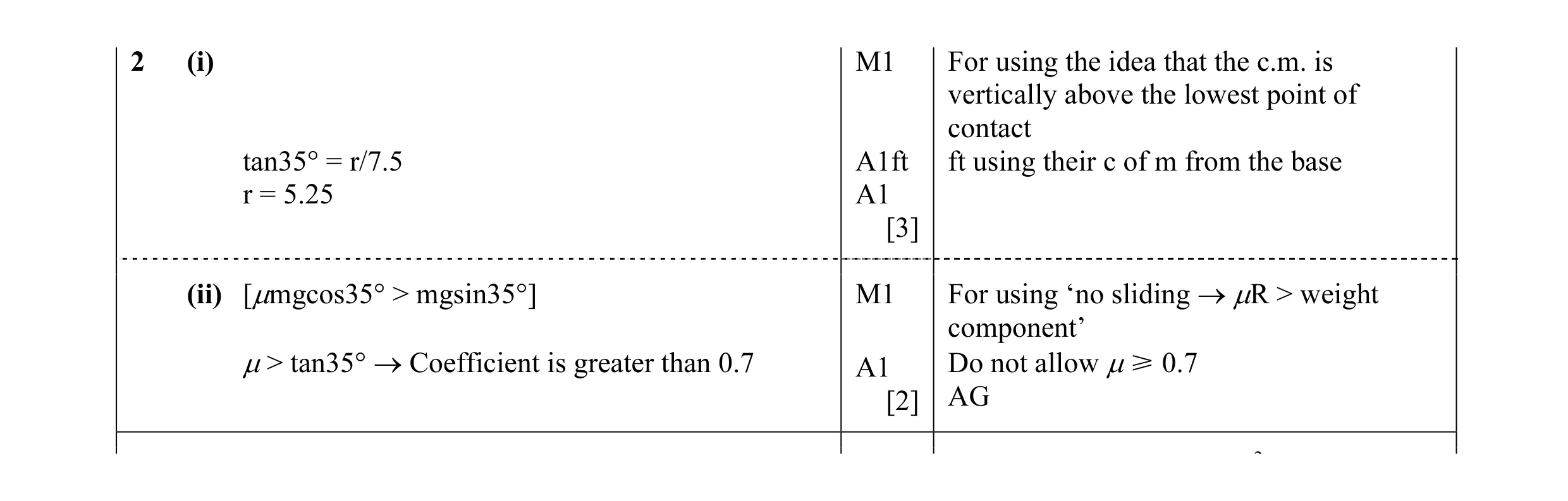 5
5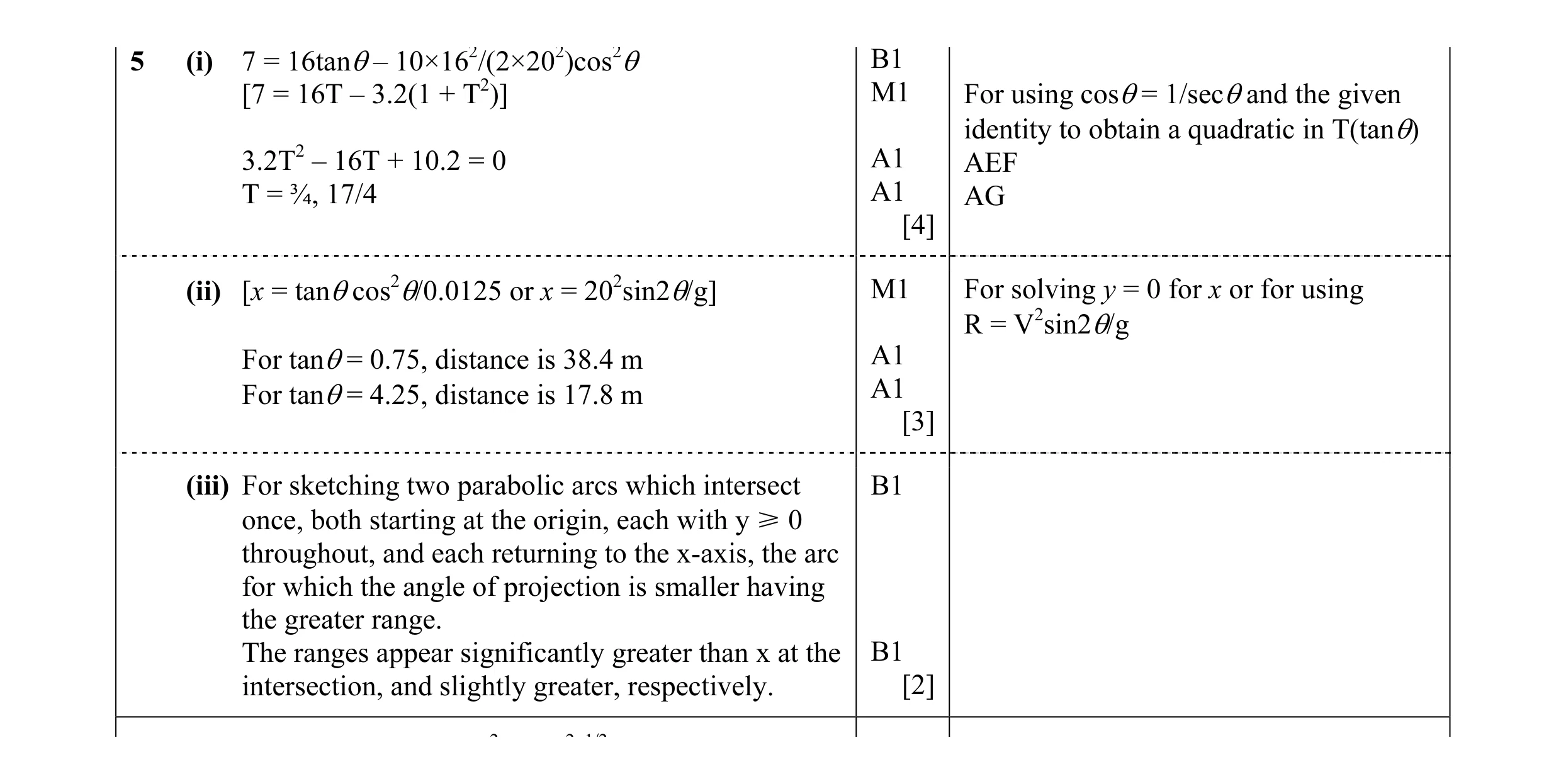 9
9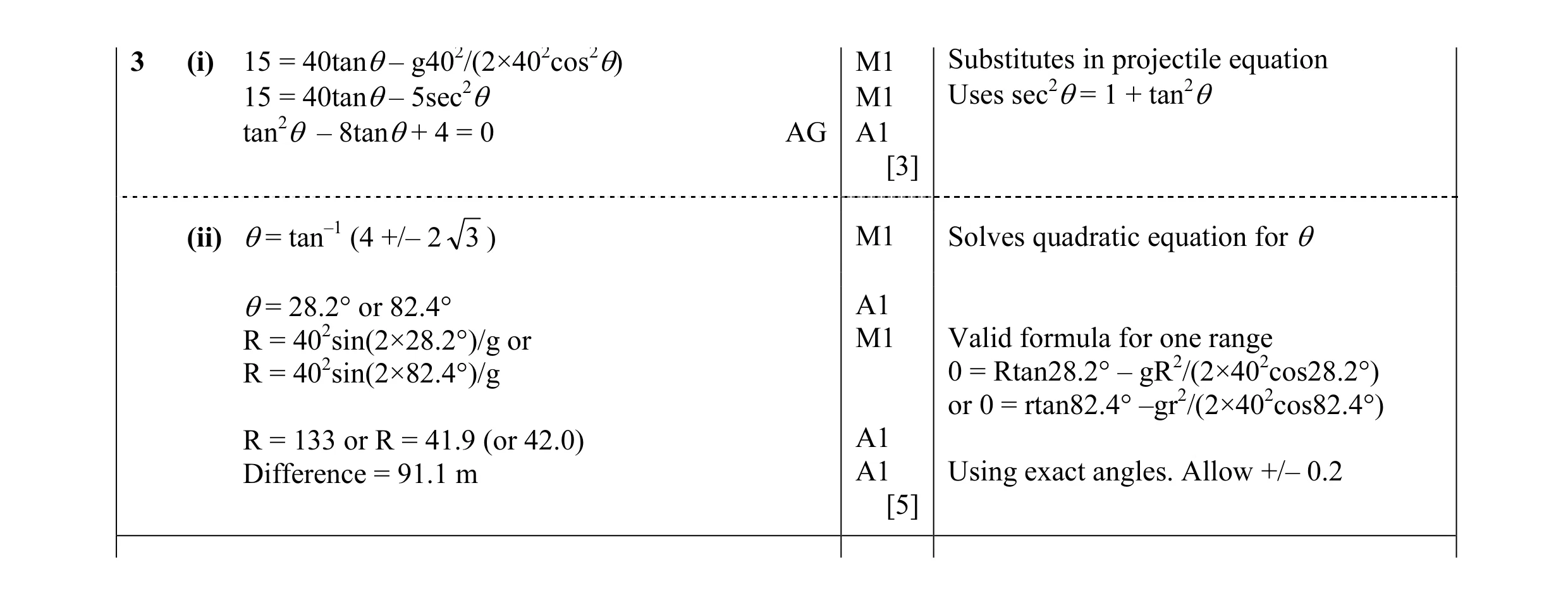 8
8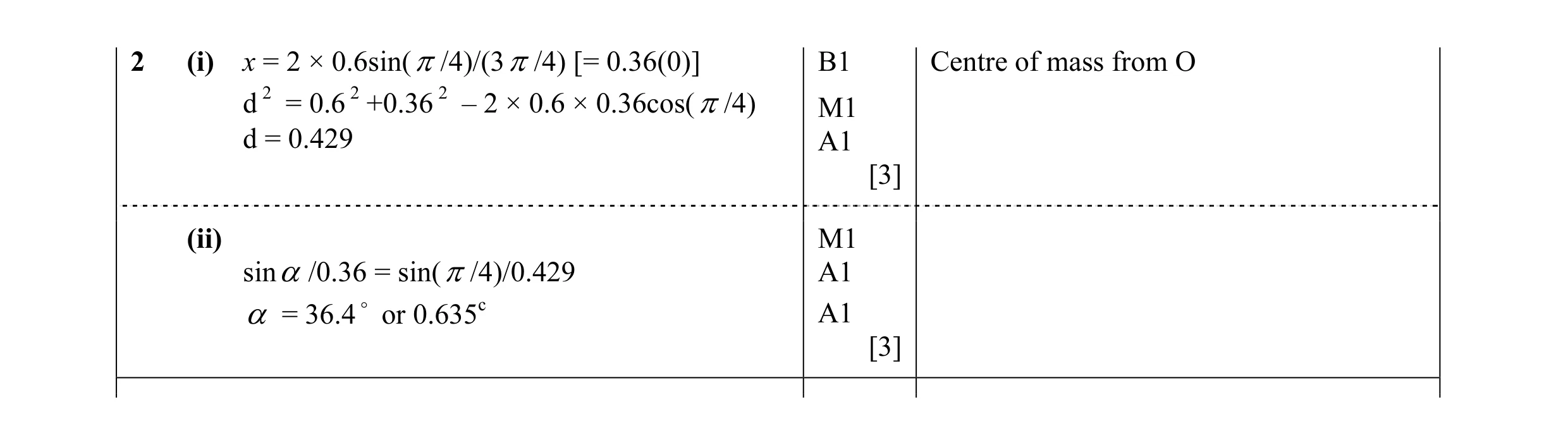 6
6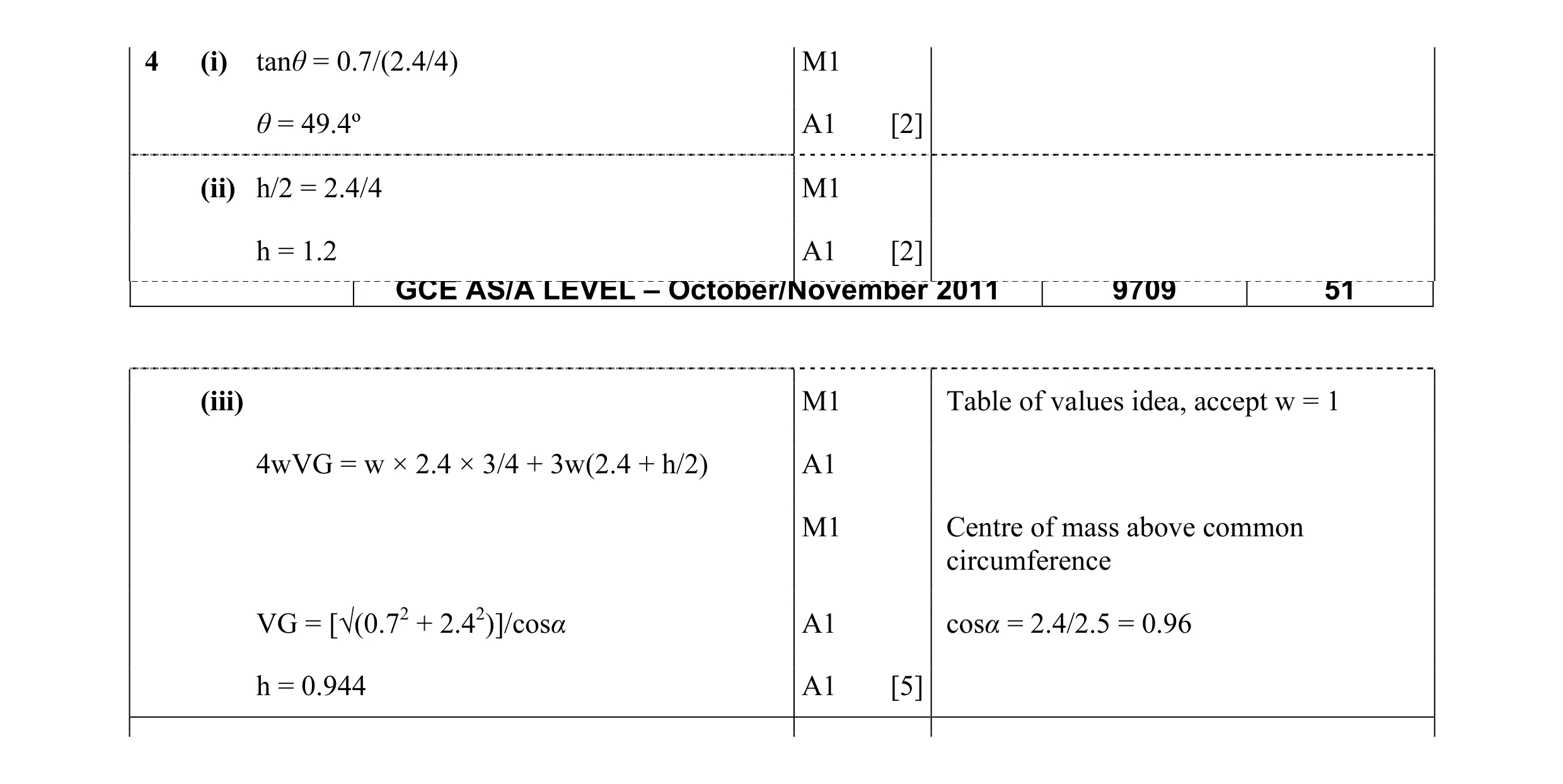 9
9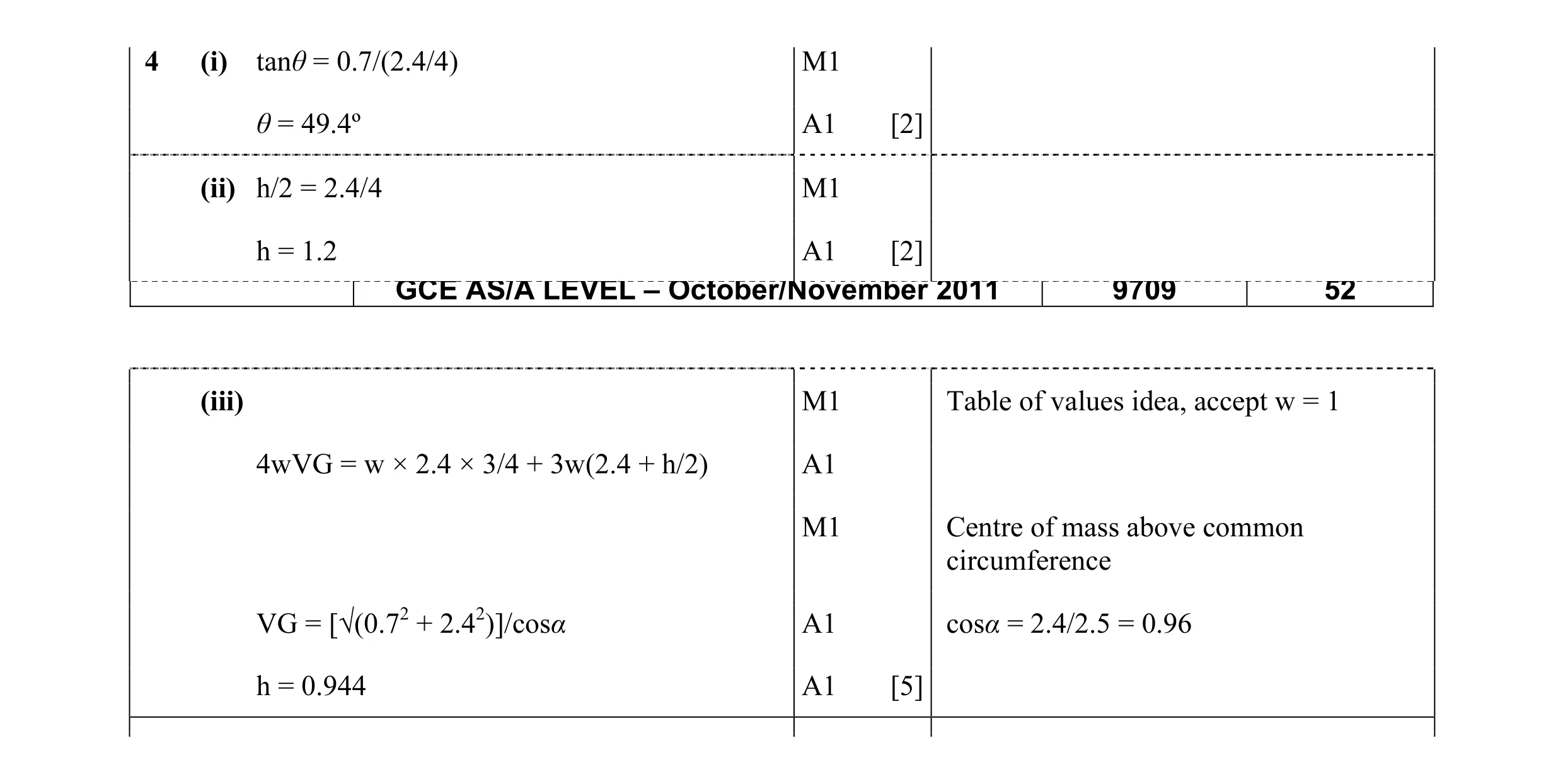 9
9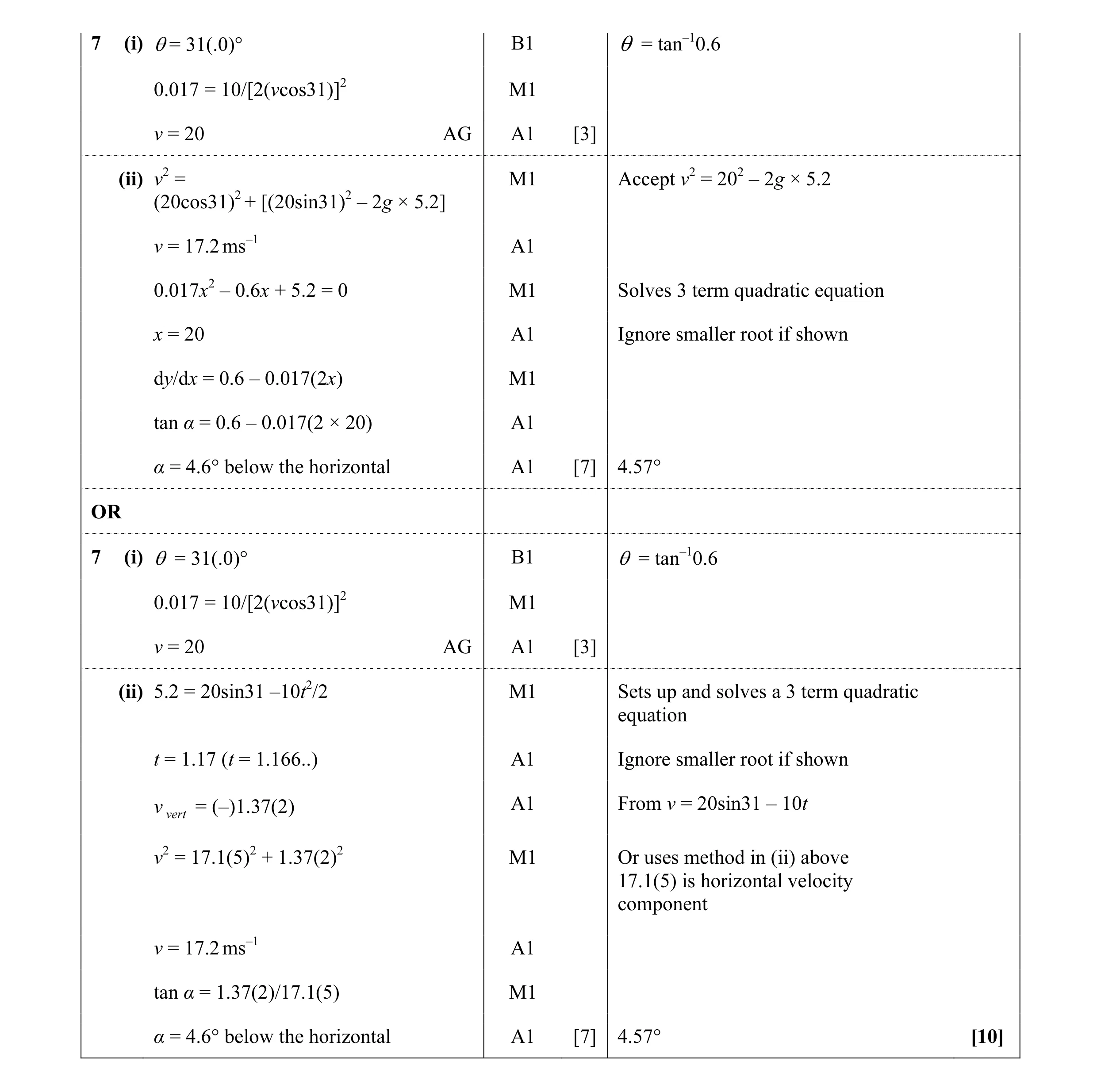 10
10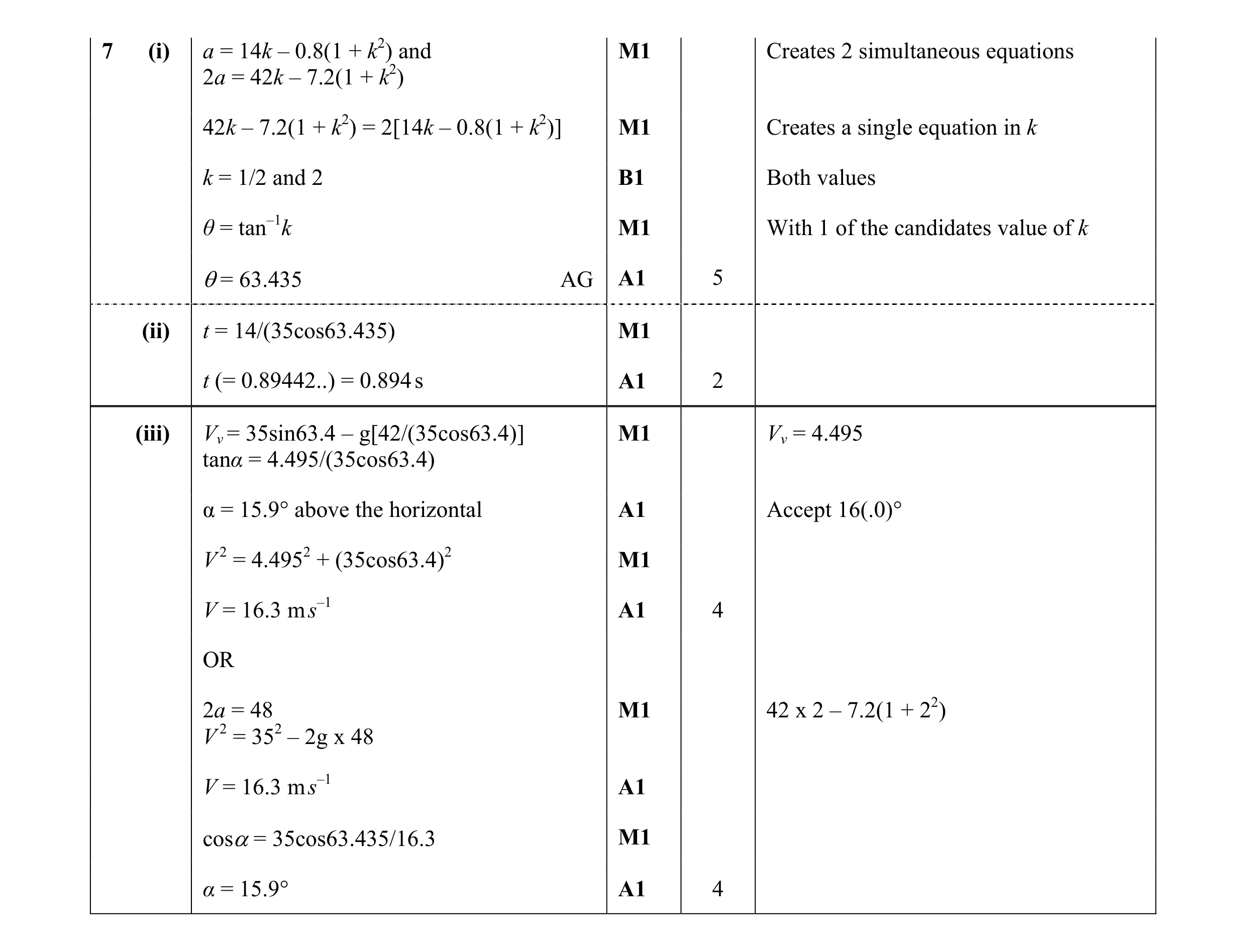 11
11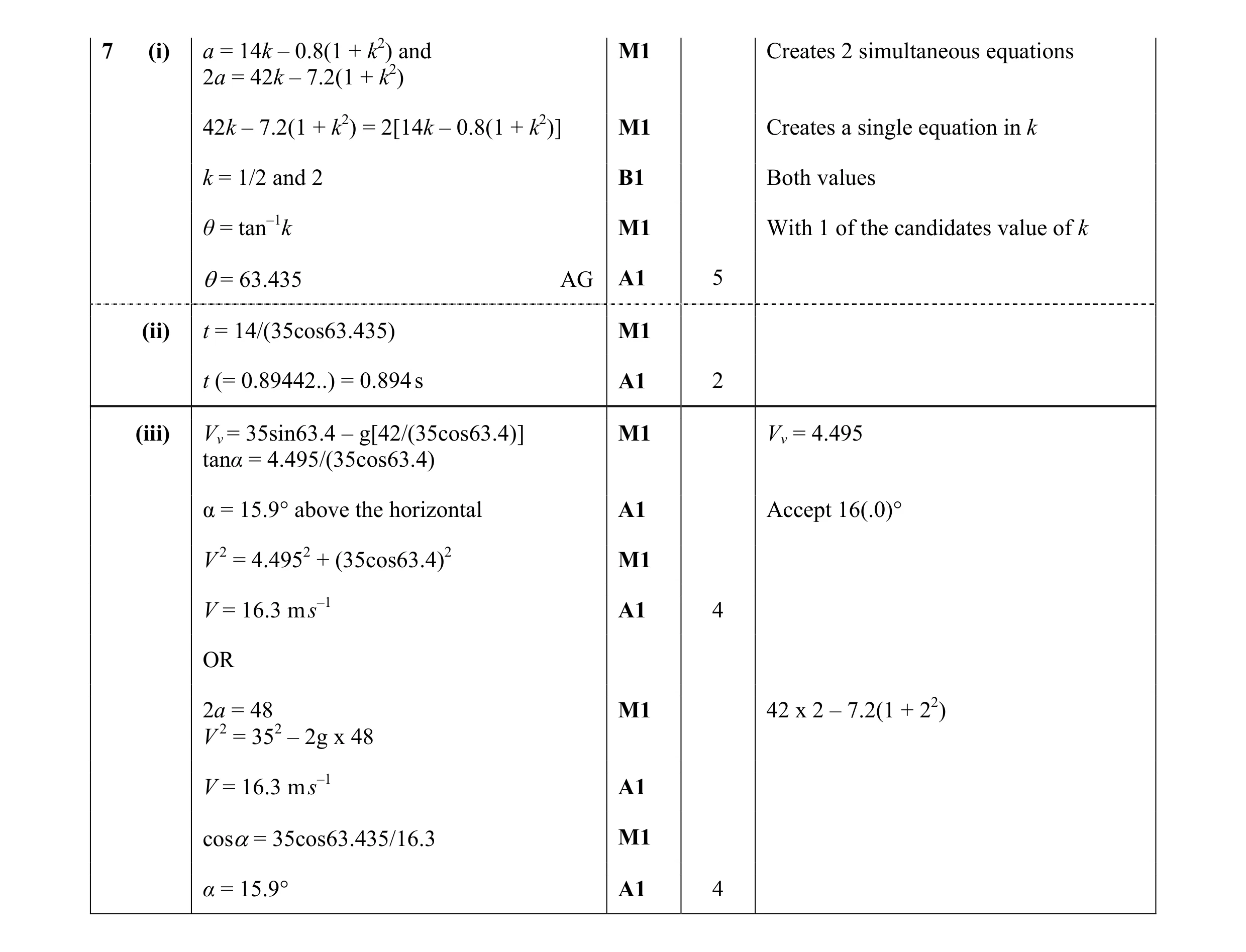 11
11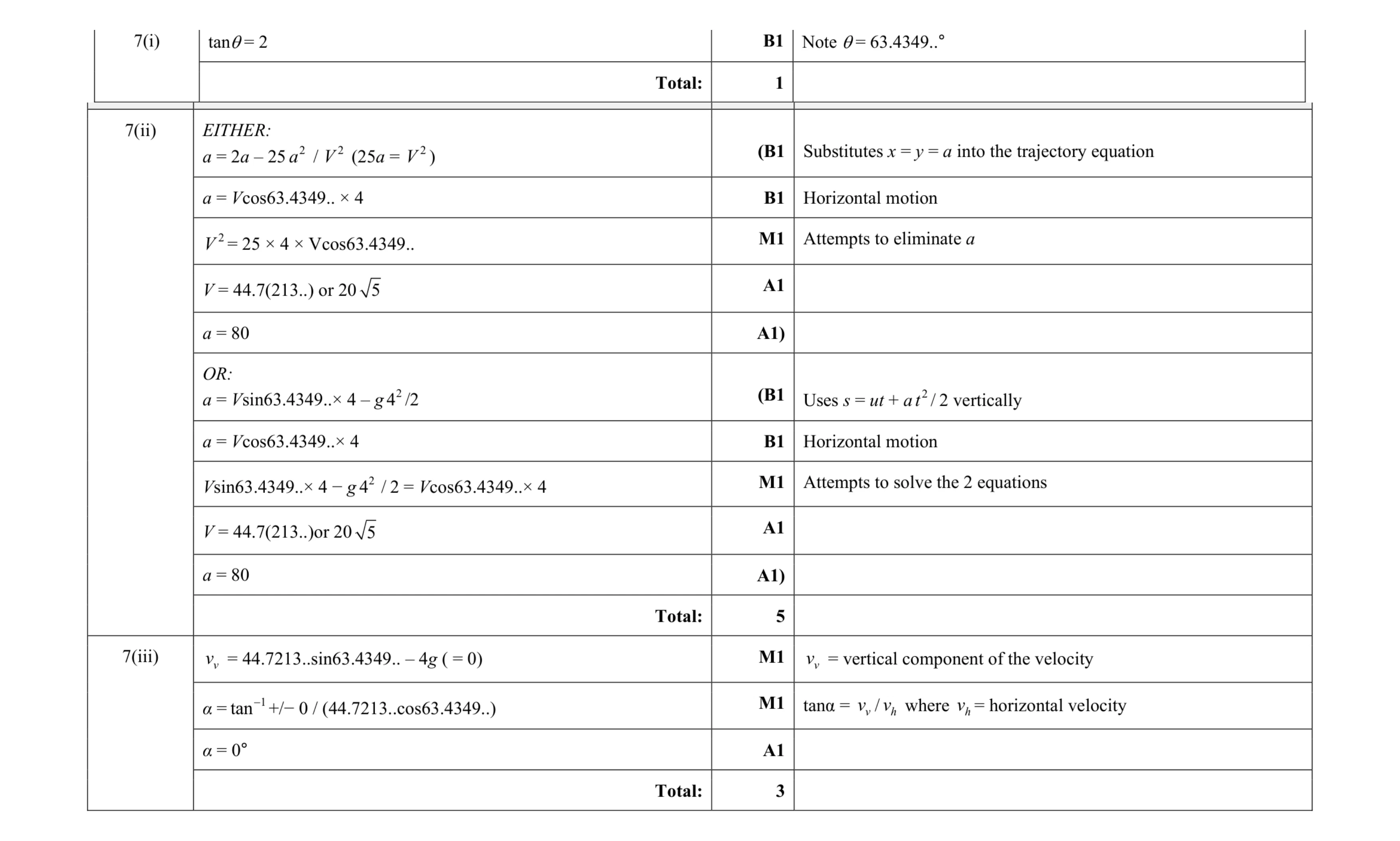 9
9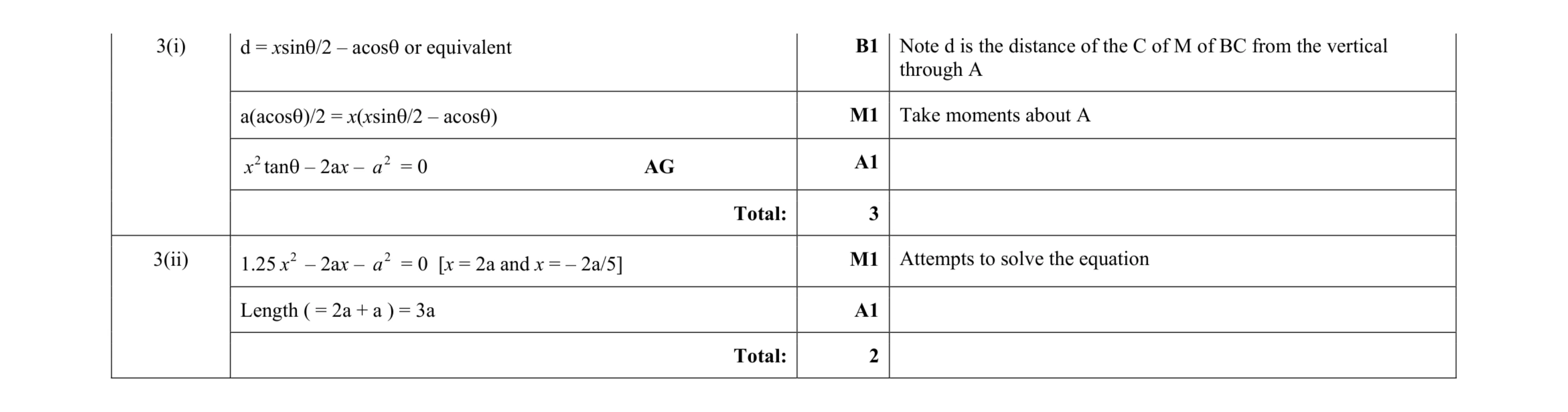 5
5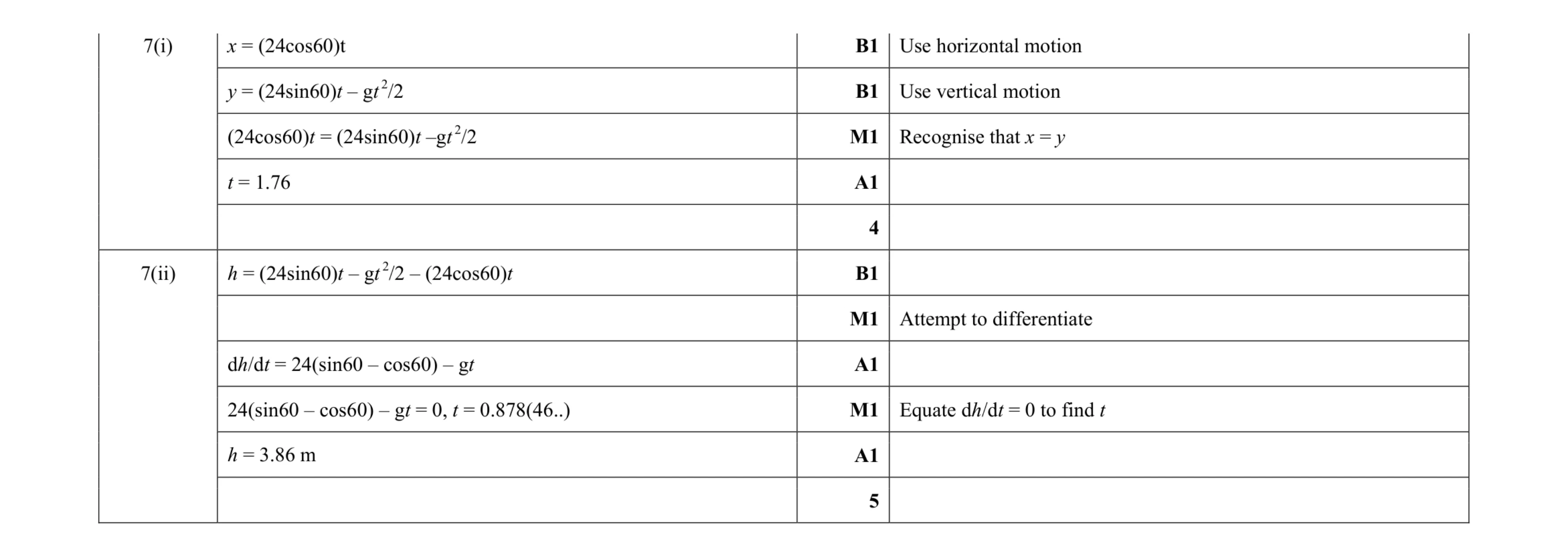 9
9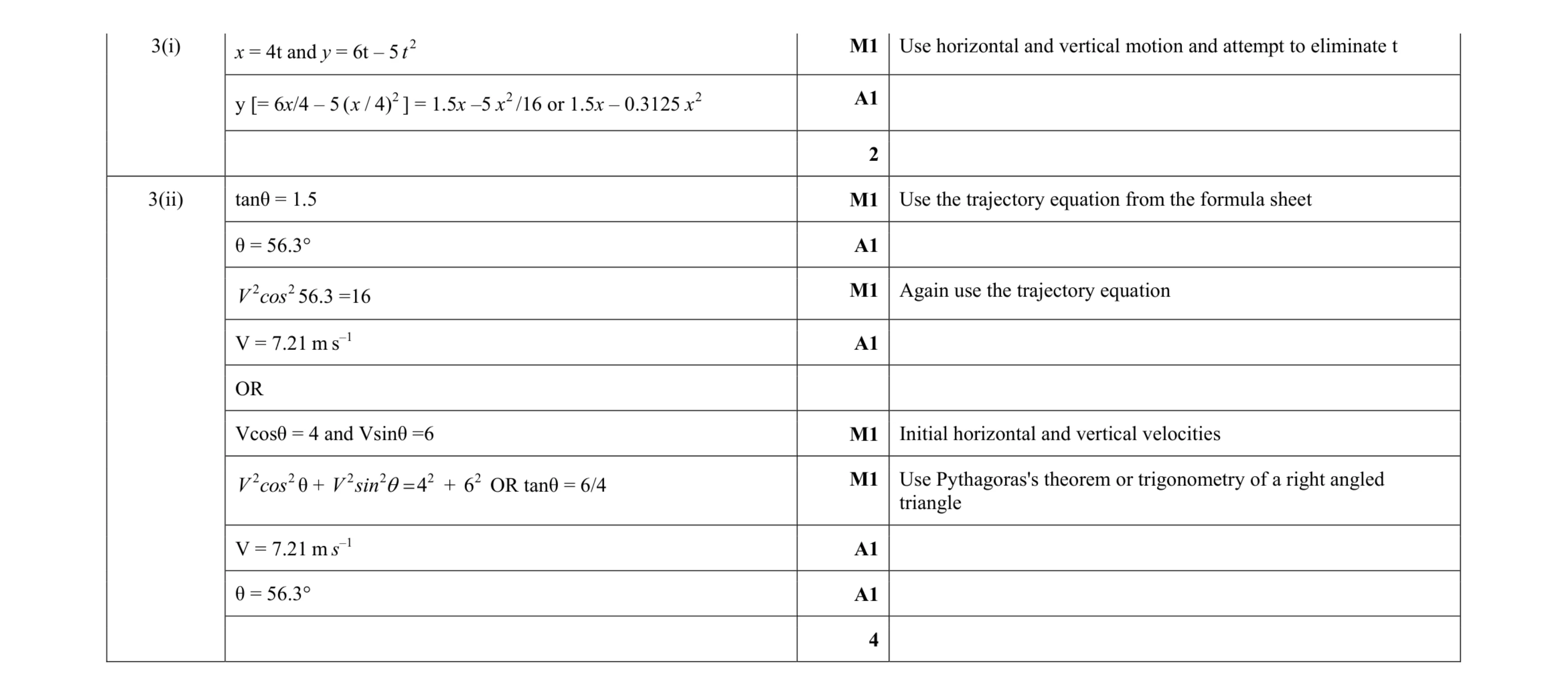 6
6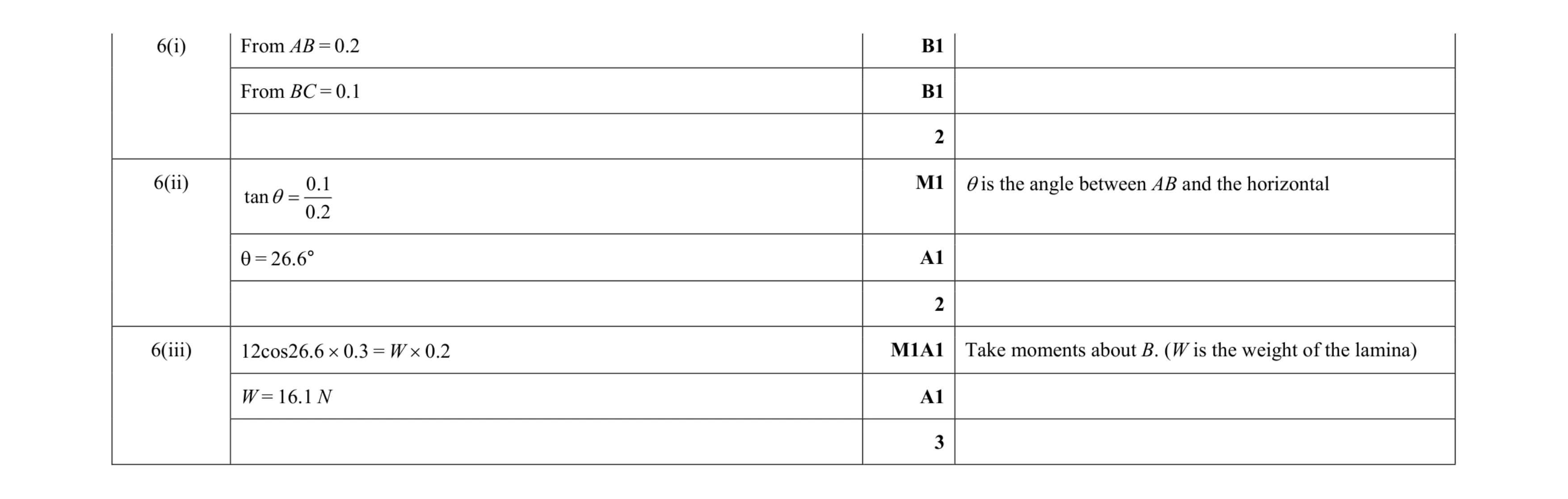 7
7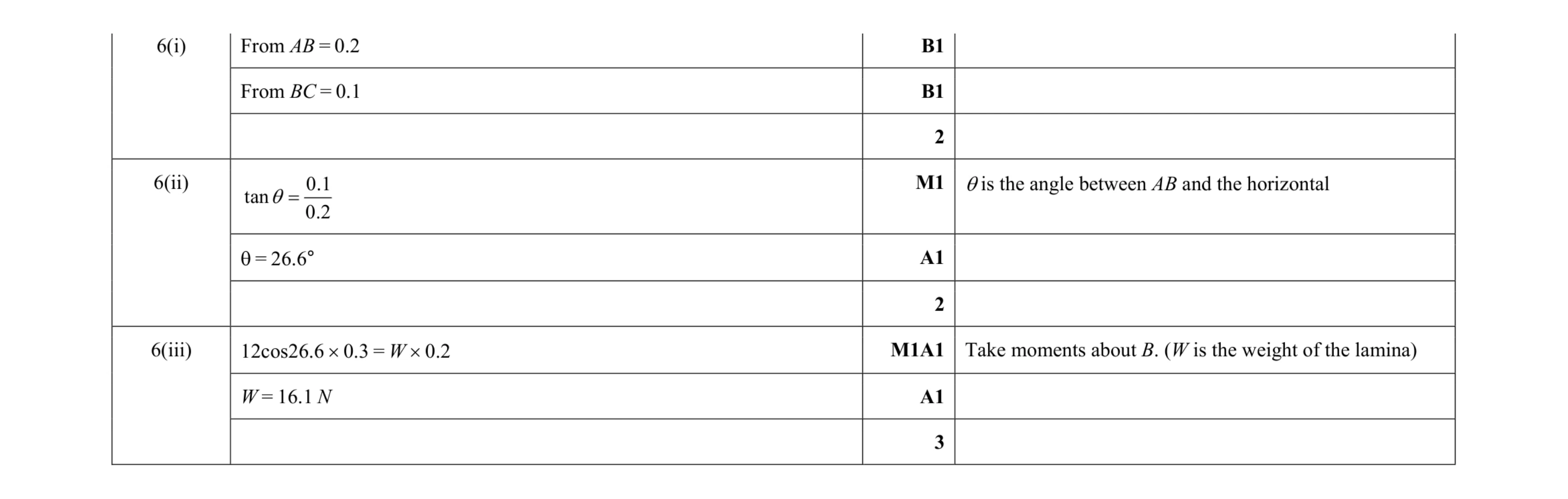 7
7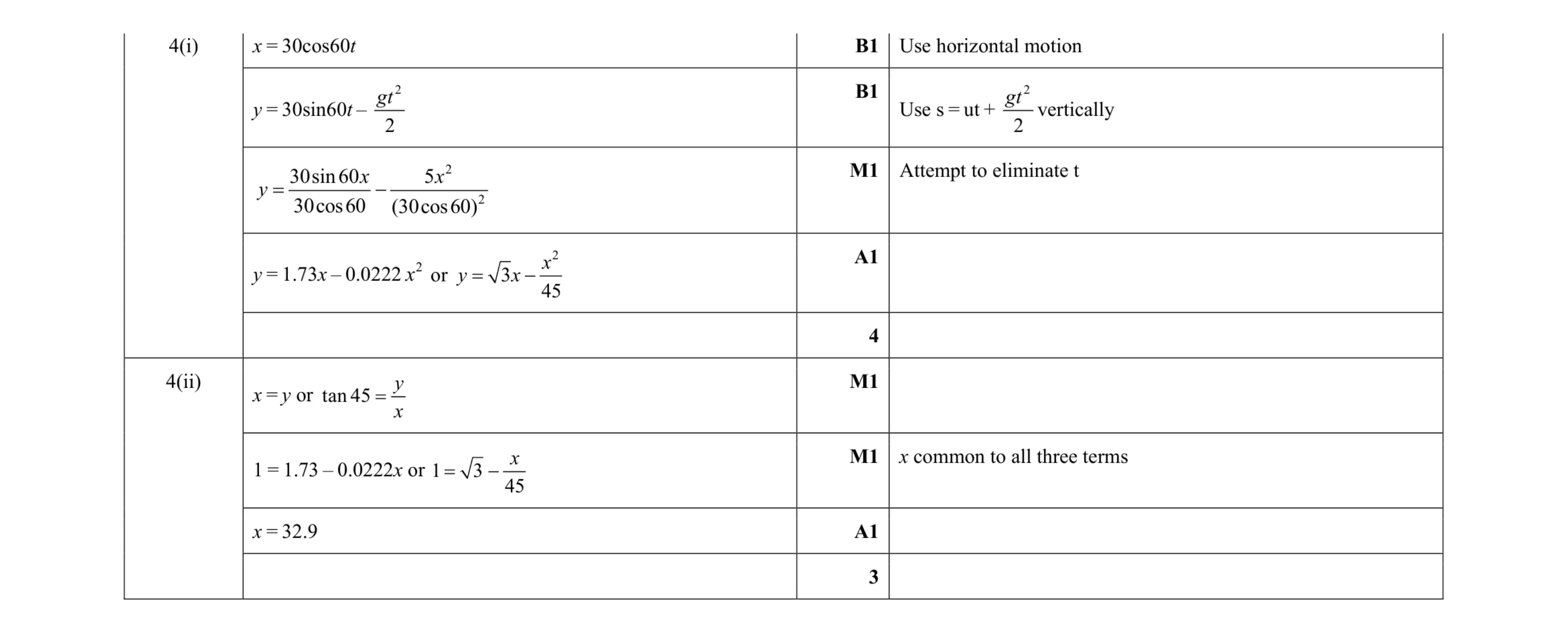 7
7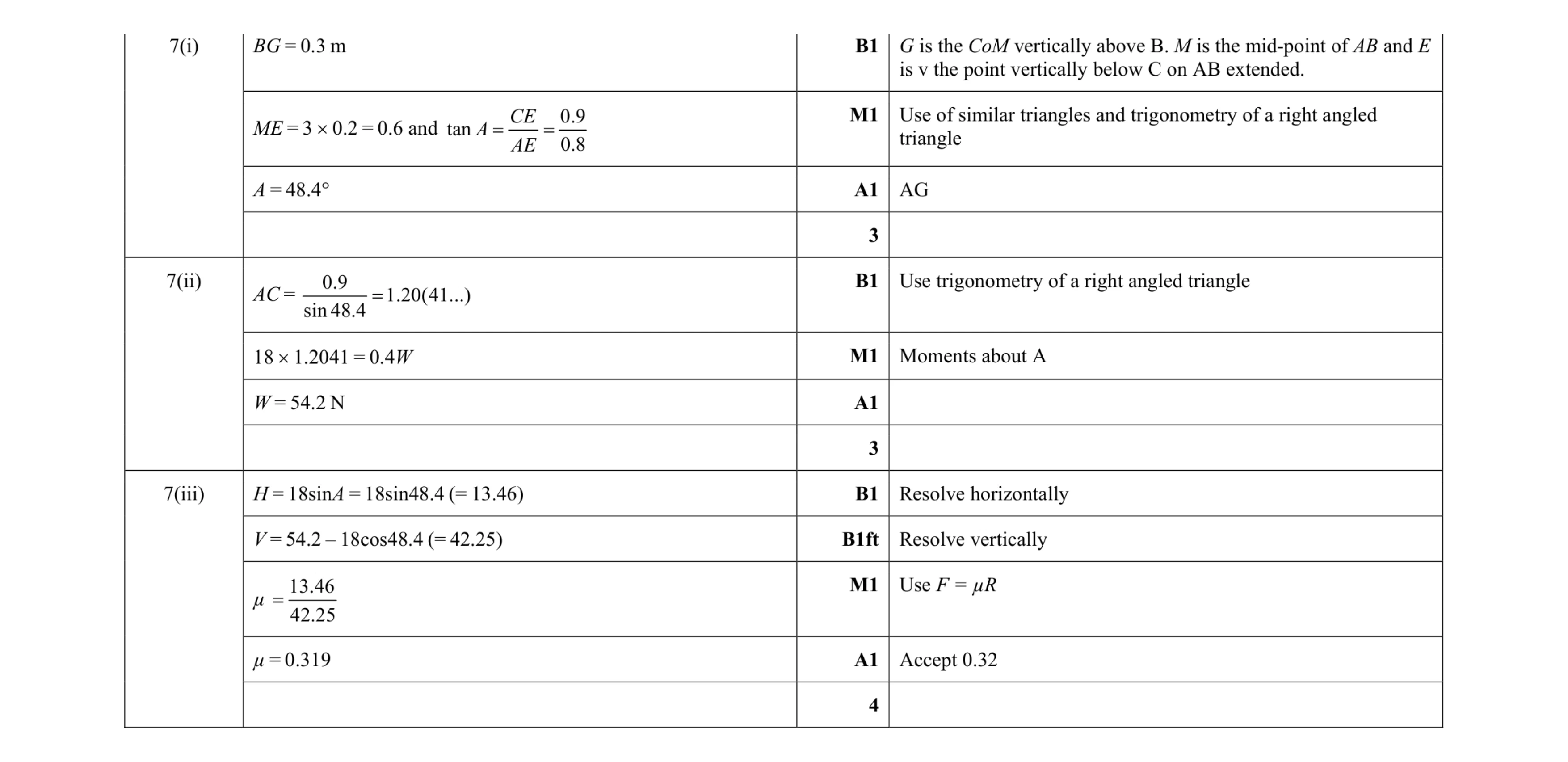 10
10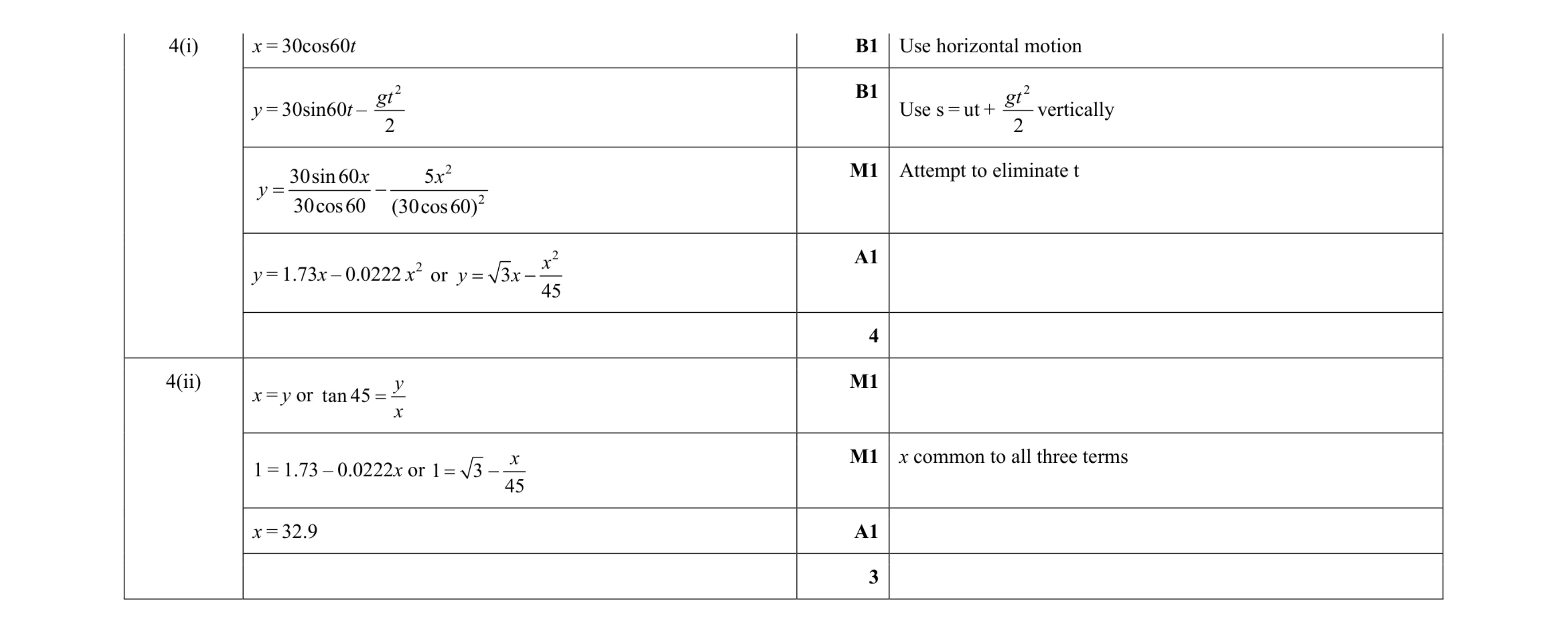 7
7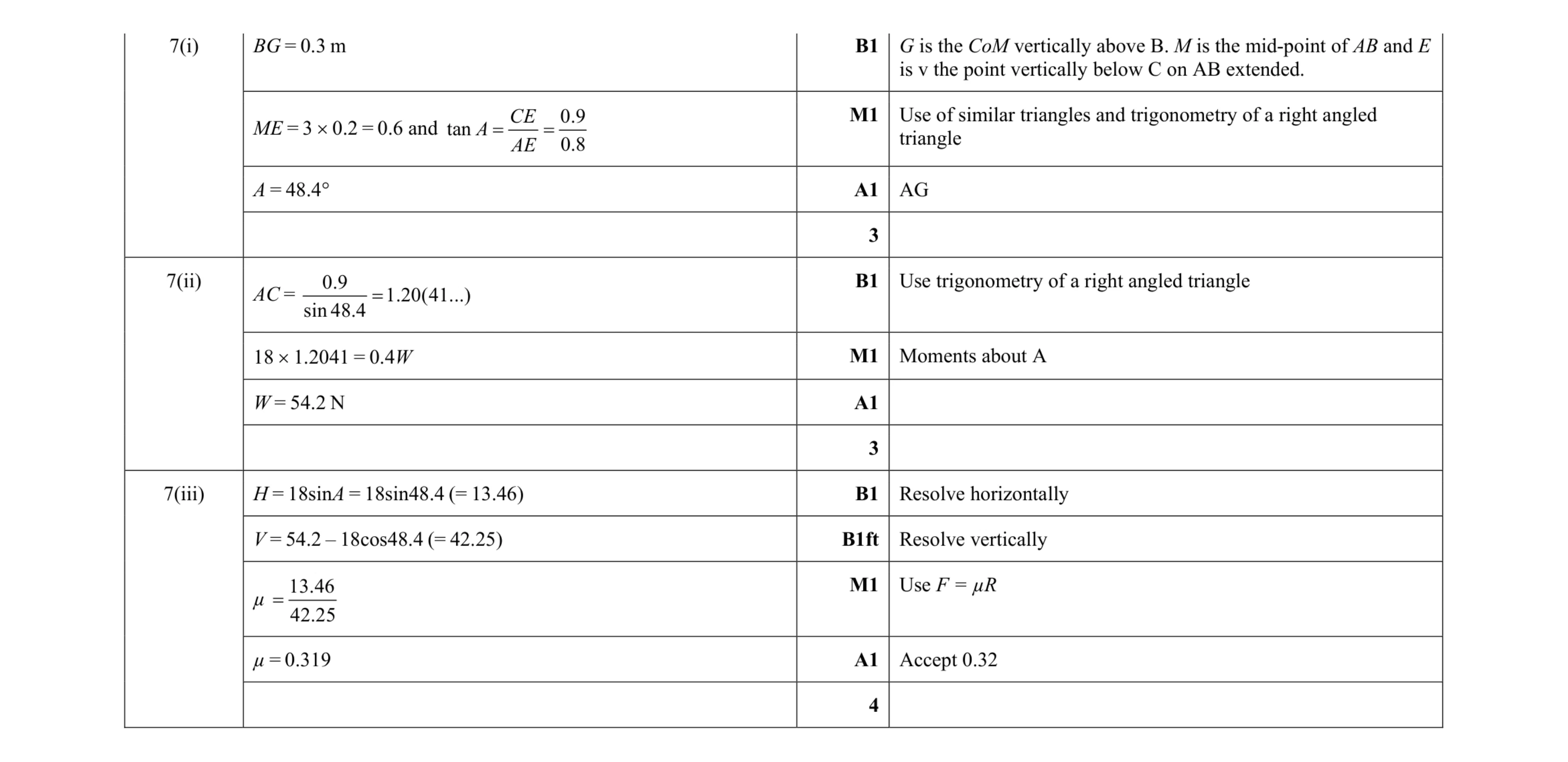 10
10