Cambridge A Level Mathematics 9709 — 2013 May/June Paper 3 · Variant 3
9709/33/M/J/13 · 5 questions · 75 marks · ≈84 min
The question paper and its mark scheme, free to read here and free to download. This is Cambridge’s own paper, exactly as it was sat.
Question paper4 pages
Mark scheme7 pages
Answers below. Sit the paper first if you are practising.
Questions as text
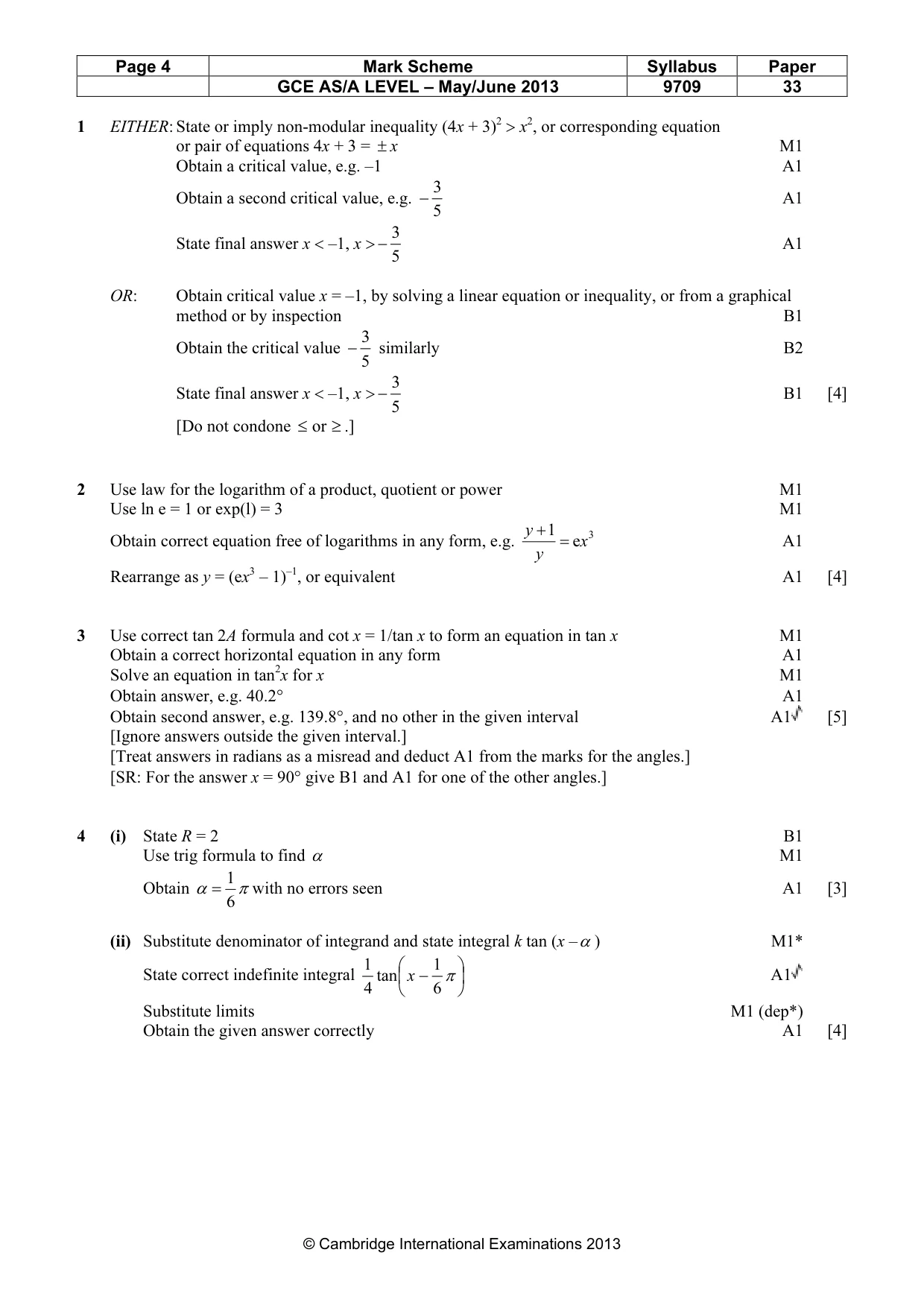
Q1 · Solve the inequality |4.x + 3| > |x|
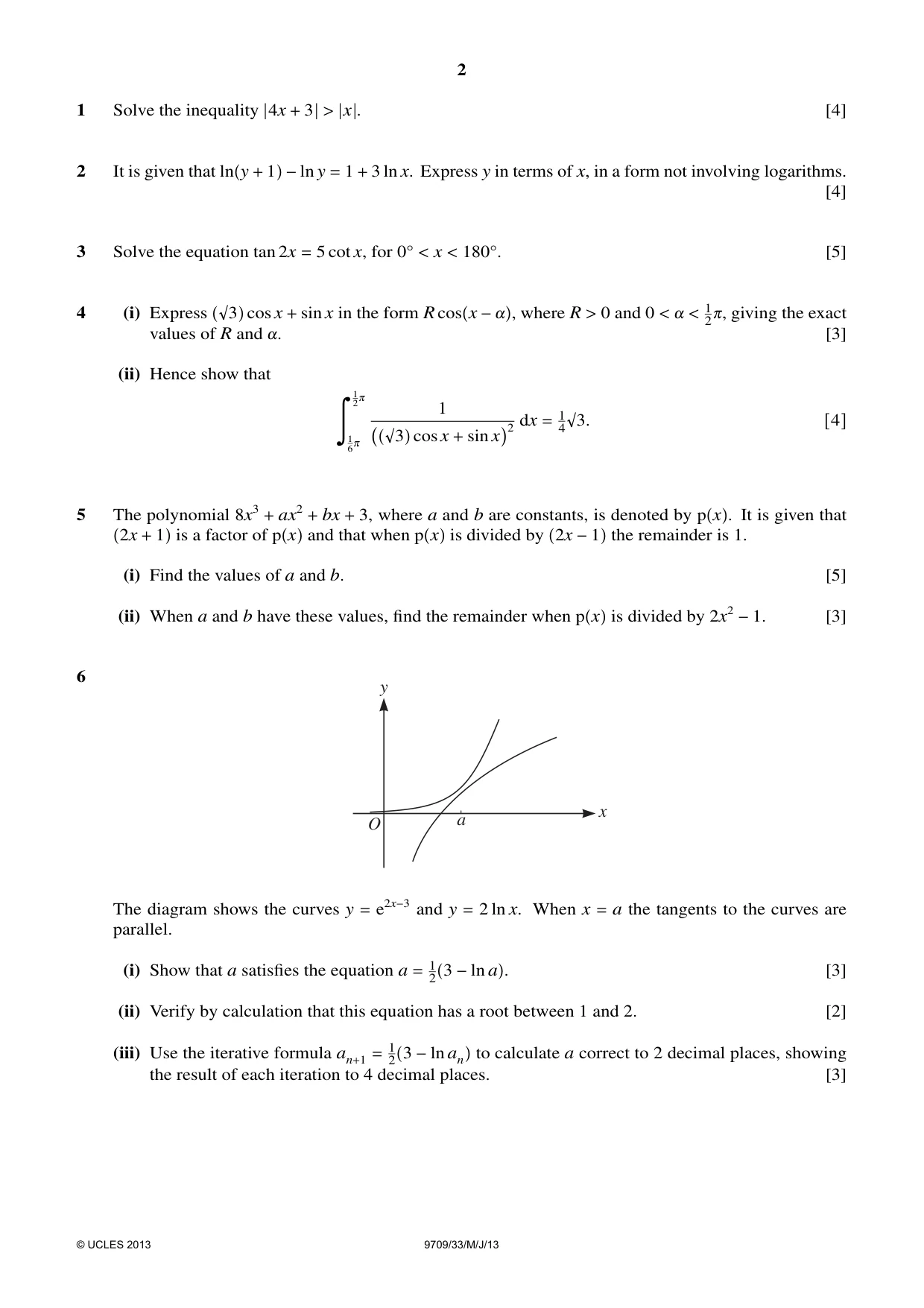
1 Solve the inequality |4.x + 3| > |x|. [4]
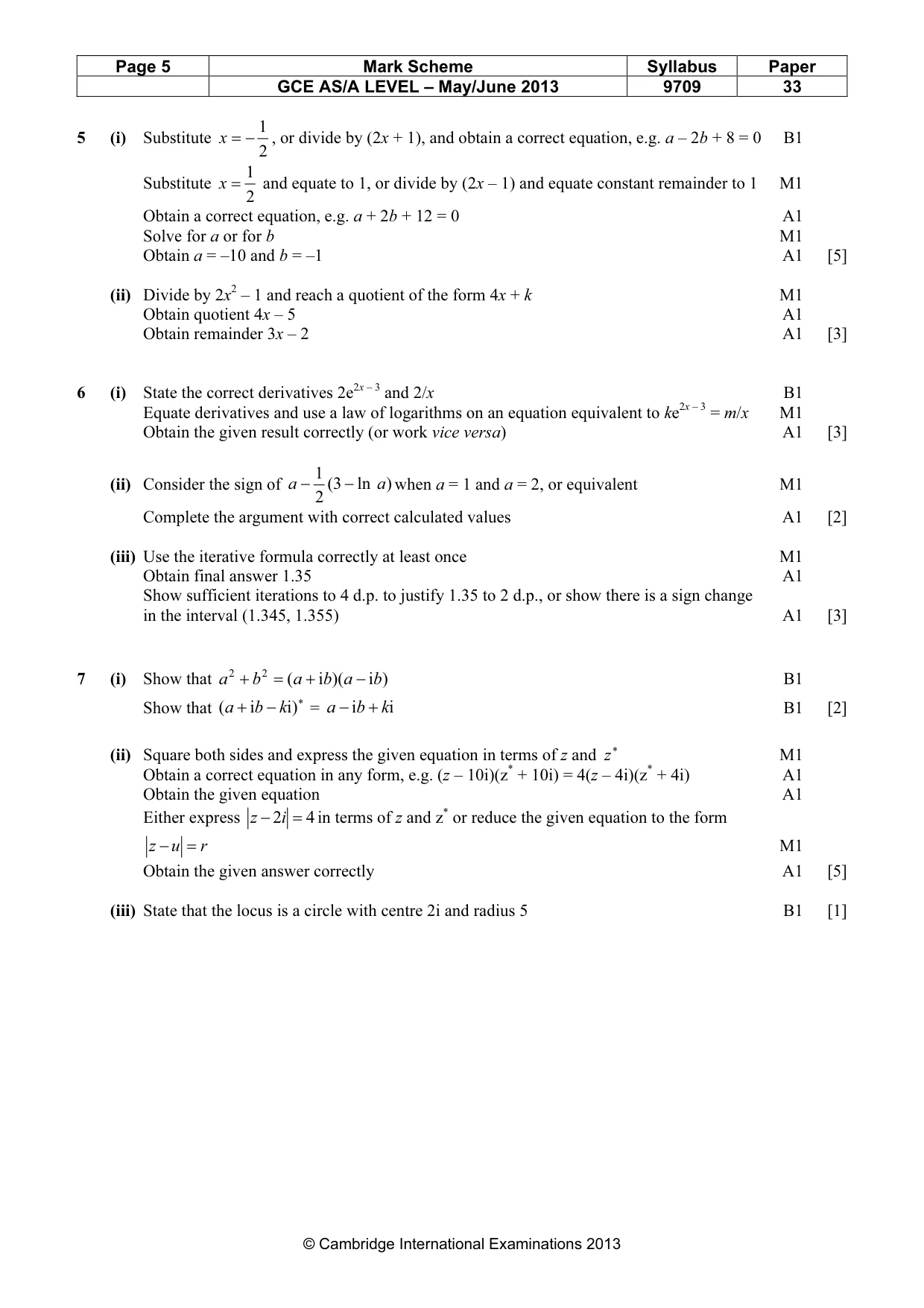
Mark scheme: 1 EITHER: State or imply non-modular inequality (4x + 3)2 > x2, or corresponding equation or pair of equations 4x + 3 = ± x M1 Obtain a critical value, e.g. –1 A1 3 Obtain a second critical value, e.g. − A1 5 3 State final answer x < –1, x > − A1 5 OR: Obtain critical value x = –1, by solving a linear equation or inequality, or from a graphical method or by inspection B1 3 Obtain the critical value − similarly B2 5 3 State final answer x < –1, x > − B1 [4] 5 [Do not condone ≤or ≥ .]
Q3 · Solve the equation tan 2x 5 cot x, for x [5] = 0Å < < 180Å
3 Solve the equation tan 2x 5 cot x, for x [5] = 0Å < < 180Å.
Mark scheme: 3 Use correct tan 2A formula and cot x = 1/tan x to form an equation in tan x M1 Obtain a correct horizontal equation in any form A1 Solve an equation in tan2x for x M1 Obtain answer, e.g. 40.2° A1 Obtain second answer, e.g. 139.8°, and no other in the given interval A1 [5] [Ignore answers outside the given interval.] [Treat answers in radians as a misread and deduct A1 from the marks for the angles.] [SR: For the answer x = 90° give B1 and A1 for one of the other angles.]
Q8 · The variables x and t satisfy the differential equation tdx k , −x3 dt = 2x2 for t 0…
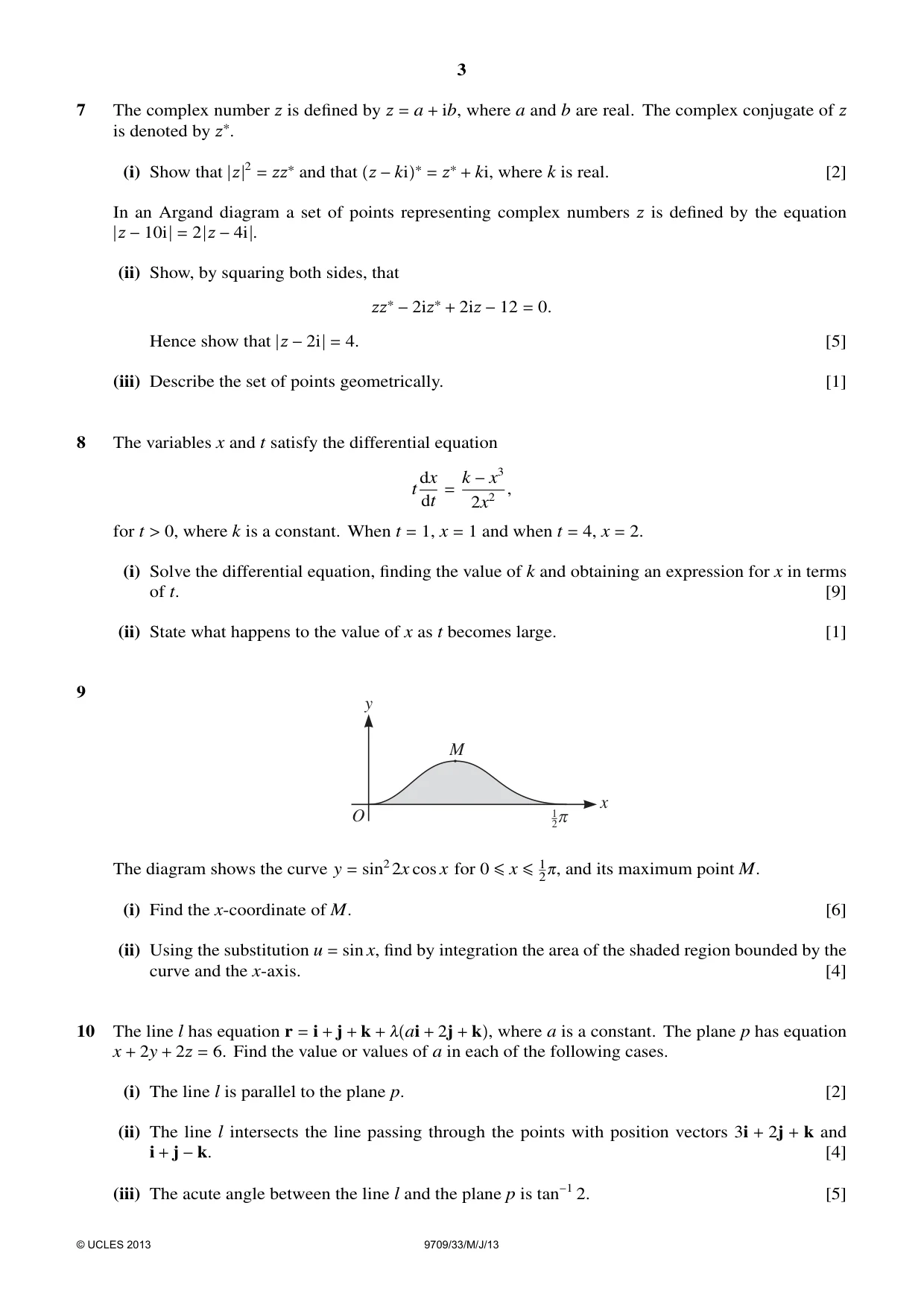
8 The variables x and t satisfy the differential equation tdx k , −x3 dt = 2x2 for t 0, where k is a constant. When t 1, x 1 and when t 4, x 2. > = = = = (i) Solve the differential equation, finding the value of k and obtaining an expression for x in terms of t. [9] (ii) State what happens to the value of x as t becomes large. [1]
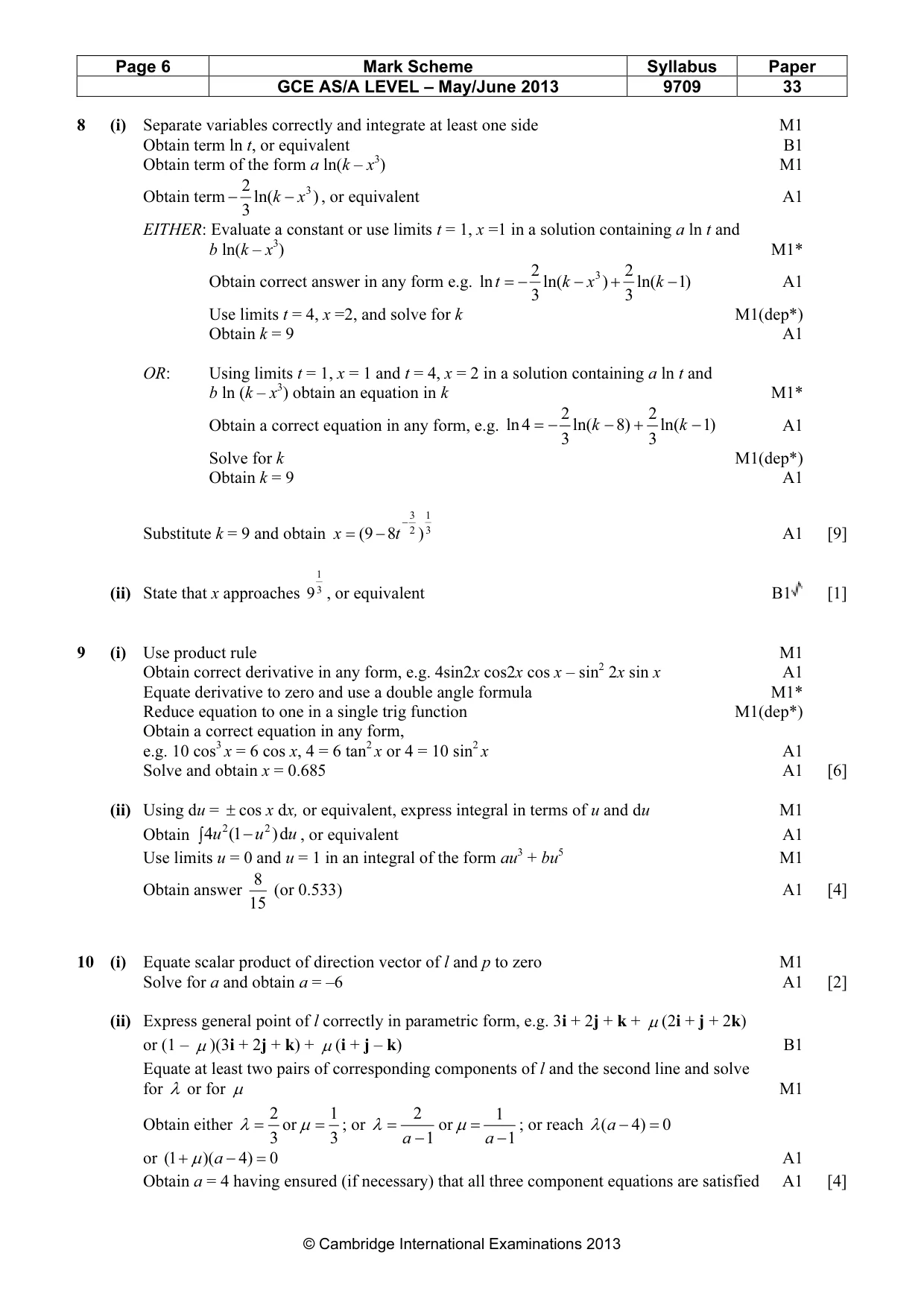
Mark scheme: 8 (i) Separate variables correctly and integrate at least one side M1 Obtain term ln t, or equivalent B1 Obtain term of the form a ln(k – x3) M1 2 Obtain term − ln(k − 3x ) , or equivalent A1 3 EITHER: Evaluate a constant or use limits t = 1, x =1 in a solution containing a ln t and b ln(k – x3) M1* 2 3 2 Obtain correct answer in any form e.g. ln t = − ln(k − x ) + ln(k − )1 A1 3 3 Use limits t = 4, x =2, and solve for k M1(dep*) Obtain k = 9 A1 OR: Using limits t = 1, x = 1 and t = 4, x = 2 in a solution containing a ln t and b ln (k – x3) obtain an equation in k M1* 2 2 Obtain a correct equation in any form, e.g. ln 4 = − ln( k − 8) + ln( k − )1 A1 3 3 Solve for k M1(dep*) Obtain k = 9 A1 3 1 − Substitute k = 9 and obtain x = (9 − 8t 2 ) 3 A1 [9] 1 (ii) State that x approaches 9 3 , or equivalent B1 [1]
Q9 · Y M x O 12 p The diagram shows the curve y sin22x cos x for 0 and its maximum point M
9 y M x O 12 p The diagram shows the curve y sin22x cos x for 0 and its maximum point M. = ≤x ≤120, (i) Find the x-coordinate of M. [6] (ii) Using the substitution u sin x, find by integration the area of the shaded region bounded by the curve and the x-axis. = [4]
Mark scheme: 9 (i) Use product rule M1 Obtain correct derivative in any form, e.g. 4sin2x cos2x cos x – sin2 2x sin x A1 Equate derivative to zero and use a double angle formula M1* Reduce equation to one in a single trig function M1(dep*) Obtain a correct equation in any form, e.g. 10 cos3 x = 6 cos x, 4 = 6 tan2 x or 4 = 10 sin2 x A1 Solve and obtain x = 0.685 A1 [6] (ii) Using du = ± cos x dx, or equivalent, express integral in terms of u and du M1 Obtain ∫ 4u 2 1( − u 2 ) du , or equivalent A1 Use limits u = 0 and u = 1 in an integral of the form au3 + bu5 M1 8 Obtain answer (or 0.533) A1 [4] 15
Q10 · The line l has equation r i j k ai 2j k , where a is a constant
10 The line l has equation r i j k ai 2j k , where a is a constant. The plane p has equation x 2y 6. Find the =value+ or+ values+ , of+a in+each of the following cases. + + 2Ï = (i) The line l is parallel to the plane p. [2] (ii) The line l intersects the line passing through the points with position vectors 3i 2j k and i j + + [4] + −k. (iii) The acute angle between the line l and the plane p is tan−1 2. [5]
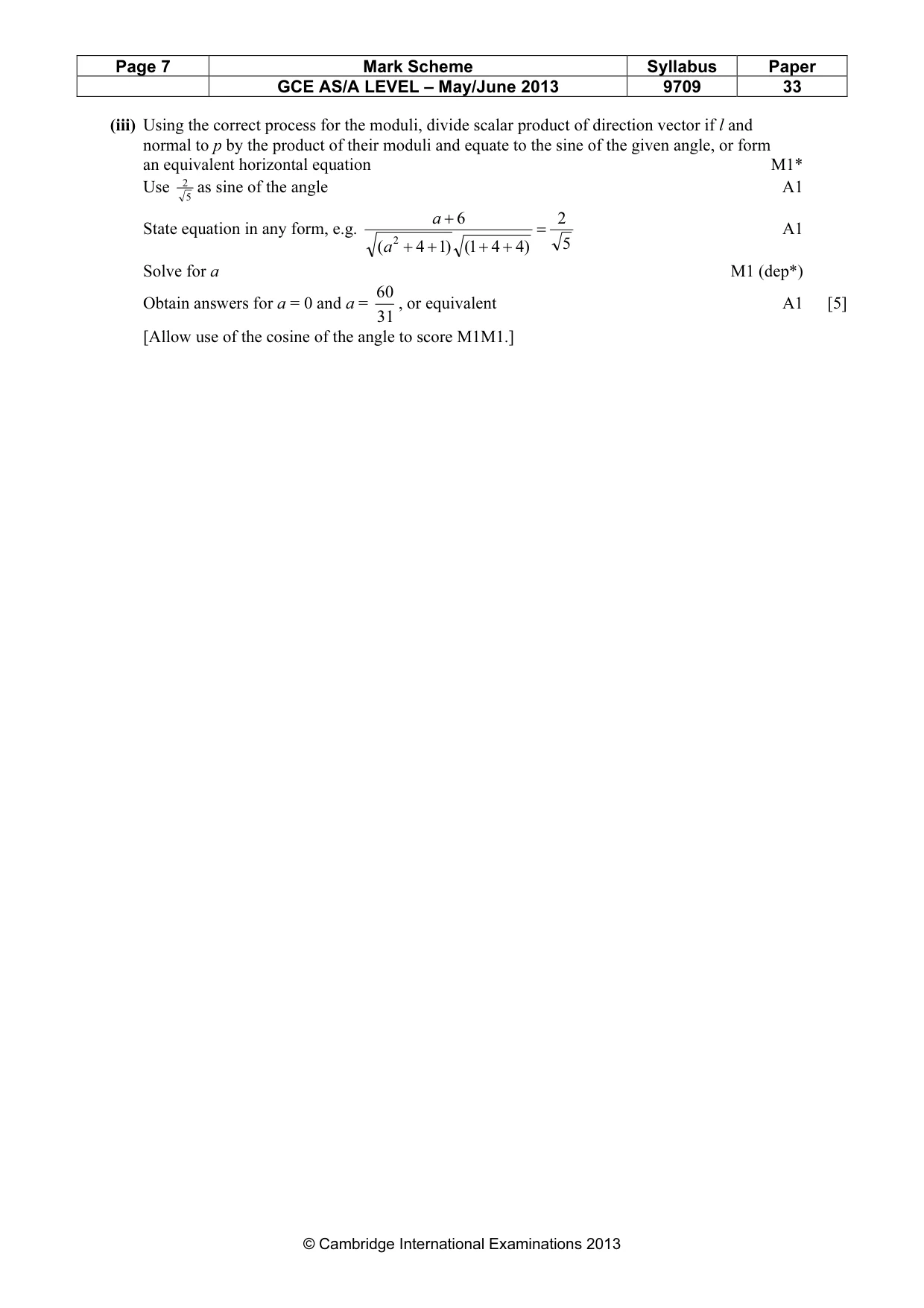
Mark scheme: 10 (i) Equate scalar product of direction vector of l and p to zero M1 Solve for a and obtain a = –6 A1 [2] (ii) Express general point of l correctly in parametric form, e.g. 3i + 2j + k + µ (2i + j + 2k) or (1 – µ )(3i + 2j + k) + µ (i + j – k) B1 Equate at least two pairs of corresponding components of l and the second line and solve for λ or for µ M1 2 1 2 1 Obtain either λ = or µ = ; or λ = or µ = ; or reach λ ( a − 4) = 0 3 3 a − 1 a − 1 or 1( + µ )( a − 4) = 0 A1 Obtain a = 4 having ensured (if necessary) that all three component equations are satisfied A1 [4] GCE AS/A LEVEL – May/June 2013 9709 33 (iii) Using the correct process for the moduli, divide scalar product of direction vector if l and normal to p by the product of their moduli and equate to the sine of the given angle, or form an equivalent horizontal equation M1* Use 2 as sine of the angle A1 5 a + 6 2 State equation in any form, e.g. = A1 ( a 2 + 4 + )1 1( + 4 + 4) 5 Solve for a M1 (dep*) 60 Obtain answers for a = 0 and a = , or equivalent A1 [5] 31 [Allow use of the cosine of the angle to score M1M1.]
What was in this paper
The subtopics covered by these 5 questions, and how many questions each got. Open one in a new tab to see every Cambridge question on it.
What you needed in this session
Cambridge’s own grade thresholds for 2013 May/June, Paper 3 · Variant 3. A higher threshold means an easier paper — the bar moves with how the cohort did.