Cambridge A Level Mathematics 9709 — 2013 Oct/Nov Paper 3 · Variant 1
9709/31/O/N/13 · 7 questions · 75 marks · ≈84 min
The question paper and its mark scheme, free to read here and free to download. This is Cambridge’s own paper, exactly as it was sat.
Question paper4 pages
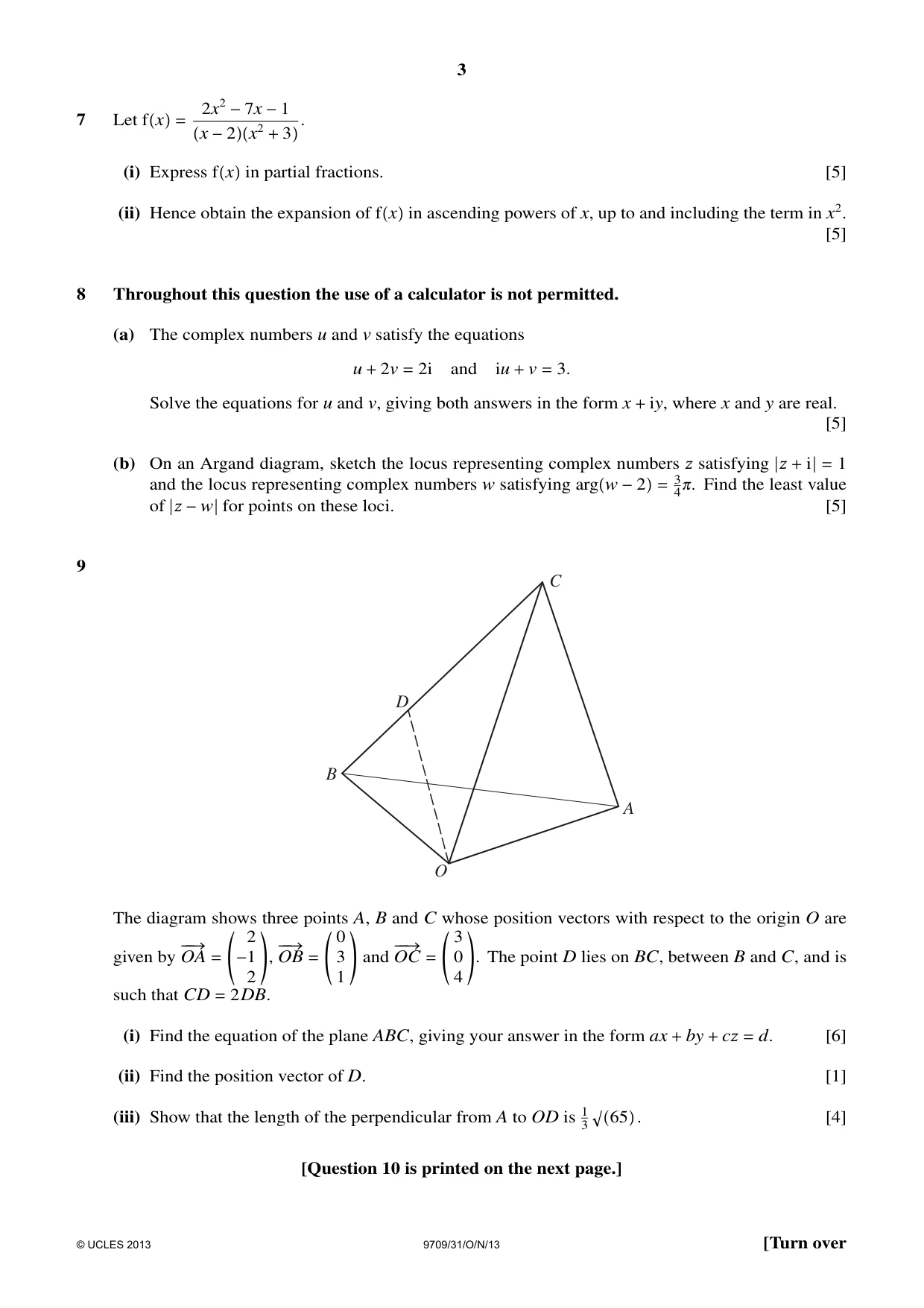
Mark scheme9 pages
Answers below. Sit the paper first if you are practising.
Questions as text
Q1 · X 1 The equation of a curve is y for x 2
1 x 1 The equation of a curve is y for x 2. Show that the gradient of the curve is always + 1 2x = > −1 negative. + [3]
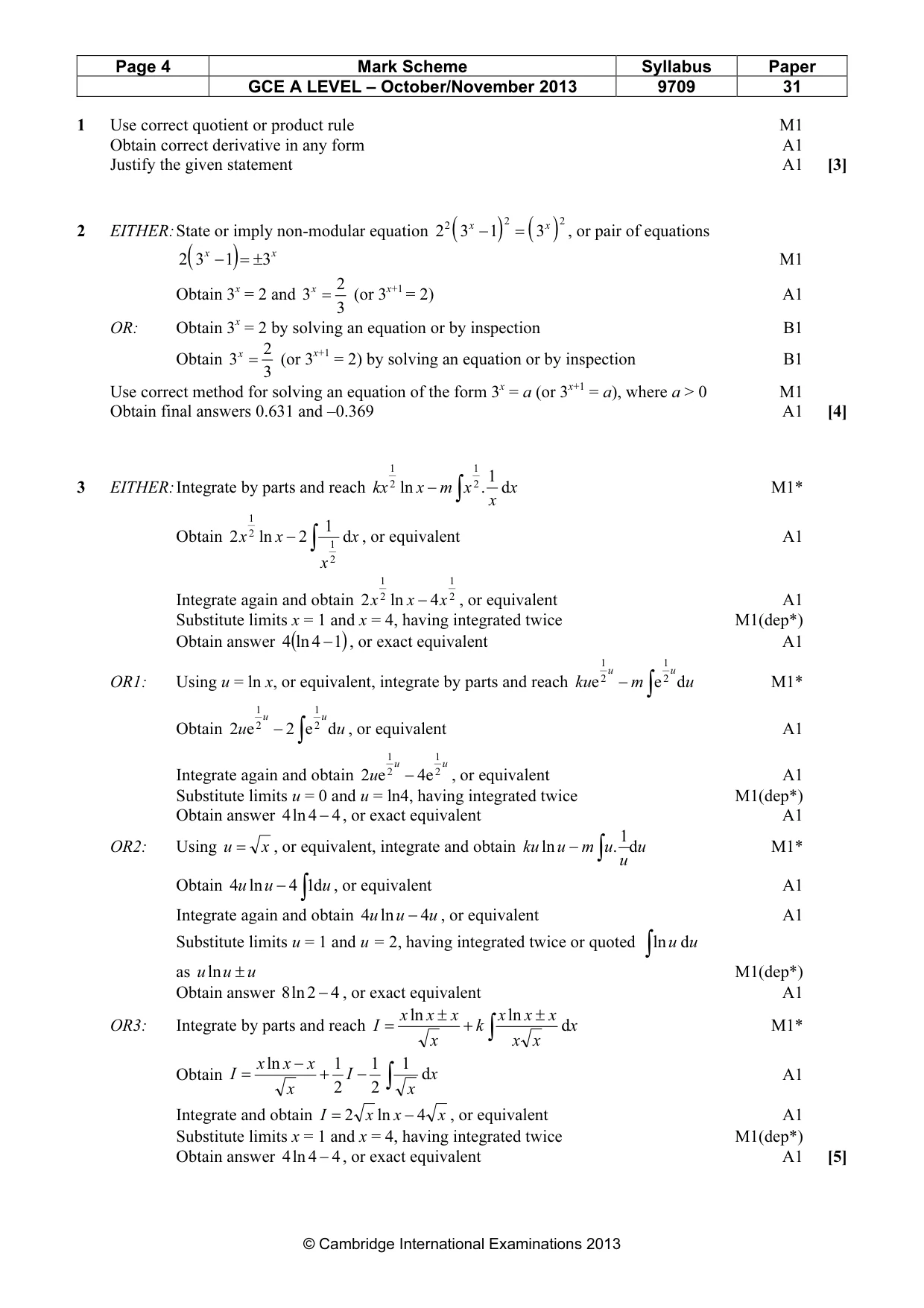
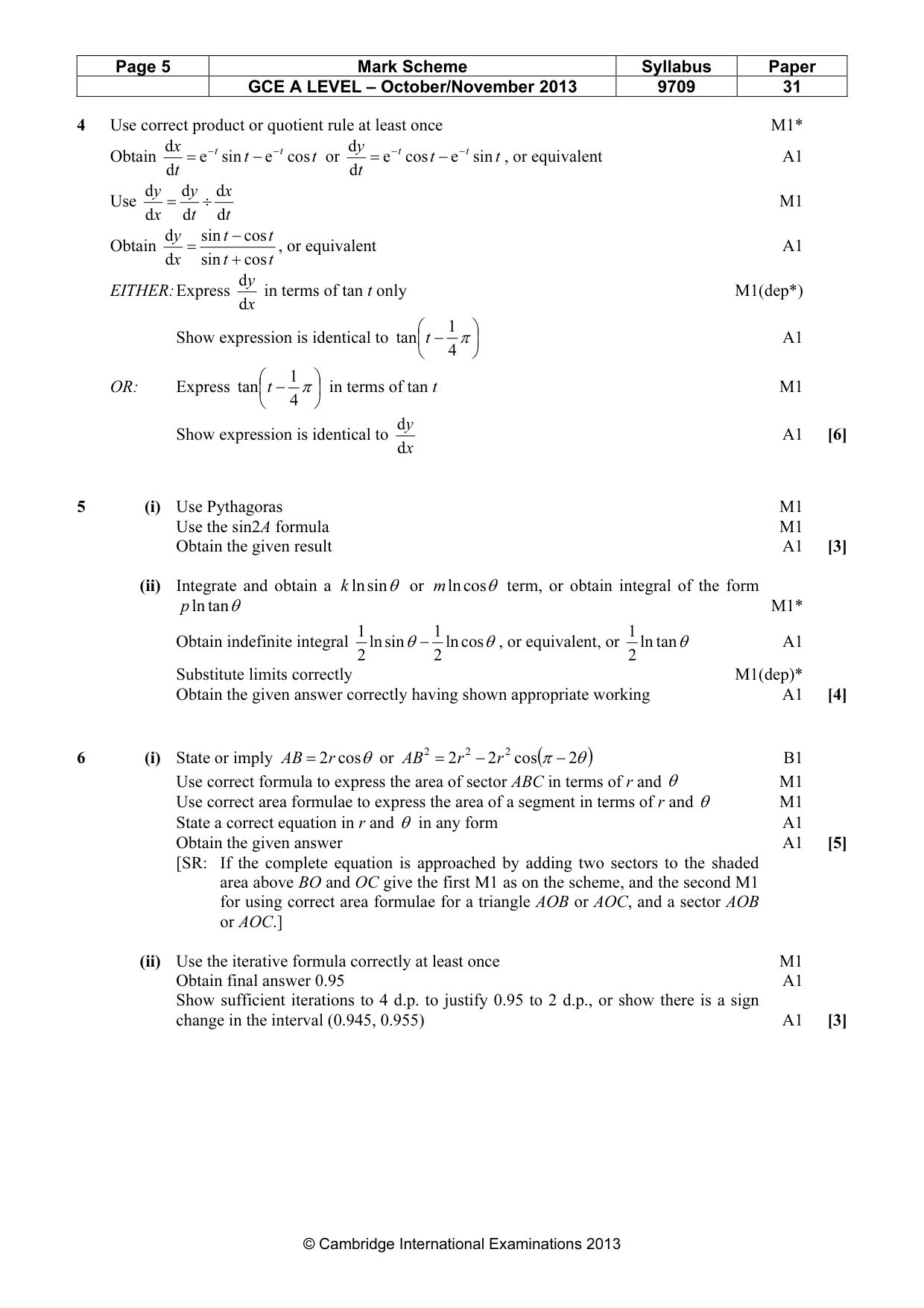
Mark scheme: 1 Use correct quotient or product rule M1 Obtain correct derivative in any form A1 Justify the given statement A1 [3] 2 ( ) 2 ( ) 2
Q2 · Solve the equation 2 3x 3x, giving your answers correct to 3 significant figures
2 Solve the equation 2 3x 3x, giving your answers correct to 3 significant figures. [4] −1 =
Mark scheme: x2 EITHER: State or imply non-modular equation 2 2 ( 3 x − 1) 2 = ( 3 ) 2 , or pair of equations x M1 2 ( 3 x − 1) = ±3 x 2 Obtain 3x = 2 and 3 = (or 3x+1 = 2) A1 3 OR: Obtain 3x = 2 by solving an equation or by inspection B1 x 2 Obtain 3 = (or 3x+1 = 2) by solving an equation or by inspection B1 3 Use correct method for solving an equation of the form 3x = a (or 3x+1 = a), where a > 0 M1 Obtain final answers 0.631 and –0.369 A1 [4] 1 1 1 ∫
Q3 · Ln x 3 Find the exact value of dx
4 ln x 3 Find the exact value of dx. [5] x Ô1
Mark scheme: 1 3 EITHER: Integrate by parts and reach kx 2 ln x − m ∫ x 2 . x dx M1* 1 1 Obtain 2 x 2 ln x − 2 ∫ 1 d x , or equivalent A1 x 2 1 1 Integrate again and obtain 2 x 2 ln x − 4 x 2 , or equivalent A1 Substitute limits x = 1 and x = 4, having integrated twice M1(dep*) Obtain answer 4(ln 4 − )1 , or exact equivalent A1 1 1 u u OR1: Using u = ln x, or equivalent, integrate by parts and reach kue 2 − m ∫ e 2 d u M1* 1 1 u u Obtain 2ue 2 − 2 ∫ e 2 du , or equivalent A1 1 1 u u Integrate again and obtain 2u e 2 − 4 e 2 , or equivalent A1 Substitute limits u = 0 and u = ln4, having integrated twice M1(dep*) Obtain answer 4 ln 4 − 4 , or exact equivalent A1 1 OR2: Using u = x , or equivalent, integrate and obtain ku ln u − m ∫ u . u d u M1* Obtain 4u ln u − 4 ∫ 1du , or equivalent A1 Integrate again and obtain 4u ln u − 4u , or equivalent A1 Substitute limits u = 1 and u = 2, having integrated twice or quoted ∫ ln u du as u ln u ± u M1(dep*) Obtain answer 8 ln 2 − 4 , or exact equivalent A1 x ln x ± x x ln x ± x OR3: Integrate by parts and reach I = + k ∫ dx M1* x x x x ln x − x 1 1 1 I − Obtain I = + 2 2 ∫ dx A1 x x Integrate and obtain I = 2 x ln x − 4 x , or equivalent A1 Substitute limits x = 1 and x = 4, having integrated twice M1(dep*) Obtain answer 4 ln 4 − 4 , or exact equivalent A1 [5] GCE A LEVEL – October/November 2013 9709 31
Q4 · The parametric equations of a curve are x cos t, y sin t
4 The parametric equations of a curve are x cos t, y sin t. = e−t = e−t dy Show that tan t . [6] dx = −140
Mark scheme: 4 Use correct product or quotient rule at least once M1* d x − t − t d y − t − t Obtain = e sin t − e cos t or = e cos t − e sin t , or equivalent A1 d t d t d y d y d x Use = ÷ M1 d x d t d t d y sin t − cos t Obtain = , or equivalent A1 dx sin t + cos t d y EITHER: Express in terms of tan t only M1(dep*) d x 1 Show expression is identical to tan − t π A1 4 1 t M1 OR: Express tan − t π in terms of tan 4 d y Show expression is identical to A1 [6] d x
Q5 · Prove that cot tan 2 cosec [3] 1 + 1 21
5 (i) Prove that cot tan 2 cosec [3] 1 + 1 21. 1 30 1 (ii) Hence show that cosec ln 3. [4] 1 2 Ó 21 d1 = 60
Mark scheme: 5 (i) Use Pythagoras M1 Use the sin2A formula M1 Obtain the given result A1 [3] (ii) Integrate and obtain a k ln sin θ or m ln cos θ term, or obtain integral of the form p ln tan θ M1* 1 1 1 Obtain indefinite integral ln sin θ − ln cos θ , or equivalent, or ln tan θ A1 2 2 2 Substitute limits correctly M1(dep)* Obtain the given answer correctly having shown appropriate working A1 [4] 2 2 2 ( )
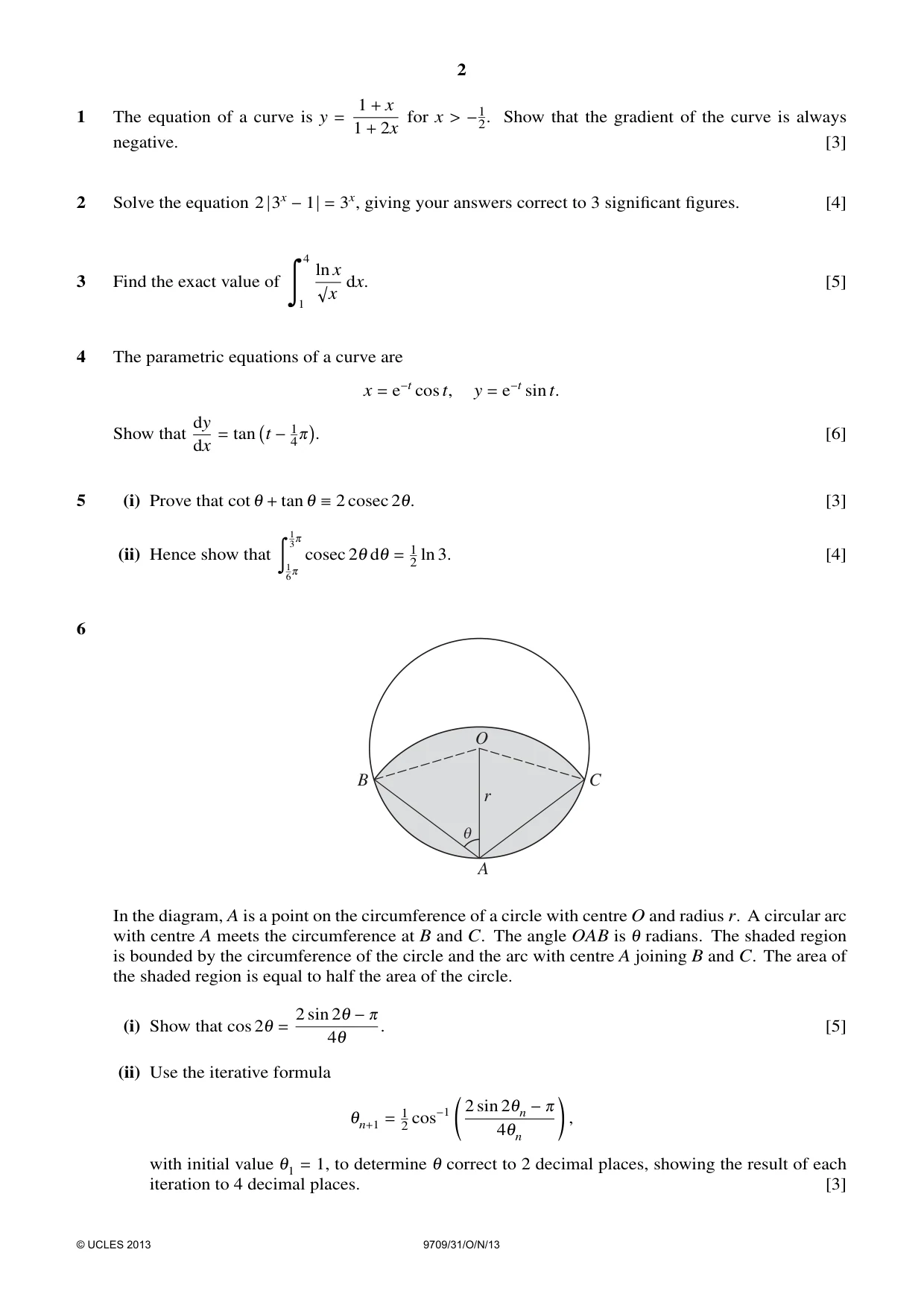
Q6 · O B C r q A In the diagram, A is a point on the circumference of a circle with centre O…
6 O B C r q A In the diagram, A is a point on the circumference of a circle with centre O and radius r. A circular arc with centre A meets the circumference at B and C. The angle OAB is radians. The shaded region is bounded by the circumference of the circle and the arc with centre A 1joining B and C. The area of the shaded region is equal to half the area of the circle. 2 sin (i) Show that cos . [5] 21 −0 21 = 41 (ii) Use the iterative formula P2 sin Q 1 , 2 cos−1 21n −0 1n+1 = 41n with initial value 1, to determine correct to 2 decimal places, showing the result of each iteration to 4 decimal11 =places. 1 [3]
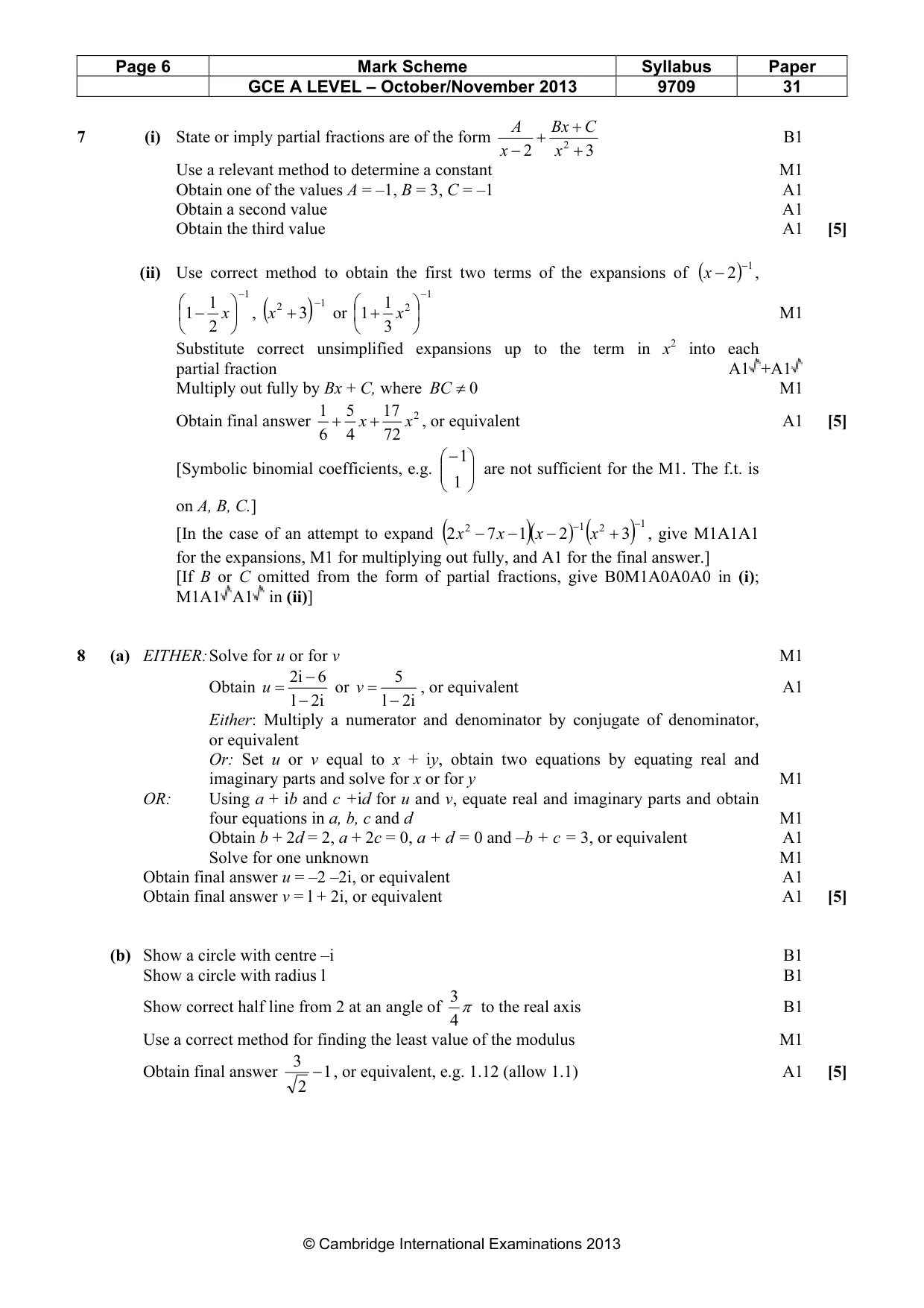
Mark scheme: 6 (i) State or imply AB = 2r cos θ or AB 2 = 2 r 2 − 2 r 2 cos(π − 2θ ) B1 Use correct formula to express the area of sector ABC in terms of r and θ M1 Use correct area formulae to express the area of a segment in terms of r and θ M1 State a correct equation in r and θ in any form A1 Obtain the given answer A1 [5] [SR: If the complete equation is approached by adding two sectors to the shaded area above BO and OC give the first M1 as on the scheme, and the second M1 for using correct area formulae for a triangle AOB or AOC, and a sector AOB or AOC.] (ii) Use the iterative formula correctly at least once M1 Obtain final answer 0.95 A1 Show sufficient iterations to 4 d.p. to justify 0.95 to 2 d.p., or show there is a sign change in the interval (0.945, 0.955) A1 [3] GCE A LEVEL – October/November 2013 9709 31 A Bx + C
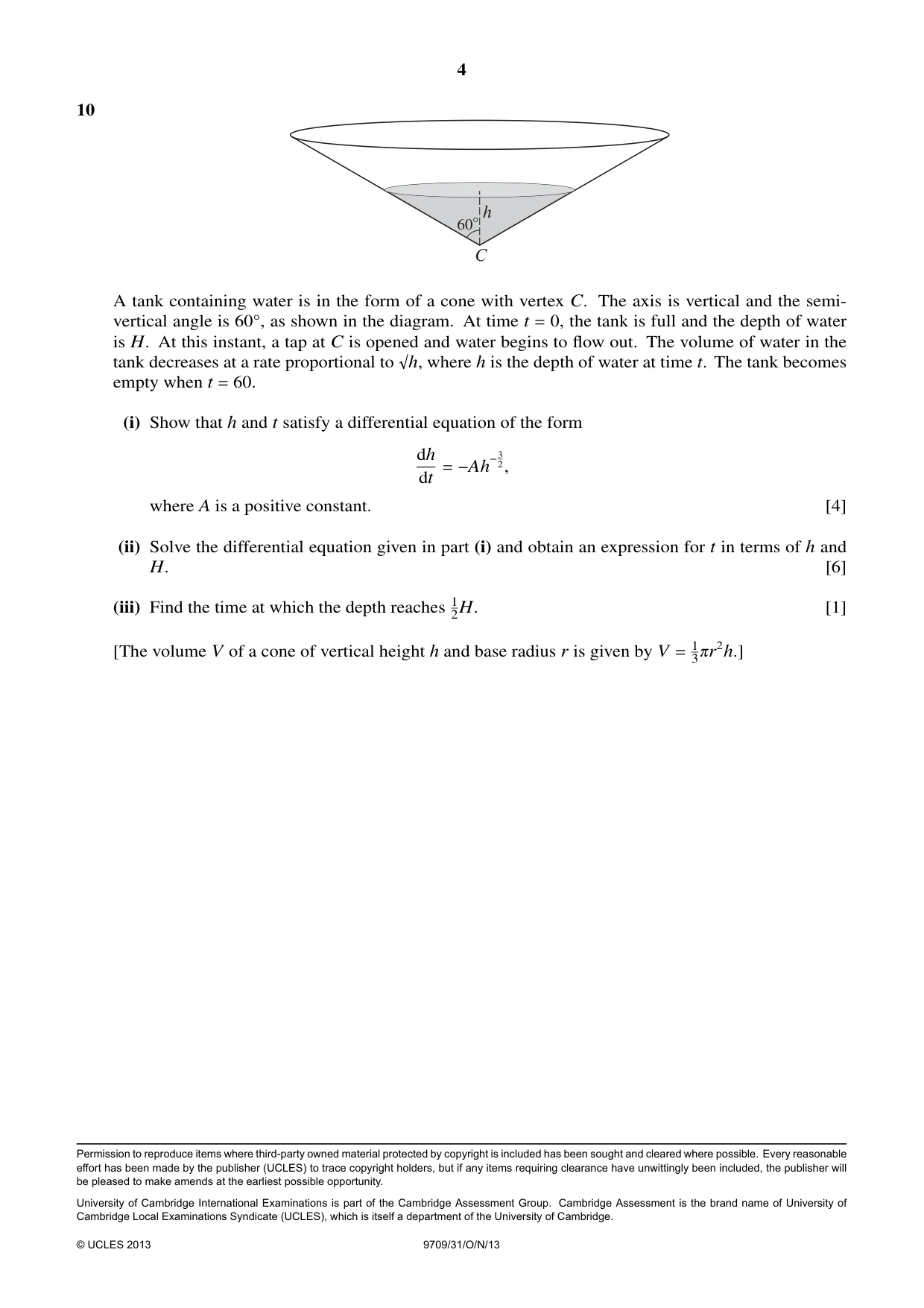
Q10 · H 60° C A tank containing water is in the form of a cone with vertex C
10 h 60° C A tank containing water is in the form of a cone with vertex C. The axis is vertical and the semi- vertical angle is as shown in the diagram. At time t 0, the tank is full and the depth of water is H. At this instant,60Å, a tap at C is opened and water begins= to flow out. The volume of water in the tank decreases at a rate proportional to where h is the depth of water at time t. The tank becomes empty when t 60. ïh, = (i) Show that h and t satisfy a differential equation of the form dh −32, dt = −Ah where A is a positive constant. [4] (ii) Solve the differential equation given in part (i) and obtain an expression for t in terms of h and H. [6] (iii) Find the time at which the depth reaches 2H.1 [1] [The volume V of a cone of vertical height h and base radius r is given by V 1 = 30r2h.]
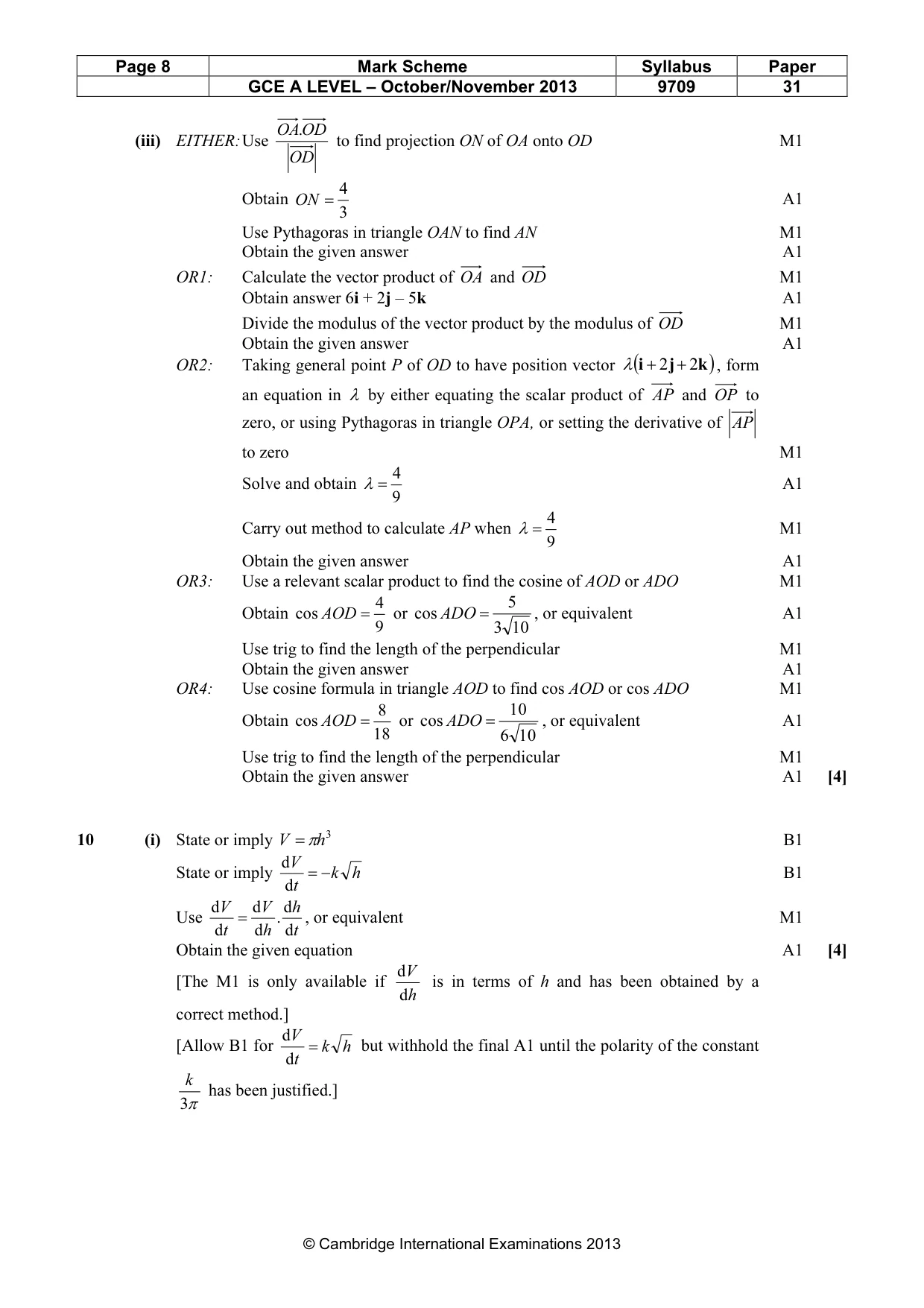
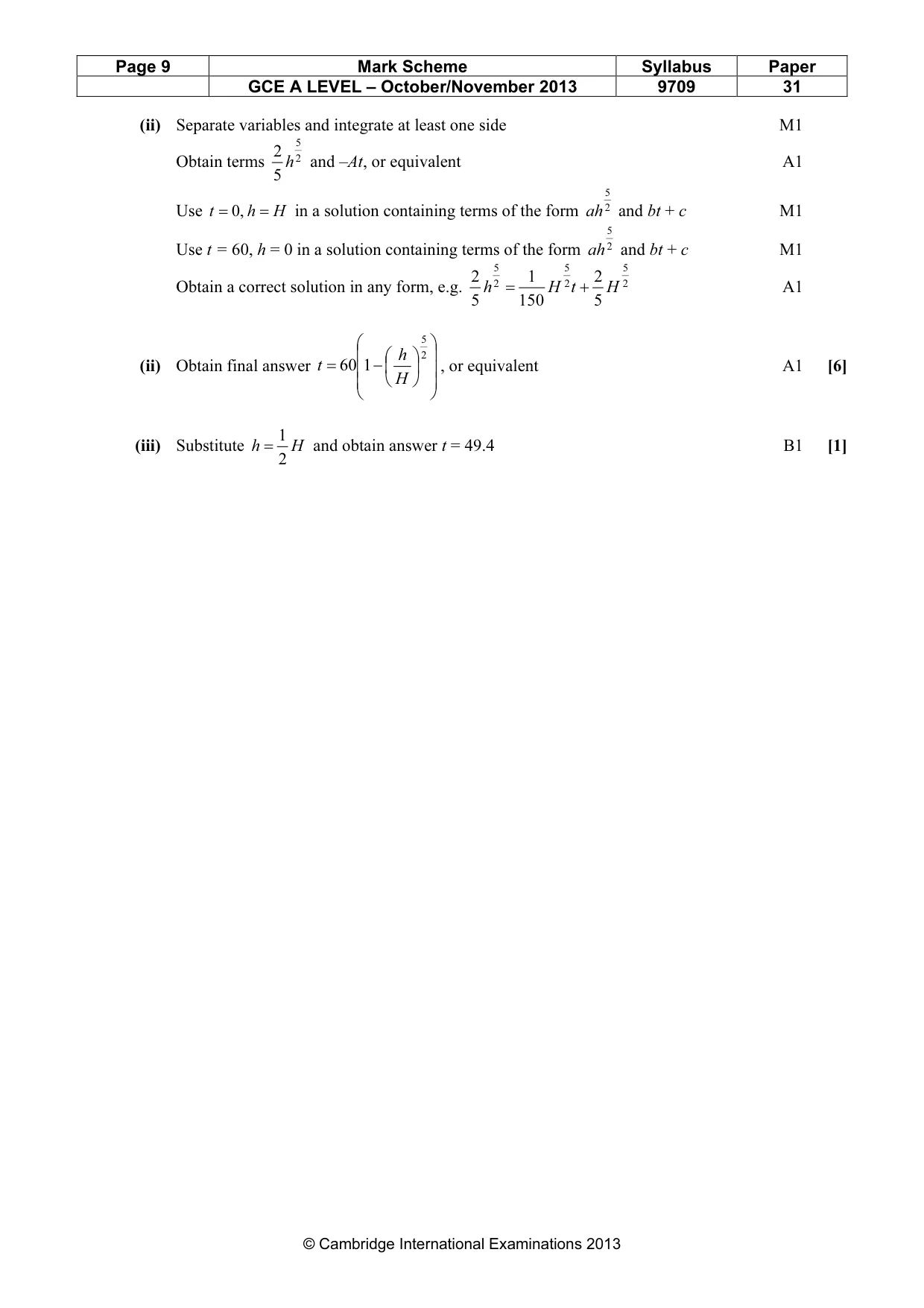
Mark scheme: 10 (i) State or imply V = πh 3 B1 d V State or imply = − k h B1 d t d V d V d h Use = . , or equivalent M1 d t d h d t Obtain the given equation A1 [4] d V [The M1 is only available if is in terms of h and has been obtained by a d h correct method.] dV [Allow B1 for = k h but withhold the final A1 until the polarity of the constant dt k has been justified.] 3π GCE A LEVEL – October/November 2013 9709 31 (ii) Separate variables and integrate at least one side M1 5 2 2 Obtain terms h and –At, or equivalent A1 5 5 Use t = ,0 h = H in a solution containing terms of the form ah 2 and bt + c M1 5 Use t = 60, h = 0 in a solution containing terms of the form ah 2 and bt + c M1 5 5 5 2 2 1 2 2 2 Obtain a correct solution in any form, e.g. h = H t + H A1 5 150 5 5 h 2 (ii) Obtain final answer t = 60 1 − , or equivalent A1 [6] H 1 (iii) Substitute h = H and obtain answer t = 49.4 B1 [1] 2
What was in this paper
The subtopics covered by these 7 questions, and how many questions each got. Open one in a new tab to see every Cambridge question on it.
What you needed in this session
Cambridge’s own grade thresholds for 2013 Oct/Nov, Paper 3 · Variant 1. A higher threshold means an easier paper — the bar moves with how the cohort did.