Cambridge A Level Mathematics 9709 — 2010 Oct/Nov Paper 3 · Variant 2
9709/32/O/N/10 · 10 questions · 75 marks · ≈84 min
The question paper and its mark scheme, free to read here and free to download. This is Cambridge’s own paper, exactly as it was sat.
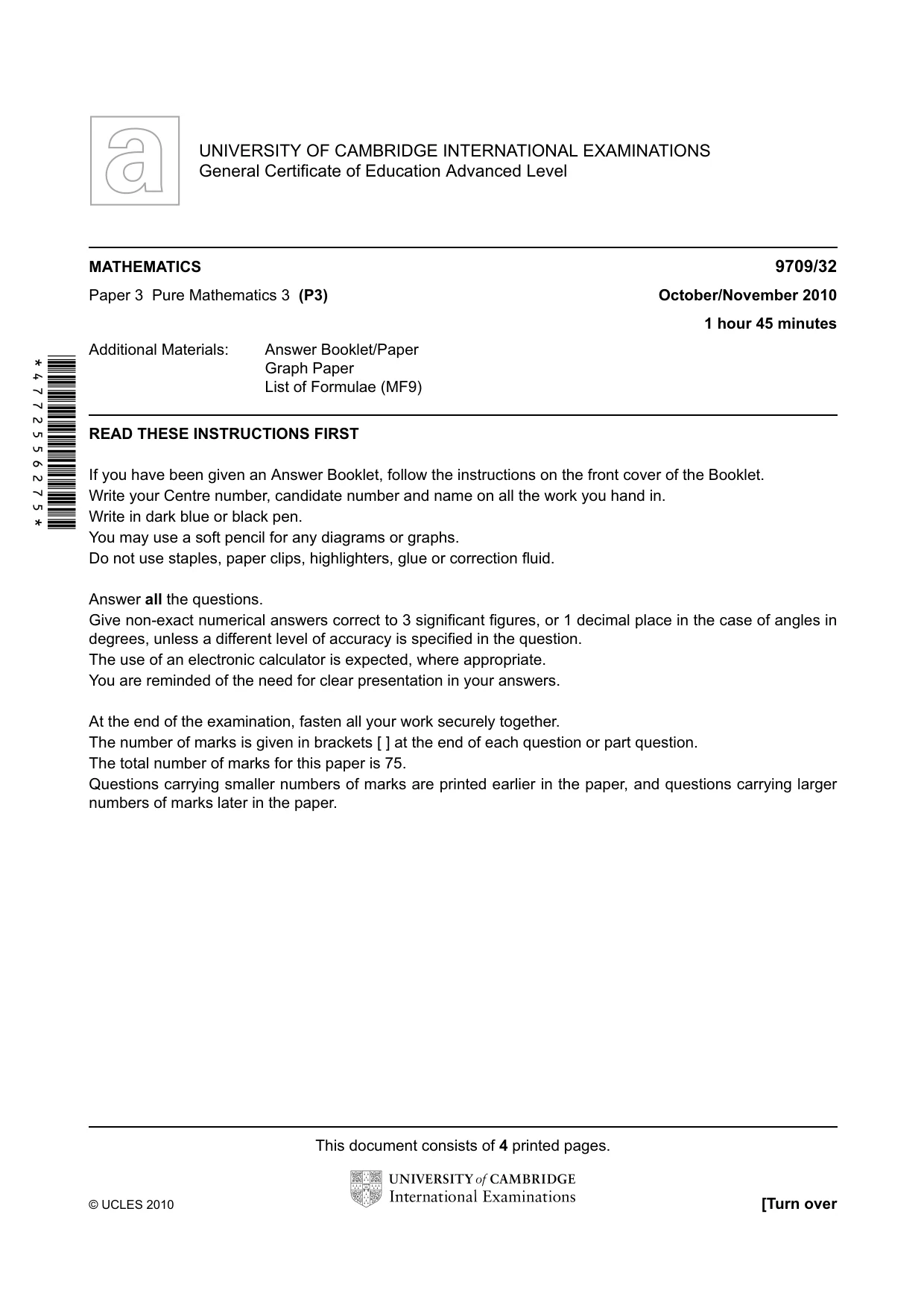
Question paper4 pages
Mark scheme8 pages
Answers below. Sit the paper first if you are practising.
Questions as text
Q1 · Solve the inequality [4] 2|x −3| > |3x + 1|
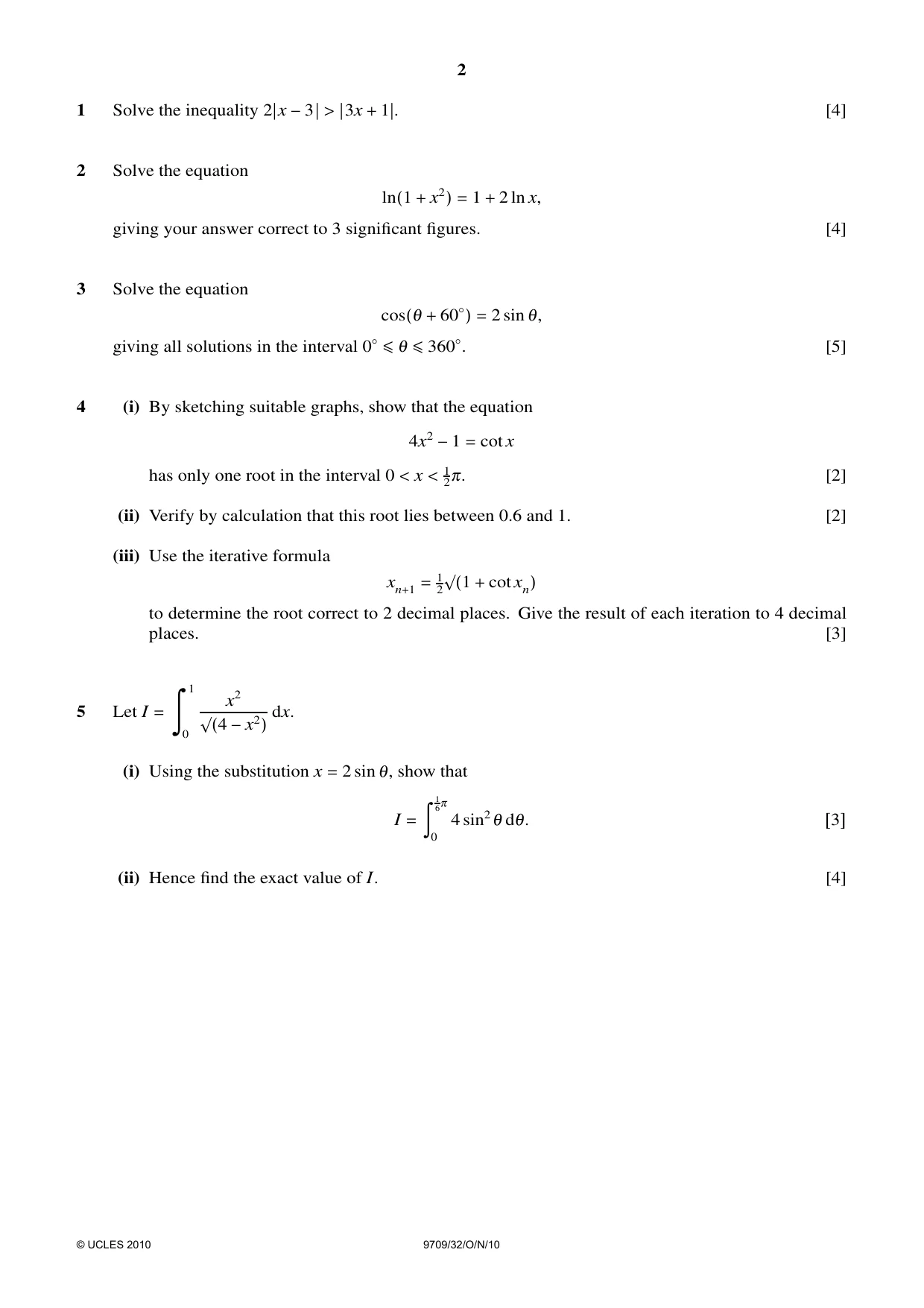
1 Solve the inequality [4] 2|x −3| > |3x + 1|.
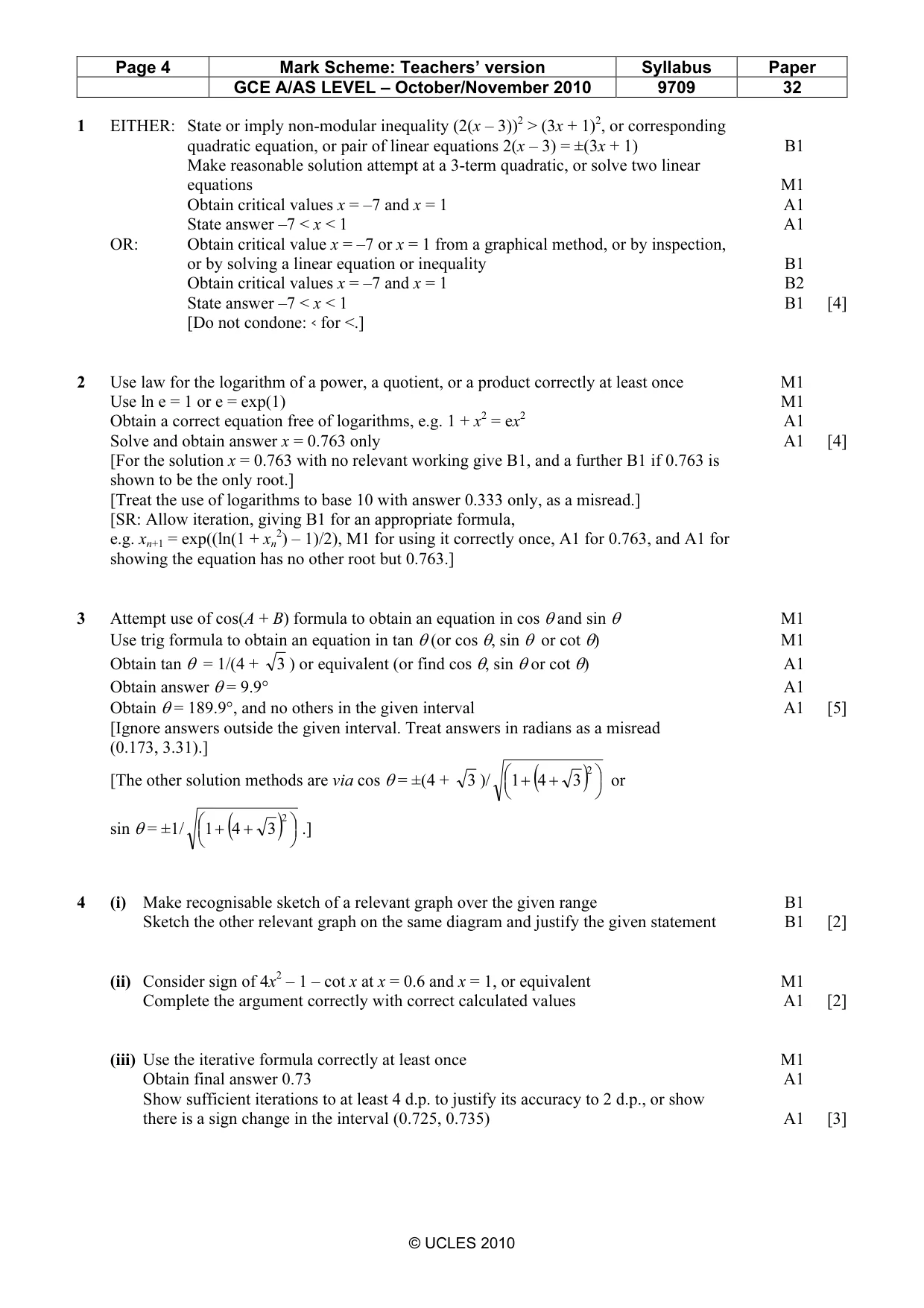
Mark scheme: 1 EITHER: State or imply non-modular inequality (2(x – 3))2 > (3x + 1)2, or corresponding quadratic equation, or pair of linear equations 2(x – 3) = ±(3x + 1) B1 Make reasonable solution attempt at a 3-term quadratic, or solve two linear equations M1 Obtain critical values x = –7 and x = 1 A1 State answer –7 < x < 1 A1 OR: Obtain critical value x = –7 or x = 1 from a graphical method, or by inspection, or by solving a linear equation or inequality B1 Obtain critical values x = –7 and x = 1 B2 State answer –7 < x < 1 B1 [4] [Do not condone: < for <.]
Q2 · Solve the equation 1 2 ln x, ln(1 + x2) = + giving your answer correct to 3 significant…
2 Solve the equation 1 2 ln x, ln(1 + x2) = + giving your answer correct to 3 significant figures. [4]
Mark scheme: 2 Use law for the logarithm of a power, a quotient, or a product correctly at least once M1 Use ln e = 1 or e = exp(1) M1 Obtain a correct equation free of logarithms, e.g. 1 + x2 = ex2 A1 Solve and obtain answer x = 0.763 only A1 [4] [For the solution x = 0.763 with no relevant working give B1, and a further B1 if 0.763 is shown to be the only root.] [Treat the use of logarithms to base 10 with answer 0.333 only, as a misread.] [SR: Allow iteration, giving B1 for an appropriate formula, e.g. xn+1 = exp((ln(1 + xn2) – 1)/2), M1 for using it correctly once, A1 for 0.763, and A1 for showing the equation has no other root but 0.763.]
Q3 · Solve the equation 2 sin θ, cos(θ + 60◦) = giving all solutions in the interval [5] 0◦≤θ…
3 Solve the equation 2 sin θ, cos(θ + 60◦) = giving all solutions in the interval [5] 0◦≤θ ≤360◦.
Mark scheme: 3 Attempt use of cos(A + B) formula to obtain an equation in cos θ and sin θ M1 Use trig formula to obtain an equation in tan θ (or cos θ, sin θ or cot θ) M1 Obtain tan θ = 1/(4 + 3 ) or equivalent (or find cos θ, sin θ or cot θ) A1 Obtain answer θ = 9.9° A1 Obtain θ = 189.9°, and no others in the given interval A1 [5] [Ignore answers outside the given interval. Treat answers in radians as a misread (0.173, 3.31).] [The other solution methods are via cos θ = ±(4 + 3 )/ 1 + (4 + 3 )2 or 2 sin θ = ±1/ 1 + (4 + 3 ) .]
Q4 · By sketching suitable graphs, show that the equation 4x2 cotx −1 = has only one root in…
4 (i) By sketching suitable graphs, show that the equation 4x2 cotx −1 = has only one root in the interval 0 x 12π. [2] < < (ii) Verify by calculation that this root lies between 0.6 and 1. [2] (iii) Use the iterative formula 1 2 xn+1 = √(1 + cotxn) to determine the root correct to 2 decimal places. Give the result of each iteration to 4 decimal places. [3]
Mark scheme: 4 (i) Make recognisable sketch of a relevant graph over the given range B1 Sketch the other relevant graph on the same diagram and justify the given statement B1 [2] (ii) Consider sign of 4x2 – 1 – cot x at x = 0.6 and x = 1, or equivalent M1 Complete the argument correctly with correct calculated values A1 [2] (iii) Use the iterative formula correctly at least once M1 Obtain final answer 0.73 A1 Show sufficient iterations to at least 4 d.p. to justify its accuracy to 2 d.p., or show there is a sign change in the interval (0.725, 0.735) A1 [3] GCE A/AS LEVEL – October/November 2010 9709 32 dx
Q5 · X2 5 Let I dx
1 x2 5 Let I dx. = ä 0 √(4 −x2) (i) Using the substitution x 2 sin θ, show that = 16π I 4 sin2θ dθ. = ã 0 [3] (ii) Hence find the exact value of I. [4]
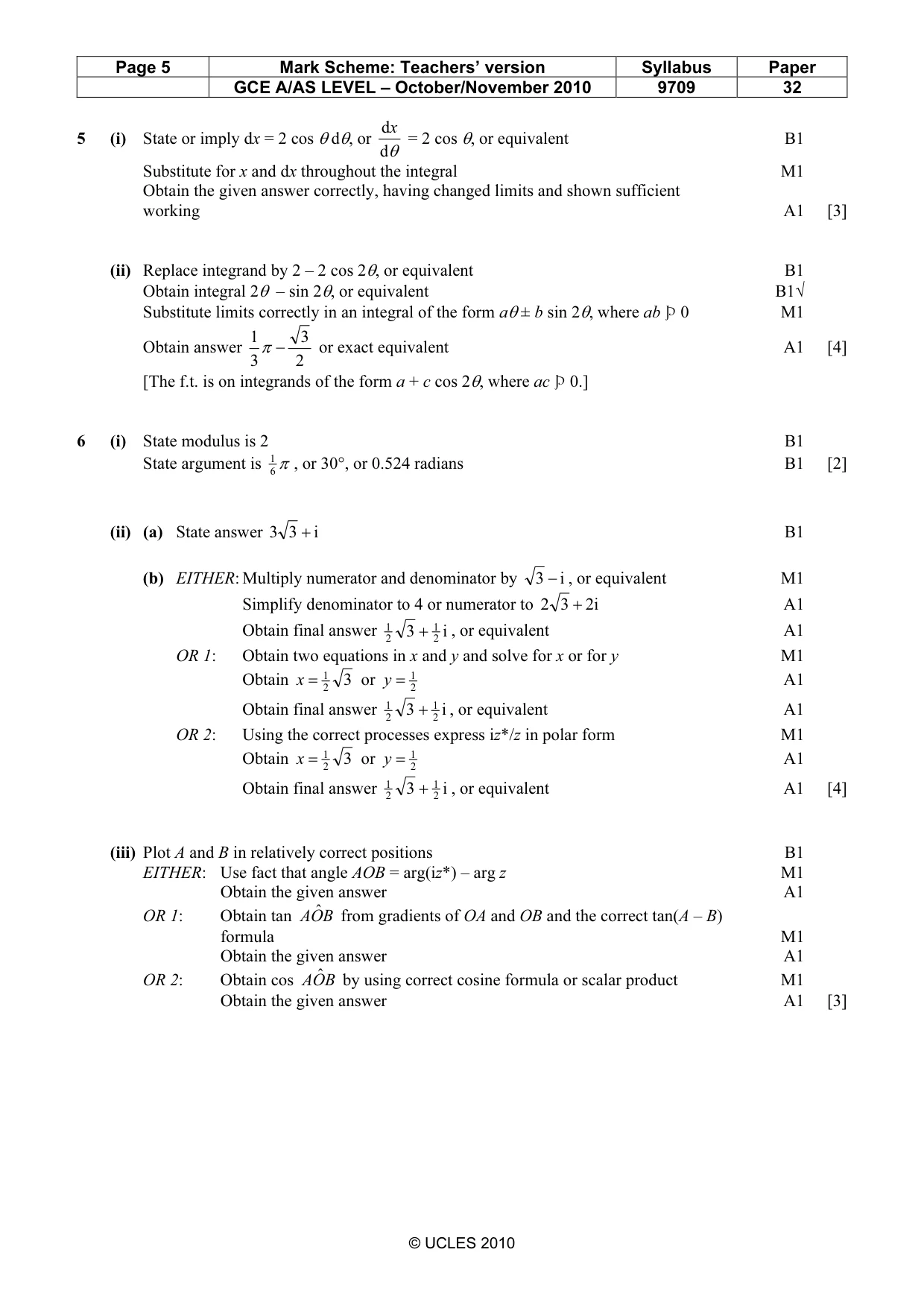
Mark scheme: dx 5 (i) State or imply dx = 2 cos θ dθ, or = 2 cos θ, or equivalent B1 dθ Substitute for x and dx throughout the integral M1 Obtain the given answer correctly, having changed limits and shown sufficient working A1 [3] (ii) Replace integrand by 2 – 2 cos 2θ, or equivalent B1 Obtain integral 2θ – sin 2θ, or equivalent B1√ Substitute limits correctly in an integral of the form aθ ± b sin 2θ, where ab Þ 0 M1 1 3 Obtain answer π − or exact equivalent A1 [4] 3 2 [The f.t. is on integrands of the form a + c cos 2θ, where ac Þ 0.]
Q6 · The complex number is given by ß i
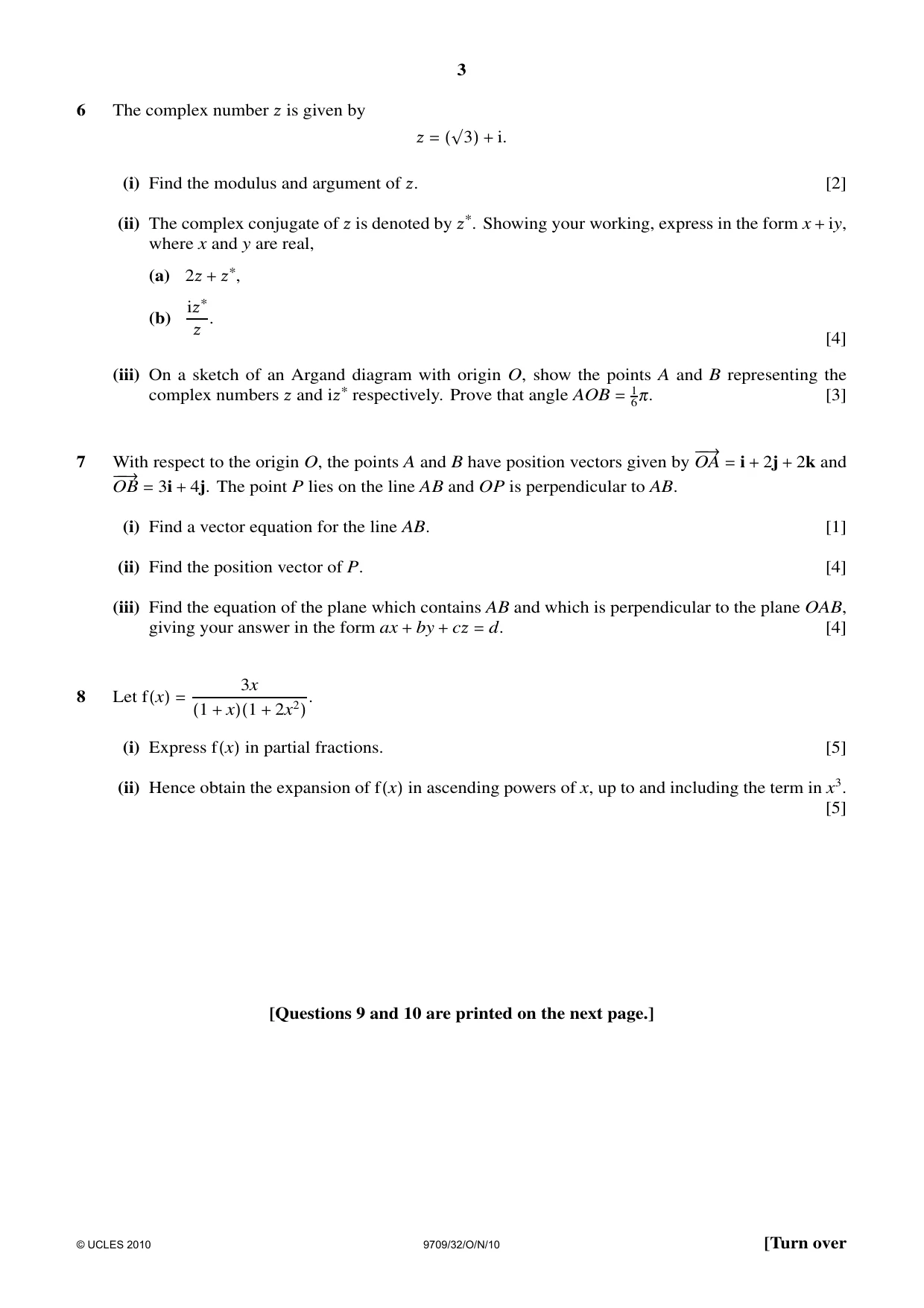
6 The complex number is given by ß i. ß = (√3) + (i) Find the modulus and argument of [2] ß. (ii) The complex conjugate of is denoted by Showing your working, express in the form x iy, where x and y are real, ß ß*. + (a) 2ß + ß*, (b) . iß* [4] ß (iii) On a sketch of an Argand diagram with origin O, show the points A and B representing the complex numbers and respectively. Prove that angle AOB 16π. [3] ß iß* =
Mark scheme: 6 (i) State modulus is 2 B1 State argument is 16 π , or 30°, or 0.524 radians B1 [2] (ii) (a) State answer 3 3 + i B1 (b) EITHER: Multiply numerator and denominator by 3 −,i or equivalent M1 Simplify denominator to 4 or numerator to 2 3 + i2 A1 Obtain final answer 12 3 + 12 i , or equivalent A1 OR 1: Obtain two equations in x and y and solve for x or for y M1 Obtain x = 12 3 or y = 12 A1 Obtain final answer 12 3 + 12 i , or equivalent A1 OR 2: Using the correct processes express iz*/z in polar form M1 Obtain x = 12 3 or y = 12 A1 Obtain final answer 12 3 + 12 i , or equivalent A1 [4] (iii) Plot A and B in relatively correct positions B1 EITHER: Use fact that angle AOB = arg(iz*) – arg z M1 Obtain the given answer A1 OR 1: Obtain tan AOˆ B from gradients of OA and OB and the correct tan(A – B) formula M1 Obtain the given answer A1 OR 2: Obtain cos AOˆ B by using correct cosine formula or scalar product M1 Obtain the given answer A1 [3] GCE A/AS LEVEL – October/November 2010 9709 32
Q7 · With respect to the origin O, the points A and B have position vectors given by OA i 2j…
7 With respect to the origin O, the points A and B have position vectors given by OA i 2j 2k and −−→ = + + OB 3i 4j. The point P lies on the line AB and OP is perpendicular to AB. −−→ = + (i) Find a vector equation for the line AB. [1] (ii) Find the position vector of P. [4] (iii) Find the equation of the plane which contains AB and which is perpendicular to the plane OAB, giving your answer in the form ax by d. [4] + + cß =
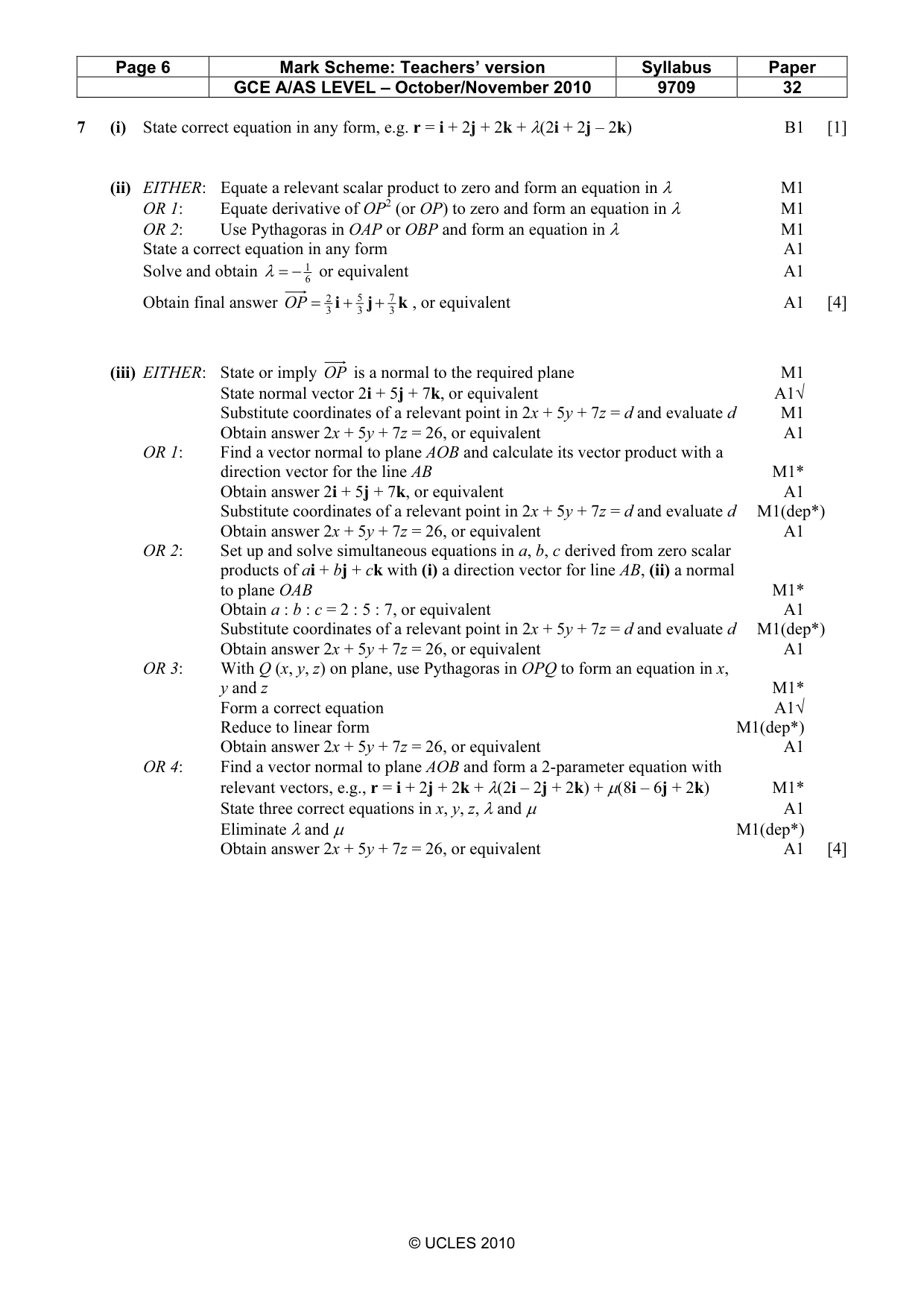
Mark scheme: 7 (i) State correct equation in any form, e.g. r = i + 2j + 2k + λ(2i + 2j – 2k) B1 [1] (ii) EITHER: Equate a relevant scalar product to zero and form an equation in λ M1 OR 1: Equate derivative of OP2 (or OP) to zero and form an equation in λ M1 OR 2: Use Pythagoras in OAP or OBP and form an equation in λ M1 State a correct equation in any form A1 Solve and obtain λ = − 16 or equivalent A1 Obtain final answer OP = 23 i + 53 j + 73 k , or equivalent A1 [4] (iii) EITHER: State or imply OP is a normal to the required plane M1 State normal vector 2i + 5j + 7k, or equivalent A1√ Substitute coordinates of a relevant point in 2x + 5y + 7z = d and evaluate d M1 Obtain answer 2x + 5y + 7z = 26, or equivalent A1 OR 1: Find a vector normal to plane AOB and calculate its vector product with a direction vector for the line AB M1* Obtain answer 2i + 5j + 7k, or equivalent A1 Substitute coordinates of a relevant point in 2x + 5y + 7z = d and evaluate d M1(dep*) Obtain answer 2x + 5y + 7z = 26, or equivalent A1 OR 2: Set up and solve simultaneous equations in a, b, c derived from zero scalar products of ai + bj + ck with (i) a direction vector for line AB, (ii) a normal to plane OAB M1* Obtain a : b : c = 2 : 5 : 7, or equivalent A1 Substitute coordinates of a relevant point in 2x + 5y + 7z = d and evaluate d M1(dep*) Obtain answer 2x + 5y + 7z = 26, or equivalent A1 OR 3: With Q (x, y, z) on plane, use Pythagoras in OPQ to form an equation in x, y and z M1* Form a correct equation A1√ Reduce to linear form M1(dep*) Obtain answer 2x + 5y + 7z = 26, or equivalent A1 OR 4: Find a vector normal to plane AOB and form a 2-parameter equation with relevant vectors, e.g., r = i + 2j + 2k + λ(2i – 2j + 2k) + µ(8i – 6j + 2k) M1* State three correct equations in x, y, z, λ and µ A1 Eliminate λ and µ M1(dep*) Obtain answer 2x + 5y + 7z = 26, or equivalent A1 [4] GCE A/AS LEVEL – October/November 2010 9709 32 A Bx + C
Q8 · X 8 Let f(x) = (1 + x)(1 + 2x2)
3x 8 Let f(x) = (1 + x)(1 + 2x2). (i) Express in partial fractions. [5] f(x) (ii) Hence obtain the expansion of in ascending powers of x, up to and including the term in x3. f(x) [5] [Questions 9 and 10 are printed on the next page.]
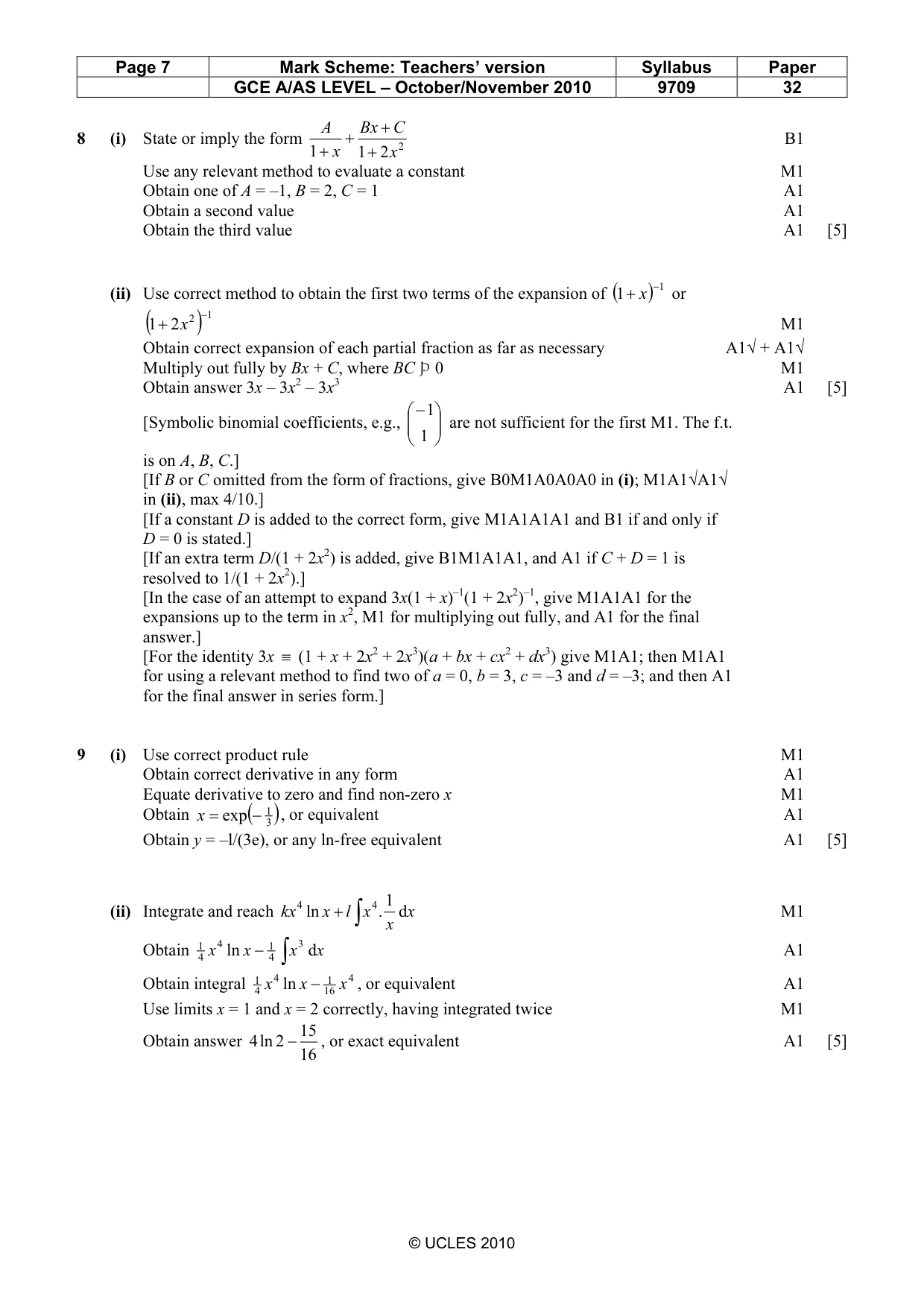
Mark scheme: A Bx + C 8 (i) State or imply the form + 2 B1 1 + x 1 + 2 x Use any relevant method to evaluate a constant M1 Obtain one of A = –1, B = 2, C = 1 A1 Obtain a second value A1 Obtain the third value A1 [5] (ii) Use correct method to obtain the first two terms of the expansion of (1 + x )−1 or (1 + 2 x 2 )−1 M1 Obtain correct expansion of each partial fraction as far as necessary A1√ + A1√ Multiply out fully by Bx + C, where BC Þ 0 M1 Obtain answer 3x – 3x2 – 3x3 A1 [5] − 1 [Symbolic binomial coefficients, e.g., are not sufficient for the first M1. The f.t. 1 is on A, B, C.] [If B or C omitted from the form of fractions, give B0M1A0A0A0 in (i); M1A1√A1√ in (ii), max 4/10.] [If a constant D is added to the correct form, give M1A1A1A1 and B1 if and only if D = 0 is stated.] [If an extra term D/(1 + 2x2) is added, give B1M1A1A1, and A1 if C + D = 1 is resolved to 1/(1 + 2x2).] [In the case of an attempt to expand 3x(1 + x)–1(1 + 2x2)–1, give M1A1A1 for the expansions up to the term in x2, M1 for multiplying out fully, and A1 for the final answer.] [For the identity 3x ≡ (1 + x + 2x2 + 2x3)(a + bx + cx2 + dx3) give M1A1; then M1A1 for using a relevant method to find two of a = 0, b = 3, c = –3 and d = –3; and then A1 for the final answer in series form.]
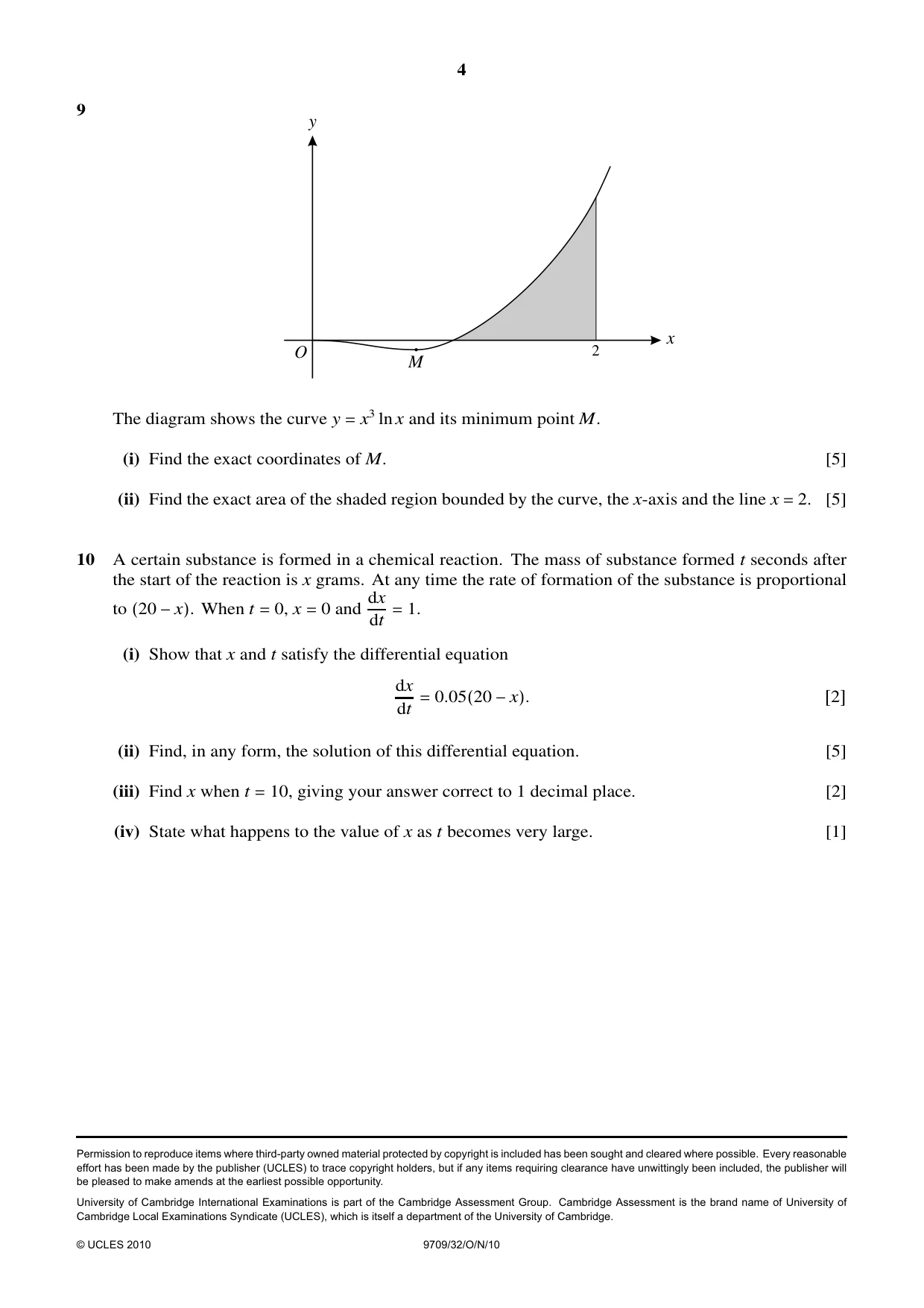
Q9 · Y x O 2 M The diagram shows the curve y x3 ln x and its minimum point M
9 y x O 2 M The diagram shows the curve y x3 ln x and its minimum point M. = (i) Find the exact coordinates of M. [5] (ii) Find the exact area of the shaded region bounded by the curve, the x-axis and the line x 2. [5] =
Mark scheme: 9 (i) Use correct product rule M1 Obtain correct derivative in any form A1 Equate derivative to zero and find non-zero x M1 1 Obtain x = exp (− 3 ) , or equivalent A1 Obtain y = –l/(3e), or any ln-free equivalent A1 [5] 1 (ii) Integrate and reach kx 4 ln x + l ∫ x 4 . x dx M1 Obtain 14 x 4 ln x − 14 ∫ x 3 dx A1 Obtain integral 14 x 4 ln x − 161 x 4 , or equivalent A1 Use limits x = 1 and x = 2 correctly, having integrated twice M1 15 Obtain answer 4 ln 2 − , or exact equivalent A1 [5] 16 GCE A/AS LEVEL – October/November 2010 9709 32 dx ( )
Q10 · A certain substance is formed in a chemical reaction
10 A certain substance is formed in a chemical reaction. The mass of substance formed t seconds after the start of the reaction is x grams. At any time the rate of formation of the substance is proportional dx to When t 0, x 0 and 1. dt (20 −x). = = = (i) Show that x and t satisfy the differential equation dx dt = 0.05(20 −x). [2] (ii) Find, in any form, the solution of this differential equation. [5] (iii) Find x when t 10, giving your answer correct to 1 decimal place. [2] = (iv) State what happens to the value of x as t becomes very large. [1]
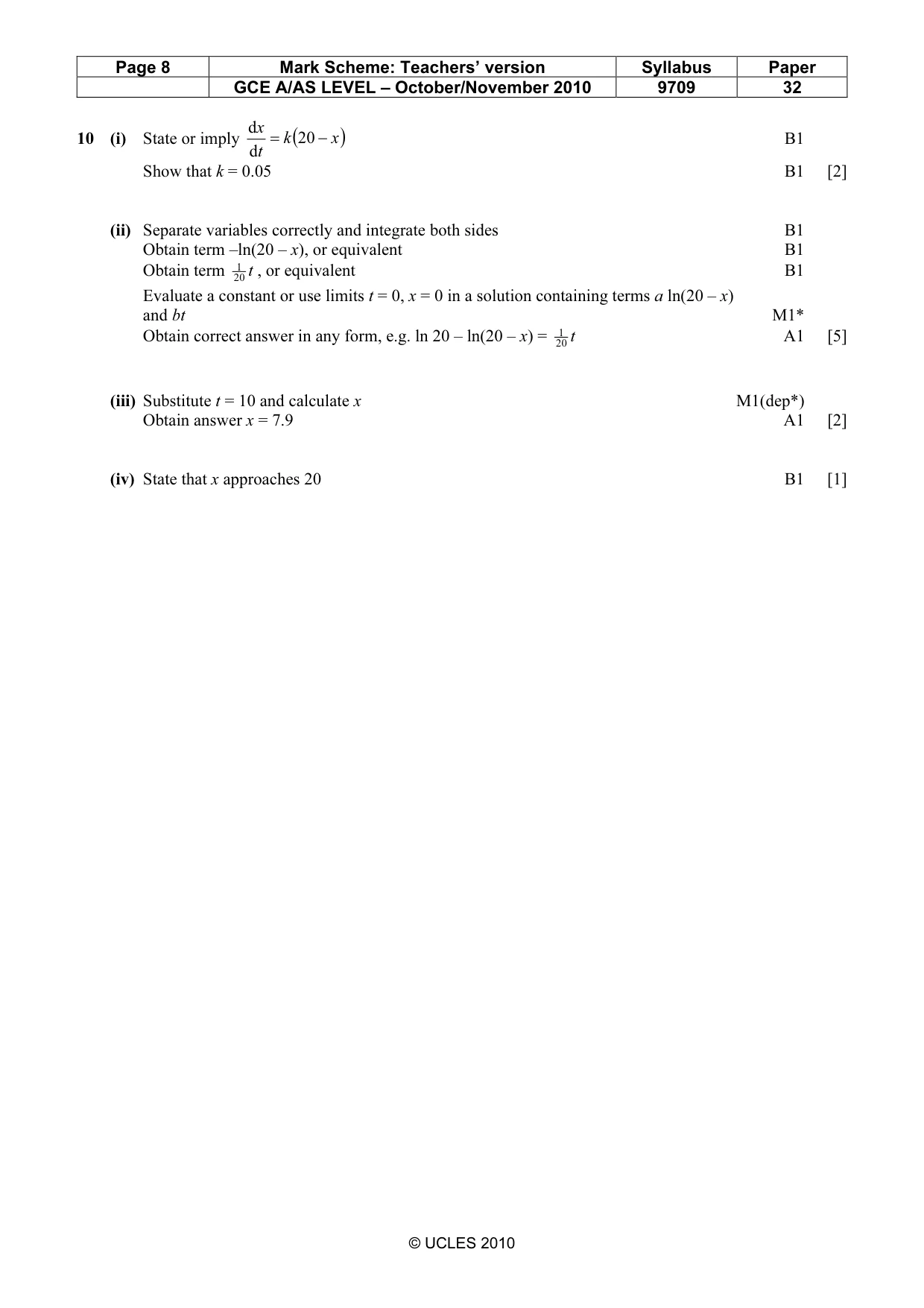
Mark scheme: dx 10 (i) State or imply = k (20 − x ) B1 dt Show that k = 0.05 B1 [2] (ii) Separate variables correctly and integrate both sides B1 Obtain term –ln(20 – x), or equivalent B1 Obtain term 201 t , or equivalent B1 Evaluate a constant or use limits t = 0, x = 0 in a solution containing terms a ln(20 – x) and bt M1* Obtain correct answer in any form, e.g. ln 20 – ln(20 – x) = 201 t A1 [5] (iii) Substitute t = 10 and calculate x M1(dep*) Obtain answer x = 7.9 A1 [2] (iv) State that x approaches 20 B1 [1]
What was in this paper
The subtopics covered by these 10 questions, and how many questions each got. Open one in a new tab to see every Cambridge question on it.
What you needed in this session
Cambridge’s own grade thresholds for 2010 Oct/Nov, Paper 3 · Variant 2. A higher threshold means an easier paper — the bar moves with how the cohort did.