Cambridge A Level Mathematics 9709 — 2014 May/June Paper 3 · Variant 1
9709/31/M/J/14 · 5 questions · 75 marks · ≈84 min
The question paper and its mark scheme, free to read here and free to download. This is Cambridge’s own paper, exactly as it was sat.
Question paper4 pages
Mark scheme7 pages
Answers below. Sit the paper first if you are practising.
Questions as text
Q1 · Simplify sin sec [2] 2!
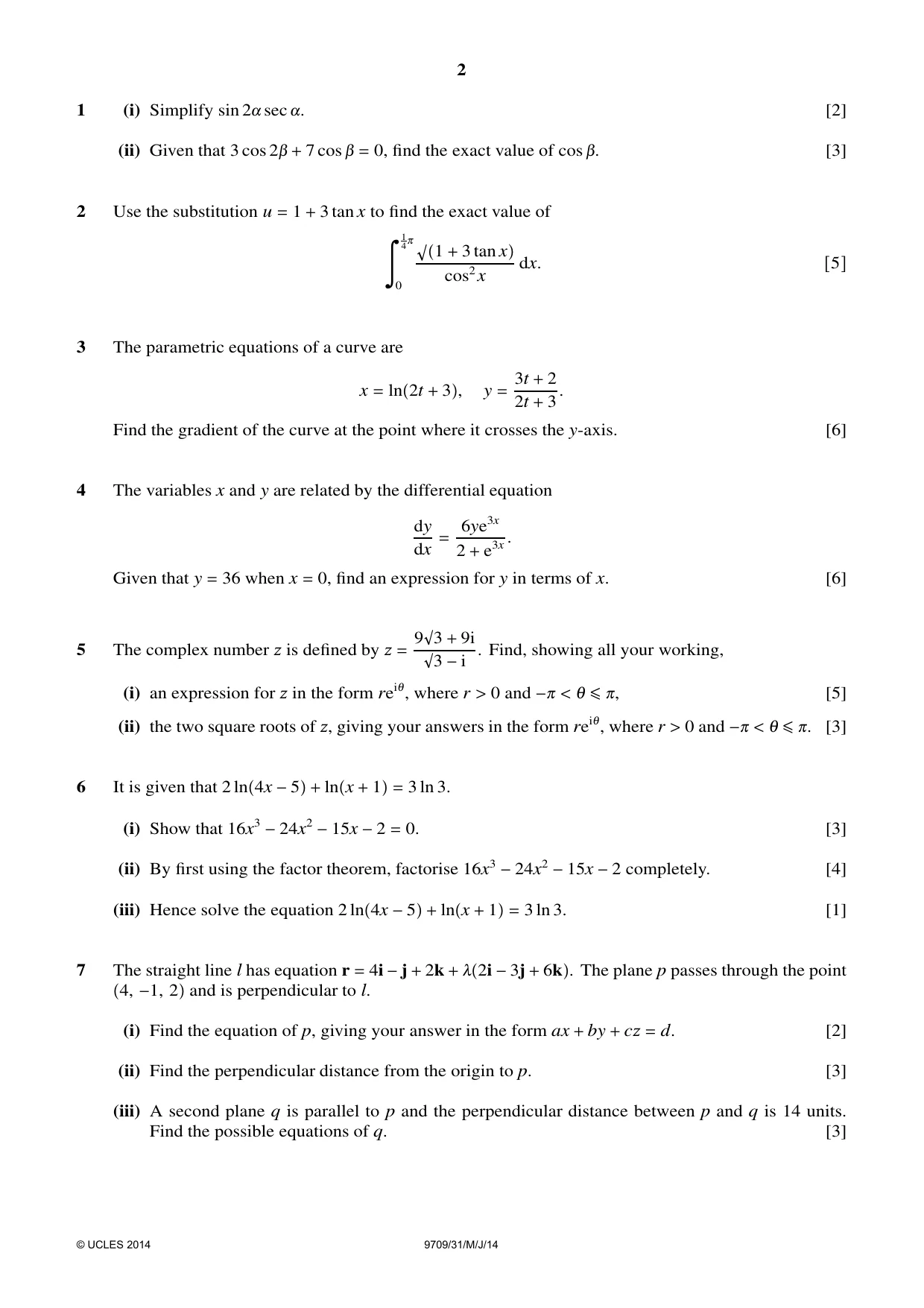
1 (i) Simplify sin sec [2] 2! !. (ii) Given that 3 cos 7 cos 0, find the exact value of cos [3] 2" + " = ".
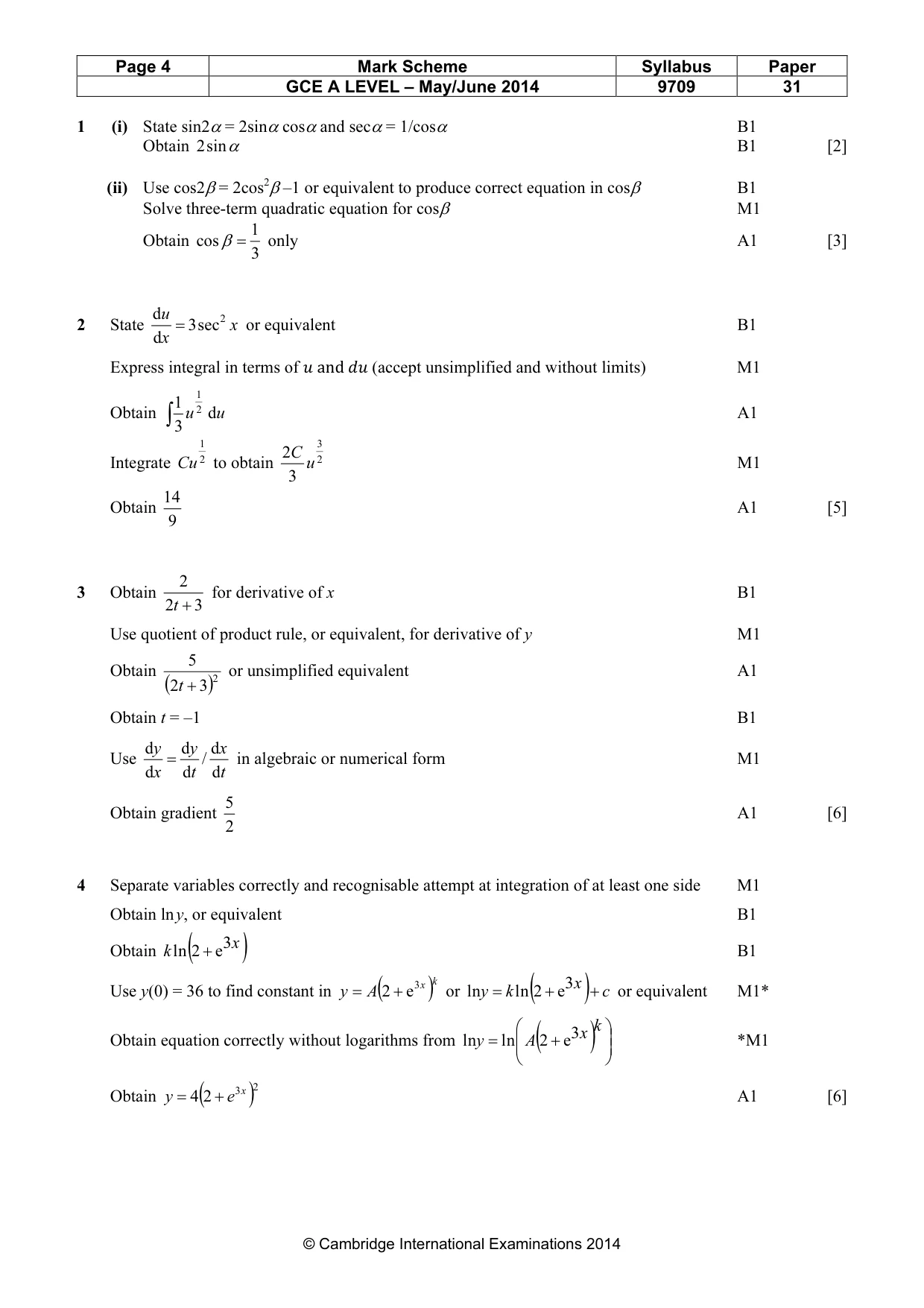
Mark scheme: 1 (i) State sin2α = 2sinα cosα and secα = 1/cosα B1 Obtain 2sinα B1 [2] (ii) Use cos2β = 2cos2β –1 or equivalent to produce correct equation in cosβ B1 Solve three-term quadratic equation for cosβ M1 1 Obtain cos β = only A1 [3] 3 d u 2
Q4 · The variables x and y are related by the differential equation dy 6ye3x
4 The variables x and y are related by the differential equation dy 6ye3x . dx = 2 e3x + Given that y 36 when x 0, find an expression for y in terms of x. [6] = =
Mark scheme: 4 Separate variables correctly and recognisable attempt at integration of at least one side M1 Obtain ln y, or equivalent B1 3 x Obtain k l n (2 + e ) B1 x k 3 x Use y(0) = 36 to find constant in y = A(2 + 3e ) or l ny = k l n (2 + e ) + c or equivalent M1* k 3 x *M1 Obtain equation correctly without logarithms from l ny = l n A( 2 + e ) 3 x 2 Obtain y = 4 (2 + e ) A1 [6] GCE A LEVEL – May/June 2014 9709 31 2
Q5 · I 5 The complex number is defined by
9i 5 The complex number is defined by . Find, showing all your working, 9ï3 + Ï Ï = ï3 −i (i) an expression for 0 and [5] Ï in the form rei1, where r > −0 < 1 ≤0, (ii) the two square roots of 0 and [3] Ï, giving your answers in the form rei1, where r > −0 < 1 ≤0.
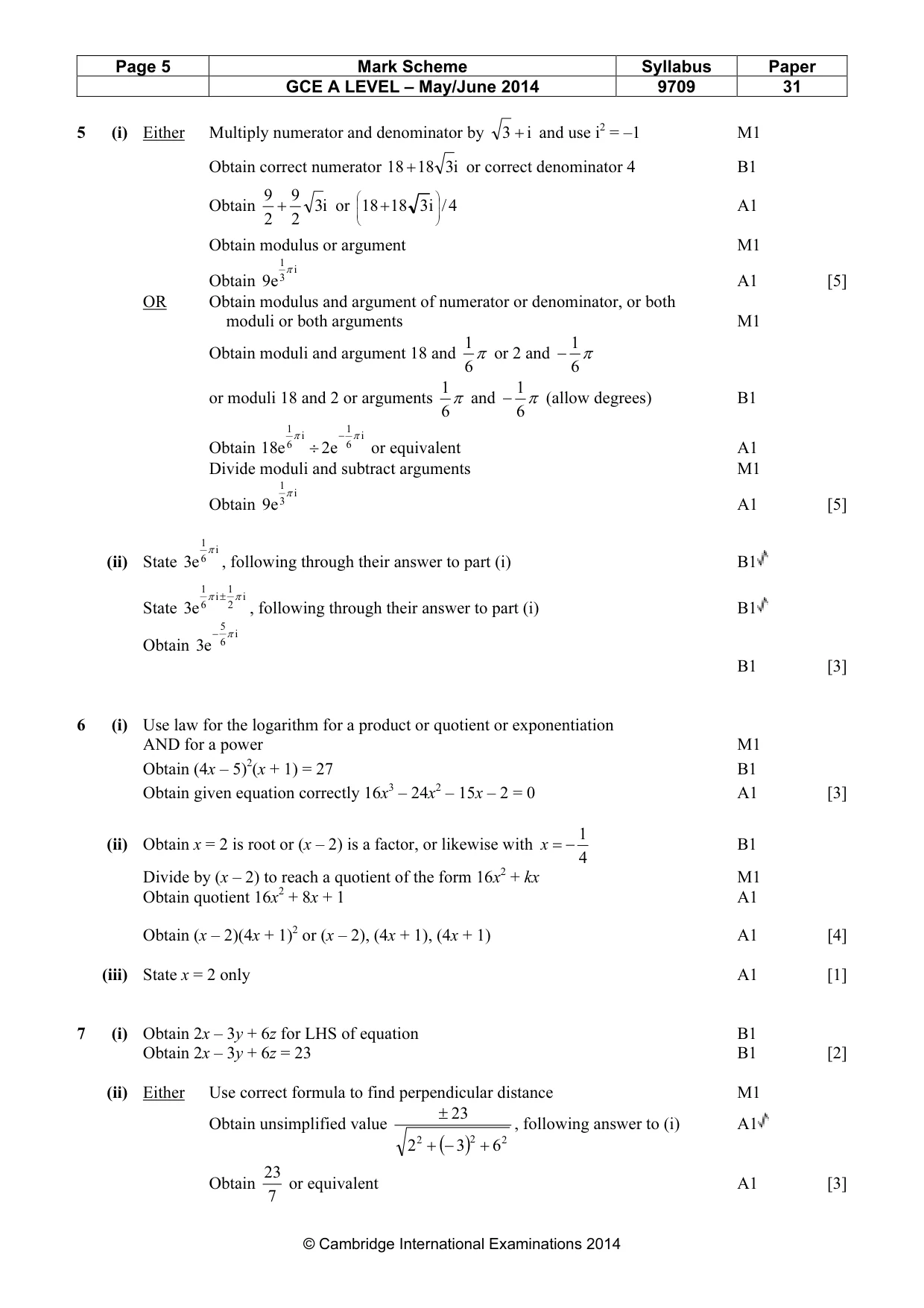
Mark scheme: 5 (i) Either Multiply numerator and denominator by 3 + i and use i2 = –1 M1 Obtain correct numerator 18 + 18 i3 or correct denominator 4 B1 9 9 Obtain + i3 or 18 + 18 i3 / 4 A1 2 2 Obtain modulus or argument M1 1 π i Obtain 9e 3 A1 [5] OR Obtain modulus and argument of numerator or denominator, or both moduli or both arguments M1 1 1 Obtain moduli and argument 18 and π or 2 and − π 6 6 1 1 or moduli 18 and 2 or arguments π and − π (allow degrees) B1 6 6 1 1 π i − π i Obtain 18e 6 ÷ 2e 6 or equivalent A1 Divide moduli and subtract arguments M1 1 π i Obtain 9e 3 A1 [5] 1 π i (ii) State 3e 6 , following through their answer to part (i) B1 1 1 π i ± π i State 3e 6 2 , following through their answer to part (i) B1 5 − π i Obtain 3e 6 B1 [3]
Q7 · The straight line l has equation r 4i 2k 2i 6k
7 The straight line l has equation r 4i 2k 2i 6k . The plane p passes through the point 4, 2 and is perpendicular to=l. −j + + , −3j + −1, (i) Find the equation of p, giving your answer in the form ax by d. [2] + + cÏ = (ii) Find the perpendicular distance from the origin to p. [3] (iii) A second plane q is parallel to p and the perpendicular distance between p and q is 14 units. Find the possible equations of q. [3]
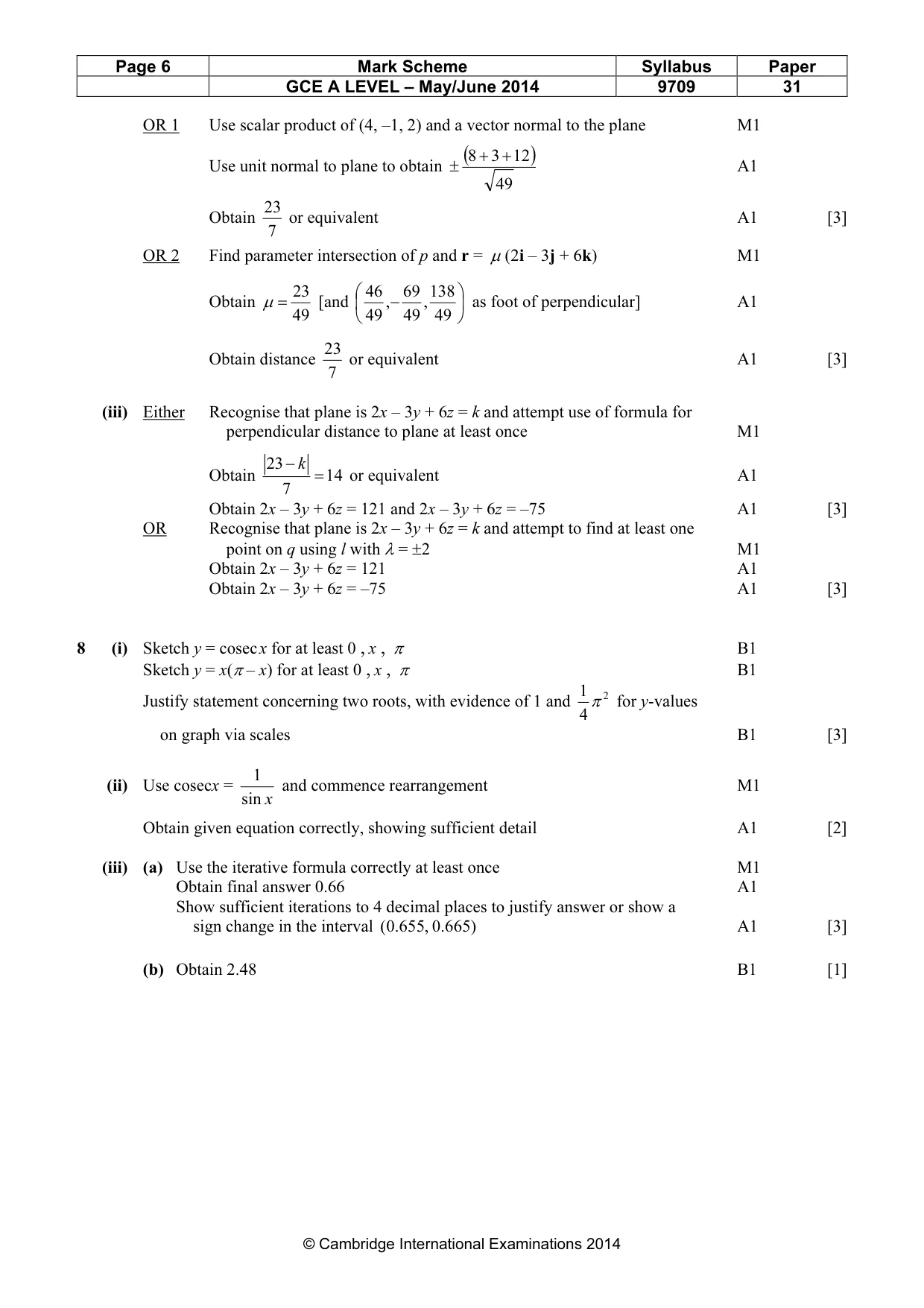
Mark scheme: 7 (i) Obtain 2x – 3y + 6z for LHS of equation B1 Obtain 2x – 3y + 6z = 23 B1 [2] (ii) Either Use correct formula to find perpendicular distance M1 ± 23 Obtain unsimplified value , following answer to (i) A1 2 2 + (− 3)2 + 6 2 23 Obtain or equivalent A1 [3] 7 GCE A LEVEL – May/June 2014 9709 31 OR 1 Use scalar product of (4, –1, 2) and a vector normal to the plane M1 (8 + 3 + 12 ) Use unit normal to plane to obtain ± A1 49 23 Obtain or equivalent A1 [3] 7 OR 2 Find parameter intersection of p and r = µ (2i – 3j + 6k) M1 23 46 69 138 Obtain µ = [and , − , as foot of perpendicular] A1 49 49 49 49 23 Obtain distance or equivalent A1 [3] 7 (iii) Either Recognise that plane is 2x – 3y + 6z = k and attempt use of formula for perpendicular distance to plane at least once M1 23 −k Obtain = 14 or equivalent A1 7 Obtain 2x – 3y + 6z = 121 and 2x – 3y + 6z = –75 A1 [3] OR Recognise that plane is 2x – 3y + 6z = k and attempt to find at least one point on q using l with λ = ±2 M1 Obtain 2x – 3y + 6z = 121 A1 Obtain 2x – 3y + 6z = –75 A1 [3]
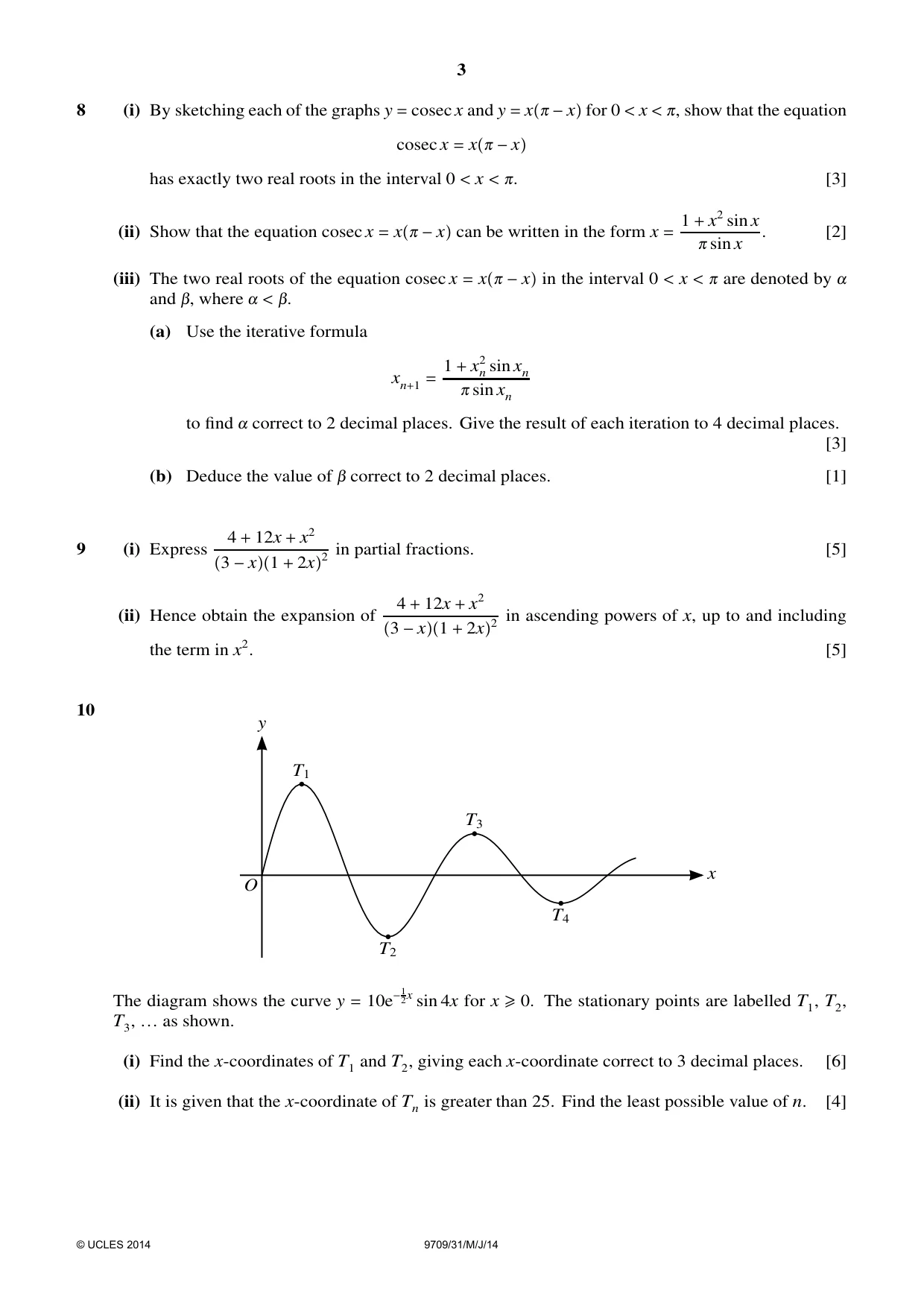
Q10 · Y T1 T3 x O T4 T2 The diagram shows the curve y 2x sin 4x for x The stationary points are…
10 y T1 T3 x O T4 T2 The diagram shows the curve y 2x sin 4x for x The stationary points are labelled T1, T2, = 10e−1 ≥0. … as shown. T3, (i) Find the x-coordinates of T1 and T2, giving each x-coordinate correct to 3 decimal places. [6] (ii) It is given that the x-coordinate of Tn is greater than 25. Find the least possible value of n. [4]
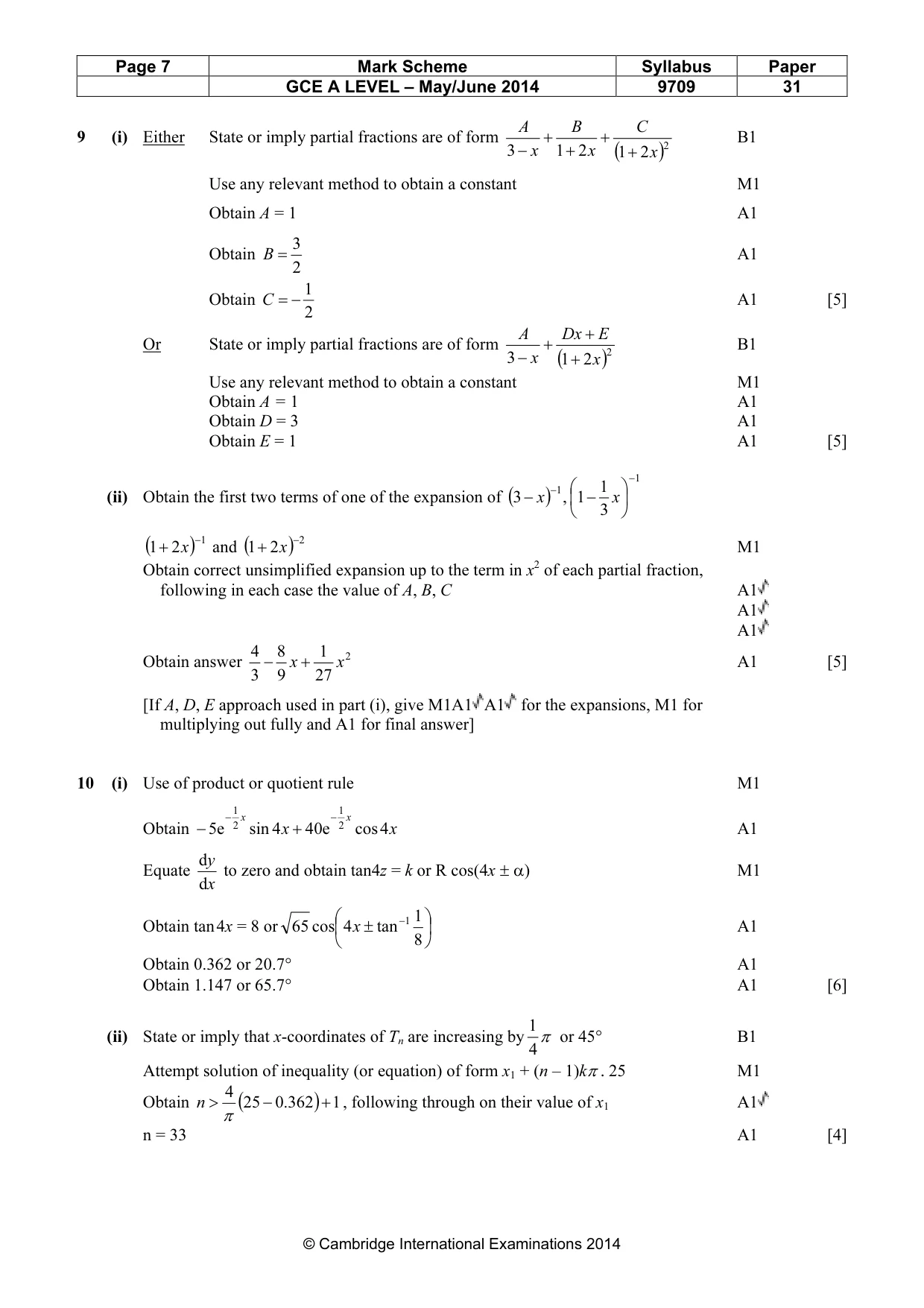
Mark scheme: 10 (i) Use of product or quotient rule M1 1 1 − x − x Obtain − 5e 2 sin 4 x + 40e 2 cos 4 x A1 dy Equate to zero and obtain tan4z = k or R cos(4x ± α) M1 dx −1 1 Obtain tan 4x = 8 or 65 cos 4 x ± tan A1 8 Obtain 0.362 or 20.7° A1 Obtain 1.147 or 65.7° A1 [6] 1 (ii) State or imply that x-coordinates of Tn are increasing by π or 45° B1 4 Attempt solution of inequality (or equation) of form x1 + (n – 1)kπ . 25 M1 4 Obtain n > (25 − .0362 ) + 1 , following through on their value of x1 A1 π n = 33 A1 [4]
What was in this paper
The subtopics covered by these 5 questions, and how many questions each got. Open one in a new tab to see every Cambridge question on it.
What you needed in this session
Cambridge’s own grade thresholds for 2014 May/June, Paper 3 · Variant 1. A higher threshold means an easier paper — the bar moves with how the cohort did.