Cambridge A Level Mathematics 9709 — 2013 Oct/Nov Paper 3 · Variant 3
9709/33/O/N/13 · 3 questions · 75 marks · ≈84 min
The question paper and its mark scheme, free to read here and free to download. This is Cambridge’s own paper, exactly as it was sat.
Question paper4 pages
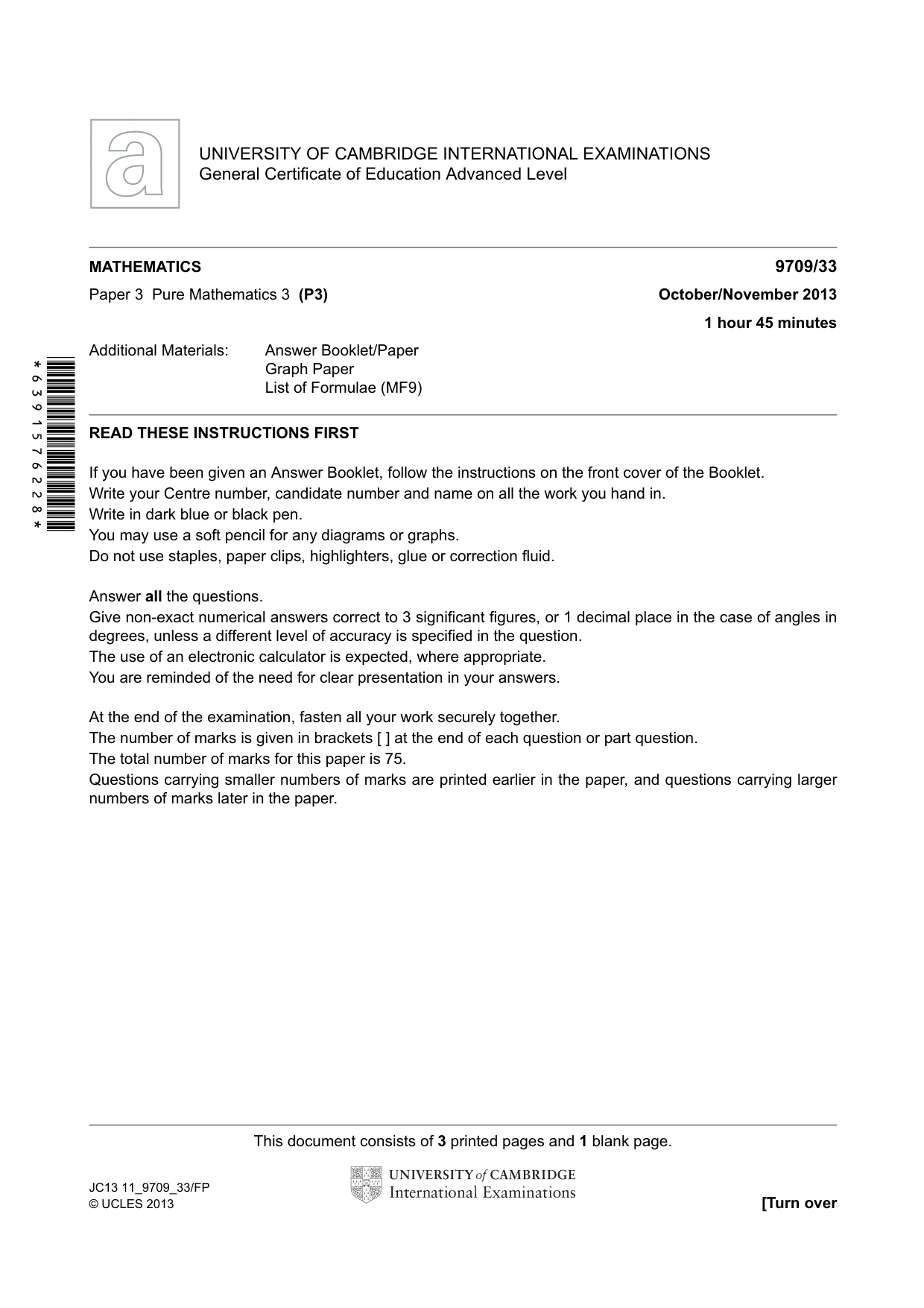
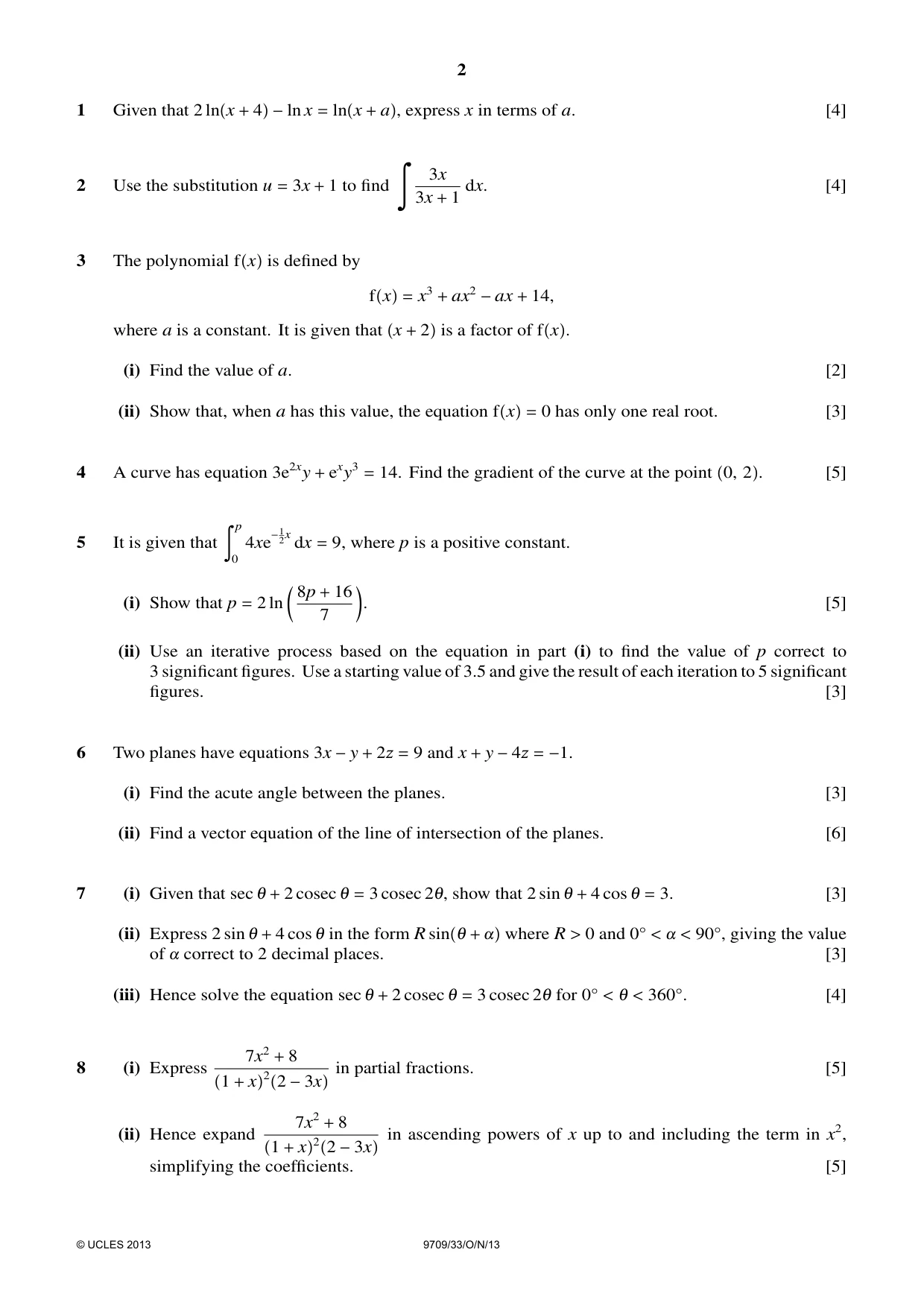
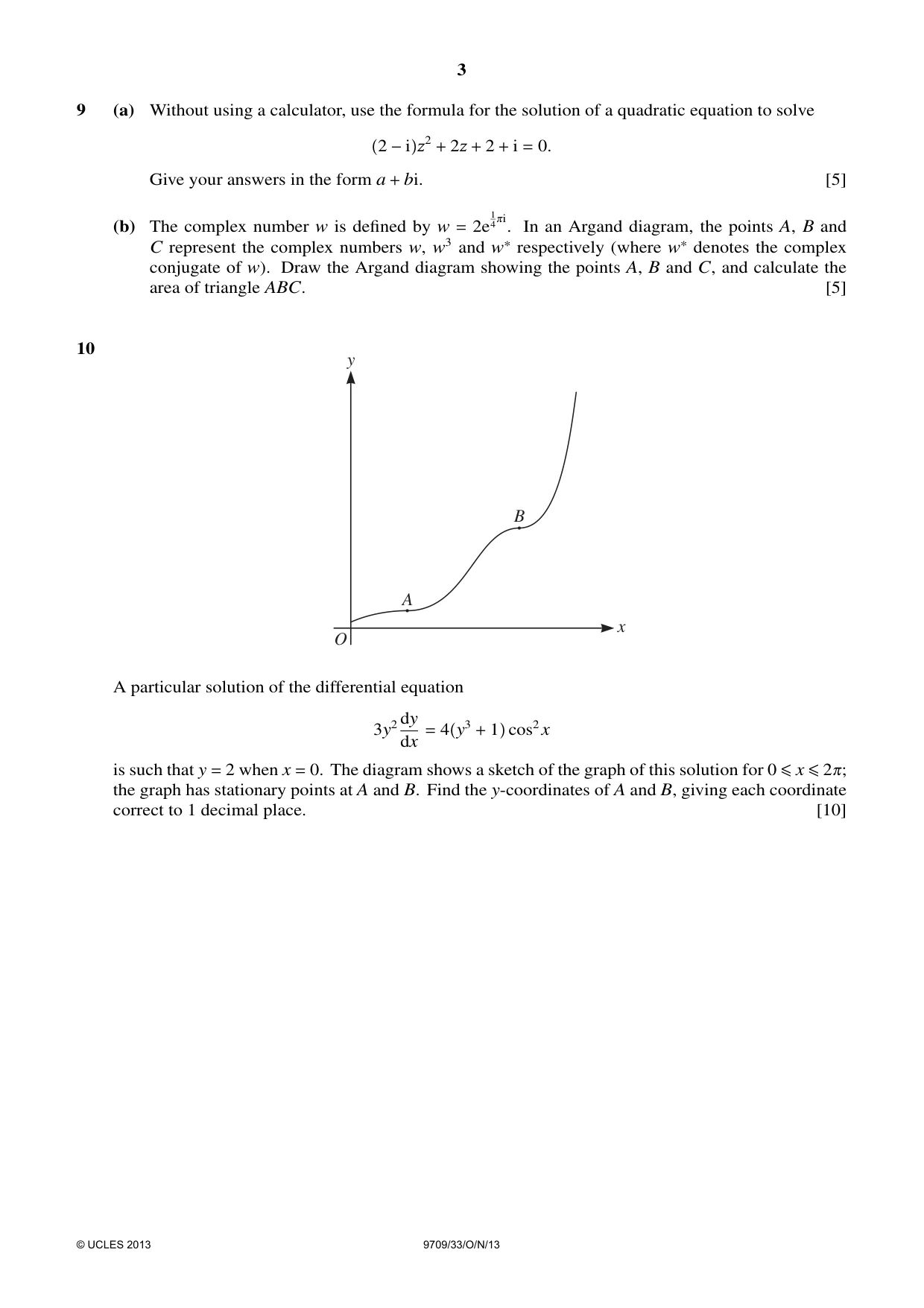
Mark scheme8 pages
Answers below. Sit the paper first if you are practising.
Questions as text
Q2 · X 2 Use the substitution u 3x 1 to find dx
3x 2 Use the substitution u 3x 1 to find dx. [4] 3x 1 = + Ô +
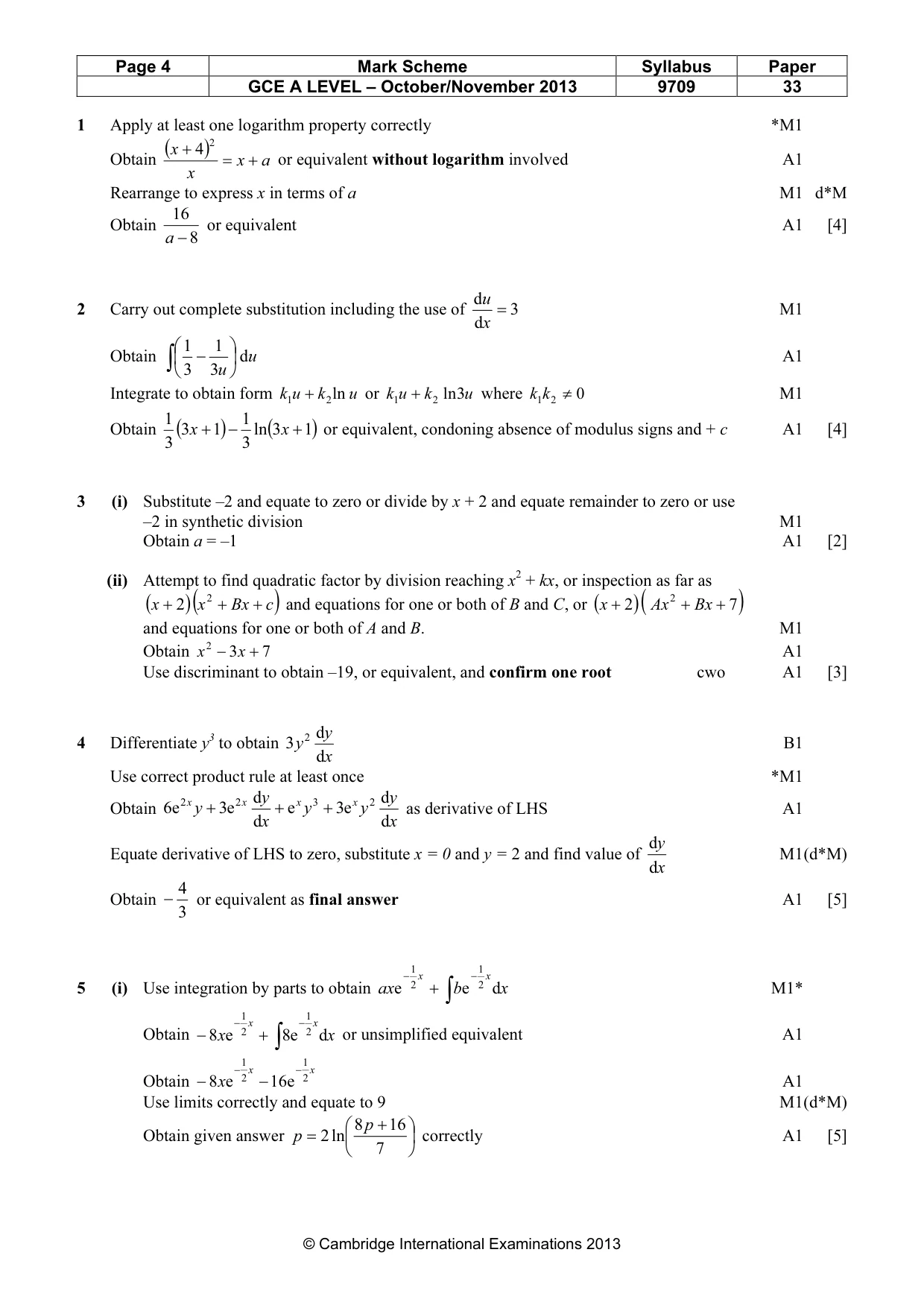
Mark scheme: du 2 Carry out complete substitution including the use of = 3 M1 dx 1 1 − du A1 Obtain ∫ 3 3u Integrate to obtain form k1u + k 2 ln u or k1u + k 2 ln 3u where k1 k 2 ≠ 0 M1 1 1 Obtain (3 x + 1) − ln (3 x + )1 or equivalent, condoning absence of modulus signs and + c A1 [4] 3 3
Q5 · P 2x5 It is given that Ó 0 4xe−1 dx = 9, where p is a positive constant
p 2x5 It is given that Ó 0 4xe−1 dx = 9, where p is a positive constant. @8p 16 A (i) Show that p 2 ln . [5] + 7 = (ii) Use an iterative process based on the equation in part (i) to find the value of p correct to 3 significant figures. Use a starting value of 3.5 and give the result of each iteration to 5 significant figures. [3]
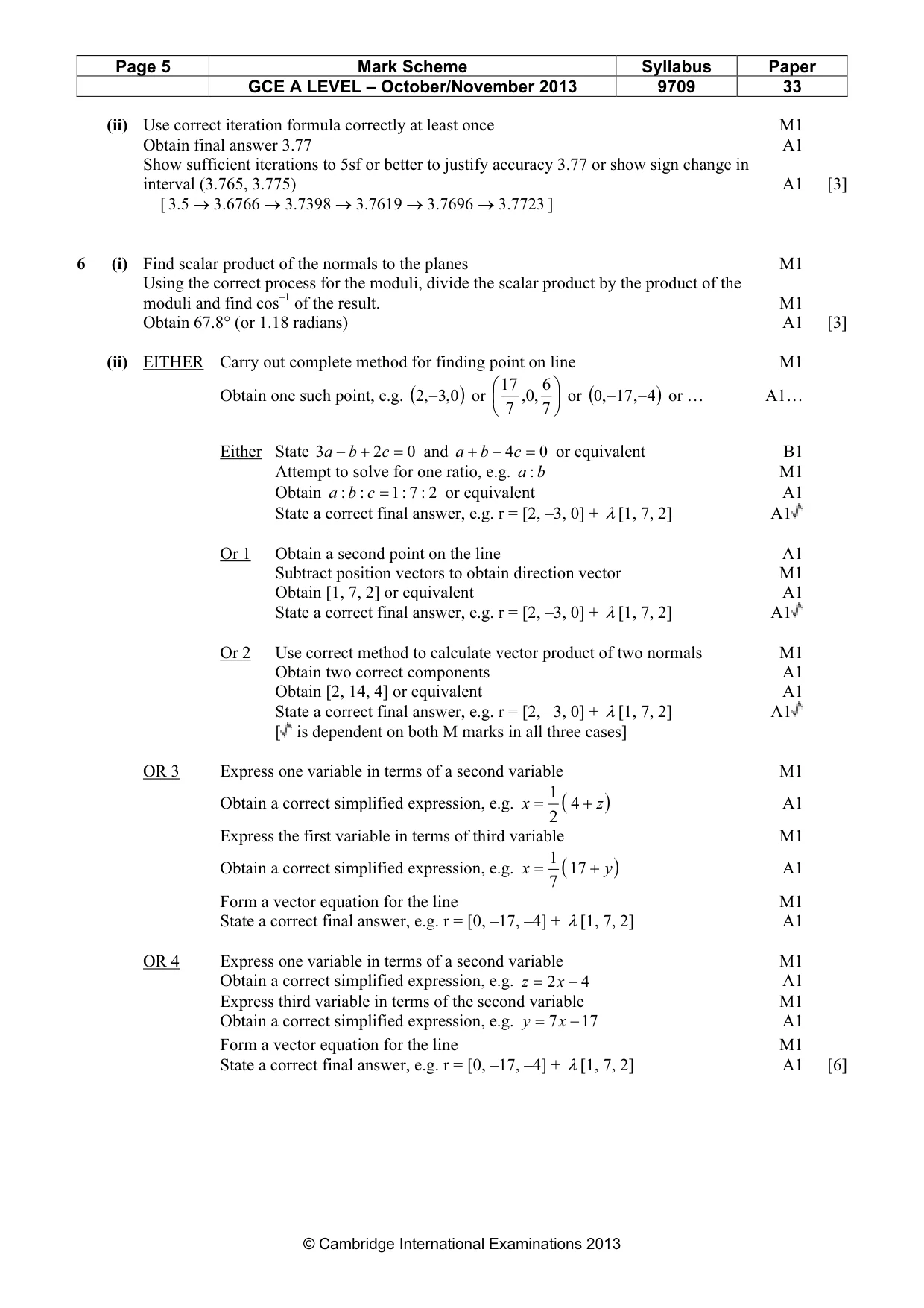
Mark scheme: 5 (i) Use integration by parts to obtain axe 2 + ∫ b e 2 dx M1* 1 1 − x − x Obtain − 8 xe 2 + ∫ 8e 2 d x or unsimplified equivalent A1 1 1 − x − x Obtain − 8 xe 2 − 16 e 2 A1 Use limits correctly and equate to 9 M1 (d*M) 8 p + 16 Obtain given answer p = 2 ln correctly A1 [5] 7 GCE A LEVEL – October/November 2013 9709 33 (ii) Use correct iteration formula correctly at least once M1 Obtain final answer 3.77 A1 Show sufficient iterations to 5sf or better to justify accuracy 3.77 or show sign change in interval (3.765, 3.775) A1 [3] [ 5.3 → .3 6766 → .3 7398 → .3 7619 → .3 7696 → .3 7723 ]
Q6 · Two planes have equations 3x 9 and x y −y + 2Ï = + −4Ï = −1
6 Two planes have equations 3x 9 and x y −y + 2Ï = + −4Ï = −1. (i) Find the acute angle between the planes. [3] (ii) Find a vector equation of the line of intersection of the planes. [6]
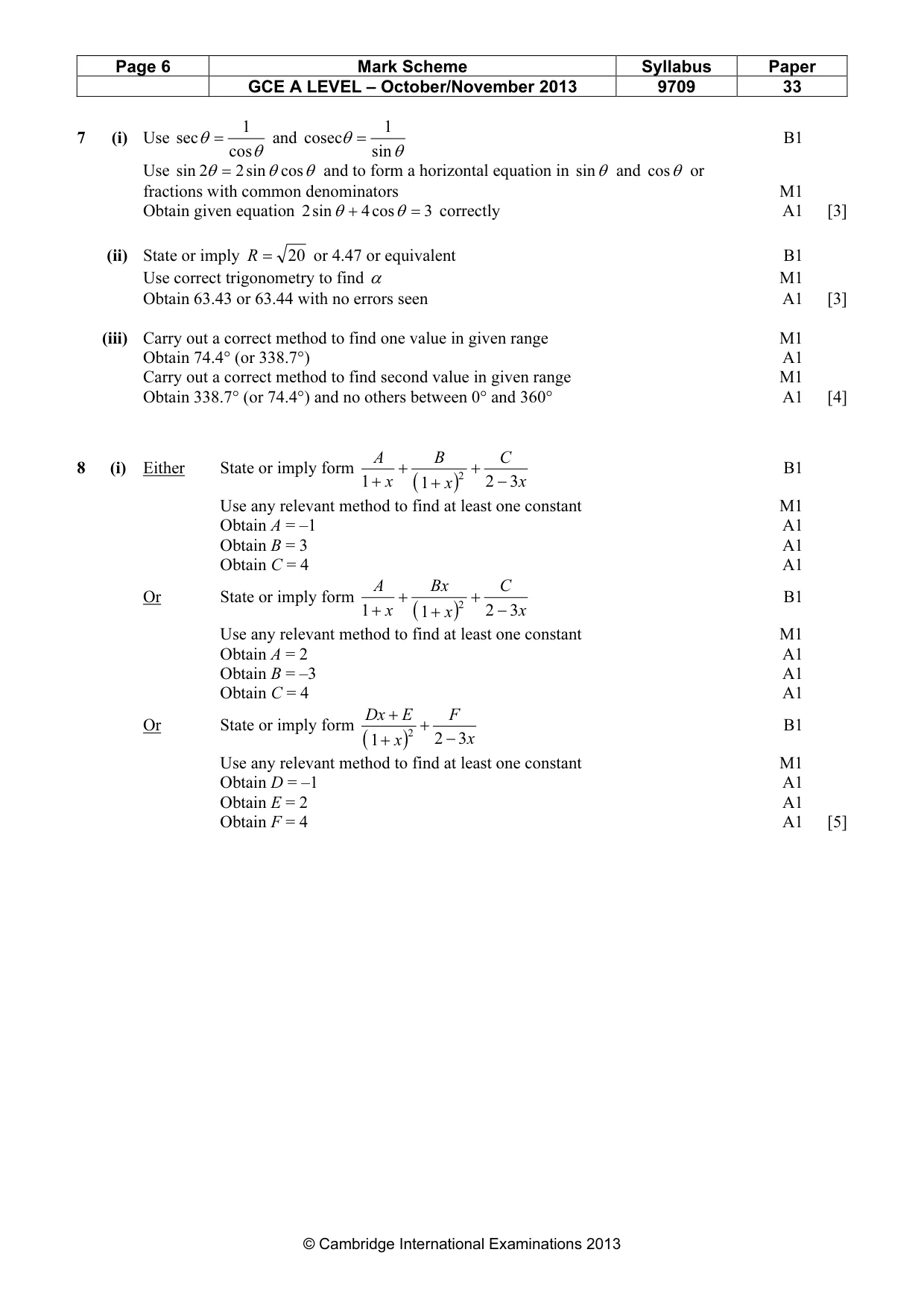
Mark scheme: 6 (i) Find scalar product of the normals to the planes M1 Using the correct process for the moduli, divide the scalar product by the product of the moduli and find cos–1 of the result. M1 Obtain 67.8° (or 1.18 radians) A1 [3] (ii) EITHER Carry out complete method for finding point on line M1 17 6 Obtain one such point, e.g. (,2 − 0,3 ) or ,0, or (,0 − 17 , − 4 ) or … A1… 7 7 Either State 3a − b + 2 c = 0 and a + b − 4 c = 0 or equivalent B1 Attempt to solve for one ratio, e.g. a : b M1 Obtain a : b : c = 1 : 7 : 2 or equivalent A1 State a correct final answer, e.g. r = [2, –3, 0] + λ [1, 7, 2] A1 Or 1 Obtain a second point on the line A1 Subtract position vectors to obtain direction vector M1 Obtain [1, 7, 2] or equivalent A1 State a correct final answer, e.g. r = [2, –3, 0] + λ [1, 7, 2] A1 Or 2 Use correct method to calculate vector product of two normals M1 Obtain two correct components A1 Obtain [2, 14, 4] or equivalent A1 State a correct final answer, e.g. r = [2, –3, 0] + λ [1, 7, 2] A1 [ is dependent on both M marks in all three cases] OR 3 Express one variable in terms of a second variable M1 1 Obtain a correct simplified expression, e.g. x = ( 4 + )z A1 2 Express the first variable in terms of third variable M1 1 Obtain a correct simplified expression, e.g. x = ( 17 + y ) A1 7 Form a vector equation for the line M1 State a correct final answer, e.g. r = [0, –17, –4] + λ [1, 7, 2] A1 OR 4 Express one variable in terms of a second variable M1 Obtain a correct simplified expression, e.g. z = 2 x − 4 A1 Express third variable in terms of the second variable M1 Obtain a correct simplified expression, e.g. y = 7 x − 17 A1 Form a vector equation for the line M1 State a correct final answer, e.g. r = [0, –17, –4] + λ [1, 7, 2] A1 [6] GCE A LEVEL – October/November 2013 9709 33 1 1
What was in this paper
The subtopics covered by these 3 questions, and how many questions each got. Open one in a new tab to see every Cambridge question on it.
What you needed in this session
Cambridge’s own grade thresholds for 2013 Oct/Nov, Paper 3 · Variant 3. A higher threshold means an easier paper — the bar moves with how the cohort did.