Cambridge A Level Mathematics 9709 — 2005 May/June Paper 3 · Variant 1
9709/31/M/J/05 · 10 questions · 75 marks · ≈84 min
The question paper and its mark scheme, free to read here and free to download. This is Cambridge’s own paper, exactly as it was sat.
Question paper4 pages
Mark scheme10 pages
Answers below. Sit the paper first if you are practising.
Questions as text
Q1 · Expand (1 + 4x)−1 2 in ascending powers of x, up to and including the term in x3…
1 Expand (1 + 4x)−1 2 in ascending powers of x, up to and including the term in x3, simplifying the coefficients. [4]
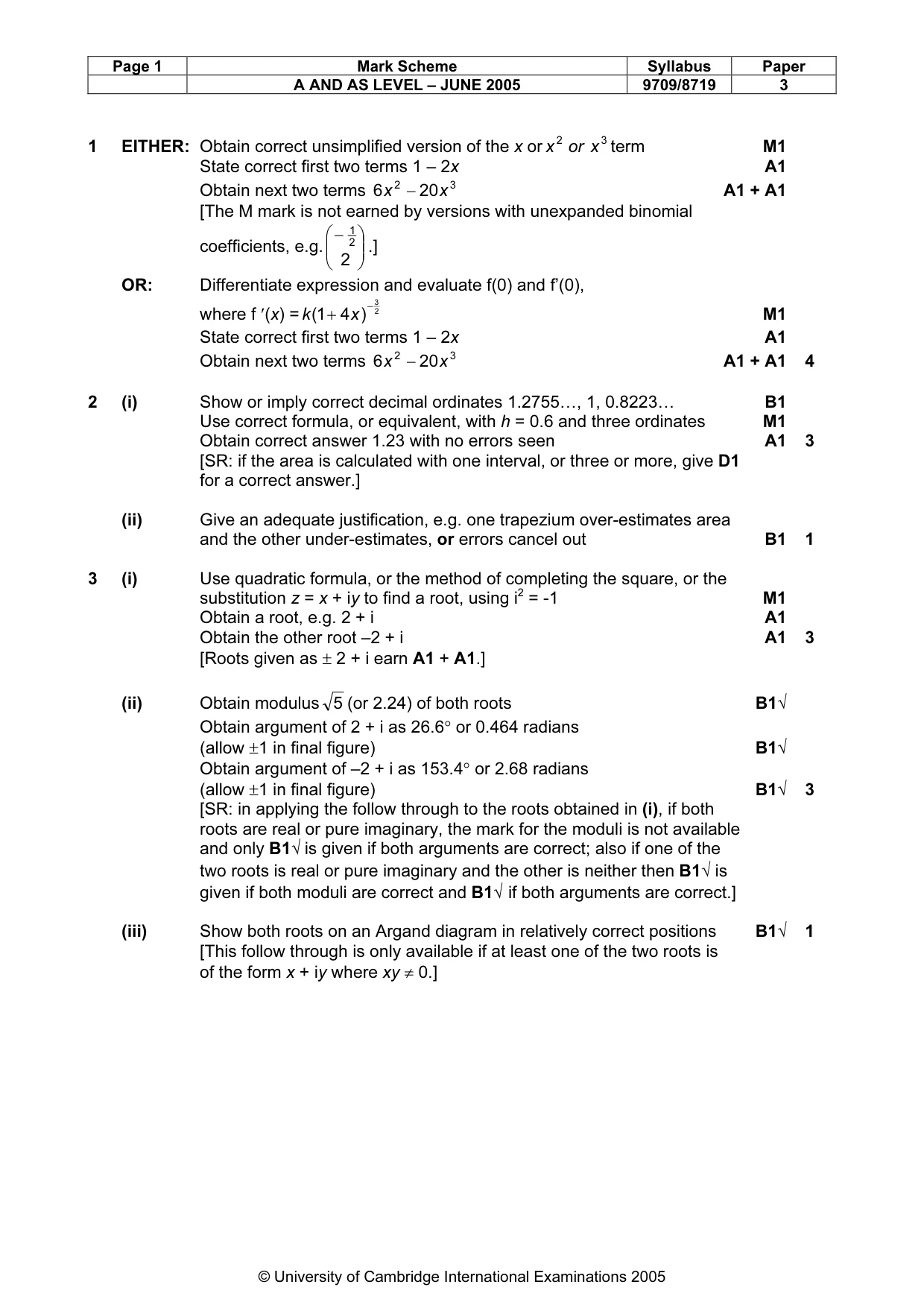
Mark scheme: 1 EITHER: Obtain correct unsimplified version of the x or x 2 or x 3 term M1 State correct first two terms 1 – 2x A1 Obtain next two terms 6 x 2 − 20 x 3 A1 + A1 [The M mark is not earned by versions with unexpanded binomial − 21 coefficients, e.g. .] 2 OR: Differentiate expression and evaluate f(0) and f’(0), − 32 M1 where f ′(x) = k (1 + 4 x ) State correct first two terms 1 – 2x A1 Obtain next two terms 6 x 2 − 20 x 3 A1 + A1 4
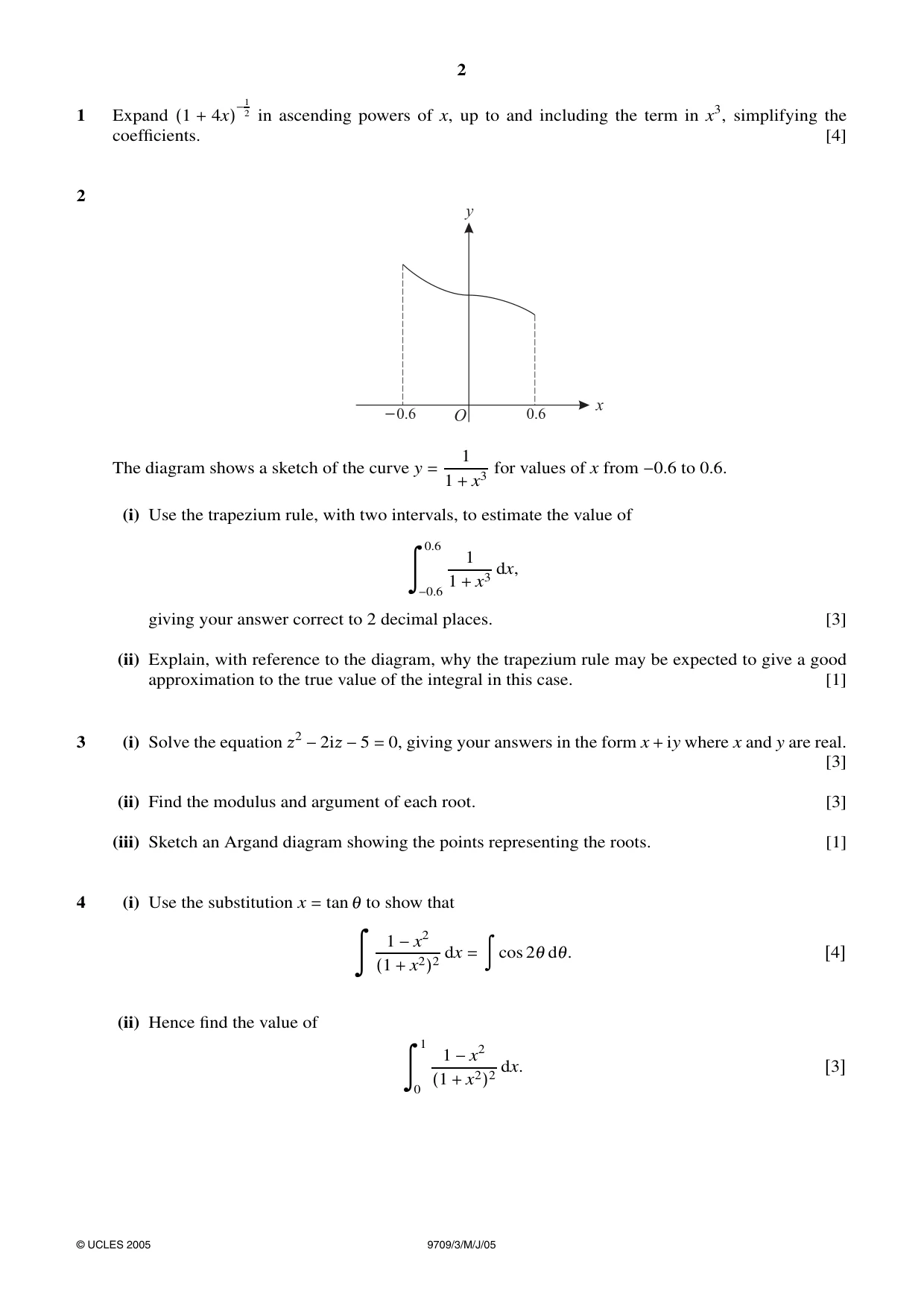
Q2 · 1 The diagram shows a sketch of the curve y = for values of x from −0.6 to 0.6
2 1 The diagram shows a sketch of the curve y = for values of x from −0.6 to 0.6. 1 + x3 (i) Use the trapezium rule, with two intervals, to estimate the value of 0.6 1 dx, 1 + x3 −0.6 giving your answer correct to 2 decimal places. [3] (ii) Explain, with reference to the diagram, why the trapezium rule may be expected to give a good approximation to the true value of the integral in this case. [1]
Mark scheme: 2 (i) Show or imply correct decimal ordinates 1.2755…, 1, 0.8223… B1 Use correct formula, or equivalent, with h = 0.6 and three ordinates M1 Obtain correct answer 1.23 with no errors seen A1 3 [SR: if the area is calculated with one interval, or three or more, give D1 for a correct answer.] (ii) Give an adequate justification, e.g. one trapezium over-estimates area and the other under-estimates, or errors cancel out B1 1
Q3 · Solve the equation 2 −2i −5 = 0, giving your answers in the form x + iy where x and y are…
3 (i) Solve the equation 2 −2i −5 = 0, giving your answers in the form x + iy where x and y are real. [3] (ii) Find the modulus and argument of each root. [3] (iii) Sketch an Argand diagram showing the points representing the roots. [1]
Mark scheme: 3 (i) Use quadratic formula, or the method of completing the square, or the substitution z = x + iy to find a root, using i2 = -1 M1 Obtain a root, e.g. 2 + i A1 Obtain the other root –2 + i A1 3 [Roots given as ± 2 + i earn A1 + A1.] (ii) Obtain modulus 5 (or 2.24) of both roots B1√ Obtain argument of 2 + i as 26.6° or 0.464 radians (allow ±1 in final figure) B1√ Obtain argument of –2 + i as 153.4° or 2.68 radians (allow ±1 in final figure) B1√ 3 [SR: in applying the follow through to the roots obtained in (i), if both roots are real or pure imaginary, the mark for the moduli is not available and only B1√ is given if both arguments are correct; also if one of the two roots is real or pure imaginary and the other is neither then B1√ is given if both moduli are correct and B1√ if both arguments are correct.] (iii) Show both roots on an Argand diagram in relatively correct positions B1√ 1 [This follow through is only available if at least one of the two roots is of the form x + iy where xy ≠ 0.] A AND AS LEVEL – JUNE 2005 9709/8719 3 dx
Q4 · Use the substitution x = tan θ to show that 1 −x2 dx = cos 2θ dθ
4 (i) Use the substitution x = tan θ to show that 1 −x2 dx = cos 2θ dθ. [4] (1 + x2)2 (ii) Hence find the value of 1 1 −x2 dx. [3] (1 + x2)2 0
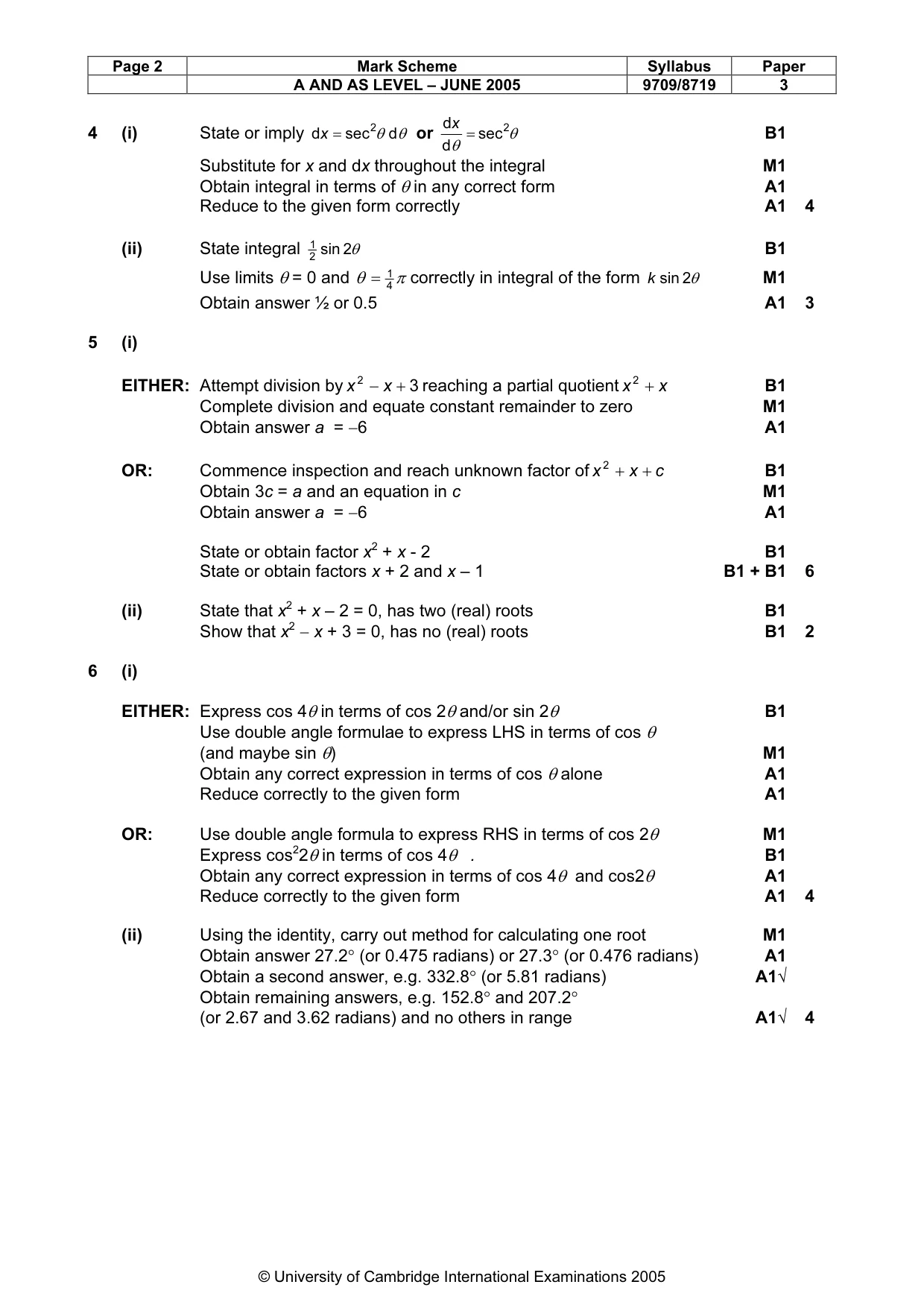
Mark scheme: d x 2 24 (i) State or imply d x = sec θ d θ or = sec θ B1 d θ Substitute for x and dx throughout the integral M1 Obtain integral in terms of θ in any correct form A1 Reduce to the given form correctly A1 4 (ii) State integral 1 sin 2θ B1 2 Use limits θ = 0 and θ = 41 π correctly in integral of the form k sin 2θ M1 Obtain answer ½ or 0.5 A1 3
Q5 · The polynomial x4 + 5x + a is denoted by p(x)
5 The polynomial x4 + 5x + a is denoted by p(x). It is given that x2 −x + 3 is a factor of p(x). (i) Find the value of a and factorise p(x) completely. [6] (ii) Hence state the number of real roots of the equation p(x) = 0, justifying your answer. [2]
Mark scheme: 5 (i) EITHER: Attempt division by x 2 −x + 3 reaching a partial quotient x 2 + x B1 Complete division and equate constant remainder to zero M1 Obtain answer a = −6 A1 OR: Commence inspection and reach unknown factor of x 2 + x + c B1 Obtain 3c = a and an equation in c M1 Obtain answer a = −6 A1 State or obtain factor x2 + x - 2 B1 State or obtain factors x + 2 and x – 1 B1 + B1 6 (ii) State that x2 + x – 2 = 0, has two (real) roots B1 Show that x2 − x + 3 = 0, has no (real) roots B1 2
Q6 · Prove the identity cos 4θ + 4 cos 2θ ≡8 cos4 θ −3
6 (i) Prove the identity cos 4θ + 4 cos 2θ ≡8 cos4 θ −3. [4] (ii) Hence solve the equation cos 4θ + 4 cos 2θ = 2, for 0◦≤θ ≤360◦. [4]
Mark scheme: 6 (i) EITHER: Express cos 4θ in terms of cos 2θ and/or sin 2θ B1 Use double angle formulae to express LHS in terms of cos θ (and maybe sin θ) M1 Obtain any correct expression in terms of cos θ alone A1 Reduce correctly to the given form A1 OR: Use double angle formula to express RHS in terms of cos 2θ M1 Express cos22θ in terms of cos 4θ . B1 Obtain any correct expression in terms of cos 4θ and cos2θ A1 Reduce correctly to the given form A1 4 (ii) Using the identity, carry out method for calculating one root M1 Obtain answer 27.2° (or 0.475 radians) or 27.3° (or 0.476 radians) A1 Obtain a second answer, e.g. 332.8° (or 5.81 radians) A1√ Obtain remaining answers, e.g. 152.8° and 207.2° (or 2.67 and 3.62 radians) and no others in range A1√ 4 A AND AS LEVEL – JUNE 2005 9709/8719 3
Q7 · By sketching a suitable pair of graphs, show that the equation cosec x = 12x + 1, where x…
7 (i) By sketching a suitable pair of graphs, show that the equation cosec x = 12x + 1, where x is in radians, has a root in the interval 0 < x < 12π. [2] (ii) Verify, by calculation, that this root lies between 0.5 and 1. [2] (iii) Show that this root also satisfies the equation 2 x = sin−1 . [1] x + 2 (iv) Use the iterative formula 2 xn+1 = sin−1 , xn + 2 with initial value x1 = 0.75, to determine this root correct to 2 decimal places. Give the result of each iteration to 4 decimal places. [3]
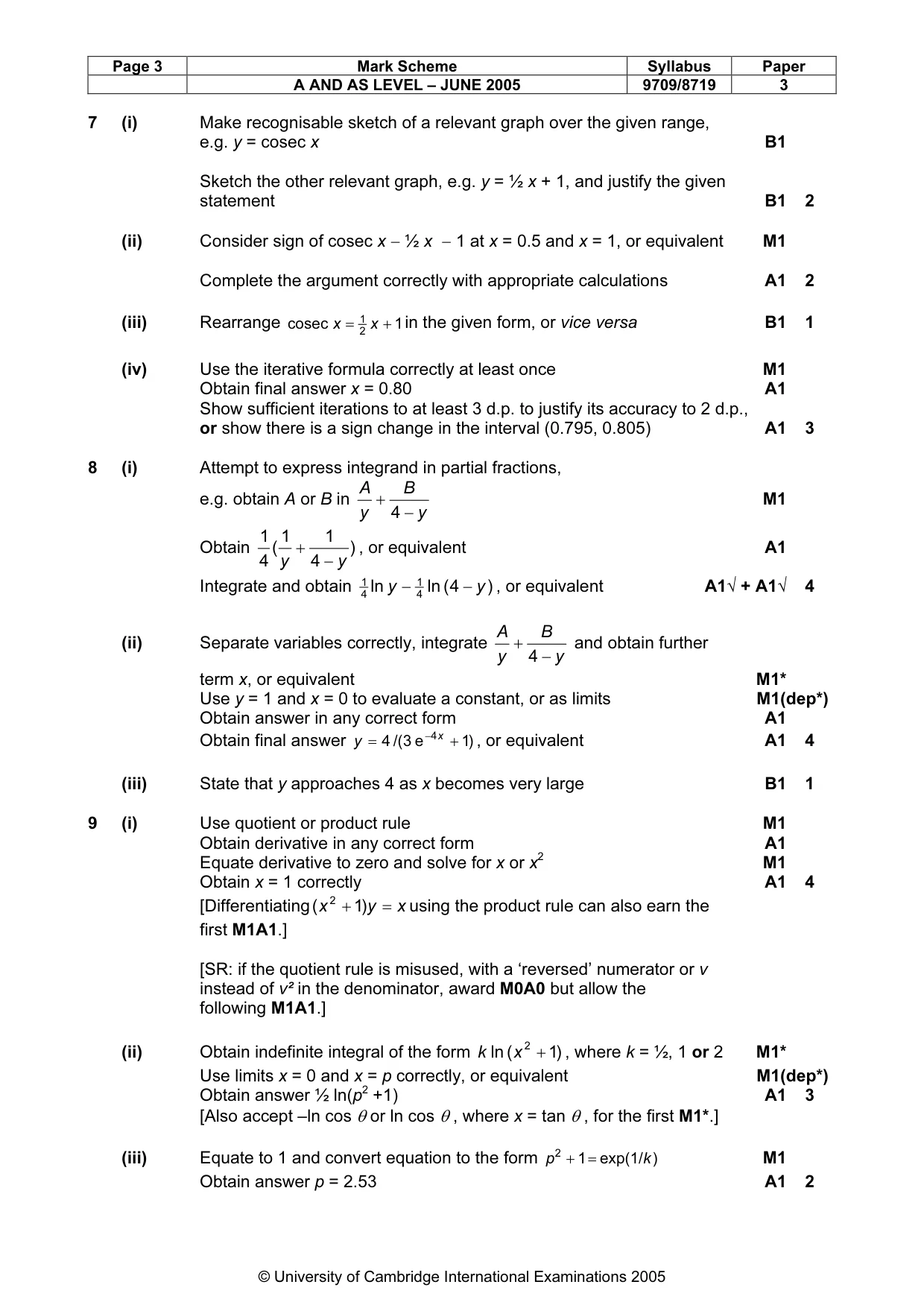
Mark scheme: 7 (i) Make recognisable sketch of a relevant graph over the given range, e.g. y = cosec x B1 Sketch the other relevant graph, e.g. y = ½ x + 1, and justify the given statement B1 2 (ii) Consider sign of cosec x − ½ x − 1 at x = 0.5 and x = 1, or equivalent M1 Complete the argument correctly with appropriate calculations A1 2 (iii) Rearrange cosec x = 1 x + 1 in the given form, or vice versa B1 1 2 (iv) Use the iterative formula correctly at least once M1 Obtain final answer x = 0.80 A1 Show sufficient iterations to at least 3 d.p. to justify its accuracy to 2 d.p., or show there is a sign change in the interval (0.795, 0.805) A1 3
Q8 · Using partial fractions, find 1 dy
8 (i) Using partial fractions, find 1 dy. [4] y(4 −y) (ii) Given that y = 1 when x = 0, solve the differential equation dy = y(4 −y), dx obtaining an expression for y in terms of x. [4] (iii) State what happens to the value of y if x becomes very large and positive. [1]
Mark scheme: 8 (i) Attempt to express integrand in partial fractions, A B e.g. obtain A or B in + M1 y 4 − y 1 1 1 Obtain ( + ) , or equivalent A1 4 y 4 − y Integrate and obtain 41 ln y − 41 ln ( 4 − y ) , or equivalent A1√ + A1√ 4 A B (ii) Separate variables correctly, integrate + and obtain further y 4 − y term x, or equivalent M1* Use y = 1 and x = 0 to evaluate a constant, or as limits M1(dep*) Obtain answer in any correct form A1 Obtain final answer y = 4 /( 3 e −x4 + )1 , or equivalent A1 4 (iii) State that y approaches 4 as x becomes very large B1 1
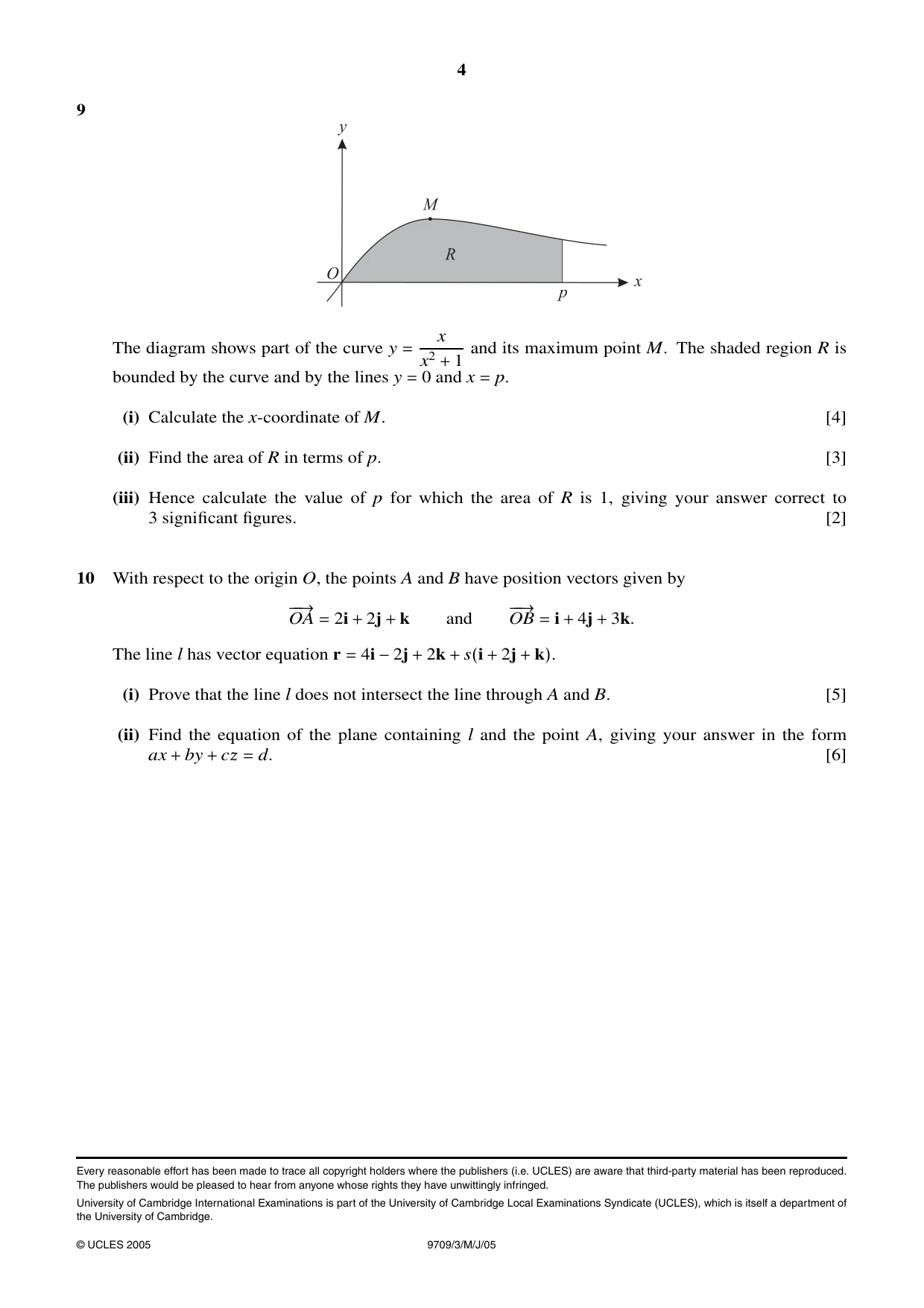
Q9 · X The diagram shows part of the curve y = and its maximum point M
9 x The diagram shows part of the curve y = and its maximum point M. The shaded region R is x2 + 1 bounded by the curve and by the lines y = 0 and x = p. (i) Calculate the x-coordinate of M. [4] (ii) Find the area of R in terms of p. [3] (iii) Hence calculate the value of p for which the area of R is 1, giving your answer correct to 3 significant figures. [2]
Mark scheme: 9 (i) Use quotient or product rule M1 Obtain derivative in any correct form A1 Equate derivative to zero and solve for x or x2 M1 Obtain x = 1 correctly A1 4 [Differentiating ( x 2 + )1 y = x using the product rule can also earn the first M1A1.] [SR: if the quotient rule is misused, with a ‘reversed’ numerator or v instead of v² in the denominator, award M0A0 but allow the following M1A1.] (ii) Obtain indefinite integral of the form k ln ( x 2 + )1 , where k = ½, 1 or 2 M1* Use limits x = 0 and x = p correctly, or equivalent M1(dep*) Obtain answer ½ ln(p2 +1) A1 3 [Also accept –ln cos θ or ln cos θ , where x = tan θ , for the first M1*.] (iii) Equate to 1 and convert equation to the form p 2 + 1 = exp(1/ k ) M1 Obtain answer p = 2.53 A1 2 A AND AS LEVEL – JUNE 2005 9709/8719 3
Q10 · With respect to the origin O, the points A and B have position vectors given by −−→ −−→…
10 With respect to the origin O, the points A and B have position vectors given by −−→ −−→ OA = 2i + 2j + k and OB = i + 4j + 3k. The line l has vector equation r = 4i −2j + 2k + s(i + 2j + k). (i) Prove that the line l does not intersect the line through A and B. [5] (ii) Find the equation of the plane containing l and the point A, giving your answer in the form ax + by + c = d. [6] Every reasonable effort has been made to trace all copyright holders where the publishers (i.e. UCLES) are aware that third-party material has been reproduced. The publishers would be pleased to hear from anyone whose rights they have unwittingly infringed. University of Cambridge International Examinations is part of the University of Cambridge Local Examinations Syndicate (UCLES), which is itself a department of the University of Cambridge.
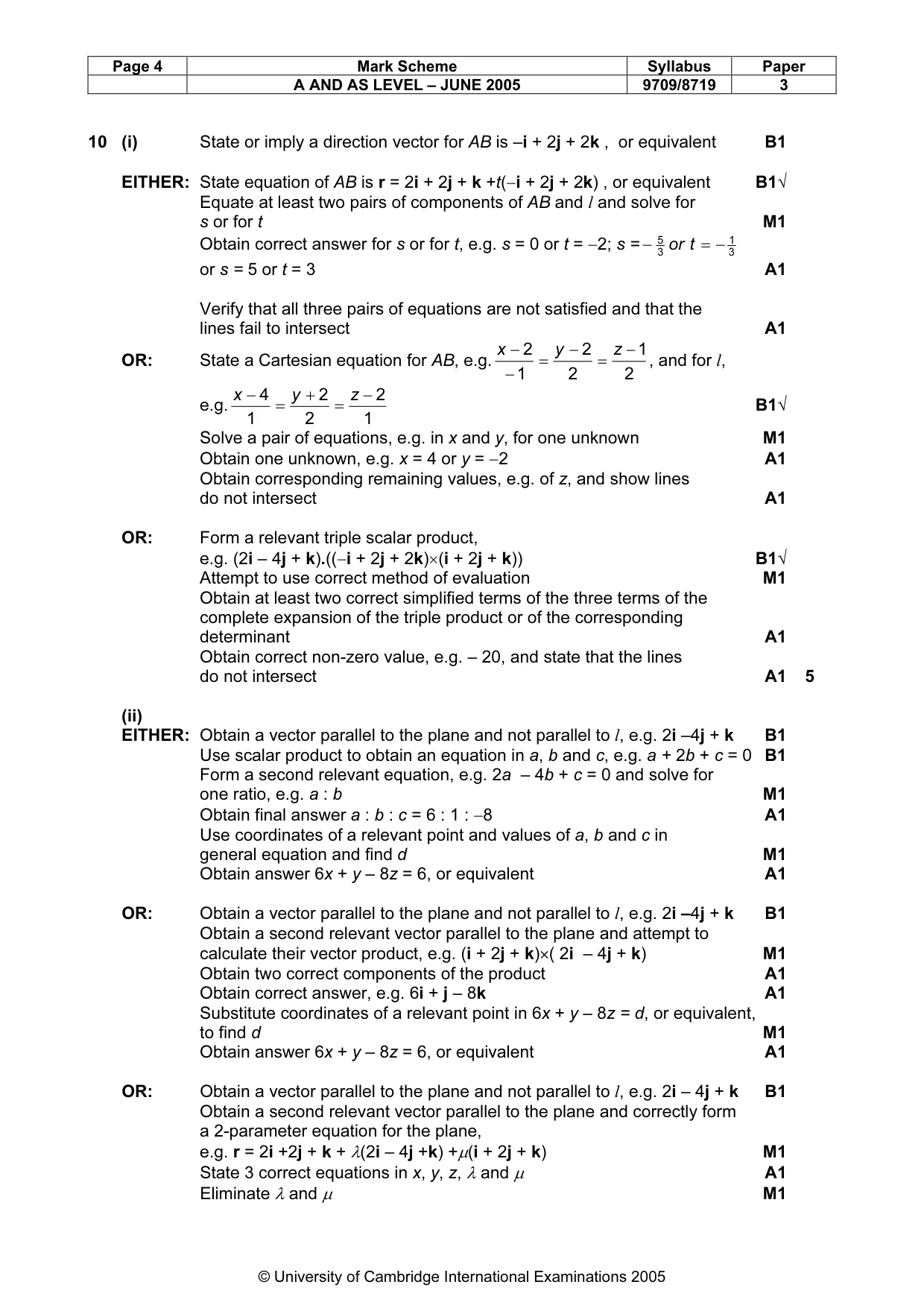
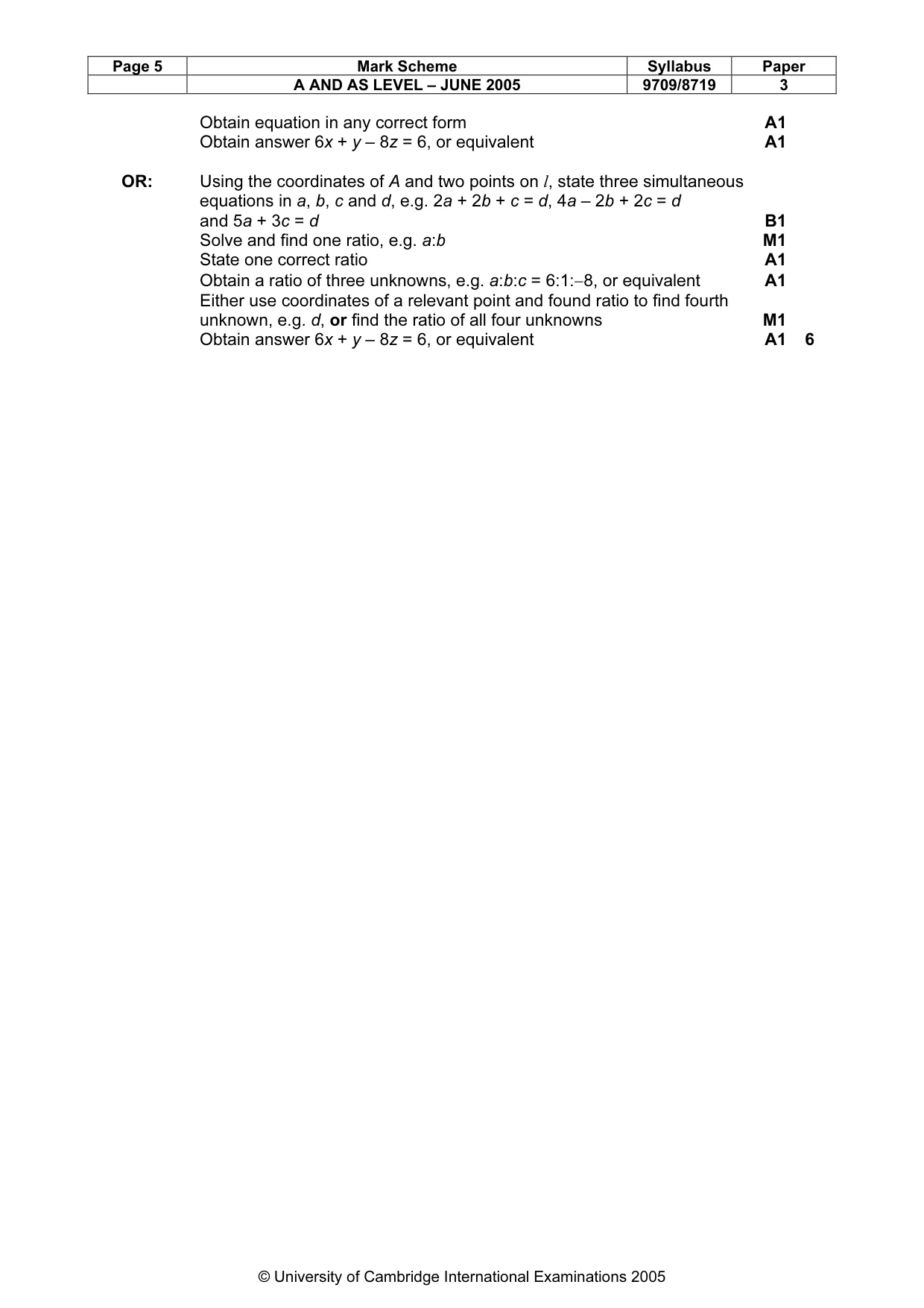
Mark scheme: 10 (i) State or imply a direction vector for AB is –i + 2j + 2k , or equivalent B1 EITHER: State equation of AB is r = 2i + 2j + k +t(−i + 2j + 2k) , or equivalent B1√ Equate at least two pairs of components of AB and l and solve for s or for t M1 Obtain correct answer for s or for t, e.g. s = 0 or t = −2; s = − 53 or t = − 31 or s = 5 or t = 3 A1 Verify that all three pairs of equations are not satisfied and that the lines fail to intersect A1 x − 2 y − 2 z − 1 OR: State a Cartesian equation for AB, e.g. = = , and for l, − 1 2 2 x − 4 y + 2 z − 2 e.g. = = B1√ 1 2 1 Solve a pair of equations, e.g. in x and y, for one unknown M1 Obtain one unknown, e.g. x = 4 or y = −2 A1 Obtain corresponding remaining values, e.g. of z, and show lines do not intersect A1 OR: Form a relevant triple scalar product, e.g. (2i – 4j + k).((−i + 2j + 2k)×(i + 2j + k)) B1√ Attempt to use correct method of evaluation M1 Obtain at least two correct simplified terms of the three terms of the complete expansion of the triple product or of the corresponding determinant A1 Obtain correct non-zero value, e.g. – 20, and state that the lines do not intersect A1 5 (ii) EITHER: Obtain a vector parallel to the plane and not parallel to l, e.g. 2i –4j + k B1 Use scalar product to obtain an equation in a, b and c, e.g. a + 2b + c = 0 B1 Form a second relevant equation, e.g. 2a – 4b + c = 0 and solve for one ratio, e.g. a : b M1 Obtain final answer a : b : c = 6 : 1 : −8 A1 Use coordinates of a relevant point and values of a, b and c in general equation and find d M1 Obtain answer 6x + y – 8z = 6, or equivalent A1 OR: Obtain a vector parallel to the plane and not parallel to l, e.g. 2i –4j + k B1 Obtain a second relevant vector parallel to the plane and attempt to calculate their vector product, e.g. (i + 2j + k)×( 2i – 4j + k) M1 Obtain two correct components of the product A1 Obtain correct answer, e.g. 6i + j – 8k A1 Substitute coordinates of a relevant point in 6x + y – 8z = d, or equivalent, to find d M1 Obtain answer 6x + y – 8z = 6, or equivalent A1 OR: Obtain a vector parallel to the plane and not parallel to l, e.g. 2i – 4j + k B1 Obtain a second relevant vector parallel to the plane and correctly form a 2-parameter equation for the plane, e.g. r = 2i +2j + k + λ(2i – 4j +k) +µ(i + 2j + k) M1 State 3 correct equations in x, y, z, λ and µ A1 Eliminate λ and µ M1 A AND AS LEVEL – JUNE 2005 9709/8719 3 Obtain equation in any correct form A1 Obtain answer 6x + y – 8z = 6, or equivalent A1 OR: Using the coordinates of A and two points on l, state three simultaneous equations in a, b, c and d, e.g. 2a + 2b + c = d, 4a – 2b + 2c = d and 5a + 3c = d B1 Solve and find one ratio, e.g. a:b M1 State one correct ratio A1 Obtain a ratio of three unknowns, e.g. a:b:c = 6:1:−8, or equivalent A1 Either use coordinates of a relevant point and found ratio to find fourth unknown, e.g. d, or find the ratio of all four unknowns M1 Obtain answer 6x + y – 8z = 6, or equivalent A1 6
What was in this paper
The subtopics covered by these 10 questions, and how many questions each got. Open one in a new tab to see every Cambridge question on it.