Cambridge A Level Mathematics 9709 — 2008 Oct/Nov Paper 3 · Variant 1
9709/31/O/N/08 · 10 questions · 75 marks · ≈84 min
The question paper and its mark scheme, free to read here and free to download. This is Cambridge’s own paper, exactly as it was sat.
Question paper4 pages
Mark scheme8 pages
Answers below. Sit the paper first if you are practising.
Questions as text
Q1 · Solve the equation ln(x + 2) = 2 + ln x, giving your answer correct to 3 decimal places
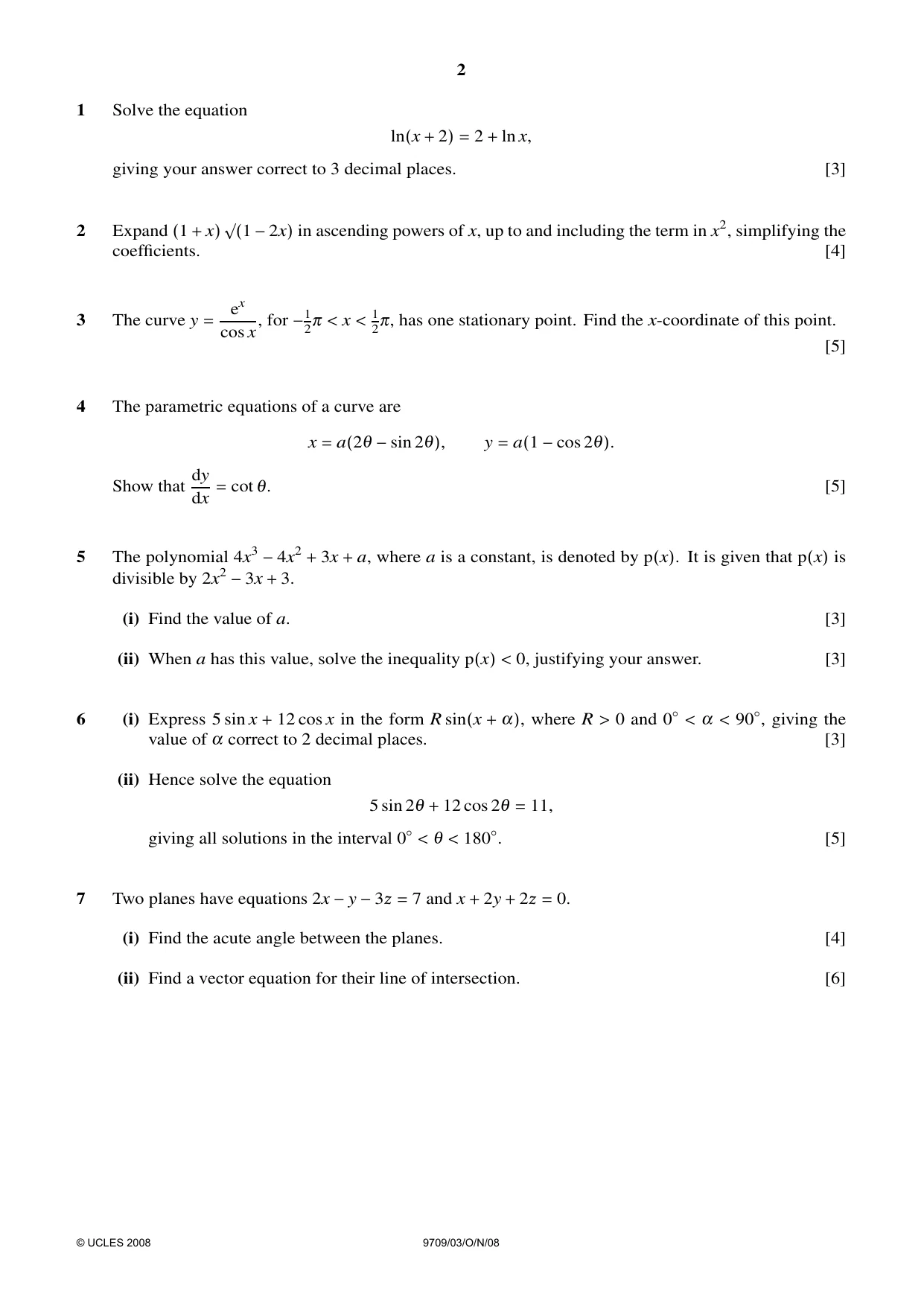
1 Solve the equation ln(x + 2) = 2 + ln x, giving your answer correct to 3 decimal places. [3]
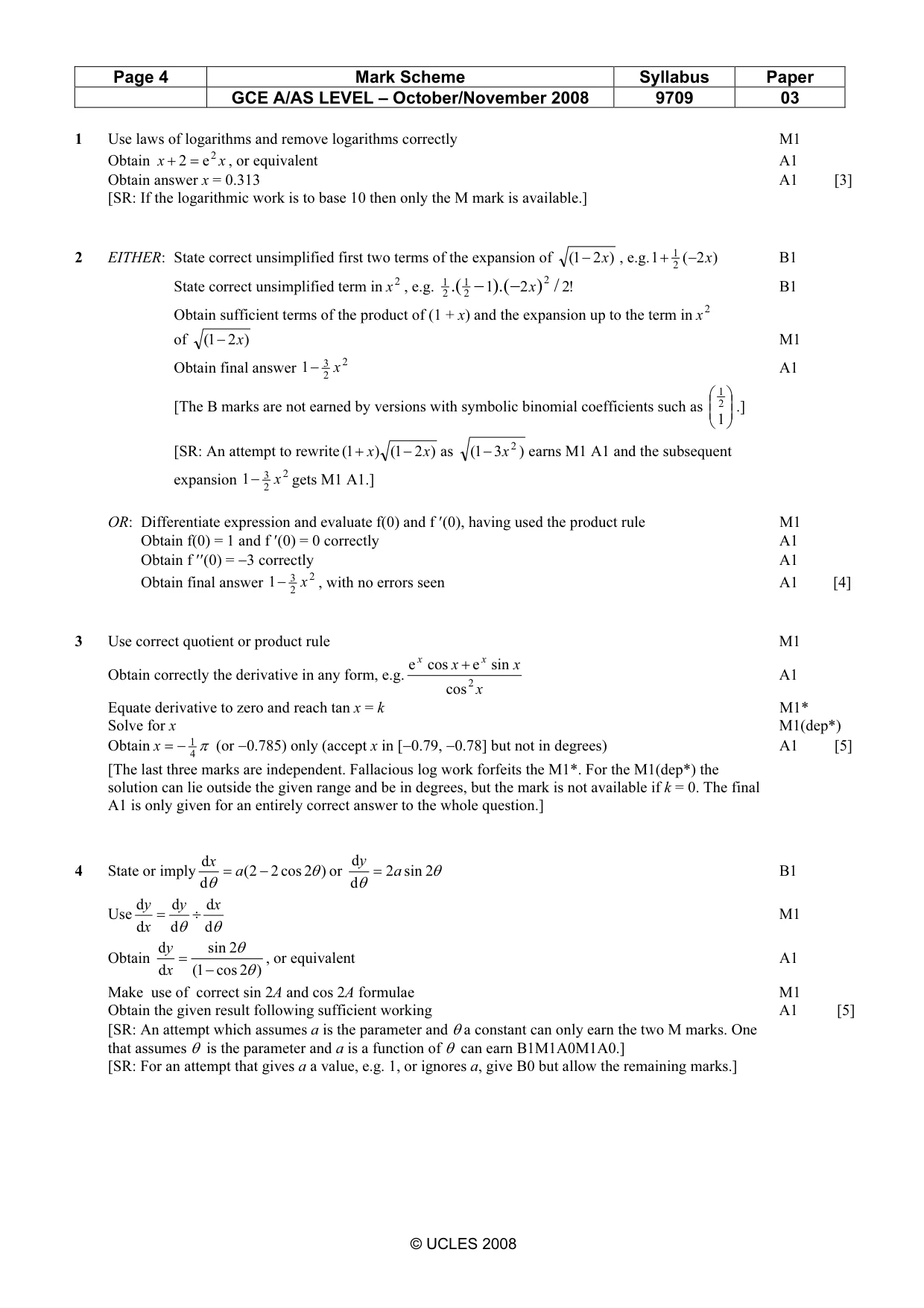
Mark scheme: 1 Use laws of logarithms and remove logarithms correctly M1 Obtain x + 2 = e 2 x , or equivalent A1 Obtain answer x = 0.313 A1 [3] [SR: If the logarithmic work is to base 10 then only the M mark is available.] 1
Q2 · Expand (1 + x) √(1 −2x) in ascending powers of x, up to and including the term in x2…
2 Expand (1 + x) √(1 −2x) in ascending powers of x, up to and including the term in x2, simplifying the coefficients. [4]
Mark scheme: 2 EITHER: State correct unsimplified first two terms of the expansion of 1( − 2 x ) , e.g. 1 + 1 ( −2 x ) B1 2 State correct unsimplified term in x 2 , e.g. 12 .( 12 − 1).( − 2 x ) 2 / !2 B1 Obtain sufficient terms of the product of (1 + x) and the expansion up to the term in x 2 of 1( − 2 x ) M1 Obtain final answer 1 − 32 x 2 A1 1 [The B marks are not earned by versions with symbolic binomial coefficients such as 2 .] 1 [SR: An attempt to rewrite 1( + x ) 1( − 2 x ) as 1( − 3 x 2 ) earns M1 A1 and the subsequent expansion 1 − 32 x 2 gets M1 A1.] OR: Differentiate expression and evaluate f(0) and f ′(0), having used the product rule M1 Obtain f(0) = 1 and f ′(0) = 0 correctly A1 Obtain f ′′(0) = −3 correctly A1 Obtain final answer 1 − 32 x 2 , with no errors seen A1 [4]
Q3 · Ex 13 The curve y = cos x, for −12π < x < 2π, has one stationary point
ex 13 The curve y = cos x, for −12π < x < 2π, has one stationary point. Find the x-coordinate of this point. [5]
Mark scheme: 3 Use correct quotient or product rule M1 e x cos x + e x sin x Obtain correctly the derivative in any form, e.g. A1 cos 2 x Equate derivative to zero and reach tan x = k M1* Solve for x M1(dep*) Obtain x = − 14 π (or −0.785) only (accept x in [−0.79, −0.78] but not in degrees) A1 [5] [The last three marks are independent. Fallacious log work forfeits the M1*. For the M1(dep*) the solution can lie outside the given range and be in degrees, but the mark is not available if k = 0. The final A1 is only given for an entirely correct answer to the whole question.] dx dy
Q4 · The parametric equations of a curve are x = a(2θ −sin 2θ), y = a(1 −cos 2θ)
4 The parametric equations of a curve are x = a(2θ −sin 2θ), y = a(1 −cos 2θ). dy Show that = cot θ. [5] dx
Mark scheme: dx dy 4 State or imply = a ( 2 − 2 cos 2θ ) or = 2 a sin 2θ B1 dθ dθ dy dy dx Use = ÷ M1 dx d θ dθ dy sin 2θ Obtain = , or equivalent A1 dx 1( − cos 2θ ) Make use of correct sin 2A and cos 2A formulae M1 Obtain the given result following sufficient working A1 [5] [SR: An attempt which assumes a is the parameter and θ a constant can only earn the two M marks. One that assumes θ is the parameter and a is a function of θ can earn B1M1A0M1A0.] [SR: For an attempt that gives a a value, e.g. 1, or ignores a, give B0 but allow the remaining marks.] GCE A/AS LEVEL – October/November 2008 9709 03 2
Q5 · The polynomial 4x3 −4x2 + 3x + a, where a is a constant, is denoted by p(x)
5 The polynomial 4x3 −4x2 + 3x + a, where a is a constant, is denoted by p(x). It is given that p(x) is divisible by 2x2 −3x + 3. (i) Find the value of a. [3] (ii) When a has this value, solve the inequality p(x) < 0, justifying your answer. [3]
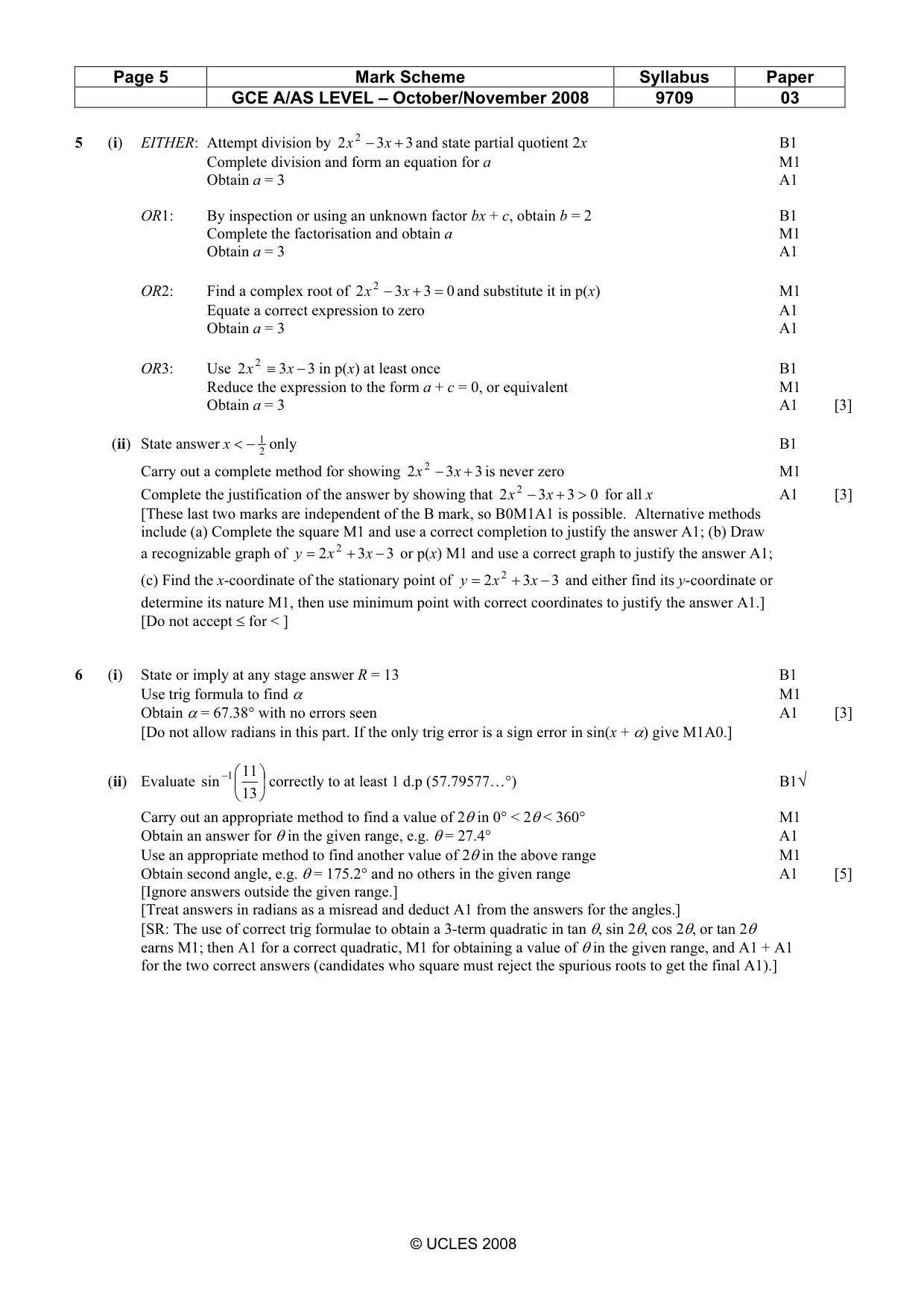
Mark scheme: 5 (i) EITHER: Attempt division by 2 x 2 −x3 + 3 and state partial quotient 2x B1 Complete division and form an equation for a M1 Obtain a = 3 A1 OR1: By inspection or using an unknown factor bx + c, obtain b = 2 B1 Complete the factorisation and obtain a M1 Obtain a = 3 A1 OR2: Find a complex root of 2 x 2 −x3 + 3 = 0 and substitute it in p(x) M1 Equate a correct expression to zero A1 Obtain a = 3 A1 OR3: Use 2 x 2 ≡x3 − 3 in p(x) at least once B1 Reduce the expression to the form a + c = 0, or equivalent M1 Obtain a = 3 A1 [3] (ii) State answer x < − 1 only B1 2 Carry out a complete method for showing 2 x 2 −x3 + 3 is never zero M1 Complete the justification of the answer by showing that 2 x 2 −x3 + 3 > 0 for all x A1 [3] [These last two marks are independent of the B mark, so B0M1A1 is possible. Alternative methods include (a) Complete the square M1 and use a correct completion to justify the answer A1; (b) Draw a recognizable graph of y = 2 x 2 + 3 x − 3 or p(x) M1 and use a correct graph to justify the answer A1; (c) Find the x-coordinate of the stationary point of y = 2 x 2 + 3 x − 3 and either find its y-coordinate or determine its nature M1, then use minimum point with correct coordinates to justify the answer A1.] [Do not accept ≤ for < ]
Q6 · Express 5 sin x + 12 cos x in the form R sin(x + α), where R > 0 and 0◦< α < 90◦, giving…
6 (i) Express 5 sin x + 12 cos x in the form R sin(x + α), where R > 0 and 0◦< α < 90◦, giving the value of α correct to 2 decimal places. [3] (ii) Hence solve the equation 5 sin 2θ + 12 cos 2θ = 11, giving all solutions in the interval 0◦< θ < 180◦. [5]
Mark scheme: 6 (i) State or imply at any stage answer R = 13 B1 Use trig formula to find α M1 Obtain α = 67.38° with no errors seen A1 [3] [Do not allow radians in this part. If the only trig error is a sign error in sin(x + α) give M1A0.] −1 11 (ii) Evaluate sin correctly to at least 1 d.p (57.79577…°) B1√ 13 Carry out an appropriate method to find a value of 2θ in 0° < 2θ < 360° M1 Obtain an answer for θ in the given range, e.g. θ = 27.4° A1 Use an appropriate method to find another value of 2θ in the above range M1 Obtain second angle, e.g. θ = 175.2° and no others in the given range A1 [5] [Ignore answers outside the given range.] [Treat answers in radians as a misread and deduct A1 from the answers for the angles.] [SR: The use of correct trig formulae to obtain a 3-term quadratic in tan θ, sin 2θ, cos 2θ, or tan 2θ earns M1; then A1 for a correct quadratic, M1 for obtaining a value of θ in the given range, and A1 + A1 for the two correct answers (candidates who square must reject the spurious roots to get the final A1).] GCE A/AS LEVEL – October/November 2008 9709 03
Q7 · Two planes have equations 2x −y −3 = 7 and x + 2y + 2 = 0
7 Two planes have equations 2x −y −3 = 7 and x + 2y + 2 = 0. (i) Find the acute angle between the planes. [4] (ii) Find a vector equation for their line of intersection. [6]
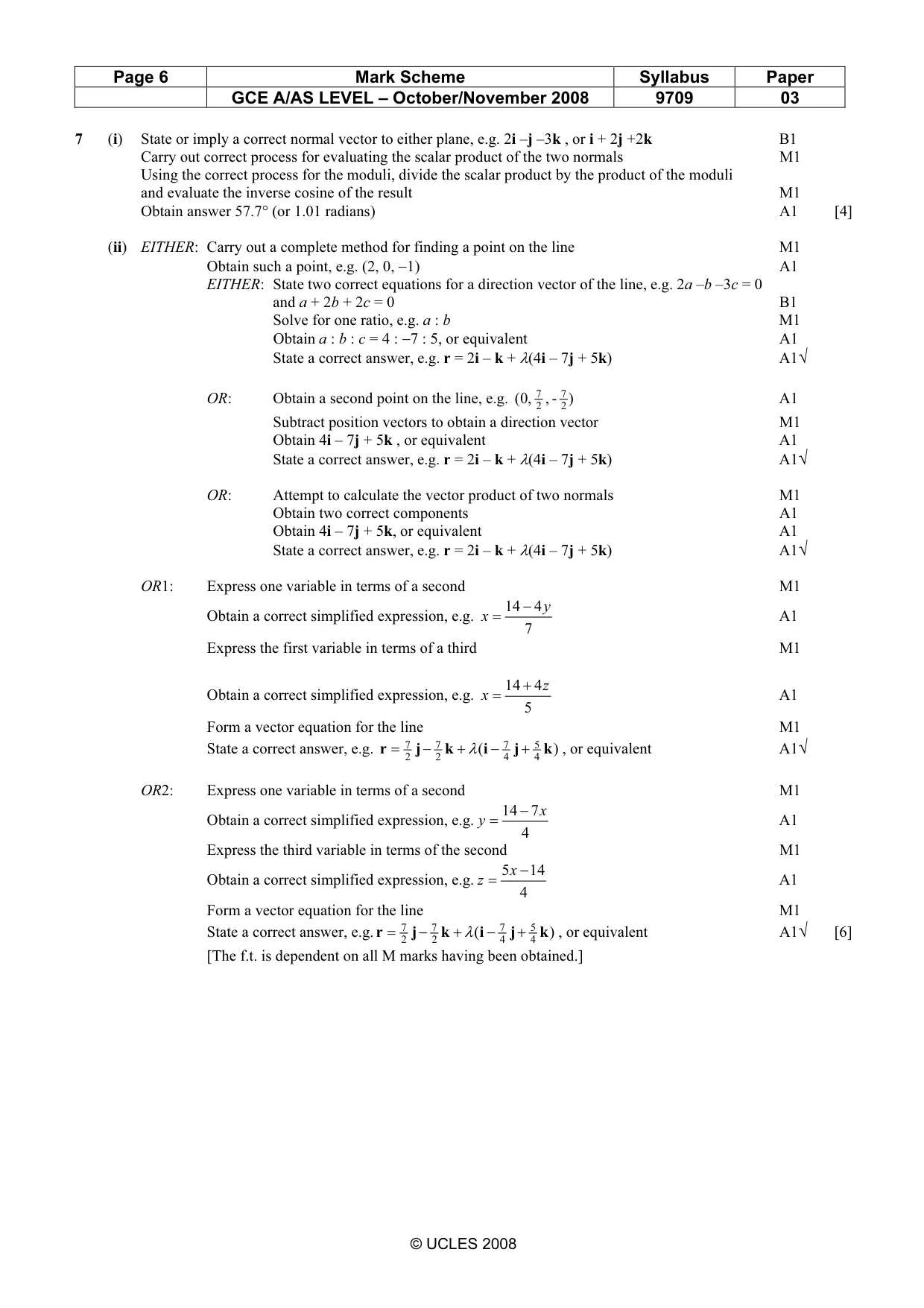
Mark scheme: 7 (i) State or imply a correct normal vector to either plane, e.g. 2i –j –3k , or i + 2j +2k B1 Carry out correct process for evaluating the scalar product of the two normals M1 Using the correct process for the moduli, divide the scalar product by the product of the moduli and evaluate the inverse cosine of the result M1 Obtain answer 57.7° (or 1.01 radians) A1 [4] (ii) EITHER: Carry out a complete method for finding a point on the line M1 Obtain such a point, e.g. (2, 0, −1) A1 EITHER: State two correct equations for a direction vector of the line, e.g. 2a –b –3c = 0 and a + 2b + 2c = 0 B1 Solve for one ratio, e.g. a : b M1 Obtain a : b : c = 4 : −7 : 5, or equivalent A1 State a correct answer, e.g. r = 2i – k + λ(4i – 7j + 5k) A1√ OR: Obtain a second point on the line, e.g. ( ,0 72 , - 72 ) A1 Subtract position vectors to obtain a direction vector M1 Obtain 4i – 7j + 5k , or equivalent A1 State a correct answer, e.g. r = 2i – k + λ(4i – 7j + 5k) A1√ OR: Attempt to calculate the vector product of two normals M1 Obtain two correct components A1 Obtain 4i – 7j + 5k, or equivalent A1 State a correct answer, e.g. r = 2i – k + λ(4i – 7j + 5k) A1√ OR1: Express one variable in terms of a second M1 14 − 4 y Obtain a correct simplified expression, e.g. x = A1 7 Express the first variable in terms of a third M1 14 + 4 z Obtain a correct simplified expression, e.g. x = A1 5 Form a vector equation for the line M1 State a correct answer, e.g. r = 7 j − 7 k + λ ( i − 7 j + 5 k ) , or equivalent A1√ 2 2 4 4 OR2: Express one variable in terms of a second M1 14 − 7 x Obtain a correct simplified expression, e.g. y = A1 4 Express the third variable in terms of the second M1 5 x − 14 Obtain a correct simplified expression, e.g. z = A1 4 Form a vector equation for the line M1 State a correct answer, e.g. r = 7 j − 7 k + λ ( i − 7 j + 5 k ) , or equivalent A1√ [6] 2 2 4 4 [The f.t. is dependent on all M marks having been obtained.] GCE A/AS LEVEL – October/November 2008 9709 03 dV 2 dh dV 2
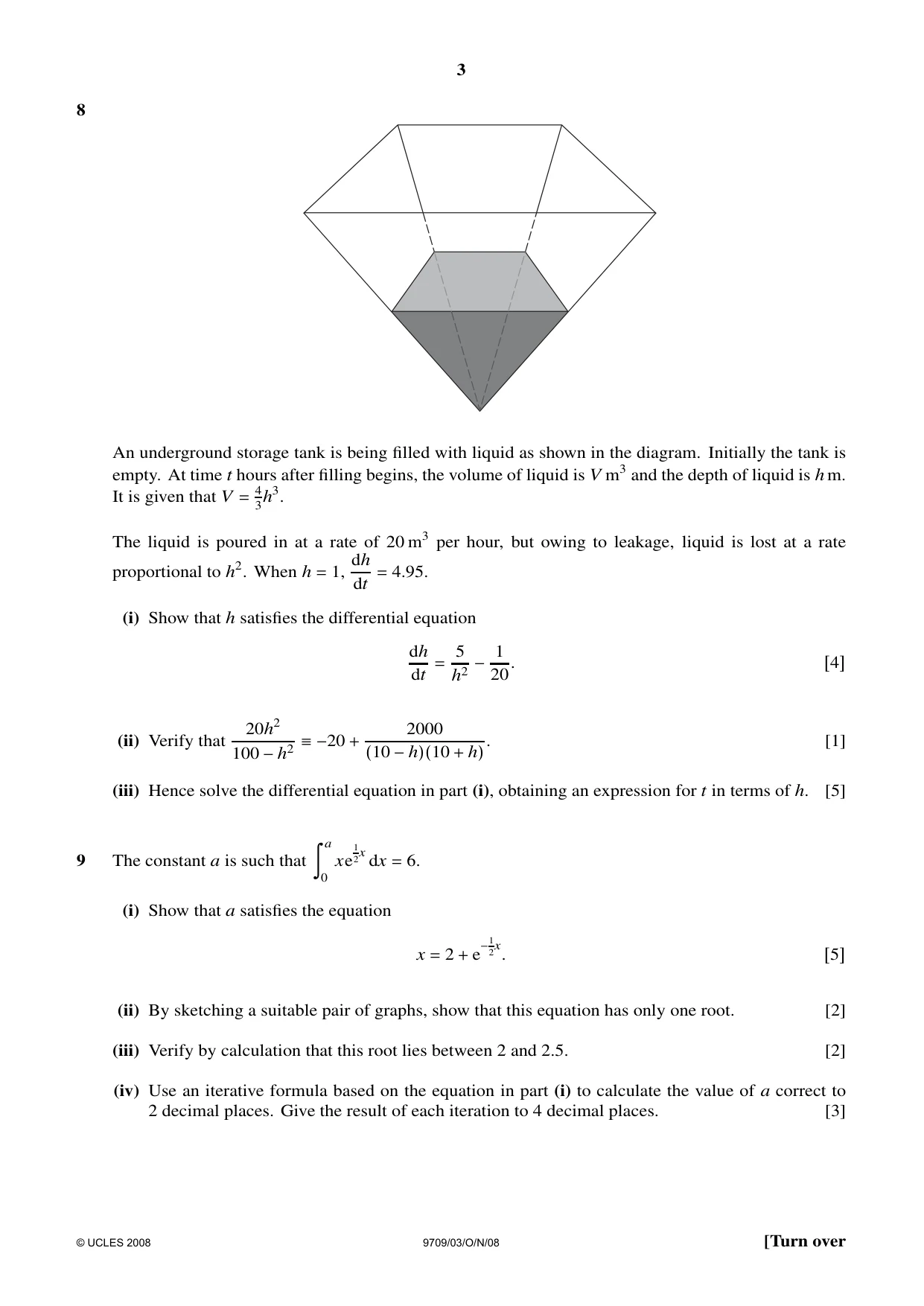
Q8 · An underground storage tank is being filled with liquid as shown in the diagram
8 An underground storage tank is being filled with liquid as shown in the diagram. Initially the tank is empty. At time t hours after filling begins, the volume of liquid is V m3 and the depth of liquid is h m. It is given that V = 43h3. The liquid is poured in at a rate of 20 m3 per hour, but owing to leakage, liquid is lost at a rate dh proportional to h2. When h = 1, = 4.95. dt (i) Show that h satisfies the differential equation dh 5 = −1 [4] dt h2 20. 20h2 2000 (ii) Verify that ≡−20 + [1] 100 −h2 (10 −h)(10 + h). (iii) Hence solve the differential equation in part (i), obtaining an expression for t in terms of h. [5]
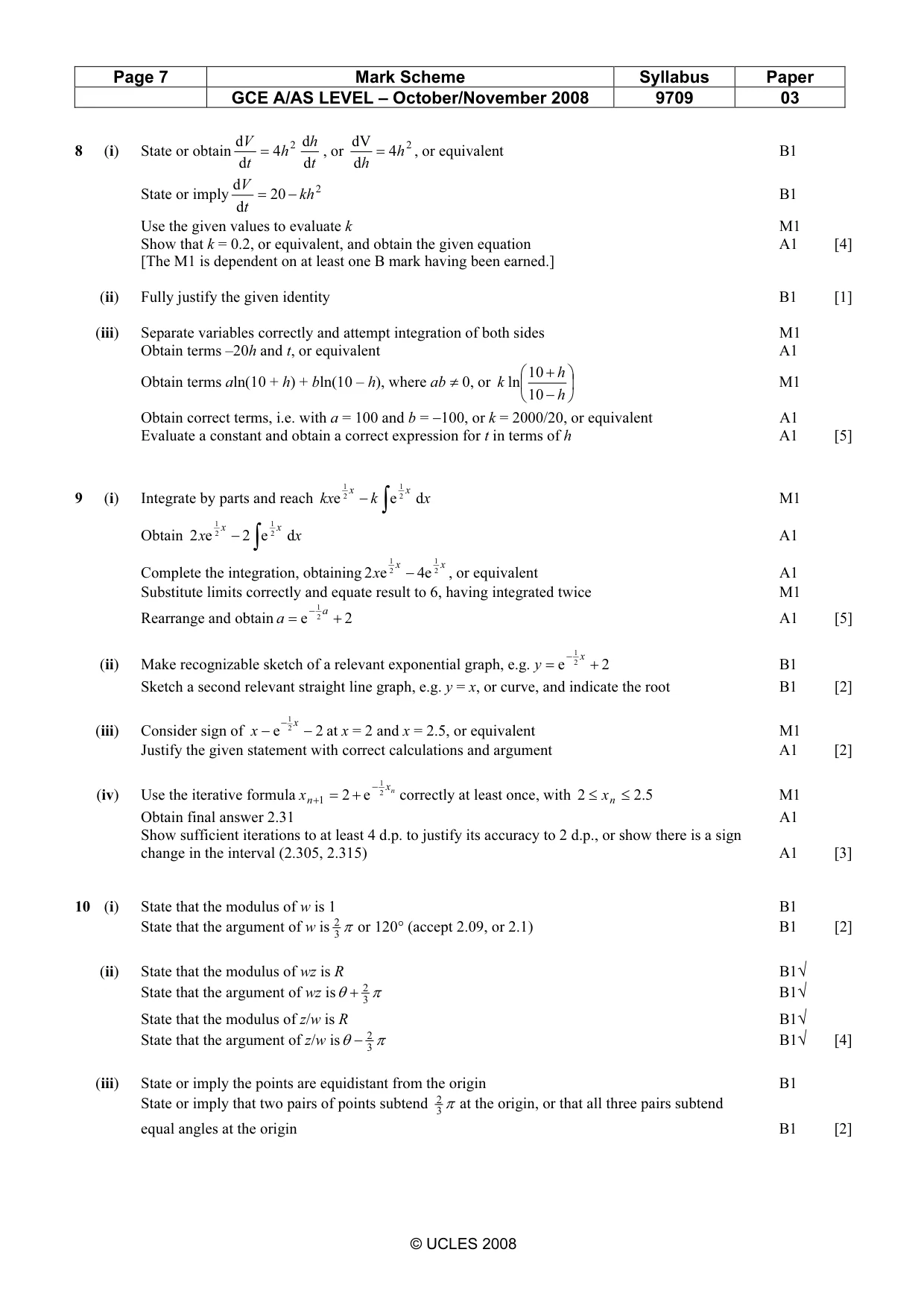
Mark scheme: dV 2 dh dV 28 (i) State or obtain = 4 h , or = 4 h , or equivalent B1 dt dt d h dV 2 State or imply = 20 − kh B1 dt Use the given values to evaluate k M1 Show that k = 0.2, or equivalent, and obtain the given equation A1 [4] [The M1 is dependent on at least one B mark having been earned.] (ii) Fully justify the given identity B1 [1] (iii) Separate variables correctly and attempt integration of both sides M1 Obtain terms –20h and t, or equivalent A1 10 + h Obtain terms aln(10 + h) + bln(10 – h), where ab ≠ 0, or k ln M1 10 − h Obtain correct terms, i.e. with a = 100 and b = −100, or k = 2000/20, or equivalent A1 Evaluate a constant and obtain a correct expression for t in terms of h A1 [5] 1 x 1 x ∫
Q9 · A 1 2x9 The constant a is such that xe dx = 6
a 1 2x9 The constant a is such that xe dx = 6. 0 (i) Show that a satisfies the equation −1 x = 2 + e 2x. [5] (ii) By sketching a suitable pair of graphs, show that this equation has only one root. [2] (iii) Verify by calculation that this root lies between 2 and 2.5. [2] (iv) Use an iterative formula based on the equation in part (i) to calculate the value of a correct to 2 decimal places. Give the result of each iteration to 4 decimal places. [3]
Mark scheme: 2 x9 (i) Integrate by parts and reach kxe 2 x d x M1 − k ∫ e 2 x − 2 e 1 Obtain 2 xe 1 ∫ 2 x d x A1 1 2 x 12 x Complete the integration, obtaining 2 xe − 4e , or equivalent A1 Substitute limits correctly and equate result to 6, having integrated twice M1 −a12 Rearrange and obtain a = e + 2 A1 [5] −x12 (ii) Make recognizable sketch of a relevant exponential graph, e.g. y = e + 2 B1 Sketch a second relevant straight line graph, e.g. y = x, or curve, and indicate the root B1 [2] −x12 (iii) Consider sign of x − e − 2 at x = 2 and x = 2.5, or equivalent M1 Justify the given statement with correct calculations and argument A1 [2] − 12 x n (iv) Use the iterative formula x n +1 = 2 + e correctly at least once, with 2 ≤ x n ≤ 5.2 M1 Obtain final answer 2.31 A1 Show sufficient iterations to at least 4 d.p. to justify its accuracy to 2 d.p., or show there is a sign change in the interval (2.305, 2.315) A1 [3]
Q10 · √310 The complex number w is given by w = −1 + i
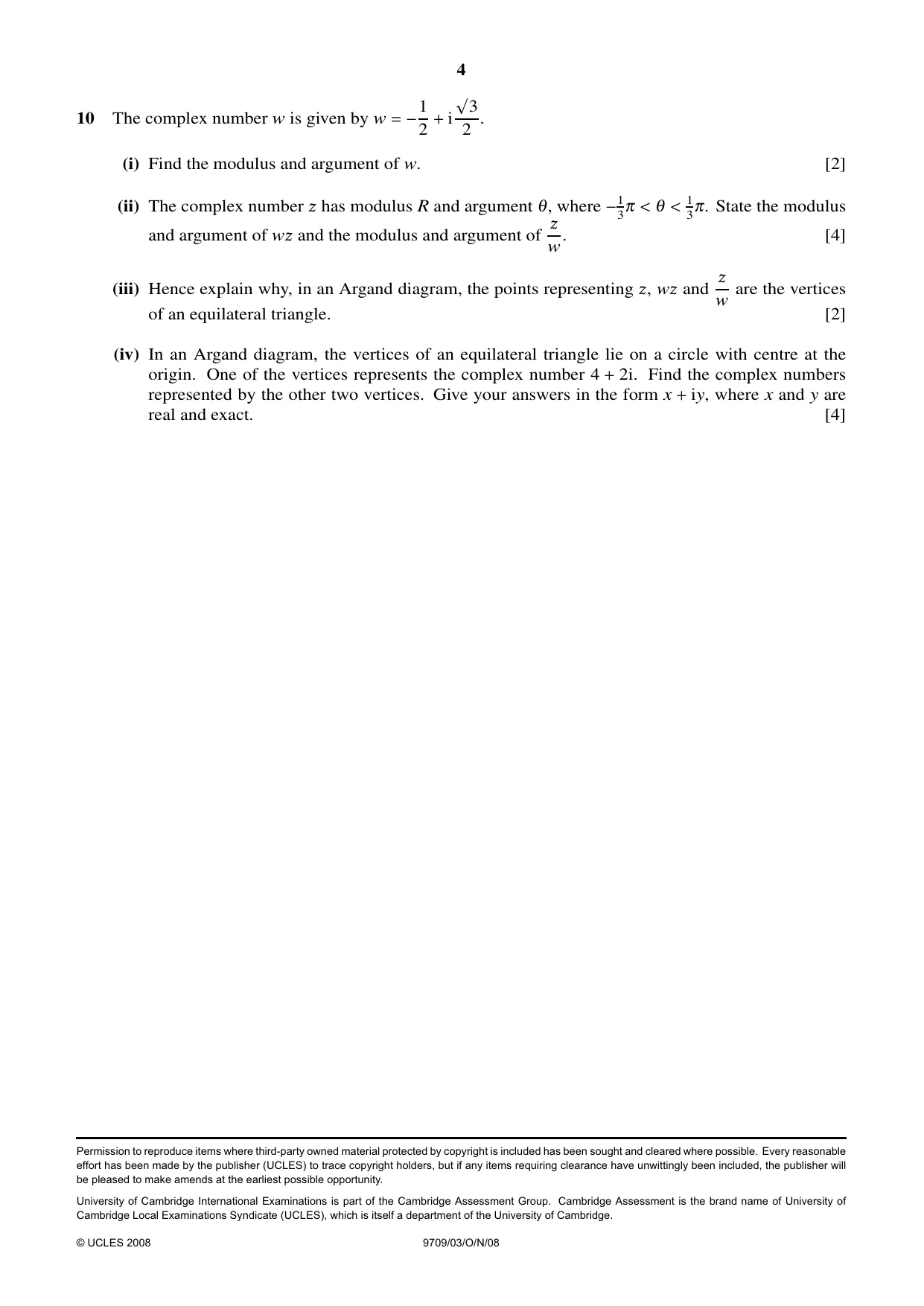
√310 The complex number w is given by w = −1 + i . 2 2 (i) Find the modulus and argument of w. [2] (ii) The complex number has modulus R and argument θ, where −13π < θ < 13π. State the modulus and argument of w and the modulus and argument of w. [4] (iii) Hence explain why, in an Argand diagram, the points representing , w and are the vertices w of an equilateral triangle. [2] (iv) In an Argand diagram, the vertices of an equilateral triangle lie on a circle with centre at the origin. One of the vertices represents the complex number 4 + 2i. Find the complex numbers represented by the other two vertices. Give your answers in the form x + iy, where x and y are real and exact. [4]
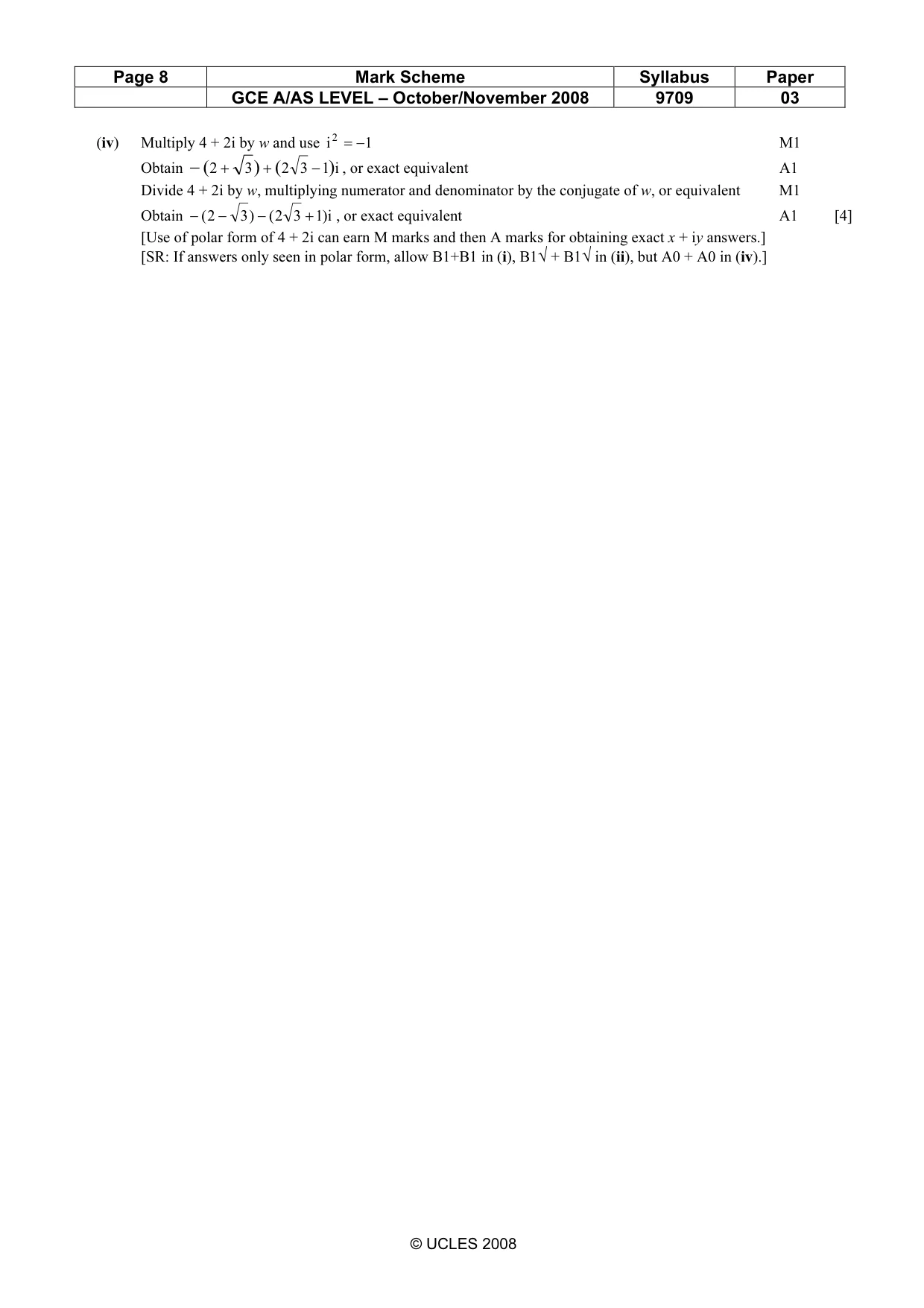
Mark scheme: 10 (i) State that the modulus of w is 1 B1 State that the argument of w is 2 π or 120° (accept 2.09, or 2.1) B1 [2] 3 (ii) State that the modulus of wz is R B1√ State that the argument of wz is θ + 2 π B1√ 3 State that the modulus of z/w is R B1√ State that the argument of z/w is θ − 2 π B1√ [4] 3 (iii) State or imply the points are equidistant from the origin B1 State or imply that two pairs of points subtend 2 π at the origin, or that all three pairs subtend 3 equal angles at the origin B1 [2] GCE A/AS LEVEL – October/November 2008 9709 03 (iv) Multiply 4 + 2i by w and use i 2 = −1 M1 Obtain − ( 2 + 3 ) + ( 2 3 − 1) i , or exact equivalent A1 Divide 4 + 2i by w, multiplying numerator and denominator by the conjugate of w, or equivalent M1 Obtain − ( 2 − 3 ) − ( 2 3 + i)1 , or exact equivalent A1 [4] [Use of polar form of 4 + 2i can earn M marks and then A marks for obtaining exact x + iy answers.] [SR: If answers only seen in polar form, allow B1+B1 in (i), B1√ + B1√ in (ii), but A0 + A0 in (iv).]
What was in this paper
The subtopics covered by these 10 questions, and how many questions each got. Open one in a new tab to see every Cambridge question on it.
What you needed in this session
Cambridge’s own grade thresholds for 2008 Oct/Nov, Paper 3 · Variant 1. A higher threshold means an easier paper — the bar moves with how the cohort did.