Cambridge A Level Mathematics 9709 — 2010 Oct/Nov Paper 3 · Variant 3
9709/33/O/N/10 · 9 questions · 75 marks · ≈84 min
The question paper and its mark scheme, free to read here and free to download. This is Cambridge’s own paper, exactly as it was sat.
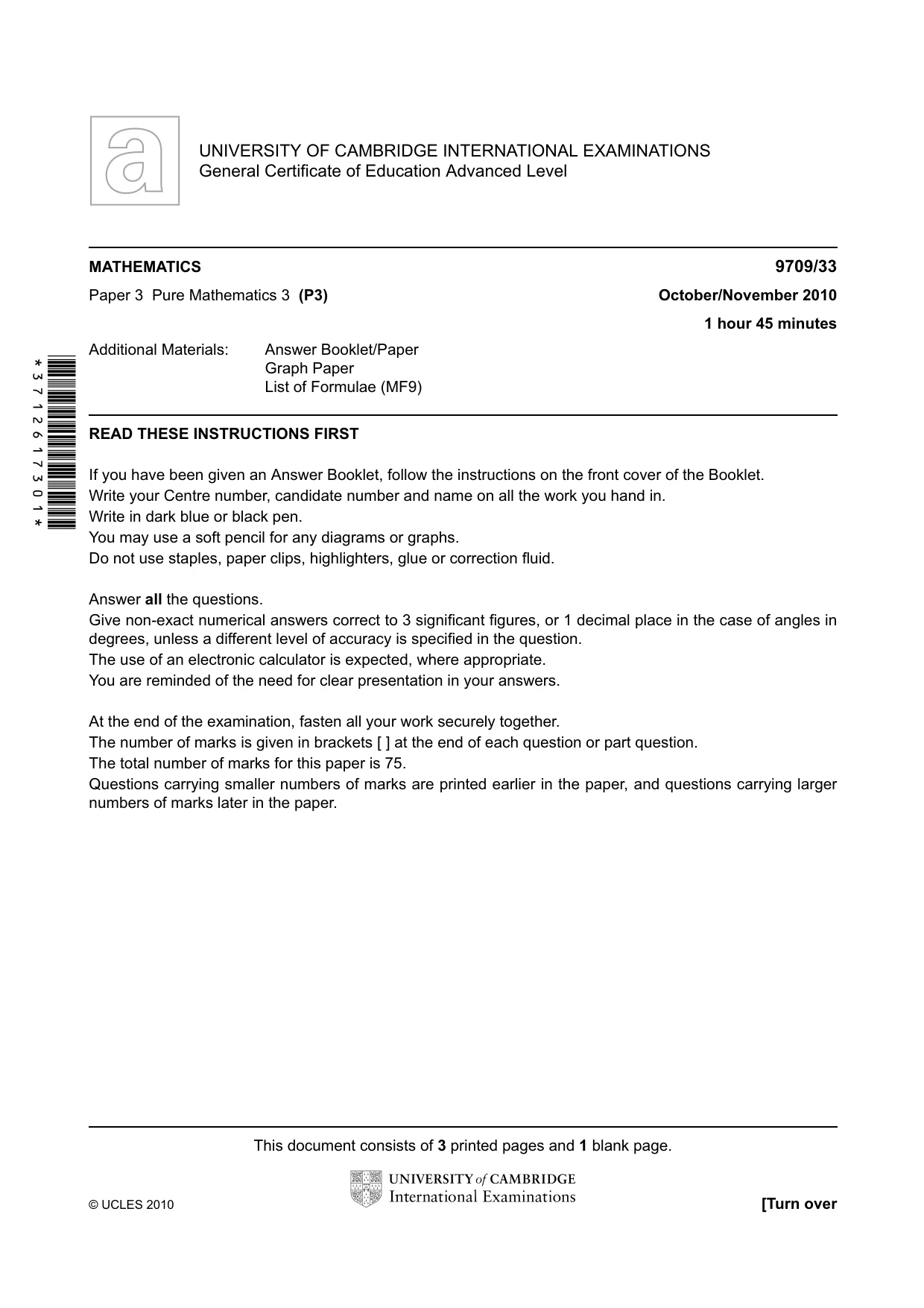
Question paper4 pages
Mark scheme6 pages
Answers below. Sit the paper first if you are practising.
Questions as text
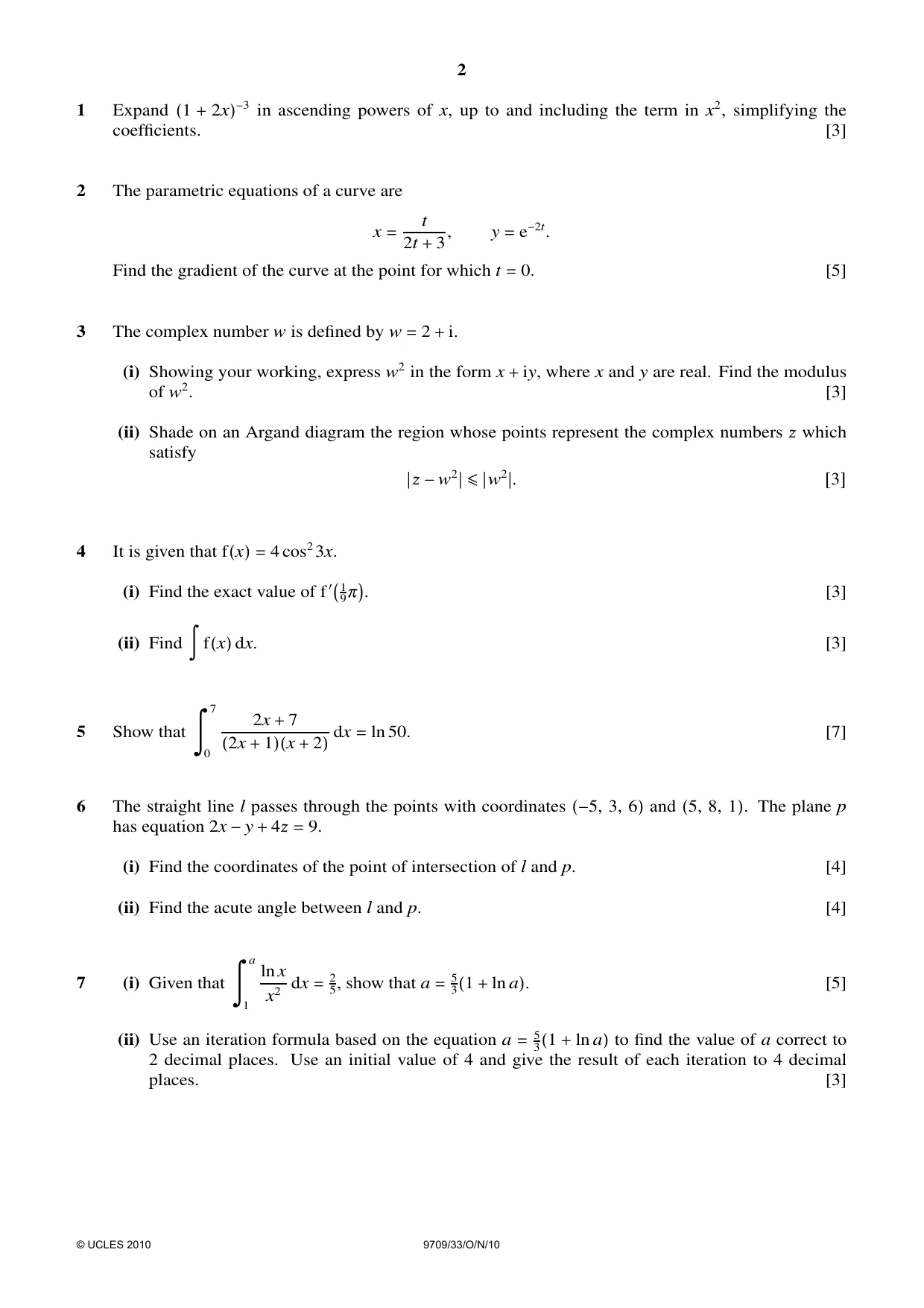
Q1 · Expand in ascending powers of x, up to and including the term in x2, simplifying the…
1 Expand in ascending powers of x, up to and including the term in x2, simplifying the coefficients.(1 + 2x)−3 [3]
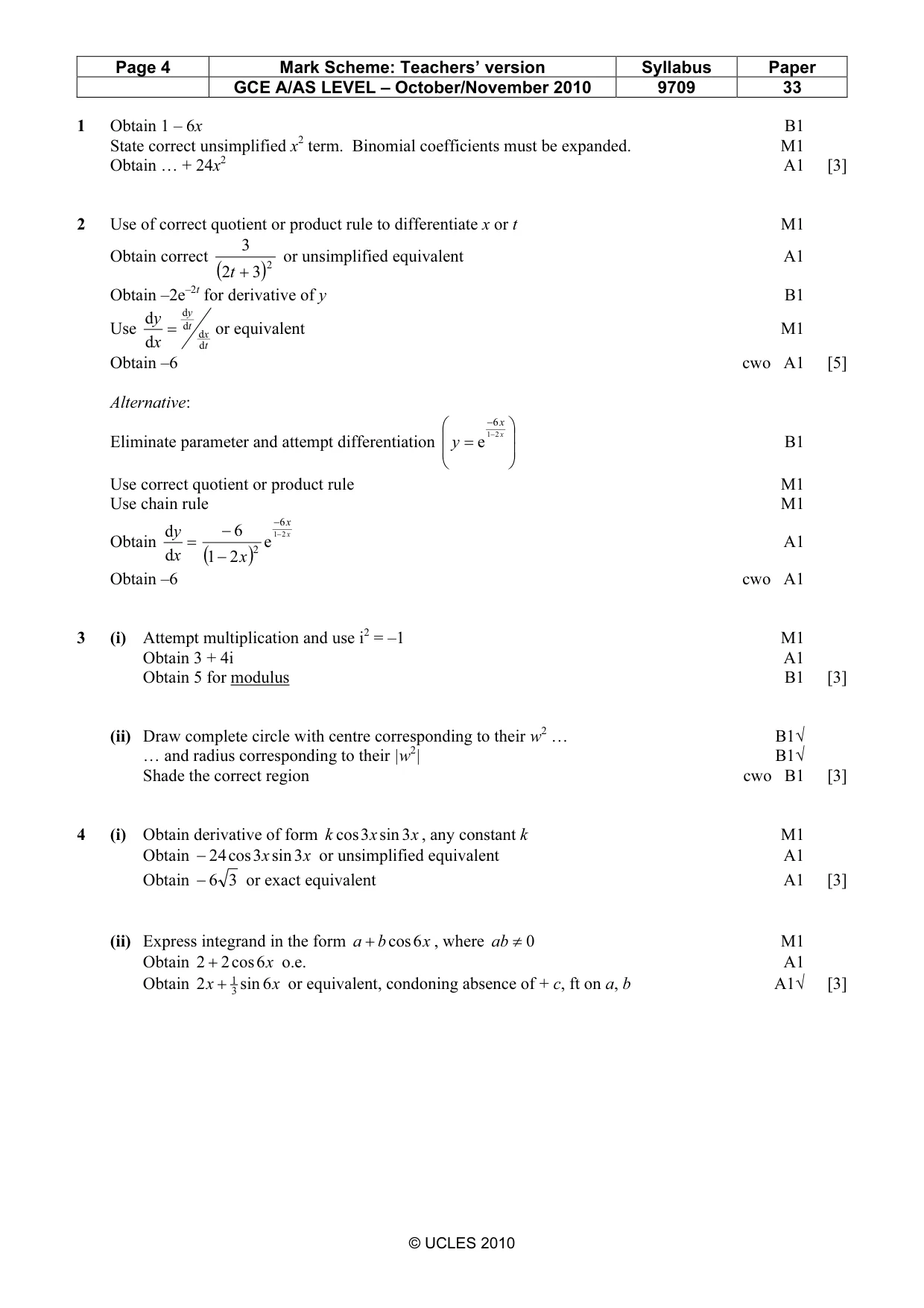
Mark scheme: 1 Obtain 1 – 6x B1 State correct unsimplified x2 term. Binomial coefficients must be expanded. M1 Obtain … + 24x2 A1 [3]
Q2 · The parametric equations of a curve are t x y e−2t
2 The parametric equations of a curve are t x y e−2t. 2t 3, = = + Find the gradient of the curve at the point for which t 0. [5] =
Mark scheme: 2 Use of correct quotient or product rule to differentiate x or t M1 3 Obtain correct or unsimplified equivalent A1 (2t + 3)2 Obtain –2e–2t for derivative of y B1 dy ddyt Use = dx or equivalent M1 dx dt Obtain –6 cwo A1 [5] Alternative: 1−−62 xx y = e B1 Eliminate parameter and attempt differentiation Use correct quotient or product rule M1 Use chain rule M1 dy − 6 1−−62 xx Obtain = 2 e A1 dx (1 − 2 x ) Obtain –6 cwo A1 2
Q3 · The complex number w is defined by w 2 i
3 The complex number w is defined by w 2 i. = + (i) Showing your working, express w2 in the form x iy, where x and y are real. Find the modulus of w2. + [3] (ii) Shade on an Argand diagram the region whose points represent the complex numbers which satisfy ß |ß −w2| ≤|w2|. [3]
Mark scheme: 3 (i) Attempt multiplication and use i2 = –1 M1 Obtain 3 + 4i A1 Obtain 5 for modulus B1 [3] (ii) Draw complete circle with centre corresponding to their w2 … B1√ … and radius corresponding to their |w2| B1√ Shade the correct region cwo B1 [3]
Q5 · 2x 7 5 Show that dx ln 50
7 2x 7 5 Show that dx ln 50. [7] + ä 0 = (2x + 1)(x + 2)
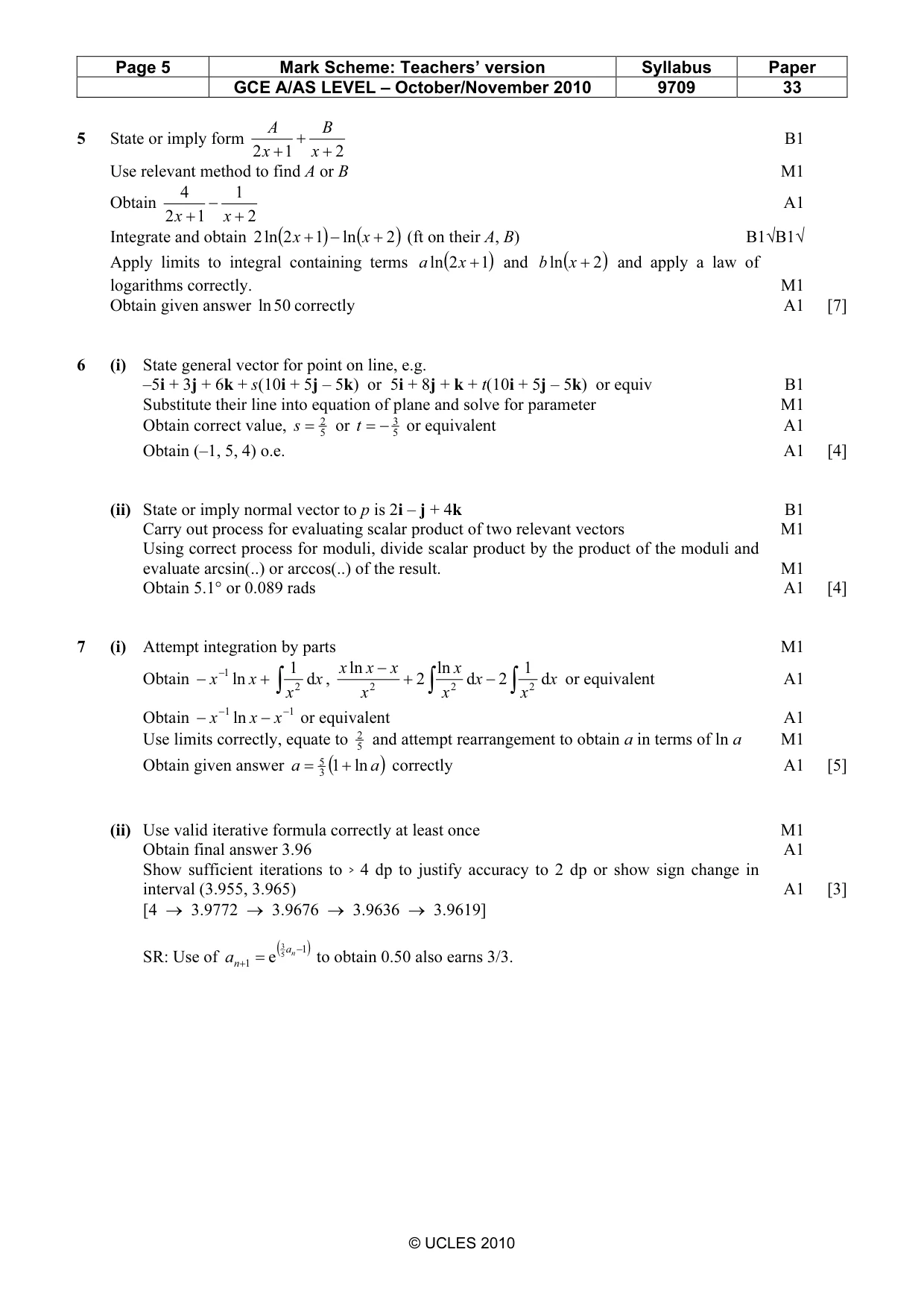
Mark scheme: A B 5 State or imply form + B1 2 x + 1 x + 2 Use relevant method to find A or B M1 4 1 Obtain − A1 2 x + 1 x + 2 Integrate and obtain 2 ln (2 x + 1) − ln ( x + 2 ) (ft on their A, B) B1√B1√ Apply limits to integral containing terms a ln (2 x + )1 and b ln ( x + 2 ) and apply a law of logarithms correctly. M1 Obtain given answer ln 50 correctly A1 [7]
Q6 · The straight line l passes through the points with coordinates 3, and 8, The plane p has…
6 The straight line l passes through the points with coordinates 3, and 8, The plane p has equation 2x 9. (−5, 6) (5, 1). −y + 4ß = (i) Find the coordinates of the point of intersection of l and p. [4] (ii) Find the acute angle between l and p. [4]
Mark scheme: 6 (i) State general vector for point on line, e.g. –5i + 3j + 6k + s(10i + 5j – 5k) or 5i + 8j + k + t(10i + 5j – 5k) or equiv B1 Substitute their line into equation of plane and solve for parameter M1 Obtain correct value, s = 52 or t = − 53 or equivalent A1 Obtain (–1, 5, 4) o.e. A1 [4] (ii) State or imply normal vector to p is 2i – j + 4k B1 Carry out process for evaluating scalar product of two relevant vectors M1 Using correct process for moduli, divide scalar product by the product of the moduli and evaluate arcsin(..) or arccos(..) of the result. M1 Obtain 5.1° or 0.089 rads A1 [4]
Q7 · A ln x 2 5 7 (i) Given that dx 5, show that a ln [5] x2 = = 3(1 + a)
a ln x 2 5 7 (i) Given that dx 5, show that a ln [5] x2 = = 3(1 + a). ä 1 (ii) Use an iteration formula based on the equation a 5 ln to find the value of a correct to 2 decimal places. Use an initial value of 4 and give= 3(1the+ resulta) of each iteration to 4 decimal places. [3]
Mark scheme: 7 (i) Attempt integration by parts M1 1 x ln x − x ln x 1 −1 d x , d x or equivalent A1 2 2 2 Obtain − x ln x + ∫ x x 2 + 2 ∫ x d x − 2 ∫ x Obtain − x −1 ln x − x −1 or equivalent A1 Use limits correctly, equate to 52 and attempt rearrangement to obtain a in terms of ln a M1 Obtain given answer a = 53 (1 + ln a ) correctly A1 [5] (ii) Use valid iterative formula correctly at least once M1 Obtain final answer 3.96 A1 Show sufficient iterations to > 4 dp to justify accuracy to 2 dp or show sign change in interval (3.955, 3.965) A1 [3] [4 → 3.9772 → 3.9676 → 3.9636 → 3.9619] ( 53 an −1 ) SR: Use of a n +1 = e to obtain 0.50 also earns 3/3. GCE A/AS LEVEL – October/November 2010 9709 33
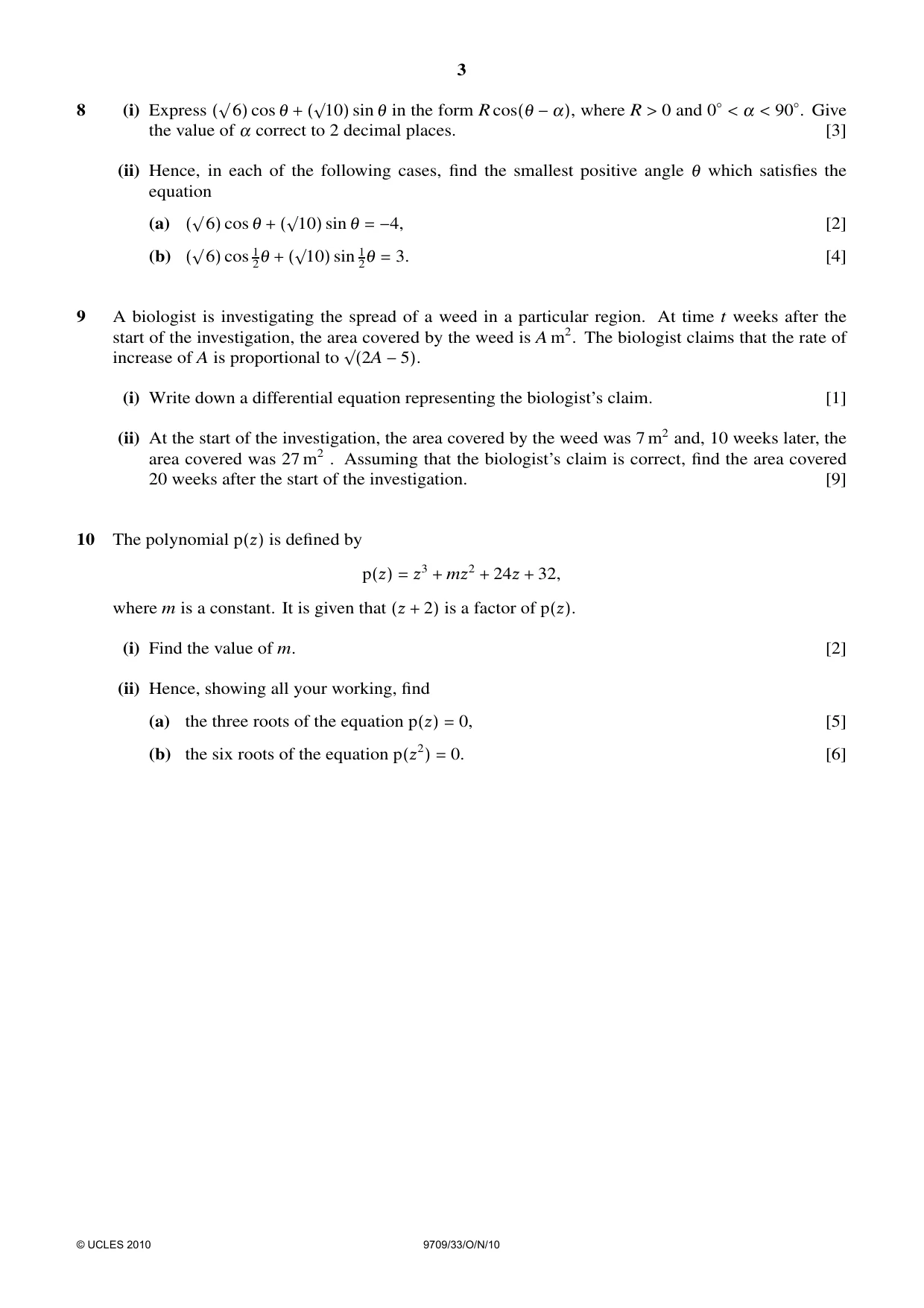
Q8 · Express cos θ sin θ in the form R where R 0 and α 90◦
8 (i) Express cos θ sin θ in the form R where R 0 and α 90◦. Give the value(√6)of α correct+ (√10)to 2 decimal places. cos(θ −α), > 0◦< < [3] (ii) Hence, in each of the following cases, find the smallest positive angle θ which satisfies the equation (a) cos θ sin θ [2] (√6) + (√10) = −4, (b) cos 12θ sin 2θ1 3. [4] (√6) + (√10) =
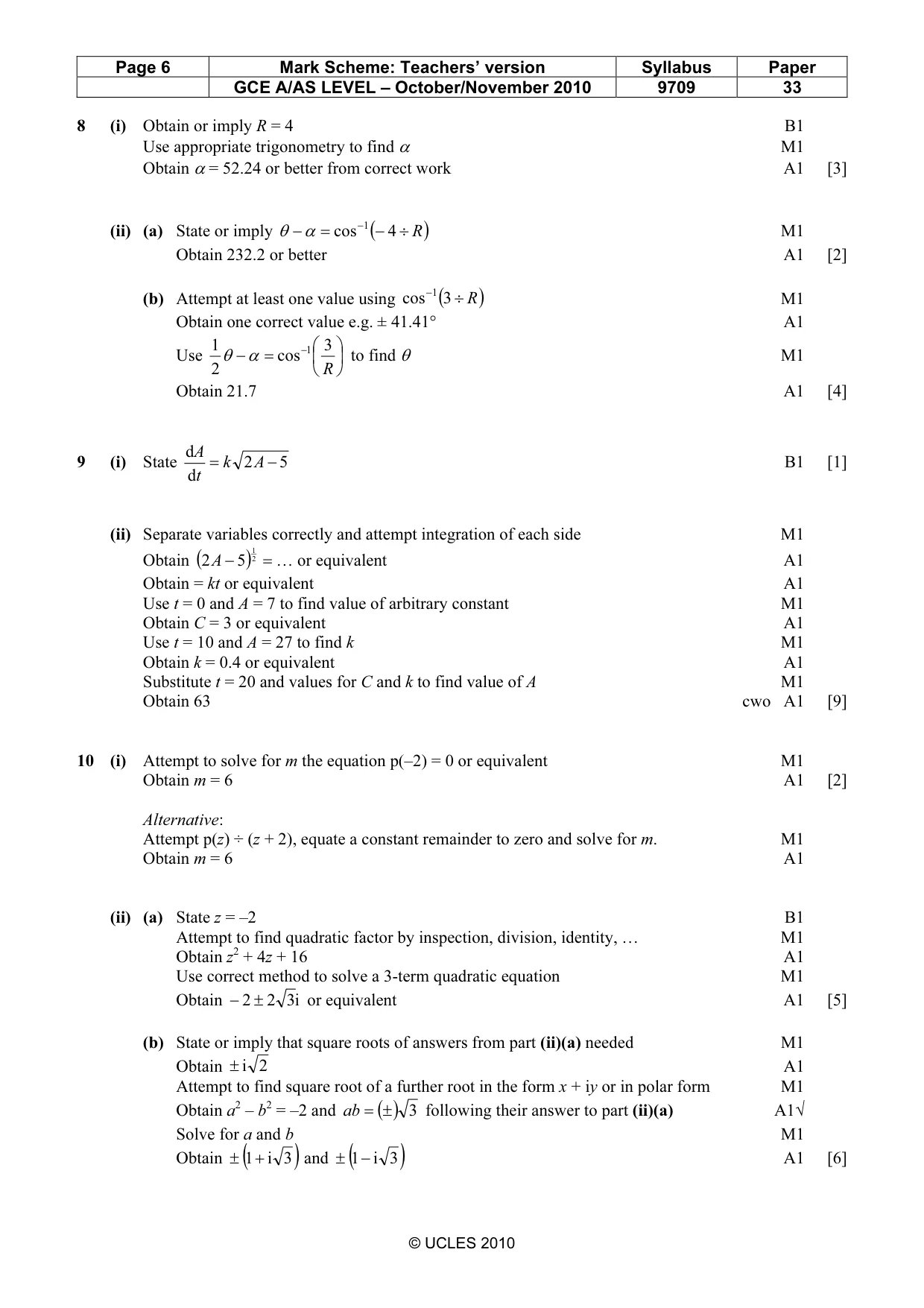
Mark scheme: 8 (i) Obtain or imply R = 4 B1 Use appropriate trigonometry to find α M1 Obtain α = 52.24 or better from correct work A1 [3] (ii) (a) State or imply θ − α = cos −1 (− 4 ÷ R ) M1 Obtain 232.2 or better A1 [2] (b) Attempt at least one value using cos −31 ( ÷ R ) M1 Obtain one correct value e.g. ± 41.41° A1 1 −1 3 Use θ − α = cos to find θ M1 2 R Obtain 21.7 A1 [4] dA
Q9 · A biologist is investigating the spread of a weed in a particular region
9 A biologist is investigating the spread of a weed in a particular region. At time t weeks after the start of the investigation, the area covered by the weed is A m2. The biologist claims that the rate of increase of A is proportional to √(2A −5). (i) Write down a differential equation representing the biologist’s claim. [1] (ii) At the start of the investigation, the area covered by the weed was 7 m2 and, 10 weeks later, the area covered was 27 m2 . Assuming that the biologist’s claim is correct, find the area covered 20 weeks after the start of the investigation. [9]
Mark scheme: dA 9 (i) State = k 2 A − 5 B1 [1] dt (ii) Separate variables correctly and attempt integration of each side M1 1 2 = … or equivalent A1 Obtain (2A − 5 ) Obtain = kt or equivalent A1 Use t = 0 and A = 7 to find value of arbitrary constant M1 Obtain C = 3 or equivalent A1 Use t = 10 and A = 27 to find k M1 Obtain k = 0.4 or equivalent A1 Substitute t = 20 and values for C and k to find value of A M1 Obtain 63 cwo A1 [9]
Q10 · The polynomial is defined by p(ß) 32, p(ß) = ß3 + mß2 + 24ß + where m is a constant
10 The polynomial is defined by p(ß) 32, p(ß) = ß3 + mß2 + 24ß + where m is a constant. It is given that is a factor of (ß + 2) p(ß). (i) Find the value of m. [2] (ii) Hence, showing all your working, find (a) the three roots of the equation 0, [5] p(ß) = (b) the six roots of the equation 0. [6] p(ß2) =
Mark scheme: 10 (i) Attempt to solve for m the equation p(–2) = 0 or equivalent M1 Obtain m = 6 A1 [2] Alternative: Attempt p(z) ÷ (z + 2), equate a constant remainder to zero and solve for m. M1 Obtain m = 6 A1 (ii) (a) State z = –2 B1 Attempt to find quadratic factor by inspection, division, identity, … M1 Obtain z2 + 4z + 16 A1 Use correct method to solve a 3-term quadratic equation M1 Obtain − 2 ± 2 i3 or equivalent A1 [5] (b) State or imply that square roots of answers from part (ii)(a) needed M1 Obtain ± i 2 A1 Attempt to find square root of a further root in the form x + iy or in polar form M1 Obtain a2 – b2 = –2 and ab = (± ) 3 following their answer to part (ii)(a) A1√ Solve for a and b M1 Obtain ± (1+ i 3 ) and ± (1− i 3 ) A1 [6]
What was in this paper
The subtopics covered by these 9 questions, and how many questions each got. Open one in a new tab to see every Cambridge question on it.
What you needed in this session
Cambridge’s own grade thresholds for 2010 Oct/Nov, Paper 3 · Variant 3. A higher threshold means an easier paper — the bar moves with how the cohort did.