Questions as text
Q1 · The stages in grouper aquaculture 9693/31 May/June 2017
5 Fig. 5.1 represents the stages in grouper aquaculture. Filtered seawater is pumped into land-based tanks which are also aerated. adult spawning tank hatching tanks nursery tanks for fry juveniles transferred to cages in grow-out tanks for the sea to complete grow-out to fingerlings and juveniles market size Fig. 5.1 (a) (i) Suggest why seawater is filtered before being pumped into the tanks. … … [1] (ii) Explain why the water in the tanks is aerated. … … … … [2] (iii) Suggest why the process shown in Fig. 5.1 can be considered semi-intensive. … … … … [2] (b) (i) State two conditions required to induce spawning in the adult spawning tanks. 1 … 2 … [1] (ii) State which tank in Fig. 5.1 must contain phytoplankton in the water. Give a reason for your answer. … … … … … [2] (iii) Adult grouper are usually fed on whole fish or pelleted feed made from whole fish. Suggest one way in which the food supply could be made more sustainable. … … [1] (c) (i) In The Bahamas, goby ‘cleaner fish’ may be added to grouper spawning tanks. State the type of interrelationship between the goby and the grouper. … [1] (ii) Suggest one danger of adding goby fish from the wild directly to the spawning tanks. … … [1] [Total: 11]
11 marks
Mark scheme: 5(a)(i) to remove particles / sand / silt / microbes / example of microbe / pathogen / parasites ; 1 5(a)(ii) any 2 of: provides (only) oxygen ; for respiration ; helps circulate contents of tank / AW ; 2 Question Answer Marks Guidance 5(a)(iii) Answer needs to give a reason why hatchery is intensive and sea cages extensive (intensive because) hatchery uses land based tanks / air supply / pumping water / food supplied / environment controlled ; (extensive in) sea cages as using water currents to supply oxygen / little control of environment ; 2 5(b)(i) any 2 of: light / moon phases ; temperature ; (correct) diet ; addition of hormones ; water quality / pH ; ratio of males to females ; 1 Note: 2 factors needed for 1 mark 5(b)(ii) hatching tank ; food supply (for larvae) / AW ; 2 ECF if tank incorrect, but reason correct 5(b)(iii) use fish trimmings / fish processing waste / feed made from soya / plant sources ; 1 5(c)(i) mutualism ; 1 5(c)(ii) spread disease / introduce parasites / introduce harmful microbes ; 1
This question in 9693/31 May/June 2017
Q2 · Some definitions of terms related to the commercial breeding of fish 9693/31 Oct/Nov 2017
7 (a) Table 7.1 shows some definitions of terms related to the commercial breeding of fish. Complete Table 7.1 by stating the term that matches each of the definitions. Table 7.1 definition term the industrial application of biological processes a section of DNA that controls the inheritance of a specific feature choosing parents with desired features to be bred together [3] (b) In genetic engineering, genes are transferred from one species to another. (i) Explain why genes cannot be accurately placed in a genome when being transferred. … … … … [2] (ii) State why a promoter may need to be attached to a gene before it is transferred. … … [1] (c) Explain why some people are concerned about the possible impacts of the escape of genetically engineered salmon into the wild. … … … … … … … [3] [Total: 9]
9 marks
Mark scheme: 7(a) term biotechnology ; gene ; selective breeding ; 3 Question Answer Marks Guidance 7(b)(i) idea that, transferred genes are not placed in the nucleus / transferred genes are placed in the, cell / cytoplasm ; DNA will attach randomly to the DNA of the host cell ; 2 7(b)(ii) idea of, switching on a gene ; 1 7(c) any 3 of: transfer of genes into the wild population ; competition with wild populations (for food) ; disruption of food chains ; could introduce disease ; 3
This question in 9693/31 Oct/Nov 2017
Q3 · The habitat of each stage in the life cycle of tuna and grouper 9693/30 May/June 2018
4 (a) Table 4.1 shows the habitat of each stage in the life cycle of tuna and grouper. Table 4.1 habitat stage in life cycle tuna grouper egg free-floating in plankton … seagrass beds and larva … mangroves seagrass beds then migrate juvenile … offshore adult open ocean … Complete Table 4.1 by naming the habitat for each stage of the life cycle of tuna and grouper. [4] (b) Read the information about bluefin tuna aquaculture (also called tuna ranching) in the Mediterranean Sea and in the Pacific Ocean. Bluefin tuna aquaculture involves catching two-year-old juvenile wild tuna and towing them in cages to the aquaculture site. Growth continues in large net cages in the sea (sea cages) until they reach market size. Tuna are difficult to keep in sea cages because they are easily disturbed by light, noise or small changes in the water temperature. Collisions with the walls of the sea cages are common. Damage to their skin lowers their market value and in many cases causes death. Tuna are fed on wild caught mackerel, sardines and squid and need to eat 10% of their body weight per day. Small fragments of the food fish break off when eaten and are lost to the sea bed below the cages. (i) Use the information to suggest why growing tuna in sea cages is considered a partly extensive and partly intensive type of aquaculture. … … … … … [2] (ii) In the wild, bluefin tuna become sexually mature between 9 and 12 years old. Use the information about tuna aquaculture to explain why the breeding age of bluefin tuna might make the supply of wild juveniles unsustainable in the future. … … … … … [2] (iii) Suggest two reasons why an alternative food source, consisting of pellets made from dried fish waste, is being developed for the tuna in sea cages. 1 … … 2 … … [2] (iv) Scientists in Japan have recently obtained fertilised eggs from adult tuna reared and bred in captivity. Use the information about tuna aquaculture to suggest why only 2% of these eggs survive to become adult fish. … … … … … [2] (c) Wild tuna stocks have decreased by 50% in the last decade. Captive bred tuna could supply 50% of the Japanese domestic market in a few years. Suggest two benefits of selling captive bred tuna, rather than tuna raised from young fish caught in the wild. 1 … … 2 … … [2] [Total: 14]
14 marks
This question in 9693/30 May/June 2018
Q4 · One of the reasons for variation in phenotype between individual members of a species is… 9693/30 May/June 2018
7 (a) One of the reasons for variation in phenotype between individual members of a species is that they have different versions of genes. Selective breeding programmes in fish have been used to increase growth rate, give disease resistance, and give an earlier age of sexual maturity. (i) State what is meant by each of the following terms. gene … … phenotype … … selective breeding … … [3] (ii) State why selective breeding for each of the following features could increase profits for a fish farmer. increase in growth rate … … disease resistance … … earlier age of sexual maturity … … [3] (b) Infectious pancreatic necrosis (IPN) is a fatal viral disease that affects farmed salmon. Selective breeding was used to produce salmon resistant to IPN. Laboratory tests were carried out to compare selectively bred salmon with farmed salmon that had not been selectively bred. Three groups of fish were kept in separate tanks: group A: selectively bred salmon group B: non-selectively bred salmon group C: non-selectively bred salmon Group A and group B were exposed to IPN. Every five days the percentage of salmon that were still living (percentage survival) was calculated. Table 7.1 shows the results of the tests. Table 7.1 percentage survival time / days group A group B group C 0 100 100 100 5 100 100 100 10 99 99 100 15 99 95 100 20 98 94 100 25 97 90 99 30 96 88 99 35 96 86 99 40 96 85 99 45 96 84 99 (i) Describe the changes in percentage survival of group A and group B. … … … … … … … [3] (ii) Suggest a reason for the difference in the percentage survival of group A and group B. … … … [1] (iii) Suggest a reason for the percentage survival of group C. … … … [1] [Total: 11]
11 marks
This question in 9693/30 May/June 2018
Q5 · Read the information about aquaculture 9693/30 Oct/Nov 2018
5 Read the information about aquaculture. The increase in aquaculture during the last 30 years has contributed to the world food supply and improved the economies of some countries. A study by the Food and Agriculture Organization of the United Nations predicts that aquaculture will continue to expand and by 2030 will contribute over 60% of the fish used for direct human consumption. High export value shellfish, such as mussels and clams, are often used for aquaculture because they are filter feeders that eat plankton and other organic material in the water. Bony fish, such as salmon and tuna, require feeding, often from wild fish stocks. The increase in aquaculture has caused great changes to the coasts and estuaries of many countries due to clearing of mangroves, mud flats and seagrass to create ponds for aquaculture. (a) Suggest two reasons why aquaculture has increased and is expected to continue to increase. 1 … … 2 … … [2] (b) (i) Describe two negative impacts of aquaculture on the marine ecosystem. 1 … … 2 … … [2] (ii) Aquaculture in some parts of the world has improved the economy of the country as a whole, but has increased poverty of many people who have a low income. Use the information about aquaculture and your own knowledge to suggest reasons for these effects. … … … … … … … [3] (c) Concern over some of the environmental impacts of fish farming has resulted in some types of aquaculture changing to an integrated multi‑trophic system, where two or more organisms are cultured together. Sea urchins are often grown in cages beneath the cages of intensively farmed fish. Sea urchins are mobile grazing animals that eat almost any organic matter. Kelp is often grown next to the fish cages. Kelp, which is used in the cosmetic industry, has a high requirement for nitrate and phosphate. Explain how growing sea urchins and kelp close to sea cages of intensively farmed fish could help reduce the negative effects of intensive fish farming on the environment. … … … … … … … [3] (d) Explain how, apart from global warming, increasing quantities of carbon dioxide in the atmosphere may result in problems for shellfish aquaculture. … … … … … … … [3] [Total: 13]
13 marks
This question in 9693/30 Oct/Nov 2018
Q6 · Coral reefs around the island of Maui in Hawaii provide major economic benefits from… 9693/30 Oct/Nov 2018
6 Coral reefs around the island of Maui in Hawaii provide major economic benefits from recreation and tourism. Since the 1970s the reefs have suffered extensive damage, including reduced coral growth and excessive growth of algae. Algae grow at a much faster rate than coral. (a) Fishing for herbivores is banned in a marine protected area around part of the reef. Suggest and explain how this ban will help to restore the coral reef. … … … … … … … [3] (b) A major pollutant in Maui is waste water, which includes nitrogen‑rich sewage, from homes and hotels on the shore, next to the reef. Use this information to explain why this waste water may cause excessive growth of algae. … … … [1] (c) Fig. 6.1 shows the estimated nitrogen discharge from West Maui from 1960 onwards. In 1975, a water treatment works was opened and some years later, a system of recycling treated waste water was started. 150 125 100 nitrogen 75 discharge / 103 kg year–1 50 25 0 1960 1965 1970 1975 1980 1985 1990 1995 2000 2005 2010 year Fig. 6.1 (i) Use the information in Fig. 6.1 to state the year in which the waste water recycling treatment was started. … [1] (ii) Fig. 6.2 shows how waste water from hotels and homes is transported to the treatment works and from here, to a storage well. Treated water is still nitrogen‑rich. escape of nitrogen-rich water water hotel treatment works home storage well coral reef groundwater Fig. 6.2 Use the information in Fig. 6.1 and Fig. 6.2 to discuss the effectiveness of the water treatment works opened in 1975. … … … … … … … [3] (d) Fresh water supply is expensive on Maui and increasing tourism puts pressure on scarce supplies. As a result, the use of recycled water is becoming more common. In 2012, water used by properties bordering the reef was 922.76 million dm3 per year and of this, 382.78 million dm3 was recycled. Calculate the percentage of treated waste water recycled in 2012. Show your working. … % [2] (e) Large tourist hotels lining the shore next to the reef often have landscaped gardens and golf courses, which need to be regularly watered. Suggest how the use of recycled treated water by these hotels could lead to increased profits for them. … … … … … [2] [Total: 12]
12 marks
This question in 9693/30 Oct/Nov 2018
Q7 · Define the term gene 9693/30 Oct/Nov 2018
7 (a) Define the term gene. … … [1] (b) (i) Genetically engineered salmon, GM salmon, contain genes from Chinook salmon and ocean pout. The GM salmon grow all year and can be harvested sooner than non‑genetically engineered salmon. Name the two types of gene that were transferred to produce these GM salmon. 1 … 2 … [2] (ii) State the effect of this change in genotype on the phenotype of these GM salmon. … … … [1] (c) In November 2015 the United States of America Food and Drug Administration announced that they had approved production, sale and human consumption of GM salmon. GM salmon eggs are produced at a land‑based hatchery in Canada. Fertilised eggs are treated so that they develop into sterile salmon. The eggs are then flown directly to a land‑ based facility in Panama to grow to market size before being harvested and processed for sale. State what you understand by the term precautionary principle and describe how this is applied to GM salmon production. … … … … … … … [3] (d) Production time for GM salmon takes about two years compared to three to four years for non‑genetically engineered salmon. State the economic advantage of producing GM salmon compared with non‑genetically engineered salmon. … … … [1] (e) Suggest two reasons why GM salmon production in aquaculture could be considered more sustainable than fishing for wild salmon. 1 … … 2 … … [2] [Total: 10]
10 marks
This question in 9693/30 Oct/Nov 2018
Q8 · Seaweed farming is the main source of income in traditional village communities on a few… 9693/31 May/June 2019
1 Seaweed farming is the main source of income in traditional village communities on a few small tropical Indonesian islands. The seaweeds are grown on horizontal ropes, held in place by wooden posts in sheltered bays with shallow clear water. They are harvested every few weeks by wading out to the ropes at low tide. Fig. 1.1 shows seaweed collection at low tide. Fig. 1.1 (a) (i) State and explain three ways in which the conditions where the seaweeds are farmed enable them to grow quickly. … … … … … … [3] (ii) Suggest how farming seaweed in the bays could benefit local fishing. … … … … [2] (b) The seaweed farmed is a red alga. Red algae can grow at depths down to 35 m. It is farmed at depths of between 1 m and 7 m, where it is able to grow rapidly. Explain how the pigments in red algae enable them to photosynthesise and grow rapidly at these depths. … … … … … … … … [4] (c) Seaweed farming usually involves the whole family. The hard physical work of harvesting, drying and packing the seaweed for distribution is very labour intensive. Tourism is gradually spreading to these islands. Suggest and explain the social impacts on the community if tourism increases. … … … … … … [3] [Total: 12]
12 marks
Mark scheme: 1(a)(i) any 3 of: clear / shallow water and allows maximum / more / enough, light / right wavelength, for photosynthesis ; sheltered bays and protected from storms / rough seas / wave action ; tropical / warm and optimum temperature for, growth / photosynthesis ; cultured on ropes and closer to light for photosynthesis ; cultured on ropes and (closer to surface) so more carbon dioxide (from dissolution) for photosynthesis ; cultured on ropes and so less competition for space ; 3 1(a)(ii) any 2 of: seaweed provides more habitat for, fish / invertebrates ; provides a source of food for fish ; provides, protection / shelter, from predators ; provides a source of oxygen (for fish / invertebrate respiration) ; 2 1(b) any 4 of: most light / all wavelengths, penetrate, between 1 and 7 m / shallow water / at this depth ; contains chlorophyll (a) ; which absorbs red light in shallow water ; and blue light in deeper water ; contains other named pigment(s) ; extra / accessory, pigments allow seaweed to absorb, more / different, wavelengths ; 4 A light penetration decreases with depth R chlorophyll b e.g. phycobilins / phycocyanin / phycoerythrin / carotenes / carotenoids / xanthophyll 1(c) any 3 of: people change to work in tourism ; as there is less physical work / less labour intensive ; higher / easier income ; seaweed farming will decrease / become unsustainable OR way of life lost ; due to lack of labour / fewer family members work in seaweed farming ; idea of: cultural exchange ; 3 I ref. to pollution
This question in 9693/31 May/June 2019
Q9 · Sea bass are fish that live in the sea or in estuaries where sea water has been diluted… 9693/31 May/June 2019
4 (a) Sea bass are fish that live in the sea or in estuaries where sea water has been diluted by fresh water. The fish can be reared in cages suspended in the water. Fig. 4.1 shows two possible sites, A and B, for a new aquaculture business to produce sea bass. B river area flooded at high tide on most days A bay with strong tidal flow coastal town with direction of fishing fleet and a ocean current small harbour 1 km Fig. 4.1 (i) Suggest and explain why site A might not be suitable for an aquaculture business. … … … … … … [3] (ii) Discuss, with reasons, whether the water quality at site B is likely to be suitable for the aquaculture of sea bass. … … … … … … [3] (b) The global expansion of aquaculture has increased concern about the quality of food it produces, the impact on the marine environment, and its sustainability. The Aquaculture Stewardship Council (ASC) was set up in 2010. It works with everyone associated with aquaculture, including producers, retailers, scientists, conservation groups and consumers to: • recognise and reward responsible aquaculture through the ASC aquaculture certification programme and seafood label. • promote best environmental and social choice when buying seafood. • contribute to transforming seafood markets towards sustainability. (i) State and explain two effects of the expansion of aquaculture on the marine environment that are a cause for concern. 1 … … 2 … … [2] (ii) Suggest two ways in which an ASC certification programme could help an aquaculture producer become more responsible. 1 … … … 2 … … … [2] [Total: 10]
10 marks
Mark scheme: 4(a)(i) any 3 of: strong tidal flow could cause damage to fish / sea cages ; strong tidal flow could wash away food / medication ; strong tidal flow increases the dangers of, getting to / working at the site / harvesting fish ; close to town so increased risk of pollution from, sewage / agricultural run-off / toxins / boat oil or fuel ; sewage from town contains pathogens which could cause disease in fish / oil from boats could clog gills of fish ; close to town so increased risk of poaching ; idea of: conflict of interest with fishermen who want to fish in the bay / competition for fish sales ; energy used to swim against current rather than growth ; 3 A strong current for strong tidal flow I pollution unqualified Question Answer Marks Guidance 4(a)(ii) MAX 2 from each: suitable: flooding / ocean current / river flow, will bring in fresh oxygen supplies for fish respiration ; flooding / ocean current / river flow, brings fresh food supply OR removes waste products ; town further away, so less chance of pollution + example ; away from / protected from, strong, currents / tidal flow / waves, so less damage ; unsuitable: high levels of silt in river water could damage fish gills ; site is 1 km from river mouth, so neap tides might not flood the site ; resulting in less, oxygen / food supply / removal of waste ; 3 Question Answer Marks Guidance 4(b)(i) any 2 of: loss of habitat and causing loss of some species / loss of breeding grounds ; wild population harvested as, feed / breeding stock and loss of wild population ; pollution from the wastes / uneaten food and causing eutrophication / harmful algal blooms ; escape of farmed fish / exotic species and outcompete wild fish / introduce disease / parasites ; idea of: escape of farmed fish and might introduce new / undesirable, genes / alleles / genotypes ; release of antibiotic into the water and increases bacterial resistance ; converting land to aquaculture and displacement of people / financial hardship ; 2 4(b)(ii) any 2 of; idea of: providing advice about stocking (so fish are not overcrowded) ; idea of: education about, alternative / sustainable, food sources ; idea of: education about, disease control / use of antibiotics ; idea of: education about impact on, the environment / habitats / other species; idea of: information about best techniques to raise healthy fish ; idea of: recognition / sustainable farming, opens up more markets / products more appealing ; 2 A idea of: applying precautionary principle / recycling water
This question in 9693/31 May/June 2019
Q10 · Omega-3 oils are an important part of the human diet 9693/31 May/June 2019
7 (a) Omega-3 oils are an important part of the human diet. There is some evidence that they may help to reduce the risk of heart disease and stroke. Phytoplankton produce omega-3 oils, which are transferred to fish along food chains. Table 7.1 compares the mass of omega-3 oils in a 100 g serving of some marine fish. Table 7.1 mass of omega-3 oils omega-3 oils source / g per 100 g serving anchovies 2.1 sardines 1.8 farmed salmon 1.4 wild salmon 0.7 canned tuna 0.35 cod 0.3 (i) Use Table 7.1 to suggest why eating farmed salmon is more beneficial in the human diet than eating wild salmon. … … [1] (ii) Traditionally, farmed salmon have been fed on pellets made from fishmeal and fish oil, mainly from anchovies and sardines. Use the information in Table 7.1 to suggest why these two species are suitable sources of fishmeal and fish oil. … … [1] (iii) Wild stocks of both anchovies and sardines are now becoming unsustainable. State the meaning of the term unsustainable. … … [1] (b) Over the past 10 years, the percentage of fishmeal and fish oil in pellets used to feed farmed salmon has gradually decreased. It has been replaced by alternative feed ingredients such as soy and oil from canola. Fig. 7.1 shows the effect of this change in feed on the mass of omega-3 oils in farmed salmon. 3.0 2.5 mass of 2.0 omega-3 oils / g per 100 g 1.5 serving of farmed salmon 1.0 0.5 0 2006 2010 2016 year Fig. 7.1 Use the information in Fig. 7.1 to describe the effect of these fishmeal replacements on omega-3 oil levels in farmed salmon between 2006 and 2016. … … … … [2] (c) One alternative to using fishmeal and fish oil in salmon feed is to replace them with genetically modified (GM) canola. GM canola has been genetically engineered to contain genes from phytoplankton and is rich in omega-3 oils. (i) Define the term gene. … … … … [2] (ii) Suggest the two types of gene that would be transferred from phytoplankton to canola, to make GM canola. 1 … 2 … [2] (iii) If farmed salmon are fed on pellets containing GM canola oil, current regulations state that they must be labelled as having been fed on GM crops. Suggest and explain why this labelling could present a problem for the sale of these fish. … … … … [2] [Total: 11]
11 marks
Mark scheme: 7(a)(i) more / twice as much, omega-3 in farmed salmon than wild ORA ; 1 7(a)(ii) any 1 of: they have the highest levels of omega-3 oils ; idea of: tuna / cod are higher value species for human consumption ; 1 7(a)(iii) idea of: fishing pressure too great to maintain numbers of fish ; 1 Question Answer Marks Guidance 7(b) omega-3 levels have decreased ; almost halved / reduced by 1.3 g (per 100 g of fish) / decreased by 48.1% ; 2 I simply quoting figures from graph 7(c)(i) a length of DNA (deoxyribonucleic acid) / sequence of nucleotides ; that codes for a (specific), polypeptide / protein (product) OR that determines a particular trait / characteristic ; 2 7(c)(ii) (gene) to produce omega-3 oils ; promoter (gene) ; 2 7(c)(iii) any 2 of: people will not buy / shops will not sell the fish ; as they are unsure of the long-term effects of eating GM food ; lack of current research into effect of eating GM food ; some countries / EU, have banned GM foods for human consumption ; 2 I reduced sales unqualified
This question in 9693/31 May/June 2019
Q11 · Read the information on prawn farming in the tidal delta region of Bangladesh 9693/30 Oct/Nov 2019
4 Read the information on prawn farming in the tidal delta region of Bangladesh. Traditional village communities in this region are self-sufficient, growing rice, fish and vegetables in fresh water ponds. The ponds are surrounded by earth banks to prevent sea water entry at high tide. A series of ditches and gates allows any excess fresh water to drain into the sea at low tide. Small scale salt water ponds produce prawns to sell. Over the past ten years, there has been a rapid change to higher income, prawn-only farming. Fresh water ponds were drained and flooded with salt water. In 2016, there were 35 000 prawn farms in the delta region. A consequence of this change is that the land becomes infertile and disease outbreaks in ponds are common. Recently, many village communities have experienced problems. The income from prawn farming has been much less than expected, as large companies who sell the prawns keep profits and pay less to the farmers. (a) Use the information provided to explain the negative impacts of the change to prawn-only farming on village communities. … … … … … … … [3] (b) Rotational polyculture is a method of growing prawns, rice and fresh water fish in the same ponds. The ponds are filled with salt water during the dry season, and used to produce prawns. In the monsoon season, the ponds are stocked with rice and fresh water fish such as tilapia. Suggest how the monsoon and design of the ponds can help to make the ponds suitable for growing rice and fresh water fish during the monsoon season. … … … … … … … [3] (c) The ponds used for rotational polyculture can be filled to a high or low depth of water. Fig. 4.1 shows the mean yield of prawns and fish from traditional farming and from rotational polyculture, at two different water depths. 4000 Key: prawn at low depth 3500 fish at low depth 3000 prawn at high depth fish at high depth 2500 yield / kg per 2000 hectare per year 1500 1000 500 0 traditional farming rotational polyculture Fig. 4.1 Use Fig. 4.1 and all the information provided to suggest the benefits of rotational polyculture over traditional farming methods. … … … … … … … … … [4] [Total: 10]
10 marks
This question in 9693/30 Oct/Nov 2019
Q12 · Explain the meaning of the term selective breeding 9693/30 Oct/Nov 2019
7 (a) (i) Explain the meaning of the term selective breeding. … … … … [2] (ii) Explain the differences between selective breeding and genetic engineering. … … … … [2] (b) A breeder of aquarium fish investigated whether the size of fish could be changed by selective breeding. Fig. 7.1 shows the experimental set-up used. All the tanks contained 1500 fish of the same size at the start. A B C 1000 of the biggest 1000 randomly sized 1000 of the smallest fish removed from fish removed from fish removed from each new generation each new generation each new generation Fig. 7.1 The breeder carried out the investigation for four generations. The fish were kept in the same conditions throughout the experiment and fed the same quantity of food. (i) State the purpose of tank B. … … [1] (ii) After four generations, the mean size of the fish in tank A had decreased. Suggest an explanation for this. … … … … [2] (iii) Based on the results of tank A, predict what will happen to the size of the fish in tank C. … … [1] (c) Selective breeding of rice fish produced a variety of colours. These are popular as aquarium fish, as they are easy to keep and breed quickly. In Japan, these fish have been genetically engineered. A gene from a jellyfish has been added so that they glow against a dark background. These have been approved for sale, under licence, as pet fish. (i) Genetic engineering in fish often needs a promoter gene to be joined to the required gene. State why this is necessary. … … [1] (ii) Suggest one advantage and one disadvantage to commercial fish breeders of these genetically engineered fish. advantage … … disadvantage … … [2] [Total: 11]
11 marks
This question in 9693/30 Oct/Nov 2019
Q13 · The table shows some definitions of terms related to the commercial breeding of fish 9693/30 May/June 2020
1 The table shows some definitions of terms related to the commercial breeding of fish. Complete the table with either the correct definition or the correct term. definition term gene length of DNA that switches genes on transfer of a gene from one species to another selective breeding the industrial application of biological processes [5]
5 marks
This question in 9693/30 May/June 2020
Q14 · The seas around Scotland are important for farming salmon in sea cages, as well as for… 9693/30 May/June 2020
6 The seas around Scotland are important for farming salmon in sea cages, as well as for their stocks of wild salmon. Over the past 20 years, sea lice have become an increasing problem and kill thousands of farmed fish every year. Sea lice occur naturally, usually in small numbers, in shallow water. They attach to and feed on salmon skin. Fig. 6.1 shows sea lice feeding on salmon skin. sea lice Fig. 6.1 (a) (i) Suggest why sea lice have increased in number in farmed fish. … … … … [2] (ii) Chemicals are added to the water in salmon cages to control sea lice numbers. In Scotland, farmed salmon production increased by 35% between 2006 and 2016, while the use of chemicals to control sea lice rose by 932%. The chemicals have been linked to reduced fertility in wild salmon. Suggest and explain why recreational wild salmon fishermen are concerned about the increase in farmed salmon. … … … … [2] (iii) By 2012, there were changes in the sea lice genes. This affected their phenotype so that the chemicals were no longer effective. State the term used for the genetic make-up of an organism, which affects its phenotype. … … [1] (b) (i) Wrasse are small fish that are natural predators of sea lice. Recently, wrasse have been introduced to salmon cages to reduce sea lice numbers. Suggest the environmental advantage of using wrasse to eat sea lice. … … [1] (ii) Wrasse are caught from wild stocks around the coast. Fig. 6.2 shows part of a food web involving wrasse. wrasse sea urchin limpets periwinkles kelp forest Fig. 6.2 Use Fig. 6.2 to suggest the negative impacts of collecting too many wrasse from the wild. … … … … … … [3] [Total: 9]
9 marks
This question in 9693/30 May/June 2020
Q15 · Macquarie Harbour is a large natural harbour, partly within the protected Tasmanian… 9693/30 May/June 2020
7 Macquarie Harbour is a large natural harbour, partly within the protected Tasmanian Wilderness World Heritage Area, Australia. The area was important for mining in the 1880s. Mining waste was either washed out to sea by local rivers, or became locked in sediment on the sea bed within the harbour. Fish farming began in the deeper water in the centre of the harbour around 30 years ago, after water quality had improved. Fish cages provide a source of salmon both locally and for export. Today, the small community at Strahan is an important tourist destination. It provides locally run hotels, restaurants and boat tours within the harbour. The shores of the harbour are important areas for commercial and recreational fishing using nets. All fishing is banned in deeper water. Fig. 7.1 shows a map of the area. Strahan King River Southern salmon farms Ocean Macquarie Harbour Gordon River Fig. 7.1 (a) (i) Use the information provided to explain why Macquarie Harbour is a suitable location for salmon cages. … … … … … … [3] (ii) Between 1990 and 2005 annual salmon production was less than 2000 tonnes. By 2011, production increased to 9000 tonnes and by 2015 it reached 20 000 tonnes. Water quality monitoring in the harbour since 2015 has shown a significant decrease in dissolved oxygen levels in deeper water, below 15 m depth. Explain how the increase in the number of salmon cages might have contributed to the decrease in dissolved oxygen levels. … … … … … … [3] (b) A meeting took place between the fish companies and other stakeholders to discuss a further increase in the number of salmon cages in the harbour. (i) State the meaning of the term stakeholder. … … [1] (ii) Conservationists may oppose the increase in the number of salmon cages in the harbour. Suggest one other stakeholder who would oppose this increase and give a reason for your answer. stakeholder … reason … … … [2] (c) The fish companies have suggested dredging the sediment beneath the fish cages to remove any pollutants and improve water quality. Use the information provided to suggest why this might not be a suitable solution. … … [1] (d) Macquarie Harbour is one of only two areas in Tasmania where the endangered Maugean skate is found. The adult lives in estuaries, in shallow water between 5 m and 10 m depth, around the shores of the harbour. It lays its eggs in deeper water, below 15 m depth, where juveniles are found. Suggest and explain why conservationists are concerned about the future of the Maugean skate in Macquarie Harbour. … … … … … … [3] [Total: 13]
13 marks
This question in 9693/30 May/June 2020
Q16 · Between 1950 and 2010, production of fish by aquaculture increased by 120 million tonnes 9693/30 Oct/Nov 2020
4 (a) Between 1950 and 2010, production of fish by aquaculture increased by 120 million tonnes. Production by commercial fishing increased by 60 million tonnes between 1950 and 1990 and then stayed the same until 2010. Suggest why aquaculture production is still increasing but production from commercial fishing is not. … … … … … … [3] (b) New aquaculture projects are being set up in many different countries. Fig. 4.1 shows a flow diagram of an aquaculture project in Africa. Water from the fish-rearing tanks is recycled in a closed system that treats the water. Key arrows represent movement of water automatic feeders nitrogen gas carbon dioxide gas fish-rearing tanks filters to remove solids and biological filter to convert toxic convert nitrate to ammonia produced by fish to nitrate nitrogen gas pump to circulate oxygen gas water ultraviolet light to kill microorganisms Fig. 4.1 (i) Three requirements for a sustainable aquaculture system are clean water, efficiency of food use and disease management. Describe how the system in Fig. 4.1 meets each of these requirements. … … … … … … … … [4] (ii) State two requirements, other than those listed in (b)(i), for a sustainable aquaculture system. 1 … 2 … [2] (iii) Suggest two disadvantages of the aquaculture system shown in Fig. 4.1. 1 … … 2 … … [2] (iv) Suggest two ways in which the aquaculture system in Fig. 4.1 reduces the negative impacts of aquaculture. 1 … … 2 … … [2] (c) Some aquaculture systems rear fish which are released into the sea to increase the populations of wild fish. Explain why fish raised in aquaculture are often unsuccessful in increasing populations of wild fish. … … … … … … [3] [Total: 16]
16 marks
This question in 9693/30 Oct/Nov 2020
Q17 · The Cam Ranh area of central Vietnam is important for grouper aquaculture 9693/30 May/June 2021
4 (a) The Cam Ranh area of central Vietnam is important for grouper aquaculture. Grouper are cultured in mud-lined ponds around the shores of small bays, where there are no rivers. Grouper grow best at temperatures of between 22 °C and 23 °C, in water with a salinity of 28‰ to 38‰ and a rich supply of phytoplankton. Suggest and explain two reasons why the lack of rivers make the water in this area suitable for grouper aquaculture. 1 … … 2 … … [2] (b) Traditional farming methods involve several farmers, each having three or four ponds, which are 2500 m2 in area. Each pond has gates on opposite sides to allow sea water to enter or leave the pond, depending on wind conditions and daily tides. More than 50% of water is exchanged each day. (i) Explain the advantages of having more than 50% of the water exchanged each day. … … … … … … [3] Fig. 4.1 shows paddle wheels used in each pond. The paddle wheels operate for 16 hours per day, from late afternoon to the following morning. Fig. 4.1 (ii) Use Fig. 4.1 to suggest the function of the paddle wheels. … … [1] (iii) Suggest why there is no need for the paddle wheels to operate 24 hours per day. … … … … [2] (c) The grouper are harvested and the water is removed from the pond. The mud at the bottom of the ponds is then ploughed, chlorinated and dried for 1 month before restocking with young grouper, called fingerlings. (i) Explain the benefit of treating and drying the mud at the bottom of the ponds, before restocking with grouper fingerlings. … … … … [2] Table 4.1 shows the source of grouper fingerlings and the percentage of each source. Table 4.1 source of fingerlings percentage of each source bought from local hatchery 2 to 3 imported from overseas hatchery 17 to 20 wild-caught locally 77 to 80 (ii) In Vietnam, more hatcheries are being constructed to supply grouper fingerlings to farmers. Use the information in Table 4.1 to discuss the reasons for constructing more hatcheries. … … … … … … … … [4] [Total: 14]
14 marks
This question in 9693/30 May/June 2021
Q18 · The stages in the life cycle of Pacific salmon 9693/30 May/June 2021
6 (a) Fig. 6.1 shows the stages in the life cycle of Pacific salmon. egg … fry … smolt adult Fig. 6.1 Complete Fig. 6.1 with the names of the missing stages in the life cycle. [2] (b) In Japan, as well as in many other countries, river beds are excavated to increase channel depth and dams are constructed to retain fresh water. Salmon hatcheries collect mature wild salmon to be used in aquaculture for breeding purposes. Suggest and explain how these activities have affected salmon numbers. … … … … … … [3] (c) Farm-hatched fish are often released in large numbers, to help increase wild populations. Suggest and explain two advantages of rearing salmon in a hatchery, rather than relying on natural reproduction in the wild. 1 … … 2 … … [2] (d) (i) Conservation areas in Japanese rivers have been created to separate wild salmon from hatchery-produced salmon to prevent them breeding together. Suggest one reason for preventing the wild salmon from breeding with hatchery-produced salmon. … … [1] (ii) State two other disadvantages of releasing hatchery-produced salmon into the ocean. 1 … … 2 … … [2] [Total: 10]
10 marks
This question in 9693/30 May/June 2021
Q19 · Marine food fish such as seabass are often cultured in sea cages 9693/30 Oct/Nov 2021
5 (a) Marine food fish such as seabass are often cultured in sea cages. Fig. 5.1 shows a typical sea cage containing seabass. Fig. 5.1 This type of aquaculture is partly intensive and partly extensive. (i) State one feature which makes this type of aquaculture partly intensive. … … [1] (ii) State one feature which makes this type of aquaculture partly extensive. … … [1] (iii) Suggest one reason why the top of the cage is netted. … … [1] (iv) Stocking densities for cage culture of seabass range from 15 to 40 kg m–3 although some may be as high as 60 kg m–3. At very high stocking densities oxygen levels inside sea cages can fall to lower levels than in the surrounding water. Suggest and explain one other potential negative impact on the seabass of these high stocking densities. … … … … [2] (v) Oxygen concentration inside the sea cages is usually monitored. Explain why the oxygen concentration needs to remain high. … … [1] (vi) Describe why the oxygen concentration underneath sea cages is usually much lower than the surrounding water. … … … … … … [3] (b) Benthic monitoring usually occurs below sea cages to check on water quality. The animals collected in the sediment are identified and compared with a biotic index. The biotic index identifies the number of key species, which are used to classify water quality. Fig. 5.2 shows the stages involved in benthic monitoring. water quality poor average good sieving expert identifies each species sediment animals sorted into biotic index of water collected by groups quality formed hand Fig. 5.2 Recently scientists have used the latest digital technology for benthic monitoring. • Sediment samples are collected remotely from the seabed under the cages. The sediment contains fragments of genes called eDNA, from each species living below the cage. • Computers identify the species each piece of eDNA came from and predict the numbers of each species present. • This is compared to a biotic index to classify water quality. (i) Suggest two advantages of using this technology instead of using the traditional method for benthic monitoring. 1 … … 2 … … [2] (ii) Suggest one reason why using this new technology might not be accurate. … … [1] [Total: 12]
12 marks
This question in 9693/30 Oct/Nov 2021
Q20 · Read the information about oysters in Chesapeake Bay, United States of America 9693/30 Oct/Nov 2021
6 (a) Read the information about oysters in Chesapeake Bay, United States of America. Oyster numbers reduced to just 0.3% of the population in the 1800s. Disease, habitat loss, overharvesting and poor water quality were the main factors for this reduction. In recent years the oyster population has recovered due to water quality improvement of the ten tributaries which flow into the bay, increasing disease resistance, growth of aquaculture and better management of the wild harvest. Oysters are filter feeders and are used to improve water quality and provide a habitat for many species, especially crabs and shrimp, which in turn provide food for fish. Better management techniques include creating sanctuary areas for oysters where no harvesting is allowed. (i) Suggest the benefits of creating oyster sanctuary areas. … … … … … … [3] (ii) Suggest how aquaculture can be used to increase oyster numbers in the bay. … … … … [2] (iii) The Chesapeake Oyster Alliance has been set up to help restore oyster numbers in the bay. Suggest why it is important to involve the local population in this alliance. … … … … [2] (b) (i) Scientists are working on improving disease resistance in oysters. The traditional method involved the use of selective breeding based on phenotype. Describe what is meant by selective breeding based on phenotype. … … … … … … [3] Recently, a technique involving genomics has been used to help with selective breeding to improve disease resistance in oysters. The genes that confer resistance are located and identified, and only oysters that contain these genes are allowed to breed. (ii) Describe what is meant by the term gene. … … [1] (iii) Explain why this breeding process is not an example of genetic engineering. … … [1] (iv) Suggest the benefits of selecting the individuals allowed to breed according to their genes, rather than selecting them according to their phenotype. … … … … [2] [Total: 14]
14 marks
This question in 9693/30 Oct/Nov 2021
Q21 · Salmon farmers usually transfer smolt (juvenile fish) from land-based hatcheries to sea… 9693/31 May/June 2022
5 Salmon farmers usually transfer smolt (juvenile fish) from land-based hatcheries to sea cages to grow them to adult size in shallow inshore waters. Now, several aquaculture businesses are growing the smolt to adult size in land-based buildings using recirculation systems, instead of transferring the smolt to sea cages. Discuss the benefits and challenges of growing smolt to adult size in land-based buildings instead of in sea cages. … … … … … … … … … … … … … … … … … … … … [10]
10 marks
Mark scheme: 5 benefits MAX 6 from: 1 easier to monitor fish ; 2 less chance of predation / parasites (such as sea-lice) ; 3 easier to harvest ; 4 no boat required / no need to travel to sea cages ; 5 does not cause pollution of the marine environment / habitat destruction (under cage) ; 6 can control / regulate / manage water quality / is a controlled environment ; 7 no / little chance of fish escape ; 8 not affected by pollution at sea / algal blooms / increased temperature due to climate change / adverse weather ; 9 can provide optimum conditions for growth / increased yield / increased growth / increased productivity ; 10 easier to spot / treat diseases / no environmental effect of chemical control ; challenges MAX 6 from: 1 increased expense of building ; 2 increased expense of pump / aeration / filter / heating / lighting ; 3 increased running costs / electricity costs ; 4 need to monitor, water quality / temperature / pH / oxygen / ammonia / nitrates / abiotic factors ; 5 need filtration system ; 6 to remove ammonia / nitrites / nitrates ; 7 needs (a continuous) supply of air / oxygen ; 8 for (aerobic) respiration ; 9 no natural food, so increased, food required / feeding costs ; 10 more labour intensive ;
This question in 9693/31 May/June 2022
Q22 · Salmon farmers usually transfer smolt (juvenile fish) from land‑based hatcheries to sea… 9693/32 May/June 2022
5 Salmon farmers usually transfer smolt (juvenile fish) from land‑based hatcheries to sea cages in shallow inshore waters to grow them to adult size. As the availability of inshore sites decreases, several aquaculture businesses are looking at completing the growth process further offshore, in deep‑water cages in open ocean sites. Fig. 5.1 shows a possible deep‑water sea cage system, monitored from land. sea cage at 15 m below the surface cage is a fully sealed unit one of a group of up to ten sea cages group of three tubes to supply light unit under cage power and food to each cage and to remove sea cage is connected waste products to winch which can from base of cage lower or raise the cage Fig. 5.1 Discuss the benefits and challenges of growing smolt to adult size in deep‑water sea cages in open ocean sites, instead of in shallow inshore waters. … … … … … … … … … … … … … … … … … … … … [10]
10 marks
Mark scheme: 5 MAX 6 from: benefits 1 more temperature stable than coastal water ; 2 no chance of any pollution from cage escaping (as waste removed) ; 3 little effect on local biodiversity ; 4 no / less chance of predation / parasites ; 5 no / less chance of fish escape ; 6 no chance of disease spreading to cage from wild populations ; 7 less habitat damage from anchors, as cages visited less often ; 8 can be lowered in adverse weather so reducing the chance of damage to cages ; 9 no chance of being affected by algal blooms from sea ; 10 less chance of being affected by pollutants in water outside the cage ; 11 (fully monitored from land) less visits to cages so less fuels used ; 12 AVP ; ; MAX 6 from: challenges 1 increased expense of setting up the system in, deep water / open ocean ; 2 increased, running / maintenance / energy, costs ; 3 extra distance to, check cages / carry out maintenance / harvest fish ; 4 might not be possible to reach cages in adverse weather ; 5 increased chance of adverse weather, so more prone to cage damage / fish escape ; 6 cages need to be more robust to combat adverse weather ; 7 winch / anchor needs to be strong enough to hold cage in place in strong currents / adverse weather ; 8 dependent on power / food supply / monitoring from land ; 9 waste products need to be processed on land ; 10 tubes on sea floor could, damage habitat for benthic organisms / entangle marine animals ; 11 need a beacon / light needs to be on constantly, to show position of cages to avoid damage by shipping ; 12 AVP ; ;
This question in 9693/32 May/June 2022
Q23 · Salmon farmers usually transfer smolt (juvenile fish) from land‑based hatcheries to sea… 9693/33 May/June 2022
5 Salmon farmers usually transfer smolt (juvenile fish) from land‑based hatcheries to sea cages in shallow inshore waters to grow them to adult size. As the availability of inshore sites decreases, several aquaculture businesses are looking at completing the growth process further offshore, in deep‑water cages in open ocean sites. Fig. 5.1 shows a possible deep‑water sea cage system, monitored from land. sea cage at 15 m below the surface cage is a fully sealed unit one of a group of up to ten sea cages group of three tubes to supply light unit under cage power and food to each cage and to remove sea cage is connected waste products to winch which can from base of cage lower or raise the cage Fig. 5.1 Discuss the benefits and challenges of growing smolt to adult size in deep‑water sea cages in open ocean sites, instead of in shallow inshore waters. … … … … … … … … … … … … … … … … … … … … [10]
10 marks
Mark scheme: 5 MAX 6 from: benefits 1 more temperature stable than coastal water ; 2 no chance of any pollution from cage escaping (as waste removed) ; 3 little effect on local biodiversity ; 4 no / less chance of predation / parasites ; 5 no / less chance of fish escape ; 6 no chance of disease spreading to cage from wild populations ; 7 less habitat damage from anchors, as cages visited less often ; 8 can be lowered in adverse weather so reducing the chance of damage to cages ; 9 no chance of being affected by algal blooms from sea ; 10 less chance of being affected by pollutants in water outside the cage ; 11 (fully monitored from land) less visits to cages so less fuels used ; 12 AVP ; ; MAX 6 from: challenges 1 increased expense of setting up the system in, deep water / open ocean ; 2 increased, running / maintenance / energy, costs ; 3 extra distance to, check cages / carry out maintenance / harvest fish ; 4 might not be possible to reach cages in adverse weather ; 5 increased chance of adverse weather, so more prone to cage damage / fish escape ; 6 cages need to be more robust to combat adverse weather ; 7 winch / anchor needs to be strong enough to hold cage in place in strong currents / adverse weather ; 8 dependent on power / food supply / monitoring from land ; 9 waste products need to be processed on land ; 10 tubes on sea floor could, damage habitat for benthic organisms / entangle marine animals ; 11 need a beacon / light needs to be on constantly, to show position of cages to avoid damage by shipping ; 12 AVP ; ;
This question in 9693/33 May/June 2022
Q24 · Marine mussels can tolerate a wide range of salinities 9693/31 Oct/Nov 2022
3 (a) Marine mussels can tolerate a wide range of salinities. State the term used for organisms that can tolerate a wide range of salinities. … [1] (b) Fig. 3.1 shows the life cycle of marine mussels. adult mussels maturity spawning juvenile mussels several different grow attached to free-floating sea bed larval stages growth metamorphosis small mussels, called spat, settle on sea bed Fig. 3.1 (i) Use Fig. 3.1 to identify two features which show that marine mussels have a complex life cycle. 1 … 2 … [2] (ii) Use Fig. 3.1 to identify a stage that is non-sessile. … [1] (c) Mussel aquaculture takes place in temperate waters, mainly in Europe and North America. Growers either collect spat from natural mussel beds on the sea bed or use hatchery-produced spat. Natural mussel beds are important feeding areas for ducks and other wild birds. Suggest two advantages and two disadvantages of producing spat in a hatchery instead of collecting spat from the sea bed. advantages: 1 … … 2 … … disadvantages: 1 … … 2 … … [4] (d) One method used for mussel culture involves wooden poles which are attached to the muddy sea bed in rows. Coconut fibre rope is wrapped in a spiral around the poles and mussels attach themselves to the rope by threads produced from the shell. Fig. 3.2 shows this type of culture. wooden pole mussels attached to coconut fibre rope Fig. 3.2 The mussels are grown in intertidal areas in shallow bays and estuaries. They are left for 12 to 15 months before harvesting. Suggest and explain two advantages and two disadvantages of growing mussels in intertidal areas and estuaries instead of offshore in cages or on the sea bed. advantages: 1 … … 2 … … disadvantages: 1 … … 2 … … [4] [Total: 12]
12 marks
Mark scheme: 3(a) euryhaline ; 1 3(b)(i) many larval stages ; 2 metamorphosis occurs ; 3(b)(ii) larvae ; 1 3(c) advantages: any 2 of: 4 supply guaranteed ; does not reduce food supply for wild birds / ducks ; spat protected from, adverse weather / pollution / toxins from algal blooms / predators ; spat protected from temperature increases due to climate change ; AVP ; disadvantages: any 2 of: high cost of setting up hatchery ; high running / maintenance costs e.g. pump / filtration / aeration ; mussels / larvae will need to be fed ; AVP ; 3(d) advantages – any 2 of: 4 easier to check growth ; easier to harvest (from land) / no need for a boat to harvest ; muddy shores and estuaries are high in nutrients ; regular water flow brings food / phytoplankton ; regular water flow washes away waste products ; regular water flow maintains oxygen levels (for respiration) ; easier to check for predators / biofouling ; estuaries more protected from wave action / storms ; disadvantages – any 2 of: mussels exposed, to atmosphere / during low tide ; so greater chance of, predation by birds / desiccation / temperature or salinity fluctuations ; less time available to feed ; so less growth ; longer time before harvest ; greater chance of being affected by algal blooms / pollutants ; greater risk of sediment blocking gills ;
This question in 9693/31 Oct/Nov 2022
Q25 · Marine mussels can tolerate a wide range of salinities 9693/32 Oct/Nov 2022
3 (a) Marine mussels can tolerate a wide range of salinities. State the term used for organisms that can tolerate a wide range of salinities. … [1] (b) Fig. 3.1 shows the life cycle of marine mussels. adult mussels maturity spawning juvenile mussels several different grow attached to free-floating sea bed larval stages growth metamorphosis small mussels, called spat, settle on sea bed Fig. 3.1 (i) Use Fig. 3.1 to identify two features which show that marine mussels have a complex life cycle. 1 … 2 … [2] (ii) Use Fig. 3.1 to identify a stage that is non-sessile. … [1] (c) Mussel aquaculture takes place in temperate waters, mainly in Europe and North America. Growers either collect spat from natural mussel beds on the sea bed or use hatchery-produced spat. Natural mussel beds are important feeding areas for ducks and other wild birds. Suggest two advantages and two disadvantages of producing spat in a hatchery instead of collecting spat from the sea bed. advantages: 1 … … 2 … … disadvantages: 1 … … 2 … … [4] (d) One method used for mussel culture involves wooden poles which are attached to the muddy sea bed in rows. Coconut fibre rope is wrapped in a spiral around the poles and mussels attach themselves to the rope by threads produced from the shell. Fig. 3.2 shows this type of culture. wooden pole mussels attached to coconut fibre rope Fig. 3.2 The mussels are grown in intertidal areas in shallow bays and estuaries. They are left for 12 to 15 months before harvesting. Suggest and explain two advantages and two disadvantages of growing mussels in intertidal areas and estuaries instead of offshore in cages or on the sea bed. advantages: 1 … … 2 … … disadvantages: 1 … … 2 … … [4] [Total: 12]
12 marks
Mark scheme: 3(a) euryhaline ; 1 3(b)(i) many larval stages ; 2 metamorphosis occurs ; 3(b)(ii) larvae ; 1 3(c) advantages: any 2 of: 4 supply guaranteed ; does not reduce food supply for wild birds / ducks ; spat protected from, adverse weather / pollution / toxins from algal blooms / predators ; spat protected from temperature increases due to climate change ; AVP ; disadvantages: any 2 of: high cost of setting up hatchery ; high running / maintenance costs e.g. pump / filtration / aeration ; mussels / larvae will need to be fed ; AVP ; 3(d) advantages – any 2 of: 4 easier to check growth ; easier to harvest (from land) / no need for a boat to harvest ; muddy shores and estuaries are high in nutrients ; regular water flow brings food / phytoplankton ; regular water flow washes away waste products ; regular water flow maintains oxygen levels (for respiration) ; easier to check for predators / biofouling ; estuaries more protected from wave action / storms ; disadvantages – any 2 of: mussels exposed, to atmosphere / during low tide ; so greater chance of, predation by birds / desiccation / temperature or salinity fluctuations ; less time available to feed ; so less growth ; longer time before harvest ; greater chance of being affected by algal blooms / pollutants ; greater risk of sediment blocking gills ;
This question in 9693/32 Oct/Nov 2022
Q26 · Marine mussels can tolerate a wide range of salinities 9693/33 Oct/Nov 2022
3 (a) Marine mussels can tolerate a wide range of salinities. State the term used for organisms that can tolerate a wide range of salinities. … [1] (b) Fig. 3.1 shows the life cycle of marine mussels. adult mussels maturity spawning juvenile mussels several different grow attached to free-floating sea bed larval stages growth metamorphosis small mussels, called spat, settle on sea bed Fig. 3.1 (i) Use Fig. 3.1 to identify two features which show that marine mussels have a complex life cycle. 1 … 2 … [2] (ii) Use Fig. 3.1 to identify a stage that is non-sessile. … [1] (c) Mussel aquaculture takes place in temperate waters, mainly in Europe and North America. Growers either collect spat from natural mussel beds on the sea bed or use hatchery-produced spat. Natural mussel beds are important feeding areas for ducks and other wild birds. Suggest two advantages and two disadvantages of producing spat in a hatchery instead of collecting spat from the sea bed. advantages: 1 … … 2 … … disadvantages: 1 … … 2 … … [4] (d) One method used for mussel culture involves wooden poles which are attached to the muddy sea bed in rows. Coconut fibre rope is wrapped in a spiral around the poles and mussels attach themselves to the rope by threads produced from the shell. Fig. 3.2 shows this type of culture. wooden pole mussels attached to coconut fibre rope Fig. 3.2 The mussels are grown in intertidal areas in shallow bays and estuaries. They are left for 12 to 15 months before harvesting. Suggest and explain two advantages and two disadvantages of growing mussels in intertidal areas and estuaries instead of offshore in cages or on the sea bed. advantages: 1 … … 2 … … disadvantages: 1 … … 2 … … [4] [Total: 12]
12 marks
Mark scheme: 3(a) euryhaline ; 1 3(b)(i) many larval stages ; 2 metamorphosis occurs ; 3(b)(ii) larvae ; 1 3(c) advantages: any 2 of: 4 supply guaranteed ; does not reduce food supply for wild birds / ducks ; spat protected from, adverse weather / pollution / toxins from algal blooms / predators ; spat protected from temperature increases due to climate change ; AVP ; disadvantages: any 2 of: high cost of setting up hatchery ; high running / maintenance costs e.g. pump / filtration / aeration ; mussels / larvae will need to be fed ; AVP ; 3(d) advantages – any 2 of: 4 easier to check growth ; easier to harvest (from land) / no need for a boat to harvest ; muddy shores and estuaries are high in nutrients ; regular water flow brings food / phytoplankton ; regular water flow washes away waste products ; regular water flow maintains oxygen levels (for respiration) ; easier to check for predators / biofouling ; estuaries more protected from wave action / storms ; disadvantages – any 2 of: mussels exposed, to atmosphere / during low tide ; so greater chance of, predation by birds / desiccation / temperature or salinity fluctuations ; less time available to feed ; so less growth ; longer time before harvest ; greater chance of being affected by algal blooms / pollutants ; greater risk of sediment blocking gills ;
This question in 9693/33 Oct/Nov 2022
Q27 · The delta of the Mekong river covers an area of 40 000 hectares in south eastern Vietnam 9693/32 May/June 2023
2 The delta of the Mekong river covers an area of 40 000 hectares in south eastern Vietnam. (a) Describe how a delta is formed. … … … … [2] (b) Up until 1990 the delta was a major rice‑growing region, with very few other forms of agriculture. Since 1990 diversification has been encouraged, including growing rice and shrimp together. Vietnam is now a major producer of shrimp for export. Fig. 2.1 shows a typical rice field, surrounded by earth banks. earth bank separates rice gate, which can field and irrigation open to allow water channel from river into irrigation channel tidal part of Mekong river at delta Fig. 2.1 Fig. 2.2 shows a traditional method of growing rice and shrimp together at the same time. before rice harvest earth bank rice crop earth bank irrigation channel refuge trench for shrimp after rice harvest inlet pipe rice harvested irrigation outlet pipe channel refuge trench for shrimp Fig. 2.2 After the rice has been harvested, the pond is flooded with sea water, allowing the shrimp to feed on natural food in the pond. The shrimp are harvested after a few months by draining the pond completely. The pond is then allowed to dry out and calcium salts are added regularly. (i) State why the pond is allowed to dry out after each harvest. … … [1] (ii) Suggest how calcium salts benefit shrimp and why these need to be added regularly. … … … … [2] (iii) The pond is re‑filled with a mixture of tidal water and river water when gates in the irrigation channels are opened. This allows wild juvenile shrimp and other marine species to reach the ponds. Suggest why the supply of wild juvenile shrimp from the sea has decreased over time and why harvested shrimp have become smaller in size. … … … … [2] (iv) A disadvantage of this method of shrimp culture is that yields are low compared with yields from intensive systems. Suggest an advantage of this method of shrimp culture compared with intensive systems. … … [1] (c) Rising sea levels are affecting this method of culturing shrimp and rice. Increased winter flooding of low‑lying land in the delta by sea water is increasing the concentration of salt in the soil. During the summer months there are heavy rain showers, increasing the flow of fresh water in the river. Farmers are therefore having to adapt. They are changing to rotational culture, growing shrimp in winter and rice in summer. Use all the information provided to suggest how the climate and design of the ponds make them suitable for rotational culture. … … … … … … … … [4] [Total: 12]
12 marks
Mark scheme: 2(a) any 2 of: water flow (in river / at river mouth) slows / decreases ; silt / sediment deposited / sedimentation occurs ; little wave action, so little erosion ; river (branches and) becomes shallower / wider ; 2 2(b)(i) to kill any, parasites / remaining marine species present ; 1 2(b)(ii) any 2 of: (source of) calcium for exoskeleton of shrimp ; required after each moult ; removed by harvesting shrimp ; 2 2(b)(iii) any 2 of: over-harvesting of wild (juvenile) shrimp / not enough wild (juvenile) shrimp to meet demand ; other marine organisms compete for food in the pond ; less food available for shrimp growth ; (idea of) evolutionary pressure / survival of the smallest ; 2 2(b)(iv) any 1 of: reduced (production) costs + example ; low technical skills required ; reduced chance of disease (due to low stocking densities) ; 1 2(c) any 4 of: during winter months ponds will flood with saline water, so (soils in) ponds will be saline ; shrimp grow in saline water (in winter) ; in summer months increased, river water / fresh water / rain water, can be added to ponds ; by opening gates / allowing water to flow through inlet pipe (to fill irrigation channel /ponds with fresh water) ; outlet pipe opens (to drainage channel) to remove the salt / to desalinate the ponds ; rice grows in less saline water (in summer) / rice cannot tolerate salt water; AVP ; 4
This question in 9693/32 May/June 2023
Q28 · The delta of the Mekong river covers an area of 40 000 hectares in south eastern Vietnam 9693/33 May/June 2023
2 The delta of the Mekong river covers an area of 40 000 hectares in south eastern Vietnam. (a) Describe how a delta is formed. … … … … [2] (b) Up until 1990 the delta was a major rice‑growing region, with very few other forms of agriculture. Since 1990 diversification has been encouraged, including growing rice and shrimp together. Vietnam is now a major producer of shrimp for export. Fig. 2.1 shows a typical rice field, surrounded by earth banks. earth bank separates rice gate, which can field and irrigation open to allow water channel from river into irrigation channel tidal part of Mekong river at delta Fig. 2.1 Fig. 2.2 shows a traditional method of growing rice and shrimp together at the same time. before rice harvest earth bank rice crop earth bank irrigation channel refuge trench for shrimp after rice harvest inlet pipe rice harvested irrigation outlet pipe channel refuge trench for shrimp Fig. 2.2 After the rice has been harvested, the pond is flooded with sea water, allowing the shrimp to feed on natural food in the pond. The shrimp are harvested after a few months by draining the pond completely. The pond is then allowed to dry out and calcium salts are added regularly. (i) State why the pond is allowed to dry out after each harvest. … … [1] (ii) Suggest how calcium salts benefit shrimp and why these need to be added regularly. … … … … [2] (iii) The pond is re‑filled with a mixture of tidal water and river water when gates in the irrigation channels are opened. This allows wild juvenile shrimp and other marine species to reach the ponds. Suggest why the supply of wild juvenile shrimp from the sea has decreased over time and why harvested shrimp have become smaller in size. … … … … [2] (iv) A disadvantage of this method of shrimp culture is that yields are low compared with yields from intensive systems. Suggest an advantage of this method of shrimp culture compared with intensive systems. … … [1] (c) Rising sea levels are affecting this method of culturing shrimp and rice. Increased winter flooding of low‑lying land in the delta by sea water is increasing the concentration of salt in the soil. During the summer months there are heavy rain showers, increasing the flow of fresh water in the river. Farmers are therefore having to adapt. They are changing to rotational culture, growing shrimp in winter and rice in summer. Use all the information provided to suggest how the climate and design of the ponds make them suitable for rotational culture. … … … … … … … … [4] [Total: 12]
12 marks
Mark scheme: 2(a) any 2 of: water flow (in river / at river mouth) slows / decreases ; silt / sediment deposited / sedimentation occurs ; little wave action, so little erosion ; river (branches and) becomes shallower / wider ; 2 2(b)(i) to kill any, parasites / remaining marine species present ; 1 2(b)(ii) any 2 of: (source of) calcium for exoskeleton of shrimp ; required after each moult ; removed by harvesting shrimp ; 2 2(b)(iii) any 2 of: over-harvesting of wild (juvenile) shrimp / not enough wild (juvenile) shrimp to meet demand ; other marine organisms compete for food in the pond ; less food available for shrimp growth ; (idea of) evolutionary pressure / survival of the smallest ; 2 2(b)(iv) any 1 of: reduced (production) costs + example ; low technical skills required ; reduced chance of disease (due to low stocking densities) ; 1 2(c) any 4 of: during winter months ponds will flood with saline water, so (soils in) ponds will be saline ; shrimp grow in saline water (in winter) ; in summer months increased, river water / fresh water / rain water, can be added to ponds ; by opening gates / allowing water to flow through inlet pipe (to fill irrigation channel /ponds with fresh water) ; outlet pipe opens (to drainage channel) to remove the salt / to desalinate the ponds ; rice grows in less saline water (in summer) / rice cannot tolerate salt water; AVP ; 4
This question in 9693/33 May/June 2023
Q29 · Disease management is one of the factors required for the long-term success of an… 9693/31 Oct/Nov 2023
7 Disease management is one of the factors required for the long-term success of an aquaculture project. Explain the need for disease management and describe the different methods used in aquaculture. … … … … … … … … … … … … [6] The boundaries and names shown, the designations used and the presentation of material on any maps contained in this question paper/insert do not imply official endorsement or acceptance by Cambridge Assessment International Education concerning the legal status of any country, territory, or area or any of its authorities, or of the delimitation of its frontiers or boundaries.
6 marks
Mark scheme: 7 any 6 of: 6 1 prevents / reduces, fish deaths / loss of income ; 2 greater need in, intensive systems / high stocking densities ; ORA 3 parasites / disease causing organisms / pathogens need to be removed / killed ; 4 or spread disease, to healthy organisms / to next batch ; 5 adding lime to ponds after harvest ; 6 disinfecting / sterilizing, tanks / equipment (after use) ; 7 using UV light (in hatcheries) ; 8 adding, antibiotics / fungicides / pesticides ; 9 vaccination ; 10 develops immunity ; 11 ensure clean water supply / uncontaminated water supply ; 12 buy / use, disease-free fish to stock, pond / tanks ; 13 use of quarantine tanks for, new / diseased fish ;
This question in 9693/31 Oct/Nov 2023
Q30 · Disease management is one of the factors required for the long-term success of an… 9693/32 Oct/Nov 2023
7 Disease management is one of the factors required for the long-term success of an aquaculture project. Explain the need for disease management and describe the different methods used in aquaculture. … … … … … … … … … … … … [6] The boundaries and names shown, the designations used and the presentation of material on any maps contained in this question paper/insert do not imply official endorsement or acceptance by Cambridge Assessment International Education concerning the legal status of any country, territory, or area or any of its authorities, or of the delimitation of its frontiers or boundaries.
6 marks
Mark scheme: 7 any 6 of: 6 1 prevents / reduces, fish deaths / loss of income ; 2 greater need in, intensive systems / high stocking densities ; ORA 3 parasites / disease causing organisms / pathogens need to be removed / killed ; 4 or spread disease, to healthy organisms / to next batch ; 5 adding lime to ponds after harvest ; 6 disinfecting / sterilizing, tanks / equipment (after use) ; 7 using UV light (in hatcheries) ; 8 adding, antibiotics / fungicides / pesticides ; 9 vaccination ; 10 develops immunity ; 11 ensure clean water supply / uncontaminated water supply ; 12 buy / use, disease-free fish to stock, pond / tanks ; 13 use of quarantine tanks for, new / diseased fish ;
This question in 9693/32 Oct/Nov 2023
Q31 · Disease management is one of the factors required for the long-term success of an… 9693/33 Oct/Nov 2023
7 Disease management is one of the factors required for the long-term success of an aquaculture project. Explain the need for disease management and describe the different methods used in aquaculture. … … … … … … … … … … … … [6] The boundaries and names shown, the designations used and the presentation of material on any maps contained in this question paper/insert do not imply official endorsement or acceptance by Cambridge Assessment International Education concerning the legal status of any country, territory, or area or any of its authorities, or of the delimitation of its frontiers or boundaries.
6 marks
Mark scheme: 7 any 6 of: 6 1 prevents / reduces, fish deaths / loss of income ; 2 greater need in, intensive systems / high stocking densities ; ORA 3 parasites / disease causing organisms / pathogens need to be removed / killed ; 4 or spread disease, to healthy organisms / to next batch ; 5 adding lime to ponds after harvest ; 6 disinfecting / sterilizing, tanks / equipment (after use) ; 7 using UV light (in hatcheries) ; 8 adding, antibiotics / fungicides / pesticides ; 9 vaccination ; 10 develops immunity ; 11 ensure clean water supply / uncontaminated water supply ; 12 buy / use, disease-free fish to stock, pond / tanks ; 13 use of quarantine tanks for, new / diseased fish ;
This question in 9693/33 Oct/Nov 2023
Q32 · Two different methods of mussel aquaculture 9693/31 May/June 2024
2 (a) Fig. 2.1 shows two different methods of mussel aquaculture. method A method B spawning spawning takes takes place place in a naturally hatchery stage 1 in the sea larval larval stages stages larval and spat production spat spat natural settlement onto rock spat settles on coconut rope stage 2 below low tide level settlement and growth of spat into young mussels young mussels dredged from bottom and placed in growing plots at lower densities rope wrapped around wooden poles in intertidal areas stage 3 harvesting of adult mussels harvesting by dredging harvesting by hand or by machine at low tide Fig. 2.1 (i) The mussel life cycle includes metamorphosis. State the meaning of the term metamorphosis. … … [1] (ii) Larval and spat production for method A takes place naturally in the sea. Larval and spat production for method B takes place in a hatchery. List two advantages and two disadvantages of using a hatchery to produce larvae and spat rather than allowing natural reproduction in the sea. advantages of using a hatchery 1 … … 2 … … disadvantages of using a hatchery 1 … … 2 … … [4] (iii) Suggest why the growth of adult mussels is usually faster using method A than using method B. … … … … [2] (iv) Explain why harvesting using method A is more damaging to the environment than using method B. … … … … [2] (b) (i) Mussels are checked regularly for shell damage. Shell damage can result in a loss of 2% of income from mussel aquaculture. Low salinity is known to decrease mineral content in sea water. Suggest why low salinity might increase shell damage in mussels. … … … … [2] (ii) Suggest two other reasons why the mussels need to be checked regularly. 1 … … 2 … … [2] [Total: 13]
13 marks
Mark scheme: 2(a)(i) a change, of form / from larval to adult ; 1 2(a)(ii) any 4 of: advantages – max 2 of: (more) guaranteed supply of spat ; not affected by pollution / adverse weather ; can develop new strains / hybrids ; can control (abiotic) conditions / provide optimum conditions, (for growth or breeding) ; AVP ; disadvantages – max 2 of: hatchery / equipment costs are high ; more labour intensive ; artificial conditions / light / temperature, required (for spawning) ; AVP ; 4 2(a)(iii) any two of: mussels always covered in sea water (in A) ; mussels in intertidal area only covered when tide is in (in B) ; so can feed constantly (in A) ; ORA reaches harvesting size sooner (in A) ; ORA 2 2(a)(iv) any two of: (dredging) damages sea bed / destroys benthic habitat ; releases sediment which, reduces light penetration / prevents photosynthesis / reduces productivity in producers / smothers benthic organisms ; greater chance of oil pollution from boat ; 2 2(b)(i) any two of: (less) calcium / carbonate (dissolved in sea water) ; (minerals) required for shell formation ; shells are weaker, (so more easily damaged) ; 2 Question Answer Marks 2(b)(ii) any two of: to remove predators ; to remove algae ; (to check) growth / when to harvest ; for disease / parasites ; 2
This question in 9693/31 May/June 2024
Q33 · Providing efficient aeration is a key requirement for aquaculture systems 9693/32 May/June 2024
2 (a) Providing efficient aeration is a key requirement for aquaculture systems. (i) Explain why efficient aeration is important in aquaculture systems. … … … … [2] (ii) Explain why efficient aeration is more important in intensive aquaculture systems than in extensive aquaculture systems. … … … … [2] (b) Various methods are used to provide aeration. These include: • surface aerators, such as rotating paddlewheels • jet aerators, which force air from the surface into the water at high pressure. Suggest one reason why these aerators are not very efficient at delivering oxygen into the water. … … [1] (c) Another, more efficient way of delivering air is by using an air diffuser, which releases the air in small bubbles. The size of the small bubbles released from different diffusers varies. Table 2.1 compares the different features of each size of bubble. Table 2.1 route bubble type of typical size of speed of rising to takes to reach bubble bubble surface surface fine bubble 100 to 3000 µm more than 6 mm s–1 microbubble 20 to 100 µm 10–3 mm s–1 nanobubble less than 1 µm 10–2 µm s–1 Use the information in Table 2.1 to suggest why many aquaculture systems are replacing diffusers that release fine or microbubbles with diffusers that release nanobubbles. … … … … … … … … [4] [Total: 9]
9 marks
Mark scheme: 2(a)(i) any 2 of: provides oxygen ; for aerobic respiration ; oxygen has low solubility in water ; 2 2(a)(ii) any 2 of: intensive has a higher stocking density ; so greater demand / more competition for oxygen ; aeration can circulate water (in tank) ; so providing even distribution of, food / waste products / oxygen / pH ; idea less natural dissolution (at surface as there is no wind / waves action) ; 2 2(b) any 1 of: (surface aerator / paddle wheel) only mixes air and water at surface ; (air from jet aerator) might not reach deeper water / might only target a small area ; 1 2(c) any 4 of: nanobubbles have the least buoyancy ; nanobubbles are the smallest in size ; so have the largest surface area (to volume ratio) ; nanobubbles take a much longer time to reach the surface ; so more, oxygen / air, can diffuse into the water ; provide a more even distribution of oxygen throughout tank ; 4
This question in 9693/32 May/June 2024
Q34 · Salmon aquaculture usually involves two different stages: • breeding adult salmon in… 9693/32 May/June 2024
3 (a) Salmon aquaculture usually involves two different stages: • breeding adult salmon in tanks in a hatchery, where fry are raised to smolt • transferring smolt to net cages in shallow water just offshore, usually in sheltered inlets, so that they can grow to adult size. List three abiotic factors, other than aeration, which need to be controlled in a hatchery, but which cannot be controlled in net cages. For each factor, explain how it is controlled in a hatchery. factor 1 … how controlled … factor 2 … how controlled … factor 3 … how controlled … [3] (b) Salmon in hatcheries and in net cages are fed on pelleted food. The pellets can be of two types: • floating pellets, which float on the surface for around an hour before sinking • sinking pellets, which sink immediately. Suggest two advantages of floating pellets over sinking pellets. 1 … … 2 … … [2] (c) In 2019, 2.6 million adult salmon died in net cages in Canada. Over the previous 12 days, the sea water temperature had suddenly increased from 13 °C to between 17 °C and 21 °C. Scientists noticed that, during this temperature increase, the salmon moved to the deepest water at the bottom of the net cage. (i) Suggest why salmon moved to the bottom of the net cage. … … [1] (ii) Explain how this behaviour could have increased the number of salmon deaths. … … … … … … … … [4] (iii) Suggest one reason why the sudden increase in sea water temperature might not provide evidence for global warming. … … [1] [Total: 11]
11 marks
Mark scheme: 3(a) any 3 of: factor: temperature controlled: add a heater ; factor: turbidity controlled: use a filter to remove particles from water ; factor: pH controlled: add a buffer / acid / alkaline ; factor: removal of waste products controlled: removed by filter ; factor: light controlled: by installing lighting / windows or adding shade ; 3(b) any 2 of: allows fish farmer to see if all the food is eaten ; easier to assess fish, health / size (as they come to the surface) ; less food is wasted / food is available for longer ; less chance of uneaten food being lost under nets / removed in outflow ; so more cost effective ; 2 3(c)(i) deepest water will be the coolest / surface temperature too warm ; 1 3(c)(ii) any 4 of: salmon are overcrowded ; eq. increased, competition for, food / oxygen ; waste products / faeces / urine / waste food / dead salmon, collect here ; these are decomposed by (aerobic) bacteria ; oxygen concentration falls ; suitable effect on salmon ; 4 3(c)(iii) any 1 of: global warming results in gradual temperature increases ; only based on one event ; could be due to another named factor ; 1
This question in 9693/32 May/June 2024
Q35 · Providing efficient aeration is a key requirement for aquaculture systems 9693/33 May/June 2024
2 (a) Providing efficient aeration is a key requirement for aquaculture systems. (i) Explain why efficient aeration is important in aquaculture systems. … … … … [2] (ii) Explain why efficient aeration is more important in intensive aquaculture systems than in extensive aquaculture systems. … … … … [2] (b) Various methods are used to provide aeration. These include: • surface aerators, such as rotating paddlewheels • jet aerators, which force air from the surface into the water at high pressure. Suggest one reason why these aerators are not very efficient at delivering oxygen into the water. … … [1] (c) Another, more efficient way of delivering air is by using an air diffuser, which releases the air in small bubbles. The size of the small bubbles released from different diffusers varies. Table 2.1 compares the different features of each size of bubble. Table 2.1 route bubble type of typical size of speed of rising to takes to reach bubble bubble surface surface fine bubble 100 to 3000 µm more than 6 mm s–1 microbubble 20 to 100 µm 10–3 mm s–1 nanobubble less than 1 µm 10–2 µm s–1 Use the information in Table 2.1 to suggest why many aquaculture systems are replacing diffusers that release fine or microbubbles with diffusers that release nanobubbles. … … … … … … … … [4] [Total: 9]
9 marks
Mark scheme: 2(a)(i) any 2 of: provides oxygen ; for aerobic respiration ; oxygen has low solubility in water ; 2 2(a)(ii) any 2 of: intensive has a higher stocking density ; so greater demand / more competition for oxygen ; aeration can circulate water (in tank) ; so providing even distribution of, food / waste products / oxygen / pH ; idea less natural dissolution (at surface as there is no wind / waves action) ; 2 2(b) any 1 of: (surface aerator / paddle wheel) only mixes air and water at surface ; (air from jet aerator) might not reach deeper water / might only target a small area ; 1 2(c) any 4 of: nanobubbles have the least buoyancy ; nanobubbles are the smallest in size ; so have the largest surface area (to volume ratio) ; nanobubbles take a much longer time to reach the surface ; so more, oxygen / air, can diffuse into the water ; provide a more even distribution of oxygen throughout tank ; 4
This question in 9693/33 May/June 2024
Q36 · Salmon aquaculture usually involves two different stages: • breeding adult salmon in… 9693/33 May/June 2024
3 (a) Salmon aquaculture usually involves two different stages: • breeding adult salmon in tanks in a hatchery, where fry are raised to smolt • transferring smolt to net cages in shallow water just offshore, usually in sheltered inlets, so that they can grow to adult size. List three abiotic factors, other than aeration, which need to be controlled in a hatchery, but which cannot be controlled in net cages. For each factor, explain how it is controlled in a hatchery. factor 1 … how controlled … factor 2 … how controlled … factor 3 … how controlled … [3] (b) Salmon in hatcheries and in net cages are fed on pelleted food. The pellets can be of two types: • floating pellets, which float on the surface for around an hour before sinking • sinking pellets, which sink immediately. Suggest two advantages of floating pellets over sinking pellets. 1 … … 2 … … [2] (c) In 2019, 2.6 million adult salmon died in net cages in Canada. Over the previous 12 days, the sea water temperature had suddenly increased from 13 °C to between 17 °C and 21 °C. Scientists noticed that, during this temperature increase, the salmon moved to the deepest water at the bottom of the net cage. (i) Suggest why salmon moved to the bottom of the net cage. … … [1] (ii) Explain how this behaviour could have increased the number of salmon deaths. … … … … … … … … [4] (iii) Suggest one reason why the sudden increase in sea water temperature might not provide evidence for global warming. … … [1] [Total: 11]
11 marks
Mark scheme: 3(a) any 3 of: factor: temperature controlled: add a heater ; factor: turbidity controlled: use a filter to remove particles from water ; factor: pH controlled: add a buffer / acid / alkaline ; factor: removal of waste products controlled: removed by filter ; factor: light controlled: by installing lighting / windows or adding shade ; 3(b) any 2 of: allows fish farmer to see if all the food is eaten ; easier to assess fish, health / size (as they come to the surface) ; less food is wasted / food is available for longer ; less chance of uneaten food being lost under nets / removed in outflow ; so more cost effective ; 2 3(c)(i) deepest water will be the coolest / surface temperature too warm ; 1 3(c)(ii) any 4 of: salmon are overcrowded ; eq. increased, competition for, food / oxygen ; waste products / faeces / urine / waste food / dead salmon, collect here ; these are decomposed by (aerobic) bacteria ; oxygen concentration falls ; suitable effect on salmon ; 4 3(c)(iii) any 1 of: global warming results in gradual temperature increases ; only based on one event ; could be due to another named factor ; 1
This question in 9693/33 May/June 2024
Q37 · Fishmeal is an important component of fish feed used in aquaculture 9693/31 Oct/Nov 2024
2 Fishmeal is an important component of fish feed used in aquaculture. It is obtained from low-value fish, such as anchovies and sardines as well as from fish trimmings. Fish feed usually contains around 30% fishmeal. Fishmeal contains between 55% and 65% protein and has the correct balance of essential amino acids. (a) State why a high protein content is required in fish feed. … … [1] (b) Fig. 2.1 shows the percentage change in use of fishmeal as a food source for agriculture, aquaculture and other animals between 1980 and 2010. 1980 2010 key agriculture 4% 2% aquaculture 10% 25% other animals 86% 73% Fig. 2.1 (i) Use the information in Fig. 2.1 and your own knowledge to suggest why fish farmers are looking for alternative feeds that contain less fishmeal. … … … … … … [3] (ii) One possibility is to replace some of the fishmeal with soybean. Soybean consists of 47% protein. Fermented soybean consists of 56% protein. Table 2.1 shows the results of an experiment where fish were fed on either fishmeal, a mixture of fishmeal and soybean or a mixture of fishmeal and fermented soybean. Table 2.1 mean percentage mean percentage percentage mass gain of feed growth rate of fish survival of fish after seven per day fish weeks control 391 3.54 70 30% fishmeal 24% fishmeal 379 3.48 68 + 6% soybean 18% fishmeal 370 3.44 68 + 12% soybean 24% fishmeal 426 3.96 68 + 6% fermented soybean 18% fishmeal 380 3.47 70 + 12% fermented soybean Use all the information provided to evaluate whether soybean and/or fermented soybean are suitable replacements for fishmeal. … … … … … … … … [4] (c) Automatic feeders are commonly used in aquaculture as an alternative to feeding fish by hand. Suggest two advantages and two disadvantages of using automatic feeders to feed fish. advantages 1 … … 2 … … disadvantages 1 … … 2 … … [4] [Total: 12]
12 marks
Mark scheme: 2(a) (protein) required for growth / muscle development ; 1 2(b)(i) any 3 of: 3 1 increasing demand / use, for aquaculture ; 2 will increase price ; 3 supply of anchovies / sardines, decreasing / unreliable ; 4 do not want to use a fish that is food for humans ; 5 removes prey for many marine species ; 6 so disrupts food chains / food webs ; 2(b)(ii) any 4 of: 4 1 both are suitable replacements (as mean percentage mass gain + mean % daily growth rate and survival are very similar to control) ; 2 suitable comparison from table ; 3 correct manipulation of figures from table ; 4 correct ref. to protein content of soybean, fermented soybean and fishmeal ; 5 soybean might not have the correct balance of amino acids ; 6 AVP ; 2(c) advantages: any 2 of: 4 1 less labour required / less labour costs ; 2 idea of less time required to feed fish ; 3 correct volume of feed delivered ; 4 fish fed at regular times ; disadvantages: any 2 of: 5 high cost of automatic feeder / installation; 6 cannot see feeding response; 7 so cannot see if all food is eaten ; 8 idea of uneaten food causing pollution ; 9 not as easy to check fish for, disease / parasites / damage ;
This question in 9693/31 Oct/Nov 2024
Q38 · Fishmeal is an important component of fish feed used in aquaculture 9693/32 Oct/Nov 2024
2 Fishmeal is an important component of fish feed used in aquaculture. It is obtained from low-value fish, such as anchovies and sardines as well as from fish trimmings. Fish feed usually contains around 30% fishmeal. Fishmeal contains between 55% and 65% protein and has the correct balance of essential amino acids. (a) State why a high protein content is required in fish feed. … … [1] (b) Fig. 2.1 shows the percentage change in use of fishmeal as a food source for agriculture, aquaculture and other animals between 1980 and 2010. 1980 2010 key agriculture 4% 2% aquaculture 10% 25% other animals 86% 73% Fig. 2.1 (i) Use the information in Fig. 2.1 and your own knowledge to suggest why fish farmers are looking for alternative feeds that contain less fishmeal. … … … … … … [3] (ii) One possibility is to replace some of the fishmeal with soybean. Soybean consists of 47% protein. Fermented soybean consists of 56% protein. Table 2.1 shows the results of an experiment where fish were fed on either fishmeal, a mixture of fishmeal and soybean or a mixture of fishmeal and fermented soybean. Table 2.1 mean percentage mean percentage percentage mass gain of feed growth rate of fish survival of fish after seven per day fish weeks control 391 3.54 70 30% fishmeal 24% fishmeal 379 3.48 68 + 6% soybean 18% fishmeal 370 3.44 68 + 12% soybean 24% fishmeal 426 3.96 68 + 6% fermented soybean 18% fishmeal 380 3.47 70 + 12% fermented soybean Use all the information provided to evaluate whether soybean and/or fermented soybean are suitable replacements for fishmeal. … … … … … … … … [4] (c) Automatic feeders are commonly used in aquaculture as an alternative to feeding fish by hand. Suggest two advantages and two disadvantages of using automatic feeders to feed fish. advantages 1 … … 2 … … disadvantages 1 … … 2 … … [4] [Total: 12]
12 marks
Mark scheme: 2(a) (protein) required for growth / muscle development ; 1 2(b)(i) any 3 of: 3 1 increasing demand / use, for aquaculture ; 2 will increase price ; 3 supply of anchovies / sardines, decreasing / unreliable ; 4 do not want to use a fish that is food for humans ; 5 removes prey for many marine species ; 6 so disrupts food chains / food webs ; 2(b)(ii) any 4 of: 4 1 both are suitable replacements (as mean percentage mass gain + mean % daily growth rate and survival are very similar to control) ; 2 suitable comparison from table ; 3 correct manipulation of figures from table ; 4 correct ref. to protein content of soybean, fermented soybean and fishmeal ; 5 soybean might not have the correct balance of amino acids ; 6 AVP ; 2(c) advantages: any 2 of: 4 1 less labour required / less labour costs ; 2 idea of less time required to feed fish ; 3 correct volume of feed delivered ; 4 fish fed at regular times ; disadvantages: any 2 of: 5 high cost of automatic feeder / installation; 6 cannot see feeding response; 7 so cannot see if all food is eaten ; 8 idea of uneaten food causing pollution ; 9 not as easy to check fish for, disease / parasites / damage ;
This question in 9693/32 Oct/Nov 2024
Q39 · Fishmeal is an important component of fish feed used in aquaculture 9693/33 Oct/Nov 2024
2 Fishmeal is an important component of fish feed used in aquaculture. It is obtained from low-value fish, such as anchovies and sardines as well as from fish trimmings. Fish feed usually contains around 30% fishmeal. Fishmeal contains between 55% and 65% protein and has the correct balance of essential amino acids. (a) State why a high protein content is required in fish feed. … … [1] (b) Fig. 2.1 shows the percentage change in use of fishmeal as a food source for agriculture, aquaculture and other animals between 1980 and 2010. 1980 2010 key agriculture 4% 2% aquaculture 10% 25% other animals 86% 73% Fig. 2.1 (i) Use the information in Fig. 2.1 and your own knowledge to suggest why fish farmers are looking for alternative feeds that contain less fishmeal. … … … … … … [3] (ii) One possibility is to replace some of the fishmeal with soybean. Soybean consists of 47% protein. Fermented soybean consists of 56% protein. Table 2.1 shows the results of an experiment where fish were fed on either fishmeal, a mixture of fishmeal and soybean or a mixture of fishmeal and fermented soybean. Table 2.1 mean percentage mean percentage percentage mass gain of feed growth rate of fish survival of fish after seven per day fish weeks control 391 3.54 70 30% fishmeal 24% fishmeal 379 3.48 68 + 6% soybean 18% fishmeal 370 3.44 68 + 12% soybean 24% fishmeal 426 3.96 68 + 6% fermented soybean 18% fishmeal 380 3.47 70 + 12% fermented soybean Use all the information provided to evaluate whether soybean and/or fermented soybean are suitable replacements for fishmeal. … … … … … … … … [4] (c) Automatic feeders are commonly used in aquaculture as an alternative to feeding fish by hand. Suggest two advantages and two disadvantages of using automatic feeders to feed fish. advantages 1 … … 2 … … disadvantages 1 … … 2 … … [4] [Total: 12]
12 marks
Mark scheme: 2(a) (protein) required for growth / muscle development ; 1 2(b)(i) any 3 of: 3 1 increasing demand / use, for aquaculture ; 2 will increase price ; 3 supply of anchovies / sardines, decreasing / unreliable ; 4 do not want to use a fish that is food for humans ; 5 removes prey for many marine species ; 6 so disrupts food chains / food webs ; 2(b)(ii) any 4 of: 4 1 both are suitable replacements (as mean percentage mass gain + mean % daily growth rate and survival are very similar to control) ; 2 suitable comparison from table ; 3 correct manipulation of figures from table ; 4 correct ref. to protein content of soybean, fermented soybean and fishmeal ; 5 soybean might not have the correct balance of amino acids ; 6 AVP ; 2(c) advantages: any 2 of: 4 1 less labour required / less labour costs ; 2 idea of less time required to feed fish ; 3 correct volume of feed delivered ; 4 fish fed at regular times ; disadvantages: any 2 of: 5 high cost of automatic feeder / installation; 6 cannot see feeding response; 7 so cannot see if all food is eaten ; 8 idea of uneaten food causing pollution ; 9 not as easy to check fish for, disease / parasites / damage ;
This question in 9693/33 Oct/Nov 2024
Q40 · Salmon aquaculture can take place on land and in sea cages 9693/31 May/June 2025
3 (a) Salmon aquaculture can take place on land and in sea cages. In both places the salmon are fed on pellets. Fig. 3.1 shows the percentage of raw materials used in salmon feed between 1990 and 2020, with predicted percentages to 2030. added vitamins and minerals 100 new sources of 90 carbohydrates, 80 proteins and oils 70 proteins and oils from land animalspercentage 60 carbohydrates,of raw materials 50 fish oil proteins and oils fromused in land plantssalmon feed 40 30 20 fishmeal marine by-products 10 0 1990 1995 2000 2005 2010 2015 2020 2025 2030 year Fig. 3.1 (i) Oils are lipids. Compare the percentages of fishmeal and fish oil used in salmon feed in 1990 with those predicted in 2030. … … … … [2] (ii) Suggest reasons for the differences you have described in (a)(i). … … … … [2] (iii) Fig. 3.1 shows that plants grown on agricultural land are predicted to make up the highest percentage of salmon feed by 2030. These plants include soya, corn, peas, beans and wheat. Suggest a reason why the predicted percentages of carbohydrates, proteins and oils from plants might be an overestimation. … … [1] (iv) Suggest why the percentage of added vitamins and minerals in the salmon feed remains the same after 2015. … … [1] (b) Fig. 3.1 shows that new sources of carbohydrates, proteins and oils were introduced into salmon feed in 2015. Some of these new sources are produced by bacteria which are grown in large tanks on land. The bacteria are provided with nutrients from waste products produced by industry. (i) Fig. 3.2 shows the molecular structure of one nutrient provided to the bacteria. CH2OH H C O OH H C C OH H HO C C H H OH Fig. 3.2 Identify the molecule shown in Fig. 3.2. … [1] (ii) Outline the benefits of using bacteria in salmon feed compared with using plant sources. … … … … [2] [Total: 9]
9 marks
Mark scheme: 3(a)(i) In 1990 the percentage fishmeal, was 50% AND in 2030 it decreased to 4% OR percentage fishmeal decreased by 46%; 2 In 1990 the percentage fish oil was 24% AND in 2030 it decreased to 4% OR percentage fish oil decreased by 20% ; 3(a)(ii) any 2 of: 2 1 fishmeal and fish oil are obtained from small fish (such as anchovies) ; 2 (small) fish stocks are overfished / demand exceeds supply (as they are food fish for humans) ; 3 stocks are unsustainable / other / new sources are more sustainable ; 4 idea that, alternative / new sources of food, might have improved, nutrient balance / are easier to obtain / are cheaper / to allow fish stocks to recover ; 3(a)(iii) any 1 of: 1 1 land will be used to grow agricultural crops for humans instead ; 2 land, might not be available / used for industry / building ; 3 better / alternative / new sources, become available (replacing plants) ; 4 idea of difficult to extract / cost of extraction from plants too high ; 3(a)(iv) idea of, optimum amount / percentage, of each already in feed ; 1 3(b)(i) glucose ; 1 3(b)(ii) any 2 of: 2 1 can be grown in a smaller space / do not take up agricultural land ; 2 grow / reproduce, at a fast rate / products produced at a fast rate ; 3 use waste products (as food) ; 4 are therefore more sustainable ; 5 AVP ;
This question in 9693/31 May/June 2025
Q41 · Discuss the advantages and disadvantages of releasing adult salmon produced in a hatchery… 9693/31 May/June 2025
7 Discuss the advantages and disadvantages of releasing adult salmon produced in a hatchery into the ocean. … … … … … … … … … … … … … … … … [8] The boundaries and names shown, the designations used and the presentation of material on any maps contained in this question paper/insert do not imply official endorsement or acceptance by Cambridge Assessment International Education concerning the legal status of any country, territory, or area or any of its authorities, or of the delimitation of its frontiers or boundaries.
8 marks
Mark scheme: 7 advantages – MAX 5 of: 8 1 increases salmon numbers (if very low) ; 2 idea of can increase (salmon) catch ; 3 so providing more, employment / income ; 4 keeps the price of (wild) salmon lower (for consumer) ; 5 used when rivers are, polluted / dry / blocked by dams (for salmon to return to the sea) ; 6 used if the salmon species is of conservation concern ; 7 salmon could provide an increase in, food supply / prey for predators, e.g. whales ; 8 survival rates of, eggs / larvae / adults, greater in a hatchery ; 9 AVP ; disadvantages- MAX 5 of: 1 correct ref. to spread of, disease / parasites ; 2 may not adapt to new environment or ref. to suitable example ; 3 idea of competition (with, wild salmon / other predators) for, e.g. prey / mates ; 4 may not be able to tolerate fluctuations in, temperature / salinity / pH ; 5 (idea of large numbers) could disrupt (other) food, chains / web ; 6 (if breeding with wild salmon), correct reference to genetics ; 7 not a long-term solution for saving wild salmon population ; 8 high cost of raising salmon in a hatchery ; 9 AVP ;
This question in 9693/31 May/June 2025
Q42 · Sea cucumbers are benthic animals which are found in all oceans worldwide 9693/32 May/June 2025
2 Sea cucumbers are benthic animals which are found in all oceans worldwide. Fig. 2.1 shows a sea cucumber. Fig. 2.1 Sea cucumbers are in high demand as a food in some Asian countries. Some people also consider them to have health benefits. Fishers in tropical countries harvest adult sea cucumbers from coastal waters for this multi‑billion‑dollar industry worldwide. This has resulted in overfishing, with some governments placing a ban on collection of adult sea cucumbers. (a) Suggest two reasons why the ban might not result in an increase in the sea cucumber population. 1 … … 2 … … [2] (b) Sea cucumber aquaculture started in the 1980s after successful hatchery technology was developed. Suggest what information was required about sea cucumbers so that they could be grown successfully in a hatchery. … … … … [2] (c) Small villages in Indonesia, where local fish stocks have been depleted, are being encouraged to farm sea cucumbers. Suggest the advantages of involving the local community in managing the aquaculture project rather than having a large multinational company manage it. … … … … [2] (d) Sea cucumbers eat sand, digesting the organic matter it contains, cleaning it in the process. Scientists have proposed that sea cucumbers might have a valuable role if grown under commercial fish cages in coastal waters. Explain the benefits of growing sea cucumbers under fish cages. … … … … … … … … [4] [Total: 10]
10 marks
Mark scheme: 2(a) any 2 of: 2 1 ban might be ignored by fishers / illegal fishing (for adults) continues ; 2 juveniles will be harvested instead ; 3 ban would be difficult to monitor / enforce ; 4 AVP ; 2(b) any 2 of: 2 1 (optimum) abiotic conditions (required for spawning / larval survival / growth) ; 2 life-cycle / breeding ; 3 suitable feed for adults / larvae ; 4 AVP ; 2(c) any 2 of: 2 1 provide, employment / income (for local community) ; 2 more likely to, look after / ensure success of, aquaculture project ; 3 idea that local people will look after the environment ; 4 AVP ; 2(d) any 4 of: 4 1 removes, organic waste / faeces, from sea floor ; 2 so recycling nutrients ; 3 decreases the chance of algal blooms ; 4 decreases the chance of, oxygen depletion / anoxic conditions ; 5 provides another source of income ; 6 no feed input required / no extra cost of feed ; 7 AVP ;
This question in 9693/32 May/June 2025
Q43 · Phytoplankton play an important role in extensive ponds used for aquaculture, such as… 9693/32 May/June 2025
3 (a) Phytoplankton play an important role in extensive ponds used for aquaculture, such as providing oxygen. State another reason why phytoplankton blooms are important in extensive ponds used for aquaculture but are less important in intensive ponds. … … … … [2] (b) Fig. 3.1 shows the daily pattern of dissolved oxygen concentration in ponds with high and low phytoplankton abundance. 20 Key high phytoplankton abundance low phytoplankton 16 abundance 12 dissolved oxygen concentration / mg dm–3 8 4 0 06:00 12:00 18:00 24:00 06:00 time of day Fig. 3.1 (i) Use Fig. 3.1 to describe how an increased phytoplankton abundance affects dissolved oxygen concentrations in ponds. … … … … [2] (ii) Use Fig. 3.1 and your own knowledge to explain why the dissolved oxygen concentration varies during the day. … … … … … … … … [4] (c) Suggest and explain how increasing winds and increasing temperature would affect the shape of the graph for low phytoplankton abundance. … … … … … … … … [4] [Total: 12]
12 marks
Mark scheme: 3(a) idea that in extensive ponds phytoplankton blooms are a food source on which the aquaculture organisms depend / AW ; 2 in intensive ponds phytoplankton blooms supplement manufactured feed / AW ; 3(b)(i) any 2 of: 2 (increasing phytoplankton abundance) increases the, range / maximum and minimum, values of dissolved oxygen (in a pond) ; correct reference to figures for low and high phytoplankton abundance ; 3(b)(ii) any 4 of: 4 1 highest oxygen concentration during the day and lowest at night ; 2 (during the day) phytoplankton photosynthesises using light (energy) ; 3 oxygen is produced (as a waste product), so concentration increases ; 4 the rate of photosynthesis is greater than the rate of respiration ; 5 at night photosynthesis stops as there is no light ; 6 oxygen is used for (aerobic) respiration, so the concentration falls ; 7 increasing phytoplankton numbers cause more oxygen to be used at night and more produced during the day ; 3(c) any 4 of: 1 idea of: increasing winds would increase the diffusion rate of gases entering the pond (from the atmosphere) ; 2 more carbon dioxide available for photosynthesis (during the day) / more oxygen available for respiration at night ; 3 increased photosynthesis increases the concentration of oxygen (during the day) / increased respiration decreases the concentration of oxygen (at night) ; 4 idea that graph will be, higher / steeper in the day / lower at night ; 5 ref to effect of increased temperature on gas solubility or denaturing enzymes or increasing kinetic energy in molecules 6 effect of change in carbon dioxide or oxygen concentrations on photosynthesis / respiration ; 7 correct ref. to change in dissolved oxygen concentration due to photosynthesis / respiration ; 8 correct ref. to change in graph ;
This question in 9693/32 May/June 2025
Q44 · Sea cucumbers are benthic animals which are found in all oceans worldwide 9693/33 May/June 2025
2 Sea cucumbers are benthic animals which are found in all oceans worldwide. Fig. 2.1 shows a sea cucumber. Fig. 2.1 Sea cucumbers are in high demand as a food in some Asian countries. Some people also consider them to have health benefits. Fishers in tropical countries harvest adult sea cucumbers from coastal waters for this multi‑billion‑dollar industry worldwide. This has resulted in overfishing, with some governments placing a ban on collection of adult sea cucumbers. (a) Suggest two reasons why the ban might not result in an increase in the sea cucumber population. 1 … … 2 … … [2] (b) Sea cucumber aquaculture started in the 1980s after successful hatchery technology was developed. Suggest what information was required about sea cucumbers so that they could be grown successfully in a hatchery. … … … … [2] (c) Small villages in Indonesia, where local fish stocks have been depleted, are being encouraged to farm sea cucumbers. Suggest the advantages of involving the local community in managing the aquaculture project rather than having a large multinational company manage it. … … … … [2] (d) Sea cucumbers eat sand, digesting the organic matter it contains, cleaning it in the process. Scientists have proposed that sea cucumbers might have a valuable role if grown under commercial fish cages in coastal waters. Explain the benefits of growing sea cucumbers under fish cages. … … … … … … … … [4] [Total: 10]
10 marks
Mark scheme: 2(a) any 2 of: 2 1 ban might be ignored by fishers / illegal fishing (for adults) continues ; 2 juveniles will be harvested instead ; 3 ban would be difficult to monitor / enforce ; 4 AVP ; 2(b) any 2 of: 2 1 (optimum) abiotic conditions (required for spawning / larval survival / growth) ; 2 life-cycle / breeding ; 3 suitable feed for adults / larvae ; 4 AVP ; 2(c) any 2 of: 2 1 provide, employment / income (for local community) ; 2 more likely to, look after / ensure success of, aquaculture project ; 3 idea that local people will look after the environment ; 4 AVP ; 2(d) any 4 of: 4 1 removes, organic waste / faeces, from sea floor ; 2 so recycling nutrients ; 3 decreases the chance of algal blooms ; 4 decreases the chance of, oxygen depletion / anoxic conditions ; 5 provides another source of income ; 6 no feed input required / no extra cost of feed ; 7 AVP ;
This question in 9693/33 May/June 2025
Q45 · Phytoplankton play an important role in extensive ponds used for aquaculture, such as… 9693/33 May/June 2025
3 (a) Phytoplankton play an important role in extensive ponds used for aquaculture, such as providing oxygen. State another reason why phytoplankton blooms are important in extensive ponds used for aquaculture but are less important in intensive ponds. … … … … [2] (b) Fig. 3.1 shows the daily pattern of dissolved oxygen concentration in ponds with high and low phytoplankton abundance. 20 Key high phytoplankton abundance low phytoplankton 16 abundance 12 dissolved oxygen concentration / mg dm–3 8 4 0 06:00 12:00 18:00 24:00 06:00 time of day Fig. 3.1 (i) Use Fig. 3.1 to describe how an increased phytoplankton abundance affects dissolved oxygen concentrations in ponds. … … … … [2] (ii) Use Fig. 3.1 and your own knowledge to explain why the dissolved oxygen concentration varies during the day. … … … … … … … … [4] (c) Suggest and explain how increasing winds and increasing temperature would affect the shape of the graph for low phytoplankton abundance. … … … … … … … … [4] [Total: 12]
12 marks
Mark scheme: 3(a) idea that in extensive ponds phytoplankton blooms are a food source on which the aquaculture organisms depend / AW ; 2 in intensive ponds phytoplankton blooms supplement manufactured feed / AW ; 3(b)(i) any 2 of: 2 (increasing phytoplankton abundance) increases the, range / maximum and minimum, values of dissolved oxygen (in a pond) ; correct reference to figures for low and high phytoplankton abundance ; 3(b)(ii) any 4 of: 4 1 highest oxygen concentration during the day and lowest at night ; 2 (during the day) phytoplankton photosynthesises using light (energy) ; 3 oxygen is produced (as a waste product), so concentration increases ; 4 the rate of photosynthesis is greater than the rate of respiration ; 5 at night photosynthesis stops as there is no light ; 6 oxygen is used for (aerobic) respiration, so the concentration falls ; 7 increasing phytoplankton numbers cause more oxygen to be used at night and more produced during the day ; 3(c) any 4 of: 1 idea of: increasing winds would increase the diffusion rate of gases entering the pond (from the atmosphere) ; 2 more carbon dioxide available for photosynthesis (during the day) / more oxygen available for respiration at night ; 3 increased photosynthesis increases the concentration of oxygen (during the day) / increased respiration decreases the concentration of oxygen (at night) ; 4 idea that graph will be, higher / steeper in the day / lower at night ; 5 ref to effect of increased temperature on gas solubility or denaturing enzymes or increasing kinetic energy in molecules 6 effect of change in carbon dioxide or oxygen concentrations on photosynthesis / respiration ; 7 correct ref. to change in dissolved oxygen concentration due to photosynthesis / respiration ; 8 correct ref. to change in graph ;
This question in 9693/33 May/June 2025
Q46 · Market demand, access to market and a return on investment are three requirements for the… 9693/31 Oct/Nov 2025
5 Market demand, access to market and a return on investment are three requirements for the long-term success of aquaculture projects. Explain other factors that contribute to the long-term success of aquaculture projects. … … … … … … … … … … … … … … … … … … … … [10]
10 marks
Mark scheme: 5 any ten of: 10 1 availability of stock ; 2 by keeping broodstock to provide a source of young / by collection of juveniles from the wild / by buying in fertilised eggs / juveniles ; 3 availability of clean water ; 4 by, natural water exchange /tides / currents, in an extensive system ; 5 by using a filtration system (in intensive systems) ; 6 availability of feed / regular food supply ; 7 natural food in some extensive systems / feed supplied in intensive systems ; 8 ref. to fishmeal as being unsustainable OR new food sources e.g. insects / soya ; 9 efficiency of use of feed ; 10 to ensure optimum growth / achieve suitable feed conversion ratios ; 11 ref. to pollution problems when excess feed is wasted ; 12 availability of labour ; 13 especially for intensive systems OR when harvesting ; 14 disease management ; 15 ref. to overstocking / grading fish in intensive systems ; 16 use of, antibiotics / vaccines (to reduce / treat, disease) OR correct ref. to using UV light / disinfectant ; 5 17 availability / suitability, of location ; 18 ref. to monitoring / controlling abiotic conditions ; 19 prevent, predators / parasites, from entering / fish escaping ; 20 must have good, transport links / storage facilities ;
This question in 9693/31 Oct/Nov 2025
Q47 · Market demand, access to market and a return on investment are three requirements for the… 9693/32 Oct/Nov 2025
5 Market demand, access to market and a return on investment are three requirements for the long-term success of aquaculture projects. Explain other factors that contribute to the long-term success of aquaculture projects. … … … … … … … … … … … … … … … … … … … … [10]
10 marks
Mark scheme: 5 any ten of: 10 1 availability of stock ; 2 by keeping broodstock to provide a source of young / by collection of juveniles from the wild / by buying in fertilised eggs / juveniles ; 3 availability of clean water ; 4 by, natural water exchange /tides / currents, in an extensive system ; 5 by using a filtration system (in intensive systems) ; 6 availability of feed / regular food supply ; 7 natural food in some extensive systems / feed supplied in intensive systems ; 8 ref. to fishmeal as being unsustainable OR new food sources e.g. insects / soya ; 9 efficiency of use of feed ; 10 to ensure optimum growth / achieve suitable feed conversion ratios ; 11 ref. to pollution problems when excess feed is wasted ; 12 availability of labour ; 13 especially for intensive systems OR when harvesting ; 14 disease management ; 15 ref. to overstocking / grading fish in intensive systems ; 16 use of, antibiotics / vaccines (to reduce / treat, disease) OR correct ref. to using UV light / disinfectant ; 5 17 availability / suitability, of location ; 18 ref. to monitoring / controlling abiotic conditions ; 19 prevent, predators / parasites, from entering / fish escaping ; 20 must have good, transport links / storage facilities ;
This question in 9693/32 Oct/Nov 2025
Q48 · Market demand, access to market and a return on investment are three requirements for the… 9693/33 Oct/Nov 2025
5 Market demand, access to market and a return on investment are three requirements for the long-term success of aquaculture projects. Explain other factors that contribute to the long-term success of aquaculture projects. … … … … … … … … … … … … … … … … … … … … [10]
10 marks
Mark scheme: 5 any ten of: 10 1 availability of stock ; 2 by keeping broodstock to provide a source of young / by collection of juveniles from the wild / by buying in fertilised eggs / juveniles ; 3 availability of clean water ; 4 by, natural water exchange /tides / currents, in an extensive system ; 5 by using a filtration system (in intensive systems) ; 6 availability of feed / regular food supply ; 7 natural food in some extensive systems / feed supplied in intensive systems ; 8 ref. to fishmeal as being unsustainable OR new food sources e.g. insects / soya ; 9 efficiency of use of feed ; 10 to ensure optimum growth / achieve suitable feed conversion ratios ; 11 ref. to pollution problems when excess feed is wasted ; 12 availability of labour ; 13 especially for intensive systems OR when harvesting ; 14 disease management ; 15 ref. to overstocking / grading fish in intensive systems ; 16 use of, antibiotics / vaccines (to reduce / treat, disease) OR correct ref. to using UV light / disinfectant ; 5 17 availability / suitability, of location ; 18 ref. to monitoring / controlling abiotic conditions ; 19 prevent, predators / parasites, from entering / fish escaping ; 20 must have good, transport links / storage facilities ;
This question in 9693/33 Oct/Nov 2025
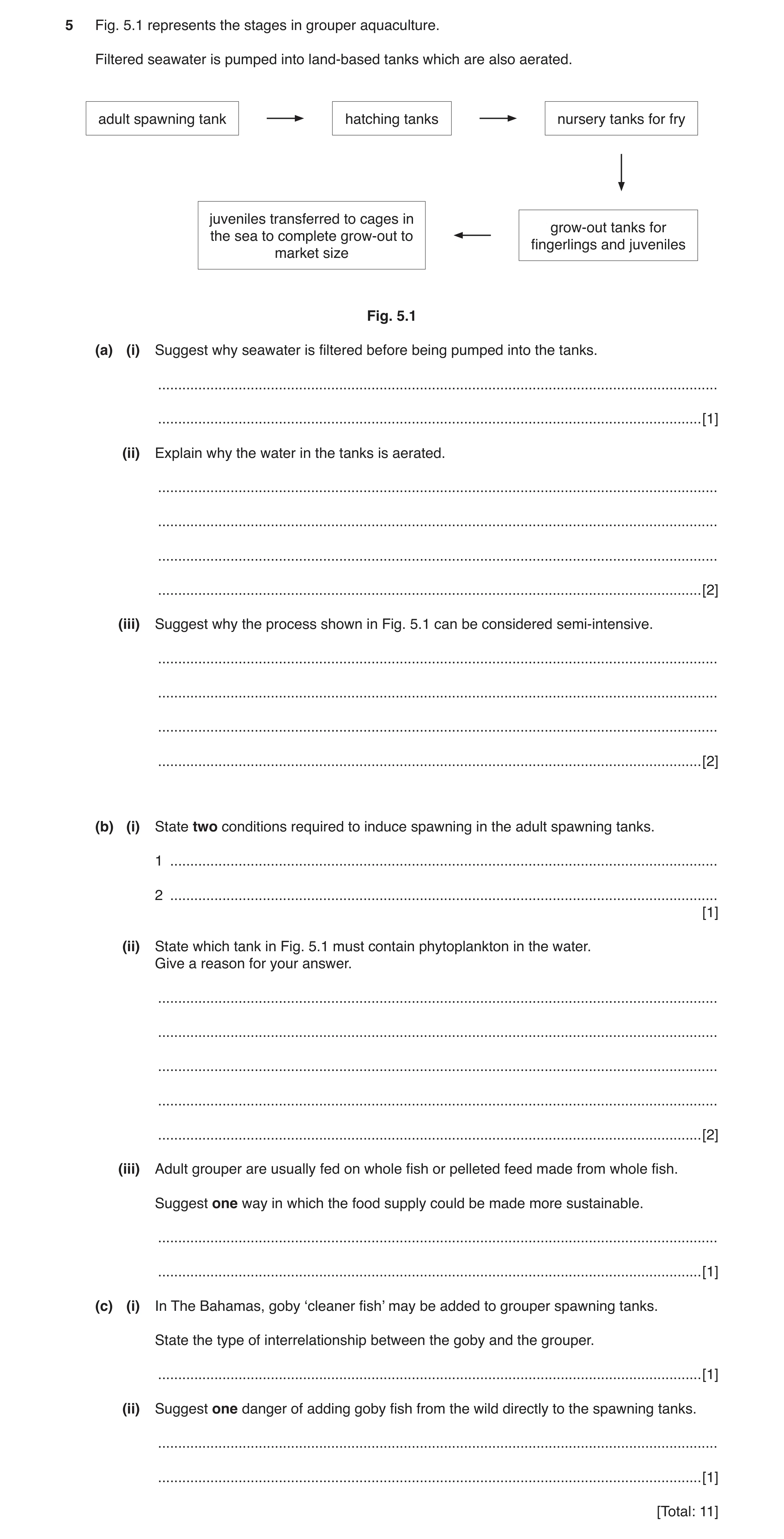
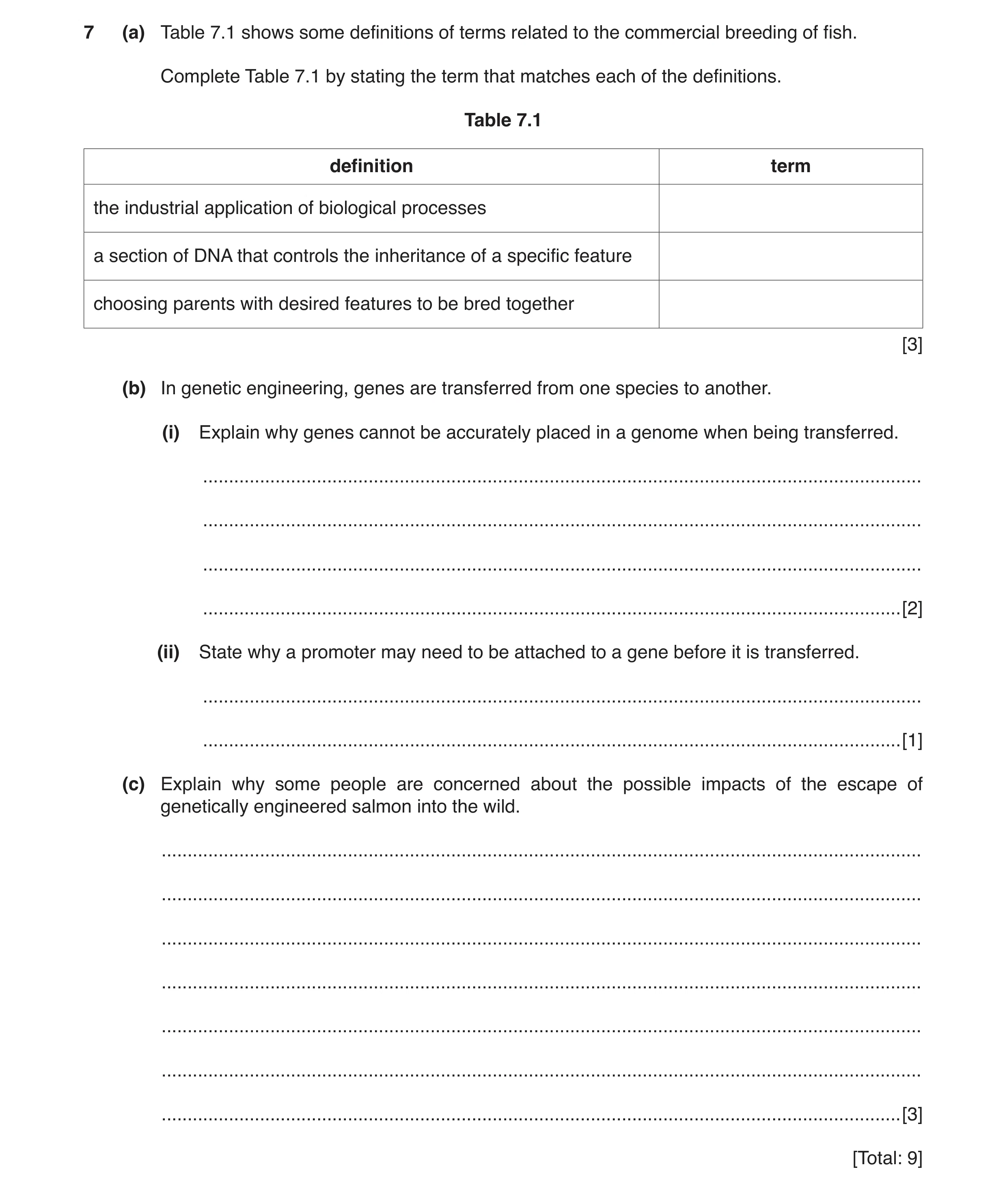 3 / 79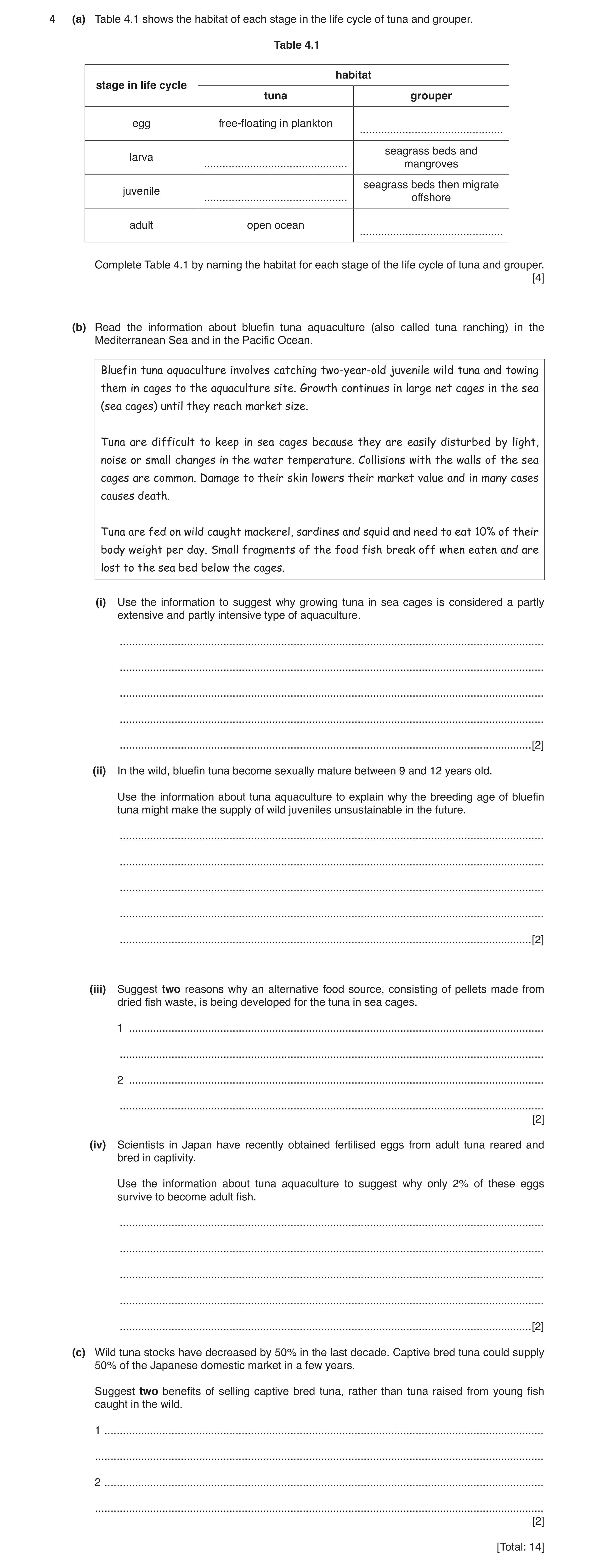
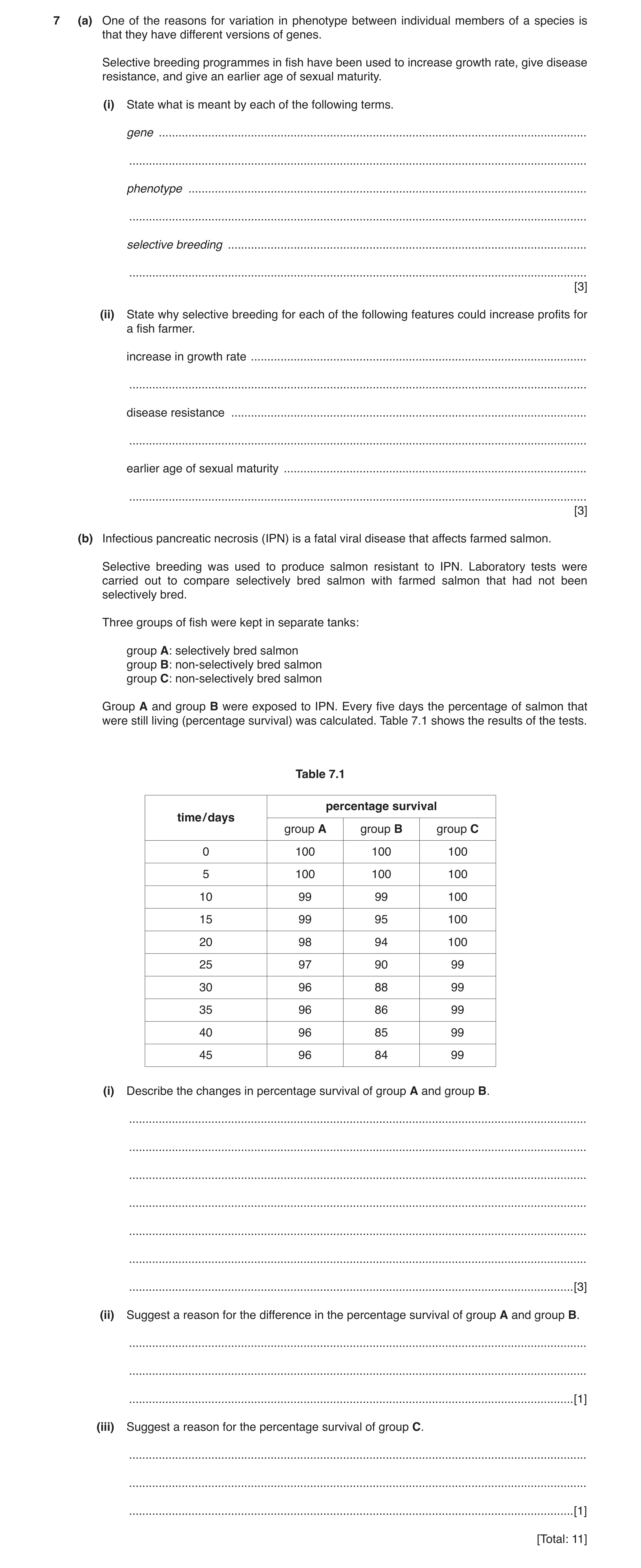
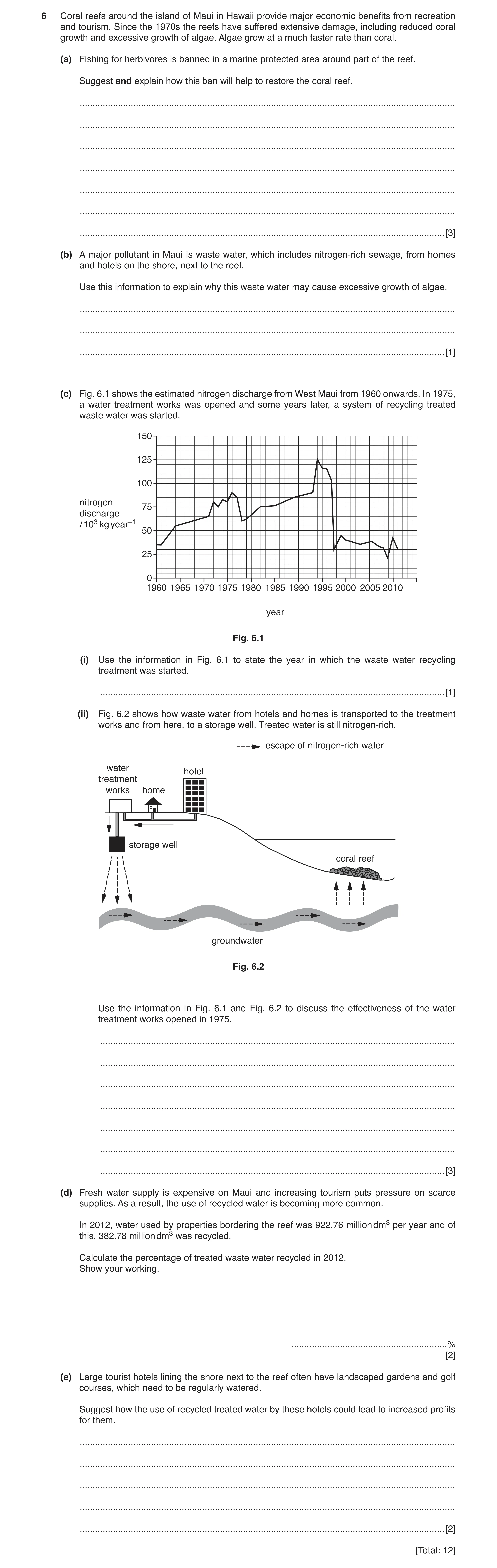
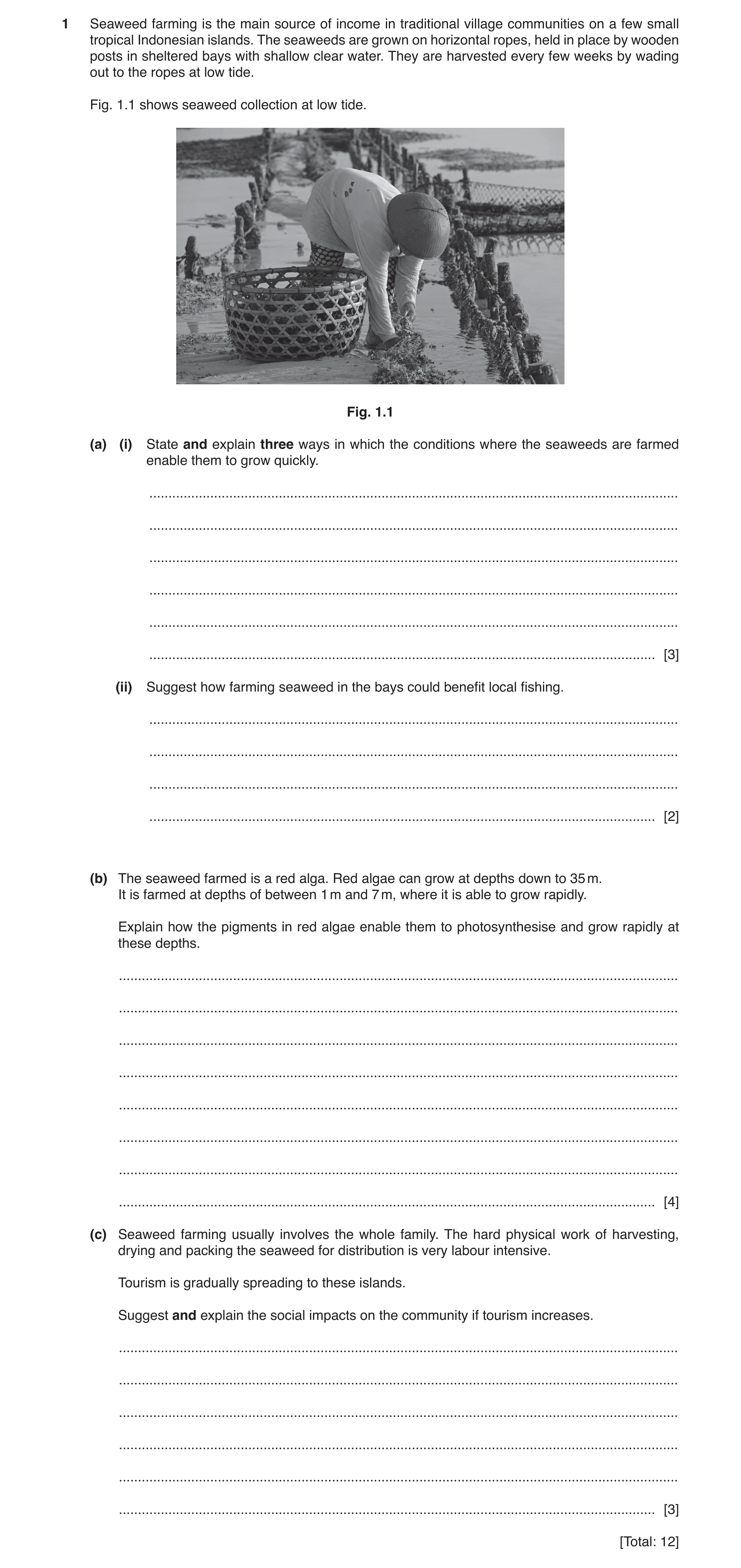
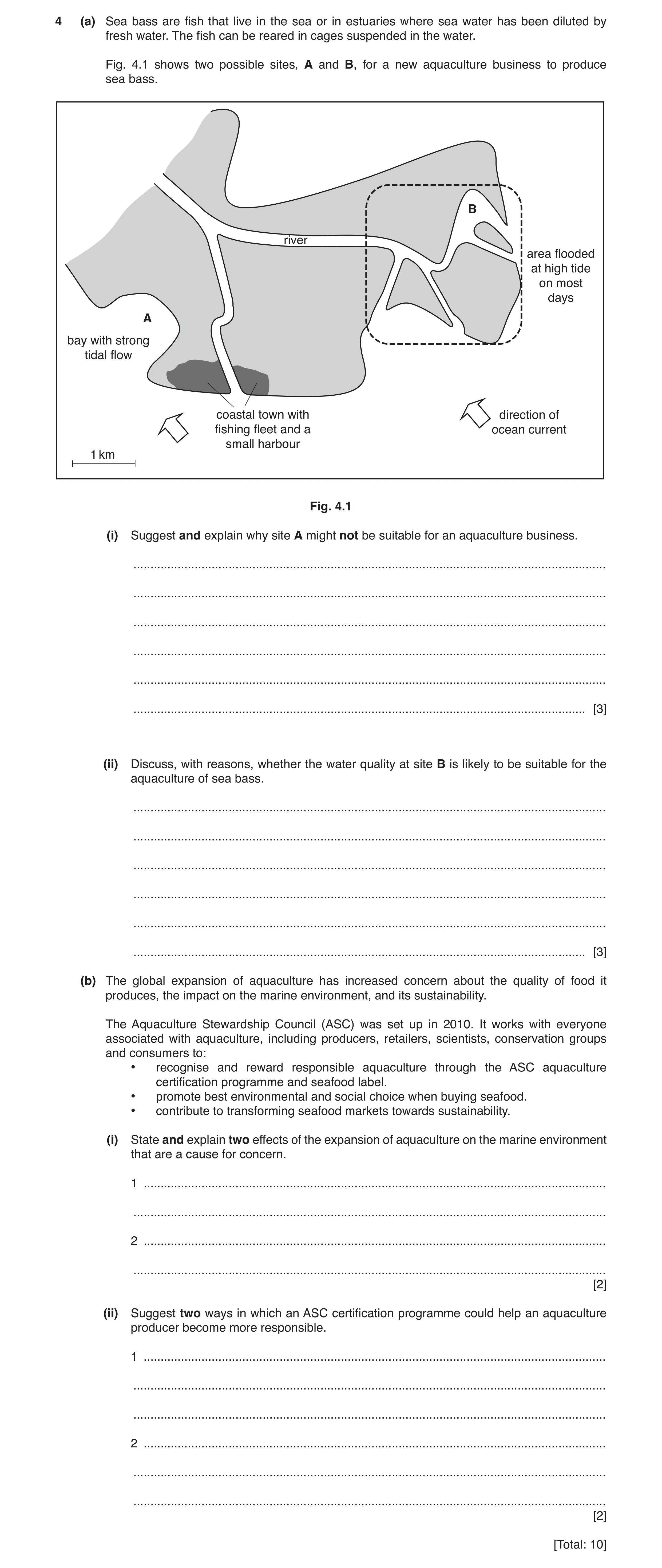
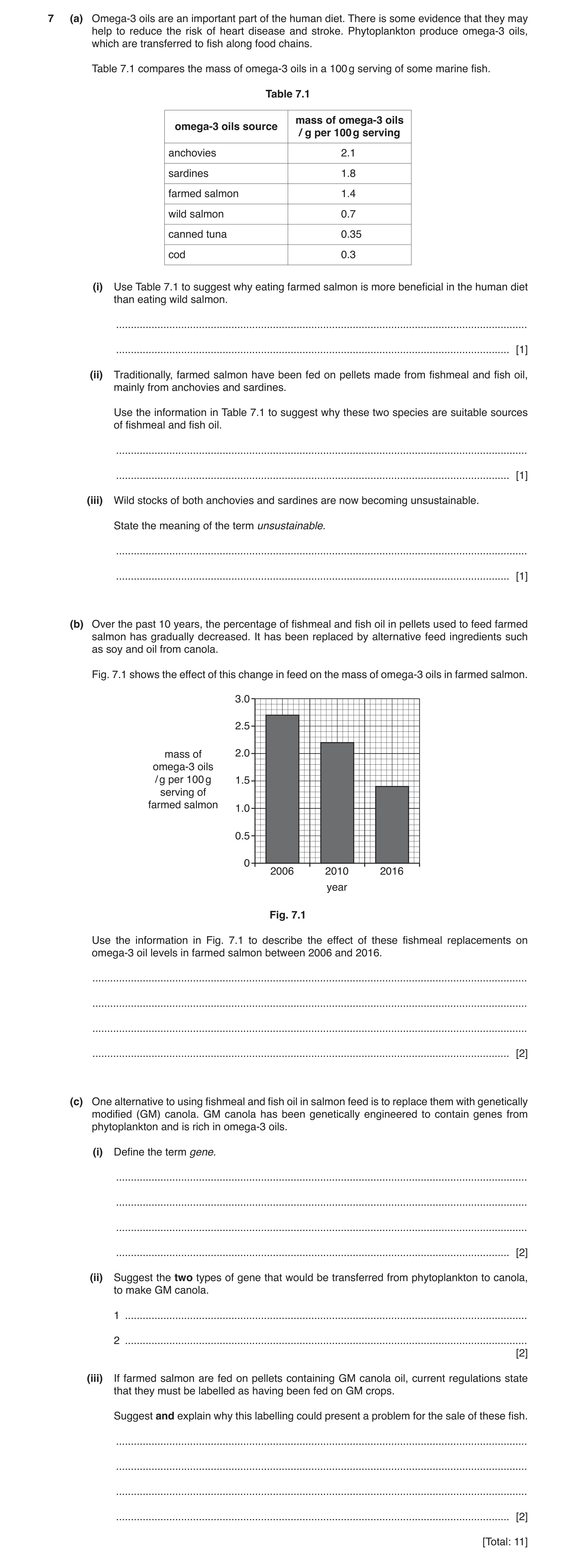
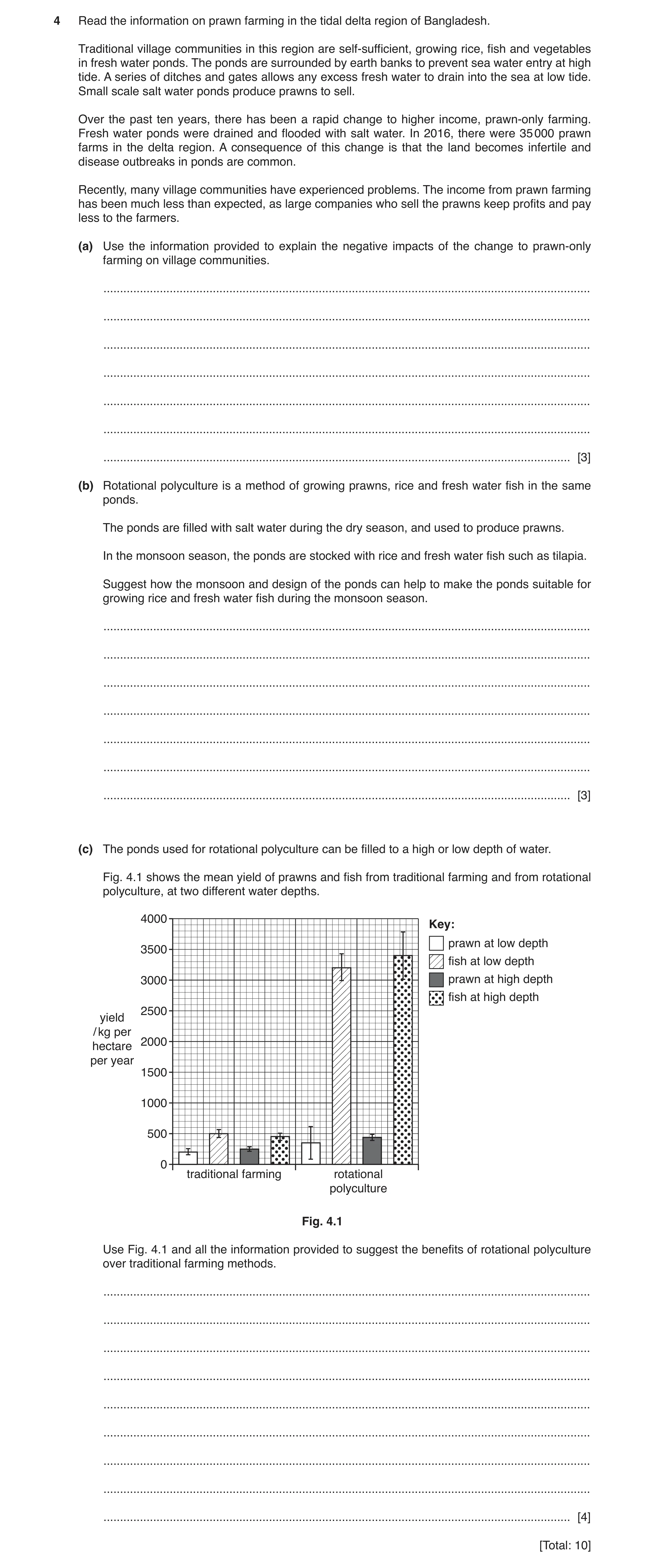
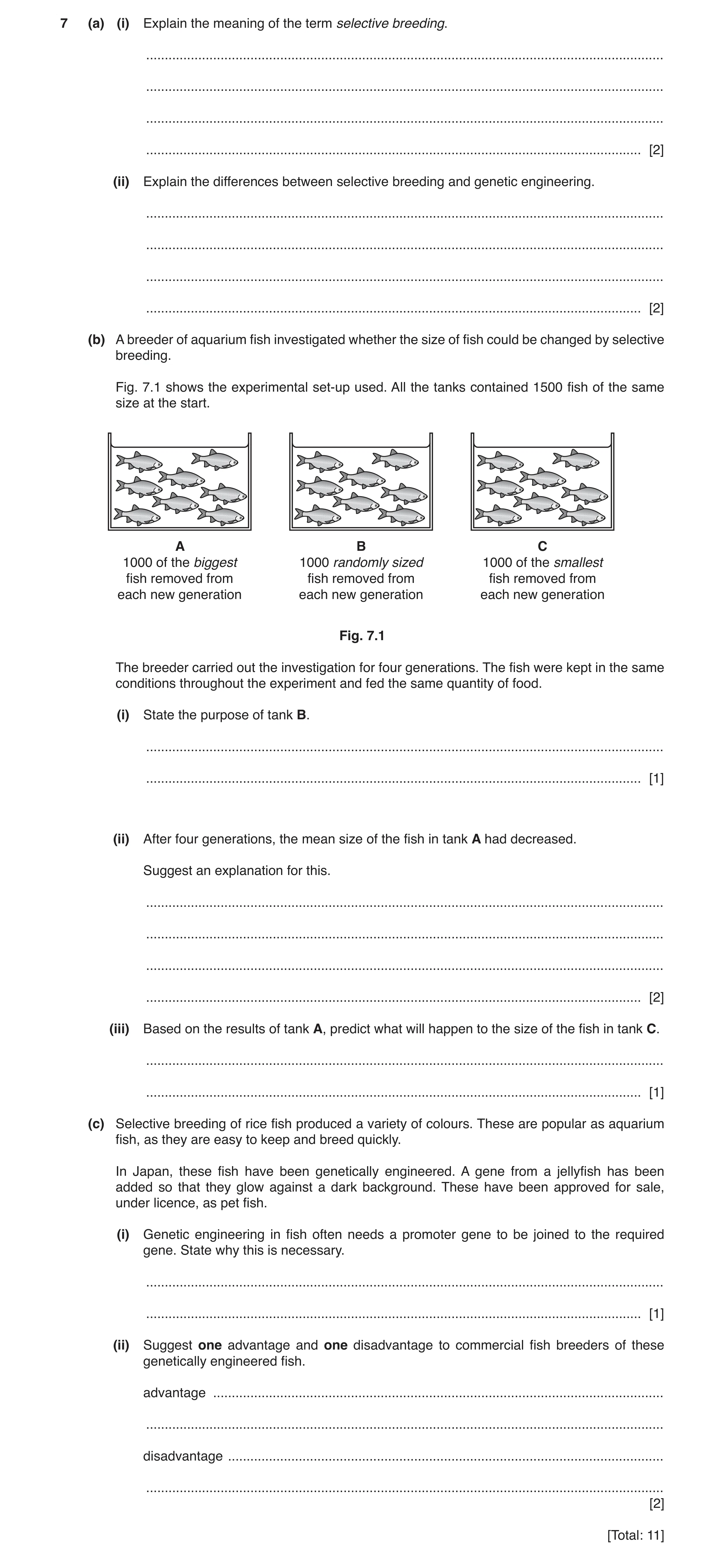
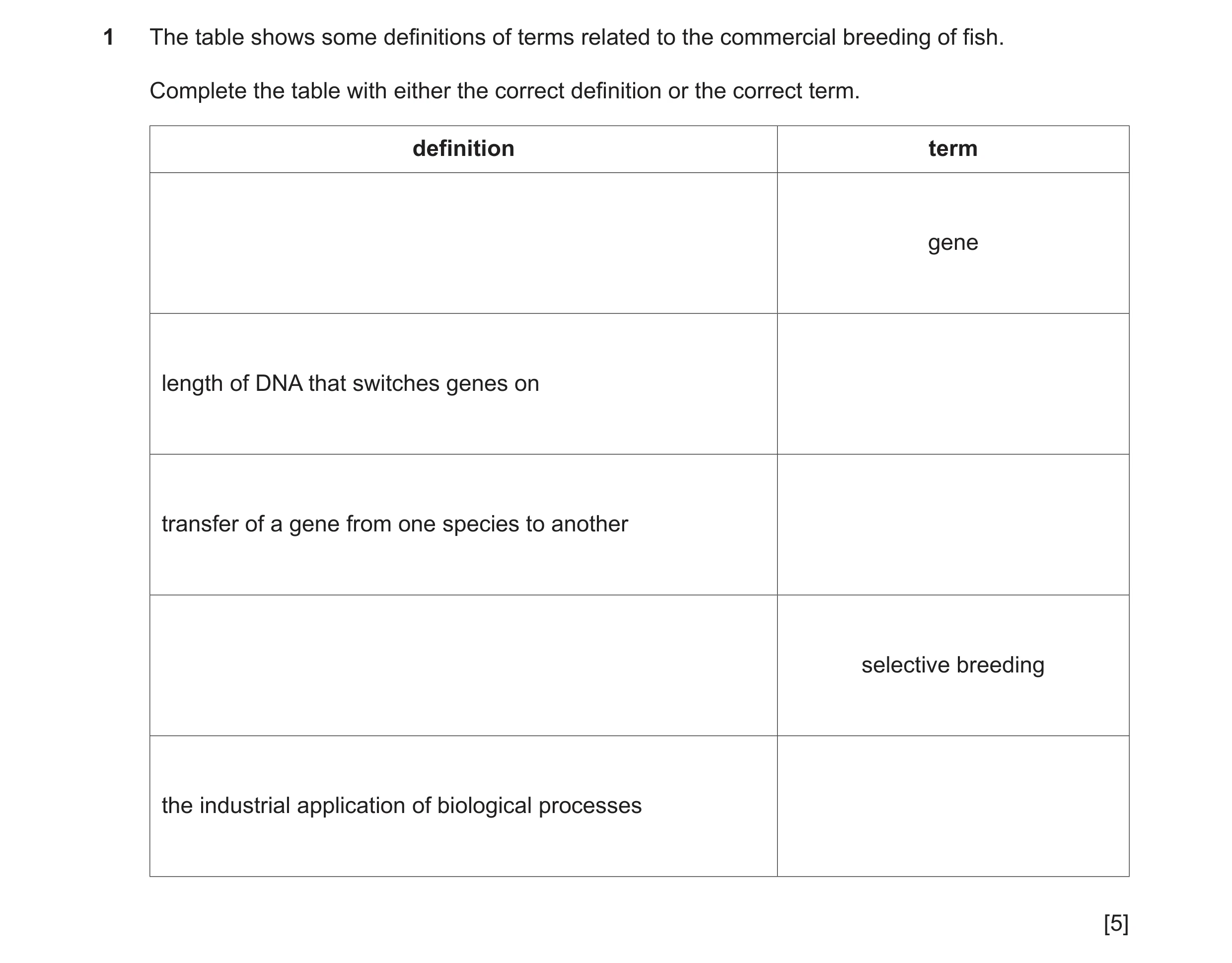 23 / 79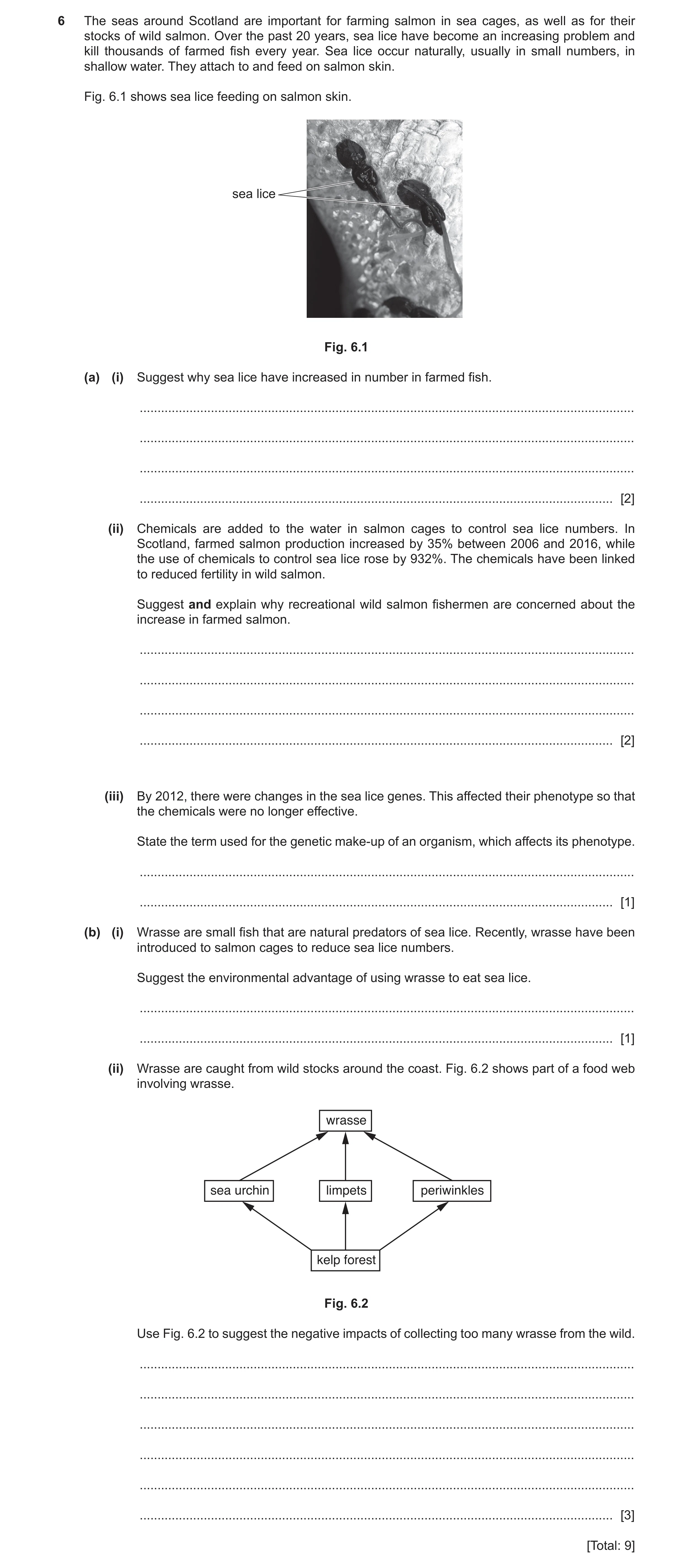
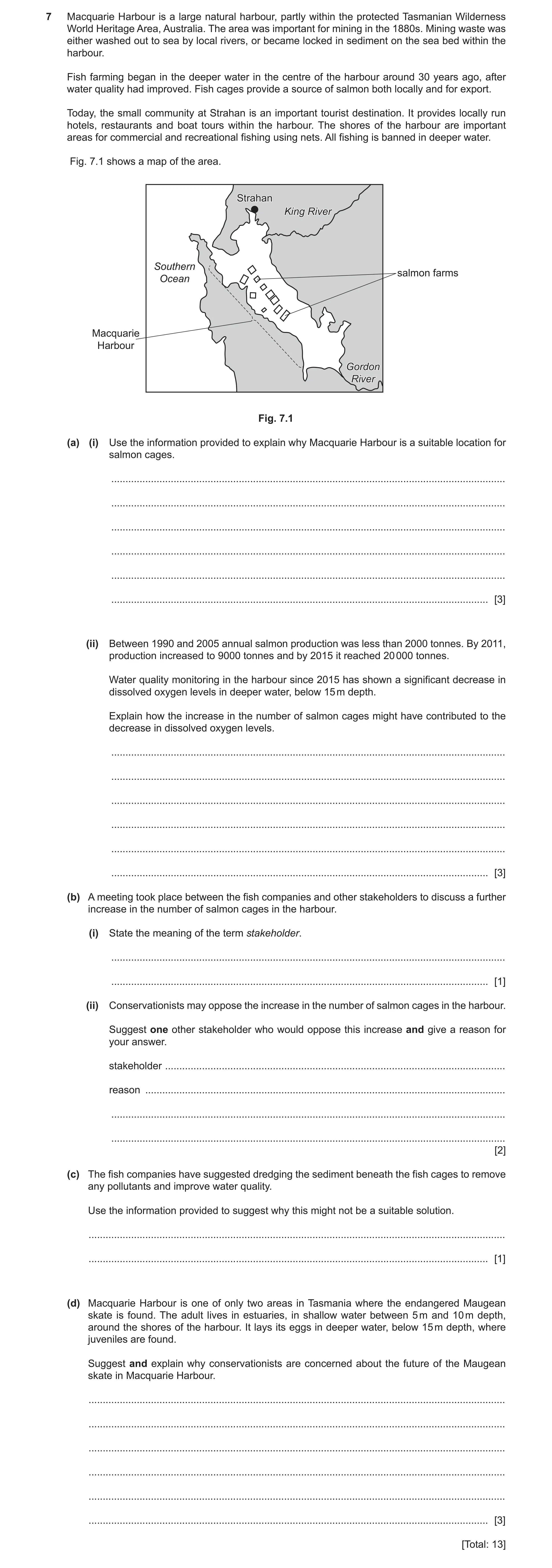
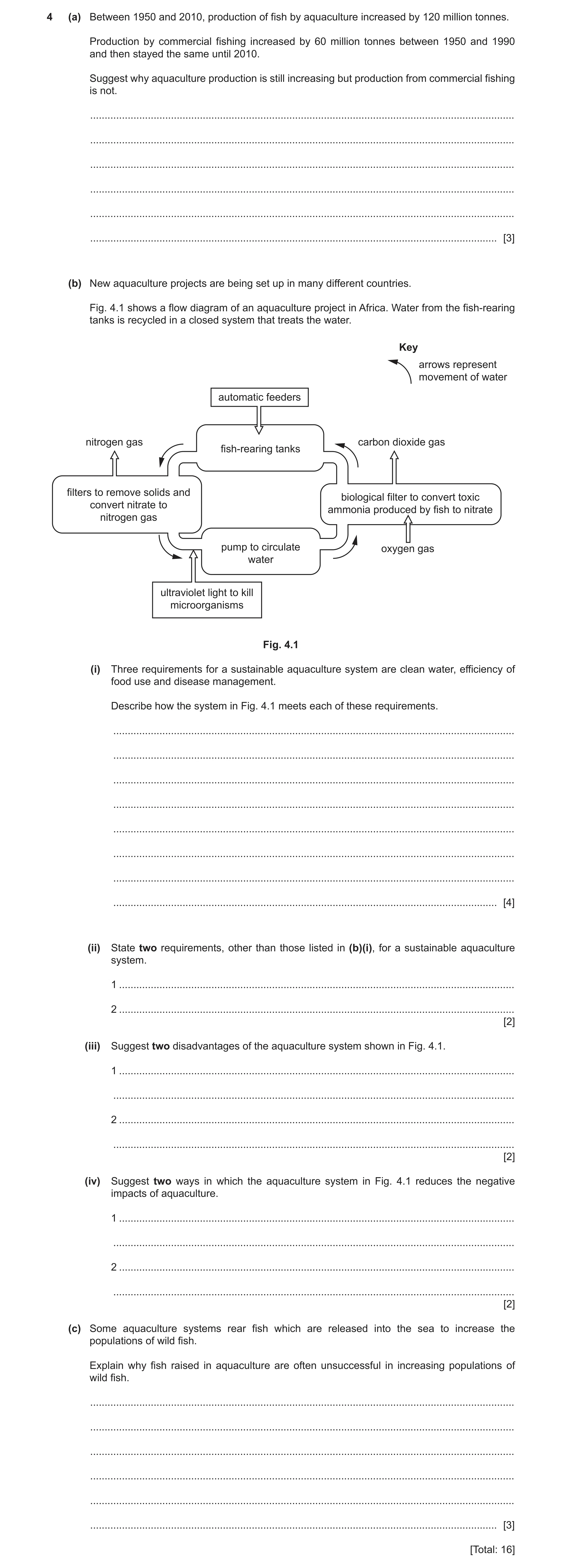
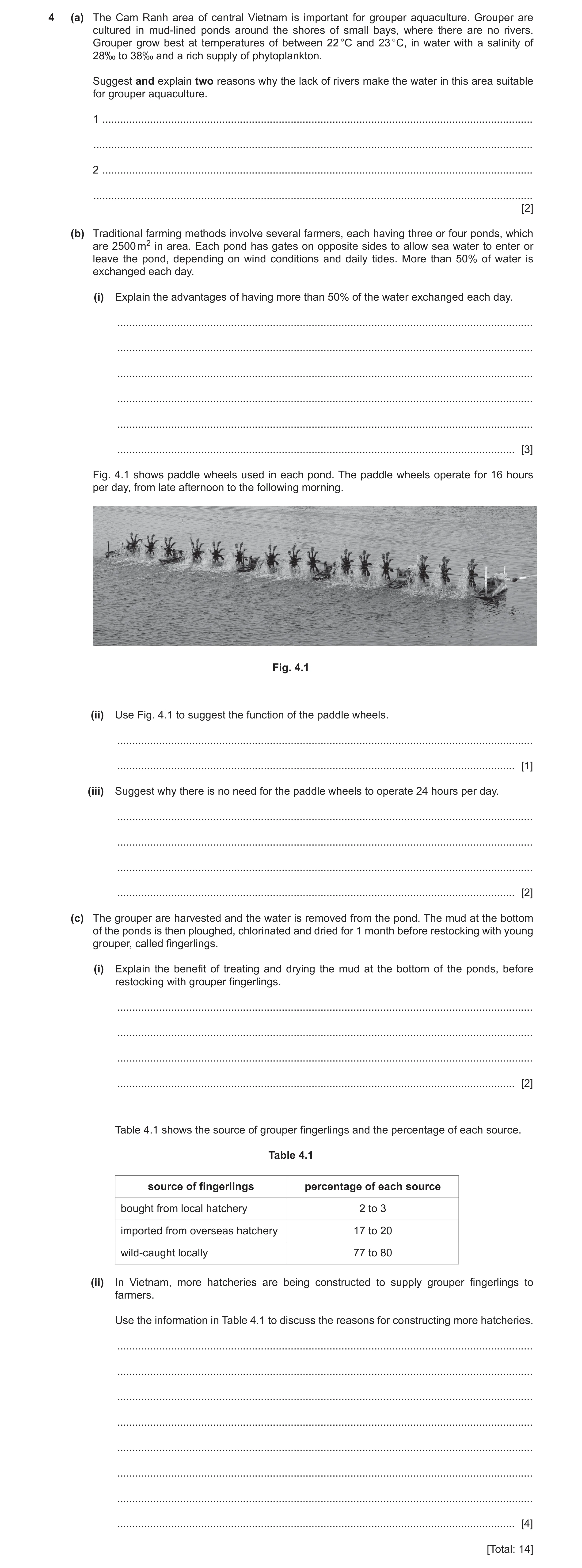
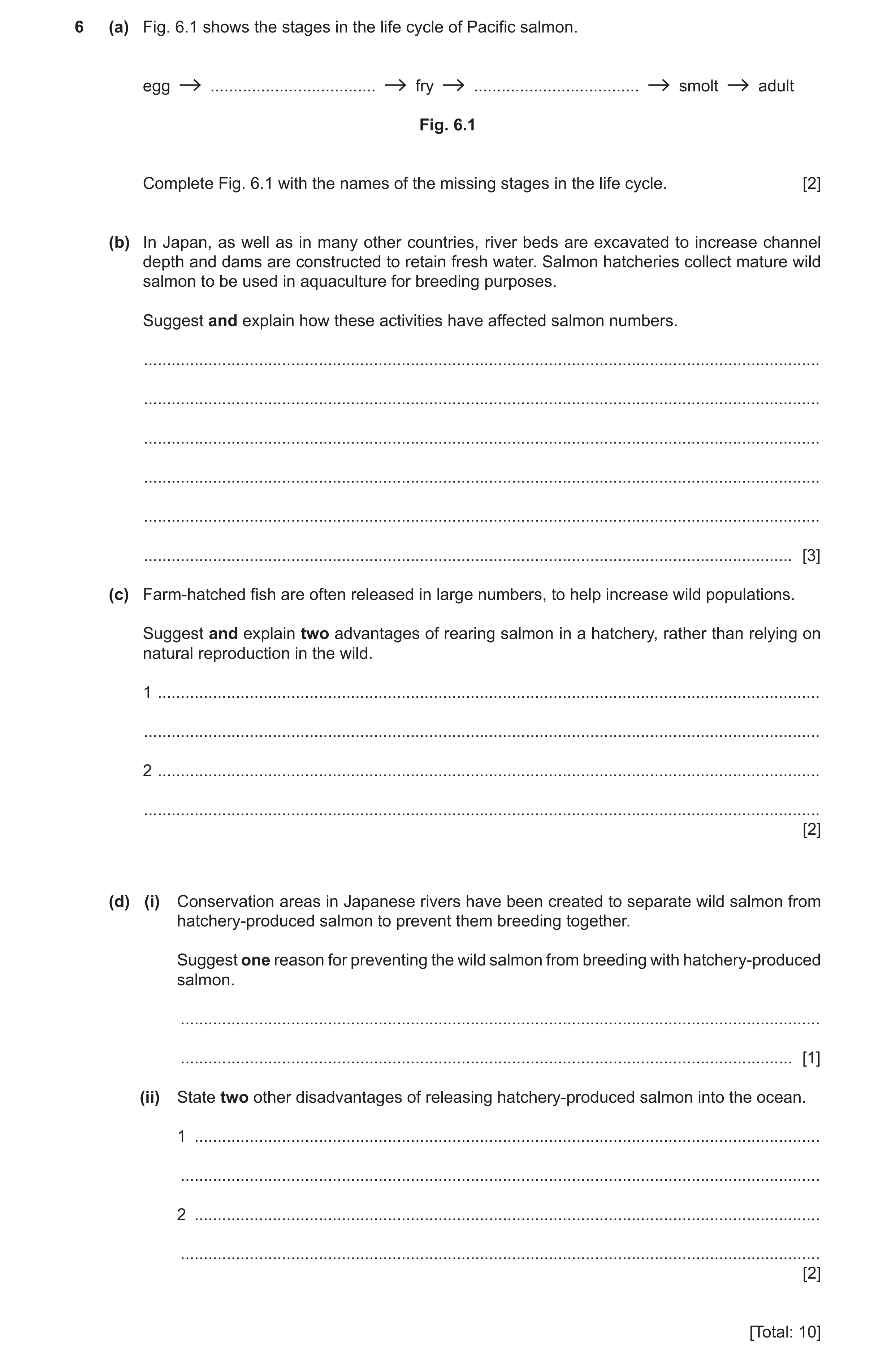
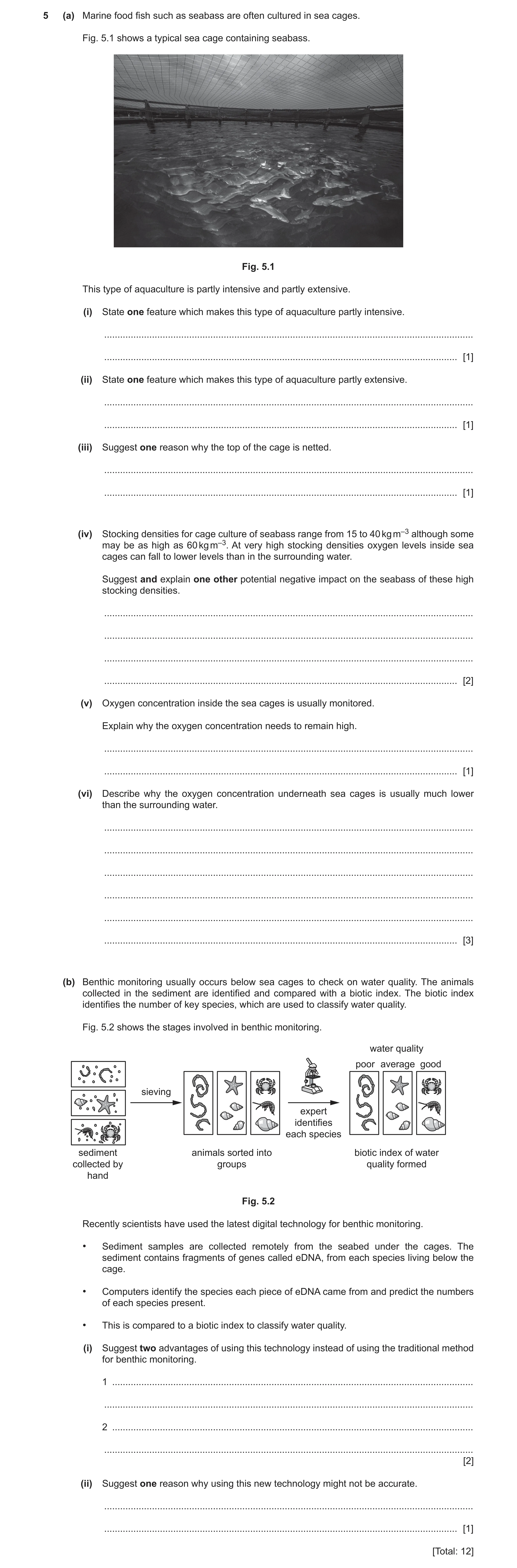
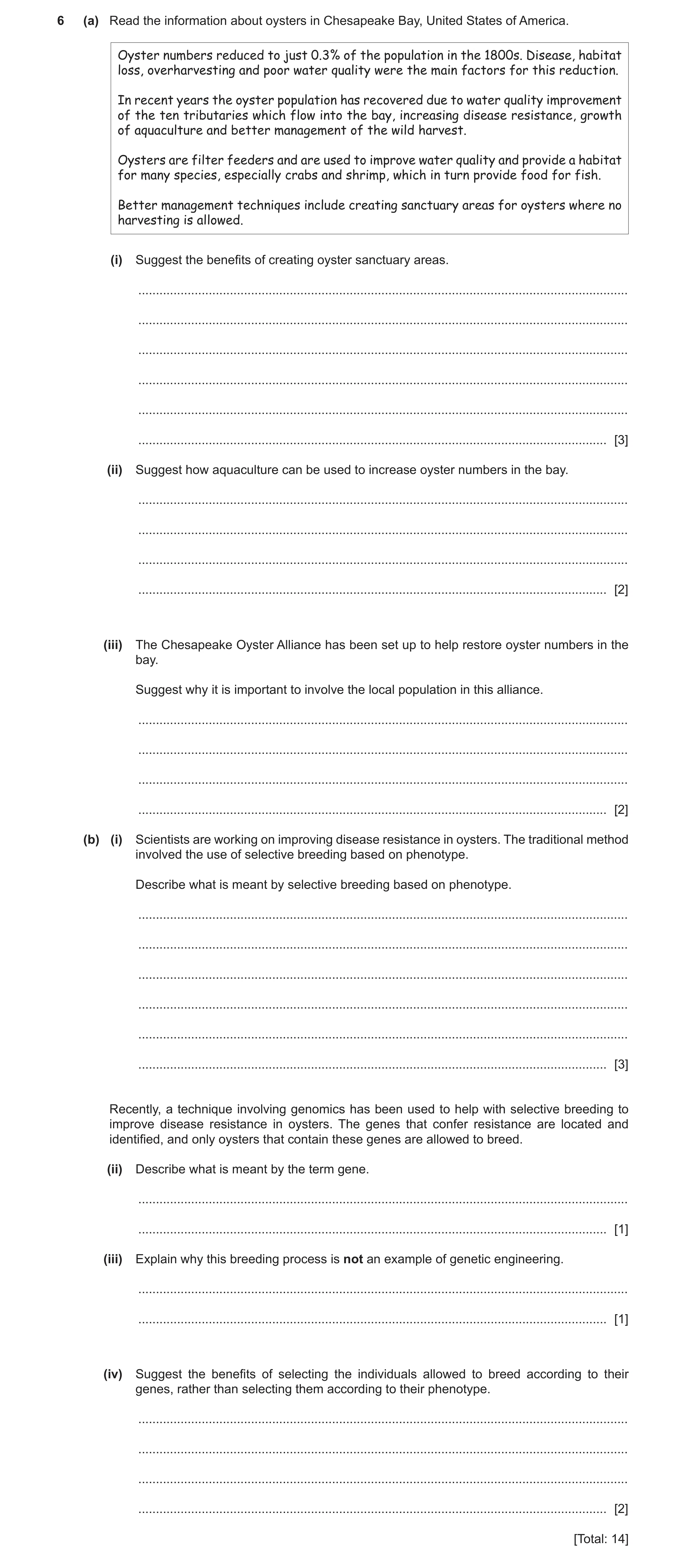
 36 / 79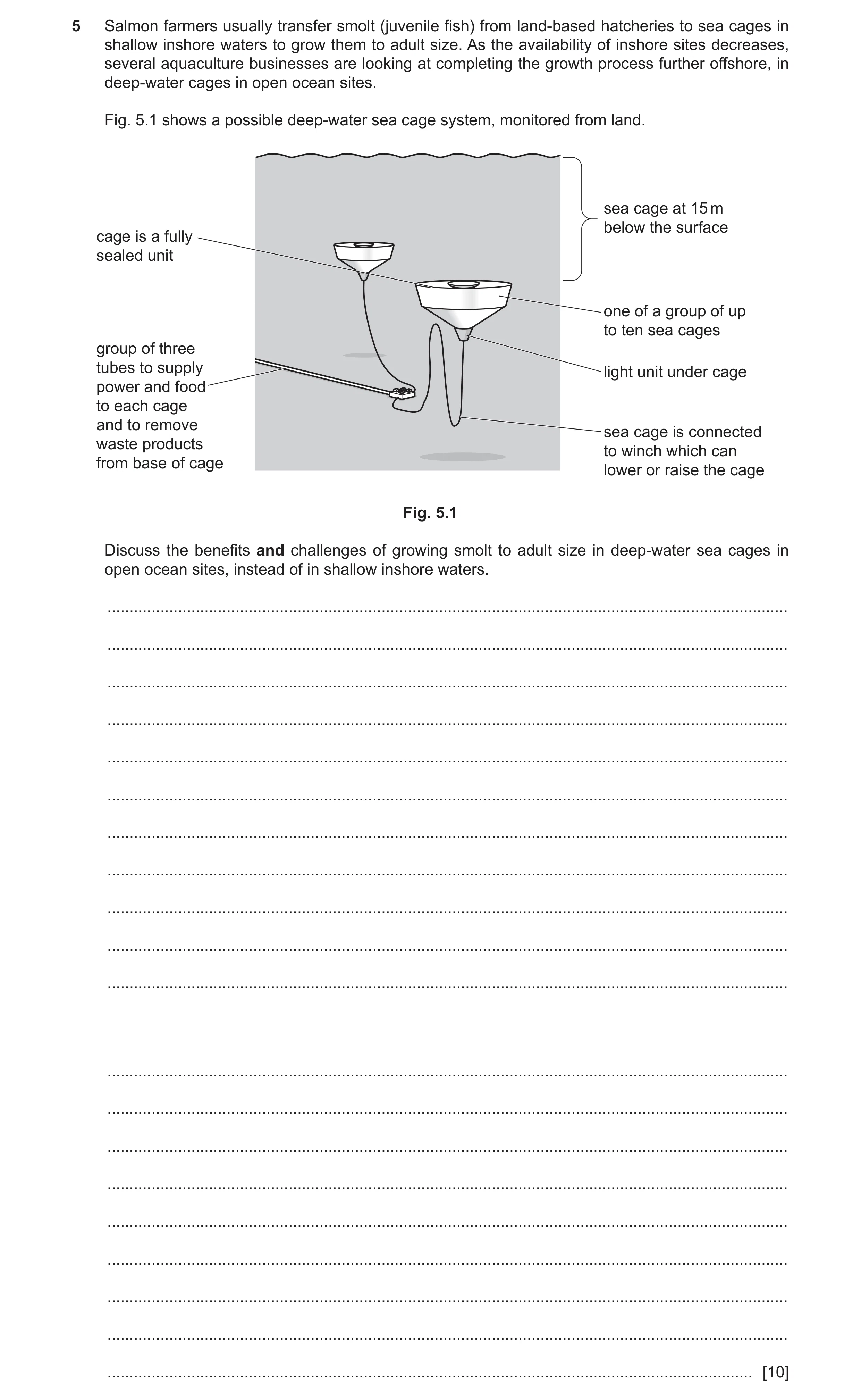
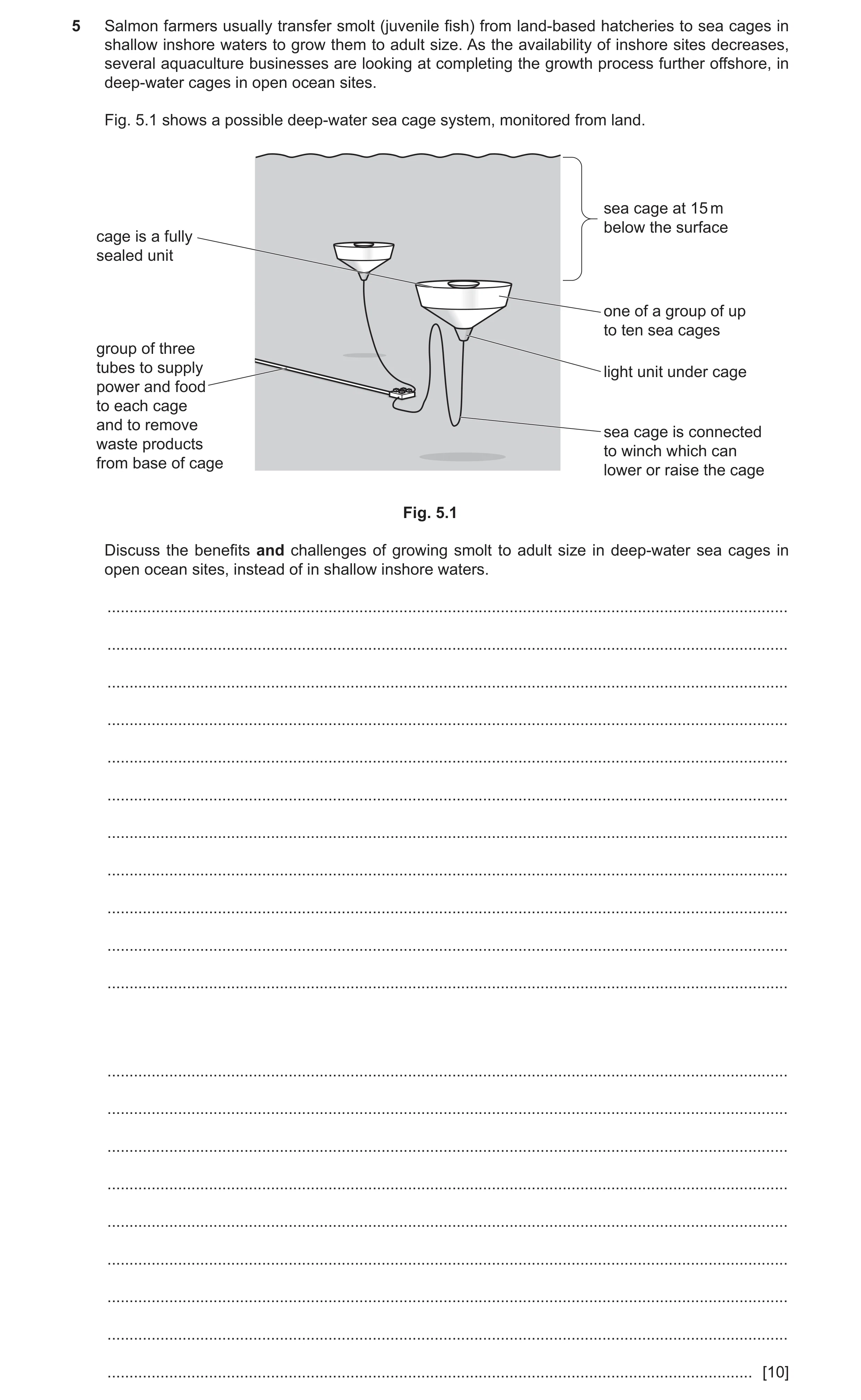
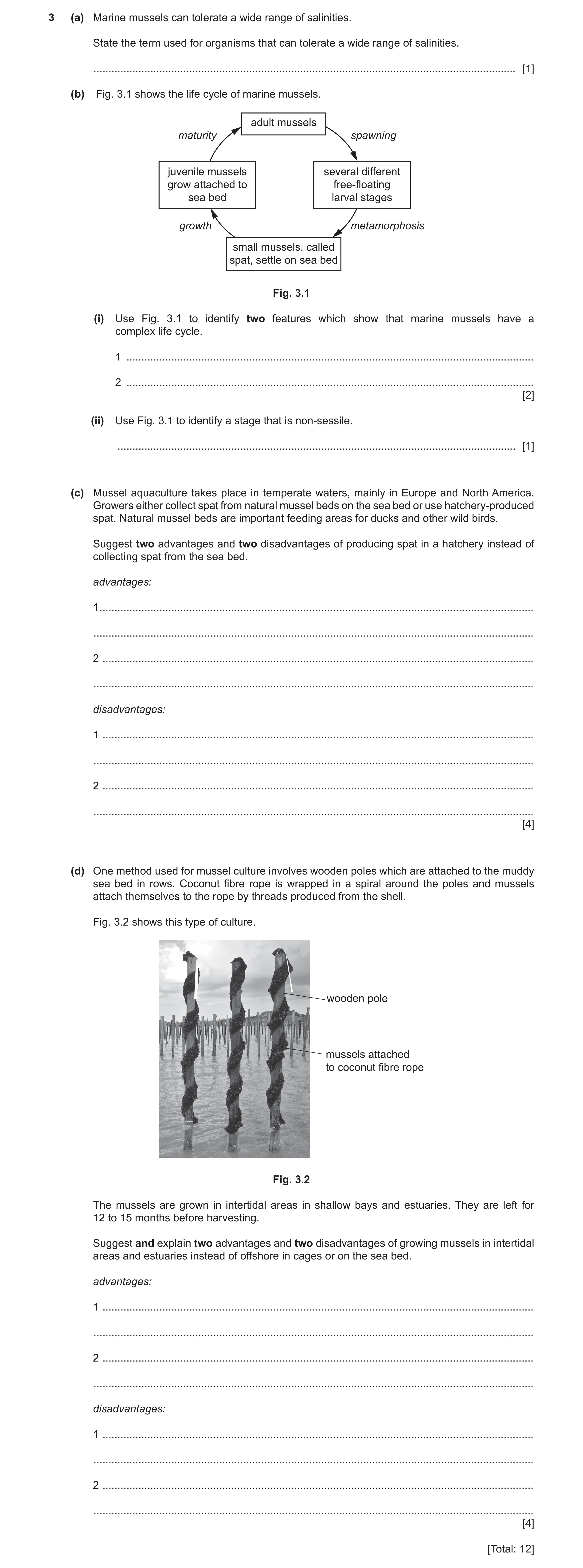
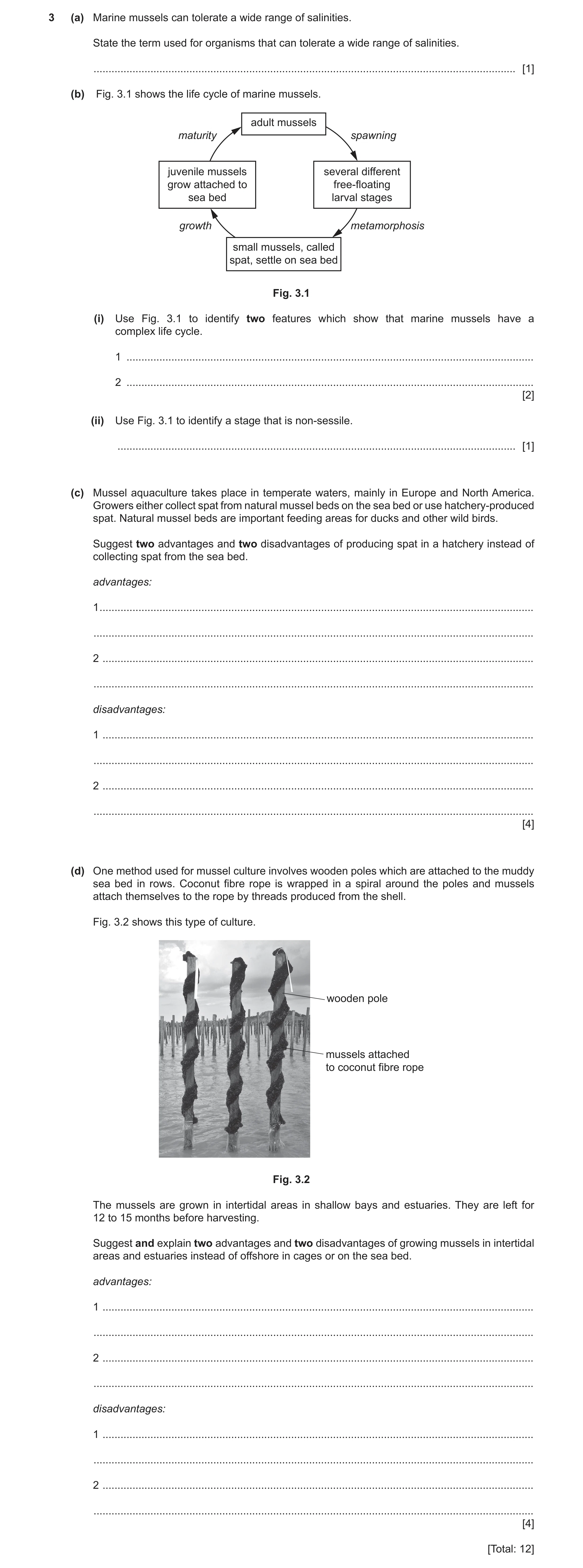
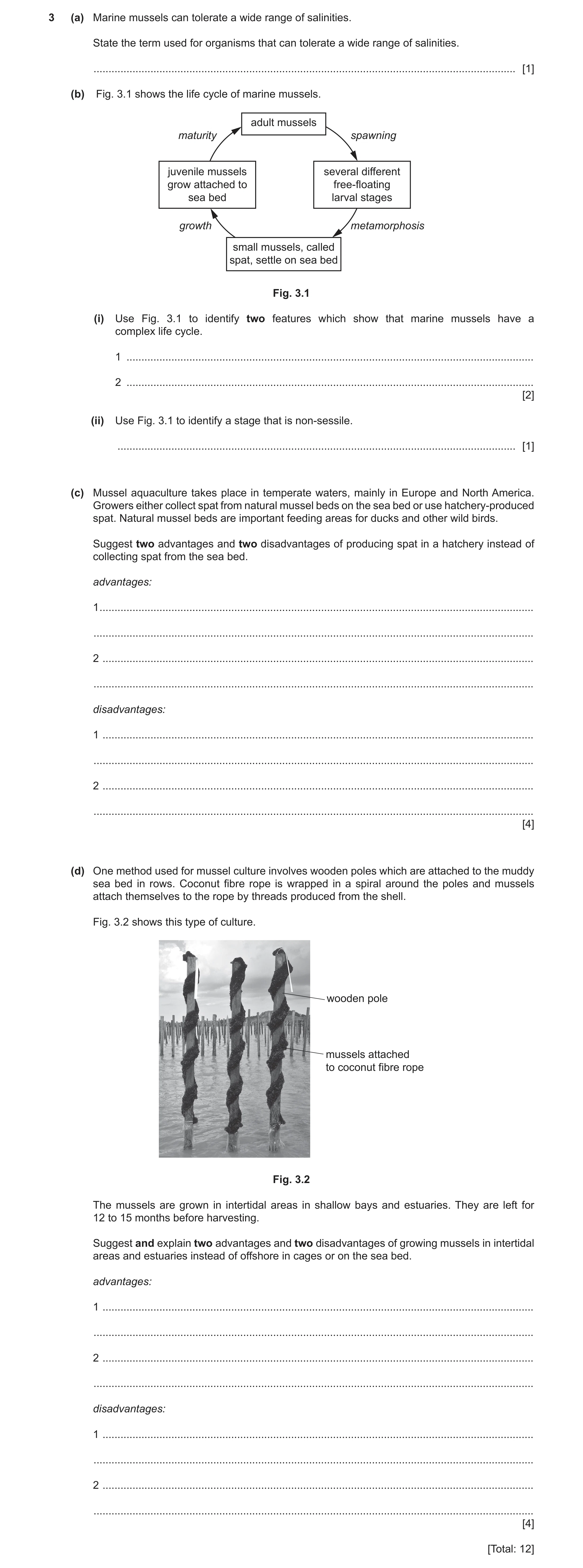
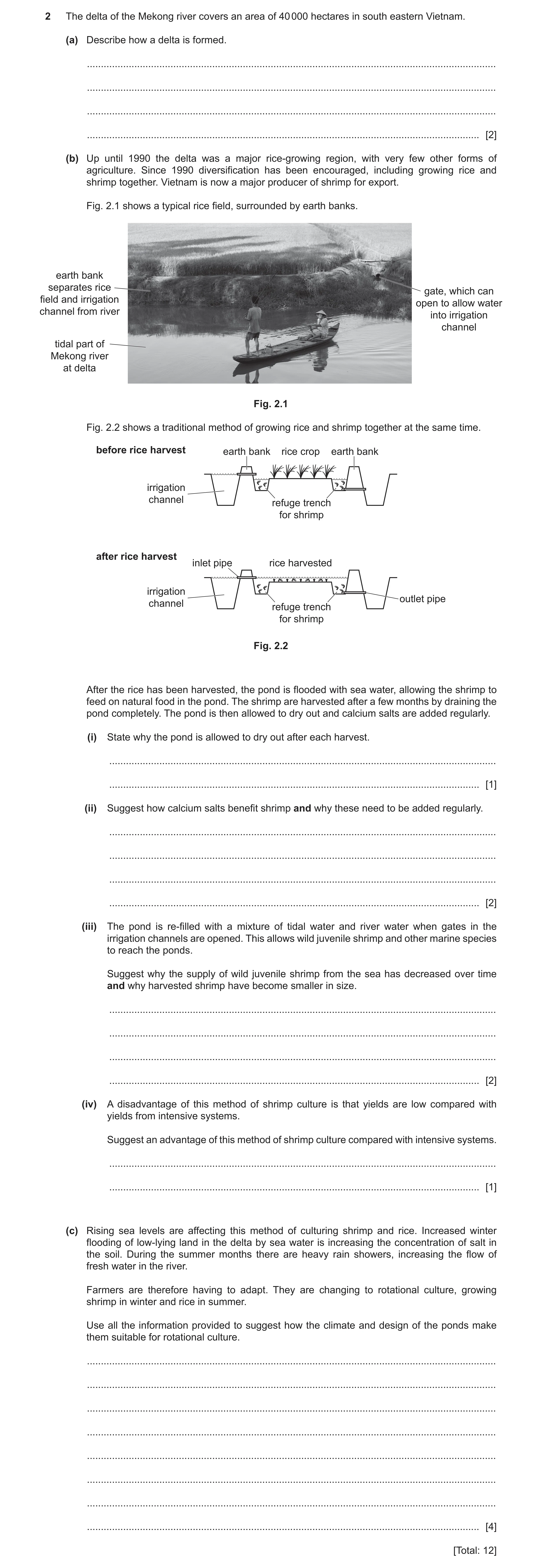
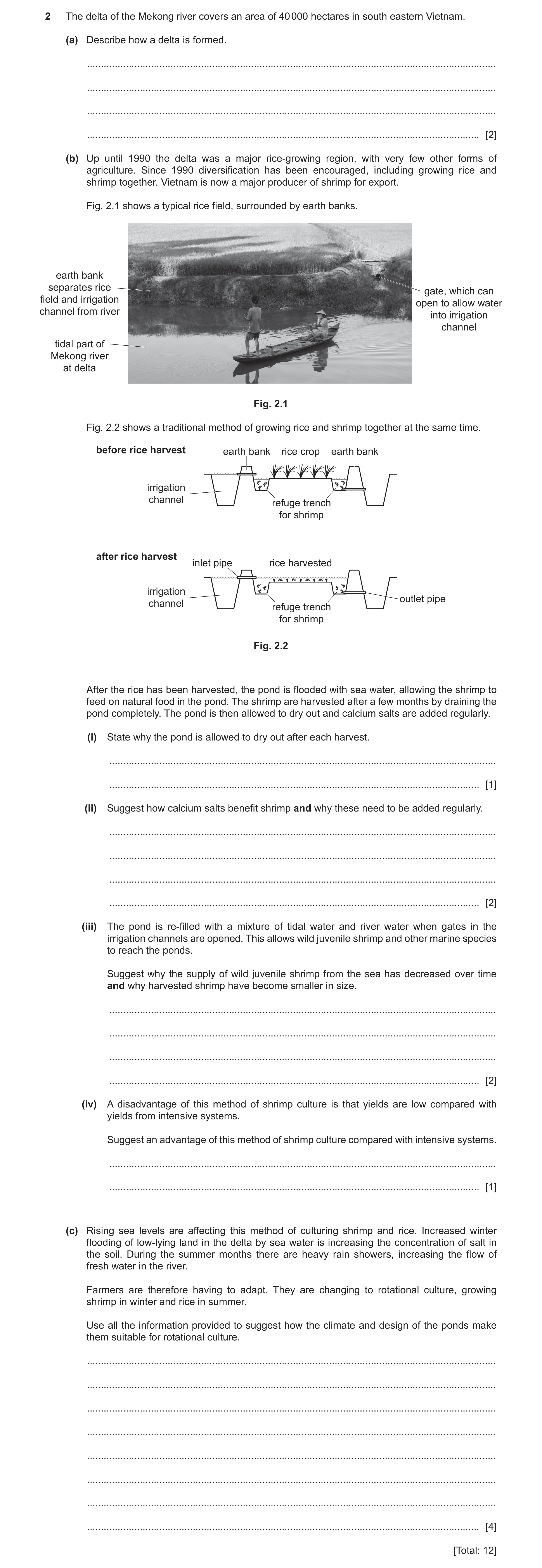
 50 / 79
 51 / 79
 52 / 79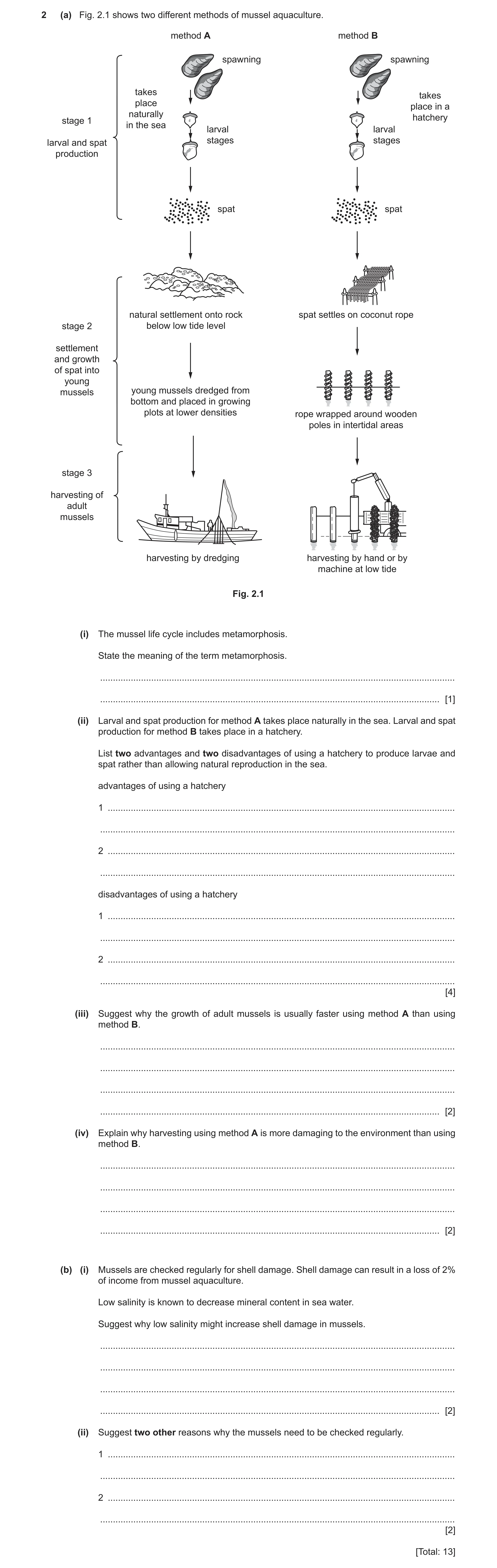
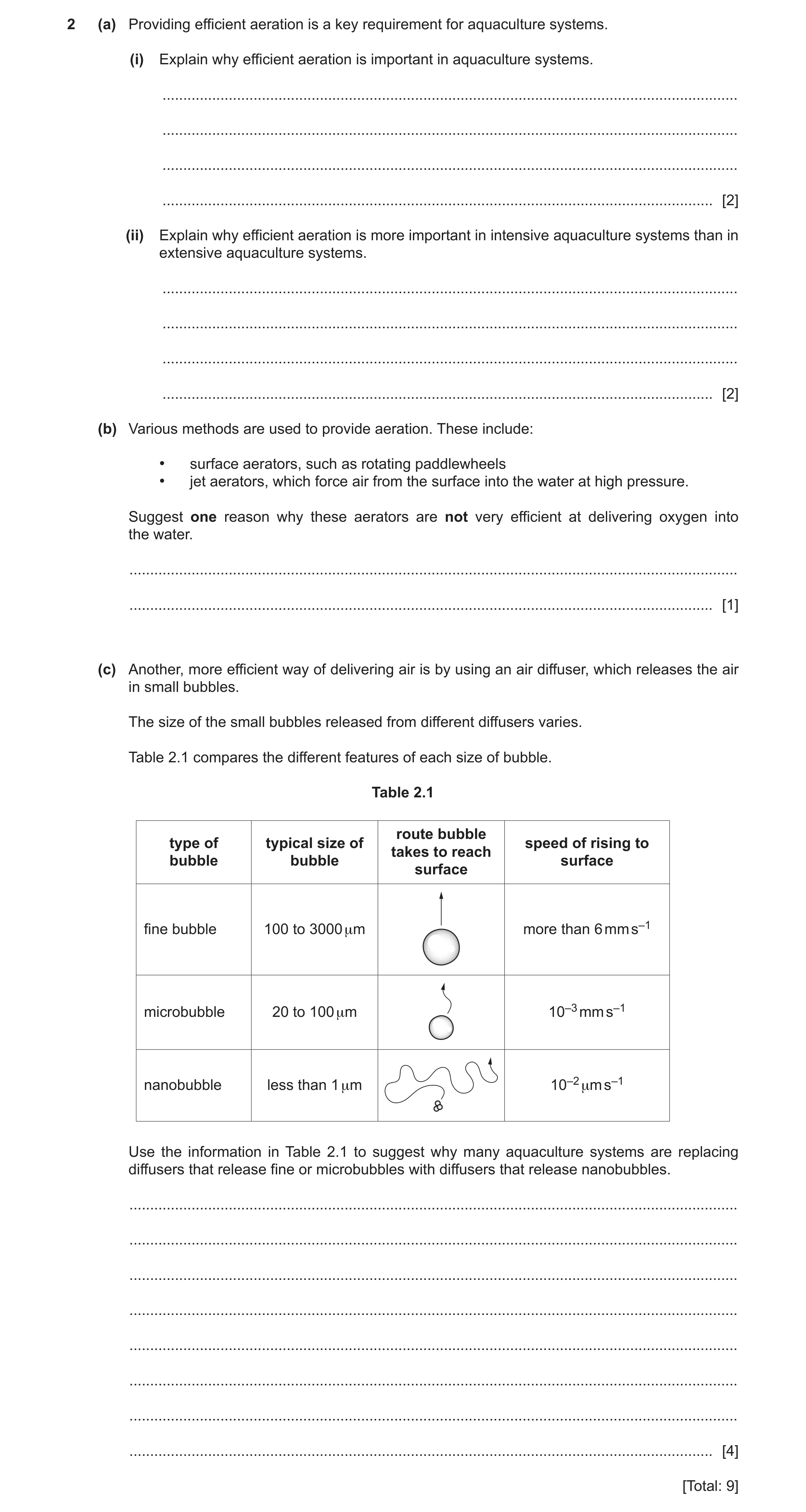
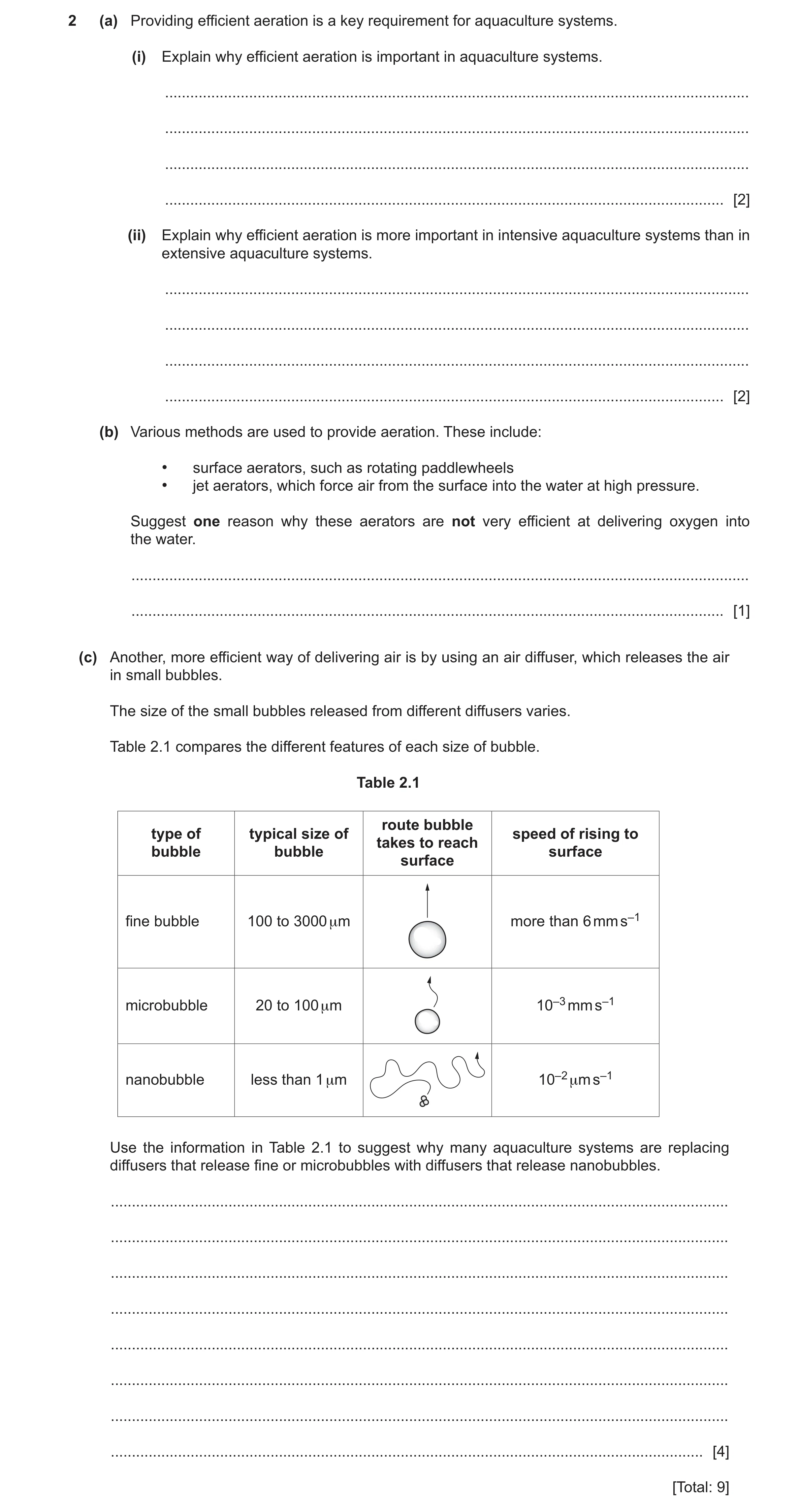
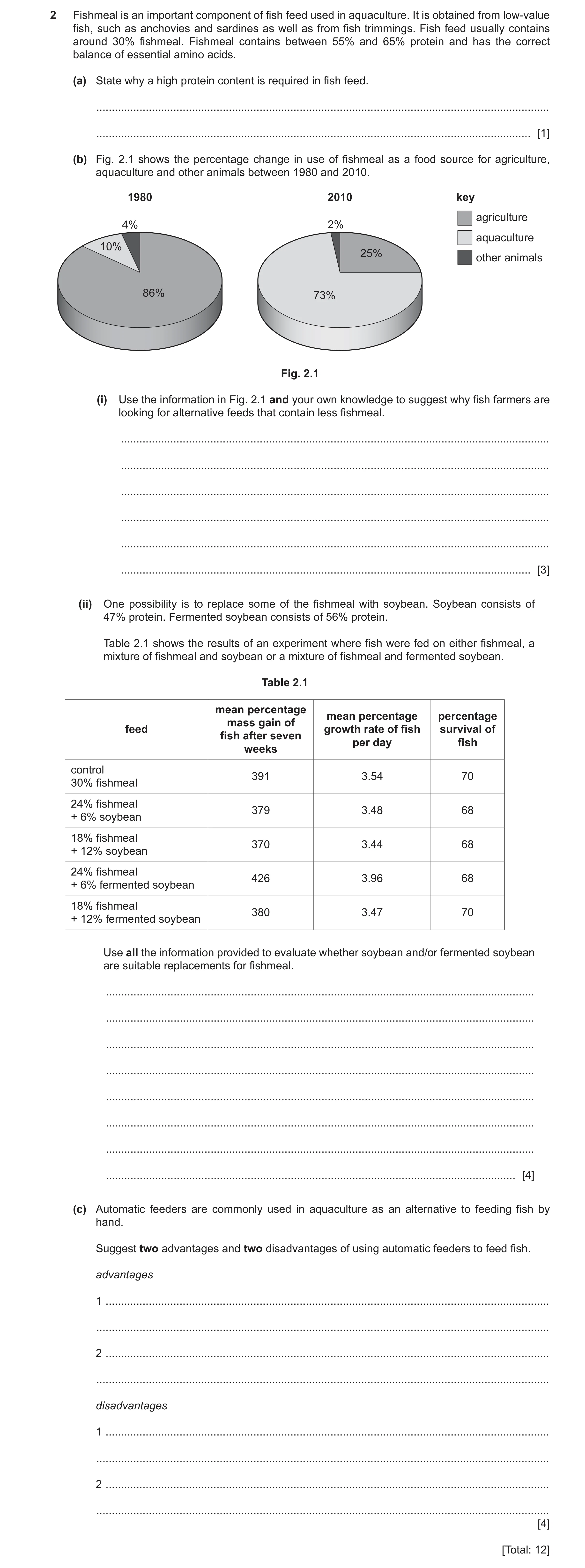
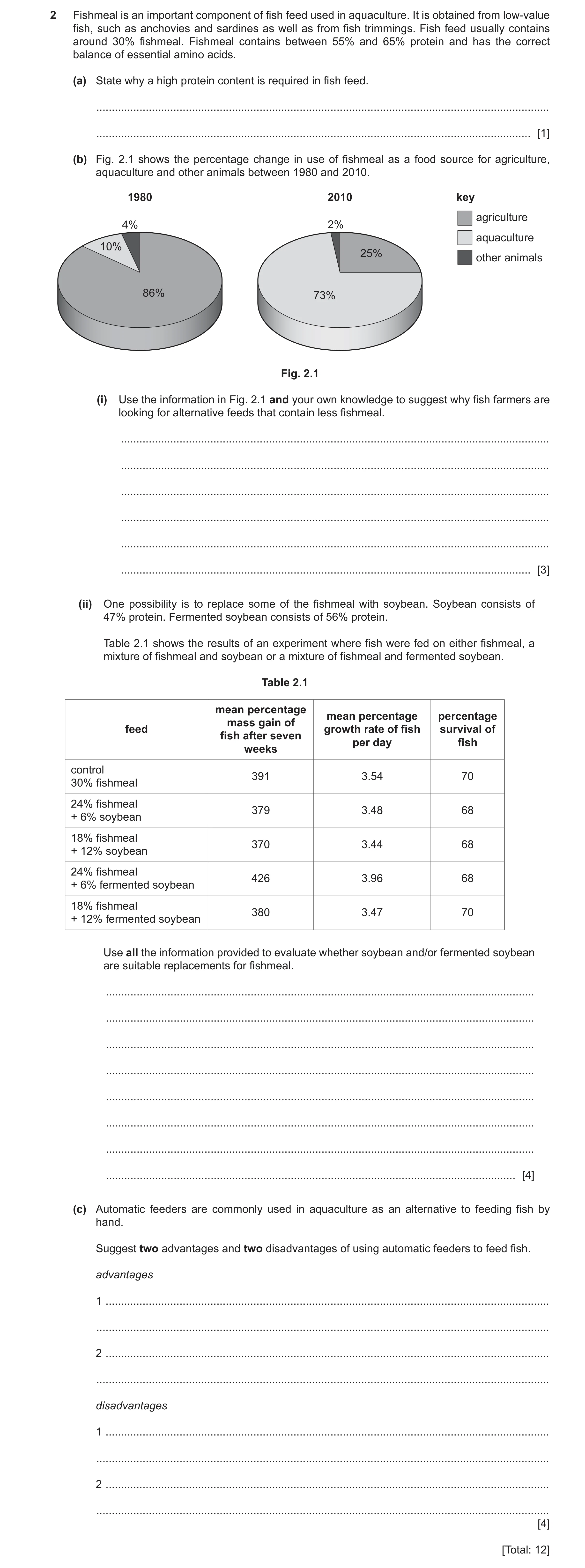
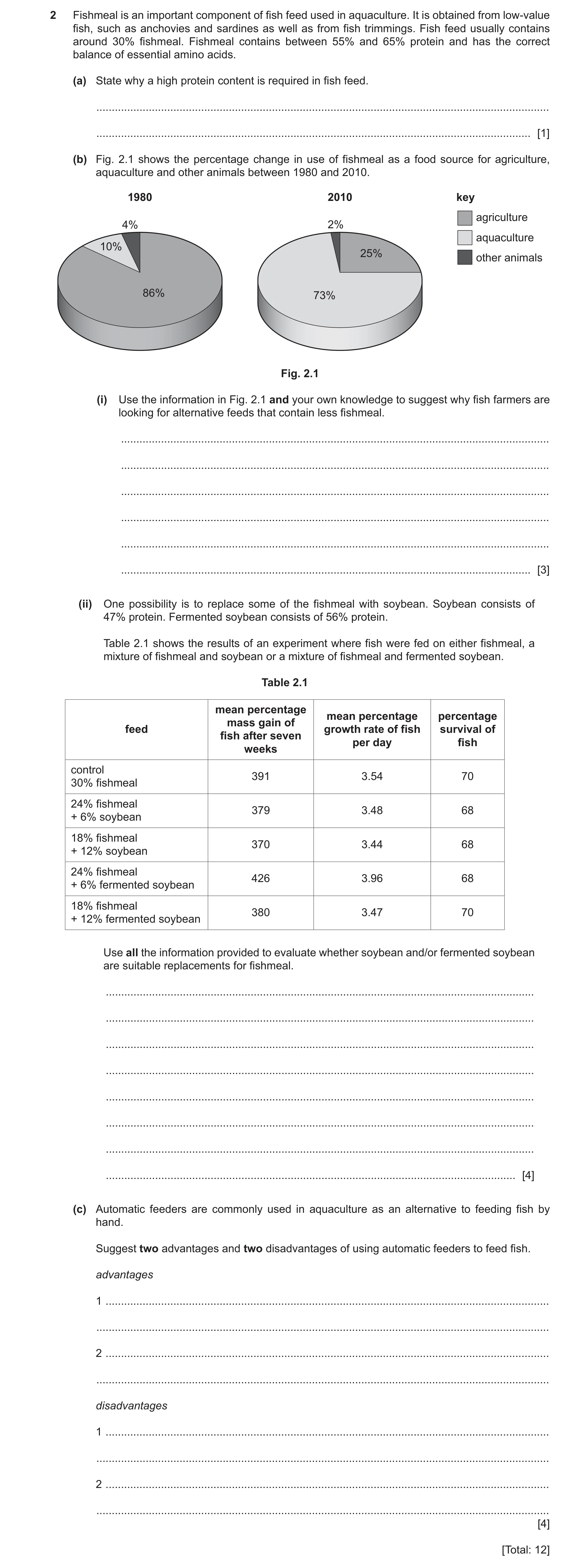
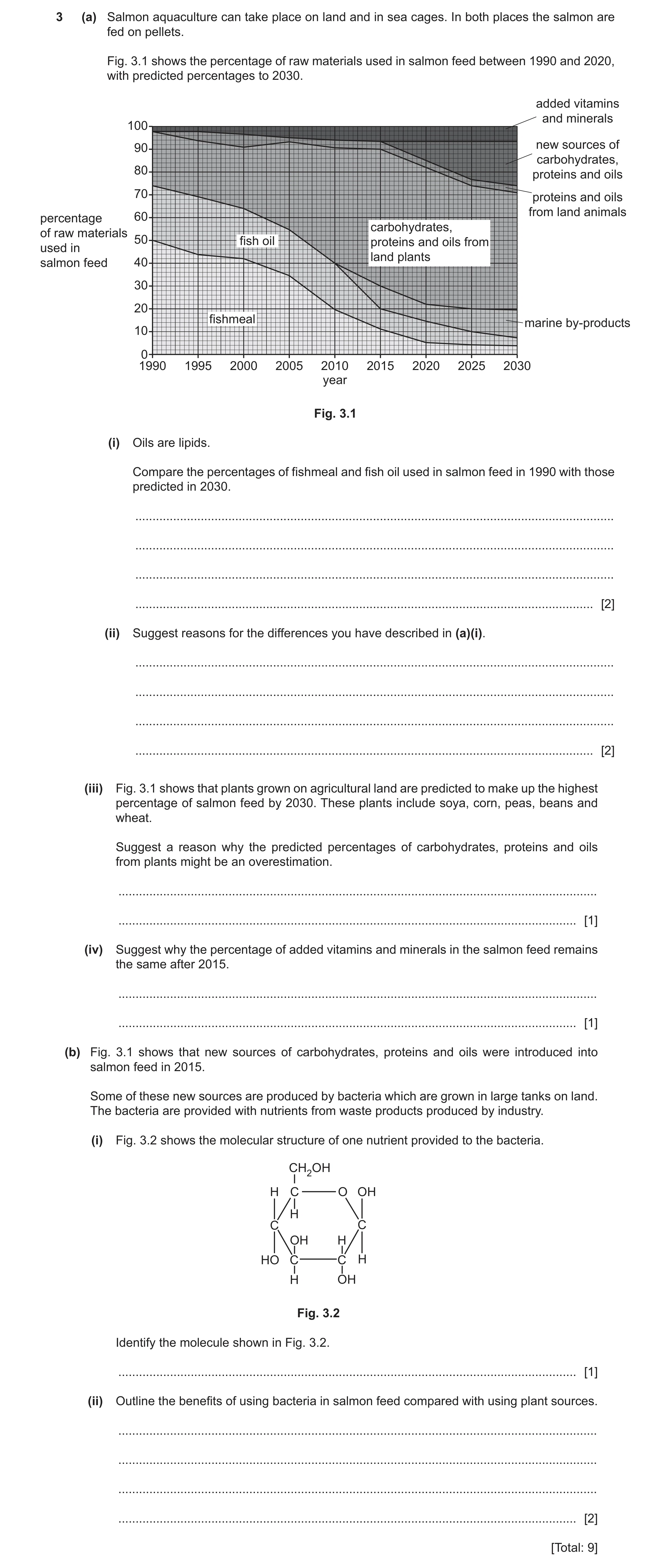
 69 / 79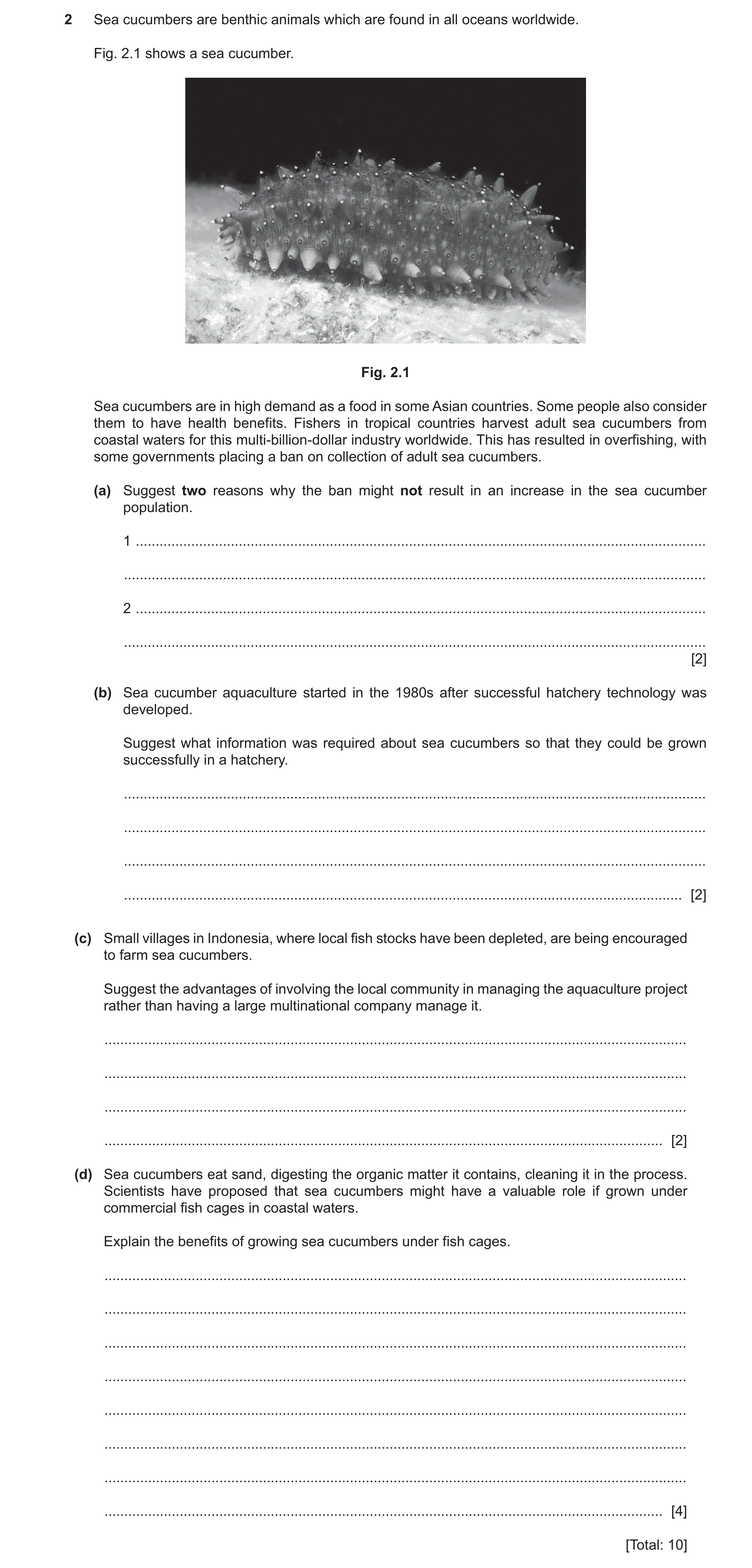
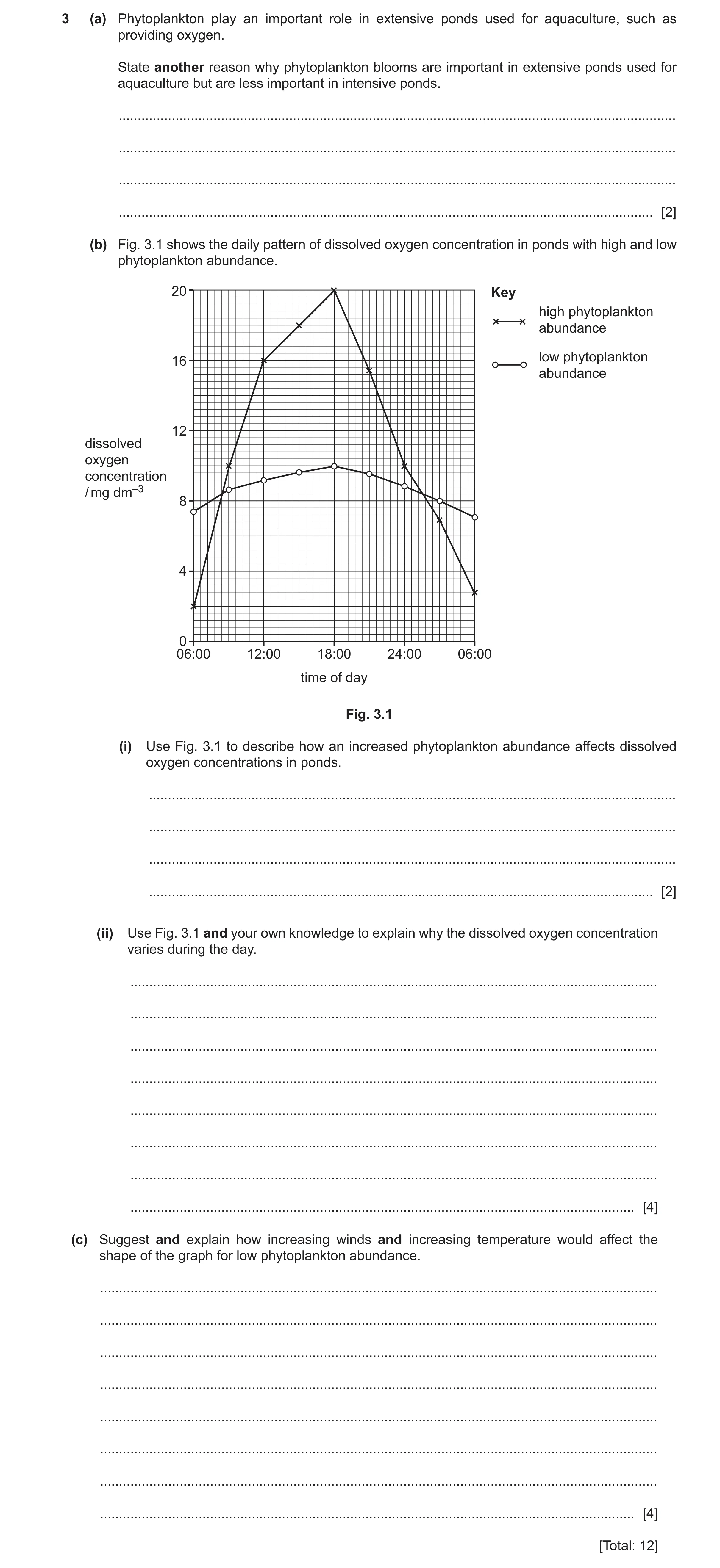
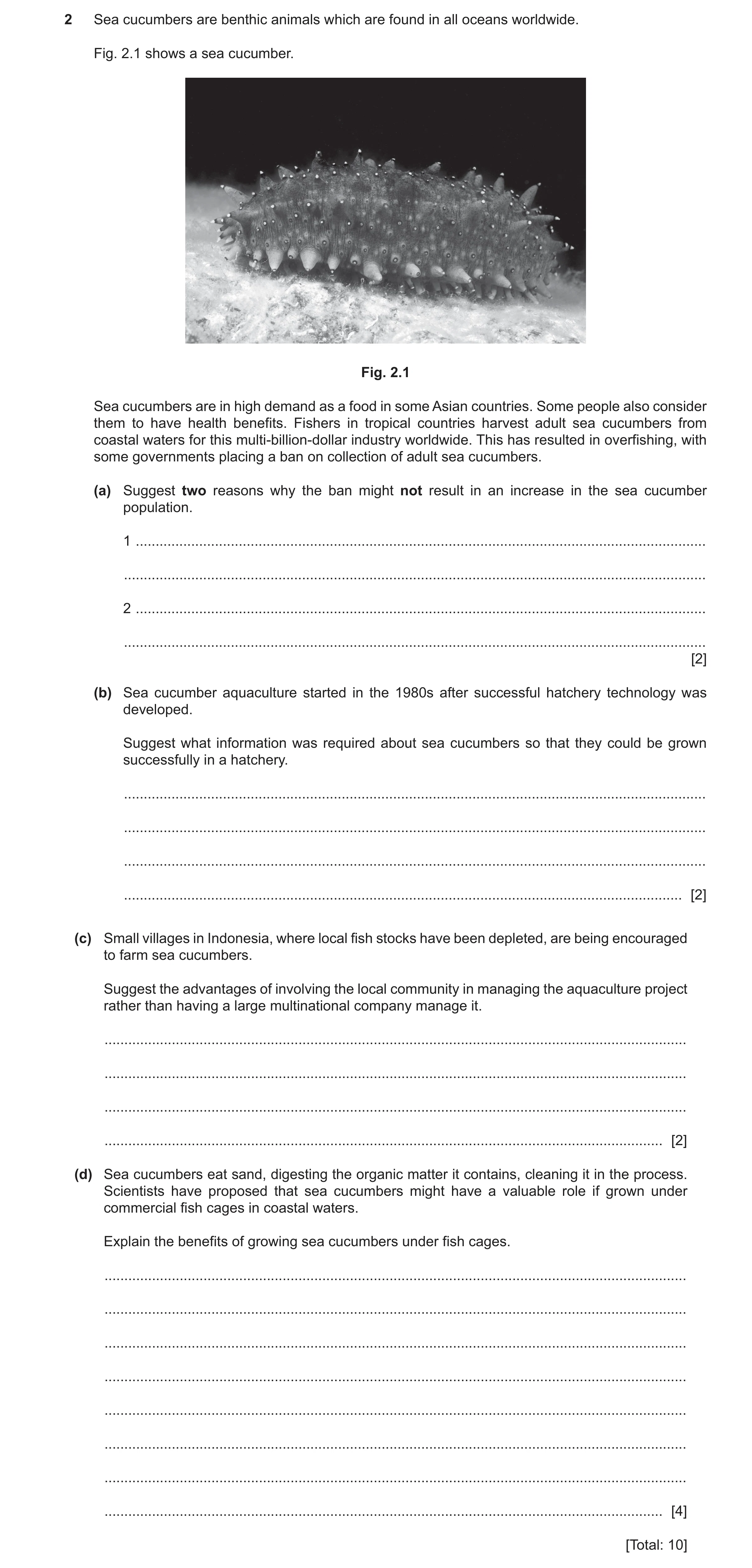
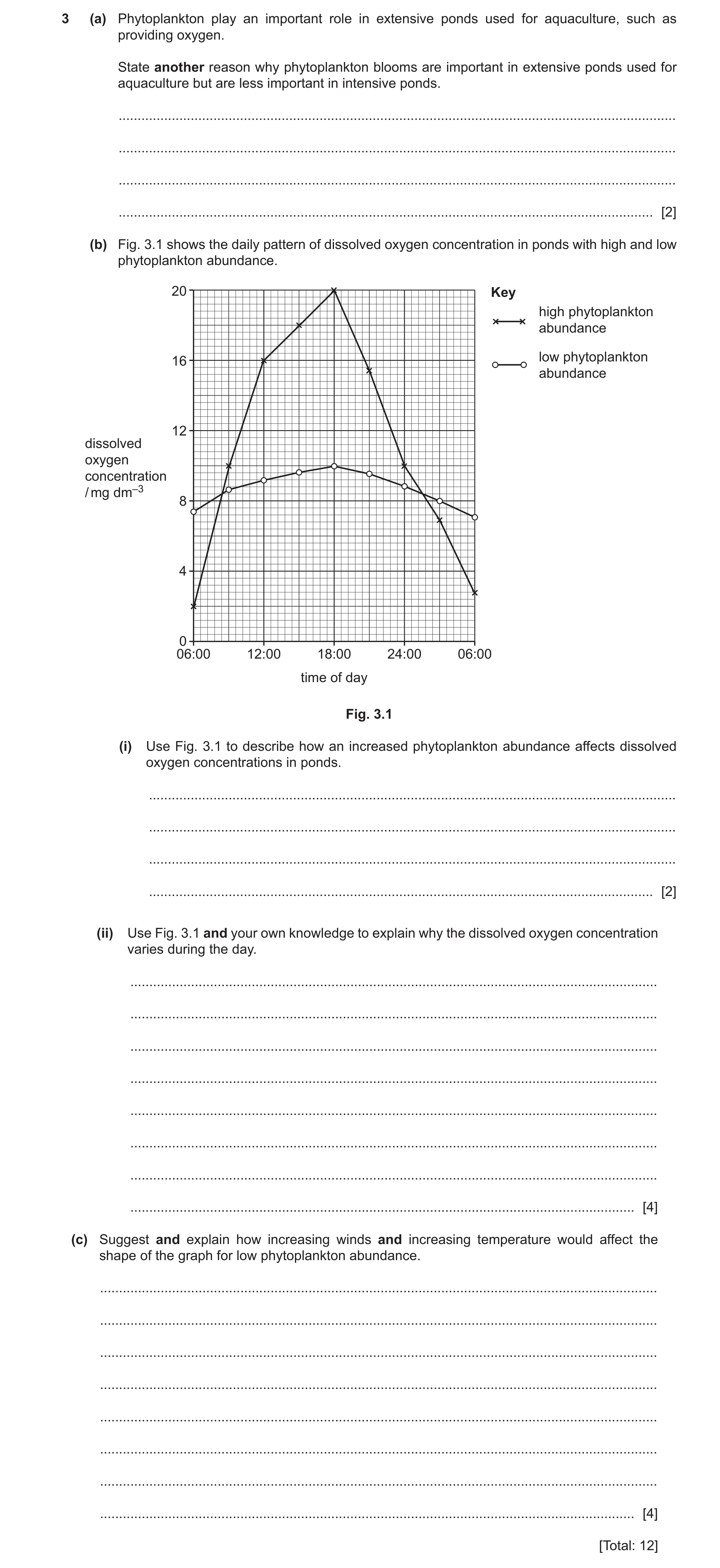
 77 / 79
 78 / 79
 79 / 79
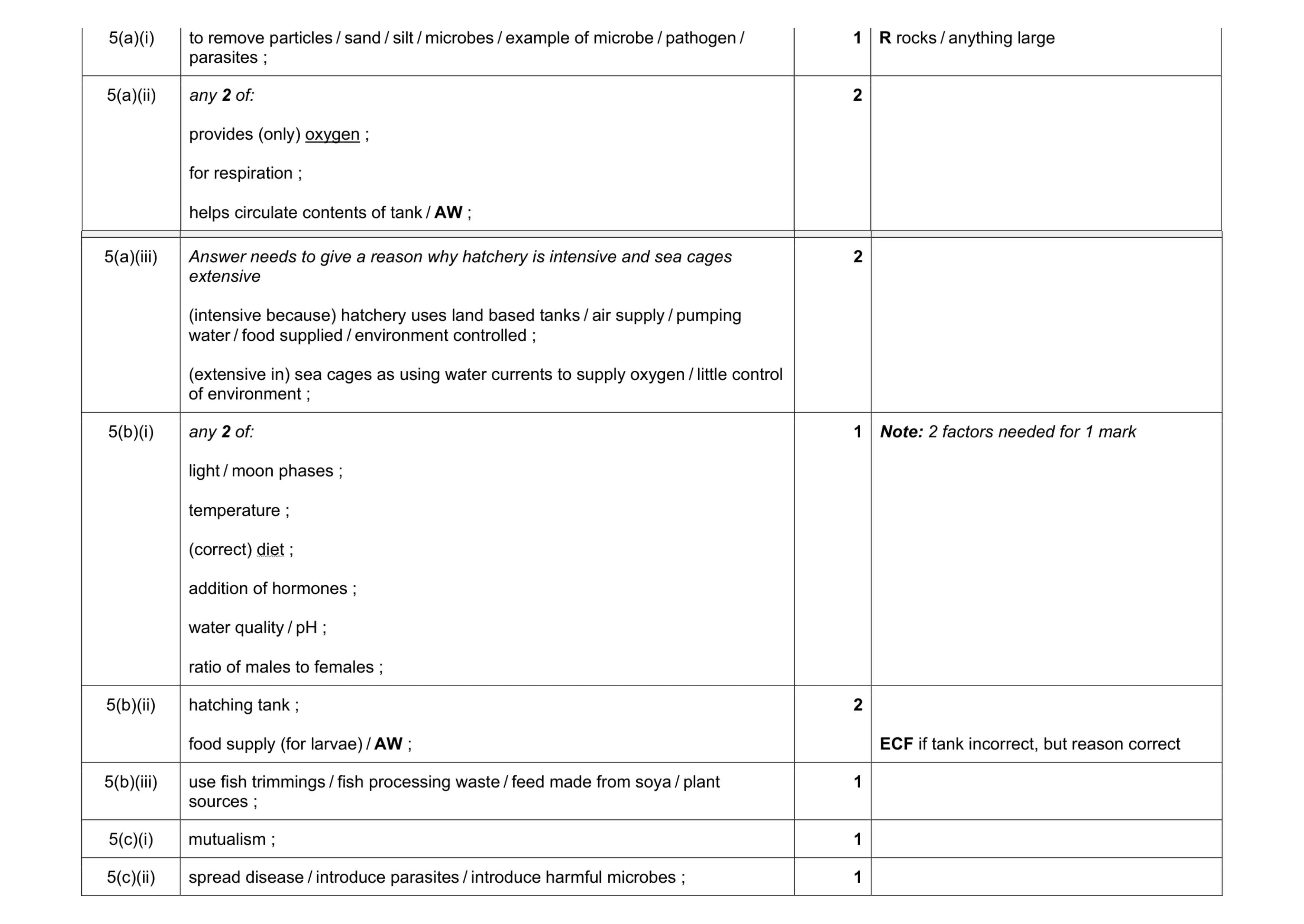 11
11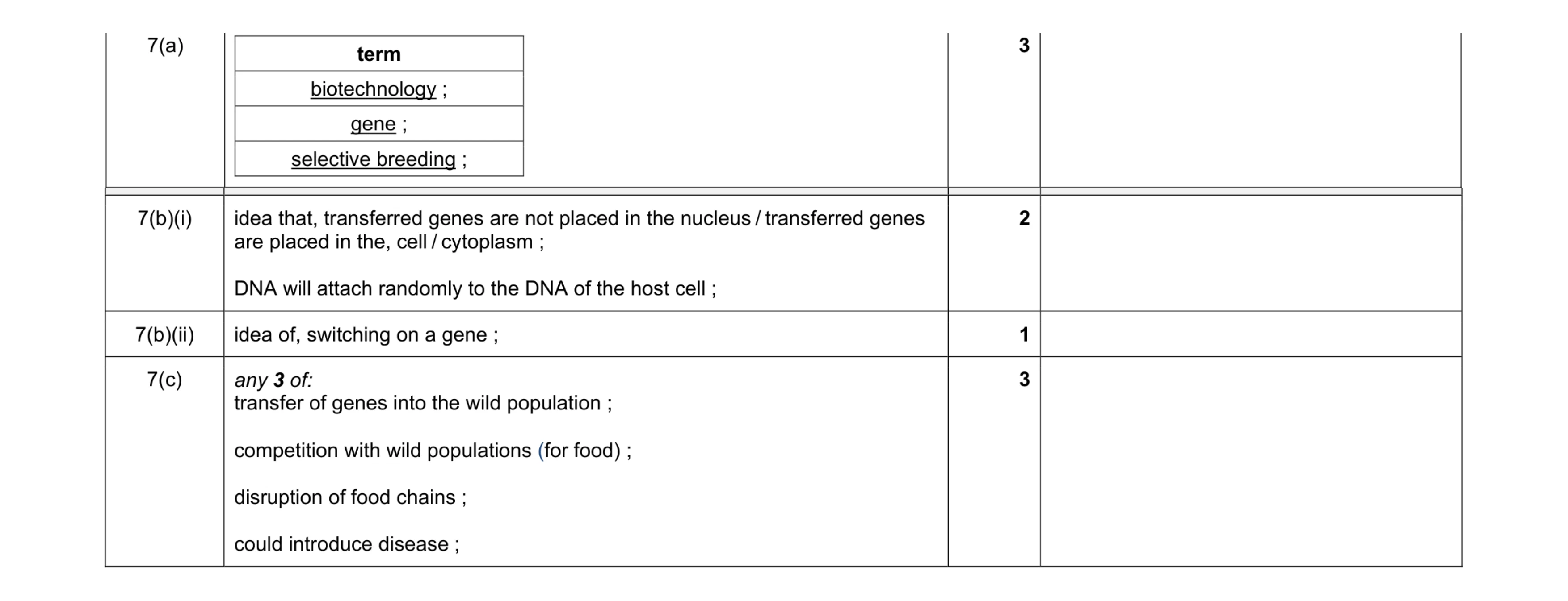 9
9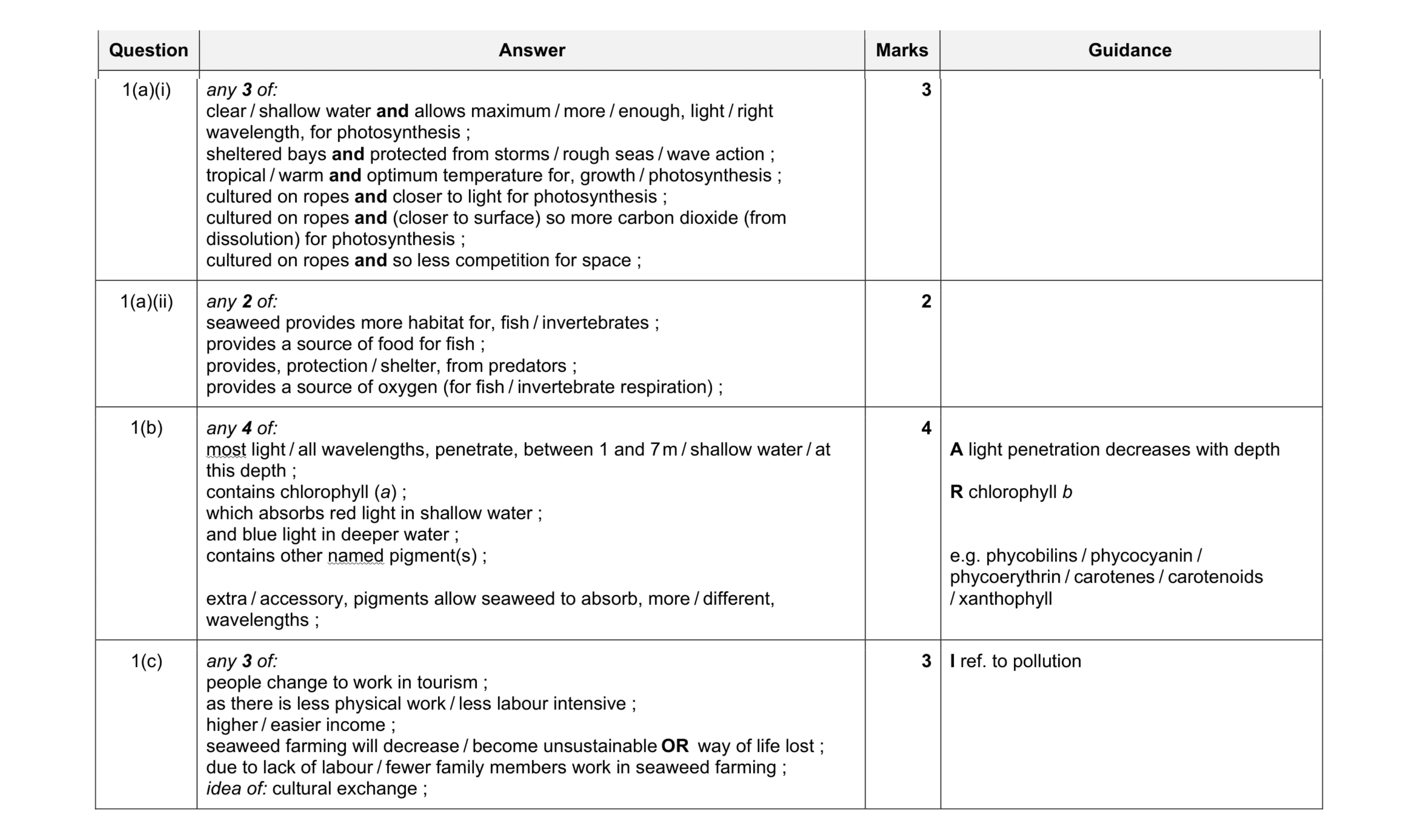 12
12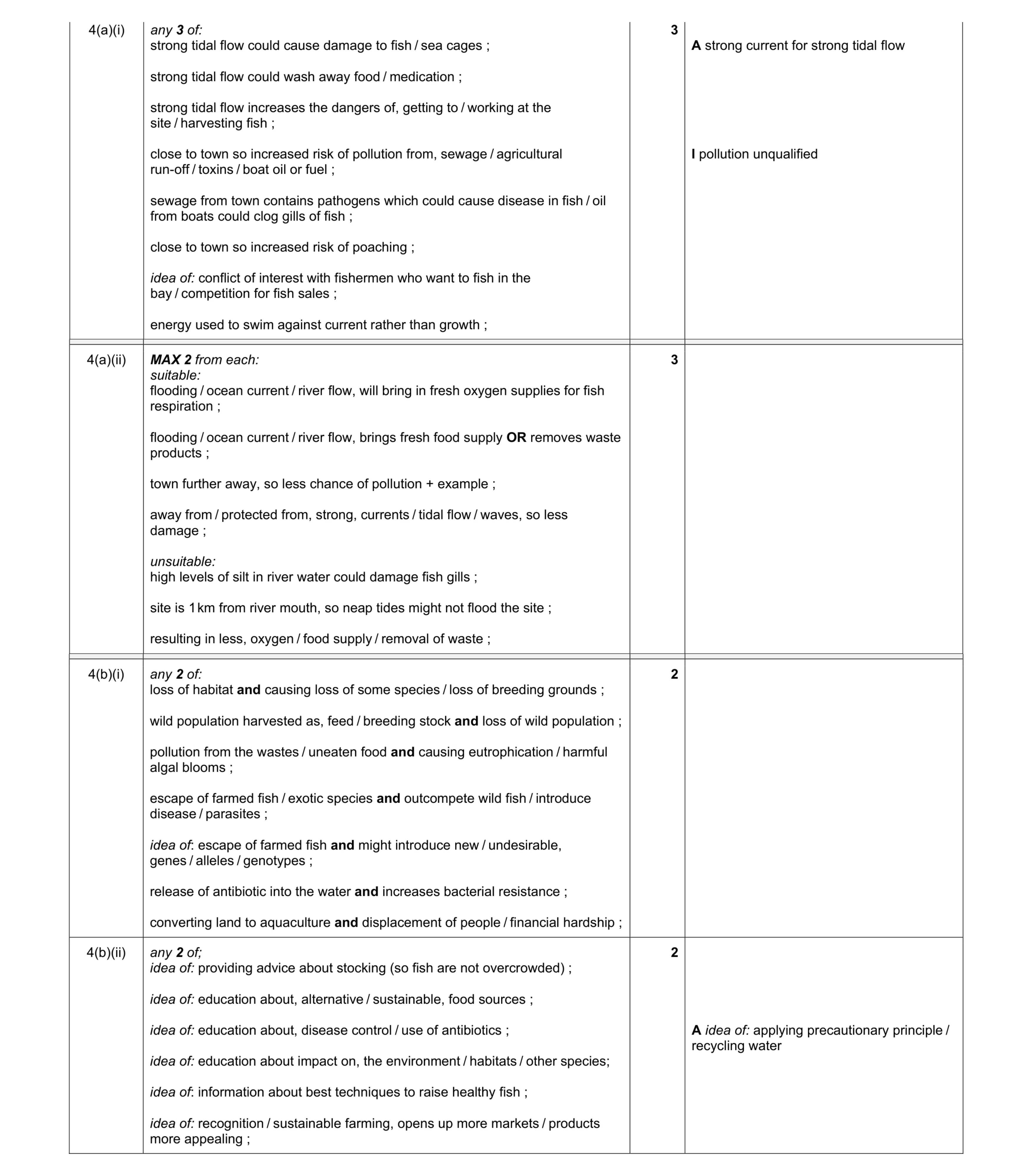 10
10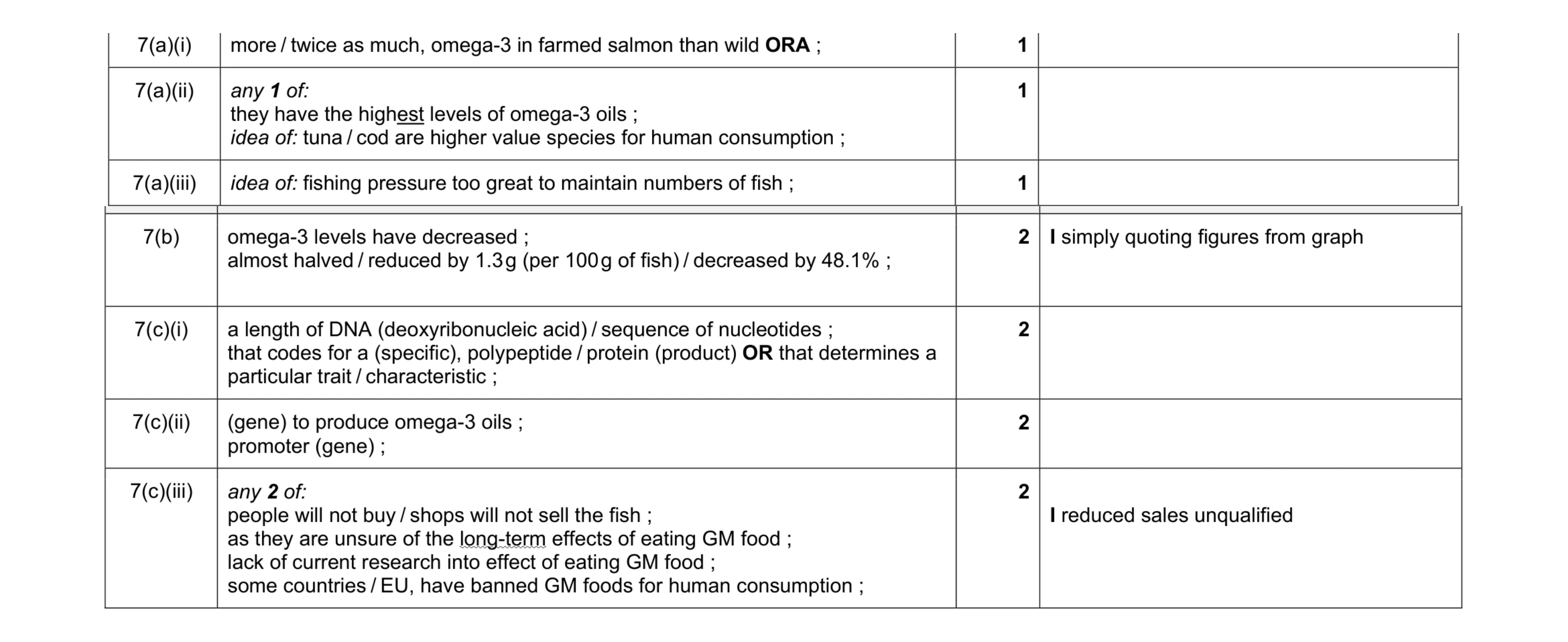 11
11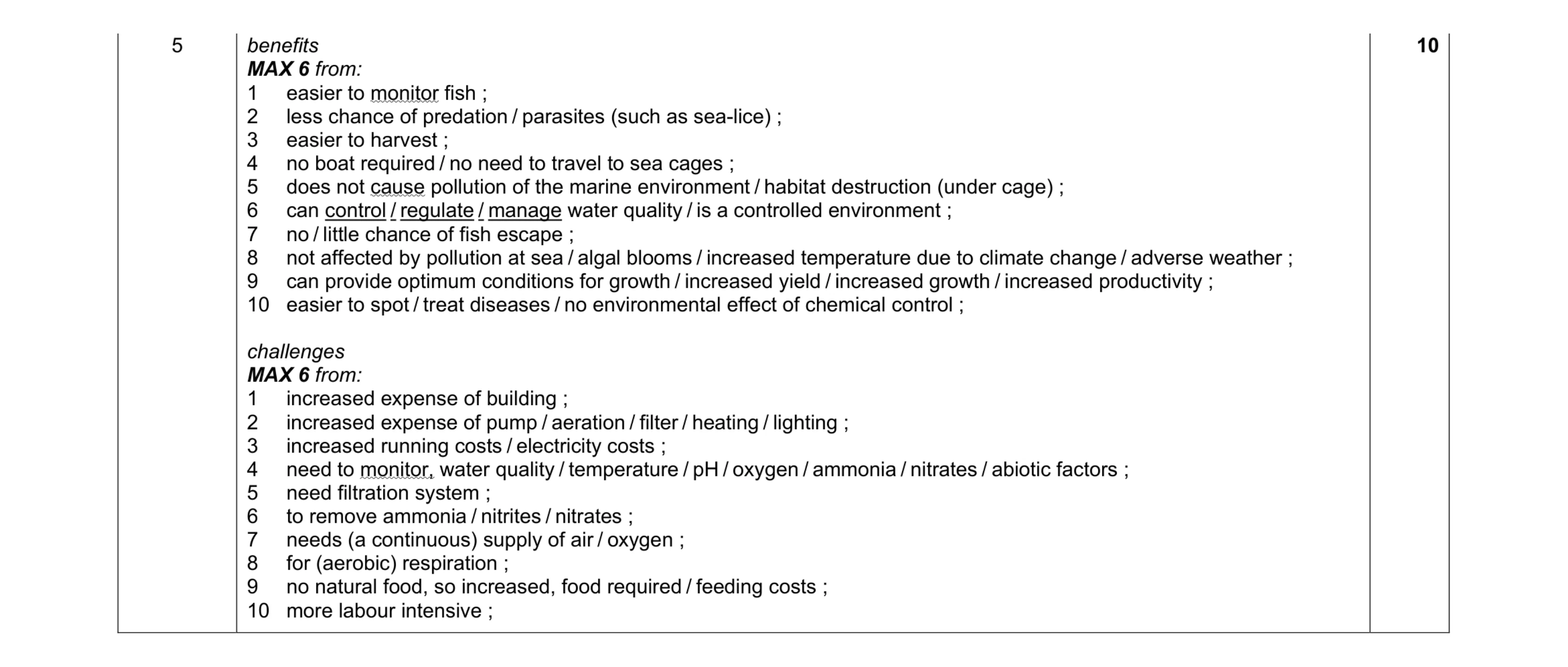 10
10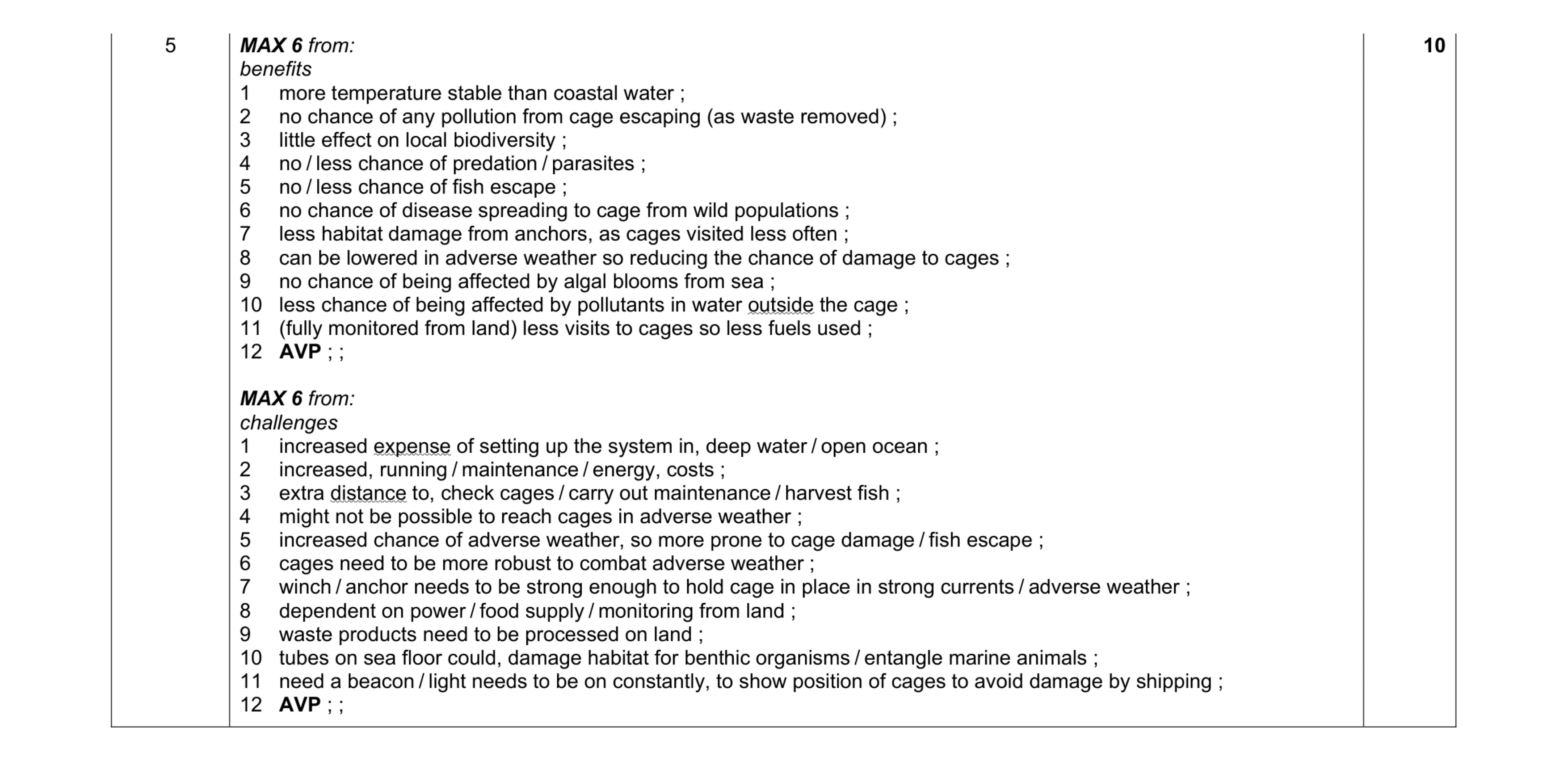 10
10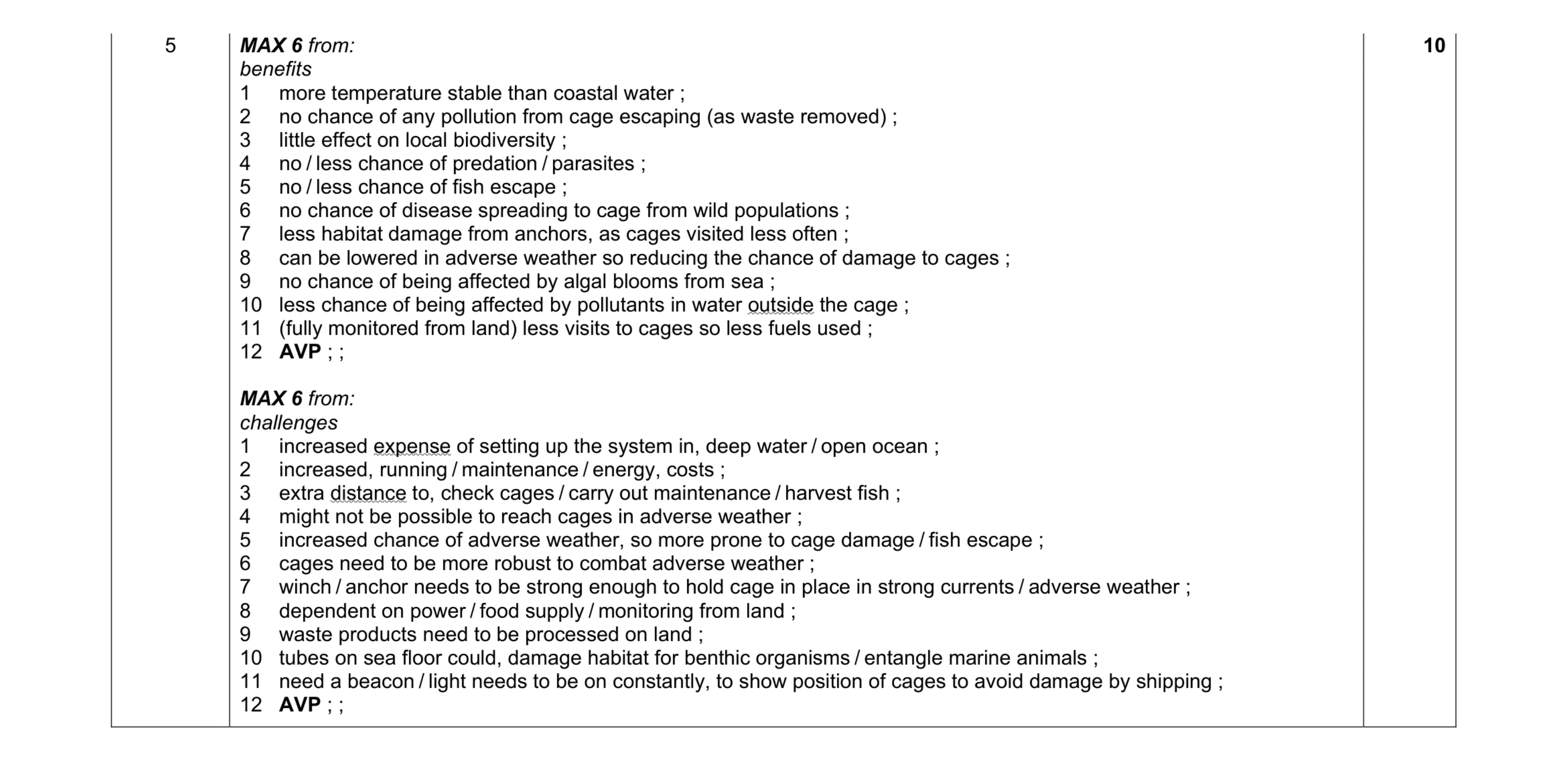 10
10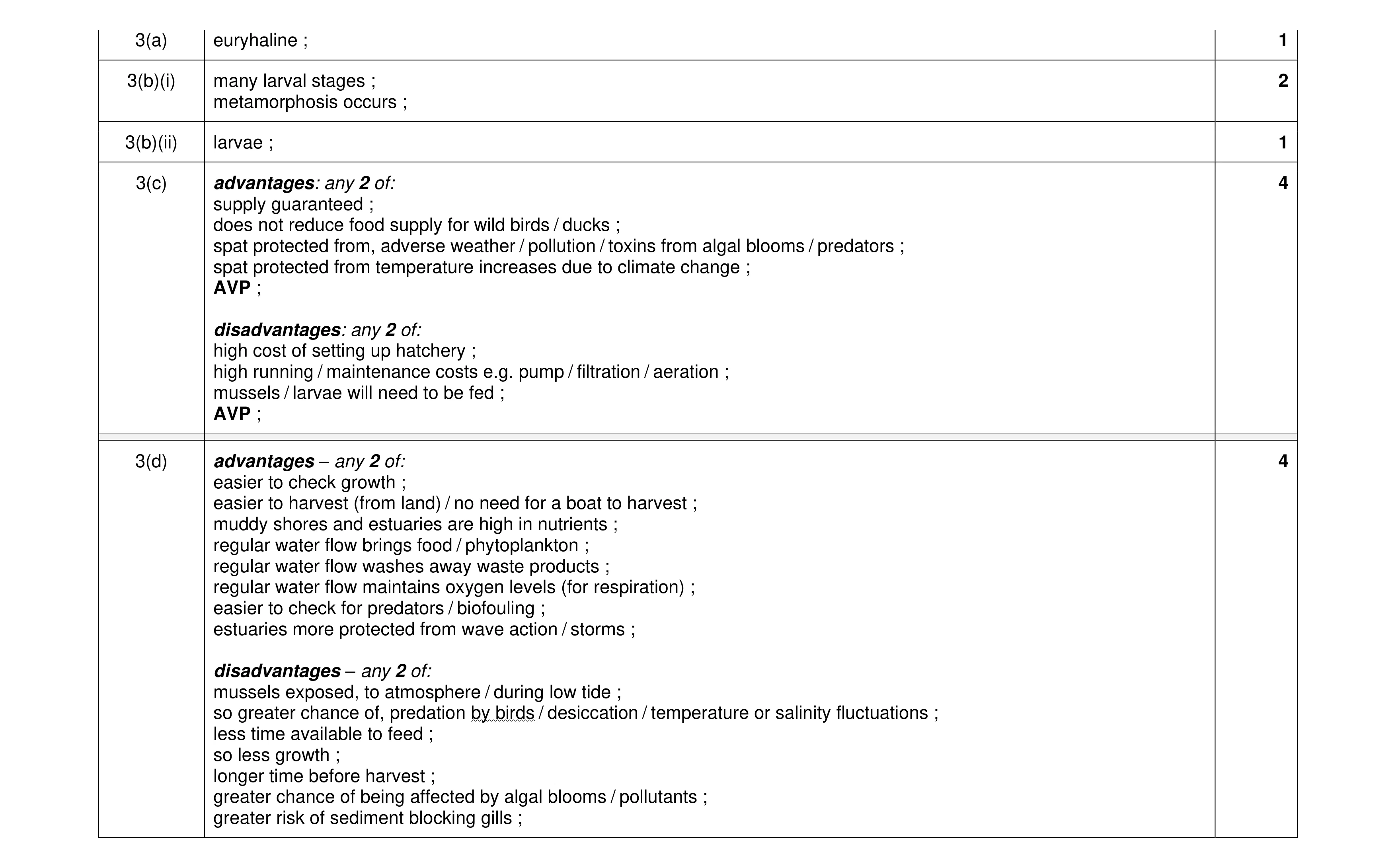 12
12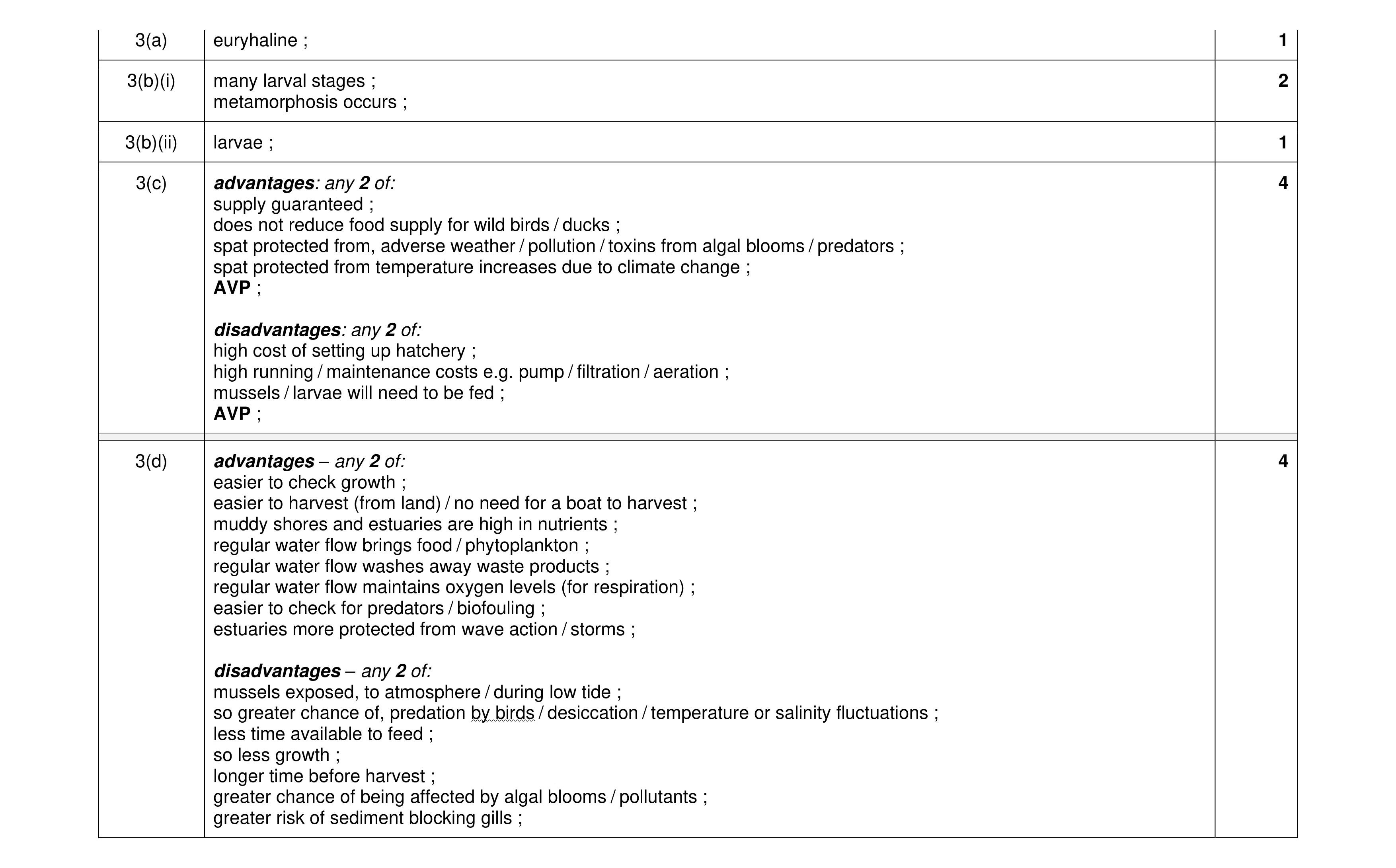 12
12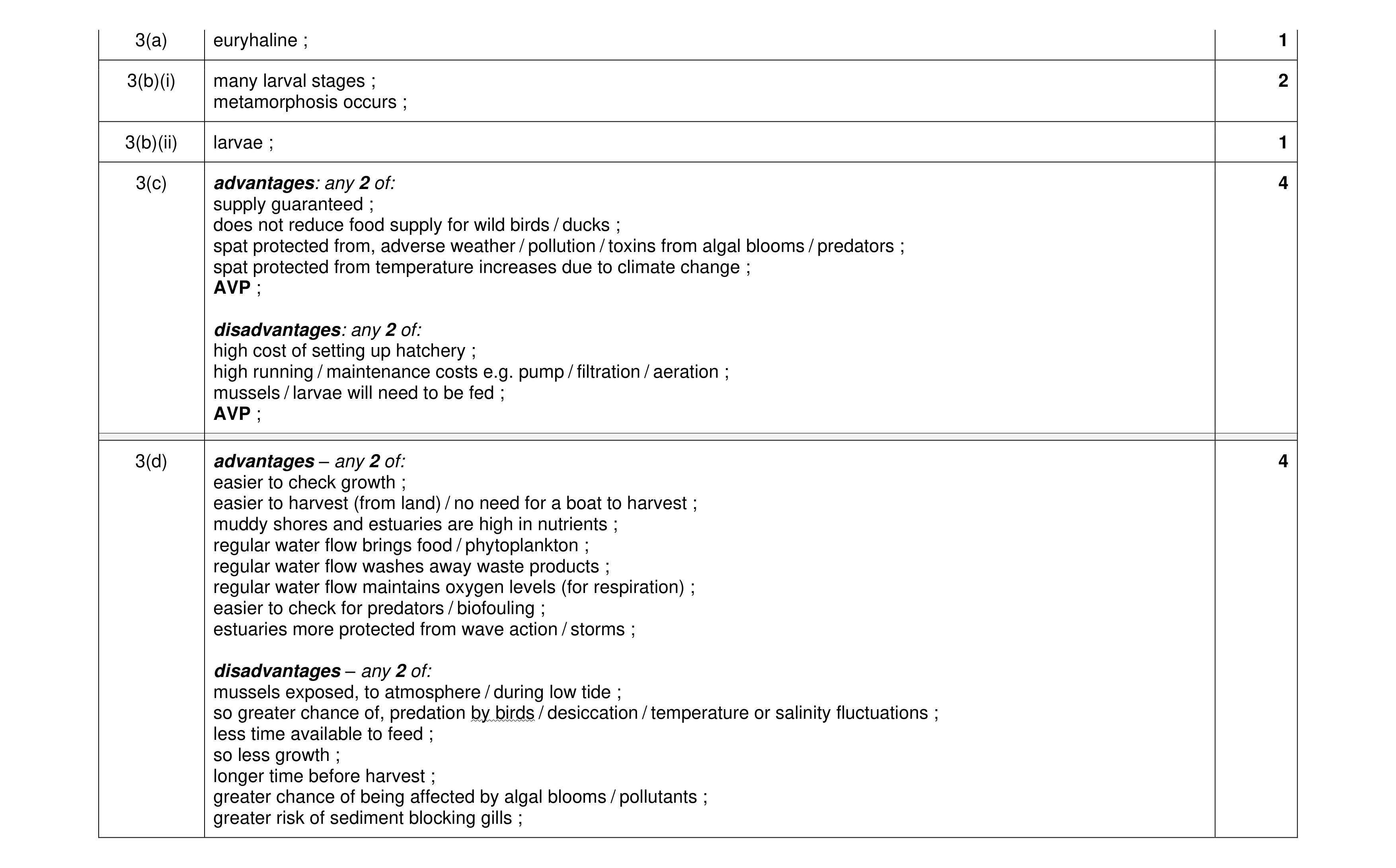 12
12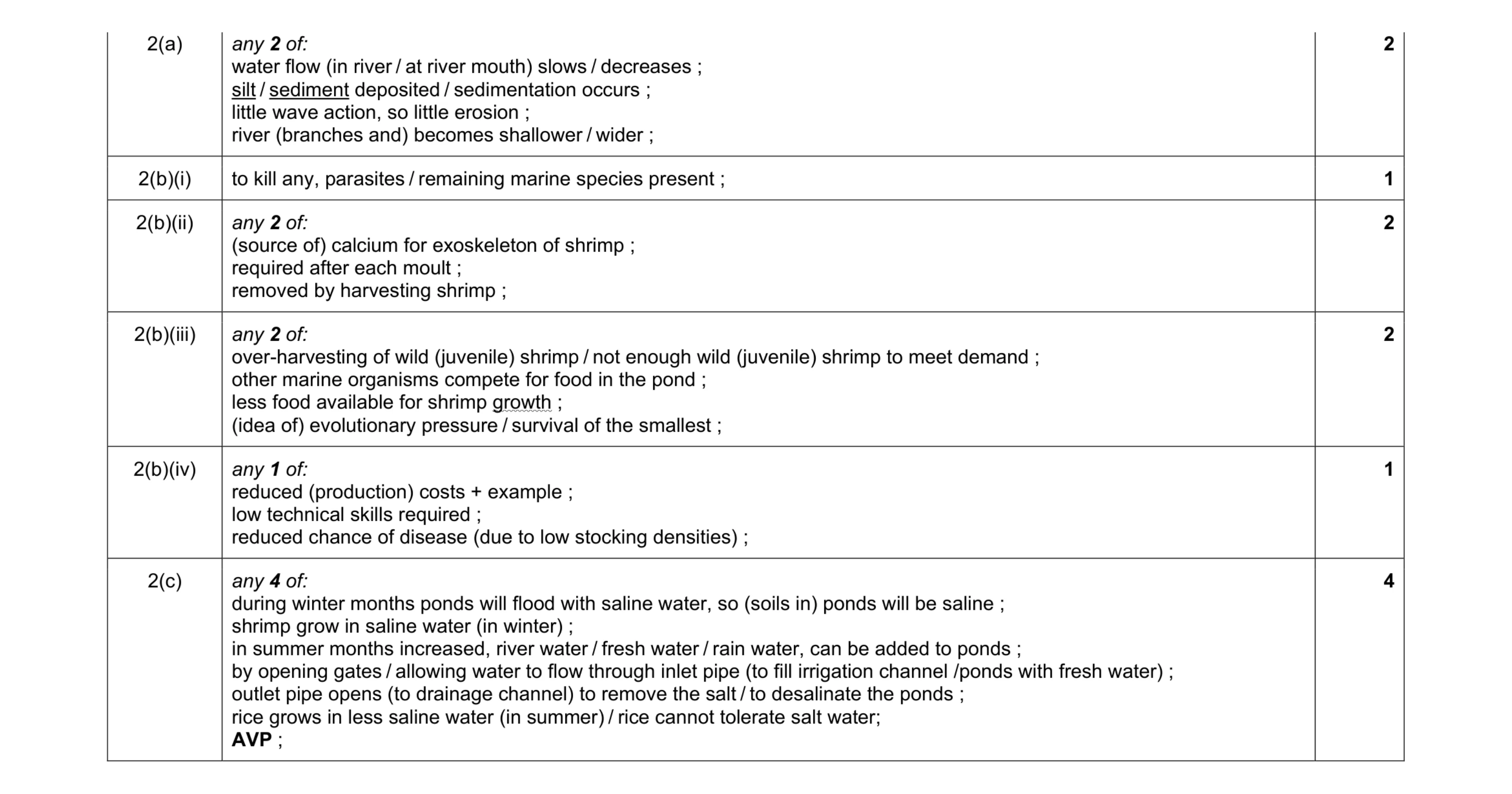 12
12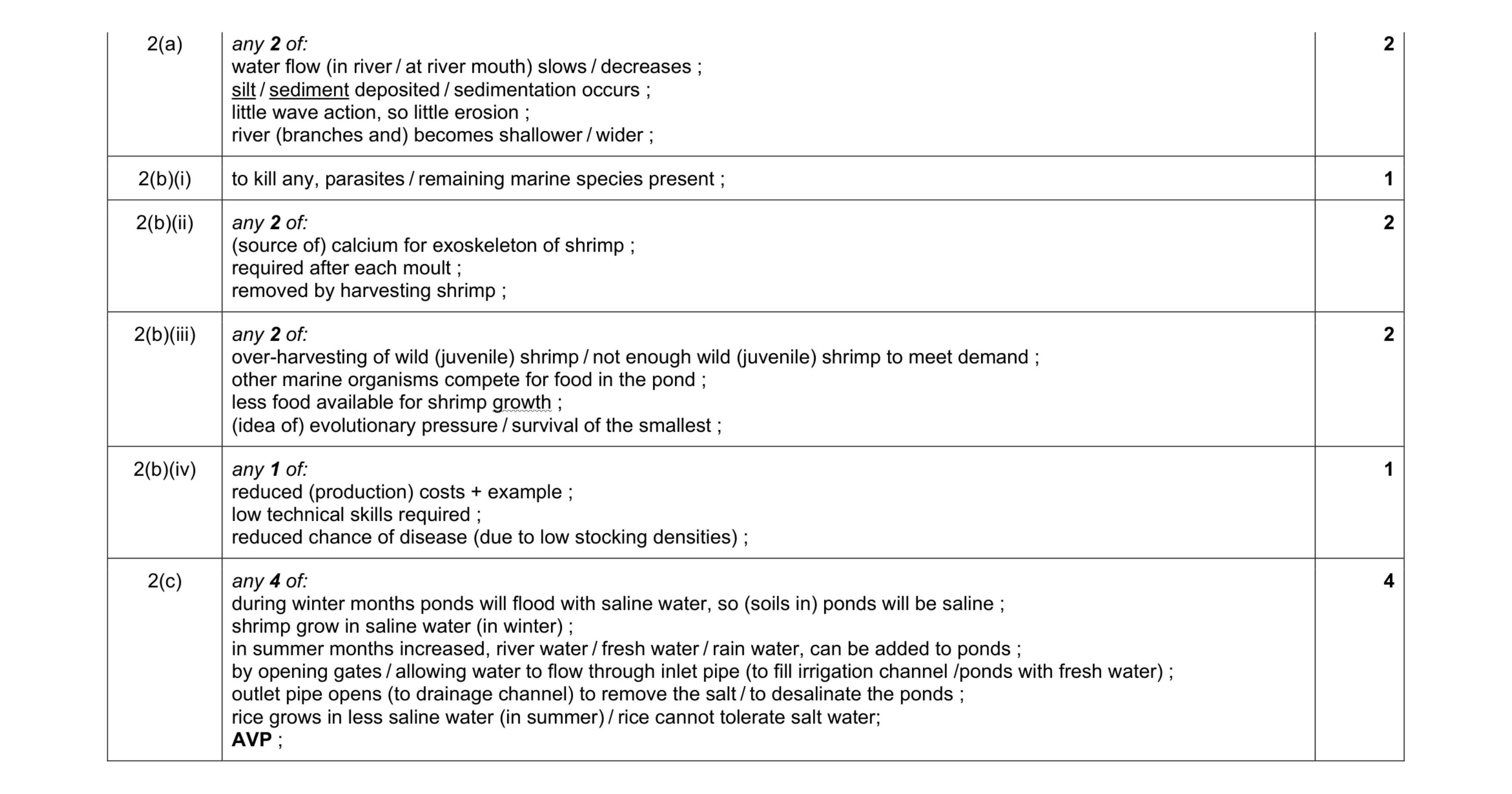 12
12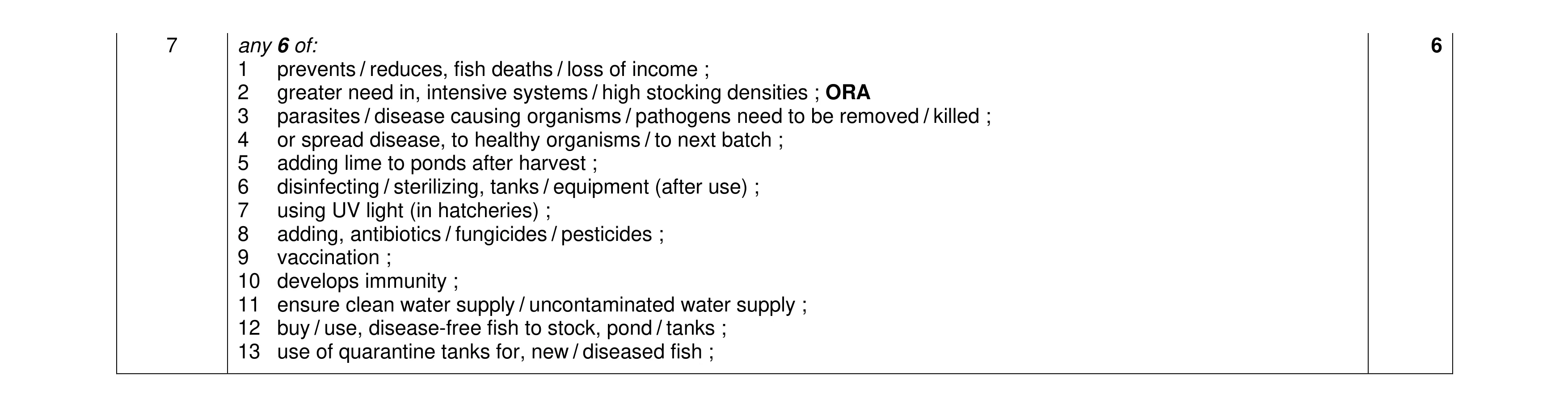 6
6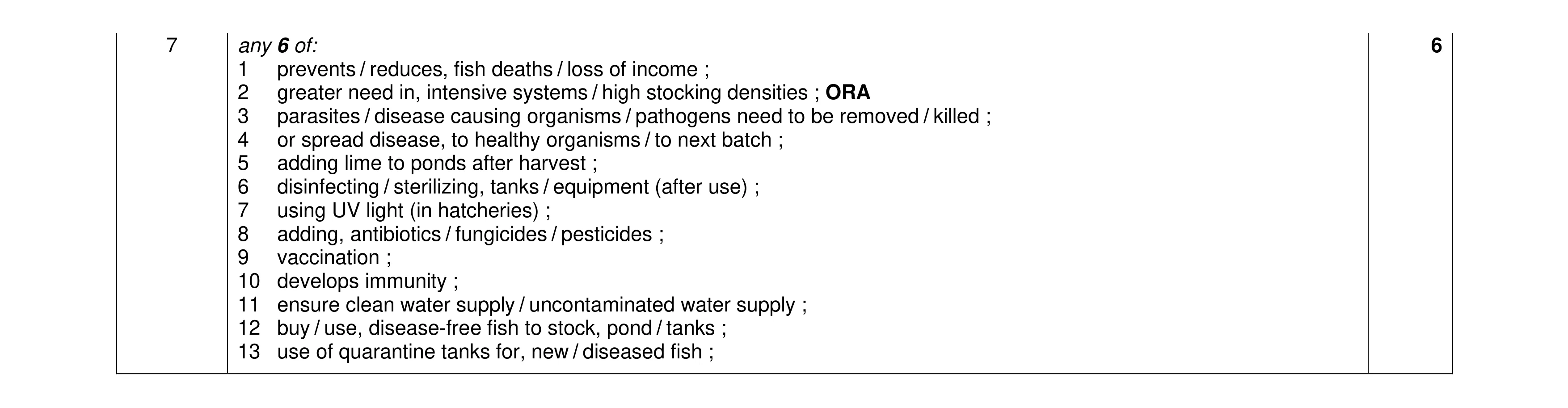 6
6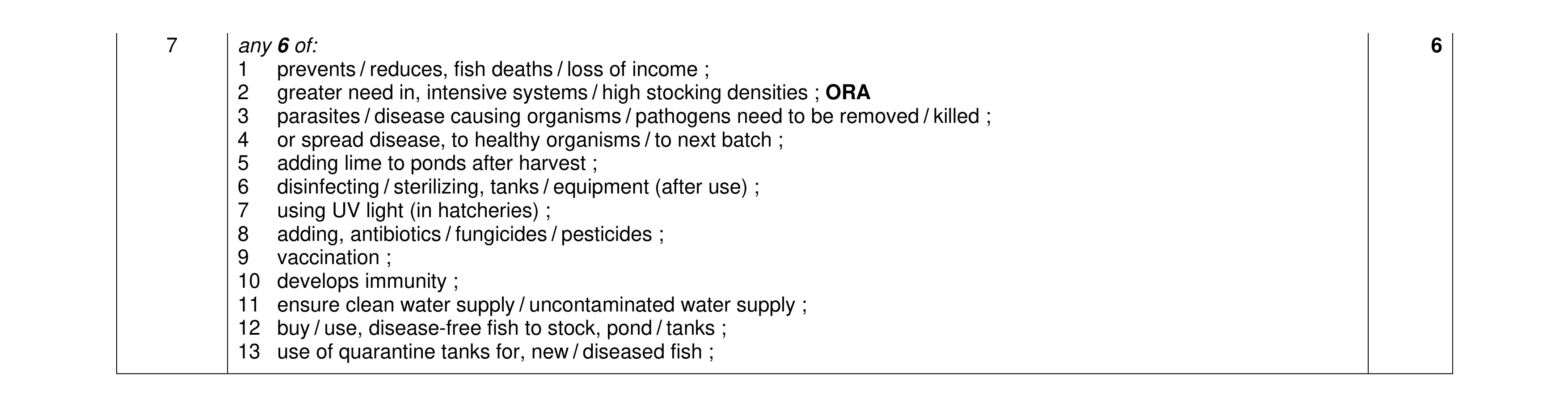 6
6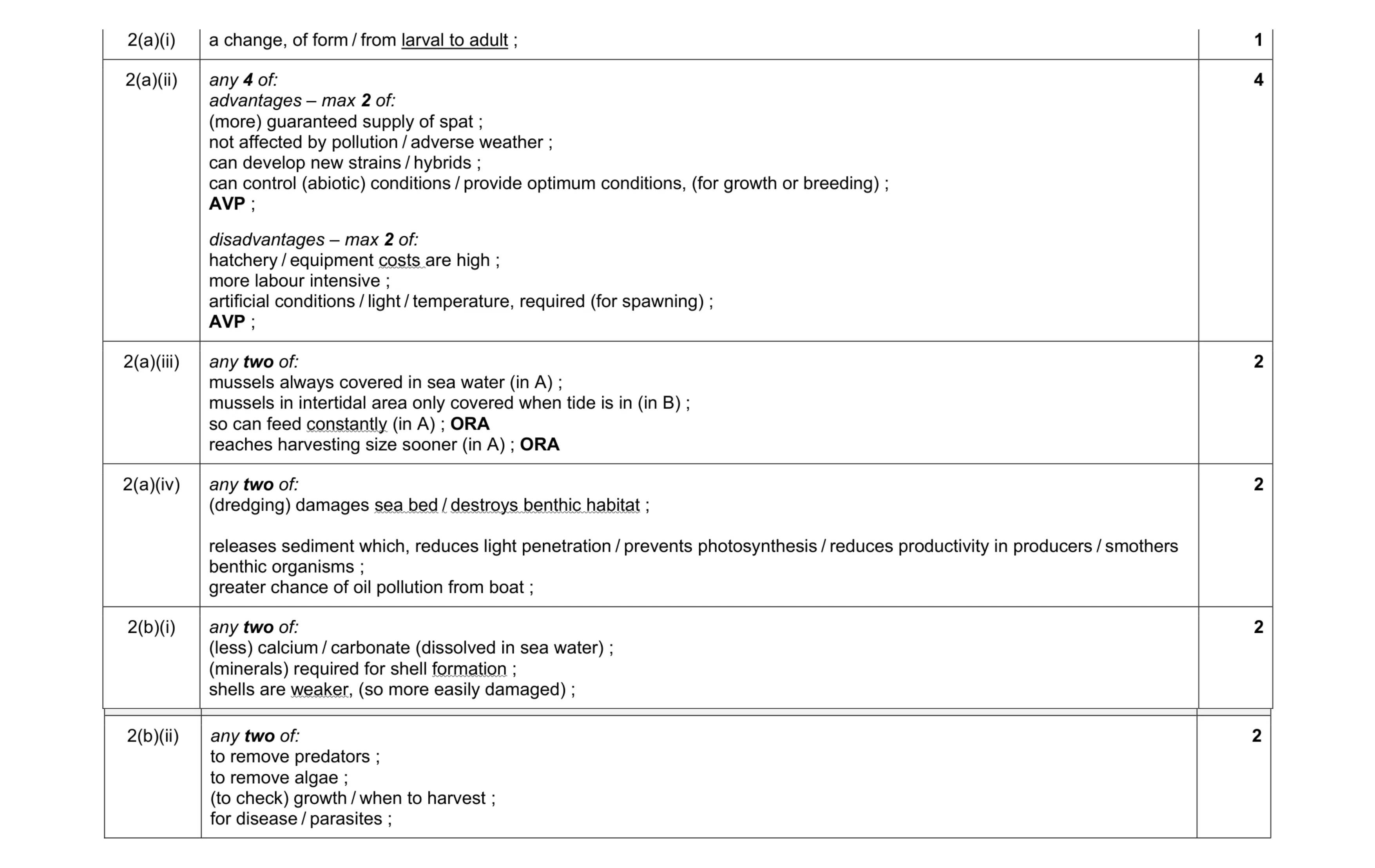 13
13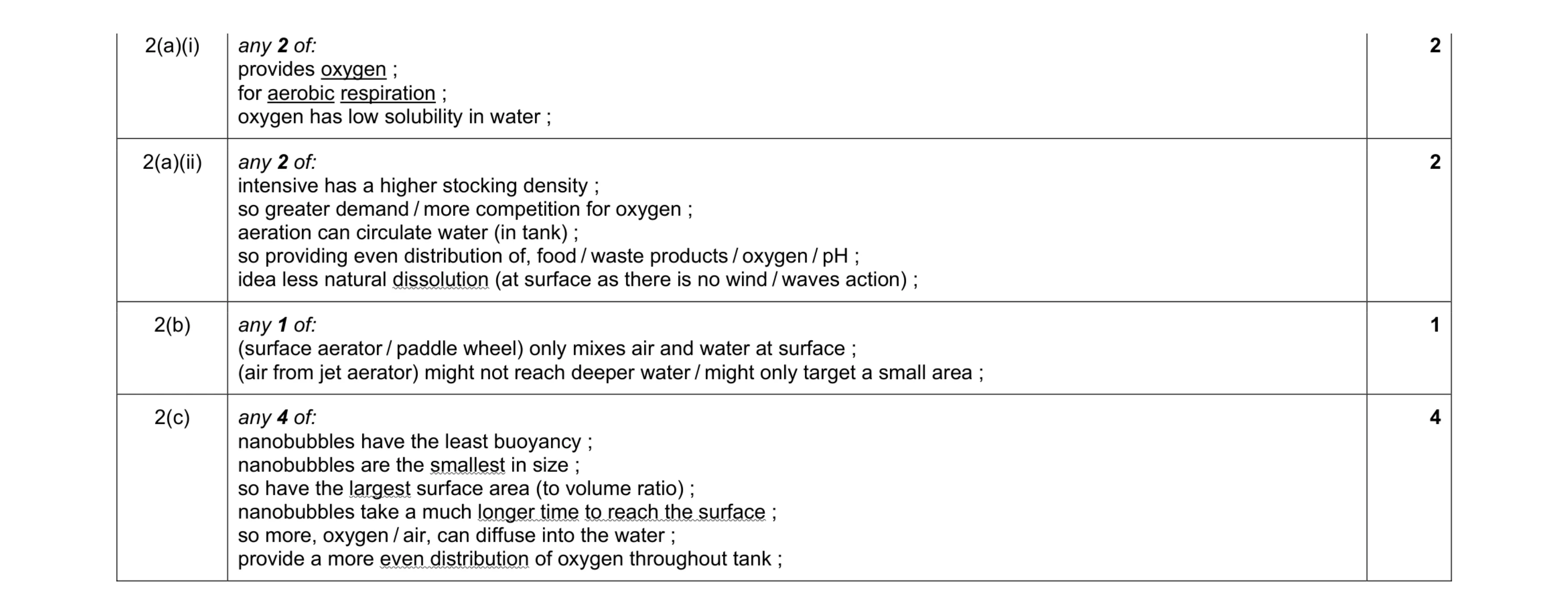 9
9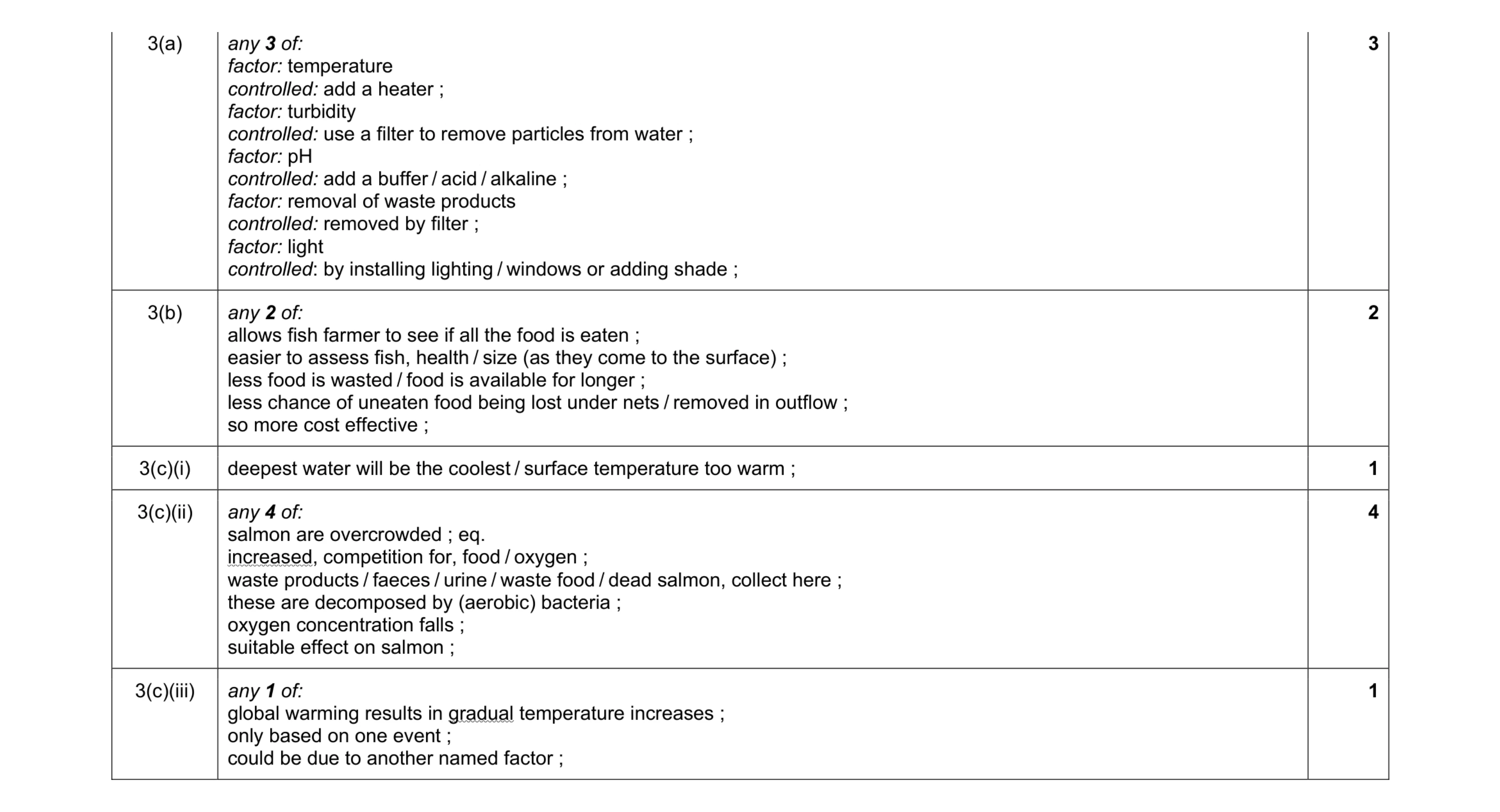 11
11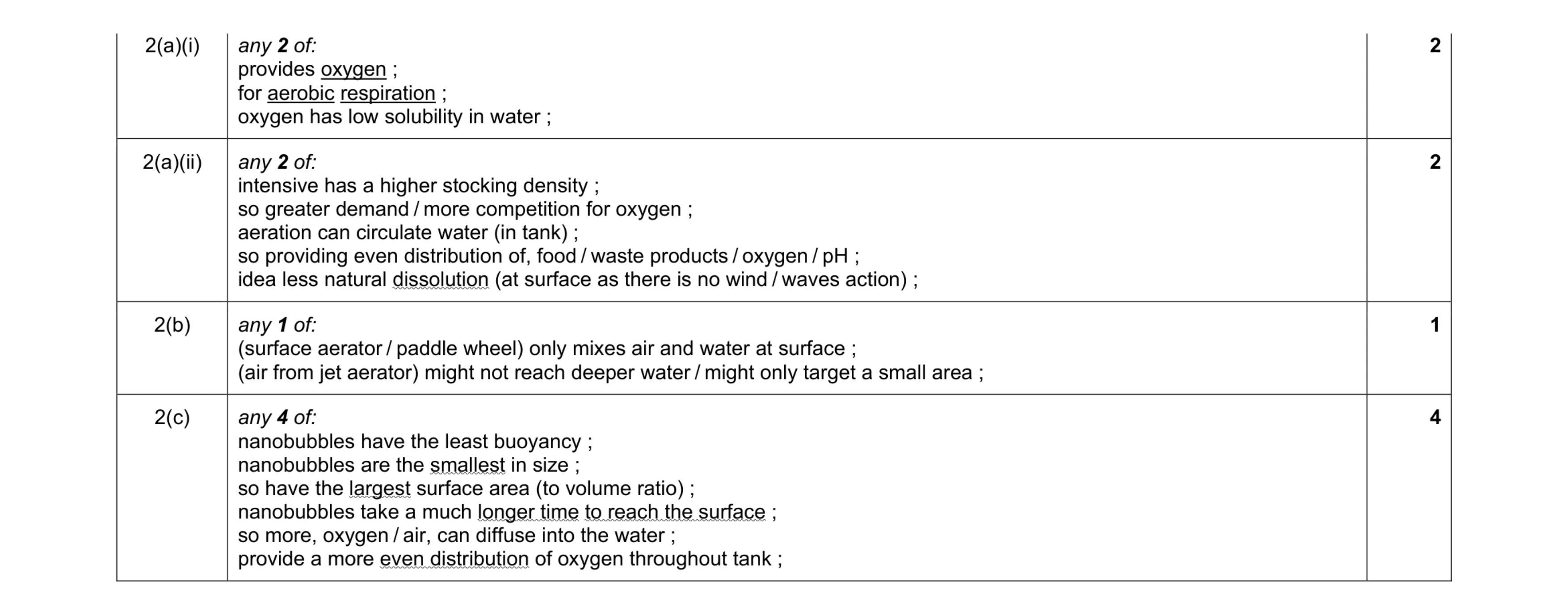 9
9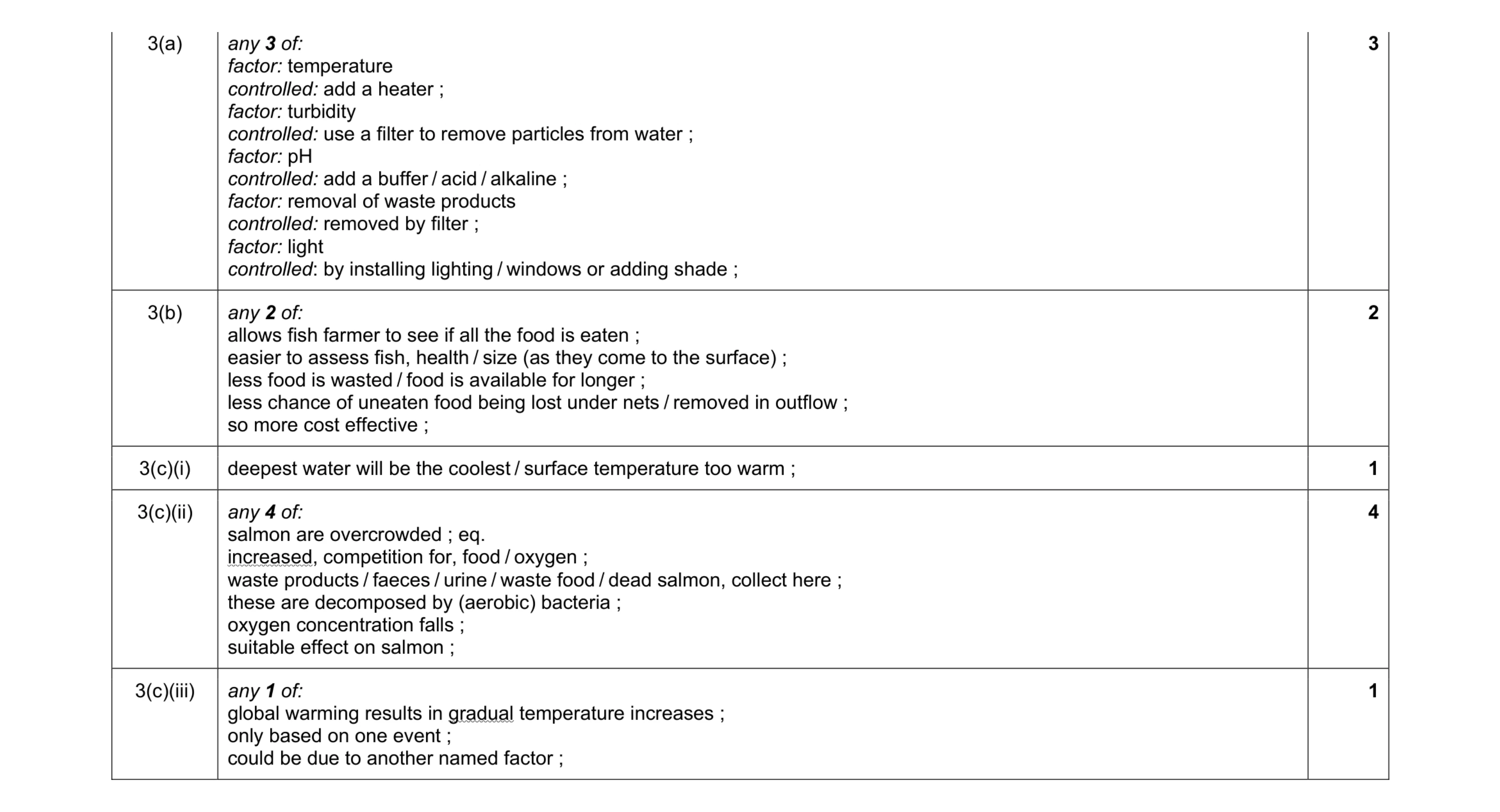 11
11 12
12 12
12 12
12 9
9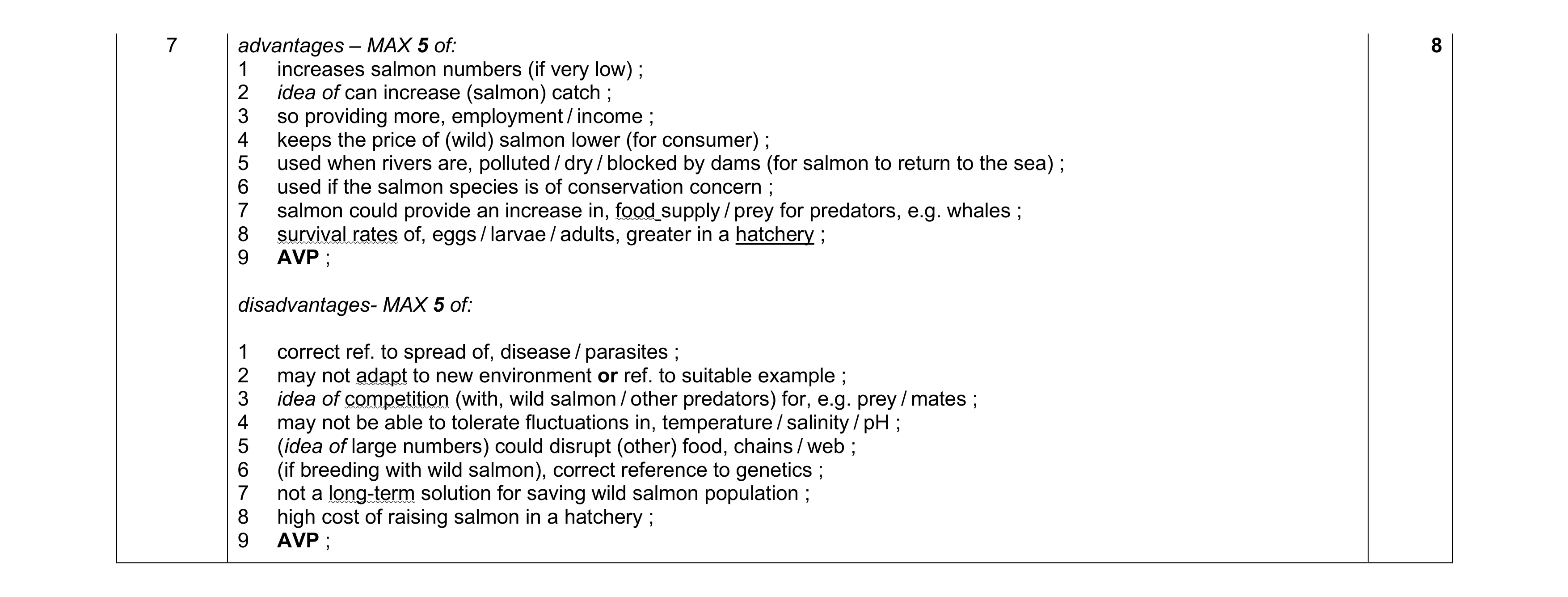 8
8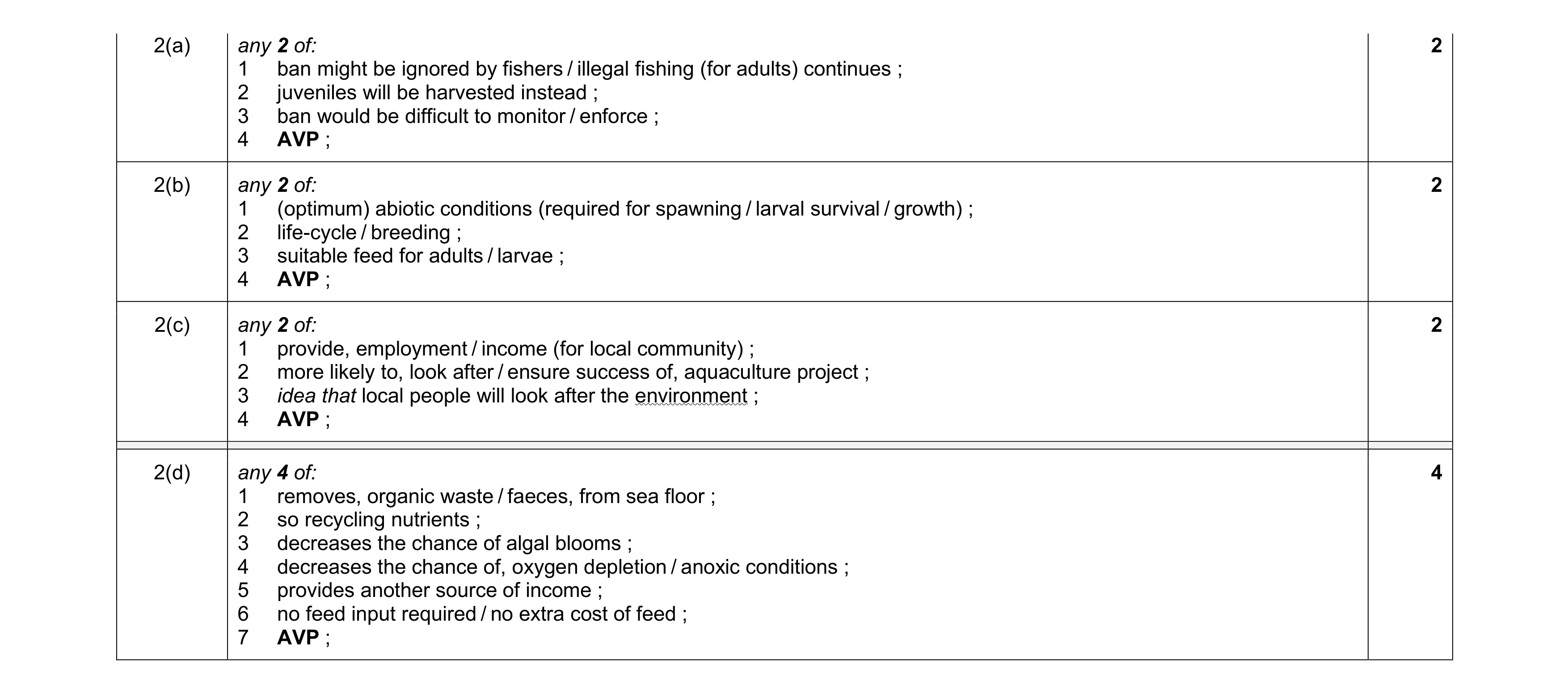 10
10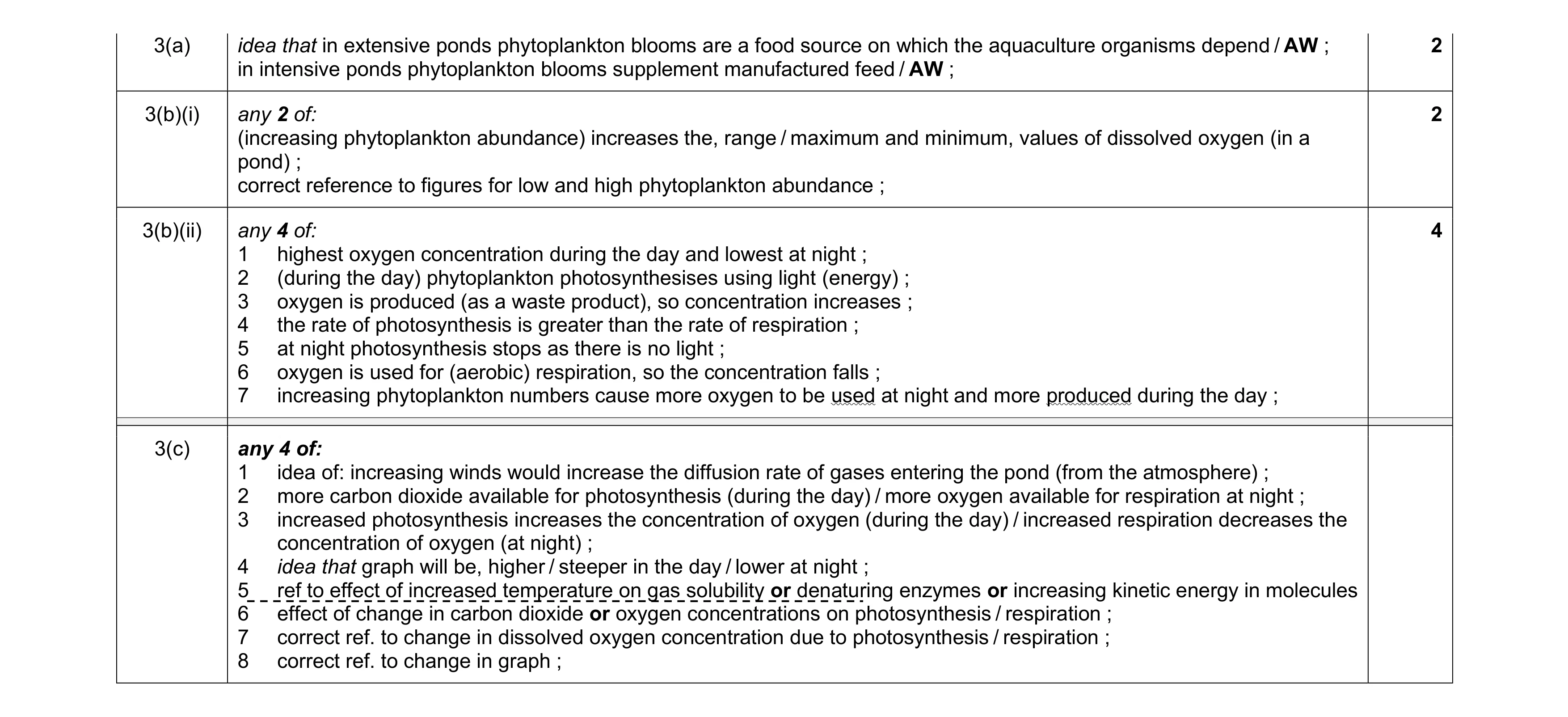 12
12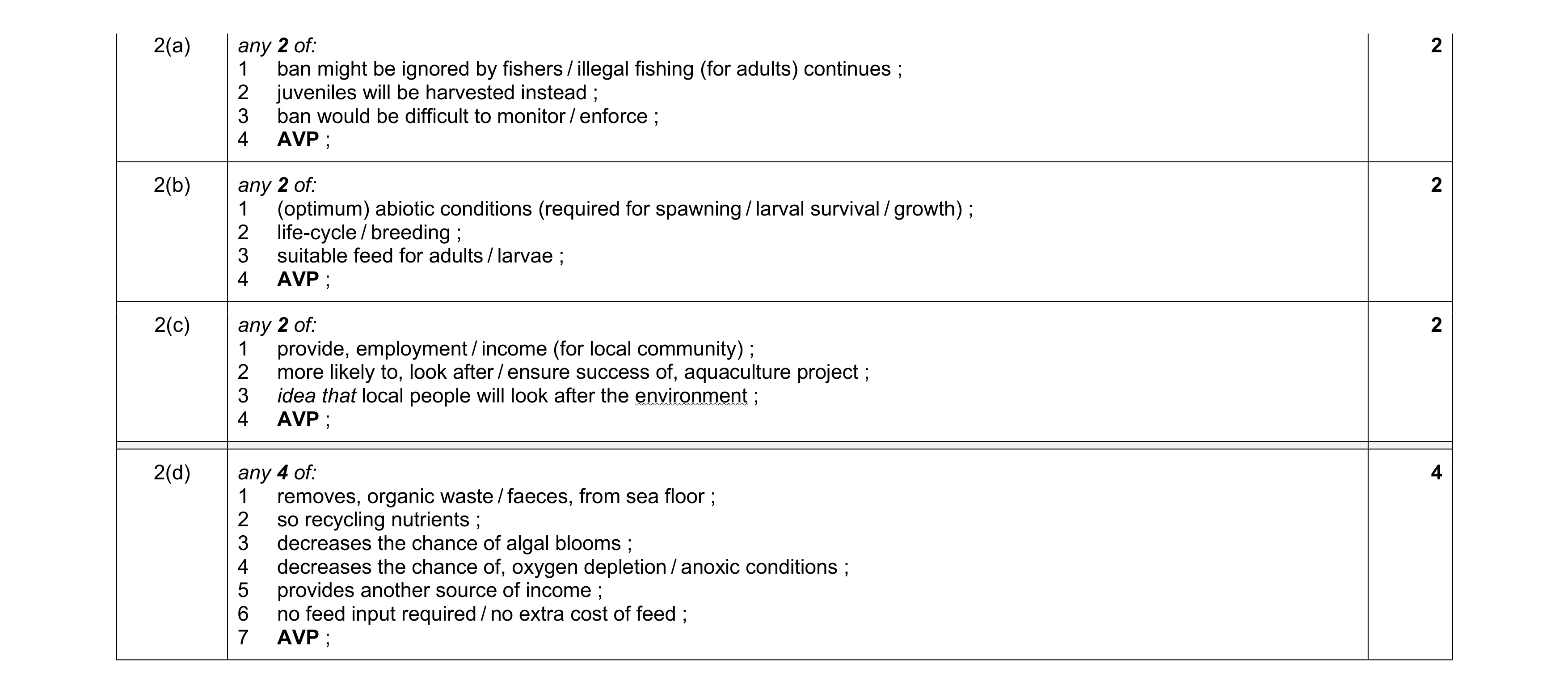 10
10 12
12 10
10 10
10 10
10