Questions as text
Q1 · Which element is expected to show the greatest tendency to form some covalent compounds? 9701/11 May/June 2008
14 Which element is expected to show the greatest tendency to form some covalent compounds? A aluminium B calcium C magnesium D sodium
1 marks
Answer: A
This question in 9701/11 May/June 2008
Q2 · The ability of an atom in a covalent bond to attract electrons to itself is called its… 9701/12 Oct/Nov 2010
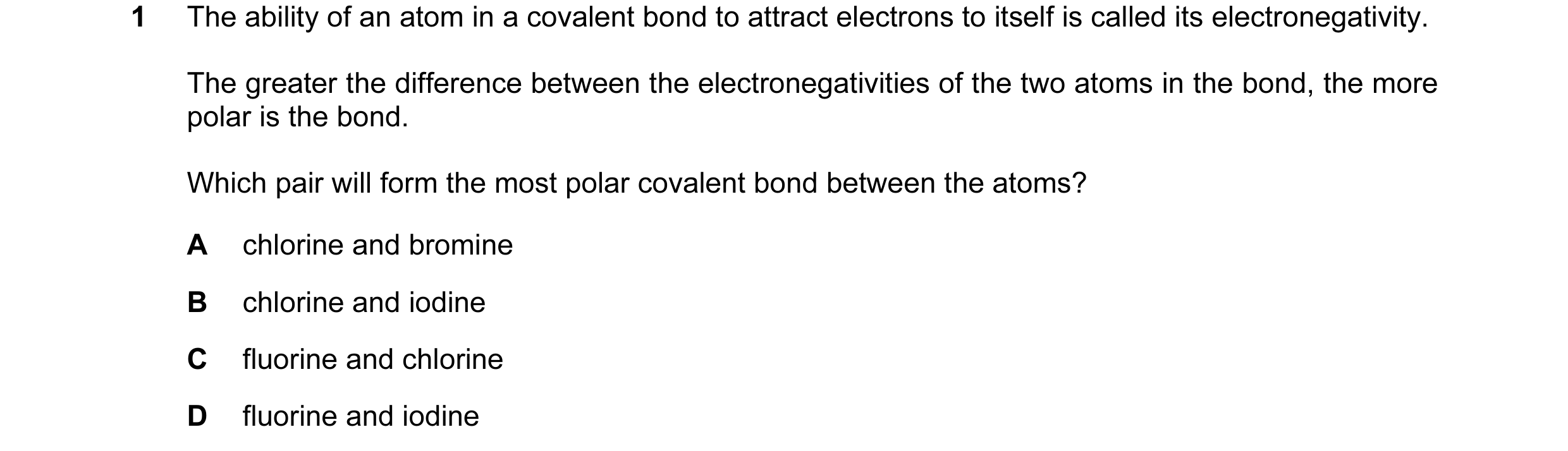
1 The ability of an atom in a covalent bond to attract electrons to itself is called its electronegativity. The greater the difference between the electronegativities of the two atoms in the bond, the more polar is the bond. Which pair will form the most polar covalent bond between the atoms? A chlorine and bromine B chlorine and iodine C fluorine and chlorine D fluorine and iodine
1 marks
Answer: D
This question in 9701/12 Oct/Nov 2010
Q3 · Use of the Data Booklet is relevant to this question 9701/12 May/June 2011
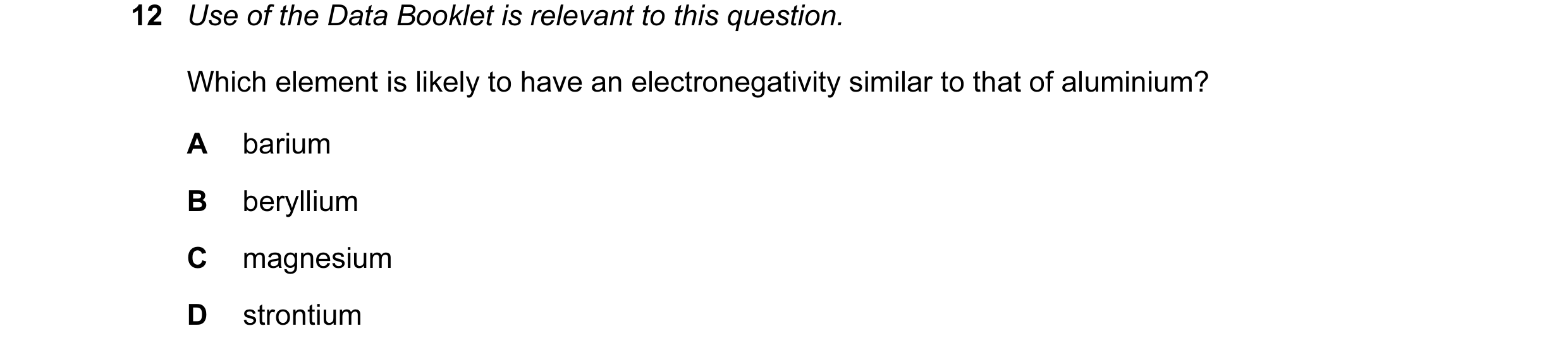
12 Use of the Data Booklet is relevant to this question. Which element is likely to have an electronegativity similar to that of aluminium? A barium B beryllium C magnesium D strontium
1 marks
Answer: B
This question in 9701/12 May/June 2011
Q4 · Which element shows the greatest tendency to form some covalent compounds? 9701/11 Oct/Nov 2011
13 Which element shows the greatest tendency to form some covalent compounds? A aluminium B magnesium C neon D potassium
1 marks
Answer: A
This question in 9701/11 Oct/Nov 2011
Q5 · Which element shows the greatest tendency to form some covalent compounds? 9701/13 Oct/Nov 2011
13 Which element shows the greatest tendency to form some covalent compounds? A aluminium B magnesium C neon D potassium
1 marks
Answer: A
This question in 9701/13 Oct/Nov 2011
Q6 · In a car engine, non-metallic element X forms a pollutant oxide Y 9701/13 Oct/Nov 2011
36 In a car engine, non-metallic element X forms a pollutant oxide Y. Further oxidation of Y to Z occurs spontaneously in the atmosphere. In this further oxidation, 1 mol of Y reacts with 0.5 mol of gaseous oxygen. Which statements about X, Y and Z are correct? 1 X forms a basic hydride. 2 Y is a diatomic molecule. 3 Z is a polar molecule.
1 marks
Answer: A
This question in 9701/13 Oct/Nov 2011
Q7 · Which solid contains more than one kind of bonding? 9701/13 Oct/Nov 2013
8 Which solid contains more than one kind of bonding? A copper B diamond C ice D magnesium oxide
1 marks
Answer: C
This question in 9701/13 Oct/Nov 2013
Q8 · Which graph correctly shows the relative melting points of the elements Mg, Al, Si and P… 9701/12 May/June 2014
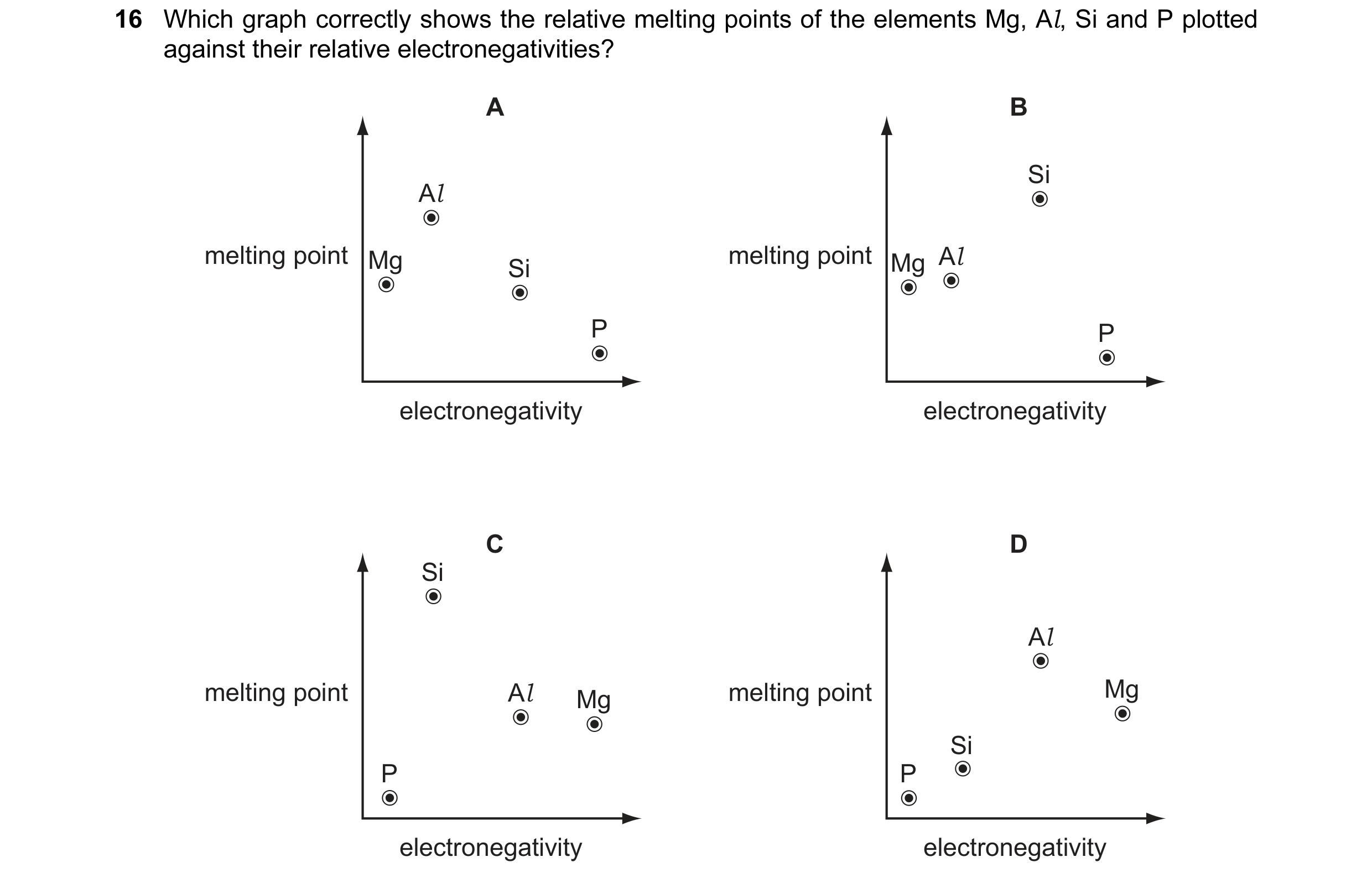
16 Which graph correctly shows the relative melting points of the elements Mg, Al, Si and P plotted against their relative electronegativities? A B Si Al melting point Mg melting point Mg Al Si P P electronegativity electronegativity C D Si Al melting point Al Mg melting point Mg Si P P electronegativity electronegativity
1 marks
Answer: B
This question in 9701/12 May/June 2014
Q9 · The table shows the physical properties of four substances 9701/11 Oct/Nov 2014
5 The table shows the physical properties of four substances. Which substance could be hydrogen chloride? electrical electrical electrical melting point conductivity conductivity conductivity / °C of aqueous of solid of liquid solution A –119 poor poor insoluble B –115 poor poor good C –50 poor poor poor D 993 poor good good
1 marks
Answer: B
This question in 9701/11 Oct/Nov 2014
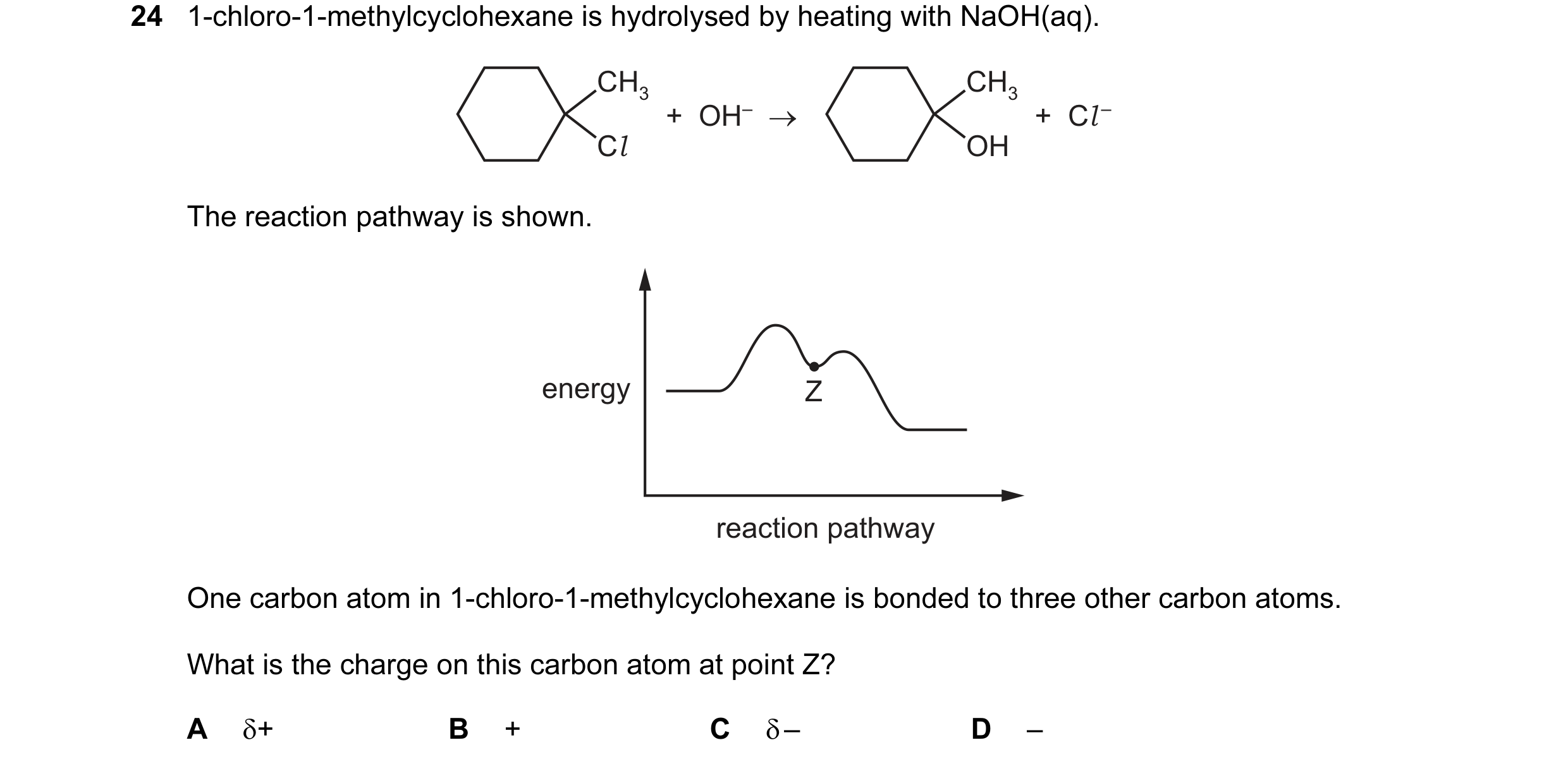
Q10 · 1-chloro-1-methylcyclohexane is hydrolysed by heating with NaOH(aq) 9701/12 May/June 2016
24 1-chloro-1-methylcyclohexane is hydrolysed by heating with NaOH(aq). CH3 CH3 + OH– → + Cl – Cl OH The reaction pathway is shown. energy Z reaction pathway One carbon atom in 1-chloro-1-methylcyclohexane is bonded to three other carbon atoms. What is the charge on this carbon atom at point Z? A δ+ B + C δ – D –
1 marks
Answer: B
This question in 9701/12 May/June 2016
Q11 · Which graph correctly shows relative electronegativity plotted against relative atomic… 9701/12 May/June 2017
13 Which graph correctly shows relative electronegativity plotted against relative atomic radius for the elements Na, Mg, Al and Si? A B Si Al Al electronegativity Mg electronegativity Mg Si Na Na atomic radius atomic radius C D Na Si Mg Al electronegativity Al electronegativity Mg Si Na atomic radius atomic radius
1 marks
Answer: B
This question in 9701/12 May/June 2017
Q12 · Which statements explain why nitrogen gas is unreactive? 9701/11 Oct/Nov 2017
36 Which statements explain why nitrogen gas is unreactive? 1 Nitrogen atoms are highly electronegative. 2 Nitrogen molecules are non-polar. 3 The triple bond between nitrogen atoms is very strong.
1 marks
Answer: C
This question in 9701/11 Oct/Nov 2017
Q13 · Which statements explain why nitrogen gas is unreactive? 9701/13 Oct/Nov 2017
36 Which statements explain why nitrogen gas is unreactive? 1 Nitrogen atoms are highly electronegative. 2 Nitrogen molecules are non-polar. 3 The triple bond between nitrogen atoms is very strong.
1 marks
Answer: C
This question in 9701/13 Oct/Nov 2017
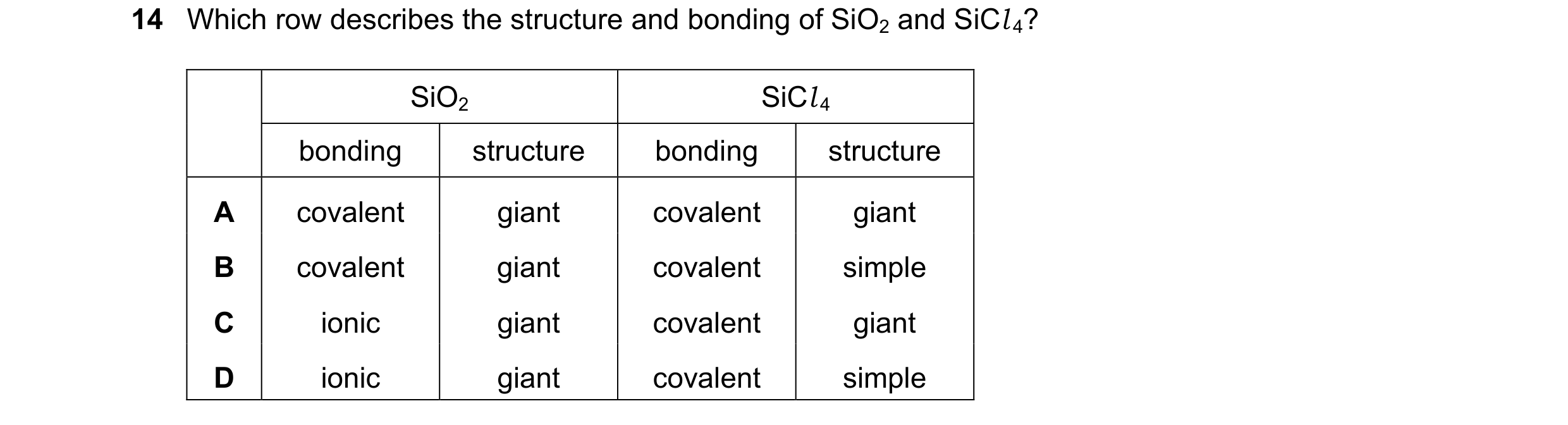
Q14 · Which row describes the structure and bonding of SiO2 and SiCl 4? 9701/11 Oct/Nov 2018
14 Which row describes the structure and bonding of SiO2 and SiCl 4? SiO2 SiCl 4 bonding structure bonding structure A covalent giant covalent giant B covalent giant covalent simple C ionic giant covalent giant D ionic giant covalent simple
1 marks
Answer: B
This question in 9701/11 Oct/Nov 2018
Q15 · Which graph represents the variation in electronegativity for Period 3 elements? 9701/13 May/June 2019
13 Which graph represents the variation in electronegativity for Period 3 elements? A B electronegativity electronegativity Na Mg Al Si P S Cl Na Mg Al Si P S Cl element element C D electronegativity electronegativity Na Mg Al Si P S Cl Na Mg Al Si P S Cl element element
1 marks
Answer: B
This question in 9701/13 May/June 2019
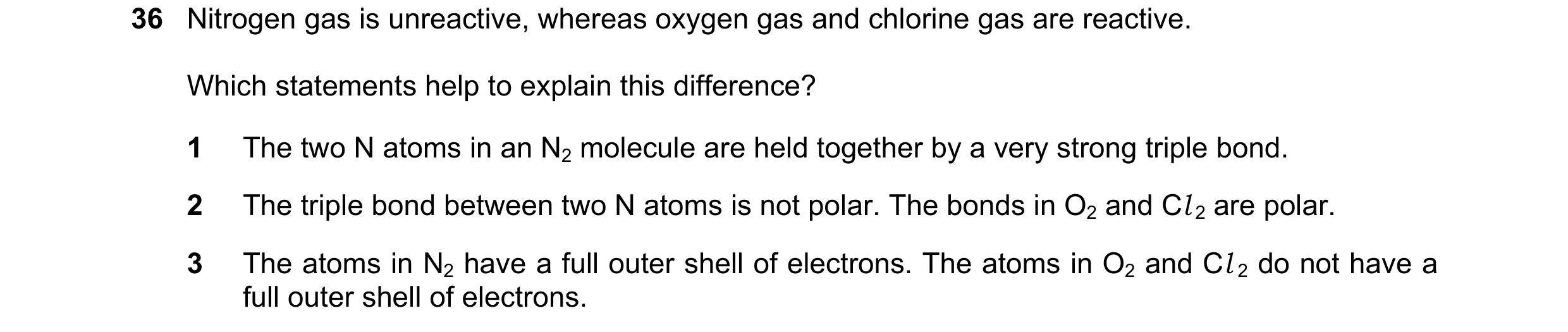
Q16 · Nitrogen gas is unreactive, whereas oxygen gas and chlorine gas are reactive 9701/11 Oct/Nov 2019
36 Nitrogen gas is unreactive, whereas oxygen gas and chlorine gas are reactive. Which statements help to explain this difference? 1 The two N atoms in an N2 molecule are held together by a very strong triple bond. 2 The triple bond between two N atoms is not polar. The bonds in O2 and Cl 2 are polar. 3 The atoms in N2 have a full outer shell of electrons. The atoms in O2 and Cl 2 do not have a full outer shell of electrons.
1 marks
Answer: D
This question in 9701/11 Oct/Nov 2019
Q17 · Which diagram correctly shows the electronegativity of the elements Na, Mg, Al and Si… 9701/12 Oct/Nov 2019
12 Which diagram correctly shows the electronegativity of the elements Na, Mg, Al and Si plotted against their first ionisation energies? A B Si Si Al Al electronegativity electronegativity Mg Mg Na Na first ionisation energy first ionisation energy C D Na Na Al Mg electronegativity electronegativity Mg Al Si Si first ionisation energy first ionisation energy
1 marks
Answer: B
This question in 9701/12 Oct/Nov 2019
Q18 · Silicon forms a tetrachloride, SiCl 4 9701/12 Oct/Nov 2019
35 Silicon forms a tetrachloride, SiCl 4. Which statements are correct? 1 In SiCl 4, the Si is δ+ and each Cl is δ–. 2 SiCl 4 is a liquid at room temperature. 3 SiCl 4 reacts with water to give an acidic solution and a precipitate.
1 marks
Answer: A
This question in 9701/12 Oct/Nov 2019
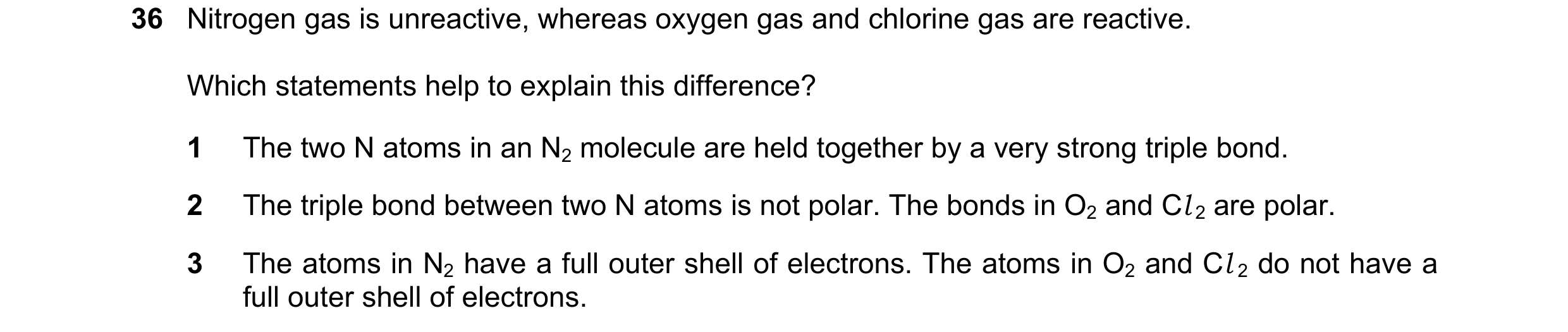
Q19 · Nitrogen gas is unreactive, whereas oxygen gas and chlorine gas are reactive 9701/13 Oct/Nov 2019
36 Nitrogen gas is unreactive, whereas oxygen gas and chlorine gas are reactive. Which statements help to explain this difference? 1 The two N atoms in an N2 molecule are held together by a very strong triple bond. 2 The triple bond between two N atoms is not polar. The bonds in O2 and Cl 2 are polar. 3 The atoms in N2 have a full outer shell of electrons. The atoms in O2 and Cl 2 do not have a full outer shell of electrons.
1 marks
Answer: D
This question in 9701/13 Oct/Nov 2019
Q20 · 1-chloro-1-methylcyclohexane is hydrolysed by heating with NaOH(aq) 9701/11 Oct/Nov 2020
25 1-chloro-1-methylcyclohexane is hydrolysed by heating with NaOH(aq). CH3 CH3 + OH– → + Cl – Cl OH The reaction pathway is shown. energy Z reaction pathway One carbon atom in 1-chloro-1-methylcyclohexane is bonded to three other carbon atoms. What is the charge on this carbon atom at point Z? A 1– B – C + D 1+
1 marks
Answer: D
This question in 9701/11 Oct/Nov 2020
Q21 · Which statements are correct? 9701/11 May/June 2021
37 Which statements are correct? 1 1,1-difluoroethane is less reactive than 1,1-dichloroethane. 2 1,1-difluoroethane is polar. 3 The C–F bond is stronger than the C–Cl bond.
1 marks
Answer: A
This question in 9701/11 May/June 2021
Q22 · Which type of bonding is never found in elements? 9701/13 May/June 2021
6 Which type of bonding is never found in elements? A covalent B ionic C metallic D van der Waals’ forces
1 marks
Answer: B
This question in 9701/13 May/June 2021
Q23 · Which graph correctly shows relative electronegativity plotted against relative atomic… 9701/12 May/June 2022
19 Which graph correctly shows relative electronegativity plotted against relative atomic radius for the elements Na, Mg, Al and Si? A B Si Al Al electronegativity Mg electronegativity Mg Na Si Na atomic radius atomic radius C D Na Si Mg Al electronegativity Al electronegativity Mg Si Na atomic radius atomic radius
1 marks
Answer: A
This question in 9701/12 May/June 2022
Q24 · Which compound has the smallest difference in electronegativity between its two elements? 9701/13 May/June 2022
5 Which compound has the smallest difference in electronegativity between its two elements? A KF B KBr C LiF D LiBr
1 marks
Answer: D
This question in 9701/13 May/June 2022
Q25 · Element X requires strong heating to react with oxygen 9701/12 Oct/Nov 2022
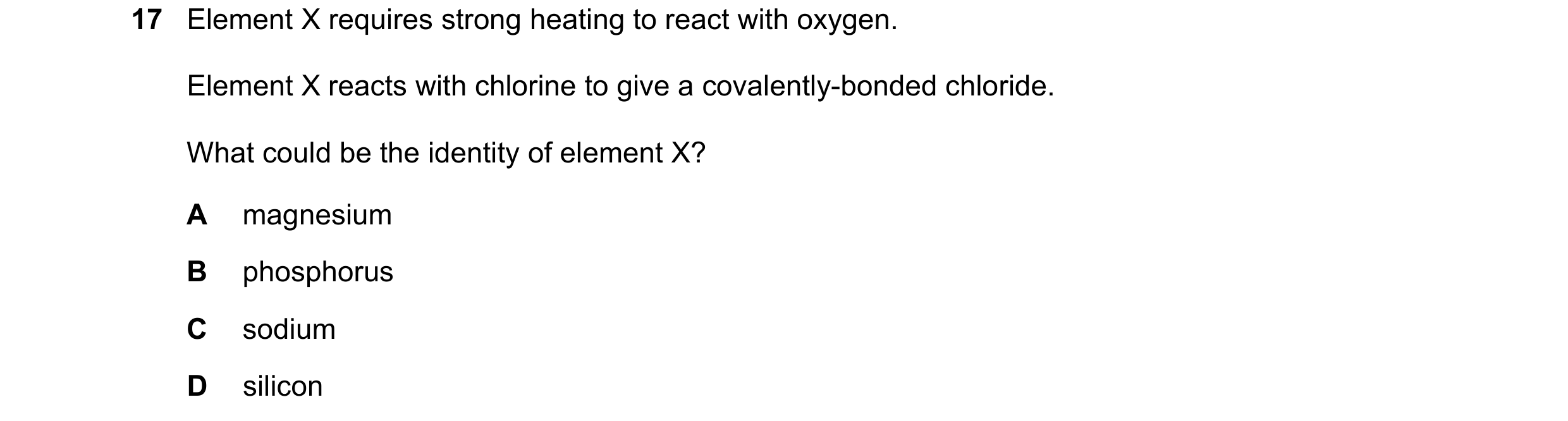
17 Element X requires strong heating to react with oxygen. Element X reacts with chlorine to give a covalently-bonded chloride. What could be the identity of element X? A magnesium B phosphorus C sodium D silicon
1 marks
Answer: D
This question in 9701/12 Oct/Nov 2022
Q26 · V and Z are both elements in Period 3 of the Periodic Table 9701/12 Feb/March 2023
22 V and Z are both elements in Period 3 of the Periodic Table. Each element forms one stable ion that does not contain another element. The atomic radius of each element and the ionic radius of the ion described above is shown. atomic radius ionic radius element /nm /nm V 0.186 0.095 Z 0.099 0.181 Which statement is correct? A Ions of V and Z have the same number of full electron shells. B Ions of Z are positively charged. C Z has a greater electronegativity than V. D V has more outer electrons than Z.
1 marks
Answer: C
This question in 9701/12 Feb/March 2023
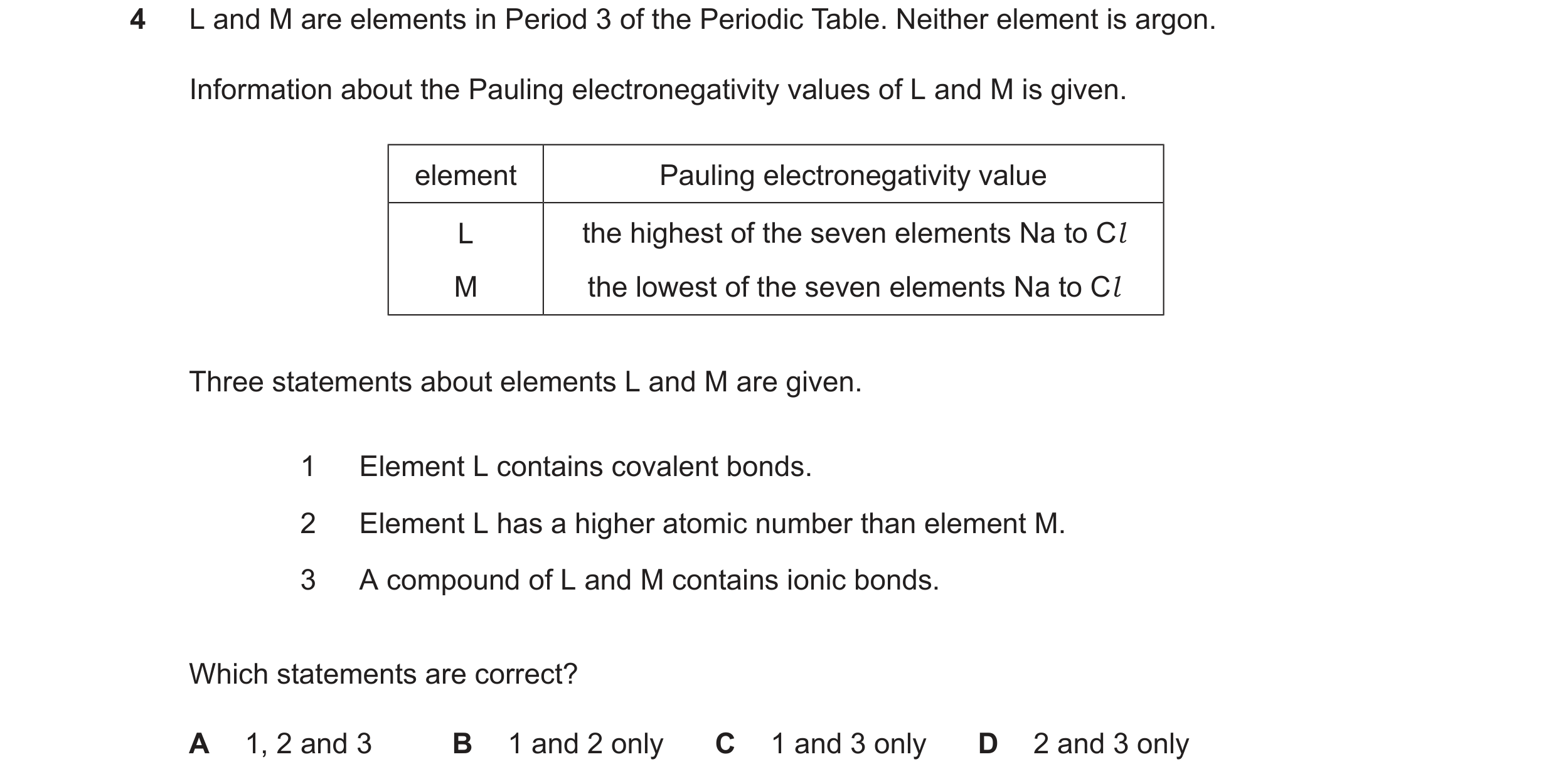
Q27 · L and M are elements in Period 3 of the Periodic Table 9701/13 May/June 2023
4 L and M are elements in Period 3 of the Periodic Table. Neither element is argon. Information about the Pauling electronegativity values of L and M is given. element Pauling electronegativity value L the highest of the seven elements Na to Cl M the lowest of the seven elements Na to Cl Three statements about elements L and M are given. 1 Element L contains covalent bonds. 2 Element L has a higher atomic number than element M. 3 A compound of L and M contains ionic bonds. Which statements are correct? A 1, 2 and 3 B 1 and 2 only C 1 and 3 only D 2 and 3 only
1 marks
Answer: A
This question in 9701/13 May/June 2023
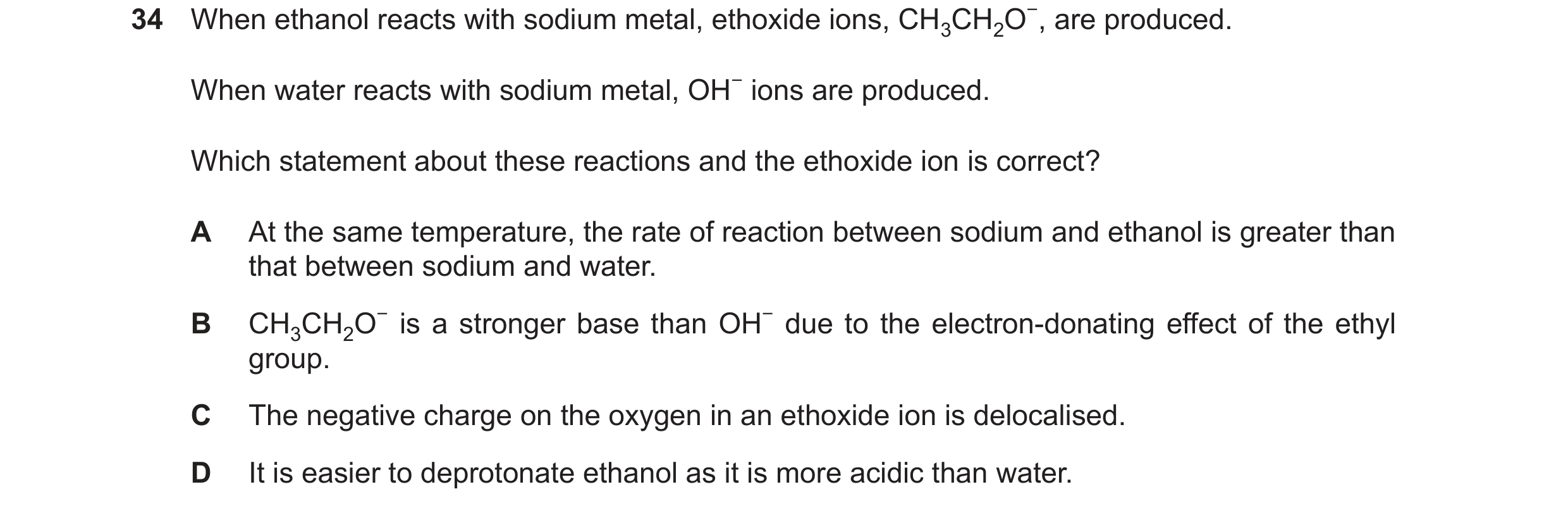
Q28 · When ethanol reacts with sodium metal, ethoxide ions, CH3CH2O−, are produced 9701/11 Oct/Nov 2023
34 When ethanol reacts with sodium metal, ethoxide ions, CH3CH2O−, are produced. When water reacts with sodium metal, OH−ions are produced. Which statement about these reactions and the ethoxide ion is correct? A At the same temperature, the rate of reaction between sodium and ethanol is greater than that between sodium and water. B CH3CH2O−is a stronger base than OH−due to the electron-donating effect of the ethyl group. C The negative charge on the oxygen in an ethoxide ion is delocalised. D It is easier to deprotonate ethanol as it is more acidic than water.
1 marks
Answer: B
This question in 9701/11 Oct/Nov 2023
Q29 · When ethanol reacts with sodium metal, ethoxide ions, CH3CH2O−, are produced 9701/13 Oct/Nov 2023
34 When ethanol reacts with sodium metal, ethoxide ions, CH3CH2O−, are produced. When water reacts with sodium metal, OH−ions are produced. Which statement about these reactions and the ethoxide ion is correct? A At the same temperature, the rate of reaction between sodium and ethanol is greater than that between sodium and water. B CH3CH2O−is a stronger base than OH−due to the electron-donating effect of the ethyl group. C The negative charge on the oxygen in an ethoxide ion is delocalised. D It is easier to deprotonate ethanol as it is more acidic than water.
1 marks
Answer: B
This question in 9701/13 Oct/Nov 2023
Q30 · Which statement is correct? 9701/12 May/June 2024
16 Which statement is correct? A Aluminium chloride has a giant ionic lattice of Al 3+ and Cl – ions. B Sodium chloride dissolves in water, forming hydrogen chloride and sodium hydroxide. C The strong covalent bonds in silicon chloride prevent it from reacting with water. D When phosphorus(V) chloride is added to water, the resulting solution conducts electricity.
1 marks
Answer: D
This question in 9701/12 May/June 2024
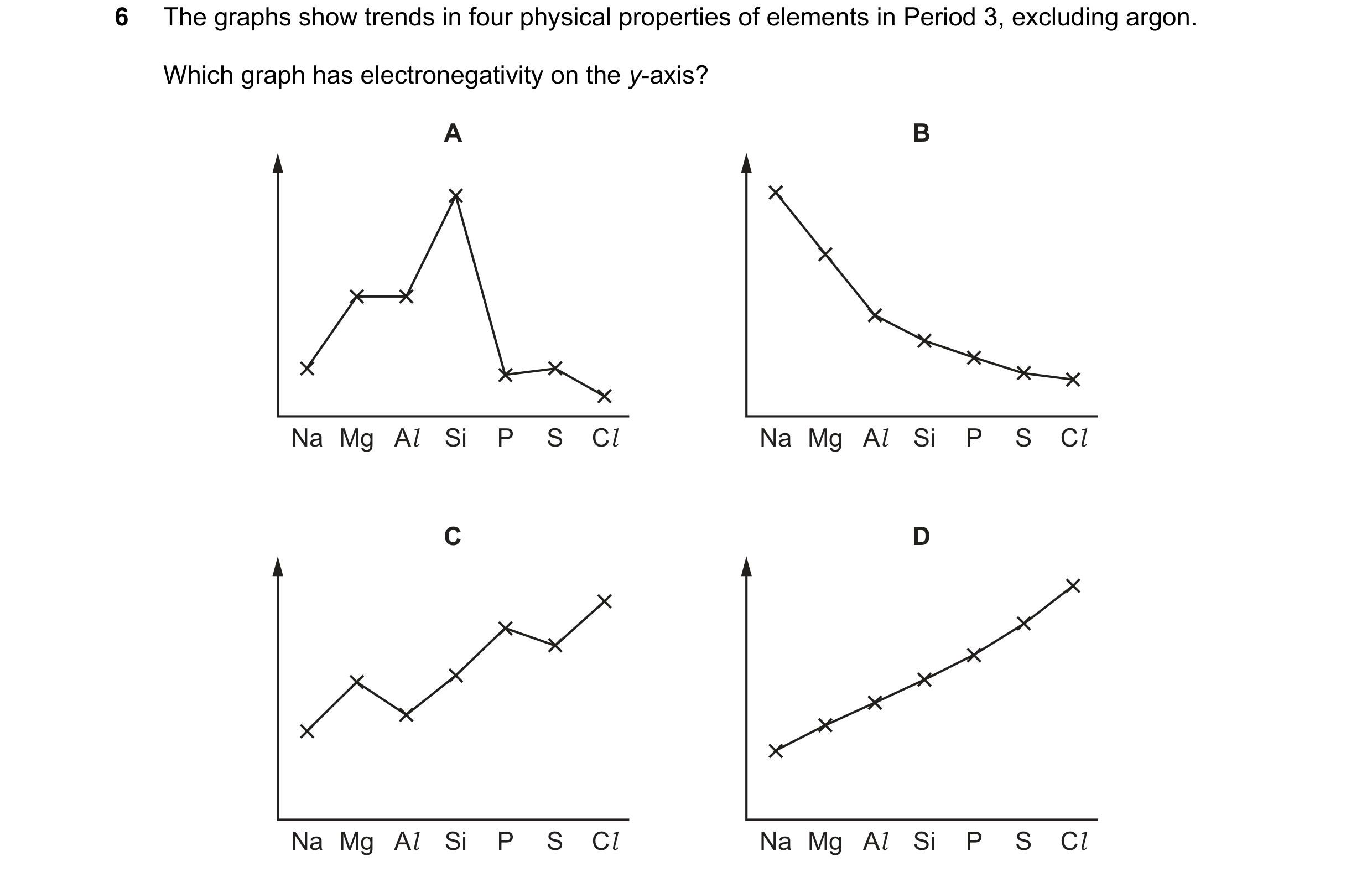
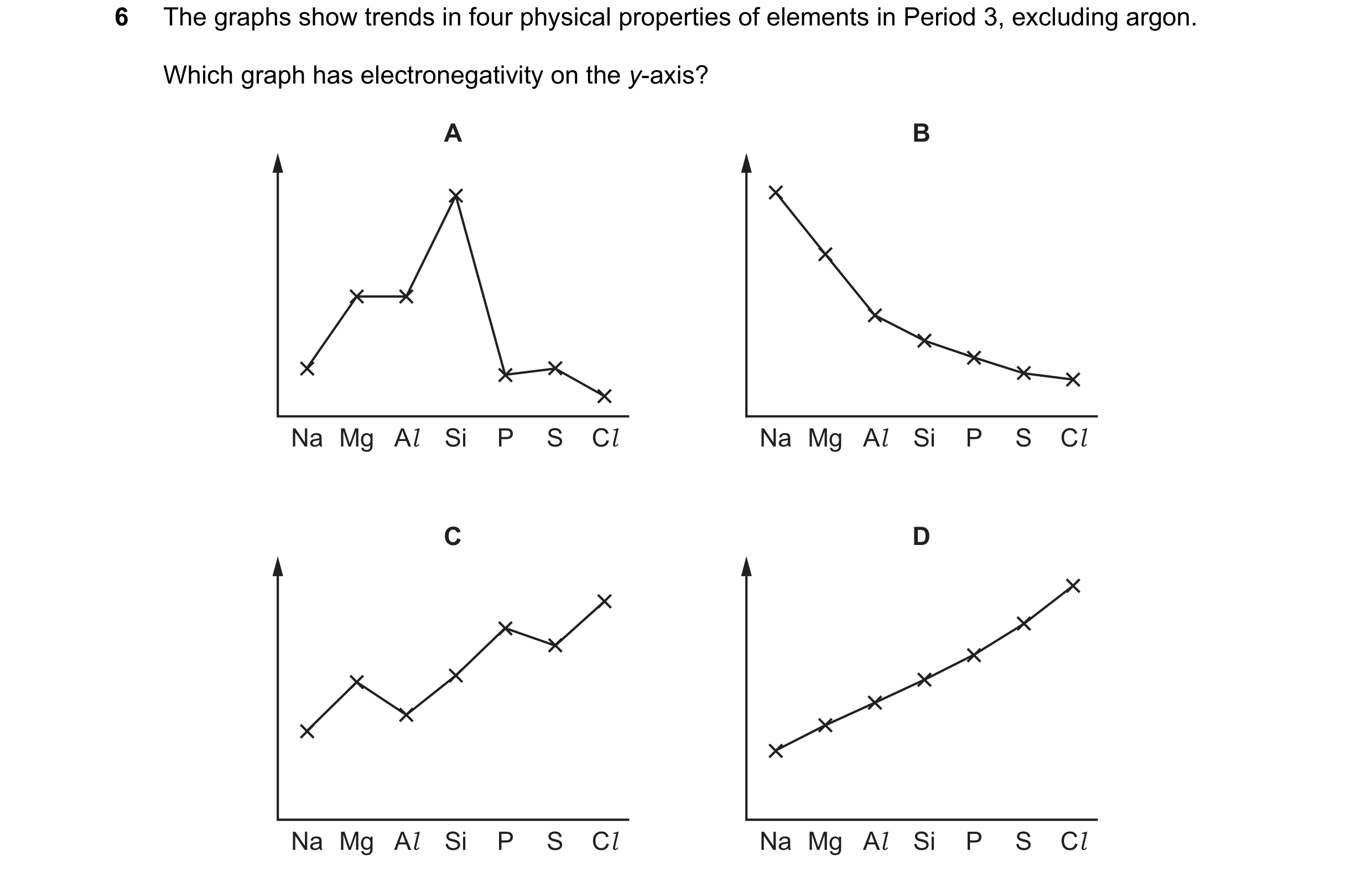
Q31 · The graphs show trends in four physical properties of elements in Period 3, excluding… 9701/11 Oct/Nov 2024
6 The graphs show trends in four physical properties of elements in Period 3, excluding argon. Which graph has electronegativity on the y-axis? A B Na Mg Al Si P S Cl Na Mg Al Si P S Cl C D Na Mg Al Si P S Cl Na Mg Al Si P S Cl
1 marks
Answer: D
This question in 9701/11 Oct/Nov 2024
Q32 · Which statement is correct? 9701/12 Oct/Nov 2024
24 Which statement is correct? A An ammonium ion is basic due to a lone pair of electrons on the nitrogen atom. B Nitrogen monoxide, NO, reacts with peroxyacetyl nitrate to produce a component of photochemical smog. C Nitrogen dioxide catalyses the oxidation of atmospheric sulfur dioxide. D Nitrogen is very unreactive due to the very strong permanent dipole–permanent dipole attractions between the nitrogen atoms.
1 marks
Answer: C
This question in 9701/12 Oct/Nov 2024
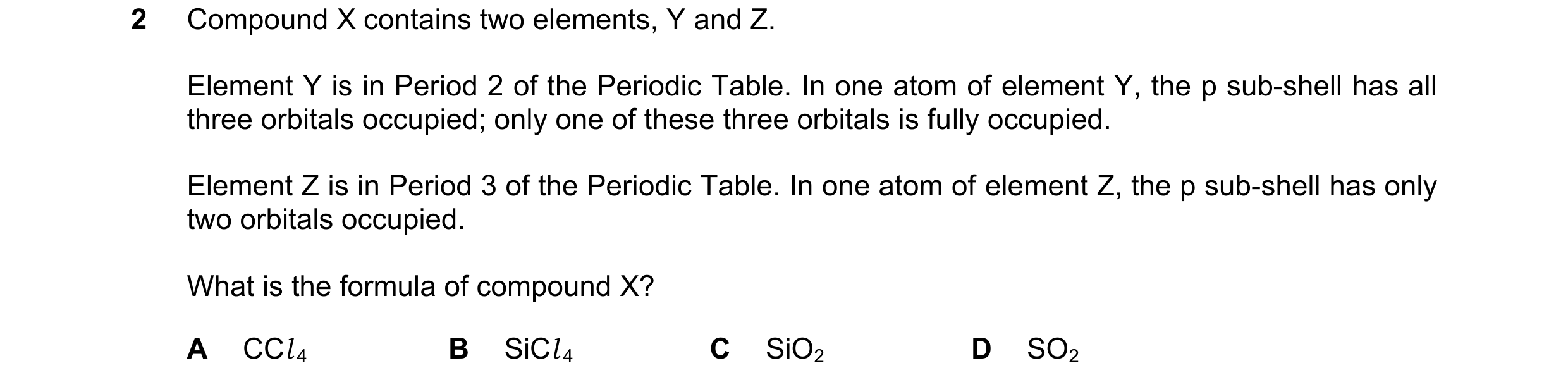
Q33 · Compound X contains two elements, Y and Z 9701/13 Oct/Nov 2024
2 Compound X contains two elements, Y and Z. Element Y is in Period 2 of the Periodic Table. In one atom of element Y, the p sub-shell has all three orbitals occupied; only one of these three orbitals is fully occupied. Element Z is in Period 3 of the Periodic Table. In one atom of element Z, the p sub-shell has only two orbitals occupied. What is the formula of compound X? A CCl 4 B SiCl 4 C SiO2 D SO2
1 marks
Answer: C
This question in 9701/13 Oct/Nov 2024
Q34 · The graphs show trends in four physical properties of elements in Period 3, excluding… 9701/13 Oct/Nov 2024
6 The graphs show trends in four physical properties of elements in Period 3, excluding argon. Which graph has electronegativity on the y-axis? A B Na Mg Al Si P S Cl Na Mg Al Si P S Cl C D Na Mg Al Si P S Cl Na Mg Al Si P S Cl
1 marks
Answer: D
This question in 9701/13 Oct/Nov 2024


 1 / 11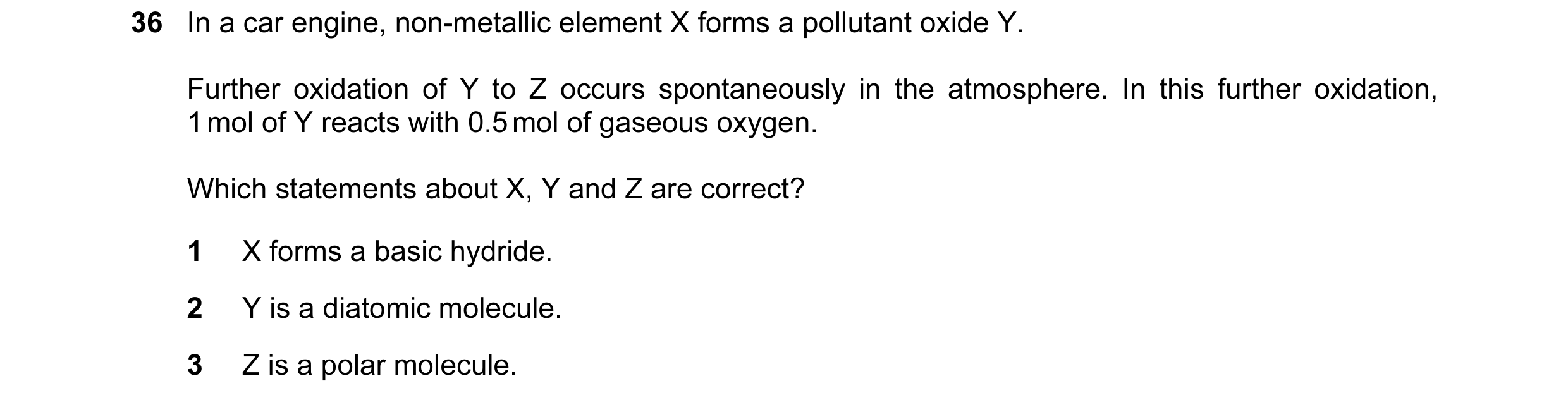

 2 / 11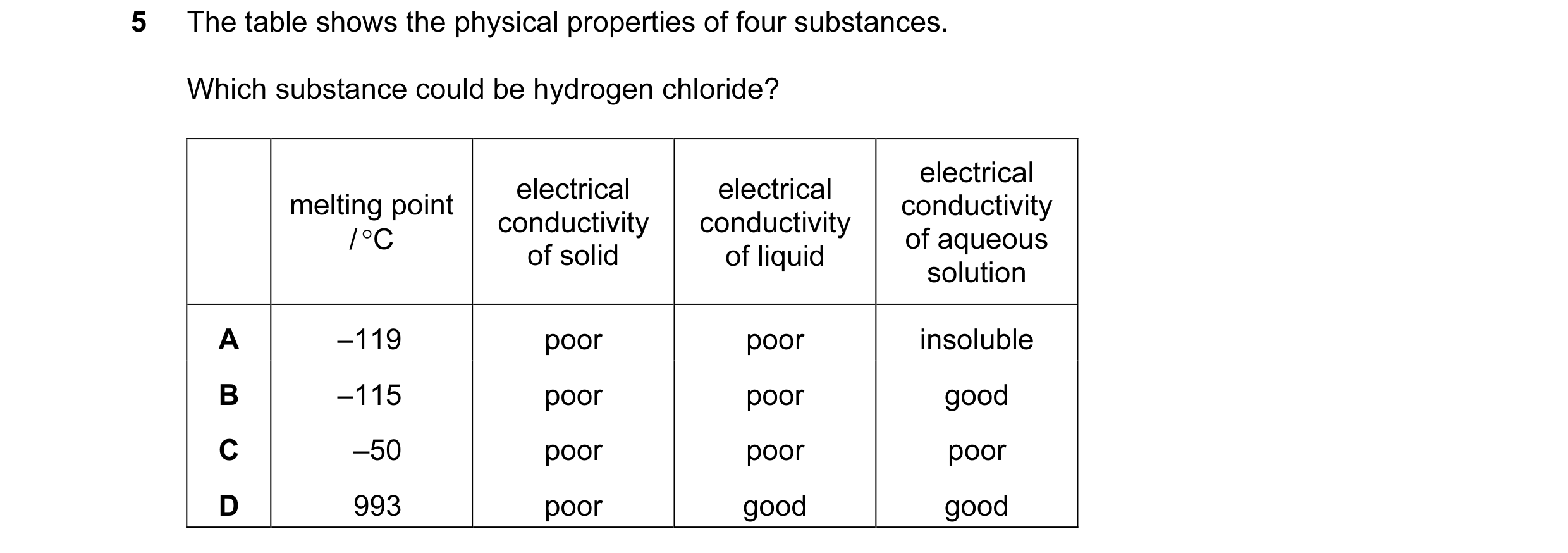
 3 / 11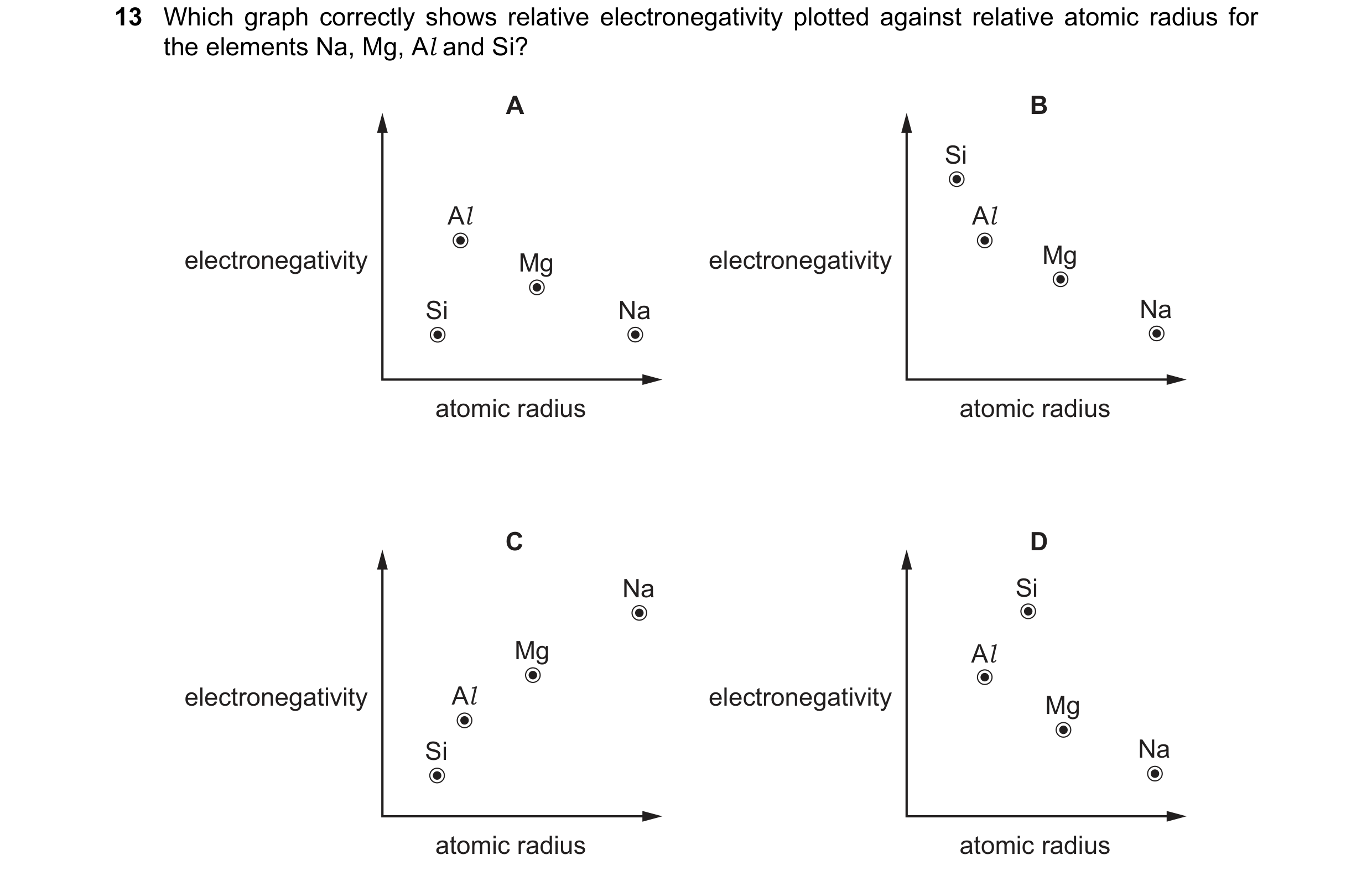


 4 / 11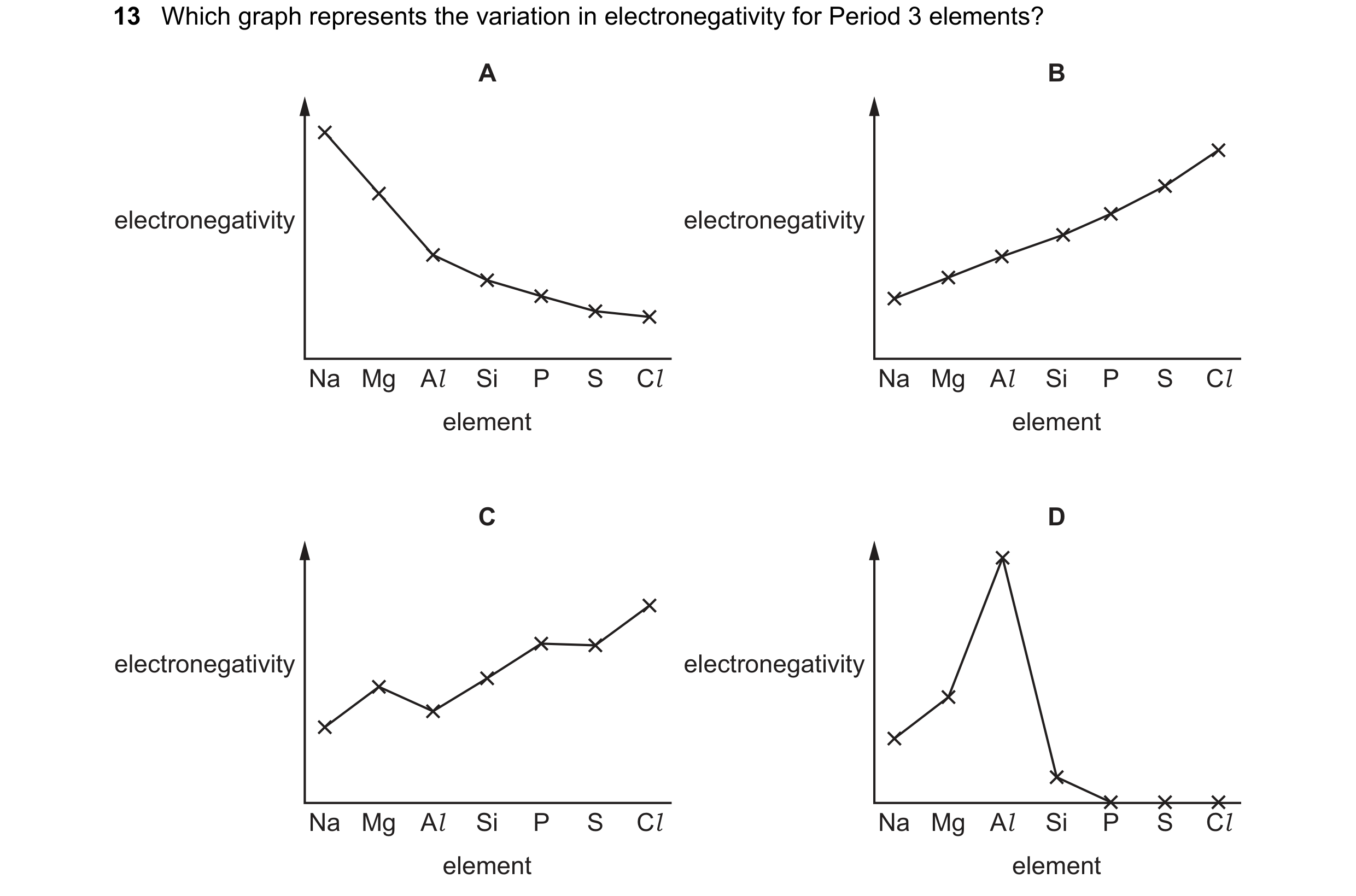
 5 / 11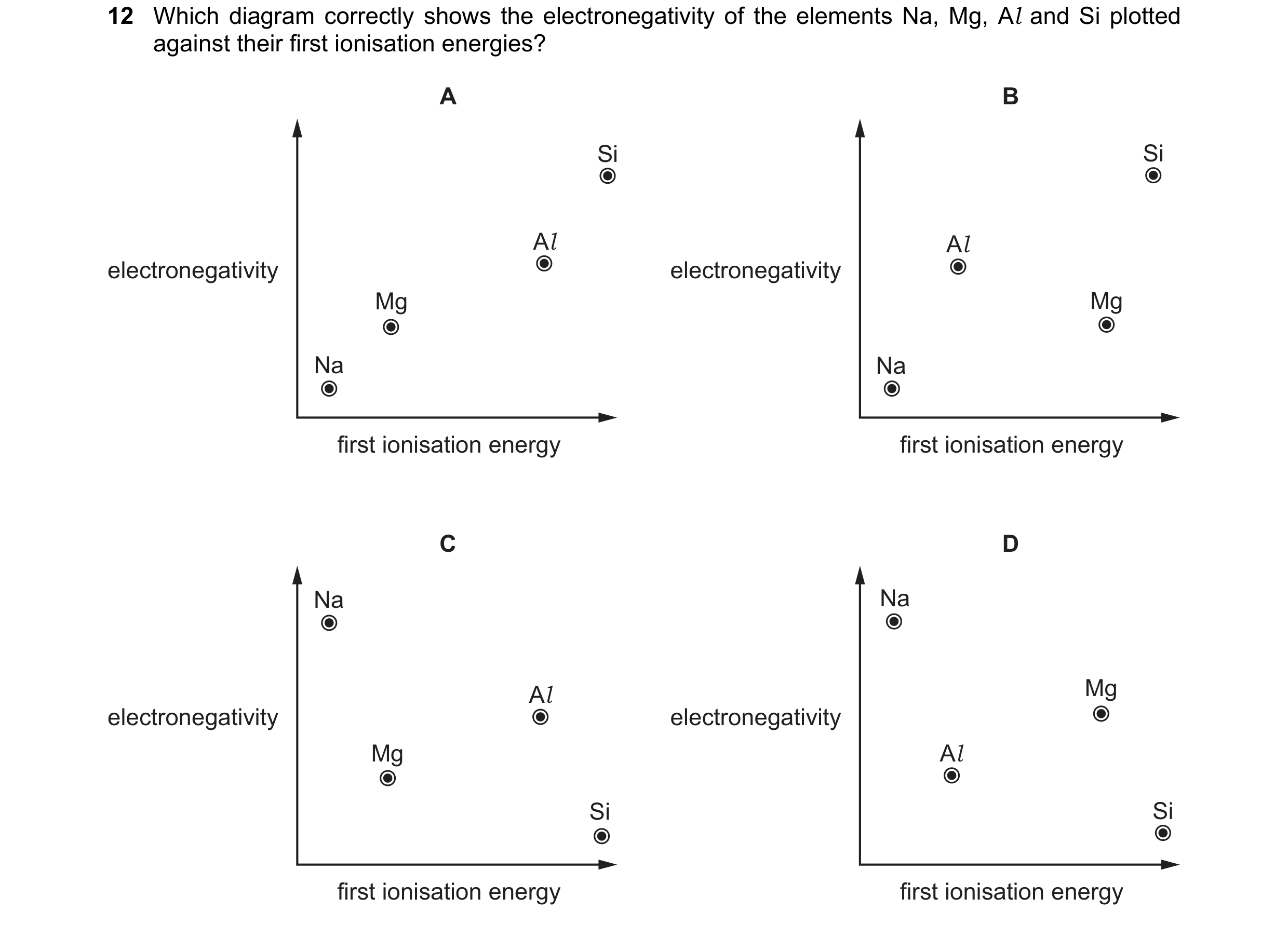

 6 / 11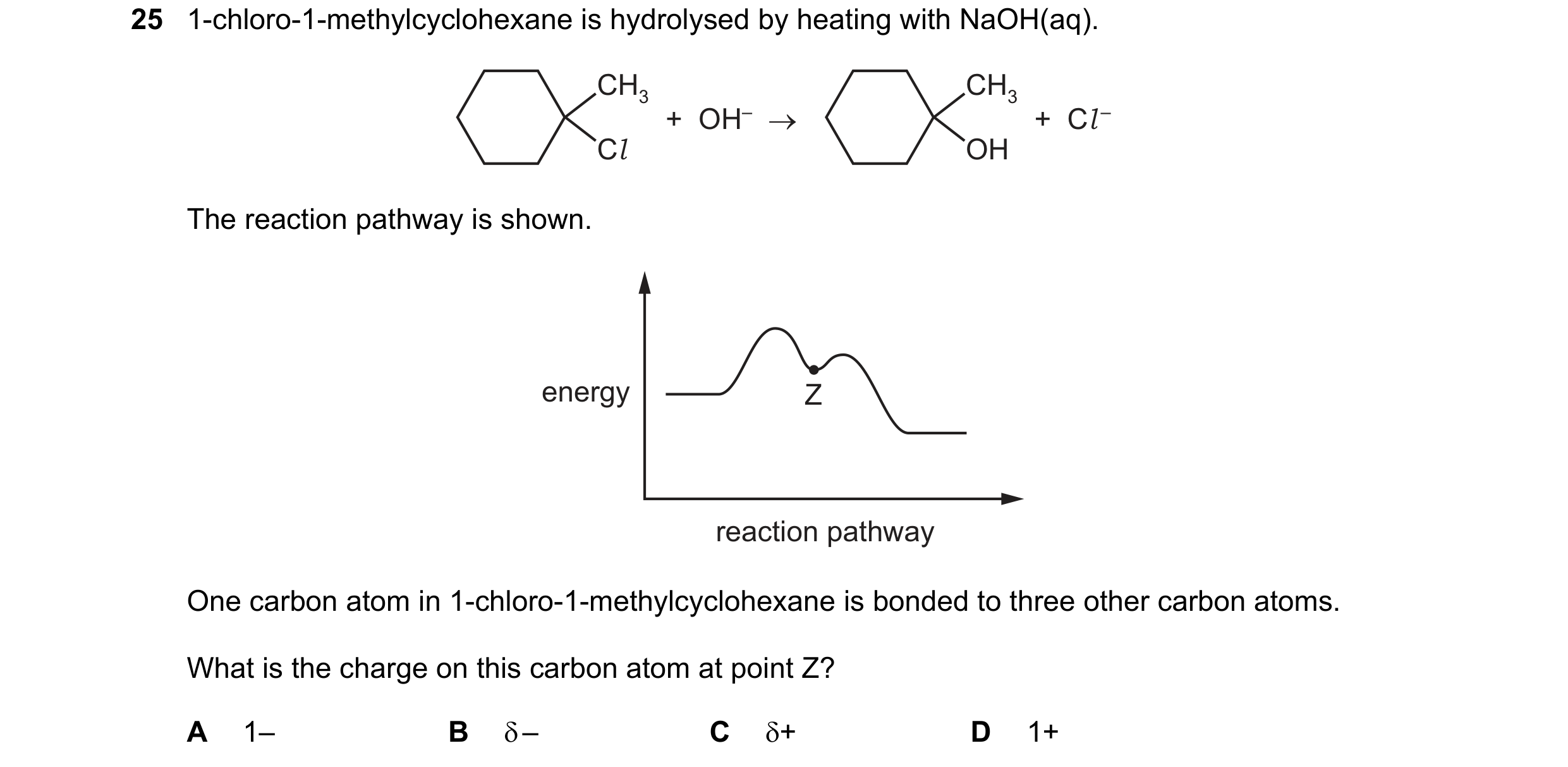

 7 / 11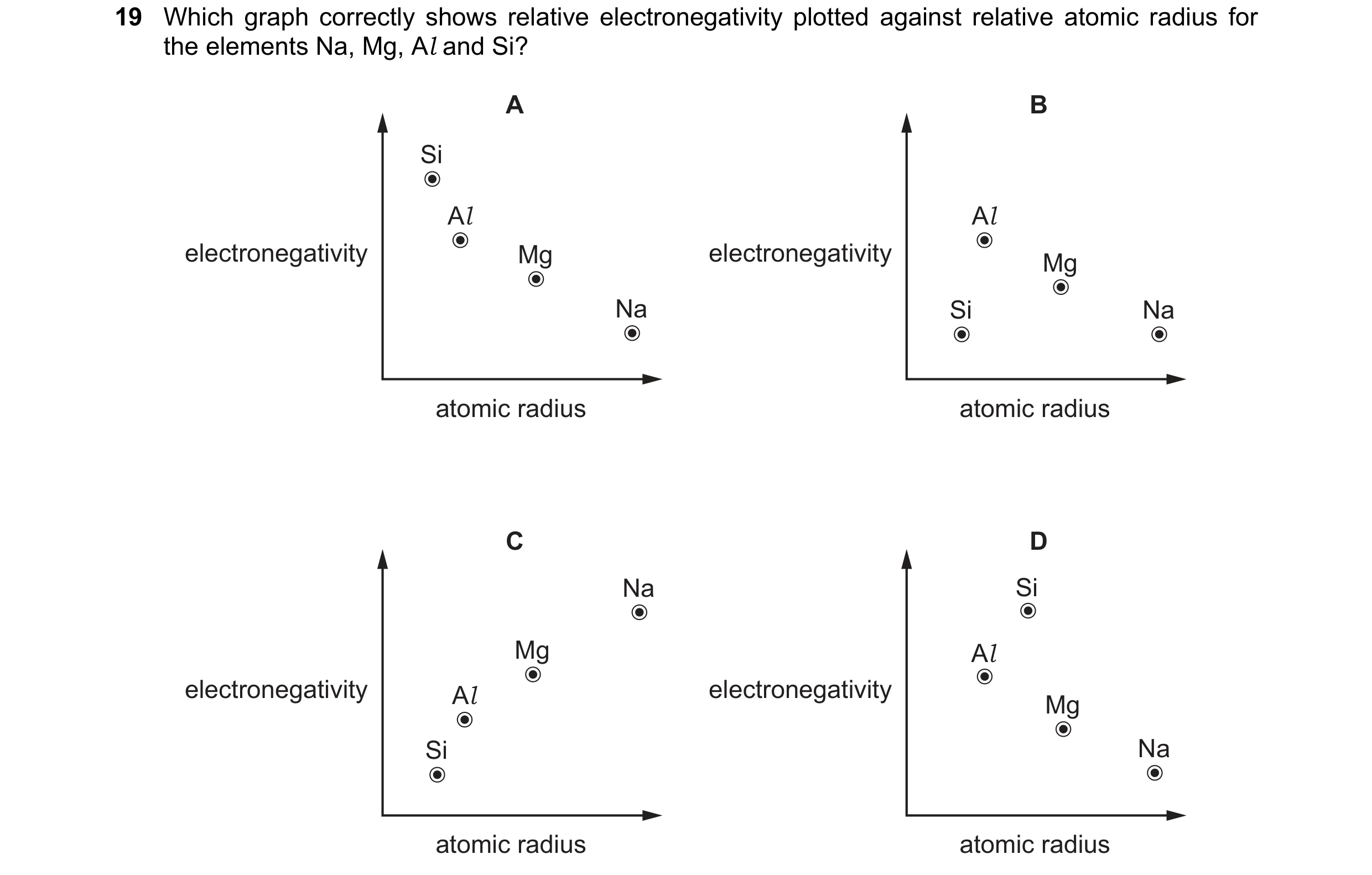

 8 / 11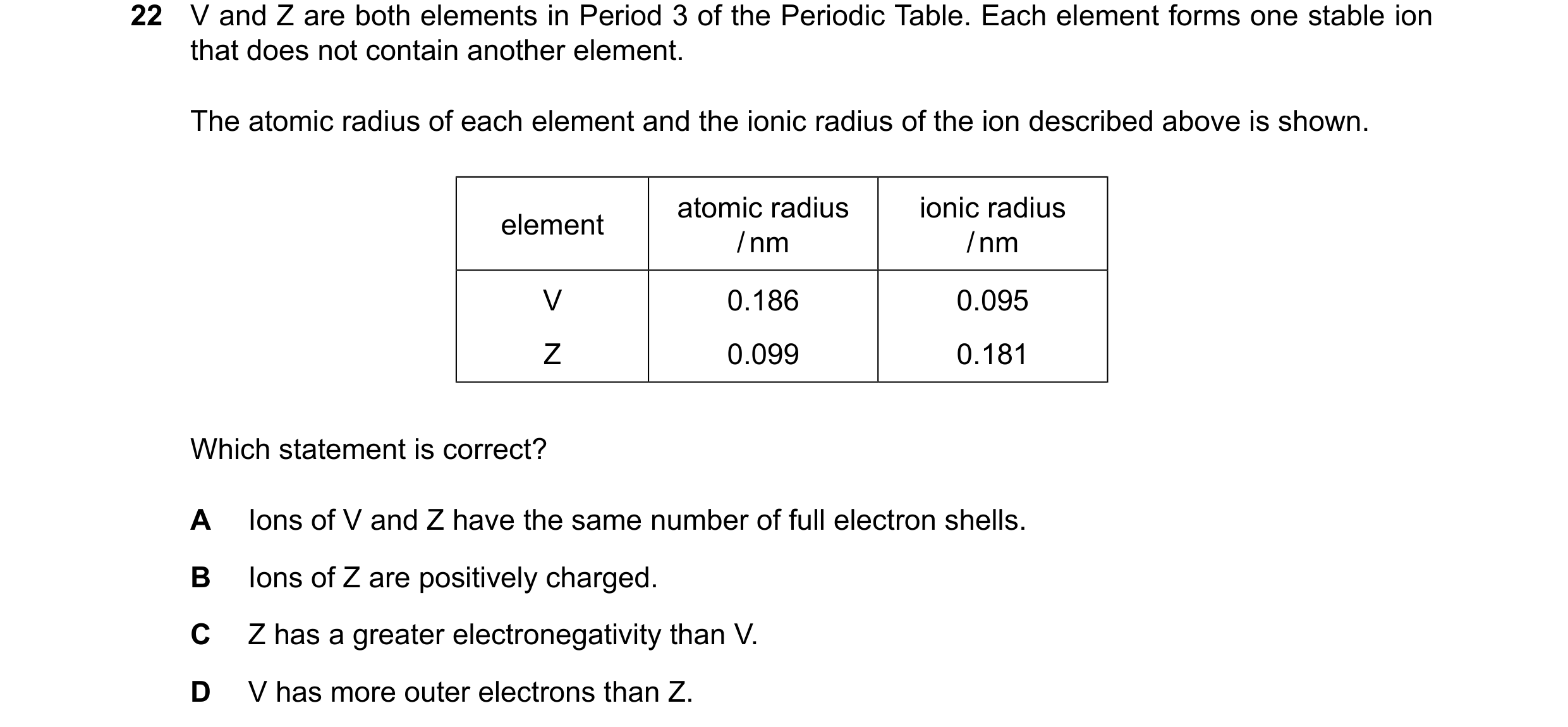
 9 / 11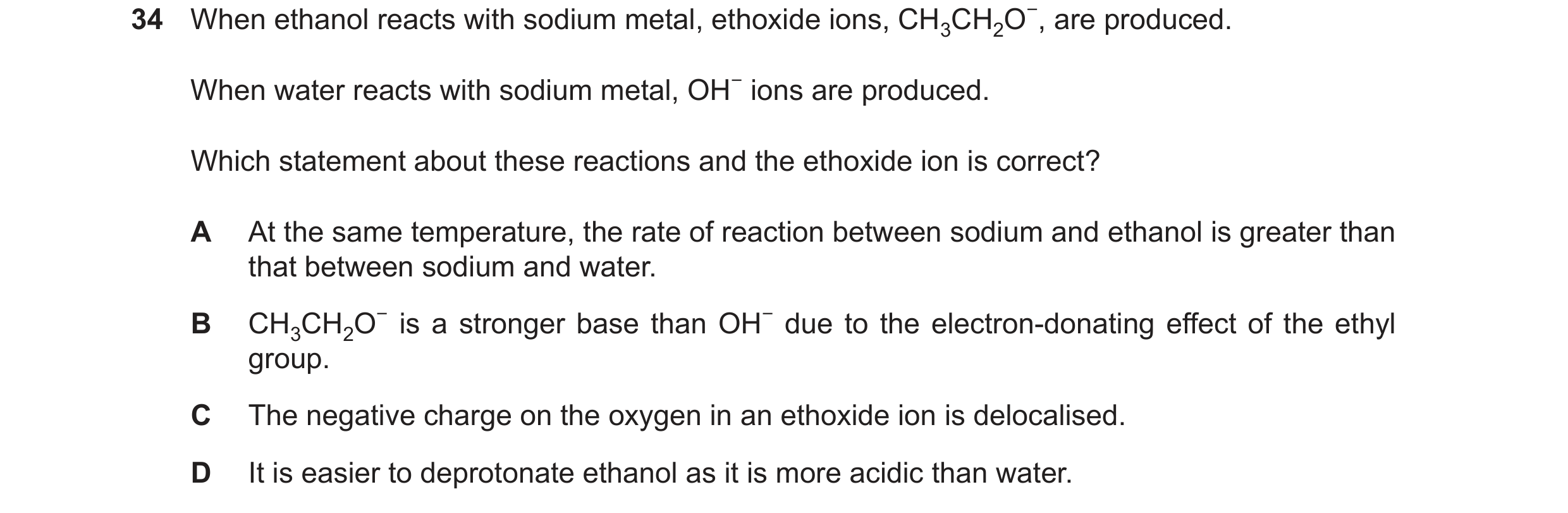

 10 / 11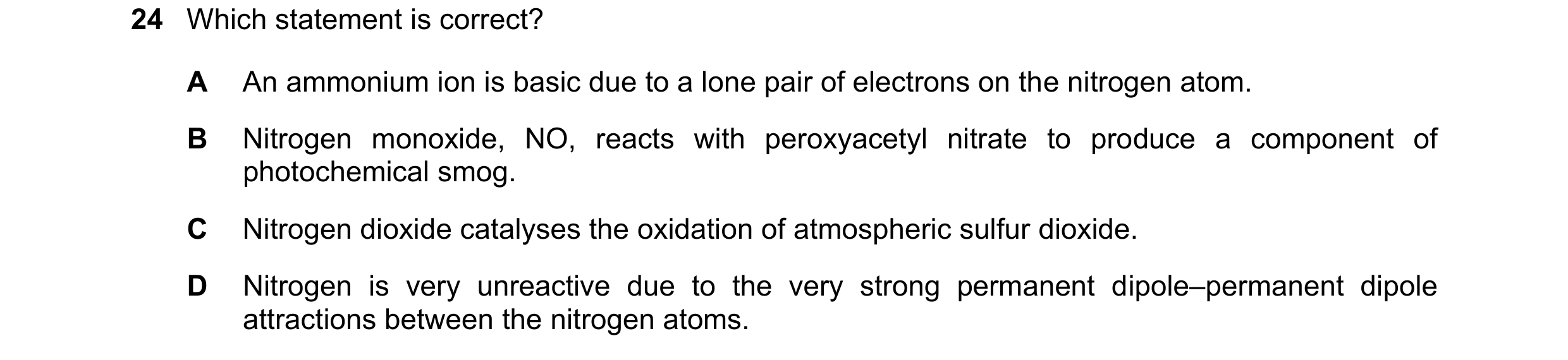
 11 / 11