Questions as text
Question 1 9706/31 Oct/Nov 2009
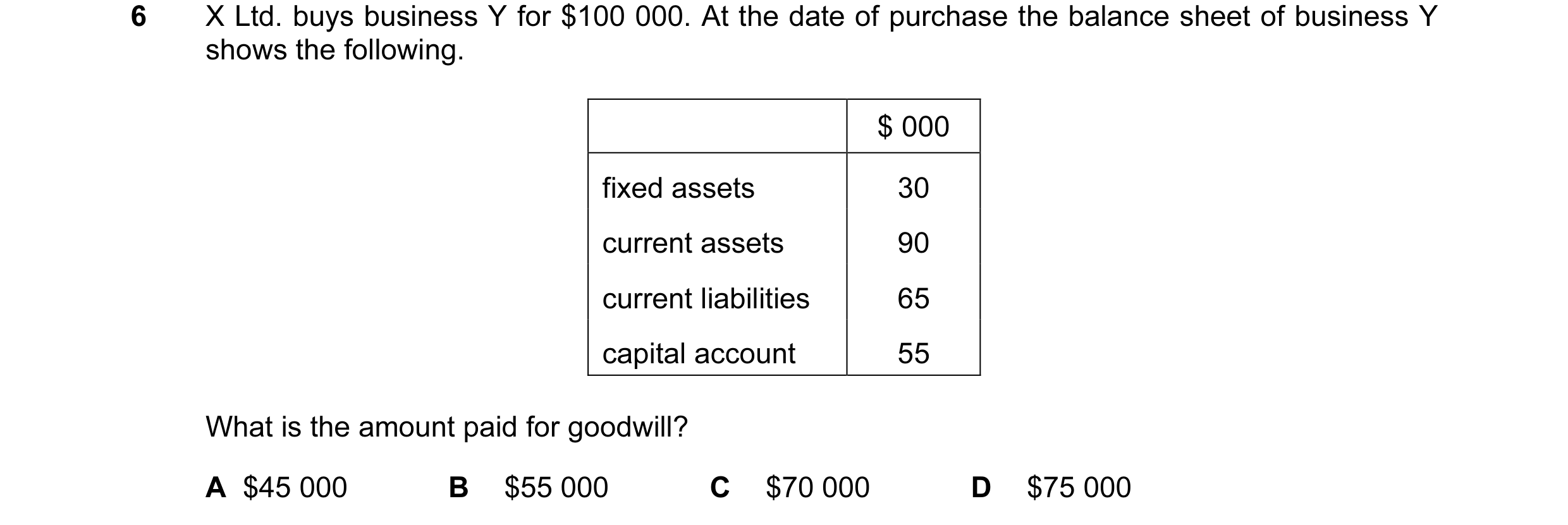
6 X Ltd. buys business Y for $100 000. At the date of purchase the balance sheet of business Y shows the following. $ 000 fixed assets 30 current assets 90 current liabilities 65 capital account 55 What is the amount paid for goodwill? A $45 000 B $55 000 C $70 000 D $75 000
1 marks
Answer: A
This question in 9706/31 Oct/Nov 2009
Q2 · A business with net tangible assets of $110 000 is purchased by a company for $150 000 9706/31 Oct/Nov 2009
7 A business with net tangible assets of $110 000 is purchased by a company for $150 000. The company completes the transaction by a cash payment of $20 000 and an issue of its $0.50 ordinary shares, fully paid, at $1.30 each. By how much will the balance on the company’s Ordinary Share Capital account increase? A $50 000 B $90 000 C $100 000 D $130 000
1 marks
Answer: A
This question in 9706/31 Oct/Nov 2009
Q3 · When the business of X was purchased by Y plc, negative goodwill of $100 000 arose 9706/31 Oct/Nov 2009
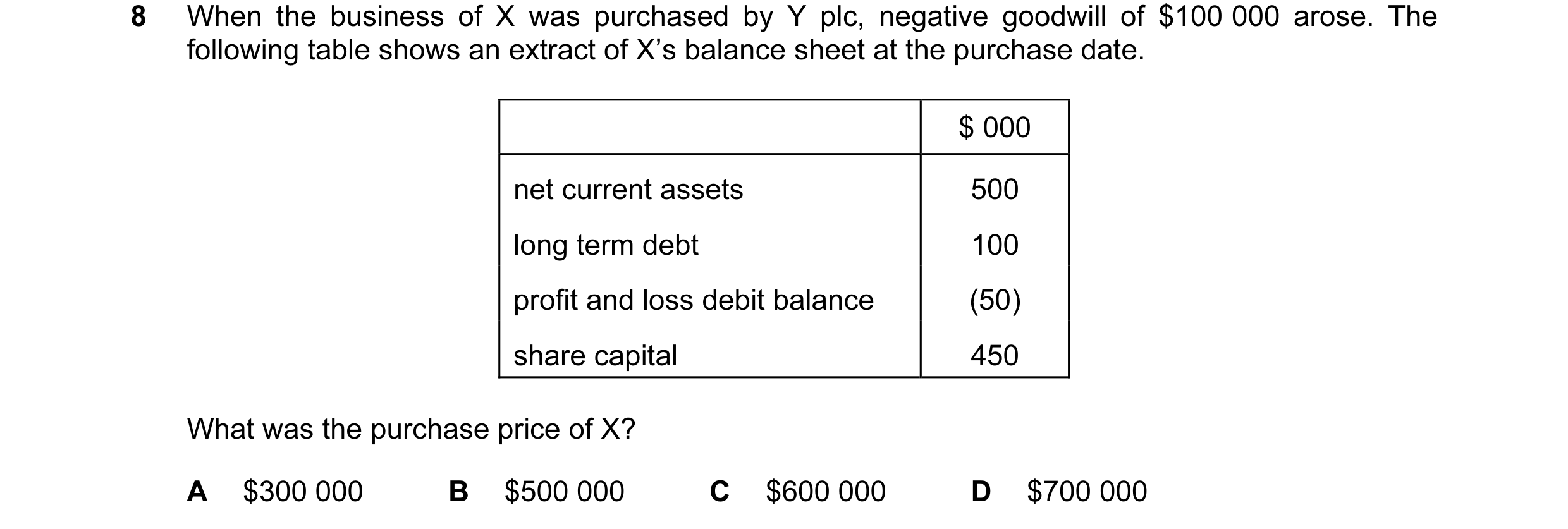
8 When the business of X was purchased by Y plc, negative goodwill of $100 000 arose. The following table shows an extract of X’s balance sheet at the purchase date. $ 000 net current assets 500 long term debt 100 profit and loss debit balance (50) share capital 450 What was the purchase price of X? A $300 000 B $500 000 C $600 000 D $700 000
1 marks
Answer: A
This question in 9706/31 Oct/Nov 2009
Question 4 9706/32 Oct/Nov 2009
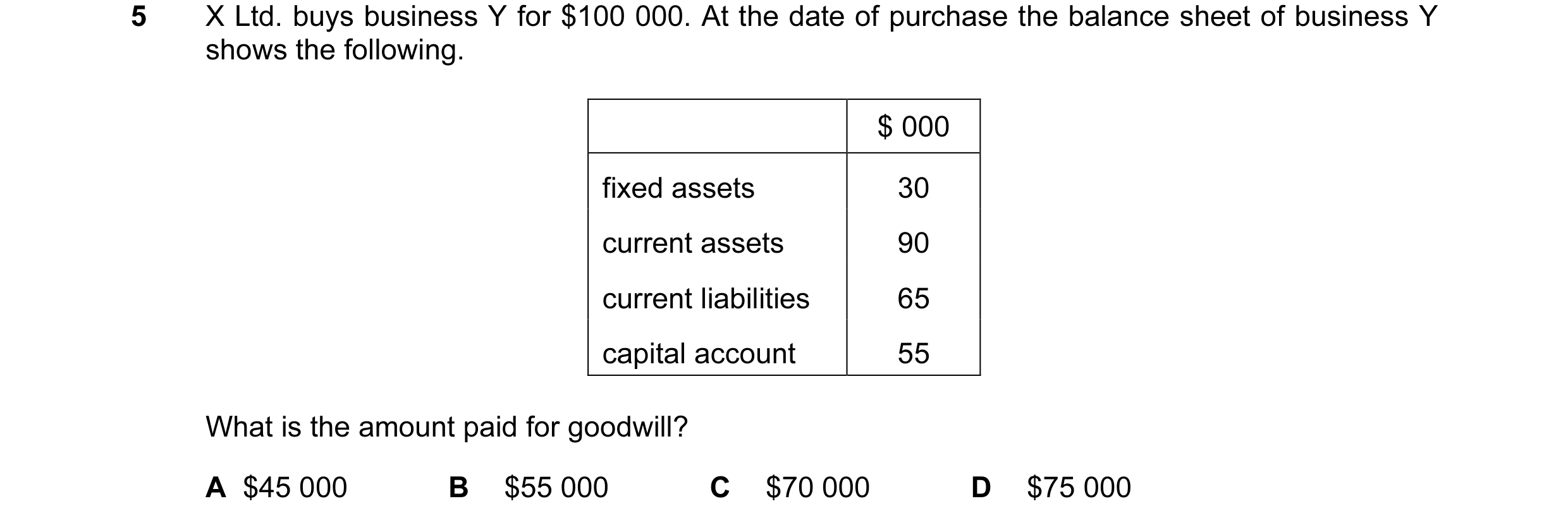
5 X Ltd. buys business Y for $100 000. At the date of purchase the balance sheet of business Y shows the following. $ 000 fixed assets 30 current assets 90 current liabilities 65 capital account 55 What is the amount paid for goodwill? A $45 000 B $55 000 C $70 000 D $75 000
1 marks
Answer: A
This question in 9706/32 Oct/Nov 2009
Q5 · A business with net tangible assets of $110 000 is purchased by a company for $150 000 9706/32 Oct/Nov 2009
6 A business with net tangible assets of $110 000 is purchased by a company for $150 000. The company completes the transaction by a cash payment of $20 000 and an issue of its $0.50 ordinary shares, fully paid, at $1.30 each. By how much will the balance on the company’s Ordinary Share Capital account increase? A $50 000 B $90 000 C $100 000 D $130 000
1 marks
Answer: A
This question in 9706/32 Oct/Nov 2009
Q6 · When the business of X was purchased by Y plc, negative goodwill of $100 000 arose 9706/32 Oct/Nov 2009
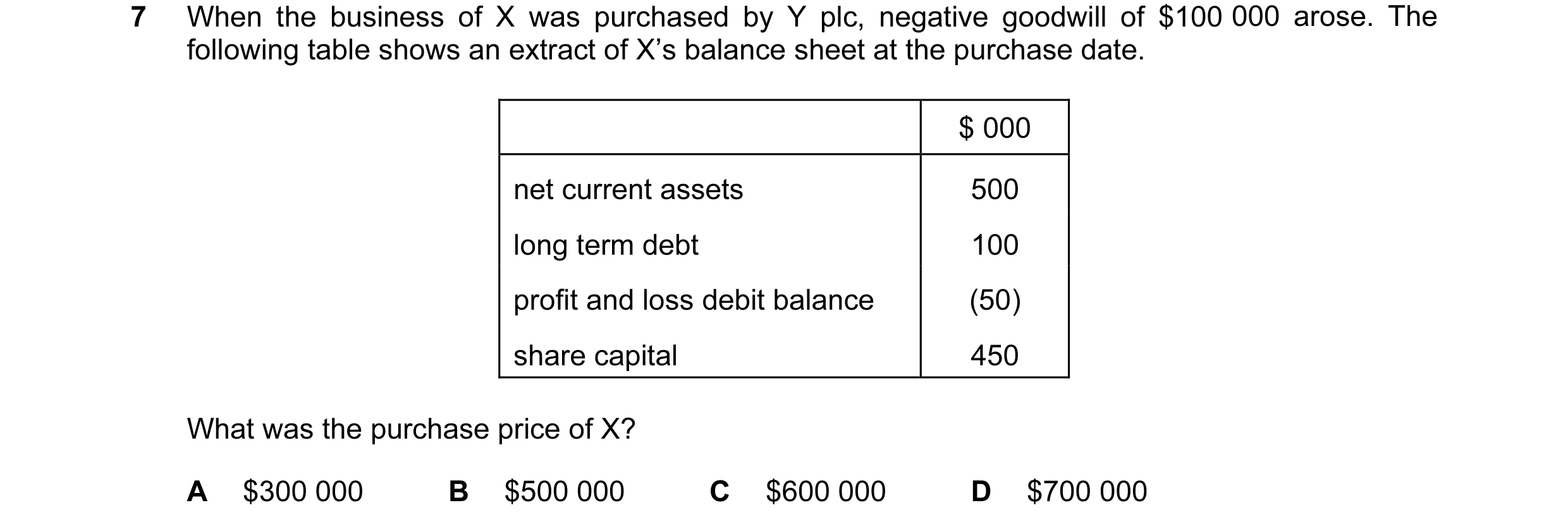
7 When the business of X was purchased by Y plc, negative goodwill of $100 000 arose. The following table shows an extract of X’s balance sheet at the purchase date. $ 000 net current assets 500 long term debt 100 profit and loss debit balance (50) share capital 450 What was the purchase price of X? A $300 000 B $500 000 C $600 000 D $700 000
1 marks
Answer: A
This question in 9706/32 Oct/Nov 2009
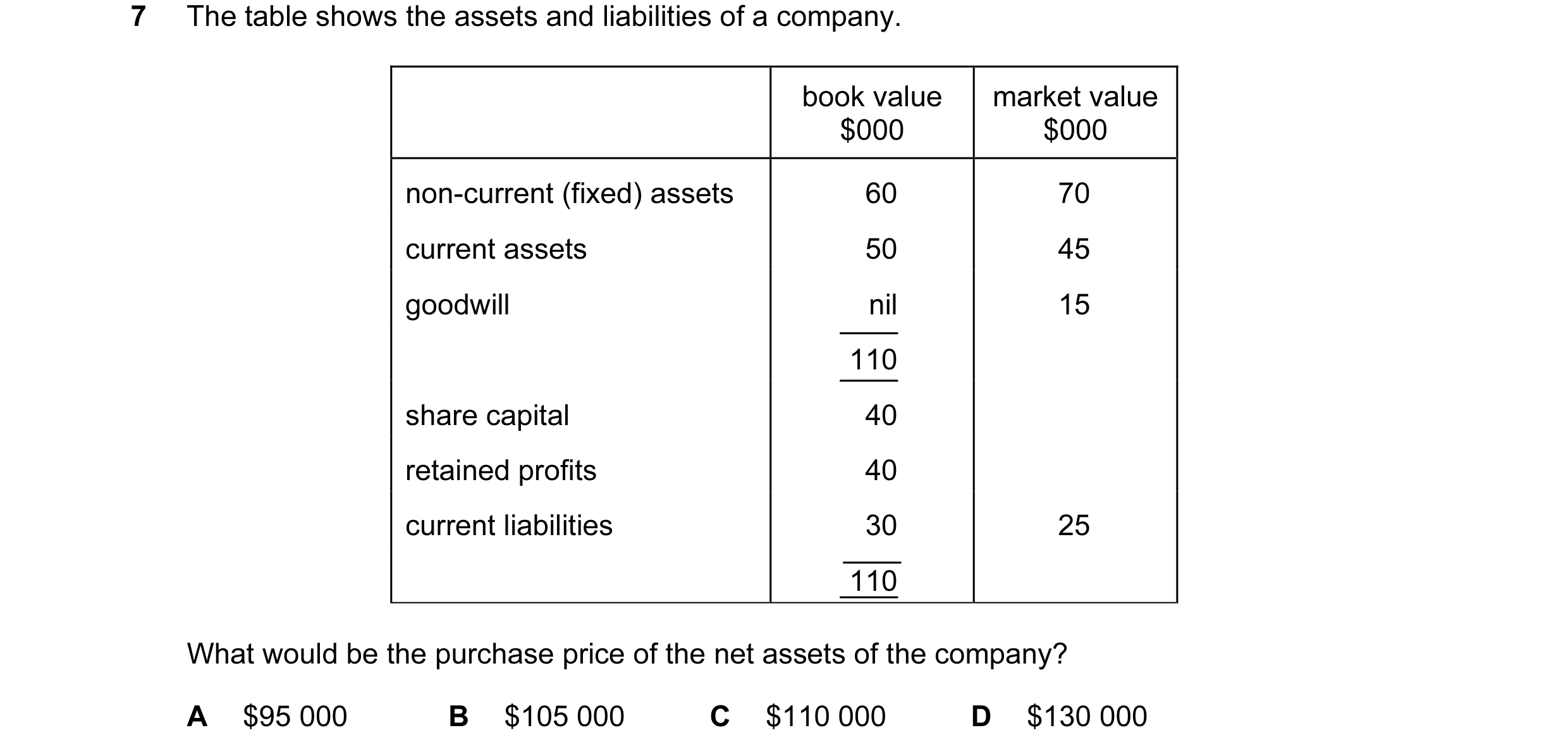
Q7 · The table shows the assets and liabilities of a company 9706/31 May/June 2010
7 The table shows the assets and liabilities of a company. book value market value $000 $000 non-current (fixed) assets 60 70 current assets 50 45 goodwill nil 15 110 share capital 40 retained profits 40 current liabilities 30 25 110 What would be the purchase price of the net assets of the company? A $95 000 B $105 000 C $110 000 D $130 000
1 marks
Answer: B
This question in 9706/31 May/June 2010
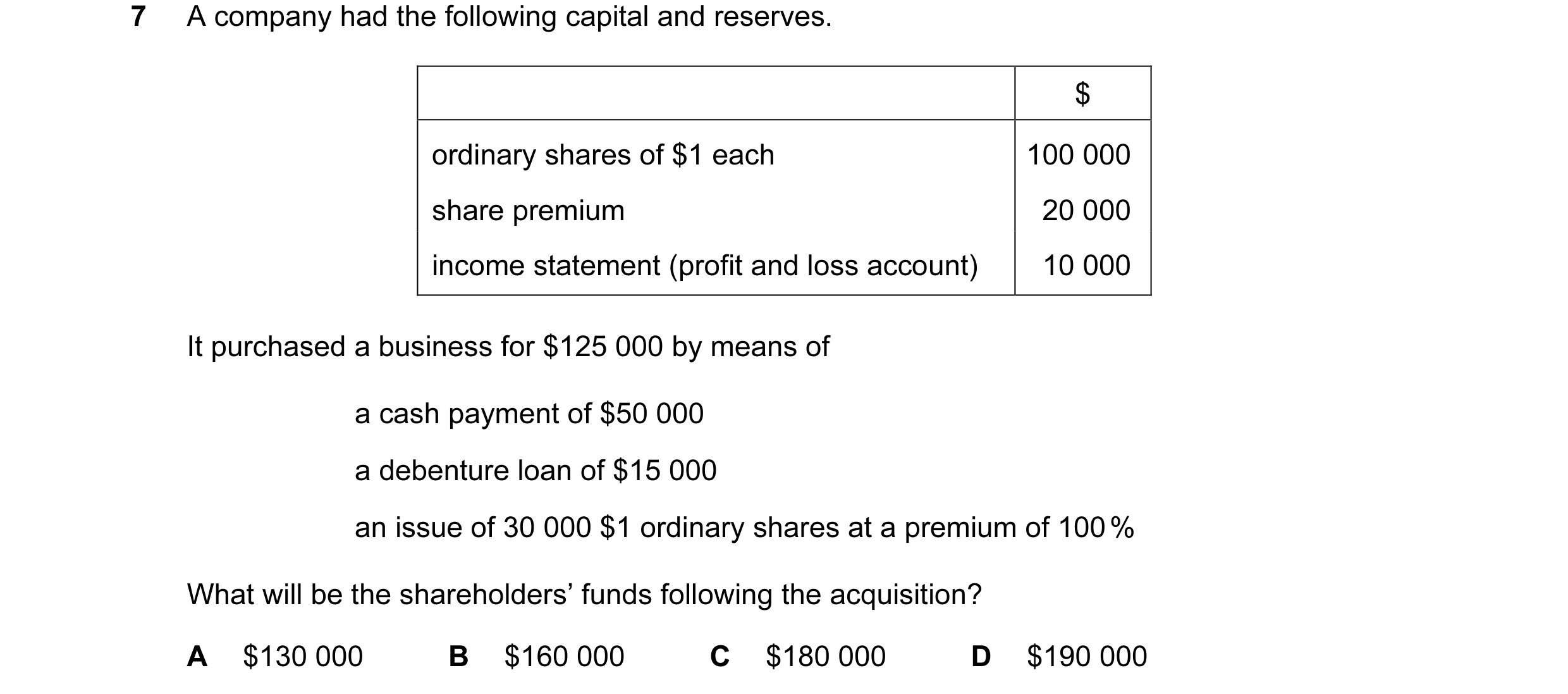
Q8 · A company had the following capital and reserves 9706/31 May/June 2010
8 A company had the following capital and reserves. $ ordinary shares of $1 each 100 000 share premium 20 000 income statement (profit and loss account) 10 000 It purchased a business for $125 000 by means of a cash payment of $50 000 a debenture loan of $15 000 an issue of 30 000 $1 ordinary shares at a premium of 100 % What will be the shareholders’ funds following the acquisition? A $130 000 B $160 000 C $180 000 D $190 000
1 marks
Answer: D
This question in 9706/31 May/June 2010
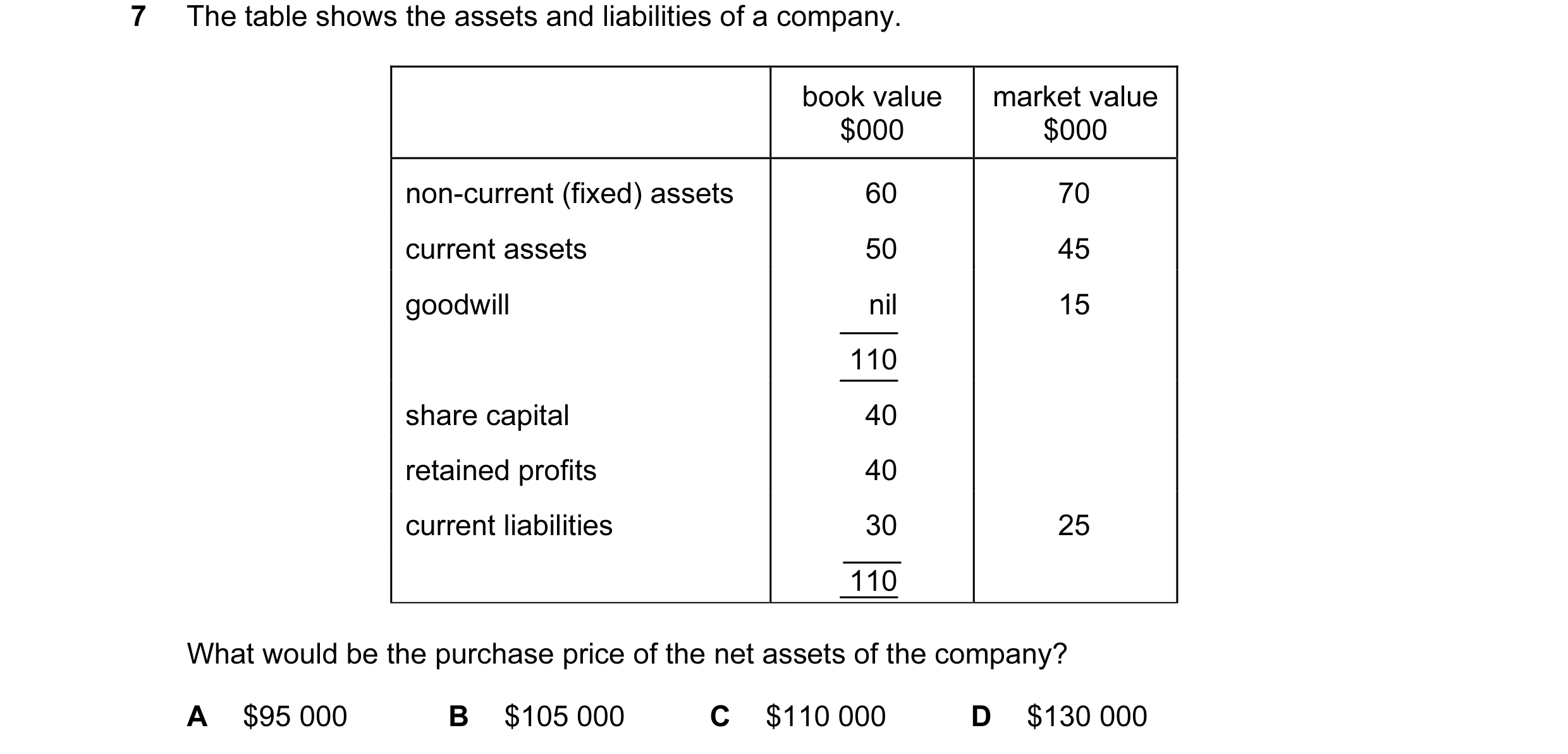
Q9 · The table shows the assets and liabilities of a company 9706/32 May/June 2010
7 The table shows the assets and liabilities of a company. book value market value $000 $000 non-current (fixed) assets 60 70 current assets 50 45 goodwill nil 15 110 share capital 40 retained profits 40 current liabilities 30 25 110 What would be the purchase price of the net assets of the company? A $95 000 B $105 000 C $110 000 D $130 000
1 marks
Answer: B
This question in 9706/32 May/June 2010
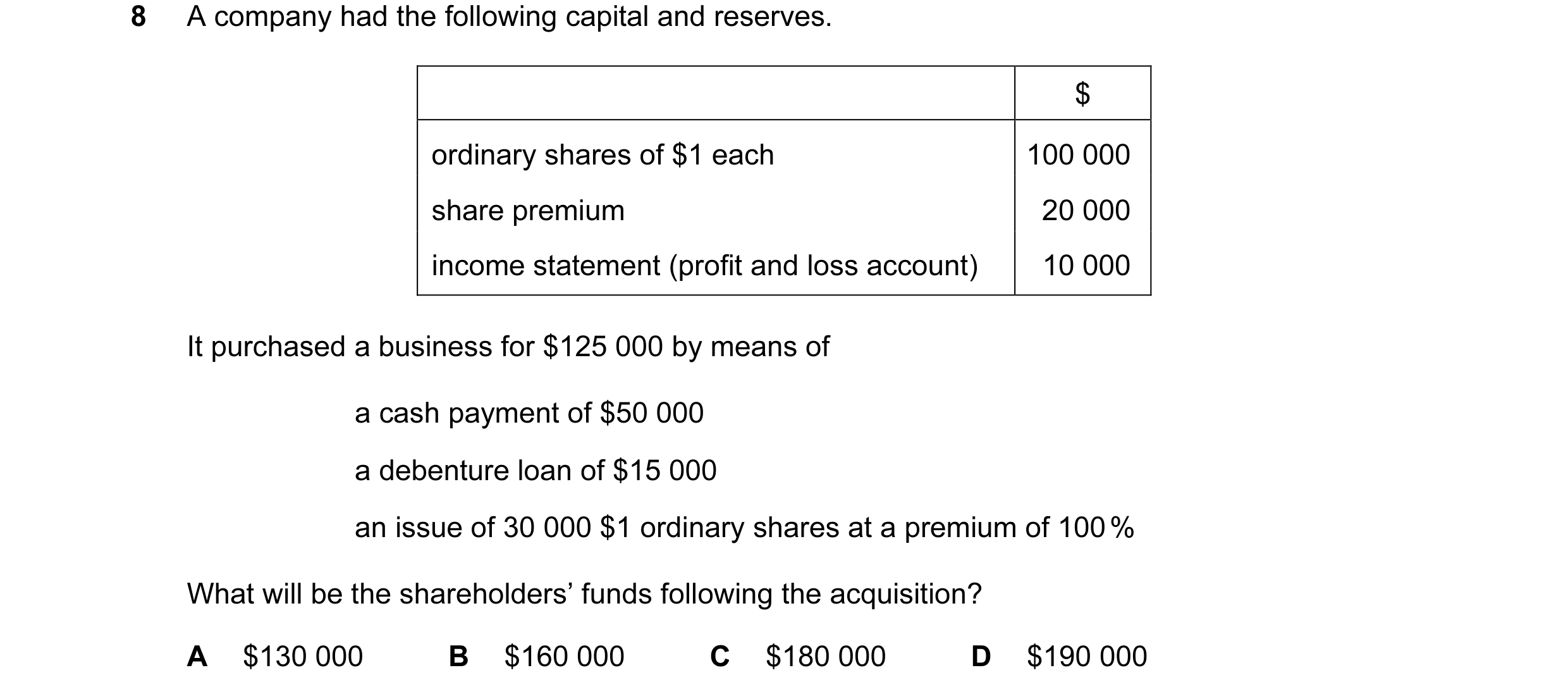
Q10 · A company had the following capital and reserves 9706/32 May/June 2010
8 A company had the following capital and reserves. $ ordinary shares of $1 each 100 000 share premium 20 000 income statement (profit and loss account) 10 000 It purchased a business for $125 000 by means of a cash payment of $50 000 a debenture loan of $15 000 an issue of 30 000 $1 ordinary shares at a premium of 100 % What will be the shareholders’ funds following the acquisition? A $130 000 B $160 000 C $180 000 D $190 000
1 marks
Answer: D
This question in 9706/32 May/June 2010
Q11 · The table shows the assets and liabilities of a company 9706/33 May/June 2010
6 The table shows the assets and liabilities of a company. book value market value $000 $000 non-current (fixed) assets 60 70 current assets 50 45 goodwill nil 15 110 share capital 40 retained profits 40 current liabilities 30 25 110 What would be the purchase price of the net assets of the company? A $95 000 B $105 000 C $110 000 D $130 000
1 marks
Answer: B
This question in 9706/33 May/June 2010
Q12 · A company had the following capital and reserves 9706/33 May/June 2010
7 A company had the following capital and reserves. $ ordinary shares of $1 each 100 000 share premium 20 000 income statement (profit and loss account) 10 000 It purchased a business for $125 000 by means of a cash payment of $50 000 a debenture loan of $15 000 an issue of 30 000 $1 ordinary shares at a premium of 100 % What will be the shareholders’ funds following the acquisition? A $130 000 B $160 000 C $180 000 D $190 000
1 marks
Answer: D
This question in 9706/33 May/June 2010
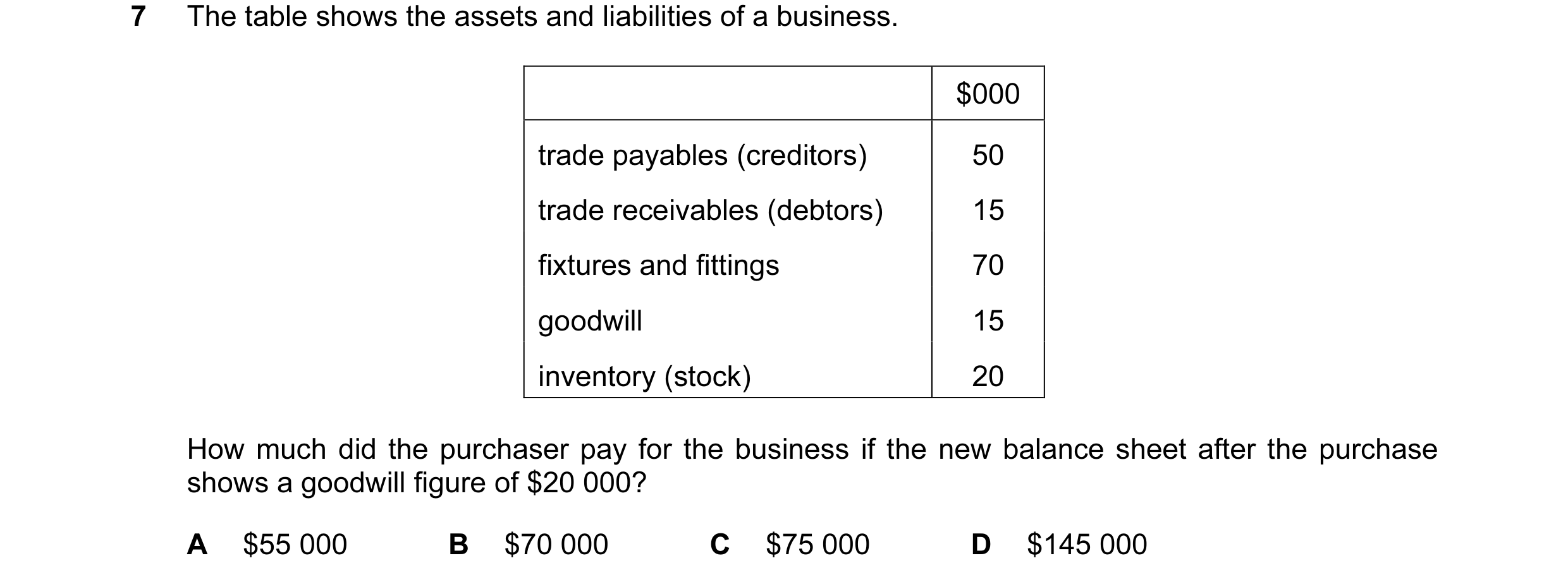
Q13 · The table shows the assets and liabilities of a business 9706/31 Oct/Nov 2010
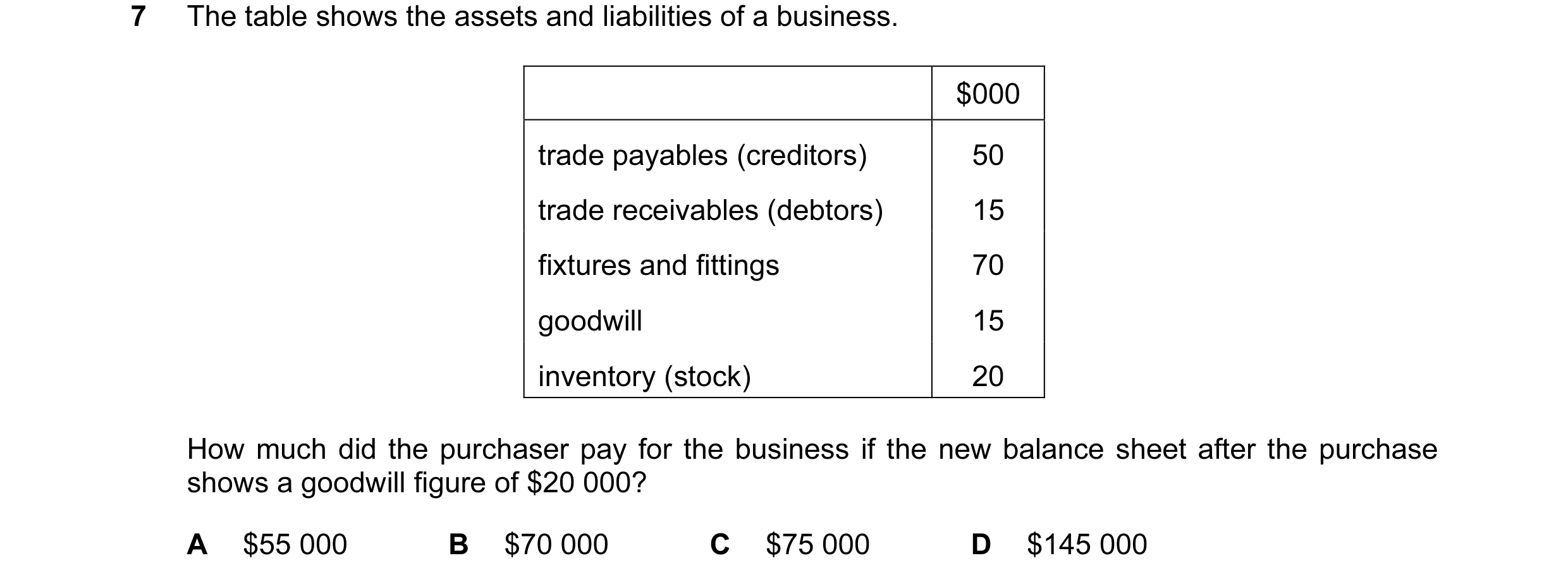
7 The table shows the assets and liabilities of a business. $000 trade payables (creditors) 50 trade receivables (debtors) 15 fixtures and fittings 70 goodwill 15 inventory (stock) 20 How much did the purchaser pay for the business if the new balance sheet after the purchase shows a goodwill figure of $20 000? A $55 000 B $70 000 C $75 000 D $145 000
1 marks
Answer: C
This question in 9706/31 Oct/Nov 2010
Q14 · A company purchases a business that it estimates has maintainable future earnings of $100… 9706/31 Oct/Nov 2010
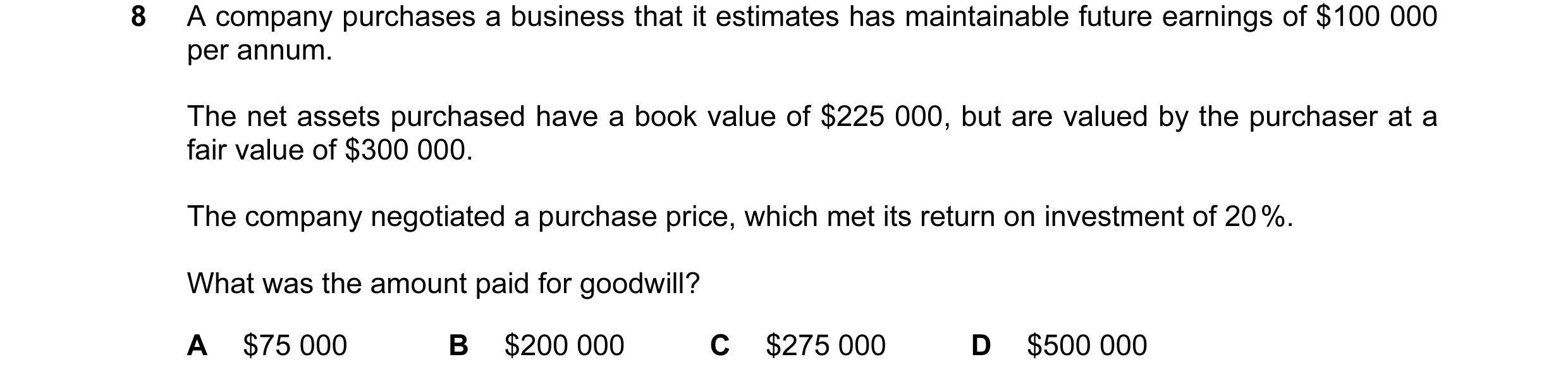
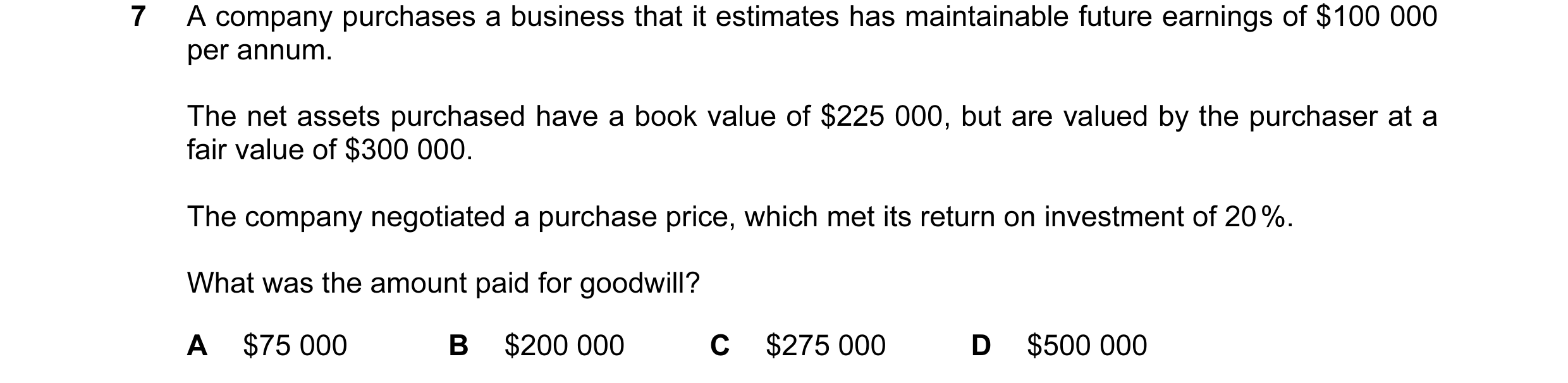
8 A company purchases a business that it estimates has maintainable future earnings of $100 000 per annum. The net assets purchased have a book value of $225 000, but are valued by the purchaser at a fair value of $300 000. The company negotiated a purchase price, which met its return on investment of 20 %. What was the amount paid for goodwill? A $75 000 B $200 000 C $275 000 D $500 000
1 marks
Answer: B
This question in 9706/31 Oct/Nov 2010
Q15 · A limited company is acquiring the business of a sole trader by: the issue of 50 000… 9706/31 Oct/Nov 2010
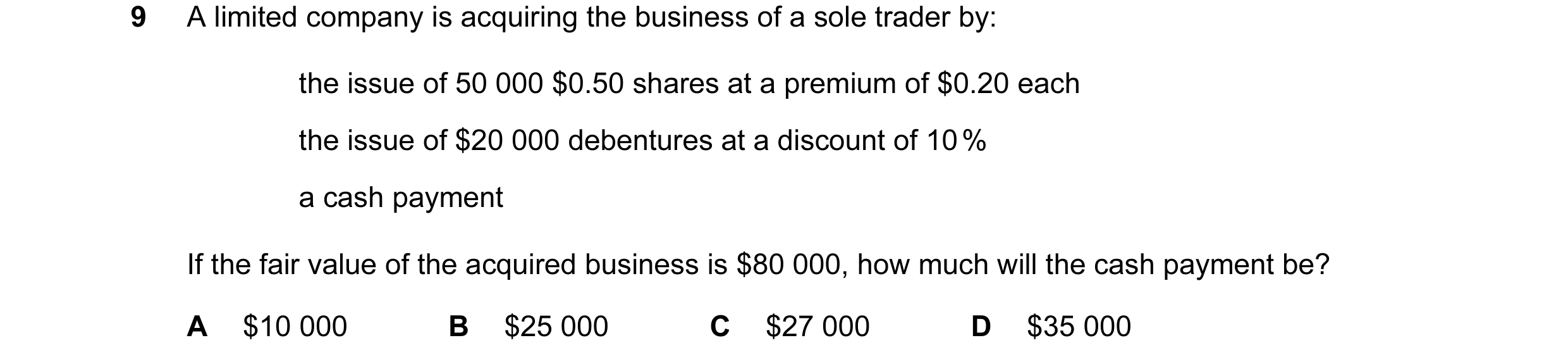
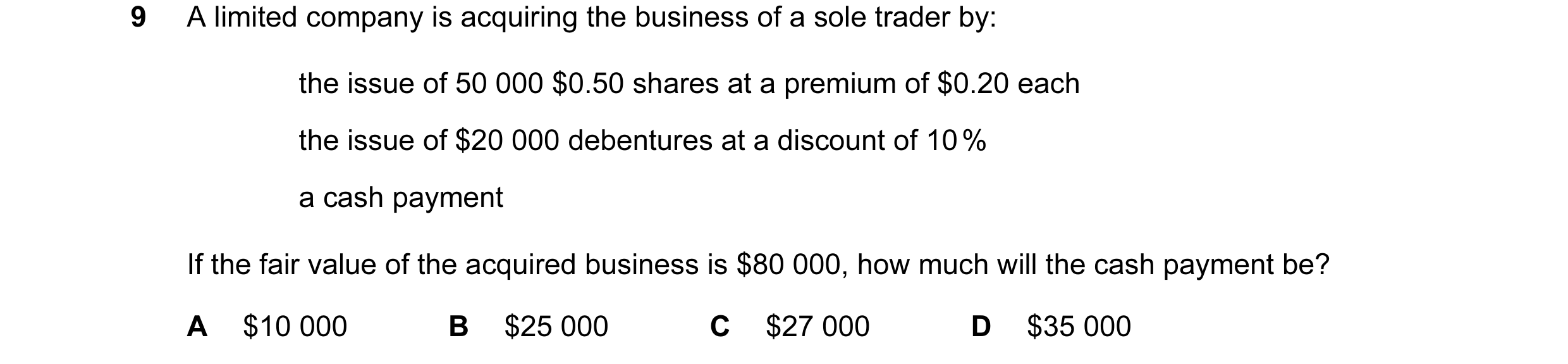
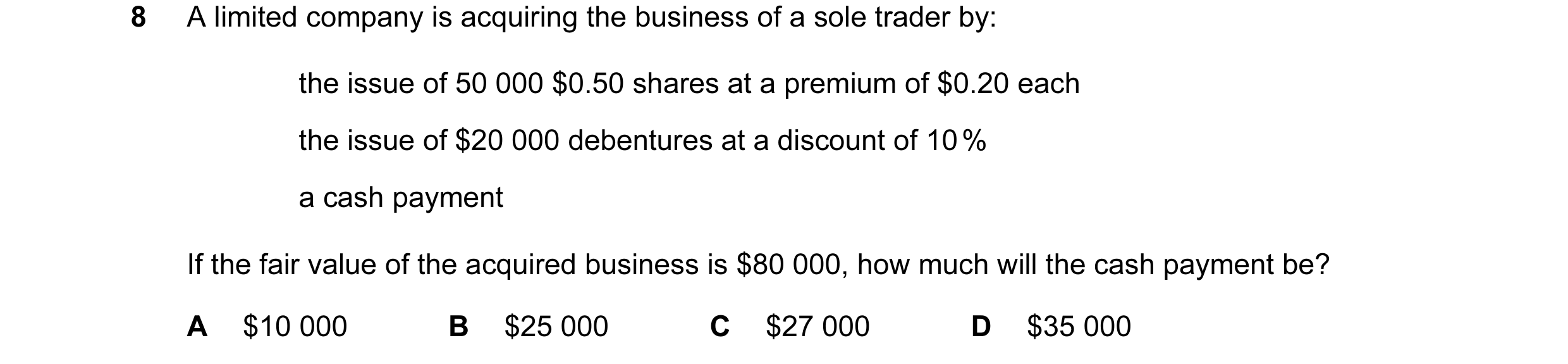
9 A limited company is acquiring the business of a sole trader by: the issue of 50 000 $0.50 shares at a premium of $0.20 each the issue of $20 000 debentures at a discount of 10 % a cash payment If the fair value of the acquired business is $80 000, how much will the cash payment be? A $10 000 B $25 000 C $27 000 D $35 000
1 marks
Answer: C
This question in 9706/31 Oct/Nov 2010
Q16 · The table shows the assets and liabilities of a business 9706/32 Oct/Nov 2010
7 The table shows the assets and liabilities of a business. $000 trade payables (creditors) 50 trade receivables (debtors) 15 fixtures and fittings 70 goodwill 15 inventory (stock) 20 How much did the purchaser pay for the business if the new balance sheet after the purchase shows a goodwill figure of $20 000? A $55 000 B $70 000 C $75 000 D $145 000
1 marks
Answer: C
This question in 9706/32 Oct/Nov 2010
Q17 · A company purchases a business that it estimates has maintainable future earnings of $100… 9706/32 Oct/Nov 2010
8 A company purchases a business that it estimates has maintainable future earnings of $100 000 per annum. The net assets purchased have a book value of $225 000, but are valued by the purchaser at a fair value of $300 000. The company negotiated a purchase price, which met its return on investment of 20 %. What was the amount paid for goodwill? A $75 000 B $200 000 C $275 000 D $500 000
1 marks
Answer: B
This question in 9706/32 Oct/Nov 2010
Q18 · A limited company is acquiring the business of a sole trader by: the issue of 50 000… 9706/32 Oct/Nov 2010
9 A limited company is acquiring the business of a sole trader by: the issue of 50 000 $0.50 shares at a premium of $0.20 each the issue of $20 000 debentures at a discount of 10 % a cash payment If the fair value of the acquired business is $80 000, how much will the cash payment be? A $10 000 B $25 000 C $27 000 D $35 000
1 marks
Answer: C
This question in 9706/32 Oct/Nov 2010
Q19 · The table shows the assets and liabilities of a business 9706/33 Oct/Nov 2010
6 The table shows the assets and liabilities of a business. $000 trade payables (creditors) 50 trade receivables (debtors) 15 fixtures and fittings 70 goodwill 15 inventory (stock) 20 How much did the purchaser pay for the business if the new balance sheet after the purchase shows a goodwill figure of $20 000? A $55 000 B $70 000 C $75 000 D $145 000
1 marks
Answer: C
This question in 9706/33 Oct/Nov 2010
Q20 · A company purchases a business that it estimates has maintainable future earnings of $100… 9706/33 Oct/Nov 2010
7 A company purchases a business that it estimates has maintainable future earnings of $100 000 per annum. The net assets purchased have a book value of $225 000, but are valued by the purchaser at a fair value of $300 000. The company negotiated a purchase price, which met its return on investment of 20 %. What was the amount paid for goodwill? A $75 000 B $200 000 C $275 000 D $500 000
1 marks
Answer: B
This question in 9706/33 Oct/Nov 2010
Q21 · A limited company is acquiring the business of a sole trader by: the issue of 50 000… 9706/33 Oct/Nov 2010
8 A limited company is acquiring the business of a sole trader by: the issue of 50 000 $0.50 shares at a premium of $0.20 each the issue of $20 000 debentures at a discount of 10 % a cash payment If the fair value of the acquired business is $80 000, how much will the cash payment be? A $10 000 B $25 000 C $27 000 D $35 000
1 marks
Answer: C
This question in 9706/33 Oct/Nov 2010
Q22 · Ess is to purchase the business of Tee 9706/31 May/June 2011
7 Ess is to purchase the business of Tee. The purchase price is $100 000 in cash. The net asset values of the two businesses at the date of purchase were Ess $250 000 and Tee $80 000. What was the value of the net assets of the business of Ess immediately after the purchase? A $150 000 B $230 000 C $250 000 D $270 000
1 marks
Answer: C
This question in 9706/31 May/June 2011
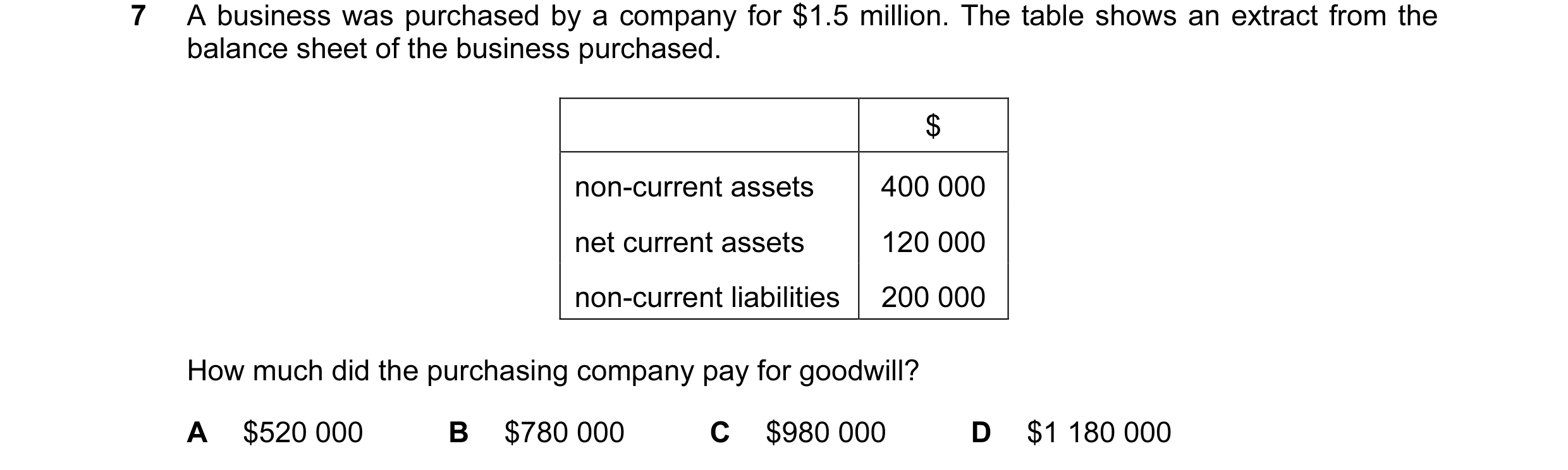
Q23 · A business was purchased by a company for $1.5 million 9706/31 May/June 2011
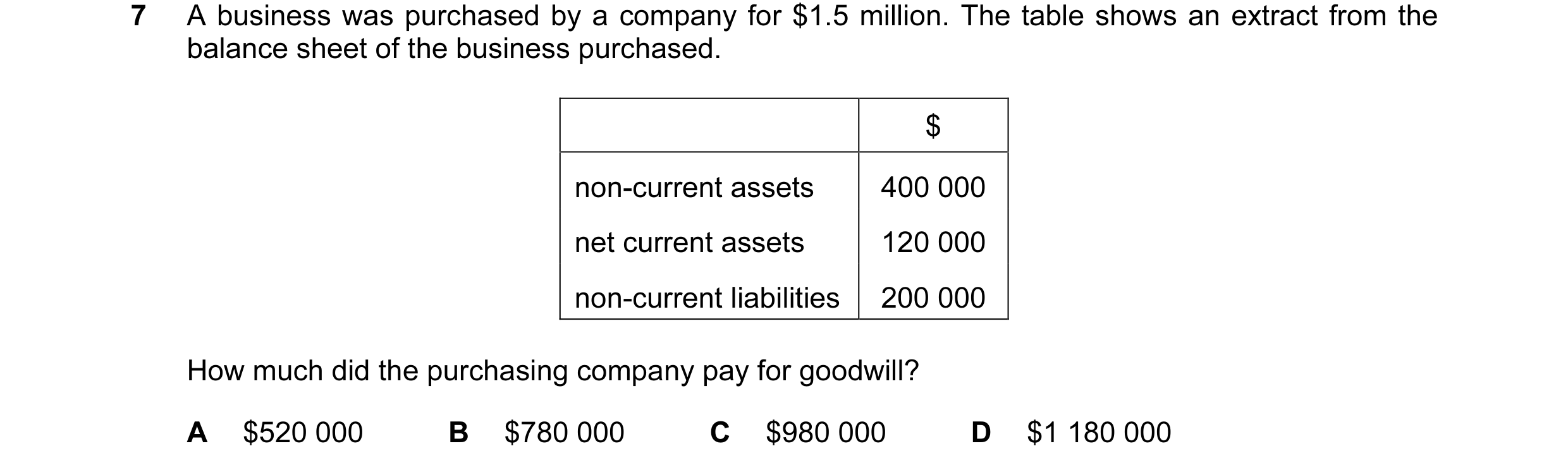
8 A business was purchased by a company for $1.5 million. The table shows an extract from the balance sheet of the business purchased. $ non-current assets 400 000 net current assets 120 000 non-current liabilities 200 000 How much did the purchasing company pay for goodwill? A $520 000 B $780 000 C $980 000 D $1 180 000
1 marks
Answer: D
This question in 9706/31 May/June 2011
Q24 · Ess is to purchase the business of Tee 9706/32 May/June 2011
6 Ess is to purchase the business of Tee. The purchase price is $100 000 in cash. The net asset values of the two businesses at the date of purchase were Ess $250 000 and Tee $80 000. What was the value of the net assets of the business of Ess immediately after the purchase? A $150 000 B $230 000 C $250 000 D $270 000
1 marks
Answer: C
This question in 9706/32 May/June 2011
Q25 · A business was purchased by a company for $1.5 million 9706/32 May/June 2011
7 A business was purchased by a company for $1.5 million. The table shows an extract from the balance sheet of the business purchased. $ non-current assets 400 000 net current assets 120 000 non-current liabilities 200 000 How much did the purchasing company pay for goodwill? A $520 000 B $780 000 C $980 000 D $1 180 000
1 marks
Answer: D
This question in 9706/32 May/June 2011
Q26 · Ess is to purchase the business of Tee 9706/33 May/June 2011
6 Ess is to purchase the business of Tee. The purchase price is $100 000 in cash. The net asset values of the two businesses at the date of purchase were Ess $250 000 and Tee $80 000. What was the value of the net assets of the business of Ess immediately after the purchase? A $150 000 B $230 000 C $250 000 D $270 000
1 marks
Answer: C
This question in 9706/33 May/June 2011
Q27 · A business was purchased by a company for $1.5 million 9706/33 May/June 2011
7 A business was purchased by a company for $1.5 million. The table shows an extract from the balance sheet of the business purchased. $ non-current assets 400 000 net current assets 120 000 non-current liabilities 200 000 How much did the purchasing company pay for goodwill? A $520 000 B $780 000 C $980 000 D $1 180 000
1 marks
Answer: D
This question in 9706/33 May/June 2011
Q28 · The balance sheet of a business shows net assets of $500 000 9706/31 Oct/Nov 2011
5 The balance sheet of a business shows net assets of $500 000. A limited company buys this business for $800 000 by issuing new share capital. The fair value of the net assets acquired is $700 000. By how much do the net assets of the purchasing company increase? A $300 000 B $500 000 C $700 000 D $800 000
1 marks
Answer: D
This question in 9706/31 Oct/Nov 2011
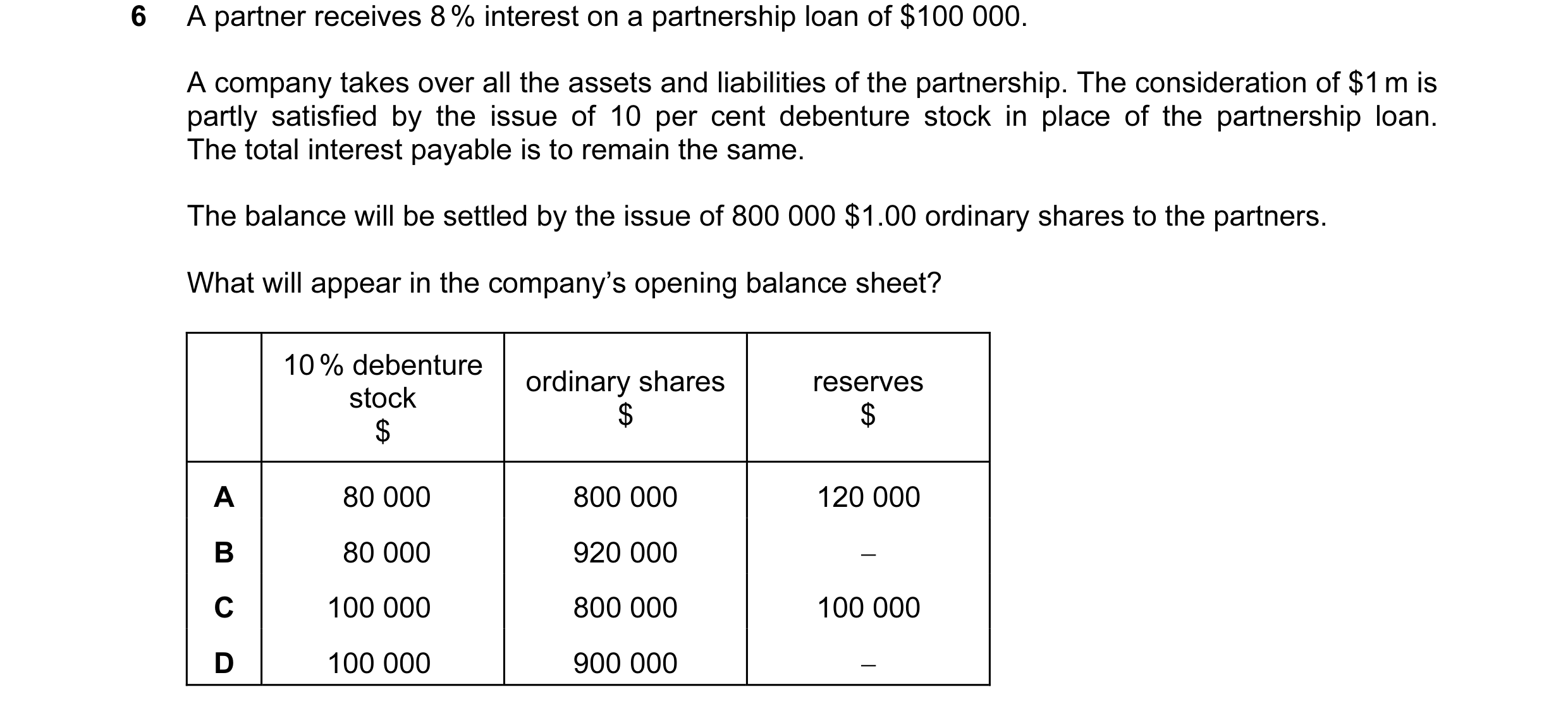
Q29 · A partner receives 8 % interest on a partnership loan of $100 000 9706/31 Oct/Nov 2011
6 A partner receives 8 % interest on a partnership loan of $100 000. A company takes over all the assets and liabilities of the partnership. The consideration of $1 m is partly satisfied by the issue of 10 per cent debenture stock in place of the partnership loan. The total interest payable is to remain the same. The balance will be settled by the issue of 800 000 $1.00 ordinary shares to the partners. What will appear in the company’s opening balance sheet? 10 % debenture ordinary shares reserves stock $ $ $ A 80 000 800 000 120 000 B 80 000 920 000 − C 100 000 800 000 100 000 D 100 000 900 000 −
1 marks
Answer: A
This question in 9706/31 Oct/Nov 2011
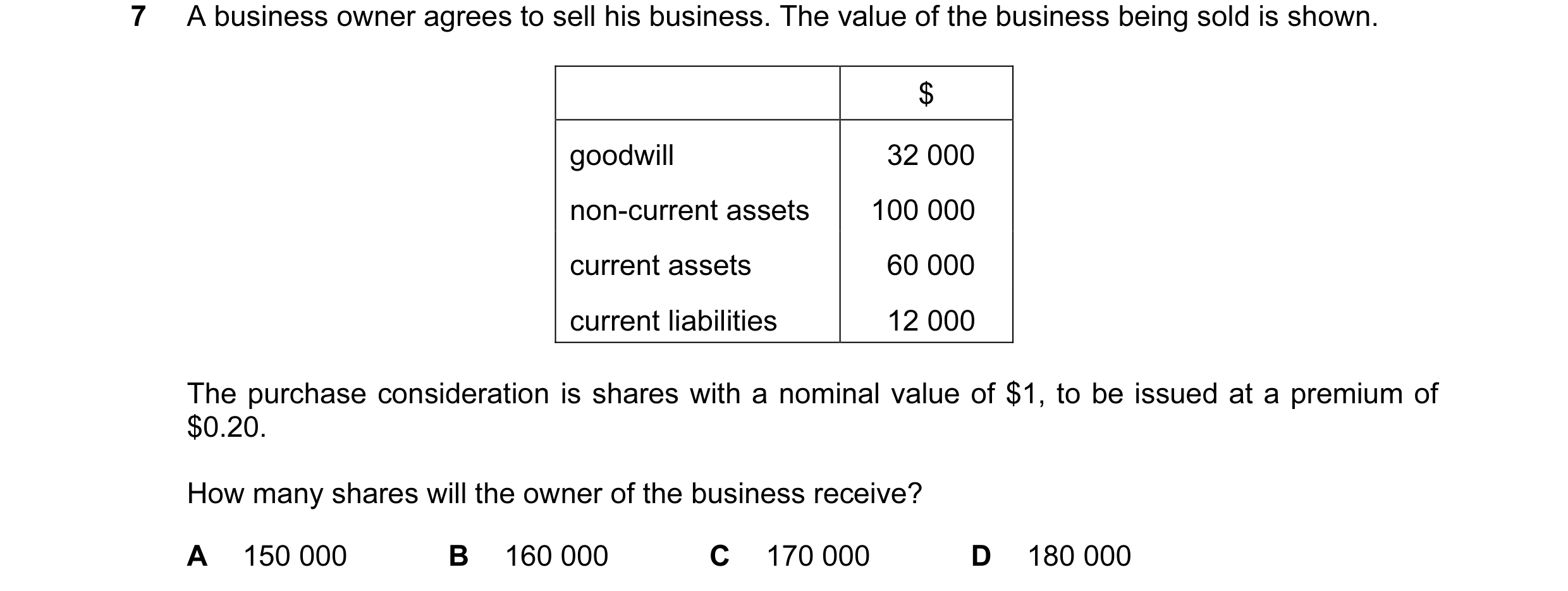
Q30 · A business owner agrees to sell his business 9706/31 Oct/Nov 2011
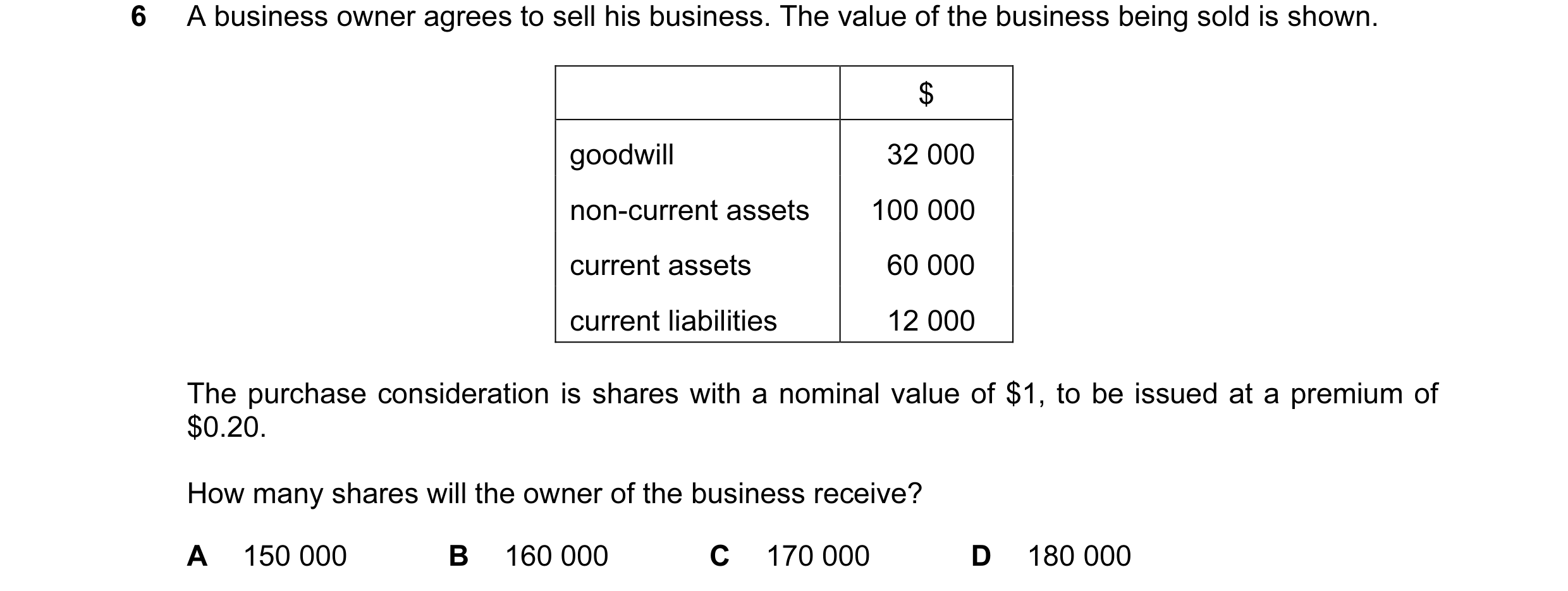
7 A business owner agrees to sell his business. The value of the business being sold is shown. $ goodwill 32 000 non-current assets 100 000 current assets 60 000 current liabilities 12 000 The purchase consideration is shares with a nominal value of $1, to be issued at a premium of $0.20. How many shares will the owner of the business receive? A 150 000 B 160 000 C 170 000 D 180 000
1 marks
Answer: A
This question in 9706/31 Oct/Nov 2011
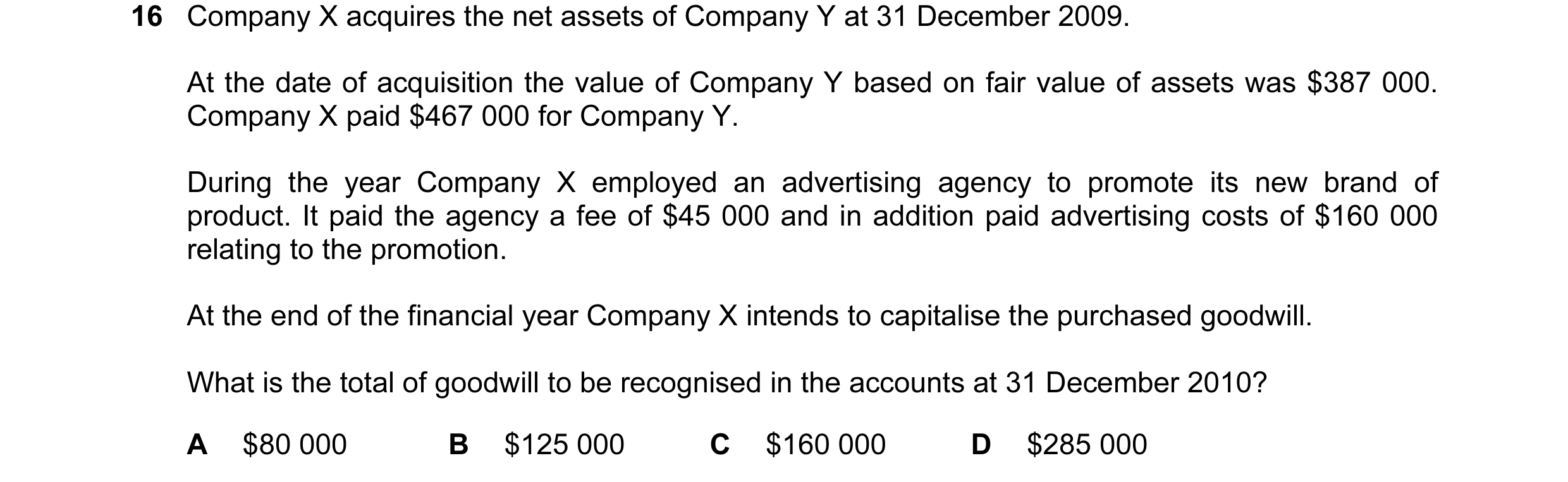
Q31 · Company X acquires the net assets of Company Y at 31 December 2009 9706/31 Oct/Nov 2011
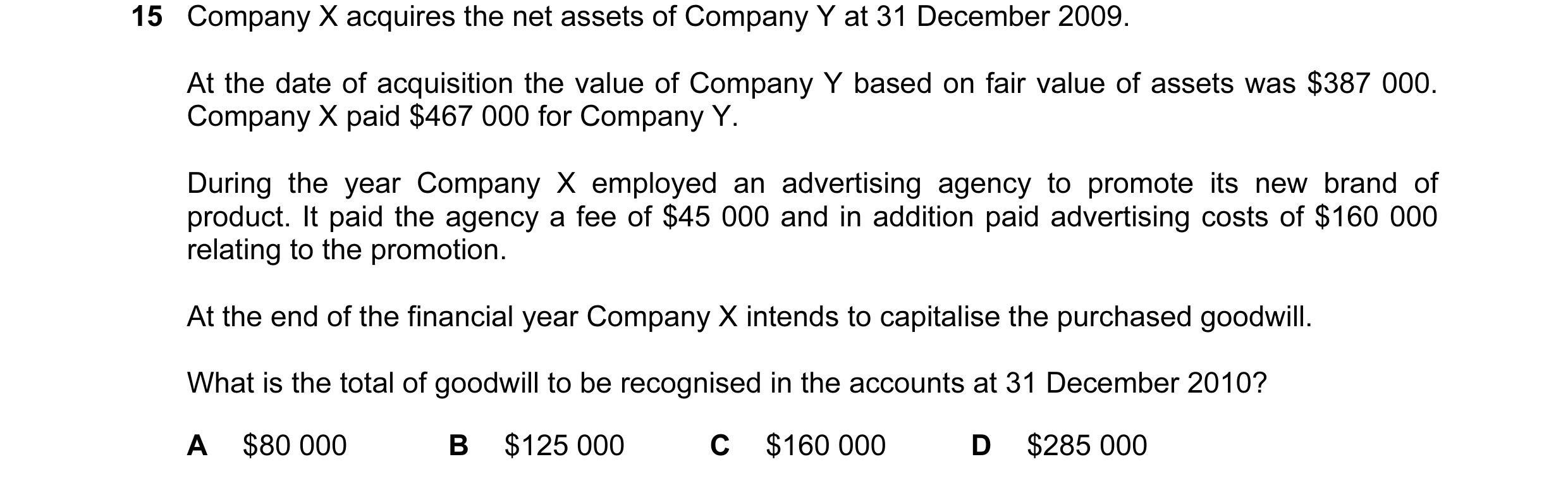
16 Company X acquires the net assets of Company Y at 31 December 2009. At the date of acquisition the value of Company Y based on fair value of assets was $387 000. Company X paid $467 000 for Company Y. During the year Company X employed an advertising agency to promote its new brand of product. It paid the agency a fee of $45 000 and in addition paid advertising costs of $160 000 relating to the promotion. At the end of the financial year Company X intends to capitalise the purchased goodwill. What is the total of goodwill to be recognised in the accounts at 31 December 2010? A $80 000 B $125 000 C $160 000 D $285 000
1 marks
Answer: A
This question in 9706/31 Oct/Nov 2011
Q32 · The summarised statement of financial position of company A is as follows 9706/32 Oct/Nov 2011
6 The summarised statement of financial position of company A is as follows. $ $ assets 600 000 capital and reserves 460 000 loan capital 140 000 Company Z agrees to buy the net assets of company A by means of issuing a debenture of $200 000 and 65 000 ordinary shares of $1 each for the balance of the consideration. How much will company Z credit to its share premium account? A $195 000 B $260 000 C $335 000 D $395 000
1 marks
Answer: A
This question in 9706/32 Oct/Nov 2011
Q33 · A company is to purchase an unincorporated business by the issue of 120 000 ordinary… 9706/32 Oct/Nov 2011
7 A company is to purchase an unincorporated business by the issue of 120 000 ordinary shares of $0.50, 10 000 $10 8 % debentures and by paying $20 000 cash. The current market value of the ordinary shares is $1.45 and the debentures are each trading at $95. What is the total value of the consideration for the purchase? A $180 000 B $240 000 C $269 000 D $289 000
1 marks
Answer: D
This question in 9706/32 Oct/Nov 2011
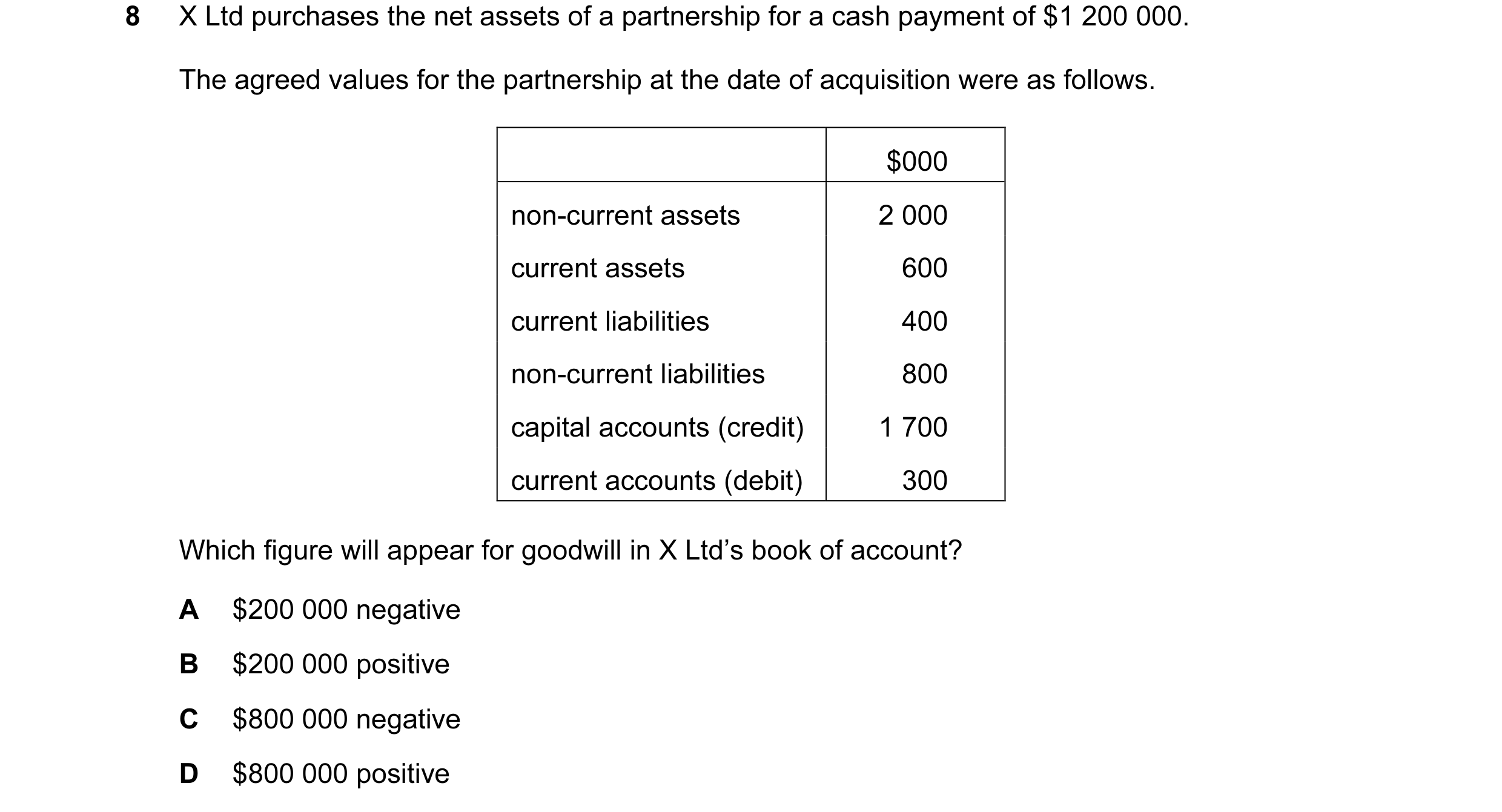
Q34 · X Ltd purchases the net assets of a partnership for a cash payment of $1 200 000 9706/32 Oct/Nov 2011
8 X Ltd purchases the net assets of a partnership for a cash payment of $1 200 000. The agreed values for the partnership at the date of acquisition were as follows. $000 non-current assets 2 000 current assets 600 current liabilities 400 non-current liabilities 800 capital accounts (credit) 1 700 current accounts (debit) 300 Which figure will appear for goodwill in X Ltd’s book of account? A $200 000 negative B $200 000 positive C $800 000 negative D $800 000 positive
1 marks
Answer: A
This question in 9706/32 Oct/Nov 2011
Q35 · The balance sheet of a business shows net assets of $500 000 9706/33 Oct/Nov 2011
4 The balance sheet of a business shows net assets of $500 000. A limited company buys this business for $800 000 by issuing new share capital. The fair value of the net assets acquired is $700 000. By how much do the net assets of the purchasing company increase? A $300 000 B $500 000 C $700 000 D $800 000
1 marks
Answer: D
This question in 9706/33 Oct/Nov 2011
Q36 · A partner receives 8 % interest on a partnership loan of $100 000 9706/33 Oct/Nov 2011
5 A partner receives 8 % interest on a partnership loan of $100 000. A company takes over all the assets and liabilities of the partnership. The consideration of $1 m is partly satisfied by the issue of 10 per cent debenture stock in place of the partnership loan. The total interest payable is to remain the same. The balance will be settled by the issue of 800 000 $1.00 ordinary shares to the partners. What will appear in the company’s opening balance sheet? 10 % debenture ordinary shares reserves stock $ $ $ A 80 000 800 000 120 000 B 80 000 920 000 − C 100 000 800 000 100 000 D 100 000 900 000 −
1 marks
Answer: A
This question in 9706/33 Oct/Nov 2011
Q37 · A business owner agrees to sell his business 9706/33 Oct/Nov 2011
6 A business owner agrees to sell his business. The value of the business being sold is shown. $ goodwill 32 000 non-current assets 100 000 current assets 60 000 current liabilities 12 000 The purchase consideration is shares with a nominal value of $1, to be issued at a premium of $0.20. How many shares will the owner of the business receive? A 150 000 B 160 000 C 170 000 D 180 000
1 marks
Answer: A
This question in 9706/33 Oct/Nov 2011
Q38 · Company X acquires the net assets of Company Y at 31 December 2009 9706/33 Oct/Nov 2011
15 Company X acquires the net assets of Company Y at 31 December 2009. At the date of acquisition the value of Company Y based on fair value of assets was $387 000. Company X paid $467 000 for Company Y. During the year Company X employed an advertising agency to promote its new brand of product. It paid the agency a fee of $45 000 and in addition paid advertising costs of $160 000 relating to the promotion. At the end of the financial year Company X intends to capitalise the purchased goodwill. What is the total of goodwill to be recognised in the accounts at 31 December 2010? A $80 000 B $125 000 C $160 000 D $285 000
1 marks
Answer: A
This question in 9706/33 Oct/Nov 2011
Q39 · A limited company purchases a partnership 9706/31 May/June 2012
8 A limited company purchases a partnership. It issues to the partners 10 % debentures and pays them cash in full settlement of the purchase price. Which of the following statements is correct? A The company's gearing is reduced. B The company intended to expand its business. C The company's reserves are reduced. D The partners now own some of the equity in the company.
1 marks
Answer: B
This question in 9706/31 May/June 2012
Q40 · A company buys a business by issuing shares in full payment 9706/31 May/June 2012
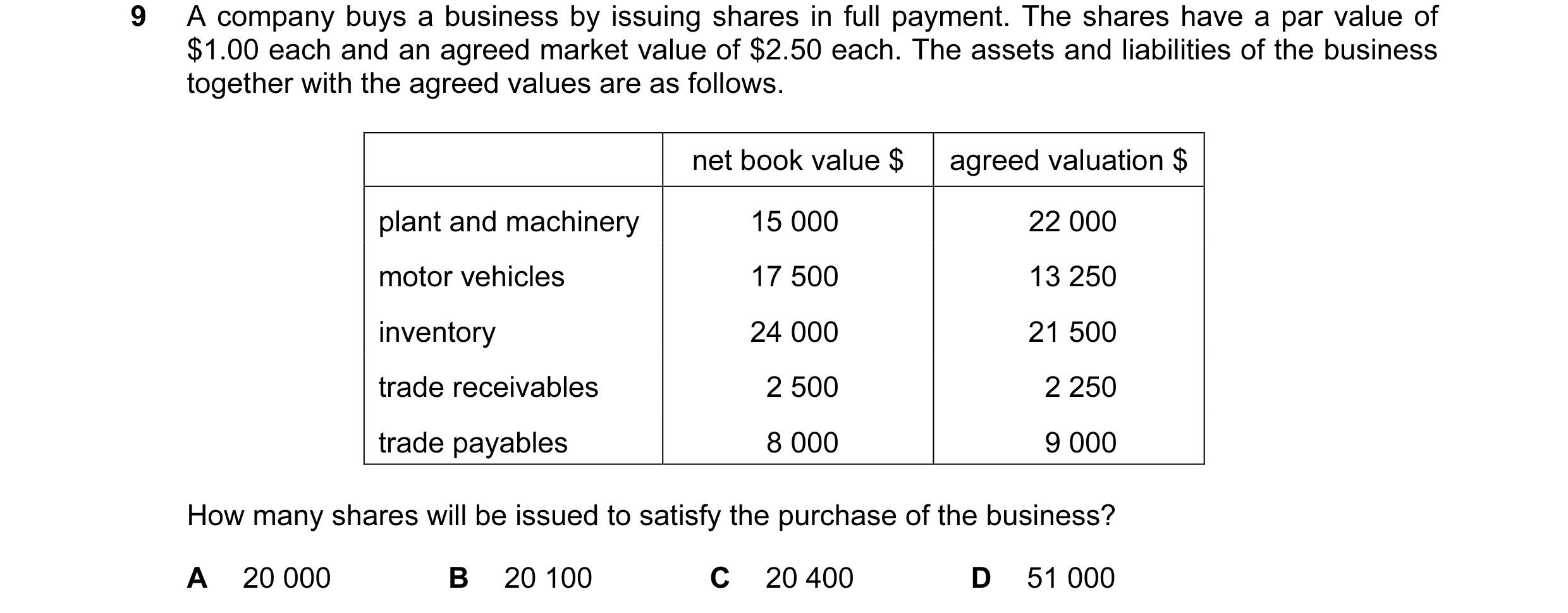
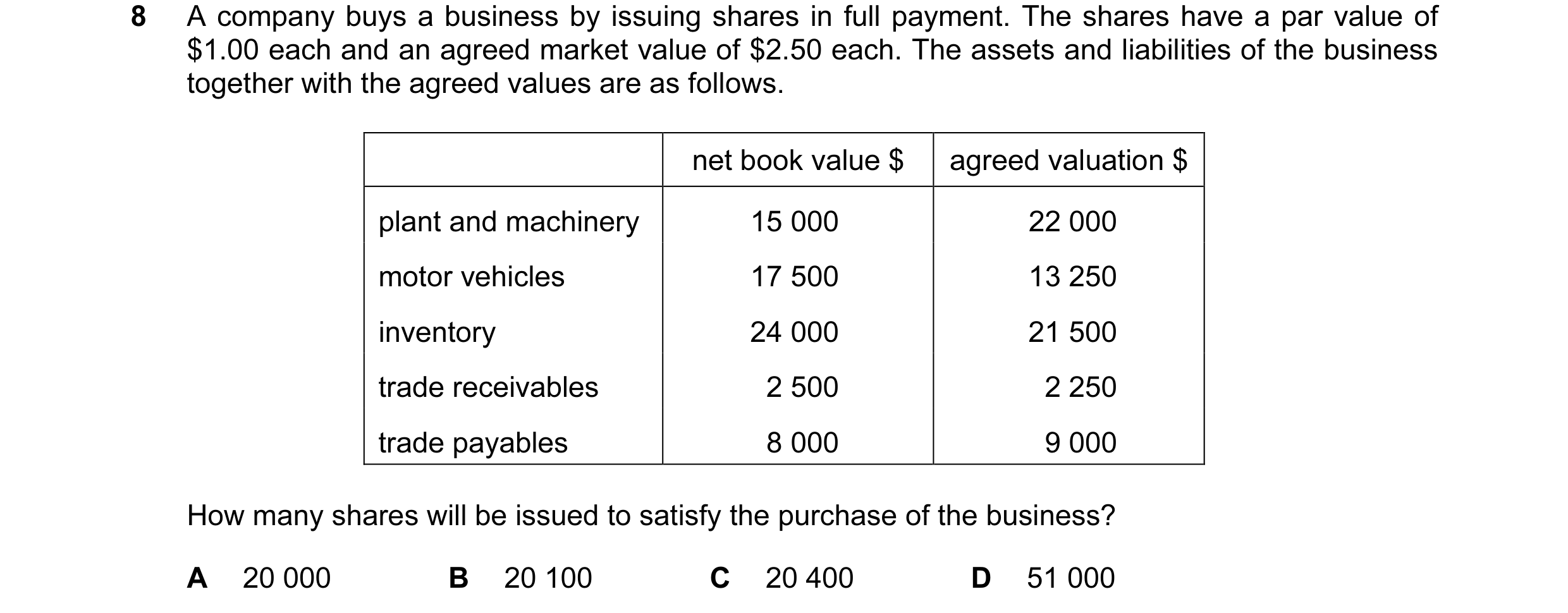
9 A company buys a business by issuing shares in full payment. The shares have a par value of $1.00 each and an agreed market value of $2.50 each. The assets and liabilities of the business together with the agreed values are as follows. net book value $ agreed valuation $ plant and machinery 15 000 22 000 motor vehicles 17 500 13 250 inventory 24 000 21 500 trade receivables 2 500 2 250 trade payables 8 000 9 000 How many shares will be issued to satisfy the purchase of the business? A 20 000 B 20 100 C 20 400 D 51 000
1 marks
Answer: A
This question in 9706/31 May/June 2012
Q41 · The business of a sole trader is bought by a limited company 9706/31 May/June 2012
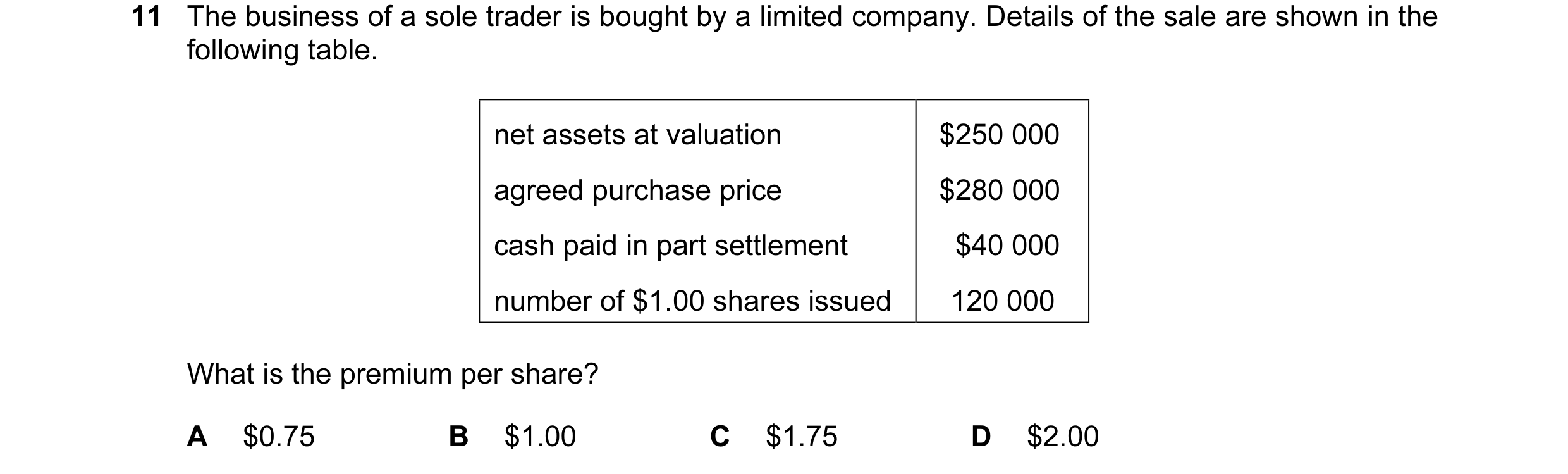
11 The business of a sole trader is bought by a limited company. Details of the sale are shown in the following table. net assets at valuation $250 000 agreed purchase price $280 000 cash paid in part settlement $40 000 number of $1.00 shares issued 120 000 What is the premium per share? A $0.75 B $1.00 C $1.75 D $2.00
1 marks
Answer: B
This question in 9706/31 May/June 2012
Q42 · A business has assets with a fair value of $150 000 9706/31 May/June 2012
12 A business has assets with a fair value of $150 000. There is agreed negative goodwill of $30 000. 16 000 ordinary shares of $2.00 each were issued at a premium of $3 each to acquire the net assets. How much were the liabilities acquired? A $40 000 B $70 000 C $88 000 D $100 000
1 marks
Answer: A
This question in 9706/31 May/June 2012
Q43 · A limited company purchases a partnership 9706/32 May/June 2012
7 A limited company purchases a partnership. It issues to the partners 10 % debentures and pays them cash in full settlement of the purchase price. Which of the following statements is correct? A The company's gearing is reduced. B The company intended to expand its business. C The company's reserves are reduced. D The partners now own some of the equity in the company.
1 marks
Answer: B
This question in 9706/32 May/June 2012
Q44 · A company buys a business by issuing shares in full payment 9706/32 May/June 2012
8 A company buys a business by issuing shares in full payment. The shares have a par value of $1.00 each and an agreed market value of $2.50 each. The assets and liabilities of the business together with the agreed values are as follows. net book value $ agreed valuation $ plant and machinery 15 000 22 000 motor vehicles 17 500 13 250 inventory 24 000 21 500 trade receivables 2 500 2 250 trade payables 8 000 9 000 How many shares will be issued to satisfy the purchase of the business? A 20 000 B 20 100 C 20 400 D 51 000
1 marks
Answer: A
This question in 9706/32 May/June 2012
Q45 · The business of a sole trader is bought by a limited company 9706/33 May/June 2012
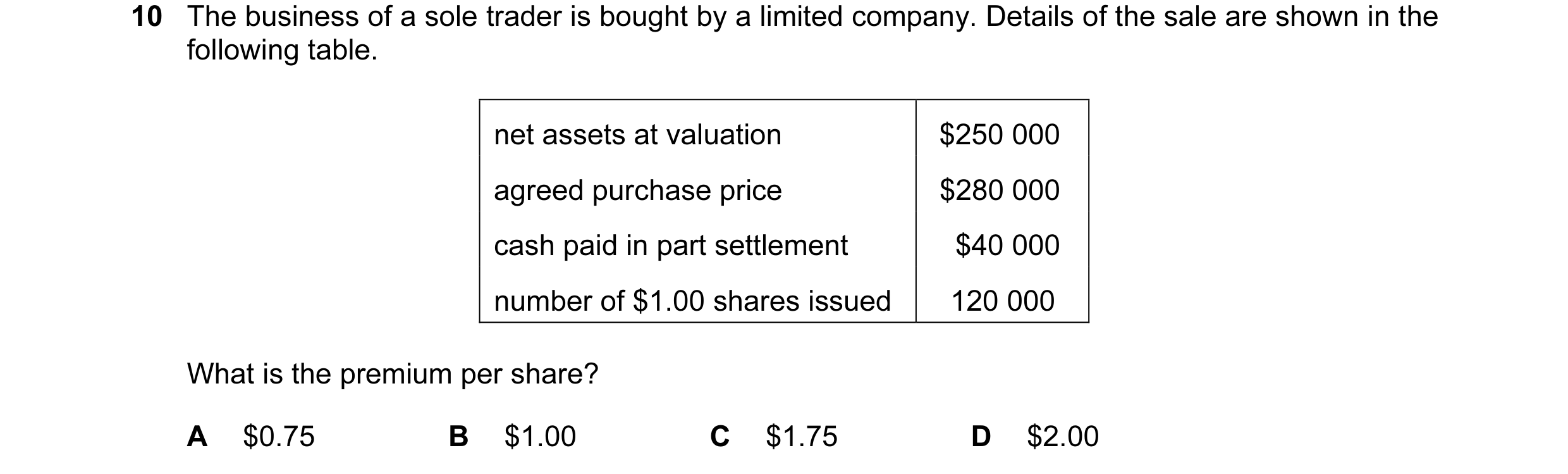
10 The business of a sole trader is bought by a limited company. Details of the sale are shown in the following table. net assets at valuation $250 000 agreed purchase price $280 000 cash paid in part settlement $40 000 number of $1.00 shares issued 120 000 What is the premium per share? A $0.75 B $1.00 C $1.75 D $2.00
1 marks
Answer: B
This question in 9706/33 May/June 2012
Q46 · A business has assets with a fair value of $150 000 9706/33 May/June 2012
11 A business has assets with a fair value of $150 000. There is agreed negative goodwill of $30 000. 16 000 ordinary shares of $2.00 each were issued at a premium of $3 each to acquire the net assets. How much were the liabilities acquired? A $40 000 B $70 000 C $88 000 D $100 000
1 marks
Answer: A
This question in 9706/33 May/June 2012
Q47 · X and Y are in partnership with combined capital and current account balances of $125 000 9706/31 Oct/Nov 2012
3 X and Y are in partnership with combined capital and current account balances of $125 000. Z is admitted as a partner, introducing capital of $40 000. At that time, the assets of the partnership are revalued upwards by $50 000 and goodwill was valued at $18 000. What was the total capital employed of the partnership immediately after the admission of Z? A $183 000 B $197 000 C $215 000 D $233 000
1 marks
Answer: C
This question in 9706/31 Oct/Nov 2012
Q48 · A company agrees to buy assets from another company for $200 000 9706/31 Oct/Nov 2012
9 A company agrees to buy assets from another company for $200 000. The book value of the assets is $170 000. The purchase consideration is made up as follows: 1 a cash payment of $60 000 2 an issue of a $50 000 debenture at a discount of 5 % 3 18 500 ordinary shares with a nominal value of $0.50 each. What is the market value of each ordinary share? A $3.24 B $3.38 C $4.86 D $5.00
1 marks
Answer: D
This question in 9706/31 Oct/Nov 2012
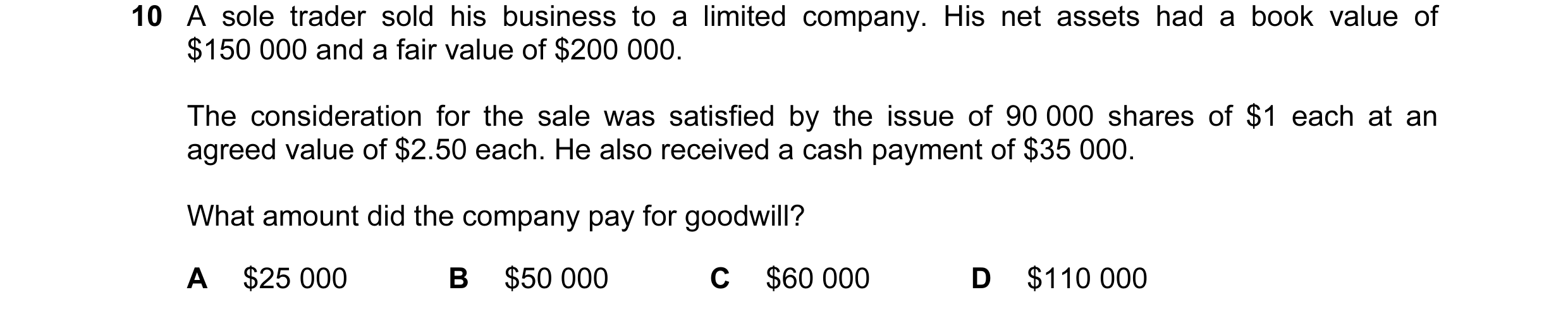
Q49 · A sole trader sold his business to a limited company 9706/31 Oct/Nov 2012
10 A sole trader sold his business to a limited company. His net assets had a book value of $150 000 and a fair value of $200 000. The consideration for the sale was satisfied by the issue of 90 000 shares of $1 each at an agreed value of $2.50 each. He also received a cash payment of $35 000. What amount did the company pay for goodwill? A $25 000 B $50 000 C $60 000 D $110 000
1 marks
Answer: C
This question in 9706/31 Oct/Nov 2012
Q50 · X Ltd purchases Y Ltd 9706/32 Oct/Nov 2012
9 X Ltd purchases Y Ltd. The purchase consideration was one million ordinary shares of $1.00 each. The shares had a market value of $1.50 each. Y Ltd had net assets of $500 000 with a fair value of $700 000. How much is the goodwill on acquisition? A $300 000 B $500 000 C $800 000 D $1 000 000
1 marks
Answer: C
This question in 9706/32 Oct/Nov 2012
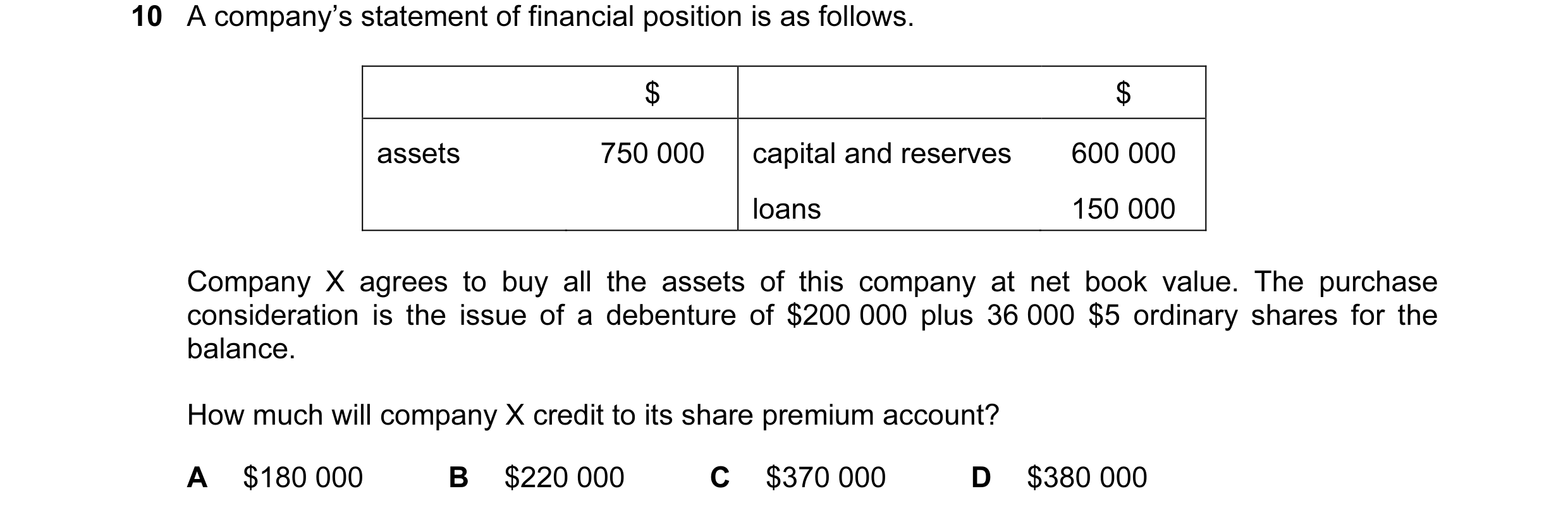
Q51 · A company’s statement of financial position is as follows 9706/32 Oct/Nov 2012
10 A company’s statement of financial position is as follows. $ $ assets 750 000 capital and reserves 600 000 loans 150 000 Company X agrees to buy all the assets of this company at net book value. The purchase consideration is the issue of a debenture of $200 000 plus 36 000 $5 ordinary shares for the balance. How much will company X credit to its share premium account? A $180 000 B $220 000 C $370 000 D $380 000
1 marks
Answer: C
This question in 9706/32 Oct/Nov 2012
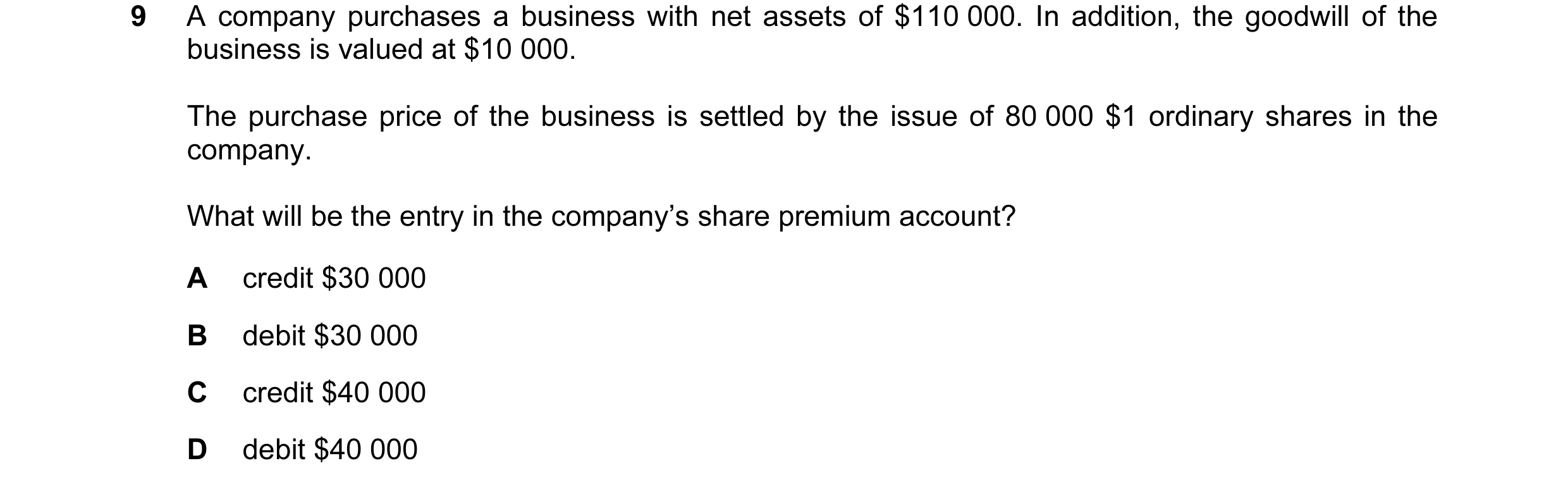
Q52 · A company purchases a business with net assets of $110 000 9706/33 Oct/Nov 2012
9 A company purchases a business with net assets of $110 000. In addition, the goodwill of the business is valued at $10 000. The purchase price of the business is settled by the issue of 80 000 $1 ordinary shares in the company. What will be the entry in the company’s share premium account? A credit $30 000 B debit $30 000 C credit $40 000 D debit $40 000
1 marks
Answer: C
This question in 9706/33 Oct/Nov 2012
Q53 · A company purchases the business of a sole trader for $250 000 9706/33 Oct/Nov 2012
10 A company purchases the business of a sole trader for $250 000. The fair value of the net assets is $230 000. The purchase price is made up as follows: 1 the issue of 80 000 ordinary shares of $1 each in the company, at a price of $2 each 2 the issue of $50 000 6 % debenture stock at par in the company 3 the balance of the purchase price in cash. What is the amount of cash to be paid? A $40 000 B $90 000 C $100 000 D $120 000
1 marks
Answer: A
This question in 9706/33 Oct/Nov 2012
Q54 · X Ltd is considering the purchase of two different businesses 9706/31 May/June 2013
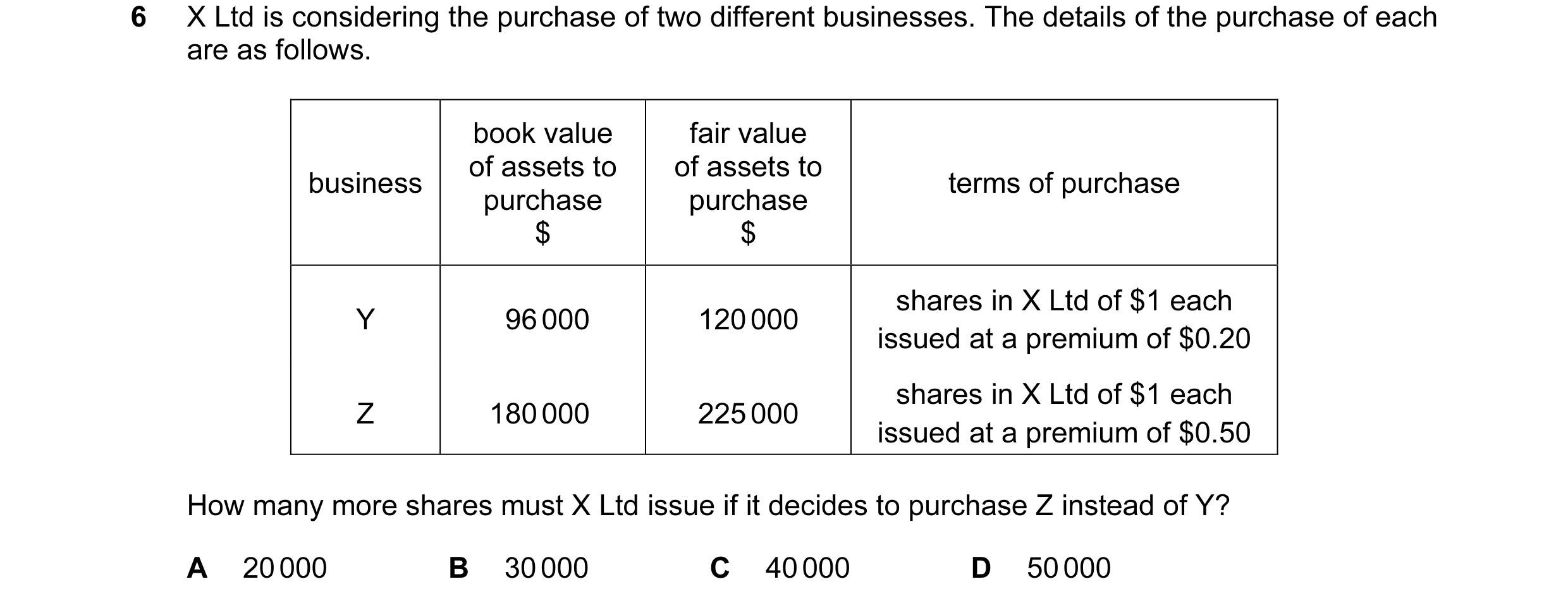
6 X Ltd is considering the purchase of two different businesses. The details of the purchase of each are as follows. book value fair value of assets to of assets to business terms of purchase purchase purchase $ $ shares in X Ltd of $1 each Y 96 000 120 000 issued at a premium of $0.20 shares in X Ltd of $1 each Z 180 000 225 000 issued at a premium of $0.50 How many more shares must X Ltd issue if it decides to purchase Z instead of Y? A 20 000 B 30 000 C 40 000 D 50 000
1 marks
Answer: D
This question in 9706/31 May/June 2013
Q55 · A Ltd acquires the assets and liabilities of B Ltd 9706/31 May/June 2013
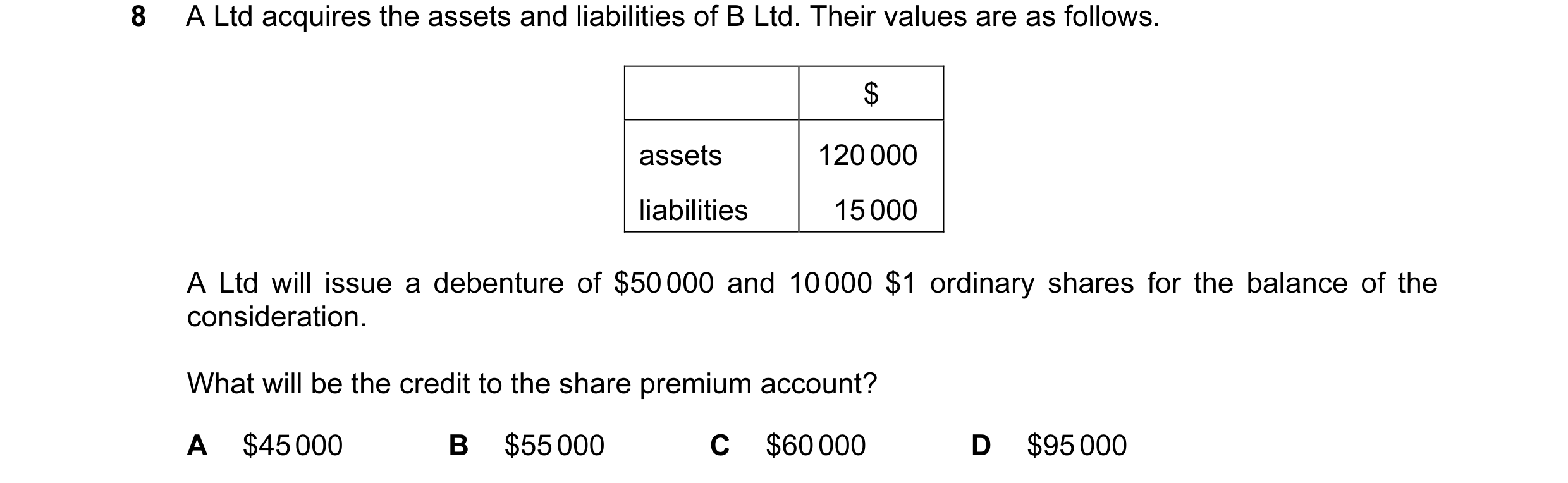
8 A Ltd acquires the assets and liabilities of B Ltd. Their values are as follows. $ assets 120 000 liabilities 15 000 A Ltd will issue a debenture of $50 000 and 10 000 $1 ordinary shares for the balance of the consideration. What will be the credit to the share premium account? A $45 000 B $55 000 C $60 000 D $95 000
1 marks
Answer: A
This question in 9706/31 May/June 2013
Q56 · Y Ltd purchases the business of J by issuing $1 shares at a premium of $0.20 9706/32 May/June 2013
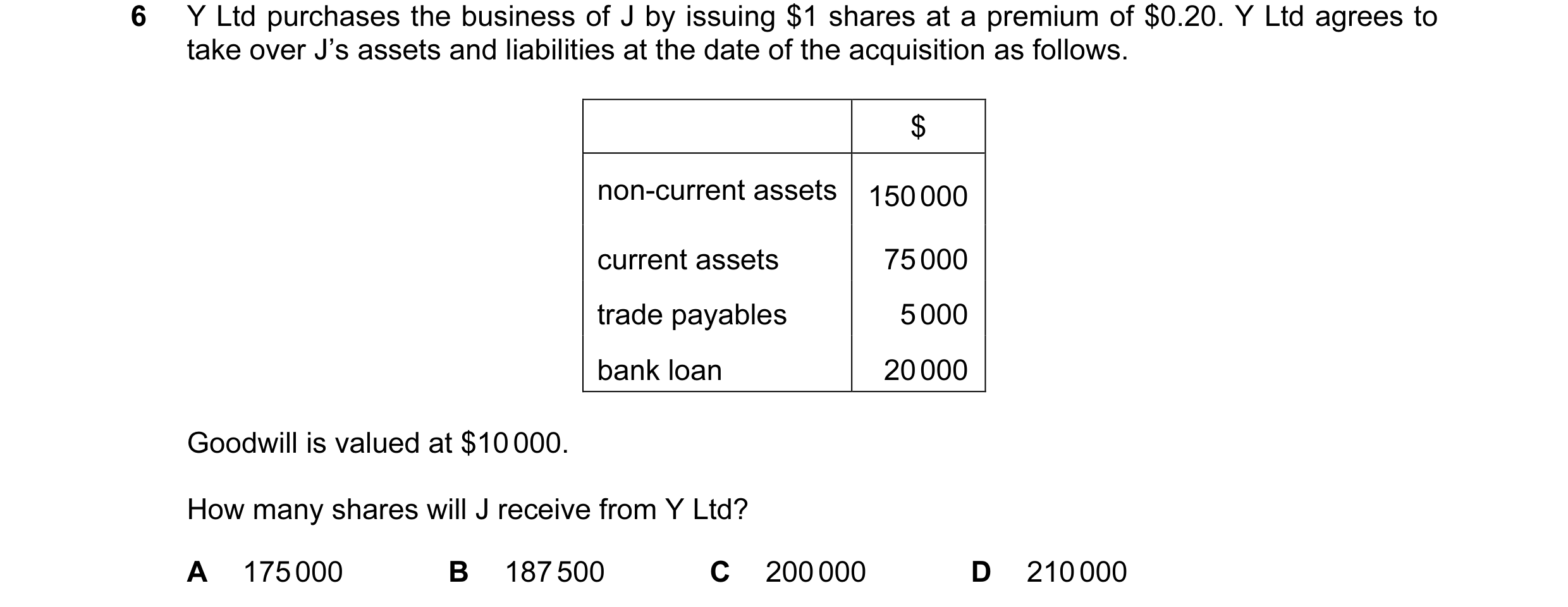
6 Y Ltd purchases the business of J by issuing $1 shares at a premium of $0.20. Y Ltd agrees to take over J’s assets and liabilities at the date of the acquisition as follows. $ non-current assets 150 000 current assets 75 000 trade payables 5 000 bank loan 20 000 Goodwill is valued at $10 000. How many shares will J receive from Y Ltd? A 175 000 B 187 500 C 200 000 D 210 000
1 marks
Answer: A
This question in 9706/32 May/June 2013
Q57 · A company purchases a business for less than the value of the net assets acquired 9706/32 May/June 2013
7 A company purchases a business for less than the value of the net assets acquired. Which entry should be made in the books of the purchasing company to account for the difference in value? A credit capital reserve B credit retained earnings C debit goodwill D debit share premium
1 marks
Answer: A
This question in 9706/32 May/June 2013
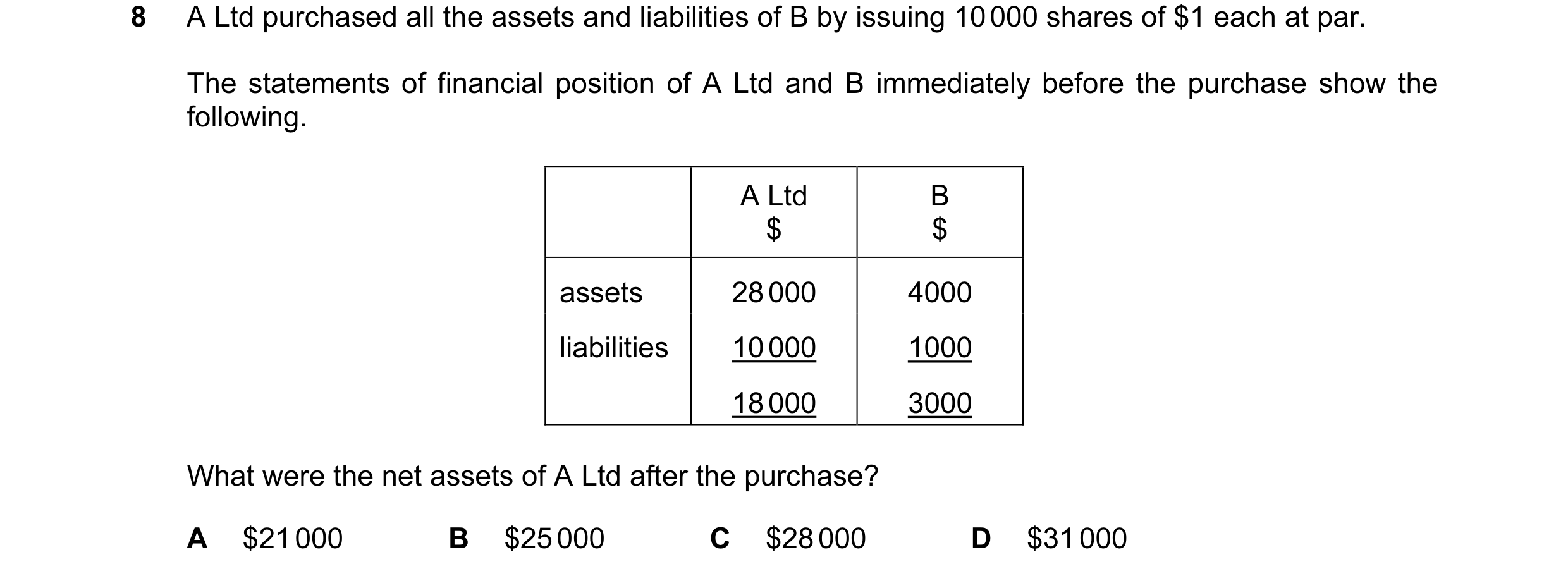
Q58 · A Ltd purchased all the assets and liabilities of B by issuing 10 000 shares of $1 each… 9706/32 May/June 2013
8 A Ltd purchased all the assets and liabilities of B by issuing 10 000 shares of $1 each at par. The statements of financial position of A Ltd and B immediately before the purchase show the following. A Ltd B $ $ assets 28 000 4000 liabilities 10 000 1000 18 000 3000 What were the net assets of A Ltd after the purchase? A $21 000 B $25 000 C $28 000 D $31 000
1 marks
Answer: C
This question in 9706/32 May/June 2013
Q59 · X and Y are in partnership sharing profits and losses equally 9706/33 May/June 2013
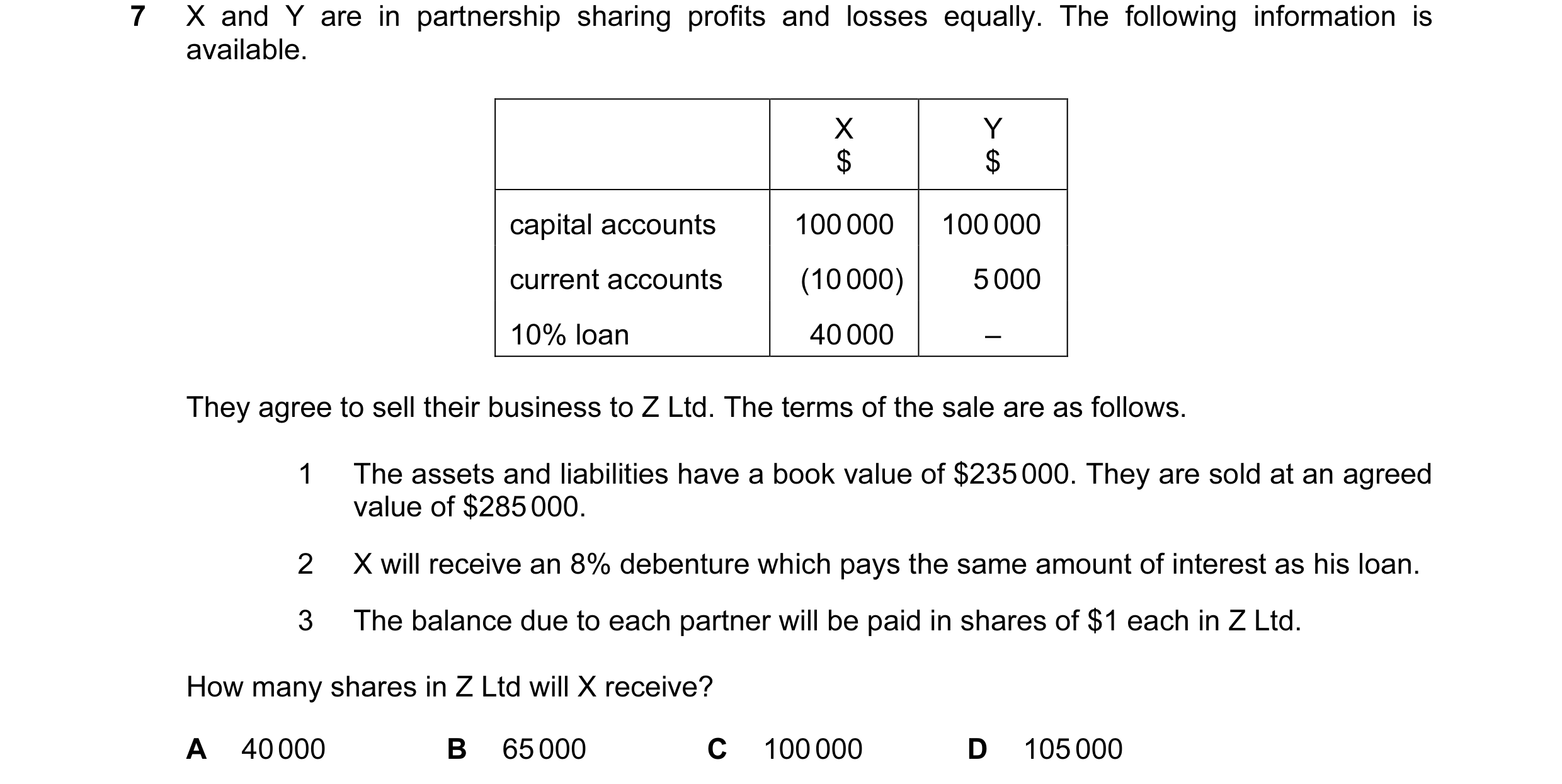
7 X and Y are in partnership sharing profits and losses equally. The following information is available. X Y $ $ capital accounts 100 000 100 000 current accounts (10 000) 5 000 10% loan 40 000 – They agree to sell their business to Z Ltd. The terms of the sale are as follows. 1 The assets and liabilities have a book value of $235 000. They are sold at an agreed value of $285 000. 2 X will receive an 8% debenture which pays the same amount of interest as his loan. 3 The balance due to each partner will be paid in shares of $1 each in Z Ltd. How many shares in Z Ltd will X receive? A 40 000 B 65 000 C 100 000 D 105 000
1 marks
Answer: D
This question in 9706/33 May/June 2013
Q60 · A Ltd has purchased B Ltd for the total purchase price of $834 000 9706/33 May/June 2013
8 A Ltd has purchased B Ltd for the total purchase price of $834 000. The purchase consideration being satisfied by: issue of 90 000 6% preference shares of $2 valued at $2.20, 300 000 ordinary shares par value $1 valued at $1.50, 10% debenture (2022). What is the value of the debenture? A $186 000 B $204 000 C $336 000 D $354 000
1 marks
Answer: A
This question in 9706/33 May/June 2013
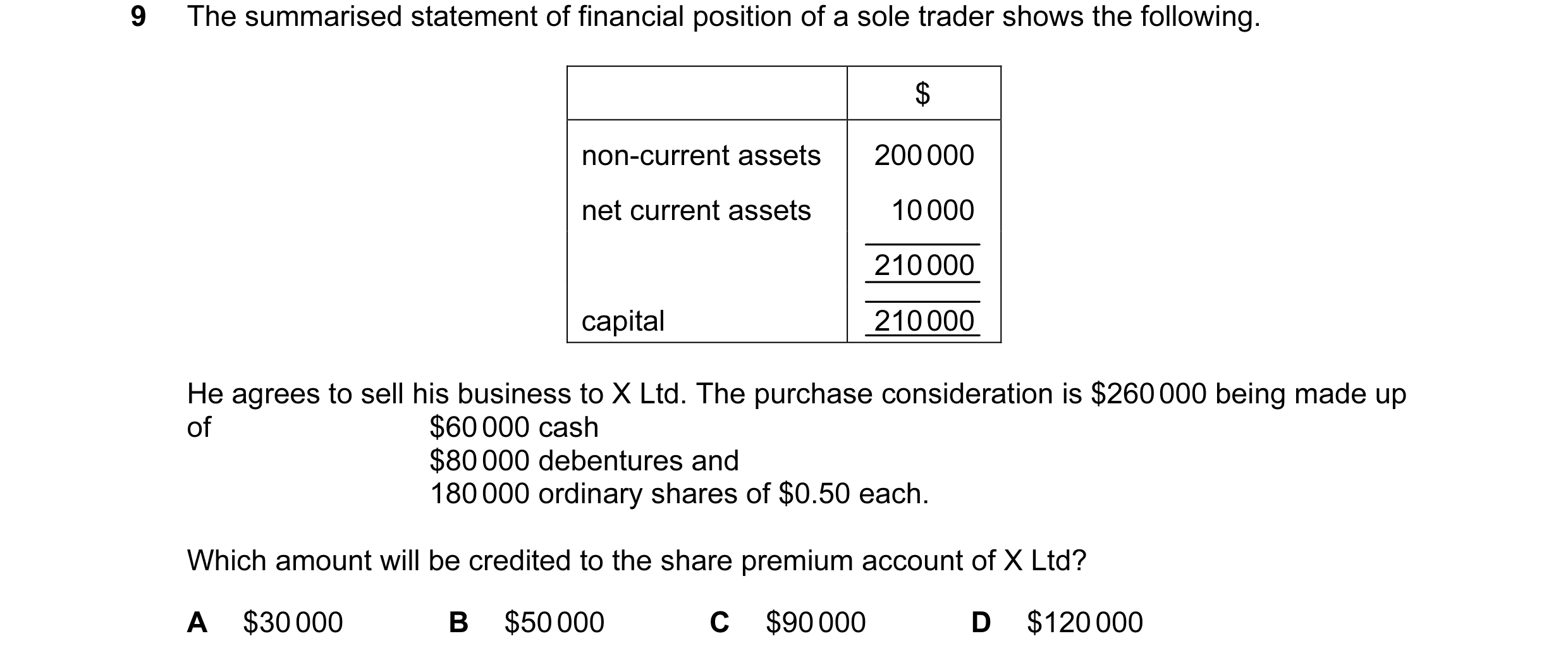
Q61 · The summarised statement of financial position of a sole trader shows the following 9706/33 May/June 2013
9 The summarised statement of financial position of a sole trader shows the following. $ non-current assets 200 000 net current assets 10 000 210 000 capital 210 000 He agrees to sell his business to X Ltd. The purchase consideration is $260 000 being made up of $60 000 cash $80 000 debentures and 180 000 ordinary shares of $0.50 each. Which amount will be credited to the share premium account of X Ltd? A $30 000 B $50 000 C $90 000 D $120 000
1 marks
Answer: A
This question in 9706/33 May/June 2013
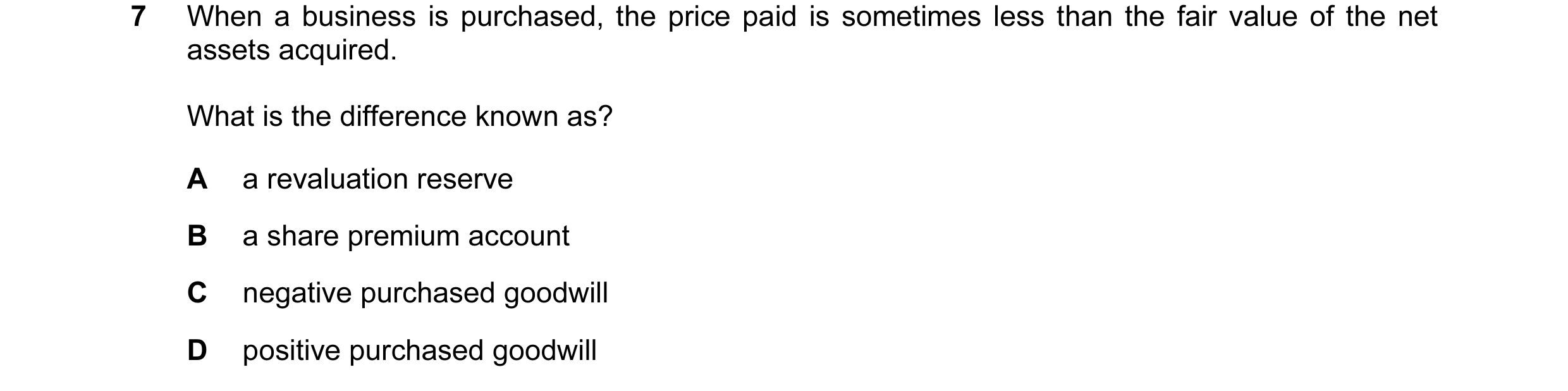
Q62 · When a business is purchased, the price paid is sometimes less than the fair value of the… 9706/31 Oct/Nov 2013
7 When a business is purchased, the price paid is sometimes less than the fair value of the net assets acquired. What is the difference known as? A a revaluation reserve B a share premium account C negative purchased goodwill D positive purchased goodwill
1 marks
Answer: C
This question in 9706/31 Oct/Nov 2013
Q63 · X and Y agree to merge their businesses and show the following balances on their books 9706/31 Oct/Nov 2013
8 X and Y agree to merge their businesses and show the following balances on their books. X Y $ $ non-current assets 20 000 35 000 current assets 7 000 10 000 current liabilities 3 000 5 000 goodwill 5 000 6 000 non-current liability nil 8 000 They wish to commence business with a total capital of $66 000 shared in the ratio 1 : 2. Which bank adjustment will each have to carry out to complete this arrangement? X Y A pays in $7000 withdraws $6000 B withdraws $2000 pays in $12 000 C withdraws $7000 pays in $6000 D withdraws $13 000 withdraws $4000
1 marks
Answer: C
This question in 9706/31 Oct/Nov 2013
Q64 · What is the correct treatment of non-purchased goodwill? 9706/31 Oct/Nov 2013
12 What is the correct treatment of non-purchased goodwill? A Do not recognise it as an asset. B Include it in the statement of financial position as an asset at valuation. C Include it in the statement of financial position as an asset, to be amortised. D Write it off through impairment provision.
1 marks
Answer: A
This question in 9706/31 Oct/Nov 2013
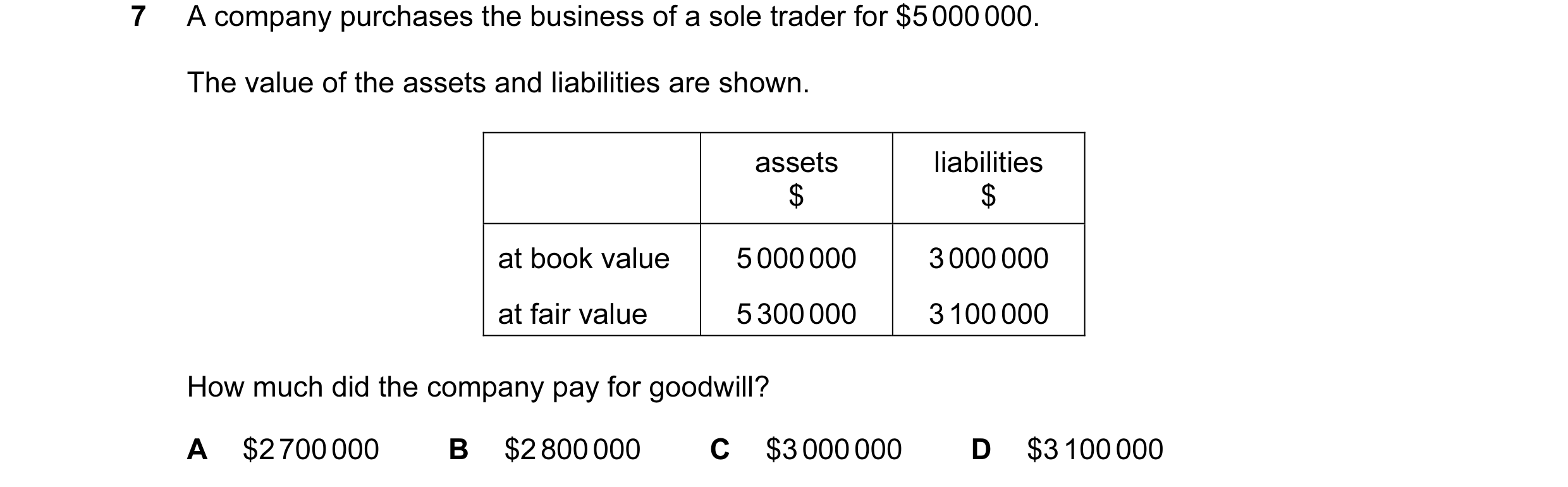
Q65 · A company purchases the business of a sole trader for $5 000 000 9706/32 Oct/Nov 2013
7 A company purchases the business of a sole trader for $5 000 000. The value of the assets and liabilities are shown. assets liabilities $ $ at book value 5 000 000 3 000 000 at fair value 5 300 000 3 100 000 How much did the company pay for goodwill? A $2 700 000 B $2 800 000 C $3 000 000 D $3 100 000
1 marks
Answer: B
This question in 9706/32 Oct/Nov 2013
Q66 · The net assets of X Limited are shown below 9706/32 Oct/Nov 2013
16 The net assets of X Limited are shown below. $ million net assets at original cost 100 net book value 50 fair value 70 Y Limited pays $100 million cash plus $20 million in shares for all the net assets. Y Limited applies a ten year economic life to goodwill. What will the annual goodwill amortisation charge be? A $2 million B $3 million C $5 million D $7 million
1 marks
Answer: C
This question in 9706/32 Oct/Nov 2013
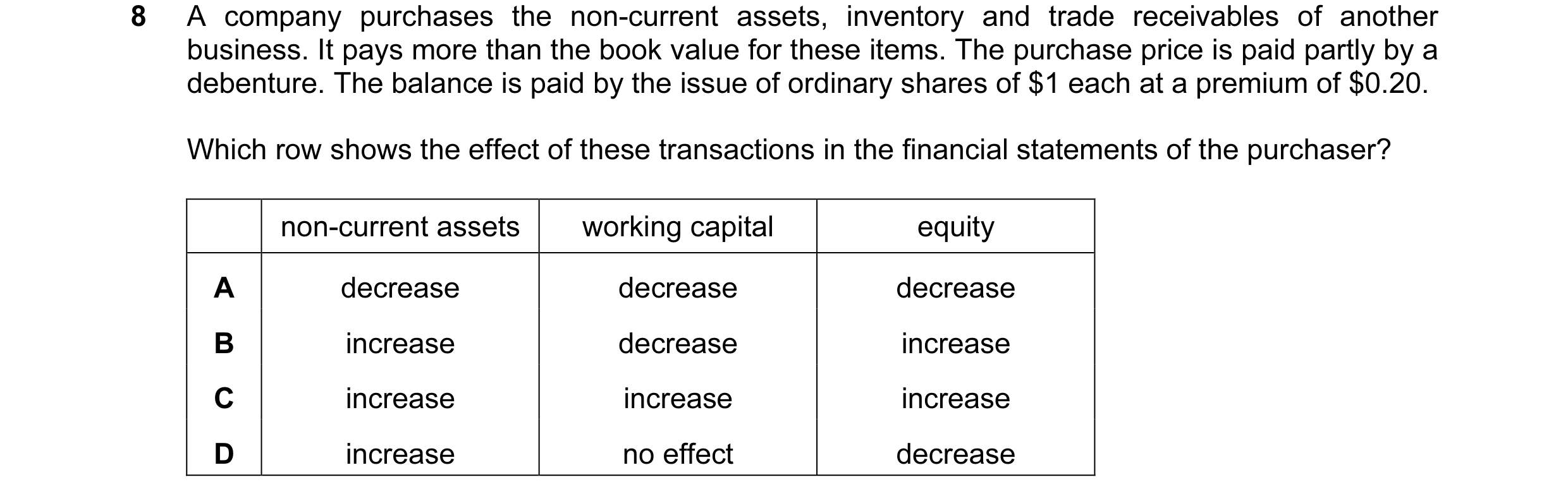
Q67 · A company purchases the non-current assets, inventory and trade receivables of another… 9706/33 Oct/Nov 2013
8 A company purchases the non-current assets, inventory and trade receivables of another business. It pays more than the book value for these items. The purchase price is paid partly by a debenture. The balance is paid by the issue of ordinary shares of $1 each at a premium of $0.20. Which row shows the effect of these transactions in the financial statements of the purchaser? non-current assets working capital equity A decrease decrease decrease B increase decrease increase C increase increase increase D increase no effect decrease
1 marks
Answer: C
This question in 9706/33 Oct/Nov 2013
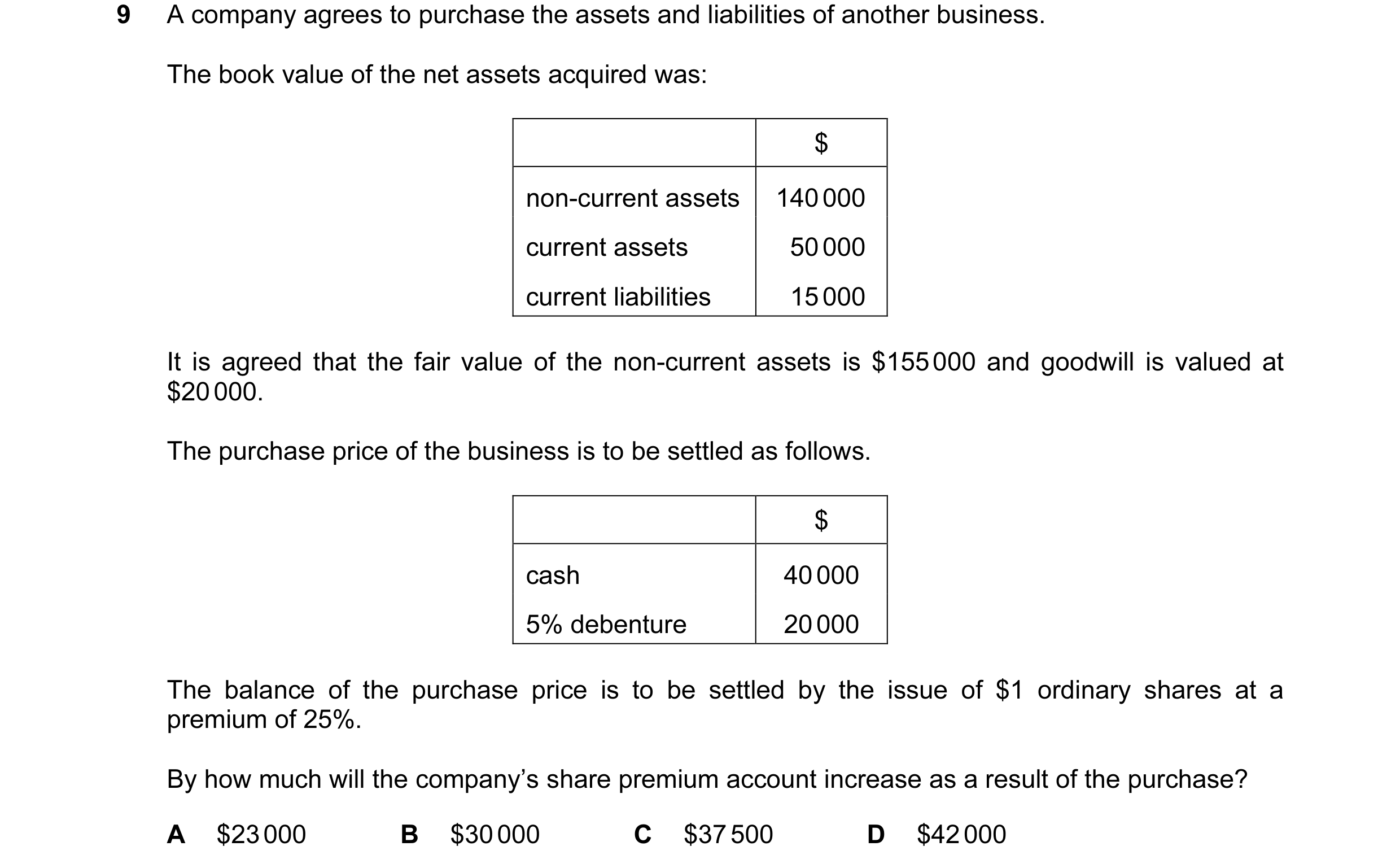
Q68 · A company agrees to purchase the assets and liabilities of another business 9706/33 Oct/Nov 2013
9 A company agrees to purchase the assets and liabilities of another business. The book value of the net assets acquired was: $ non-current assets 140 000 current assets 50 000 current liabilities 15 000 It is agreed that the fair value of the non-current assets is $155 000 and goodwill is valued at $20 000. The purchase price of the business is to be settled as follows. $ cash 40 000 5% debenture 20 000 The balance of the purchase price is to be settled by the issue of $1 ordinary shares at a premium of 25%. By how much will the company’s share premium account increase as a result of the purchase? A $23 000 B $30 000 C $37 500 D $42 000
1 marks
Answer: B
This question in 9706/33 Oct/Nov 2013
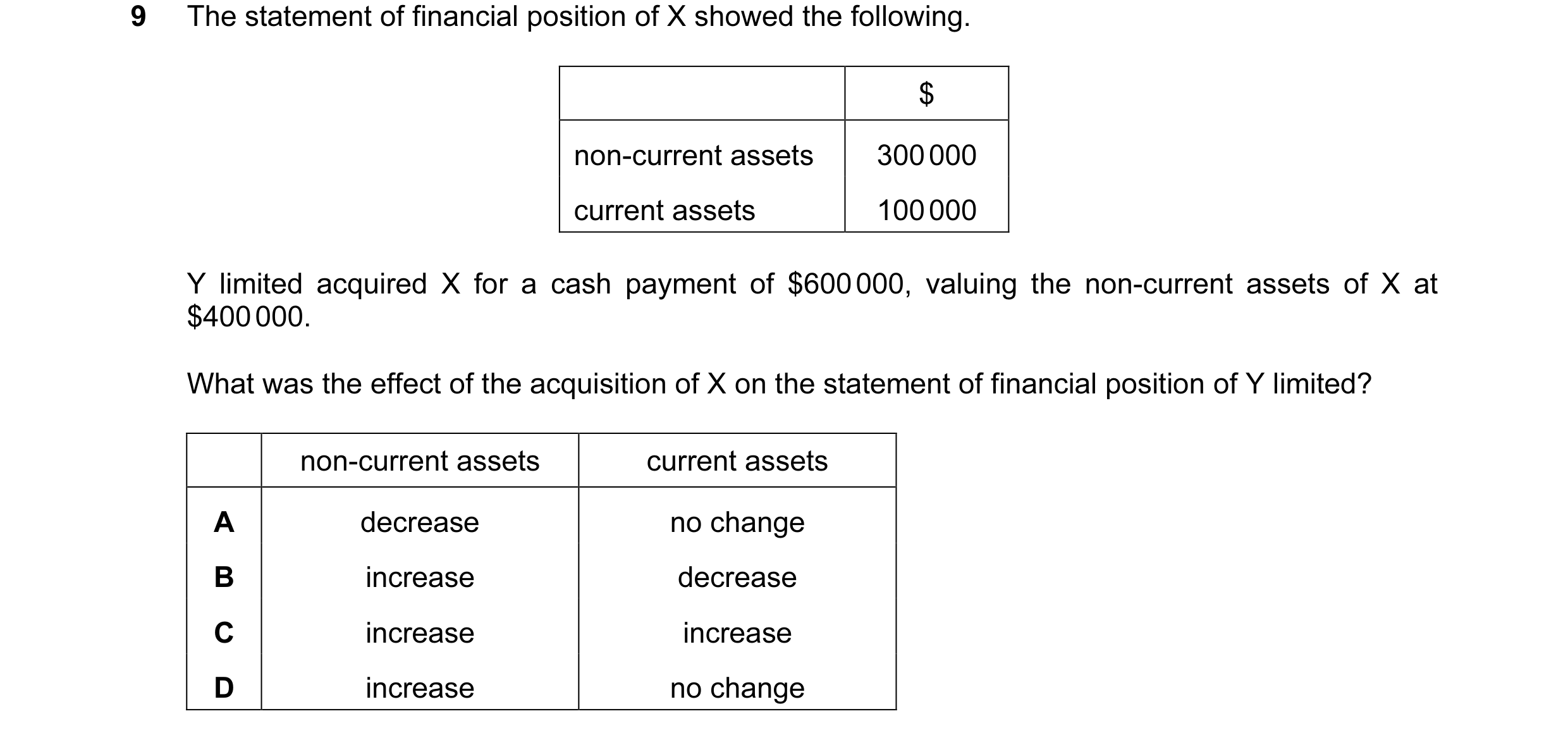
Q69 · The statement of financial position of X showed the following 9706/31 May/June 2014
9 The statement of financial position of X showed the following. $ non-current assets 300 000 current assets 100 000 Y limited acquired X for a cash payment of $600 000, valuing the non-current assets of X at $400 000. What was the effect of the acquisition of X on the statement of financial position of Y limited? non-current assets current assets A decrease no change B increase decrease C increase increase D increase no change
1 marks
Answer: B
This question in 9706/31 May/June 2014
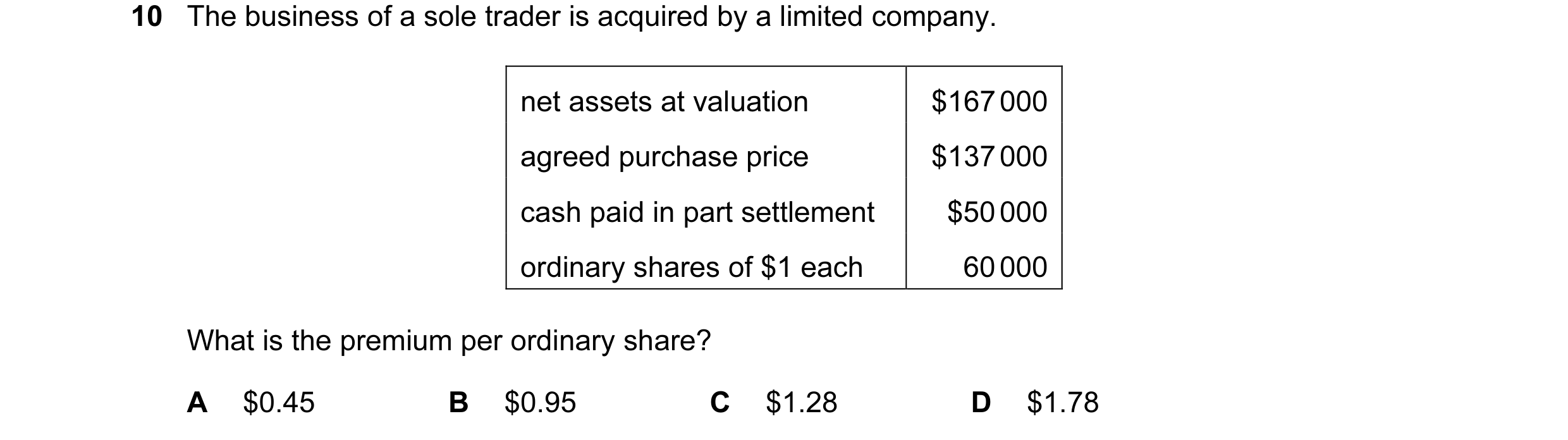
Q70 · The business of a sole trader is acquired by a limited company 9706/31 May/June 2014
10 The business of a sole trader is acquired by a limited company. net assets at valuation $167 000 agreed purchase price $137 000 cash paid in part settlement $50 000 ordinary shares of $1 each 60 000 What is the premium per ordinary share? A $0.45 B $0.95 C $1.28 D $1.78
1 marks
Answer: A
This question in 9706/31 May/June 2014
Q71 · The statement of financial position of X showed the following 9706/32 May/June 2014
9 The statement of financial position of X showed the following. $ non-current assets 300 000 current assets 100 000 Y limited acquired X for a cash payment of $600 000, valuing the non-current assets of X at $400 000. What was the effect of the acquisition of X on the statement of financial position of Y limited? non-current assets current assets A decrease no change B increase decrease C increase increase D increase no change
1 marks
Answer: B
This question in 9706/32 May/June 2014
Q72 · The business of a sole trader is acquired by a limited company 9706/32 May/June 2014
10 The business of a sole trader is acquired by a limited company. net assets at valuation $167 000 agreed purchase price $137 000 cash paid in part settlement $50 000 ordinary shares of $1 each 60 000 What is the premium per ordinary share? A $0.45 B $0.95 C $1.28 D $1.78
1 marks
Answer: A
This question in 9706/32 May/June 2014
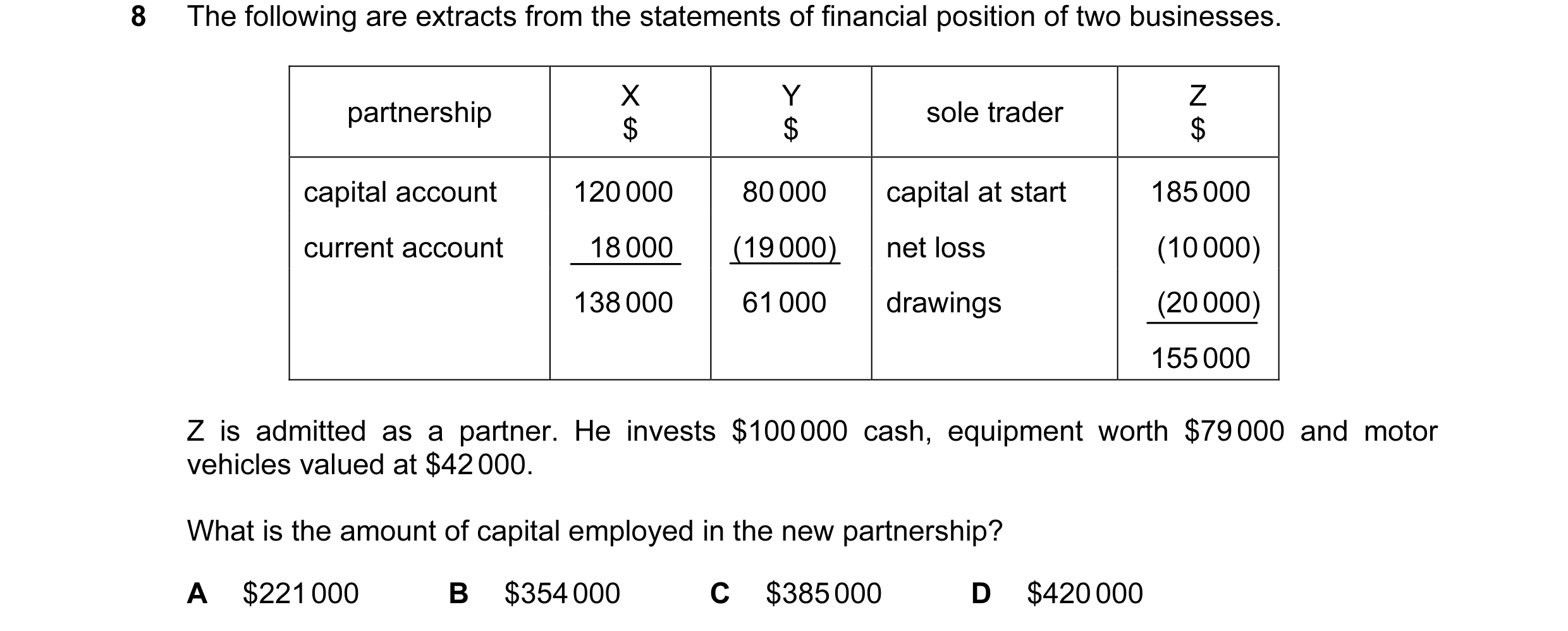
Q73 · The following are extracts from the statements of financial position of two businesses 9706/33 May/June 2014
8 The following are extracts from the statements of financial position of two businesses. X Y Z partnership sole trader $ $ $ capital account 120 000 80 000 capital at start 185 000 current account 18 000 (19 000) net loss (10 000) 138 000 61 000 drawings (20 000) 155 000 Z is admitted as a partner. He invests $100 000 cash, equipment worth $79 000 and motor vehicles valued at $42 000. What is the amount of capital employed in the new partnership? A $221 000 B $354 000 C $385 000 D $420 000
1 marks
Answer: D
This question in 9706/33 May/June 2014
Q74 · What is the usual accounting treatment of goodwill arising on the purchase of a business? 9706/33 May/June 2014
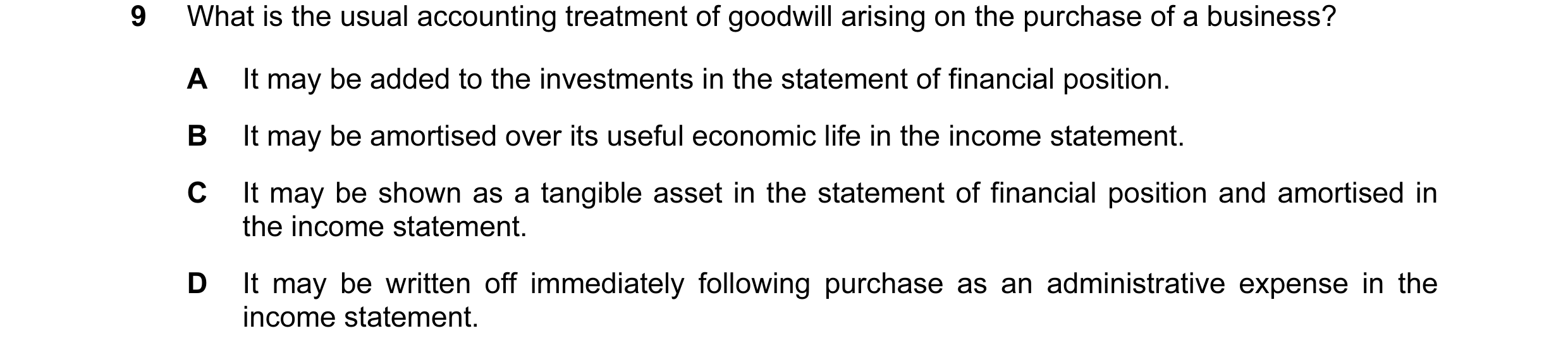
9 What is the usual accounting treatment of goodwill arising on the purchase of a business? A It may be added to the investments in the statement of financial position. B It may be amortised over its useful economic life in the income statement. C It may be shown as a tangible asset in the statement of financial position and amortised in the income statement. D It may be written off immediately following purchase as an administrative expense in the income statement.
1 marks
Answer: B
This question in 9706/33 May/June 2014
Q75 · The summarised statement of financial position of company Y is as follows 9706/33 May/June 2014
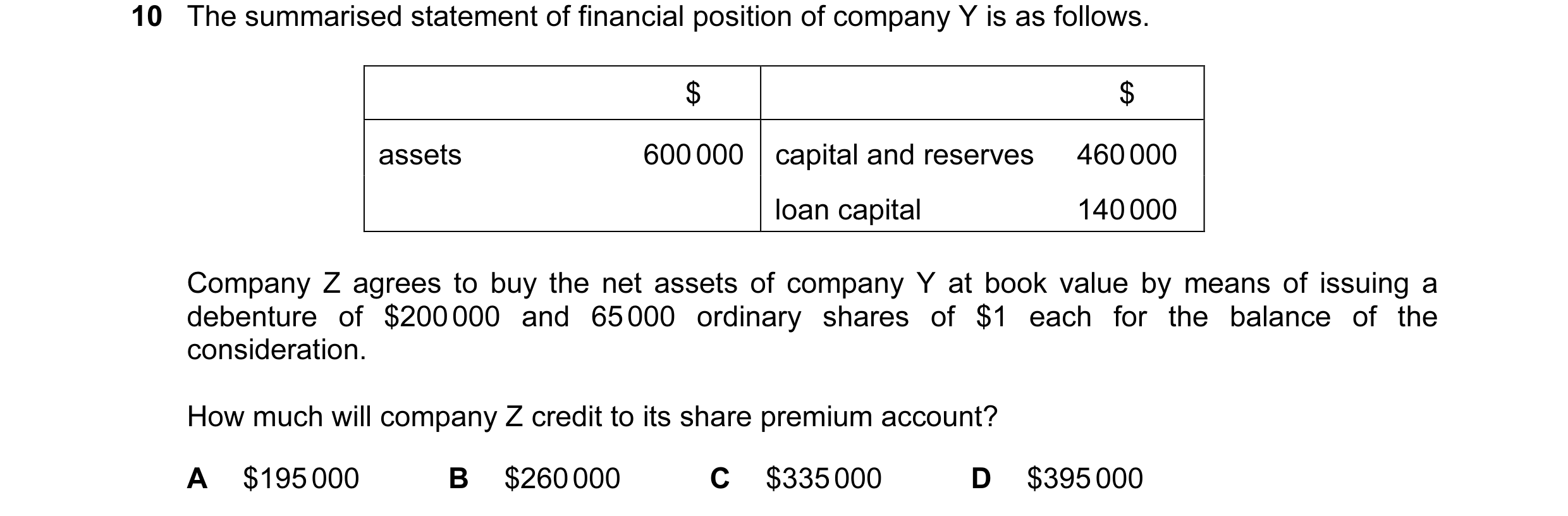
10 The summarised statement of financial position of company Y is as follows. $ $ assets 600 000 capital and reserves 460 000 loan capital 140 000 Company Z agrees to buy the net assets of company Y at book value by means of issuing a debenture of $200 000 and 65 000 ordinary shares of $1 each for the balance of the consideration. How much will company Z credit to its share premium account? A $195 000 B $260 000 C $335 000 D $395 000
1 marks
Answer: A
This question in 9706/33 May/June 2014
Q76 · A company’s summarised statement of financial position is as follows 9706/31 Oct/Nov 2015
10 A company’s summarised statement of financial position is as follows. $ $ assets 750 000 equity 600 000 loans 150 000 Company X agrees to buy all the assets of this company at net book value. The purchase consideration is the issue of a debenture of $200 000 plus 36 000 $5 ordinary shares for the balance. How much will company X credit to its share premium account? A $180 000 B $220 000 C $370 000 D $380 000
1 marks
Answer: C
This question in 9706/31 Oct/Nov 2015
Q77 · The following information is available for Y’s business 9706/32 Oct/Nov 2015
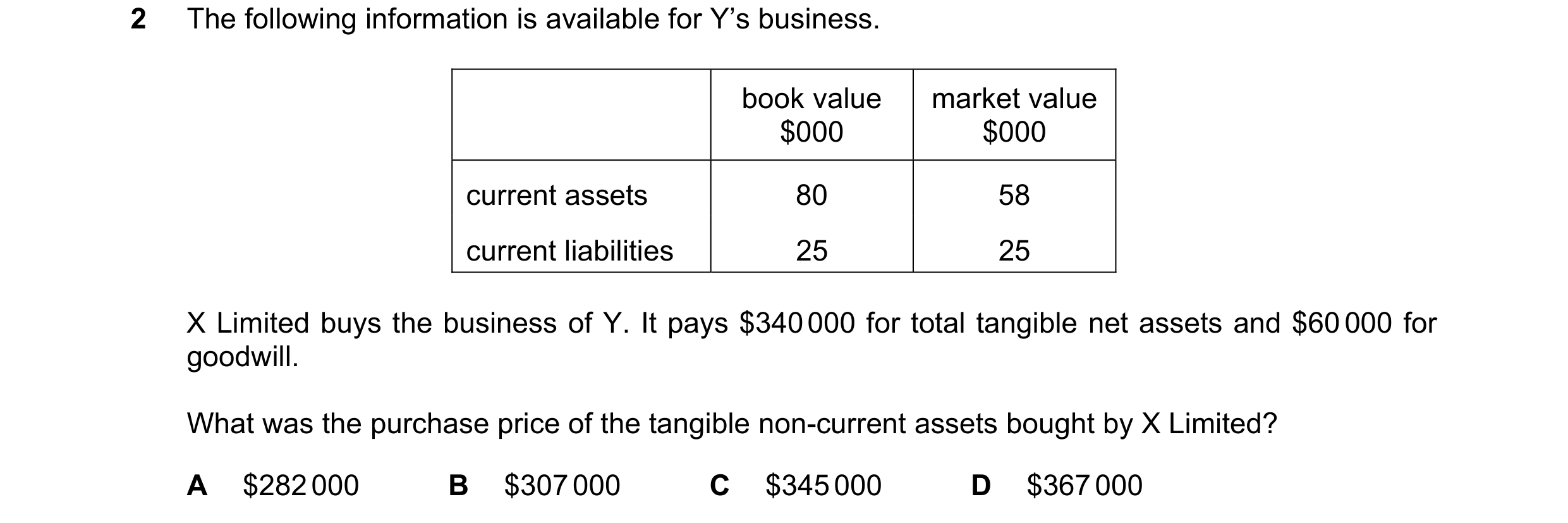
2 The following information is available for Y’s business. book value market value $000 $000 current assets 80 58 current liabilities 25 25 X Limited buys the business of Y. It pays $340 000 for total tangible net assets and $60 000 for goodwill. What was the purchase price of the tangible non-current assets bought by X Limited? A $282 000 B $307 000 C $345 000 D $367 000
1 marks
Answer: B
This question in 9706/32 Oct/Nov 2015
Q78 · The business of a sole trader is bought by a limited company 9706/32 Oct/Nov 2015
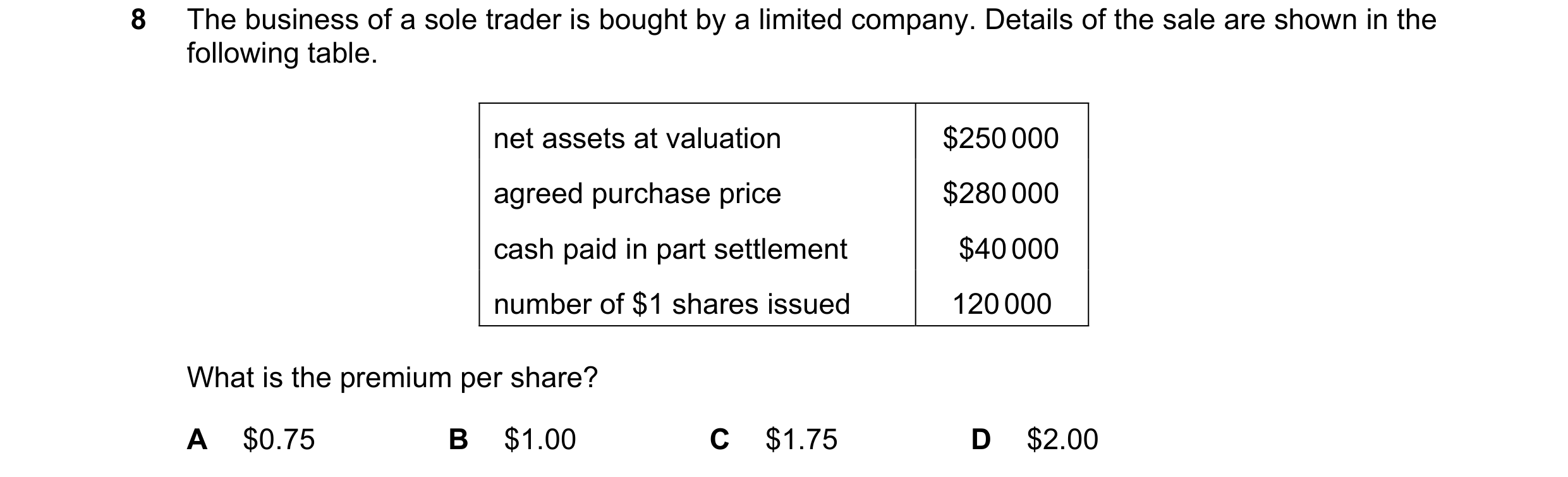
8 The business of a sole trader is bought by a limited company. Details of the sale are shown in the following table. net assets at valuation $250 000 agreed purchase price $280 000 cash paid in part settlement $40 000 number of $1 shares issued 120 000 What is the premium per share? A $0.75 B $1.00 C $1.75 D $2.00
1 marks
Answer: B
This question in 9706/32 Oct/Nov 2015

 1 / 21
 2 / 21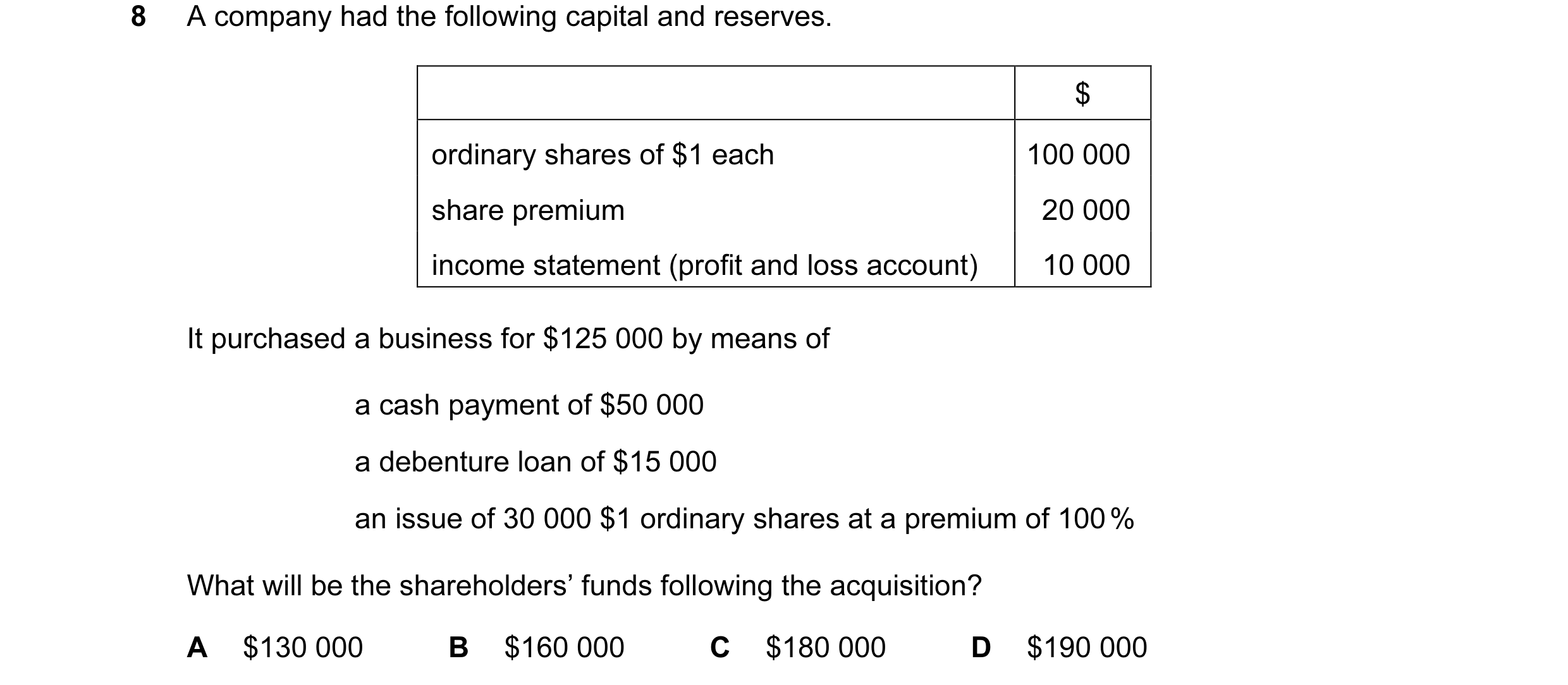
 3 / 21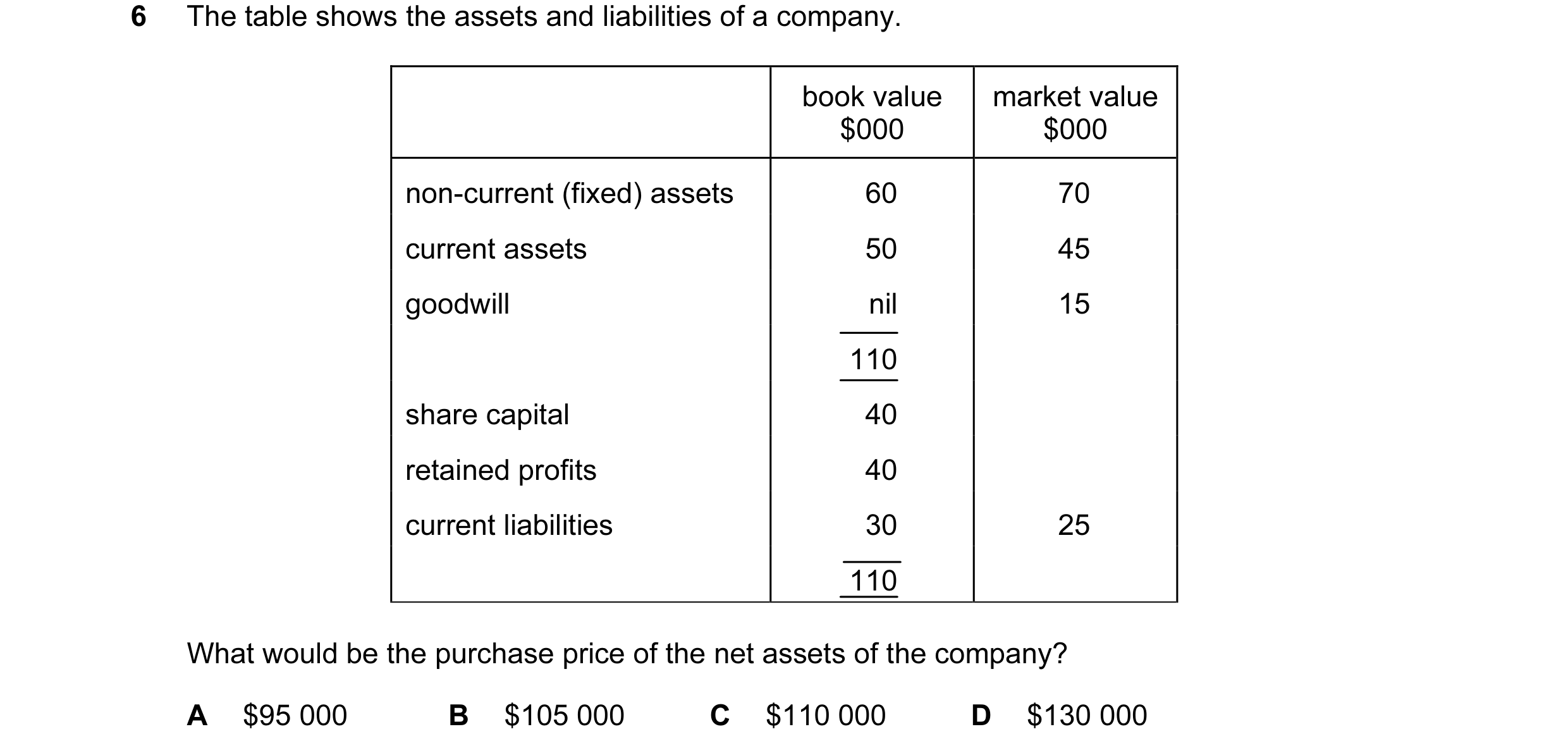
 4 / 21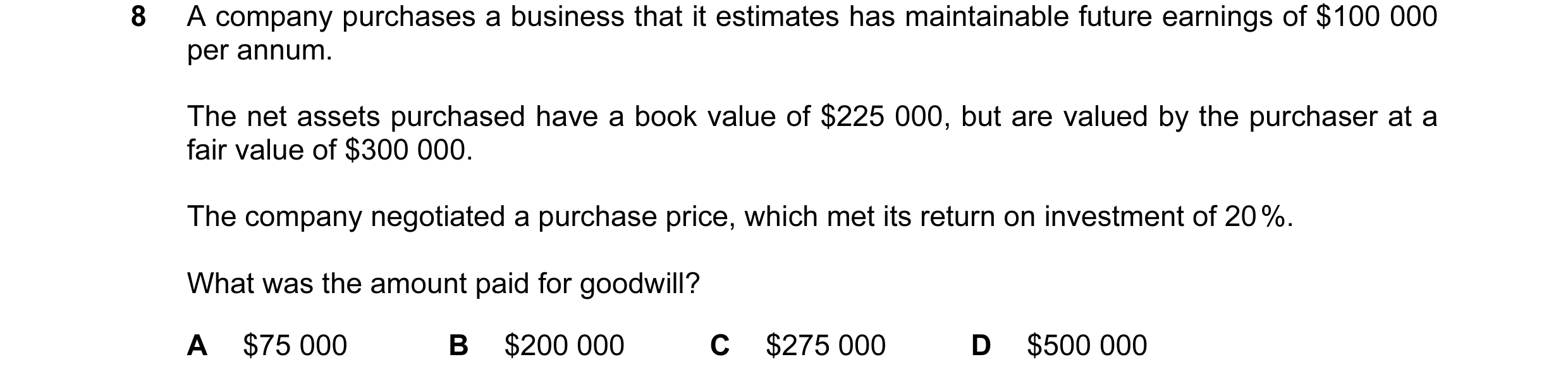
 5 / 21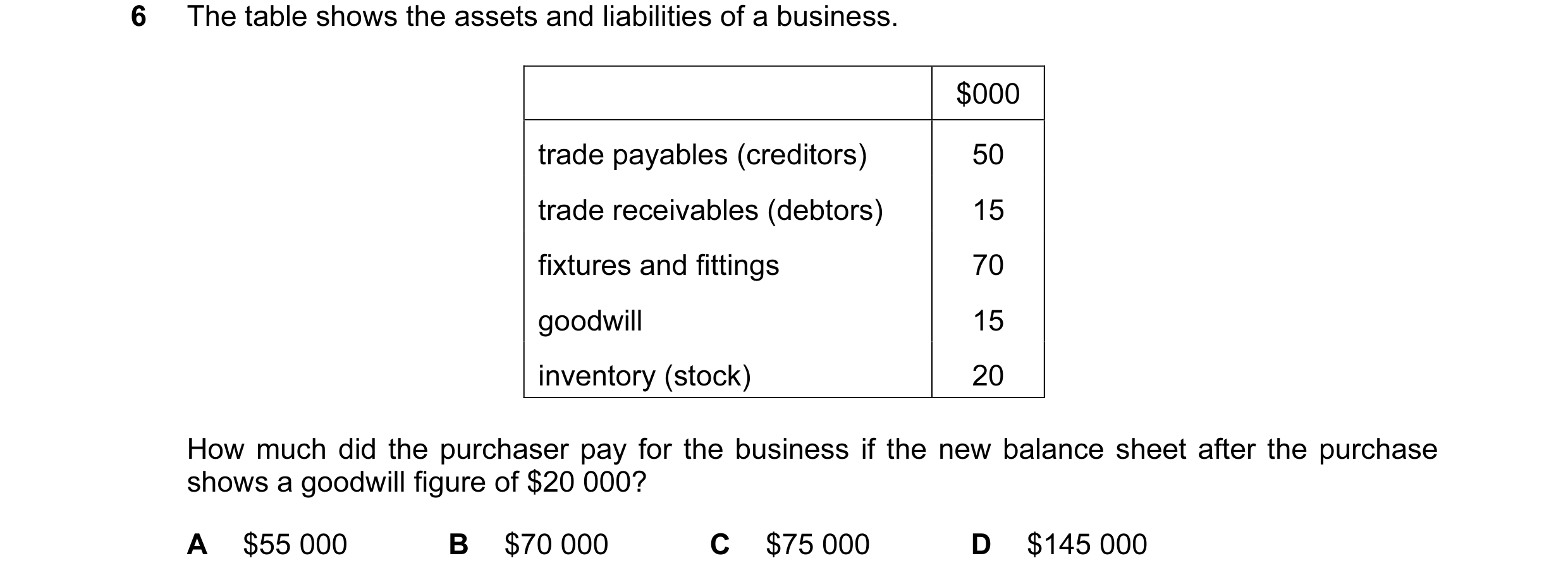
 6 / 21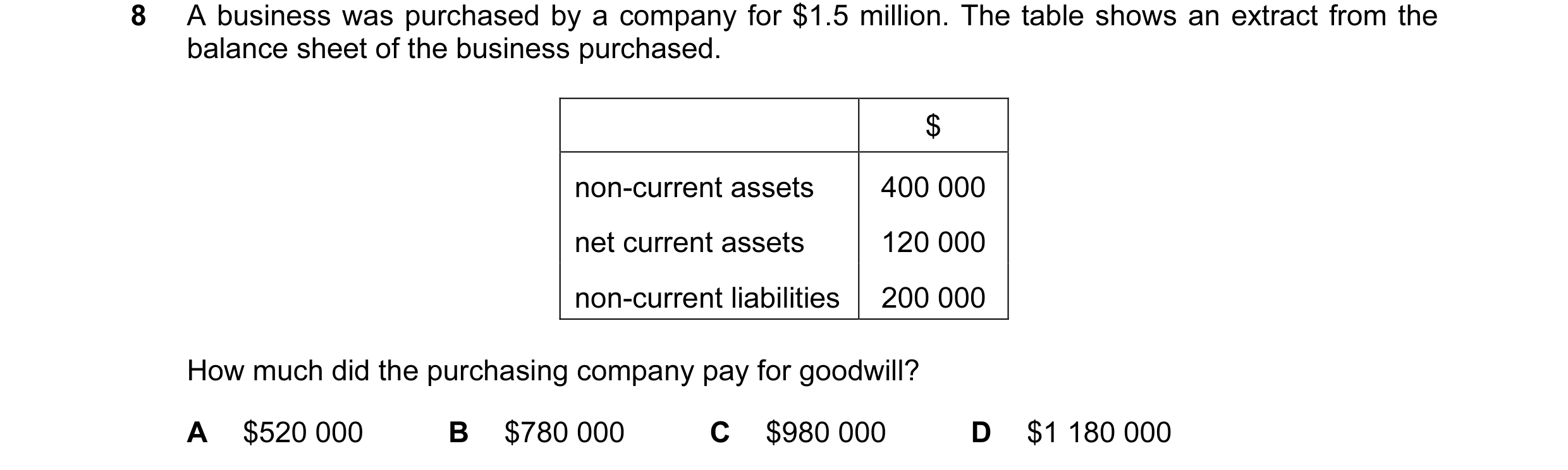


 7 / 21
 8 / 21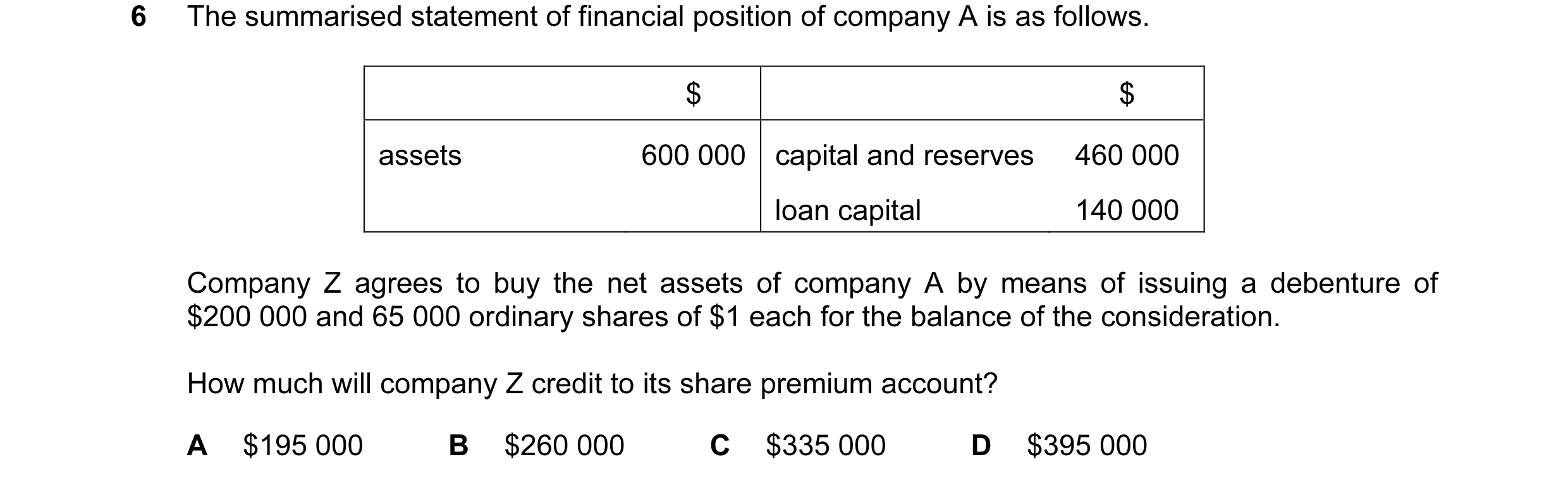

 9 / 21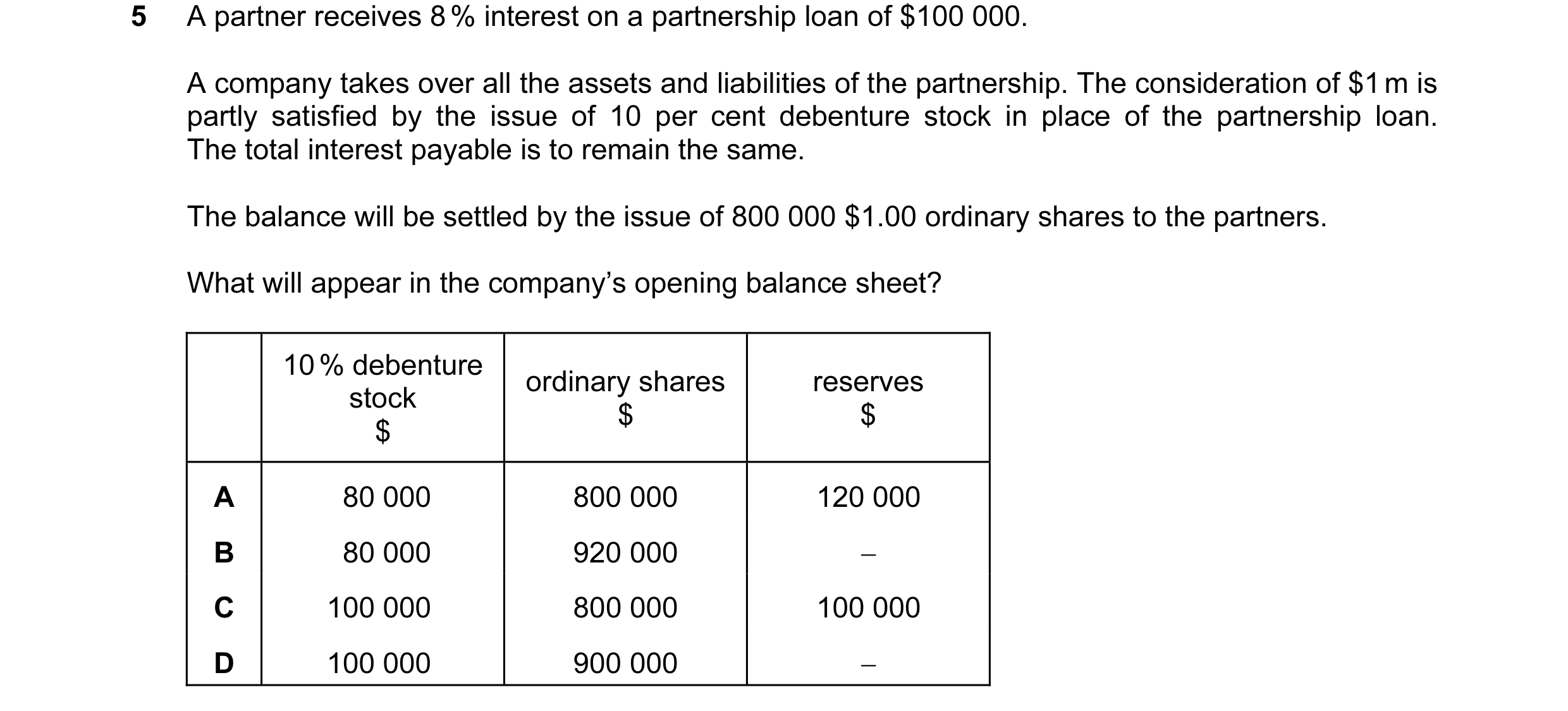
 10 / 21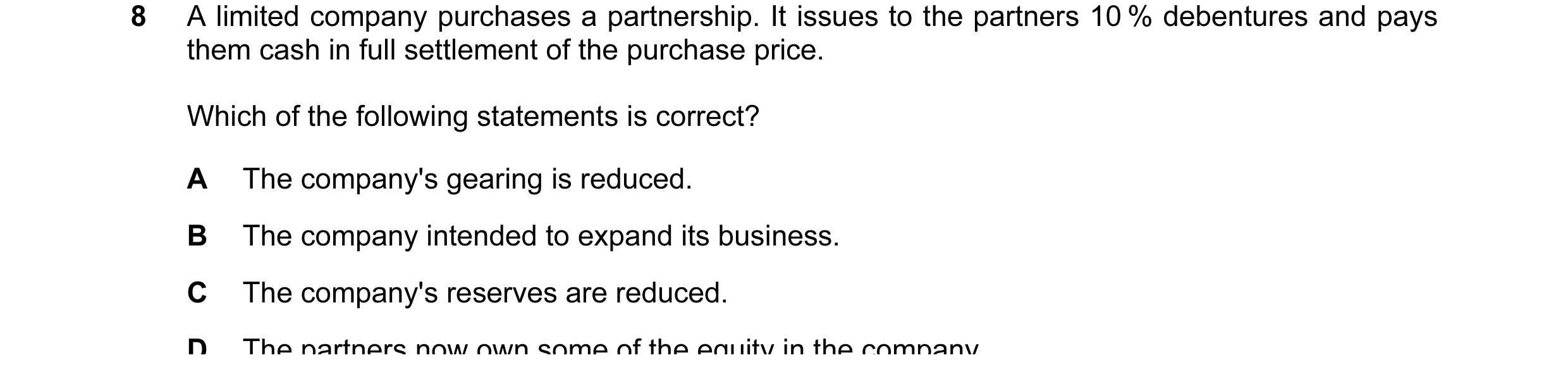
 11 / 21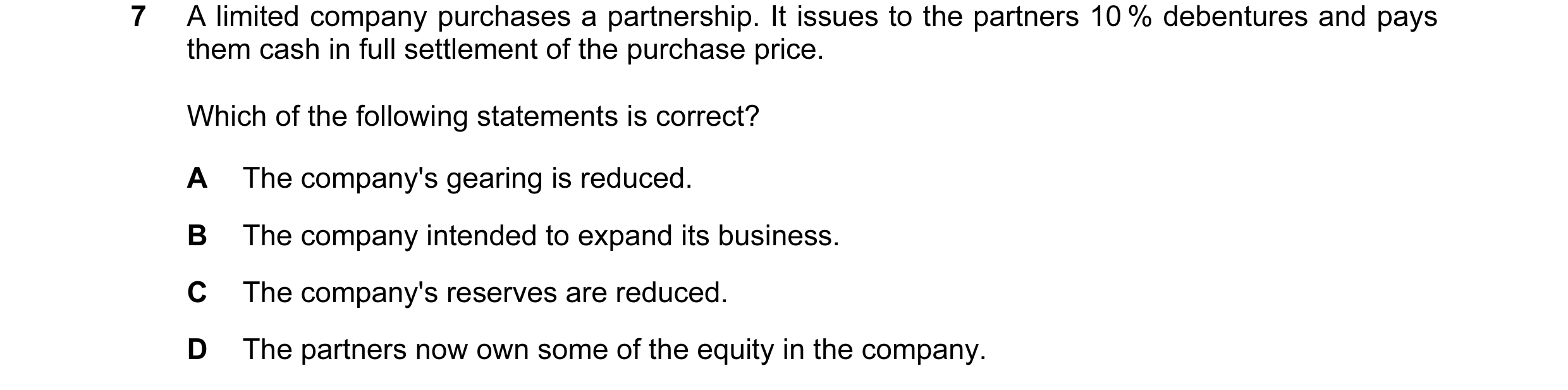

 12 / 21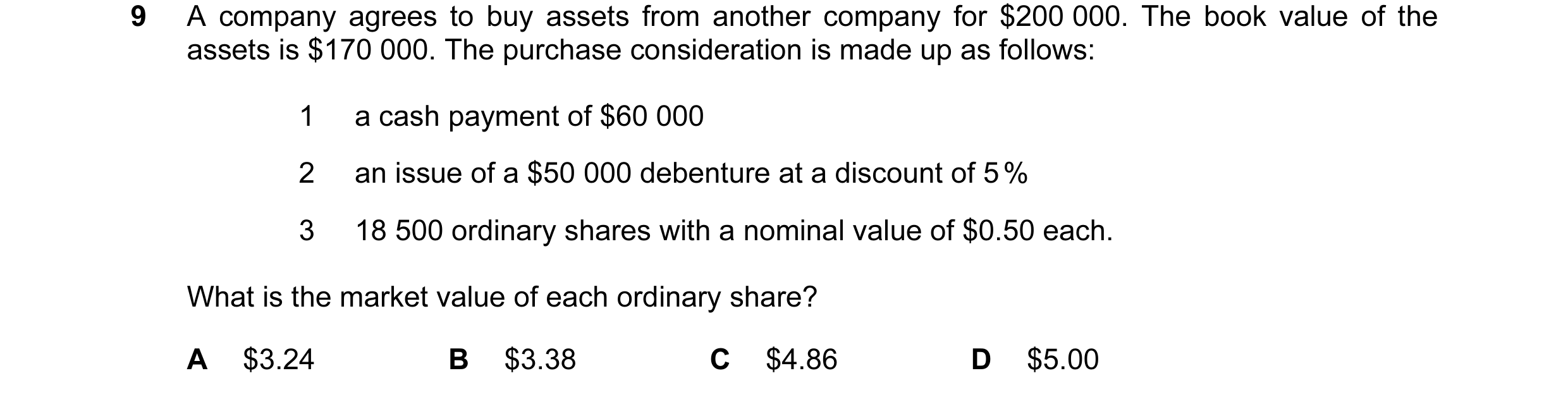

 13 / 21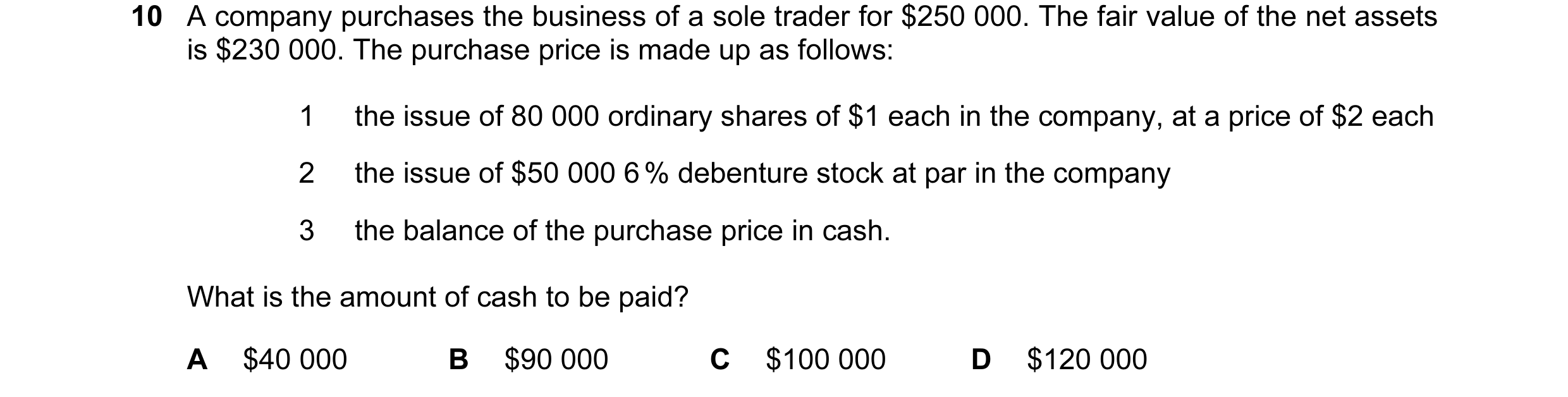
 14 / 21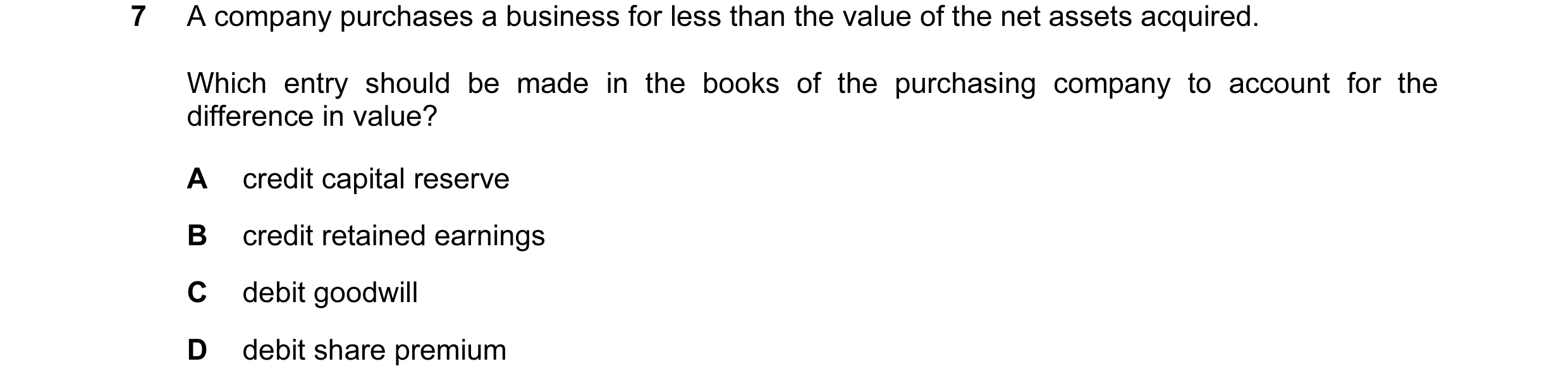
 15 / 21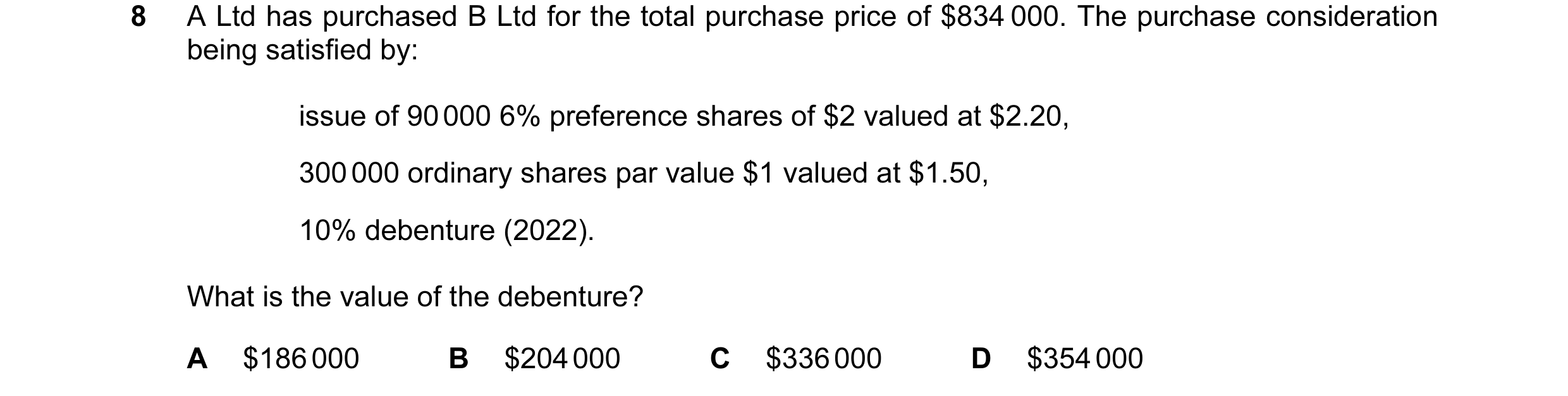
 16 / 21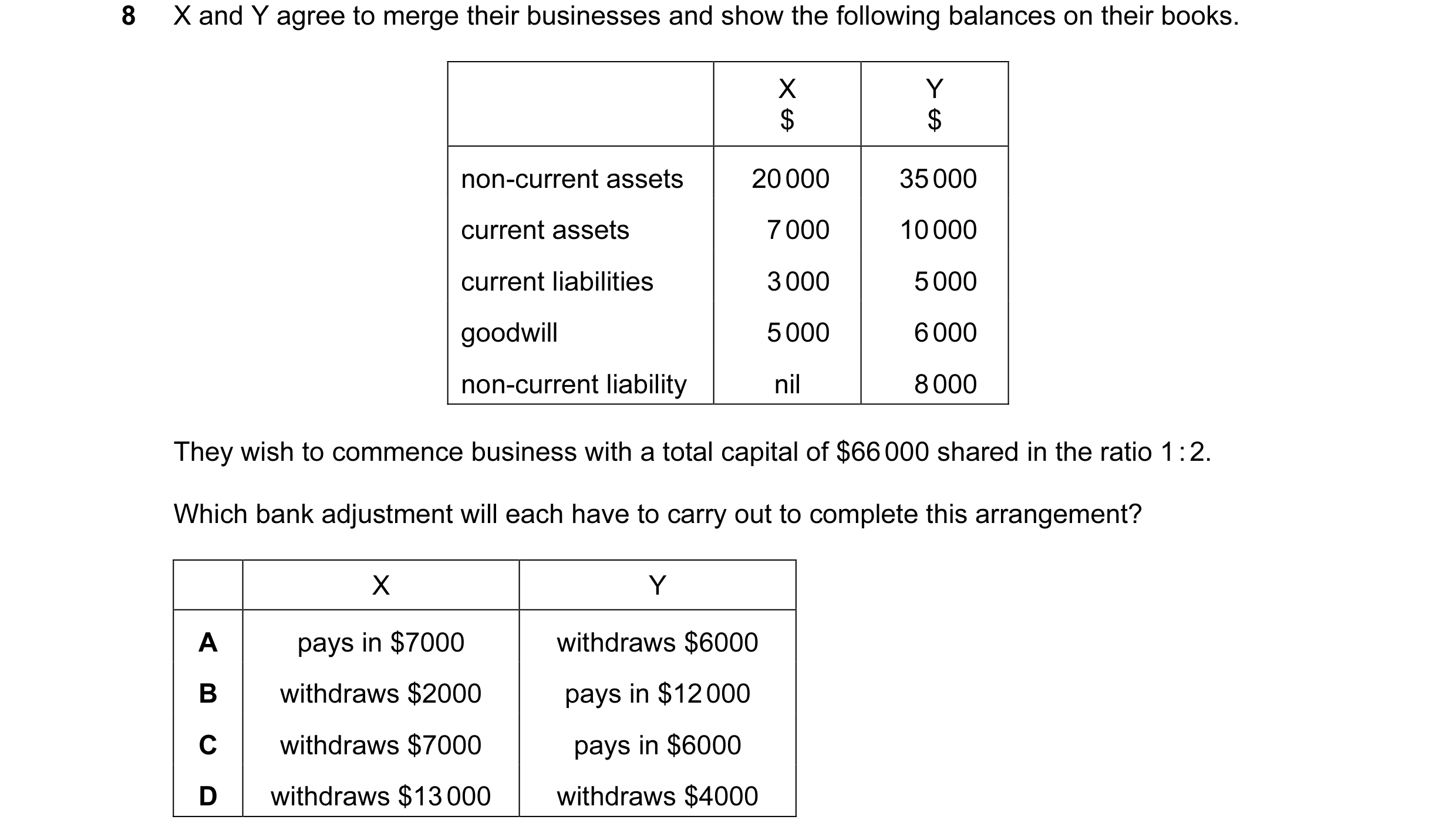

 17 / 21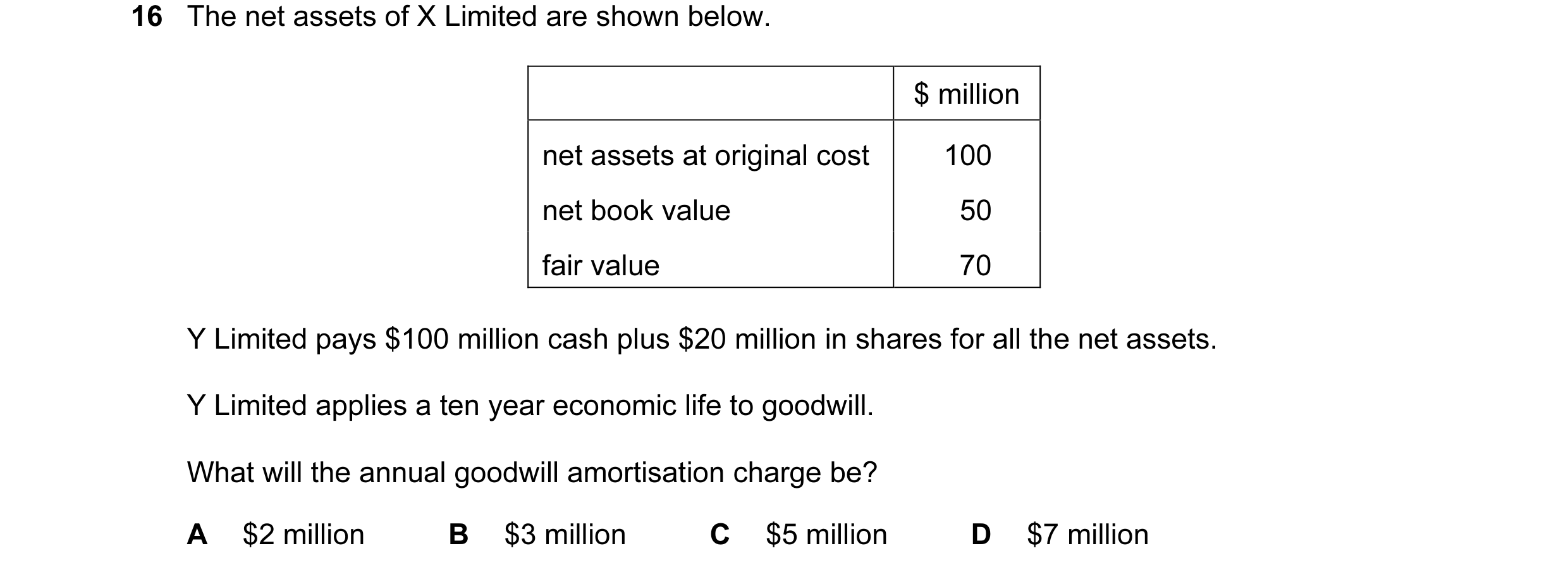
 18 / 21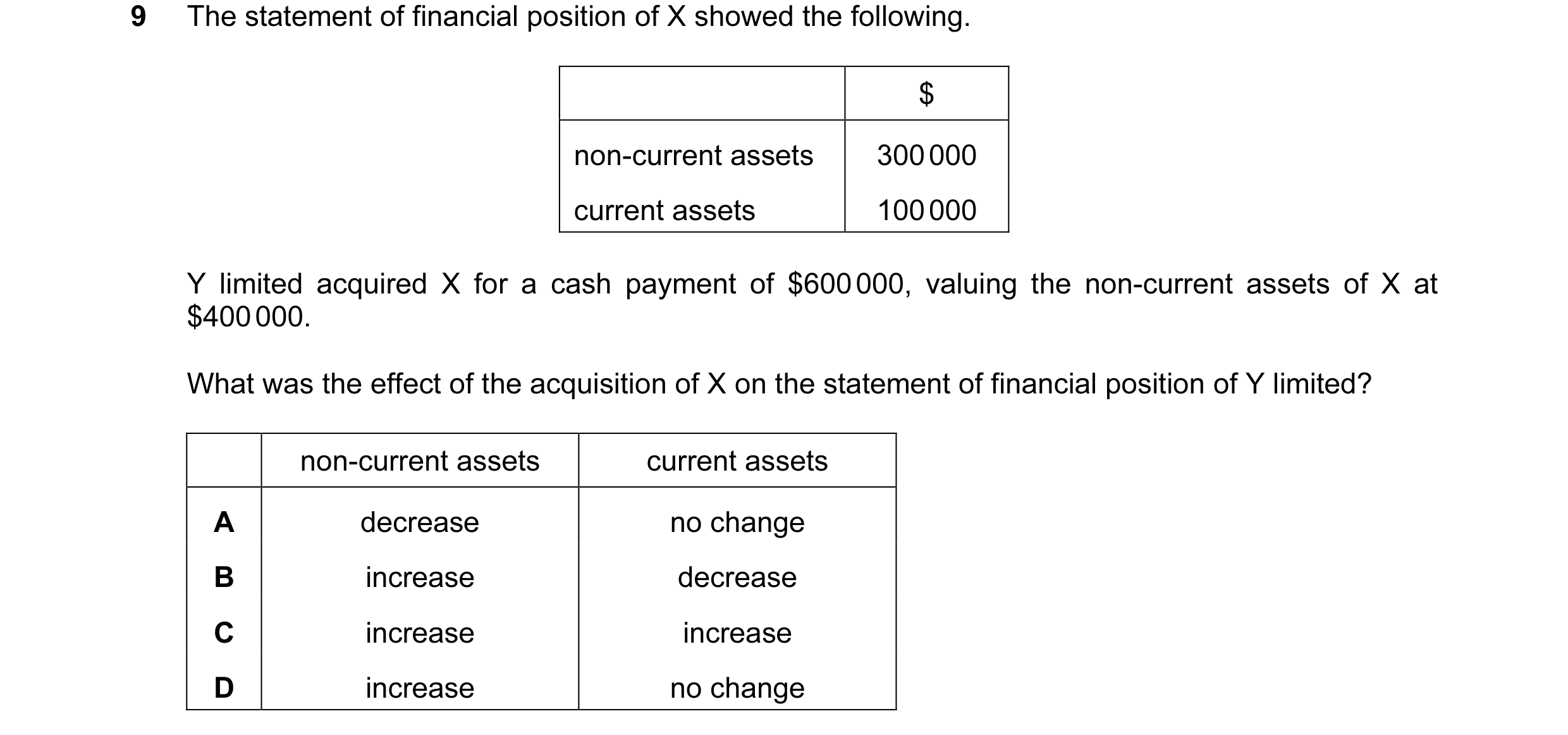
 19 / 21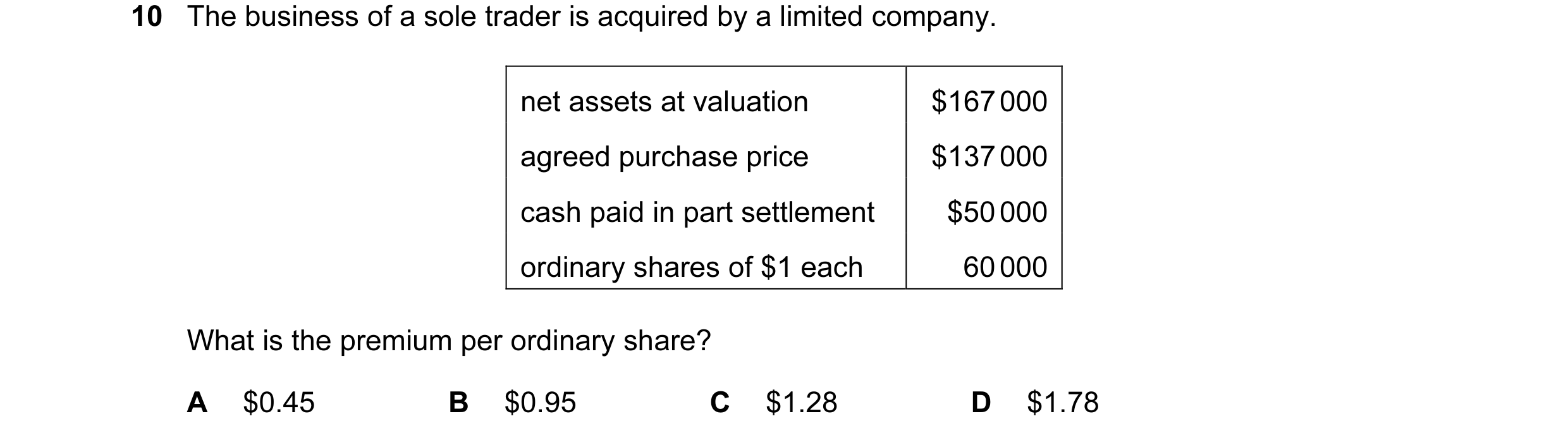
 20 / 21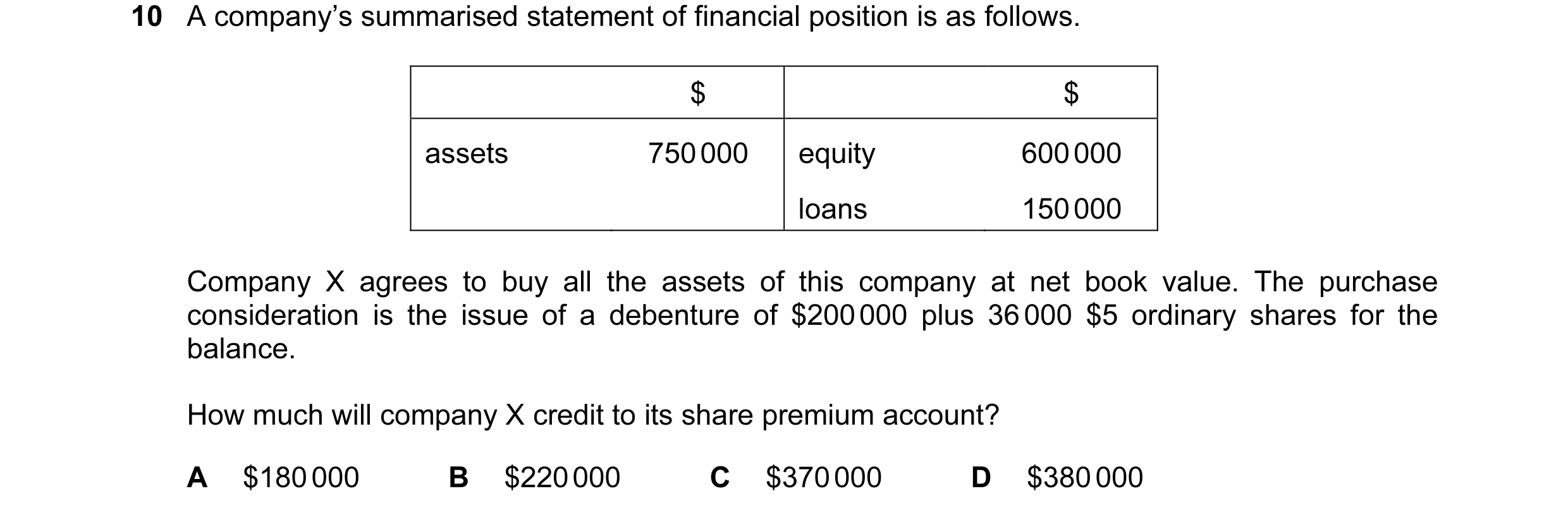
 21 / 21