Questions as text
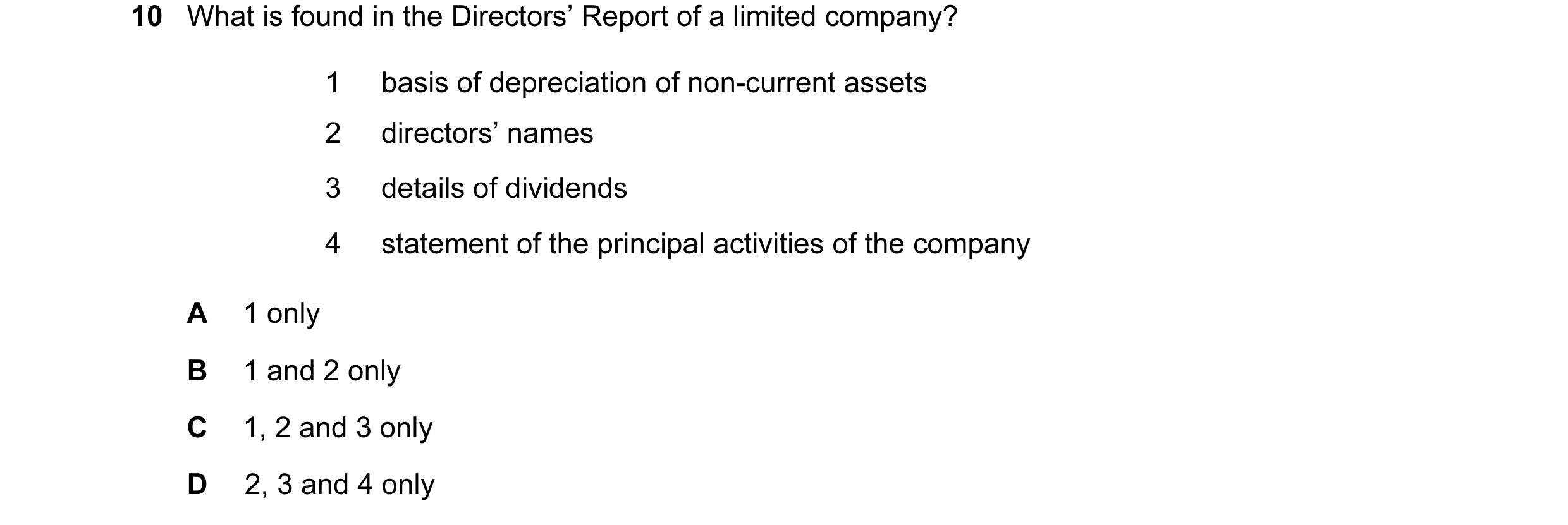
Q1 · What is found in the Directors’ Report of a limited company? 9706/31 Oct/Nov 2009
10 What is found in the Directors’ Report of a limited company? 1 basis of depreciation of non-current assets 2 directors’ names 3 details of dividends 4 statement of the principal activities of the company A 1 only B 1 and 2 only C 1, 2 and 3 only D 2, 3 and 4 only
1 marks
Answer: D
This question in 9706/31 Oct/Nov 2009
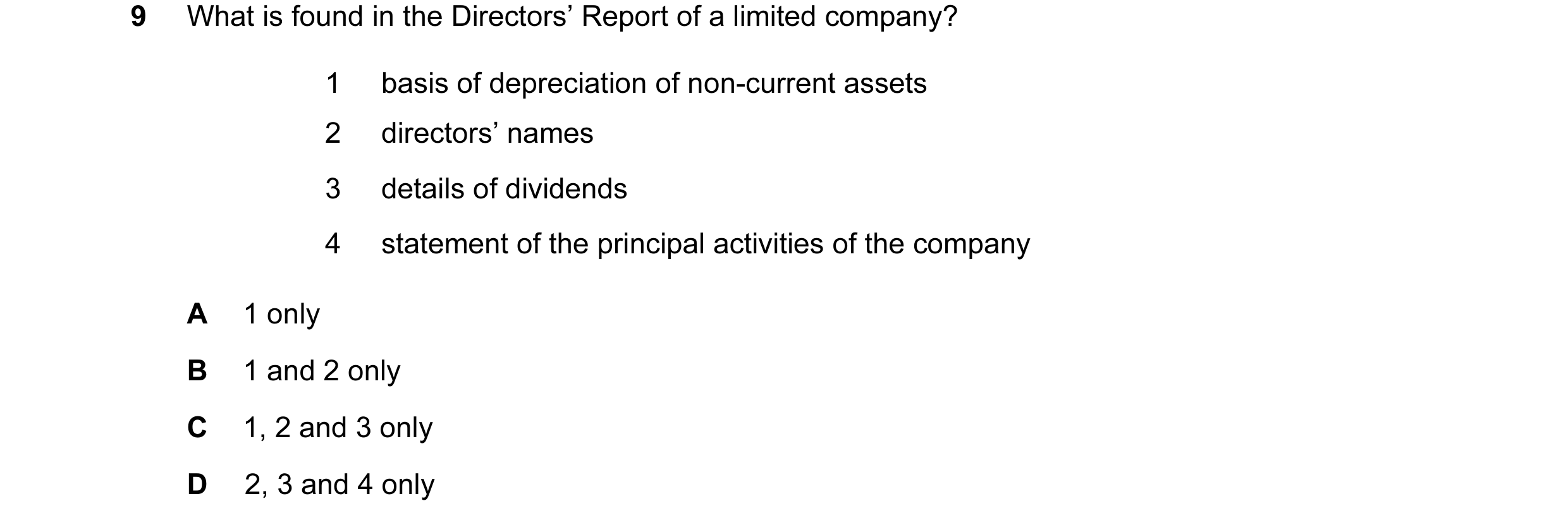
Q2 · What is found in the Directors’ Report of a limited company? 9706/32 Oct/Nov 2009
9 What is found in the Directors’ Report of a limited company? 1 basis of depreciation of non-current assets 2 directors’ names 3 details of dividends 4 statement of the principal activities of the company A 1 only B 1 and 2 only C 1, 2 and 3 only D 2, 3 and 4 only
1 marks
Answer: D
This question in 9706/32 Oct/Nov 2009
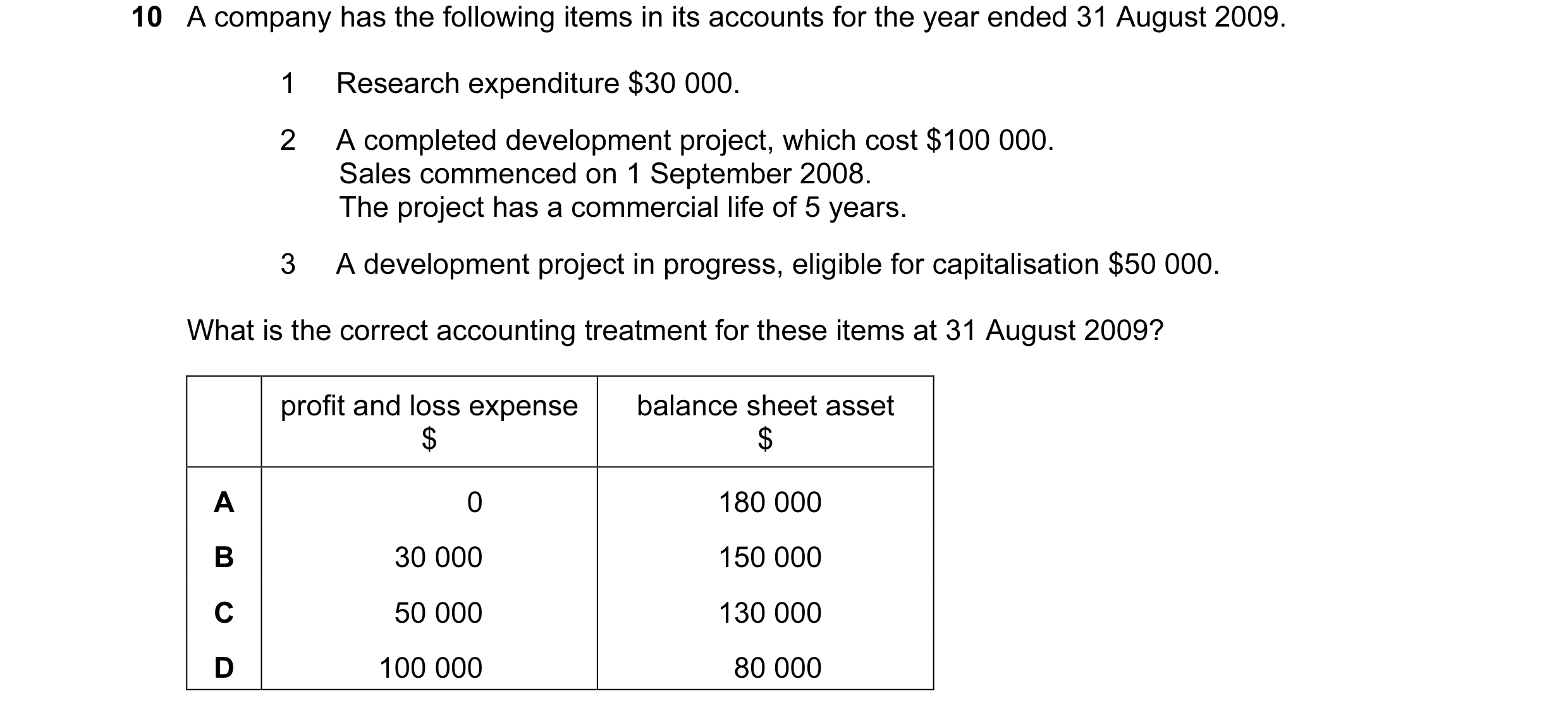
Q3 · A company has the following items in its accounts for the year ended 31 August 2009 9706/32 Oct/Nov 2009
10 A company has the following items in its accounts for the year ended 31 August 2009. 1 Research expenditure $30 000. 2 A completed development project, which cost $100 000. Sales commenced on 1 September 2008. The project has a commercial life of 5 years. 3 A development project in progress, eligible for capitalisation $50 000. What is the correct accounting treatment for these items at 31 August 2009? profit and loss expense balance sheet asset $ $ A 0 180 000 B 30 000 150 000 C 50 000 130 000 D 100 000 80 000
1 marks
Answer: C
This question in 9706/32 Oct/Nov 2009
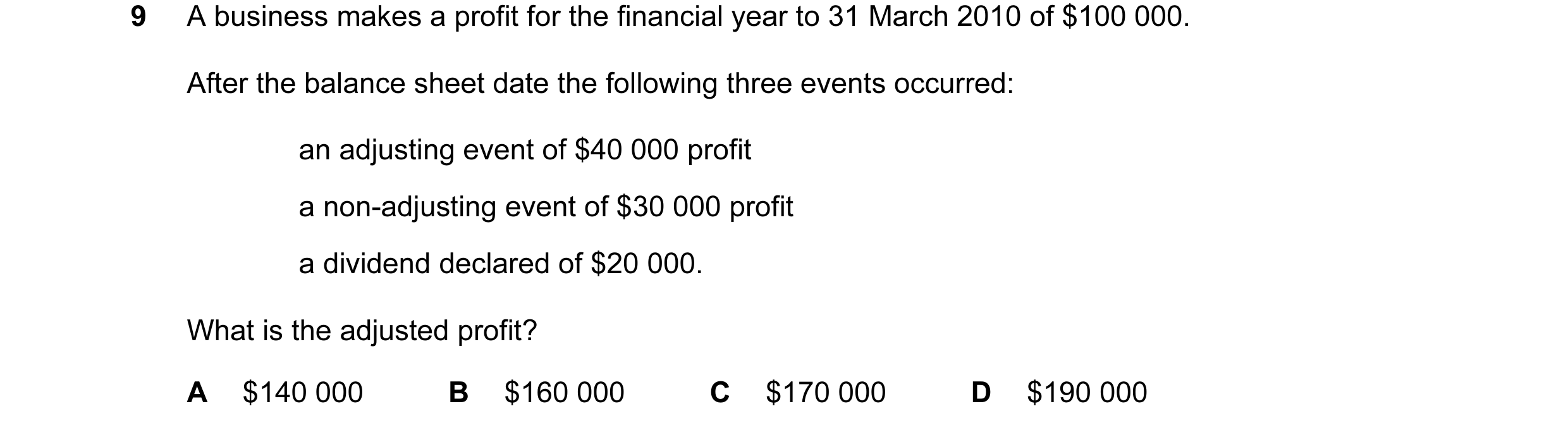
Q4 · A business makes a profit for the financial year to 31 March 2010 of $100 000 9706/31 May/June 2010
9 A business makes a profit for the financial year to 31 March 2010 of $100 000. After the balance sheet date the following three events occurred: an adjusting event of $40 000 profit a non-adjusting event of $30 000 profit a dividend declared of $20 000. What is the adjusted profit? A $140 000 B $160 000 C $170 000 D $190 000
1 marks
Answer: A
This question in 9706/31 May/June 2010
Q5 · A business makes a profit for the financial year to 31 March 2010 of $100 000 9706/32 May/June 2010
9 A business makes a profit for the financial year to 31 March 2010 of $100 000. After the balance sheet date the following three events occurred: an adjusting event of $40 000 profit a non-adjusting event of $30 000 profit a dividend declared of $20 000. What is the adjusted profit? A $140 000 B $160 000 C $170 000 D $190 000
1 marks
Answer: A
This question in 9706/32 May/June 2010
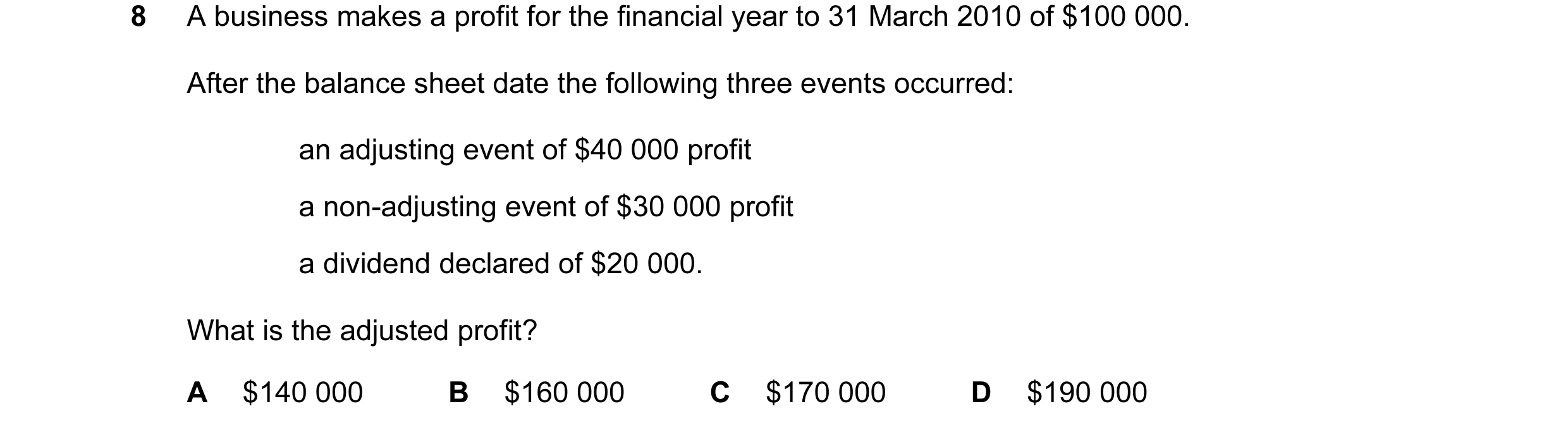
Q6 · A business makes a profit for the financial year to 31 March 2010 of $100 000 9706/33 May/June 2010
8 A business makes a profit for the financial year to 31 March 2010 of $100 000. After the balance sheet date the following three events occurred: an adjusting event of $40 000 profit a non-adjusting event of $30 000 profit a dividend declared of $20 000. What is the adjusted profit? A $140 000 B $160 000 C $170 000 D $190 000
1 marks
Answer: A
This question in 9706/33 May/June 2010
Q7 · In published accounts, where will the details of directors’ pay and benefits be found? 9706/31 May/June 2011
9 In published accounts, where will the details of directors’ pay and benefits be found? A accounting policies B income statement C statement of cash flows D none of the above
1 marks
Answer: D
This question in 9706/31 May/June 2011
Q8 · A company’s year end is 31 May 9706/31 May/June 2011
12 A company’s year end is 31 May. The following table shows dividends paid and proposed by it. $ proposed final dividend for year ended 31 May 2009, 100 000 payable September 2009 interim dividend for year ended 31 May 2010, 50 000 payable March 2010 proposed final dividend for year ended 31 May 2010, 120 000 payable September 2010 Which figure will be shown as dividends in the note to the accounts for the year ended 31 May 2010? A $120 000 B $150 000 C $170 000 D $270 000
1 marks
Answer: B
This question in 9706/31 May/June 2011
Q9 · In published accounts, where will the details of directors’ pay and benefits be found? 9706/32 May/June 2011
9 In published accounts, where will the details of directors’ pay and benefits be found? A accounting policies B income statement C statement of cash flows D none of the above
1 marks
Answer: D
This question in 9706/32 May/June 2011
Q10 · In published accounts, where will the details of directors’ pay and benefits be found? 9706/33 May/June 2011
8 In published accounts, where will the details of directors’ pay and benefits be found? A accounting policies B income statement C statement of cash flows D none of the above
1 marks
Answer: D
This question in 9706/33 May/June 2011
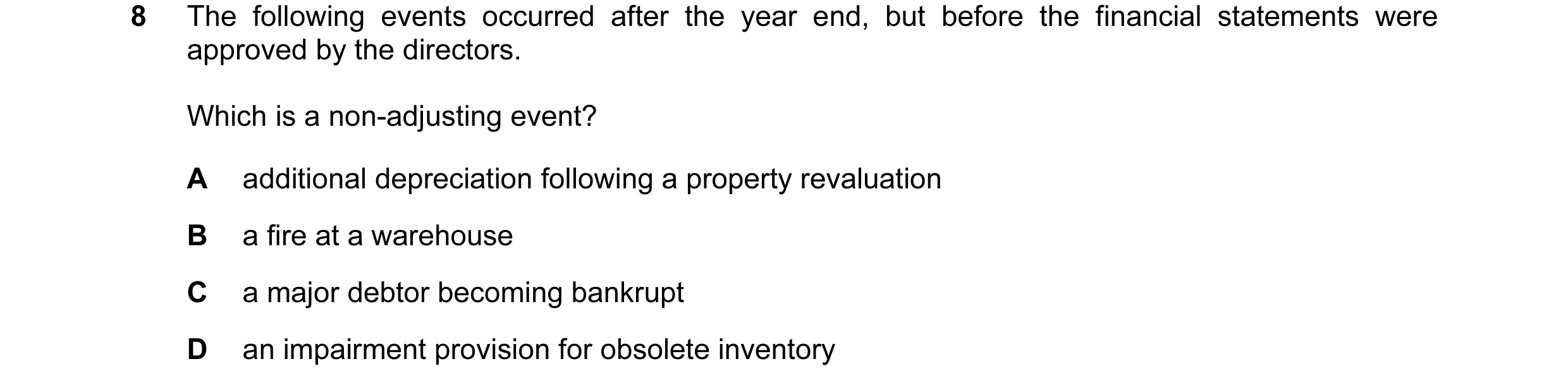
Q11 · The following events occurred after the year end, but before the financial statements… 9706/31 Oct/Nov 2011
8 The following events occurred after the year end, but before the financial statements were approved by the directors. Which is a non-adjusting event? A additional depreciation following a property revaluation B a fire at a warehouse C a major debtor becoming bankrupt D an impairment provision for obsolete inventory
1 marks
Answer: B
This question in 9706/31 Oct/Nov 2011
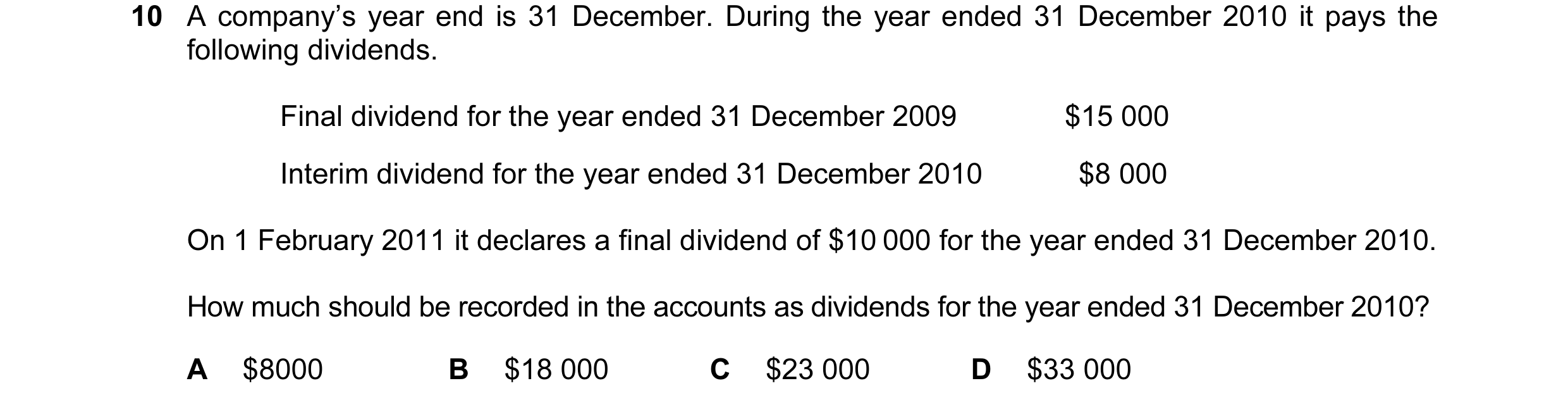
Q12 · A company’s year end is 31 December 9706/31 Oct/Nov 2011
10 A company’s year end is 31 December. During the year ended 31 December 2010 it pays the following dividends. Final dividend for the year ended 31 December 2009 $15 000 Interim dividend for the year ended 31 December 2010 $8 000 On 1 February 2011 it declares a final dividend of $10 000 for the year ended 31 December 2010. How much should be recorded in the accounts as dividends for the year ended 31 December 2010? A $8000 B $18 000 C $23 000 D $33 000
1 marks
Answer: C
This question in 9706/31 Oct/Nov 2011
Q13 · The following data relates to a company at 31 December 9706/31 Oct/Nov 2011
15 The following data relates to a company at 31 December. details of a non-current asset $ million historic cost 15 accumulated depreciation 10 value in use 4 fair value less costs to sell 3 What would be the impairment loss for the non-current asset to be recognised at 31 December? A $1 million B $3 million C $4 million D $5 million
1 marks
Answer: A
This question in 9706/31 Oct/Nov 2011
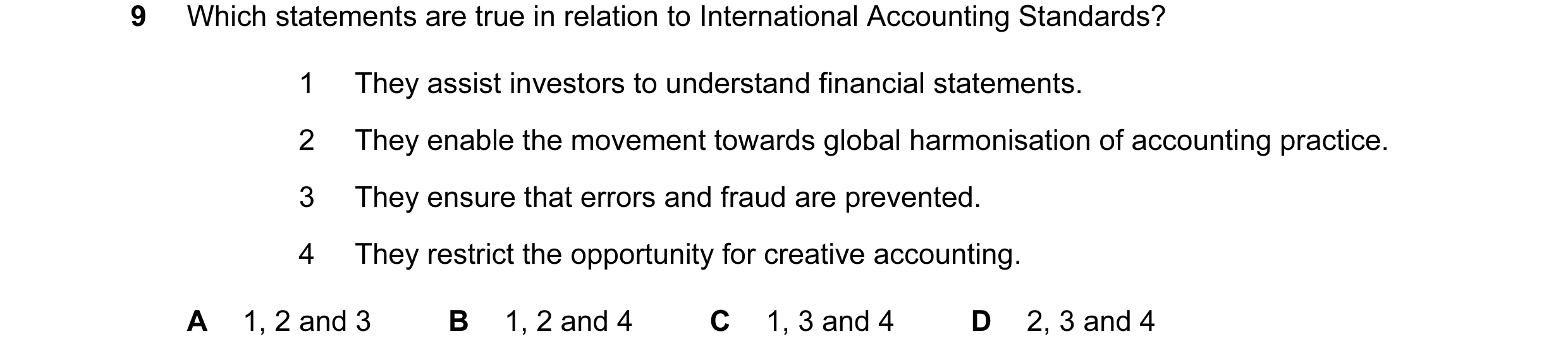
Q14 · Which statements are true in relation to International Accounting Standards? 9706/32 Oct/Nov 2011
9 Which statements are true in relation to International Accounting Standards? 1 They assist investors to understand financial statements. 2 They enable the movement towards global harmonisation of accounting practice. 3 They ensure that errors and fraud are prevented. 4 They restrict the opportunity for creative accounting. A 1, 2 and 3 B 1, 2 and 4 C 1, 3 and 4 D 2, 3 and 4
1 marks
Answer: B
This question in 9706/32 Oct/Nov 2011
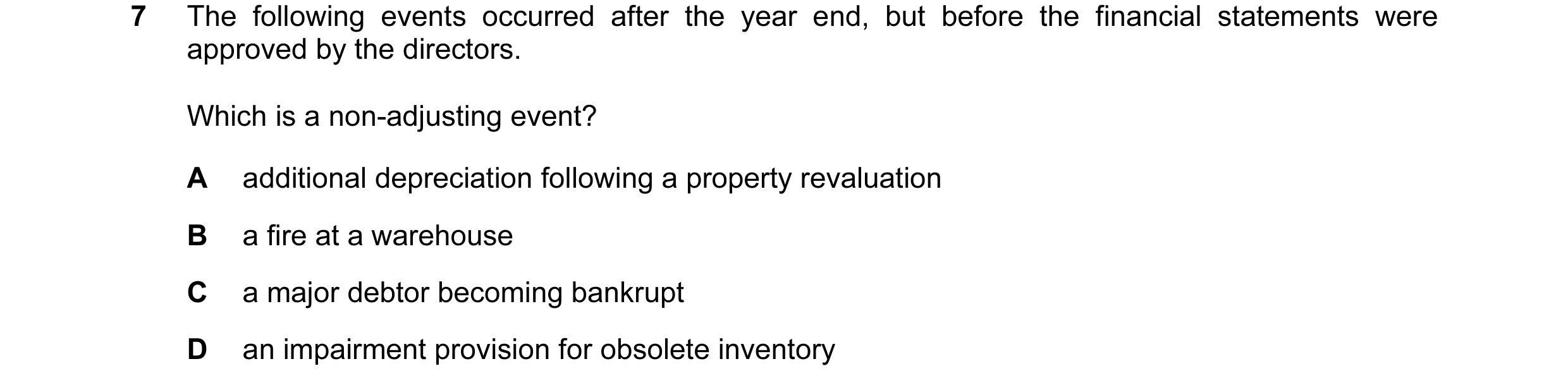
Q15 · The following events occurred after the year end, but before the financial statements… 9706/33 Oct/Nov 2011
7 The following events occurred after the year end, but before the financial statements were approved by the directors. Which is a non-adjusting event? A additional depreciation following a property revaluation B a fire at a warehouse C a major debtor becoming bankrupt D an impairment provision for obsolete inventory
1 marks
Answer: B
This question in 9706/33 Oct/Nov 2011
Q16 · Which items are part of the published accounts of a limited company? 9706/31 May/June 2012
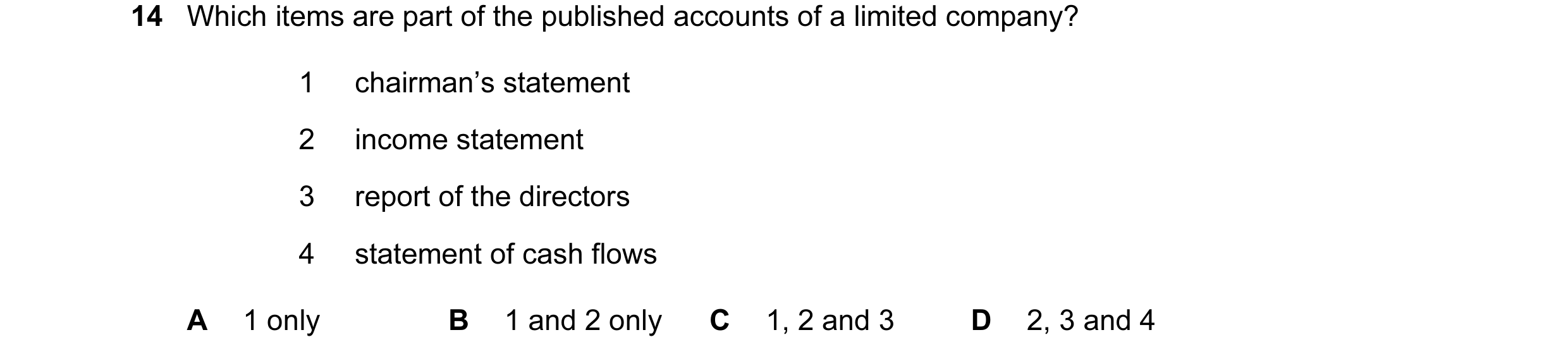
14 Which items are part of the published accounts of a limited company? 1 chairman’s statement 2 income statement 3 report of the directors 4 statement of cash flows A 1 only B 1 and 2 only C 1, 2 and 3 D 2, 3 and 4
1 marks
Answer: D
This question in 9706/31 May/June 2012
Q17 · To which asset is impairment normally applied each year? 9706/31 May/June 2012
15 To which asset is impairment normally applied each year? A goodwill B inventory C plant and machinery D trade receivables
1 marks
Answer: A
This question in 9706/31 May/June 2012
Q18 · How may a company improve its profit by window dressing? 9706/32 May/June 2012
9 How may a company improve its profit by window dressing? A applying an impairment test to goodwill B making a provision for obsolete stock C increasing the bad debts provision D reducing the rates of depreciation
1 marks
Answer: D
This question in 9706/32 May/June 2012
Q19 · Which item must be included in the director’s report of a limited company? 9706/32 May/June 2012
14 Which item must be included in the director’s report of a limited company? A basis of depreciation of non-current assets B details of dividends C losses on disposal of non-current assets D respective responsibilities of the directors
1 marks
Answer: B
This question in 9706/32 May/June 2012
Q20 · Which items are part of the published accounts of a limited company? 9706/33 May/June 2012
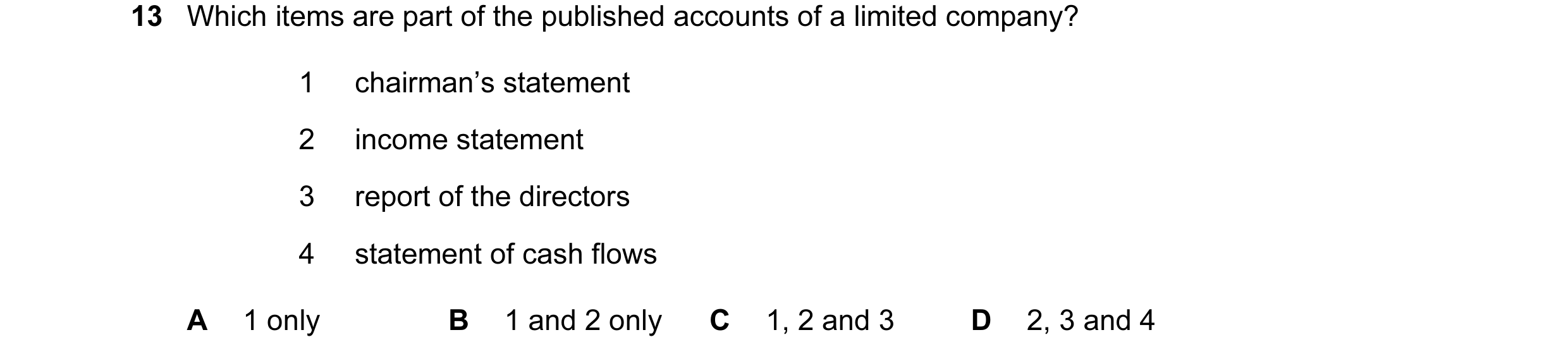
13 Which items are part of the published accounts of a limited company? 1 chairman’s statement 2 income statement 3 report of the directors 4 statement of cash flows A 1 only B 1 and 2 only C 1, 2 and 3 D 2, 3 and 4
1 marks
Answer: D
This question in 9706/33 May/June 2012
Q21 · What is not a criterion for the recognition of an intangible asset according to IAS38? 9706/31 Oct/Nov 2012
11 What is not a criterion for the recognition of an intangible asset according to IAS38? A ownership of the item B the ability to control the item C the ability to measure reliably the value of the item D the expectation of future economic benefits from the item
1 marks
Answer: A
This question in 9706/31 Oct/Nov 2012
Q22 · What is an intangible asset? 9706/31 Oct/Nov 2012
14 What is an intangible asset? A an identifiable non–monetary item lacking physical substance which is controlled by an entity B an identifiable non–monetary item used by a company C an identifiable non–monetary item where future economic benefits are in doubt D an identifiable non–monetary item which a company intends to purchase
1 marks
Answer: A
This question in 9706/31 Oct/Nov 2012
Q23 · Why is a Directors’ Report required in the accounts of a company? 9706/31 Oct/Nov 2012
15 Why is a Directors’ Report required in the accounts of a company? A It contains information regarding the company’s accounting policies. B It is a requirement of company law. C It is required by accounting standards. D The shareholders require it to be included.
1 marks
Answer: B
This question in 9706/31 Oct/Nov 2012
Q24 · What is required to be disclosed in the directors’ report? 9706/32 Oct/Nov 2012
13 What is required to be disclosed in the directors’ report? A accounting policies B directors’ remuneration C earnings per share D the principal activity of the company
1 marks
Answer: D
This question in 9706/32 Oct/Nov 2012
Q25 · According to IAS37 (Provisions, contingent liabilities and contingent assets), when… 9706/32 Oct/Nov 2012
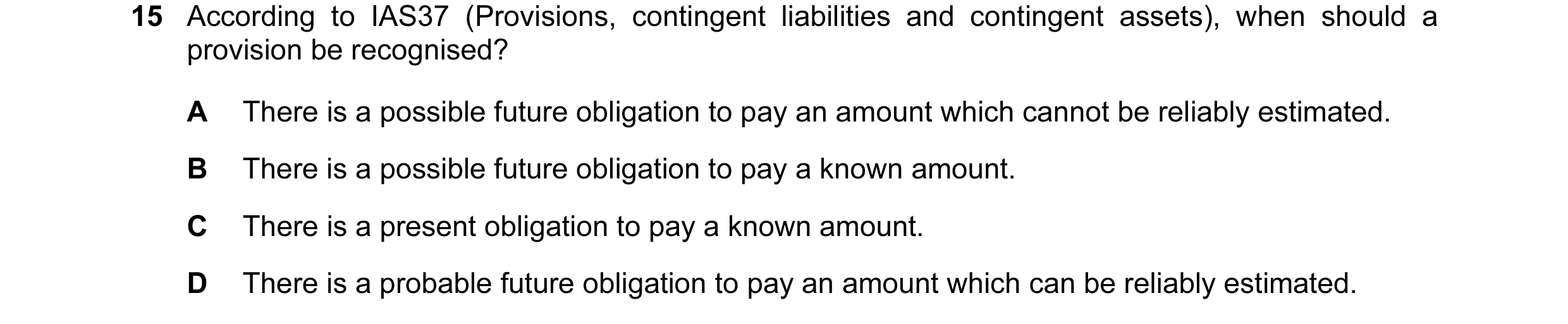
15 According to IAS37 (Provisions, contingent liabilities and contingent assets), when should a provision be recognised? A There is a possible future obligation to pay an amount which cannot be reliably estimated. B There is a possible future obligation to pay a known amount. C There is a present obligation to pay a known amount. D There is a probable future obligation to pay an amount which can be reliably estimated.
1 marks
Answer: D
This question in 9706/32 Oct/Nov 2012
Q26 · Under IAS37, a ‘liability of uncertain timing or amount’ is classed as what? 9706/33 Oct/Nov 2012
18 Under IAS37, a ‘liability of uncertain timing or amount’ is classed as what? A contingent asset B contingent liability C liability D provision
1 marks
Answer: B
This question in 9706/33 Oct/Nov 2012
Q27 · A company has prepared its financial statements for the year ended 31 December 2012 9706/31 May/June 2013
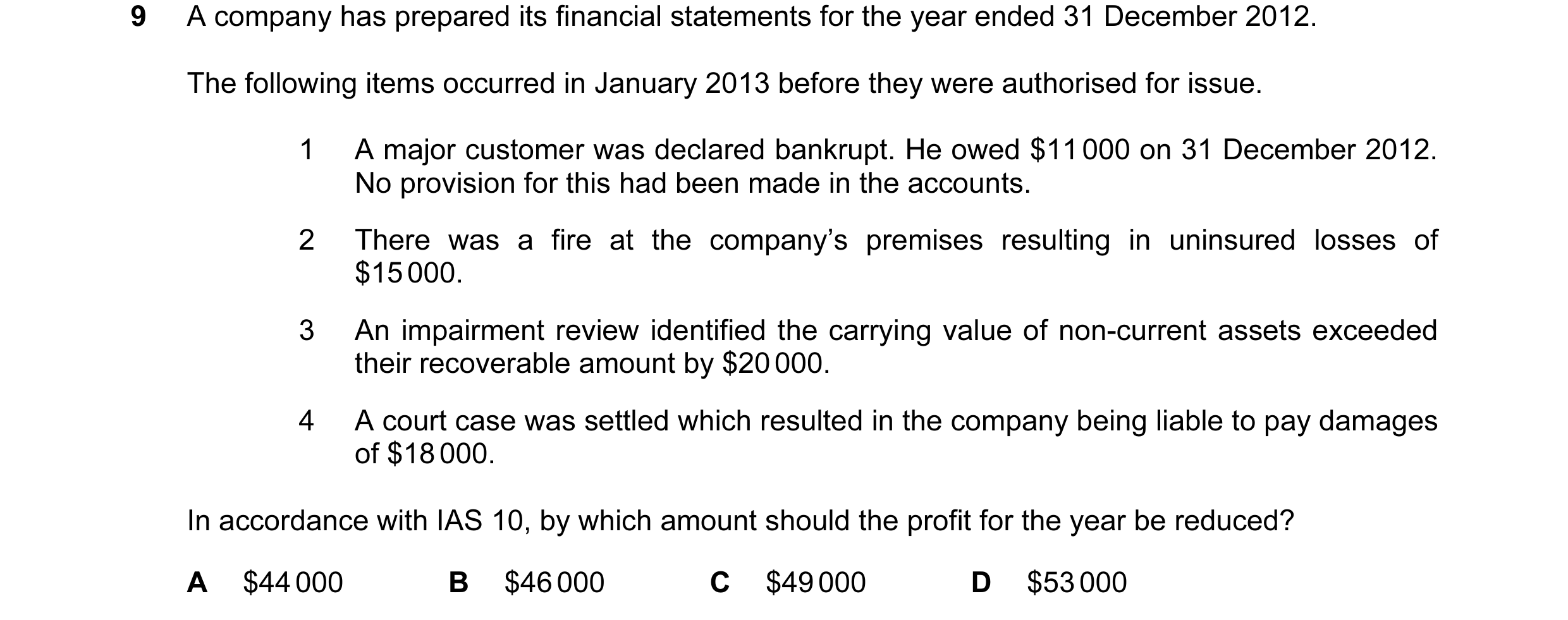
9 A company has prepared its financial statements for the year ended 31 December 2012. The following items occurred in January 2013 before they were authorised for issue. 1 A major customer was declared bankrupt. He owed $11 000 on 31 December 2012. No provision for this had been made in the accounts. 2 There was a fire at the company’s premises resulting in uninsured losses of $15 000. 3 An impairment review identified the carrying value of non-current assets exceeded their recoverable amount by $20 000. 4 A court case was settled which resulted in the company being liable to pay damages of $18 000. In accordance with IAS 10, by which amount should the profit for the year be reduced? A $44 000 B $46 000 C $49 000 D $53 000
1 marks
Answer: C
This question in 9706/31 May/June 2013
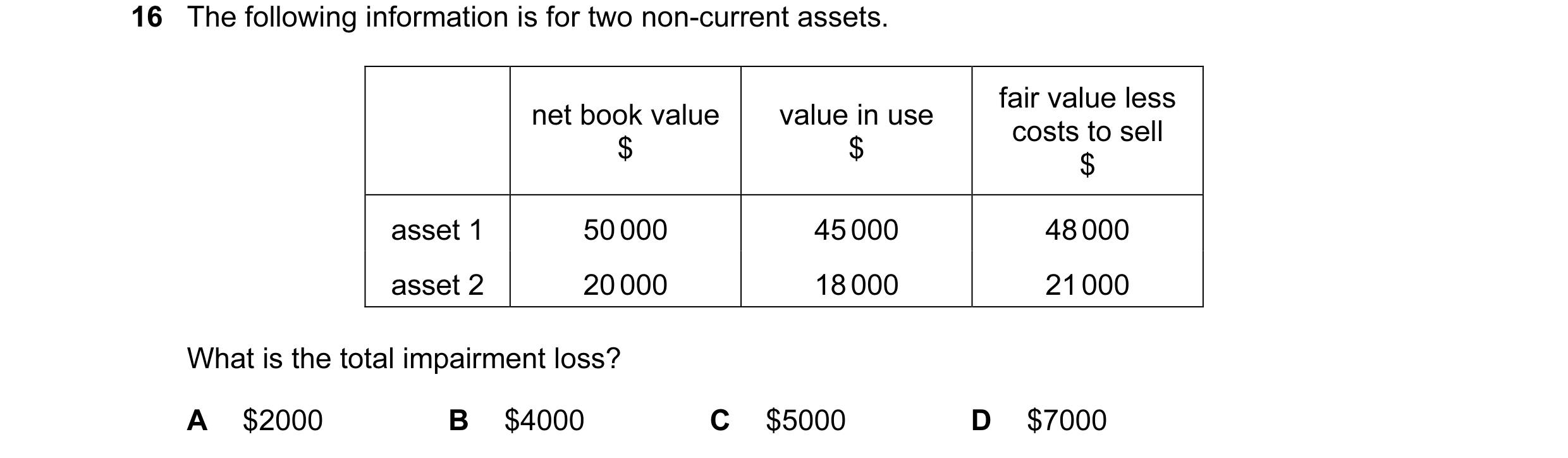
Q28 · The following information is for two non-current assets 9706/31 May/June 2013
16 The following information is for two non-current assets. fair value less net book value value in use costs to sell $ $ $ asset 1 50 000 45 000 48 000 asset 2 20 000 18 000 21 000 What is the total impairment loss? A $2000 B $4000 C $5000 D $7000
1 marks
Answer: A
This question in 9706/31 May/June 2013
Q29 · Which is an example of window dressing in financial statements? 9706/31 May/June 2013
17 Which is an example of window dressing in financial statements? A amortising goodwill as soon as it arises B failure to write down freehold property following a revaluation shortly after the year end C omitting to write down inventory which has been stolen after the year end D writing off debts before they have become bad
1 marks
Answer: B
This question in 9706/31 May/June 2013
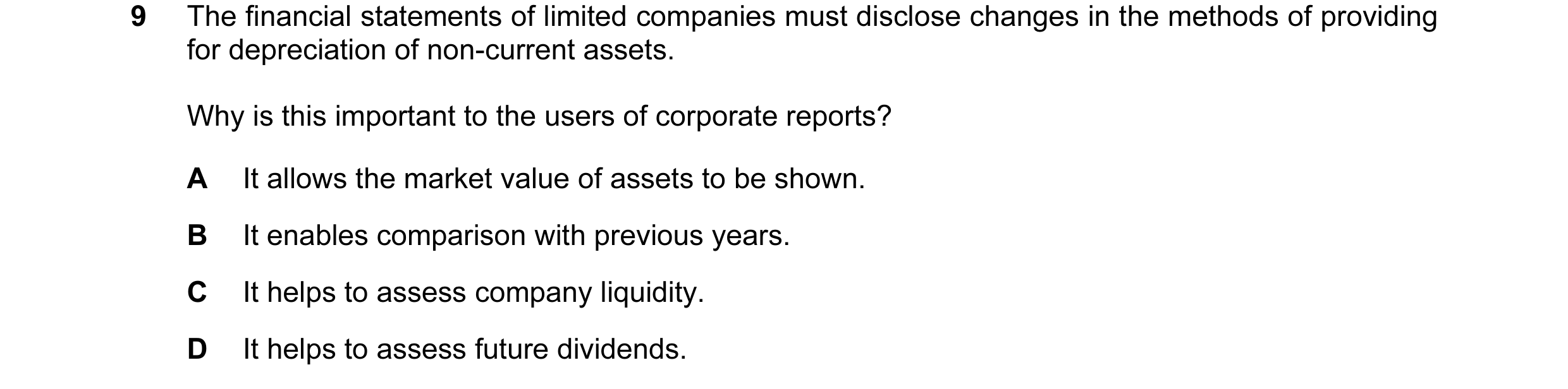
Q30 · The financial statements of limited companies must disclose changes in the methods of… 9706/32 May/June 2013
9 The financial statements of limited companies must disclose changes in the methods of providing for depreciation of non-current assets. Why is this important to the users of corporate reports? A It allows the market value of assets to be shown. B It enables comparison with previous years. C It helps to assess company liquidity. D It helps to assess future dividends.
1 marks
Answer: B
This question in 9706/32 May/June 2013
Q31 · A company, with financial year end 31 December 2012, has prepared its final accounts 9706/32 May/June 2013
19 A company, with financial year end 31 December 2012, has prepared its final accounts. Before the accounts are approved, the company are notified that a credit customer with an outstanding debt of $175 000 has been declared bankrupt on 6 January 2013. Which International Accounting Standard should be applied by the company for this situation? A IAS 1 B IAS 7 C IAS 8 D IAS 10
1 marks
Answer: D
This question in 9706/32 May/June 2013
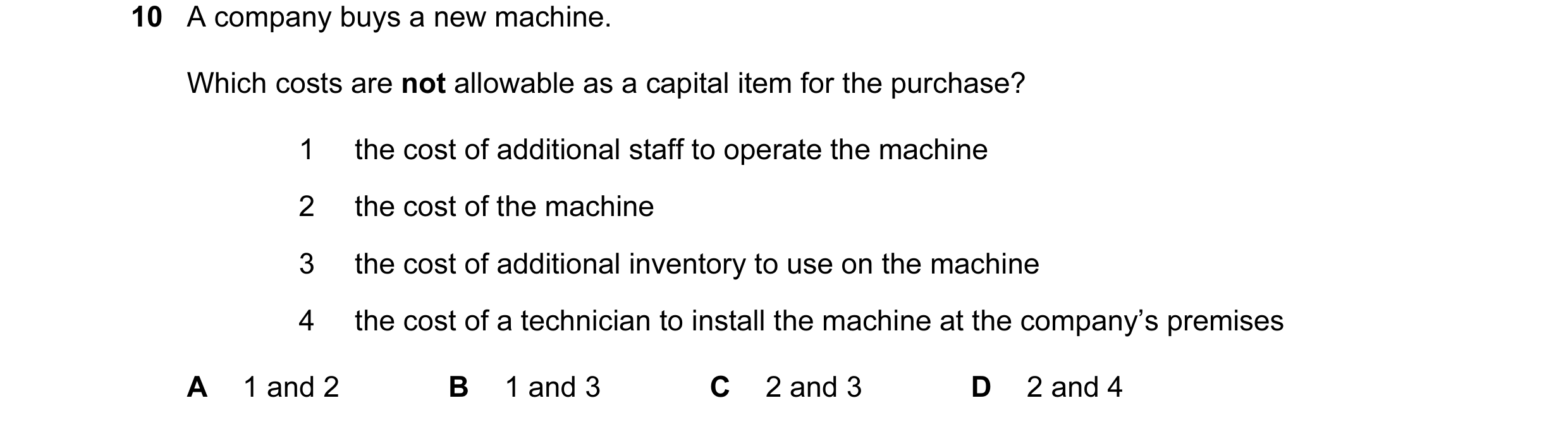
Q32 · A company buys a new machine 9706/33 May/June 2013
10 A company buys a new machine. Which costs are not allowable as a capital item for the purchase? 1 the cost of additional staff to operate the machine 2 the cost of the machine 3 the cost of additional inventory to use on the machine 4 the cost of a technician to install the machine at the company’s premises A 1 and 2 B 1 and 3 C 2 and 3 D 2 and 4
1 marks
Answer: B
This question in 9706/33 May/June 2013
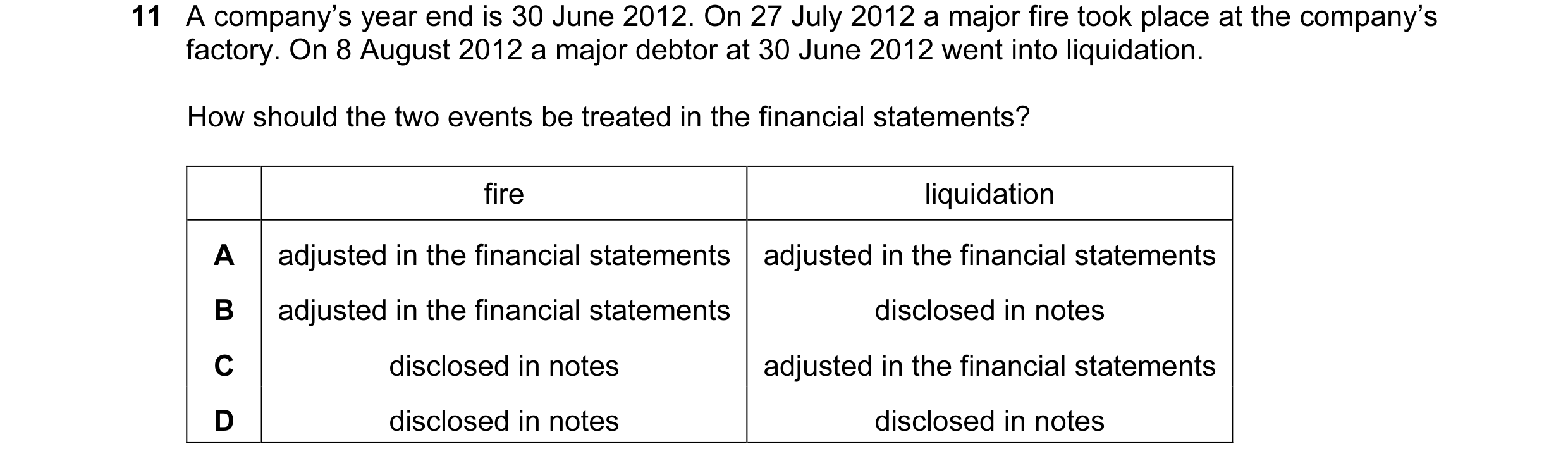
Q33 · A company’s year end is 30 June 2012 9706/33 May/June 2013
11 A company’s year end is 30 June 2012. On 27 July 2012 a major fire took place at the company’s factory. On 8 August 2012 a major debtor at 30 June 2012 went into liquidation. How should the two events be treated in the financial statements? fire liquidation A adjusted in the financial statements adjusted in the financial statements B adjusted in the financial statements disclosed in notes C disclosed in notes adjusted in the financial statements D disclosed in notes disclosed in notes
1 marks
Answer: C
This question in 9706/33 May/June 2013
Q34 · How does IAS 16 define the fair value of an asset? 9706/33 May/June 2013
17 How does IAS 16 define the fair value of an asset? A the amount a buyer will pay for it B the amount paid to purchase the asset C the value after deducting an impairment loss D the value shown in the statement of financial position after depreciation
1 marks
Answer: A
This question in 9706/33 May/June 2013
Q35 · What is the correct treatment of non-purchased goodwill? 9706/31 Oct/Nov 2013
12 What is the correct treatment of non-purchased goodwill? A Do not recognise it as an asset. B Include it in the statement of financial position as an asset at valuation. C Include it in the statement of financial position as an asset, to be amortised. D Write it off through impairment provision.
1 marks
Answer: A
This question in 9706/31 Oct/Nov 2013
Q36 · What is included in the directors’ report? 9706/32 Oct/Nov 2013
8 What is included in the directors’ report? A directors’ salaries B principal activities of the company C trade receivables D turnover
1 marks
Answer: B
This question in 9706/32 Oct/Nov 2013
Q37 · A company’s directors have been advised that there is a 40% chance that they will lose a… 9706/32 Oct/Nov 2013
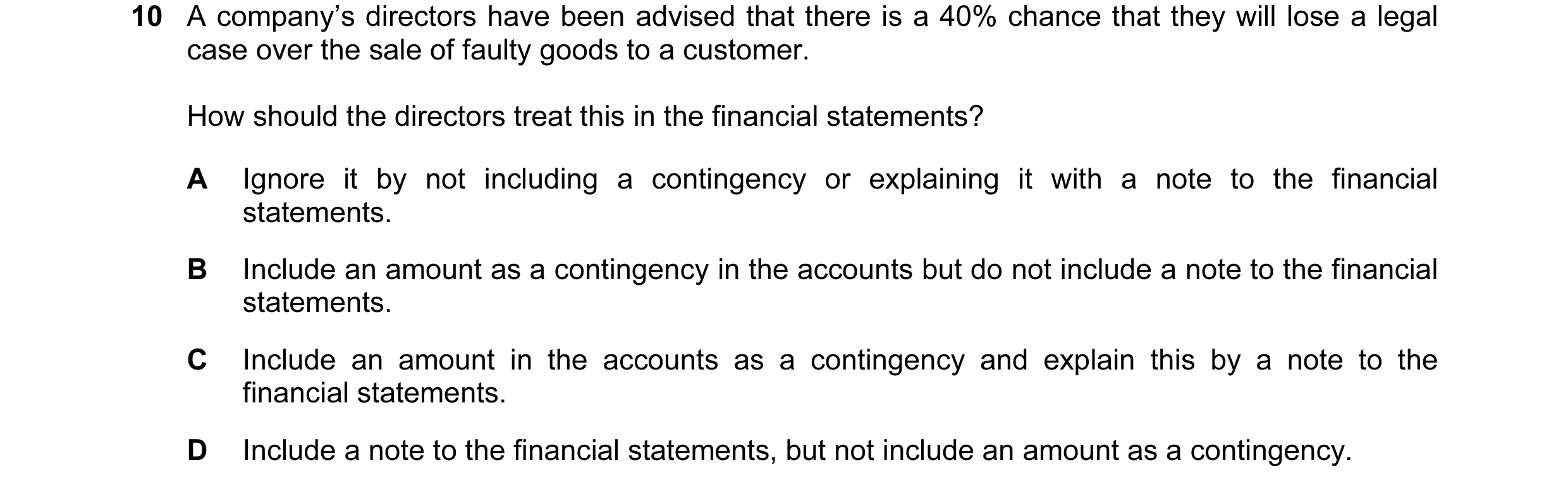
10 A company’s directors have been advised that there is a 40% chance that they will lose a legal case over the sale of faulty goods to a customer. How should the directors treat this in the financial statements? A Ignore it by not including a contingency or explaining it with a note to the financial statements. B Include an amount as a contingency in the accounts but do not include a note to the financial statements. C Include an amount in the accounts as a contingency and explain this by a note to the financial statements. D Include a note to the financial statements, but not include an amount as a contingency.
1 marks
Answer: D
This question in 9706/32 Oct/Nov 2013
Q38 · Which is an example of an adjusting event? 9706/33 Oct/Nov 2013
10 Which is an example of an adjusting event? A change in interest rates B the insolvency of a major customer C the issue of loan stock D the purchase of a new vehicle
1 marks
Answer: B
This question in 9706/33 Oct/Nov 2013
Q39 · The non-current assets of a company include a machine which has the following values 9706/33 Oct/Nov 2013
18 The non-current assets of a company include a machine which has the following values. $ carrying amount 55 000 fair value 60 000 costs of sale 6 000 value in use 42 000 Which value will be shown in the statement of financial position? A $42 000 B $54 000 C $55 000 D $60 000
1 marks
Answer: B
This question in 9706/33 Oct/Nov 2013
Q40 · After the date of the statement of financial position, but before the financial… 9706/31 May/June 2014
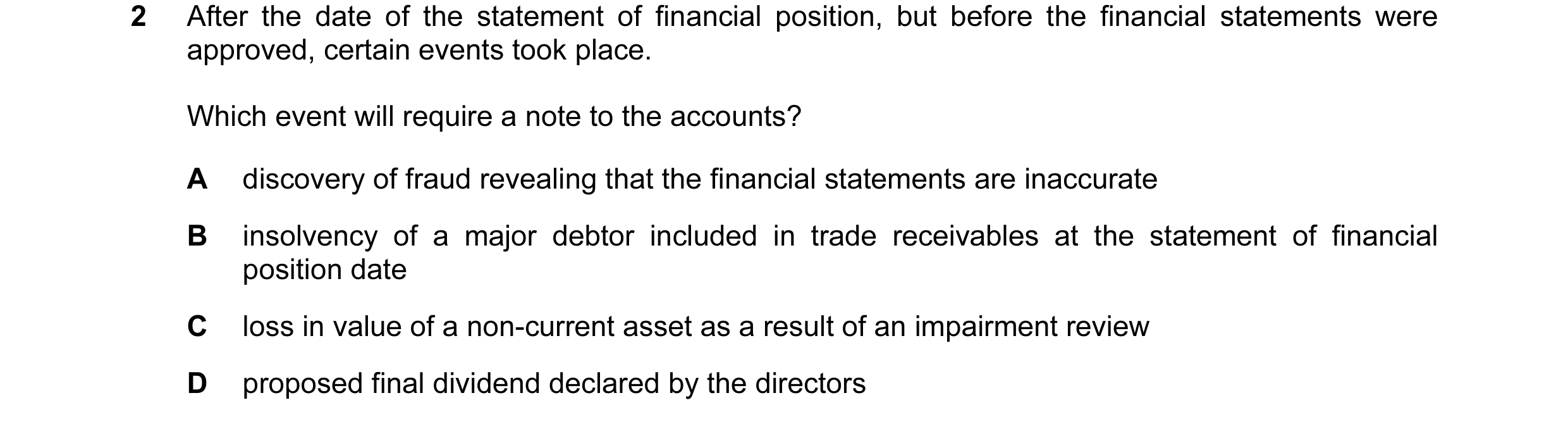
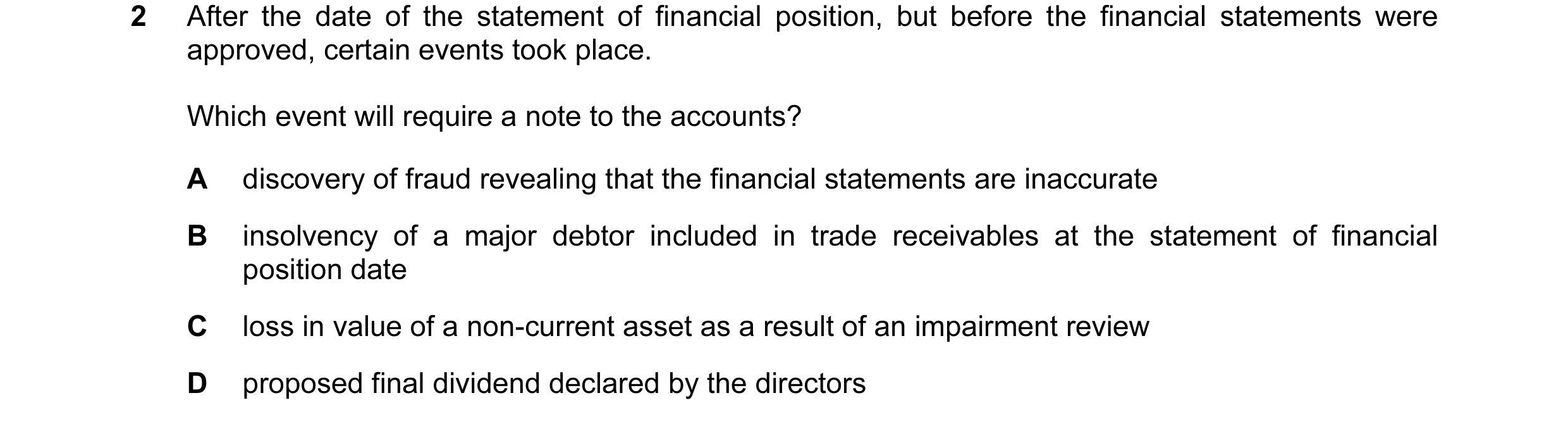
2 After the date of the statement of financial position, but before the financial statements were approved, certain events took place. Which event will require a note to the accounts? A discovery of fraud revealing that the financial statements are inaccurate B insolvency of a major debtor included in trade receivables at the statement of financial position date C loss in value of a non-current asset as a result of an impairment review D proposed final dividend declared by the directors
1 marks
Answer: D
This question in 9706/31 May/June 2014
Q41 · A company has both a share premium account and retained earnings 9706/31 May/June 2014
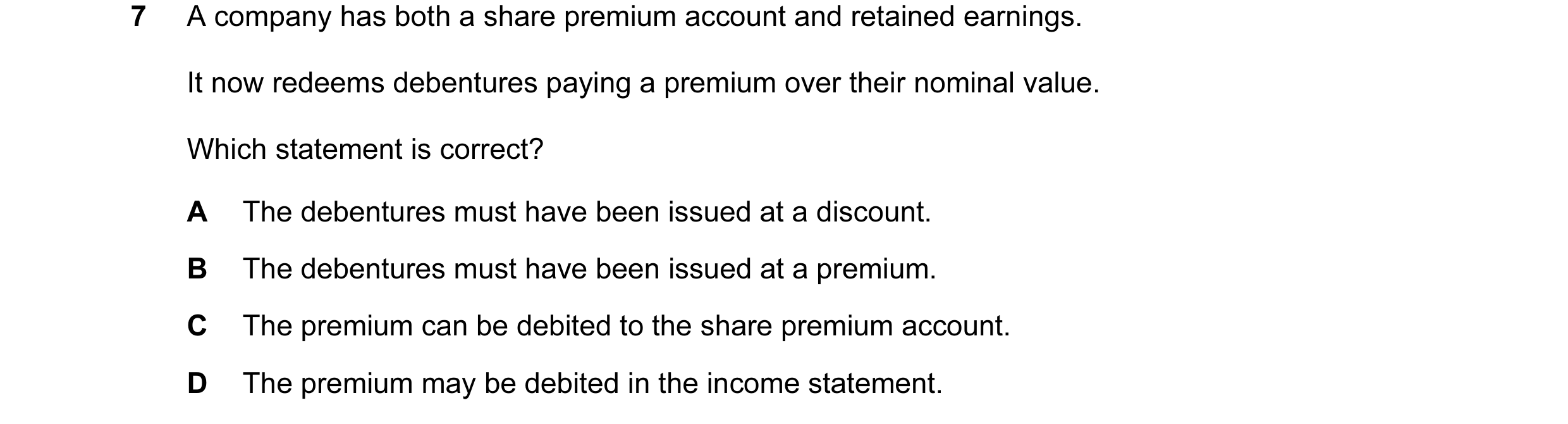
7 A company has both a share premium account and retained earnings. It now redeems debentures paying a premium over their nominal value. Which statement is correct? A The debentures must have been issued at a discount. B The debentures must have been issued at a premium. C The premium can be debited to the share premium account. D The premium may be debited in the income statement.
1 marks
Answer: C
This question in 9706/31 May/June 2014
Q42 · Which item is normally included in the directors’ report? 9706/31 May/June 2014
11 Which item is normally included in the directors’ report? A debenture interest paid B redemption of shares C research and development activities D taxation liability
1 marks
Answer: C
This question in 9706/31 May/June 2014
Q43 · What is an example of an accounting policy? 9706/31 May/June 2014
13 What is an example of an accounting policy? A adopting regular revaluations of non-current assets B ensuring all items are treated in a similar manner from one year to the next C preparing financial statements assuming the company is a going concern D using straight-line depreciation for all non-current assets
1 marks
Answer: D
This question in 9706/31 May/June 2014
Q44 · The following information relates to a company’s non-current assets 9706/31 May/June 2014
20 The following information relates to a company’s non-current assets. carrying value fair value less value in use costs to sell $ $ $ machinery 35 000 32 000 40 000 motor vehicles 20 200 8 000 16 000 office equipment 12 000 10 000 8 000 What is the total value of non-current assets to be included in the statement of financial position? A $48 000 B $50 000 C $61 000 D $67 200
1 marks
Answer: C
This question in 9706/31 May/June 2014
Q45 · After the date of the statement of financial position, but before the financial… 9706/32 May/June 2014
2 After the date of the statement of financial position, but before the financial statements were approved, certain events took place. Which event will require a note to the accounts? A discovery of fraud revealing that the financial statements are inaccurate B insolvency of a major debtor included in trade receivables at the statement of financial position date C loss in value of a non-current asset as a result of an impairment review D proposed final dividend declared by the directors
1 marks
Answer: D
This question in 9706/32 May/June 2014
Q46 · Which item is normally included in the directors’ report? 9706/32 May/June 2014
11 Which item is normally included in the directors’ report? A debenture interest paid B redemption of shares C research and development activities D taxation liability
1 marks
Answer: C
This question in 9706/32 May/June 2014
Q47 · What is an example of an accounting policy? 9706/32 May/June 2014
13 What is an example of an accounting policy? A adopting regular revaluations of non-current assets B ensuring all items are treated in a similar manner from one year to the next C preparing financial statements assuming the company is a going concern D using straight-line depreciation for all non-current assets
1 marks
Answer: D
This question in 9706/32 May/June 2014
Q48 · The following information relates to a company’s non-current assets 9706/32 May/June 2014
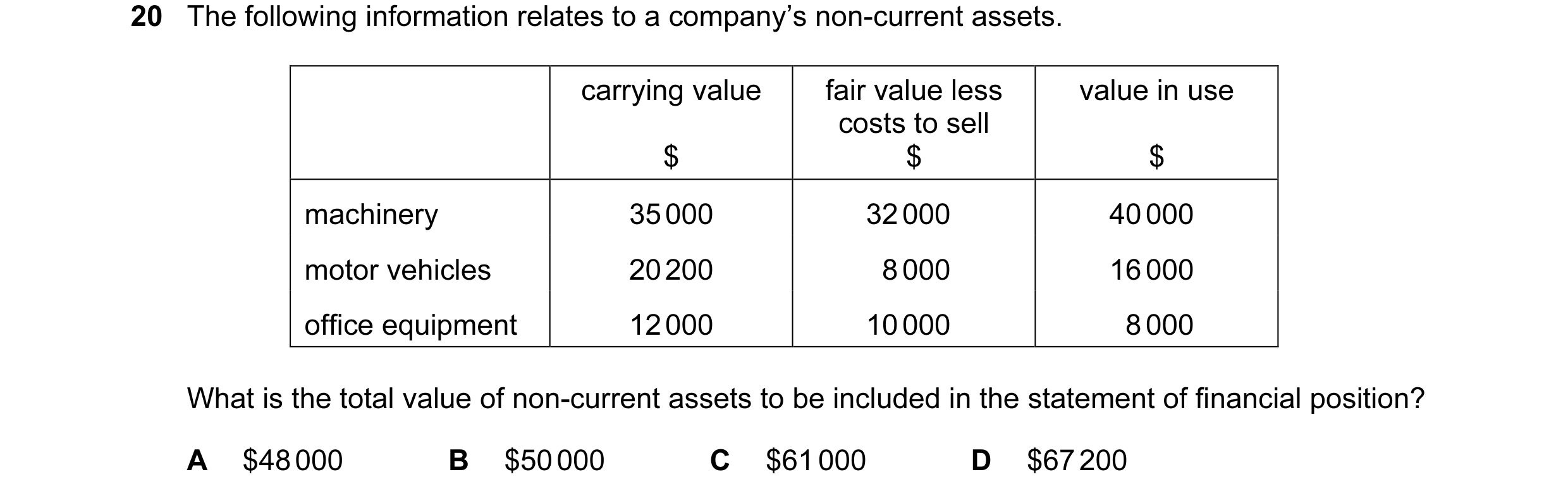
20 The following information relates to a company’s non-current assets. carrying value fair value less value in use costs to sell $ $ $ machinery 35 000 32 000 40 000 motor vehicles 20 200 8 000 16 000 office equipment 12 000 10 000 8 000 What is the total value of non-current assets to be included in the statement of financial position? A $48 000 B $50 000 C $61 000 D $67 200
1 marks
Answer: C
This question in 9706/32 May/June 2014
Q49 · Which IAS deals with provisions, contingent assets and contingent liabilities? 9706/33 May/June 2014
19 Which IAS deals with provisions, contingent assets and contingent liabilities? A IAS1 B IAS10 C IAS36 D IAS37
1 marks
Answer: D
This question in 9706/33 May/June 2014
Q50 · A company prepares its financial statements for the year ended 31 December 2014 and they… 9706/31 Oct/Nov 2015
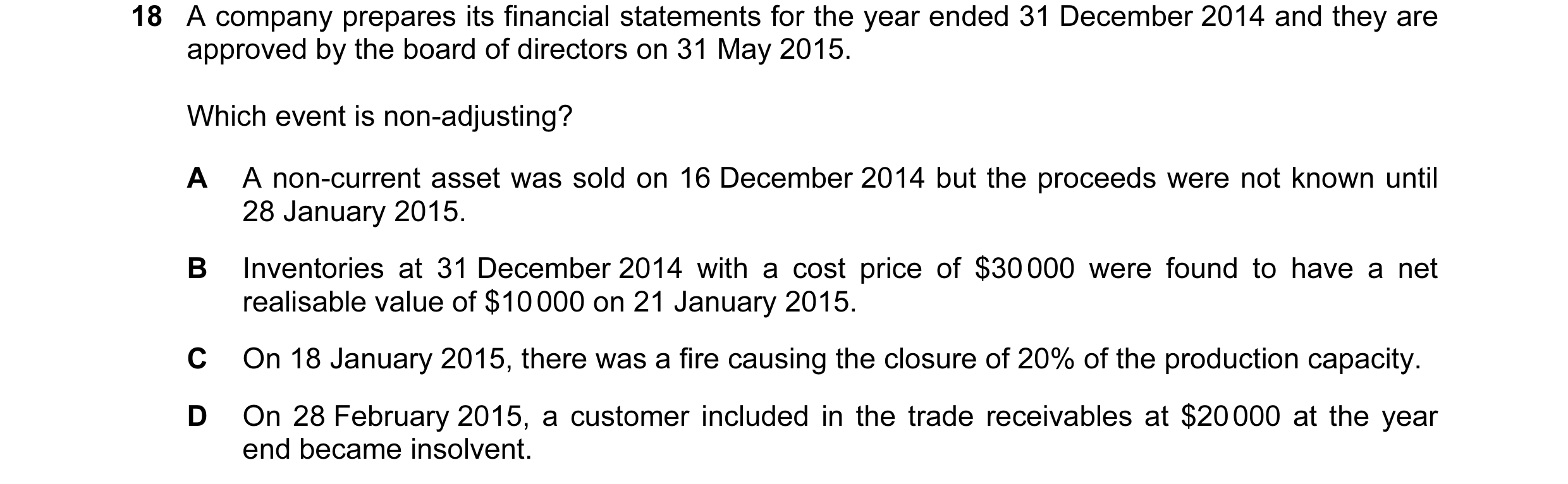
18 A company prepares its financial statements for the year ended 31 December 2014 and they are approved by the board of directors on 31 May 2015. Which event is non-adjusting? A A non-current asset was sold on 16 December 2014 but the proceeds were not known until 28 January 2015. B Inventories at 31 December 2014 with a cost price of $30 000 were found to have a net realisable value of $10 000 on 21 January 2015. C On 18 January 2015, there was a fire causing the closure of 20% of the production capacity. D On 28 February 2015, a customer included in the trade receivables at $20 000 at the year end became insolvent.
1 marks
Answer: C
This question in 9706/31 Oct/Nov 2015
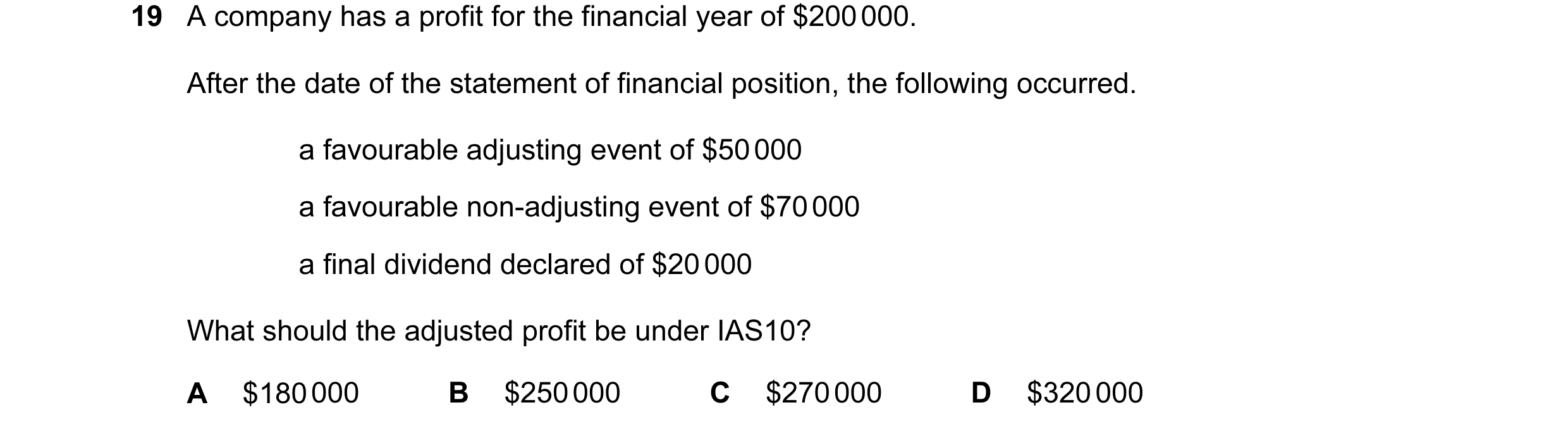
Q51 · A company has a profit for the financial year of $200 000 9706/31 Oct/Nov 2015
19 A company has a profit for the financial year of $200 000. After the date of the statement of financial position, the following occurred. a favourable adjusting event of $50 000 a favourable non-adjusting event of $70 000 a final dividend declared of $20 000 What should the adjusted profit be under IAS10? A $180 000 B $250 000 C $270 000 D $320 000
1 marks
Answer: B
This question in 9706/31 Oct/Nov 2015
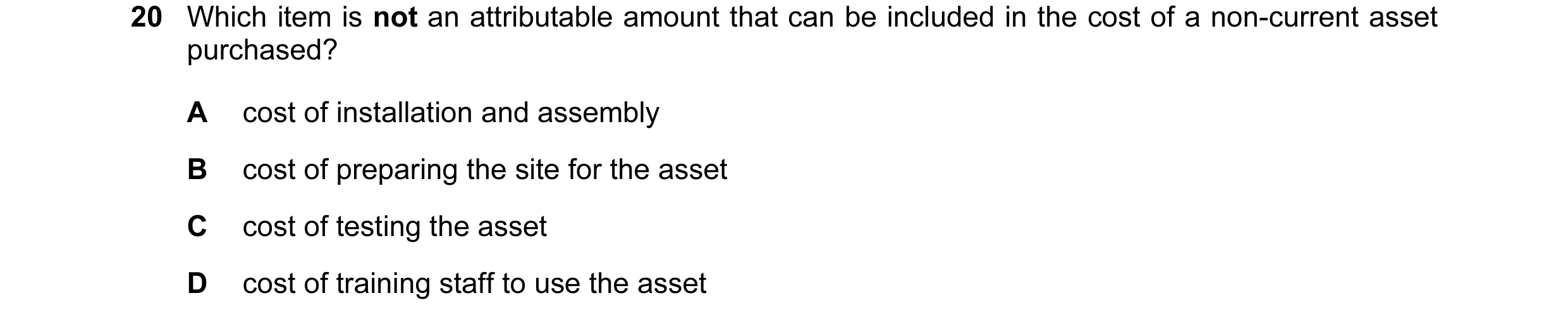
Q52 · Which item is not an attributable amount that can be included in the cost of a… 9706/31 Oct/Nov 2015
20 Which item is not an attributable amount that can be included in the cost of a non-current asset purchased? A cost of installation and assembly B cost of preparing the site for the asset C cost of testing the asset D cost of training staff to use the asset
1 marks
Answer: D
This question in 9706/31 Oct/Nov 2015
Q53 · How is a liability of uncertain timing or amount classified under IAS37? 9706/32 Oct/Nov 2015
18 How is a liability of uncertain timing or amount classified under IAS37? A contingent asset B contingent liability C liability D provision
1 marks
Answer: B
This question in 9706/32 Oct/Nov 2015
Q54 · A company provides the following information about its inventory 9706/32 Oct/Nov 2015
19 A company provides the following information about its inventory. net realisable cost product value $ $ lamp shades 1250 1000 cushions 4500 5000 rugs 5500 7500 What is the correct inventory valuation to enter in the financial statements? A $11 000 B $11 250 C $13 500 D $13 750
1 marks
Answer: A
This question in 9706/32 Oct/Nov 2015
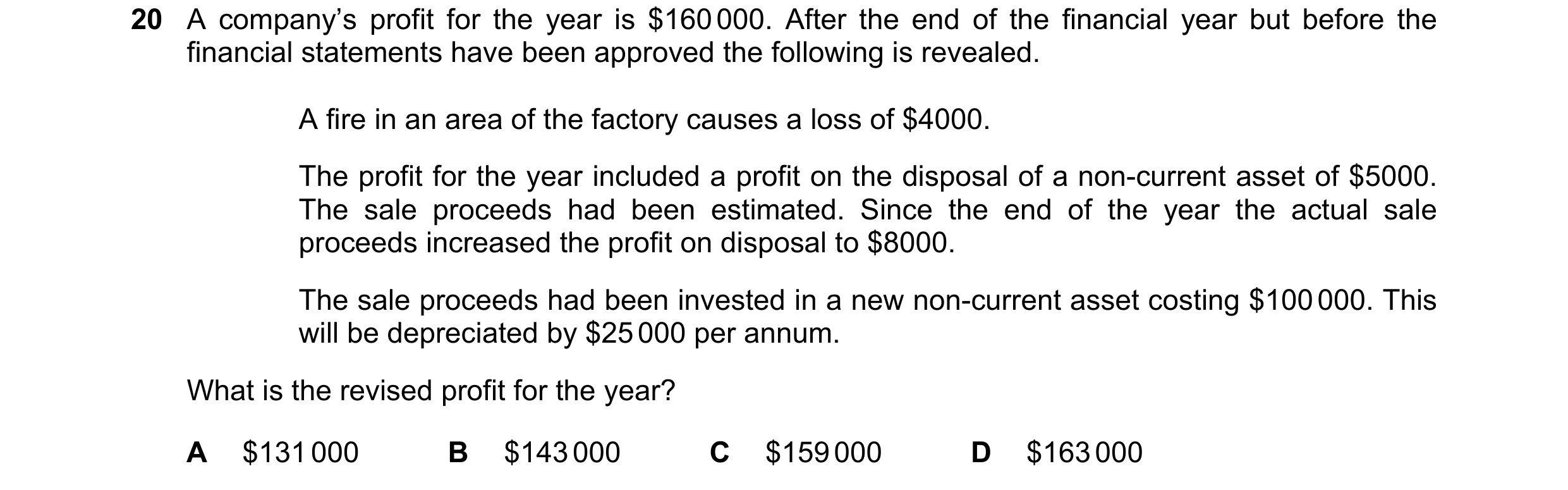
Q55 · A company’s profit for the year is $160 000 9706/32 Oct/Nov 2015
20 A company’s profit for the year is $160 000. After the end of the financial year but before the financial statements have been approved the following is revealed. A fire in an area of the factory causes a loss of $4000. The profit for the year included a profit on the disposal of a non-current asset of $5000. The sale proceeds had been estimated. Since the end of the year the actual sale proceeds increased the profit on disposal to $8000. The sale proceeds had been invested in a new non-current asset costing $100 000. This will be depreciated by $25 000 per annum. What is the revised profit for the year? A $131 000 B $143 000 C $159 000 D $163 000
1 marks
Answer: D
This question in 9706/32 Oct/Nov 2015
 1 / 12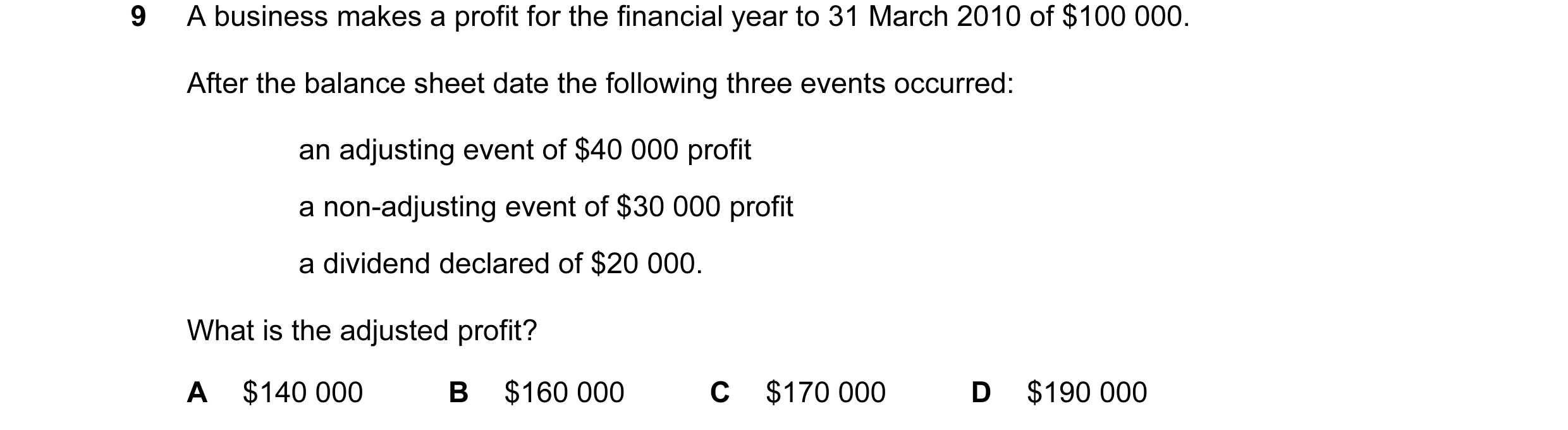
 2 / 12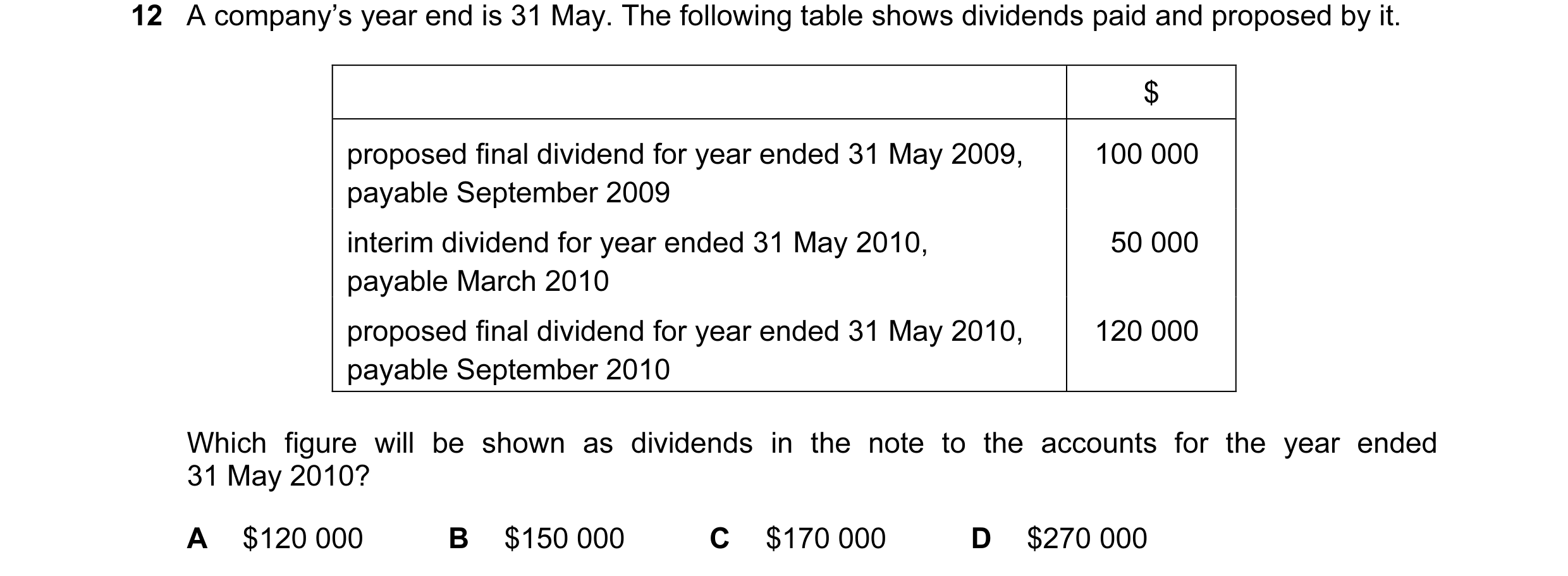


 3 / 12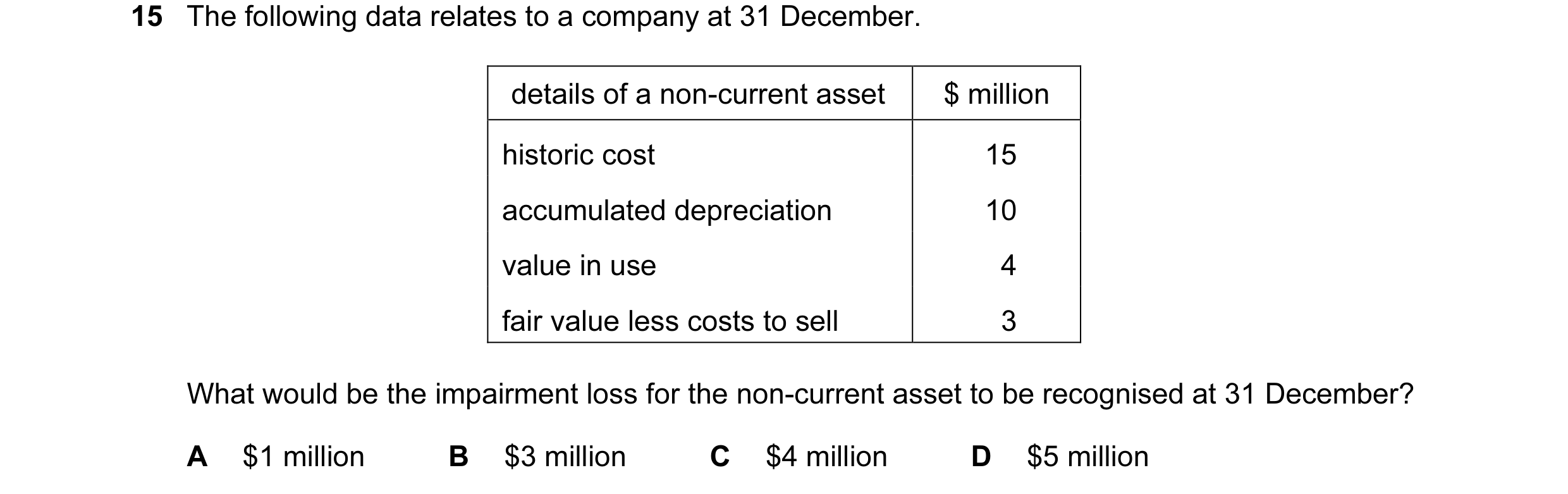
 4 / 12



 5 / 12

 6 / 12

 7 / 12


 8 / 12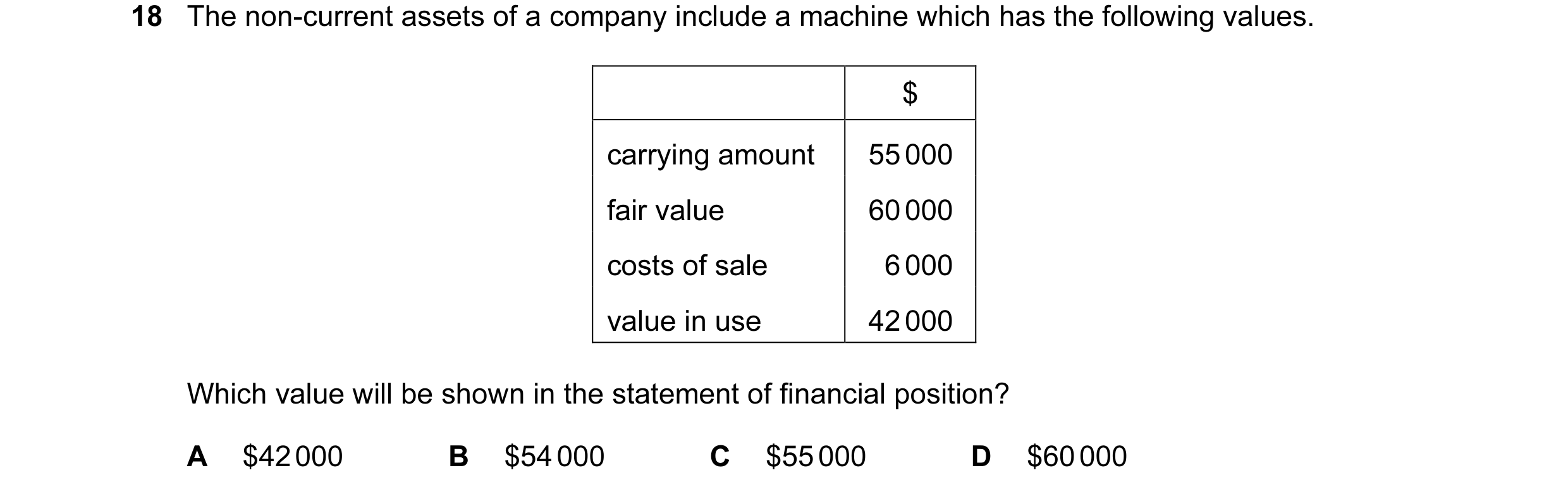

 9 / 12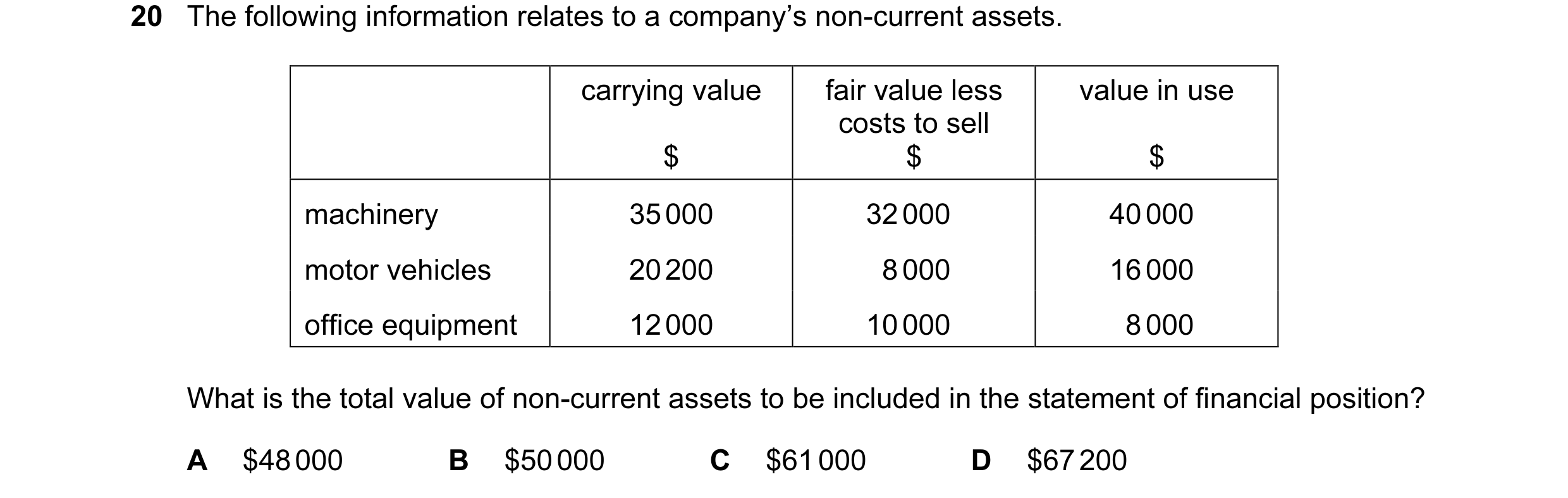


 10 / 12
 11 / 12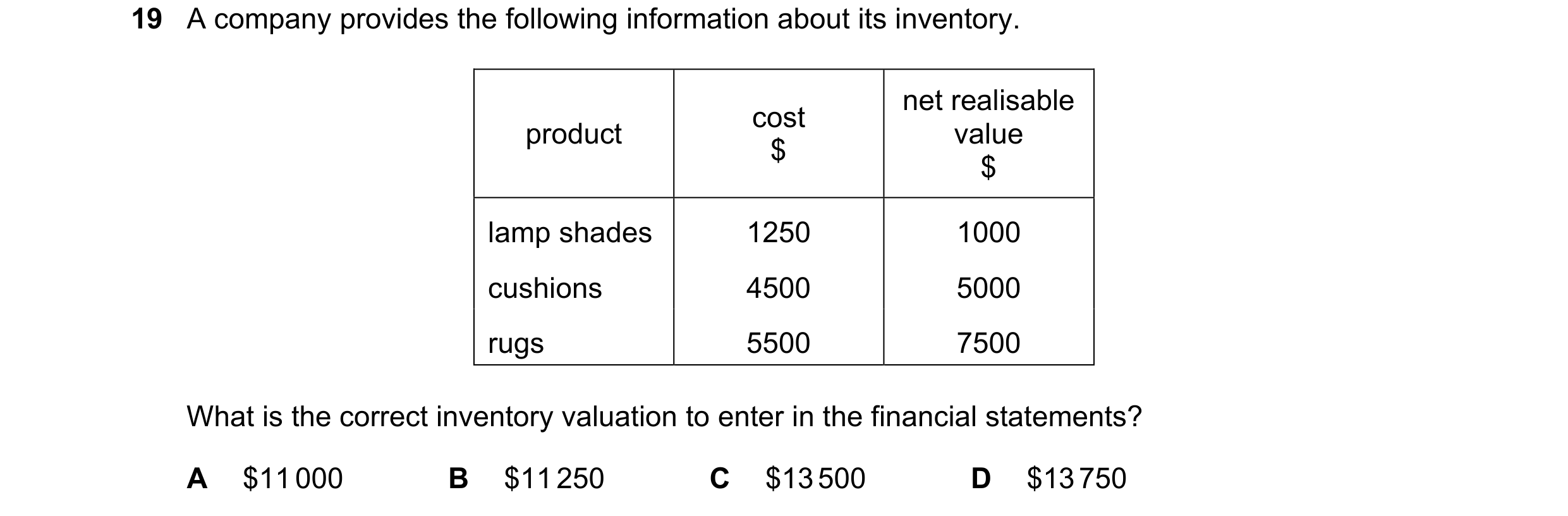
 12 / 12