Questions as text
Q1 · A business obtained a machine by means of a hire purchase agreement 9706/12 May/June 2010
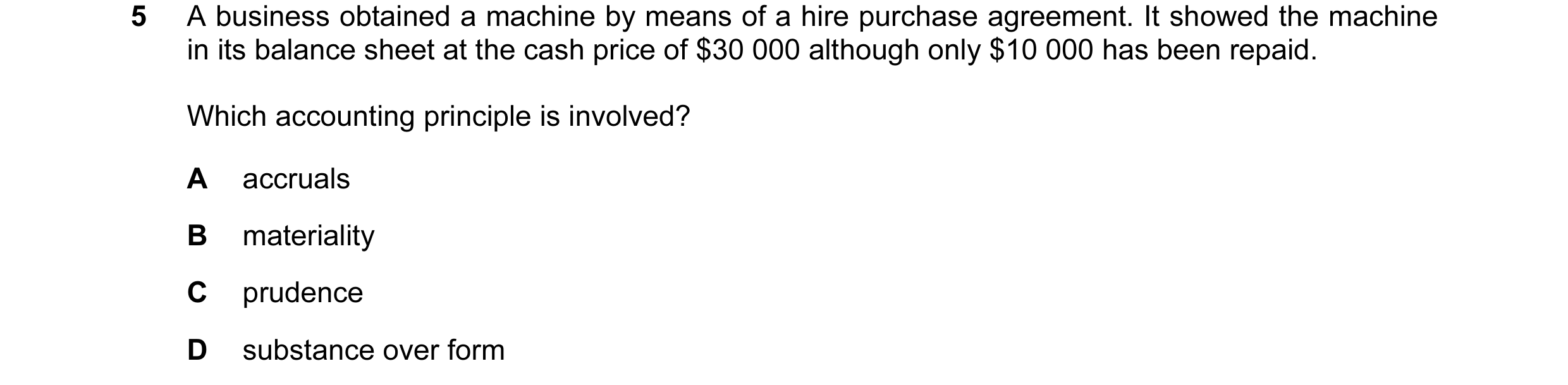
5 A business obtained a machine by means of a hire purchase agreement. It showed the machine in its balance sheet at the cash price of $30 000 although only $10 000 has been repaid. Which accounting principle is involved? A accruals B materiality C prudence D substance over form
1 marks
Answer: D
This question in 9706/12 May/June 2010
Q2 · Accountants prefer the commercial reality of a transaction to a strictly legal approach 9706/12 May/June 2011
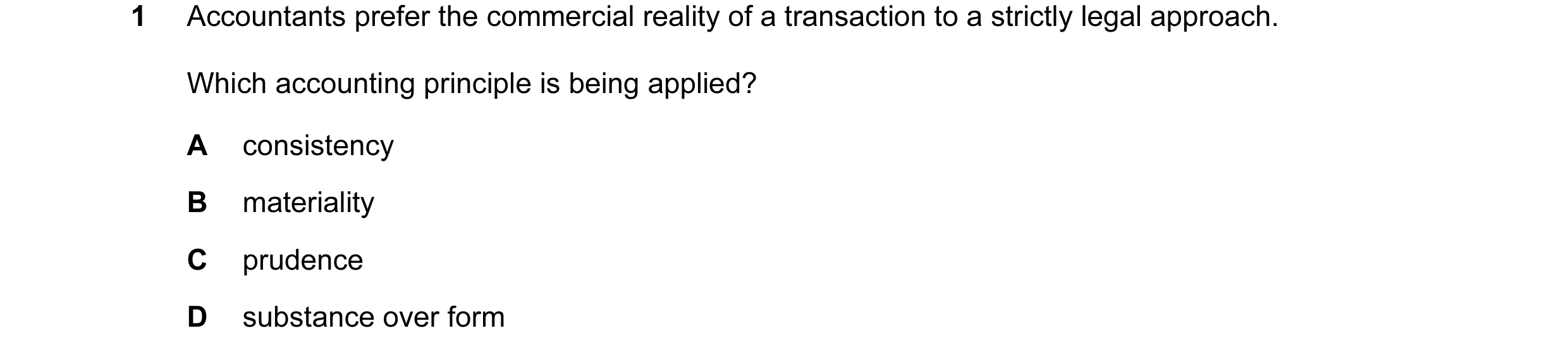
1 Accountants prefer the commercial reality of a transaction to a strictly legal approach. Which accounting principle is being applied? A consistency B materiality C prudence D substance over form
1 marks
Answer: D
This question in 9706/12 May/June 2011
Q3 · There is great uncertainty about the continuance of a business 9706/12 May/June 2011
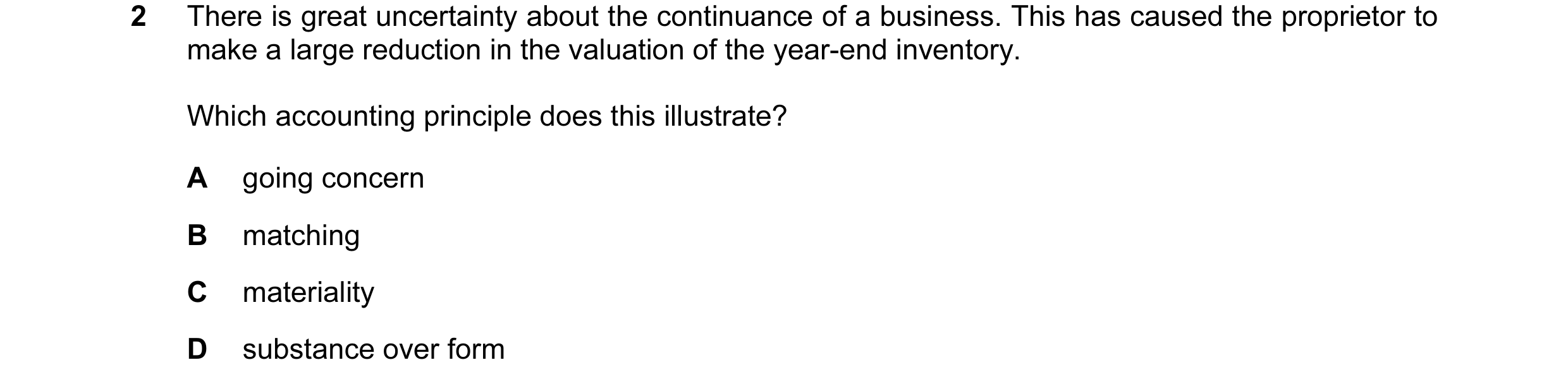
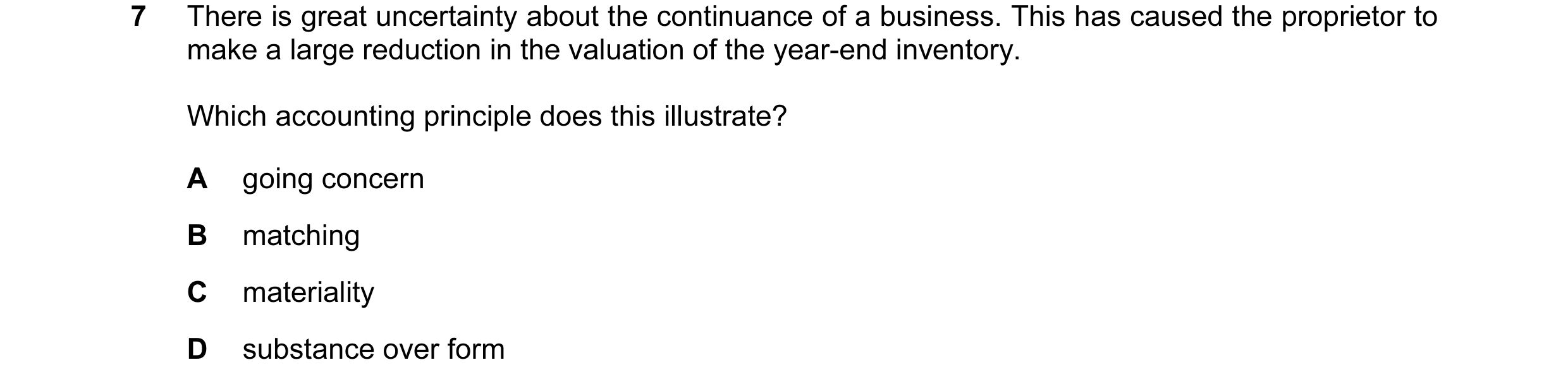
2 There is great uncertainty about the continuance of a business. This has caused the proprietor to make a large reduction in the valuation of the year-end inventory. Which accounting principle does this illustrate? A going concern B matching C materiality D substance over form
1 marks
Answer: A
This question in 9706/12 May/June 2011
Q4 · Accountants prefer the commercial reality of a transaction to a strictly legal approach 9706/13 May/June 2011
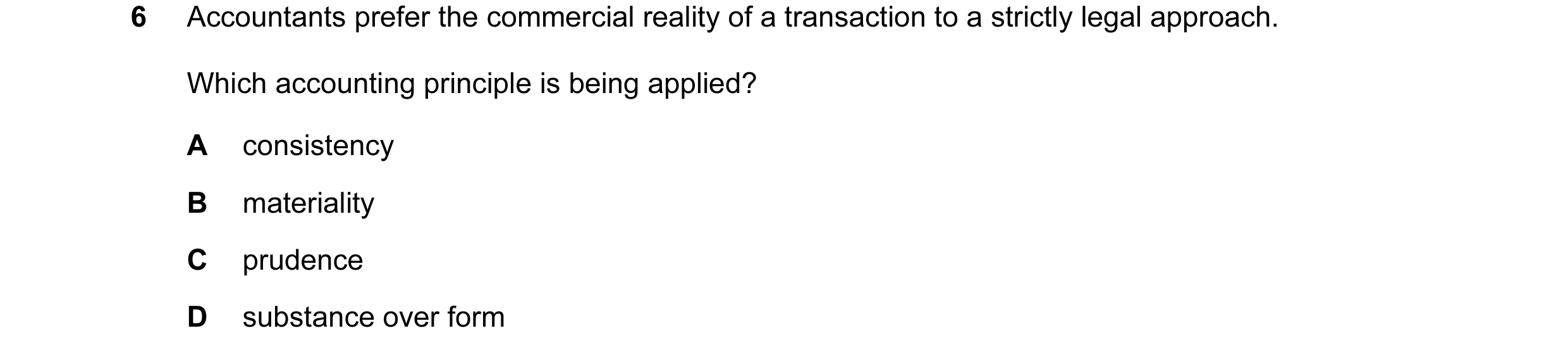
6 Accountants prefer the commercial reality of a transaction to a strictly legal approach. Which accounting principle is being applied? A consistency B materiality C prudence D substance over form
1 marks
Answer: D
This question in 9706/13 May/June 2011
Q5 · There is great uncertainty about the continuance of a business 9706/13 May/June 2011
7 There is great uncertainty about the continuance of a business. This has caused the proprietor to make a large reduction in the valuation of the year-end inventory. Which accounting principle does this illustrate? A going concern B matching C materiality D substance over form
1 marks
Answer: A
This question in 9706/13 May/June 2011
Q6 · How should goodwill be treated by a limited company? 9706/13 May/June 2011
16 How should goodwill be treated by a limited company? A Goodwill should always be written off immediately. B Non-purchased goodwill is shown in the balance sheet. C Purchased goodwill is shown in the balance sheet and written off over its useful life. D Purchased goodwill remains on the balance sheet as a permanent item.
1 marks
Answer: C
This question in 9706/13 May/June 2011
Q7 · What might stop financial statements showing a true and fair view? 9706/11 Oct/Nov 2011
5 What might stop financial statements showing a true and fair view? A changes in depreciation methods from year to year B changes in dividend policy C creation of an asset revaluation reserve D inclusion of purchased goodwill in a balance sheet
1 marks
Answer: A
This question in 9706/11 Oct/Nov 2011
Q8 · A company has been depreciating its IT equipment over 5 years, but now finds that it is… 9706/11 Oct/Nov 2011
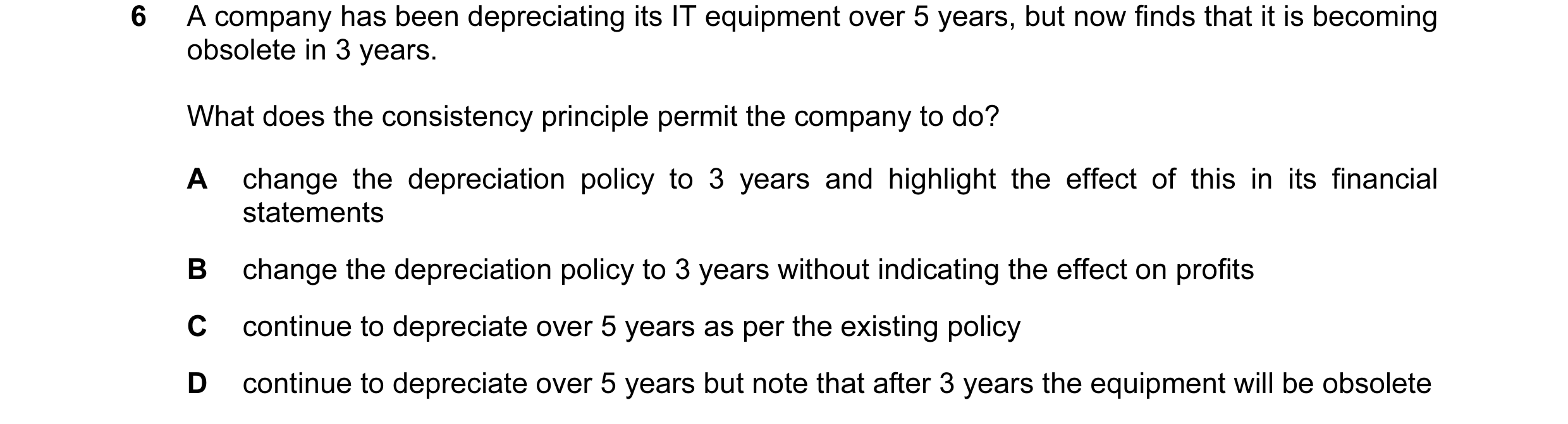
6 A company has been depreciating its IT equipment over 5 years, but now finds that it is becoming obsolete in 3 years. What does the consistency principle permit the company to do? A change the depreciation policy to 3 years and highlight the effect of this in its financial statements B change the depreciation policy to 3 years without indicating the effect on profits C continue to depreciate over 5 years as per the existing policy D continue to depreciate over 5 years but note that after 3 years the equipment will be obsolete
1 marks
Answer: A
This question in 9706/11 Oct/Nov 2011
Q9 · What might stop financial statements showing a true and fair view? 9706/13 Oct/Nov 2011
4 What might stop financial statements showing a true and fair view? A changes in depreciation methods from year to year B changes in dividend policy C creation of an asset revaluation reserve D inclusion of purchased goodwill in a balance sheet
1 marks
Answer: A
This question in 9706/13 Oct/Nov 2011
Q10 · A company has been depreciating its IT equipment over 5 years, but now finds that it is… 9706/13 Oct/Nov 2011
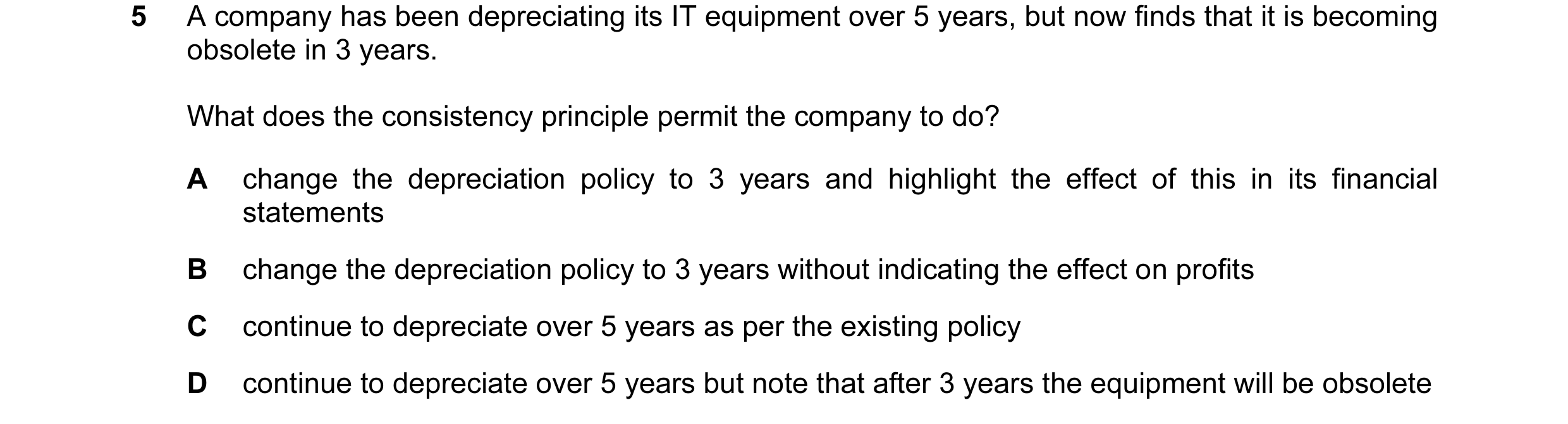
5 A company has been depreciating its IT equipment over 5 years, but now finds that it is becoming obsolete in 3 years. What does the consistency principle permit the company to do? A change the depreciation policy to 3 years and highlight the effect of this in its financial statements B change the depreciation policy to 3 years without indicating the effect on profits C continue to depreciate over 5 years as per the existing policy D continue to depreciate over 5 years but note that after 3 years the equipment will be obsolete
1 marks
Answer: A
This question in 9706/13 Oct/Nov 2011
Q11 · The principle of prudence in the preparation of financial statements is practised through… 9706/13 May/June 2012
4 The principle of prudence in the preparation of financial statements is practised through the application of which action? A create additional reserves B exclude unpaid credit sales C overstate the liabilities D provide for anticipated losses
1 marks
Answer: D
This question in 9706/13 May/June 2012
Q12 · What is evidence that a company’s financial statements are true and fair? 9706/13 May/June 2012
5 What is evidence that a company’s financial statements are true and fair? A The directors have signed off the financial statements. B The profit has been agreed with the tax authorities. C They are filed on time. D They follow generally accepted accounting principles.
1 marks
Answer: D
This question in 9706/13 May/June 2012
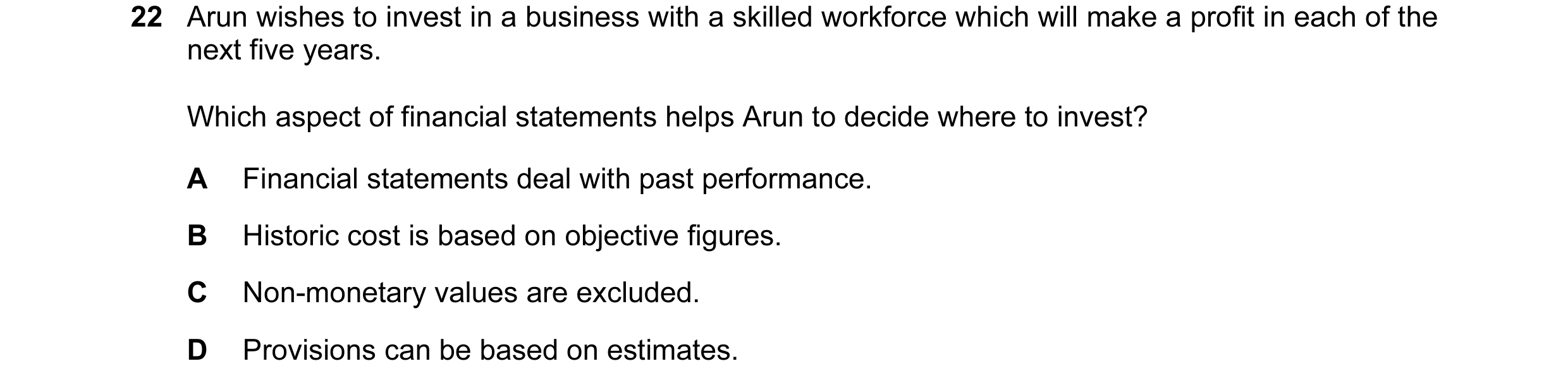
Q13 · Arun wishes to invest in a business with a skilled workforce which will make a profit in… 9706/13 May/June 2012
22 Arun wishes to invest in a business with a skilled workforce which will make a profit in each of the next five years. Which aspect of financial statements helps Arun to decide where to invest? A Financial statements deal with past performance. B Historic cost is based on objective figures. C Non-monetary values are excluded. D Provisions can be based on estimates.
1 marks
Answer: B
This question in 9706/13 May/June 2012
Q14 · Which statement is correct? 9706/13 Oct/Nov 2012
5 Which statement is correct? A Assets cannot be revalued by companies at all. B Companies have to disclose their policy on revaluation in their accounts. C Companies must carry out revaluations every year. D Every asset in a particular class must be revalued by companies, not just one.
1 marks
Answer: D
This question in 9706/13 Oct/Nov 2012
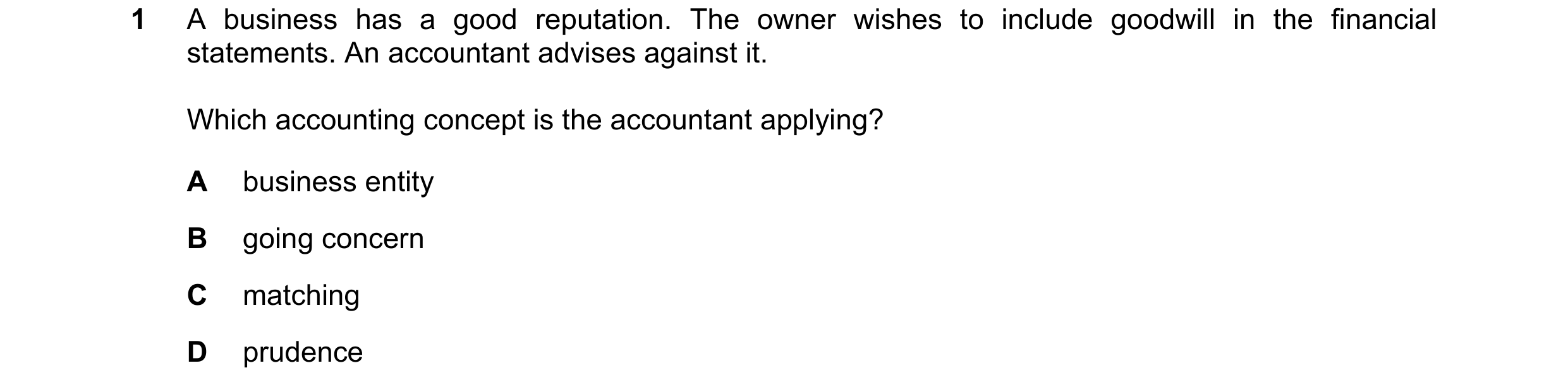
Q15 · A business has a good reputation 9706/12 Feb/March 2016
1 A business has a good reputation. The owner wishes to include goodwill in the financial statements. An accountant advises against it. Which accounting concept is the accountant applying? A business entity B going concern C matching D prudence
1 marks
Answer: D
This question in 9706/12 Feb/March 2016
Q16 · What might stop financial statements showing a true and fair view? 9706/12 May/June 2016
1 What might stop financial statements showing a true and fair view? A changes in depreciation methods from year to year B changes in dividend policy C creation of a general reserve D inclusion of purchased goodwill in a statement of financial position
1 marks
Answer: A
This question in 9706/12 May/June 2016
Q17 · An item is found to be the subject of a material error in a company’s financial statements 9706/13 Oct/Nov 2018
1 An item is found to be the subject of a material error in a company’s financial statements. What does ‘material’ mean? A The item affects only the income statement of the entity. B The item affects only the statement of financial position of the entity. C The item has a small monetary value. D The item may affect the economic decisions of a user of the financial statements.
1 marks
Answer: D
This question in 9706/13 Oct/Nov 2018
Q18 · What could make financial statements less reliable for users? 9706/13 Oct/Nov 2018
18 What could make financial statements less reliable for users? 1 a disclosure of changes in accounting policies 2 an irrecoverable debt not written off 3 revaluation of assets A 1, 2 and 3 B 1 and 2 only C 1 and 3 only D 2 only
1 marks
Answer: D
This question in 9706/13 Oct/Nov 2018
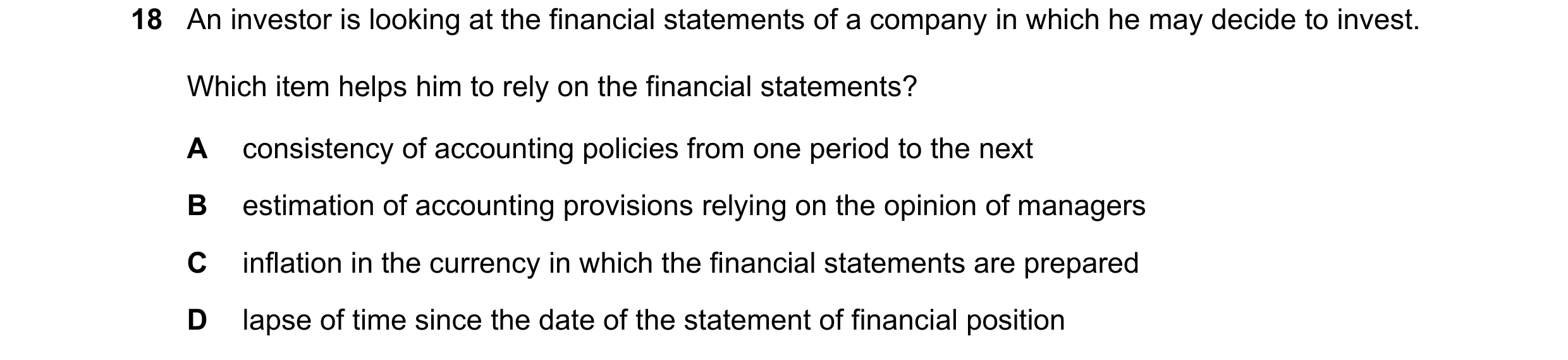
Q19 · An investor is looking at the financial statements of a company in which he may decide to… 9706/13 Oct/Nov 2019
18 An investor is looking at the financial statements of a company in which he may decide to invest. Which item helps him to rely on the financial statements? A consistency of accounting policies from one period to the next B estimation of accounting provisions relying on the opinion of managers C inflation in the currency in which the financial statements are prepared D lapse of time since the date of the statement of financial position
1 marks
Answer: A
This question in 9706/13 Oct/Nov 2019
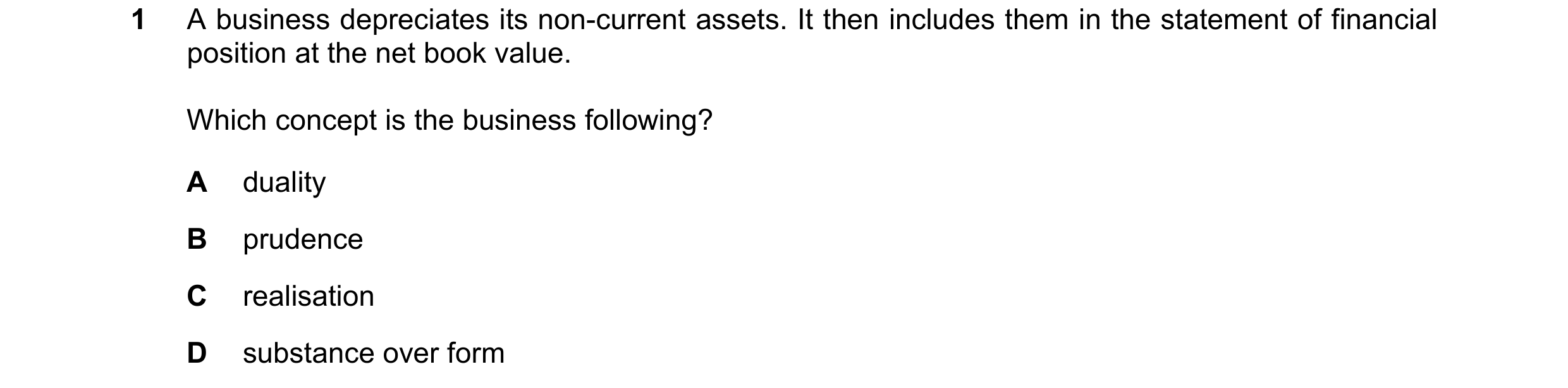
Q20 · A business depreciates its non-current assets 9706/12 May/June 2020
1 A business depreciates its non-current assets. It then includes them in the statement of financial position at the net book value. Which concept is the business following? A duality B prudence C realisation D substance over form
1 marks
Answer: B
This question in 9706/12 May/June 2020
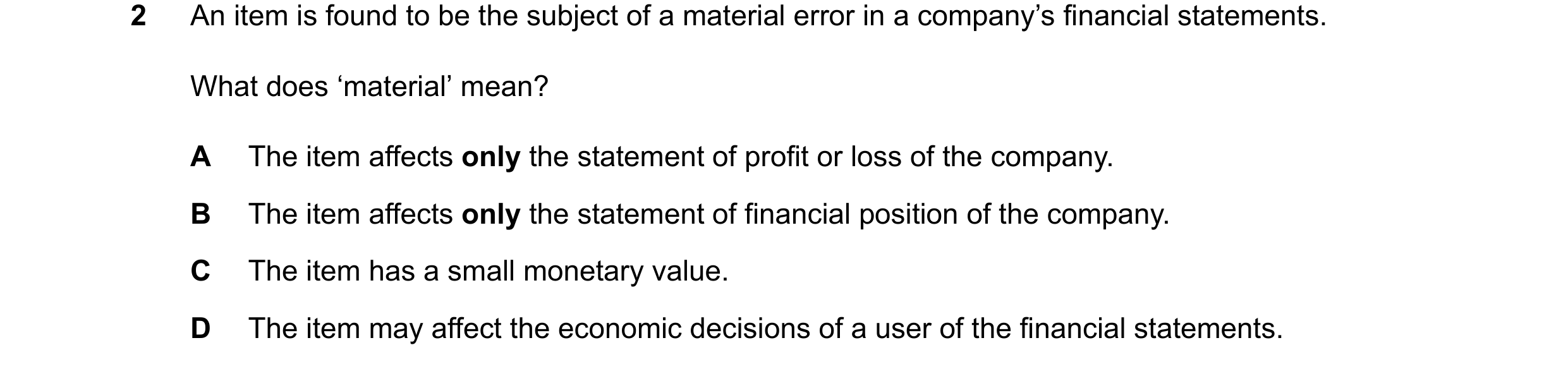
Q21 · An item is found to be the subject of a material error in a company’s financial statements 9706/13 Oct/Nov 2024
2 An item is found to be the subject of a material error in a company’s financial statements. What does ‘material’ mean? A The item affects only the statement of profit or loss of the company. B The item affects only the statement of financial position of the company. C The item has a small monetary value. D The item may affect the economic decisions of a user of the financial statements.
1 marks
Answer: D
This question in 9706/13 Oct/Nov 2024
 1 / 4
1 / 4


 2 / 4
2 / 4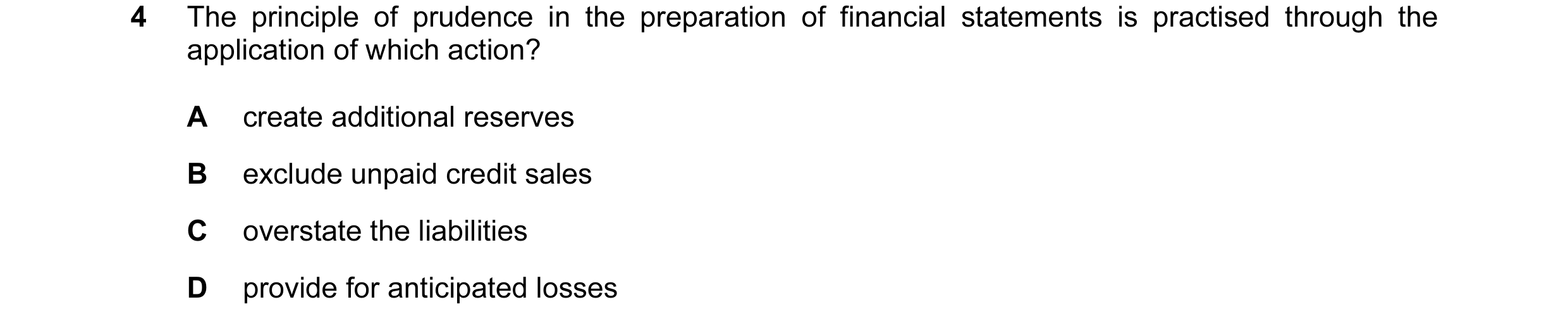


 3 / 4
3 / 4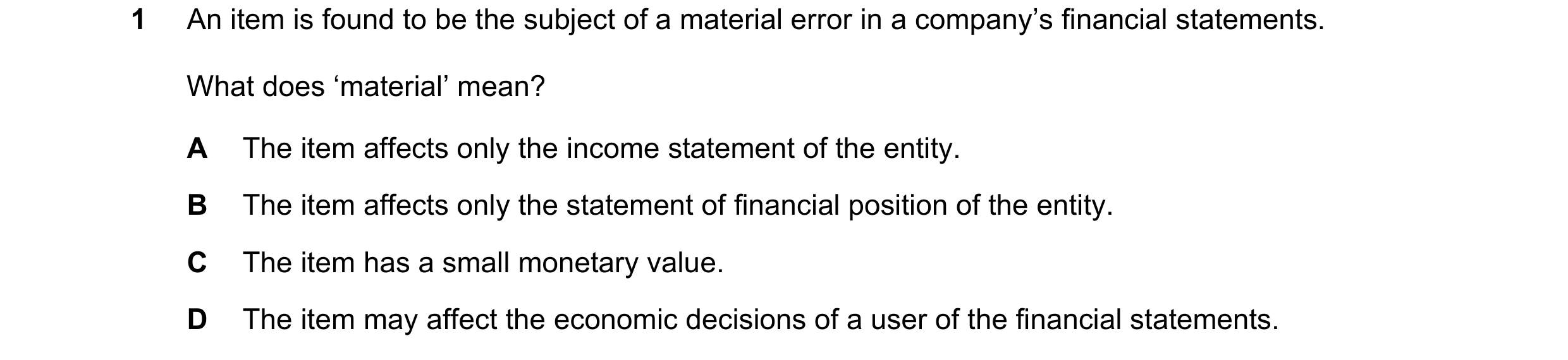

 4 / 4
4 / 4