Questions as text
Q1 · Which element is used to extract some metals from their ores? 0654/21 May/June 2017
22 Which element is used to extract some metals from their ores? A carbon B copper C iron D nitrogen
1 marks
Answer: A
This question in 0654/21 May/June 2017
Q2 · Which metal is extracted from its ore by heating with carbon? 0654/22 May/June 2017
22 Which metal is extracted from its ore by heating with carbon? A copper B magnesium C potassium D sodium
1 marks
Answer: A
This question in 0654/22 May/June 2017
Q3 · In the blast furnace, which substance is added to make slag? 0654/21 Oct/Nov 2017
22 In the blast furnace, which substance is added to make slag? A calcium carbonate B carbon dioxide C carbon monoxide D coke
1 marks
Answer: A
This question in 0654/21 Oct/Nov 2017
Q4 · Which reaction does not occur in the blast furnace? 0654/22 Oct/Nov 2017
22 Which reaction does not occur in the blast furnace? A C + O2 → CO2 B C + CO2 → 2CO C 4Fe + 3O2 → 2Fe2O3 D Fe2O3 + 3CO → 2Fe + 3CO2
1 marks
Answer: C
This question in 0654/22 Oct/Nov 2017
Q5 · Part of the reactivity series is shown 0654/21 Oct/Nov 2018
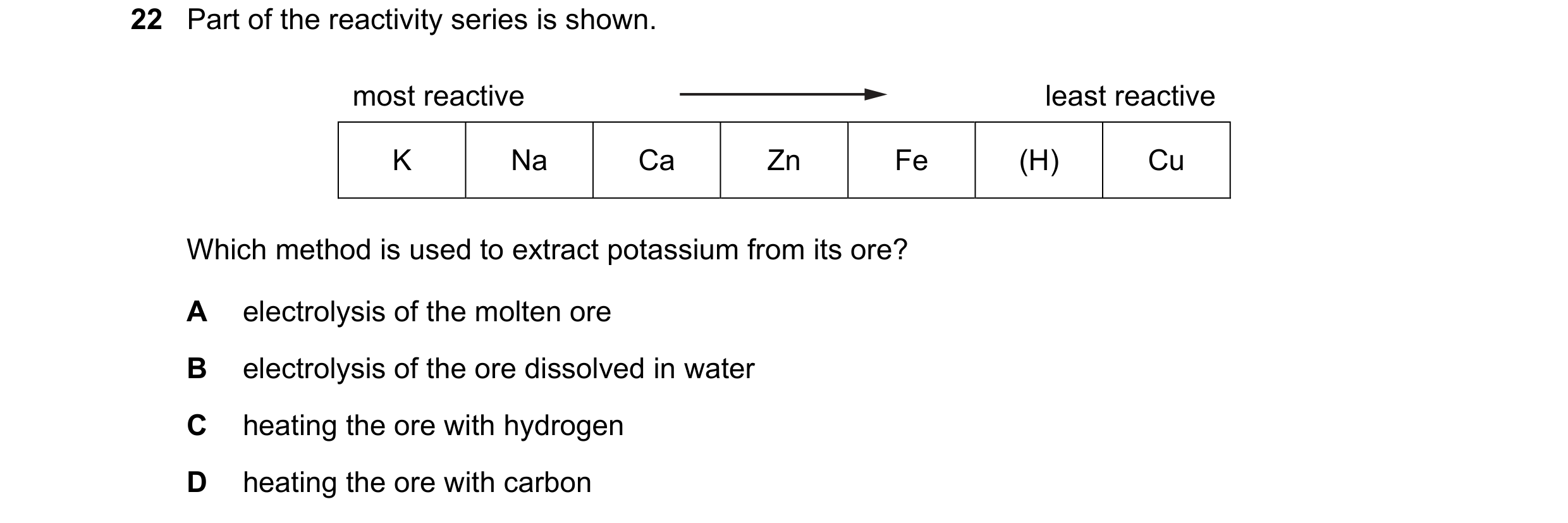
22 Part of the reactivity series is shown. most reactive least reactive K Na Ca Zn Fe (H) Cu Which method is used to extract potassium from its ore? A electrolysis of the molten ore B electrolysis of the ore dissolved in water C heating the ore with hydrogen D heating the ore with carbon
1 marks
Answer: A
This question in 0654/21 Oct/Nov 2018
Q6 · Which reaction does not occur in the blast furnace? 0654/22 Oct/Nov 2018
23 Which reaction does not occur in the blast furnace? A C + CO2 → 2CO B CaCO3 → CaO + CO2 C CaO + SiO2 → CaSiO3 D 2Fe + 3CO2 → Fe2O3 + 3CO
1 marks
Answer: D
This question in 0654/22 Oct/Nov 2018
Q7 · Tin is extracted from cassiterite (tin oxide) 0654/22 Oct/Nov 2019
24 Tin is extracted from cassiterite (tin oxide). The process involves two reactions. reaction 1 carbon + oxygen → carbon monoxide reaction 2 carbon monoxide + tin oxide → carbon dioxide + tin Which statement about the process is correct? A Carbon is higher than tin in the reactivity series. B Carbon monoxide is formed in reaction 1 by complete combustion. C Carbon monoxide is reduced in reaction 2. D Cassiterite is oxidised in reaction 2.
1 marks
Answer: A
This question in 0654/22 Oct/Nov 2019
Q8 · Which statement about the Haber process is correct? 0654/22 Feb/March 2021
25 Which statement about the Haber process is correct? A All of the raw materials are obtained from the air. B It requires a catalyst. C It uses a low pressure and a high temperature. D Sulfuric acid is produced in the process.
1 marks
Answer: B
This question in 0654/22 Feb/March 2021
Q9 · Iron is extracted in the blast furnace 0654/22 Feb/March 2022
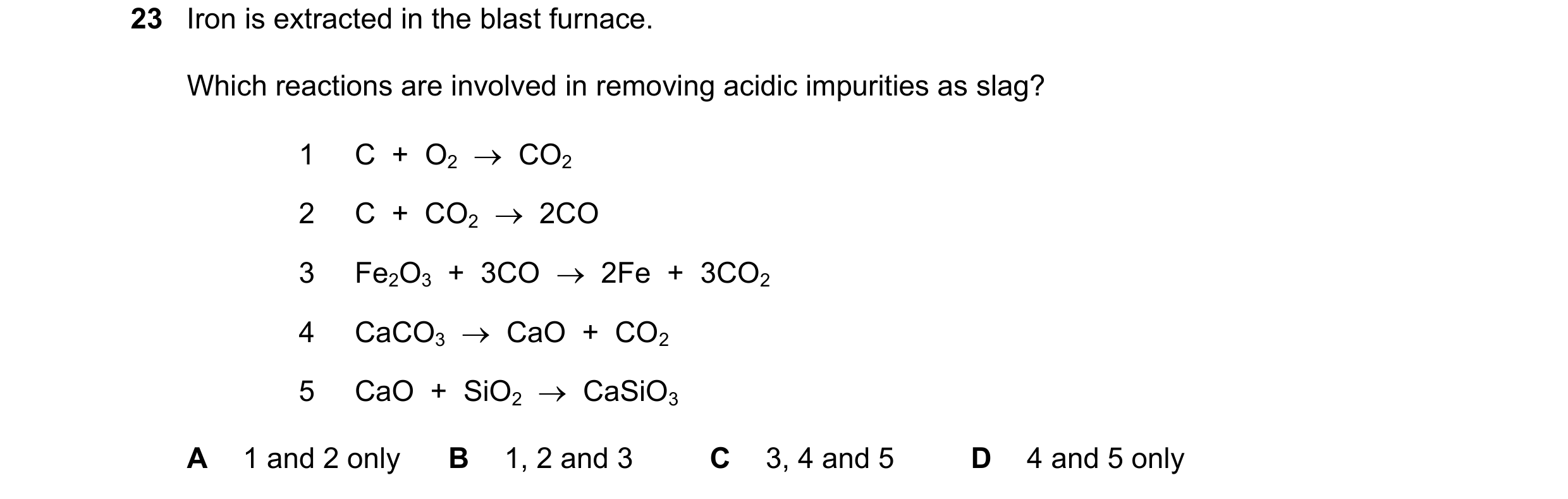
23 Iron is extracted in the blast furnace. Which reactions are involved in removing acidic impurities as slag? 1 C + O2 CO2 2 C + CO2 2CO 3 Fe2O3 + 3CO 2Fe + 3CO2 4 CaCO3 CaO + CO2 5 CaO + SiO2 CaSiO3 A 1 and 2 only B 1, 2 and 3 C 3, 4 and 5 D 4 and 5 only
1 marks
Answer: D
This question in 0654/22 Feb/March 2022
Q10 · Iron is extracted from hematite in the blast furnace 0654/21 May/June 2022
22 Iron is extracted from hematite in the blast furnace. Why is limestone added to the furnace? A It decreases the melting point of the mixture. B It increases the temperature inside the furnace. C It produces calcium oxide which removes acidic impurities. D It produces carbon dioxide which reduces the hematite.
1 marks
Answer: C
This question in 0654/21 May/June 2022
Q11 · The equations for reactions in the blast furnace are shown 0654/22 Oct/Nov 2022
20 The equations for reactions in the blast furnace are shown. 1 C + O2 CO2 2 CO2 + C 2CO 3 Fe2O3 + 3CO 2Fe + 3CO2 4 CaO + SiO2 CaSiO3 Which statement is correct? A In reaction 1, carbon is reduced. B In reaction 2, carbon dioxide is oxidised. C In reaction 3, carbon monoxide is oxidised. D In reaction 4, silicon dioxide is reduced.
1 marks
Answer: C
This question in 0654/22 Oct/Nov 2022
Q12 · Which metal cannot be extracted from its ore by heating with carbon? 0654/22 Feb/March 2023
24 Which metal cannot be extracted from its ore by heating with carbon? A aluminium B copper C iron D zinc
1 marks
Answer: A
This question in 0654/22 Feb/March 2023
Q13 · Which statement about the extraction of aluminium from its ore by electrolysis is correct? 0654/22 May/June 2023
18 Which statement about the extraction of aluminium from its ore by electrolysis is correct? A Aluminium gains electrons from the anode. B Aluminium ions are oxidised at the cathode. C Aluminium ore is called cryolite. D Aluminium oxide is in the electrolyte.
1 marks
Answer: D
This question in 0654/22 May/June 2023
Q14 · In the blast furnace, which substance is added to make slag? 0654/22 May/June 2023
23 In the blast furnace, which substance is added to make slag? A calcium carbonate B carbon dioxide C carbon monoxide D coke
1 marks
Answer: A
This question in 0654/22 May/June 2023
Q15 · Which metal can only be extracted from its ore using electrolysis? 0654/23 Oct/Nov 2023
23 Which metal can only be extracted from its ore using electrolysis? A calcium B copper C iron D zinc
1 marks
Answer: A
This question in 0654/23 Oct/Nov 2023
Q16 · Which row identifies an ore of aluminium and the method of extraction of aluminium from… 0654/23 May/June 2024
23 Which row identifies an ore of aluminium and the method of extraction of aluminium from its ore? ore method of extraction A bauxite electrolysis B bauxite reduction using carbon C hematite electrolysis D hematite reduction using carbon
1 marks
Answer: A
This question in 0654/23 May/June 2024
Q17 · Which statement about the extraction of metals is correct? 0654/21 Oct/Nov 2024
24 Which statement about the extraction of metals is correct? A Aluminium ore is called hematite. B Aluminium is extracted from its ore by heating with carbon. C Iron oxide is reduced to iron by heating with carbon monoxide. D Limestone is used to remove basic impurities in a blast furnace.
1 marks
Answer: C
This question in 0654/21 Oct/Nov 2024
Q18 · The ore cassiterite contains tin dioxide 0654/22 Feb/March 2025
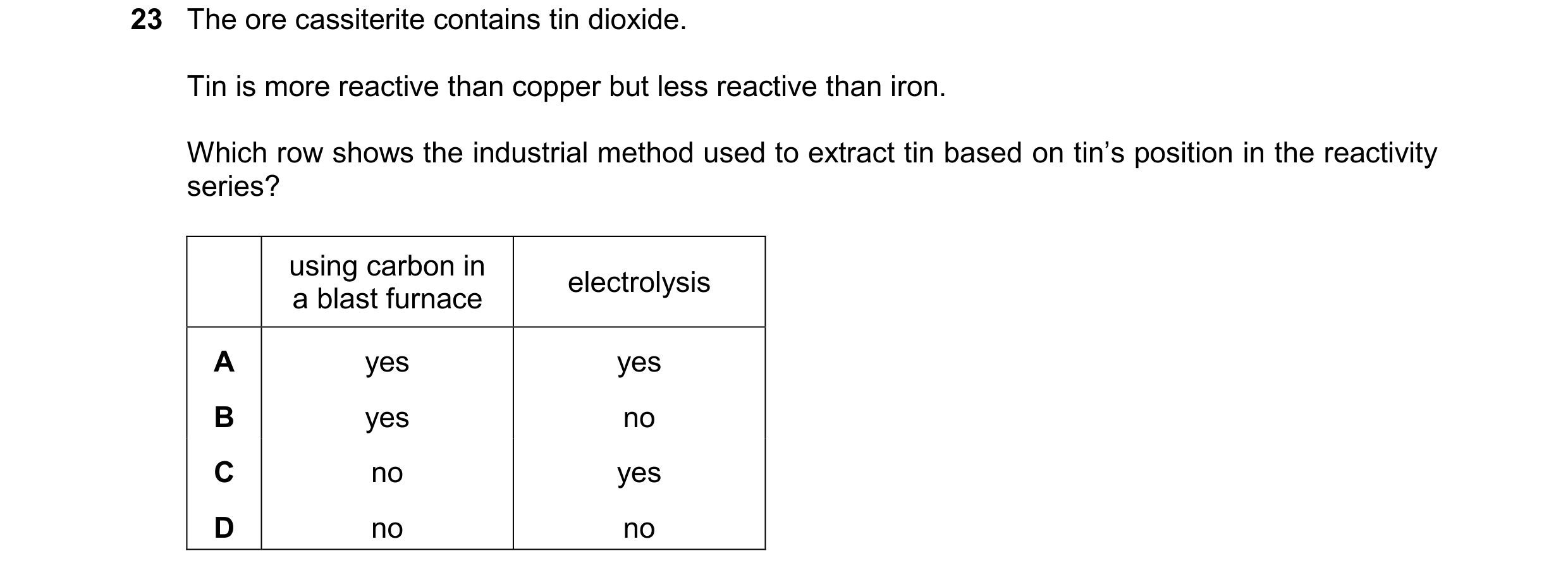
23 The ore cassiterite contains tin dioxide. Tin is more reactive than copper but less reactive than iron. Which row shows the industrial method used to extract tin based on tin’s position in the reactivity series? using carbon in electrolysis a blast furnace A yes yes B yes no C no yes D no no
1 marks
Answer: B
This question in 0654/22 Feb/March 2025
Q19 · Which statement describes what happens when calcium carbonate is added to the blast… 0654/22 May/June 2025
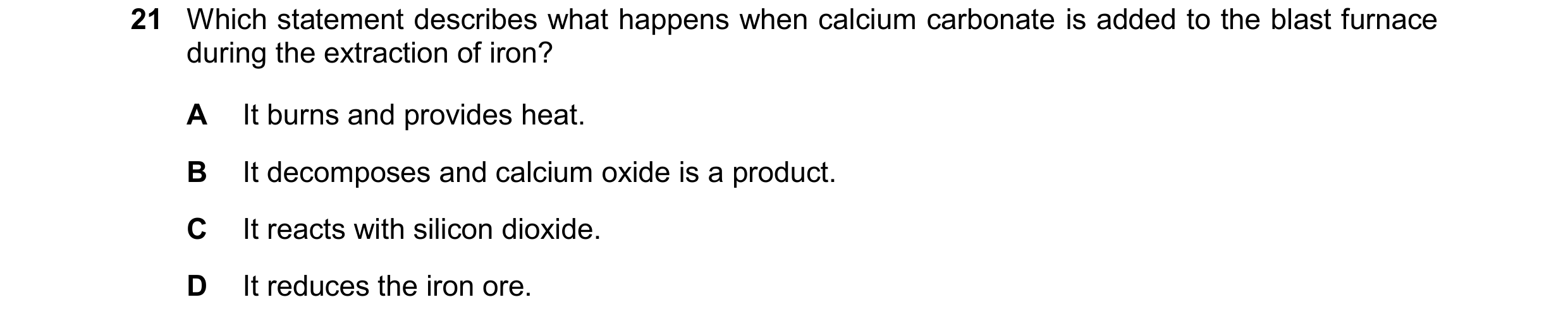
21 Which statement describes what happens when calcium carbonate is added to the blast furnace during the extraction of iron? A It burns and provides heat. B It decomposes and calcium oxide is a product. C It reacts with silicon dioxide. D It reduces the iron ore.
1 marks
Answer: B
This question in 0654/22 May/June 2025
Q20 · Which element is used to extract some metals from their ores? 0654/23 May/June 2025
22 Which element is used to extract some metals from their ores? A carbon B copper C iron D nitrogen
1 marks
Answer: A
This question in 0654/23 May/June 2025




 1 / 4
1 / 4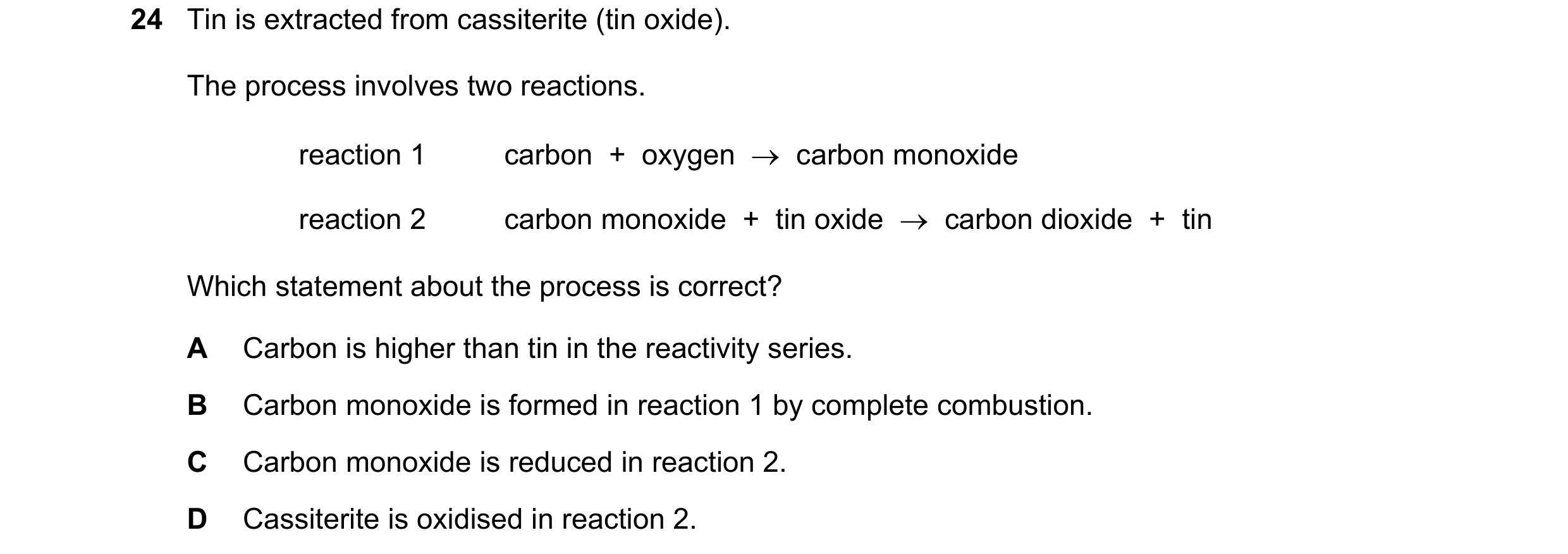

 2 / 4
2 / 4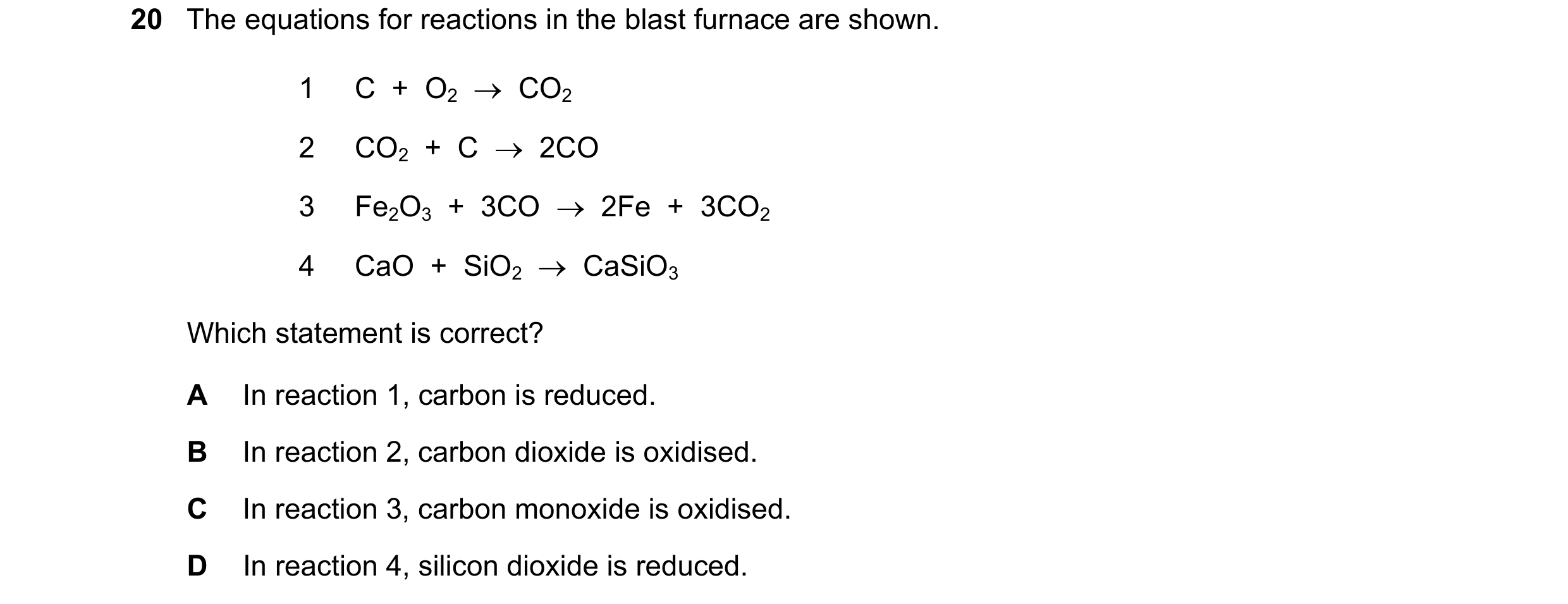



 3 / 4
3 / 4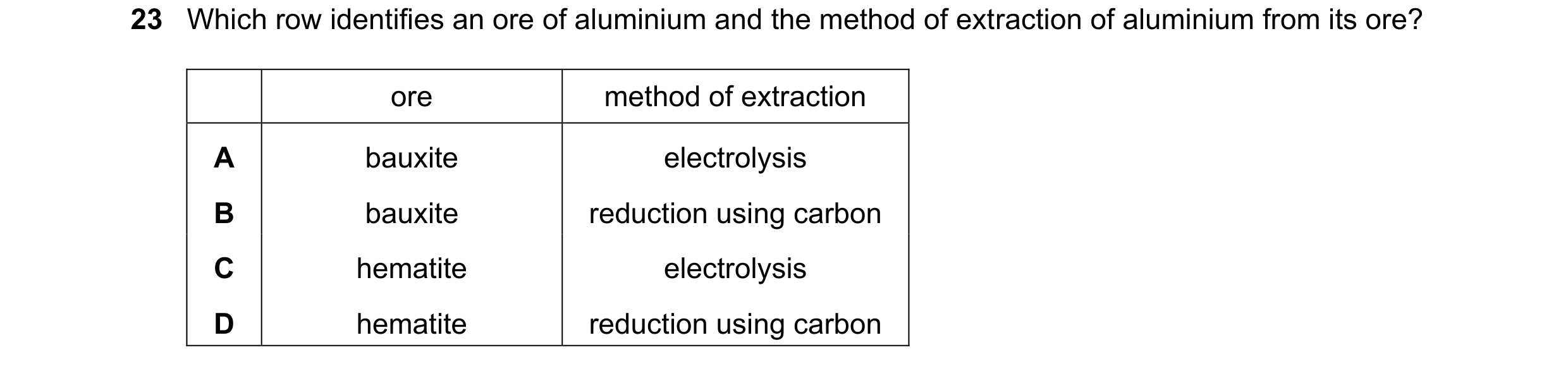

 4 / 4
4 / 4