Questions as text
Q1 · Most elements in the Periodic Table are metals 0654/31 May/June 2019
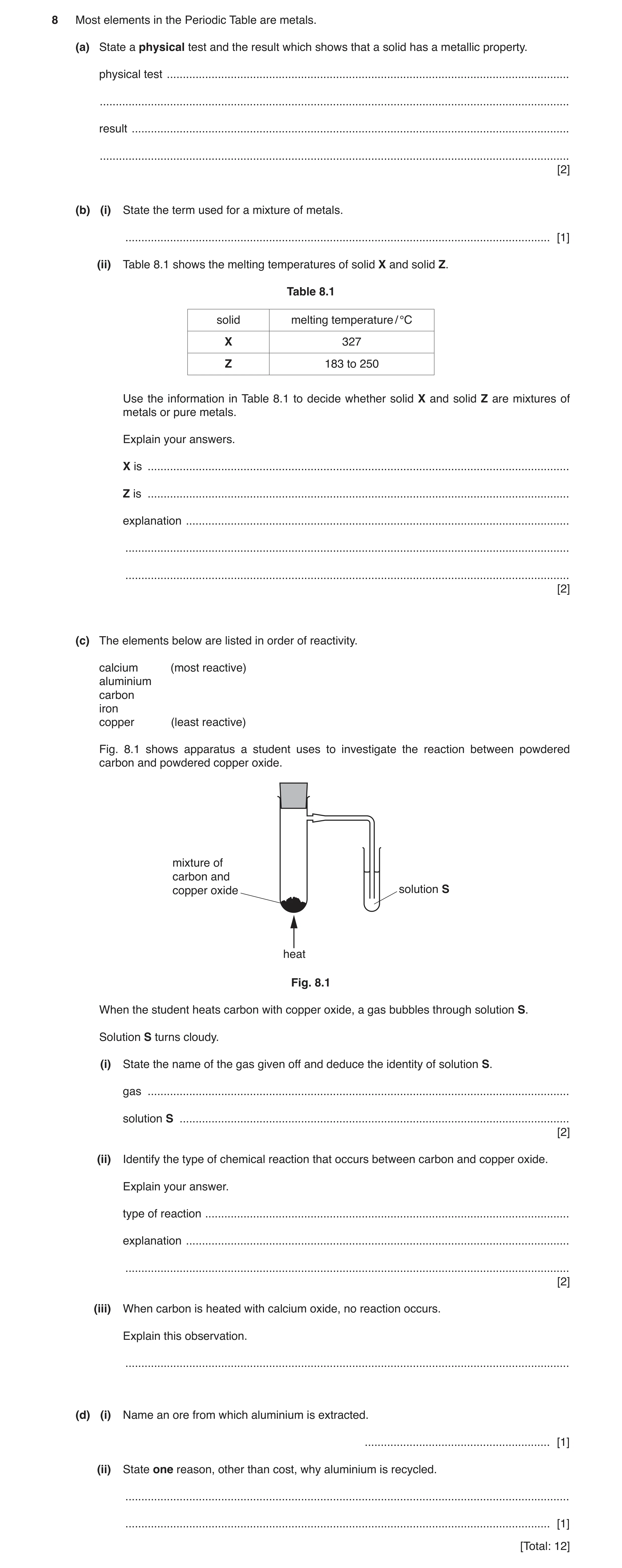
8 Most elements in the Periodic Table are metals. (a) State a physical test and the result which shows that a solid has a metallic property. physical test … … result … … [2] (b) (i) State the term used for a mixture of metals. … [1] (ii) Table 8.1 shows the melting temperatures of solid X and solid Z. Table 8.1 solid melting temperature / °C X 327 Z 183 to 250 Use the information in Table 8.1 to decide whether solid X and solid Z are mixtures of metals or pure metals. Explain your answers. X is … Z is … explanation … … … [2] (c) The elements below are listed in order of reactivity. calcium (most reactive) aluminium carbon iron copper (least reactive) Fig. 8.1 shows apparatus a student uses to investigate the reaction between powdered carbon and powdered copper oxide. mixture of carbon and copper oxide solution S heat Fig. 8.1 When the student heats carbon with copper oxide, a gas bubbles through solution S. Solution S turns cloudy. (i) State the name of the gas given off and deduce the identity of solution S. gas … solution S … [2] (ii) Identify the type of chemical reaction that occurs between carbon and copper oxide. Explain your answer. type of reaction … explanation … … [2] (iii) When carbon is heated with calcium oxide, no reaction occurs. Explain this observation. … (d) (i) Name an ore from which aluminium is extracted. … [1] (ii) State one reason, other than cost, why aluminium is recycled. … … [1] [Total: 12]
12 marks
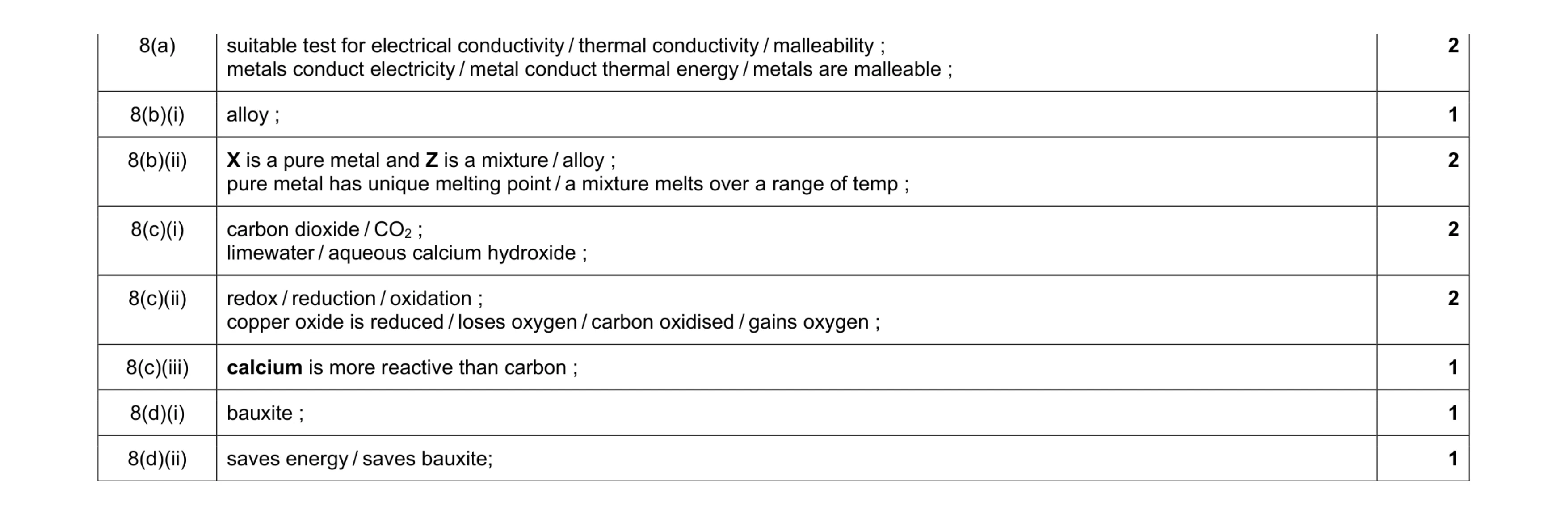
Mark scheme: 8(a) suitable test for electrical conductivity / thermal conductivity / malleability ; metals conduct electricity / metal conduct thermal energy / metals are malleable ; 2 8(b)(i) alloy ; 1 8(b)(ii) X is a pure metal and Z is a mixture / alloy ; pure metal has unique melting point / a mixture melts over a range of temp ; 2 8(c)(i) carbon dioxide / CO2 ; limewater / aqueous calcium hydroxide ; 2 8(c)(ii) redox / reduction / oxidation ; copper oxide is reduced / loses oxygen / carbon oxidised / gains oxygen ; 2 8(c)(iii) calcium is more reactive than carbon ; 1 8(d)(i) bauxite ; 1 8(d)(ii) saves energy / saves bauxite; 1
This question in 0654/31 May/June 2019
Q2 · Electrolysis is a process which uses electricity to break down a compound 0654/32 May/June 2019
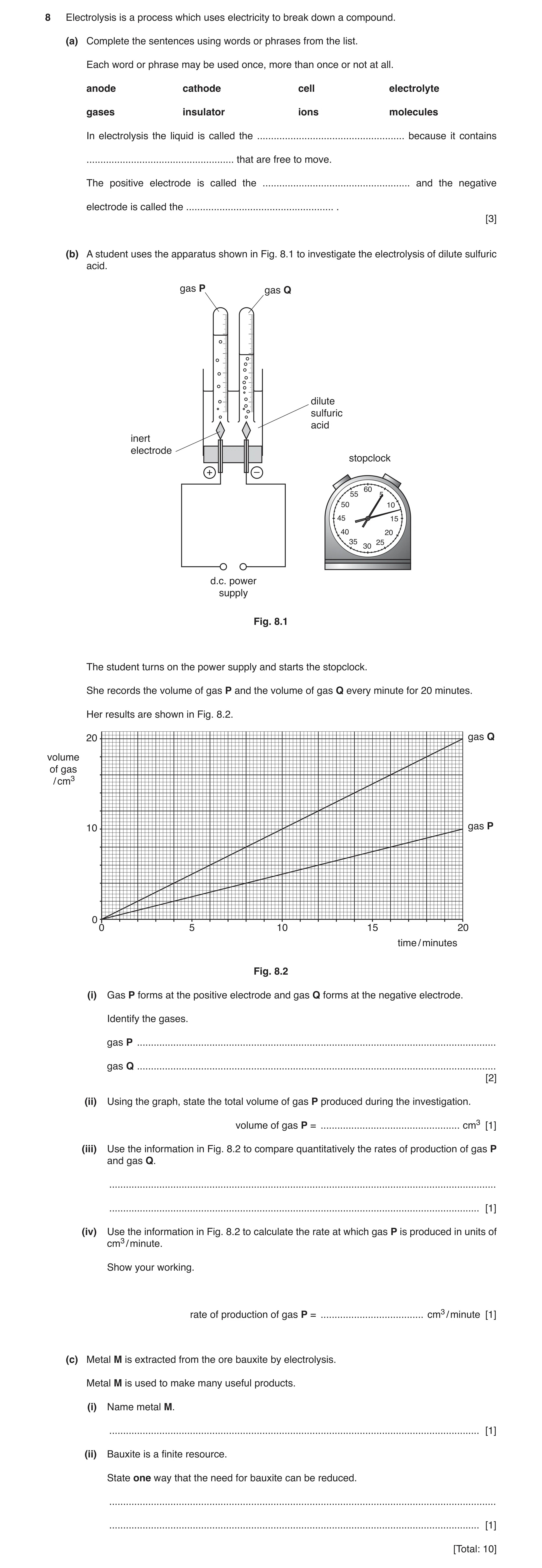
8 Electrolysis is a process which uses electricity to break down a compound. (a) Complete the sentences using words or phrases from the list. Each word or phrase may be used once, more than once or not at all. anode cathode cell electrolyte gases insulator ions molecules In electrolysis the liquid is called the … because it contains … that are free to move. The positive electrode is called the … and the negative electrode is called the … . [3] (b) A student uses the apparatus shown in Fig. 8.1 to investigate the electrolysis of dilute sulfuric acid. gas P gas Q dilute sulfuric acid inert electrode stopclock + – 60 55 5 50 10 45 15 40 20 35 25 30 d.c. power supply Fig. 8.1 The student turns on the power supply and starts the stopclock. She records the volume of gas P and the volume of gas Q every minute for 20 minutes. Her results are shown in Fig. 8.2. 20 gas Q volume of gas / cm3 10 gas P 0 0 5 10 15 20 time / minutes Fig. 8.2 (i) Gas P forms at the positive electrode and gas Q forms at the negative electrode. Identify the gases. gas P … gas Q … [2] (ii) Using the graph, state the total volume of gas P produced during the investigation. volume of gas P = … cm3 [1] (iii) Use the information in Fig. 8.2 to compare quantitatively the rates of production of gas P and gas Q. … … [1] (iv) Use the information in Fig. 8.2 to calculate the rate at which gas P is produced in units of cm3 / minute. Show your working. rate of production of gas P = … cm3 / minute [1] (c) Metal M is extracted from the ore bauxite by electrolysis. Metal M is used to make many useful products. (i) Name metal M. … [1] (ii) Bauxite is a finite resource. State one way that the need for bauxite can be reduced. … … [1] [Total: 10]
10 marks
Mark scheme: 8(a) electrolyte ; ions ; anode and cathode ; 3 8(b)(i) P oxygen / O2 ; Q hydrogen / H2 ; 2 8(b)(ii) 10 (cm3 ) ; 1 8(b)(iii) Q is produced at twice the rate of P ; 1 8(b)(iv) 10 ÷ 20 / = 0.5 ( cm3 / minute) ; 1 8(c)(i) aluminium ; 1 8(c)(ii) recycle metal M / aluminium ; 1
This question in 0654/32 May/June 2019
Q3 · Electrolysis is a process which uses electricity to break down a compound 0654/33 May/June 2019
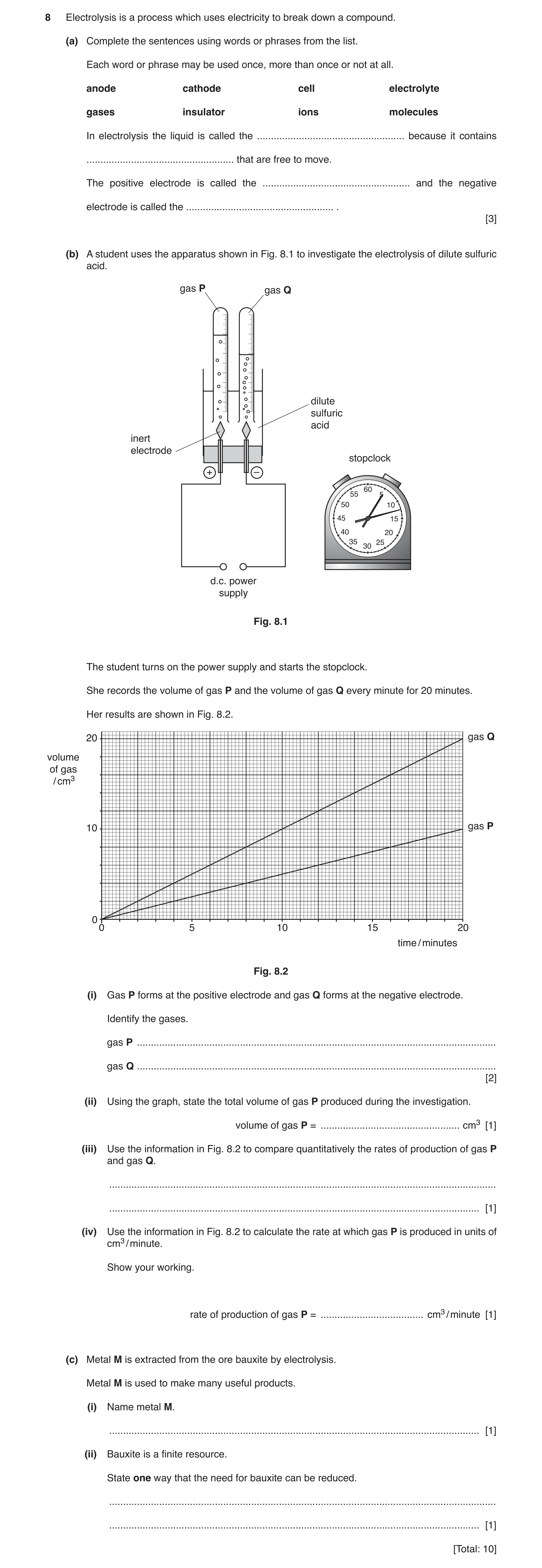
8 Electrolysis is a process which uses electricity to break down a compound. (a) Complete the sentences using words or phrases from the list. Each word or phrase may be used once, more than once or not at all. anode cathode cell electrolyte gases insulator ions molecules In electrolysis the liquid is called the … because it contains … that are free to move. The positive electrode is called the … and the negative electrode is called the … . [3] (b) A student uses the apparatus shown in Fig. 8.1 to investigate the electrolysis of dilute sulfuric acid. gas P gas Q dilute sulfuric acid inert electrode stopclock + – 60 55 5 50 10 45 15 40 20 35 25 30 d.c. power supply Fig. 8.1 The student turns on the power supply and starts the stopclock. She records the volume of gas P and the volume of gas Q every minute for 20 minutes. Her results are shown in Fig. 8.2. 20 gas Q volume of gas / cm3 10 gas P 0 0 5 10 15 20 time / minutes Fig. 8.2 (i) Gas P forms at the positive electrode and gas Q forms at the negative electrode. Identify the gases. gas P … gas Q … [2] (ii) Using the graph, state the total volume of gas P produced during the investigation. volume of gas P = … cm3 [1] (iii) Use the information in Fig. 8.2 to compare quantitatively the rates of production of gas P and gas Q. … … [1] (iv) Use the information in Fig. 8.2 to calculate the rate at which gas P is produced in units of cm3 / minute. Show your working. rate of production of gas P = … cm3 / minute [1] (c) Metal M is extracted from the ore bauxite by electrolysis. Metal M is used to make many useful products. (i) Name metal M. … [1] (ii) Bauxite is a finite resource. State one way that the need for bauxite can be reduced. … … [1] [Total: 10]
10 marks
Mark scheme: 8(a) electrolyte ; ions ; anode and cathode ; 3 8(b)(i) P oxygen / O2 ; Q hydrogen / H2 ; 2 8(b)(ii) 10 (cm3 ) ; 1 8(b)(iii) Q is produced at twice the rate of P ; 1 8(b)(iv) 10 ÷ 20 / = 0.5 ( cm3 / minute) ; 1 8(c)(i) aluminium ; 1 8(c)(ii) recycle metal M / aluminium ; 1
This question in 0654/33 May/June 2019
Q4 · A pie chart showing the percentages of some of the elements in the Earth’s crust 0654/32 May/June 2020
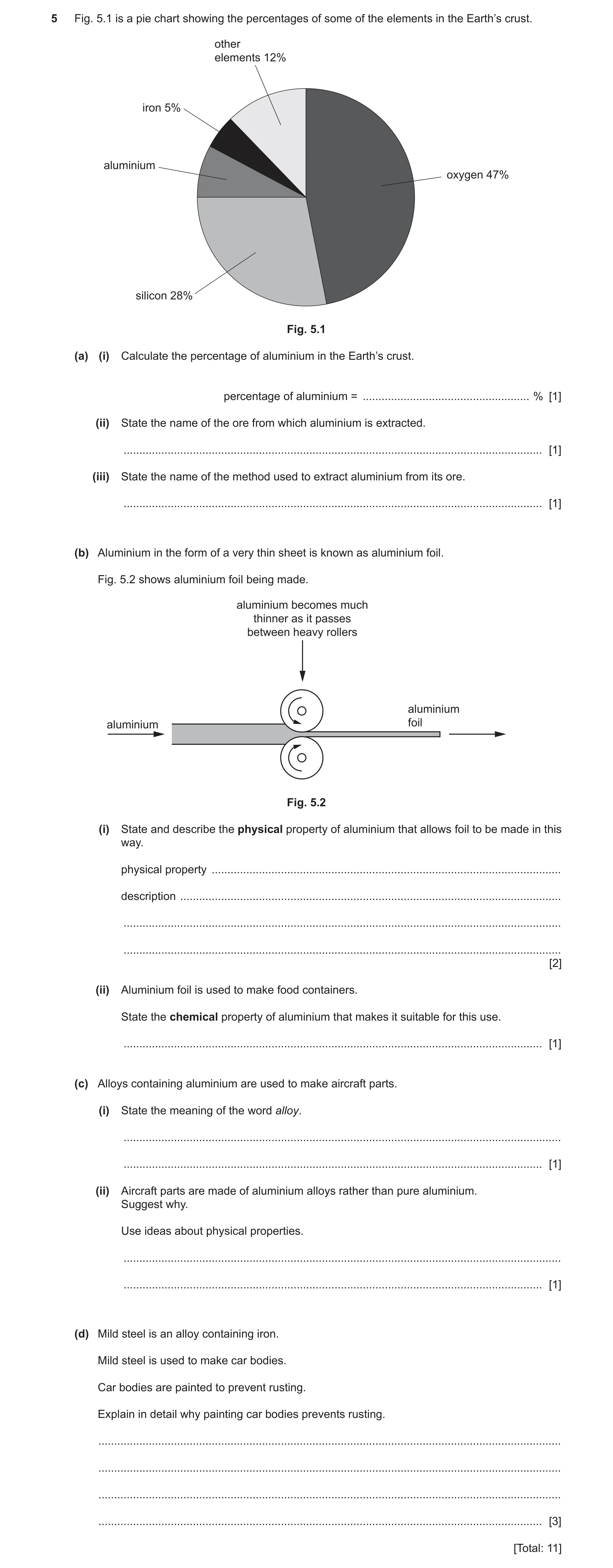
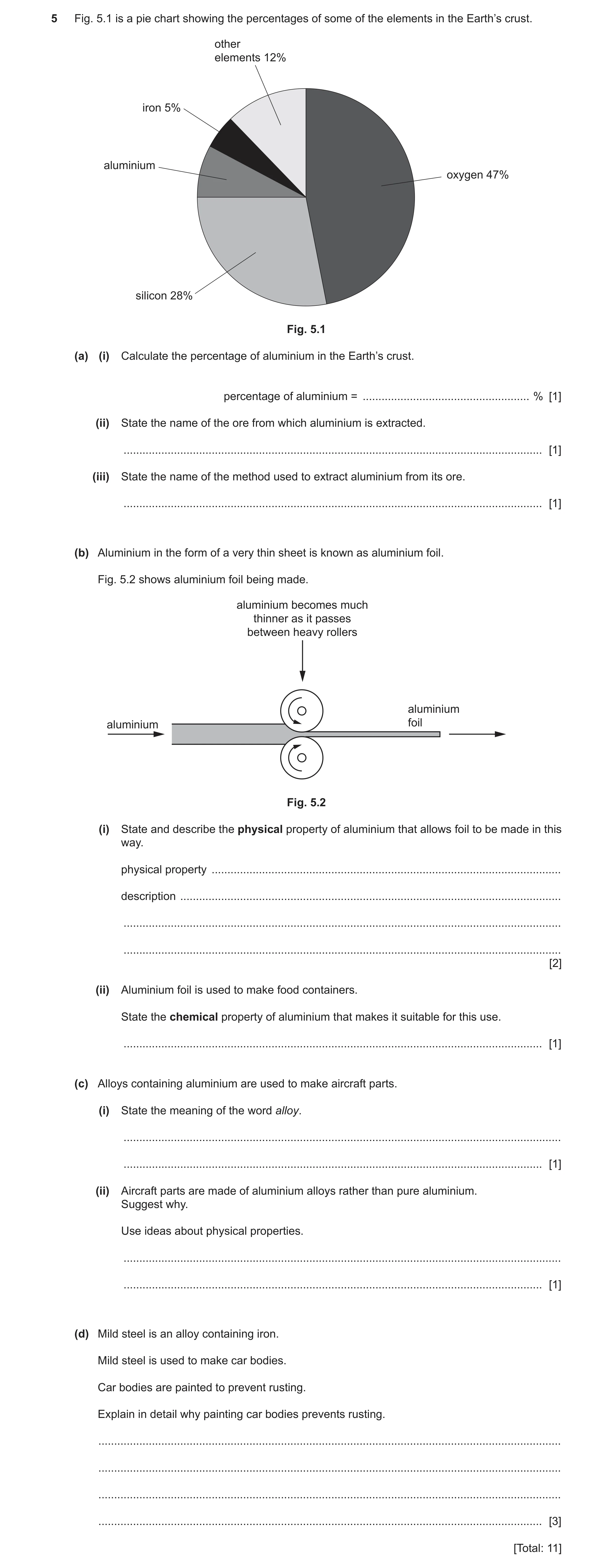
5 Fig. 5.1 is a pie chart showing the percentages of some of the elements in the Earth’s crust. other elements 12% iron 5% aluminium oxygen 47% silicon 28% Fig. 5.1 (a) (i) Calculate the percentage of aluminium in the Earth’s crust. percentage of aluminium = … % [1] (ii) State the name of the ore from which aluminium is extracted. … [1] (iii) State the name of the method used to extract aluminium from its ore. … [1] (b) Aluminium in the form of a very thin sheet is known as aluminium foil. Fig. 5.2 shows aluminium foil being made. aluminium becomes much thinner as it passes between heavy rollers aluminium aluminium foil Fig. 5.2 (i) State and describe the physical property of aluminium that allows foil to be made in this way. physical property … description … … … [2] (ii) Aluminium foil is used to make food containers. State the chemical property of aluminium that makes it suitable for this use. … [1] (c) Alloys containing aluminium are used to make aircraft parts. (i) State the meaning of the word alloy. … … [1] (ii) Aircraft parts are made of aluminium alloys rather than pure aluminium. Suggest why. Use ideas about physical properties. … … [1] (d) Mild steel is an alloy containing iron. Mild steel is used to make car bodies. Car bodies are painted to prevent rusting. Explain in detail why painting car bodies prevents rusting. … … … … [3] [Total: 11]
11 marks
Mark scheme: 5(a)(i) 8(%) ; 1 5(a)(ii) bauxite ; 1 5(a)(iii) electrolysis ; 1 5(b)(i) malleability / it is malleable ; the idea that it can be forced to change shape without breaking ; 2 5(b)(ii) resistant to corrosion / it does not react with food ; 1 5(c)(i) a (solid) mixture containing metals / a mixture of a metal and other elements; 1 Question Answer Marks 5(c)(ii) alloy is stronger / less likely to bend or break ; 1 5(d) reference to reaction with / need for oxygen ; reference to reaction with / need for water ; description of paint as a barrier between steel and oxygen / water ; 3
This question in 0654/32 May/June 2020
Q5 · A pie chart showing the percentages of some of the elements in the Earth’s crust 0654/33 May/June 2020
5 Fig. 5.1 is a pie chart showing the percentages of some of the elements in the Earth’s crust. other elements 12% iron 5% aluminium oxygen 47% silicon 28% Fig. 5.1 (a) (i) Calculate the percentage of aluminium in the Earth’s crust. percentage of aluminium = … % [1] (ii) State the name of the ore from which aluminium is extracted. … [1] (iii) State the name of the method used to extract aluminium from its ore. … [1] (b) Aluminium in the form of a very thin sheet is known as aluminium foil. Fig. 5.2 shows aluminium foil being made. aluminium becomes much thinner as it passes between heavy rollers aluminium aluminium foil Fig. 5.2 (i) State and describe the physical property of aluminium that allows foil to be made in this way. physical property … description … … … [2] (ii) Aluminium foil is used to make food containers. State the chemical property of aluminium that makes it suitable for this use. … [1] (c) Alloys containing aluminium are used to make aircraft parts. (i) State the meaning of the word alloy. … … [1] (ii) Aircraft parts are made of aluminium alloys rather than pure aluminium. Suggest why. Use ideas about physical properties. … … [1] (d) Mild steel is an alloy containing iron. Mild steel is used to make car bodies. Car bodies are painted to prevent rusting. Explain in detail why painting car bodies prevents rusting. … … … … [3] [Total: 11]
11 marks
Mark scheme: 5(a)(i) 8(%) ; 1 5(a)(ii) bauxite ; 1 5(a)(iii) electrolysis ; 1 5(b)(i) malleability / it is malleable ; the idea that it can be forced to change shape without breaking ; 2 5(b)(ii) resistant to corrosion / it does not react with food ; 1 5(c)(i) a (solid) mixture containing metals / a mixture of a metal and other elements; 1 Question Answer Marks 5(c)(ii) alloy is stronger / less likely to bend or break ; 1 5(d) reference to reaction with / need for oxygen ; reference to reaction with / need for water ; description of paint as a barrier between steel and oxygen / water ; 3
This question in 0654/33 May/June 2020
Q6 · Electrolysis is used to extract some elements from their ores 0654/31 Oct/Nov 2020
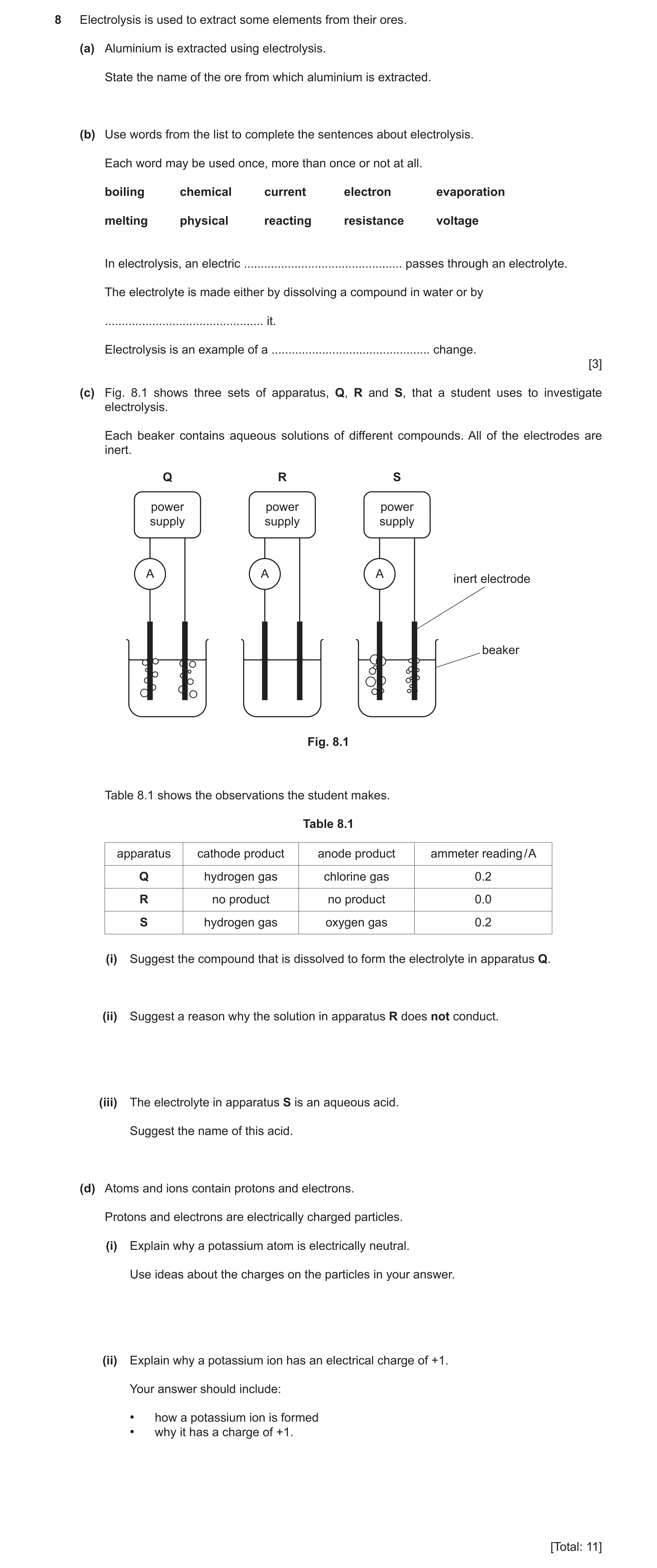
8 Electrolysis is used to extract some elements from their ores. (a) Aluminium is extracted using electrolysis. State the name of the ore from which aluminium is extracted. (b) Use words from the list to complete the sentences about electrolysis. Each word may be used once, more than once or not at all. boiling chemical current electron evaporation melting physical reacting resistance voltage In electrolysis, an electric … passes through an electrolyte. The electrolyte is made either by dissolving a compound in water or by … it. Electrolysis is an example of a … change. [3] (c) Fig. 8.1 shows three sets of apparatus, Q, R and S, that a student uses to investigate electrolysis. Each beaker contains aqueous solutions of different compounds. All of the electrodes are inert. Q R S power power power supply supply supply A A A inert electrode beaker Fig. 8.1 Table 8.1 shows the observations the student makes. Table 8.1 apparatus cathode product anode product ammeter reading / A Q hydrogen gas chlorine gas 0.2 R no product no product 0.0 S hydrogen gas oxygen gas 0.2 (i) Suggest the compound that is dissolved to form the electrolyte in apparatus Q. (ii) Suggest a reason why the solution in apparatus R does not conduct. (iii) The electrolyte in apparatus S is an aqueous acid. Suggest the name of this acid. (d) Atoms and ions contain protons and electrons. Protons and electrons are electrically charged particles. (i) Explain why a potassium atom is electrically neutral. Use ideas about the charges on the particles in your answer. (ii) Explain why a potassium ion has an electrical charge of +1. Your answer should include: • how a potassium ion is formed • why it has a charge of +1. [Total: 11]
11 marks
Mark scheme: 8(a) bauxite ; 1 8(b) current ; melting ; chemical ; 3 8(c)(i) sodium chloride / other correct ; 1 8(c)(ii) the liquid is not an electrolyte / does not contain (free) ions / the compound dissolved is not ionic ; 1 8(c)(iii) sulfuric (acid) / other correct ; 1 8(d)(i) reference to protons being positive and electrons being negative ; in atom proton and electron numbers are equal ; 2 8(d)(ii) ion forms when one electron is lost ; so in ion number of protons / positive charges is one more than electrons / number of negative charges ; 2
This question in 0654/31 Oct/Nov 2020
Q7 · Electrolysis is used to extract some elements from their ores 0654/33 Oct/Nov 2020
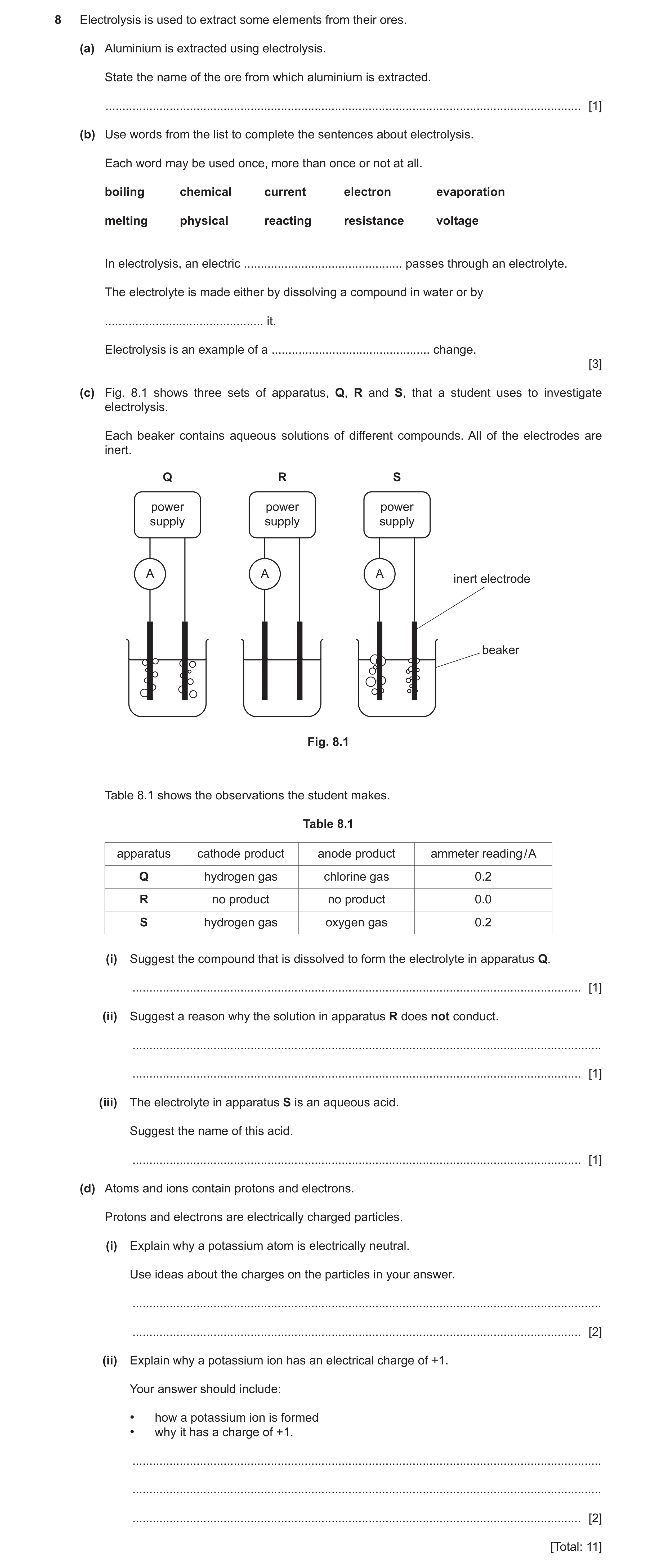
8 Electrolysis is used to extract some elements from their ores. (a) Aluminium is extracted using electrolysis. State the name of the ore from which aluminium is extracted. … [1] (b) Use words from the list to complete the sentences about electrolysis. Each word may be used once, more than once or not at all. boiling chemical current electron evaporation melting physical reacting resistance voltage In electrolysis, an electric … passes through an electrolyte. The electrolyte is made either by dissolving a compound in water or by … it. Electrolysis is an example of a … change. [3] (c) Fig. 8.1 shows three sets of apparatus, Q, R and S, that a student uses to investigate electrolysis. Each beaker contains aqueous solutions of different compounds. All of the electrodes are inert. Q R S power power power supply supply supply A A A inert electrode beaker Fig. 8.1 Table 8.1 shows the observations the student makes. Table 8.1 apparatus cathode product anode product ammeter reading / A Q hydrogen gas chlorine gas 0.2 R no product no product 0.0 S hydrogen gas oxygen gas 0.2 (i) Suggest the compound that is dissolved to form the electrolyte in apparatus Q. … [1] (ii) Suggest a reason why the solution in apparatus R does not conduct. … … [1] (iii) The electrolyte in apparatus S is an aqueous acid. Suggest the name of this acid. … [1] (d) Atoms and ions contain protons and electrons. Protons and electrons are electrically charged particles. (i) Explain why a potassium atom is electrically neutral. Use ideas about the charges on the particles in your answer. … … [2] (ii) Explain why a potassium ion has an electrical charge of +1. Your answer should include: • how a potassium ion is formed • why it has a charge of +1. … … … [2] [Total: 11]
11 marks
Mark scheme: 8(a) bauxite ; 1 8(b) current ; melting ; chemical ; 3 8(c)(i) sodium chloride / other correct ; 1 8(c)(ii) the liquid is not an electrolyte / does not contain (free) ions / the compound dissolved is not ionic ; 1 8(c)(iii) sulfuric (acid) / other correct ; 1 8(d)(i) reference to protons being positive and electrons being negative ; in atom proton and electron numbers are equal ; 2 8(d)(ii) ion forms when one electron is lost ; so in ion number of protons / positive charges is one more than electrons / number of negative charges ; 2
This question in 0654/33 Oct/Nov 2020
Q8 · Copper and sodium are metals 0654/32 Feb/March 2021
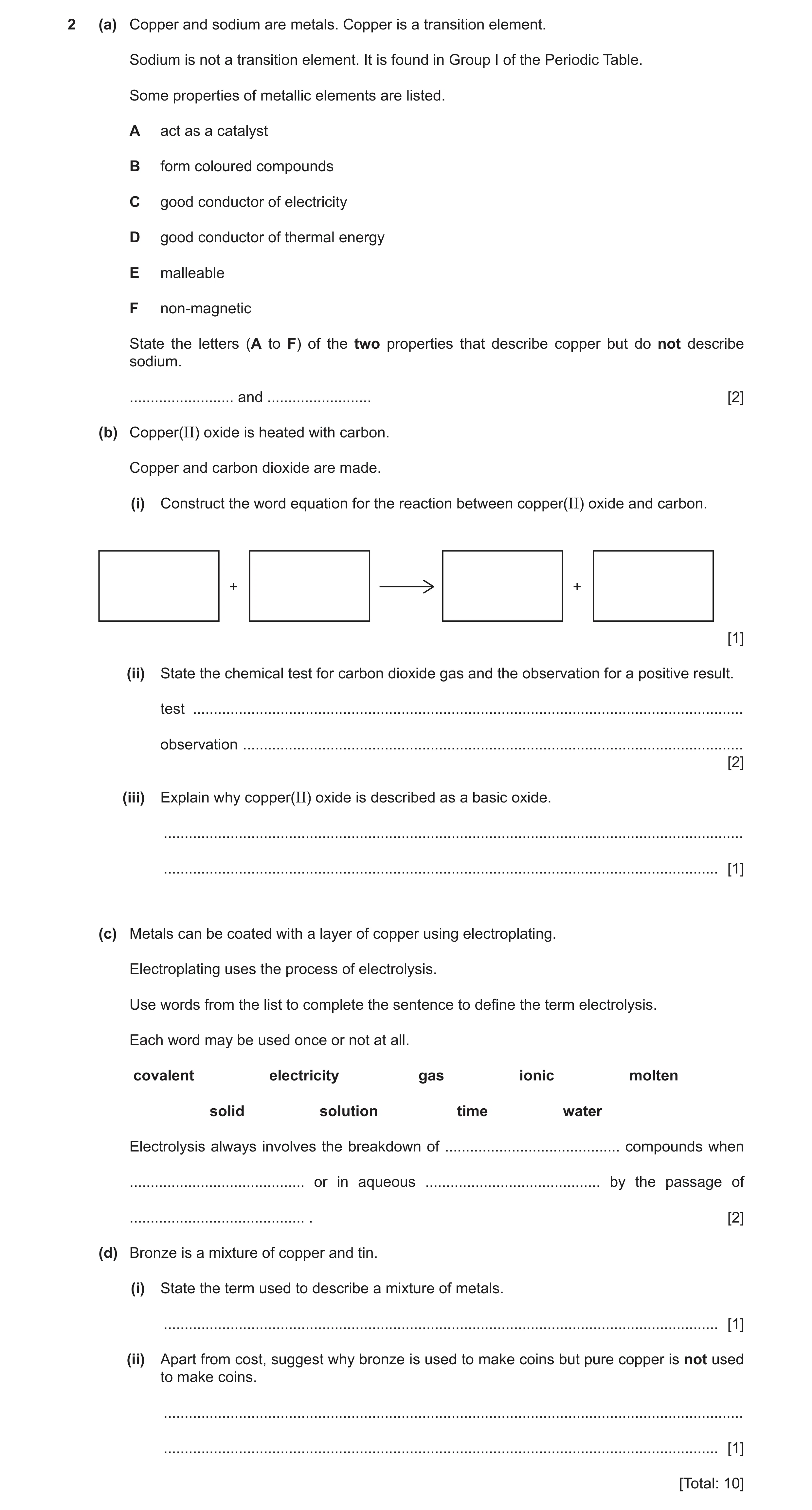
2 (a) Copper and sodium are metals. Copper is a transition element. Sodium is not a transition element. It is found in Group I of the Periodic Table. Some properties of metallic elements are listed. A act as a catalyst B form coloured compounds C good conductor of electricity D good conductor of thermal energy E malleable F non-magnetic State the letters (A to F) of the two properties that describe copper but do not describe sodium. … and … [2] (b) Copper(II) oxide is heated with carbon. Copper and carbon dioxide are made. (i) Construct the word equation for the reaction between copper(II) oxide and carbon. + + [1] (ii) State the chemical test for carbon dioxide gas and the observation for a positive result. test … observation … [2] (iii) Explain why copper(II) oxide is described as a basic oxide. … … [1] (c) Metals can be coated with a layer of copper using electroplating. Electroplating uses the process of electrolysis. Use words from the list to complete the sentence to define the term electrolysis. Each word may be used once or not at all. covalent electricity gas ionic molten solid solution time water Electrolysis always involves the breakdown of … compounds when … or in aqueous … by the passage of … . [2] (d) Bronze is a mixture of copper and tin. (i) State the term used to describe a mixture of metals. … [1] (ii) Apart from cost, suggest why bronze is used to make coins but pure copper is not used to make coins. … … [1] [Total: 10]
10 marks
Mark scheme: 2(a) A; B; 2 2(b)(i) copper oxide + carbon → copper + carbon dioxide; 1 Question Answer Marks 2(b)(ii) (bubble through) limewater; goes cloudy / milky; 2 2(b)(iii) produces solution with pH above 7 / copper(II) oxide is a metal oxide; 1 2(c) ionic molten solution electricity;; 2 2(d)(i) alloy; 1 2(d)(ii) tougher / stronger; 1
This question in 0654/32 Feb/March 2021
Q9 · An atom of aluminium has a proton number of 13 and nucleon number of 27 0654/32 Oct/Nov 2021
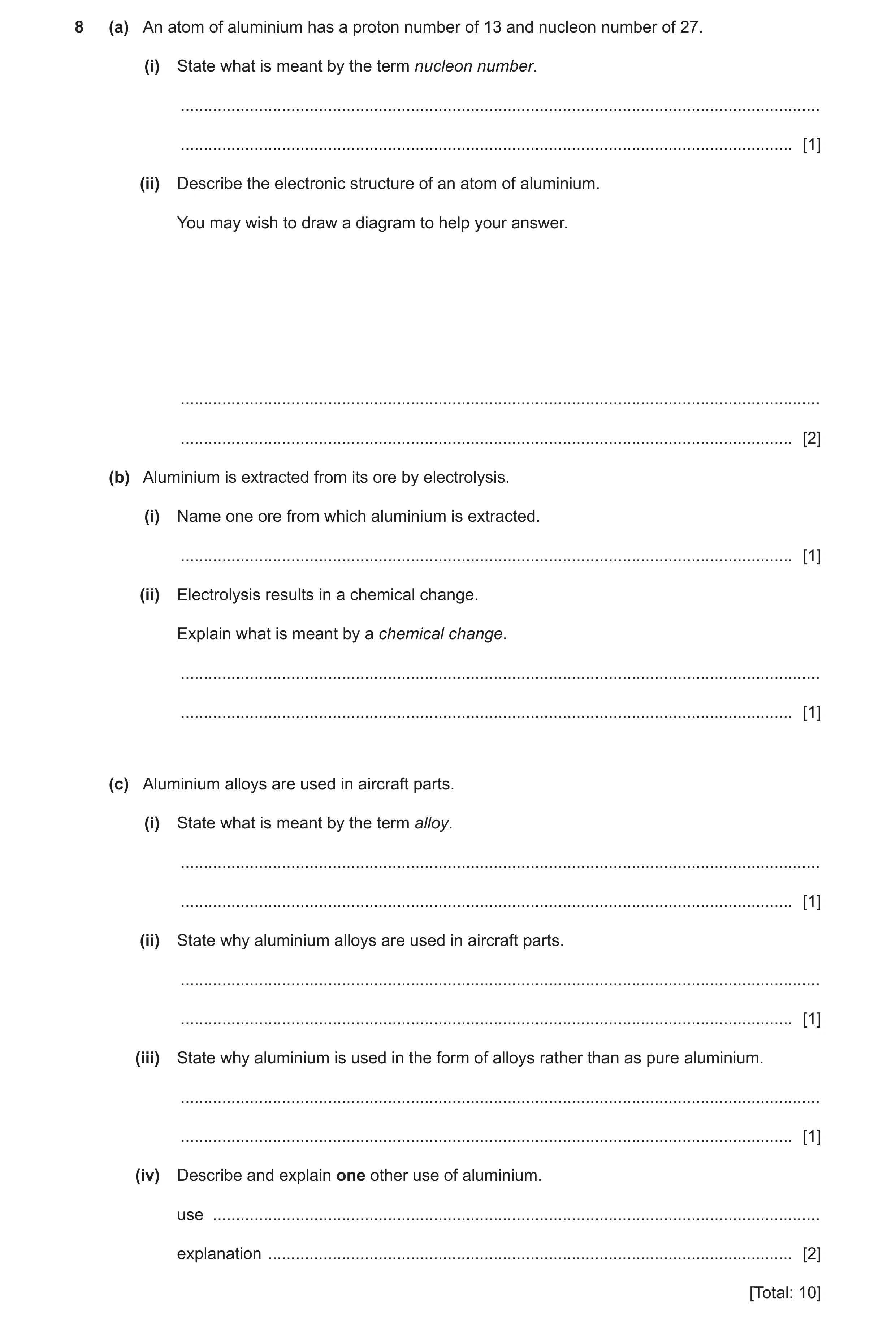
8 (a) An atom of aluminium has a proton number of 13 and nucleon number of 27. (i) State what is meant by the term nucleon number. … … [1] (ii) Describe the electronic structure of an atom of aluminium. You may wish to draw a diagram to help your answer. … … [2] (b) Aluminium is extracted from its ore by electrolysis. (i) Name one ore from which aluminium is extracted. … [1] (ii) Electrolysis results in a chemical change. Explain what is meant by a chemical change. … … [1] (c) Aluminium alloys are used in aircraft parts. (i) State what is meant by the term alloy. … … [1] (ii) State why aluminium alloys are used in aircraft parts. … … [1] (iii) State why aluminium is used in the form of alloys rather than as pure aluminium. … … [1] (iv) Describe and explain one other use of aluminium. use … explanation … [2] [Total: 10]
10 marks
Mark scheme: 8(a)(i) number of protons and neutrons in an atom ; 1 8(a)(ii) 13 electrons ; 2.8.3 ; 2 8(b)(i) bauxite ; 1 8(b)(ii) new substance(s) produced ; 1 8(c)(i) mixture of metals / mixture of a metal and another element ; 1 8(c)(ii) low density ; 1 8(c)(iii) stronger ; 1 8(c)(iv) food containers / drink cans ; resistant to corrosion ; 2
This question in 0654/32 Oct/Nov 2021
Q10 · Two isotopes of iron are iron-54 and iron-56 0654/33 Oct/Nov 2021
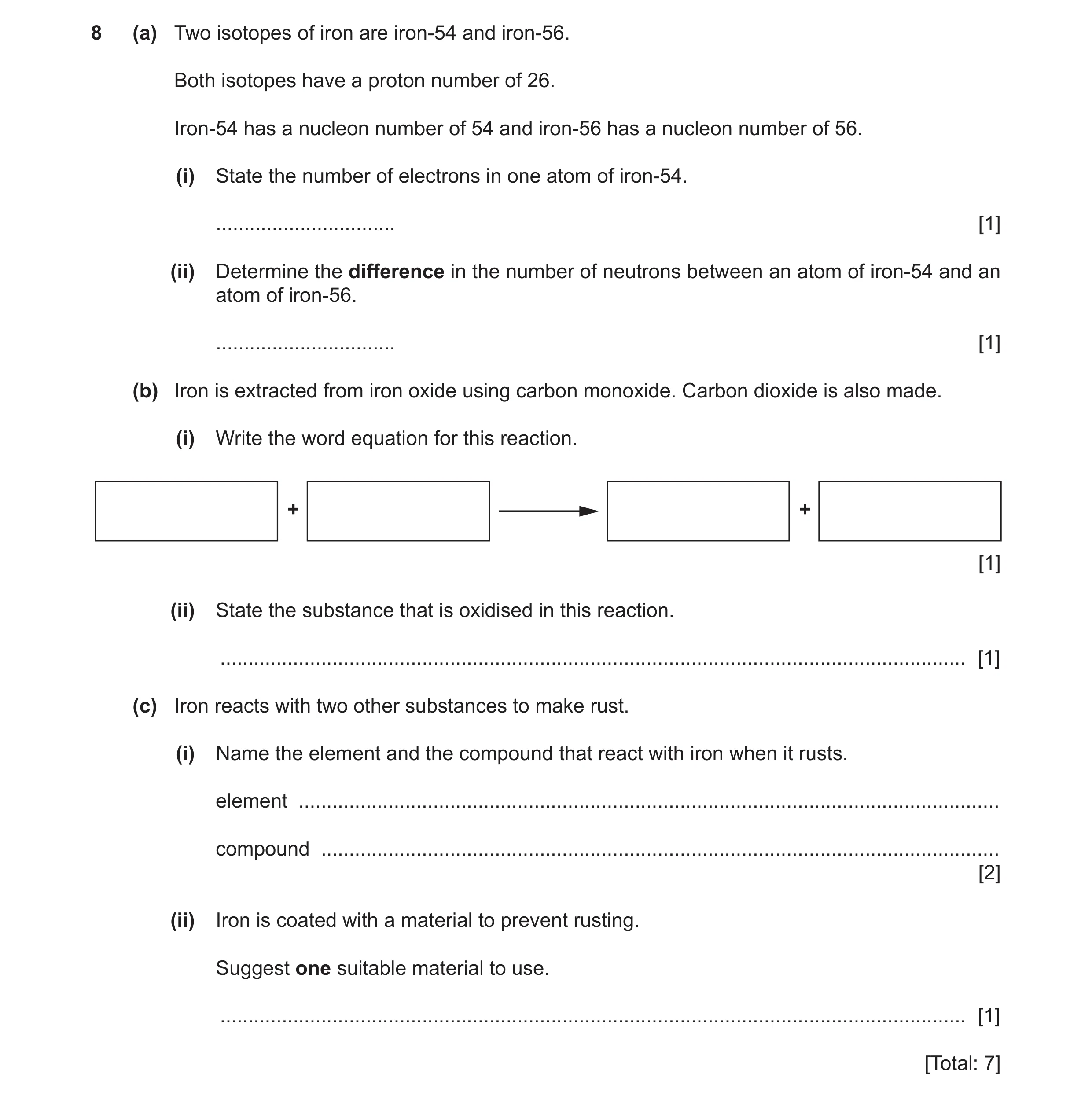
8 (a) Two isotopes of iron are iron-54 and iron-56. Both isotopes have a proton number of 26. Iron-54 has a nucleon number of 54 and iron-56 has a nucleon number of 56. (i) State the number of electrons in one atom of iron-54. … [1] (ii) Determine the difference in the number of neutrons between an atom of iron-54 and an atom of iron-56. … [1] (b) Iron is extracted from iron oxide using carbon monoxide. Carbon dioxide is also made. (i) Write the word equation for this reaction. + + [1] (ii) State the substance that is oxidised in this reaction. … [1] (c) Iron reacts with two other substances to make rust. (i) Name the element and the compound that react with iron when it rusts. element … compound … [2] (ii) Iron is coated with a material to prevent rusting. Suggest one suitable material to use. … [1] [Total: 7]
7 marks
Mark scheme: 8(a)(i) 26 ; 1 8(a)(ii) 2 ; 1 8(b)(i) iron oxide + carbon monoxide → iron + carbon dioxide ; 1 8(b)(ii) carbon monoxide ; 1 8(c)(i) (element) – oxygen ; (compound) – water ; 2 8(c)(ii) paint ; 1
This question in 0654/33 Oct/Nov 2021
Q11 · Aluminium is a metal 0654/31 May/June 2022
5 (a) Aluminium is a metal. Two physical properties of metals are that they are good thermal conductors and good electrical conductors. State two other physical properties of metals. 1 … 2 … [2] (b) Duralumin is an alloy of 95% aluminium and 5% copper. (i) Calculate the mass of aluminium used in 1000 kg of duralumin. mass = … kg [1] (ii) State why aluminium alloys are used in aircraft parts. … … [1] (c) Aluminium is extracted from its ore by electrolysis. (i) State the name of the ore of aluminium used. … [1] (ii) Define electrolysis. … … … [2] (iii) Aluminium cannot be extracted from its ore by heating with carbon. Name one metal which can be extracted from its ore by heating with carbon. … [1] (d) Aluminium ores must be conserved. (i) State why aluminium ores must be conserved. … … [1] (ii) Suggest how aluminium ores may be conserved. … … [1] [Total: 10]
10 marks
Mark scheme: 5(a) high melting point; high boiling point; malleable; ductile; Max 2 marks 2 5(b)(i) 950 (kg); 1 5(b)(ii) low density / high tensile strength; 1 5(c)(i) bauxite; 1 5(c)(ii) breakdown of an ionic compound; when molten or in aqueous solution; by the passage of electricity; Max 2 marks 2 5(c)(iii) iron; 1 5(d)(i) finite resource / material being used at a faster rate than it can be replaced; 1 5(d)(ii) recycling; 1
This question in 0654/31 May/June 2022
Q12 · Aluminium is obtained from its ore 0654/32 Oct/Nov 2023
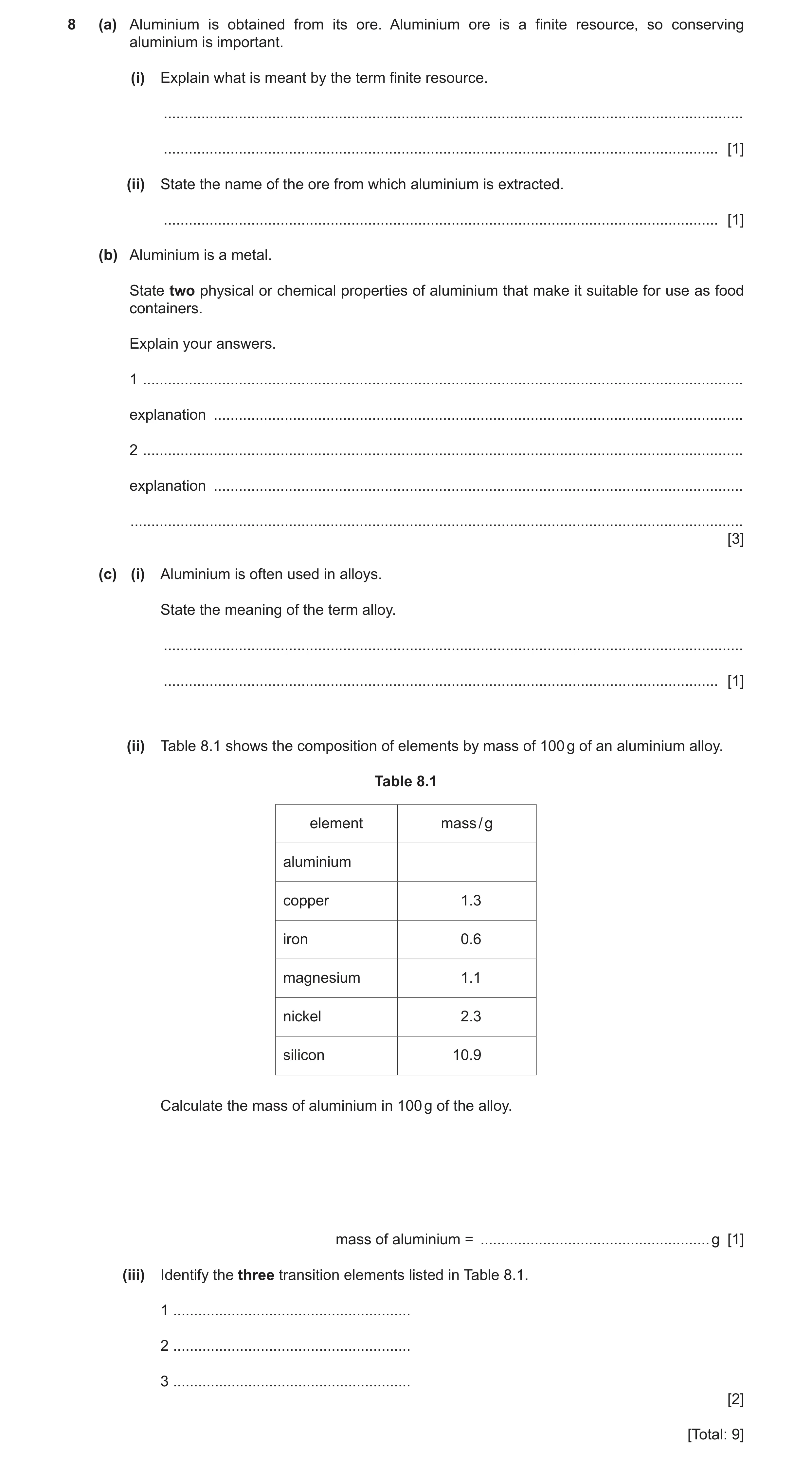
8 (a) Aluminium is obtained from its ore. Aluminium ore is a finite resource, so conserving aluminium is important. (i) Explain what is meant by the term finite resource. … … [1] (ii) State the name of the ore from which aluminium is extracted. … [1] (b) Aluminium is a metal. State two physical or chemical properties of aluminium that make it suitable for use as food containers. Explain your answers. 1 … explanation … 2 … explanation … … [3] (c) (i) Aluminium is often used in alloys. State the meaning of the term alloy. … … [1] (ii) Table 8.1 shows the composition of elements by mass of 100 g of an aluminium alloy. Table 8.1 element mass / g aluminium copper 1.3 iron 0.6 magnesium 1.1 nickel 2.3 silicon 10.9 Calculate the mass of aluminium in 100 g of the alloy. mass of aluminium = … g [1] (iii) Identify the three transition elements listed in Table 8.1. 1 … 2 … 3 … [2] [Total: 9]
9 marks
Mark scheme: 8(a)(i) no longer being made or made extremely slowly ; 1 8(a)(ii) bauxite ; 1 8(b) any two from: 3 unreactive / resists corrosion ; malleable ; low density ; AVP ; suitable explanation for at least one property ; 8(c)(i) Mixture of two or more metals / metal and other elements ; 1 8(c)(ii) 83.8 (g) ; 1 8(c)(iii) copper 2 iron nickel ;; 2 correct – 1 mark 3 correct – 2 marks
This question in 0654/32 Oct/Nov 2023
Q13 · Copper is a metal in high demand that is now often recycled 0654/32 Oct/Nov 2024
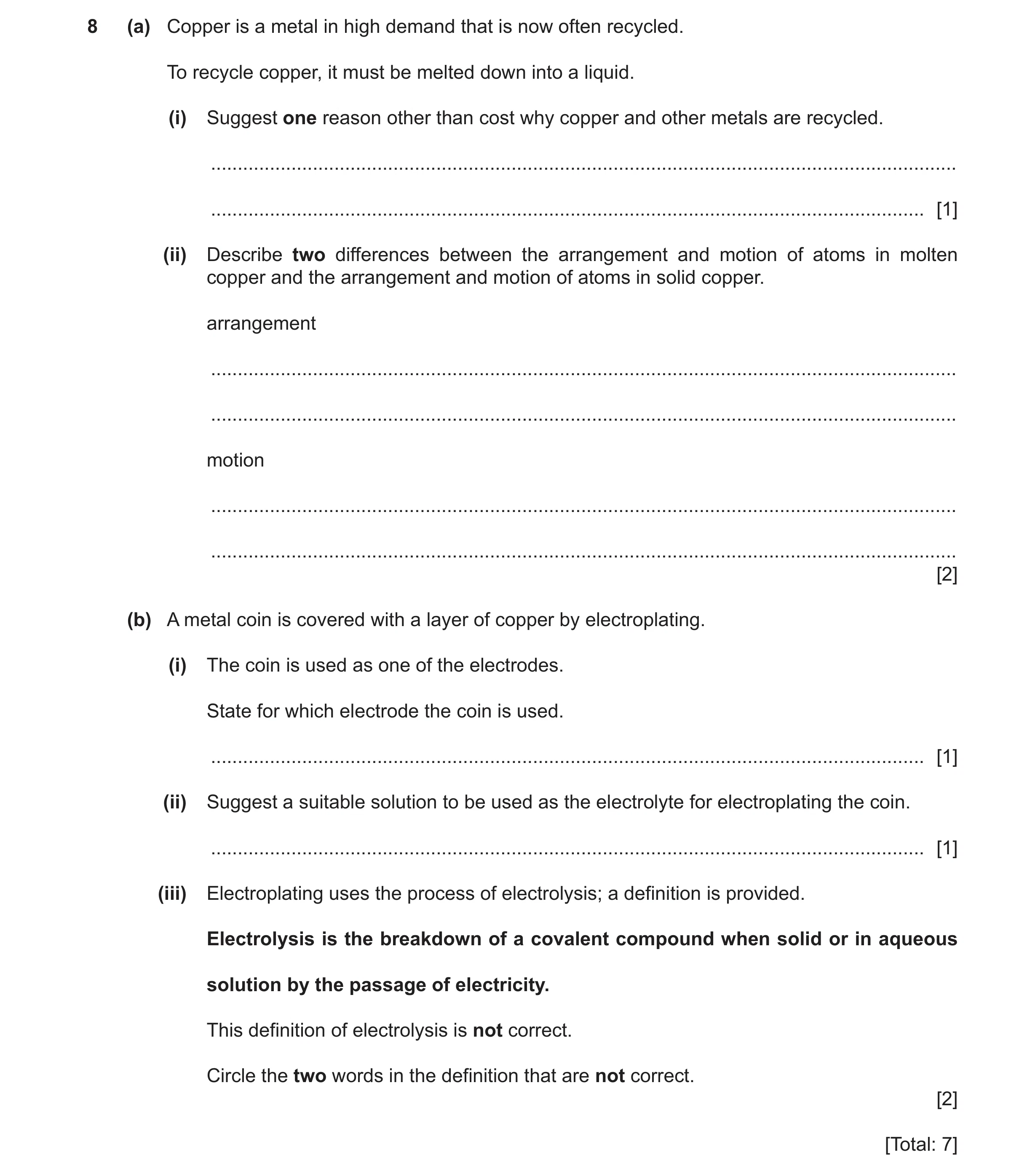
8 (a) Copper is a metal in high demand that is now often recycled. To recycle copper, it must be melted down into a liquid. (i) Suggest one reason other than cost why copper and other metals are recycled. … … [1] (ii) Describe two differences between the arrangement and motion of atoms in molten copper and the arrangement and motion of atoms in solid copper. arrangement … … motion … … [2] (b) A metal coin is covered with a layer of copper by electroplating. (i) The coin is used as one of the electrodes. State for which electrode the coin is used. … [1] (ii) Suggest a suitable solution to be used as the electrolyte for electroplating the coin. … [1] (iii) Electroplating uses the process of electrolysis; a definition is provided. Electrolysis is the breakdown of a covalent compound when solid or in aqueous solution by the passage of electricity. This definition of electrolysis is not correct. Circle the two words in the definition that are not correct. [2] [Total: 7]
7 marks
Mark scheme: 8(a)(i) copper (ore) is a finite resource ; 1 8(a)(ii) arrangement – solid regular and liquid irregular ; 2 motion – solid vibrate (about fixed point) only / do not move AND liquid are able to move about ; 8(b)(i) cathode ; 1 8(b)(ii) copper sulfate / copper chloride ; 1 8(b)(iii) covalent ; 2 solid ;
This question in 0654/32 Oct/Nov 2024
Q14 · The list shows six metals 0654/32 Feb/March 2025
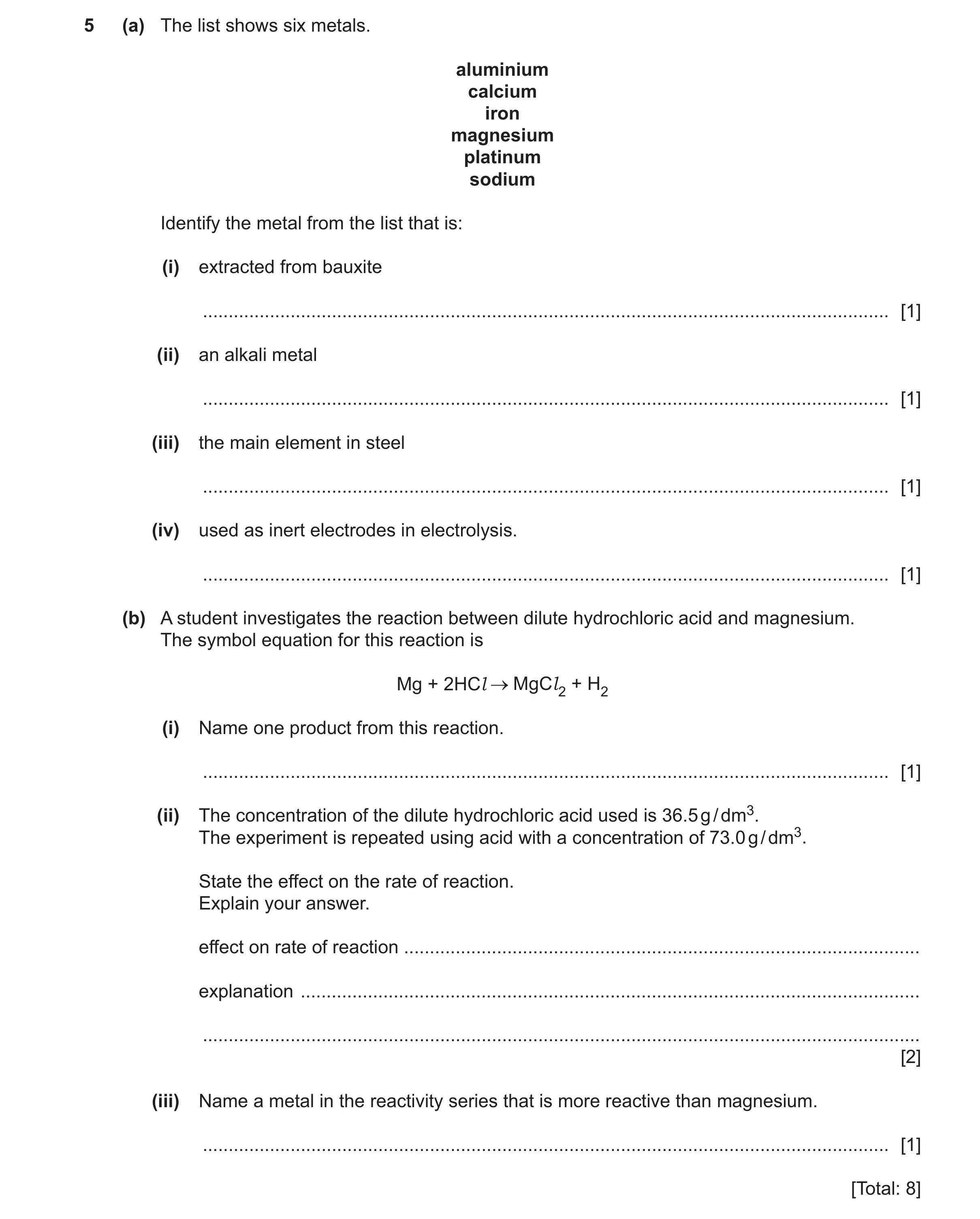
5 (a) The list shows six metals. aluminium calcium iron magnesium platinum sodium Identify the metal from the list that is: (i) extracted from bauxite … [1] (ii) an alkali metal … [1] (iii) the main element in steel … [1] (iv) used as inert electrodes in electrolysis. … [1] (b) A student investigates the reaction between dilute hydrochloric acid and magnesium. The symbol equation for this reaction is Mg + 2HCl MgCl + 2 H2 (i) Name one product from this reaction. … [1] (ii) The concentration of the dilute hydrochloric acid used is 36.5 g / dm3. The experiment is repeated using acid with a concentration of 73.0 g / dm3. State the effect on the rate of reaction. Explain your answer. effect on rate of reaction … explanation … … [2] (iii) Name a metal in the reactivity series that is more reactive than magnesium. … [1] [Total: 8]
8 marks
Mark scheme: 5(a)(i) aluminium ; 1 5(a)(ii) sodium ; 1 5(a)(iii) iron ; 1 5a(iv) platinum ; 1 5(b)(i) magnesium chloride / hydrogen ; 1 5(b)(ii) (rate of reaction) increases ; 2 increased concentration ; 5(b)(iii) calcium / sodium / potassium ; 1
This question in 0654/32 Feb/March 2025
Q15 · Iron is extracted from its ore by reduction in a blast furnace 0654/31 May/June 2025
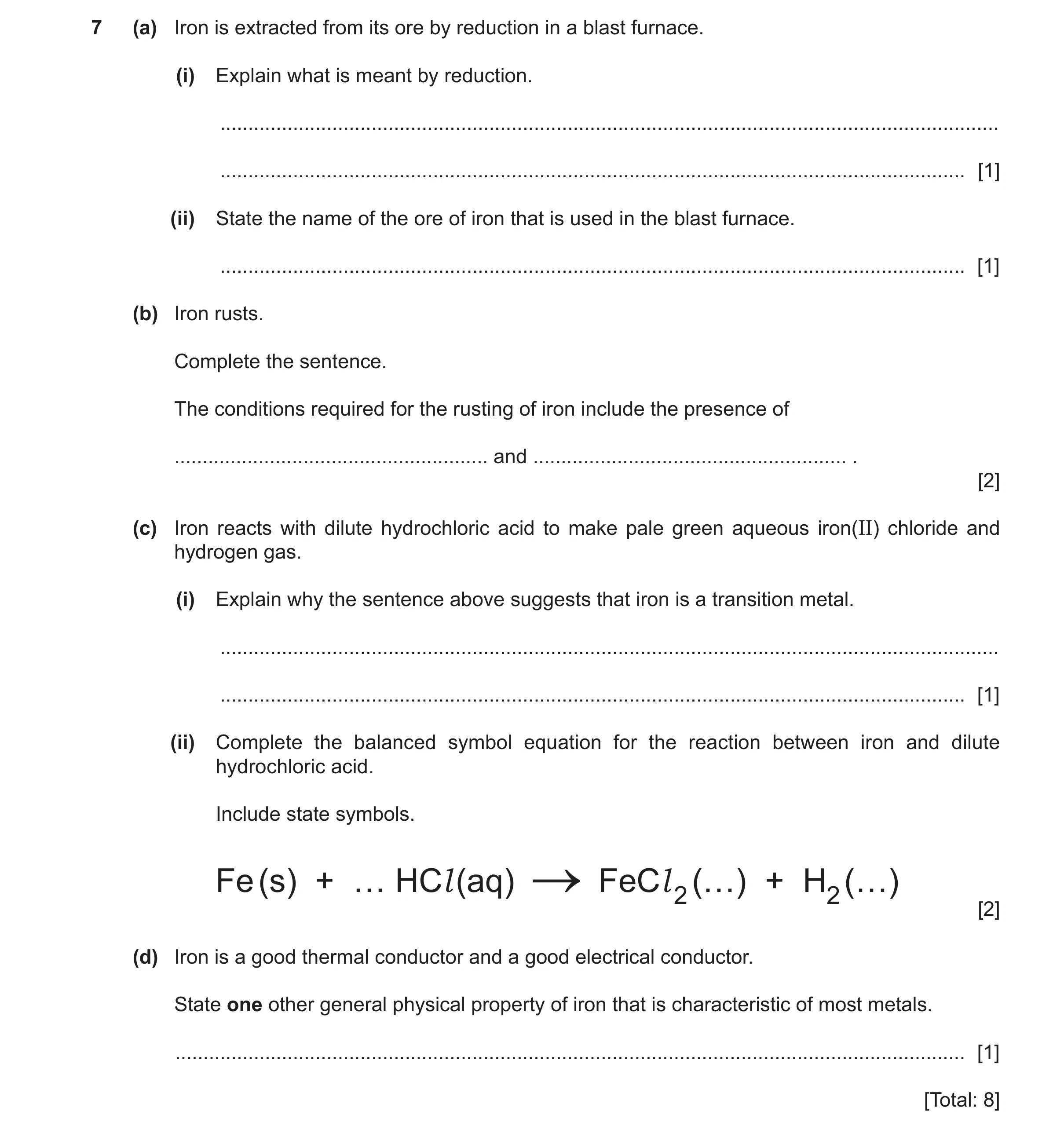
7 (a) Iron is extracted from its ore by reduction in a blast furnace. (i) Explain what is meant by reduction. … … [1] (ii) State the name of the ore of iron that is used in the blast furnace. … [1] (b) Iron rusts. Complete the sentence. The conditions required for the rusting of iron include the presence of … and … . [2] (c) Iron reacts with dilute hydrochloric acid to make pale green aqueous iron(II) chloride and hydrogen gas. (i) Explain why the sentence above suggests that iron is a transition metal. … … [1] (ii) Complete the balanced symbol equation for the reaction between iron and dilute hydrochloric acid. Include state symbols. Fe (s) + … HCl (aq) FeCl (…) + (…) 2 H2 [2] (d) Iron is a good thermal conductor and a good electrical conductor. State one other general physical property of iron that is characteristic of most metals. … [1] [Total: 8]
8 marks
Mark scheme: 7(a)(i) loss of oxygen ; 1 7(a)(ii) hematite ; 1 7(b) oxygen ; 2 water ; 7(c)(i) forms coloured compound ; 1 7(c)(ii) Fe (s) + 2 HCl (aq) → FeCl2 (aq) + H2 (g) 2 balancing ; both state symbols ; 7(d) high melting/boiling point / malleable / ductile ; 1
This question in 0654/31 May/June 2025
Q16 · The arrangement of atoms in pure aluminium metal and in a mixture of aluminium and… 0654/32 Oct/Nov 2025
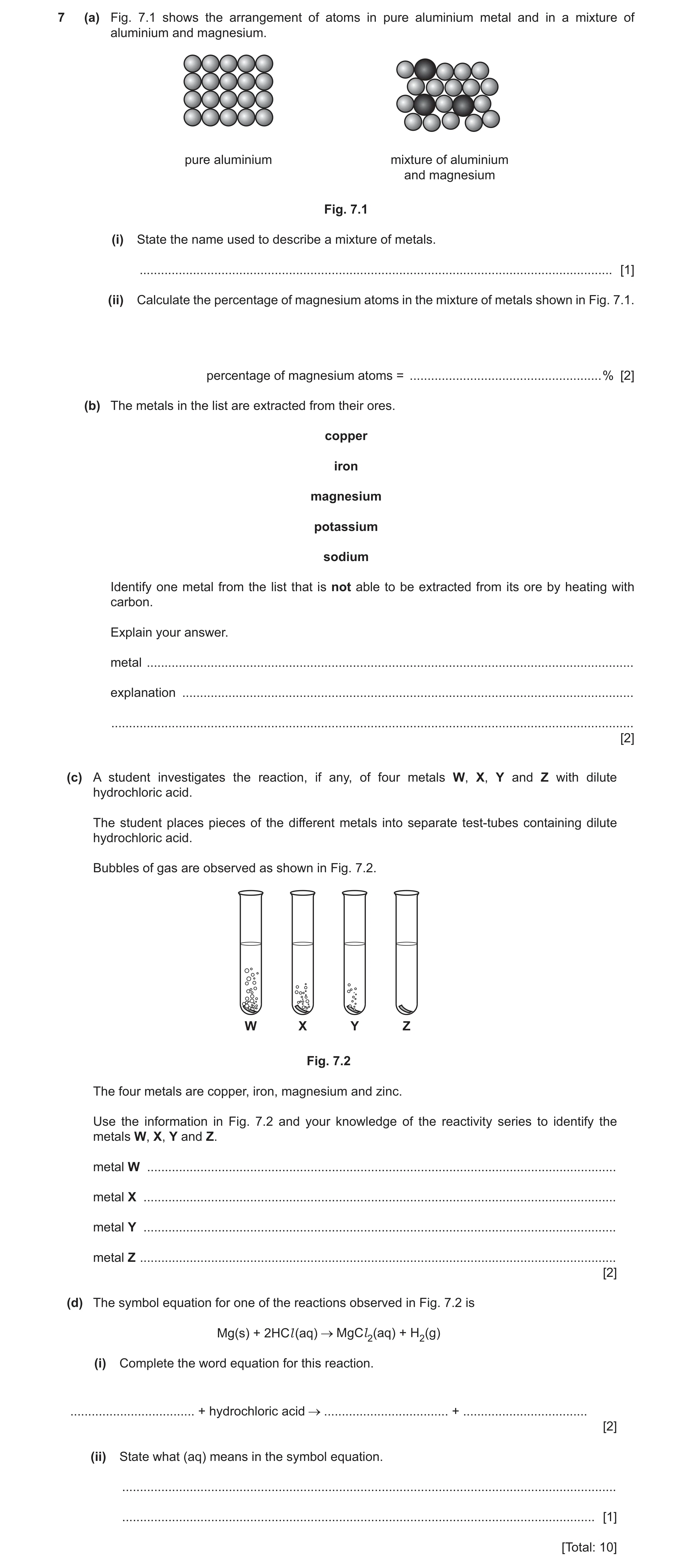
7 (a) Fig. 7.1 shows the arrangement of atoms in pure aluminium metal and in a mixture of aluminium and magnesium. pure aluminium mixture of aluminium and magnesium Fig. 7.1 (i) State the name used to describe a mixture of metals. … [1] (ii) Calculate the percentage of magnesium atoms in the mixture of metals shown in Fig. 7.1. percentage of magnesium atoms = … % [2] (b) The metals in the list are extracted from their ores. copper iron magnesium potassium sodium Identify one metal from the list that is not able to be extracted from its ore by heating with carbon. Explain your answer. metal … explanation … … [2] (c) A student investigates the reaction, if any, of four metals W, X, Y and Z with dilute hydrochloric acid. The student places pieces of the different metals into separate test‑tubes containing dilute hydrochloric acid. Bubbles of gas are observed as shown in Fig. 7.2. W X Y Z Fig. 7.2 The four metals are copper, iron, magnesium and zinc. Use the information in Fig. 7.2 and your knowledge of the reactivity series to identify the metals W, X, Y and Z. metal W … metal X … metal Y … metal Z … [2] (d) The symbol equation for one of the reactions observed in Fig. 7.2 is Mg(s) + 2HCl (aq) MgCl 2(aq) + H2(g) (i) Complete the word equation for this reaction. … + hydrochloric acid … + … [2] (ii) State what (aq) means in the symbol equation. … … [1] [Total: 10]
10 marks
Mark scheme: 7(a)(i) alloy ; 1 7(a)(ii) 3 magnesium atoms out of 20 total or 3 / 20 ; 2 15(%) ; 7(b) sodium or magnesium or potassium ; 2 more reactive than carbon / higher than carbon in the reactivity series ; 7(c) W magnesium 2 X zinc Y iron Z copper magnesium and copper correct – 1 mark zinc and iron correct – 1 mark 7(d)(i) magnesium + (hydrochloric acid) → magnesium chloride + hydrogen 2 all three correct – 2 marks one or two correct – 1 mark 7(d)(ii) aqueous or (in) solution or dissolved in water ; 1
This question in 0654/32 Oct/Nov 2025
Q17 · The arrangement of atoms in pure aluminium metal and in a mixture of aluminium and… 0654/33 Oct/Nov 2025
7 (a) Fig. 7.1 shows the arrangement of atoms in pure aluminium metal and in a mixture of aluminium and magnesium. pure aluminium mixture of aluminium and magnesium Fig. 7.1 (i) State the name used to describe a mixture of metals. … [1] (ii) Calculate the percentage of magnesium atoms in the mixture of metals shown in Fig. 7.1. percentage of magnesium atoms = … % [2] (b) The metals in the list are extracted from their ores. copper iron magnesium potassium sodium Identify one metal from the list that is not able to be extracted from its ore by heating with carbon. Explain your answer. metal … explanation … … [2] (c) A student investigates the reaction, if any, of four metals W, X, Y and Z with dilute hydrochloric acid. The student places pieces of the different metals into separate test‑tubes containing dilute hydrochloric acid. Bubbles of gas are observed as shown in Fig. 7.2. W X Y Z Fig. 7.2 The four metals are copper, iron, magnesium and zinc. Use the information in Fig. 7.2 and your knowledge of the reactivity series to identify the metals W, X, Y and Z. metal W … metal X … metal Y … metal Z … [2] (d) The symbol equation for one of the reactions observed in Fig. 7.2 is Mg(s) + 2HCl (aq) MgCl 2(aq) + H2(g) (i) Complete the word equation for this reaction. … + hydrochloric acid … + … [2] (ii) State what (aq) means in the symbol equation. … … [1] [Total: 10]
10 marks
Mark scheme: 7(a)(i) alloy ; 1 7(a)(ii) 3 magnesium atoms out of 20 total or 3 / 20 ; 2 15(%) ; 7(b) sodium or magnesium or potassium ; 2 more reactive than carbon / higher than carbon in the reactivity series ; 7(c) W magnesium 2 X zinc Y iron Z copper magnesium and copper correct – 1 mark zinc and iron correct – 1 mark 7(d)(i) magnesium + (hydrochloric acid) → magnesium chloride + hydrogen 2 all three correct – 2 marks one or two correct – 1 mark 7(d)(ii) aqueous or (in) solution or dissolved in water ; 1
This question in 0654/33 Oct/Nov 2025
 18 / 28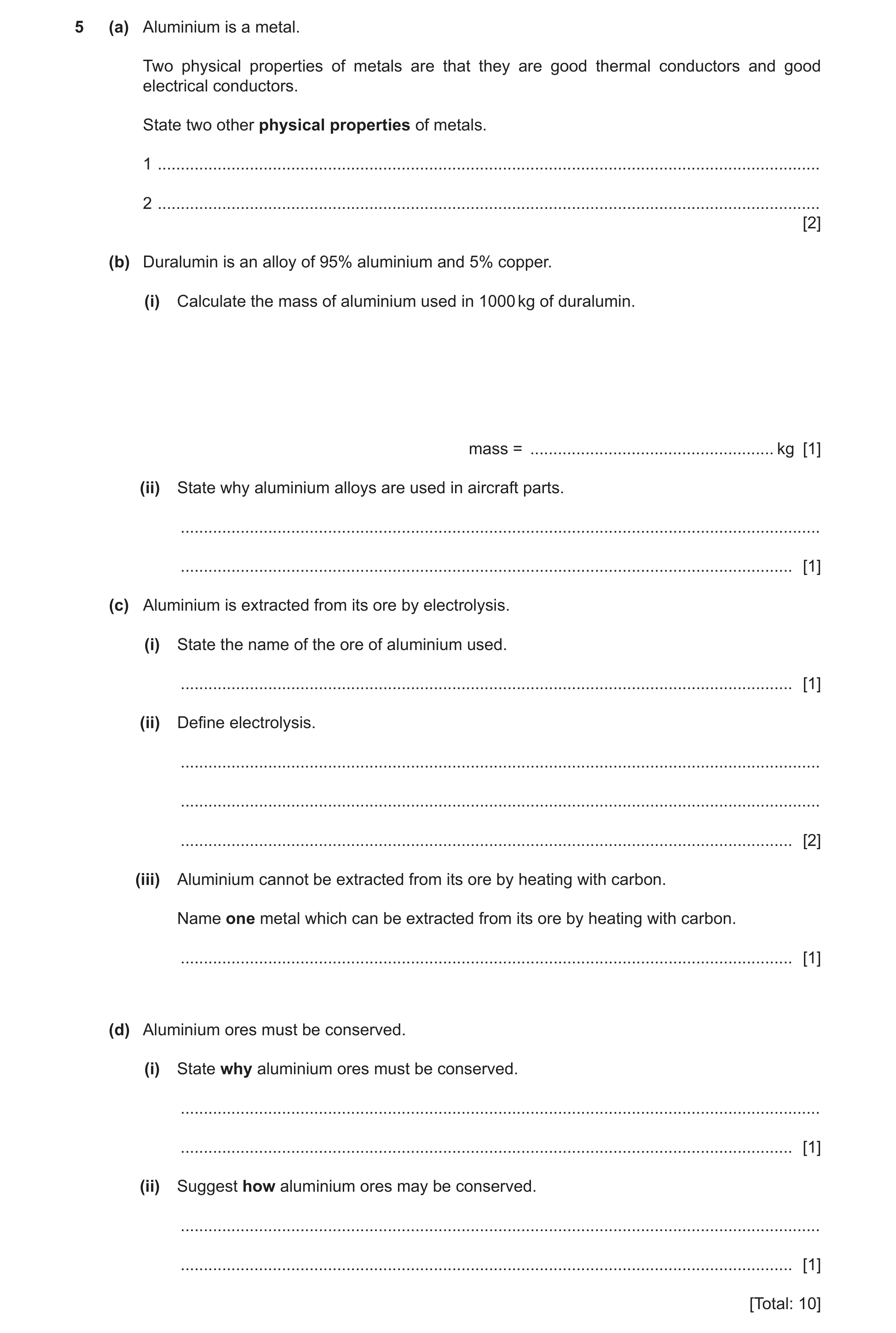
 22 / 28
 23 / 28
 24 / 28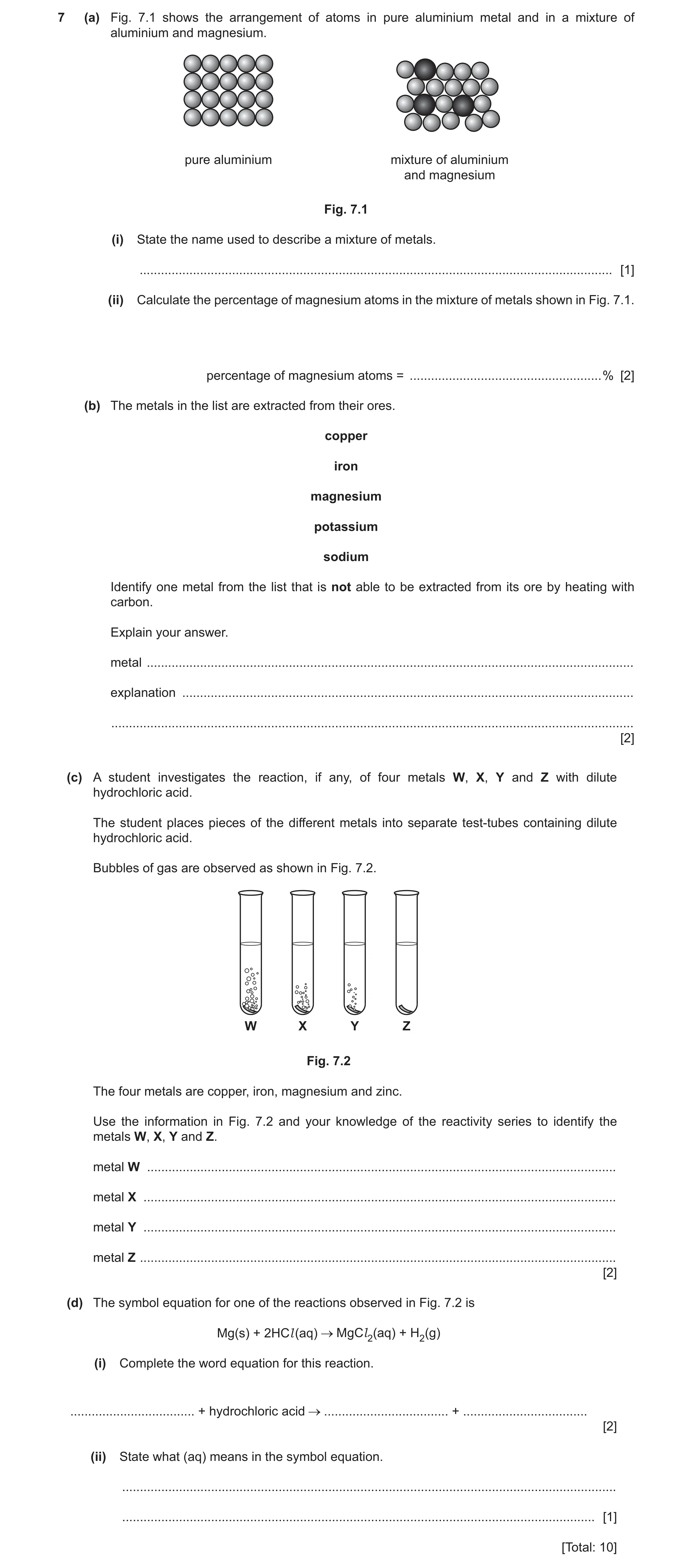
 12
12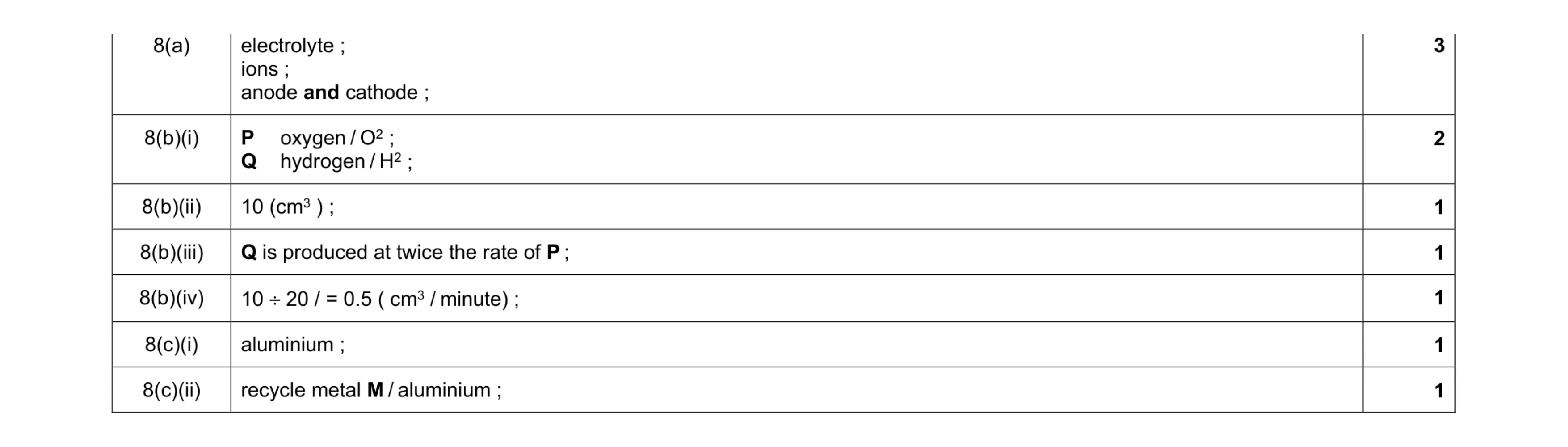 10
10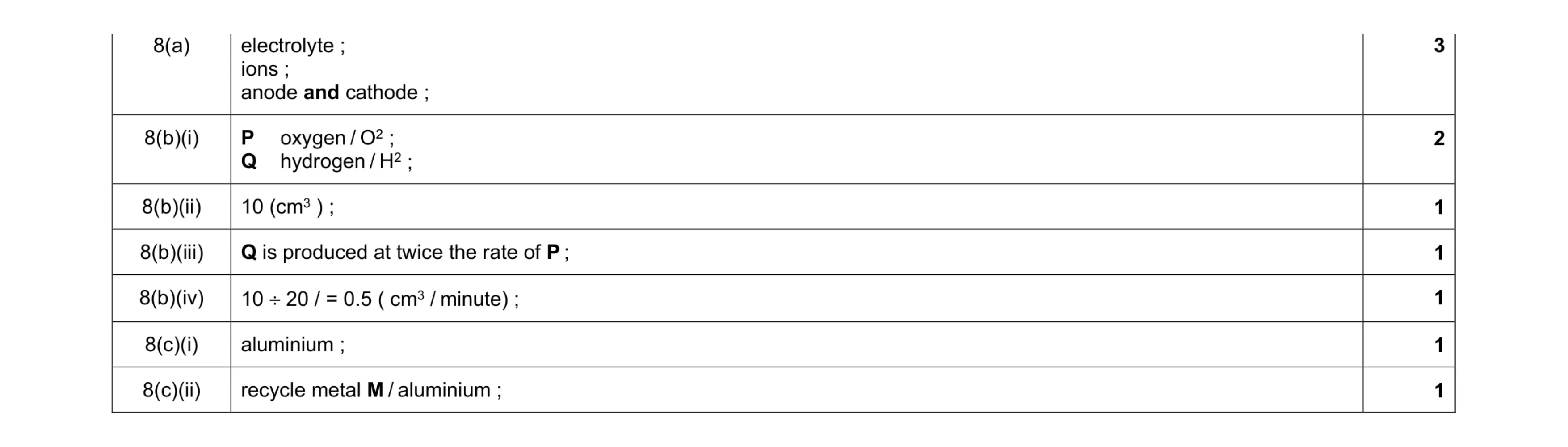 10
10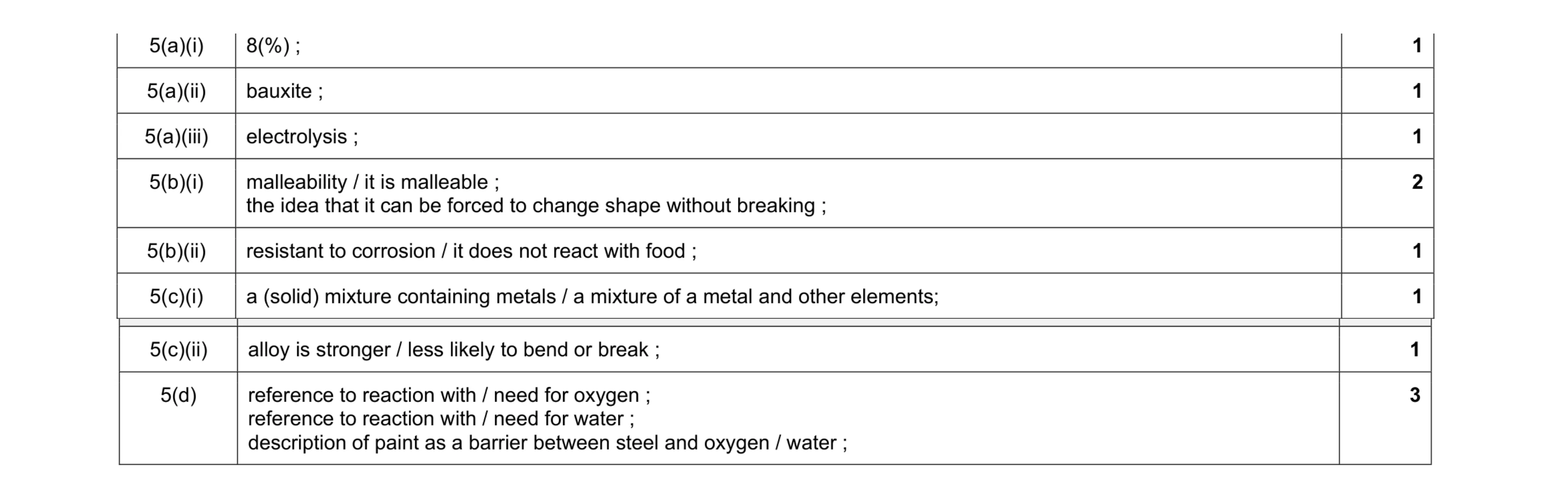 11
11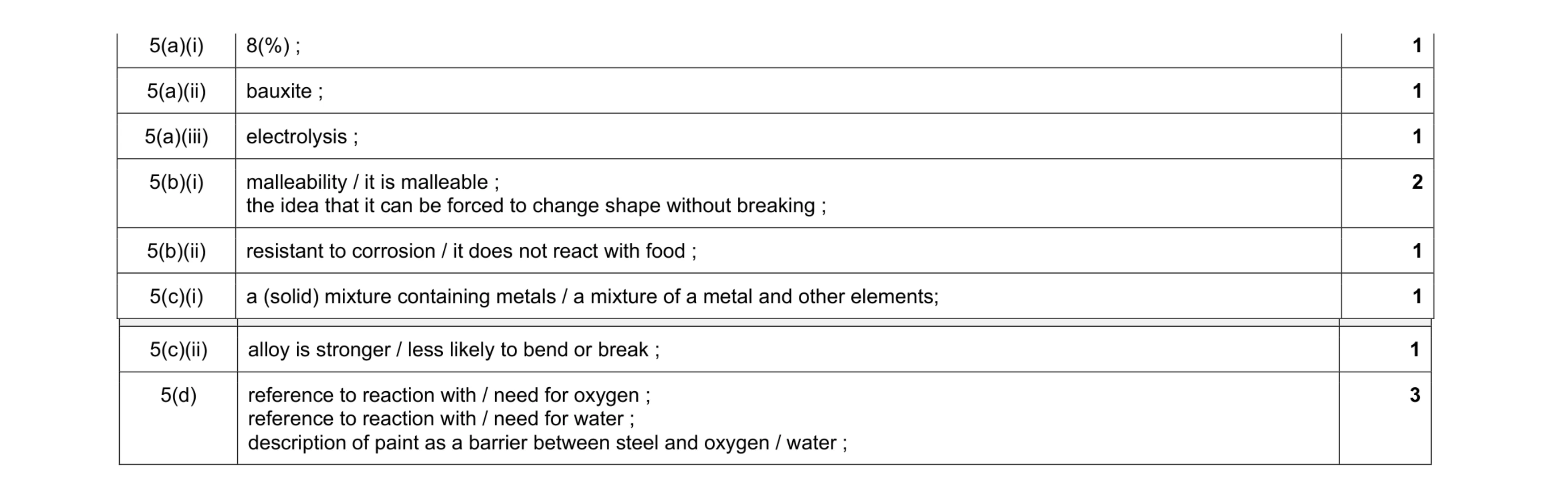 11
11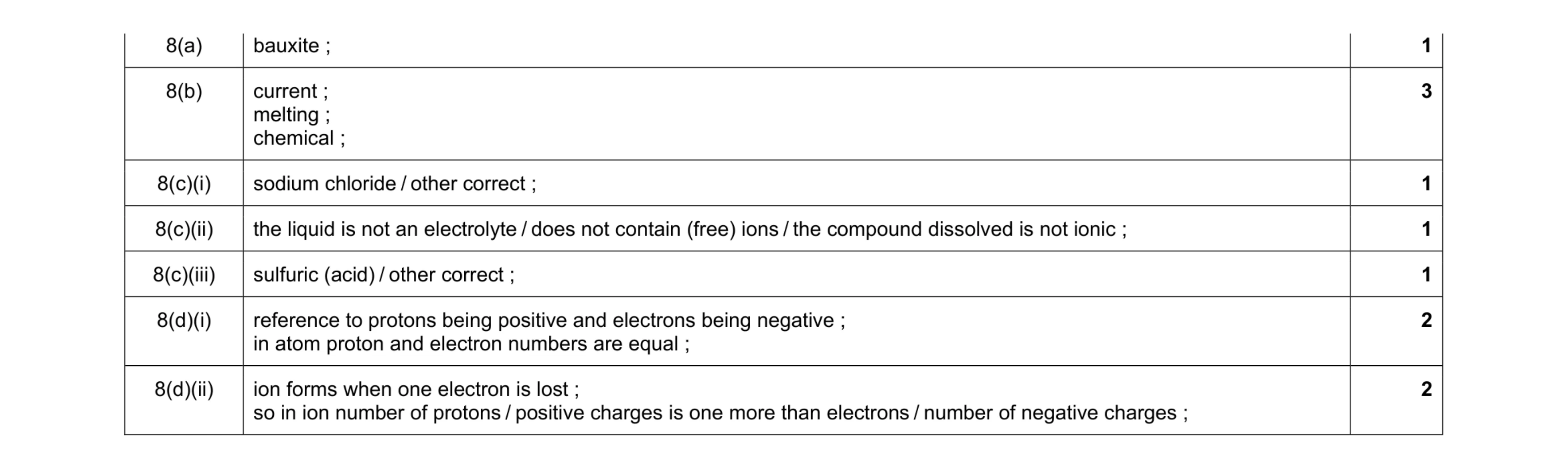 11
11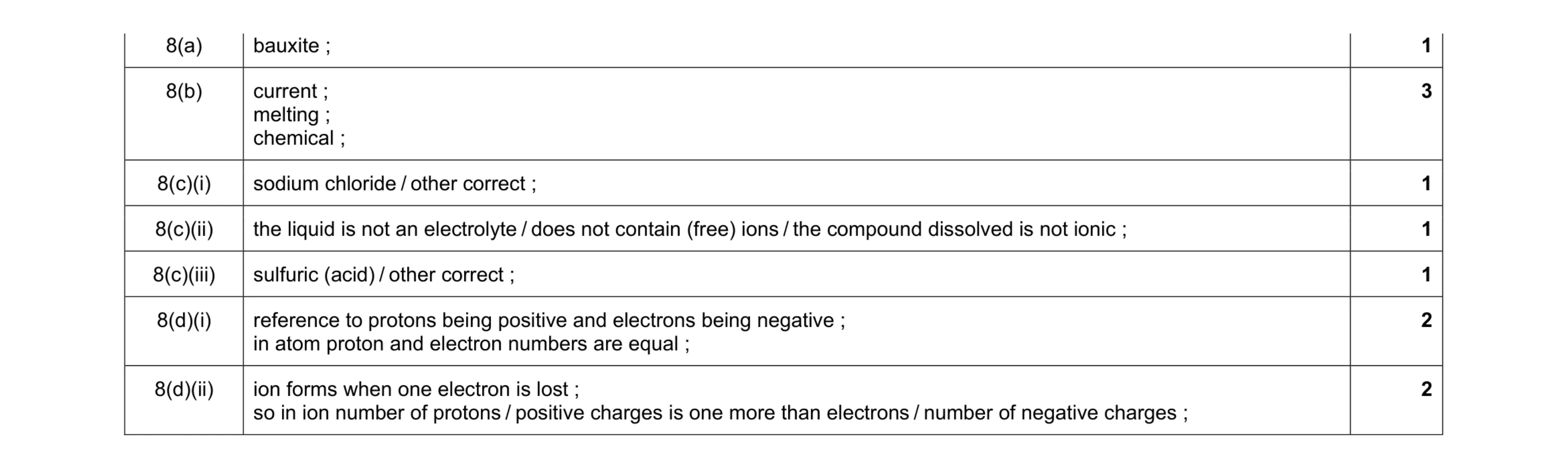 11
11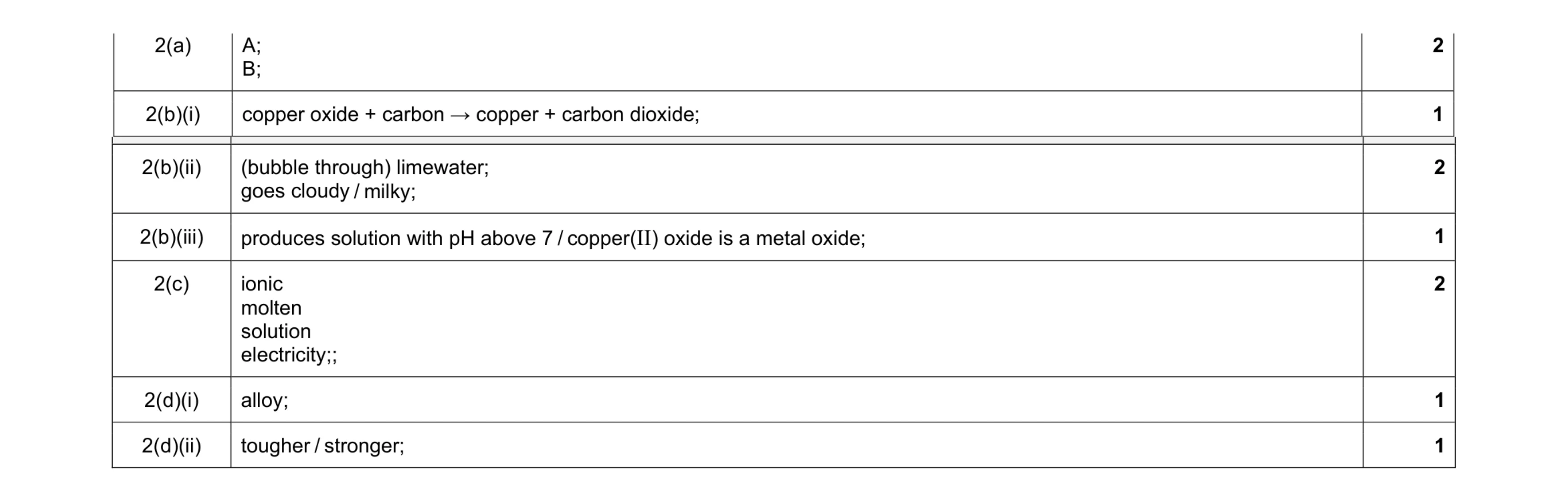 10
10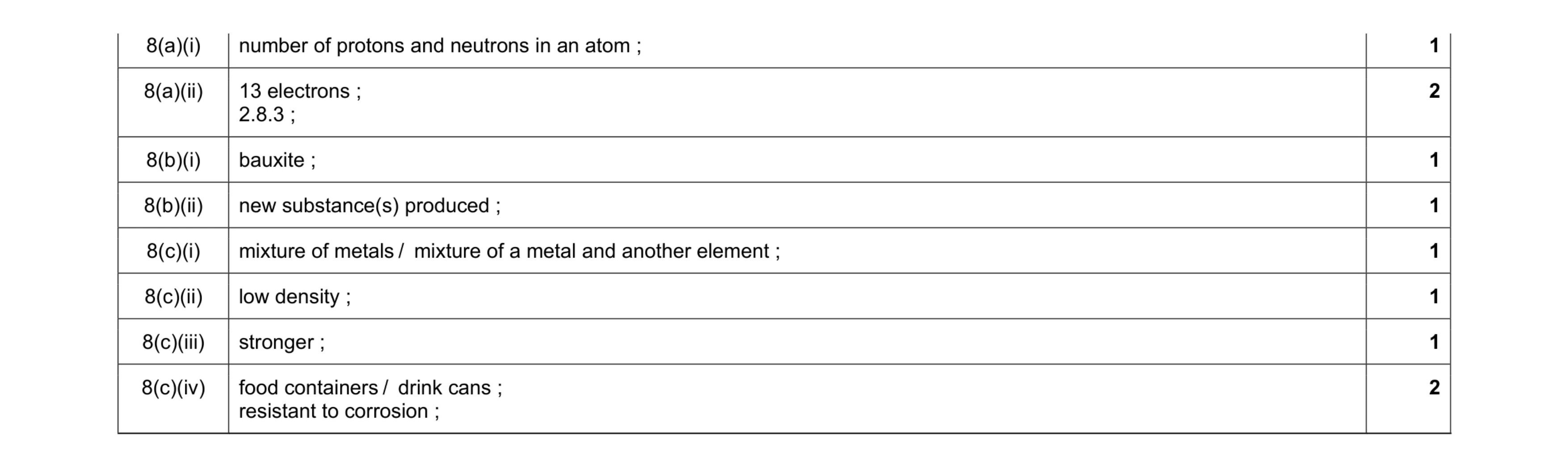 10
10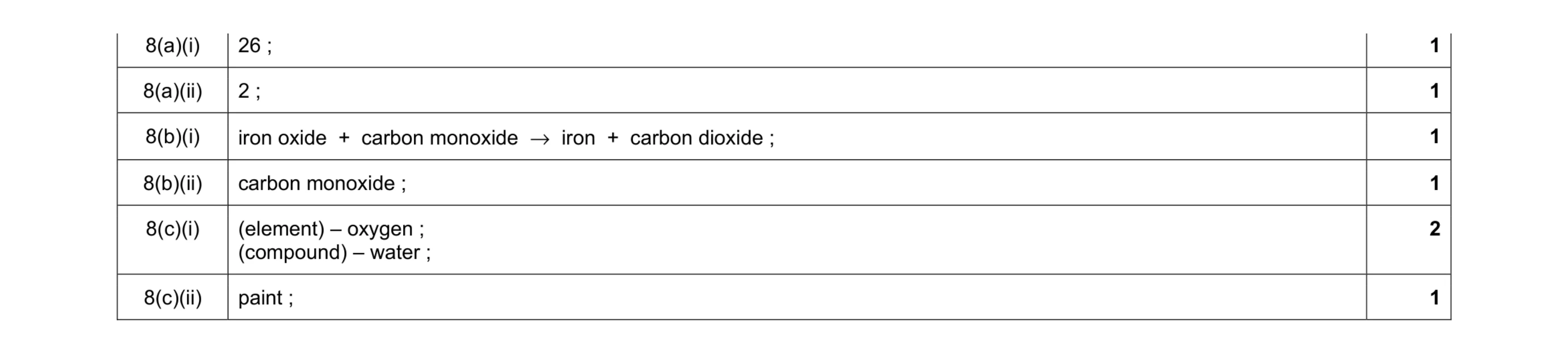 7
7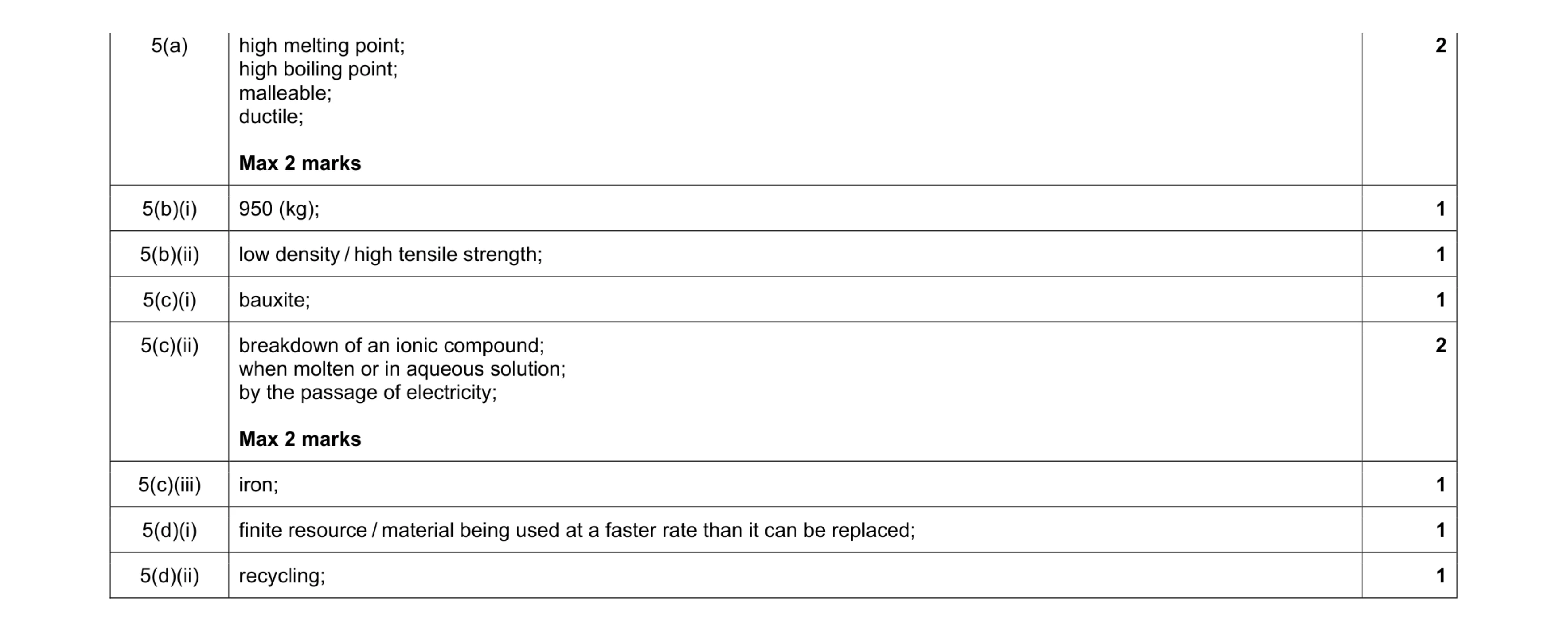 10
10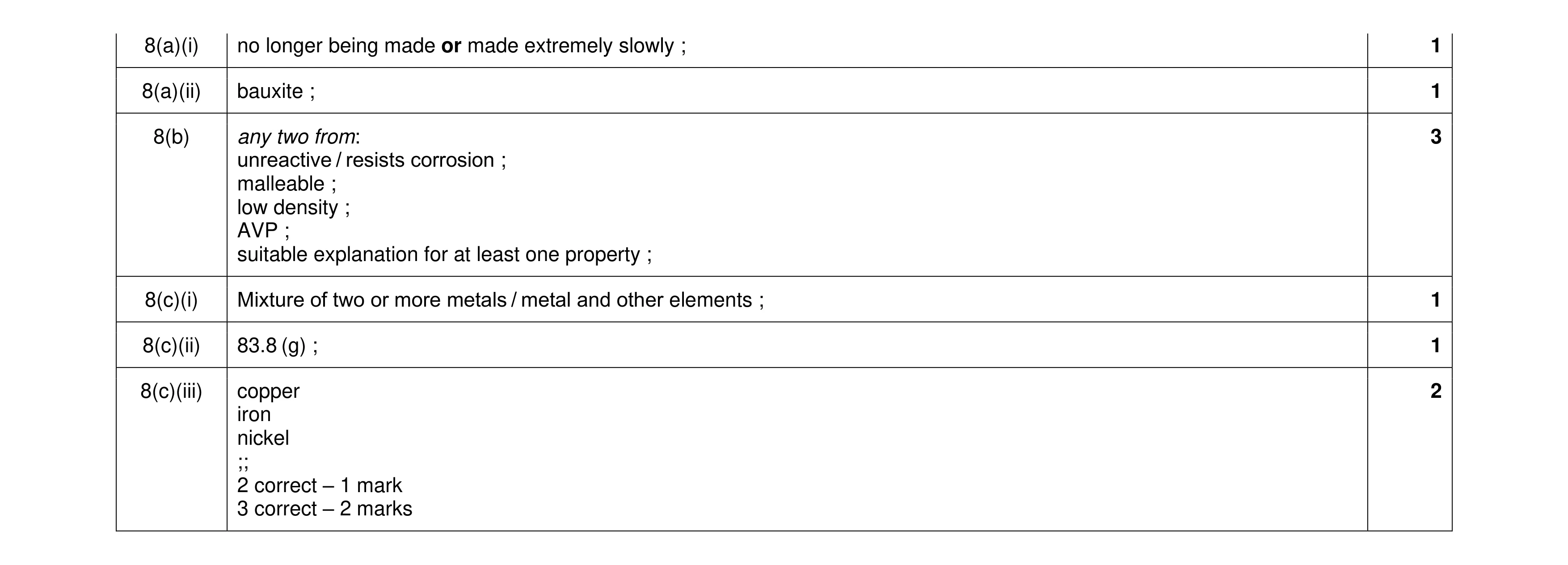 9
9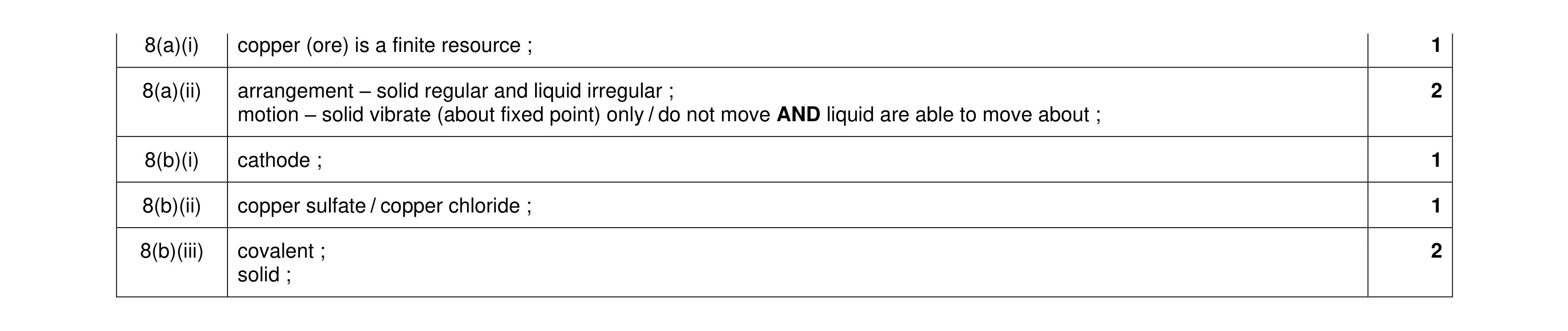 7
7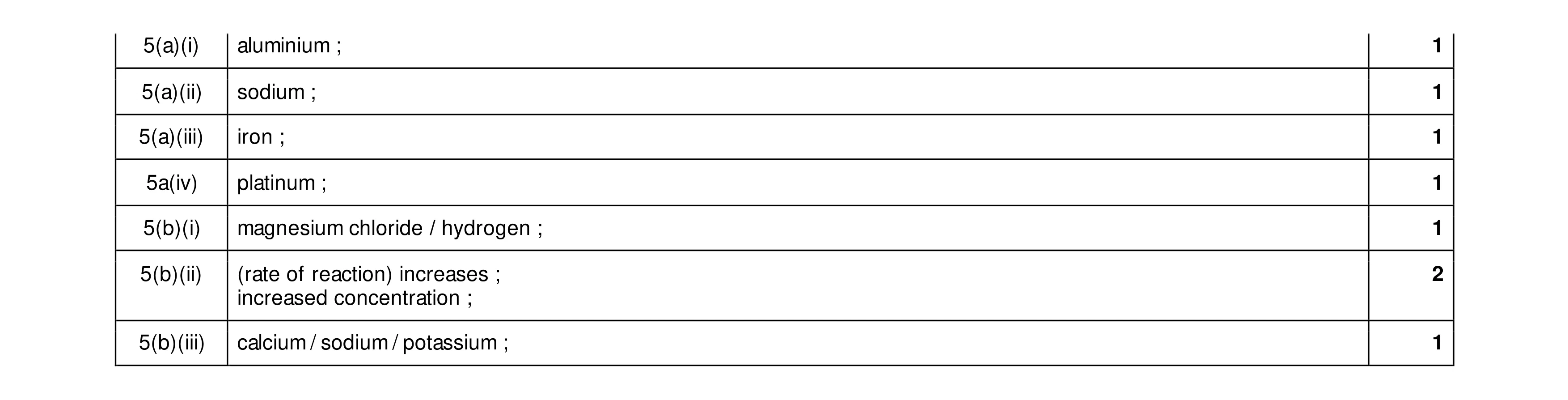 8
8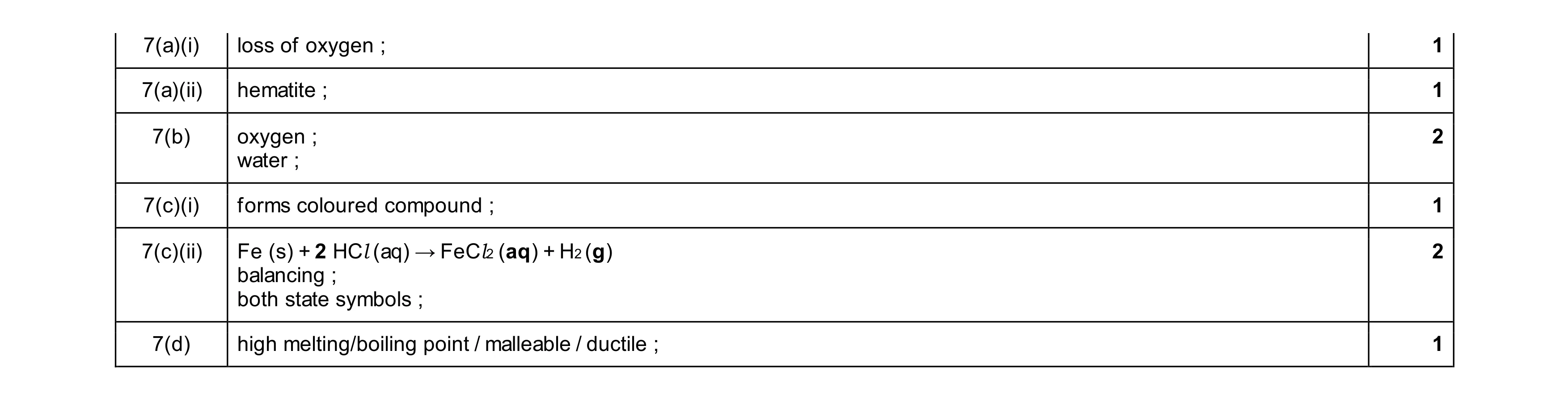 8
8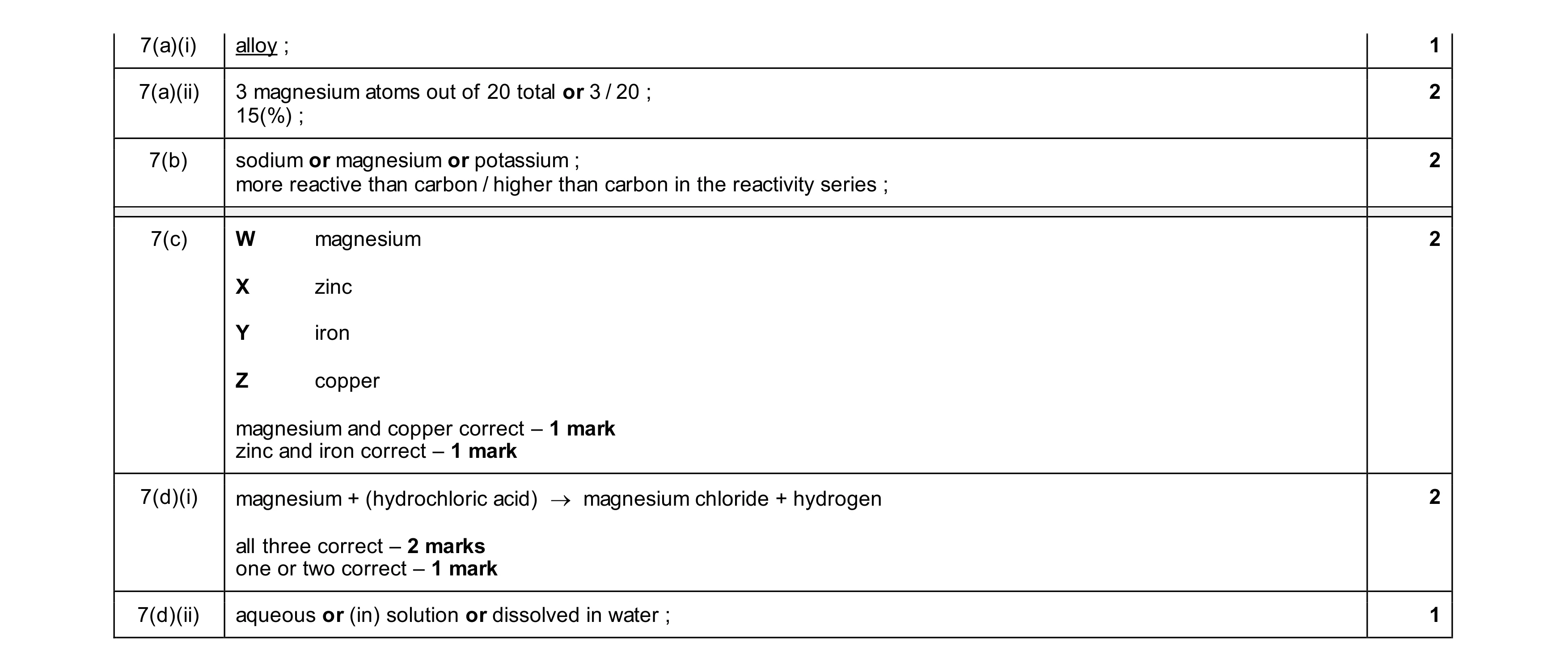 10
10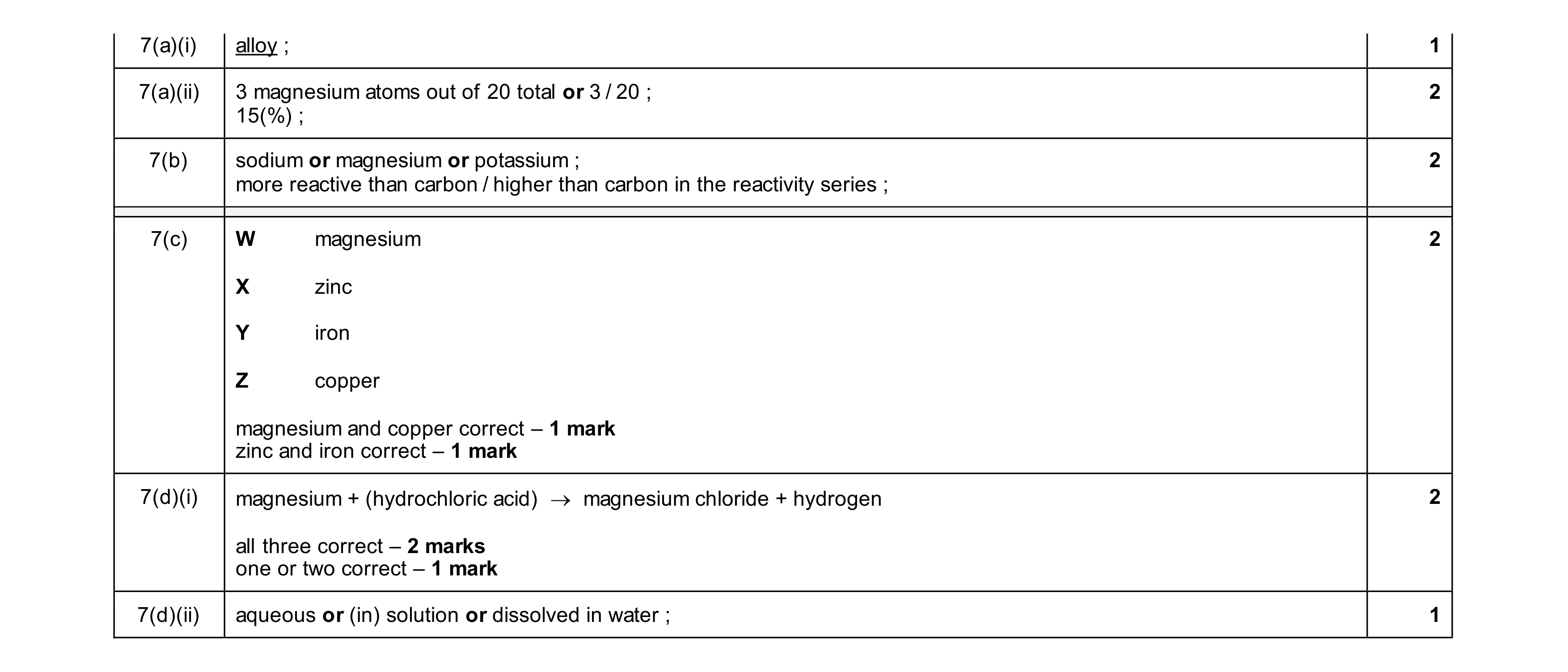 10
10