Questions as text
Q1 · Some particles in a mixture of gases 0654/42 Oct/Nov 2017
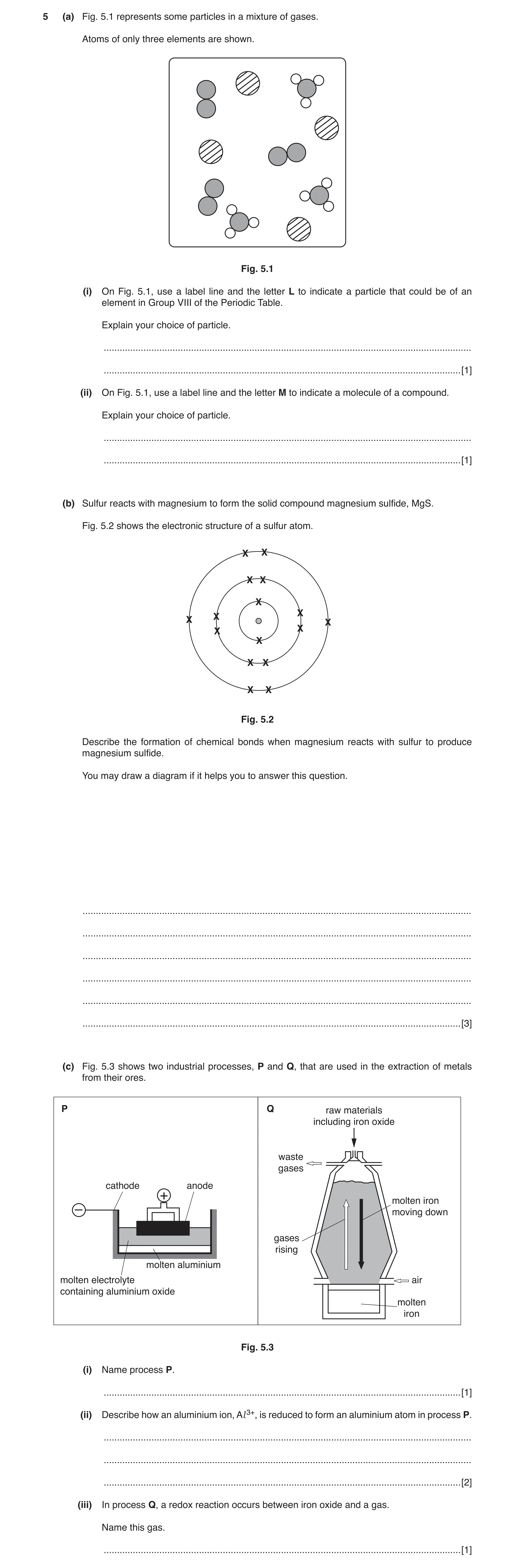
5 (a) Fig. 5.1 represents some particles in a mixture of gases. Atoms of only three elements are shown. Fig. 5.1 (i) On Fig. 5.1, use a label line and the letter L to indicate a particle that could be of an element in Group VIII of the Periodic Table. Explain your choice of particle. … … [1] (ii) On Fig. 5.1, use a label line and the letter M to indicate a molecule of a compound. Explain your choice of particle. … … [1] (b) Sulfur reacts with magnesium to form the solid compound magnesium sulfide, MgS. Fig. 5.2 shows the electronic structure of a sulfur atom. X X X X X X X X X X X X X X X X Fig. 5.2 Describe the formation of chemical bonds when magnesium reacts with sulfur to produce magnesium sulfide. You may draw a diagram if it helps you to answer this question. … … … … … … [3] (c) Fig. 5.3 shows two industrial processes, P and Q, that are used in the extraction of metals from their ores. P Q raw materials including iron oxide waste gases cathode anode + molten iron – moving down gases rising molten aluminium molten electrolyte air containing aluminium oxide molten iron Fig. 5.3 (i) Name process P. … [1] (ii) Describe how an aluminium ion, Al 3+, is reduced to form an aluminium atom in process P. … … … [2] (iii) In process Q, a redox reaction occurs between iron oxide and a gas. Name this gas. … [1]
9 marks
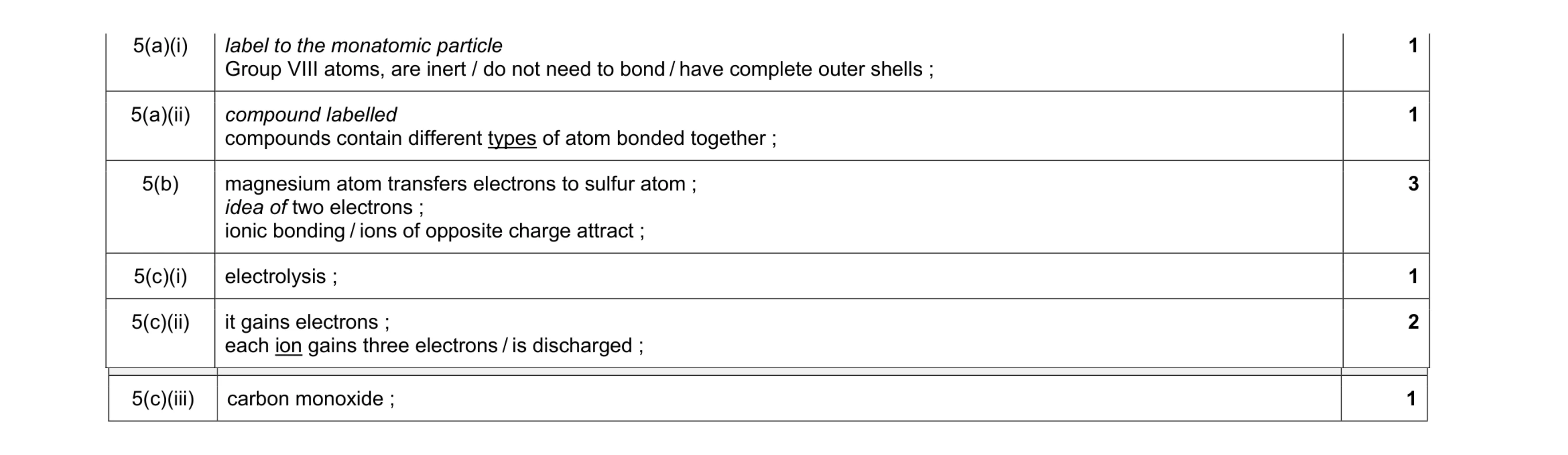
Mark scheme: 5(a)(i) label to the monatomic particle Group VIII atoms, are inert / do not need to bond / have complete outer shells ; 1 5(a)(ii) compound labelled compounds contain different types of atom bonded together ; 1 5(b) magnesium atom transfers electrons to sulfur atom ; idea of two electrons ; ionic bonding / ions of opposite charge attract ; 3 5(c)(i) electrolysis ; 1 5(c)(ii) it gains electrons ; each ion gains three electrons / is discharged ; 2 Question Answer Marks 5(c)(iii) carbon monoxide ; 1
This question in 0654/42 Oct/Nov 2017
Q2 · Five elements are listed in order of reactivity 0654/43 Oct/Nov 2018
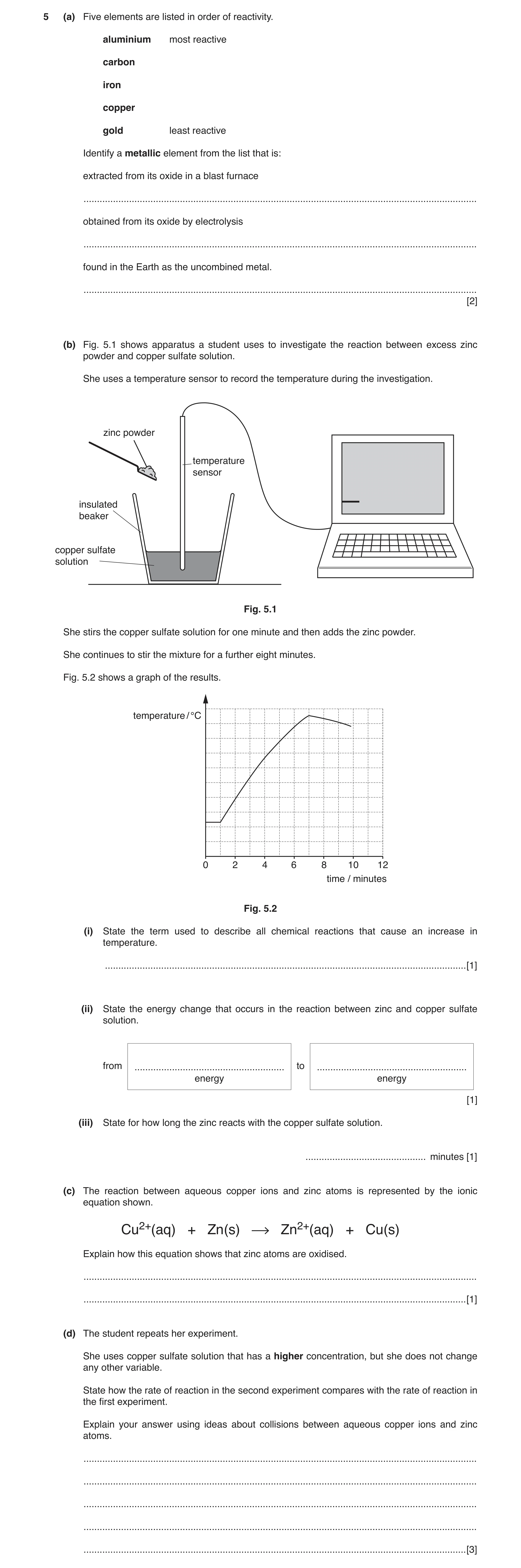
5 (a) Five elements are listed in order of reactivity. aluminium most reactive carbon iron copper gold least reactive Identify a metallic element from the list that is: extracted from its oxide in a blast furnace … obtained from its oxide by electrolysis … found in the Earth as the uncombined metal. … [2] (b) Fig. 5.1 shows apparatus a student uses to investigate the reaction between excess zinc powder and copper sulfate solution. She uses a temperature sensor to record the temperature during the investigation. zinc powder temperature sensor insulated beaker copper sulfate solution Fig. 5.1 She stirs the copper sulfate solution for one minute and then adds the zinc powder. She continues to stir the mixture for a further eight minutes. Fig. 5.2 shows a graph of the results. temperature / °C 0 2 4 6 8 10 12 time / minutes Fig. 5.2 (i) State the term used to describe all chemical reactions that cause an increase in temperature. … [1] (ii) State the energy change that occurs in the reaction between zinc and copper sulfate solution. from … to … energy energy [1] (iii) State for how long the zinc reacts with the copper sulfate solution. … minutes [1] (c) The reaction between aqueous copper ions and zinc atoms is represented by the ionic equation shown. Cu2+(aq) + Zn(s) Zn2+(aq) + Cu(s) Explain how this equation shows that zinc atoms are oxidised. … … [1] (d) The student repeats her experiment. She uses copper sulfate solution that has a higher concentration, but she does not change any other variable. State how the rate of reaction in the second experiment compares with the rate of reaction in the first experiment. Explain your answer using ideas about collisions between aqueous copper ions and zinc atoms. … … … … … [3]
9 marks
Mark scheme: 5(a) iron aluminium gold / copper 1 or 2 correct ; 3 correct ; 2 5(b)(i) exothermic ; 1 5(b)(ii) chemical (potential) to thermal ; 1 5(b)(iii) 6 ; 1 5(c) zinc atoms lose electrons ; 1 5(d) rate is higher ; higher concentration means more copper ions per volume / more ions near the zinc at any one time ; increased frequency of collision (of copper ions and zinc atoms surface) / increased chance of collisions ; 3
This question in 0654/43 Oct/Nov 2018
Q3 · Carbon is used to extract zinc from zinc oxide, ZnO 0654/41 May/June 2019
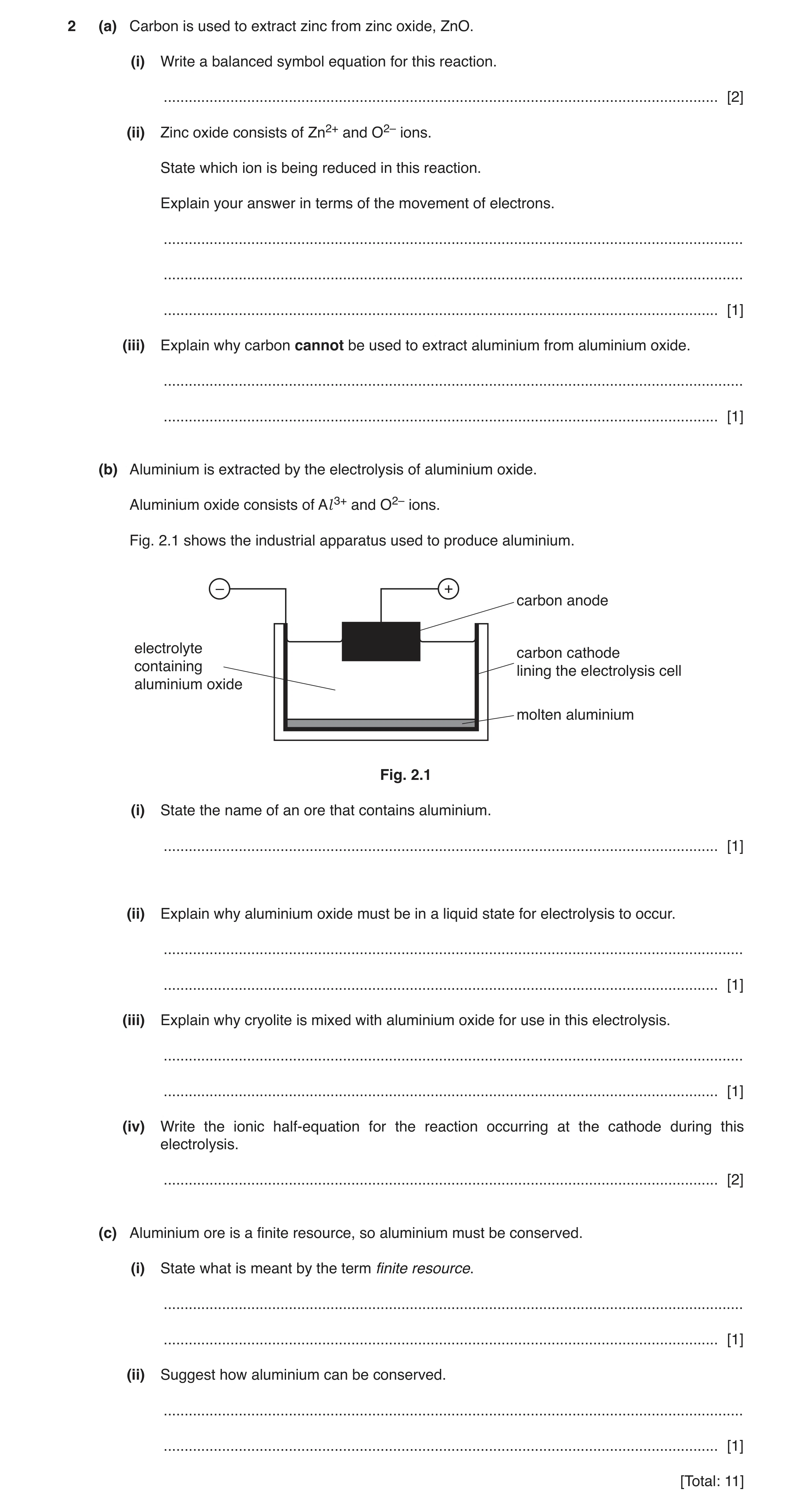
2 (a) Carbon is used to extract zinc from zinc oxide, ZnO. (i) Write a balanced symbol equation for this reaction. … [2] (ii) Zinc oxide consists of Zn2+ and O2– ions. State which ion is being reduced in this reaction. Explain your answer in terms of the movement of electrons. … … … [1] (iii) Explain why carbon cannot be used to extract aluminium from aluminium oxide. … … [1] (b) Aluminium is extracted by the electrolysis of aluminium oxide. Aluminium oxide consists of Al 3+ and O2– ions. Fig. 2.1 shows the industrial apparatus used to produce aluminium. – + carbon anode electrolyte carbon cathode containing lining the electrolysis cell aluminium oxide molten aluminium Fig. 2.1 (i) State the name of an ore that contains aluminium. … [1] (ii) Explain why aluminium oxide must be in a liquid state for electrolysis to occur. … … [1] (iii) Explain why cryolite is mixed with aluminium oxide for use in this electrolysis. … … [1] (iv) Write the ionic half-equation for the reaction occurring at the cathode during this electrolysis. … [2] (c) Aluminium ore is a finite resource, so aluminium must be conserved. (i) State what is meant by the term finite resource. … … [1] (ii) Suggest how aluminium can be conserved. … … [1] [Total: 11]
11 marks
Mark scheme: 2(a)(i) formulae ; balanced ; 2 2(a)(ii) zinc (ions) / Zn2+ gain electrons ; 1 2(a)(iii) carbon is less reactive than aluminium ; 1 2(b)(i) bauxite ; 1 2(b)(ii) for mobility of ions ; 1 2(b)(iii) (aluminium oxide is dissolved in molten cryolite) to reduce melting point ; 1 2(b)(iv) Al3+ + 3e– Æ Al correct charges on Al ; correct number of electrons ; 2 2(c)(i) non-renewable / will run out / used faster than formed ; 1 2(c)(ii) recycle / example of recycling ; 1
This question in 0654/41 May/June 2019
Q4 · A blast furnace used to extract iron from iron oxide 0654/43 May/June 2019
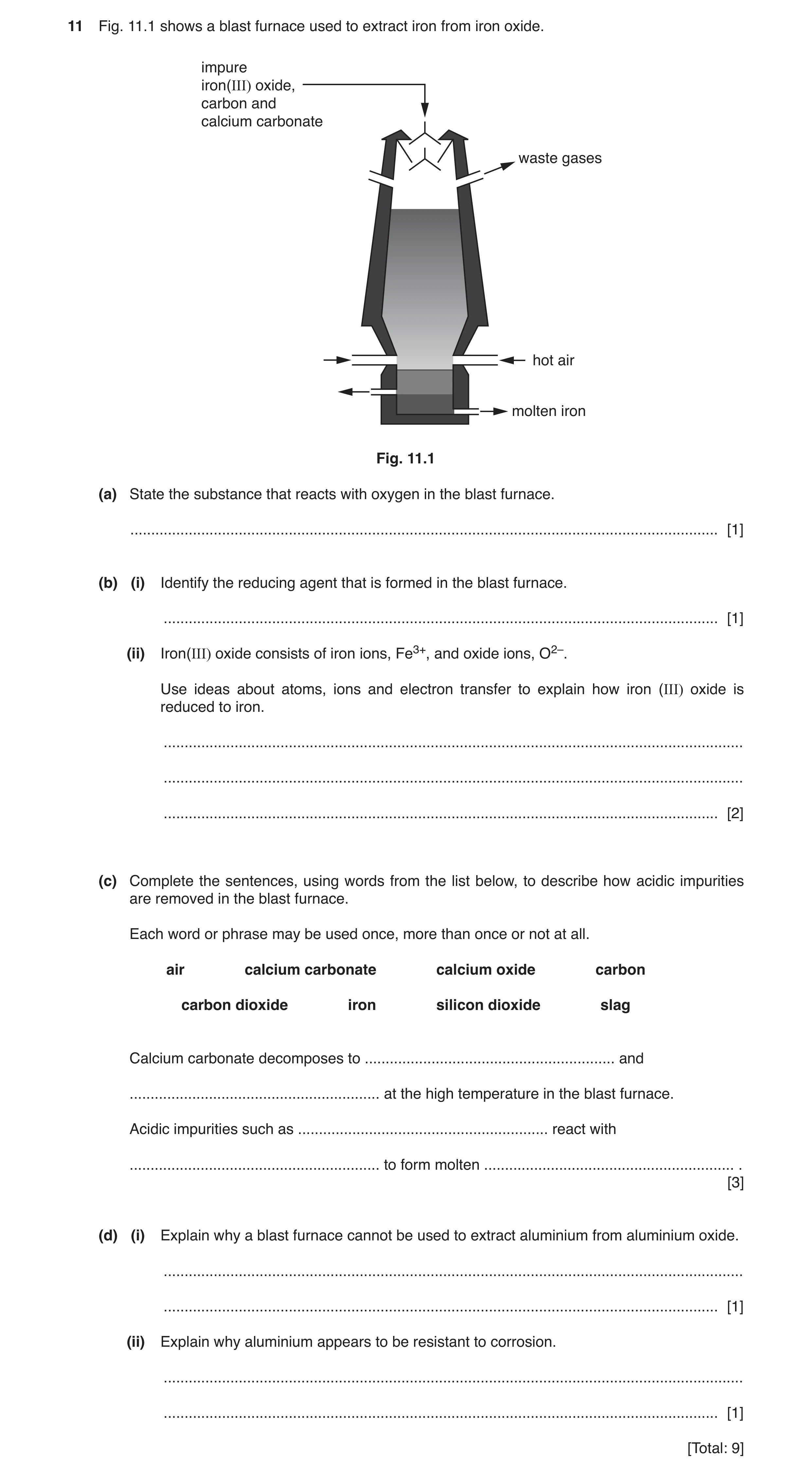
11 Fig. 11.1 shows a blast furnace used to extract iron from iron oxide. impure iron(III) oxide, carbon and calcium carbonate waste gases hot air molten iron Fig. 11.1 (a) State the substance that reacts with oxygen in the blast furnace. … [1] (b) (i) Identify the reducing agent that is formed in the blast furnace. … [1] (ii) Iron(III) oxide consists of iron ions, Fe3+, and oxide ions, O2–. Use ideas about atoms, ions and electron transfer to explain how iron (III) oxide is reduced to iron. … … … [2] (c) Complete the sentences, using words from the list below, to describe how acidic impurities are removed in the blast furnace. Each word or phrase may be used once, more than once or not at all. air calcium carbonate calcium oxide carbon carbon dioxide iron silicon dioxide slag Calcium carbonate decomposes to … and … at the high temperature in the blast furnace. Acidic impurities such as … react with … to form molten … . [3] (d) (i) Explain why a blast furnace cannot be used to extract aluminium from aluminium oxide. … … [1] (ii) Explain why aluminium appears to be resistant to corrosion. … … [1] [Total: 9]
9 marks
Mark scheme: 11(a) carbon / coke ; 1 11(b)(i) carbon monoxide ; 1 11(b)(ii) Fe3+ / iron ions gain electrons ; forming Fe / iron atoms ; 2 11(c) calcium oxide and carbon dioxide ; silicon dioxide and calcium oxide ; slag ; 3 11(d)(i) aluminium is too reactive ; 1 11(d)(ii) oxide layer on surface ; 1
This question in 0654/43 May/June 2019
Q5 · Limestone consists mainly of calcium carbonate 0654/41 Oct/Nov 2019
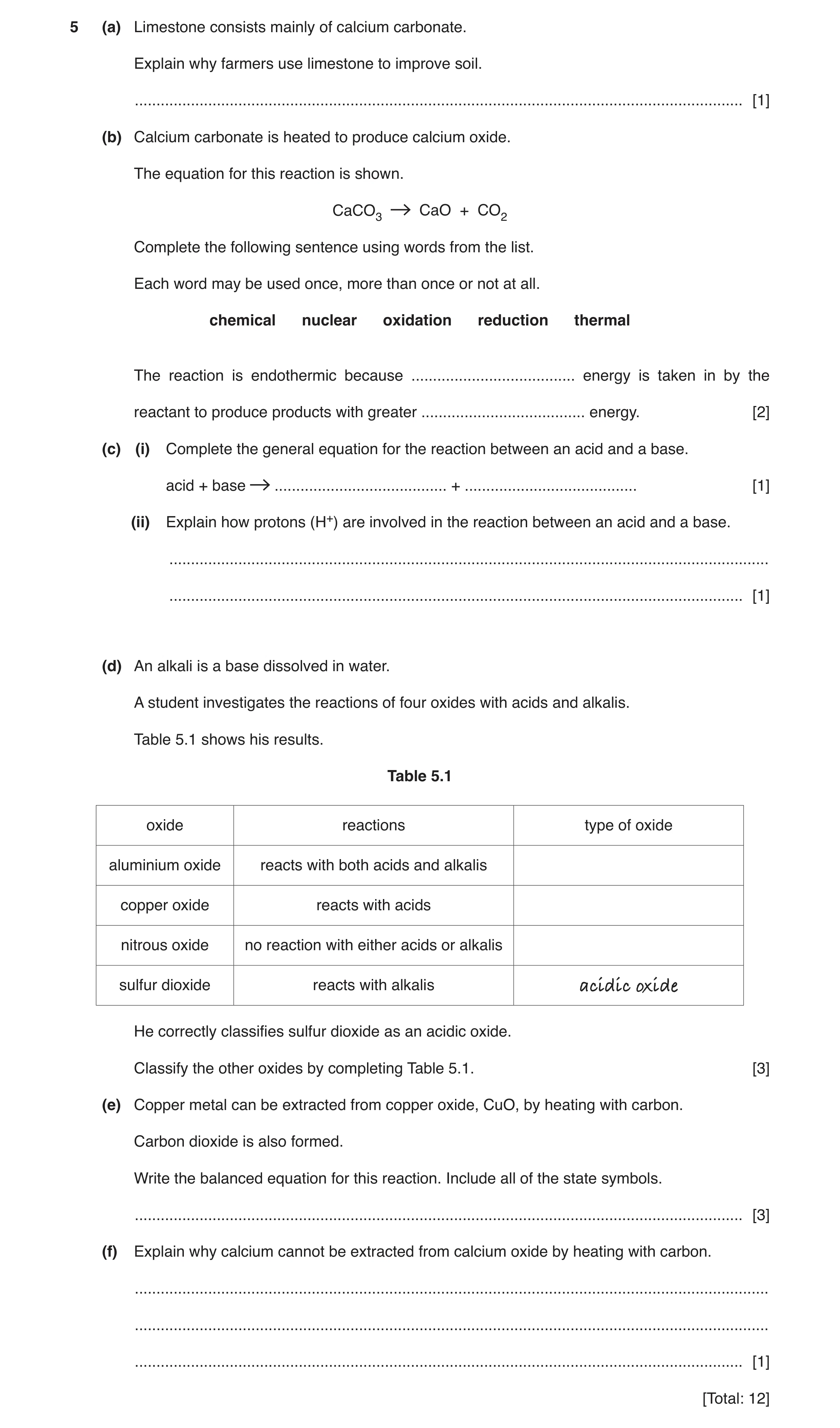
5 (a) Limestone consists mainly of calcium carbonate. Explain why farmers use limestone to improve soil. … [1] (b) Calcium carbonate is heated to produce calcium oxide. The equation for this reaction is shown. CaCO3 CaO + CO2 Complete the following sentence using words from the list. Each word may be used once, more than once or not at all. chemical nuclear oxidation reduction thermal The reaction is endothermic because … energy is taken in by the reactant to produce products with greater … energy. [2] (c) (i) Complete the general equation for the reaction between an acid and a base. acid + base … + … [1] (ii) Explain how protons (H+) are involved in the reaction between an acid and a base. … … [1] (d) An alkali is a base dissolved in water. A student investigates the reactions of four oxides with acids and alkalis. Table 5.1 shows his results. Table 5.1 oxide reactions type of oxide aluminium oxide reacts with both acids and alkalis copper oxide reacts with acids nitrous oxide no reaction with either acids or alkalis sulfur dioxide reacts with alkalis acidic oxide He correctly classifies sulfur dioxide as an acidic oxide. Classify the other oxides by completing Table 5.1. [3] (e) Copper metal can be extracted from copper oxide, CuO, by heating with carbon. Carbon dioxide is also formed. Write the balanced equation for this reaction. Include all of the state symbols. … [3] (f) Explain why calcium cannot be extracted from calcium oxide by heating with carbon. … … … [1] [Total: 12]
12 marks
Mark scheme: 5(a) reduces acidity ; 1 5(b) thermal ; chemical ; 2 5(c)(i) → salt + water ; 1 5(c)(ii) protons / H+ transferred from acid to base ; 1 5(d) amphoteric ; basic ; neutral ; 3 5(e) 2CuO(s) + C(s) → 2Cu(s) + CO2(g) formulae ; state symbols ; balancing ; 3 5(f) calcium more reactive than carbon ; 1
This question in 0654/41 Oct/Nov 2019
Q6 · Aluminium is used to make aircraft parts 0654/42 May/June 2020
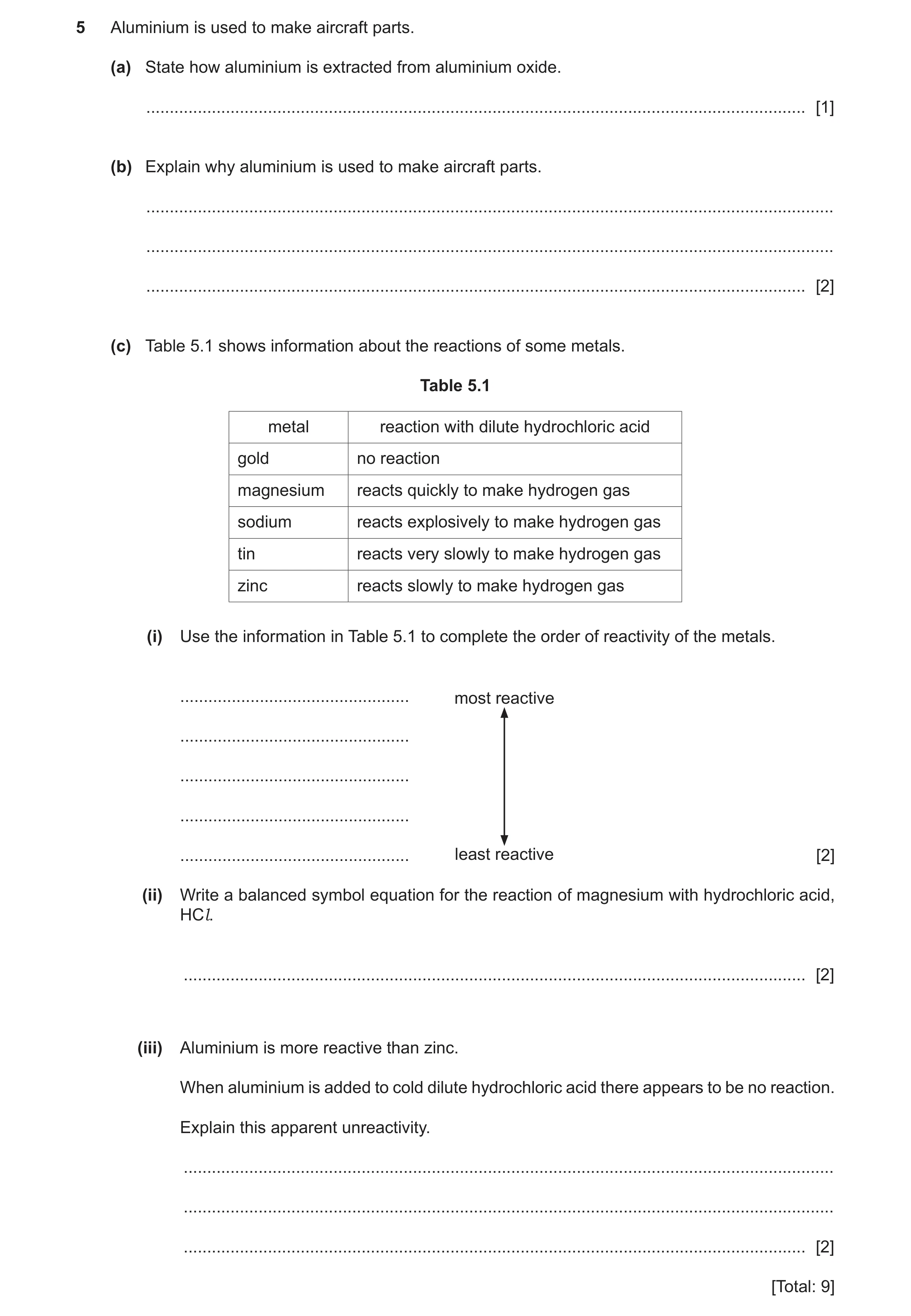
5 Aluminium is used to make aircraft parts. (a) State how aluminium is extracted from aluminium oxide. … [1] (b) Explain why aluminium is used to make aircraft parts. … … … [2] (c) Table 5.1 shows information about the reactions of some metals. Table 5.1 metal reaction with dilute hydrochloric acid gold no reaction magnesium reacts quickly to make hydrogen gas sodium reacts explosively to make hydrogen gas tin reacts very slowly to make hydrogen gas zinc reacts slowly to make hydrogen gas (i) Use the information in Table 5.1 to complete the order of reactivity of the metals. … most reactive … … … … least reactive [2] (ii) Write a balanced symbol equation for the reaction of magnesium with hydrochloric acid, HCl. … [2] (iii) Aluminium is more reactive than zinc. When aluminium is added to cold dilute hydrochloric acid there appears to be no reaction. Explain this apparent unreactivity. … … … [2] [Total: 9]
9 marks
Mark scheme: 5(a) electrolysis; 1 5(b) strong ; low density ; 2 5(c)(i) order of reactivity (most to least): sodium magnesium zinc tin gold ;; 2 Question Answer Marks 5(c)(ii) Mg + 2HCl → MgCl2 + H2 correct formulae; correctly balanced; 2 5(c)(iii) (aluminium) reacts with oxygen to form an oxide layer / aluminium oxide ; (oxide layer) adheres to the metal / does not flake off ; 2
This question in 0654/42 May/June 2020
Q7 · The equations A, B, C and D represent four possible reactions 0654/43 Oct/Nov 2020
11 (a) The equations A, B, C and D represent four possible reactions. equation A Zn + Cu2+ Zn2+ + Cu equation B Cu – 2e– Cu2+ equation C Cu2+ + 2e– Cu equation D Cu2+ + 2OH– Cu(OH)2 (i) State which equation A, B, C or D represents only oxidation. … [1] (ii) State which equation A, B, C or D represents both oxidation and reduction. … [1] (iii) Copper is purified by using electrolysis of copper sulfate solution. Fig. 11.1 shows the apparatus used. + – impure copper pure copper anode cathode copper sulfate solution Fig. 11.1 State which equation A, B, C or D represents the reaction that takes place at the cathode. … [1] (b) Copper is extracted from copper oxide by heating copper oxide with carbon. 2CuO + C 2Cu + CO2 CuO acts as an oxidising agent in this reaction. Define the term oxidising agent. … … [1] (c) Aluminium is extracted from its purified ore by electrolysis. Fig. 11.2 shows the equipment that is used. + graphite anode – compound containing steel case aluminium graphite cathode molten aluminium Fig. 11.2 Describe how aluminium is extracted from its purified ore. Include in your answer: • the name of the compound containing aluminium • what is made at each electrode. … … … … [3] [Total: 7]
7 marks
Mark scheme: 11(a)(i) B ; 1 11(a)(ii) A ; 1 11(a)(iii) C ; 1 11(b) (substance which) gives oxygen to / removes / gains electrons (from another substance during a redox reaction) ; 1 11(c) (molten) aluminium oxide ; oxygen at the anode ; aluminium at the cathode ; 3
This question in 0654/43 Oct/Nov 2020
Q8 · Sodium, Na, is an element in Group I of the Periodic Table 0654/42 Feb/March 2021
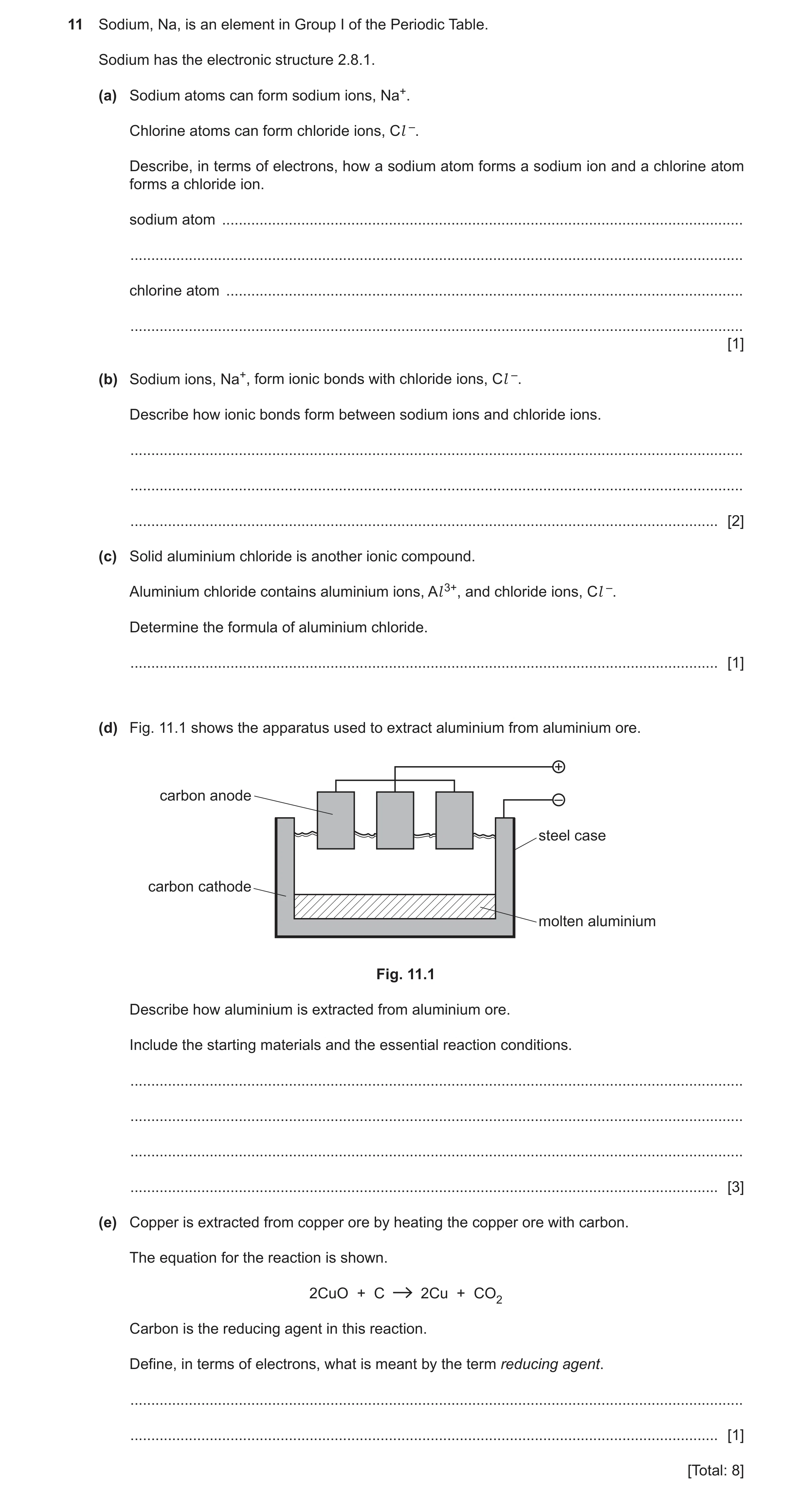
11 Sodium, Na, is an element in Group I of the Periodic Table. Sodium has the electronic structure 2.8.1. (a) Sodium atoms can form sodium ions, Na+. Chlorine atoms can form chloride ions, Cl –. Describe, in terms of electrons, how a sodium atom forms a sodium ion and a chlorine atom forms a chloride ion. sodium atom … … chlorine atom … … [1] (b) Sodium ions, Na+, form ionic bonds with chloride ions, Cl –. Describe how ionic bonds form between sodium ions and chloride ions. … … … [2] (c) Solid aluminium chloride is another ionic compound. Aluminium chloride contains aluminium ions, Al 3+, and chloride ions, Cl –. Determine the formula of aluminium chloride. … [1] (d) Fig. 11.1 shows the apparatus used to extract aluminium from aluminium ore. + carbon anode – steel case carbon cathode molten aluminium Fig. 11.1 Describe how aluminium is extracted from aluminium ore. Include the starting materials and the essential reaction conditions. … … … … [3] (e) Copper is extracted from copper ore by heating the copper ore with carbon. The equation for the reaction is shown. 2CuO + C 2Cu + CO2 Carbon is the reducing agent in this reaction. Define, in terms of electrons, what is meant by the term reducing agent. … … [1] [Total: 8]
8 marks
Mark scheme: 11(a) (sodium atom) loses one electron and (chlorine atom) gains one electron ; 1 11(b) electrostatic attraction ; between oppositely charged ions ; 2 11(c) AlCl3 ; 1 11(d) any three from: molten aluminium oxide / alumina, and cryolite ; cryolite lowers melting point of, aluminium oxide / alumina ; electrolysis / use of electricity ; high temperature to melt, aluminium oxide / alumina ; 3 11(e) (species that) loses or donates electrons ; 1
This question in 0654/42 Feb/March 2021
Q9 · Different methods can be used to extract metals from their ores 0654/43 May/June 2021
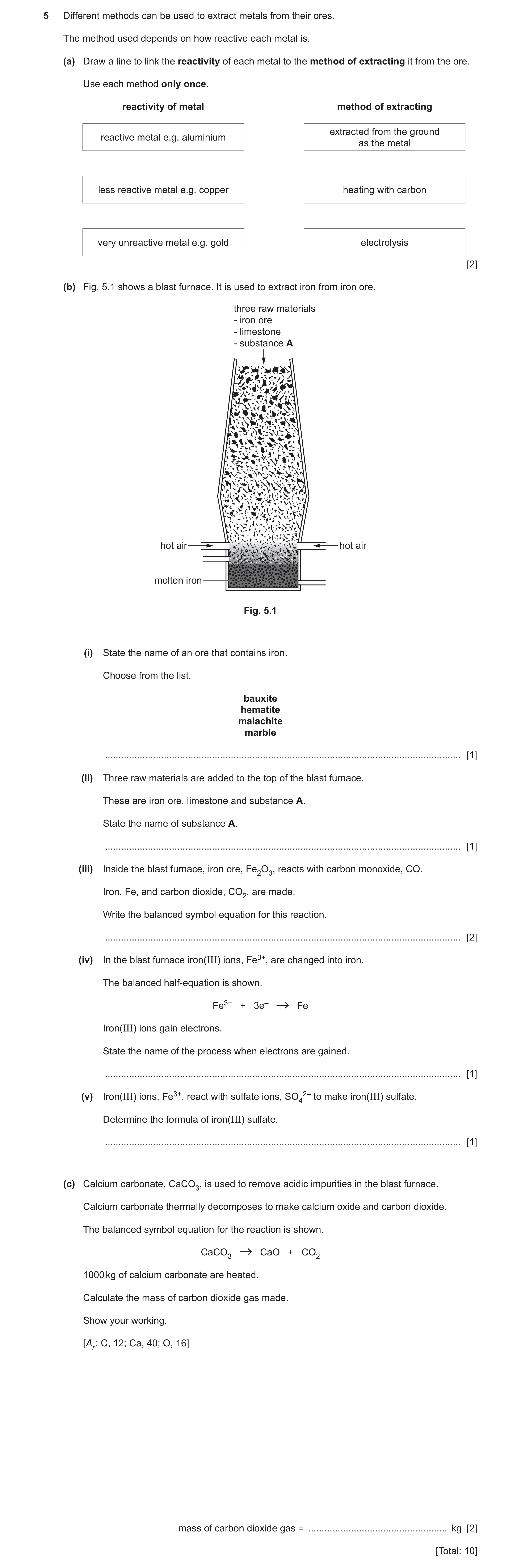
5 Different methods can be used to extract metals from their ores. The method used depends on how reactive each metal is. (a) Draw a line to link the reactivity of each metal to the method of extracting it from the ore. Use each method only once. reactivity of metal method of extracting extracted from the ground reactive metal e.g. aluminium as the metal less reactive metal e.g. copper heating with carbon very unreactive metal e.g. gold electrolysis [2] (b) Fig. 5.1 shows a blast furnace. It is used to extract iron from iron ore. three raw materials - iron ore - limestone - substance A hot air hot air molten iron Fig. 5.1 (i) State the name of an ore that contains iron. Choose from the list. bauxite hematite malachite marble … [1] (ii) Three raw materials are added to the top of the blast furnace. These are iron ore, limestone and substance A. State the name of substance A. … [1] (iii) Inside the blast furnace, iron ore, Fe2O3, reacts with carbon monoxide, CO. Iron, Fe, and carbon dioxide, CO2, are made. Write the balanced symbol equation for this reaction. … [2] (iv) In the blast furnace iron(III) ions, Fe3+, are changed into iron. The balanced half-equation is shown. Fe3+ + 3e– Fe Iron(III) ions gain electrons. State the name of the process when electrons are gained. … [1] (v) Iron(III) ions, Fe3+, react with sulfate ions, SO42– to make iron(III) sulfate. Determine the formula of iron(III) sulfate. … [1] (c) Calcium carbonate, CaCO3, is used to remove acidic impurities in the blast furnace. Calcium carbonate thermally decomposes to make calcium oxide and carbon dioxide. The balanced symbol equation for the reaction is shown. CaCO3 CaO + CO2 1000 kg of calcium carbonate are heated. Calculate the mass of carbon dioxide gas made. Show your working. [Ar : C, 12; Ca, 40; O, 16] mass of carbon dioxide gas = … kg [2] [Total: 10]
10 marks
Mark scheme: 5(a) ;; 5(b)(i) hematite ; 1 5(b)(ii) carbon / coke ; 1 5(b)(iii) Fe2O3 + 3CO → 2Fe + 3CO2 formulae ; balancing ; 2 5(b)(iv) reduction ; 1 5(b)(v) Fe2(SO4)3 ; 1 5(c) relative molecular mass of CaCO3 =100 and of CO2 = 44 ; 44 1000 100 × = 440 (kg) ; 2
This question in 0654/43 May/June 2021
Q10 · This question is about metals 0654/43 Oct/Nov 2023
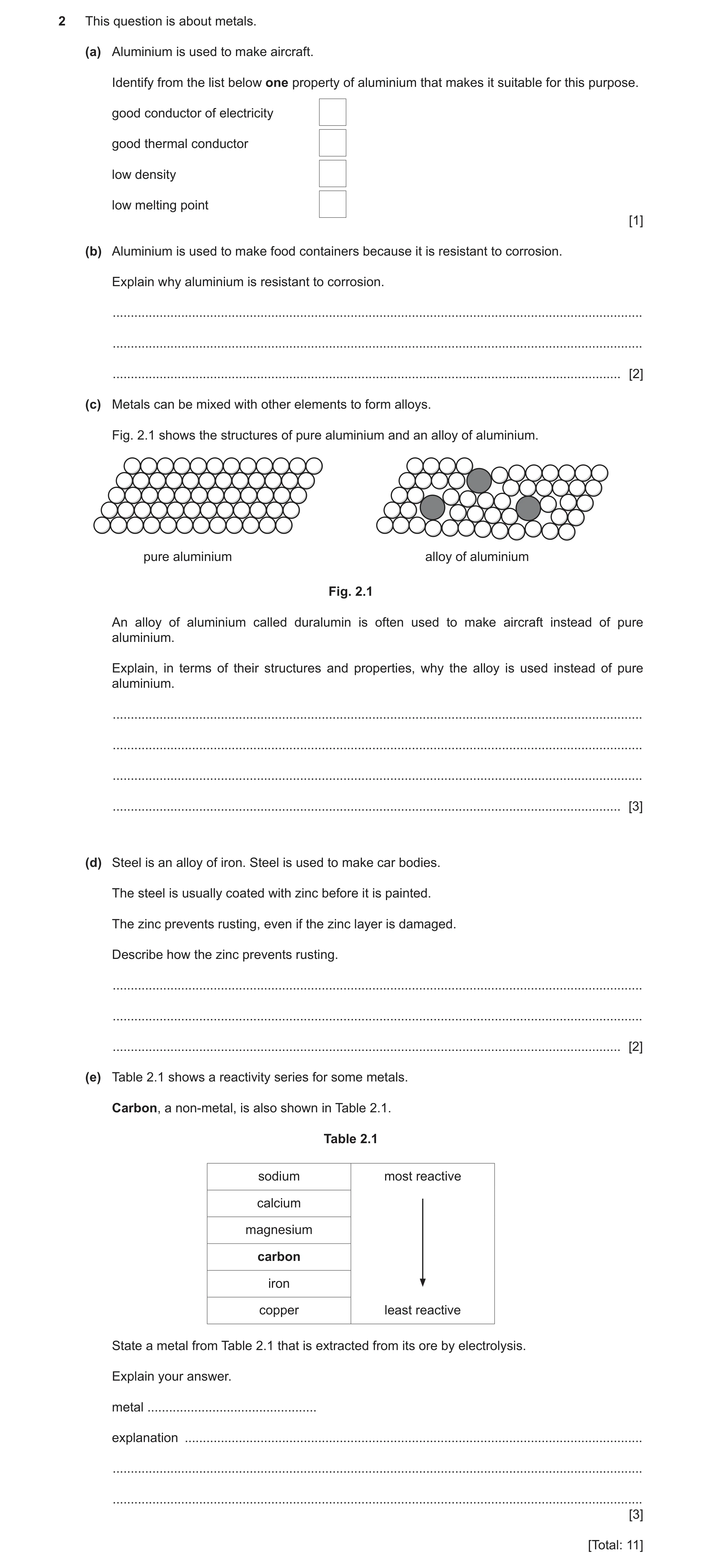
2 This question is about metals. (a) Aluminium is used to make aircraft. Identify from the list below one property of aluminium that makes it suitable for this purpose. good conductor of electricity good thermal conductor low density low melting point [1] (b) Aluminium is used to make food containers because it is resistant to corrosion. Explain why aluminium is resistant to corrosion. … … … [2] (c) Metals can be mixed with other elements to form alloys. Fig. 2.1 shows the structures of pure aluminium and an alloy of aluminium. pure aluminium alloy of aluminium Fig. 2.1 An alloy of aluminium called duralumin is often used to make aircraft instead of pure aluminium. Explain, in terms of their structures and properties, why the alloy is used instead of pure aluminium. … … … … [3] (d) Steel is an alloy of iron. Steel is used to make car bodies. The steel is usually coated with zinc before it is painted. The zinc prevents rusting, even if the zinc layer is damaged. Describe how the zinc prevents rusting. … … … [2] (e) Table 2.1 shows a reactivity series for some metals. Carbon, a non-metal, is also shown in Table 2.1. Table 2.1 sodium most reactive calcium magnesium carbon iron copper least reactive State a metal from Table 2.1 that is extracted from its ore by electrolysis. Explain your answer. metal … explanation … … … [3] [Total: 11]
11 marks
Mark scheme: 2(a) low density ✓ ; 1 2(b) (aluminium) forms an oxide layer / reacts with oxygen / forms a layer of aluminium oxide ; 2 idea that the (oxide) layer adheres to the surface of the aluminium ; 2(c) explanation about alloy linking any three from: 3 added atoms are different size / atoms or ions in an alloy are different sizes / irregular arrangement ; layers / particles cannot easily slide over each other ; more energy is needed to cause slippage of the layers / owtte ; idea that alloy is stronger ; 2(d) zinc is more reactive than iron / ORA ; 2 idea that zinc corrodes or oxidises or reacts instead of the iron ; 2(e) metal – sodium / calcium / magnesium ; 3 explanation idea that the chosen metal is more reactive than carbon ; idea that metal cannot be displaced from its ore by (heating with) carbon ;
This question in 0654/43 Oct/Nov 2023
Q11 · A student investigates the reaction between calcium carbonate and dilute hydrochloric acid 0654/43 May/June 2024
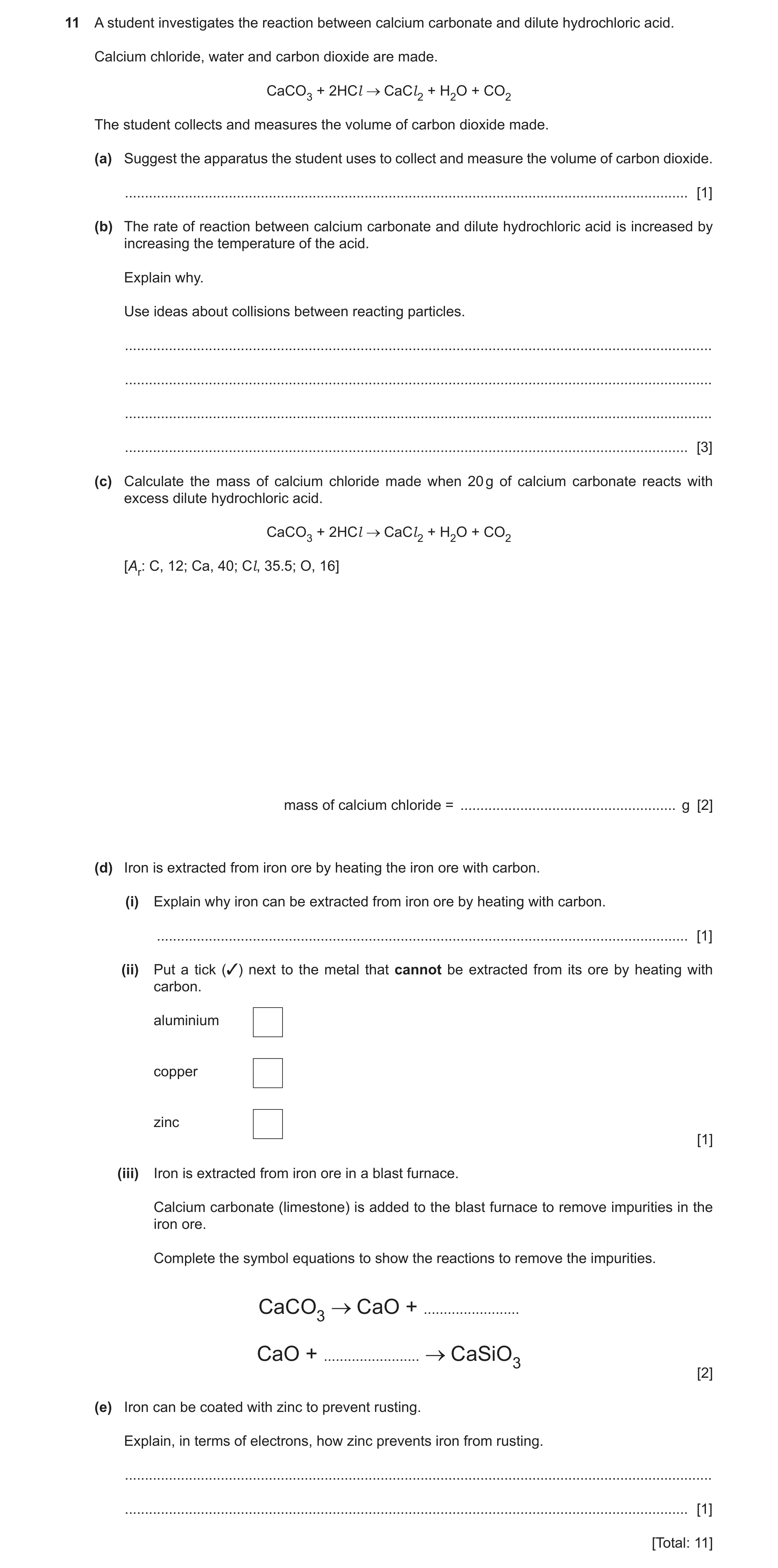
11 A student investigates the reaction between calcium carbonate and dilute hydrochloric acid. Calcium chloride, water and carbon dioxide are made. CaCO3 + 2HCl CaCl 2 + H2O + CO2 The student collects and measures the volume of carbon dioxide made. (a) Suggest the apparatus the student uses to collect and measure the volume of carbon dioxide. … [1] (b) The rate of reaction between calcium carbonate and dilute hydrochloric acid is increased by increasing the temperature of the acid. Explain why. Use ideas about collisions between reacting particles. … … … … [3] (c) Calculate the mass of calcium chloride made when 20 g of calcium carbonate reacts with excess dilute hydrochloric acid. CaCO3 + 2HCl CaCl 2 + H2O + CO2 [Ar: C, 12; Ca, 40; Cl, 35.5; O, 16] mass of calcium chloride = … g [2] (d) Iron is extracted from iron ore by heating the iron ore with carbon. (i) Explain why iron can be extracted from iron ore by heating with carbon. … [1] (ii) Put a tick (✓) next to the metal that cannot be extracted from its ore by heating with carbon. aluminium copper zinc [1] (iii) Iron is extracted from iron ore in a blast furnace. Calcium carbonate (limestone) is added to the blast furnace to remove impurities in the iron ore. Complete the symbol equations to show the reactions to remove the impurities. … CaCO3 CaO + CaO + … CaSiO3 [2] (e) Iron can be coated with zinc to prevent rusting. Explain, in terms of electrons, how zinc prevents iron from rusting. … … [1] [Total: 11]
11 marks
Mark scheme: 11(a) gas syringe / measuring cylinder over water ; 1 11(b) Any 3 from particles have more kinetic energy / molecules move faster ; more particles with activation energy ; more successful collisions ; frequency of collision (of particles) is higher / more collisions per second ; 3 11(c) relative molecular mass of CaCO3 = 100 and CaCl2 = 111 / 111 20 100 = 22.2 (g) ;; 2 11(d)(i) carbon is more reactive than iron / ORA ; 1 11(d)(ii) aluminium ; 1 11(d)(iii) CO2 ; SiO2 ; 2 11(e) zinc loses electrons more readily than iron / ORA ; 1
This question in 0654/43 May/June 2024
Q12 · Aluminium is extracted by electrolysis from the ore bauxite that contains aluminium… 0654/41 Oct/Nov 2024
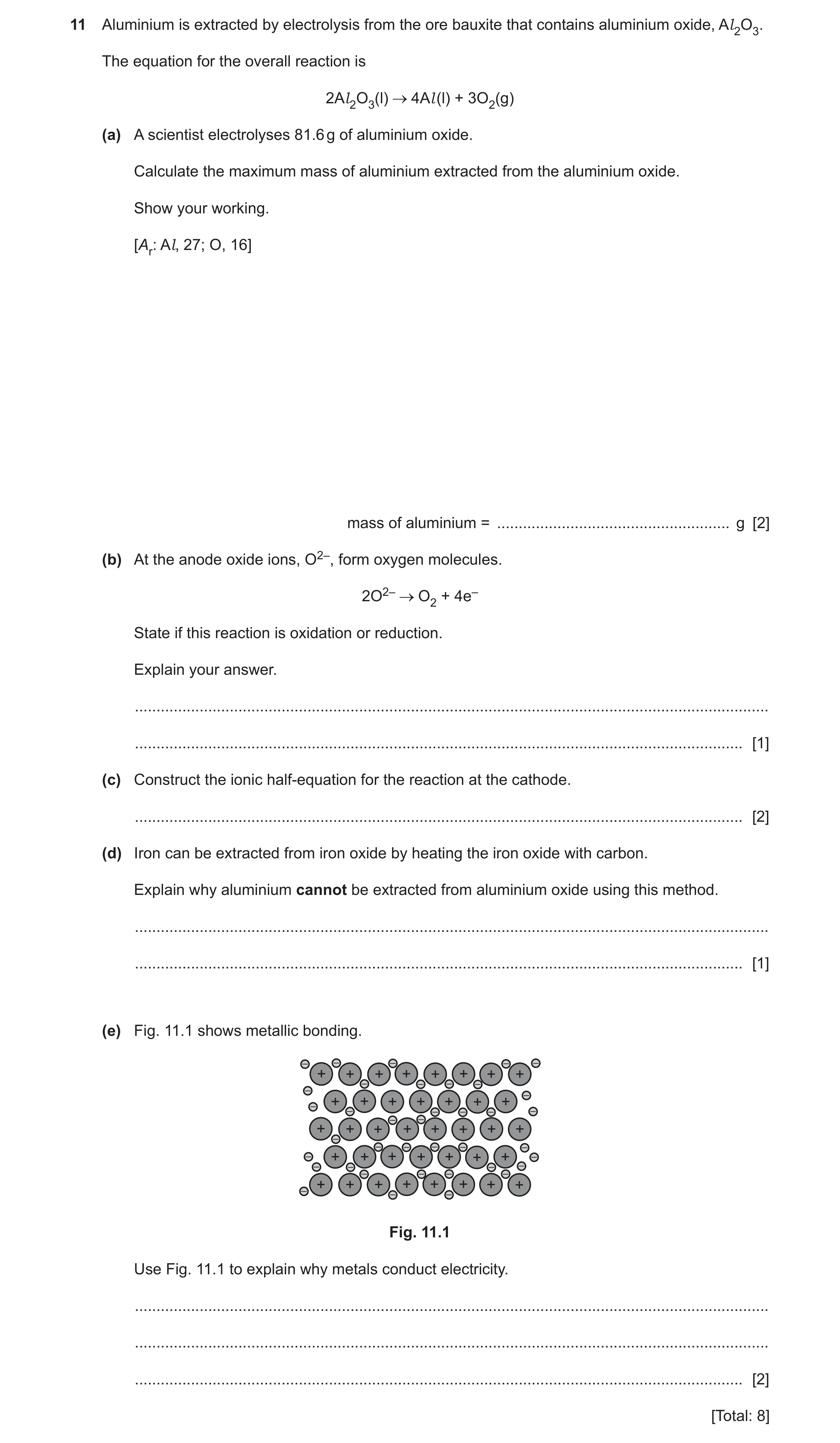
11 Aluminium is extracted by electrolysis from the ore bauxite that contains aluminium oxide, Al 2O3. The equation for the overall reaction is 2Al 2O3(l) 4Al (l) + 3O2(g) (a) A scientist electrolyses 81.6 g of aluminium oxide. Calculate the maximum mass of aluminium extracted from the aluminium oxide. Show your working. [Ar: Al, 27; O, 16] mass of aluminium = … g [2] (b) At the anode oxide ions, O2–, form oxygen molecules. 2O2– O2 + 4e– State if this reaction is oxidation or reduction. Explain your answer. … … [1] (c) Construct the ionic half‑equation for the reaction at the cathode. … [2] (d) Iron can be extracted from iron oxide by heating the iron oxide with carbon. Explain why aluminium cannot be extracted from aluminium oxide using this method. … … [1] (e) Fig. 11.1 shows metallic bonding. – – – – – + + + + + + + + – – – – – – + + + + + + + – – – – – – – – + + + + + + + + – – – – – – – – + + + + + + + – – – – – – – – – + + + – + + – + + + Fig. 11.1 Use Fig. 11.1 to explain why metals conduct electricity. … … … [2] [Total: 8]
8 marks
Mark scheme: 11(a) relative molecular mass of Al2O3 = 102 ; 2 (54 81.6 g ) ; = 43.2 ( 102 11(b) oxidation 1 and electrons are lost ; 11(c) Al3+ + 3e– → Al 2 1 mark for correct symbols ; 1 mark for correctly balanced electrons ; 11(d) idea that aluminium is more reactive than carbon / ORA ; 1 11(e) has free electrons ; 2 which can move throughout/in (the metal) ;
This question in 0654/41 Oct/Nov 2024
Q13 · The reactivity series of some metals 0654/43 Oct/Nov 2024
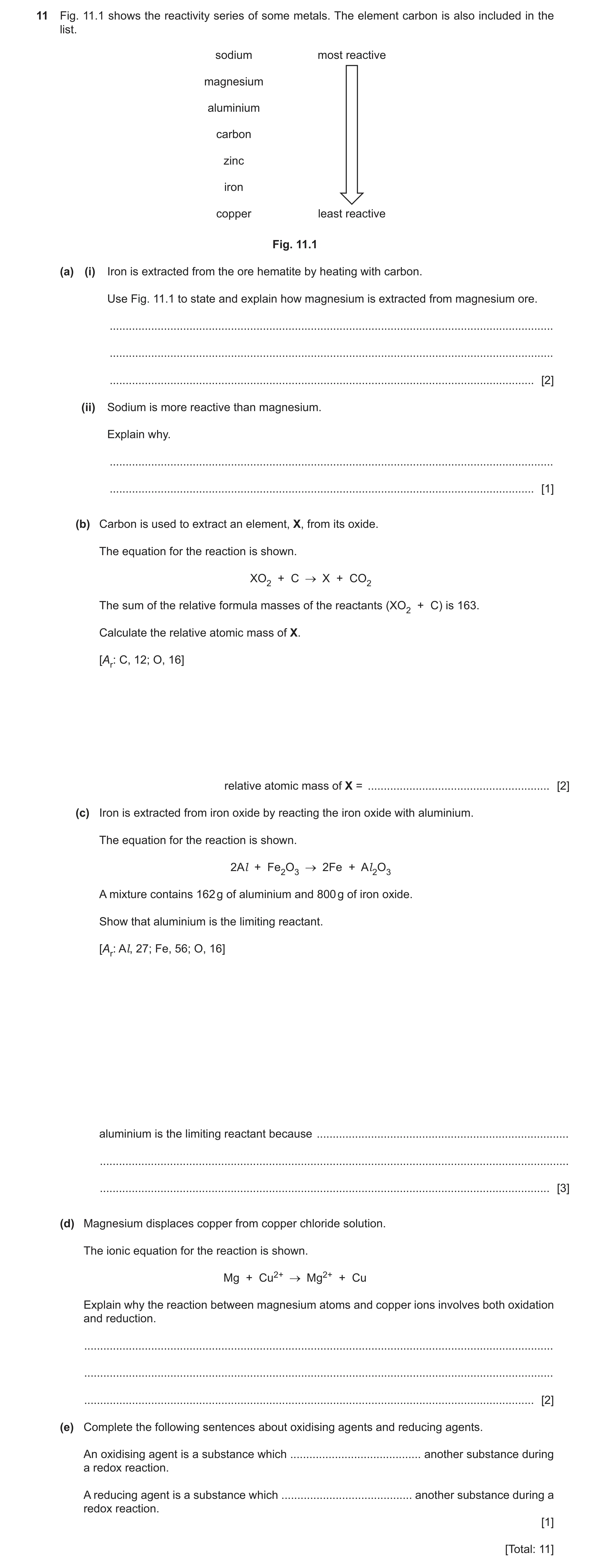
11 Fig. 11.1 shows the reactivity series of some metals. The element carbon is also included in the list. sodium most reactive magnesium aluminium carbon zinc iron copper least reactive Fig. 11.1 (a) (i) Iron is extracted from the ore hematite by heating with carbon. Use Fig. 11.1 to state and explain how magnesium is extracted from magnesium ore. … … … [2] (ii) Sodium is more reactive than magnesium. Explain why. … … [1] (b) Carbon is used to extract an element, X, from its oxide. The equation for the reaction is shown. XO2 + C X + CO2 The sum of the relative formula masses of the reactants (XO2 + C) is 163. Calculate the relative atomic mass of X. [Ar: C, 12; O, 16] relative atomic mass of X = … [2] (c) Iron is extracted from iron oxide by reacting the iron oxide with aluminium. The equation for the reaction is shown. 2Al + Fe2O3 2Fe + Al 2O3 A mixture contains 162 g of aluminium and 800 g of iron oxide. Show that aluminium is the limiting reactant. [Ar: Al, 27; Fe, 56; O, 16] aluminium is the limiting reactant because … … … [3] (d) Magnesium displaces copper from copper chloride solution. The ionic equation for the reaction is shown. Mg + Cu2+ Mg2+ + Cu Explain why the reaction between magnesium atoms and copper ions involves both oxidation and reduction. … … … [2] (e) Complete the following sentences about oxidising agents and reducing agents. An oxidising agent is a substance which … another substance during a redox reaction. A reducing agent is a substance which … another substance during a redox reaction. [1] [Total: 11]
11 marks
Mark scheme: 11(a)(i) electrolysis ; 2 carbon is less reactive than magnesium / ORA / carbon cannot displace the magnesium from the magnesium ore ; 11(a)(ii) (idea that sodium atoms) form positive (sodium) ions more easily (than magnesium) / 1 (idea that sodium atoms) lose electrons more easily (than magnesium) ; 11(b) Mr of CO2 = 44 / relative atomic mass of X = 163 – 44 / 163 – 32 – 12 ; 2 119 ; 11(c) (moles of Fe2O3 = 800 / 160 =) 5 ; 3 (moles of Al = 162 / 27 =) 6 ; (aluminium is limiting because) 6 mol is less than the (2 5 =) 10 mol (aluminium needed) or iron oxide is in excess because 5 mol is more than the (6 ÷ 2 =) 3 mol (iron oxide needed) ; 11(d) oxidation because magnesium atoms lose electrons ; 2 reduction because copper ions gain electrons ; 11(e) oxidises 1 and reduces ;
This question in 0654/43 Oct/Nov 2024
Q14 · Iron is extracted from hematite by reduction of iron(III) oxide in a blast furnace 0654/43 Oct/Nov 2025
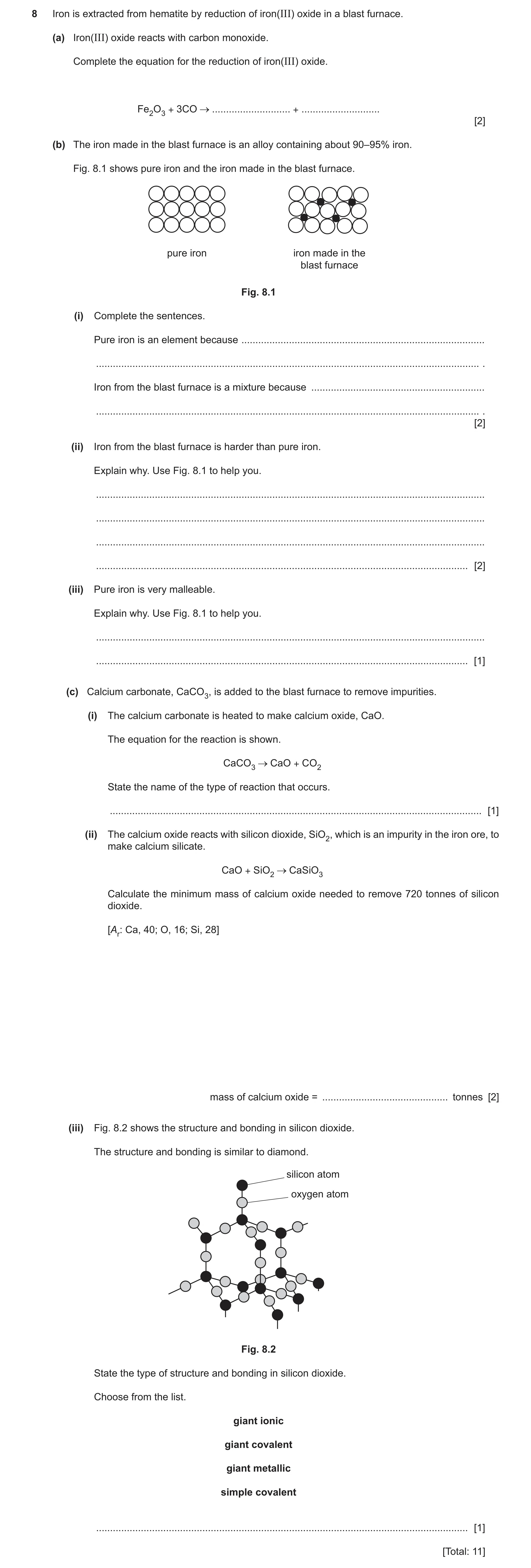
8 Iron is extracted from hematite by reduction of iron(III) oxide in a blast furnace. (a) Iron(III) oxide reacts with carbon monoxide. Complete the equation for the reduction of iron(III) oxide. Fe2O3 + 3CO … + … [2] (b) The iron made in the blast furnace is an alloy containing about 90–95% iron. Fig. 8.1 shows pure iron and the iron made in the blast furnace. pure iron iron made in the blast furnace Fig. 8.1 (i) Complete the sentences. Pure iron is an element because … … . Iron from the blast furnace is a mixture because … … . [2] (ii) Iron from the blast furnace is harder than pure iron. Explain why. Use Fig. 8.1 to help you. … … … … [2] (iii) Pure iron is very malleable. Explain why. Use Fig. 8.1 to help you. … … [1] (c) Calcium carbonate, CaCO3, is added to the blast furnace to remove impurities. (i) The calcium carbonate is heated to make calcium oxide, CaO. The equation for the reaction is shown. CaCO3 CaO + CO2 State the name of the type of reaction that occurs. … [1] (ii) The calcium oxide reacts with silicon dioxide, SiO2, which is an impurity in the iron ore, to make calcium silicate. CaO + SiO2 CaSiO3 Calculate the minimum mass of calcium oxide needed to remove 720 tonnes of silicon dioxide. [Ar: Ca, 40; O, 16; Si, 28] mass of calcium oxide = … tonnes [2] (iii) Fig. 8.2 shows the structure and bonding in silicon dioxide. The structure and bonding is similar to diamond. silicon atom oxygen atom Fig. 8.2 State the type of structure and bonding in silicon dioxide. Choose from the list. giant ionic giant covalent giant metallic simple covalent … [1] [Total: 11]
11 marks
Mark scheme: 8(a) 2Fe + 3CO2 2 1 mark for correct formulae 1 mark for correct balancing 8(b)(i) (pure iron is an element because) it is made of only one type of atom ; 2 (iron from the blast furnace is a mixture because) it contains two elements not chemically combined ; 8(b)(ii) idea that atoms in iron from the blast furnace are different sizes / atoms in pure iron are all the same size ; 2 idea that layers in iron from the blast furnace and cannot slide over each other / ORA ; 8(b)(iii) idea that layers of atoms in pure iron slide / move / slip over each other ; 1 8(c)(i) thermal decomposition ; 1 8(c)(ii) (Mr of CaO =) 56 and (Mr of SiO2 =) 60 ; 2 720 56 ( =) 672 (tonnes) ; 60 or moles of SiO2 = 720 106 / 60 =) 1.2 107 g ; (1.2 107 g 56 = 6.72 108 g = ) 672 (tonnes) ; 8(c)(iii) giant covalent ; 1
This question in 0654/43 Oct/Nov 2025
 10 / 24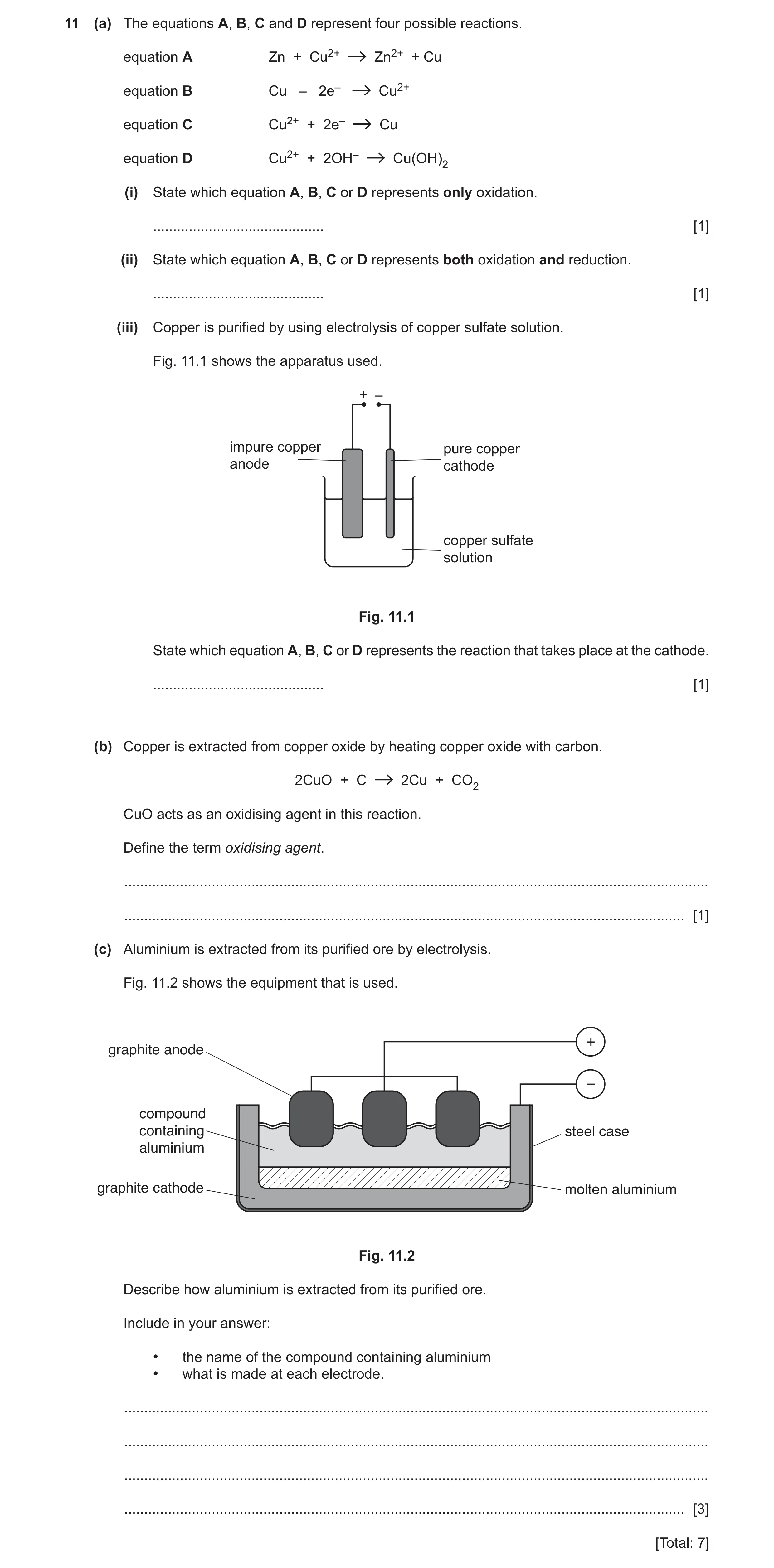
 9
9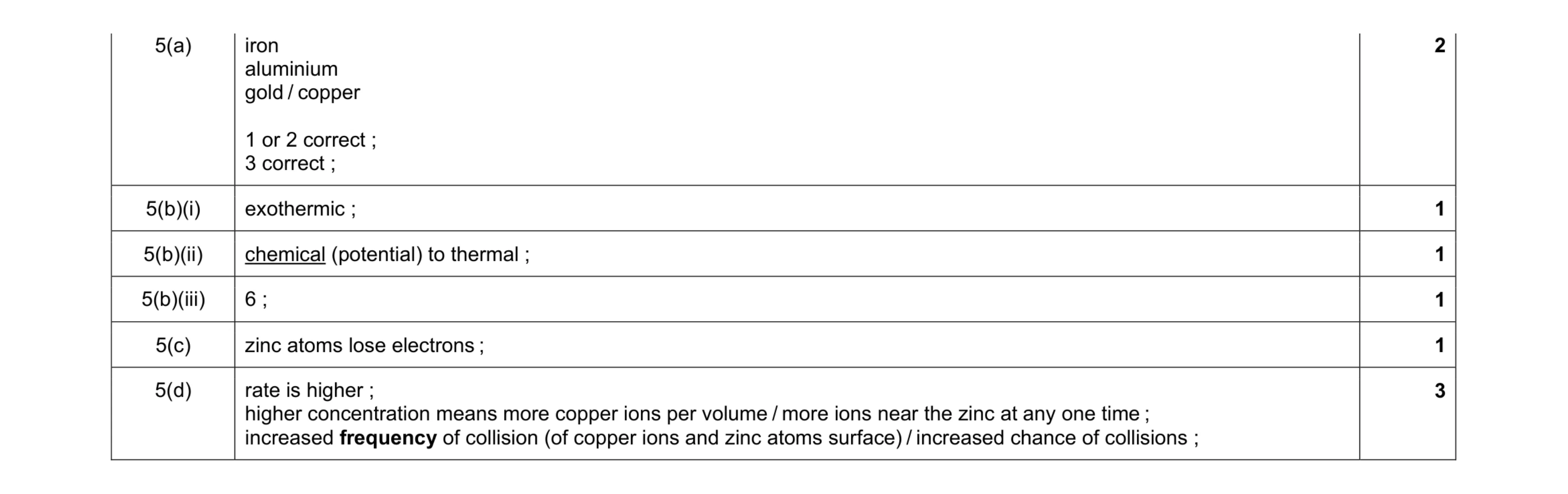 9
9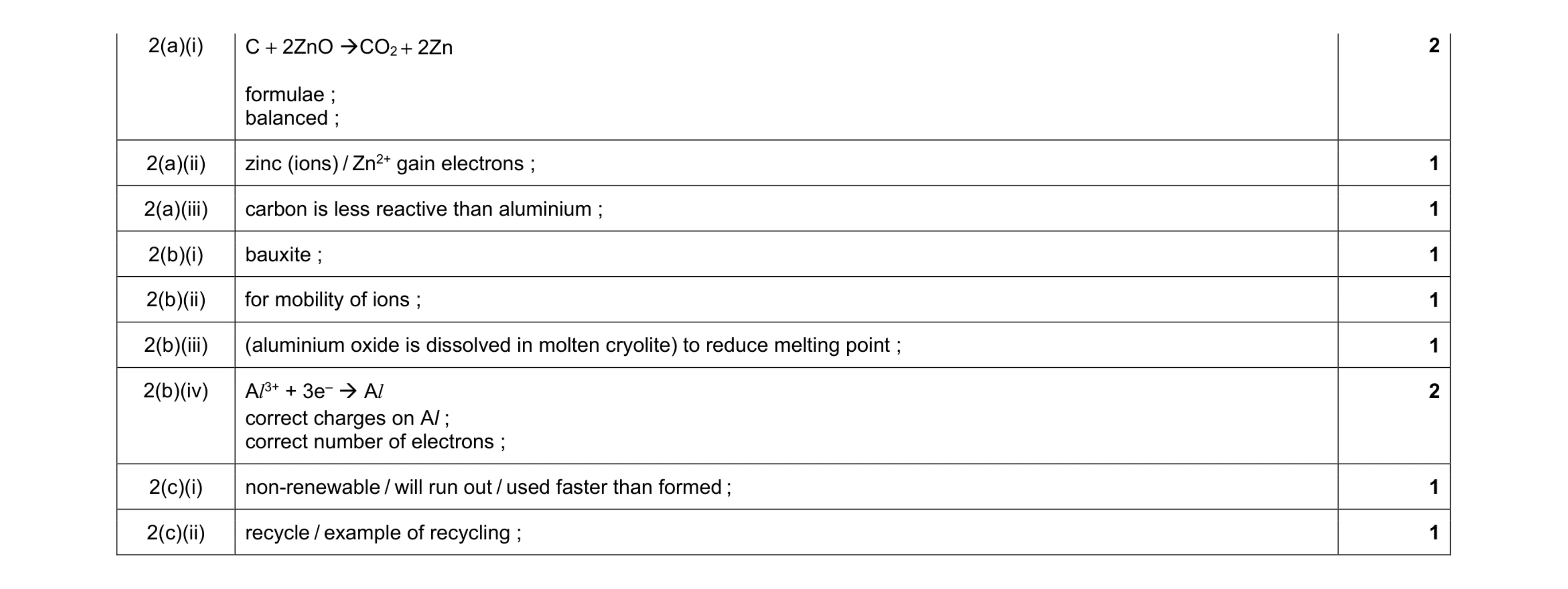 11
11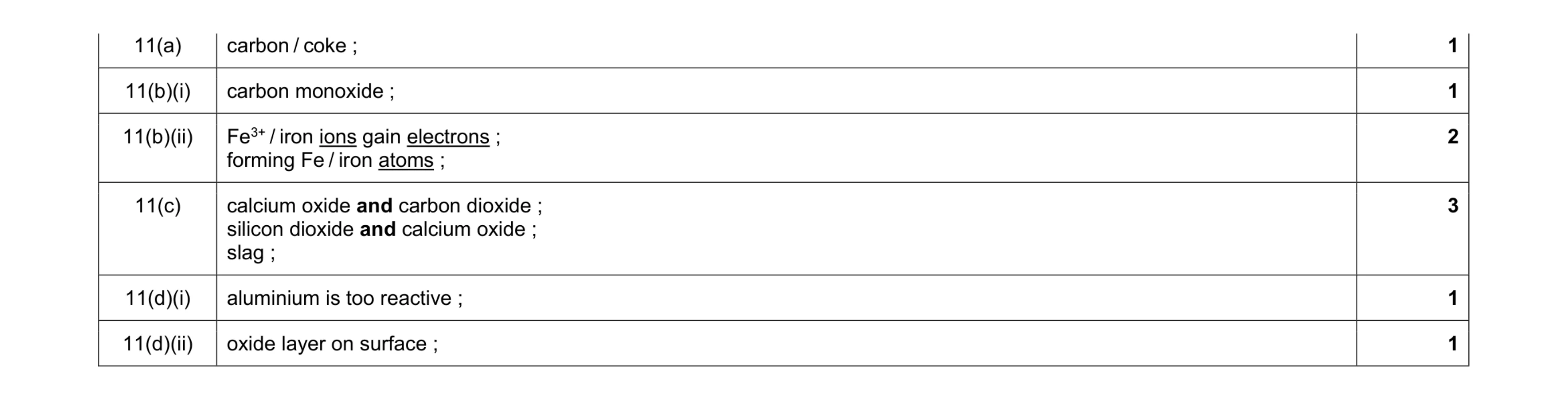 9
9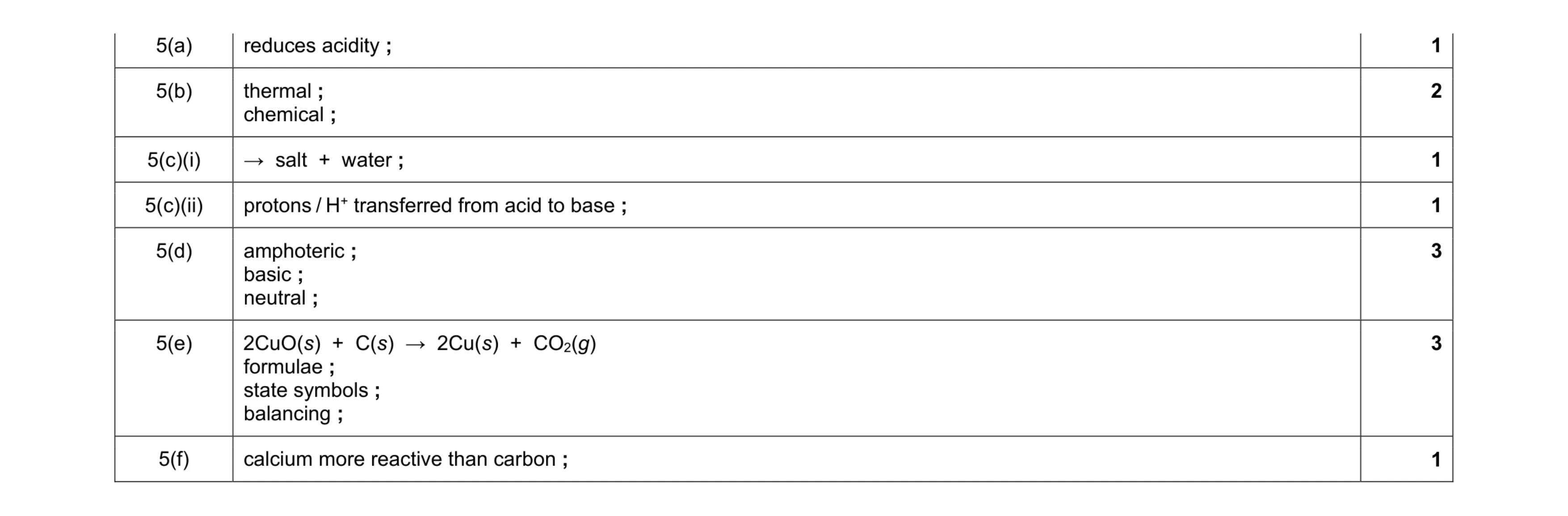 12
12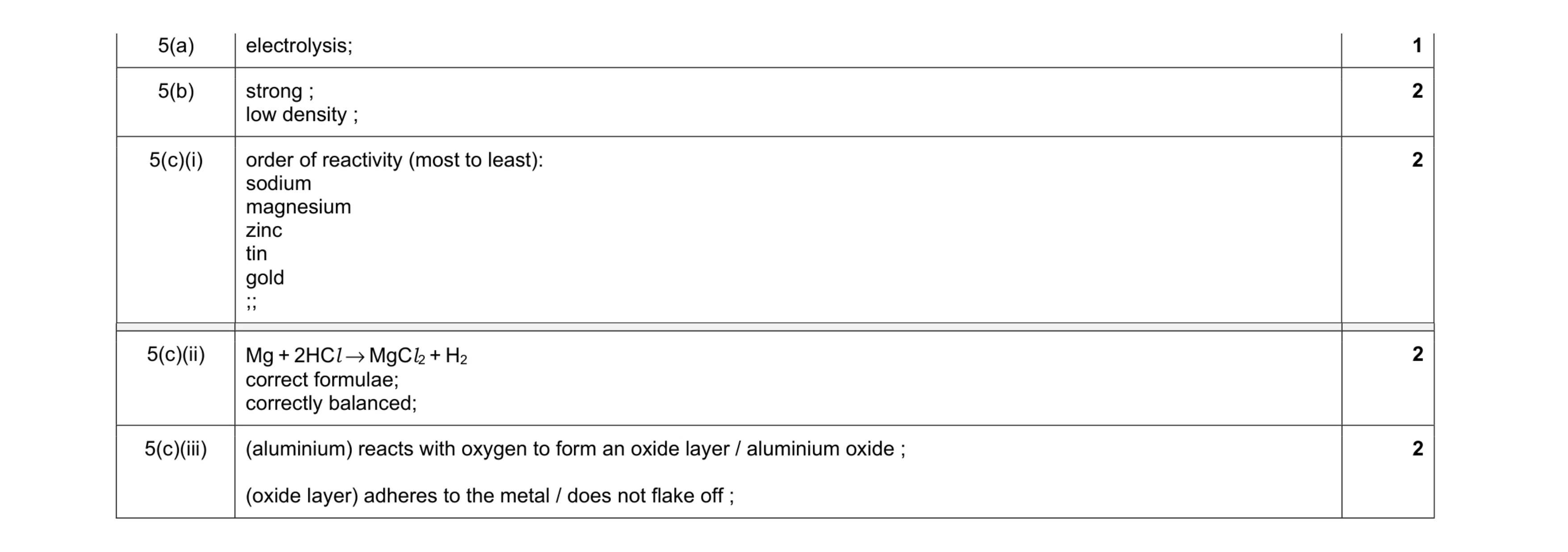 9
9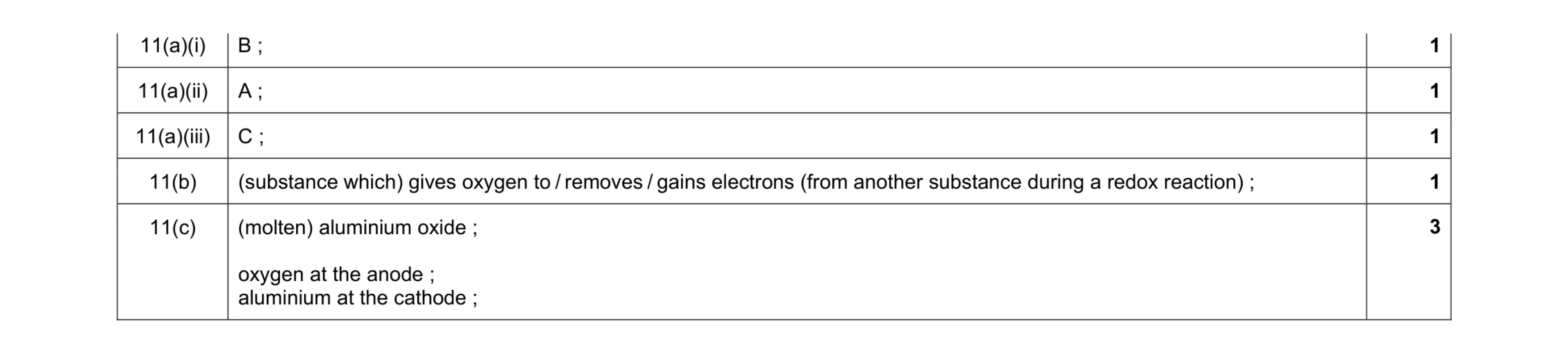 7
7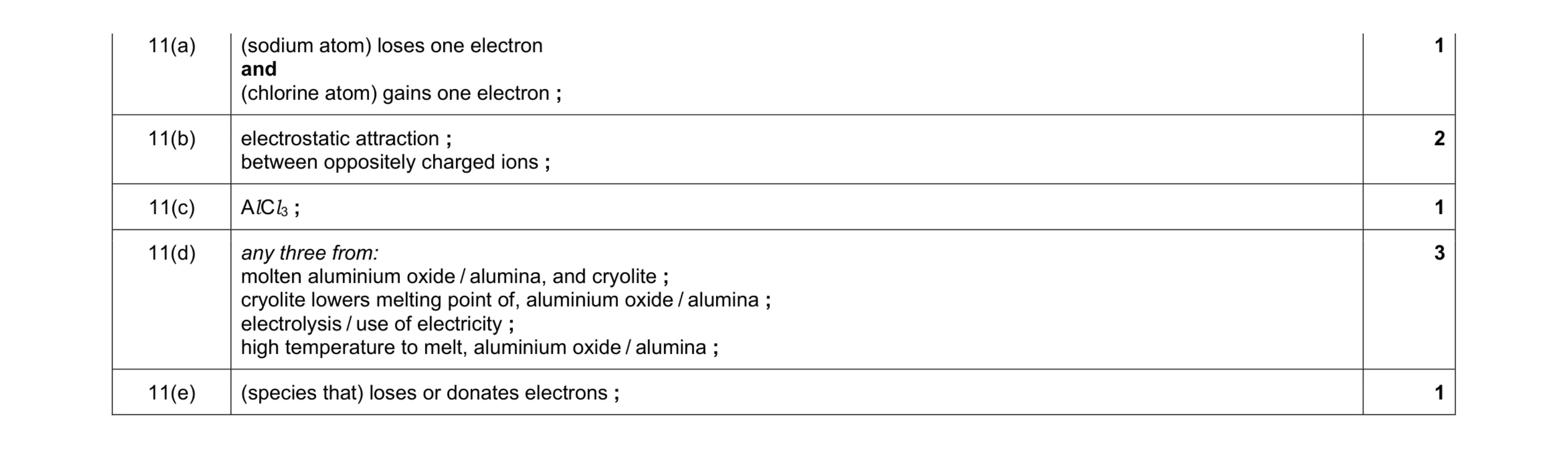 8
8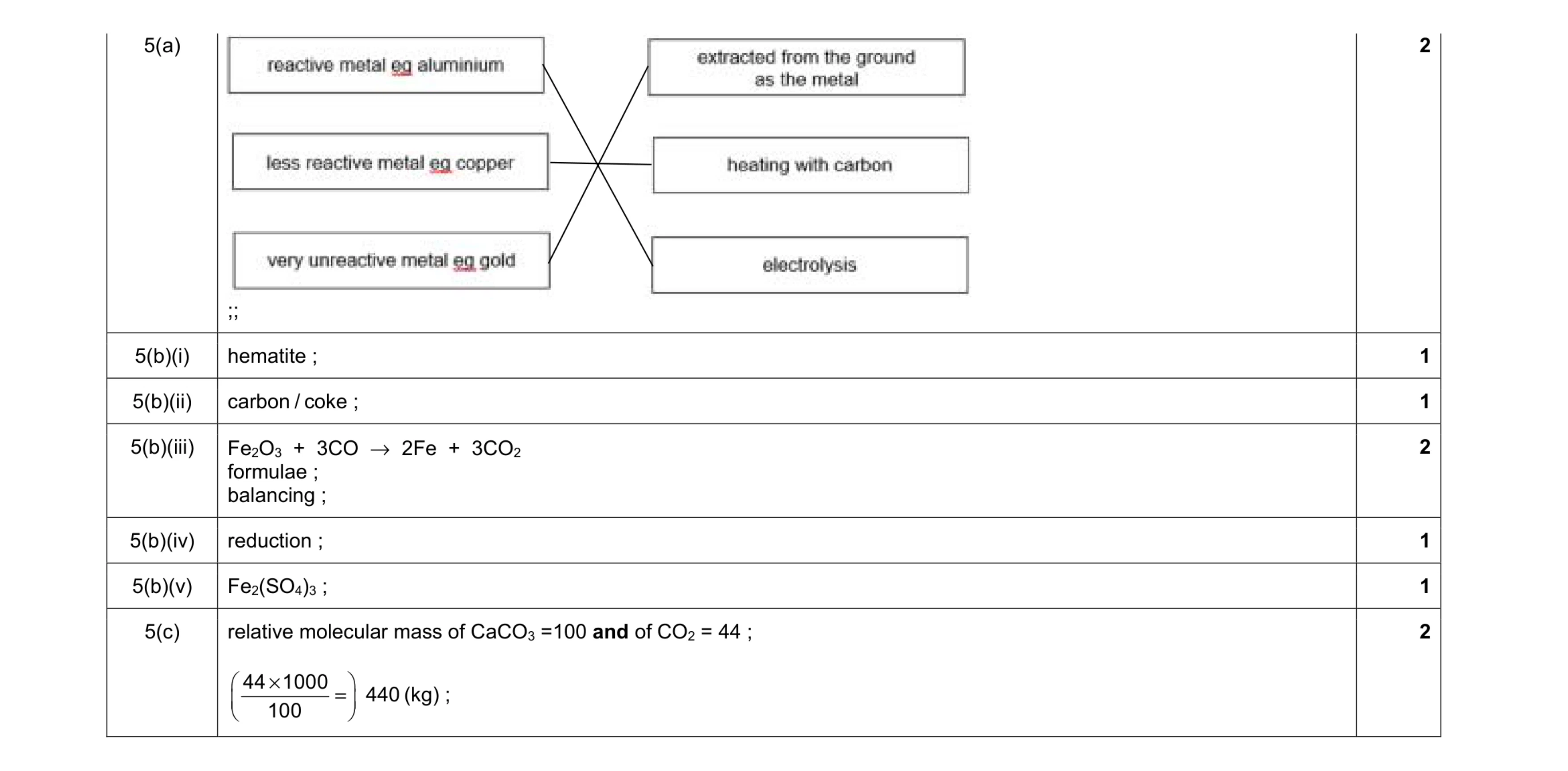 10
10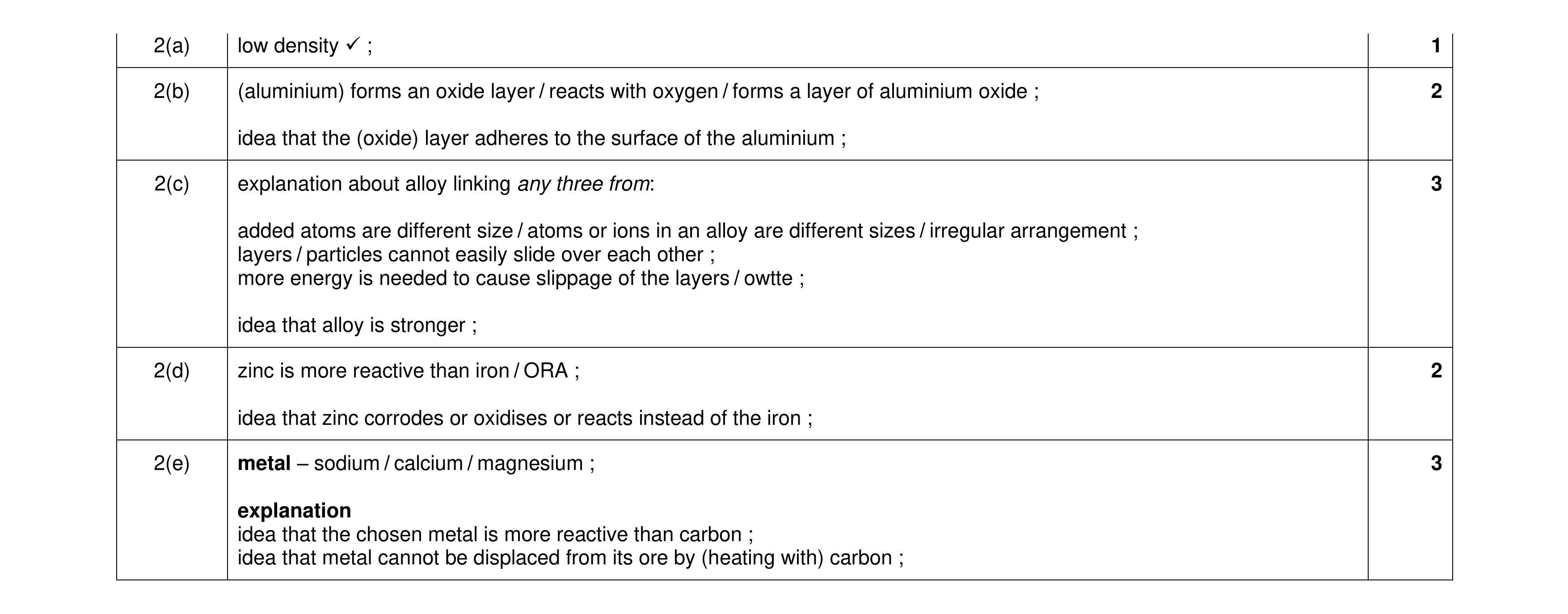 11
11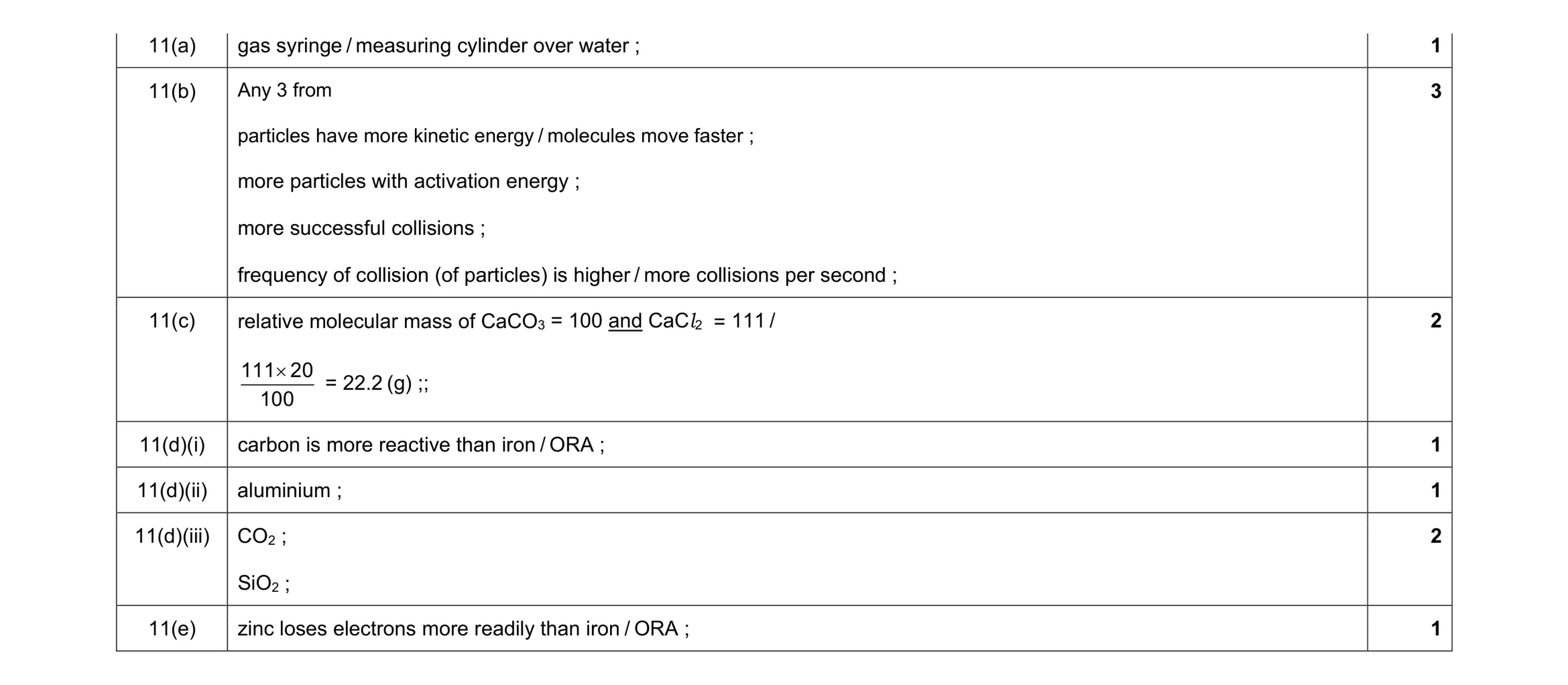 11
11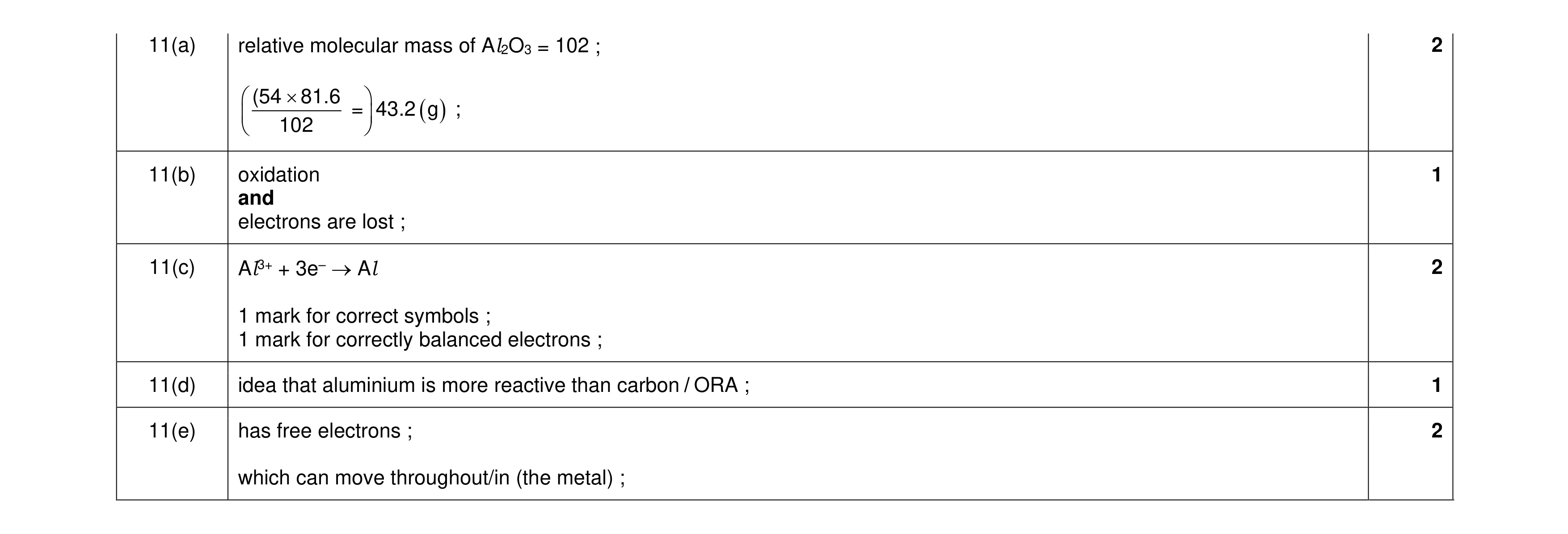 8
8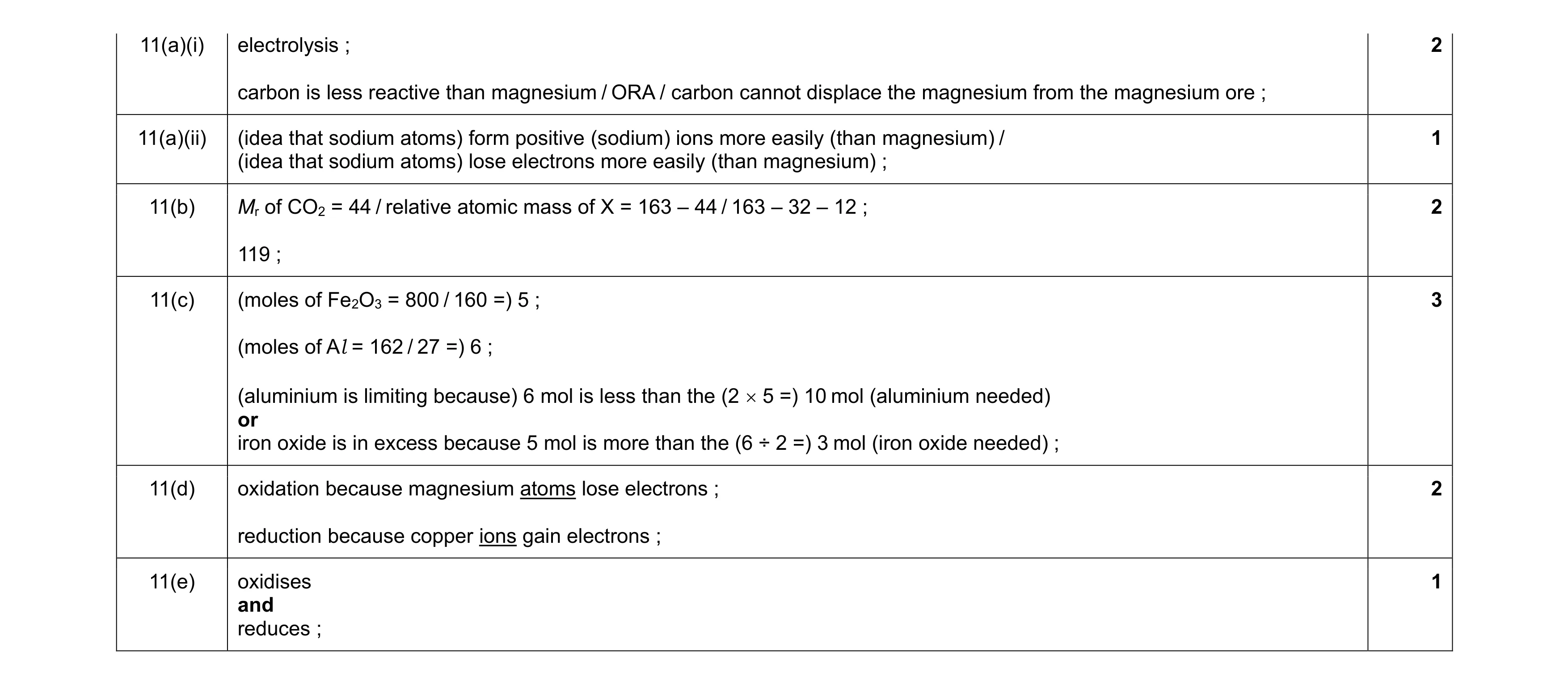 11
11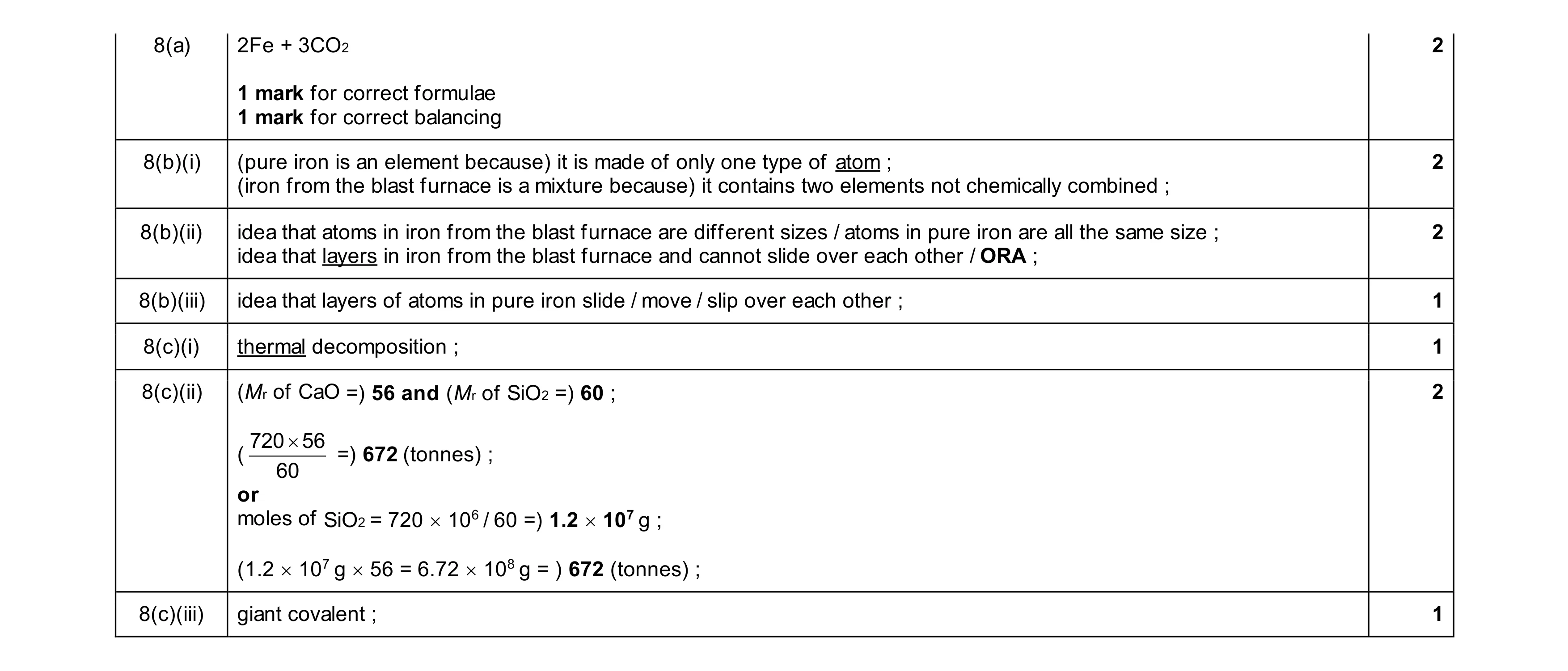 11
11