Questions as text
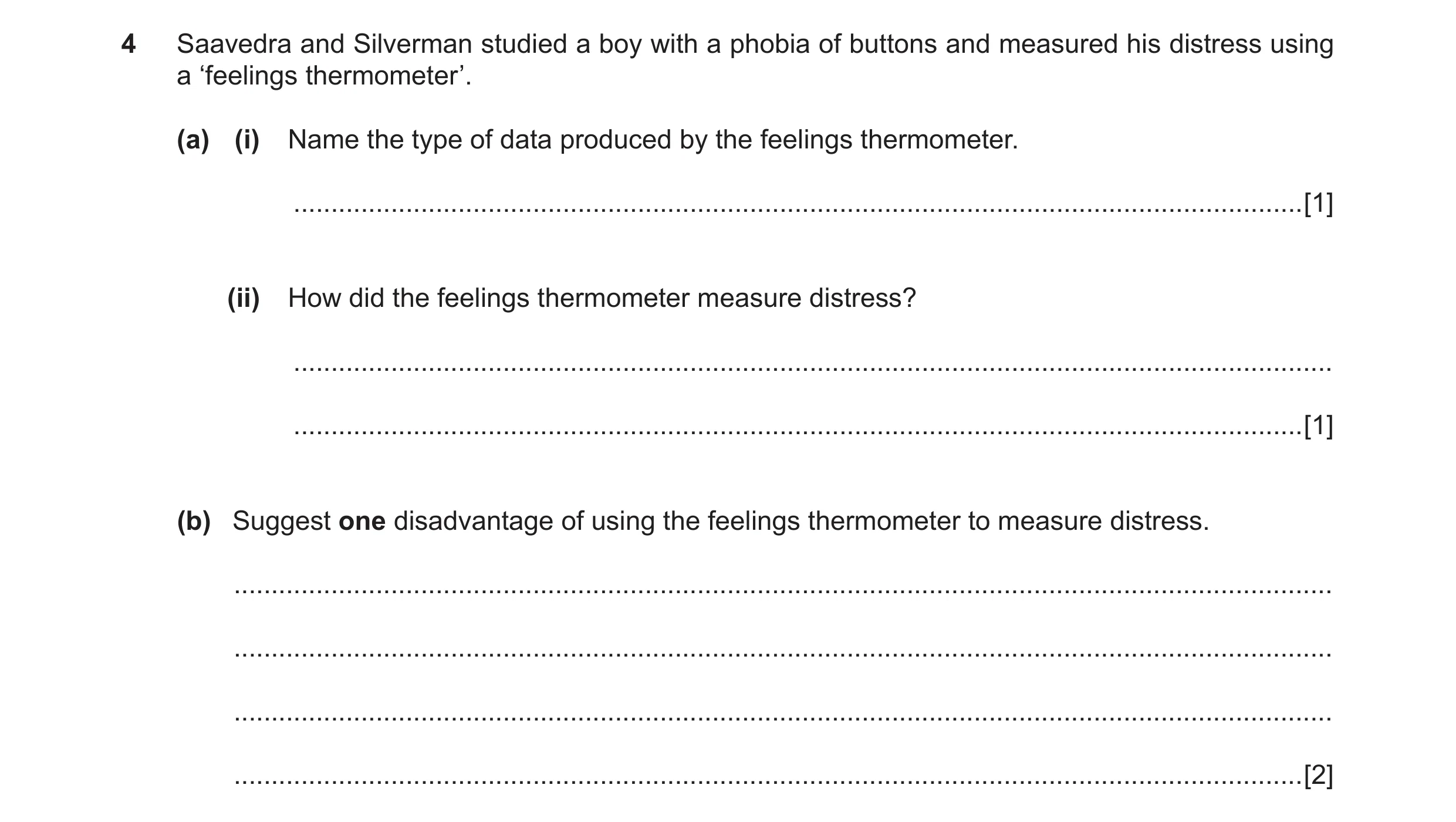
Q1 · Saavedra and Silverman studied a boy with a phobia of buttons and measured his distress… 9990/22 Feb/March 2018
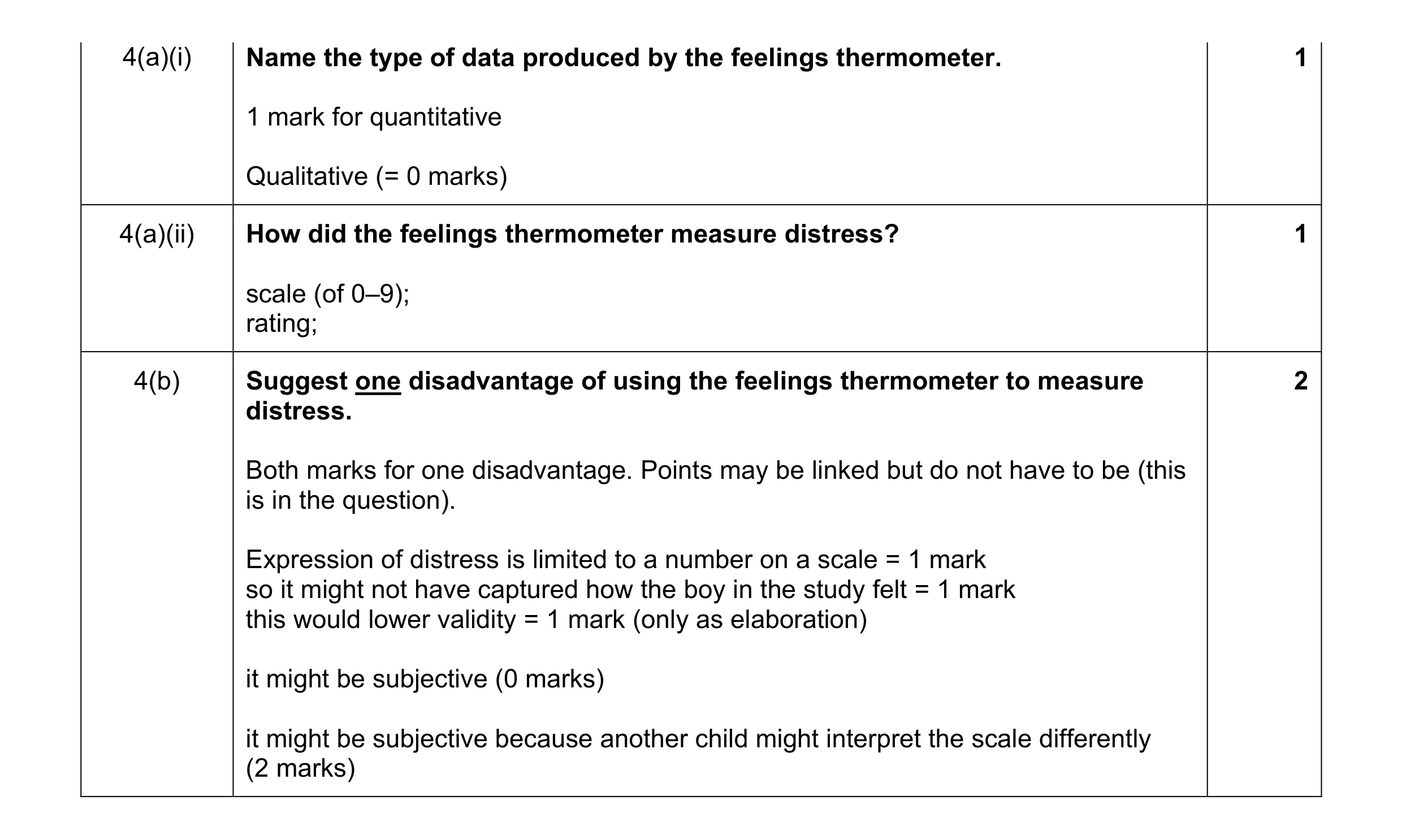
4 Saavedra and Silverman studied a boy with a phobia of buttons and measured his distress using a ‘feelings thermometer’. (a) (i) Name the type of data produced by the feelings thermometer. … [1] (ii) How did the feelings thermometer measure distress? … … [1] (b) Suggest one disadvantage of using the feelings thermometer to measure distress. … … … … [2]
4 marks
Mark scheme: 4(a)(i) Name the type of data produced by the feelings thermometer. 1 1 mark for quantitative Qualitative (= 0 marks) 4(a)(ii) How did the feelings thermometer measure distress? 1 scale (of 0–9); rating; 4(b) Suggest one disadvantage of using the feelings thermometer to measure 2 distress. Both marks for one disadvantage. Points may be linked but do not have to be (this is in the question). Expression of distress is limited to a number on a scale = 1 mark so it might not have captured how the boy in the study felt = 1 mark this would lower validity = 1 mark (only as elaboration) it might be subjective (0 marks) it might be subjective because another child might interpret the scale differently (2 marks)
This question in 9990/22 Feb/March 2018
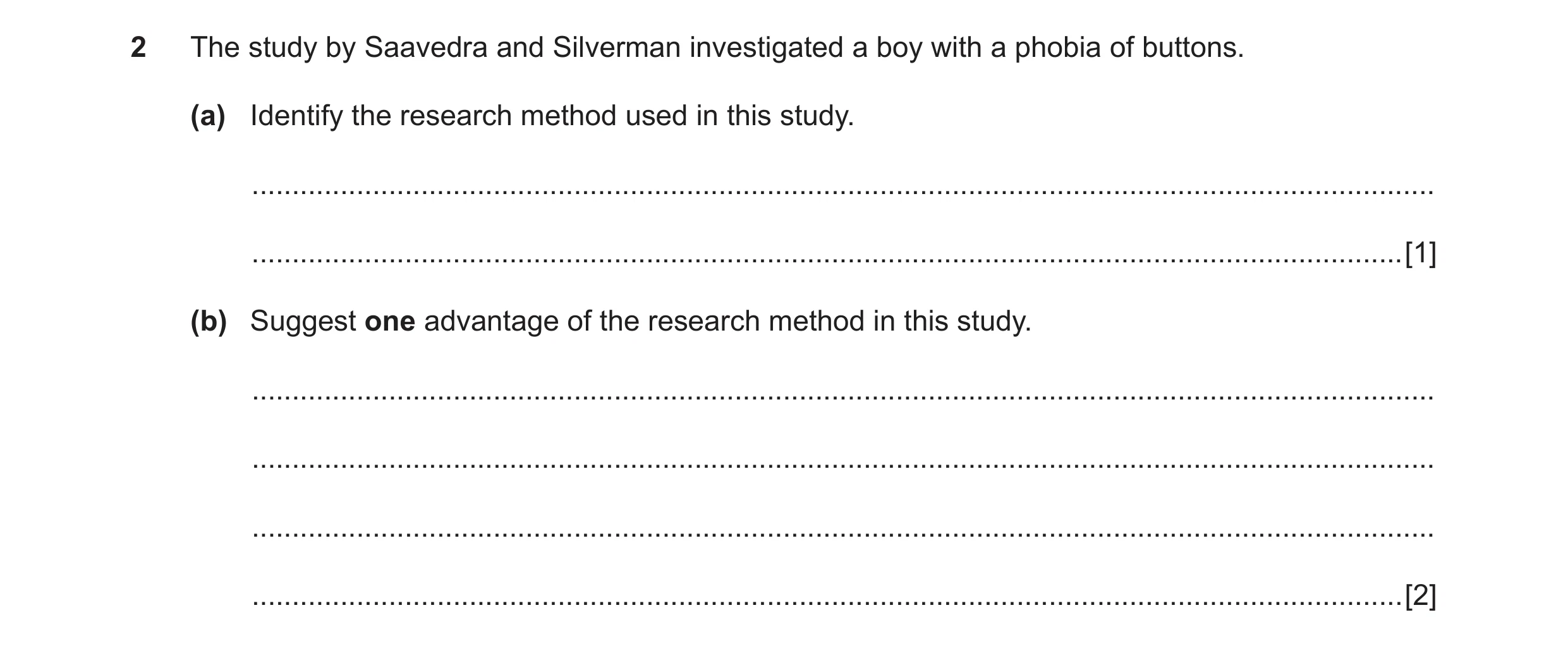
Q2 · The study by Saavedra and Silverman investigated a boy with a phobia of buttons 9990/21 May/June 2018
2 The study by Saavedra and Silverman investigated a boy with a phobia of buttons. (a) Identify the research method used in this study. … … [1] (b) Suggest one advantage of the research method in this study. … … … … [2]
3 marks
Mark scheme: 2(a) Identify the research method used in this study. 1 1 mark for case study 2(b) Suggest one advantage of the research method in this study. 2 1 mark for identifying advantage. Plus 1 mark for linked detail. • allowed for in depth investigation/the collection of qualitative data; (1 for identification) • so reasons for the behaviour could be investigated; (1 for identification) • provided scope for therapy; (1 for identification/link) • to find out why he was afraid of buttons; (1 for identification/link) • allowed for the collection of data over time; (1 for identification/link) • to follow his progress through therapy; (1 for identification/link)
This question in 9990/21 May/June 2018
Q3 · Beth is looking at the treatment of people with phobias 9990/22 May/June 2018
10 Beth is looking at the treatment of people with phobias. She is investigating whether there is a relationship between how long they have been in therapy and the severity of their symptoms. (a) Describe how Beth could conduct a correlational study to investigate this relationship. … … … … … … … … … … … … … … … … … … … … … … … [10] (b) Identify one weakness/limitation with the procedure you have described in your answer to part (a) and suggest how your study might be done differently to overcome the problem. … … … … … … … … [4]
14 marks
Mark scheme: 10(a) Describe how Beth could conduct a correlational study to investigate 10 this relationship. Indicative content for a correlational study: • what: identification of variable 1 • what: identification of variable 2 • how: examples of ways to measure the variable such as questions/ tests/observations used • sampling technique • sample size • description of how closed questions will be scored • description of how data will analysed, e.g. use of scattergram • ethical issues Other appropriate responses should also be credited. Three major omissions for a correlational study are: What: – variable 1 (correct operationalisation and quantification of first correlational variable) – variable 2 (correct operationalisation and quantification of second correlational variable) How: – technique for producing/collecting data i.e. procedure (e.g. tests, observations, questionnaires). The minor omissions are: where – location of participants when data is collected (e.g. clinics) who – participants (must be phobics) Mark according to the levels of response criteria below: Level 3 (8–10 marks) • Response is described in sufficient detail to be replicable. • Response may have a minor omission. • Use of psychological terminology is accurate and comprehensive. Level 2 (5–7 marks) • Response is in some detail. • Response has minor omission(s). • Use of psychological terminology is accurate. Level 1 (1–4 marks) • Response is basic in detail. • Response has major omission(s). • If response is impossible to conduct max. 2. • Use of psychological terminology is mainly accurate. Level 0 (0 marks) No response worthy of credit. 10(b) Identify one weakness/limitation with the procedure you have 4 described in your answer to part (a) and suggest how your study might be done differently to overcome the problem. Answer will depend on problem identified. Problems may, for example, be matters of: Validity • operationalisation (of severity) • cannot determine causality [Note: max 2 for ‘causality’ answer as cannot be solved within the context of a correlational study] Reliability • standardisation • intra-rater consistency (of severity measures) Ethics • issues with phobias (harm) This list is not exhaustive and other appropriate responses should also be credited. If the problem was an obvious omission in (a), marks can be awarded here if the candidate refers to the omission. Marks Comment 3–4 Appropriate problem identified. Appropriate solution is clearly described. 2 Appropriate problem identified. plus EITHER Explanation of why it is a problem OR Ineffectual but possible solution described. 1 Appropriate problem identified. Little or no justification. 0 No response worthy of credit
This question in 9990/22 May/June 2018
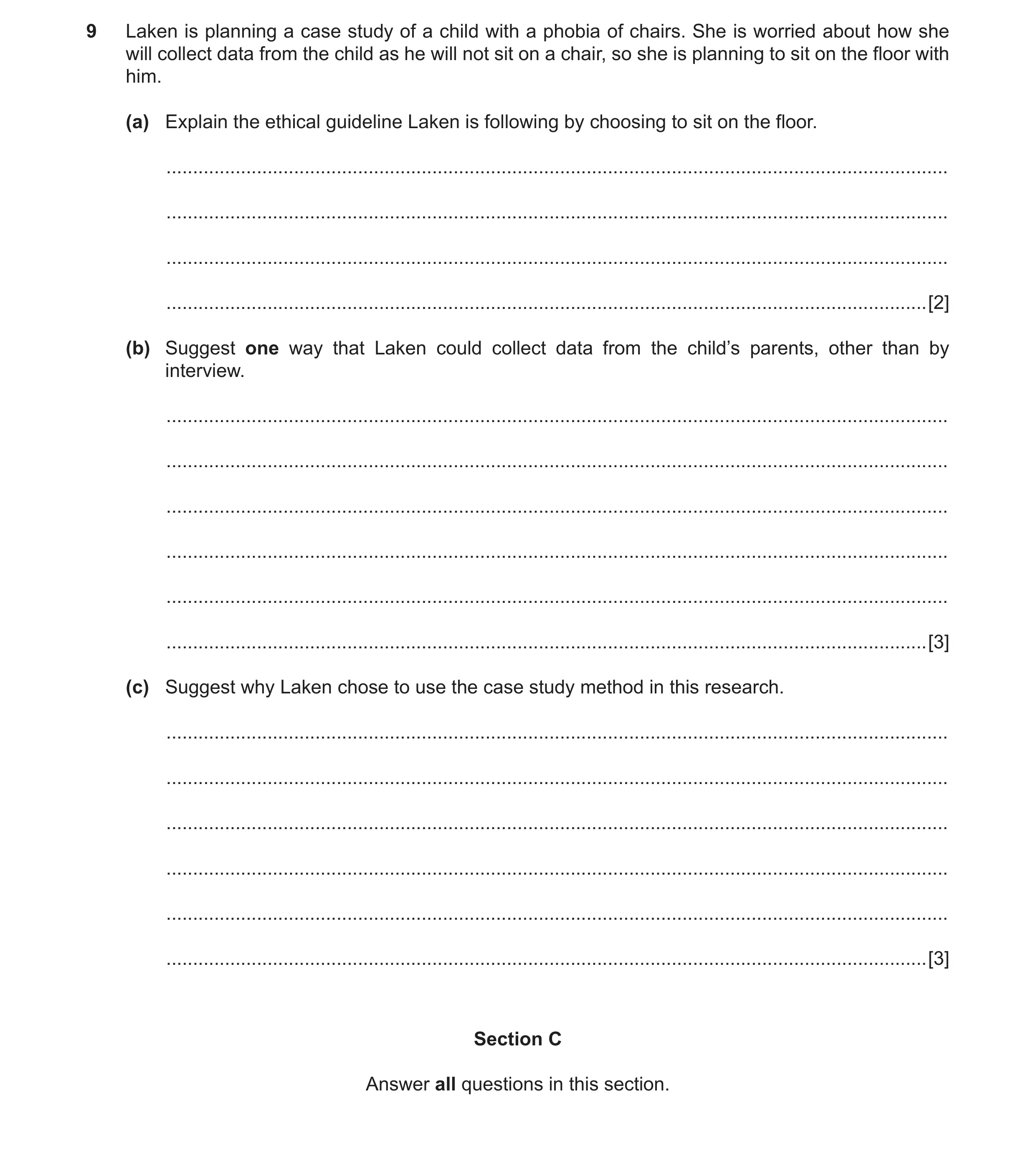
Q4 · Laken is planning a case study of a child with a phobia of chairs 9990/23 May/June 2018
9 Laken is planning a case study of a child with a phobia of chairs. She is worried about how she will collect data from the child as he will not sit on a chair, so she is planning to sit on the floor with him. (a) Explain the ethical guideline Laken is following by choosing to sit on the floor. … … … … [2] (b) Suggest one way that Laken could collect data from the child’s parents, other than by interview. … … … … … … [3] (c) Suggest why Laken chose to use the case study method in this research. … … … … … … [3] Section C Answer all questions in this section.
8 marks
Mark scheme: 9(a) Explain the ethical guideline Laken is following by choosing to sit on 2 the floor. 1 mark for identification of protection from (psychological) harm. Plus 1 mark for detail linked to the study. • Not scaring him / to protect him from (psychological harm/distress) (1) • he might be frightened by having to sit on a chair; (+1) 9(b) Suggest one way that Laken could collect data from the child’s 3 parents, other than by interview. 1 mark for identifying an appropriate alternative method e.g. questionnaire Plus 1 mark for detail Plus 1 mark for detail applied to the situation • questionnaire; (1) • they could be sent questions through the post / by email / online; (+1) • they could be open/closed questions; (+1) • e.g. asking when the phobia started; (+1) • what the symptoms of the phobia are; (+1) • which types of chairs he is most frightened of; (+1) 9(c) Suggest why Laken chose to use the case study method in this research. 1 mark for reason (does not have to be linked but can be) Plus 1 mark for detail linked to the study • to obtain detailed/descriptive/in-depth data; (1) • for example to find out the causes/symptoms of his phobia; (+1) • because she only had one/participant/phobic/child to study; (1) • so could explore the causes/symptoms / treat his phobia; (+1) • because she could use a range of different methods (interviews/ questionnaires/observations); (1) • for example observing how he reacted to a chair and sending a questionnaire to the parents; (+1) • because it meant a long time could be spent on one person; (1) • and a long time is needed to study the phobia/find a therapy; (+1) • because it offers an opportunity for therapy; (1) • so they could go slowly enough to not frighten the child more; (+1)
This question in 9990/23 May/June 2018
Q5 · From the study by Saavedra and Silverman (button phobia): (a) Identify two ethical… 9990/23 Oct/Nov 2018
4 From the study by Saavedra and Silverman (button phobia): (a) Identify two ethical guidelines followed in this study. 1 … … 2 … … [2] (b) For one of the ethical guidelines you identified in (a): Suggest one disadvantage of following this ethical guideline in this study. … … … … [2]
4 marks
Mark scheme: 4(a) Identify two ethical guidelines followed in this study. 2 1 mark for identification of guideline from study × 2 • confidentiality • deception • consent • debrief • right to withdraw • protection from harm 4(b) For one of the ethical guidelines you identified in part (a): 2 Suggest one disadvantage of following this guideline in this study. Both marks are for one disadvantage. 1 mark for identification of disadvantage 2nd mark for link to study 1 mark confidentiality • no one else can follow up the same child (because they do not know who he is = 1 mark • so it would be hard to validate the original research / to see if the benefits last = 2nd mark deception / consent • if the boy had not known the reason for his meeting he might have responded differently = 1 mark • so the results may not generalise to case where the patient cannot be told what they are seeing a therapist for because they would be too scared = 2nd mark right to withdraw • although he did not withdraw, he or his mum might have done so the study would have stopped early = 1 mark • this would have been a problem because they may not have reached far enough into the treatment programme = 2nd mark
This question in 9990/23 Oct/Nov 2018
Q6 · Bella is conducting a laboratory experiment to find out about people’s fear of animals 9990/22 Feb/March 2019
9 Bella is conducting a laboratory experiment to find out about people’s fear of animals. She asks each participant if they have any phobias. If the participant says yes they are asked to leave. The remaining participants are shown photographs while their pulse rate is measured. The independent variable (IV) is whether the photographs are of animals with eight legs or animals with four legs. (a) Explain why it was necessary to ask some of the participants to leave. … … … … [2] (b) The photographs of different animals were shown in a random order. State why this was important. … … [1] (c) The experiment used a repeated measures design. Explain one advantage of this design in this study. … … … … [2] (d) Explain two extraneous variables that Bella should control. 1 … … … … 2 … … … … [4] (e) Explain one disadvantage of using pulse rate to measure fear. … … … … [2] Section C Answer all questions in this section.
11 marks
Mark scheme: 9 Bella is conducting a laboratory experiment to find out about people’s fear of animals. She asks each participant if they have any phobias. If the participant says yes they are asked to leave. The remaining participants are shown photographs while their pulse rate is measured. The independent variable (IV) is whether the photographs are of animals with eight legs or animals with four legs. 9(a) Explain why it was necessary to ask some of the participants to leave. 1 mark for identification/description of ethical guideline ‘protection from harm’ 1 mark for detail otherwise they could have been distressed by the pictures = 1 (detail) to avoid participants who would have been very scared doing the study = 1 (detail) 2 Question Answer Marks 9(b) The photographs of different animals were shown in a random order. State why this was important. 1 mark for reason (explanation or term) To avoid order / practice / fatigue effects; Otherwise participants might have been so scared by the 8-legged things they even found 4-legs scary; 1 9(c) The experiment used a repeated measures design. Explain one advantage of this design in this study. 1 mark for identifying advantage (can be generic) 1 mark for link reduces individual differences = 1 (generic) in an independent measures design all the people who don’t like 8-legs might be in one group = 1 (link) the same group is tested on both species, so if some people dislike all animals it doesn’t matter = 1 (link) 2 9(d) Explain two extraneous variables that Bella should control. 1 mark for identification of extraneous variable × 2 1 mark for detail × 2 The individual’s previous experience with animals = 1(identification) Whether the participants own an 8/4 legged pet = 1 (identification) If a person owns a 8/4 legged pet they would be more positive towards them = 1 (detail) Whether participants have even been bitten by a 8/4 legged animal = 1 (identification) If a person has been bitten by a cat/spider they would be more negative towards them = 1 (detail) Whether participants live in an area with feral mammals/ dangerous 8-legged animals = 1 (identification) If there is a problem with local 8/4-legged animals they would be more negative towards them = 1 (detail) 4 Question Answer Marks 9(e) Explain one disadvantage of using pulse rate to measure fear. 1 mark for identifying disadvantage (can be generic) 1 mark for detail It only produces numerical / quantitative data = 1 (identification) So Cara and Bella cannot know how the participant really feels = 1 (detail) It only produces data about their physiological response = 1 (identification) whereas the emotional response might be different = 1 (detail) 2
This question in 9990/22 Feb/March 2019
Q7 · The study by Saavedra and Silverman (button phobia) raised ethical issues 9990/21 May/June 2019
4 The study by Saavedra and Silverman (button phobia) raised ethical issues. Explain two ethical guidelines that are relevant to this study. … … … … … … … … [4]
4 marks
Mark scheme: 4 The study by Saavedra and Silverman (button phobia) raised ethical 4 issues. Explain two ethical guidelines that are relevant to this study. 1 mark for identifying an issues (whether resolved or not) } 1 mark for describing the situation in the study } ×2 the need for informed consent; this was obtained both from the boy and the parents; avoiding psychological harm ; he was distress by the desensitisation procedure; the researchers kept the sessions short/used a staged procedure to avoid too much distress; they used food which might encourage bad eating habits; maintaining confidentiality; we know the boy’s ethnicity but few other details (so not identifiable); ensure privacy; the boy may have been asked questions he didn’t want to answer (so not followed); boys’ mother may have said things the boy didn’t want other people to know; giving the right to withdraw; there were several adults in the room so he may have felt unable to leave;
This question in 9990/21 May/June 2019
Q8 · Cecil is studying a family 9990/22 May/June 2020
10 Cecil is studying a family. The mother, father and both of their sons all have a phobia of trees. (a) Describe how Cecil could conduct unstructured interviews to investigate the phobia in this family. … … … … … … … … … … … … … … … … … … … … … … … … … … … … … … … … … … … … … [10] (b) Identify one practical weakness/limitation with the procedure you have described in your answer to part (a) and suggest how your study might be done differently to overcome the problem. Do not refer to ethics or sampling in your answer. … … … … … … … … [4]
14 marks
This question in 9990/22 May/June 2020
Q9 · The study by Saavedra and Silverman (button phobia) was a case study 9990/23 May/June 2020
3 The study by Saavedra and Silverman (button phobia) was a case study. Explain the two reasons that the case study method was chosen, using examples from this study. Do not refer to ‘longitudinal’ in your answer. 1 … … … … 2 … … … … [4]
4 marks
Mark scheme: 3 The study by Saavedra and Silverman (button phobia) was a case study. 4 Explain the two reasons that the case study method was chosen, using examples from this study. Do not refer to ‘longitudinal’ in your answer. 1 mark for reason (can be generic), 1 mark for example (will necessarily be linked) ×2 one participant / a (9-year-old) boy / rare case = 1 reason e.g. interesting because a button phobia is rare / the phobia was very narrow / he had volunteered for treatment = 1 reason in-depth data (about the history / symptoms / therapy) = 1 reason e.g. collected detailed data about his experience with the bowl of buttons in school = 1 reason
This question in 9990/23 May/June 2020
Q10 · In the study by Saavedra and Silverman (button phobia), data was collected in the form of… 9990/21 Oct/Nov 2020
2 In the study by Saavedra and Silverman (button phobia), data was collected in the form of statements. During therapy the boy stated that: • buttons ‘emitted unpleasant odours’ • ‘buttons are gross’. (a) Identify this type of data. Include a reason for your answer that refers to the boy’s statements. … … … … [2] (b) Explain one disadvantage of collecting this type of data in this study. … … … … [2]
4 marks
Mark scheme: 2 In the study by Saavedra and Silverman (button phobia), data was collected in the form of statements. During therapy the boy stated that: • buttons ‘emitted unpleasant odours’ • ‘buttons are gross’. 2(a) Identify this type of data. Include a reason for your answer that refers 2 to the boy’s statements. 1 mark for type of data: qualitative DEFINITIVE 1 mark for reason (linked) Qualitative = 1 type Not numerical = 0 (no link) Word-based data = 0 (‘word based’ is incorrect) Because the statements are descriptive expressions of how he feels = 1 reason Because the statements are descriptive/detailed, e.g. said ‘buttons are gross’ = 1 Word-based data (e.g. said ‘buttons are gross’) = 0 (‘word based’ is incorrect) Qualitative (1) because the statements are descriptive/detailed = 0 (no link) Qualitative (1) because he said ‘buttons are gross’ = 0 (no reason) 2(b) Explain one disadvantage of collecting this type of data in this study. 2 1 mark for disadvantage 1 mark for link Lacks reliability / it may be difficult to interpret / researcher may be subjective/biased = 1 disadvantage He may say things like ‘emit unpleasant odors’, which doesn’t make sense for buttons, so is open to misinterpretation = 1 link Cannot use graphs / measures of central tendency / measures of spread / statistics = 1 (generic)
This question in 9990/21 Oct/Nov 2020
Q11 · In the study by Saavedra and Silverman (button phobia), the results were the effect of… 9990/22 Oct/Nov 2020
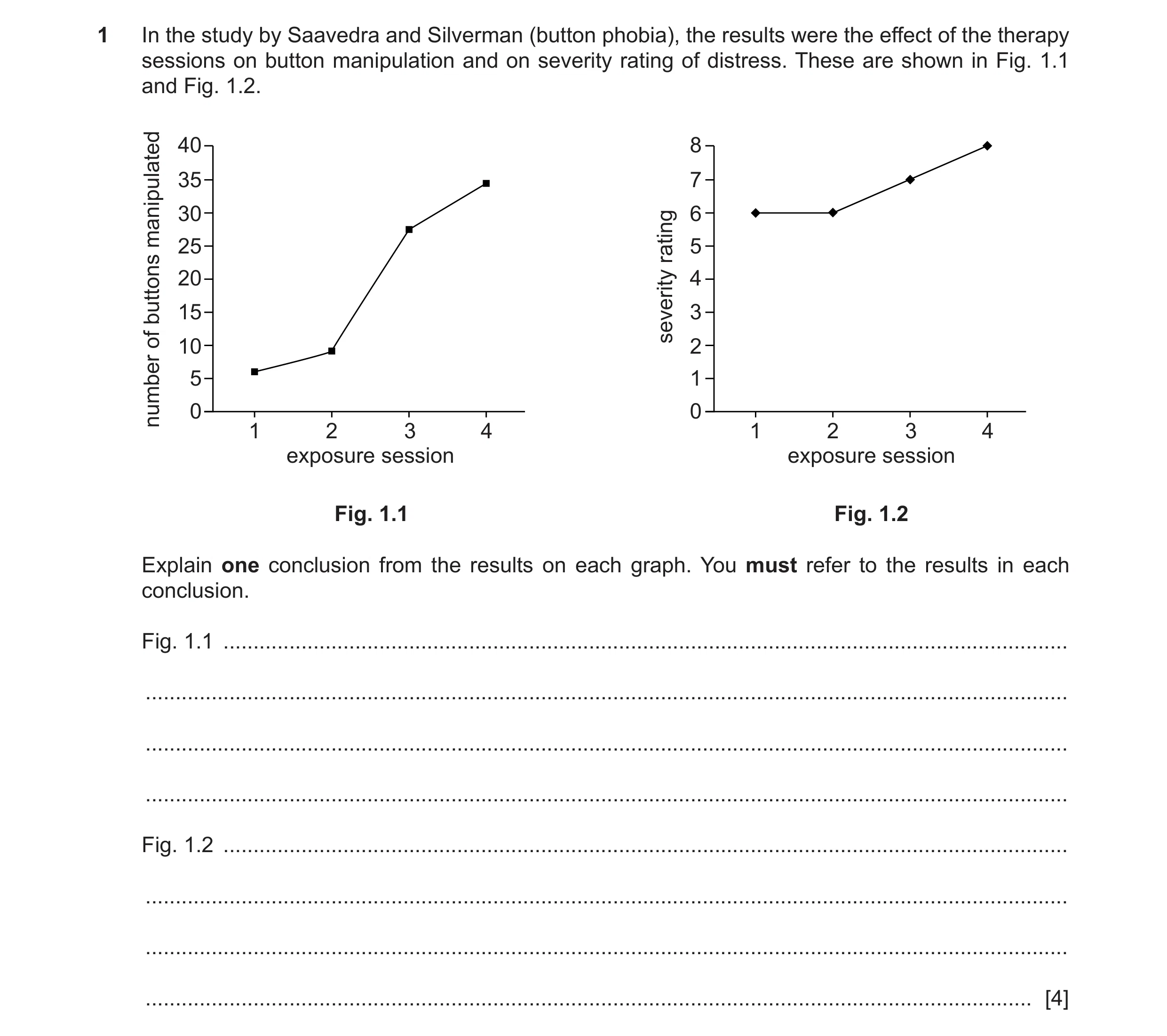
1 In the study by Saavedra and Silverman (button phobia), the results were the effect of the therapy sessions on button manipulation and on severity rating of distress. These are shown in Fig. 1.1 and Fig. 1.2. 40 8 35 7 30 6 manipulated 25 rating 5 20 4 buttons 15 3 of severity 10 2 5 1 number 0 0 1 2 3 4 1 2 3 4 exposure session exposure session Fig. 1.1 Fig. 1.2 Explain one conclusion from the results on each graph. You must refer to the results in each conclusion. Fig. 1.1 … … … … Fig. 1.2 … … … … [4]
4 marks
Mark scheme: Question Answer Marks 1 In the study by Saavedra and Silverman (button phobia), the results 4 were the effect of the therapy sessions on button manipulation and on severity rating of distress. These are shown in Fig. 1.1 and Fig. 1.2. Explain one conclusion from the results on each graph. You must refer to the results in each conclusion. 1 mark for 1 conclusion × 2 Linked to evidence from the graph × 2 The therapy worked / he was able to manipulate buttons better after therapy = 1 (conclusion), because in later exposure sessions the number of buttons he manipulated increased from 28 to 35 (graph) = 1 (graph) Therapy increases distress / the therapy didn’t work as he became more stressed over time = 1 (conclusion), because the severity rating he gave the buttons rose from 6 to 8 (graph) = 1
This question in 9990/22 Oct/Nov 2020
Q12 · In a study about phobias, researchers have identified two problems 9990/22 Oct/Nov 2020
5 In a study about phobias, researchers have identified two problems. (a) One problem is that they cannot be sure that they are studying phobias rather than just dislikes. For example, people may refuse to eat a food they claimed to have a phobia of simply because they don’t like it. Explain whether this is a problem of validity or reliability. Validity or reliability: … Explanation: … … [1] (b) Another problem is that they cannot be sure that they are measuring phobias consistently. For example, the researchers may interpret the participants’ written comments differently. Explain whether this is a problem of validity or reliability. Validity or reliability: … Explanation: … … [1]
2 marks
Mark scheme: 5 In a study about phobias, researchers have identified two problems. 5(a) One problem is that they cannot be sure that they are studying phobias 1 rather than just dislikes. For example, people may refuse to eat a food they claimed to have a phobia of simply because they don’t like it Explain whether this is a problem of validity or reliability. 1 mark for name of validity and an explanation (does not have to be linked) Validity (identification) as they will not be measuring the variable they expected to measure (generic) = 1 Validity (identification) as they will not be measuring phobias, but dislikes instead (linked) = 1 Reliability (incorrect) as they will not be measuring phobias, but dislikes instead (linked) = 0 5(b) Another problem is that they cannot be sure that they are measuring 1 phobias consistently. For example, the researchers may interpret the participants’ written comments differently. Explain whether this is a problem of validity or reliability. 1 mark for name of reliability and an explanation (does not have to be linked) Reliability (identification) because it is about the researchers’ consistency in recording data (explanation) (generic) = 1 Reliability (identification) because they may make different records from the same data (explanation) (linked) = 1 Validity (incorrect) because it is about the researchers’ consistency in recording data (explanation) = 0
This question in 9990/22 Oct/Nov 2020
Q13 · Mandy wants to investigate the effects of phobias on the way people socialise, such as… 9990/23 Oct/Nov 2021
10 Mandy wants to investigate the effects of phobias on the way people socialise, such as how friendly they are and the social groups or clubs they belong to. (a) Describe how Mandy could conduct a study using a questionnaire to investigate the effects of phobias on the way people socialise. … … … … … … … … … … … … … … … … … … … … … … … … … … … … … … … … … … … … … … … [10] (b) Identify one practical weakness/limitation with the procedure you have described in your answer to part (a) and suggest how your study might be done differently to overcome the problem. Do not refer to ethics or sampling in your answer. … … … … … … …
10 marks
Mark scheme: 10(a) Mandy wants to investigate the effects of phobias on the way people 10 socialise, such as how friendly they are and the social groups or clubs they belong to. Describe how Mandy could conduct a study using a questionnaire to investigate the effects of phobias on the way people socialise. Three majors for a questionnaire are: a content of questions (examples: phobic symptoms, social life) b style of questions asked (e.g. open/closed) c people with phobias (source, sampling) The minor is: where: location of participants when completing the questionnaire / how it is distributed Other details for replication: • lie questions • filler questions • sample size • description of how closed questions will be scored • description of how open questions will be interpreted • ethical issues Other appropriate responses should also be credited. Mark according to the levels of response criteria below: Level 3 (8–10 marks) • Response is described in sufficient detail to be replicable; • Response may have a minor omission; • Use of psychological terminology is accurate and comprehensive; Level 2 (5–7 marks) • Response is in some detail; • Response has minor omission(s); • Use of psychological terminology is accurate; Level 1 (1–4 marks) • Response is basic in detail; • Response has major omission(s); • If response is impossible to conduct max 2; • Use of psychological terminology is mainly accurate; Level 0 (0 marks) No response worthy of credit. 10(b) Identify one practical weakness/limitation with the procedure you have 4 described in your answer to part (a) and suggest how your study might be done differently to overcome the problem. Do not refer to ethics or sampling in your answer. Answer will depend on problem identified. Problems may, for example, be matters of: Validity • operationalisation • situational/participant variables factors Reliability • inter-rater consistency • intra-rater consistency This list is not exhaustive and other appropriate responses should also be credited. Marks Comment 3-4 Appropriate problem identified. Appropriate solution is clearly described. 2 Appropriate problem identified. plus EITHER Explanation of why it is a problem OR Ineffectual but possible solution described. 1 Appropriate problem identified. Little or no justification. 0 No response worthy of credit
This question in 9990/23 Oct/Nov 2021
Q14 · Manas is a researcher at a drug company and is conducting an experiment to test a new… 9990/21 Oct/Nov 2022
9 Manas is a researcher at a drug company and is conducting an experiment to test a new drug for patients who have phobias. The drug is a clear, tasteless liquid that should help the patients to relax during therapy. Manas selects 10 patients who will take the new drug and 10 other patients who will be given water, which is also clear and tasteless. The patients in both groups believe they are taking the new drug. (a) Identify the experimental condition and the control condition in this experiment. experimental condition: … control condition: … [1] (b) Manas has controlled two variables. The drug is: • a clear liquid • tasteless. (i) Suggest two other controls that could be used in this experiment to keep the experimental condition and the control condition as similar as possible. 1 … … 2 … … [2] (ii) Explain why it is important to keep the experimental condition and the control condition as similar as possible. … … [1] (c) Suggest two ethical problems with this experiment. … … … … … … … … [4] Section C Answer all questions in this section.
8 marks
Mark scheme: 9 Manas is a researcher at a drug company and is conducting an experiment to test a new drug for patients who have phobias. The drug is a clear, tasteless liquid that should help the patients to relax during therapy. Manas selects 10 patients who will take the new drug and 10 other patients who will be given water, which is also clear and tasteless. The patients in both groups believe they are taking the new drug. 9(a) Identify the experimental condition and the control condition in this 1 experiment. 1 mark for identifying both conditions (definitive answers). Answers MUST be in the correct space (unless unambiguously indicated otherwise). experimental condition = (10 patients being given) the (new) drug control condition = (10 patients being given) water/placebo. 9(b) Manas has controlled two variables. The drug is: • a clear liquid • tasteless 9(b)(i) Suggest two other controls that could be used in this experiment to 2 keep the experimental condition and the control condition as similar as possible. 1 mark for a control 2. The liquids should be labelled / presented in the same way (e.g. both in a beaker); Taken at the same temperature; The drug should have no smell / smell like water; The liquids should look/taste the same = 0 marks (repetition from stem). 9(b)(ii) Explain why it is important to keep the experimental condition and the 1 control condition as similar as possible. 1 mark for generic explanation of the purpose of controls. To ensure that any differences / changes in the DV (phobia reduction) are due only to the IV (the drug). 9(c) Suggest two ethical problems with this experiment. 4 1 mark for identification of problem 2. 1 mark for link. Informed consent; (problem) Because the participants do not know whether they are receiving the drug or not; (link) Participants must not know whether they are receiving the drug or not, so they cannot give fully informed consent = 2 Deception / they are being lied to; (problem) they may believe they are getting the drug, which will not be true if they are in the control group; (link) Protection from harm (physical) / it might be dangerous; (problem) participants in the drug group may be physically harmed by the drug as it is still being tested; (link) Protection from harm (psychological); (problem) control participants may suffer in therapy if they try too hard if they think they are getting the drug; (link) control participants may not make progress in therapy because they are only getting water; (link).
This question in 9990/21 Oct/Nov 2022
Q15 · The research by Saavedra and Silverman (button phobia) was a case study 9990/22 Feb/March 2023
5 The research by Saavedra and Silverman (button phobia) was a case study. It used a variety of techniques including interviews and a scale (the feelings thermometer). Suggest one strength of using a variety of techniques in a case study. … … … … [2]
2 marks
Mark scheme: 5 The research by Saavedra and Silverman (button phobia) was a case 2 study. It used a variety of techniques including interviews and a scale (the feelings thermometer). Suggest one strength of using a variety of techniques in a case study. 1 mark for advantage (does not have to be linked) 1 mark for detail (does not have to be linked but a link may be detail) Can collect qualitative and quantitative data; (advantage) So can compare (quantitative) and look at reasons/detail (qualitative); (advantage / detail) So increases validity; (detail) More valid as can compare different sources of data to see if they demonstrate the same finding / triangulation; (adv) E.g. Saavedra and Silverman could see if the feelings thermometer and the boy’s comments were similar; (detail)
This question in 9990/22 Feb/March 2023
Q16 · Dr Caesar is interested in animal phobias in his patients 9990/23 May/June 2023
10 Dr Caesar is interested in animal phobias in his patients. He wants to investigate whether there is a correlation between the size of the animal causing the phobia and the severity of each patient’s animal phobia. (a) Describe how Dr Caesar could conduct a correlational study to investigate the relationship between animal size and the severity of the patients’ phobias. … … … … … … … … … … … … … … … … … … … … … … … … … … … … … … … … … … [10] (b) Identify one practical weakness/limitation with the procedure you have described in your answer to part (a) and suggest how your study might be done differently to overcome the problem. Do not refer to ethics or sampling in your answer. … … … … … … … … [4]
14 marks
Mark scheme: 10 Dr Caesar is interested in animal phobias in his patients. He wants to investigate whether there is a correlation between the size of the animal causing the phobia and the severity of each patient’s animal phobia. 10(a) Describe how Dr Caesar could conduct a correlational study to 10 investigate the relationship between animal size and the severity of the patients’ phobias. Three majors for this correlation are: (a) variable: animal size (operationalisation and quantification of how big the animal is, must be continuous data) (b) variable: phobia severity (operationalisation and quantification of severity of the phobia, must be continuous data) (c) technique for producing/collecting data i.e. procedure (e.g. tests, observations, questionnaires). The minors are: where: location of participants when completing the study who: participants (with phobias of varying severity, to various animals), sampling technique Also a statement about whether a positive or negative correlation is expected sampling technique sample size description of how data will analysed, e.g. use of scattergram ethical issues Other appropriate responses should also be credited. Mark according to the levels of response criteria below: Level 3 (8–10 marks) Response is described in sufficient detail to be replicable. Response may have a minor omission. Use of psychological terminology is accurate and comprehensive. Level 2 (5–7 marks) Response is in some detail. Response has minor omission(s). Use of psychological terminology is accurate. Level 1 (1–4 marks) Response is basic in detail. Response has major omission(s). If response is impossible to conduct max. 2. Use of psychological terminology is mainly accurate. Level 0 (0 marks) No response worthy of credit. 10(b) Identify one practical weakness/limitation with the procedure you have 4 described in your answer to part (a) and suggest how your study might be done differently to overcome the problem. Do not refer to ethics or sampling in your answer. Answer will depend on problem identified. Problems may, for example, be matters of: Validity operationalisation situational/participant variables factors. Reliability inter-rater consistency intra-rater consistency. This list is not exhaustive and other appropriate responses should also be credited. Marks Comment 3–4 Appropriate problem identified. Appropriate solution is clearly described. 2 Appropriate problem identified plus EITHER Explanation of why it is a problem, OR Ineffectual but possible solution described. 1 Appropriate problem identified. Little or no justification. 0 No response worthy of credit.
This question in 9990/23 May/June 2023
Q17 · In the study by Saavedra and Silverman (button phobia), a boy was repeatedly asked to use… 9990/23 Oct/Nov 2023
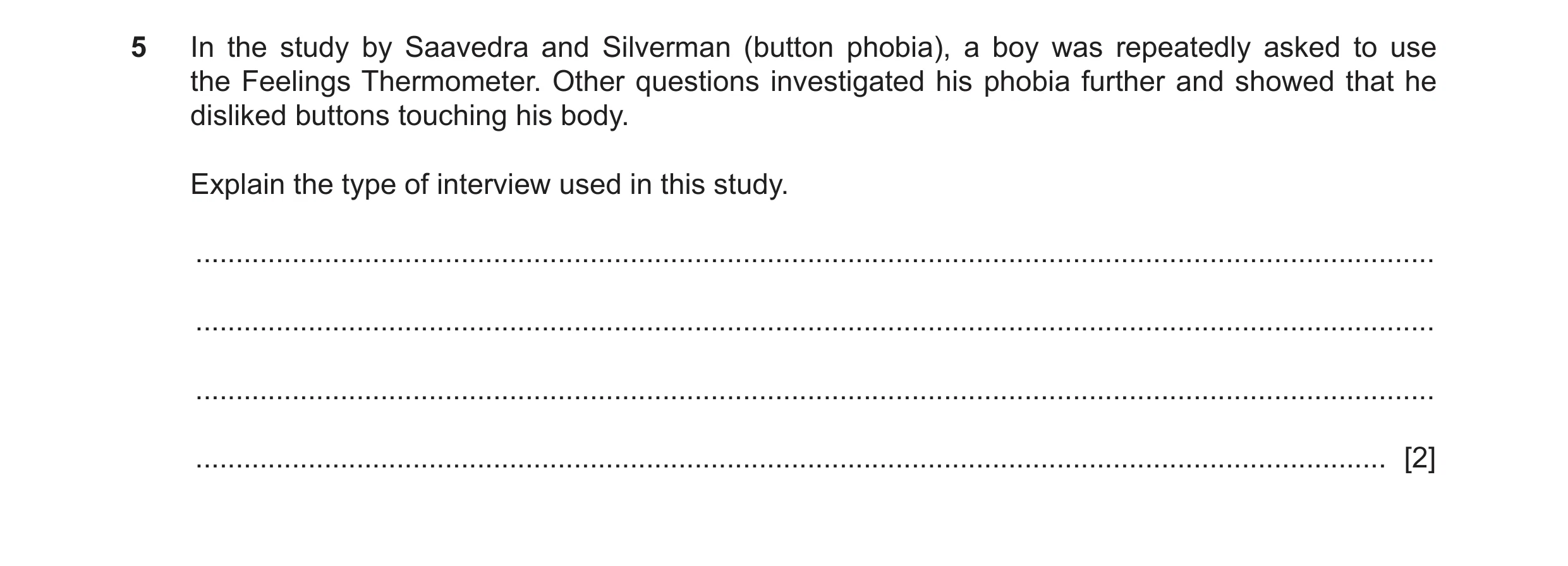
5 In the study by Saavedra and Silverman (button phobia), a boy was repeatedly asked to use the Feelings Thermometer. Other questions investigated his phobia further and showed that he disliked buttons touching his body. Explain the type of interview used in this study. … … … … [2]
2 marks
Mark scheme: 5 In the study by Saavedra and Silverman (button phobia), a boy was 2 repeatedly asked to use the Feelings Thermometer. Other questions investigated his phobia further and showed that he disliked buttons touching his body. Explain the type of interview used in this study. 1 mark for identifying semi-structured interview 1 mark for explanation of what made the interview semi-structured semi-structured interview (accept: an interview with structured and unstructured parts); because there were some standardised questions and some flexible ones (accept: questions were repeated or different);
This question in 9990/23 Oct/Nov 2023
Q18 · In the study by Saavedra and Silverman (button phobia), imagery exposure was investigated 9990/21 Oct/Nov 2025
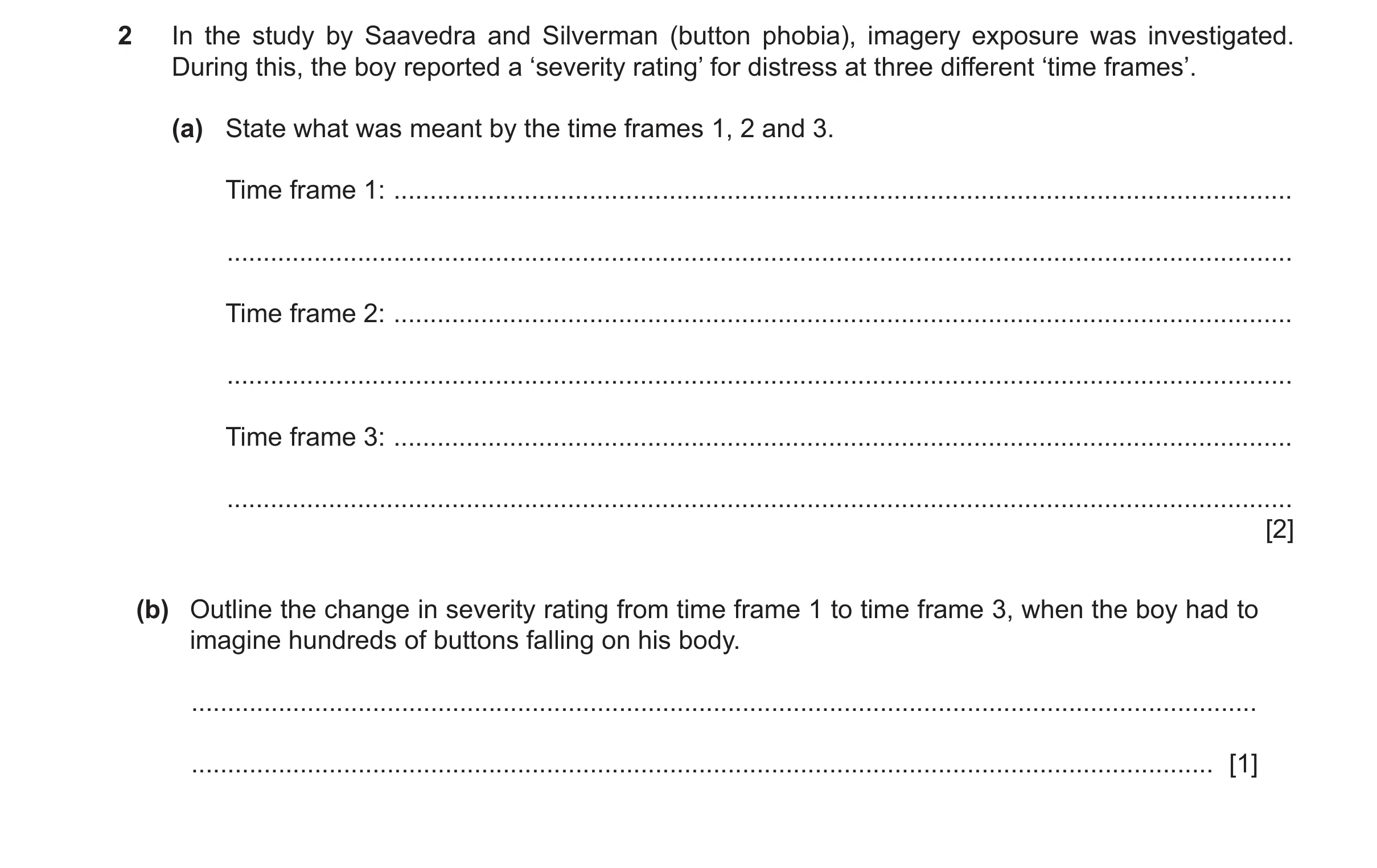
2 In the study by Saavedra and Silverman (button phobia), imagery exposure was investigated. During this, the boy reported a ‘severity rating’ for distress at three different ‘time frames’. (a) State what was meant by the time frames 1, 2 and 3. Time frame 1: … … Time frame 2: … … Time frame 3: … … [2] (b) Outline the change in severity rating from time frame 1 to time frame 3, when the boy had to imagine hundreds of buttons falling on his body. … … [1]
3 marks
Mark scheme: 2 In the study by Saavedra and Silverman (button phobia), imagery exposure was investigated. During this, the boy reported a ‘severity rating’ for distress at three different ‘time frames. 2(a) State what was meant by the time frames 1, 2 and 3. 2 Two out of three correct time frames = 1 All three correct time frames = 2 Just one correct = 0 • Time frame 1: before (imagery exposure/therapy) session; • Time frame 2: midway through (imagery exposure/therapy) session; • Time frame 3: after the (imagery exposure/therapy) session; 2(b) Outline the change in severity rating from time frame 1 to time frame 3 when the boy had to imagine hundreds of 1 buttons falling on his body. Outline of change = 1 the boy’s (distress) rating decreased over time/from timeframes 1-3
This question in 9990/21 Oct/Nov 2025
 1 / 16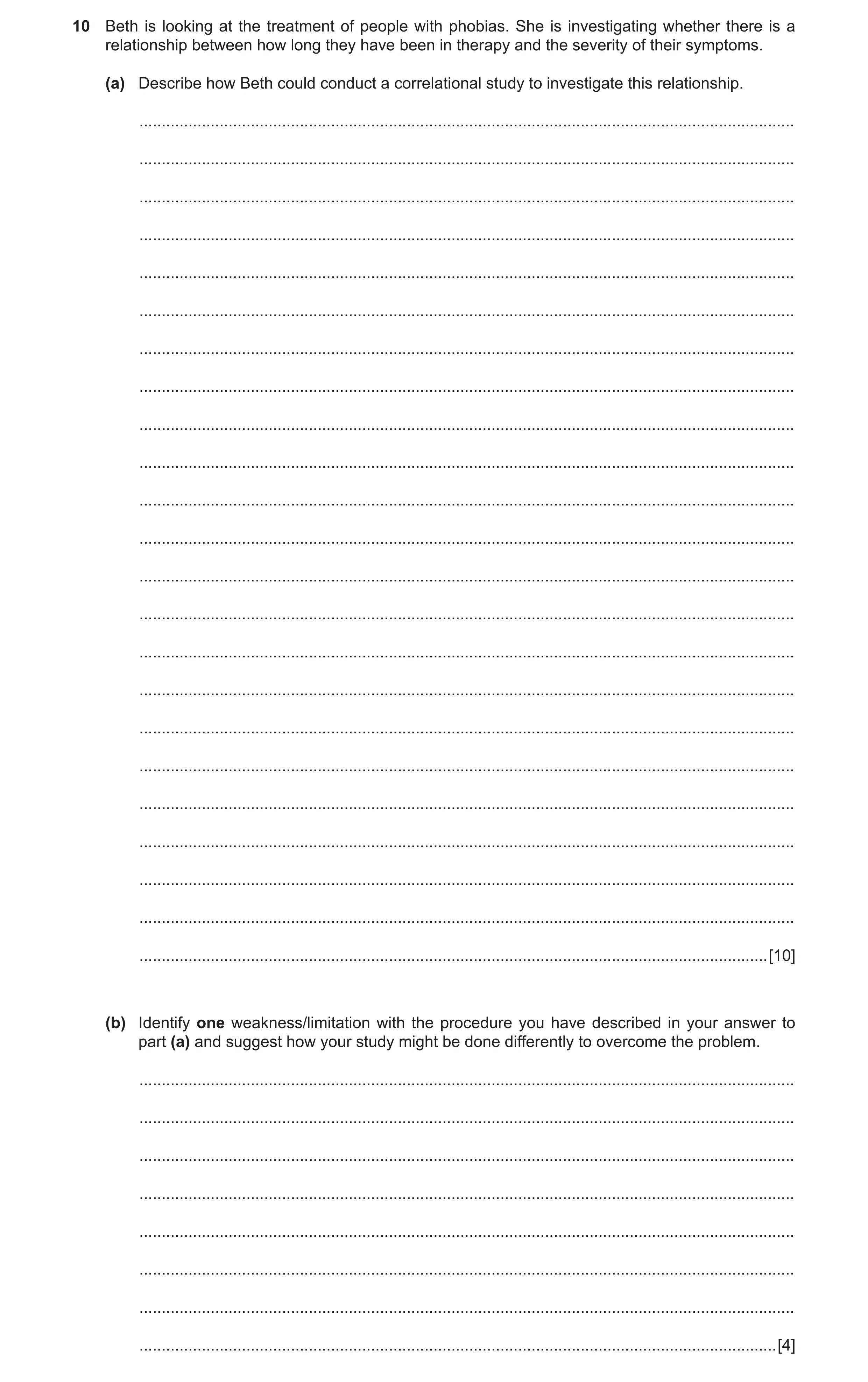
 3 / 16
 4 / 16
 5 / 16
 7 / 16
 8 / 16
 9 / 16
 10 / 16
 13 / 16
 14 / 16
 16 / 16
 4
4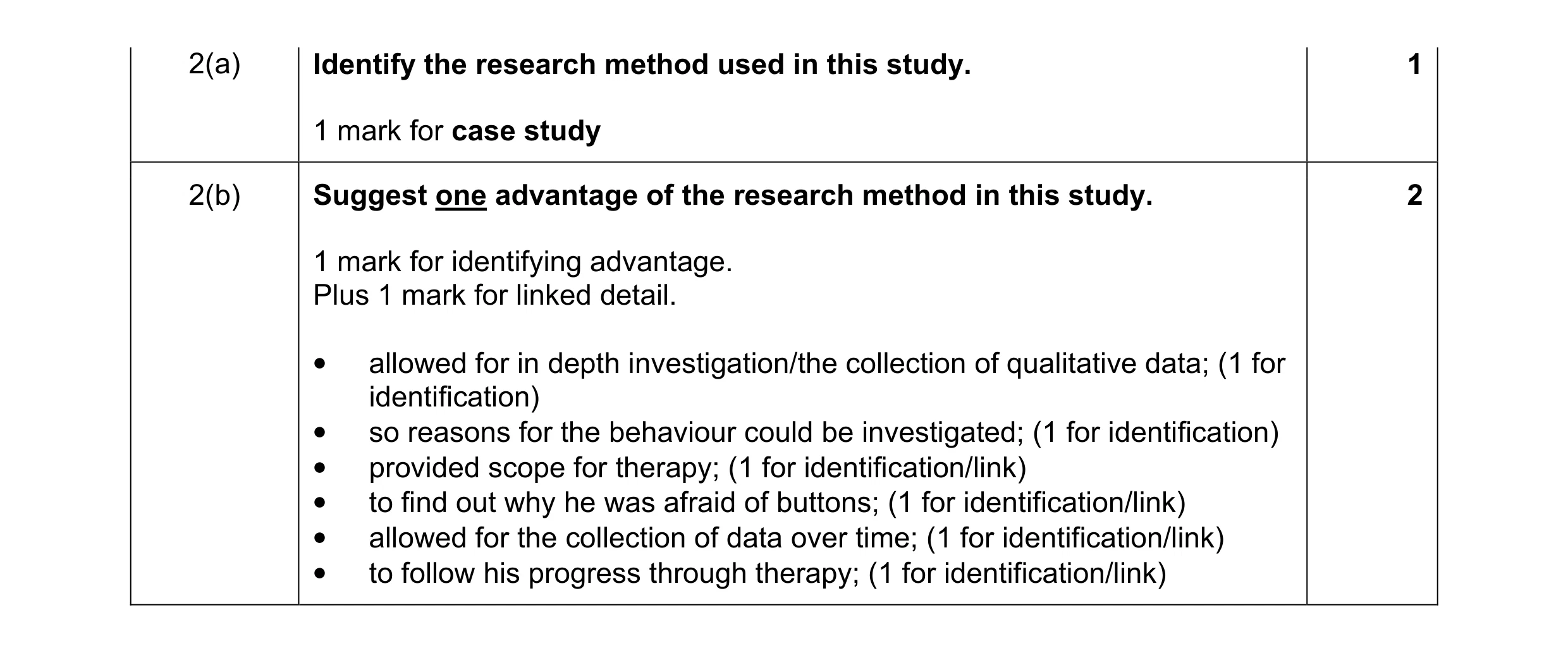 3
3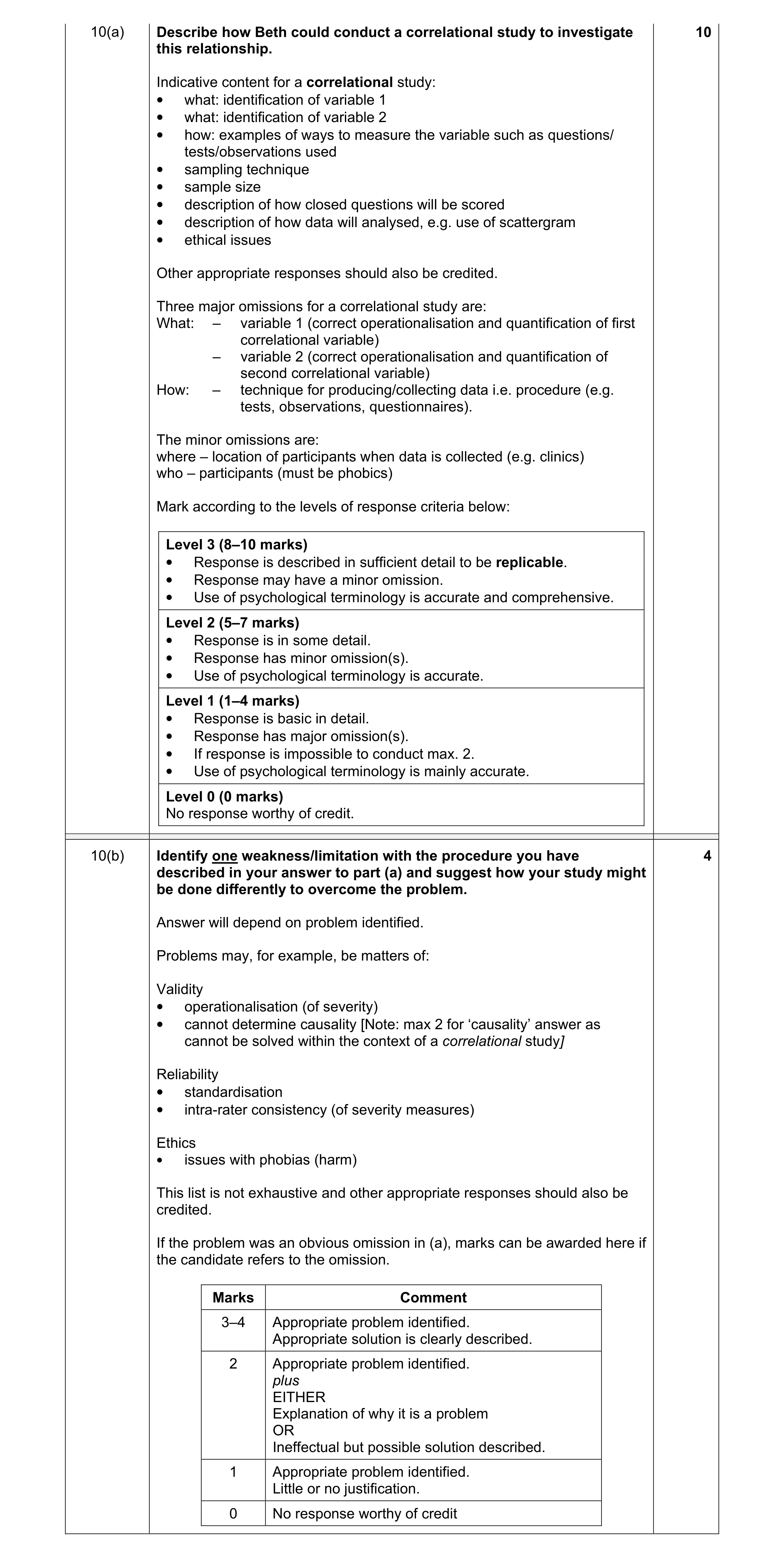 14
14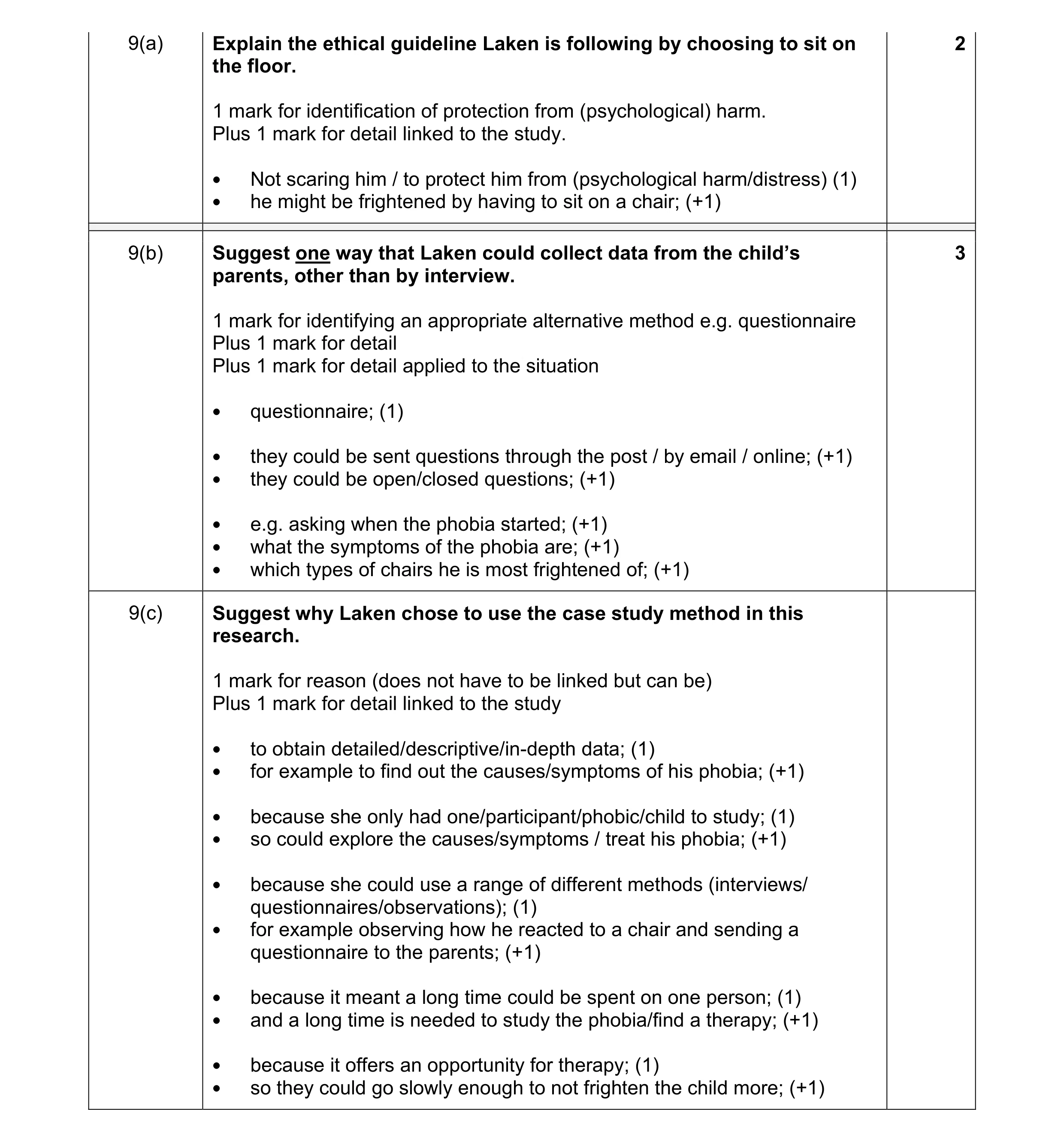 8
8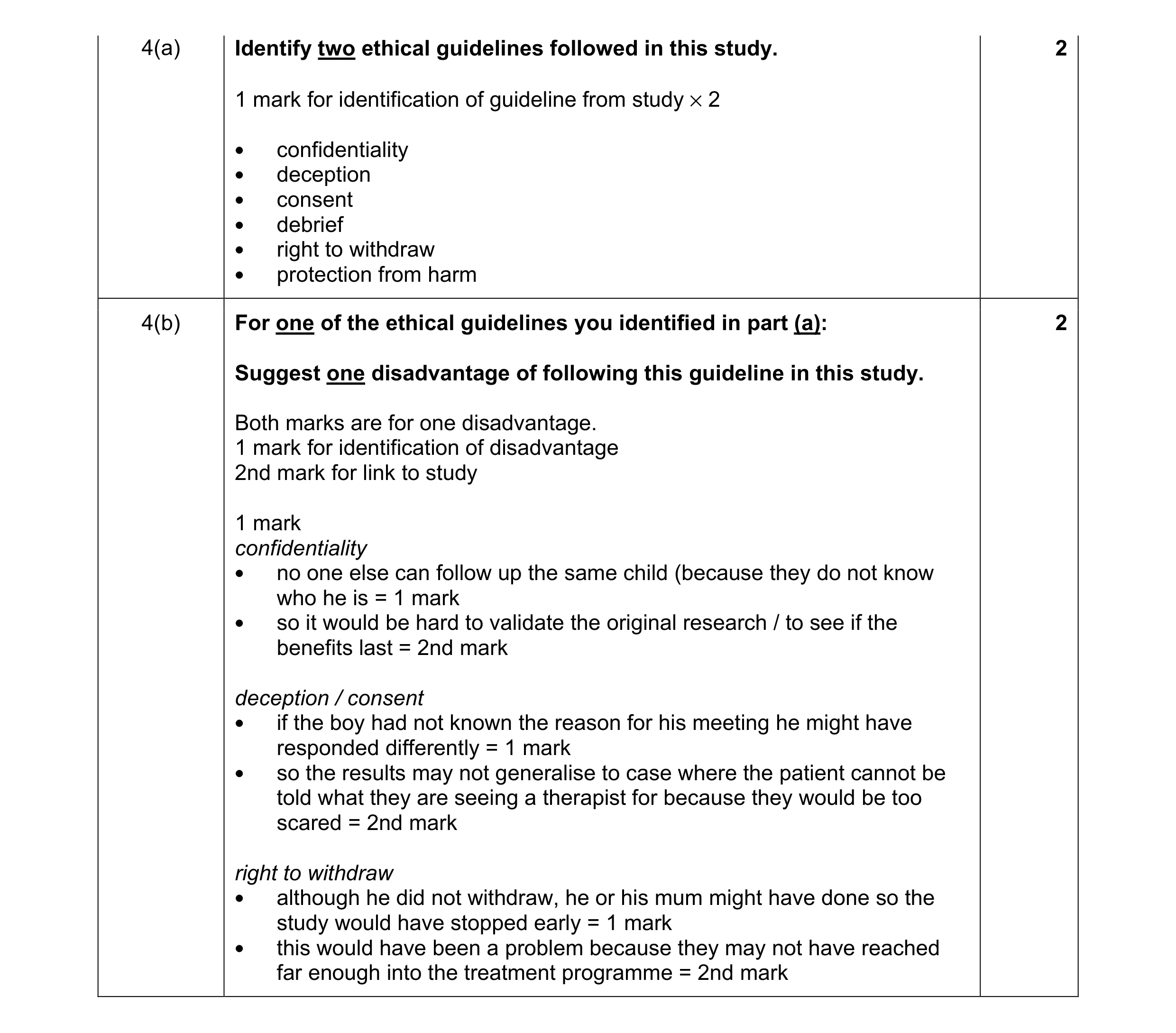 4
4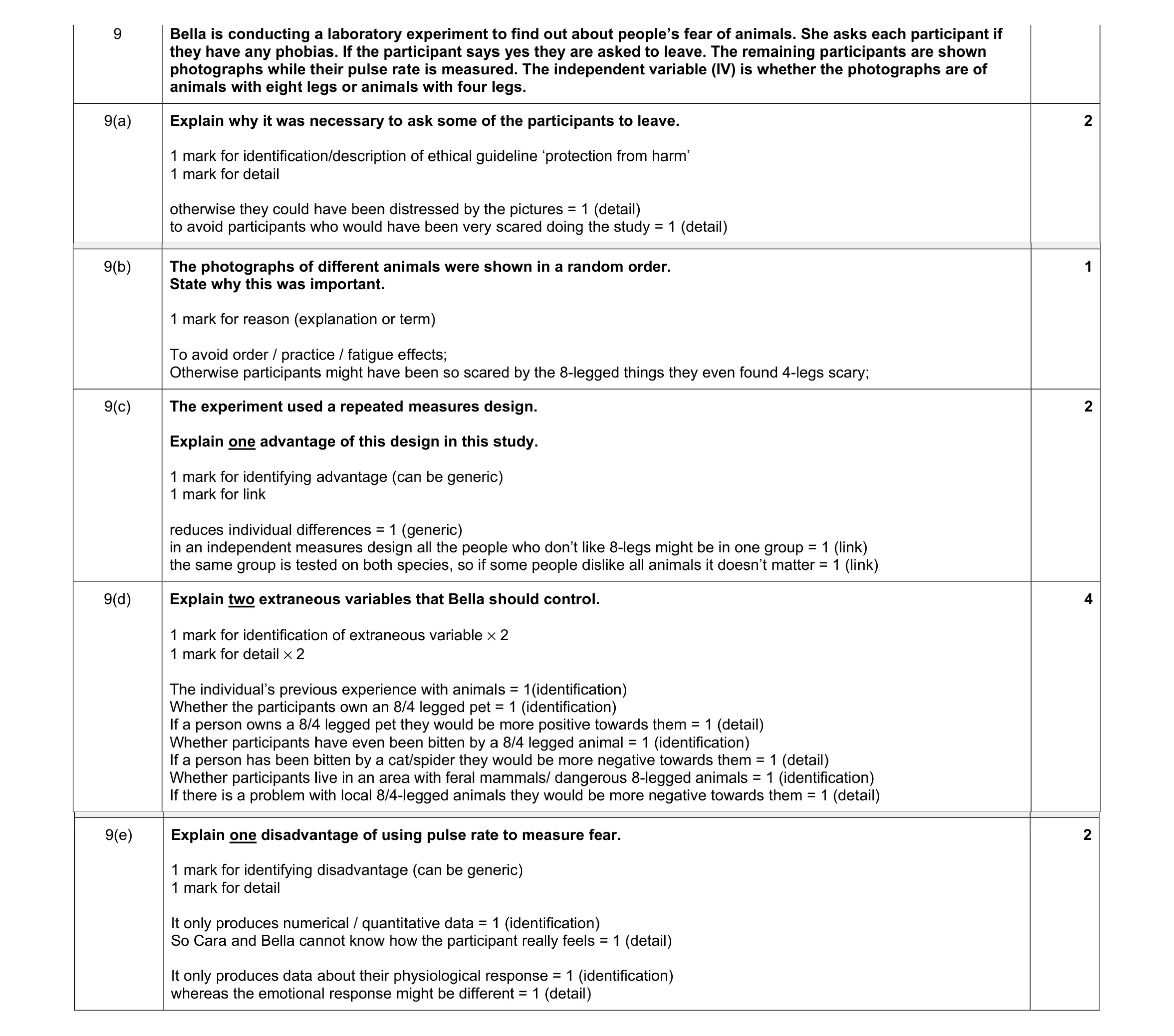 11
11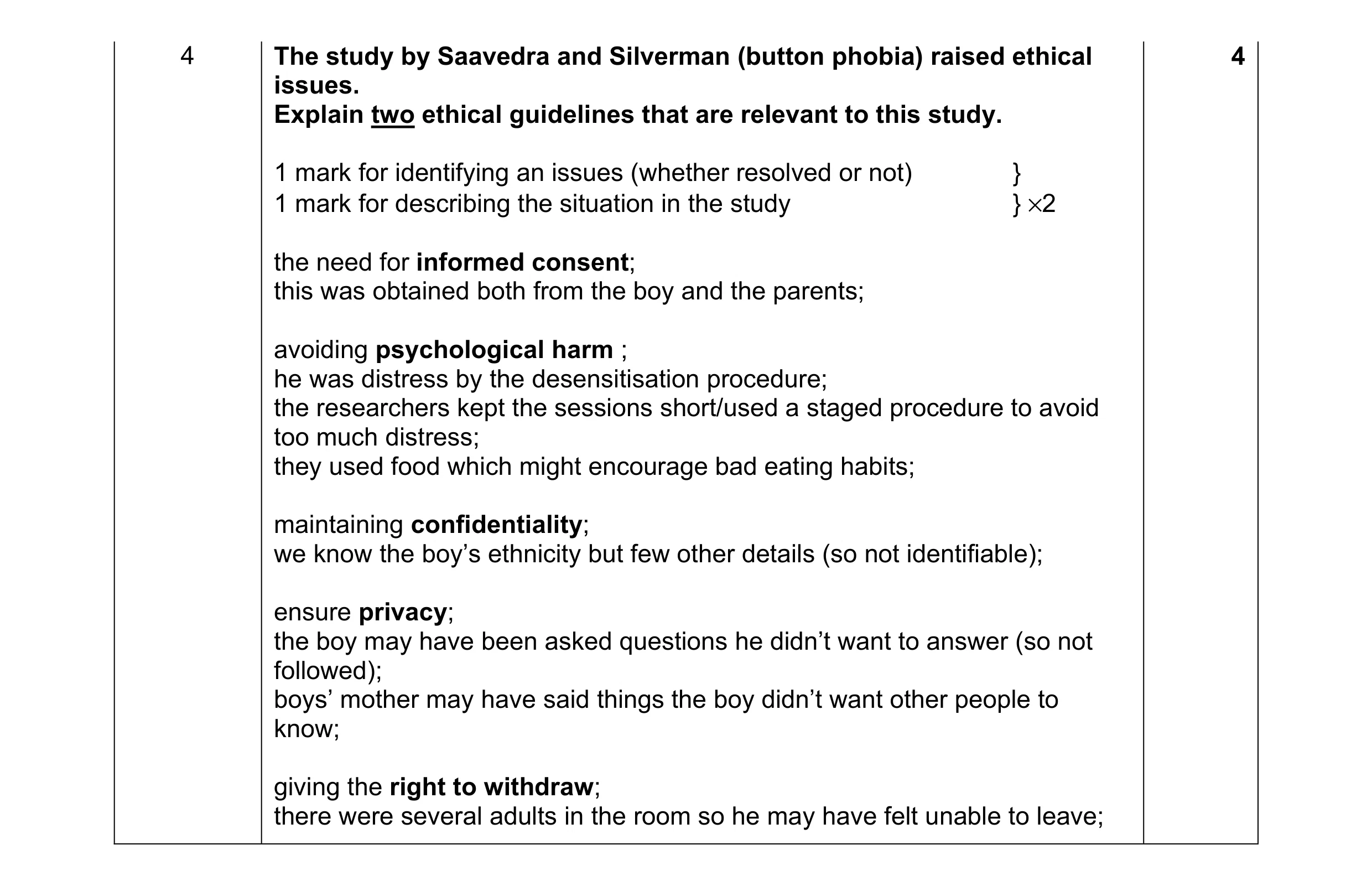 4
4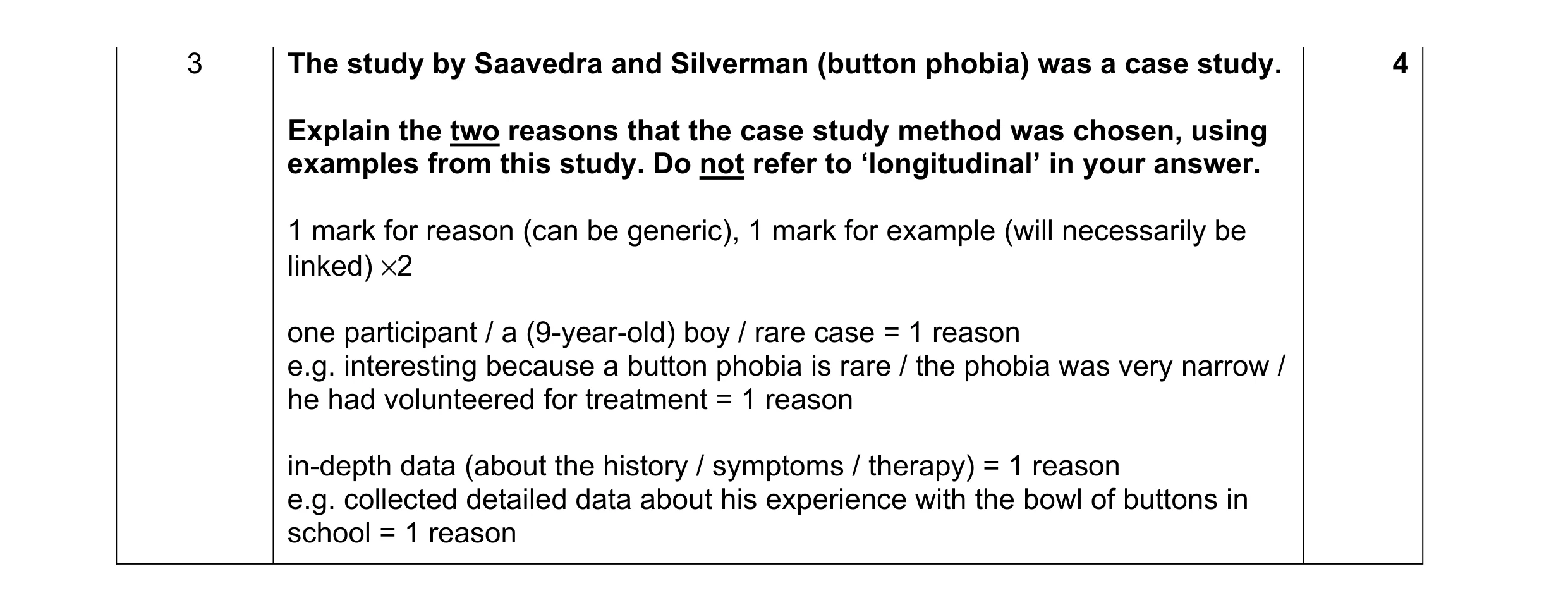 4
4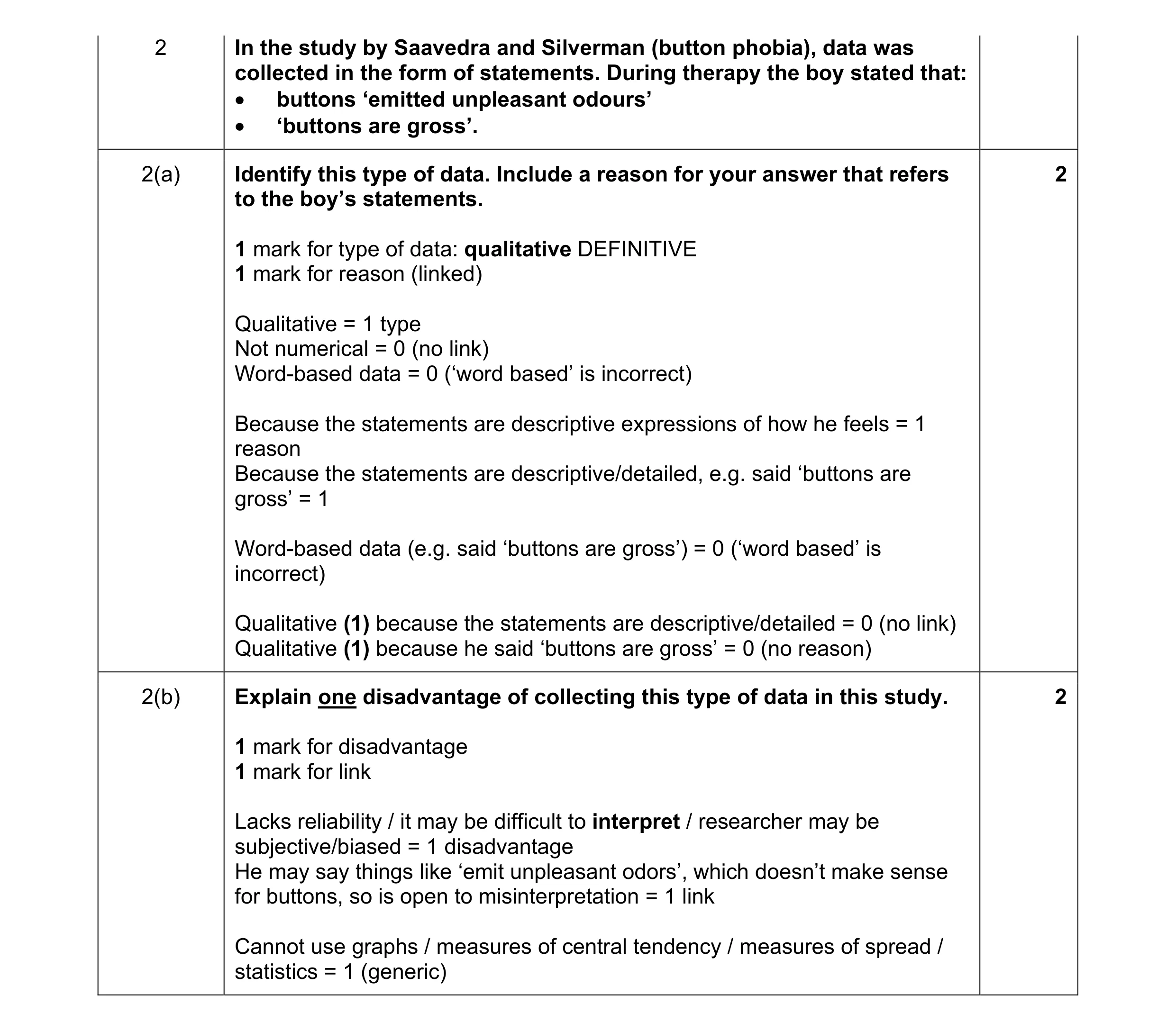 4
4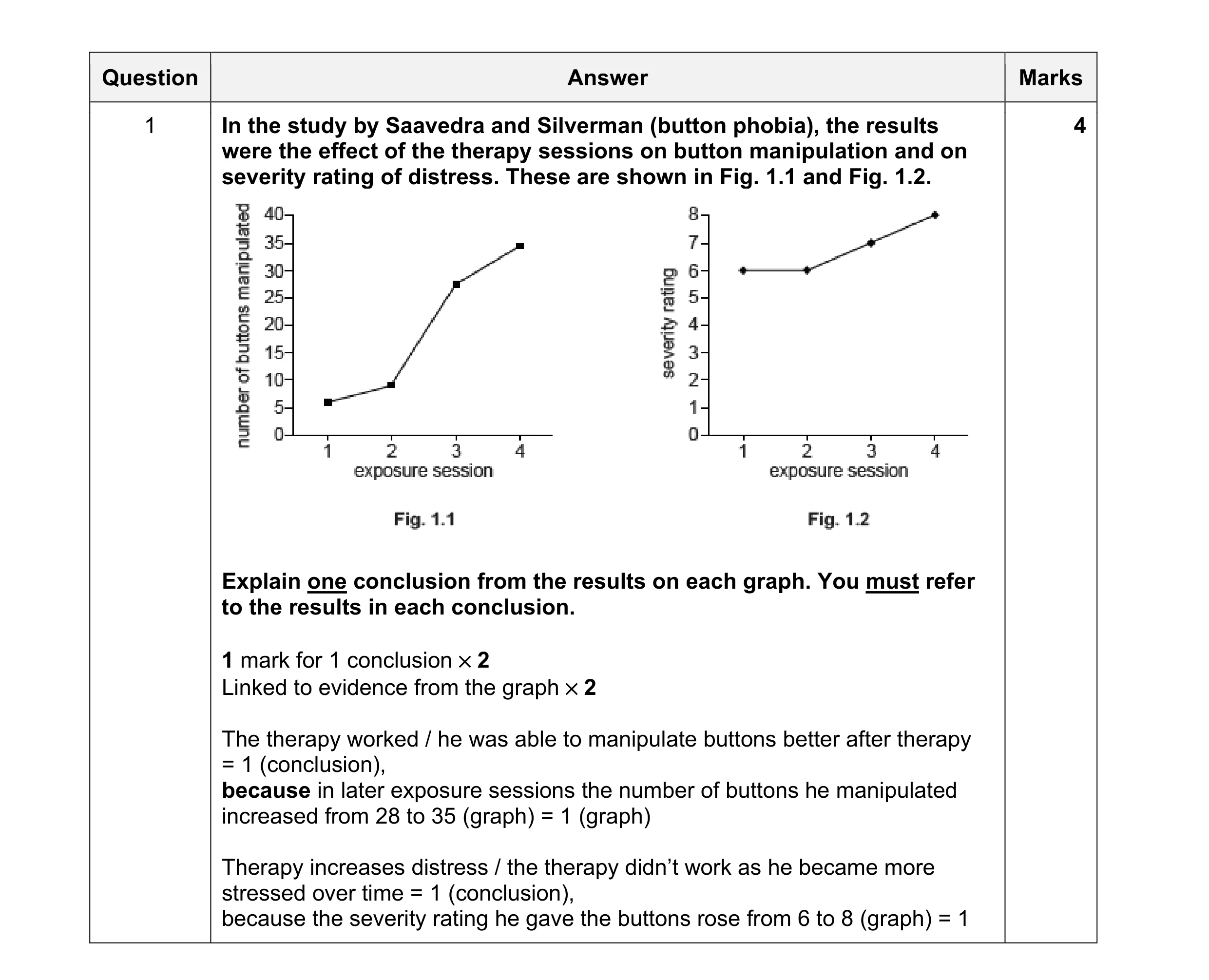 4
4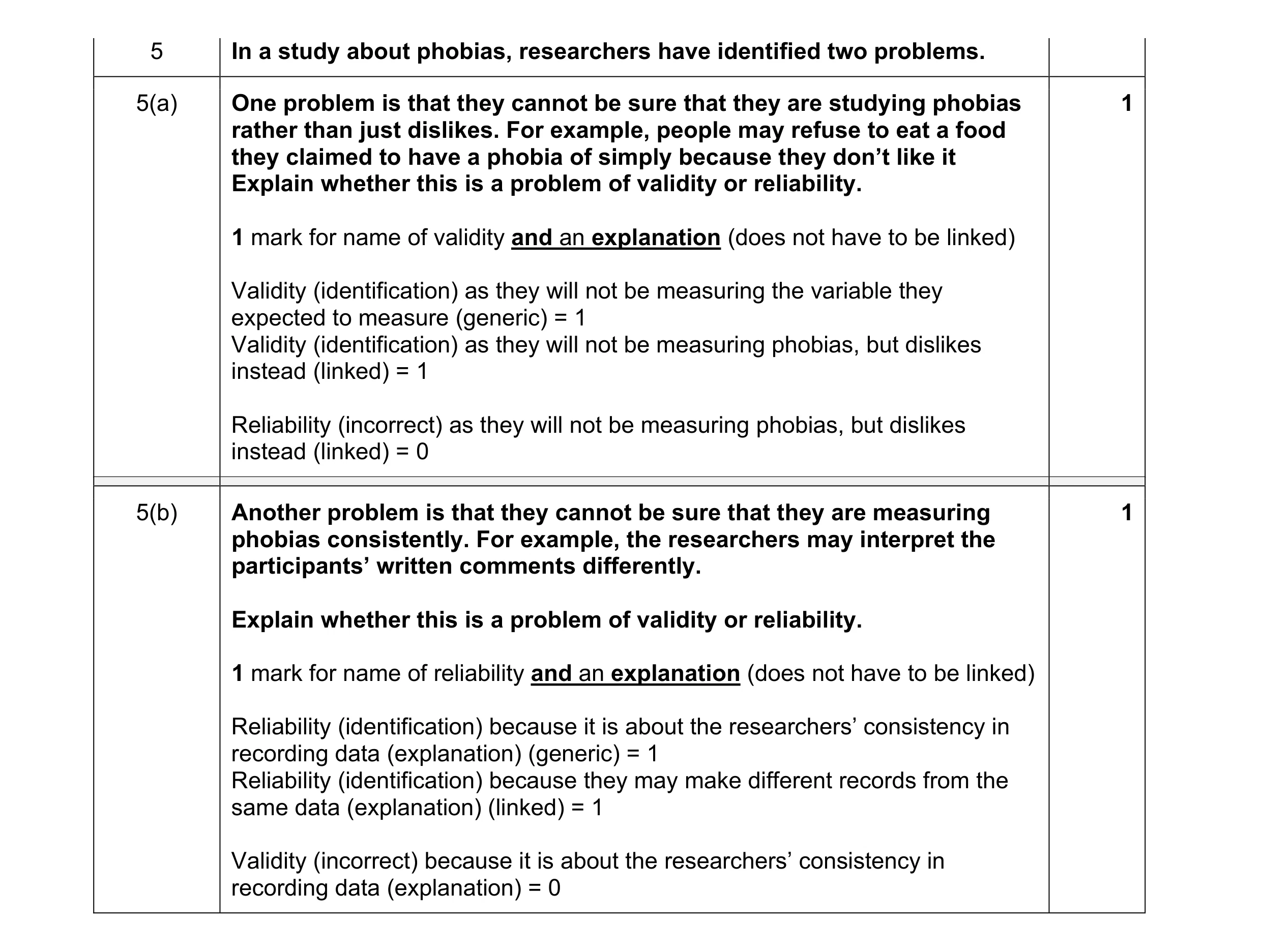 2
2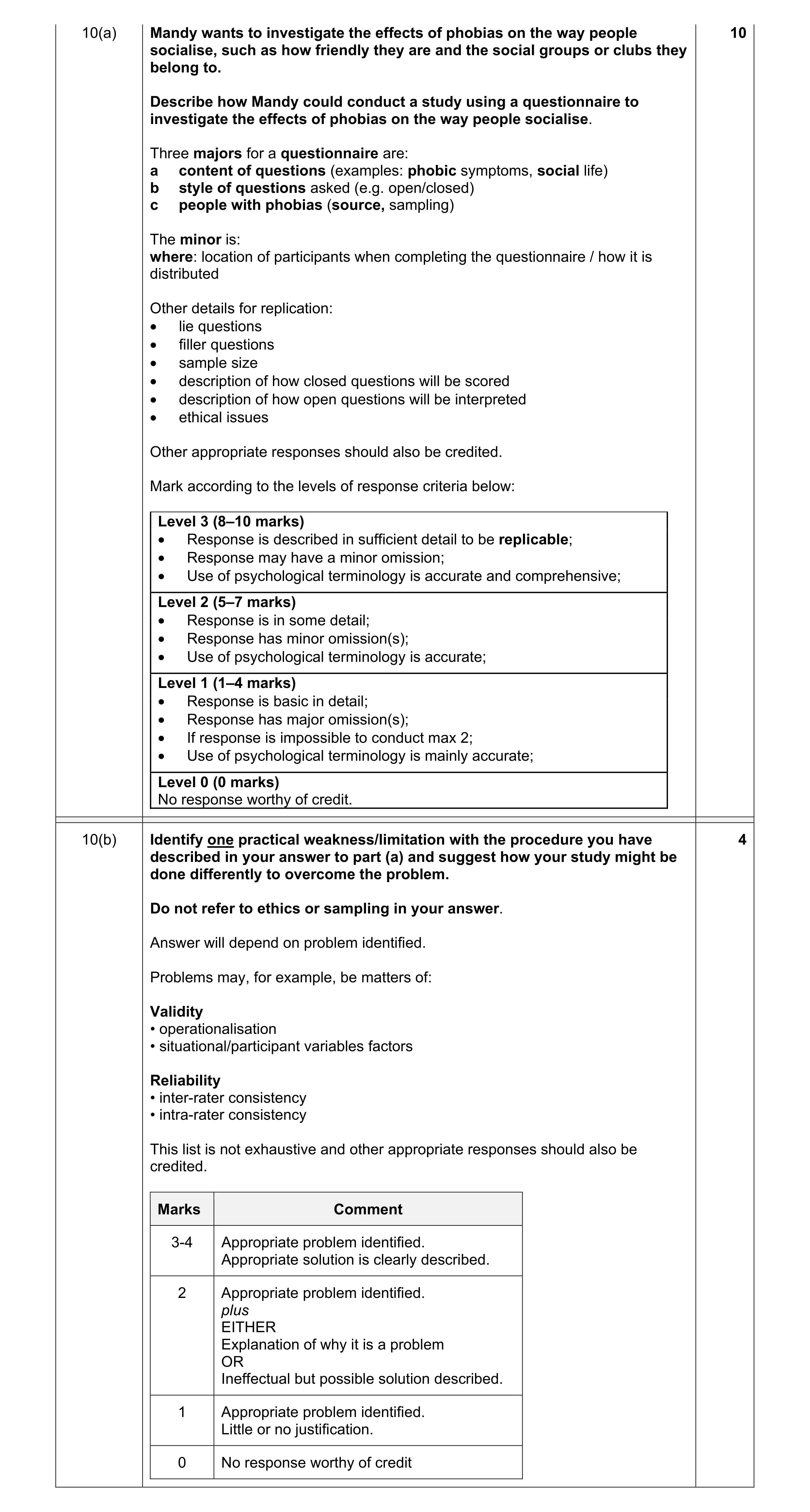 10
10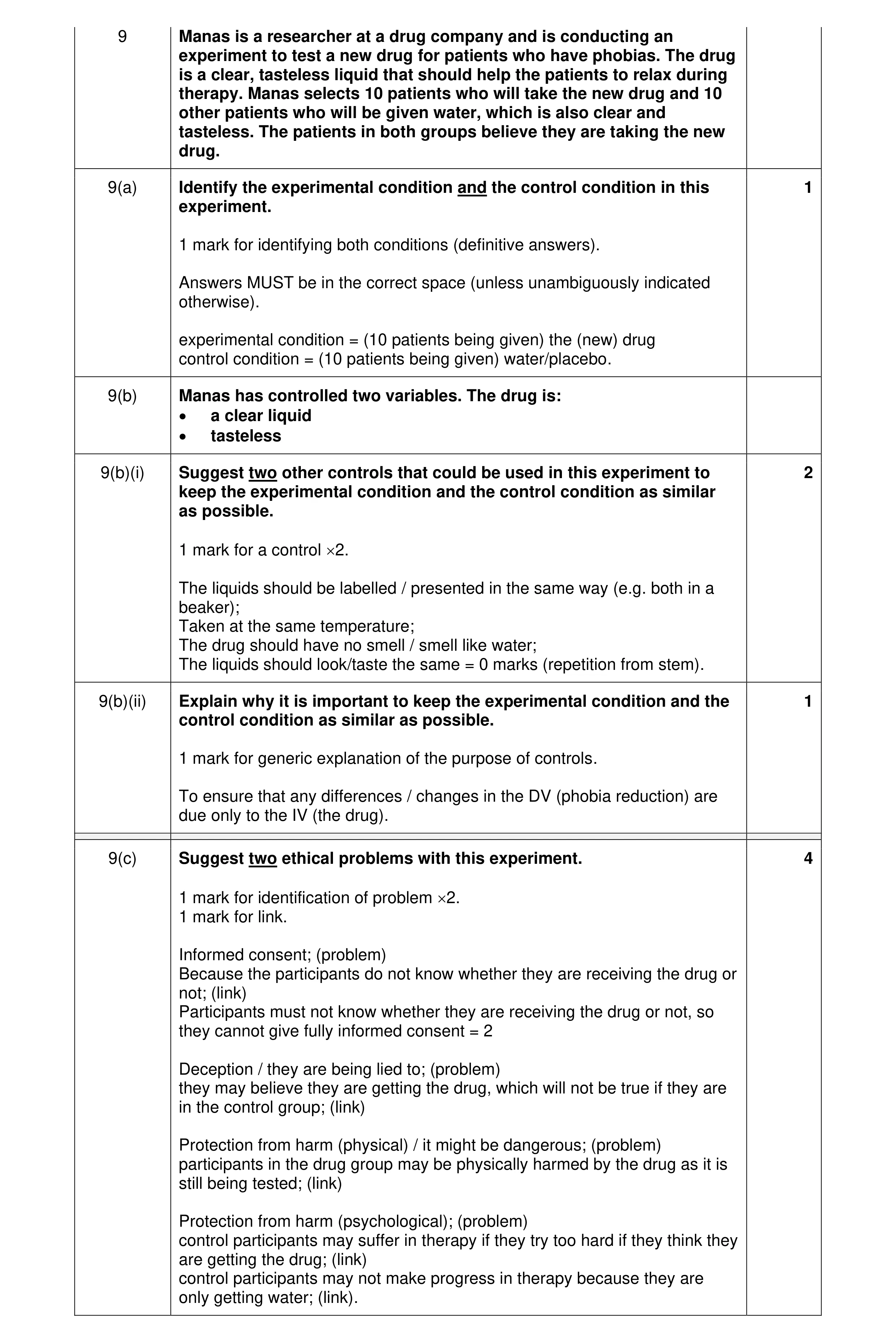 8
8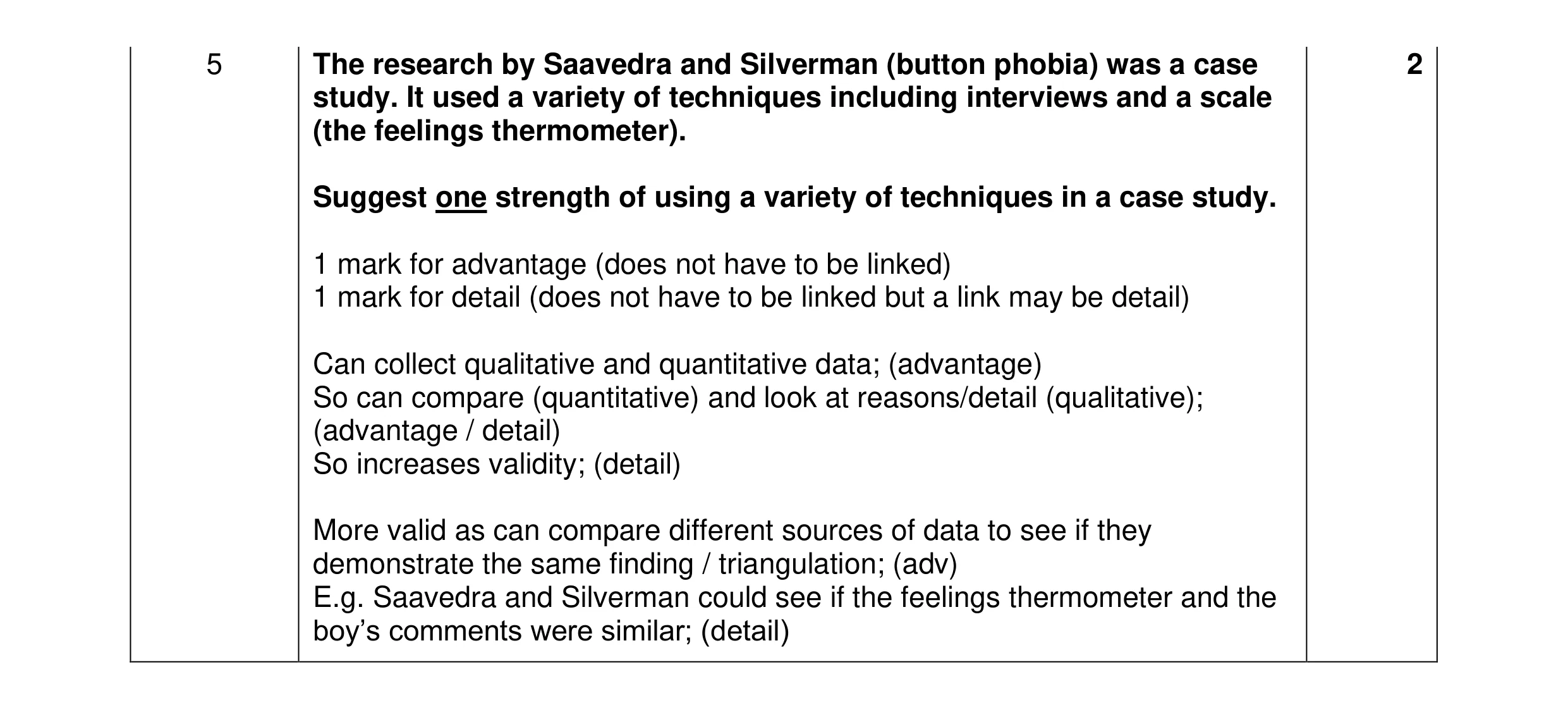 2
2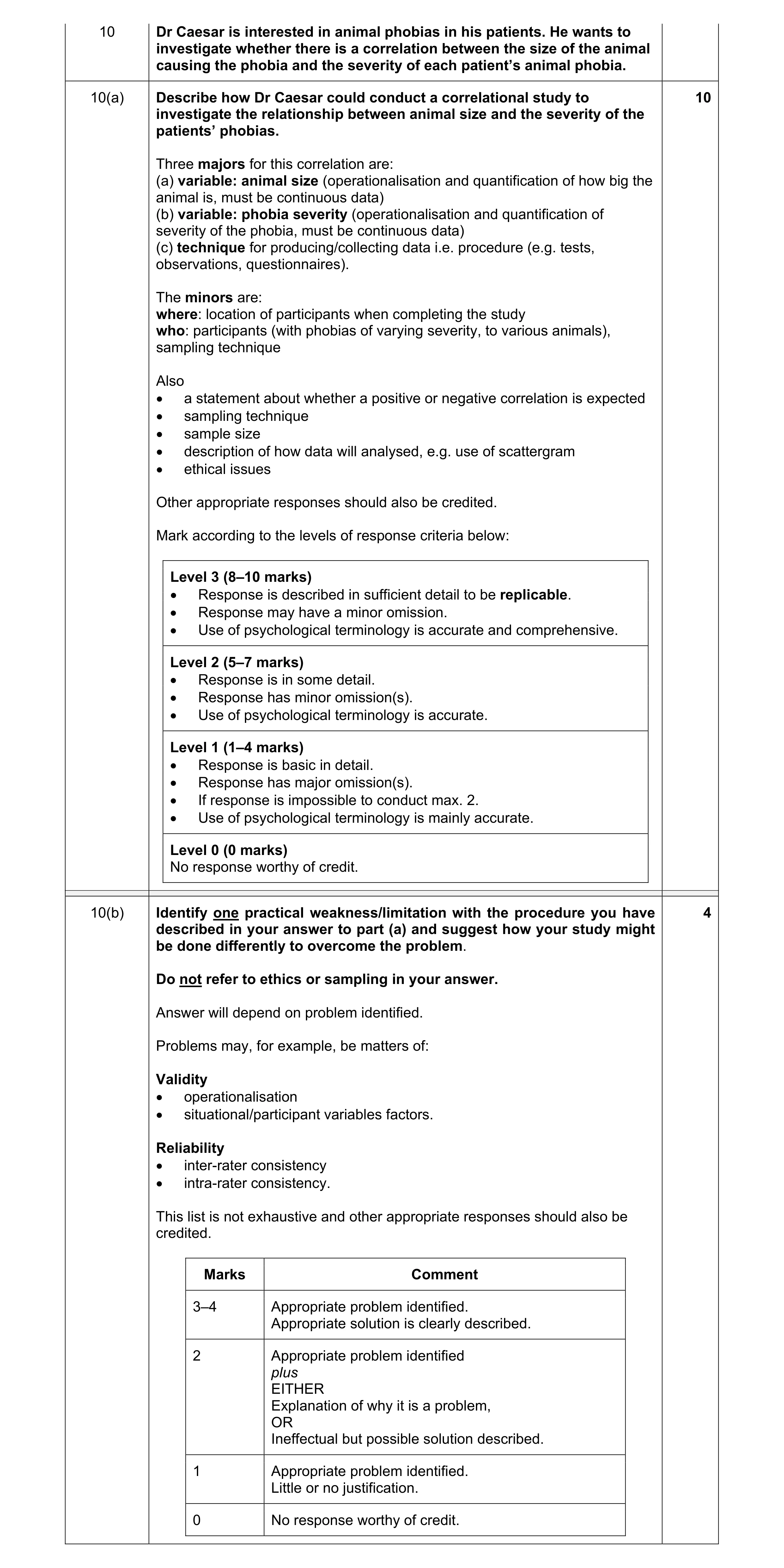 14
14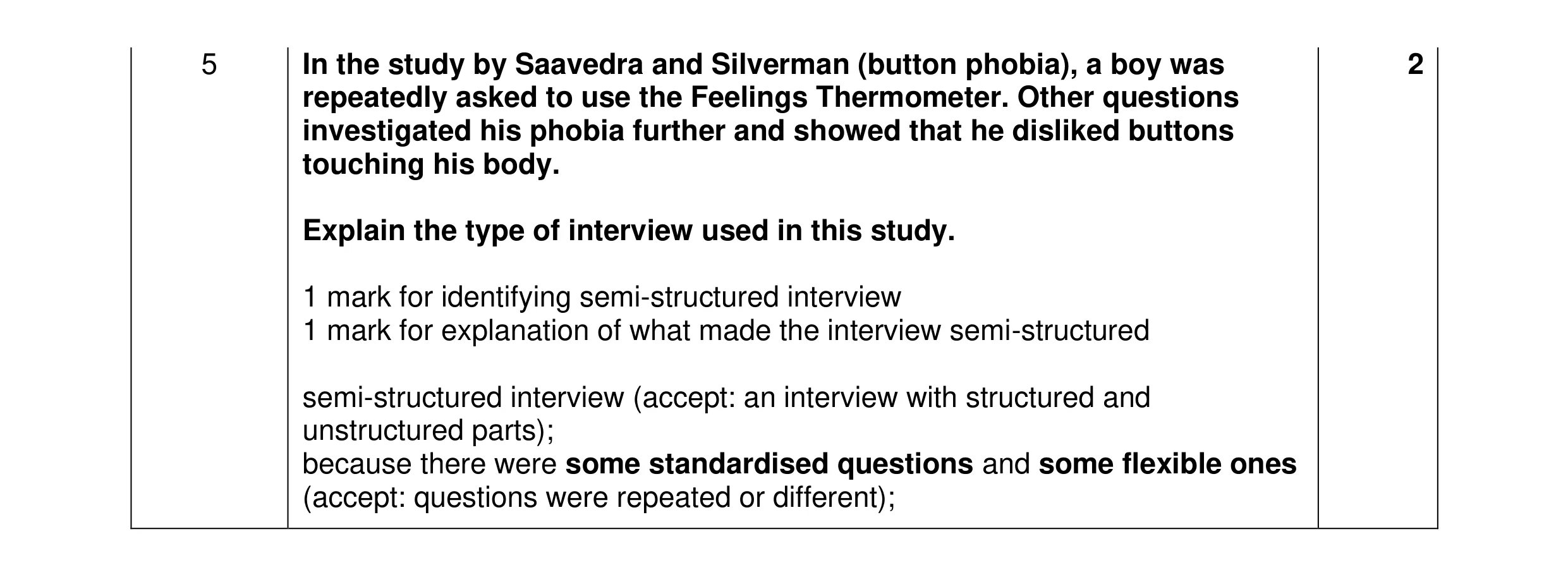 2
2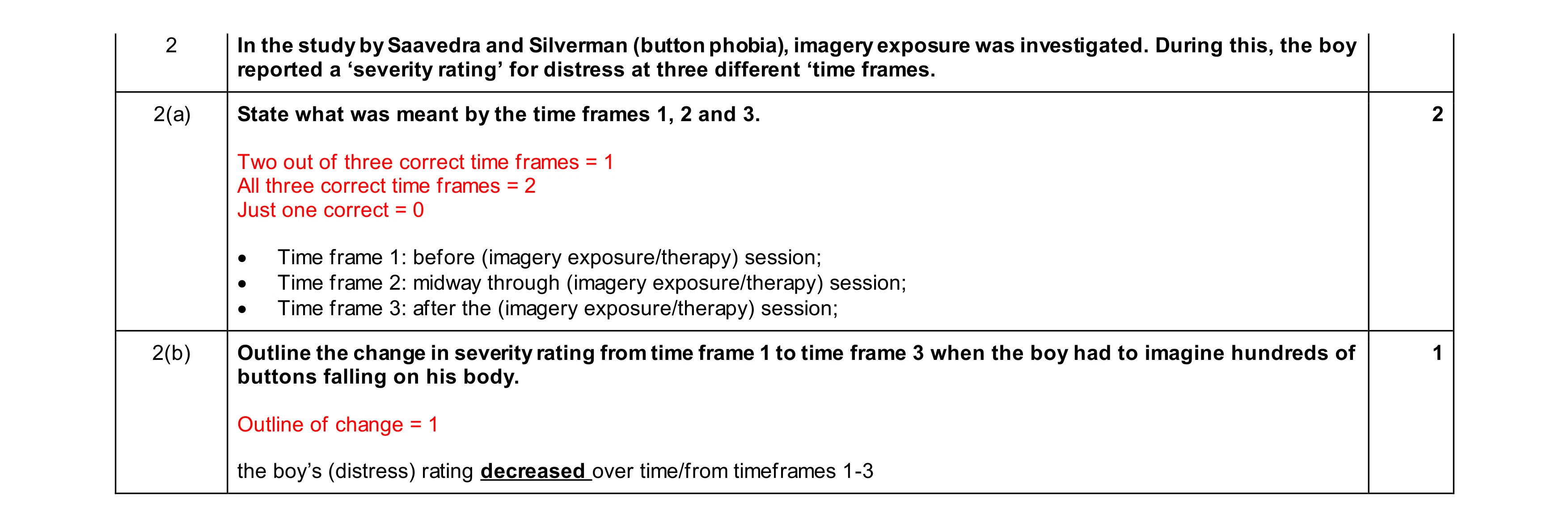 3
3