Cambridge A Level Psychology (from 2018) 9990 — 2025 Oct/Nov Paper 2 · Variant 1
9990/21/O/N/25 · 10 questions · 60 marks · 90 min
The question paper and its mark scheme, free to read here and free to download. This is Cambridge’s own paper, exactly as it was sat.
Question paper12 pages
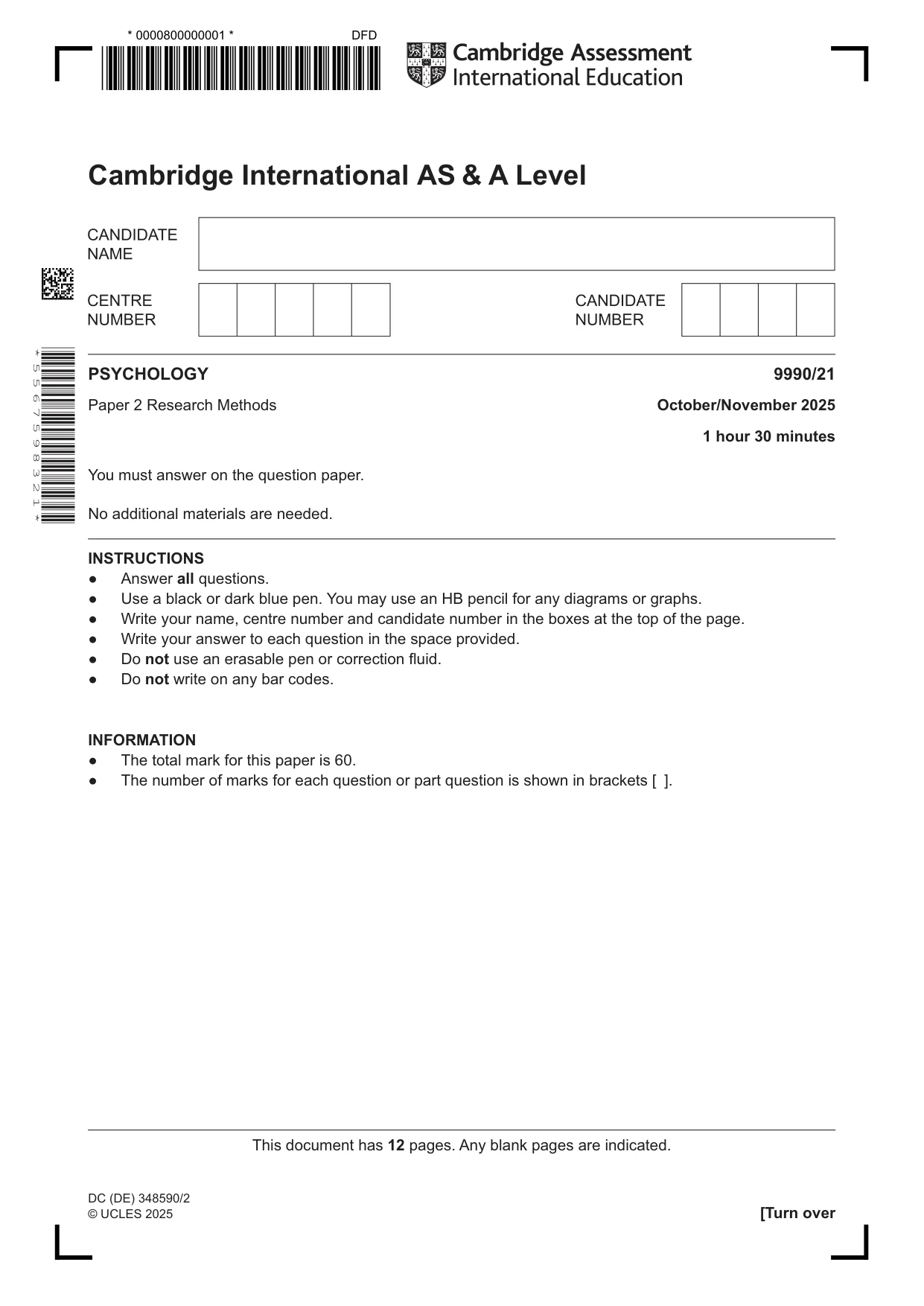


Mark scheme24 pages
Answers below. Sit the paper first if you are practising.
Questions as text
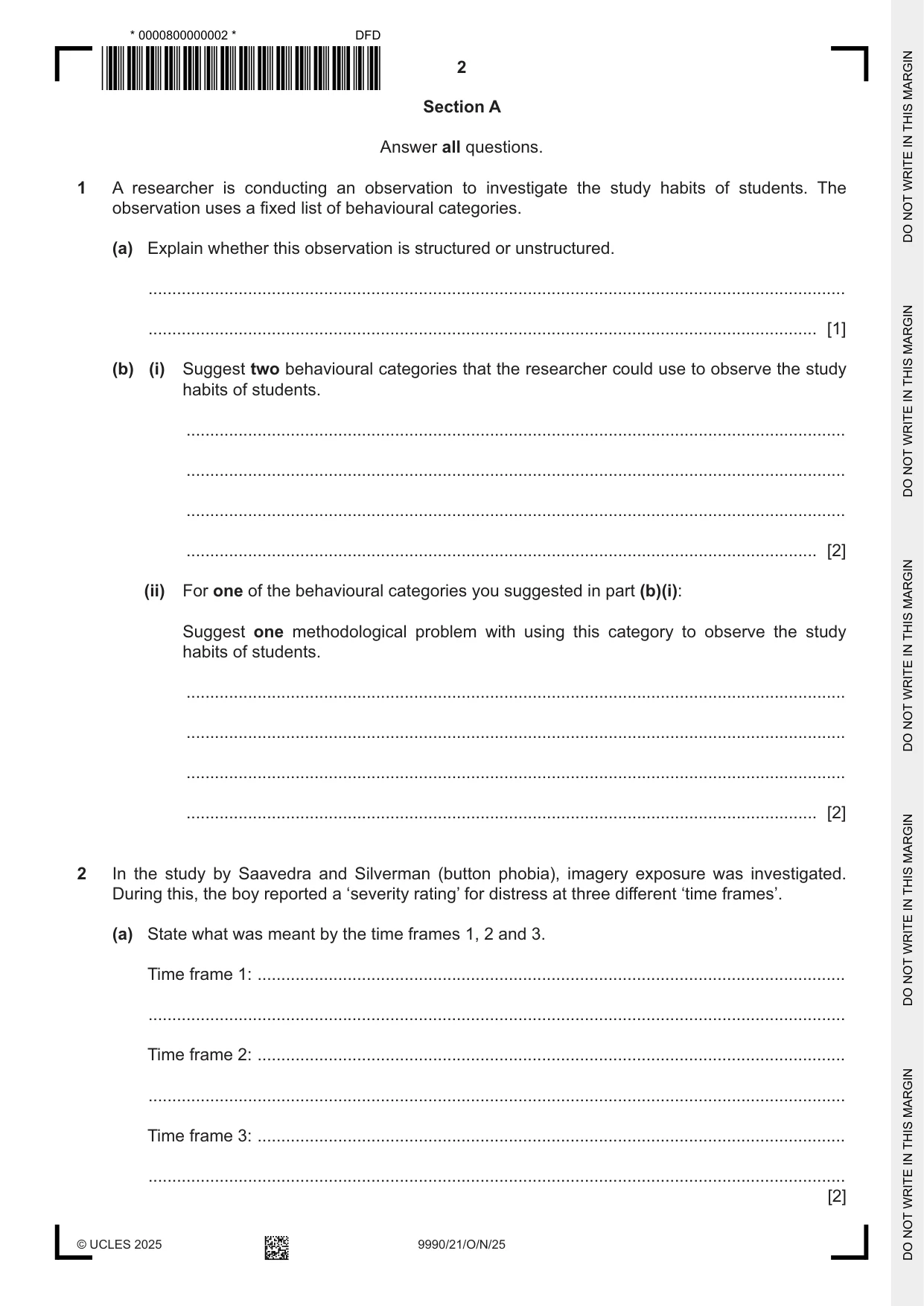
Q1 · A researcher is conducting an observation to investigate the study habits of students
1 A researcher is conducting an observation to investigate the study habits of students. The observation uses a fixed list of behavioural categories. (a) Explain whether this observation is structured or unstructured. ................................................................................................................................................... ............................................................................................................................................. [1] (b) (i) Suggest two behavioural categories that the researcher could use to observe the study habits of students. ........................................................................................................................................... ........................................................................................................................................... ........................................................................................................................................... ..................................................................................................................................... [2] (ii) For one of the behavioural categories you suggested in part (b)(i): Suggest one methodological problem with using this category to observe the study habits of students. ........................................................................................................................................... ........................................................................................................................................... ........................................................................................................................................... ..................................................................................................................................... [2]
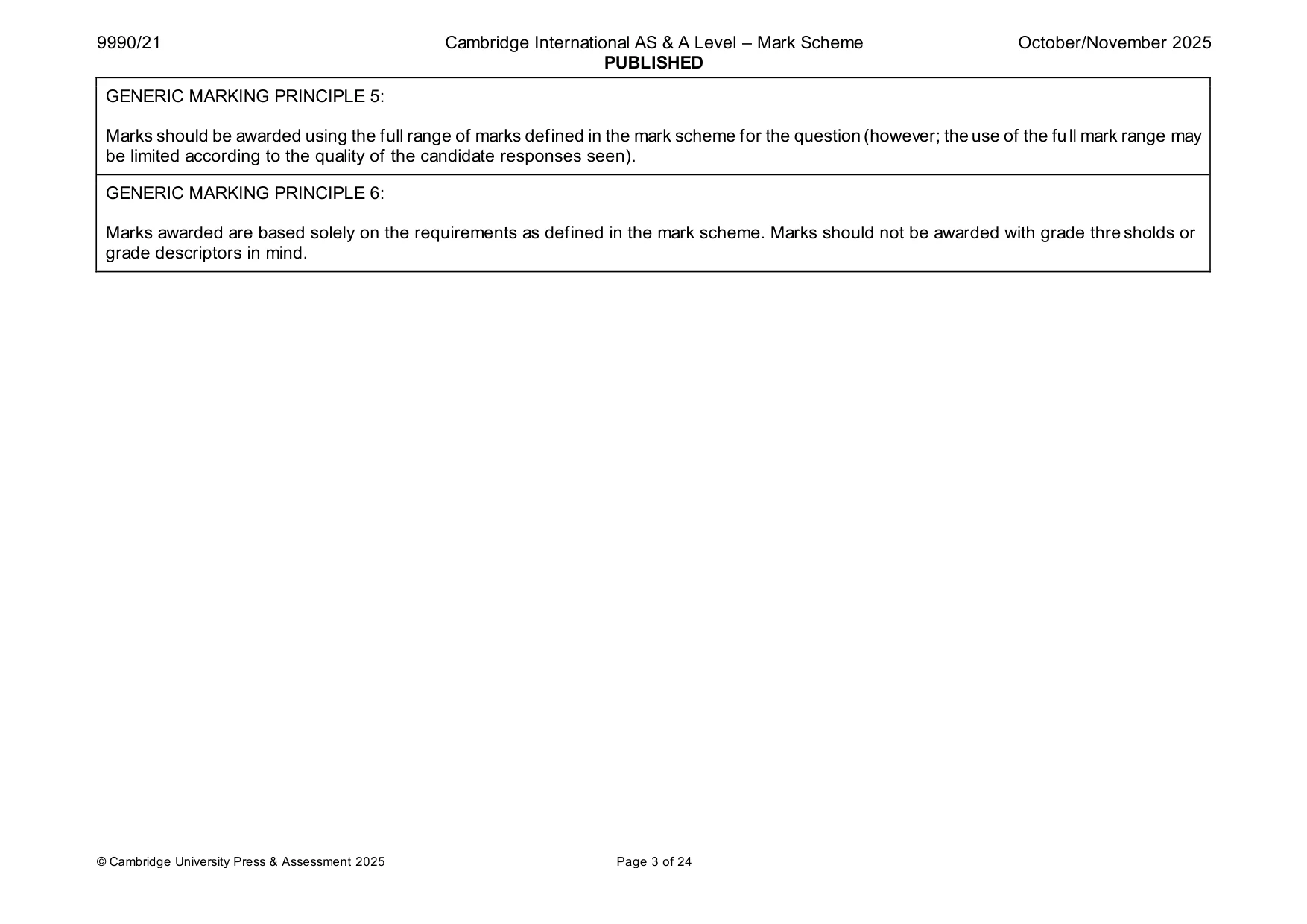
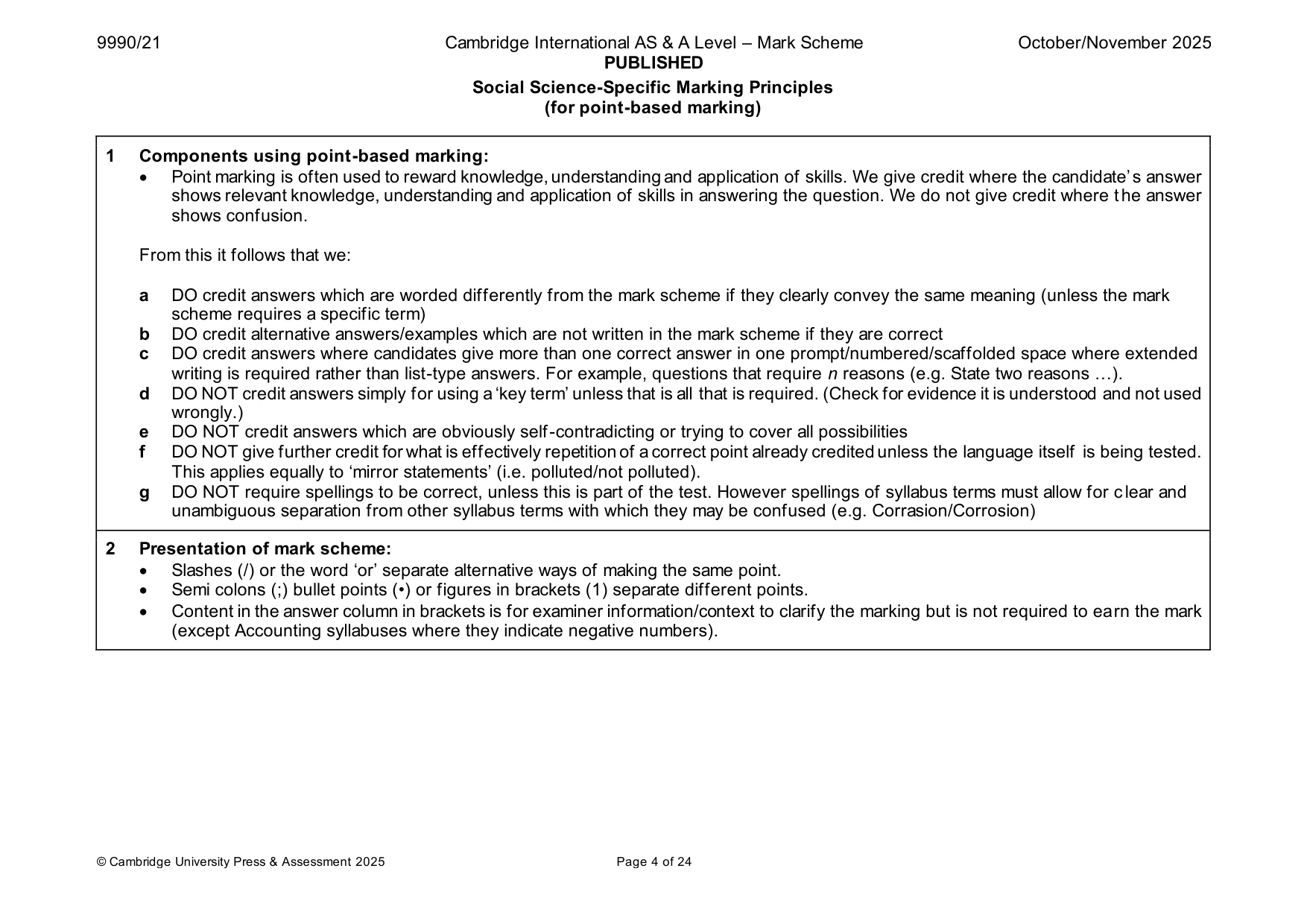
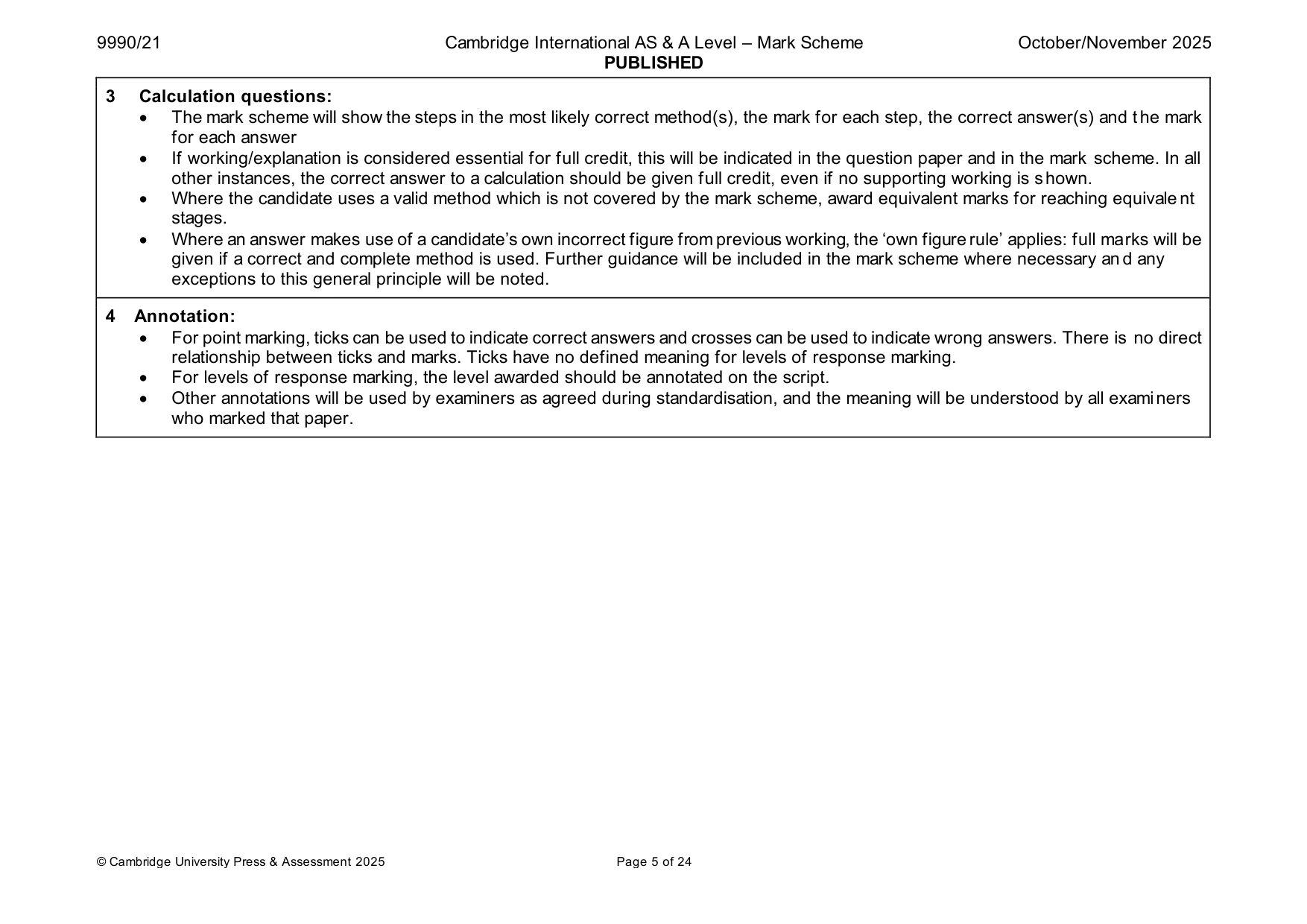
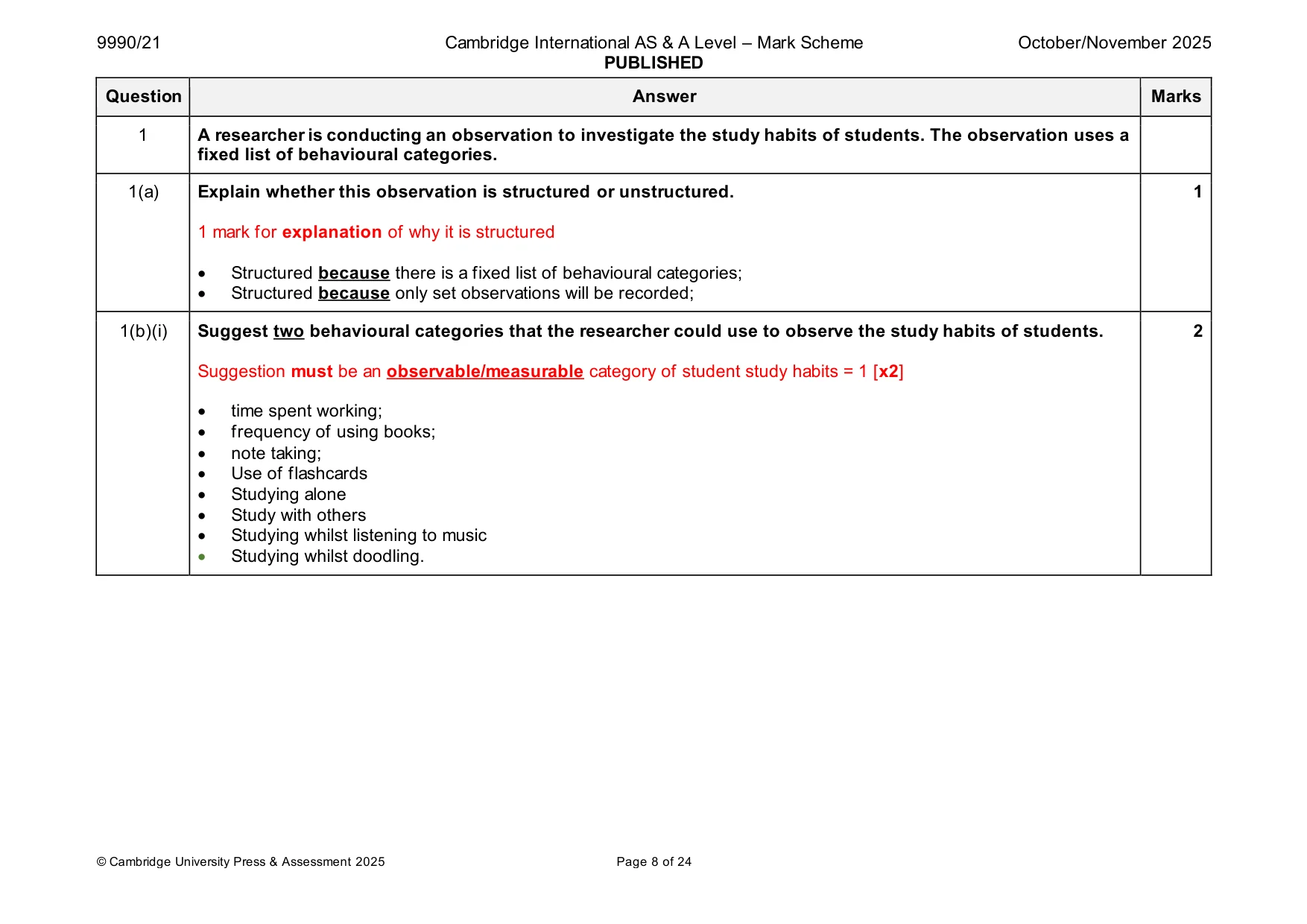
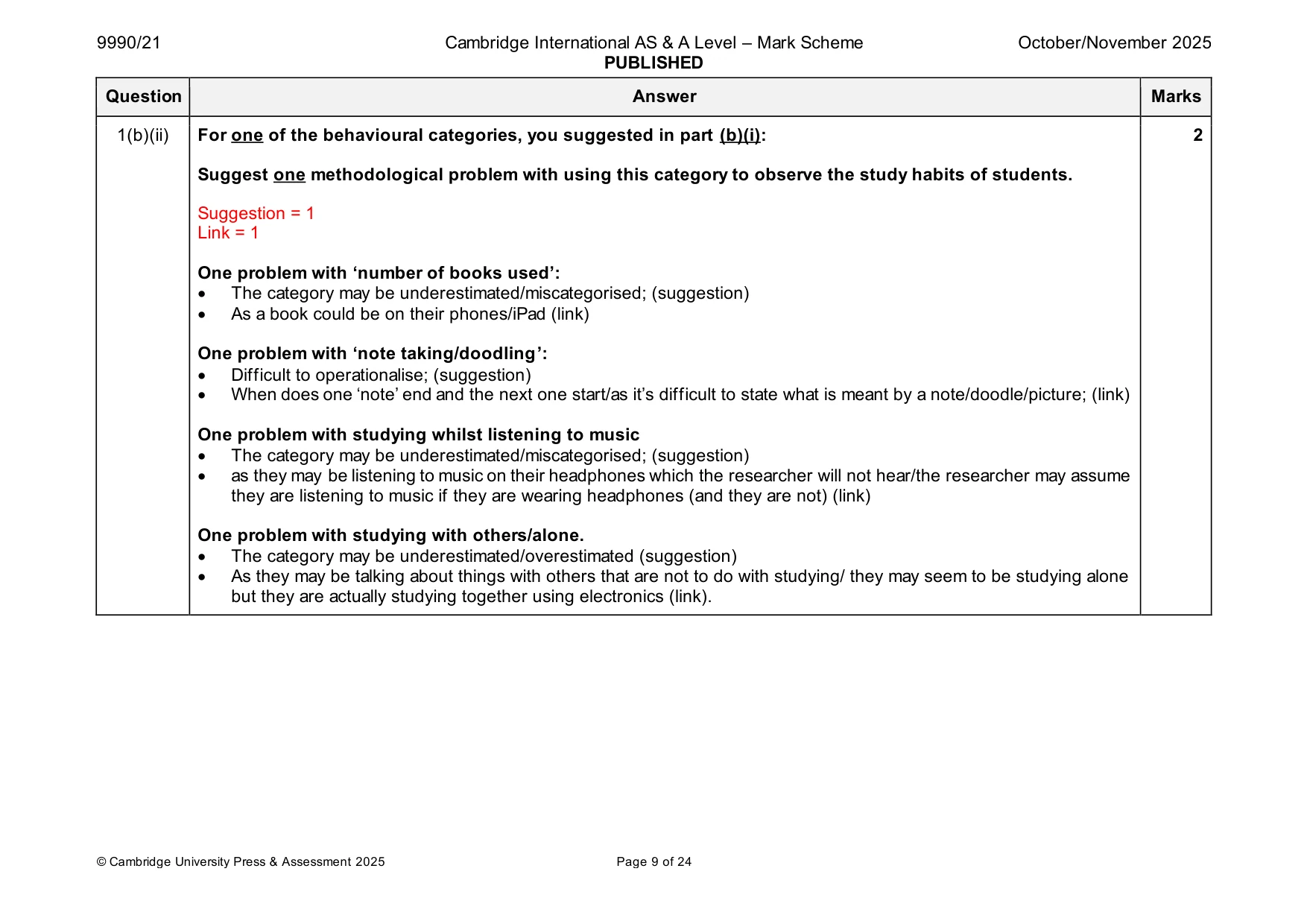
Mark scheme: Question Answer Marks 1 A researcher is conducting an observation to investigate the study habits of students. The observation uses a fixed list of behavioural categories. 1(a) Explain whether this observation is structured or unstructured. 1 1 mark for explanation of why it is structured • Structured because there is a fixed list of behavioural categories; • Structured because only set observations will be recorded; 1(b)(i) Suggest two behavioural categories that the researcher could use to observe the study habits of students. 2 Suggestion must be an observable/measurable category of student study habits = 1 [x2] • time spent working; • frequency of using books; • note taking; • Use of flashcards • Studying alone • Study with others • Studying whilst listening to music • Studying whilst doodling. 1(b)(ii) For one of the behavioural categories, you suggested in part (b)(i): 2 Suggest one methodological problem with using this category to observe the study habits of students. Suggestion = 1 Link = 1 One problem with ‘number of books used’: • The category may be underestimated/miscategorised; (suggestion) • As a book could be on their phones/iPad (link) One problem with ‘note taking/doodling’: • Difficult to operationalise; (suggestion) • When does one ‘note’ end and the next one start/as it’s difficult to state what is meant by a note/doodle/picture; (link) One problem with studying whilst listening to music • The category may be underestimated/miscategorised; (suggestion) • as they may be listening to music on their headphones which the researcher will not hear/the researcher may assume they are listening to music if they are wearing headphones (and they are not) (link) One problem with studying with others/alone. • The category may be underestimated/overestimated (suggestion) • As they may be talking about things with others that are not to do with studying/ they may seem to be studying alone but they are actually studying together using electronics (link).
Q2 · In the study by Saavedra and Silverman (button phobia), imagery exposure was investigated
2 In the study by Saavedra and Silverman (button phobia), imagery exposure was investigated. During this, the boy reported a ‘severity rating’ for distress at three different ‘time frames’. (a) State what was meant by the time frames 1, 2 and 3. Time frame 1: ............................................................................................................................ ................................................................................................................................................... Time frame 2: ............................................................................................................................ ................................................................................................................................................... Time frame 3: ............................................................................................................................ ................................................................................................................................................... [2] (b) Outline the change in severity rating from time frame 1 to time frame 3, when the boy had to imagine hundreds of buttons falling on his body. ................................................................................................................................................... ............................................................................................................................................. [1]
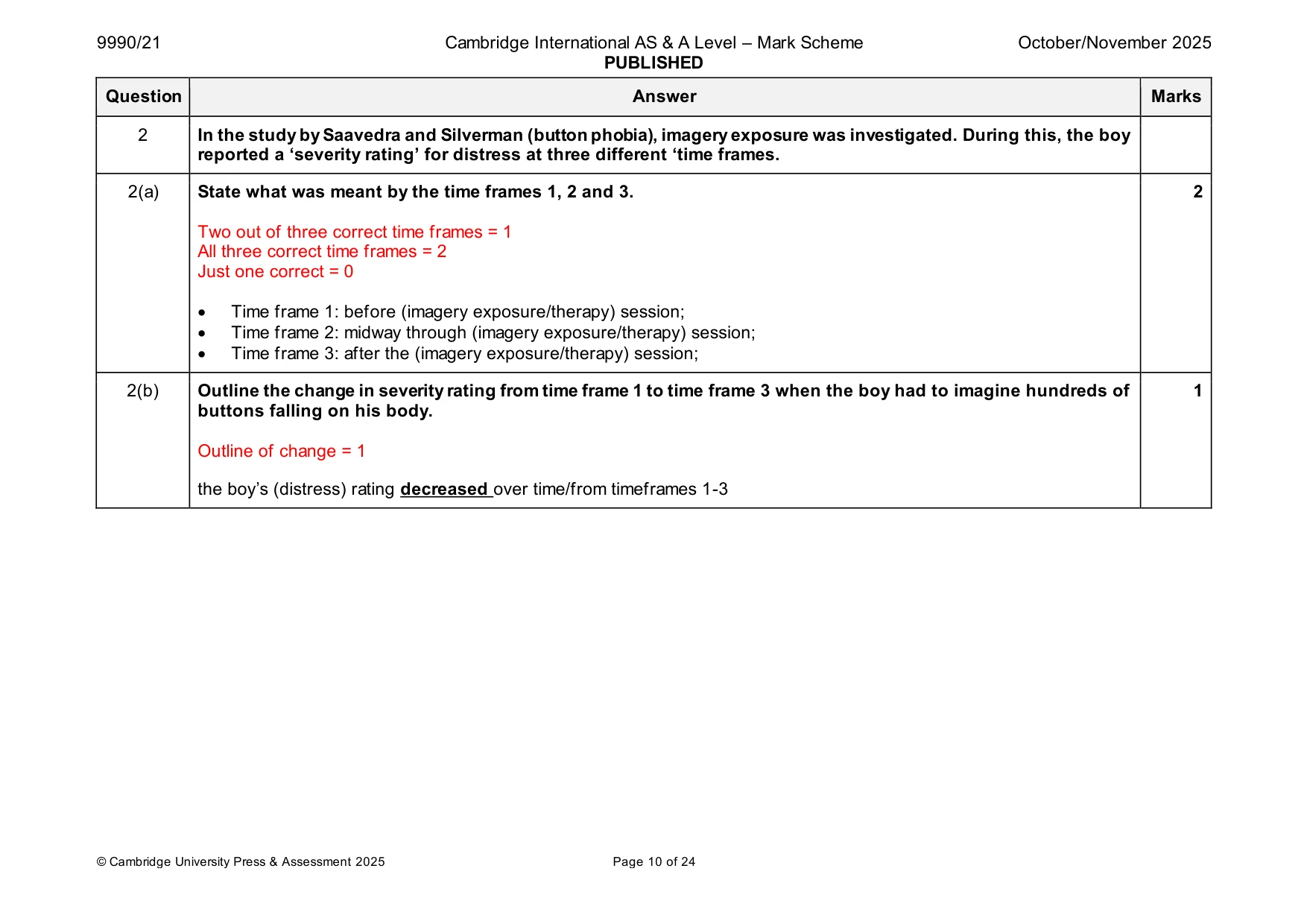
Mark scheme: 2 In the study by Saavedra and Silverman (button phobia), imagery exposure was investigated. During this, the boy reported a ‘severity rating’ for distress at three different ‘time frames. 2(a) State what was meant by the time frames 1, 2 and 3. 2 Two out of three correct time frames = 1 All three correct time frames = 2 Just one correct = 0 • Time frame 1: before (imagery exposure/therapy) session; • Time frame 2: midway through (imagery exposure/therapy) session; • Time frame 3: after the (imagery exposure/therapy) session; 2(b) Outline the change in severity rating from time frame 1 to time frame 3 when the boy had to imagine hundreds of 1 buttons falling on his body. Outline of change = 1 the boy’s (distress) rating decreased over time/from timeframes 1-3
More questions on Anxiety disorders and fear-related disorders
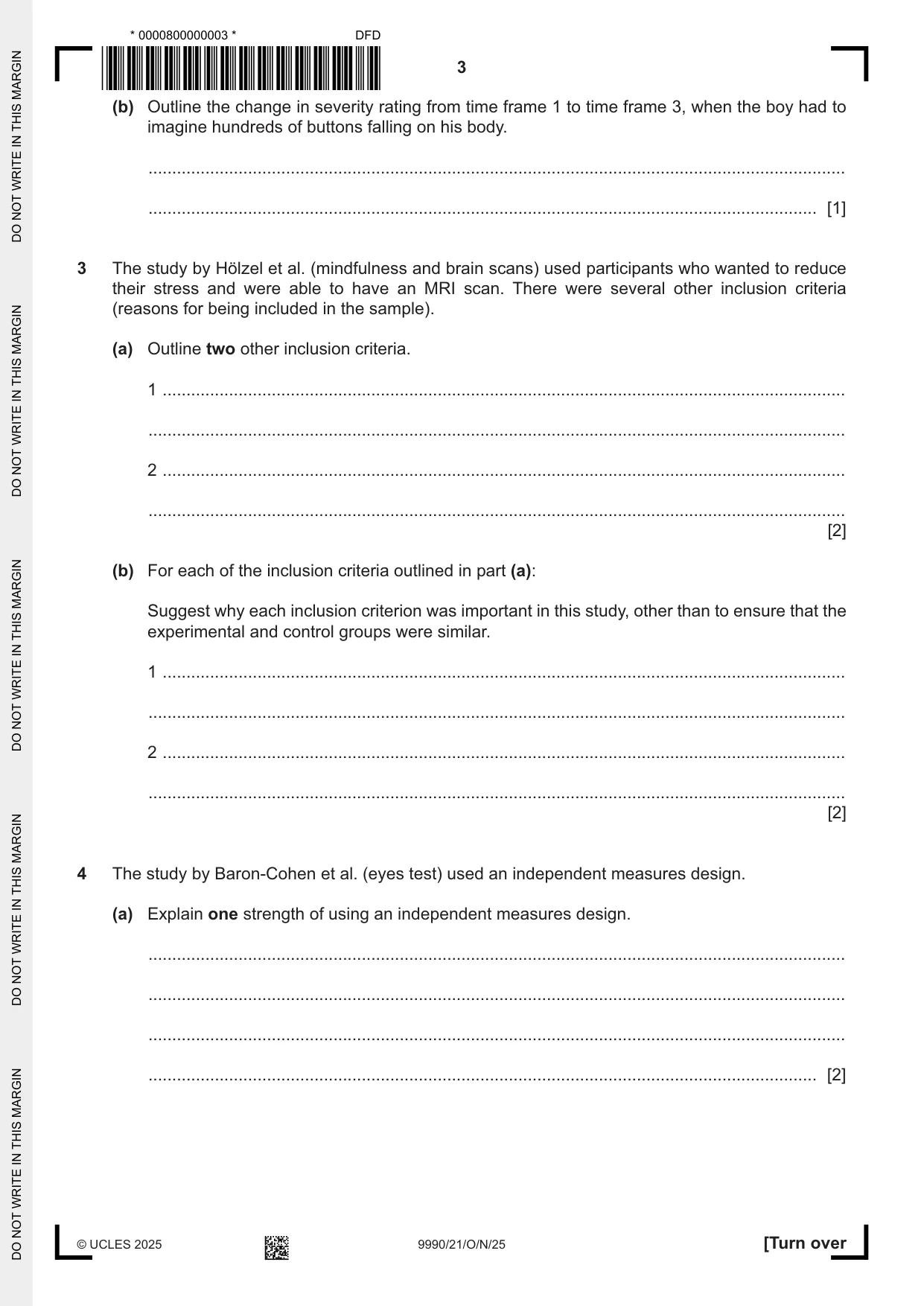
Q3 · The study by Hölzel et al
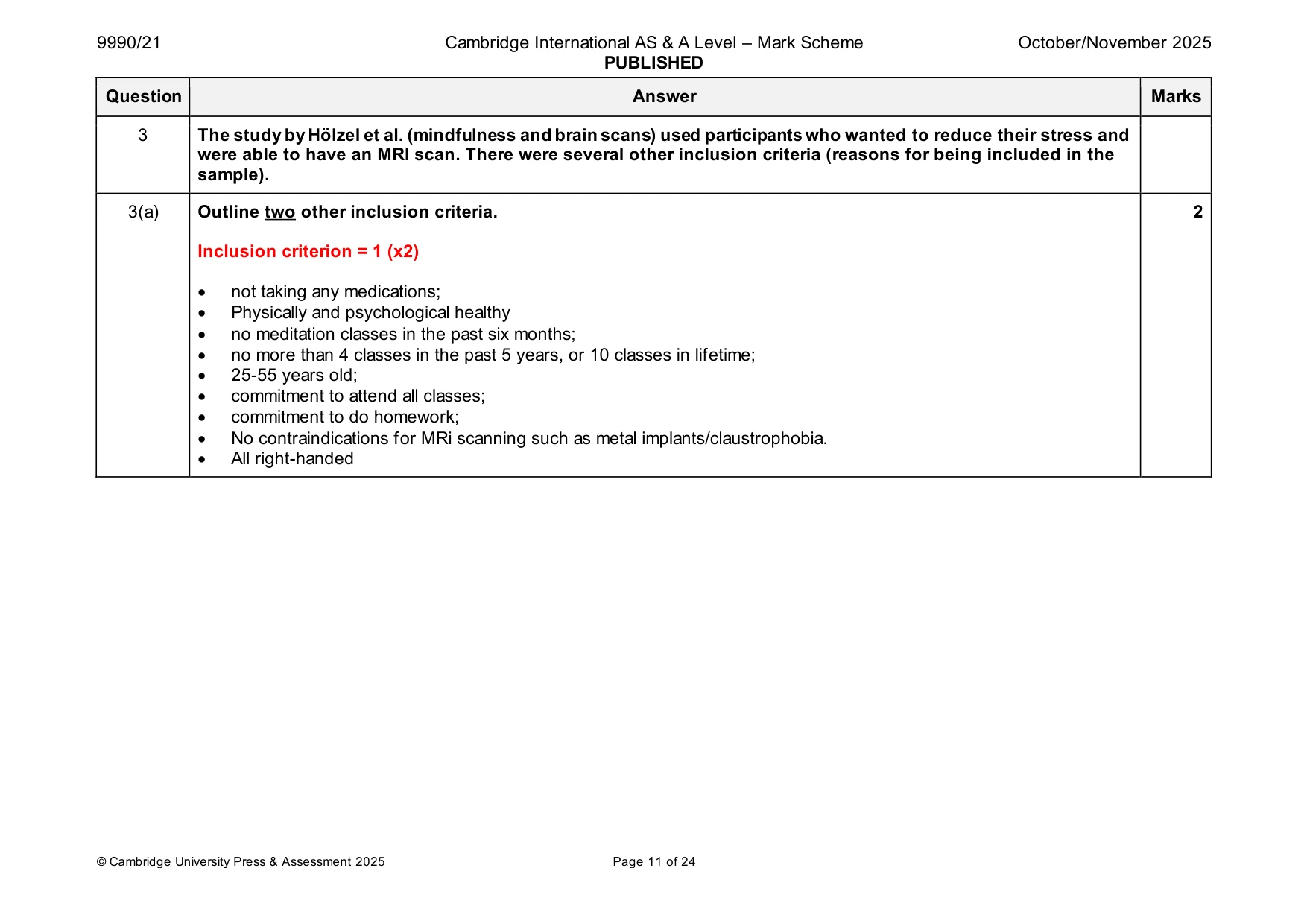
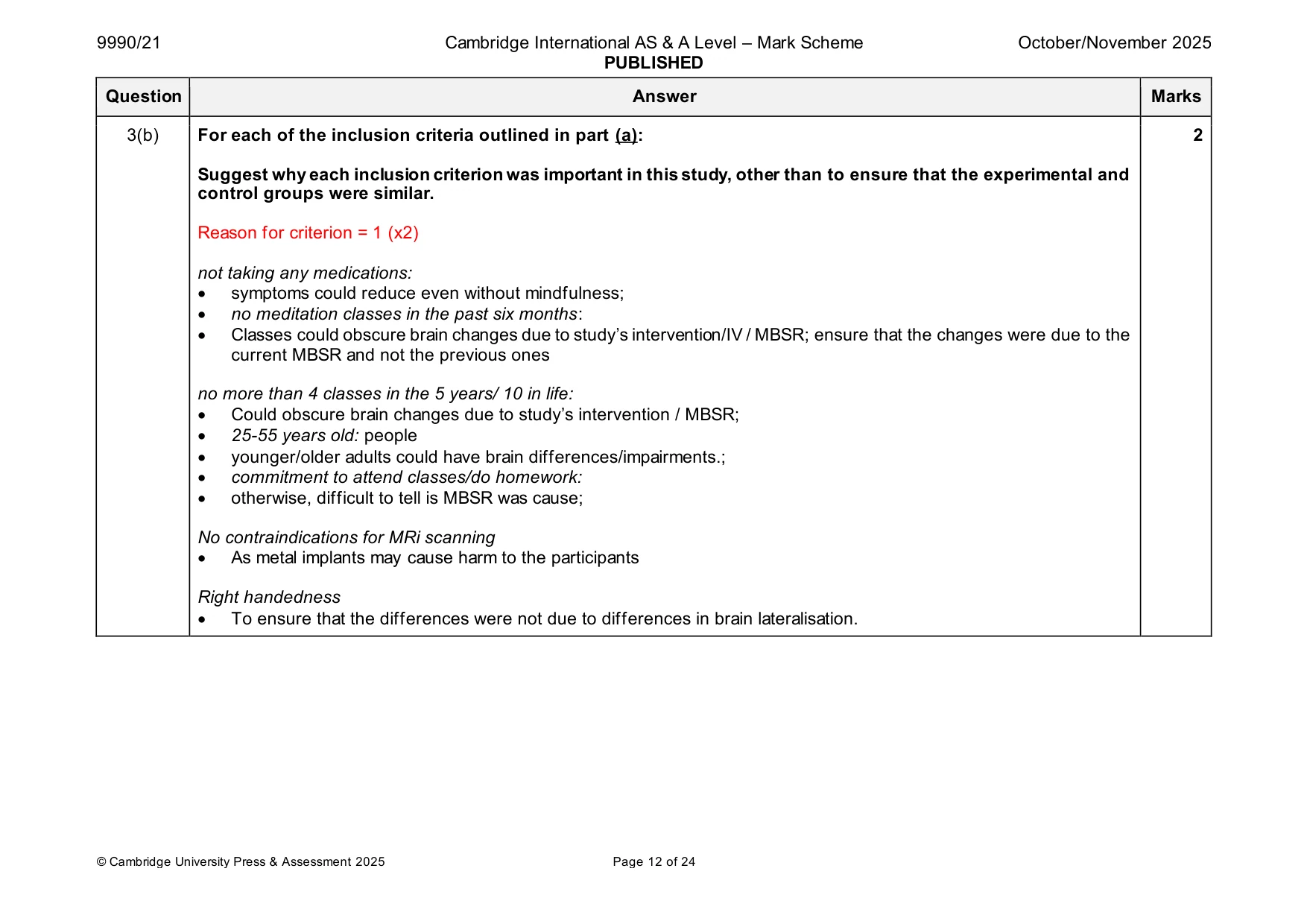
3 The study by Hölzel et al. (mindfulness and brain scans) used participants who wanted to reduce their stress and were able to have an MRI scan. There were several other inclusion criteria (reasons for being included in the sample). (a) Outline two other inclusion criteria. 1 ................................................................................................................................................ ................................................................................................................................................... 2 ................................................................................................................................................ ................................................................................................................................................... [2] (b) For each of the inclusion criteria outlined in part (a): Suggest why each inclusion criterion was important in this study, other than to ensure that the experimental and control groups were similar. 1 ................................................................................................................................................ ................................................................................................................................................... 2 ................................................................................................................................................ ................................................................................................................................................... [2]
Mark scheme: 3 The study by Hölzel et al. (mindfulness and brain scans) used participants who wanted to reduce their stress and were able to have an MRI scan. There were several other inclusion criteria (reasons for being included in the sample). 3(a) Outline two other inclusion criteria. 2 Inclusion criterion = 1 (x2) • not taking any medications; • Physically and psychological healthy • no meditation classes in the past six months; • no more than 4 classes in the past 5 years, or 10 classes in lifetime; • 25-55 years old; • commitment to attend all classes; • commitment to do homework; • No contraindications for MRi scanning such as metal implants/claustrophobia. • All right-handed 3(b) For each of the inclusion criteria outlined in part (a): 2 Suggest why each inclusion criterion was important in this study, other than to ensure that the experimental and control groups were similar. Reason for criterion = 1 (x2) not taking any medications: • symptoms could reduce even without mindfulness; • no meditation classes in the past six months: • Classes could obscure brain changes due to study’s intervention/IV / MBSR; ensure that the changes were due to the current MBSR and not the previous ones no more than 4 classes in the 5 years/ 10 in life: • Could obscure brain changes due to study’s intervention / MBSR; • 25-55 years old: people • younger/older adults could have brain differences/impairments.; • commitment to attend classes/do homework: • otherwise, difficult to tell is MBSR was cause; No contraindications for MRi scanning • As metal implants may cause harm to the participants Right handedness • To ensure that the differences were not due to differences in brain lateralisation.
Q4 · The study by Baron-Cohen et al
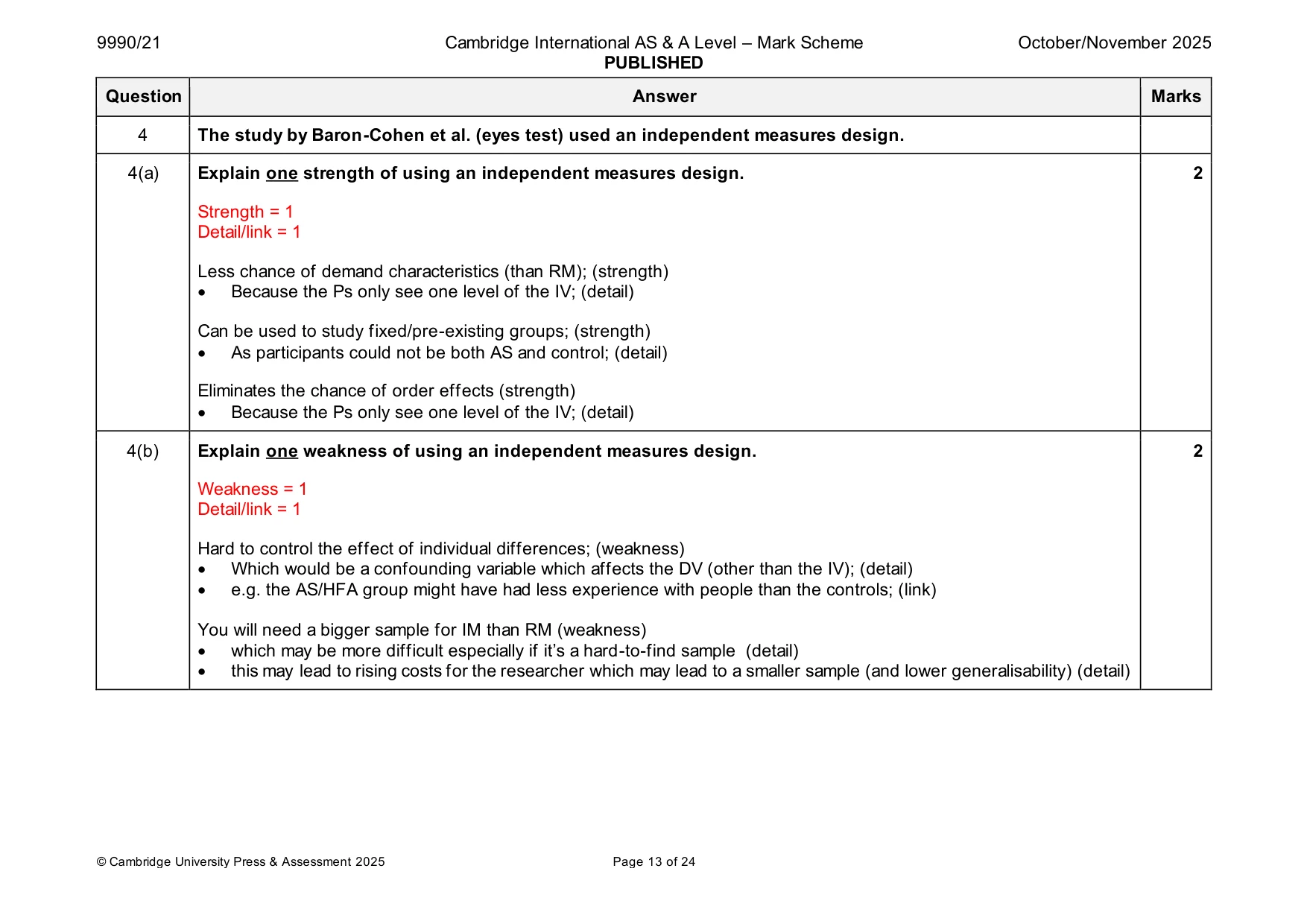
4 The study by Baron-Cohen et al. (eyes test) used an independent measures design. (a) Explain one strength of using an independent measures design. ................................................................................................................................................... ................................................................................................................................................... ................................................................................................................................................... ............................................................................................................................................. [2] (b) Explain one weakness of using an independent measures design. ................................................................................................................................................... ................................................................................................................................................... ................................................................................................................................................... ............................................................................................................................................. [2]
Mark scheme: 4 The study by Baron-Cohen et al. (eyes test) used an independent measures design. 4(a) Explain one strength of using an independent measures design. 2 Strength = 1 Detail/link = 1 Less chance of demand characteristics (than RM); (strength) • Because the Ps only see one level of the IV; (detail) Can be used to study fixed/pre-existing groups; (strength) • As participants could not be both AS and control; (detail) Eliminates the chance of order effects (strength) • Because the Ps only see one level of the IV; (detail) 4(b) Explain one weakness of using an independent measures design. 2 Weakness = 1 Detail/link = 1 Hard to control the effect of individual differences; (weakness) • Which would be a confounding variable which affects the DV (other than the IV); (detail) • e.g. the AS/HFA group might have had less experience with people than the controls; (link) You will need a bigger sample for IM than RM (weakness) • which may be more difficult especially if it’s a hard-to-find sample (detail) • this may lead to rising costs for the researcher which may lead to a smaller sample (and lower generalisability) (detail)
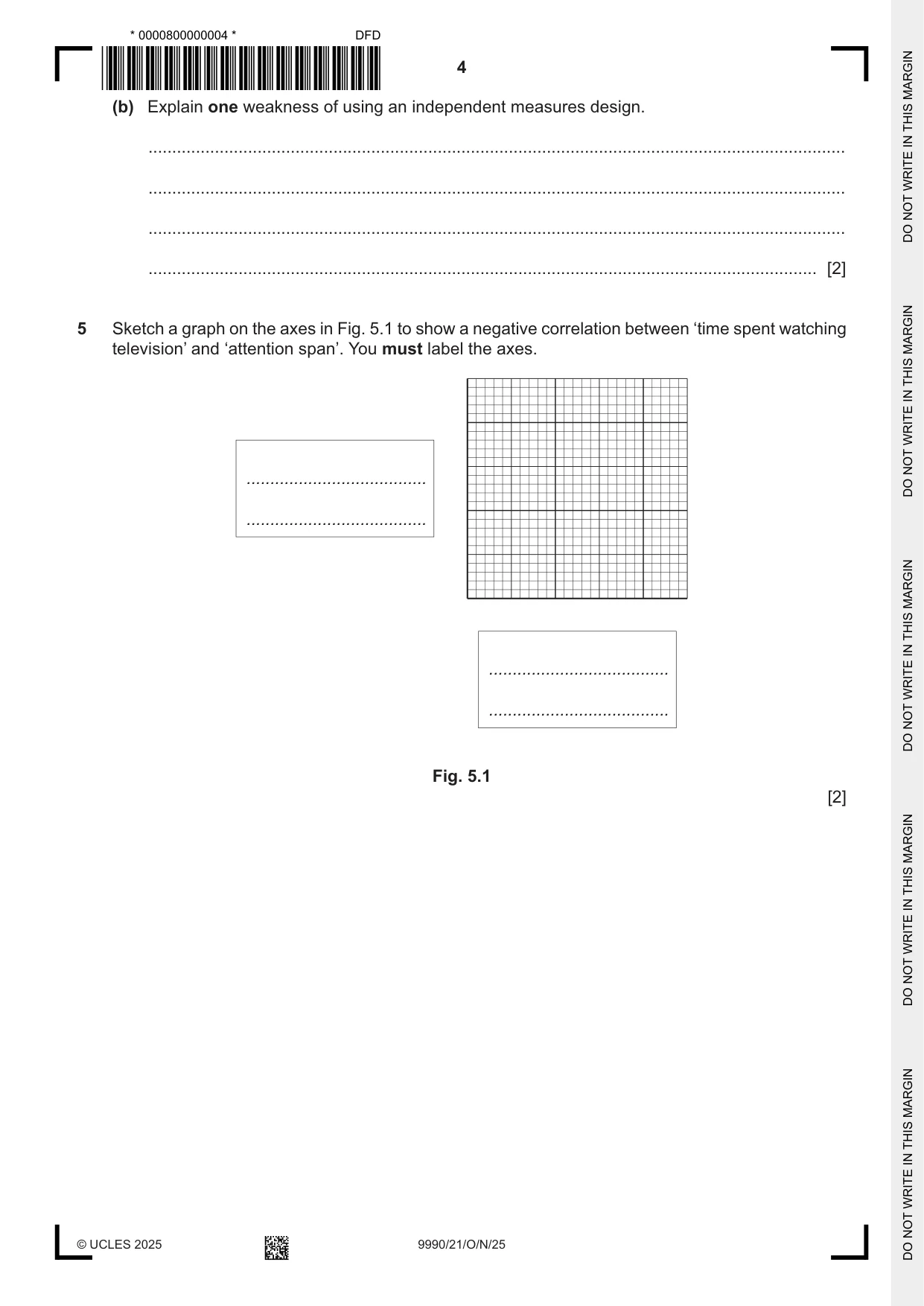
Q5 · Sketch a graph on the axes in Fig
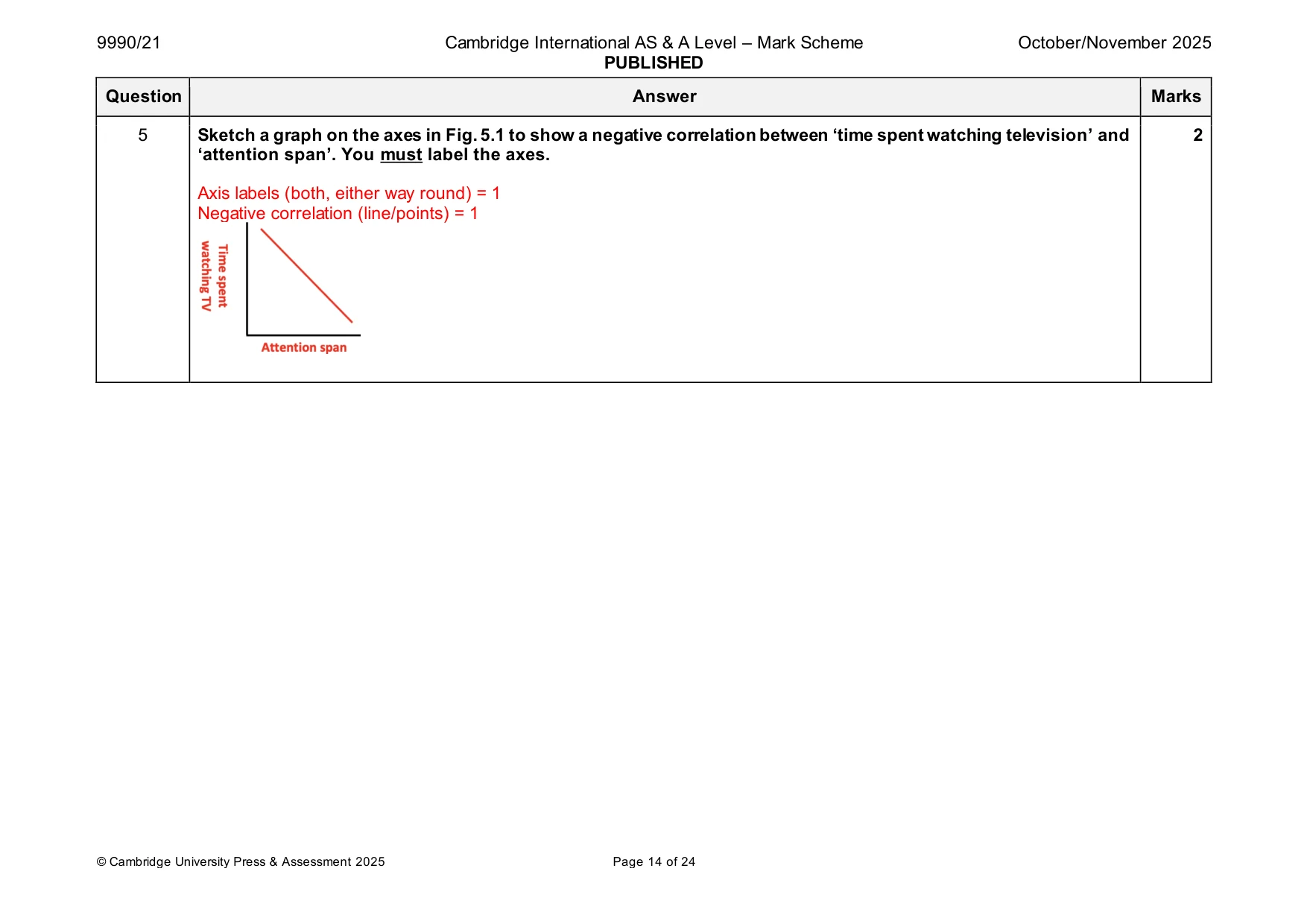
5 Sketch a graph on the axes in Fig. 5.1 to show a negative correlation between ‘time spent watching television’ and ‘attention span’. You must label the axes. ...................................... ...................................... ...................................... ...................................... Fig. 5.1 [2]
Mark scheme: 5 Sketch a graph on the axes in Fig. 5.1 to show a negative correlation between ‘time spent watching television’ and 2 ‘attention span’. You must label the axes. Axis labels (both, either way round) = 1 Negative correlation (line/points) = 1
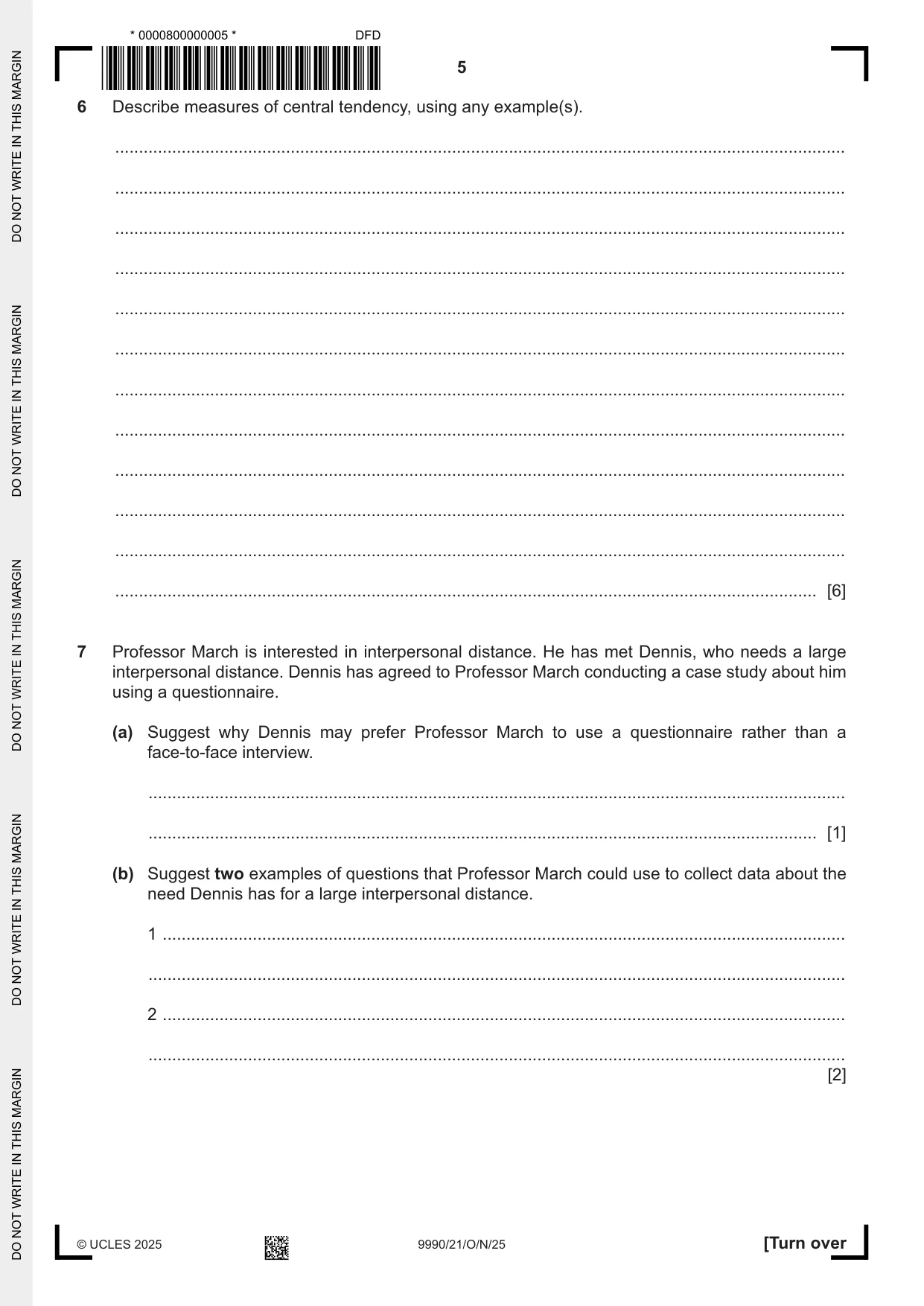
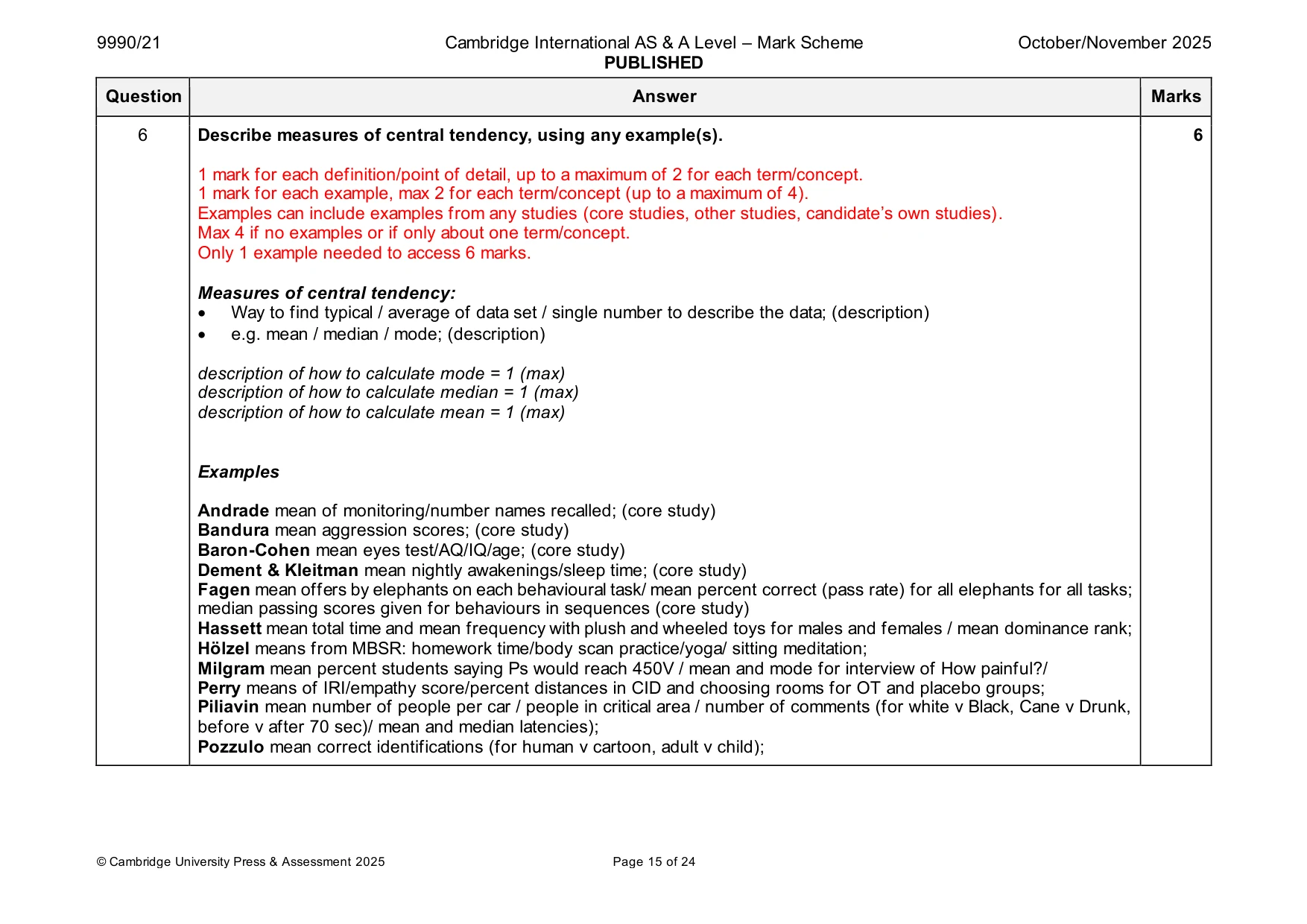
Q6 · Describe measures of central tendency, using any example(s)
6 Describe measures of central tendency, using any example(s). .......................................................................................................................................................... .......................................................................................................................................................... .......................................................................................................................................................... .......................................................................................................................................................... .......................................................................................................................................................... .......................................................................................................................................................... .......................................................................................................................................................... .......................................................................................................................................................... .......................................................................................................................................................... .......................................................................................................................................................... .......................................................................................................................................................... .................................................................................................................................................... [6]
Mark scheme: 6 Describe measures of central tendency, using any example(s). 6 1 mark for each definition/point of detail, up to a maximum of 2 for each term/concept. 1 mark for each example, max 2 for each term/concept (up to a maximum of 4). Examples can include examples from any studies (core studies, other studies, candidate’s own studies). Max 4 if no examples or if only about one term/concept. Only 1 example needed to access 6 marks. Measures of central tendency: • Way to find typical / average of data set / single number to describe the data; (description) • e.g. mean / median / mode; (description) description of how to calculate mode = 1 (max) description of how to calculate median = 1 (max) description of how to calculate mean = 1 (max) Examples Andrade mean of monitoring/number names recalled; (core study) Bandura mean aggression scores; (core study) Baron-Cohen mean eyes test/AQ/IQ/age; (core study) Dement & Kleitman mean nightly awakenings/sleep time; (core study) Fagen mean offers by elephants on each behavioural task/ mean percent correct (pass rate) for all elephants for all tasks; median passing scores given for behaviours in sequences (core study) Hassett mean total time and mean frequency with plush and wheeled toys for males and females / mean dominance rank; Hölzel means from MBSR: homework time/body scan practice/yoga/ sitting meditation; Milgram mean percent students saying Ps would reach 450V / mean and mode for interview of How painful?/ Perry means of IRI/empathy score/percent distances in CID and choosing rooms for OT and placebo groups; Piliavin mean number of people per car / people in critical area / number of comments (for white v Black, Cane v Drunk, before v after 70 sec)/ mean and median latencies); Pozzulo mean correct identifications (for human v cartoon, adult v child);
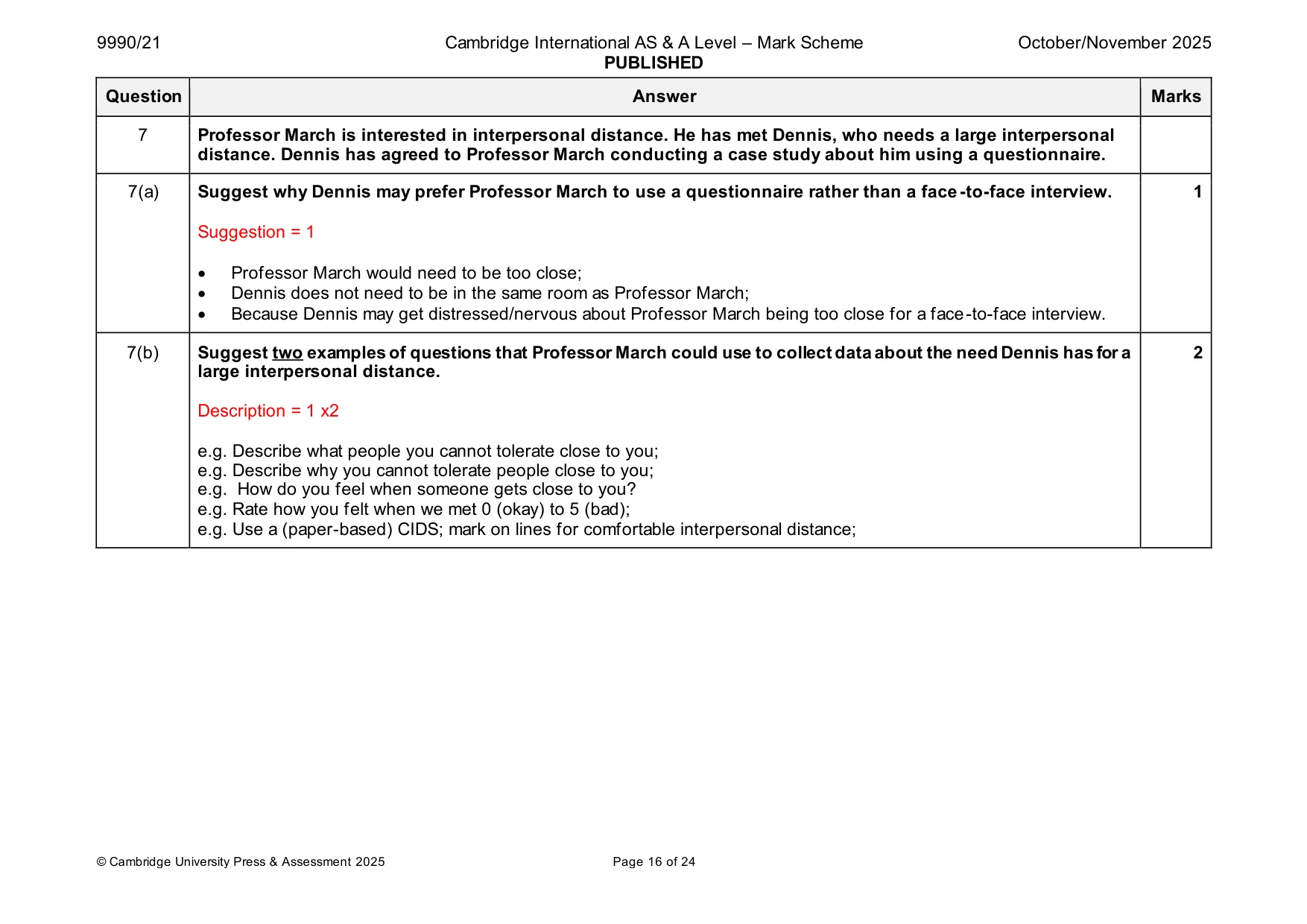
Q7 · Professor March is interested in interpersonal distance
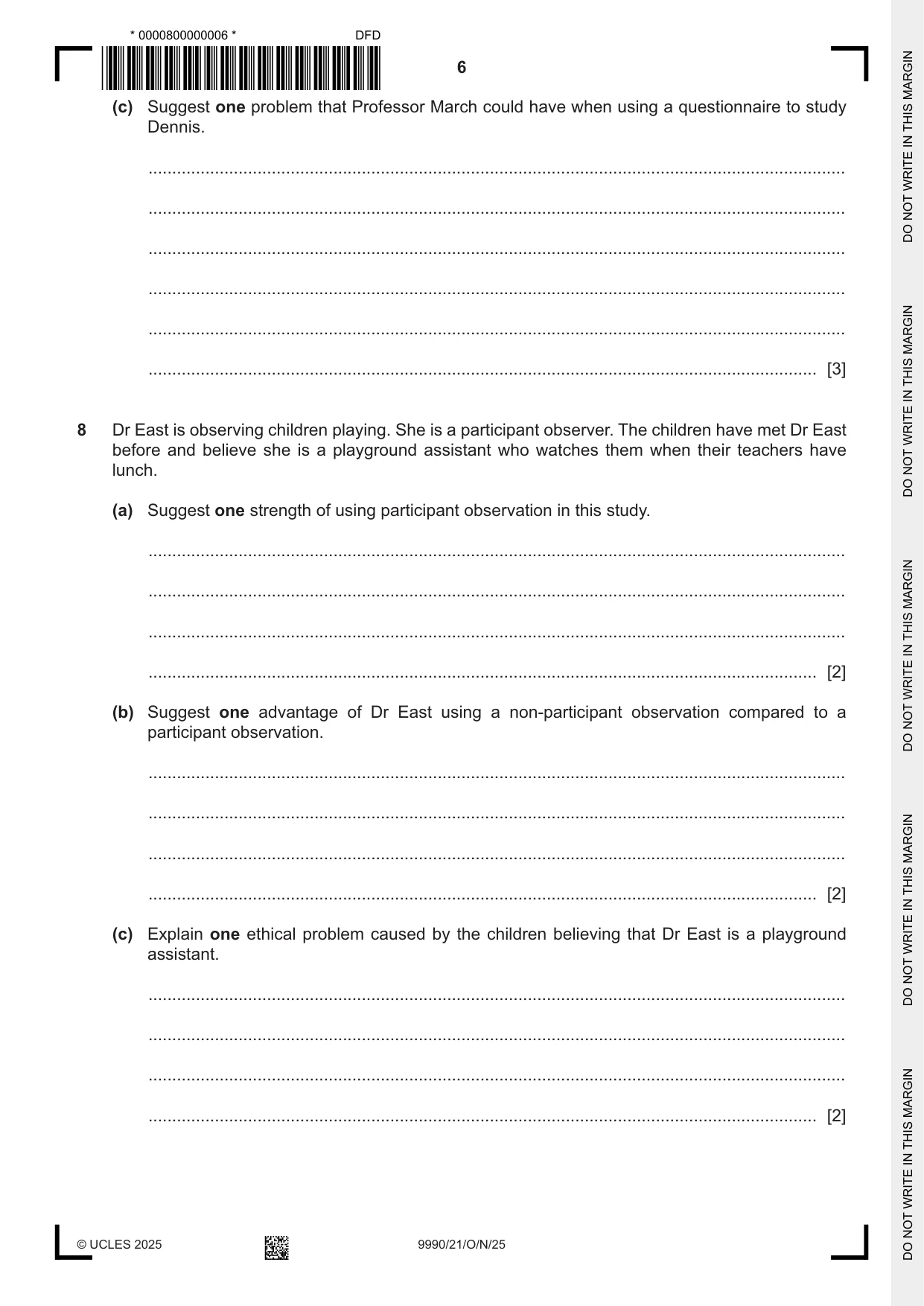
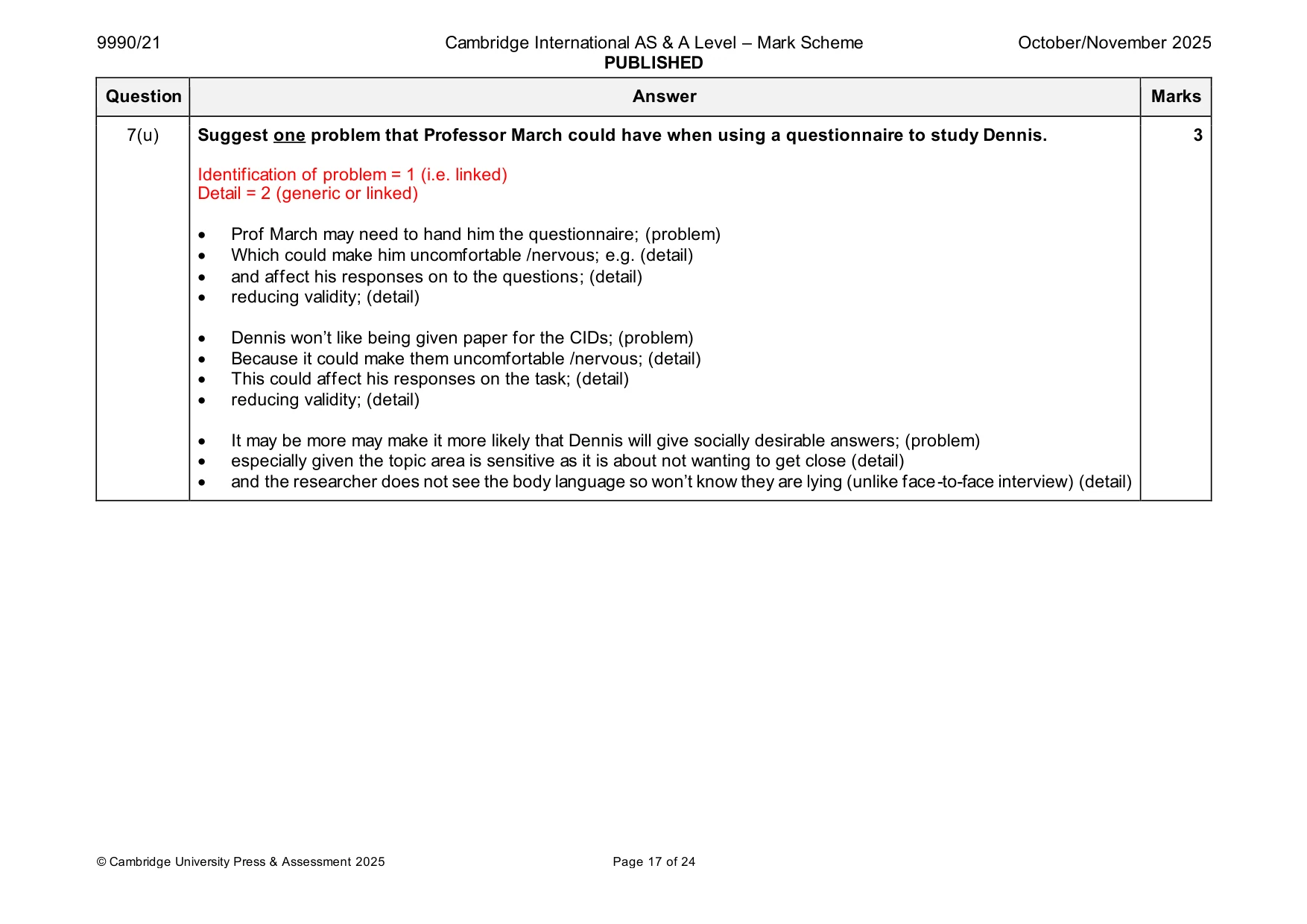
7 Professor March is interested in interpersonal distance. He has met Dennis, who needs a large interpersonal distance. Dennis has agreed to Professor March conducting a case study about him using a questionnaire. (a) Suggest why Dennis may prefer Professor March to use a questionnaire rather than a face-to-face interview. ................................................................................................................................................... ............................................................................................................................................. [1] (b) Suggest two examples of questions that Professor March could use to collect data about the need Dennis has for a large interpersonal distance. 1 ................................................................................................................................................ ................................................................................................................................................... 2 ................................................................................................................................................ ................................................................................................................................................... [2] (c) Suggest one problem that Professor March could have when using a questionnaire to study Dennis. ................................................................................................................................................... ................................................................................................................................................... ................................................................................................................................................... ................................................................................................................................................... ................................................................................................................................................... ............................................................................................................................................. [3]
Mark scheme: 7 Professor March is interested in interpersonal distance. He has met Dennis, who needs a large interpersonal distance. Dennis has agreed to Professor March conducting a case study about him using a questionnaire. 7(a) Suggest why Dennis may prefer Professor March to use a questionnaire rather than a face-to-face interview. 1 Suggestion = 1 • Professor March would need to be too close; • Dennis does not need to be in the same room as Professor March; • Because Dennis may get distressed/nervous about Professor March being too close for a face-to-face interview. 7(b) Suggest two examples of questions that Professor March could use to collect data about the need Dennis has for a 2 large interpersonal distance. Description = 1 x2 e.g. Describe what people you cannot tolerate close to you; e.g. Describe why you cannot tolerate people close to you; e.g. How do you feel when someone gets close to you? e.g. Rate how you felt when we met 0 (okay) to 5 (bad); e.g. Use a (paper-based) CIDS; mark on lines for comfortable interpersonal distance; 7(u) Suggest one problem that Professor March could have when using a questionnaire to study Dennis. 3 Identification of problem = 1 (i.e. linked) Detail = 2 (generic or linked) • Prof March may need to hand him the questionnaire; (problem) • Which could make him uncomfortable /nervous; e.g. (detail) • and affect his responses on to the questions; (detail) • reducing validity; (detail) • Dennis won’t like being given paper for the CIDs; (problem) • Because it could make them uncomfortable /nervous; (detail) • This could affect his responses on the task; (detail) • reducing validity; (detail) • It may be more may make it more likely that Dennis will give socially desirable answers; (problem) • especially given the topic area is sensitive as it is about not wanting to get close (detail) • and the researcher does not see the body language so won’t know they are lying (unlike face-to-face interview) (detail)
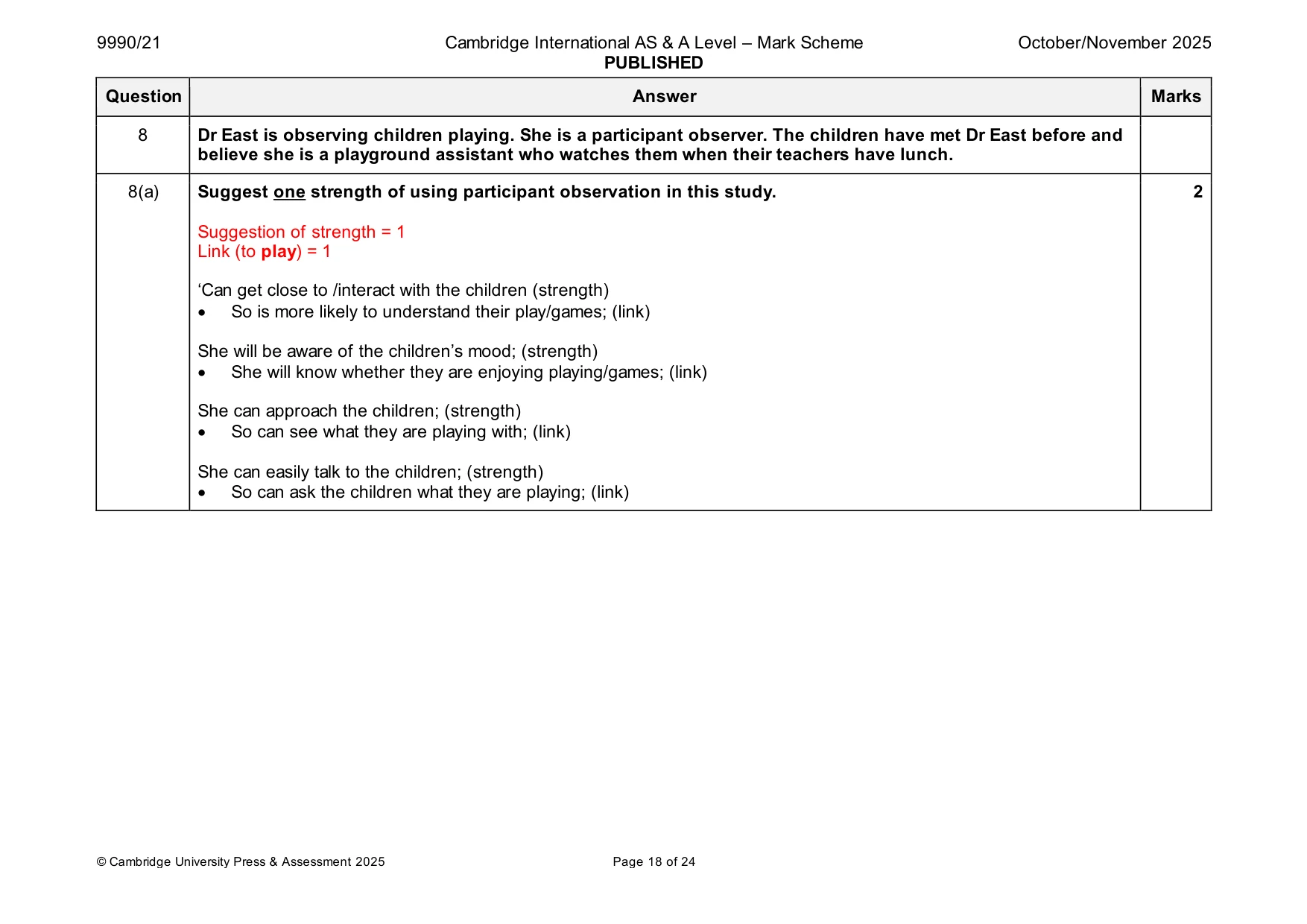
Q8 · Dr East is observing children playing
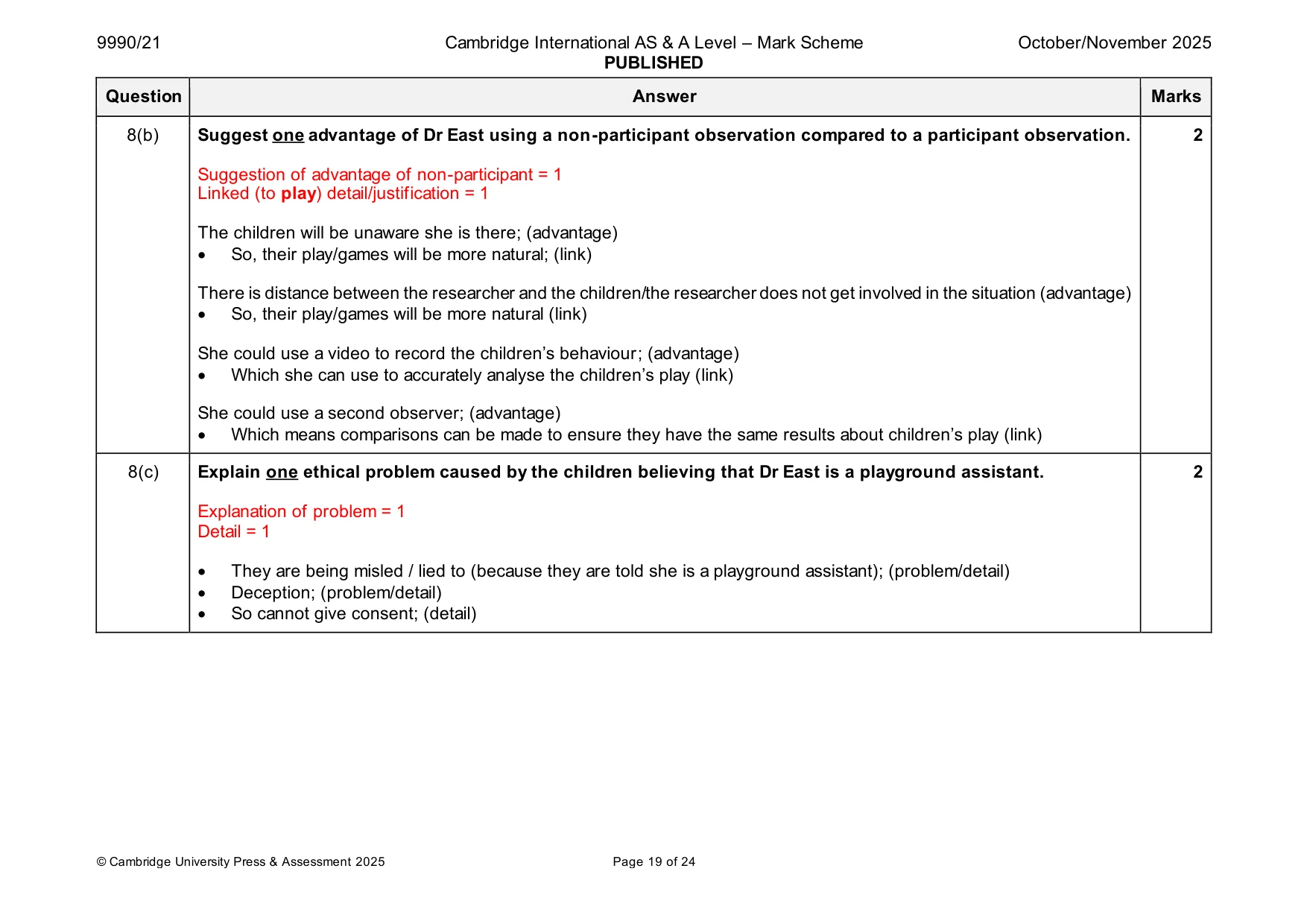
8 Dr East is observing children playing. She is a participant observer. The children have met Dr East before and believe she is a playground assistant who watches them when their teachers have lunch. (a) Suggest one strength of using participant observation in this study. ................................................................................................................................................... ................................................................................................................................................... ................................................................................................................................................... ............................................................................................................................................. [2] (b) Suggest one advantage of Dr East using a non-participant observation compared to a participant observation. ................................................................................................................................................... ................................................................................................................................................... ................................................................................................................................................... ............................................................................................................................................. [2] (c) Explain one ethical problem caused by the children believing that Dr East is a playground assistant. ................................................................................................................................................... ................................................................................................................................................... ................................................................................................................................................... ............................................................................................................................................. [2]
Mark scheme: 8 Dr East is observing children playing. She is a participant observer. The children have met Dr East before and believe she is a playground assistant who watches them when their teachers have lunch. 8(a) Suggest one strength of using participant observation in this study. 2 Suggestion of strength = 1 Link (to play) = 1 ‘Can get close to /interact with the children (strength) • So is more likely to understand their play/games; (link) She will be aware of the children’s mood; (strength) • She will know whether they are enjoying playing/games; (link) She can approach the children; (strength) • So can see what they are playing with; (link) She can easily talk to the children; (strength) • So can ask the children what they are playing; (link) 8(b) Suggest one advantage of Dr East using a non-participant observation compared to a participant observation. 2 Suggestion of advantage of non-participant = 1 Linked (to play) detail/justification = 1 The children will be unaware she is there; (advantage) • So, their play/games will be more natural; (link) There is distance between the researcher and the children/the researcher does not get involved in the situation (advantage) • So, their play/games will be more natural (link) She could use a video to record the children’s behaviour; (advantage) • Which she can use to accurately analyse the children’s play (link) She could use a second observer; (advantage) • Which means comparisons can be made to ensure they have the same results about children’s play (link) 8(c) Explain one ethical problem caused by the children believing that Dr East is a playground assistant. 2 Explanation of problem = 1 Detail = 1 • They are being misled / lied to (because they are told she is a playground assistant); (problem/detail) • Deception; (problem/detail) • So cannot give consent; (detail)
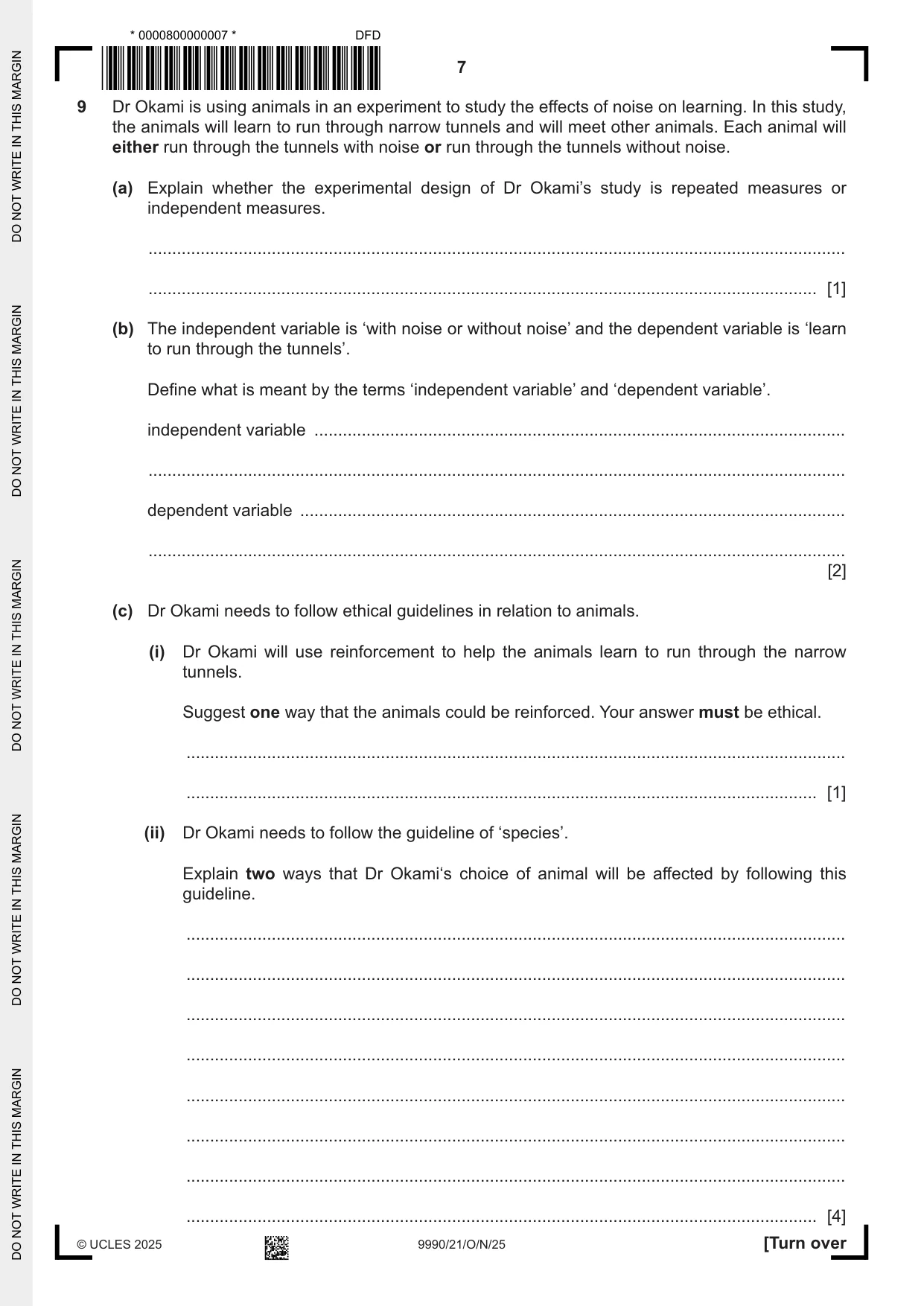
Q9 · Dr Okami is using animals in an experiment to study the effects of noise on learning
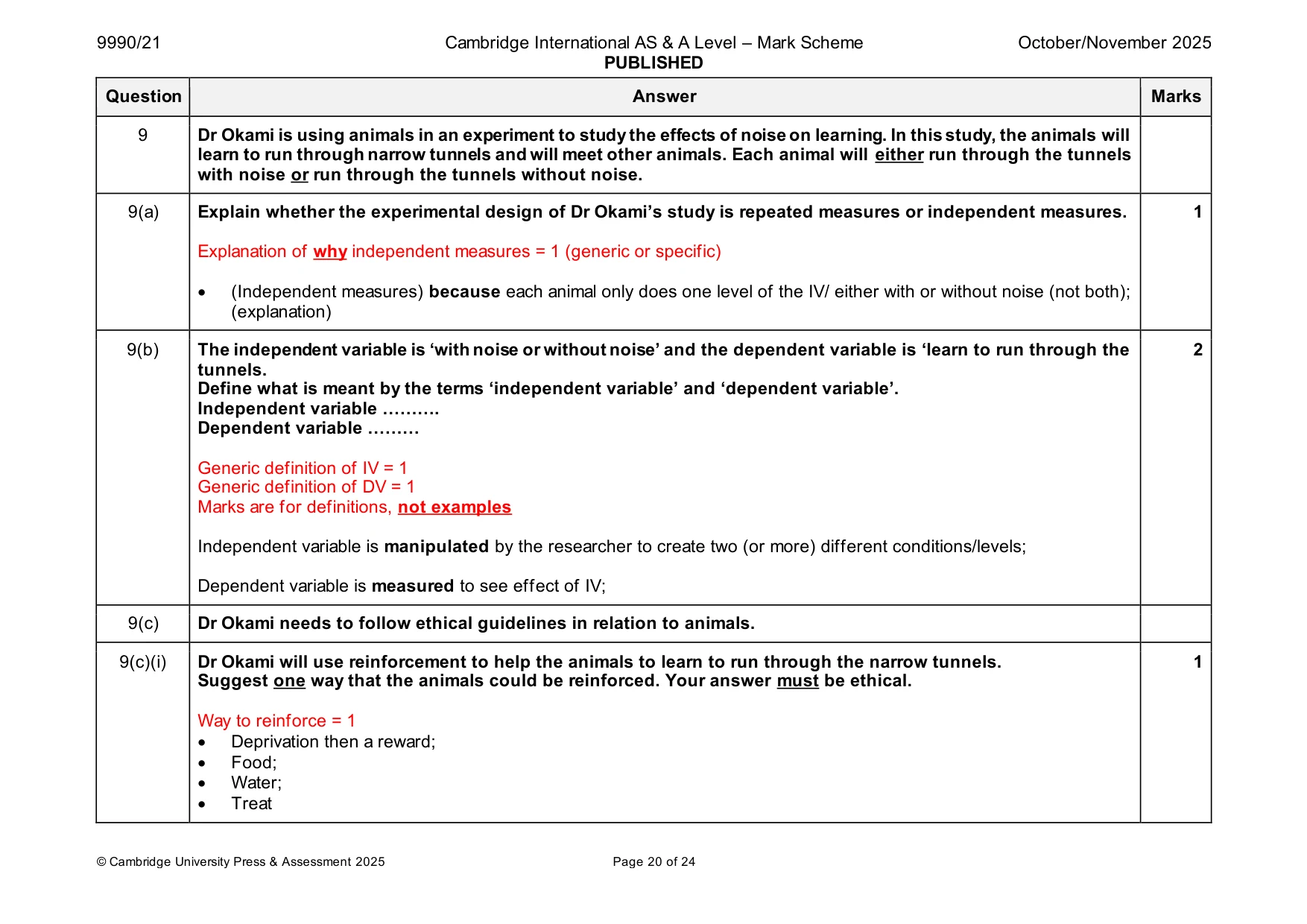
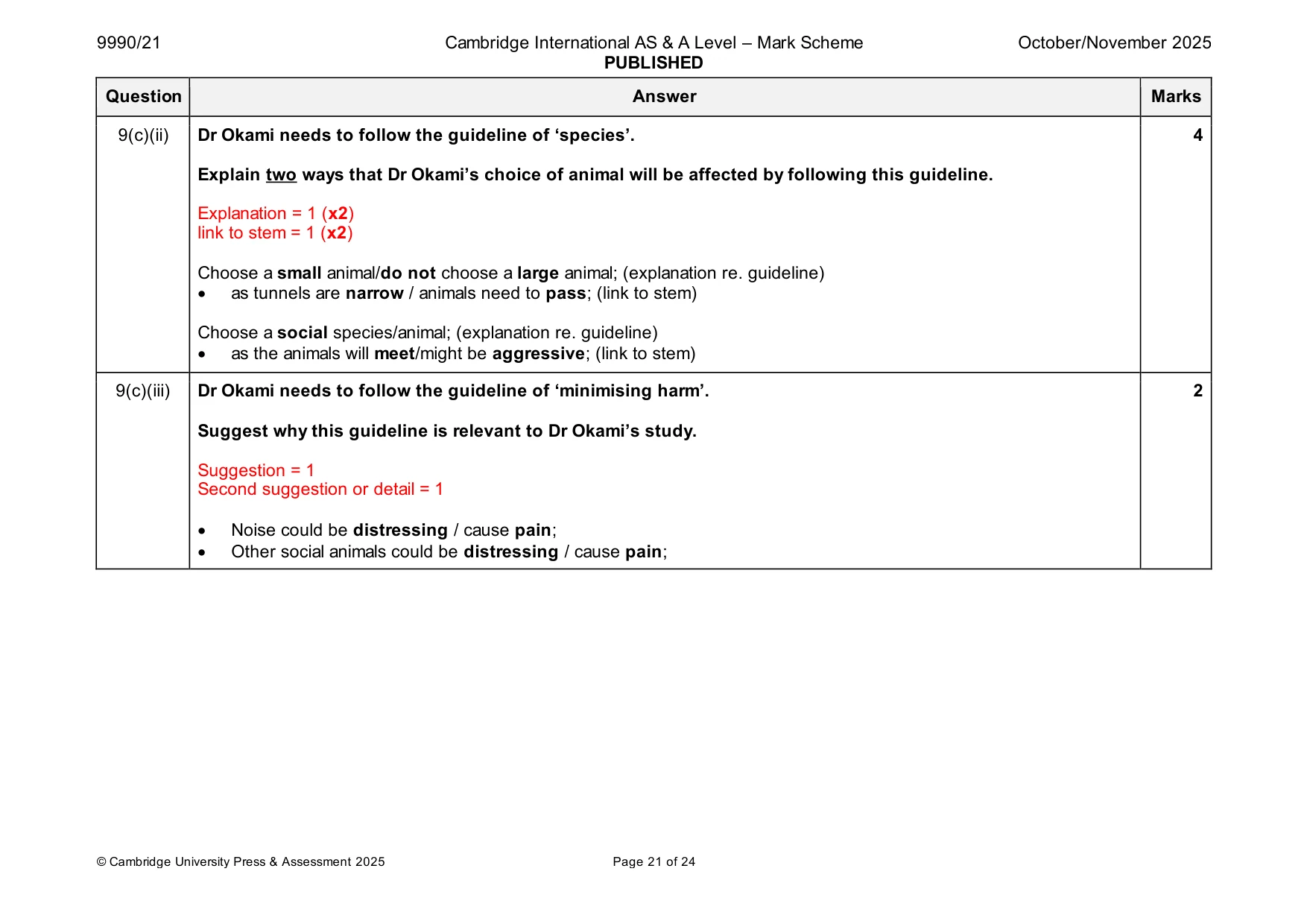
9 Dr Okami is using animals in an experiment to study the effects of noise on learning. In this study, the animals will learn to run through narrow tunnels and will meet other animals. Each animal will either run through the tunnels with noise or run through the tunnels without noise. (a) Explain whether the experimental design of Dr Okami’s study is repeated measures or independent measures. ................................................................................................................................................... ............................................................................................................................................. [1] (b) The independent variable is ‘with noise or without noise’ and the dependent variable is ‘learn to run through the tunnels’. Define what is meant by the terms ‘independent variable’ and ‘dependent variable’. independent variable ................................................................................................................ ................................................................................................................................................... dependent variable ................................................................................................................... ................................................................................................................................................... [2] (c) Dr Okami needs to follow ethical guidelines in relation to animals. (i) Dr Okami will use reinforcement to help the animals learn to run through the narrow tunnels. Suggest one way that the animals could be reinforced. Your answer must be ethical. ........................................................................................................................................... ..................................................................................................................................... [1] (ii) Dr Okami needs to follow the guideline of ‘species’. Explain two ways that Dr Okami‘s choice of animal will be affected by following this guideline. ........................................................................................................................................... ........................................................................................................................................... ........................................................................................................................................... ........................................................................................................................................... ........................................................................................................................................... ........................................................................................................................................... ........................................................................................................................................... ..................................................................................................................................... [4] (iii) Dr Okami needs to follow the guideline of ‘minimising harm’. Suggest why this guideline is relevant to Dr Okami’s study. ........................................................................................................................................... ........................................................................................................................................... ........................................................................................................................................... ..................................................................................................................................... [2]
Mark scheme: 9 Dr Okami is using animals in an experiment to study the effects of noise on learning. In this study, the animals will learn to run through narrow tunnels and will meet other animals. Each animal will either run through the tunnels with noise or run through the tunnels without noise. 9(a) Explain whether the experimental design of Dr Okami’s study is repeated measures or independent measures. 1 Explanation of why independent measures = 1 (generic or specific) • (Independent measures) because each animal only does one level of the IV/ either with or without noise (not both); (explanation) 9(b) The independent variable is ‘with noise or without noise’ and the dependent variable is ‘learn to run through the 2 tunnels. Define what is meant by the terms ‘independent variable’ and ‘dependent variable’. Independent variable ………. Dependent variable ……… Generic definition of IV = 1 Generic definition of DV = 1 Marks are for definitions, not examples Independent variable is manipulated by the researcher to create two (or more) different conditions/levels; Dependent variable is measured to see effect of IV; 9(c) Dr Okami needs to follow ethical guidelines in relation to animals. 9(c)(i) Dr Okami will use reinforcement to help the animals to learn to run through the narrow tunnels. 1 Suggest one way that the animals could be reinforced. Your answer must be ethical. Way to reinforce = 1 • Deprivation then a reward; • Food; • Water; • Treat 9(c)(ii) Dr Okami needs to follow the guideline of ‘species’. 4 Explain two ways that Dr Okami’s choice of animal will be affected by following this guideline. Explanation = 1 (x2) link to stem = 1 (x2) Choose a small animal/do not choose a large animal; (explanation re. guideline) • as tunnels are narrow / animals need to pass; (link to stem) Choose a social species/animal; (explanation re. guideline) • as the animals will meet/might be aggressive; (link to stem) 9(c)(iii) Dr Okami needs to follow the guideline of ‘minimising harm’. 2 Suggest why this guideline is relevant to Dr Okami’s study. Suggestion = 1 Second suggestion or detail = 1 • Noise could be distressing / cause pain; • Other social animals could be distressing / cause pain;
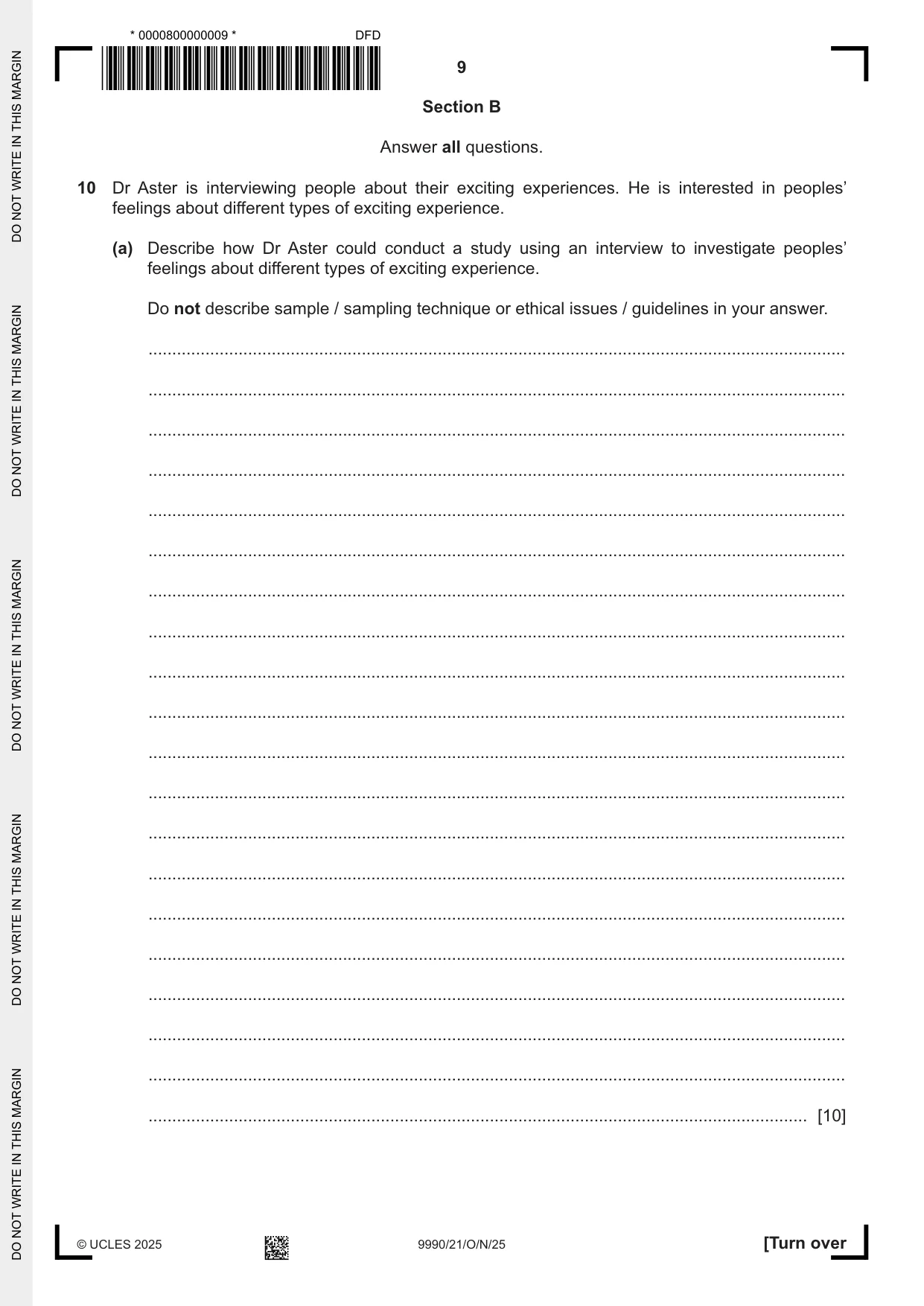
Q10 · Dr Aster is interviewing people about their exciting experiences
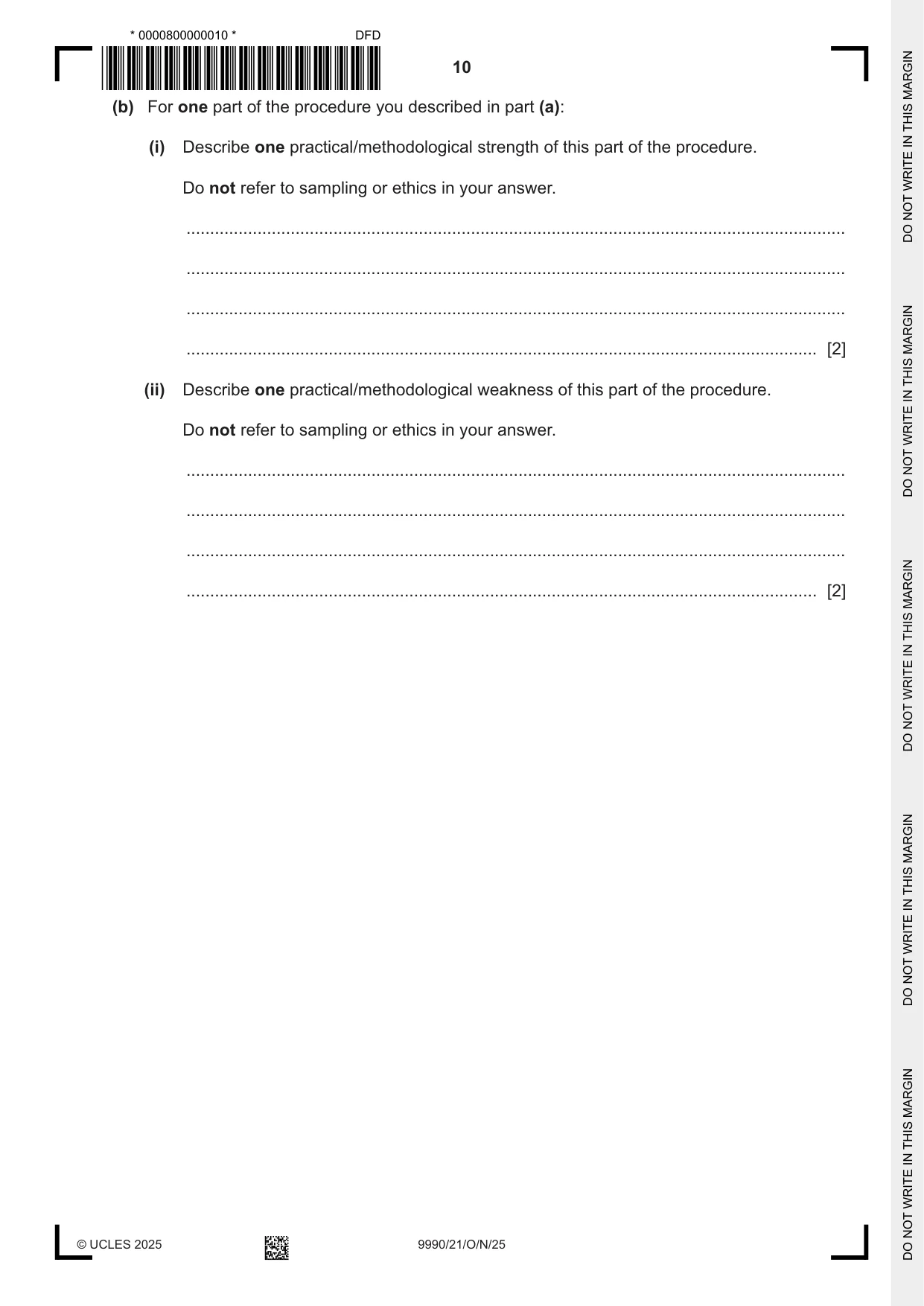
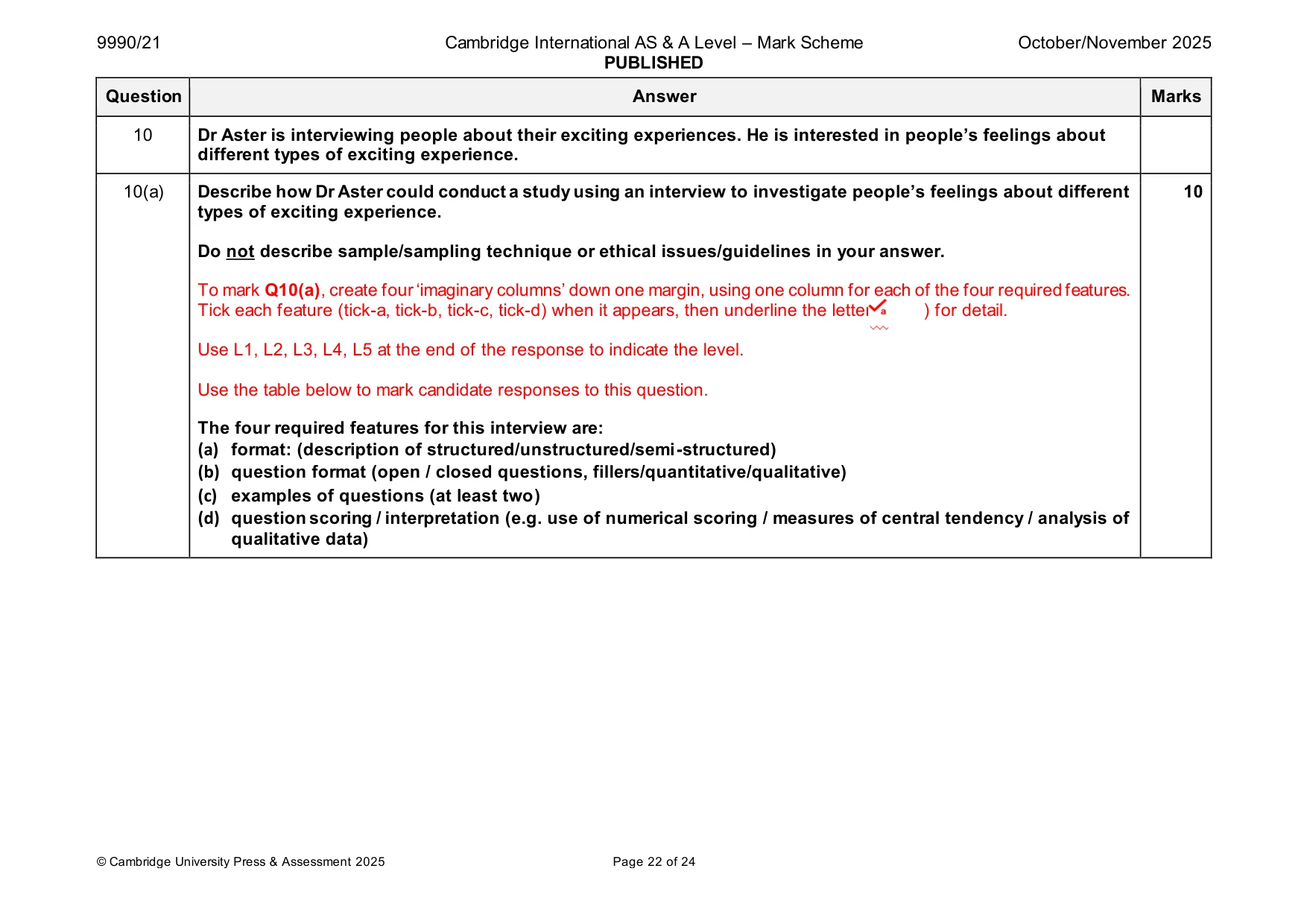
10 Dr Aster is interviewing people about their exciting experiences. He is interested in peoples’ feelings about different types of exciting experience. (a) Describe how Dr Aster could conduct a study using an interview to investigate peoples’ feelings about different types of exciting experience. Do not describe sample / sampling technique or ethical issues / guidelines in your answer. ................................................................................................................................................... ................................................................................................................................................... ................................................................................................................................................... ................................................................................................................................................... ................................................................................................................................................... ................................................................................................................................................... ................................................................................................................................................... ................................................................................................................................................... ................................................................................................................................................... ................................................................................................................................................... ................................................................................................................................................... ................................................................................................................................................... ................................................................................................................................................... ................................................................................................................................................... ................................................................................................................................................... ................................................................................................................................................... ................................................................................................................................................... ................................................................................................................................................... ................................................................................................................................................... ........................................................................................................................................... [10] (b) For one part of the procedure you described in part (a): (i) Describe one practical/methodological strength of this part of the procedure. Do not refer to sampling or ethics in your answer. ........................................................................................................................................... ........................................................................................................................................... ........................................................................................................................................... ..................................................................................................................................... [2] (ii) Describe one practical/methodological weakness of this part of the procedure. Do not refer to sampling or ethics in your answer. ........................................................................................................................................... ........................................................................................................................................... ........................................................................................................................................... ..................................................................................................................................... [2]
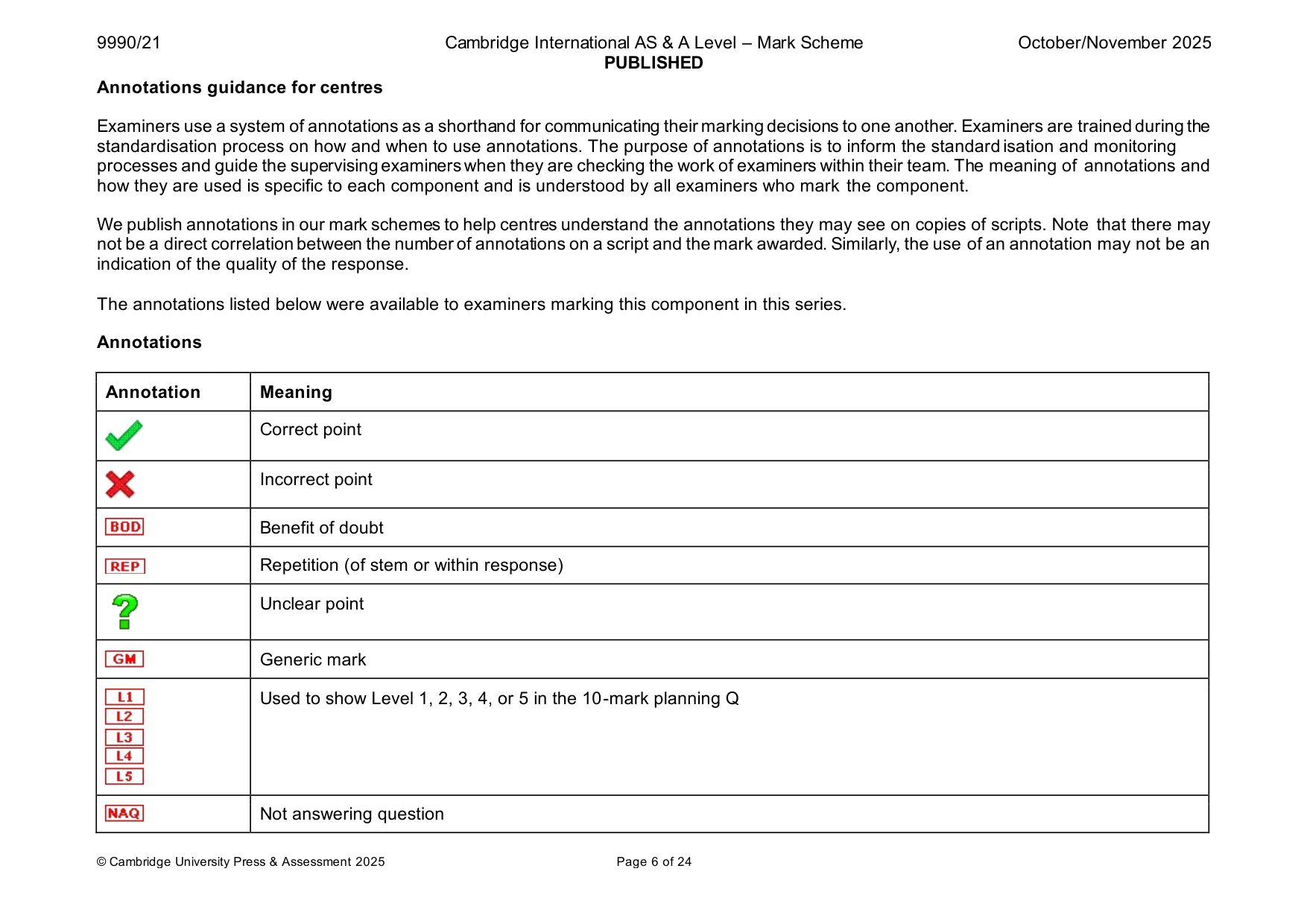
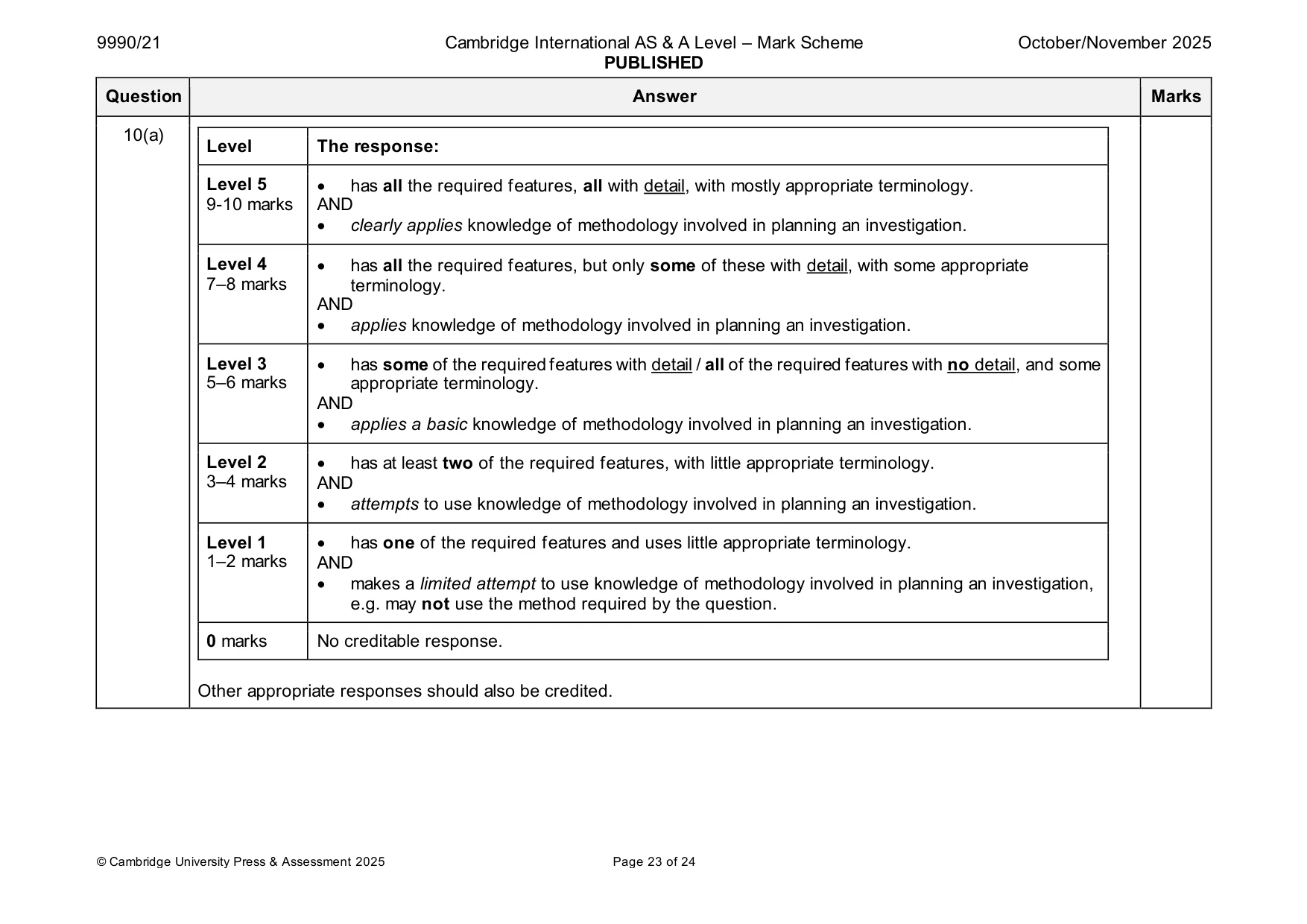
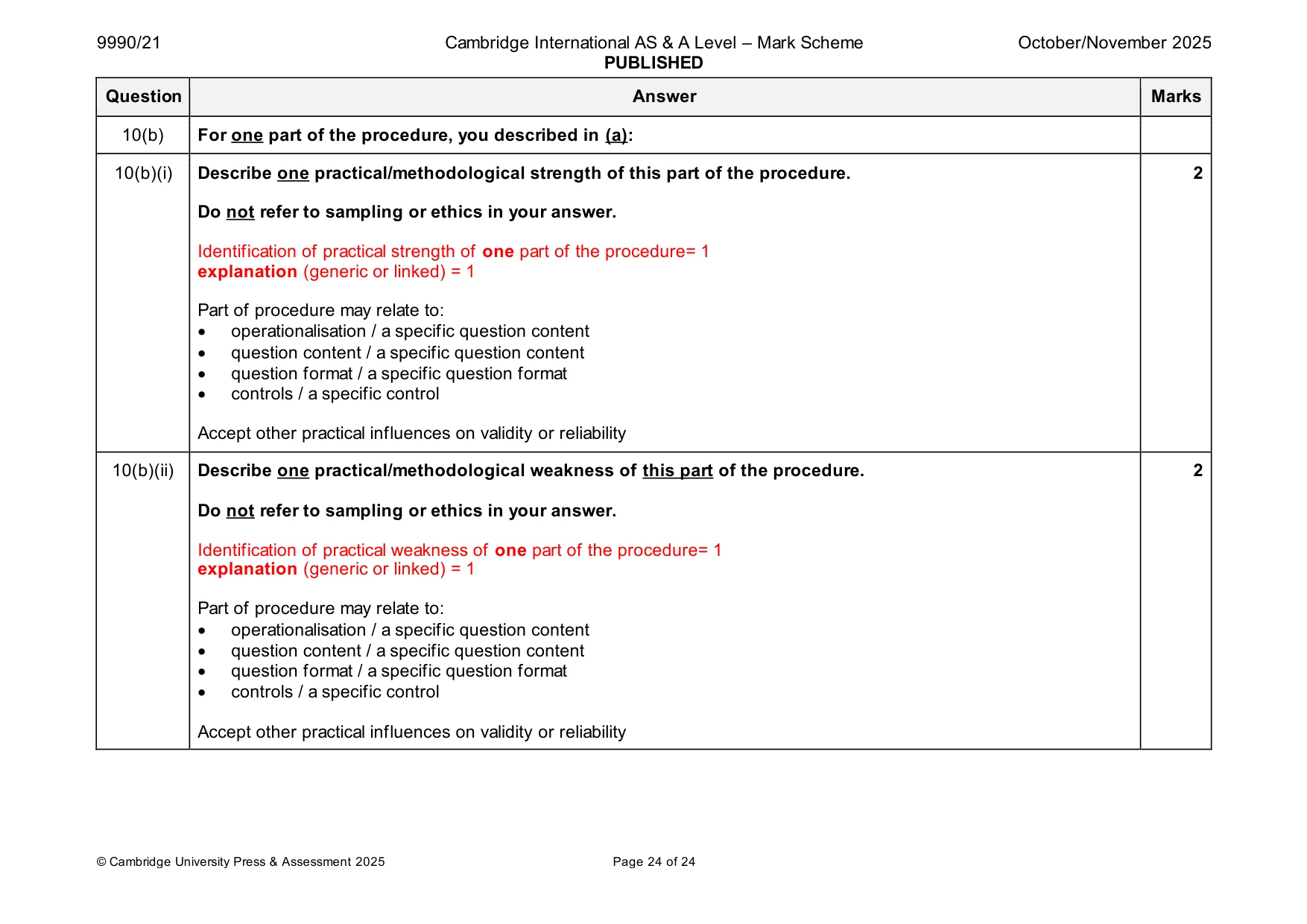
Mark scheme: 10 Dr Aster is interviewing people about their exciting experiences. He is interested in people’s feelings about different types of exciting experience. 10(a) Describe how Dr Aster could conduct a study using an interview to investigate people’s feelings about different 10 types of exciting experience. Do not describe sample/sampling technique or ethical issues/guidelines in your answer. To mark Q10(a), create four ‘imaginary columns’ down one margin, using one column for each of the four required features. Tick each feature (tick-a, tick-b, tick-c, tick-d) when it appears, then underline the letter ( ) for detail. Use L1, L2, L3, L4, L5 at the end of the response to indicate the level. Use the table below to mark candidate responses to this question. The four required features for this interview are: (a) format: (description of structured/unstructured/semi-structured) (b) question format (open / closed questions, fillers/quantitative/qualitative) (c) examples of questions (at least two) (d) question scoring / interpretation (e.g. use of numerical scoring / measures of central tendency / analysis of qualitative data) 10(a) Level The response: Level 5 • has all the required features, all with detail, with mostly appropriate terminology. 9-10 marks AND • clearly applies knowledge of methodology involved in planning an investigation. Level 4 • has all the required features, but only some of these with detail, with some appropriate 7–8 marks terminology. AND • applies knowledge of methodology involved in planning an investigation. Level 3 • has some of the required features with detail / all of the required features with no detail, and some 5–6 marks appropriate terminology. AND • applies a basic knowledge of methodology involved in planning an investigation. Level 2 • has at least two of the required features, with little appropriate terminology. 3–4 marks AND • attempts to use knowledge of methodology involved in planning an investigation. Level 1 • has one of the required features and uses little appropriate terminology. 1–2 marks AND • makes a limited attempt to use knowledge of methodology involved in planning an investigation, e.g. may not use the method required by the question. 0 marks No creditable response. Other appropriate responses should also be credited. 10(b) For one part of the procedure, you described in (a): 10(b)(i) Describe one practical/methodological strength of this part of the procedure. 2 Do not refer to sampling or ethics in your answer. Identification of practical strength of one part of the procedure= 1 explanation (generic or linked) = 1 Part of procedure may relate to: • operationalisation / a specific question content • question content / a specific question content • question format / a specific question format • controls / a specific control Accept other practical influences on validity or reliability 10(b)(ii) Describe one practical/methodological weakness of this part of the procedure. 2 Do not refer to sampling or ethics in your answer. Identification of practical weakness of one part of the procedure= 1 explanation (generic or linked) = 1 Part of procedure may relate to: • operationalisation / a specific question content • question content / a specific question content • question format / a specific question format • controls / a specific control Accept other practical influences on validity or reliability
What was in this paper
The subtopics covered by these 10 questions, and how many questions each got. Open one in a new tab to see every Cambridge question on it.