Cambridge A Level Psychology (from 2018) 9990 — 2022 Oct/Nov Paper 2 · Variant 1
9990/21/O/N/22 · 10 questions · 60 marks · ≈68 min
The question paper and its mark scheme, free to read here and free to download. This is Cambridge’s own paper, exactly as it was sat.
Question paper12 pages

Mark scheme19 pages
Answers below. Sit the paper first if you are practising.
Questions as text
Q1 · The study by Milgram (obedience) used a shock generator, which looked real
1 The study by Milgram (obedience) used a shock generator, which looked real. Explain why it was necessary that the shock generator looked real. .......................................................................................................................................................... .......................................................................................................................................................... .......................................................................................................................................................... .................................................................................................................................................... [2]
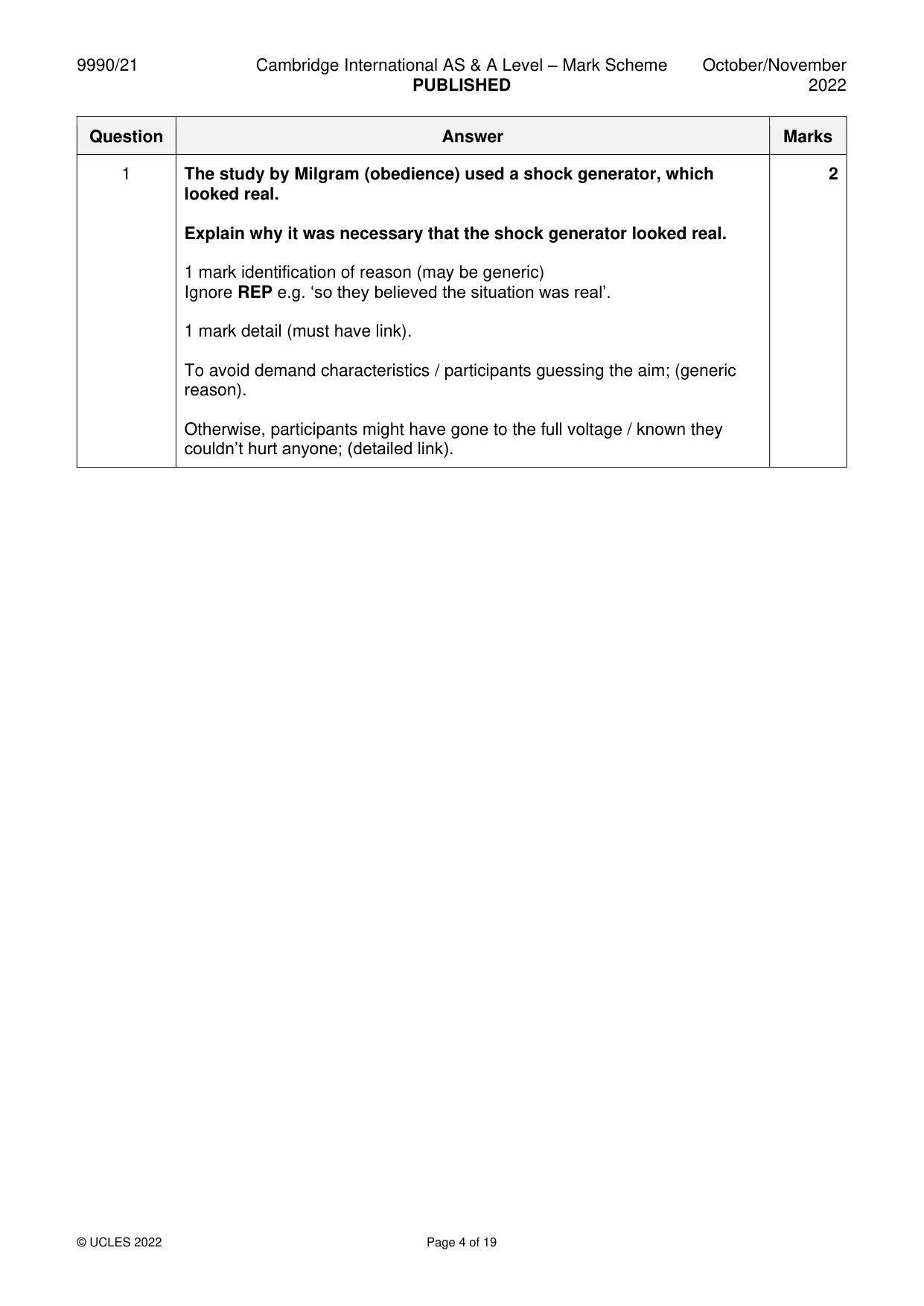
Mark scheme: Question Answer Marks 1 The study by Milgram (obedience) used a shock generator, which 2 looked real. Explain why it was necessary that the shock generator looked real. 1 mark identification of reason (may be generic) Ignore REP e.g. ‘so they believed the situation was real’. 1 mark detail (must have link). To avoid demand characteristics / participants guessing the aim; (generic reason). Otherwise, participants might have gone to the full voltage / known they couldn’t hurt anyone; (detailed link).
Q2 · Bill has two groups of children in his study and writes a directional hypothesis
2 Bill has two groups of children in his study and writes a directional hypothesis. It states that ‘Older children are more obedient than younger children’. He then decides that this might not be correct and uses a non-directional hypothesis instead. (a) Suggest a non-directional hypothesis for Bill’s study. ................................................................................................................................................... ............................................................................................................................................. [1] (b) State how Bill will find the mode for the age of the group of younger children. ................................................................................................................................................... ............................................................................................................................................. [1] (c) Suggest two reasons why it could be ethically more difficult to measure obedience in children than in adults. 1 ................................................................................................................................................ ................................................................................................................................................... ................................................................................................................................................... ................................................................................................................................................... 2 ................................................................................................................................................ ................................................................................................................................................... ................................................................................................................................................... ............................................................................................................................................. [4]
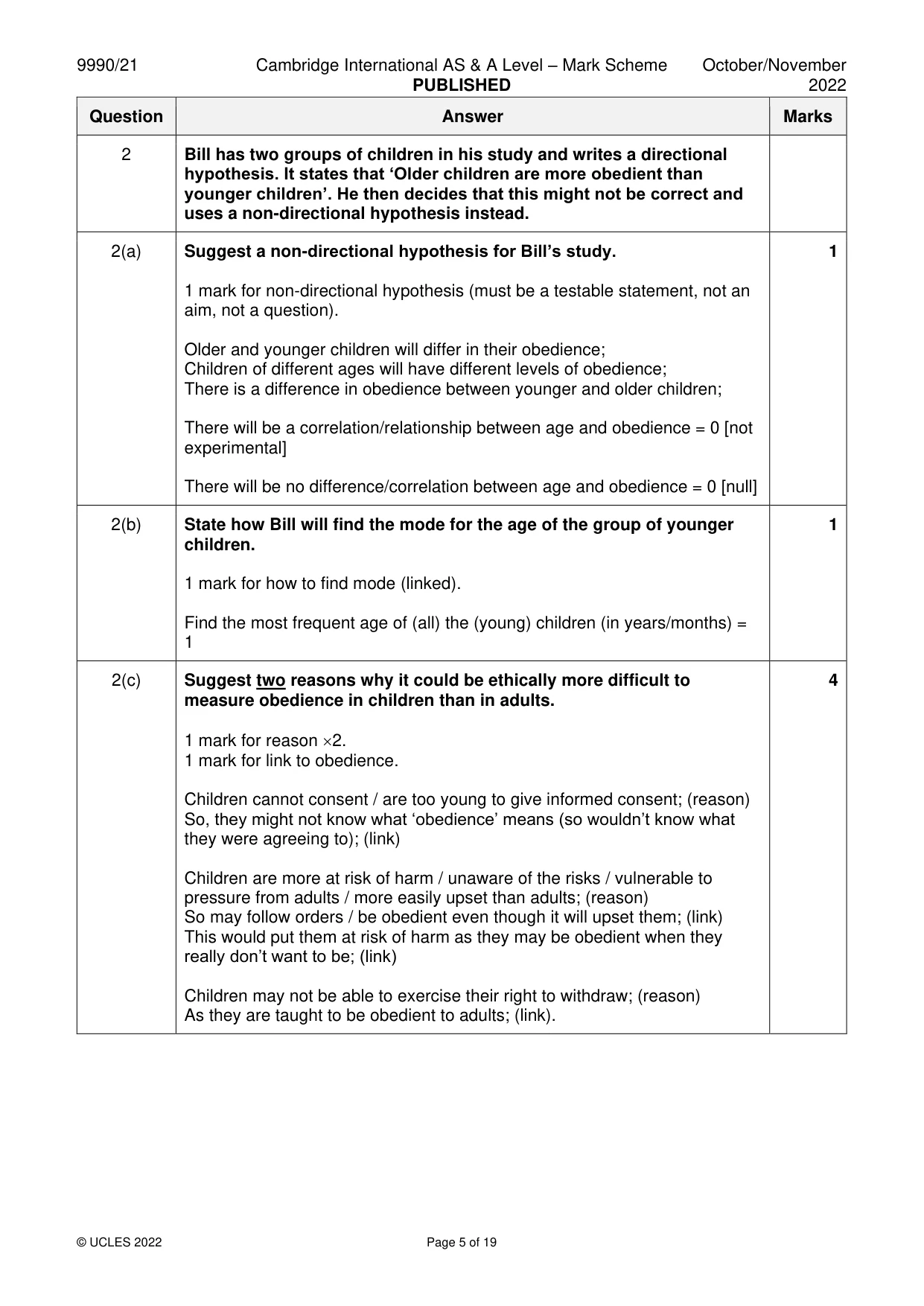
Mark scheme: 2 Bill has two groups of children in his study and writes a directional hypothesis. It states that ‘Older children are more obedient than younger children’. He then decides that this might not be correct and uses a non-directional hypothesis instead. 2(a) Suggest a non-directional hypothesis for Bill’s study. 1 1 mark for non-directional hypothesis (must be a testable statement, not an aim, not a question). Older and younger children will differ in their obedience; Children of different ages will have different levels of obedience; There is a difference in obedience between younger and older children; There will be a correlation/relationship between age and obedience = 0 [not experimental] There will be no difference/correlation between age and obedience = 0 [null] 2(b) State how Bill will find the mode for the age of the group of younger 1 children. 1 mark for how to find mode (linked). Find the most frequent age of (all) the (young) children (in years/months) = 1 2(c) Suggest two reasons why it could be ethically more difficult to 4 measure obedience in children than in adults. 1 mark for reason 2. 1 mark for link to obedience. Children cannot consent / are too young to give informed consent; (reason) So, they might not know what ‘obedience’ means (so wouldn’t know what they were agreeing to); (link) Children are more at risk of harm / unaware of the risks / vulnerable to pressure from adults / more easily upset than adults; (reason) So may follow orders / be obedient even though it will upset them; (link) This would put them at risk of harm as they may be obedient when they really don’t want to be; (link) Children may not be able to exercise their right to withdraw; (reason) As they are taught to be obedient to adults; (link).
Q3 · Describe two features of a laboratory experiment
3 Describe two features of a laboratory experiment. Use a different example from the study by Schachter and Singer (two factors in emotion) for each feature. 1 ....................................................................................................................................................... .......................................................................................................................................................... .......................................................................................................................................................... .......................................................................................................................................................... 2 ....................................................................................................................................................... .......................................................................................................................................................... .......................................................................................................................................................... .................................................................................................................................................... [4]
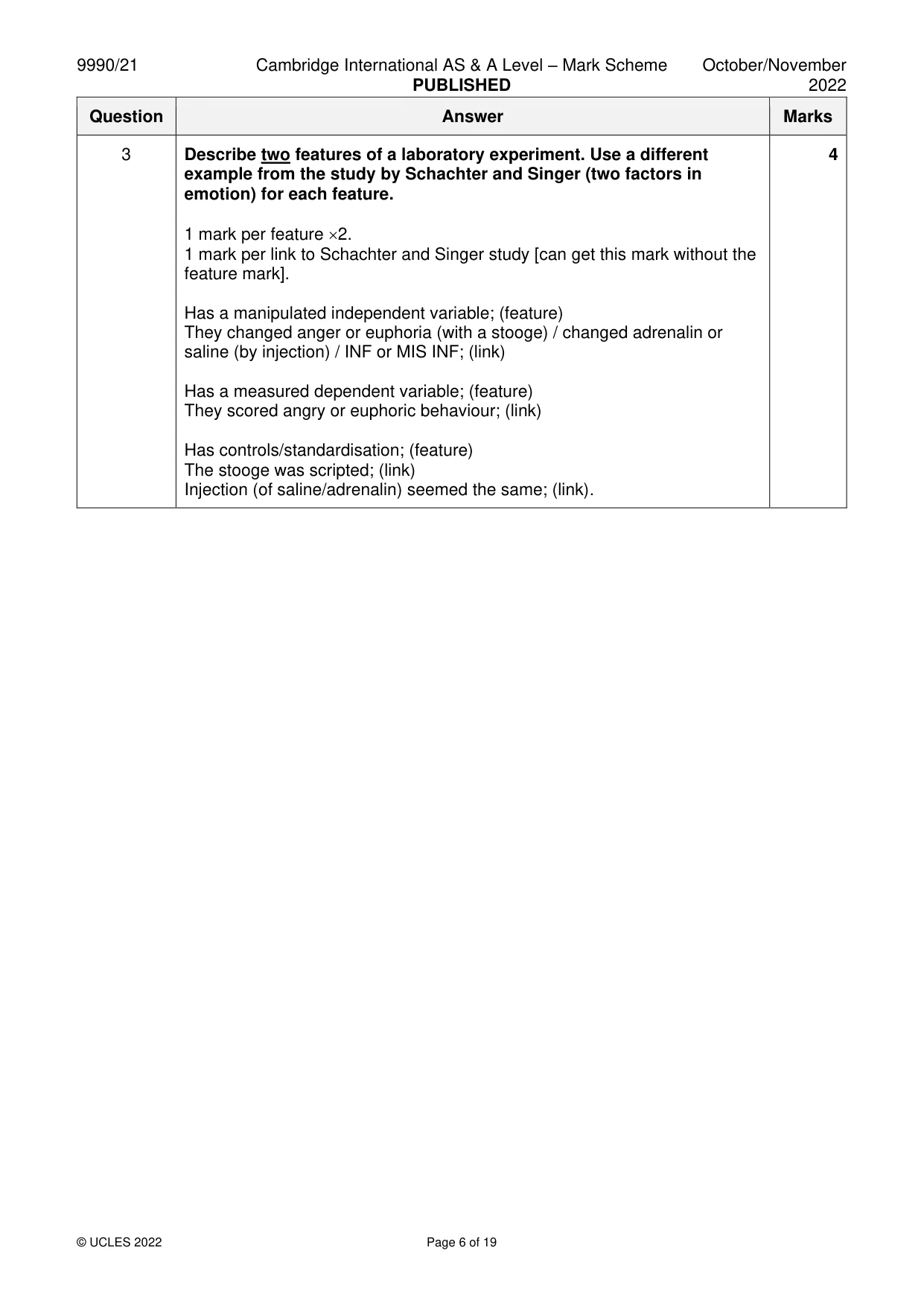
Mark scheme: 3 Describe two features of a laboratory experiment. Use a different 4 example from the study by Schachter and Singer (two factors in emotion) for each feature. 1 mark per feature 2. 1 mark per link to Schachter and Singer study [can get this mark without the feature mark]. Has a manipulated independent variable; (feature) They changed anger or euphoria (with a stooge) / changed adrenalin or saline (by injection) / INF or MIS INF; (link) Has a measured dependent variable; (feature) They scored angry or euphoric behaviour; (link) Has controls/standardisation; (feature) The stooge was scripted; (link) Injection (of saline/adrenalin) seemed the same; (link).
Question 4
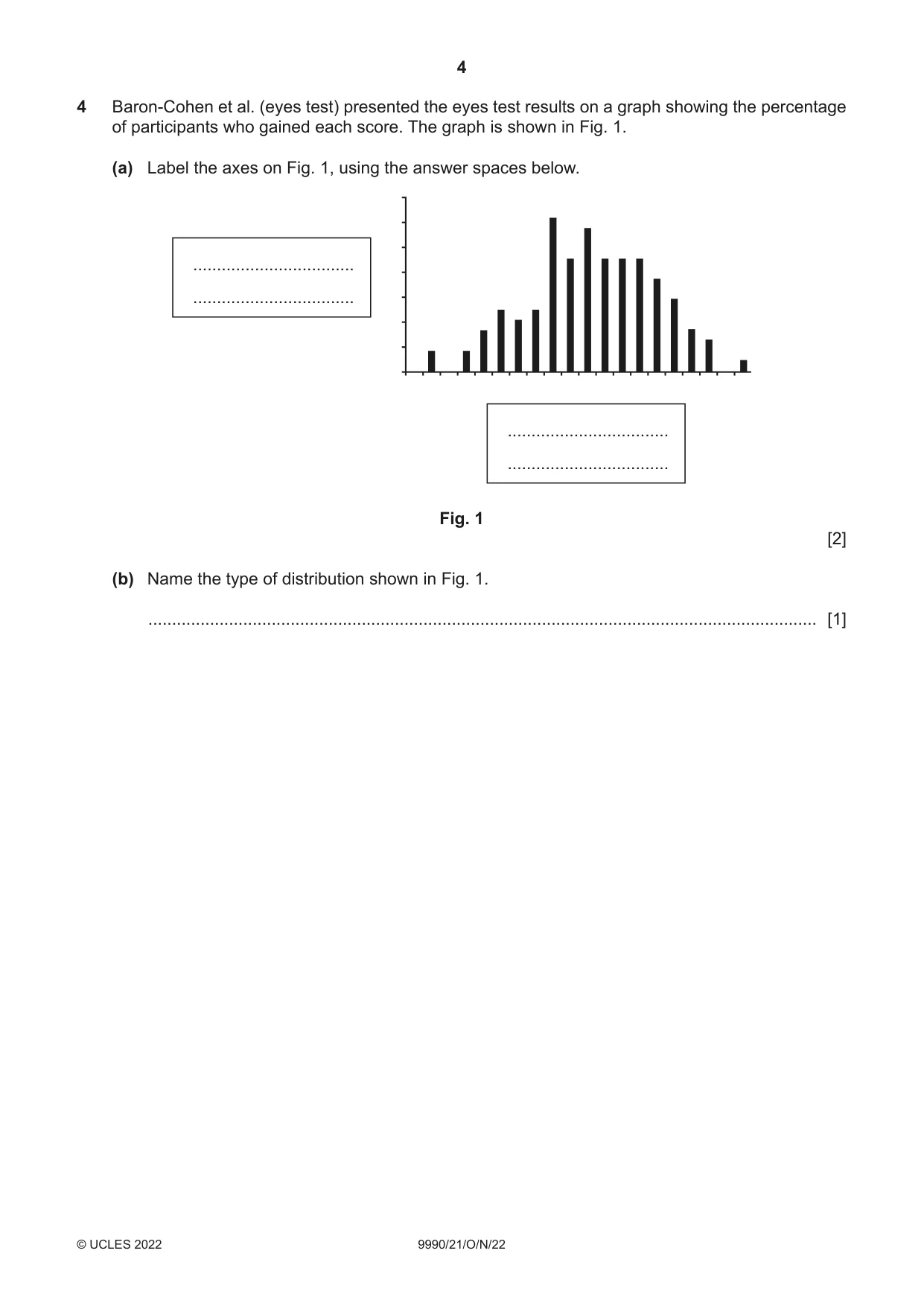
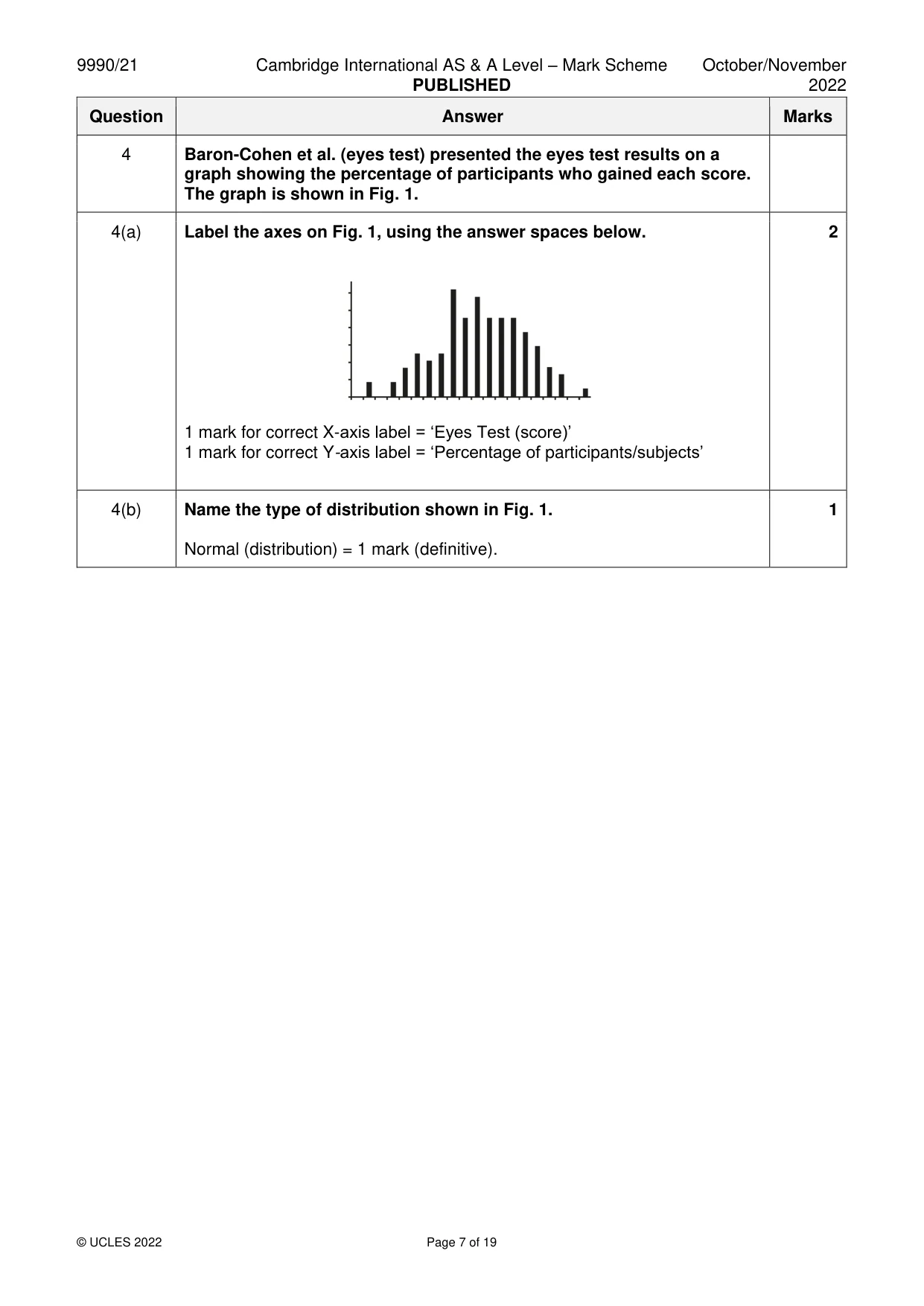
4 Baron-Cohen et al. (eyes test) presented the eyes test results on a graph showing the percentage of participants who gained each score. The graph is shown in Fig. 1. (a) Label the axes on Fig. 1, using the answer spaces below. .................................. .................................. .................................. .................................. Fig. 1 [2] (b) Name the type of distribution shown in Fig. 1. ............................................................................................................................................. [1]
Mark scheme: 4 Baron-Cohen et al. (eyes test) presented the eyes test results on a graph showing the percentage of participants who gained each score. The graph is shown in Fig. 1. 4(a) Label the axes on Fig. 1, using the answer spaces below. 2 1 mark for correct X-axis label = ‘Eyes Test (score)’ 1 mark for correct Y-axis label = ‘Percentage of participants/subjects’ 4(b) Name the type of distribution shown in Fig. 1. 1 Normal (distribution) = 1 mark (definitive).
Q5 · Participants in a study are learning to throw a ball through a hoop
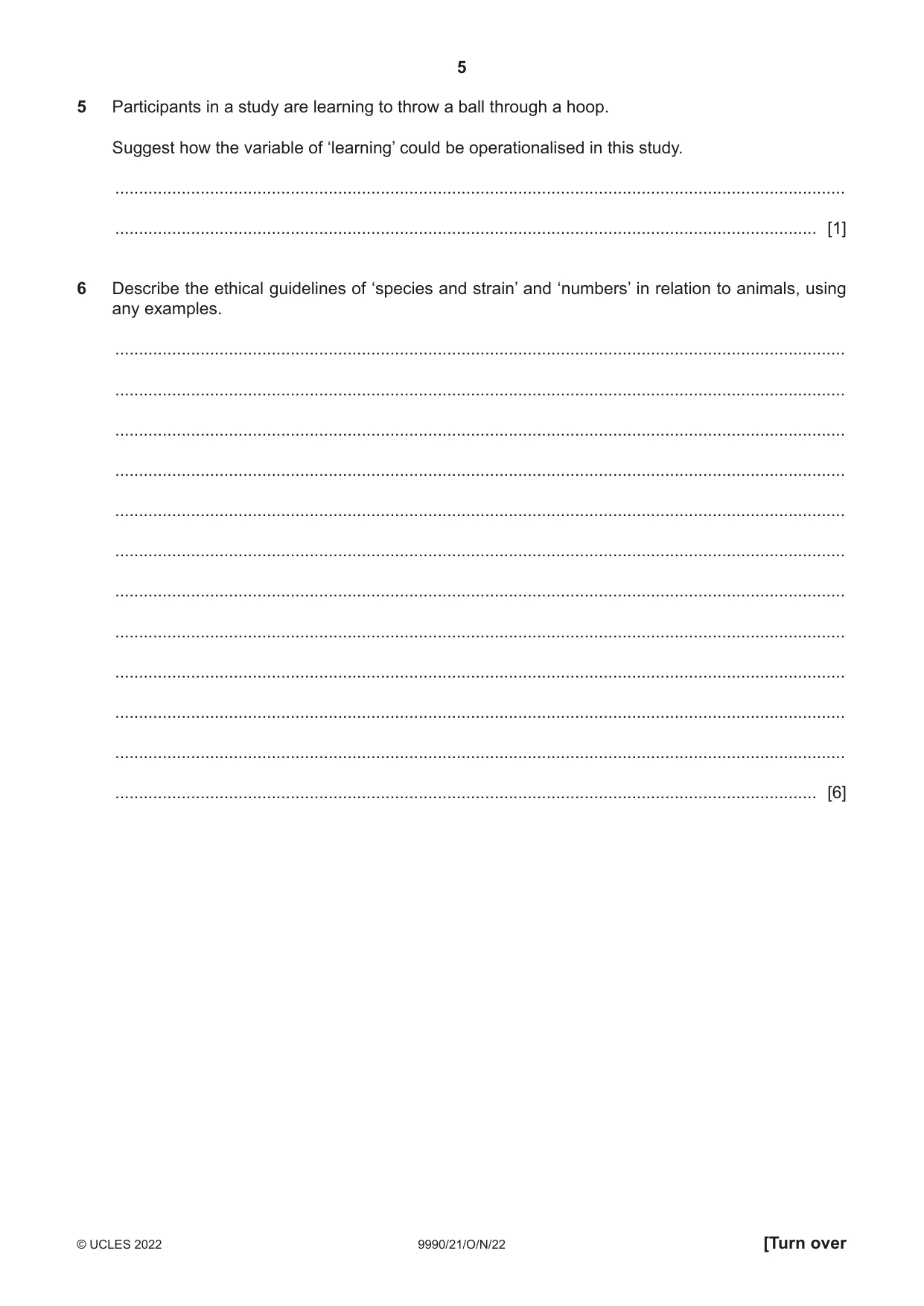
5 Participants in a study are learning to throw a ball through a hoop. Suggest how the variable of ‘learning’ could be operationalised in this study. .......................................................................................................................................................... .................................................................................................................................................... [1]
Mark scheme: 5 Participants in a study are learning to throw a ball through a hoop. 1 Suggest how the variable of ‘learning’ could be operationalised in this study. 1 mark for operational definition of operant conditioning of learning to throw a ball through a hoop. Their accuracy of getting the ball through the hoop increases; How many balls go through the hoop on each trial; How fast they can get (10) balls through the hoop; How many minutes it takes before they get balls into the hoop accurately.
Q6 · Describe the ethical guidelines of ‘species and strain’ and ‘numbers’ in relation to…
6 Describe the ethical guidelines of ‘species and strain’ and ‘numbers’ in relation to animals, using any examples. .......................................................................................................................................................... .......................................................................................................................................................... .......................................................................................................................................................... .......................................................................................................................................................... .......................................................................................................................................................... .......................................................................................................................................................... .......................................................................................................................................................... .......................................................................................................................................................... .......................................................................................................................................................... .......................................................................................................................................................... .......................................................................................................................................................... .................................................................................................................................................... [6]
Mark scheme: 6 Describe the ethical guidelines of ‘species and strain’ and ‘numbers’ in 6 relation to animals, using any examples. Definitions/detail: up to a maximum of 4 marks for each guideline. Examples: maximum of 2 marks for each guideline. Examples can be from any studies (core studies, other studies, candidate’s own studies). Max. 4 if no examples or if only one type of the guidelines is described. Species and strain: The species/strain which is least likely to become distressed should be chosen; That is able to fulfil the requirements of the study (i.e. it is a compromise); Each species has different needs e.g. for warmth / cover / space for exercise / to avoid overcrowding; The needs of each species may differ with age / sex / reproductive stage; Don’t use endangered species; e.g. Pepperberg used a parrot, which is a domesticated species so not distressed by human interaction; e.g. Yamamoto et al. needed to use chimpanzees which may be distressed as helping is a complex concept. Number: The smallest number of animals possible should be used (so that the smallest number of animals experience harm/distress); However, enough should be used to achieve valid/reliable results; e.g. Pepperberg only used 1 parrot / only Alex (which is good); e.g. Yamamoto et al. only used 5 / a small number of chimpanzees (which is good).
Q7 · Kate is using a questionnaire to investigate how participants could feel about people who…
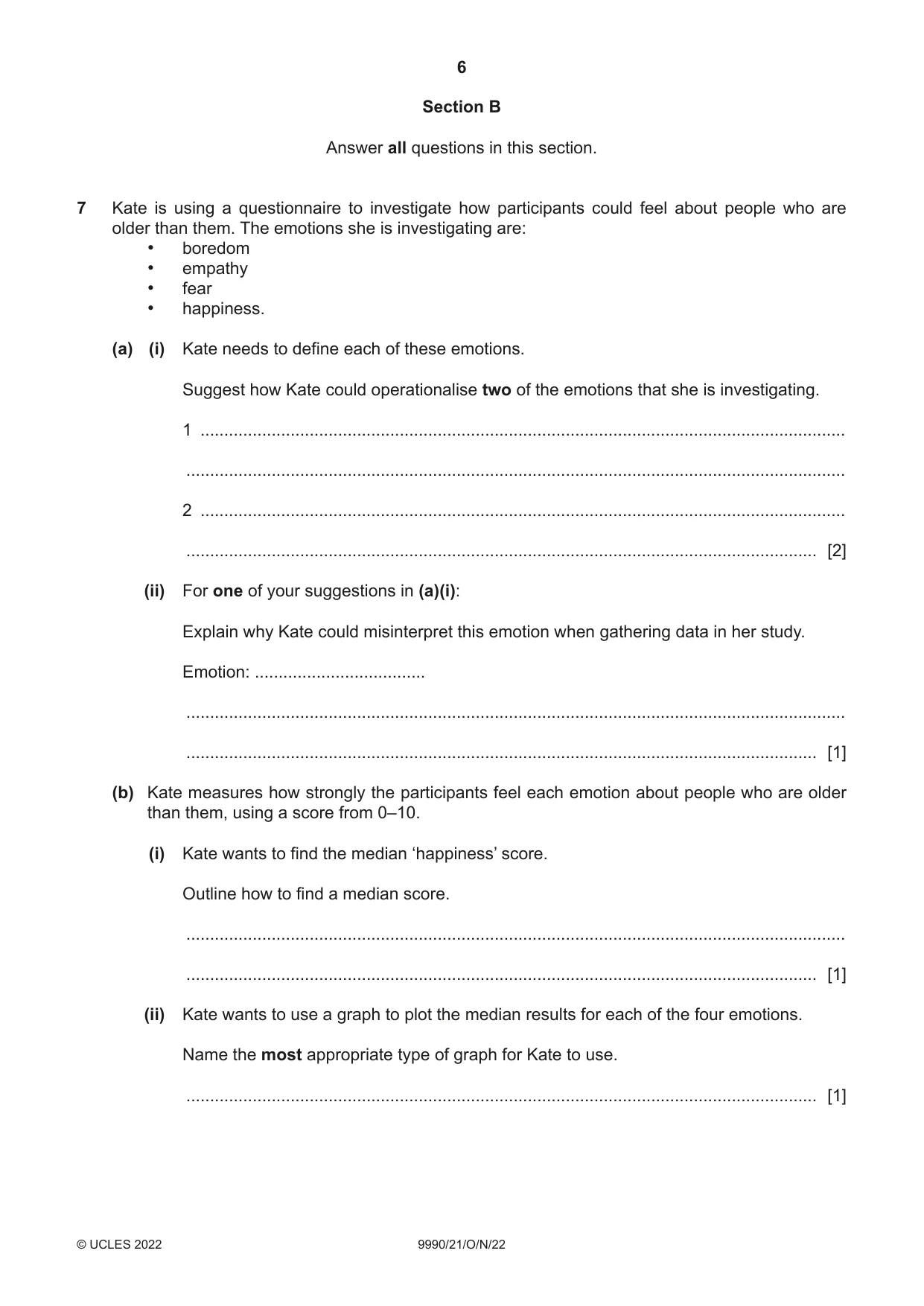
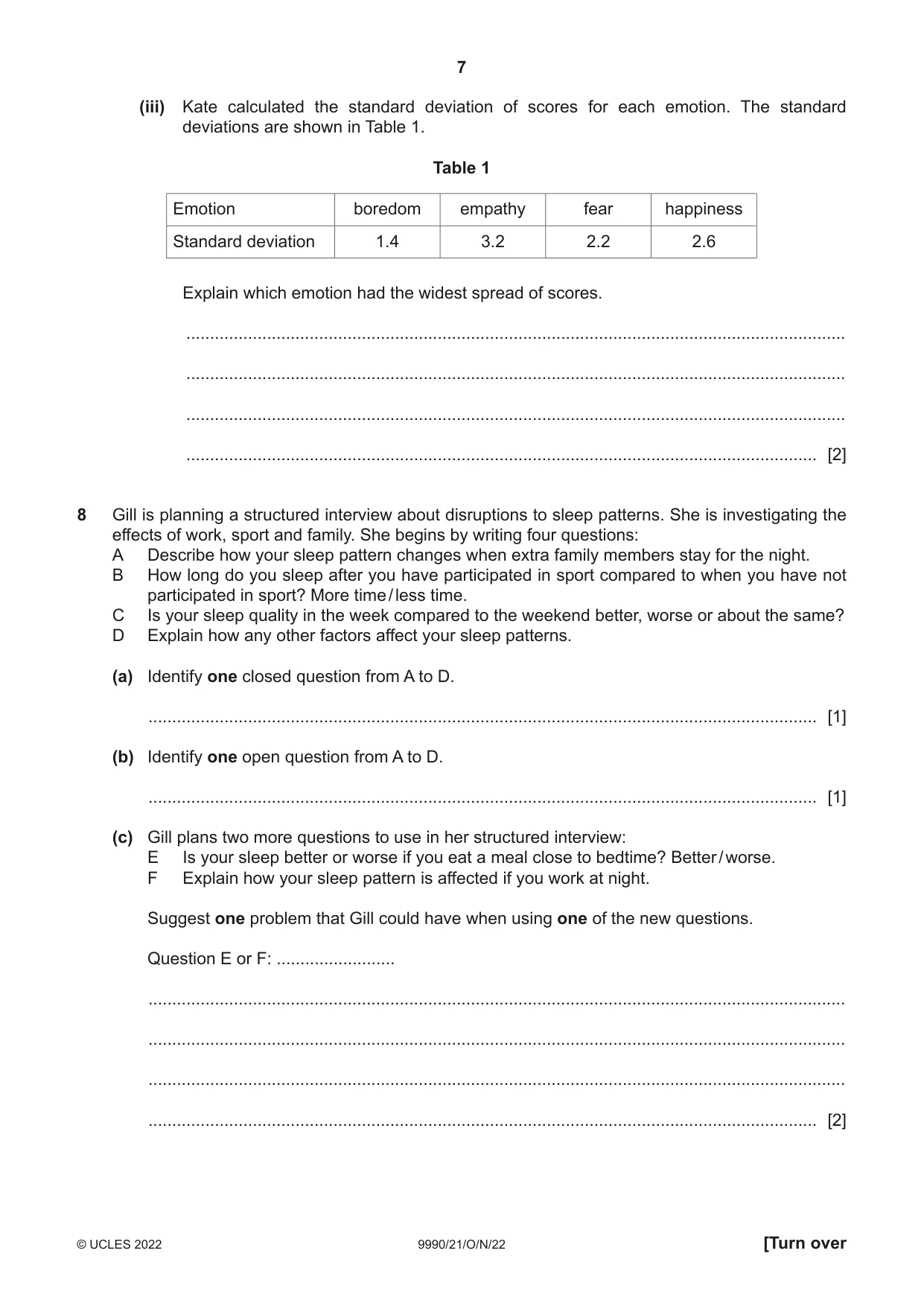
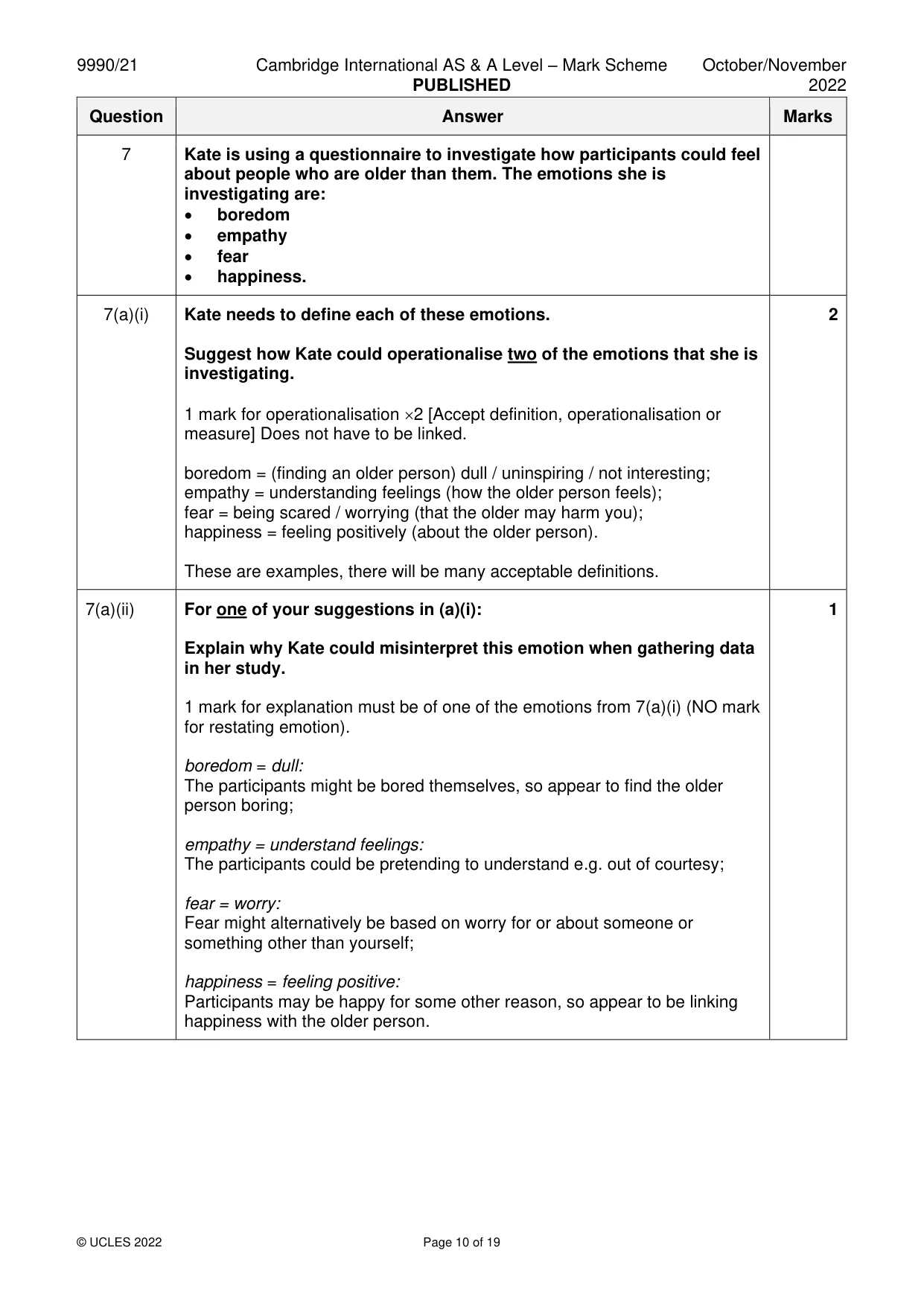
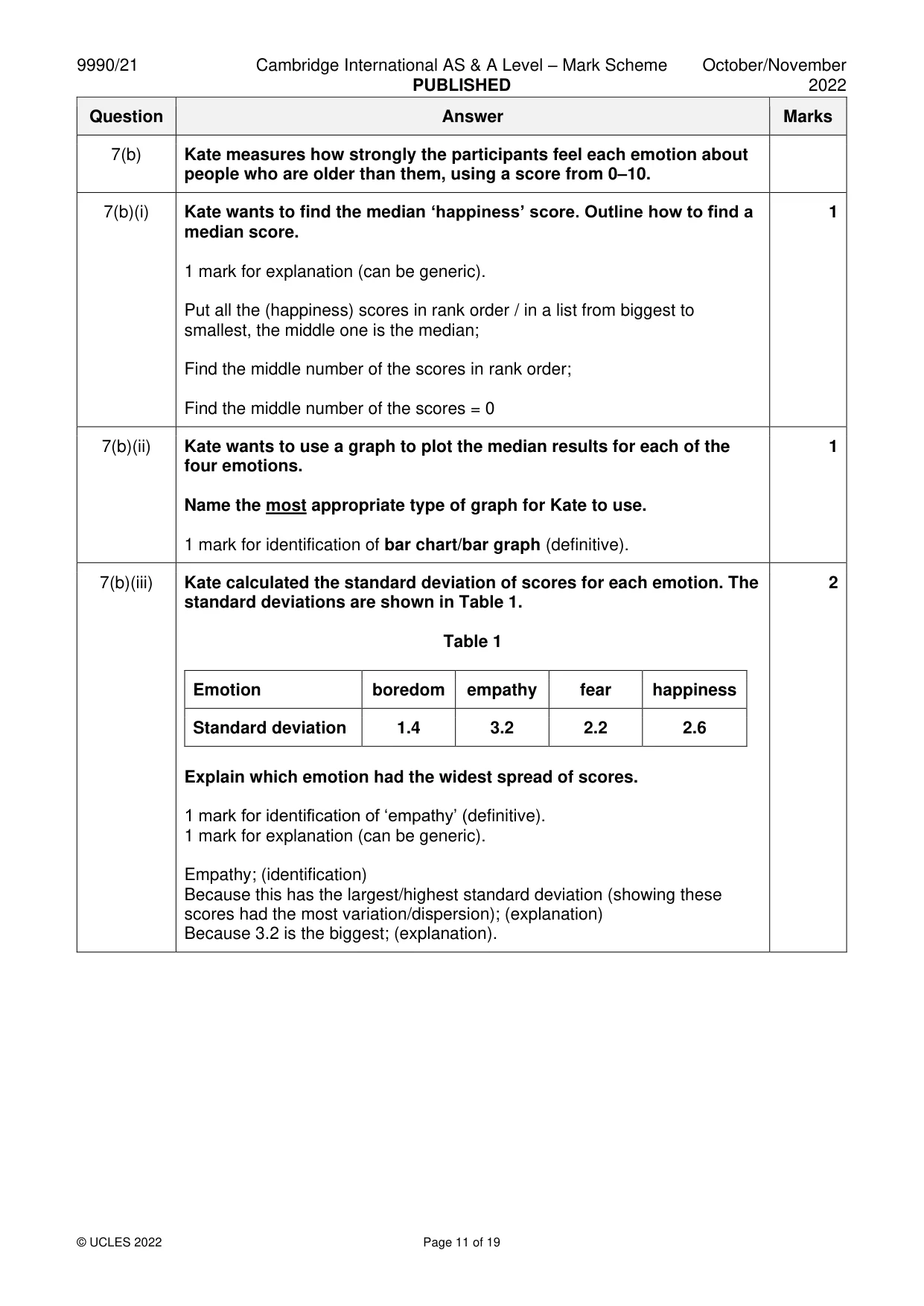
7 Kate is using a questionnaire to investigate how participants could feel about people who are older than them. The emotions she is investigating are: • boredom • empathy • fear • happiness. (a) (i) Kate needs to define each of these emotions. Suggest how Kate could operationalise two of the emotions that she is investigating. 1 ........................................................................................................................................ ........................................................................................................................................... 2 ........................................................................................................................................ ..................................................................................................................................... [2] (ii) For one of your suggestions in (a)(i): Explain why Kate could misinterpret this emotion when gathering data in her study. Emotion: .................................... ........................................................................................................................................... ..................................................................................................................................... [1] (b) Kate measures how strongly the participants feel each emotion about people who are older than them, using a score from 0–10. (i) Kate wants to find the median ‘happiness’ score. Outline how to find a median score. ........................................................................................................................................... ..................................................................................................................................... [1] (ii) Kate wants to use a graph to plot the median results for each of the four emotions. Name the most appropriate type of graph for Kate to use. ..................................................................................................................................... [1] (iii) Kate calculated the standard deviation of scores for each emotion. The standard deviations are shown in Table 1. Table 1 Emotion boredom empathy fear happiness Standard deviation 1.4 3.2 2.2 2.6 Explain which emotion had the widest spread of scores. ........................................................................................................................................... ........................................................................................................................................... ........................................................................................................................................... ..................................................................................................................................... [2]
Mark scheme: 7 Kate is using a questionnaire to investigate how participants could feel about people who are older than them. The emotions she is investigating are: • boredom • empathy • fear • happiness. 7(a)(i) Kate needs to define each of these emotions. 2 Suggest how Kate could operationalise two of the emotions that she is investigating. 1 mark for operationalisation 2 [Accept definition, operationalisation or measure] Does not have to be linked. boredom = (finding an older person) dull / uninspiring / not interesting; empathy = understanding feelings (how the older person feels); fear = being scared / worrying (that the older may harm you); happiness = feeling positively (about the older person). These are examples, there will be many acceptable definitions. 7(a)(ii) For one of your suggestions in (a)(i): 1 Explain why Kate could misinterpret this emotion when gathering data in her study. 1 mark for explanation must be of one of the emotions from 7(a)(i) (NO mark for restating emotion). boredom = dull: The participants might be bored themselves, so appear to find the older person boring; empathy = understand feelings: The participants could be pretending to understand e.g. out of courtesy; fear = worry: Fear might alternatively be based on worry for or about someone or something other than yourself; happiness = feeling positive: Participants may be happy for some other reason, so appear to be linking happiness with the older person. 7(b) Kate measures how strongly the participants feel each emotion about people who are older than them, using a score from 0–10. 7(b)(i) Kate wants to find the median ‘happiness’ score. Outline how to find a 1 median score. 1 mark for explanation (can be generic). Put all the (happiness) scores in rank order / in a list from biggest to smallest, the middle one is the median; Find the middle number of the scores in rank order; Find the middle number of the scores = 0 7(b)(ii) Kate wants to use a graph to plot the median results for each of the 1 four emotions. Name the most appropriate type of graph for Kate to use. 1 mark for identification of bar chart/bar graph (definitive). 7(b)(iii) Kate calculated the standard deviation of scores for each emotion. The 2 standard deviations are shown in Table 1. Table 1 Emotion boredom empathy fear happiness Standard deviation 1.4 3.2 2.2 2.6 Explain which emotion had the widest spread of scores. 1 mark for identification of ‘empathy’ (definitive). 1 mark for explanation (can be generic). Empathy; (identification) Because this has the largest/highest standard deviation (showing these scores had the most variation/dispersion); (explanation) Because 3.2 is the biggest; (explanation).
Q8 · Gill is planning a structured interview about disruptions to sleep patterns
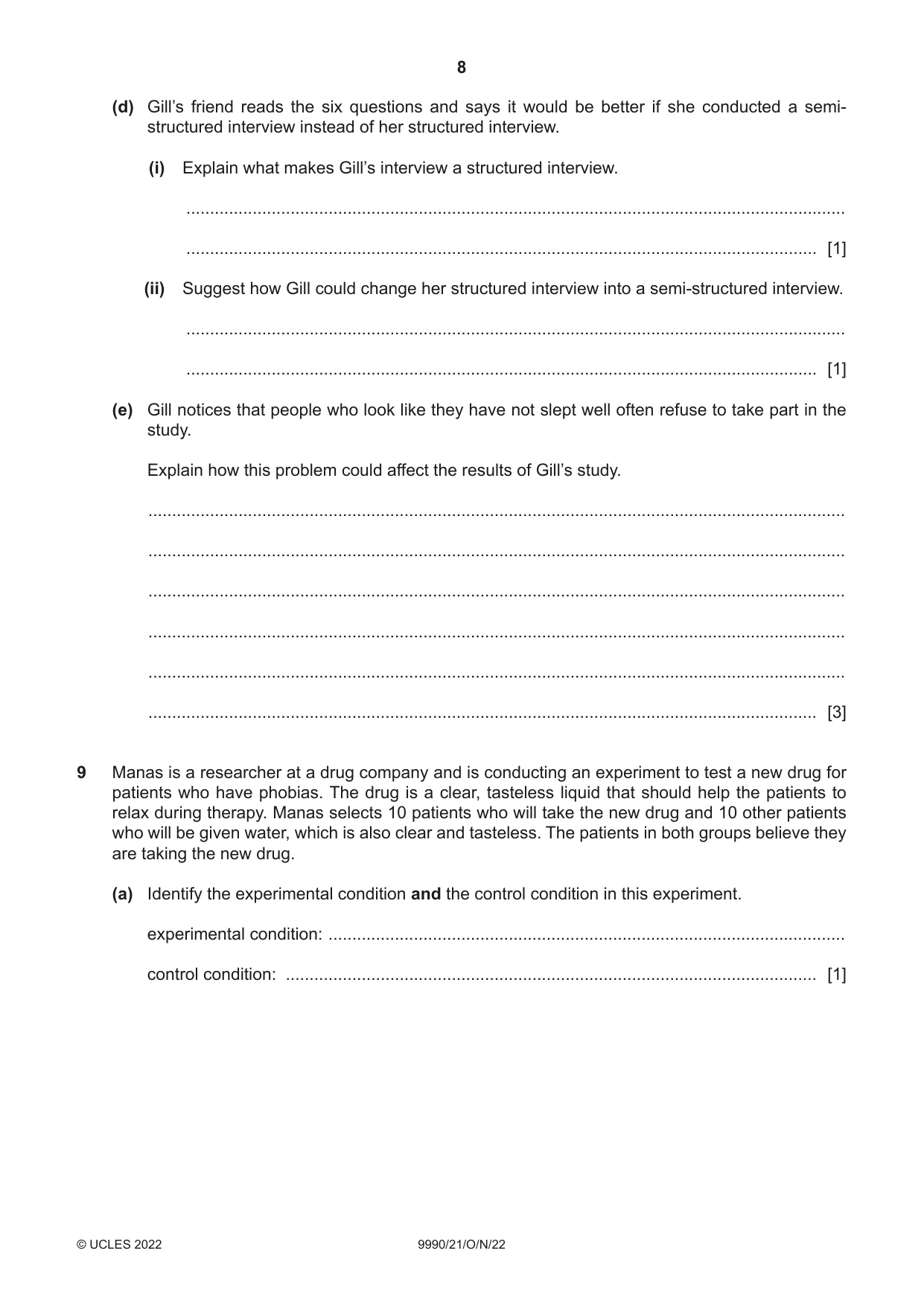
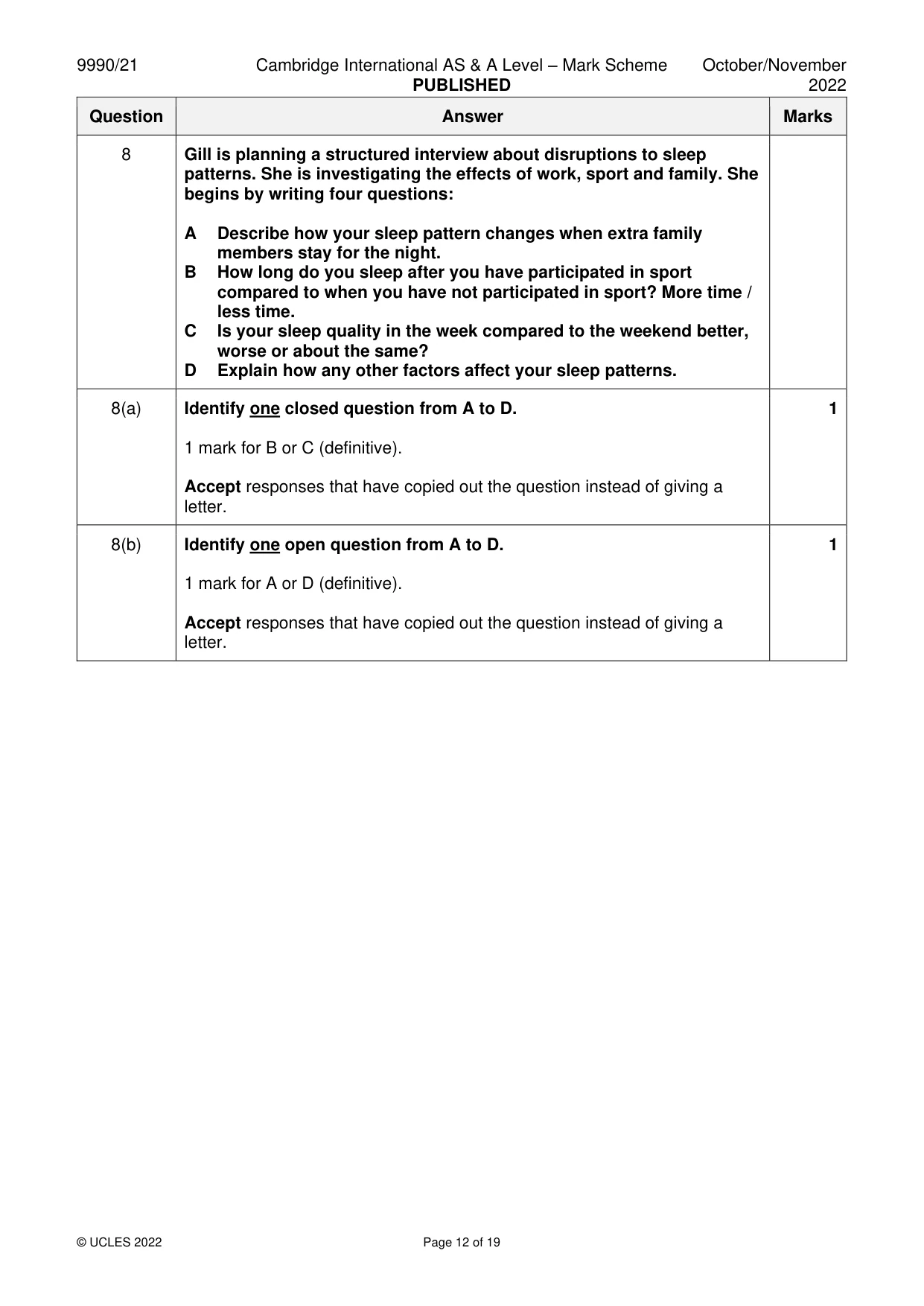
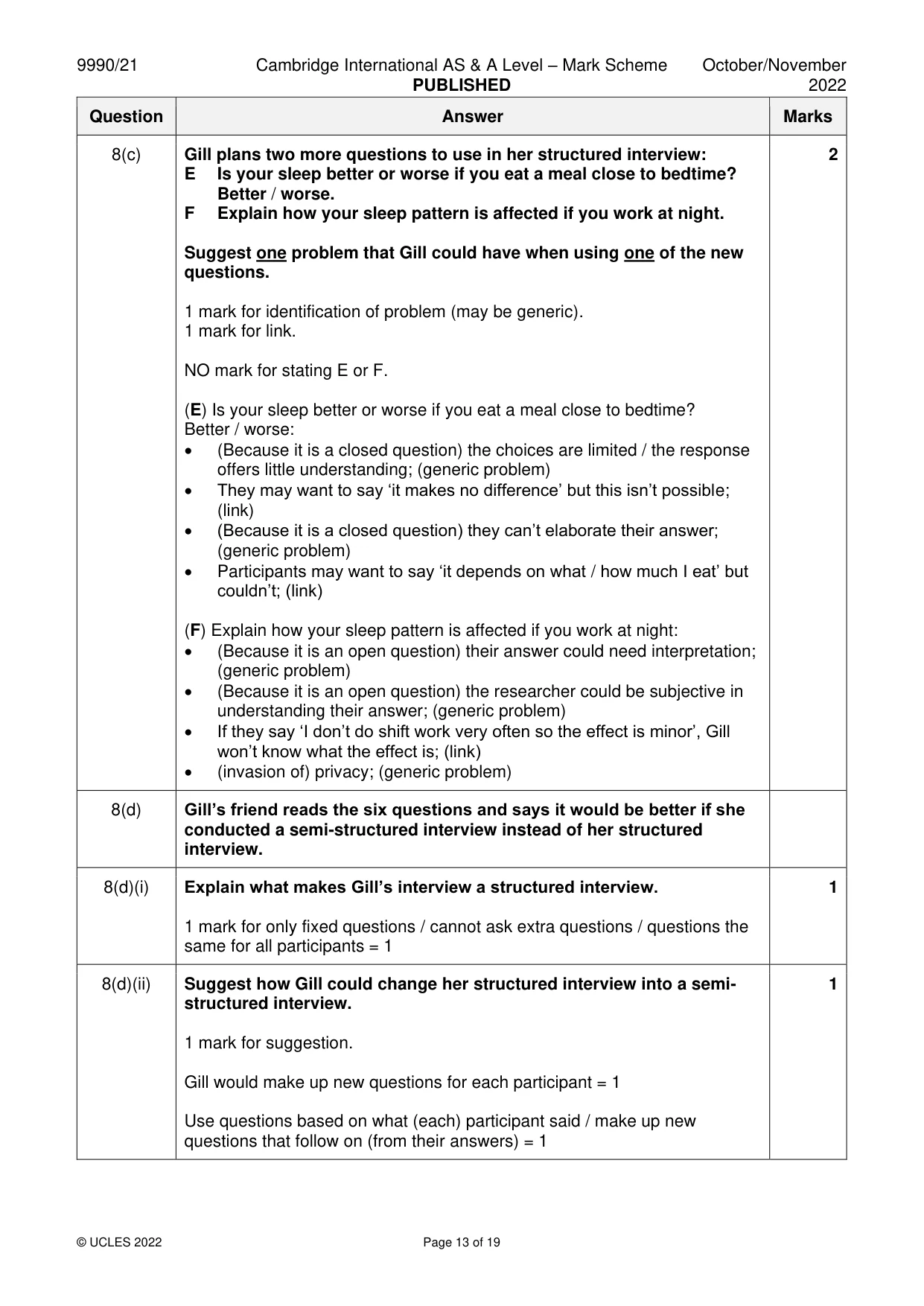
8 Gill is planning a structured interview about disruptions to sleep patterns. She is investigating the effects of work, sport and family. She begins by writing four questions: A Describe how your sleep pattern changes when extra family members stay for the night. B How long do you sleep after you have participated in sport compared to when you have not participated in sport? More time / less time. C Is your sleep quality in the week compared to the weekend better, worse or about the same? D Explain how any other factors affect your sleep patterns. (a) Identify one closed question from A to D. ............................................................................................................................................. [1] (b) Identify one open question from A to D. ............................................................................................................................................. [1] (c) Gill plans two more questions to use in her structured interview: E Is your sleep better or worse if you eat a meal close to bedtime? Better / worse. F Explain how your sleep pattern is affected if you work at night. Suggest one problem that Gill could have when using one of the new questions. Question E or F: ......................... ................................................................................................................................................... ................................................................................................................................................... ................................................................................................................................................... ............................................................................................................................................. [2] (d) Gill’s friend reads the six questions and says it would be better if she conducted a semi- structured interview instead of her structured interview. (i) Explain what makes Gill’s interview a structured interview. ........................................................................................................................................... ..................................................................................................................................... [1] (ii) Suggest how Gill could change her structured interview into a semi-structured interview. ........................................................................................................................................... ..................................................................................................................................... [1] (e) Gill notices that people who look like they have not slept well often refuse to take part in the study. Explain how this problem could affect the results of Gill’s study. ................................................................................................................................................... ................................................................................................................................................... ................................................................................................................................................... ................................................................................................................................................... ................................................................................................................................................... ............................................................................................................................................. [3]
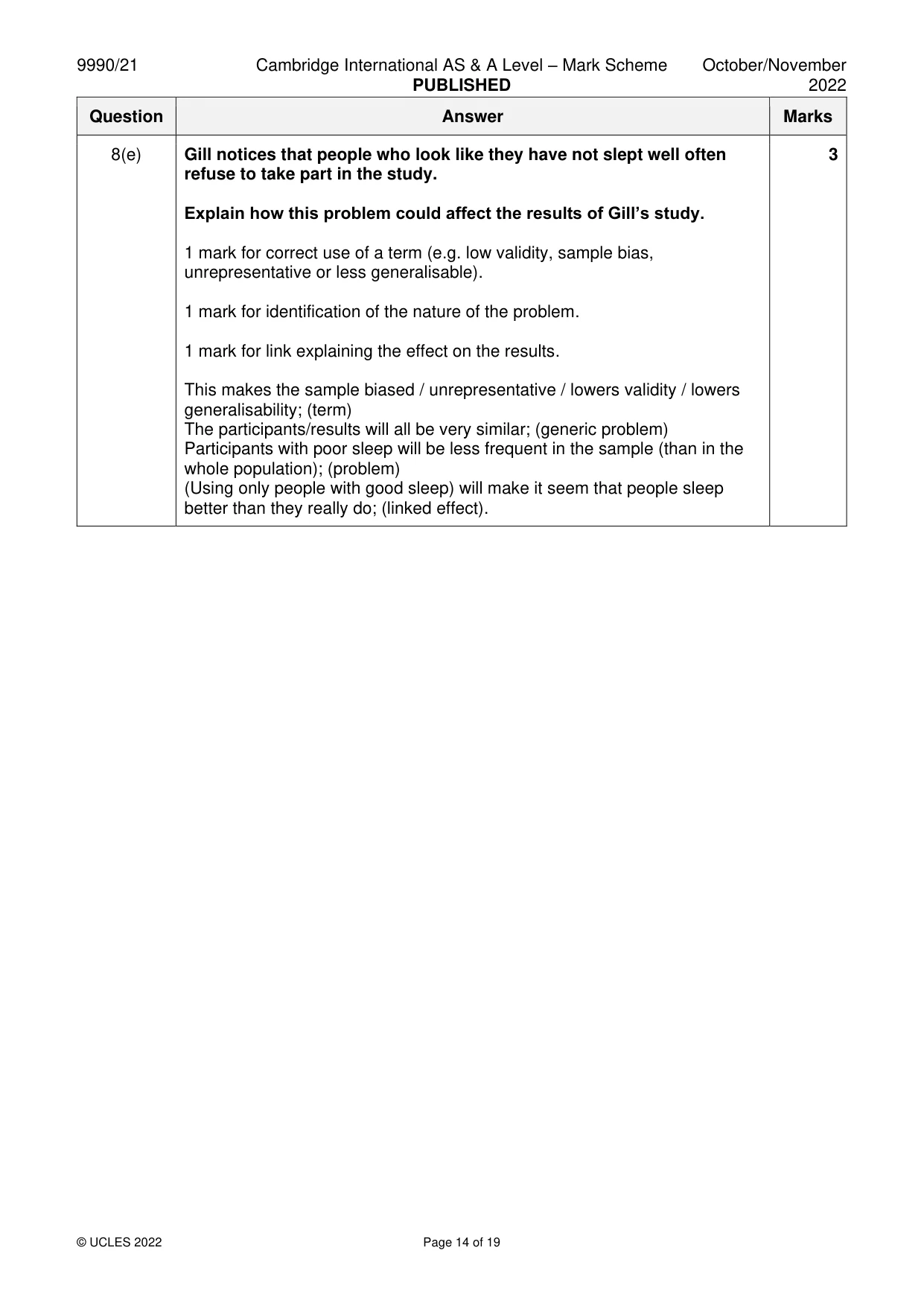
Mark scheme: 8 Gill is planning a structured interview about disruptions to sleep patterns. She is investigating the effects of work, sport and family. She begins by writing four questions: A Describe how your sleep pattern changes when extra family members stay for the night. B How long do you sleep after you have participated in sport compared to when you have not participated in sport? More time / less time. C Is your sleep quality in the week compared to the weekend better, worse or about the same? D Explain how any other factors affect your sleep patterns. 8(a) Identify one closed question from A to D. 1 1 mark for B or C (definitive). Accept responses that have copied out the question instead of giving a letter. 8(b) Identify one open question from A to D. 1 1 mark for A or D (definitive). Accept responses that have copied out the question instead of giving a letter. 8(c) Gill plans two more questions to use in her structured interview: 2 E Is your sleep better or worse if you eat a meal close to bedtime? Better / worse. F Explain how your sleep pattern is affected if you work at night. Suggest one problem that Gill could have when using one of the new questions. 1 mark for identification of problem (may be generic). 1 mark for link. NO mark for stating E or F. (E) Is your sleep better or worse if you eat a meal close to bedtime? Better / worse: • (Because it is a closed question) the choices are limited / the response offers little understanding; (generic problem) • They may want to say ‘it makes no difference’ but this isn’t possible; (link) • (Because it is a closed question) they can’t elaborate their answer; (generic problem) • Participants may want to say ‘it depends on what / how much I eat’ but couldn’t; (link) (F) Explain how your sleep pattern is affected if you work at night: • (Because it is an open question) their answer could need interpretation; (generic problem) • (Because it is an open question) the researcher could be subjective in understanding their answer; (generic problem) • If they say ‘I don’t do shift work very often so the effect is minor’, Gill won’t know what the effect is; (link) • (invasion of) privacy; (generic problem) 8(d) Gill’s friend reads the six questions and says it would be better if she conducted a semi-structured interview instead of her structured interview. 8(d)(i) Explain what makes Gill’s interview a structured interview. 1 1 mark for only fixed questions / cannot ask extra questions / questions the same for all participants = 1 8(d)(ii) Suggest how Gill could change her structured interview into a semi- 1 structured interview. 1 mark for suggestion. Gill would make up new questions for each participant = 1 Use questions based on what (each) participant said / make up new questions that follow on (from their answers) = 1 8(e) Gill notices that people who look like they have not slept well often 3 refuse to take part in the study. Explain how this problem could affect the results of Gill’s study. 1 mark for correct use of a term (e.g. low validity, sample bias, unrepresentative or less generalisable). 1 mark for identification of the nature of the problem. 1 mark for link explaining the effect on the results. This makes the sample biased / unrepresentative / lowers validity / lowers generalisability; (term) The participants/results will all be very similar; (generic problem) Participants with poor sleep will be less frequent in the sample (than in the whole population); (problem) (Using only people with good sleep) will make it seem that people sleep better than they really do; (linked effect).
Q9 · Manas is a researcher at a drug company and is conducting an experiment to test a new…
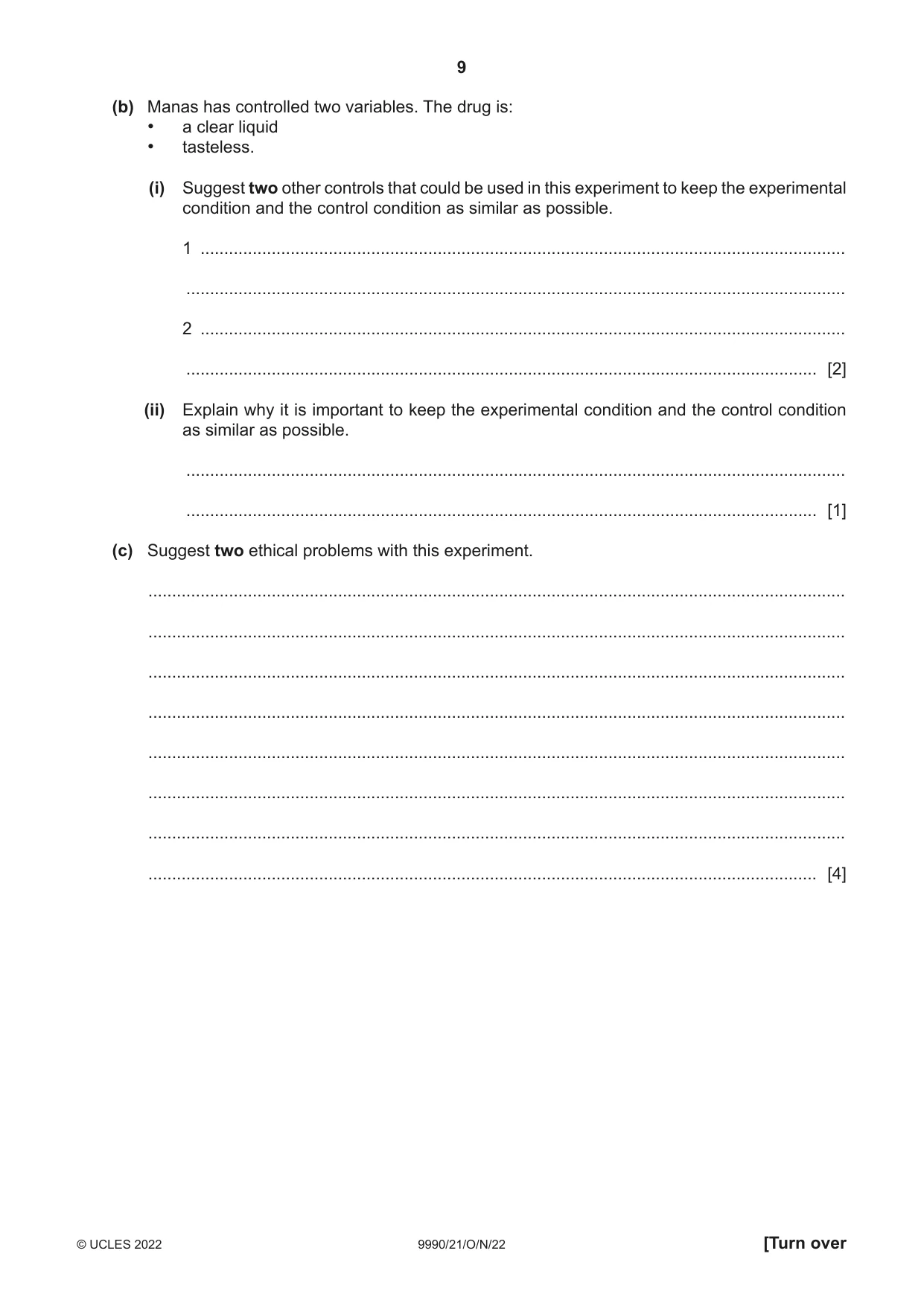
9 Manas is a researcher at a drug company and is conducting an experiment to test a new drug for patients who have phobias. The drug is a clear, tasteless liquid that should help the patients to relax during therapy. Manas selects 10 patients who will take the new drug and 10 other patients who will be given water, which is also clear and tasteless. The patients in both groups believe they are taking the new drug. (a) Identify the experimental condition and the control condition in this experiment. experimental condition: ............................................................................................................. control condition: ................................................................................................................ [1] (b) Manas has controlled two variables. The drug is: • a clear liquid • tasteless. (i) Suggest two other controls that could be used in this experiment to keep the experimental condition and the control condition as similar as possible. 1 ........................................................................................................................................ ........................................................................................................................................... 2 ........................................................................................................................................ ..................................................................................................................................... [2] (ii) Explain why it is important to keep the experimental condition and the control condition as similar as possible. ........................................................................................................................................... ..................................................................................................................................... [1] (c) Suggest two ethical problems with this experiment. ................................................................................................................................................... ................................................................................................................................................... ................................................................................................................................................... ................................................................................................................................................... ................................................................................................................................................... ................................................................................................................................................... ................................................................................................................................................... ............................................................................................................................................. [4] Section C Answer all questions in this section.
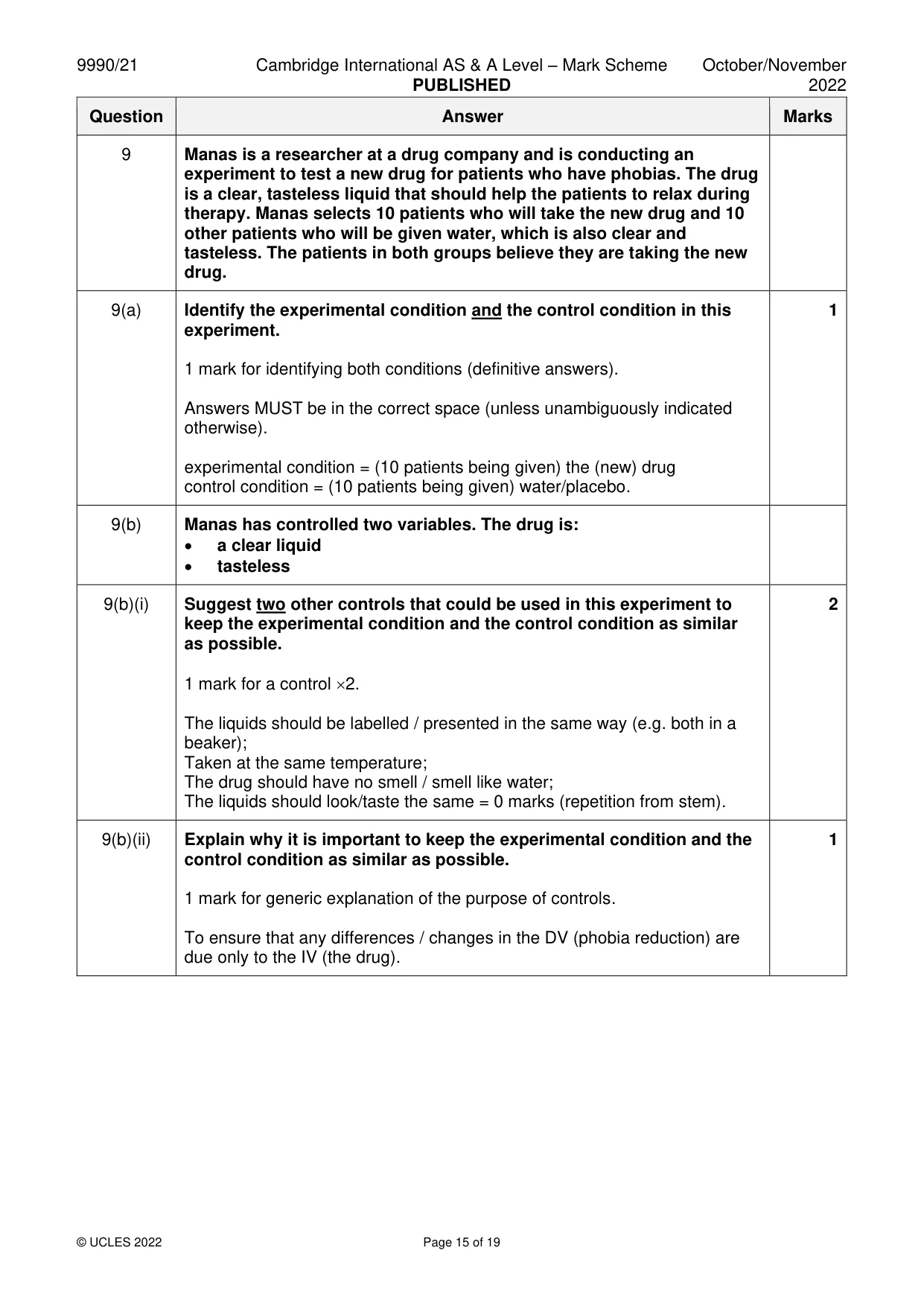
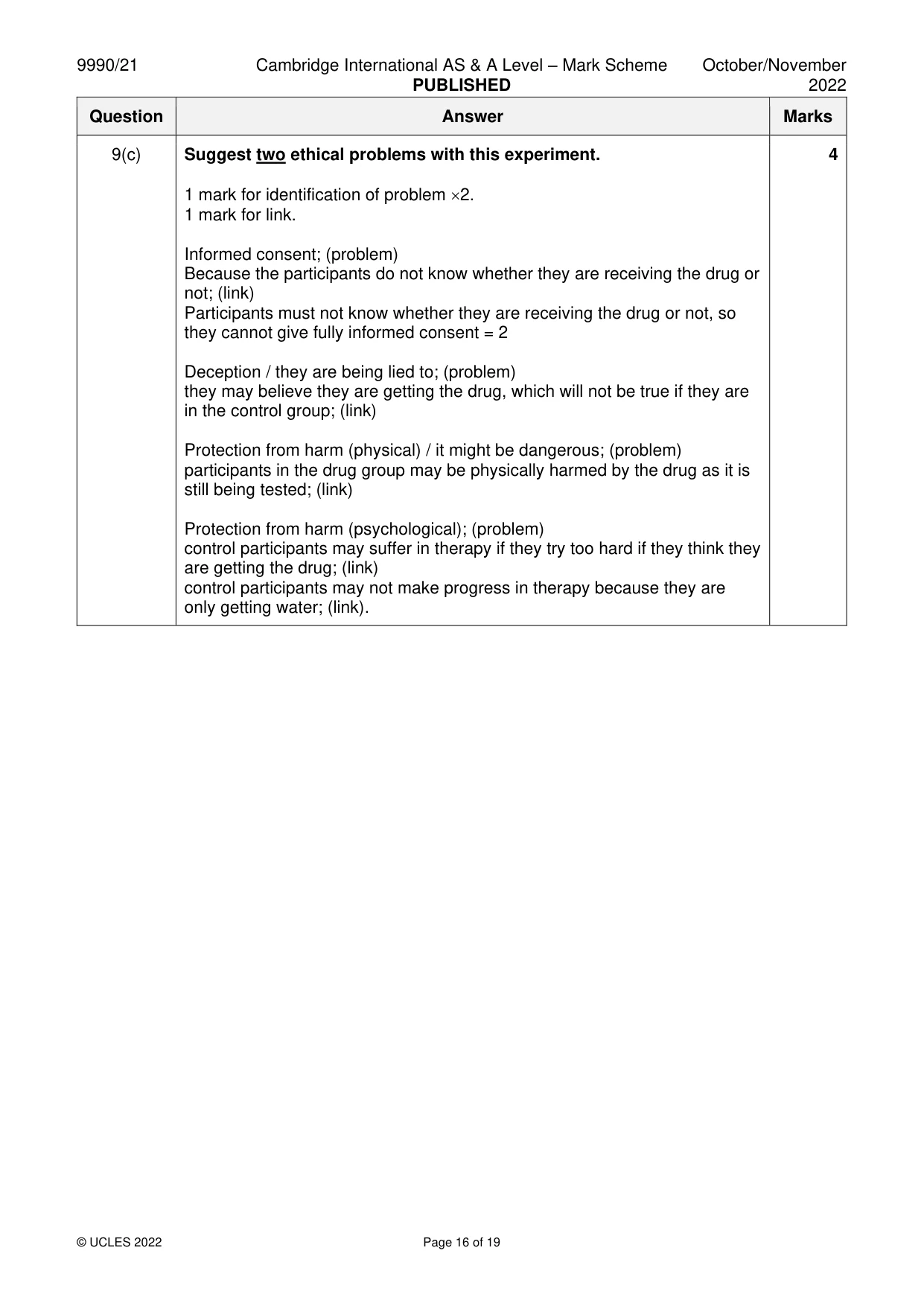
Mark scheme: 9 Manas is a researcher at a drug company and is conducting an experiment to test a new drug for patients who have phobias. The drug is a clear, tasteless liquid that should help the patients to relax during therapy. Manas selects 10 patients who will take the new drug and 10 other patients who will be given water, which is also clear and tasteless. The patients in both groups believe they are taking the new drug. 9(a) Identify the experimental condition and the control condition in this 1 experiment. 1 mark for identifying both conditions (definitive answers). Answers MUST be in the correct space (unless unambiguously indicated otherwise). experimental condition = (10 patients being given) the (new) drug control condition = (10 patients being given) water/placebo. 9(b) Manas has controlled two variables. The drug is: • a clear liquid • tasteless 9(b)(i) Suggest two other controls that could be used in this experiment to 2 keep the experimental condition and the control condition as similar as possible. 1 mark for a control 2. The liquids should be labelled / presented in the same way (e.g. both in a beaker); Taken at the same temperature; The drug should have no smell / smell like water; The liquids should look/taste the same = 0 marks (repetition from stem). 9(b)(ii) Explain why it is important to keep the experimental condition and the 1 control condition as similar as possible. 1 mark for generic explanation of the purpose of controls. To ensure that any differences / changes in the DV (phobia reduction) are due only to the IV (the drug). 9(c) Suggest two ethical problems with this experiment. 4 1 mark for identification of problem 2. 1 mark for link. Informed consent; (problem) Because the participants do not know whether they are receiving the drug or not; (link) Participants must not know whether they are receiving the drug or not, so they cannot give fully informed consent = 2 Deception / they are being lied to; (problem) they may believe they are getting the drug, which will not be true if they are in the control group; (link) Protection from harm (physical) / it might be dangerous; (problem) participants in the drug group may be physically harmed by the drug as it is still being tested; (link) Protection from harm (psychological); (problem) control participants may suffer in therapy if they try too hard if they think they are getting the drug; (link) control participants may not make progress in therapy because they are only getting water; (link).
More questions on Anxiety disorders and fear-related disorders
Q10 · Dr Angelo wants to investigate how young children respond when their teachers are helpful
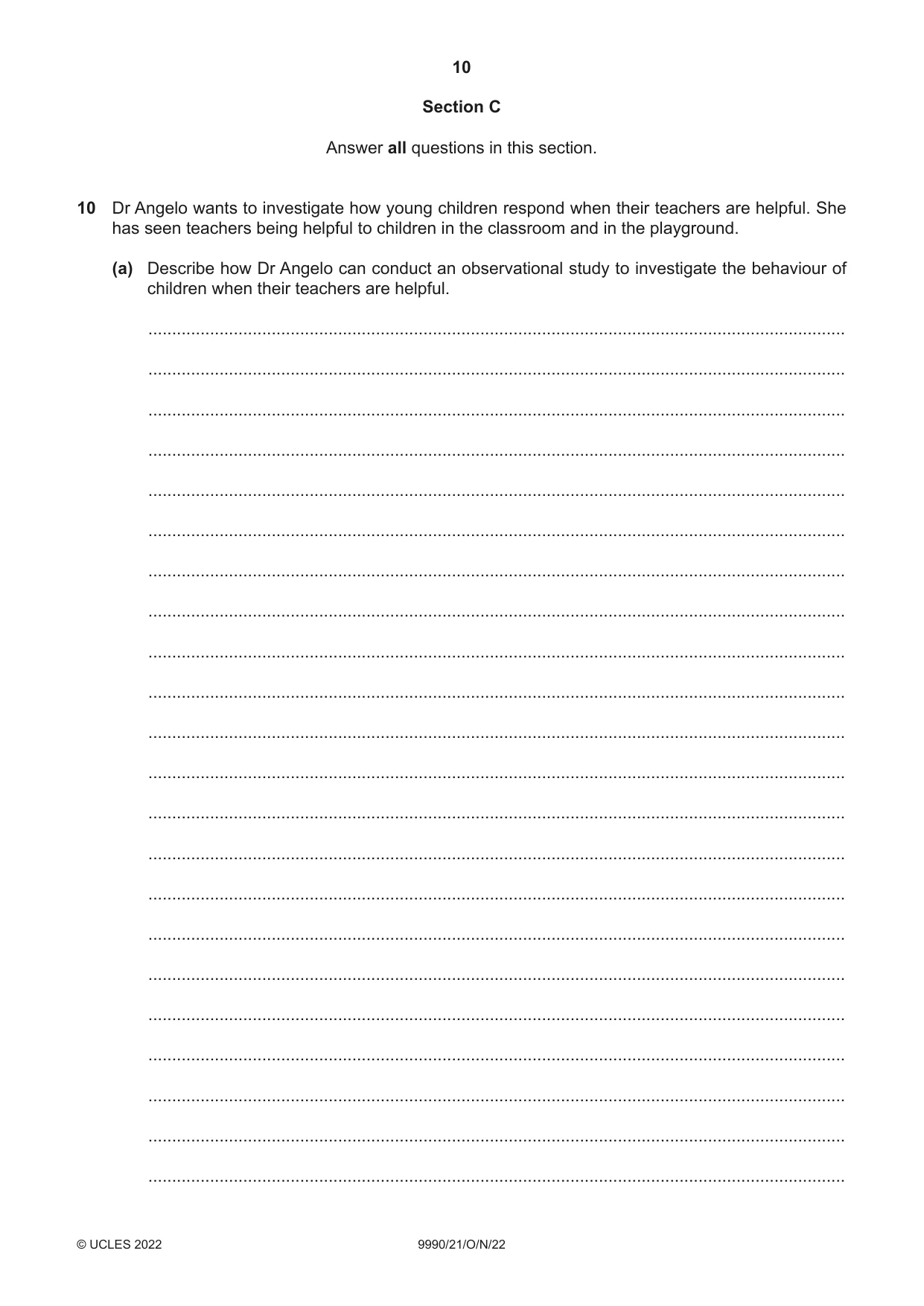
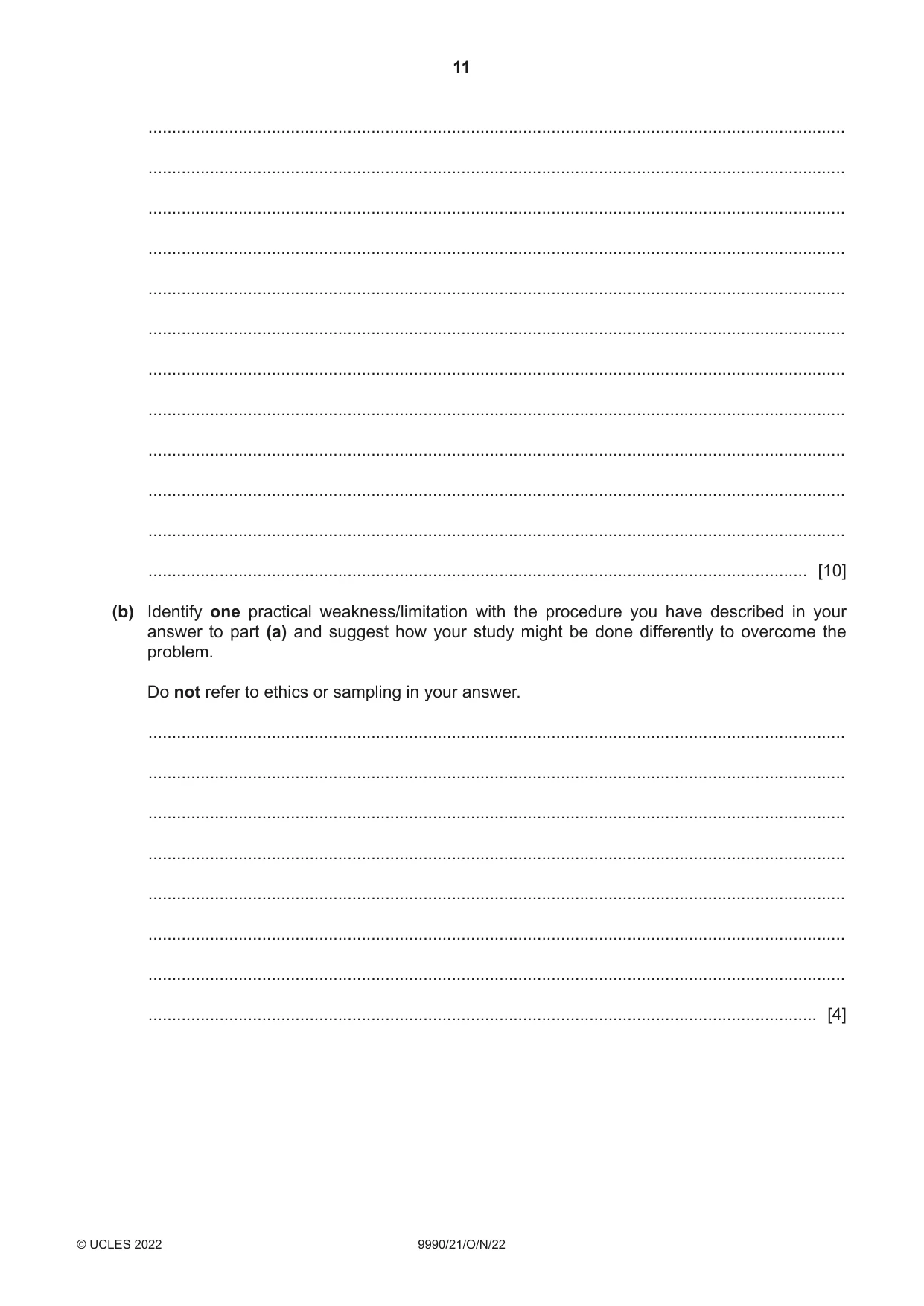
10 Dr Angelo wants to investigate how young children respond when their teachers are helpful. She has seen teachers being helpful to children in the classroom and in the playground. (a) Describe how Dr Angelo can conduct an observational study to investigate the behaviour of children when their teachers are helpful. ................................................................................................................................................... ................................................................................................................................................... ................................................................................................................................................... ................................................................................................................................................... ................................................................................................................................................... ................................................................................................................................................... ................................................................................................................................................... ................................................................................................................................................... ................................................................................................................................................... ................................................................................................................................................... ................................................................................................................................................... ................................................................................................................................................... ................................................................................................................................................... ................................................................................................................................................... ................................................................................................................................................... ................................................................................................................................................... ................................................................................................................................................... ................................................................................................................................................... ................................................................................................................................................... ................................................................................................................................................... ................................................................................................................................................... ................................................................................................................................................... ................................................................................................................................................... ................................................................................................................................................... ................................................................................................................................................... ................................................................................................................................................... ................................................................................................................................................... ................................................................................................................................................... ................................................................................................................................................... ................................................................................................................................................... ................................................................................................................................................... ................................................................................................................................................... ................................................................................................................................................... ........................................................................................................................................... [10] (b) Identify one practical weakness/limitation with the procedure you have described in your answer to part (a) and suggest how your study might be done differently to overcome the problem. Do not refer to ethics or sampling in your answer. ................................................................................................................................................... ................................................................................................................................................... ................................................................................................................................................... ................................................................................................................................................... ................................................................................................................................................... ................................................................................................................................................... ................................................................................................................................................... ............................................................................................................................................. [4]
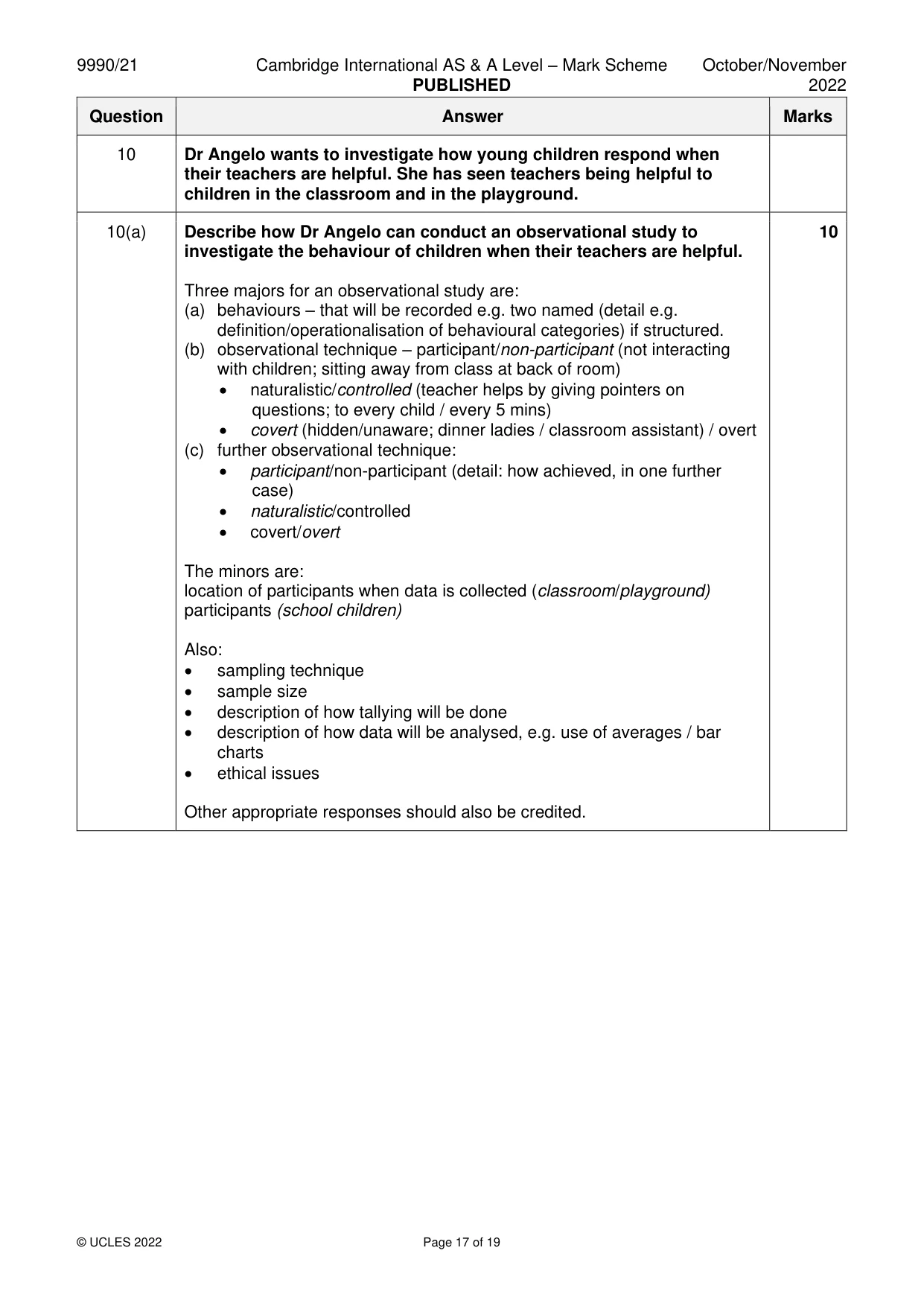
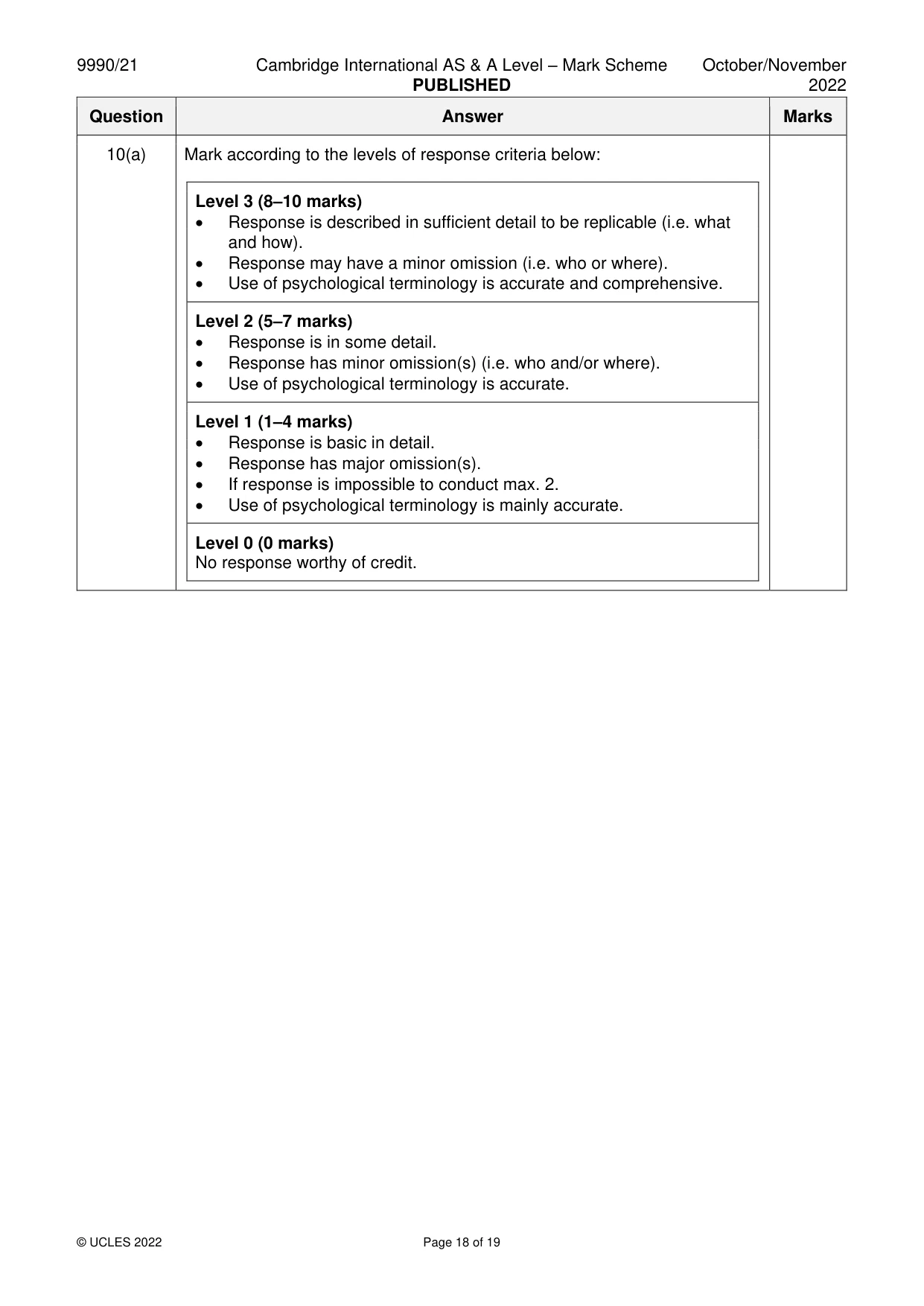
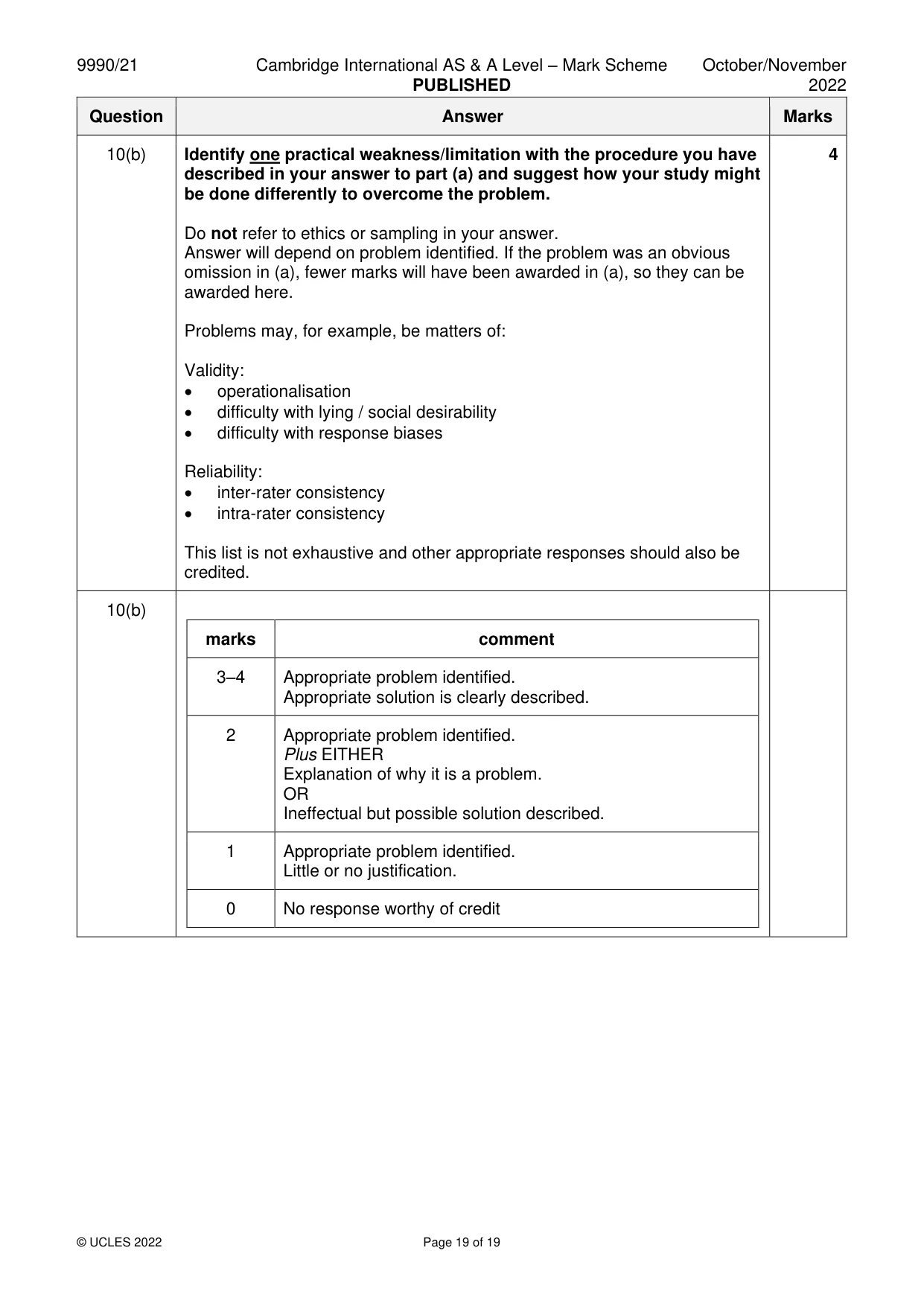
Mark scheme: 10 Dr Angelo wants to investigate how young children respond when their teachers are helpful. She has seen teachers being helpful to children in the classroom and in the playground. 10(a) Describe how Dr Angelo can conduct an observational study to 10 investigate the behaviour of children when their teachers are helpful. Three majors for an observational study are: (a) behaviours – that will be recorded e.g. two named (detail e.g. definition/operationalisation of behavioural categories) if structured. (b) observational technique – participant/non-participant (not interacting with children; sitting away from class at back of room) • naturalistic/controlled (teacher helps by giving pointers on questions; to every child / every 5 mins) • covert (hidden/unaware; dinner ladies / classroom assistant) / overt (c) further observational technique: • participant/non-participant (detail: how achieved, in one further case) • naturalistic/controlled • covert/overt The minors are: location of participants when data is collected (classroom/playground) participants (school children) Also: • sampling technique • sample size • description of how tallying will be done • description of how data will be analysed, e.g. use of averages / bar charts • ethical issues Other appropriate responses should also be credited. 10(a) Mark according to the levels of response criteria below: Level 3 (8–10 marks) • Response is described in sufficient detail to be replicable (i.e. what and how). • Response may have a minor omission (i.e. who or where). • Use of psychological terminology is accurate and comprehensive. Level 2 (5–7 marks) • Response is in some detail. • Response has minor omission(s) (i.e. who and/or where). • Use of psychological terminology is accurate. Level 1 (1–4 marks) • Response is basic in detail. • Response has major omission(s). • If response is impossible to conduct max. 2. • Use of psychological terminology is mainly accurate. Level 0 (0 marks) No response worthy of credit. 10(b) Identify one practical weakness/limitation with the procedure you have 4 described in your answer to part (a) and suggest how your study might be done differently to overcome the problem. Do not refer to ethics or sampling in your answer. Answer will depend on problem identified. If the problem was an obvious omission in (a), fewer marks will have been awarded in (a), so they can be awarded here. Problems may, for example, be matters of: Validity: • operationalisation • difficulty with lying / social desirability • difficulty with response biases Reliability: • inter-rater consistency • intra-rater consistency This list is not exhaustive and other appropriate responses should also be credited. 10(b) marks comment 3–4 Appropriate problem identified. Appropriate solution is clearly described. 2 Appropriate problem identified. Plus EITHER Explanation of why it is a problem. OR Ineffectual but possible solution described. 1 Appropriate problem identified. Little or no justification. 0 No response worthy of credit
What was in this paper
The subtopics covered by these 10 questions, and how many questions each got. Open one in a new tab to see every Cambridge question on it.
What you needed in this session
Cambridge’s own grade thresholds for 2022 Oct/Nov, Paper 2 · Variant 1. A higher threshold means an easier paper — the bar moves with how the cohort did.