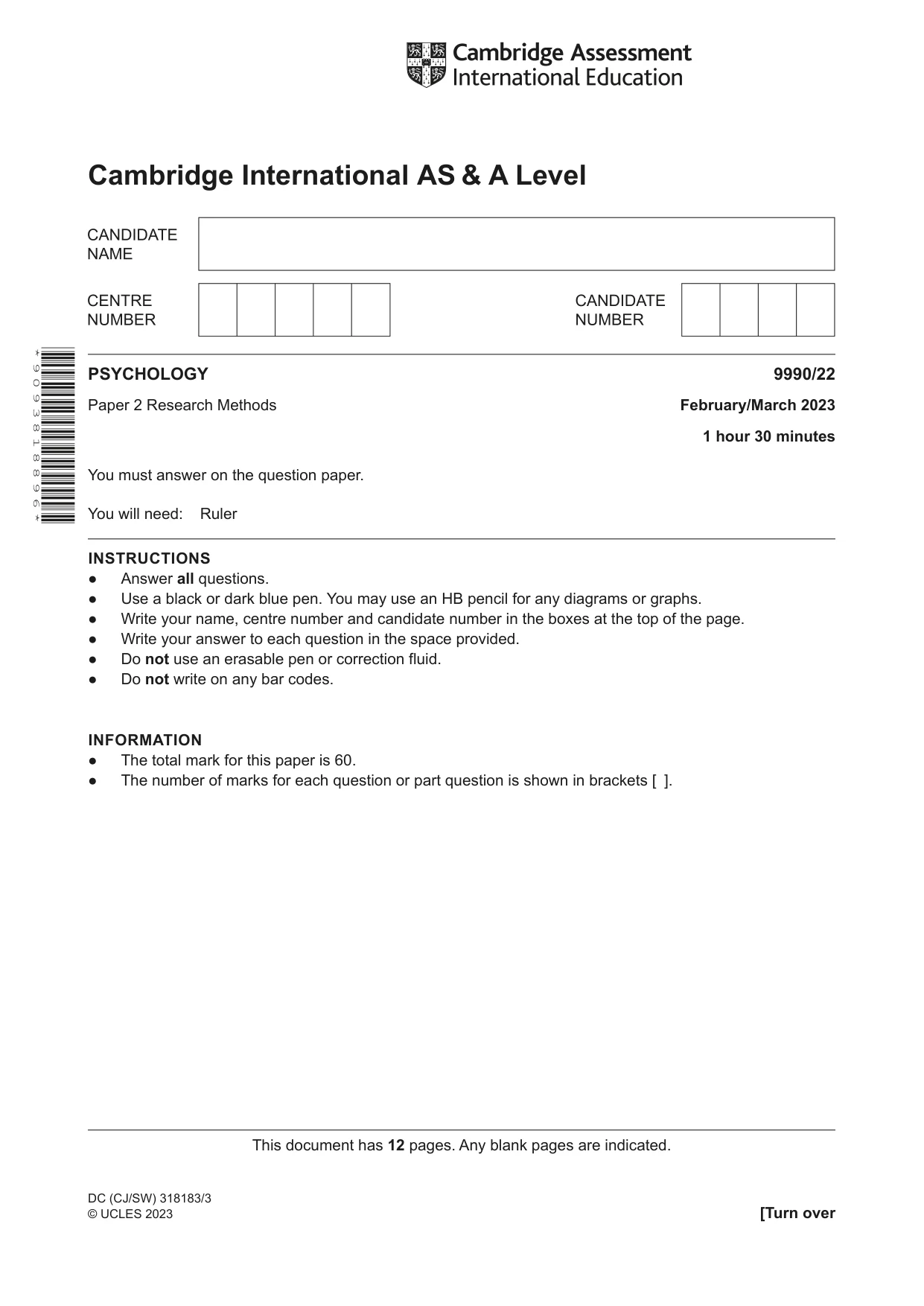
Cambridge A Level Psychology (from 2018) 9990 — 2023 Feb/March Paper 2 · Variant 2
9990/22/F/M/23 · 10 questions · 60 marks · ≈68 min
The question paper and its mark scheme, free to read here and free to download. This is Cambridge’s own paper, exactly as it was sat.
Question paper12 pages


Mark scheme15 pages
Answers below. Sit the paper first if you are practising.
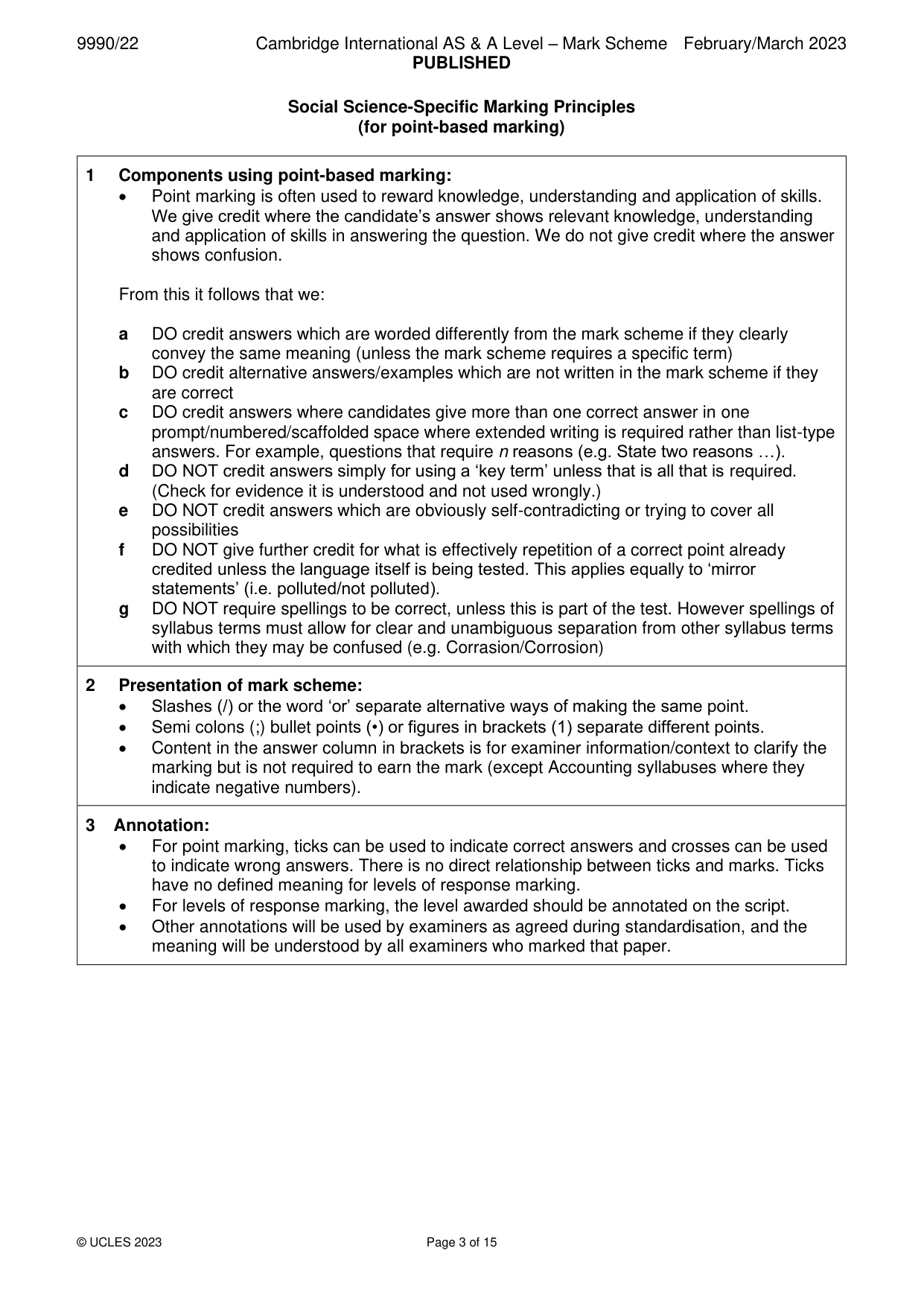
Questions as text
Q1 · A hypothesis is ‘There will be no difference between how quickly men and women blink in…
1 A hypothesis is ‘There will be no difference between how quickly men and women blink in response to a flash of light’. Name this type of hypothesis. .......................................................................................................................................................... .................................................................................................................................................... [1]
Mark scheme: Question Answer Marks 1 A hypothesis is ‘There will be no difference between how quickly men 1 and women blink in response to a flash of light’. Name this type of hypothesis. 1 mark for null (hypothesis) (definitive)
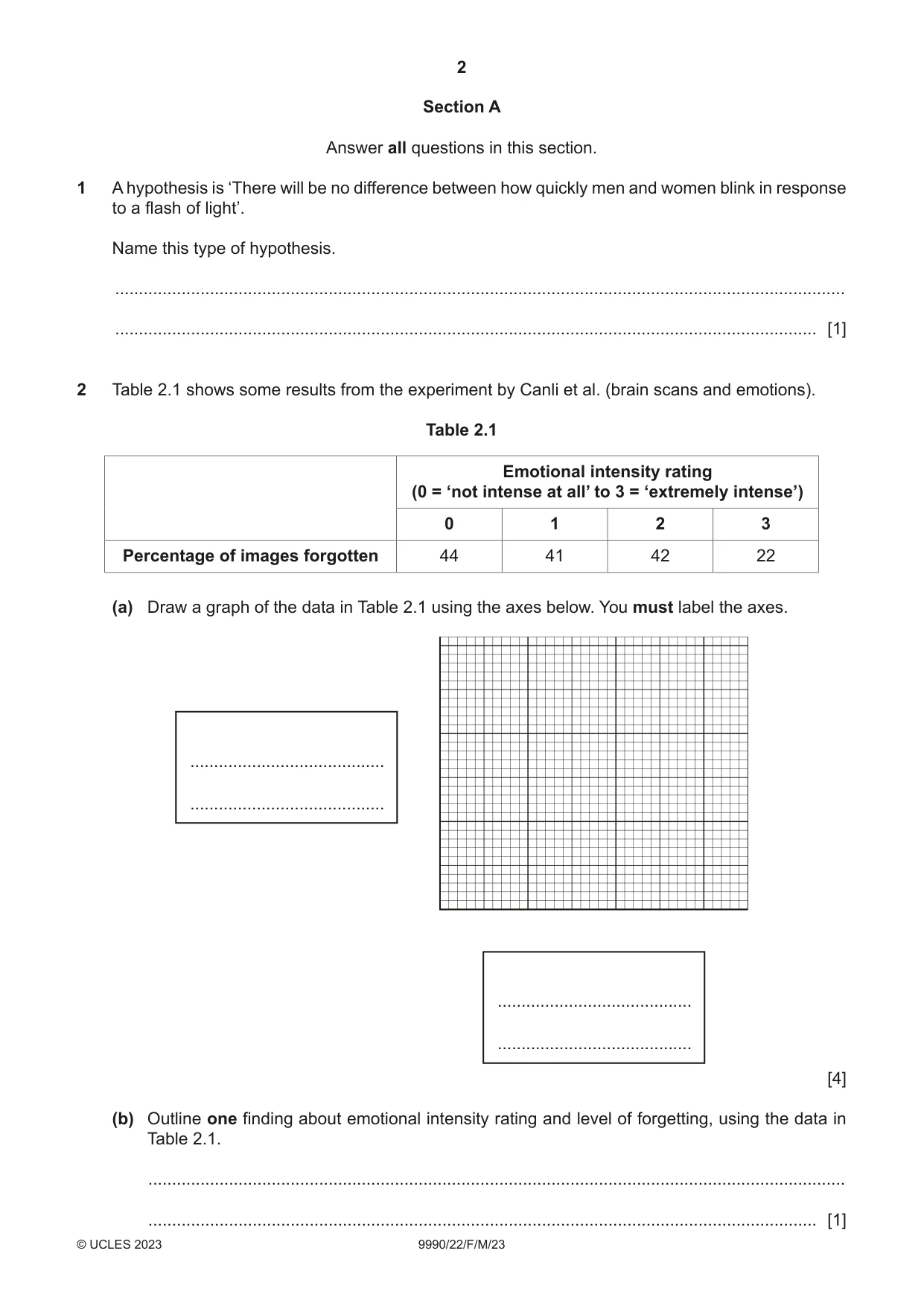
Q2 · Some results from the experiment by Canli et al
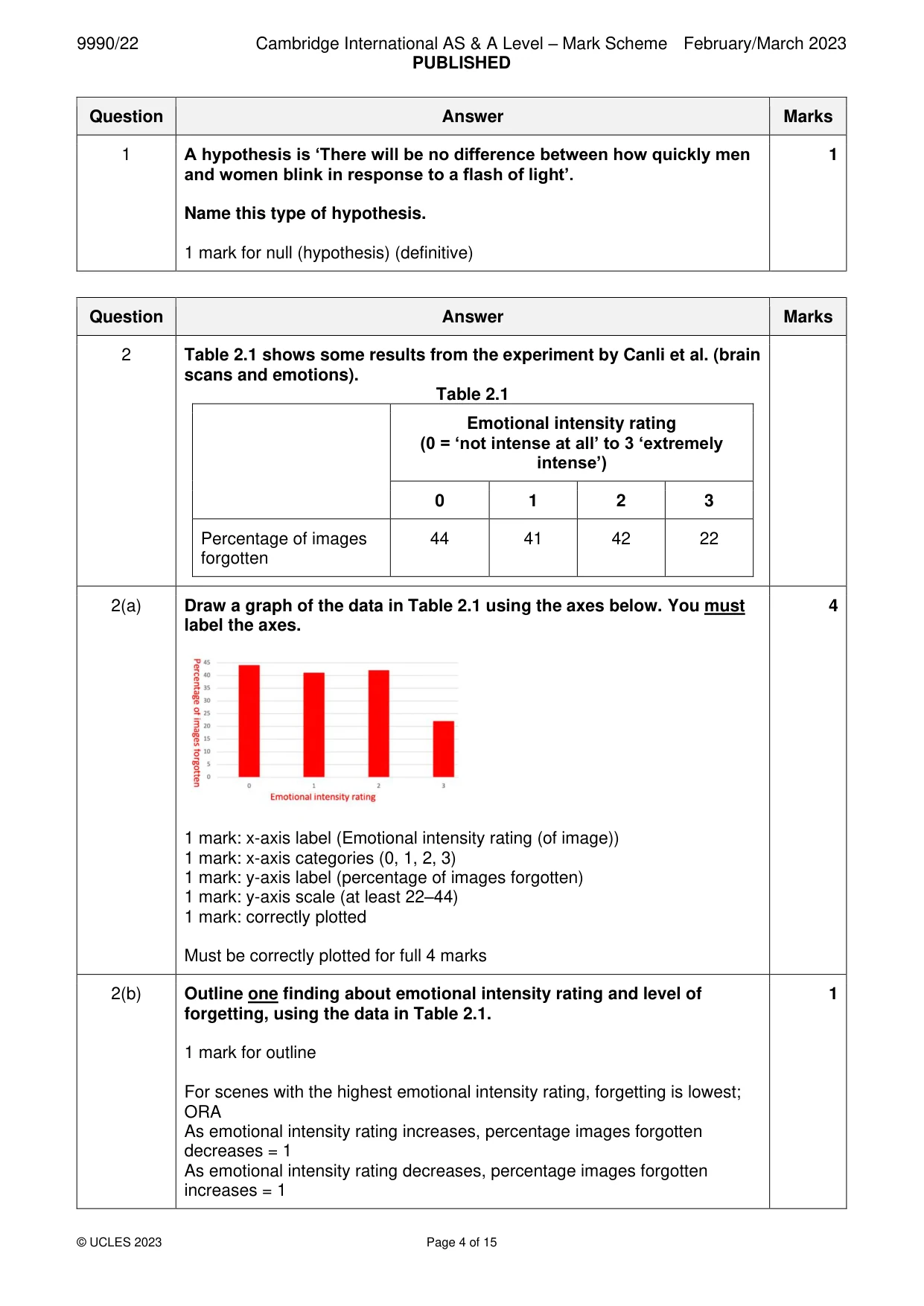
2 Table 2.1 shows some results from the experiment by Canli et al. (brain scans and emotions). Table 2.1 Emotional intensity rating (0 = ‘not intense at all’ to 3 = ‘extremely intense’) 0 1 2 3 Percentage of images forgotten 44 41 42 22 (a) Draw a graph of the data in Table 2.1 using the axes below. You must label the axes. ......................................... ......................................... ......................................... ......................................... [4] (b) Outline one finding about emotional intensity rating and level of forgetting, using the data in Table 2.1. ................................................................................................................................................... ............................................................................................................................................. [1]
Mark scheme: 2 Table 2.1 shows some results from the experiment by Canli et al. (brain scans and emotions). Table 2.1 Emotional intensity rating (0 = ‘not intense at all’ to 3 ‘extremely intense’) 0 1 2 3 Percentage of images 44 41 42 22 forgotten 2(a) Draw a graph of the data in Table 2.1 using the axes below. You must 4 label the axes. 1 mark: x-axis label (Emotional intensity rating (of image)) 1 mark: x-axis categories (0, 1, 2, 3) 1 mark: y-axis label (percentage of images forgotten) 1 mark: y-axis scale (at least 22–44) 1 mark: correctly plotted Must be correctly plotted for full 4 marks 2(b) Outline one finding about emotional intensity rating and level of 1 forgetting, using the data in Table 2.1. 1 mark for outline For scenes with the highest emotional intensity rating, forgetting is lowest; ORA As emotional intensity rating increases, percentage images forgotten decreases = 1 As emotional intensity rating decreases, percentage images forgotten increases = 1
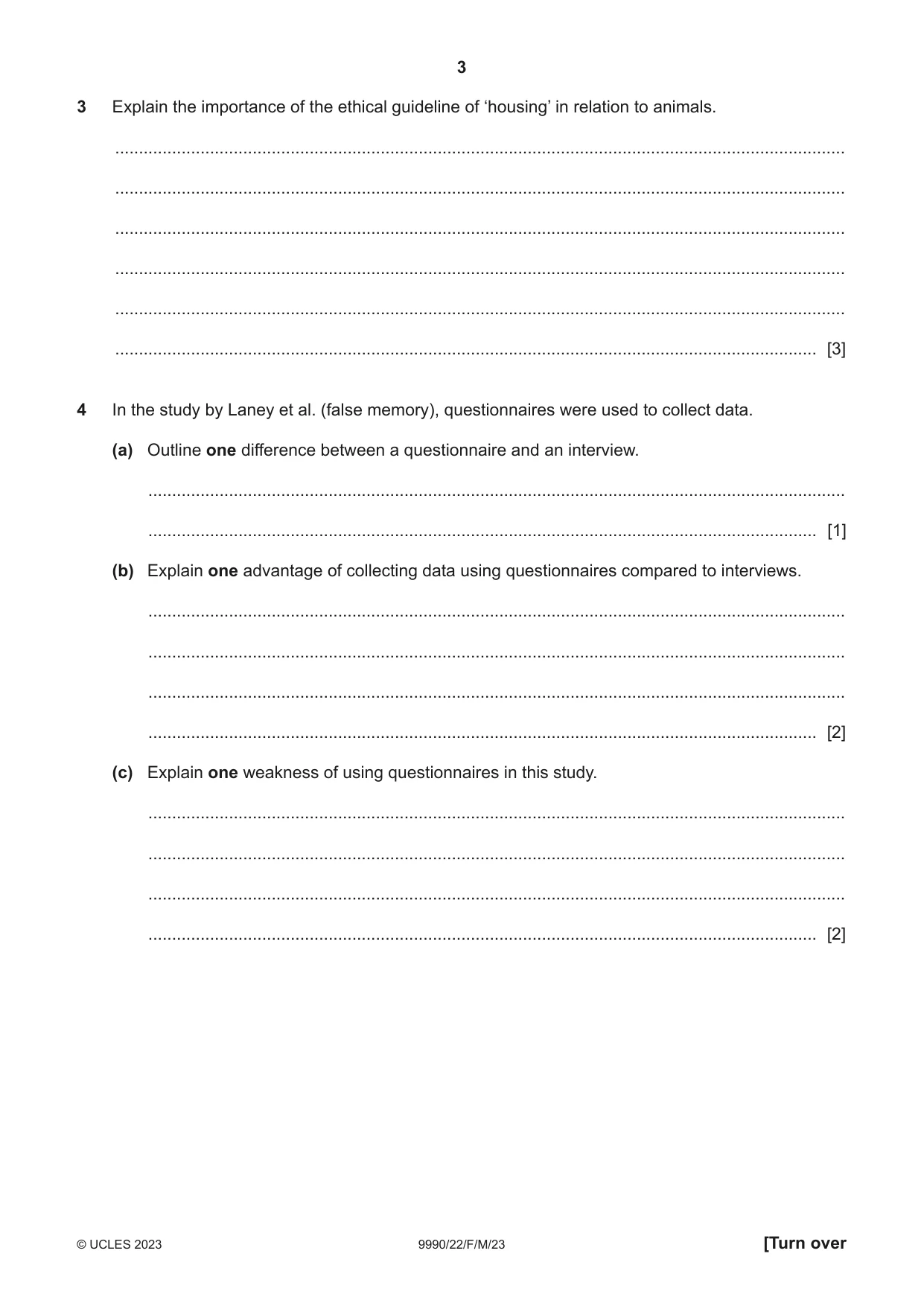
Q3 · Explain the importance of the ethical guideline of ‘housing’ in relation to animals
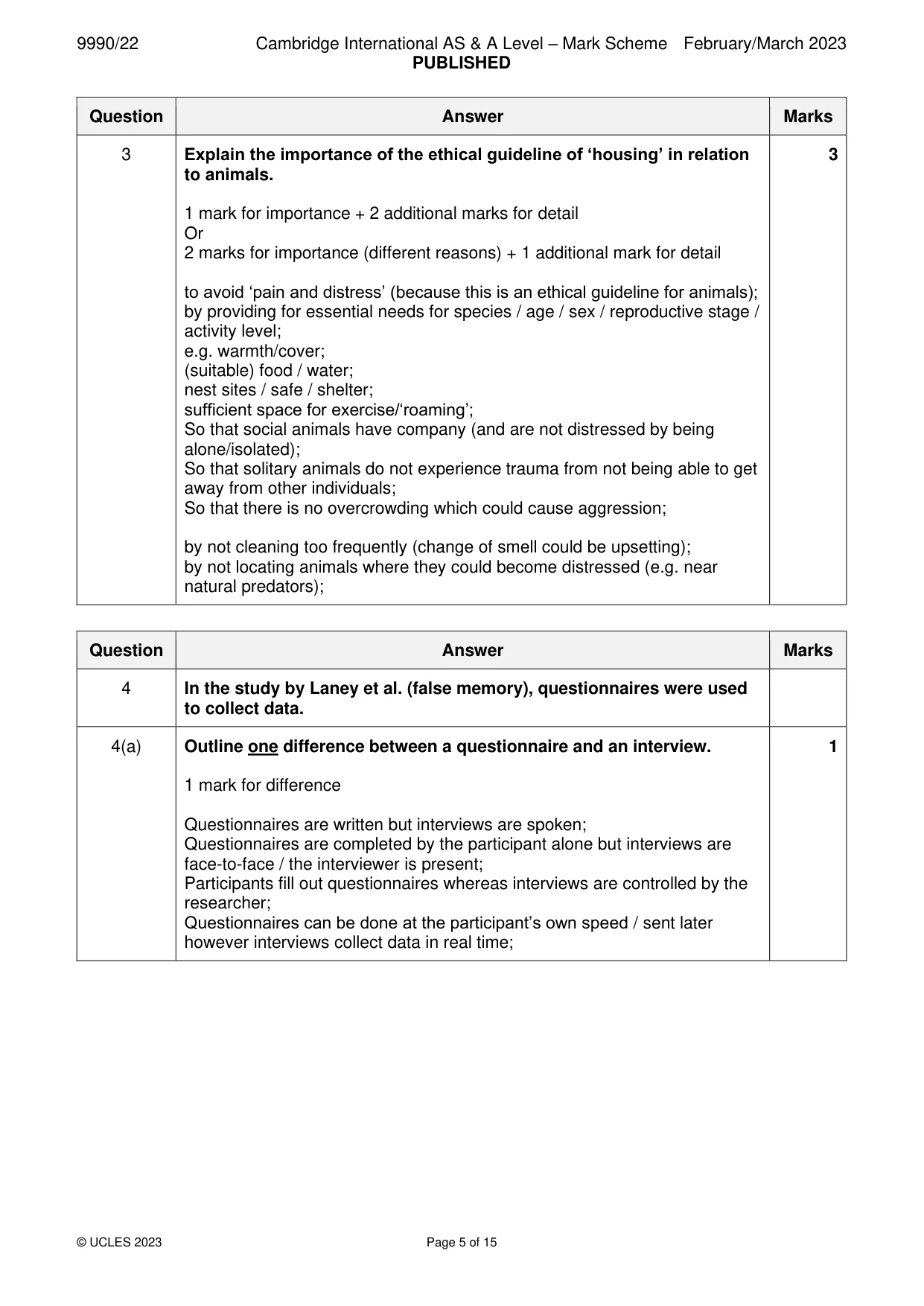
3 Explain the importance of the ethical guideline of ‘housing’ in relation to animals. .......................................................................................................................................................... .......................................................................................................................................................... .......................................................................................................................................................... .......................................................................................................................................................... .......................................................................................................................................................... .................................................................................................................................................... [3]
Mark scheme: 3 Explain the importance of the ethical guideline of ‘housing’ in relation 3 to animals. 1 mark for importance + 2 additional marks for detail Or 2 marks for importance (different reasons) + 1 additional mark for detail to avoid ‘pain and distress’ (because this is an ethical guideline for animals); by providing for essential needs for species / age / sex / reproductive stage / activity level; e.g. warmth/cover; (suitable) food / water; nest sites / safe / shelter; sufficient space for exercise/‘roaming’; So that social animals have company (and are not distressed by being alone/isolated); So that solitary animals do not experience trauma from not being able to get away from other individuals; So that there is no overcrowding which could cause aggression; by not cleaning too frequently (change of smell could be upsetting); by not locating animals where they could become distressed (e.g. near natural predators);
Q4 · In the study by Laney et al
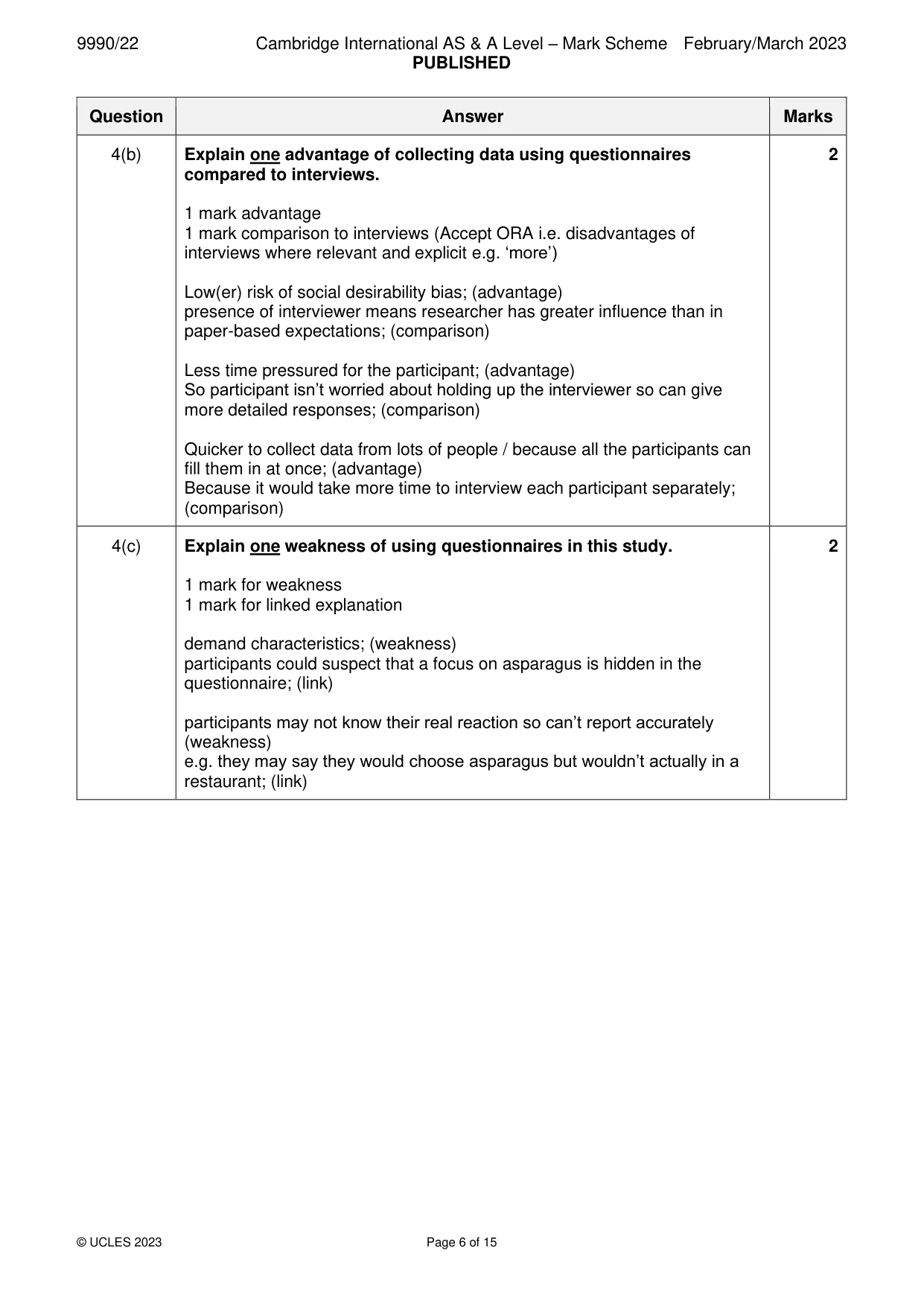
4 In the study by Laney et al. (false memory), questionnaires were used to collect data. (a) Outline one difference between a questionnaire and an interview. ................................................................................................................................................... ............................................................................................................................................. [1] (b) Explain one advantage of collecting data using questionnaires compared to interviews. ................................................................................................................................................... ................................................................................................................................................... ................................................................................................................................................... ............................................................................................................................................. [2] (c) Explain one weakness of using questionnaires in this study. ................................................................................................................................................... ................................................................................................................................................... ................................................................................................................................................... ............................................................................................................................................. [2]
Mark scheme: 4 In the study by Laney et al. (false memory), questionnaires were used to collect data. 4(a) Outline one difference between a questionnaire and an interview. 1 1 mark for difference Questionnaires are written but interviews are spoken; Questionnaires are completed by the participant alone but interviews are face-to-face / the interviewer is present; Participants fill out questionnaires whereas interviews are controlled by the researcher; Questionnaires can be done at the participant’s own speed / sent later however interviews collect data in real time; 4(b) Explain one advantage of collecting data using questionnaires 2 compared to interviews. 1 mark advantage 1 mark comparison to interviews (Accept ORA i.e. disadvantages of interviews where relevant and explicit e.g. ‘more’) Low(er) risk of social desirability bias; (advantage) presence of interviewer means researcher has greater influence than in paper-based expectations; (comparison) Less time pressured for the participant; (advantage) So participant isn’t worried about holding up the interviewer so can give more detailed responses; (comparison) Quicker to collect data from lots of people / because all the participants can fill them in at once; (advantage) Because it would take more time to interview each participant separately; (comparison) 4(c) Explain one weakness of using questionnaires in this study. 2 1 mark for weakness 1 mark for linked explanation demand characteristics; (weakness) participants could suspect that a focus on asparagus is hidden in the questionnaire; (link) participants may not know their real reaction so can’t report accurately (weakness) e.g. they may say they would choose asparagus but wouldn’t actually in a restaurant; (link)
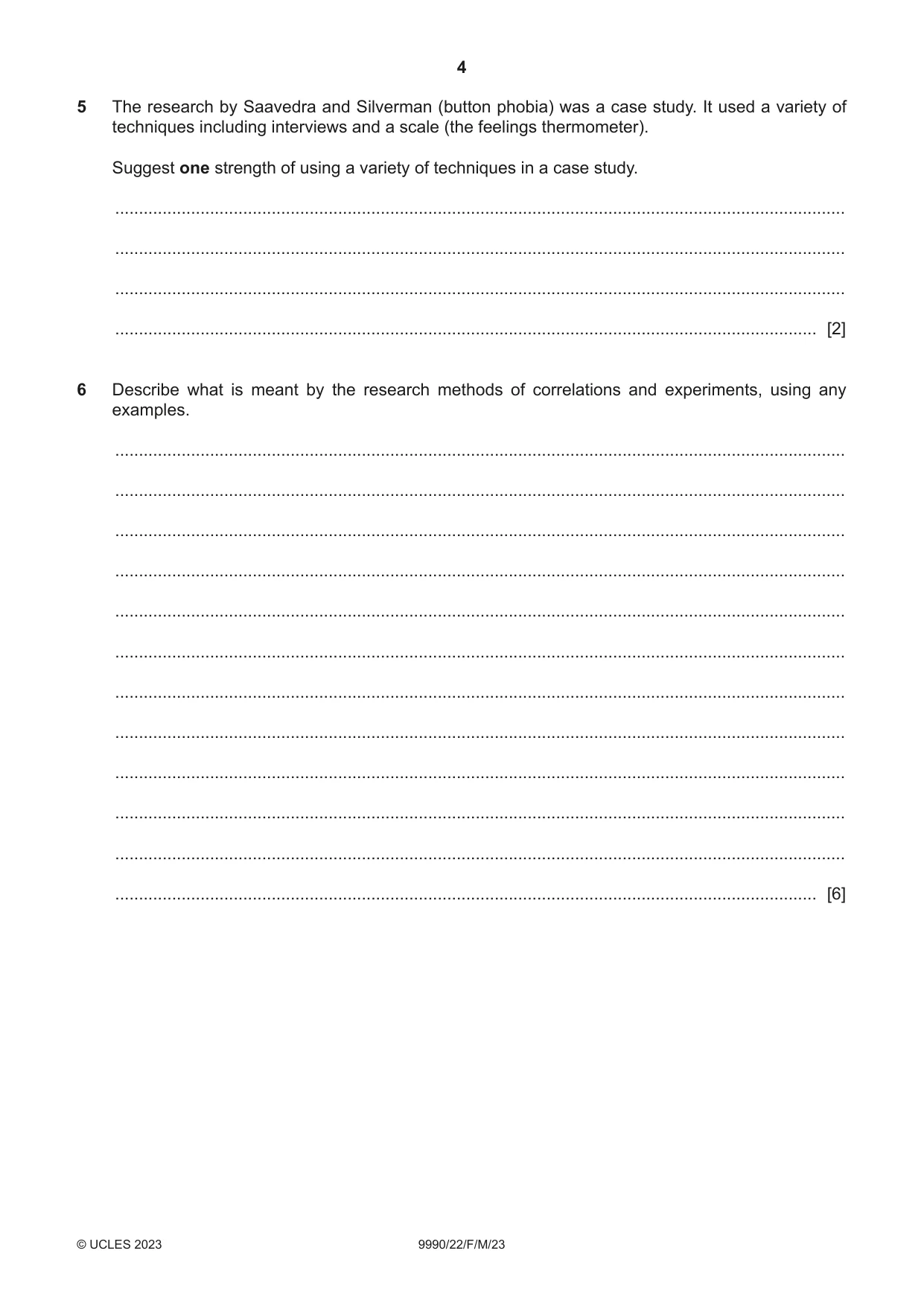
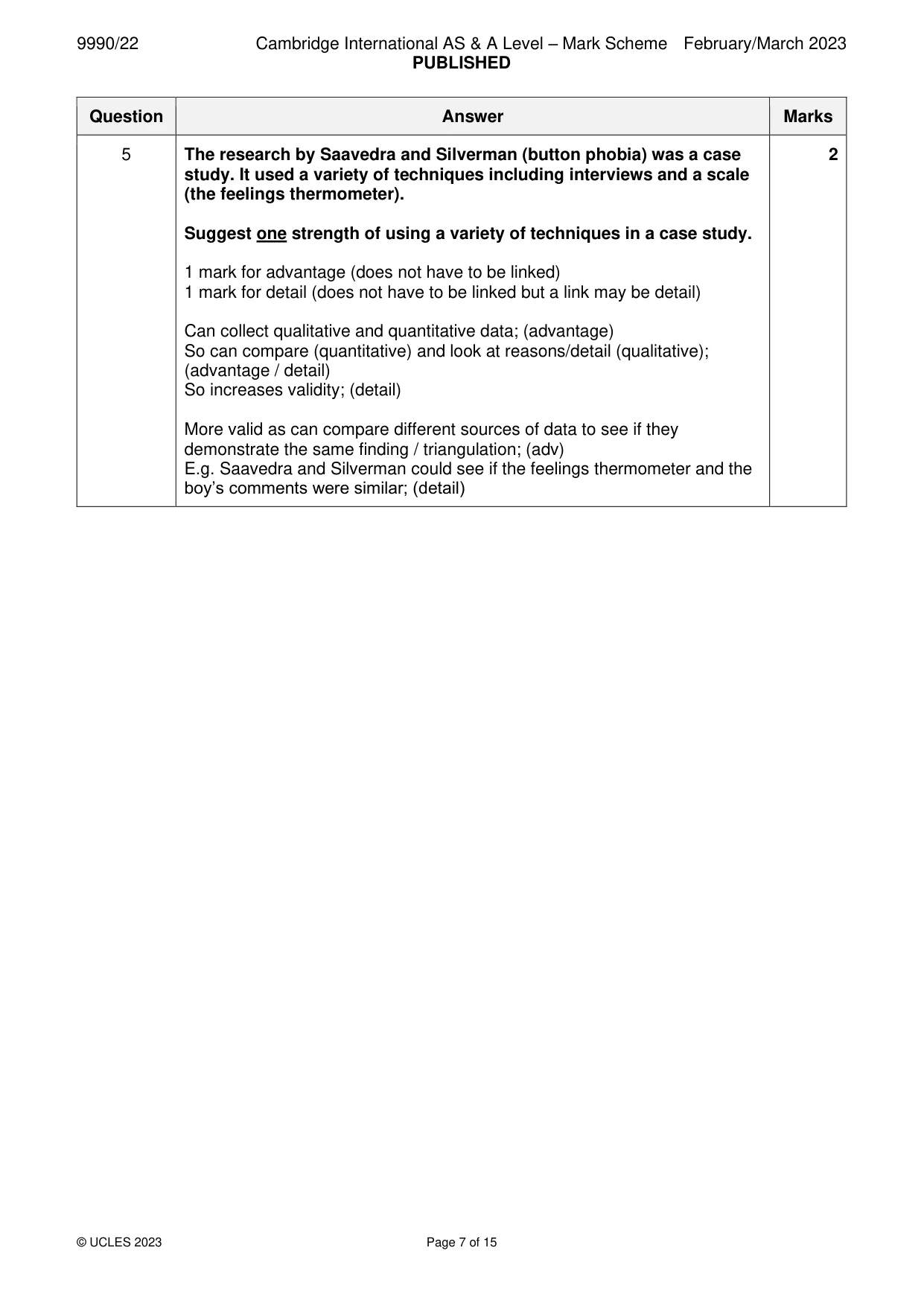
Q5 · The research by Saavedra and Silverman (button phobia) was a case study
5 The research by Saavedra and Silverman (button phobia) was a case study. It used a variety of techniques including interviews and a scale (the feelings thermometer). Suggest one strength of using a variety of techniques in a case study. .......................................................................................................................................................... .......................................................................................................................................................... .......................................................................................................................................................... .................................................................................................................................................... [2]
Mark scheme: 5 The research by Saavedra and Silverman (button phobia) was a case 2 study. It used a variety of techniques including interviews and a scale (the feelings thermometer). Suggest one strength of using a variety of techniques in a case study. 1 mark for advantage (does not have to be linked) 1 mark for detail (does not have to be linked but a link may be detail) Can collect qualitative and quantitative data; (advantage) So can compare (quantitative) and look at reasons/detail (qualitative); (advantage / detail) So increases validity; (detail) More valid as can compare different sources of data to see if they demonstrate the same finding / triangulation; (adv) E.g. Saavedra and Silverman could see if the feelings thermometer and the boy’s comments were similar; (detail)
More questions on Anxiety disorders and fear-related disorders
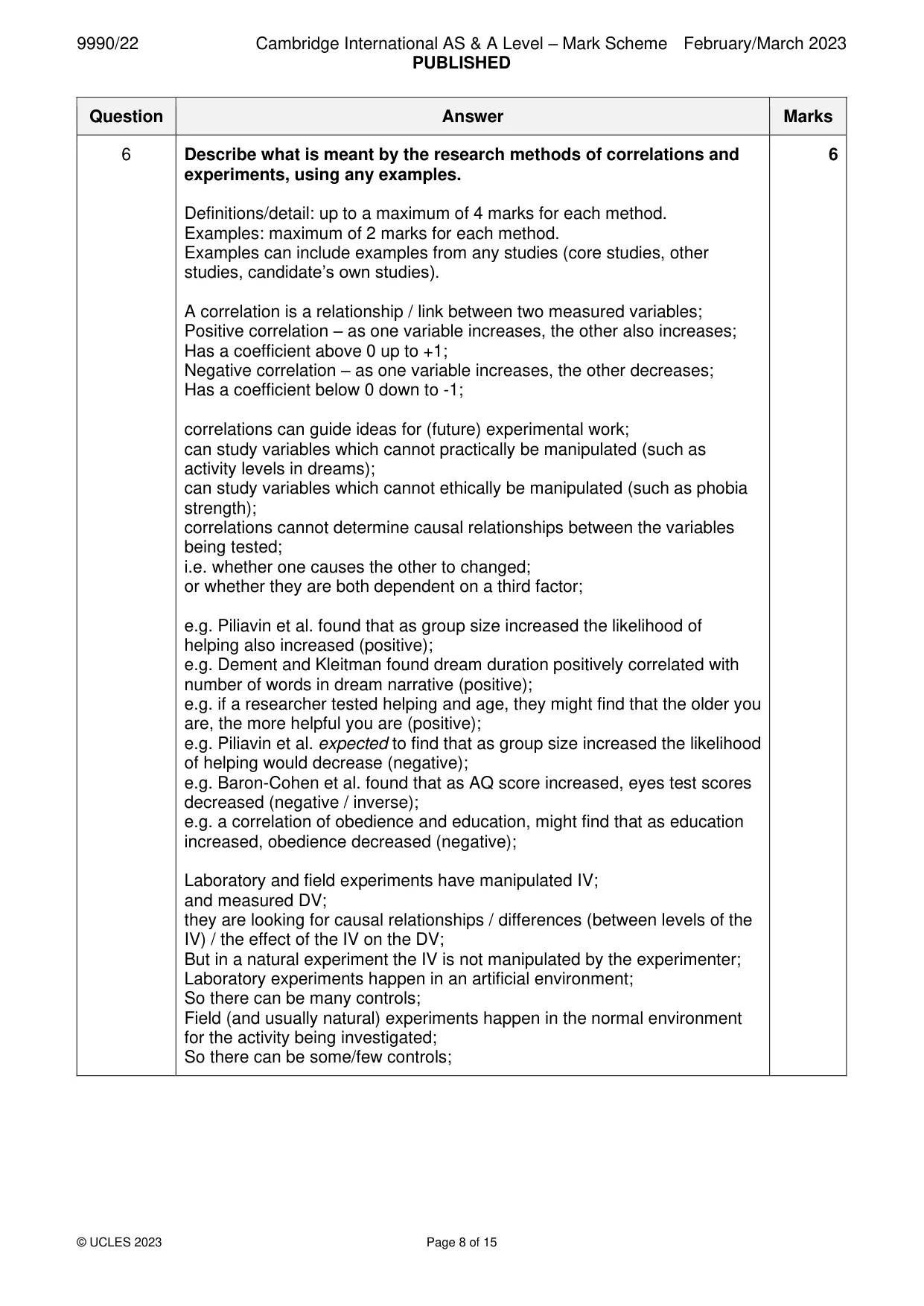
Q6 · Describe what is meant by the research methods of correlations and experiments, using any…
6 Describe what is meant by the research methods of correlations and experiments, using any examples. .......................................................................................................................................................... .......................................................................................................................................................... .......................................................................................................................................................... .......................................................................................................................................................... .......................................................................................................................................................... .......................................................................................................................................................... .......................................................................................................................................................... .......................................................................................................................................................... .......................................................................................................................................................... .......................................................................................................................................................... .......................................................................................................................................................... .................................................................................................................................................... [6]
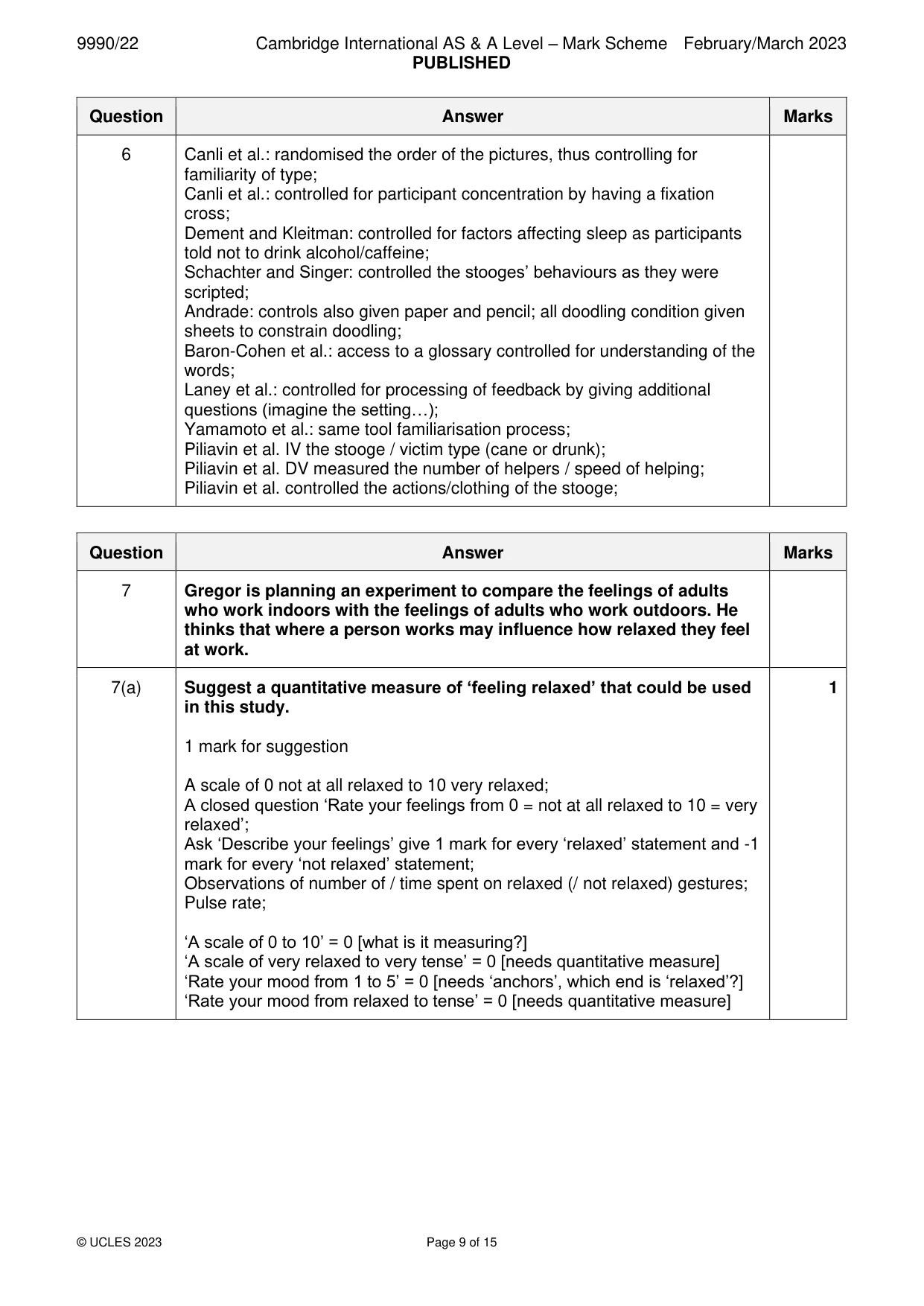
Mark scheme: 6 Describe what is meant by the research methods of correlations and 6 experiments, using any examples. Definitions/detail: up to a maximum of 4 marks for each method. Examples: maximum of 2 marks for each method. Examples can include examples from any studies (core studies, other studies, candidate’s own studies). A correlation is a relationship / link between two measured variables; Positive correlation – as one variable increases, the other also increases; Has a coefficient above 0 up to +1; Negative correlation – as one variable increases, the other decreases; Has a coefficient below 0 down to -1; correlations can guide ideas for (future) experimental work; can study variables which cannot practically be manipulated (such as activity levels in dreams); can study variables which cannot ethically be manipulated (such as phobia strength); correlations cannot determine causal relationships between the variables being tested; i.e. whether one causes the other to changed; or whether they are both dependent on a third factor; e.g. Piliavin et al. found that as group size increased the likelihood of helping also increased (positive); e.g. Dement and Kleitman found dream duration positively correlated with number of words in dream narrative (positive); e.g. if a researcher tested helping and age, they might find that the older you are, the more helpful you are (positive); e.g. Piliavin et al. expected to find that as group size increased the likelihood of helping would decrease (negative); e.g. Baron-Cohen et al. found that as AQ score increased, eyes test scores decreased (negative / inverse); e.g. a correlation of obedience and education, might find that as education increased, obedience decreased (negative); Laboratory and field experiments have manipulated IV; and measured DV; they are looking for causal relationships / differences (between levels of the IV) / the effect of the IV on the DV; But in a natural experiment the IV is not manipulated by the experimenter; Laboratory experiments happen in an artificial environment; So there can be many controls; Field (and usually natural) experiments happen in the normal environment for the activity being investigated; So there can be some/few controls; 6 Canli et al.: randomised the order of the pictures, thus controlling for familiarity of type; Canli et al.: controlled for participant concentration by having a fixation cross; Dement and Kleitman: controlled for factors affecting sleep as participants told not to drink alcohol/caffeine; Schachter and Singer: controlled the stooges’ behaviours as they were scripted; Andrade: controls also given paper and pencil; all doodling condition given sheets to constrain doodling; Baron-Cohen et al.: access to a glossary controlled for understanding of the words; Laney et al.: controlled for processing of feedback by giving additional questions (imagine the setting…); Yamamoto et al.: same tool familiarisation process; Piliavin et al. IV the stooge / victim type (cane or drunk); Piliavin et al. DV measured the number of helpers / speed of helping; Piliavin et al. controlled the actions/clothing of the stooge;
Q7 · Gregor is planning an experiment to compare the feelings of adults who work indoors with…
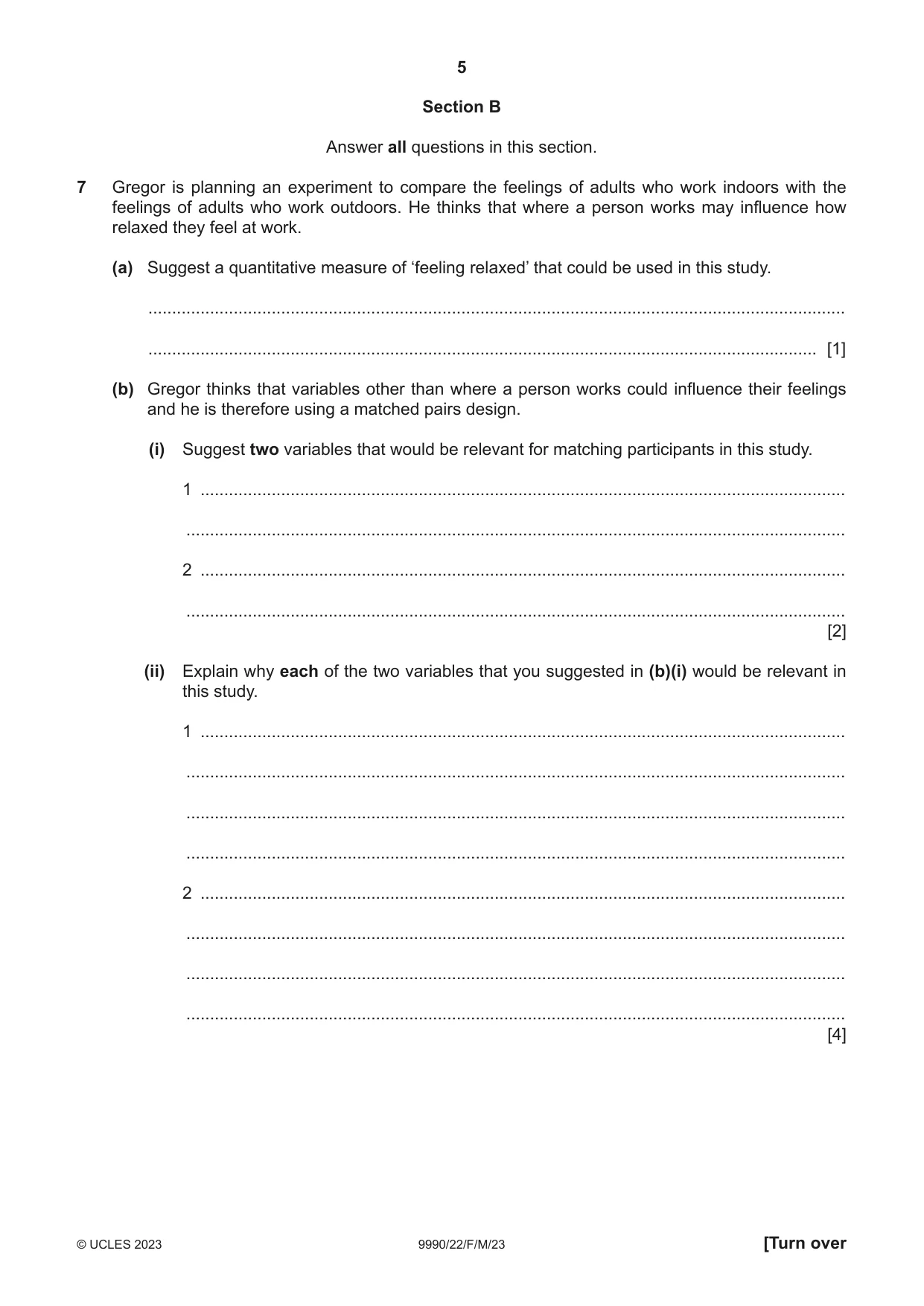
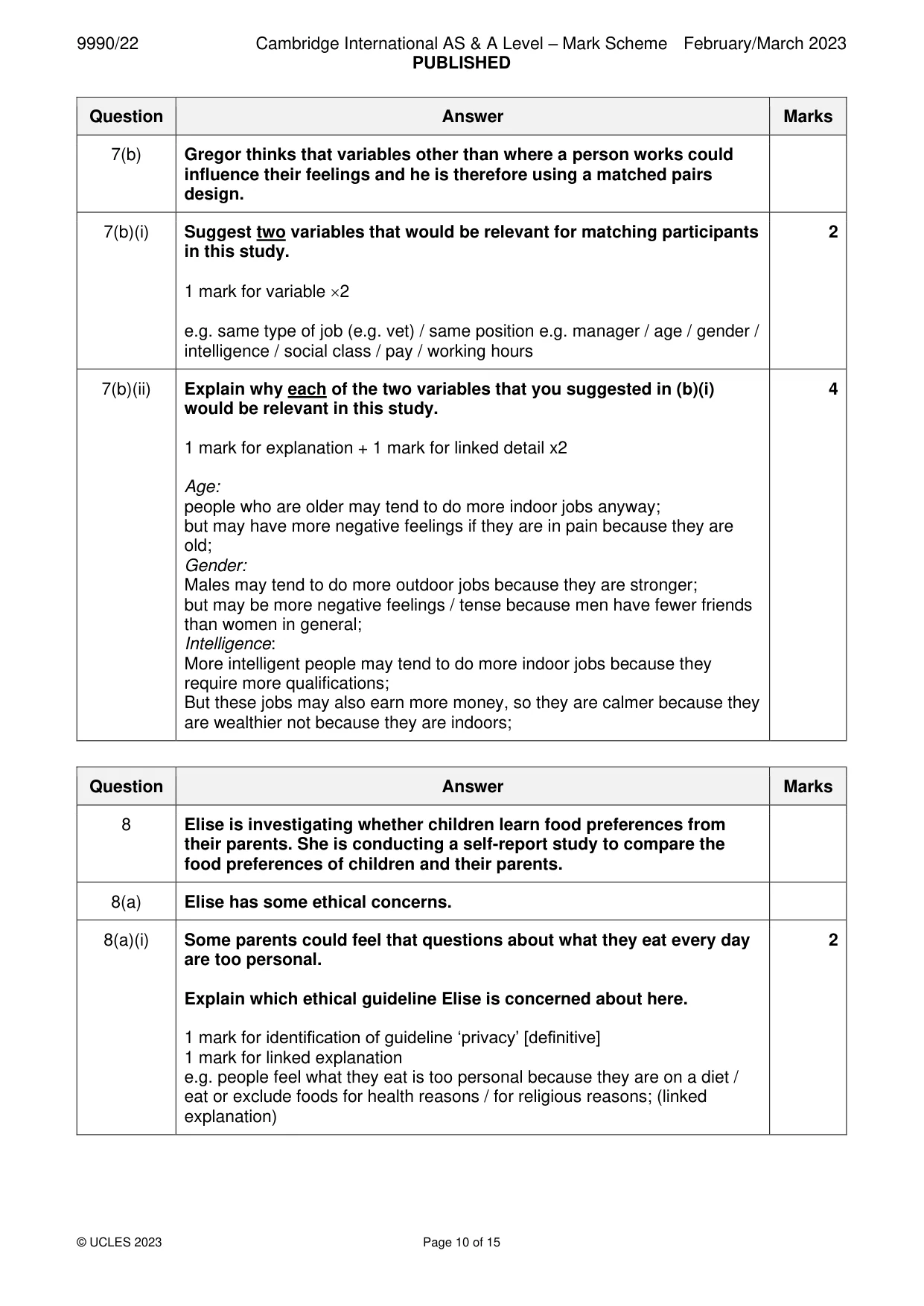
7 Gregor is planning an experiment to compare the feelings of adults who work indoors with the feelings of adults who work outdoors. He thinks that where a person works may influence how relaxed they feel at work. (a) Suggest a quantitative measure of ‘feeling relaxed’ that could be used in this study. ................................................................................................................................................... ............................................................................................................................................. [1] (b) Gregor thinks that variables other than where a person works could influence their feelings and he is therefore using a matched pairs design. (i) Suggest two variables that would be relevant for matching participants in this study. 1 ........................................................................................................................................ ........................................................................................................................................... 2 ........................................................................................................................................ ........................................................................................................................................... [2] (ii) Explain why each of the two variables that you suggested in (b)(i) would be relevant in this study. 1 ........................................................................................................................................ ........................................................................................................................................... ........................................................................................................................................... ........................................................................................................................................... 2 ........................................................................................................................................ ........................................................................................................................................... ........................................................................................................................................... ........................................................................................................................................... [4]
Mark scheme: 7 Gregor is planning an experiment to compare the feelings of adults who work indoors with the feelings of adults who work outdoors. He thinks that where a person works may influence how relaxed they feel at work. 7(a) Suggest a quantitative measure of ‘feeling relaxed’ that could be used 1 in this study. 1 mark for suggestion A scale of 0 not at all relaxed to 10 very relaxed; A closed question ‘Rate your feelings from 0 = not at all relaxed to 10 = very relaxed’; Ask ‘Describe your feelings’ give 1 mark for every ‘relaxed’ statement and -1 mark for every ‘not relaxed’ statement; Observations of number of / time spent on relaxed (/ not relaxed) gestures; Pulse rate; ‘A scale of 0 to 10’ = 0 [what is it measuring?] ‘A scale of very relaxed to very tense’ = 0 [needs quantitative measure] ‘Rate your mood from 1 to 5’ = 0 [needs ‘anchors’, which end is ‘relaxed’?] ‘Rate your mood from relaxed to tense’ = 0 [needs quantitative measure] 7(b) Gregor thinks that variables other than where a person works could influence their feelings and he is therefore using a matched pairs design. 7(b)(i) Suggest two variables that would be relevant for matching participants 2 in this study. 1 mark for variable 2 e.g. same type of job (e.g. vet) / same position e.g. manager / age / gender / intelligence / social class / pay / working hours 7(b)(ii) Explain why each of the two variables that you suggested in (b)(i) 4 would be relevant in this study. 1 mark for explanation + 1 mark for linked detail x2 Age: people who are older may tend to do more indoor jobs anyway; but may have more negative feelings if they are in pain because they are old; Gender: Males may tend to do more outdoor jobs because they are stronger; but may be more negative feelings / tense because men have fewer friends than women in general; Intelligence: More intelligent people may tend to do more indoor jobs because they require more qualifications; But these jobs may also earn more money, so they are calmer because they are wealthier not because they are indoors;
Q8 · Elise is investigating whether children learn food preferences from their parents
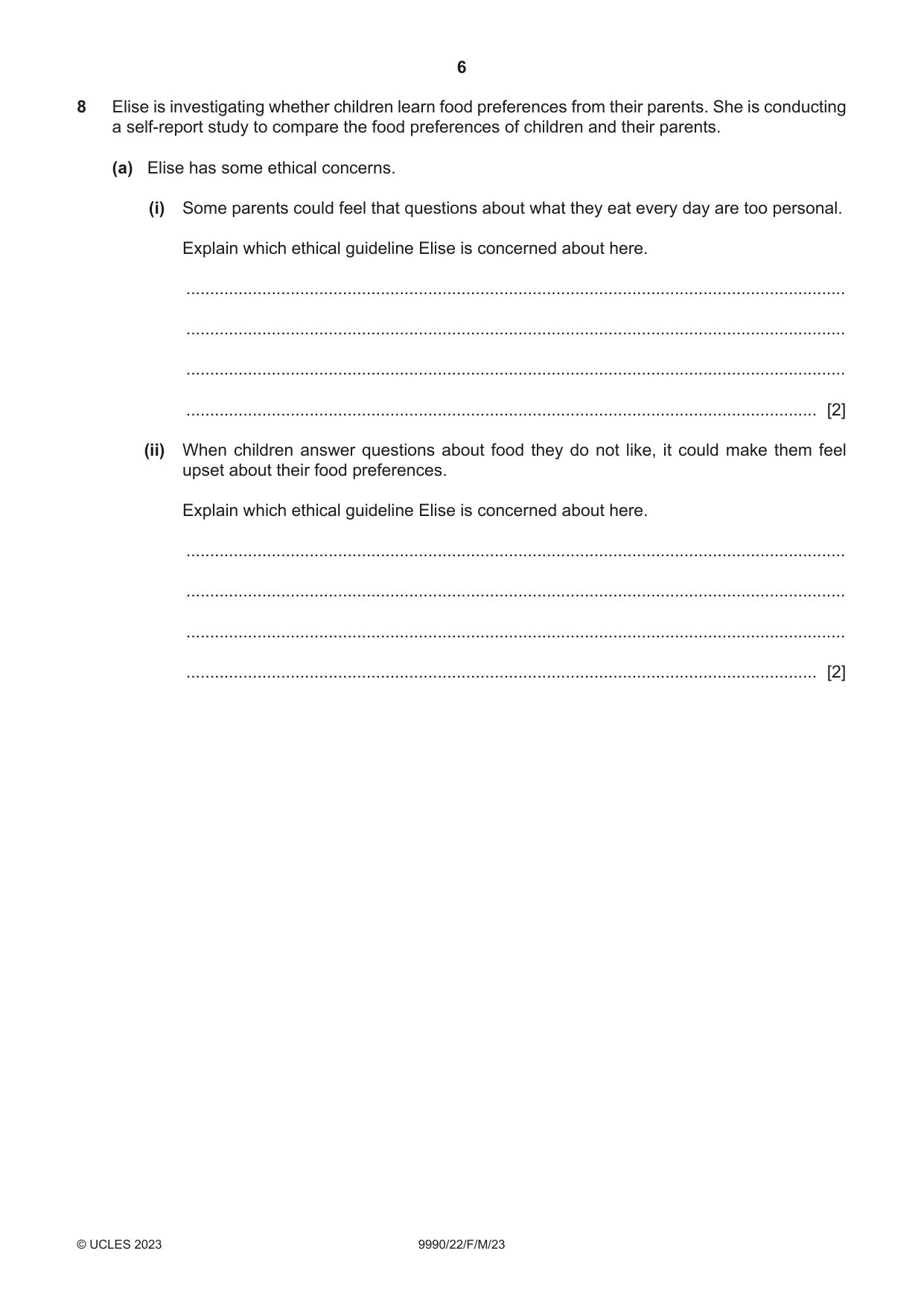
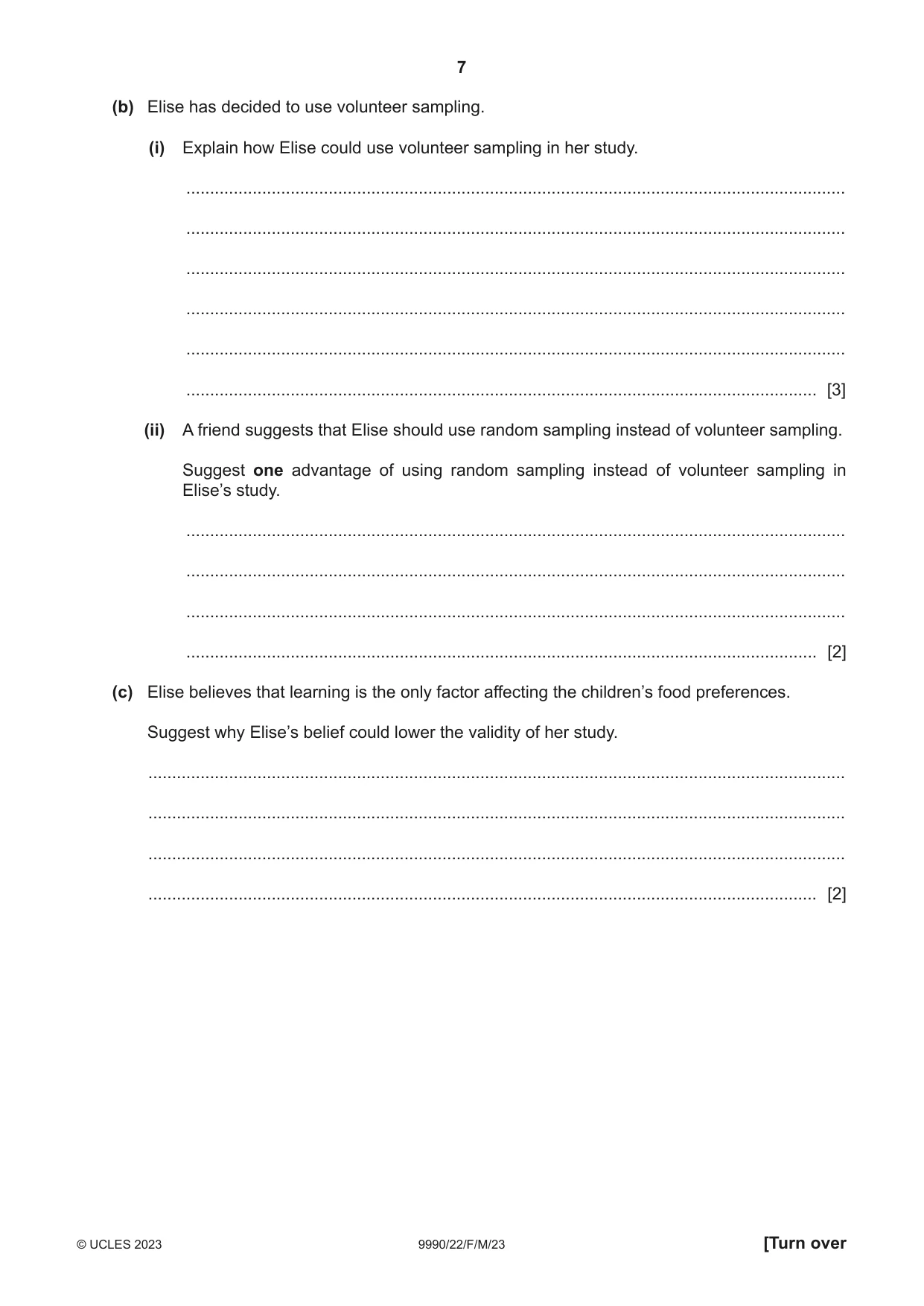
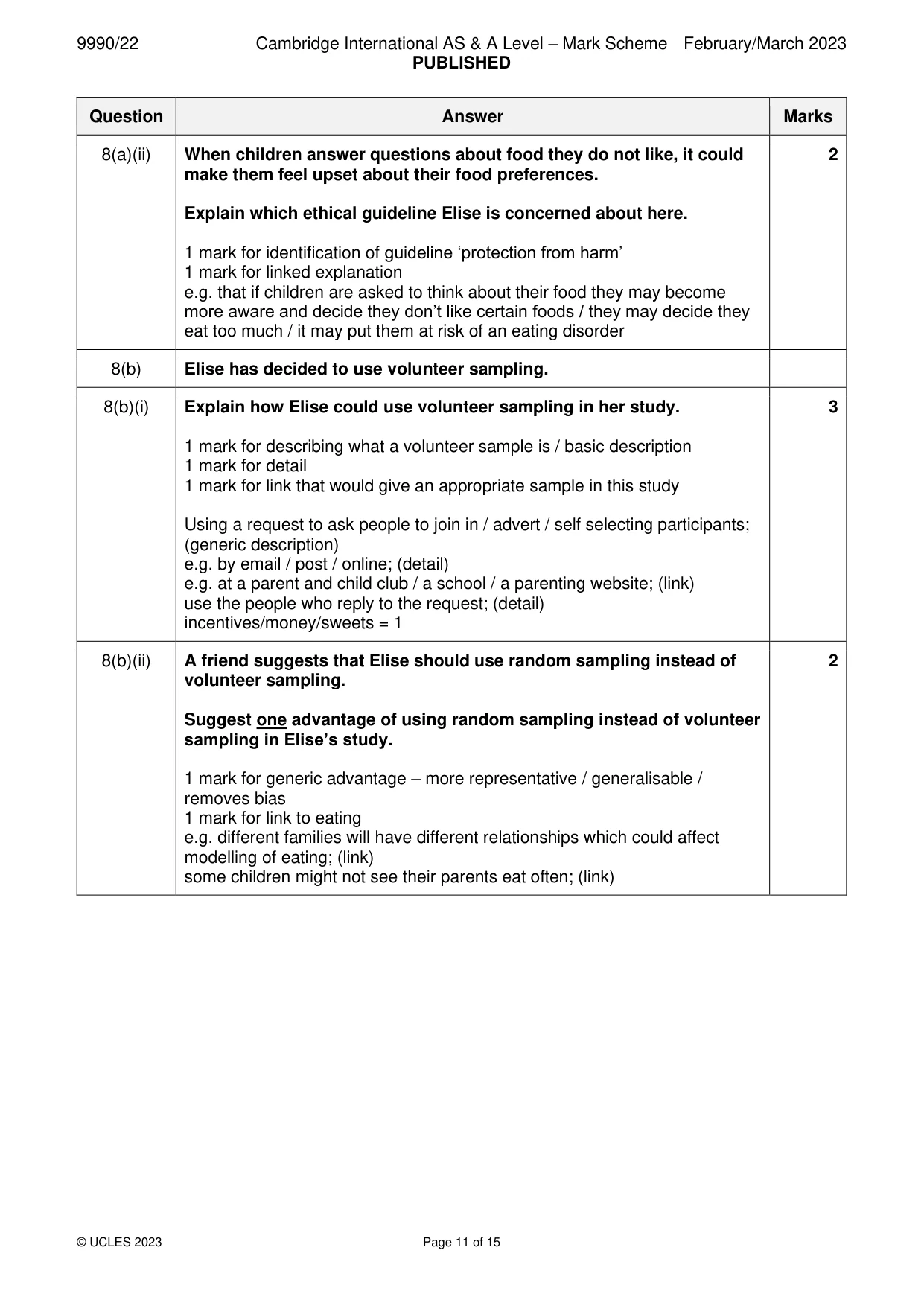
8 Elise is investigating whether children learn food preferences from their parents. She is conducting a self-report study to compare the food preferences of children and their parents. (a) Elise has some ethical concerns. (i) Some parents could feel that questions about what they eat every day are too personal. Explain which ethical guideline Elise is concerned about here. ........................................................................................................................................... ........................................................................................................................................... ........................................................................................................................................... ..................................................................................................................................... [2] (ii) When children answer questions about food they do not like, it could make them feel upset about their food preferences. Explain which ethical guideline Elise is concerned about here. ........................................................................................................................................... ........................................................................................................................................... ........................................................................................................................................... ..................................................................................................................................... [2] (b) Elise has decided to use volunteer sampling. (i) Explain how Elise could use volunteer sampling in her study. ........................................................................................................................................... ........................................................................................................................................... ........................................................................................................................................... ........................................................................................................................................... ........................................................................................................................................... ..................................................................................................................................... [3] (ii) A friend suggests that Elise should use random sampling instead of volunteer sampling. Suggest one advantage of using random sampling instead of volunteer sampling in Elise’s study. ........................................................................................................................................... ........................................................................................................................................... ........................................................................................................................................... ..................................................................................................................................... [2] (c) Elise believes that learning is the only factor affecting the children’s food preferences. Suggest why Elise’s belief could lower the validity of her study. ................................................................................................................................................... ................................................................................................................................................... ................................................................................................................................................... ............................................................................................................................................. [2]
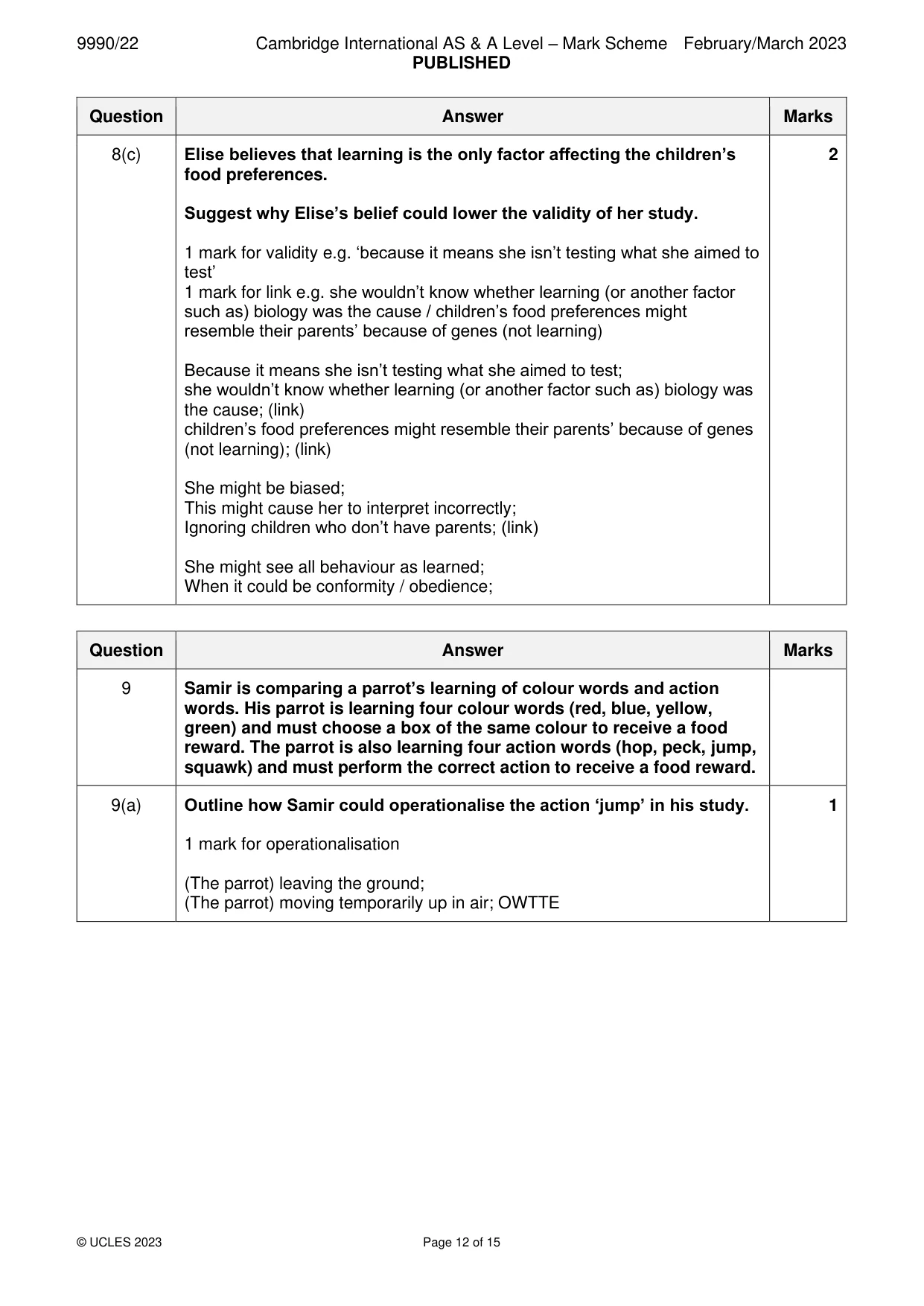
Mark scheme: 8 Elise is investigating whether children learn food preferences from their parents. She is conducting a self-report study to compare the food preferences of children and their parents. 8(a) Elise has some ethical concerns. 8(a)(i) Some parents could feel that questions about what they eat every day 2 are too personal. Explain which ethical guideline Elise is concerned about here. 1 mark for identification of guideline ‘privacy’ [definitive] 1 mark for linked explanation e.g. people feel what they eat is too personal because they are on a diet / eat or exclude foods for health reasons / for religious reasons; (linked explanation) 8(a)(ii) When children answer questions about food they do not like, it could 2 make them feel upset about their food preferences. Explain which ethical guideline Elise is concerned about here. 1 mark for identification of guideline ‘protection from harm’ 1 mark for linked explanation e.g. that if children are asked to think about their food they may become more aware and decide they don’t like certain foods / they may decide they eat too much / it may put them at risk of an eating disorder 8(b) Elise has decided to use volunteer sampling. 8(b)(i) Explain how Elise could use volunteer sampling in her study. 3 1 mark for describing what a volunteer sample is / basic description 1 mark for detail 1 mark for link that would give an appropriate sample in this study Using a request to ask people to join in / advert / self selecting participants; (generic description) e.g. by email / post / online; (detail) e.g. at a parent and child club / a school / a parenting website; (link) use the people who reply to the request; (detail) incentives/money/sweets = 1 8(b)(ii) A friend suggests that Elise should use random sampling instead of 2 volunteer sampling. Suggest one advantage of using random sampling instead of volunteer sampling in Elise’s study. 1 mark for generic advantage – more representative / generalisable / removes bias 1 mark for link to eating e.g. different families will have different relationships which could affect modelling of eating; (link) some children might not see their parents eat often; (link) 8(c) Elise believes that learning is the only factor affecting the children’s 2 food preferences. Suggest why Elise’s belief could lower the validity of her study. 1 mark for validity e.g. ‘because it means she isn’t testing what she aimed to test’ 1 mark for link e.g. she wouldn’t know whether learning (or another factor such as) biology was the cause / children’s food preferences might resemble their parents’ because of genes (not learning) Because it means she isn’t testing what she aimed to test; she wouldn’t know whether learning (or another factor such as) biology was the cause; (link) children’s food preferences might resemble their parents’ because of genes (not learning); (link) She might be biased; This might cause her to interpret incorrectly; Ignoring children who don’t have parents; (link) She might see all behaviour as learned; When it could be conformity / obedience;
Q9 · Samir is comparing a parrot’s learning of colour words and action words
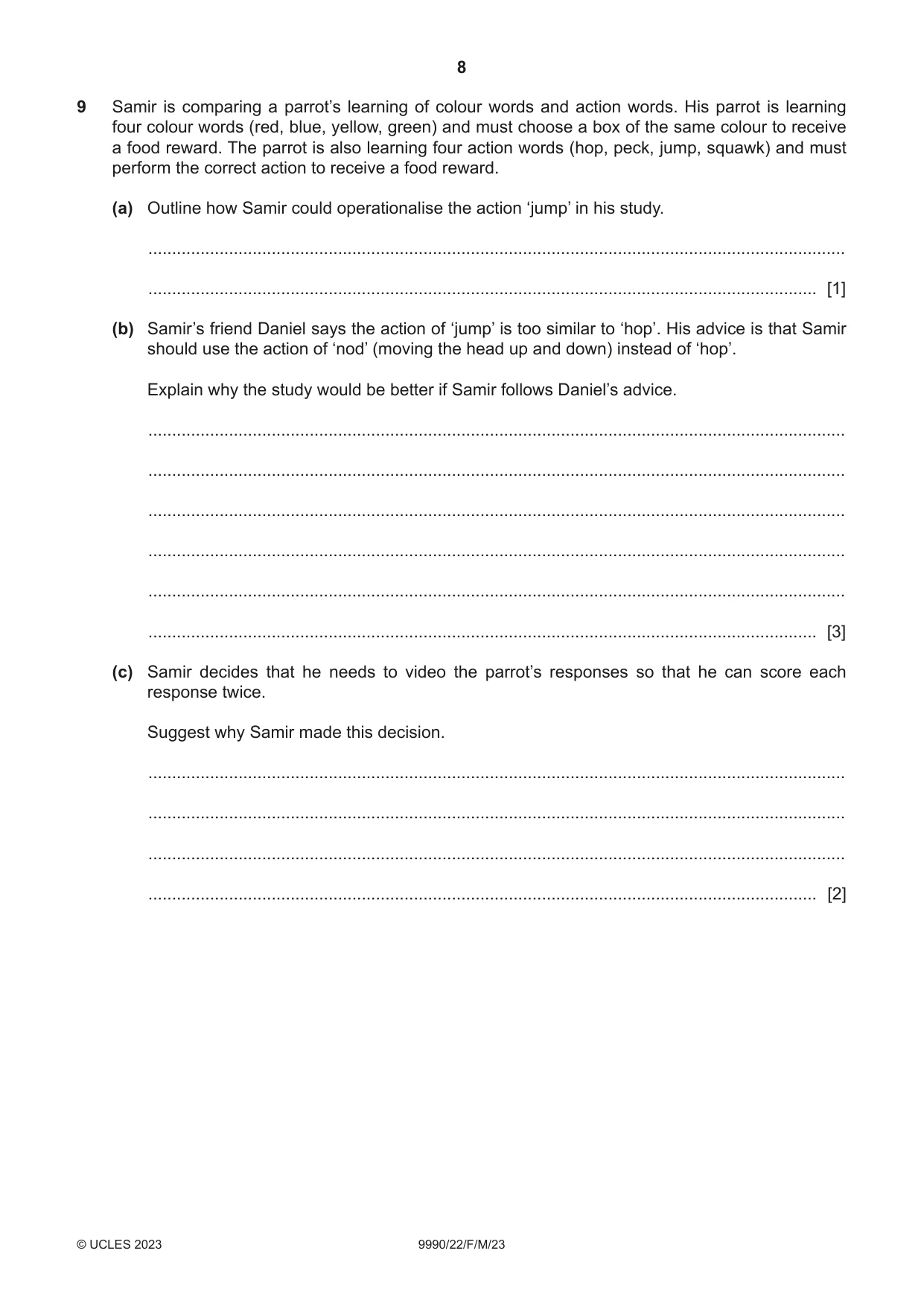
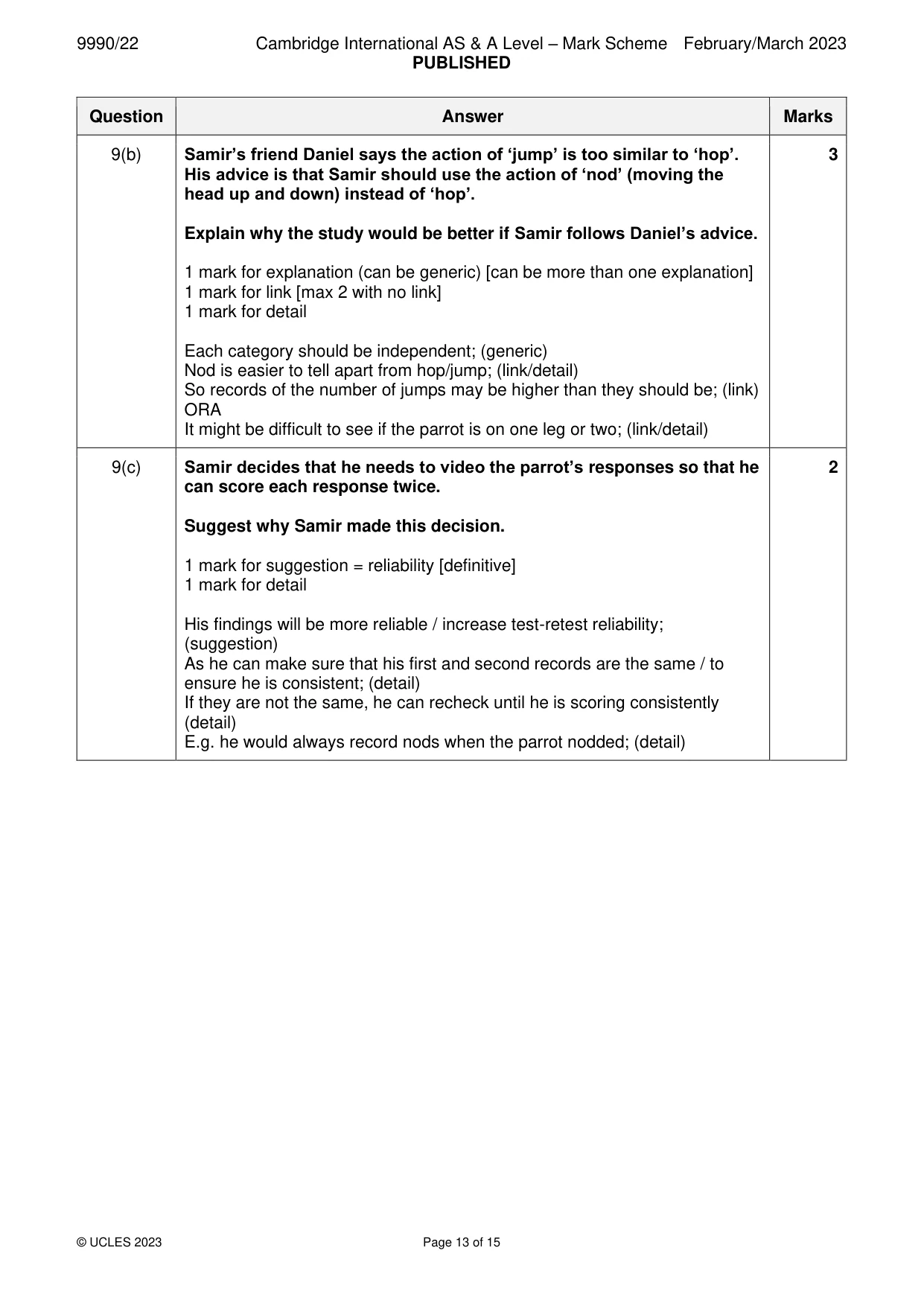
9 Samir is comparing a parrot’s learning of colour words and action words. His parrot is learning four colour words (red, blue, yellow, green) and must choose a box of the same colour to receive a food reward. The parrot is also learning four action words (hop, peck, jump, squawk) and must perform the correct action to receive a food reward. (a) Outline how Samir could operationalise the action ‘jump’ in his study. ................................................................................................................................................... ............................................................................................................................................. [1] (b) Samir’s friend Daniel says the action of ‘jump’ is too similar to ‘hop’. His advice is that Samir should use the action of ‘nod’ (moving the head up and down) instead of ‘hop’. Explain why the study would be better if Samir follows Daniel’s advice. ................................................................................................................................................... ................................................................................................................................................... ................................................................................................................................................... ................................................................................................................................................... ................................................................................................................................................... ............................................................................................................................................. [3] (c) Samir decides that he needs to video the parrot’s responses so that he can score each response twice. Suggest why Samir made this decision. ................................................................................................................................................... ................................................................................................................................................... ................................................................................................................................................... ............................................................................................................................................. [2] Section C Answer all questions in this section.
Mark scheme: 9 Samir is comparing a parrot’s learning of colour words and action words. His parrot is learning four colour words (red, blue, yellow, green) and must choose a box of the same colour to receive a food reward. The parrot is also learning four action words (hop, peck, jump, squawk) and must perform the correct action to receive a food reward. 9(a) Outline how Samir could operationalise the action ‘jump’ in his study. 1 1 mark for operationalisation (The parrot) leaving the ground; (The parrot) moving temporarily up in air; OWTTE 9(b) Samir’s friend Daniel says the action of ‘jump’ is too similar to ‘hop’. 3 His advice is that Samir should use the action of ‘nod’ (moving the head up and down) instead of ‘hop’. Explain why the study would be better if Samir follows Daniel’s advice. 1 mark for explanation (can be generic) [can be more than one explanation] 1 mark for link [max 2 with no link] 1 mark for detail Each category should be independent; (generic) Nod is easier to tell apart from hop/jump; (link/detail) So records of the number of jumps may be higher than they should be; (link) ORA It might be difficult to see if the parrot is on one leg or two; (link/detail) 9(c) Samir decides that he needs to video the parrot’s responses so that he 2 can score each response twice. Suggest why Samir made this decision. 1 mark for suggestion = reliability [definitive] 1 mark for detail His findings will be more reliable / increase test-retest reliability; (suggestion) As he can make sure that his first and second records are the same / to ensure he is consistent; (detail) If they are not the same, he can recheck until he is scoring consistently (detail) E.g. he would always record nods when the parrot nodded; (detail)
Q10 · When a person pays more attention to their mobile phone than the person they are with…
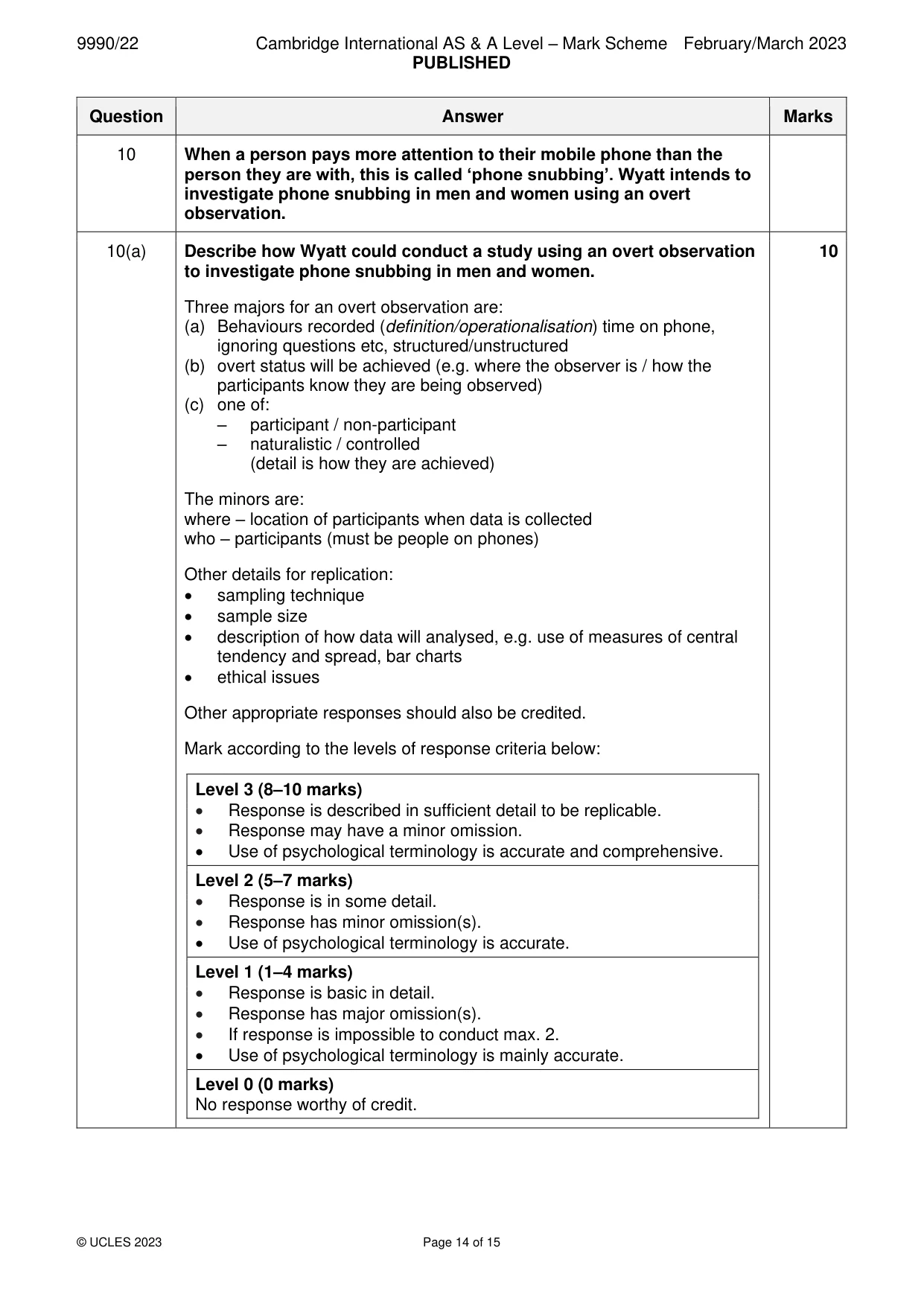
10 When a person pays more attention to their mobile phone than the person they are with, this is called ‘phone snubbing’. Wyatt wants to investigate phone snubbing in men and women using an overt observation. (a) Describe how Wyatt could conduct a study using an overt observation to investigate phone snubbing in men and women. ................................................................................................................................................... ................................................................................................................................................... ................................................................................................................................................... ................................................................................................................................................... ................................................................................................................................................... ................................................................................................................................................... ................................................................................................................................................... ................................................................................................................................................... ................................................................................................................................................... ................................................................................................................................................... ................................................................................................................................................... ................................................................................................................................................... ................................................................................................................................................... ................................................................................................................................................... ................................................................................................................................................... ................................................................................................................................................... ................................................................................................................................................... ................................................................................................................................................... ................................................................................................................................................... ................................................................................................................................................... ................................................................................................................................................... ................................................................................................................................................... ................................................................................................................................................... ................................................................................................................................................... ................................................................................................................................................... ................................................................................................................................................... ................................................................................................................................................... ................................................................................................................................................... ................................................................................................................................................... ................................................................................................................................................... ................................................................................................................................................... ................................................................................................................................................... ................................................................................................................................................... ........................................................................................................................................... [10] (b) Identify one practical weakness/limitation with the procedure you have described in your answer to part (a) and suggest how your study might be done differently to overcome the problem. Do not refer to ethics or sampling in your answer. ................................................................................................................................................... ................................................................................................................................................... ................................................................................................................................................... ................................................................................................................................................... ................................................................................................................................................... ................................................................................................................................................... ................................................................................................................................................... ............................................................................................................................................. [4]
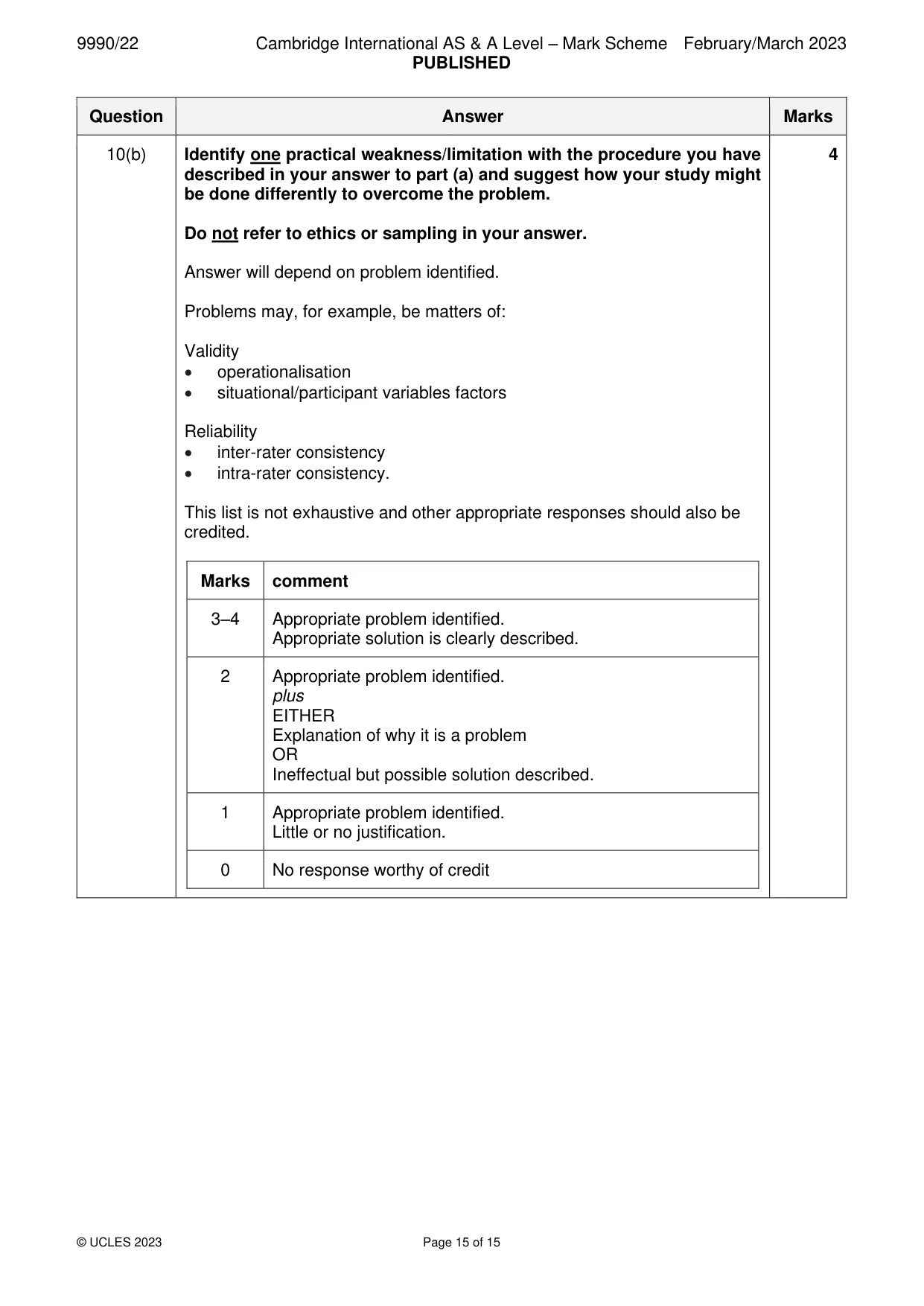
Mark scheme: 10 When a person pays more attention to their mobile phone than the person they are with, this is called ‘phone snubbing’. Wyatt intends to investigate phone snubbing in men and women using an overt observation. 10(a) Describe how Wyatt could conduct a study using an overt observation 10 to investigate phone snubbing in men and women. Three majors for an overt observation are: (a) Behaviours recorded (definition/operationalisation) time on phone, ignoring questions etc, structured/unstructured (b) overt status will be achieved (e.g. where the observer is / how the participants know they are being observed) (c) one of: – participant / non-participant – naturalistic / controlled (detail is how they are achieved) The minors are: where – location of participants when data is collected who – participants (must be people on phones) Other details for replication: • sampling technique • sample size • description of how data will analysed, e.g. use of measures of central tendency and spread, bar charts • ethical issues Other appropriate responses should also be credited. Mark according to the levels of response criteria below: Level 3 (8–10 marks) • Response is described in sufficient detail to be replicable. • Response may have a minor omission. • Use of psychological terminology is accurate and comprehensive. Level 2 (5–7 marks) • Response is in some detail. • Response has minor omission(s). • Use of psychological terminology is accurate. Level 1 (1–4 marks) • Response is basic in detail. • Response has major omission(s). • If response is impossible to conduct max. 2. • Use of psychological terminology is mainly accurate. Level 0 (0 marks) No response worthy of credit. 10(b) Identify one practical weakness/limitation with the procedure you have 4 described in your answer to part (a) and suggest how your study might be done differently to overcome the problem. Do not refer to ethics or sampling in your answer. Answer will depend on problem identified. Problems may, for example, be matters of: Validity • operationalisation • situational/participant variables factors Reliability • inter-rater consistency • intra-rater consistency. This list is not exhaustive and other appropriate responses should also be credited. Marks comment 3–4 Appropriate problem identified. Appropriate solution is clearly described. 2 Appropriate problem identified. plus EITHER Explanation of why it is a problem OR Ineffectual but possible solution described. 1 Appropriate problem identified. Little or no justification. 0 No response worthy of credit
What was in this paper
The subtopics covered by these 10 questions, and how many questions each got. Open one in a new tab to see every Cambridge question on it.
What you needed in this session
Cambridge’s own grade thresholds for 2023 Feb/March, Paper 2 · Variant 2. A higher threshold means an easier paper — the bar moves with how the cohort did.