Cambridge A Level Psychology (from 2018) 9990 — 2019 May/June Paper 2 · Variant 1
9990/21/M/J/19 · 10 questions · 60 marks · ≈68 min
The question paper and its mark scheme, free to read here and free to download. This is Cambridge’s own paper, exactly as it was sat.
Question paper12 pages


Mark scheme14 pages
Answers below. Sit the paper first if you are practising.
Questions as text
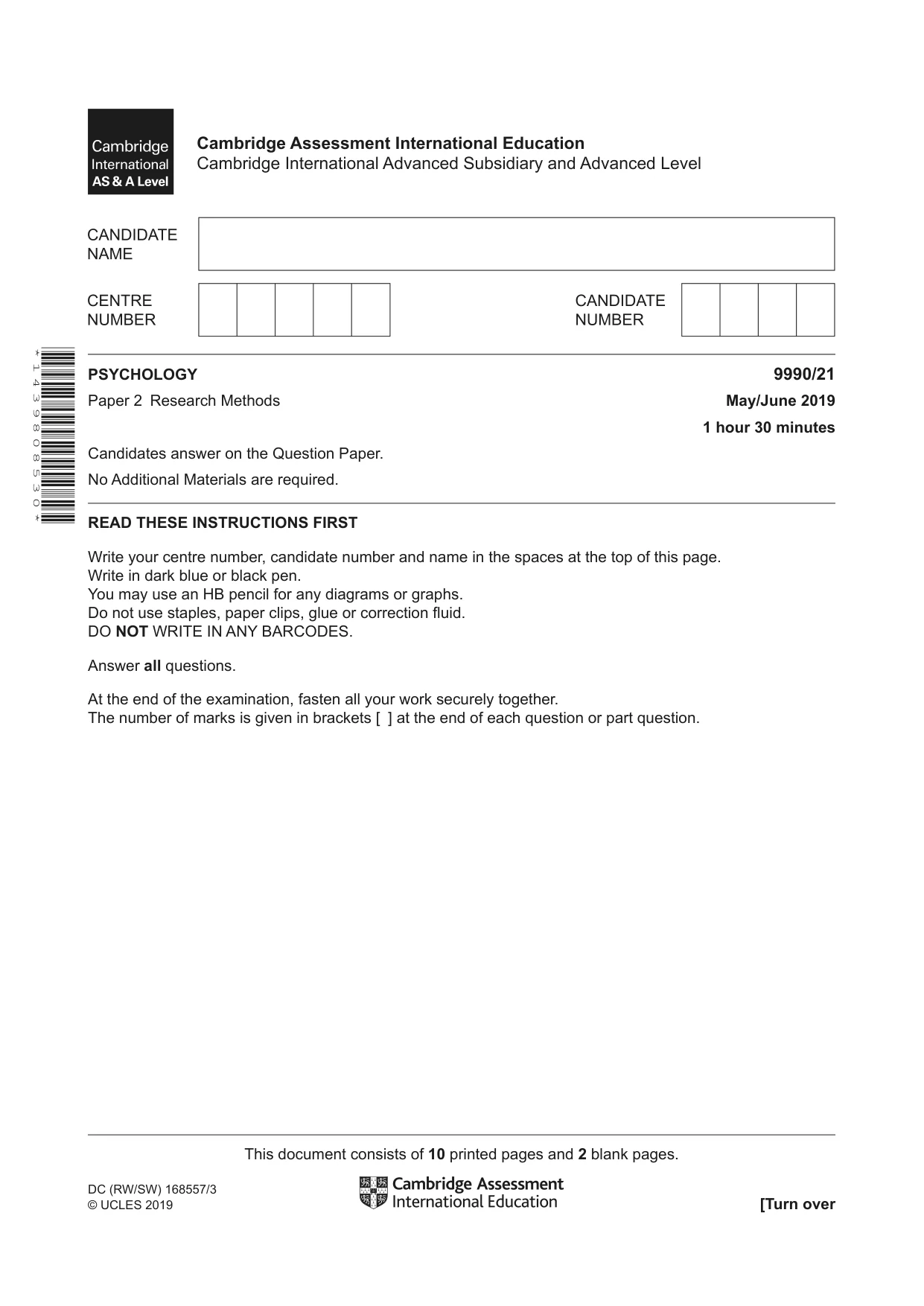
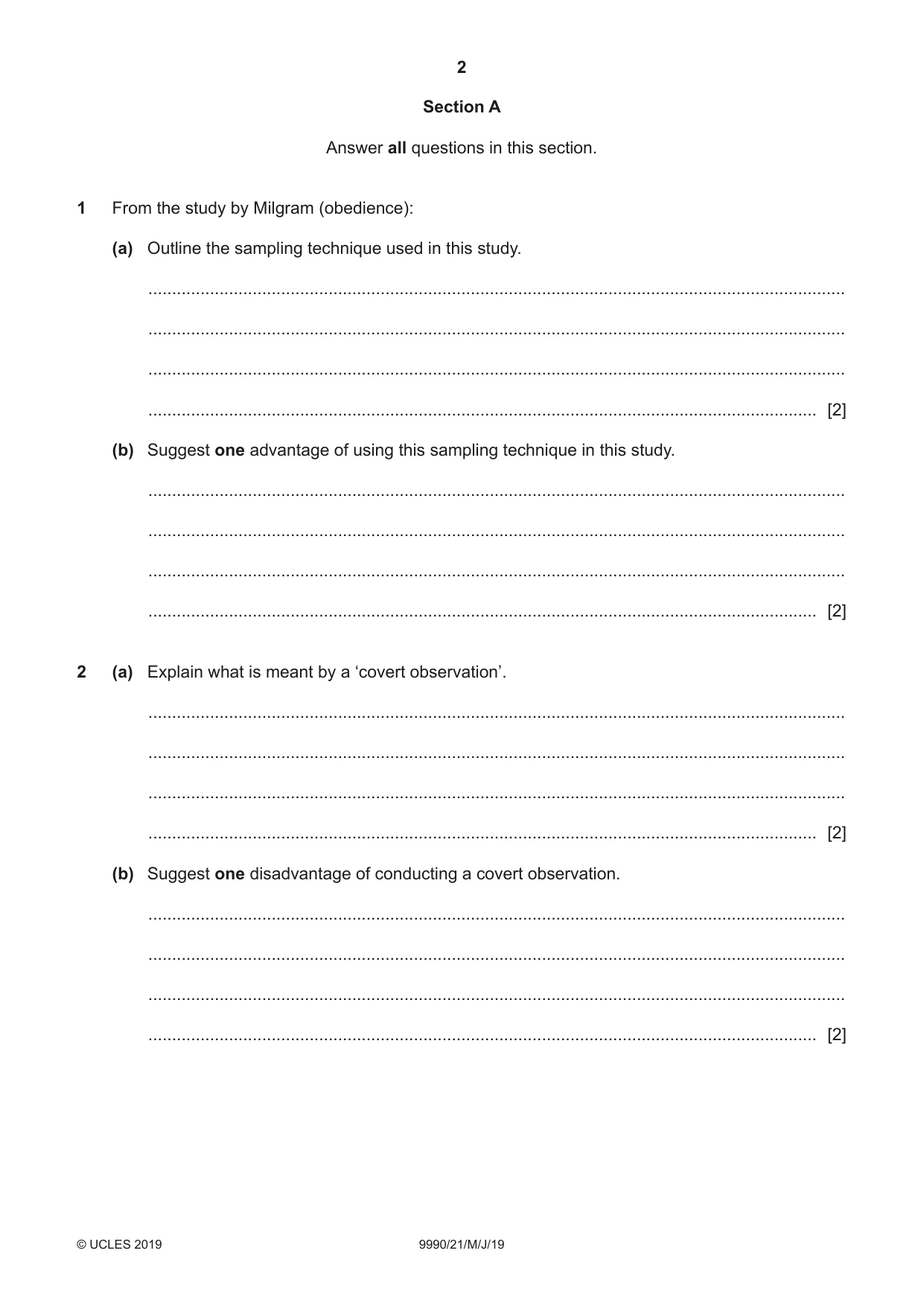
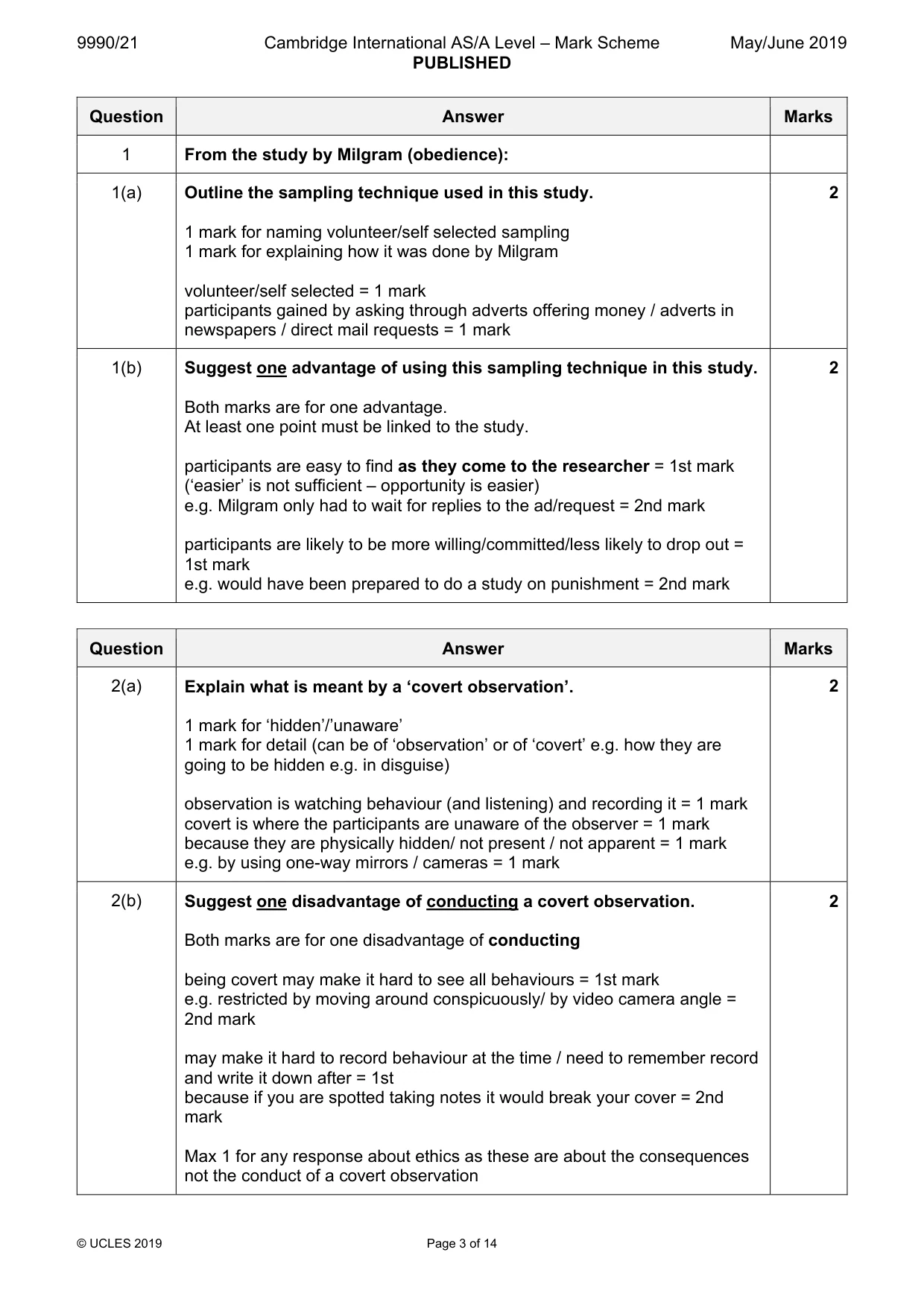
Q1 · From the study by Milgram (obedience): (a) Outline the sampling technique used in this…
1 From the study by Milgram (obedience): (a) Outline the sampling technique used in this study. ................................................................................................................................................... ................................................................................................................................................... ................................................................................................................................................... ............................................................................................................................................. [2] (b) Suggest one advantage of using this sampling technique in this study. ................................................................................................................................................... ................................................................................................................................................... ................................................................................................................................................... ............................................................................................................................................. [2]
Mark scheme: Question Answer Marks 1 From the study by Milgram (obedience): 1(a) Outline the sampling technique used in this study. 2 1 mark for naming volunteer/self selected sampling 1 mark for explaining how it was done by Milgram volunteer/self selected = 1 mark participants gained by asking through adverts offering money / adverts in newspapers / direct mail requests = 1 mark 1(b) Suggest one advantage of using this sampling technique in this study. 2 Both marks are for one advantage. At least one point must be linked to the study. participants are easy to find as they come to the researcher = 1st mark (‘easier’ is not sufficient – opportunity is easier) e.g. Milgram only had to wait for replies to the ad/request = 2nd mark participants are likely to be more willing/committed/less likely to drop out = 1st mark e.g. would have been prepared to do a study on punishment = 2nd mark
Q2 · Explain what is meant by a ‘covert observation’
2 (a) Explain what is meant by a ‘covert observation’. ................................................................................................................................................... ................................................................................................................................................... ................................................................................................................................................... ............................................................................................................................................. [2] (b) Suggest one disadvantage of conducting a covert observation. ................................................................................................................................................... ................................................................................................................................................... ................................................................................................................................................... ............................................................................................................................................. [2]
Mark scheme: 2(a) Explain what is meant by a ‘covert observation’. 2 1 mark for ‘hidden’/’unaware’ 1 mark for detail (can be of ‘observation’ or of ‘covert’ e.g. how they are going to be hidden e.g. in disguise) observation is watching behaviour (and listening) and recording it = 1 mark covert is where the participants are unaware of the observer = 1 mark because they are physically hidden/ not present / not apparent = 1 mark e.g. by using one-way mirrors / cameras = 1 mark 2(b) Suggest one disadvantage of conducting a covert observation. 2 Both marks are for one disadvantage of conducting being covert may make it hard to see all behaviours = 1st mark e.g. restricted by moving around conspicuously/ by video camera angle = 2nd mark may make it hard to record behaviour at the time / need to remember record and write it down after = 1st because if you are spotted taking notes it would break your cover = 2nd mark Max 1 for any response about ethics as these are about the consequences not the conduct of a covert observation
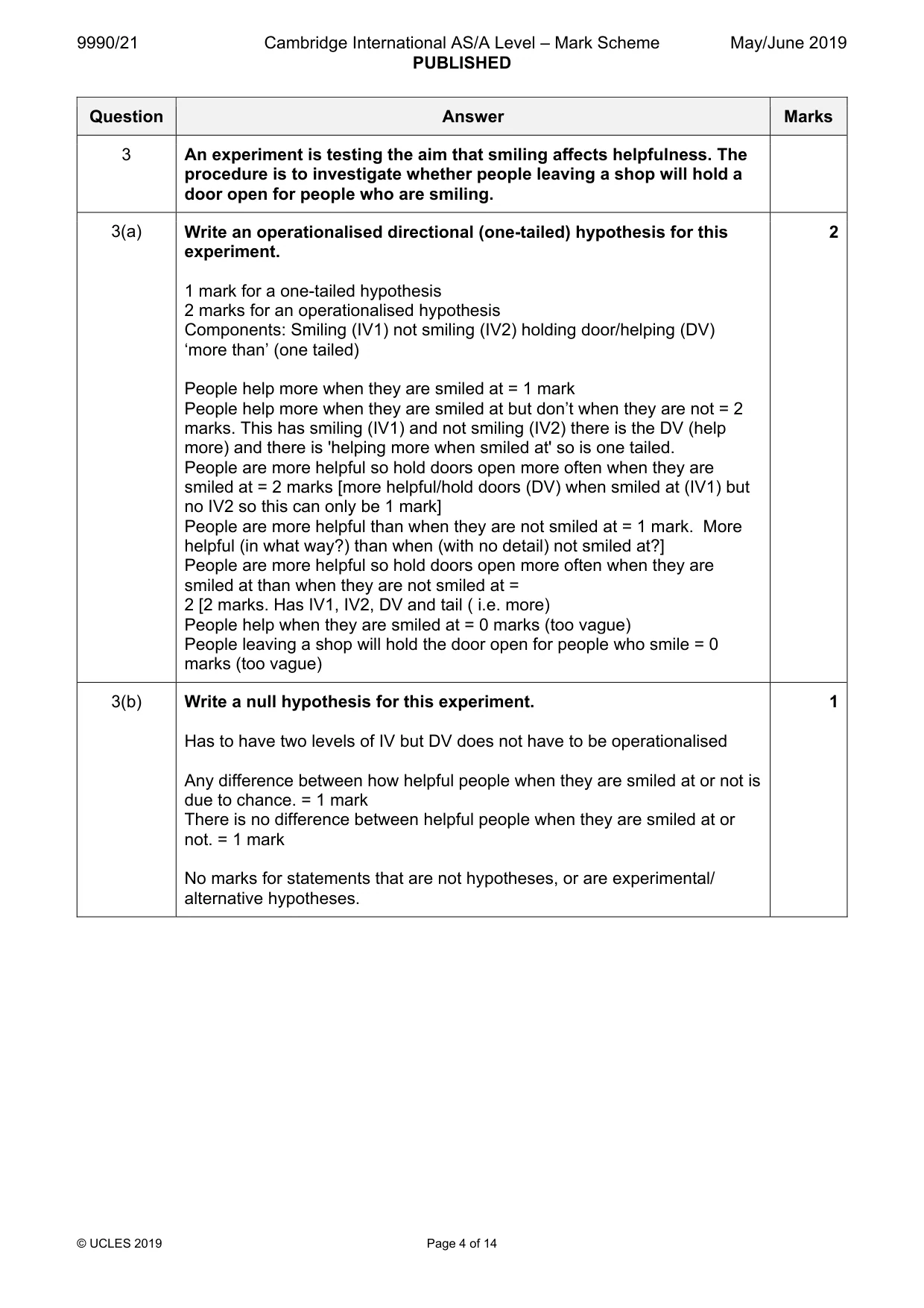
Q3 · An experiment is testing the aim that smiling affects helpfulness
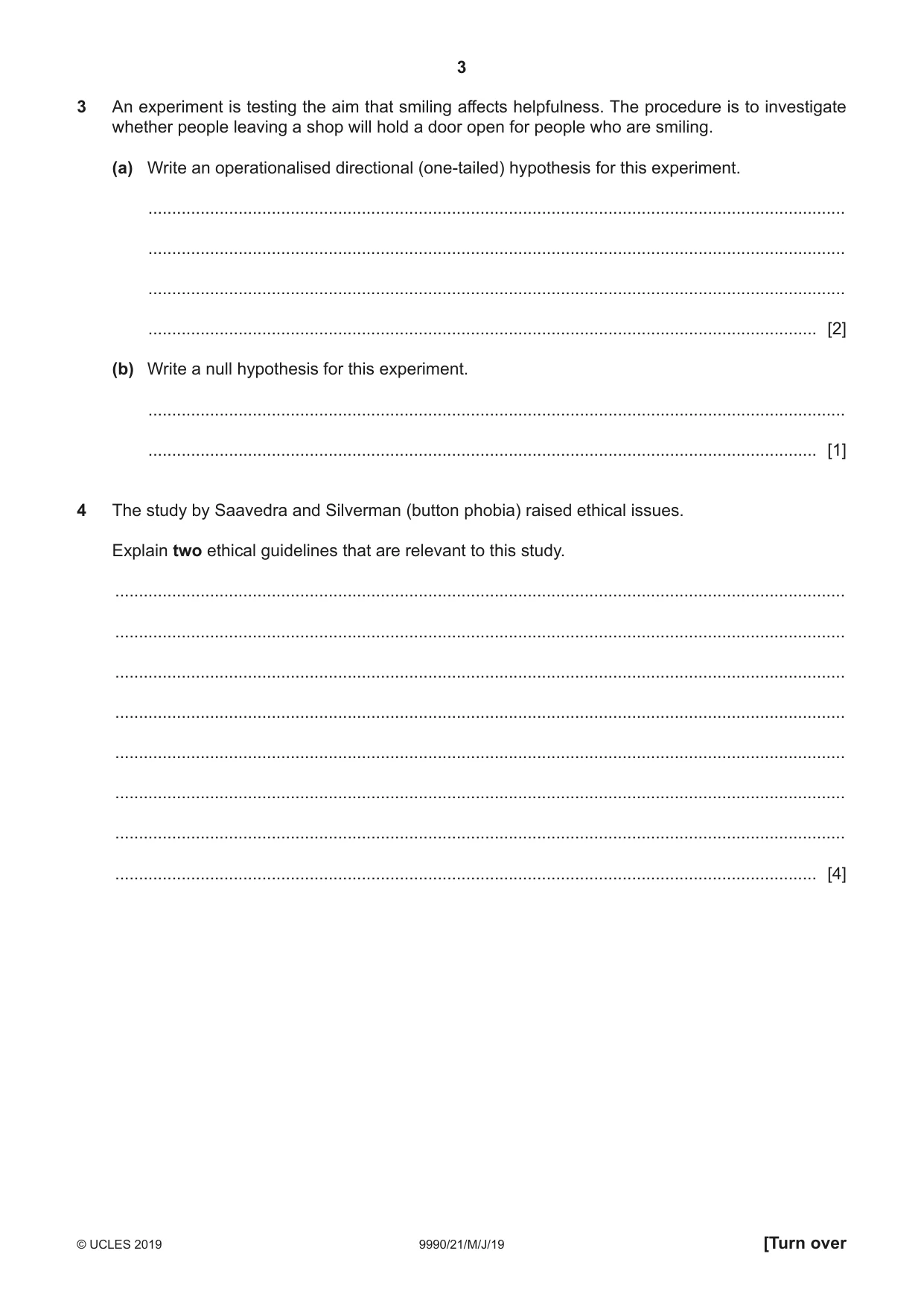
3 An experiment is testing the aim that smiling affects helpfulness. The procedure is to investigate whether people leaving a shop will hold a door open for people who are smiling. (a) Write an operationalised directional (one-tailed) hypothesis for this experiment. ................................................................................................................................................... ................................................................................................................................................... ................................................................................................................................................... ............................................................................................................................................. [2] (b) Write a null hypothesis for this experiment. ................................................................................................................................................... ............................................................................................................................................. [1]
Mark scheme: 3(a) Write an operationalised directional (one-tailed) hypothesis for this 2 experiment. 1 mark for a one-tailed hypothesis 2 marks for an operationalised hypothesis Components: Smiling (IV1) not smiling (IV2) holding door/helping (DV) ‘more than’ (one tailed) People help more when they are smiled at = 1 mark People help more when they are smiled at but don’t when they are not = 2 marks. This has smiling (IV1) and not smiling (IV2) there is the DV (help more) and there is 'helping more when smiled at' so is one tailed. People are more helpful so hold doors open more often when they are smiled at = 2 marks [more helpful/hold doors (DV) when smiled at (IV1) but no IV2 so this can only be 1 mark] People are more helpful than when they are not smiled at = 1 mark. More helpful (in what way?) than when (with no detail) not smiled at?] People are more helpful so hold doors open more often when they are smiled at than when they are not smiled at = 2 [2 marks. Has IV1, IV2, DV and tail ( i.e. more) People help when they are smiled at = 0 marks (too vague) People leaving a shop will hold the door open for people who smile = 0 marks (too vague) 3(b) Write a null hypothesis for this experiment. 1 Has to have two levels of IV but DV does not have to be operationalised Any difference between how helpful people when they are smiled at or not is due to chance. = 1 mark There is no difference between helpful people when they are smiled at or not. = 1 mark No marks for statements that are not hypotheses, or are experimental/ alternative hypotheses.
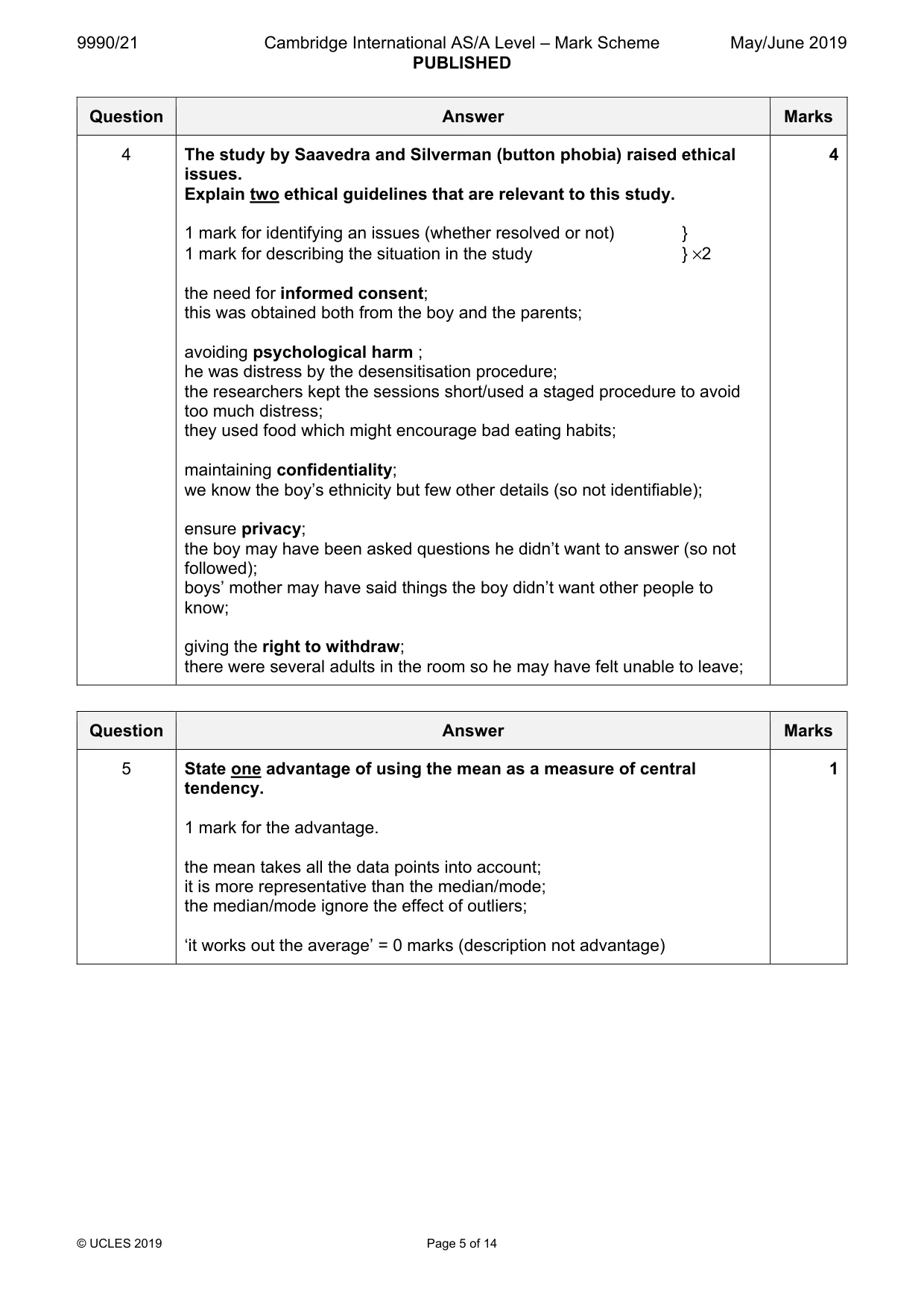
Q4 · The study by Saavedra and Silverman (button phobia) raised ethical issues
4 The study by Saavedra and Silverman (button phobia) raised ethical issues. Explain two ethical guidelines that are relevant to this study. .......................................................................................................................................................... .......................................................................................................................................................... .......................................................................................................................................................... .......................................................................................................................................................... .......................................................................................................................................................... .......................................................................................................................................................... .......................................................................................................................................................... .................................................................................................................................................... [4]
Mark scheme: 4 The study by Saavedra and Silverman (button phobia) raised ethical 4 issues. Explain two ethical guidelines that are relevant to this study. 1 mark for identifying an issues (whether resolved or not) } 1 mark for describing the situation in the study } ×2 the need for informed consent; this was obtained both from the boy and the parents; avoiding psychological harm ; he was distress by the desensitisation procedure; the researchers kept the sessions short/used a staged procedure to avoid too much distress; they used food which might encourage bad eating habits; maintaining confidentiality; we know the boy’s ethnicity but few other details (so not identifiable); ensure privacy; the boy may have been asked questions he didn’t want to answer (so not followed); boys’ mother may have said things the boy didn’t want other people to know; giving the right to withdraw; there were several adults in the room so he may have felt unable to leave;
More questions on Anxiety disorders and fear-related disorders
Q5 · State one advantage of using the mean as a measure of central tendency
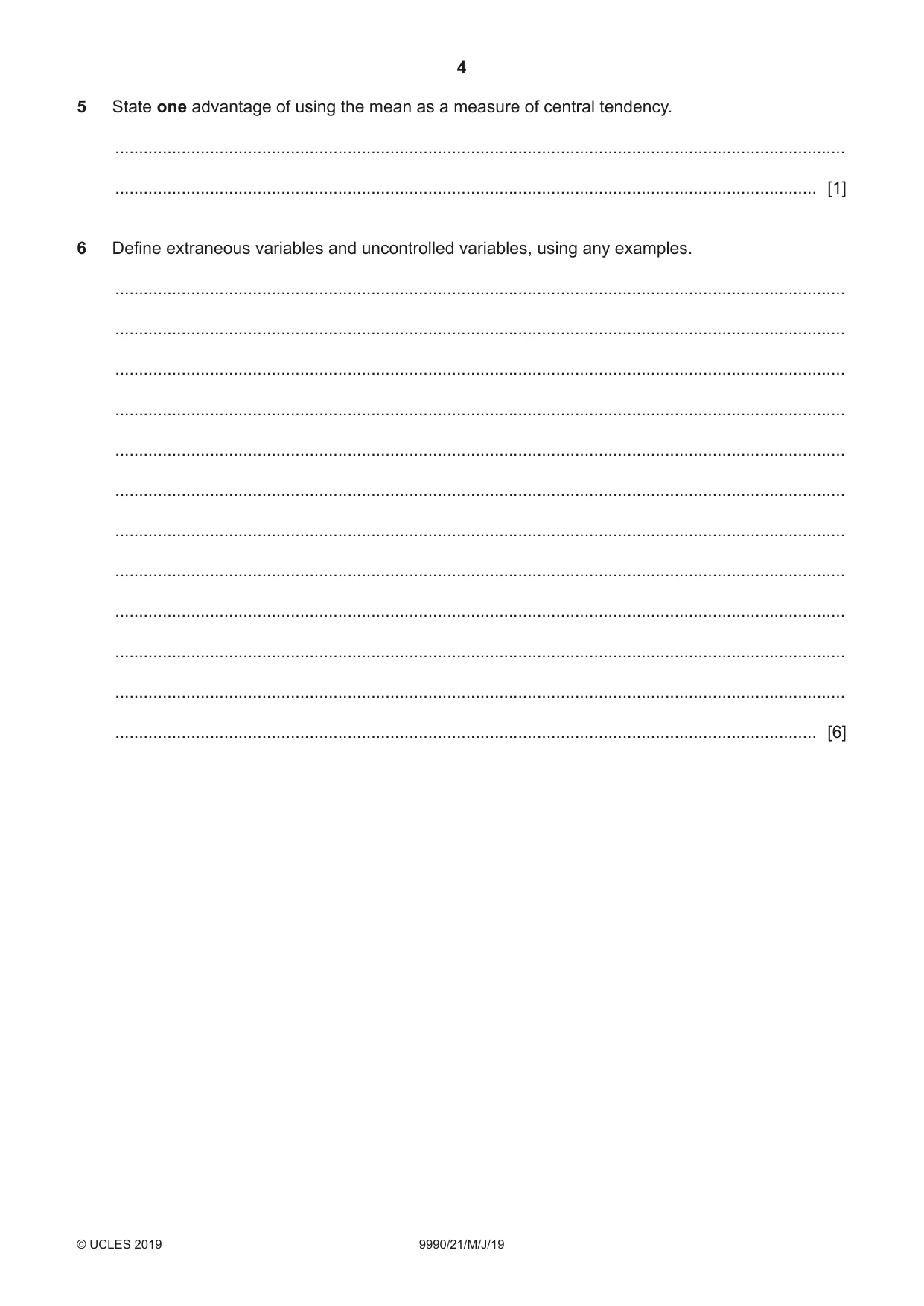
5 State one advantage of using the mean as a measure of central tendency. .......................................................................................................................................................... .................................................................................................................................................... [1]
Mark scheme: 5 State one advantage of using the mean as a measure of central 1 tendency. 1 mark for the advantage. the mean takes all the data points into account; it is more representative than the median/mode; the median/mode ignore the effect of outliers; ‘it works out the average’ = 0 marks (description not advantage)
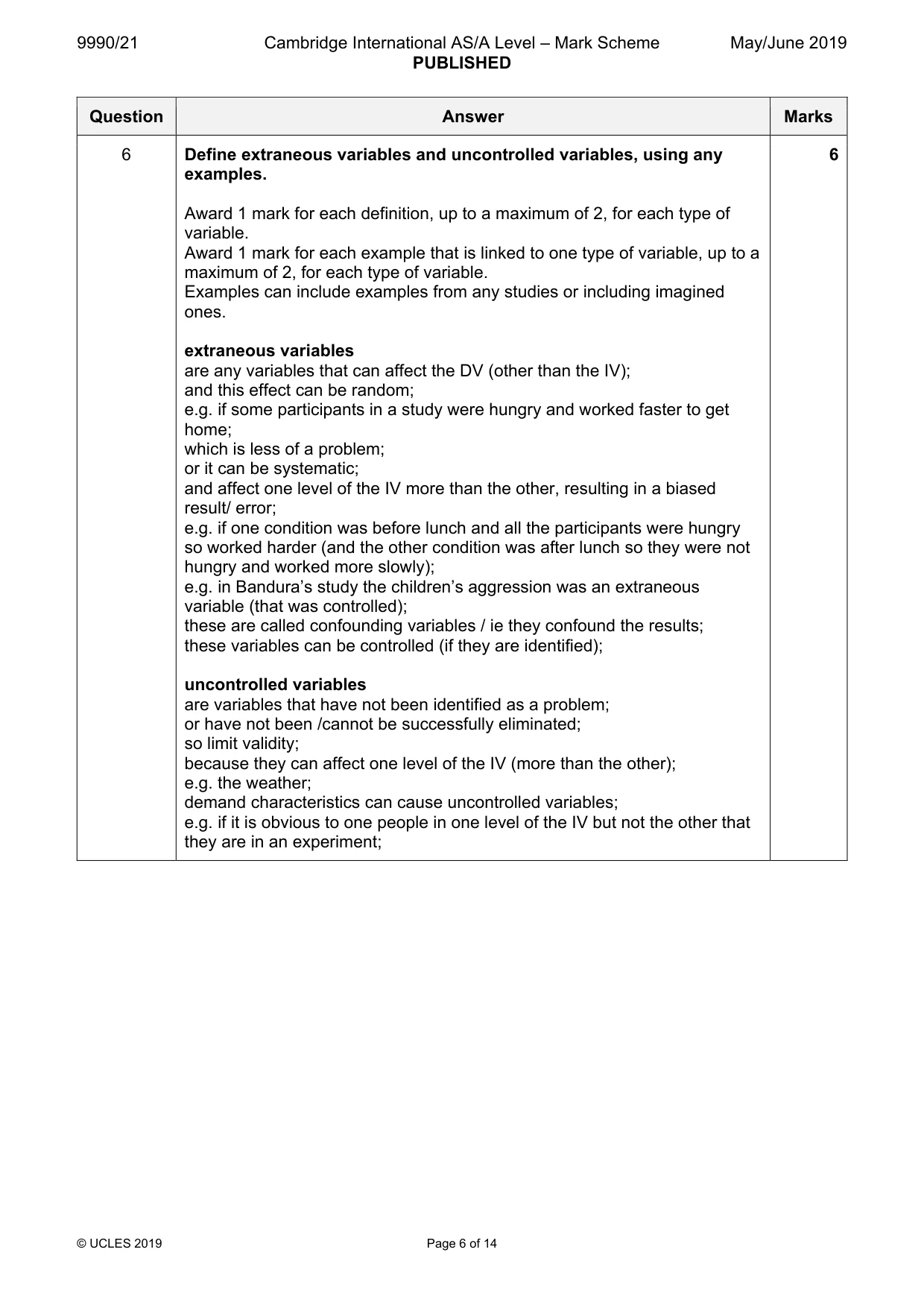
Q6 · Define extraneous variables and uncontrolled variables, using any examples
6 Define extraneous variables and uncontrolled variables, using any examples. .......................................................................................................................................................... .......................................................................................................................................................... .......................................................................................................................................................... .......................................................................................................................................................... .......................................................................................................................................................... .......................................................................................................................................................... .......................................................................................................................................................... .......................................................................................................................................................... .......................................................................................................................................................... .......................................................................................................................................................... .......................................................................................................................................................... .................................................................................................................................................... [6]
Mark scheme: 6 Define extraneous variables and uncontrolled variables, using any 6 examples. Award 1 mark for each definition, up to a maximum of 2, for each type of variable. Award 1 mark for each example that is linked to one type of variable, up to a maximum of 2, for each type of variable. Examples can include examples from any studies or including imagined ones. extraneous variables are any variables that can affect the DV (other than the IV); and this effect can be random; e.g. if some participants in a study were hungry and worked faster to get home; which is less of a problem; or it can be systematic; and affect one level of the IV more than the other, resulting in a biased result/ error; e.g. if one condition was before lunch and all the participants were hungry so worked harder (and the other condition was after lunch so they were not hungry and worked more slowly); e.g. in Bandura’s study the children’s aggression was an extraneous variable (that was controlled); these are called confounding variables / ie they confound the results; these variables can be controlled (if they are identified); uncontrolled variables are variables that have not been identified as a problem; or have not been /cannot be successfully eliminated; so limit validity; because they can affect one level of the IV (more than the other); e.g. the weather; demand characteristics can cause uncontrolled variables; e.g. if it is obvious to one people in one level of the IV but not the other that they are in an experiment;
Q7 · Dan is looking for a correlation between the amount children play and how aggressive they…
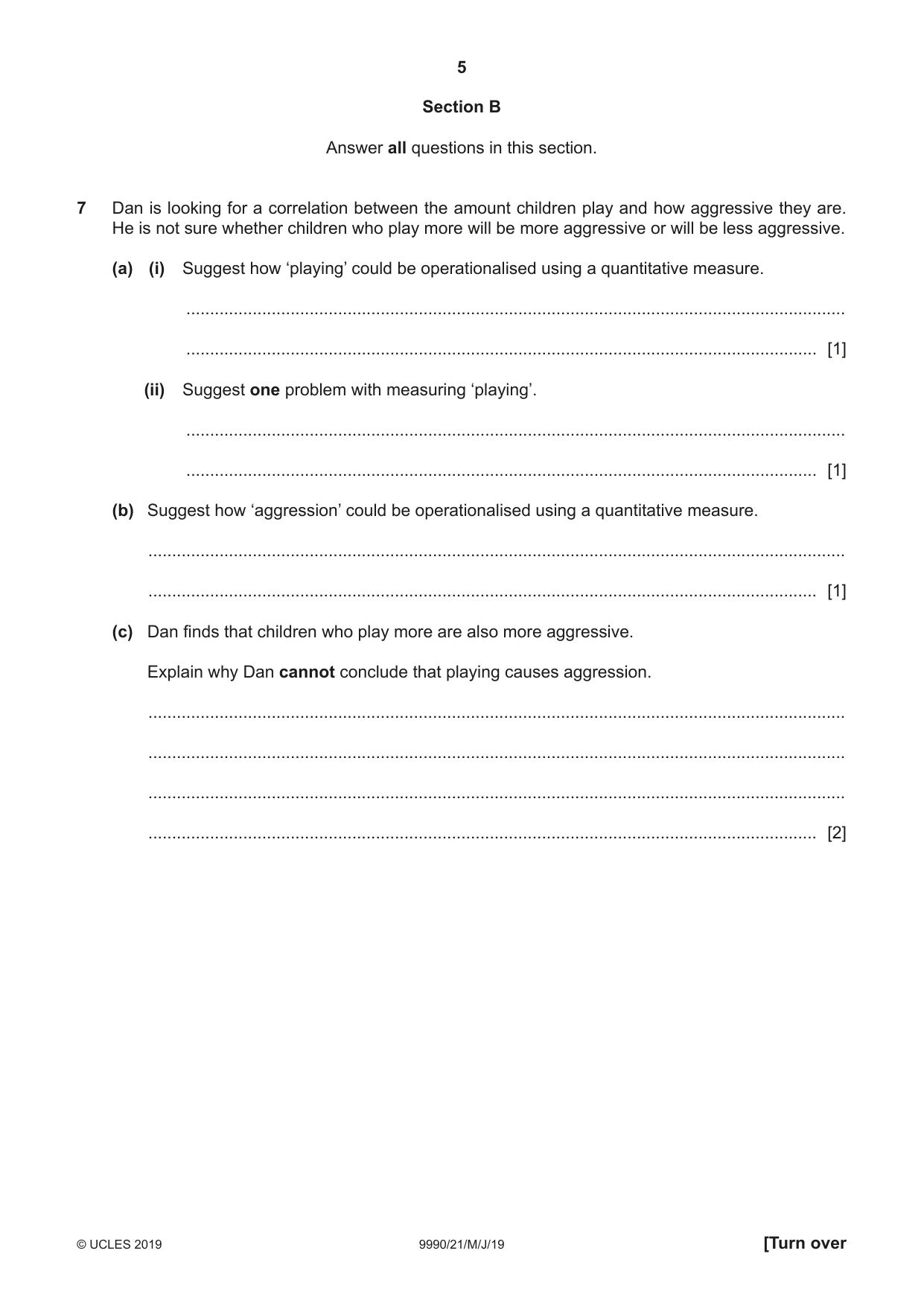
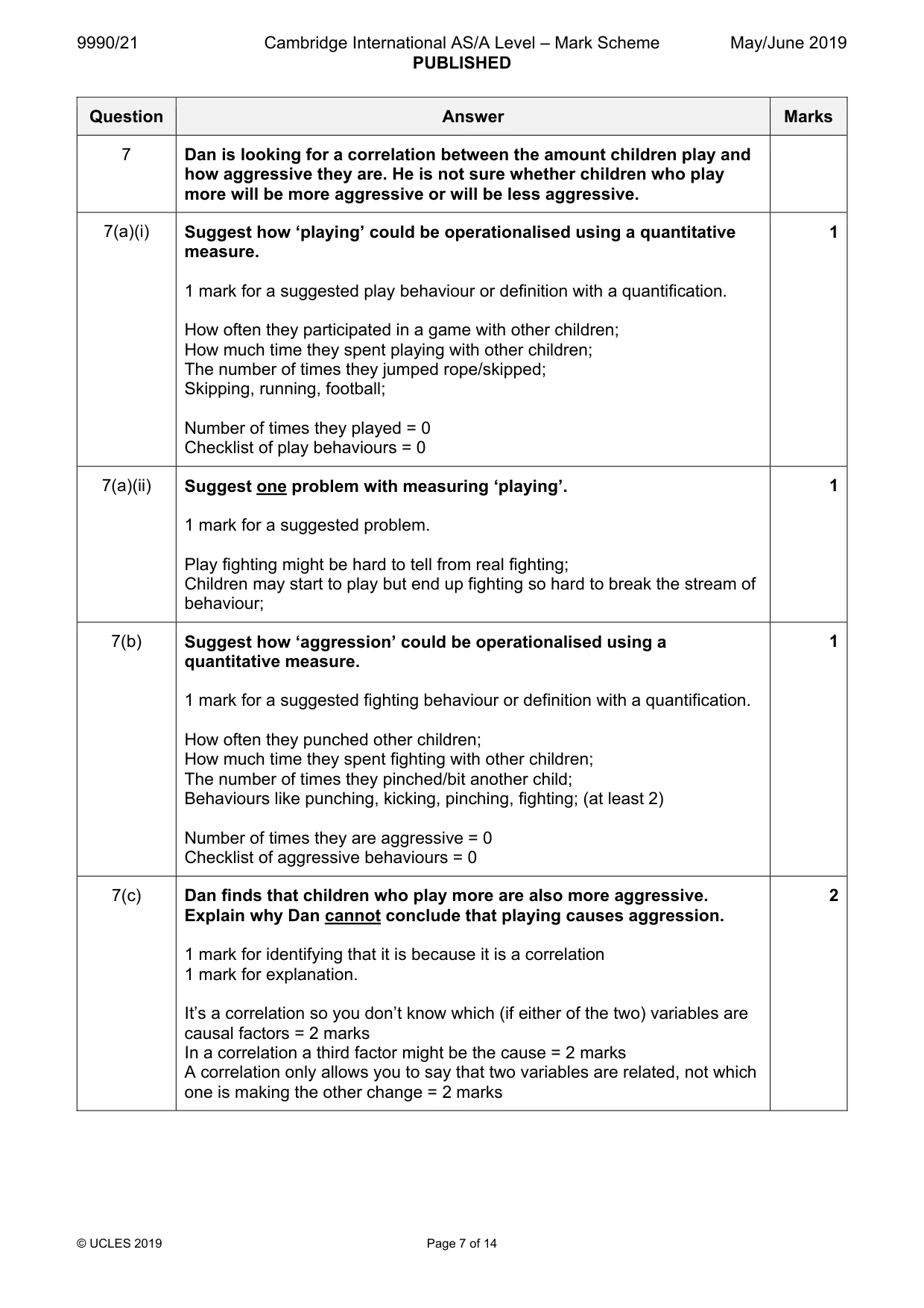
7 Dan is looking for a correlation between the amount children play and how aggressive they are. He is not sure whether children who play more will be more aggressive or will be less aggressive. (a) (i) Suggest how ‘playing’ could be operationalised using a quantitative measure. ........................................................................................................................................... ..................................................................................................................................... [1] (ii) Suggest one problem with measuring ‘playing’. ........................................................................................................................................... ..................................................................................................................................... [1] (b) Suggest how ‘aggression’ could be operationalised using a quantitative measure. ................................................................................................................................................... ............................................................................................................................................. [1] (c) Dan finds that children who play more are also more aggressive. Explain why Dan cannot conclude that playing causes aggression. ................................................................................................................................................... ................................................................................................................................................... ................................................................................................................................................... ............................................................................................................................................. [2]
Mark scheme: 7(a)(i) Suggest how ‘playing’ could be operationalised using a quantitative 1 measure. 1 mark for a suggested play behaviour or definition with a quantification. How often they participated in a game with other children; How much time they spent playing with other children; The number of times they jumped rope/skipped; Skipping, running, football; Number of times they played = 0 Checklist of play behaviours = 0 7(a)(ii) Suggest one problem with measuring ‘playing’. 1 1 mark for a suggested problem. Play fighting might be hard to tell from real fighting; Children may start to play but end up fighting so hard to break the stream of behaviour; 7(b) Suggest how ‘aggression’ could be operationalised using a 1 quantitative measure. 1 mark for a suggested fighting behaviour or definition with a quantification. How often they punched other children; How much time they spent fighting with other children; The number of times they pinched/bit another child; Behaviours like punching, kicking, pinching, fighting; (at least 2) Number of times they are aggressive = 0 Checklist of aggressive behaviours = 0 7(c) Dan finds that children who play more are also more aggressive. 2 Explain why Dan cannot conclude that playing causes aggression. 1 mark for identifying that it is because it is a correlation 1 mark for explanation. It’s a correlation so you don’t know which (if either of the two) variables are causal factors = 2 marks In a correlation a third factor might be the cause = 2 marks A correlation only allows you to say that two variables are related, not which one is making the other change = 2 marks
Q8 · Zho is investigating how quickly fish learn to respond to different coloured lights
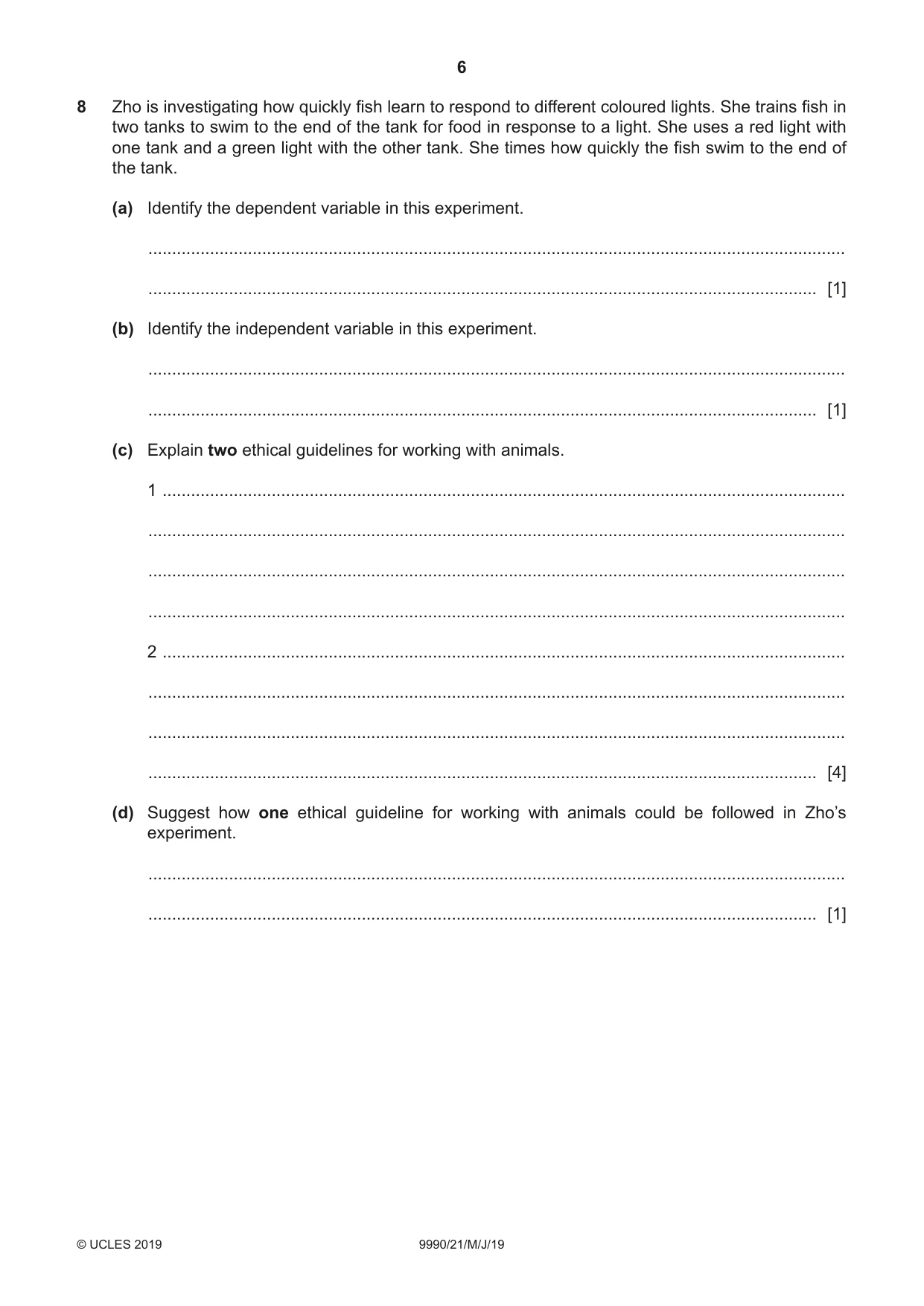
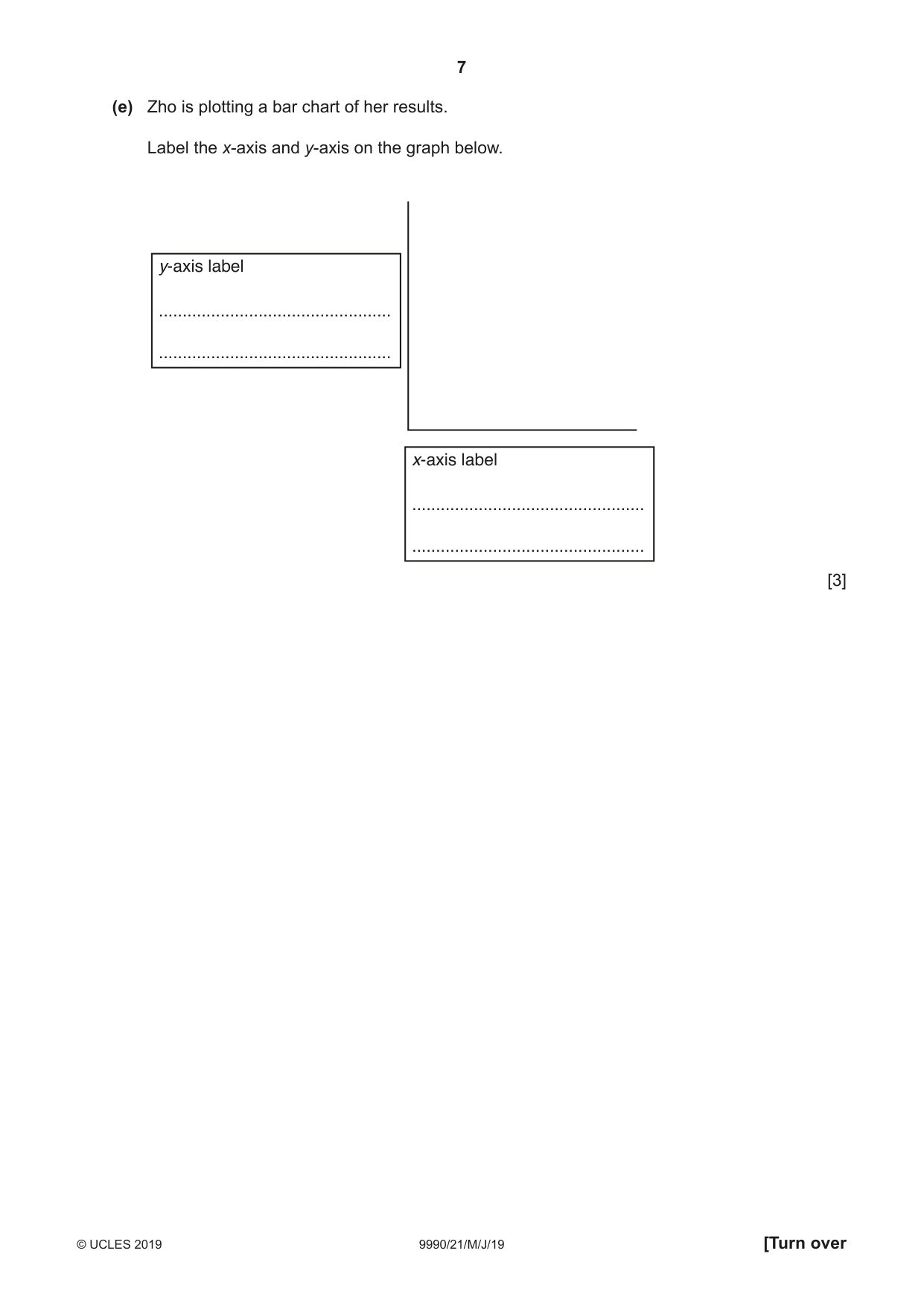
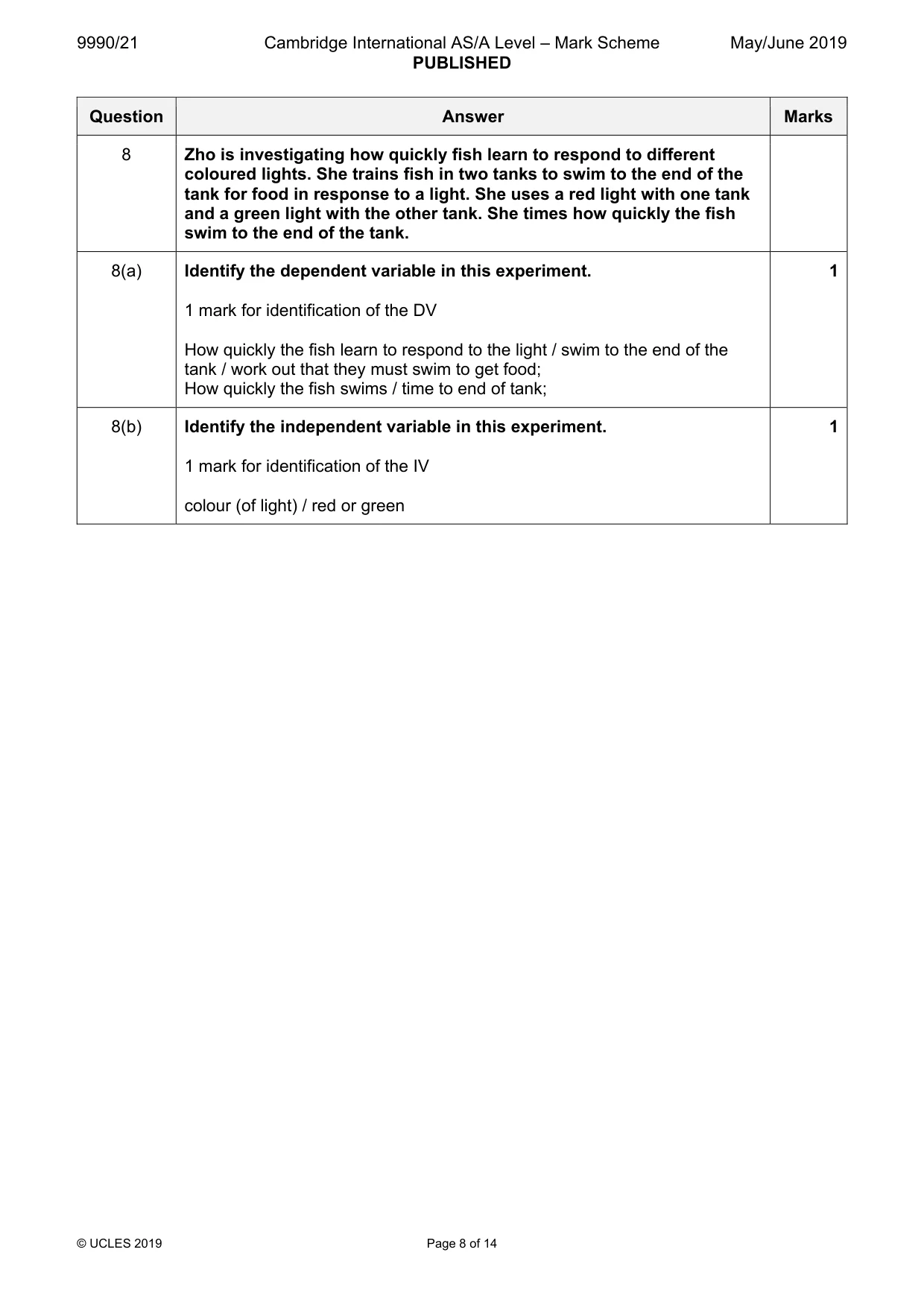
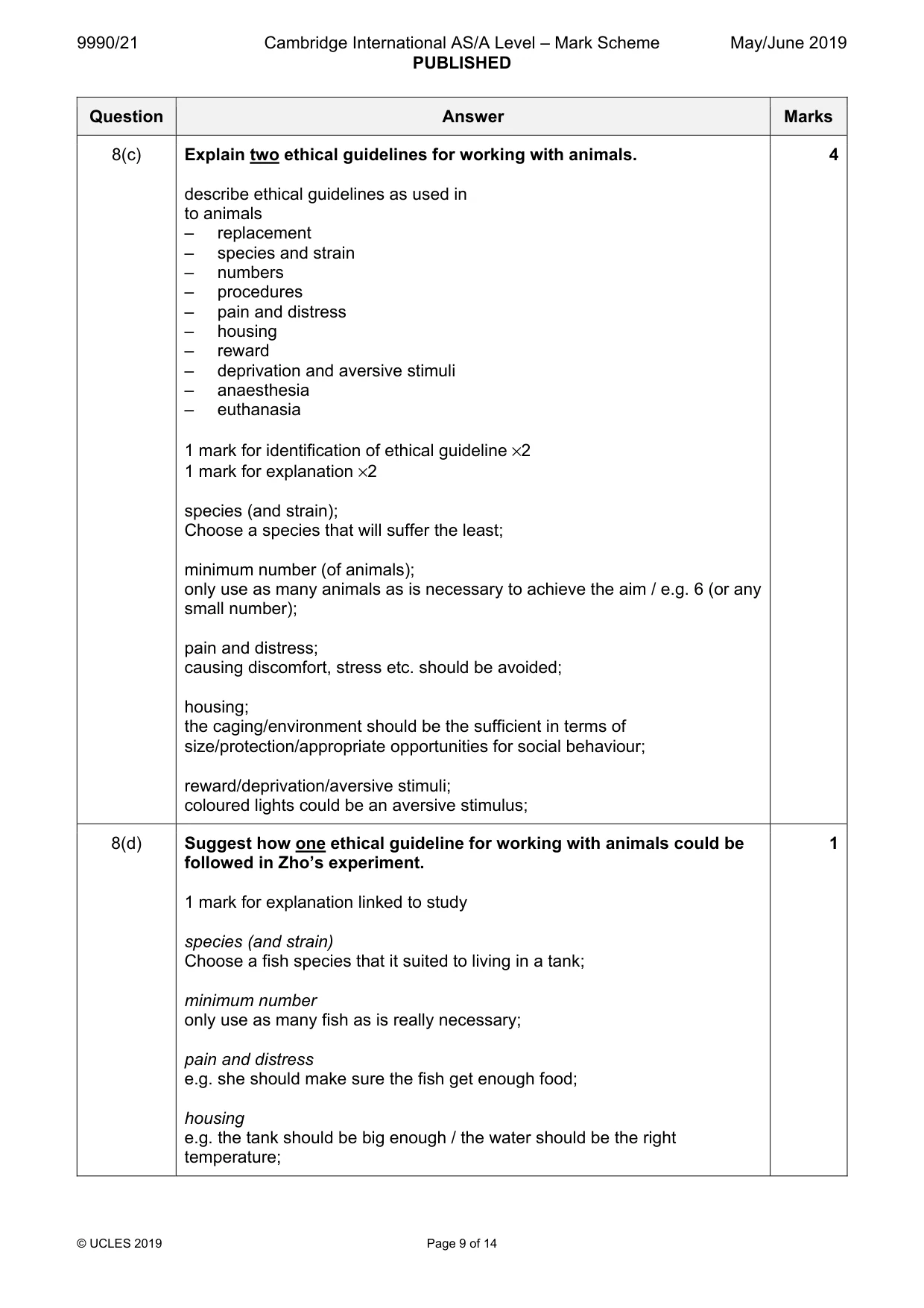
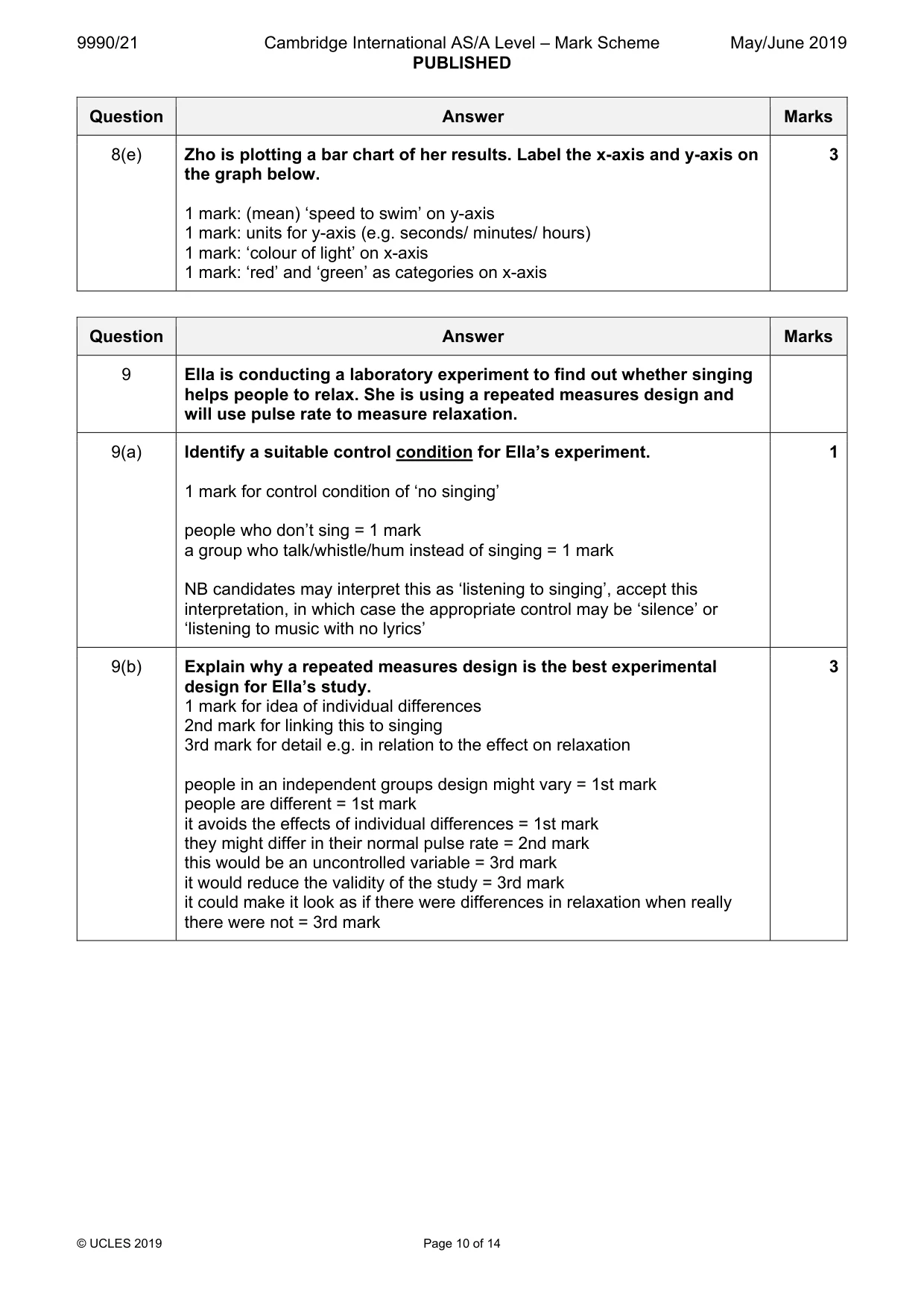
8 Zho is investigating how quickly fish learn to respond to different coloured lights. She trains fish in two tanks to swim to the end of the tank for food in response to a light. She uses a red light with one tank and a green light with the other tank. She times how quickly the fish swim to the end of the tank. (a) Identify the dependent variable in this experiment. ................................................................................................................................................... ............................................................................................................................................. [1] (b) Identify the independent variable in this experiment. ................................................................................................................................................... ............................................................................................................................................. [1] (c) Explain two ethical guidelines for working with animals. 1 ................................................................................................................................................ ................................................................................................................................................... ................................................................................................................................................... ................................................................................................................................................... 2 ................................................................................................................................................ ................................................................................................................................................... ................................................................................................................................................... ............................................................................................................................................. [4] (d) Suggest how one ethical guideline for working with animals could be followed in Zho’s experiment. ................................................................................................................................................... ............................................................................................................................................. [1] (e) Zho is plotting a bar chart of her results. Label the x-axis and y-axis on the graph below. y-axis label ................................................. ................................................. x-axis label ................................................. ................................................. [3]
Mark scheme: 8(a) Identify the dependent variable in this experiment. 1 1 mark for identification of the DV How quickly the fish learn to respond to the light / swim to the end of the tank / work out that they must swim to get food; How quickly the fish swims / time to end of tank; 8(b) Identify the independent variable in this experiment. 1 1 mark for identification of the IV colour (of light) / red or green 8(c) Explain two ethical guidelines for working with animals. 4 describe ethical guidelines as used in to animals – replacement – species and strain – numbers – procedures – pain and distress – housing – reward – deprivation and aversive stimuli – anaesthesia – euthanasia 1 mark for identification of ethical guideline ×2 1 mark for explanation ×2 species (and strain); Choose a species that will suffer the least; minimum number (of animals); only use as many animals as is necessary to achieve the aim / e.g. 6 (or any small number); pain and distress; causing discomfort, stress etc. should be avoided; housing; the caging/environment should be the sufficient in terms of size/protection/appropriate opportunities for social behaviour; reward/deprivation/aversive stimuli; coloured lights could be an aversive stimulus; 8(d) Suggest how one ethical guideline for working with animals could be 1 followed in Zho’s experiment. 1 mark for explanation linked to study species (and strain) Choose a fish species that it suited to living in a tank; minimum number only use as many fish as is really necessary; pain and distress e.g. she should make sure the fish get enough food; housing e.g. the tank should be big enough / the water should be the right temperature; 8(e) Zho is plotting a bar chart of her results. Label the x-axis and y-axis on 3 the graph below. 1 mark: (mean) ‘speed to swim’ on y-axis 1 mark: units for y-axis (e.g. seconds/ minutes/ hours) 1 mark: ‘colour of light’ on x-axis 1 mark: ‘red’ and ‘green’ as categories on x-axis
Q9 · Ella is conducting a laboratory experiment to find out whether singing helps people to…
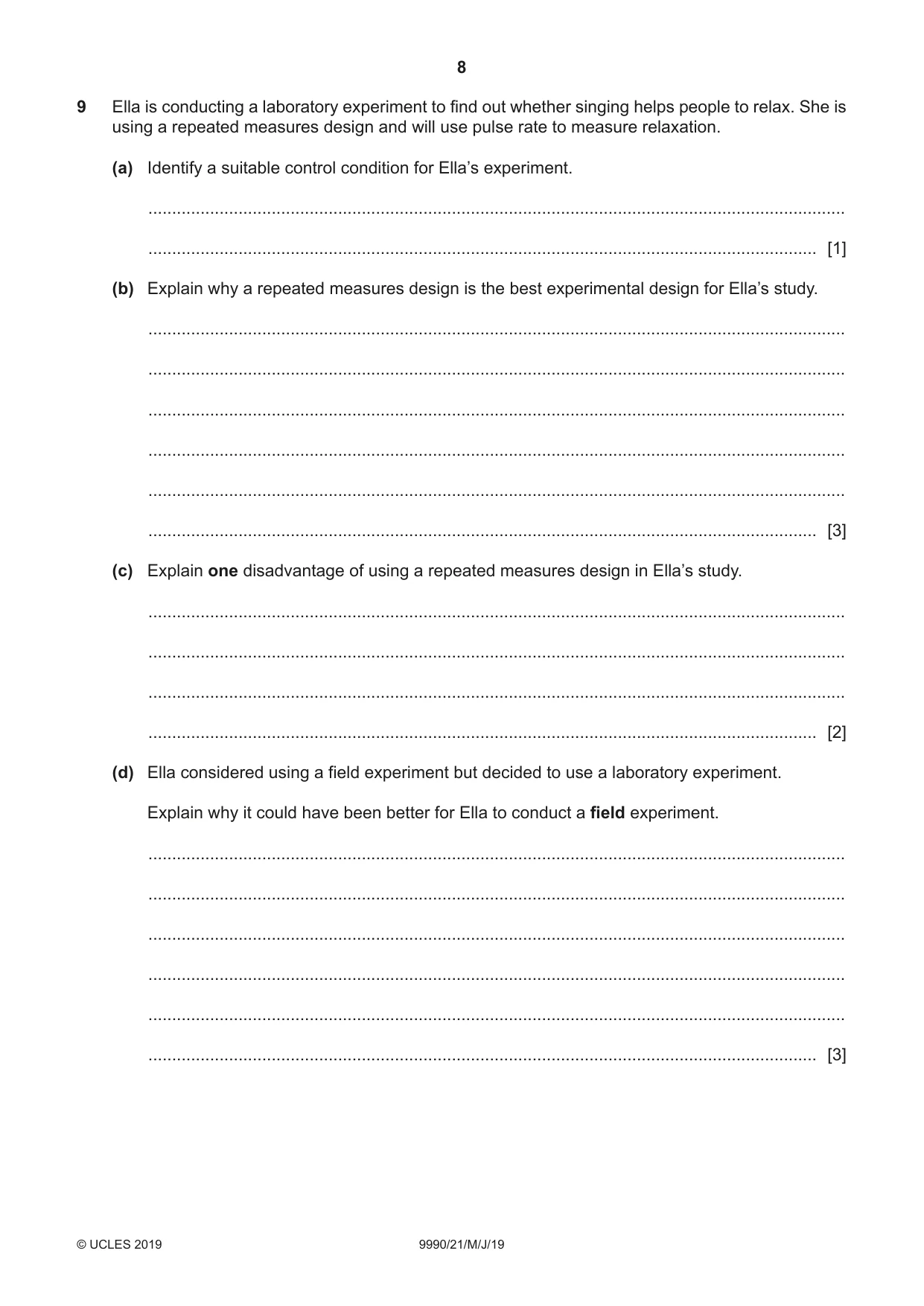
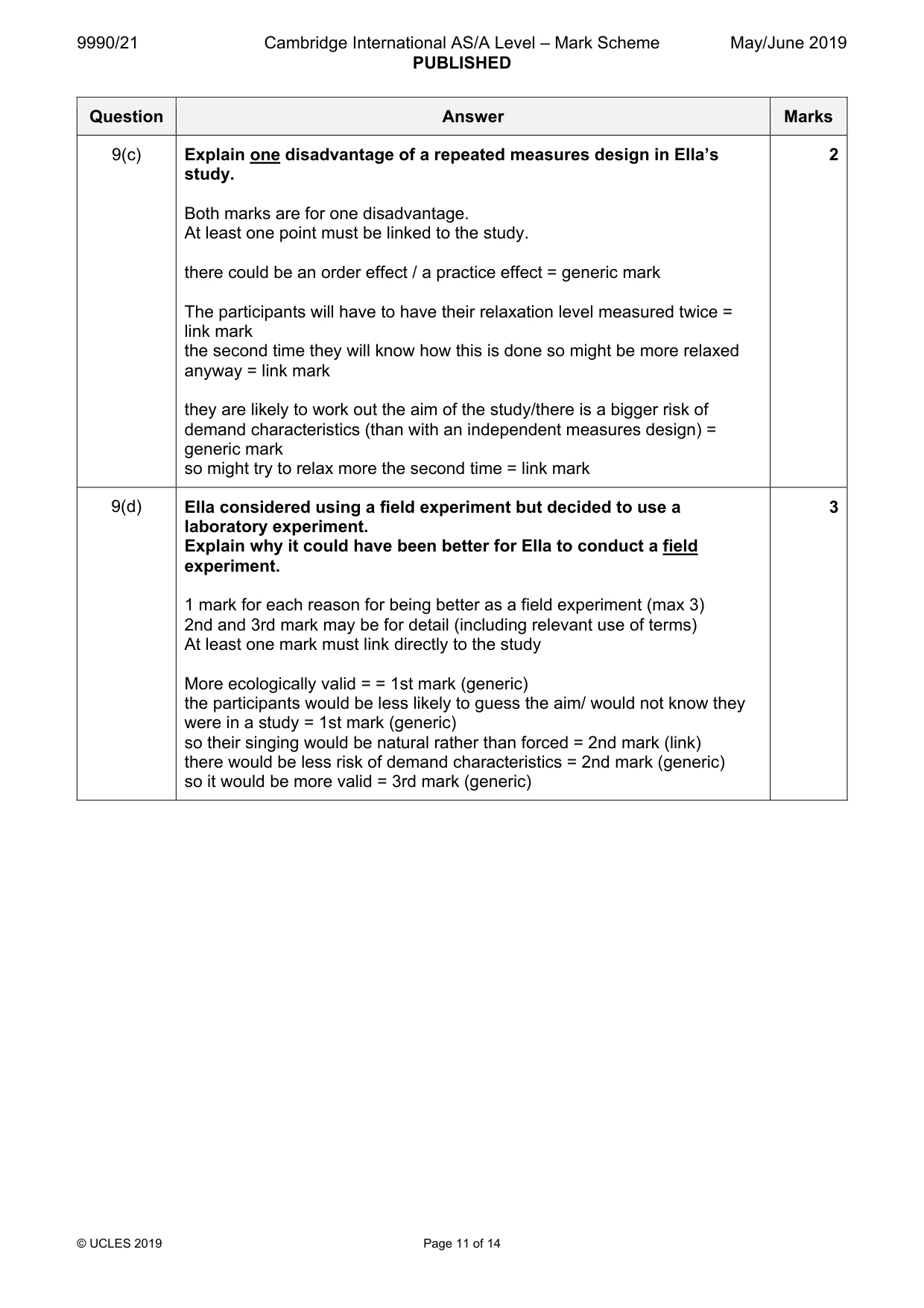
9 Ella is conducting a laboratory experiment to find out whether singing helps people to relax. She is using a repeated measures design and will use pulse rate to measure relaxation. (a) Identify a suitable control condition for Ella’s experiment. ................................................................................................................................................... ............................................................................................................................................. [1] (b) Explain why a repeated measures design is the best experimental design for Ella’s study. ................................................................................................................................................... ................................................................................................................................................... ................................................................................................................................................... ................................................................................................................................................... ................................................................................................................................................... ............................................................................................................................................. [3] (c) Explain one disadvantage of using a repeated measures design in Ella’s study. ................................................................................................................................................... ................................................................................................................................................... ................................................................................................................................................... ............................................................................................................................................. [2] (d) Ella considered using a field experiment but decided to use a laboratory experiment. Explain why it could have been better for Ella to conduct a field experiment. ................................................................................................................................................... ................................................................................................................................................... ................................................................................................................................................... ................................................................................................................................................... ................................................................................................................................................... ............................................................................................................................................. [3] Section C Answer all questions in this section.
Mark scheme: 9(a) Identify a suitable control condition for Ella’s experiment. 1 1 mark for control condition of ‘no singing’ people who don’t sing = 1 mark a group who talk/whistle/hum instead of singing = 1 mark NB candidates may interpret this as ‘listening to singing’, accept this interpretation, in which case the appropriate control may be ‘silence’ or ‘listening to music with no lyrics’ 9(b) Explain why a repeated measures design is the best experimental 3 design for Ella’s study. 1 mark for idea of individual differences 2nd mark for linking this to singing 3rd mark for detail e.g. in relation to the effect on relaxation people in an independent groups design might vary = 1st mark people are different = 1st mark it avoids the effects of individual differences = 1st mark they might differ in their normal pulse rate = 2nd mark this would be an uncontrolled variable = 3rd mark it would reduce the validity of the study = 3rd mark it could make it look as if there were differences in relaxation when really there were not = 3rd mark 9(c) Explain one disadvantage of a repeated measures design in Ella’s 2 study. Both marks are for one disadvantage. At least one point must be linked to the study. there could be an order effect / a practice effect = generic mark The participants will have to have their relaxation level measured twice = link mark the second time they will know how this is done so might be more relaxed anyway = link mark they are likely to work out the aim of the study/there is a bigger risk of demand characteristics (than with an independent measures design) = generic mark so might try to relax more the second time = link mark 9(d) Ella considered using a field experiment but decided to use a 3 laboratory experiment. Explain why it could have been better for Ella to conduct a field experiment. 1 mark for each reason for being better as a field experiment (max 3) 2nd and 3rd mark may be for detail (including relevant use of terms) At least one mark must link directly to the study More ecologically valid = = 1st mark (generic) the participants would be less likely to guess the aim/ would not know they were in a study = 1st mark (generic) so their singing would be natural rather than forced = 2nd mark (link) there would be less risk of demand characteristics = 2nd mark (generic) so it would be more valid = 3rd mark (generic)
Q10 · Dr Bell is interested in how aware people are of the two factors involved in emotion…
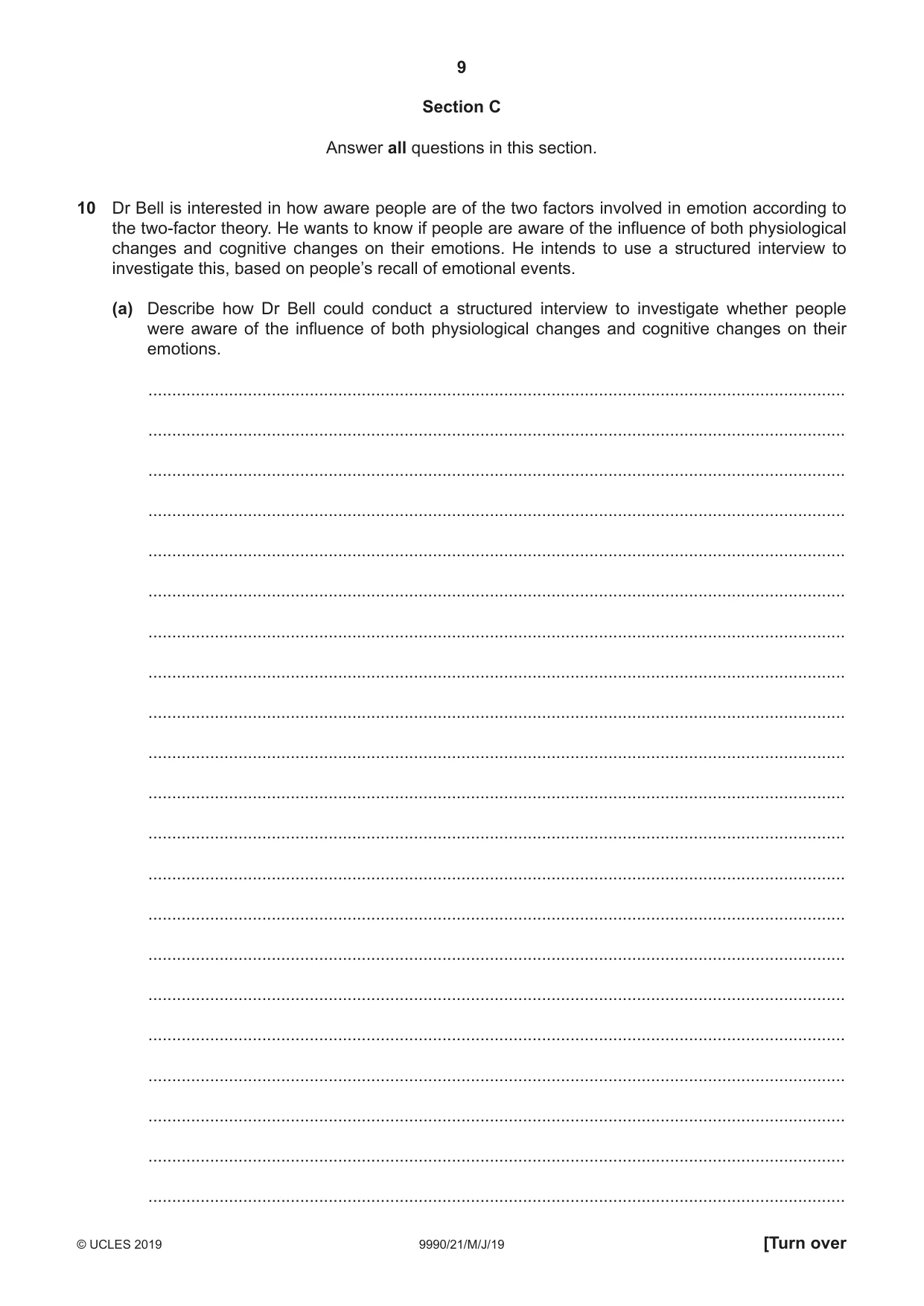
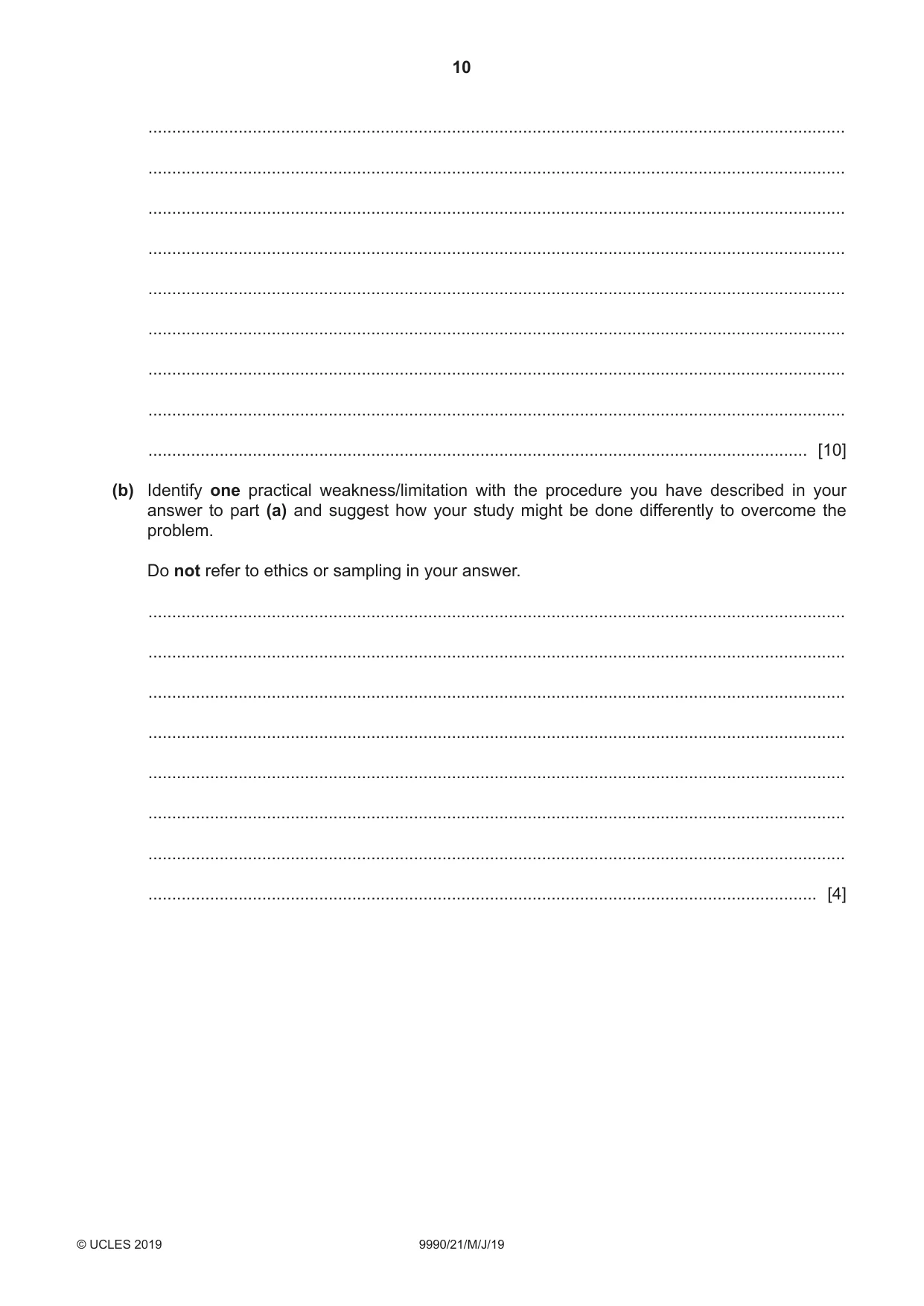
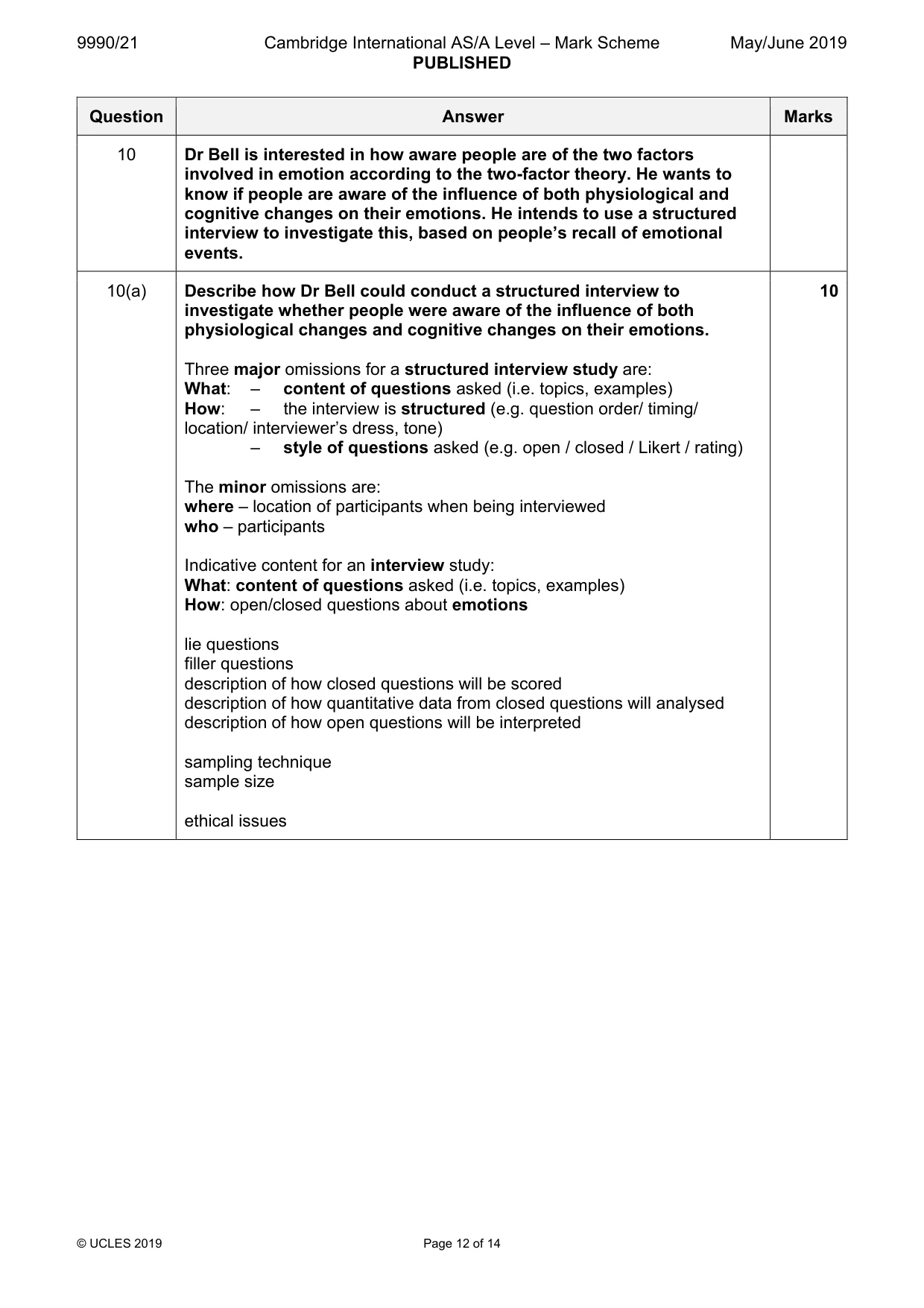
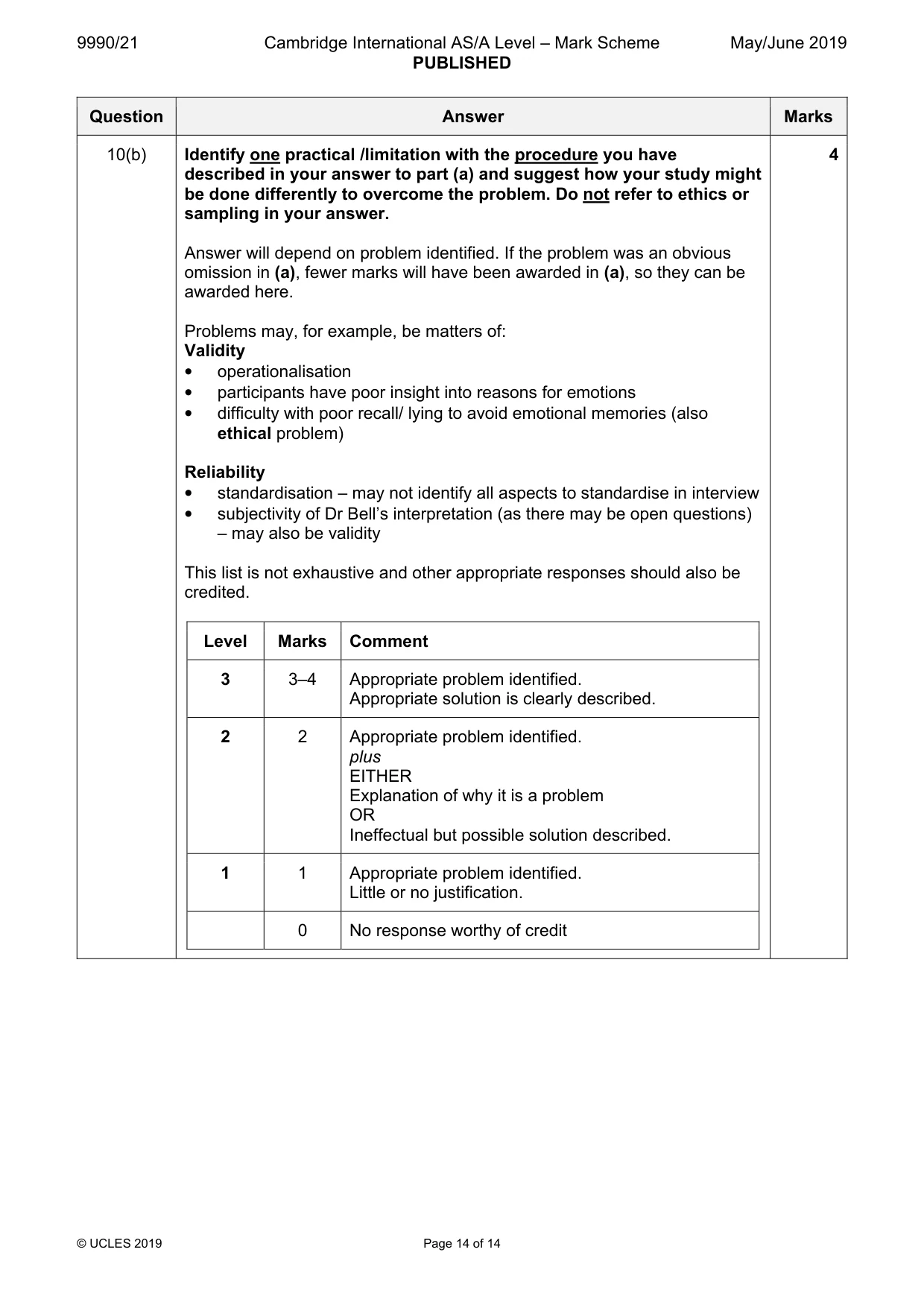
10 Dr Bell is interested in how aware people are of the two factors involved in emotion according to the two-factor theory. He wants to know if people are aware of the influence of both physiological changes and cognitive changes on their emotions. He intends to use a structured interview to investigate this, based on people’s recall of emotional events. (a) Describe how Dr Bell could conduct a structured interview to investigate whether people were aware of the influence of both physiological changes and cognitive changes on their emotions. ................................................................................................................................................... ................................................................................................................................................... ................................................................................................................................................... ................................................................................................................................................... ................................................................................................................................................... ................................................................................................................................................... ................................................................................................................................................... ................................................................................................................................................... ................................................................................................................................................... ................................................................................................................................................... ................................................................................................................................................... ................................................................................................................................................... ................................................................................................................................................... ................................................................................................................................................... ................................................................................................................................................... ................................................................................................................................................... ................................................................................................................................................... ................................................................................................................................................... ................................................................................................................................................... ................................................................................................................................................... ................................................................................................................................................... ................................................................................................................................................... ................................................................................................................................................... ................................................................................................................................................... ................................................................................................................................................... ................................................................................................................................................... ................................................................................................................................................... ................................................................................................................................................... ................................................................................................................................................... ........................................................................................................................................... [10] (b) Identify one practical weakness/limitation with the procedure you have described in your answer to part (a) and suggest how your study might be done differently to overcome the problem. Do not refer to ethics or sampling in your answer. ................................................................................................................................................... ................................................................................................................................................... ................................................................................................................................................... ................................................................................................................................................... ................................................................................................................................................... ................................................................................................................................................... ................................................................................................................................................... ............................................................................................................................................. [4]
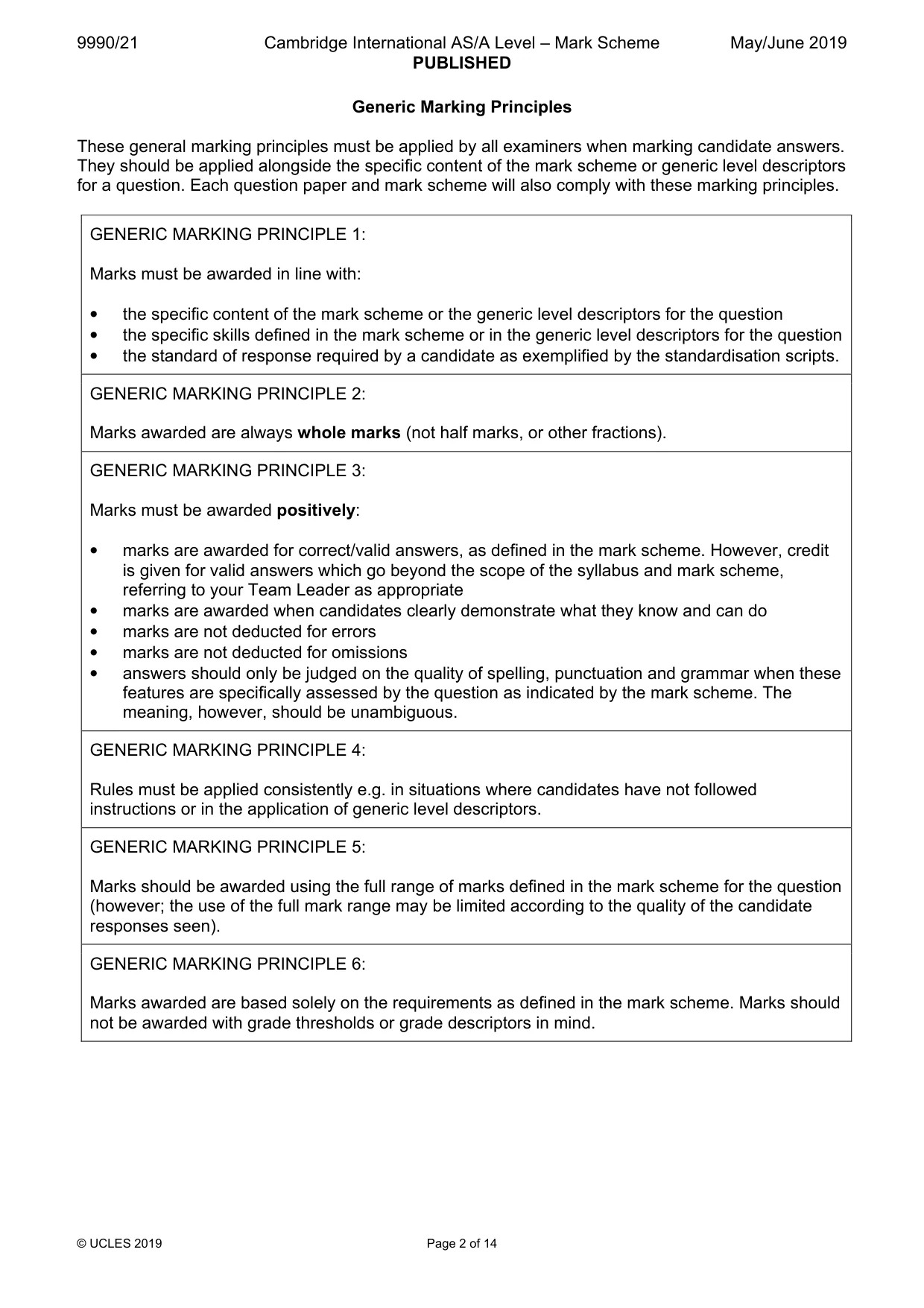
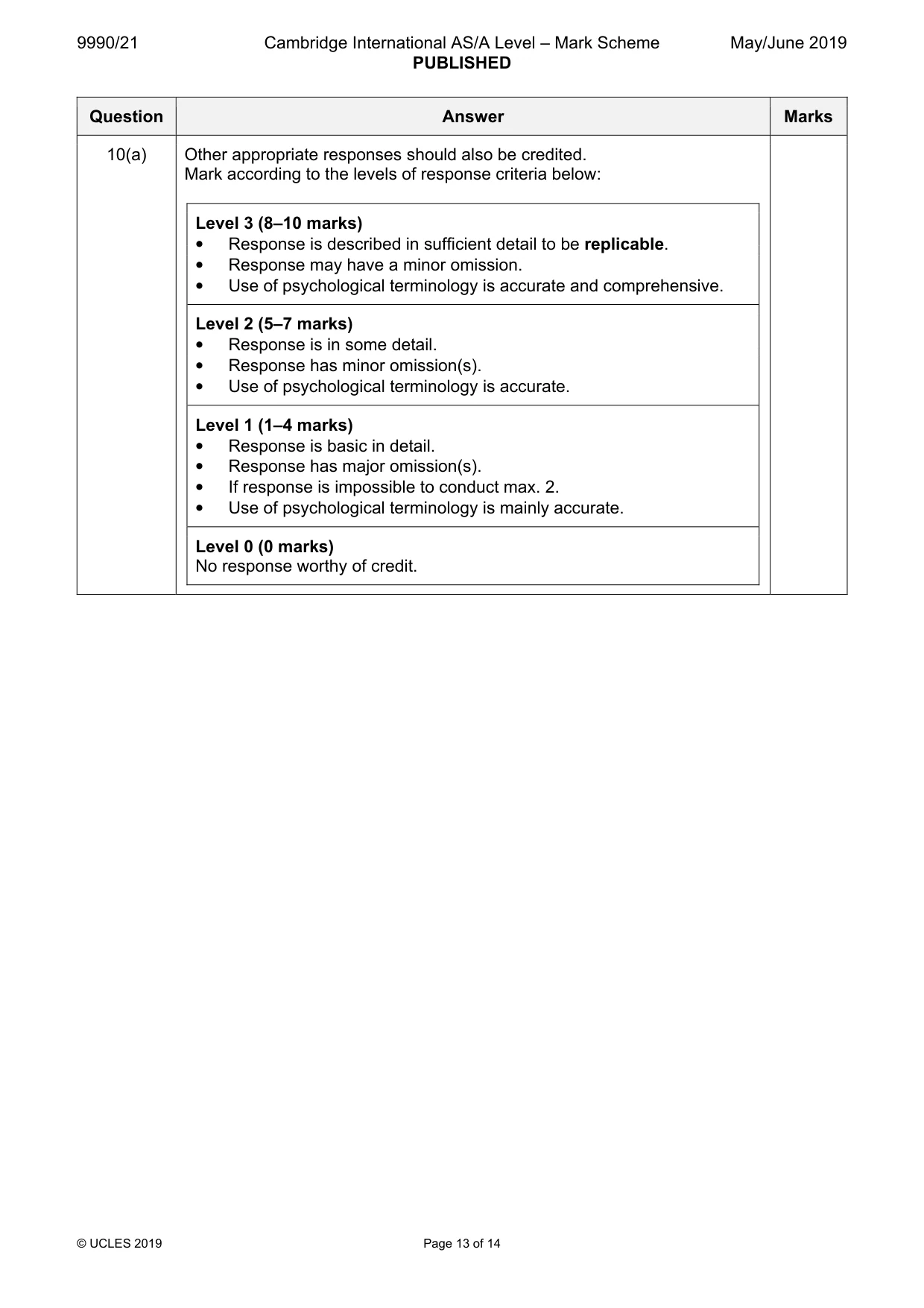
Mark scheme: 10(a) Describe how Dr Bell could conduct a structured interview to 10 investigate whether people were aware of the influence of both physiological changes and cognitive changes on their emotions. Three major omissions for a structured interview study are: What: – content of questions asked (i.e. topics, examples) How: – the interview is structured (e.g. question order/ timing/ location/ interviewer’s dress, tone) – style of questions asked (e.g. open / closed / Likert / rating) The minor omissions are: where – location of participants when being interviewed who – participants Indicative content for an interview study: What: content of questions asked (i.e. topics, examples) How: open/closed questions about emotions lie questions filler questions description of how closed questions will be scored description of how quantitative data from closed questions will analysed description of how open questions will be interpreted sampling technique sample size ethical issues 10(a) Other appropriate responses should also be credited. Mark according to the levels of response criteria below: Level 3 (8–10 marks) • Response is described in sufficient detail to be replicable. • Response may have a minor omission. • Use of psychological terminology is accurate and comprehensive. Level 2 (5–7 marks) • Response is in some detail. • Response has minor omission(s). • Use of psychological terminology is accurate. Level 1 (1–4 marks) • Response is basic in detail. • Response has major omission(s). • If response is impossible to conduct max. 2. • Use of psychological terminology is mainly accurate. Level 0 (0 marks) No response worthy of credit. 10(b) Identify one practical /limitation with the procedure you have 4 described in your answer to part (a) and suggest how your study might be done differently to overcome the problem. Do not refer to ethics or sampling in your answer. Answer will depend on problem identified. If the problem was an obvious omission in (a), fewer marks will have been awarded in (a), so they can be awarded here. Problems may, for example, be matters of: Validity • operationalisation • participants have poor insight into reasons for emotions • difficulty with poor recall/ lying to avoid emotional memories (also ethical problem) Reliability • standardisation – may not identify all aspects to standardise in interview • subjectivity of Dr Bell’s interpretation (as there may be open questions) – may also be validity This list is not exhaustive and other appropriate responses should also be credited. Level Marks Comment 3 3–4 Appropriate problem identified. Appropriate solution is clearly described. 2 2 Appropriate problem identified. plus EITHER Explanation of why it is a problem OR Ineffectual but possible solution described. 1 1 Appropriate problem identified. Little or no justification. 0 No response worthy of credit
What was in this paper
The subtopics covered by these 10 questions, and how many questions each got. Open one in a new tab to see every Cambridge question on it.
What you needed in this session
Cambridge’s own grade thresholds for 2019 May/June, Paper 2 · Variant 1. A higher threshold means an easier paper — the bar moves with how the cohort did.